VOLUME
23
NUMBER
1
FALL
1987
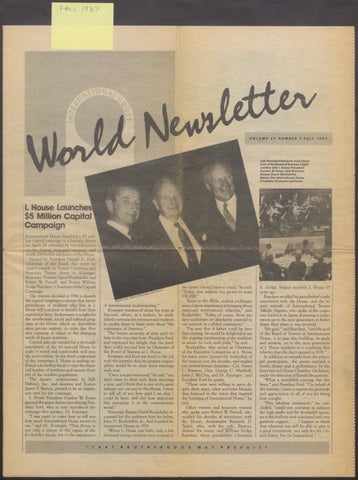
Left: President Gerald R. Ford, Chairman of the Board of Trustees, (right) confers with |. House President Gordon W. Evans and Honorary Trustee David Rockefeller. Below: The International House Chamber Orchestra performs
I. House Launche
$5 Million Capital |
Campaign International House launched a $5 million capital campaign at a historic dinner on April 28 attended by two Chairmen her
DC
gdOAEGy AOMOFALY
trustees,.and
nearly 200 friends and guests of the House. Hosted
by
President
Gerald
R.
Ford,
Chairman of the Board, the event included remarks by Former Chairman and Honorary Trustee Henry A. Kissinger, Honorary Trustees David Rockefeller and Robert W. Purcell, and Trustee William Dodge Rueckert, Chairman of the Capital Campaign. The trustees decided in 1986 to launch the capital campaign to ensure that future generations of residents who live at I. House will continue to benefit from their
of international understanding.” Kissinger reminisced about his years at
experience here. Endowment is sought for
Harvard,
he estab-
were of great importance in bringing about improved international relations,” said Rockefeller. “Today, of course, those stu-
the intellectual, social and cultural programs of the House, which are dependent upon private support, in order that they may continue to adjust to the changing needs of future residents. Capital gifts are needed for a thorough renovation of the 63-year-old House to make it sound and comfortable well into the next century. In the third component of the campaign, I. House is seeking endowed scholarship funds to ease the financial burden of residents and sustain diver-
lished a seminar for international students to enable them to learn more about “the experience of America.” The former secretary of state paid tribute to his one-time boss, President Ford, and expressed his delight that the president could succeed him as Chairman of the Board of Trustees at I. House. Kissinger said Ford was lured to the job with the promise that his primary responsiblity would be to chair three meetings
dent exchanges are absolutely essential to our survival as a global community.” “!’m sure that if father could be here this evening, he would be delighted to see the ongoing continuation of the tradition in which he took such pride,” he said. Rockefeller, who served as Chairman of the Executive Committee at I. House for many years, praised the leadership of the trustees over the decades, and singled out several former chairmen - Col. Henry
sity of the resident population. The
dinner,
Nabisco,
Inc.
underwritten and
alumnus
by
RJR
and Trustee
James T. Barton, proved to be an impressive start for the campaign. I. House President Gordon W. Evans greeted the guests before introducing President Ford, who in turn introduced the evening’s first speaker, Dr. Kissinger. “I was eager to come here to tell you how much International House means to me,”
said
Dr.
Kissinger.
“This
House
is
not only a tribute to the values of the
Rockefeller family, but to the importance
the entire United Sates to study,” he said.
prot
“Today; that number has grown to some 350;000.” “Even in the 1920s, student exchanges
By THEA FE
where,
as a student,
each year.
L.
“Once you get interested,” he said, “you don’t want to chair only three meetings a year, and I think that is one of the great tributes one can pay to this House. I want to tell all of you how glad I am that |
John J. McCloy, and Dr. Kissinger - and President Ford for praise. “These men were willing to serve de-
could
be
here,
and
also how
important
this enterprise is in the contemporary world.” Honorary Trustee David Rockefeller recounted
for the audience how his father,
John D. Rockefeller, Jr., had founded International House in 1924. “When I. House was built, only a few thousand foreign students were coming to
Stimson,
Gen.
George
C.
Marshall,
spite their many other activities because they believed in the vision that inspired the founding of International House,” he said. Other trustees and honorary trustees
who spoke were Robert W. Purcell, who recalled his decades. of association with the House, Ambassador Kenneth D. Taylor, who, with his wife, Patricia, chaired
Rueckert,
the
event,
and
William
Dodge
whose grandfather, Cleveland
ee
E. Dodge, helped establish I. House 63 years ago. Rueckert recalled his grandfather's early association
cent
with
remarks
the House,
of
and: the re-
International
Trustee
Takeshi Nagano, who spoke of the corporate tradition in Japan of passing a corpo-
ration on to the next generation in better shape than when it was received. “My goal,” said Rueckert, “and the goal of the Board of Trustees at International House, is to pass this building, its goals and
mission,
on
to
the
next
generation
of I. House residents in a condition that is better than the day it opened in 1924.” In addition to remarks from the principal participants, the guests enjoyed a lovely dinner and a performance by the International House Chamber Orchestra, under the direction of Ronald Braunstein. “What a wonderful. evening this has been,” said President Ford. “On behalfof the trustees, I want to express my gratitude and appreciation to all of you for being here tonight. "This fabulous institution,“ he concluded, "could not continue to achieve the high marks and the wonderful successes it has without your continued and very generous support . . . | happen to think that whatever you will be able to give is a good investment, not only for the United States, but for humankind.“
Left: President Gerald R. Ford, Chair-
man of the Board of Trustees, (right) confers with |. House President Gordon W. Evans and Honorary
Trustee David Rockefeller. Below: The International House Chamber Orchestra performs
I. House Launche
$5 Million Capital Campaign International House launched a $5 mill-
ion capital campaign at a historic dinner | on April a attended by two Chairmen HI
nan
ert
re
d
honor,
7
~
nearly 200 Friencs and guests er the ce,
Hosted by President Gerald R. Ford, Chairman of the Board, the event included remarks by Former Chairman and Honorary Trustee Henry A. Kissinger, Honorary Trustees David Rockefeller and Robert W. Purcell, and Trustee William
Dodge Rueckert, Chairman of the Capital Campaign.
‘the entire United Sates to study,” he said.
“Today, that number has gowns to some
~ 350,000.”
The trustees decided in 1986 to launch
the capital campaign to ensure that future generations of residents who live at I. House will continue to benefit from their experience here. Endowment is sought for the intellectual, social and cultural programs of the House, which are dependent upon private support, in order that they
may continue to adjust to the changing needs of future residents. Capital gifts are needed for a thorough renovation of the 63-year-old House to make it sound and comfortable well into
of international understanding.” Kissinger reminisced about his years at Harvard, where, as a student, he established a seminar for international students to enable them to learn more about “the
experience of America.” The former secretary of state paid tribute to his one-time boss, President Ford,
and expressed his delight that the presi- — dent could succeed him as Chairman of Kissinger said Ford was lured to the job
of the campaign, I. House is seeking endowed scholarship funds to ease the financial burden of residents and sustain diver-
with the promise that his primary respon-
sity of the resident population. - The dinner, underwritten by RJR Nabisco, Inc. and alumnus and Trustee James T. Barton, proved to be an impressive start for the campaign. I. House President Gordon W. Evans greeted the guests before introducing President Ford, who in turn introduced the evening’s first speaker, Dr. Kissinger. “I was eager to come here to tell you how much International House means to me,” said Dr. Kissinger. “This House is not only a tribute to the values of the Rockefeller family, but to the importance
our survival as a global community.” “I’m sure that if father could be here
shape than when it was received.
this evening, he would be delighted to see the ongoing continuation of the tradition
of the Board of Trustees at International House, is to pass this building, its goals. and mission, on to the next generation of I. House residents in a condition that is better than the day it opened in. 1924.” In addition to remarks from the principal participants, the guests enjoyed a | lovely dinner and a performance by the
out several former chairmen - Col. Henry L. Stimson, Gen. George C. Marshall,
each year.
“Once you get interested,” he said, yg
John J. McCloy, and Dr. Kissinger - and President Ford for praise. “These men were willing to serve despite their many other activities because they believed in the vision that inspired the founding of International House,” he said. Other trustees Sod honorary trustees
don’t want to chair only three meetings
a year, and I think that is one of the great tributes one can pay to this House. I want to tell all of you how glad I am that I
could be here, and also how important is in the aren
world.”
Honorary Trustee David Rockefeller recounted for the audience how his father, John D. Rockefeller, Jr., had founded International House in 1924. “When I. House was built, only a few thousand foreign students were coming to
association with the House, and: the recent remarks of International Trustee Takeshi Nagano, who spoke of the corpo- 5 rate tradition in Japan of passing a corpo-
| for many years, praised the leadership of the trustees over the decades, and singled
siblity would be to chair three meetings
this enterprise
Rueckert recalled his grandfather's early
“Even in the 1920s, soir exchanges _ were of great importance in bringing about _ improved international relations,” said Rockefeller. “Today, of course, those student exchanges are absolutely essential to
in which he took such pride,” he said. Rockefeller, who served as Chairman _ of the Executive Committee at I. House
the Board of Trustees at I. House.
the next century. In the third component
|
E. Dodge, helped establish 1. House 63 years ago.
who spoke were Robert W. Purcell, who recalled his decades of association with the House, Ambassador Kenneth D.
Taylor, who, with his wife, Patricia, chaired the event, and William Dodge Rueckert,
whose grandfather, Cleveland
ration on to the next generation in better
“My goal,” said Rueckert, “and the goal
International House Chamber Orchestra, under the direction of Ronald Braunstein. | —
“What a wonderful. evening this has | been,” said President Ford. “On behalf of |
the trustees, I want to express my gratitude. and appreciation to all of you for being» here tonight. "This. fabulous institution,“ he concluded, "could not continue to achieve |
the high marks and the wonderful successes it has without your continued and very generous support . . . | happen to think that whatever you will be able to give is | a good investment, not only for the United States, but for humankind.“
Trustee Nagano Offers Perspective of Japanese CEO
I. House Resident Zheng Wang
Chinese Doctor Recalls Struggle There is a feeling of being at ease about Zheng Wang, an International House resident for the past year and a half, that
belies her life as a doctor in the People’s Republic of China. She freely tells about the hardships of being a “barefoot doctor” during the Chinese cultural revolution and the difficulty of mastering both traditional Chinese and western medicine. Yet even after living in New York where “everything seems so strange,” she considers herself lucky. Indeed her first introduction to medicine was unlikely. Leaders of the cultural revolution had relocated one of the four great masters of Chinese medicine, Kong
Be
Hua,
.near
Wang’s
home.
Through a family connection, the young woman, soon began to study secretly under the doctor who had been forbidden to teach. She took to her studies with determination.
“When I was not with him I would read medical books from morning to night,” Wang says. “For a whole year I just read, read, read.” By 1969, however, the revolution had become more severe and Wang’s prominent family was torn apart. Her father was thrown in jail, her brothers and sisters deported to villages throughout the country. Wang was sent to a collective farm of about 800 peasants in Heilongjang Province in northeastern China. Life on the farm was hard. There was no electricity, no proper heating and little rest from work in the sweltering fields. Wang recalls that when she first arrived she was too frail to lift water from a well. But when she returned to her home six years later, she had become so muscular her mother did not recognize her. Although she labored in the fields, Wang
also ran a clinic at night, adminis-
tering herbal remedies and acupuncture. The herbs are generally boiled and drunk with sugar. “Often it turns out to taste pretty good,” Wang says. She used acupuncture for illnesses as serious as appendicitis. “Traditional Chinese medicine is not as simple as many people think it is,” Wang says. “I have studied it for about 20 years now and I can only say that I have-a handle on it., But western medicine, which I have studied for much less time, I feel like I know pretty well.” For most of her own ailments, Wang relies on traditional medicines and has assembled a large collection of herbs and
acupuncture
needles
in her
I. House
room. Like any good doctor, however, she is concerned about the well-being of the masses and often administers traditional treatments to Chinese students living in
I. House. After six years on the farm, government officials allowed Wang to return home. Still interested in health care, she began studying Western medicine and earned her M.D. at the Beijing Medical Hospital. The combination of Chinese and Western medical expertise propelled her quickly up the administrative ladder. Before leaving for New York, she was in charge of Beijing Medical University’s academic affairs. In the United States, Wang finished a Master’s degree in public health at Columbia University and is now a candidate for an ED. D. degree from the health education department of Teachers College at Columbia. Wang is now studying the health of babies of different races in New York and is trying to determine if o race’s lifestyle leads to healthier infants. Like past events in Wang’s life, living in New York has not been easy. “I call it my second trip to the farm,” she says. “It’s
different than big cities in other countries. New York is a big international family. But it’s a hard place to be a poor student.” “Because New York can be difficult, | feel very lucky to live in a place like I. House,” she says. “It is really great to come home to my International House family.” While in New York, Wang has witnessed Western medicine first-hand. She is impressed with American ~ diagnostic techniques like ultrasound and X-rays, but
Thirty years after leaving International House, Dr. Takeshi Nagano reminisced about his first chance to make international friends and “eat steamed rice cooked on the one rice cooker.” Dr. Nagano, president of Mitsubishi
friction from the world, especially from the business world. What is important is how to resolve that friction. I feel it would be wise not to let the problems that occur in economics and business get linked to emotional issues such as antipathy or an-
Metal
tagonism.”
Corporation
in Tokyo,
spoke
to a
group of residents and guests at a dinner in his honor on April 24. Under the theme “Multilateral Cooperation from the Point of View of a Japanese Chief Executive Officer,” he addressed the frictions between Japan and the United States precipitated by an overvalued yen and trade disagreements. “The bilateral relations between Japan and the United States face the most crucial moment in the 40 years-after the end of World
War
II,” he said.
“I don’t
like
the use of the language ‘trade war,’ but the situation is so complex that it really is a matter of requiring both
nations
to
consider seriously the reasons why we have come to face such an unbearable, difficult situation.”
The solution he proposed cuts through superficial economic analysis to a deeper, more personal approach. “I feel the situation we find ourselves in today is such that material issues have been linked to a difference of philosophy and even to a difference of culture. “What I'd like to think about are not the issues of current U.S.-Japanese friction on the surface,
but rather the prob-
imnot but has
created
and
American,
Canadian
West German companies. “In the process I found that it is vital to have deep human ties with the other partner, and it’s also important to have a full understanding of the partner’s basic characteristics and traditions.” Dr. Nagano assured the students that competition is.a healthy by-product of business.
He
is concerned,
can
lead
to
hard
however,
feelings
and
relations,
“I will just take pleasure in doing what
the
success
(and
recent
adjustments) of Japanese labor policy and Japanese overseas investment. Dr.
Nagano
was joined by Mr.
Naem-
ura, president of Mitsubishi Metals USA, and two members of the Tokyo office, Messrs: Nakagome and Nakamura. President Gordon Evans and his wife Barbara also welcomed several other distinguished guests, including: Stephen C. Eyre, Chairman of the Executive Commit-
tee of the Board of Trustees; Trustee William Dodge Rueckert, Chairman of the Capital Campaign; President Emeritus
that it
Howard
World Council Member and President of the International Council of Women; and alumnus and Trustee James T: Barton.
be impossible to avoid any
dislikes chemicals, which often have unwanted side effects. When practicing in China or on herself, Wang prefers to use a combination of Western chemical treatments and traditional Chinese remedies. The Chinese herbal remedies - and acupunture were developed over 1,000 years ago coinciding with the nation’s first attempt at surgery. Although revolutionary for their time, Wang says Chinese surgical techniques have not advanced like those in the West. But Chinese doctors operate less frequently than do Americans, she adds. Wang, who has about another two years in New York, was joined by her husband this summer. He is employed as a visiting scholar in the architecture department at Columbia. “It was very unusual for the Chinese government to let him come here,” Wang says. “They usually don’t want couples to live together because they might not want to come back.” Although Wang’s administrative duties are likely to increase when she returns — a prospect she grudgingly accepts — she seems certain to make the best of it. my boss tells me,” she laughs.
1953
misun-
derstanding. “It would
Dr. Nagano lived in the House from
to 1955 as he studied metallurgy at Columbia University. He earned a Ph.D. in pyrometallurgy in 1962 and returned to Japan to work in copper smelting. In December 1979 he was elected to represent Japan as an I. House International Trustee. He has served Mitsubishi Metal as president since 1982. Prominent accomplishments _ notwithstanding, the powerful corporate executive still fondly smiles as he recalls his days on Riverside Drive. “I believe there is nowhere in the world such an ideal place where understanding each other transcends nation, race, language and custom.” Following his talk, the Japanese alumnus answered questions from Swiss, South African and American residents. He addressed the critical and timely issues of the rapidly increasing yen, U.S.-Japan trade
lems behind it or underlying it.” Dr. Nagano’s observations on the portance of cultural sensitivity stem only from his I. House friendships, also from several joint ventures he with
“In this context I believe the existence of International House and your experiences here are extremely valuable.” Over 1,000 Japanese students have resided at International House in past years.
Dr. Takeshi Nagano with President Gordon W. Evans and Chairman of the Executive Committee Stephen C. Eyre.
A.
Cook;
Dr.
Sookja
Hong,
Trustee Nagano Offers Perspective of Japanese CEO Thirty years after leaving International House, Dr. Takeshi Nagano reminisced about his first chance to make international friends and “eat steamed rice cooked on the one rice cooker.” Dr.
Nagano,
president
of Mitsubishi
Metal Corporation in Tokyo, spoke to a
tagonism.”
group of residents and guests at a dinner
“In this context I believe the existence of International House and your experiences here are extremely valuable.”
in his honor on April 24. Under the theme “Multilateral Cooperation from the Point of View of a Japanese Chief Executive Officer,” he addressed the frictions between Japan and the United States precipitated by an overvalued yen and trade disagreements.
1. House Resident Zheng Wang
_|Chinese Doctor Recalls Struggle There is a feeling of being at ease about Zheng Wang, an International House resi-
Republic of China. She freely tells about
officials allowed Wang to return home. Still interested in health care, she began studying Western medicine and earned her M.D.
the hardships of being a “barefoot doctor”
at the Beijing Medical Hospital. The com-
during the Chinese cultural revolution
bination of Chinese and Western medical expertise propelled her quickly up the administrative ladder. Before leaving for
dent for the past year and a half, that belies her life as a doctor in the People’s
and the difficulty of mastering both traditional Chinese and western medicine. Yet
even after living in New York where “everything seems so strange,” she considers
herself lucky. Indeed her
first
introduction
to
medicine was unlikely. Leaders of the cul-
tural revolution had relocated one of the four great masters of Chinese medicine,
| Kong Be Hua, .near Wang’s home. Through a family connection, the young woman, soon began to study secretly under the doctor who had been forbidden to _| teach. She took to her studies with deter| mination.
|
“When I was not with him I would read
medical books from morning to night,” Wang says. “For a whole year I just read, read, read.” By 1969, however, the revolution had:
| become more severe and Wang's prominent family was torn apart. Her father was
thrown in jail, her brothers and sisters deported to villages throughout the country. Wang was sent to a collective farm of
| about 800 peasants in Heilongjang Province in northeastern China. Life on the farm was hard. There was
| no electricity, no proper heating and little rest from work in the sweltering fields. Wang recalls that when she first arrived . she was too frail to lift water from a well. But when she returned to her home six | years later, she had become so muscular her mother did not recognize her. Although she labored in the fields, | Wang also ran a clinicat night, administering herbal remedies and acupuncture. The herbs are generally boiled and drunk with sugar. “Often it turns out to taste pretty good,” Wang says. She used acupuncture for illnesses as serious as ap-
| pendicitis. |. “Traditional Chinese medicine is not as | simple as many people think it is,” Wang |
I. House. After six years on the farm, government
New York, she was in charge of Beijing Medical University’s academic affairs. In the United States, Wang finished a
Master’s degree in public health at Columbia University and is now a candidate for an ED. D. degree from the health education department of Teachers College at _ Columbia. Wang is now studying the — health of babies of different races in New York and is trying to determine if one race’s lifestyle leads to healthier infants.
Like past events in Wang’s life, living in New York has not been easy. “I call it my second trip to the farm,” she says. “It’s different than big cities in other countries.
New York is a big international family. But it’s a hard place to be a poor student.” “Because New York can be difficult, I
feel very lucky to live in a place like I. House,” she says. “It is really great tocome | home to my International House family.” While in New York, Wang has witnessed Western medicine first-hand. She is impressed with American © diagnostic techniques like ultrasound and X-rays, but
The solution he proposed cuts through superficial economic analysis to a deeper, more personal approach. “I feel the situation we find ourselves in today is such that material issues have
been linked to a difference of philosophy and even to a difference of culture. “What I'd like to think about are not the issues of current U.S.-Japanese fric-
tion on the surface, but rather the problems behind it or underlying it.” Dr. Nagano’s observations on the importance of cultural sensitivity stem not only from hisI. House friendships, but also from several joint ventures he has created with American, Canadian and West German companies. “In the process | found that it is vital to have deep human ties with the other partner, and it’s also important to have a full understanding of the partner’s basic characteristics and traditions.” Dr. Nagano assured the students that competition is.a healthy by-product of bus-
iness. He is concerned, however, that it can lead to hard feelings and misunderstanding. “It would be impossible to avoid any
such an ideal place where understanding each other transcends nation, race, language and custom.’ Following his talk, the Japanese alumnus answered questions from Swiss, South African and American residents. He addressed the critical and timely issues of the rapidly increasing yen, U.S.-Japan trade relations, the success (and recent
adjustments) of Japanese labor policy and Japanese overseas investment. Dr. Nagano was joined by Mr. Naem-.|. ura, president of Mitsubishi Metals USA, and two members of the Tokyo office, Messrs: Nakagome and Nakamura. President Gordon Evans and his wife Barbara also welcomed several other distinguished guests, including: Stephen C. Eyre, Chairman of the Executive Committee of the Board of Trustees; Trustee William Dodge Rueckert, Chairman of the
Capital Campaign; Howard A. Cook;
alumnus and Trustee James T. Barton.
cans, she adds.
Wang, who has about another two years _ in New York, was joined by her husband | this summer. He is employed as a visiting — scholar in the architecture department at
ingly accepts — she seems certain to make _ the best of it.
“I will just take pleasure in doing what — my boss tells me,” she laughs.
Dr. Takeshi Nagano with President Gordon W. Evans and Chairman _ Of the Executive Committee
Stephen C. Eyre.
President Emeritus Dr. Sookja Hong,
World Council Member and President of the International Council of Women; and
surgical techniques have not advanced — like those in the West. But Chinese doc- | tors operate less frequently than do Ameri-
is concerned about the well-being of the ‘treatments to Chinese students living in
come to face such an unbearable, difficult
situation.”
attempt at surgery. Although revolutionary for their time, Wang says Chinese
room. Like any good doctor, however, she | masses and often administers traditional
is a matter of requiring both nations to consider seriously the reasons why we have
tee. He has served Mitsubishi Metal as president since 1982. Prominent accomplishments _ notwithstanding, the powerful corporate executive still fondly smiles as he recalls his days on Riverside Drive. “I believe there is nowhere in the world
The Chinese herbal remedies. and_ acupunture were developed over 1,000 years ago coinciding with the nation’s first -
“It was very unusual 7 the Chinese government to let him come here,” Wang — says. “They usually don’t want couples to live together because they might not want to come back.” Although Wang’s administrative duties are likely to increase when she returns — a prospect she grudg- |
medicine,
the situation is so complex that it really
Japan as an I. House International Trus-
itional Chinese remedies.
_| which I have studied for much less time, I feel like I know pretty well.” For most of her own ailments, Wang | relies on oot medicines and has assembled a large collection of herbs and Biche needles in her I. House
it., But western
the use of the language ‘trade war,’ but
Japan to work in copper smelting. In December 1979 he was elected to represent
When practicing in China or on herself, Wang prefers to use a combination | | of Western chemical treatments and trad-—
Columbia.
on
“The bilateral relations between Japan and the United States face the most crucial moment in the 40 years:after the end of World War II,” he said. “I don’t like
Over 1,000 Japanese students have resided at International House in past years. Dr. Nagano lived in the House from 1953 to 1955 as he studied metallurgy at Colum- | bia University. He earned a Ph.D. in pyrometallurgy in 1962 and returned to
dislikes chemicals, which often have un- — wanted side effects.
says. “I have studied it for about 20 years | now and I can only say that I have~a
handle
.
friction from the world, especially from the business world. What is important is how to resolve that friction. I feel it would be wise not to let the problems that occur in economics and business get linked to emotional issues such as antipathy or an-
complete, and by the spring of 1988, five brand new elevators will be operational.
inviting. They are, indeed, central to the
Considerable improvements will be made to our auditorium/theatre complex, and resident floors and lounges have been and will continue to be refurbished. In early 1985 we decided, with Board support, to group each of the eight reServices, Bazaar, etc.) into a business en-
terprise complex. It has been exhilarating to see the enterprise concept applied to I. House units that previously have been
For all these reasons: an exciting reno-
leaders in their fields, and prepare them
relevance to our graduate student/trainee population, the House continues to be a
As you know,
the experience of living in | —
reach for their own potential.It provides an understanding of issues. It develops not only an awareness of other perspectives|
in our various offices, and our
computer intern is studying the feasibility of a program which would make available to our resident body the use of House com-
required to turn down approximately 9 out of every 10 applicants, which clearly _ attests to the demand for an International
divergent to one’s own are very often based on equally rational arguments, dif-|
puters on a limited basis. Our new state-_ of-the art telephone system has been well
_ House-type experience.
positions.
I am sure our alumni will be interested to learn that the number of countries represented over the most recent five-year
received. Thus, the House’s renovations projects
and
capital
improvements
con-
tinue to make our physical plant more attractive than ever to prospective residents.
International House is making an effort to appeal to students who, without our financial assistance would not be able to apply to live here. We now have a systematic program of work aid opportunities, fel-
period has increased from 76 to 83. The number of countries represented for one -month or longer during FY 1987 was 93.
Representation from Eastern Europe and | the PRC has risen dramatically over the
period, whereas the number of students _ hailing from African and Latin American countries, sensitive as they are to changes
-lowships, and no-interest loans and grants —_
boilers is essentially
Our programs =o
the House equally
but an appreciation of those perspectives, a recognition
that attitudes opposing or
ferences arising only from different presup-|
Becoming aware of cultural differences | _ beliefs and opinions. And by becoming | — Es aware of cultural similarities, these resi-|
dents find a common basis and perhaps even the hint of more objective truths | that underlie the possibility of a global | community.
If this was and continues to
be your experience as a global citizen, we hope you will stay in touch with Inter tional gia NYC and will su
ndontt
As you will read elsewhere in this newsletter, in April we launched International House’s $5 million capital campaign. Our
¢
Jose T. Aguilar
INDONESIA _ Sjamsiah Achmad
< EGYPT Aly Ahmed Raafat
wa
iia
ARGENTINA Horacio C. Reggini
gH
nie ner
Cesare B. Fabozzi
AUSTRALIA Anthony Gorman
Jean-Marie Pj ners Hevre ehinteticoniees:©
JAPAN
“alga coma
FEDERAL REPUBLIC OF
ae es
ti
GERMANY Walther Casper
eae ‘
BELGIUM Henri Simonet
BRAZIL Sergio P. Mendes
CANADA
Susan and Alan McLaine CHILE
Mario Astorga
Hernan Elizalde
Bruno Niemeyer Karin Zinkann GREECE Peter a E. Deras
Vassilia Petsas
scien
Mrs. Peter Choy
Wing-Lim Ho
Agnes Ng Teh Chao and King-Fan Pai Kayloe Tiio
»
UNITED KINGDOM Mohammad Kia
PAKISTAN
Abdullah A. Almoosa Salim Al-Moosa,
REPUBLIC OF CHINA George Y.L Wu
taro Asano Takeshi Nagano . Akiko and Rempei Mizuno
SAUDI ARABIA
KOREA Sookja Hong |Byong Hyun Shin Kim Myong Whai — Seungpil Yu
SINGAPORE Stephen Lee
Farouk Luqgman
SPAIN Manuel Alonso-Olea
KUWAIT
SUDAN
Milind S. Gadkary
Bona. Malwal-Ring
:
sea
che
Amadou Ba
ia de
;
SWITZERLAND
Beat U. Semadeni
sani
Arnold Stalder
THAILAND
CZECHOSLOVAKIA
ICELAND
Oscar Carpizo
‘Otakar Matousek
Sigurdur Helgason
Gerardo Hemken
DENMARK Poul Kjaer-Hansen
INDIA | Win Chadha | Nand Khemka Madhav Pradhan
DOMINICAN REPUBLIC
NORWAY Knut Boye Merethe Ring
M. Ikramullah Khan
ITALY
Esther and Sergio Gasperoni
THE NETHERLANDS
Willibrord Van Nierop : NIGERIA ; Joseph Adegbite _
UNITED ARAB EMIRATES
UNITED STATES OF AMERICA Clarence Akwai | James T. Barton Emma R. Broisman Vincent Carrozza Richard S. Cowen James M. Davis Barbara Grace
Helen and Richard Halverson Summer Scott Huyette Roger Jollis Margaret Rice Anne and Kees Schager H. Clay Simpson Starlin Sims Daisy Soros Gustav Szabo Frank C. Taylor Werner Valeur-Jensen Lucia K. Whitmarsh
Frank Wong
Prok Amranand
Snoh Unakul | TURKEY Isabel Horulu Tunc Ulug |
_
_
and celebrating them prepares our resi-| dents for understanding others’ lifestyles,
The International House Council of World Members 1987 CO-CHAIRMEN Sigurdur Helgason Daisy Soros
|
to help make that community a reality. |
ram of participatory activities, promotes confidence in residents, allowing them to |
world which are under-represented at I. House.
new
diverse group of individuals, much like | yourselves, already destined to be future
vation program, continued attempts to
penditure of nearly $3 million. You will be pleased to learn, I know, that the installation of two
leaders for the global community. This is not a mission intended to create leaders: | it is, rather, a mission intended to take a
meet the financial needs of our residents, and creative programs of excellence and
ment Budget, we project for FY 88 an ex-
which we can all be justifiably proud! In our Renovation and Capital Improve-
International House continues to|_ broadcast widely its mission: preparing |
an environment of such diverse excellence, combined with a challenging prog-
,in the international economy and comfor residents, and anticipate formulating re ‘parative exchange rates, has fluctuated. a program of scholarship "outreach“ The room demand from the Far East and whereby we will realize increased applicaWestern Europe has risen significantly, tions from countries such as the People’s though actual admissions have been fewer relative to the flood of applications. Republic of China and other areas of the
backgrounds living together. But recent | advances in the renovations, scholarships and programs areas, are something of
second half — lies ahead.
place where students seeking a significant cross-cultural and international experience, choose to live. Just this fall we were
computers
parable spirit of 500 persons of diverse
months we have reached half our goal, we recognize that the greater challenge — the |
in its second year under the baton of Con-
Computers have made an incalculable impact on residents and staff at International House. We now have 24 personal —
or 22 years ago; it has that familiar old world warmth and charm and the incom-
resident participates in orientation night,
ductor Ronald Braunstein, looks forward to continuing a successful 1987-1988 year.
sector exposure that often does not exist within a not-for-profit institution.
body. Mind you, the house looks and feels the same as when you were here four, ten,
focusing on the House’s financial needs over the next five years. While in six
rams, sports and social programs reach a
control of expenditures. Residents working in these enterprises are given a private
As I approach the anniversary of my first five years of service as President of International House, I am struck by the wide variety of recent developments, all made possible through the cooperative efforts of our Board of Trustees, staff, and resident
year brings 530 residents into community. Just as when you were here, nearly every
great many of our residents on a regular basis. And our chamber orchestra, now
largely service rather than bottom-line oriented. Most recently printing and video production have been sandwiched into the enterprise format with much greater attention to pricing, marketing and
the President
Board of Trustees and several of its committees~set the ball rolling in FY 1985,
Sunday Suppers, and the Night of Nations. A strong majority attend our Thursday evening Cultural Hours, which are consistently presented with humor and enormous creativity. The International Forum, performing and visual arts prog-
venue producing entities (our Pub, Dining
Che
spirit of International House, which each
VENEZUELA Maria J. Da Silva YUGOSLAVIA Sinisa Ruzicic
ocean, Internat! Every Sun
ue:
se barbeq y ay, so man d to
5
» State
, t
community
be ch which will ry rempora the most
ec taylor R
S.
in rel eased Hill, was ion it w ed a r G ck Mc paperba In a dia d an March ns: yext Spri 1s Tay work is stories
at
P siness of the Bu : n o i t ounda tional F
onored prlingisHsidents to live
re the first One of House in l a n o e nati side Driv at inter 500 River
d to
re rurne
\berta “
livelier
beet:
pestry © Chinese ta and Wa , of his wife nner di a special
Unfortuna
cookout
at
Hudson.
ars king
angings
ng
- peparti
Residents
eer
Fe
or
O
ther en acquaint
. pursues a9 ch fellow , an P d learning es eimburs
taining
joy enter
the ents from
Aumrni Tl 1920s
Birger Lofgren
the Decader
(1937- 38) lives in Ber-
Renata de Gara Cafiero (1955-56) lives in Bergenfield, N.J., and tells us she still
keley, Calif.
| Felicite L. Hoffman (1924-27) enjoys | spending a few hours in the I. House Development Office every week when possi-
tries to travel as much‘as possible despite the handicap of multiple sclerosis.
Helen R. Ward (1938-39) is a retired teacher and lives in Lebanon, Penn.
Dr. Maurice Machover (1957-64) is a professor of math and computer science at St. John’s University. He lives in Flushing, N.Y.
| ble. She is very interested in global educa-
tion and generally in international affairs. Magda Trocme (1924-25) sends greetings | and good wishes from her Paris home, and
_ | writes that she is well despite a back injury _| from a recent accident. She has 12 grand-
_ | children and 4 great-grandchildren.
Charles
M.Q.
McEaddy
(1939-40)
foreign trade director at Frontline Data, an international consulting firm in Stockholm, Sweden. He paid a call on I. House during a summer visit to the U.S. and said the visit “tingled the prisms in the chandeliers of some of my most de-
Dr. Selena M. Grissom (1958-62) is retired and living in Mamaroneck, N.Y.
During a recent visit to the House, she
lightful memories.” | Dorothy Chacko (1925-26) lives in Chester, PA... | Frederick.W. Lantz (1927-29) of Reading, | PA., recalls that he organized “The Dirty
_ | Dozen” of the House in September of — | 1927. Without elaborating about this group, he writes that the only other surviv| ing members are “Danny” Chang of Hawaii and “Colonel” Harold B. Miller
Giorgio Tagliacozzo (1939-1942)
said she would be attending the International Conference on the Homeless in Ot-
tawa.
is the
founder and director of the Institute for Vico Studies in New York. He also edits
1960s |
| Dr. Nina R. Lief (1927-31) lives in Wil-
to R. Trautz (1928-39) retired in 1971 as professor of biochemistry at New York iversity College of Dentistry. Since e has lived in Badenweiler, West
‘William A. Griffey (1931-32) is in heal-
their recent involvement with the Inter-
Dr. eae
Paul (1936) of Middletown,
- daughter, Sonya, who is a pre- professional ballerina.
versity of Beijing last year on a Fulbright
_ new legislation to promote development
Herbert J. (Jimmy) Schwarz (1950.51) lives in Manhatten.
~ of the coastal region that suffers cyclones | and flooding. Her husband, Maudud | Ahmed, is the Deputy Prime Minister of ESL | Bangladesh.
Flushing High School. This year the chs 2
1970s
raised funds for earthquake and other vicwrites
rience helped me to make friends all ver the world. I hope International e will be able to help following genons of students in the same way.” She
n Brombachtal, West Germany.
is a world council
member and heads the Department of Social Work at the Chinese University of Hong Kong. She is also a member of the Consultative Committee for the Basic Laws of the Special fos ones in Hong Kong. Husnara Kamal (1977-78) is on sabbatical |
leave this year from the University of
New York, working as an institutional fixed income salesman for UBS Securities/ Union Bank of Switzerland.
Carol Ann Arvan (1979-80) is a vice president at Citicorp. She lives in North Tarrytown, N.Y.
Francis M. Wong (1965-68) of Honolulu,
HI, writes, “I will always have warm memories of I. House and its people. Who Ann Van Nuys Sinclair (1950-51) has — can forget the Night of Nations? Keep up sold her nursery school business and is no |} the good work.” longer teaching: She works as a librarian assistant in the New Jersey Department | _ Hasna Jasimuddin Maudud (1969-70) is of Public Advocate in Trenton and lives one of 30 women members of the in Yardley, Penn. Bangladesh Parliament, now introducing
mber of I. House, lives in Huntington,
(1937-38)
Agnes Ng (1976-78)
James P. O’Higgins (1978-80) resides in
William A. Sawyers (1949-50) retired in’
Eumelia Pretel (1953-54) is an teacher and International Club adviser at
Peters
ation he has written poems and articles for the newsletter “Globe.”
sociate professor of music at Brookdale Community College.
- scholarship. He and wife Helen have a
- Jilliam D. Carter (1936-40), former staff
Wiegand
science in Banaras Hindu University, Varanasi. As a member of the Alumni Associ-
Helen Benham Kim (1963-65) is ‘an as-
Nancy M.Y. Young (1946-47) is publisher of the China Post Newspaper in Taipei.
R I is a retired Presbyterian missionary.
that her time at I. House taught her to: be tolerant and broad-minded. “This ex-
Arun Kumar Agrawel (1974-75) returned to India in 1980 and teaches computer
search methods and human behavior. She is working on a text about women with marginal incomes, and recently published an article on a severe intestinal disorder that kills many infants in India.
Samuel Kim (1963-65) taught at the Uni-
thy retirement and has made two trips
‘orrest H. Kirkpatrick (1934- 35) was deignated Distinguished Professor Emeritus t Bethany College in W. Va., where he tved for many years as dean and professor before working as vice president and director of Wheeling- Pittsburgh Steel Corporation. He now lives in West Virginia.
Italian editions of Wallace Stevens
ville.
Irene Prince (1964) of Essex, England, teaches primary school. She visited the House last spring.
national center of Syracuse, which counsels and arranges hospitality for visiting business leaders, students and scholars. In 1986 they traveled to Massachusetts, Virginia. Alaska and California.
1950s
new
Dacca where she teaches social work re-
|
48) live in Fayetteville, N.Y. and report
June, 1986, and lives in Baldwin, N.Y.
University of Udine, after teaching English literature since 1978 at the Univer-
housing planner trying to increase accessi-
_and assistant tour operator for Peltours— _ Larry Keeter (1960-61) is serving as the Ltd. in Tel Aviv, although she ati mayor of Boone, N.C., where he is a proretired in 1985. fessor of sociology at Appalachian State Joukje Jepsen (1943-46) lives in sash University. © York City, and in the last year has assisted the Development Office with _ its | Daniel Hirsch (1963-64) is the chairman _phonathon and participated in the | and publisher of Divorce magazine, a new publication scheduled to hit the newsAlumni Brunch. She retired in January “to have more time to do my own things,* | stands in October. He is an attorney who like writing my memoirs in which k House was inspired to create the magazine as he experienced his own divorce. ~ will take an important part.”
tells people of I. House, his first New York home.
Massimo Bacigalupo (1972-75) of | Rapallo, Italy, has just been appointed professor of American. literature at the
Charles C. Rotenberg (1960-61) is a state
in the U.S. Virgin Islands until 1974, . | where he met and married his wife. They have a five-year-old son whom they | adopted in Colombia in 1984.
Miriam R. Lassman Rosin (1941-46) still works on a freelance basis as a translator
around the world. He lives on New York’s, i: Upper West Side and writes that he often
profession - it is my love.” He married in 1978 and has a six-year-old daughter.
and Samuel Taylor Coleridge, and is now working on Robert Frost and Herman Mel-
abilities. He served as a territorial planner 1940s
Prescott and Dorathea Laundrie (1945Harold J. Jonas (1930-32) is Professor Emeritus of History, State University of New York, now active in a radio program for the blind and local historical affairs. He and his wife, who have seven grandchildren, celebrated their 40th wedding anniversary last year. They, keep up with I. House friends in Italy and Japan.
soccer, and tells us his work is “not my
bility of buildings for people with dis-
of Pennsylvania.
| ton, Ct., and is associate professor of _ | psychiatry at New York Medical College. She reports that her daughter is also a “psychiatrist.
Sinisa Ruzicic (1971-74) is a sports writer for Politika Express in Belgrade, Yugoslavia, and visited I. House last spring. He covers all international sports, especially
sity of Genoa. In 1985-86 he published
|
the New Vico Studies yearbook, published by Humanities Press International, with Donald P. Verene, chairman of the Department of Philosophy at Emory University.
MI, was recently promoted to senior financial counsel of Dow Corning Corporation.
|
_
tims by putting on an international shim | Madreddi C. Mohan (1970-72) is a gen-
she writes.
|
eral manager for Procter and Gamble now _ posted in Egypt. His wife Paru Mohan,
also an I. House alum, is a professor of John G. Denusis’ (1943-96) is accive WEL,i”|: chemistry.
They recently brought their, establishing links between California— State University, Long Beach, and foreign : two children to the House to see where universities. He’s pleased to report an oe their parents were married. ternational House is now being —_ campus. , Donald G. Deibert (1970-71) of Midland,
Ronald M. Schramm (1979-80), former head of the Harlem Tutorial Program, is
participating in the fall 1987 twentieth
anniversary celebration. He lives in Manhattan.
Frank Wong (1979-80) is associate product manager with Colgate-Palmolive in Manhattan. He is the chairperson of the NON Liason Committee of the New York Area Alumni Council.
1980s Age Hollander (1980-81) moved back to New York after two years in Brazil and started a new position as vice president international with First Boston Corporation. *
Johs
Boe
(1981-83)
opened
his
own
photographic studio in Oslo, Norway, in
1984. He does fashion shoots, record cov-
continued on page 7 |
*
ed
From the Director
of Development and Alumni Affairs International House sends the World Newsletter to all its alumni to let them know of the activities of current residents and of their fellow alumni. You yourselves are the House in dispersion throughout representing many the world,
backgrounds and areas of professional . work, each of you reflecting the experience you shared here. You have read of the launching of our
Calendar of Events November
ram— Join former and current tutors and
tutees
December 2 — Alumni Phonathon — The | — programs. If you'd like to help, contact the Development Office.
ence between room rental fees and the total cost of each resident’s program at the House. We count on alumni, as past sharers of the program, for their help in
who can’t go home for the holidays, New |} York can be a lonely place. If you are | interested in inviting a student for a meal |
~— In the Auditorium at 8 p.m. Note -
eee
or a weekend, contact the Programs Of fice.
February 7 — Chamber Orchestra Con-| cert — At 8 p.m. in the Auditorium.
Annual Fund total this year, as compared
_ March 8 — Alumni Phonathon — More callers will be seeking support. If you’d . like to volunteer, contact the Develop- |
alumni
group of former residents from a particular
islands, and alumni meet in groups and,
| increases in Alumni support and Alumni
area to raise funds for a named room at I. House.
from time to time,
: _ participation in the programs at I. House.
for a
named
room
at ©
the House which now costs $15,000 pays for the refurbishment and ongoing maintenance of a resident room, and is considered an excellent way of perpetuating © the name of an institution, friend, country, or, in this case, state, for years to come.
.
It took the Hawaii group nearly ten years to raise the necessary funds, but a
ceramic tile depicting a ceremonial lai and “Aloha” has been installed outside the room of acurrent resident from the state.
Much credit for the drive can be given to alumna Lucia Whitmarsh (1948-50), a ‘World Council member, whose success,
we hope, will be duplicated by alumni in other regions of the world. “Howard Cook
is really the one who
the Hawaiian
banquet.
Rather than use these occasions to sek ;
ake. coal
ment Office.
Hawaii may have the option of living in the room that bears the name of their homeland.
former
I. House
president
planted
the seed during
his
| continued from page 6 ers and regular commercial photography, and also exhibits his drawings. Daniel Pardy (1982-83) earned a degree in historic preservation at‘Columbia University {Conn.
and
now
lives
in New
Haven,
Bakary Traore (1983) directs the Ivorian
Social Security Training Center, Ivory | Coast, which trains the personnel of fran| cophone African social security agencies. Carol Marks (1983-84) is a U.S. Foreign | Service officer currently serving in Sofia, Bulgaria. In March she will be transfered to the Bahamas for two years.
Please confirm these dates by contacting either the Programs Office (316-8438) o1
the Office of Development and Alum Affairs (316-8423) as appropriate. If you would like to be on the mailing list Art Gallery openings or other one please contact Programs.
| Remember...
Enclosed is my contribution of $ I House years
Name
“What the Hawaii alumni have done has been exemplary,” said the former I. House president. “We hope that alumni
Address
in other states and countries will initiate
Robin Roper
The
call (212) 316-8486.
others will follow their example.
AlumniThrough the Decades
home.
| to help or want additional informati
Nancy Cooper; Director .
Yes,
Howard Cook has been an enthusiastic supporter of the group’s efforts, and hopes
travels in the mid-1970s.
Honolulu
March 26 — Night of Nations — 1. House’s famous international festival, run by residents for the benefit of the scholarshi; program, and the most spectacular of the year, from 1-11 p.m. If you'd li
funds, however, Mrs. Whitmarsh said the | PS. Postage costs prevent our sending the campaign to endow a Hawaii resident Newsletter to our overseas Alumni more room was organized through newsletters than once a year. If any of you outside containing a tear-off coupon. | the United States would like to receive the Spring issue, please indicate that on A decade of perseverance has paid off, however, and from now on residents from | the reply coupon.
similar projects.” As for the decade-long campaian to | endow the Hawaii Room, Mrs. Whitmarsh had this to say: “If you just hang in there, it will pay off!”
got us working on this,” said Mrs. Whitmarsh in a telephone interview from her .
aati
Holiday Home Hospitality — For students | _
_ cent of the overseas Alumni to whom we write. Thank you! We look forward to further
There are an estimated 300 I. House
in date!
amount of Alumni support past year, The Alumni share represents 11 percent of the
International House alumni from Hawaii have the distinction of being the first
endowment
I.
phone will be ringing tonight as volun-| — teers seek donors to help finance residents’ | _
Hawaii Alumni Raise Funds for Named Room
An
this landmark
December 6 ~ Chamber Orchestr Con-
— that 4.4 percent of the Alumni for whom we have valid addresses in the United fromhishomestate _ States contributed to the Annual Fund, | up from 3 percent last year. International House also received support from 1.3 per-
gather for a festive
with
- Capital Campaign, which will ensure the continuation of that experience for future generations, and you will hear more about the Campaign later. But it is the Annual Fund which each year makes up the differ-
to 8 percent last year.
living throughout
involved
House program. Call the Programs Office for details. -
raising these funds, and we are happy to report: — a 33 percent increase in the dollar
‘Alan Nakamura, a resident from Hawaii, stands outside his room, endowed by alumni
7 — Twentieth Anniversary
Celebration of the Harlem Tutorial Prog-
State
City
Telephone Please send me Spring issue of newsletter
(1983-85) is an obstetrics | featured them on her: anihnin program. and gynecology social worker at the Hos- | The additional exposure has helped push pital of The University of Pennsylvania. — | Kaffir Boy, now published in paperback, She writes of fond memories of I. House, | to the number three position on The New especially because it led to her engage- — ~ York Times best seller list, a milestone ment to Mark Heller (1984-85). Mark is ~ noted in a September feature story in The
a psychiatric social worker at Hahnemann —
Times., Mark is working on a sequel to his
University Hospital in Philadelphia. They | will marry on December 5 in Philadelphia. |
b
Mark
.
Mathabane
Ernsberger (1984-85)
(1985)
RA
i
and Gail |
were married last
summer on Long Island. Mark recently won a writing and teaching fellowship in the graduate humanities program at Corn ell University. His acclaimed Kaffir Boy, caught the attention of syndicated talk
Zip
in Memoriam Harold Anson (1948- 49) of Wilmette, III.
Margaret Bowen (1948- 49) of High
| Point, N.C. |_ ‘Dr. C.J. Chacko (1927) of Chester, Penn. Herman Detering (1960) of Houston,
Texas.
Clifford Jackson (1938-41) of New Yo: N.Y. Margaret Carl Lofgren (1935- 38) of Berkeley, Calif. Lorna Milgram (1939-40) of Newto Penn. = Prof. Eliezer Naddor (1952- 53) of B more, Md. *
Shunpei Okamoto Japan.
(1959-60) of °
Grace J. Paul (1923-24) of Colombo, Lanka. Frederica Ponsonby (1930-31) if
chester, England. Chester Ross (1970-72) of Springfie
of Osborne,
Mo. Erla Scull (1946-47) of Brownsville,
show host Oprah Winfrey, who arranged — ~ Dorothy Gregory (1965-71) of Osborne,
E. Raymond Wilson sr ors of : a Md.
for Mark’s family to come to the U.S. and
—
. | Kan.
Gregory
(1962-64)
ges be
Be 3: 2he?
986-3) PRESIDENTS CLUB
Bruce Bassett Gertrude M. Bechtel Thekla J. Beere Marijke Bekaert Helen F. Bellows Matthias Benecke Dorothy E. Berendt Gerald A. Berger M. Louis Bernell Mrs. John E. Black David Blumenthal Johs Boe Mr. & Mrs. Alan H. Booth Douglas R. Boulter Rachelle Bradt George Brakas Elliot J. Brebner Dorothy E. Brickman Mary Louise Bright Emma R. Broisman Clara Mae Brown Edward H. Brown Max Bruggmann Bruce D. Brundage
Anonymous (1) Mr. & Mrs. James T. Barton
Mrs. Peter Choy Patricia M. Cloherty Shelby Cullom Davis Percy S. Douglas Eleanor Clark French Mary M. Fulton (Estate of) Barbara Grace
Sigurdur Helgason Mr. & Mrs. Poul Kjaer-Hansen Stephen Lee Kay Kok Lim Mr. & Mrs. Paul Soros Conrad Taff Mr. & Mrs. Werner Valeur-Jensen
| George Y. L. Wu | ASSOCIATES | Yukichi Chiba Aurora Galves M. Ikramullah Khan
|
Frank C. Campbell Mr. & Mrs, Raymond M. Carlson Arthur C. Carr Margaret H. Carr William D. Carter Miriam A. Cassady E. Ten Cate Win N. Chadha Daniel S. K. Chang
William R. Liesman
| Agnes Ng ~
|James P. O'Higgins
Anne L. Schager % Kees. Schager
-|Starlin A. Sims | Arnold Stalder |Mrs. Eng Han Tan {Eleanor Thom _ |Mrs. Philip K. Thomas
Sheila B. Chapline Gertrude Y. Cheney Elizabeth M. Chmiel Anna Maria Cienciala Louise T. Clark Clorinda Clarke Dale S. Collinson Dorothy W. Corwin Marcia Corwin Mr. & Mrs. Laurence G: Cowles Mr. & Mrs. Donald L. Cuneo Elizabeth J. Decker
| PATRONS |James M. Davis _|Martha G. Ensher
Mary E. Fowler | Eleanor Lucy | Harald May Mr. & Mrs. David H. Miller ‘Takeshi Nagano Henry C. Preston | Lothar Sudekum Kayloe Tjio John D. Von Pischke ~ |Karin Zinkann °
Rev. & Mrs. Pieter DeJong Esther Dekker John G. Dennis Samaroo Deonarine Ajit S. Dhawan Mr. & Mrs. Erwin Dingman Mr. & Mrs. Maurits Dolmans
Mr. & Mrs. Philip H. Du Bois Lucile Dudgeon
Sjamsiah Achmad |Joseph A. Adegbite Lorraine G. Aldrich Manuel Alonso-Olea
Safiye Altunay Mary E. Ambler
_ {Christoph Amonn | Edward Anders
Philip C. Anderson
|Mr. & Mrs. Donald A. Andrushko | Anonymous (11)
|Sotaro Asano | Helen M. Ayars | Hidekuni Ayugai
| Dr. & Mrs. Edward F. Babbott | Virginia P. Bainbridge Gabriel M. Bartoli
Rainer M. Dumke Leonie M. Dunlap James M. Eanes Maurits E. Edersheim Adele Edwards Gail S. Ernsberger Albino C. Ertola Jamil Estarabadi G. Leslie Fabian Mr. & Mrs. Herbert K. Feist Alemayehu Fettene Mr. & Mrs. Dimitrios Fikioris
Amelia E. Fletcher
Russell Hill
Mr. & Mrs. Roderic V. Lowman Scott Calvin Lyon Maureen L. .MacGrogan Mark R. MacGuigan Maurice Machover Marian E. Madigan Sigurdur A. Magnusson Axel Majert Philip A. Mallinckrodt Harry H. Manko W. Manski Anna Mapp Mr. & Mrs. V. Neal Maricle Pierre Mariotte Emilia C. Martyka Richard B. Mather Catherine A. Mayer Christine ]. McCloskey Robert K. McConnell, Jr. Margaret B. McCormick Laura McRae Maharaj K. Mehta Dufican Merriwether Lorna S. Milgram Dorothy I. Miller Mary FE. Miller
Felicite L. Hoffman
April Modlinger
Ellen N. Hoke |
Phyllis Moore Antonio Mullet Robert Myers Bruno Niemeyer Arthur H. Nighswander
Mrs. Gene A. Garrett
Mr. & Mrs. Sergio Gasperoni Phoebe F. Gedge_ Daniel Gersen
Paul A. Gillin Anna Goldfeder — Matthew S. Gordon
William A. Griffey
Selena M. Grissom Miguel G. Guilarte Isabelle F Hampton Dr. & Mrs. George Haour Mercedes L. Haroldson Nurhan Harput Elizabeth Hatchett
Jean C. Haugen ~ Marie Havenith Akiko Hayashi — Edith Herrmann
Enola W. Hicks John Higham Jerry Hill
Susan S. Holland Dominique G. Homberger | Irmgard C. Hormann
Mrs. Richard Highes _
Hsiomei Hung Leon N. Hurvitz on R. Hutchins Mary Jane Irwin _ Namiji Itabashi Patricia L. Jackson Feller C. Jean .
Charles S. Rotenberg Alice M. Routines Bradley Rubin Ruperto A. Ruiz-Marquina Mr. & Mrs. Kenneth C. Rule Sinisa Ruzicic Robert Sander Dr. & Mrs. Daniel S. Sanford Rev. & Mrs. Charles S. Sangree Anna-Maija Saranko Toru Sato Robert W. Saunders Herman Schindler Judith L. Schroeder Mare Schroeder Beat Semadeni Yong C. Shin Dorothea B. Shultes Mr. & Mrs. H. Norman Sibley Helen C. Sill Henry Clay Simpson, Jr. Oksana Sirko-Bauer Melville A. Smiley Irene B. Smith Ellen Solowey Walter Springer Sally J. Staley
Edna F. Stappenbeck Mr. & Mrs. Steven J. Stein
Dr. & Mrs. Joseph H. Stein Panagiotis G. Stergianopoulos M. Lesueur Stewart William H. Swan
Ruby C. Nip
Tatsuji Takeuchi
Agnes Nohrnberg Ruth I. Nomura Shirley B. Nute Gabriel M. Ondeck Valerian Osheredin Daniela Passal-Schayer Gaston E. Pereira Mrs. Charles G. Petersén
Joukje Jepsen
Roger Jollis HaroldJ. Jonas : Axel V. Jorgensen
Frank C. Taylor
Grace Thompson Eiji Tominomori Bakary Traore Ruth Trauger Otto R. Trautz Frances Siu Lan Tyau Anthony A. Ukoli Marguerite Van Hauwaert Willibrord Van Nierop _
Eleanor C. Phillips Mrs. Hans J. Pilgram Michael Plouf
Laura C. Kayser
Mrs. Charles S. Keevil Mr. & Mrs. M. Javed Khan T.. S.. Khagti }
Jan J. Pokorny
Christopher R. Vaughan
Martha E. Pollard
Carl E. Veazie Blanche T. Vessels
Lorenzo M. Polvani
Mohammad Kia
Norma L. Dickey
_-|MEMBERS
John M. French Dr. & Mrs. Hubert Gabrielse Mrs. Robert A. Gamble
Amarante Pretel
David Kigonzi Henry Kirstein William A. Knowlton Rachel R. Knutson Kenji Kobayashi _ Reimer Koch-Weser
Anthony P. Prodis
Mr. & Mrs. Ralph E. Pumphrey Elaine I. Purcell William W. Pusey III
Lillias L. Quintana Bibudhes Rautray
Takeshiro Kodera
Bernard Krevitz _ Rudolf Kuhlmann Frederick W. Lantz Karen O. Larsen.
Miriam R. Laserhan- Rosin James Latimer
Prescott L. L&undrie
Mr. & Mrs. Michael R. Lavington Laurence G. Leavitt
J. G. LeVan — Nina R. Lief Doreen M. Lilore — Mr. & Mrs. Chenig Tao Lin
Charlotte Fletcher Merle M. Foeckler Robert T. Fox, Jr.
Dorothea W. Lissim
Robert J. Fraser
Fawn Louie
Margareta Litean —
Lucinda M. Lord
.
Mr. & Mrs. Horst Von Maltitz Carlos E. Von Metzen
Eumelia Pretel
Lucie S. Reedy Helen P. Reeves Mr. & Mrs. Curt Regen Horacio C. Reggini Horst FE. Reinhardt Margaret K. Rice Walter Ringel
| Peggy Robbins Mark I. Robinson Mary D. Robinson
Stephen M. Robinson Samuel L. Roe Marion G. Roenke Mrs. Gordon Root Harry M. Rosen Ernest Rosenfeld Beatrice S. Ross
Meeta R. Vyas Dr. & Mrs. Morton L. Wadsworth Rainu Walia Chris S. Wanyonyi Hilda H. Warkentin AnnaBell Washburn Evelyn E. West Alice M. Westerberg Wendell C. Wheeler A. Geraldine Whiting Lucia K. Whitmarsh Stephen Wilson Michael Wimberly — Frank C. Wong
Helen Wood Harold S. Wood Phelps M. Wood Joseph C. Wyman Takashi Yamakawa Shigenobu Yoshida Frank Zullo 8/19/87
International House World Naurslotter Vol. 23 No. 4 Fall 1987 A newsletter for alumni and friends of Pavoecac, House, 500 Riverside aire, New York, NY 10027-3916
John A. Wells, Editor; Karen and Scott Miller, Alumni News |Fellows. Photo »graphhy: Pierre Chanty, Dipinder Singh
As a nonprofit organization, a copy of our last annual financial report is availe
or from the Development Office, 500
Department of State
of Charities Registration, Albany, NY br 231,
my Paiva. New York, NY 10027-3916.
VOLUME
23
NUMBER
2 SPRING
1988
Left: The Council of Worid Members in front of
international House during their October meeting. Below:
Crown Prince and
New York Mayor Ed Koch and President Evans welcome the Crown Prince and Princess of Japan in a Mural Room ceremony.
Princess Return The Japanese and U.S. flags flew side by
side on October 7 as Their Imperial Highnesses the Crown Prince and Princess of Japan visited International House to rededicate a monument in Sakura Park.
Prince Akhito and Princess Michiko, during part of a state visit to the United States, were greeted upon their arrival by
a contingent of city officials, led by Mayor Ed Koch, and a gathering of I. House trustees, residents and staff. Immediately upon entering the park, the couple visited the Japanese stone lan-
_
tern they had originally dedicated on Oc-
tober 1, 1960. The lantern was a gift from the people of Tokyo to the people of New York in recognition of the sister-city affiliation that exists between the two cities. In a brief ceremony, the Crown Prince and Mayor Koch unveiled the lantern,
World Council Gathers in New York For Meeting weather awaited Interna-
monds Room to honor those who have
which was recently restored along with
tional House alumni and friends for the fifteenth gathering of the Council of World Members, held October 21-26 in New York. The five days of meetings and
endowed rooms at the House. Trustee and alumnus James T. Barton introduced
special events helped dramatize the efforts
denhagen and Mr. and Mrs. Thomas Burns (all representing the L. W. Frohlich
the rest of Sakura Park.
Following the unveiling, President Gordon W. Evans led the contingent into I. House, where students and staff cheered
the Royal Couple. In the Mural
Room,
President Evans
welcomed the Royal Couple to I. House, recalling their previous visit and presenting them with a photograph taken at that time.
“You
honor
us with
your
presence,”
Evans said to the couple, who signed the
Crisp autumn
of Council members around the world in furthering the goals of the House. President Gordon W. Evans welcomed
the group during the first session, chaired by Co-Chairman Sigurdur Helgason. Unfortunately, Co-Chairman Daisy Soros, who had been instrumental in planning the event, was confined to her bed
I. House guest book just as they had done 27 years before. Mayor Koch then offered a few words of welcome to the Crown Prince and Prin-
with severe back pains. She was very much
cess, and commented on the desirability of Japanese tourists in New York. He presented them with a crystal apple, the sym-
ties for President
bol of New York City.
The
couple was then
received by I.
House trustees on hand for the occasion:
Dr. Takeshi Nagano, who had flown from Tokyo for the occasion, Stephen C. Eyre,
William D. Rueckert, Jonathan Mason, and President Emeritus Howard A. Cook, who had welcomed the Royal Couple in 1960. Also on hand were Nicholas Quennell, whose firm re-designed and re-land-
scaped Sakura Park, and Jean Branscombe, President of the Greenacre Foundation ‘which provides funding for the renewal and upkeep of parks in the New York area. Following the Mural Room reception, the Crown Prince and Princess departed for other stops on their New York visit, smiling and waving to the cheering crowd as they left.
missed throughout the meetings.
‘Council members reported on alumni activities in their regions, including par-
Evans,
gatherings
donors present for the occasion, which included
Trustee
Charitable
Trust),
Kathleen
Edward
Burns
Hall
Bud-
of the
Readers Digest Foundation, alumna Felicite Hoffman, and World Council Member Lucia Whitmarsh, representing the Hawaiian Alumni Association. At the afternoon session, Trustee Donald Cuneo, Chairman of the New York Area Alumni Council, spoke to the
Council about the progress the association had made in the past year. Cuneo pointed out some limitations of
of
the effort: the “split allegiance” I. House
former I. House residents and “networking” opportunities for current and future alumni. President Evans delivered his “State of
alumni share with their alma maters and a small budget for mailings. He urged home-country alumni to help the House by asking their employers or affiliates to
the House” report, which included a showing of the I. House videotape produced
contribute to NON, and to develop local development committees to contribute
by Ohlmeyer Communications Co. and contributed by RJR Nabisco through the efforts of International Trustee Kenneth
services as well as funds to the House. President Evans praised Cuneo’s leadership, and Council members generally ag-
D. Taylor. The president also distributed copies of his Five Year Report, detailing
reed that the New
York Area Alumni
Council
that can be used in
the
the creation of other alumni chapters.
accomplishments
tion since
he
arrived
of his administra-
at International
House in 1982.
The president concluded the first session by asking Council members to consider which I. House programs, such as the I. House Chamber Orchestra, should be endowed, and what guidelines should be adopted for outreach scholarship programs. A luncheon was then held in the Ed-
is a model
That evening, council members, residents and trustees enjoyed an outstanding panel discussion, “New York From Many
Perspectives,” in the auditorium (See In and Around I. House, p. 2). The.Friday morning council session was devoted to I. House’s Capital Campaign and ways in which alumni can help in this $5 million effort. I. House Trustees on hand to discuss the matter were Stephen
C. Eyre, Chairman of the Executive Committee, William Dodge Rueckert, Chair-
man of the Capital Campaign, and Treasurer Kent Rhodes. The council broke up into small groups to discuss what they could do to further the efforts of the campaign.
At a special luncheon that day, President Evans presented a beautiful citation to Mrs. Gerald Barsdorf, commemorating
her late husband’s dedication to the House as an alumnus (1952-56),
trustee, and co-
founder of the Council. The moving ceremony was attended by the council and members of the Barsdorf family. At the closing session Friday afternoon, the Council chose to leave the question of orchestra endowment up to the I. House
trustees and staff. All agreed on the importance of scholarship upkeep, and specifically the recruitment of students from under-represented nations. After council members reported on their ambitious agendas to further I. House’s goals in the coming months, the fifteenth session of the World Council came to a close. ; During the weekend which followed the session, council members participated in
the Alumni
Ball on Friday evening,
a
Saturday brunch given by the President and Barbara Evans, the annual Fall Fiesta, a Sunday luncheon at the Locust Valley home of Trustee Mrs. Daniel P. Davison,
and a Monday tour of the Sleepy Hollow Restorations, hosted by its president, Council Member Richard Halverson. The next World Council meeting is likely to be held in the spring of 1990,
with Taiwan and South Korea under consideration as possible sites.
VOLUME
23
NUMBER
2 SPRING
1988
Left: The Council of World Members in front of
international House during their October meeting. Below:
Crown Prince and
New York Mayor Ed Koch and President Evans welcome the Crown Prince and Princess of Japan in a Mural Room ceremony.
Princess Return The Japanese and U.S. flags flew side by side on October 7 as Their Imperial Highnesses the Crown
Prince and Princess of
Japan visited International House to rededicate a monument in Sakura Park. Prince Akhito and Princess Michiko, during part of a state visit to the United States, were greeted upon their arrival by a contingent of city officials, led by Mayor
Ed Koch, and a gathering of I. House trustees, residents and staff. Immediately upon entering the park, the couple visited the Japanese stone lantern they had originally dedicated on October 1, 1960. The lantern was a gift from the people of Tokyo to the people of New York in recognition of the sister-city affiliation that exists between the two cities. _ Ina brief ceremony, the Crown Prince
and Mayor Koch unveiled the lantern, which was recently restored along with the rest of Sakura Park. Following the unveiling, President Gordon W. Evans led the contingent into I. House,
where students and staff cheered
the Royal Couple.
World Council Gathers in New York For Meeting Crisp autumn weather awaited International House alumni and friends for the
monds Room to honor those who have endowed rooms at the House. Trustee and
fifteenth gathering of the Council of World Members, held October 21-26 in
alumnus
New York. The five days of meetings and special events helped dramatize the efforts
included
of Council members around the world in
furthering the goals of the House.
donors
James
T.
present
for
Trustee
Barton the
introduced
occasion,
Kathleen
which
surer Kent Rhodes. The council broke up
Bud-
into small groups to discuss what they could do to further the efforts of the cam-
Burns
denhagen and Mr. and Mrs. Thomas Burns (all representing the L. W. Frohlich
recalling their previous visit and present-
President Gordon W. Evans welcomed the group during the first session, chaired
Charitable Trust), Edward Hall of the Readers Digest Foundation, alumna Felicite Hoffman, and World Council
ing them with a photograph taken at that
by Co-Chairman Sigurdur Helgason.
Member
In the Mural
Room,
President Evans
welcomed the Royal Couple to I. House,
“You honor
us with your presence,”
| Evans said to the couple, who signed the
I. House guest book just as they had done 27 years before. Mayor Koch then offered a few words of welcome to the Crown Prince and Princess, and commented on the desirability
of Japanese tourists in New York. He presented them with a crystal apple, the sym-
bol of New York City. The couple was then
received by I.
House trustees on hand for the occasion:
Dr. Takeshi Nagano, who had flown from
At the afternoon session, Trustee Donald Cuneo, Chairman of the New
with severe back pains. She was very much missed throughout the meetings. ‘Council members reported on alumni activities in their regions, including parties for President Evans, gatherings of former I. House residents and “networking” opportunities for current and future alumni. President Evans delivered his “State of
York Area Alumni Council, spoke to the Council about the progress the association had made in the past year. Cuneo pointed out some limitations of
of orchestra endowment up to the I. House
the effort: the “split allegiance” I. House
trustees and staff. All agreed on the impor-
Co-Chairman
Daisy
the House” report, which included a showing of the I. House videotape produced by Ohlmeyer Communications
Co.
and
contributed by RJR Nabisco through the
who had welcomed the Royal Couple in 1960. Also on hand were Nicholas Quennell, whose firm re-designed and re-landscaped Sakura Park, and Jean Brans-
D. Taylor. The president also distributed copies of his Five Year Report, detailing the accomplishments of his administration since he arrived at International
combe, President of the Greenacre Foun-
House in 1982.
dation ‘which provides funding for the renewal and upkeep of parks in the New York area. -
The president concluded the first session by asking Council members to consider which I. House programs, such as the I. House Chamber Orchestra, should be endowed, and what guidelines should be adopted for outreach scholarship programs.
Following the Mural Room
reception,
At a special luncheon that day, Presi-
dent Evans presented a beautiful citation
Soros, who had been instrumental in planning the event, was confined to her bed
Tokyo for the occasion, Stephen C. Eyre, William D. Rueckert, Jonathan Mason, and President Emeritus Howard A. Cook,
the Crown Prince and Princess departed for other stops on their New York visit, smiling and waving to the cheering crowd as they left.
paign.
to Mrs. Gerald Barsdorf, commemorating her late husband’s dedication to the House as an alumnus (1952-56), trustee, and cofounder of the Council. The moving ceremony was attended by the council and members of the Barsdorf family. At the closing session Friday afternoon, the Council chose to leave the question
Unfortunately,
time.
C. Eyre, Chairman of the Executive Committee, William Dodge Rueckert, Chairman of the Capital Campaign, and Trea-
efforts of International Trustee Kenneth
A luncheon was then held in the Ed-
Lucia Whitmarsh,
representing
the Hawaiian Alumni Association.
alumni share with their alma maters and a small budget for mailings. He urged
home-country alumni to help the House by asking their employers or affiliates to contribute to NON,
and to develop local
tance of scholarship upkeep, and specifically the recruitment of students from under-represented nations. After council members reported on
their
ambitious
agendas
to
further
I.
development committees to contribute services as well as funds to the House.
House’s goals in the coming months, the fifteenth session of the World Council
President Evans praised Cuneo’s leadership, and Council members generally ag-
came to a close. During the weekend which followed the
reed that the New York Area Alumni Council is a model that can be used in
session, council members participated in
That evening, council members, residents and trustees enjoyed an outstanding panel
the Alumni Ball on Friday evening, a Saturday brunch given by the President and Barbara Evans, the annual Fall Fiesta, a Sunday luncheon at the Locust Valley
discussion, “New York From Many _ Perspectives,’ ’ in the auditorium (See In and Around I. House, p. 2).
home of Trustee Mrs. Daniel P. Davison, and a Monday tour of the Sleepy Hollow Restorations, hosted by its president,
the creation of other alumni chapters.
The.Friday morning council session was
devoted to I. House’s Capital Campaign and ways in which alumni can help in this $5 million effort. I. House Trustees on hand to discuss the matter were Stephen
Council Member Richard Halverson. The next World Council meeting is likely to be held in the spring of 1990, with Taiwan and South Korea under con-
sideration as possible sites.
Rest
alian 4197e
ese ant,
cee ations, ral festival;
giant-sized . : ing a< : TV framing
stage) 1S. 10F Booth po : the U-*
Ig
for
he world isitors
sid, and visitor Voge proxim oe aes hot
spe
visitOls
bidders
v¥*
ion
‘
where V" At the Grand Auct g "a jams rangin - - vied for Ite —chance belong: ; \f clubs be10" aA
C
i
mom
B
Gera
:
to tic
ord,
aR
ing to
oast
York Philhar tre. ae for the Neween Ballet Thea
at and far
Douglas
ce,
.
rve
’
_
Ne
an
ances sey ceil
:
-jring
is was an abun ntertainment: Lee ees ATIONS* f ore oe « , med be
then-Presi escnestl nae, ik Dr.pli nein, Donna Sha Collet College The dent of ane calists were | nomas a et pare’ Foun
=: rsCOTiUihs
nd the En
ance n Danc
= d ent ustastie 0 re was also SU
the Japan
Boot”
8 ) by recording ie a tionist Jows
emort
bl % Colombian
€
as
on a ~" iO of th ~ Council Congressmat! til
Cong
mi arlistielec
4
ncilon the Arts;
York State CO”
Peter Jen
ABC A nchore e Rose aceresi ings; and
Dan’
£ Daniel Rose nings; d ag
Associates,
s
“
>
‘
a)
ing iinpreceaented‘
sxists
O
shou
whe
a
from.
sag in} an ssulting srm politi
res
. chort-term™
F°
oe ate,
hoericy” where sgt ‘sed for
calals solutions 4m a questions . econo long-te™™Green Seo Rep:
ommmente® aan + eome ; lost so
Ww ‘ -oncentraation
;
td New York Peseco . omic and‘ \
politica’ P ,
abe ai
power in pogo
sased
rominence easy
bes
dk, because rDev p
Mere
nax
abte.™ § yoke » on
ie at
he \lanh the id : P 4 ite exists In the Un
° he best
“the Pn ew
.
creo jits
include”
he oa
>ide
Story, < ee
ee sinisce offic 5 an
Yankees; aca? “econ : » and “Caba apes
ame @ ie
his early 2 * lege eg Broadway cate days
_eritutions that at of theempPopY \ation. institution
:
ay
ren pe ren
|
Rapidly The International House Chamber Orchestra concluded its second season with record attendance levels and a sensational
customary grace, efficiency and calm.
campaign.
all-Mozart program in February.
Paula was selected by President Evans to succeed Nancy Cooper, who had served
Paula now oversees International House’s entire development effort, with the help of her staff — Carol Skyrm as Manager of the Capital Campaign; John Naughton, former Admissions Coor-
The group benefited not only from advance publicity, but from favorable wordof-mouth which quickly spread throughout the season. Both the floor of the ‘auditorium and the balcony were packed with music lovers.
enjoys with the residents — | enjoy dealing
the U.S. Committee for UNICEF before moving to New York in 1982.
directly with the beneficiaries of our development work.” . Paula says the diversity of the student. population at I. House, and, more particu-._ larly, the alumni with whom she has fre-
She arrived in Manhattan to work as
| Program Development Officer for UN| ICEE There, she planned and developed
Paula Arnold. quent contact, gives her job an additional dimension that makes her efforts even more rewarding. She took over operation of the Development Office at a critical time, in the middle of a $5 million capital campaign, and with efforts at re-establishing the New York Area Alumni Council in full swing.
In addition, there is the ongoing annual fund effort to oversee, as well as maintenance of a vast database system, coordination of overseas fund-raising efforts, and keeping in touch with thousands of I. House alumni throughout the world. It is a challenging task, but one which Paula Arnold has taken in. stride. She is grateful for the support provided by the Board of Trustees and I. House residents and staff. Indeed,
her reliable,
organized approach won her the respect and admiration of her colleagues long before she became Director.
he V
Me Th e legendary higas a} lef
aN.
to
rated
a
vy about :mosetl by individuals, at employ «
e had an
*™~
30,000
han $80 billion
4
Mrs. Hart sat.
-
ages capital © co
thropy that ¢ |in 1986 more ag givers States, W ere
c*
of the at _— Si
.
ron
jin internation: financia
has increase we
Tet
S nal
n ' of feder? ate a nd private ; corporan ork ” Ayat make * ow r tha ‘he world
a
fund-raising programs conducted by non- . governmental organizations, including the $2 million National UNICEF Day
for two years as Program Coordinator at
3
‘rthday, St adwat€ 60th birthaa’ k for Broa énet never Woe
a
After nearly four months on the job, Paula Arnold is fulfilling her duties as Director of Development and Alumni Affairs with
Assistant; and Millie Rey, Development Assistant. The House provides a stimulating working atmosphere, she says. ing strategies, organization of special events, recruitment of volunteers and sup“UNICEF was a much larger organzaport staff, and maintenance of the De- | tion of which I was a relatively small part,” she says. “I was working predominantly velopment Office computer system. with other organizations in the fund-raisA Baltimore native, Paula was ing efforts there, and somewhat removed graduated cum laude from the University from those groups we were seeking to assist. of Baltimore with a B.S. in business administration with a concentration in mar“It’s a pleasure to work at I. House beketing. She worked in Washington, D.C.., cause of the immediate contact the staff
pe iblicity
ex!s vis sion : \d be
Paula Arnold Heads Development Office
dinator, who is now Associate Director; Judy Soto-Castellanos, Administrative
r¢
aeYet>t SIje fa PTince, ‘ sportine : for vacate
Seats Selling
whom Paula had worked as Associate and then Deputy Director since arriving at I. House in August, 1984. Her experience in that capacity made | the transition to Director a smooth one for Paula, whose prior I. House responsibilities included research and fund-rais-
-
iy yea opened to eae sipts and | jus ad ffice rece aa ; y box offic
Orchestra Concludes Second Season; Auditorium
as Director for almost three years, and for
Fe
oe j SYte) cated complained ing at New Yor
eee
ee William Green, man Kitty of the© NewR Hart, Chait
“
ce) f problems ;
modera
rion
>
faces,
siry
Real est
KewC York City pees “3 st pre P most > Manhattan rg ; ons. : Many Mé a red by wrk From —citiZe “nN 2W Yor
sy
jouse Tes
Coeeion attalrs: spoke e tycoon Rose as of + pee
a
irec
was on 3h dents early
a psi yedia’s e coverage answered 5.5. eobout the fairs abo
baret and dane njoyed in the vast : gour se these go : njoying
eT
~~
Producet! d {| when he spoke
latest ofprodue His nom es the 7. ¢2 é ruary: Ph:
and
“
ing some
Pe
\
Bm
0
smatks, the President “: "of questions
Perspectives
seting itv C * OF discussion cil sie
on Ste
j
ave an Ove
anchorman 8°
WwW York From
f tk e World Coun Many gh A highlight ' yf‘ theycrobetoy was se att ‘
: alms a the > inal a
c
ring. 1 he
ae earlier inthe even aw
mcees
‘
WSs
ssident Rea hem
staft vane event
ast, SWS! Canadas : om
-
\
* > this th s -hlights high! £ a
f the
ym. > ‘ as yeat it: ein he Dodge 2a “take a casino S€ eee
S
a
aut-
elevi-
(gq simulater ances it Sic clive performan
; ss, teawing draw g
g funds
t he
tO
-
The Chamber Orchestra’s home, the I.
House auditorium, will undergo renovations beginning in the spring of 1989. A limited number of balcony seats may now be purchased and named in honor of the donor. As the auditorium is the hub of so many events — Sunday Suppers, cultural hours, special dinners and balls — it is an integral part of the memories of everyone who has lived here.
.
Balcony seats may be donated for only $250 each. Donors will be recognized by a plaque affixed’to the back of each chair, so that future generations will be aware of the generosity which made the renova-
tion of the auditorium possible. Checks for balcony seats may be sent to the Office of Development and Alumni Affairs.
Abbott.
rime, and t
Se ew s — pa, of Nation live p erforman \¢ sion *: satst of Nations, Once
Beh
House s eee
ene
a a
se
a} raising
; :
resident
anid
se
stage)
drawing Pit
ee
4
;
ne O
for
va
in close Pt
could indulge, m Japan,
He
chars
tween ¢M}
. catantee
an abun-
1
set
2
“New York Fron pderatte bY tues”
was
| met delights, there ae ane Perspectiy” Cough live entertall) sealant Dr. Donn danice
LL N Atl
belo’
ibed golf clubs
from insct d Chairman Prest hoe tickets a ing tO R. er ald.
PO* oying these gout ac
belong
ders vied for ite
bidder
ot
HOO
me
where eek hi the Grand Auctto™
ity, in sushi mere ited States, dogs from the 5S ae roast — bez2S e
Caribbean
me Dodge Room
rors cou \
casino S
worlWO
the
ans
‘
_ ¢ the highlights ; booth,
ar was an alu
_
cold, and visitors Beer from Sad ;
for Sas
)
festiva
ultural
again ee
ere
dent
he Jap
wrestling @ by reco ding artis
halala, ca ee a Colle ge- $3 e
of oem
re
Phomas
rk State
:
s
hocracy | cal solutic
Tee
eter Jen
BC A prek wee Rose,
s
jrould be.
res!
rominence
e
\\ion
\d center of the wor she had an
000
than $80 Pirin uals, t0 30 mostly by indivi ee about
ther Bro
ree..
ae rgethatAbbott rime, and| thi
Paula Arnold Heads Development Office | After nearly four months on the job, Paula | fund-raising programs conducted by non| Arnold is fulfilling her duties as Director | governmental organizations, including _ | of Development and Alumni Affairs with | the $2 million National UNICEF Day | customary grace, efficiency and calm. campaign. Pl
Paula was selected by President Evans
Paula
now
oversees
chestra concluded its second season with record attendance levels and a sensational
all-Mozart program in February. |
International -
_ | to succeed Nancy Cooper, who had served | House’s entire development effort, with _ | as Director for almost three years, and for | the help of her staff — Carol Skyrm as _| whom Paula had worked as Associate and | Manager of the Capital Campaign; John’ | then Deputy Director since arriving at 1. | Naughton, former Admissions Coor
House in August, 1984.
The International House Chamber Or-
yy | Paula Amoid. | quent contact, gives her job an additional | dimension that makes her efforts even
The group benefited not only from ad-—
|
dinator, who is now Associate Director;
|
more rewarding.
vance publicity, but from favorable word-
of-mouth which quickly spread through| out the season. Both the floor of the au| ditorium and the balcony were packed
Ne
with music lovers.
fess:
| — Her experience in that capacity made | Judy Soto-Castellanos, Administrative | — She took over operation of the DevelopThe Chamber Orchestra’s home, the I. | _| the transition to Director a smooth one | Assistant; and Millie Rey, Development | ment Office at a critical time, in the mid- | House auditorium, will undergo renovafor Paula, whose prior I. House respon- | Assistant. ; _« | dle of a $5 million capital campaign, and | tions beginning in the spring of 1989.
sibilities included research and fund-rais-
| ing strategies, organization of special | | events, recruitment of volunteers and sup- | | port staff, and maintenance of the De- | | velopment Office computer system. | A> Baltimore native, Paula was |
The House provides a stimulating work-
| with efforts at re-establishing the New
ing atmosphere, she says. | York Area Alumni Council in full swing. | “UNICEF was a much larger organza- | In addition, there is the ongoing annual | tion of which I wasa relatively small part,” | fund effort to oversee, as well as mainte- | she says. “I was working predominantly | nance of a vast database system, coordina- | with other organizations in the fund-rais- | tion of overseas fund-raising efforts, and
A limited number of balcony seats may now be purchased and named in honor of | the donor. As the auditorium is the hub of so many events — Sunday Suppers, cultural hours, special dinners and balls — it is an integral part of the memories of
_ | graduated cum laude from the University | ing efforts there, and somewhat removed | keeping in touch with thousands of I. | everyone who has lived here. of Baltimore with a B.S. in business ad-
from those groups we were seeking to assist.
| House alumni throughout the world.
on
Balcony seats may be donated for only
ministration with a concentration in mar- | “It’s a pleasure to work at I. House be- | — It is a challenging task, but one which | $250 each. Donors will be recognized by eting. She worked in Washington, D.C., | cause of the immediate contact the staff | Paula Arnold has taken in stride. a plaque affixed’to the back of each chair, for two years as Program Coordinator at
| enjoys with the residents—I enjoy dealing
ying to New York in 1982. — She arrived in Manhattan to work as-
velopment work.” et Paula says the diversity of the student
|
She is grateful for the support provided. | so that future generations will be aware |
he U.S. Committee for UNICEF before | directly with the beneficiaries of our de- | by the Board of Trustees and I. House | of the generosity which made the renova- | ogram Development Officer for UN- | population at I. House, and, more particu-. nere, she planned and developed | larly, the alumni with whom she has fre-
— residents and staff. Indeed, her reliable, | organized approach won her the respect
| tion of the auditorium possible. | Checks for balcony seats may be sent
| and admirationof her colleagues long be- | to the Office of Development and Alumni | fore she became Director. ele a. ew
_
6
‘
sie
ES
Prince’s early = of 0, budgets © sai 8 f relatively ers from were finan ed ‘ gmall group of Curren producchow to show
ere
rion Costs
f dollars, have
os ee cankis candor, ‘
the millions O° hods obsolete
made those — one of his Prince said tha ng yeats is tc oals in he ee writers ANC
time in years, neighboring Sakura Park,
transfer of $317,000 to our Capital Cam-
kon Elliotts spea Co uple
whose extensive renovations were com-.| pleted nine months ago, is responding to.
paign through the good offices of the Japan Foundation. Similarly, corpora-
o-careet ea ae Supper at a Tw The Holidays ouse was unique
i
same.
He
a
predictec
future
© youll
couple She
in
Mr.
BE
spoke of
hin Elliott Jt.
and
NS
Fo-Cateet
he Elliotts are we
merely anothet sriginating for road nore creativity be-
known at Ke Board of ‘Trus membet : = for het previous
elsewhe
tees, and wits gements het
ductions willbegi™
or Eaward
early in Feb-
‘wed munic-2 New York Mayor set -TECORMIZE
ably
ro Internatto vary
47:
for a
ypper on
who
e as a
the hardest.
of Spring
.
International
House
continues to make
a difference to our current residents — just
There is a sense of renewal, too, in the | as it has made to residents in the past. If area of Alumni Affairs. I had the pleasure this winter of bringing alumni up to date
in Honolulu,
es
| 1. House made a difference in your life, will you take this opportunity to make
Hawaii; Sydney and Mel- | your contribution to the campaign? You
nual Night of Nations last month,
the suggestions t
penne
ced were
ital Campaign,
pril. on 28 April
Be pt teasures f0T pleasu
;
ity’s highest e Mayo? briefly 0” decade as the :
500 Riverside Drive, New York, 10027. Thank
you in advance for
completing
its first year
Sincerely, Gordon W. Evans
Paha ve
erson
each
and | N.Y.
|
about the continuing success of our Cap- | your support.
sacrifice Elliotts 9 : epared to an
Fe
is observing
pas
a highlight
we
rams this spring, highlighted by the an- | paign,
the most ne country, came House
oa
are likewise
the world,
vided —
Ed Koch, are
ipal teactet mt a
cokes,
port of our alumni around
of | are sure we will meet our target. It is true, however, that the second half is always
will find a coupon in the newsletter for bourne, Australia; and in Auckland, New Zealand. They were particularly gratified | this purpose, and you may send your check to hear about our exciting roster of prog- | to: International House Capital Cam-
tive insté
May
Renovations
| tions, foundations and individuals in the Federal Republic of Germany have already | pledged more than $65,000. With the sup-
speaking © reamed UP on this The et weve; d proHO are and informa occasion,
.
ql Prince
h
. Tout
forth.”
1988 at International House.
Couple.
there
are not the only areas where
is a “bursting | spaces,
which Broadwé Pr ppind point
hind new aad other parts © ro emerge . m the nation he $
he spoke ©
City
Internatior” (ie d two speakers,
colleagues soe es
do the
the warmth of the sun and the gentle rains of April with a colorful floral display. Still the gardens and parks of New York
= unique than © iS — in that put no mor
d encourage
a
Dear Friends: EES | To date, we have achieved half of our Spring 1988 is spring in more ways than | target of $5 million, thanks to friends around the world. Our efforts in Japan, one! The crocuses are past, but the daffodils are now in full flower. For the first | for instance, have resulted in the initial
se
help up-and- ot euceets in the
ene composers at theater,
Message from the President
he
Soy he simply ear them as he sees et, had from time though he admitte ffled some feathers
well into
ded
that cat
ma
n en het commitmen the others “le in emergencle” tructive — Be flex!
enero
scrub the facaWorkers de of I. vor part of exterior
22 *
renovations.
1920s Benjamin H. Bardin (1923-26) of Wilson, N.C., last tember won four trophies in the United States Tennis Association’s national tennis championships on grass courts for players 85 years of age and ate Gretchen H. Jeffery (1924-26) of Los Angeles spends most of her time doing volunteer work at UCLA Hospital, Meals on Wheels and Church Women United, and as an Elder at Beverly Hills Presbyterian Church. Felicite L. Hoffman (1924-27) lives in Elizabeth, N.J., and works with former I. House Canadian residents on a foundation to help Canadian students come to I. House. Paul M. Limbert (1926-27) is retired but active in | community affairs in Black Mountain, N.C. He is the former Secretary-General of the World Alliance of YMCAs and co-founder of a large retirement com-
Ralph Philipson ni (1926-28) (1926-28) is an “old Id timer” helhelpin his wife at home in Motala, Sweden. : G Leuba Bernheimer (1927-28) still loves to travel and climb in the Alps. She gardens and continues her study of architecture and painting in - Wynnewood, PA. :
Martha Hamilton Morgan (1927-28) of Spartan-
burg, S.C., has just retired from 60 years of teaching European and Far Eastern history, and has taken over 800 students to visit the places —.
Dr. Nina R. Leif (1927-31) of
Wilton,
CT., is Clin-
ical Associate Professor of Psychiatry at N.Y. Medical College and director of the Early Childhood De-
velopmental Center. She visited hospitals in China
in the summer of 1987. Irene Cheng (1928-29) of San Diego is organizing
an International Special Education Tour to China
in the summer of 1988. She also volunteers for other organizations and is aang bat ya E. Adamson Hoebal (1929-30) has retired as Regents Professor Emeritus of Anthropology and Adjunct | Professor of Law at the University of Minnesota, ° and lives in St. Paul. From 1960 to 1963 he was a
| member of the Conference Board for International
1930s “Rebecca C. Tansil (1930-31) lives in Parkton, MD. She shared with us a touching article she wrote for The
Poodle
Review
about
her outstanding
le,
Amy, who brought a great deal of joy into the lives of Rebecca and her sister Blanche. Susan P. Hodgkin (1930-31) retired in 1970 from 42 years of teaching. She lives in Denver and has been conducting a senior chorus for 15 years. Anne Dunston (1930-32) lives in London, Ontario, and recalls that as a non-resident member she went to Il. House every day while studying at Columbia . University. : Dorothy B. and Alan H. Booth (1932-33) both worked for the United Way 1988 drive, their 37th year, and are active in the First Presbyterian Church and other community activities in Plattsburgh, N.Y. Frank C. Campbell (1932-33) retired 18 years ago and still square dances, reads, and works at a Red Cross Blood Mobile. He and his wife of 51 years live in Voorheesville, N. Y. Robert Sachs (1932-34) is a publishing consultant active in regional library and museum affairs in N. Granville, N.Y., and is “mindful, after more than a
half century, of all that I. House has offered to so
many. Roberta Lusardi (1936-37) is retired in Vienna after a 40-year career. Her last assignment was with the
United Nations in Vienna and later with the U.N.
Environmental Program in Nairobi. Nelle Brumelle (summers 1933-44) of Potsdam, N.Y., a retired teacher, talked to four elementary school classes last November about “Teaching in a
One-Room School,” together with one of her pupils
from 50 years ago. Alice pa pene (1937-38) is retired in Petersburg, VA., ai enjoys volunteer work and stamp collect-_
ing.
Alice H. Streng (1937-38) of Milwaukee writes that
she is making up for lost time. She has audited 55
courses in the over-62 program at the Universityof — Wisconsin-Milwaukee since 1978 and enjoys every — minute of it.
‘
B. Bragonier (1938-39) is living happily
in a retirement home in Alexandria, VA.
1940s Lois B. Townsend (1940-41) of Verona, N.J., reports that she is the mother of four, grandmother of ten,
and wife of a busy newsman for 46 years. Ruth W. Dean (1940-41) lives in Ocean Shores, WA., keeping busy with community activities and some travel. — Fitzpatrick (1940-41) traveled east from Portand, OR.., with his wife last June to attend the 50th reunion of their Harvard College class, and to visit relatives in Massachusetts and Pennsylvania. Ardith Dunlap (1940-42) is an American Red Cross volunteer in Middletown, CT. From 1949 to 1972 she served as Art Deepen Chairman of | Middletown Public Schools. : Jane Fields (1940-42) is “retired — sort of’ in Salem, OR., teaching courses in world religions for a community college program at Oregon State Peniten-
tiary.
Caroline Auger Schneider (1941-42) occasionally hosts foreign students from Michigan State Univer-sity in her Okemos, MI., home. ith Herrmann (1942-43) continues her profes-
sional library work, in cataloging and reference, at
Hillside Public Library near Elizabeth, N.J., where she lives. Last June she suffered the loss of her father, Alfred Herrmann, who died at age 100 after 19 years in her care. ‘ Katharine A. Bonney (1942-44) retired in 1971 from a career of teaching and counseling, her last post as head of an independent day school. She lives in Southbury, CT., and plans to move to a retirement home in the spring of 1988. Gaulda Jermulowske Hahn (1943-44) is a retired social worker in Portland, OR., who specialized in
gerontolagy and traveled to China and other coun-
tries to learn how societies deal with aging populations. Louis Pavlatos Paulson (1943-44) is president of | Shawswnee Chemical Co. in Springfield, OH. He is
married, with a daughter and son in their early 20s.
- Louise Guenveur Streat (1943-44) is happy to hear — the Sakura Park renovations in front of I. House.
She lives in Greensboro, N.C., and spent time in
Marcelli Mauetta Raglione (1945-46) of Laval West, P.Q., Canada, has branched into religious research for a hobby and corresponds with Oral Roberts and Robert Schuller. John B. Ervin (1945-47) was Dean of the School of Continuing Education at Washington University | in St. Louis from 1965 to 1977, and served as Vice. President of the Danforth Foundation from 1977 to 1986. He resides in St. Louis. 3 Robert Hamlisch (1946-49) retired as senior development officer of the Food and Agriculture Or | ganization of the United Nations in 1978. His wife, Doris Koenig, passed away in 1982, and he now | assists in running a hotel in Merano, Italy. : Anna Neville (1947-48) has retired after 34 years as district director of social services for the State of Vermont in St. Albans, where she lives. é Major Alice M. Westerberg Ret. (1947-48) lives in Stamford, CT., where she participates in ethnic cultural activities and is cultural director of two lodges. Carl E. Veazie (1947-48) and his wife havea German | woman living with them in Brunswick, ME., while teaching at a local high school under the Amity International Program. They have shared their home with French and Swiss women in previous years | _ under the same program. 2 coo Dr. Gibson Gray (1947-49) lives in Lumberton, N.C., and is chairperson of the Department of Polit-, } ical Science at Pembroke State University. ae Isabelle S. Purnell (1948) is a retired professor of — accounting and economics at the University of IIlinois, Urbana, and lives in Mahomet, IL. She taught one year in Iquique English College in | Iquique, Chile, and now travels and plays golf. Sascaron M. Currie (1948-49) retired in 1972 and now volunteers in the prison and other organizations in Rhinebeck, N.Y. wef Nina Palasanian Manuelian (1949-51) a cellist, is an. alumna of the Juilliard School of Music. She is currently on the faculty of Dowling College and a | member of the Long Island Piitenachic: She lives in Huntington, N.Y., and hasa private cello studio. Charlotte Soaksre (1949-54) is a retired public school
teacher livingin Indianapolis, IN.
=
Robert E. (1956-60) and Yuri Y. Smylie (1958-60) live in Englewood, N.J. Robert became director of
the
United
Nations
Office
of the
Presbyterian
Church (USA) in January. j Dorothy Brickman (1956-58 and 1963-64) of Columbus, OH., became Director Emeritus, Interna-
-M. Elizabeth Brothers (1950-51) of Winter Park, FL., is a vice president of Rollins College, moderator of the First Congregational Church of Winter Park,
and a board member for two private foundations. Takeshiro Kodera (1950-51) lives in Kobe, Japan, and is Emeritus Professor of Economics at Kwansei
Gakuin University. Manuel Alonso Olea (1950-51) lives in Madrid and
has published the 10th edition of his book Labor Law, which is the standard textbook in Spain.
Dickinson T. Guiler (1950, summers
1951-57) re-
tired last July after 37 years with the West Carrollton | City Schools, 26 as assistant superintendent of schools.
He
lives
Edward
H.
Brown
in West
Carrollton,
OH.,
and-
traveled to the South Pacific in January 1987 and | to East Asia in October 1987. (1951-52,
summers
1942-51)
writes that he enjoys retirement in Washington, D.C.., and looks forward to the I. House World News| letter. Kiku Tomita (1950-52) lives in Manhattan, working
as district superintendent for the New York State Department of Labor and keeping busy with cultural se
volunteer activities in the city.
Robert M. Spire (1952) is Attorney General for the
state of Nebraska, and lives in Lincoln. Elizabeth Jane Knapp (1952-53) retired from Purdue University in 1970 and now lives in Corvallis, OR.
Eumelia Ver Pretel (1952-54) teaches English as a second language at Flushing High School, where she also advises the International Club. Kenji Kobayashi (1952-56) is concertmaster for the Tokyo Metropolitan Symphony Orchestra, which will tour England,
Germany
and France in April-
May 1988. He lives in Tokyo. Mary Jane (Hanford) Penzo (1954-55) of Pasadena, CA., is a member of The Fabulous Forties, an adult
precision ice skating team that was the National Adult Champion team in 1987.
Neil McKelvie (1954-59) and Naomi Weiss McKelvie (1958-59) live in Forest Hills, N.Y. He is a
chemistry professor at the City College of New York
and City University Graduate Center, and offers I.
House chess players an invitation to the Manhattan Chess Club as his guest. | Frederic B. Vohralik (1955-56) is managing director
of a market research firm in Killara, New South | Wales, Australia.
Dorothy Schneider (1956) is a retired college faculty member who lives in St. Louis and Santa Barbara.
She continues to travel, and to publicize and promote the United Nations General Assembly Resolution (1971) for a world holiday on United Nations Day, October 24.
lone M. Armstrong (1956-58) is Professor Emerita, — of the Virgin Islands, and resides in St. roix.
where she has taught since 1958. She has traveled a great deal, including trips to China and the Soviet Union. Ruth FE. (Morris) Lacey (1958) works with the blind in Tallahasee, FL., and travels extensively, after re-
tiring from teaching special education in the former
Panama Canal Zone Division of Schools. Gladys (Crane) Burke (1958-59) lives in Dallas,
TX, where she spends her time supporting the arts, programs for the abused, and working for peace.
1960s Gerald Berger (1960-61) is Senior Assistant Deputy
Minister of Supply and Services for the Government of Canada, serving as federal coordinator for the
1988 Olympic Winter Games. He lives in Ottawa, Ontario. Eloise Hayes (1961-62) of Honolulu retired from the University of Hawaii and now works part time as organist in Moanalua Congregational Church.
Mervin Block (1961-62) is a prize-winning broadcast news writer who has worked for all three national networks and now teaches part time at the Columbia University Graduate School of Journalism. He has
just published the professional handbook Writing Broadcast News. Stephen T. Williams (1960-61) is a sales manager for John Brown Engineers and Constructors Zoerermeer, The Netherlands. -
B.V.,
Prof. PB. Mangla (1961-62) is presently working as Professor and Head of the Department of Library and Information Science at the University of Delhi where he is also Dean of the Faculty of Arts. He was recently elected Vice-President of the Interna-
tional Federation of Library Association and Institutions (IFLA). In this capacity he will represent not only India, but all Third World nations in the IFLA,
which is headquartered in The Hague. Jagtar Singh Khinda (1961-63) of Manhattan works for Blauvert
Engineers,
PS,
and
is now
Resident
Engineer for the Williamsburg Bridge connecting
at the Henry M. Jackson School of International Studies at the University of Washington. Betty Higgens Ainbender (1964-65) lives in Cleveland, TN., and plans to open a shop in Gattenburg @ resort town nearby. : to work for his country after seven years of assignments abroad for UNCHS. Ernst
Stauffer
(1966)
of Evilard,
Switzerland,
is administrator of the
Houston Ballet Academy, appointed in 1986 after working for three years as program coordinator of
Peter A. Mohilla (1965-67) has returned to Vienna
international activities with the National Endowment for the Arts and for 15 years.as a dancer and
choreographer for several dance companies. Gabriela Huber (1982) has opened her own law office in Altdorf, Switzerland.
in
engaged in Career Planning Research after working
25 years in vocational counseling. Marion G. Roenke (1967) is active in the Geneva Historical Society in Geneva, N.Y. H. Merrill
Philip Anderson (1982-84) of Ithaca, N.Y., is engaged to marry Rhonda Bernstein on May 29, 1988. Cynthia Zelmer (1985-87) is associate artistic coordinator and outreach coordinator of Women and the Arts, a non-profit organization in Winnipeg,
Roenke Jr. is director of Rose Hill Mansion restoration. The Greek revival structure is a Department of Interior National Historic Landmark.
Dr. Edward Gerald Gingold (1967-68) is completing
Canada. She is also helping put together an international women’s arts festival for next July.
10 years as an attorney with the Federal Energy Regulatory Commission in Washington, D.C.
Martina Schmitz (1983-87) and Markus Hugelsofer (1985-87) were married May 7 in Cologne. The
1970s
couple has recently been asked to join the I. House
Hjallmar and Kim Zeydel (1979-73) live in Orange, CA. Jally is V.P. of Engineering at ISICAD, and
Council of World Members. Margaret Hunter and Bjarne Albrechtsen (198587) were married in Atlanta on March 19. The
Kim is a math teacher at Oak Ridge Private School. Dr. Roy Wylie (1971-73) of Auburn, AL., teaches piano at Auburn University and is treasurer of the
couple was honored at a shower held at the House
in early March. Congratulations to the World News-
letter’s former special assistant and former photographer!
Alabama Music Teachers Association. David W. and Summer Scott Huyette (1971-73) have lived in Surrey, England, for more than a year. Mrs. Huyette serves on the Board of The American Women of Surrey as the representative of the Federation of American Women's Clubs Overseas.
Diane Reid (1986-87) lives in Frisco, TX, and is consulting in forensic psychology in the Dallas area. She returned to I. House to lend a welcome hand for Night of Nations.
Charles A. Zupsic (1976-77) of Bedford, Texas, is director of planning for Pier 1 Imports, Inc. He married Laurie Doane.
In Memoriam
William C. Cruz (1975-76) reports from Caloocan
City, the Philippines,-that he is “engaged in the packing industry and doing fairly well.” Helen L. Bird (1976-78)
H. Anderson of Austin, TX. Bernard Barnes of New York, N.Y. Dr. Kurt Birrenbach of Dusseldorf, FRG Richard S. Cowen of New Rochelle, N.Y.
lives in Brooklyn and di-
rects the U.S. Coast Guard Family Services Center on Governors Island, N.Y. Gordon L. Best (1978-80)
Maurice Dartigue (1930-31) of Haiti. is a vice president with
Madeline Dill (1938-39) of Rutland,
Citicorp’s Private Banking Group and lives in Manhattan. Lee Ming Yin Pai (1979-81) is a film production manager living in Manhattan.
CA. Theodore Faulkner of Cohoes, N.Y. Annette Fortier of Ortawa, Canada. Cornelis Hazelnet of Rotterdam, The Netherlands. Kiyoko Hosoura (1944-46) of New York, N.Y. Margaret Hoswell of New York, N.Y. Freeda Jones of Lake Oswego, OR.
146th Street in Manhattan, and has taught in the New York public schools since 1986.
1980s Center of CUNY in October 1986, and is now director of the Speech and Language Pathology Depart-
representing the opposition Social Democratic Party.
Corp. in Japan.
MA.
Robert Dillon of Albuquerque, N.M. Margaret Rose Emery (1945-47) of Scotts Valley,
Rachelle Bradt (1979-81) teaches social studies, art and science at P.S. 153, on Amsterdam Avenue and
Brooklyn and Manhattan. Dr. Selena Grissom (1958-62) is retired in Mamaroneck, N.Y., and will attend the International Conference on the Homeless in Ottawa. Dan Wolman (1962) of Ramat-chen, Israel, is a successful film director now working on “The Island on Bird Street,” a production being shot in Hungary. He was audio visual fellow for the House. Dr. Sook Ja Hong (1962-63) of Seoul last year be-
came the first woman to run for president in Korea,
Robert Petersen (1981-83)
Virginia Lewis of San Francisco, CA.
Jean Mann of New York, N.Y. T. Benton Pegg of Chestnut Hill, MA.
Ann Mary S:anton (1980-82) earned her doctorate
in speech and hearing sciences from the Graduate
Ruth Brinton Perera of Kennett Square, PA. Demetrius Rigakos of Brooklyn, N.Y.
Pauline Schubert (1958-59) of Kingston, Ontario, Canada. Ruth Somers of Santa Ana,.CA. Leonard Sutter (1924-26) of Staten Island, N.Y. Yolanda Vadiz (1982-85) of Puerto Rico.
ment of the Montreal Children’s Hospital.
Muniyoshi Murakami (1981) earned a master’s degree from Osaka University in 1983. He is now a coating and welding engineer for Kawasaki Steel
International House World Newsletter Vol. 23 No. 2, Spring 1988 A newsletter for alumni and friends of International House, 500 Riverside Drive, New York, NY 10027-3916. John A. Wells, Editor; Karen Lowry-Miller, Alumni News Special Assistant. Photography, Rima Smine, Stephan Donelian As a nonprofit organization, a copy of our last annual financial report is available from the Department of State Office of Charities Registration, Albany, NY 12231,
mation.
TOTAL
_____
Please make reservations well in advance.
write the Admissions Office for more infor-
Donald L. Cuneo for chairing this Mrs.
to promise one another House, national
special event, and especially to Werner Valeur-Jensen, who served as “toastmas-
10027. 500 Riverside Drive, New York, NY
(J I. House Women’s Watch $22.50 (1 I. House Men’s Watch $22.50 C] I. House Yearbook Video $14.95 (Relive your memories with this 15 minute Tax (NY) 84% Shipping $3.00 video on life at I. H.)
I. House Watches & Video Yearbook
Now available to alumni and friends. Complete this order form and send to Director of Enterprises,
State
Telephone
SOytG a ke
Address
(_] Please send me Fall issue of newsletter
00
Ethos
of $— contribution is my Enclosed
Name
... Yes, | Remember
ends on June 30th, so won’t you send your contribution today? Thank you. Paula Arnold, Director
We rely on your support to conHouse.
pass the light wherever we go.” So concludes the Candlelight Ceremony at the last Sunday Supper of the ram. This one-on-one networking proacademic year. As one of our oldest traditions, this ceremony symbolizes how each vides opportunities for-developing social resident carries a piece of the Internaand professional contacts. tional House experience throughout his The Alumni Booth at Night of Nations or her life. It also calls for us to’ reflect on transformed the Dodge Room into an elegour activities of the past year. ant casino. Planning has already begun This has been an active year for alumni, for next year. If you are interested in beparticularly in the New York area. The coming involved in Night of Nations or Council of World Members meeting last any of the other activities of the New York October brought a number of alumni back | Area Alumni Council, please contact the to the House for meetings as well as reOffice of Development and Alumni Afminiscences. We. are most grateful for fairs. A number of alumni living outside the everyone who helped to make this a memorable meeting. The Alumni Ball, New York area came back to visit us last held in conjunction with the Council year. For those planning trips to New York, meeting, was a festive event. We were deplease keep in mind that there are guest for available lighted to welcome back over 200 alumni accommodations suite alumni at the House. As there are a limfor an evening of dancing and special entertainment. Many thanks to Mr. and ited number of guest suites, it is wise to
4
~
a organized Staley Sally winter Last
career networking dinner for alumni and residents interested in the legal profession. We anticipate more networking events next year. Elaine Shea has begun work on an Alumni/Resident Link Prognations to live in one fellowship at Inter-
ter” for the evening with wit and memorable style.
tinue the many programs and services that you enjoyed as a resident. Our fiscal year
10027-3916.
Alumni support of the Annual Fund has continued to increase, but we still need your help. Reflect back on the Candlelight C eremony and the importance of your experiences at International
York, NY
“As light begets light, so love, friendship and goodwill are passed from one to another. We who have come from many
From The Office of Development and Alumni Affairs
IVd FOVLSOd '§'N ava 41nd
916€-LZ001 AN 2°
“9N
PALI] PPISIOATY OOS asnopyy JeUOeUIIIU]
§
or from the Development Office, 500 Riverside Drive, New
paisanbay uoIdaI07)
-|
Ebba V. Sandberg (1957-58) lives in Scarsdale, N.Y.,
| S€bI “ON WUuEg AN 0K “2N
|
tional Student and Scholar Services at Ohio State University in 1986. She was the recipient of the NAFSA Region VI’s Leo Dewling Award for her attributes of “leadership, integrity and compassion.”
Paul A. Gillin (1981-83) writes from Michigan that he continues to gainfully employed by the Chrysler Corp. and has found many great party spots in Detroit.
Eugene Webb (1962-64) lives in Seattle and teaches