sa
_ VOLUME24
NUMBER2
SPRING 1986
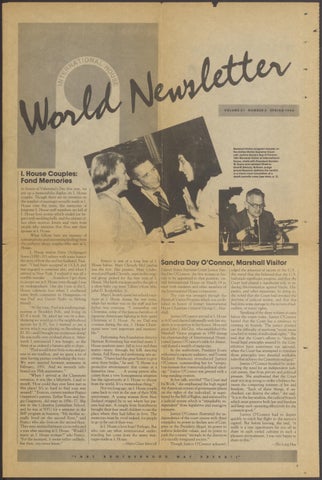
Marshall Visitor program focuses on the United States Supreme Court. Left: Justice Sandra Day O’Connor, 44th Marshall Visitor at International House, chats with President Gordon W. Evans and resident Shelina
Shariff (Kenya). Bottom: Judge Arnold Bauman delivers the verdict in a mock court simulation of a death penalty case (see story, p. 3).
I. House Couples: Fond Memories In honor of Valentine’s Day this year, we
put up a memorabilia display on I. House couples. Though there are no statistics on the number of marriages actually made at I. House over the years, the memories of longtime I. House staff members are full of I. House love stories which ended (or began) with wedding bells, and the alumni office often receives letters and visits from
people who mention that they met their spouses at I. House.
What follows here are excerpts of conversations and interesting findings from
the archives about couples who met at I. House. I. House trustee Daisy (Schlenger) Soros (1950—51) relates with some humor the story of how she and her husband, Paul,
Franco is one of a long line of I.
met. “I had been accepted at UCLA and
House babies. Mary Cleverly McConchie
Sandra Day O’Connor, Marshall Visitor
was engaged to someone else, and when | arrived in New York, I realized it was all a
was the first. Her parents, Mary Underwood and Frank Cleverly, were in the origi-
terrible mistake . . . Somehow I-got them
United States Supreme Court Justice Sandra Day O’Connor, the first woman in his-
nal group picked for the first year of I. House. Her birth was honored by the gift of a silver baby cup from Tiffany’s ‘from Mrs.
tory to be appointed to that position, vis-
_to accept me at I. House even though | was an undergraduate. One day I was in the I. House cafeteria line when | overheard some fresh, comments in Hungarian—it was Paul and Gustav Szabo (a lifelong friend). “At the time, Paul was studying engineering at Brooklyn Poly, and living on $7-8 a week. He asked me out on a date,
thinking we would go to the neighborhood movies for $.35, but I wanted to see a movie which was playing on Broadway for $1.50—and I brought my roommate along! He was really very civilized about it. Afterwards I announced | was hungry, so the
John D. Rockefeller, Jr. Mary Cleverly spent her school vacations at I. House during the war years, when her mother was on the staff and her father was overseas. “I remember one Christmas, some of the famous battalion of Japanese-Americans fighting in Italy spent Christmas at I. House. As my Dad was overseas during the war, 1. House Christ-
mases were very important and memorable.”
Herman Rottenberg has watched many I. House residents meet, fall in love and then marry—many through his folk dancing
ems in my mailbox, and we spent a lot of time having picnics overlooking the river.
classes, Fall Fiesta and performing arts ac-
We were married between semesters in February, 1951. And we recently celebrated our 35th anniversary.” “When ! arrived at the Claremont entrance, it was like a labyrinth. I said to
away three brides,” he said. “I. House is a
this place? It’s so hard to find your way
tivities. “I have had the great honor to give
his chairmanship of International House, joined Justice O’Connor’s table for dinner,
and shared a wealth of memories. In the auditorium, President Evans welcomed a capacity audience, and Trustee Richard Simmons introduced Justice O'Connor, commending her for “scrupu-
lous fairness that transcends political ideol-
from the world. It’s a tremendous thing.” Not too long ago, an I. House couple
Franco who also lives on the second floor.
to go so far out of their way. who
marry an I. House woman?” asks Franco. “For the moment, it seems rather unlikely, but then, you never know.”
guest John J..McCloy, who established the
ogy.” Justice O’Connor was greeted with a
that comes
They were married between six months and a year after meeting at I. House. “Would I
IMP program in business. “My mother ac-
at 4:00 and chatted informally with law students at a reception in her honor. Honored
at a
protective environment
tually lived on the second floor,” said
Gasperoni’s parents, Esther Rota and Sergio Gasperoni, did meet in 1956—57. She was in the Columbia Journalism School, _and he was at NYU for a semester in the
lished in honor of former International House Chairman General George C. Marshall. Justice O’Connor arrived at I. House
formative time . . . A young person who comes from a very homogeneous situation has the opportunity at I. House to choose came back to visit in the year of their 50th anniversary. A young woman from New Zealand stopped by to see where her parents had met. A couple from Scandinavia brought their four small children to see the place where they had fallen in love. The memories must be vivid indeed, for people
around!’ ” Even so, current resident Franco
Marshall Visitor Program which was estab-
Marshall Visitor program in 1959 during Performing Arts Foundation director
three of us ordered a banana split to share. “Paul would leave little notes and po-
myself, ‘How could they ever have met in
ited International House on March 19 to meet with residents and other members of the International House community. The visit was arranged through the
long standing ovation. In her talk, entitled “The Court and Its Work,” she emphasized the high regard the American system of government places
on the rights of the individual, as manifested by the Bill of Rights, and enforced by a judicial system which is “remarkably independent” from legislative and execugive pressures. Justice O’Connor illustrated the independence of the court system with three examples: its power to declare acts of Con-
Is 1. House a love boat? Perhaps. But
gress or the President illegal; its power to
can
enforce federalist values, and its power to push the country “strongly in the direction
say what
international
under-
standing has come from the many marriages made-at I. House. —Mary-Clare Metcalf
of a racially integrated society.”
Though Justice O’Connor acknowl-
edged the presence of racism in the U.S.,
she stated that she believed that the U.S. had made significant progress, and that the Court had played a significant role in reducing discrimination against blacks, Hispanics, and other minorities. In doing so, she noted that the Court had invoked the doctrine of judicial review, and that this had done some damage to the notion of federalism, or states’ rights. Speaking of the sheer volume of cases before the courts today, Justice O’Connor hinted that the Court has a tendency to overstep its bounds. The justice pointed out the difficulty of resolving “social issues couched in terms of individual rights.” She said that the Court’s efforts to “describe
broad legal principles assured by the Constitution
have
sometimes
run
aground,
when the Court has attempted to translate those principles into detailed workable rules that achieve the Constitutional goal.” Justice O’Connor finished by underscoring the need for an independent judicial system, free from private and political
pressure. She emphasized that the Court must not stop trying to strike a balance between the competing interests of law and freedom. “Each of these things, if unchecked, can destroy the other,” she said. “Tt is in the last analysis, the judicial branch which must preserve both law and freedom
and keep each operating effectively for the common good.” Justice O’Connor had to depart quickly to catch her flight to the nation’s capitol. But before leaving, she said, “it
really is a rare opportunity for you all to share in such varied cultures in such a pleasant environment. | was very happy to share in this.”
—Shi-Ling Hsu
| | | | |
procession: ®
airs, own the st g ta
vians came ite dressed |in wh
and wearin
W ai he effect t the eteeerie 2a
pe >d hats: T cone-s ha
beautifu | and ye
e. Vibeke
e Pe d erson
+. Coun:
is elected
cee
ank “glogs
ee
ae
d
might impart
patroons
well-dress¢ ips the C rainment. in Jane
lu
me
of cu sang
as stot
O
aid tt An‘ all exP enses P%
cont
as though She
ial iano
|. House residents
a Scandinavia?
. Scanal-
ala 4“
\jamsburg
painstakingly
a Balinese course, do
has t W \
eaetet
a
|Chinese Ambassador Visits I. House Jesse Jackson On the Issues The Rev. Jesse Jackson was an hour late, ought to be our politics.” but his audience waited with anticipation. | A serious problem in U.S. society When current resident Althea Hamilton day is the effect of drugs on our yout (Jamaica-Fordham-Education) discovered stated. “This threat of drugs, this collap:
that the black civil rights leader was slated
| | | _|
to speak at nearby Riverside Church, she was determined to get him to visit I. House beforehand. Sure enough, the daily phone calls to his office paid off. On October 30, Jackson was greeted at I. House with a standing ovation. He shook all the hands he could reach, and a beaming Althea introduced him. Jackson saluted the global rainbow village of International House. His brief talk ranged over a variety of topics, punctuated with his characteristic memorable one-liners. On the superpowers: “If Reagan and Gorbachev want to fight, let them fight each other. We want to live.” On the role of the U.S.A. in the world: “We have to make the adjustment from living over the
world to living with the world . . . We can
of character is eroding the opportuni
and expectations of a generation,” he sa
“It is an epidemic more pervasive than AIDS. This is a generation of youth in
trauma, and we must fight to keep Bes d of opportunity open.” ae For the foreign students of a use, he had a special message: “The impo ished nations of the Third World n good, bright minds with integrity would hope that the basic orientation her is to get an education; not to escape home but fo liberate home.” Finishing with an inspiration to underdog everywhere, Jackson ex “if you’re behind, don’t curse the Get up earlier, run farther, stay up la
more determined .. . keep buildir people. That’s our challenge. If we
it, we will prevail.” Jackson exited to another thunde ing ovation, leaving all presen’ e the charisma of an imme se
be the world’s brother and sister, not its policeman.” On politics in general, everywhere: “We must live in a world with val- / man.
ues that unite a ie us. oe
pomnes
-
Sunday Supper on February 2 was an historic occasion thanks to the presence of The Honorable Han Xu, ambassador from the People’s Republic of China. He is China’s first ambassador to the U.S.A. since
the two countries resumed diplomatic relations. Ambassador Han and his wife, Madam Ge Giyun, have both served in the foreign ministry since the 1940s, surviving
‘many changes of leadership in Beijing. Ambassador Han was the vice minister of foreign affairs before being appointed to his post in Washington. - Ambassador Han gave a speech outining China’s foreign policy. He felt the world’s major problem was maintaining eace. As he put it, “development through
peace is the common aspiration of the world’s people. But three-quarters of them are faced with foreign aggression and dominance.” In particular the ambassador criti‘ized the U.S. and the U.S.S.R. for “their continual policy of confrontation which
hreatens world peace.”
China had wel-
-comed the dialogue the two superpowers last year, as a much-needed step in
t direction.
cordingto AmbassadorHan, the Soviet in-
vasion of Afghanistan was an attempt to
break the strong will of the Afghan people. China is actively seeking to promote peace, said Ambassador Han, and reduced its armed forces by one million last year.
Ambassador Han ended by discussing the Chinese student experience in America.
In 1984-85,
there were 50,000
Chinese students in the United States.
This student exchange was, in his opinion,
“a good way to cultivate friendship from
generation to generation. International House is a place of friendship and understanding between Chinese, Americans and all peoples. Perhaps one day we will have an International House in China.” —Shelina Shariff
|
From the President
some, |like A
SO
As International House enters its seventh decade of service to the international aca-
ager, ’ ¢
M sn
: demic community, we are taking a fresh
Teachers the coac Educatio n)
look at where we are headed. Since last summer, the Ad Hoc Committee of the
”
sO
out, frball inside ™ ember: team o one AT S be m ye out for
Long Range Planning Committee of the Board of Trustees has scrutinized everyng from the condition of the boilers to mission of the House, and has clarified
ALS
our commitments in the following three
ane
The physical plant: we are committed to ensuring that our house, which has been
jome to so many over the years, remains ef-
icient, attractive, and safe. Residents’ quarters will be as inviting as our resources permit, and our public spaces will be of which we can all be proud. Programs and resident services: The ide range of programs and resident serv-
-es available at ]. House are what make the perience of living here special. We will nue to offer the traditional program nts such as Sunday Suppers and cultural
rs. But we must also plan programs
reflect our changing world and
which respond sensitively to the issues of theday. Financial assistance to residents: 1. House has had a long and proud history of providing financial assistance to residents. Whether via the work-aid program, room | rental
deferments,
loans
or grants, the
House has always committed resources to meeting the needs of residents. Over the years, there has been a fluctuation in the numbers of residents at I. House from countries with scarce foreign exchange. We are determined that I. House should not be offlimits to certain segments of the world be-
cause of financial considerations, and we |
are pursuing fundraising efforts in this area. As you will note as you browse through this newsletter, the House is in the midst of yet another exciting year of events. On behalf of the International House community, I encourage you to pay
us a call. | am sure you know how welcome | each one of you will be!
bidenMh Some
d ‘ ‘Thistles
net, colore
Homecoming jiees Sandra Day O’Connor’s recent visit to International House. was preceded by several programs dealing with the Supreme Court and the American system of justice. Oneof these was the March 17 seminar entitled “The Anatomy of a Death Penalty sumént Before the Supreme Court.” € program was organized by I. House alumnus and trustee Donald L. Gyitiens a partner at the New York law firm, Shear-
man & Sterling. The case discussed was Cabana v eek 3in which the convicted was not the
time. At first, McLaughlin See y addressed his agenda, but as their pro ing questions began to interrupt his deli the lawyer reported, “you begin to pi like a wind-up toy at Christmas.” With f minutes left, McLaughlin reported that h returned to the best parts of his argument— that Bullock “deserves a fair chane asec ond chance.”
After McLaughlin’s pels
Shearman & Sterling lawyers argued th
merits of the case before a mock “Bench
composed of Judge Arnold Bauma actual murderer, but was sentenced to former federal district judge, John eath under the Mississippi felony-murder Boger, director of the NAACP’s Cap 3, while the actual murderer received . Punishment Project, and McLau a life sentence. Shearman & Sterling This argument centered around the sa partner Joseph T. McLaughlin argued suctechnical point that had been key through
cessfully before the Supreme Court that his
lient, Crawford Bullock, Jr. was impropsentenced under the circumstances. McLaughlin, addressing a standingroom-only audience in the Main Lounge,
eviewed the facts and procedural history of case, and then recounted how he prefor
and delivered his argument before
oreme Court. McLaughlin revealed at the four key areas of preparation for a rem
Court argument involve gaining a
knowledgeof the client, the al issues, and each justice’s |
out the appeal: whether Bulloc
kill
tempted to kill, intended to kill or co plated that deadly force would be
Through this simulation, the aud
alized first hand that in an Ame an a b is. late argument, an advocate’
much to argue against his oppons rather to address the concerns.
Bench, by fielding a contin ae questions. _ After the oe court argu was clear that no one in the
a
stated = oethenee
a, poten: the poe
hol
rational leaders insist on total vestment, South African busits and corporations with South dings: should be given a chance the apartheid government for ges, former Australian prime m Fraser told International
nts on November 6.
currently head of the United ssion on Transnational ons, which recently held hearning the role some 1,068 transporations (TNCs) currently in 7 may Play in sustaining the
ould not leave, but apply ¢ ant | ressure
against
apar-
Fraser. Fraser criticized the
|
It was another grey February Sunday, but : the Main Lounge was alive with the warm smiles and chatter of old friends who hadn’t. seen one another in a long time. The Alumni Branch, held February 23, brought | together 85 alumni from all came 2 of the history of I. House. . There was a roaring fire, music Ay: resident jazz pianist Boko Suzuki (Canadaprivate study-piano), and a warm welcome | extended to all by Gordon and Barbara’ Evans, and Development and Alumni Affairs Director Nancy Cooper. | Felicite Laflamme Hofiuan and Marcelle Schwarzenbach, who represented the earliest years of the House, chatted about art (Marcelle paints) and the possibility of organizing an alumni art exhibit at the House. Marcelle’s son, Robert, ( oi
d British governments for not ngly enough against the apar- 67) talked about the current venture
tal projects. Eumelia Pretel (1952-54) was at I. House during the McCarthy era, and nts, they will “seek sup- remembered what it was like at the House ne Soviet | Union and other during the cold war years. The late 1970s and early 80s were id he artes severe eco-. represented by Dhananjay Saheba, Sally | ons to a world agreement for| Staley, Michel de Portu, Jim O’Higgins but the U.N. commis- and Frank Wong, all looking happy < ivestment begin | successful. Current resident Martina = ent. get
He said that if black Afsufficient support from
easures. are unsuc-
mitz (Germany-CUNY-Art History) circu-
lated with her tape recorderto record
; ilure by Week busi- | oldest memories for the archi eaders tc ime South Sey
the
the Decader 1920's Benjamin Bardin (1923—26) has been nationally ranked
in the U.S.
Tennis Associa-
tion’s Super Seniors 80-year-old division for the past five years! John J. Fuller
(1924-25)
writes “My
resi-
dence in I. House was the introduction to a lifetime of interest in the peoples of the world. I have visited in about 35 countries and I have personal friends in many countries.”
Birger Z. and Margaret Carl Lofgren (1935-38, 1937—38) met at the House—she was from the Philippines; he was from Sweden. They married in Sweden in 1940 and moved to
James T. Barton (1955-56) was recently ap-
the U.S.A. in 1965. Now they live in Berkeley, CA. Robert Sachs (1932-34) retired several years ago as VP at Harper & Row and is currently
ties Inc. Joan M. Bisser (1953-54) teaches Japanese brush painting and calligraphy to 9th graders in
grandson
and
New Rochelle, NY, and took a trip to Japan last summer.
another
Raymondo and Beverly Berghaus Chico (1958-59) met at I. House in 1959. Beverly
Felicite Laflamme Hoffman (1923-27) has established a foundation dedicated to global education which will award scholarships to
began working last year at the Mizel Museum of
1940’s
| Judaica as director of museum outreach. Ray is
has recently
Yves and Yvonne Biry-Clavery (1949- creating anew company, and is sometimes mis50). Yvonne enjoyed teaching science at the | taken for John Forsythe of TV’s “Dynasty!” Nadia Ehelich Finkelstein (1952—54) is asAmerican International School of Bamako, Mali. Yves continues his consultancy for the | sociate executive director of Parsons Child and Family Center in Albany, NY, and does teachU.N. and is expanding it to European smalling and consulting. scale industry and foreign subsidiaries in Belgium. x Louise Goldberg (1958-59) is rare book librarian at Sibley Music Library, the largest acaMargaret M. Currie (1948-49) is active in local organizations, particularly the NY State demic music library in the hemisphere, “and Correctional System, visiting prisoners as well _ loving it!” Calvin P. Hatcher (1953-55) is a hospital as ex-offenders. K. G. Hrishikesan (1949) retired from Rey- | administrator at Presbyterian Hospital in New nolds Metals Co. in 1983, and started Micro | York.
published an article on the economist and social philosopher, Henry George, in the American Journal of Economics and Sociology.
tired librarian who works on a grassroots level to prevent nuclear war, and as a mobile meals
French Canadian | Canada.
students studying outside
Heinz Muller-Touraine (1925-26) is gardening and keeping 12 acres of mostly woody land in shape. Arthur G. Murphy (1927-29) is holding a
retrospective exhibit of his oils, lithographs, drawings and watercolors in three locations in
Connecticut this spring.
1930’s C. Lowell
Harriss
(1935-36)
Russell Hill (1938-39) writes that he’s retired after a career as a foreign correspondent for the New York Herald Tribune, and Radio Free Europe.
Frank
H. and
Ann
Richards
Hutchins
(1934-35) are now “alas—retired!” They met at I. House. She was in advertising for 15 years and he is a retired Episcopal clergyman. Harold J. Jonas (1930-32) writes that an I. House friendship with Junji Oyama began his lifelong interest in Japanese art and history. In 1959, he organized the first course in Asian Studies to be offered at any community college
in NY state.
Judy Martin Beach (1966-68) has a music school for piano and voice students, and teaches at the University of New Orleans. She’s married to Lee, principal percussionist of the New Orleans Symphony, and they have two children, ages 8 and 12. George N. Marsh (1969) is master control engineer of KRON-TV, Channel 4 in San Francisco. Stephan L. Mintz (1965-67) has lived in Miami, FL since 1972 and has recently been promoted to professor of physics, Florida International University. Eileen Tway (1959-62) is professor of teacher education at Miami University and president for the National Conference on Research in English.
pointed president of Prudential-Bache Securi-
president of the Southern Adirondack Library System. He has one grandchild en route!
1960's
1950's
1970's & 1980's
Ernst H. Rosenberger (1953-55) was recently appointed Justice of the Supreme Court,
Marcos Goncalves Avila (1981-82) is assistant professor at the MBA progratn at the Federal University of Rio de Janeiro. Guillermo Barnes Garcia (1978—80) has worked as an economist in banks in Mexico since 1983. Now, he’s professor of public finance at the Instituto Tecnologico Autonomo de Mexico. Janis Abrams Green (1982-83) was married last year to Jeff Green, an alumnus of SIA. Until recently, she was working at Ted Bates Ad-
since 1982, and received the Bard Award from Appellate Division, State of NY. the City Club in New York in 1985. 4 Dorothy Schneider (1956) was awarded Dr. Louise G. Streat (1943-44) has retired after Laurence J. Petér’s (author of the Peter Princi40 years as professor and chairman of the Home ple) 1985 “No Bull Peace Prize” for her oneEconomics Department at Bennett College in. -woman crusade to establish a world holiday E! dedicated to peace, an Interdependence Day. Greensboro, NC. David A. Teaze (1950—51) retired from UnAnnaBell Leinbach Washburn (1948-50) is president of the Pet Adoption & Welfare ion Carbide after 34 years in marketing and fiService when she’s in Martha’s Vineyard, and | nance. on the Executive Board of the Humane Educa- _ Gary Thornburg (1952-54) has published a new book, Beyond the Superego. tion Committee when she’s in New York.
Kemal Ilisulu Jr. (1973-75) established a family corporation dealing with building construction and importation of toys and chemicals to Turkey. His firm recently completed a holiday village on the Mediterranean Sea Coast. George McAllister (1976-77) is practicing law at Ruben & Kingston in Fredericton, NB, and is president of the New Brunswick Trial Lawyers Association.
Carol Shipman La Pierre (1950—51) isa
Grinding Systems, a consulting firm for grinding tests and analysis of minerals. Mae Jan Pokorny (1940-42) received the “Ethnic New Yorker Award” from Mayor Koch in
volunteer.
December, 1985. He has been Professor Emeritus of Architecture
at Columbia
re-
University |
vertising.
r 24 No. 2, Spring 1986 International House World NewsletteVol.
A newsletter for alumni and friends of International House, 500 Riverside Drive, New York, NY 10027-3916. Mary-Clare Metcalf, Editor; Shelina Shariff, Alumni N ws Fellow. Photography, Marco Mitrani, Dipinder Singh.
82
8
ce 6
wr
72290 oO 3 pd 2 TY os
re!
Bi BZ”
40
mw
2)
2
”n
2
moeaes Re
gS
oe
& 2 ok
52
ae
Ud
CERSEs
o See
3
uv
3 |e
S|&
wiey
a
|9
Zz 10
Poaae
OG
Iw
ae
13 =o
6
=
ait. BS|< ia.
A =
Ge
0
30
o
65>
o
38 DO
kea 2 |
v
5=
(2Gove oOe
tsSinem5
Pas]
x>
eepa) eee
| ~DME
9ad ¥
I= c
5
aeWw
de
a. n
OSs BS Oo ee
oy
co)
e
ge.a ese < >
ss
9vo *
asa A
5
rc
«2 |
&§ ED
oO
Rep
re
o
oS
fo ome ee 7 pkey
o¥eso o#8f2g a0 3 O
Law}
2
Y
lo
m
Iz
lt
GS
5
a,
>
oe 3%
ae ret to
bo = 3
Oo wv SS
82
o£
Y
nN
oD
by
ory
e
co
oe
. 3g wo ects
fo
a
SS
36
US
vt
2s
oa
&
>
HY
>2z50
oa
E
oO,
Fas
and to the House,
hope she will visit us often.
friendliness and devotion
38 5O
,
wee ow eee ay
om
= &
igs)
las}
Zz
VS
OZ = 2
=
BIA
\
=)
=
o> v
=
=>
33 Seis 3 oY oR
AIT
eS. On. > $e 2o5 se? ood Raed ee
i Be &« Q ® 553 £ a
| awe OME
ig|e SS ¢&
Clare Metcalf, who has been with I. House for nine years. We will miss her professional skills,
(JaCo., Manufacturing Instrument
ms
|esOQ 16 2a
3=e
i
3 ~ont
ee
:
3
A
.
2
“3
g \5
§
=
.
oO
\o)
+
&
Musical
ae
ia ae res Oo (2 2£Z Sy eee 2 >ov rs) is |S Ge
1
B
pan) and Samick Musical Instrument Manufacturing Co. (Korea). We regret to announce that this is the last issue of the newsletter to be edited by Mary-
ties to talk about career opportunities, and the
Reader’s Digest Foundation financed an allexpenses-paid trip to visit Colonial Williamsburg (see story, p. 2) during the holidays. I. House music students are happily playing brand-new six-foot concert grand pianos—recently given to 1. House by Kawai g
» 3
Oc
2:
2
a= =)
as e) 0
a)
|e asa
|G
i
|
Oat vo
3
9> ~~
&e Aa:
6h : ic
A)
Qa
=
c
B
a =
S
2S Oc ewer oe Oa SAE sAnspk onal &
Y8Y8R2E
3916. Thank you!
=
So
§>
&N
a
.
ouncil
(‘Sk
Bu
wanes
eg]
gy
‘
Sgga
dead 23% 6
a” Biee:eS a,
Es ~
N
>
4
Ze38
303
a. a=
r)
—Karen Lowry
z
Haze
co
Ms. Lowry (U.S.A.-Columbia-International Afchairs the alumni committee of the Resident’s fairs) C
oC
°
for the
Sa Se 7328
Oo
4
environment
F852. | 1 oe oe
Se
on
lease pause for a few moments to remember I. e. Your contribution, no matter how
|Z@
O.8
=
a
much of the operating budget depends activities of the Develop, | discovered that
geeseB38 apo
oe
Z3s5
=
you who have lived here
&
every nation, race and | Tele
5
: ¥ = o APW
bs ) E iS) ie
fe)
2
CE
is a unique
=
We thank the Hang-Seng Bank and T. G. Ling (1924—25) who have given room scholarships for students from the People’s Republic of v5 China. i-Liny oO& Tang (Columbia-Electrical Engineering) and Wang Zhang (ColumbiaPublic Health) are the recipients. ® Several of our corporate donors have made possible special programs for I. House residents. Groups recently visited Manufacturers Hanover Trust and Prudential Bache Securi‘-
Please Remember...
oO
72s.
mon
io
O
ter SO
Ox
is
8
m4 Pa
en
nace
2
3
Sz
ane
5
Employer
WO
j~
yg
OD
22
&
sce 2Bg Bess:
Networking
paasanbay UoNd9.07) ssouppy
wa
fae]
ni
OS
es
v
I. House
CS
a
§ w
eg
Bees O. Co US
Sete w &
3
_
Yet the reality of daily expenses makes this
23
~
Yo
cecal Lowry meets with Development Directed pers
4
ovr
Cooper.
ge
to help I. House at the same time. The income of funds contributed is used for program purposes. Your friend’s name will be inscribed in a large leather volume on display at the House. A companion volume holds biographies and photographs. Write > or call the Development Office for details at 212-316-8423.
make a gift in memory o f a beloved friend and
@ The Memorial Register is an opportunity to}
Development Office Notes
"** Onss] SIUL Ul
p 26nd “10}/s!A ]DYSIDW
UlPL SI (@AOCGD) 10UU0D,O Adg DIpUDS I
z e6pd ‘ieddng Appuns
jb sypeds ‘DulYd Jo a1;qndey s,ejdoeg OU} WO} JOPDSSDquID ‘nx UD} "UOH Ou
|Dqo|,, Ouy SejN|DSs UOSYOOF essor IN
7 e6pd ‘asnoH [DUOHJOULEJU] JO ,, oHDIJIA MOQqUIDY
Buo| Uo SUDAZ"M UOPIOS juepIseld
¢ e6pd ‘Bujuujd eBup! Fh
As a nonprofit organization, a copy of our last annual financial reportis available from the Department of State Office of Charities Registration, Albany, NY 12231, Dffice, 500 Riverside Drive, New York, NY 10027-3916. or from. the Development Offic