Ve
PF
Oe gee eS
'Celebrating
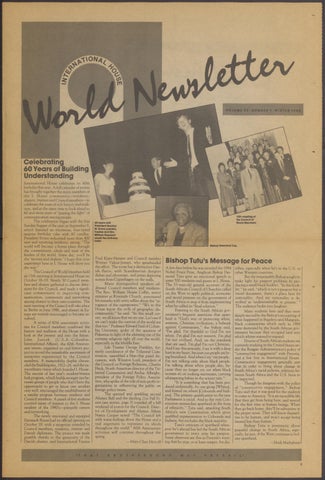
60 Years of Building Understanding International House celebrates its 60th birthday this year. A full calendar of events has brought together the many members of
the I. House community—residents, alumni, trustees and Council members—to celebrate the years of rich history and tradi_ tion, and at the same time to look ahead to 60 and more years of “passing the light” of communication among people.
The celebration began with the first Sunday Supper of the year on September 9, which featured an enormous, four-tiered surprise birthday cake with 60 candles. President Evans welcomed more than 400 new and returning residents, saying: “The
world will become a better place through the commitment,
leaders of the world. Some day, you'll be the ‘movers and shakers.’ | hope that your experience here at I. House will show you the way.” The Council of World Members held its 13th meeting at International House on October 18-19. Nearly 30 Council members and alumni gathered to discuss directions for the Council, and made a significant
commitment
munication,
to improving
com-
community and networking
among alumni in their own countries. The
next meeting of the Council will take place in Berlin in June 1986, and alumni in Eutrope are warmly encouraged to become involved. A series of 60th anniversary activities for Council members combined the history and tradition of the House with a look at the present and into the future. John Juricek (U.S.A.-ColumbiaInternational Affairs), the 60th Anniver-
sary intern, organized an oral history project to record the remarkable assortment of memories represented by the Council members. A memorabilia display chronicled the building site, 1922-24, and the ex-
traordinary vision which founded I. House. The success of last year’s resident/trustee link program, which builds stronger ties between groups of people who don’t have the opportunity to get to know one another very well, encouraged the establishment of a similar program between residents and Council members. A panel of five students covered issues of interest to the I. House resident of the 1980’s—primarily careers and networking. The newly renovated and equipped Denmark Room had its official opening on October 18, with a reception attended by Council members,
Bishop Desmond
Tutu
ideals and trust of the
residents, trustees and
Danish diplomats. The project was made _ possible thanks to the generosity of the Danish alumni, and International Trustee
Poul Kjaer-Hansen and Council member Werner Valeur-Jensen, who spearheaded the effort. The room has a distinctive Danish flavor, with Scandinavian designer dishes and silverware, and prints depicting scenes from Copenhagen on the walls.
Many distinguished speakers addressed Council members and residents. The Rev.
William Sloane Coffin, senior
minister at Riverside Church, punctuated his remarks with witty sallies about the “ar-
rogance of the superpowers.” “We in this House know the evils of geographic discrimination,” he said. “In this small corner, we all know that we are one. Let’s see if
we can’t make the nations of the world see that too.” Professor Edward Said of Columbia University spoke of the question of Palestine in light of the alarming rise of the extreme religious right all over the world, especially in the Middle East. Life Trustee George
Franklin,
for-
merly coordinator of the Trilateral Commission, assembled a blue-chip panel discussion, with Winston Lord, president of the Council on Foreign Relations, Charles Heck, North American director of the Trilateral Commission and Archie Albright,
president of the Foreign Policy Association, who spoke of the role of non-profit organizations
in influencing the public on
foreign policy issues. The spirited and sparkling second Alumni Ball and the dazzling 21st Fall Fiesta (see stories, page 3) rounded off a full
weekend of events for the Council. Director of Development and Alumni Affairs Nancy Cooper noted: “The Council left with warm feelings about the House and a
real eagerness to represent its ideals throughout the world.” 60th Anniversary activities will continue throughout the spring.
Bishop Tutu’s Message for Peace A few days before he was awarded the 1984 Nobel Peace Prize, Anglican Bishop Desmond Tutu gave an emotional speech to some 500 residents and guests at I. House. The
53-year-old general secretary. of the
South African Council of Churches called on the West to apply political, economic and moral pressure on the government of South Africa to stop it from implementing what he called its “final solution.” Pointing to the South African government’s frequent assertions that apartheid is “God’s way of protecting white, western, Christian civilization, a bulwark against Communism,” the bishop said, “T’m glad,
I’m thankful
to God
I’m not
white. I’m glad I’m not western. I’m glad I’m not civilized. And,
on the standards
But the irrepressible Bishop sought to make light his passport problems by producing a small black booklet. “In this booklet,” he said, “which is not a passport but a
travel document, there’s a place here for nationality.
And
my
nationality
is de-
scribed as ‘undeterminable at present.’ ” The audience broke into laughter. Many students later said they were deeply moved by the Bishop’s recounting of what happened in Suguletu and Mangopa, black communities which early in 1984 were destroyed by the South African government because they occupied land into
which whites wanted to expand. Dozens of South African students are
that are used, I’m glad I’m not Christian. — currently studying in the United States unAnd I say this seriously, I say it with a deep der the Reagan Administration’s policy of hurt in my heart, because our people are be- “constructive engagement” with Pretoria, ing brutalized. And when I say ‘our people,’ and a few live in International House. I’m not talking only about black people. Constructive engagement generally says I’m talking about white people also, be- that in order to bring about change in cause they no longer cry out when black South Africa’s racial policies, relations bewomen sit on soaking mattresses, carrying tween South Africa and the U.S. have to whimpering babies in the winter rain.” be improved. “It is something that has been proThough he disagrees with the policy duced unilaterally, by one group [Whites], of ‘‘constructive engagement,” Bishop and foisted on others [Coloureds and Indi-
ans]. The primary qualification to the new Parliament is racial. And so the very Con-
stitution entrenches apartheid in the form of ethnicity,” Tutu said, attacking South Africa’s new Constitution which gives
qualified representation to Coloureds and Indians, but excludes the black majority. Tutu’s criticism of apartheid whenever he’s abroad has led the South African government
to
twice
seize
his
passport.
Some observers see this as Pretoria’s warn—Mary-Clare Metcalf
tribes, especially when he’s in the U.S. or other Western countries.
ing that he stop, or at least temper, his dia-
Tutu said that it was good for the students
to come to America. “It is an incredible life that they get from being here, and treated
for the first time as human beings. When they go back home, they’ll be subversive in the proper sense. They will know themselves to be human, and won't accept being treated less than human.” Bishop Tutu is pessimistic about peaceful change in. South Africa, especially, he says, if the West continues to bolster apartheid. —Mark Mathabane
m saat
ee
w
weeks
ed
the
uy
*
&!
: This year’s eee
le did. mnmunity
Cam
dr ew peop le
:
ON
a
end ra
check Or
oe z coe
te ec
dOSS dition to p rogram
4
ae utd
es a
Jook 00 into t
:
and guitar, SW
or just ch
=
inte
4 ctivities,b
hips have
Hip
SP
nd
vin
:
new
Progra’
d waste! hy
|.
Spiegel, s. Ellie came on ae August an
ting‘ to k ».
this yeat S
WwW
t
€
orienta
d no rim
:
S during
tion.
rope
represented at International House, but it’s not widely known that until 1939, Chinese
constituted the largest single foreign student group of House members. Since the 1960’s, Japan and India have consistently competed for that distinction. _ Africa ranks third after Europe in the number of foreign members provided to the House. This is a fairly new phenomenon and the steadily increasing proportion of African members is one of the most significant changes in the House composition since 1924. In 1927 there were only two Africans at International House out of a total membership of 1012, while in 1983 the proportion had risen to 8% of a total membership of 602. Over the years, Algeria and 2
ar
ment.
A \\ told, ’ some
ouse wort
d to ex
notes President
ae
is
:
700,000 a ae “ies . through t
fan various nd work-ald
nniversary rganize an
‘don to providing
rns
In addian te friends
activities a
of education:
pe
cia
occur:
Fourteen Oo
s th:
gs
h
se mat)
;
ee
en
wo- |
P
lease a” wit
fe)
dents W
‘
is
e
A
ew
edt
ies and find . also visite
is fall, the eaourl History © he Museum
Follies
ae the real fun
Computers Introduced at |. House >
1938, about 4.4% of House members majored in business; this figure was listed at
17.8% in 1983. The social sciences have always been popular among International House residents, consistently attracting between a fourth and a third of House membership. International affairs and sociology are currently among the most popular majors. The last major area of study is the arts and humanities. In the late 1930’s about 10% of House members recorded this as their major interest. Between a fifth and a fourth of all current House members now specialize in the arts and humanities. —John Juricek
which
Controller’s Office in 1982, through the
generosity of IBM. The latest expansion in I. House’s computer capacity followed an intensive investigation into various alternatives by Phil Anderson, one of the six residents employed during the first year of the new internship program. Introducing computers into the Development Office has been the highest priority during the expansion. The Development Office is currently entering data on alumni, donors, trustees, and World Council members into its PC, equipped with a large “hard disk” capable of storing the. equivalent of 35,000 pages of text. An
information
management
pro-
gram will make it possible to keep track of
alumni and their special. interests much more effectively than is now possible. Use of the computer will reduce the amount of mail returned due to out-of-date addresses,
manage gifts and produce form letters. The Admissions Office computer is used to keep track of residents and admissions applicants, and to manage guest suite
reservations. Formerly, computing how many residents come from each country took up to 2 days; the Admissions Office can now produce an updated tally in less than four seconds. The Cashier’s Office will use its computer primarily to manage resident room rents, while the President’s Office computer will be used primarily for word processing. Eventually, the House hopes to connect all of its computers, allowing them
to pass information back and forth freely. In the future, International House may introduce PC’s into other areas. For the rest of this year at least, the House will
devote its energies to absorbing the new computers; training staff and writing new ” programs will take months to complete. “We have a big job ahead of us,” acknowledges President Gordon Evans. “The introduction of computers is one of the most important things we can do to prepare
International years.”
ul
ecaiet cal v3 é pee
“I
gathered great momentum in 1981 when IBM introduced its personal computer. The House acquired an IBM PC for the
mae
hs a os perfort
,
of the shift to office automation,
AT)
qurning istro, Cor
male
wp
Nigeria have contributed the most new African members. Americans have always constituted the largest nationality group at International House. They have come from every region of the United States. Currently, they compose about 40% of the resident membership. The reasons young people from all over the world come to International House have also changed since 1924. In the early years of the House, many more came to study education than today. In
di ng
a stam
ete W ith red-ans eese. A th
or
help wit ad ¢ ne tfriend. es ity,likewhile
The sight of staff members busily typing onto green television screens while their disk drives whir and their printers click will become increasingly familiar to I. House visitors, as the House completes a major expansion of its computer resources. Between August and October, the House installed IBM Personal Computers (“PC’s”) in the Development, Admissions, Cashier’s, and President's offices. I. House was actually in the forefront
\gium, g
editorium™ into ae
|
benefited areas about by se stu
(Fran ce ’
Switzer aa m only ©
Everyone :
ne.
child
0other SUdJEr it,” us says Bob.
ert
Hour
cura
— of enon neigh! ser jgned UP i math, EN"
s, these |
social t § * coordinate Mean fellows Ne p «+ residents wi assist f
tions
ery
re prep
prank 0U with aaking Sometime ~ ron re
Inte qnatiO i
ips
valuable expetl© also help stu actly ‘he ever-rising core House dents meet the
~
ic sohlights © e highlig
ae
rogram. F/T) g.A--Columbi; the
that
just uNce
:
the
ents
985 program fellox
he’s
\ly isFr" tran ransferre ‘
s
Bob Bit et ne Affairs) Le
make yet d. And,
e are
the
jaunch
olved.
be House
af
Some Birthday Demographics Like many birthday celebrants, we at International House have been thinking about our history and trying to understand what we are today by what we were in past years. There has always been a diverse mixture of humanity at International House. From about 60 in the 1920's to a high of 99 in 1962, the number of countries represented in the House currently runs between 75 and 80. — Asians have always been well-
velopment an
ge
internsht se Ris bse & New he Dit credit for this os 5 + Chronicle | \7 resident floor Much all-out off We {come belongs Directorto Oo’
Fro”
he office
rechnology
‘
¢
the “Bierstu"
res gen see Reside
t
the ogoeh bat glso into a specia
a have been
es
ment,
>
the cate g Admissions, grams,$
Raver: 2s v4 theit SKI
house aeeivities of
a fat
Pp aye
agen
Progra
rerns will be = sie
cooked togetne
.
-1
meen create
sci
ne
: =p
:
ons
Ham Radio am
‘cipal
Visual ean ae
in recorups of abou! ‘
ns
the United 12 ager
tions ats
in Sete nu
Hine,”
Sapa
ows: >
duels
ge pa each September resi ro the CO
»
n So
nd rips to HObGOY "A y.,
ore
the
:
es
a qui by all accou
\
House for its next sixty —Phil Anderson
ssi
came
From the President As 1984 draws to a close, it is my pleasure to report to you that International House continues to be extensively concerned with the care and nurture of its residents, attend-
ing not only to their “creature comforts” but also to their social, cultural, and intel-
lectual concerns. | One of the Board’s first tasks this fall was to begin the search for an individual to replace retiring Chairman of the Board Henry A. Kissinger, whose letter of resignation after eight years of service to the House was regretfully accepted by the Board. That search has recently culminated in the election of former President Gerald R. Ford, a leader and man of vision whose personal commitment to the art of healing makes him a consummately appropriate choice for the chairman of an institution whose motto is “That Brotherhood May Prevail.” This fall, the House has been fortunate in having several residents who,
in
their capacity as International House Forum fellows, have arranged for us to have in s
So urs
: SS bers of the House
or Ww
Mey -
udicor™
gg Fiesta Fun
'
A capacity Cf this $
yrate
Octover
1a nora
okie
Belgium, @ a sardine
on
y turn!
re, a¢ de (U
em \ Psychol
yntry OF
resent the Tr pene
e
) .
A iia I
5
our midst representatives from around the world who presented their views—not always easy to hear—on the question of human rights. I speak, of course, of our visit in
general secretary of the South African . Council of Churches, who spoke to us on the topic of apartheid. In November, Kim Dae Jung, noted human rights spokesperson from South Korea came to the House and addressed our residents only weeks be- |. fore his planned return to his homeland after several years of self-imposed exile. And this month, we have in our art gallery a stunning collection of paintings by the Chilean artist, Roberto Thieme, a provocative show dealing once again with the
theme of human rights in various parts of the world. Around Thanksgiving time, a group of concerned students mounted a campaign whereby over $500 was collected to be donated to Oxfam. An awareness of the crying need to alleviate the suffering of the poor and disenfranchised, and a determination to meet that need are thus both alive and well at International House. We look forward to continued probing, sharing, learning, and when possible, healing in the months ahead. In this spirit of hope and expectation, | join with the entire International House community: trustees, residents, alumni and staff, in wishing
early October, of Bishop Desmond Tutu,
for us all a new year of peace and justice everywhere.
Spotlight on
Alumni Ball
Michael Wimberly
Sparkles
Getting Cafe Esperanto Fellow Michael Wimberly to sit still long enough to chat is no easy task. That’s because this 26-year-
The sparkling success of the Second Annual Alumni Ball all but insures its future as a favorite I. House tradition. This year’s fete got a special boost, as it coincided with the 13th meeting of the Council of World Members. On October 19, some 200 alumni, trustees and guests were greeted at the Riverside entrance by resident hosts and hostesses and escorted to a cocktail reception held in the auditorium foyer. Everyone so enjoyed mingling through the decades that it was hard to cajole the guests into the candlelit audito-
hada V Gane
Tl Homanities
.S.A--Barnie est in rock
8t 0
residents,
articipat
fashion P native dt e
bistro, com j-white table cheese: A i
ber Orchest ram W e
up petforme eres to shame
came with
a
Latin American Art Launches Visual Arts
Program This fall, the main lounge was transformed ‘into a living museum with the installation of an exhibition of artworks entitled “Ten Latin American Artists Working in New York.” The exhibition, which opened October 10 and was on view through November 11, introduced the pioneering concept of turning the main lounge into a gallery for the visual arts to feature international works on a rotational basis. This concept, and the flagship exhibition of works by artists from Central and South America, are the brainchild of I. House trustee Barbara Duncan, chairman.
of the Arts Committee of the Board of Trustees. Approximately 200 persons attended the opening, including representatives from the various Latin American consulates and missions to the United Nations. Featured were the works of Catalina Parra, Francisco Sutil, Ismael Frigerio and Benjamin Lira, all originally from Chile; Josely Carvalho and Lydia Okumura, natives of Brazil; the Argentinian-born artists Liliana Porter and Osvaldo Gomanz; Armando Londono, of Colombia; and Francisco Munoz, a Mexican artist recently arrived in New York. The artists used a variety of media, including painting, drawing, collage, and photography. “The theme of the exhibition is to show the impact that New York City has consciously or unconsciously had on their distinct modes of expression,” wrote Ms. Duncan in the catalogue. The Chilean art-
ist Esteban Perez installed the exhibition,
using several free-standing white panels which can be rearranged for future shows. Several new shows are already planned by Visual Arts Fellow Ida Ghiraldini of Venezuela. Works by American artist Joni Pienkowski depicting the life of an Appalachian woman are the subject of “Malissia of Tom’s Creek and Brush Mountain,” on view through November. Ida, astudent of Arts Administration
at NYU, plans to program exhibits which will increase residents’ awareness of the art and artists of different cultures. “We have many programs at the House which focus on the performing arts,” she says. “I want to offer more contact with the visual arts.” All of the exhibitions are also open to the public by appointment. —Ann Friedland
old Manhattan School of Music student
would rather be dancing. Or singing. Or composing. Michael is, quite literally the I. House music man. Under Michael’s management, Cafe Esperanto has evolved into a night club on a par with New York’s finest. “Cafe” offers everything from classical guitar to modern dance. The music Michael provides is as diverse as the House itself. In addition to fine-tuning his management skills,. Michael says that his work with Cafe offers him the chance to develop artistically. “Cafe is my laboratory,” he says. “I can create an idea on Monday and then maybe play it on Friday. It’s great!” Michael still finds time to fit in his work-aid job as a dishwasher in the I. House cafeteria. “But don’t think I’m just washing dishes back there,” he cautions,
flashing his characteristic smile. “I bring | my unfinished music to work and try out my latest pieces.” With all that energy and enthusiasm, little wonder that Michael was voted Student of the Year in 1983. Michael modestly attributes the honor to his uncanny ability to remember names. With all he’s given I. House, Michael Wimberly will be a name that’s hard to forget. . —Ann Friedland
rium, where they dined to the music of a
resident string quartet. Master of ceremonies Werner Valeur-Jensen and Alumni Ball Committee Chairman Gerald Barsdorf entertained the audience with jokes and anecdotes, delivered in the best ‘stand-up’ style. Council members Merethe Ring of Norway, Joseph Adegbite of Nigeria, and Gerardo Hemken of Mexico spoke of their days at I. House and how the experience had shaped their lives. The jazz ensemble, headed by resident Michael Wimberly, swung into an evening of song and dance with a catchy rendition of “New York, New York.” The auditorium glowed ’til the last guests departed well after the clock struck midnight. Watch the spring newsletter for news of the date for next year’s gala. —Ann Friedland 3
* > on
eo
ah
*
‘
©
28
P
¥:
*
« "
“ ae
he
:
.
4
‘
BA e
.
nk
< Se
&
‘
ee + tee om,
;
;
dk
a
.
‘ene
‘
librarian, now engaged in church and community activities in Lexington, KY, and has 2 children and 5 grandchildren. John J. Fuller (1924-25) writes: “Now profes-
.
Myrtle Crawford (1952-53) is professor of nursing at the University of Saskatchewan, Saskatoon, Canada. John G. Dennis (1953-56) reports that construction of an International House on the cam-
Margaret B. Blossom (1939-40) recently vis-
ited Egypt where her husband attended a conference on law of the world in Cairo. They also visited Luxor and Thebes, and enjoyed a cruise on | the Nile. Elizabeth Burtner (1930's) is professor emeri-
tus, George Washington University, Washingra ag 68 Sp John C. and Janet Murray Fiske (193840,
vice chairman for psychiatric education and
These trips brought back
Georg D. Kriimpelmann (1953-54) is a doctor of economics, manager of a pharmaceutical wholesale company, and living in Gelsenkirchen, Germany. Walter Ringel (1954-55) is managing director of a food import and wholesale company and living in Fuerth, Germany.
training at the U. of Miami School of Medicine, and associate dean for special projects. Bernard Chalip (1945-47) recently founded a small publishing firm, Pillar Press, in Alameda, | CA. His first book, To Love and Let Go, by Grace Morrison, received excellent national re_| views. One chapter takes place at 1. House. | Gibson Gray (1947-49) was promoted to full-
Neale D. Simmons
(1951-53,
1955-56) re-
tired from the New York City Public School System on December 31, 1983, having taught for 25 years. Now he’s making plans for traveling to Europe, Africa and Asia.
time chair, Department of Political Science, Pembroke State University, Pembroke, NC. . Virginia Clemment Lowman (1944-46) re-
*
.
>
+
|
‘
. ft
;
: cet
ee
‘.
. ne
E
ogee ‘ ay
a
‘
Ay
ees
*
%
‘
Soe »
on
‘
Jeffrey Graham (1981-82) is living in Wash-
French, and is on the board of directors of her
family company which deals with chemical raw materials all over the world. She lives in Thessaloniki, Greece. Graciela E. Duce (1964-65) is deputy chief of the Latin America and Caribbean branch of the United Nations Fund for Population Activities. (1960-63) was re-
cently director, office of development and planning at the Academy of Korea Studies, and now a professor at Kyeonggi University, Seoul. He
also lectures at various Korean training institutions for Korean bureaucrats. Palacio
(1968-69)
House party (he was not a resident, however),
Stephen M. Robinson (1962-63) is currently
professor of industrial engineering at the University of Wisconsin-Madison, and is just finishing a 3-year term as department chairman. Frank C. Taylor (1964-67,
1977-78) has re-
cently been appointed executive director of the Business Press Educational Foundation, a new
non-profit organization formed to increase interest in business journalism on the part of journalism students and faculties. Francis Welch, Jr. (1960-61)
ington D.C. and working for a law firm where he is doing commercial and international work. “Would welcome news from other lawyers at I. House in 1981-82.” Silvia B. Hartman (1970-71) writes: “I’m sta-
tistical consultant for PAHO/WHO stationed in Mexico City, and working there and in the Caribbean and Central American countries on survey sampling design and analysis of data connected to health problems.” Ashok Khanna
Asseraf (1971-72)
is married
to
Martine, has a son, Antoine, 4, and a baby daughter, Camille. He is sales manager for Corning France. Donald G. Deibert (1970-71)
is a financial
counsel with Dow Corning Corporation.
Marie C. Gorey (1973-75) is an assistant vice president with a Wall Street insurance broker.
is manager of ac-
(Hattori
Corp.
of America)
which
markets
timepieces, computers, peripherals and consumer electronic products. John Lau (1980-82) has been selected as resi-
dent conductor for the Hong Kong Philharmonic. Del Palhus (1975—79) is now assistant wed
sor of psychology at the University of British | Columbia, Vancouver, Canada.
Elizabeth Kelner Pozen (1970-72) is an artist, living in Washington D.C. with her husband and two children.
Kimmo Sasi (1977-78), an M.P. in Finland, has recently been elected chairman of the a liament tax committee.
Night of Nations
is an attorney
1970’s and 1980's
(1973-76)
counting and finance for a Japanese subsidiary
April 13, 1985
with Kelley, Drye & Warren in New York.
Alexandre
y a,
a
‘
Ekaterini Billi (1969-70) teaches English and
Gomez
: E
1960’s
(Calk)
‘ *
‘ .
Miriam
.
eet)
has two children, ages 8 and 10, and is working in their own import business.
antiques! !” Henry C. Jadow (1957-58) has two children, and is treasurer, B. Jadow& Sons, Inc.
is professor and
*
see
Nadia E. Finkelstein (1952—54) writes: “I am the associate executive director of Parsons Child and Family Center in Albany, NY. During this past year, I had an opportunity to visit Hawaii,
States from time to time—still interested in “economie politique, stock exchange . . . and
1940's
©
»
married Enrique in 1971 whom she met at an I.
many fond memories of International House.” Ethel Grunberg-Barmat (1953-54) writes from Neuilly, France that she still comes to the
number of old I. House friends like Hugh Chase, Ralph & Helen Crockroft, Clifton Line, Vilma Golde Telford, and John Brockelba
“3
pus of California State University, Long Beach is now authorized.
Japan and Korea.
1939-40) write: “We're still in contact with a
$
i
Choung (Jeong) Kil Kim
1950's
1930's
*
.
*
County, MD.
tries.”
:
©
* *
tired from the Maryland State Department of Education and living on a farm in Frederick
teaching, research and administration, | get much satisfaction knowing former students are holding responsible positions in many coun-
ss+ .
te
nical and cultural exchange.” Sarah Leiter Remsberg (1945-46) is now re-
sor emeritus after a half century of university
4 .
at
we
cently toured the People’s Republic of China with husband, Rod, as part of an Institute of Electrical and Electronic Engineers delegation—“a tremendous experience for both tech-
Eleanor Munson Carey (1929-30) is a retired
Plans are well underway to make | NIGHT OF NATIONS 1985 the best | ever, with the largest, most professional a auction in NON history. : If you can help by giving some-
A newsletter for alumni eb friends of International House, 500 Rives Drive, New os NY 10027. Hou
tes
Fe
able biota the Teagan oO Charit aC vl House, 500 Riverside Drive, toe York, NY 10027,
Cut out the Mountain Climber and send him |
[euoneUsaIu] asnoy
£7001
AN
“JOA
MON
IAL aPpIssaaty OOS
paisanbay U0NI2105 ss2JpPy
NEEDS YOU!
back to I. House
with a gift
today! Home Telephone Occupation
GIFT COUPON:
Professional Title
Enclosed is $
Institution
Name
Business Address
Address
ie. Business Telephone Spouse
Send to: Development Offi ice, International House 500 Riverside Drive New York, NY 10027
Spouse's Occupation and Affiliation Children, Names and Ages . Name while at |. House
Undergraduate College Years and Major Graduate University Years and Field of Study -
Institution where studying or training while at |. House |, House activities while a resident Honors or Awards Publications Volunteer Activities
| ALVY W1nG
Owe.
W
SEPT “ON MuNEg
From the Office of Development and Alumni Affairs: , I am happy to be able to greet the alumni and friends~ of International House through this newsletter. We | hope to see more of you at the House and look forward to finding ways to help you maintain contact |
with each other and with the residents who have followed you.
But what I would like to remind you is that, in order for others to share in the International House experience which you enjoyed, funding is require now, as it was when you lived here, over and ab
what students pay in room rental fees. The Annu Fund goal this year is an unprecedented
Date
needed!) $400,000, of which the alumni
~
We invite your commentson yourI. House ‘experience and what kinds of information you would like to receive from/about the House.
Please return questionnaire to: Development Office,cananaelt ee House, 500 Riverside Drive, pire i alae ‘
|
thing for the auction, by making a con. | ; tribution, or, best of all, by coming and | spending lots of money, please call 212-. 678-5038 for details. Thank yout !
International House World Newsletter Vol. 20 No. 1, Winter 1985
FOVLsSOd's'n
Robert L. Bragg (1947-49)
f ‘
* *
og
’
1920's
4
pies
e Bet
,
i
es
-_geted for $50,000. So tear out the coupon senda check that shows you wan)
. share in the great eiperiencs, o=N
at
h:
to
a