ck Ars: inisce
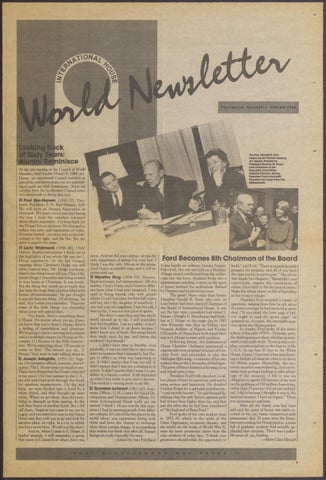
The Hon. Gerald R. Ford chairs his first Board meeting at I. House, flanked by President Gordon W. Evans and Chairman of the Executive Committee Katusha Davison. Below, | President Ford chats with » Comelie van Linge from The ; Netherlands.
At the last meeting of the Council of World Members, held October 18 and 19, 1984, at I. House, we interviewed Council members as
part of the oral history project we are undertak-
ing to mark our 60th Anniversary. Below are excerpts from the recollections Council members shared with us during their visit. @ Poul Kjer-Hansen (1936-37), Denmark. President, P. H. Kjer-Hansen, A/S: We still have an Alumni Association in Denmark. We meet once a year and during the year I keep the members informed about what’s important. I’ve been back (to the House) five or six times. It’s c
to
reflect the rules and regulations of today. ‘It’s more natural—no more men to the left, women to the right, and the like. But the
spirit is exactly the same. ® Lucia Whitmarsh (1938-40), USA/ Hawaii. Realtor and pianist: I think one of the highlights of my whole life was the I. House experience. At the last Council meeting when Cleveland Dodge was still alive, I said to him, ‘Mr. Dodge you know,
there’s one thing I must tell you. One of the nicest things I remember was being invited to your home at Christmas. It was lovely. But the thing that struck me so much that day were the huge brass planters filled with bronze chrysanthemums.’ He just thought it was the funniest thing. ‘Of all things,’ he
said, ‘that’s what you remember.’ Those are some of the little things you remember about some very special days. You know, there’s something about I. House. No matter where you go, if people know that you’re from I. House, there’s a feeling of camaraderie and closeness. We're going to have a meeting and a dinner and a candlelight supper (in Hawaii on November 11) because of the 60th Anniver-
sary. We’re expecting about 100 people to come to that. The minute you say, ‘I. House,’ they want to start talking about it.
® Joseph Adegbife, (1951-52) Nigeria. Government official, scientist, and ed-
ucator: The I. House means so much to me. There were things that the House corrected in my mind. Our first summer in the U.S., my wife and I had gone through the South for speaking engagements. On the way back, we were booked into a hotel by a white friend, and they thought we were white. When we got there, they did everything to dissuade us from staying. In the end they found us another hotel. But I did tell them, ‘Suppose you came to my city in Lagos, and you wanted to stay in the Grand Hotel and they told you to go and look for another place, at night, in a city in which
you have never been. Would you like that?’ And so, when I came to I. Hotise, it healed wounds. I still remember a group that went to Connecticut where there was
or snow. And we did some skiing—it was the only experience of skiing I’ve ever had. I think I was the only African in the group. And I had a wonderful time, and it still remains with me. @ Merethe Ring (1954-55), Norway. Businesswoman and entrepreneur: All of a sudden, I had a home, anda home so differ-
ent from what I had ever imagined. I was used to being friends only with people whom I could introduce by their full names and say, she’s the daughter of somebody. | also had a set of complexes. I was too tall, I
was too fat, I was not that good at sports. But then I came here and the whole world opened up to me. I still remember that first breakfast. I sat at a table—I don’t know howI dared to sit down because I didn’t know any of them. But immediately they made room for me, and before the weekend I had friends! I didn’t have time to breathe. And gradually, it was not only day-to-day or moment to moment that | enjoyed it, but I began to reflect on what was happening to me. It didn’t matter that I was too tall. It didn’t matter that I was not a champion at tennis. It didn’t matter that I wasn’t a candidate in a beauty contest. It all depended on what I was ready to give and to receive. This marked a turning point in my life. @ Sjamsiah Achmad (1961-62), Indonesia. Officer, U.N. Center for Social De-
velopment and Humanitarian Affairs, Vienna: International House really got me started. I think I. House was the first experience I had in meeting people from different cultures. It’s one of the few places in the world where you experience living with them and have the chance to exchange ideas about certain things. It is something that makes you think that after all, human beings are really basically the same. —Edited by Ann Friedland
Ford Becomes 8th Chairman of the Board It was hardly an ordinary Sunday Supper. First of all, this one was held on a Monday. A huge crowd overflowed from the auditorium into the foyer. Students broke into a spontaneous standing ovation as the guest of honor entered the auditorium, flanked
by Trustees and secret service men. The guest? None other than former President Gerald R.
Ford,
who
only an
hour before had been elected Chairman of the Board of International House. It was not the first time a president had visited I. House—Dwight D. Eisenhower had breakfast at I. House on the tragic day in 1963 that Kennedy was shot in Dallas, and Nnamdi Azikiwe of Nigeria and Kwame N’Krumah of Ghana have both found their way to I. House to meet with residents. Following dinner, the International House Chamber Orchestra announced a surprise selection prepared in honor of President Ford, and proceeded to play the Michigan fight song, a reminder of his own student days at the University of Michigan. The guest of honor beamed as he sang along and wiped away a tear. President Ford’s talk was short, to al-
low plenty of time for questions, and was by turns serious and humorous. He thanked Gordon Evans for a splendid introduction, “a real morale booster,” he said sheepishly, relating that his wife Betty’s opinion polls had always been higher than his, and that just the other day he had been introduced as “the husband of Betty Ford.” Ford spoke of his own student years in 1935-39, which in the midst of the Great Depression, economic disaster, and the world on the brink of World War II,
were far more pessimistic times than the ones students of today face. “I think your generation should relish the opportunity to
build,” said Ford. “There is an unbelievable prospect for progress, and all of you have the opportunity to participate.” His advice was simple but eloquent. “Remember your convictions, respect the convictions of others. Have faith in the decency of others. Make the whole planet as full of friendship as this room is tonight.” President Ford accepted a variety of questions, ranging from how he felt about the press coverage he had received as president (“If you think the front page is bad, you ought to read the sports page!” he quipped) to, of course, the inevitable question about the Nixon pardon. In answer, Ford spoke of the atmosphere of the early 1970’s—Vietnam, riots,
the disillusionment about whether government could really work. “It was a very complex, controversial era in the history of the U.S.A. In my first 30 days in the White House, I spent 25 percent of my time listening to lawyers advising me what to do about the Nixon papers. Meanwhile, the economic situation was worsening, and our en-
emies were perhaps looking to take advantage of the situation. | felt it was my obligation to spend 100 percent of my time on the problems of 250 million Americans, rather than 25 percent of it on one individual. I did it because I thought it was in the
national interest. I have no regrets.” There was spontaneous applause. After all the thank yous had been said and the guest of honor was safely escorted to his car, many commented with amazement that 10 years after the bitterness surrounding the Nixon pardon, a room
full of graduate students had actually applauded that decision. There was a palpable sense of, yes, healing.
-—Mary-Clare Metcalf
bao
ERS
House ss
‘
This holiday FT
qson
owe
i.
‘ n
co-all students ' making
who were
Night of Nations: Behind the Booths Residents in Focus: The Icelandic Five “Why are there so many musicians in Iceland?” The question drew differing responses from the members of this resident string quintet. All natives of this small (population: 238,000) northern country, they have performed at many House events over the last two years. “It’s because musical education is compulsory in Iceland,” said Vera Steinsen, a violinist who now studies fashion design at Parsons. “No, it isn’t,” Sigurlaug Evaldsdottir, a violin student at the Manhattan School, corrected her. “But in every Ice-
landic town, there’s a music school.” —_. “Actually, we’d be more typical Icelanders if we were all soccer players, not musicians,” chimed in Svava Berhardsdottir, the Juilliard violinist whom the others say “manages” the all-female group of musicians during their appearances at the Fall Fiesta, Performers’ Showcase, and Night of Nations. “There are more men than
| women in Iceland,” she said. “But it is true that the people who come to New York typically study performing arts.” Thanks to Svava, all five graduatesof
Fae |
the Reykjavik College of Music also came
| to IL. House. While at a summer music 2
camp in Vermont, she learned of the House
and spread the word to the others back home as they were making plans to continue their studies abroad. Besides playing together as a string quartet, the young women, who have known each other for almost a dozen years, sing and perform Ice-
landic folk dances. They are also members of the I. House Chamber Orchestra. In addition to Vera, Sigurlaug, and Svava, the group includes violinists Greta Gudnadottir, of Manhattan School, and Bryndis Palsdottir, of Juilliard.
“We eat a lot of fish, which is good for the brain,” said Svava, when asked to speculate as to the source of their abundant talents. But, noted Greta, strings, songs, and a love of their active life here at the House aren’t the only things shared by the Icelandic Five. “Cod lover oil,” she said.
“We all have unopened bottles of cod liver oil. Our mothers send it to us.” Meanwhile, the lone male Icelandic resident, Gudmundur Gudmunsson, a biology student at CCNY, said he prefers sci-
ence to soccer. Asked whether he, too, had musical talents, he hesitated, then said: “I’m a shower singer.” . —Ann Friedland
You can tell the big day is drawing near by the increase in the number of notices
posted in the elevators for planning meet-
ings. You can’t miss the giant sign hanging in the middle of the cafeteria, and if that’s not enough, there’s a sign-up board nearby, surrounded by a string of blinking lights. An impressive-looking proclamation from the Mayor’s Office, officially declares April 13th “Night of Nations Day” in the City of New York. Once again, the diversity found under this one roof is emerging with an abundance of creativity and energy. The Northeast Dining Room is being transformed into an African market. The only thing lacking will be the beating African sun; even so, visitors will find respite
under the thatched roof of the market restaurant. There’s even talk of a homemade beer to sip as you enjoy the hot rhythm of African music. One of the new additions to this year’s Night of Nations is the European Booth featuring European accomplishments in economy and science. And what about the Americans? In light of the House’s 60th Anniversary, we're looking back to the decade when it all began: the Roaring Twenties. The Home Room will be the setting for underground
speakeasy, with blues and jazz floating through a crowd of plumed flappers and
dandies toting cigarettes in holders.
The ALLNATIONS Dance pany will hit the auditorium stage tween performances by a Middle Easte
dance troupe and an Israeli dance cot pany. Even the kids involved in th Harlem Tutorial Program are getting in on
the act. They will be singing, breakdancin; and parading the latest fresh looks in a fash ion show.
:
ee
The classiest act will take place in |
the Dodge Room, where an auctioneer
from Sotheby's will be donating his services for the most important fund-raising
|
After all, a major impetus to putting festival together is to raise mon
International House Student Sch ip Fund. Items donated to Nightof Nations for the auction include a computer, a |
Paul guitar, a VCR, fur coats, and various
trips around the world. Any bidders? __ The Night of Nations seems to cc
at a time of year when residents really feel a ‘
each other in this setting, and
n¢
too easy to forget about our different back
grounds. This festival can help us and the rest of New York to appreciate the uniqu ness of our various cultural settings. Bet long, the academic year will come |
and Night of Nations will giv
4
Alumni Forum
By Frank Taylor At an October meeting of the Council of World Members, to which I was recently appointed, I felt embarrassed about how little I’ve done for I. House since I was last there in 1977-78. As I’m only working part-time to “pay the rent” while I write a book, I knew! couldn’t just write a check and clear my conscience. So I decided to pitch in with a few hours a month of work that I thought could make a difference. I offered to help the development office create a networking group of alumni who were graduates of journalism schools and are now working in the New York area. We've located about 60 alumni working at such places as Time, Science Digest, The Asian Wall Street Journal, Town and Country, Attenzione, CBS, NBC and the Soap Opera Digest. On April 25th we'll be meeting at the House for a dinner with students to see how we might help. In addition to discussing topics of professional interest, | think the group can do more of what I’ve just started doing as one individual. If the current crop of students is any-
pro-
adets, special:
McGraw-Hill World News, one of the largest and most reputable news organizations in the world, and one alumna to a major
video producer. I asked for the resume of one student, Michael Cowan, and was so impressed reading of his past project filming and recording children in Nicaragua that I asked him to show it to his fellow students and my journalist colleagues at the House. I even offered to get it shown at the Overseas Press Club. I know the genuine and enthusiastic interest 1 showed him gave him an important boost in morale at a critical point of a long, intense school year. At the same time
] expect to be inspired by his work. I have also sent notices to the House of interesting talks to groups of journalists in the city that students might want to attend. The latest featured Dith Pran, the
Cambodian associate of a New York Times reporter, whose story was told in the film “The Killing Fields.” It was a magical moment for those who attended, one which
first,
reinforced what International House is all about, brotherhood. And that’s what this networking project is all about. Frank Taylor has worked for McGraw-Hill
“Where can I get a job?” I’ve already intro-
World News in South America, and is now
duced
writing a book on Alberta Hunter.
thing
like us, they want two
residents
to know
to the director of
Dick Simmons and Elly Elllott speak to
| Meet Your Trustee: Dick Simmons On American Media : "After introducing himself as “‘a defrocked - profession. “What type of person will aclawyer” who is in the Guinness Book of cept a life where you will almost certainly ‘World Records “for losing the largest libel never get rich, where you will work unsuitin history,” I. House Trustee Dick Sim-
mons, President and Chief Operating Officerof the Washington Post Company, shed his suit jacket for a frank discussion with _ | residents February 27. “There are a lot of | interesting issues,” he told the audience of
_ | 50 who eagerly waited to pose questions.
_ | “Who wants to go first?” |
“I get very distressed when people use
a ‘ie reporting section of the newspaper to
put across their own ideas,” he said in re|
sponse to a question on fairness in media,
| brought on by the recent efforts of some conservative leaders, notably Senator Jesse.
| Helms of North Carolina, to acquire stock in companies which they perceive as being biased. Mr. Simmons said that he under| stood how many people could come to the conclusion that the stories in American ; were influenced by those who ‘ran them. “When I came down to The Washington Post, I guess | was pretty connced that somehow the word from on igh got translated into the daily reportage the newspaper,” he said. “And I can tell you, from the point of view of a business person—despite what you read—that is imply not true. . . There is no direction.”
Nonetheless, Mr. Simmons charac-
tized the coverage in The Washington Post din other American media enterprises as
a
er than conservative, but said
reason had more to do with the toee —
-story. “With blacks, we've failed . . have not done a very good job.” He called the difficulty of finding qualified minorities to place on the management fast-track “one of the stickiest problems that any business manager has to face” in America today. “We're doing our part, but there just aren’t enough to pick from,” he said. As to the quality of coverage in the
godly hours, to try and serve a higher public good,” he asked. “I think it’s the type of person who likes to kick at authority, who likes to uncover wrong, and I think that person by definition would tend to be somewhat more liberal than conservative. It is, of course, the job of the editor,” he American press, Mr. Simmons said that in added, “to get those spins out of the stories. some areas, particularly business, reporting Mr. Simmons praised the freedom had improved, “very, very substantially,” that American journalists enjoy under the while in others, such as foreign affairs, First Amendment, calling it, “the only thing that distinguishes this democracy - good, thorough coverage was still lacking. “Business has become front page news,” from every other democracy in the world,” said the former Dun and Bradstreet execubut said that, in certain cases, notably tive. But with regard to international news, those in which the public’s right to know he said, “I’m not convinced that the great was balanced against the privacy of individuals thrust into the limelight, the press took "mass of the American people are a helluva lot more educated about what is going on in their freedoms too far. “The First Amendment was not created to protect the press, it the world today than they were twenty years ago.” Nor did he see any major imwas created to protect the American pubprovements in store. lic,” he said. “Easy to say, but where do you “You’re talking money,” he said, draw the line?” Turning to the question of the lack of outlining the position many publishers took when deciding what and how much progress for blacks and women in news orforeign news to cover. “Yes, there’s a reganizations, Mr. Simmons maintained that sponsibility. You raise a vital issue,” the women had made significant inroads but president of the company that publishes they were not yet visible in high-level posiThe Washington Post and Newsweek told a tions because many were still young and risstudent who asked whether the American ing through the ranks. “It takes time. You've got to pay your dues,” he said, not- . press had an obligation to devote more and better space to international events. “But ing that he expected to see more women in nobody gives a damn. In Keocook, Iowa, the upper echelons of media management in the not-too-distant future. But for they don’t care. They really don’t care.” —aAnn Friedland blacks, he said, it was quite a different
Elly Elliott: On Men “What’s happening to men in the women’s.
revolution?” was the subject of an address
by Eleanor Elliott, trustee of Barnard College and wife of I. House trustee John Elliott, held March 18 as part of the Meet Your Trustee Program. “The overall answer is easy,” said Ms. Elliott, “men are in
the revolution as deeply as women.” Pointing to advancements made by women in the professions of law, business, science, and medicine, Ms. Elliott said that men were adjusting well to the changes in the workplace. When it comes down to “all of the things which go into basic oldfashioned gratification of the ego that job | success confers,” she continued, “men are usually sympathetic.” But in their social and sexual roles things are not so easy. “If you agree,” she said, “that men’s sexuality is somehow bound up with being more powerful than women, then, ironically, sexual equality is
a defeat for a man.” Another major shift, according to Ms. Elliott, concerns the loss of men’s socalled ‘hero role’. “As women become more independent, men’s dependency on |
them is exposed.
The net result of all this, she feels, is a growing ambivalence that men feel today as husbands and fathers. Men are adjusting | to the women’s revolution, she concluded. Like it or not, “day by day, men are having to make it possible for more women to use
aod liberty and eae their own happiss. And that’s goc ae
Friedland 3.
|
1920's
1940's
Nina R. Lief (1927-31) is director of the Early Childhood Development Center, and associate
ElizabethG. Bolton (1941-43) is retired, with time for creative writing—poems, short stories and novels. “I’ve just had a book of poems published—The Heart Speaks.” James Barron Fitzpatrick (1940-41) writes: “I am working as a social worker for the Portland, Oregon public schools, and hope to continue until our youngest, Sally, graduates from
professor of clinical psychiatry at the NY Medi-
| cal College. She lives in Connecticut. _ Thelma Mills (1927-28) is a retired YWCA executive after 12 years of service as an international
volunteer
with
the Taipei,
Taiwan
_ | YWCA. Currently, she’s on the board of the Oregon UN Association, and is a recent gradu| ate group advisor for the American Association. of University Women. - Rosalind Mortimer-Maddox (1925-26) is a free-lance writer, living near Boston, and is married to the Rev. Richard MortimerMaddox. Henry B. Refo (1924-25) is retired, and living in Pilgrim Place, a retirement community. He recently revisited old friends in Hong Kong and Canton, China.
ea
—
Boston University in 1986.”
Gibson Gray (1947-49) writes that he became chairperson of the department of political science, Pembroke State University in 1983, and
that Ruth Saunders also lives in Lumberton, NC. Georgia E. P. Lash (1940-41) accompanied ay as satan who is mayor of Salisbury, NC, , IN for a meeting of the Naas Lteapaeob ies Giorgio Tagliacozzo
(1939-41),
a scholar,
and specialiston the Italian philosopher, Giambattista Vico, is generally credited as being one of the main initiators of the resurgence and current vogue of Vico studies in the English-
1930's
_ | Elizabeth Bright McKinney Chmiel (1931-— 32) writes that she and her husband celebrated
Marjorie
their 35th wedding anniversary in June, 1984.
Willcox
(1942-43)
writes
from
North Carolina that she visited Mrs. Jack
| John Austin Jardine (1939-40) will be 80
Dunderdale in Vancouver and Mrs. George
next year, and spends a lot of time with the
Goodwin in Calgary, both of whom she hadn’t
| handicapped, people with drug and alcohol
seen in years.
_ | problems and senior citizens. He also promotes . for anaes mre
4950's Thomas J. Gardner (1949-52) is professorof
the Kennedy Center and museums. _ | Ralph E. and Muriel Warren Pumphrey
management at CUNY, and a management consultant. (1931-32, 1930-32) are both retired, active in Lutgarde Jans (1959-60) enjoys working as a numerous volunteer activities, and recently cel-_ nutrionist at St. Luke’s Hospital Center where kG | ebrated their 50th wedding anniversary. | she’s been since 1968, and still likes New York. | Leslie F. Smith (1928-32) visits Britain and - Kemal Karpal (1950-51) is president of the Norway once a year, and recently taught NorMiddle East Studies Association of ee wegian for an American-Scandinavian group. America.
stan, the Far and Middle East and Europe. “We take great pride and joy knowing the light is | eh James W.
Soss Melik’s (1950-53) portrait of Sinclair Lewis, which hangs in the National Portrait
Gallery, was used for the recently issued $.14 stamp commemorating the centennial of the novelist. Mary Lou (Twombly) Stealy (1953-54) manages a field office for a U.S. Senator. to an award-winning high school newspaper and yearbook, and president of the Hawaii School Publications Advisors. Frances Sui Lan Tyau (1956-58), associate professor of education at SUNY Buffalo for 26 years, will soon join the ranks of professors emeriti. Susan Wheeler (1953-55) is administrative manager at Baccarat, Inc., the crystal importers in New York, and is hoping to look up I. House alumni on her next trip to France.
1960's Joanne R. Bronars (1959-64), associate professor of education at CUNY, is married with
one child. “I do folk song programs for children with my guitar,” she writes. Joel Davidow (1962-63) has returned to New Washington. He practices law, and teaches international trade and antitrust law at the Columbia University Law School. | Mary E. Fowler (1965-67) is director, building services division, in the U.S. Department of Energy’s office of conservation. Mary Gegerias (1961-63) received a distinguished service award at Pine Manor College where she teaches French literature. Theodore S. Housman (1964) has had many international experiences from overseas teaching and travels in East Africa, India and Vow
McCourt
(1963-64) is director of
Francis C. Welch, Jr. (1960-61) is with | _ Carter, Ledyard and Milburn, a law firm on Wall Street.
1970's& 1980's Carol Ann Kinsaul Arvan
(1979-80) is a sen-
ior account officer with Citicorp in New York. Rachelle Bradt (1979-81) has a baby daughter, Lillian, and will soon be going to Zambia for | a 6-week international museum exchange program. Greg Miles (1977-79) is number two at the | Pittsburgh bureau of Business Week magazine. Hiroko Hagino and Bernard Poirson (1976) met at I. House, and were married in 1979. They have a 4-year-old daughter, and five in Abu Dhabi, U.A.E. DavidN. Tso (1971-72) So talk joined General Electric Trading Co. in New York City as |
manager, international trade development.
Mary U. Cleverley (1924-25), June, 1984
Myrtle Ako Kung (1969) Wallace D. Ormsby (1946) — | John M. MacGregor (1924-30), February 14,
1985, was a noted lawyer. He served on the fac-
Metcalf, Editor; Ann Friedland, International House Notes Fellow. Ve‘Photo
it organization, a copy of our last annual financial finanche from the wis acca eee
es is avai i
as
Riverside Drive, New
with the Alpha
Tan Omega
fraternity, and
Scottish Heritage-U.S.A. A loyal friend of I. ee ee shemales Pee the Board in the 1960's. Francis A. Pontincello (1927-28)
hy,0Tom Jarmoszko, Brooks
Charities Registration, Albany, tL: 12231,
Yor NY 10027.
ae _ >
oO
fa) fe} a
ra
DAN PISIZATY 00S
LZ001 AN ‘3404 MON
p=
Zz oO
Fe os c oO an -
oO
a
asnoy [euoNneusaiuy
oO
a S
® President Emeritus Howard Cook went off on yet another trip around the world for I. House, October 28-December 15, to enlist the support of alumni, friends and contributors for the 60th Anniversary of I. House. Making stops in the Far and Middle East, and Europe, he has raised $50,000. Costs were low thanks to free accommodations or discounts provided by the Hilton and Intercontinental hotel chains, and TWA. @ Dr. Henry A. Kissinger, former chairman of the Board of I. House, was honored at a benefit dinner on December 12. 250 trustees and friends of 1. House gathered to pay tribute to a remarkable statesman and to honor his eight years of service to I. House. David Rockefeller gave the tribute. Dr. Kissinger spoke on foreign policy. The guests dined and danced—and raised over $50,000 for I. House.
@8 Many New York area alumni received phone calls
from 30 enthusiastic student and alumni volunteers
on March 18 and 19, reminding them about upcoming events, and asking for a 60th Anniversary contri_ bution to the Annual Fund. Fueled by cookies from Barbara Evans, volunteers made over 635 calls and $4,800 was pledged. Thank you! BB Dr. T. G. Ling, who lived at International House in the 1920’s, recently gave a beautiful Chinese embroidered hanging to I. House in memory of his wife, Helen Ling, who died in 1982. Helen left the U.S.A. in 1928 to be married in China, and eventu-
ally settled in Singapore where she had an antique shop, and was widely known for her knowledge of oriental art and crafts. & When John French died in the summer of 1984, his friends, fellow trustees and associates set up a special program fund in his memory. Mr. French, a partner at Curtis, Mallet-Prevost, Colt & Mosle, was
Henry A Kissinger, David Rockefeller and Cleveland E. Dodge, Jr. at December
42 dinner honoring Dr. Kissinger.
THE ALUMNI FUND MOUNTAIN NEEDS YOU! Cut out the ~ Mountain Climber and send him back to I. House
with a gift
GIFT COUPON:
trustee of I. House for 21 years, for many of them as secretary and legal counsel.
Enclosed is $
made a generous bequest in memory of Harry and Florence Edmonds. Mrs. Babbott served on the Board of Trustees in the early years, and was a loyal friend and supporter throughout more than 50 years of association with I. House. @ The Alumni Fund needs your help! To date, only three percent of I. House alumni have sent gifts for 1985. And we’d like to reach five percent participation by June 30, 1985. Remember how much I. House meant to you, and send a check today!
Name
‘divd
ADVLSOd 'S'N ALVY WING
#8 We are deeply grateful to Elizabeth Babbott, who
SEPT ‘ON Weg IM ‘UosIpeyy
|
ulty of NYU for many years, and was very active
A newsletter for alumni and friends of International House, 500 Riverside Drive, New York, NY aad Pent
_
Mrs. Cyril O. Bratley, (1925-26)
setienaieiniantienanitiate Newsletter Vol 20 Ne. 2, Spring 1985
.
.
education for the U.S. Army in Panama. i Meriemil Rodriguez (1966-67) is a copy editor for the Houston Chronicle.
Ann Todd (1959-60) writes that she is advisor
York after a year with the Justice Department in
=< J. ‘Little (1939-40) is retired. She greatly enjoys life at Friends house, a Quaker retirement community in Maryland, and trips to
*%
Thomas A. Lee (1952-53, 1957-58) has become head of the department of teacher training at Antigua State College, Antigua, Leeward Is-
Address
Send to: Development Office, . International House
500 Riverside Drive New York, NY 10027 a
|