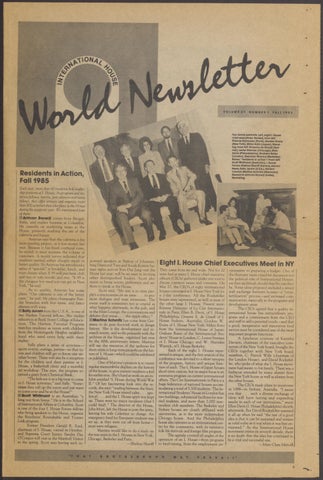
Two famlly portraits. Left, eight I. House
chief executives. Seated, from left: Etlenne Daimasso (Paris), Gordon Evans
(New York), Mikio Kato (Japan). Standing, from left: Graeme de Graaff (Syd-
ney), Lester Stermer (Chicago), Ellen Davis (Philadelphia), Graham Rates (London), Sheridan Warrick (Berkeley). Below, “residents in action”: From left:
Scott Whitmont (Australia), |. House
: '
Residents in Action,
Forum; Shelina Shariff (Kenya), Alumni
News; Sally Juram (U.SA.), Harlem
iS
Tutorial; Martina Schmiiz (Germany),
Research; Anirvan Baner|i (India), Marketing.
Fall 1985. Each year, more than 60 residents hold leadership positions at I. House. As program and tesidence fellows, interns, peer advisors and nurse fellows, they offer services and organize more than 800 activities that take place at the House during the academic year. We interviewed four 7 of them:
~-
®Anirvan Banerji comes from Bengal, India, and studies business at Columbia.
He consults on marketing issues at the House, primarily studying the use of the cafeteria and bazaar. Anirvan says that the cafeteria is his most pressing project, as it lost money last
—
year. Because it has fixed overhead costs,
he noted, it must increase the volume of customers. A recent survey indicated that residents wanted either cheaper meals or better quality. So Anirvan has introduced a
series of “specials” at breakfast, lunch, and even dinner when $.99 will purchase chili and rice or tofu teryaki and rice. “$.99 is
the cheapest hot meal you can get in New York,” he said. As
to quality,
Anirvan
has some
plans. “Our cafeteria is one of the better ones,” he said. He plans champagne Sunday brunches with live music and fancy dinners with wine. Sally Juram from the U.S.A.., is one of two Harlem Tutorial fellows. She studies
nowned speakers as Bishop of Johannesburg Desmond Tutu and South Korean human rights activist Kim Dae Jung visit the - House last year, will be an asset in inviting
other distinguished
leaders.
Scott also
wants to bring actors, performers and au-
thors to speak at the House.
Scott said, “My aim is to raise people’s consciousness on an issue. . . to promote dialogue and raise awareness. The
event itself is sometimes not so crucial as what happens afterwards, in the pub, and in the Main Lounge: the conversations and
debates that ensue. . . the ripple effect.”
education at Bank Street College of EducaMartina Schmitz has come from Gertion. The Harlem Tutorial Program many to do post doctoral work in design matches residents as tutors with children history. She is the development and refrom the Morningside Heights neighborsearch intern, and works primarily with the _hood who need extra help with their archives of the House, organized last year studies. by the 60th anniversary intern. Martina Sally plans a series of activities— will use the resources of the archives for sports events, outings, parties—so that tushort-term or long-term projects on the histors and children will get to know one antory of I. House—which could be exhibited other better. There will also be a reception or published. for the children and their parents at I. One of Martina’s projects is to create House, a basketball clinic and a monthly regular memorabilia displays on the history art workshop. This year, the program reof the house, to give current residents a feel ceived a grant from Chemical Bank. for earlier eras. She’s hard at work on an ex“The kids see it as a big treat to come hibit entitled “I. House during World War
Eight I. House Chief Executives Meet in NY They came from far and wide. Not for 20 years had as many I. House chief executive officers (CEOs) gathered under one roof to discuss common issues and concerns. On May 27, the CEO’s of eight international houses converged at I. House New York for a 2-day conference. All the Rockefeller
houses were represented, as well as most of the other large I. Houses. Preserit were: Etienne Dalmasso of La Cite Internationalein Paris; Ellen B. Davis, of I. House
Philadelphia; Graeme E. de Graaff of I. House Sydney, Australia; Gordon W. Evans of I. House New York; Mikio Kato
from the International House of Japan; Graham Rates of the International Students’ House in London; C. Lester Stermer of I. House
Chicago;
and W.
Sheridan
Warrick, of I. House Berkeley. Each of the eight I. Houses represented is unique, and the first session of the
vironment to preparing a budget. One of the thorniest issues raised for discussion was the political role of International Houses: are they apolitical; should they be; can they be. Some ideas proposed included a senior staff exchange between houses—a “‘crossfertilization” process—and increased communication, especially in the programs and development areas. The CEOs agreed that a quality in-
ternational house has extraordinary programs and a commitment from the CEO and staff to add a personal touch—and that -a good, inexpensive and innovative food service must be considered one of the most
important program functions. A luncheon courtesy of Katusha Davison, chairman of the executive committee of the New York board, brought the CEOs together with New York board members,
C. Patrick Wills (chairman of
conference was devoted to a short synopsis _ the London House), and David Rockefelof the program, history and unique funcler, who spoke of what the I. House movetion of each. The I. House of Japan houses ment had meant to his family. There was a short-term visitors, but its major focus is an barbecue attended by many alumni from extensive program on current international the New York house as well as alumni from affairs. The Cite Internationale in Paris is a the other houses. to I. House activities,” said Sally. “SomeII.” Of her fascinating look into the rehuge federation of national houses accomThe CEOs made plans to reconvene times they callup the tutors and just want cords, she says: “reading between the lines, modating a total of 5,500 students. The In- in 1988—in Sydney, Australia. “I assure to come over and be at the House!” the New York House stayed calm. . . apoternational Students’ House in London has. ,you that . . . such a diverse exchange of @ Scott Whitmont is an Australian “a litical. . . and the I. House spirit was kept two buildings, substantial facilities for marideas will have lasting and expanding long way from home.” He is in the School up. There were no major incidents (that I tied students, and more than 2,000 nonresults in each of our institutions,” wrote of International Affairs at Columbia. Scott could find).” The director of the House, ‘ resident club members. The Berkeley and Ellen Davis (I. House Philadelphia) shortly ‘is oneof the four I. House Forum fellows John Mott, left the House to join the army, Sydney houses are closely affiliated with: afterwards. But David Rockefeller summed who bring speakers to the House, organize leaving his wife Celestine in charge. An universities, as is the more independent it all up when he said “the test of a good the Residents’ Roundtable and Trustee emergency fund for European students was 4 Chicago house. And the Philadelphia idea is that it can be sustained and remain Link program. _ set up, as they were cut off from home— house also operates as an international cenas valid today as it was when it was first enFormer President Gerald R. Ford, most were refugees. ter for the community, with its extensive visioned.” As the International House chairman of I. House, visited in October, Martina would like to do a study on folk life festivals and foreign film program. movement enters its seventh decade, there and Supreme Court Justice Sandra Day the war years in the I. Houses in New York, The agenda covered all angles of the is no doubt that the idea has continued to O'Connor will visit as the Marshall Visitor Chicago, Berkeley and Paris. operation of an I. House—from programs be a vital and successful one. _ in the spring. Scott says having such re—Shelina Shariff to fund-raising, from the employment en—DMary-Clare Metcalf
ww
oat
P Fou (S
O
Povjpile the Kenne’Y Hyannis Sivek: Y calc only be viewe
;
omplex CO®
*
rance, WE
2. Bows at another te ’s music \ding t
«disappointing
= “hopping alone
— was played Py ge of rou
Main ay
nbetTy apple
enjoyed bout aS bathing, an
Pie
ep
: Sunday SUPP called for in
rt, M
=
an for dinnet:
In Provincet ‘
\
roo early
ine and
we arose fat
lobster
for t
joint of hig
g. Ou
arch
nstrument UP .
to
biol
across the
runnin’
In his welcome sp eech, ave a fres
rage-
, Gordon Evans rspect!
sve to ne
com
cate
r
bs
aa {
oe
urricane a
et 21. Ah
\
eect
y
hit
re caution
Ne
grou
y
out of
:
Ov. entured to
rivet
hoa
‘
rth to south, 1 P
H. Rotienberg:
cé
As part of Oe
he
tion program the Programs
‘
annual orem *%
Tew residents ;
organizes ken ds in Sep
O-
hartge
oe
ey
skies
gave
dent’s guccesstu Ee
+ had the fee en had at least one Tt te c know,” said sei ae
four of these wen ber, free © mbet toandparticipa fier way tc
Shariff ~ che a rection a saint¢ _-She in
West German w on
the trip
*
Gloria s Bt on Sat rday, Wit
glorious blue
H peel? “Something | Believe in
The grey-haired gentleman often seen in | of these young dancers. This occasion was the cafeteria surrounded by residents is not | the precursor to the annual Fall Fiesta. Uni. House
ling actor who can discuss religious conflict _in India as easily as Australian politics, yet prefaces his remarks by saying, “actors are profoundly stupid people”? On October 14th, Roshan Seth, the
Indian actor now starring in the offBroadway production of “Map of the World” by David Hare, engaged 45 Interresidents in. a discussion
about acting, India, economics, and life. Mr. Seth, also known for his film roles of Nehru in “Gandhi” and Aziz in “Passage to India,” said that acting was a way of breaking out of his middle-class background, which he termed “closeted, closed, and molly-coddling.” “The only way to get out,” he said, “was to do something outrageous.” “I had received a good formal education, but was not really good at anything. Acting seemed effortless. Now, I know otherwise,” he laughed.
Roshan Seth receiyed his theatrical ‘| training in England, where he lived for 15
years. He then returned home, despite his contention that “there is no real theater in India—not theater as you know it in the West.” There, he workedas an editor for
an intellectual journal in New Delhi.
the father of a student, nor is he the mander HR’s direction, these talented residents ager of ‘service operations or of business | became the initial nucleus of the dance Seth condemned the rampant cor- | services. He is Herman Rottenberg, p erg, poppopu- | troupep now known as the ALLNATIONS ruption in the Indian film industry which, larly known as “HR” to those who've Dance Company. he said, survives on “black money’— chancedeto meet him at dinner or on The company, now composed of money made on the black market. LaunchWednesday nights during his international eight dancers, an artistic director, a techniing into a description of India’s two econofolk dancing classes. cal director and HR as producer and narramies, one official, one unofficial, he said: International folk dancing became a tor of the shows, travels widely. In mid“Black money provides for conspicuous serious interest for HR more than .20 years . October the group began its third tour in consumption—and daughters’ weddings.” ago, when hevand his wife participated in three years for the U.S. military forces, enIt is hard not to compare Roshan folk dancing lessons offered by their sons’ tertaining in Japan, Korea, Guam, the Seth’s flippancy with the attitude of Victor school. Soon, HR took a course for instrucPhilippines and Diego Garcia. In February, Mehta (the character he plays in “Map of tors and subsequently began teaching. In they will perform in Taiwan and again in
the World”) at the end of the play. Said Seth, “Mehta comes to a point where he believes everything’s pointless . . . It’s like the Hindu belief that a man is not perfectible.” He suggested that’s why India is the
king.
”ste w for the got\ fisig
and on
' | How does one describe a talk by an enthral-
+e
ethnic cuisin
daunted he grouP
sto
t
ntries, 2!
ling various
‘carnival air as SMe the piano; . 71 on
e force of t Those of us he roof The saw rrees € ee a nced tswildly; W et
national House
ent cou
hey took turns nse le’s couple from ee vali of hina ma :a -
he caferer for the first time
at
“
for ag
gcheduled to \eave data ywCA acquainted ress \ i the ne next mp in Pawling,
food, probally : his year!
Seth
esi dents we
50
calledand PEOPT” 1, wasa ro rolonged stay indo’. which took on 8 aff iW, x playe 1920 s-style ja yen ran
Roshan
of
1963, he sold his prosperous knitted wear manufacturing
business
in order to “do
something I believed in.” International House “wrapped up in one neat package everything | loved.” He offered to teach international folk dancing, and I. House not only accepted his proposal, but hired HR as
way it is: “In India you're freer, in a way, than in the U.S. You can do what you like because it’s so chaotic.” ~ cultural director in 1964, a position he held But Seth acknowledged that for peountil 1976. ple like I. House residents living in New When HR began his Wednesday York, going home isn’t easy. “You get evening folk dancing courses in the 1960s, spoiled in New York,” he said. “Everyone; many talented residents attended the then here’s striving for excellence.” nearby Juilliard School. Midway through For someone who claims to have the evening’s activities, a select few would dropped all pretenses of being intelligent, perform a dance routine for the rest of the Roshan Seth seems to be living up to New group. The performances were so well reYork standards. ceived that HR planned an event inviting —Sonali Paul the whole of the House to enjoy the talents
the Philippines under the sponsorship of cultural organizations. HR sees the ALLNATIONS Dance Company as a way of promoting international understanding. Audiences feel closer to “strange” and “exotic” peoples after experiencing dances like the Ukranian Hopak, the Mexican Mixteco, the Chinese Umbrella Dance and the Greek Hasapiko. Now, after a 12-year hiatus, the Wednesday night international folk dancing classes are back again. “I consider it a privilege to be involved with such a wonderful group of people,” said HR. “There. are over 500 people living under this roof and every one of them is something special.”
‘
—Karen Groshek
aae
B
ree an d president ; of
:
e USA
ite —
jazz from New
The eee 3
Fidelis play Chamber Orchestté undet the direction
a American
and serious, re
arby
Koreas S
pudience roate
awhen =
nus Rort
oueh
rege
.
= rent por’
n fami
aaa
“
safety he \
S Dance
ne.
e ALLN
he audience
ins
drawling
“Blossoms © ant crinikling”
who
ght them
fr om
‘ usic born an
of world sine see Irving
Berlin’s eGive
bluegrass t0 F
d
Your Poot
and Bruce Spring
—
Traditional
stage action La
adth
of America,
’
and its ethnic
ee
e
diversity:
Bud Bultman
; Pet e's Repub:
@ Fall Fiesta
iors™ deaderc sup after as rest
The
ray
t
wen t along
where they may test their leadership skills in an environment where their considera-
Today, they make a difference for our 530 residents and the many friends of I. House in the wider community. Tomorrow, these
leaders will still be making a difference—in every part of the world. h., J Vf ¢ om WV,
rea ceremony se indian
acini tuxe 0) =
sentingNom»
the Pari
‘
Also inrthe
any
a
|
che
Te
presen
dress
dents
1
House test?
onal wedding sect
®
marriecs
ny talente
es
Cindy im
this section ©
ore
Frank Wong (4979— 84), president for a doy, June 10, 1985
ppp articles sigs House residents:
rd Fall Fiesta?
a
psseates
¥
Councilto Meet
Away from Home
Video at I. House
President for a Day
The noisy, congenial atmosphere of International House changes during the holidays when many residents leave to visit friends or relatives. Those left behind face a Thanksgiving or Christmas alone, away from home, in the often cold and impersonal city of New York. The Home Hospitality program
Over the past two years, through opportunities provided by the internship program, computer and telephone interns have led the House through technological transitions from old to new systems.
Some people just can’t stay away from International House for long. When Frank
matches up interested residents with fami-
lies willing to have them over for holiday festivities,
an overnight
stay,
or just to
share a meal. “It’s an
invitation
for foreign
stu-
dents to experience the American way of life,” explained Maya Speelmans, who is helping to coordinate the program. Home hospitality also gives hosts the opportunity to get acquainted with other cultures. Elaine and David Benedict of New Jersey invited two residents, one from Hawaii and the other from Turkey, for Thanksgiving dinner with their family last year. “It was a very pleasant experience . . sharing with people of another culture,” Mrs. Benedict said. Alan Jim, the Hawaiian student who spent
the
holiday
with
the
Benedicts,
noted “It was a very nice opportunity to get ... back into a family experience.” Alumni in the New York vicinity in| terested in hosting a student or two should :
Our residents are our most precious
asset. They bring to us enthusiasm, initiative, a high level of creativity and expertise, and a willingness to share both. But we are especially proud to provide a setting
4 '
Bud Bultman
f
home.
O c robert
ya Bec ker, \4
n who
curity of the building after the staff has gone
- kimono wom
a formal Japane™’ | for the rae nnin and a stu
ENATIONS Dane
ALL
Comp
feeling ket got to e friend
lows, two to a floor, create a sense of com-
munity and meet any problems which might arise. Problems which require special attention are referred to the three peer advisors and two nurse fellows. Finally, our 14 house managers are responsible for the se-
ble talents are given a chance to flourish.
internships include: a development and re-
contact the Programs Office at (212) 316-
8438. According to Mrs. Benedict, being a host is well worth it. “I'd like to have someone again,” she said. —Bud Bultman
This year, a new communications system internship, inspired by the gift of videotape recording equipment from SONY USA, aims to bring I. House into the video
age. Using our newly acquired Betamax, 3/ 4” recording decks and color monitor, we are beginning to take advantage of I. House’s natural visual appeal for both educational programs and entertainment. Some of the video uses being explored include: documenting House events (the first recording was made at the Octo-
ber 12 Fall Fiesta); arranging workshops on video production to teach residents about the equipment; organizing a video night, featuring video as an art form, music videos and/or residents’ productions; and making training tapes for House computer systems.
Further possibilities include producing a year-end roundup tape of House programs, producing an I. House music video,
and taping performers’ rehearsals in order to give them instant feedback. If the program proves to be successful, future creative coverage of the House’s activities and people could become useful for external as well as internal purposes. Fund-raising applications might be next on the horizon, as well as sharing our House experience with other international houses
and institutions across the country. : —Laura Kaufman
4
ye
ul fishing 1°
erin the
tivities offered each year. 18 residence fel-
repreW as Evans che designe! show was aBat bara ahiere
cuisines aS ohh in king
ge
ae
gram fellows help to organize the hundreds of intellectual, cultural and recreational ac-
‘areas of technology, and into greater in-volvement with our neighborhood and the international community of. greater New York. Last year, an intern organized the House’s historical archives. This year, our
ce Side rful interna
In many ways, the Fellowship Program
in the past have guided the House into new
tional ress TANG d TO from history f © f eo Fiesta
ed with the
mae? A i its rich
ing als0 ncluded the
largest and
aie sia slides depict
n
“
The even
yn the U.
m different
the
House Chorus Me Your Tired,
he auditor ium,
is what makes this House “tick.” 32 pro-
We are particularly proud of our Internship Program , which provides an opportunity for a select group of residents to explore new directions for I. House. Interns
1, House idea
keeping vies has
stand and appreciate a global world view. How better to meet this goal than by
ing, and I look forward to working with this year’s Council.
And
‘eh
Pe
Chin
ing, am Appala-
rt
‘ axticipa r 20 n’dittet eves sam
Pp a
from the Be
tern, a nutrition intern, a communications system intern, and an accounting intern.
Council, whose elected members advise the president on the affairs of International House by communicating the views of the residents. The potential for constructive and creative interchange between this Council and the staff of the House is excit-
° “ graceful from the Ukraine, sonlit Rivet
pi al via PFO
‘
“Ho
T
h dances wit cil, including
ar
~resident conduc eda tout
search intern, a diplomatic community in-
decade, our mission is to provide an opportunity for this community of 530 students, trainees, and. visiting scholars to under-
There is, first of all, the Residents’
€ vey ound ¢ Company delighted
ett ily jamet ee ters Ric
oPreneas
:
Y
As International House enters its seventh
using the extraordinary leadership skills of our own residents. Who are these residents and how do they operate?
arrived for Pde Verdi's “Rigo weat from rtet th ding a bicy \ and ae
aunt across the ;
Puerto Rico am
“
ing kicked off a nts on
of resident
jonal House
use residents tC
¢ cultural programs
«Sernpet
joe Pee “apy the RO
Pies.
H
From the President
A wit
storys
rolina hi “tg
i
g Arts Foundation
eae
ae
in Berlin
Wong (1979-81) came back for the Night
The Council of World Members will hold
of Nations festivities on April 13; he spied a modest notice amongst many glamorous items donated for the auction. It announced that the successful bidder would have the privilege of presiding over International House for a day. Needless to say,
1986. The agenda will include an update on the House and its mission. The meeting will be addressed by the Mayor of Berlin. Time will be allowed far attendance at musical events and for specially-conducted
Frank outbid all comers, and purchased the
honor.
. During his three years at the House,
Frank had a distinguished career as House manager, Night of Nations manager, and first student member of the admissions committee. A student at the Columbia University School of International Affairs while at I. House, Frank went on to Harvard for a business degree and has founded two companies specializing in innovative technologies in the past four years.
On June 10, Frank flew down from Boston. He spent the day meeting with senior staff members, had lunch with residents, and asked a great many questions. ' He noted that it was great to see I. House in such good shape. “You get a very different perspective from the inside.” Meanwhile, Gordon Evans, whose undergraduate degree was in engineering, spent the day getting a look at a very different side of the operation. “I was delighted to take off my president’s hat and don my engineer’s cap,” he said. “I spent much of
its 14th meeting in Berlin on June 12-15,
tours of Berlin. President and Mrs. Evans
will be present throughout the meetings. All I. House alumni are welcome to attend the general sessions. Please return the coupon below by January
would
15, if you
like more detailed information.
Council
members
have
priority for the
rooms held at the Hotel Steigenberger, where the meetings willbe held, so alumni
are urged to make their own arrangements. —Mrs. Paul Soros | —Sigurdur Helgason Co-Chairmen, Council of World Members To:
Nancy Cooper, I. House, 500 Riverside Drive, New York, NY 10027.Phone: (212) 316-8440. ,
Yes, I would like more information about the
Council meeting in Berlin, June
12-15 , 1986.
(} I am interested in round trip group air fare from New York. [J 1 am interested in a room at the Hotel Steigenberger, if available. Name
I. House years
Street
ts
" the day climbing around rafters and check-
City
State
ing out water spigots. ” —Mary-Clare Metcalf
Country
Telephone
‘Zip
|
|
Mumni- rough the Decader 1920's
Barbara Rosen (1935-36) is a psychiatric so-
Benjamin Bardin (1924—26)is a retired col-
glass, hangings and quilts—and writes poetry in
lege professor, living in Wilson, NC. T.G. Ling (1924-25) came to I. House for a visit this summer. He has been instrumental in
cial worker.
She
her spare time. “(I. House) was a fun time and New York is still my favorite city.”
setting up a program to provide scholarship funds for students from the People’s Republic of
tirement there, with one trip around the world, and 6 or 7 to Europe, courtesy of his son who’s a pilot with Pan Am.
Cecilia Vassos Casey (1958-59) was a reading consultant for eight years, training teachers and
1930's
the elementary schools of suburban communities in NY and NJ. Then she returned to art school, becoming an artist in her own right, and began an unusual school program in creative arts
D. Carter
(staff, 1935-39)
is now
president of the Feris Foundation of America, a foundation for promotion and education in information studies.
Ruth Tensen De Witte (1938-39) made a special visit from Rochester to attend the Candlelight Supper in May. Sook Ja Hong (1932) is active in women’s issues in Korea, and last summer attended a conference of the Federation of Asian Women’s As-
sociation in the Philippines,
where she was
elected 2nd vice president. Prescott L. Laundrie (1934-35) is a retired Episcopal priest, and active in Common Cause,
Crop Walk in Syracuse,
and the Episcopal
Church General Convention.
Curt and Rosalie Regen (1932-34) sent us a
>
M. Javed
ployed at the U.N., and looks forward to becoming more involved at I. House.
York after 10 years abroad,
is now em-
Eumelia Ver Pretel (1952-54) is an ESL teacher at Flushing High School, and advises the International Club there.
is assistant vice
where he’s in charge of commercial and internaTwila L. Perry (1971-72) is presently associate professor of law at Rutgers Law School in Newark, NJ, teaching torts and family law. Dhananjay Saheba (1977-80) is working at | AT&T-Bell Laboratories in Holmodel, NJ. Bogart Welzel (1984-85) has returnedto Germany to resume his studies in Cologne. He writes enthusiastically of his I. House experience: “The willingness to share skills, knowl edge and talents and the very good chances té make friends for life has fascinated me . . . I positively believe in the motto that has become mine: “That Brotherhood May Prevail.’ ”
Joseph and Fadeke Ajayi (1968-69) ‘write that they have retired from the Nigerian Diplo-
matic Service after 21 years, and are practicing law in Lagos. Joseph has recently been appointed chairman of the board of directors of Judith Alstadter (1962-63) is a concert pianist. She is busy giving recitals, making record-
ings, teaching and directing her own piano studio: Bruce Bassett (1962-65) is a professor in the Graduate School of Business and School of International and Public Affairs at Columbia Uni-
the island of St. John, U.S. Virgin Islands my I.
family in Finland, and am planning a trip there in June. My daughter, Leena, attends Haverford ‘College in PA.” Mark M. MacGuigan (1958-60) is a justice on the Federal Court of Appeal in Ottawa, Canada.
(1977-79)
tional banking for Africa.
1960's
House year and have lived here now for 22 years. I have a firm, Islandia Real Estate, spe-
cializing in property on this island. I still visit my
Khan
president in the Middle East/Africa division of the world banking group at Chemical Bank,
Oshogbo Steel Rolling Company Limited.
Renaud d’Elissagary (1955-56), vice president of Banque Louis-Dreyfus in Paris, has fond memories of his Columbia University-I. House times, “if a bit old, nowadays!” Inga Hiilivirta (1958-59) writes: “I discovered
John and Esther Kokkins, who were married
tensive travels tracking down |. House alumni.
1970's & 1980's
tired from the directorship of the All India Insti-
tute of Medical Sciences and has recently been appointed president of the National Board of
for children.
Yousef Nujibullah (1958-67) has returned to
1934-36, and has spent much time on his ex-
Baruch College.
Exploring Space with
Medical Examinations in India.
developing individualized reading programs in
New
appointed associate dean for academic affairs at
Logo. H.D. Tandon (1951-53) writes that he has re-
1950's
postcard from Costa Rica noting that while on a cruise on the SS Rotterdam, they had run into in the Home Room in June, 1937! Curt was the director of the NY Alumni Association in
for educational activities. His 1982 book Alas
book: Ideas and Shapes:
Katharine A. Bonney (1942-44) is a retired educator, college teacher and administrator, who cares for her 98-year old invalid mother.
Sara Arguello Pitt de Pasman (1965-68) is a social worker in Cordoba, Argentina and has an adorable 7 year-old son. Harry M. Rosen (1968-70) has recently been
para la Mente was translated into French and Italian: Now he is working intensively on a new
1940’s
China to live at International House. Daniel Sanford (1927-31) is a retired vocational rehabilitation counselor, living nearby in Seaford, NY. Wendell Wheeler (1925-28) writes from Los Osos, CA, that he’s enjoyed 21 years of quiet re-
William
Horacio C. Reggini (1959-60), our World Council member in Argentina, is involved in consulting engineering work, and in computers
also enjoys crafts—stained
versity.
IN MEMORIAM
PatrickJ. Buchanan (1962) is now director of communications at the White House. The columnist and author has become one of the most powerful policy-making figures in the Reagan Administration. Miriam Gersho (1968-69) directs a program in infant development and parent teaching. She
Thomas M. Cody (1954-55) Ramon Mellado-Parsons (1945-47), June 7, 1985. Dr. Mellado Parsons was our World Council member in Puerto Rico, where he hada distinguished career as an author, educator, senator, and ranking administrator in the Department of Education. Frank Armon Melton (1924-26), geologist and professor, May, 1985. James Reid Parker (1930-31)
has an adopted daughter, 14. Lothar Glitzner (1961-62) continues to work for the U.N. as administrative officer for UNCTAD in Geneva. Susana J. Icaza (1966-68) has retired from the Pan American Health Organization, and now lives in her home country, Panama.
International House World Newsletter Vol. 24 No. 4, Fall 14985 A newsletter for alumni and friends of International House, 500 Riverside Drive, New York, NY 10027-3916. Mary-Clare Metcalf, Editor; Shelina Shariff, Alumni News Fellow. Photography, Marco Mitrani, Dipinder Singh. As a nonprofit organization, a copy of our last annual financial report is available from the Department of State Office of Charities Registration, Albany, or from the Development Office, 500 Riverside Drive, New York, NY 10027-3916. :
tonsaIJ0-5 ssaippy
Nee
paisanbay
5
ae
=
bef O8i ceegyeess esse S Zz = cas: Eap es i 2 soe p ete ee” Boe s. See Sep ss Bene 5fSetea, 2
ee -; peye tasd2
ese
©
~
S28 lsEe
3
Se
SS
Ow
®
Sig tm oO OO
5
O
4
4
eertee Se ee ttaete
oS
Bee
oo
oe
es
eS SSS Set See esas
g
ie oe es ow 2°
es OE) ee cs SR Oe OSS
ae oe Oo
ee
ws
oa—
6
ge es
op
gy
sSte ge~s HVC or-suob gser8 ve £oa soe eos
sS
GA ts
es
. 5
ie er
are
A
O8
POS
s
ia)
+
e
ec
Pas
Ow
seat
sec
Sc
Ea
a
es
=
8
els
BiSesore ggeteosy a 0 vn z
S34
BSc
aes
=)
sms
-OOD os leo
sS8ERZr eF8s SBES k
C4
—~EeE89sa
EB
OQ
gS 2
2U
oe
Se yetge caas SESbe ays ESE EZE
20 <
Sa
Gan
Sra
b6&se
§
a:
&
ce
Nilene
ee5ec
2%
as
e235
4 8
5
go5S
‘
2)
,
ee
ecu ozige. Seszese esseose cesy
ESE
oe og
S
4
>
Rent
oa. 475
taeSO
Eese ee . ee
&
2SsscsaefSee
6500 OO
eeER U es O'S a &
©
at
ss eose tS ee ites etse eae.
‘“
Cf
5 4
oT 5 Tessi e aes Ce Sw See “pee : ae
=A
22o6>0
oo i
winks
Rc
.
Ot
ee
SELee
ee
o<
SOS
NI
C
pee
Ss
zee <0 > “ee Sf
oe
seeg
Soe “
eFe
c=
o23s
FBS
‘
—
SGESEP SS segua eG ute e ts ESS Se ocex w
=
8
be | OS iM
oso
oO =»
-
w=
OA
92
u
NY 12231,
g
2é52 fxs!
mae
~
Ve
gynr
Me epee 862485
ogsgt £oeG,4 ESSEst eesa GakGt gelges fats ia.. gente x 2 2S FEESBu BEP Sis Rosse seH egs Sk eeeeeese po esase z= PES ge Pa2 95 abLsS f2og acs SL Lge 2L GE SY SH F= PEER Shee ERS SHGO SSE ROC secre s ghb geSEe Zag eee = swatch sop ep sess SesypFepesasBg 2TNS peas oS 3 =
[?]
28
cs
os =
=
é
=
a
E =)
SStec
«
aE
iG
¢€
E
SEX
‘
Y
EBBZ
§O
9's
oC,
=
ZkeH
is)
fh
SOS
SE
2
CEMHOAMZERSASS
§:§
eE=e
GSAS
as
37a
5
go
>
CASS 6 © Io AGES ERS
Fe
2
eos
SE
FASeakz
Es
2
5
8
ry
“ EOE
=
BF
CS
vf o ie
=
g.
© feibscsiyiisecis
4
Eo =£
3
=
§S—
Beieii
se
~
é =5 ckss
5 3
a s ag age
é 2 oc yoo = 8
"2~=
F
E wo 42
es fegcstc lied, 4982) 22a2e it a5 SEEPS elseseS i188 5 iiss sesEsse fata eee Pease Ye gs eMMM dgecst es Pie loes FSG LS fe SRGO eS = Ss beovs Stace BLyvgss pps Pago EE ES ELI RSE iS vi
de:
$s zES Da
=
SA
so
Ess gfs#oges Eit an
=
£
= <
+ 2.
PeGCL
8 5
c
5sSx
geeegia eyo eGo soe 8b
pees hace io 5
E
OCC
SESE
§
- OS ee
gCC geRco Ss
:
So
e
PS eeoe
oS
ae
ee sito 2:9 ons
=
ra BE 3¢
af
See
os sad aes Sa gaaccacs exes ico desde
Sa
io)
USE
On ies]
2
3
-oe
2g
EES
o
Gsok
<
O
He
#538
= cn Ss
8s S3t 8 52g
é §
=
O
e ¥ oo fotos
¢
Ac
E> OF oe ee BR
v =Be, fa
3 eSSOS8H ESt aos tuesge tapity Peeae eeee eSSoeas eee ty as teSVE b2leee e 2826 es bee ZOIsRc errr es ee,=o 8 ee tSEHBSSES H SeSaeCaceP - eee ZeS sa 8 SSZS5 SSPESSH2 CaS ReSSEE BAZ SSS Gade ents gies22GFuSs a sbess 32 is
°
=
BE.
Bs ba yeees
Shar:
=
Eel
oe
‘
Pe
% oe cPSSFEe .
5
se getsa
oS
é E
fat
cS EESEES SSS. 6 3=58 2s OfteZESSC eat ial ai Mt
§
ze £8 33 3BEcS3e2 ss §=§ Sct ze sn
33
ee elesedesssseT
Seoot
ee o_
4
2
9ao
Eg
Atsest,‘Se
38
28%
quces eelaa'
7 > Besess e6042s" 6€c92 SCS
PECL
RE
fdszsesesss
Ne 3
eens = Bee
eeaE g
PLesges
a
§
2—&
|
S2s a
2g
=
Q
g ¢ #8 €s To. eee <Gess es p.een.& Bis see euty 2s nCseee s gs2 Ace sugg Sehess -ous= s Deak Mesegeeee yee
Ore esseegeoe
= 8 2 Hese cs a ses
S gers
QESSA=SEEGRESEE
Cesese esse
gee
CEC aey eer eee Beccecgsaaes agtu ek cae syle
ale: ee CESSE a sa ea 2ea x%> S
EXERSSS
PRR
bce:
=
oe
Ee
HERES geeses E EE SEER Fe 8 SaSSe slezadd
3