Ss
International House
/ WORLD NEWSLETTER Vol. 19
No.
Spring 1984
“That Brotherhood May Prevail’’
1
Trip Around the World Pan Am donated part of the ticket, and a special agreement with Intercontinental Hotels provided a room in six cities.
On
October
12, President
Gordon
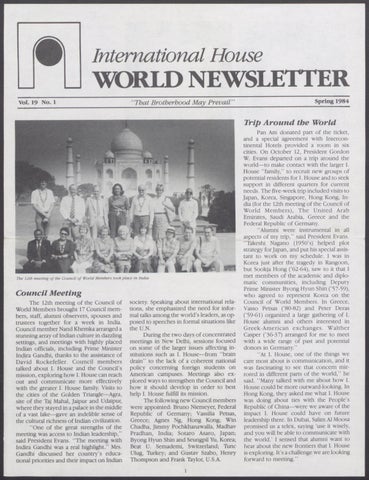
W. Evans departed on a trip around the world—to make contact with the larger I. House ‘“‘family,’’ to recruit new groups of potential residents for I. House and to seek support in different quarters for current needs. The five-week trip included visits to Japan, Korea, Singapore, Hong Kong, India (for the 12th meeting of the Council of World Members), The United Arab Emirates,
Saudi
Arabia,
Greece
and
the
Federal Republic of Germany. “Alumni were instrumental in all aspects of my trip,” said President Evans. “Takeshi Nagano (1950’s) helped plot strategy for Japan, and put his special assistant to work on my schedule. I was in Korea just after the tragedy in Rangoon,
but Sookja Hong (’62-64), saw to it that I The 12th meeting of the Council of World Members
met members of the academic and diplomatic communities, including Deputy Prime Minister Byong Hyun Shin (’57-59), who agreed to represent Korea on the
took place in India
Council Meeting The 12th meeting of the Council of World Members brought 17 Council members, staff, alumni observers,
spouses and
trustees together for a week in India. Council member Nand Khemka arranged a stunning array of Indian culture in dazzling settings, and meetings with highly placed Indian officials, including Prime Minister
Indira Gandhi, thanks to the assistance of David Rockefeller. Council members talked about I. House and the Council’s mission, exploring how I. House can reach out and communicate more effectively with the greater I. House family. Visits to the cities of the Golden Triangle—Agra, site of the Taj Mahal, Jaipur and Udaipur,
where they stayed in a palace in the middle of a vast lake—gave an indelible sense of the cultural richness of Indian civilization. “One of the great strengths of the
society. Speaking about international relations, she emphasized the need for informal talks among the world’s leaders, as opposed to speeches in formal situations like the U.N.
During the two days of concentrated meetings in New Delhi, sessions focused on some of the larger issues affecting institutions such as I. House-—from “‘brain drain’”’ to the lack of a coherent national policy concerning foreign students on American campuses. Meetings also explored ways to strengthen the Council and how it should develop in order to best help I. House fulfill its mission. The following new Council members were appointed: Bruno Niemeyer, Federal Republic of Germany; Vassilia Petsas, Greece; Agnes Ng, Hong Kong; Win Chadha, Jimmy
Pochkhanawalla,
Madhav
meeting was access to Indian leadership,”’ said President Evans. ‘“The meeting with
Pradhan, India; Sotaro Asaro, Japan; Byong Hyun Shin and Seungpil Yu, Korea;
Indira Gandhi was a real highlight.’’ Mrs.
Beat
Gandhi
Ulug, Turkey; and Gustav Szabo, Henry Thompson and Frank Taylor, U.S.A.
discussed her country’s educa-
tional priorities and their impact on Indian
U.
Semademi,
Switzerland;
1
Tunc
Council
Vasso
of World
Petsas
Members.
(80-82)
and
In
Greece,
Peter
Deras
(59-61) organized a large gathering of I. House alumni and others interested in Greek-American exchanges. Walther Casper (’36-37) arranged for me to meet with a wide range of past and potential donors in Germany.” “At
I. House,
one
of the things
we
care most about is communication, and it was fascinating to see that concern mirrored in different parts of the world,’’ he said. ‘‘Many talked with me about how I. House could be more outward-looking. In Hong Kong, they asked me what I. House was doing about ties with the People’s Republic of China—were we aware of the impact I. House could have on future leadership there. In Dubai, Salim Al Moosa promised us a telex, saying ‘use it wisely, and you will be able to communicate with the world.’ I sensed that alumni want to hear about the new frontiers that I. House is exploring. It’s a challenge we are looking forward to meeting.”
Alumni
Ball
The guests arrived in black tie or national dress. The dance band played everything from waltzes to Michael Jackson. There was student-produced entertainment and an excellent prime rib of beef. Flags and flowers transformed the auditorium into an elegant ballroom for the first alumni dinner dance in recent memory. Alumni from all generations came back to I. House to renew old friendships and a commitment to the special spirit of International
Ambassador
Shinichiro
Isaac Asimov
Asao
International House
Forums
Groups of students listened intently and then posed questions as Carlos Diaz Alejandro, member of the Bipartisan Comthe economic aspects of the Commission’s report. As William Sloane Coffin Jr., senior
technological advancement need not be dehumanizing. Even though new technologies can be put to evil uses, society should not let suspicion close the doors to advancement. ‘““We need a large vision free of shortsightedness, hatred and suspi-
minister
at
cion,’’ he concluded.
greater
understanding
mission on Central America,
Riverside
talked about
Church,
called
for
in a world
gone
mad. As Eleanor Elliott, first woman
direc-
tor of Celanese Corp. and the Life Insurance Company of New York, gave dozens of tips about behavior and career advancement. There is no doubt about it: this year, International House is enjoying a particularly stimulating program of speakers. Two of the most popular were science fiction writer Isaac Asimov and Ambassador Shinichiro Asao, Consul Gen-
eral of Japan in New York. Dr. Isaac Asimov spoke to a standingroom only audience in the auditorium on
November 30. Dr. Asimov is author of 273 science fiction novels, including the bestselling Andromeda Strain and the popular Foundation series. With a twinkle in his eye, he attributes his success to “‘sheer genius.” On
a
more
serious
note,
his
talk
developed around the theme of “‘escaping to reality’’—projecting the future by using the most unacceptable concepts of our imagination today. Asimov’s “‘tabulator pad”’ of 1950 has its modern day counterpart in the pocket calculator. Popular fairy tales of flying to the moon have become a reality. “Through insight, imagination, research and technology,”’ said Dr. Asimov, “‘man’s fiction of today becomes tomorrow’s reality.”’ Asimov takes a humanistic view towards technological advances for modern society. Changes, while they encounter resistance from those who stand to loose financially by innovation, need not displace jobs, but create new ones, and
Ambassador Asao’s talk at Sunday Supper on February 19 centered around how Japan views its role in the outside world. Japan’s economic ‘“‘miracle,’’ he said, is a product of its vulnerabilities as a country lacking in virtually all natural resources, and of its desire to “‘catch up”’ to the industrialized nations of the West. Japan early realized that its economic security can be ensured through interdependent trade relations with other nations
of
the
world;
that
international
cooperation on common economic concerns is both necessary and feasible. Japan now accounts for 10% of world trade and economic output, stated Asao. ““We recognize that we cannot remain an island of prosperity in a troubled world,
and
we
can and must
House,
from
Felicite
Laflamme Hoffman who lived at I. House in 1924-25, to former admissions assistant and dance fellow Bob Petersen who left I. House just last year. There were large contingents from the 1950’s—Gustav Szabo, George Huvos and Jan & Zlata Paces—and the 1970’s—Elaine Shea & Antreas Ghazarossian, Mark Robinson, Sally Staley, Anne
Quick,
David
Ruth,
Ethiopis
Ghebremicael and Albert Hakakian. Current I. House residents worked hard to help make the evening a success. They addressed thousands of invitations. Twenty-one volunteered as escorts and chatted with guests about goings-on at I. House today. Michael Wimberly, last year’s student of the year and this year’s Cafe Esperanto fellow, organized an ex-
cellent and versatile dance band, a string quartet to play during dinner, and entertainment featuring current I. House talent. All pronounced the evening a smashing success. Next year’s Alumni Ball will take place on October 19. All alumni are invited. However, because of mailing costs, only alumni in the New York metropolitan area will receive invitations in early September. If you do not live in the area but will be in New York at that time, write the Development Office, and we’ll be delighted to send details and an invitation.
use our re-
sources actively to contribute to world © peace, prosperity and stability.’’ Japan has thus committed energies to active peacebuilding efforts, through foreign aid and developing mutually beneficial economic relationships with the nations of the Third World. “The real significance of what Japan is accomplishing lies in what it says about the universal opportunities facing humanity,” said Asao. Japan has overcome its vulnerabilities by reaching out to other nations. Today, Japan seeks to play its part in strengthening that open world community and to help other nations maximize their Own opportunities. —With Julian Jenkins, Science Fellow, for Dr. Asimov
Mohammed Soleymani ('74-79) and Sally Staley (78-80) at the Alumni Ball
Beverly Sills, 13th Marshall Visi On the morning of February 3, 1984,
nervous voice students began vocalizing earlier than usual. The reason? Beverly Sills, opera
star and
director
of the
New
York City Opera, was due to arrive at noon —as 13th Marshall Visitor at International House.
The Marshall Visitor program was established in 1959 by then Chairman John J. McCloy in honor of his predecessor, General George C. Marshall, who served I. House from 1949-53. The program was designed to broaden the opportunities for foreign and American graduate students to meet and hear distinguished spokesmen from all disciplines of American life and culture. Each year, International House invites a prominent American to visit I. House to speak informally with students and deliver a major address. Miss
Sills arrived
with
her husband,
Peter Greenough, a prominent businessman and journalist. Following lunch with residents, Miss Sills gave a master class for the voice students, listening to each one of
The opening of the
New Pub
them sing a short selection, critiquing their technique and offering insights into the characterization of a masterful perfor-
‘‘Bierstube’’
mance. Mr. Greenough gave a seminar to the journalism students. Then the two
at Last!
When President Evans took his trip around the world, the stop in Germany included a visit to the Beck’s Brewery in
designed by Robert A.M. Stern, Architects, the firm which has handled our other ma-
Bremen.
monochromatic murals in black and white has a dramatic impact. ‘“The murals call to mind the abstract expressionist painters who made New York their home,”’ said a spokesman from the firm. ‘“They might suggest a white dawn over the glowering citiscape or a host of other romantic images.”’ The free-standing bar at the center of the pub breaks a large space into different physical areas for music, dancing and conversation, and a low stage provides additional seating when not used for entertainment. The entire construction project and decorating was carried out by an I. House crew of carpenters in a record four and a half months. The Bierstube represents a new vision for social programs at I. House. Designed as a gathering place, it can have a cafe or nightclub atmosphere, depending on the lighting, music and set-up. A large range of programs now takes place there because of increased space and its unique atmosphere. The popular Cafe Esperanto or amateur coffee house has found its home, and theme parties such as Caribbean and California nights are popular innovations.
Back
in New
York,
he met
with
the chief of Beck’s sole U.S. importer, Dribeck Importers in Greenwich, CT. Both meetings were arranged thanks to International Trustee. Walther Casper. Several months later, word came that Dribeck
Im-
porters had agreed to contribute towards the cost of the new pub at I. House. It was the first step in our effort to interest German corporations and individuals in the project.
January 31, 1984 marked the official opening ceremony of the ‘‘Bierstube”’ which welcomed residents and members of the German corporate and diplomatic community in New York. Mr. Peter Sympher, Consul General of the Federal Republic of Germany to New York, spoke of the important role International House plays in advancing communication and understanding in a troubled world. Walther
Casper,
who
lived at I. House
in
1936-37, flew in from Germany and spoke of the extraordinary impact that the ideals of I. House had on his own life and career. The all-German program of entertainment featured chamber music and a chorus of students singing popular folk songs. The “‘Bierstube’’ as it is now known,
jor renovations
projects.
The
decor,
with
joined forces with Mr. Schuyler Chapin, Dean of the College of Arts at Columbia University, who moderated a seminar about the relationship of the performing artist to his or her manager. Miss Sills’ evening presentation featured her own background growing up as
is located on C-Level on the site of the old Development Office and old pub, and was
—With
Mita Mitra, International House Scribe
3
Voice student Anne
Wilkenson
sings for Beverly
Sills
| Visitor at I. House the daughter of Eastern European immigrants in Brooklyn, and the tremendous obstacles she had to overcome as an American educated and trained singer trying to break into a European dominated opera world. She auditioned nine times before being accepted by the New York City Opera. Then she was chosen to sing Cleopatra and got her lucky break when all the critics who were in town for the opening of the Metropolitan Opera decided to come over to hear what the City Opera was doing. Overnight, she was vaulted into stardom. Miss Sills never forgot the many moments of frustration ‘“‘because there was really no one to look after American talent.’’ The United States’ first American trained opera star, she popularized opera on radio and television and supported widened opportunities for young American artists. After a long and dazzling career, she retired and accepted a new challenge as director of the New York City Opera. She is working hard to promote the arts as part of the United States’ cultural heritage. “There's something very special about being able to pass on the dream,”’ said Miss Sills. “I’ve seen regional companies spring up,
and
a tremendous
awareness
in
the
American audience grow. I keep telling the young sopranos who come to me, sometimes very discouraged: ‘Look, if it could happen to me, it could happen to you. It’s just a question of timing, talent and a lot of luck.’”’
East Room Dedicated in Memory of Cleveland E. Dodge The East Room was polished and shined, resplendent with beautifully reupholstered furniture. Even the painting over the fireplace had been cleaned. All was ready for a remarkable dedication ceremony which brought together many of the closest friends of International House and the spirit of communication and understanding which it embodies. Cleveland E. Dodge died on
November 24, 1982 at age 94. As a young man in the 1920’s, he became involved with the Cosmopolitan Club. He served on the I. House building committee, as Trustee and then Honorary Trustee of International House for 57 years. A modest and dedicated man, he gave inspiration and support tirelessly throughout the entire history of I. House. In January, 1983, the Board of Trustees elected to dedicate the East Room in his memory. The Cleveland H. Dodge Foundation subsequently made a special grant to renovate this room, once the site of the Men’s Sitting Room, so that it will continue to be an area for quiet reading and study for many more generations of I. House residents. Members of the Dodge and Rockefeller families, Honorary Chairman John J. McCloy, trustees and friends of I.
House gathered on December 6, 1983, to pay tribute to this remarkable man who played a key role in the founding of International House. President Gordon W. Evans and Trustee Mrs. George D. O’Neill made welcoming remarks. Cleveland E. Dodge Jr. shared some anecdotes about the early history of I. House, researched from his father’s correspondence. David Rockefeller spoke of the extraordinary vision of the senior members of the Rockefeller and Dodge families and
of the subsequent
involvement
of suc-
ceeding generations. ‘‘Student exchanges are the hope of the world,” he said. ‘The forces of nationalism pull’us apart. The greatest hope of bringing the world back to its senses is the spirit of these extraordinary founders.”’ John J. McCloy paid an especially moving tribute to “Cleve” Dodge. ‘““We are here today,”’ he said, ‘‘to dedicate this room at International House to the memory of Cleveland Dodge whose character so completely pervades this room and this building. It is a setting which exudes hospitality and philanthropy. We see around us bricks and mortar; but contained in them is the spirit of hospitality, friendship and goodwill...International House is a monument to the best of the human spirit.”’
Members of the Dodge family at the dedication of the East Room
In Memoriam Edward Forster, BA., FR., IBA (30-31), January 1, 1983. Liberia Rutigliano Gokhale (25-29), April 14, 1982. Born in Italy, ‘‘Lila’’ Gokhale was educated at Hunter and Columbia. She married Madhu Gokhale of Schenectady, NY, whom she met at I. House, and taught romance languages for 35 years in New York and Philadelphia. After retirement, they traveled extensively while Mr. Gokhale worked as an industrial expert for the U.N. Her family has made a special contribution in her memory to establish an annual award for a deserving resident. Edward Flemmon Hall, Jr. (’24-27), March
1, 1982.
Ernest J. Howe (’25-27), January 23, 1982. Mr. Howe was a brilliant financial expert and former president of the Rochester Gas & Electric Corp. He played a key role in developing the company into a successful, modern utility firm. Serving on many bank boards and civic undertakings, he contributed enormously to the decisions which have
strengthened
the
area economy. Louis Vergniaud
Rochester,
NY,
Pierre-Noel
(36-40), April 27, 1982. Born in Haiti, Mr. Pierre-Noel was internationally recognized for his many award-winning stamp designs for the U.N. and other organizations. He was also known for his remarkably accurate entomological drawings for the American Museum of Natural History, Columbia and Harvard Universities and the Entomological Society of America. For 20 years, he worked as visual media technician for the Pan American Health Organization in Washington, D.C.
|
An Artist’s Gift
Fund-Raising News ¢ On November 23, 1983, members and close friends of the Babbott family gathered to celebrate the fifth anniversary dedication of the Mural Room in memory of Barbara Chapin Babbott, who died in 1976. Mrs. Babbott served International House as secretary to the Director with
enthusiasm and distinction from 1952-55. The income from the endowment gift of her family and friends will ensure that this gracious room will continue to be the scene of the receptions, recitals and forums which so enrich the program at I. House. A bronze plaque gives tribute to her memory. ' e Several friends of I. House have devised interesting new ways to show their support for the goals and mission of International House. Alumna Karen Ovestad Larsen is in the process of deeding to I. House a small parcel of land in upstate New York where she and friends used to go for picnics during student days in New York more than 50 years ago. John D. McKeown, James Gantsoudes and Harvey
Reisman have each given a series of etchings and lithographs by Wurtz and Pensenke, which depict the history of
opera. These gifts are valued at a total of about $24,000. ¢ During the last week of April and early May, we will hold our second alumni phonathon in New York, Washington, D.C., the Southeast and southern California. Student and alumni volunteers will
telephone alumni in these areas to tell you that I. House needs your support and why. Last year’s phonathon raised $5,000. This year’s goal is $10,000 and with your help, we'll make it.
House family. There will be many opportunities to visit I. House for special programs including the Fall Fiesta of Dance and Song, the Alumni Ball, the Marshall Visitor program, the 13th meeting of the Council of World Members and many more. A calendar of events will be mailed to New York area alumni during the summer. If you do not live in the area but are planning a visit to New York, write to the Development Office for 60th Anniversary Celebration details. e Attention, all New York Metropolitan area
alumni!
On
May
18,
1984,
alumna
Leontyne Price (’49-52) will make a rare New York appearance to benefit International House. Miss Price will sing a program of songs at St. Peter’s Church at
Citicorp Center and a buffet reception will follow the program. Tickets are selling for $125. If you are interested in attending, telephone the Development Office at (212) 678-5024.
Dates to Remember April 30
Phonathon
May
_Leontyne Price Benefit
18
September 20
Circle Line Boat Ride
October
13th meeting of the
18-19
Council of World Members
October October
19 20
Alumni Ball Fall Fiesta
Write the Development
Office for details
His portraits hang in the Smithsonian Institution, the National Portrait Gallery, the Metropolitan Opera House—and International House. One of America’s fore-
most portrait painters, Soss Melik (’50-53) has painted President Dwight D. Eisenhower, William Faulkner, Buckminster Fuller, Alexander Haig, Ernest Hemingway and Eugene O’Neill—and I. House directors Harry Edmonds, John Mott and
Howard Cook. When we told him about our project to display around the House more momentos of its history, Soss agreed to apply his talents to eight portrait drawings in charcoal of our distinguished Board Chairmen, and gave four of them as a gift to I. House. “When you are working from photographs, as I was, you must do some research and consult several different ones for each subject,’’ he said, chatting about his art. ‘““You have to find the finest aspect, the one which typifies the man. We call that the composite likeness, the fullest likeness.”’ Soss has completed portraits of Honorary Chairman Dwight D. Eisenhower, and Chairmen George W. Wickersham, Henry L. Stimson, George C. Marshall, John J. McCloy, Charles W. Yost, and George W. Ball. The portraits now hang in the rotunda of the main staircase which leads from the Main Lounge to
the Auditorium. Soss likes the I. House work. ‘‘Work-
ing for people I know is a little different. Harry Edmonds, John Mott and Howard Cook were all close friends—it’s like
working for family.”
e The Memorial Register, begun in 1978 by Madge Sills Hamlin (’25-26) as a way to remember old friends and support I. House
at the same
time,
has grown
to
over $5,000 with 40 names listed in a fine leather book of memory. The fund provides income each year to support pro-
grams for students. If you are interested in memorializing a never-to-be-forgotten friend in the I. House Memorial Register,
send us a check along with a note telling us
1983-84 Goal $40,000
who it is you would like to remember. A
The Alumni Fund needs your help.
gift of $25-$99 will list your friend in the Register. $100 or more will list him or her in the Register and a biography and photograph will appear in the companion volume. e International House is deeply grateful to the memory of Helen L. Calderon,
Adela
M.
Mendez
and
Laura
There’s still $6,913 to go before
June 30, 1984. 1982-83 $38,805.90
Babcock
when you were here?
Kampe, all of whom provided for Interna-
tional House in their wills. ¢ 1984-85 marks the 60th anniversary of International House. Plans for a yearlong celebration
are already
under
way,
featuring special events for the greater I.
Did I. House help you climb mountains If so, send
a Last Stretch gift today! 1980-81 $36,688.65
J. Russell
Alumni Through the Decades The 20's Mary-Margaret
H. Barr
Koon
(’25-30) writes
from Indiana: ‘‘I am not a lady of leisure! I manage several family farms. I am editor of the Gazette of the American Friends of Lafayette. Last but not least, 1am updating my bibliography on Voltaire.”’ Otakar Matousek ('29-30), professor emeritus of science education and history of science and medicine at Charles IV University in Prague, Czechoslovakia, celebrated his 85th birthday on January 14, 1984. He has ceaselessly worked for international understanding, inspiring many generations of his students, who are unable to study in the West, with the hope and the spirit of International House. We salute you, Professor Matousek!
Nina R. Lief (23-27) is director of the Early Childhood
Development
Center in New
York, and has
written two books on child rearing. G. Kenneth Reiblich ('28-30) is professor emeritus at the University of Arizona College of Law, and would like to hear from I. House people visiting Tucson.
Machteld E. Sano ('29-31) has taken up painting since retirement, ‘“‘but I hate to sell them!!’’ She’s also writing a short autobiography at the request of M.I.T., called The Obstacle Race.
E. Raymond Wilson ('23-25) is lobbying to prevent the use of military weapons in outer space, ad-
vocating using space to benefit all mankind. He is also active in Friends activities, traveling extensive-
ly and speaking on current events.
The 30's Anna Ballarian (’34-35) has retired from 19 years as professor of art at San Jose State University, and now travels and exhibits in local galleries. Harold J. Jonas (30-32) writes ‘I remain in touch with I. House friendships that have taken me to Italy, Denmark and Japan (6 times). Now retired from college teaching (Asian history). Iam seen on cablevision in Orange County, NJ, three times weekly with my own talk show.”’ Miriam E. MacDonald ('25-27), staff, ('34-56) is
living in Heath Village, a retirement community in Hackettstown, NJ. Jorn Nielsen (Jornow) (’37-39), secretary of the Danish International House Association for the past
35 years, paid a visit to I. House last fall to renew ties and make new ones as part of a trip to visit alumni. Ralph E. and Muriel Warren Pumphrey
Baker
('66-68),
president
of Chase
Manhattan Financial Services, Inc., was recently elected to the Board of Trustees of Chase Manhattan Bank (U.S.A.)—Delaware.
assist part time. She’s traveling as much as she can and catching up on reading and correspondence.
John
Esther Anne Wright Keller (40-41) is program
Samuel and Helen Benham Kim ('63-65) live in
director of a classical music radio station. “I hada
Elberon, NJ, where Helen is associate professor of music at the Brookdale Community College and a faculty member of the Monmouth Conservatory of
good visit with Louis A. Roselaar & Eleanor Firke Anderson (both '40-41) this spring.”’
L. Berry
('63-65) is now
senior minerals
geologist with the Shell Oil Co.
Music. Samuel is professor of political science at
Anna McW. Neville (’47-48) writes that she worked with the State of Vermont in social services. ‘‘Husband David now retired after many active years overseas. Daughter Jennifer a senior at Hollins after a year at Oxford and travel.”
Monmouth College. Sonya, 12, studies ballet. David J. Kluck (’63-66) is financial attache at the U.S. Embassy in Ottawa, Canada.
Bettina
just
Roulier
Tilley
(’40-42)
reports
“‘On
January. 1, 1983, I was married to Dr. Winthrop Tilley, a retired English professor who is a contradance caller. I am still an active cellist—performing and teaching.” Francis R. Valeo ('41-42) retired as secretary of the U.S. Senate in 1977 and is now writing and consulting in Asian and U.S. affairs.
The 50’s Celia Vassos Casey ('58-59) spent some years as a reading consultant and teacher trainer, and then worked with U.N. ambassadors on English. She went back to art school where she learned Chinese
Katherine S. and David H. Miller ('64-66) have returned
to
Princeton,
NJ
Liberia with Chase Manhattan
C.
Paulson
('67-68)
after
two
is working
for Petroleos de Venezuela.
Ed
(’65-67) has opened
his own
firm in
media consulting.
Kees Schager ('67-69) has a new job as executive director, Merrill Lynch International Research.
Eugene Webb ('62-64) is professor and chairman of the department of comparative religion at the University of Washington. His most recent book is Eric Voegelin: Philosopher of History (University of Washington Press, 1981).
David and Henrietta Whitcomb (’63-65) spent
on
February-June, 1983 in Australia, where David was visiting professor, and Henrietta visiting scholar at
Anna Cienciala (53) has a book coming out soon:
the University of New South Whales, Sidney. They saw David Ellis (’65) in Adelaide, and sailed to Fiji,
brushwork,
and
now
has
two
shows
a
year
Madison Avenue. From Versailles to Locarno, Keys to Polish Foreign Policy, 1919-25, (University Press of Kansas). Ceferina Cordero ('54-55) has retired from the department of education as superintendant of schools in Puerto Rico, and is now engaged in farming and civil activities, and travels.
John G. Dennis ('53-56) is working on a committee to establish an International House at California State University, Long Beach. Grace L. Hewell (51-55) received an honorary Doctor of Humane Letters degree from Spellman College in May, 1983. She was principal founder of the Academy on Human Rights and Peace, and served for two terms as commissioner for the U.S. National Commission for UNESCO.
Tonga, Samoa and Tahiti.
The 70’s and 80’s Christopher Belvedere (’80-81) is a Peace Corps volunteer,
working
on
a
large,
internationally
funded agricultural project in rural Senegal. Paul S. Berg (’79-81) is an officer of the U.S. Foreign Service, serving in Bombay, India. Rolf Geckler (’82-83) is back in Denmark, putting in long hours as a business and finance reporter at
an influential weekly paper in Copenhagen. Fred Levinton and Betsy Phillips ('78-80), (77-79) were married September 25, 1983, and are living near Princeton, NJ.
Nand Khemka ('54-56) is managing director of the
Maria Aparecida B. Marques (’79-81) is assistant
Khemka Group of Companies in India, and was recently elected International Trustee of I. House.
professor at the Catholic University in Rio de Janeiro, and researching child abuse through the juvenile court there.
William
A.
Knowlton
(’56),
a
retired
army
general, is now active as a trustee of Davis & Elkins College in WV, and as director of Aeronca Inc. and the Chubb Corp. He also works as a consultant.
Hasna Jasimuddin
work, retired after a final two years teaching at the
Eduardo Tietelman (55-57) is very involved in
University of Trondheim,
several businesses in Argentina: director of Celulosa Argentina, president of Cartonex, vice president of Fabi, and director of Puerto Pinay, SA.
ond time—‘‘R,J. is 2. and Ryan 2 months.”
(31-32,
'30-32),
both
professors emeriti of social Norway.
The 40's Clorinda Clarke ('41-42) is retired after many years as an editor. ‘‘I write American history for British schools. Also edited the diary of an American Revolutionary soldier. Travel a lot and enjoy
New York City when I’m here.” Helen Curtis Cole ('39, 41-42) is dean emerita of women, University of Massachusetts at Amherst, and loves retirement.
Inettie B. Edwards ('44-46) is retired and a volunteer reading teacher in the Newport News public school system. She was honored on television by the National Negro Business and Professional Women’s Assoc. for community service.
Joukje Jepsen ('43-46) has retired from her job as public relations assistant at the Belgian American Chamber of Commerce, though she continues to
in
as an energy
economist
Riner
years
Bank.
Moudad
('69-70) is in New
York as the delegate from Bangladesh to the U.N.
Mary
Jane Mulligan (’76-79) is a lecturer at SUNY
New
Paltz, and became a grandmother for the sec-
Katherine S. Naughton (’78-80) is working in Citibank’s export trading company, exploring new
ways to finance global trade flows.
Helen D. Ullrich (53-54) delivered the first Margaret Bamford Memorial Lecture to the Home
Jim O’ Higgins (’78-80) is working on Wall St. as an
Economics Association of New South Wales, Sidney, Australia in July, 1983. She has also formed a consulting firm in Berkeley, CA.
a small beer importing company.
Ed and
Byong-hyun
ap-
(’78-80) are living in Germany and have a beautiful
pointed Deputy Prime Minister in Korea, following the tragic accident in Rangoon, Burma, which
Michael J. Sodaro (’7 1-73) is assistant professor of
Shin
('57-59)
was
recently
killed several top-level Korean officials.
The 60's Sjamsiah Achmad ('61-62) has recently moved to Vienna, Austria, where she is social affairs officer, Advancement of Women’s Branch, U.N. Centre for Social Development and Humanitarian Affairs.
Obed
Asamoah
('62-63) is foreign
Ghana.
minister
of
institutional corporate bond trader, and has started Charlotte
Halkjaer-Lassen
Sherman
new baby daughter, Krista, born April 29. international affairs and member of the Institute for Sino-Soviet Studies, George Washington University, Washington, D.C. Reinhard Thurner (’70-73) has been working at the German Embassy in Brasilia, Brazil, since September, 1982.
Barbara Wanner ('76-78) now works as a government relations counselor for International Bus)ness—Government
Counsellors, Inc.
International House World Newsletter Vol. 19 No. 1 Spring, 1984 A newsletter for former members of International House, 500 Riverside Drive, New York, NY 10027, Mary-Clare Metcalf, Editor As a nonprofit organization, a copy of our last annual financial report is filed with the New York State Board of Social Welfare and may be obtained by writing to the New York State Board of Social Welfare, Office Tower, Empire State Plaza, Albany, New York 12223, or by writing to the Development Office, International House, 500 Riverside Drive, New York, New York 10027.
6