cy
International House
WORLD NEWSLETTER Vol.18
No.1
Spring 1983
“That Brotherhood May Prevail”’
President Evans Talks about the First Months President Evans chatted informally about his initial months at I. House. Here are some excerpts: I want I. House to be run very professionally. Students should sense that people take joy in doing their jobs, know their functions and do them well. I would like them to feel I. House is an experience in living that is an experience in soaring. No matter what direction we take in the future, it will be controversial. There is
no right road for I. House. Next fall, we are launching an internship career training program for several outstanding students. The way we've designed it reflects some thoughts for the future, and it will be a means to explore possible directions. One intern, a ‘scribe’ will provide a detailed written record of what goes on at I. House. Ideally we would publish this quarterly as International House Notes. A computer specialist will make sure that the needs of residents and the different offices
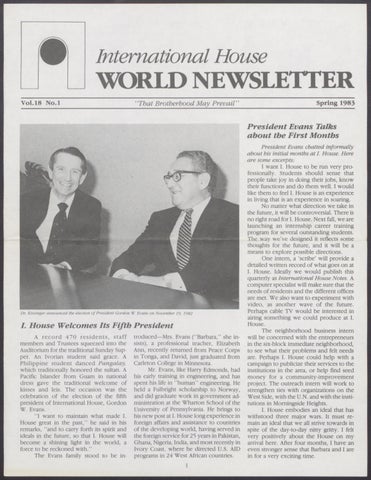
are met. We also want to experiment with Dr. Kissinger announced the election of President
Gordon
W. Evans on November
19,
1982
I. House Welcomes Its Fifth President A record 470 residents, staff members and Trustees squeezed into the Auditorium for the traditional Sunday Supper. An Ivorian student said grace. A Philippine student danced Pangalay, which traditionally honored the sultan. A Pacific Islander from Guam in national dress gave the traditional welcome of kisses and leis. The occasion was the celebration of the election of the fifth president of International House,
Gordon
W. Evans. “T want to maintain what made I. House great in the past,’ he said in his remarks, ‘“‘and to carry forth its spirit and ideals in the future,
become
so that I. House
will
a shining light in the world, a
force to be reckoned with.”’ The Evans family stood
to be
in-
troduced—Mrs. sists),
a
Evans (‘‘Barbara,”’ she in-
professional
teacher,
Elizabeth
Ann, recently returned from Peace Corps in Tonga, and David, just graduated from Carleton College in Minnesota. Mr. Evans,
like Harry Edmonds,
had
his early training in engineering, and has
spent his life in ““‘human’’ engineering. He held a Fulbright scholarship to Norway, and did graduate work in government administration at the Wharton School of the University of Pennsylvania. He brings to his new post at I. House long experience in foreign affairs and assistance to countries of the developing world, having served in the foreign service for 25 years in Pakistan, Ghana, Nigeria, India, and most recently in Ivory Coast, where he directed U.S. AID
programs in 24 West African countries. l
video, as another wave of the future. Perhaps cable TV would be interested in airing something we could produce at I. House. The neighborhood business intern will be concerned with the entrepreneurs in the six-block immediate neighborhood, to see what their problems and felt needs are. Perhaps I. House could help with a campaign to publicize their services to the institutions in the area, or help find seed money for a community-improvement project. The outreach intern will work to strengthen ties with organizations on the West Side, with the U.N. and with the institutions in Morningside Heights. I. House embodies an ideal that has withstood three major wars. It must remain an ideal that we all strive towards in spite of the day-to-day nitty gritty. I felt
very positively about the House on my arrival here.
After four months,
I have an
even stronger sense that Barbara and I are in for a very exciting time.
More
“Twenty-five years ago,’”’ said Gerald Barsdorf (’53-56), chairman of the House Committee of the Board of Trustees, gesturing around him at the brand-new study center on C-Level, ‘‘this used to be called the ABC Room. It was a room withOut specific purpose—a general rumpus room. They used to put us here when we were making too much noise. It’s an important and impressive step for I. House to have developed a space entirely for the purpose of studying.”’ Mr. Barsdorf, Mrs. Amory Houghton, Jr, who is chairman of the Decorating Sub-Committee of Mr. Barsdorf’s House Committee, members of the Residents’ Council, Student Trustees, the architect
:
a 7 sites aay
,* ets
he
Barbara and Gordon
Robert Evans
The Evans
and I. House
Gordon Evans is a friendly man with
a smile for everyone, and a propensity for hard work. In meetings, he is constantly initiating ideas or listening, building his team. A man
of vision, he has some
fasci-
nating directions for I. House to explore
for the future. On a typical day, he’s in the Office at 8 A.M., breaks at noon for a swim
at the Columbia
on Renovations
pool
and
lunch.
Pro-
grams often keep him at I. House late into the evening. He is very much a family man, and imparts a sense of family to I. House. Barbara Evans, a dedicated professional teacher, has always taught in international schools throughout their life in the foreign service. ‘‘It’s a privilege dealing with the minds of the next generation,’’ she says. She has done
A.M.
Stern and his assistants, staff
impressed,’’
and
3
English is weak. The major project I'd like on is a ‘paper clinic’, a service
that would help residents edit, correct, copy and bind their papers and disserta-
tions. It would help a critical aspect of stuand
educate
students
the
wooden
floor
nuing
‘“‘I’m
a lot of time with I. House friends, participates in sports events, and plays violin in the Chamber Orchestra. A constant stream of residents finds its way to the Evans’ next-door apartment—about 75 in February alone. “There are needs I see that I can do something about,”’ says Barbara. ‘‘Sometimes residents suffer from too much of a good thing at I. House, so I'd like to help them find ways of experiencing more of the larger world of New York. There’s a lot of potential for language crosstutoring, especially for those whose
life,
restoring
discovered under the old carpet.” The pub is the second major renovations project, which will take about two and a half months to complete. It will expand into a large adjoining unused room which will provide space for parties and
ply:
produced
several bottles of champagne to celebrate. “The next projects are first, to refurbish the East Room, then to start renovating the pub,”’ says Ranjan Rellin, a former
larger I. House family. She and David are
word-processing, now.”
and
we
committee of residents to work on the project,’ says Ranjan. “I know from my student days that often a great many exciting ideas come from residents. We plan on asking residents to submit designs, so I know we'll have a lot of good concepts to choose from.” “The renovations process is a conti-
often at I. House for lunch. David spends
dent
niture,
members and the team of carpenters and workmen who were responsible for bringing the center into being, were all present for the opening of the new study center, and all smiling proudly. The center has more than doubled study space at I. House. It provides conference rooms, so that students working together on projects will not disturb others, and a typing room which we hope will some day house a word-processor. Nicholas Koutsopoulos, president of the Residents’ Council announced sim-
everything to bring the Evans into the
to work
I. House resident who recently received his degree in international affairs and urban planning, and is now full-time renovations coordinator for I. House. “The East Room is the only public room which has not yet been restored under our renovations program. We want it to retain the library feeling, with the paneling, bookshelves and leather furniture that it used to have as the Men’s Social Room. Now it will be a quiet reading room with newspapers and magazines. The work itself consists mostly of restaining the paneling, ordering some new but compatible items of fur-
about
too. The future is here The
new
study
center seats
60 students
2
dancing.
‘Right
one,’
says
now
we're
President
organizing
Evans.
a
‘‘The
House is a very organic entity. If we view it as something
that
is not
static,
but
is
always changing, it is more exciting to be with, to experience and to live within.”’
a large corporation, about being an MBA and getting to the top. It was encouraging to know that people out there want MBAs with broad perspectives.’’ Mr. Houghton brought his assistant for corporate relations who is associated with Steuben
Glass, a division of Corning which produces fine works of art. “It was fascinating to hear about Steuben’s philosophy and its role in Corning. Mr. Houghton
is a renaissance
man,
committed
to
seeing the arts flourish.”’
Don Cuneo (’66-69), junior partner at Shearman & Sterling, talked about international
law
and
what
it means
to
a
lawyer, ‘“whether it’s relevant or just a lot of hot air,’ says Pano. ‘Basically, he’s
Nags; Law roe o Christopher Edley, president of the Uni ted Negro College Fund,
ba
Trustee
Meet “For
Your many
talks with students
Trustee I.
House
students,
the
(65-67),
who
founded
her own
venture
Meet Your Trustee program is a special opportunity to meet and talk with ‘the movers and the shakers’ of the business and professional worlds,”’ says Pano Anthos, the student who directs the program.
capital firm, talked with students about careers in business. David McKinney, executive vice-president for personnel at IBM, spoke informally about the prob-
“That’s one of the reasons I took the job. I
Trustee Ruth Houghton introduced her husband Amory Houghton, Jr., chairman of Corning Glass Works. ‘“‘He was thoughtful, perceptive, and downright fun to be with,’’ remembers Pano. “‘At dinner, he talked about being chairman of
knew I would benefit from spending even two hours with these people.” Jock
Elliott,
chairman
emeritus
of
Ogilvy & Mather International, spoke about the advertising world. Pat Cloherty
The Cultural Hour:
lems of the modern
corporation.
concerned about the collapse of international trade—because of protectionist legislation, and because U.S. trade interests are self-serving.” Christopher Edley brought a completely different perspective to the program. As president of the United Negro College Fund, he spoke about the relationship between minorities and the American higher education system. ‘‘He was extremely direct and to the point,” says Pano. ‘‘He talked about discrimination all over the world, and threw a very interesting light on domestic forms of averting discrimination, such as what the United Negro College Fund is trying to do with predominantly black institutions.”’ “What's the appeal of the program? Well,
it’s the chance
to meet
Celebrations
The Main Lounge always looks the same, but on Wednesday evenings,it has a way of exuding the spirit of a Greek taverna, a Turkish bazaar, or a folk festival in India. ‘‘The cultural hour is the spirit of I. House distilled into a program,’’ says Nina Capistrano, the cultural hour fellow. “‘I have found that people really do understand each other better through experiencing each other’s cultures.”’ One of the most popular programs at I. House, the cultural hour’s appeal seems to lie in a unique spirit of celebration: the pride in presenting beloved traditions, and the joy of participating. Inevitably, residents presenting folk dances are called back for encores, and soon the chairs have to be pushed aside to accommodate all the impromptu dancing. The Turkish students staged one of the first extravaganzas that quickly, thanks to friendly competition, are becoming a tradition. They presented an award-winning film which showed im-
ages
Of Turkish
life.
They
served
rich
Turkish food and drink. A band with the traditional ud, darbuka and baglama began playing and a belly dancer appeared. “It was incredible because you really felt like you were in Turkey,” remembers Nina. At the end, the Turks threw money on the stage in enthusiastic appreciation, and soon of course, everyone was dancing. Since then the Indians, Pakistanis, Sri Lankans and Bangladeshis have presented a two-day Subcontinent festival, and the Scandinavians have put together a humorous fashion show that had everyone exhausted from laughing so hard. ‘For me it’s wonderful that people love the cultural hour, in spite of the hard work it involves,’ says Nina. “‘I remember sending thank you notes to all the Japanese students who had produced such a lovely show. And then I got all these notes back saying ‘but we should thank you!’”’
the movers
and the shakers,”’ says Pano. “Then after a while, you realize they are people, too—kind and fun to be with. It’s a demystification process. It gives us all hope that some day we'll get there, too.”’
The Indian Subcontinent festival
Did You Know
that I. House Once Had a Radio Station?
Louis M. Bloch, Jr. lived at I. House in the early 1940’s when a room cost $5.50. a week. His recent book, The Gas Pipes Network, about his life-long passion, college radio, recounts some humorous stories about his days at I. House. We have reprinted one of them below. “International House...is a twelve story building with six floors reserved for men and six floors for women. ..(In those days,)
the administration
staff was
rigid,
and I must say effective in keeping the living quarters separate. “It was into this atmosphere that we introduced the clandestine radio station WOLF, The Voice of International House. WOLF was a two-watt station which was fed into the electric light system of the building. Programs were at odd hours and consisted of records, skits and talk shows featuring both men and women. “The location of the station was secret, and the staff was alarmed and help-
less. They were convinced that the programs with mixed sexes must be originat-
In Person
ing from one of the rooms. They made a search of the common rooms and then secretly searched the entire building without finding a trace of the station. The broadcasts continued and the Director was frantic. He was faced with a breakdown of the long and successful separation of the living quarters of the sexes. “IT guess we were just pranksters at heart looking for a good prank but seeing the genuine distress we were causing, we decided to suspend operations. We announced over station WOLF that we were terminating our broadcasts and thanked everyone for being such a loyal audience. Everyone but the staff got a kick out of our experiment but, until this day, no one except our station members knew how these broadcasts were accomplished. “Our chief engineer had built the transmitter in an old suitcase which he kept under his bed and all broadcasts originated from his room. To obtain the women’s participation in the programs, he had simply lowered a microphone to the women’s floor below.”
at I. House
In Memoriam Cleveland E. Dodge, Honorary Trustee, died on November 24, at the age of 94. Mr. Dodge became involved with the Cosmopolitan Club, serving on its Board from 1920 until his death. The Dodge family was instrumental in helping I. House become a reality, procuring the original six building lots on Claremont Avenue for the residence. Mr. Dodge served as Trustee, giving his inspiration and support tirelessly throughout the entire history of International House. Sadik Isikli (’65-68), and staff member for some years thereafter, was killed in a diving accident in Turkey in October, 1982. Tony Fitzgerald and Peter Stillman
Asta Jorgensen, from Norway, a current resident at I. House, is studying violin at the Manhattan School of Music, She recently accepted a job with the Bergen Symphony, an appointment which will make her the youngest member in its history. Tatsuzo Mizukami, former chairman of Mitsui & Co., and honorary chairman of the I. House committee in Japan that raised $274,000 for our Half
(66-68)
are organizing
a dinner
at I.
House so that Sadik’s friends in this country may gather to honor his memory. The dinner will be held on September 9, 1983, at 7 P.M. at I. House. Those interested in attending should write to Anthony M. Fitzgerald, P.O. Box 1110, Waterbury, CT
06721.
Friends may also wish to make
contributions to the I. House Register in Sadik’s memory.
Century Fund, had lunch here on a re-
cent trip to New York. He retains a strong interest in I. House and feels a deep responsibility for keeping our Japanese donors abreast of current activities. Edward Morgan (’80-81) used to teach a jazz dance class at I. House. “We weren't really very good, but Ed-
Henry Richardson
Memorial
Henry Richardson, Chief Engineer, died September 30, 1982, of heart failure. One of the most beloved and respected I. Asta Jorgensen (top);
Tatsuzo Mizukami (bottom)
House
employees,
‘“‘Hank,’’
as
he
was
he is an up and coming young dancer with the Joffrey Ballet, receiving rave
known to friends and co-workers, served I. House loyally for 25 years. Generations of students remember him as a hardworking employee who tackled every task cheerfully, always mindful of the well-being of International House and its residents, Hank was an example to all staff
reviews from the New York Times. On February 13, he came back to I. House
his path.
die had a way of making us believe we were,’’ remembers a participant. Now
to dance a program of his own
members,
and a friend to all who crossed
work
ArmourJ. Blackburn (’47)
for a large Sunday Supper audience. Paul Newman himself could be seen
Richard F. Clemo (’48-49)
this winter. He and his cast used our
Amy Nakashima Fukuba Malcolm Graham (’50) Lawrence G. Lane (’71) Herbert T. Liedke (’31)
auditorium to rehearse the initial stages
Robert S. Scalley (’40-41)
of upcoming film Harry and Son to be shot in Florida and released in 1983-84.
Homer K. Secor (’24-25) Ruth Spaulding, formerly Secretary, New York Alumni
arriving and departing from the very doorstep of I. House for two weeks
Fund Raising News ¢ In a gesture of confidence in the future of I. House and in appreciation of its long and distinguished history, Mr. and Mrs. George D. O’Neill gave a major gift to start the endowment of the Sunday Supper program. This gift is especially meaningful since it was at an early Sunday Supper in 1920 that Mrs. O’Neill’s grandfather, John D. Rockefeller, Jr., became interested in the idea of building International House. e The September Casino benefit, organized by the Trustees of International House, brought New York’s social crowd uptown for an evening of gambling and dancing—to benefit the Annual Fund. Months of hard work on the part of the benefit committees yielded over $30,000. ¢ Our room endowment program is flourishing, thanks to friends in the Middle East. Sheikh Saleh Kamel and Sheikh Ahmed Juffali of Saudi Arabia, and Ahmed Mannai of Qatar have all recently given generous gifts to International House. Through the room endowment program, large gifts generate income which provides an annual subsidy for a student. Almost one fifth of our 530 rooms have been
endowed,
with
Give a Chair to the Study Center... We
have
given
$1,800
out
60
sturdy
establish
a
a
SS
®,
abe.
(signature)
(date)
Make checks payable to International House. All gifts are tax deductible.
$50,000—The Top! |
There’s still $21,000
staff
to
go before June 30, 1983 ... But we'll scale it with your help. Did I. House help you climb mountains when you were
bring the fund to $2,800, and we hope to raise the total to $4,000.
here? If so, send
¢ Does the corporation you work for make matching grants? This year we have
us your Last Stretch gift today.
already received $2,500 from companies that matched employees’ gifts to International House. How does it work? An alumnus gives a contribution to I. House of $100, fills out the matching gift forms available through the corporate giving department of his corporation, and the company also gives $100 to I. House. So his gift has stretched to $200. Some corporations double or even triple employees’ contributions. Before you send your gift to I. House, check and see if your company has a matching gift program.
$29,338—Here
we are now April 15, 1983
We
wouldn’t
have come so far without the 455 generous alumni who have already given... Thank you!
$0—The
Bottom, July
1, 1982
i Phonathon
Alert!
We'll take over the floor of an office building, bring in sandwiches and coffee and a progress chart. After a pep talk, 20 student and alumni volunteers will sit down at the telephones and start calling
The Last Stretch... is always the longest, hardest climb.
award in memory of Chief Engineer Hank Richardson who died on September 30. The prize will be awarded to the staff member who best exemplifies the qualities of dedication, loyalty and excellence that Hank did. Pledges will soon
The Alumni Fund needs you! Send a Last Stretch gift today!
ead
SS
(date)
half of the endow-
to
Ya
Yes, I want to give a chair. ____My check for $250 is enclosed. misiay Check for $...:. is enclosed: bill me for the balance on
ments coming from 20 countries, and the remainder from friends and benefactors in the U.S.A. e Trustees and staff members have to date
picked
blond oak captain’s chairs and we hope that those of you who remember tense moments studying for exams will give them to the study center. A small brass plaque on the back of each one will identify its giver. $250 will give a chair to the study center and express your good wishes for the next generation at I. House. To make this special gift, fill out the form below and enclose with your check.
alumni.
They’ll
tell you
that I. House
needs your support and why, and will ask you to pledge a contribution. If New York, Washington D.C. and Southeast area phonathons are successful, we plan to try them in other areas in the U.S.A. Our little mountain climber tells only part of the I. House fund-raising story. Our
$50,000
Alumni
Fund
Mountain
represents one sixth of the total $300,000 Annual Fund goal. It is an ambitious goal because there is so much to do to make every resident’s stay at I. House the very best experience it can be. Every contribution goes to student aid, to providing programs that enrich and challenge, and to services that help make each student feel comfortable and at home. Your gifts are the wherewithal that makes I. House more than just a place to live. We have $21,000 still to raise before June 30 to reach our $50,000 alumni goal. So when those of you who live in New York, Washington D.C. and the Southeast receive a call from a current I. House resident, we hope you won’t disappoint him or her, and will pledge a contribution. I. House was more than just a place to live when you were there. It still is, and this is the reason seven residents have already volunteered to call and tell you so, and to
enlist your support for the Last Stretch.
government
Alumni Through the Decades The Cosmopolitan Club Katharine G. Amberson ('18-19) wrote from Waynesboro, PA. She graduated from Teachers Col-
lege in 1919. Now she’s a homemaker, ‘‘a full time
tercollegiate Cosmopolitan Club, application number 881, certificate and member’s ticket No. 805, both personally signed by Harry Edmonds.”’
The 20’s
Iona
M.
Armstrong
(53-58)
wrote
that
she’s
recently been transferred to the St. Croix campus of the College of the Virgin Islands to direct the associate degree program in nursing.
Irene M. Field ('50-52, '56) is senior fellowship officer of the United Nations FAO
in Rome.
Inga
('58-59),
Liljestrand
Hiilivirta
Chang ('27-28) who has had a couple of the eye operations and is coming along very well.” Ellen L. Lash ('24-25) is ‘going strong at 85,’’ and
visit to New York and I. House brought back memories. ‘‘The only change was that the students
years
old,
a professor
emeritus
of
The 30's Jane Fitch Beal ('38-40) retired some years ago from the U.S. Department of Agriculture where she was associate editor of Foreign Agriculture magazine. Now she’s active as a member of the
from Finland, now lives and works in the Virgin Islands. She started out with a gift shop importing Marimekko textiles and other crafts from Finland; now she has a real estate business.
looked
Much-Ellingsen
so
Voters.
Ellis Huntington Dana ('37-38) was recently reelected as vice-president of the United Nations Association of Greater Boston, and is an active leader in the World Affairs Council of Boston. He lives in Weston, MA.
Curt and Rosalie Regen ('32-34) met each other at I. House in 1934. Now they take extensive trips to many parts of the world and have helped update the I. House alumni register in those countries they
visited,
by calling people
and checking
on
ad-
dresses. ‘‘May we recommend that traveling alumni join in this worthwhile endeavor,” they wrote.
Many thanks to the Regens from the Alumni Office! Tatsuji
Takeuchi
('38,
'52)
wrote
that
he
has
retired from Kwansei Gakuin University where he was emeritus professor of political science. Now he’s at Kansai Gaidai, Osaka, as director of international studies where some 90 foreign students participate in the Asian studies program.
or
maybe
it was
wrote
from
I who
had
John E. Rexine ('55) is Charles A. Dana professor of the classics and director of the humanities division at Colgate University. In 1981 he was awarded
the
honorary
degree
of doctor
Thompson
of letters
from
Hellenic College. He was senior Fulbright-Hays scholar to Greece 1979-80. Ernst H. Rosenberger (’53-55) continues as a Justice of the Supreme Court of the State of New York, and presided at the Court’s extraordinary
term.
The 60's Ervand Abrahamian ('63-64), professor of history at Baruch College in New York, has published Jran Between Two Revolutions (Princeton University Paperback).
Mrs. Heath D. Boote ('63) writes that she’s just started a job as assistant director of development for the YWCA of New York. She handles founda-
tion funding. Bette D. Fox ('60) is teaching criminal justice at Eastern Kentucky University and researching the role of women. She writes she’d like to do research in comparative criminal justice, too. Turkan Gardenier (62-64) writes that she’s a pro-
fessor at American University in Washington D.C., teaching statistics and operations research, and publishing a book on risk assessment. Husband John is with the Coast Guard, and daughter Pam has
turned 16, Edward Gerald Gingold ('67-69) writes: ‘I have a challenging position at the United States Depart-
ment of Energy. The memories of I. House remain
(67-68) has established
her own editorial services company in New York, writes books and publishes feature articles in many nationally circulated magazines.
The 70’s and 80’s Massimo
Bacigalupo
('74-75) wrote from Italy
where he is associate professor of literature at the University of Genoa. His book L’Ultimo Pound (The Formed Trace, Columbia University Press) won the prestigious Italian Viareggio Prize for the best first work of non-fiction of 1982. His film, Postcards from America, largely shot at I. House in 1975, was premiered in Turin and London last fall. ‘“‘Leslie Webb, Dieuwke Schreuder, Janet Longquist, Catherine Lindblom, Peri
Ceperley
become old? Love to all of you.”
Board of Directors of the Washington D.C. League of Women
young,
('55-56)
from Korea and they have 2 children, 7 and 8%.
Jacqueline
originally
Tromso, Norway where she is still working as leading social worker at Asgard Mental Hospital. A
84
of
man of the department of industrial engineering at the University of Wisconsin. His wife, Chong-Suk is
Karen
marketing at City College.”
as director
The 50's
Heritage U.S.A. in Chester, PA. Col. John helped organize this group in 1965. I still write to Danny
nearly
after 6 years
on Deer Island and completed a 12-month technical cooperation project with the Pan American Health Organization, masterplanning 4 district hospitals in Trinidad and Tobago. Stephen M. Robinson ('62-63), is currently chair-
Frederick W. Lantz ('27-28) wrote recently: ‘‘Last August 1981, ‘Tuffy’ Miller and I saw John MacGregor at the Alpha Tan Omega Congress in Philadelphia. The whole convention honored him. The three of us meet every year for Scottish
living in Virginia. John W. Wingate ('24-25) ‘Enjoyed being a member of International House when it opened. No one had occupied my room before. I am now
1978
other psychologists, where they visited university psychology departments and psychiatric hospitals. “One of the professors I met in Canton,’ she wrote, ‘‘was a fellow student at Columbia in 1948.”’
occupation,” she writes. ‘‘Our household consists
of a brother—105 years old, a sister and myself.” John Dodd ('23-24) wrote from the U.K. ‘I must be the only—or nearly only—survivor from the In-
in
hospital services. Since then, he has built a house
and other ’74-75 residents make brief
appearances—all looking very young!”’ Robert S. Brierton (73-75) is busy as a labor lawyer defending various companies in National Labor Relations Board, Black Lung, and EEOC cases. He and Ann have 3 children: Elizabeth, Kathryn and Margaret. Nancy Churnin (’80-81) is working for Paramount Pictures as a writer
for Happy
Days.
Dayna English-Hollander and Age Hollander (80-81) were married in Delft, the Netherlands, and now live in New York. Maria Goncalves (’79-81) is a management trainee in the commercial lending division of the Shawmut First Bank & Trust Co. in Springfield, MA. Katsuyuki and Anne Imamura ('74-75) write that Katsuyuki is with the United Nations Development Programme in Somalia, and Anne is assistant professor of sociology at the University of
Maryland. They have two children, Haruto Robert, 4, and Alysia Julia, 2. Fred D. Heather (’70-72) is an attorney with Paul, Weiss, Rifkind, Wharton & Garrison in New York.
Summer
Scott Huyette
('71-73) is writing her
doctoral dissertation on the Council of Ministers of the Government of Saudi Arabia where she has lived for the past 8 years with her husband David and two children.
Anthony Kreft (’71-73) is with Wyeth Labs in Radnor, PA where he’s involved in designing and synthetizing drugs, and enjoys trapshooting, trout fishing and photography in his spare time. Cornelis Los and Diane Nichols (’77-79) were
married shortly after leaving I. House. Kees is an
in
Diatezulwa Nsiku ('60) wrote a long letter from
economist in the business conditions division of the Federal Reserve Bank of New York, and Diane is still singing opera. ‘‘In the meantime,’’ wrote Kees, ‘we have found time for another, our greatest project: We have a 1% year old daughter Francesca who gives us lots of joy.” Karen MacPherson (’77-78) wrote: ‘I've moved from being the State Capitol reporter at the UPI in Richmond, VA to being a Washington correspondent for Thomson Newspapers. Also, I married Peter Herdin, a reporter on Washington for the
Harrington Park, NJ, enjoying senior women’s tennis, and entering eastern and national tournaments.
Zaire where he manages a large shipping company, and is a national deputy in the Zairian Parliament.
Richmond New Leader, on February 27, 1982.” Susan Rosenfeld ('76-77) is at the University of
Martha S. White ('47-48) and her husband have
George W. Peck ('63-64), a hospital planning con-
just returned from a trip to China with a group of
sultant, left the New Brunswick (Canada) provincial
Burundi as Fulbright Lecturer in english as a foreign language and linguistics.
The 40’s
with me even today.”
Emma R. Broisman (45-46) has retired from the
Susana J. Icaza ('67-69) writes from Guatemala
United
that she’s enjoying her work as regional advisor in nutrition education for the Pan American Health Organization, which keeps her in close contact with the schools of nutrition in Latin America. Kenneth M. Kite ('63) has been a toy designer for
Nations
International
Labor
Organization
after 35 years of service, 20 of them working in the Asian and Pacific region. Ruth
W.
Dean
('40-41) has
lived abroad
for
12
years, 9 of them working for The World Health Organization in Asia. Now she’s retired in Ocean Shores, WA, and travels from time to time.
Mary
Judy
Stark
('40-42)
is semi-retired
the past 20 years, the last 10 of them at Kenner, a division of General Mills.
International House
World Newsletter Vol. 18 No. 1 Spring,
A newsletter for former members of International House, 500 Riverside Drive, New
York,
1983
NY 10027,
Mary-Clare Metcalf, Editor
As a nonprofit organization, a copy of our last annual financial report is filed with the New York State Board of Social Welfare and may be obtained by writing to the New York State Board of Social Welfare, Office Tower, Empire State Plaza, Albany, New York 12223, or by writing to the Development Office, International House, 500 Riverside Drive, New York, New York 10027.
6