Q NewsLeccER
=
xa, i 6
iy
“Q
fa)
pe
”
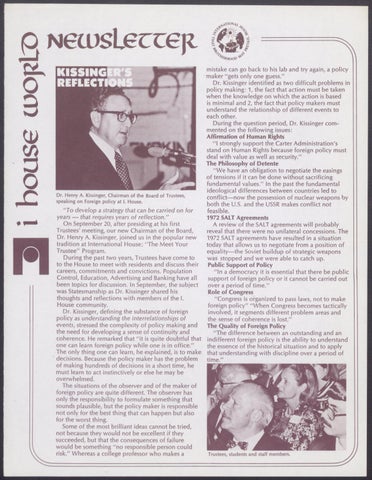
Dr. Henry A. Kissinger, Chairman of the Board of Trustees, speaking on Foreign policy at |. House.
“To develop a strategy that can be carried on for years — that requires years of reflection.” On September 20, after presiding at his first Trustees’ meeting, our new Chairman of the Board, Dr. Henry A. Kissinger, joined us in the popular new tradition at International House; “The Meet Your
Trustee” Program. During the past two years, Trustees have come to to the House to meet with residents and discuss their careers, commitments and convictions. Population Control, Education, Advertising and Banking have all been topics for discussion. In September, the subject was Statesmanship as Dr. Kissinger shared his thoughts and reflections with members of the I. House community. Dr. Kissinger, defining the substance of foreign policy as understanding the interrelationships of events, stressed the complexity of policy making and the need for developing a sense of continuity and
coherence. He remarked that “it is quite doubtful that one can learn foreign policy while one is in office.”
The only thing one can learn, he explained, is to make
decisions. Because the policy maker has the problem of making hundreds of decisions in a short time, he must learn to act instinctively or else he may be overwhelmed. The situations of the observer and of the maker of foreign policy are quite different. The observer has only the responsibility to formulate something that sounds plausible, but the policy maker is responsible not only for the best thing that can happen but also for the worst thing. Some of the most brilliant ideas cannot be tried, not because they would not be excellent if they succeeded, but that the consequences of failure would be something ‘‘no responsible person could risk.”” Whereas a college professor who makes a
*— 7{\S
z
%
. e,
o
RY ~
Wi
s
%y, ERHOOD a
4
mistake can go back to his lab and try again, a policy maker “gets only one guess.” Dr. Kissinger identified as two difficult problems in policy making: 1, the fact that action must be taken when the knowledge on which the action is based is minimal and 2, the fact that policy makers must understand the relationship of different events to each other. During the question period, Dr. Kissinger commented on the following issues: Affirmation of Human Rights “I strongly support the Carter Administration’s stand on Human Rights because foreign policy must deal with value as well as security.” The Philosophy of Detente “We have an obligation to negotiate the easings of tensions if it can be done without sacrificing fundamental values.” In the past the fundamental ideological differences between countries led to conflict—now the possession of nuclear weapons by both the U.S. and the USSR makes conflict not feasible. 1972 SALT Agreements A review of the SALT agreements will probably reveal that there were no unilateral concessions. The 1972 SALT agreements have resulted in a situation today that allows us to negotiate from a position of equality—the Soviet buildup of strategic weapons was stopped and we were able to catch up. Public Support of Policy “In a democracy it is essential that there be public support of foreign policy or it cannot be carried out over a period of time.” Role of Congress “Congress is organized to pass laws, not to make foreign policy” “When Congress becomes tactically involved, it segments different problem areas and the sense of coherence is lost.” The Quality of Foreign Policy ‘The difference between an outstanding and an
indifferent foreign policy is the ability to understand
the essence of the historical situation and to apply
that understanding with discipline over a period of time.”
wa .
— s re.
<“t
v
+
-
oa
rx
, d
Fis~
Lf
Trustees, students and staff members.
THOMAS A. OLSON APPOINTED EXEC. VICE Upon accepting his appointment, Mr. Olson said, “The challenge at International House is to offer an atmosphere where foreign students can learn about American culture beyond the confines of New York’s Upper
horas
A. Olson
MEET YOUR TRUSTEE PROGRAMS Banking and Backgammon were featured subjects at student Trustee evenings. Trustee Gerald
Barsdorf instructed a group of residents in backgammon. In
For six years he was Ford Foundation representative in Beirut. He also lived for a year or more each in France, Holland & Kenya. Before joining I. House in September 1977, he was completing the requirements for a Ph.D. at Princeton University’s Woodrow Wilson School. Previously, he had earned a Master’s Degree in Public Affairs at Princeton.
DENMARK
COMPLETED
ROOM
A bright red orange door which opens into a room filled with Danish furniture, fabrics and Danish prints proclaims that the private dining room on C floor is now the Denmark Room. Spear-headed by Council Member for Denmark, Paul KjaerHansen Danish World Members, in cooperation with Danish banks and industry and the New York Danish Bicentennial Committee raised over $10,000 to refurbish the room and to create a Danish atmosphere.
November, Trustee Mrs. Daniel
Davison brought both her husband and son to International House. Mr. Davison is executive Vice President with Morgan Guaranty Trust in New York,
and his son a trainee at Citicorp. The topic for the evening was: Banking From Two Perspectives.
NEW
kitchen, where students may cook their own meals for themselves or for friends, was equipped
according to Danish taste under the supervision of Connecticut Council Member Werner ValeurJensen.
The room is not only a delightful addition to the comfort of residents, but also a reminder of the pleasure of having Danish students and World Members a part of International House. Other redecorating projects will follow as a result of the Half Century Fund. The Coffee Wing (Waffle Wing) and the eleven floor lounges will also have a total “facelifting’”, with help from the Japan World Exposition (1970) Fund.
NEW APPOINTMENT
TRUSTEES
You may remember that Margy
Four new Trustees joined the
Board on December 1, 1977. Paul Carter, Executive Vice
President Columbia University; Donald Cuneo, attorney, a World
Member, who organized the Harlem Tutorial Program; Paul Kjaer-Hansen, Member of the
World Council from Denmark, and Mrs. Reuben Richards of Far Hills, New Jersey, along time friend of |. House. Mr. Kjaer-Hansen joins Walther Casper, Council Member from Germany, as the second Council Member elected to serve on the Board of Trustees.
PRESIDENT
West Side, and the American student can become more sensitive to the complex of social, political, and economic issues that face the world in which he must live. | look forward to working with students and staff at 1. House to meet this challenge.” Mr. Olson is well prepared for the challenge. He has broad experience in student affairs and wide exposure to foreign cultures.
Paul Kjaer-Hansen, World Council Member from Denmark and Trustees enjoys dinner in the Denmark Room.
Plans were drawn up by the Danish architect Ole Hagen, as a gift to International House. Furniture, paintings and a service of Royal Copenhagen China were shipped from Denmark. Even the
Henkels, our World Newsletter Editor for five years, said goodbye in the last issue. Our new editor, Margaret Mather Mecke, also has the title of Coordinator for World Members. Mrs. Mecke will be responsible for correspondence with World Members, the Alumni Fund, Council Meetings and working with all of you in developing networks of communications.
A graduate of Barnard College with a background in teaching, journalism and public relations she brings over twenty years of experience in Alumni Affairs to International House.
“A PLACE GROW”
TO
The next time someone asks you, “Isn’t International House just a place to live—just another dormitory?” Answer them in the words of Mary Lise Rheault, former Program Fellow and Student Trustee. She, speaking at the Contributors’ luncheon, called |. House “a
place to grow.” She explained that what kept her here was: “the way the House can so successfully combine the advantages of a unique, self-sufficient community without the disadvantages of a boring homogeneous population.” “The ideals of
brotherhood and exchangedglobal outlooks are the real catalysts in the foundation of peace-seeking attitudes.”
“Our dinner-table conversations
are more than pleasant chatter —they are, perhaps, the foundations for future round-table discussions resulting in solutions to contemporary world problems, and eventual peace.”
STUDENTS FORM CARE COMMITTEE Over the years, the | House tradition of expressing concern for others has frequently taken the form of a student service project. In 1968 it was the Harlem Tutorial, initiated by Donald Cuneo. This year, in their own words, “a diverse group of committed
students who would like to accomplish something lasting while at I. House.” established a student Committee for CARE. Paul Cohen, the business student who is chairman has had a personal involvement in CARE since he was a child in Israel and saw how welcome the packages were in that young country. The
agency was chosen because of its fine reputation for efficiency
around the world without regard to politics. The first check to CARE was $172.89.
A HOUSE FILLED TO OVERFLOWING In the Fall of 1977, the rooms at International House are filled to overflowing with students from 61 different countries. But the rooms are not the only thing that’s full, the calendar has been full of activities as well. Residents arriving at Interna-
tional House in 1977 were greeted with new orientation: an enlarged and revised Resident Handbook plus a two-part Orientation Program. This year, in-house sessions; briefing sessions by staff members, interest seminars and a reception by Mr. Cook were followed by three country weekend trips. The first sessions were planned to give students an opportunity to get acquainted with the House, the neighborhood, and the city. The weekend trips gave them a chance to begin building friendships. The mini-bus continues to be valuable as a way of introducing students to American life. Boston was explored by 12 students on a recent weekend trip. Professional interest groups have been very active in bringing together residents interested in
planning and preparing for careers in their professions. There are also dance classes, a full sports program, and bridge and back-’ gammon groups. What makes such a full program possible? In addition to the appointment of Vice President, Thomas Olson, Mary-Clare Metcalf, the Coordinator of the Program Office, has a group of eight students to assist her.
SAVE THE DATE NIGHT OF NATIONS APRIL 1, 1978
Orientation Weekend, the beginning of new friendships.
STUDENT GOVERNMENT IMPORTANT A lively student government is another vital influence on residential life. This Fall, election campaigning was spirited and inspired a good voter response. Mark Robinson, Chairman of the Student Council, told the Editor that he believes there are two main goals for student government this year: |. To work in cooperation with the administration to find ways to hold down the costs. He believes that it is important to keep the cost of living at 1. House competitive with other student residential choices. Il. To enhance the spirit of international community. He hopes the student government
will be able to help the staff increase the feeling of community which already exists between members from all over the world. The Student Council itself is a cross-section of the House. Mark Robinson, a Columbia law student, is from Wisconsin. His fellow student trustee, Anil
Trivedi, is a City University physics student from India. Australia,
Spain and Utah are represented by the Committee. Chairpersons. Seven Regional Representatives from Nigeria, Italy, Puerto Rico, Japan, Iran, Pakistan and Illinois
complete the Council.
A VISIT WITH PRESIDENT CeOn In the photograph of me with Mitsuo Mutai, you see me at work at one of my favorite jobs; meet-
ing with World Members all over the world. | enjoy bringing you all up to date about |. House and also hearing from you what the House meant to each of you. Many of you ask me what role you can play in helping to perpetuate the work International House is trying to accomplish. Our World Members program was founded for just this purpose, to give an opportunity to former residents to put the idea of International House to work in their lives and their communities. Ways you can help........ One important way you can help is to make new friends for the House. Tell people about our goals and programs, show them our literature and refer students to us who will enrich our community of residents. Since everything we do invariably costs more than students can afford, we hope that many of you will want to contribute to the Annual Fund so that the House will be able to serve others as it once served you.
\ eee
President Cook visiting Mitsuo Mutai , President of Yomiuri Shimbun one of the leading newspapers in Japan reviewing pictures of |. House. With them is Mrs. Yasushi Shidatsu, wife of the Secretary of our Japan Committee who helped find hundreds of “lost” alumni.
Photo courtesy, Yomiuri Shimbun, Tokyo.
Some of you may be able to, lead us to sources of Foundation or Corporate giving (including matching gifts for employees) which will insure a strong future for the House. On May 18-20, The Council of World Members will meet at |. House. This meeting will permit Council Members and Trustees to discuss together points of vital interest to the future of the House. A gala Candlelight Dinner will follow the Trustees’ meeting on
STUDENT PROFILE TRUDY BOWER PROGRAM
to a U.N. internship in the Language Training Service the summer before she earned a
As a high school student in
Stanford University. The summer of 1977 she was in Brussels, Belgium as assistant in the U.S.European Office of the Experiment-in-International Living. Trudy is now working toward
International studies continued for Trudy when, as a French major at Smith College, she spent six weeks at Aix-en-Province, followed by study at the Sorbonne. Her interest in French led her
invitations.
| will be traveling throughout the United States to meet with alumni who would like to reestablish ties with the House, thus helping to further our goals. Please let us hear from you if you would like to help in this effort.
ela Qik
FELLOW - SPORTS
Trudy Bower is an American student who brings a well-established foundation in international living with her to 1. House. Princeton, N.J. she participated in an exchange program sponsored by the English-Speaking Union. She and her family hosted a Scottish student for a year and later Trudy spent a year living and studying in Scotland.
May 18. All Alumni who have contributed $25 or more to the Annual Fund will receive
Master’s degree in French at
a Master’s degree in International Affairs at Columbia.
Value of Sports As a Sports Program Fellow,
Trudy “realizes the value of sports in furthering the goals of the House.” One of the most popular groups
has been a karate class taught by a volunteer black belt instructor, Hiroshi Nagata. Sunday football
games in Riverside Park have also proved a popular way to involve students from overseas in a
distinctively American sport. An Education in Itself Trudy calls the living experience here “an education in itself.” She knows it will be invaluable preparation for the work she hopes to do in an organization such as the U.N. As a Program Fellow, she enjoys ‘responding
to the challenge of representing the interests of a diversified student body.”
RETURN
TO MORNINGSIDE
HEIGHTS
day with anxious breath. Terrorism is rampart, freedom eludes too many people still, and the mushroom shadow has not disappeared. We have need of a House whose doorway spells out: That Brotherhood May Prevail.
by Margaret Mather Mecke This Fall as | came back to Morningside Heights, to |. House, vivid memories of my first arrival as a Barnard Freshman crowded in on me. World War II had just ended and awareness of international politics was at a peak. In the autumn of 1945 the mushroom clouds of August shadowed and sharpened the consciousness of us all. | remember—talking with unsettled physics students who now suddenly felt the need to think of something outside a laboratory.
—coffee sessions with our Dean
FOR FUTURE GENERATIONS
the sum of $........ to be used for its general corporate pur-
John J. Hader ‘24 and Mathilde C. Hader ’25
poses.”
toast their Golden Wedding Anniversary.
Further information on bequests may be obtained from the President’s Office, 500 Riverside
who met at International House.
Teachers practice their professions for the benefit of future generations. Two teachers who had lived at International House wanted to continue their concern for the next generation by remembering the House through Bequests.
Miss Margaret Knight who lived here in 1931-32 and the Summer of 1940 bequeathed $7,254.88.
We have been unable to find any detailed information about Margaret Knight and would welcome information from those who knew her. Miss Wilma Schell who lived here in 1956-58 left a bequest of $4,964. A representative of the School of Music, Florida State University
described Dr. Schell as a ‘‘dedicated teacher particularly good with children. A friendly person,
always pleasant and cooperative.” Her gift to |. House seems especially appropriate. A tax-exempt, charitable and educational corporation, International House depends upon individuals, foundations and corporations to support its program and its fellowship and
scholarship funds. Bequests from friends of the House may be made in the following manner:
0) “I bequeath to International House, a New York corporation,
Virginia Gildersleeve who talked with us about her recent session
in San Francisco where she helped to write the United Nations Charter.
—a meeting of the International Relations Club where | was fired
by the impassioned speech of a young Indian pleading for the overthrow of the British in India. Now in 1977 — although
“ORIGINALS” i)
'
'
}
ae
colonialism has withered on most continents and scores of new nations swell the rolls of the
United Nations—again arriving students must meet the news each
Drive, New York, N. Y. 10027.
A MESSAGE ABOUT NEW YORK Many times | am asked about the conditions of New York City. | believe that too much attention is paid to instances of violence rather to the advantages of being. in the city. | should like to share with you the comments of Columbia’s President William McGill which appeared in the Business School Alumni Newsletter: “There is nothing like New York City anywhere else in the world. Although we are sometimes ruthless and abrasive, this city gives us all the competitive urge to make something of our lives and at the same time to preserve our religious and ethnic values. -— It is a place of excellence where
reputations are tested
and where real ability counts for more than anything else. It is the nucleus of the American dream. We cannot allow that dream to die.” We must remember to draw from the vigor of New York in striving to realize our own dream. Howard Cook
The Hader’s are one of the: many couples
In the last newsletter, Chih Meng ‘24 asked about other “Originals”. There was such a wonderful response we decided to publish a separate newsletter supplement devoted to that news. We will mail it automatically to all World Members from the 20’s. And to anyone else who writes us for it. The supplement will have news of the following: 1. Ernest and Ruth Spencer Arndt 2. Dr. Anna Aucamp 3. Donald Blaisdell 4. W. J. Brockelbank
5. Rev. Baldwin W. Callahan 6. Shepard B. Clough 7. 8. 9. 10. 11.
George and Elizabeth Ellison Amelia Fletcher John Fuller William Gardner Sara Shaw Gilley
12. Dr. E. G. Malherbe 13. John and Mathilde Christian Hader 14. 15. 16. 17. 18. 19. 20. 21. 22. 23. 24.
Edward F. Hall Felicite Hoffman Rosalind Mortimer-Maddox Jeanne Palisse Marandon Elizabeth Eckhardt May Marie and Cyrus Peake Henry Refo Arline Risdon Helena Simpson Lenoard Sutter Pauline Wojewodski
NEWS
FROM
WORLD
MEMBERS
Before you read on for news
international women’s conference.
of other members, read what our
The 60’s
founder, Harry Edmonds, believes you are capable of. Harry Edmond’s call for leadership “.,. dedicated leadership is as important as money! Never before in history has there been such a world crisis. Never before has there been such a group of people, thousands, the World Members of |. House, with the capability of contributing to the solution of this crisis. (That's for sure!) Will we rise to this opportunity? W/LL WE???”
Patrick Quien ’63 is head of
Public Relations for Remy Martin & Co., Cognac and travels around Europe. Shanker Narayan '64 is back in New Delhi, India after spending some years in Kenya and Nigeria as a UNESCO Expert in Teacher Training. He is now Acting Head of the Department of Teaching Aids, National Council of Educational Research and Training. Harry Edmonds - Founder of |. House.
NEWS OF WORLD MEMBERS THROUGH THE DECADES The 30’s C.R. Vosburgh ’36 wrote to us from Batavia, N.Y. where he has retired with his wife, the former Ines Rodriguez from the Republic of Panama. After they met at International House and were married, they returned to Panama where he taught in the Canal Zone schools. He also wrote a weekly newspaper column which he continues although living in New York State. Dr. Evelyn Carrington '38 is retired from active work as a clinical psychologist. She is living in Austin, Texas and has recently edited a bicentennial book, WOMEN
IN EARLY TEXAS.
Federico Mangahas '39 recalls his visit “between two conferences” as a base for a “stock of memories” that are a pride of my life.”” His eldest son lived at the Chicago International House
while studying Economics. The 40’s Fanny Cortes Garcia, writes that her son is now studying at the Wharton School at University of Pennsylvania and living at Philadelphia International House. Kim Yaroshevskaya '47 is an actress at Theatre d’Aujourdhui in Montreal. Two women from this decade disagree somewhat regarding the
Francis Tyau ‘58 wrote of having dinner with Berthe Bak in Copenhagen when she was abroad for an
status of women: Elsie Scott '40 writes from Kansas that in her opinion “there is little difference in the progress of women today.” But from India we hear from: Dr. Sripati Shridevi ’49 that “Thanks to the International Women’s Year—the cultural prejudice against women is being broken down, many a special educational facility is being created by Government for women.”
The 50’s Barbara Fawkes '53 has retired as Chief Education Officer for the General Nursing Council for England and is settled in Australia. Barbara Scheyer '54 is teaching at Long Island University in Brooklyn. Her specialty is MotherChild Health. Alan McLaine '56 wrote from England that he and his wife Susan were making preparations to travel through the Baltic to take up a new diplomatic post in Moscow. Alan and his wife are World Council members from Canada. He will be second in line at the Canadian Embassy. Dorothy Schneider '57 has been listed in Who’s Who in the World as the originator of U.N. Day as a world holiday.
Donna G. Haines 65 is a Learn-
ing Disabilities Specialist in Cheldsford Mass, schools. She
has also been elected Eastern Regional Vice President of American Youth Hostels. Violeta Vincenti Parades '67 has been appointed Assistant Secretary, in charge of Economic Studies, in the Puerto Rico Department of Consumer Affairs. She also announces the birth of her son, Jose in October 1976.
The 70’s Les Browns '76 is working as a library assistant at McGill in Montreal and is also working on two film studies: ‘““Women in Innmar Bergman’s Cinema” and “Movement,
Memory,
Ameri-
canism and Landscape, Form Elements of a Lyrical Cinema.”
IN MEMORIAM We regret to announce the death of Council Member Jose Concepcion of the Philippines, in August 1977 and of Kenneth Holland ’32-’33 in December 1977. Mr. Concepcion was a prominent industrialist. One of the earliest world representatives of 1. House, he had sent us many referrals and had served on the Council of World Members from the beginning. Kenneth Holland, was past President of the Institute for International Education and played a leading role in encouraging international cultural ex-
changes. He was a devoted friend of |. House.
MOSAIC
DISCUSSION
“If you had a ‘mosaic’ discussion - - people from many countries presenting their own side and point of view on any given problem in which they are all involved, might there not be some constructive solutions emerging from such a bringing together of ‘pieces’ rather than from trying to get the answer from any one country or individual?” —Dorothy Ulrich Troubetzyoy ’38
The
Human
Rights Equation
The affirmation of human rights has become a controversial issue throughout the world, both as an internal issue in many countries and as a matter affecting foreign policy and international relations. Although the concept of human rights is readily embraced by peoples and governments all over the world, the practice of such rights is sometimes more difficult to achieve. The need for national security and the need for conditions which permit economic growth sometimes conflicts with the practice of Human Rights. In a country threatened by external political forces or in a stage of growth which makes the delivery of basic needs of food, shelter and health care tenuous, priorities regarding human rights may be quite different from those in a secure, highly developed country. Cultural traditions can also affect the practice of Human Rights. Since priorities vary in different parts of the world in determining the balance between Human Rights and
Security and material well being, we invite 1. House World Members to send us their ideas regarding the Human Rights Equation. USE
SPACE
BELOW
FOR
YOUR
COMMENTS
As a nonprofit organization, a copy of our last annual financial report is filed with the New York State Board of Social Welfare and may be obtained by writing to the New York State Board of Social Welfare, Office Tower, Empire State Plaza, Albany, New York 12223 or by writing to the Development Office, International House, 500 Riverside Drive, New York, New York 10027 Vol. 13 No. 3. Winter, 1978
A
Designed
by Curry Copy
and
Printed
letter for former members of International House, 500 Riverside Drive, New York, N.Y. 10027 Margaret Mather Mecke Editor Center,
Spring
Valley,
N. Y.
SEPT “ON HUE ‘A'N HOA man dIVd
paysanbay
UOIAMO~)
ssaippy
LZO0T ‘A'N “440A Man GAUC] SPISIOAIY OOS
dOVLSOd 'S'N ‘OYO LISJOUdNON
asnoy]
seuoyeusaj}u]
This is International House Countries of Citizenship of Resident Members 1976-1977
Europe,
Bs)
Far
North 236
America,
Latin America and the Caribbean, 56
Africa, 34
Middle East, 59
Oceania,
8
East,
119