NewsLetter 9
Pada
?%
%
4 =) = <x > #
re
“ER HOOD *
Nw
Roscoe Lee Browne concluded the ceremony with the following poem by the Indian poet, Rabindranath
Tagore, who
once
read at
International House:
aS
4
dl
~~)
7
a7
Where the mind is without fear
and the head is held high,
“>
Where knowledge is free; Where the world has not been broken
up into fragments by narrow domestic walls;
Where words come out from the depth
of truth;
Where tireless striving stretches its arms towards perfection;
Where the clear stream of reason has not lost its way into the dreary desert sand of dead habit; Where the mind is led forward
by thee into ever-widening Sa
a
thought and action— into that heaven of freedom my Father, let my country awake.
eS
* “wm
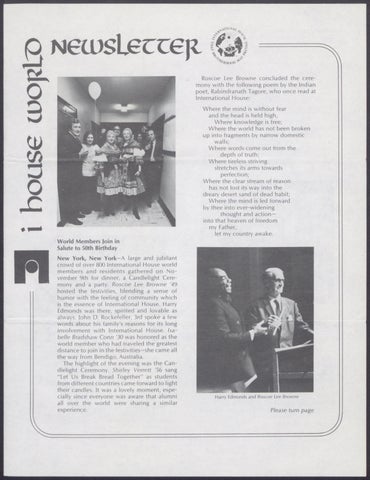
’ World Members Join in Salute to 50th Birthday New York, New York—A large and jubilant crowd of over 800 International House world members and residents gathered on No-
vember
9th for dinner, a Candlelight
mony
and
a party.
Roscoe
hosted
the
festivities,
Cere-
Lee
Browne
‘49
blending
a sense
of
humor with the feeling of community which is the essence of International House. Harry Edmonds was there, spirited and lovable as
always. John D. Rockefeller, 3rd spoke a few words about his family’s reasons for its long involvement
with
International
House.
/Isa-
belle Bradshaw Conn ‘30 was honored as the world member who had traveled the greatest distance to join in the festivities—she came all the way from Bendigo, Australia.
The highlight of the evening was the Candlelight Ceremony. Shirley Verrett ‘56 sang “Let Us Break Bread Together” as students from different countries came forward to light their candles. It was a lovely moment, especially since everyone was aware that alumni
all over
the
experience.
world
were
sharing
’
“a Harry Edmonds and Roscoe Lee Browne
a similar Please
turn
page
Buenos Aires, Argentina—“The International House ideals of worldwide brotherhood and international understanding were evoked and shared by the group, and all joined in a toast for the strong and
guest speaker. Oldest members from 1928 and 1931, youngest from 1973. Evening went on in high
fruitful continuation of the Old Home in the States.”—Council Member Horacio Reggini ‘60.
pledged.”—Council
Sao
Paulo,
Brazil—It
was
very
important
to feel
that all of [the alumni at the Candlelight Ceremony] came with the spirit of 1. House. In contacting them, | had some extremely interesting experiences, such as the one related to one alumnus deceased over fourteen years whose son wanted to
come to represent his father!’’—Council Sergio Pimentel Mendes ‘63.
Member
November 10th with alumni from different parts of Germany and U.S. Consul General Robert Harlan as
spirits, and
support for the cause of |. House
Member
Walther
was
Casper
‘37.
Helsinki, Finland—“We the undersigned International House alumni have gathered tonight to celebrate the worldwide Candlelight Dinner... Some of us told this evening how they arrived at International House as narrow-minded national-
ists, but how the atmosphere at |. House made them realize what brotherhood and international meant
to everyone.
7
North Vancouver, Canada—“Our alumni party was
a small and congenial one with several guests affiliated with the local International House attending as well. For the alumni it was a nostalgic treat to view New York International
in the film.’”—Council Member
House again
Mrs. Hubert Gab-
rielse ‘54.
4
»
y
-
ma
2a
~
Candlelight
Howard
Cook
and
Council
Member McLaine
in
Dinner,
Port-au-Prince, Haiti
East Room
Ottawa, Canada—The world members gathered for
a Candlelight Supper and decided to join together and give something to today’s |. House residents. On
November
9, 1974, Council
Member
Mrs. Alan
McLaine ‘56 presented a Canadian World Book Encyclopedia and ten books about Canada to Howard Cook. The books are in the Reading Room (East Room) where they are available to students. Prague, Czechoslovakia—“We shall meet at the time of the Jubilee Ceremony together; even when without any ceremony, we are three people.”— Council Member Otakar Matousek ’30.
Copenhagen, Denmark—‘‘The members of the Danish Alumni Council of International House gathered for a Golden Jubilee Celebration send you greetings and good wishes.” Frankfurt, Federal Republic of Germany—“Germany chapter of |. House held Candlelight Dinner
Candlelight
Dinner, Bangalore, India
Bangalore, India—‘We held our Candlelight Dinner before the distinguished gathering of elite of Bangalore under my chairmanship with a grand success and the first of its kind, with candles lit for the
special occasion and accompanied by old film on International
House
and
a
cultural
program
at
dinner.”’—Council Member Behram Sidhwa ‘39. Taipei, Republic of China~—’’As Honorary Chairman of Taipei International House, it is my great pleasure and privilege to extend congratulations on the occasion of the International lee. Confucius
more
than
House Golden
said, ‘Rites, rites!
jades
and
silks?’
Do
Our
they
Jubi-
mean
no
ceremonies
of
observing the Golden Jubilee are most meaningful in what they imply for years to come.—“C.K. Yen, Vice President, Republic of China. Zurich, Switzerland—“It took no time at all for everybody to warm up, even though except for myself nobody had ever met anybody before. It was,
of
course,
the
spirit
of
International
House
lovely young ladies presented flute duets, and | was reminded
of
Howard
Cook’s
description
Brunswick, Maine, U.S.—“The gathering of Maine alumni of International House took place at Bow-
that prevailed all over again. We decided that we
doin College, where the Candlelight followed
tion gap had to be overcome. We were just one big family with alumni from 1924 all the way through to 1973.”—The late Emil Kuster ‘26.
Warwick, England, United Kingdom—‘Our United Kingdom alumni have celebrated the Jubilee by completing the building of a new International House at the University of Warwick.”—Council Member Keith Aitken ‘29. San
Diego,
California,
Shoukletovich
U.S.—“The
Reverend
D./.
‘26 read a part of the original cere-
mony which he had received in a personal letter from Harry Edmonds. Dr. Irene Cheng ‘29 gave an illustrated lecture on her extensive travels recently in mainland China.”—Council Member James McCoy Davis “48.
sented
by ‘An African’s View by
Nizarelli
Motani,
Dinner was
of America,’
Professor
of
Studies at Bowdoin. A lively discussion of recent African and American events, politics and customs was enjoyed by the fourteen attenders.”—Carl Veazie ‘46. Candlelight Dinners were also held in Washington, D.C. and Chapel Hill, North Carolina and many other places throughout the world.
Harry Edmonds Says Thanks! Harry Edmonds wishes to express his appreciation of the many letters sent him on the occasion of
the Golden Jubilee and Candle Lighting around the world.
They are his most
precious possession.
lieu of that, let him say to each and all: “Thank you;
thank you very, very much.” And we would like to wish Harry Edmonds a belated Happy Birthday. He was 92 on March 11th!
0
ay Dinner
He
would acknowledge every one, were it possible. In
TITY Candlelight
pre-
African
ete s eawne oon oe
Honolulu, Hawaii, U.S.—”. . . it was a terrific group, and the warmth and fellowship was just great. Two
the
ful music and thoroughly enjoyed.”’—Council Member Lucia Whitmarsh ‘40.
would definitely not wait for another fifty years to get together again here or in Geneva. It was a great
and really heartening experience that no genera-
of
Metropolitan Museum of Art dinner. It was beauti-
at the home of John and Janet Fiske ‘41, Moscow,
Idaho
Introducing... A new lady is presiding over the World Members kingdom, someone whom many of you have already met. She is curiously unflappable and easy to
talk to and has been overseeing World
Members
and Development since July, 1974. Since Vice President Henry Munson’s resignation in January, she
has also been coordinating the Half Century Fund Drive with the Development activities. This wonder
woman is OJ Rudd. Mrs. Rudd came to our subterranean world (the World Members Office is on the C floor, next door
to the Pub) with a variety of international and organizational experience. She and her husband, Roger, lived in Japan for six and a half years after World War II and have traveled widely. Mrs. Rudd has had extensive experience in volunteer organizations and served as President of the Library Board, Art in the Park and the Creative Arts Council
Don’t Worry if you don’t receive a receipt for your contribution to the Alumni Fund. Our file expert
advised us to stop sending receipts, so in the name of efficiency,
please"use
your
cancelled
check
as
your receipt. Receipts will be sent on request.
Thank
you
for the greetings
you
send
to us at
Christmastime. When we decorate for Christmas, it gives us a special feeling to have cards from all of you all over the world. Dedicated We
the
Swiss Alumnus
are very
Dies
sorry to report
International
House
Switzerland, died
that
Emil
Council
Kuster
Member
‘26,
from
in early January, 1975. Mr. Kuster
was a devoted |. House alumnus and had been a member of the Council since 1971. In 1973 Mr. Kuster wrote this about his life at International House:
in her area. The Rudds worked together on man-
Looking back over the years, there is no doubt
agement training and also organized a volunteer program involving 2,000 people in seven New York counties. The Rudds have five lively and confident
in my mind
children.
that the world would
never have
been what it turned out to be had it not been for International House.
| was literally thrown
into the world face to face with people from all parts of the globe. Whatever prejudices or fixed ideas | may have had against people from other parts of the world, they evaporated into thin air shortly after my arrival at |. House and never had a chance to develop. | found out that most of my new friends reacted to kind-
ness, responded to reason and found praise as soothing as | did. Board Chairman
George
W.
International
Named
Ball House
is the Board
new
Chairman
of
Trustees.
the United Nations and also as Under Secretary of State.
New Members on Council
We are pleased to announce two new appointments to the Council of World Members. Abdullah Almoosa is the Council Member from Dubai, United Arab Emirates. Mr. Almoosa is head of his own construction firm and is involved in most of the
He
is now
a partner of Lehman
sentative from South Africa. Mr. van Schaik director of J.L. van Schaik, Ltd. in Pretoria.
aging director of Lehman
Brothers
is the
Half Century Fund Drive Launched Now that the festivities celebrating the InternaHouse
Half
50th Anniversary are over, the three
Century
Fund
Drive
is beginning
in
earnest. Here in the U.S., the Metropolitan New York Alumni Committee was the first to form. Gerald Barsdorf ‘56 is the Chairman of the Committee, which includes Richard Cowen ‘48, Jon Gundersen ‘62, Zlata Paces ‘52, Susan Radvany-
Greer 58, Jo Ann Sperling ‘60 and Gustav Szabo ‘51.
Brothers,
an
international investment banking firm, and a man-
major building in Dubai. Jan van Schaik ‘43 has replaced £.G. Malherbe ‘24 as the Council repre-
year
Ball
brings a rich variety of international experience to his new post, having served as U.S. Ambassador to
O) Rudd
tional
of the Mr.
George W. Ball
Incorporated.
Give and Take at I. House
This center page is devoted to activities of interest which are taking place at the House now. The Council of World Members has asked us if we would try to keep you up-to-date on the things that today’s students are thinking about and listening to. We hope you will write in and describe your reactions to the ideas expressed here. Margaret Mead Launches International Women’s Year
Margaret Mead, the noted American anthropologist and author, returned to |. House this winter to kick off the International House observation of the UN International Women’s Year. She spoke on “The Evolution of the Status of Women”. Dr. Mead began by examining a few of the myths which are currently popular about women, initially tackling the assumption that the
role of women has evolved. Dr. Mead agreed that female roles have changed, but questioned the idea that these changes have meant a progressive increase in power and participation. The first important biological development in the evolution of
women, Mead said, was the “invention” of the menopause. The menopause
shortened
the reproductive
period at one end; the
latent phase in children shortened it at the other. The fact that women stopped bearing children after a certain age meant a longer life for them. This was good for their societies, because they had experience and wisdom and knew how to deal with emergencies. Dr. Mead compared this phenomenon to an example from the animal world. The red deer in Scotland look to the old females of the herd when times are hard, and food is scarce. In these times, the old females lead the herd to the good grazing areas they know. If there are no old females, the herd is likely to die. Dr. Mead went on to discuss the ways in which sexual identity
is tied to tasks as well as to biological sex traits. The only human task which is universally assigned to one sex is the bearing of arms, which is only done by men. The other universal in male-female labor division is that the tasks that men do, whatever they are, are regarded as more important than the tasks
that women do. Dr. Mead said that this is
acompensation for the
fact that only women can bear children. Even societies of hunters
and gatherers which do not have a hierarchical structure observe a division
of
labor.
Women
do
not
do
men’s
work
or men,
women’s. If for some reason this division is violated, there is always some apology or explanation. One example Mead cited of the effort made to bolster the male ego was that of an Eskimo woman building an igloo. In Eskimo culture building an igloo is a man’s job, but women know how to do it. If a woman needs to build an igloo, she does, but mutters all the while, “Just a mere woman building this igloo. Just a mere woman.”
In evaluating a culture, anthropologists look at domestic life, which
is usually female;
the management
public life, which
is usually male, and
of food, which can go either way. Dr. Mead
said that the extent to which women
in a society contribute to
food management is a crucial factor in determining their status. Plants are usually a female domain and animals,
a male domain.
Herding and hunting cultures are usually much less favorable to women than horticultural societies where women grow and process and manage food. As our society has developed, women’s importance in food management and feeding has decreased. In the last fifty years, women have been cut off from the food supply, especially in U.S. cities, and Dr. Mead saw this
as one of the mainsprings of today’s women’s movement. Many women have been changed from managers to consumers, just as many families have been changed from a production unit to a consumption unit. Dr. Mead argued
was done women
that women
are now
by the industrial revolution.
trying to undo what
The changing
role of
is not a product of a simple evolutionary process which
gives women a larger and larger share of power and participation. Many of the changes are not steps “forward” to places women have never been, but are efforts by women into areas in which they were once powerful.
to move back
Dr. Mead was very adamant about the fact that the movement
of women out of food management has severely affected the world’s food supply. When food management left the village level, food management became part of the public domain, and women were excluded from it. Dr. Mead said that this is when food’s relationship to life was lost. People are now thinking about food in terms of power and politics and money instead of thinking about food in terms of human life. One of the goals of the United Nations International Women’s Year is to put women back into food management at every level. One social condition which Dr. Mead saw as a contributor to the current push for greater freedom for women is the population crisis. In the next fifty years, in all but the poorest societies where food and medical care are scarce, the pressures to have
children will decrease. This is a liberation for both men
and
women, since most of the human race has spent most of its time as progenitors, the women raising the kids and the men support-
ing the family. Now we need people to contribute as individuals. Dr. Mead said that need was also felt in the Middle Age: in Europe in a time of over-population. Then many people went into convents or monasteries. Society is once again asking men and women to contribute as individuals, yet it is still limiting the ways in which it wants women to contribute.
R. Buckminster Fuller Brings I. House “Great News”
by Margy Henkels, Editor “The only thing worth noting about me is that | am an average, healthy human being,’”” Buckminster Fuller said at the beginning of his talk at International House this spring. The International House residents who voted him the 1975 George Marshall Visitor considered him anything but average. This exceptional human, inventor of energetic-synergetic geometry, geodesic structures and tensegrity structures and author of fourteen books said, “Anything I’ve done, someone can do better.” Perhaps. But to hear the accomplishments of Buckminster Fuller’s life and the range of his thinking was a thrill. In 1927, at the age of thirty-two, R. Buckminster
Fuller broke
out of what he calls the game of survival. His contemporaries were convinced that the number one priority in life was earning a living. At thirty-two, Fuller asked, “What
does my experience
tell me that humanity needs attending to?”, deciding that whatever it was, he was going to do it. An “average” human. What humans call natural... “What human beings are born to is what they call natural,’ Fuller said. It is very difficult for humans to call things that change natural. Fuller says his experience tells him that “Only the impossible happens.” He remembers when he was a little boy growing up outside of Boston, Massachusetts, he and his friends would throw paper airplanes out of the attic window, but that everyone knew that it was inherently impossible for human beings to fly. Then,
when
he was
eight
brothers flew for the first time. When
years old, the Wright
he was twelve, the first
wireless SOS was received. At twenty-three, he heard a voice on a navy radio. At fifty-two, he experienced TV. “Only the
impossible happens.”
Continued on the next page
Fuller says, “All human beings are born naked, ignorant and helpless. The fact that we have gotten this far without any kind of a rulebook
is extraordinary.
We
find our
way
by trial and
error.” He has been looking at the world for a long time in terms of a world game which everyone can win. When someone asks him where he lives, he answers, “On a little planet called Earth.”
He sees the earth as part of the larger pattern of the universe. When
he was young and someone said, “East is east, and west is
west,” people believed it. In the past groups of humans lived in clusters spread out over the earth, each group isolated from the others, each group following its local urge without thinking mucn about its effect on anyone else. Now everyone everywhere
must be all right or nobody will be. “The great news of our moment...” Dr. Fuller said that the great news of our moment is that there are adequate resources for the world to work. There is enough to go around. “The great working assumption of humanity is that there is not enough to go around,” he said. Malthus was the. first economist
to see
the
world
as a closed
system.
Before
him,
everyone had perceived the peoples of the world surviving or failing pretty independently. Malthus figured that if human beings were reproducing in a geometric progression, and the food supply was increasing in an arithmetic progression, at some point there would come a time when there would not be enough for everybody, and only the fittest would survive. Of course, Malthus could not consider the technological advances such as refrigeration, hermetic sealing or tins which would affect his projection. The fact that there is enough for everybody in this life is a twentieth century phenomenon, due to technological advances and new information and perceptions. It is an idea which is still not generally accepted. “Only when a man sees things moving .. .” Dr. Fuller sees society's ways of playing games as fundamentally myopic. Myopia is a general human characteristic, he says. “When
a man
cannot
see motion,
he doesn’t
really believe
it.
Only when a man sees things moving, does he get out of the way.” The politician is looking only as far as the next election, the businessman, only as far as his profit. Because we still assume
that there is not enough to go around, there are areas of high priority, which get the best materials and brains. Right now the highest priority is arms. The areas of anti-priority get what’s left. In 1952, TV entered the American home, magnifying the
changes that radio began twenty-five years earlier. Radio and TV meant that everyone had access to information. Parents as information sources became obsolete. The children could see from the fact that their parents were watching the TV for their information that parents were not “the final authority”. They could also see that their parents didn’t have much to do with what was going on. Since parents were not the ultimate authority, many of the children started to do their own thinking. This is the basis for Fuller’s hope that humans will start to act more responsibly. The kids saw that people all over the world are in trouble. Kids are compassionate, and the kids figured that if human beings can get to the moon, they can get the humans on earth out of trouble. The kids of that first TV generation are grown now, and they know that ‘We can take care of all of humanity without anyone profiting at someone else’s expense,” Fuller said. When Fuller considers man’s function in the universe, he considers “an eternally regenerative universe,” one with incredible design flexibility. He says, “You can do anything, but some things take longer than others. There are many choices for every move you make, which is lucky for human beings, since we are put on this planet without a rulebook. We are given an incredible cushion of resources with which to make mistakes.” We had always thought we would run out of everything, but in this century we have learned to see that we won't. (Or at least,
that we don’t have to.) In such a universe lying and politics and war are obsolete. “If | designed an incredibly flexible, regenerative universe,” Fuller said, “| would need a local sensing unit.”” The human brain is terminal; the human mind deals with the eternal. Human
beings have the ability to put something together which is not seen in the data, the ability to see something going on between parts which is not of the parts. We are in a universe with a design,
and our minds can see this design. None of the principles of the universe ever contradict each other; all are interaccommodative.
According to Fuller, human beings are put here for their ability to see the patterns; for our minds, not our muscle. In this century we have gained access to an incredible information system, and now we must solve our design problems. “This is the big examination,” Dr. Fuller said, “and now we must begin to use our computers to do the cosmic accounting.” “We are burning up spaceship earth.” Fuller and
a study group
of his have
worked
out
a “critical
path” for one design problem—a step by step breakdown of a way to give all of humanity the energy advantage the people of the U.S. enjoyed in 1972. They say that this can be accomplished
by 1985 using known and proven resources and technology. “The politicians of the world,” Fuller said, “are advertising ways to get
enough for ‘us’. They have no grand strategy except to use up all the fossil fuel and then to switch to atomic fuel and hope that fusion methods will be ready when the atomic energy runs out.” Fuller thinks it extremely foolish of us, the residents of the planet earth, to spend our energy savings in ignorance—to live on our
capital when we could live on the interest. Nature must expend a huge amount of energy to make petroleum, and in relying on petroleum, Fuller says, “we are burning up spaceship earth.” To give all humanity an energy advantage equal to what the people of the U.S. enjoyed in 1972, Fuller’s group would phase out all fossil, atomic and fusion energy, water, tidal and methane
energy uses and utilize solar methods instead. They would
employ an energy network connecting the night side of the earth to the day side so that human beings could use existing materials and equipment to maximum advantage. These findings will be published in a book later this year. The thinking behind them is what
Fuller calls doing more with less.
“All our heads are spheroidal . . .” While
Buckminster
Fuller was
in the navy, he observed
that
success was dependent on doing more with less or doing more with the same. After leaving the navy, Fuller went into the building
business,
where,
he
says,
‘Nobody
does
more
with
less.” When he saw the waste and the lack of thinking that went on, Fuller began to approach architecture in terms of doing more with less. Eventually he invented the geodesic dome. ‘All our heads are spheroidal, even
if we think as if they’re cubes,”
he
said. The sphere is the building form which does the most with least. Spheres suffer the least energy loss and can carry the most weight
or
pressure
per
square
inch.
There
are
now
100,000
geodesic domes all over the world. Dr. Fuller does not think of people as good or bad. He says that people’s conditioned reflexes are an enormous deterrent to thinking. People must unlearn the concept that there is not enough to go around. Fuller is always amazed, he says, by how much he has had to unlearn. As an outcast, an eccentric, he looks
over the top of the mountain and see what's on the other side, At the
moment
Dr.
Fuller sees
humanity
“in a bind
of fear and
bureaucracy and a momentum of non-thinking.”” He urged each of us to meet each moment fully conscious of the responsibility we have for the earth. “You cannot leave it to anyone else to pick up the piece of paper,” he said. “How we each meet each moment is going to decide for all of us.”
You Remember Your Room, But Does Your Room Remember You?
I. House President Visits Alumni Around the World
Do you remember the first time you walked into your room at International House and dreamed up the ways you would decorate it, the ways you would make it your own? Do you remember the
Howard Cook took off on October 4, 1974 in his twentieth year as International House President on
feeling of pride you had putting your name in that empty slot in the door? When people come back to International House, they often visit their old rooms. That room
is the
his first trip around the world to visit alumni. The trip was taken at the urging of the Council of World Members
alumni
so
and
that
Mr.
Cook
could
enlist their support
consult
with
for the Golden
Jubilee celebration and the Half Century Campaign. He visited San Diego, Honolulu, Tokyo,
place that was theirs at |. House, the place where
Taipei, Manila,
they were alone to think or to read or where they
New Delhi, Bangalore, Bombay, Tehran, Riyadh, Bahrain, Abu Dhabi, Dubai, Sharja and Kuwait.In Tehran Mr. Cook was joined by his wife, Diane, and an International House trustee, Stanley Rumbough, Jr., who accompanied him throughout the balance
stayed up late at night talking with friends. Any scribbled “Naomi and Peter” or “Miguel was here,” is probably long gone from your I. House room, but there is a way you can leave your mark, and that is to endow it. One alum wrote in recently
to ask if Room 910 had been endowed. Room 910 was
his room,
and
he was
fond
of it. Any
room
which is endowed for $10,000 will have a plaque memorializing the person or country who endows it. As you may know the alumni in the Republic of China gave $10,000 to endow a room in the name of their country. There will be a plaque in one room at International House commemorating this gift. Pierre Mariotte ‘27 gave the House $10,000 to endow a room last year, and the House has named this room in his honor. One world member recently endowed a room in memory of his parents.
Hong
Kong, Singapore,
Bangkok,
of his trip. Council Member Nihad Pasha ‘49 of Lebanon joined the party in Riyadh and was extremely helpful as guide and interpreter while they were in the Middle East. Mr. Cook returned from his five-week whirlwind
tour with enthusiastic reports about the warmth of his reception and the devotion of alumni to International
House
and
the
idea
for
which
it was
established. The most rewarding aspect of the trip was that everyone wanted to help |. House continue to serve students.
“A trip like this, although exhausting and frustrating because of the much-too-brief stay in each city, was tremendously rewarding because of the depth of feeling which alumni have for their Inter-
The House has received room endowment pledges from alumni groups in Hawaii, Finland and Singapore. The world members in Denmark have raised $5,000 toward the endowment of a room,
morale of the staff to know that the institution they work for in New York City has had a major impact
and
the
on the lives of people all over the world,” Mr. Cook
Philippines have pledged their best efforts in this direction.
said. He would like to take this opportunity to thank all of the alumni who were so hospitable to him and who took the time to visit with him during his trip.
the
alumni
in
Hong
Kong,
Japan
and
In order to offer rooms at a price students can afford, International House subsidizes each stu-
national
House.
It is a tremendous
boost
to the
dent to the extent of $500 a year. Endowing a room is one way you Can assure the continuation of this support. Please write the World Members Office if
you would like a brochure describing the room endowment program.
“sum §, RES, 421
US Commends |. House
RESOLUTION Commending International House, New York City, on the service which it performs and extending congratulations on the occasion of its Golden Jubilee Anniversary. ss
__By Mr. Mansriexp and Mr. Hueu Scorr OcroBER Considered
7, 1974
and
agreed
to
=
Dr. V.V. Teggimani with President Bangalore, India Airport
Howard
Cook at the
News from around the World
From the United States...
From Algeria, Don Cuneo ’74 sends ‘Greetings from Algiers. I’m missing the House a lot and wondering how you all are... I’m fine here, having an interesting time, with so much to learn. The adjustment hasn’t been too hard, as | had my work and a predecessor who introduced me around a lot. The culture is fascinating to me and a real challenge.”
John J. Fuller ‘24 writes from Minnesota, “| have just received your letter and am pleased to note that International House is alive and well. It was, | believe, fifty years ago next month that | became one of the the first residents of International House. It may have been in November of that year that the first ‘Candlelight’ occasion was scheduled. Subsequent to my residence at I.H., | have visited over thirty countries in five continents and a
Sven Libaek ‘60 wrote from Killara, Australia, where he and his wife, Lolita Rivera ‘60, are living. He says, ‘| am a full-time, free lance composer, arranger, conductor working mostly in film and
few years ago was at the dedication of International House at the University of the Philippines.
television. You may have seen an underwater series called ‘Inner Space,’ which was on NBC-TV in New York some time ago for
The older | get, the quicker the days, weeks and months seem to
which | scored the music.” From Ghent, Belgium, Carl C. Grosjean ‘51 tells us, “Presently | am head of the Department of Mathematical Physics at the University of Ghent. | am also a full member of the Royal Belgian Academy of Sciences, Literature and Fine Arts. My scientific achievements are contained in several monographs and about sixty papers concerning various topics of theoretical physics and applied mathematics.” Thomas Benes Felsberg ‘71 writes from Sao Paulo, Brazil, “| am partner of Rezende, D’Avila, Woelz & Felsberg, was appointed Assistant Professor of International Law at the Sao Paulo University Law School and just published ‘Foreign Business in Brazil—A Practical Law Guide’. From Denmark,
ou
Patricia Kyle Bojesen
‘70 writes, “| am at home
now with a baby daughter born May worked in a Danish kindergarten.”
13, 1974, after having
William
news
P.
continue
Alexander
‘33,
sends
this
in the final stages of my present
from
England,
“|
office as General
Secretary of the Association of Education Committees of Local Education Authorities in England, Wales, Northern Ireland, the Isle of Man and the Channel Islands, but in June this year, in the
Birthday Honors List, | was promoted to the Peerage and have now taken my Seat in the House of Lords as Baron Alexander of
Potterhill. My address continues unchanged.” From Hungary, Otto Haszpra
Institute of Hydraulic
‘68 wrote to say that he obtained
Research
in 1968 and
1969.
He
is
Scientific Consultant to VITUKI Research Institute for Water Resources Development in Budapest. He is also Professor of Hydrometry at the international postgraduate course on Hydrology in Budapest, which is sponsored by UNESCO and the Hungarian Water Authority. The Reverend Kunnath V. Varkey ‘58 sends this news from the Vapi Mission and Sarvajanik Mission Hospital in Gujarat, India. “1974
has
indeed
been
a
‘Difficult
Year’
float by, probably because | have been able to keep busy with something or another all the time... | lecture for a couple of hours a week
all
around,
with
uncontrolled rises in the prices of essentials, unwholesome trends in politics and unbelievable atrocities on the part of man against man and against society. Here in Gujarat we had several months of political and social unrest, not to speak of natural calamities ... We have been keeping fairly busy throughout the year, the cold months being the busiest. The loving Lord has brought comfort and healing to many, and a good many have got some chance to hear about and experience something of the love of God. The latest addition to the facilities in the hospital is a clinical laboratory with equipment worth over Rs. 20,000/- and an enthusiastic laboratory technician. Our desire to go out more into the villages has not materialized owing to want of staff.” From the Sudan, Taha El Jack Taha ‘62 writes, “| am still holding the key post of Senior Planning and Development Officer on the Sudan Gezira Board’s Establishment. The Sudan Gezira Board is the public corporation running the two million acre irrigation project situated between the Blue and the White Nile, with a farming population of one hundred thousand. The resident population of the Scheme is one and a quarter million. The Gezira Scheme is presently undergoing great technological change centered around the diversification and intensification of the agricultural production and the setup of rural industries.”
with an occasional
additional
lecture elsewhere,
help out on a voluntary capacity at various jobs, including the Chung Hwa School of San Diego, Inc., to teach Chinese language and culture to Chinese and other children. | serve on several boards and, taking everything into consideration, find myself 98% unemployed and 200% busy. “I came home from the People’s Republic of China and Hong Kong via Athens, Switzerland, the United Kingdom, New Jersey,
Washington, D.C. and Minneapolis, giving a talk and showing slides to relatives and friends here and there [including International House]. “My book, called Lady Clara Ho Tung of Hong Kong is now being published by the Chinese University of Hong Kong Press, Hong Kong, and should be out some time next year. The book is partly a biography of my mother and partly a sociological study of some of the customs and traditions of the Chinese people as they were to be found in Hong Kong during the end of the nineteenth century and the first forty years of this one.” From Colorado, Lauretta Robinson ‘32 wrote to tell us that she retired from Western Illinois University after twenty-seven years
as a supervising teacher of English in the campus school there. She then returned to her original home in Pueblo, Colorado, where
she became
Colorado
the scientific degree of Doctor of Technical Sciences from the Hungarian Academy of Sciences after having defended his dissertation, which was partly based on his research made at lowa
Irene Ho Cheng ‘29 sends “Greetings from San Diego! Time flies.
Associate
State College.
Miss
Professor of English
Robinson
says that
at Southern
“transition
from a small local junior college of 1,200 students to an all-new,
fast-growing campus of approximately 6,000 students was both exciting and rewarding.” She retired again and is now a homemaker for her “alert ninety-five-year-old father” and they “both participate in community and social activities.” She remembers her experience at International House as one of “the most rewarding and stimulating in all my educational experience.” Dorothy Ulrich Troubetzkoy ‘38 is editor and publisher of The Independent Virginian, a weekly paper in Richmond, Virginia. She reports that she is “struggling with the usual—insufficient capital, long hours, short staff, etc.—but having an exciting time in the middle of things.” From Pacific Grove, California, Ann Arpajolu ‘42 (Anastasia Arpadjoglou when she was at |. House) wrote saying that since leaving |. House, “I worked on The Greek National Herald in New York, went back to Greece and taught at Anatolia College. In 1947, | was invited by the U.S. Army to organize the Greek Department of the then Army Language School, which eventu-
ally became
the Defense
terey, California.
Language
Institute located in Mon-
| have been the Department
Chairman
of the
Greek Language Department since then until my retirement last year. “The Defense Language Institute is an International House in
its own way. Here the faculty and not the students come from all over the world,” Paul Laus ‘53 is working “with others of Oriental background and interests,” investigating the “possibilities of service to helpless
Asians” in San Francisco, California under the Executive Council of the Episcopal Church. Vincent Comiskey ‘54 is “working full-time with children with learning problems and also as a part-time instructor at Fairleigh Dickinson University [in New Jersey] with graduate students. Would be delighted to exchange ideas and experiences with I. House members wherever.”
World
Bhek Pati Sinha ‘60 is the resident philosopher-priest of the Vedic (Cosmic) Temple and President of the Vedic Seminary in Pacific
Scarecrow
Palisades, California. He is an active participant at the world conference on World Peace through Law and delivered an
mat
address on “The Universal Declaration of Human Rights: 25 Years Later” at the Sixth World Assembly of Judges in Abidjan, Ivory Coast in 1973. Judith Alstadter ‘64 has been continuing her concert and teach-
ing careers. Last season she appeared in a three-concert series at Tully Hall in New York devoted to the complete piano works of Gabriel Faure, followed by a European tour. This year she was at. Tully Hall in a lieder recital and performed in Haiti for the Institut Francais. Miss Alstadter is on the Music Faculty of Five Towns College in
Merrick,
Long
Island. She is Professor of Music
Francais in New
at the Lycee
York City and maintains private piano studios.
News of You?
This space is for you. Please fill it in with change of address, news of yourself or of other alumni, and send it to Margy national House,
Members
Henkels, Newsletter Editor, Inter500 Riverside Drive, New York,
New York 10027.
at
Table:
in Print
Press recently published A
Social
and
The Diplo-
Anecdotal
History
Through the Looking Glass by the late Kenneth P. Kirkwood ‘28. The book is “his commentary on the
diplomatic adventure and on the significance of food and drink in diplomacy.” Mr. Kirkwood spent thirty-one years in Canada’s diplomatic service, and this title is part of a long, unfinished manuscript written after his retirement. Black American Music:
Past
and
Present
by
Hildred Roach ‘58 was published this year by Crescendo Publishing Company. The book is a survey of Afro-American composers and music from colonial times to the present and shows the influence Black music has had on all forms and styles of American music. Miss Roach is an Asso-
ciate Professor of Music at Federal City College in Washington, D.C. Maria Illo ‘75 and Henry
Lee ’75 have created
a
book of poetry: Mirrors for the Unnamed Flower. Maria Illo, a doctoral candidate in Philosophy of Religion at Columbia University, is a singer, composer and poet who has appeared in concert, radio
and T.V. in Europe, India and the Middle and Far East, as well as her native U.S.A. Henry Lee, the designer of the book, is of Chinese background, born in the Philippines, and is doing his doctorate in Chemical Physics at Columbia University. The book is a reflection of Maria IIlo’s travels and
philosophy and is available directly from her at $2. Write to Maria Illo, 600 West York, New York 10027.
Golden Jubilee Paperweight This 5 cm by 5 cm Golden Jubilee Paperweight with the International House seal on a blue background is now available to all alumni at the price of $5.
Please fill out the order form below and return it with your check for the correct amount or its equivalent in foreign currency. Please make your check payable to International House.
| enclose
$5.00, or its equivalent
in foreign
currency,
Golden Jubilee Paperweight. Name
ae
Address
Please send me () Bequest Information J] Room Endowment Brochure
for a
122nd
Street,
New
World Member in Focus
Editor’s Note: The following are excerpts from an article about Jacques Corriveau '55, which appeared in the January issue of Canadian Design. “Any designer worthy of his profession has
a sense of mission about his role in shaping the physical and aesthetic environment. “Jacques Corriveau,
a Montreal
industrialist
whose firm is one of the busiest in Quebec, shares that article of faith with a fervor akin to missionary zeal...
a pavilion for an African country. By the time the exposition opened, he had designed pa-
vililons
for the
Congo
(now
Zaire),
Chad,
Ghana, Rwanda and Nigeria. Every year since,
his firm has designed pavilions at ‘Man and His
World’,
the
successor
to
Expo,
for
a
number of countries, including the People’s Republic of China. In order to create a showcase or a distilled essence of these countries, he studied their cultures and traveled widely. ‘Cultural diversity is linked together by design,’ Corriveau says, ‘which explains why
primitive art and modern
motifs are consis-
tent with each other.’ ”
“We designers have improve the quality ment...
a responsibility to of our environ-
Not an easy task,’ he admits. ‘In fact,
“Preparation for Leadership in a
it’s a bitter struggle just to convince manufacturers of the value of good design, let alone the rest of the world... Certainly there has not been much clamor for well designed products...’ For Corriveau, culture is the key...
Global Society”
International House is a non-profit residence and program center for graduate students from all nations. Its program, supported by
contributions
from
individuals,
corpora-
“Corriveau returned [to Canada from New
tions and foundations, seeks to achieve three
York] in 1956, a twenty-three-year-old interior
basic goals: to promote friendship and mutual respect among young people of all countries and cultures; to provide opportunities for
designer whose eagerness to work in Quebec City was frustrated by a lack of opportunities. “He spent the next nine years with a Mon-
treal retail outlet as an interior designer. Then came
the
dawn
of
Expo
’67, and
the
door
opened wide. In 1966 he was invited to design
Vol. 11 No. 1A April, 1975
students to experience American life through trips, home visits and active participation in the community; to help students reach their
educational and professional goals.
letter for former members of International House, 500 Riverside Drive, New York, N.Y. Margy Henkels, Editor
Af