| house world newsletter
|
AVIONA, d
Vol.9
Mad, 2
“, €
A letter for former members of International House, 500 Riverside Drive, New York, N.Y. 10027
No. 2
World Members Council Meets
IN THIS ISSUE:
1. House Planned
Se
Cookbook
The
Council
of
World
Mem-
bers held a conference in September to discuss the world members’ participation in the Golden Jubilee year. The meeting was held in the Prieure of the Benedictine Abbey of Talloires,
France,
which
was
built between the ninth and the fifteenth centuries. Dr. and Mrs.
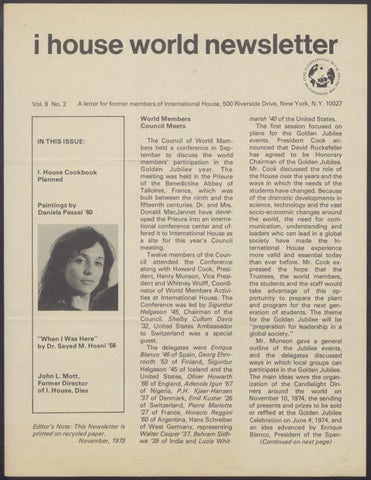
Paintings by Daniela Passal ‘60
Donald MacJannet have developed the Prieure into an international conference center and offered it to International House as
a site for this year’s Council meeting. Twelve members of the Council attended the Conference along with Howard Cook, President, Henry Munson,
‘“‘When | Was
Here”
by Dr. Sayed M. Hosni ‘56
John L. Mott, Former Director of |. House, Dies
Editor’s Note: This Newsletter is printed on recycled paper. November, 1973
Vice Presi-
dent and Whitney Wulff, Coordinator of World Members Activities at International House. The Conference was led by S/gurdur Helgason ‘45, Chairman of the Council. Shelby Cullom Davis ‘32, United States Ambassador to Switzerland was a _ special guest. The delegates were Enrique Blanco ‘46 of Spain, Georg Ehrnrooth ‘53 of Finland, Sigurdur Helgason ‘45 of Iceland and the United States, O/iver Howarth ‘66 of England, Adenola /gun ’67 of Nigeria, P.H. Kjaer-Hansen ‘37 of Denmark, Emil Kuster ‘26 of Switzerland, Pierre Mariotte ‘27 of France, Horacio Reggini ‘60 of Argentina, Hans Schreiber of West Germany, representing Walter Casper ‘37, Behram Sidhwa ‘39 of India and Lucia Whit-
marsh 40 of the United States. The first session focused on plans for the Golden Jubilee events. President Cook announced that David Rockefeller has agreed to be Honorary Chairman of the Golden Jubilee. Mr. Cook discussed the role of the House over the years and the ways in which the needs of the students have changed. Because of the dramatic developments in science, technology and the vast socio-economic changes around the world, the need for communication, understanding and leaders who can lead in a global society have made the _International House experience more valid and essential today than ever before. Mr. Cook expressed the hope that the Trustees, the world members, the students and the staff would take advantage of this opportunity to prepare the plant and program for the next generation of students. The theme for the Golden Jubilee will be ‘preparation for leadership in a global society.”’ Mr. Munson gave a general outline of the Jubilee events, and the delegates discussed ways in which local groups can participate in the Golden Jubilee. The main ideas were the organization of the Candlelight Dinners around the world on November 10, 1974, the sending of presents and prizes to be sold or raffled at the Golden Jubilee Celebration on June 4, 1974, and an idea advanced by Enrique Blanco, President of the Span-
(Continued on next page)
(Continued from previous page)
Vice President Takes
ish-American Society, who suggested that perhaps groups of world members might organize seminars in their own countries. All groups would discuss the same subject. The conclusions could then be forwarded to |. House and published in the special Golden Jubilee publication. The next session concentrated on “Meeting the Needs of the Next Generation of Students.” Adenola Igun and Behram Sidhwa presented papers on the topic. Mr. Igun discussed the need for change, ‘because old values are no longer suited to dealing with today’s. experiences.’’ He felt that the I. House experience is crucial to today’s world citizens because it teaches them the importance of the interdependence of all nations. Mr. Igun felt that living at |. House also gives a broader world view, which is very useful in each person’s field of specialization. Mr. Sidhwa brought greetings from Bangalore and a gift to I. House, a magnificent chariot carved out of sandlewood. He thought that there were two important needs felt by students today: expanding the |. House idea in other countries and providing scholarship funds for needy students. Mr. P.H. Kjaer-Hansen opened the next session with a tribute and a moment of silence for the late Bill Frohlich, World Members Council Founder and Chairman. The session focused on finding “‘lost’’ alumni and .other world members business. Dr. Oliver Howarth gave an illustrated talk on the new International House, which is under construction in Warwick, England. The Council Members extended their congratulations to International House alumni in England who are responsible for the latest addition to the Il. House movement.
Around-the-World Trip by
Henry
Lee
Munson,
Vice
President,
Golden Jubilee Celebration and Capital Campaign On September 7th, | returned from
a world
trip,
the
trip of a
lifetime for me. Having had many interesting conversations at Dr.
MacJannet
Greets
Adenola
Igun
Mr. Horacio Reggini presided over the session at which the Newsletter, ‘‘Passport,’’ and Council business were the topics. A Council Member expressed the feeling that one real concern that had brought the Council together was the Capital Campaign effort. The Council decided to ask all World Council Members to establish a bank account for International House in their individual countries to facilitate alumni contributions to the Capital Campaign. The delegates also expressed interest in endowing Nationality Rooms in International House as a reminder that |. House is not a New York institution; it is an international institution which happens to be in New York. One surprising highlight of the conference was a magnificent luncheon at the Auberge du Pere Bise, one of France’s 11 threestar restaurants, given to the Council by the delegate from France, Pierre Mariotte. The conference was a great success. Each delegate was asked to sum up what he or she had gotten out of the conference. Some of the responses were, ‘It was like a shot in the arm,”’ “‘Now | have a concrete idea of what we’re working for,” “We were united by belief in an ideal.” The delegates agreed to meet once every two years from now on, with a special meeting this June in New York in honor of the Golden Jubilee.
|. House
with
students
from
the world over made me want to see more of the world.
Visiting 15 countries, 10 of which were new to me, | met many alumni. | was particularly impressed because in most countries alumni said that |. House had been one of the most important influences in their entire lives. In Hong Kong, | lunched with 16 world members and outlined plans for the Golden Jubilee. They told me that 25 to 30 alumni had had monthly reunions for over 20 years! | asked if they could arrange a Candlelight Dinner
in
November,
1974,
and
William Choy ‘38 said, ‘That's easy, as we do that every year!”’ Each country wants to be a part of the Jubilee Celebration next June. This Celebration will be a major fund-raising event; the goal is $50,000. This occa-
sion will be more alumni
significant if
in all countries
tangibly
participate in some way. The In-
dian alumni are thinking of sending tablecloths and a prize to be raffled off; a safari in Africa, a rug from Iran and a trip to Japan are also being considered. The Jubilee Celebration will commemorate 50 years of |. House history and will also celebrate the rich diversity of cultural heritages around the world. As the world becomes more homogenized, this diversity becomes more precious. | want to thank all the alumni who helped me during this trip, and | am sure we all look forward to the Golden Jubilee events.
John Mott, Former Director of International House, Dies
by Miriam MacDonald
'34
During his twenty years as Director, John L. Mott gave International House a warmth and vitality which was quite unique.
His
deep
belief
in
what
the
House stood for, his experience abroad and with students in this country provided the basis for the truly international family which he created. For Johnny thought of people as individuals and welcomed each into his home as he: might any member of his own family. With the help of his wife and their three children he established a home atmosphere which helped many a student adjust to a new life in a strange country. Johnny was always ready with a sympathetic ear for those looking for understanding or direction, for he seemed to recognize some of the needs of people far from home. A small gift at everyone’s door on Christmas Eve, getting together at holiday times,
an
invitation
to tea
or a
ride in the country—these were the little things that showed so clearly his awareness of the needs of the individual: His term of office, which included the war years, was
fraught with upheavals and uncertainties. Students from many countries were restricted in their movements, tensions were high between various groups, money was tight for everyone. It was John Mott’s concern for all peoples of the world that sparked his great International Benefit where contributors could earmark their money for the cause they most wanted to help. This benefit made a substantial financial contribution to many of
the war-torn countries of the world. His efforts were not limited to civilian activities. His term of duty with the army took him to India,
a country
he parti-
cularly loved, and he found time to
renew
many
contacts
Mott recognized that this was of importance, not only to the inner
circle, but to the community at large and to the many friends who had helped the project. Hundreds of people from the community got a closer view of their neighbor
and,
hopefully,
a
keener interest in the world, through this hospitality. For some thousands of students and many staff members John L. Mott typified the spirit of International House. This spirit was a guiding light for some years and will remain in the hearts of many alumni, helping them to carry on the faith that makes International House what it is.
in the
East. Not many years later the United Nations came into being. Headquarters were established at Lake Success on Long Island long before the beautiful buildings were erected at 46th Street and the East River. It was in those early years that John Mott established |. House’s relationship with the United Nations. In 1949 International House celebrated its 25th Anniversary, a milestone which could not go unheralded. A conception of Brotherhood had, by this time, been firmly established and John
“LABS” Project a Success This fall the House purchased a 15-passenger Dodge van for the students’ use. The van is crucial to the success of the “LABS” (‘‘Let America Be Seen’’) project, a travel program which will enable |. House residents to see America. This program is one which the students have anticipated for a long time. Because of the extraordinarily high cost of transportation, many students from other - countries have seen little of the
United
States
outside
of New
York City. This is something they see as a real lack in their experience in the States. The initial support for the purchase of the van was provided by the Mary Senior Fund and the John L. Mott
From
left to right: General
George
C. Marshall, former
Chairman
of the Board
of |.
House, John Foster Dulles and the late John L. Mott at |. House’s 25th Anniversary.
Memorial
Fund, which
will
pay for garaging, insurance and maintenance expenses. The interests of the students will determine the destination of each trip, and the students will pay for their expenses. They have already taken several trips to the beaches on Long Island. The next trip will be to Niagara Falls, and plans are being made for a trip to Williamsburg, Virginia.
Whitney Wulff to Coordinate World Members Activities
Focus on an |. House Resident by Margy Henkels,
At Harry Edmonds’ 90th Birthday Party, the Ralph J. Bunche Memorial Contest prizes were awarded. The contest was initiated in honor of Ralph J. Bunche, Under-Secretary-General of the United Nations and a member of the Board of Trustees of International House for many years. There was $1,500 in prize money for the best proposals submitted by world members on the subject, ‘‘How can the world members of International House best serve the cause of world peace? What new dimensions need to be explored so that the 20,000 alumni can make their most effective contribution?”’ The first prize of $1,000 was awarded to Harry Edmonds, founder and former Director of International House, as_ the world member who has made the most effective and_farreaching contribution to world peace. The second prize was awarded to Emmanuel Cuenco Gonzalez ‘73. Third prize went to Jacob Akindele ‘70. Bilun Karal ‘72 and Edward Odjaghian ’73 tied for fourth prize.
Whitney Wulff has been named the new Director of Annual Giving and Assistant Campaign Director at International House, as well as Coordinator of World Members Activities. Miss Wulff worked most recently with the Institute for Mediation and Conflict Resolution, a program in New York City funded by the Ford Foundation.
Newsletter Editor
Hasory Edmonds
wishss
to wypewac
hin appucnation
for te cna
set
ocecaoccor cf hin WOW
Ralph J. Bunche Memorial Contest Prizes Awarded
him
on
Me
birthday. Thay QU
He Loould wore
“Paint a Door on Your Floor’ Thank
you
so
much
for
all
your contributions to the ‘’Paint a Door on Your Floor’’ project. The doors of the’ students’ rooms are being painted bright, cheerful colors. The students initiated the project and painted many of the doors themselves. Each door is painted the color of the student’s choice. Your donations have paid for this project, which is one aspect of a program to brighten those long, dark halls you well remember. Your help and the students’ enthusiastic participation have made the project a big success so far. We still have 445 doors to go!
Aattorra
LEmAY PIUWCLOUD
acknototadge Wey
|
OTL ,
i+ posable. In Dinu of Hat,
det Nin
say to each amd
all,
" Thamk YOu, Hoamnk You veTY , LOY moucn|” aE, —
One frustration that we all feel looking out to the world around us is a sense that the world’s problems are too overwhelming to think about, too difficult to
solve.
When
| see
someone
whose work seems to be making a real difference in people’s lives, | breathe a_ sigh of relief. Deborah Kumi, a current lI. House resident from Ghana, is such a person. She _ teaches people in Ghana how to achieve a balanced diet with the food available to them. In 1958 the Food and Agricultural Organization and the World Health Organization of the United Nations conducted a nutrition survey in Ghana, finding that the nation’s diet was deficient in protein and Vitamins A, B and C. The deficiencies were not due to lack of proper food; they were due to the fact that the people did not know what foods to eat. In 1959 the government of Ghana established the National Food and Nutrition Board in the Ministry of Health and appointed Mrs. Kumi Assistant Executive Secretary. Later Mrs. Kumi was promoted to Chief Nutrition Officer, and in 1964 she was appointed Principal Nutrition Officer of the nine-member Food and Nutrition Board. Mrs. Kumi’s job is to educate people about the importance of good nutrition. This involves modification of eating habits, which is difficult because of the strong opinions people have on what they eat. There are often
taboos about food, which have been passed down from generation to generation. Mrs. Kumi has learned that people are most willing to try something new for the sake of their children. When Mrs. Kumi
or a member of her staff visits a village, a mother or father will bring a child with protein calorie malnutrition forward and ask for advice. Severe cases are referred to hospitals and clinics. If a diet change will help the child, Mrs. Kumi advises the parents what foods to prepare and demonstrates choices of various low cost, high protein meals and how to prepare them. One typical meal Mrs. Kumi would recommend for a pre-school child would include palmnut soup with beans and fish, mashed plaintains and creamed fruit. When the child begins to show the dramatic improvement that often occurs, the parents and the family and then the whole village become more interested and cooperative. As
Principal
Nutrition
Officer,
Deborah Kumi supervises over 300 people, both in the Nutrition Board’s headquarters in Accra and in the regions. In Accra the staff prepares annual progress reports and educational programs for use in the field. These materials include standard recipes, which are tested by the staff and written up so that people can learn to use new foods and to prepare familiar foods in new ways. There are also little booklets describing how to prepare balanced meals. Mrs. Kumi makes monthly visits to all the regions, supervising the activities in the field, helping the teams in their demonstrations and making home visits. In the village demonstrations, the team gathers all the people of the village and actually shows them how to prepare certain foods such as fruits and juices, fish, meat, beans, eggs and vegatables. They explain diets which provide high protein, vitamins and minerals. Mrs. Kumi also discovered that patients in clinics and hospitals are very eager for information about better diet. When she
visits a clinic, she does not just advise the cooks about the
menus,
but
strations
and
also
gives
demon-
talks to the
pa-
tients about the right diet for better health. The program has been a great success. There was a survey in 1961 and 1962, just three years
after the program started, and already the level of malnutrition had decreased! Mrs. Kumi has returned to the United States (she lived at |. House in 1956 and 1957 while she was studying food and nutrition at N.Y.U.) to gain additional expertise in meeting the problems of the people of Ghana. She wants to learn more about recognizing the symptoms of specific nutritional deficiencies and diseases and recommending diet therapy before the problem is serious. Mrs. Kumi is also studying the preparation of small pamphlets on nutrition and diet, which enable people to learn more on their own.
World
Members
Activities
Page Editor’s Note: We have received a great response from last year’s request for information about what the world members are doing. There is an incredible diversity of activity and talent among the alumni of |. House. The following is a description of one of the most interesting jobs we've heard about. ‘Those who contemplate the beauty of the earth find reserves of strength that will endure as long as life lasts.”’ Rachel Carson Bill Hollomon "44 is an environmental planner working with the Virginia Highway Department, with special interest in ecology, recreational planning and historic preservation.
“The Virginia Highway Department, through its own con-
struction program, is one of the most important agents for environmental change,”’ writes Mr. Holloman. ‘‘That is why studies are needed before highways are constructed.”
An_
environmental
planner’s
work is ensuring ‘‘that people have clean air, pure water, adequate public lands for recreation and inspiration.’’ In designing a road,
Mr.
Hollomon
and _
his
colleagues try to protect land from erosion and water from sedimentation, which kills fish and upsets the ecology of the stream or lake. “We want to establish and maintain a balance between a sound economy, capable of supporting the standard of living of the people, and a wholesome physical environment where man and nature can exist in pro-
ductive harmony.”
We are very pleased to present the work of Daniela Passal ‘60 on this page. Ms. Passal was born in Poland. In 1950 she moved to Israel where she studied at the Bezalel Art Academy in Jerusalem. In 1958 Ms. Passal came to New York to continue her studies at the Art Students League. From 1958 to 1960 she lived at |. House. Of life at |. House Ms. Passal wrote, ‘‘Here were people who had come to America
to achieve certain goals, thrown into a cultural fire, a collision of ideas.’ She presently lives in New York City and maintains studios in Jerusalem and in Woodstock,
New York.
Ms. Passal’s most recent exhibition was held at the Estee Gallery in Toronto. Discussing her work, Ms. Passal writes, ‘The most personal feeling | would
like to communicate
visually is the fluidity of matter.
The constant metamorphosis of all forms in nature derives from the organic flexibility and the transfor-
mation of one ‘being’ into another.”
“‘When | Was Here” by Dr. Sayed M. Hosni ‘55-56 | lived at International House some 15 years ago, from 1955 to
-
1956. My life at International House was very happy and memorable, and | will never forget it. It had a deep and profound impact on my life, and | can safely say that it gave me the philosophical basis of my political career. At the beginning of my life at International House, | ran into certain difficulties and problems,
mainly concerning adjustment to a new life, which at first led me to believe that | should go back home. One typical experience was such a funny story that | have never forgotten it. Two days after | arrived at International
House
from
the
Sudan,
Living at International House, in New York City and in the whole of the United States, | came to realize thoroughly what the es-
sence of freedom meant. | lived -
face. He said, ‘‘Do you want to commit suicide?”’ | said, ‘‘No, sir,
| want to take the subway.”’ He said, “‘Just wait here for the train.” | said, ‘No, sir, | don’t Oe i
oth
vs
tage
Ae t<
|
wanted to go from Columbia University to New York University at Washington Square. | asked at the Information Desk at Columbia how to get to Washington Square, and was told to get the subway at 116th Street. At that time | didn’t know what a subway was, so | went to 116th Street to look for the subway. As far as my English could support me, | thought that a subway was an off-street or a by-street. Not finding a small street that | had imagined would qualify as a subway, | began asking the passersby if they could show me to the subway. What | got was terrible yelling, cursing and neglect. At last | found an elderly man in religious clothing, and | asked him to please take me with him if he was going to the subway. He smiled at me and took me with him into the subway. When we went underground, he pointed to a depression on the rails and said, ‘‘Here’s the subway.’’ Even at that time, | didn’t know what the subway was, and that depression which he pointed to was, | thought, the by-street |
was told to take to Washington
Square. Still my problem wasn’t totally solved. | wondered how | was going to get into that depression of the rails. | began walking up and down, back and forth, looking to the right and left, but found no way to lead me to that subway. This time | decided not to ask anybody, but to jump into that depression! No sooner did | do this than a policeman from the platform on the other side jumped after me and pulled me up and gave me a slap across the
Sayed
M.
Hosni
with
Ambassador
Henry Cabot Lodge
want the train. | want the subway.” The cop replied, ‘’But the subway /s the train.”’ | got over my initial difficulties very quickly. Life at International House became delightful and even glamorous for me. | was with friends from all over the world, from practically every different culture. | also began to organize my thoughts and to develop an independent, critical, philosophical thinking about what the future held for me and my country. When | first came to International House, | had a hazy and shaky understanding of the concept of freedom and individual liberty.
©
and experienced the essence of the concept of individual freedom. It became a part of my being, the guiding line of my ideas, my philosophy and my future life. In my life, | have not — only understood what freedom is; | have also struggled for it in my own country. The struggle to have the ideals of freedom planted and flourishing in a faraway and developing society like mine was not easy, nor one of a short span and space. Yet it did come about. International House provided me with a tremendous opportunity at this phase of my life. Just when | was about to graduate, the Sudan became independent, and | was called upon to be the Sudanese representative at the United Nations. | was entrusted with the responsibility of processing my country’s application for admission to the U.N. In all my lectures and lessons at Columbia University and New York University, | could not find a guide for this new assignment. | had only my friends at International House to help me out. At the International House conference on the United Nations, | was student chairman, and in that capacity | was introduced to Mr. Andrew Cordier, the Under-Secretary of the U.N. at that time. Mr. Cordier was of _great help to me in my new assignment. He introduced me to Ambassador Henry Cabot Lodge, who was then the U.S. representative to the U.N. Mr. Henry Cabot Lodge was kind enough to sponsor the application of the Sudan for admission to the U.N. ) Now | have come back after quite a long time to stay at Inter-
(Continued on next page)
(Continued from previous page) national House. It is certainly another wonderful, fruitful and pleasant experience. The _ atmosphere of diversified cultures is invigorating and affects my present understanding of the world. Most
important,
| have
come
to breathe the air of freedom, which this country enjoys and affords to any visitor. The little apprehension | have is the fact that so many American friends and citizens do not know how much they have of this air and how valuable and how sacred it is. Maybe they take it for granted because it is already here to enjoy.
the changes in the Chinese education system. The Chinese government has tried to make more education available to greater numbers of people, as well as de-emphasizing the importance of formal education. Ambassador Yost also described his visit to a commune and the quality of life there. One thing that Ambassador Yost mentioned as a pleasant surprise was the exceptional friendliness of the Chinese people on every level. He found it remarkable
Wanted— Your Favorite Recipes We are planning to publish an International House Cookbook, which will be published during the Jubilee Year. Please send us a delicious recipe, preferably one that
is
unique
to
your
home
country. We hope to include both simple homey dishes and more exotic gourmet delights. Send your suggestions to Whitney Wulff in the World Members Office by January 15, 1974.
_ that both the American and Chi-
nese people have maintained warm feelings toward one another in spite of the years of silence between the two coun-
Golden Jubilee Year Schedule February — Symposium on Communications
tries.
Dr. Sayed M. Hosni is currently working at the U.N. Secretariat on preparations for the Law of the Seas Conference which will take place at the end of this year.
March— Corporate Dinner April— Diplomatic Dinner June—Golden
Jubilee
Celebration,
, World Members Council Meeting
Ambassador Yost Speaks at This Year's First Sunday Supper The International House auditorium was filled for the first Sunday Supper of the year. The food was delicious, and from all reports the whole evening was a great success. After dinner |. House residents presented outstanding entertainment of all kinds. Ambassador Charles W. Yost, Chairman of the Board of Trustees of International House and President of the National Committee on United StatesChina Relations, Inc., was the featured speaker. Ambassador Yost spoke about his recent trip to the People’s Republic of China. As President of the United States-China Committee, which is trying to facilitate exchanges between the U.S. and China, he travelled as a guest of the Chinese government. Ambassador Yost discussed
November— Candlelight Suppers Editor’s Note: Please see the Golden Jubilee Flash Sheet enclosed in this
Newsletter for the details of the Golden Jubilee events.
For Future Generations:
A
Bequest
to
International
House
People often write in and ask us how ’to include International House in their wills. It’s really very simple, and bequests can be earmarked for the Program Endowment Fund, for the Fellowship Fund or in memory of a particular person. You can make a bequest in the following way, ‘’| bequeath to International House, a New York corporation, the sum of $ to be used for its general corporate purposes.’”’ Or you can designate a particular fund for your bequest.
International House is a non-profit residence and program center for graduate students from all nations. Its program, supported by contributions from _ individuals, corporations and_ foundations, seeks to achieve three basic goals: to promote friendship and mutual respect among young people of all countries
and
cultures;
to
provide opportunities for students to experience American life through trips, home visits and active participation in the community; to help students reach their educational and professional goals.