i house world newsletter es atric INA va r
Pg:
eee
i ft %
s=< per
%,
>,oh
bed
% ?)
Vol.8
No. 2
A letter for former members of International
pr.
“ER HOOD *
P
House, 500 Riverside Drive, New York, N.Y. 10027
Preparing for the Jubilee
TABLE OF CONTENTS Statesmen
Look at I. House
a.
CulitDun be 0 7
re
World Members Activities Page Featuring Maria Bonomi ‘57-’58
"
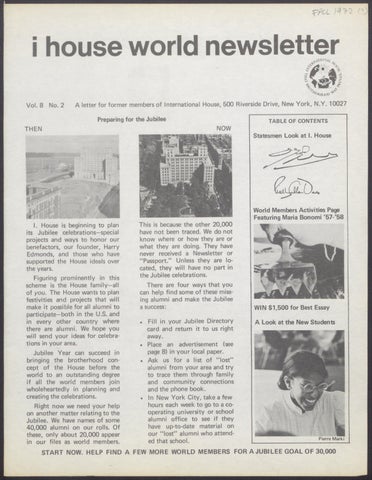
|. House is beginning to plan its Jubilee celebrations—special projects and ways to honor our benefactors, our founder, Harry Edmonds, supported
and those who have the House ideals over
the years. Figuring prominently in this scheme is the House family—all of you. The House wants to plan festivities and projects that will make it possible for all alumni to participate—both in the U.S. and in every other country where there are alumni. We hope you will send your ideas for celebrations in your area.
This is because the other 20,00 have not been traced. We do not know where or how they are or what they are doing. They have never
Right now we need your help on another matter relating to the Jubilee. We have names of some 40,000 alumni on our rolls. Of these, only about 20,000 appear in our files as world members.
NOW.
HELP
a
Newsletter
or
There are four ways that you can help find some of these missing alumni and make the Jubilee a SuCCeSS:
Jubilee Year can succeed in bringing the brotherhood concept of the House before the world to an outstanding degree if all the world members join wholeheartedly in planning and creating the celebrations.
START
received
“Passport.” Unless they are located, they will have no part in the Jubilee celebrations.
FIND A FEW
Fill in your Jubilee Directory card and return it to us right away. Place an advertisement (see page 8) in your local paper. Ask us for a list of “‘lost”’ alumni from your area and try to trace them through family and community connections and the phone book. In New York City, take a few hours each week to go to a cooperating university or school alumni office to see if they have up-to-date material on our “‘lost’’ alumni who attended that school.
MORE
WORLD
MEMBERS
WIN $1,500 for Best Essay A Look at the New Students
ierre
FOR A JUBILEE GOAL OF 30,000
Marki
We are honored to present in this issue the thoughts of two outstanding alumni on International House. Both have carved out distinguished careers as international statesmen. We feel sure you will be as interested as we were to read what they feel about the role of International House in their lives and in the atmosphere of today’s world.
Gaston Eyskens '26-'27, Prime Minister of Belgium, lived at International House while he was studying for his Master of Science degree at Columbia University. A doctor in economics and in political and social sciences, he has served three times as Prime Minister of his country and twice as Minister of Finance. He was twice Governor of the International Bank for Reconstruction and Development and also has served as Dean of the Faculty of Economic and Social Sciences at the University of Louvain.
Shelby Cullom Davis '30-'32 has been the United States Ambassador to Switzerland since 1969. Dr. Davis has degrees from Princeton, Columbia, Bradley and the University of Geneva and is the author
of numerous
books.
A member
of the New
York Stock Exchange, he was Managing Partner for 22 years of his own firm, the world’s largest specialists in insurance securities. He endowed the Princeton Center for Historical Studies. Ambassador Davis also served in several advisory posts for Thomas
E.
Dewey,
Governor
of
New
York
and
Presidential Candidate, early in his career. What
International House Has Meant to Me
An Ambassador
| had the privilege of residing at International House from 1926 to 1927 and for some time in 1928 while | was studying at Columbia University. That | found this experience extremely valuable is amply proven by the fact that one of my sons, Mark Eyskens, took up residence at International House while he was at Columbia in 1957. Although my true vocation was academic and my profession that of Professor of Political Economy and
Public
Finance
at
the
University
of
Louvain,
the circumstances and hazards of life led me into politics and into the Government of my country. There | have spent now too many years, serving several times as Minister of Finance, Minister for Economic Affairs, and Prime Minister. | have been Prime Minister of Belgium once again since 1968, and this has brought me not only the burdens of responsibility but also the privilege of tackling the political, economic and financial problems of my own country and, at the same time, of taking part in many international meetings and negotiations. Brussels, the capital of Belgium, has become ‘‘the capital of Europe” as well, now that the city is the seat of the great European institutions and a meeting place for political leaders and diplomats of the whole world. This combination of circumstances has obviously had a profound effect both on my outlook and on my activities. Now that | have reached an age where | can look back down the long corridor of the years, | realize
Looks at |. House
| was a young 13 year old in Peoria, Illinois, when International House was founded in 1922, but a mere eight years later, after graduation from Princeton and four summer trips abroad, including Russia and a summer at the so-called Zimmern School in Geneva, | found myself at International House in the autumn of 1930. How did | happen to go? At the Zimmern School, named for Alfred Zimmern of Oxford, a leading internationalist of his day, | was first told about International House, and it seemed an ideal place to live as | pursued graduate studies in history and international relations at Columbia. And so it turned out to be. What | liked particularly was the ease of contact with students from many lands, the possibility of going into the cafeteria for an evening meal,. for example, and sitting down at a table with foreign students representing many different nationalities. The conversation was always interesting, and | formed many good friendships during the nearly year and a half that | lived there. In fact, one of the “friendships” included my wife, who lived at International House for six months or so from the fall of 1930, so our marriage in January, 1932, was an International House “romance” although | must confess that we had first met at the Zimmern School in Geneva where | persuaded her to do graduate work at Columbia in the fall and live at |. House.
Eyskens (continued) how much | gained from my stay at International House when | was a young man, and how profoundly | was influenced by the contacts | made there, and by the opportunity it afforded me of getting to know students and scientists from all over the world and learning to understand their mentality, their point of view and their problems. When | look back upon my own life | realize that | have never allowed my horizons to be bounded by sstrictly national problems.
|
have,
of course,
al-
ways worked with might and main to serve my own country and solve its problems, but at the same time | think | can fairly say that | have always tried to see them in the wider context of international affairs and the great community
of nations,
and that
| have thrown myself heart and soul into the task of promoting understanding, agreement, cooperation and peace in the world. The motto, ‘That Brotherhood May Prevail’’ has been an inspiration
to
me,
and
| think
| may
honestly say, although with all due modesty, that | have always tried to live up to it. At Riverside Drive | forged links of friendship that have never been broken, and that have been a comfort to me all my ees eee
Gaston Eyskens Prime Minister of Belgium Davis
(continued)
| left
International
House
on
January 4, 1932, which was the day of our marriage, and a week or so later we embarked on the SS Harding for France and then Geneva with the U.S. delegation to the World Disarmament Conference which convened in Geneva in late January and which | covered as a broadcaster for Columbia Broadcasting System.
Certainly International House quickened my interest in foreign affairs which was already rather keen
at
that
time,
but
| felt
|
could supplement my courses and reading and lectures with human contacts with students from other lands and these were always of great importance as well as enjoyment. | am sure my experience must have been repeated many times over. Today is an era of worldwide travel, for the first time in history. What was an adventure for the most daring or luxury for those amply endowed has now become a day-to-day expectation for more or less the average man and woman. There is great opportunity for good in this as travelers become increasingly acquainted with citizens of other countries. International
House
can
per-
form, in fact is performing, a valuable role in this expanding world. While | have lost track of virtually
all,
if
not
all,
of
my
International House friends in the intervening 40 years or more of depressions and war, such should
not happen today because there is increasing opportunity to renew these ties of friendship through travel.
the principal monuments, and certainly those who have had similar backgrounds at International House can form a nucleus of friends and acquaintances in other countries. This has its practical as well as enjoyable side, for
who can give better advice in a city on where to go, what restaurants, swim,
what theaters, where to etc., than those who live
there and have a reason for which to be helpful. Both sides can gain from such an exchange. In Switzerland compulsory military service (unpopu-
lar in America these days) acts as a democratic force in bringing people together for sometimes as long as 30 years for frequently as long as a month each year. Swiss of different occupations and stations of life are mixed together with a result that there is a greater understanding and tolerance of others. Many Swiss mert tell me, and their wives agree, that their best friends come from the Swiss Army or Air Force, men who have served together under all kinds of conditions for perhaps 30 years and more, who have learned to like and respect each other even though their professions and stations of life may be far apart.
For example, when | informed International House that my short article might be a little late because | was going on a brief trip to Russia, the efficient World Members Secretary sent me a list of 19 Soviet alumni, ranging from 1964 to 1970, with 14 in Moscow, one in Leningrad, one in Kiev, and the remainder scattered. Unfortunately, the response to my letter, although made immediately, came too late for me to make use of it in Russia and | received it only on my return to Bern. Yet, great possibilities are surely offered for interesting meetings between old friends and acquaintances.
The bonds of friendship gained at International House as well as the simple knowledge of a shared experience can bring about fruitful exchanges and understanding as the years advance—and also make traveling far more interesting for the travelers.
Cities without people are rather dreary affairs once one has visited
U.S. Ambassador to Switzerland
It is my hope that the next 50 years, for the Centennial in 2022, will find increased traveling both ways, to and from the United States,
with
International
House
extending its influence throughout the many countries of the
Met
Shelby Cullom Davis
A Look at the New Students
by Margie Henkels Acting Newsletter Editor I’ve for
been
you,
keeping an eye out
watching
the
new
stu-
dents arrive, seeing them begin the experience you've shared. I’ve talked to a few of them and | thought that you might enjoy hearing some of the things they'‘ve said. They're all different, as all of you are, and they are what the House is all about. Nancy Moyna was the most unabashedly enthusiastic student | spoke to. Nancy is from Uruguay and is studying illustration at Parsons.
New
York
that it was very conservative and she wanted to get away and have a different experience of the U.S. Ameerah has become much more aware of her country and her role in solving its problems since she has been in the States. This awareness led her to study community planning at the Columbia School of Social Work. Orhan student
Kural, at
an
Columbia,
engineering expressed
the most curiosity and surprise about the United States. When he arrived he would go out expecting something,
he didn’t know what,
to happen.
Columbia Teachers College. This is a subject she could neither or
teach
at
home.
Also,
Shake says, ‘‘American life fits the needs of a career woman.” At home she could not be a career women and a housewife, too. Here, she thinks it is possible to try.
“| love everything from the subways to the dirty trashcans.’’ The energy and activity is exciting to her. One thing that is new and stimulating is the fact that there are so many different kinds of people, speaking so many different languages on the streets of New York.
Pierre Marki
Ameerah Haq is a soft-spoken, energetic young woman from Bangladesh. She is not a stranger to the United States; she did her undergraduate work at Western College in Ohio. Like many Americans, Ameerah found New York a huge, unfriendly place after the little college town of Oxford, Ohio, “| was lost. The city overwhelmed me when | arrived. Oxford was a place where everyone cared about everyone else. It’s very friendly.” But she also felt
and he is eager to partic-
The United States seems to have surprised Shake Balmanoukian, a nursing education student from Syria, relatively little. She arrived here last January and had been living in Beirut for six years before coming to the U.S. She likes living in the States and is a permanent resident. In Lebanon, she had gone as far as she would be able to go in her field. Shake is studying psychiatric and mental health nursing education at
study
she loves,
Pierre Marki
House, ipate.
Orhan was a little startled when he went to visit some friends soon after his arrival in the States. When you go to visit someone in Turkey, you are always offered something to eat or drink: tea or fruit or nuts. When these delicious goodies are offered, it is impolite to say yes right away. You are expected to say, ‘No, save it for later,” or something equally gracious. The second
or
third
time
you
may
accept. In his first visit in the United States, his hosts offered him tea and he refused. The tea was never offered a second time! Orhan’s father lived at |. House while studying in New York. Orhan likes the fact that there is always something to do at the
Suryakant Patel was the student | spoke to who had the most serious misgivings about New York City and American life. These misgivings are not first impressions; he has been in the city for eight months. He finds New York City life ‘hectic and vicious” and the people very concerned with themselves and uninterested in everybody else. “You have no time to give to others.’’ There is no time or place for solitude or getting close to yourself. Carmen Biascoechea is a dancer who lived at the House from 1962-63. She responds to the city and the House and the States quite philosophically. The. most important thing about New York for her is the joy of being back in great dance classes in one of the dance centers of the world. She feels that the people of New York are calmer now, sort of courteous, “almost as if they’ve developed a philosophy of how to survive in the city. People talk to each other more. If someone starts talking on the bus, everyone joins in the conversation!”
The Ultimate Trip
with everything from ordering lunch to translations on stage.
This summer an important part of |. House—Herman Rottenberg and his troupe of 20 performers— traveled to Rumania for a three week tour. The American Council for Nationalities Service sponsored the tour in order to provide person-to-person contact between young people behind the Iron Curtain and young people of the West. The program was subsidized by the Readers Digest Foundation and the Rumanian government.
The group traveled from the Transylvanian Alps to the Black Sea, usually visiting medium-sized towns in resort areas. The countryside was very lovely and they rode in a beautiful modern bus provided by the Rumanian government. Whenever the bus stopped, a crowd gathered and looked. If someone held out a hand or said hello, everybody began to communicate. Usually someone in the crowd spoke English and with that and sign language, everyone managed.
Herman Rottenberg is a trustee of the House and President of the Performing Arts Foundation, an organization founded for the purpose of assisting young, talented,
“‘emerging’
artists
from
around the world to achieve their career goals. His enormously successful show, now called *‘ Around The World in 90 Minutes,” illustrates the idea of International House and provides the House with favorable publicity while creating performing opportunities and income for talented young artists. In 1967 the group went on their first two week tour. Since then they have visited the Caribbean several times. In 1971 they toured Israel, and in 1972 Rumania.
The
troupe
has a very
busy schedule planned for this year. A highlight of this season will be several Christmas appearances at Tully Hall, Lincoln Center.
Ronnie
Alejandro,
a
dancer
from the Philippines, said: ““The Rumanian landscape in summer reminded me of the Philippine countryside—huts, greenery and forests. The roads were clean and the weather pleasant. On the way,
Carpati, the government travel agency, arranged the whole trip for the group: performances, touring, lodging and the provision of two bilingual guides. The guides were with them at all times and helped the performers
Rumanians,
in
fact,
responded
with great enthusiasm to the whole show; often they would throw flowers on stage during the performances. At the end of each show, the Cultural Representative of the town came on stage and gave a little speech and presented flowers to every member of the company. At this point the group would break into a Rumanian folk song and dance.
we saw a lot of rural folk in their colorful native costumes.”
When the troupe arrived in a town, they would wonder if anyone knew they were coming and if anyone would come to the show. But they didn’t take into consideration
the
excellent
or-
ganization of the Cultural Centers and the tremendous interest Rumanians take in America. If the performance was at 8 o'clock,
people started streaming toward the auditorium at 7, and was rarely an empty seat.
there
The weeks before departure for Rumania were full of activity and suspense. And after their arrival, before performing in public, the group had to perform the whole show for the Rumanian Cultural Board to make sure that the material was suitable for presentation. _
Mr. Rottenberg had been advised to include as much “ Americana” as he could because of the Rumanians’ curiosity about America. The “Roaring Twenties’ production number was a tremendous hit. The Texan who sang cowboy songs and other typical American tunes was called back for encore after encore by enthusiastic unison clapping. The
Don Cuneo
Don Cuneo
The tour was immensely satisfying for Herman Rottenberg and his group of performers. They left Rumania knowing that they had touched and been touched by people who had started out as complete strangers to them. As Mal Pate, a member of the group, was getting ready to board the plane in Bucharest, a man came up to him and said, ‘’So you're finally leaving.” Mal said yes, wondering who in the world this stranger was. “Well,” the man said, ‘I’m sorry to see you go. Your show was the best thing I’ve seen in all my life.” He had seen ‘Around The World in 90 Minutes” on the Black Sea coast, 400 miles away!
This issue |. House is beginning a new photographic feature article to.be included in each issue of the Newsletter. This feature will show world members in their different professional activities. We are proud to start this with photographs of Maria Bonomi and her xylographs in an exhibit which was held at the Museum of Modern Art in Rio de Janeiro in 1971. Xylography is the art of engraving on wood and making prints from the engravings. The photographs were taken by Aldo Simoncini. Maria Bonomi Antunes was born in Italy. Her father was Italian and her mother Brazilian. She grew up in Brazil and studied painting and drawing. She is married to the theatre director, J.A. Antunes. In 1952, Ms. Bonomi traveled to Italy to study. After returning to Brazil, she began to learn the technique of woodcutting in Sao Paulo. In 1956, Ms. Bonomi enrolled at Columbia University where she studied graphic and comparative arts. She lived at International House from 1957-1958. While in New York, she also studied at Pratt Institute and New York University. Ms. Bonomi returned to Brazil in 1960 and began studying engraving at the Museum of Modern Art in Rio. She has been exhibiting in collective and individual shows since 1956. We are very pleased to share her work with you.
Win $1,500 in Prizes
Eligibility:
International House is holding a contest which is a tribute to Ralph J. Bunche, former Trustee. There is $1,500 in prize money for the best proposals submitted on
the
subject,
‘‘How
can
that
the
20,000
alumni
All present and past members of International York
House-New
Marj Martin Goodman
Retires
can
make their most effective contribution?”’ All present and past members of |. House-New York are eligible.
Marj Goodman, Executive Housekeeper, retired last summer after 37% years at the House. Mrs. Goodman came to |. House in November, 1934, and became Executive Housekeeper in 1949.
The Award Committee hopes that practical, effective ideas for world peace will come out of this contest. The entries will be judged on content, not on style. Form of the Competition: Proposal from 500 and not to exceed 3,000 words with a 250 word abstract of the idea. Deadline:
January 15, 1973 Prizes:
First Prize, $1,000 Other Prizes Totaling $500
intermedia artist
bration of his life one sunny Saturday in September. About 250 people attended the celebration which was held in New Jersey at
the family’s High Time farm. Many different types of people were there, each participating in his or her own way.
Douglas Davis, in the August 28, 1972, Newsweek wrote: ‘“The recent death of Ken Dewey took from life a man who made it a form of art. He was an authentic
of Dr. Bunche, a renowned world
The prize money was donated by The J.M. Kaplan Fund, of which Raymond S. Rubinow, an alumnus of the House, is Trustee and Secretary. It was through Mr. Rubinow’s thought and effort that this contest was initiated.
'57-'58,
plane crash in August, held a cele-
It is particularly fitting that this award will be made in honor statesman who dedicated his life to the cause of peace. Dr. Bunche died in December, 1971. UN Secretary General U Thant said of him: ‘Ralph Bunche’s work, whether in the academic field, in government or at the United Nations, was all devoted to greater understanding among nations, among men and among different races of men, and to the endless quest for peace.”
The family and friends of Ken Dewey
and administrator who died in a
the
World Members best serve the cause of world peace? What new dimensions need to be explored so
A Celebration of Life
pioneer in what he called
‘Action
Theatre’ — a mix of film, theatre and happening motifs—and in persuading government and the arts to work together.”
Mrs. Goodman was someone whom everyone relied on during her years here. One morning at about 2 a.m. her phone rang. It was the night guard on duty at the House, ‘‘Mrs. Goodman, a couch in the Main Lounge is on fire! What should | do?” Marj calmly suggested a solution and then had to chuckle at such a question. Her good nature and efficiency will be greatly missed. Before Marj left each woman on the staff crocheted or knitted a colorful square for an afghan to give Marj asa going away present. It really was a lovely gift, and Marj’s response was typical of her. She said, ‘I’m so glad that everyone thought enough of me to do this.” Marj and her husband, Dexter, have moved to Florida. There they are busy remodeling her mother’s house. If you would like to write to her, we will be happy to forward any letters we receive.
Dewey was an artist who experimented in many genres. While he was living at the House he was studying Dramatic Arts at Columbia. From there he went on to write plays. After working with the Actors’ Workshop in the early 1960's he began to strike out on his own, using theatre as a more open form, working without scripts or stages. He founded the American Cooperative Theatre in Europe.
One friend described this experience in the Vi/lage Voice, August 10, 1972: “Coming from the bleak, rainy late fall evening into the jam-packed, media-suffused atmosphere of the old armory, one was immediately assaulted by a spine-tingling array of Boschian fantasy. The crowds mingled through the funky, smoke-laden humid air—in and out of exhibits—. . .—music and noise and activity and madness and confusion. “Way off in the front left corner, hidden by an eerie half light, certainly not a main attraction, was an old plane—just a plain plane. One was drawn to it by the silence surrounding it—a serenity
out of context with the frenetic environment.
“| slowly wandered over and looked up. There in the cockpit sat a bearded young man, his head covered by an old leather flying helmet. “ ‘Hey, Ken, what are you doing up there?’ “‘Oh, nothing much. Come on up.
Li
“And so | climbed up and sat there and surveyed the craziness below. We didn’t speak—we just smiled. And for the first time in many hours that day, | felt peace. After a while, | said thanks and climbed down to re-join the insanity. “To know | will never encounter his smile again brings a new sort of sadness upon me that will take a long time to get behind.” Douglas Davis (Newsweek, August 28, 1972) described Dewey’s administrative career in this way: “By the end of the 1960’s, Dewey had turned to another frontier. Named director of program development for the N.Y. State Council on the Arts, he helped to create the nation’s first broadscale state arts agency. More than anyone else, Dewey served as the channel between the artists of New York and the state system. In this period, he focused his creative skills on reform of the economics of art, supplanting private with public funds. He thought and planned in large-scale terms; in this sense, he was one of the first artists— along with Germany's Joseph Beuys—to make the whole of society his canvas.”
Harry Edmonds Writes: “As to me, there is nothing of interest beyond the news, if it is news, that | am living happily in up-state New York, enjoying my favorite flowers. This has been
a good season and | have harvest-
ed this year’s crop of seeds, and they are ready for distribution to any alumni interested, as long as they
last —
‘first
come,
first
served.’ Simply send a card or letter to me at R.D. 2, Lyons, N.Y. 14489 with return address. “Inreply, each will receive post paid a teaspoon of about 25 seeds that, if planted in a sunny place
against
a
wall,
fence,
or
building, and pressed not too deeply, should sprout next year and bloom the following. That's a promise! “| guess you have heard of Johnny Appleseed who, in Colonial times, walked the colonies with a bag of apple seeds, which he distributed widely? Perhaps someday, | shall become famous as Harry Hollyhock, who sent his seeds around the world!” (Editor’s Note: Harry Edmonds will be 90 on March 11, 1973— Remember the date!)
The i. house world newsletter is published twice a year, reminding the world members of their relationship to International House. Each world member is a part of the
|. House
movement,
pledged
to support the principles of the House whenever and wherever possible. International House is a nonprofit residence and program center for graduate students from all nations. Its programs, supported by contributions from individuals, corporations and foundations, seek to achieve three basic
goals: to promote friendship and mutual respect among young people of all countries and cultures; to provide opportunities for students to experience American life through trips, home visits and active participation in the community; to help students reach their educational and professional goals.
HELP US FIND LOST ALUMNI OF |. HOUSE. Insert this ad in your local paper or in a trade or professional journal. We need your help. There are over 40,000 alumni of the House. Of these, we have found only 20,000. We are anxious for the names and addresses of former members of International House-New York. If you are an alumnus of the House in New York and have not been receiving our Newsletter and other mailings, please fill in the coupon below and send it to: International House 500 Riverside Drive « New York, N.Y. 10027 Name Maiden Name Address Business Title and Address
Years You Were a Member of |. House Wicciete Ve ctiew
PLEASE return your Jubilee Directory card !