cs
eae
| house world newsletter
ALUMNI NAMED ‘“WORLD MEMBERS’’ At the Alumni Annual Dinner on January 28, President Howard A. Cook announced that all alumni of the House
would be named “World Members.” The new name, largely a result of the Japan Conference, implies an ongoing commitment to International House and
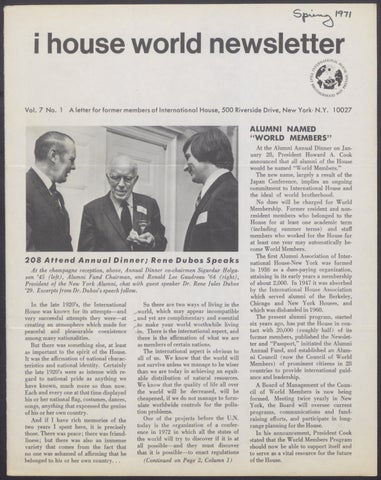
At the champagne reception, above, Annual Dinner co-chairmen Sigurdur Helga-
the ideal of world brotherhood. No dues will be charged for World Membership. Former resident and nonresident members who belonged to the House for at least one academic term (including summer terms) and staff members who worked for the House for at least one year may automatically become World Members. The first Alumni Association of International House-New York was formed in 1936 as a dues-paying organization,
son °45 (left), Alumni Fund Chairman, and Ronald Lee Gaudreau ’64 (right), President of the New York Alumni, chat with guest speaker Dr. Rene Jules Dubos
attaining in its early years a membership of about 2,000. In 1947 it was absorbed
208 Attend
Annual
Dinner;
Rene
Dubos
Speaks
living
by the International House Association which served alumni of the Berkeley, Chicago and New York Houses, and which was disbanded in 1960. The present alumni program, started six years ago, has put the House in con-
4n. There is the international aspect, and there is the affirmation of what we are as members of certain nations.
ter and “Passport,” initiated the Alumni
°29. Excerpts from Dr. Dubos’s speech follow. In the late 1920’s,
the
International
House was known for its attempts—and very
successful
attempts
they
were—at
creating an atmosphere which made for peaceful and pleasurable coexistence among many nationalities. But there was something else, at least as important to the spirit of the House. It was the affirmation of national characteristics and national identity. Certainly the late 1920’s were as intense with regard to national pride as anything we have known,
much
more
so than now.
Each and every one at that time displayed his or her national flag, costumes, dances,
songs, anything that expressed the genius of his or her own country. And if I have rich memories of the two years I spent here, it is precisely those. There was peace; there was friendliness;
but there was
also an immense
variety that comes from the fact that no one was ashamed of affirming that he belonged to his or her own country...
So there are two ways of living in the _world, which may appear incompatible _and yet are complimentary and essential _to
make
your
world
worthwhile
The international aspect is obvious to
all of us. We know that the world will not survive unless we manage to be wiser
than we are today in achieving an equitable distribution of natural resources. We know that the quality of life all over the
world
will
be
decreased,
will
be
cheapened, if we do not manage to formulate worldwide controls for the pollution problems. One of the projects before the U.N. today is the organization of a conference in 1972 in which all the states of the world will try to discover if it is at all possible—and they must discover that it is possible—to enact regulations (Continued on Page 2, Column 1)
tact with 20,000 (roughly half) of its former members, published the NewsletAnnual Fund, and established an Alumni Council (now the Council of World
Members) of prominent citizens in 28 countries to provide international guidance and leadership. A Board of Management of the Coun-
cil of World Members is now being formed. Meeting twice yearly in New York,
the
programs,
Board
will
oversee
communications
raising efforts, and
and
current
fund-
participate in long-
range planning for the House. In his announcement,
President Cook
stated that the World Members Program ‘should now be able to support itself and to serve as a vital resource for the future of the House.
Annual
Dinner
(Continued from Page 1) to stop this senseless and destructive pol-
lution of the air and waterways which is threatening our future.
There is no discontinuity between con-
cern for international
welfare and
the
maintenance of our national traditions. Even in those most international institu-
tions,
like airports,
we know
that the
genius of the country expresses itself and persists independent of the international character of the technological
equipment and of the international regulations that govern flying. We want to retain that which is peculiar to our own country
...
For those of us who biologists,
there
is
no
are professional doubt,
but
no
doubt, that all human beings without ex-
e
ception, whether they be black, yellow or white, whether they be Australian aborigines, Eskimos or Caucasians, all of them have the same fundamental characteristics. Anatomically, biologically, in the construction order of our mental apparatus, we are all essentially the same.
Pk
ve
Distinguished World Member Rene Dubos was congratulated by President Cook. Harry Edmonds was given the First World Member certificate. Melbourne
So we are part of one family. When we speak of the brotherhood of man, we
Nunes,
current
resident
and
Harlem Tutorial Fellow, reminded alumni that I. House still “has something . . . smiles ... pats... eating food together ... that oneness.”
are not using only a sentimental phrase, we are expressing a very profound and universal biological truth. And yet, and once more I present you with an example of that incompatibility and yet complimentarity fundamental to all aspects of human life, even though we are all the same, we differ depending
upon the country in which we develop and to which. we have given some kind of allegiance. These differences . . . are extremely difficult to explain because the forces involved in shaping these characteristics are so very complex.
We are influenced by the physical en-
vironments in which we develop. The child who, during his early years, experiences only dirt and rubble around him is going to be very different in the
future from the one who has a chance to see trees and skies. Unquestionably, all of us are affected by the structure of
the sky, the quality of the light, the shape of the land, and many other factors of the physical environment. Then
there is another kind
of force,
namely the history of the group to which we belong. There is no doubt that the history of our group expresses itself in all sorts of attitudes and behavioral characteristics because we imbibe it during the first days and years of our lives. In addition, there are all the aspirations of a people, the myths of a people.
Here is a problem that is so subtle that to try to express
it in words
is almost
impossible. George Orwell offers the illustration that the behavior of the people in London during the Blitz can be explained by one thing —it’s that all Englishmen, whether they were cowards or brave people,
nevertheless
all
thought
that
as
Englishmen they should behave in certain ways. Their behavior was determined by the myth of the environment in which they developed. National and regional characteristics are so different that all over the world they provide a multiplicity of different possibilities among which each one of
us can choose. And I believe that out of this immense diversity there emerges the variety and the richness of human civilizations.
So that when I look at the world today, I do feel that we are beginning to approach a sense that it is, of course, necessary in those aspects of our lives which are common to everybody that we accept international regulation. But | also sense that in the continued affirmation of national genius, different from one part of the world to another, we are leaving open the possibility for mankind to express all of its potentialities and thereby to continue developing civilizations.
Dr. E. J. Sparling
'25,
Two
President
Emeritus
and
Founder
sored
by the Ernest
B. Schwarzenbach
Memorial Fund. The first Alumni Visitor had, appropriately, lived at the House during its first year, 1924-25, and he reminded the students
and
staff
members
who
World
had
joined him after dinner in the Home Room that this kind of informal gathering happened every Sunday night in those days. He was the leader of the Men’s Division during his year at the House. Dr. Sparling was born and raised in
California and graduated from Stanford University. He received his Master’s and Ph.D. degrees from Columbia. In 1934, he became Dean of Men and Professor of Psychology at Hiram College in Ohio, following which he served as President of Central Y.M.C.A. College in Chicago from 1936 to 1945. His leadership of Central Y.M.C.A. College was characterized by two basic —and at that time, almost revolutionary
Human
The
group
students who
had gravitated to
Central Y.M.C.A. College under its non-
discriminatory admissions policy. Dr. Sparling was directed to set quotas. He refused. He had not, in fact, even counted the minority-group students.
and
Dr.
Edward
awards,
the
first of their kind,
were made by President Cook. Each recipient was given a certificate for “having lived at the House in the years (1924-25 for Sparling, 1927-29 for Dubos) and having since served with distinction his profession and his fellow man, in accordance with the highest ideals of the House.”
Dr. Dubos was given his certificate at the Annual Dinner, at which he was prin-
work, he considered statistics on race, creed or origins immaterial. On April 13 (Friday), 1945, he was forced to resign, under protest. Four
cipal
days later, on April 17, he put up his own $10 for incorporation fees and founded a new college, to be named Roosevelt University. Almost all of the faculty and students at Central Y.M.C.A.
College also resigned and joined him under the aegis of a new Board of Trustees, carefully chosen to include men and women
of different races, religions and
speaker.
Dr.
Sparling’s
was
pre-
sented to him on March 26 during his stay at International House
as the first
Schwarzenbach Alumni Visitor.
|. HOUSE WORLD SPRING,
NEWSLETTER 1971
Published by International House—New York Howard A. Cook, President L. W. Frohlich, Chairman, Alumni Council Janice Crichton, Editor
occupational backgrounds. Now President Emeritus of Roosevelt,
cago Council on Foreign Relations, and the American Civil Liberties Union. During his visit at International House, he dined with students, talked informally with individuals and groups, and addressed the staff at a special luncheon.
Council Against Discrimination, the Chi-
ANA Your
Animal,
Since all had been accepted on the basis of proven ability to do the academic
tunity in admissions regardless of race, creed or color, and complete academic freedom for faculty and students. In 1945, with huge numbers of education-hungry men returning from the War, the Board of Trustees could no longer tolerate the large percentage of minorityNeeds
an
James Sparling, President Emeritus and founder of Roosevelt University, now President of the United World Federalists in Chicago, have been named Distinguished World Members of International House-New York.
—principles: complete equality of oppor-
House
Members
professor at Rockefeller University, and Pulitzer Prize-winning author of So
a thriving university with over 24,000 alumni, Dr. Sparling is acting as President of the United World Federalists in Chicago. His long list of activities includes membership’on the Boards of the United Nations Association, the Chicago
International
Cited
Dr. Rene Jules Dubos, noted biologist,
of
Roosevelt University in Chicago, IIl., relaxed by the fireplace in the Home Room, talking thoughtfully about his memories of International House and his belief in the concept of brotherhood. “Tt’s not just an abstract principle,” he said. “It works. It has worked at Roosevelt University. So long as the same rules are applied equally to everyone, it will work.” He had been invited to the House for three days, from March 24 to 27, as the first distinguished Alumni Visitor, spon-
Alumni
As Distinguished
Is First Schwarzenbach Alumni Visitor “It was at International House that I first learned about the oneness of man.” The speaker, Dr. Edward J. Sparling,
Financial
Support
As Never Before .. . (See page 8 for details.) If you wish, you may designate a gift for general support, student services, World Member programs, scholarships, or other specific purposes. Please send your check today in the envelope enclosed.
International House is a non-profit residence and program center for graduate students from all nations. Its programs, supported by contributions from individuals, corporations and foundations,
seek
to
achieve
three
basic goals: 1. To promote friendship and mutual respect among young people of all countries and cultures; 2. To provide opportunities for students to experience American life through trips, home visits and active participation in the community; 3. To help
students reach their educational and professional goals.
What's
Going
On... workers
Letters
Below is part of a letter recently sent to the seven Swiss Federal Councilors and 42 Swiss newspapers. Mr. Fischer also sent a petition to change the Swiss banking secrecy to their minister of finance. It was signed by 155 I. house students from To the land:
44 countries.
Federal
Councilors
of Switzer-
I would like to take this opportunity to tell all our Federal Councilors and as many of my citizens as possible approximately how Switzerland is seen by a community of young people from all over the world. I have been studying computer science
here in New York for two and a half years now and I have the unique opportunity to live in “International House.” We are about 500 students from 80 different countries, from the West, the East
and the Third World. The house is not only a dormitory, but a living community, with
numerous
cultural
events, lec-
tures and discussions. I find it particularly stimulating and valuable to discuss, at meals or in my spare time, basic prob-
lems of our time with friends from all over the world and to mutually inform ourselves. Switzerland rarely makes headlines in the world news. If ever the conversation touches on our country, it is usually praised as a beautiful, quiet, neutral country, in which there is hardly any poverty and whose inhabitants are hardworking and peaceloving. But this almost ideal image is also impaired by some shadows. It is widely known and seems incomprehensible to most that in Switzerland women do not have the right to vote in federal elections. One of the basic human rights is that all men are equal, regardless of race, language, beliefs, class or sex. Only equal rights for women seem to take longer. Fortunately, our executive and legislative body have both unanimously advocated women’s right to vote, and I am
confident that we, the citizens, will
soon put an end to this discrimination. Another point which impairs the humanitarian reputation of our country is our severe laws on immigration. Also the fact that many guest workers are not allowed to bring their families with them is inhuman. If it is not possible for our country to accommodate more foreign
and
Mrs. Herbert Schroeder (Annelise von
their dependents,
then
a
Halle ’27) stayed at International House last summer while on a return trip to the U. S. to visit old friends. She and
more sensitive solution is to transfer in-
her husband,
dustries into other countries, if possible into developing countries with a high degree of unemployment, and also to further automation. The questions that | am asked most frequently concern the Swiss banking secrecy. This is also the field where our
in Bonn,
also a ’27 alumnus,
Germany.
After
her
live
return
home, she wrote us this letter about her
impressions of this country after an absence of 43 years. Dear Mr. Cook:
Particularly students from developing countries tell me that often corrupt government officials deposit money, which is destined for development projects, in secret private bank accounts in Switzerland. Most admit that corruption is first of all a problem of the country where it occurs; but cooperation by Switzerland would make it much easier to fight it. I usually assure them that also in our coun-
I hope that you did not notice in all your work how long it is since I once more received the marvelous hospitality of International House, that extremely kind atmosphere so soothing to a stranger’s feelings in a city like New York, which is disturbing even for an experienced world traveler. And I did not write immediately to thank you, that lovely secretary of yours and the people at the desk. They all demonstrate in the extreme the unlimited hospitality of the
try many people are concerned about this situation, but that so far our banks
Americans, which we all admire and which no other nation lives up to, as far
country influences other countries most.
are too powerful to be easily brought to give up this source of income. People say that if there was any weakening of Switzerland’s banking secrecy, officials of the developing countries would merely put their money in other countries. I do not find this a sound argument. If others make a mistake, this is no reason for us to make the same mistake.
Furthermore,
an
abolition
of
banking secrecy by Switzerland (at least in cases of corruption) would put pressure on other countries to do the same. I realize that the repudiation of banking secrecy will mean a financial loss for us, not only for our banks, but to a cer-
tain degree for our whole country. But the loss that is currently being inflicted on developing countries is much more serious for them than for our relatively rich country. And as an economically and politically stable country, Switzerland will still attract enough honestly earned money. There are certainly many things that can be improved in Switzerland. Nevertheless it is widely regarded as one of the most fortunate countries, compared with the enormous problems of war, poverty and repression by which people in many parts of the world are tormented. I wish to thank you for your tircless efforts in the service of your fellow men. With my best wishes for a peaceful and successful new year, Yours sincerely, Dietrich Fischer—I. H. Resident
as I can see. It took me a while to straighten out my impressions, which are worrying me indeed. And from there everything comes to Europe, and Germany always accepts it, embraces it, more and more quickly than anyone else. It is awful how quickly a new generation anywhere grows up which has not known the experiences of the older ones and won’t believe them. I am thinking of the danger of fascism in your country, strangely enough.
I see
so much on these lines in the education the Black Panthers give to their followers in the paper which you can buy anywhere in the streets, but which no “de-
cent” citizen seems ever to read. But even if they did —they have not lived through the last pre-nazi years, where the same kind of stuff was printed under a too-tolerant
government.
Get
a
gun.
Learn to shoot. Shoot to kill. Report daily to your headquarters. Do something for the movement every day, etc.,
etc. You can re-read it in said paper. And fascism No, 2, as a counter move-
ment, developing among the people who love law and order—at any price. Both understandable, both highly explosive. It still may be assumed that there is one side much stronger than the other, but it will be fought out. My first worry was racism and fascism. My second, crime. There I don’t understand the capitalists, who never give before they are forced to. If one sees negro (Puerto Rican or Mexican, also)
living
conditions contrasted with the hope they can have, one is flabbergasted, because it
is door
to door
wealth,
for everyone
with
such
incredible
to see.
And
what
To Be Noted Honorary Chairman of the 1971 International House Festival of the Arts is
shocked me also is the complete lack of information, not to speak of education,
World Member Shirley Verrett 58, Metropolitan Opera star and I. House Trus-
your press gives to the people in general on housing, jobs, training, education.
tee. Mrs. Howard of the event.
With the exception of the big East Coast papers, there is nothing, nothing whatsoever, and television is just as poor in
“Around
an
the
World
international
in 90
review
tion, Inc., and the Division of the Col-
It keeps us in touch with actual politics and journalism. I try to do a lot for the African women of whom we have so many in Bonn. My husband, whom I met
lective Settlements in Israel.
also
president
of
an
inter-ministerial,
inter-organizational committee on the mutual recognition of studies, training,
examinations and diplomas by various countries. Kind of a life job if you see how snaillike they agree even in Germany alone with our 11 lands. The foreign office still sends him occasionally as special envoy to Africa, three times this
year.
I came back from New York—off
he went.
We
finally met in Munich.
My best wishes to you all. Annelise Schroeder
a
ees iss, ah erer5of
“As light
baat
begets light, #0 love, friendship and goodwill
Fellowship
in International
House,
promise
to pass
light
we
the
wherever
York
DATE
Miss
Frances
French,
’37,
New
York
City,
Searles
’43,
Rochester,
New
’48, Cochabamba,
Bo-
Rev. Murray Dickson livia
First Year Alumni have been granted special status by the International House
Albert
Senate, in cooperation with the New York
Dr, Rico
Alumni. Non-resident member privileges are combined with membership in the New York Alumni for a fee of $15.00. Such
New York City.
House
Issues
certificate,
available
World
printed
to all alumni
Whiting
Malver
’48, New
New York
Adrian
L. Hull
’57, Hato
Rey,
Puerto
We announce with profound regret the death of Phya Vidura Tharmabinet 23, Alumni Council Member for Thailand, in Bangkok, Thailand on January 28, 1971
members are expected to perform informally as volunteers, advising present residents on finding housing and jobs in
Member
and Jane
York City,
on
Member
8” by
10”
for a modest
Certificates
parchment price
suitable
of $2.50,
for
including
Let others know that you belong to International House and that, as a World Member, you support world brotherhood and peace. Please fill out the order form below and return it with your check for $2.50 in foreign
currency)
in the envelope
WORLD
MEMBER
CERTIFICATE
enclosed.
ORDER
FORM
I was a Resident [-] Non-resident
[] member from (date)
to
go.”
takind @. Cok
coy
Eleanor
I enclose $2.50, or equivalent in foreign currency, for my World Member Certificate.
nations to live in one another
Miss
are
passed from one to another, We who have come from many one
Mr. Ray Forrest Harvey ’32, Manhasset, New
ances should contact GAL ESH LTD., 6 Beth Hashoeva Lane, Tel Aviv, Israel. (Phone 614216).
a TY"
’26,
York
New York
(or equivalent
WORLD MEMBRR
Swartwout
Mr. Heber Harper ’29, Denver, Colorado
Israeli alumni who would like informa-
framing, is now mailing costs.
eal Hitsp. gst founded in 1924 Ne “ yy“ny
of
Mrs. Mary Fulton Gotwald Haddonfield, New Jersey
tion about dates and places of perform-
A World Prevail
Memory
Mrs. Elizabeth Skeele Klein ’26, Swannanoa, North Carolina
House students and alumni, will tour Is-
International
That Brotherhood May
In
I.
in Africa, S. A., Guinea, Tanzania) edits.
He is
Members, International House, 500 Riverside Drive, New York, N.Y. 10027.
Minutes,”
featuring
rael this year from June 29-July 15. The tour is sponsored by Herman Rottenberg’s Performing Arts Founda-
student at Johns Hopkins in 1927.
tiful travel posters from your country. Please send posters to: Office of World
A. Cook is Chairman
that regard. This card comes from the editing house of the paper my husband (Dr. Herbert Schroeder, formerly ambassador
at International House, was an exchange
Travel Posters Needed. In redecorating the Coffee Wing (Waffle Wing to many of you), we could use some beau-
(Please print legibly or type name as you wish it to appear on your certificate.) Name Address
Please make check payable to International House.
Alumni of
Miriam
Notes
Earl L. Willmott, Cosmopolitan Vancouver, B.C., now retired,
Club ’21, served as
the Registrar of Mount Royal Junior College from 1953-66. From 1921-52 he was in teaching and administration in West China Union University in Chengtu, West China. Maria Hartong Farr, Cosmopolitan Club 22, retired from the Common Council of Syracuse,
N.Y.,
in
May
of
1970.
She
came
originally from the Netherlands. Luisa Sant Zaccaro, Cosmopolitan Club 24, of Tuckahoe, N.Y., goes to Naples, Italy, to help her brothers, the Rev. Emanuele Santi and Teofilo Santi, M.D., at the Casa Materna orphanage. She has five daughters and as many granddaughters. Mr. Henry W. Swartwout of Haddonfield, N.J., husband of the late Mary Gottwald ’25, donated $10.00 so that the House could buy a plant at Christmastime in her memory. Aagot Tharaldsen ’25 is now retired and living at the Osborn Home in Rye, N.Y. She has taken up painting and recently won a Red Ribbon at an art show in Harrison, N.Y. Dr. Thekla Beere ’26 of Ireland, has been appointed Chairman of a Government Commission which will examine and report on the status
of women
in Irish
society.
Dr.
Beere
is a former secretary of the Department of Transport and Power in Ireland. E. Raymond Wilson ’26, executive secretary emeritus of the Friends Committee on National Legislation and long-time member of the Board of Trustees of Wilmington College, was the principal Baccalaureate speaker at that college last June. He was awarded an honorary Doctor of Human Reconstruction degree for his life-long effort in the fields of peace, civil liberties, disarmament, and freedom from fear and want. Fern Graden ’27 of Litchfield, IIl., is retired
and, at 80 years of age, is tending to her household duties and her own gardening. Jennie M. Doidge ’29, of St. Paul, Minn., has been retired for one year but continues speaking on World Wide Mission & Community Concern. She is planning a trip to Europe via Africa late in April. Thelma
Mills
’29 of
Portland,
Oregon,
is
now retired but expects to go to Taiwan in late spring, where Charlotte and Herrick Young ’28 are at Tunghai University completing a two-year assignment. Mildred Lock Wheatcroft.’29 of London is now secretary of I.H.A., U.K., which carries on hospitality for overseas students. Gertrude Metzler ’31 of Napanee, Ontario, spent some time last winter in the hospital “Struggling,” as she says, "with a contrary heart.” We are happy to note that she is better,
but
still must
take
care.
Daniel S. Sanford ’32 is a Rehabilitation Counselor with the New York State Office of Rehabilitation. His wife, Ruth Cooper Sanford ’37 is Chairman of Guidance of the West Hempstead Junior and Senior High Schools in West Hempstead, N.Y. Margaret Shepard ’32 of Chicago, and Fina Ott °32 of Claremont, Cal., visited together when Miss Ott was en route to New England
this past fall. Leslie Smith ’32 taught for one semester in 1969-70 at Trinity College in Dublin, and will retire this year as Professor of History at the University of Oklahoma.
Wurts
Andrus
’33
of
Baltimore,
Md., is on the Woman’s Board of Japan International Christian University. She was recently made a member of the Board of Damavand
College
(Teheran,
Iran)
Founda-
tion. Helen Holfinger ’33 retired from teaching in 1969 but returned to half-time teaching in the same year, in Covington, Ohio. Joseph Boylan ’35 has retired after 35 years of teaching and being head of the Science Department at Franklin Sr. H.S. in Reisterstown, Md.
Philip Burnett ’35 is now the director of libraries for the new University of Wisconsin-Parkside campus, in Kenosha, Wis. His three previous careers were
college
teaching,
State Department work, and employment with the U.S. Foreign Service. His wife, Esther Pelton Burnett ’38 is also an I.H. alumna. Evelyn F. Perry ’36 retired in April, 1970, as an administrator for supervision of children’s institutions in the New York State Dept. of Social Services. She then moved to Antrim, N.H., where she enjoys gardening and volunteer work as well as mountain climbing. Richard Anderson ’37 has been named Director of Research Promotion at the Columbus, Ohio, Laboratories of Battelle Memorial Institute. Frederick Ahrens ’38 has been named chairman of the Department of Foreign Languages at Monmouth College, N.J. Margaret Fesing °38, now retired from teaching, and living in Battle Creek, Mich., tells us, “I took
a delightful cruise from
San
Francisco to Alaska in September. The scenery was breath-taking.” Dorothy Smith ’38 of California, visited in Finland last May and was entertained in the Parliament dining room by two I. House alumni, Mrs. Margit Borg-Sundman ’27 and Mr. Georg Ehrnrooth ’53, both M.P.’s.
Jean Soula ’39 is executive secretary to the rector of Lyon University, Lyon, France, and tells us that he is ready to guide any member who calls either at the University or at his home. Manette Marble Baltz ’40, a harpsichordist, and her husband, Harold, a choral director, both retired in 1968. They lived in England and Spain for seven months, then returned to Solana Beach, Calif., to devote time to family
and community affairs. Norman D. Farrow 740, is Prof. of Music and Chairman of the Voice Division at the U. of No. Carolina at Greensboro, He is continuing his concert activities, which include some 20 performances each season as the baritone member of the Bach Aria Group. Benjamin H. Kagwa ’40 is working as a neuropsychiatrist for the Veteran’s Administration in New York. He and his wife spent two years in Uganda’s psychiatric hospitals and mental hygiene clinics. Subsequently, their medical papers were presented before the East African Medical Association as well as the World Federation for Mental Health. Twan Wright Keller ’41 is president of the Easter Seal Society of Pennsylvania. She has 5 children, including one in the USAF stationed in Tokyo. Elizabeth Boyd ’42 of De Land, Fla., retired from the math department of Stetson
University last spring. Edith Herrmann ’43 has been active for the past two years in the very successful World Affairs programs of the Hillside, N.J., Business and Professional Women’s Club. She is listed in “Foremost Women in Communications-1970”, and the “National Register of Prominent Americans and International Notables, 1970-71.” She is Senior Librarian at the Hillside Public Library. V. James Manzella, M.D. ’43 was promoted to Assistant Vice President of Greater N.Y. Blue Cross in May, 1970. He lives in Tarrytown, N.Y. Dr. Sripati Chandrasekhar
’45, Minister of
Health and Family Planning in India, is now a Visiting Professor at Battelle Research Center
in Seattle, Washington.
Rafael Lacot ’45, who has his own law office in New York, spent Christmas vacation in his home country of Puerto Rico. He visited many European countries this past fall. Sarah Dunning Schear ’45 is, for the fifth year, working as director of religious education at the United Methodist Church in Belmont, Mass. She has two sons in high school. Raymona Hull ’44 is a professor in the department of English at Indiana U. of Pa. She has been teaching there for 13 years, and hopes to return abroad on a sabbatical this coming fall. Betty Brown Syed °45 exhibited two oil paintings in the Beckett Gallery in Hamilton, Ontario, last fall. Marianne S. Dahl ’46 is employed as Director of the Office of Resource Information by the Human Resources Administration of the City of New York. Gabrielle Sewall °46 of San Bernadino, Calif., has retired from Civil Service after 30 years with the Dept. of the Interior and the U.S. Air Force. Richard Loo ’47 and his wife Phyllis ’48 run the Dynasty Cattery in Honolulu. Phyllis was Publicity Chairman for the fifth annual cat show of the Cat Fanciers’ Association in Hawaii, and proudly announced that her own black Persian won the Governor’s Trophy as best cat. Dorothy Frost ’48 has been serving in Korea as Vice President of the AmericanKorean Foundation. The Foundation’s work involves assistance from the American people to Korea in a self-help program. Ruth Tensen DeWitte ’49 of Rochester, N.Y., writes: “My ‘Come to’ series of five picture books for children continues to be widely used in Canada and the U.S.A.. Many I. House friends watched the manuscript (of the first book of the series) grow and helped me to celebrate its publication (in 1949),” Lily Bracht Bucheli ’51 of Colombia, spent the summer of 1970 in I. House-Chicago while attending a Family Planning Workshop. This experience “brought back wonderful memories of days at I. House-N.Y.” Manuel Alonso Olea ’51, living in Madrid, has been elected to a third term as member of the Social Development Commission of the U.N. He is a Professor of the Faculty of Law at the U. of Madrid and Chief Justice of the Central Labor Court of Spain. Marjorie Stamm Rosenfeld ’51 is the man-
uscript
editor
of the Southern
Methodist
sa 2Be
7 University Press. She has recently moved, but is still living in Dallas, Texas.
Kiku Tomita ’51 has found the Passport to be an “invaluable travel aid” in her extensive travels around the world. She is living in N.Y. William D Wolle °51 is Economic Counselor and Acting AID Director for the American Embassy
in Amman,
Jordan. In October,
he will have completed 20 years in the U.S. Foreign Diplomatic Service. Nikitas Chrysostom °55, his wife, Louise, and their four children are spending the year in Cyprus and enjoying it thoroughly. Their permanent address is Rutland, Mass. Thomas
M.
Cody
’55
has
been
promoted
to the post of Chief Deputy U.S. Marshal, District of Massachusetts, Boston, Mass, Previously, he served as Chief Deputy for the District of New Hampshire. Ernest Tan ’°55 is not associated with the banking
business any more.
He is now
taking
care of his own investments in Hong Kong. Mattie
Y.
Childress
°56
of
Dallas,
Texas,
is teaching art and she says, “I just go along living the good life which is never newsworthy, but I like it.” John E. Rexine ’56, professor of the classics at Colgate University, will investigate the role and treatment of non-Muslim minorities in Turkey during this coming summer. He was awarded a summer faculty grant for this purpose by the State Education Dept. Dickinson Thetford Guiler ’57 of Dayton, Ohio,
is serving
a second
term
on the Board
of Directors of the National Education Association and a third stint on the Executive Committee of the Ohio Education Association, of which he is a past president. Debbie Kumi °57, a nutritionist, is working for the Ministry of Health in Accra, Ghana. Rey. K. V. Varkey ’58 is working at the Mission Hospital in Vapi, Gujarat, India. Dr. B. N. Consul °59 of Jaipur, India, delivered the Adenwalla oration at the All India Ophthalmic Conference in January. His around-the-world lecture tour last year included a visit to I. House and attendance at the Japan Conference. Violet
L.
Coughlin
°59
is
Professor
and
Acting Director at the Graduate School of Library Science, McGill University, Montreal. She is Secretary-Treasurer of the American Association of. Library Schools, and, in recent summers, has been visiting professor at the University of Hawaii Library School. Celestel H. Patton ’60 recently toured Portugal, Spain,
Italy, France
and
Morocco.
As
an Assistant Professor of Health at Southern University in Dallas, Texas, she was interested in comparing health problems and solutions to those of the United States. Ivy Baxter ’61 of Jamaica, has written a book entitled “The Arts of an Island” (Scarecrow Press Inc., 1970), an account of the development of the culture, folk and creative arts in Jamaica. Esther M. Jensen °61 is retiring from teaching at the University of Wisconsin where she is an Instructor in the Dept. of Early Childhood. She will spend most of next year in England and Denmark. Dr. Soma Vira ’61, an Agent for the Equitable Life Assurance Society in New York, attended the National Leaders Conference in Las Vegas in March because of her outstanding sales performance last year.
Lothar E. A. Glitzner ’62 was transferred in May 1969 from UN Headquarters to the European Office in Geneva and worked as Internal Auditor. In February, 1971, he began a position as Administrative Officer of the Mekong Secretariat, Economic Commission for Asia and the Far East, in Bangkok. Antonio Mullet ’63, a state supervisor of ‘schools with the Puerto Rico Education De-
of a G.I. newspaper called the Xpress, which opposes American policies in Vietnam. Kathleen Ellegood ’68 recently became Director, Division of Educational Services, of the American Dental Hygienists’ Association. She is living in Chicago, Ill. Olivia Cheever *69 is living in Cambridge, Mass. and teaching French at Lexington High School. She saw Claude
Personality,
Mari-Elizabeth Morgen ’70 will receive a Masters Degree this June. A concert pianist, she gave a New York debut recital at Town Hall in November which was highly praised by critics on the New York Times and the New Yorker Magazine. Kei Takei ’70 and Company received great acclaim in a series of programs, performed in December and January at the Cubiculo Theatre in New York. The group is sponsored by Mr. Rottenberg’s Performing Arts
which,
he
thinks,
can
help
give
ference.
Stephen M. Robinson
’63 was married
the former Han Chong-suk
of Korea
to
in 1968.
They are now living in Madison, Wis., where he is on the research staff of the Mathematics Research Center at the University. They plan to return to East Asia, where Stephen spent three years before his marriage. George W. Peck ’64 of Ontario, Canada, spent a year of “bi-cultural immersion. in French-speaking Quebec City in 1969-70.” He occasionally revisits architecture students
while
they
were
and Karl
Homberg
unity and direction to the International University endorsed by the I.H. Japan Con-
°69
Berbier 69
partment, is working on an_ international philosophy of education, the Philosophy of
working
in
Boston.
Foundation.
member
Maldwyn
Pate
°70
is
also
a
of this dance group.
Staff Notes
at Laval University to discuss health and hospital buildings. Mr. Peck is Chief of the Health Facilities Design Division with the Department of National Health & Welfare in Ottawa. Lucy
M.
this summer York.
B. Hook
to Scott
’65 plans to be married
Porter,
also
of New
Anthony Chen °66 informs us that Mrs. William Co, formerly Lucy Chen ’68 re-
turned to Manila in 1968, married in August, 1969, and had a son, Walter, in November, 1970. Christopher Czaja Sager ’66 recently made his European concert debut. He is Asst. Prof. of Piano at Birmingham-Southern College in Alabama. While on tour in Holland, he and his wife visited with Henny Ravestein ’66. He won a First Prize at the Vienna International Piano Master Class, in Austria. Margot Daniel ’67, a native of Argentina, is presently revalidating her teaching degree in Los Angeles. She plans to do some studytravelling in the near future and will make use of the “Passport.” Trude Gruber ’67 worked in a Family Service Agency in Chicago after leaving the House. She is currently at Mount Sinai Hospital, assigned to the Adolescent Psychiatry Service as a Social Worker. Elias Wadih Hanna ’67 tells us that he would be most pleased to hear from everyone who knew him at the House. He is living in Riyadh, Saudi Arabia, where he is a practicing attorney. Barbara Shuttleworth 67 is now a member of the New
York City Opera Company.
Donald Andrushko ’68 and his wife, the former Joann Mendlin who was on the LH. staff, will be living in Singapore for the next few years. They requested that their new address be noted: c/o Hewlett-Packard, P.O. Box 87, Alexandra P.O., Singapore 3, Singapore. William Barrett Brice 68 plays flute in a group called the Zelenka Quintet. The ensemble has performed at the Brooklyn Museum in one of its series of Sunday Concerts. On April 1, the quintet made its debut at Alice Tully Hall. Mr. Brice is also the editor
Peggie Bolger, secretary to the Business Manager, retired on March 25 after 46 years with International House. Peggie came to the House in 1925, the first year after it opened. Trustees and fellow staff members gave her a round-trip tick-
et to Ireland plus a substantial cash gift to help her enjoy the trip back to her homeland.
Vice-president and Program Director Jim Davis ’64 was married on Valentine’s Day, Feb. 14, to. Mollie» Humphries,
daughter of Trustee Bernard Barnes and Mrs. Barnes. Mollie has three children by a previous marriage. Jim and his new family live in Hastings-on-Hudson. Sami Ural ’65, Associate Program Director, and Karen Kroll Ural ’66, proud-
ly announce the arrival of their first baby, Timothy Chase Ural. Timothy, who arrived on Feb. 4, has been named an Honorary World Member of Interna-
tional House. _ The Bazaar is now managed by old friends Jack and Faye Buckler, whom many alumni remember as the proprietors of Estelle Cleaners on LaSalle Street. We are sad to report the death of Bessie Albritton, who retired last year after 40 years as an International House maid and elevator operator.
THE CASE FOR ALUMNI President Cook Speaks of I. House Future At the Annual Dinner, President Howard A. Cook spoke to alumni about the
coming 50th Anniversary of International House, and of the years beyond. Some
of his remarks are quoted here for the “other 19,800” to ponder. | must talk to you about some of our thoughts and dreams for the future and of your role in this future. Because if International House is to have a future,
it will be determined by the people—like you who are here tonight—who care most
about the House. With our 50th
Anniversary
due
in
1974, this is the time when we must plan
for the next fifty years. The entire International House family—the students, the staff, the trustees and the 20,000 alumni around the world with whom we're in touch—must be involved in this effort.
What do we want? First, I ask myself if we’re serving foreign students in New
York
City
as Harry
Edmonds
served
them
in 1924, and the answer is, we’re
not. We then housed about 60% of these students.
We
now
house
about
6%
of
them. Who worries now about student housing in New York? Everyone is worried about their own housing. As a result, foreign students put up with some of the most
deplorable
housing
condi-
tions that students find in any big city
GIVING
We must increase alumni membership
trol, education and pollution. There’s a great deal of knowledge in the city of New York about all of these problems. How about the resolution of tension between groups? How do we train people in the techniques of conflict resolution?
There is a sizable body developing in this area.
of knowledge Shouldn’t we
transmit this to some of our residents? The alumni program—we’re not yet in touch with all of ovr alumni, and they’re not involved enough with the House. The 200 here tonight are involved, but what
about the other 19,800?
It’s important
that our alumni—our World Members— be involved, and that this program become not only self-supporting but a source of ideas and financial support for
the House. We need your participation and involvement in the future of International House. Who knows better than you what it means to live here in this atmosphere, what it has meant to you in your own
private lives, and what it could and will mean
to future generations of I. House
students? An Open Letter From Sigurdur Helgason
Dear Fellow World Members: Forty-seven years ago, the dreams
of
Harry Edmonds, his friends in the Cosmopolitan
Club,
and
their
benefactor,
we’re not doing any-
John D. Rockefeller, Jr., were realized in the building of International House-
How to keep this present plant as beautiful and as functional as it was when you were here—this is a major problem. This plant was not designed for current life
New York. Now, as President Cook has said, it’s time to dream again. In order to remain the dynamic, pioneering institution it has always been, International House needs large sums of money to offset the increasing costs of
in the world. And thing about it.
styles
of students
and
for
the
present
economics of operation. Just to heat this building now costs $20,000 a year, and And then the program. We have such a unique group of people here, trained, professional people from 90 countries who have been exposed to a great deal of cultural diversity and yet sense the unity that has been spoken about tonight —this is a very unusual group. But are
urate new educational programs, such as
we giving them the tools with which to make the human decisions which will be
important to their countries and to us in the future? I think the answer is no. In Kyoto, we talked about a World Citizens Institute in which a certain portion of our students would take special training in the problems that they will be facing in such areas as population con-
in or
more to International House.
we
must encourage
tribute
alumni
at Allnations
And
who cannot con-
level
to consider
giving $100 or $500 or more, rather than keeping to the habit of $10 or $25 or $50. New habits of annual giving must be established if the House is to build the solid base of alumni support needed to obtain still larger capital and endowment grants for its Fiftieth Anniversary. Smaller
contributions
are, of course,
still vitally important, not only as an indication of alumni participation but because they add up to larger amounts. As of April 1, $5,841.85, mostly in smaller contributions of from $5 to $50, had
been received this year, exceeding last year’s alumni fund total at the same date by $1,145.18. A total of 483 alumni have already sent their contributions — 4] more than at this time in the 1969-70 campaign. This kind of support in a difficult financial year is indeed heartening, and helps prove to our corporation and foundation contributors that the members of our own family are solidly behind the House. Finally, we need your brainpower as well as your money. The House has recently decided to set up a new Board of Management of the Council of World Members. An important function of this Board will be to work on long-range planning with other members of the International
House
trustees and staff.
family
—
students,
Please send me your
ideas, criticisms and dreams for the future of International House, so that we
may consider them in our discussions. Sigurdur Helgason *45 Alumni Fund Chairman
maintaining an aging physical plant and
of providing necessary student services in an era of recession and inflation. In addition, scholarships are needed for students who cannot find part-time and summer jobs. And it is not enough simply to maintain the House. We must continue to look ahead. Funds are needed to inaug-
to light it, $37,000 worth of electricity.
in the Allnations Club, established 1965 for annual donors of $1,000
those proposed for the World Citizens Institute, to meet the new and urgent problems of our time. Alumni help is desperately needed now. In past years, our former members have contributed approximately 10% of the total annual giving to the House. I believe we should assume a much larger share of the responsibility.
FACTS YOU
SHOULD
KNOW
e@ Each International House resident is now subsidized by the House in the amount of more than $400 a year. e Providing adequate, not luxurious, cafeteria food service—the most important “program” in the House— now incurs a major deficit each month which cannot be met by increased prices. @ Scholarship funds, awarded mainly to foreign students who can’t obtain
work
permits,
have
ating in the red all year.
been
oper-
Dozens of -
worthy students ewer’ had to aca Tes
te Meee