i house world newsletter es sTION4,
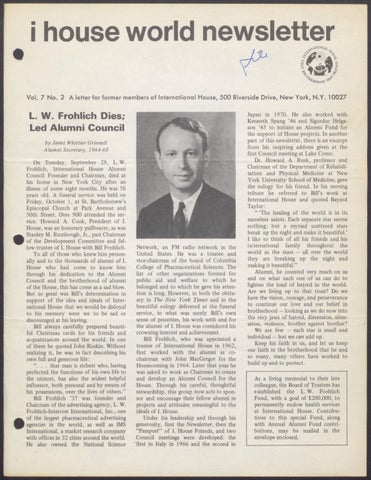
L. W. Frohlich Dies; Led Alumni Council
Japan
by Janet Whittier Grinnell Alumni Secretary, 1964-68 On Tuesday, September 28, L. W. Frohlich, International House Alumni
Council Founder and Chairman, died at his home in New York City after an illness of some eight months. He was 58 years old. A funeral service was held on Friday,
October
1, at St. Bartholomew’s
Episcopal Church at Park Avenue and 50th Street. Over 900 attended the service. Howard A. Cook, President of I. House, was an honorary pallbearer, as was Stanley M. Rumbough, Jr., past Chairman
of the Development Committee and fellow trustee of I. House with Bill Frohlich. To all of those who knew him personally and to the thousands of alumni of I. House who had come to know him
through
his dedication
Council
and
to the Alumni
the brotherhood
of alumni
of the House, this has come as a sad blow.
But so great was Bill’s determination in support of the idea and ideals of International House that we would be disloyal to his memory were we to be sad or discouraged at his leaving. Bill always carefully prepared beautiful Christmas cards for his friends and acquaintances around the world. In one
of them he quoted John Ruskin. Without realizing it, he was in fact describing his
own full and generous life: “.. . that man is richest who, having perfected the functions of his own life to the utmost, has also the widest helpful influence, both personal and by means of his possessions, over the lives of others.” Bill Frohlich °37 was founder and Chairman
of the advertising agency, L. W.
Frohlich-Intercon International, Inc., one of the largest pharmaceutical advertising agencies in the world, as well as IMS International, a market research company with offices in 32 cities around the world. He also owned the National Science
in
1970.
He
also
worked
with
Kenneth Spang °46 and Sigurdur Helga-
Network, an FM radio network in the United States. He was a trustee and vice-chairman of the board of Columbia College of Pharmaceutical Sciences. The list of other organizations formed for public aid and welfare to which he belonged and to which he gave his attention is long. However, in both the obituary in The New York Times and in the beautiful eulogy delivered at the funeral service, in what was surely Bill’s own sense of priorities, his work with and for the alumni of I. House was considered his crowning interest and achievement. Bill Frohlich, who was appointed a trustee of International House in 1962, first worked with the alumni as cochairman with John MacGregor for the Homecoming in 1964. Later that year he was asked to work as Chairman to create
and develop an Alumni Council for the House. Through his careful, thoughtful stewardship, this group now acts to sponsor and encourage their fellow alumni in projects and attitudes meaningful to the ideals of I. House. Under his leadership and through his generosity, first the Newsletter, then the “Passport” of I. House Friends, and two Council meetings were developed: the ‘first in Italy in 1966 and the second in
son °45 to initiate an Alumni Fund for the support of House projects. In another part of this newsletter, there is an excerpt from his inspiring address given at the first Council meeting at Lake Como. Dr. Howard A. Rusk, professor and Chairman of the Department of Rehabilitation and Physical Medicine at New York University School of Medicine, gave the eulogy for his friend. In his moving tribute he referred to Bill’s work at International House and quoted Bayard Taylor: “*The healing of the world is in its nameless saints. Each separate star seems nothing; but a myriad scattered stars break up the night and make it beautiful.’ I like to think of all his friends and his international family throughout the world as the stars — all over the world they are breaking up the night and making it beautiful.” Alumni, he counted very much on us and on what each one of us can do to
lighten the load of hatred in the world. Are we living up to that trust? Do we have the vision, courage, and perseverance to continue our love and our belief in brotherhood — looking as we do now into the very jaws of hatred, dissension, alienation,
violence,
brother
against
brother?
We are few — each star is small and individual — but we can add up. Keep his faith in us, and let us keep our faith in the brotherhood that he and so many, many others have worked to build up and to protect. As a living memorial to their late colleague, the Board of Trustees has established the L.W. Frohlich Fund, with a goal of $200,000, to permanently endow health services at International House, Contributions to this special Fund, along with Annual Alumni Fund contributions, may be mailed in the envelope enclosed.
The New Residents: Who
pie aay
What Do aney Want?
by Sami Ural ’65 Associate Program Director
Every year, out of 600 to 700 students applying to live in International House, the Admissions Committee accepts 250 to 300 as resident members. Who are they? What kind of people are they? Why do they want to live in the House? After reading 200 applications of the newly admitted students and talking to more than half of them, I can make the following observations. e@ They represent 67 nations, which brings the total of different nationalities, with the second year residents, to 82. @ 80% of the new residents are from the middle class, representing a cross section of their countries.
e 80% of the foreign students speak and write fluent English; 5% are taking English language courses now. e 40% of the foreign students, aside from speaking their native language and English fluently, can converse in another
language,
while
45%
of the American
students speak either Spanish or French. e@ Of the foreign students, 25% have traveled outside their country previous to their arrival in the U.S.A.
. @ 80%
of the American students have
visited
or
world,
mostly
lived in various Europe
and
parts of the South
Amer-
ica. e Of the foreign students, 30% are studying in fields related to science, 30% in Social Studies (Business, Economics, History, Sociology, etc.), 20% in the Performing Arts. e@ Most American students are in Education, Social Work, Music (voice or instrument), Law and International Affairs. e 90%
of
all
the
new
residents
are
working towards a Master’s Degree, 7% for a Ph.D. and 3% are candidates for a
Bachelor’s Degree. @ Most: of the foreign students’ work experience in their own country has been either with their government or family business; American students have had
experience in community work (mostly with children) and, of course, odd jobs in camps,
in
the
performing
arts and
with
small newspapers.
daughter
of the Turkish
Washington
Ambassador
icans, too . . . I discovered that one of the American students actually went over Niagara Falls in a barrel he built himself. Why do these people want to live in I. House? One obvious factor is that there is a shortage of housing for students, and I. House provides a convenient and decent place to live. A second reason, the most important one for I. House, is the desire of these young people to have the opportunity to learn more about other countries. They come from different cultural backgrounds, emphasizing various traditions, customs and values. They realize that the world is no longer an immense piece of rock and water where one can live in isolation, and that there is hope for people to live together if we are given the chance to meet other nationalities on an individual basis and share with them our thoughts, our ideas, and our problems arid pleasures. In his application to International House, Mr. Thakur Sajnani of India de-
Ali Yurdakul, a Turkish student, answered the question on what aspects of the U.S.A. interest him most: “Giantism, and appeal to the American of that which is spectacular. Giant enterprises, giant technological and artistic achievements, a
willingness to do everything on a grand scale with not much thought given to the likelihood of its being a_ grand blunder . “The valiant fight of that irrepressible American spirit of amateurism for survival in the onrushing age of advanced specialization (as typified by a Wall Street executive managing a Babe Ruth Little
League team over the weekend
. . .)”
welfare, the teen-age drug problem, and community resources other countries use
interests he would
like to
ican;
to support family structures.
2. dignity and hard labor; 3. the social aspects of dating a girl and thus meeting a marriage partner;
4. the friendly warmth and understanding.
opportunities for men and women.”
(the
my formal education at Columbia.)”
1. The human values of an average Amer-
the
sons
of diplomats
independence, the freedom, and the dem-
ocracy at work are of primary importance to my informal education (as opposed to
explore while in the U.S. by listing the following:
scribes
swinging
daughters
A young lady from Taiwan, Miss Edith R. Lim, explained: “Needless to say, the Americans are most interesting — specifically the students of the present age. The
On the other hand, there are answers by American students to the question on “Aspects of life in other countries that you would like to learn more about.” They specifically mention problems of
Among the European students there are very interesting individuals, including a TV film maker, an amateur radio operator, travel agents, tourist guides, the
and
in
lives in the House). Amer-
Mr. Thakur cites the appeal of “social and
financial independence of all Americans, life,
equal
rights
and
equal
Miss
Summer
Scott
writes:
“. . . I
would look forward to learning varieties of customs, vocational interests, and hob-
bies.” A young man wrote: “England and the Common Market, France and the New Europe; Germany and the mark and the split Berlin; Africans’ views of the Union
of South Africa; Asians’ independence of Communist China and the Vietnam War.”
Another applicant: “. . . how do they (foreign students) look upon authority? What cultural changes have occurred that would make the process of growing up substantially different now than fifteen years ago? Is the country collectively responsive to changes in personal morality? What is the present quality of life in terms of housing standards, education, health care? How well does the legal system function? Mainly, I am interested
solidified support for the Senate because it has increasingly adopted the position of
in
ideas
holding down financial pressures on stu-
through friendships which hopefully can
dents and on service staff positions. This advocacy approach in the Spring contributed to the defeat of a compulsory meal plan, and in the Fall the persistence of the Senate elicited the decision of the President’s Office of Emergency Preparedness that House rents as well as wages would be frozen under the wage-price freeze. The wisdom of these and similar moves can only be judged in time. However, in the case of the meal plan, a stop-gap measure directed at the cafeteria deficit, rejection of the plan was followed by a significant improvement in the monthly balance of operations costs due to economies implemented by _thenmanager Chuck David. Where student opinion is traditionally and notoriously ephemeral and _ undirected, the Senate is providing a focus and a concentration of active talent working to translate opinion into reality. Other Senate actions have been directed toward participation in long-range fiscal and organizational planning. Senate actions in the period since its inception have frequently been ad hoc solutions to immediate crises, and it is to be hoped that the Senate can formalize a mechanism for long-range planning. In conjunction with this goal, a study of the operation of the Columbia University Senate was initiated in the Spring. And to establish some criteria for economic planning, the Business Office, at the request of the Senate, is preparing a study of administrative and staff needs, costs and priorities. The results of both these studies are eagerly awaited. Economics has been a prime concern of the Senate, but not the only one.
generating
an
exchange
of
grow freely in an atmosphere which seeks harmony in diversity.” These national
are
the people
House.
Their
living in Interideas,
hopes
and
tolerance give a new perspective to other people. By simply living in this House they contribute to this institution. This is our institution’s great accomplishment.
Herman
Rottenberg
Named
I. House
On
September
Trustee
22,
Herman
Rotten-
berg, former Cultural Director of the House, was elected a member of the Board of Trustees to fill a vacancy on the oard. Mr.
Rottenberg,
who
has
been
at
I.
House in a staff or consulting capacity since 1963, is now President of the Performing Arts Foundation, which he organized for the purpose of assisting young, talented “‘emerging” artists from around the globe to achieve their career goals. The Foundation, with offices at International House, organizes performances of international songs, dances and music
which
are presented for schools, muse-
ums, hospitals, cultural councils, benefits, etc., throughout the year. In the summertime, the group performs abroad, presenting
the
I.
House
show,
World in 90 Minutes.” Most of the artists P.A.F.
troupe
“Around
involved
the
in
the
are residents, members,
or
alumni of I. House. The performances organized by the Foundation, both at home and abroad, serve a double purpose: 1. to provide
valuable
performing
experience
(and
income) for the young artists involved; 2. to bring the story of International House to ever-increasing audiences in this
leasant fashion. Detroit
alumni
take
note:
10 P.A.F.
performances for the Detroit Institute of Fine Arts are scheduled from April 9-16,
i972.
Senate
Happenings
by Robert Buford, I. House Resident
During the past six months, the Senate
has been preoccupied with the financial crisis of the House and the restrictions this imposes on programs and activities.
The
continued
Security
crisis has,
problems
have
if anything,
been
an ever-
present reality. A fine security mechanism is already in existence, and it has been the Senate’s function to be a watchdog to see that procedures are followed or bolstered where special need requires. Nor have all concerns been of such a
distressing nature. A weekend exchange of students with the International House
in Philadelphia
was arranged
with the
assistance of the Program Committee. The possibility or need of co-educational floors was discussed and will be considered in light of more student opinion. In future meetings the Senate will
discuss
projects
to
celebrate
the 50th
Anniversary of the House. And another anniversary, Assistant Business Manager Frank Kennedy’s 25th in the House, was celebrated with coffee and cake at the Senate’s meeting on September 28th.
New
Trustee
Charles
Chairman
W. Yost, former U. S. Ambas-
sador to the United Nations, has become the new Chairman of the Board of Trustees of International House. This announcement was made at the May 25 meeting of the Board. Ambassador Yost replaces John J. McCloy who has been Chairman for the past 17 years. Mr. McCloy has been elected Honorary Chairman, a post formerly held by the late General Dwight D. Eisenhower. Mr. Yost is currently associated with the School of International Affairs at Columbia University.
I. HOUSE WORLD NEWSLETTER FALL, 1971 Published by
International House—New York Howard A. Cook, President Sigurdur Helgason, Acting Chairman, Council of World Members Janice Crichton, Editor
International
House
is a
non-profit
residence and program center for graduate students from all nations. Its programs, supported by contributions from individuals, corporations and foundations, seek to achieve three basic goals: 1. To promote friendship and mutual respect among young people of all countries and cultures; 2. To provide opportunities for students to experience American life through trips, home visits and active participa-
tion in the community; 3.To help
students reach their educational and professional goals.
|
© —
| —
Howard Cook Initiates Conference of |. Houses Representatives from the four large International Houses in the United States — Berkeley, Chicago, New York and Philadelphia — will meet in Racine, Wisconsin, on December
16-18 to discuss the
possibility of future joint efforts in programming and fund raising. Two staff members, two trustees and one student will represent each institution. The Conference, partially funded by the Johnson Foundation, will be held at “Wingspread,” designed by Frank Lloyd Wright as the home of Mr. and Mrs. H. F. Johnson, and now used by the Foundation as an educational conference center.
Harry Edmonds Awarded Honorary
Doctorate
At its Founder’s Day Exercises on Sunday, October 10, 1971, Lehigh University conferred the honorary degree of Doctor of Humane Letters on its distin-
guished alumnus Harry Edmonds (Lehigh ’04), founder of International House-New York. President Howard A. Cook of International House attended the ceremony. A formal letter from the faculty to the president of Lehigh recommending Mr. Edmonds for this honor read, in part: “In 1924, with the aid of philan-
thropic
support,
founded
SILVER
the first
Ask
NEW
The New York Alumni reported that, in planning programs through last year, it “sought to be of service not only to its own members but to the House and its students as well.” Its financial contributions to scholarships and other causes totaled $2,124, plus individual contributions to the Festival of the Arts, Theater
:
one (or some) to give away, International House needs: ~— all kinds, but especially a
concert grand for the auditorium; T.V. SETS for the public rooms;
(or stainless) for spe-
cial occasions such as alumni or trustee dinners; service for about 100 needed;
A World
House
Member
framing, is now mailing costs.
Issues
Our thanks for a job well done.
World
certificate, printed
available
to all alumni
Benefit and the
Alumni Dinner. Three scholarships to students for Summer House weekends were also given. Activities sponsored by the group included two student-alumni receptions and a Yuletide party, as well as the Alumni Dinner, which was co-sponsored by the Office of World Members. A number of special summer events and tours for both students and alumni were also held. Service projects included the Clothing @® Bank, the Apartment Inspection Committee, and volunteer help for many House projects.
If you have connections with a company that manufactures or distributes the following items, or if you simply have
SILVERWARE
on
Member 8” by
10”
for a modest
Certificates
parchment price
suitable
of $2.50,
for
including
Let others know that you belong to International House and that, as a World Member,
you
support world
brotherhood
and
peace.
Please fill out the order form below and return it with your check for $2.50 (or equivalent in foreign currency) in the envelope enclosed.
WORLD
MEMBER
CERTIFICATE
ORDER
FORM
I enclose $2.50, or equivalent in foreign currency, for my World Member Certificate. “As light passed from one to another. We who have come from many nations to live in one Fellowship
in International
House,
promise
light
we
one
another
to pass
the
wherever
I was a Resident
[] Non-resident
q
New York Alumni Stress Service Programs
and Ye Shall Receive ?
PIANOS
FLAGS for the auditorium, “@
4x6 feet with tape at 4 foot side and grommet at each end of tape, preferably made of 75% nylon, 25% wool, to replace original wool flags which are now worn.
Gifts of property to International House are treated as tax-deductible contributions, with receipts issued for their
market value.
candlesticks, candelabra and
serving pieces for buffet dinners;
Doctor of Humane Letters.”
International
That Brotherhood May Prevail
he
International House in New York City. A city within a city where students from all over the world live together in daily contact with American students, International House has done more to stimulate mutual friendship and understanding than most of us can grasp.” The degree was presented with the following words: “Harry Edmonds, your selfless devotion to a brilliantly original concept has transformed an ideal into a great and growing reality. Upon the recommendation of the faculty, and with the approval of the Board of Trustees, I confer upon you the Honorary Degree
[] member from (date)
_ to
go.”
(Please print legibly or type name as you wish it to appear on your certificate.) N ame Address
Please make check payable to International House.
4
World =
Members
The Annual Dinner for World Members and their guests will be held at International House
on Saturday evening,
January 22. A “Las Vegas Casino,” operated by the New York Alumni, will be
open to all in the auditorium following the dinner. Invitations will be mailed to New York area World Members late in December. Out-of-towners who would like to attend
New York area telephone campaign in June, raising $2,514 from 317 contributors. First prize, for the person raising the most money, was won by New York Alumni Vice-president, Joe King. The prize, a free round-trip ticket to Europe, was donated by Alumni Fund Chairman Sigurdur Helgason, President of Icelandic Airlines. Resident Zeyad Barazanji won the second prize, dinner for two at the Top of the Sixes, contributed by Stouffer’s, which manages the I. House cafeteria.
may request an invitation from the Office of World Members. Svenska Foreningen I. H., the Swedish chapter of the former International House
Association,
decided
to
disband
this year because not enough new members were joining. The group presented I. House-New York with a generous gift of
$200 from the money
remaining in its
treasury.
We'll be traveling soon. International House World Members are about to embark on a group tour program in cooperation with Arthur’s Travel Center
of Philadelphia.
Arthur’s specializes in
alumni tours and currently works with a large number of college and university alumni associations in the New York area. After the success of the Japan Tour, which was run in conjunction with the
First World Conference of International House Alumni in Kyoto in March-April, 1970, the Office of World Members felt it might be fun and educational to sponsor other such group travel ventures. Our first tour offerings will be a trip to
London from April 2-9 (the week following Easter) and
a long weekend
in Las
Vegas from May 28 to June | (Memorial Day weekend.) Prices include air fare, deluxe accommodations, most meals,
some sightseeing, all tips, baggage transfer and
escort
services.
The
cost
of
the
London week, per person, will be $299, plus 10% tax and service charge. The Las Vegas weekend will cost $199, plus the 10%. Rates are based on double occupancy of hotel rooms. A brochure and registration form is enclosed
with this Newsletter for World
Members in the greater New York area. If any members outside this area would be
interested in joining either of the tours, please
write
to
the
Office
of
World
Members for descriptive and registration material. staff
ment
for
another
five-year term.
Five
former Council members were unable to accept another term: Saleh Abusaidi, Iran;
Fernando
Berckemeyer,
Peru; Sre-
ten Bjelicic, Yugoslavia; Pierre Mariotte, France; and Dr. Harold Wyndham, Australia. Their service to the Alumni Coun-
cil
during
its first
formative
years
is
deeply appreciated by International House and all of its World Members. Help
wanted!
The
Office
of World
Members
needs
your
help
in
“lost” and/or
finding
alumni — those whose names addresses in our files are out of
date.
members
volunteered
for the
7
Excerpts from Chairman L. W. Frohlich’s opening address at the First Alumni Council Meeting, Lake Como, Italy, September, 1966.
“ . . I postulate that it is difficult in our time to realize that, while distances
between
lands
are
being narrowed
by
impressive jet-speeded contacts, this has very little bearing on bringing people, nations or individuals closer together. As a matter of fact, I even suspect that, due to the easier reach, the contacts may be more superficial and, therefore, less effective . ... “So, therefore, the experience of actually living together day by day cannot be underestimated; and we who have been
privileged jointly to have had this experience at an International House have, from time to time, fondly recalled moments that have had the touch of spiritual
closeness with a person of another land when suddenly a very simple thought may have occurred to us: ‘I never knew that this was what he was like.’ ‘Now I know and understand.’ “This is his reason for thinking the way he does.’ « . . As some of you may know, my major interest is in medicine; and I believe that we are all at our best in our own element. Medicine works on the basis of hypotheses, tentative generalizations and assumptions, but not yet on the basis of laws, or rigid formulae — except
perhaps in biochemistry. The introduction of the specific human element into
Our records are being computerized this year in order to make the World Members program more effective. Not only will we have more information about individuals, but we can now readily
the aims of the medical art endows it with a moral character . “So I find that our International House idea is equally not governed by
obtain
ets but by the simple experimental hypothesis that there is ‘something’ in this loose yet impressive environmental
lists of alumni
by residence year,
country of origin, occupation, etc. Furthermore, our antiquated system for addressing envelopes will be replaced by attractive and accurate mailing labels.
One of the fringe benefits of this new record system will be its help in producing a 50th Anniversary Directory of all known World Members.
Obviously, now is the time to update address records and attempt to find the lost members of our large family. Any person who is willing to look up alumni
addresses in his or her area — particularly in foreign countries — is requested please to contact the Office of World Members at International House. We’ll provide lists
of missing alumni with their last known
Thirty-eight alumni, present residents and
A new appointment to the Council of World Members is Emil Kuster of Switzerland. Mr. Kuster, who lived at International House in 1925-26, is with the J. Henry Schroder banking corporation in Zurich. Sixteen Council members whose terms expired in 1970-71 accepted reappoint-
“‘Let Us Continue ...°
address or, in some cases, their parents’ address. Thanks in advance!
strict laws and educational straight jack-
exposure to the simple thought brotherhood may prevail.’
‘that
“*. . . Brotherhood, as a single word,
is a simple thought — proposed for centuries, not built on laws. It is suggested that it be practiced as an art, just as medicine is, depending on experiment, on observations and on chance recipes of
life and not on rigidly established formulae. “So,
let us not despair when we (at
our Council Meeting) do not find all the answers. And let us not be governed by
rigid stipulations. Let us continue with this experiment of brotherhood and let us try
to
continue
with
the
search
methods that will further our ideals.”
for
Alumni Dr. Richard Taylor, Vice-president and Program Director of International House from 1960 to 1967, was killed in an automobile accident in Danby, Vermont, on May 22nd. He was 55 years old. At the time of his death, Dr. Taylor was executive director of Voluntary Agencies on Narcotics Treatment in New York. He is survived by his widow, Patricia, a daughter and two sons. A memorial service was held at Riverside Church on Thursday, May 27. Jack Buckler, who with his wife, Faye,
had run the I. House Bazaar since last September, died suddenly of a heart attack on July 10th. Before taking over the Bazaar, the Bucklers owned and managed the Estelle Cleaners, patronized by many I. House residents over the years. Jack’s father had been associated with the House since it was built in 1924, serving as its first valet. Faye, with the help of her daughter, Estelle
Menduke,
is
now
managing
Cleveland
E. Dodge,
the
Bazaar. Mrs.
wife
of the
Honorary Trustee, friend and hostess to thousands of I. House students who have attended the annual fall picnic at the
Dodge’s home, died on August 22nd. Mr. 50th
and
Mrs.
wedding
Dodge
celebrated their
anniversary
in
1969,
at
which time they were presented a letter of congratulations and thanks signed by 350 I. House residents.
In Memory of Miss Barbara V. Pisek ’24, Hillsdale, N. Y. Miss Inez N. Wenz
’24, Porterville, Cal.
Rev. Paul C. Scheirer ’25, Pottstown, Pa.
Mr. Elmer J. Hoare ’26, New York, N. Y. Mr. Carl Frederic Kayan ’26, Katonah, N. Y. Dr. Frank Canada
C.
Tenzer
Dr. Joseph J. McCadden
’26,
Montreal
Quebec,
’27, Yonkers, N. Y.
Dr. Willis D, Mathias ’28, Allentown, Pa. Dr. Harold S. Cook ’29, Quebec, Quebec, Canada Dr. Gerald W. Lawlor ’37, San Jose, Cal. Dr. Roman S. Gorski ’40, Mars Hill, N. C.
Mrs. Dorothy P. Bolin ’53, New York, N. Y. Mr. Harold H. Full ’55, New York, N. Y.
Mrs. Doris Covel S’60, New York, N. Y. Mrs. Doris Harrison S’65, Kreamor, Pa. Mrs.
Leonard
Rossell S’66, Ottawa,
Ontario,
Canada
Mrs.
Kyoko
E. K. Bellinger
’69, Ottawa, On-
tario, Canada Saed ee
ee
Notes
Connecticut Planning Committee
Dr. Clara Mae Taylor, Cosmopolitan Club 20, has retired from Columbia Teachers College where she was a Professor of Nutrition. She now lives in Pittsburgh, Pennsylvania.
has
Maria Hartong Farr, Cosmopolitan Club ’22, retired from the Common Council of
Syracuse, N. Y. She is a member of the Citizens Advisory Committee of the N. Y. State Urban
Development Corporation. From Helsinki, Finland, Einar Wathen, Cosmopolitan Club ’22, writes that he has retired from business and is the secretary of the
Furniture Manufacturers Association. He also owns and publishes a furniture magazine there. Luisa Santi Zaccaro °24 is living with her
for the White
House Conference on Children and Youth. S. Elizabeth Englar *32 has retired as a teacher in the York, Pennsylvania, schools. In the summer of 1970, she traveled 10,500 miles
by car through the western U.S., visiting friends and most of the National Parks.
Marcelo and park developed
Arroyo
Buncio ’34 is a landscape
consultant in the Philippines. He the Luneta Park in the City of
Manila, which many visitors consider to be the best developed park in the East. A. C. Deve Gowda ’34 has worked in education programs in India for many years and is currently serving the Mysore State Government
she
as Special Officer for School Reorganization. His daughter, Mrs. Premalatha A. Kothavale, is also an alumna of I. House (61) and is now living in Norwalk, Connecticut. A Professor Emeritus of Music at the University of Wisconsin, Anita Hankowitz Kastner
volunteers in an orphanage, which was founded
34 keeps busy as pianist, organist and accom-
by her parents in 1905, and which is now directed by her two brothers. She says, “‘It isa joy to be able to do something for those dear
panist for churches and civic and art groups in Milwaukee, Wisconsin. On August 1, Miriam Snow Mathes ’34 retired after teaching Library Science at West-
daughter
in
Tuckahoe,
New.
York,
and
calls
herself “‘the house grandmother.” In the summet
she
travels
to
Naples,
Italy,
where
children.” Having moved to a new permanent address in Orlando, Florida, Daniel Bliss ’26 writes that he has almost concluded his fifty year association with the International College in Beirut,
Lebanon. He began there as a teacher in 1923 and continued later as a member of the Board of Trustees. The dedication of the new campus he worked so many years for is in October, and
ern Washington State College for 37 years. Jack Williams ’35, publisher of the Waycross, Georgia Journal, attended the Southern Newspaper Seminar on Junior Colleges held at Vanderbilt University in the summer. The Williams family, along with the Jemisons of Memphis, has offered to give 100 acres of land
he plans to go to Beirut to attend. Edgar L. Morphet ’26 is now the Director of the Improving State Leadership in Education
for the formation of a Junior College under the University system. Bernard I. Galitzki 36 was recently married to Pearl Gold of New York. He is president of
Project in Denver Emeritus, of the
his own Fabrics,
and Professor of Education, University of California at
Berkeley. He has had a long career in education, including teaching and research projects all over the U.S. and in the Philippines, Hong Kong, and Brazil. After an interesting and varied career as a teacher and researcher, Cecile Wilson ’26 has retired and is living in Santa Rosa, California.
There she has the opportunity to concentrate on her poetry, which she writes in both French and English. She belongs to a group of poets in San Francisco. Lois Cobb Smith ’27 and her husband spent six weeks this summer touring England and Scotland. Harold J. Jonas ’31 retired from teaching and
was
named
Professor
Emeritus
of History
at Orange County Community College, SUNY, where he specialized in Asian Studies. This fall he plans to travel to Japan with his older son. There he will visit Dr. Junji Oyama 32, an I. House friend. Another alumnus traveling around Europe is Christian A. Meister ’31 of West Germany. He has retired from foreign banking and now has more time for landscape gardening and traveling. In 1958 Robert E. Vivian ’31 retired from the University of Southern California where he was Dean of the School of Engineering. He is now Dean Emeritus and is living in Los Angeles. Gertrude Vrooman-Metzler ’31 writes that she is staying in the Convalescent House of Providence in Kingston, Ontario, while recovering from a long illness. She is a retired teacher of Modern Languages and Fine Arts. Having completed 21 years as a teacher, supervisor, and professor of Education at Eastern Connecticut State College, Juliette Phifer Burstermann *32 is currently a member of the
chain of retail fabric stores, Discount Inc., with headquarters in Portland,
Oregon. From Stockholm, Sweden, Bengt Julin ’37 writes that he bought his own firm in 1968, after working as a marine-underwriter for 29 years. He has pleasant memories of his year at the House and remembers that folk singer Burl Ives ’39 was there at the time. Dr. Alan L. Rowland ’37 is a specialist in Internal Medicine and Cardiology in San Gabriel, California, He writes, “If there is such a thing as love by personal nostalgia, the New York I.
House keeps a very large place in my heart.” Margaret Brustrom Blossom °40 retired as Director of Willoughby House Child Care Center in 1970. This year she was elected President of Willoughby House Settlement, Inc., the old-
est settlement house in Brooklyn, New York. A graphic designer for the Pan American Health Organization, Vergniaud Pierre-Noel ’40 won the United Nations “First Honorable Mention” for the “World Health Day, 1971,” stamp design contest this year. Edith Mitchell Hunt ’41 is a casework supervisor for the Travelers Aid Society of Boston and lives with her husband in Cambridge, Massachusetts, She says, ““We’re kept on our toes by the ferment of the youth around us, and we find stimulation and pleasure in the
plays and concerts we attend and the trips we take,” Ruth Mellby White ’41 spent the summer with her daughter and son-in-law and their three children in Rio de Janiero, At home in San
Francisco,
Wednesday
Mrs. White is a soloist with the
singers
and
is active
with
many
conservation societies. Her husband, Edward B.
White, is a financial consultant. After serving 28 years as a professor in Cornell University’s Extension Service, Carrie
Williams Taylor ’42 has retired and is living in Oregon. She is active in the Legislative Committee of the Oregon Branch, American Association of University Women, and many other educational and charitable organizations Marjarie Willcox ’43 has been a librarian in the
Seneca
Falls,
New
York,
schools
since
1965. In 1968 she received her Master’s Degree in Library
Science
from
the
State
University
College at Geneseo. Minnie Yasgur Greenia °44 writes that she would enjoy hearing from alumni who resided at the House when living in Brooklyn,
she did (1938-44). She is New York, and is head
librarian at the Fort Hamilton Army Post. A teacher with the Toronto Board of Education, Clara Campbell Lahmer °44 just returned
from
a
trip
to
the
Far
East
and
Southern and Eastern Africa. Ruth Isu Nomura ’44 of Honolulu, Hawaii, writes, “May you continue to help the students from other lands, for this is one way of helping the students as well as the people who are in need of understanding to build a better world.” An Assistant Professor of Art at the University of Kentucky, Anne G. Green °45 has just returned from her sabbatical. She traveled around the world, studying and photographing textiles, primarily in the Far East. The University of Washington presented Dr. Sripati Chandrasekhar °46 as a guest lecturer on world population problems this summer. Dr. Chandrasekhar was Minister of Health and Family Planning in India from 1967 to 1970. Helen Laird °48 is a Professor of Voice at the College-Conservatory of Music at the University of Cincinnati, where she is also the soprano in residence. Dr. Georges P. H. Delhove °49 of Brussels, Belgium, has been working and traveling all over the world since 1961 as an international economist and consultant.
An
Associate
Social Work
Professor
in the
School
of
at the University of Georgia, Merle
Foeckler ’49 has been invited to teach at the School of Social Work in Stockholm this fall. She is planning to visit the I. House there. Muriel A. Code ’50 of Toronto is planning a trip around the world this year. Last summer she visited Charlotte and Herrick Young ’28 at Tunghai
University
in Taichung,
Taiwan.
Dr.
Young will soon return to New York president of the Near East Foundation.
as
)
a
>|
Adenola A. Igun 50 and 67 (above, with wife,
Remi,
and
children)
is now
Director
of
the Institute of Population and Manpower tudies and Head of the Department of Sociology and Demography at the University of Ife, Nigeria. Ade stayed at International House for a week in October while working with the U.N. Population Council Office in New York.
A
teacher
in
the
Denver
Public
Schools,
Charlotte M. O’Reilly ’50 writes that ecumenical activities are becoming a part of Denver life and says, “The motto of International House I’m sure is growing everywhere, so let’s hope’’. Carl Grosjean °51 is a Professor at the University of Ghent and has been a member of the Flemish Academy of Sciences, Literature
and Fine Arts of Belgium since 1968. After traveling around Europe, Bhagwondai Bisessar McCaughey ’51 worked in psychiatric nursing in Northern Ireland until 1967. In 1968 she and her husband, who is also in psychiatric nursing, left Ireland and traveled through England, the West Indies and South America and
A high school City Public
Simmons Waters
Language Sensitivity Program for Teachers, was
published by Teachers College Press. He has also developed an M.S. program in Communication Arts for teachers.
A writer-consultant for UNESCO, Margo Meier Viscusi 56 has been living in France since 1967. She was married in 1960 and has two children.
State Employment Service, Kiku Tomita ’51 continues to spendas much time as possible traveling around the world, This fall she plans to visit Japan, Burma, Singapore, Indonesia and Hong Kong. Helen Fairfax Holmes ’52 is an Associate
McLaine McLaine
In the summer she works with the Upward Bound Program where she plans and teaches a program for disadvantaged high school students. Professor Hyung-Kook Jun °52 of Seoul,
in the Baltimore
Ruperta
55 was on sabbatical leave last year and worked on her Master of Liberal Arts Degree at Johns Hopkins University. Robert Wolsch ’55 is an Associate Professor at Western Connecticut State College. His book, Poetic Composition Through the Grades: A
finally settled in Lagrangeville, New York, where they now live with their two sons. An employment consultant with the N. Y.
Professor of English at Kentucky State College.
counselor
Schools,
After four years in Washington, D.C. and seven
years
abroad,
Mr.
and
Mrs.
Alan
P,
°57 are returning to Ottawa. Mr. is a diplomat with the Canadian
Department
of
External
Affairs.
They
write,
“Any alumni or old friends are invited to look us up if their travels ever take them to the Canadian capital.” Dorothy L. Schneider ’57 of Irvine, California, is conducting a one-woman campaign to establish
paign
a U.N.
states,
population,
Day
world
holiday.
in part:
“War,
disease,
poverty,
Her cam-
pollution,
over-
development,
Korea, visited I. House in October while attend-
human rights, peaceful uses of space and the oceahs and the ocean floors — all of these are
ing meetings
world issues, and no one nation can guarantee a
of the Association
of American
University Presses. Professor Jun is President of the University Press Association of Korea and Director of the Yonsei University Press. On his
solution to the problems they entail. Earthscale problems must be matched by earth-scale cooperation, and we must start at some point
trip he was visiting University Presses in the U.S. and Europe. Ulrich Merten ’52 has been transferred from being General Manager of the Bank of America’s Chilean branch to being Vice-president of the Latin American Division in the Head Office in San Francisco.
on which we can agree. A U.N. Day World Holiday is such a point; United Nations Day —
A Professor of Ancient History at McMaster
University in Ontario, Canada, J. A. S. Evans *53 taught in Italy this past summer. He is also editor of “Vergilius,” the annual of the Vergilian Society of America. John Seiki Kikawada ’54 is President of the Tokogakuen Children’s Home in Osaka, Japan, and belongs to the Sakai Rotary Club. His two children are studying in the U.S. A teacher in the Los Angeles City Schools, Lorraine Bott Aldrich °55 wrote that she was on her way to Europe and Israel for a three month sabbatical with her husband. They were planning to stop and visit I. House friends along the way. Dr. Lavanya-Rao ’55 is Chairman of Pediatrics at Andhra Medical College in India. She has two children, a son and a daughter. This past spring Dr. Lakshmi Rao °55 stopped by the Office of World Members. She is Dean of Students and an Associate Professor of Microbiology at the Christian Medical College in India. The College celebrated its 75th Anniversary last year and the faculty sent Dr. Rao to the U.S. to thank Americans who contributed to their fund drives. Salomea Tretiak °55 is retiring next year from Red Deer College in Alberta, Canada, where she is an instructor in Nursing Education. She says she will “probably bum around” in 1972-73. A. W. Skardon, Jr. ’55 is a History Professor at Youngstown State University in Ohio. This year his book on William A. Muhlenberg will be published.
October 24 — Interdependence Day.” Fern McGuire Barnett ’59 is volunteering for the United Nations Association in South Bend, Indiana, serving as executive director.
Michael Westgate °60 has been living in Cambridge, Massachusetts. This summer he sailed a schooner in Greece and Turkey and plans to move to Washington, D. C. this fall. Judith Hursh Constantinides and Dinos Constantinides 61 are living in Baton Rouge, Louisiana. Mr. Constantinides is an Associate Professor of Music at Louisiana State University
and has been awarded two teaching awards. Belva O. Hennegan ’61 is living in New York and is teaching remedial reading to disadvantaged students. A teacher with the Newport News, Virginia,
School System, Augusta Inettie Banks Edwards *60 took a trip around the world in 1970. She visited nine countries and Hawaii in 34 days and called it “the experience of a lifetime.” Carlos Bernardo Gutierrez °62 was at I. House this summer visiting his brother. He has recently been teaching Philosophy at Heidelberg University. An Assistant Editor with Prakken Publications
in
Michigan,
Elizabeth
Andrews
Weigel
62 served on the Michigan State Board of Education Committee on Citizenship, Morality and Value Education. She has published two papers in the field of political socialization in professional education. A student at Juilliard while at I. House, Rhonda Bruce Hutchinson-Brooks ’63 has been living in England and is married to an Englishman, She has been singing with the Royal Opera House in Covent Garden and with Sadlers Wells, as well as in concerts. She and her
husband visited the U.S. this summer and then returned to Australia, where they plan to stay for a couple of years.
Retired from teaching at the University of Hawaii, Lorraine F. Fitzsimmons ’63 recently returned from a trip to Spain, Portugal, the Canary Islands, North Africa, the Azores, and
mainland U.S. As Assistant Professor at Queensborough Community College in New York, Robert K.W.K. Loo ’63 received his Ph.D. from N. Y. U. in 1970 and was named the American Council on Educational Academic Administration Fellow for this year at Fordham University.
Sergio
Pimentel
Mendes
°63
is Assistant
Director of Maxwell Electronics S/A and has been elected Vice-director for TV and broadcast equipment of the Brazilian Association of Electric and Electronic Industries. He is planning to spend the summer of ’74 in the USS. and will be at I. House for the 50th Anniversary celebration. A field adviser for the National Council of Educational Research and Training in India,
A Professor with the Ministry of Education in Panama, Otilia Donoso ’66 attended the summer session on Latin American Programs at
Abilene Christian College in Texas this year. Christopher Czaja Sager ’66 is a concert pianist and teacher and made his second appearance with the Birmingham, Alabama, Sym-
phony
in March.
This fall he plans a concert
tour in Europe and hopes to see I. House alumni. He is taking a leave of absence from his post as Artist-in-Residence at Birmingham Southern College. : Last April Ze’eva Cohen ’67 performed an evening of solo dances, composed by herself and three other choreographers, in New York
City. She graduated from
Juilliard and for six
years
dancer
was
the
principal
in
the
Anna
Sokolow Dance Company. In the spring of 1970, she was choreographer for Joseph Papp’s production of Myrna Lamb’s ‘“‘Mod Donna” at the Public Theater in New York City.
Rafael de Acha ’67 is finishing his Master’s
be contacted by alumni. After three years’ service at the American
Embassy in Tokyo, William J. Cunningham ’68 has been assigned to the Senior Seminar at the Foreign Service Institute, Department in Washington, D. C.
Richard
H.
Rosensweig
°68
of State,
is currently
doing management consulting work in New Jersey. Martha Irons Watson ’68 is a social worker
with the Kaiser Foundation Parent-Child Center in California. The program is based on the Montessori and English Infant School methods. Mrs. Watson has her Master’s in Social Welfare from U.C.L.A.
Calvin F. Bastian ’69 is General Manager of the Public Television System in the Virgin Islands. He is establishing an educational TV network which will serve the school system as well as cultural and informational functions. A Public Health Educator with the U.S.
Public Health Service, Vernon A. Bowman ’69
Batuk N. Pandey ’63 has been working in the area of Secondary Teacher Education and is presently looking after school improvement projects. ; Dorothy Brickman ’64, foreign student
this year at the New England Conservatory of Music. He lived in Maine this summer and plans to start his own opera group this fall. In the spring of 1972, he will do a concert tour of the U.S. with his wife, Kim Daniel, a soprano.
has been assigned to the Division Health. He was recently transferred Alaska to Lewiston, Idaho.
adviser at The Western College in Oxford, Ohio, has been named to “Who’s Who of American
After graduating from C.C.N.Y. in 1967, Henry Kan °67 returned to Taiwan where he
freighter trip to the Orient recently and was royally entertained by Nunta Tasavong °69 in
Women.” In December she plans to visit the Soviet Union with the Comparative Education
worked
Bangkok.
Dairies. He came back to the U.S. in 1969 with
Society’s “Winter Festival of Education.”
his
After
completing two years of teaching in
New
Delhi, Ted and Margaret Housman, Jr. ’64
have
accepted
a new
teaching
assignment
in
West Pakistan. They left New Delhi in June and traveled to the Holy Land, Bavaria, Spain,
Morocco and New York City before returning to Karachi.
Lucy Hook Porter 65, an editor of mental ability tests in New York City, was married in June and visited Switzerland on her honey-
moon.
Alumni Fund Report The 1970-71 Alumni Fund totaled $14,237 from 1,176 contributors — compared with $13,361 from 1,279 the year
before, While the average gift increased from $10.45 to $12.10, resulting in the higher total, the number of contributors fell to the lowest point in five years. (This, incidentally, reflected a national trend — one we hope is short-lived!) Total alumni support, including designated gifts, gifts-in-kind and payments for World Member certificates, amounted to
$18,791.30. An important point: our total would have been an estimated $6,800 higher if all those alumni who contributed in the past had remembered International House
last year.
Your ANNUAL
gift COUNTS!
as administrative manager
family,
and
is
now
senior
in Foremost engineer
of
Bechtell Corporation in San Francisco. Melinda Mills ’67 is living in Cambridge, Massachusetts, and is studying for a Master’s in Education at Boston University.
Violeta Vincenti Paradis 67 is married and
Jerrie English
Anne teacher
Norman
Green
°69
of Indian from S.E.
is a high
school
She
on a
in California.
went
Metzger 69 wrote the script for a
film on the analysis of lunar samples, which was released earlier this year. His book on current
scientific research will be published in the spring of 1972. He lives in Washington, D.C. Alceu de Castro Romeu ’69 is a physician
has a baby girl. She is an instructor of Economics at the University of Puerto Rico.
and is lecturing at the School of Medicine in Porto Alegre, Brazil. He would like to hear from his I. House friends.
Having completed his Ph.D. at Cambridge in 1970, Brian Sweeney ’67 is now a management trainee with Shell International Petroleum Co. He is living in London and would be happy to
A teacher and a doctoral candidate at N. Y. U., Shirley Ann Hunter ’70 was selected as one of the “Outstanding Young Women in America” in 1971.
What Your Gift Can Do
though last year’s deficit of $86,486 was $51,000 less than that of 1969-70. Major savings came from reducing staff by eight people since early 1970. Major over-thebudget expenses came from increased
Your gift supports vital student programs. Last year, over 150 House members participated in community service
projects as tutors, assembly performers or _ classroom speakers. The House sponsored 45 lectures, seminars and discussions on
topics such as Conflict Resolution and Mediation Techniques, Soviet-Middle East Relations, The Law and the Poor, Parent-
Child Problems, and The Population Bomb. There were 33 cultural events, including art and photography exhibits, nationality dinners and shows, and musicales. Maintaining programs relevant to the needs of today’s members (see “The New Residents,” page 2) costs money. The budget remains a real concern,
security and cafeteria costs.
Last summer, the Board of Trustees and the Senate agreed on room: rent increases to project a balanced budget for 1971-72. Room contracts at the new rates had been signed by 76% of Fall residents, when the wage-price freeze was announced, The increase had to be rescinded, putting this year’s budget back into the red. Your gift can count more than ever this year in making up this loss. Today’s students are involved with the
world.
Through
your
contribution
to
International House, you can be too.
PLEASE, REMEMBER INTERNATIONAL HOUSE—AGAIN—THIS
YEAR. @