Sie Mt
i house world newsletter gn
)
stlONay
ie “He acd
Vol.
6 No.
1.
A letter for former members of International House, 500 Riverside Drive, New York, N.Y. 10027
NONE Citizen
**Unless man learns to live in harmonious unity, the human race faces the danger of destroying itself. Indeed, the
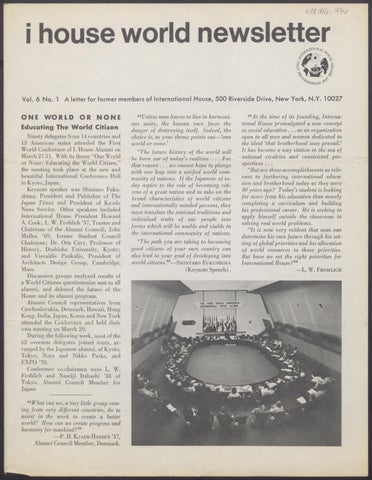
Ninety delegates from 14 countries and 13 American states attended the First World Conference of I. House Alumni on March 27-31. With its theme “One World
choice is, as your theme points out—‘one world or none.’
or None: Educating the World Citizen,”
that reason ... we cannot hope to plunge with one leap into a unified world community of nations. If the Japanese of today aspire to the role of becoming citizens of a great nation and to take on the broad characteristics of world citizens
ONE WORLD OR Educating The World
the meeting took place at the new and beautiful International Conference Hall in Kyoto, Japan.
Keynote speaker was Shintaro Fukushima, President and Publisher of The Japan Times and President of Kyodo
News Service.
Other speakers included
International House President Howard A. Cook; L. W. Frohlich ’37, Trustee and Chairman of the Alumni Council; John Mallea
°69,
former
Student
Council
Chairman; Dr. Otis Cary, Professor of History, Doshisha University, Kyoto; and Visvaldis Paukulis, President of Architects Design Group, Cambridge, Mass. Discussion groups analyzed results of
a World Citizens questionnaire sent to all alumni, and debated the future of the House and its alumni program. Alumni Council representatives from Czechoslovakia, Denmark, Hawaii, Hong Kong, India, Japan, Korea and New York
attended the Conference and held their own meeting on March 29, During the following week, most of the 62 overseas delegates joined tours, arranged by the Japanese alumni, of Kyoto,
Tokyo,
Nara
and
Nikko
EXPO ’70. Conference
co-chairmen
Frohlich
and
Namiji
Tokyo, Japan.
Alumni
Parks,
and
were
L.
Itabashi
°38
of
Member
for
Council
W.
**What can we, a tiny little group coming from very different countries, do to assist
in the
a
work
to
create
a
better
world? How can we create progress and harmony for mankind ?*? —P. H. Kyarr-HAnsen °37, Alumni Council Member, Denmark.
“The future history of the world will be born out of today’s realities . . . For
and internationally minded persons, they must translate the national traditions and individual traits of our people into forms which will be usable and viable in
the international community of nations. “The path you are taking to becoming good citizens of your own country can also lead to your goal of developing into
world citizens.??——-SHINTARO FUKUSHIMA (Keynote Speech) .
**4t the timeof its founding, International House promulgated a new concept in social education .. . as an organization open to all men and women dedicated to
the ideal ‘that brotherhood may prevail.’ It has become a way station in the sea of national rivalries spectives...
and
constricted
per-
“But are these accomplishments as relevant
to furthering
international
educa-
tion and brotherhood today as they were 40 years ago? Today’s student is looking for more from his education than merely completing
a curriculum
and
building
his professional career. He is seeking to apply himself outside the classroom to solving real world problems. “It is now very evident that man can determine his own future through his setting of global priorities and his allocation
of world resources to those priorities. But have we set the right priorities for International House?*? —L. W. FROHLICH
What's
Going
On...
STUDENT POWER: The Pleasure and the Pain by Don Cuneo ’69 Eldridge Cleaver said it well: youre
not part of the solution,
part of the problem.” serious
student
experienced in tentative first steps that the
“If
you’re
sponsibility, for relevance
and
and
re-
for the
accountability of those in the “establish-
ment” has reached even inside the sheltered walls of International House.
Or is it sheltered? Should it be? The question has been squarely posed: “International
House
needs
a_
far
greater commitment—particularly by students—than we've ever given it in the past. It... should be an exemplar community,
where
commitment
to
broth-
erhood is lifelong, developed not by osmosis, not just by living together or... even by drinking beer together, but by
facing the problems which are there now. “(Students)
must
take on racism,
House
has
taken
recently
in
con-
fronting the issues. The battle is not over,
The demand for
participation
debates among the membership and be-
the
Middle East, etc., without getting at each
others’ throats. They must know they are going to have a one or two year experi-
ence where they'll learn both the pleasure and pain of being a world citizen.” —John Mallea ’69, speaking at the Japan Conference.
From a different perspective, the nature of the problem becomes clear: “We have faced a real dilemma when it comes to programming—whether or not we should give a platform to, say, a
Black Panther group on the grounds that white residents must be exposed to Panther invective to understand the deep feelings of antagonism felt by so many blacks in the United States, when at the
same time we know that groups preaching hatred and violence are antithetical to everything for which International House
stands. “Do meetings of this sort polarize our
but here are some skirmishes
along the
way. U. N.
Round
Tables
A scheduled “Roundtable:
appearance of the South African Ambas-
sador at a separate luncheon held prior to the evening’s panel discussion. Several communication snafus took place concerning the significance and timing of the South African representative’s visit, and
as a result the invited Ambassadors
of
other nations refused to come. Debate on the debacle raged for days. Following an appeal by the student organizer of the program to “help us make International House an authentic inter-
national forum and not a pollyanna superstructure of spineless jellyfish” (1. House “Globe,” March 23, 1970), a sec-
“U.N.
Detente,”
Roundtable a
less
on
European
controversial
subject,
roundtable,
“U.N.
went smoothly. A
recent
third
defined policy-making power should be formed. Just what and how broad that policy-
Peacekeeping in the Middle East,” pro-
point
of
a Town
Meeting
one evening.
Many students insisted that they be directly involved by way of the Senate in decisions concerning hiring and firing of personnel, wage levels and financial policy in general. Not without opposi-
tion, this very Senate’s
wide conception
powers
was
endorsed
of the at
the
Town Meeting and then by a House (student) referendum,
Elections quickly fol-
lowed. Students
and
Trustees
A
second result of the formation of the Senate was the election of two students to the Board of Trustees. The de-
sign is to bring these two bodies much closer
together
and
coordinate
their
|. HOUSE WORLD NEWSLETTER SPRING, 1970 Published by
vided another kind of scenario. Anyone there will never forget the student moni-
International House—New York
tors rushing around to keep peace in the huge crowd that filled the Auditorium, or the on-the-scene confiscation of a photog-
L. W. Frohlich, Chairman, Alumni Council Janice Crichton, Editor
rapher’s film.
Howard
A. Cook, President
The results were disputed,
but no one doubted the sincerity of the effort to confront issues.
The New Senate A new approach to House politics has promoted yet more confrontation this spring. Frustration and lack of power to effect change were the catalysts as students began to take an active interest in nearly every aspect of House policy and
procedure. The evolution of the Senate to its pres-
membership, or do they in the long run promote greater understanding? We have found that discussions between Israelis and Arabs on the situation in the Middle East have led to a complete breakdown in communications . . . whereas
ent structure of 15 students, 2 studenttrustees, and 7 staff members, with working committees in all important areas,
meetings of professional interest groups
members “dramatically read out their resignation manifestoes” and challenged the body to do more than “debate the size of paper cups in the cafeteria.”
in which Israelis and Arabs participate often bring about close associations or friendships, which hopefully will bridge important national differences in the fu-
developed that a new body with clearly
making power would be became the focal
Africa and
the U.N.” collapsed in a dispute over the
ond
tween students and staff on how to restructure. The Pub was the scene of much negotiating, and eventually a concensus
was a painstaking process. Several months ago, at a meeting of the now defunct Student Council, three
As the “Globe”
observed, ‘The meet-
ture.”—Howard A. Cook, President, In-
ing marked the beginning of change, but
ternational House, speaking at the Japan Conference. Pleasure, pain and dilemma were all
for the Council.”
it was also the end of a long bitter road
The session disbanded
in confusion, and there ensued continual
lashes nintioaial House is ahasan residence and program center for graduate students from all nations. Its programs, supported by contributions from individuals, corporations and foundations, seek to achieve three
oe ee
1. To promote friendship
m
respect among you Ait ME cencstien und ania ve provide opportunities for students to
experience American life through trips, home visits and active partici-
oe in the community;
3, To help
policy-making
for
the
benefit
of
knowledge, and sharpen their skills so that they may take effective action in
the
House.
combating
Another example of trustee-student interaction was provided by Mr. Herman Schmidt,
a trustee
Mobil Oil Company.
and
a
Director
of
International
Inaugurating the
subjects of special relevance in the news, Mr. Schmidt discussed “The Role of the International Oil Company.”
Following introductory remarks filled with revealing facts, Mr. Schmidt fielded
alumni,
audience questions with candor and care,
A subsequent program in the Contemporary Issues Series featured The Fortune Society, a group of ex-convicts
which is trying to bring the problems of prisons
to the
attention
of the
public.
Their highly moving personal stories left the audience
spellbound
for hours, and
at the close of the meeting conditions
in other
countries
the prison were
ex-
plored. A third program scheduled a debate on Abortion Reform just prior to
Discussion group participants at Japan Conference from
left:
Sjamsiah
Don
and
Linda
Achmad
Cuneo,
both
'61,
from
Indonesia;
'69,
from
New
York.
SUMMARY OF RESOLUTONS Kyoto, Japan — March 31, 1970 WE find it significant and appropriate that this First World Conference of International House Alumni, meeting for the purpose of evaluating and improving the role of this institution in promoting understanding among people of all nations, should be held at this time, at the outset
the dramatic New York State Legislature approval of a new liberalized law.
of the International Education Year as proclaimed by the United Nations, and
Program Fellowships The fellowship program has also re-
dedicated to “Progress and Harmony for
sponded
to the goals of responsible stu-
in this place, by the site of an Exposition Mankind.”
dent participation and relevance by mov-
THIS Conference expresses its appre-
ing away from specifically described job
ciation to our Japanese hosts who contributed so much to its success. It is also
duties under each of the fellowships. Instead, applicants have been asked for
appreciative of the presentation made by
creative programming, and new ideas will be the primary criteria for choosing the new fellows. The goal is to give stu-
Mr. Visvaldis Paukulis of a new architectural concept in international community living.
dents flexibility and autonomy while re-
THE Conference proposes that International House send a formal statement to U Thant endorsing his proposal to establish an International University available to all citizens of the world.
quiring a greater degree of responsibility.
Some fellowships are given a budget to use at their discretion. In addition to altering fellowship policy, the Program Committee of the Senate undertook a complete review and trimmed the number of fellowships offered from 21 to 15. This kind of responsible and tough look at the system is typical of the students’ approach to every aspect of Inter-
national House’s operation. Everything and everyone is to be accountable and relevant. Secretiveness is not permitted. Everyone has a stake in the House. Such is the pleasure and pain of being a world citizen. Don Cuneo is a graduate student at Columbia and Program
Assistant at International House.
problems
facing
House,
as
proposed
by
President Cook, with priorities and procedures to be determined in large measure by the residents themselves. IN order to improve communications and understanding between students,
Contemporary Issues Series, a group of highly topical programs which are on
covering the major controversial areas of oil company activity. From the audience participation and interest it was obvious that more of this type of program should be scheduled.
the crucial
our world. To this end, we urge the creation of a World Citizens Institute at
WE
recommend
the formation
of a
permanent organization of International Houses and Centers with these stated ob-
jectives: a) to give unity and direction to the International House Movement; b) to assist in the establishment of new international houses and centers; c) to coordinate the movement of students among such organizations; d) to facil-
itate the exchange of information about organization, operation, and programming. IT is our belief that International
House has an obligation to help its residents deepen their concern, broaden their
trustees
and
staff, it is recom-
mended that each group be given representation at the meetings of the others. THE alumni strongly endorse the fullest participation of students at all levels of decision-making in the policies and programs of International House. WE recognize and support the view that participation by residents in the programs and activities of the House can and does help to develop the future commitment of alumni. AS alumni, we offer our assistance to
present and future members, particularly by providing contact on departure and return to their own communities, hospitality in the New York area, and greater financial support. WITH the aim of encouraging and strengthening contact among
alumni, as
well as promoting a closer relationship with current residents, it is suggested that periodic
“Alumni
weekends”
be
insti-
tuted. WE believe that often the best step that a new alumnus can take to carry out the ideal of Brotherhood is to associate himself actively with an appropriate ongoing project in his own community. BECAUSE it is often difficult for alumni to develop appropriate projects to carry out on the local level, it is recom-
mended that the Alumni Newsletter carry more case histories of projects now under way as a stimulus to other alumni.
It is
hoped that better communications will be established in all regions in the future, especially with alumni who have recently
left International House. ALUMNI members at the Conference urge the strengthening and expansion of the Alumni Council through the addition of new members. THE Conference proposes that the Alumni Council members consider sponsoring regional conferences in preparation for the 50th anniversary of International House in 1974, This is a partial list of resolutions. A complete Conference Report may be obtained from the Alumni Office at $2.00 per copy.
Mrs. Lilliana Seibert '49, Mr. Henry Matsushita '26 and Mr. at Japanese Alumni Luncheon, International House of Japan.
George
Seibert,
Oldest conference participant: Mr. Katsuo Chairman of Kikutake Sangyo Co., Ltd.
oo x
Conference
iy
5
eo”)
Co-chairman
Sm:
Namiji
ton MF
i, J
Ome
Itabashi
’ ~
é
'38
speaks
From left: Co-chairman L, W. Frohlich; Keynote speaker Mr. Itabashi; |. House President Howard A. Cook.
oe
Japan
. 4
“Bil
at
Opening Shintaro
Banquet. Fukushima;
, Trustee Bernard Barnes, Mrs. William Hollomon of Virginia and Miss Ei Komada Reception.
of Fukuoka,
? ay
Plenary
at Conference
'20
“a
Session:
P. H. Kjaer-Hansen
dent Howard Cook.
of Tokyo
Yamauchi
'37,
John
Mallea
'69
(speaking) ; Presi-
Discussion Group leaders report. From left: Emma Broisman '46, Thailand; Masaru Ogawa '38 and '54, Japan; Sjamsiah Achmad '61, Indonesia; Dorothy Brickman,
'58 and '64, U.S.A.
a»
Five Alumni marsh
'40
Council
members
(Hawaii);
Mr.
listen
P. H.
intently
Kjaer-Hansen
in Conference '37
Alumni Council Seeks New Area Projects Ten members of the International House Alumni Council met at the Kyoto International Conference Hall on March 29, 1970. In the spirit of activism that
pervaded
the
Conference,
the
council
members resolved that 1. To enlist new members and sustain commitment
among
current
members,
area committees must undertake specific projects for the advancement of International House goals. Such projects might include: * community service and education
programs such as those undertaken current students at the House,
by
revised to
meet local needs and conditions; e research on local organizations and
group
(Denmark);
discussion.
Dr.
Otakar
Facin g, from right to left: Dr. Myong
Matousek
'30
(Czechoslovakia);
pressed with the ongoing responsibility of I. House membership and urged to join their local area committees after com-
pleting their studies. the
House,
should
their
When
names
be sent as soon
they leave
and
addresses
as possible to
Alumni Council members in their home country or community. 3. To save money and time, the News-
letter may be sent in Air Freight packages to Council Members, to be re-mailed to alumni in their own countries. 4, Alumni Council members, or persons designated by them, should be add-
ed to the Bequest Committee of the Board of Trustees.
5. To
implement
each area committee,
these
resolutions,
individual alumni working on population control, food and hunger, environmental
b)
pollution,
d)
control,
etc.,
alumni “information bank”; e increased efforts to raise
for
an
Alumni
Bequests;
c)
Community
Service;
Tracing alumni addresses. The following Council members were present: Mr. Namiji Itabashi, Japan; Dr.
scholarships and House endowment funds
Myong
Korea;
Mr. P. H.
with special 50th Anniversary be established; e tracing alumni addresses
Kjaer-Hansen, Denmark; Matousek, Czechoslovakia;
Dr. Otakar Mr. Behram
goals to through
area “class chairmen” for each alumni decade or five year period; ¢ orientation
and
re-orientation
pro-
grams for I. House students departing and returning to the area. 2. Current students should be im-
Whai
Kim,
Whai
Behram
From
Kim
'60
Sidhwa
the
(Korea); ’49
Mrs. Lucia Whit-
(India).
Editor:
Where do we go from here? Your 1970-72 “Passport to International House Friends” lists names and addresses of Alumni Council members in 32 areas around the world. Contact them or the Alumni Office at International House—
IF you would like to initiate new regional activities...
[F you’re already involved in an educational or community service endeavor in which other local alumni could
help...
under the direction
of the Alumni Council member, should appoint a chairman for the following projects: a) Orientation Programs;
arms
Mr.
Sidhwa, India; Dr, Eleanor Thom, representing William Choy, Hong Kong; Mrs. Lucia Whitmarsh, Hawaii; Mr. L. W. Frohlich, Chairman, New York; Mr. Howard A. Cook, President, International House; Mrs. Janice Crichton,
Alumni Secretary-Editor.
IF you're available to write articles or make speeches of interest to alumni. . .
IF you simply want to know more about common world problems. . . IF you would like to volunteer yourself or suggest someone else as chairman for one of the area committee projects listed at left . . .
IF you have no area committee in your town
or
country
and
would
like
to
and
addresses
of
start one...
IF you
have
names
I. House alumni
who are not on our
Newsletter mailing list.
Alumni
Leslie
Notes
Harry Edmonds, who recently celebrated his 87th birthday, was awarded the Officer’s Cross of the Order of Merit of the Federal Republic of Germany at a ceremony at International House on Mar. 12. The award, among the highest given by the German President to citizens who have assisted in the post-war
Germany,
of
reconstruction
was
granted to Mr. Edmonds for his contribution to international education exchange programs and for the inspiration he has given to the many German students who have studied in the U.S. Reverend Frank B. Gigliotti ’°22, former Chaplain of the Assembly of the State of California, chairman or active member of numerous state commissions and civic organizations, holder of decorations and medals from
France,
Italy,
the
and
States,
United
was honored by the Senate of the State of California on Sept. 21, 1965 “in recognition of his long standing and ever continuing efforts to make this world a better place in which to live.” Barbara Pisek ’24 of Hillsdale, N.Y., is a retired dietitian. In a Christmas letter, Miss E. M. Thillayampalam °’24 described the good work being
done at the girls’ residence centre which she manages in Chunnakam, Ceylon. Mrs. Gladys Bernheimer ’26 wrote that her son just received a Ph.D. from Harvard and her daughter is a private secretary and active in the Philadelphia I. House. Daniel Bliss ’26 of West Newton, Mass., was one of five who signed the legal papers to incorporate I. House in 1924. He is on the Board of the American University of Beirut and International College, and often sees Dr.
Matta
Akrawi
’29, Alumni
Council
Member for Lebanon. Edith Sterling Currier ’26 has returned to this country from France and is now living in San Francisco. Eric F. Menke °26 has retired after 35 years in the Office of the Chief of Engineers, U.S. Army. He continues to work in Washington, D.C., as a private consultant. Lloyd R. Killam ’27 of Honolulu is a YMCA
organizer and executive.
He was also
a co-founder of the Institute of Pacific Relations (now Pacific and Asian Affairs Council.) Now Minister of the First Congregational Church, Ashville, N.C., Paul Limbert ’27 retired in 1967 as Executive Director of the Blue Ridge Assembly and in 1962 as Secretary General of the World Alliance of YMCA’s. Peter W. Lin ’27 retired from banking and accounting work in 1964 but remains fully active in work of the Philadelphia I. House and other civic organizations. Gertrude Haines Tabor °30 now lives in Richmond, Va. and enjoys “reading about all the alumni, especially those in my day.” Christian A. Meister ’31 of Bavaria, Germany, writes: “I gladly remember International House and would appreciate any contact with former members.” Registered Nurse Katherine G. Amberson °32
of
Waynesboro,
Pa.,
wrote
that
Isabel
Bradshaw Conn ’30 has moved to a new house in Poendigo, Victoria, Australia.
F. Smith
’32,
Professor
of
History
at the U. of Oklahoma, is teaching at Trinity College, Dublin, Ireland, during the 1969-70 academic year. Dr. Eugene L. Sarkies ’33 has left Surabaja, Indonesia, after living there for more
than 65 years. His new home will be Wassenaar, Holland. Helen Clark ’34, a retired member of the American Dietetic Assn., keeps busy as a volunteer for the local Dial-a-Dietician program in Columbus, Ohio. From August, 1968 to July 1969, Curt Regen ’34 and Rosalie Stork Regen ’34 of Plainfield,
N.J.,
visited
Quakers
on _ the
European Continent on behalf of the Friends World Committee of The Religious Society of Friends.
Unfortunately,
they were far too
busy to visit I. H. alumni, as done in previous years. Harold E. and Betty (Linton) Snyder ’34 have just returned to Washington,
D.C., after
three: years in India and Pakistan with American Friends Service Committee. Francisco
Segundo
Cespedes
’35
is
the now
Director of the Dept. of Educational Affairs, General Secretariat, Organization of American States, in Washington,
D.C.
Japan
Participants
Conference
Delegates From Overseas: Miss Sjamsiah Achmad ’61 ..... Indonesia Mr. Max Arensberg "39 ... New York City Mrs. Beryl Arensberg °37 .. New York City Mr. Bernard Barnes, Trustee. New York City Mrs. Carolyn Payne Barnes . New York City Mrs. Frid] Blumenthal ......... Maryland Miss Dorothy Brickman ’64 ......... Ohio Miss Emma Broisman ’46 ....... Thailand Mrs; Alice Carey 6.44.6 ..%> Massachusetts Mr. Isaac Chocrom "53 ......+++ Venezuela Mrs. Reiko Conahan ’60 ... New York City Et, B, Ns COORG Oe ence hice enw ean India President Howard A. Cook . New York City Mr. Victor Crichtoa® ... 5.03 New York City Mrs. Janice Crichton ...... New York City Mrs. Linda Cuneo ’69 ..... New York City Mr. Donald Lane Cuneo 69 New York City Miss Margaret Currie ’49 .. New York City Dr. James L. Davis 64 .... New York City Mrs. Anne Deichert ’51....... New Jersey Miss Jennie Doidge ’29 ........ Minnesota Mr. L. W. Frohlich ’37* .... New York City Miss Carmen Gonzalez-Lago ’55 Puerto Rico Miss
Evelyn
Graham
(I. H.
Berkeley)
Calif.
Mrs. Hatsuye Higaki 39 .......... Hawaii Mr, Ralf HOGKOMS «0. cece nc cencs Kansas Mrs. Alice Hockens '33'........... Kansas Mr. William Hollomon ’44 ....... Virginia Mrs. Beverly Hollomon ......... Virginia nerd,
Pett
HOM
ccs Fics
es 5 tae
England
Miss May Hosken °50 ........++:. England Dy. Susana tava "OF io. cece ve cas Panama Dr. Manfred Kanther ’57 .... Pennsylvania Mrs. Peter Kenmore ’50 .. Washington, D.C. Dr. Myong Whai Kim ’60* ......... Korea Mr. P. H. Kjaer-Hansen °37* .... Denmark Mrs. Leah Levin ....60 058% New York City Miss Emily U. Light 42 ........ California Miss Shirley Loo
’66
....
Washington,
D.C.
Mr. John R. Mallea 69 ........++. England Dr. Otakar Matousek °30* . Czechoslovakia Mr. Larry Millet icc cscs: Massachusetts Mrs. Shirley Paukulis ...... Massachusetts Mr. Visvaldis Paukulis ..... Massachusetts
Frederick D. Eddy ’35 is a Professor of French at the University of Colorado in Boulder. During the last three summers, he has served on the teaching staff of NDEA Institutes Abroad. He has published several books on language teaching and served as a consultant for the U.S. Office of Education. Erna Henschke Bowman °36 of Brockport, N.Y., has been Tutor-in-charge of a Social Work Training Course at Rupert Stanley College, Belfast, Northern Ireland, for the school year 1969-70. Allie Miller Holley Hubert ’37 of Wilmington, Del., writes that she is “available for I. H. programming. Yearly one realizes that the greatest International Discipline and preparation for world promotion of Brotherhood began while (we) were involved in programs at one of our International Houses.” John L. Landgraf ’38 has moved from Tappan, N.Y., to Washington, D.C., where’ he is now Executive Secretary of the Committee on International Exchange of Persons (Senior Fulbright-Hays Program.) Dorothy Smith °38 of Portuguese Bend, Calif., spent a month in the U.S.S.R. during the summer of 1969. She is a retired college librarian. Mire. Josefina Pere? ... os. «ss Puerto Rico Mrs. Evy Sambale "49 .....0 055 .c006s Haiti Mrs. Lilliana Seibert 49 ....... New York Mr: George 1, Seibert ......... New York Mir. Sonn BRAGG OF bn ce cesses New York Mis, LOMG0G SUSIE «occ aces. New York bie BS CO Lis isxic es Om India Dr.
Harold
Sternbach
'54
....
Rhode
Island
Mrs. Selma B. Sternbach.....
Rhode Island
Miss Maria Texidor (Staff 66)
. Puerto
Rico
Dr. Eleanor Thom *46* ....... Hong Kong Miss Anna Reba Weitz 61 . New York City Mrs. Lucia K. Whitmarsh ’40* .... Hawaii Mr. John K. Whitmarsh ..... .... Hawaii Dr. Roland Wingfield ’52...... Puerto Rico Miss Clare Zelley '54 ........ Pennsylvania Miss Pauline Zelley ......... Pennsylvania Mrs. Judith Zesiger ....... New York City
Delegates from Japan: I FE OF dn hss Ke aa che Tokyo Mae Cte APA SD oki ei win as Tokyo Mr. Kiyoshi Asamura 60 .......... Tokyo Dr, Biaeakaten Paci 52) 6s iv is ces Tokyo Mr. Kanetake Hamachi ’55 ........ Tokyo Mr. Namiji tabashi *39"........... Tokyo Mr. Yoshitsugu Kaneko 60 .. Fukuoka City Mr. Kaoru Kobayashi 'S7 o...essss Tokyo Miss Ei Komada
(I. H. Berkeley)
...
Tokyo
Rev. Neal Henry Lawrence ’47 ..... Tokyo Mrs. Blanche Mitsushima ’54....... Osaka Mr. Harry H. Mitsushima ’54....... Osaka Mr. Yuzaburo Mogi ’60........ Chiba-ken DEE ee BENE OE 6 chk ch cedeeuan Tokyo BAe, SOUROT Cena 54 iis vont nds Tokyo Miss Kazuko Okamura ’52 ......... Tokyo Mi, Toehio Saote 39 6.6. ie ies Tokyo Miss Tomoko Takabayashi ..... Chiba-ken Mrs. Toshiko Tsujimura "62 ....,... Tokyo Dr, Jeamu Teuketiara 60 .......45. Tokyo Mr. Katsuo Yamauchi ’20 ... Fukuoka-ken Mrs. Katsuo Yamauchi...... Fukuoka-ken Pat, 1 eee ONO R! , ke. . i s Tokyo
Conference Staff (Japan): Mrs. Kazu Itabashi, Mrs. Sumiye Mikami, Mr. Tetsuo Mikami, Mr. Minoru Saito, Mr. Shiro Narita.
* Alumni Council Member
Dr. Robert H. Shaffer ’36 retired as Dean
wrote:
“I visited
Europe
this
summer,
trav-
Chair-
elled with an international group from Lon-
man of the Dept. of Higher Education in the
don to Sorrento, Rome, Venice, Naples, Paris and back; met a student from Iran in Edin-
of Students,
Indiana
School of Ed.
Univ., to become
He served as Dean
from
1954
to 1969, after going to Indiana in 1941. Lois Hamilton Tennent ’39 of Spartanburg, S.C., writes: “I am conducting a group on an Around the World Tour next June and July, which House
tact
will make me very International conscious. I hove to be able to con-
alumni
in
Bangkok,
Hong
Kong
and
Tokyo.”
Anna Ballarian ’41 wrote from San Jose, Calif.: “For the last 13 years I have been teaching design and textile design at San Jose State
College
and
exhibit
my
personal
crea-
tive textiles in many galleries.” Minnie Walker Johnson ’42 has taken a leave of absence from her job as a guidance counselor to manage her late husband’s business,
the
Johnson
Funeral
Home,
Inc.,
in
Columbia, S.C. Bettina Roulier ’42 of Rutland, Vt., is Asst.
Prof. of Music at Castleton State College and a cellist with the Vermont State Symphony. Ethna Beulah Winston ’42 is Research Consultant for the Women’s International Religious Fellowship in Washington, D.C.,
burgh at the Festival; seemed like the enjoyable year at I. House.” Ernest S. Lent ’52 is a Specialist in International Politics with the Legislative Reference Service, Library of Congress, Washington, D.C. Adela M. Mendez ’52 is now Director of the English Division of the Dept. of Education, Commonwealth
Florence
of Puerto Rico.
Nightingale
’52
is a teacher
in
Toronto, Ontario, Canada.
Since April, 1969, Lucy Hansson Sohr ’52 has been temporarily on leave from the Dept. of Public Welfare in Oslo, Norway, teaching Social Case Work and supervising students in field work. She writes that she would enjoy meeting social workers, psychologists and related professionals from any country. Victor Wolf, Jr. °52 has been with the American Foreign Service since 1952, serving mostly
in the
Midddle
East.
He
is now
Re-
Principal Officer at the U.S. Consulate in Cebu, the Philippines. He wrote that Mrs. Maria B. Putong ’49 is working with him at the Consulate. Paul S. Amos °53 of Champaign, IIl., is Librarian of the Adler Zone Center, a children’s psychiatric clinic of the Illinois Dept. of Mental Health.
sources Center at Coolidge High School. Emma Broisman °46 wrote to tell of her appointment as I. L. O. Senior Personnel Administrative and Finance Officer for the Asian Region: “I continue to be stationed at the I. L. O. Regional Office for Asia in Bangkok, but shall have to travel in the region to visit our network of Area offices.”
for the General Nursing Council of England and Wales. She also meets twice a year with the West European Nursing Assoc., where they discuss policy for European Nursing. Uriel Akavia °54 is School Psychologist at Levinsky’s Teachers Training College in Tel Aviv, Israel.
founded
in
1959
by
women
from
Burma,
Ghana, India, Pakistan, the U.A.R. and the United States to promote child welfare and understanding of other religions and cultures. She
is also
Augusta
Director
Inettie
of the
(Banks)
Educational
Edwards
°46
and
*61 plans to attend the Third World Conference on Reading in Sydney, Australia, in August,
1970.
Betty Sweet Sargent °47 is teaching English at Inter City High School in Kansas City, Mo. “The students are equally divided between
Negro,
Mexican
and
Caucasian—
many serious problems, but it’s challenging, demanding and rewarding (sometimes).” Ralph E. Holben °46 and °49 recently spent 5 years in Pakistan as an Economist with USAID.
He
is now
with
AID
in
Ankara,
Turkey. Donald Capriola-Eischen ’50 is an Instructor in English at McLane High School and part-time Supervising Teacher of Student Teachers in English for Fresno State Colleze, Fresno, Calif. Last school year he was awarded an NDEA scholarship to study American Lit. at the Univ. of California. Mary Green ’50, Home
Furnishings Editor
of Family Circle Magazine, was named a winner of the Dorothy Dawe Awards, the highest honor given in home furnishings journalism. In addition
to her job
of teaching,
Char-
lotte O’Reilly °50 is chairman of “Ecumanism” at her church in Denver, Colo., and a member of the inter-church “Neighborly Hour” Board. Gary H. Caster ’52 is a School Social Worker
in Edmonton,
Alberta,
Canada.
He
Barbara Fawkes ’53 is Education
Dr. Wim
K. Brauers ’54 (Baby
Officer
New
Year,
I. House-New York ’54) is doing economic research for the Belgian Dept. of Defense. He is a professor in Antwerp and Louvain and lives in Berchem, Belgium. Dieter Dandkortt ’54 is Director of Education and Science in Developing Countries in’ the German Foundation for Developing Countries, Bonn, Germany.
Rasin
(Suleyman)
Serpen
°54
is
Asst.
Commercial Manager with IPRAS (Istanbul Petroleum Refinery Co.) which is owned
49% by Caltex and 51% by the government. He lives in Istanbul. Ceferina
Cordero
Turkish
°55 is Superintendent
of
Schools in Isabela, Puerto Rico. She visited India during Christmas vacation this year. William
Exum
’57
of
Frankfort,
Ky.,
is
now a member of the U.S. Olympic Committee for Track and Field through the 1972 Munich Games. The new Foster-Tanner Fine Arts Center at Florida A & M University honored Dr. William Patrick Foster °55 who played a major role in developing the University Marching Band and led the music department to a position of national and international achievement. Dr. Foster lives in Tallahassee. Aleta Styers °55 of Evanston, Ill., writes that she is back at college again. Kathrene Styles ’55, formerly of Vina del Mar, Chile, is now Mrs. Christopher Mat-
thews of Toronto, Canada. David Belgray °56 is Manager of Profit Planning Standards and Evaluations for Eastern Airlines. He wrote: “In Sept., 1967, married most wonderful girl in the world, Alice Bunzl, a musicologist; in Oct., 1969, welcomed Laura Sharon, our first child.”
They live in New York City. Mr. and Mrs. Alan McLaine °57 are presently living in Washington, D.C., where he is with the Canadian diplomatic service. David
Drucker
’58 was
U.N.
Social
Work
Training Adviser to the Government of Indonesia
in
1968-69
and
Consultant
to
the
ECAFE/UNICEF Workshop in Bangkok this past February. There he met Giancarlo Castelli 58 and Renee Gerard ’59. He is now working for the U.N. in Iran. Jerzy Kosinski ’58 of New York won the 1969 U.S.A. National Book Award in Fiction for his novel, “Steps,” and has been appointed Senior Fellow of the Council of the Humanities at Princeton University. Jens Nygaard ’58 is Music Director of the Westchester Chamber in White Plains, N.Y. Fern
Barnett
Chorus
’59 of South
and Orchestra, Bend,
Indiana,
writes: “Since serving as chairman of the Mayor’s Committee for the fall U.N. observance, I have been able, with help, to establish a strong chapter of the U.N. Association, with Headquarters and Information Center open daily to render a wide variety of services in this field.” Elizabeth Kesia Gray °59 retired in 1969 as Supervisor for the Richmond, Va., Public Schools and is now working in her studio doing sculpture and oil painting. Huguette Nizard Auerswald ’60 is teaching Philosophy at La Fondation Francaise Internationale in Washington, D.C.
Agnes Bennhold ’60 is teaching in Tubingen, Germany. “I now have a small international house of my own,” writes Pauline van Eyssen Schubert °60. Formerly of South Africa, Pauline is married to an Australian, has two American children, and is living in Kingston, Ont., Canada. Carlos Gutierrez °61 writes: “I am still teaching . . . at the Heidelberger Universitat (Germany).
After
finishing
my
book
‘Kritik
der Heideggerschen Philosophie’ I planto go back to Colombia, my homeland, next year. Nicholas Pobbi-Asare °61 (Ghana) visited with me some months ago; we were chairman and vice-chairman of the Student Council in 1960.” Eduard Feitzinger ’62 and his wife Polly (Shaw) ’62 live in Vestal, N.Y., with their two children, Laura, 4, and Edward, 2. Ed is
engineering manager of a division of GAF Corp.; Polly, a pianist, gives lecture-recitals. Ashraf Ismail Macchiwalla ’62 is working as a Medical Social Worker in the largest municipal hospital in Bombay. She is also vice-president of the Indian Assoc. of Trained Social Workers (Bombay Chapter) and a member of several committees of welfare organizations. Louise Bernikow °63 of New York has written a book called “Abel,” about the Soviet spy Rudolph Abel, published by Trident Press this spring.
©
Cano
Ozgener ’63 is an engineer
with
Du-
pont in Nashville, Tenn. and is also involved in franchising restaurants serving TurkishMiddle Eastern food. His wife, Esen (Sever)
60 is studying for her Ph.D. in Child Education at Peabody. They have one young son. Stephanie Wenner Highberg °64 writes:
“My paintings will be exhibited at a twosister show in Chesterfield, Mo., and at a one-man
show at the Chase-Park
Plaza Hotel
in St. Louis. They are continuously exhibited at the Lord & Taylor Gallery, New York.” She
teaches
at Chicago
Jag Jayaswal
(Ill.) Latin
’64 is now
School.
director of Uni-
versal Systems Institute (Data Processing School) in New York. J. D. Von Pischke ’64 is with the Standard Bank, Ltd., in London. He recently met Eric
Arthur ’69 of Ghana,
a trainee at the same
bank.
Cipriano
Apolinario
’65 of Nandaluyong,
Rizal, Philippines, wrote that he has two children, Emmet (7) and Erwin (5), teaches English and Journalism, hopes to revisit New York in 1972, is assoc. editor of the “Manila
Times” and a target-shooting buff. Kaoru Ishii ’65 is married and running her own
modern
dance studio.
She is accepted as
the foremost choreographer of modern dance in Japan, has an excellent dance company, and hopes to bring it to the U.S. Helen Klaben
Kahn ’65 wrote that her first
child was expected in Feb. traveling extensively. Before housewifery,
I
was
a
“We've been retiring into
stockbroker—before
that an asst. editor with Macmillan.” Lurline Purvis ’°65 of New York writes: “Tam thoroughly enjoying my work as staff psychotherapist and chief psychiatric social
worker at the Long Island Consultation Center. My private practice is growing and my special interest is in leading sensitivity or encounter groups.”
David Shostac in the
’65 is now
principal
Symphony
Orchestra.
Milwaukee
Sister Emily Sabla Zwang this year at Ball State
Univ.
for her M.A. in Education. work with Mexican children.
flutist
’65 is studying in Muncie,
She
Ind.,
hopes
to
Eiko (Young-ja Shin) and Takafumi Ara, both ’66, are living with their two children in Tokyo. He is an executive of the Nissan
Motor Co.; she sang at the opening banquet of the Alumni Conference in Kyoto.
Otilia
Donoso
’66
sent
Christmas
greet-
ings from Panama.
David J. Klock ’66 is working as an international economist for the Dept. in Washington, D.C.
U.S.
Treasury
Ratna Ramchandani ’66 has been busy as an Interior Designer, both in the commercial and residential fields, since returning to Bombay, India, in 1966. Cyrus Abbe ’67 of New York, a lawyer, still seeks I. H. alumni volunteers for his
musical programs in New
York hospitals.
After two years as a research chemist with Eli Lilly & Co. in Indianapolis, James C. Cheng ’67 has returned to school for his
M.B.A.
at Carnegie-Mellon
Univ.
in
Pitts-
burgh.
Peter Mohilla ’67 is working
as an archi-
tect in Vienna, Austria.
John Molino ’67 finished his Ph.D. at Columbia criteria Bureau
and is doing research on loudness and noise control at the National of Standards in Washington.
Michael Nagel ’67 has been assigned the Paris office of Smith, Barney & Co. develop business in Germany. Jonathan
Rose
’67
is an Architectural
De-
Mass.
that
signer in Stockbridge, he was married to last August 23rd. as
to to
Anne
He wrote
Alexander
Cogbill
(Takahara) ’69 continues her study of modern
»
dance in Japan.
\
Violist Karen Phillips ’68, a former I. House Scholarship holder, recently performed 104 concerts in 56 days, to high critical acclaim, as an Affiliate Artist with the Performing Arts Council of the Music Center in Los Angeles. Karen, who lives in New York, can be heard on Mercury, RCA
Victor and Philips records. Yoav Talmi ’68 won
the
Koussevitzky
Memorial Conducting Prize at the Berkshire Music Festival, Tanglewood, Mass., last
summer. Rebecca nard
Cook
’69
graduated
in January.
She
was
from
Bar-
a researcher
last
summer for the Pearson Commission Report, Partners in Development, commissioned by the World
Bank.
Joan Fuerstman ’69 is currently with the New York Pro Musica. Tomoko
Fujita and
Sachio
singing
Kohjima,
both
69, were married recently in Japan. Sharon Guyer and 69, graduated from
Doreen Wunsch, both Manhattan School of
Music last June. Doreen is now an oboist with the Symphony Orchestra of Miami, Florida. Sharon teaches vocal music in two elementary schools of Southington, Conn.
Mitsuko Maeda
’69 is now
back
in Japan
teaching dance.
Ivan Verougstraete ’67 has been appointed
Constance Hopkins McCluskey °69 was married in June, 1969. She is teaching 4th
Referendaire
Grade
at
the
European
Economic
in
a
parochial
school
and
lives
in
Community Court of Justice in Luxembourg. Yasukata Yano ’67 is a Language Special-
Madison, Wisconsin.
ist at the Univ.
that he is trying to found a nutrition course in Porto Alegre, Brazil. Bass-baritone John Spiro ’°69 was a soloist with the Israel Broadcasting Symphony last
of Maryland
Far Eastern
Di-
vision in Tokyo. He served on the panel of recent alumni at the Alumni Conference in Kyoto.
Reuven Kimelman ’68 expects to be ordained as a Rabbi in June. His article, “NonViolence in the Talmud,” was published in 1969, Doris Krebs ’68 was elected Director of the School of Nursing of the Univ. of Chile in July of 1969, Anita Loomis ’68 and Charles Koho 69 were married on November 26, 1969.
Muneo Ohkawa ’68 had his operatic debut in Tokyo
on
October
Ist.
His
wife
Etsuko
Dr.
Alceu
de
Castro
summer in its performance conducted by Pablo Casals. Writer-director
Dan
Romeu
’69
of “El
Wolman
’69
writes
Possebre” won
ex-
travagant praise from the critics for his first film, “The Dreamer,” photographed in Israel. Winfried Wurffel ’69 is now solocellist with the Nurnberg (Germany) Opera House and Philharmonic Orchestra. Peter Franz Zurbrugg ’69 is with the Division of Finance and Control, F. HoffmannLa Roche & Co. Ltd., in Basel, Switzerland.
Tce
In 1969-70, the Alumni Office budget
for 3 good reasons 1. When you give, it is an indication to other contributors that you found the International House program worthwhile. This acts as a lever to raise the total amount contributed by all sources. In 1969-70, the International House
Your gift will support expanded efforts
was pared to a minimal $21,024,+which barely covers the cost of the services above. Any new programs such as
in these directions. An envelope is enclosed. Do your own thing.
Alumni
Giving
budget requires $250,000 in contributions for all sources. Every new gift from
an alumnus brings us closer to this goal. 2. Alumni contributions help to offset the cost of alumni services. If you ever use the “Passport” or read the Alumni Notes or attended an alumni event—if
you ever write to the House for information or the address of a lost classmate—
‘it costs money. —
recommended
in Kyoto
could
double
that amount.
3. The First World Conference of I. House alumni in Kyoto adopted resolutions (see page 3) that call for new programs and a greater contribution by individuals and institutions alike toward
building peace. Keeping in touch with _alumni and what they are doing provides International House with an information resource bank that helps and inspires all who seek answers to the challenges of our
times, whether social, political or en-
_ vironmental,
ee