SUMMEXK,
| house world newsletter gs hT1ONAy \\ Za
:
,
(s)
&
~
Ve
€RuooD ©
Vol.5No.2
a
‘
" sx
&
(Nad
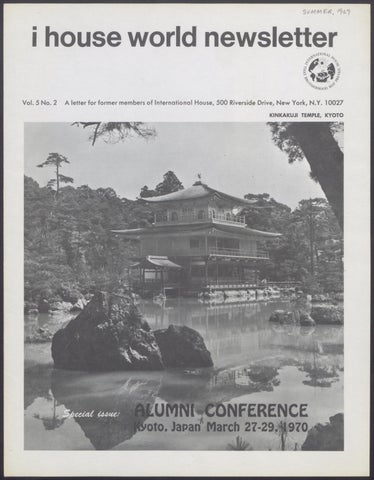
A letter for former members of International House, 500 Riverside Drive, New York, N.Y. 10027 KINKAKUJI
TEMPLE,
KYOTO n
Interview with Masaru
An Masaru
Ogawa,
’39 and
’54,
Ogawa
“free-loader.” If we are to continue to be protected by the U. S. militarily, what will we give in return?
visited
First, we can and should increase our
International House in May and lunched
foreign aid, especially to other Asian countries. There are problems involved here, as the U. S. well knows. We have
with a group of students and staff mem-
bers. Senior Editor of the Japan Times, Tokyo’s oldest English-language newspaper, he was touring the U.S. to explore attitudes toward the Japanese-American
been paying reparations, but to offer aid is different. What kind of aid do we give — money? materials? technical help?—and to whom? People may re-
Security Treaty and the future status of
give them help. Still, it is something we must do. A second way in which we can con-
sent or fear the ones
Okinawa. Discussion was lively at the luncheon, after which Mr. Ogawa was interviewed by Newsletter Editor Janice Crichton. The following report includes
tell us about student
A. We have plenty of student trouble in Japan—perhaps even more than you have here. The responsible Press tries not to make too much of it—no more than
is
necessary — because
ing ourselves for our own defense.
participation.
And
they
are getting
it.
The small group wants only destruction. Their think,
demonstrations and riots are, I more violent than the American
ones, Q. A lot of students here have been outraged when city and state police were invited to enter the campus and when they treated students as ordinary rioters.
Is this so in Japan? A. Yes, very much schools
as
an
themselves or to give added the students’ protests.
weight to
| Note: the present session of the Japanese Diet has been extended an unprecedented 72 days to consider legislation for control of student disorders. |
Q. The Treaty of Mutual Cooperation and Security between Japan and the United States becomes liable to termination on June 19, 1970, if either side so
desires. How do you think the Japanese people really feel about this? A.
I feel sure the treaty
will not be
terminated. The Socialist and Communist opposition will try to get the government to abrogate it. If neither side takes action, then the treaty will continue to remain in force. There will surely be student
demonstrations,
and
these
are
The
extraterritorial
use of
sanctuary
of a sort has long persisted in Japan, and many university administrators have been very reluctant to have police enter their campus even though they have had buildings blockaded and the school has been paralyzed by the violent minority.
involving not only our relations with the U.S. but our own Constitution. At what precise point do “defensive” weapons become “offensive” weapons? Even more important, at what point does the capacity to produce defensive weapons become a capacity to produce offensive weapons? This has yet to be worked out.
Q. (Japanese student): Many of the students I meet here ask about Japan’s relations with Red China. What are our present relations with China and do you think they are improving? A. For the past two years, since the Cultural Revolution, they have been get-
ting worse. been
Before then, our trade had
increasing.
Today
we
have
more
trade with Formosa than with mainland China.
However,
Japanese businessmen
cannot forget that there are more than seven hundred million potential customers over there. Now that a number of Western countries have begun to estab-
what we fear most, but again, different
lish trade contacts with China, they are
opposition groups want different things
getting even more anxious. So we will no doubt try to improve trade relations
and
I think
they
will not get together
enough to provide effective blockage of Then there is the question of Okinawa. Sooner
or
further. We did have a cultural exchange pro-
the treaty,
so.
This
is, of course, a very complicated matter
publicity
seems to feed the rebellious students. First of all, one must break up the dissenting group into parts. There is a small radical minority, perhaps 1-2% of the whole, which even the Communist Party in Japan condemns. The Communist and Socialist students want one thing really:
are able to
tribute is by assuming the cost of rearm-
parts of both conversations.
Q. Mr. Ogawa, unrest in Japan.
who
later,
it will
be
returned
to
Japan and many people feel it also should be covered by the treaty, which specifically bans nuclear weapons and the offensive use of U. S. bases on Japanese territory without prior consultation with the Japanese government. Okinawa is
gram, but that, too, has deteriorated dur-
ing the past two years. We also had arranged an exchange of news correspond-
ents—originally nine from each country — but that number has now been reduced
to three from each side. China kept recalling hers, one by one. Then, not long ago, five of our correspondents were
they
now used as a nuclear base and, of course,
kicked out—mainly
have been remarkably restrained. Even though they may know of a demonstra-
a base for operations in Viet Nam. If its reversion to Japanese rule takes place
curate reporting of the Cultural Revolu-
tion in advance, they will not take action
over a certain length of time, one would
untjl the students actually start breaking things or setting fires or hurting people.
hope that the Viet Nam conflict would be finished and the problem would be simplified. There is also the fear that Japan may be accused by Washington of being a
As
for the police, in my
opinion,
In part, I think this is because they are very concerned
about
they do not want
their image;
to create
also,
disorders
on charges of inac-
tion—and one was arrested. us even again.
That made
Q. Do you think increased trade will change
China’s attitude toward the rest
of the world? A.
I do
not
look
forward
to
much
3 change in China in the near future. “Mao
very honored to be given the opportunity
Tse Tung Thought”
to hold it.
(now a single Chi-
nese word) has been made its official ideology along with Marxism and Lenin-
ism. Deputy Chairman and Defense Minister Lin Piao has been named
officially
as Mao’s successor. And about half of the Chinese Communist Party leaders are now military men. I do not think increased
trade with other countries
will
Q. A major problem facing the entire
of these leaders.
Q. Then I gather Tokyo is no better off than New York. Is this a political problem? Why isn’t more being done?
Would
you tell us something of
the current political situation country?
in your
A. As you know, our political system calls for an election of the lower house—
the Diet—every four years, but the government can choose the most opportune time for them to dissolve the Diet and
call an election. We thought for a while that the education bills—the university control bills— might be a good issue for the election. There is a great deal of opposition to the student violence and the proposed laws, of course, violence.
are designed
to prevent
the
But it is felt now that perhaps the Okinawa problem will become the central issue. Our Foreign Minister plans to come to the United States in early June and then Prime Minister Sato will come to the U. S. in November. At that time, it is
hoped that the when and the how of the return of Okinawa—at least the general principles—will be decided. Perhaps that would be the time for the general elections to be held, when
Sato
comes
back and explains to the people how it is going to be. He will then ask the public to decide whether that course is acceptable or not. Q.
International House, as you know,
plans to hold its first all-alumni conference in Kyoto next spring, at the time of the opening of EXPO ’70. This will be the first “World’s Fair” ever to be held in Asia. Why do you think Japan has decided to hold the exposition at this time? A. I really don’t know much about it myself. I suppose that EXPO will be a sort of showcase for the economic development of Japan. Perhaps the question is rather why was Japan selected as the place to have it? Asia has never been represented, and why was it chosen at this time? We did bid for it, but the governing group chooses which country should sponsor it. I think Japan was
the
status
of women
is
Q. Mr. Ogawa, as Senior Editor of the Japan Times, you are in a position to influence a good many opinions. Do you believe that the experience of living at International House influenced your views, and if so how has it affected your work and your present interests?
A. Many things are being done, actu-
ally. There is a program in Japan to disperse the industries. Where you have industrial concentrations, you have polluted water and polluted air, so there is a program to distribute the concentration of industries to other parts of the country. Then all of us will have an equal amount of pollution, which is funny or perhaps not so funny.
I think
changing, gradually. It is true, of course, that Japanese men do spend much of their evenings away from the family. One thing which could be done is to cut out this expense account business. The expense account is really one of the facts of long standing in Japan.
A. The people in Tokyo are wishing they could see the blue sky once in a while.
Japan.
men.
would today, along with the population explosion, is environmental pollution. How is Japan attempting to deal with this?
have much effect on the thinking or plans Q. There have been rumors of a new national election to be held soon in
A. Well, we say that two things have become stronger since the War. One is women’s stockings and the other is wo-
A. My
views,
of course,
have
been
greatly influenced by my experiences during my two stays at International House,
rather
from 1937 to 1939 and again in 1953-54.
In some respects, the problem is one
tional minded. I feel that I do not have any prejudices because I have been in contact here at the House with so many people, so many races, and also because I have had many, many friends from
of enforcing
some
I think that I have become more interna-
of the laws we now
have. You see office buildings on a cold winter day with smoke billowing out. Certainly there is a regulation, as I understand it, that they must burn a certain quality of oil. And traffic is another thing. I don’t know. We just have to regulate trucks and large cars, or even restrict passenger cars from certain districts. We must do something.
many nations.
Q. Do you see these friends still? A. I correspond with them and I see them. In some cases, my daughter has visited them and stayed with them. I am not trying to say I think the world is a bed of roses. I don’t think everything goes along perfectly. But having known people from other countries, you can understand their positions better. So even if you do have differences,
Q. May I change the subject with a personal question? I confess to a certain amount of prejudice toward Japan because of the social position of women. Even today, one hears that Japanese men spend their evenings living it up at night
you don’t have to come to a confronta-
clubs while their wives stay at home with
the children. this?
I. HOUSE
Could
you
comment
tion with them. I think this is the best we can hope for.
on
SUMMER
NEWSLETTER
1969
Published by International House — New York Howard A. Cook, President L. W. Frohlich, Chairman, Alumni Council Janice Crichton, Editor SPECIAL ISSUE An Interview with Masaru
Ogawa
_..
2
Alumni Conference Planned for 1970 I
NN
NI
ae
ics oi Sk Soest ogsoes fp a ie
(Japan photos courtesy of Japan National Tourist Organization)
International House is a co-educational residence and program center for graduate students from all over the world. A non-profit organization, it is supported by voluntary contributions.
Alumni Conference Planned for International Education Year—1970 At cherry blossom time in Kyoto, Japan, just 15 miles from Osaka and a brand new
EXPO
'70, International House will hold its
first world conference of alumni to celebrate the International Education Year. The conference, tentatively titled ‘‘One World or None,”’ will concentrate on education as a tool for human understanding, and will seek recommendations from the
participants to be forwarded in a formal report
to
UNESCO.
International
one
of
a
of
number
House
organizations
is
hold-
ing NGO (Non-Governmental Organization) membership in the United Nations, sponsor
of the
International
Education: Year.
More than 250 alumni participate. Arrangements
are expected to have been made
for a charter flight from New York City and special
group
flights
from
other
cities,
to
arrive in Tokyo on March 25, 1970. In addition to the three-day conference, plans include ten days of sightseeing at EXPO '70 and in the cities of Kyoto, Osaka and Tokyo, with a departure date of April 7. Ground transportation and hotel accommodations for the group have already been reserved.
The Tokyo
Alumni
Council,
last
was
fall
the all-alumni
whose
meeting
in
postponed
in favor
of
gathering,
will meet
during
the conference along with area committees and representatives of the International Houses and Centers. All former House members and their husbands or wives are invited to attend. Area
committees and,
are urged
if necessary,
help with expenses. est be shown,
to select delegates
to raise money
locally to
Should sufficient inter-
group flights from
Depart for Japan.
New York
Charter Flight passengers check in at Kennedy Airport at 8:00 a.m. for J.A.L. Flight
#1
departure
at 9:00
brief stopovers at San
There
will be
Francisco and
a.m.
Hono-
lulu.
Losing one day crossing the Interna-
tional
Date
Line,
the
Tokyo on Wednesday
flight
evening,
will
arrive
in
Mar. 25.
Mar. 25 Wed. All conference participants arrive Tokyo International Airport. Transportation
to
hotels
Mar. 26 Thu. In the
provided.
Welcome
afternoon,
the
by Tokyo
group
will
alumni. travel
to
Kyoto on the Hikari super express, said to be the world’s fastest train. Transportation to and from train stations provided. Evening free for rest or sightseeing
CONFERENCE
Kyoto
International
Conference
Hall. Opened in 1966, it is located in scenic surroundings to the north of the city and represents the cream of modern Japanese architecture. The 3-day meeting is scheduled purposely over a weekend to avoid tourist crowds both in Kyoto and at EXPO '70. The Conference program, including speakers and discussion topics, will be decided at a meeting of the Planning Committee in late September and announced in the. fall issue of the Newsletter. Conference participants
will
be
informed
by
as
plans develop. Mar. 30 Mon. Tour EXPO '70. Members of the International House alumni group will be greeted at the Fair by EXPO '70 officials and given the ‘‘warmest possible courtesy” throughout
the
day.
Mar. 31 Tue. to Apr. 4 Sat. Visits to EXPO ‘70 or tour Kyoto and Kansai (West Central Japan),
“‘the cradle of Japan's
civilization.”
culture
for more
Imposing
shrines and temples
and
palaces
with elaborately designed gardens attest to its former glory and splendor. Today, with a population of 1,383,000, it is the fifth largest city in Japan and one of the country’s most important producing
centers
of
fine
silk
fabrics,
embroidery
work, porcelain and lacquer ware. It is also the education center of western Japan. The present city of Kyoto still benefits from the original plan of its streets and boulevards which were laid out in a modern checkered design more than 1,100 years ago.
Guided
tours
of temples,
arts and
crafts
centers
‘Kyoto Golden
Mar. 27 Fri. through Mar. 29 Sun. The First World Conference of International House Alumni is expected to be held at the handsome
Kyoto was the capital of Japan
than ten centuries, from 794 to 1868 A. D.
are
gardens
and
available,
with
prices ranging from $3.40 for a morning or afternoon tour of the city to $15.00 for the
in Kyoto.
additional
cities may be arranged. Details of travel arrangements, costs, and conference plans follow.
ITINERARY Mar. 24 Tue.
and
Night Tour.’”’
There are also
tours to Nara, national capital of Japan from 710-784 A.D., and other nearby cities. Apr. 4 Sat. Afternoon train (Hikari Express) from Kyoto to Tokyo. Apr. 4 to Apr. 7 Tue. Visit Tokyo and surrounding area. (Cherry blossoms should be at their peak in early April.) TOKYO The capital of Japan, with a population over 11 million, is the center of national administration, education and finance. For-
merly called Edo, the city was the seat of the Tokugawa Shogunate Government from 1603 to 1867. With the restoration of the Imperial regime in 1868, Edo was renamed Tokyo and became Japan’s national capital. the
Its charms are traditionally Japanese— classical Kabuki drama and Noh play,
centuries-old art objects in the museums, elaborately laid out landscape gardens, the Imperial Palace and grounds, and, of course,
gourmet
restaurants
and
world-
famous night clubs. All modern facilities are available to the visitor, and shopping can be done
even
at night and on holidays.
As in Kyoto, bus tours with English-speaking guides are available with pick-up service at all the major hotels. Prices are comparable with those in Kyoto. All day tours to Nikko National Park ($16.70), to Mt. Fuji (same price) and other scenic areas are also available. Hotel accommodations will be provided for the entire group in Tokyo.
Apr. 7 Tue. All participants depart Japan. New York Charter Flight will leave Tokyo International Airport late Tue. afternoon and arrive in New York (gaining a day crossing the International Date Line) around
AIR
other cities may be obtained from Departure
153 seats reserved Early reservations for this
accommodations while on the trip.
AIR
and
services
TRANSPORTATION.
not
used
Round-trip
econ-
omy jet fares are quoted. A minimum of 25 people is required to obtain the special
group fares. Reservations from other cities will be
Air
made
fares
changes
as
are are
registrations
subject made
to
are
received.
revision
if any
by carriers.
for
the
entire
group
have
been
seats
Group
flight
are
Flight....................
Me
FE
35
seats
reserved
ss...
MONG IN sin 35 seats reserved seats
Deposits
will be refunded in full if cancellations are received before December 31, 1969, or if
for any reason the conference itself is cancelled. Those registering after flight quotas are filled will be placed on a waiting list. After
December
31,
1969,
partial
refunds
will be allowed in accordance with a schedule to be provided unless alternates from the waiting list are available.
$740.00
$990.00
$905.00
$1205.00
$1455.00
$316.80
$616.80
$866.80
$1165.00
$1465.00
$1715.00
$633.20
$933.20
$1183.20
.. $1133.40
$1433.40
$1683.40
$713.10
$1013.10
$1263.10
25 seats reserved
TELE Re no
Cy by SMBROEIE seats
TN) seats
iipe tht 2 5 a
ew
ee ee reserved
Air fares are quoted international
ge
reserved
as of June,
1969,
and
are subject to agreements
reached
by
mate
a minimum
carriers.
tion; 3) Conference Fee of $50 per person. The travel agency recommends that each participant allow an additional $250 (minimum) to cover costs of meals, sightseeing tours and personal expenses. Thus to esti-
CANCELLATIONS AND REFUNDS.
recommended!
$440.00
Sydney (E) Overnight Hong Kong ...........
served basis. Single persons will be assigned roommates unless they specify another registrant with whom they wish to
registrant on receipt of the deposit.
$1050.00
reserved
Lines; 2) a charge of $250 per person for hotels, transfers and ground transporta-
to each
$800.00
$1105.00
Santiago, Chile (E) Overnight Los Angeles
age charge for each registrant, with rooms assigned strictly on a first-come, first-
REGISTRATION. Your registration form is enclosed with this Newsletter. Reservations may be secured by sending a deposit of $100 per person. The balance of payment is specified in ‘‘Total Tour Charges” below. Additional tour information will be mailed
$500.00
$855.00
a
COSTS. Total Tour Charges (less $100 deposit) are payable to International House on or before Dec. 31, 1969. These charges include: 1) Round trip air fare via Japan Air
MEALS. No meals or tours are included in the package fee except those specified in Itinerary. Conference meals (current plans include two luncheons and two banquets) will be served free of charge to participants.
Min. Trip Budget
$555.00
ac
made at the Kyoto Oriental and the Kyoto Hotel. Room rates (double occupancy only) vary from one hotel to another, with an average charge of $10.00 per person per night, plus $2.00 tax and service charge. Note. The package fee includes this aver-
share a room.
Total Tour Charges
reserved
rape
30
Air Fare
strongly
Honolulu Group Flight 35 seats reserved
no
HOTELS. In Tokyo (4 nights) reservations have been made at the following hotels: Akasaka Tokyu, Tokyo Prince, Tokyo Hilton, Palace, Daiichi. In Kyoto (10 nights), reservations
Francisco
35
NOTE. The arrangements for this itinerary have been made to satisfy, as much as possible, the specific needs and interests of this group. No refunds can be made for
COSTS
any international airline.
Point
New York City Charter Flight....................
San
INFORMATION
LAND
Trip costs from a number of cities are listed below. Where group flights are not available, normal (N) or excursion (E) fares are given. Fares from
6:00 p.m. on Tue., April 7.
GENERAL
AND
your total trip budget,
of
$550 should be added to the round-trip air fare from your departure point. TOURIST INFORMATION. Japan National Tourist Organization offices are located in the following cities: New York, Chicago, Dallas, San Francisco, Los Angeles, lulu, Toronto, London, Hong Kong, kok,
Paris,
Geneva,
and Sao Paulo.
Frankfurt,
Mexico
HonoBangCity
6 WHAT’S GOING ON ...
(Upper left) Asha Coorlawala of Bombay,
India, Alumni Scholarship holder for 1968-69, carries her
(Upper right) Jose (Tito) Vertiz of Peru records a big pledge during N.Y. Area Phone-alight from the Candlelight Supper. thon. Tito’s enthusiasm won him Ist Prize—a free trip to Denmark—for the volunteer raising the most money. Phone-a-thon
raised $4,166 for the Alumni Fund. scribes
his country
to ninth
grade
(Lower left) Greg Aruede, New
Yorkers
Carnegie
as part of |. House
Endowment
Classrooms
Fellow
International
in Diplomacy project.
from
(Lower
Nigeria,
right)
de-
Marshall
Visitor Eugene V. Rostow talks with |. House Board Chairman John J. McCloy.
Alumni Harry 1935,
still
Edmonds,
Director
from
1924
to
Dr. Evangeline M. Thillayampalam, Cosmopolitan Club ’22-’25, is back in Ceylon after many years in India and other parts of
visits
House
occasionally
to
the
Notes the
inspire us with his perfect posture and pithy anecdotes. He has plenty of hollyhock seeds left and would be glad to send you some, as a gesture of friendship, on request. (See Newsletter, 9/67). His address is: R. D. #2,
world.
She
works
at a residence
centre
for girls in Maruthanamadan, Chunnakan, which she describes as just a night’s journey from Colombo (about 250 miles). Visitors are
most
wlecome.
Felicite
Hoffman
Rev. H. J. S. Howey ’25 has lives in Owen Sound, Ontario.
Zoe ‘Mass.,
retired
and
Demetracopoulou ’25 of Cambridge, wrote that she still reads and enjoys
the Newsletter.
An Alumni Fund contribution from Guiseppe Genovese ’27 and Antonietta Ruffo Genovese
’28 of Palisades
Park,
N.
J. came
Lyons, N. Y. 14489. Rev. Dr. Cumming Thom, Cosmopolitan Club ’22, is now retired and lives in Ashfield, N.S.W., Australia.
J.,
with the following note: “. . . I have given all
writes with news of another alumnus: “Rey. Marcel Brun ’24, for many years the spiritual leader of the Eglise Americaine du Saint-
people of my native town, Bisacquino, Sicily,
Julia Desmet, Cosmopolitan Club ’23, wrote us from Wemmel, Belgium: “Every time the Newsletter reaches me I read it from
de Guyenne France.”
end to end and find myself back in the old days, 46 years ago.”
Inez Wenz, Cosmopolitan Club now lives in Porterville, Calif.
’27
of
Elizabeth,
N.
Esprit in Nice, is now teaching at the College
in Sainte-Foye, near Bordeaux,
my by
savings donating
the
education
a library.
of
the
Its dedication
young in the
fall of 1966 was reported even in the American newspapers.” Marian
’20-’25,
for
E.
Madigan
’27
is director
of
a
counseling center at Drake College, Ft. Lauderdale,
Fla.
7 Louise Hawkes Padelford ’28 is a Trustee of the Blaisdell Institute, affiliated with the Assoc. Colleges of Claremont, Calif. She writes that the Institute offers advanced study in World Cultures and Religions—a direct relationship to early days at I. House! Dr. Herrick B. Young ’28 retired this year as President of Western College for Women in Oxford,
Ohio.
He will spend the next two
years as consultant to the Preident of Tunghai Univ., Taichung,
Taiwan.
Irene Ho Cheng ’29 has left Hong Kong to settle near her married daughter and new grandson in San Diego, Calif. After receiving her Ph.D.
in Education
she worked moving to
from
London
Univ.,
in Canton and Nanking before Hong Kong. Having “retired”
twice, she now teaches Chinese Language and
Culture and English as a Second Language to Chinese
adults,
and
lectures
at the Univ.
of
Calif. in San Diego. She has taught a T.V. classroom in San Diego and serves on the board of the Mental Health Association. Co-winner (with Norman Mailer) of the Pulitzer Prize for general non-fiction was microbiologist Dr. Rene Jules Dubos ’29 for his study, “So Human an Animal: How We Are Shaped by Surroundings and Events.” Born in France, Dr. Dubos is now a professor
at Rockefeller Univ. in New York. Marjorie Jacobs Banks ’30 of Syracuse, N.Y., writes: “Retirement brings a new chapter as Executive Secretary of the U.N. Assoc. of Central New York. This followed many years as an administrative social worker for the N.Y. State Welfare Dept. Travel to 60 countries looking at U.N. projects and absorbing history turned out to be excellent preparation for ‘retirement’.” Charlotte Nissiat le Sourd ’30 wrote us from France, telling about her family and her present life. She was president of the French Group while at the House and reports that she has seen and entertained many I. House friends since then. Leng Smith ’30 has retired after teaching in the public schools of Westfield, N. J., where he still lives. George Butler ’°31 of Camden, Delaware, is also retired after teaching Science in Delaware high schools. Dr. Mary Margaret Barr Koon ’31 of Portland, Indiana, reports that her latest book, “Forty Years of Voltairian Studies, 19261965,” was published in Paris last year. Ruth Burlingham Loomis ’34 offers Western hospitality to I. House Alumni traveling through Forest Grove, Oregon. Ralph and Muriel Warren ’34 are both working at Washington University in St. Louis, Mo. He is a professor of Social Work; she is a senior research associate. Philip M. Burnett ’35 is Director of Libraries for the University of Wisconsin-Parkside,
a new campus in Kenosha due to open for students in Sept. 1969, Allie Miller Holley Hubert ’37 of Wilmington, Del., is a member of the Far East Interdisciplinary Seminar of Western College for Women in Oxford, Ohio. She planned to see Olive Lee Chang and Marjorie 37, while in Honolulu in May.
Wong,
both
Roberta McKay Liusardi ’37 is Permanent U.N. Representative for the International Chamber of Commerce in New York. Florence Steinhorn Sinclair ’37 is presently Director of Volunteers at the Jewish Board
of Guardians, N.Y., an agency for emotionally disturbed children. Roberta Foote ’38 has retired as Director of Public Health Nursing for the Kansas State Health Dept., a position she held since 1960. She lives in Topeka. Rey. John Austin Jardine ’39 of St. Stephen, New Brunswick, Canada, writes: “In a world that is facing so many disruptions it is most encouraging to belong to such an organization as International House.” Lois Hamilton Tennent °39 is faculty advisor to the Int’l Relations Club at Spartanburg (S.C.) Junior College, where she teaches European History. During the past five summers she has organized and led European tours and says she has an even greater appreciation of the I. H. now. Dr. Roman S. Gorski ’40 is a professor of Economics and Business Administration at Mars Hill College in No. Carolina. He is also a professional financial counselor and author of numerous books on investments. Kay Clary Corinth °41 is Merchandising Director of Seventeen Magazine and coauthor of “Male Manners—the Young Man’s Guide,” published in April, 1969. She received a “Distinguished Alumni Award” this spring from Oklahoma City Univ. Therese-Marie Trudel ’41 is a pianist and teacher in Shawinigan, Quebec. Dr. Elizabeth Boyd ’42 of DeLand, Fla., has recently returned from South America. Ambrose Cort, Jr. ’42 of New London, Conn., has retired from the Babcock and Wilcox Co. and is teaching engineering at the U. S. Coast Guard
Academy.
Barbara Holmquist ’42 has moved to London, England, where she will continue her profession as a concert pianist, writer on musical subjects and teacher. Mary Agnes Kelleher Walsh ’42 is on the faculty of the School of Education at San Diego State College, Calif. Edward Wasserman ’42 teaches music in a high school in Clifton, N. J. Ethna Beulah Winston ’42 is Director of the Educational Resources Center at Calvin Coolidge High School in Washington, D. C. and participated in the Sixth Conference on International Education in Washington in Feb., 1969. Edith M. L. Herrmann ’°43 of Elizabeth, N. J., will be listed in the First Edition of “Two Thousand Women of Achievement” (English publication) next fall. Howard K. Holland (Staff °38-’43) and Eva Maria Cox ’64 were married in Munich in 1966. Howard is Higher Education Advisor in USAID, Saigon, and Eva and the children will live in Manila in “Safe Haven” until after the war. Anne Guerrant Green °45 is teaching Textile Design and Weaving at the Univ. of Kentucky. Sarah Dunning Schear 45 is educational director at the Belmont United Methodist Church
in Belmont,
Mass.
She has two sons,
ages 12 and 15. Emma Broisman ’46 has been named Area Officer of the I.L.O. Regional Office for Asia in
Bangkok,
Thailand.
Edith History
Tatnall °47 is an Asst. Prof. at Metropolitan State College
Denver,
Colorado.
of in
Prok Amranand °48 of Bangkok is in charge of trade promotion work of the U. N.
Economic Commission for Asia and the Far East. He continues to be President of the Young Buddhists Association of Thailand and
Honourary
Asst.
Secretary-General
of
the World Fellowship of Buddhists. Victoria Herrera Bossio ’48 is one of the first two women Ph.D.’s in Colombia. A child psychologist, she practices in Bogota. Dr. Ralph Gordon Hoxie °48, former Chancellor of Long Island Univ., has been named Chairman of the Human Resources Center (Albertson, L. I.) Fund Drive. The campaign will finance a new research and educational facility for the Center, which provides training for handicapped and mentally retarded children and adults. Mary Ellen Hege Radford ’49 is now a Rehabilitation Counselor at Grace Wood Hospital, Augusta, Ga. Lelia Jaffe Zamir °49 is Director of Programs in Health at Cleveland College, Case Western Reserve Univ., Cleveland, Ohio. Her
book, “Expanding Dimensions in Rehabilitation,” has just been published. Richard J. Kempe ’50 is an industrial economist with Copley International Corp., FX. Dhanraj Ramphal ’50 of West Nyack, N.Y., reports flying to India this spring to buy merchandise for a store he is opening this September. William D. Wolle ’51 is now Counselor of Embassy, U.S. Embassy, Kuwait. Since leaving I. House he has been a U.S. Foreign Service Officer, serving in Baghdad, Manchester, Beirut, Aden, Jidda and Washington, D.C.
Marion Pool ’52 is a Professor and Chairman of the Dept. of Public Health Nursing at West Virginia University, Morgantown, W. Va. She is listed in “Who’s Who of American Women,” 1967 and 1970, and is a Fellow of the American Public Health Assoc. Dr. Amir H. Biniaz ’53 is in private practice as a dentist in Wantagh, N.Y. His wife, Celina Karp Biniaz, ’53, teaches in Wantagh elementary schools. They have two children, Robert,
14, and Susan,
11.
Wilton S. Dillon ’53 has been appointed Director of Seminars for the Smithsonian Institute, Washington, D. C. After more than 20 years in college education, Katharine A. Bonney °44 and °54 returned to her home area in 1964 to become head of a girls’ college preparatory school in Stamford, Conn. “Education today is equally challenging at all levels.” Robert Olson ’54 writes that he is interested in World Government development and wonders if other I. H. members share this view. Lynn Rasmussen Owen ’54 is now a leading singer in the Zurich Opera House. She is married to attorney-composer Richard Owen and
has
two
sons,
Carl
and
David.
Norman L. Sweet ’54 is serving as Senior Program Officer for the U.S. Special Aid Mission to Tunisia. In May, William H. Bittel °55 became Asst. Public Affairs Officer for the Third Naval District, in N. Y. Catherine King Clarke °55 teaches Music in the public schools of Hartsdale, N. Y. and has three children. Ceferina C, Cordero °55 of Isabela, Puerto Rico, plans to visit 13 countries in Africa this summer under the sponsorship of the National Education Association.
H. E. Mohammad Mousa Shafiq Kamawi *55 has been named Afghan Ambassador to the U.A.R. Ernest H. Rosenberg ’55 was married in November to Anna Jane Warshaw, an advertising writer. They live in N.Y.C. John D. K. Sundarsingh ’55 is Principal of Scott Christian College in Nagercoil, South India. Rose T. Kinney ’56 is now a Specialist in Social Studies for the Baltimore, Md., Public Schools. William A. Knowlton ’56 has been promoted to major general in the U.S. Army. He recently returned from two years of service in Vietnam where he won 15 U.S. decorations, the Vietnamese National Order, and the Viet-
namese now
Gallantry
stationed
with
Palm.
in Washington,
Cross
D. C.
He
is
M. A. K. Panchasi ’56 is Sales Manager of Bralco Metal Industries Private Ltd., in Bombay, India.
John E. Rexine ’56, professor of classics and chairman of the department at Colgate Univ., Hamilton, N. Y., is one of three Americans elected this year to honorary membership in the Greek Society for Humanistic Studies in Athens. He has been a member of the Colgate faculty since 1957. Florence Helen Ashby ’57 is teaching at Montgomery College in Rockville, Maryland, as is another I. House alumna, Gloria Monterio ’53. Jess Heinritz ’58 of Manhattan Beach, Calif., spent a 4-month sabbatical last year in Mexico, Central and So. America and the Caribbean Isles. “I speak Spanish so exchange of ideas was great!” J. Harold
Bennett ’59 has opened
an office
m East Orange, N. J., for the practice of Orthopaedic Surgery. He has a daughter, Elizabeth, born Nov. 6, 1967. Neil McKelvie ’59 is now a professor of Chemistry at City College (City Univ. of New
York).
neck (N.Y.) Chapter of the U. N. Association. A professional social worker, she is supervisor of preventive services with the Division of Family and Child Social Services in Mt. Vernon. She is also past president of the Mamaroneck-Larchmont Branch of the NAACP and a former member-at-large of the N. Y. State NAACP. Dr. Kenneth J. Lippman ’61 has just begun a 3-year residency in Medicine at the New York Hospital-Cornell Medical Center in New York City. In 1967, he and his wife (who has a B. S. and R. N. from Cornell) both joined the Army as a medical team and went to Japan to work in one of the evacuation hospitals which care for the severely wounded from Vietnam. He writes: “Our 2-year tour has been most rewarding professionally and has enabled us to visit Hong Kong,
Cambodia,
Thailand,
India
and
Ne-
pal, as well as much of Japan.” Dr. John H. M. Chen ’61 has been appointed Director of Libraries and Professor of Education at Wisconsin State University, Stevens Point, Wis. Dr. Louie Hamilton
’64 of London,
Eng-
land, visited I. House in June with her husband and 3-month-old baby. She has been organizing Sunday Suppers, but finds it increasingly difficult to locate new alumni. (London alumni take note!) Mary Olmsted ’64 is working
a Ph.D.
Norman and Rhoda Singer ’64 were in Dar es Salaam, Tanzania, from 1966-68. Norman
worked as a finacial adviser in the Ministry of Finance while Rhoda did psychiatric social work in the government hospital. They now live in Arlington, Mass. Mario Guarneri ’65 is Asst. Ist Trumpet with the L. A. Philharmonic and a member of the Los Angeles Brass Quintet. He also teaches at Claremont College. King,
Staff
’65,
now
Mrs.
Jeffrey
Elroy and Margaret Thiel ’59 are moving to Utica, N. Y. where Elroy will be teaching at Utica College beginning in September, 1969. George (Varghese) Varky ’59 is now a Research Economist for Planned ParenthoodWorld Population, in N.Y.C. Doris Abramson ’60 has written a book, “Negro Playwrights in the American Theatre, 1925-59,” published this April by Columbia Univ. Press. She lives in Amherst, Mass. Rachel Katzenstein Manor ’60 would be glad to welcome I. H. visitors to Kibbutz
Parson, lives in Edgewater, N. J., where she is caring for her 3-year-old daughter, Miranda, and a new baby. Knarig Khatchadourian Meyer ’65 is presently an Instructor of Nutrition at the School of Nursing at Easton Hospital, Easton, Pa. Virginia Montoya-Arce ’65 is now a Pro-
Mushmar
that he recently visited Cambridge, England, while attending an economic conference. David Whitcomb ’65 will be leaving the
Kaemek
in Israel, where
she
lives
and works as a social worker. Ammu Menon Muzumdar ’60 writes: “We attended the 14th International Conference of Social Work, held in Helsinki, Finland, in August, 1968.” Barbara Teelucksingh ’60 is a working Director of her family company, Teelucksingh Theatres, Ltd., which owns and operates movie houses in Port-of-Spain, Trinidad. Ralph J. Votapek ’60 wrote that he was appointed
in Sept.,
1968,
to the
music
faculty
of Michigan State Univ., while continuing to concertize throughout No. and So. America. In June,
1968,
Dr.
Rita
Chow
’61 joined
the U.S. Public Health Service commissioned corps as a nurse consultant. Selena Meredith Grissom ’61 has been elected president of the Larchmont-Mamaro-
fessor
of
Humanities
at
the
University
of
Puerto Rico. David L. Murray ’65 was recently made Asst. to the President of General Dynamics Corp., home based in N. Y. Edward J. Powers, Jr. 65 of N.Y.C.
Rand
Corp.
of Santa
Monico,
Calif.,
writes
to be-
come an Asst. Prof. of Economics at the Business School of N. Y. U. Jaime Yumiseva ’65 is now an engineer with LIFE, a pharmaceutical manufacturing affiliate
of
Dow
Chemical,
Margot Harrison ’66 is the conductor of the
Millberry Singers of the Univ. of Califi Medical Center in San Francisco and also is conductor of a small but growing chamber orchestra at the I. House in Berkeley.
Laura Lee ’66 (Lan Fen Tung Lee) of Taiwan wrote to tell us that staying at International House will be an unforgotten memory in her life. Christopher Sager ’66 is a professor of Piano at Birmingham Southern College in Alabama. He is spending this summer in Vienna and Salzburg and will be soloist with the Birmingham Symphony on Jan. 27, 1970. Dr. Bela Balazs ’67 wrote that he was promoted to assoc. professor in the Dept. of Astronomy at Roland Eotvos University, Budapest,
Hungary.
Joan Fuerstman ’67 is now the mezzosoprano with the New York Pro Musica, touring and recording with the group of ten. They will spend a month in South America this summer. From Bombay, India, Akshani Kumar ’67 writes: “I am presently engaged
on
in English at the Univ. of Denver and teaching Freshman English.
Diana
graduate student at T. C. ~ Nancy Perry Harris ’66 is working parttime as an Occupational Therapist at the Meeting Street School in Providence, R. I. The rest of her time is taken up with 1-yearold daughter, Amy.
Quito,
Ecuador.
He returned to Ecuador in 1967, after working for a year in Connecticut as an International Enterprise Fellow. Giles Chitty ’66 writes that he is still working for Allied Chemical International in New York as Manager of Economic Analysis. His wife, Ricqui is directing a community service organization storefront on the Brooklyn waterfront in a Puerto Rican neighborhood. Carol Flomerfelt ’66 tells us she is still a
in the manu-
facture of packaging materials for the pharmaceutical companies. Very shortly we will be diversifying by entering the food processing industry, with American collaborations.” His firm is the Akshani Steel & Casting Corp. James
Toedtman
°67
writes
that
he
and
Haydee Sicard ’67 will be married Aug. 23 in Buenos
Aires,
then
return
to Long
Island.
Thierry Verhelst ’67 has accepted a teaching assignment in Ethiopia. He hoped to visit Japan,
Hong
Kong,
Vietnam,
Cambodia,
In-
dia, Tibet and Nepal on his way there this spring. Simon Barsky, Staff ’67-'68, is a candidate for Democratic District Leader on the West Side of Manhattan.
(Note: he won!)
Jose Cazorla ’68 of Grenada, Spain, wrote to say that he has become “profesor agregado titular” of Political Sociology in the Dept.
of
the
Faculty
of
Laws
in Grenada’s
University. He describes it as “the equivalent to full professor junior with the possibility of soon becoming professor senior.” Henry Drewal ’68 is an Adm. Asst. in the Afro-Anglo-American Program in Teacher Education in N.Y.C. He will lead an Experiment in International Living group to Uganda this summer. Lawrence Etigson ’68 writes: “I am working towards a Ph.D. at the Univ. of Waterloo, Ontario. On observing the number of foreign ' students here, I set up a program like the English-in-Action at I. House, in which over 100 students and professors participated.” From Argentina came a letter from Sara Arguello Pitt ’68 congratulating the House for all it is doing to help brotherhood prevail, and including a few pertinent suggestions of her own. Yoav Talmi ’68 of Israel is now Asst. Conductor of the Louisville(Ky.) Symphony Orchestra. He conducted the Cosmopolitan Young Peoples Symphony Orchestra at Philharmonic Hall in N. Y. on March 8, 1969, and has been invited this summer to conduct at Tanglewood under a full fellowship.