| house world newsletter TION
& ge
i
~
\/ We=
A.
re ANS
=|
5 we bos)
%,
vol.4
erry e)e) »
>
a letter for alumni of International House, 500 Riverside Drive, New York, N.Y. 10027
no. 1
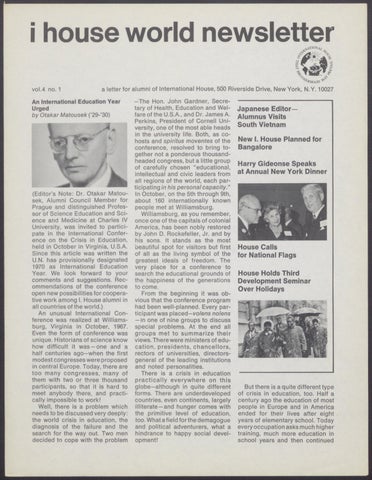
An International Education Year
Urged by Otakar Matousek (’29-’30)
x (Editor’s Note: Dr. Otakar Matousek, Alumni Council Member for Prague and distinguished Professor of Science Education and Science and Medicine at Charles IV University, was invited to participate in the International Conference on the Crisis in Education,
held in October in Virginia, U.S.A. Since this article was written the U.N. has provisionally designated 1970 as International Education Year. We look forward to your
comments
%
and
suggestions.
Rec-
ommendations of the conference open new possibilities for coopera-
tive work among |. House alumni in all countries of the world.) An unusual International Conference was realized at Williamsburg, Virginia in October, 1967. Even the form of conference was unique. Historians of science know how difficult it was—one and a half centuries ago—when the first
modest congresses were proposed in central Europe. Today, there are too many congresses, many of them with two or three thousand participants, so that it is hard to meet anybody there, and practically impossible to work!
—The Hon. John Gardner, Secretary of Health, Education and Welfare of the U.S.A., and Dr. James A. Perkins, President of Cornell University, one of the most able heads in the university life. Both, as cohosts and spiritus moventes of the conference, resolved to bring together not a ponderous thousand-
headed congress, but a little group of carefully chosen “educational, intellectual and civic leaders from all regions of the world, each participating in his personal capacity.” In October, on the 5th through 9th, about 160 internationally Known people met at Williamsburg. Williamsburg, as you remember, once one of the capitals of colonial America, has been nobly restored by John D. Rockefeller, Jr. and by his sons. It stands as the most beautiful spot for visitors but first
of all as the living symbol greatest
very
ideals
place
for
of the
of
freedom.
The
a
conference
to
search the educational grounds of the happiness of the generations
to come. From the beginning it was obvious that the conference program had been well-planned. Every participant was placed—vol/ens nolens
Japanese Editor— Alumnus Visits South Vietnam New I. House
Planned for
Bangalore Harry Gideonse Speaks at Annual
New York Dinner
House Calls for National Flags House Holds Third Development Seminar Over Holidays
—in one of nine groups to discuss special groups
problems. At the end all met to summarize their
views. There were ministers of education, presidents, chancellors, rectors
of
universities,
directors-
general of the leading institutions and noted personalities. There is a crisis in education practically everywhere on this globe—although in quite different forms. There are underdeveloped
But there is a quite different type
countries, even continents, largely
of crisis in education, too. Half a century ago the education of most
illiterate —and
people
Well, there is a problem which needs to be discussed very deeply: the world crisis in education, the diagnosis of the failure and the search for the way out. Two men
and political adventurers, what a hindrance to happy social devel-
ended for their lives after eight . years of elementary school. Today every occupation asks much higher training, much more education in
decided to cope with the problem
opment!
school
hunger
comes
with
the primitive level of education, too. What afield for the demagogue
in Europe
years
and
and
then
in America
continued
learning throughout adult life. This educational system is not now able to cope. In this disparity between the needs of today’s society and
International Education Year will be proclaimed by the United Nations, we are sure. In fact, it has already been provisionally designated for 1970 at the U.N. It will be a great year for International House
the capability of the educational
students
system
the world. We all know what education has given to our life. There are young people, however, who have never seen a school. They, as well as students who are in class-
means a
real strain to educational
programs—one
with
lies today’s
which
the
crisis.
Let us mention only the problem of adult education, a problem important to most members of International House; and let us take the U.S.A. as an example. During the last decade the number of students in colleges has doubled —but how to expand classrooms, dormitories, everything; and how to get so many new and good instructors imme-
better help
the
elusive
guerrilla
fades into the jungle.... This suggests then that one way
to convince the peasantry that it is indeed in its best interests to sup-
help to change the world into a world of intelligent, good and free
port the Government. But it will take time—lots of it. In the long run, however, the winning over of the
revolts
type of college.
to speed
On
up
the
other hand, students are not expe-
to work
whole system positively. We can’t solve those
often
Support and celebration of the In-
Student
enough
more
who darts in and out of villages, or
ternational Education Year by these learned and dedicated alumni will
the
rienced
rooms today, will live a great part of their lives in the 27st century. In the education of modern teachers with modern methods to meet this rising tide of youngsters lies the important way out of a world crisis. The Alumni Council will meet this year. What a program to unite thousands of |. House members!
in-
of old-
involvement for undergraduates. new
throughout
curriculum
satisfied with the methods
timers, are asking for modern and
alumni
by either the Viet Cong or the Government. Traditionally, the farmers have remained politically neutral in times of strife, but they will support the side which can assure them a peaceful existence.... It is the nature of the war in Vietnam today that a decisive, crushing victory in the military sense cannot be achieved. The enemy may mass his forces at some points, but he is
of immobilizing the Viet Cong would be to cut them off from their refuge among the peasants in the villages and hamlets. This will require patient and laborious efforts
diately? We understand why students revolt, because they, not structors
and
want peace—and a chance to work their farms without being harassed
people everywhere!
out the My Recent Visit to South Vietnam problems
by Masaru Ogawa
(’37-’39, ’53-’54)
peasants may prove to be the decisive factor in the war. Fortunately, the Government
of educational crisis at a three-day meeting. Even the Conference was not able to do more than to analyze
seems aware of this and is giving high priority to the task of presenting a better deal to the farmers
the extent of the problem and to rec-
through the Revolutionary opment program.
ommend an Education Year. This was the first step and let us hope
The aims of the program are to free the people of Viet Cong control, to initiate political, economic
that all countries of the world will join to support the noble proposal
of the Williamsburg Conference to the United Nations to declare an International Education Year. The day before the final meeting an
unexpected
guest
came
to
shake hands with participants, to take dinner with them,
and then—
quiet, serious, unsmiling—to speak. It was the President of the United States. Once a teacher himself, he felt that “no gathering anywhere has a subject more urgent than yours.” There are friends and adversaries of President Johnson’s politics, as of any politics. But the President
did
not come
to speak
about the political problems. “The men of Jefferson’s day associated Williamsburg with liberty—and learning. We have the same concern. Let us hope that our commitment will be as great as theirs, and our achievements as worthy of re-
membering.” The presence of the President was symbolic of the importance of the Conference.
Devel-
and social development, to extend
effective government authority and Masaru
Ogawa
(Editor's
addressing
Note:
Last
alumni
to win the support of the people. To accomplish this, thousands
Masaru
of young Vietnamese are being trained to go into the hamlets, live with the people and give them necessary guidance. As it was ex-
Tokyo
fall,
Ogawa spent eleven days in South Vietnam touring the country and talking with chiefs of state, military leaders and citizens. The trip gave rise to a series of nine articles on life in Vietnam published in the Japan Times, of which he is Execu-
tive Editor, and was the subject of a speech given by him to Japanese
alumni at their annual International House Day luncheon, held November 10th in Tokyo. Mr. Ogawa has given us permission to reproduce here, excerpts from his reports to
his Japanese readers.) The longing for peace runs deep and strong among the people of South Vietnam. This feeling extends from President Nguyen Van Thieu to the peasants in the countryside. The vast majority of the peasants
plained by Gen. Thang, Minister of
Revolutionary Development, 30,000 youths, divided into 500 teams of 59 men each, will be in the field by the end of the year. They will make friends with the farmers, build up a community spirit, distribute seed and fertilizer, encourage education, spread knowledge of health and sanitation and build roads and irrigation systems.... They will also do one other thing. That is to stir up a feeling of patriotism as Vietnamese citizens and as proud inheritors illustrious past.
of a rich and
As Nguyen Be, a Sorbonne graduate and one of the 600 Vietnamese
instructors at Vung Tau, the Chi Linh Revolutionary training camp, explained it, the students undergo a 14-week training program which teaches them to become wholly self-sufficient in living off the land. “We want them to be tough and hardened to adversity,” Be said. “We depend too much on foreign help. Thus, we must give to our
is tragic, and it is cause for impa-
1967 in the Campus
tience to find a quick solution. There is an old Japanese proverb, “Isogaba maware.” (If in a hurry, take the long way.) It may be appli- cable to Vietnam today. To win the confidence and trust of the peasants may be the long way around, but it may prove to be the shortcut, after all.
mira College. The speaker was Dr. Grant Northrup, a recently returned exchange professor from the Uni-
students a new spirit of independence and self-sufficiency. This is the only way to build Vietnam.” Be said that great emphasis was being placed on the study of Vietnamese history, “so that the trainees will awaken to their proud heritage.” This was reflected in the names given to the hamlets built by the students. They included Hung Vuong, Le Loi and Hung Dad, all legendary heroes who either united
the nation
In the last issue of the newsletter
New Council Member for Pakistan Representation
on
Council
a new
reached
the
Alumni
peak
of
trol and set up a local government picked by the people themselves. It trains a people’s militia so that
the hamlet will be able to defend itself. It hears grievances and enforces remedies. Then, it tackles the problem of bringing social well-
Co-Managing Director of the Orient Trading (PAK) Corporation and a Director also of Searle, Ltd. and USA Laboratories, Ltd.
first things the team does is to root
out all remnants of Viet Cong con-
being and economic
Area
The expansion of the Revolutionary Development program to im-
prove the welfare of the farming points
whose service and achievement in fields related to |. House goals are of special interest. In this issue we would like to tell you about Behram Sidhwa ('38-’39) and the ambitious task he has set for himself and the
alumni community of Bangalore. Although Mr. Sidhwa had kept us informed by mail throughout the summer of alumni developments in Bangalore,
it was
not
until
he
visited New York in October—and spent
several
hours
“brainstorm-
ing” with key staff members —that we learned the details of a project to build an International House in Bangalore.
prosperity to
the community....
communities
his impressions of India. Miss Andrea Meilly, astudent at Elmira who received our Harry Edmonds Brotherhood Award, will spend her junior year abroad at the University of Paris.”
we inaugurated under this heading a series of profiles on alumni
thirty-three members with the recent appointment of Ghulamali Kassimali Panjwani (’55-’57) as Council Member for Pakistan. Mr. Panjwani was a member of International House while a student at the Graduate School of Business Administration of Columbia University. A resident of Karachi, he is
and shovels. Each man has a definite mission to perform. One of the
versity of Calcutta, and he gave us
In the News...
or fought off invaders
from the north. When a 59-man RD cadre group moves in to secure a hamlet, it is armed with rifles as well as picks
Center at El-
in this direc-
tion. By opening up a new life for them, the peasants are given a real stake in the national efforts. It will matter very much to them that the
Government will win. The prosperous farmers of Dalat, who refuse to give the Viet Cong a foothold in their community, is a case in point. The real breakthrough will come when the hamlet people in such
areas throw off their fears and themselves begin to call upon the RD to send teams to help their selfdevelopment. This has not come yet. But the program has been operating for only one year, and one must not be impatient in Vietnam.
In the meantime, the military phase of the war continues. And valuable lives are being lost. This
Committee
Notes
Some news of alumni gatherings held recently in: India—V.T. Krishnamurthi ('48-’49) writes: “... There have been quite a number of activities of our alumni association.... During November, 1967, at the residence of William D. Miller, Counsellor-Minister, USIS, Delhi, the members were shown color slides of his visit to Vietnam. Then during the visit of the Philadelphia String Quartet to Delhi recently...members played hosts to the visiting artists.... We are also inthe process
of sending you a consignment of gift articles which after sale may be included as our little contribution to the Alumni Fund.” Elmira, New York—Timothy
Mr. Sidhwa’s dream
dates back
to 1936. After earning a B.A. with honors from Bombay University and completing studies at the London School of Economics, he came to New York to attend Columbia University and the American Institute of Bankers. Two of the four years he studied in New York were spent at I. House. It was then that the determination took root to cre-
ate a similar center in India that would offer foreign students hospitality,
the
opportunity
to
learn
about Indian life and to communi-
Davidson ('32-’38), President of the
cate
Chapter, reported: “The Elmira Chapter of International House held its annual meeting in October,
dents of diverse backgrounds.
with
Indians
Mr. Sidhwa
and
other
stu-
returned to India in
1940 to begin a career in Finance
then
to
Later, in 1964, he was appointed to the special Rotary Extension Advisory Council. Mr. Sidhwa’s association with
Rotary may prove to be the means for turning his dream of building an |. House into a reality. As Chairman
of the Bangalore Chapter’s World
accommodate
100
students
and
include a cafeteria, gymnasium, shopping center and ahostof other facilities for the convenience of its residents. The significance of Mr. Sidhwa’s efforts for the |. House movement is well summarized in this statement from a four-page article on |. House which appeared in the Shimavani Special:
“If this high ambition of Mr. Sidhwa is fulfilled in the establishment of the wing of the International House in Bangalore it can inspire the young minds of our own country as well as those of the other countries to work and live in har-
the value of building India’s first |. House in Bangalore, a cosmopoli-
the East.”
tan city with a university and sev-
House Sponsors Third Development Seminar
cooperation
of
Rotarians
and local alumni in a campaign to generate interest and support from the community
Success
at large.
for their initial efforts
came with the gathering of a large
and impressive group of leading educators, business and professional
men
in
August,
1967,
celebrate the inauguration
to
of the
SERIE
Directed by Carl Schieren (’64’65) with the assistance of two New York members, Tony Elson and Marjorie Frieder, this Seminar once again made it possible for thirty-one students from fourteen countries, studying all over the United States, to gather at International House. Here they undertook an intensive schedule of
lectures, meetings and discussion sessions over a five-day period. The topics ranged from the Technical Assistance Program of the United Nations to the Pluralistic Economy and Human Resources. Participants were given a briefing at the United Nations, a lun-
cheon
by the
First National
City
Bank, and they also attended the Broadway show, Hello Dolly, the Christmas party at the Institute of International Education and a House New Year’s Eve Ball.
be an endeavor to harmonize the higher standard of living of the most scientifically advanced and theoritically guided Western nations with the universal sensitivity
to the beautiful, the abiding equa-
active
Christmas vacation.
mony for the betterment of humanity. This House in Bangalore will
Community Service Committee, he has convinced fellow members of
eral institutions of higher learning attended by students from many countries. With the Committee’s decision to sponsor the project came the
"Ea
and
ees
Lucknow
eR
Calcutta,
London, where he served as manager of the branch from 1960-63. In 1963, he became Chief Agent of the bank’s Bangalore group of branches. During these years his desire to further |. House goals in India found expression in active work for Rotary, the world federation of business and professional men’s clubs dedicated to the ideal of service to others and to the fostering of international goodwill. A member of Rotary’s Bangalore chapter, Mr. Sidhwa, at one time or another, served in every office, from Treasurer to President, and was for nine years a member of its Board of Directors. As the first Rotary Governor of the district covering the Mysore, Andhra and Bombay States, he set a world record by chartering twenty-two new groups within one year. While in this office, he succeeded also in raising over Rs. 35,000/- for Rotary’s International Foundation Fund for foreign students. In recognition of his outstanding service as Governor he was named a Rotary Information and Extension Counsellor for India, Pakistan and Ceylon. As Counsellor, he conducted a series of leadership Institutes in four cities.
Bangalore organization of |. H. alumni. The decision to build I. House-Bangalore was formally announced at the event, which was widely publicized in the press. Guest of honor for the occasion was Mr. Nijalingappa, Chief Minister of the Mysore State. In his address to the group he gave his promise that the state government would do its best to aid in the establishment of the House. Since then, Mr. Sidhwa and coworkers have intensified the campaign to raise funds for the construction of the House among local citizens and through grants and contributions from abroad. Architectural designs are now being studied for a building which will
~
with the Central Bank of India, Ltd., which led him from Bombay to
nimity and
sense
of spirituality of
This the
“Though
| have spent
seminar
is the third
to be
held under the joint sponsorship of most of my
Institute of International
cation, AID, and
administered
Edu-
by
time in USA at a university with an
International House.
estimated foreign student population of 1,800 students, the seminar was the first opportunity | had to sit down and discuss the common problems with my counterparts from other countries.” This comment was contained in a letter of thanks to President Cook from Zul Devji, Uganda, one member of the Development Fellows Seminar held at the House over the
to give foreign students from developing areas the rare and valuable opportunity to meet one another and leading experts in the business, educational
Its purpose is
and
profes-
sional fields allied to the developing areas. They are able to define and discuss common problems peculiar to the emerging nations with those experts most qualified to aid in the solutions of their problems.
November Alumni Dinner
agreed to accept the appointment as Council Member to suceed her.
More than two hundred New York area alumni returned to |. House on November 9th for the annual reunion dinner. Co-Chairmen of this year’s event were Eleanor
French
(’36) and
Joseph
along with President and Mrs. Howard Cook, were guests of honor for the evening.
Foul
Mitch Miller ('34-'35), Eleanor
Dr. Wyman
is Chief Metallurgist
of the Burndy Corporation of Norwalk, Connecticut and a member of numerous professional scientific organizations. A native of the Netherlands, where he attended the Technological University, he lived at |. House while studying for his doctorate on a Campbell Fellowship at Columbia University’s School of Mines. After receiving the Alumni Council Handbook from Mrs. French, Joe Wyman announced the good news that the Board of the New York Chapter of alumni had voted to assume, as of January, 1968, full status as an Area Committee of
French and
the Alumni Council. He added that the group would move its office
as they
from 160 Claremont Avenue to space in the House in order to facilitate the increased contact with students and involvement in House service projects that come with the new role. Both the move and the
Harry Edmonds
Others greeting alumni
uum....
Wyman
('54-'56). A fifteen-member invitation Committee and twenty-two alumni Patrons assisted in the planning. Alumni gatherings are always occasions of warmth and high spirits, but this dinner was given added lustre by the presence of John and Celestine Mott, directors of the House from 1935-1954, and founder Harry Edmonds, who,
arrived were Harry Gideonse (’22'26), guest speaker at the dinner, Bill Frohlich (’37), Chairman of the
Alumni Council, and Ken Spang ('34-’35, ’46), Alumni Fund Chairman. Following dinner and an excellent concert by |. House students, Mrs. French announced her decisiontoresign fromthe Alumni Council in order to keep other commitments. Both |. House and its alumni will miss the excellent guidance Mrs. French offered during her two years of service as Council Member for New York. In her term of office, which began during the
national House,” in mid-January.
were
Distinguished alumnus Dr. Harry then spoke on “Students and Future Planning.” He emphasized the need to update higher education by restoring it to relevance. Following are some excerpts of his proreceived speech. “! used the phrase ‘to restore relevance.’ Anyone familiar with the problem of the American campus today will recognize it. The grow-
French
and
the
announced
House,
Mrs.
that
had
he
must teach with a con-
cern for where we are, and not for where the class is. Unless this vital lesson is learned we will face increasing pressures and dangers, for the comments from many nonactivist students suggest that there is an increasing problem of nonrelevance in many areas of the academic program. We are presently not making a strong enough effort to put the restoration of relevance at the center of our rethinking of the curriculum, and our graduate schools are deliberately refusing to train our future faculty in a fashion that would prepare them for their responsibility....
D. Gideonse, Chancellor of The New School for Social Research,
vocative
Council
class we
completed
opment of the alumni program, Mrs. French gave dedicated effort communication and cooperation between the House and the New York area alumni organization. Working closely with her during this period of coordination was Joe Wyman, President of the New York Chapter of alumni (until Jan. ’68). To the good fortune of the Alumni
“The degree to which we can control change depends upon our understanding of the causes of change. We are dealing today with enormously increased numbers of students, with vastly changed moiivations, and we often miss the boat in not understanding what makes our young people ‘tick.’ In teaching, for example, we overlook my old Dean’s advice, and we face the
official change in the name of the group to “New York Alumni-— Inter-
early, critical stages in the develto building an effective system of
about liberal education, it somehow does not catch the imagination of a large and vocai group among the undergraduates—and a large number of ‘activist’ programs emerge that promise to fill the vac-
and
enthusiastically
ing millions in our student enrollments
today
are
not complaining
about space and crowded lodgings. They are vocal in increasing numbers about the ‘meaning’ of their
education.
Whatever
we
on
the faculties or in the college administrations may think or say
“How do we restore to the center of our programs the interest in educating men and women who are fit for the moral and intellectual responsibilities of a free society? There is a paragraph in the First Annual Report of the Harvard Program which points in this direction:
““The key might lie in a better understanding of human values. It is the individual human being, ultimately, that is the carrier of value. ... Inquiry must be devoted to the psychology of change, to asking how a man that has adapted to change and uncertainty might now react to their cessation. We must seek to determine whether there is
a limit to human adaptability. We must re-examine reactions to motivations and rewards that come in a different guise and explore the true Capacity of man to learn. The task, in short, is to probe deep into life’s meaning, and into the values that constitute it.’ “A better understanding of ‘human values’ will call first of all for an education that will be the opposite of the education ‘consistent with the culture’ that is now so fashionable in respectable academic circles. It will call for an education that will seek to correct or to offset many of the cultural influences that are increasingly exercised by the society itself.... “| think decline and disintegration lie ahead if we continue, computer-like, to extrapolate current trends. Wecannotchangethe ‘hardware’ of the computer, but we
can change what the computer fraternity calls the ‘software,’
that is
in
friends: The House is once again in the melee of activity that heralds the annual Spring Festival of the
something very needed and worthwhile.” Twenty-seven foreign students and nine Americans are currently serving as tutors.
Arts. This year, as in the past, alumni are cordially invited to feast on the foods of many continents and enjoy the many talents of our
come acquainted with our problems (in the American city) and to
feel that they are participating
The success of the Harlem Tu-
international stars at the gala Night
torial Project led the President to approve the establishment of a Fellowship to pay the room expenses of a student coordinator for the project. The first fellowship for Spring, 1968, has been granted to James Thomas, a social psychologist and race relations student from England. He and Don plan to expand the program by providing instructional materials for the tutors, by arranging for them to visit pupils at home and to make excursions with the children to points of cultural interest in the city.
of Nations. The date is April 20th; the fun begins at 5:30 p.m. Tickets may be purchased at the door at
Over the years |. House flags have become worn. Some are no longer usable and must be replaced. We think it would be an excellent opportunity for alumni to serve the spirit and the ceremony of the Sunday Suppers by presenting the
The growing demands of the /. House Globe, a thriving new stu-
flags of their countries as a gift to the House. A list of the flags
dent
newspaper,
have
led
to the
$2.50 per person. Hope to see you! Write for details, if desired.
National Flags for the House
needed and the size specifications
to say the programming that is fed
appointment of another Fellow for
for them appears below.
into the computer before they start pushing the buttons.... “What | have said may have an
Spring, '68, Mohamed Abshir of Somalia, named to assist Senior Journalism Fellow Walter Thurber. Published bi-weekly since October,
Austria Belgium Republic of China
unconventional or a novel ring. It is the classical doctrine recognized by all of us in the words ‘Without vision the people perish.’ Or, in my 1967 words, ‘We must
learn to dream again.’ ”
the Globe began as an experiment to supplement and possibly replace the Observer, a glossy magazine which was expensive to produce and appeared only twice each year.
The G/obe is usually one, but What Goes On at I. House... There is an assortment of young teenage faces brightening the already lively lobbies and lounges of the House these days. New admissions standards? No. Rather a new
sometimes two pages in length, and offers thorough, up-to-date coverage of House events, as well
as news of programs-to-be. Thanks to its editor’s belief in the free press or perhaps to his taste for controversy, there has been room
and imaginative program in which
in each issue for the airing of stu-
pupils
dent views on subjects ranging in variety from the House switchboard, to astudy of American women, to an analysis of the French
from
Harlem’s
Manhattan-
ville High School come to the House each week for tutoring by |. H. members. Known as the
Harlem
Tutorial
Project, it was created and set on course last fall by Don Cuneo, a member of the House and student
assistant to the Resident Advisor. Don explains the tremendous impact which the program has had on
students and on the neighboring community this way: “Our Program has been called a ‘reverse Peace Corps.’ | think its value is not only that it helps junior
high students who need tutoring but also that it gives foreign students a great opportunity to be-
who congregate at the House. Written with a candor and wit that inclines toward the brash, it has proven to be a fine indicator of student temper and on occasion has been a major force for minor House
“reforms.” Judging fromthe enthusiasm with which each new edition is greeted
slovakia
Brazil Chile Cuba Czecho-
Denmark
France
Germany Greece Honduras Hungary Iceland Ireland Israel Japan Liberia Mexico Netherlands Norway
Morocco Panama
Paraguay
Philippines
Poland
Portugal
Sweden
Switzerland
Thailand Trinidad Africa Uruguay.
Turkey
South
Measurements: 4 feet x 6 feet (120 cm. x 180 cm.) Tape at 4-foot top.
Grommet at each end of tape. Material: 75% nylon, 25% wool. The name of the country should be stamped on the tape. If your flag is not on the list, or
if you do not have access to a flag but would like to present a gift representative
of your
nation
to the
House, you might consider donating one of your country’s national costumes. These add greatly to the beauty and significance of folkdance performances, fashion shows, and other student produc-
tions.
.
Reading the Mail...
and from the quantity of “letters to
the editor” which follow, the Globe has made a permanent and cherished place for itself in the life of the House. New York Area Alumni and
Information on an important world project related to the goals of the
House came in a letter to President Cook from Clara Grossman ('59’60), director of the University and
Nostalgia Department At |. House the showing of national colors at Sunday Suppers and other gala events has always symbolized the friendship and common purpose among students of
many nations. In this picture students of the ’°30’s donned national costumes and waved flags for a parade and peace pageant on Riverside Drive. As always we expect many of you will recognize yourselves or your friends in this photograph. We hope you will tell us more of the
circumstances surrounding this event. Publication Program of the World
Council
Law Fund. “For those like myself who have ‘graduated,’ the newsletter has provided a real sense of
came
Member
word
for
on views
Australia,
of McLaine departures that we left
of I. House-
with very mixed feelings. The trop-
Sydney at the end of its first term:
ical
“Friday, 20thNovember, the Sydney
has bequeathed the island provided a continuing source of fascination and wonder at the abun-
belonging to the most successful
House
of ‘working international organizations.’ The World Law Fund, as you may know, was established in 1961 in order to promote the teaching and discussion of world order in schools, universities and adult education classes across the country. We have recently, however, embarked on a truly international venture, part of which is being sponsored by International House in Tokyo, under the leadership of
Ceremony. It was on the occasion of the last dinner of the term, examinations being over and most of the students about to leave for the
Mr. Shigeharu Matsumoto. “The project involves the preparation of models of world order for the year 1990 by five teams of distinguished scholars in different re-
gions of the world. It is described in detail in the ‘World Order Models Project Progress Report’... Ournew publication, Peace /s Possible addresses itself to the ‘concerned person’—anyone, that is, who is
held
its first
Candlelight
Summer vacation. Those of the alumni of the American House who were in Sydney were invited to the dinner, and the ceremony brought back many memories. For those of us who had been involved
in the Sydney House project, it was rewarding to realize in how short a time the House is developing the feeling of being lived in as an International House.” Thanks to Harry Edmonds’ offer in the last issue of the newsletter, New York State hollyhocks will be
blooming
in many
parts
of the
world. Among the letters he received was one from William Holloman (’43), Superintendent of the National Park Service, Fredericks-
in the war/peace
burg, Va.: “We have lived in many
issues confronting the contemporary world. We think this book would
of our lovely national parks, from California to the East. Now we are
deeply involved
interest to residents
living in a lovely Georgian Colonial
and alumni alike. “It is our hope that the World Law Fund and International House, whose interests are so much along
house on Lee Drive, part of the Civil War battlefield. We would be
the same lines, may find opportunities to work together.” Alumni interested in learning more about the activities of the organization may write to Mrs. Grossman at the
colonial garden....”
be of great
World Law Fund, 11 West 42 Street,
New York, New York 10036. From Harold Wyndham
(’53),
so pleased to have a few of your hollyhock An
excerpt
letter” Alan
seeds
to plant
from a
little “news-
sent by Trudy
McLaine
in our
(’55-’57),
(’56) and now
with
the Canadian Embassy in Washington: “Our posting in Cuba drew to a close on June 1, after almost three years. It was perhaps typical
splendour
which
geography
dancy of mother nature. The open, warm-hearted Cuban people enriched our lives with many lasting friendships....” We received news clippings on: Horacio Reggini (’59-’60), Council
Member from Argentina, who was named one of the Ten Outstanding Young Men by the Junior Chamber of Commerce
of Buenos Aires....
Catherine Comet of France (’6465) who won the second prize, an award of $2,500, in the rigorous Dimitri Mitropoulos International Music Competition for Conductors in New York City. Miss Comet was
the only woman in a group of 40 candidates. Christiane Edinger (66) of Berlin, featured with her teacher in a program of the nationally televised Bell Telephone Hour in the U.S. which studied the world of the concert violinist.... Jacob Adler (54), editor of a new book, The Journal of Prince Alexander Liholiho (King Kamehameha IV of
Hawaii),
published
in
con-
junction with the 75th anniversary of the Hawaiian Historical Society. Dr. Adler is Professor of Accounting and Finance at the University of Hawaii. The Christmas season brought many messages from alumni in all corners of the world, for which Howard Cook and all of us at the House send our warm thanks and greetings.
cil and of the Council scholarships,
Editor’s Note Council Chairman Bill Frohlich has just announced that the second Alumni Council meeting will be
held
at
the
Tokyo
International
House on the third weekend in October. Under the leadership of a steering committee including
two
non-alumni
(Mr.
Miyauchi, Managing Arabian Oil Company
Shigeharu
Toshiyuki Director of Ltd.,and Mr.
Matsumoto,
Managing
Director of the International House of Japan) Namiji Itabashi (’38-’39), Council Member, and the Tokyo area alumni have undertaken to sponsor this meeting in their country. It represents a substantial ef-
fort
both
in fund-raising
and
in
organizational time, and the House is deeply impressed and grateful for this dedication.
The
tentative
agenda
OFFICERS
500 Riverside Drive New York, New York 10027
MEMBERS ARGENTINA Prof. Horacio C. Reggini ('59-’60) Coronel Diaz 1432 Buenos Aires AUSTRALIA Dr. Harold Wyndham ('53) 3 Amarna Parade Roseville, N.S.W. Sydney BELGIUM Prof. Gaston Eyskens ('26-’27) University of Louvain Rue de Namur, 60 Louvain CHILE Mr. Hernan Elizalde G. (’45-'46) 1.B.M. de Chile S. A. C. Casilla 3630 Santiago CZECHOSLOVAKIA Dr. Otakar Matousek ('29-'30) Brunclikova 9 Praha 6 Petriny 1829 DENMARK Mr. P. H. Kjaer-Hansen ('36-’37) 25, Loengangstraede Copenhagen K ENGLAND Mr. Keith Aitken ('28-’29) Secretary, International House Association Trust 30 Fitzroy Square London W 1
role of alumni in the long range planning of International House. We would greatly appreciate your suggestions on any of these items and on other items which you would like to have discussed by the Council. If there is a Council Member in your area, please direct your suggestions to him (see names below); if not please write to me, the Alumni Secretary, at International House. | am also happy to announce that this issue and succeeding is-
International House is a private, non-profit and educational organization. Its program is supported by the generous contributions of individuals, corporations and foundations who believe in its purpose. International House has developed through the years a program de-
sues will have the expert editing and compilation of a very talented
signed to carry out its three-fold purpose:
new Alumni Editor, Gabrielle Riback. She will be as grateful as | have been for your comments, suggestions, and for your news.
To help each student achieve the educational and personal goals which brought him to New York. To provide foreign students with the broadest opportunities to experience the many facets of American life and give them a deeper understanding of the United States. To give American students an opportunity to broaden their horizons through friendship with people from diverse backgrounds.
includes
the role of International House in the International Education Year, the further expansion of the Coun-
CHAIRMAN — Mr. L. W. Frohlich FUND CHAIRMAN — Mr. Kenneth M. Spang SECRETARY — Miss Janet Whittier
the Alumni Fund, local area projects for alumni committees, the
March, 1968 Janet Whittier, Alumni Council Secretary
FINLAND Mr. Georg C. Ehrnrooth (’53) Unionsgatan 7 Apartment 17 Helsinki
FRANCE Dr. Pierre M. H. Mariotte (’26-’27) 1 Rue Lafayette Paris 9e
GERMANY Mr. Walther Casper ('36-'37) Metallgesellschaft Reuterweg 14 6000 Frankfurt A. M.
HONG KONG Mr. William Choy ('36-'38) The Sun Co., Ltd.
Des Voeux Road C. 181 P.O. Box #548
ICELAND
Dr. Selma Jonsdottir ('43) Listasafn Rikisins Reykjavik INDIA Dr. C. Joseph Chacko ('26-'31) C 429 Defence Colony New Delhi (In Honolulu until 7/68) Mr. V. T. Krishnamurthi (’48-’49) Caltex (India) Ltd. Post Box 39 New Delhi (Alternate) IRAN Mr. M. Saleh Abusaidi ('53-’55) National Iranian Oil Co. P.O. Box 1863 Teheran
ITALY Prof. Francesco Vito (’50) Universita Cattolica del Sacro Cuore
Largo A. Gemelli, 1 Milano JAPAN Mr. Namiji Itabashi ('38-'39) International Education Center 21 Yotsuya 1-Chome Shinjuku-Ku Tokyo KOREA Dr. Myong Whai Kim (’57-’60) Division of General Education Yonsei University Seoul MIDDLE EAST Dr. Matta Akrawi ('25-’29) Department of Education American University of Beirut Beirut NIGERIA Dr. Joseph A. Adegbite ('50-’52) Mile 7, Ikorodu Road P.O. Box #321 Yaba, Lagos (U.S. until 6/68) PAKISTAN Dr. Iftikhar A. Mukhtar ('57-'58) Faculty of Business Administration University of Karachi Karachi 32
SOUTH AFRICA, REPUBLIC OF Dr. E. G. Malherbe ('29) Salt Rock Natal SPAIN Mr. Joaquin Tena Artigas ('45-’46) Department of Elementary Education of Spain Alcala 36 Madrid SWEDEN Mr. Sven G. Malmberg ('38-'39) Skandinaviska Banken Stockholm TAIWAN Mr. George Y. L. Wu ('34) Central Trust of China 49 Wu Chang Street Section 1 Taipei THAILAND Phya Vidura Tharmabinet (’17-'18) Deves Palace Bangkok UNITED STATES Hawaii
Mrs. Lucia Whitmarsh ('39-’40) 733 Honua Street Honolulu Mr. Ghulamali K. Panjwani ('55-'57) Illinois Orient Trading Corporation Mr. Starlin A. Sims ('35-'36) G.P.O. Box #391 2865 Western Karachi 1 Park Forest PERU Mr. Fernando Berckemeyer ('20-'21) New York Dr. Joseph C. Wyman ('54-’56) Banco de Credito del Peru Research Division of Burndy Corp. Lima Norwalk, Connecticut PHILIPPINES Mr. Jose Concepcion ('20-'21) YUGOSLAVIA Concepcion Industries, Inc. Mr. Sreten Bjelicic ('65) 308 Buendia Ext. Dalmatinska 60 Makati, Rizal Belgrade