,
‘
“ RHoo
a letter for former members
vol. 4 no. 2
~\ >
of International House, 500 Riverside Drive, New York, NY 10027
LJ
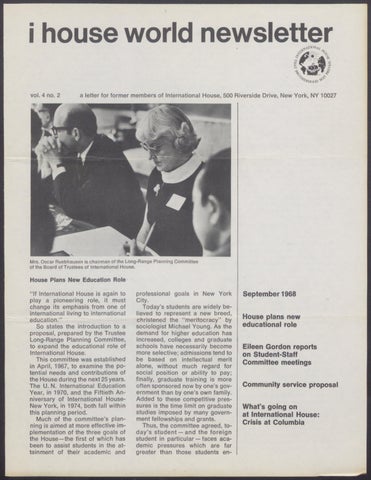
Lt Mrs. Oscar Ruebhausen is chairman of the Long-Range of the Board of Trustees of International House.
House
Plans
New
Education
Role:
“If International House is again to play a pioneering role, it must change its emphasis from one of international living to international education.” So states the introduction to a proposal, prepared by the Trustee Long-Range Planning Committee, to expand the educational role of International House. This committee was established
Planning Committee
— professional
goals
in
demand
for higher education
alone,
without
much
social
position
or
of
regard
ability
for
finally, graduate
The U.N. International Education Year, in 1970, and the Fiftieth Anniversary of International HouseNew York, in 1974, both fall within this planning period. Much of the committee’s plan-
often sponsored now by one’s government than by one’s own family. Added to these competitive pressures is the time limit on graduate studies imposed by many govern-
is more
ning is aimed at more effective im-
Thus, the committee agreed, today’s student — and the foreign
ment fellowships and grants. student in particular — faces academic
pressures
greater
than
those
which
House plans new educational role
Eileen Gordon reports on Student-Staff Committee meetings
pay;
the House during the next 25 years.
plementation of the three goals of the House—the first of which has been to assist students in the attainment of their academic and
training
to
September 1968
has
increased, colleges and graduate schools have necessarily become more selective; admissions tend to be based on intellectual merit
in April, 1967, to examine the pocontributions
York
Today’s students are widely believed to represent a new breed, christened the “meritocracy” by sociologist Michael Young. As the
tential needs
and
New
City.
are
far
students
en-
Community service proposal What’s going on at International House: Crisis at Columbia
2 countered during the early days of International House.
Four specific programs to meet the special educational needs of foreign students have been sug-
gested
by the staff to implement
this new emphasis: A. aseries of workshops to serve as an introduction to American higher education and a means to improve English language skills. These workshops would be open to new foreign residents on a voluntary basis, and would explain
such practical matters as semester hours and credits, grades, and registration procedure; the meaning of various forms of instruction such as the seminar, workshop, lecture and discussion group; the use of the library; preparation of reading assignments and term papers; and the purpose and use of examinations in American graduate schools. This orientation workshop
would include individual English language tutorial sessions with American residents, as well as the use of the Language Laboratory and prepared materials to improve skills in written and spoken English. B. the creation of six Faculty Fellowships, one each in the fields of education, social work, business, law, the natural sciences and the behavioral sciences, to provide academic leadership for the Professional Interest Groups at International House. Fellows would be chosen from the faculties of major graduate and professional schools in New York City. Each would meet with his group six times a semester for informal discussions aimed at
home to his country. D. a week-long, predeparture workshop to develop human relationship and communication skills that would assist the returning student to adapt and apply his American training to his home country. General sessions would explore such topics as the effect of ‘‘culture” and “perception” on communication; workshop sessions would be conducted in small groups to promote closer relationships and increasing candor in discussions. Extensive use of prepared case studies and related materials would be made, with each participant required to prepare and present a plan for putting this training to use upon his return home. Dr. James L. Davis ('61-’64), Vice President and Program Director of
ably it is the result of a combination of factors, internal and exter-
nal, coinciding
and
reinforcing
each other. Surely, in the case of International House, this has been so. For in the midst of this long hot summer, in the wake of that sad
and incredible American spring, a group of students and staff are holding a series of discussions unprecedented in the history of this House. For some time now it has been apparent that student participation
in policymaking
in the House has
been minimal. The Student Council as currently constituted is neither representative nor responsive to the needs of the House. Moreover, in its role as ‘‘advisor’’ to the president, it is virtually powerless. Problems such as student apathy and
the House, would play a significant
group
role in carrying out these new educational programs. A corollary to this proposal for a major change in emphasis from international living to international education is a change in the char-
traced to the failure of students to
ter of the House to reflect this new emphasis. Alumni comments and suggestions on this proposal, as on all House programs and activi-
ties, would be very welcome. Student-Staff Committee Evaluates House Goals by Eileen Gordon
&
clannishness
might
be
take responsibility for various aspects of the House, and the lack of appropriate channels for them to do so. This realization, coinciding with an increased interest in student participation, both inside and outside the House, resulted in a call to action. On May 16, 1968, Mr.
Cook
issued a memorandum
rec-
ommending the establishment of a committee composed of members of the Council and the Key
Staff to explore the possibilities for increased student participation in the running of the House. It was understood that the committee would meet throughout the summer and present a report with a proposal to both the Student Council and Trustees. It held its
relating current issues in the field
first meeting on June 27, 1968, and
to
has been meeting weekly ever since. Members of the committee felt its first work was to redefine the
problems
and
conditions
stu-
dents might encounter in their own countries.
C. a leadership seminar devoted to areas of particular concern to students returning to developing countries. The seminar would be
held eight times demic
during
the aca-
year for discussion of such
topics as population control, urban problems, the educational revolution, and conservation of resources.
Organizatians such as the Population Council and the National Education Association would be asked to discuss their latest research findings with this group, and membership in the organizations might continue
after the student
returns
goals of the House in order to clarify the kind of community it envisioned. They agreed that the
Pee *
ee
%
main purpose and emphasis of the House should be to provide oppor-
Eileen Gordon, Secretary of the Student Council Steering Committee and author of the following article, is an International House resident studying biology and chemistry at Columbia University. She is shown above with John Mallea, an active member of the committee.
all countries of the world.
It is difficult to know why, at a particular moment in its history, an
pected that the House will help students in understanding various
institution
aspects of American life, possibly through participation in the life of the local community, and will help
tunities
for
the
development
derstanding among
students from
In addition, of course, embarks
on
self-con-
scious reevaluation of itself in the name of meaningful change. Prob-
of
greater friendship, respect and un-
it is ex-
3 to further the educational aims of the individual students. These may sound trite and simple, like the brotherhood goal which is the paramount objective of the House. But committee members felt strongly that these goals should determine the character of the community that is created. The committee then moved on to establish general guidelines for the implementation of the goals it had set down. In so doing, it has considered such matters as admissions policy, length of residence, the role of Americans in the House, and relations with the community. At this writing, the committee is beginning its discussions of student participation. Two open meetings have been scheduled to hear student opinions on the subject. The Joint Committee report will soon be compiled and presented to the Trustees and the Student
Committee, these activities are intended to implement the second and third goals of the House: to provide opportunities for foreign students to experience the many facets of American life and to give American students an opportunity to broaden their horizons through friendship with people from diverse backgrounds and cultures. Both city and suburban schools, public and private, have been invited to participate in the new ser-
Council.
contribute to social studies programs in the schools by making it possible for foreign students to teach about their home country on a paid professional basis. Based on a plan developed by International House in Philadelphia, this project has two basic objectives: 1) to bring American students into personal contact with a representative of the country or region being studied; 2) to help
Certainly,
the
Council
must be restructured on a new basis. But already the effects are being felt. Slowly, subtly, apathy is giving way to awareness. A method of communication has been established. The very existence of the committee has served to further the ends toward which it is moving.
Community Service Projects Proposed
Four community
service projects,
proposed this year by Dr. James Davis and his program office staff, stress cooperative work with local
elementary and secondary schools. In contrast to the educational programs of the Long-Range Planning
vice projects. These will include a continuation of the successful Harlem Tutorial Project (described in the March, 1968 Newsletter), another tutorial program in instrumental music, and a program in which talented International House student entertainers will be featured at school assemblies. A fourth community endeavor, entitled the “International House
Ogontz
Project,”
is designed
foreign students learn United States through
about the participa-
tion in American schools classrooms. Each cooperating school ceives a team of five foreign
dents
after consulting
to
with
and restu-
mem-
cate easily, are well versed in their own country’s history and culture, and who can spare time from their studies are selected. Each team member returns to “his” classroom three times, allowing the youngsters, the teacher, and the foreign student himself to adjust and reflect on the next session. Through this process, American pupils become aware of cultures different from their own and of those desires and aspirations which are common to all men. Consequently, they are better able to see their American culture in perspective. The facts in Philadelphia show that educators realize the value of this type of cross-cultural communication. The Ogontz Project, which began on a small scale in 1961, had,six years later, 142 for-
eign students from 51 countries working with 14,000 American pupils in 50 schools. Eighty schools requested the program for 1967-68, and at times the Philadelphia staff
finds it difficult to keep up with the demand.
International House is presently seeking foundation support to underwrite the costs of these projects. What’s Going On... The times are turbulent. Seldom has the motto, “That Brotherhood May Prevail,’’ seemed more compelling, or more remote. On April 6, 1968 and June 8, 1968, respectively, messages of
sympathy
with
hundreds
of indi-
bers of the International House Ogontz Project Committee. Only
vidual
those students who can communi-
staff were sent from the House to
An attentive listener at the Development Fellows Seminar.
signatures
of students
and
4 Mrs. Martin Luther King, Jr. and to
Mrs. Robert F. Kennedy. To Mrs. King: “The members and staff of International HouseNew York wish to extend their deeply felt sympathy to you and your family. “Our goal of brotherhood was ably served by Dr. King’s leader-
ing in the auditorium, in which the issues of student force and admin-
istration
indifference
were
hotly
debated. The meeting was followed by the drafting of a resolution which, in
part, held President Kirk and the trustees responsible for the crisis because of “. . . their continuing
ship. At this tragic time, we rededi-
failure to listen and respond to the
cate
opinions and grievances of both the local community and the aca-
ourselves
to the
justice and peace sacrificed his life.”
cause
of
for which, he
demic community.”
To Mrs. Kennedy: “The members and staff of International House-New York wish to extend their heartfelt sympathy to you and your children. “Senator Kennedy was deeply concerned about the needs and aspirations of young people both
here
and
abroad.
His
leadership
will be sorely missed. “At this tragic time, we renew our commitment to the ideals to which he dedicated his life.” Crisis at Columbia
On April 23, student demonstrators began an “occupation” of buildings on the Columbia University campus which resulted in a major clash, one week later, with
sent
to
President
a
the
representative
the
received
funds
four private sources,
has
includ-
ing the Ford and Taconic Foundations, to do research on means of student participation in the University administration. This group is examining not only the existing
administrative
structure
at
Co-
lumbia and other universities, but is also looking at the total environment of education in the United States. An Executive Committee of the
Faculty
and
a five-member
com-
mittee of the Board of Trustees are also conducting foundationfunded _ investigations, with reports planned for early fall. It is hoped that proposals and recommendations arising from the
to
serve
on
Columbia
Students’
Strike
Coor-
summer projects will help to ease
dinating
Committee.
be-
existing tensions and prevent a further confrontation when students return for the fall term.
Later,
cause of philosophical differences with this group, the delegate changed his affiliation to the more moderate, ‘Students
for a Restruc-
tured University.”
Spring Program Highlights
passion,
seemed
the mood
playwright Ossie
House.
Few
us
suspended.
|.House resident James Thomas
summed up the situation in the May 9 issue of the student
cane
language
procedure, from
30,
the situation
changed. Shock waves from the police action, and the student arrests and injuries which resulted from it,
spread quickly over the area. More than 150 House residents who attend Columbia held a protest meet-
of the
manned
the
than American students. Were they floored in debate by the ar-
A second demonstration was staged on May 24 to protest the suspension of three students involved in the first melee. Again, the police were called to intervene, with more violence and additional arrests resulting. During the first week of the crisis, International House students remained generally uninvolved, except to worry about the cessation of classes. After the police interApril
of
newspaper,
barricades, and, in general, foreign students were less involved
eral weeks.
on
and
University from
throughout the Univer-
Some resumed for final examinations; others remained closed for the rest of the spring term. A sizable contingent of police remained on and about the campus for sev-
vention
Kirk
trustees. Students at this meeting elected
crisis.
The Students for a Restructured
temporarily
buildings.
sity were
second meeting on May 2, and was
related to the Columbia
the ‘International House Globe.” His article concluded: “Earnest discussion, more than
morning police action to empty the Classes
“...restructuring of the University ...whereby faculty and student participation in decision making is increased,” This resolution was approved by a majority of residents attending a
groups, projects
Major House programs for the spring semester began with a “Negro History Week” in February. The week included an art exhibit, a dramatic anthology of Negro literature, a panel discussion, and a special address by author-
the New York City police. Over 700 students were arrested in the early occupied
It also urged a
pendent student-faculty are working on summer
of
or
parliamentary
were
they
blasé
of
student
un-
experience
rest at home? “More likely, they identified less with the University, or feared that participation would be seen as in-
terference
in American
politics. However,
domestic
in time of crisis
it is hard to act neutrally — especially when
seen
‘business
as usual’
is
as support for one side.”
At this writing
(mid-August),
an
uneasy calm prevails. A fact-finding
commission,
chaired
by
dis-
tinguished Harvard jurist, Archibald Cox, has been investigating the causes of the campus disorder and is expected to present its findings in the fall. Three other official committees, in addition
to
a number
of inde-
Dr. Howard
Davis.
Rusk, renowned
au-
thority on rehabilitation
medicine
and New
for the to Inter-
medical columnist York Times, spoke
national House members at a Sunday Supper in March. His topic: “Sick People in a_ Troubled World.”’ The annual
Festival
of the Arts
highlighted April and, as always, was a popular and financial success. Combined proceeds from the International Cabaret, on April 17 and the Night of Nations, on April 20, netted $12,500 for House scholarship and fellowship funds. An estimated 2,500 people attended the two events.
Harry Edmonds, looking extraordinarily hale and hearty at 85, returned
as
featured
speaker
at
the 56th Candlelight Supper in May. His old magic prevailed as he spoke of the continuing need for human understanding and peace, and drew a standing ovation from the packed auditorium.
To"
5 all
7 yy!
F
+
I
ne eter
A booth
at the Night of Nations
~
held during
ot
the Festival
of the Arts this spring.
Oe
Ossie Davis, shown above with |.House residents, Wilma in American Society” during Negro History Week.
NOSTALGIA
DEPARTMENT
International
House
N fe) Mr.
,
\ \ Shakesnider and Walter Turnbull,delivered an address on the‘‘Evolving Negro
To lose within these walls all thought of race, And greet the world within this resting place And free from all restraint awake to find That beauty dwells in every human mind. To hear the answering echo of thy thought Within the voice some other land had taught And lose the strangeness of a country’s name Within the purpose of our common aim. To find an understanding for all creeds, To sympathize with one another’s needs, To realize we are so much akin That good for one is good for all to win.
Such are the thoughts these walls with mute appeal Awake each heart to serve the commonweal
And leaving here this joins each diverse trail The words of peace “May Brotherhood Prevail.” Appreciation. August,
1934 ;
“Anonymous” ;
Harry Edmonds, founder of International House and featured speaker at the 56th Candlelight Supper in May, lights the can-
(Does anyone remember seeing this poem on the
die of Dr. Ashley Montagu ('27-'28, ’30-’31),
bulletin board in 19347)
distinguished anthropologist and writer.
6 Alumni
in the News
Dr. Gaston Eyskens (’26-’27), Council Member for Belgium, was asked
by King Baudouin last June to head Belgium’s government again. He has twice before served as Premier, in 1949-50 and 1958-61, serving also as Minister of Finance in
1965. Dr. Eyskens lived at International House while studying for his
Master of Science Columbia. He later
degree from obtained his
doctorate in political science from the University of Louvain, where he
continues to hold a professorship in economics. His son, Marc, now a doctor, was a member of International House in 1956-57.
In an
article
captioned
“From
Yukon to Mrs. Kahn,” the New York
Daily News reported the marriage of Helen Klaben (63-64) to Robert Kahn on December 17, 1967. Miss Klaben, who was a member of In-
ternational
House
while
after a 1963
plane
crash. She and a bush pilot survived six weeks without food in subzero temperatures before being rescued.
Mezzo-soprano lebrew
Gwendolyn
(’65-’66) was
added
Kil-
to the
Metropolitan Opera roster last season. Four International House alumni starred in the Juilliard Opera Theatre production of Francesco Cavall’s “Ormindo” in April. Leading roles went to Grayson Hirst (’6365),
Michael
Best
courts, plus a bungalow for special
Relations. His association with International House began in 1920,
guests.
when he joined the old Cosmopoli-
Alumni Council Member for New Delhi, writes of their Annual Dinner in March: “... we had such a won-
tan
Club,
continuing
until
he
fin-
ished Teachers College in 1924.
('63-’67),
Bar-
bara Shuttleworth (’65-’67) and Wilma Shakesnider (’67-’68). Their performance won high praise from critic Harold Schonberg of the New York Times. (Editor’s note: We know that many more of our alumni must be “in the news” all over the world. We would welcome any articles and clippings from our readers for
was
also discussed
born
and
raised
in Honolulu,
and has long been active with the Hawaii Area Committee of International
House
alumni.
She
was
a
member of the House while studying at Juilliard and Columbia. Married to John K. Whitmarsh, Vice President of MidPac Lumber
Co., Mrs. Whitmarsh is a realtor associated with Hawaiian Housing
Dr. Ernst
G. Malherbe
(’20-’24)
on
the
14th.
As
many as 90 persons were present, and Mr. and Mrs. Miller, CounselorMinister, U. S. Embassy, were our chief guests . . . Your cable mes-
at the meeting
the
1. House Alumni Council Meeting at Tokyo, outlining the broad areas over which our deliberations would
take place, and everyone was of the view that such a step would not only enhance the image of |. House but would also serve as a great help to many foreign students who look
to |. House
as their
‘Friend,
Corp., Ltd.
Philosopher, and Guide!’.” New York area alumni under the
Sean
direction
In Memoriam: Dr. Francesco Vito. From Rome came sad news of the death of Dr. Francesco Vito (’50),
on
April
8,
1968.
Dr.
served as Alumni Council
Vito
had
Member
for Italy since his appointment September, 1966. LALLA
ELEN
ELE
Area
Committee
Our alumni
LETS ELINA
in
LE LOL SELLE LLL LINE TIES,
Notes
in India again set the
pace for area activities. Behram S. Sidhwa ('38-’39), President of the International House-New York Alumni Council in
Bangalore, continues to inform us of their progress toward building a new International House. On May 13,
Mr.
Sidhwa
and
seven
other
of the Alumni House. There are quite a number of formalities re-
has been appointed as Council Member for South Africa. Dr. Malherbe, who retired as President of the University of Natal in 1967, is currently serving as President of
evening
(’48-'49),
sage was received with thunderous cheers and please convey to Mr. Frohlich our grateful thanks...We
New
Two new members of the Alumni Council have been appointed by Trustee Chairman John J. McCloy.
Krishnamurthi
the House, regretfully resigned as Council Member because of extensive travel plans. Mrs. Whitmarsh
use in future newsletters.) Members
T.
derful
alumni met with the Chief Minister of Mysore to present the proposed architectural plan of the Bangalore House. Mr. Sidhwa writes: “The Chief Minister has favourably viewed our request for the grant of a Suitable area for the construction
Council
V.
Lucia K. (White) Whitmarsh ('39’40) has been appointed to replace Beatrice Chang (’39-’40) as Council Member for Hawaii. Mrs. Chang, who still keeps in close touch with
studying
at Columbia, was stranded 49 days
in the Yukon
the South African Institute of Race
quired to be done and it will take some time. The alumni have urged the Chief Minister to allot an area which is centrally located and | think this will be viewed favourably.” The proposed new International House will accommodate 200 students and will include a cafeteria, auditorium, department stores, swimming pool and tennis
of
President
David
Lee
(58) have undertaken a new service
relationship
with
the
House,
opening an office for this purpose just opposite the Bazaar. Included in their service projects are 1) an apartment-inspection commit-
tee, 2) a host family
program
in
which alumni will entertain students in their homes, 3) volunteers
for the clothing bank and Englishin-Action programs, and 4) car-pool transportation for distinguished visitors to the House. On the social side, the New York group has opened
a popular
in Westhampton
summer
Beach,
house
Long
Is-
land, for use at reasonable rates by alumni, students, and staff.
Located just one-half mile from the ocean, the New York Alumni summer
house
offers comfortable
accommodations, including two living rooms complete with bar, plus wide verandas, expanses of lawn and a tennis court—a real oasis for the summer city dweller! The group also
runs summer
excursion
trips
and maintains a winter ski lodge. Hawaiian alumni, under the chairmanship of Council Member Lucia Whitmarsh, have again conducted asuccessful local telephone campaign on behalf of the annual Alumni Fund, raising, to date,
$222.00 from 36 contributors. During the whole campaign year, 49 Hawaiian alumni have contributed
atotal of $435.00 to the Alumni Fund.
At a recent organizational meeting of the Santiago alumni, Hernan Elizalde (’45-’46), Council Member for Chile, presented materials and information on the International House Alumni Council scholarship program. (This year Alumni Council scholarship students at International House came from Japan, India, and Turkey.) The meeting was addressed by Joaquin Barcelo, Executive Secretary of the Fulbright Commission for Educational
Interchange between the U.S.A. and Chile. Mr. Barcelo is the husband of Georgeanne Vial (’59-’62). He described in some detail the Fulbright Commission scholarship program. The alumni group is now undertaking study to determine the possibility of coordinating the Council program with the specific scholarship needs of Chilean professionals. The progress of this study will be presented in a later newsletter.
in receiving such a magazine.” (Editor’s note: Alumni interested in subscribing to this magazine should write to FAO Review, Business Office, Via della Terme di Caracalla, 00100, Rome, Italy.) Jean-Marie Herve of France (’65’66) wrote from Madagascar last spring: “It was nice to have the |.House world newsletter forwarded to me from France, and | enjoyed
very much reading about the House and its people....Since | left New York in the fall of 66, | have been on a (French) National service assignment and as Assistant Professor here at the Business School....Several friends of the House have been able to meet my family in France, and eventually to spend some time with them either in Versailles or in Savoy. So | heard a lot about the House. We have also been in close
contact
with
the family who
re-
ceived me in Dorset, Vt., as a guest for 65 Christmas vacations....1’ll leave here in July, and plan to settle somewhere in France in time to give you my address for the next Passport... and organize for giving hospitality to potential |.House alumni.”
Several
other Passport
users
have written interesting accounts of their travels and the alumni hospitality which greeted them.
The following House
through Dr. Howard Rusk, shown at the left above with Sigurdur O. Helgason (’44-’45), Mrs. Helgason, and
L. W.
Frohlich, Chairman
of the International
House
Alumni
Council,
was the fea-
tured speaker at a recent Sunday Supper.
Reading the Mail From Mrs. Joy Wheeldon Hansen (48-50) of South Africa came a contribution to the Alumni Fund with the note...‘‘Last year | gave some lectures to nurses in child
Brian H. Taylor ('67) wrote to tell us: “| have...returned to the (U.N.) Food and Agricultural Organization where | am now executive editor of a new bi-monthly magazine,
care,
forum for development problems. Its aim is to present articles, sometimes controversial, sometimes
report from
resident on
New
her spring
England
was
an lI. trip
given
to us over a year ago, but for lack of space could not be included until now. The author, Francoise Descamp (’67) from Bordeaux,
France,
was
studying
medicine
with various aspects of the devel-
while living at International House. “Having 11 free days, | decided to leave New York in order to find the spring in New England. “First | went to New Haven where | met Mrs. Christa Lefson Feiss ('63-’65), a young sculptress who once lived in International House. She took me around Yale University where | enjoyed the
opment process. It is aimed at influential people in education, in-
beauty of the English Gothic buildings. In the evening they had me
broadening and deepening the reality of our all belonging to the family of man. With it comes my
dustry and agriculture. “| have the recent International House Passport for 1967-69, and on rereading it | find that there
to dinner—with a very nice bachelor friend—(look how nice are American people!). So | spent a
affectionate greetings to the House for all it stood for to all old alumni, and for all those who are there now
are quite a few persons (especially in the developing countries) who would be interesting to us pros-
and who will follow. May its motto one day prevail.”’
and who should also be interested
and
am
dividing
the
small
amount received between International House Alumni Fund and the
Columbia
School
of Social
Work
Alumni Fund. Though small, this amount represents my enduring feelings of gratitude for the role
International
House
played
in
Ceres. This magazine represents a
non-FAO
pective
in point of view, dealing
readers
of the
magazine
very pleasant day in New Haven. “Arriving in Newport, | met Mrs. Terry Day and Mrs. Louise Eithington. Both of them were very busy with big families, but together they managed to take care of me all
8 visit pleasant. Very often | thought sadly that French people should do the same. And | have decided
the time! Neither of them was an alumna, but one had friends ‘who have friends who have friends’ who are alumni. “Unfortunately, | had to leave
for Boston
to do as much as possible myself to make foreign students’ travel in
the next day. There
|
Association.
Mrs.
Eithington
was to invite their young doctor friend. And once again, it was a very pleasant evening!
lively—
’ type of person | was going to meet in Thomaston, Maine. Miss Hilda May George (’22-’24), 70 plus, typifies an ever-young lady! So lively, in fact, that she woke me up at
6:00
in the morning
pleasant
as
mine
was
Alumni Council Meeting in Tokyo Postponed
to do for me
“Quite a different—and
as
ar-
ranged a meeting for me with friends of hers, who also thought
that the best thing
France
in New England!”
stayed in the International Student
to show
me
the sunny day!
“| did not object to getting up
and
the
Tokyo
alumni, co-sponsors cil meeting. The main reason
area
of the Counfor
postpon-
portunity to taste the lobster stew
ing the meeting was the delay in official plans for the International Education Year. An important feature of the Tokyo meeting was to
for which Maine is famous—it was delicious. As a real French girl, | love good food and | can say that all during this trip | enjoyed the
have been discussion of the role of International House in relation to this important event. Alumni may expect further word
American food that everybody prepared for me. You can get much
on which
better
samples
homes
than
in
the
in New
on the Tokyo meeting and the date it will be held in 1969.
American
York’s
cafe-
terias!
President Cook Announces
‘“‘The road from Thomaston, Maine, to Rutland, Vermont, is
Important Staff Changes
beautiful
and
various.
Office
Howard
A. Cook,
In Rutland,
Mrs. Julie Teta (’57-’60) entertained me. She was learning French and so we could improve our language —she, speaking
announced
the
of Janet Whittier,
Di-
rector of the Office of Development and Alumni Affairs, June 28, 1968. In making the announcement, President Cook expressed appreciation for the many contributions Miss Whittier has made to International House, especially in launching and nurturing the growth of the
President
of In-
New York City as Secretary to the
Executive Committee. President Cook has Mrs.
Elizabeth
position of Director of Development and Alumni Affairs of International House. Mrs. Scarlatos, who started
her new job in August, is a graduate
of
Radcliffe
| had the plea-
1953
and
as
Assistant
the
development
worked on projects for a number of nonprofit clients of Schless & Company, a New York City public relations firm.
to University on Monday where | could listen to a discussion and to a student faculty meeting. “So ended this wonderful trip.
NAME OF GROUP TO USE FILM
the
houses...Much
the
country,
museums, more,
the
however,
enjoyed the people, all of them so different but all so warm and so ready to do their best to make my
of the
ni and student-faculty exchange. For three years, Mrs. Scarlatos was Director of Women’s Activities for the Visiting Nurse Service of New York and more recently
International House, 500 Riverside Drive, New York City, N.Y. 10027
| enjoyed
program
The International House film is available only for distribution to groups of 30 or more. Please allow two months for scheduling. Mail coupon to: Alumni Office,
DATE OF SHOWING
Alternate Date
| understand that | pay the expense of mailing the film on to its next scheduled showing or back to International House by air parcel post. Name
| Address
City
the
college and for working with alum-
gent, very interesting, she took me
cities,
to
President of Anatolia College in Thessaloniki, an American-sponsored coeducational school, in the school’s New York City office until 1963. She was responsible for formulating and carrying forward
International House.
sure to meet a lady who is a Ph.D. and a drama teacher. Very intelli-
course
She
Available For Your Use
“The last city | visited was Am-
Of
College.
served as Assistant Public Affairs Officer for the United States Information Agency in Tehran, Iran and Thessaloniki, Greece, from 1951-
This documentary offers a thoroughly enjoyable insight into the intellectual and social activities of the more than 500 members of International House. The film, available in 16 mm, sound and color, would be helpful to you in informing students and visitors to this country about the facilities and program of
tions and the lakes around Rutland.
the
appointed
D. Scarlatos to the
Colorful, Informative Film
French, and |, speaking English, and each of us correcting the other! She showed me the ski staherst, Mass. There
in Alumni
House,
resignation
Alumni Program. Miss Whittier will join The Duplan Corporation in
As we go to press, we have just received word from Council Chairman, Bill Frohlich, that the second Alumni Council meeting which was to be held in Tokyo October 17-20, has been postponed for a year. The decision was made by Chairman Frohlich in consultation with Namiji Itabashi, Managing Director of the International Education
Center,
so early, however, because | had a wonderful, full day. Miss George drove me around, showing me rivers, the seaside, hills, harbors, old sea captains’ houses and so on. A little break gave me the op-
ternational