OTOBEK, 1966
i house world newsletter $ :
:
‘
t a
;
|
Hi wl
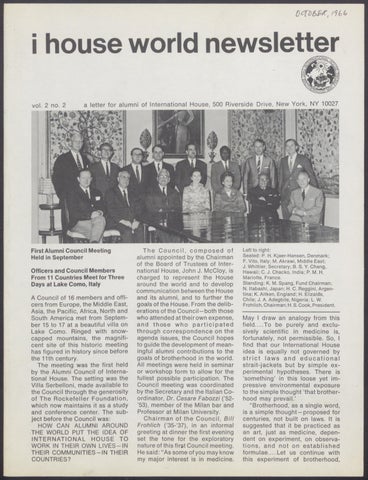
First Alumni Council Meeting Held in September Officers and Council Members From 11 Countries Meet for Three Days at Lake Como, Italy A Council of 16 members and officers from Europe, the Middle East, Asia, the Pacific, Africa, North and South America met from September 15 to 17 at a beautiful villa on Lake Como. Ringed with snowcapped mountains, the magnificent site of this historic meeting has figured in history since before
the 11th century. The meeting was the first held by the Alumni Council of International House. The setting was the Villa Serbelloni, made available to
the Council through the generosity of The Rockefeller Foundation, which now maintains it as a study and conference center. The subject before the Council was: HOW CAN ALUMNI AROUND -THE WORLD PUT THE IDEA OF INTERNATIONAL HOUSE TO WORK IN THEIR OWN LIVES—IN THEIR COMMUNITIES —IN THEIR COUNTRIES?
The Council, composed of alumni appointed by the Chairman of the Board of Trustees of International House, John J. McCloy, is charged to represent the House around the world and to develop communication between the House and its alumni, and to further the goals of the House. From the deliberations of the Council—both those who attended at their own expense, and those who participated through correspondence on the agenda issues, the Council hopes to guide the development of meaningful alumni contributions to the goals of brotherhood in the world. All meetings were held in seminar or workshop form to allow for the fullest possible participation. The Council meeting was coordinated by the Secretary and the Italian Coordinator, Dr. Cesare Fabozzi (’5253), member of the Milan bar and Professor at Milan University. Chairman of the Council, Bil! Frohlich (’35-’37), in an informal greeting at dinner the first evening set the tone for the exploratory nature of this first Council meeting. He said: “As some of you may know
my major
interest is in medicine.
Left to right: Seated: P. H. Kjaer-Hansen, Denmark; F. Vito, Italy; M. Akrawi, Middle East; J. Whittier, Secretary; B. S. Y. Chang,
Hawaii; C. J. Chacko, India; P. M. H. Mariotte, France.
Standing: K. M. Spang, Fund Chairman; N. Itabashi, Japan; H. C. Reggini, Argen-
tina; K. Aitken, England; H. Elizalde, Chile; J. A. Adegbite, Nigeria; L. W. Frohlich, Chairman; H.S. Cook, President.
May | draw an analogy from this field....To be purely and exclu-
sively
scientific
in
medicine
is,
fortunately, not permissible. So, | find that our International House idea is equally not governed by strict laws and educational strait-jackets but by simple experimental hypotheses. There is ‘something’ in this loose yet impressive environmental exposure to the simple thought ‘that brotherhood may prevail.’ “Brotherhood, as a single word, is a simple thought— proposed for centuries, not built on laws. It is suggested that it be practiced as an art, just as medicine, dependent on experiment, on observations, and not on established formulae....Let us continue with this experiment of brotherhood,
2 ning stages locally to aid foreign students of the area. Only three
and let us try to continue with the search for methods that will further our ideals.” The first day of the conference, considerable time was spent in trying to define and examine what it is
that
I. House
has
given
to
can be reported on here.
The English Council Member,
her
alumni—in order to know how to preserve it and pass it on to one’s present environment. It was perhaps best expressed by Joseph Chacko (’26-’31), India: “I went to
International
House
ignorant
of
other peoples. The years | lived there gave me a high degree of appreciation of others and a feeling of something in common with all
men—a sense that we were standing together as brothers. Sometime during the stay a sense of appreciation of others comes to the student without effort—naturally —in the environment of the House. Affinities we have and we know we have them; at the House there is an integration of differences.” It was agreed by the Councilors that it is difficult to describe this
quality even though it is so apparent to so many
alumni, and that it
could only be communicated by practical projects within the local community. As Paul Kjaer-Hansen ('36-’37) of Denmark put it: “We cannot keep up the enthusiasm about a brotherhood ideal, no matter how well defined. It needs a medium. We need a medium by which one can break off from rou-
dependent
on
bers throughout
the
Council
Mem-
the world
for its
success. It involves grants ranging
from $615 to $1,700 to be awarded to students who, even after receiving substantial educational grants, might not be able to finance their
living expenses in New York. It is hoped that Council Members, through interviews, can aid the Committee in enabling these deserving students to come to New York with living expenses at I. House either partially or fully taken care of, dependent on need. The Admissions Committee of the House asked that the Council, its Committees, and individual alumni call International House to the attention of students coming to New York. Council Members have applications to give out to students
whom alumni feel would add to the membership of the House. It was also suggested that
the
Keith Aitken ('28-'29), reported on the International House Association Trust, which is currently raising funds to build an International House in London. He also told of the London alumni work of entertaining students with Sunday Suppers and on outings to historic places on weekends.
Matta
Akrawi
(’25-’29),
Middle
East representative, spoke of sponsoring a four-campus International Relations Club as an aid to intercampus fraternity among the students. Joseph Chacko (’26-'31), India, also stated that in Delhi it is difficult for students to find suitable employment after returning from abroad. He felt that the Delhi Area Committee, when notified of new alumni just returning from the House, should aid them in their
return to life in Delhi in any way possible. The Chairman of the seminar on student aid, Hernan Elizalde ('4547) of Chile, summarized the discussion, saying that the students’ needs were as varied as the cities in which they found themselves, and that the first need of an orga-
nizing committee would be to de-
tine daily activity. We also need an
Committees around the world schedule film showings with local organizations handling orientation
organization—a feeling that we are not alone in this goal after we leave the House—that we are a part of a
of U.S.-bound students. The Alumni Fund was discussed in detail (see article immediately
given on President members spacious
following), and the Council devel-
outlined the goals of the House by
oped several plans in support of the Fund. It was felt that as soon as
1974. In answer to the need of expanding the |. House movement, he put forward the idea of developing, with an international chain of hotels, a chain of International Houses
larger movement, that it is of use that we continue our own efforts.” The remainder of the sessions were for the most part concerned with the practical steps of organi-
zation and with projects which alumni could successfully undertake
world
in the
various
represented
areas
of the
by
Coun-
the
cilors themselves. These fell into two general categories: (1) Projects which the House requests be undertaken locally by the alumni to aid the House program (2) Projects and programs developed lo-
cally by alumni to aid the students coming into their own area. Members learned that there are three major areas where the House program can be strengthened through the Council. The Scholarship
Committee
of
International
the alumni had developed a pattern of sustained giving to the House, Council projects such as the newsletter, the Passport, development of a complete address
list of alumni, and the cost of administration of Council. projects could be fully met by the Fund. Local campaigns on behalf of the Fund
were
worked
out.
Joseph
Adegbite ('51-’52), member from Nigeria, presented the first gifts in kind to be sold for the Alumni Fund. He brought with him two oil paintings by a noted Nigerian art-
ist which will be sold in New York City for the benefit of the Fund. There were many illustrations of projects undertaken or in the plan-
fine the need
The
of the students.
only formal
speech
was
the second evening by Cook, who spoke to the after dinner in one of the salons of the Villa. He
staffed by their trainees, and serving thus not only foreign students but their own needs for training facilities. He spoke also of developing more group travel opportunities for students and for alumni, and for developing more facilities in New York to accommodate the ever-increasing number of stu-
dents in the city. He closed his address to the Council, “We count on the alumni to aid in setting the goals of the House. The program for the fiftieth anniversary of the House in 1974 should be developed
3 in cooperation with the Council, as no one knows the House as well as her alumni. It is hoped that alumni, by discussions in their local communities and by writing directly to the House, will help shape the 1974 goals now being formulated at International House.” On the last evening Dr. Matta Akrawi and Dr. Francesco Vito summarized the meeting and listed Council Goals for the next meeting in Manila in 1968. Dr. Vito said in his summary: “The real goal of the Alumni Council program becomes to refine and continue the impact of International House brotherhood on the life and ideology of her students and former students.” Dr. Akrawi listed five goals for the Council to achieve before 1968: 1) 24 Area Committees well organized and in operation. 2) Closer relationships with other |. Houses and their alumni. 3) 25,000 alumni on the mailing list. 4) Achievement of complete selfsupport of the Council Projects and alumni contribution to House activities.
Fund Drive had raised $12,394 for International
still being
House.
received
Checks
were
after Septem-
ber 1, but will be credited to this year’s drive. Mr. Spang said, “In setting the
‘goal
of $12,000 the Alumni
Fund
Chairman of this year’s campaign is Harry Edmonds, and that a birth-
day
party
will
be
held
for
Mr.
Edmonds in connection with the campaign. More details on this will be sent to all alumni within a few weeks.
Committee had no past history of Alumni Fund giving to draw on. We had to estimate alumni interest in contributing to the House judging from the favorable response to the new alumni program and to the newsletter. We are pleased to announce that we reached—and
passed -—this
first goal of $12,000
through the generosity of 1505 alumni. “Many hours of alumni effort went into achieving this goal. Well over 500 hours of volunteer time were donated to the New York, Honolulu, San Francisco, Berkeley, and Baltimore telephone campaigns. The Committee is impressed with the dedication it represents.”
Ken Spang received the following letter from the Chairman of the Board of Trustees, John J. McCloy. “At the October Board of Trust-
Welcome Home, Harry!
Final Report on Harry Edmonds’ World Trip — 20 stops in 15 weeks Welcome Home, Harry!—that was the way the hand-lettered signs read at Kennedy International Airport on April 19, when Harry Edmonds stepped off the big jet—one of those that had become so much
of one
ees Meeting, Mr. Frohlich reported
a part of his life in the preceding
project of international import by each Area Committee. The Council is particularly concerned with the expansion of the geographical areas in which the Council operates and hopes that individuals will come forward to develop projects in their own
that the Alumni Fund goal for ’65’66 had been reached and surpassed. “l express the sincere commendation and gratitude of the Trustees
weeks. Although
5) Successful
completion
towns or cities. It is also of great significance
to
develop
a
larger
mailing list so the newsletter and Council programs may reach as many alumni as possible. For more information on the Council deliberations, please communicate with your Council Mem-
ber directly or with the Council Office at the House. The Council Members and officers look forward to your suggestions and hope you will find a project which will help to define the brotherhood of Interna-
tional House right where you are. Fund Reaches Goal of
First Campaign — Sets ’66-’67 Goal at $18,000 Alumni
Fund
Chairman,
Kenneth
Spang (’34-’35, ’46), announced to the Alumni Council that on completion of the year’s campaign (September 1—August 31) the Alumni
the
extensiveness
the trip in itself was impressed
“The
of
news,
what
Skipper”
and
to you as Chairman of the Fund, to
those working on his tour was the great affection and loyalty which
your Committee, and to all the alumni whose generous interest in International House made this fine achievement possible.
the alumni felt for him and for the House. In summarizing the grand tour, he writes: “Though | did not realize
“We look to the alumni to aid us
it at the time, the route selected turned out to be a ‘world thorofare,’ less than a decade old, com-
more and more in our efforts to develop and expand the program of International House.” The 1966-67 campaign was announced to the Council and approved by them at the September
parable in a smaller way to the Erie Canal, which opened up the American West to the Mississippi;
or the Oregon Trail which blazed a
meeting. The goal is $18,000. Contributions will be collected for the House by the Area Committees of
path to the Pacific. “Just as surely, my route will be-
Denmark and France, as announced by their Council Members. Follow-up campaigns for the Fund are planned by a number of other Council Members and their committees. The Telephone Cam-
of travel, trade, and understanding
paign Chairman for the United States, H. Clay Simpson (’61), plans a number of local campaigns in various parts of the continental
United States. Mr. Spang also announced at the
Council
Meeting
that Honorary
come, it already is, an ‘esplanade’ across the Free World. “This is a point of significance! “Another is that the response from hundreds of my old students in many nations was way beyond expectations.
“Which augurs well for the hope that when these International House Alumni rea//y become harnessed to the Potential of peace
and understanding, they will contribute
immensely
to the
Interna-
4 tional
House
objective—That
Brotherhood May Prevail.
“One other thought: this was not a ‘sight-seeing’ trip. “It was a ‘people-seeing’ journey. And yet, | can write down the names of only a fraction of those |
Saw. “| was greatly moved by the geographic-historic aspects of my
flight, but these were as nothing, compared with the human warmth and affection of the people along the way.
“They made me feel like a longlost parent, relative, teacher, monk, priest, friend, whom they knew long ago, now come to life. “This was a very beautiful experience. “And something to remember, always!” He visited alumni in the following
cities: Honolulu, Tokyo, Taipei, Manila, Hong Kong, Bangkok, Delhi, Karachi, Teheran, Beirut, Istanbul, Athens, Rome, Paris, Berlin, Co-
penhagen,
Oslo,
Stockholm,
Hel-
sinki, and London. In the last issue of the newsletter we covered the first stops in some detail, but we regret that in this issue space will not allow a detailed account of the rest. We would like you to know about each of the royal receptions he was accorded. Wherever he went, groups of alumni who had not perhaps seen one another for years, joined
in paying happy tribute to the man and to the institution which he represents. Through the good “advance” work of the alumni in all cities, he was widely interviewed by the press, on radio and on television. He gave excellent publicity to the ideal of brotherhood and to the House which is working for these ideals. In his own report on the trip, we find beautiful descriptions of the brief moments he was able to snatch to see the countryside, and an awareness of the mood of the cities outside the circle of his
alumni
and
their distinguished
friends. One evening at a sidewalk cafe in Istanbul, he was struck with the
styles of dress.” Everywhere he went he was greeted at the airport, cars were put at his disposal, there were flowers in his room...or some act of kindness made him aware of the
love
of these
generous
former
members of I. House. He celebrated his birthday with alumni and six Ambassadors at an elegant formal party given by Dr. Tsune-Chi Yu (’24-’26)...He learned
of the detailed plans being developed
by
tional
alumni
for
new
Houses
in
London
Interna-
and
Denmark...He talked with civic leaders, royalty, high government Officials in every city, many of whom were alumni...He traveled
Bangkok
on
her
intricate
water-
ways...He watched the New Delhi Republic Day parade with its golden-masked elephants...sipped tea at a quai on the Bosporus... visited the Studentendorf in Berlin and, most familiar, the Maison Internationale of the Cite Universitaire in Paris in which he played a major role during its construction in the 30’s.
Distinguished
journalist
International House deeply appreciates the loyalty of its alumni and the many generous acts which made Harry Edmonds’ trip the success it was. In particular, those whom we asked to organize the alumni gatherings and to arrange for Harry Edmonds’ visit deserve a special thank-you for their untiring efforts and faultless planning. For Harry Edmonds, this was not a personal triumph, this strenuous trip was taken on with a sense of mission—his own ageless enthusiasm for the goals of the House. He concluded his informal talks given at these alumni gatherings throughout the world: “Yes, that’s the big idea of International House: to see mankind whole, with under-
standing,
and
without
prejudice.
Which brings me to my reasons for
having made this trip. The world is so small now, and this is such a fateful moment, that any group with remarkable experiences in international living should mobilize its resources, enthusiasm, and skills for peace.”
and
publisher, Ahmed Emin Yalman ('14-'15), well expressed the sentiments of countless letters we received on Harry Edmonds’ visits. He said: “...it gave me a special pleasure to greet Mr. Edmonds on his arrival in Istanbul. | had no difficulty in recognizing him among the passengers of Pan American at the airport. He seemed to be as alert and cheerful, as in the old days. He seemed to have changed very little. “| greatly enjoyed my three days with Mr. Edmonds. It was a thrilling experience to revive the atmo-
New Delhi Committee Greets the Skipper, February 12.
sphere of 55 years ago. | found him more mature, more tolerant, more international minded than at the
p
time of our first meeting. The members of the Rotary Club, the
Teheran Alumni Hold High Tea for Harry, February 17.
Turkish-American University Asso-
ciation and Robert College faculty enjoyed his nice talk and were impressed by the film of the Interna-
tional House, which he showed. “Mr.
Harry
Edmonds
seems
to
be one of the morally rich and fortunate men who received from God
similarities of all the cities he had
his just reward for his noble char-
seen: “If there were one universal language, the city-world would seem like one universal country, except for facial variations and
acter
and
perseverant
certainly wish
him
and
services.
national House further possibilities
of service.”
|
the InterAlumni and Friends gather at Pierce College, Athens, March 4.
5 were turning out mimeographed information sheets on how to take the subway and where to find this and that, posters announcing the first dance, sports competition sign-up sheets. The first Sunday Supper got the year off to an excellent start. Members were treated to a thrilling performance by member violinist, Chris Kimber, who recently returned to the House from a concert tour of his native Australia and three European capitals. Alumni and Ambassador celebrate Harry Edmonds’
Birthday in Rome,
March 11.
Then came
Harry at landmark honoring Hans Christian Andersen, Copenhagen,
April 3.
bers serving
International
House.
the calendar of fall
events:
For
Two Cosmopolitan Club Members join
South America, the Pacific, the Near and Middle East, the U.S.A. These men and women will serve for terms of five years, and many were able to attend the Serbelloni Conference held in Italy. We are honored to list these distinguished men and women as Council Mem-
instance,
in
October,
the
President’s Coffee Hour with Mr. lan Henderson, formerly of the University of Salisbury, speaking on “Rhodesia Today” promises to be a lively session. Student members from Rhodesia itself, the Republic of South Africa, and from the surrounding African nations will surely make up a large part of the audience. The United Nations Conference on October 29 and 30 will follow much the same pattern as in years past. A reception for the Permanent Heads of Missions to the United Nations follows a day of workshops. The following evening Mr. Brian Urquhart, Principal Political Officer, Office of the SecretaryGeneral of the U.N., is the speaker at the Banquet.
a Dr. Mohammad Saleh Abusaidi ('53-'54) has been appointed Member for Iran. Dr. Abusaidi is Head of Administration and Senior Advisor of National Iranian Oil Company in Teheran. A man of diverse interests, Dr. Abusaidi is author of “Family and Education” which won the 1953 Royal Prize for the best book of the year, and has translated books by John Dewey, Sumner Welles, and other wellknown English and American authors.
In December, Mr. Harrison Salisbury, Deputy Manager of The New
York Times, will be guest at a Sunday Supper, speaking on his recent European and Asian tour—a followup to an illuminating series of articles in “The Times” this fall. Early in October, the Admissions
Office came out from under an avalanche
What’s Going on at I. House
of applications
(’28-'29),
ap-
ation of the United
Kingdom
and
the
tary-Treasurer of the newly formed
for the
International House Association Trust, which has as its goal the establishing of an _ International House in London. Mr. Fernando Berckemeyer (’2021), Director of Banco de Credito del Peru, has been named Council Member for Peru. Mr. Berckemeyer, a career diplomat, retired in 1964 as Peruvian Ambassador to the U.S. He also served as his country’s ambassador to London and minister to Sweden. Appointed to represent Yugoslavia is Mr. Sreten Bjelicic (’65-
announce
composition
of the
House
Shortly after the middle of September, new members started appearing at 500 Riverside Drive. Baggage collected at the back door, trunks stacked themselves in the elevators—We were stopped innumerable times by plaintive cries: How
222, Far East 90, Europe 69, Latin America 51, Africa 44, Near and
do | get to Claremont Avenue?...
15 Council Members Appointed
dent Fellows, already on the job,
Aitken
room
and
to
first semester. It is: North America
Where is the cafeteria?...or just... How do | get out of here? Second-year members returned from summer “work” on the beach or in exotic concert halls. The Stu-
Keith
later as Honorary Treasurer for 10 years. He is now Honorary Secre-
assignments,
Middle East 44, and Oceania 6, to total 526 including the apartments next door.
Mr.
pointed Council Member for England, has worked as an architect in London, New York and the Sudan. He served as First Chairman of the International House Associ-
annex
of
Council Continues to Grow:
Since the last issue of the newsletter, 15 Council Members have
been appointed by John J. McCloy, Chairman of the Board of Trustees, to represent the House in Europe,
66), General Director of the Yugo-
6 slav Community of Insurance in Belgrade. Mr. Bjelicic was recently at International House on a brief research project. He is currently working on reorganization of the insurance system of Yugoslavia.
sioner to the United Nations, is a member of the New York City Commission on Human Rights. Mrs. French will also act as representative at the United Nations for the House, a Non-Governmental Organization at the United Nations.
Argentina. Mr. Reggini, a partner in the firm Fernandez, Long, y Reggini, Professor at the National University of Buenos Aires, and Professor at the Universidad Catolica Argentina. He is also a co-
founder of the Sociedad Argentina de Investigaciones y Operaciones
aie
and
co-founder
of Sociedad
Ar-
gentina Computac.
Mr. Starlin A. Sims ('35-'36) lived at International House while study-
ing at St. John’s A new Council Member for Hawaii is Mrs. Beatrice Chang ('28-
'29). Mrs. Chang is President of Kai Aloha,
Ltd.
Mrs.
Chang
received
her Master’s degree from Columbia University, and upon return to Hawaii, was associated with her husband in his business. She served five years as a trustee of the former International House Association, and was President of the Hawaii
Chapter for two terms.
Dr. Myong Whai Kim (’57-'58, '59’'60) is the Council Member for Korea. Dr. Kim received his Ph.D. from New York University, and is presently Chairman of the Political Science Department and Dean of the Graduate School of Yonsei University; he is also Director of the Korean Social Science Research Institute. Dr. Kim has served as Korean delegate to the 17th and 20th Sessions of the United Nations General Assembly.
University. He
maintained his former interest with |. House while located in New York, serving two terms as President of the New York Chapter and was a member of the Board of Directors. A pioneer in the paperback book field, in a career spanning nearly 30 years, he is presently Midwest Sales Director for Crown Publishers.
Dr.
Joaquin
Tena
Artigas
('45-
’46) is Director General of Elementary Education in Spain and also Mr. Hernan Elizalde G. (’45-’46) is our new Council Member for Chile. Mr. Elizalde is Chairman of
Dr. Pierre Mariotte (’26-'27), Council Member for France, a
the Board and General Manager of
Rockefeller Fellow while living at |.
IBM de Chile, S.A.C. He has been a member of the Board of the Chamber of Commerce of the U.S.A. in Chile, and is also a member of the Association of Commercial Engineers of the University of Chile. We are pleased to announce the appointment of Dr. Gaston Eyskens (’26-’27), Former Prime Minister, as Council Member for Belgium. There is a special story on Dr. Eyskens in
House, is President and Director of Societe Francaise d’ Expansion Commerciale et Industrielle. He is President of the Societe Melalco S.A. and of the Societe Istamel, both of Madrid. Dr. Iftikhar Ahmad Mukhtar (’5758), Council Member for Pakistan,
this issue on page 7.
President of the Central Committee for the Construction of Schools in Spain. He represented Spain at the UNESCO Mission-World Bank in Peru in 1964 and was also chief of
the Spanish
delegation
at the
worldwide conference of Ministers of Education held at Teheran in 1965. As a doctor of Exact Sciences and Economy, a number of
his statistical articles have appeared in publications all over the world.
is Dean of the Faculty of Business Administration of the University of
Karachi. He has accepted an invitation to serve as Senior Specialist at the East-West Center for Cultural and Technical Interchange, University of Hawaii, and will be in Honolulu for this academic year.
Dr.
Francesco
Vito
('50-’51),
President of Credito Italiano, Italy’s
third largest bank, and
Professor
cil of Economy
new
Council
Member
from
and
Labor.
i
is the
a
"Mr. Horacio C. Reggini ('59-'60)
versity in Milan, is a member of the National Economic Planning Commission and of the National Coun-
a
of Economics at Sacred Heart Uni-
i
Mrs. Eleanor Clark French (’36) has been named the first International House Alumni Council Member from New York. Mrs. French, formerly New York City Commis-
7 New Delhi Committee Inaugurated
Alumni Council Member Honored
by Columbia University Dr. Gaston Eyskens ('26-’27), newly appointed Council Member for Belgium, was awarded an honorary Doctor of Laws degree by
Columbia
University.
The
event
took place at a convocation in September, celebrating the 50th Anniversary of the founding of the University’s Graduate School of Business. Dr. Eyskens, Dean of Faculty of Economic and Social Sciences, University of Louvain, has served twice as Prime Minister of Belgium
1949-50
and
1958-61,
has served
as Member of the Senate and Minister of State since 1963.
His son Mark was a member of International House in 1956-1957.
At its first formal function, the New Delhi Committee of the Alumni Council chose to honor American Independence Day. On July 6, members and friends joined American guests in a tribute to the American holiday and to IndianAmerican friendship. American Ambassador Chester Bowles, who attended the party, congratulated Dr. Joseph Chacko (26-31), Council Member for
India,
and
his Committee
on the
new organization devoted to the goal “That Brotherhood May Prevail.” In the picture (below) Ambassador and Mrs. Bowles greet organizers of the Chapter at the
celebration.
Dr. Gaston Eyskens (left) receives award
New York Alumni Developing New
from Dr. Grayson Kirk, President of
Columbia University.
Service Projects for the House
Reidar Gundersen
An
It is with great sadness, that we report to you the news of the sudden death of Reidar Gundersen ('2729) in July. Mr. Gundersen had retired this year as Vice President of
exploratory
meeting
on
New
York area alumni projects was held at the home of Eleanor Clark
member of the Alumni Fund Com-
French (36), Chairman of the New York Area Committee. As a result, four new service committees have been created and are working to aid this fall’s student membership. Mrs. Otto Brendel is in charge of an “I.H.A.F.” (International House
mittee
Alumni
pany.
He
Guaranty Trust Com-
had
recently
(1966-67)
become
as further
a
evi-
Friends)
program
which
dence of his lifelong interest in |.
pairs new foreign students with an
House and in the development of alumni support of the House. He
alumni friend or family—a New York host who will hope to aid the students in getting acquainted
had
been
original
First Alumni
President
of the
Association,
Also “in the works”, a program to involve the newest alumni, just out of the House. This is being organized by Tom Gardner (’4950, 53). New alumni will volunteer their services to orient new stu-
dent
members,
lish
conversation,
aid them and
in Engwork
for
the Scholarship Fund at the Festival of the Arts. A U.N. Liaison Committee, with Sinan Korle, Assistant Chief of Pro-
tocol,
and
Carolyn
Comfort
(’43-
45), Secretary to the Examination
and
Training
Center,
will
work
closely with the Program Office to develop a more continuing contact between House members and the work of the United Nations.
Student Talent Tour Delights Kingston, New York
fj
the Morgan
House student members. Over 50 places were screened this fall.
the
first alumnus to be elected a member of the Board of Trustees in 1937. His feeling for the House and its work is best expressed by his own words to Mr. David Rockefeller in 1948: “lI feel that this work is worthy of the sincerest efforts of
with
the
fessional
social,
cultural
and
pro-
worlds of the city. This
program involves over a hundred students with their alumni friends.
Another
new
service
is that of
Apartment Inspection Committee, under the direction of Sallie
by Sheila Solomon Hadley (’57-’65) A group of 19 dancers and musicians recently invaded Kingston, New York, a community of 30,000 on the Hudson. It was the |. House Talent Tour, performing a 90-minute show. The student members’ performance ranged from folk songs of Korea and Israel, Scottish, Ukrainian, Japanese and Latin American folk dances, to an operatic quartet, and a Bach violin solo. Sheila writes of this: “When Presi-
dent Cook asked if Kingston would like to play host to one performance and an overnight homestay of a new international variety show
group, | was delighted, not only that the project was revived after seven years, but that | would have an opportunity to coordinate it. “We had 21 families hosting the students.
There were
no other re-
ception
personnel
or hosts,
as
Brooks ('41-'42, ’44). This Commit-
such, except for the Mayor, on their arrival. “In publicity, we found one of the
believes
tee inspects apartments and prepares a permanent listing of good
the quick impression that this was
that good will is both necessary and possible in today’s world.”
and reasonably priced apartments available to International
just another local talent show to which people would buy tickets
each
and
everyone
who
biggest
difficulties
was
avoiding
8 out of loyalty to the cause, but then not bother to see the show. Em-
phasizing
that
the
|. House
stu-
dents were for the most part highly trained professionals and all competent performers was the biggest challenge to our ingenuity....We also concentrated on pre-performance ticket sales, but the nature of our efforts was by necessity mostly through one individual’s approach to another, and making sure that the individuals who sold tickets were well informed about
the project.
It paid
off in a near
100% attendance amongst the advance ticket holders.... “It was a wonderful experience. The overall response.of our community to the project was summed up in someone’s saying ‘the best thing that’s happened to Kingston in years.’ The audience came to the show not knowing quite what to expect in terms of quality or
content.
It went away
deeply
im-
pressed with the extent of the first, and the delightfully broad scope of the second. When | questioned students and host families about
their
home
hospitality
experi-
ences, both sides without exception responded enthusiastically. We all shared both the. general satisfaction and personal feeling of having taken part in something immensely worthwhile....” Herman Rottenberg, Director of
Special Projects, tells us that another, more extended three-week tour throughout parts of the United States is being planned for June of this year, with many of the
same talented performers. If you would be interested in having the tour come to your please let us know.
community,
Foreign students converge on the University and Manila for regular conventions and seminars sponsored by various United Nations agencies, the Red Cross, and cultural groups. Dr. Romulo who was a student in New York and absorbed the ideals of the International House movement as a member of |.H.N.Y. said, “The International Center stands for its name: a symbol of the interest of the University of the Philippines in actualizing, within our time and in our generation, the brotherhood of men. And, in the affirmation of this interest, the University sought the involvement of The Rockefeller Foundation in principle and in material participation. So that the edifice, that we here will construct, is a collaborative work in friendship and for a disinterested aim: that the University of the Philippines, non-partisan as it is in matters of politics, religion, economic interests, or in the individual creed of peoples, must provide a condition where the very desired actuality of integration would be fulfilled and our conviction on the rightness and necessity of a unified world society asserted, in ahumble scale, on this campus.”
—in fact the total Alumni Council program—must reach many more alumni, particularly those overseas. So with this issue of the newsletter, we are instituting OPERATION FIND. The goal set by the Council is 25,000 names on the mailing list by 1968. This means almost 10,000 more alumni should be receiving the newsletter and Council information by 1968 than are receiving this issue! Please send us the names and current addresses of the New York House alumni with whom you have kept in touch —also the years when you knew them at the House. We will gladly check any and all names you send us against our file list.
Janet Whittier, Editor October, 1966
International House is a private, non-profit and educational organization. Its program is supported by
the generous contributions of individuals, corporations and foundations who believe in its purpose. International House has developed through the years a program de-
signed to carry purpose: To
each
its threefold
student
achieve
the educational and personal goals which
Editor’s Note:
help
out
brought
him
to
New
York.
To provide foreign students with
OPERATION FIND Our alumni mailing list for this newsletter now stands at 18,000,
the broadest opportunities to experience the many facets of American life and give them a deeper
of a possible 40,000. Only 5,200 of this number are alumni living out-
understanding of the United States. To give American students an
City is now in the works, under the administration of Dr. Carlos P.
side of the United States.
Romulo (’21), President of the University of the Philippines and, con-
International goals the newsletter
opportunity to broaden their horizons through friendship with people from diverse backgrounds.
A New International House for the University of the Philippines
by Cipriano Apolinario ('64-’65) An
International
House
in Quezon
currently, Secretary of Education... International House will house foreign students from the United States, Asia and other parts of the world who have been coming to the University of the Philippines in
increasing numbers. At present the University does not have enough facilities to meet student needs.
We
feel
that
to
accomplish
its
Because of the demand for the study by Dr. James L. Davis on Foreign Students Look at International House, New York, we have printed an additional supply. Copies of the study (This is a mailing label—please print) are available now for $1.00.
ADDRESS CITY COUNTRY