SEPTEMBEX, STD,
aed
oe
ee
a letter for former members
ol.1no.2
of International oe
House, 500 Riverside
Drive, New York, NY 10027
ee ee
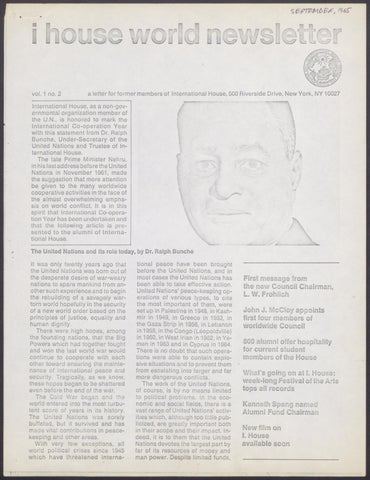
International House, as a non-governmental organization member of the U.N., is honored to mark the International Co-operation Year with this statement from Dr. Ralph Bunche, Under-Secretary of the United Nations and Trustee of International House. The late Prime Minister Nehru, inhislastaddress before the United Nations in November 1961, made the suggestion that more attention e given to the many worldwide cooperative activities in the face of the almost overwhelming emphasis on world conflict. It is in this spirit that International Co-operation Year has been undertaken and that the following article is presented to the alumni of International House. The United Nations and It was
only
twenty
its role today, by Dr. Ralph Bunche
years
ago
that
tional peace have been brought before the United Nations, and in most cases the United Nations has been able to take effective action. United Nations’ peace-keeping operations of various types, to cite the most important of them, were set up in Palestine in 1948, in Kash-
the United Nations was born out of the desperate desire of war-weary nations to spare mankind from another such experience and to begin the rebuilding of a savagely wartorn world hopefully in the security of a new world order based on the principles of justice, equality and human dignity. There were high hopes, among the founding nations, that the Big Powers which had together fought and won the last world war would continue to cooperate with each
the Gaza Strip in 1956, in Lebanon in 1958, in the Congo (Léopoldville) in 1960, in West Irian in 1962, in Yemen in 1963 and in Cyprus in There is no doubt that such operations were able to contain explo-
other
sive dissin
toward
ensuring
the mainte-
nance of international peace and security. Tragically, as we know, these hopes ami: to be shattered even before t he en d of the war. The Cold War began and the world entered into the most turbulent score of years in its history. The United Nations was _ sorely buffeted, but it survived and has made vital contributions in peacekeeping and other areas. With very few exceptions, all world political crises since 1945 which have threatened interna-
mir
in
1949,
in Greece
in
1952,
in
. Chairman WwitClibitica
five? Pew
WC
feyrrr G
ENF
Ue
at
vhirdy Wii idwide
PAD 5
eae
> om 2 am oil WwOUTCH
ouU
ele | alums
tiny
eomrroant
Ui
i
off ier atric
UCUPICiit
rms
re,
@
FEU
ot
ryt
aent
* ix
mempers
"s 4 a's * I, nOspi cally
ortne
+
LJ vs)
mouse =)
and to prevent them
from escalating into larger and far more dangerous conflicts. The work of the United Nations, of course, is by no means limited to political problems. In the ecoim and Booial fields, there is a st range of United Nations’ activities which, although too little publicized, are greatly important both in their scope
ri
and
their impact.
In-
deed, it is to them that the United Nations devotes the largest part by far of its resources of money and man power. Despite limited funds,
Alsswmri PAIGE
De
acs tikes
ING »
Vi
rim
&
,
bave
Saud
ne on
House
OG
Pw2 ws
available soon wal
.
ml PI ynairme ay Ni i Gbdidicail
ay
2 mankind might not have been spared the fateful holocaust of world nuclear war. Although the United Nations has been unable to find final solutions to the political problems creating the conflicts it has checked and contained, it is the only organization with enough moral force and backing to do so. It is recognized that the limitations of the United Nations are most serious, especially just now. International peace is facing one of its gravest threats since the last world war, because of at least one menacing conflict with which the United Nations has not yet become involved, and because, within the United Nations itself, its indispensable peace-keeping operations have become the cause of disturbing internal crises, political as well as financial. Those limitations are essentially due to the inherent conflict of interest between the sovereign rights of individual member states and the requirements of the international organization as an effective
through research, humanitarian missions, technical assistance and other operational activities, the United Nations and its Specialized Agencies have done a great deal to promote better living standards and economic and social progress,
particularly in the less developed parts of the world. This aspect of United Nations’ activities, it may be noted, is intimately related to the
primary United Nations’ objective of maintaining international peace, for the present ever-widening gap between the have and the have-not peoples of the world constitutes a serious source of discontent and conflict among men and nations. In the long-range view of things, this is no doubt the most serious of international problems. Looking back on the past twenty
years
of United
Nations’
history,
one can say without reservation that the record of the United Nations has been an impressive one. Without its interventions in areas of conflict speedily, and, at times daringly, it may well be said that A message
from the new Council
operating instrument. The United Nations, which, after all, is only a composite reflection of all of the nations of which it is composed, can be effective only to the extent that those nations, and particularly the most powerful wish it to be. To mark the twentieth anniversary of the United Nations, its Gen-
eral Assembly has designated 1965 as International Co-operation Year. This provides a unique opportunity for the peoples and the nations of the world to renew the faith and
the
sense
of
solidarity
which,
twenty years ago, made the founding of the United Nations possible, and to reaffirm their determination to support and strengthen it. At a time when, as a result of technological advances, our world has become amazingly smaller and our power of destruction frightfully greater, the well-being of mankind and, indeed, its very sur-
vival,
clearly
depends
upon
the
effectiveness of the United Nations as man’s sole hope for international peace and security.
Chairman
More than forty years ago, in an address delivered at a Sunday Supper of the Intercollegiate Cosmopolitan Club, John D. Rockefeller, Jr. stated his concept of the work of International House, and its goal “That Brotherhood May Prevail.” He defined brotherhood as one of the closest and
finest relations of life, made up of justice, good will and understanding. In discussing how the work of International House would be carried out, he said—“| know of but one way—by each one of us living each day in the spirit of brotherhood. Living! We may listen as peaple talk to us, as ministers preach to us, as teachers teach us, but much more powerful than words is example. So if everyone who comes through the doors of International House, if everyone who is now a member of this Club, or may be as the years go by, if everyone who avails himself of the privileges of the Club exemplifies brotherhood in daily life, wnat a powerful influ will thus be exerted, not only in the individual life, but in the
life of t return, and
mmunity, of the homeland to which you will all some day of the world.” In other words, Mr. Rockefeller pointed up
the necessity for putting theory into practice in our daily lives.
This was said in 1923—long
before the United
Nations began
its ef-
forts to foster and establish brotherhood between the nations of the world. The International House experiment has been successful—as more than 40,000 alumni can testify. Is it unrealistic to hope that what can be achieved at the individual level can also be achieved at the national and
world
levels?
Granted,
the problems
become
infinitely more
(Bill Frohlich
('35-’37) was
ap-
pointed Chairman of the Alumni Council in April of this year by John J. McCloy, Chairman of the Board of Trustees of International House. He brings unique organizing experience and skill
to his formidable task of setting up the Alumni Council of the House. Founder of his own com-
complex
pany in 1938, he is now President
but, in the final analysis, nations are people. Therefore, let us earnestly, continuously and energetically practice brotherhood, and support the House in its continuing drive to promote the principles of justice, good will and understanding. And | do mean practice. To quote William James — “No matter how full a reservoir of maxims one may possess, and no
of this worldwide corporation in market research, and carries a number of other responsibilities in related fields herein New York City. A Trustee of International
matter how good one’s sentiments may be, if one has not taken advantage
House,
of every concrete opportunity to act, one’s character may remain entirely unaffected for the better.” Recognizing the need and the responsibility, the Alumni Council gives us the opportunity—it’s up to us to act!
at
Chairman
Frohlich
lived
International
House
from
1935-37, while studying at Columbia.)
att
Beak
pk hay
a datctk:
SUSE
DR.he
OME
FO LE a EE
3 Alumni open their
Chacko, formerly President of St. Andrews College in North India,
_ homes to students Over 800 alumni have indicated that they are willing to offer or arrange hospitality for student members of International House. This will be particularly helpful during the vacation period when many of our foreign students with limited budgets would like to travel in the U.S. and Canada—or when U.S. students on limited budgets wish to travel abroad. As.a small pilot project, the Student Travel Fellow, Jeanne Hazen, worked with some of these alumni in providing 30 overnight or weekend stays across the U.S. and abroad for individual students. Jeanne and the Alumni Office have already received cards and letters from a number of participants
which tell glowing
“success”
sto-
ries for the project. Jeanne plans to do an evaluation of the project with both students and alumni this fall. On the basis of this evaluation, she and this year’s Travel Fellow— Frank Taylor — will plan the alltime-best student homestay program. Those of you who filled in the card in the Spring will be hearing from them and with your cooperation, the House should be able to add a new dimension, here and abroad, to its program for the student members. Alumni
Fund Chairman appointed
In accordance with the Bylaws of the House, the Chairman of the Board, John J. McCloy, appointed
Kenneth M. Spang as Alumni Fund Chairman. Kenneth Spang was a resident of the House in '34-'35, and again in ‘46 while he was studying at Columbia. As Vice President in the Overseas Division of the First National City Bank, he is uniquely qualified to aid in setting up the first annual Alumni Fund Drive. In the case of International House this is an especially difficult assignment due to the many types of currency and
was also Head of the Dept. of Political Science, University of Delhi 1952-62. In 1959 he organized the Indian Society of International Law, and is its Secretary-General as well as Editor-in-Chief of the Indian Journal of International Law. Since 1964, he has also been Director of the Indian Academy of International Law and Diplomacy. He is married to the former Dorothy Dunning, alumna of 1925-27.
kcal
is Treasurer
Fund,
a
of the Phelps-Stokes
member
of
the
African
Council
Advisory Council of the U.S. Department of State, a member of the Council on Foreign Relations Study Group on Africa, and Chairman of the New York Regional Export Expansion Council. First four Alumni Council members appointed John J. McCloy, Chairman of the Board of Trustees of the House, has appointed the first four members of the Alumni Council, an international advisory body on alumni affairs for International House. They are: Dr. Matta Akrawi ('25-'29, '32 & '33-'34), Dr. C. Joseph Chacko ('26-'31), Mr. William Choy ('36-'38), Mr. Namiji Itabashi ('38-'39). Dr. Akrawi, who will be the charter representative of the Council from the Middle East lived at International House while study-
ing
at Columbia
for his Masters
and later for his Doctorate. He has been Professor of Education at the American University of Beirut since 1963. Prior to this he was associated with UNESCO as the Director of the New York office and as the UNESCO repre-
member
lished in 1948,
the of
Commerce,
Inc.,
Af-
studying for his M.A. and Ph.D. in
fairs
of America,
He
his
Public
Mr. William Choy
Society
and
African Ltd.
member
of the Coun-
sentative at the UN for two years.
Mr. Spang is President of African-American Chamber
contribu-
Choy,
cil for English Language Education of the Ministry of Education. We are indeed honored and proud to have as “charter members” of the Alumni Council, men of such demonstrated dedication to the ideals of the House.
He was also First President of the University of Baghdad in 1957-58, and Director-General of Higher Education in the Ministry of Education, Baghdad in 1947-48. Dr. Akrawi has directed a number of government and intergovernmental surveys and research studies in the Middle East and in Southeast Asia, North and South America, North Africa. Dr. C. Joseph Chacko, the Alumni Council member from Delhi, India, was at |. House in 1926-31 while
many areas from which tions will be coming.
William
who studied at N.Y.U. and lived at |. House in 1936-38, is Director of The Sun Co. Ltd. Dept. Stores in Hong Kong. He has maintained an active interest in the House, acting as Founding President of the Hong Kong Chapter in 1953 of the former International House Association, and continues to encourage the association of House alumni to the present day. He is Director in Hong Kong of the Chinese YMCA and Chairman of the Hong Kong Society for the Protection of Children. Council’s Namiji Itabashi, of Tokyo, who lived at the House while he studied at Columbia Graduate School, has been a leader in the Japan Chapter of the old International House Association for many years. He is Chairman of the Board of International Education Center, which he estab-
Law
at
Columbia. ?
Dr.
7 }
| See
eare
.
Y
;
e
elias
4
BEA
Dr. Matta Akrawi
eee
Dr. Joseph
ee
Chacko
| ~ ~
Sew.
—
Mr. Namiji Itabashi
J
4 In the wind— World Tour Nothing has been confirmed-—it is still a matter of major conjecture —but it looks to us as though the Founder of International House, Harry Edmonds, and the President of the House, Howard Cook, might really be making a world tour early in 1966. You will be notified well in advance if they are to be in your area. We hope for the cooperation
of all local alumni in spreading the news and in organizing, in advance, a meeting place and time for them to greet all alumni who can come
to talk with them. We eager as you and when....
are
are just as
to know
where
Eleanor Clark French (’35-’36) chairs November 4 alumni dinner at the House OIE 1h
ry
NET
VY
-
RA ; ii
j
We ‘
9 4
}
ee: en
Li f/
%
'
/,
Numbers of foreign students in the U.S. continue to mount
Alumnus receives Distinguished Service Cross of the
participants
pointed
New
York
City
Commis-
Board of the Foreign Policy Association and the New York Fund for
Children. Eleanor French, who is active in
the Democratic party of the State, was
the
candidate
Democratic
and
for Congress
Liberal
from
the
17th District in 1964. She says of the alumni dinner: “We want to make this year’s dinner avery special event as it marks the launching of the new committee of alumni in the New York area. These alumni will take a personal
responsibility
in developing .proé
.
Federal Republic of Germany In the just-published survey report on educational exchange with the U.S., Open Doors, 1965, Kenneth Holland, President of Institute of International Education (an alumnus '32-’33) stated: “International education has vital meaning for the world in which we live today, and those who believe that it is indispensable to a better world have reason to be encouraged by
its steady growth.
sioner to the United Nations in 1962 by Mayor Wagner, she is also a member of the City Commission on Human Rights, a member of the
with highest
representation of students in the U.S. (in decreasing order) for 196465 were: Canada, India, Republic of China, Iran, Japan. The breakdown at International House for the years '64-’65 follows the same pattern with India having the largest representation, next largest Japan, then Canada.
For the seven-
teenth consecutive year since IIE began collecting statistics on educational exchange, the number of
We are happy to announce that Eleanor Clark French will be Chairman of the annual alumni dinner to be held at the House on Thursday, November 4. Mrs. French, who lived at the House in 1935-36, while she was studying at Teachers College, is a civic leader in New York City. Ap-
The five countries
grams to aid student members of International House.” Patrons and an Invitation Committee for this dinner will consist of alumni in the New York area, including many members of the New York Chapter of the former International House Association. We hope all alumni in the New York area, who can, will come.
in educational
ex-
change programs between the United States and other countries has grown. “This unbroken trend underscores the increasingly important role educational exchange plays on the American academic scene as well as in the economic and social development of many lands and in the search for international understanding.” According to this survey of some
3000
institutions
throughout
the
world “...more than 91,000 foreign citizens were on American college and university campuses during this academic year. By far the greater number — more than 82,000 — were students; the remaining
9000 were scholars engaged in research, or teaching at U.S. institutions. This total exceeds last year’s by 7800 — about nine per cent. “The over-all increase was re-
On
July
16 of this year,
ceremonies in Konigstein, Germany, in particular recognition of his outstanding service as Chairman of the Development Service Administrative Council (the German Peace Corps). President and Mrs. Cook, who were in Europe at the time, attended these ceremonies. Many of you will remember Walther Casper as a member of
the June Homecoming Panel at the House. At the ceremony Mr. Casper said in part, relative to the Development Service, “We all, regardless’ whether we come from independent organization, the administration, the churches, or private industry, were involved and determined to act in accordance with Our innermost conviction, that is the conviction that in the coexis--. tence of peoples and states the » human factor must be put first. Human solidarity, human relations on the basis of shared values, must characterize national as well as international interrelationships. Man alone can help man, and without him the most perfect machine made available to a developing country is no more than the expression of futility and profound lack of understanding.” What’s going on at
flected in every geographic area. The largest number of exchange
International
‘visitors by far—32,400, or 35 per cent — came from the Far East. Latin Americans made up 16 per cent, followed by visitors from Europe (15 per cent), the Near and Middle East (13 per cent), North America (11 per cent), Africa (eight
The
per cent), cent).”
and
Oceania » Pd
(two
per
Walther
Casper (’36-'37) was awarded the Distinguished Service Cross at
noisiest
House
and
most
colorful
event at the House this past Spring was the Festival of the Arts. This year’s festival was the largest, most elaborate, had the most food booths and raised the most money in history for the Scholarship Fund
— $9,000. Many New York area alumni came to the week-long,
6 student-run-built-producedcooked-prepared-directedpainted-hammered-sung-danced events. It included such diversities
as a Sibelius
concert
conducted
by a Finnish student conductor, African native story dances, a gen-
uine
Eskimo
igloo,
in the Coffee
Wing — courtesy of the Canadian members, a demonstration of Karate, and flaming crépe suzettes to be eaten standing in a mob witha
glass of Australian passion-fruit juice in your left hand. (Some of the moments of truth are pictured on the preceding page.) The
Mary
Senior Fellowship
Fund
which was started with a. bequest from this alumna of '53-’54 has been receiving contributions from Mary's friends with a total to date
of $6,893. This year the Fellowship will be awarded to a Travel Fellow who, among other duties, handles the alumni home hospitality program for the traveling student members. In 1964 the New York Chapter of the former International House Association gave a room scholarship for one year to International House
in memory of alumna Celia Siegler ('37-’38),
and
this
past
year
has
contributed $1,000 to the scholarship aid program.
Editor’s Note: An endowed scholarship of almost $12,000 was arranged through alumnus Tom Gardner (’49-’50, 53) as a Trustee of the Lee Scholarship Fund in 1958, and has proved a much appreciated benefit to a student each year since.
loyalty
inspired
by
among
its
members.
ban
Business Manager retires after 34 years at the House
Perhaps one of the best indications of the success of an institu-
tion is the length of service—and the devotion in this service—of
staff. Ennis Van ployed
by
its
Duyn, first em-
International
House
in
1931 as the Manager of the Coffee Shop, is a perfect example of the
the
House
Most
alumni will remember “Van” as the man to go to whenever anything or everything went wrong.... During the period from '53-’64, he was responsible for keeping the
House functioning.
with people of the Peace Corps of
Europe, with the German
ambas-
sadors in the African countries, with specialists for documentation, specialists for wildlife managing in Africa and other technical assistant experts. Next year Dieter
His office and
will become director of the Bonn-
staff handled everything from unsticking a “stuck” window frame on the 10th floor to managing a banquet or the physical arrange-
bureau of the German Foundation for Developing Countries.”
ments for the week-long Festival of the Arts. Most alumni remember “Van” and the ease with which he performed miracles. They know why those of us here at the House will and do miss him. Reading
the mail...
Letters, brochures of the latest endeavors, copies of addresses by distinguished alumni, wedding and birth announcement —all s this and more crosses the mail desk in the
Alumni Office.
We would like to share all information with you, but since we can't, here is a sampling, all of it showing, either by profession or
by persuasion, that |. House goals
are
being
thought
carried
and
action
forward
in the
of its alumni
throughout the world. We hope we will continue to receive letters from you—and we, in turn, will continue to publish as much of this as space will allow. Piera Tuzii Peyron ('61-’62) of Torino, Italy writes, “It is with a real, great pleasure that | received International House Newsletter. | am sure that you will understand how easy it is to be caught in the heavy routine of a family and working life, and will excuse those alumni who, despite of desire, have not remained in touch with l. House. “! lived there during the academic year 1961/62, and | remember the time | spent there as a
period
iy Nena Nee
staff
full of meaningful
experi-
ences: experiences that changed and enriched me very much. “| became aware of how many opportunities to get in touch with people of other countries | had wasted or missed before, and of how pleasant, useful and broadening could be improving the reciprocal understanding.”
From
Helga
and
Dieter Danck-
wortt we hear that Dieter (’53-'54) “was very busy this year and man-
aged
many
interesting seminars
Helene M. Crooks ('21-’22 & '28'29), of Maine writes, “l adopted a little Greek girl through ‘Save the Children Federation’ as a memorial to Eleanor Roosevelt, and of course | hope to return to Greece some day to visit my new family: the father, the mother, three boys, and Vasiliki, my godchild. | think Eleanor Roosevelt would like to have her memory live on in the heart of a child. At the time | did not know that Adlai Stevenson had Started the Eleanor Roosevelt Memorial Foundation to continue her work, for individuals, and for humanity in general. | was invited to the Memorial Tribute held for her last November at the Lincoln Center, and realized more than ever then how many lives she touched.”
Carlos G. Fuller (’24-'25) of Ver-
mont says: “it seems to me that we have not yet scratched the surface of the almost unlimited power available in the wise and persistent exchange of ideas and fellowShip possible nationwide and
worldwide,
through
the exchange
of personal letters. Obviously, such fuel keeps fires of memory, loyalty and support at an even higher pitch of glad and generous expression. It could be a steadily widening network of vitally renewed and developed relations, of crucial value in present world Crisis.” Vergel De Dios ('39-’40), Commercial Attaché with the Embassy of the Philippines in Switzerland, Suggests: “In order to encourage alumni to be more active to the ideals of International House throughout the world and encourage closer fellowship, perhaps, an elder statesmen’s roster is needed for those who have specially contributed to the cause of the House. International House statesmen should be nominated by the area
committee
to the Alumni
Council
for the approval of the International House Board of Trustees. At every International House annual
7 homecoming
in November
a spe-
From Olga L. Butterworth ('18), Denmark—(apologies to her sonnet form) “What joy! ‘Il. H. world newsletter’ has come! A breath from ‘olden days’ —now long ago—While just a few days after letter from OUR
cial honor could be given to the elected statesman, who automati-
cally
becomes
a memberof
exclusive Statesmen
International Club.
“On
suggestions
my
the
House
above,
|
‘Skipper’—lifelong
leave it all to the Alumni Council to consider the matter or not. Thank you for the attention given to this letter, and best wishes.” From Amaranto A. Abeledo ('13), Buenos Aires: “I wish to thank you
goes to show How comradeship, established in our youth, When we — with hope, trust, faith —all looked ahead, Foundation, which our leaders built—on truth—Through years of joy and sorrow now has led To hands reaching out to us— faded, old—Yet, still imbued with confidence that life, Despite trials encountered, souls did mold To conquer, e’er undaunted, despite strife...A breath from country of
very much for your kindness in sending me the first number of the ‘i. house
world
Through
newsletter.’
this Bulletin,
| have
learned of the meeting which was held last summer by the ‘Alumni’ and their families, and the steps taken to maintain a close relationship with the former members of the International House.”
Fern
McGuire
our birth...Accept
Our gratitude,
bond, which time—intact—kept.”
JoAnn Bloomer Fleenor ('52-'53)
Barnett ('59), In-
is Area Coordinator for “Hospitality International” in Phoenix and Scottsdale. This group enables
diana says: “It was truly a delight to see the first issue of the Newsletter and review the homecoming activities of the summer. It is a publication of which IH and all the alumni can be proud. For me it fills a long-felt need for contact with the House and for renewal of
coming to their area for study at Arizona State University, Phoenix College, Good Samaritan Hospital and the American Institute for For-
the inspiration of its program
eign Trade.
families and groups to provide hospitality to foreign students
and
climate of brotherhood.” From Shakunthala Jagannathan ('49), Bombay: “I was overjoyed to receive the International House Newsletter and to see that, in the proper tradition of the |. House, those of us who stayed there are not forgotten!...For the last 9 years I’ve been working as Deputy Director of the Government Tourist Bureau and have therefore been meeting tourists of every country in the world, so that! don’t really feel cut off from the |. House! Mr. & Mrs. Mott once visited India and by sheer coincidence, | was
Viola G. Pfrommer ('33-'35, '51) last summer developed a conference held in Boulder, Colorado, on American Indian Affairs. It of-
fered qualified Indian college students an unusual opportunity to study in a small group, with Indian Indian. This workshop was sponsored by American Indian Devel-
opment,
Inc.
in cooperation
with
The University of Colorado. From Martin S. Allwood ('46-'47), and his wife Inga Wilhelmsen AIllwood ('47) came an interesting
(’57-’58 & '60-'61),
booklet on the Anglo-American Center in Mullsjo, Sweden. This Center was founded in 1924 to act as a Cultural bridge between Eng-
Arkansas, is “at present Professor of Social Sciences at A. M. andN.
lish-speaking countries and Scandinavia. Dr. Allwood, who is head
We
hear
that
Muzumdar
Ammu
Menon
College, teaching courses in Sociology and Social Work.” Her “doctoral dissertation, Social Welfare
in India: Mahatma Gandhi's Contributions, was published in 1964.” She is “married to Dr. Haridas T. Muzumdar,
friend
and
biographer
of the late Mahatma Gandhi, presently Dean of the Division of Arts and Sciences, Arkansas A. M. and N. College.” Michvatead: ihe
ame aoe
ee
Alumni represented on new Bequest Committee With the approval of the Board of Trustees a new committee has been established to serve inquiries regarding bequests to International House.
Our
Alumni
representative
on
the committee is Emi! Kuster ('2526), Senior Vice President of J. Henry Schroder Banking Corporation in New York City. Others serving on the committee which is chaired by John G. Powers, an attorney and Trustee of International House, are James North, Vice President and Trust Officer of The
Chase
Manhattan
Bank,
Oscar
Ruebhausen, Attorney with Debevoise, Plimpton, Lyons & Gates, and Lawrence G. Chait, President of Lawrence G. Chait & Company. Through the generosity of Mr. Powers, a bequest folder, explaining how to word bequests legally and listing various projects, scholarships and other programs important to the House, has been
made
available.
Alumni
desiring
further information may fill in the coupon on the last page, and send
it to Mr. Kuster, c/o the Alumni Office.
and non-Indian scholars and lead-
ers, the situation of the American
the first person they met when they got off the ship!”
Shoah
friend—which
things which today, if we stop and think, are important; and unless we take this time, those important things slip away and are lost forever.”
°
of the Center
is a translator and
writer
and
as well,
is one
faculty of lowa Wesleyan in Mount
of the
College
Pleasant.
Arthur G. Murphy ('27-'29) of Connecticut writes: “...1 wish it were possible to properly sit down and say what those years have
meant in retrospect. Your words, ‘The pressures of daily living...’ seem to, at times, erode many
New
film on |. House
An excellent new color and sound film (20-minute, 16 mm) on |. House has just been completed and will be available for local showings (to groups of 30 or more) January ’66. Written and produced by a student member of the House, this film gives an engaging and infor-
mative look at life today at |. H., of the services
and
facilities that
greet its student members. film will showing
The
be especially useful for groups of graduate stu-
dents coming to New York to study who would be interested in International House. Groups of alumni
will
be
most
interested in seeing it to familiarize themselves gram today. If you wish
with the House
pro-
to
film
schedule
the
(starting in January) please send us the coupon on page 8.
8 Editor’s Note The response to the first Newsletter was overwhelming—we knew you were all out there somewhere, but how wonderful it was to learn that you are still so much involved in the plans and ideals of the House! Some quick excerpts from the loads of fascinating mail that
came
to us are
in the
“Reading
the Mail” section. Over 1500 people took the time to send back their card, giving usa fairly accurate picture of how rap-
idly the
Newsletter
is being
de-
livered (terrible!) and indicating their interest in the alumni coming to their area and in student hos-
pitality (wonderful!). The list of the “contact” volunteers is being printed right now in a Passport to International House Friendships. (You will receive a copy—free— please don’t write for one.) For those of you interested in the James L. Davis study—patience is in order. It now looks as though, due to complications in the printing contract, this summary will not be published until the end of 1965. We were also impressed with the number and amount received in those contribution envelopes we enclosed with the copy of the annual report. Although the House did not ask for any contributions,
merely making the envelope avail-
able
for use,
almost
$2000
came
to the House from 200 alumni from 15 countries. (This is very helpful in covering the costs of getting the
Newsletter to you.)
:
Since our first issue in February this year we have added some 5000 names to our mailing list. If you are one of those—welcome! We hope you will enjoy receiving the Newsletter—there is no charge or membership fee—as an alumnus of the House you receive this and other informative mailings at no expense to you. Janet Whittier, Editor September,
1965.
Return any and all of these coupons to: Alumni Office, International House, 500 Riverside Drive, New York, N.Y. 10027
FILM COUPON
Page 5 photos by Paul Cordes
(This film is only available for distribution to groups of 30 or more)
Please allow 2 months for scheduling NAME
OF GROUP
TO USE FILM ALTERNATE
DATE OF SHOWING
DATE
| understand that | pay the expense of mailing the film on to its next
scheduled showing or back to International House NAME ADDRESS
| would be interested in more information on the Charter Flight | plan to go to Europe (from N.Y.) next Summer (J | plan to go to Hawaii (from San Francisco) (]
Alone]
With (number) (J other members of my family
NAME ADDRESS
| I l I |
Dear Mr. Kuster:
| would
like more
information
national
House
[] Please send Bequest Folder
|
NAME
| | | L
ADDRESS
on the Bequest
Program
of Inter-
International House is a private, non-profit and educational organization. Its program is supported by the generous contributions of individuals, corporations and foundations who believe in its purpose. International House has developed through the years a program designed to carry out its three-fold purpose: To help each student achieve the educational and personal goals which brought him to New York. To provide foreign students with the broadest opportunities to experience the many facets of American life and give them a deeper understanding of the United States. To give American students an opportunity to broaden their horizons through friendship with people from diverse backgrounds.