vol. 1 no. 1
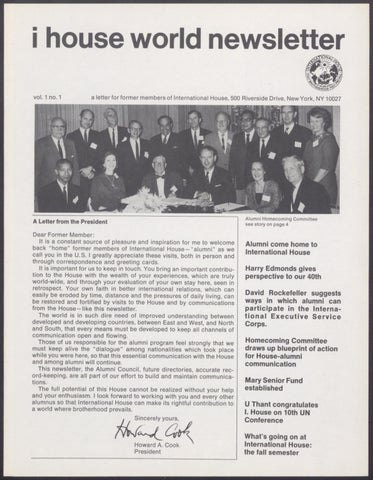
Alumni Homecoming Committee
A Letter from the President
see story on page 4
Dear Former Member: It is a constant source of pleasure and inspiration for me to welcome back “home” former members of International House—“alumni” as we call you in the U.S. | greatly appreciate these visits, both in person and through correspondence and greeting cards. It is important for us to keep in touch. You bring an important contribution to the House with the wealth of your experiences, which are truly world-wide, and through your evaluation of your own stay here, seen in retrospect. Your own faith in better international relations, which can easily be eroded by time, distance and the pressures of daily living, can be restored and fortified by visits to the House and by communications from the House—like this newsletter. The world is in such dire need of improved understanding between developed and developing countries, between East and West, and North and South, that every means must be developed to keep all channels of communication open and flowing. Those of us responsible for the alumni program feel strongly that we must keep alive the “dialogue” among nationalities which took place while you were here, so that this essential communication with the House and among alumni will continue.
This newsletter, the Alumni Council, future directories, accurate record-keeping, are all part of our effort to build and maintain communications. The full potential of this House cannot be realized without your help and your enthusiasm. | look forward to working with you and every other
alumnus so that International House can make its rightful contribution to a world where brotherhood
prevails. Ae
yours,
Alumni come home to International House
Harry Edmonds gives perspective to our 40th David Rockefeller suggests ways in which alumni can participate in the International Executive Service Corps. Homecoming Committee draws up blueprint of action for House-alumni communication Mary Senior Fund established U Thant congratulates I. House on 10th UN Conference
What’s going on at Howard A. Cook President
International House: the fall semester
2 Alumni come home to International House
Ceremonies, introduced in turn, Harry Edmonds, Founder and First Director, John and Celestine Mott,
careful thought, planning and preparation would be needed to foster this idea. He concluded that
Directors of the House from ’35 to 54, who gave brief and informal
anything which could be done to keep the spirit of International
greetings to the alumni. Howard Cook, President of the House since 1955, spoke of the House, its present and its future role. David
House alive would make a definite contribution to world understand-
Rockefeller then gave an informal address which suggested a new
Walther Casper (’36-’37), a leading German industrialist, who is head
dimension in international understanding, which all alumni might well seriously consider. (An abstract of his challenging remarks appears on page four.)
of the German Peace Corps. He stated that all student residents, quite apart from being inspired by living and studying here and get-
For most alumni the highlight of Last summer, from June to September, International House was briefly the “home base” for hundreds of alumni and their families. There were eleven reunion dinners, a major conference in June, another in August, and innumerable coffee sessions in the “waffle wing.” The subject of all this? A new alumni-House relationship, with alumni taking on a more active role in the future of International House. The President's Reception, at the first Conference, took place on a beautiful afternoon in June. Two hundred alumni, their families and
guests,
current
staff and
student
members circulated in the Alumni Room (formerly called the Duncan Phyfe room) spilling out onto the front terrace, where tables and gay umbrellas had been set up.
Harry
Edmonds,
David
Rocke-
feller, Cleveland Dodge, John and
Celestine Mott were there to greet their many friends—some returning for the first time in many years. The Conference dinner was held
the evening was the candlelight ceremony. It served to waken the memories of their pledge to brotherhood made years before. In the hush of the darkened auditorium, with only the single large Inter-
national
House
candle
for
light,
Harry Edmonds spoke the solemn words of the ceremony. Lighting
the first candle he passed the light on to the next and on to the next. Soon the room was aglow with
candlelight
as the
alumni,
many
with tears in their eyes, remembered many things and pledged a renewal to the principle of brotherhood. “As light begets light, so love, friendship and goodwill are passed from one to another. We who have come from many nations to live in one Fellowship in International House, promise one another to
pass the light wherever we go.” The following morning, after a coffee hour in the upper foyer, panel members, alumni, and current students adjourned to the Home Room. Under the expert
ing. Bill
Frohlich
then
introduced
ting a grasp of American democracy, are led to a feeling of closer international cooperation wherever they go afterward. He felt that it is, without a doubt, vitally important to keep in touch with alumni. As an example, he pointed out that in German Peace Corps projects it would be a tremendous help for him to have addresses of former residents of International House so that contacts could be made. B. A. Liu (’39-'42), formerly with UNESCO and currently Associate Professor and Coordinator of Ad-
ministrative University
Studies of
New
at the
York,
City
said,
“|
urge that the International House program include its 40,000 alumni in order to keep the ideals of the House alive for them long after they have left. The moving candlelight ceremony is an example of the way in which an idea can be
passed from one individual to another. Each person who has lived at International House carries with
him the gene for world understanding. This gene should, must, be transmitted to other people who have never felt the influence of
in the auditorium and followed the
guidance of Bill Frohlich ('35-’37),
International House and, with geo-
pattern of a Sunday supper, so familiar to all alumni. Under the shimmering glow of the chande-
Trustee of International House and Panel Chairman, a panel of distinguished alumni and one outstanding guest settled down to cope with the problem of how best to pass on the spirit of the House
metric multiplication, it is not impossible to reach the whole world with the International House spirit.
lier, with colorful
flags of all na-
tions hanging around the balcony, candlelit tables had been decorated for the various “decades” when alumni were at the House. They did their reminiscing and chatted with current students over
fried chicken
and a specially de-
licious apple brown Betty. After a short musical interlude provided by some of the talented
current members studying at Juilliard School
Gregor
of Music,
(25-30),
ternational
House
John
The first panelist, His Excellency Sverker C. Astrom, Ambassador, Permanent Mission of Sweden to the United Nations, the only non-
alumnus, addressed himself as an observer of the House to the feasi-
bility of an International House alumni
organization
warned
that
the
overseas.
concept
He
of an
of
In-
alumni
“club”
is more
popular
Master
of
America
than
abroad,
and
Trustee and
Mac-
through the lives of her alumni.
in
that
Kenneth
Spang
('34-’35,
’46),
Vice-President of the First National
City Bank, who in his profession is vitally involved in the growing cooperation among nations, reinforced the theme that a continuation of the International House experience in the lives of its alumni is much to be desired. He stated that his own renewal of contact with International House alumni during his frequent business trips abroad had added much to his life. James M. Davis ('38-'39, '46-'48), who has recently been named
3 Vice-President of the Institute of International Education and in 1960-61 was Chairman of President
dent of the Greater New York Council for Foreign Students.
What’s going on at International House
Kennedy’s Task Force of Exchange
Capsule
of Persons, said that alumni can be termed “international pros” and what they do is extremely important. He feels that the average alumnus can foster the ideals of the
ures on House Events This Fall:
In November, a thoroughly successful theater benefit for the
There are 651 members from 77 countries this semester. The largest single national representation (outside of the U.S. which still runs
House was held. Due to the dedicated efforts of a Benefit Committee of prominent New Yorkers and to the equally dedicated efforts of the Development staff in assisting
progress and programs offered by
to about 40% of total membership)
them, the evening netted over $18,-
the House and by contributing fi-
is from India.
000 for the benefit of the House Program. The play, one of the hits of the season: “Ben Franklin in Paris.”
House by taking an interest in the © nancially so that continued efforts can be made in the areas of international cooperation and understanding. Throughout the summer, the informal reunion dinners on Thursdays were held in the Dining Room with coffee-hour discussions afterwards in the Home Room. The staff recorders came away with note-
books bulging with new ideas for an
alumni
program—some
imme-
diately practical and some admittedly visionary. The second Conference held in the heat of August proved to be
Reports
and
Quick
Fig-
37 fellowships and scholarships were awarded by the House during
this fall. 210 jobs were provided for 120 students, grossing a total of $7,250 earned by individual students between September the end of 1964.
15 and
New this year: the great dormitory stratification. For the first time at |. House we have booked rooms in a horizontal pattern, men and women on alternating floors. This, so that men can now enjoy the wonderful view of the Hudson—formerly exclusively the privilege of
The 10th Annual UN Conference held October 31-November 1 consisted of a luncheon (Guest Speaker: Erwin D. Canham, Editor-in-Chief of The Christian Science Monitor), workshops, and
masquerade ball on Saturday, and on Sunday, a reception for UN Ambassadors and banquet (Guest Speaker: Richard N. Gardner, Deputy Assistant Secretary of
State
for International
Organiza-
populous as its June counterpart. It was held in the auditorium and followed the June format. After dinner, the formal evening discus-
the “Girl’s Wing.” Reaction of the students: “favorable,” perhaps we ought to say “enthusiastic.”
tion Affairs and Presidential Adviser). This year’s Conference was organized under the direction of student members Edward Butler,
sion with Bill Frohlich as Chairman
The
Chairman, and Ethel Ragsdale, Vice-Chairman, both from Georgia.
of the Evening was devoted exclu-
year was
sively to the question of achieving
It was highlighted by an inspiring talk on the goals of the House by
immensely valuable, though not as
better
communication
that
the
held
Supper
on September
opened
summer’s
a tradition remembered
all over the world,
such communication could best be developed. Panel members were James M. Davis, Sigurdur Helgason ('44-’45), R. Gordon Hoxie ('46Robert
W.
Kitchen
Editor of the American
annual dents.
by alumni
hosted
their
fall picnic for foreign Almost two hundred
stuen-
joyed the beauty of the setting with rolling lawns and a view of the Hudson at their Riverdale estate.
(’45-
'46), Rita Chow (’58-’61), Associate Journal
of
Nursing, and Ellen Ryan (’52-'54), former Editor of the old |.H. Quarterly, currently Editor of Ebasco News, a trade publication.
In place of the Halloween
Festival,
which is now held as the Night of Nations in the Spring, the House now holds a UN Conference over the Halloween weekend.
Mr. and Mrs. Cleveland Dodge, in
communication was desirable and asked the panel to discuss how
and
27.
by
events
had proved conclusively that such
48),
of the
President Cook.
House and alumni. Chairman Frohlich saying
between
first Sunday
In October, the Raritan, New Jersey, Yacht Club entertained about fifty students
with
a sail on
More
and more
“deputations”
of
American and overseas students are being sent as House representatives to business and profes-
sional conferences in and around New York. It is hoped in this way to expand their exposure to the thought of those practicing in their chosen field. Sixty students were involved in this activity this fall.
their
Holiday excursions: |In November forty-two students visited Old Sturbridge Village in Massachusetts to
The conclusions of this panel, summing up the summer’s findings and pointing out the future path of alumni plans, formed the basis for the recommendations submitted to the Board of Trustees by the
fleet of yachts. Two weeks later the students invited Club members for an evening of folk dancing and singing at the House. Father George B. Ford, whom many of you remember from his years at the Corpus Christi Church,
then toured two other famous New England cities: Boston and Cambridge. Some hundred foreign stu-
was
dents
Homecoming
his 75th
Committee.
recommendations page four.
These
are reported on
given
a memorial
Birthday.
dinner
It was
on
a gala
evening, held at the Americana hotel, with several students repre-
senting
the
House
honor.
Father
Ford
as
guests
of
is Vice-Presi-
see how colonial America celebrated Thanksgiving. The group
had
a
picture-postcard
Christmas, visiting the snowbound homes of families in Vermont and returning just in time for
the House New Year’s Eve Ball.
4 IESC Discussed
is set up
to provide
expert
man-
agement skills recruited on a volDavid Rockefeller Suggests Ways in Which Alumni Can Participate in the International Executive Service Corps.
At the June Homecoming
Confer-
ence dinner, David Rockefeller spoke informally about a possible
role of |. House alumni in bridging the gap between developed and developing nations. He opened his remarks, in part, by saying: “I’ve always felt that the alumni of International House and of the related International Houses could be an enormously important force for good in the world if they were mobilized.... “I'd like to suggest one idea which you may wish to consider in your deliberations. It seems to me that probably the most important single problem in the post-war world is the problem of how to assist the new and developing na-
tions of the world in achieving their rising aspirations....
“Of the roughly two billion people
States
blueprint of action for Housealumni communication
for developing nations in need of such know-how. Unlike the Peace Corps, this program, initially underwritten by the Agency for Inter-
The Alumni Committee for the 40th
unteer
basis
in the
United
national Development,
corporation
and
is a private
will be financed
by private funds. He stated:
“This
organization
is not
only
going to need volunteers but it's going to need very good screening. We will need people who are first-rate in their own special pro-
fessions and, in addition, who have the ability to adapt themselves to foreign countries and foreign situations. “It is equally important that the opportunities be screened carefully in the developing nations, so that these experts take part in something that is of real consequence. | would think that many
alumni
of
International
House
would be exceptionally well-qualified to participate in this project— some of them perhaps as volunteers and others as participants in
who live in what we describe as the free world today, about a billion and a half live in the develop-
the process of screening....
ing nations and about five hundred
Germany; and that Mr. Casper, our own very distinguished alumnus,
million in the industrialized nations of North America, Japan, and Europe. The difference in standards of living is shown in a comparison of average annual income per per-
son—$1,500 per person for the half‘billion
persons
in
the
industrial-
“It is interesting to me that a similar idea is being developed in
is in charge of it. This gives us added reason to feel that perhaps the IESC is an idea related to International House and to the alumni. | should be very interested to see whether this thought which
ized nations, less than $150 for the
! submit to your discussion
billion and a half persons in the developing nations.... “It is perfectly clear that the industrialized nations have got to
summer has any merit and what comes of it.” During the summer, there was
this
of providing capital—
discussion of the IESC and of ways in which the developing alumni
and they are doing so through aid programs, through investments, and in many other ways. But in
program and alumni as individuals could serve in this effort. It was
find means
many areas, while capital is short, the most acute shortage is managerial skills. Herein lies the possible opportunity for alumni of the International Houses. Provision of managerial skills is peculiarly the opportunity of private enterprise — the private sector of the world in which so many of our alumni find themselves.” Mr. Rockefeller then went on to describe the initial steps in the formation of the International Exec-
utive Service Corps, in which he has played a major role. The Corps
Homecoming Committee draws up
agreed that a first step would be to alert alumni to the IESC and its needs,
then,
as alumni
communi-
cation and organization throughout the world were achieved, the IESC and its goals could become of particular concern to alumni as individuals or in their community work. The newsletter would wel-
come your thoughts on alumni participation in the IESC. For further information on the IESC
IESC 720 Fifth Avenue York, New
sented
Homecoming
recommendations
prefor
de-
veloping alumni relations with the House, based on their findings over the summer, at the Annual Meeting of the Board of Trustees of International House, held November 30. (Committee members are listed on page eight.) The Committee recommended that the momentum of interest de-
veloped
among
Summer
be
alumni
panded
in the ways
over the
maintained
and
ex-
briefly sum-
marized below. 1 Formation of the Alumni Council
with its Area Committees as outlined in the amended Bylaws* of the House. 2 Creation and maintenance
efficient,
accurate
and
of an
complete
address list of all alumni.
3 Mailing of a newsletter periodically to all alumni at no cost (expense to be defrayed by voluntary alumni contributions to the House). 4 Initiation in 1965 of an annual alumni fund drive to finance
needed House projects and programs. *In May of 1964 the Trustees set up a new
category of membership
International
House,
alumni membership. At the same time,
the
in
namely Board
made provisions in the Bylaws for an Alumni Council, made up of representatives from all areas of the world, appointed by the Chairman of the Board of Trustees. The officers of this Council would be the Chairman of the Council, appointed for a five-year
term; and the Chairman of the Alumni Fund, appointed annually. Both appointments would be made by the Chairman of the Board of Trustees. Under the supervision of the
Chairman
of the Alumni
Council
and the Council members, committees of alumni in all areas of the
world may organize themselves to aid International House and the goals of the International House movement.
This may
be accom-
plished in whatever ways seem practical in theirown countries and
itself, write:
New
Anniversary
in their geographical
York 10019
respect to the House.
location with
Alumni Homecoming
Album: June 8 through September 7, 1964
Co-Chairman John Mac Gregor, President Cook, David Rockefeller
Per
ts
ait
ate
President's Reception of the June Conference
Harry Edmonds, Tom Gardner ('49-’50, ’53), and Joukje Jepsen ('43-'45, '46)
‘pee Robert Kitchen, Phyllis and James
The June Conference
Davis
Dinner
he ‘Ant WE Current Resident, Knarig Khatchadourian and Tred Smith ('15-'18, ’25-’29)
a Former
Directors Celestine
with Soma Vira ('60-’61) The June Conference Panel: James Davis, Kenneth Spang, Ambassador Astrom, Bill Frohlich, B. A. Liu, Walther Casper
and John
Mott
6 “A Penny for your Thoughts...” This past summer during the Alumni Homecoming, we recorded hundreds of suggestions for alumni projects. So many, in fact, that both visiting alumni and the staff have decided it will take years of dedicated effort to put all these thoughts into action. Below are just a few examples, recorded during formal conference panels and in informal discussions over after-dinner coffee. Send us
Augusta Edwards ('43-’46, ’6061), Virginia, suggested, “It might be a good idea to have regional meetings of alumni in the United States to help with trips for students living at |. House.” Bill Hollomon
('43-’44), Tennes-
to all seven hundred of you. First, your
completed
questionnaires
helped to produce this unique assessment of International House, one that should be of assistance to other international houses and centers as well as our own. Sec-
see, speaking for both himself and
ond,
his wife Beverly, offered: “In plan-
naires also served to demonstrate that International House alumni do
ning for cross-country travel for the current students there would be advantages
in the students us-
your completed
question-
care, that you do wish to be associated with the House and that you can and will make an important contribution to it when you are
your ideas, too. What can you and
ing the National Parks for camping. We ourselves would like to be included in plans for student hos-
others like you do in your own part
pitality, as we
response
of the world to further the goals of
past
the House? William L. Tayler (’28-’29), Pennsylvania, suggested, “Could a letter or questionnaire be sent to those alumni living near New York, asking them about their interest in entertaining present student members? This type of home hospitality could help to familiarize the student with the New York area. Ali Panjwani (’55-’57), Pakistan, made this suggestion, “Perhaps a scholarship in local currency could be set up by an area committee in their local bank. The money could then be sent to the student at regular intervals and within the amount prescribed by their local government.” Mary E. Woods (’60-’62), Atlanta, suggested, “In addition to acting as hosts for students in their areas, it would be a good idea for alumni to undertake projects which would
dents (from International House, Berkeley, California). In arranging home hospitality, other alumni as
help students living at International House. For instance, alumni in this * general area might send clothes to the Clothing Bank.” Starlin Sims (’35-’36), Chicago, volunteered: “If the students feel a need for a library containing basic reference works and background material on the United States and other nations, perhaps the alumni could plan to help in this project.”
(Mr. Sims has volunteered personally to aid in this plan as he is himself in the publishing field.)
Kenneth M. Spang (’34-’35, ’46), New York, said: “| think it would be
a good idea for overseas Chambers of Commerce in New York City to invite International House students from their own country to
an annual event of their Chamber.” (Mr. Spang was recently named President of the African-American Chamber of Commerce.)
with
have done
groups
it in the
of foreign
stu-
well as relatives and friends could be enlisted.” (Mr. Hollomon is Superintendent with the National Park Service in Tennessee.) Edith Gray Woodsworth (25), Vancouver, said, “Alumni should support the program more and
more. If the need is realized, the funds will be forthcoming.” Robert C. Grier (’42-’51), New York, suggested, “To finance the program, we must ask all alumni to start supporting it immediately. : A thank-you to 700 questionnaireminded alumni
called has
Your
overwhelming
to this request
shown
the trustees
for help
and
the
staff of International House how interested all of you are in the House and how valuable a program of House-alumni communication could be. Mary Senior (’53-’54) Fund established
In honor of the memory of alumna, Mary Senior, the Trustees have set up The Mary Senior Fund. The income of the Fund will be used to provide one or more fellowships for deserving students or for such other purposes consistent with the goals of International House, as
the Trustees may determine. This
$5000 Jim Davis ('61-’64)
upon.
Fund
will
bequest
consist
of the
received
under
Mary Senior’s will and such other gifts or bequests as may be made to International House for the Fund by her friends and relatives. Mary Senior, for many years a member of the International House Association and active in alumni affairs of the House, lived at International House in 1953 and '54,
In August of 1961 we undertook a survey to evaluate the success of International House in achieving its stated objectives. 1200 questionnaires were sent to foreign students who had lived in the House for at least one academic year in the ten-year period from September 1951 to June 1961. Seven hundred of you responded to this request for information—a number far greater than anyone could have expected. From your responses has come an evaluation
Hazen, graduate student from Ohio State University, who will act as Travel Fellow for the House.
study
of
Jeanne,
in cooperation
the House in achieving its stated goals. This encouraging evaluation is presently being used by the International House staff and Board of Trustees to assess their current and future policies. Now we are happy to announce that a brief summary of this evaluation study is being made available. (See box on page eight.) We owe a double vote of thanks
Program
Office and the Alumni
of the
relative
success
while studying at Columbia’s New York School of Social Work. The first fellowship from this Fund has been awarded to Jeanne
with the
Office, will develop a program to help foreign students see more of
the United States while studying here. She hopes to be able to schedule
brief
stays
in
alumni
homes across the country. [Please indicate your interest
in
this program of home hospitality to
visiting International House students on the enclosed card.]
¥ The traveler finds a friend
members traveling throughout the
During the summer alumni from seventeen countries volunteered to
United States. A partial list of Alumni Contacts is printed below. Soon we hope there will be at least one alumnus
serve as “Alumni Contacts” in their own home towns. They will be happy to talk with alumni and student members of the House visiting their area, and hope to help the travelers in whatever ways they can. In addition, here in this country families in sixteen states have volunteered to work with the ProHarry
Edmonds
gives perspective
listed in all major communities. The list will then be printed as a directory available to traveling alumni. If you would like to offer this helping hand of friendship to other “International Housers” vis-
iting your town, please be sure to
gram Office of the House in organ-
note this on the enclosed card when you return it to the Alumni
izing home
Editor.
hospitality
for student
to our 40th Harry Edmonds took an active part in both conferences, and, as might have been expected, his statement at the close of informal remarks at the June Conference put the 40th
Argentina
Buenos Aires
Canada
Ontario, London
Vedia 3892
among those who live here now and among those of you who have
Toronto
London
France
Paris
Robert Tavernier (’50) 152 Rue de Saussure
Germany
Duren/Rheinland
Renate Albrecht (’27-’28) 137 Gneisenaustr.
30 Fitzroy Square
Dieter & Helga Danckwortt
Bonn
53 Ippendorf b. Bonn
Hong Kong
U THANT congratulates I. House Japan
Tokyo
Mexico
Mexico City
Pakistan
Karachi
International
House,
of
New York, for the admirable work it has accomplished toward inter-
national
understanding
through
the opportunities it has provided for students from all over the world to get to Know one another during their stay in this city. It is indeed an example to be fol-
lowed. | believe that the ageless objective of International House — “That Brotherhood May Prevail” — will continue to be pursued
in the
future with as much vigour as it has in the last forty years. Needless to say, this objective is in strict conformity
the
purposes
of the
United Nations. With my best
with
personal
wishes
for your success and happiness.
U Thant UN Secretary-General
Buchholzstr. 35 William L. Choy ('36-’38) Des Voeux Road C. 181 P.O. Box No. 548 Namiji Itabashi ('38-’39) 824 Kami-renjaku Leonardo Silva Espinosa (’44-’45) Calle Bahia Magdalena No. 119 Ali Panjwani ('55-’57) Orient Trading Corp. (PAK) Hemani Mansion, Bunder Road
It gives me great pleasure to con-
gratulate
63 Mallory Crescent Edith G. Woodsworth (’25) 4609 Osler Avenue Keith Aitken (’28-'29)
England
thing is to keep that spirit alive in
A letter from the Secretary-General on the occasion of the 10th U. N. Conference l/ast fall:
(’30-’31)
Verna Tucker (’27-'29)
Vancouver
left the House. The most important this place and in each of you.”
Ann Jeanette Dunston 1246 York Street
Ida M. Sally Lutton (’59-’60) 440 Queens Avenue
Anniversary Homecoming into perspective for us all. He said: “At this time of anniversary celebration, | think perhaps the most important thing about this House is not that it is 40 years old or that it had 40,000 members. It is the spirit — the real spirit that | see and feel
Nereo Roberto Parro ('59-’61) Philips Argentina S.A.
Lahore
Peru
Arequipa
Puerto Rico
Isabela
Switzerland
Berne Lausanne
United States
Arkansas, Pine Bluff California, Oakland Delaware, Wilmington Florida, De Land Miami Hawaii, Honolulu Illinois, Chicago
Mohammed S. Rana (’58-’60, '64) 1434/C Lange-Mandi Jose Rodriguez (’64) Ave. J. Chavez 304 Ceferina Cordero (’54-'55) La Curva 364 A. L. Vergel de Dios ('39-’40) Ambassade des Philippines Jean-Pierre Felber (’55-’56) Ave. de Beaumont 66 Haridas & Ammu Muzumdar (57-60) 421 Park Place Lee V. & Marjorie R. Barker ('29-'31) 2057 Asilomar Drive Robert & Jan Barrett (’58-'59, ’64) 400 Rodman Road Elizabeth Boyd ('36-’42) 522 North Blvd. Miriam Scheinberg ('60-'62) 2401 Coral Way Daniel Sung-Kao Chang ('26-’32) 2032-A3 Wilder Avenue Starlin & Evelyn Sims ('35-'38) 2865 Western, Park Forest
Maine, Orono
Lorraine & Paul Hepler ('54-’56) 6 Chapel Road
Maryland, Silver Spring
Don & Kinuyo Stuart (’47-'48) 525 Thayer Avenue
Massachusetts,
Editor’s notes: Enclosed
Easan Cross ('21-'22)
Boston
7 St. Luke’s Road Baldwin & Helen Callahan ('21-’22) 37 Gay Street
Newtonville
2211 Rambling Road Alan & Nixola Bayle ('40-'41)
Okemos
4287 Greenwood
Drive
New York, Aurora
Pat & David Mac Main Street
Kenzie ('51-’53)
Elmira
Timothy Davidson 766 Perine Street
('38-’40)
Rochester
James & Mary Creighton ('57-'60) 2017 Norton Street John & Ruth De Witte ('38-'49) Robert & Taber Sachs ('32-'35)
Chagrin River Road Tennessee, Greeneville
William & Beverly Hollomon National History Site National Park Service
Texas, Fort Worth
Elise Merriam (’61) 1000 Penn Street
Vermont, Thetford
Fedor & Irina Cekich ('20-'24) Helen B. Goetsch ('34-’35) 1005 South 28 Street
Wisconsin, Milwaukee West Indies
Jamaica, Kingston
('43-'44)
Joyce A. Baxter (’56-'57) 1 Caenwood Road (Cross Roads) Ozzie Williams (’57-’60) 7 Karachi Avenue
Trinidad, Bayshore
of the
please help us bring our records up to date by filling in this vital in-
formation
Our
160 Fernboro Road Ohio, Gates Mills
this copy
and
returning
it to us?
The newsletter will be mailed periodically and without charge to all former student members for whom we have accurate addresses. It will feature stories about or by alumni, news of the House, and other material of special significance to alumni of the House.
Elmer & Margaret Beloof (’46-'49)
Michigan, Kalamazoo
with
newsletter is a postcard. Will you
goal
with
the
newsletter,
and with other parts of the alumni program outlined in this issue, is to contribute to better international relations through increased communication among former members of International House. Please send us your news, your views, your ideas — even clippings from your local newspapers (translated into English, please!) — whatever you feel of value to share with other alumni. We look forward to hearing from you. Janet Whittier, Editor
February, 1965
Barbara V. Teelucksingh ('60) 5 Palm Avenue
Caption for the photograph on page one: 40th ANNIVERSARY ALUMNI HOMECOMING COMMITTEE MEETING AT THE OFFICES OF L. W. FROHLICH—INTERCON INTERNATIONAL, INC., OCT. 27, 1964. Left
'64), Assistant to Coordinator, Afghanistan and India Projects, Teachers College, Columbia University (1. H. Alumni Project Researcher).
Olaf
Nielsen,
Jr.
('35-’36),
The City College of the University of New York. Janet Whittier, Alumni Secretary-
Vice-President, Comac Engineering, Inc. Axel V. Jorgensen ('40), Director of Purchases, Secretary of the Corporation, F. L. Smidth & Co. Edmond J. Nouri ('39-'42), General Agent, Edmond J. Nouri Agency. Howard A. Cook, President, Inter-
Editor,
national
to right (seated): Thomas J. Gardner ('4750), Lecturer, Baruch School of Business,
International
House.
John
M.
Mac-
House.
Frederick
L. Redefer
('28-
Gregor ('25-’30), Co-Chairman of Alumni 40th Anniversary Homecoming Committee; Attorney at Law; Professor of Law at N.Y. University School of Commerce; Member
'29), Professor of Education, New York University. Emil E. Kuster ('25-'26), Senior Vice-President, J. Henry Schroder Banking Corp. Sigurdur Helgason ('44-'45), Presi-
of Board
dent, Icelandic Airlines. Clare Wisecarver, Development Director, International House. Jose Concepcion ('20-'21), (observer) Chairman, Concepcion Industries, Inc., The
of Trustees,
International
House.
L. W. Frohlich ('35-’37), Co-Chairman of Alumni 40th Anniversary Homecoming Committee; Chairman, L. W. Frohlich — Intercon International, Inc.; Member of Board of Trustees, International House.
Vera Kwochka
(’61-’62), Program
Special-
ist, Institute of International Education (Il. H. Alumni Project Researcher). Kenneth
M.
Spang
('34-’35,
°'46),
Vice-President,
First National City Bank. (standing): Francis E. Taylor ('24-’28), retired Vice-President,
Textile Banking
Co. James
L. Davis
Philippines.
Following
are the Committee
members who do not appear here: James McCoy Davis, Jr. ('48), Vice-President,
Institute of International Education. D. Gideonse
('22-'26),
President,
Harry
Brooklyn
is a private,
zation.
Its program
by the generous
is supported
contributions
of
individuals, corporations and foun-
dations who believe in its purpose. International House has developed
through the years a program designed to carry out its three-fold purpose: To
help
each
student
achieve
the educational and personal goals which brought him to New York
Long
the broadest opportunities to experience the many facets of American life and give them a deeper understanding of the United States. To give American students an opportunity to broaden their horizons through friendship with peo-
Island University.
Robert W. Kitchen,
Jr. ('45-'46), Director, Office of International Training, Department of State.
The James Davis survey will soon
fessor, Division of Teacher Education; Coordinator of Administrative Studies, The City University of New York. Starlin A. Sims ('35-'36), Midwest Representative for Crown Publishers Inc. Evelyn Hodge Sims (’35-'38) All photos by Paul Cordes
Office.
House
non-profit and educational organi-
College of The City University of New York. R. Gordon Hoxie ('46-’48), Chancellor,
('61-
be available in printed form to all interested alumni. If you wish a copy, please write to the Alumni
International
Bangnee
A.
Liu
('39-'42),
Associate
Pro-
To provide foreign students with
ple from diverse backgrounds.