WWW.IGNITEDWOMANMAG.COM
EDITION 16 | AUG/SEP 2021
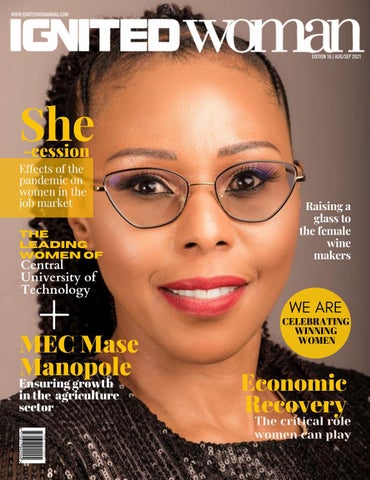
She -cession
Effects of the pandemic on women in the job market
The leading women of
Central University of Technology
+
MEC Mase Manopole
Ensuring growth in the agriculture sector
Raising a glass to the female wine makers
WE ARE
CELEBRATING WINNING WOMEN
Economic Recovery
The critical role women can play
CONTENTS DARE TO LEVEL UP WITH EMPOWERING CONTENT
04 EDITOR'S NOTE Celebrating the women who came before us by being as intentional about our purpose as they were with theirs.
08 WORK-LIFE BALANCE IN A PANDEMIC One would think after a year of juggling work and personal life at home, we would be experts by now.
10 EMPLOYMENT OR BUSINESS There is a conversation that parents have with their children at one point of life. Their future plans. Could it be time to rejig this conversation?
12
18 ON THE COVER
MEC MASE MANOPOLE ON TRANSFORMING THE AGRICULTURE SECTOR FOR WOMEN IN THE NORTHERN CAPE
32 RAISING GLASS FOR FEMALE WINE MAKERS
42
17
A BOOST TO SCALE THEIR BUSINESSES
NEW UNIVERSITY REGISTRAR
Five women owned businesses get a boost as big corporates take a stand to support entrepreneurs and SMEs in South Africa.
Dr Sally Dzingwa, resolute to take on one of the most challenging roles of her career, yet being determined to succeed.
02
Women are increasingly taking on traditionally male dominated industries and making great strides. The wine sector is no different.
34 THE SHE-CESSION: ARE WE
LOOKING AT ANOTHER PANDEMIC As the pandemic wrecks more havoc; in its trail its leaving more women unemployed. Could this be a sign of a workplace pandemic.
40 FIVE BLACK OWNED TIME PIECES Celebrating the young entrepreneurs who are getting involves in the economy one sector at a time. WWW.IGNITEDWOMANMAG.COM
38
37 40
30
24
Issue 16 03
Editor's note Intentional with my purpose
I
have been struggling a lot with focus lately. There are so many things that have become a real disruption, the merciless Covid-19 pandemic being the source of some of these unwelcome distractions. And when one loses focus it is very easy to let other aspects of our lives slip through the crack. For me I found that I became cynical about my purpose because I was out of touch due to lack of focus. I have had to draw very deep inside of myself to re-everything – be it rewind, recalibrate, recoup, refresh, restore, and remind myself who I am. Who I truly am and what my purpose truly is.
04
The one thing that this pandemic has reminded me of is that we don’t have time. And it has also awoken a spirit of being intentional in whatever I do. As we celebrate the women who came before us this August let’s also make our intentions crystal clear about where we want to steer this country. The class of 1956 was intentional with their march and paved a way for us. We now have the baton, we cannot lose focus.
Love, Kamo
Advertise with us
Contact us : 061 434 4631
We are an emerging leading voice for women in business and a resource for our readers with strategic business content and insightful profiles on industry leaders!
Founder & editor Kamogelo Seekoei
Content Lead Basetsana Makhalemele writer tshego ramoupi graphic designer Basetsana makhalemele tumelo mosue
Contributors Tracey Dube Dr Nkomile Setlaba Dikonelo mile edith mjuluki mpho mabote
digital Advertising solutions kamogelo seekoei
Subscriptions Visit www.ignitedwoman.co.za or send email To: info@kannamedia.co.za
124 Lyndhurst road, lyndhurst Johannesburg, 2192 Phone: +27 61 434 4631 Cell: +27 81 708 1412
06
Published by Kanna Media productions All Rights Reserved. all opinions by our independent writer does not necessarily reflect the opinions of ignited woman magazine or its staff members.
Maintaining a work-life balance during a pandemic By Tracey Dube
S
trict lockdown regulations are once again apart of our lives. For some, this means working from home full time, helping the kids with schoolwork, and managing physical and mental wellbeing. One would think after a year of juggling work and personal life at home, we would be experts by now. However, balancing professional life, personal life, and family is complicated, especially under the current covid-19 restrictions. Achieving balance is essential for our wellbeing. When you feel out of balance, it may indicate that certain aspects of your life are neglected, including physical, emotional, and spiritual wellbeing. Research shows that the lack of a healthy work-life balance leads to stress, burnout, anxiety, and depression.
08
Other signs that your life is out of balance may include a weakened immune system, unhappiness, irritability, no time for hobbies, neglecting personal relationships, and constantly thinking about work. The concept of having a balanced life may seem elusive, but it’s possible. Here are different ways you can achieve a work-life balance during and post covid-19.
Think about what is important to you As a starting point, it’s crucial to evaluate what is important to you. Ask yourself the following questions: What are my core values, and what do I want to achieve? If your core values and life goals are not aligned with how you currently live your life, you may be out of balance. With this in mind, begin to define what a work-life balance looks like for you by setting your priorities.
When you focus your time and energy on what matters the most, not what is urgent or what will you give you instant gratification, it will lead to a sense of purpose and fulfilment.
Prioritize time for yourself Mental health is at the forefront of conversations during the pandemic. Corporates are even implementing strategies to prioritise employee wellbeing as numbers continue to show that a healthy employee is a productive employee. Prioritizing time for yourself is not only good for your mental health but also your physical and spiritual wellbeing. To do this successfully, you should insert time in your schedule for activities that promote your wellbeing. This may include selfcare remedies like meditation, physical exercise, hobbies, taking time to learn a new skill or any activity that boosts your energy levels or recharges your brain.
Improve your productivity
Create some boundaries
We’ve glorified being busy for many years because ‘busy’ gives one a false sense of esteem. But research shows that the global pandemic has shifted the way many people view life. We are beginning to take responsibility for our lives and what’s meaningful to us. This includes being productive instead of busy, so we have more time to focus on other critical things in our lives.
Achieving a work-life balance may require you to create some boundaries. For example, you may decide not to check or respond to emails after 18h00, or you are inaccessible in the mornings between 06h00 and 09h00.
To improve your productivity, audit your time by tracking how long it takes you to complete tasks at work and home. Is it possible that you could do specific tasks in less time by limiting distractions such as social media, reading the news, or checking emails every five minutes? When you improve your productivity, you can enhance your work-life balance.
Without boundaries, you’ll find yourself being pulled in one direction or aspect of your life. To create boundaries, you must learn to politely say no when something is not a priority at that particular time. In the beginning, it may feel uncomfortable, but people will respect you even more when you have boundaries. Attaining a work-life balance is not about making drastic decisions but taking small steps that will radically transform the quality of your life. You can do it all, just not at the same time.
Tracey Dube is a certified transformational life coach and founder of Positive Minds Africa.
09
Employment vs Entrepreneurship ARE WE ADAPTING THE CONVERSATION AT THE DINNER TABLE?
T
he future plans of young children have always been something most families are keen on knowing. Families discuss careers paths and future plans with their children around the dinner table by asking them "what do you want to study when you finish school?" Traditional professions such as lawyer, doctor or teacher are often thrown around by the excited kids. The parents relish these moments as they kick start plans to manifest these dreams. Surely those career path discussions remain a tradition for most families. Even I have had a chat with my boys to find out what they wanted to do post matric. One wanted to be in the Navy, while the other one couldn’t see why he needed to work for someone else if he could become entrepreneur. In a nutshell, they were both
10
By Edith Mjuluki
exploring possibilities to financial freedom post matric. They will both have to make some choices later on due to the changing economic circumstances that affect their careers. The world as we knew it has changed, it is full of possibilities especially for those wanting to explore the business sphere. This space requires intellect and the youth are up to the challenge. With all the developments taking place across the globe in how we do business, we need to reevaluate our position in business, especially in light of the Covid-19 pandemic. One major effect Covid-19 brought is poverty. Poverty leads to a whole lot of pressures and instability in one's life. We have a lot of youngsters who had their dreams lined up prior to the Covid-19outbreak, well planned and now they are at a
Edith Mjuluki is a business development expert specialising in digital training.
crossroad. The economy flipped on its head, changing everything socially and economically. Technology has taken over the global economy in general. Digital training and digital skills transfer has been a solution during this the Covid-19 pandemic. We might even see a situation where young graduates may have to upgrade their degrees or to change career direction completely to make it in this ever changing world. However, the fact remains, unemployment keeps increasing as the economy takes a knock and businesses close down. Adapting to the new digital age seems the obvious solution to thrive. This means the conversation around the dinner table should also shift gears to prepare the young ones for a changing future.
Ensuring transformation FOR WOMEN IN THE AGRICULTURE SECTOR By Kamogelo Seekoei
12
A study conducted by the Sustainability Initiative of South Africa (SIZA) looking into the extent to which gender roles have changed in the agriculture sector over the years has found that outdated perceptions that agriculture remains a man’s job still exists.
T
he study has outlined some of the challenges that impede complete transformation in the sector, the main one being the exclusion of men in the inequality debate. The SIZA found that these outdated perceptions of gender roles are also deeply influenced by patriarchal and traditional values which do not belong in a modern society. These views still find expression in how land ownership patterns are handled, women participation in leadership positions, employment patterns as well as in-job work allocations within the agriculture, environment and conservation sectors. An often forgotten aspect of the problem is the exclusion of men in the pursuit of gender equality.
Women’s inequality is greatly influenced by patriarchy and part of the solution is men being change agents of transformation. This equally applies to men in corporates who influences women empowerment through boxticking as opposed to true transformation in employment patterns and in-job work allocations and wage disparities. Enter Northern Cape MEC for Agriculture, Environmental Affairs, Land Reform and Rural Development, Mase Manopole, whose legacy project is to entrench transformation that will yield success long after her tenure as MEC ends. Since July 2021 Manopole has been hosted individual weekly webinars with each district in the province as part of a broad
conversation on how to reposition women in the sector as trailblazers. Manopole hopes that through these online dialogues there will be opportunities to tackle the imbalances in resource rights and ownership, where women do not have access and control over resources. She also looks forward to the upcoming provincial webinar taking place at the end of August. “More often, you might have come across the sentiments that ‘agriculture is the backbone of rural livelihoods, particularly in developing countries’, derived from agricultural writings. This statement is an indication that if women can be given access to the land, equal rights and opportunities, they could
13
decrease the risk of food insecurities and build sustainable livelihoods,” Manopole stated. She says women create and contribute towards subsistence agriculture in the rural areas and this agricultural activity is viewed as the main alternative for rural women. Men, on the other hand, are dominating the smallholder and commercial sectors in agriculture and that is why these webinars are so important. She says she is very excited about this initiative because at the end of it all the department will be able to develop practical and implementable initiatives. “This will guide us in the transformation of women in the sector in this province and also contribute to the national discourse about how to take the sector forward. Throughout the series of webinars, access to land and funding have been some of the main challenges that the female farmers highlighted.
14
Lack of land and financial resources are hindering women from becoming smallholder and commercial producers in the agricultural sector. Manopole believes that women create and contribute towards subsistence agriculture in the rural areas and this agricultural activity is viewed as the main alternative for rural women. Men, on the other hand, are dominating the smallholder and commercial sectors in agriculture and that is why these webinars are so important. “It is time that women are being given access to the land, equal rights and opportunities, because women are the real backbone of rural economies. For years, they have been more involved in agricultural activities than men- because they guarantee livelihoods in rural areas and in our communities”, the Manopole said during her online dialogue with Pixley ka Seme district.
Testimonies Through the department’s redistribution program Ridgewater farm owner, Elizabeth Pietbooi, from Prieska managed to grow her stable from only 10 sheep (nine ewes and one ram), and is now farming with Dorper and Damara sheep, Boer Goat and Nguni cattle. Thanks to the Department of Agriculture and Land Reform’s land redistribution program.
The journey for Martha Sawaal of Van Wyksvlei farm dates back to 2006, when she set her foot in farming in a commonage with only 23 white Dorper ewes and one ram. In 2013 she received a farm through the land restitution program from the Department of Land Reform and Rural Development together with 533 Dorper ewes, 302 merino ewes and 14 rams. Her ‘never die’ spirit keeps her motivated, despite all the challenges. Currently she has 700 merino ewes, 50 rams, 300 lambs, 600 Dorper ewes, 40 rams and 300 lambs.
FOCUS ON ZF MGCAWU DISTRICT MUNICIPLAITY SERINA VIVASHI (IN MEMORIAM) Marinda Farm The challenge of land and stock theft could not deter Mrs Serena Vivashe to continue farming. Having started her business in 1994 the odds were stacked against her. Although it was not easy, she persisted and in 2010 she entered the Female Farmer Competition in the youth category and won both at provincial and nationally levels. In 2012 she then acquired the Marinda Farm through the Department of Land Reform and Rural Development. The farm is approximately 4935 hectares and consists of 21 camps.
GREEN PLAN CO-OPERATIVE Louisvale Dorp While the waste collection contributes to employment in our country, plastic waste undermines the flood absorption and water storage capacity at our wetlands and threatens catchments, river system, estuaries and oceans. Enters waste cooperatives such as Green Plan in Louisvale Dorp near Upington. At the centre of their work ar the five R’s – Refuse, Reduce, Reuse, Repurpose and Recycle which give a framework for dealing with waste in our lives. With various challenges facing them, The Green Plan Coop is determined to succeed on clean environment. The National Environmental Management: Act stipulates very clearly that no should litter.
EILAND WINE DEVELOPMENT PROJECT Marinda Farm The Eiland Wine Development Project was established in 2012 for two female beneficiaries by the department. Two female beneficiaries were originally given 13 hectares of land and in 2018 received a further 10 hectares. They currently utilize 9ha are in production. Due to the lapsed lease agreement the project could not be funded by the department for the 2019/2020 financial year. This put a strain on beneficiaries as they could not plant lucerne on the four hacter land due to finances. The Eiland women previously won on Female Entrepreneur Awards in the Smallholder category.
FOCUS ON FRANCIS BAARD DISTRICT MUNICIPLAITY MATSHIDISO PARAGE Ipele Mosadi Farming Project - Warrenton Ms Matshidiso Parage from Warrenton started her farming journeu after her matric in 2014.Growing up she used to accompany her father to the kraal and having spotted potential in her he gifted her a few goats and cattle. She never looked back an in just five years scooped the Best Subsistence Producer - Female Entrepreneur Awards 2019.The Ipele Mosadi owner uses the Magareng communal land and her aspiration is to be a commercial farmer.
REMMOGO RECYCLING CO-OP Barkley West Air pollution and waste dumping sides in the Northern Cape harms health of both people and animals. The province consists of 95 landfill sites which do not comply with provisions. Air quality community projects come in handy in this regard. Working together with projects such as Remmogo Recycling Coop in Barkley West and other areas has yielded positive results in ensuring the environment is cared for. Though more assistance is needed for them to succeed, Remmogo Recycling Project is optimistic that they can turn the tables and create more jobs for the locals.
ELLEN KAWENG Kubu Kwena Farm - Greffputs Mrs Ellen Kaweng's farming journey started with only four cows in Hartswater commonage in 2013. She has built Kubu Kwena Farm at Greffputs outside Barkley West since then. Over the years she built her livestock by selling male animals and buying female animals. In 2019 she had a total number of 110 cattle, 150 goats and 40 sheep and relocated to Greffputs farm which is 2108 hectares. Her farm was obtained through the Proactive Land Acquisition Strategy purchased by the Department of Land Reform and Rural Development as part of their land distribution programme. She has employed six workers and - managed to graduate from being a subsistence farmer to smallholder producer.
FOCUS ON JOHN TAOLO GAETSEWE DISTRICT MUNICIPLAITY KGALALELO BOTSHELENG Milk and Bees Land Project - Kuruman Creation of sustainable livelihoods coupled with creating permanent work is the basis of the Milk and Bees Land Project in Seoding near Kuruman. With the land allocated to her by the department in 2020, Mrs Kgalalelo Botsheleng’s aim is to create a permanent change to her community through healthy and balance vegetables. Her aim is to revolutionise the poultry’s value chain in her district then spread her wings to the whole province. Her dream is to see to it rural poor have access to quality, affordable and nutritious products.
BASHA BA TEMO Kuruman Basha ba Temo is a youth project where young people are using tunnels to plant vegetables in Kagung just a stone throw from Kuruman in the John Taolo District Municipality. The project produces vegetables such as tomatoes, spinach, cucumbers, sweet and hot pepper. The purpose of using tunnels is to stand against the harsh weather conditions of the area. Through the assistance of local mines, the Basha ba Temo have managed to move from a small plot to a bigger land as part of expanding their business.
ELLEN KAWENG Kubu Kwena Farm Tlhago ke Pholo Boswa Project is situated in Glenred in the John Taolo District Municipality. The project is harvesting the devil’s claw better known as “Sengaparile in vernacular”. The Devils’ claw is a common name for harpagophytum procubens and harpagophytum zeyheri which belongs to the sesame family. It is an indigenous medical plant that has been used by traditional people/healers as an ailment remedy for various diseases such as – fever, skin cancer, rheumatism, arthritis, menstrual difficulties and other ailments just to mention but few. The project has come to a halt pending permit from government to harvest the plant legally
Powerhouse
RESOLUTE TO SUCEED AS NEW REGISTRAR By Kamogelo Seekoei
New university Registrar, Dr Sally Dzingwa, taking on one of the most challenging roles of her career, yet being resolute to succeed.
18
Pic from VUT website
The newly appointed Registrar of
“Being a Registrar comes with
the Central University of
responsibilities that can impact
Technology, Dr Sally Dzingwa, is
on the stability of each university
determined to contribute
- not just CUT. This is a heavy
positively to the strategic
burden to carry, loaded with
objectives of the institution.
expectations and some anxiety to
She was recently appointed by the
see desired outcomes,” she says.
university council replacing Dr
She admits that the sector is
Nothemba Mrwetyana who
confronted with several
retired after 40 years of service in
unprecedented contestations,
the higher education sector.
some are internal some external.
T
his has made her more resolute to increase access to students and position the university as one of the best producers of top graduates in the country. “As the university’s Registrar, I look forward to working with everyone who aspires to grow the university, to being part of this strong leadership which is resolute on achieving CUT’s aspirations,” says Dr Dzingwa. “I am a resilient proponent of student success and so I would like to see CUT students taking advantage of their academic qualifications and being countered as entrepreneurs, employable graduates, and economic drivers in South Africa,” she states. Dr Dzingwa holds a Bachelor of Arts degree from the University of KwaZulu-Natal; a Master of Administration in research, and a Doctor of Administration (PhD) both also from the University of KwaZulu-Natal. She held two critical portfolios respectively at the Vaal University of Technology as Deputy Registrar for Enrolment Services from 2012 to 2018 and Senior Deputy Registrar for Strategic Enrolment Management between 2018 and 2021. Her passion and love for the higher education sector inspired her to pursue a career in academics. As a mother having to navigate work and study at the same time was difficult, however she was resolute, and extremely persistent in achieving her goals. “I am results driven, so what motivates me is that one can’t give up because things are not bringing expected results, situations may be challenging even complex, therefore require some courageous reflection, readjustments, navigating those portholes, but we continue to take charge and keep going forward,” concludes Dr Dzingwa.
19
Trailblazer
Validating traditional medicine for modern use By Kamogelo Seekoei
A
frican indigenous medicines have throughout history received scorn, even though they are
essentially the source of many boxed medicines we consume today. According to Dr Idah Tichaidza Manduna, who is a senior researcher in the Centre for Applied Food Sustainability and Biotechnology (CAFSaB) at the Central University of Technology, Free State, historically the use of plant medicines especially, was not taken seriously in some circles because most of the information was not written down as it was only passed down by oral tradition from generation to generation and because of the lack of scientific evidence of its efficacy. “In fact, medicinal plants are the basis of modern drugs. For example, Aspirin was developed from the traditional use of the willow tree and many drugs used for cancer treatment are based on medicinal plants. Modern drugs evolved as people gained more understanding of the compounds found in the medicinal plants and their effects,” she asserts. At the CAFSaB her work gives credence to traditional
She says these resources have been used by our people for generations and are part of our heritage. The mother and wife started her career as Cubatrained Biology teacher but later decided to focus on Botany and obtained an MSc in Botany (University of Fort Hare South Africa) and DSc in Botany from Colegio de Postgraduados (COLPOS, Mexico). She has worked as a lecturer at Walter Sisulu University. The impact of her work has created enough common knowledge that now sees more people packaging
medicines by providing scientific justification for the use
indigenous plants and creating a market for them.
of these medicines to treat disease.
“I am proud that people have realised the economic
Through the involvement of scientific research and
value of indigenous plants.”
researchers such as Dr Manduna, this reputation has
However, I have a number of concerns about this trend.
drastically diminished.
The
Dr Manduna admits that she is proud advocate for
knowledge or the resources do not always benefit from
indigenous medicines and vegetables.
the boom in marketing of medicinal plants.
20
knowledge
holders,
the
custodians
of
the
Trailblazer
Blazing a trail
In her sector
By Kamogelo Seekoei
I
t has been just over 30 years of service for this engineering trailblazer. From starting out as a training engineering technician in 1980s, Prof Lize Theron has come a long way in a male dominated industry. For several years she was the only female lecturer and the first person to do it with a PhD in the civil engineering department at the Central University of Technology. If this does not set her apart then nothing does. Today she is one of few women in the faculty –a good sign for the institution and the sector.
She is also a conduit for postgraduate students wanting to follow her path having supervised a total of 15 students at varying levels of qualification. She is also the lead of the Soil Mechanics Research Group, which assess or investigate foundation problems, especially in RDP houses, due to heaving clays in the Free State. It is for this research project that for there years in a row, Prof Theron received the J.E. Jennings award from the Geotechnical Division of the South African Institution of Civil Engineering between 2017 and 2019. A feat achieved by no one else.
“What a few people know about me is that I was one of the first group of students to enrol for the civil engineering diploma at the then TFS (Technikon Free State). I was also part of the first group to obtain my diploma and national higher dip. After I joined CUT I was first to obtain a MTech, as well the first lecturer with a PhD, only female lecturer in civil engineering department for about 20years,” she says. But this is not her highest honours; the awards she has received over the years are the actual accolades of her contribution to the industry.
Pic from CUT website
Prof. LizeTheron
Dr Phillip Robert Stott
21
Embracing
Trailblazer
women in science By Kamogelo Seekoei
The imbalance between men and women in the science and technology sector is unlikely to be remedied unless organisations, schools and universities work together to change entrenched perceptions about the tech industry.
22
According to PwC, in South Africa the proportion of females to males who graduate with STEM-related (science, technology, engineering and mathematics) degrees is out of kilter. As a result, there is a significantly smaller pool of female STEM talent, restricting the potential of South Africa’s technology sector. Dr Ritu Bhagwandeen, a chemistry lecturer at the Central University of Technology’s Welkom campus, has dedicated her life's work to assist in closing this gender gap. Although the science and technology sector has made advances to include women and embrace their contribution to the sector, she believes that more can definitely still be done. Dr Bhagwandeen, who is also departmental manager; Mathematics, Science & Technology Education Welkom Faculty of Humanities, says although men and women bring their own uniqueness to the sector more can still be done to open up the sector for women. “We have not transformed the sector enough at the same time I believe that no one should be elevated because of their gender. A woman is an individual and should give her best but being a woman
should not in any way affect their progress. That is my motto,” she says. She believes however that anyone coming into the sector should be ready to give it their all. “If you are a person who takes shortcut then this is not the sector for you. There is no easy route to achieving something. It takes dedication, discipline, drive and hard work and dignity,” she declares. Dr Bhagwandeen reveals that her aspirations for the sector is seeing young people being trained in science and technology. “For me it goes beyond just bringing women into the sector, it is about bringing young minds. It is really immaterial which gender makes a contribution to the sector because each gender brings their uniqueness to the table,” she says. Dr Bhagwandeen is originally from India and was one of eight children in her family and says a women’s independence and education were held in high regard by her academic parents. “We were taught that a woman has to be educated and independent so that is important for me. As a woman once you have studied you should be financially and emotionally independent. You must not depend on a man to do things for you,” she asserts.
,,
We believe that we can neither achieve our Vision 2030 without advancing the development of women at CUT, nor build the future we want without their full participation in leadership positions. For this reason, we strongly believe in empowering and encouraging women to step up and occupy leadership positions. Prof. Henk de Jager Vice-Chancellor and Principal
23
Woman Hustler
Retreating to regroup 24
FINDNG HER FOOTING By Kamogelo Seekoei
T
ransitioning from being an entrepreneur to becoming and intrapreneur and adding value in her new environment is something that Virtue Business Solutions founder and managing director Wendy Silinyana is relishing. Since she took the tough decision to temporarily park her business due to the devastating effects the Covid-19 pandemic had on it, life has been nothing short of amazing for this mother of two. Disrupted and compelled to move back to her home province of the Eastern Cape has proven to be the kind of stretch that this impact maker needed. She has become a force to be reckoned with in the business world and has taken that influence to her new role as the Personal Assistant to the executive director of the Fort Hare Solutions, a wholly owned company of the University of Fort Hare. In her new role she also tackles stakeholder engagement, an area she excels in, due to her experience as an events manager, one of the many roles she took on over her years of business. Despite going back to the corporate world her main focus has been on how she can allow her purpose to come through. Coming from a background of hustle can be a value-add when you re-enter the corporate world. You have self-drive and motivation that sets you apart instantly.
"In a short space of time I have entrenched my work ethic and it’s something that my seniors have noticed,” she says. Realigning due to Covid-19 The Covid-19 pandemic has forced so many people to rethink their life plans and to start implementing alternatives. The event management sector specifically has been one of the hardest hit sectors of the economy since the Covid-19 pandemic hit our shores. The event management sector specifically has been one of the hardest hit sectors of the economy since the Covid-19 pandemic hit our shores.
25
With small business being the hardest hit Wendy knew that battling a tide that was strongly working against her would be futile, so she did what many did, realigned. “It became tough to navigate the pandemic when business was essentially not operating. So I decided to reposition the company and look at new ways that one can run the company,” says Wendy who started her company in 2009. “I think by far the most difficult thing was informing my virtual team and associates about this decision,” she admits. She says although she has taken a new role that will help her navigate the pandemic, she does not take it lightly. She has already assisted the office of the executive director to secure partnerships through her diverse networks. “This makes me excited because it showcases the hustle skills I developed as an entrepreneur. It places me in good stead where I am and beyond that I still have to fulfill my purpose as a social entrepreneur,” Wendy says. Despite the many challenges, she continues to speak of various platforms with the latest being and organizes online events.
26
About Wendy A brand strategist and entrepreneur with over 12 years’ hands on experience in the fields of Public Relations, Brand Development, Multi Stakeholder engagement and Conference Co-ordinator. She is an Award-Winning Women Entrepreneurs Day Organization Ambassador and international speaker; she recently spoke at the EuroWoman Global Business Forum hosted in Ukraine in May 2021 and was a speaker at the WEDO Global Summit in 2020 and an awardee of both organisations. Apart from being an entrepreneur and CEO of Virtue Business Solutions, Wendy has occupied various positions such as marketing director, sales executive, HR assistant, a provincial impact study coordinator for the Regenesys Business School as well as the Host and co-producer of two documentaries on the Trinity Broadcasting Network (TBN), now known as Faith Broadcasting Network. She is also a former radio host at KNR radio station an online radio station. Wendy is also known for two things Style & Class, her thought provoking quotes which she shares on her social media pages and uses to inspire, edify and awaken others to their true potential. Wendy is a BMF Young Professionals Development Programme Alumni and is currently doing a Women In Power Programme with BMF in partnership with DUKE CE.
NOW WITH
pH BALANCED FORMULAS
FOR GENTLE HAIR CLEANSING
28
A GEM IN THE CITY OF ROSES
The new Premier Splendid Inn Bloemfontein is a gem right in the heart of the city. The newly renovated hotel with its modern architecture and refreshing interior décor offers a tranquil energy smack in the middle of the buzzing Zastron Street. The hotel is conveniently located in close proximity to Free State Government Departments; the SARS office is directly opposite the hotel, sports stadiums, renowned schools, as well as historical and cultural landmarks such as the National Museum, the University of Free State and the Supreme Court of Appeal. Also a short 10 km drive from Bloemfontein Airport and the Waterfront Mimosa Mall is approximately 1km from the hotel.
CONFERENCE FACILITIES Premier Splendid Inn Bloemfontein offers a magnificent boutique conference experience for organisers looking for something new. The sound proofed conference room is equipped with the latest audio visual equipment incorporating screens, roving and lapel microphones, flexible lighting solutions for any set up and poster holders. Delegates can also enjoy dining in an enclosed rooftop area, whilst there are convenient pause and pre-assembly areas available.
RESTAURANT The Fountains restaurant has a tempting menu with a variety of dishes available including Durban-style lamb curry, vegetarian, chicken or beef gourmet burgers, Macufe-mix grill and pasta dishes. Halaal meals are also offered. The open plan kitchen behind the buffet area creates a vibrant atmosphere for customers. Open daily for breakfast, lunch and dinner (a la carte & buffet style dining).
ROOMS The hotel has 88 rooms that include 20 double rooms, 50 twin, 13 king, 3 executive and 2 disabled bedrooms in a comfortable, contemporary and spacious setting.
29
Fashion Trends
A Spring of sweet pastels and bold shoulders
Spring essential this year - the yellow clutch & cross-body sling bag
Here is a trend for you: BOLD shoulders. From bold 80s padded shoulders in relaxed suiting, to feminine puff sleeves in maxi dresses and tops
30
They are ladylike and sweet looking hues that can be incorporated with almost any color
AN ALL WHITE
Affair
31
Game Changers
Raising a glass to the female wine makers C
ontemporary South African winemaking celebrates the
normalisation of women in high-profile winemaking roles. Thanks to female pioneers who led the way for others to follow, numerous female winemakers hold significant positions at major estates and labels, where they rake in awards and recognition. Female winemakers – who were once a novelty in a male-dominated industry – now gain acclaim on the merits of their wine.
32
Spier’s organic winemaker Tania Kleintjes is a stellar example of the new breed of female winemakers who are acknowledged for excellence. She joined the Stellenbosch-based farm in 2007 as assistant red winemaker. In 2013 she began a three-year stint in the cellar’s quality control department, before being appointed Spier’s organic winemaker in 2016. Kleintjes now oversees the organic winemaking process – from harvest and production to bottling as well as managing accreditation and compliance. Spier harvests its certified organic grapes from its own estate in Stellenbosch, as well as the farm it owns near Paarl, Nooitgedacht, which had its first certified organic harvest in 2019. Making great-quality organic wine that’s also great value for consumers is part of Spier’s ongoing commitment to its Growing for Good initiatives. “There are two aspects to organic winemaking,” Kleintjies explains. “The first is using grapes that were grown organically – that means without the use of pesticides or chemical fertilizers. Secondly, there are special rules to adhere to in the cellar. In organic winemaking there are fewer additives permitted compared to conventional winemaking.” Although South Africa’s natural and organic wine market is still relatively small, Kleintjes predicts a bright future ahead. This is partly because of the general consumer demand for organic products, but largely because Spier’s organic wines are garnering some of the industry’s highest local and international accolades. The Farmhouse Organic has achieved a coveted John Platter Wine Guide 5-star rating twice.
Kleintjies is one of three female winemakers at Spier, all of whom have earned their positions thanks to their considerable talents. Lizanne Jordaan joined Spier in 2006 as an assistant winemaker, keen to gain knowledge and experience as part of a wine team renowned for excellence. Today, Jordaan oversees the production of select red wine brands for Spier’s export markets. She crafts red wines that over-deliver on quality and exceed customer expectations. The third person in this formidable trio of oenophile femmes is Spier’s Senior Winemaker for Cap Classique and Red Wine, Heidi Dietstein. Her learning journey has included internships in top winemaking regions in New Zealand, France and the USA. She joined Spier in 2015. “I think being a successful woman in the wine industry specifically, means that you are dedicated, hardworking and passionate,” she states. “It is for sure a male-dominated industry, but for me, it kind of motivates me even more to succeed. I also have good relations with my male peers. We are all a team in the cellar. Sometimes, I think my other team members don’t notice my gender.” “There are still many challenges in the wine industry, but it’s important that women show that they can hold their own, physically, and mentally… Because of the challenges we face as women, we must be supportive towards each other and celebrate our achievements and what makes our wines so special.” This Women’s Month we raise a glass to the wonderful women winemakers working across the industry – not only do they usher in excellent wines, helping to set benchmarks for the industry, they also work towards a more inclusive and progressive South Africa for all.
33
The "she-cession" Are we looking at another pandemic?
34
Retrenchments, business closures and increased short time, these are some of the realities that many South Africans experienced in the past year. More so the women who are reportedly the hardest hit by the effects that came with the Covid-19 pandemic.
T
he inadvertent exodus of women from the economy, due to the economic contraction, has brought to the spotlight the question of whether the she-cession is our next pandemic. Critically we have to ask ourselves why more is not being done to ensure women remain active in the economy when they contribute so much to the economy, and have more potential to jump start the economy and turn things around. According to female entrepreneurship expert and Citadel Advisory Partner, Kirsten Smit, South Africa needs to invest in its female entrepreneurs, because they have a critical role to play in the country’s socio-economic recovery. “South Africa boasts exceptional female entrepreneurs who are already
playing a critical role in jumpstarting the economy and getting the country’s food security, job creation and financial stability back on track after a tumultuous year, therefore we need to support them and help them succeed”.
South Africa boasts exceptional female entrepreneurs who are already playing a critical role in jump starting the economy. She reports that by endOctober 2020, South African business liquidations were up by 33.2% over the third quarter, representing a 20.8% year-onyear increase in liquidations, according to Statistics SA. In addition, Sub-Saharan women, according to the International Monetary Fund (IMF), were disproportionately affected by the pandemic. Yet according to research by
Development Economics, women-owned businesses established between 2018 and 2022 may generate an estimated R175 billion a year and create close to one million jobs. The World Bank also reports that women are critical for job creation. The global 2021 Mastercard Index of Women Entrepreneurs, which tracks across 58 economies, also found that a staggering 87% of female business owners globally felt adversely affected by the pandemic, and that in South Africa 59% of femaleowned businesses worked in sectors hardest hit by the economic downturn such as retail, restaurants, food shops and domestic services. The IMF and World Bank reported similar findings. The Africa Report also recently reported on the so-called “shecession”, saying that three quarters of South Africa’s --
35
youth are now unemployed, with women making up two thirds of the job losses during the pandemic. “Right now, women need more public and private sector support to close the gender gap in the economy and reverse the disproportionate effects of the recession on women,” says Smit.
Male to female entrepreneurship ratios While Africa is ranked the top continent in terms of female entrepreneurship by the World Bank, women are still in the minority in South Africa’s entrepreneurial landscape. Although more than half of South Africa’s population is female, only 34% of small and medium enterprises are women-led, according to a Facebook, World Bank and OECD joint survey. While gender equity varies from country to country, on average, men remain more likely to be entrepreneurs. In South Africa, the ratio of male to female entrepreneurial activity has changed from 1.52 (12.5 men to 8.2 women) in 2017 to 1.14 (10.9/9.6) in 2019, which means that female entrepre-
36
neurship is growing. “Although this is encouraging, considering that women constitute more than half of the adult population, this ratio should ideally be more equal,” says Smit.
Challenges present opportunities The global Covid-led boom in e-commerce presents a massive, growing opportunity for female business owners. “But, for women to take full advantage of the rapid digitisation brought on by the pandemic, they need greater access to affordable internet and digital resources in this country. This will also contribute to closing the entrepreneurship gender gap,” says Smit. “Clearly one of the first places where we can make a difference to the face of female entrepreneurship is in the sphere of funding via South Africa’s multiple femalefocused government and private programmes and funds, including the Industrial Development Corporation’s Women Entrepreneurial Fund, the Business Partners Women in Business Fund, the Isivande Women’s Fund and the Enablis Acceleration Fund,” says Smit.
,, Global research shows that women’s success is tied to the success of our communities and economies as a whole. With all the challenges facing South Africa right now, we need to invest more in women, not less. Kirsten Smit
Motoring
The H6 Oh so Nouvelle The 3rd Gen HAVAL H6 has everything that a girl who loves SUVs wants, a fantastic manly grill with svelte head lights, the voluptuous trunk, sleek lines that create a spectacularly elegant silhouette of the car, not to mention the exquisite interior that screams modern details.
38
About the car The 3rd Gen HAVAL H6 features a leading high-level intelligent driving experience with five-dimensional upgrades in the areas of design, intelligence, power, safety, and comfort. Being the third generation of H6, the all New H6 is quite literally a quantum leap for South Africans as we skipped a model, unfortunately for us Generation 2 was never made in right hand drive. It is no wonder that you should be ready to part with a minimum of R419 900 to own this piece of machinery.
W
hen this vehicle first arrived in my driveway I knew immediately that engineering excellence had endearingly met modish design and magic had been created. The 3rd Gen HAVAL H6 has everything that a girl who loves SUVs wants, a fantastic manly grill with svelte head lights, the voluptuous trunk, sleek lines that create a spectacularly elegant silhouette of the car, not to mention the exquisite interior that screams modern details. I loved what I saw before I could pay real attention to the futuristic interior of this mean machine. If the 3rd Gen HAVAL H6 was food it would just be moreish. Prior to this ride I had not been inside a Haval, so I had no point of reference, but that does not really matter when you have been in various other cars that never really elicited goose bumps as this car did. Or was it the small of new leather – the jury is still out on that one.
This makes the 3rd Generation of H6, more than a generation ahead. The vehicle boasts three new standards that were set out from the start, the first being an Intelligent SUV with the world’s leading safety, the creation of a comfortable riding space for driver and passenger and lastly an efficient technical standard ensuring supreme efficiency on all levels. The all new HAVAL H6 has a purposeful design aesthetic with the goal to be unapologetically futuristic with a “sci-fi-esc” design intention ushering in a new generation of design. Everything from the front bumper and mesh grille flows stylistically into an uninterrupted Phil Simmons design that embraces the futuristic mindset from the outset. The streamlined waistline mimics an archer’s bow string, poised and ready to fire. The LED Lighting is striking and effective to say the least and together with the 19-inch alloy wheels makes for a fast pose even when standing still.
39
Black Owned
5 LOCALLY MADE TIME PIECES 40
Era
Era by DJZinhle is a timeless fashion-accessory brand founded in 2012 by South African House Music DJ, author and super mom, DJ Zinhle. The brand Era, which embodies sophistication and style, started out as a time piece specific brand that has now expanded into a wide range of accessories. The brand was built around the notion and idea that us, as women, should use this specific moment in time and in our individual journeys, to conquer whatever it is we forsee. It was and still is our mission to inspire and bring light the fact that our time is in fact now and we hope our products act as a reminder of that message. For us, there's nothing more precious than time. It's how we measure what's important to us, and it also acts as an indication of our growth. That's why we've built our product line from watches up.
Keamo Keamo was born with a vision to unite and spread hope. To celebrate the resilient, innovative and to inspire those who aspire to be. We believe in building a community that will stand in solidarity to drive change. Our core values as a brand are authenticity, unity and servant leadership. A brand name that derived from our strong sense of Africanism and authenticity. Our roots are an essential part of who we are. in our country.
Xesha The fresh and young brand, which has been making fashionable high quality watches for almost two years has its eyes set on advancing the local timepiece design industry. Each Xesha is a symbol of Authenticity, Honour, leadership and Power. A reminder that with dedication, sacrifice and hard work, your dreams can truly come alive. We are dedicated to offering you the best quality timepieces. It is our aim to build a diverse community of timepiece designers and illustrators within the African continent.
Nkarhi
LN Watches
Nkarhi is an African timepiece brand, inspired by AFRICA and designed for the world. It was while travelling the African continent installing solar energy systems that the founder, Elmond Khoza, noticed the distinctive characteristics of African cities. “African cities are alive with a heart and soul of their own, and hold hopes and dreams of many, like myself who left their home to seek a better life in the city”. He then vowed to one day create a product that celebrated and paid homage to African cities. He made an observation that in recent times African flair and design styles have been the lifeblood of the fashion industry across the world, and this is easily noticed on international fashion runways.
Since love cannot be seen or touched our watches are masterpieces that translate this feeling. We strive to be the mark that you make on the wrists of those who have and continue to imprint on your life. In so doing just as the colours in the ancient Nguni bead work has a significant meaning, so do the colours in our watches as derived from the original Nguni meanings. Red symbolises intense love, Blue stands for fidelity. White shows virginity, faithfulness, true love, and as universally recognised it also stands for purity. The density of the colour black stands to represent marriage and regeneration, and green is for contentment. Finally yellow, representing wealth and fertility.
41
Five
SME Focus
women-owned businesses get a R1m boost
“There is a dire need to support entrepreneurs and SMEs in South Africa. At the same time, we also recognise that women are among the most financially exposed individuals in the country at the moment as a result of the pandemic. Charlotte Nsubuga-Mukasa, Head of Marketing: Momentum Brand, says that SMEs make up 98.5% of formal businesses in South Africa, which means that successful SMEs can have a significant impact on our economy.
44
Masodi Organic Masodi Organics, founded by Liz Letsoalo, a Midrand (Gauteng) based producer of clean hair and skin care products, which are kinder to the body as well as the environment.
Leap Better Tutor The Montana Park, Pretoria based business is a private tutoring company that aims to help learners and students reach their full academic potential. The company was founded by Pearl Lefifi
The Trea Garden
Social Coding
PuriSolutions
The Trea Garden is an outdoor area and café based in Midrand (Gauteng), owned and run by Amanda Yoyo
The skills development company founded by Thembiso Mgajana, is based in Silver Lakes, Pretoria East (Gauteng). It focuses on equipping rural communities with digital tools to help them navigate the online world.
PuriSolutions, a solar and renewable energy company based in Johannesburg (Gauteng), was co-founded by Omphemetse Marijoy Modimoeng and Kelebogile Moloi.
New Bramley Herbal Range
Womandla
The
Gender parity debate
T
he dawn of democracy in South
Africa came with inherent societal gender deficiencies deeply
entrenched by culture and skewed social order. These skewed view on women and children not only stayed in the homes but permeated into the workplace and general economy. This imbalance has been highlighted by the Free State Treasury MEC, Gadija Brown, who believes should be challenged and corrected. Women are over-represented in support functions like administration, while men tend to be concentrated in operations, profit
and
loss,
and
development—all experiences
for
research
viewed CEO
as
and
and
critical
board-level
positions. In 2020, 40% of human resources directors were women, compared to 17% of chief marketing
officers
and
16%
of
chief
information officers. This
is
according
to
research
house
Catalyst, a global nonprofit working with some of the world’s most powerful CEOs and leading companies to build workplaces that work for women. Treasury
MEC,
Gadija
Brown,
has
highlighted this as an issue that should receive attention as women continue to occupy space in the workplace.
46
Paying tribute the women of 1956 Brown says women contributed in a battle against the exploitation of the working class, and saw several women activists taking positions such as shop steward and union organisers. She says the increasing number of women in trade unions is also encouraging. “Women continue to be at the forefront of our struggle and the historical account is necessary for everyone to grasp the event that contributed immensely to change the landscape of our struggle,” she says. A 2020 analysis by Mercer of over 1,100 organizations across the world found a leaky pipeline for women in leadership with executives at 23% senior managers on 29% ad managers on 37%. Women are human too Speaking on the alarming increase of femicide in the country Brown noted that during the pandemic the country witnessed an increase in gender-based violence and femicide (GBVF) targeting women and children.
"The battle against GBVF affects all of us in the province and across the country and it requires all human races to forge relations and fight it,” she said. “We stand opposed to stereotype gender roles that continue to prevail in our communities. Some of these elements are strongly fuelled by religion and customs amongst different races.” The journey into politics As a young girl growing up in a political family in Port Elizabeth, now known as Gqeberha, politics were the furthest thing in her mind. She left home for Johannesburg at just 19-years to start a career in banking. After three years in Gauteng she moved to Bloemfontein and studied at the University of the Free State and subsequently worked in commercial banks. She joined the private sector at the encouragement of her family, who felt they wanted something different for her, not politics as . “I joined government in August 2014,” states the MEC.
Investing in skills development "There are days where I wish that I could just wave a magic wand and quickly see the results that are envisioned by the leadership of the province,” she muses adding that the Free State has invested years of financial resources and programmes into education, consistent matric results and higher education support and funding. She says during the time that she has been in government; the province has invested in more than 4000 bursaries of which 1020 international and the rest in local universities. “Our bursary policy specifically outlines that bursaries are aligned to the Free State Growth and Development Strategy, skills set to support the future economy. Maths and Science has been high on the agenda, engineers, Agricultural scientists, doctors and technical skills have been priority. Having a strong foundation in this regard provides a great level of readiness for skilled workers," she says.
47
Dijo
VIENNA & CHEESE POTATO BOMBS INGREDIENTS 6 large potatoes, peeled and cut into 2cm cubes 3 tbsp butter ½ tsp each salt and pepper 5 pieces Rainbow Simply Smoked Chicken Viennas Original 1 cup grated cheddar cheese ¾ cup flour 1 XL egg 1 cup breadcrumbs Oil, for frying Serving suggestion: Fresh parsley, chopped, sweet chilli sauce
1. Rise the cut potatoes and add them to a large microwave-safe bowl. Add ½ cup of water and cover the bowl with a microwave-safe lid. 2. Microwave the potatoes on high (700W) for 20-25 minutes or until the potatoes are soft. Toss them halfway through. 3. Remove the bowl from the microwave and drain any remaining water. Mash the potatoes while hot, adding in the butter. Allow to cool completely and season to taste with salt and pepper. Refrigerate for at least 15 minutes to help the potatoes mould better. 4. Cut the Rainbow Simply Smoked Chicken Viennas Original in half. 5. Spoon ¼ cup of the mashed potato and mould with viennas and cheese inside. 6. Beat the egg in a shallow bowl. Dip each of the potato bombs into flour, egg and breadcrumbs. *Chef’s Tip: You can also use panko breadcrumbs! 7. Fry the potato bombs in batches until golden brown, for about 5 minutes. ENJOY!
48