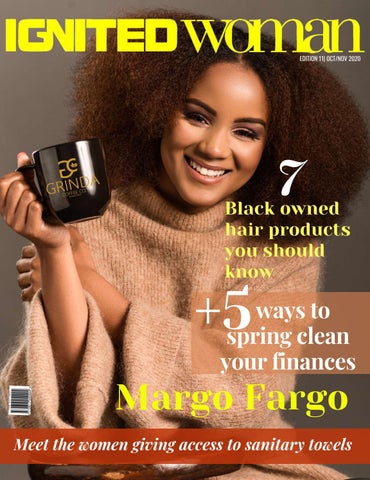
EDITION 11| OCT/NOV 2020
7
Black owned hair products you should know
+5
ways to spring clean your finances
Margo Fargo Meet the women giving access to sanitary towels
CONTENTS REGULARS 10 MENTAL HEALTH 12 MONEY COACH 21 HEALTH FOCUS
FEATURES 18 MRS SA SEMI-FINALIST DOING IT FOR IMPACT 22 MARGO VENTURING INTO COFEE 26 INSURANCE OMBUDS FOCUSING ON MAKING CHANGE 28 CRAFTING A FUTURE IN JEWELLERY DESIGN
FOCUS ON MENSTRUAL HYGIENE 14 ADVOCATING FOR RURAL WOMEN AND GIRLS VIA HER SANITARY TOWEL BUSINESS 30 INNOVATING WITH REUSABLE SANITARY TOWELS
2
TRENDS GET THE SPRING LOOK WITH BYSSIE CLOSET THE BLACK LIST: BLACK OWNED HAIR PRODUCTS COMMON BUSINESSES TERMS TO KNOW FASHION WITH AN AFRICAN SPIRIT
Cover pic by Slebz Collen
08 34 36 38
HELLO ISSUE
11
Pg 32 3
editor's note Is it to soon to mark 2020 as one of the best years?
Picture by Khothatso Mokone
S
Check out our competitions on our social media platforms @ignitedwoman_
eriously, I feel like this year was intended for us. Despite the pandemic that got us to stay indoors for months, I have grown both personally and in my business. There is a sense of clarity and things feel and appear aligned. My team and I have hope for a future because unlike other businesses that unfortunately had to shut down we have been seeing business coming our way. So the dream and plan to dominate is actualising, which feels amazing for us. As its our custom we continue to celebrate trailblazers with a special focus on women who are giving access to sanitary pads through fresh and innovative ways. Bloemfontein entrepreneur, Margo graces our cover. We also introduce a new feature called The Black List, on page 34 where we feature list on Black owned products from different industries. Hair was aptly the first after the Clicks furore early in September.
Founder & editor Kamogelo Seekoei
Content Lead Basetsana Makhalemele writer tshego ramoupi graphic designer Basetsana makhalemele tumelo mosue
Contributors Dr Relebohile Ncha Dr Nkomile Setlaba boitumelo monyatsi Dikonelo mile edith mjuluki mpho mabote
Advertising Kopano lebethe head: advertising sales kopano@kopsmedia.com
digital solutions kamogelo seekoei
WWW.IGNITEDWOMAN.CO.ZA
Subscriptions Visit www.ignitedwoman.co.za or send email To: info@kannamedia.co.za
124 Lyndhurst road, lyndhurst Johannesburg, 2192 Phone: +27 61 434 4631 Cell: +27 81 708 1412
Published by Kanna Media productions All Rights Reserved. all opinions by our independent writer does not necessarily reflect the opinions of ignited woman magazine or its staff members.
Effortless spring look By ByssieCloset
Stay Beautiful
8
Is my other parent really that bad or am I being hot-spotted? By Dr Nkomile Setlaba
Disorders such as ADHD, Conduct Disorder, Oppositional Defiant Disorder and Autism Spectrum Disorders are neurodevelopmental and are illnesses that are typically diagnosed in children.
I was recently asked how the Covid-19 pandemic with the resultant lockdown affected my private practice. With many businesses struggling to meet their usual bottom line and people losing their jobs, I experienced a different kind of change.
In the past six months the children presented to my consultation rooms with severe major depressive and anxiety disorders, accompanied by suicidal thoughts.
My patient dynamic certainly changed. The age group that consulted me was much younger; with the youngest patient that I saw having been only 12 years of age.
The common theme was that maybe the parents would stop fighting if the kids were not around anymore. The change in the dynamics became evident during the increased interaction between parents and their children. With the schools being closed and most parents working from home, they got to spend a lot of time in one place.
Don’t get me wrong, psychiatric disorders such as depression and anxiety are found in children and adolescents, however the reasons for the disorders have always been age appropriate.
The time spent at home certainly brought a lot of families closer together. Children got to see their parents more and spouses got to be with each other without the pressures of having to be at their respective
10
offices or the morning rush of taking the kids to school. However, there was a downside to lockdown when it comes to family time. The most prominent and common disadvantage having been the children witnessing and being a part of the strained relationships between their parents. Children were subjected to the animosity and resentment that their parents feel towards one another. The worst being the children themselves being used to bring unhappiness or displeasure to the other parent. I guess being under lockdown and not being able to visit our friends left us with no one to talk to about our problems. Unhappiness of one parent towards the other was first communicated to the children. Our children stopped being protected/shielded from the weaknesses of the other parent. Children knew/know things that they shouldn’t know about their parents. This has been more pronounced in situations where the relationship between the parents is strained; separated, divorced or separating. Whenever a mother or father was unhappy with the other parent, it was immediately communicated with the child, full details disclosed.
It is difficult to determine if this has been a persistent pattern of behaviour or whether the lockdown brought the worst out of us. Either way, the damage being done to these children is evident. Children have now replaced their parents’ best friends and are subjected to the harsh realities of the world before their time. They are forced to grow up too quickly and do not get to stay innocent and enjoy their childhood. But mostly, they get to have an ugly picture of their other parent. Divorce leaves bitter feelings between two parties that have decided to call it quits; this however should not be the case between the kids and either parent. When a couple divorces or separates, it should always be kept in mind that the separation is between the parents; not the child with either parent. Before telling your child about how terrible or bad their other parent is, ask yourself whether the knowledge of that truth will serve your child any good now and in the future. In essence, we need to stop “hot-spotting” our children with the hatred we have towards their second parent. Dr Nkomile Setlaba is a psychiatrist with her own private practice. She writes in her personal capacity. Read the rest of the article on our website:
www.ignitedwoman.co.za
11
5
Ways to spring clean your finances By Dikonelo Mile
Spring is upon us in South Africa. We have just come out of long winter nights and all the different national lockdown levels. The sun is out, the flowers are blooming and there's a sense of hope in the air. This is also a good time to spring clean your finances. Out with the old, in with the new! We have a few tips on starting on a clean slate. Review your budget So much has changed since the beginning of level 5 lockdown until now. Refresh your budget. Look at new expenses that you have to accommodate and old expenses that you have to cut down. Consider new methods to save. Are there any new sources of income you will be looking into? Read up about where the investment environment is going and start planning on how much you will put towards investing. Create a Plan to Pay Off Debt It is a good time to look at your credit report and plan on how to pay off your debts. You can use different methods to pay off your debts. Make a list of all your debts, from the smallest to the biggest. Use the extra income you receive to pay off the smallest debt first and make extra payments on your instalments of the remaining debt, in order to cut down the term. Take note of when you receive discounts or decrease in interest rates. Declutter Whether you keep a physical file or a digital folder on your device of your financial
12
documents, it is time to go through them and destroy old financial documents. Organize your financial documents in categories that are easy to understand. This will also assist you when filing your personal income tax returns Review your insurance policies Revisit all your insurance policies to check if they are still active and if you are still covered. Revisit all the clauses to check if you are still covered and if anything might have changed due to the pandemic. Check if you need new insurance covers or if there are those that are no longer applicable. Are your beneficiaries still the same? These are all the things to consider when spring cleaning your finances Plan Ahead There's a new and fresh energy that comes with both spring and starting on a clean slate. Set new dreams and plans. Adjust your financial plan to accommodate your dreams and hopes. Finally, remember money is just a measurement. Go forth and live your life boldly.
Advertise or sponsor an edition Contact us : 061 434 4631
Leading voice for women in business and a resource for our readers with strategic business content and insightful profiles on industry leaders!
Inspired by rural women to birth sanitary towel business By Kamogelo Seekoei
It was after realizing the struggles that rural women face when it comes to menstrual hygiene that entrepreneur and author, Matefo Morakeng started her advocacy and sanitary towels business. She was working on project to assist women in the rural Free State establish income generating initiatives when it dawned on her that access to sanitary towels was a real challenge. One of the exercises was to draw a shopping list, when she realised that they had almost every item similar the mission of sanitary pads on their lists. “Upon probing, they informed me that they were not menstruating as they use an injection from the overnment clinic which helps stop the process. That didn’t sit well with me at all. That’s when I decided to do my research and discovered how serious the issue of sanitary towels or lack thereof was,” Matefo explains. She admits that prior to this encounter she was a naive woman who never even thought much about the situation. “Of course we live with poverty around us, but that there might be women and girls struggling with access to sanitary towels was never ever something I thought of. "I don't eve remember having a conversation with my friends
about it, or even the cost. I guess my naiveté on this issue is one of the things that always make me feel desperate about wanting to help.” She says the experience with these women became an awakening to her. She dug deep into the issue and was shocked at what she found. “Women and girls having to use old rags, toilet paper, socks stuffed with sand, some girls even having to sleep with older men just to get money for sanitary towels. I read one of the heartbreaking stories ever where one little girl said she had never held a sanitary towel in her hand. This girl was of menstruation age. I was not going to sit with all that I had become aware of, so I decided to do something”. From there Dear Bella Maxi, a sanitary towel made from cotton and designed to provide comfort and maximum hygiene women deserve was born. “To me, sanitary towels are not just business. It’s really a mission and a call to action for people to be kinder and think of others who are in need. The psychological and emotional impact that this has on girls and women is incredible," she says.
The sanitary towel provides good quality and comes at a reasonable cost which is one of the reasons for lack of access sanitary pads. The brand especially targets the low to no income earners. “This means we have to find ways to cater for both segments. For low income earners, we price our product in an affordable manner. For no income earners, we rely on corporate sponsorships and individual sponsors or what we call guardian angles to assist. There are a lot of girls and women who honestly come from very poor families, it doesn’t matter how low the price could be, affordability will still be a problem. Our aim is to ensure that they too are taken care of, menstruation is not a choice, but nature.” Ultimately Matefo aims to show that quality sometimes does not have to cost an arm and a leg. While on the topic of quality, Dear Bella recently received from the South African Bureau of Standards and became a member of Proudly SA.
15
“Very exciting times. This means my product is market ready and can compete with other products in the market, exportable and safe for consumers. Being a Proudly SA product means it is made in South Africa, supporting the brand therefore means people will be helping to build the brand and create and sustain much needed jobs. Another milestone has been being listed in some retail stores in Kroonstad and Qwa Qwa in the Free State, as well as many spaza shops in Gauteng. “Listing with retail stores is not a child’s play. It needs patience, persistence and trusting the process” she says. The reception to her brand has been quite good and humbling,
Matefo concedes, that the positive reception is validation for her hard work and dedication. “I am currently 100% committed to Dear Bella, but I am also a self-published
16
author of two books, The Sky’s The Limit and The Mentorship Word. I am also a non-executive board director”. In the next three years Matefo wants dear Bella in store shelves across the country as well as the rest of African. “To be that product that allows any African girl child, no matter their background, can dream and know that it is possible and her dreams are valid,” she says. “This is why I have even recently started a campaign called Turn Up For Girls, with the aim of reaching one million African girls. The campaign has been joined by dynamic women from seven African countries so far, we are still looking for more though as the aim is to reach all 54 African countries. Through this initiative, my wish is that we dispel the idea that as Africans, we are not able to take care of our own and if we join hands and work together,” she adds. Matefo explains the name is a tribute to her mom, who is called Bella. “I had to do something to celebrate her whilst she is still alive. This is my way of saying thank you to her.” To other women she says “start today with whatever you have, wherever you are. There is never a perfect time. Get yourself a mentor, formal or informal. And most importantly, be passionate about what you do, it will pay off in the long run”.
Sound Advice "My faith has helped me stay grounded and realise that we are all in this world to play our part then leave. But while at it, do my best to make sure that I help as many people as I can, in whatever form and leave a legacy."
Driven by the need to impact lives Kamogelo Seekoei
The desire to make a difference in other people’s live has been the driving force behind graphic designer, entrepreneur and Mrs South Africa semi-finalist, Keke Moeca.
Originally from Bloemfontein, in the Free State province, the Central University of Technology gradutate, is now pursuing the title of Mrs South Africa, a journey she admits has been filled with growth. A wife to an inspirational man and mom to two amazing little girls Kwadiwa and Kgabo, feels it is her duty to go on a growth journey by stepping out of her comfort zone. “I believe as women and community builders; we must give from a full cup. What does this mean for me? Self-care: Looking after your mental, emotional and physical health. This platform also encourages me to do so unapologetically. She entered the Mrs South Africa pageant to help
propel her in the right direction whilst making sure that she is also able to give back to the community. “I‘ve always known I could do more, but I wanted to inspire others while I learn how to do that.”
18
Great Top 50 lessons
Family support
Keke concedes that being one of the Top 50 semi-finalists has opened her to a sisterhood circle that she would otherwise not have.
Her family has been the support she most definitely needs in this journey.
She although the pageant will ultimately have one winner, there is a strong bond amongst the contestants and that she has built wonderful friendships with women she probably would never have met in her life. “They all have amazing stories and have overcome so much. Some of us have already started working on projects within our communities together, which is what I’ve wanted to do. So, I feel so honoured, especially during a time like this we are collaborating and doing more than what we thought we could,” she says. The Rustic City co-founder also acknowledges the spirit of resilience, a positive attitude and great work ethic as attributes that propelled her in the competition. However the hardest knock has been rejection; especially from people support was expected from. She says it’s very difficult to let go of something you feel could have worked so well, whether it’s in business, friendships, partnerships. “Support has come from the unlikeliest places, which is great because once again I’ve had to go out of my comfort zone to make things happen for myself. There is a Tswana proverb which says “Se nkganang se nthola morwalo” which translates to “What rejects me, reduces my burden”. It has reminded me of what I’ve always known, but seem to have forgotten: It’s not rejection, its redirection”.
Admittedly nothing is perfect, but Keke makes it a point to take time out to rest when she feels overwhelmed and she has great support system in my family as a whole. “My husband, Kevin is amazing. I annoy him sometimes with my many photo opportunities, but he caves and ends up helping with my many duties (😊). We are a team. When I come up short, he comes through for me and vice versa. My helper, Makamohelo Ralebona is such an amazing woman. She really is great with our girls. Burnout is real and you need to pull in all the help you can,” she says. “It’s also important that you have a great support structure. You will need it. You definitely don’t enter this competition alone. It’s a family effort. Those around me contribute a lot to your success which for me is one of the highlights I’ve experienced.
“I believe as women and community builders; we must give from a full cup." 19
Business ventures Speaking of her husband, Keke co-founded her first business, a leather products company, with him. She was inspired to start this business after she sold her wedding gown in 2016 to invest in herself. “The business was inspired by a need to add to my skill set, considering the SA economic climate. I figured it would always be good to have more than one income and toempower myself doing something I share a huge interest in, which is the fashion industry,” Keke says. Future plans for the brand include being able to supply globally. “We see Rustic City being one of the biggest African Luxury brands and we have no doubt will achieve that with the right guidance and great work ethic.”
Other project collaborations Keke recently collaborated with a friend of hers from Thaba Nchu, also in the Free State, Palesa Masisi, on an African inspired baby clothing range called Asante Baby. The idea came about while both were on maternity leave. “A passion project that was driven by us wanting baby clothing that were still mainstream but with a bit of heritage added to them. Interestingly enough we’ve noticed that there is a bigger appetite for these abroad, so we are working on accessing that market” She has also collaborated with fellow Westrand semi-finalist; Paula Msiza and Nthabiseng Mohane to support a community centre in Munsieville by offering career guidance on an ongoing basis.
20
She says they work with the community centre to see what other needs the kids might have to best prepare them for the world post matric.
I believe knowing your worth makes you unstoppable. You can do that by really owning your scars and showing up for yourself.
Be the author of your own story, so no one else will tell you who you are ought to be.
Content form Netcare Pholoso Hospital and Akeso Crescent Clinic
What is premenstrual dysphoric disorder?
Rare severe form of PMS raises need for greater awareness and sensitivity
Premenstrual dysphoric disorder (PMDD) is a rare yet potentially debilitating condition linked to a woman’s monthly menstrual cycle. An estimated two to five percent of menstruating women report symptoms meeting the diagnostic criteria of this condition at some point during their lives.
a significant concern is the potential for women with PMDD to develop suicidal thoughts if they find it difficult to cope with its impact on their lives,” says Dr Lavinia Lumu, a psychiatrist who practises at Akeso Randburg Crescent Clinic.
She says that this is in contrast to PMS, which about half of women A psychiatrist and a experience at some time between gynaecologist share their puberty and menopause. perspectives on this women’s health issue, and explain how it “Traditionally, there has been differs from the more social stigma attached to commonly-known premenstrual menstruation, as this was syndrome (PMS). considered a private or taboo subject. As PMDD is usually “PMDD can affect various diagnosed through women selfaspects of a woman’s life, reporting their symptoms, it is including family, social, and possible that this stigma could occupational functioning, have resulted in fewer women however, as with other mood seeking assistance disorders, for it,” she points out.
Symptoms of PMDD One of the set of five symptoms should be from the potential symptoms listed directly below: Mood swings Marked irritability or anger Markedly depressed mood Noticeable anxiety and tension. In addition, the woman should also have another four symptoms, either from the list above, or from the following list: Decreased interest in usual activities Difficulties in concentrating Lethargy and marked lack of energy Marked change in appetite (e.g. overeating or specific food cravings) Insomnia or oversleeping Feeling overwhelmed or ‘out of control’
21
Picture by Kevin Mark Pass
Taking her entrepreneurial journey to the next level By Basetsana Makhalemele
22
Being black girl magic is about expressing every part of you and Bloemfontein born, model, environmental activist and entrepreneur, Margo Fargo, is excelling in her game.
Picture by Juan Pinnick
W
ith all her achievements including founding Far_Go Straws, metal straws
company, the multi gifted Margo is showing no sign of slowing down and her latest venture, coffee label, Grinda is testament to this. As many would agree, coffee is a cup of hope in a world full of chaos and Mondays and Margo has opened the taste buds for us coffee lovers with her newly Grinda Coffee co. She speaks to our content creator, Basetsana Makhalemele about her latest project and future plans.
23
IW: Please briefly tell us about yourself and
IW: How did it come to existence? What
where you are from?
motivated you to start it?
Margo Fargo (MF): I'm a small city girl from
MF: For the past year and a half, I've been
the heart of South Africa, Bloemfontein, where
working on the brew, the packaging and
grew up very simple with a big diverse family. I
looking for a shop space. Although the
graduated at the University of The Free State
pandemic slowed everything down and
with a BSc Consumer Sciences Honors Degree
delayed a lot of aspects, it gave me an
in Sustainability. I'm a lover of life and always
opportunity to refine my story. When one
seek opportunities wherever possible. Over the
thinks of coffee, you think of its colors,
past 6 years I've worked as a shop assistant,
smell and taste. The grind of Africans is
Medical Sales Representative, retail, and Front
unmatched and I wanted to
of House Manager for a design studio before
incorporate that into the brand, hence the
going into full-time entrepreneurship in 2018.
name "Grinda". That was the start of creating and experiencing Africa in a cup.
IW: Can you tell us about the business ventures you are involved in?
"
I have always been a lover of coffee because it
MF: I am currently pursuing my eco-business Far_Go Straws, a metal straw company I’ve founded in January 2019. My new coffee business, Grinda Coffee Co, is also keeping me
creates such a unique experience to each individual.
quite busy at the moment. One thing I'm being more intentional about too is going into environmental consulting for corporates, as well as sustainable projects that are directly connected to corporate social initiatives. IW: You gave birth to Grinda Coffee co, please share the story or idea behind this venture. MF: I have always been a lover of coffee because it creates such a unique experience to each individual. The idea started in mid-2018 when I sat down and asked myself how I can do this. I met with a few people in the consumer industry as well as existing experts in the coffee business.
24
IW: What sets Grinda Coffee Co apart from other coffee brands? MF: There are so many good coffee brands out there. Each story is unique and that’s exactly what it is. The focus is for it to be an African household premium coffee brand. Apart from the fact that I am a woman of color venturing into a male-driven industry, it’s really all about the experience and the story we are trying to tell the rest of the world, one coffee bag at a time.
IW: What has been the highlight of your journey in the hot beverages industry? MF: The feedback we received at our pre-
responsibility for the upcoming generation in the beauty and pageant industry. What's exciting about such a platform is that you are in control of how you use it afterwards. Title or no title, it’s all about perspective.
launch was pretty overwhelming. Every person loved the taste and that definitely gave me a boost to push harder. The other highlight is seeing it come to life. That is priceless. IW: What expansion plans are you looking for the next 2 to 5 years? MF: I'm really hoping to be exporting to other parts of the world, and to expand my range of products that are centered around sustainability. I also plan to take up space in major retail stores and allowing my brand to
Sound advice
Ask all the questions, big and small, to the people you look up to in the entrepreneurial space. Also start with what you have. For me, I believe if you can start with little you can self-sustain your business ventures and create opportunity for expansion.
be accessible. The sky is the limit! IW: What has been the most challenging part of your journey thus far? MF: It would be financial backing to be honest. At times you are required to produce a big order which could be challenging, especially due to the fact that my businesses are both start-ups. This has not held me back however, and has taught me to think in innovative ways. IW: You were one of the Miss SA 2018 Top 12 finalists. Can you tell us what has been the most exciting part of this journey? MF: It most certainly changed the way I saw myself, and instilled in me a bigger sense of responsibility for the upcoming generation in the beauty and pageant industry.
25
Insurance Ombud
subscribes to hard work and a helping hand Edite Teixeira-McKinon, CEO of the office of The Ombudsman for Short-Term Insurance (OSTI), is a role model for many young women and men looking to carve out a career in the insurance alternative dispute resolution sector.
It’s a responsibility she takes seriously, but not one that has always come easily. The daughter of Portuguese immigrants, Teixeira-McKinon grew up in a tightknit family where self-sufficiency was the order of the day. Both men and women have left an indelible mark on her professional journey, but she never had a formal mentor. “Only when I started working with a coach a few years ago did I come to learn that I could be a mentor to someone,” she says. Teixeira-McKinon also reflects on the importance of guiding young South Africans and the value she believes is inherent in the OSTI internship programme.
26
In 2020, OSTI has three second-year legal graduates and two first-years on an internship initiative which is now in its third year and is open to legal graduates of all sexes wanting to pursue a career at the legal bar. For these young interns, Teixeira-McKinon’s own story underlines the importance of hard work and dedication. “I’ve always worked hard, done everything with excellence,” she says. “And this is what I tell the interns who come to me for advice.” Carving out a niche As a young legal graduate, and admitted attorney, Teixeira-McKinon soon realised a career in legal practice was not for her. So she steered herself towards financial services, starting out at Mutual & Federal Insurance Company. Over 10 years she gained experience in the insurance sector, before joining OSTI as an assistant ombudsman. After four and half years, and needing a break from the sheer volume of work as well as more time with her family and young daughter, Teixeira-McKinon took an 18month break from OSTI, returning to the corporate world. It proved a seminal moment. “I realised that my values were aligned to OSTI’s. The process of adjudication, applying the law and fairness and finding the best possible resolution was my passion,” she recalls. Teixeira-McKinon returned to OSTI as General Manager and later became Deputy Ombudsman. In 2020 she became CEO. Covid rocks the boat In many respects, 2020 has been a baptism of fire; necessitating an organisation-wide shift to remote work.
The latter was enabled by OSTI’s foresight in moving to a totally paperless environment over the course of 2019. Teixeira-McKinon salutes her team for rising to the occasion with empathy, understanding and a willingness to assist both colleagues and those applying for adjudication. This, she believes, underlines the importance of the human touch in the process. While OSTI does have a fast-track procedure for more easily resoluble cases, these only account for around 30% of matters. “All others need engagements and probing, and some are resolved months later.
Adjudication is quite complex, and I don’t know if robotics can ever really apply equity and fairness to outcomes,” admits TeixeiraMcKinon. This creates a clear space for graduates with a legal background. These are traits which are well suited to the young female interns, who, to date, outnumber the men who have been through the OSTI internship programme. This also underscores the importance of empowering and educating women about the value of insurance and protecting their assets.
Teixeira-McKinon adds: “My daughter, who is in matric, does business studies and they touch on insurance. We were never educated on this in the past. I came into the insurance environment knowing nothing about insurance, because my parents believed in self-insurance by saving. But things are so expensive that even if you save it’s unlikely you can ever replace a motor vehicle or the entire contents of a home.” Insurance remains a form of protection which spans gender, race and age and, she concludes, is a consideration which should be “very much part of financial planning”. Article provided by SBPR Communications
27
DESIGNING THE FUTURE OF HER DREAMS THROUGH HER BUSINESSES By Basetsana Makhalemele
The creative process is one of the purest ways for us to connect with our truest thoughts, hopes and emotions. This is according to Bonolo Moloi, a proudly Free State girl who has huge plans for her design business. Now a member of the Proudly South African Group, Noli Goddess,a jewellery design company, has been growing and endearing itself as a favourite brand to many. Over the past few years the interior and jewellery designer has been steadily growing her brand and has started seeing the fruits of her labour. She shares with us how her creativity enthused her career. "I used to make jewellery for myself and my friends until I saw the growth in demand and took the plunge," says the creative entrepreneur.
28
Born and bred in Phuthaditjhaba in the Eastern Free State, with over nine years of experience in the design industry she specialises in high end residentials, hospitality and offices spaces.
Bonolo has always had a strong connection with creative handwork. Always excelled in knitting and art projects, Bonolo says her fascination with space planning and colour coordination ignited her love and passion for design. Throughout her prolific career, she has created a variety and multiple mediums such as; jewelry design, DIY projects and event decor styling as a way of expressing her creative side. "I enjoy using my hands to create things. Over the years I have been creating beautiful statement neck-pieces using crochet and weaving techniques," she says. In 2016 Bonolo's passion and hard work led her to give birth to her very own jewellery design brand Noli Goddess, which was inspired and influenced by beautiful African women. Her aesthetic brand represents women who embrace being African and women who see beauty that is not defined by societal pressure or stereotypical expectations. It is known for its statement accessories that are authentic, bold and vibrant just for women who want to stand out and be unique. "These accessories are handmade from different techniques from weaving, crocheting to wiring”, she says. The brand has made its way to the top. “We have received orders from a big retailer like Big Blue and we also attracted the attention of the Edcon group to use our statement neckpieces at their Proudly South African Fashion Showcase”. The brand was chosen out of hundreds of applicants to be one 40 Design Indaba Emerging Creatives for 2019. "We hope that showcasing at this festival will take our brand to the world" she adds.
What the future holds…
The future definitely looks bright for Noli Goddess as the brand has grown steadily over the past few years and now looking to reach a new clientele and take it to the next level. According to Bonolo, Noli Goddess would love to expand and have a wider accessibility to a bigger audience. "The opportunity to collaborate with retailers and fashion designers will help us achieve this goal," she adds.
"
I enjoy using my hands to create things. Over the years I have been creating beautiful statement neck-pieces using crochet and weaving techniques.
29
Innovator
Reusable pads to transform lives By Basetsana Makhalemele
A
s horrifying as it sounds, in a country that has evolved from the traumatic past and still finding its way to be better, millions of girls in South Africa miss 3-5 days of each month due to a lack of sanitary pads. While at home they make use of all sorts of unhygienic alternatives to absorb menstrual blood such as newspapers, toilet paper, grass, sand and even bits of foam mattress, which can be harmful to their reproductive health. Founder and CEO of Palesa Sanitary Pads, Sherie de Wet, could not live this reality. She decided that every girl deserved at least the same advantage and hatched the idea of assisting women who don't have the means to afford sanitary pads. She started exploring the possibility of finding a sustainable solution for sanitary hygiene.
30
Six months later following extensive research and testing of prototypes Sherie launched Palesa Reusable Sanitary Pads, which manufacture and distribute high-quality washable cloth pads in Southern Africa. The first sponsorship to 30 girls took place in November 2017 and three years on the company has manufactured over 200,000 pads and provided free sanitary pads to more than 30,000 girls to keep them in school with dignity and pride. Palesa Pads are high-quality, reusable cloth sanitary pads that can reusable for up to 5 years. "The tremendous savings on sanitary products contribute to the financial well-being of their families,” reassures de Wet. The design of Palesa Reusable Sanitary Pads provides maximum protection against leakage. One pad can be worn for up to 8 hours depending on flow.
"
As Palesa Pads, we are committed to providing a comfortable, affordable and sustainable solution to help keep girls in school, every day of the month.
One pad can be worn for up to 8 hours depending on flow. Not only that, but the pad can be folded neatly and discreetly and taken home to wash with no smell in a girl's school bag. According to Sherie they aim to be the leader of the Cloth Pad Revolution in Africa and in the process restore dignity to millions of women and girls with every process in our supply chain. "We envision a world where sanitary pad waste is a thing of the past. We do all we can to bring affordable, sustainable, eco-friendly solutions to every woman," she says. The organisation has not only changed the lives of young women who are under privileged but has created 48 job opportunities through the program. "Palesa Pads are hand made in South Africa by previously disadvantaged men and women whom we have upskilled through our in-house training," she says. “We plan to grow our footprint in Africa for sponsorship, retail and manufacturing through collaborative partnerships with a number of organisations,” she says, adding that they focus on education and entertainment to change the face of periods and help girls and women take control of their lives. “We as Palesa Pads, are committed to providing a comfortable, affordable and sustainable solution to help keep girls in school, every day of the month,” says de Wet. The organization currently distributes pads into the surrounding Southern African countries and hoping in the future to establish factories there as well.
Palesa Pads are high-quality, reusable cloth sanitary pads that can reusable for up to 5 years.
31
BOEREWORS SISHEBO
INGREDIENTS 1 tbsp cooking oil 1.5 onions, chopped 1 tbsp rajah mild & spicy curry powder 1 tsp Robertsons Steak & Chops Spice 2 tomatoes, chopped 400g boerewors, sliced 2 cups water 2 cups pumpkin, peeled and cubed 1 Knorrox Beef Stock Cube 2 x tbsp KNORR Minestrone Soup
ONE POT LEMON CHICKEN DINNER
SOURCED FROM FOODIES OF SA
3 tbsp oil, of choice 6-8 chicken thighs, skin-on Salt & pepper, to taste 1 onion, diced 3 cloves garlic, crushed 1 cup millet 2 cups boiling water, add 1 extra cup if necessary 2 x KNORR Chicken Stock Pot juice from ½ lemon ½ lemon, sliced and pan seared 1 tsp dried thyme 1 – 2 tbsp chopped coriander Serving suggestion: Side salad KNORR Light Greek Salad Dressing
32
7
Black owned hair products to know
The Perfect Hair Founder: Taryn Gill Contact: taryn@theperfecthair.co.za Location: Cape Town
Glolooks Founder: Refilwe Xaba Contact: 063 721 3195 Location: Bloemfontein, FreeState
Root 2 Tub Founder: Kekeletso Khena Contact: 072 814 1331 Location: Krugersdorp
AfroBotanics Founder: Ntombenhle Khathwane Contact: 067 7100 475 Location: Midrand, Gauteng
Nalane ea Afrika Founder: Karabo Mokoena Contact: 081 572 6519 Location: Midrand, Gauteng
Nguni Botanical Founder: Nonzuzo Mkhwanazi Contact: 081 554 2574 Location: Durban, KwaZulu-Natal
Mabu Tribe Founder: Tlholo Mabalane Contact: 076 276 8752 Location: Midrand
34
List compiled by Basetsana Makhalemele
Advertise or sponsor an edition Contact us : 061 434 4631
Leading voice for women in business and a resource for our readers strategic business content and insightful profiles on industry leaders!
Be empowered with these business terms
Understanding your business and your unique selling proposition is an entrepreneur’s first priority. However navigating the business world goes beyond just knowing your USP, you have to be able to know what is being spoken about in the hallways of opportunity.
Bottom line This refers to the final figure at the bottom of the income statement. It refers to the overall profit of a company. You may have heard the phrase “affecting the bottom line” and this refers to things which increase or decrease the profits of a company. Working capital The efficiency and the short term financial health of a company can be measured through working capital. To calculate working capital, you can use the following formula: Working capital = current assets – current liabilities. Equity The equity refers to the ownership one has for a company.
36
We have compiled a few basic terms that are often thrown around in the business world.
Equity can be sold to investors who will then have a share in your business. In accounting terms, Equity = assets – liabilities, this calculation will give you the market value of your company.
Cash flow This refers to the movement of money through your business every month. You can determine your cash flow by looking at your cash balance at the start and end of a certain period. Capital for expenditure This is a purchase which will continue to give you benefits beyond the taxable year that it has been purchased in. Examples are computers and property to name a few.
Partnership where owners are not liable for A partnership is an agreement the company's debt. It is possible between two or more people to for an LLC to be owned by a operate a business together and share its profits. The partnership person, corporation, other LLCs, and foreign entities. LLCs may may or may not have formal elect to be taxed as a corporation, documents describing the a partnership, or as part of the agreement. Partnerships do not pay taxes at the entity level. Profits owner's personal tax return. and losses pass through to partners equally unless otherwise Long-term debt stated. Long-term debt is a liability that will be paid back over a period There are different types of longer than one year. Businesses partnerships, such as general sometimes borrow money over partnerships, limited partnerships, and limited liability several years to finance larger assets or take advantage of partnerships. Each type has different pros and cons based on financing opportunities. your business arrangements and Examples of long-term debt are commercial real estate loans, goals. equipment leases, pension benefits, and contingent obligations. Personal guarantee Although many small businesses have their own credit report and score, a lender may require a Assets Assets are anything that the personal guarantee from the company owns that has monetary owners in order to guarantee a value. This could be land, loan. vehicles, inventory, cash, furniture, accounts receivable, A personal guarantee holds the owner responsible for a business patents and copyrights to name a debt in case the business is unable few. to make payments. In most cases, Assets can be divided into four when you apply for a business credit card, loan, or lease, as the categories: Fixed, current, tangible and intangible. owner, you will personally guarantee the debt. Fixed assets are things which can’t be converted into cash quickly Limited Liability Company (LLC) A limited liability and are purchased for long term company is a corporate structure use e.g. land and buildings.
Current assets are things which can be changed into cash quickly like inventory, cash and investments. Tangible assets are things which you can touch. An example is a machine. Intangible assets are things which you cannot touch like patents and copyrights. Liabilities When we talk about liabilities, we are looking at any debt which the business has since it was started. This can be credit card debt, money owed to suppliers and bank loans. Liabilities can be divided into current and fixed. Current liabilities refer to debt which must be settled within a year and is normally related to your suppliers. Fixed liabilities refer to the debt which is settled over more than one year like a bank loan. Gross Margin The gross margin refers to the percentage of the sales earnings that a company keeps after the costs for producing product or service are deducted. This percentage is then used to pay for overheads like rent, salaries and more.
Compiled by Basetsana Makhalemele
37
THE WOMAN BEHIND FLAMBOYANCE DESIGNERS
Fashion designer: Kgomotso Mokhakho
38
Issue 12
MUSINGS
Modern fashion with an African spirit @flamboyancedesigners
39