FALL 2026
COMMUNITY
How two Central Minnesota projects are creating belonging. Pg. 8
GENEROSITY
Generous support helps New Pathways expand support for Central Minnesota families. Pg. 42
HOME MADE
Discover apples, crafts, learning and family fun at Brainerd-area orchard. Pg. 50
A life-saving service staffed by community volunteers, today’s rural ambulance crews struggle to provide service, save lives.
Pg. 28
A growing business. A revitalized downtown. A stronger community. For 30 years, BCI has partnered with business owners and community leaders to turn ideas into achievable plans. From evaluating possibilities and aligning scope and budget to assembling the right team and building it, we help create spaces designed for what comes next.
Build something greater:
bciconstruction.us
Initiative Foundation FALL 2026
Contents FEATURES
DEPARTMENTS
8
6
18 28 42
Good Neighbors
Four Central Minnesotans show what it means to care for people and their communities.
Connection & Community
How two Central Minnesota projects are creating belonging.
A New Path for Homeless Families
Generous support helps New Pathways expand assistance for Central Minnesota families.
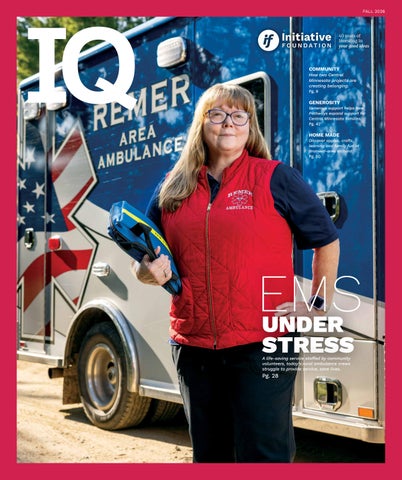
ON THE COVER: Retired nurse practitioner Diane Ammerman continues her decades-long presence with the Remer Area Ambulance Service. For Ammerman, stepping away isn’t easy when the next generation of rural EMS volunteers remains uncertain. See “EMS Under Stress” on page 28.
2 Initiative Foundation ifound.org
Regional Highlights
Get the latest highlights from Central Minnesota’s 14 counties and two Native nations.
50
Home made:
The Crafted Orchard & More A Brainerd-area destination brings together local flavors, creativity and connection.
EMS Under Stress
Rural ambulance services face mounting workforce and financial pressures.
Initiatives:
52
Where’s IQ?
Your Trusted Business Advisers Helping you manage your finances, so you can focus on your mission St Cloud - Monticello - Little Falls www.swco.cpa
THOUGHTFUL DESIGN for vibrant communities
We’ll collaborate with you on . . .
Altona Square, Vergas, MN
Design Building Renovation, Addition, New Construction Improvements Site Parking, Circulation, Drainage Facility Assessments Space Planning Mechanical, Electrical Upgrades Structural Enhancements Environmental Assessments
Mike Angland AIA, LEED AP
Architect, VP 218.316.3608 Mike.Angland@Widseth.com
Dana Hlebichuk AIA Architect, VP 507.206.2135 Dana.Hlebichuk@Widseth.com
FALL 2026
3
Dear Friends, As we listen closely and engage deeply in Central Minnesota to respond to our region’s needs and opportunities, we regularly discover two conditions. One is the complexity of the challenges. From child care to housing to healthcare, from rural leadership to welcoming communities, these issues are deep and systemic, and rural places don’t always have access to the resources and capital they need. The other is a commitment to local problem-solving: People are working together in all kinds of creative and resilient ways to take on their communities’ biggest issues. These challenges and successes are unique to each place, while capable of being learned from and replicated. I’m pleased to announce that, starting with this edition, we are transforming our magazine’s approach to focus on the bigger challenges Central Minnesota faces and how the region is working to solve them. We will spotlight and dig into issues, celebrate solutions, offer playbooks for ideas from our region and elsewhere, and thoughtfully point to policies, resources, ideas and investments the people and places of Central Minnesota need most to imagine bold solutions and shape communities where everyone prospers, participates and belongs. Our cover feature is on rural Emergency Medical Services (EMS). Across Greater Minnesota, volunteer ambulance crews are stretched to their limits by rising costs, workforce shortages, changing healthcare demands, and more. Alongside immense pressures, local leaders are pioneering creative solutions—from telemedicine rollouts and mobile sprint medics to innovative training pathways. The spirit of community problem-solving weaves through every story. You will read about our Good Neighbor Honorees—champions who fight for immigrant rights, run rural kitchens to support older and isolated adults, open community centers, and lead belonging efforts like jail writing workshops and senior socials. As the Foundation celebrates 40 years, our commitment remains steadfast: To invest in the people and places of Central Minnesota. As we center the magazine’s spotlight on ways we work together to invest in our shared futures, we hope these stories provide new forms of investment that inform, inspire and spark conversations and change.
Brian Voerding PRESIDENT
Initiative Foundation
VOLUME 44, FALL 2026
Initiative Foundation President | Brian Voerding Marketing & Communications Director | Bob McClintick Marketing & Communications Specialist | Allison Norgren Editorial Managing Editor | Andy Steiner Writer | Gene Rebeck Writer | Laura Billings Coleman Writer | Lisa Meyers McClintick Writer | Jon Spayde Writer | Suzy Frisch Art Art Director | Gary Guderian Photographer | John Linn Photographer | Mohamed Jama Photographer | Paul Middlestaedt Advertising Advertising Director | Brian Lehman Advertiser Services | Gary Guderian Advertising Sales Representative | Emily Davis Subscriptions Email IQ@ifound.org to subscribe or to make subscription inquiries.
405 First Street SE Little Falls, MN 56345 (320) 632-9255 | ifound.org
IQ Magazine unlocks the power of Minnesota leaders to understand and take action on regional issues.
RANGEPRINTING.COM
Printed at Range Printing with Soy-Based Ink on Recycled Paper
Are you receiving extra copies of IQ Magazine at your home or place of business? Let us know of any changes by sending an email to IQ@ifound.org. Thank you!
4 Initiative Foundation ifound.org
Business Banking Built for You.
Scan to learn more!
Commercial Lending • Treasury Management • Payment Solutions If you want a bank that cares about you, your business and your community, look no further. Since 1923, we’ve been creating a better way of life across ND and MN. Local decisions. Trusted experts. Come see why banking is better at Gate City Bank.
701-293-2400 • 800-423-3344 • GateCity.Bank/Business
IQ
Initiatives LEECH LAKE BAND OF OJIBWE
WADENA
CROW WING
MILLE LACS BAND OF OJIBWE
MORRISON BENTON
PINE KANABEC
TODD
MILLE LACS
ISANTI
STEARNS SHERBURNE
CHISAGO
Regional Investment Highlights
CASS
WRIGHT
WESTERN MORRISON COUNTY | Fueling Future Investment in Motley A new matching grant program in Motley is helping local businesses invest in storefront improvements along Highway 10. Supported by an Initiative Foundation grant and city funding, the program helps cover improvements such as paint, siding, signage, awnings and landscaping. Three businesses have applied so far, including Scanlon Law Service, which added a new awning, sign and sidewalk—an early example of the investment taking shape in the community.
TODD COUNTY | Wellness in the Woods Plans for the Future Preparing for future leadership transitions will help Wellness in the Woods sustain peer-led support for people experiencing mental health and substance use challenges. The Eagle Bend nonprofit received a $5,000 Initiative Foundation grant for succession planning. Working with staff, board members and an outside consultant, the organization aims to have a plan in place by 2027, strengthening its ability to continue serving underserved rural communities across Minnesota. MORRISON: Scanlon Law Service in Motley added a new awning, sign and sidewalk with support from the city’s new matching grant program
WADENA COUNTY | Building Healthy Connections Through Service New opportunities for connection are helping Wadena-area residents build relationships and find purpose through Astera Health’s volunteer program. Following a 2025 community conversation about mental health and social isolation, a $5,000 Initiative Foundation grant helped Astera launch initiatives including a Pet Volunteer Program and monthly Connect & Chat luncheons. Today, nearly 60 volunteers contribute their time and talents, providing more than 1,000 hours of service in 2026.
NORTHERN CASS COUNTY | More Than a Ride Faith in Action for Cass County is helping older adults and adults with disabilities stay connected to their communities—not just get where they need to go. A $10,000 Initiative Foundation grant is helping expand volunteer rides to concerts, art classes, farmers’ markets, powwows and other community activities. In a county without public transportation, those connections matter. Faith in Action volunteers drove 149,000 miles in 2025, helping residents stay active, healthy and connected.
CROW WING COUNTY | Crosby Puts Spotlight on Local Business Development Local businesses and entrepreneurs are the focus of a new effort taking shape in Crosby. The community is one of three selected for the Rural Entrepreneurial Venture program, a partnership between the Initiative Foundation and University of Minnesota Extension. Over the next year, local leaders, business owners and residents will identify strengths, uncover opportunities and build stronger connections to support entrepreneurship and help local businesses thrive.
MILLE LACS COUNTY | Pease Cafe Serves Up a New Chapter MILLE LACS: Pease Cafe owners Jaime and Eli Lawrence are carrying on the delicious traditions with support from an Initiative Foundation loan.
6 Initiative Foundation ifound.org
Hot roast beef sandwiches, homemade pies and fresh caramel rolls are still on the menu at Pease Cafe, where Jaime and Eli Lawrence have been serving customers for the past several years. After leasing the building and operating the cafe, the couple recently purchased the property with help from an Initiative Foundation loan. Jaime continues to serve customers while Eli does the cooking, carrying on the cafe’s longtime traditions.
“If you offer a welcoming place, people will come. The Joy Riders bike club has about 20 people aged 50+ who create connections. Interest keeps growing!” – Susan Sperstad
Little Falls Bicycles Joy & Connection grant recipient
SOUTHERN BENTON COUNTY | Benton County Cooks Up New Event Local flavors took center stage at the inaugural Taste of Benton County this summer. Held July 22 in Sauk Rapids, the event brought hundreds together to sample offerings from area food businesses, enjoy live entertainment and connect with one another. A $6,500 Initiative Foundation Joy & Connection grant helped Benton Economic Partnership launch the event. Following the success of the first event, Taste of Benton County will return April 22, 2027.
SHERBURNE COUNTY | The Next Track for ANP Streaming Big Lake entrepreneur Lilly Goyah is building momentum behind ANP Streaming (A New Psalm), an app-based platform designed to connect listeners with Christian music that reflects their moods and spiritual needs. An Initiative Foundation loan is helping fund the software and equipment needed to continue developing the platform. Goyah is part of the 2026-27 Initiators Fellowship, where she is strengthening her social entrepreneurship skills while bringing her streaming venture to life.
WRIGHT: A ribbon-cutting celebrates the opening of Kid’s Haven Child Care & Preschool in Waverly, adding capacity for up to 95 children.
STEARNS COUNTY | A Sustainable Start for Avivo Village Avivo Village Central Minnesota opened this fall in St. Cloud, offering 48 private shelter units for adults experiencing homelessness. The facility helps guests work toward permanent housing through individualized services and resources. Open 24/7 with staff members on duty, Avivo Village serves people from surrounding counties. A $15,000 Initiative Foundation grant supported the installation of a high-efficiency HVAC system, helping reduce energy use and operating costs.
WRIGHT COUNTY | Growing Child Care in Waverly Kid’s Haven Child Care & Preschool opened its new Waverly location this summer, adding capacity for up to 95 children, from infants through school-age. The new center expands access to care in an area where families and employers continue to feel the effects of a child care shortage. Citizens State Bank served as the lead lender, with an Initiative Foundation loan helping finance the project and expand child care options for area families.
EASTERN
CHISAGO COUNTY | Rush City Explores a New Home for City Services City hall, the fire department and a sheriff’s satellite office could one day share a home in Rush City. The city is exploring a new public safety and administration center that would bring the three services under one roof, replacing aging and leased spaces with a permanent, centralized facility. A $5,000 Initiative Foundation grant is helping fund a study to examine space needs, potential sites and costs to determine whether the project should move forward.
ISANTI COUNTY | Braham and Isanti Main Streets See Renewal More than $175,000 is helping breathe new life into properties in Braham and Isanti. At the Park Cafe in Braham, improvements include new flooring, insulation and updates to second-floor apartments. In Isanti, The Creamery Crossing is taking shape with improvements to apartments, business suites, and restaurant and kitchen space. The projects are supported through the Minnesota Main Street Economic Revitalization program, administered locally by the Initiative Foundation in partnership with the Minnesota Department of Employment and Economic Development.
KANABEC: Children dig in during a slime-making project through Mora Rocks the Park.
KANABEC COUNTY | Connecting Through Play in Mora Kanabec County Public Health has found plenty of ways to get people of all ages out and having fun through Mora Rocks the Parks. Free activities since last winter have ranged from ice skating, bowling and tie-dye to a Ninja Warrior course, kids yoga, a bike rodeo and water-themed fun with the Mora Area Fire Department. An Initiative Foundation Joy & Connection grant helped support the ongoing series, giving neighbors more opportunities to gather, play and connect.
PINE COUNTY | Old School, New Life After sitting empty for more than two decades, Sandstone’s historic former school is bustling with life again. Jillpine transformed the landmark into The Bookmatch, 32 apartments that help address the area’s workforce housing shortage while preserving pieces of the building’s past. The Initiative Foundation provided its largest-ever business loan to help move the project forward. The Bookmatch opened to residents this summer and is now fully leased. FALL 2026
7
community
CARING FOR NEIGHBORS: Acts of service often begin with simple gestures like sharing a meal, offering a helping hand or creating opportunities for people to connect. Across Central Minnesota, good neighbors strengthen their communities in countless ways.
8 Initiative Foundation ifound.org
Good Neighbors
F r o m n o u r i s h me n t t o h o p e , these Central Minnesota Good Neighbor Honorees help p e o p l e i n t i me s o f n e e d By Lisa Meyers McClintick
Some neighbors found help putting food on the table. Others found someone willing to fight for their rights, deliver a hot meal or create a place where they could gather, belong and be supported. Across Central Minnesota, acts of service are changing lives. From advocating for immigrant families and workers to expanding food access, strengthening community connections and supporting rural seniors, three individuals and one organization are helping neighbors navigate challenges and build stronger communities. This year, the Initiative Foundation recognized that work through its Good Neighbor Honor, part of its yearlong 40th anniversary celebration with events in Big Lake, Braham, Foley and Nisswa. The honor recognizes people whose character and actions embody what it means to care for a place and the people who call it home. Each honoree received a $5,000 grant to support work that continues to strengthen communities across the 14 counties and two Native nations of Central Minnesota.
Here’s a look at the people and programs behind the impact. FALL 2026
9
Ma Elena Gutierrez Fe y Justic ia (Fa ith a n d J us t i c e )
Ma Elena Gutierrez knows firsthand what it means to navigate a new country with limited resources, language barriers and uncertainty about the future. After immigrating from Mexico with her family in 1996, she experienced many of the challenges immigrant families encounter while building new lives. Those experiences eventually led her to found Fe y Justicia (Faith and Justice), a nonprofit that advocates for families and workers while helping community members find resources, understand their rights and develop as leaders. “Fe y Justicia … brings compassion and support to our community,” Gutierrez said. “Our main mission is to develop leaders in the community to stand up for themselves.” Gutierrez grew up watching how hard her mother worked to support six children. Her family’s experiences in agriculture and hospitality, along with the discrimination and other obstacles they faced, helped shape Gutierrez’s commitment to advocacy. “I have felt this calling for a long time because I have the experience of being undocumented,” she said. “Many undocumented people pay taxes, work hard, contribute and invest in the community. I feel we have the right to stand up for ourselves.” Since starting Fe y Justicia in 2020, Gutierrez has worked extensively with agricultural, meatpacking and poultry workers. The organization responds to concerns that include wage theft, exploitation, human trafficking and workplace safety while helping workers learn about available protections and resources. That work begins at the community level. Through leadership training, community meetings and other outreach, Fe y Justicia encourages residents to become involved in addressing the issues affecting their families and workplaces. Its services have included legal 10 Initiative Foundation ifound.org
clinics, know-your-rights workshops and mobile health clinics. In 2025, Gutierrez was appointed to the Minnesota Council on Latino Affairs and named a Bush Fellow, a Bush Foundation distinction recognizing leaders with a record of creating meaningful community change. The organization’s support network became especially important during a period of heightened uncertainty for new Americans and immigrant families in early 2026. More than 100 volunteers collected food, household supplies and donations, connected families with legal assistance and delivered necessities such as medicine and diapers to people who were staying home and missing work or school. For Gutierrez, that willingness to respond is central to being a good neighbor. “It’s good when you show up. If there is a crisis and you show up,” she said, “I think that is a good neighbor.” The year also brought significant milestones. Fe y Justicia expanded into a St. Cloud office, continued growing its volunteer network and began putting down permanent roots in the community it serves. The organization’s new location is a place where families can seek help with paperwork and connect with legal, housing and other community resources. Gutierrez accepted the Initiative Foundation’s Good Neighbor Honor on behalf of the people who have participated in meetings, training sessions, clinics and volunteer efforts. “When I see the difference that we have made through the years, I realize none of it would [have happened] if we did not act, speak up and share our stories,” she said. “If we do not tell our history, future generations will not know what people went through to be successful, educate their children, buy homes and create better lives.”
CONTINUED ON PAGE 12
FALL 2026
11
Good Neighbors - CONTINUED FROM PAGE 10
Vo lunteers a t
TUSEN TACK With its vibrant red exterior, crisp white trim and an expanse of windows big enough to make visitors feel like they’re outdoors, the Braham Event Center has become a popular destination for events and activities in east-central Minnesota. But the building itself is only part of the story. Behind the activity is Tusen Tack, a nonprofit organization powered by more than 200 volunteers whose fundraising and service efforts have supported residents for decades. From helping families recover after fires and medical crises to creating gathering spaces, food programs and educational opportunities, the group’s commitment to its neighbors earned it recognition as an Initiative Foundation Good Neighbor Honoree. Depending on the day, instrumental music may accompany a couple down the aisle, or country music may coax people to join line dancing lessons. Calls of “Bingo!” and the clatter of dishes may be heard during game nights, pancake feeds and community dinners. Visitors might even catch the lilt of Swedish language lessons. Fittingly, Tusen Tack means “a thousand thanks” in Swedish, a nod to the area’s heritage and the spirit that drives the organization. “[Tusen Tack] was started by two ladies (Mae Nordeen and Lucy Nelson) who had an idea about starting a thrift shop,” said Patty Lind, a volunteer since 2010. The Tusen Tack Thrift Store, which opened in 1989, sells gently used donated goods to raise money for community needs. The shop quickly outgrew its first and second locations and continued expanding while directing profits back into the community.
12 Initiative Foundation ifound.org
As Tusen Tack’s reach grew, so did ambitions for what the organization could accomplish. During a 2007 community visioning process, construction of a community center emerged as a top priority. Despite the lingering effects of a nationwide recession, the Tusen Tack board voted in 2009 to press forward. With support from the Initiative Foundation, including community visioning assistance and nearly $35,000 in grants, the community opened the 40,000-square-foot Braham Event Center in February 2014. The project proved transformational. Today, the Braham Event Center hosts hundreds of events and welcomes thousands of guests annually. It’s also home to the food shelf, the Alice Studt Library and Kathy’s Kitchen. Named in honor of Lind’s late sister, Kathy’s Kitchen caters events while helping meet the community’s nutritional needs. “[At Tusen Tack] we don’t have a really narrow focus on our mission,” said Lind, who joined her mother in volunteering and helping build what became the event center. “That gives us a wide range of things that we can help improve depending on what the needs are. The culture of Tusen Tack is one of generosity and community problem-solving.” As the organization has grown, leaders have worked to ensure Tusen Tack remains sustainable well into the future. In September 2025, it hired its first executive director to help lead the nonprofit and support the volunteers who continue to practice the art of being good neighbors. “I think Tusen Tack is deserving of a lot of thanks,” Lind said, “because it has created an organization that has more than 200 people aligned with it who have shown up to say, ‘I’m willing to help.’” CONTINUED ON PAGE 14
Land Only $1 per Acre Shovel-ready Industrial and Commerical Property Incentive Program in Brainerd, MN Learn More at BrainerdEDA.com
FALL 2026
13
Good Neighbors - CONTINUED FROM PAGE 12
Heather Kliewer C o m m unity A i d o f Elk Ri v e r
Volunteers and staff at Community Aid of Elk River (CAER) know it isn’t easy for some people to ask for help. Heather Kliewer, the organization’s executive director, remembers one Friday afternoon when a young woman knocked on the door at 4 p.m. CAER had closed for the day. Nervous about visiting a food shelf for the first time, the woman confided that she desperately needed food for her children for the weekend. The volunteers had gone home, yet Kliewer welcomed her in to shop and encouraged her to return the following week. That small act reflects the culture Kliewer has worked to build at CAER, where volunteers strive to meet people with flexibility, compassion and dignity. The effort helped earn Kliewer recognition as an Initiative Foundation Good Neighbor Honoree. “I see so many people come through who have a hesitancy to be here,” said Theresa Elveru, a volunteer and CAER board member. “They may be here for the first, second or third time, but they walk away feeling good because they’re treated with dignity and respect.” When shoppers’ needs extend beyond food, CAER helps connect clients with assistance for rent, utilities, car repairs and other services that help keep families housed, employed and healthy. Kliewer learned that lesson during her years as a volunteer before becoming executive director in 2019. Since taking the organization’s helm, she has overseen changes designed to make CAER more welcoming and accessible. The organization expanded its parking lot to better serve bus riders and people with mobility challenges. Inside, the shopping area became more open and inviting, with bright colors, photos of fresh produce and signs in English, Spanish and Russian. Under Kliewer’s leadership, CAER earned SuperShelf certification, reflecting the organization’s commitment to treating clients more like shoppers than aid recipients. The model promotes a welcoming 14 Initiative Foundation ifound.org
environment where people can choose foods that fit their family’s needs, preferences and cultural traditions. Volunteers provide extra assistance for clients with mobility issues, dietary restrictions, language barriers or difficulty reading food labels. They also stock foods familiar to immigrant and refugee families, including fufu flour, sweet potato greens and spicy peppers. The welcoming atmosphere extends beyond the pantry shelves. Greeters welcome visitors at the door, volunteers plant flowers outside, and an interactive whiteboard near the entrance poses questions such as, “What would your superpower be?” As demand has grown in recent years, CAER has worked to expand its reach. Elveru said Kliewer has strengthened partnerships with food supplier Second Harvest Heartland, area farmers and grocery stores that donate soon-to-expire food. “[Heather] has really had to take it to the next level in making sure there is enough food to distribute,” Elveru said. That work depends on a large volunteer network. Around 30 volunteers may serve on a given day, drawing from a pool of roughly 120 who stock shelves, collect donations and support projects such as Kids Weekend CAER Packages during the summer months when children no longer have access to school meals. “There have been so many cute stories where you hear, ‘Mom, we got pizza in the Kids Pack this week,’ or they’re hugging a mango they got in the kids pack,” Kliewer said. Special treats also make their way into the packages, from s’mores ingredients around the Fourth of July to other surprises meant to brighten a child’s week. Community Aid of Elk River is “truly a group effort,” Kliewer said. “The whole community comes together to make sure that we have what we need here, and we’re so excited that we can be recognized for that.” CONTINUED ON PAGE 16
Leave a Legacy for Future Generations Donate to the Nisswa Lake Park
swa Lake s i N n o s Dock
walk Walking Trails to Lake Views
bike picnic boat fish swim
Gazebo A hidden gem just waiting to be explored! Come enjoy the beauty of Nisswa Lake Park and Recreation Area, featuring a gazebo, scenic walking trails, relaxing benches, and docks. Whether you’re out for a stroll or simply taking in the scenery, it’s a wonderful place to visit, unwind, and enjoy the outdoors. Thank you for your continued support and contributions that help make this a special place!
Please make your year-end tax deductible donation payable to our 501 C 3 partner — the Brainerd Lakes Area Community Foundation, c/o Friends of Nisswa Lake Park. Mail to: Friends of Nisswa Lake Park PO Box 262, Nisswa, MN 56468 To learn more about this project call Lee, Co-Chair FONLP, at (218) 821-0362
view ski canoe play
Good Neighbors - CONTINUED FROM PAGE 14
Verna Toenyan
S e nior orga n i ze r, Hillto p R e g i o n a l K i t c h e n On any given weekday, Hilltop Regional Kitchen hums with the sounds of clattering pans, conversation and laughter inside the former Eagle Bend high school, a 1942 cement-and-granite building that has found new purpose as a community hub. From this unlikely location, staff and volunteers prepare meals for older adults across the region. The facility also serves as a gathering place where residents share meals, host events and connect with neighbors. For Verna Toenyan, the kitchen represents something bigger than food. “It helps to be the impetus and the backbone, a place to go where there’s food and friends,” Toenyan said. The former Todd County aging coordinator helped spark the idea that eventually became Hilltop Regional Kitchen, one of several community efforts that earned her recognition as an Initiative Foundation Good Neighbor Honoree. Toenyan has spent much of her career identifying community needs and connecting the people and resources needed to address them. “You don’t step back and say it can’t be done,” she said. “You look at how.” That mindset helped transform a local meals program into a regional kitchen that now serves communities well beyond Eagle Bend. In 2025, Hilltop produced 130,000 meals. Along with providing congregate dining and meal delivery, the kitchen has become a source of jobs and community activity in a town of fewer than 1,000 residents. Rick Hest, chair of Hilltop Regional Kitchen’s board of directors, said Toenyan was among the first people to recognize that smaller community kitchens were disappearing and that a regional approach could help fill the gap. “She deserves this award because the truth of the matter is, this project probably would never have existed if it hadn’t been for Verna planting that seed and then encouraging us all along the way,” Hest said. The kitchen was only the first stage of a larger vision. For the past 16 years, Toenyan has worked to transform Eagle Bend’s former three-story school into affordable housing for older adults. The proposed project would create 23 senior apartments while
16 Initiative Foundation ifound.org
helping address a housing shortage that affects both retirees and working families. “We have an extreme lack of affordable housing in our county,” Toenyan said. “By solving this issue of having senior affordable housing, we are actually moving forward to have more workforce housing.” Plans also call for renovating the school’s historic auditorium into a gathering space for residents of all ages. At the heart of each project is a belief that strong communities depend on connection. “The reason it’s important to have the opportunity to come together is that people actually need to be engaged with other people,” Toenyan said. She attends community meetings, shares ideas freely and builds partnerships wherever she can find them. Often, her role is to start the conversation, gather support and then help others carry the work forward. Long Prairie Area Chamber of Commerce Director Luan Thomas-Brunkhorst said that approach has left a lasting mark across the region. “[Verna] has an amazing amount of energy,” Thomas-Brunkhorst said. “Her passion for projects and people exudes from every pore in her body.” More importantly, Thomas-Brunkhorst said, Toenyan is motivated by a desire to strengthen the communities she calls home. “She sees the work and does the work that needs to be done for the greater good,” she said. “She is a wonderful human being who does her best and has her heart in the right place.” Toenyan, meanwhile, has no plans to slow down. “My odd thing is I don’t believe in retirement,” she said. What could your community accomplish with the right support? The Initiative Foundation works alongside local leaders, volunteers, nonprofits and businesses to advance communitydriven solutions across Central Minnesota. Learn more about grants, lending and programs that can help advance opportunities in your community at ifound.org.
Thank You for Celebrating 40 Years of YOUR Good Ideas In 2026, nearly 450 people from Central Minnesota and beyond gathered with us at four celebrations. Together, we honored the people, places and good ideas that have shaped our region and looked ahead to new opportunities to invest in the communities we call home.
OUR 40TH ANNIVERSARY GATHERINGS
Scan the code to watch Good Neighbor Honoree videos.
THANK YOU TO OUR SPONSORS: The Bank of Elk River, BankVista, Bell Bank, CTC, Falcon National Bank, Frandsen Bank & Trust, Granite Partners, McKnight Foundation, Schlenner Wenner & Co., Sentry Bank, Sourcewell, Stearns Bank and Target. Watch for 2027 dates and join us for more community get-togethers across Central Minnesota.
FALL 2026
17
PUTTING PEN TO PAPER: Participants write and reflect during a Write On! Workshop at the Morrison County Jail. Supported by an Initiative Foundation Joy & Connection grant, the workshops create space for self-expression, creativity and connection. (Photo courtesy of the Morrison County Jail with permission from workshop participants.)
18 Initiative Foundation ifound.org
CONNECTION COMMUNITY How two Central Minnesota projects are creating belonging By Jon Spayde
Derek Plante was serving time in the Morrison County jail in Little Falls when he noticed a program on the inmate activity list called the Write On! Workshop. An occasional songwriter, Plante signed up for the biweekly program, where participants explore poetry and other forms of creative writing with the help of a volunteer instructor. One day, he wrote a poem that was, in essence, a letter to his mother. “It was about when I was younger, and my mom used to tell me that I was messing up in life, and I needed to change,” he said. “I didn’t really care what she said back then. And now that I was sitting in a lonely place we call a prison, which had trapped me in my head and physically, I understood that what she said was true—after all that time.” When Plante read the poem aloud, he could see its effect on the room. “There was this guy next to me who was almost crying,” he said. “Not quite crying, but he was like, ‘Dude, when you were reading that, I was shaking, dude. That gave me goosebumps.’” For Plante, the experience was transformative. “It felt good. I felt like a real writer,” he said. The moment Plante felt like “a real writer” is exactly the kind of outcome Becky Olson hoped for when she launched Write On! at the Morrison County jail during summer 2024. It’s also the type of connection the Initiative Foundation seeks to foster through its Joy & Connection grants.
“We know that the secret sauce of community is connectedness, people feeling like they belong.” Amy Trombley, vice president for community, Initiative Foundation
Since 2024, the Initiative Foundation has invested more than $350,000 to support community-led projects that help people build relationships, strengthen community ties and find a greater sense of belonging across Central Minnesota. “We know that the secret sauce of community is connectedness, people feeling like they belong,” said Amy Trombley, vice president for community at the Initiative Foundation. “We asked ourselves, ‘How
do we as an organization try to inspire opportunities for this type of belonging, this type of social connectedness, in their communities?’” The answers are as varied as the communities themselves. Some projects connect generations. Others create space for creative expression, cultural celebration or simply spending time together. What they share is a focus on helping people find common ground and a stronger sense of belonging.
The Power of Words For Becky Olson, that opportunity took the form of a notebook, a pen and a circle of writers inside the Morrison County jail. After earning an English degree and spending a brief stint as a tutor, Olson found herself thinking about teaching again. “I thought about setting up some kind of community education class or something. I knew what writing could do for a soul,” she said. “Give a man or a woman a pen, and it can really affect their life— because of the power of words to express your values, your hopes, your dreams.” Then she began thinking about where those benefits might be needed most. “If there’s a hopeless demographic of people, it’s probably those behind bars,” she said. “I could do something with writing to maybe help them have some hope so they come out a little better than when they went in.” Olson approached jail officials with the idea and received permission to launch Write On! in the summer of 2024. The workshops quickly gained traction. Participants filled notebooks with poems, reflections and stories, and Olson found herself scrambling to keep up with demand for pens, paper, books and dictionaries. “Some of the guys filled up their notebooks so quickly it was hard to keep up,” she said. When local donations began running thin, Olson applied for a Joy & Connection grant on behalf of the Morrison County jail. The funding helped provide a stable foundation for the growing program. “When I got the email, I was as excited as I’d won the Publishers Clearing House sweepstakes!” Olson recalled. The workshop’s success soon extended beyond the jail walls. Impressed by the quality of the writing she was seeing, Olson worked with the Morrison County Record to create a half-page showcase of inmate poetry four times a year. The work is reviewed by a panel assembled by Olson, including literary friends, an English teacher and acclaimed poet Jimmy Santiago FALL 2026
19
Baca, who began writing while incarcerated and went on to build an internationally recognized literary career. One of the poems selected for publication was Derek Plante’s letter to his mother. For Olson, moments like that are evidence that a simple act of self-expression can become something bigger: a chance to be heard, understood and connected to others.
LGBTQ+ Seniors Find Community In 2005, members of the East Central Men’s Circle organized a picnic in Pine City’s Voyageur Park that is now recognized as the first rural Pride event in the United States. What began as a modest gathering evolved into East Central Minnesota Pride (ECM Pride), a nonprofit that advocates for rural LGBTQ+ residents and produces an annual celebration that now draws thousands of attendees. In 2026, Pine City dedicated a historical marker commemorating the 2005 event’s place in LGBTQ+ history. Its success, however, revealed a new challenge. As the annual Pride celebration grew larger, some older LGBTQ+ adults found it harder to navigate and fully enjoy. “We decided to do something special for our older community, in the middle of the day, and indoors,” said Valerie Mondor, a board member of ECM Pride.
A DEDICATED SPACE & PLACE: Valerie Mondor poses with the historical marker at Voyageur Park in Pine City honoring the nation’s first rural Pride celebration. The marker, unveiled in May 2026, recognizes the park’s place in LGBTQ+ history.
MUSIC & MERRIMENT: Guests enjoy live music and conversation during the Silver Social in Braham, a gathering created especially for older LGBTQ+ adults and their friends (Submitted photo).
20 Initiative Foundation ifound.org
Mondor and four fellow board members created Silver Social, a February gathering designed specifically for LGBTQ+ seniors. The event combines opportunities to socialize with information and resources geared toward older adults, while also welcoming allies and community members. Joy & Connection grants from the Initiative Foundation helped support the event’s growth, fully funding the second Silver Social and partially supporting the most recent gathering. When attendees arrived at the Braham Event Center, they were greeted by live piano music, lunch and tables staffed by community organizations ranging from ECM Pride to elder-care and legal-rights groups. The afternoon also included some lighter fare, including a pie walk and drag bingo. “Our initial idea was a cakewalk,” Mondor said. “But, you know, Braham bills itself as ‘the Homemade Pie Capital of Minnesota.’” The event is fun and informative, but Mondor said its greatest value may be helping people find community. Like many older adults, LGBTQ+ seniors can experience increasing isolation as they age. Some attendees have told organizers they feel pressure to hide parts of themselves when they become dependent on caregivers or move into new living situations. “Attendees tell us, ‘Thank you for being here. It’s really good to find community here,’” Mondor said. Silver Social has also introduced participants to other LGBTQ+ organizations in the region, including the East Central Men’s Circle and the Purple Circle for gay women. Sometimes, the connections formed are unexpected. “Our board member Nathan Johnson’s dad joined him last Silver Social,” Mondor recalled. “He’s an ally, but he wasn’t sure he’d be welcome. He’s a veteran, and he had a really good, deep conversation with a gay man who is a vet. One man was gay, the other was the father of a gay man. It was a powerful, tender moment.” Different communities. Different challenges. But in a county jail in Little Falls and a community gathering in Braham, the outcome was much the same: people finding a place where they felt they belonged.
EXPLORE. PLAY. WONDER. REPEAT. OPEN NOVEMBER 7, 2026 Wednesday - Sunday 10am - 5pm
12170 Ironwood Dr. Baxter, MN 56425
FALL 2026
21
Why Connection Matters
48%
• 48% of Minnesotans say they lack companionship at least some of the time. • 44% say they feel isolated from others at least some of the time. • 1 in 10 fall into the survey’s “frequently lonely” category.
Lack companionship
Source: American Public Media Research Lab’s 2024 “Minds of Minnesotans” survey of 3,399 Minnesota adults: apmresearchlab.org/poll-about-half-of-minnesotans-feel-lonely
The Connection Challenge
44% Isolated from others
Loneliness is often thought of as a personal struggle, but research suggests it is also a community issue. A 2024 American Public Media Research Lab survey found that many Minnesotans experience feelings of loneliness, isolation and disconnection from others, prompting researchers to describe these concerns as part of a broader challenge facing communities across the state. The findings echo a growing national conversation about social connection and well-being. While loneliness can affect people of any age or background, the survey found especially high rates among younger adults, Indigenous Minnesotans and people who perceive their communities as unsafe. Programs like the Write On! Workshop, Silver Social and other Joy & Connection grantees approach the issue from a community perspective. Rather than focus on loneliness itself, these programs create opportunities for people to gather, share experiences, build relationships and find a stronger sense of belonging.
1 in 10
The activities may look different, but the goal is the same: helping people feel connected to one another and to the communities they call home.
Frequently lonely
Bringing People Together From music and cycling to art classes and community gatherings, Joy & Connection grants are helping Central Minnesotans build friendships, bridge differences and find a sense of belonging. Since launching the program in 2024, the Initiative Foundation has provided $350,200 through 68 grants to support community-led activities that bring people together and help reduce social isolation.
Cass Lake-Bena Saturday Night Live Cass Lake-Bena Schools was awarded a grant to support its Saturday Night Live program, bringing community members together for activities such as maple syrup candy-making that encourage learning, connection and shared experiences. 22 Initiative Foundation ifound.org
Youth Chorale of Central Minnesota The Youth Chorale of Central Minnesota received a grant for its Voices Together Memory Choir. The program uses music to bring together people experiencing memory loss and their care partners, fostering a sense of belonging through music.
| celebrating 50 years | | of | | design with purpose |
FALL 2026
23
In the Region 2
3
1 1) Minnesota’s six Initiative Foundation presidents gathered with McKnight Foundation President Tonya Allen in Minneapolis to share stories from rural Minnesota and reflect on the 40-year anniversary of the Minnesota Initiative Foundations. 2) Lisa Finck, Dawn Finn and Shannon Murray, members of the 2024-2025 Initiators Fellowship cohort, share a moment with Initiative Foundation staff Zach Tabatt (left) and Christine Metzo (second from right) to celebrate their completion of the program. 3) Brian Voerding, Initiative Foundation president, joined Trustee Joe Mulford, president of Pine Technical and Community College, for a two-wheeled tour of the Pine Tech campus in Pine City. 4) Initiative Foundation staff members Tim Swanson, Kasey Stevens and Carl Newbanks hit the links for a good cause during the inaugural golf tournament to support Eagle’s Healing Nest in Sauk Centre. The event raised $25,000 to support the veterans it serves. 5) Initiative Foundation staff gathered for two days of strategic planning and connection in August, looking ahead to the Foundation’s 2027 work across Central Minnesota while making time for bowling, great food and some fiercely competitive trivia.
5 24 Initiative Foundation ifound.org
4
Your Will, Your Future, Your Legacy When you plan ahead, you can support the people and causes you care about.
Get started today with the Initiative Foundation’s FreeWill tool. Scan the QR code or visit FreeWill.com/initiativefoundation
Congratulations to these recent loan partners • Better Greens, LLC, Otsego* • Big Lake Pizza Factory, Big Lake • Bobber Inn and Suites, Pequot Lakes • Bricks Travel Center, Motley • Central Minnesota Dermatology, P.A., Brainerd • Diggity Dowdle, Little Falls* • Head of the Lakes Resort, Osakis • Liquidation Station Retail Outlet, LLC, Avon • Mi Guatemala Market, Waite Park* • Miss Pumper, Wahkon • PeacefulCardz, LLC, St. Cloud • Pease Café, LLC, Pease • Prairie Grass Outfitters, LLC, Delano • Signature Care, Rice • True North Family Clinic, LLC, Foley • Wadena Lodging, LLC, Wadena • Wirth Center for the Performing Arts, St. Cloud* • XO Fire, LLC, Avon* • Yesterday’s Gone, LLC, Brainerd
XO Fire owners Michael and Chelsea Gauthier partnered with the Initiative Foundation on a loan to start a food truck.
To learn more about the Initiative Foundation’s lending program, visit ifound.org and select “Business Services” in the navigation or scan the QR code.
Loans signified by an asterisk (*) are supported by the Impact Fund, a wholly owned subsidiary of the Initaitive Foundation.
Minnesota Needs More People Who Love Working With Kids
eed Little learners n your big heart
Pine Technical and Community College is offering an early childhood education funding opportunity for the spring 2027 semester. Students enrolled in any Early Childhood program may be eligible for a scholarship (up to $2,500) to help cover tuition, books, and supplies not already covered by federal or state grants and scholarships.
100% online!
Eligible students must live or work within the Initiative Foundation service area, including the following counties and portions of the Native nations of the Leech Lake and Mille Lacs Bands of Ojibwe.
26 Initiative Foundation ifound.org
Students can also earn workforce incentives as they complete their credentials: • $250 bonus for completing the 9-credit Early Childhood Education Teaching Assistant Certificate. • An additional $500 bonus for completing the full 19-credit Early Childhood Education Certificate.
Scan to visit pine.edu/scholarships or call 320-629-5100 Available through 6/30/27
• Marketing & Advertising • Small Business Strategic Planning & Development • Public Relations • Meeting Facilitation • Executive Coaching B R I A N LE H M A N (218) 838.4158 lehmanconsulting2@nisswa.net
l ehman & a
ssoCiates Consulting, inC. Keeping Your Business Healthy
Expected
Needing a checking account Unexpected
Earning cash back from it Your checking can do more than you think!
Scan to see how much you can earn & open online today.
FALL 2026
27
ANSWERING THE CALL: Retired nurse practitioner Diane Ammerman continues to serve with the Remer Area Ambulance Service. For Ammerman, stepping away isn’t easy when the next generation of rural EMS volunteers remains uncertain.
28 Initiative Foundation ifound.org
EMS UNDER STRESS
A life-saving service staffed by community volunteers, today’s rural ambulance crews struggle to provide service, save lives By Laura Billings Coleman
IN THIS STORY | For generations, rural Minnesotans have counted on volunteers to answer 911 calls, and that system is reaching its limit. WHY | Volunteers are leaving, calls are rising and reimbursements fall short. WHAT’S WORKING | Telemedicine, sprint paramedics and faster training paths. WHAT’S NEXT | New policy, new funding and new volunteers. Maybe you.
For generations, rural Minnesotans have operated on a simple assumption: If they call 911, someone will come. Across Greater Minnesota, that assumption is under growing strain. Ambulance services built around volunteer responders are grappling with shrinking rosters, rising costs, longer transport distances and reimbursement systems that often fail to cover the cost of care. In some communities, fewer responders are being asked to cover larger territories, leaving patients waiting longer for help and local leaders searching for ways to keep lifesaving services afloat. No one understands that reality better than Diane Ammerman, ambulance chief for the Remer Area Ambulance Service. After nearly five decades of answering emergency calls in and around the northern Minnesota town of 391 residents, she’s proud of the lives her crews have helped save. She’s also increasingly concerned about what happens after her generation hangs up the radio.
“Volunteerism just isn’t what it was 30 years ago. People don’t like giving up their time unless they’re getting paid for it.” –Diane Ammerman Ambulance Chief for Remer Area Ambulance Service
“There are people I see all the time who are still alive and doing well all because my crew made it there on time,” said Ammerman, who took her first emergency response training class at the age of 17. “Sometimes I’ll even run into someone I don’t know, but they’ll come up to me because I’ve been to their house. I remember one guy coming up to say, ‘I guess you don’t recognize me with my shirt on.’” At age 63, Ammerman has just retired from a long career as a licensed nurse practitioner, but she’s not ready to give up her role at the Remer Area Ambulance Service. It’s not just because she enjoys the work, which is flexible enough to allow her to listen for emergency calls while she bakes cookies with her grandkids. She’s also worried that when her generation steps down from similar roles across Greater Minnesota, rural ambulance services like Remer’s may not survive.
“Volunteerism just isn’t what it was 30 years ago. People don’t like giving up their time unless they’re getting paid for it,” Ammerman said. While her crews answered 195 emergency calls last year—10% more than the year before—fees for service don’t come close to building a balanced business model. “No matter what, every year we’re writing off $200,000 to $300,000 in unreimbursed expenses,” she said.
A Growing Rural Crisis The crisis is building across rural communities, where aging populations are putting added pressure on emergency medical services (EMS) systems already strained by low staffing levels, reimbursement models that don’t cover the full cost of service and increasing call volumes for problems that were never meant to be served through ambulance care, such as addiction, mental health crises and support for residents determined to age in place. Unlike fire and police departments that are supported through property taxes, rural EMS must be ready to deliver care 24/7 while relying on a much less stable mix of patient billing, local municipal subsidies, fundraising and occasional grants. “We’re at a breaking point,” said Rebecca Huebsch, director of EMS and emergency preparedness in Perham. “With basically all of the rural ambulances in Minnesota facing financial hardship, what’s happening is the system is stretching in ways that it wasn’t designed to stretch.” In many places, smaller numbers of EMS professionals are covering larger areas, and patients sometimes need to wait 30 to 40 minutes for rescue crews to get there.
“With basically all of the rural ambulances in Minnesota facing financial hardship, what’s happening is the system is stretching in ways that it wasn’t designed to stretch.” –Rebecca Huebsch Perham Director of Emergency Medical Services and Emergency Preparedness
FALL 2026
29
These challenges have clearly captured the attention of Minnesota lawmakers, where support for ambulance relief and funding for recruiting a new generation of EMS professionals have received broad bipartisan support in recent sessions. But the fragility of rural EMS response has yet to spark the same alarm bells with the public, said Kelly Asche, senior researcher at the Mankato-based Center for Rural Policy and Development, and author of a 2022 report about the state of rural EMS. It’s a problem Asche compares with the rural child care shortage, a challenge many Greater Minnesota residents might not have been aware of until it hit closer to home. “If you look at child care, it had to get really bad before counties started figuring out how to fund centers, lower overhead and give out grants,” he said. “Once families start hearing things like, ‘The ambulance didn’t show up because it was already being used to drop somebody off two hours away,’ that’s when we’ll start seeing the political will to make changes.”
How Rural Care Came to Depend on Volunteers Today’s ambulance services can deliver a host of life-saving interventions, from emergency glucagon kits to treat severely low blood sugar to cutting-edge LUCAS devices to deliver steady chest compressions on the way to the hospital. But for most of their history, ambulances have been viewed as a transportation service rather than a critical link in health care delivery. In many small towns, Asche said, early ambulance services were offered by funeral homes, since a hearse was the only vehicle most communities had that could carry a patient lying down. The modern EMS system emerged during the 1960s and ‘70s, driven by growing recognition that delivering emergency care in transit could save lives. But as Susan Long, president of the Minnesota Ambulance Association’s (MAA) board of directors, explained, the evolution of the ambulance has always been tied to geography. In urban areas, the volume of customers and calls created economies of scale that allowed cities to invest in professional, paid ambulance services. “But in rural communities, we just don’t have the volume to pay people to be in those roles 24/7,” she said.
Greater Minnesota EMS Pay Lags Behind Comparable Jobs
$17.60
$19.58
$17.83
$16.60
$19.28
$20
Registered nurse For reference
GREATER MINNESOTA
$40 $30
Patrol officer
$23.84
Construction laborer
EMT / Paramedic
$10 $0
Central
Northeast Northwest Southeast Southwest
7-County Metro
Average hourly wage by region, Q1 2021. Outside the metro, EMTs and paramedics earned $16.60-$19.58 an hour – less than construction laborers in every region but the Northwest, and about half of what registered nurses earned. The report chose these comparison jobs because EMS workers often move into them. Wages cover paid employees only; EMT and paramedic wages are reported together. Regions are MN DEED planning areas and include regional centers such as St. Cloud, Rochester and Duluth. (Data: Minnesota EMS Regulatory Board, “Analysis and Trends of the Minnesota EMS Workforce,” April 2022, Table 5; wage data from MN Department of Employment and Economic Development) Many rural volunteers aren’t counted in these wages. One rural service paid volunteers $10-$12 per 12-hour on-call shift, plus $11/hour (EMRs) or $13/hour (EMTs) on runs. (Office of the Legislative Auditor, “Emergency Ambulance Services,” Feb. 2022)
30 Initiative Foundation ifound.org
EMS Innovations
From telehealth, to supportive apps, technology could help rural EMS shorten the distance to good health care Emergency responders in Murray County answered an extraordinary call for help in 2023—a high-voltage electrocution involving farm equipment and a powerline. It’s the kind of catastrophic accident that’s impossible to train for, said Ann Jenson, executive director of the Southwest Minnesota EMS Corporation, but thanks to new telemedicine tools installed in the ambulance only the day before, Murray County’s team of first responders had plenty of backup. “Obviously, this was a situation they’d never seen before,” Jenson said. But as they drove to the accident, responders were already connecting to Avel eCare, a South Dakota-based telemedicine service that equips ambulance crews with an iPad-sized interface that provides near-instant access to medical professionals. “Within minutes,” Jenson said, “they had a doctor online who could say, ‘OK, here are your next steps.’” The Avel eCare telemedicine solution is rolling out across Southwest Minnesota’s 18 counties thanks to a $9.9 million U.S. Department of Transportation grant. Ambulance setups through Avel eCare include microphones and speakers that allow remote doctors to hear and see everything that’s happening on scene. They can monitor the patient, choose medications and even see the contents of the ambulance cabinets. The technology takes the burden off crews, Jenson said: “It’s like having another set of eyes on the scene.” While technology can’t solve every challenge rural ambulance crews experience, it may help make some agencies more sustainable, said Jose Alba, director of community engagement for AscendRural, a Sourcewell initiative started in 2024 that helps rural communities pilot emerging technologies aimed at improving health, connectivity and quality of life. “I don’t know how EMS is sustained without government intervention or policy intervention,” he said, but as rural communities begin looking to technology to solve health care gaps, “there’s more hope than negativity.” One example is AscendRural’s Volunteer First Responder Innovation Challenge, which identifies technologies aimed at helping rural emergency services recruit and retain volunteers, improve training, reduce burnout and strengthen emergency response systems. Finalists can receive mentoring and accelerator support and may qualify for pilot contracts worth up to $150,000 to test their solutions in real-world rural settings. Several recent finalists illustrate the range of ideas being explored. mResilience, developed by Virginia-based TIAG,
is a mobile platform designed to help first responders manage stress and reduce the stigma around seeking psychological support. Another recent finalist, Paralign Health, helps EMS agencies provide preventive care in patients’ homes by creating ways to pay for those services. The company says its model can reduce 911 calls from frequent users of emergency services by as much as 80%. First-responder drone technology, which is already being tested or deployed in such communities as Duluth, Edina, Minnetonka and St. Paul, could also have useful applications in rural Minnesota, by getting life-saving supplies into distant or difficult-to-access regions. In other rural communities, AI is showing promise for analyzing emergency calls, using key
words and speech cues to predict heart attacks, or helping triage accidents. Jenson said the telemedicine tools her southwest Minnesota crews are using is doing more than improving patient care. By giving responders immediate access to doctors and other medical experts, it is helping build confidence—and potentially helping with retention—among EMS crews while reinforcing patients’ trust that rural communities can meet their health care needs. “We really want that higher level of care to start at point of contact,” she said. “We don’t want people to be scared to live in our small communities because of healthcare. We have it covered.”
CARE FROM A DISTANCE: Avel eCare’s telemedicine technology gives ambulance crews real-time access to remote physicians who can see and hear what’s happening inside the ambulance, providing additional medical support when and where it’s needed. Photo courtesy of Avel eCare.
FALL 2026
31
Instead, smaller communities recruited civic-minded volunteers to staff ambulances part-time, a work-around that became embedded in Minnesota’s EMS system through regulatory frameworks, licensing structures and franchise regions, many of which have changed little since the 1970s. A 2016 Minnesota Department of Health study found that about four out of every five rural ambulance services relied on volunteers. While the staffing mix has evolved, volunteer responders continue to play a critical role in sustaining rural EMS, contributing an estimated 1.7 million hours of service statewide in 2025.
But as rural Minnesota ages, so has its pool of licensed EMS volunteers, many of whom are approaching their 60s and are ready to retire themselves. In 2024, Minnesota lost 542 more certified EMS providers than it welcomed into the system, according to a Minnesota Department of Health analysis of state certification data. The imbalance adds to the recruitment and retention pressures facing rural ambulance services, where the loss of even a small number of responders can make schedules and around-the-clock coverage more difficult to maintain.
“But in rural communities, we just don’t have the volume to pay people to be in those roles 24/7.” –Susan Long Minnesota Ambulance Association
While COVID and its aftermath drove many longtime volunteers out of EMS, Dylan Ferguson, director of the state’s Office of Emergency Medical Services, said the losses have been especially pronounced among younger generations. In 2025, nearly two-thirds of EMS certifications that expired belonged to people younger than 40, he said, while 41% belonged to people younger than 30. At the same time, a shifting workplace culture has made being on-call for your community impractical-to-impossible for many employees. “These days, people might be driving 20 to 30 miles to get to work in a rural area, and to be an hour away from the station
EMS Education Strategies Offer the Next Generation a Pipeline to Purpose
When Kevin Lee was a high school student in Moorhead, a single ambulance ride-along was all it took to set him on a career path as a paramedic. Four decades later, Lee, EMS relationship specialist at North Memorial Health in Baxter, is hopeful that educational strategies like these could help activate the next generation:
TAKE IT SLOW
SCHOLARSHIPS AND EARN AS YOU LEARN
CURRICULUM REDESIGN
Rather than ask new recruits to invest 160 hours and $2,000 or more toward pursuing EMT certification, the Remer Area Ambulance Service encourages residents to take a trial run as an emergency medical responder (EMR), a certification course that takes only 40 to 60 hours. “If we bring them on as an EMR, that gets their feet wet, before moving on to become an EMT,” said ambulance chief Diane Ammerman. “That way you’re not investing all that money and time into someone who discovers they can’t handle blood.”
Reducing economic barriers to EMS careers is another promising strategy for driving greater participation. The state of Minnesota recently completed a two-year paramedic scholarship program that offered $5,000 grants to offset the $11,000 to $20,000 in estimated training costs. In western Minnesota and North Dakota, Sanford Health EMS Education is using a grant from the Substance Abuse and Mental Health Services Administration (SAMHSA) to help cover the costs of tuition and fees for residents in their service area to get them ready to work or volunteer for rural providers. In 2024, Mayo Clinic Ambulance offered an “earn as you learn” program, providing 10 weeks of training and pay to EMS candidates interested in serving the communities of Austin and Albert Lea.
Over the years, EMT certification requirements have grown from 81 hours to 160 hours, creating a barrier for potential recruits who don’t have that much time to spare. But combining asynchronous coursework with mandatory in-person labs and clinical rotations could make it simpler for working people to complete training. “Doing the runs is what’s really important,” Ammerman said. “What the book tells you and what you do on a real call is totally different.”
32 Initiative Foundation ifound.org
CONTINUED ON PAGE 34
Baxter 14084 Baxter Dr | 218.829.8712
Crosslake 35563 County Rd 3 | 218.692.2828
Nisswa - Downtown 5411 Lakers Ln | 218.963.7325
Nisswa - Schaefer's 23964 Smiley Rd | 218.963.7880
Empowering positive, collective impact
outreachprogramBLA.org info@outreachprogramBLA.org 218-961-0055
Scan to watch nonprofit impact in action! Eight central Minnesota nonprofits were awarded over $740,000 in Impact Funding to advance mental health, food security, and homelessness assistance across the region. mn.sourcewell.org
FALL 2026
33
READY TO RESPOND: Diane Ammerman, chief of the Remer Area Ambulance Service, demonstrates a cardiac monitor used to track patient vital signs during emergencies. Ammerman has spent nearly five decades helping provide lifesaving care to residents in and around the small northern Minnesota community.
34 Initiative Foundation ifound.org
EMS Under Stress CONTINUED FROM PAGE 32
when you’re on call doesn’t really work,” said Long from the Minnesota Ambulance Association. Marion Larson, regional EMS coordinator for Central Minnesota, said many rural employers remain supportive when workers leave to answer emergency calls. But workforce pressures are growing as health care becomes more centralized and ambulance crews spend more time on long-distance transfers. A volunteer responding to a mental health crisis in Little Falls, for example, may spend hours transporting a patient to Fargo because that’s where treatment is available. “That becomes a long day away from work,” Larson said.
“As the Baby Boomers have been retiring, we’ve started getting calls from people who want to know what kind of services we can provide for them.” –Kevin Lee EMS Relationship Specialist for North Memorial Health
Struggling rural hospitals compound the problem. Minnesota secured roughly $193 million in initial federal Rural Health Transformation Program funding to help stabilize rural facilities, about 40% of which operate on thin or negative margins. Yet 16 rural Minnesota hospitals remained at risk of closing as of July 2026, according to the Center for Healthcare Quality and Payment Reform. Larson said those closures could mean even longer drives for care and worse outcomes when minutes matter most. As volunteer commitments become more demanding, some ambulance services have begun offering paid shifts or stipends to help recruit and retain responders. But with many rural agencies relying on bake sales, pancake breakfasts and other community fundraisers to balance their budgets, meaningful compensation remains out of reach. In Remer, Ammerman offers volunteers between $2 and $10 an hour for on-call shifts, plus additional pay for hospital transfers. Despite those incentives, the service has lost nearly one-third of its volunteer workforce in just the past few years. “It’s not enough just to help your neighbor anymore,” she said. “Now people want to know, ‘What are you gonna pay me?’”
Growing Demands, Diminishing Returns Many of those unfunded calls involve challenges that are becoming more common in rural communities, including falls among older adults, diabetic emergencies and mental health crises. The burden is especially pronounced in Greater Minnesota, where roughly 80% of counties qualify as mental health professional shortage areas. Rebecca Huebsch, the director of emergency medical services and emergency preparedness in Perham, said rural ambulance crews are increasingly filling gaps in the behavioral health system. “We’re definitely seeing more mental-health patients,” Huebsch said. “A lot of the resources that have existed for mental illness are just not there anymore, or not sufficient anymore. When there aren’t enough beds for people, patients that should be seeing therapists or having inpatient treatment are seeing ambulance professionals and emergency rooms, and that’s not the right place for them.” Rural Minnesota’s aging population accelerates these financial challenges, said Kevin Lee, EMS relationship specialist for North Memorial Health, which serves the Brainerd and Baxter areas. Not
only are patients older, frailer, and more medically complex, they’re more likely to receive health coverage through Medicare, which set its baseline costs for ambulance reimbursement back in the late 1990s. While these rates are adjusted annually using the Ambulance Inflation Factor (AIF) and other add-ons approved by Congress, they haven’t kept pace with the true cost of providing these life-saving services. As a result, most ambulance services are losing money every time they pick up a government-insured patient—a population that Lee says accounts for about two-thirds of patients in his service area. While older people are more likely to depend on ambulance services, Lee said they’re also starting to demand more from their health care systems—and from their communities. “As the Baby Boomers have been retiring, we’ve started getting calls from people who want to know what kind of services we can provide for them,” said Lee, who has three decades of EMS experience in his community. “If they’re thinking about moving up to the Brainerd area, they ask about what type of ambulance service we have, what hospitals we can take them to, how long it’ll take to get there.” The answers, he believes, may well determine where Minnesotans choose to buy houses, build cabins, open new businesses, and pick vacation destinations. “I can tell you, we didn’t get any questions like that in the past, and now we do, which is a great thing,” he said. “These are questions people should be asking.”
New Strategies for Rural Health None of these problems are unique to Greater Minnesota. Nationwide, 82% of rural counties now have at least one so-called “ambulance desert,” a community located more than 25 minutes from the nearest operational ambulance station. Recognizing those challenges, Congress recently authorized the Rural Health Transformation Program, a $50 billion initiative designed to help states strengthen rural health care systems and address gaps in access to care. Minnesota lawmakers have also been looking for ways to make rural health care more sustainable, from creating a just-ended $3 million paramedic scholarship program aimed at activating 600 of the most skilled responders, to a recent $27.5 million appropriation to support EMS training, education and programs. The state is also exploring new ways to deliver emergency services more effectively in rural areas, including through a new Sprint Medic program being piloted in Otter Tail, Grant and St. Louis counties. The program places paramedics in mobile advanced-life-support units across rural communities. By monitoring emergency radio traffic and other local communications, they can start moving toward a developing incident even before a formal ambulance request is made. “It really speeds up the time that patients are waiting for care,” said Huebsch, whose Perham-based service is leading the pilot program. Under the old model, volunteers working for a basic life-support ambulance had about five minutes to get to the station to answer an emergency call, and up to 15 minutes before they first reached the patient. Only then would they determine whether it was necessary to call in a paramedic or other support. With the new model, Huebsch said, the sprint paramedic “often arrives at the scene at the same time or before the volunteer ambulance,” shortening the time patients wait for advanced care—minutes that can be critical for serious emergencies. While paramedics can provide a higher level of medical care, Huebsch said they are also helping small communities manage chronic FALL 2026
35
EVERY MINUTE MATTERS: Grant County medics Travis Nyreen, Carrie Clauson and Aric Risbrudt stand alongside a Sprint Medic vehicle, designed to reach patients more quickly than a local ambulance service. Photo by Molly Castle Work, MPR News
staffing shortages. “Now, instead of needing two responders to go out on a call, we can find just one volunteer and the sprint paramedic can be their partner for those gaps,” she said. “That way it can reduce the amount of time that a community is without an ambulance responding locally.” It may be a year or more before the full results show whether the Sprint Medic model can work in other rural communities. Still, many EMS leaders see tentative signs that years of workforce investments are beginning to pay off. Minnesota has increased its number of certified EMTs by 14% and certified paramedics by 8% since December 2022, according to state data. The gains suggest that recruitment efforts are helping strengthen the pipeline, even as ambulance services continue to grapple with retention challenges and an aging volunteer workforce. “We need to continue this work, and continue to work collaboratively,” Ferguson said.
“Now, instead of needing two responders to go out on a call, we can find just one volunteer and the sprint paramedic can be their partner for those gaps.” –Rebecca Huebsch Perham Director of Emergency Medical Services and Emergency Preparedness
From a policy perspective, organizations including the Minnesota Ambulance Association and the Coalition of Greater Minnesota Cities have backed efforts to designate emergency ambulance service as an essential service. Workforce advocates say another challenge is the cost of training. New emergency medical technicians can spend thousands of dollars on coursework, certification and equipment, while aspiring paramedics often face training costs of $15,000 or more. “The state paramedic scholarship that was in place definitely needs to be funded again,” Lee said. Asche believes public support for such changes would grow if more people realized that access to ambulance services is an issue that touches everyone. “People don’t have it in their mind that they’re ever going to need an ambulance,” he said. “But you’re way more likely to need an ambulance than to have a house fire.” When those calls come, Huebsch wants the responders she works with to have all the training, equipment and resources they need to deliver the best possible care. “This is an essential service,” she said. “Your ZIP code shouldn’t determine your level of care.’’
READY & WAITING: Otter Tail County Sprint Medic Jesse DeGrote pays close attention to the radio alerts coming through in his truck so he can respond to emergency calls quickly while he roves around his coverage area. Photo by Molly Castle Work, MPR News
36 Initiative Foundation ifound.org
CONTINUED ON PAGE 38
Make Your Year-End Gift Today. Year-end giving can make an even greater impact when you use taxadvantaged giving options. Gifts of Stock Required Minimum Distributions Donor-advised Funds Cash
Give now to strengthen Central Minnesota for generations to come. Scan the QR code or visit ifound.org/ways-to-give
EMS Under Stress CONTINUED FROM PAGE 36
BY THE NUMBERS The Value of Volunteer EMS
1.69 million
$64.4 million
Volunteer EMS hours contributed across Minnesota in 2025.
Estimated value of volunteer EMS labor statewide.
$669,000
Average annual operating cost of a regularly staffed ambulance across Minnesota’s seven non-Metro EMS regions.
493,283
97%
Share of those volunteer hours provided outside the Metro EMS Region.
$1.38 million
Volunteer hours reported in Southwest Minnesota, more than any other EMS region in the state. The region also has Minnesota’s lowest annual operating cost per regularly staffed ambulance, at $267,483.
Average annual operating cost of a regularly staffed ambulance in the Twin Cities EMS region.
Why it matters
Volunteer responders aren’t just providing emergency care. They’re helping make rural EMS financially possible. State analysts found that regions relying more heavily on volunteer responders generally have lower operating costs, while the Metro EMS Region’s greater reliance on career staffing and advanced life support drives costs significantly higher. As volunteer recruitment becomes more difficult, EMS leaders worry about what those costs could look like if more rural communities were forced to replace unpaid responders with paid staff. Source: Minnesota Office of Emergency Medical Services, Financial Evaluation of Minnesota’s Ground Ambulance Industry (May 2026): mn.gov/ oems/data-center/data-reports-resources
Why EMS Providers Leave
39%
35%
37%
Paid EMS providers who left the profession said pay was an important or very important factor in their decision.
Former EMS providers in Greater Minnesota identified time commitment as an important influence on their decision to leave.
EMS providers cited mental health challenges and burnout as an important factor affecting retention.
Source: Influencers of Retention in the Minnesota EMS Workforce: A Cross Tabulation Analysis (Emergency Medical Services Regulatory Board, November 2022). Survey results are based on responses from former Minnesota EMS providers whose certifications expired between 2017 and 2022: mn.gov/oems/data-center/data-reports-resources.
38 Initiative Foundation ifound.org
CONTINUED ON PAGE 40
How business gets done. For over a century, Deluxe has been powering the connections that move business forward. From finding solutions to your biggest challenges to providing expert solutions to help you pay easier, get paid faster and grow profitably, we help you get business done.
deluxe.com
© 2026 Deluxe Corporation
EMS Under Stress CONTINUED FROM PAGE 38
Could You Answer the Call? To activate more EMS volunteers, rural Minnesota may have to address some of the most common myths that prevent people from helping their communities. The Minnesota Health Department reports that these are some of the most common misconceptions the public has about EMS.
MYTH: Most calls are bloody, life-and-death emergencies.
MYTH: You need to understand medical jargon. MYTH: You must have nerves of steel. MYTH: My ambulance district has enough volunteers. MYTH: EMS volunteers are always on call. MYTH: You must live within the district.
While “blood and guts” leads the list of reasons many people refrain from volunteering, experts say the majority of 911 calls are for physically ill patients or injuries that aren’t bloody. To the person calling 911, their situation may feel life and death. But EMS leaders say what is most needed in emergency situations is a trained person with a cool head to stabilize the situation, prevent additional injury and comfort the individual. EMS training doesn’t require a prior knowledge of medical terminology. The emphasis in EMS is always on being clear and understood rather than being overly technical. EMS volunteers almost always respond to emergencies as a team, and can rely on each other for support, utilizing their training, and following EMS protocols. With teamwork, all situations are manageable. While that may be true today, EMS experts say it’s critical to recruit a new generation of volunteers. When new members are paired with veteran EMS providers, communities can sustain high levels of experienced, quality care now and in the future. While most EMS volunteers are required to volunteer a minimum number of shifts per month, members may choose shift times that work well for their schedule. And yes, vacations are allowed. EMS positions may be available to those who qualify. Many services also make sleeping and living quarters available to EMS staff when they’re on call.
Source: Minnesota Department of Health; adapted from Emergency Medical Services Recruitment and Retention resources: health.state.mn.us/facilities/ruralhealth/emskit/recruit.html
Interested in becoming an EMS volunteer? Contact your local ambulance service, or find your regional EMS office through the Minnesota Office of Emergency Medical Services. To learn about training and volunteer opportunities, visit mn.gov/oems/ems-providers/become-emsprovider or scan the QR code.
RURAL RESPONSE: Jesse DeGrote, a sprint medic in Otter Tail County, helps bring emergency medical care to patients in rural communities. Photo by Molly Castle Work, MPR News
40 Initiative Foundation ifound.org
Decisions made locally. Navigating your business through all stages.
Where Relationships and Results Matter. For our clients. For our communities. For all of us.
Serving Minnesota with more than 75 locations
320-983-1340 | fnbmilaca.com
oldnational.com
Buying new appliances during the holidays? Don’t forget to send in your rebate! cwpower.com/rebates
Nothing Compares #exploreBRAINERDLAKES Plan your trip at ExploreBrainerdLakes.com
Personal service. Local expertise. Exceptional real estate. Jessica Richau 320.309.8071 jessica@northlandsir.com northlandsothebysrealty.com
FALL 2026
41
A NEW PATH FOR HOMELESS FAMILIES By Suzy Frisch Photography by Paul Middlestaedt
ON A NEW PATHWAY: After turning to New Pathways in 2019, Kristy Talley found stable housing, employment and a fresh start for herself and her three children. Today, she shares her story to help others see that change is possible.
Thanks to community support, New Pathways, a Cambridge-based nonprofit serving unhoused families in Central Minnesota, has opened a new 12,000-square-foot facility this summer. In her 20s, Kristy Talley found herself trapped in a cycle of domestic violence, drug use and homelessness. Living with her three young children, she knew her situation was dangerous, but leaving felt impossible. Talley’s mother and sister repeatedly tried to connect her with help. She wasn’t ready, until one day she was. When Talley walked into New Pathways, Inc., in 2019, she took the first step toward rebuilding her life. In just over a month, staff helped her and her children secure a subsidized apartment, find employment and begin building a more stable future. “At first, it was really scary and almost unbelievable that these complete strangers could love and care about me,” Talley said. “They were concerned, non-judgmental, and their arms were so open and welcoming. They are eager to make sure you have everything you need and all the services that help you with the problems you’re having.” Now, New Pathways hopes to help many more families find that same stability.
42 Initiative Foundation ifound.org
Thanks to $3.75 million in community support, the nonprofit has opened a new 12,000-square-foot facility in Cambridge that more than doubles its capacity. The permanent, round-the-clock shelter can house up to 10 families, or as many as 33 individuals, including large and multigenerational families. The expansion comes as homelessness continues to affect families across rural Minnesota, even though the issue is often associated with larger cities. According to the Institute for Community Alliances, about 3,500 of Minnesota’s 10,500 unhoused residents live in rural areas. In Central Minnesota, 828 people were experiencing homelessness in 2025 and 881 in 2024. Since 2000, New Pathways has served families in Chisago, Isanti, Kanabec, Mille Lacs and Pine counties. For years, demand has outpaced available space. “Throughout the years, we have turned away at minimum just as many people as we’ve been able to serve,” said Mary Westlund, New Pathways executive director. The hardest part of her job, she said, is not being able to help everyone who needs it. The organization’s approach differs from many traditional shelters. Families can stay for up to six months while receiving intensive support services designed to help them achieve long-term stability. Residents receive counseling, family education, assistance finding housing and opportunities to build community connections. CONTINUED ON PAGE 45
Support That Keeps Communities Moving Forward Planning, Administration, and Development Services That Manage Growth, Capacity, and Public Safety Responsibilities
+320-260-2042
letstalk@saehrco.com
saehrco.com
HELLO FROM YOUR MINNESOTA AGRICULTURAL MENTAL HEALTH PROVIDERS Farming is tough—your mental health support shouldn’t be.
This free and confidential program connects farmers and others in agriculture with experienced counselors who understand farm life and are here to help— by phone, Zoom, or in person, anywhere in Minnesota.
Monica McConkey (218) 280-7785
Jennifer Vaughn (218) 820-6626
Tracie Rutherford-Self (507) 514-7057
If you or someone you know is struggling with mental health, help is available. Contact the providers above or call the Minnesota Farm Rural Helpline at 833-600-2670. This program is facilitated by Region Five Development Commission, in partnership with the Minnesota Department of Agriculture and Minnesota State.
FALL 2026
43
Improving the Way You Look at Life • Comprehensive Eye Examinations • Complete Contact Lens Care • Children’s Vision Care, • Diagnosis & Treatment of Eye Diseases • The Best in Eyewear Dr. Daniel B. Clayton
Dr. David B. Pelowski
Dr. Michelle K. Malchow
Brainerd Nisswa Pine River
218-829-1789 218-963-2020 218-587-2020
1-888-420-2015 1-877-963-2010 1-888-970-3937
W W W. A S S O C I AT E S I N E Y E C A R E M N . C O M
AGRICULTURE
IS HOPE for everyone OFFERING HOPE IN OUR COMMUNITY At Bridges of Hope, we believe no one should face life’s challenges alone. If you need support, call 218.825.7682. To help others find hope, visit www.bridgesofhopemn.org
MANUFACTURING
COMMERCIAL
A better understanding of how your facility uses energy can lead to cost savings, rebates and much more. Reach our team or apply online to access all of Minnesota Power’s commercial, industrial and agricultural customer offerings.
Self-service rebates. Custom programs. Team of energy experts. mnpower.com/Business or call 218-355-2843, option 4 24046
44 Initiative Foundation ifound.org
A New Path for Homeless Families CONTINUED FROM PAGE 42
COVID Accelerates Plans The need for a larger facility became especially clear during the COVID-19 pandemic. At the time, families spent their days receiving services at New Pathways, then moved to local churches each evening for meals and overnight accommodations. Pandemic safety restrictions disrupted that model. New Pathways secured funding for hotel rooms, but the arrangement was expensive and difficult to sustain. That experience accelerated long-standing plans for a permanent facility where families could remain in one location while receiving services. This summer, that vision became reality. Families now live in upper-level private apartment-style units with full bathrooms rather than moving between multiple sites. The building’s main floor also includes indoor and outdoor play areas, a living room, food pantry and donation center for furniture and household goods. The project gained momentum in 2022 through the Initiative Foundation’s Transformative Funding for Nonprofits program, conducted in partnership with the Otto Bremer Trust. A $60,000 grant helped New Pathways identify a location, begin building design work and launch a capital campaign. The project was bolstered by a subsequent Initiative Foundation-Otto Bremer Trust Community Responsive Fund grant for $45,000 in 2024. The city of Cambridge also sold land near downtown to the organization for $1. One of the campaign’s major milestones came when the Memorial Hospital Foundation, a Partner Fund of the Initiative Foundation, contributed $500,000 to the project.
KRISTY TALLEY: “All of the love and support blew my mind. These people care. You can see it and feel it. I’ve been completely blessed.”
The Memorial Hospital Foundation’s mission focuses on supporting health-related initiatives in Isanti County. Board members saw a direct connection between housing stability and health outcomes, said Lowell Becker, chair of the Memorial Hospital Foundation. “Unfortunately, a lot of the people who are there have health issues,” said Becker, a retired medical doctor. “That might range from a history of chemical dependency, or having autistic or disabled children, or mental health issues.” Time at New Pathways can feel like a break and a chance to change the rest of their lives, he said. “Having the opportunity to help people get in a better situation and have some stability was a no-brainer.” The Memorial Hospital Foundation later donated an additional $120,000 to create an outdoor gathering space. CONTINUED ON PAGE 47
RING IN HOPE
FOR THOSE IN NEED
Just two hours of bell ringing can provide more than 100 meals Bell ringer shifts are filling quickly in the Brainerd Lakes area, and we want to make sure you don’t miss your opportunity to serve. Whether you sign up on your own or ring alongside family and friends, every shift at a Red Kettle helps our neighbors facing hardship.
Register at SalvationArmyVolunteer.org FALL 2026
45
We help you find quality child care that fits your family
SUE LEHMAN Realtor®
218-820-4299 suelehman@nisswa.net suelehmansells.com
Central Minnesota’s Lakeshore Specialists
2027 chamber of commerce
Events February 12-14
Wednesdays JUNE 2 - AUGUST 11 SATURDAY JULY 3 SATURDAY SEPTEMBER 18
320-251-5081 www.MilestonesMN.org
FRIDAY NOVEMBER 26 visit
nisswa.com
for more info
@NISSWACHAMBER
46 Initiative Foundation ifound.org
This ad is partially funded by the MN Department of Children, Youth, and Families
A New Path for Homeless Families CONTINUED FROM PAGE 45
A Community-Led Gift For Westlund, the campaign demonstrated how deeply the community understood the need. “I think our community knows there is a need and they wanted to be part of the solution,” she said. “This is such a gift we were given by our community.” The larger facility also allows New Pathways to expand services. The organization now hosts additional outside providers, including two clinical social workers licensed as drug and alcohol counselors and a wellness coach. Westlund said those resources strengthen a model that already produces strong outcomes. Regional homelessness data compiled through the Central Minnesota Continuum of Care (See Tracking the Region’s Trends) show that transitions into permanent housing remain a significant challenge across the broader system. New Pathways reports that 60 to 80% of the families it serves move into permanent housing, a result the organization attributes to longer stays, intensive case management and wraparound support services. “It’s not just about housing,” Westlund said. “There are so many factors that contribute to stability, and we’re trying to address all of them. This is a place for healing and hope and putting the pieces back together and helping families get back on their feet.” Talley experienced that approach firsthand. Staff helped her address barriers to long-term stability, including removing an eviction from her record, securing medical and food benefits, and connecting her with a supportive network. She moved into a permanent apartment, found new employment and maintained the sobriety she began the day she entered New Pathways.
TRACKING THE REGION’S TRENDS The Central Minnesota Housing Partnership helps coordinate the region’s Continuum of Care and works with local partners to collect and analyze homelessness data. Much of that information comes from Minnesota’s Homeless Management Information System, which the Institute for Community Alliances administers statewide. The data helps communities understand the scope of homelessness, track outcomes and guide housing and service investments. Learn more at cmhp.net/continuum-care
“It was a game changer,” Talley said of her time at New Pathways. “All of the love and support blew my mind. These people care. You can see it and feel it. I’ve been completely blessed.” Seven years after New Pathways opened its doors to Talley, the organization has opened much larger ones for families who follow her. The new facility cannot eliminate family homelessness in eastcentral Minnesota. But it gives more parents and children access to the same combination of safety, stability and support that helped Talley rebuild her life. It also offers New Pathways the opportunity to serve many more families in the years ahead.
FALL 2026
47
Our Services The services we offer bring clarity to your relationships and your life, giving you the tools to take charge and make change. Parental Capacity Assessments Reunification Therapy Court-Ordered Therapy – Criminal court system – Family court system – Child protective services Co-Parenting Therapy
Time To Make a Change? (218) 232-6971
Support that fits your life. Navigate. Clinical Supervision/Consultation
ashley@redefyneyourlife.com
Custody Evaluations
redefyneyourlife.com
Divorce/Family Mediation
Parenting Consultant Services
17025 Commercial Park Rd, Suite 6 Brainerd, MN 56401
Empower. Change.
Parent Coaching
BOOK TODAY
IN-PERSON THERAPY | TELEHEALTH OPTIONS | MULTPLE LOCATIONS
Your Life.com
COMMUNITY CENTERED Because of our local ties, we have a true understanding of the people, needs, and resources in the communities we serve. We’re proud to serve central Minnesota, building lasting partnerships and delivering solutions with the community’s best interests in mind.
SERVICES • Civil/Municipal Planning & Engineering • Water & Wastewater Engineering • Transportation Planning & Engineering • Structural Services • Architectural & Building Services • Aviation Services • Water Resources Engineering • Environmental Planning & Permitting • Urban Design & Landscape Architecture • Community & Area Planning • Construction Administration & Inspection • Land Surveying • Geographic Information Systems • Project Funding • Engagement Services • Visual Communications
Bolton-Menk.com
48 Initiative Foundation ifound.org
A Special Thanks to Our Annual
COMMUNITY BUILDERS CIRCLE Members. Your Region. Your Initiative. Your Foundation. The generosity of Community Builders Circle members unlocks the power of local leadership, nonprofits, small businesses and emerging entrepreneurs. Thank you for your annual contributions that help to make Central Minnesota an exceptional place to live, work and raise a family.
BUSINESSES
• BankVista
$10,000+
• Bell Bank
• Connexus Energy • East Central Energy • Falcon National Bank • Granite Partners Foundation of
Minnesota • McKnight Foundation – Sponsorship • Sourcewell • Stearns Bank, NA • U.S. Bank Foundation $5,000+ • Anderson Brothers Construction
Company • Compeer Financial • Consolidated Telecommunications
Company • Old National Bank • St. Cloud Hospital / CentraCare
Health System • Schlagel, Inc. • Stearns Electric Association • Target Foundation $2,000+ • American Heritage National Bank • American National Bank of
Minnesota
• Harvest Bank of Kimball • Harvest Bank of Waverly • Hunt Utilities Group, LLC
• Central McGowan
• Kensington Bank
• Clow
• LINDAR Corporation
• Crow Wing Power • Farmers & Merchants State Bank
Charitable Fund of the Central Minnesota Community Foundation • First National Bank of Milaca • Frandsen Bank & Trust • IPEX, Inc. • Long Prairie Packing Company • McDowall Company • Microbiologics, Inc. • New Life Thrift Store • Schlenner, Wenner & Co. • Sentry Banks • Sherburne Bank • Rotochopper $1,000+ • Buffalo Hospital on behalf of Allina
Health System • Brenny Transportation • Cambridge Medical Center on behalf of Allina Health System • First Bank & Trust • First National Bank North • First Western Bank & Trust • Hanneken Insurance Agency
• Little Falls Chamber and Tourism • Margaret A Cargill Foundation –
Sponsorship • Midwest Security and Fire • National Bank of Commerce • NOR-SON Custom Builders • NOR-SON Construction • Park Industries, Inc. • Pequot Tool & MFG., Inc. • Pine Country Bank • The Bank of Elk River • Todd-Wadena Electric Cooperative • Wadena State Bank • Western Bank • West Central Telephone Association • WiDSETH INDIVIDUALS $2,000+
• Dorothy J. Simpson • Diane Tuff and Murdoch Johnson • Brian Voerding and Mollee Sheehan
Voerding $1,000+ • Dick & Mimi Bitzan Family Fund
of Central Minnesota Community Foundation • David & Kim Ellingso • Hoggarth Family Giving Fund • Kathy & Neal Gaalswyk • James A Rice • Jo & Larry Korf • Mateo Mackbee • Robert and Susan Olson Donor Advised Fund, an American Endowment Foundation • Robert Shadduck Family Fund of the Minneapolis Foundation • Kimberly & Denise Slipy • Rita & Everett Sobania • Charlotte Stephens • Gregory Tomso & Conor Cronin
• Nancy and Thomas Adams Family
Charitable Fund • Rick and Helga Bauerly Foundation • Don Hickman & Sandra Kaplan • John & Bonnie Schlagel
Join the Community Builders Circle today. (320) 632-9255 | ifound.org 405 First Street SE, Little Falls, MN 56345
To make a pledge and join the Community Builders Circle, contact Carl Newbanks (cnewbanks@ifound.org; 320-631-2042) or Britt Poser (bposer@ifound.org; 320-631-2007), or visit ifound.org/give to give online.
As a 501(c)(3) nonprofit organization, your Initiative Foundation contribution is tax-deductible to the extent allowed by law. The Foundation owns and manages financial contributions for the benefit of Central Minnesota communities.
FALL 2026
49
home made
The Crafted Orchard & More Apples, Crafts, Learning and Family Fun Brainerd
By Gene Rebeck | Photography by John Linn
Angie Litchy’s vision for The Crafted Orchard & More near Brainerd includes more than apples. It’s a place to learn about regional crafts and nature—and for families to enjoy rich experiences. Visitors to The Crafted Orchard & More won’t just find apple trees. Owner Angie Litchy envisions a destination where families can wander through a corn maze, pick flowers, learn nature-inspired crafts and spend time outdoors together. The orchard’s name reflects that broader vision. “I grew up with a crafty mother,” Litchy said. “She’d make doll furniture out of cardboard and made all kinds of creative things for me. I picked up that gene from her.” With The Crafted Orchard & More, Litchy is crafting an experience rooted in nature, learning and family fun. That vision emerged during the COVID-19 pandemic, when Litchy reconsidered what she wanted for the next chapter of her life. After spending more than two decades as an IT and data analytics specialist for Mille Lacs Corporate Ventures, the business investment arm of the Mille Lacs Band of Ojibwe, the idea of owning an orchard began to take hold. Apple growing also carried a personal connection. 50 Initiative Foundation ifound.org
“I grew up in North Dakota around apple trees,” Litchy said. “My mom would use every apple, making applesauce, apple pies, apple everything.” In 2022, Litchy and her husband, Trever, purchased a 35-acre property south of Brainerd and began transforming it into The Crafted Orchard & More. While Litchy is a certified master gardener with no shortage of creative ideas, she wanted help turning those ideas into a sustainable business. To do that, she enrolled in the Initiative Foundation’s Enterprise Academy, a 12-week program designed to help underserved entrepreneurs start and grow businesses. The program helped her navigate business planning, finances, legal considerations and organizational structure while providing a support network of instructors and fellow entrepreneurs. As she developed her plans, Litchy worked with Akiptan, a CDFI and Initiative Foundation partner that provides financing to Native producers, on a loan to build her storage barn and retail space. She also learned how to tell her story. Most of her marketing happens on social media, particularly Facebook (@thecraftedorchard), where she shares updates on the orchard’s progress, new projects and future plans. “I’ve been sharing my journey,” she said. “I get a lot of positive feedback.”
That journey is still unfolding. The Crafted Orchard’s apple trees are only one part of a larger vision. Litchy hopes to offer classes focused on crafts and creative projects using natural materials. She’s also developing a corn maze and is exploring plans for a corn pit, farm-themed play area and other attractions designed to encourage outdoor exploration. Flower production is another area of growth. Litchy plans to add sunflowers and other blooms for cut-flower sales, creating yet another way for visitors to experience the property. For Litchy, the orchard isn’t simply about growing apples. It’s about creating a place where families can gather, learn new skills and make lasting memories together. Much like the homemade creations her mother crafted years ago, she’s building something designed to bring people joy.
Still a Work in Progress Litchy’s vision for The Crafted Orchard & More keeps growing. Here’s what visitors can experience today. • Pick-your-own produce: The orchard’s most popular attraction is exactly what you’d expect: fresh fruit. Visitors can pick their own apples, strawberries and pumpkins. • Farm-inspired fun: Litchy transformed two gravity wagons into basketball-style hoops positioned on opposite sides. After a basket is made, the ball rolls back down to a retrieval platform, making it easy for the next shot. • A Minnesota-grown apple lineup: The Crafted Orchard is home to about 1,200 dwarf apple trees, which began producing fruit last year. Varieties include Minnesota favorites: SweeTango, Honeycrisp, Zestar, Kudos and Haralson. • Shop local products: A recently completed retail enclosure features products from area farmers and artisans, including jams, honey, earrings and goat-milk soap. • A glimpse of what’s ahead: This fall, Litchy plans to host an open house featuring hay wagon tours to help visitors envision the orchard’s future. Wagon rides along the property’s wooded trails are also planned for next year.
AN APPLE A DAY: Angie Litchy and her husband, Trever, operate The Crafted Orchard & More on 35 acres south of Brainerd.
“I grew up in North Dakota around apple trees. My mom would use every apple, making applesauce, apple pies, apple everything.”
Have a business idea of your own? The Initiative Foundation helps entrepreneurs launch and grow businesses through programs such as Enterprise Academy, business financing and one-on-one support. Learn more at ifound.org/business-services.
FALL 2026
51
where’s IQ?
THINK YOU KNOW? Send your best guess to IQ@ifound.org by Dec. 15, 2026. Three winners will be chosen, at random, to receive a $25 credit to apply toward their favorite Initiative Foundation Partner Fund. HINT: From Pearl Harbor artifacts to heavy armor, can you name this new Minnesota landmark that explores 160 years of history? Congratulations to those who correctly identified the Snake River Fur Post in Pine City in the spring 2026 edition of IQ Magazine. Readers Dave Olson and Doug Voerding were the lucky winners of the “Where’s IQ” contest.
52 Initiative Foundation ifound.org
More than ink on paper.
OFFSET • DIGITAL • L ARGE FORMAT • APPAREL DECORATION • PROMOTIONAL CRE ATIVE • BRAND MANAGEMENT • MAILING & FULFILLMENT • eCOMMERCE
Serving Clients Nationwide • rangeprinting.com
GROWING COMPANIES ENHANCING COMMUNITIES Granite Partners is a private investment firm based in St. Cloud, Minnesota. We partner with retiring owners of niche-leading companies to sustain across generations. With an evergreen structure, we provide long-term ownership, growth resources, and stewardship to create value and enhance wellbeing for all stakeholders.
Granite.com