IN DESIGN
reflections AUTUMN | 2026
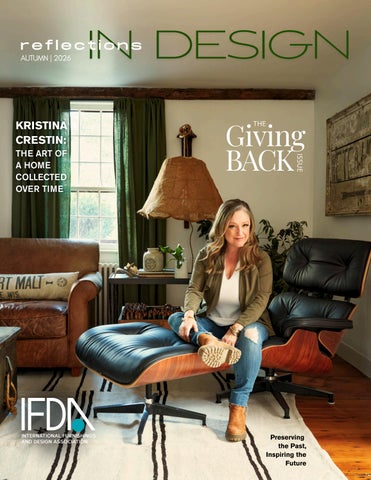
KRISTINA CRESTIN:
ISSUE
THE ART OF A HOME COLLECTED OVER TIME
Giving BACK THE
Preserving the Past, Inspiring the Future
610-273-2212 MasterDesignCabinetry,com
ON THE COVER:
KRISTINA CRESTIN
IN DESIGN
reflections AUTUMN | 2026
p.45
Rosemary Porto Editor-in-Chief EditorReflectionsMagazine@ifdane.net
John Trifone Managing Editor ifda.nec@gmail.com
KRJST STUDIO
Eunice Weckesser Publisher ifda.nec@gmail.com
Reflections in Design is a subscription magazine that is distributed at no charge to all IFDA-NE chapter members and subscribers. Advertising Inquiries: ifda.nec@gmail.com Editorial Submissions: EditorReflectionsMagazine@ifdane.net Subscriptions: Send an email to ifda.nec@gmail.com with the subject “Subscription” and your email address to be added to the subscribers list.
ELAINE FREDRICK PHOTOGRAPHY
ARCHITECT - NICK PAOLUCCI, MASS ARCHITECT - IFDA ARCHITECT OF THE YEAR 2025 ELAINE FREDRICK - IFDA PHOTOGRAPHER OF THE YEAR 2023 www.elainefredrick.photography
IN DESIGN
reflections AUTUMN | 2026
ART DIRECTION Jennifer Driscoll Hadley Driscoll Broadview Marketing
CONTRIBUTORS
HEATHER HILL Owner of Hill Drapery Design, Heather specializes in custom window treatments and soft furnishings. A 12-year IFDA member, she has served as President of the Philadelphia Chapter for the past two years.
JULIE MATOS A fashion/style director and image consultant based in New York, Los Angeles, and Boston, Julie crafts celebrity fashion, high-end style, and fashion editorial with bold creative vision.
JENNIFER DRISCOLL Specializing in marketing, Jennifer’s campaigns for architects, designers, builders, and manufacturers has earned her many awards. Her highly curated international Broadview Tours garner private access to leading brands, and artisans.
JULIE DALTON With over 10 years in the design industry, Julie Dalton has established herself as a respected leader in marketing and business development, known for fostering meaningful industry relationships and driving strategic growth.
GIOVANNI DECUNTO
THE STOLEN 13
p. 26
MORE ROOM FOR WHAT MATTERS™
CUSTOMXCLOSETS
ENTRYWAY
PANTRY
SCHEDULE YOUR COMPLIMENTARY
Brighton Burlington Cape Cod Cranston Hingham Natick West Hartford
DESIGN CONSULTATION 800.274.6754 | CALIFORNIACLOSETS.COM
HOMEXOFFICE
FEIHC-NI-ROTIDE EHT MORF
Dear Readers, As we approach the end of 2026, I hope this issue will inspire a conversation about moving forward into a new year while preserving the past with creativity and commitment. Scroll ahead and find a story about a historic Boston church transformed into a luxury condo building, while saving its artistic majesty. We shine a light on A Mystery Mansion in dire condition and the remarkable story of a musical trailblazer, Mary Cardwell Dawson. IFDA member Dawn Carroll is committed to saving this historical building and Miss Cardwell’s legacy, producing a music album and a play telling a story nearly forgotten by time. We share a tale of an artist’s ode to remembering the infamous heist of stolen art. Take a museum tour of fashion from Hollywood’s golden age of silent films; and a read story about the award-winning installation, modernizing a colonial landmark with state-of-the art technology. Travel Beyond the Borders to ancient Rome and Pompeii for lessons in architecture and design. With Thanksgiving at our door, we honor IFDA members whose selfless efforts made a big difference by giving back to their communities. There’s a colorful story of a team of builders and painters who created a magical rainbow in an apartment building where families shelter during their children’s cancer treatment. Young adults in Philadelphia transition from foster care and homelessness into comfortable and independent apartments, thanks to an organization founded and operated by IFDA members, who gather designers and trade partners to donate time and effort helping these young people begin their adult lives in the comfort of home. May our kind and generous members and their noble labors inspire you. In our cover story, we are thrilled to introduce interior designer Kristina Cristen, whose HGTV hit, Farmhouse Fixup, features her fresh brand of farmhouse design elevating a tried-and-true form of American architecture. Kristina shares revealing insights into her practice and ideas on how she transforms old houses into dramatic new dwellings for her clients. Thank you to our contributing writers, whose storytelling will entertain and motivate all of us. Sincere thanks to our readers and followers; may the rest of the year bring you precious time to slow down and enjoy the small pleasures of your life. Cheers to all!
Rosemary Porto ROSEMARY PORTO
Editor-in-chief, Rosemary Porto visits Christopher Haven with Chapter President Eunice Weckesser and Member Julie Dalton of Platt Builders.
G I O V A N N I D E C U N T O . C O M
SIMPLICITY, DUPLICITY, MULTIPLICITY (1 OF 3)
GIOVANNI DECUNTO
ROTIDE GNIGANAM EHT MORF
Our design community has always been built on collaboration, creativity, and connection. We learn from one another, inspire one another, and, at our very best, create opportunities for others to thrive. In this issue, we celebrate the designers, architects, builders, makers, and industry partners who carry that spirit beyond their professional work, generously sharing their time, talents, resources, and voices in service to others. Giving back takes many forms. It can mean mentoring the next generation of creative talent, supporting scholarships and educational opportunities, lending expertise to a nonprofit, contributing to organizations that serve our neighbors, or using design itself to improve the places where people live, gather, learn, and heal. Sometimes it is a grand gesture. More often, it is something quieter: showing up, making an introduction, opening a door, sharing knowledge, or helping someone else find their way forward. What makes these efforts so meaningful is the ripple effect they create. One act of generosity can spark another, strengthening not only an individual or an organization, but the design community as a whole. And in an industry defined by imagination, perhaps one of our greatest opportunities is imagining what we can accomplish together. The stories in these pages are a reminder that success is measured not only by what we create, but also by what we contribute and what we make possible for others. Great design leaves an impression. Giving back leaves a legacy. Sincerely,
John Trifone JOHN TRIFONE
Iconic Jewelry for Everyday Radiance
aliandeve.com
REHSILBUP EHT MORF
Dear Friends, I’ve always believed that the energy we put into the world matters. The kindness we offer, the time we make for someone, and the causes we choose to support all leave an impression. Call it good karma or good energy. I believe that when we lead with generosity, we create more room for it in our lives and in the lives of others. This issue of Reflections in Design celebrates giving back, something that means so much to me personally and is one of the things I love most about IFDA. Our community brings together talented, creative, and passionate people. We connect through design, but those connections give us the opportunity to do something that reaches well beyond our industry. Together, we can support the organizations doing meaningful work in our neighborhoods and bring attention to causes that have touched our lives. Often, a cause becomes personal because of something we’ve experienced ourselves, someone we love, or a story that stays with us. Sharing those connections helps others understand why an organization’s work matters. Through IFDA, one person’s passion can become a shared effort, with more hands, more voices, and more opportunities to help. And the truth is, every one of us will need support at some point. Life can change quickly. We don’t alwaysbknow what someone is carrying, and we certainly don’t know when we might be the person who needs a little extra kindness, understanding, or help finding our footing. There is something deeply comforting about belonging to a community that shows up. Giving back can take so many forms: a donation, a few hours of your time, an introduction, or simply asking, “What do you need?” Each of us has something to offer, and even a small gesture can make a meaningful difference. As you turn these pages, I hope you’ll feel inspired by the people using their creativity and connections to care for others. I hope you’ll also think about a cause that speaks to you and how you might help move it forward. Thank you for bringing your talent, your heart, and your good energy to this community. I’m proud of what we can make possible together. With gratitude,
Eunice Weckesser EUNICE WECKESSER
ISSUE
in this
17
DESIGN CALENDAR industry events from Texas to Qatar
21
DEFYING GRAVITY celebrating designers who challenge convention
26
THE STOLEN 13 giovanni decunto paints an ode to the masters
32
FIVE FAB FINDS bohemian glass making in the czech republic
35
BOSTON’S OLD SOUTH MEETING HOUSE reimagined with an immersive educational tool
39
SAVING THE FORGOTTEN MYSTERY MANOR carrying on mary cardwell dawson’s legacy
45
KRISTINA CRESTIN the art of a home collected over time
55
BEYOND OUR BORDERS lessons in architecture, innovation, and living
Sam Kachamr Architects| Michael J. Lee Photography
ISSUE
in this
61
PRESERVING THE PAST inspiring the future
64
A NEW LIFE FOR A SACRED SPACE transformation of a gothic church
70
IN FOCUS ifda chapter event highlights
77
WHEN FASHION SPOKE fashion in american silent film
82
HOPE BENEATH THE FLOORBOARDS giving back in new jersey
84
CREATING COMFORT & DIGNITY giving back in philadelphia
87
THE POWER OF COLLABORATION giving back in new england
AUTHENTIC
DESIGN COLLECTION
Authentic Design. From the Original Source. Curated partnerships with original designers and manufacturers. www.authenticdesigncollection.com | e: info@authenticdesigncollection.com | t:551-400-0024
NOVEMBER/2026 5 - January 31
25-26
DESIGN DOHA BIENNIAL 2026
MELBOURNE BUILD EXPO
Doha, Qatar | 5 Nov - 31 Jan Website
Melbourne, Austrailia Website
6-8
26-29
THE MODERNIST WEEKEND
SEOUL DESIGN FESTIVAL
Faro | Tavira | Olhão Portugal Website
COEX Seoul, Korea Website
Three cities. Three days. One architectural story waiting to be told. The Modernist Weekend tells this story through guided tours, book signings, a tile workshop, and doors that are rarely open.
The Seoul Design Festival promotes and fosters design thinking . Visitors purchase the philosophies, perspectives , and ideas of designers and brands beyond mere materiality.
12 IFDA JAPAN X IFDA NY Sub-Zero, Wolf, Cove | A&D Building New York, New York Website
DESIGN CALENDAR
arketadesign.com
By collaborating closely with builders and architects, we become a reliable extension of your team from concept through completion.
Just Enough, Beautifully Considered.
We listen carefully, communicate clearly, and respond proactively to support your vision and make the process easier—not more complicated. The result is a trusted partnership and interiors that reflect thoughtful collaboration and consistently delivered results.
DECEMBER/2026
JANUARY/2027
1
12-15
SAUNA & STEAM BRUNCH & LEARN
HEIMTEXTIL
Republic’s Collection Weymouth, Massacusetts Website
Messe Frankfurt Frankfurt am Main Germany Website
1-6
A textile trade show featuring bedding, carpets, rugs, curtains and drapes, furniture fabrics, and the technology behind textile creation.
DESIGN MIAMI Miami, Florida Website
13-17 3-4
MAISON&OBJET
SHARE ARCHITECTURE FESTIVAL & AWARDS
Paris Nord Villepinte Paris, France Website
Barbican Center London, UK Website
An exhibition of Decor and Design, Fine Craft, Fragrance and Wellness, Fashion and Accessories, Gift and Play, and Cook and Share.
8 IFDA PHILADELPHIA HOLIDAY PARTY SIP & STROLL
22-31
Philadelphia, Pennsylvania More Info
DESIGNTO FESTIVAL Toronto, Canada Website
9 OFFSITE CONSTRUCTION SUMMIT Houston, Texas Website
DESIGN CALENDAR
DEFYING GRAVITY BY JOHN TRIFONE Photography by Evelyn Dow
talent On September 18th, New England's design community gathered in the grand ballroom at the Hilton Boston Park Plaza Hotel for the IFDA New England Awards Gala, celebrating an unforgettable evening of creativity, innovation, and the professionals shaping the future of design. Guided by the theme Defying Gravity, a perfect metaphor for the design industry itself, the evening celebrated creative minds who challenge convention and transform ambitious ideas into new realities. The elegant atmosphere, decorated in a sophisticated palette of emerald green and soft pink, overflowed with energy and imagination. Emcees and television personalities Taniya Nayak and Jenny Johnson led an extraordinary program of recognition and connection, honoring members of the New England design community. At the heart of the gala were the Premiere Awards, honoring individuals whose work and accomplishments exemplify excellence in design. David Hacin received the Architect of the Year award, recognizing his contributions to architecture and his commitment to thoughtful, impactful design. Michael Ferzuco of Eleven Interiors was named Designer of the Year, celebrating his creative vision and contributions to the interior design profession. The Lifetime .....
Taniya Nayak and Jenny Johnson
Sage Conti
David Hacin
Gala Stilt Walker
Tim Young
Achievement Award was presented to Sage Conte in recognition of a lasting contribution to the design community. Guests were treated to a gift by New England Home magazine. As the formal celebration drew to a close, the atmosphere shifted to late-night glamour at a Speakeasy after-party. Guests were treated to a private concert with musician Tim Young. The 2026 awards gala reminded us that design can ..... o .......
Michael Ferzoco
inspire, connect, and create meaningful change. From architecture and interiors to the many disciplines that shape our surroundings, the honorees showed what's possible when imagination meets purpose and the courage to think beyond the expected. For IFDA New England, Defying Gravity was more than a theme. It celebrated the people who elevate the profession, expand opportunities, and remind us that the most exciting achievements often begin when we dare to reach higher.
CONGRATULATIONS TO THE 2026 IFDA-NE AWARDS WINNERS DESIGNER OF THE YEAR
ARCHITECT OF THE YEAR
LIFETIME ACHIEVEMENT
Michael Ferzoco
David Hacin
Sage Conti
BEST RESIDENTIAL ARCHITECTURE | TRADITIONAL DESIGN
BEST BATH DESIGN
Top Notch Contracting & Samantha Carey Interiors
Liz Miller Interiors
BEST RESIDENTIAL ARCHITECTURE | TRANSITIONAL DESIGN
BEST HOME TECHNOLOGY DESIGN
BEST RESIDENTIAL ARCHITECTURE | MODERN DESIGN
BEST LIGHTING DESIGN
BEST RESIDENTIAL ARCHITECTURE | SPECIALTY DESIGN
BEST SPECIALTY RESIDENTIAL INTERIOR DESIGN
SV Design Architecture + Interiors Hacin
Monti Ackerman Sculpture, Inc. Dawn Carroll Couture Kenneth Vona & Son Construction Gregory Lombardi Design Colonial Marble Company
BEST COMMERCIAL ARCHITECTURE | STUDENT PROJECT
Troy Rudolph
BEST SUSTAINABLE FASHION DESIGN
SimpleHome SimpleHome
Doug Jack — Nidify Studio
BEST RESIDENTIAL INTERIOR DESIGN
Leslie Fine Interiors
BEST SHOWROOM DESIGN
Bespoke of Winchester Birchwood Builders Group BEST RESTAURANT DESIGN
Megha Patil — Happy Lilliput LLC
AG&Co Interior Design
BEST FLORAL EVENT DESIGN
BEST STUDENT RESIDENTIAL INTERIOR PROJECT
Erica Jones & Shawn Donnelly — O Luxe Design BEST GRAPHIC DESIGN BRANDING
Kenneth Vona & Son Construction BEST SUSTAINABLE INDUSTRIAL DESIGN
Stanislaus Miklaszewski
BEST RESIDENTIAL LANDSCAPE DESIGN
LeBlanc Jones Landscape Architects BEST COMMERCIAL LANDSCAPE DESIGN
Top Notch Contracting & Traverse Architects
LeBlanc Jones Landscape Architects
BEST INDUSTRIAL DESIGN PRODUCT
DESIGNER TO WATCH
Tommy Mac
Ariel Roth
BEST RETAIL INTERIOR DESIGN
PRESIDENT’S AWARD
Hacin
BEST HOSPITALITY INTERIOR DESIGN
Vineet Malik
BEST IN BUILDING
AG&Co Interior Design
Nick Vercollone
BEST LIVING ROOM DESIGN
COMMUNITY SPIRIT
Elms Interior Design
Betty Moore
BEST HOME OFFICE DESIGN
SPOTLIGHT AWARD
Honey and Fitz Interiors BEST KITCHEN DESIGN
AG&Co Interior Design
Patti Watson
INDUSTRY PARTNER
John Speridakos
Defying Gravity MANY THANKS TO THE SPONSORS FOR THEIR SUPPORT OF THE 2026 IFDA-NE AWARDS GALA
HOST SPONSOR
DIAMOND SPONSORS
GOLD SPONSOR
SILVER SPONSORS
BRONZE SPONSORS
SPECIALTY SPONSORS
BRYSON E L E C T R I C
AUCTION SPONSORS
VIP SPONSOR
GIOVANNI DECUNTO THREE MOUNTED JOCKEYS – 5 WORKS ON PAPER – STOLEN 13 (2018)
13
the stolen
Exclusive interview with
Giovanni DeCunto BY SOPHIE VAN HOUTTE Photography provided by Giovanni DeCunto
Interior courtyard at the Isabella Stuart Gardner Musueum Photo by Cao Vi Ton
GIOVANNI DECUNTO PORTRAIT OF THE ARTIST AS A YOUNG MAN (2018)
REMBRANDT VAN RIJN PORTRAIT OF THE ARTIST AS A YOUNG MAN (1633)
The largest property crime in US history shocked Boston in 1980 when thieves entered the Isabella Stewart Gardner Museum and cut thirteen rare paintings from their frames, including works by Vermeer, Rembrandt, Manet, and Degas. These masterworks disappeared mysteriously, and the crime remains unsolved. Fine artist Giovanni DeCunto was painting in his Fenway art studio when he learned about the shocking heist. As a boy, Giovanni remembers going to the Gardner Museum to sketch. He was drawn to art from a young age and longed to emulate the artists whose pieces hung on those walls. He humorously recalls his grammar school nuns reprimanding him for not paying attention in class. Although he struggled in his early school years, he excelled once he reached art school. One defining experience was his time as a traveling fellow at the University of Padua in Italy. There he was surrounded by his greatest teachers: Rembrandt, Michelangelo, da Vinci, Titian, Donatello, Vermeer, and many others. Giovanni believes that without understanding the past, an artist can never move forward. Each of these artists shaped how Giovanni understands art. Degas taught him about geometry and the golden section, and Rembrandt showed him how to break up his brushstrokes, which ultimately led him to his personal style. “Art is the language that connects all languages together,” Giovanni said during a recent interview. “As an artist, I feel a strong responsibility to serve humanity through my art.”
“As an artist, I feel a strong responsibility to serve humanity through my art.” GIOVANNI DECUNTO CHRIST IN THE STORM ON THE SEA OF GALILEE (2018)
REMBRANDT VAN RIJN CHRIST IN THE STORM ON THE SEA OF GALILEE (1633)
GIOVANNI DECUNTO THE CONCERT (2018)
JOHANNES VERMEER THE CONCERT (C. 1663–1666)
The Boston celebrity, Ernie Boch, suggested a bold idea to Giovanni: Paint the stolen thirteen. Armed with a deep respect for these masters and inspired by the dualities of modern life, Giovanni set out to paint an ode to his teachers. As a contemporary artist, he enveloped within him the lessons he learned from these master artists; this ambitious project gave him a chance to honor those who shaped his artistic journey. He turned to the Baroque palette and infused GIOVANNI THEmetallics, CONCERT –reimagining STOLEN 13 it with hisDECUNTO, signature the brushstrokes and squeezing paint directly from the tube onto the canvas to create a layered, almost sculptural effect. He took further ............
- Giovanni DeCunto
artistic license with scale, enlarging each piece well beyond its original size. He felt free to breathe new life into his beloved paintings. Today, the collection hangs in a private residence. Meanwhile, the empty frames still hang at the Isabella Stewart Gardner Museum as a reminder of the stolen originals and Giovani’s hope that the original masterpieces will return home to Boston. To view all thirteen of DeCunto’s recreations of the stolen works, visit giovannidecunto.com.
5
FIVE FAB FINDS
JEN DRISCOLL To increase access to European brands’ ideas, technology, and sophisticated design, Jen Driscoll is reaching across the Atlantic to enable American designers to realize their full creative potential. While planning for a new Broadview Tour in March, Jen recently traveled to Prague in the Czech Republic, Dublin, Ireland, Munich, Germany, Zurich, Switzerland, and Northern Italy to meet with artisans and high end manufacturers. Here she shares with you five fab finds from Lasvit, a Czech designer & manufacturer of bespoke glass products, lighting installations, and architectural glass.
JOIN US IN THE CZECH REPUBLIC & NORTHERN ITALY
2027 March | Bespoke Tours DESIGNED FOR ARCHITECTS | BUILDERS | INTERIOR DESIGNERS to source reputable products from Europe while building trusted relationships with manufacturers
COMING SOON: FRANCE & BELGIUM
broadviewtours.com 888.494.4951 : ext 101 info@broadviewtours.com
BOSTON’S OLD SOUTH MEETING HOUSE,
REIMAGINED BY ROSEMARY PORTO
At Boston’s Old South Meeting House, centuries of history meet the twenty-first century. Originally built by the Puritans for worship, it was the place where the Boston Tea Party was organized; a century later, a group of twenty brave women saved it from peril and founded a museum in this landmark. For America’s 250th anniversary, Revolutionary Spaces brought together a multidisciplinary team, including IFDA member Kyle Tripp, founder of Collaborative Integration, along with McGinley Kalsow Architects, New England Shutter Mill, and CVC Installations, to open Ruckus!, an immersive show exploring Boston’s pivotal role in shaping America.
HANDCRAFTED SOUL: THE ENDURING ARTISTRY OF NATIVE TRAILS' MURANO COLLECTION
YOUR PARAGRAPH TEXT
Photo | Lunamarina
Photo | Courtesy of Kyle Trippreceived the prestigious 2026 Lutron Excellence Award in Denver, CO. Kyle Tripp of Collaborative Integration
Tripp and the team designed and integrated 28 custom Lutron tensioned shading systems within the historic architecture, carefully integrated to virtually disappear once the presentation begins. Overcoming irregular windows, complex wiring, and an active museum environment, the system established the controlled lighting environment necessary for projection, lighting, and media. “Working within a building of this significance meant finding a way to introduce modern technology without competing with the history and character of the ......
space,” says Tripp. “Every detail of the installation had to be carefully considered, from the mounting to the controls, so the technology could do its job quietly and seamlessly.” The heart of this story of professional teamwork is the perfect example of giving back, using the team’s knowledge, experience, and technology not simply as a business opportunity, but as a way to contribute to the preservation of an essential part of American history and to offer a gift to the community and to future generations.
MYPUREPROTECTION.COM
DRAPERY CLEANING
UPHOLSTERY CLEANING
MOTH TREATMENT
FABRIC PROTECTOR
REVIVING INTERIORS & RESTORING BEAUTY CLICK TO LEARN MORE ABOUT OUR SERVICES INFO@MYPUREPROTECTION.COM
RUG CARE
esign r
raperies
OF BOSTON
YOUR TRADE WORKROOM
PORCELANOSA.IT
SAVING THE FORGOTTEN MYSTERY MANOR BY ROSEMARY PORTO PHOTOGRAPH BY JONNET SOLOMON
27 CHURCH ST, WINCHESTER, MA 01890
Throughout New England and beyond, IFDA member Dawn Carroll is widely known as a ‘Rock Star’ for her expertise and extensive experience in the stone industry. Chip away the layers, and you’ll find Dawn’s passions for music, mentoring, and a fierce curiosity for abandoned spaces. Captivated by the remarkable, nearly forgotten history of Mary Cardwell Dawson and Mystery Manor, Dawn turned her research into a heartfelt passion project.
MARY CARDWELL DAWSON
Mary Cardwell Dawson, born in 1894, studied at the New England Conservatory of Music in Boston and continued her training at the Chicago Musical College. After returning to the Pittsburgh area, she founded the Cardwell School of Music in 1925. She later operated the school from space in the Apple Street mansion owned by William “Woogie” Harris and, in 1941, established the National Negro Opera Company there. Mary Cardwell Dawson
During segregation, the mansion provided lodging and hospitality to prominent Black entertainers and athletes who were excluded from Pittsburgh’s white-only hotels. The house welcomed legendary figures including Lena Horne, Cab Calloway, boxer Joe Louis, and baseball great Roberto Clemente. Locals knew it as Mystery Manor because you never knew which celebrity might be coming or going. When Dawn discovered Mary’s story and learned that Mystery Manor had fallen into dire condition, she leaped into action.
27 CHURCH ST, WINCHESTER, MA 01890
“My passion ignited once I learned the history of these powerful people who did so much for human rights. Mary shattered the glass ceiling before anyone knew there was one,” Carroll said. “She risked her life to create beautiful music, mentoring students, and welcoming legendary musicians to the manor.”
Dawn Carrroll in front of the former National Negro Opera Company
Inspiring the next generation of preservationists, Dawn Carroll shares Mary’s story with third graders who, in turn, donated her portrait to the New England Conservatory, helping keep her legacy alive.
Dawn wrote a poem for Mary that became a song and part of a 15-song soundtrack collaborated with other songwriters.
Despite Mary’s remarkable accomplishments, her story and Mystery Manor might have been largely forgotten if not for preservationist Jonnet Solomon, who purchased the endangered property in 2000 with the late Miriam White and has spent more than two decades restoring the house and protecting its rich American history. Committed to raising awareness and financial support to save Mystery Manor, Dawn wrote a poem for Mary that became a song. She brought in other songwriters, and a 15-song soundtrack, Songs for Mary, was born, telling the stories of the legendary people who made Mystery Manor iconic. Dawn went further, developing the soundtrack into a theatrical work titled If the Walls Could Talk. The restoration of Mystery Manor is underway. Significant work remains, including interior reconstruction and establishing the historic property as a cultural space for future generations. This ambitious project requires ongoing funding and a long-term commitment to preservation. Dawn plans to use her soundtrack and music to raise awareness and funds while helping restore Mary Cardwell Dawson’s legacy for generations to come. “There is something for everyone under this roof. Sports history, music history, women’s history, Black history, and even a super cool story of William ‘Woogie’ Harris’s Duesenberg,” Dawn said. “This is a story of a woman’s legacy and the legendary people welcomed to the manor that refuses to die. Mystery Manor inhaled hate and exhaled love. When we save this house, it will exhale love once again.” If you would like to support the restoration of Mystery Manor, click here for more info.
KRISTINA CRESTIN The Art of a Home Collected Over Time BY ROSEMARY PORTO | PHOTOGRAPHY BY JARED KUZIA
Kristina Crestin’s story with IFDA New England began in 2002, when she was an interior design student at Endicott College and served as the organization’s student representative on its Board of Directors. Her dazzling smile and youthful energy made an immediate impression. Even then, she seemed destined for a remarkable design career. Today, that early promise has blossomed into a nationally recognized practice, with a celebrated portfolio, a starring role on HGTV’s Farmhouse Fixer, and recognition as a winner of New England Home’s 5 Under 40 award.
After establishing a strong foundation at Siemasko + Verbridge, Crestin launched her own firm, Kristina Crestin Designs. Her work reflects an approach that is thoughtful, practical, and deeply personal. For Crestin, creating a beautiful home is not about following a prescribed style. It is about understanding how people live and bringing together materials, furnishings, and meaningful details that make a space feel as though it has evolved naturally and organically. Rather than leaning too heavily on the farmhouse ..........
label, she begins with the fundamentals: layout, materials, and the everyday rhythms of a household. Traditional New England farmhouses evolved to meet the needs of the people who lived and worked in them. Today, the same practical thinking can guide a contemporary home. “Many people label my work as farmhouse, when what they’re speaking about is an interior that feels collected and thoughtfully practical,” Crestin said. Natural materials provide the next layer of authenticity. During an intensive renovation, an old house may require so much structural, electrical, and plumbing work that little of its original interior remains. At that point, Crestin sees her role as rebuilding the atmosphere of the house, using materials that evoke its history without turning the interior into a theme. She gravitates toward natural materials that develop character with age: reclaimed floors with varied widths and patina, hand-brushed cabinetry, metal that ages over time, and natural stone such as soapstone and marble. Their beauty lies in their tactile qualities and imperfections. Rather than relying on manufactured finishes that remain pristine, she embraces materials that reveal their history through use. Millwork is another essential element. Beadboard walls, re-claimed beams, exposed joists, and carefully layered architectural details bring depth and texture to a room. Lighting is equally important. Crestin builds a lighting scheme around the mood a space should convey, combining decorative fix-tures, island pendants, sconces, and lamps before adding recessed lighting where necessary. She believes a simple grid of recessed lights rarely creates the warmth and character her clients are seeking.
Her experience working on Farmhouse Fixer also changed how Crestin approaches her private practice. One important lesson was the value of establishing a realistic budget at the start of a project. Television brought her a different mix of clients and budget expectations, reinforcing her conviction that preliminary pricing is a nonnegotiable part of the design process. Clear expectations create a stronger foundation for the relationship and help clients understand what is possible before decisions are made.
With her background weighted toward interior architecture rather than decorating, Crestin had not fully appreciated how much she would enjoy the final stage of a project. As many designers know, on some residential jobs, clients reach decision-making fatigue or exhaust their budgets before the finishing touches can be completed. Television required her to deliver a fully styled interior, pushing her to expand her sourcing skills and explore the possibilities of accessories and decorative objects. What began as a challenge became one of her favorite parts of the profession. Finding the right pieces can be one of design's most demanding aspects, but for Crestin, it is also among the most rewarding. Creating a home that feels as though it has evolved over decades requires patience and an eye for the unexpected. Crestin combines vintage and antique finds with new furnishings, adjusting the balance to suit each client's goals and the house's architecture. “We create this by sourcing actual vintage and antique items and layering old and new together.” She said, “Sometimes, the most memorable details emerge from a conversation.” In one new-construction project, a 15-foot livingroom console presented a considerable styling challenge. As Crestin and her client discussed collections, the idea of handbells emerged. The client recalled that her children learned to play the bells when they were young, along with the amusing memories that came with those lessons. Crestin and her client went antiquing together to find bells, turning the process into an enjoyable adventure. The resulting collection did more than fill a long console. It connected the room to the family's history and introduced a playful detail that could never have come from a generic accessories package. The same home included a billiard area that called for a more casual atmosphere. Crestin and her client decided to display family photographs, searching for old frames in every condition, from beautiful examples to those showing signs of wear. Mixed with newer frames, they became an eclectic gallery spanning two walls. The effect suggested a collection assembled gradually, with each piece carrying its own history. Crestin also believes in making room for the unusual. Not every object needs to match, nor does every design decision have to be perfectly practical.
“Not every object needs to
match
nor
does every design decision have to be
perfectly practical.
“
At a showroom-model sale, she discovered a set of upholstered chairs with legs in different finishes. Their oddity appealed to her. She sourced African mudcloth, had it sewn and backed, and used it to upholster portions of the chairs while leaving the backs and sides intact. The result was imperfect, unexpected, and full of character; the sort of detail that makes an interior feel genuinely collected.
Finding distinctive accessories requires years of exploration. Crestin has developed a network of favorite sources by driving unfamiliar roads, stopping at unexpected places, and learning which destinations are worth revisiting. Coastal Maine remains a favorite for sourcing trips, whether for a long day of antiquing or an overnight excursion. Her sourcing collection has grown considerably through her television work.
Preparing for an average of eight installations in a season required a substantial inventory of accessories. Today, she keeps a large collection in her barn, drawing from it for current projects and adding to it whenever new treasures turn up. “Collecting without the boundaries of a retail store, “ she admits, “can become a dangerous habit.” Client-owned furnishings also play a role in the process. Crestin reviews what clients already have, what they hope to keep, and what will work in the new design. Honest conversations about scale and aesthetics determine which pieces belong. Sometimes a treasured object fits perfectly; other times, it is better left behind. When renovating older homes, Crestin is especially protective of original millwork and floors. Beautiful stone sinks and existing cabinetry may also deserve preservation. These features offer a connection to the past that new materials cannot easily reproduce. Crestin's palette often begins with earthy colors and blues and greens, which are also among her clients' most requested choices. In older homes with low ceilings, she pays special attention to finding a white that brings light into a room without feeling cold or drifting too far into yellow. Benjamin Moore's Vanilla Milkshake (OC59) and Simply White (OC-117) are two favorites. For green, she prefers the richness of mossy tones with yellow undertones, including Sherwin-Williams' Secret Garden. For clients willing to take a more adventurous approach, she also admires Backdrop's Night on Earth.
Among the designers whose work inspires her is Heidi Caillier. Crestin is drawn to Caillier's willingness to take risks, mix old and new, combine colors in unexpected ways, and create rooms that feel lived-in rather than formulaic. That sensibility captures Crestin's own philosophy. A home does not become authentic simply by adopting the visual language of a particular style. “Its character comes from the thoughtful decisions made along the way, materials that age gracefully, architectural details that are preserved, the treasures discovered on a sourcing trip, and the quirky objects that carry a personal story,” Crestin said. For Crestin, the most successful interiors feel as though they have grown organically around the people who inhabit them. Her goal is to create a home that is practical enough for everyday life, beautiful enough to inspire, and personal enough to tell a story all its own.
ORION | GIAMPIERO TAGLIAFERRI
MINOTTIBYDDC.COM
The Roman Colosseum is located in the center of Rome, Italy, just east of the Roman Forum and Palatine Hill
BEYOND OUR BORDERS
L E S S O N S A R T
O F
I N
A R C H I T E C T U R E ,
L I V I N G
F R O M
I N N O V A T I O N ,
A N C I E N T
R O M E
A N D
A N D
T H E
P O M P E I I
BY GEORGIA ZIKAS | PHOTOGRAPHY COURTESY OF GEORGIA ZIKAS
This summer, my husband and I traveled to Italy with our two daughters, who are entering ninth and sixth grade and both study Latin. We joked that surely all those months spent studying an ancient language would come in handy in Rome. Meanwhile, one daughter spent months diligently practicing Italian on Duolingo, which proved far more useful, especially when ordering pasta, gelato, and our daily cappuccinos. Apparently, ancient Latin doesn't get you very far at a Roman coffee bar. Although I had visited Rome before, this trip felt different. I made a conscious decision to slow down, listen intently to our guides, and experience these extraordinary places with a student's curiosity rather than a tourist's hurried pace. Having our daughters along made the experience even more meaningful. I wanted them to understand not only what they were seeing, but why these places still matter. As an interior designer, I spend most of my ....
days considering how people live, how spaces make them feel, and how thoughtful design can endure for generations. Rome reminded me that these questions are hardly new. It also reminded me how fortunate we are that generations before us recognized the importance of preserving their answers. At the Colosseum, completed in AD 80, we marveled at the sophisticated engineering, vaulted passageways, and circulation systems designed to accommodate approximately 50,000 spectators. Imagine nearly two millennia later, modern stadiums still employ many of these same principles. Interior of the Roman Colosseum
The Roman Forum features three surviving triumphal arches that once honored great military victories and imperial reigns. The Arch of Titus stands at the southeastern end of the Via Sacra. Emperor Domitian built it around 81 AD to commemorate Titus and Vespasian's victory in the Jewish War and the siege of Jerusalem. Famous interior reliefs show Roman soldiers carrying spoils from the Jerusalem Temple, including the golden Menorah.
I T A L I A N A R C H I T E C T U R A L
D E S T I N A T I O N S &
D E S I G N
P R O F E S S I O N A L S
Walking through the Roman Forum, once the center of Roman civic life, we imagined the generations who had gathered among its temples, monuments, and public buildings. Standing beneath the Pantheon's magnificent concrete dome, completed under Emperor Hadrian around AD 125, I was captivated by its perfect proportions and central oculus. Sunlight moving through that single opening was a beautiful reminder that natural light remains one of architecture's most powerful design elements. Vatican visit included an especially memorable tour beneath St. Peter's Basilica, completed in 1626 after 120 years of construction. Beneath this magnificent Renaissance church, we explored an ancient Roman necropolis .....
F O R
and the burial site traditionally identified as St. Peter's. Experiencing nearly 2,000 years of history layered beneath one of the world's most celebrated churches was profoundly moving. It was also a remarkable example of how preserving what lies beneath can be just as important as celebrating what rises above. At the Trevi Fountain, completed in 1762 and feeling practically "new" compared to everything else, we admired the extraordinary marriage of ancient Roman water engineering and Baroque artistry. And, of course, we had to make a wish!
The Trevi Fountain (above) Saint Peter's Basilica (below)
But perhaps my greatest discovery came during our few days exploring Pompeii, a place I was experiencing in person for the very first time.
A N C I E N T A N D O F
R U I N S
A C T I V E
D I G
S I T E
P O M P E I I
Preserved by the eruption of Mount Vesuvius in AD 79, the same era in which the Colosseum was nearing completion, Pompeii offers an astonishing window into everyday domestic life. We wandered through homes with interior courtyards, decorative frescoes, intricate mosaic floors, and thoughtfully arranged gathering spaces. As a designer, I found myself studying the floor plans as closely as the artwork. What surprised me most was how familiar these ancient design principles felt. Natural materials, connections between indoors and outdoors, decorative storytelling, and spaces designed around family and community remain fundamental to our work today. Centuries later, Renaissance architects rediscovered and reinterpreted classical ideas, proving that innovation often begins with an appreciation for what came before. For our design community, preserving the past is itself a form of giving back. We have the privilege, and perhaps the responsibility, to carry forward the knowledge, artistry, and craftsmanship of those who came before us. Whether restoring a historic home, supporting skilled artisans, thoughtfully repurposing materials, or mentoring the next generation of designers, we contribute to a legacy that extends well beyond any individual project. Perhaps giving back begins even more simply, with curiosity, education, and a willingness to share what we have learned. Walking these ancient streets with our daughters reminded me that preservation is not only about protecting buildings and beautiful objects. It is about preserving the stories, ingenuity, and human experiences that give them meaning.
The Ancient Roman Temple, Pantheon
I returned home grateful for the opportunity to experience history through our daughters' eyes, and with renewed appreciation for the ingenuity and humanity embedded in these extraordinary places. We concluded our travels along the breathtaking coastline of Positano, where yet another chapter of Italian architecture awaited us... But that is a story for another issue! Perhaps that is preservation's greatest gift: allowing the next generation to discover, question, appreciate, and ultimately carry forward the lessons of the past.
Available at Minotti by DDC, Boston, New York and Miami
Mount Vernon | Photo by JacobH from Getty Images
PRESERVING THE PAST INSPIRING THE FUTURE GRANT PROVIDES A RARE LOOK BEHIND THE SCENES AT MOUNT VERNON BY IFDA-EDUCATIONAL FAOUNDATION / PHOTOGRAPHY COURTESY OF CYNDI PARKER
For decades, the Educational Foundation of the International Furnishings and Design Association (IFDA) has supported historic preservation through its Ina Mae Kaplan Historic Preservation Grant, helping design professionals expand their knowledge and advance the preservation of our architectural heritage. Recent grant recipient Cyndi Parker, MFA, an interior designer, historic preservationist, and Assistant Professor at Mississippi State University, experienced firsthand how this support can make a meaningful difference.
ABOVE: Graduate students Charlyn King (L) and Jennifer Burt (R) visit Mount Vernon with grant recipient Cyndi Parker, MFA
In November 2025, Parker traveled to George Washington's Mount Vernon during a major restoration of the historic estate. The grant enabled her to bring two fellow historic preservation graduate students, providing a rare opportunity to observe preservation specialists at work while much of the mansion was closed to the public. Guided by Mount Vernon's Director of Preservation, Tom Reinhart, the group explored areas undergoing active restoration and gained insight into the painstaking research, craftsmanship, and conservation techniques required to preserve an 18th-century landmark.
Hands-on demonstration by Mount Vernon's Director of Preservation, Tom Reinhart
Their observations included analyzing 15 generations of paint layers to identify historically accurate colors, reproducing original wallpaper patterns, and using traditional materials to restore interior finishes. They also examined structural stabilization efforts and modern environmental systems designed to protect the mansion without compromising its historic character. Particularly compelling was evidence uncovered in the basement of the living quarters of Frank Lee, George Washington's enslaved butler. A concealed cavity beneath the floor offered insight into the lives of enslaved individuals whose stories are essential to the estate's history. For Parker, the experience demonstrated the importance of studying preservation in progress, rather than simply viewing completed restorations. She prepared an extensive field report, photographs, and documentation that provide valuable resources for future teaching and research. The project exemplifies the Ina Mae Kaplan Historic Preservation Grant's lasting impact. By supporting hands-on learning and professional development, the IFDA Educational Foundation continues its longstanding commitment to preserving the past while preparing design professionals to safeguard historic spaces for future generations.
P R I S M
A W A R D
W I N N E R
877-372-9653 DistinctivePergolas.com
BECAUSE LUXURY ISN’T JUST SEEN. IT’S EXPERIENCED. OFFERING DESIGN AND INSTALLATION SERVICES WITH THE INDUSTRY’S LEADING PERGOLA BRANDS SCAN TO EXPLORE OUR PROJECTS
R E S I D E N T I A L
|
C O M M E R C I A L
|
H O S P I T A L I T Y
A NEW LIFE FOR A SACRED SPACE BY LAURIE GORELICK PHOTOGRAPHY BY RAJ DAS | COURTESY OF FINEGOLD ALEXANDER ARCHITECTS
HISTORY In Boston’s revitalized Ink Block district, an eight-story condominium building with 33 luxury residences occupies a site with a distinctly different past. The Lucas, as the development is known, began life in 1874 as the German Trinity Catholic Church. Its transformation from a Gothic house of worship into a contemporary residential dwelling offers a compelling example of adaptive reuse: how historic buildings can find new purpose without losing their identity. The church stood abandoned for a decade before the Archdiocese of Boston put it up for sale as part of an effort to consolidate parishes and raise funds to settle legal claims. In 2017, the site’s developers engaged Finegold Alexander Architects (FAA), a Boston-based, women-owned firm, to reimagine the structure as condominiums. The project drew on the firm’s 1988 experience converting the Baptist church at 2 Clarendon Street in Boston’s South End into condominiums.
Title: The Lucas Architect: Finegold Alexander Architect
ADAPTIVE REUSE Repurposing an existing building for a different function has become a key strategy for preserving historic architecture, reducing construction waste, and retaining the character of established neighborhoods. FAA is a leader in this architectural niche. Ellen Anselone, the project manager for the Lucas, identified the building’s soaring height and expansive windows as central design challenges. “Looking at the structure as a volume of space,” said Anselone, “is the principal challenge in reconfiguring a church as a residential dwelling.”
PRESERVATION The original masonry walls, which measure two to three feet thick, were robust, allowing the architects to preserve the exterior shell while gutting the interior. Within the former church nave, FAA introduced three residential levels. Above them, the firm designed five additional stories in a steel-and-glass curtain-wall tower, set back behind the original façade and bell tower. The resulting design unifies old and new without attempting to camouflage the distinction. The historic masonry provides a substantial architectural base, while the contemporary tower introduces a lighter, more transparent profile.
REINTERPRETATION
Rather than replicate the church’s Gothic attributes, the architects found ways to reinterpret them. Two of the original rose-tracery windows were incorporated into individual residences, while a third remains in the lobby, where it sits alongside Gothic arches.
FAA devised a contemporary interpretation, using steel buttresses to connect the original third-level masonry to the tower's steel mullions above. The resulting structural elements frame terraces on either side of the fourth level, creating an intimate, arbor-like setting that softens the transition between the historic church and new addition. Light was another guiding consideration. The tower’s five floors are arranged to maximize the extensive exterior glazing, with bedrooms positioned along the window walls. Each residence is individualized, reflecting the complexities of fitting one- to four-bedroom units into a building originally designed for congregational worship. This architectural strategy balances modern living demands with the existing structure's spatial irregularities and unique proportions.
For residents, the appeal of the Lucas goes beyond its unusual provenance. High ceilings, natural materials, abundant light, and retained historic details distinguish the residences from other Ink Blot developments. Although living in a former church might suggest an atmosphere steeped in religious iconography, the building’s character is conveyed more from its novel architecture than from overt religious references. For Finegold Alexander Architects, the Lucas represents a continuation of a specialized body of work that gives historic religious buildings a viable future. The firm has since been approached about additional churchconversion projects in Toronto and Newton, Massachusetts, underscoring the growing interest in adapting these structures for contemporary use.
In Focus BOSTON, MA Guests at the IFDA-NE awards gala enjoyed taking cocktail hour to new heights, one perfectly poised pour at a time.
Beneath cascading crystal chandeliers and soaring vaulted ceilings, the Hilton Boston Park Plaza ballroom was transformed into a jewel box of fuchsia and emerald for the Defying Gravity themed 2027 IFDA-NE Awards Gala.
Boston, MA | Top Right, Clockwise, Michael Palmer of Kevin Cradock Builders and Georgia Zikas of Georgia Zikas Design; Ryan Pinnock of Winsupply Middletown CT Co.; Tyler Belanger and Regan Couto, NCIDQ of AG&Co, Beezee Honan of Cumar Inc. and Garrett Moynihan of Howell Custom Building Group.
BOSTON, MA | Top Left, Clockwise: Jeannine and Shane Lawless, and Liz Balestrero of Lawless Upholstery; Andy Sich and Roman Dvoracek of Lasvit; Sasha Durand, Birchwood Builders Group, and Melinda Guglietta, Bespoke of Winchester; Christina Close, Glenda Lopez Pagliocco, Katherine Sloan, Michael Ferzoco, Lindsey Tanner, Kerry Hayes, and Anna Rostron of Eleven Interiors.
BOSTON, MA | Top Left, Clockwise: Award winners, Patti Watson of Taste Design; Stanley Miklaszewski of New Dimension Cleaning and Protection; Dee Elms of Elms Interior Design; Chris Shirazi of Leblanc Jones Landscape Architects with Taniya Nayak of Taniya Nayak Design and Gala Emcee
IFDA- PHILADELPHIA HOSTS MULTIPLE EVENTS Top Left: Ann Decker and member Kristen Cossa from Kieffer’s Appliances Top Right: Winner of the Fox Den Wellness, Ashley Dowse at Lighting By Design Wellness event Bottom: Armelle Ferns, Lisa Tallman, and Heather Hill at the premier event at The Colonial Theatre hosted by ONUR Marble and Granite hosts
FENWAY ALLIANCE
F A C E S
CELEBRATES EXCEPTIONAL SPIRIT
Join us IN HONOR OF
Mayor Michelle Wu
SAVE THE DATE MARCH 4, 2027 |6 PM SIMMONS UNIVERSITY LIVING AND LEARNING CENTER PENTHOUSE LEVEL
YOUR PARAGRAPH TEXT
Picture hat worn by Lulu Glaser, (c. 1910. Straw, handmade lace, velvet, metal, and ostrich feather. Jimmy Raye Collection. Photograph by Joel Benjamin.
WHEN FASHION SPOKE BY JULIE MATOS
Long before Instagram, red carpets, and celebrity stylists, Hollywood was already shaping the way women dressed. Silent-film stars were among the first fashion influencers, turning on-screen looks into trends that made their way into department stores and wardrobes across America.
Goddesses in the Machine: Fashion in American Silent Film, an exhibit at Bard Graduate Center in New York (September 18, 2026 - January 3, 2027), explores this fascinating intersection of fashion, film, and cultural influence. The exhibition examines how costume design evolved alongside the early film industry and how the women of silent cinema helped define a new visual language of style. Curated by Michelle Finamore and Emma Cormack, the exhibition brings together rare garments, film footage, archival photographs, and historical ephemera, offering a look at an era when clothing became one of cinema’s most powerful storytelling tools.
Before audiences could hear an actress speak, her wardrobe told them everything. A silhouette suggested status, a fabric conveyed personality, and a perfectly constructed costume could transform an unknown actress into a screen goddess. As the film industry evolved, so did fashion's role. Early performers often supplied their own wardrobes, but as cinema grew more sophisticated, it created demand for dedicated costume designers who understood movement, lighting, texture, and how the camera could transform a garment. Off-screen, the influence was just as significant. Clara Bow, the original “It Girl,” captured the Jazz Age's rebellious spirit. Louise Brooks made the sleek black bob and streamlined silhouette synonymous with modern femininity. Gloria Swanson embodied extravagant Hollywood glamour, while Lillian Gish represented a softer, romantic ideal.
Satin Shoes by I. Miller (c. Mid-1920s) Silk, satin, gilt leather, and kid leather Jimmy Raye Collection Photograph by Joel Benjamin Picture Hat Worn by Lulu Glaser (c. 1910) Straw, handmade lace, velvet, metal, and ostrich feather Jimmy Raye Collection Photograph by Joel Benjamin Evening Dress Henri Bendel, Inc. Worn by Lilian Gish as Anna Moore in Way Down East (c. 1920) (D. W. Griffith, Inc.) Silk velvet, imitation pearls, glass, silver thread, silk habotai, silk net. Museum of the City of New York Gift of Miss Lillian Gish, 1949
These women were more than actresses. They were tastemakers whose images traveled far beyond the movie theater. Their hairstyles were copied, their silhouettes reinterpreted, and their wardrobes became part of a growing consumer fascination with celebrity style. Sound familiar? The relationship between Hollywood and fashion was already taking shape decades before today’s luxury brand ambassadors, celebrity dressing, and social media campaigns. The medium may have changed, but the desire to emulate the women on screen remains remarkably familiar.
SILVER SCREEN The exhibition also reveals the craftsmanship behind early film wardrobes. Garments are presented alongside moving images and archival materials, highlighting the relationship between construction, movement, and how the camera translated clothing. The result reminds us that costume design was never simply about dressing an actress. It was about creating an identity. Among the historical details is a 1905 program from Boston’s B. F. Keith’s Theatre, an early American vaudeville venue that also presented motion pictures. It’s a particularly fitting connection for Finamore, a fellow Boston native whose research often uncovers the relationship between fashion, entertainment, and cultural history. Yet much of this extraordinary fashion legacy .................
Lillian Gish as Anna in Way Down East (D. W. Griffith, Inc., 1920) wearing a peignoir set designed by Henri Bendel, Inc. Photo: The Library of Congress, Washington, DC George Grantham Bain Collection
nearly disappeared. Costumes from the silent-film era were rarely preserved, and surviving garments are often too fragile to be exhibited. Through meticulous research and rare archival material, Goddesses in the Machine brings renewed attention to an overlooked chapter of fashion history. For an industry constantly obsessed with what’s next, the exhibition offers an intriguing perspective on what came before. The power of celebrity, the influence of an image, the construction of a fashion identity; these ideas didn’t begin with the modern fashion machine. Hollywood’s original goddesses were already setting the trends. And more than a century later, we’re still watching.
Lillian Gish as Anna in Way Down East (D. W. Griffith, Inc., 1920) wearing evening dress on facing page by Henri Bendel, Inc. Photo: Bruce M. White Ira Resnick Collection
Mae Murray Photo: Gelatin silver print by Ruth Harriet Louise Robert Dance Collection
CELEBRATING BACKLIT STONE CONTEST ENTER TO WIN: Interior Designers and Architects are invited to submit commercial and residential projects featuring the beauty of backlit stone! Have you ever walked into a stone gallery and wondered, “What would this stunning stone look like with lighting underneath?” At CBS, we’ve partnered with Lucia Lighting & Design to bring your vision to life! Introducing our breathtaking Wall of Light – a curated display showcasing extravagant translucent stones, dramatically backlit by custom LED panels.
Scan QR code below for contest details and to watch a short video sharing the story behind the Wall of Light, an exclusive collaboration with Lucia Lighting. View real-time lighting demos on premium translucent materials and discover design inspiration for architects, builders, and homeowners. Visit the CBS showroom to see it in person!
Watch as natural veining and vibrant hues come alive under precision lighting, transforming ordinary slabs into glowing works of art. Perfect for countertops, feature walls, bar tops, and luxury interiors. Ready to elevate your next project? Visit us at the CBS showroom or contact our team for a private consultation. CBS Showroom 35 Holton Street, Winchester MA Call us at 781-721-3415 or email walloflight@cbsstones.com Discover more at cbsstones.com
Visit lucialighting.com/stonecontest for details.
Stepping Stone Series B Y D AW N C A R R O L L
GIVE • SUPPORT • SHARE
GI
I NG BACK
NEW JERSEY • PHILADELPHIA • NEW ENGLAND
HOPE BENEATH THE FLOORBOARDS I N BY HEATHER WISMER
N E W
J E R S E Y
PHOTOGRAPHY COURTESY OF HEATHER WISMER
Before the floors went down at a new home in Manasquan, New Jersey, members of the community walked through the unfinished rooms and wrote messages of hope directly onto the subfloor. Those notes are still there, sealed beneath the finished surfaces of the 2026 Jersey Shore St. Jude Dream Home Showplace. The program brought together a local builder, trade partners, vendors and national sponsors to construct a home almost entirely through donated materials and labor. Once the house was finished, it was sold, and all proceeds went to St. Jude Children’s Research Hospital. CMM Custom Homes led the Jersey Shore build, and Avalon Flooring was proud to be one of the many partners who helped bring it to life. Avalon Flooring, an IFDA Sponsor in the Philadelphia chapter, donated
the tile and setting materials for the home’s bathrooms and laundry room. Bathrooms and laundry rooms take a beating in any household, so the goal was to choose materials that would look beautiful on the day of the open house and still perform for years to come. The finished 3,500-square-foot coastal home opened for public tours in April, and when it sold, the project raised $845,593 for St. Jude. That money supports a hospital where families never receive a bill for treatment, travel, housing or food, and where research is shared freely with doctors around the world. For Avalon Flooring, the project was a natural fit. The company has been part of communities across New Jersey, Pennsylvania and Delaware for more than 65 years, and as an employeeowned business, its people have a real stake in how it shows up for its
neighbors. Avalon Flooring talks often about treating every customer’s home like its own, and the Dream Home offered a different version of that idea: a house built with care that would end up helping families who may never step foot in on Avalon Flooring. It was also a reminder of how much good happens when the design and building community pulls in the same direction. Avalon Flooring is grateful to CMM Custom Homes for the opportunity to be part of this project, and to every partner, volunteer and supporter who helped make the Jersey Shore Dream Home possible. Somewhere under those finished floors, the messages of hope written in the cold, early days of March 2026 are still doing their job.
CREATING COMFORT & DIGNITY I N P H I L A D E L P H I A BY HEATHER HILL | PHOTOGRAPHY COURTESY OF HEATHER HILL
For young adults transitioning out of foster care or homelessness, an apartment can represent an incredible new beginning. That is where Marvin’s Home comes to the rescue. This organization serves young adults, aged eighteen to twenty-three, many who are moving into independent housing after foster care or homelessness. Founded by interior designer and former social worker Mel McDaniels, IFDA member, and headed by executive directors, Rebecca Wein of Design Trade Resources and Rene Schleicher of Rene's Fabric Armor, Marvin’s Home serves young adults by turning empty apartments into thoughtfully furnished, welcoming ..............
homes. Furniture, lamps, artwork, kitchen necessities, bedding and decorative accessories come together to create something much greater than a just furnished apartment; it is a place where a young person can feel safe, comfortable and proud to say, “This is my home.”
hanging artwork and window treatments, assembling furniture, making beds, styling accessories or simply carrying boxes. Every task contributes to the young adult who walks through the door and feels they have a home. Sometimes the smallest details make the biggest difference.
Mel McDaniel’s mission immediately resonated with the Philadelphia Chapter members of IFDA. Our partnership with Marvin’s Home gives our members an opportunity to use their talents in a deeply meaningful way. Members volunteer their time and skills during Marvin’s Home installations, helping transform apartments from empty spaces into complete homes—arranging furniture, .........
For our members, these installations remind us that good design isn't defined by a price tag. A donated chair, an up-cycled table, a pair of lamps and carefully chosen accessories can completely change how someone experiences a room. For someone beginning adulthood without a family safety-net, a sense of belonging can be especially meaningful. A sofa becomes a place to invite ....
IFDA-PHILADELPHIA
MARVIN’S HOUSE
To invite a friend; a dining table becomes a place to share a meal; a lamp makes an apartment feel warmer at night; artwork on the wall says someone cared enough to make the space beautiful; a comfy bedroom feels like a private retreat. These may seem like ordinary things, until you have lived without them. The connection between Marvin’s Home and IFDA Philadelphia feels especially natural because both organizations understand the emotional power of warm surroundings and creature comforts. Through Marvin’s Home, we use our professional resources and talents to serve the community. The partnership extends beyond volunteering. Members and industry partners help by donating furnishings and home goods, contributing financially, purchasing needed items, and providing professional expertise. In 2024, the Philadelphia Chapter brought approximately fifty people together at Marvin’s Home for an IFDA event featuring television host and craftsman Jeff Devlin. The gathering introduced more design community members to Marvin’s Home and shared opportunities to get involved. In 2025, our members celebrated their 100th apartment makeover and move-in, an extraordinary milestone representing 100 opportunities to help a young adult begin a new chapter surrounded by comfort and community. The most priceless impact isn't measured simply in the number of installations. At IFDA Philadelphia, we value relationships within our industry: designers supporting vendors, vendors supporting designers, and members helping members succeed. Sometimes the answer to a challenging problem is surprisingly simple—show up, bring a drill, make a bed, donate a lamp, give a few hours, and help turn an empty apartment into a home for a person in need. Through IFDA Philadelphia members’ commitment to Marvin’s Home, along with the broader Philadelphia design community, we will keep transforming empty apartments into places filled with comfort, dignity, hope, and the unmistakable feeling of home for young people starting the first chapter of their adult lives.
Members and industry partners help by donating furnishings and home goods, contributing financially, purchasing needed items, and providing expertise.
THE POWER OF COLLABORATION I N
N E W
E N G L A N D
BY JULIE DALTON | PHOTOGRAPHY COURTESY OF JULIE DALTON
“As a designer, I’ve always been aware of how we need to create transitions between spaces. Bringing it to reality required a build team.” - Laurie Gorelick In the heart of Boston, just steps from some of the world’s leading medical institutions, families facing the unimaginable find comfort and community at Christopher's Haven. The nonprofit provides housing for families whose children are undergoing cancer treatment, offering not just shelter, but stability during some of life’s most difficult moments. Recently, a simple but meaningful design intervention transformed one of the organization’s busiest corridors into something more intentional: a vibrant rainbow arch installation now welcomes residents while gently redirecting misplaced visitors away from the private residential hallway. What began as a practical need quickly became a powerful example of how collaboration within the design and construction community can create real impact. Designer and IFDA-New England member Laurie Gorelick envisioned a colorful architectural feature that would bring warmth, joy, and clarity to the space. The challenge was turning that concept into a functional installation that met strict commercial code requirements and fit the hallway's height and width constraints. “I realized they needed a clear threshold with signage so visitors would know that Christopher’s Haven's portion of the floor was private and offlimits. I thought an arch would be the best type of threshold, which is how I arrived at the idea of a rainbow. As a designer, I’ve always been aware of how we need to create transitions between spaces. Bringing it to reality required a build team,” says Gorelick.
Relationships are essential in our design/build community; it was easy to reach out to colleagues for help. Threaded together through IFDA, the Platt Builders team stepped in at the request of IFDA member Rosemary Porto.
of their lives. Warm, energetic, and deeply committed to the mission, Acosta championed creating a more defined, welcoming threshold for the space. “The colorful rainbow arch became the perfect solution,” said Acosta.
“I met Julie and Steve at an IFDA event–you never know whom you’re going to meet and how it could impact your world,” says Porto.
Platt Builders generously donated the design expertise, materials, and labor needed to bring the concept to life. The project quickly became a full team effort, with craftspeople, installers, and paint specialists contributing their expertise. The need for lighting improvements in the common area was also pointed out; Morton and Nick Buni, Platt’s Director of Project Development, recruited their electrical subcontractor, Synergy Electric, to pitch in. “They spent an entire day extending wires and changing out light fixtures to improve the space for patients and their families to gather,” says Buni. “This was a team effort,” he continued.
The Platt Builders team quickly realized this was about more than aesthetics. This was about protecting the privacy and peace of families going through incredibly difficult circumstances, while also creating a moment of happiness and hope. Tom Carrigan, a senior project development specialist at Platt, led the team in turning Gorelick’s sketches into a design. “We had to imagine multiple people at one time, strollers, and even lots of little hands walking beneath the arch,” Carrigan said. “Tom’s design was executed flawlessly. I appreciated how he took my sketches and created a workable solution that everyone loved,” says Gorelick. The inviting corridor unintentionally drew Mass Eye and Ear foot traffic into the residential area, disrupting the calm environment Christopher’s Haven maintains for families. The exact scenario unfolded the morning of installation. Platt’s Director of Production, Michael Morton, watched patients exit the elevator and turn into the open Christopher’s Haven hallway instead of going through the door to Mass Eye and Ear. “It was eyeopening for sure,” says Morton. “It reinforced why this project was necessary.” Under the tender, loving care and leadership of Family Manager Glennys Acosta, the organization continually advocates for thoughtful improvements that better serve the families residing there during the worst time ...........
Mahon partnered with Moore’s Lumber and Benjamin Moore Paints, both of which donated the vibrant primary-color paints. Rey Santiago and Ray Gouveia sprayed the arches and spacers, the rainbow was assembled on a Saturday morning at the Platt Builders shop. The team spent another full day on site carefully installing the structure. “We had patients and their families coming and going throughout the time we were there. Seeing the smiles on the kids’ faces was heartwarming,” says Dalton. The result is a visual cue that defines the residential space, protects family privacy, and injects a moment of magic into an emotionally heavy environment. For Platt Builders, the project reinforced an important internal philosophy: the importance of giving back and being visible within the community. At Christopher’s Haven, that meaning now greets families every day in the form of a rainbow.
CHAPTER
EVENTS
12 01 08
Nov NY
IFDA Japan X IFDA New
York
Dec MA
Sauna & Steam Brunch & Learn
Dec PA
Holiday Sip & Stroll
IFDA.COM
DESIGN PROFESSIONALS:
ITS TIME TO
Whether you’re a furniture maker, architect, builder, interior designer, product inventor, graphic designer, app developer, fashion creator, or design student, we get you! nvest in Your Career: IFDA provides resources to enhance your business. oster Relationships: IFDA encourages innovation through collaboration. evelop the Next Generation: IFDA connects all experience levels for a strong design future. ct and Benefit: IFDA offers professional grants, volunteer service projects, and award opportunities.