Issue 2
2025
Official Journal of the Institute of Explosives Engineers
EXPLOSIVES ENGINEERING
This Month’s Features: Highlights of Fulmination 2025 If you oversaw the Defence budget for the next ten years… Beyond TNT Equivalent Cancer Risk in Army Bomb Disposal Veterans
Advanced vibration monitoring equipment
Vibracord Tellus
Everything you need in a Vibration Meter.
Vibracord Gaia
Excels in the roughest of conditions.
With greater accuracy comes improved results. EPC Metrics has brought Vibraquipo’s technically advanced vibration monitoring products into the EPC Ecosystem, making customers’ operations leaner and adding more value.
01773 832 253 info@epc-groupe.co.uk
2
Vibracord Hermes
High speed data logger.
Vibradata
Vibration mointoring software.
Our enabling suite of seismographic equipment can be expertly managed and serviced at EPC Metrics’ dedicated calibration facility, where ‘next level’ customer service and industry leading capabilities set the standards for our sector.
Enabling mineral sustainability
Contents
Features 6
Fellows of The IExpE
10
Highlights of Fulmination 2025
14
Women in Explosives
16
If you oversaw the Defence budget for the next ten years…
24
Beyond TNT Equivalent
28
Cancer Risk in Army Bomb Disposal Veterans
32
Field-Based Risk Assessment of Sea-Dumped Munitions
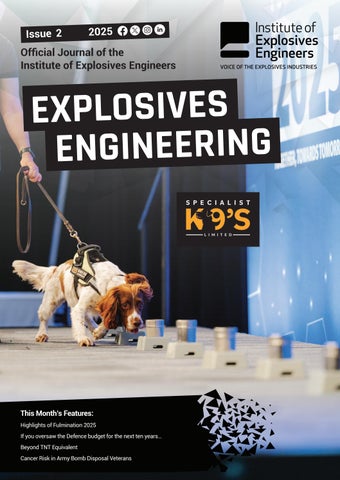
DISCLAIMER: The opinions expressed in Explosives Engineering are those of the authors concerned. They do not necessarily represent the views of the Institute. Front Cover: Image of ‘Specialist K9’s Limited’ dogs demonstrating at Fulmination 2025. Given our continued growth, IExpE are now registered for VAT. There will be no increase in Membership Subscriptions as these are exempt, however other services provided by IExpE will now be subject to VAT.
Our Corporate Members
Institute of Explosives Engineers Registered Office: Ground Floor, Unit 1, Greyfriars Business Park, Frank Foley Way, Stafford, ST16 2ST Company No: 07905911. Company Limited by Guarantee. VAT Registration No: 450546405 Contact us to be featured in the next issue of our journal: isseykelly@iexpe.org
3
Welcome to our New Members
Welcome to our ts n a tr is g e R & rs e b m e M New Fellow
Andrew Crooks
Allan Scott
Alan Chapman
Christopher Haworth
Lucie Smith
Obaid Juma
Charlotte Sparrey
Company Member
Shaun Malone
David Leek Chye Tan
Helix Robotic Solutions
David Tindall
Carter Watson
Charlene Walsh
Karl Wilkinson Samuel Yeap
Student Andrew Campbell
Member
Emalie Halifax
Waleed Alqahtani
New Registrants
John Hamilton
Matthew Andrews
CEng
Neil Hannaway
Scott Asbury
Charlotte Adlam
Alun Morris
Matthew Ault
William Gilroy-Hirst
Jack Walker
Lee Barnes
Richard Neale
Paul Bowen
David Philbey
Associate
Lewis Bradley
Alan Renton
Mohammed Kashif Ali
Ashuk Braham
Nicola Roberts
David Campbell
Emily Carr
Robert Coles
Dean Clark
EngTech
Kealey Darrington
Daniel Cox
Christopher King
Arron Dewar
Kenny Dalglish
Alexander Makoswki
Lauren Lockyer
Charlie Dutton
Richard Newe
Stephen Major
Rebecca Dyer
Steven Nowell
Liberty Napper
Reuben Francis
Craig Saunders
Lauren Patmore
Sean Galloway
Paul Wellsteed
Andrew Gordon Technical
Rachael Hazael
Saif Al Sereidi
Dan Heelis-Adams
Humaid Alari
Charlotte Knight
Ahmed Alblooshi
Opal-Jade Lacey
Abdulrahman Alhashemi
Matthew McGhee
Shaikh Almualla
Euan McLean
Badir Almueeni
Jack Naseby
Khaled Alshaibani
Steven Nassif
Obaid AlShamsi
Gregory Nichols
Saif Alsuwaidi
Sam Philpot
Jonathan Baker
Theirry Pope
Lee Bradbury
Charles Reynolds
Salim Buamim
Ralf Alexander Riebl
4
Proud to sponsor Fulmination 2025
Providers of specialist WOME Safety, Risk and Technical Engineering services to all domains in the Defence Industry. CONSULTARC.COM For more information please contact: ian.barnes@consultarc.com
Centre of Excellence in
Energetic Materials
Bringing together the Energetics Community • Leadership and strategy • Occupational standards and career paths • Access to training and education courses • Access to PhD placements and research projects • Maintaining a national EM SQEP capability • Access to specialist facilities • Collaboration via forums and networking events • Access to data and information
Be part of the solution www.coeem.org Contact us to be featured in the next issue of our journal: isseykelly@iexpe.org
5
of IExpE
Spotlight on IExpE Fellows
Stephen Miller & Chris Case: Fellows
Stephen Miller in Explosive Chartered Explosives Engineer, MSc IExpE Ordnance Engineering, and Fellow of What is your Career History? I joined the Territorial Army (TA – Army Reserves) when I was 17, qualified as a Bomb Disposal Engineer while still at school, before sitting my A levels. My explosives training made me a ‘shoe-in’ for a job as an Assistant Scientific Officer in the Guns and Warheads branch of the Royal Armaments Research and Development Establishment (RARDE) Fort Halstead, where I started at 20 (1990) working there until I was 32 (2002). I worked on warheads for the Defeat of Concrete and Defeat of Armour, then as deputy manager of the Old Fort firing facility and was given responsibility for the delivery of basic explosives training across the Fort Halstead site. In 1997 while at Fort Halstead, I joined the Institute becoming one of the first people on-site to do so. I also did some commercial work on the decommissioning of oil rigs and using military shaped charge knowledge to increase the oil flow of a North Sea oil well by 12.5%. This was when RARDE became part of QinetiQ (via DRA and DERA), before taking voluntary redundancy ahead of the warheads branch being cut to just 5% of its former head count. Initially, after being made redundant from QinetiQ, I went back to my EOD training, and took part in several area clearance projects. Here I was responsible for helping conduct the search of the sites with metal detectors and ground penetrating radar, and then dealing with any finds that came to light. This included lots of small arms ammunition, but the two boxes of hand grenades (No. 36 ‘mills bombs’ and No.69 ‘offensive’), along with tetryl booster pellets, No.6 detonators and even a mortar shell, were the most interesting to deal with. Prior to being made redundant, I had been dabbling with film and theatre special effects as a hobby/ part time job, so I used my redundancy money to support myself while I made full time in-roads to the film industry. I was co-opted to the IExpE council as they also wanted in-roads into the SFX industry. I joined the Special Effects branch of the Broadcast, Entertainment, Cinematography and Theatre Union (BECTU), becoming branch secretary, where I contributed to the formalisation of the education and training within the industry. I ended up working on some 40 odd productions – mostly commercials and 6
low budget films, but the one that gave me the best content for my showreel (clips that advertise your work) was ‘The Fall’, directed by Tarsem Singh. Scene 23 contained most of my work for the film – here’s a link to the ’making of’ that sequence: https://youtu.be/zt_VPlwJ-cU After being called as a character witness for a crown court case, I ended up providing technical information on explosives that helped result in a ‘Not Guilty on all counts’ ruling. The defence lawyer was impressed by my explosives knowledge and how I held up under aggressive cross examination while on the stand. They suggested that I become an expert witness, providing me with a glowing letter of recommendation.
Stephen Miller & Chris Case: Fellows of IExpE
As a result, I have produced expert witness reports for at least 80 different court cases covering the ‘Use and Mis-Use of Explosives’ over the last 25 years, some criminal, some terrorist, some military, but mostly people getting hurt with fireworks. As I became listed as an ‘Explosives Expert’ I started being approached by TV companies and other media outlets to comment on explosives and provide various demonstrations. The most notable of these was ‘Ultimate Explosions’ for the Discovery Channel: https://youtu.be/TKRVMdN7gOA, ‘Naked Science: Shockwave’ for National Geographic: https://youtu.be/Tx86pklBwmY and ‘Scrap Heap Challenge’, plus recreating a car bomb for the Sunday People: https://youtu.be/8s75L7pNAAY. More recently I have done three YouTube-specific videos with the science communicator Tom Scott: https://youtu.be/nqJiWbD08Yw, https://youtu.be/OOWcTV2nEkU and https://youtu.be/J3F2odr2Ms, which between them have received over 9.6 million views! After three years of fun and games doing full time special effects, I was recruited by a defence contractor who made me an offer I couldn’t refuse i.e. they’d pay me a regular salary that would cover my mortgage each month, unlike the film industry where the money was good, but the work was short term and sporadic. My employers have kept me engaged with interesting projects on complex electro/explosive initiation systems, shaped charges, explosive printing, explosive forging and cutting charges. So much so that I an now rapidly approaching the point where I’ll be awarded a shiny metal badge for 20 years of service. My employer was good enough to allow me up to 10% of my time to support the UK explosives industry via IExpE, as anything I did that benefited the industry would also benefit my employer, as they were part of the explosives industry. As such, I got involved in both the Education and Training Working Group and helped establish the level 4, 6 and 7 modern apprenticeships in Ordnance, Munitions and Explosives. Having become a Chartered Explosives Engineer in 2016, I also volunteered to be a mentor for others seeking the same (as my mentor had helped me tremendously).
This evolved into me becoming a Professional Registration Reviewers, Assessor, Interviewer and Ratifier through the Joint Review Board (JRB) set up between IExpE and INCOSE. What first attracted you to the industry? I wasn’t really attracted, I just sort of fell into it, but once in, I loved it. What does it mean to you to become an IExpE Fellow? To me, becoming an IExpE Fellow means that I am recognised and respected by my peers within the Institute and the wider explosives industry, as being at the top of my field and that I have earned this respect through having contributed to the explosives industry. To date what has been the highlight or your career? You’d think it would be something like becoming a Chartered Explosives Engineer, earning an MSc in Explosive Ordnance Engineering or becoming an IExpE Fellow, but the real highlight for me was when, having just conducted a presentation about explosives (which included multiple small scale firings as demonstrations), indoors, in a primary school assembly hall, as a STEM Ambassador, I was approached by a young lad, who said “Excuse me mister, but that was the BEST SCIENCE LESSON EVER!” as he raised both his thumbs. What do you see the industry looking like in 10 years? I have hopes and aspirations for the industry – mainly that we will have a stable suite of modern apprenticeships that can be used to attract new talent to the industry and allow those already working with explosives to learn more and advance their careers in technical roles, without having to resort to becoming people managers to earn promotions.
Contact us to be featured in the next issue of our journal: isseykelly@iexpe.org
7
of IExpE Stephen Miller & Chris Case: Fellows
Chris Case: Firefighter and Fellow of IExpE lead me to seek formal training to be able to effectively investigate these incidents and licence their storage and sale. Incidents such as Peterborough, Enschedde and Marlie Farm where firefighters had been killed was a clear indication that we needed to have a better understanding of explosives.
I joined Merseyside Fire Brigade in 1991 and rose through the ranks from operations to training and then onto a command position running the Toxteth Fire Station in South Liverpool. I moved into special operations and with a secondment to Merseyside Police formed the UK’s first joint team to investigate fires, explosions and oversee the storage of explosives legislation. From that the team was increased to over a hundred police and fire staff to manage anti-social behaviour, arson and explosion scene investigation. After a few years at the district chief level I moved to Canada in 2016 and became an Assistant Chief in Chatham-Kent Ontario, becoming Chief in 2019. I Chair the Canadian Fire Chiefs Committee on Dangerous Goods and sit on some other similar groups for the US and Canada.
When I became a Fellow, I recall looking at the people who had been awarded this privilege before me and was very humbled to be even considered. When I think about my expectations and aspirations when I first put on a uniform in 1991 I never even considered the diverse pathways my career would take me and to have the honour of being a Fellow in an Institution of such high esteem is still incredibly humbling. Every day is a highlight, to be able to continue to serve a community in what I advise new recruits is ‘Winning the lottery of life’ is not something I take for granted. But in the past few years I have seen my son become a firefighter, I’ve been able to train alongside him and last year presented him with his helmet as he graduated our Academy. The first question he asked me afterwards was ‘So how do I learn about blowing things up?’
Alongside my fire career I was privileged to be an instructor at the UK Fire Service College and a Trustee of the Royal Armouries Museum along with some EU Appointments in the areas of fire safety and community safety.
The Institute has changed its approach, outlook and business practices significantly over the past ten years with a group of dedicated board members and Presidents evolving our Institution to engage a broad group of practitioners and to promote the safety and wellbeing of our members. I can only see this increasing and the depth and richness of the discussions and debates increasing.
I was first attracted to the industry as an investigator, the increase in fireworks being used as weapons and the basis for criminal improvised explosive devices
With that increases our relevance and our influence to ensure the safety of our communities and the safety of our members.
8
POWERING SOVEREIGNTY WITH ROXEL UK Our commitment to powering sovereignty is at the heart of everything we do. As a world-class player in the defence industry, we take pride in our contribution to the safeguarding of our nation through the design, development and manufacture of cutting-edge propulsion systems.
We are more than a business — we’re a community of innovative and driven people, proud of our capabilities and advances in defence technology.
Roxel UK is dedicated to innovation, excellence and delivering solutions that help keep nations secure. Together, we’re shaping a safer future.
Joining Roxel UK is more than a job it’s a chance to defend sovereign capability, protect lives, and secure the vital interests of our customers while achieving your full potential.
L EARN M O RE AB OU T ROXE L UK
in F OL L OW US ON SOCIA L M E DIA WWW.ROXELGR O UP .C OM/EN
Highlights of Fulmination 2025
Highlights of Fulmination 2025 By Issey Kelly Fulmination 2025 took place at the East Midlands Conference Centre, the same esteemed venue that hosted the 2023 event. Situated on the expansive and picturesque grounds of the University of Nottingham, the venue offered an ideal setting, combining state-of-the-art facilities with approximately 330 acres of green space. The conference centre, along with its onsite hotel, provided ample meeting rooms, elegant banqueting suites, and dedicated networking areas - making it a fitting location for both the Gala Dinner and Networking Night. The venue’s strong commitment to environmental sustainability also aligned with Nottingham’s ambitious goal of becoming a net zero carbon city by 2028.
Having been closely involved in the planning, preparation, and experience of Fulmination in 2022, 2023, and now 2025, I can confidently say that Fulmination 2025 has been a resounding success. This year’s conference featured an impressive range of speakers, with safety as the central theme. We were supported by outstanding sponsors, welcomed a significant number of delegates, and benefited from impactful, cohesive branding. The venue maintained an engaging and vibrant atmosphere throughout the three days, contributing to the overall success of the event. Fulmination 2025 commenced with an opening address by Martyn Sime, President of IExpE since 2024, setting the tone for a dynamic and engaging event. 10
Over the course of three days, delegates attended presentations from the IExpE and OME streams. One notable improvement, especially when compared to Fulmination 2022, was the flexibility offered to attendees in 2023 and 2025. The ability to attend sessions without the need for advance booking proved to be a significant advantage, made possible by the large capacity of the East Midlands Conference Centre. The programme featured a diverse array of speakers and topics, reflecting the breadth of the explosives engineering field. Despite the wide-ranging subject matter, a common thread ran through nearly all presentations: a strong emphasis on safety - underscoring its importance across every sector of the industry.
Since the establishment of the IExpE Women’s Group in 2024, there has been a noticeable increase in the number of women attending the conference, representing a broad spectrum of companies across the industry. The formation of this group has played a key role in fostering greater inclusion within the explosives sector. Notably, it has also enabled women from different organisations to connect and network prior to Fulmination 2025, enhancing the sense of community and collaboration at the event. Emerging Professionals were also involved in Fulmination 2025, with several delivering presentations and others contributing to the poster competition. Congratulations to all who submitted a poster - your efforts and insights were greatly appreciated.
Highlights of Fulmination 2025
The competition provided a platform for showcasing research, innovation, and professional development within the explosives industry. Fulmination 2025 placed a strong emphasis on STEM engagement and showcasing the opportunities available within the explosives industry. As part of this initiative, a local school was invited to attend the conference for a dedicated day of activities. Their programme included live explosive demonstrations, career panels, visits to sponsor stands, and engaging Q&A sessions exploring routes into the industry and potential career pathways. With recruitment and retention continuing to be a well-recognised challenge across the sector, Fulmination provided an ideal platform to inspire the next generation and make a meaningful, positive impact on the future of the profession. On day one, a formal gala dinner and awards evening took place. Mandy Hickson, a former Royal Air Force pilot and Human Factors facilitator, was the after dinner speaker for the evening. She was the only female pilot on her Front Line Tornado Squadron, flying multimillion pound fast jets.
Delegates also had the opportunity to meet Specialist K9’s Limited dogs for a dog demonstration, showcasing how intelligent the dogs are within the explosives industry. The evening of day two offered delegates a more relaxed and social atmosphere, beginning with welcome drinks and a buffet-style dinner. The highlight of the night was an impressive drone display delivered by Star Symphony Drone Shows, captivating attendees with a visually stunning performance. The evening provided an excellent opportunity for informal networking, fostering connections and collaboration among delegates in a more casual setting.
On day two of Fulmination 2025, delegates were invited to participate in a team-building activity known as the ‘Pressure Chamber’, inspired by the format of The Cube. This interactive session encouraged participants to collaborate effectively, think under pressure, and communicate efficiently while completing a series of challenges. The activity was well-received, with many delegates embracing the opportunity to engage in some light-hearted competition - revealing not only strong teamwork skills but also a lot of competitive spirit.
Day three featured a full schedule of presentations across both streams, culminating in a closing address by Martyn Sime, President of IExpE. His remarks brought the conference to a fitting close, reflecting on the success of Fulmination 2025. We extend our sincere thanks to all sponsors, speakers, delegates, and the entire event team whose contributions were instrumental in making this year’s conference such a success. We look forward to welcoming everyone back for Fulmination 2027, and will be sharing more information in the near future.
Contact us to be featured in the next issue of our journal: isseykelly@iexpe.org
11
Fulmination 2025 Award Winners
rs e n in W rd a w A 5 2 0 2 n o ti a in Fulm 1.
2.
3.
4.
5.
6.
7.
8.
12
Fulmination 2025 Award Winners
9.
Image Captions WORKING GROUP OF THE YEAR 1. Education & Training Working Group Received by Julie Softley EMERGING PROFESSIONAL OF THE YEAR 2. Cosimo Nastasia APPRENTICE OF THE YEAR 3. Thomas Volpato MANAGER OF THE YEAR 4. Hugh Bellars
ROSENTHAL SILVER SALVER 6. Steve Miller HAROLD SWINNERTON AWARD 7. Emma Willes PRESIDENT’S AWARD 8. Gareth Collett LIFETIME ACHIEVEMENT AWARD 9. Ken Cross
COMPANY OF THE YEAR 5. Roxel UK Received by Adrian Banks
THANK YOU TO ALL OF OUR
SPONSORS
13
Women in Explosives
Women in Explosives
The IExpE Women in Explosives group has been created to help increase the number of Women within the Explosives sector and to help find solutions to increase the number of women entering the sector and identify why very few are achieving management roles.
being women heavy within their departments and the commercial sector (fireworks, special effects, EOD, demolitions) seem to edge more towards being male orientated. One idea being discussed was to identify if there was a way to capture those finishing university and encourage them into our industry.
During the initial period, good engagement has been received from women across the sector, with more than 40 joining and participating in the group ranging from those who have just joined the industry through to those who have 30+ years’ experience. Having this breadth of experience provides significant positive benefits for all involved.
One group member suggested that it seems to be “the 1% of the 1% of the 1%” and with it being such a niche industry how do we entice them to join and to stay once here? A few ideas included attending more open days at the universities and showcasing what is available once finishing university; another was more marketing aimed towards those leaving and also looking at the wording being used for job adverts.
In March Ramora UK hosted the Group at their premises for the first face to face meeting and a tour of the facilities. One of the key topics covered was mentoring, and one key initiative is to establish a bank of mentors who are accessible to anyone within the group. It doesn’t have to be someone within their company or industry and by opening this up it allows more experiences and knowledge to be shared. A point raised on this subject was that the number of women in senior management roles was very limited and therefore mentoring for this type of role would be challenging. It is hoped that by establishing the scheme and offering out the mentoring route, this will hopefully help elevate and highlight this problem, as well as push more women to seek and achieve higher management roles. If you are interested in becoming a mentor, please email isseykelly@iexpe.org. Another area discussed was how to capture more women who are at the beginning of their career in explosives. It was highlighted that there is a clear change in some areas with a more balanced mix of women and men. However, there are still some areas which have no women within their teams. Government and educational sectors seem to have a healthy balance and sometimes edging more to 14
Research has been conducted on people applying for job adverts and it has shown that often, women are more likely to be cautious when applying compared to men. The balance between the HR departments writing the adverts and those within the departments writing them could perhaps be more balanced to ensure the right applicants are applying.
Women in Explosives
The second meeting was hosted by MBDA in April and took the form of a workshop on bridging generational differences and the roles of mentors, including secondment opportunities & STEM mechanisms. During the workshop session some of those within the Group who have previous experience being mentors agreed to a career Q&A discussing their backgrounds and experiences and allowed the others within the Group to ask questions relating to their career. This linked in well with the mentoring discussions and demonstrated the clear value of having experienced members of the industry available to provide insights to those in the early stages of their career. These discussions were followed by a tour of the site and the feedback from the Group attending the event was excellent. A presentation was given on generational differences which highlighted that whilst there have been massive improvements in communication between different generations, there are still some areas that need further improvements. The presentation was well received by the Group with a number of questions being raised and some interesting perspectives on how things have improved alongside the areas that still need looking at. We are looking to share this via the IExpE member network and would welcome any interactions relating to any of the aspects raised or involving women in explosives.
If you are interested in joining this Group you need to be a IExpE member or you can join the first meeting but if you wish to continue you will need to become a member afterwards. It would be great to get a wider variety of women within the industry to join so we are getting a better idea of where we are as a whole and what the other barriers are out there that we can try and overcome. If you are interested in joining or hosting a meeting, please email stephanieball@iexpe.org.
IExpE Board Members 2025–2026 Martyn Sime – President Steve Roberts – Vice President Emma Willes – Vice President Dave Welch – Executive Officer Rik Arthur Ruth Barber Andy Carr Ed Clinton Mark Hardman Helen Jones Richard Neale Bob Woolley Contact us to be featured in the next issue of our journal: isseykelly@iexpe.org
15
for the next ten years... If you oversaw the Defence budget
If you oversaw the e th r fo t e g d u b e c n fe e D next ten years...
vest in?
es would you in gi lo no ch te ce an dn Or ive os pl Ex t ha W Could a circular economic approach contribute to deterrence and sustain munition production? This article posits that for deterrence to be affordable and effective against emboldened adversaries, the UK and it’s NATO partners, will need to embed elements of a circular economic approach, i.e. designing products with the aim of recovering as much value as
possible during disposal from the outset[1], into its OME production. This will ensure that there are stockpiles of significant quantity to adjust an adversary’s risk-reward calculation, while remaining affordable to nations, regulatory compliant and profitable to industry.
1. Introduction The vast quantities of ammunition being gifted to Ukraine are a reminder of the massive resource requirement in a high intensity war[2]. A key modern development is the sheer range of systems and munitions used and on top of that, this type of war has been categorised by rapid shifts in ordnance required as equipment supplied has evolved[3]. The ability to keep this level of intensity going would require a significant national ability to store, manufacture or procure these quantities of munitions rapidly. That ability would form a central part of a general deterrence strategy[4]. The ability to demonstrate rapid production of diverse munitions, capable of imposing significant costs in a large-scale conventional war, sends a clear signal to adversaries to carefully reconsider their risk calculations’.
various Chemical and Dangerous Substances Acts, along with Coastal Acts, impose a complex web of sensible yet often cumbersome restrictions. These regulations dictate where OME can be manufactured, how it is transported, the inspection processes, and access controls. Collectively, they significantly limit a nation’s ability to prepare adequately for largescale conflict. The “where” question is also a difficult problem to resolve. Communities don’t usually want to live near a strategic stockpile especially as the Russian Federation increases their sabotage campaign across Europe[5]. Over lay this with the growing competition for secure storage locations with data companies, and even the estate that is available is becoming extremely difficult to maintain.
In a modern, developed nation, this element of a comprehensive deterrence strategy presents three quite challenging issues to unpack, firstly, regulatory constraints, raw material costs and financial aspects. This article will tackle each one of these issues in turn: 2. Regulatory constraints All these munitions require vast quantities of various propellants, explosives, and pyrotechnics. While this is a well-known issue within the Ordnance, Munitions, and Explosives (OME) industry, it is less understood by broader NATO societies. A significant challenge arises from the numerous regulations governing storage, transport, and management. For instance, in the UK, laws like the Explosives Act, NATO STANAG 4440, the Environment Act, and 16
1.
A further sub complicator is the continued growth of regulation. If the last 30 years are a guide, then regulations will only get stricter[6]. For every politician promising to roll back the red tape, there are 10 people willing to show you what happens when you do. For example, the tightening of hazardous chemical regulations, i.e UK REACH, or Registration, Evaluation, Authorisation and Restriction of Chemicals. These incremental changes in environmental impact legislation and the knock-on effects should be seen as a sign that there needs to be a fundamental change in how OME is developed, transported and stored.
An example could be having liners for warheads premanufactured, grenade bodies or artillery projectile casings premanufactured but not filled. These items would be easier to store, as they require less compliance with dangerous goods regulations. Additionally, they would retain a higher value due to their lack of integration with other materials
3. Competition for resources A key factor for anticipation, likely to be leveraged by an adversary, will be the need for raw materials to process into the myriad of munitions and systems needed to properly fight a conflict. The decline in raw material processing in Europe will only compound this issue in the initial phase[7] and could ultimately be an early checkmate. If you’re able to manoeuvre around any constraint imposed by a block or political group, the requirement to search for materials sources to maintain momentum will require a significant diversion[8] of time, resources and people to open new sources of material.
4. Funding The cost of defence seems to continually rise. Increases in labour costs, advancements in technology, and other factors appear to undermine efforts to enhance national defence capabilities. Additionally, the declining value of most defence systems, whether due to obsolescence or disposal, poses a significant challenge within these everpresent financial constraints within that, as OME items are often single use, and comes with a problematic subsequent recovery of value, the products are their own worst brand ambassador. The best and worst example of this is the cost of recycling 155 artillery shells, which often must be moved to remote locations, such as the Norwegian Ammunition Organisation’s Norwegian and Swedish facilities, where simple shells can have the explosive charge removed, but more complex natures often need to be destroyed in place.
2.[9]
As all the resource scarcity is playing out, the cost implications of procuring the huge amounts of material required could become staggering. The Covid-19 pandemic has a myriad of examples of this[10]. A combination of scarcity and price extorting took effect globally, leading to huge sums of capital needing to be procured to purchase the minimum amounts of important equipment to protect people. The competition for resources at the beginning of a conflict is an easy factor to pre plan for. Just having the resource stored in configuration that retains its value and is easy to process is very achievable.
If a politician were to consider the costs of recycling or disposal in an environmentally conscious society, along with storage expenses, transportation infrastructure, and more, it might become tempting to either adopt an overly optimistic perspective or defer the decision for someone else to handle in the future. If there where ways or mechanisms that would represent better value for money, or have a significantly improved value recovery opportunity, then a government might be significantly easier to convince that investment is the correct option. 5. A way forward So, balancing these key items of context, defence industry and government need to formulate a response that can deliver a range of munitions in a relevant period. >>
Contact us to be featured in the next issue of our journal: isseykelly@iexpe.org
17
for the next ten years...
Therefore, the development of OME should have these regulations built into their Life Cycle. An example could be to begin at the concept phase and map the known legislation and then focus on how those regulations could be written out of the considerations until as late as possible. Several of these ideas will be discussed in this article.
If you oversaw the Defence budget
Congratulations to Graham Jackson on achieving 2nd place in the Explosive Ordnance & Engineering Future Development: Scanning the Horizon in EOE writing competition!
for the next ten years... If you oversaw the Defence budget
>> But, it must not be so costly that it causes a paralysis for decision makers, working around the myriad of regulatory frameworks and has a significantly better value recovery mechanism. An economic ideology already exists that has this retention of value built into its operating systems. The circular economy is a model of production and consumption, which involves sharing, leasing, reusing, repairing, refurbishing and recycling existing materials and products as long as possible. In this way, the life cycle of products is extended[11]. Building on this ideology, a micro-circular economy based on 3 core principles could form the core of this approach. Those tenets would be, bulk precursors and re-saleable materials, unrestricted experimentation, and hibernating systems. The aim here is to pre-empt the need for huge volumes of small arms ammunition, grenades, artillery and mortar shells needed to conduct effective defensive operations. 6. Blanks and base components The core promise of this tenet is that there are volumes of single material tailored blanks in storage that can be easily assembled into working systems quickly. Tailored blanks are semi-finished parts, which are typically made from sheets with different alloys, thicknesses, coatings or material properties easily stored that can be quickly integrated into a manufacturing process. An example could be empty 155mm shell cases that are stored across the country in plain packaging, ready to be called forward. If the materials are selected well, then this also creates commodities value that can be traded against or sold on should that capability be deemed obsolete. The capital raised from the sale of those raw materials could then be used to kick start the next round of preparation purchases. The same could be done with key chemical precursors for explosives and propellants. Although this would require a separate active management system that would trade and sell the precursors during low levels of conflict but keep the stock levels at a predefined level.
Drawing inspiration from the archaeological preparation done for HS2[12], where the UK government paid hundreds of retainers to archaeologists so that any finds would be quickly exploited, maintaining progress on the project, the systems that built the stockpiles would then be placed into hibernation. This would then be maintained through a series of service contracts with industry, a semi-permanent work force and some kind of retainer system. The work forces are then identified and trained ahead of time, further adding to the ability of the system to start up quickly. Additionally, existing manufacturing capabilities, such as small machinery, vehicles or electronics, could be integrated into the plan. Industry could be paid to experiment with their manufacturing facilities to see if they could be quickly repurposed or realigned to produce a tailored blank or assemble a series of tailored blanks. Again, a series of retainers, experimentation with the work force and prelocation of components would enable this to be quickly built up and then activated when required. 8. Unrestricted experimentation There are several artistic movements built around strict confinement. Phil Hansen 2013 stated “We need to first be limited in order to become limitless.”[13] This phenomenal creativity born of restriction is playing out on the modern battlefield, where we are witnessing the battlefield innovations come from immense resource and time restrictions. Modern examples include how Daesh (ISIS) repurposed grenades into multipurpose Improvised Explosive Device (IEDs)[14] or how the Ukrainians have reprofiled existing munitions for drones[15]. These easily manufactured, repurposed systems, created a credible capability that required significant investment by global partners to defeat. 4.
3.
This ideology should be integrated in as many levels as possible to create a generation of engineers and designers who understand what it is to create novel solutions with what they have at hand.
7. Hibernating systems The tenet that would make this entire system work is a series of hibernating systems. 18
This has significant regulatory issues now, but if it’s part of the overall development of the economic model, then space to conduct this type of experimentation could be easily achieved. Industry would also benefit, from a free-flowing Intellectual Property (IP) would complement the Research and Development of larger companies and create a more competent user group.
For certain systems, the users will be locked in for a significant amount of time, limiting the amount of innovation that could be incorporated into that area. This could stifle innovation, be made obsolete by improvement in manufacturing technology or capability, or become workable due to resource scarcity. On balance, this is a credible argument, but I would argue that having lots of capable systems is significantly better than the promise of the best system. Additionally, if the stockpiles are paired with innovators who have the freedom to experiment and innovate in their fields, then it will be hard for a system to become completely obsolete.
References: 1. United States Environmental Protection Agency. What is a Circular Economy? [Internet]. www.epa.gov. 2021. Available: www.epa.gov/circulareconomy/what-circulareconomyBureau of Political-Military Affairs 2. Bureau of Political-Military Affairs. U.S. Security Cooperation With Ukraine [Internet]. United States Department of State. 2024. Available: www.state.gov/u-s-security-cooperation-with-ukraine 3. Liebermann KBL. How Ukraine became a testbed for Western weapons and battlefield innovation | CNN Politics [Internet]. CNN. 2023. Available: https://edition.cnn.com/2023/01/15/politics/ukrainerussia-war-weapons-lab/index.html 4. Fearon J. Selection Effects and Deterrence. International Interactions. 2002 Jan;28(1):5–29. www.tandfonline.com/doiabs/10.1080/03050620210390 5. Keating J. Russia’s campaign against the West is getting more aggressive [Internet]. Vox. 2024 [cited 2024 Dec 3]. Available: www.vox.com/world-politics/383330/russiageorgia-bomb-threats-gray-zone 6. The Future of Regulation [Internet]. The Centre for Policy Studies. [cited 2024 May 13]. Available: https://cps.org.uk/research/the-future-of-regulation 7. Anatomy of a fall: Europe’s deindustrialisation | illuminem [Internet]. Illuminem.com. 2024. Available: https://illuminem.com/illuminemvoices/anatomy-of-afall-europes-deindustrialisation 8. War highlights shrinking U.S. shell stock | Arkansas Democrat Gazette [Internet]. Arkansasonline.com. 2023 [cited 2024 Dec 15]. Available: https://www.arkansasonline.com/news/2023/apr/24/ war-highlights-shrinking-us-shell-stock 9. Ellen Macarthur Foundation. The butterfly diagram: visualising the circular economy [Internet]. ellenmacarthurfoundation.org. Ellen MacArthur Foundation; 2019. Available: www. ellenmacarthurfoundation.org/circular-economy-diagram 10. Reuters. China’s industrial profits nearly double as demand for raw materials rises. Reuters [Internet]. 2021 Apr 27; Available: www.reuters.com/world/china/chinaindustrial-profits-rose-923-yy-march-2021-04-27 11. European Parliament. Circular Economy: Definition, Importance and Benefits [Internet]. www.europarl.europa. eu. European Parliament; 2023. Available: www.europarl. europa.eu/topics/en/article/20151201STO05603/ circular-economy-definition-importance-and-benefits 12. Flyvbjerg B, Gardner D. How Big Things Get Done. Currency; 2023. The whole book is excellent. I recommend a read. 13. Can limitations make you more creative? A Q&A with artist Phil Hansen [Internet]. TED Blog. 2013. Available: https://blog.ted.com/can-limitations-make-you-morecreative-a-qa-with-artist-phil-hansen 14. ISLAMIC STATE’S MULTI-ROLE IEDs - Projected grenades used as air-borne improvised explosive devices (ABIEDs) [Internet]. Conflict Armament Research. 2017 [cited 2024 Dec 3]. Available: www.conflictarm.com/publications 15. RL R. How Ukraine Uses Obsolete Soviet Grenades To Destroy Russian Tanks From Above [Internet]. RadioFreeEurope/RadioLiberty. 2022 [cited 2025 Apr 9]. Available: https://www.rferl.org/a/ukraine-cheapgrenades-expensive-tanks/31835434.html
5.
A key issue with this whole system will be if any of the base components for munitions or pyrotechnics are not shelf stable in storage. If those base chemicals are unable to be stored for long periods, and in bulk, without breaking down or becoming less effective, then there is a liability in the whole system. To prevent this, a forum will need to exist where the liabilities can be communicated across government and industry to that contingency plans can be created and other sources of supply identified. Unfortunately, this will require a significant amount of work and oversight to ensure that any issues created by this risk are well managed. 10. Conclusion There is a large swarth of equipment and munitions that this won’t work for. Some areas are too complicated or difficult to keep pace with. However, the opportunity this presents is significant. There could be a scalable solution that would prepare for conflict, while limiting escalation. It would introduce significant amounts of modernisation, create large stockpiles of raw materials and inject an investment into domestic manufacturing amongst other values. The skills and job creation from managing this system should ultimately benefit any economy.
19
for the next ten years...
Image Captions: 1. Regulatory bodies and regulations 2. Circular economics 3. 155 mm M795 artillery projectiles are stored during manufacturing process at the Scranton Army Ammunition Plant (AP Photo/Matt Rourke) 4. ISIS Recoilless Rocket with a repurposed PG-7 40 mm rocket in an injection molded tube 5. UAV bomblets made from Soviet-era RKG-3 anti-tank grenades modified with 3D-printed tail fins attached to stabilize their fall
If you oversaw the Defence budget
9. Drawbacks and limitations There are drawbacks to this approach, for example the start-up costs would initially seem to be expensive, but the alternative is ‘eye watering’ and at least in times of assured peace, some of the funding can be recovered and directed into other areas. Additionally, if the tailored blanks are kept as close to a raw material as possible, then they will always have some intrinsic value that can be recovered by the system’s owner.
Colouring Contest The Big Bang of Colours: Journal
Last Issue’s Winner! The winner of our Issue 1 2025 journal colouring competition is Seb Kelly, age 7.
Congratulations Seb!
20
Win an Exclusive Institute Prize! The most impressive entry will be featured in the next issue of the journal, so don’t miss your chance to showcase your talent! Deadline for all entries is 14th August 2025. Get creative, have fun, and let’s see what you can do!
Contact us to be featured in the next issue of our journal: isseykelly@iexpe.org
21
Colouring Contest
Get ready for a fun and creative challenge! Grab your colours and bring the picture to life - invite your friends, family, and other members to join in the fun! Once you’ve completed your masterpiece, scan and send it to isseykelly@iexpe.org or mail it to: Institute of Explosives Engineers Ground Floor, Unit 1, Greyfriars Business Park, Frank Foley Way, Stafford, ST16 2ST.
The Big Bang of Colours: Journal
The Big Bang of Colours: t s te n o C g n ri u lo o C l a rn u Jo
Radnor Range Networking
g in rk o tw e N e g n a R r o n d Ra to Team Visit of Discovery, Innovation Nestled in the rugged heart of mid-Wales, Radnor Range is a name that echoes with history, innovation, and a healthy dose of highdecibel activity. This month, members of the Institute of Explosive Engineers had the privilege of visiting this extraordinary site – a rare blend of heritage, cutting-edge research, and an unwavering commitment to safety and precision. A Range Steeped in History Our day began with a warm welcome and an introduction to the origins of Radnor Range. Established in the mid-20th century, the site has served both military and civilian sectors for decades. Initially developed as a defence testing ground, it has since evolved into a world-class proving and R&D facility. Continually reinventing itself to meet the needs of tomorrow and continually contributing to sovereign capability. Safety First – Entertainingly So Before setting foot into the testing zones, we were treated to what must surely be the most entertaining safety briefing this side of a Top Gear special. Delivered with flair, humour and a firm grounding in protocol, the session covered everything from ear protection to what not to press (“unless you want a swift visit from the Ministry”). There’s something about explosive hazards being explained with Monty Python-level wit that really makes the rules stick. Touring the Terrain Our tour took us across the vast and varied site, with its combination of ranges, laboratories, and environmental testing capability. •
Environmental Testing: We were given a closeup look at Radnor’s environmental simulation capabilities – where kit is put through arctic freezes, desert heat, and even monsoon conditions. If your equipment can survive here, it can survive anywhere.
22
•
•
•
Radnor Range
R&D Capabilities: The range’s commitment to innovation was on full display, showcasing Radnor Range’s rapid prototyping and R&D capabilities with energetic materials—a critical area where speed, safety, and innovation converge. From concept to controlled detonation, the team can quickly design, fabricate, and test experimental materials, enabling fast iteration and data-driven development. It’s a dynamic environment where new ideas are safely brought to life under expert supervision. Remote Machining Capability: We were introduced to the remote operation of the CNC lathe and mill, where skilled technicians craft bespoke components tailored for explosive testing. Operating from a safe distance, these precision machines enable the fabrication of complex parts with exacting tolerances, ensuring both safety and performance in high-stakes test environments. It’s a seamless blend of engineering precision and operational safety. The Isostatic Press: During our tour, we had the opportunity to see Radnor Range’s isostatic press capability — an impressive piece of kit designed to apply uniform pressure from all directions. This process is crucial for testing the structural integrity and performance of advanced materials under extreme conditions.
Fitness – Complimentary, Not Compulsory The walking alone offered a complimentary exercise regime, as we traversed the hills and test areas. For those with wearable fitness trackers, personal records were quietly shattered. It turns out, climbing a slope to visit the array of capabilities does wonders for your heart rate. Takeaways and Lasting Impressions Radnor Range left a strong impression: a place where heritage meets future capability, where professionalism is balanced with personality, and where no detail – from safety to innovation – is left to chance. The team returned not only more informed, but inspired by the sheer range (pun fully intended) of capabilities on display. Our thanks to the Radnor Range team for their hospitality, expertise, and good humour. We’ll be talking about this visit for a long time to come – at least until our legs stop aching.
Is this your next step? Do you have experience of working in Weapons, Ordnance, Munitions & Explosives (WOME) safety and are looking for new challenges, career growth and a company where you are valued?
If you answered yes, we would love to hear from you. Read on to discover our exciting opportunities and apply to join our growing team! Frazer-Nash Consultancy Ltd is a leading engineering, systems and technology consultancy operating across defence, transport and energy markets. With a strong reputation and an impressive project portfolio, we’re looking for talented people with transferable skills to help us grow further. We have several engineering and consultancy roles available within our defence technical axis, based in locations across the UK — each offering something unique.
What will you be involved in? We offer excellent opportunities for individuals with a background in WOME design, platform integration and safety assurance including modifications, operation, maintenance and disposal.
Recent projects include:
• Conducting a safety analysis to inform the design and development of future hypersonic capability.
• Producing safety case documentation to underwrite the operation of a Ground Based Air Defence System.
• Providing technical oversight to support strategic Naval defence capability.
• Running OME Safety Review Panels (OSRP) to provide Second Party Assurance (2PA) of inherent OME safety on behalf of UK MOD.
• The safety assurance of novel Directed Energy Weapon capability.
Could this be you? We want to hear from you! If you are interested in applying, then send your CV to
rec1@fnc.co.uk and one of our Talent Acquisition team will be in contact to discuss roles with you in more depth and see if your next career step is with us here at Frazer-Nash Consultancy!
Beyond TNT Equivalent: Operator Safety in Offshore UXO Disposal
t: n le a iv u q E T N T d n o y e B osal, Operator Safety in Offshore UXO Disp written by Auke van der Velde Introduction Offshore disposal of unexploded ordnance (UXO) demands a combination of historical insight, technical execution, and environmental responsibility. Shock wave, ground shock, and hull shock factor each play a role in UXO disposal safety planning, where shock wave drives environmental impact, ground shock affects subsea assets, and hull shock factor ensures vessel protection. While the term TNT equivalent is often used to characterise explosive effects for modelling underwater blast propagation, especially for marine mammal mitigation protocols, it is not the only or even the primary determinant of UXO disposal safety. Instead this, I focus in this article on the operational measures that safeguard personnel and assets during work with live explosives offshore. This with particular focus on shock tube based initiation systems and Remotely Operated Vehicle (ROV) explosive counter charge deployment. Engineering safety into UXO disposal Comparing to electrical systems, the use of shock tube systems has significantly improved the safety of commercial offshore EOD procedures. These non-electric systems are inherently immune to electromagnetic, Radio Frequency and electrical current interference. The systems are engineered for stretch tolerance, incineration safety, and overpressure stability. A Shock Tube (e.g. NONEL® LEAD LINE) is a 3 mm diameter, three-layer plastic tube coated on the innermost wall with a reactive explosive compound e.g. HMX/Al. The starter is based on an impact initiation that transmits the ignition signal through the tube. When initiated, NONEL shock tube propagates a low energy signal, similar to a dust explosion, at approximately 2000 m/sec and initiates the detonator. The middle layer prevents the coating from being damaged with explosives during use. The outermost layer has high abrasion resistance, UV resistance and thus protects against damage caused by environmental influences. The tube of the system is not destroyed by the ignition transfer and will be retrieved to deck avoiding any extra subsea pollution. 24
Key safety components in such systems include but not limited to: A hydrostatic shock tube switch completes the firing circuit once the system is submerged to 8 –10 m depth, acting as a mechanical safety lockout during surface handling. The switch and detonator will be crimped on, to secure being waterproof. Radio Frequency initiators featuring timed arming delays, automatic disarm cycles, and secure channel coding, these systems add procedural and electronic safety layers for remote deployments and allow full stand-off from initiation zones. These measures together with Standard Operating Procedures enable safe ROV-based deployment of charges, even under complex sea state or vessel movement conditions. Other than RF initiators we can use manual initiation systems using shot shell primers and provide a rugged, all-weather option that requires no electrical power. However, they typically involve a close proximity to the detonation point and are often deployed from small craft such as RHIBs. This increases exposure of personnel to the marine environment, introduces additional vessel coordination, and inherently raises the operational risk profile, especially in poor weather conditions or when multiple assets are in play. Operational weather limits are much less than working with remote RF systems.
Safety in Offshore UXO Disposal Beyond TNT Equivalent: Operator
ROV Deployment: Precision without compromise ROVs equipped with manipulators, cameras and acoustic sonar-based visual guidance tools allow precise charge placement without exposing divers. Coupled with pre-calibrated firing chains and visual confirmation systems (e.g., marker floats with lights or beacons), this remote approach limits personnel exposure and increases efficiency throughout the disposal cycle. The human factor in a model-driven world TNT-equivalent remains a widely used input for defining safety distances around subsea structures, marine traffic corridors, and especially in acoustic models for marine mammal impact assessments. However, its relevance to the operational safety of personnel is limited. Ultimately, models serve a purpose, but they cannot replace the instincts, experience, and procedural discipline of the EOD operator. It is in the final 5% of the task, where data ends and decision making begins. And it is here that EOD Technicians must rely on training, teamwork, and professional judgment to execute safely.
Conclusion The true safety of offshore UXO disposal lies not just in calculating the size of the explosion, or using high or low order techniques, but in how the operation is conducted. Systems using shock tube detonators, hydrostatic switches, ROV deployment platforms, and secure initiation protocols represent the current state of best practice. As scrutiny increases around environmental impact and operator safety alike, emphasis must remain on practical mitigation, robust procedures, and proven systems, not on theoretical calculations alone. I certainly welcome and encourage new innovative systems that have been proven by thorough testing. Only in this way will we arrive at a better and more environmentally conscious technique to avoid both subsea and top side pollution. “In UXO disposal, 95% of the risk often sits in the last 5% of the detail”. About the author: Auke van der Velde is a Fellow of the Institute of Explosives Engineers, a Chartered Engineer, and senior UXO/EOD specialist with over 25 years of international maritime experience. He supports offshore projects with risk evaluation, render-safe strategies, and expert second opinions across Europe and beyond.
Contact us to be featured in the next issue of our journal: isseykelly@iexpe.org
25
Science Bazaar Beyond
Science Bazaar Beyond gouts of flame, illustrating how explosives function and what they can be used for. Even though Steve was presenting to a 180 seater theatre all three of his sessions were over subscribed – who’d have thought that live explosives demonstrations would be so popular!
At the beginning of March saw one of our Fellows, Stephen Miller (see ‘Spotlight on IExpE Fellows’ page 6), in his voluntary STEM Ambassador role, delivering engaging explosives presentations at the Oxford Brookes University’s ‘Science Bazaar’. The three sessions that Steve provided for the event all featured slides and videos showing how modern life relies on the use of explosives, along with live explosive demonstrations with flashes, bangs and
Short-Pulsed LASER ILLUMINATION SOLUTIONS For High-Speed Imaging
See through the glare from energetic events to gain insight into fragmentation processes
FireBIRD
1000 W Laser
FireFLY
500 W Laser
www.oxfordlasers.com enquiries@oxfordlasers.com | +44 01235 810088
26
Advantage where it counts
Resonant Acoustic Mixing • Cutting edge, innovative technology • Significantly enhanced explosive power • Superior performance and capability Contact us for more information
LandUK@baesystems.com
Copyright© 2023 BAE Systems. All Rights Reserved. BAE SYSTEMS is a registered trademark.
l Veterans Cancer Risk in Army Bomb Disposa
Cancer Risk in Army Bomb Disposal Veterans
re among su po ex ce an dn or ive os pl ex th wi k Bladder cancer lin reth Collett Ga by en itt wr s, er fic of al os sp di b m Army veteran bo 1.
According to a newly published study, Army bomb disposal veterans may face a significantly higher risk of developing bladder cancer than the general public.
2.
A research letter published in the medical journal BJU International and presented at the European Association of Urology Annual Congress in Madrid suggests that the incidence of bladder cancer among British Army veteran bomb disposal officers under 70 may be five times higher than that of the general public, raising urgent concerns about occupational exposure to hazardous substances. The study was conducted by a team from the University of Wales Trinity Saint David (UWTSD), University of Birmingham, King’s College London, University of Glasgow, and South Wales NHS Trust. It has identified a disproportionately high rate of bladder cancer among the cohort of former bomb disposal operatives, following a survey of approximately 30% (688 of 2300) of veterans who have served in Explosive Ordnance Disposal since 1970. Dr Gareth Collett CBE, a trustee of the Felix Fund Bomb Disposal Charity and the study’s lead author said: “This research isn’t about blame; it’s about raising awareness amongst veterans and general practitioners, protecting those still serving, and ensuring that lessons are learned.” “Our findings suggest that there is a significant link between exposure to certain explosives encountered by ammunition technicians during their careers and bladder cancer, and a definitive study based on these findings could lead to real change that saves lives.” Professor Rik Bryan, Director of the Bladder Cancer Research Centre at the University of Birmingham and a co-author of the study said: “Despite the relatively small size of this initial study, the findings 28
provide a strong signal that there is a considerably increased risk of bladder cancer amongst members of the ammunition technician profession who are exposed to certain explosives on a regular basis. This risk is significant enough to warrant urgent further investigation and a definitive study working with as many veterans as possible”. The research was inspired by the personal experience of Dr. Collett, a retired British Army brigadier and former head of the UK bomb disposal profession. Dr Collett said: “I was diagnosed with bladder cancer at 56. I served as an ammunition technical officer for 33 years, experiencing operational deployments in Northern Ireland, the Balkans, Iraq, Afghanistan, and less-publicised operations around the world. I was fortunate to survive when many of my friends and colleagues did not. However, I bear psychological scars and wasn’t prepared to confront another unwanted consequence of military service. “The diagnosis came as a shock, and the treatment was quite invasive. It affects your life and those around you. The impact of immunotherapy and transurethral resections of tumours is both physical and psychological. It can prevent you from having intimate
Cancer Risk in Army Bomb Disposa
3.
5.
l Veterans
4.
6.
relationships with your partner, interfere with your sleep patterns, and alter the way you need to urinate - in the most severe cases, it may involve the removal of your bladder, prostate, lymph nodes, and urethra.”
“The immediate assumption made by medical professionals was that it was a disease of heavy smokers. However, this was not the case for me, suggesting the possibility of an occupational link due to my service history and frequent visits to the Regimental Medical Officer for overactive bladder issues over the past decade. Anecdotal evidence was already being collected within the ammunition technical profession before my diagnosis in November 2023, raising concerns about a potential connection between explosives and urological cancers. Nonetheless, very little epidemiological evidence was available for the MOD to consider this a matter of concern. As a result, I chose to gather factual and preliminary evidence by consulting service charities, knowledgeable professors of urology, and trade professionals to develop an initial epidemiological survey. This survey produced the standard incidence ratios and confidence intervals reported in the paper, underscoring the need for further action.” “The profession is epitomised by the ‘Lonely Walk,’ that approach you do on your own when dealing with unpredictable explosive threats. This research suggests that those who have hung up their bomb suits, or destroyed stockpiles of ammunition during their careers, may have one further lonely walk to take long after their service is over. Let’s ensure we have the support mechanisms to assist those who have given so much to their country.” Further investigation linked exposure to the disposal of munitions containing nitro-explosives like TNT and their combustion products. Studies have long established that occupational exposure to certain chemicals increases the risk of bladder cancer, particularly among
professions such as tyre and chemical industry workers. However, the team believes this is the first study linking the disease to explosive ordnance disposal. Implications for Veteran Health and Policy Change Since the research began, two more veterans have come forward with a diagnosis of bladder cancer, highlighting the immediate need for better screening and preventative measures for those at risk. The Felix Fund and other service charities have already implemented self-help guidance on early detection, potentially saving lives by enabling earlier diagnosis. The study’s authors are calling for: • Further large-scale research into the long-term health impacts of explosive exposure. • Changes in military safety regulations regarding the disposal and handling of explosives. • Regular screening programmes for at-risk individuals, using low-cost urinalysis tests for early detection of bladder cancer. • Raised awareness amongst GP’s when dealing with veterans exposed to explosives during their careers, particularly if they are aged below 70 and are experiencing blood in their urine. For further information please visit: https://bjui-journals.onlinelibrary.wiley.com/doi/ full/10.1111/bju.16678 Image Captions: 1. Dr Gareth Collett CBE, principal author of the study 2. An improvised explosive device containing an unknown explosive later confirmed as nitroaromatic in nature 3. Ageing Bangalore torpedoes stored well outside their safe climatic category – exudation confirms the presence of TNT, amatol and the migration of liquid carcinogenic eutectics such as dinitrotoluene 4. Dr Collett providing manual IED neutralisation training in Yemen 5. Felix Fund, the bomb disposal charity, which supports the EOD and Search community and fielded the initial study 6. Brigadier Collett receives his CBE in 2013 for operations in Afghanistan
Contact us to be featured in the next issue of our journal: isseykelly@iexpe.org
29
From the Archives
30
2025 editions of Explosives Engineering will include a variety of extracts from archive editions for members to enjoy. Disclaimer: The opinions expressed in these articles are those of the authors concerned. Extract taken from April 1998.
From the Archives
Extract taken from December 2004.
31
-Dumped Munitions Field-Based Risk Assessment of Sea
t n e m s s e s s A k is R d e s a -B ld ie F : s n io it n u M d e p m u -D a e S of ring Expedition ito on M 2 62 R KO AL e th m fro s ht sig In a in the Baltic Sea by Bhumika Sharm
Dr. Aaron Beck and his team from the GEOMAR Helmholtz Centre for Ocean Research Kiel, Germany, invited Prof. Tracey Temple and her team from Cranfield University, Shrivenham, to visit the research vessel ALKOR 622. The objective was to exchange knowledge and technical expertise on the monitoring and risk assessment of World War-era sea-dumped munitions. I joined the Centre for Defence & Security, Cranfield University, Shrivenham in October 2023 to pursue PhD under the supervision of Prof. Tracey Temple and Prof. Frederic Coulon.
The Alkor 622 capability – Identification and detection of munition hotspots The ALKOR 622, a 55-meter research vessel, operates mainly in the North and Baltic Seas, conducting expeditions up to 21 days long (Figure 1). Equipped with advanced Autonomous Underwater Vehicles (AUVs) and Remotely Operated Vehicles (ROVs), the vessel facilitates high-resolution seafloor mapping, sediment and water sampling, and in-situ contamination assessment.
My research focuses on “Scientific Advancements in the Development of Risk Assessment for the Clearance of Dumped Munitions”. I had the privilege of participating in the expedition aboard ALKOR 622 on October 19, 2024, departing from Neustadt, Holstein in Germany. Context of sea dumped munitions post world wars Post-World Wars, unused war materials were routinely dumped in the seas all around the world. Currently, there are hundred thousand tons of munitions in the European waters alone (1-3). The dumping continued until legislation, namely the London Conventions, 1972 on the Prevention of Marine Pollution came into force. There are no comprehensive records of these dumped munitions but based on some recovered data there are more than 1.6 million metric tons of conventional munitions in the German North Sea and the Baltic Sea. These munitions are decreasing in stability and becoming more sensitive with age (4-5).
Figure 1: ALKOR 622 research vessel in the Baltic Sea near Neustadt port, Holstein, Germany
The equipment on-board the vessel enables detection and identification of munition hotspots using bespoke Autonomous Underwater Vehicle (AUV) & a Remotely Operated Vehicle (ROV) depicted in Figure 2. The instruments are deployed in the water using Crane and are equipped with conductivity, depth, temperature, oxygen level and salinity sensors.
There are reports of several spontaneous detonations of these conventional munitions. Apart from explosions creating high levels of noise and vibration, there is also a high risk of toxicity due to the spread of carcinogenic and mutagenic explosive compounds that are dispersed into the oceans and sea. This creates an urgent need to monitor conventional munitions resting on the seabed, as they potentially leach harmful substances into the surrounding environment. 32
Figure 2: Detection equipment of munition hotspots (a) Autonomous Underwater Vehicle (AUV) (b) Remotely Operated Vehicle (ROV)
Figure 3: (a) Mapping of seafloor using AUV (b) monitoring the munition conditions using ROV (c) marking the munition hotspots on the map
Sampling: Water & Sediments Following the identification of munition hotspots, the next step is environmental sampling. During the Alkor 622 cruise, water and sediment samples were collected to assess the release of explosive compounds from dumped munitions. Water sampling was conducted using devices equipped with CTD (Conductivity, Temperature, and Depth) sensors, enabling precise sampling at target depths while simultaneously recording real-time data via Dship Jens software. Both surface and deep-water samples were collected to develop a vertical water profile. CTD parameters were continuously logged along the trajectory of the sampler, AUV, or ROV, with downward casts preferred to minimize sample contamination during retrieval. A dedicated file can also be generated for each sampling bottle, recording associated environmental parameters. Collected data are processed and converted into usable formats using OceanView software. Two sampling methods were employed: large-volume samplers (10 L) as shown in Figure 4(a), and ROV-based samplers (1 L capacity). References: 1. Beck, A. J., Esposito, M., Sandmann, T., Cornils, C., Baker, J., Martínez-Cabanas, M., Schwenk, A., & Achterberg, E. P. (2019). FINAL PROJECT REPORT ExPloTect: Ex-situ, near-real-time exPlosive compound deTection in seawater. 2. Bełdowski, J., Achterberg, E., Andresen, C., Beck, A., Brenner, M., Böttcher, C., Cumming, A., Czub, M., Frey, T., Kammann, U., Kampmeier, M., Koschinski, S., Koske, D., Köser, K., Lang, T., Lastumäki, A., Lehtonen, K., Lundgreen, K., Lindgren, F., & Mesk, L. (2024). Thematic assessment on Hazardous Submerged Objects in the Baltic Sea Warfare Materials in the Baltic Sea 2.
Figure 4: a) Water Sampler (b) Sediment Sampler
Sediment sampling was done using sediment grabber attached to a pulley system as shown in Figure 4 (b). The whole setup was washed with clean water before and after sampling. To the identified hotspots the grabber was deployed. It also consists of a camera to monitor the activities of the grabber and to avoid any munition being grabbed to avoid the risk of accidental explosion. The contents of the grabber were emptied in a clean plastic container, plastic apparatus is preferred to avoid any reaction with explosives. Two types of samples were collected (a) 3 sub-grab samples were collected using a big spatula (100-150 g) in zip locks for the study of physical properties of sediments including grain size and total organic carbon. (b) the samples were filtered using a 0.5 mm sieve and collected in a labelled plastic container (500 mL) using a plastic funnel for the toxicity studies of micro-organisms. The collected samples are stored at –22°C before analysis. Samples were thawed and kept to a constant room temperature before analysis. The next step is to extract explosives from these samples to avoid any interference that may affect the results. Extraction of explosives from water and sediment samples The extraction of explosive residues from environmental samples was carried out using two distinct approaches: (i) Manual extraction: in this method, sample pouches were suspended and connected sequentially to a glass fiber filter and a Solid Phase Extraction (SPE) cartridge, as illustrated in Figure 5. Relying on gravity, the sample was allowed to pass through the filter and cartridge, enabling the retention of explosive compounds within the SPE material. These retained analytes were subsequently eluted using a water/acetonitrile mixture, preparing them for further analysis. >> 3. 4.
5.
Koschinski, S., & Kock, K.-H. (2020). Underwater Unexploded Ordnance-Methods for a Cetacean-friendly Removal of Explosives as Alternatives to Blasting. Maser, E., Hartwig Bünning, T., & Strehse, J. S. (2023). Environmental and human toxicology studies on explosive chemicals leaking from submerged munitions. In Propellants, Explosives, Pyrotechnics. John Wiley and Sons Inc. https://doi.org/10.1002/prep.202300181 Raupers, B., Passig, J., Gehm, C., Beck, A. J., Esposito, M., Gledhill, M., Zimmermann, R., & Achterberg, E. P. (2023). In situ detection of munition compounds in coastal waters. In TrAC - Trends in Analytical Chemistry (Vol. 163). Elsevier B.V. https://doi.org/10.1016/j.trac.2023.117084
Contact us to be featured in the next issue of our journal: isseykelly@iexpe.org
33
-Dumped Munitions
After the mapping ROV is sent to the set location to see the conditions of these munitions as shown in Figure 3 (b) and hotspot marking on the map is represented in Figure 3 (c). ROV is always attached to the ship using strings and remotely operated. It can also be used for other purposes such as sampling, to implant devices such as acoustic signal devices to measure water current, pulling out samplers, etc.
Sea Field-Based Risk Assessment of
AUV is a programmed instrument that works on set instructions and helps with the mapping of seafloor and sub-seafloor. For example, this AUV was programmed to move along a specific area in a pattern as shown below and clicks pictures of the seabed and then creates a 3D photo mosaic using these pictures to detect the munition piles. Figure 3 (a) shows the photo mosaic and mapping of munition piles.
Field-Based Risk Assessment of Sea
-Dumped Munitions
The UV detector operates by measuring the absorbance of specific wavelengths of light by the analytes, while the MS provides compound-specific identification based on their mass-to-charge (m/z) ratios. Future Insights One of the major challenges encountered by scientists aboard the ALKOR 622 research vessel was the highly dynamic marine environment— characterized by strong tides, variable currents, and high hydrostatic pressure. Additionally, the collected samples generally contained only trace levels of explosive residues, except for those obtained in close proximity to the dumped munitions. Manual extraction from large sample volumes (1 L or 10 L) was therefore labour-intensive and time-consuming.
Figure 5: Extraction process involving (a) Sampling pouches (b) SPE Cartridge (c) The complete extraction setup
>> (ii) Automated extraction: This approach utilized a compact, integrated system combining SPE with HPLC and UV-MS detection (SPE_HPLC_UV_MS), as shown in Figure 6. Specifically designed for field applications, this portable setup streamlines the extraction of explosives from complex matrices such as sediments and water. Following extraction, High Performance Liquid Chromatography (HPLC) is employed to separate the explosive compounds for subsequent quantification and characterisation.
However, the use of an integrated, portable analytical system—referred to by the scientists as a “lab in a box”—proved highly effective. This system delivered accurate and specific results and was capable of analysing key explosives such as 2,4,6-trinitrotoluene (TNT), hexahydro-1,3,5-trinitro-1,3,5-triazine (RDX), and their derivatives including 1,3-dinitrobenzene (DNB) and 4-amino-2,6-dinitrotoluene (ADNT), with each analysis completed in 15–20 minutes. As illustrated in Figure 6, the instruments were secured to stabilizing poles to minimize motion, though the need for more robust stabilization solutions in such conditions remains evident. My participation in the ALKOR 622 expedition was an invaluable experience. Interacting with experts focused on monitoring and analysing WWII-era munitions dumped at sea provided direct insights aligned with my PhD research on the risk assessment and remediation of underwater munitions. This engagement deepened my understanding of the multifaceted risks posed by aging munitions— including structural degradation, spontaneous detonations, and leaching of toxic compounds— within a challenging oceanographic context. Observing ALKOR 622’s advanced technologies for detecting munition hotspots offered a practical perspective on contamination assessment and risk mitigation strategies. These field-based insights serve as a vital complement to my laboratory research on corrosion-induced leakage and the environmental fate of explosive residues in marine ecosystems.
Figure 6: SPE-HPLC-UV-MS Integrated System
Analysis of explosives High Performance Liquid Chromatography (HPLC) was employed to separate potential explosive compounds based on their differential partitioning between a reverse-phase stationary column and an organic mobile phase. Following chromatographic separation, analytes were detected using either an Ultraviolet (UV) detector or a Mass Spectrometer (MS). 34
Acknowledgements I would like to express my sincere gratitude to Dr. Aaron Beck, Dr. Mario Esposito, and the GEOMAR team for their invaluable support and collaboration during this research expedition. Special thanks also go to my supervisors, Professor Tracey Temple and Professor Frédéric Coulon, and to Cranfield University for providing this exceptional opportunity. I am also deeply grateful to the UK Ministry of Defence and Det Norske Veritas (DNV) for their generous sponsorship of my PhD.
The Institute of Explosives Engineers is delighted to announce that on 30th January 2025, the Engineering Council awarded IExpE with a 5-year extension of their Professional Registration Licence. This licence allows us to assess Members applications for inclusion on the National Register of Professional Engineers and Technicians as Chartered Engineer (CEng), Incorporated Engineer (IEng), and Engineering Technician (EngTech). IExpE has been on a 14 year journey as a fully licensed Professional Engineering Institute. Initially a Professional Affiliate with an agreement to offer professional registration with the Society of Environmental Engineers (SEE), since February 2020, IExpE has been approved as a Licensed Professional Engineering Institution (PEI) as part of the Joint Registration Board (JRB) with INCOSE UK (which is the UK institute for systems engineers). To date we have registered (including transfers) 130 IExpE members with the Engineering Council on the National Register of Professional Engineers and Technicians. Executive Officer, Dave Welch, states, “I’m really pleased we’ve been awarded this licence extension. It shows a real confidence in IExpE and the JRB by the Engineering Council. It gives us a solid foundation on which we can begin to look at extending our licence into accrediting higher education programmes and work-placed training schemes. I would like to take this opportunity to thank all our volunteer assessors and advisors for their continued support”. Martyn Sime, President of IExpE, “I am immensely proud of our organisation receiving a five-year licence
from The Engineering Council to accredit individuals as Chartered Engineer, Incorporated Engineer, and Engineering Technician. This significant milestone is a testament to the hard work and dedication of our professional development team to ensuring we can continue to offer this fundamental benefit to our members, their employers and the wider society. “This licence not only enhances the credibility and recognition of our members but also strengthens our role as a leading authority in the field. We look forward to continuing to support and advance the careers of our members, helping them achieve their professional goals and contributing to the ongoing improvement and innovation in Explosives Engineering.” Two voluntary roles that are crucial to IExpE being able to offer professional registration are ‘Professional Registration Assessors’ and ‘Professional Registration Advisors’. The Assessor role evaluates the applications, ensuring the applicant has met the required standards and competencies (knowledge, skills, experience, behaviour). They play a crucial role in helping to maintain the integrity and quality of our profession by verifying that standards are met and making their recommendation to the JRB. Professional Registration Advisors offer guidance and support throughout the registration process. One PRA, Shaun Dooley, said, “professional registration can significantly enhance your career prospects and professional standing. Benefits of seeking advice from a PRA include personalised support and clarity on the requirements and routes. These are both highly rewarding roles and I encourage members to consider training for them”.
milestone is a testament to the “Thishardsignificant work and dedication of our professional
development team to ensuring we can continue to offer this fundamental benefit to our members, their employers and the wider society.
Contact us to be featured in the next issue of our journal: isseykelly@iexpe.org
” 35
Professional Registration
Professional Registration
MEMBERS WEEKEND 11.10.25 Book Now!
De Vere Latimer Estate, Church Lane, Chesham, HP5 1UG
Buy your tickets & find out more at www.iexpe.org