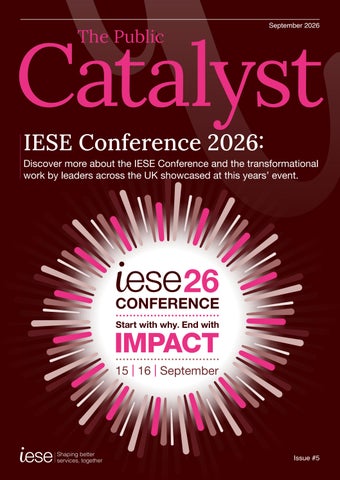
Catalyst The Public
September 2026
IESE Conference 2026:
Discover more about the IESE Conference and the transformational work by leaders across the UK showcased at this years’ event.
Issue #5
Conference Schedule Tuesday 15th September 14:00 - 15:00, Exhibition Room, Registration and Welcome 15:00 - 15:45, Breakout Room 1, Outcomes-Based Care: It Makes Sense, So Why Don’t We 15:00 - 15:45, Breakout Room 2, Temporary Accommodation Budgets Are Broken 15:45 - 16:00, Exhibition Room, Coffee, and Exhibition Viewing
16:00 - 16:45, Breakout Room 1, The Power of Words How Language Shapes Care 16:00 - 16:45, Breakout Room 2, From Lithuania to Ukraine: Bringing New Talent into Government 18:00 - 19:00, City Suite, Drinks Reception 19:00 - 22:00, City Suite, Dinner
Wednesday 16th September 08:00 - 09:00, Exhibition Room, Registration
09:00 - 09:30, Main Hall, Welcome and Introduction to the Conference
09:30 - 10:10, Main Hall, Organisational Sustainability: Workforce, Leadership, Culture and Communities
10:15 - 11:00, Breakout Room 1, Adult Social Care Demand Crisis: Practical Short-Term + Long-Term Fixes 10:15 - 11:00, Breakout Room 2, Cyber Resilience and Digital Trust
10:15 - 11:00, Breakout Room 3, Redesigning Services End-to-End: Customer Focus Presntation, DfE 11:00 - 11:20, Exhibition Room, Coffee, and Exhibition Viewing
11:20 - 12:00, Main Hall, Governance & Public Trust: Building Legitimacy in Hard Times
12:05 - 12:50, Breakout Room 1, Social Data Management and Digital Transformation in Azerbaijan
12:05 - 12:50, Breakout Room 2, Staying Human Through Change: Story Telling Workshop 13:00 - 14:00, Exhibition Room, Lunch and Exhibition Viewing
14:00 - 14:15, Main Hall, A Special Performance
14:15 - 14:55, Main Hall, Climate Resilience & Adaptation as a Transformation Catalyst 15:00 - 15:45, Breakout Room 1, CareCubed in Children’s Services: Using Data to Improve Decisions, Outcomes and Sustainability
15:00 - 15:45, Breakout Room 3, Emergency Planning Workshop
15:00 - 15:45, Breakout Room 2, Residents and Citizens: The Missing Stakeholders in your Transformation Projects 15:45 - 16:05, Exhibition Room, Coffee, and Exhibition Viewing
16:05 - 16:45, Main Hall, Practical AI for the Public Sector: What Works Now 16:45 - 17:00, Main Hall, Conference Close
Editorial Contacts The Public Catalyst is produced by IESE: www.iese.org.uk | enquiries@iese.org.uk @ IESE CIC Editorial by Nicola Quinn Artwork by SMK Design (Aldershot)
Tuesday 15th - Wednesday 16th September Park Plaza, Riverbank, London IESE is a community-interest-company created, and led, by local authorities to create lasting positive change where it matters most – in everyday life. This year, the IESE Conference is focused on something simple but important - making sure transformation makes a difference. In a sector facing unprecedented pressure, transformation is no longer optional, it is essential. But too often, we begin in the wrong place. We start with systems, technology, or funding constraints. This year’s conference challenges that thinking. Because if we do not start with WHY, we risk simply digitising yesterday’s problems. At its heart, this conference asks a simple but critical question: what difference will transformation make to the communities we serve? Across the programme, sessions focus on key public sector priorities including social care, SEND, digital transformation, cyber resilience, and long-term financial sustainability Alongside the 4 main sessions focusing on:
• Purpose-led leadership and organisational sustainability • Governance, legitimacy, and public trust • Climate resilience as a transformation driver • Responsible adoption of AI in public services
The IESE Conference 2026 asks public sector organisations to drive transformation by starting with defining the purpose for transformation. By starting with why, organisations can make more informed choices about the type of transformation they pursue, the solutions they implement and the outcomes they seek to achieve. In an era defined by complexity, uncertainty, and rapid change, that may be one of the most important disciplines public sector leaders can adopt. If we begin with technology, we may transform a process. But if we begin with purpose, we can transform the outcomes.
The IESE Conference is proudly sponsored by:
Views expressed within are those of the IESE editorial team. The Public Catalyst is distributed to companies and individuals with an interest in reviewing, remodelling and reinventing public services. © Copyright IESE 2026
2
The Public Catalyst | September 2026 | Issue #5
Cyber Resilience
A Challenge to Public Sector Resilience Over recent years, we have all seen how quickly disruption can impact everyday life. Sometimes the cause has been a cyber attack. Sometimes it has been extreme weather, power failure, infrastructure issues, or wider geopolitical events. While the triggers can be different, they often raise the same question: Kurtis Toy, “ What happens if the digital services we Chief Executive of the CCoE rely on every day become unavailable? ” This question sits at the heart of Analogue 72 (A72), a Green Paper and initiative developed over 18 months of consultation with the Cyber Centre of Excellence (CCoE) Advisory Forum, local-government officers, emergency planners and voluntary organisations. The concept of preparing for 72 hours of disruption is not new and is already reflected in approaches adopted internationally. What we believe is new is the perspective. UK resilience planning is largely organised from the top down, through statutory responders, command structures and mutual aid. A72 works the other way round, and asks:
“How do we ensure our communities still have their basic needs met if we have 72 hours without digital services?” This challenge is for the whole of the public sector: public authorities, local services, community organisations and resilience practitioners across the UK. Our resilience needs to be measured by whether people can still get medicines, food, water, cash and reliable information while the systems are down.
Why 72 Hours? The 72-hour timeframe is not a prediction that disruption would be resolved within this threeday span. Rather, it forces attention onto the first hours, when the decisions are hardest and the plans are thinnest.
• • • •
Would local authorities still be able to communicate with residents? How would communities access reliable information? How would vulnerable people receive support, medication, care, food, or emergency assistance? How would organisations make decisions if the systems they normally depend on were unavailable?
These questions could emerge following a major cyber attack, but they could just as easily arise through widespread flooding, severe storms, prolonged power outages, extreme heat events, or other forms of disruption. This summer alone, England and Wales passed the previous annual record of 1,017 wildfires, and
last autumn towns such as Monmouth had their worst flooding since the 1970s.
Beyond Cyber I have been on the wrong end of this myself, living in a rural community that lost power and mobile coverage for days during Storm Arwen in 2021. It’s the reason I stopped thinking of this as a purely organisational problem. As Chief Executive of CCoE, I spend a great deal of my time on cyber security, including organisational preparedness and resilience. Organisations should naturally continue to strengthen their defences, reduce vulnerabilities, and improve their ability to detect and respond to threats. However, even the strongest cyber controls cannot eliminate every risk. Equally, not every disruption originates from malicious actors. Climate-related events, infrastructure failures and national emergencies can create the same practical challenges as a significant cyber incident. The question is not only whether digital systems can be protected, but whether communities can function without them. A72 is a resilience challenge rather than a cyber security exercise. It asks how services keep running while the disruption is still happening.
Community-Level Perspectives Every consultation conversation and group discussion started with technology and ended with people: a resident waiting for a prescription, an elderly person requiring powered medical equipment, a family that needs urgent support, a rural community that has limited access to transport or essential supplies, or an individual who depends on digital channels to access services and communication. These are community questions before they are organisational ones, which is why A72 addresses several levels at once.
• If services go offline, what remains? • What existing community strengths can be relied upon? • Where are the vulnerabilities?
Issue #5 | September 2026 | The Public Catalyst
• What practical measures can be put in place before disruption occurs?
Testing Preparedness CCoE has passively scanned all 382 UK local authorities every year since 2023. The passive scan assesses externally visible vulnerabilities without touching internal systems, awarding each authority a health score from 5 (strong outward-facing cyber health) to 1 (significant improvements required). The most recent cycle, reported in July 2026, found some councils more vulnerable to cyber attack than a year earlier, but many more had improved. Alongside this, the tabletop exercises I run with CCoE enable organisations and partners to explore realistic disruption scenarios in a controlled environment, testing assumptions, finding the gaps and building confidence in their response arrangements. A72 proposes that each authority scores itself across five dimensions on a six-level maturity scale, with red, amber and green ratings for individual functions. Reaching level three requires at least one live test of offline communication, hub activation, manual decisionmaking and last-mile delivery. A72 goes beyond a traditional organisational tabletop exercise. The ambition is to create a practical, community-focused resilience exercise that encourages public bodies, local partners, community groups and resilience practitioners to think collectively about what would happen if digital dependency was suddenly removed. The focus is the first hour, not the seventy-second. Once an incident has escalated, the options narrow quickly. Preparedness must be in place before disruption, which is why A72 is designed to be repeated, retested and scored over time.
A Public Sector Challenge A72 is a challenge from CCoE to the public sector. It’s a grassroots, bottom-up analysis of whole-of-society resilience. In an event that disrupts or removes ordinary digital systems, resilience will be experienced first in households and communities and delivered through the practical interaction of local institutions, essential services, and then in regions, nations and the UK state. Whether disruption is caused by a cyber-attack, severe weather, infrastructure failure, or another unforeseen event, widespread disruption creates the same responsibility: Ensuring people can still get what they need to stay safe, supported and informed. And that brings us back to the question that drives A72:
“How do we ensure our communities still have their basic needs met if we have 72 hours without digital services?” The Green Paper is published with an open invite for consultation, please visit: www.ccoe.org.uk/analogue-72 Join me to explore that challenge at the IESE Conference on Wednesday 16th September at 3:00pm.
3
Public Service Transformation
Mais Pourquoi? Why Purpose Must Come Before Transformation The opening keynote of the IESE Conference 2026 led by Annabelle Atkin, Chief Executive of IESE, sets the tone for two days of discussion, challenge, and debate by returning to a surprisingly simple question: why?
D
elivered under the title ‘Mais Pourquoi?’ (“But Why?”), the session explores the relationship between purpose, transformation, and impact. It challenge delegates to consider whether, in a sector under constant pressure to modernise, save money and embrace new technologies, public services sometimes become so focused on finding solutions that they fail to spend enough time understanding the problem they are trying to solve. This year’s conference theme: “Start with Why. End with Impact”, encourages participants to look beyond individual projects, technologies and organisational changes and focus instead on the outcomes they are seeking to create for people and communities. Throughout the conference, delegates are encouraged to return to the importance of purposeled leadership, the role of public trust, community resilience, responsible use of AI and designing public services around outcomes rather than transactions. Against that backdrop, Mais Pourquoi? examines what can happen when organisations begin transformation with purpose rather than process.
with a proposed solution rather than a clearly articulated purpose. A discussion may begin with a new customer platform, a redesigned operating model, a shared service arrangement or an AI-powered tool. Once a solution has been identified, significant energy is understandably directed towards governance, procurement, implementation, and delivery. The risk is that organisations become highly effective at delivering change without being completely clear about the difference that change is intended to make. This can lead to situations where technology is implemented without fundamentally improving outcomes, where digital services replicate existing inefficiencies, or where transformation programmes are deemed successful because they were delivered on time and on budget despite having limited impact on the experience of residents, businesses or communities. As one of the themes explored during the conference suggested, it is entirely possible to modernise a process without transforming the outcome.
A Sector Full of Solutions
4
The presentation draws on Simon Sinek’s Golden Circle mode (Diagram 1), which distinguishes between three questions: Why? How? and What? At its simplest level, the model argues that most organisations can clearly explain what they do and many can explain how they do it. Far fewer consistently begin by explaining why a particular activity, service or change exists in the first place. While the Golden Circle is often discussed in the context of leadership and organisational culture, its application to public sector improvement and transformation is increasingly relevant. When viewed through a transformation lens, the model encourages organisations to begin by clearly defining the purpose behind a proposed change before designing the mechanisms required to deliver it. This involves asking a series of deliberately challenging questions. Why does this change matter? Who should benefit from it? What future are we trying to create? And perhaps most importantly, what will be different for citizens, communities, or places if the transformation succeeds?
Local government is not short of transformation activity. Across the public sector, organisations are redesigning services, introducing new technologies, exploring the opportunities presented by artificial intelligence, responding to financial pressures and preparing for major structural change through Local Government Reorganisation. In many cases these programmes are necessary and unavoidable. The challenge is not a lack of ambition or willingness to change. The challenge is that transformation conversations often begin
Starting with Purpose
Diagram 1 - The Golden Circle.
These questions do not replace business cases, programme management disciplines, or delivery planning. Instead, they provide a stronger foundation for them. By clarifying purpose at the outset, organisations create a clearer line of sight between the activity they undertake and the impact they hope to achieve.
The Public Catalyst | September 2026 | Issue #5
Public Service Transformation Revisiting the IESE Transformation Framework The session also revisits the IESE Transformation Framework (Diagram 2), which has informed transformation thinking within the sector for many years. A common misconception about the framework is that it represents a maturity journey from Level 1 to Level 3. In reality, the framework helps organisations understand the type of transformation they are pursuing rather than prescribing a sequence that all projects must follow.
moving beyond service provision towards community enablement. In this model, public services act as facilitators, connectors, and stewards of local ecosystems, helping residents and communities meet more of their own needs and build long-term resilience. Importantly, all three levels remain valid forms of transformation. The framework is not intended to suggest that every project should become a Level 3 initiative. Instead, it encourages organisations to be conscious and deliberate about the nature of the transformation they are undertaking.
Connecting Purpose to Impact One of the most significant themes emerging from both the conference and the keynote is the need to reconnect transformation activity with measurable public value.
Diagram 2 - IESE Transformation Framework.
Across the sector there is growing recognition that success cannot be judged solely by whether a project has been implemented successfully. Increasingly, the important questions relate to what changed as a result of that implementation, who experienced the benefit and whether the intended outcomes were achieved.
LEVEL 1 – SERVICE: transformation focuses on improving the effectiveness and efficiency of an existing service. It is often concerned with productivity, automation, cost reduction, and process redesign. These initiatives can be highly valuable and can produce meaningful benefits for organisations and service users alike.
This shift is evident in the breadth of work recognised through the IESE Awards, where successful initiatives increasingly demonstrate community impact, partnership working, sustainability, health outcomes, digital innovation, and organisational transformation capability rather than simply operational improvement alone.
LEVEL 2 – CUSTOMER: transformation shifts the focus towards the customer, asking how services can be redesigned around the needs of individuals rather than organisational structures. The emphasis is on simplifying access, reducing friction and improving the overall experience for those using public services.
The real opportunity for public services lies not in becoming better at delivering programmes, but in becoming better at delivering outcomes.
LEVEL 3 – COMMUNITY: transformation takes a broader view, focusing on communities rather than services or transactions. The objective is not simply to improve the response to demand but to understand whether demand can be prevented, reduced, or addressed differently through stronger communities, earlier intervention or the mobilisation of local assets and capabilities. The Digital White Paper expands on this thinking by arguing that the future role of local public services is increasingly
That distinction may seem subtle, but it fundamentally changes how success is defined. Instead of asking whether a project was completed, organisations begin asking whether the original problem was solved. Instead of measuring activity, they begin measuring impact.
other transformation tool: through the lens of purpose. The question should not be where AI can be deployed, but why it should be deployed. The same technology could be used to automate a process, improve the customer experience, or support community resilience. What determines its value is not the technology itself, but the objective it is helping to achieve. This perspective aligns closely with the broader conference discussions around responsible AI, public trust, governance, and ethical innovation. Technology has enormous potential to enable positive outcomes, but it should never become the outcome in its own right.
A Simple Question with Significant Implications Ultimately, ‘Mais Pourquoi?’ is not a presentation about Simon Sinek, artificial intelligence or even the IESE Transformation Framework. It is a reminder that the quality of transformation is often determined by the quality of the questions asked at the beginning. Before selecting the technology, redesigning the service, or restructuring the organisation, there may be value in pausing to ask a simple question: Why are we doing this? By starting with purpose, organisations can make more informed choices about the type of transformation they pursue, the solutions they implement and the outcomes they seek to achieve. More importantly, they can maintain a clear connection between transformation activity and the impact experienced by the communities they serve. In an era defined by complexity, uncertainty, and rapid change, that may be one of the most important disciplines public sector leaders can adopt. After all, if we begin with technology, we may transform a process. But if we begin with purpose, we have the opportunity to transform outcomes.
The Role of Technology and AI No discussion about the future of public services would be complete without considering the role of data, digital technologies, and artificial intelligence. The keynote argues that AI should be viewed in exactly the same way as any
Issue #5 | September 2026 | The Public Catalyst
Annabelle Atkin, Chief Executive of IESE www.linkedin.com/in/ annabelle-atkin-128973101/
5
Transform Talk 1
Organisational Sustainability: Workforce, Leadership, Culture and Communities The UK public sector is navigating a period of unprecedented change. Financial pressures, rising demand, workforce shortages, digital transformation and increasing public expectations are creating a level of complexity that cannot be solved via technology, funding, or organisation redesign alone. Sustainable transformation depends on people. TRANSFORM TALK SPEAKER INFORMATION Wednesday 16th September 09:30 - 10:10
Graham Rees, Blaneau & Gwent Borough Council. Dalia Krapavickaite, Central Project Management Agency (Lithuania). Kim Wright, London Borough of Brent and Solace Spokesperson on Leadership and Learning.
Tracey Boffey, Wigan Council.
T
his Transform Talk explores what it takes to build the workforce, leadership and culture needed to succeed in this environment. Drawing on examples from local government, national public bodies and international public sector organisations, speakers will share practical insights into strengthening organisational capability, developing future talent, and creating cultures where people can thrive. At a time when recruitment and retention remain significant challenges, the session examines how organisations are rethinking traditional workforce models. Attendees will hear perspectives on modernising recruitment pathways, attracting talent in increasingly competitive markets, balancing specialist expertise with organisational agility, and investing in skills that support long-term resilience. The discussion will explore how leading organisations are moving beyond short-term workforce solutions and building capability for the future.
While digital tools can improve efficiency and support better decisionmaking, this session focuses on the human factors that determine whether transformation succeeds. Speakers will consider how multidisciplinary teams, talent development and purposeful leadership can create organisations that are better equipped to adapt to changing demands. International contributors will share lessons from workforce reform programmes overseas, offering fresh perspectives on sustaining change over time and building organisations that are resilient by design. The conversation will also explore the role of apprenticeships, leadership development, and home-grown talent in creating a sustainable pipeline of skills. Delegates will gain insight into how investing in people today can strengthen organisational capacity, improve resilience, and support succession planning for the future. Beyond the workforce itself, the session examines the importance of purpose-led transformation. Rather than beginning with structures or technologies, speakers will discuss why successful change programmes start with outcomes, communities, and public value. The role of local government as a catalyst for prevention, community capacity and long-term improvement will be a key theme throughout the discussion. Attendees can expect practical examples, international perspectives and thought-provoking discussion on how public service organisations can build the foundations for lasting transformation. This session asks a vital question: What does a truly sustainable public sector organisation look like when success depends not only on the strength of its workforce but also on the capability, resilience, and wellbeing of the communities it serves?
6
The Public Catalyst | September 2026 | Issue #5
Transform Talk 1 Blaenau Gwent Council our focus on sustainable workforce development enables us to invest “inAtskills and capabilities rather than solely relying on recruitment in an increasingly unstable labour market. By building long-term workforce sustainability through apprenticeships, we have developed our pipelines for future leadership roles. We are highlighting how organisations can invest in local people and develop future leaders in communities.
”
Graham Rees, Aspire Regional Engagement Officer at Blaenau Gwent CBC.
with Create Ukraine has shown us that bringing new people into the public sector can be a “realWorking driver of change. The programme builds on Lithuania’s experience with Kurk Lietuvai, but applies this model in a very different context – Ukraine, where public institutions are working under the pressure of war while also preparing for recovery and moving forward with major reforms. We bring Ukrainians with international experience back to work with public institutions. They come with expertise from different sectors and often with a different understanding of how things can be done. But we have also learned that bringing talented people in is not enough. A lot depends on the institution itself – whether there is space for new ideas, whether managers trust people to take responsibility, and whether they can find ways to work together despite very different professional backgrounds. This is what makes the discussion about workforce, leadership and culture interesting to me. I hope we can share some of what we have learned in Lithuania and Ukraine, but also hear how UK public institutions are dealing with similar questions of attracting people and creating the conditions for them to make a difference.
”
Dalia Krapavickaite, Coordinator of Create Ukraine.
Never has there been a time where leadership development in local government has been “more important - the complex and dynamic political environment, the reshaping of the local state through local government reform and devolution, the impact of technology, the need to design and deliver public service reform to enable sustainable public services, are all daily challenges for the professional leadership in the sector. With the pace, scale and complexity of change across local government intensifying, this places real pressure on leaders at all levels. There is a clear shift towards systems leadership, partnership working and navigating increasing political complexity and alongside this, relational skills such as curiosity and the ability to build trust, are becoming just as important as technical expertise. So, now is the time to talk about some developing national work on developing a stronger and more coherent approach to leadership development across local government. Kim Wright, Chief Executive at London Borough of Brent and Solace Spokesperson on Leadership and Learning.
”
When I think about organisational sustainability, I think about people and communities. “Technology can be a powerful enabler, but meaningful and lasting transformation depends on a confident workforce, strong leadership, and a culture of trust, collaboration, and shared purpose. At Wigan, we’ve learned that sustainable change is not something we do to people, it is something we create with them. We work alongside residents, neighbourhoods and partners to build on local strengths, focus on prevention and co-design solutions that improve lives. Our role is not simply to deliver services, but to enable people to influence decisions, shape solutions and help their communities flourish. This session is particularly important because organisational resilience and community wellbeing are inseparable. As public services face rising demand and increasing complexity, sustainability cannot simply mean doing more with less, it requires purposeful leadership, genuine partnership, and a long-term commitment to developing people, strengthening local capacity and unlocking community potential. I am looking forward to exploring how organisations across different sectors are responding to these challenges and what we can learn from one another about building sustainable public services that are resilient, community-powered, and better prepared for the future. Tracey Boffey, Service Manager at Wigan Council.
Issue #5 | September 2026 | The Public Catalyst
”
7
Transform Talk 2
Governance & Public Trust: Building Legitimacy in Hard Times Public services across the UK are operating in an environment where trust can no longer be taken for granted. Public expectations are evolving, scrutiny is immediate, and decisions are increasingly challenged through political, legal, and public channels. TRANSFORM TALK SPEAKER INFORMATION Wednesday 16th September 11:20 – 12:00 Annette Roberts, South Staffordshire Council. Laura Gaudion, Isle of Wight Council.
Greg Campbell, Brentwood Borough Council & Rochford District Council.
At
the same time, organisations are being asked to transform services, deliver better outcomes, and manage meaningful change, often with constrained resources and competing priorities. In this context, legitimacy has become one of the most important assets a public institution can possess. Yet, legitimacy is difficult to define and even harder to maintain. It cannot be created through communications strategies alone, nor secured through compliance processes, governance frameworks, or organisational structures. It is earned through the choices organisations make, the way decisions are taken and the confidence communities place in those who lead them. As public services navigate increasing complexity, important questions emerge. What gives institutions the authority to lead when consensus is difficult to achieve? How can organisations maintain public confidence when tough decisions must be made? And what role do accountability, transparency and community engagement play in creating trust that can withstand uncertainty, challenge, and change? Much of the debate around governance has traditionally focused on risk, compliance, and oversight. These remain vital functions. However, there is a growing recognition that effective governance can also enable transformation. The organisations most able to adapt are often those that create clear decision-making processes, establish accountability and foster confidence among both stakeholders and communities. In this sense, governance is not simply about control; it is about creating conditions in which change can occur without the loss of trust. The challenge becomes even more significant during periods of transformation. Local Government Reorganisation, public service reform, and wider system change are forcing organisations to bring together diverse cultures, priorities, and ways of working. Success depends not only on managing organisational change, but on maintaining legitimacy throughout the process. Public trust can be strengthened or weakened by how change is delivered as much as by the outcomes it achieves. At the heart of this conversation lies a fundamental question: What gives public institutions the legitimacy to lead? The most successful transformation is rarely those that encounter the least resistance. More often, they are the ones that sustain trust, demonstrate accountability, and retain public confidence while navigating uncertainty. In an age of disruption, legitimacy may prove to be the foundation upon which all lasting change depends.
8
The Public Catalyst | September 2026 | Issue #5
Transform Talk 2 “ South Staffordshire Council were keen to engage early on the next iteration of their
Local Plan. This plan is going to be controversial and needs to meet significant housing needs over and above a scale ever been witnessed before in the District. A fresh approach to engaging with communities is essential in this to build trust and confidence both in place-making and with the Council’s engagement with communities. The Council engaged with think tank demos on a pilot project aimed at increasing trust and confidence in the public sector. Waves is a digital democracy pilot aimed at building consensus through engagement. The results so far have demonstrated the effectiveness of this engagement particularly with those who had previously not engaged in planning matters before.
”
Annette Roberts.
“ Prevention has been essential in driving positive outcomes in adult’s social
care for the Isle of Wight, by focusing on ensuring the objectives and needs of people in our communities are being met for the future. It is important to look at the pressures that people face to live well and ensure that they have access to the early help they need. We strengthened our partnerships locally to develop a community-based Living Well and Early Help Service to ensure that we are planning for the futures of our communities and minimizing the need for any intrusive or unwanted statutory service interventions.
”
Laura Gaudion, Strategic Director of Adult Social Care and Housing Isle of Wight Council.
“ For me, ‘Governance and Public Trust: Building Legitimacy in Hard
Times’ goes to the heart of the challenge facing public services. We are being asked to make difficult choices, transform how we work and respond to changing expectations, often while resources are under significant pressure. In that environment, good governance is not a brake on progress. It is what gives change direction, credibility and staying power. Trust is built when people can see how decisions have been reached, understand the evidence and trade-offs involved and know that leaders will be accountable for the outcomes. This does not mean everyone will agree with every decision. It means being open, consistent and prepared to listen, particularly when the way forward is contested. During transformation, communication matters, but it must be matched by action. Leaders need to set a clear purpose, involve elected members, staff, partners and communities at the right points and create proper routes for challenge and scrutiny. If we treat governance as an active part of transformation rather than a final check, we make better decisions and build confidence in the journey. Ultimately, legitimacy comes from doing what we say we will do, explaining honestly when circumstances change and keeping public value at the centre of every decision. Its easy to say but I firmly believe that Transformation is best built together on strong foundations however its easy to say but not necessarily easy to achieve.
”
Greg Campbell, Strategic Director at Brentwood Borough Council & Rochford District Council.
Issue #5 | September 2026 | The Public Catalyst
9
Transform Talk 3
Climate Resilience & Adaptation as a Transformation Catalyst In the past, climate resilience was considered solely an environmental consideration, now it must be considered across sectors, stakeholders, and communities. It is becoming a defining factor in how public sector organisations invest, plan, deliver services and prepare for the future. As climate risks increase and pressures to achieve net zero accelerate, leaders are being challenged to think differently about the places, infrastructure, services, and communities they support. TRANSFORM TALK SPEAKER INFORMATION Wednesday 16th September 14:15 – 14:55
Paul Stacey, Watford Borough Council. Richard Tyrie, The GoodPeople Company. Sam Moore, Greater Southeast Net Zero Hub. Mark Alston, East Ayrshire Council.
F
or many organisations, climate change has traditionally been viewed through the lens of environmental policy. Today, it is increasingly becoming a question of organisational resilience. The impacts of a changing climate are shaping decisions about infrastructure, public health, housing, economic development, and community wellbeing. At the same time, the transition to a net zero economy is creating new expectations, opportunities, and responsibilities for public sector leaders. This raises important questions about how organisations prepare for the future. Can climate resilience be treated as a standalone programme, or does it need to become a fundamental consideration in every strategic decision? How should public services balance immediate pressures with long-term environmental challenges? And what does it mean to build places that are not only sustainable, but capable of adapting and thriving in the face of uncertainty? Across the public sector, there is growing recognition that climate resilience is about more than simply reducing emissions or meeting policy targets. It is about creating the conditions for stronger communities, more resilient services, and healthier places. Decisions about infrastructure, investment and service delivery more frequently require leaders to consider environmental, social, and economic outcomes together, recognising that each is deeply connected to the others. The transition presents opportunities as well as challenges. Efforts to achieve net zero have the potential to support employment, develop new skills, and stimulate local economic growth. Yet realising these benefits requires collaboration across sectors, organisation, and within communities. The scale of change needed cannot be delivered by any single institution acting alone. Alongside investment in infrastructure, there is also a need to invest in people. Achieving climate ambitions depends on leadership, workforce capability, and organisational capacity. The ability to translate ambition into action will be determined as much by skills, culture, and collaboration as by policies and plans. Climate resilience is not just about preparing organisations for future risks. It is about strengthening the capacity of communities to adapt, respond and prosper in a changing world. The central question is therefore not whether climate change will transform public services, but whether public services can use that transformation as an opportunity to create more resilience places, stronger communities, and lasting public value for future generations.
10
The Public Catalyst | September 2026 | Issue #5
Transform Talk 3 “In my council I work for Waste Management. We visit every home in East Ayrshire weekly, this council
service may be the only interaction residents have with the council, so it is important that they feel heard if changes are proposed. We have six dedicated place-based Community Waste Officers set up to champion climate change that reach out and sit on community groups and visit local schools. Using these platforms, they promote recycling and get direct feedback from residents and pupils to help improve our services whilst lowering our carbon footprint. As the term ‘climate change’ can provoke both positive and negative attitudes we put residents at the heart of any project, ensuring buy-in at the early stage.
In our schools we have set up a Clean Green initiative for climate change, covering energy, transport, environment, and waste. Our ‘Dinnae forget yer Caddie’ project has empowered school pupils to take ownership of their own food waste caddies and bring that message to their community. Also, residents in communal blocks recently reached out as they had no access to recycling, using this as a catalyst we worked with the community groups to design street hubs. Highlighting the carbon saving we gained external funding from Zero Waste Scotland; this project has made significant savings not only for climate change but as a cost saving for the council through recycling diverted from general waste.
”
Mark Alston, Team Coordinator for Climate Change at East Ayrshire Council.
“ At the core of our work in Watford is a commitment to protecting and restoring our natural environment while enabling people to participate, understand and act. Sustainability cannot be delivered in isolation, it must be embedded in the way we regenerate our towns, plan our transport networks, support our cultural assets and manage our parks and open spaces. Anchored in Watford’s bold and ambitious Council Plan, our Environmental Strategy builds on our systems leadership approach, bringing together purpose and tangible action to drive lasting change.
”
Paul Stacey, Chief Operating Officer at Watford Borough Council.
“ At the Greater South East Net Zero Hub, we help local authorities, NHS
organisations, education providers, community energy and public sector partners to develop, fund and accelerate energy projects — turning ideas into scalable, replicable solutions that build resilience, sustainability and energy security.
”
Sam Moore, Energy Project Manager at Greater South East Net Zero Hub (GSENZH).
“ The UK needs to re-skill four million workers for the net zero transition by 2030 - according to Bain & Company’s research. That’s roughly the size of the entire NHS workforce.
At the same time, the construction and built environment sector expects around 40% of its current workforce to retire this decade. That gap has to be closed if we are to deliver the major infrastructure programmes and the government’s plan to build 1.5 million homes. With almost a million young people out of work, and AI and automation set to hollow out jobs across a range of professions, the net zero transition is a once-in-a-generation opportunity to meet both challenges — provided we can inspire, engage and upskill our communities, and open up access to good local work at scale. But there’s lots to do. The social, economic, and environmental pressures on our communities are growing by the day. We can choose bold leadership, or we can maintain the status quo. Either way, this will be a defining decade — for all of us. Richard Tyrie – Founder/ CEO at GoodPeople.
Issue #5 | September 2026 | The Public Catalyst
”
11
Transform Talk 4
Practical AI for the Public Sector: What Works Now Public sector transformation is increasingly judged not by the technologies organisations adopt, but by the outcomes that they achieve for their residents, communities, and public services. As artificial intelligence (AI) moves from experimentation to implementation, leaders are facing a critical challenge: how can AI be used to solve real problems, improve services, and create meaningful public value? TRANSFORM TALK SPEAKER INFORMATION Wednesday 16th September 16:06 – 16:45
Mike Connell, Blaby District Council.
Kristina Shaw, Wealden District Council.
Cllr Dhindsa, Derby City Council.
Rob Cherrie, County Durham and Darlington Fire and Rescue Service.
F
or much of the discussion surrounding artificial intelligence, the focus has been on the technology itself. Yet, the most important questions facing public services are not about algorithms, platforms, or technical capability. They are about purpose. What problems are organisations trying to solve? What outcomes are they seeking to achieve? And how can innovation be harnessed in ways that strengthen rather than undermine public trust? As AI becomes more accessible, public-sector leaders are increasingly being asked to make decisions about where and how it should be used. The challenge is no longer if the technology will influence the future of public services, but how organisations can ensure its adoption is guided by public value instead of technological enthusiasm. In a sector where resources are finite and expectations continue to grow; success depends less on adopting the latest innovations and more on applying it to the right problems. This raises a series of important questions. Which challenges are best suited to AI-enabled solutions, and which continue to require human judgement, experience, and compassion? How can organisations balance innovation with accountability? And how can leaders create the conditions for responsible experimentation without exposing communities to unnecessary risk? Alongside these practical considerations sits a broader conversation about trust. Public institutions are expected to operate transparently, fairly, and with public interest in mind. As AI becomes embedded within decision-making, service design and operational processes, questions of accountability, bias, data protection, and public confidence become increasingly significant. The legitimacy of AI in public services may depend not on what it can do, but on how openly and responsibly it is deployed. Yet, technology alone cannot deliver transformation. The organisations that make the greatest progress are those that invest, not only in digital capability, but also in leadership, governance, and workforce readiness. Culture, skills, and organisational confidence in using digital resources are critical elements in turning potential into practical realities. The conversation around AI is not really a conversation about technology. It is a conversation about how public services make decisions, allocate resources, and generate value for those they serve. The defining question is not about how AI will alter public services, but if public services can use AI in ethical, trusted ways that are genuinely focused on improving outcomes in communities.
12
The Public Catalyst | September 2026 | Issue #5
Transform Talk 4 Local government continues to operate in an increasingly challenging environment, with tight budgets, “rising demand for services and significant organisational change. Against this backdrop, AI has the potential to help councils work differently, make better use of resources, and create capacity for higher-value work. Successful AI adoption is not simply about the technology; it is about leadership, organisational culture, and a clear focus on outcomes. At Derby City Council, we have learned valuable lessons about moving from AI ambition to practical, measurable delivery. Our progress has been driven by strong political leadership, effective professional leadership, and a unified approach across the council. This has meant making clear strategic decisions, embedding AI within our wider transformation program and securing buy-in across the organisation. Building workforce confidence has been critical, ensuring AI is seen as a tool to support staff, improve services and create capacity, rather than technology for technology’s sake. Strong financial oversight is equally important. We have focused on ensuring our investment delivers genuine value for staff and residents, while also generating measurable savings and efficiencies. Cllr Dhindsa, Labour and Cooperative Party for Derby City Council.
”
AI adoption in local government is often held back by uncertainty around risk, “governance and where to begin. At Blaby District Council, we have focused on creating a simple, practical framework that helps colleagues understand how AI can be used safely and effectively in their day-to-day work. This session will explore our AI governance model, including a clear bronze, silver and gold approach that enables staff to understand the level of assurance, oversight and suitability required for different AI use cases. We will share how straightforward communications, guidance, and policy have helped build confidence and encourage responsible adoption across the organisation. The discussion will also cover the development of internal AI guides and specialist AI assistants that support colleagues with routine tasks, improve access to information, and drive productivity. Attendees will leave with practical ideas for introducing AI in a controlled, proportionate and people-focused way within their own organisations. Mike Connellm, Chief Technology, and Innovation Officer at Blaby District Council.
”
In County Durham and Darlington Fire and Rescue Service, one real success has been seeing “data and AI help our operational crews focus their time where it matters most. By aligning firefighter productivity to risk, we have shifted more activity into prevention and protection, helping us better protect vulnerable people, reduce risk in our communities, and show that technological innovation can make a practical difference on the ground.
”
Rob Cherrie, Deputy Chief Fire Officer at County Durham and Darlington Fire & Rescue Service.
Artificial Intelligence is not about using systems to replace people but rather helping them do “more of the work that matters most by removing friction, reducing administrative burden, and creating more capacity for better public services. The focus should be on making AI practical, accessible and responsible, combining workforce development, innovation, and strong governance to turn potential into real-world outcomes. The opportunity of AI is substantial, but accountability must remain human. Through initiatives including Copilot training, an AI Academy, staff-led innovation, and automation projects, we are building the confidence and skills needed to embed AI and support its use across the organization. The future opportunity lies not only in improving productivity, but in redesigning services through the combined use of AI, automation, data, and digital technologies. Success should ultimately be measured by better outcomes for residents and stronger public services, not by how much AI is deployed.
”
Kristina Shaw-Hamilton, Corporate Director of Governance and Projects at Wealden District Council.
Issue #5 | September 2026 | The Public Catalyst
13
Exhibitor Introduction
Bringing People Together The IESE Conference 2026 is proud to share sector stories from the following organisations:
About The Housing Network: The Housing Network (THN) is a specialist housing and support provider working in partnership with local authorities, government departments and organisations across the UK. Since 2014, THN has provided safe, good-quality accommodation alongside practical, person-centred support for individuals and families facing homelessness and housing need. Its services span temporary accommodation, supported housing and Ministry of Justice provision, helping people move from crisis towards greater stability and independence. As a certified B Corp, THN is committed to delivering positive social impact, combining housing expertise with innovative support that strengthens outcomes for residents, communities and the public sector.
14
Temporary Accomodation Budgets are Broken A practical roadmap to Reducing Local Authority Subsidy Loss by +75% How Local Authorities have taken a different approach – combining the best of Third, Public and Private Sector DNA – to tackle Subsidy Loss, whilst simultaneously ensuring improved housing, health & wellbeing outcomes for households. Demand for Temporary Accommodation (TA) continues to grow, placing Local Authority (LA) finances under more pressure than ever. Making the system of trying to manage TA costs in line with January 2011 LHA rates (minus 10%) simply unsustainable. At the same time, levels and complexity of need and risk amongst those living in TA are increasing, with no obvious route to sustainable funding to meet those needs. Meaning single-people and families could be placed at even further risk of harm and trauma. This session provides a practical roadmap of how several Local Authorities have achieved improved housing, health & wellbeing outcomes for singlepeople and families – whilst reducing Subsidy Loss by +75% for some households.
The Public Catalyst | September 2026 | Issue #5
Exhibitor Introduction
Issue #5 | September 2026 | The Public Catalyst
15
Submit your nomination for the IESE Awards 2027. Celebrating bold ideas and brilliant breakthroughs that are transforming local public services. Scan the QR code to share your innovations and success.