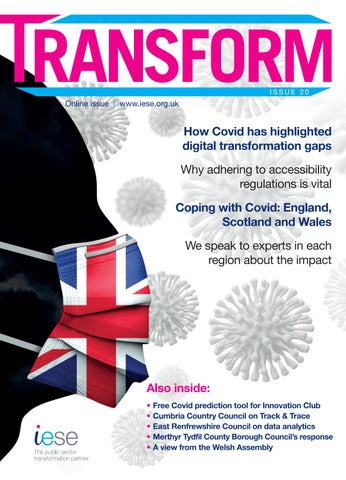
IESE_Transform_020

Page 1


Page 2

Welcome letter from iESE Chief Executive Dr Andrew Larner

We introduce the Lumilinks tool, available to trial free for Innovation Club members, which reports the statistic likelihood of members of staff or visitors to your premises having Coronavirus at any time

Page 3-4

Find out how Covid-19 has highlighted digital transformation gaps and shown the necessity of compliance with the Public Sector Bodies (Website and Mobile Applications) Accessibility Regulations

Page 5

We speak to iESE consultant Graham Simmons about how local authorities have managed and are planning ahead in the pandemic Also features a case study with Cumbria County Council about its Track & Trace app

Pages 6

Gerard McCormack from the Improvement Service discusses how Covid-19 has been handled in Scotland and ongoing plans. We also speak to East Renfrewshire Council about how they have been using data analytics during the pandemic

Pages 7-8

Jonathan Huish from consultancy and training company Capital People based in Wales talks through the local authority response to Covid-19 You can also read a case study with Merthyr Tydfil County Borough Council and another about the Welsh Assembly response

EDITORIAL CONTACTS

TRANSFORM IS PRODUCED BY: iESE, www iese org uk

Email: enquiries@iese org uk @iESELtd

CREDITS:

Editorial by: Vicki Arnstein

Designed by: SMK Design

Views expressed within are those of the iESE editorial team iESE is distributed on a triannual basis to companies and individuals with an interest in reviewing, remodelling and reinventing public services

© Copyright iESE 2021

CareCubed is copyright of iESE ©iESE Ltd 2021 All rights reserved

Adaptation not recovery

F

or the majority of 2020 local authorities have been operating in uncharted territory What began as firefighting just to provide support to the vulnerable and essential council services has eased into a new way of operating

As we hopefully come out of this difficult period of uncertainty with the advent of a vaccine there is a lot of talk about recovery and renewal But I think a better term is adaptation Recovery suggests we will go back to how things were and I don’t think we will Even if recovery were possible, the stark reality is that Coronavirus is likely to be out there for many years still, even with a vaccine We need to work out how to rise up and live alongside it

It is not all doom and gloom The pandemic has shown how agile and rapidly responsive the public sector can be It has shown how our workforces are adaptable and able to be trusted to get the work done It has brought communities together, fostered the volunteering spirit and changed the way some of our services are transacted, refocusing attention on digital as a communication channel

As we move forward into 2021, we should continue to examine the opportunities Covid-19 has presented to reinvent some of our offerings We need to examine what has worked well, what has not and what we might like to keep as new practice We should share our experiences and lear nings as widely as possible so that we emerge stronger collectively as a result

The public sector has shown great resilience in the face of adversity in 2020 As a sector we should feel proud of what we have achieved and use it as fuel for continued momentum for change and transformation in the year ahead

Dr Andrew Lar ner and the iESE team

Innovation Club members offered Covid

screening tool

iESE INNOVATION CLUB MEMBERS ARE BEING OFFERED A FREE TRIAL OF A NEW SERVICE WHICH PREDICTS WHAT COVID LEVELS WILL BE LIKE IN THE POPULATION IN A WEEK'S TIME IN A GIVEN AREA AS THE VACCINATION ROLLS OUT THE ENVIRONMENT IS GOING TO BE MORE COMPLEX TO MANAGE, WITH TIERS AND LOCKDOWNS LIKELY TO BECOME INCREASINGLY LOCAL.

The brand-new Lumilinks tool allows an organisation to input the postcodes of employees, people booked into visit their premises or customers attending an event into the system and it then generates a report which details the Covid-19 forecast for each postcode, allowing an informed decision to be made on whether each person should attend based on their risk

The version available to trial for the Innovation Club through an iESE partnership with Lumilinks will initially be a weekly report but the data can also be fed back as an interactive list and clickable map and could also be integrated into internal databases

The system uses a blend of different data sources: the local authority information (tier), the location type (rural, suburban etc), local demographics (age, ethnicity, pre-existing conditions), previous three weeks of infections, current levels of infections, possible outcomes and origin and destination data (transport data)

Although a vaccine is now available, it will take some time for the whole country to be protected Andrew Larner, Chief Executive at iESE, believes using a variety of Covid-19 preventative measures, including Lumilinks, will allow the country to open up more widely again “It is quite possible that for the vaccine to fully roll out will take till the end of 2023 So what does that mean for employers? What does that mean for theatres? What does that mean for cinemas and

football matches? It means that when people come to the door, you don't know whether they're infected or not ”

He adds: “It means that you've got to take a riskbased approach because testing is not scalable Even if we could do on-the-spot testing, with thousands of people turning up to a football match or an exhibition, they're going to have to queue from the day before to do that What the Lumilinks service does is it starts to screen people before the event A venue can say it looks like next week, the Covid weather in your area is going to be bad So, if you want, we'll buy the ticket off you now ”

Dr Tim Drye is the statistician who has developed the model which looks at the risk of a person having been exposed to Covid based on an output area of roughly 100-150 households The tool can be used across England, Scotland and Wales

“A business might not want everyone in but needs some people in Lumilinks allows them to assess which people in the team should be asked to come in Ideally, we want to ask those who are least likely to be infected because of where they live or the route they take It means that in terms of health and safety you are doing your utmost to make the working environment as safe as possible but what you definitely shouldn’t do is use the information to penalise someone,” he explains “I envisage this service as being very effective going forward You can use it for your own employees and that would apply to local authorities themselves and they could also encourage local businesses to use it so that their business space is safer The other thing you can use it for is for local mass testing as it can give you an idea of where the hotspots are ”

• To find out more about the Lumilinks service contact: Annabelle Spencer@iese org uk

Dr Andrew Larner, Chief Executive
@LaverdaJota

How Covid has highlighted digital transformation gaps

The accessibility regulations for websites and mobile applications may currently seem ‘toothless’ but Covid-19 has highlighted just how necessary the legislation is and forced local authorities to see the gaps in their digital transformation

he Public Sector Bodies (Websites and Mobile Applications) Accessibility Regulations came into force for public sector bodies in September 2018 and require public sector websites to be made as accessible to as many people as possible, including those who are visually impaired, have motor difficulties, cognitive impairments or lear ning disabilities and deafness or impaired hearing By 2018 websites, including intranets and extranets, needed to be accessible, along with a requirement to publish an accessibility statement

By September 2019, public sector websites published after 22 September 2018 were required to meet the regulations and by 22 June 2021 all public sector mobile apps should be compliant too Organisations failing to meet the regulations, or which fail to provide a satisfactory response to a request to produce information in an accessible format, will be failing to make reasonable adjustments and will be in breach of the Equality Act 2010 and the Disability Discrimination Act 1995

Andrew Grant, Interim Chief Executive at Cambridge City Council and former Chief Executive at Aylesbury Vale District Council, says compliance may have taken a backseat during the pandemic, but with so much customer traffic now being forced online it is time to reassess digital “There are currently no teeth to the regulations, you can go beyond the date and nothing will happen The fines will follow but they will give organisations time to catch up, so there is time now to win the peace and be optimistic We should cut some slack to councils who have been a bit head in the sand because we all want to help them get there ”

He believes the pandemic has highlighted how far there is still to go with digital transformation “Covid has been a wake-up call for councils who have been patting themselves on their backs because they all signed up to video conferencing, got laptops, started working remotely and called that digital transformation,” he says “It is pretty transformative but your customers only care whether the food parcel tur ned up when they were isolating or whether what they saw on the website thought of them in the way it was designed ” He points out that many failings might have gone under the radar – all the times a laptop lid has been slammed down because people haven’t achieved what they wanted to or got the information they needed from the council in the timeframe they had available Councils are used to

working in their own timeframe, but customers increasingly expect the answer quickly and in a format that suits them

Digital transformation, not overlay

Lawrence Shaw is the CEO of Sitemorse, a company which automates the checking of websites for regulatory compliance It can assess accessibility, as well as a host of other categories, including privacy, the function of links and HTML code quality One thing it will scan for, for example, is embedded descriptions of images which enable them to be automatically read out to users

“In local gover nment, rather than undergoing digital transformation, it is more what we call digital overlay A lot of time and money has been spent automating what they already do – we have a paper form so let us upload it as a web page Covid has shown that we have to change how we work and has shown the cracks as organisations have had to become digitally led,” he says

According to Shaw, most local authority websites are failing to meet the regulations The Website Content Accessibility Guidelines (known as WCAG 2 1) explain how to make web content more accessible to people with disabilities There are three levels of conformance: Level A is the minimum, Level AA includes all Level A requirements and is the level a public sector website must be to meet the accessibility regulations, and Level AAA is the highest standard “In our testing of all the local gover nment websites this quarter, 82 per cent would fail the requirements of Level A and 24 per cent would fail the double AA standard,” Shaw says

Whilst Covid may have caused local authorities to take their eyes off the regulations, it has also highlighted the importance of getting digital transformation right, including accessibility “Digital transformation should try to help accelerate and

enhance your council’s services Digital is not an overlay, the idea is not to get it wrong and then make it a bit faster wrong, the idea is to get it right,” argues Grant

Both Grant and Shaw believe the lack of true digital transformation and compliance with the regulations is down to a combination of factors One is that those high up in the authority, such as the leader and CEO, often see digital as an add-on, then there is the ready belief that software vendors have the answers to the problem combined with minimal procurement standards They also blame a lack of accountability for digital at the top level

Shaw believes comparing the building trade to the digital arena shows how complacent local authorities can be when it comes to digital “In the building trade you can’t use a building until it has been signed off by an independent building regulations officer The electricity must be signed off by an electrician and the gas by a gas safety expert With digital, there is a leadership lack of ownership to the level where you might have an inter n who registers a domain An inter n would never be allowed to sign a lease for a building The executives need to realise that just because you can’t see it and touch it, it doesn’t mean that you can’t monitor and manage it ”

Accountability at the top

Grant agrees that there should be greater accountability “Chief Executives have to sign off for safety of staff, and literally everything else, but website accessibility hasn’t yet got to that point ”

However, both see a point in the future where there could be more stringent legal repercussions, citing cases in America where action has been taken against companies who have failed to make their products and services accessible online,

including a case taken by a blind man who was unable to order food from a Domino’s Pizza website despite using screen-reading software (Domino’s Pizza V Guillermo Robles) According to accessibility technology firm UsableNet, 2,200 website accessibility cases were heard in federal courts in 2018, nearly treble that of 2017

One thing top-down ownership of digital needs to do is look more carefully at the suppliers and what they are providing, asking for the functionality needed, rather than what the supplier says it can offer, and running frequent diagnostic and usergroup tests of the local authority website, apps and intranet and extranet

If the UK does become more litigious, using the defence that a provider said their software would enable the local authority to meet their legal requirements is unlikely to stand up “In the US, one of the fastest growing revenue ear ners for lawyers is to sue municipals and authorities and that is moving from hundreds of millions of dollars this year to potentially a billion next year What happens if this attitude comes over here and the authorities try to rely on the defence of ‘we did this to sort it’?” says Shaw

Beyond adhering to the regulations, council leaders should be looking to get the accessibility issue right because it may help a minority, but that minority might also be those most in need of their services Grant says it starts with the idea of the

council’s purpose and what it is there to provide “Digital shouldn’t be a fashion item but a means of delivering a purpose and a value set that the Leader and the Chief Exec stand behind It starts with the leadership and ends with the leadership Digital should enhance the customer experience

Accessibility is all to do with the complexion and belief system of your council,” he explains Digital also encapsulates more than what can be seen online At Aylesbury Vale, for example, Grant gives the example of automating its web chat using AI This gave customers the answer they were looking for quicker and freed up more staff time to deal with people with more complex queries or higher support needs It also commissioned Amazon to create a ‘skill’ for its voice-supported products, such as the Echo and Alexa, so registered users could draw down some services by voice, such as sharps collections Voice gives a valuable means of contact for people who cannot access a screen-supported device easily and, as Grant points out, the voice is often the last part of the body to fail in health

It might also be time to re-evaluate the resources given to digital in a Covid and post-Covid environment As customers increasingly become used to accessing council services online and public sector workers change work patter ns to spend more time at home, shifting the balance between web teams and those working on

reception desks, for example, might become a priority “As part of digital transformation everyone is now a digital-first person, but no-one has really been trained on it There needs to be a reality check If more people are going to the website and Covid has accelerated this, there should be a realignment of resources in the future,” adds Shaw

The war ning is clear While there might be time to grapple with the new regulations before being slapped with a fine, users might not wait that long before seeking legal redress Looking carefully at digital is vital, not only to adhere to the regulations, but to make the most of this valuable channel for those being served

• Read about the accessibility regulations here: https://www gov uk/guidance/accessibilityrequirements-for-public-sectorwebsites-and-apps

• Read more about understanding the Web Content Accessibility Guidelines (WCAG 2.1) here: https://www gov uk/servicemanual/helping-people-to-use-your-service/ understanding-wcag

• Find out more about Sitemorse here: https://sitemorse.com

THE PANDEMIC IN ENGLAND:

Now and beyond

AiESE’s Graham Simmons has been looking at the stages of disaster management and how this could be applied to local authorities as they recover and renew. Here Simmons talks about the immediate impact of the pandemic, ongoing work and challenges and how local authorities are looking to the future and recovery.

crisis is a difficult or dangerous time in which a solution is needed quickly The noun crisis comes from the Latinised form of the Greek word krisis, meaning ‘tur ning point in a disease’ At such a moment, the patient could get better or worse: it is a critical moment

The four-stage response to the pandemic in local authorities looks like this:

• Reacting – keeping essential services running, supporting the most vulnerable and changing ways of working

• Restarting – understanding the new needs, meeting surges in demand and supporting localities to ’bounce back’

• Reimagining – lear ning positive lessons, adapting service delivery and ways of working

• Renewing – build the ‘new normal’ for services, address long-term impacts, develop resilience to possible further demand peaks

At the start of the Covid-19 crisis, local gover nment focused on supporting the immediate needs of its communities, as well as maintaining delivery of statutory services It had to quickly move essential services online, get staff set up for homeworking and create some new services which had not previously existed, such as providing emergency support to the most vulnerable This was against a backdrop of an already stretched environment and one in which they were already strapped for cash The fiscal black hole has deepened massively over the course of the pandemic too, with local authorities losing revenue from ear ners such as car parks and leisure facilities

As we move through a crisis, there is some breathing space, less panic, and more room to consider how effective our immediate reactions were There is time to consider what worked well and what did not, what is now better and could be adopted long-term and how we want to adapt and change to provide better or different services in a post-pandemic future

Right now, we are in the reimagining phase Local authorities might be looking at how having staff working from home has worked and considering if

employees might increasingly work from home in the future – a far cry from the four days in and one day at home many local authorities had already adopted

Bizarrely, getting people together in a meeting ‘room’ through video conferencing has become easier with people outside the office than in it And whilst bosses might now be confident the work will get done there are wider considerations, such as ensuring employees are supported with their mental health and wellbeing and helping managers with supporting remote workers While employees gain leisure time through not commuting, the flipside is isolation and not being able to escape from work because it is set up in their own home Local authorities might be considering if there could be any HR implications of increased homeworking I am aware of one case where an employee has said that they do not want to work from home because their home is their home

If local authorities imagine a future where fewer employees are needed to be physically present in an office, they might be starting to think about what happens to council buildings in the future They might also find the talent pool gets wider Employees increasingly working from home could increase your recruitment options but, conversely, you could also lose good staff for the same reason I am also aware that some council services are currently being called upon more than others There has been an increase in complaints to planning departments, for example If I am home more, my neighbour’s extension might bother me more than if I was out all day Some services provided by the council, such as maintaining grass verges, might become bothersome when I am home too

As we move forward through reimaging into the renewal phase there is much for local authorities to consider There is an opportunity to build our services and organisations back up stronger than before and we should be grasping at that with both hands

• Watch our TED-style talk on Public Service Adaptation: at: https://www youtube com/watch?v= IMDgGk-qhAU

CASE STUDY

Cumbria County Council: Track & Trace

Cumbria County Council’s Track & Trace launched in May, ten days ahead of the central gover nment scheme It was quickly realised that what started as a tool for outbreak management in schools was much more powerful and it was adopted throughout the county’s public health teams “It is great example of how county and district authorities can work together and how we can work with our NHS colleagues across complex systems,” explained Kate Hurr, Digital and Innovation Manager at Cumbria County Council “In an emergency you find solutions to some of the bureaucracy that gets in the way normally In this case we are taking a balanced risk and needs approach, and it has shown you can do more without drowning in red tape ” The Cumbria Track & Trace system was designed using Netcall’s low-code platform Liberty Create It was rapidly built by one person and is now being used by all contract tracing teams throughout the county The nature of low code allowed components that the digital team had previously created to be reused by dragging and dropping them into the new solution “While the Track & Trace subject matter is potentially quite complex, some of the components of building that system are in common with other things we have done so we can take them and plug them in,” Hurr explained “Low-code is a really powerful tool which gets you off the ground quickly I can’t praise it highly enough ” The app has been working well, allowing local teams to trace 97 per cent of contacts, compared with the 60 per cent national average The system integrates the data coming from the national gover nment daily but is now regularly detecting positive cases earlier than they are being fed through Hurr believes the app has been “massively important” in the fight against Covid “The Digital team is really proud that they’ve been able to help support the contact tracing teams on the ground who’ve been doing such a fantastic job fighting Covid-19 in Cumbria,” she added

• For more information about the low-code platform Liberty Create contact Lynley Meyers@netcall com

THE PANDEMIC IN SCOTLAND:

Now and beyond

TGerard McCormack is the Head of Transformation, Performance and Improvement at the Improvement Service – the ‘go to’ organisation for Local Government Improvement in Scotland. Here he discusses the immediate response to the pandemic, what local authorities in Scotland are doing now and their plans for a post-Covid world.

he speed at which Scottish councils adapted their response and stood up a range of services to support the most vulnerable people in their communities was remarkable

mental health and wellbeing of the workforce too

The Improvement Service has been developing toolkits for councils (and partner organisations) to

The Improvement Service supported COSLA and SOLACE to develop the Local Gover nment Covid19 Dashboard, which represents an attempt by Local Gover nment to co-ordinate and derive richer insight and value from the significant volume of largely disparate Covid data-reporting requirements introduced during the pandemic The Covid-19 pandemic has underlined the importance of securing accurate meaningful information with weekly or even daily regularity and the dashboard responds to this by providing a weekly information management tool to visually track aspects of the Covid-19 response and impacts, allowing councils to be alert to issues and pressure points that may arise

From June onwards, after the initial reactive phase, local authorities started looking more at recovery and renewal It seemed then that we were on the road to recovery, although we know better now

The issues Scottish local authorities are looking at are generally the same They are thinking about how they want to build on the sense of community and spirit that has been fostered throughout the pandemic – how do you sustain that and use it as an opportunity to embed much more community focus? They are also looking closely at economic regeneration and how you make that sustainable over the next few years, especially with less budget and resources Councils also want to grasp the opportunity around redesigning and rethinking what services are going to look like in the future, so they are thinking about transformation but at the same time recognising that services must be inclusive and accessible There has been a tendency to do more things online since March but there is a recognition that this is not always the easiest or best option for all citizens

Scottish local authorities are also looking at the workforce and seeking to build on how adaptable it has been but looking more at the

CASE STUDY

East Renfrewshire Council: Data analytics

Making better use of its data has enabled East Renfrewshire Council to better target support during the coronavirus crisis for its most vulnerable residents Through technology, the council has joined up its data points to get a single shared view of vulnerable clients across its services, enabling it to target support in a dignified way

The council is now in its third iteration of using data sets during the crisis The first was for shielding residents to ensure they were able to access the food, medicines and help they

required, the second was around financial vulnerability and the third use has been in its Test & Protect response (Test & Trace in the UK)

Jamie Reid, Strategic Insight & Communities Senior Manager at East Renfrewshire, believes the council will continue to build on data analytics in its renewal and recovery plans “We were an organisation who had ambition around digital and data before but we are now seeing the power of that combined with being agile in the right places as a mechanism to achieve particular goals,” he said The council had started data mapping pre-Covid, but this has grown enormously At the start of the crisis it was amalgamating a handful of datasets, but this is now in the region of 30 from key services, including f rom the voluntary sector

More than 150 million data-matching checks were run in the first month This showed any potential overlaps in households and allowed the most relevant service to contact the client “The goal was to get a process where we would get the names of the vulnerable people who were shielding and develop an end-to-end process, including reporting back out to the Scottish gover nment The back-end piece is the technology and then there is the human side with the focus on treating people as individuals and making sure we were not dropping a generic service on them from a great height Taking a mix of being personcentred, technology and partnership working we were able to collectively and rapidly build up a response that very much kept the focus on the dignity of the individual but still enabled us to do new technological things We are proud of what we have achieved but we know that we are not unique in this and everyone has been on a very similar jour ney ”

THE PANDEMIC IN WALES:

Now and beyond

Jonathan Huish is Chief Executive of Capital People, a consultancy and training company based in Wales which is focused on organisational development, HR, strategy, leadership, governance, health, safety and environment. Here he talks about how Welsh organisations managed the pandemic initially and how they can look to adapt to a post-Covid environment.

here is no doubt 2020 will be a year to remember In Wales, the year began with two consecutive months of floods causing damage to property, infrastructure and lives

Then in March, Covid-19 struck and the UK was sent into lockdown, the extent, duration and impact of which nobody imagined I still remember the day before lockdown, talking with colleagues and remarking that I would be fine working from home for a couple of weeks Now we know restrictions will likely be in place until spring and, with Brexit still to happen, we wonder what 2021 will look like

That said, we must seek out those silver linings At local authority and community level, the challenge was met with vigour, with councils moving swiftly to protect residents and staff, making sure that whilst services were reduced to those of necessity, nobody was left behind The drive of the initial phase was clear – to ensure residents in need were supported and essential functions were maintained wherever possible Services were redesigned to meet new conditions and partnerships were entered at pace to ensure the vulnerable were protected A new language came into being of social isolation, distancing, furlough and zoom fatigue And now we seek to understand where things will go – what the ‘new normal’ will be

Most people were met by a myriad of virtual platforms they had not encountered before and entered a world of homeworking at a scale previously thought unviable We know that surveys within councils are already showing that only a small percentage want things to go back as they were and that a similarly small proportion believe things will stay as they are The majority sense the reality will be somewhere in between, with an understanding – and desire – that agile is now a reality and each authority and team will need to find its own balance

Once some stability was established, thoughts moved to what would come next The new agile world brings its own challenges What does the office now look like? What do we do with all that desk space we no longer need? What happens to

the economics of town centre sustainability, often so reliant on footfall of office workers? Especially when our partner organisations are thinking the same, and as residents, we have begun to fully explore the world of online shopping and found a love of baking and cooking again

This has led to three areas of thinking Firstly, at a strategic level, we need to explore how our values have shifted as individuals, teams, councils, and communities The world has changed, with huge impact on people’s lives, jobs, wellbeing and needs We need to understand how the needs and expectations of our communities and customers have changed, not just for service requirements, but in also in terms of delivery and communication and adjust our strategies accordingly

We need to understand how we can convey the culture and values of an organisation when looking at a screen in our living room, and how we project those values to partners and communities And we have to face the growing sense that uncertainty and change is here to stay, not only in terms of the nation’s response to Covid, but with the onset of Brexit and likely retur n to larger reductions in real levels of public funding

This leads to the second area, the importance of mindfulness, wellbeing and resilience, not only at an individual level, but also in terms of team, organisation and community There is no doubt 2020 has put great strain on the emotional wellbeing of many Change always requires resilience – and we are seeing great strides by local authorities to ensure that, as much as possible, people are supported, with mindfulness and wellbeing of staff and communities at the top of everyone’s agendas, both now and into the future

Which leads us to third area of thinking – what shift in policy do we need to see to sustain Wales? Not just to keep the wheels tur ning, but to make sure that even in these dark times, we reach for the windows of opportunity

• If you would like to share your views, contact Annabelle.spencer@iese.org.uk

CASE STUDY

Merthyr Tydfil County Borough Council

Kevin O’Neil is the Leader of Merthyr Tydfil County Borough Council Here he shares how the organisation has managed the pandemic

The unparalleled nature of the coronavirus pandemic cannot be overstated and Merthyr Tydfil has certainly not been spared the effects of Covid-19, with the sad loss of dearly valued colleagues and many more members of staff having suffered infection or been otherwise impacted

Yet Merthyr Tydfil’s enduring spirit has seen this local authority strive to leave no stone left untur ned in our efforts to meet this test Some brief examples include:

• The demands to shield and isolate in the initial lockdown period saw us rapidly mobilise, coordinate and partner with the third sector to ensure free school meals (nearly 8,000 in the first fortnight alone) reached the most vulnerable families in our community

• The much-welcomed Welsh Gover nment business grants required local facilitation and the resultant mobilisation of staff along with new synergistic working practices across departments saw Merthyr Tydfil recognised as one of the top performing authorities in Wales (more than £22million in funding distributed to date)

• The crucial need to get to our residents with the right messages saw us undertake a multi-platform approach to communication We engaged with a mass programme of direct welfare calls and established a dependable social media/web base for all matters Covid This was reinforced by many high-profile national news interviews that I led on to establish a consistent, trusted presence

THE PANDEMIC IN WALES: Now and beyond continued

CASE STUDY CONTINUED

Merthyr Tydfil County Borough Council

• From an organisational standpoint homeworking was a huge obstacle with need for mass procurement of IT equipment/software, implementation of new procedures, and requirements for councillors and staff to retrain where necessary Yet the commitment to, and delivery of, service standards remained high with the new agile working culture seen as a tremendous opportunity

Underpinning all this are the tenets that my administration has been working toward since election, they include – daily and open meetings between Leader and Chief Executive, consistent Cabinet and Senior Leadership team collaboration, encouragement of innovation coupled with effective scrutiny, willingness to work with any/all potential partners to deliver results

With the heartening arrival of vaccination we will soon find ourselves in another phase of change, a new ‘new normal’ The experiences gained by Merthyr Tydfil during the last year encourage me that we are in a healthy position to adapt and thrive

CASE STUDY What the Assembly is doing in Wales

Chris Nott is a founder and senior partner at Capital Law and Chair of the firm’s integrated consultancy Capital People. He is also vice-chair of the Economy and Transport Ministerial Advisory Board In 2016, he received an OBE for Services to Business and Economic Development in Wales

“As pandemic waves continue to surge, and with a hard Brexit on the horizon, it is fair to say we are about to enter the harshest recession in our lifetime A clear strategy now will make tough decisions easier in the future, and the Welsh Gover nment is engaging tightly with the private sector to develop effective policy Over the summer, the Minister for Economy, Transport and North Wales asked me, as vicechair of the Ministerial Advisory Board, to pull together a senior group of experienced people from outside gover nment, and across Wales, to obtain their views on how Welsh Gover nment can promote the best economic recovery for Wales

The group, named Ffenics (Phoenix in Welsh), has since produced two interim reports In the first, we recommended a new Welsh economy focused on wellness, developing existing policy

like the Economic Action Plan to deliver prosperity for all The second suggested more specific short and medium-term policies and economic interventions, focusing on the Welsh Gover nment’s four economic levers (people, places, green and digital)

Four key themes emerged First, building confidence by developing a vision for the Welsh economy – not just as policy but to unite and inspire across Wales Second, developing infrastructure and skills – especially in the public transport, social-housing, digital and green sectors, to boost demand for training and reskilling in those areas Third, supporting viable businesses financially, by developing debt and equity specialist funds for the Development Bank of Wales and engaging with banks and the public Finally, tackling unemployment, by creating a skills safety net tailored to Welsh needs

Our gover nment has some very tough decisions to make about how it prioritises financial support and other resources, as it is simply not going to be able to rescue every organisation or sector It needs all the help it can get, and it is refreshing that it is inviting us to participate by sharing, investigating, and evaluating ideas ”

Have you reviewed your social care uplifts ?

We have upgraded CareCubed to ensure that data is accurate, robust and delivering best value to managing uplifts.

Our engagement with over 60 care commissioners and providers has allowed us to better understand this challenge, and ensure you are delivering a sustainable process to managing uplifts.

If you want to speak to us about managing your uplifts, drop us a line at carecubed@iese.org.uk

Turn static files into dynamic content formats.

Create a flipbook