EL CHICANo
By Christopher Salazar
The evening was full of gratitude and embrace as nonprofit leaders, first responders, veterans and small business owners gathered at the Ayala Park community center in Bloomington July 14 as Sen. Eloise Gómez Reyes recognized residents whose work has strengthened communities across Senate District 29.
The inaugural Summer Celebration of Service marked the beginning of what many hope will become a tradition to honor exemplars of volunteerism, public service and civic leadership from across the region.
“We call it ‘Summer Celebration of Service’ because service is one of the greatest gifts that we can give one another,” Reyes told attendees. “Communities
are built by people . . . they’re built by all of you.”
During her opening remarks, Reyes reflected on growing up in Colton and said the district’s strength comes from neighbors investing in one another rather than seeking recognition. She noted that hundreds of nominations were submitted across multiple award categories before Summer of Service, Cont. next pg.
Cedar House Breaks Ground on 70-Bed Bloomington Addiction Treatment Expansion
By Manny Sandoval
edar House Life Change Center broke ground July 16 on a twostory, 70-bed residential treatment facility designed to expand access to substance use disorder care across San Bernardino County.
The 32,000-square-foot facility will be
Cedar House, cont. next pg. Sen. Eloise Gómez Reyes Honors Inland Empire Changemakers at ‘Summer Celebration of Service’
built at Cedar House’s campus at 18612 Santa Ana Ave. in Bloomington. It will include clinical group rooms, family visitation areas, counseling space and additional room for treatment planning and recovery services.
The expansion was made possible through a California Department of Health Care Services Behavioral Health Continuum Infrastructure Program Launch
Ready grant and support from public agencies, funders and community partners.
Cedar House CEO Jamie Lamb said the project marks a major step toward addressing one of the region’s most urgent behavioral health needs: timely access to substance use treatment and sustained recovery support.
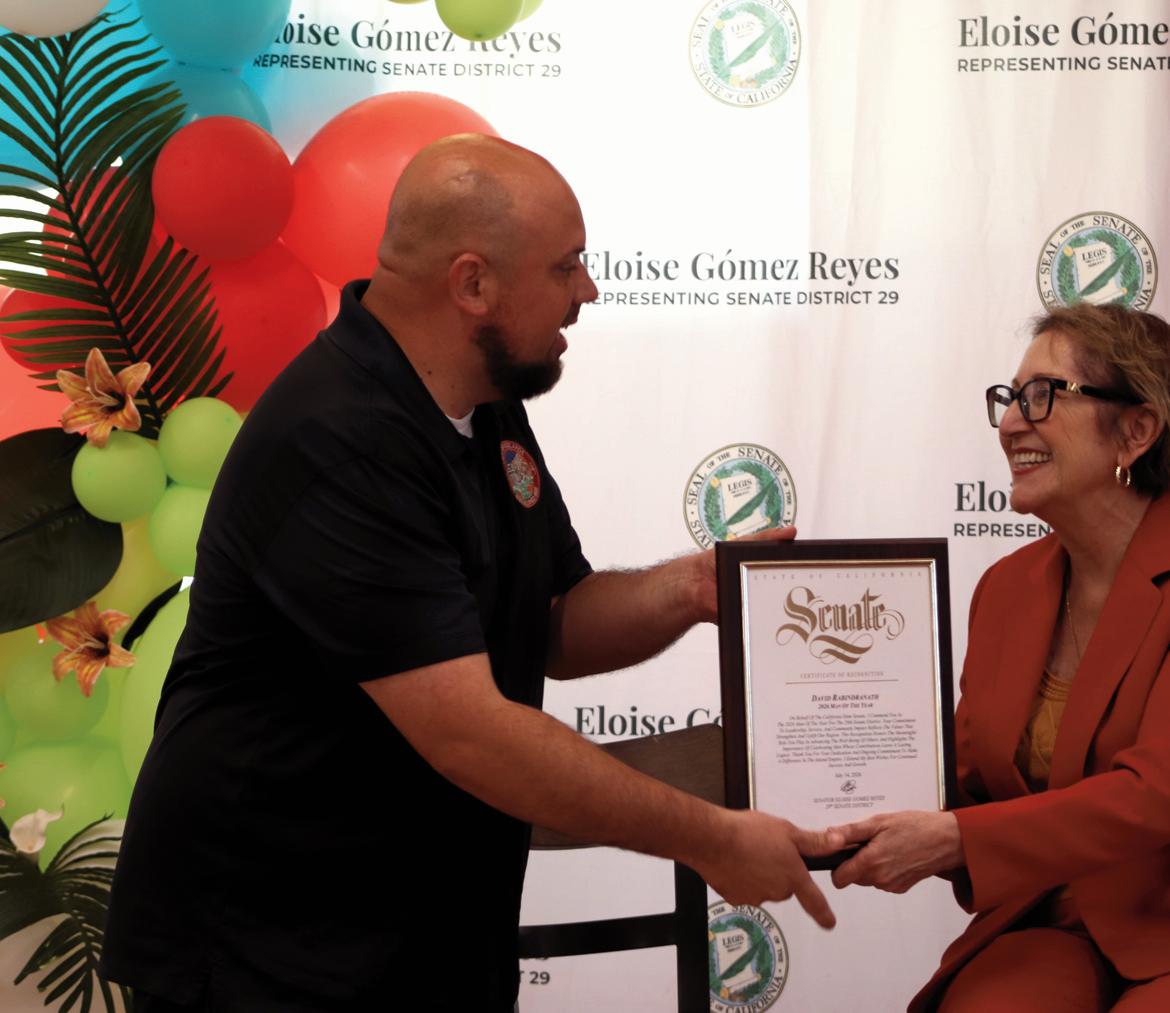
PHOTO CHRISTOPHER SALAZAR Man of the Year, David Rabindranath, receives his award from Senator Eloise Gómez Reyes at the Ayala Park community center July 14.
PHOTO CHRISTOPHER SALAZAR
Inland Empire changemakers gather for a group photo at the Ayala Park community center July 14.
PHOTO MANNY SANDOVAL
on
new 70-bed
Summer of Service (cont.)
- her office selected one honoree from each city represented in the district.
“The best part of this is that they allow us to honor them,” Reyes told Inland Empire Community News (IECN). “When you do it with heart, when you do it with love, it makes all the difference.”
One of the evening’s most memorable moments came when organizers honored World War II veteran Pete Molina, who was recognized as Veteran of the Year and recently celebrated his 100th birthday. Molina was still a student at San Bernardino High School when he was drafted into the U.S. Army.
He served from 1944-46 as Private First Class with the 169th Infantry Regiment, earning multiple medals, including the “Asiatic-Pacific Campaign Medal, Philippine Liberation Ribbon with One Bronze Star, World War II Victory Medal, Army of Occupation Medal and Good Conduct Medal,” according to the program literature. While he was unable to attend, his recognition erupted into sustained applause, an uproar of praise for deeds distant and recent, in peace and strife.
Among the night’s top honors, David Rabindranath, homeless solutions coordinator for the City of Redlands, received Man of the Year. Accepting the recognition, Rabindranath thanked his staff and city leadership, saying the award reflected the broader effort to assist residents experiencing homelessness.
“Man of the Year means a lot for 2026 — recognizing not just my work, but the work we’re doing in Redlands helping the unhoused population,” he said to IECN as generous good-byes echoed from the entryway. “Sometimes you don’t think the work’s being recognized. But at the end of the day, it always is, and we just get to change lives every day.”
Rabindranath, who has worked in homeless services for roughly 12 years, said San Bernardino County has seen declining homelessness during recent point-in-time counts while Redlands has recorded three consecutive years of decreases, though he added that “we haven’t finished the job” and “still have a long way to go, but we’re definitely heading in the right direction.”
The Family Assistance Program was named Nonprofit of the Year. Chief Executive Officer Darryl Evey said the organization serves families affected by domestic violence, human trafficking, homelessness, incarceration and other hardships by pairing clients with staff who have lived similar experiences.
“Our programs are focused on how to help people, and the best way to help a person is to have someone that can relate to them,” Evey said before hopping on his red touring motorcycle, adding that many staff members are survivors or formerly incarcerated individuals helping others rebuild their lives.
Evey said the organization's philosophy is rooted in second chances, arguing that people who have completed their prison sentences deserve an opportunity to become productive members of society.
“We should forgive and give people some grace,” he said. “After they’ve served their time, they deserve an opportunity to succeed . . . they should not have to wear that albatross that prevents them from ever being successful.”
Rialto Police Capt. Mark Adams, who served in the U.S. Marine Corps Reserves and earned a Medal of Valor in 2006 for protecting an officer from attempted murder, was recognized as an honorable mention for Veteran of the Year. He described the ceremony as “very uplifting” and said he felt humbled to be recognized alongside so many community servants.
“It says a lot for Senator Reyes . . . recognizing the individuals within her community — not just the veterans, but the nonprofit volunteers, the small businesses and those folks that keep this region running,” Adams said. “There were many veterans that have much stronger military records, but it was my privilege to attend the event and be honored, and something I'll never forget.”
La Cascada, a family-owned Mexican and seafood restaurant serving Fontana for over four decades, was awarded Small Business of the Year. After Javier Alfaro and Dilsa Duarte immigrated to the U.S. from the small town of Guayameo, Guerrero, Mexico, they opened the home-style eatery in 1986. Although Alfaro and Duarte passed in 2024 and 2019, respectively, their children continue to operate the well-known purveyor of home-cooked meals in the original “little blue house” that began the legacy.
As attendees gathered for photos and congratulations beneath an arc of pastel-colored balloons, the ceremony concluded with the same spirit as it commenced: with evergreen counsel and acclaim.
“Because of what you do, someone’s life is better,” Reyes said. “And when one person’s life is better, our entire community is better.”
Cedar House (cont.)
- “For Cedar House, this moment represents a major step forward in our ability to respond to one of the most urgent needs in our region — access to substance use treatment and recovery support,” Lamb said.
Founded in 1973, Cedar House provides individualized, evidence-based treatment for adults experiencing substance use disorders and co-occurring mental health conditions. Its continuum of care includes withdrawal management, residential and outpatient treatment, a perinatal program for women and children, sober living, alumni services and community outreach.
Lamb said each part of that system is essential because recovery does not happen through a single intervention or at one moment in a person’s life.
“Recovery is not a moment in time,” she said. “Recovery is a process, and it takes time, community support and tremendous grit from the people who come to us. We want to be ready to support them.”
The expansion will allow Cedar House to serve more clients while addressing longstanding space limitations at its existing campus. Lamb said offices, group rooms and meeting areas currently serve multiple purposes, requiring staff to frequently rearrange as different services compete for space.
“This expansion will not only help us serve more people, but it could also mean immediate access to care, fewer barriers to treatment and significantly more space,” Lamb said. “Cedar House is out of space.”
The new building will create dedicated areas for treatment, counseling, family meetings and longterm recovery planning. Lamb said the added capacity will be especially important when a person reaches the point of acknowledging a need for help.
“That moment of clarity comes when someone finally says, ‘I want help. I cannot do this alone,’” Lamb said. “Having that help readily available is going to mean the world to them.”
She said the impact will extend to families by creating opportunities for healing, forgiveness and reunification with loved ones who may have struggled for years with addiction.
“Nobody is beyond help, and nobody is beyond reach,” Lamb said.
Joyce Ablett, president of the Cedar House Board of Directors, said the expansion reflects years of planning, advocacy and collaboration
focused on meeting the region’s growing need for behavioral health services.
“Cedar House has responded to the needs of the community with compassion, professionalism and a conviction that recovery is possible,” Ablett said. “This project is the result of years of planning, partnership, advocacy and a shared commitment to expanding high-quality treatment for those who need it most.”
Ablett credited Cedar House’s leadership, staff members, funders and community supporters with advancing the project from an initial vision to construction.
San Bernardino County Acting Director of Behavioral Health Joshua Dugas described Cedar House as a trusted part of the county’s behavioral health continuum and pledged the department’s continued support.
“The work reflects the kind of compassion, persistence and community-centered care that is essential to recovery,” Dugas said.
Dugas, who also serves as the county’s public health director, said the project demonstrates the connection between behavioral health services and the broader health of the community.
“Cedar House is an amazing facility that provides an important resource, and this community needs more help,” he said. “Behavioral Health is committed to doing whatever we can to help make this successful.”
Fontana Mayor Acquanetta Warren said Cedar House’s work affects not only those receiving treatment, but also their relatives, friends and support systems.
“You are changing lives, and not only the life of the person receiving care, but also the lives of the family and friends behind them,” Warren said. “When you look at one person, you may need to multiply that impact by 100.”
Lamb said the facility is only the beginning of Cedar House’s long-term vision. The nonprofit plans to eventually develop approximately 4½ acres across from its current campus with a sobering center, recovery housing and extended recovery support.
The goal is to create what Lamb described as a “recovery village” where clients can move through multiple stages of care in one location before returning to the community with greater stability and support.
“The people who come through our doors can start and finish here, then walk away ready to live life on life’s terms,” Lamb said. “Going back out there is not easy, and we know it.”
Naked Man Found Dead in Rialto City Park; Police Investigate Suspicious Death
By Manny Sandoval
Rialto police are investigating the suspicious death of a 63-year-old man whose nude body was found early Sunday morning at Rialto City Park.
The Rialto Police Department received a 911 call at about 5:21 AM July 19 reporting a deceased
man at the park, located at 130 E San Bernardino Ave., Rialto. Officers found Jose De Jesus Arriaga Loza, a Rialto resident, lying on the grass in the northcentral area of the park, Lt. James Mills said. His clothing and personal belongings, including his wallet, cash and California driver’s license, were found inside a nearby trash can.
Investigators observed injuries
to Loza’s face that could have resulted from either a fall or a physical altercation, according to police.
Authorities said robbery does not appear to have been a factor in his death. The circumstances surrounding the incident remain under investigation. Anyone with information is asked to contact the Rialto Police Department at 909-820-2550.
PHOTO MANNY SANDOVAL
Rialto City Park is pictured before police began investigating the suspicious death of 63-year-old resident Jose De Jesus Arriaga Loza, who was found nude with facial injuries early July 19.
Cal State President at Center of $12M Discrimination Suit Is Up for Transition Job
By Phoebe Huss, CalMatters
An outgoing California State University president, one of two administrators at the center of a multimillion dollar discrimination lawsuit, may transfer to a different Cal State job while the university pays his salary and benefits. The Cal State Board of Trustees will review the transition plan and decide whether to approve the president’s emeritus status Wednesday.
The proposed new job and salary for Cal State San Bernardino President Tomás Morales will be announced at the Wednesday meeting, according to Cal State spokesperson Amy Bentley-Smith. Morales received $655,626 in pay and benefits in 2024, the most recent figure available from TransparentCalifornia.
Cal State recently spent $12 million settling the lawsuit in which two female employees at Cal State San Bernardino said they were harassed and discriminated against based on their gender by two male university administrators: Morales and former Palm Desert campus dean Jake Zhu. Cal State continues to deny any wrongdoing. Zhu is an emeritus faculty member, a title given as a gesture of appreciation for service contributed to the university, and Morales remains in good standing with the university.
Morales resigned at the end of the school year and, because of his good standing, is eligible to receive a coveted executive transition package with faculty retreat rights. That means he can continue to work as a university faculty member.
This Wednesday, a Cal State Board of Trustees committee will view a presentation on Morales’ transition plan. Later that day, the full board will discuss Chancellor Mildred Garcia’s recommendation to grant him the title of president emeritus.
A ‘cesspool of gender harassment and discrimination’
The two women, Clare Weber and Anissa Rogers, both formerly worked as high-ranking administrators at Cal State San Bernardino. Weber was appointed deputy provost and vice provost of Academic Affairs on the main campus in 2017, and Rogers served as associate dean at the satellite campus in Palm Desert starting in 2019. During the 202122 school year, Weber and Rogers each confronted their male supervisors with what they believed was strong evidence of a gender pay gap and sex-based bullying in their workplaces. Both were pressured to resign almost immediately, they alleged in a 2023 lawsuit that calls the Cal State system a “cesspool of gender harassment and discrimination.”
Rogers, then-associate dean at Palm Desert working under Zhu, was terrified a firing would ruin her reputation and career prospects, and agreed to resign. Weber, thenvice provost of academic affairs, refused and was fired.
In their joint lawsuit, they sued the Cal State Board of Trustees, Zhu and Morales.
“The lawsuit shows systemic, sexist bullying,” Weber said in an interview. “It was primarily from President Morales.”
Bentley-Smith said the university system has already thoroughly reviewed all of the lawsuit’s allegations and resolved the matter through the settlement.
Weber and Rogers have submitted a public comment to the board of trustees imploring them to scrutinize Morales’ “good standing” before approving the proposed transition plan.
Cal State president accused of berating women
The lawsuit alleged Morales was notorious for routinely harassing and acting aggressively toward female Cal State employees. He ranted at women, excessively criticized and undermined them, attempted to intimidate them, and held women to higher standards than men, the suit complaint read. But faculty concerns about Morales began years before the lawsuit. A 2016 survey revealed that over 60% of Cal State San Bernardino employees felt the campus climate had worsened under Morales’ tenure. The faculty senate wrote in a 2017 resolution of “no confidence” in Morales’ performance that the survey results indicated an environment of toxicity, fear and distrust had formed under Morales’ tenure, which they added was rife with bullying, favoritism and retaliation.
Two months before his appointment as Cal State San Bernardino’s president in 2012, while Morales served as president of the College of Staten Island, more than half of that college’s senators also approved a resolution of “no confidence” in his leadership.
“It was a ‘his way or the highway’ vibe, particularly for women. I was berated and put down and yelled at. I had
other colleagues that experienced the same thing,” Weber said.
Walking on eggshells around Morales caused her stress and made it difficult to do her job, Weber said.
“Sometimes I got to feeling isolated, like I was the only one, and I think probably other women did too,” Weber said.
In late May 2022, a California State University Employees Union study demonstrated that white male Cal State employees earn about 3% more than men of color, 5% more than white women and 7% more than women of color.
Weber wanted to see if a similar pattern applied to her job. She conducted research, consulted a compensation specialist in the campus’ human resources office, and determined that she was the lowest-paid female vice provost in the Cal State system. She also found that, with the exception of one female, and one male who made about $3,000 less than Weber, every female Cal State vice provost made less than every male vice provost.
Weber met with her boss, then-interim Provost Rafik Mohamed, in June 2022, where she planned to discuss her concerns over the pay gap she’d identified.
“I was scared,” she said. “I had my data, I had notes ahead of time. I wrote little encouraging messages to myself before I was in the meeting.”
At the same time, she felt she had reason to be hopeful. She’d just spearheaded and secured the university’s regional accreditation, kicked off a new strategic plan, and, only a few weeks before, earned the highest possible score on a mid-year performance review: “exceptional leadership.”
At the meeting, Mohamed attempted to assign her additional job duties, the suit alleged. In response, Weber asked for a 12% equity raise and suggested there was a pay disparity among genders at the university.
Mohamed told her he would pass the concerns along. Weber also emailed the university president, Morales, with the same raise request. Four weeks later, Mohamed told Weber she would have to resign, with Mohamed stating he “could not” work with Weber, the suit alleged.
Weber wrote an email to Morales protesting.
“I explicitly raised concerns that these female Vice Provosts were being paid less because of their gender,” she wrote. “I have been shocked and saddened that CSU’s response to my complaints was to subject me to unprecedented and unwarranted criticism and then – just a month later – ask me to ‘resign’ from my position. This is highly offensive and totally discriminatory, and retaliatory.”
She asked Morales to rescind the resignation request and open an investigation into the pay equity concerns. Weber was fired the next day, she said. She retreated to a faculty position as required by her original appointment letter.
Mohamed did not respond to CalMatters’ request for comment. Morales’ office referred CalMatters to the Cal State San Bernardino Office of Marketing and Communications, which did not respond to a request for comment.
Discrimination also alleged at Palm Desert campus Cal State San Bernardino hired Rogers in 2019 as an associate dean — her dream job.
“When I interviewed, it was perfect,” Rogers said. “Then I quickly realized that I had just been immersed in hell.”
From day one, Rogers said she perceived the culture at San Bernardino’s Palm Desert campus as male-driven and discriminatory. The campus dean, Zhu, stuck out to her in particular with his penchant for screaming at people, especially women.
Men who worked for him would model his behaviors in his presence and at staff meetings, even those who were normally kind and supportive, Rogers said. Women struggled to speak up in meetings without being interrupted, yelled at, called “too emotional” and “sensitive,” or belittled, she said. By contrast, men were always treated with respect, she said. Eventually, Rogers said she gave up presenting her own ideas and began sneaking them in through a male colleague, from whom the ideas were often accepted.
In addition, several employees declared in the lawsuit under penalty of perjury that Zhu would publicly treat Rogers like a secretary or assistant, though she was the second-highest ranking employee on the satellite campus.
“It was awful,” Rogers said. “I hated going to work every day. My anxiety increased. I was constantly on guard.”
Tensions boiled over at an informal meeting with the dean and several of Rogers’ colleagues in October 2021, at which Rogers was not present. According to various attendees who reported back to Rogers during the meeting via text and later that day in person, several men ganged up on a female interim associate dean, interrogating her for around 25 minutes about her preparations for an upcoming campus visit with a Cal State trustee. Zhu watched the verbal onslaught and did not act, various female employees who walked out of the meeting in protest alleged.
That same day, Rogers approached Zhu in his office and told him Cal State needed to do a better job at disrupting sexism. Zhu told her she could train the men to behave differently, the suit states, though the male employees involved reported to the dean. Zhu told a different faculty member who complained to him about the meeting, social work department chair Deirdre Lanesskog, that the men were probably just trying to impress him, the suit alleged.
An employee said under penalty of perjury in the lawsuit that Jolene Koester, who served as Cal State’s interim chancellor from 2022 to 2023, worked for Cal State to “coach” Zhu in late October 2021. A few days after approaching Zhu, Rogers also reported to Koester that Zhu exhibited sexist conduct and bullying.
In November 2021, Mohamed instructed Rogers to tell colleagues she was resigning, citing a “leadership issue” he did not elaborate on, according to the lawsuit. He told her that was her only option if she hoped for career advancement, the suit states. On January 1, 2022, she resigned and retreated to faculty.
“I call it fired,” Rogers said. “They told me, ‘Either leave or you will be fired.’”
The joint lawsuit by Weber and Rogers split into two trial proceedings. A jury awarded Rogers $6 million in damages in October 2025 and Weber settled for $6 million in lieu of a trial. In court, Zhu defended his leadership techniques and said he treated everybody in the same way.
“I raised voices to make a point, to change the tones, not in the malicious way or discriminatory way,” he said according to court transcripts.
While testifying, Mohamed admitted that he did not report various complaints regarding Zhu’s alleged gender mistreatment because he saw the accusations as “low-grade bias,” despite being a mandated reporter of sexual harassment under Cal State policy.
“Everybody has bias. We all harbor biases that are just ingrained in us from how we’re socialized, how we are brought up, the environments that we were reared in,” Mohamed said. “The allegation of bias in and of itself, in my view, does not require a reporting of bias, an alleged bias to Title IX. It’s the action on that bias that triggers that requirement to report.”
Mohamed did not reply to a request for comment on his role in either of Rogers’ and Webers’ departures. Mohamed announced his retirement on July 16 in an internal email to faculty reviewed by CalMatters.
Zhu did not respond to CalMatters’ request for comment.
Executive transition package up for approval
After Zhu retired in June 2023, he retreated to faculty and is now an emeritus faculty member.
Morales is slated to get an executive transition package that would enable him to retreat to faculty and stay on the university’s payroll until he starts another Cal State job. All university executives who complete this program must remain in good standing at the start and throughout the transition assignment, according to a 2022 trustee agenda item.
Executives are rendered ineligible if it is found that they violated university policy or engaged in serious misconduct, per the item. San Bernardino’s chapter of the California Faculty Association urged the board of trustees not to approve executive transition benefits for Morales in a May statement.
The lawsuit “raises serious questions about whether President Morales should be regarded in good standing for those benefits,” said Thomas Corrigan, a communication and media professor and the union chapter’s communications coordinator. “Dr. Rogers’ and Dr. Weber’s case really stands out as a moral outrage with exceptional financial, reputational and human costs.”
After Weber and Rogers filed their joint lawsuit in March 2023, Weber said, Cal State finally kickstarted its investigation into her 2022 pay gap complaint. The university system sent her a pay analysis two months later, stating there were seven vice provosts who earn a lower salary than Weber, including four men.
This article was originally published by CalMatters.
Community News
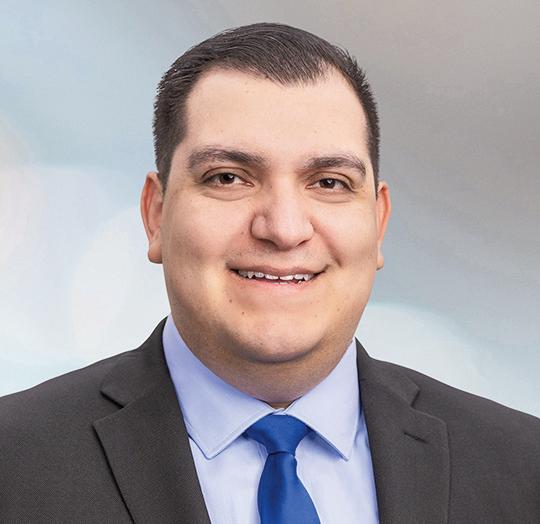
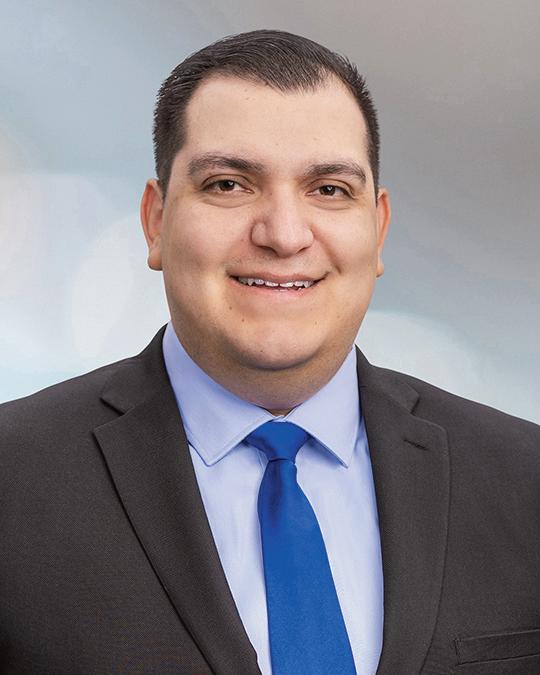
The San Bernardino mayor and City Council have appointed Albert J. Maldonado as the new city attorney following a unanimous vote during the July 15 City Council meeting.
In a news release, the City says Maldonado, a partner with Best Best & Krieger LLP, brings extensive experience in municipal law, land use, ethics, transparency and governance. He has served as a deputy city attorney for the City of San Bernardino since March 2020 and has provided legal counsel to cities, special districts and planning commissions throughout Southern California.
“Albert Maldonado has demonstrated a deep understanding of San Bernardino,” Mayor Helen Tran said. “His municipal law experience, collaborative leadership style and commitment to public service make him an excellent choice to serve as our city attorney. The council and I look forward to working with him as we continue to build a stronger, more transparent and prosperous
San Bernardino.”
Under the city’s charter, the city attorney is one of three positions appointed directly by the mayor and City Council, along with the city manager and city clerk.
As city attorney, Maldonado will serve as the city’s chief legal adviser, providing counsel to the mayor, City Council, city manager and city departments while overseeing the delivery of legal services that support city operations.
“As a resident of San Bernardino, I am honored that the mayor and City Council have the confidence in me to serve the city in this new role,” Maldonado said. “I have a strong appreciation for this community, its dedicated public servants and its tremendous potential. I look forward to working collaboratively with the mayor, City Council and city staff to provide legal guidance that supports the city’s goals while maintaining the highest standards of public integrity and service.”
Maldonado currently serves as assistant city attorney for the city of Upland, assistant town attor-
ney for the town of Apple Valley and general counsel to the Beaumont-Cherry Valley Recreation and Park District. He previously served as assistant city attorney for the city of Big Bear Lake.
Maldonado earned his Juris Doctor from Northwestern University Pritzker School of Law. He also holds a Master of Theological Studies from Harvard Divinity School and a Bachelor of Arts in political science from Pitzer College, one of the Claremont Colleges.
Maldonado said he is deeply committed to community service. He is a founding board member of the Hispanic Bar Association of the Inland Empire, serves on the board of directors of the Ontario-Montclair Schools Foundation and recently joined the board of directors of the San Bernardino Symphony.
The city also expressed its gratitude to Sonia Carvalho, who served as city attorney beginning in 2020, for her professionalism, leadership and dedication to San Bernardino.
SBCUSD Police Arrest San Bernardino Man in $70,000 Copper Theft Spree Across Four Campuses
Community News
As the San Bernardino City Unified School District (SBCUSD) prepares to welcome tens of thousands of students and employees back for the new school year, SBCUSD District Police have arrested a suspect believed to be responsible for a series of copper thefts and acts of vandalism that impacted multiple school campuses.
The arrest reflects the District’s commitment to investigating crimes against its schools and holding those responsible accountable.
On July 8, following an extensive investigation, District Police tracked down and arrested Fred Owens, 42, of San Bernardino, in connection with multiple thefts of copper wiring from SBCUSD properties. Owens, who is currently on active probation, was arrested on 11 felony counts of grand theft of copper and felony vandalism.
The investigation linked the suspect to incidents at San Bernardino High School, Lytle Creek Elementary School, Allred Child Development Center and Richardson PREP HI Middle School. The estimated value of the stolen copper is approximately $70,000, with repair and replacement costs still being assessed.
“Every dollar spent repairing damage caused by criminals is a dollar that cannot be invested in our classrooms,” said School Police Chief John Guttierez. “Our officers worked tirelessly to identify and apprehend this suspect. This arrest demonstrates our commitment to protecting our schools. If you target our schools, we will investigate, we will find you and we will hold
you accountable.”
With the first day of school approaching, SBCUSD continues to strengthen security measures across its campuses to provide safe, welcoming learning environments for students and staff.
“Our schools belong to our students and our community, not to criminals looking to profit at their expense,” Superintendent Mauricio Arellano said. “We are grateful for the outstanding work of our District Police and want our families to know that protecting our campuses remains one of our highest priorities as we prepare for another successful school year.”
The investigation remains ongoing as detectives continue to determine the full extent of the damage and whether additional incidents may be connected. Anyone with information about vandalism or theft on an SBCUSD campus is encouraged to report it by calling (909) 388-6043 or using https://www.wetip.com/ to make an anonymous tip.
PHOTO CORINA BORSUK
San Bernardino High School was among four SBCUSD campuses targeted in a series of copper thefts and vandalism that caused an estimated $70,000 in losses.
PHOTO CITY OF SAN BERNARDINO
Albert J. Maldonado, a San Bernardino resident with extensive municipal law experience, was unanimously appointed city attorney after serving the city in a deputy role since 2020.
Rancho Cucamonga Deploys AI Wildfire Cameras, HeloPod and New Brush Engines to Strengthen Fire Response
Community News
The Rancho Cucamonga Fire District (RCFD), alongside City leaders and regional partners, highlighted a series of proactive advancements designed to strengthen wildfire preparedness and improve emergency response capabilities throughout the community.
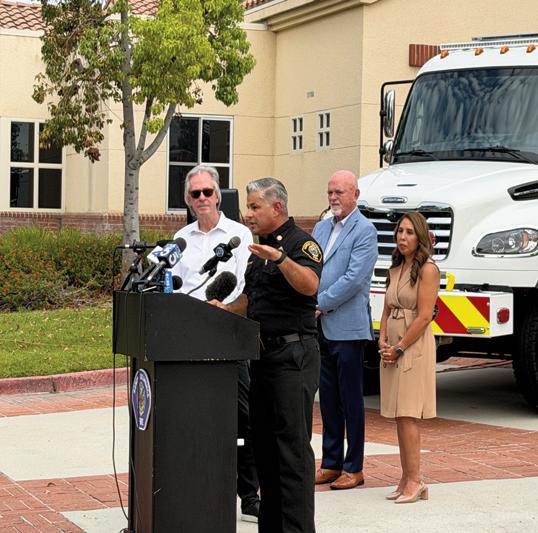
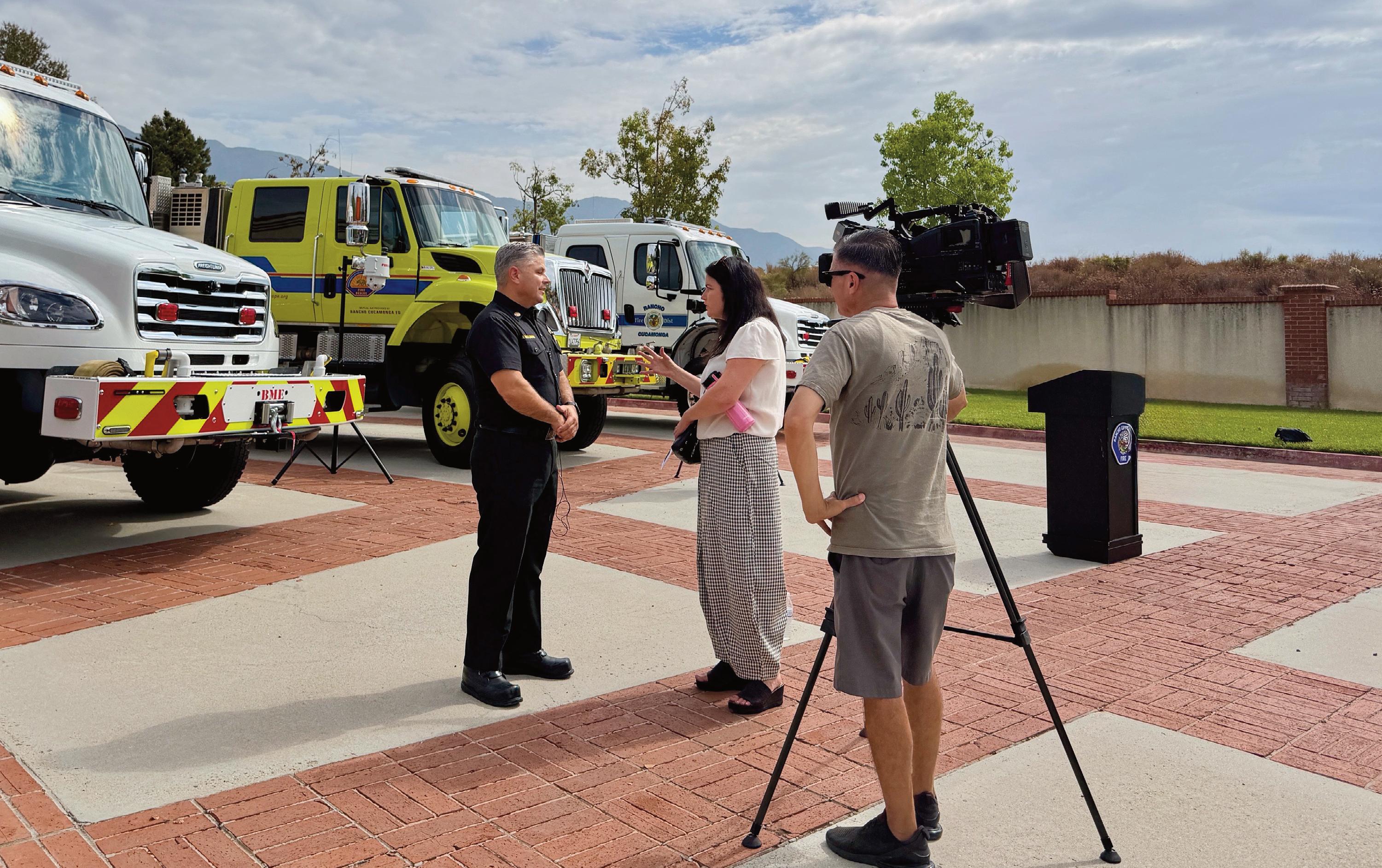
During a press conference held at the Banyan Fire Station, Fire Chief Mike McCliman and Mayor L. Dennis Michael outlined how implementing wildfire detection technology, enhanced aerial firefighting infrastructure, and modern wildland firefighting apparatus are helping build a safer and more resilient Rancho Cucamonga long before a wildfire ignites.
"As wildfires across California continue to grow larger, faster, and more destructive, preparedness has never been more important," said Fire Chief Mike McCliman. "These investments strengthen every stage of our wildfire response—from detecting fires sooner, to supporting aerial suppression, to ensuring firefighters have the specialized equipment needed to respond safely and effectively in different terrain. Together, they help us protect lives, property, and our community."
One of the most significant advancements is the installation of FIREBird early wildfire detection cameras along Rancho Cucamonga's northern boundary, where residential neighborhoods meet the foothills of the San Gabriel Mountains.
The 30 newly installed FIREBird cameras use thermal imaging, artificial intelligence, and on-site weather monitoring to automatically detect wildfires as small as five by five feet—often within minutes of ignition—without requiring human monitoring. Once a fire is detected, the system immediately alerts emergency dispatchers at CONFIRE with the fire's location, live imagery, and weather conditions, and initiating a response by RCFD.
"Protecting our community requires planning for tomorrow's challenges today," said Mayor L. Dennis Michael. "These investments reflect our City Council's commitment to maintaining a safe and healthy community while embracing innovative solutions that improve quality of life."
The City Council also recognized retired Assemblymember Chris Holden for his leadership in securing state funding for the project, making Rancho Cucamonga the first community in California to deploy a state-funded FIREBird system.
RCFD also unveiled its recently installed HeloPod at the Banyan Fire Station. The HeloPod serves as a dedicated water refill station for firefighting helicopters, allowing aircraft to reduce turnaround times between water drops and spend more time actively suppressing wildfires. As a regional resource, helicopters utilizing the HeloPod may be responding to incidents throughout Southern California, strengthening aerial firefighting capabilities beyond Rancho Cucamonga's city limits while strengthening the region's overall emergency response network.

Completing the District's wildfire preparedness enhancements is the replacement of two Type 3 brush engines specifically designed for wildland firefighting. The four-wheel-drive apparatus are built to navigate steep, rugged terrain commonly found throughout the San Gabriel Mountains and provide firefighters with enhanced pumping capabilities and greater mobility during vegetation fires. Replacing this equipment ensures firefighters have reliable, modern equipment capable of responding quickly and safely to incidents in difficult terrain.
Together, these investments represent a layered approach to wildfire preparedness by improving early detection, accelerating aerial suppression efforts, and enhancing frontline firefighting capabilities. These initiatives reflect the Rancho Cucamonga Fire District's ongoing commitment to community risk reduction and aligns with the City's mission to continuously advance the quality of life through proactive planning, innovation, and collaborative partnerships.
The Rancho Cucamonga Fire District extends its appreciation to the City Council, retired Assemblymember Chris Holden, the State of California, Lindsey FireSense, CONFIRE, and the Cucamonga Valley Water District, whose collaboration made these projects possible.
By investing in advanced technology, critical infrastructure, and modern emergency response equipment today, Rancho Cucamonga is strengthening its ability to protect lives, property, and natural resources for years to come.
PHOTO RANCHO CUCAMONGA FIRE PROTECTION DISTRICT
A Rancho Cucamonga Fire District official discusses the city’s expanded wildfire preparedness efforts at the Banyan Fire Station, where new wildland firefighting apparatus are displayed during a press conference.
PHOTO RANCHO CUCAMONGA FIRE PROTECTION DISTRICT
Rancho Cucamonga Fire District’s two new Type 3 brush engines feature four-wheel drive, enhanced pumping capabilities and specialized equipment for wildland firefighting in steep, rugged terrain.