San Bernardino Symphony’s Summer Concert Under the Stars Returns With Fireworks, Food and Activities
California Housing Bill Would Raise Wages to $28. Why Do Some Unions Hate It? Pg. 5
Pg. 4 Fontana Elementary School Receives National Recognition for Preserving O’Day Short Family’s Legacy
8
Inland Empire Community Newspapers
iecn1@mac.com
By Manny Sandoval
Acontroversial
Bloomington warehouse project that would demolish more than 100 homes in a predominantly Latino, working-class community returned to San Bernardino County Superior Court on Friday, as residents and environmental justice advocates argued the development threatens housing, health and a longstanding rural way of life.
People’s Collective for Environmental Justice held a June 5 press conference outside the San Bernardino Justice Center before a hearing on the Bloomington Business Park warehouse project, one of the most closely watched warehouse fights in the Inland Empire.
The lawsuit argues San Bernardino County’s approval of the project is not only an environmental issue, but a civil rights and housing justice issue. A court has already ruled the county violated the California Environmental Quality Act and ordered a new environmental review. Advocates are now asking the court to consider whether the
county also violated its legal obligation to affirmatively further fair housing.
For Bloomington resident Xochitl Pedraza, who has lived north of the project area for 10 years, the case is about whether families like hers can remain in the community they worked to build.
When she moved to Bloomington, Pedraza said, the neighborhood was quieter and more rural, with horses, large lots, chickens, goats, home gardens and views of the surrounding hills. Many of the homes that have since been demolished sat on nearly an acre of land, she said, offering working families space that has become increasingly difficult to find in Southern California.
“It was a rural environment,” Pedraza said. “It was a lot quieter.”
That has changed, she said, as warehouse development and truck traffic have pushed deeper into residential areas.
“Right now, it’s truck after truck,” Pedraza said.
Inside her home, Pedraza said, soundproof windows are
By Manny Sandoval
Incumbent Mayor Helen Tran remained above the 50% threshold in San Bernardino’s mayoral race Monday, June 8, as the San Bernardino County Registrar of Voters posted its latest unofficial results showing all county precincts reported.
The Registrar of Voters’ Summary Report No. 8 showed Tran with 13,738 votes, or 54.66%, maintaining a majority in a six-candidate race that included former Mayor John Valdivia, former Councilman Rick Avila, Ivan Garcia, Ronnika Ngalande and Amy Malone.
The results remain unofficial until certified, but Tran’s standing is significant because San Bernardino requires a runoff election when no candidate receives more than 50% of the vote. If Tran’s majority holds through certification, she would avoid a November runoff and secure a second term.
The mayoral results, with
164 of 164 precincts reported, were:
Helen Tran: 13,738 votes, 54.66%
Ivan Garcia: 2,582 votes, 10.27%
Rick P. Avila: 2,564 votes, 10.20%
Ronnika Ngalande: 2,459 votes, 9.78%
Amy Malone: 2,262 votes, 9.00%
John Valdivia: 1,528 votes, 6.08%
The updated count follows a contentious mayoral campaign centered on housing, homelessness, public safety, economic development and City Hall leadership.
Tran, who is seeking a second term, has defended her administration’s record and said the mayor’s role is to advocate for funding, build regional partnerships and keep city projects moving.
“As mayor, you have to continue to advocate, go out for funding, seek funding, build relationships,” Tran said during an April candidate forum.
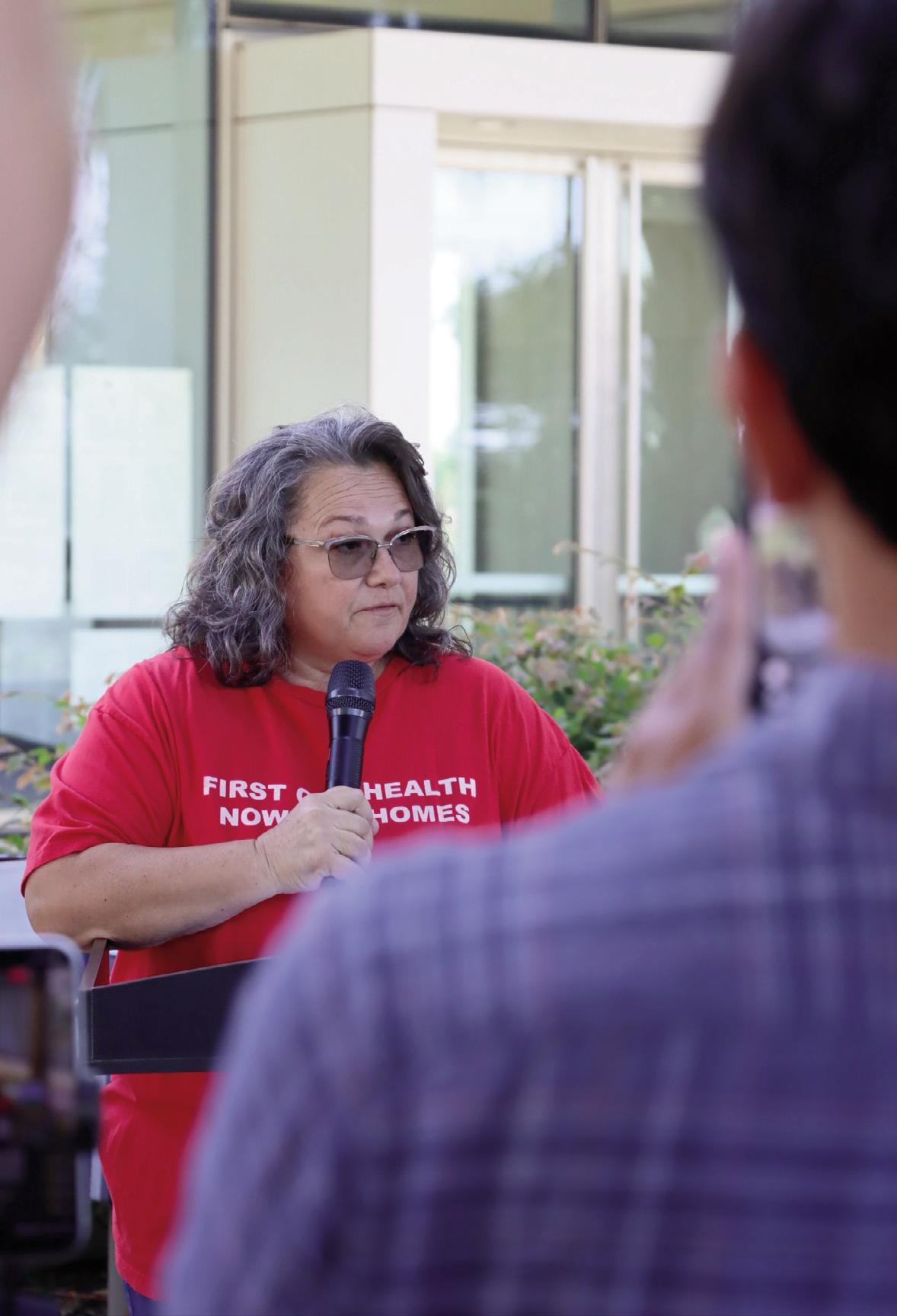
PHOTO PC4EJ
Bloomington resident Xochitl Pedraza speaks outside San Bernardino Superior Court on June 5 as advocates challenged a warehouse project they say threatens homes, health and community life.
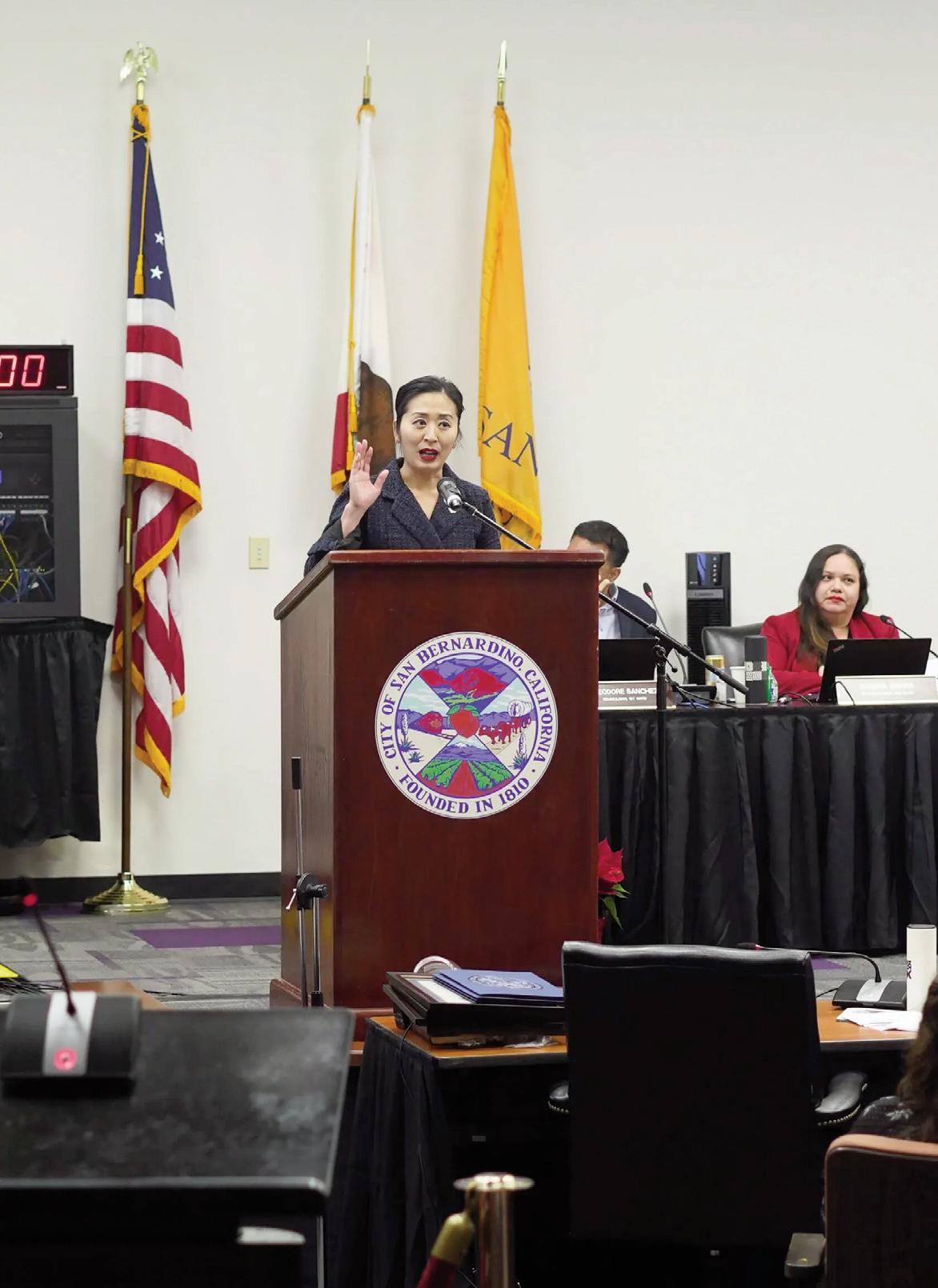
PHOTO MANNY SANDOVAL
San Bernardino Mayor Helen Tran speaks from the City Council dais, where her administration’s record on housing, homelessness, public safety and economic development became central to the closely watched mayoral race.
Warehousing (cont.)
- not enough to block the noise from passing trucks. She said the rumbling can still be heard indoors and felt through the house.
“You can still hear it when the trucks pass by,” Pedraza said. “You can feel it like an earthquake.”
Outside, she said, the impacts are even more difficult to ignore. Pedraza said cracks have appeared in parts of her home and concrete outside, and that she and her husband sometimes cannot hear each other while working in the yard because of passing trucks. She also described delivery lines near warehouses in the evening and heavier morning traffic that has made daily routines more difficult.
The uncertainty has changed how her family thinks about investing in their home.
“It’s like we’re always in limbo,” Pedraza said. “We don’t know if they’re eventually going to rezone, so why invest in your house?”
Pedraza said her backyard, shaded by trees and still home to chickens and birds, remains a place of refuge. But even there, she said, the noise of honking, engines and truck movement can still be heard.
To her, the growth feels like it is closing in on Bloomington.
“It seems like a circle that is just literally choking us up,” Pedraza said.
Susan Phillips, director of the Robert Redford Conservancy at Pitzer College, said the Bloomington case reflects one of the Inland Empire’s most serious warehouse disputes because it involves the loss of homes and the disruption of an entire community.
“We’re here to fight one of the most egregious cases in the history of warehouse construction in the Inland Empire,” Phillips said. “The destruction of homes — not only homes, but an entire community and way of life — has been at stake in this case.”
Phillips said air pollution is a major concern, but not the only one. She pointed to noise, light, truck rumbling and safety concerns as part of the cumulative burden residents face when warehouse projects are placed near homes.
“Air pollution is one of the key things,” Phillips said. “It causes asthma, it causes heart issues, it
causes all kinds of health issues.”
Phillips said advocates believe the Bloomington project reflects a discriminatory pattern in land-use decisions, particularly when warehouse developments are placed in low-income Latino communities with lower-density housing and large lots.
“The predatory aspect of it is about race,” Phillips said. “At the end of the day, that’s the assertion that we’re making here in this court.”
Advocates say Bloomington’s experience reflects a broader Inland Empire pattern in which warehouse expansion has replaced housing, increased truck pollution and concentrated environmental burdens in low-income communities of color. The recent “Region in Crisis” report cited by advocates argues that warehouse growth across the region has placed homes, schools and neighborhoods closer to industrial uses and truck routes.
Pedraza said some neighbors have become discouraged, while others continue to fight because they see the project as a threat to the lives they built and the retirement years they planned.
“It’s what we have,” Pedraza said. “It’s what we wanted.”
She said the demolition of homes also affects families who may feel pressured to sell but cannot easily find similar property elsewhere.
“Where are we going to find an acre in California that is reasonably priced?” Pedraza said.
Pedraza said she wants county leaders to listen to residents, particularly because parks and schools are near areas affected by warehouse development.
“The most logical thing is to stop the project,” she said.
The outcome of the case could carry broader implications for how local governments weigh warehouse development, housing loss and environmental justice in communities already facing industrial pressure.
For Pedraza, the issue remains rooted in the daily reality outside her door.
“We have parks and we have schools that are next to that,” she said. “They need to listen to us.”
Elections (cont.)
- Across San Bernardino County, the June 8 update showed 396,586 ballots cast out of 1,234,386 registered voters, for a turnout of 32.13%. The county reported 352,260 mail ballots and 44,326 polling place ballots.
San Bernardino City Council races
In San Bernardino’s 1st Ward, former Councilwoman Virginia Marquez remained in first place with all 22 precincts reported, though no candidate was above 50%.
The 1st Ward results were:
Virginia Marquez: 769 votes, 34.53%
Ron Alvarado: 693 votes, 31.12%
Theodore Sanchez: 555 votes, 24.92%
Omar Williams: 210 votes, 9.43%
If the standings hold and no candidate reaches the required majority, Marquez and Alvarado would advance to a November runoff.
The 1st Ward race has focused heavily on downtown revitalization, homelessness, infrastructure, public safety, prostitution concerns and city accountability.
Marquez previously said the ward needs full-time attention and a renewed focus on downtown.
“Being a council member will be my full-time job because that’s what it’s going to take,” Marquez said during a candidate forum. “There’s a lot of healing that needs to take place during the next four years.”
Sanchez, who has represented the ward since 2019, defended his record during the campaign by pointing to public safety, housing and fiscal progress.
“We have hundreds and hundreds of affordable housing units that are built every year,” Sanchez said during the forum. “We have a 25-year low in crime. We have invested in infrastructure.”
In the 2nd Ward, Christian Shaughnessy held a wider lead over Benito J. Barrios and San-
dra Ibarra, with all 18 precincts reported. The 2nd Ward results were:
Christian Shaughnessy: 890 votes, 39.61%
Benito J. Barrios: 730 votes, 32.49%
Sandra Ibarra: 627 votes, 27.90%
Because no candidate was above 50%, Shaughnessy and Barrios would advance to a November runoff if the results hold.
In the 4th Ward, challenger Joe Salas moved ahead of incumbent Fred Shorett in one of the city’s most closely watched council contests. With all 43 precincts reported, Salas led Shorett by 207 votes.
The 4th Ward results were:
Joe Salas: 2,024 votes, 38.33%
Fred Shorett: 1,817 votes, 34.41%
Jesus “Chuy” Medina: 826 votes, 15.64%
Erick Marquez: 403 votes, 7.63%
Vincent D. Laster: 210 votes, 3.98%
If the standings hold, Salas and Shorett would advance to a November runoff.
Countywide and regional races
Several major countywide and regional races also continued to take shape in the June 8 update.
In the San Bernardino County sheriff/coroner/public administrator race, incumbent Shannon Dicus maintained a wide lead over Joe Silva, with all 2,065 precincts reported.
Shannon Dicus: 218,104 votes, 65.33%
Joe Silva: 115,736 votes, 34.67%
In the San Bernardino County auditorcontroller/treasurer/tax collector race, Ryan Hutchison continued to lead incumbent Ensen Mason.
Ryan Hutchison: 188,602 votes, 57.14%
Ensen Mason: 141,463 votes, 42.86%
The contest drew heightened attention in recent weeks as Mason faced scrutiny over his elected office, outside business interests and public criticism of county leadership. Hutchison’s lead grew from election night as additional ballots were counted.
In the race for San Bernardino County superintendent of schools, Cali Binks remained in first place, followed by Alejandro “Alex” Vara.
Cali Binks: 126,350 votes, 38.87%
Alejandro “Alex” Vara: 101,341 votes, 31.18%
Ray Anthony Culberson: 49,529 votes, 15.24%
Ken Larson: 47,820 votes, 14.71%
In the 2nd District San Bernardino County Board of Supervisors race, Jesse Armendarez III remained well above 50%, leading Jesus “Jesse” Sandoval and Joe Alvanez.
Jesse Armendarez III: 43,775 votes, 57.52%
Jesus “Jesse” Sandoval: 18,928 votes, 24.87%
Joe Alvanez: 13,407 votes, 17.62%
In the 4th District Board of Supervisors race, incumbent Curt Hagman led Christina Gagnier.
Curt Hagman: 39,705 votes, 55.08%
Christina Gagnier: 32,378 votes, 44.92%
In the 45th Assembly District race, Assemblymember James C. Ramos continued to lead Republican Greg Abdouch.
James C. Ramos: 43,468 votes, 65.53%
Greg Abdouch: 22,867 votes, 34.47%
All results remained unofficial Monday. The San Bernardino County Registrar of Voters said its next update is scheduled for Tuesday, June 9, by 4 p.m.
Rialto Unified Top Graduates Head to UCLA, Dartmouth, UC Irvine With Bold Futures
By Manny Sandoval
Rialto Unified’s Class of 2026 closed one chapter Sunday at Toyota Arena, where graduates from across the district walked the stage carrying more than diplomas.
For several of the district’s top graduates, commencement marked the start of futures shaped by discipline, family sacrifice, faith, service, curiosity and a deep sense of responsibility to become more than successful students. They are leaving high school with plans to enter medicine, engineering, science, research and public serv-
ice-minded careers, while carrying stories rooted in Rialto Unified classrooms and communities.
The June 7 ceremonies brought together graduates from Carter, Rialto, Eisenhower, Milor and Zupanic high schools at Toyota Arena. This year’s featured valedictorians, salutatorians and top scholars reflected the talent, discipline and ambition emerging across Rialto Unified.
At Rialto High School, valedictorian John Mark Reyes graduates with a 4.81 GPA and plans to attend UC Irvine to study aerospace engineering. His interest in engineering began with a childhood fascination with cars and aircraft, then grew into a desire to understand how complex
systems work. “I really like engineering,” Reyes said. “I was curious about how things work.”
Born in the Philippines, Reyes said his family’s experience shaped his drive. His mother completed college, while his father did not finish high school, giving him a close view of how education can change opportunity. He said his mother’s work ethic remains one of his greatest examples.
“She is so driven and hardworking,” Reyes said. Read the full story at IECN.com.
Op-Ed
The Hunger Strike at Adelanto Is a Warning We Cannot Ignore
By Javier Hernandez, Executive Director, Inland Coalition for Immigrant Justice
The hunger strike currently unfolding inside the Adelanto Detention Center should alarm every person in California. When people are willing to risk their health and their lives to protest the conditions they are living under, that is not a political stunt. That is desperation. That is a warning.
For nearly a decade, our organization, alongside a broad coalition of advocates, families, faith leaders, and directly impacted community members, has fought to shut down the Adelanto Detention Center. Throughout that time, we have consistently raised concerns about medical neglect, abuse, unsafe conditions, retaliation, and the broader dehumanization that defines immigrant detention in this country.
And throughout that time, people have continued to suffer inside those walls.
The current hunger strike is not happening in isolation. It is the latest chapter in a long history of people detained at Adelanto speaking out about conditions that no human being should be forced to endure. People inside have de-
By Hold The Line
Hscribed inadequate medical care, fear, isolation, retaliation, and treatment that strips them of dignity. These are not new allegations. They are part of a pattern that has existed for years.
At the Inland Coalition for Immigrant Justice, we have worked alongside directly impacted families and organizers to expose these conditions because we understood early on what Adelanto represented. It was never just another detention center. It became a symbol of a system that normalizes suffering and asks the public to look away.
During the Biden administration, we came closer than ever to shutting Adelanto down. There was real momentum. Communities across California demanded action. Impacted families organized tirelessly. National attention grew. For the first time, closure felt within reach.
But there was also a coordinated effort to keep the facility open. Among those advocating for its continuation were sectors of organized labor that argued the detention center should remain operational in the name of protecting jobs. Letters were sent to the Biden administration urging it not to close the facility.
That moment exposed a difficult but necessary question
for all of us: What does solidarity actually mean?
Because worker solidarity cannot stop at a paycheck while people inside a detention center suffer. The reality is that GEO Group harms everyone—detained immigrants, families, surrounding communities, and even workers themselves. These corporations profit from instability, incarceration, and political fear. That is not sustainable economic development. That is dependence on human suffering.
At the same time, this movement has also shown us something hopeful. Even within labor, there are workers and local leaders who have begun challenging these systems and questioning contracts tied to detention. There are people willing to confront uncomfortable truths and push for something better.
At some point, California must decide whether it truly believes in dignity and human rights, or whether those values stop at the walls of an immigration detention facility.
For us, the answer is clear. Adelanto should be shut down.
West Valley Detention Center: Violence, Deaths, and Warnings Ignored
ow many warnings does it take before someone acts? For more than a year, deputies, employees, and concerned citizens have raised alarms about deteriorating conditions inside the West Valley Detention Center (WVDC), one of the largest county jails in California. Those warnings have been delivered to jail administrators, the Sheriff's Department, the Board of State and Community Corrections (BSCC), and the Sheriff’s Employees’ Benefit Association (SEBA).
Yet despite repeated complaints, documented safety concerns, multiple inmate deaths, violent attacks on staff, and allegations of severe facility deterioration, critics say little meaningful action has been taken. Today, West Valley Detention Center remains on lockdown following multiple inmate attacks on deputies, while questions continue to mount regarding six in-custody deaths this year alone.
Deputies Sound the Alarm
On March 20, 2026, a formal notice was submitted to both SEBA and Detention and Corrections Bureau leadership, warning of what deputies described as "increasingly dangerous and life-threatening conditions" inside county correctional facilities.
The warning was not subtle. The letter documented a violent assault in which a deputy was allegedly bitten on the back of the head while an inmate attempted to gouge his eyes. Within days, another deputy was reportedly nearly stabbed with an inmate-manufactured weapon. The notice warned that these incidents were not isolated events but indicators of a correctional environment rapidly spiraling out of control.
"Serious injury or loss of life is not only possible, but foreseeable," the letter stated.
Perhaps most troubling, deputies alleged that a single deputy routinely operates housing units designed to be staffed by two deputies while personnel are reassigned elsewhere. According to the correspondence, Lieutenant Higgins acknowledged during a January 1, 2026, briefing that housing units ideally require three to four deputies to operate safely. Despite that acknowledgment, deputies report that only one deputy regularly staffs housing units at a time.
If true, the contradiction raises serious questions about operational decision-making and employee safety.
A Jail Under Lockdown
The staffing concerns come amid a surge of violence inside the facility. West Valley Detention Center is currently operating under lockdown conditions following multiple attacks on deputies. The lockdown follows months of escalating violence, including the January homicide of inmate Zacarias Joseph Ruiz. According to the San Bernardino County Sheriff's Department, Ruiz was found unresponsive in his cell on January 19, 2026, suffering from obvious trauma. He later died at a local hospital. Detectives determined Ruiz had been involved in a physical altercation with his cellmate, Isaiah Mark Bailon, who
was subsequently booked on suspicion of murder.
The incident marked the most recent confirmed homicide inside the facility. For many observers, it was another warning sign of a detention center struggling to maintain order.
Six Deaths in Four Months
The violence is occurring alongside a disturbing series of inmate deaths. Since January, authorities have investigated at least six in-custody deaths connected to West Valley Detention Center.
Among them:
Zacarias Joseph Ruiz, 38, who died following a violent assault.
Katie Sarah Jackson, 43, whose death was investigated in February.
Odiakosa Sylvester Obazeh, 40, who suffered a medical emergency and later died.
Mariel Rashad Mays, 26, found unresponsive on April 19.
Alexis Moron Ledinich, 45, found unresponsive on April 20.
An additional inmate death connected to a January altercation.
In each case involving an unattended death or medical emergency, investigators from the Sheriff's Specialized Investigations Division were dispatched to determine the cause and manner of death. While investigations remain ongoing, the sheer number of deaths has intensified scrutiny of conditions inside the facility.
The BSCC Was Warned
Months before the most recent deaths and lockdown, a detailed complaint was submitted to the Board of State and Community Corrections. On October 14, 2025, an emergency complaint alleged widespread violations of California Title 15 regulations governing detention facilities. The complaint accused jail officials of operating housing units without adequate safety staff, leaving civilian clerical personnel monitoring housing control booths while sworn custody personnel were absent. The complaint further alleged that deputies were unable to perform required safety checks or respond effectively to emergencies, assaults, suicides, or fires. Photographs accompanying the complaint reportedly showed severe corrosion, deteriorated plumbing, rusted fixtures, damaged housing areas, and unsanitary conditions that critics argued violated Title 15 requirements mandating facilities be maintained in a clean, safe, and operable condition.
The complaint directly challenged the findings of a June 2025 BSCC inspection that declared the facility compliant with state regulations. Despite these allegations, no emergency intervention occurred. No inmate relocation occurred.
No public enforcement action was announced.
No public declaration of non-compliance was issued.
For critics, the question remains: How could a facility accused of such serious deficiencies continue to receive a passing grade?
What About SEBA?
Equally troubling to many deputies is the perceived silence from SEBA, the union charged with protecting correctional staff. The March 2026 notice specifically criticized what deputies described as a lack of meaningful advocacy regarding unsafe working conditions. The document stated that represented members continue to work in hazardous environments while corrective action remains absent. Deputies argue that staffing shortages, increasing violence, and the presence of inmate-manufactured weapons constitute an obvious workplace safety crisis. Yet despite repeated complaints and documented warnings, many employees say they have seen little evidence of aggressive intervention or public pressure from union leadership. For deputies working the housing units, that perceived inaction has become a source of frustration and anger.
Waiting for a Tragedy?
The most alarming aspect of the situation may be that none of the problems described are new.
The warnings were submitted.
The incidents were documented.
The deaths were investigated.
The photographs exist.
The complaints were filed.
The question now confronting San Bernardino County taxpayers, elected officials, and jail administrators is simple: How many more warnings are required before meaningful action is taken? Every major correctional disaster begins with warning signs.
Rivers
San
Bernardino Symphony’s Summer Concert Under the Stars Returns With Fireworks, Food and Family Activities
Community News
The San Bernardino Symphony Orchestra, under the baton of Maestro Anthony Parnther, will present their annual concert under the stars with fireworks on Saturday, June 20, 2026 at 8:00 p.m. on the football field at San Bernardino Valley College.
Explained Maestro Parnther, “Our annual summer concert has now become a community staple and welcomes our largest crowd of the year. It's great to see so many people from throughout the Inland Empire joined together as we celebrate America and put on this spectacular show!"
The Symphony will perform a variety of favorite music from the Broadway and the American Songbook, as well as tradi-
tional Patriotic fare and a few special surprises. This year, members of the San Bernardino Symphony Youth Orchestra and Overture Orchestra will also perform at the start of the event which will culminate in Tchaikovsky’s bombastic 1812 Overture performed to a fantastic fireworks display!
And remember the world record breaking piccolo performance in 2024? 192 piccolo players from all over the state performed John Phillip Sousa’s “The Stars and Stripes Forever” at that concert. The piccoloists will return this year in an attempt to break our own record!
Shared San Bernardino Community College District Dr. Chancellor Diana Z. Rodriguez. "This event is a fantastic opportunity to bring our community together in celebration and unity. This evening will be an unforgettable blend of
live music, connection, and community pride."
The concert begins at 8:00 pm, but the public is invited to arrive by 5:30 p.m. to enjoy the College's annual SUMMERFEST which will take place on campus nearby the football stadium and will include food trucks, vendors, informational booths, kids' activities, campus tours, and, more!
"Once again, Maestro Parnther has curated a concert that will exceed all expectations! This annual evening under the stars has never failed to bring the entire community together to share in the uniting power of music," declared Symphony Board of Directors President Sonietta Martin Brown.
Tickets and Location Details
Tickets for "America, the Beautiful" may be purchased online at www.sanbernardinosymphony.org or by phone at (909) 381-5388 Monday through Friday.
Tickets for Assigned Table seats are available at $20 - $100 per person. General admission lawn seats are $10 per person with children under 12 always free. General admission ticketholders are encouraged to bring low lawn chairs or blankets. All attendees may bring their own picnic baskets or visit some of the many food trucks that will be on campus as part of SUMMERFEST.
San Bernardino Valley College is located at 701 S. Mt. Vernon Avenue in San Bernardino. Free, lighted parking is available in assigned lots throughout the campus on concert day.
Redlands Theatre Festival’s Summer Season Turns Chaos, Comedy Into Community Community News
The Redlands Theatre Festival will open its Summer 2026 season with a comedy-forward lineup celebrating connection, chaos and the unpredictable ways people build community.
The season, set in the festival’s outdoor amphitheater at Prospect Park, will run Tuesday through Sunday nights from June 26 through Aug. 1. All performances begin at 8 p.m.
This year’s lineup invites audiences into stories where identities are fluid, love is complicated and laughter is essential. From farce and musical comedy to contemporary storytelling, the 2026 season explores what happens when people are forced together across class, culture and circumstance and discover something unexpected about themselves along the way.
At the center of the season is a spirit of joyful disruption, according to festival organizers.
“One Man, Two Guvnors,” by Richard Bean, directed by Shannon Galuszka, with music direction by Kobe Darby, will kick off the season with high-energy physical comedy and mistaken identities.
“Men on Boats,” by Jaclyn Backhaus and directed by Jennifer Lawson, reclaims history with wit and irreverence, challenging who gets to tell the story and who gets written out of it.
“Native Gardens,” by Karen Zacarias and directed by Tamara Griffey, digs into culture clashes and the politics of belonging, showing how even the smallest boundaries can reveal deeper divides.
“Blithe Spirit,” by Noël Coward and directed by Pamela Lambert, brings together romance, regret and the supernatural while exploring what people carry with them from past relationships.
“The Drowsy Chaperone,” featuring music and lyrics by Lisa Lambert and Greg Morrison and a book by Bob Martin
and Don McKellar, will close the season. Directed by Lisa Lyons, with music direction by Kelsey Cauldren, the production offers a meta-theatrical celebration of musical theater and a reminder of why audiences gather to dream together.
The festival will also present two nights of its fourth annual New Works program, which showcases emerging artists in a staged reading format followed by a question-and-answer session with directors, cast members and, at times, playwrights. The special performances are scheduled for June 14 and June 21.
A one-night concert featuring Teen Music Workshop is scheduled for June 27.
The nonprofit organization features upand-coming singers, a full band, dancers and backline for a music-filled evening.
Together, festival organizers said, the productions form a season about collisions of worlds, values and identities; the reinvention of history, self and story; messy, surprising and deeply human connections;
and the joy that comes from healing, community and resistance.
“This season leans into comedy not just for entertainment, but as a way of navigating complexity,” said Artistic Director Shannon Cabanilla Galuszka. “Each play asks: How do we live together? And the answer, again and again, is through laughter, empathy, and a willingness to be changed.”
Set against the backdrop of Redlands’ outdoor amphitheater in Prospect Park, the Summer 2026 season promises an experience that is both playful and provocative, heartfelt and hilarious.
Tickets and full season information are available at RTFSeason.com. Tickets are available online and by mail.
More information is available by following the Redlands Theatre Festival on Instagram and Facebook.
PHOTO SB SYMPHONY
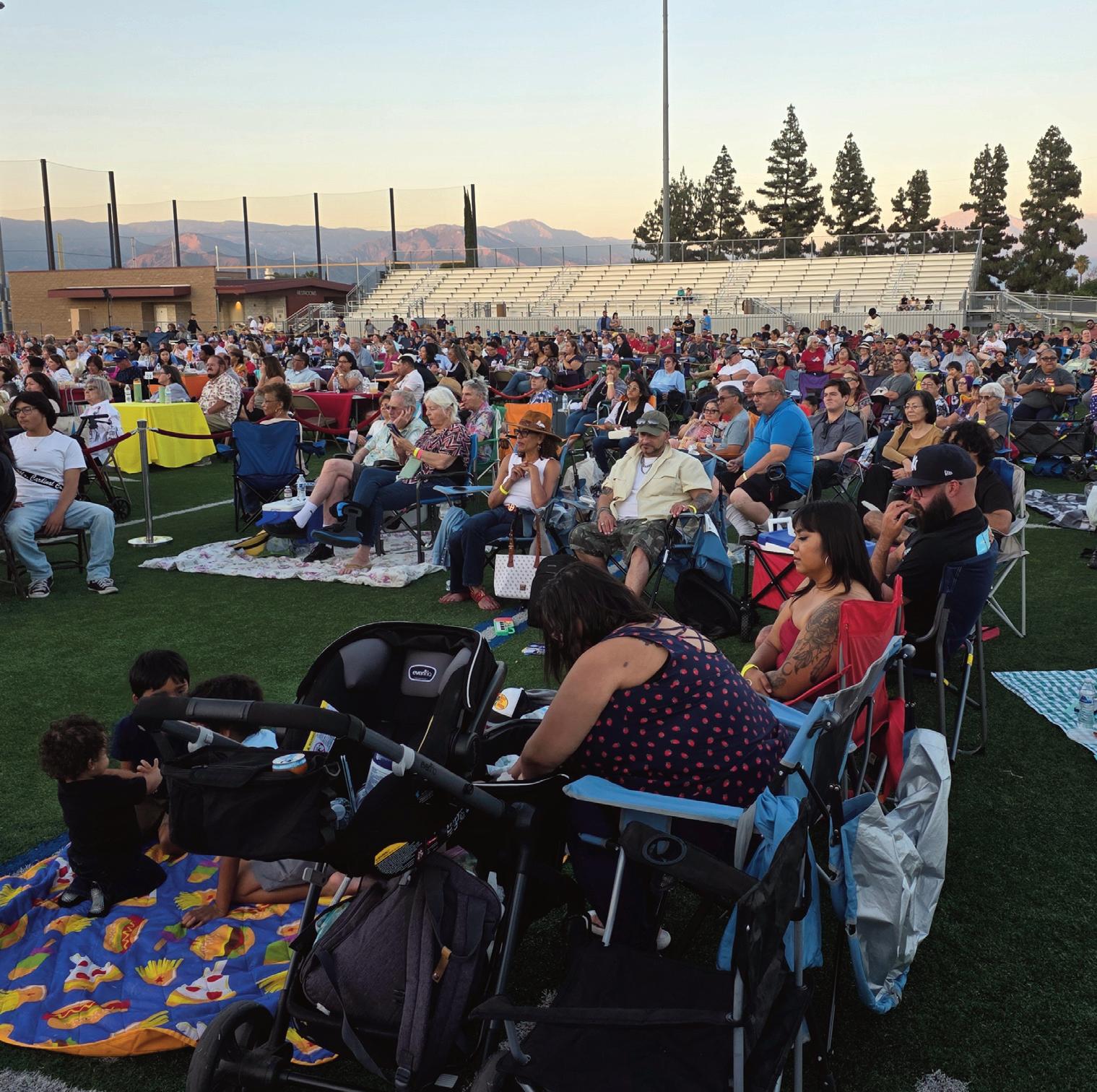
Families and community members filled San Bernardino Valley College’s football field with lawn chairs, blankets and picnic setups for the San Bernardino Symphony Orchestra’s annual summer concert.
PHOTO SB SYMPHONY
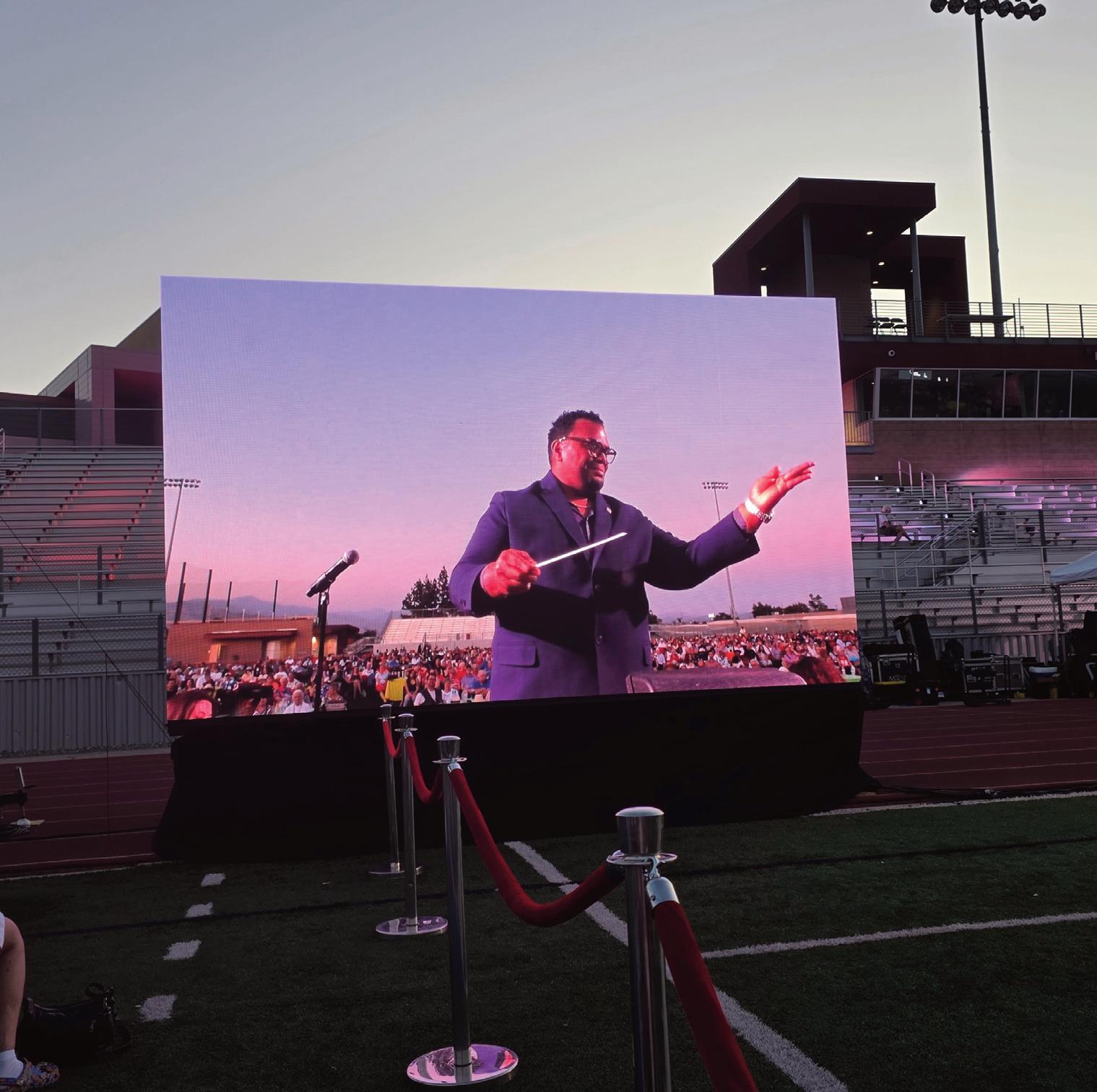
A large video screen shows the San Bernardino Symphony Orchestra conductor leading the annual concert under the stars at San Bernardino Valley College’s football field.
A California Housing Bill Would Raise Wages to $28. Why Do Some Unions Hate It?
By Ben Christopher, CalMatters
When is a minimum wage hike of more than $11 per hour actually a pay cut? That question has dominated the debate over a current California housing bill that has riven the state’s two most powerful construction worker unions and many state legislative Democrats reluctant to get on the wrong side of either group.
Assembly Bill 1751, authored by Fullerton Democrat Sharon Quirk-Silva, would kick aside regulatory barriers to building townhouses — tightly clustered, multistory homes. In exchange for this fast-tracked approval process, townhouse developers would be required to pay their workers at least $28 per hour.
That’s a significant pay bump over the statewide minimum wage of $16.90. But the fiercest opposition to the bill has come from what might seem like an unexpected source: The State Building and Construction Trades Council, an umbrella organization that represents electricians, plumbers, sheet metal workers and other skilled construction trade unions.
The trades — as the council is colloquially known — argue that the new wage floor could have the paradoxical side-effect of driving down the “prevailing wages” enjoyed by many of their members. Prevailing wages are mandatory minimum pay rates for publicly-funded or supported construction projects, which include many affordable housing developments and other projects propelled forward by recent state law in California. State and federal regulators set prevailing rates based on surveys of the most common wages in each field and geographic area. Because union pay scales can cover hundreds of similarly employed workers, those union-level wages often set the prevailing wage.
In a testy debate on the Assembly floor earlier this month, Quirk-Silva stressed — repeatedly — that the bill would in no way affect the state-set wage rates. “It does not replace prevailing wage,” she said. “It does not undercut prevailing wage. This bill leaves prevailing wage exactly where it stands in current law.”
The trades aren’t buying it, noting that the federal government sets its own rates for federallysupported projects. But the group’s bigger beef may boil down to precedent. For years, the building trades have battled any legislation aimed at easing regulations on the construction of new housing unless it also included pro-union guarantees. Those are either union-level prevailing wage pay requirements or, in more recent years, even more restrictive “skilled and trained” rules that require developers to hire apprenticeship program graduates, the vast majority of whom are union members.
Quirk-Silva’s townhouse streamlining bill introduces a new standard: a minimum wage far
lower than what most trades members already make.
Making a meager minimum wage hike the new bone that prohousing bills throw to construction workers would “signify the new norm,” said Chris Hannan, president of the Trades Council. “When you start a trend of doing a minimum wage, then that becomes the new go-to.”
Standing on the other side of the debate, supporting the new wage standard, are California’s unionized carpenters. The trades battling the carpenters is a familiar face-off in Sacramento. This isn’t even the first time the groups have publicly locked horns over this specific wage proposal.
Last summer, Assemblymember Buffy Wicks, an Oakland Democrat and longtime ally of the carpenters, inserted residential construction worker minimum wage of between $28 and $40 per hour into a budget bill in the final hours of the fiscal year. Aside from high-rise construction developments where the use of steel and concrete tend to draw more specialized workers, unions represent relatively few laborers who build California homes, the carpenters argued at the time. The new wage standard would be a modest corrective for those nonunion laborers whose current wage floor is the state minimum wage.
For years, carpenters union leaders have argued that improving working standards for lowwage workers presents an “organizing opportunity” for the union. The trades were apoplectic. Dozens of union members crowded in the budget bill hearing to decry what they saw as an anti-union reversal of state labor policy. One representative likened the measure to “Jim Crow” laws. Many labor-friendly Democrats on the committee recoiled; the proposal was shelved.
This year, the idea has been given a bit more time for debate, though the trades and some lawmakers have still complained of a process they see as rushed. When Quirk-Silva’s bill was introduced in early February, it focused solely on townhouse regulations. The wage language was added only in time for its second committee hearing in late April. (Quirk-Silva’s staff declined to make her available for an interview to explain that delay or discuss the bill in general, citing personal family matters. On the Assembly floor, she explained the late addition in part by noting “severe health issues” among staff and family members.)
Since then the entirety of the legislative debate has been focused on the wage issue. That itself is a notable development: The bill exempts the construction of townhomes from both environmental review and the jurisdiction of elected local city councils and planning boards. Just a few years ago, such a proposal would have made for a capitol-shaking, headline-grabbing fight. But a year after Gov. Gavin Newsom signed a law exempting most urban housing developments from environmental litigation, the
land-use implications appear to be an afterthought.
At an Assembly floor vote last month, San Diego Assemblymember Chris Ward referred to the minimum wage issue as the “900 pound gorilla.” He, like many Democrats who spoke on the bill, said that he supported the legislation in general, but that he remained wary of the “unresolved” questions about how the new wage rate would affect existing labor standards.
The bill needed 41 out of 80 “yes” votes to move onto the Senate. It passed with just 47. QuirkSilva’s office tried to get around the prevailing wage fight early on. Prevailing wages are required of publicly funded works, including many affordable housing projects. They are set by the California Department of Industrial Relations, which sets its rates based on the most common wage for each job type in each region of the state.
Quirk-Silva’s bill specifically bars the state department from taking the new $28 per hour townhome wages into account when running those calculations, lest a glut of townhome builders inadvertently bring down the wages owed to union roofers and plumbers.
The trades aren’t satisfied with that concession. That’s because the federal government conducts its own wage surveys and set its own prevailing wage for federally-funded infrastructure projects. The current federal prevailing wage required for a residential roofer in Sacramento, for example, is $46.73 per hour plus benefits. That number is based on the most common wage paid for that job in the area or — if no single rate is paid to at least 30% of the workers in the survey — on the regional average.
“The federal government won’t give a rat’s ass about what this bill says,” Scott Wetch, a lobbyist for Trades-affiliated unions, said at the bill’s April hearing. “And they will set the prevailing wage rate for all the crafts at $28.”
The trades “have a case” in this argument, said Kevin Duncan, an economist at Colorado State University Pueblo who has studied prevailing wage policy’s effect on construction costs. Imagine a smaller market with a relatively low unionization rate. If the bill uncorked a geyser of contractors paying all their low-wage workers exactly $28 per hour, “that would be the prevailing rate — and with zero benefits,” he said.
Backers of the bill dispute that, saying such a specific outcome is unlikely given how many contractors are likely to use this specific townhouse bill. They also argue that vanishingly few residential roofers do federal public works jobs in Sacramento — or anywhere in California — so changes in the federal prevailing wage for residential projects aren’t likely to affect many workers anyway. Instead, most roofers are non-union on privatelyfunded projects and many are being paid less than $28 per hour, said Danny Curtin, director of the California Council of Carpenters.
Employment Opportunities
Accounting Manager needed by Sentury Tire USA, Inc. in Rialto, CA. Lead the month-end fin close process & oversee the preparation of annual fin rprts; Cndct comprehensive review of fin metrics, identifying & examining significant variations; Dvlp & implmnt process improvements that enhance org efficiency & fin rprting; Assist in responding to request for fin info from external entities; Collab w/ cross-functional teams to ensure comprehensive fin oversight. Req. Master’s deg in acctng or rltd field & 3 yrs of exp as an Accountant or Auditor; CPA License; Exp w/ audits of fin statements prepared in accord w/ U.S. GAAS & U.S. GAAP; Exp w/ Alteryx or other data anlss tools; Exp w/ documentation s/w such as audit documentation s/w or acctng s/w; Exp of supervising teams consisting of two or more staff members. Salary $110,000/yr. Send resume to ayin@senturytireusa.com ref job #4534.
Free Summer Meals Map Connects San Bernardino County Youth to 40-Plus Sites
Community News
San Bernardino County Superintendent of Schools (SBCSS) is proud to offer a free, accessible, interactive map detailing where students 18 years of age and younger can access free meals throughout the summer. The GIS map allows users to browse over 40 summer meal distribution sites operated by school districts across the County, including dates and times when students can access the free meal program.
“We know that more than 280,000 students in our county qualify for free or reduced lunch,” said County Superintendent Ted Alejandre. “Our 33 school districts want to ensure students continue to have access to free, nutritious meals during the summer, just as they do during the school year. This map helps families and students, no matter where they are spending the summer, easily find nearby meal locations and access the support they need.”
The Healthy SBCSS and SBCSS Data Team partnered to develop the map, which allows users the ability to search meal locations and view operating dates and hours. Meal distribution sites include schools, parks, libraries, and community centers. Youth can visit locations close to home, school or other areas throughout the County, providing families with a variety of convenient and accessible options.
Meals are available to all youth 18 years of age and younger, regardless of whether they are currently enrolled in a San Bernardino County school district, and no identification is required.
The 2026 Summer Meals map will continue to be updated as additional meal sites are added throughout the summer.
Users can locate the map here: sbcss.maps.arcgis.com/apps/da shboards/a2b1b595e1884a77914 4abccc1c31387
Fontana Elementary School Receives National Recognition for Preserving O’Day Short Family’s Legacy
Community News
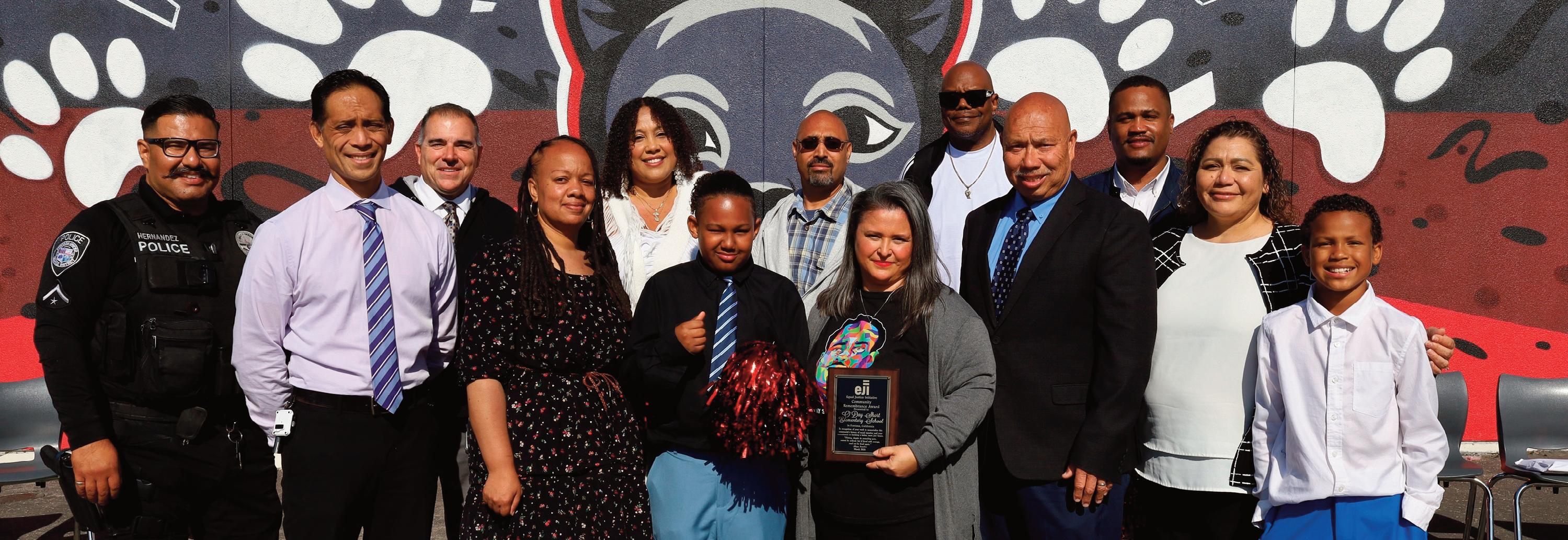
O’Day Short Elementary School and Fontana Unified student Cyrus Moss were honored by the Equal Justice Initiative (EJI) on May 28 with its Community Remembrance Award, marking a milestone in the school community’s effort to preserve and share the legacy of the O’Day Short family.
EJI Senior Attorney Jennifer Taylor presented the award during a recognition assembly, where she addressed students and staff, recognized Moss for his role in leading the school renaming effort, and donated books to the school library. The Community Remembrance Award recognizes efforts to memorialize a community’s history in support of developing a more just future.
“When we heard of the efforts being made to acknowledge and talk about this history, even though it is often hard to have those kinds of conversations, we thought it was important to recognize everyone here for making that happen,” Taylor said. “Having this history become a public part of our narrative helps people become aware of it earlier, understand how it happened, and think about how to prevent something like this from happening again.”
The event centered on the legacy of the O’Day Short family, who purchased and built a home on a five-acre
lot at Randall and Pepper avenues in Fontana at a time when African Americans were forbidden from living south of Baseline Avenue. The family received threats of violence before their house was set ablaze on Dec. 16, 1945. All four members of the family died from injuries sustained in the fire, which was later determined to be caused by arson.
O’Day Short Elementary held its official renaming ceremony at the beginning of the 2024-25 school year, marking the transition from Randall Pepper Elementary to a campus name honoring the O’Day Short family. Fontana Unified’s Board of Education unanimously voted in September 2024 to rename the school after Moss, a former O’Day Short Elementary student, submitted a petition with 132 signatures in March 2024.
“This school will always be special, and it is amazing to see how much it means to our community,” Moss said. “This is more than just a name change. It shows that when a community stands united, anything is possible. I am proud that I was able to help be a voice for their story and their legacy. To every student hearing this, I want you to know that you matter, no matter your race or skin color. You belong here, and your voice is powerful.”
After the assembly, staff and members of the Short family viewed a teaser for an upcoming documentary on
the O’Day Short family, which explores the family’s move to Fontana, the events surrounding their deaths, and the city’s history of racial inequity. The documentary will be submitted to film festivals beginning in June and featured during a VIP screening in Fontana in July.
“I do not take it lightly that I am the principal of O’Day Short Elementary, and we work every day to make our students and the O’Day Short family proud,” Principal Michelle Avilla said. “I hope Cyrus’ work continues to inspire our students and our community, because there is still a long way to go and a lot of work to be done. I hope this story continues to be told.”
Fontana Unified Executive Director of Marketing and Communications Clarissa Trejo spearheaded the documentary effort, working with producers and editors, gathering information on the O’Day Short family, and helping ensure the story was told with care and accuracy.
“The O’Day Short family’s story is part of Fontana’s history, and we have a responsibility to tell it truthfully in a way that helps future generations understand why it matters,” Trejo said. “This documentary was created to honor the family’s legacy, preserve the work that led to the school’s renaming, and give our students and community a lasting resource rooted in hope for a more just future.”
PHOTO FUSD
O’Day Short Elementary School students and staff gathered for a recognition assembly featuring the Equal Justice Initiative, a book donation to the school library, and the debut of a short documentary on the O’Day Short family’s legacy.
PHOTO FUSD
O’Day Short Elementary School and Fontana Unified student Cyrus Moss were honored by the Equal Justice Initiative with its Community Remembrance Award on May 28, recognizing their work to preserve and share the legacy of the O’Day Short family.