
CHRY SALIS

Spring | 2026 | Printemps
Vol. XVIII
The Academic Journal of the International Development Studies Students’ Association of McGill University
Le journal académique de l’association des étudiant.e.s en développement international de l’Université McGill
Chrysalis is annually published by the International Development Studies Students’ Association (IDSSA) of McGill University in Montréal, Canada.
The opinions expressed in Chrysalis are those of the authors and contributors, and do not necessarily reflect those of the editorial board, the peer review board, or McGill University.
Chrysalis est publié annuellement par l’AEDI de l’Université McGill à Montréal, Canada.
Les opinions présentées dans Chrysalis représentent celles des auteur.rice.s. Et des contributeur. rice.s, et non celles des éditeur.rice.s, de l’AEDI ou de l’Université McGill.
Land acknowledgement
McGill University is situated on land that has long been a site of meeting and exchange among Indigenous peoples. Today, we are in Tiohtià:ke (Montreal), on the larger Turtle Island (North America). We recognize that we are on unceded traditional territory, where the Haudenosaunee and Anishinabeg nations, specifically the Kanien’kehá:ka peoples, also known as the Keepers of the Eastern Door, are the traditional stewards of these lands and waters. We acknowledge the enduring presence and resilience of Indigenous peoples and their cultures and commit to working toward reconciliation and decolonization. It is important that we remain mindful of this history and context, and actively resist neocolonialism in all its forms.
Reconnaissance des terres
L’Université McGill est située sur des terres qui ont longtemps servi de lieu de rassemblement et d’échange entre les peuples autochtones. Nous résidons actuellement à Tiohtià:ke (Montréal) qui est située sur la plus grande Île de la Tortue (Amérique du Nord). Nous reconnaissons que nous nous sommes rassemblé.es sur un territoire traditionnel non cédé où les nations Haudenosaunee et Anishinabeg, en particulier les peuples Kanien’kehá:ka, également connus comme les gardien.nes de la porte de l’Est, sont les gardien.nes traditionnel.les de ces terres et de ces eaux. Nous reconnaissons la présence durable et la résilience des peuples autochtones et de leurs cultures. Nous nous engageons à œuvrer à la réconciliation et la décolonisation. Il est important que nous restions conscient.es de cette histoire et de ce contexte, et que nous résistions activement au néo-colonialisme sous toutes ses formes.
Our Team | Notre Équipe
EDITOR-IN-CHIEF | RÉDACTRICE EN CHEF
Hannah Hipólito
IDSSA | AEDI VP PUBLICATIONS
Justine Delangle
LAYOUT EDITOR | DIRECTRICE DE MISE EN PAGE
Mia Helfrich
AUTHORS | AUTEUR•RICE.S
Louisa Calame
Shipra Chandane
Alexandra J. Douglas
Wendy Lin
Sandrine Melanson
Quinn Moar
Sophia Newman-Jimenez
Ayesha Rahim
EDITORS | ÉDITEUR•RICE.S
Alexandru Albu
Sofia Figueredo
Laura Rodrigues McCall
Alexandria Sasso
Maia Sunnberg
PEER REVIEWERS | RELECTEUR•RICE.S
Mia Alexander
Lily Christopoulos
Sofia Gobin
Ingara Maidou
Galia Pakman Arrojo
FRENCH TRANSLATOR | TRADUCTEUR FRANÇAIS
Emil Ståhle

Thank you to our mentors for offering wonderful feedback to peer reviewers and authors alike!
Merci à nos mentors pour leurs excellents commentaires, tant aux relecteurs qu'aux auteurs !
Professor Jacob Blanc
Professor Megan Bradley
Professor Timothy Hodges
Professor Eduardo Romero Dianderas
Professor Kazue Takamura
Editor’s note
Dear readers,
It is a great honour to open this edition of Chrysalis as its 2025-26 Editor-in-Chief. Leading this team of talented editors, writers, and peer reviewers has been such a pleasure, and this project would not have been possible without them. Throughout my time at McGill, I have worked on various student publications, and I am proud to count Chrysalis among my favourites. This journal is a celebration of students’ academic accomplishments, strong writing, and love of research. Chrysalis has served as a pillar of the IDSSA for 15 years, providing a platform for student expression and engagement with global issues in international development studies. I know my team and I are excited to contribute to this tradition, and look forward to seeing its continuation in future years.
I would like to congratulate everyone who has been a part of this process. Thank you to the editorial board for serving as a sounding board and home base for the project. Thank you to the peer reviewers and their professor mentors for their essential feedback on each paper. And thank you to the authors, without whom we would have nothing to edit or publish! I would also like to give a special thanks to Justine (IDSSA VP Publications), Mia (layout editor), and Emil (French translator). These three have been essential in helping me smooth out all the tiny details of this operation. Finally, a big thank you to my family for encouraging me to be curious and ask questions about the world–I don’t know who I would be without my passion for research.

Mot du redacteur en chef
Chers lecteurs et chères lectrices,
C’est un grand honneur pour moi d'inaugurer cette édition de Chrysalis en tant que rédactrice en chef pour l’année 2025-2026. Diriger cette équipe d’éditeur.rice.s, d’auteur.rice.s et de relecteur.rice.s talentueux a été un véritable plaisir, et ce projet n’aurait pas été possible sans eux. Tout au long de mon temps à McGill, j’ai travaillé pour plusieurs journaux étudiants, et je suis fière de compter Chrysalis parmi mes préférées. Ce journal célèbre les accomplissements académiques des étudiants, leur talent pour l’écriture et leur passion pour la recherche. Cela fait 15 ans que Chrysalis est un pilier de l’AEDI, offrant une plateforme d’expression étudiante et d’engagement avec les enjeux mondiaux en études du développement international. Je sais que mon équipe et moi sommes ravis de contribuer à cette tradition et nous avons hâte de voir son évolution dans les années à venir.
Je tiens à féliciter toutes les personnes qui ont participé à ce projet. Merci au comité de rédaction pour son rôle de conseil et son soutien tout au long du projet. Merci aux relecteur.rice.s et à leurs mentors professeurs pour leurs retours essentiels sur chaque article. Et merci aux auteurs, sans qui nous n’aurions rien à éditer ni à publier ! Je souhaite également adresser un remerciement particulier à Justine (vice-présidente aux publications de l’AEDI), Mia (responsable de la mise en page) et Emil (traducteur français). Ces trois ont été indispensables pour m’aider à peaufiner les moindres détails de cette aventure. Enfin, un immense merci à ma famille, qui m’a toujours encouragée à cultiver ma curiosité et à poser des questions sur le monde. Je ne sais pas qui je serais sans ma passion pour la recherche.

Table of contents
Death by a Thousand Cuts: The Federal Government’s “Slow Bureaucratic Violence” Against TPS Holders in the United States
Louisa Calame
Colonial Projects and the Politics of Victimhood: Women and LGBTQI+ Communities as Ideal Victims
Alexandra J. Douglas
Developing Dharavi: A Study on the illegibility and Incalculability of Slum Development in Mumbai, India
Shipra Chandane
Human Trafficking of Indigenous Women and Girls in Canada: A Gendered, Racialised, and Colonial Violation of Human Rights
Wendy Lin
Evaluating the Effectiveness of School Attendance Conditionalities in Brazil’s Bolsa Familia Program
Ayesha Rahim
Reclaiming Agency : Strategic Essentialism in Liberia and Sudan’s Peace Processes
Sandrine Melanson
Displacement and Violence in the Downtown East Side: The Legacy of the 2010 Vancouver Olympic Winter Games
Quinn Moar
“Venezuela Will Breathe Again”: Desire-Centered Politics, Authoritarian Food Governance, and the Reproduction of Inequality

Death by a Thousand Cuts: The Federal Government’s “Slow Bureaucratic Violence” Against TPS Holders in the United States
by Lulu Calame
TAbstract
emporary Protected Status (TPS) is an essential legal protection extended to non-citizens in the United States who face the threat of persecution, violence, or natural disaster in their home country. Under both the first and second Trump administrations, however, these protections have been victim to a barrage of explicit attacks as part of Trump’s anti-immigration agenda. Underlying these hyper-visible explicit attacks against TPS holders, the federal government is simultaneously enacting an agenda of covert bureaucratic violence against TPS status that is both largely invisible, and uniquely capable of eroding already-achieved TPS status, as opposed to simply establishing higher barriers to entry for TPS. This paper argues that through its imposition of accumulated bureaucratic stipulations, the federal government inflicts a “slow bureaucratic violence” upon TPS holders in the United States which—unlike other forms of anti-immigration reform—functions uniquely to erode TPS holders’ already-achieved legal protection while both evading public and legal scrutiny, and touting political neutrality.
Résumé
Le statut de protection temporaire (TPS) est une protection légale essentielle accordée aux non-citoyens résidant aux États-Unis, menacés de persécution, de violence ou par des catastrophes naturelles dans leur pays d’origine. Cependant, durant les premier et deuxième mandats de Donald Trump, ces protections ont subi de nombreuses attaques explicites dans le cadre de son agenda anti-immigration. Sous-jacentes à ces attaques explicites et hyper-visibles visant les bénéficiaires du statut de protection temporaire, le gouvernement fédéral a également mis en place un programme de violence bureaucratique clandestine à leur encontre. Cette violence, largement invisible, est particulièrement apte à éroder le statut de TPS déjà obtenu, plutôt qu’à simplement établir des barrières plus élevées pour y accéder. Cet article soutient que, par l’imposition d’exigences bureaucratiques cumulatives, le gouvernement fédéral exerce une « violence bureaucratique lente » à l’encontre des bénéficiaires du statut de protection temporaire (TPS) aux États-Unis. Contrairement à d’autres formes de réforme anti-immigration, cette violence agit de manière spécifique pour défaire la protection juridique déjà acquise par les bénéficiaires du TPS, tout en échappant à l’examen public et juridique, et en se parant d’une neutralité politique.
Introduction
In the United States, Temporary Protected Status (TPS) exists to protect individuals whose home countries pose a threat to their safety—due to political persecution, physical violence, conflict, natural disaster, or famine.
1 United Nations Refugee Agency, Global Trends (2025).
Globally, the number of individuals facing these threats is rising, with 123.2 million people displaced worldwide at the end of 2024—compared to about 115 million at the end of 2023.1 As circumstances worsen in the humanitarian crises in Venezuela,2 and Haiti;3 as the genocides in
2 United Nations, “Venezuela crisis: UN aid effort continues amid political upheaval.” United Nations News (2026).
3 United Nations Office for the Coordination of Humanitarian Affairs, “Haiti.” OCHA. Accessed February 28, 2026
Sudan4 and Gaza5 vigorously persist; and as Russia intensifies its war in Ukraine,6 providing refuge has never been so important.7
Even while these crises intensify, the United States is increasing bureaucratic obstacles to TPS protections, leaving the nationals of these crisis-ridden countries vulnerable to deportation back home.8 Since President Donald Trump was inaugurated on January 20, 2025, his administration has revoked TPS status for more than one million nationals of countries still ravaged by violence and humanitarian crises. These actions directly violate the principle of non-refoulement under international human rights law based in the 1951 Refugee Convention—a principle that “guarantees that no one should be returned to a country where they would face torture, cruel, inhuman or degrading treatment or punishment and other irreparable harm” and, notably, “applies to all migrants at all times, irrespective of migration status [emphases mine]”.9
While there is no shortage of explicit attacks on TPS holders in the United States, this paper is focused instead on the largely invisible bureaucratic violences taking place quietly underneath them—covert attacks that erode already-achieved protections. That is not to say that these overt attacks are at all trivial or undeserving of attention. Rather, the more covert and bureaucratic dimension of anti-immigration reform in the United States represents a gap in the scholarship and in the mainstream consciousness of violence against immigrants. Thus, the question guiding my research is: as a result of the government’s flood of explicit, high-visibility attacks on TPS holders, what forms of governmental violence go unnoticed, and what are the sites where, and mechanisms by which, this violence is created and
maintained?
I argue that through its imposition of accumulated bureaucratic stipulations, the federal government inflicts a “slow bureaucratic violence” upon TPS holders in the United States which—unlike other forms of anti-immigration reform—functions uniquely to erode TPS holders’ already-achieved legal protection while both evading public and legal scrutiny, and touting political neutrality.
Orientation of this Paper
This paper serves primarily to expose and clarify the intimate relationship between immigration bureaucracy and the construction of slow violence against TPS holders. My argument is founded on definitive bureaucratic regulations, citing these stipulations as the mechanisms of violence, and the similarly definitive protections these requirements erode as the manifestation of that violence.
As such, my goal is to take one step back from the impacts of violence against TPS holders, and instead work towards credibly and constructively implicating bureaucracy as a mechanism of slow violence in the first place—as a clear but systematically overlooked perpetrator. In doing so, I hope to provide a sturdy terminological base on which scholars and policymakers may effectively address the impacts of this slow bureaucratic violence upon TPS holders and other non-citizens going forward.
The assumption upon which my argument sits— echoing Gren et al. (2025)’s conception of bureaucratic violence—is that any bureaucratic mechanism that denies or undermines an individual’s TPS protections is inherently a form of violence. Unlike other immi-
4 Shadia Taha, “War on Heritage and the People in Sudan’s Ongoing Conflict, 2023–2025,” The Palgrave Encyclopedia of Cultural Heritage and Conflict (2026), 1-25.
5 Kalpana Kannabiron, “The Gaza Genocide,” Social Change, (2026).
6 Seth Jones and Riley McCabe, “Russia’s Grinding War in Ukraine,” Center for Strategic and International Studies, (2026).
7 This paper was written after spending a summer as a policy and advocacy intern at the Maine Immigrants’ Rights Coalition (MIRC) in Portland, ME, USA. It is inspired by my observations of gaps in protections amongst those our coalition served, with a focus on TPS, for which I spent much of the summer writing a policy brief on behalf of MIRC.
8 “Home” is a heavy term that I use here to avoid redundant wordiness, but which should generally be avoided, both because it is profoundly subjective, and because using “home” as antithesis to the United States (or any country where an immigrant physically presides) solidifies a problematic distinction that prevents immigrants discursive entitlement to belonging.
9 United Nations Human Rights Office of the High Commissioner, “The principle of non-refoulement under international human rights law,” (2018).
gration statuses, TPS is designed as the direct alternative to life-threatening persecution, famine, conflict, or environmental disaster—an inversely proportional relationship wherein a decrease in protections causes an automatic increase in the threats an individual faces. That correlation presupposed, my argument follows a clear pattern wherein I lay bare one covert bureaucratic action after another, each of which ultimately function to erode TPS protection for the individual who holds it. Because of the insignificant appearance of these bureaucratic changes and the delayed realization of their effects, the cumulative impact of these apparently small bureaucratic violences inflict an incessant and sometimes deadly slow violence upon those with TPS protections.
I will begin this paper by defining the key terms from preexisting scholarship used in my argument, and also my own term of “slow bureaucratic violence” which is the foundation of my thesis. I will then engage in a brief literature review, identify the subsequent gap this paper aims to fill, and give an overview of TPS itself— specifically its history, its original rationale and ongoing relevance, and its key actors. From there I will dive into the body of my paper, wherein I dissect several tangible mechanisms of slow bureaucratic violence built into the stipulations imposed upon TPS holders. I will then return to Rob Nixon’s concept of slow violence, synthesizing the impacts of the aforementioned tangible bureaucratic requirements into the streamlined bounds of Nixon’s “slow violence,” but in the context of immigration bureaucracy.
Temporary Protected Status: An Overview
Temporary Protected Status, created through the Immigration Act of 1990, and rooted in the sentiment of protection endorsed by the 1951 Refugee Conven-
tion, is a governmental protection for those fleeing ongoing armed conflict, environmental disaster, epidemics, or other extraordinary or temporary conditions in their home countries.10 TPS is designated to a list of specific countries, offering temporary work and residency permits, and granting travel authorization, to eligible nationals of these countries.11 TPS holders are also protected from deportation and authorized to apply for an Employment Authorization Document (EAD), but they may not apply for permanent residence. The duration of TPS is specific to the designated country. As of March 2025, about 1.2 million individuals were living in the US with TPS.12
The author of TPS administration is US Citizenship and Immigration Services (USCIS), an agency under the umbrella of the US Department of Homeland Security (DHS) and headed by the Secretary of Homeland Security. Notably, while Congress is the only body capable of passing immigration legislation, the Immigration and Nationality Act (INA) upholds USCIS’s administrative authority under INA §103(a), 8 U.S.C. §1103(a). This means that while Congress still has the final word on changing substantive laws—which cover the rights and obligations of individuals—USCIS retains authority over procedural requirements, which govern how the substantive laws are enforced, such as application deadlines and required documentation. Considering this paper is centered on the violence inflicted through these procedural requirements, USCIS can be understood as the sole executor of this slow bureaucratic violence.
In theory, TPS embodies the United States’ alleged commitment to humanitarian liberal protection founded in the historical and ongoing demand for refuge from identifiable and unconscionable crises around the world—not just an abstract moral imperative. The for-
10 Claire Bergeron, “Temporary Protected Status after 25 Years: Addressing the Challenge of Long-Term ‘Temporary’ Residents and Strengthening a Centerpiece of US Humanitarian Protection,” Journal on Migration and Human Security, (2014)
11 As of February 13, 2026, just fifteen countries held TPS designation: Burma, El Salvador, Ethiopia, Haiti, Honduras, Lebanon, Nicaragua, Nepal, Somalia, South Sudan, Sudan, Syria, Ukraine, Venezuela, and Yemen. It should be noted that TPS designation will be effectively terminated for South Sudan on January 5, 2026; for Ethiopia on February 13, 2025; for Somalia on March 17, 2026; for Yemen on May 13, 2026; and for Burma 60 days after the Federal Register publishes DHS Secretary Noem’s termination announcement. The terminations for Haiti, Burma, Honduras, Nepal, Nicaragua, Ethiopia, South Sudan, and Venezuela are being actively litigated in court.
12 National Immigration Forum, “Temporary Protected Status (TPS): Fact Sheet,” National Immigration Forum, (2025).
malization of TPS in 1990 came in particular in response to the high influx of El Salvadorian and Nicaraguan refugees fleeing their country’s respective civil wars.13 Establishing TPS thus “created a precedent and a new legal category” which refugee rights activists felt, optimistically, represented a “positive model worthy of emulation” that would put the US at the forefront of international humanitarian support.14 Democratic Representative Bruce Morrison said in 1989 that TPS reflected the US’s responsibility to “recognize that for Salvadorans, Nicaraguans, and Chinese to return home at this time is to take into one’s hands the risk of losing one’s life or being seriously injured.”15
At its inception, TPS legislation was also endorsed for its particular capacity to circumvent the backlogged refugee processing system, thus extending legal protections more quickly.16 This faster processing timeline served as a lifesaving expedition for all those who, until legal protections were approved, would otherwise remain under threat in their home countries. In fact, it was this built-in efficiency that legitimized TPS during early debates wherein TPS was seen by some as a mechanism threatening to undermine the 1951 Refugee Convention.17 Because nationals of TPS-designated countries need not individually prove the threat they faced back home, opponents of TPS feared that it might allow individuals to abuse American protection. Nevertheless, the demand for a fast channel through which to navigate “high influx situations” of individuals fleeing violence or disaster was—and remains— undeniable,18 and TPS filled that gap.19 By creating a legal status that did not lead to eventual permanent status—like the refugee resettlement program did—TPS was able to cut back on certain bureaucratic hurdles and grant the necessary protective triage in the immediate aftermath of natural disasters or conflict. Between these roots in the
liberal humanitarianism imaginary and its practical manifestation as a mechanism of violence, however, TPS embodies a profound contradiction. It is within this sphere of contradiction that this paper resides.
Part 1: Setting the Stage
Conceptualization and terminology
The combined characteristics and impacts of the US government’s weaponisation of bureaucratic requirements for TPS protections are best illustrated by what I refer to as “slow bureaucratic violence.” This hybrid term fuses the idea of ‘bureaucratic violence’ with Rob Nixon’s concept of “slow violence.”
Nixon coined the term “slow violence” in his 2011 book Slow Violence and the Environmentalism of the Poor. “By slow violence,” he writes, “I mean a violence that occurs gradually and out of sight, a violence of delayed destruction that is dispersed across time and space, an attritional violence that is typically not viewed as violence at all.”20 Slow violence inherently evades pinpointability, and thus condemnation: it lacks the spectacle necessary to make media headlines; the temporal concentration necessary to spark political or social urgency; and the singularity of a targetable perpetrator necessary for effective social mobilization against it.
Bureaucratic violence boasts much of the evasiveness of slow violence; it is, by nature, unspectacular, and thus all the more perverse—a sphere of dry, convoluted language wherein changes are disguised by legalese and fine print “that are hard for the outside world to observe.” 21It is a violence enacted through the “normalized administrative processes” of bureaucracy and “legitimated by rules and regulations and facilitated by systems which turn humans into files, often obviating accountability [emphasis
13 Muge Dalkirun and Jana K. Lipman, “’But we have to be realistic’: examining the origins of temporary protection in the USA and European Union,” Journal of Refugee Studies 38, no. 1 (2025), 188.
14 Dalkirun and Lipman, 186; 184.
15 Dalkirun and Lipman, 188.
16 Dalkirun and Muge, 189.
17 Dalkirun and Muge, 187.
18 Meltem Ineli-Ciger, “A Temporary Protection Regime in Line with International Law: Utopia or Real Possibility?” International Community Law Review (2016), 283.
19 Dalkirun and Muge, 189.
20 Rob Nixon, Slow Violence and the Environmentalism of the Poor, (Cambridge: Harvard University Press, 2011), 2.
21 Donald Moynihan, Julie Gerzina, and Pamela Herd, “Kafka’s Bureaucracy: Immigration Administrative Burdens in the Trump Era,” Perspectives on Public Management and Governance (2022), 22.
mine].”22 Bureaucratic violence can include absence of effective regulation and lack of transparency;23 arbitrary governmental decision-making, corruption, knowledge production, and exclusion;24 and excessive “administrative burden” created through excessive paperwork, dense technocratic and legal language, and inaccessible information, to name a few.25 “Slow bureaucratic violence” is thus the slow violence established in, enacted through, and propagated by bureaucracy; it is a conceptual framework that addresses both the site of violence production, and the particular nature of the ensuing violence.
Rooting the exploration of bureaucratic violence in Nixon’s concept of slow violence serves two critical functions: first, on a practical level, it sheds light on the vastly unchecked processes of bureaucratic violence that erode protections with gradual, unconcentrated, and relatively invisible persistence; and second, on a more conceptual level, it crucially illustrates the ways in which that bureaucracy constitutes an ecosystem in and of itself, wherein no bureaucratic mechanism exists in isolation, and that addressing the damages of one requires analysis of an entire web of other, adjacent, bureaucratic structures. Ultimately, this paper is an attempt to enact Nixon’s call to action: “to engage the representational, narrative, and strategic challenges posed by the relative invisibility of slow violence,”26 but within the context of US immigration bureaucracy.
Finally, as will be made clear through specific examples, slow bureaucratic violence is simultaneously concealed and compounded by the hyper-visible anti-immigrant attacks that saturate the media. In fact, in a mutual dependence of relativity, the unchallenged longevity and the caustic damage of slow bureaucratic violence relies, in large part, on the hyper-visibility of governmental attacks that flood headlines. While the latter bears the brunt of public condemnation, the former quietly and steadily persists, feeding off the protection and the destruction of its bold counterpart. As such, slow bureaucratic violence
functions both in isolation, and also in divisive collaboration with the churning public face of the American immigration ecosystem.
Literature review
Scholarship on bureaucratic violence within immigration is abundant. In discussing bureaucratic violence against refugees entering the US, Gren et al. (2024) set an important conceptual foundation by equating all “assaults” of human freedom, or restrictions to survival stemming from bureaucracy, as forms of violence, regardless of their apparent innocuousness or invisibility. The authors draw attention to coercive governmental strategies of concealing the violence of bureaucracy beneath claims that it exists to “enlighten and help those subjects they pretend to serve”, while offering no meaningful channels of dialogue between the refugee and the bureaucratic bodies. As such, not only is bureaucratic violence disguised as governmental benevolence, but even if bureaucratic violence were to be condemned as such, there is no infrastructure of accountability in place to dismantle it. While Gren et al. (2024) provide crucial conceptual foundations for my work, their focus is on bureaucratic violence as a barrier to refugee status, as opposed to a mechanism of eroding that status.
Schmidt et al. (2023), in their qualitative study of ‘administrative burden’ imposed upon individuals navigating Canada’s two-step immigration system, closely align with my practical and conceptual consideration of slow bureaucratic violence. ‘Administrative burden’ refers specifically to individuals’ “onerous experiences” interacting with government bureaucracies.27 Their study found that these forms of ‘administrative burden’ can “compound to create significant emotional and material harms” for those navigating the immigration process.28 While Schmidt et al. (2023) explored ‘administrative burden’ in the context of achieving new legal status, I apply this same concept of ‘administrative burden’ to the context of those who have
22 Nina Gren, Dalia Abdelhady, and Martin Joormann, “Unmasking the Impact of Bureaucratic Violence,” Refuge: Canada’s Journal on Refugees (2024), 3-5.
23 Gren et al., 3.
24 Erin R. Elridge, and Amanda J. Reinke, “Ethnographic Engagement with Bureaucratic Violence,” Conflict and Society (2018), 95.
25 Catherine Schmidt, Heather Bergen, Oula Hajjar, et al, “Navigating bureaucratic violence in Canada’s two-step immigration system,” Journal of Ethnic and Migration Studies 49, no.19 (2023), 4890.
26 Nixon, 2
27 Schmidt et al., 4890.
28 Schmidt et al., 4891.
already achieved legal status—using it as a framework through which to expose the mechanisms of this particular slow bureaucratic violence.
Terminologically, I employ the term “slow bureaucratic violence” which has been used already by Camilla Nordberg (2025) in her study on linguistic bureaucratic violence embedded in the accessibility (or lack thereof) of welfare services in Finland. Nordberg conceptualizes bureaucratic language as enacting a “slow bureaucratic violence” that exacerbates vulnerabilities and creates structural disadvantages for those with language barriers trying to navigate the immigration system. This paper builds upon this concept of “slow bureaucratic violence” by calling attention to other areas of immigration bureaucracy that act as mechanisms for this violence, and by highlighting how these different mechanisms are mutually reinforcing.
Finally, an important theoretical foundation for predicting the longitudinal impacts of slow bureaucratic violence comes from the Minority Stress Model, coined by Ilan Meyer (2003). This model explains how the stigma, prejudice, and discrimination felt by minority groups lead to disproportionate psychological stress and mental health problems amongst these minority populations.29 Rabin et al. (2022) applied the Minority Stress Model to the experiences of Latino immigrants in the United States, noting how they were victim to “an accumulation of multilayered stressors through their daily interactions with the systems, processes, and structures of their hegemonic social environment.” This model is instrumental in understanding the long-term, disseminated psychological damage of bureaucratic violence against TPS holders in the US, incited both by their interactions with antagonistic bureaucracies themselves (an “administrative burden” I will explore later in the paper), and by the (not-yet-clear) effects of this slow bureaucratic violence.30
The gaps this paper fills
This paper fills several gaps in the literature on bureaucratic violence and immigration processes. First and
foremost, I employ the term ‘slow bureaucratic violence’ to reflect the gradual and cumulative nature of bureaucratic violence against TPS holders in the United States. Second, while many scholars focus on the outcomes of bureaucratic violence, this paper is focused instead on the sites where it is created. Third, this paper addresses the role of bureaucratic violence in eroding pre-existing legal protections, building on existing scholarship focused on bureaucracy as a barrier to achieving legal protective status in the first place. Finally, this paper unpacks ‘slow bureaucratic violence’ in the context of the second Trump administration. Trump’s second term has eroded pre-existing precedents and normalized a new status quo in the US immigration environment.31 As such, it is crucial to supplement and build upon immigration literature written before Trump’s second inauguration in January of 2025, as this paper aims to do.
Part 2: Mechanisms of Erosion
A deficient grace period
Little is more emblematic of ‘slow bureaucratic violence’ than the case of the 60-day grace period for those whose home country has lost its TPS designation. When a country loses its TPS designation, nationals of that country are given 60 days to either return to their country of origin or apply and be approved for an alternative legal status. When this grace period ends, these nationals are considered automatically undocumented. However, two months is far from sufficient time to get approved for an alternative legal or protective status. The average processing time for refugee status applications, for instance, is 12 to 20 months, while the average waiting time for an asylum application was more than three and a half years in FY 2024.32
Following the international law of non-refoulment, a country should only lose its TPS designation when its designation period has expired and the country is formally determined as safe for return. This means that the 60-day
29 Ilan Meyer, “Prejudice, social stress, and mental health in lesbian, gay, and bisexual populations: conceptual issues and research evidence,” Psychological Bulletin (2003).
30 Further research could explore how the intersectionality of slow bureaucratic violence against TPS holders as (1) individuals navigating a hostile bureaucratic environment, and (2) as a population composed overwhelmingly of racial or ethnic minorities, compounds the psychological stress felt by this population.
31 Alonso, Alexandra Délano, “The Far-Reaching Impacts of Trump’s Anti- Immigrat,” Current History (2026).
32 American Immigration Council, “Temporary Protected Status in the United States,” American Immigration Council, (2017).
grace period is not designed to be relied upon for personal safety because any national whose country has lost its TPS designation should, in theory, feel comfortable returning to their country of origin. While some TPS holders may naturally prefer to remain in the United States regardless of the safety of their country of origin, those individuals are much more likely to have begun the process of pursuing a new legal status well before the day their country officially loses TPS designation. Ultimately, under a constitutionally-obedient administration, the 60-day grace period holds relatively little significance, and could not be considered a form of slow bureaucratic violence.
However, since coming into office on January 20, 2025, the Trump administration has moved to unlawfully terminate TPS designation for Venezuela (Raymond 2026), Cameroon and Afghanistan (Davis 2026), Haiti (State of California Department of Justice), Burma (International Refugee Assistance Project), Honduras, Nepal, and Nicaragua (National TPS Alliance)—countries still ravaged by humanitarian crises, political persecution, and famine.33 The more than one million nationals of those countries must now embark on the almost impossible feat of applying and getting approved for a new legal status before the 60-day grace period is over. Thus, in this environment where the federal government terminates TPS designation at an unprecedented rate without assessing whether the countries losing their designation are safe for return, this 60-day grace period morphs into a decisive form of bureaucratic violence. For individuals faced with the threat of returning to a dangerous home country, those two months are the only difference between safety and potential death; and yet, that grace period is not a feasible amount of time to achieve a new form of legal protection.
Taken at face value in legal terms, the grace period appears to be a relatively innocuous fact of the TPS pro-
cess. Yed amid the federal government’s unlawful attacks on TPS—revoking protection for those still entitled to it under national and international law—the grace period becomes their last frontier of protection, and one that, by design, cannot provide that protection. Returning to Nixon’s definition of slow violence, the TPS grace period functions in the current US immigration environment as a mechanism of “delayed destruction.” It is presented as a formal channel for pursuing alternative status, thereby imposing culpability for undocumented status on TPS holders themselves instead of on the government and its deficient bureaucracies, while also building in a delay in the realization of its damage on the individuals it targets. In these ways, the fundamentally deficient 60-day grace period for TPS holders neither inevitably nor immediately revokes legal protections; rather, it erodes them over time, justified by a logic that diffuses culpability for the damages of terminated TPS designation amongst TPS holders themselves. Gradually, with their only path towards safety unable to provide this protection, more than a million individuals in the United States are threatened with the acute precarity of undocumented status,34 the increasing violence of immigration enforcement,35 or the persecution, humanitarian crisis, or natural disaster in their home country.
Increased “Administrative Burden”
Slow bureaucratic violence against TPS holders is also manifested through the administrative burden imposed by the increased frequency of Employment Authorization Document (EAD) renewal, and the risks of ineligibility or denial that emerge as a result of this increased bureaucratic exposure. Schmidt et al. define administrative burden as the “onerous experiences” individuals face when navigating bureaucracies,36 Moynihan et al. indict this “regime” of burden as a tactic that makes it more difficult
33 Nate Raymond, “Trump administration unlawfully ended Venezuelans’ legal status, US court rules.” Reuters (2026); Chanea Davis, “Despite Court Denial to Pause Afghanistan and Cameroon TPS Terminations, Court Recognizes Strong Evidence That Terminations Were Unlawful; CASA Vows to Keep Fighting in District Court.” Washington Lawyers’ Committee (2025); State of California Department of Justice, “Attorney General Bonta Urges Court to Block Unlawful Termination of Haiti’s Temporary Protected Status While Case Proceeds.” News release. Office of the Attorney General (2026); International Refugee Assistance Project, “Aung Doe v. Noem: Challenging the government’s termination of TPS for Burmese nationals.” Refugee Rights (2026).; National TPS Alliance. “Breaking: Federal Court Rules Trump Administration Illegally Ended TPS for Honduras, Nepal, and Nicaragua.” News release. Accessed February 28, 2026.
34 Nina Rabin, “Legal Limbo as Subordination: Immigrants, Caste, and the Precarity of Liminal Status in the Trump Era.” Georgetown Immigration Law Journal 35, no. 2 (2021).
35 Mak Nevitt, “The Mounting Crisis of Militarizing Immigration Enforcement.” Emory Legal Studies Research Paper Forthcoming (2025).
36 Schmidt et. al, 4890.
to maintain “the promise” of legal immigration status and protection.37 The administrative burdens imposed specifically upon TPS holders mirror a number of general bureaucratic burdens outlined by Moynihan et al., including financial and time compliance costs, more demanding and arbitrary standards, increased interactions with the bureaucracy, and disproportionate penalties for small paperwork errors.
Effective for all EAD applications filed and approved after October 30, 2025, USCIS no longer automatically extends the validity of TPS holders’ (a)(12) and (c) (19) EADs—also known as I-765 forms;38 instead, TPS holders must reapply annually to remain authorized to work. The US Department of Homeland Security (DHS) made this announcement through an interim final rule (IFR)—a kind of binding regulation which the government enacts immediately “without prior notice and public comment.”39 The DHS states that the purpose of this IFR is “to prioritize the proper vetting and screening of aliens before granting a new period of employment authorization.”40 Filing the I-765 form required for TPS holders to renew their EADs is not easy—it requires a long list of documentation, whose stipulations for proper processing are stringent and difficult to meet. TPS holders must submit a copy of their I-94 form or another arrival/ departure record, a copy of their latest EAD, two identical passport-style photographs, evidence of nationality, a Form G-28 (if represented by an attorney), a letter indicating that this application is for TPS re-registration, and evidence of a previously-approved I-821 (TPS application) form. The EAD application thus imposes a heavy administrative burden on TPS holders, and increasing the frequency of the application is a means of gradually compounding that burden.
The violence inherent to this renewal policy, however, is not only rooted in the pure magnitude of administrative burden, but also in the hidden hurdles and costs embedded within those requirements, which only com-
37 Moynihan et al, 22.
pound the threat of denied work authorization. Biometric requirements, translation, and screening severity are only two of dozens of these requirements—what Moynihan et al. call “compliance costs”—that, when dissected, hide such hurdles.41 I have highlighted these three hurdles because of their generalisability to other immigration statuses, and because they are the most dissectable because of their explicit presence outlined within the immigration bureaucracy.
a. Biometrics
USCIS has full authorization to request biometric data “at any time” to verify an applicant’s identity, obtain additional information, and conduct background and security checks.42 As such, an EAD renewal applicant who has already provided biometrics could be asked to provide them again without warning or reason from USCIS. Notably, biometric data can only be obtained at a USCIS application support center (ASC) during a time appointed by USCIS, not the applicant themselves.43 The USCIS may deny the application entirely of any applicant who fails to show up for this appointment. Beyond the general inconvenience of assigned appointment times, the ASCs are not easily accessible. For instance, the closest ASC to Greenfield, Massachusetts is not in Massachusetts at all, but an hour drive south in Hartford, Connecticut. To draw on a more extreme example, the closest ASC for an applicant living in Sonora, Texas—one of the states with the most TPS holders (American Immigration Council TPS)—is two and a half hours northeast, in San Antonio. Forcing the renewal of TPS holders’ EADs thus increases the probability of arbitrary requests for biometric data—a service that might require a long commute for an appointment imposed without accommodation to the applicant’s schedule. As such, inculpable factors such as work schedule or lack of access to personal transportation can prevent a TPS holder from upholding their ability to work in the United States.
38 U.S Citizenship and Immigration Services. “Automatic Employment Authorization Document (EAD) Extension.” USCIS. Accessed December 11, 2025.
39 Michael, Asimow, “Interim-Final Rules: Making Haste Slowly,” Administrative Law Review (1999).
40 Removal of the Automatic Extension of Employment Authorization Documents, Federal Register, (2025).
41 Moynihan et al., 28.
42 Department of Homeland Security, “Instructions for Application for Employment Authorization.” U.S. Citizenship and Immigration Services (2025), 15.
43 Department of Homeland Security, 15.
b. Language
All documents submitted for any stage of the EAD renewal process must be submitted in English, or be accompanied by an approved English translation.44 A study of TPS holders from Haiti, El Salvador, and Honduras found that while about 87 percent reported speaking some English, only slightly more than 50 percent reported speaking English well or fluently,45 making these translation services especially prevalent within the TPS-holding population. To be granted translation approval, the English translator must sign off on a certification that the translation is complete and accurate, and that the translator is “competent” to translate the foreign language into English. Notably, certified translation services are not provided through USCIS, but through a dispersed market of third-party companies, whose rates range from $25 to $65 USD per page, depending on the type of document and the language being translated.46 For an application like the EAD, which requires five or more documents, the cost for a renewal could easily exceed $300 USD, in addition to the $275 USD non-waivable renewal application fee.47 Aggregated, the approximately $600 USD additional cost of renewing an EAD application if translation is required—not including transportation costs for biometrics, or the opportunity costs of missing work for the appointment—is equivalent to the cost of about three weeks of groceries for the average US family of four.48
c. Screening severity
The DHS’s vilifying rhetoric used to justify its new renewal policy is also deeply damaging, foretelling an increased meticulousness, and thus increased surveillance and austerity, in EAD application processing. The DHS claimed that this renewal regulation will also bring a “renewed emphasis on robust alien screening,” and advised that TPS holders begin their EAD renewal applications 180 days before the one-year anniversary of their last
44 Department of Homeland Security, 15.
EAD.49 This recommendation implies that a TPS holder hoping to renew their EAD might spend six months in an application process that must be repeated annually, forcing a TPS holder to spend half their time navigating the expensive, complicated, and unclear bureaucratic processes necessary to maintain basic work authorization.
The new renewal requirement for TPS holders’ EADs increases their exposure to a violent bureaucracy, and with it compounds their risk of being denied this work authorization for a vast number of reasons, many of which are entirely out of the applicants’control. It is through the hidden accumulation of administrative, financial, psychological, and logistical burden that slow bureaucratic violence emerges from an apparently innocuous renewal policy. It is a slow bureaucratic violence designed to erode the protections for those most vulnerable TPS holders first— reflecting the Minority Stress Model, wherein these TPS holders are uniquely exposed to “multilayered stressors” through their interactions with the “systems, processes, and structures of their hegemonic social environment:” 50those TPS holders with limited English proficiency, who live in rural areas, and who have long work days and families to feed will be the first to lose their work authorization, and thus their means of making a living. Most concerning of all is that by eroding the legality of the most vulnerable, this EAD renewal policy imposes upon them the existential threat of deportation to a home country not yet safe for return.
Governmental Evasion of Accountability
Perhaps the most invisible mechanism of slow bureaucratic violence against TPS holders is the way bureaucracy inflicts harm while simultaneously “obviating accountability.”51 This occurs through extended application processing timelines, neglected communication with applicants, failure to provide explanation for requests for additional information, and formal requirements of safety
45 Robert Warren and Donald Kerwin, “A Statistical and Demographic Profile of the US Temporary Protected Status Populations from El Salvador, Honduras, and Haiti,” Journal on Migration and Human Security 5, no. 3 (2017).
46 Circle Translations, “USCIS Certified Translation: Everything You Need to Know,” (2025).
47 “USCIS Immigration Fees Required by HR-1 Reconciliation Bill,” Federal Register, (2025).
48 US Department of Agriculture, “USDA Food Plans: Monthly Cost of Food Reports,” (2025).
49 “Removal of the Automatic Extension of Employment Authorization Documents,” Federal Register, (2025).
50 Julia Rabin, Cathleen Stough, Anjali Dutt, and Farrah Jacquez, “Anti-immigration Policies of the Trump Administration: A Review of Latinx Mental Health and Resilience in the Face of Structural Violence,” Analyses of Social Issues and Public Policy, (2022), 878.
51 Gren et al., 4891.
assessment. When immigration bureaucracies have executive power to implement their policies, they “may deliberately take advantage” of already fundamentally vulnerable individuals—such as TPS holders pursuing sustained refuge from persecution at home.52 In order to undermine protections, bureaucracies may hold these TPS holders to almost impossible standards of bureaucratic meticulousness, while the bureaucracies deciding their fate hold near free reign over whether, when, and why they will or will not approve an application.
In the context of this paper, governmental unaccountability is a form of slow bureaucratic violence underlying and compounding all the rest; it festers between the lines of EAD renewal application requirements and stipulated grace periods, paralyzing even those applicants who followed every one of the dozens of steps necessary to maintain legality in the US. For instance, if USCIS were held accountable to a six-week processing deadline, the 60-day grace period problematized above would not be a form of violence. Similarly, if it were forced to provide official rationale before requesting additional biometric data, or denying an application outright—as opposed to its current “flimsiness of justifications” or lack of justification at all—the prevalence of unlawful denial of status or arbitrary request for inaccessible biometrics would drop considerably.53 And if it ensured that formalized safety criteria were met in a country before ending its TPS designation, TPS holders would not be forced to return to dangerous countries against the stipulations of international law.54
Part 3: Slow Violence, Immeasurability, and Sites of Invisibility
“We need, I believe, to engage a different kind of violence, a violence that is neither spectacular nor instantaneous, but rather incremental and accretive, its calamitous repercussions playing out across a range of temporal scales.”55
52 Moynihan et al., 22
53 Moynihan et al., 25.
This paper is a response to Nixon’s call to engage, illuminate, and make tangible this incremental and accretive violence—though the lens of US immigration bureaucracy. At the crux of this slow violence is its immeasurability—the result of its disseminated temporal and spatial manifestation—which invisibilizes slow bureaucratic violence in scholarship and media.
Immeasurability begets invisibility, and that process begins in scholarship—a process this paper attempts to reverse. For instance, in their analysis of Trump’s expanded “regime of illegality”, Sarabia and Vargas (2025) open with the fact that the Trump administration had enacted more than 400 policies related to immigration.56 Alam and Asef (2020) similarly cite Trump’s executive orders, terminating the refugee resettlement program, and travel bans as the basis of their analysis of federal anti-immigration behaviors.57 These numbers certainly demand attention, but the category of “policy” itself systematically excludes the vast majority of the actions that constitute slow bureaucratic violence. In the United States, a “policy” is a law, regulation or executive order. An amendment of application requirements falls under none of these categories; one cannot easily count amendments and report these changes to an academic journal because such an amendment could be innocuous, or even beneficial. There are no formalized means of categorizing such changes into anti- or pro-immigrant the way there is with formal policy. Sarabia and Vargas, as well as Alam and Asef and many other scholars of immigration law, address those violences that have a formal title in US law—“policies” or “executive orders.” This paper expands on a gap in the literature concerning the invisibility of those violences with no formal designation—such as an imposed authorization renewal, or the shift from a waivable to a non-waivable fee. Policies are divisive, but so is the churning sea of bureaucracy whose legal namelessness enables persistent
54 The UN employs a “real-risk” standard when assessing whether it violates the principle of non-refoulement to send an individual back to their home country (International Migration Law Unit 2023). This standard requires “substantial grounds” for believing that an individual faces threats in their country of origin, taking into consideration a breadth of evidence including the human rights status of a country, governmental and non-governmental reports, forensic reports, and personal histories. This standard can be cited as a benchmark for how to identify risk, and assess when and whether a country is safe for return.
55 Nixon, 2.
56 Heidy Sarabia and Maria Vargas, Moral Panics and Social Control in the COVID-19 Pandemic, ed. Morena Tartari, Cirus Rinaldi, and Riccardo Caldarera (Oxfordshire, UK: Routledge, 2025), 92.
57 Fahmida Alan and Samin Farhan Asef, “Xenophobia and Shift in Immigration Policy Under Trump Administration,” IOSR Journal of Humanities And Social Science, (2020), 2.
violence. Beginning the process of identification, classification, and conceptualization of the latter is a major goal of this paper.
While its invisibility in scholarship enables unintended scholarly oversight, the similar invisibilization of slow bureaucratic violence enacted by the media disables public recognition. Through the media, the Trump administration’s anti-immigrant violence is put in the spotlight, though its severity and extent are far from fully understood. The explicit attacks that make headlines are just half of the administration’s violences, covering up the other half that persists underneath, through the dry impersonal jungle of bureaucracy. News headlines, reasonably, tend to focus on legal and executive actions that can be identified with formal criteria, and can be appealed through similarly formalized channels. Like Nixon’s slow violence, the violence built into the TPS grace period or the potential biometric requirement, for example, are “neither spectacular nor instantaneous;” they cannot be reported on as events, or imbued with the urgency inherent to an event.58
Conclusion
It is easy to condemn the Trump administration for ending TPS designation for 1.1 million Venezuelan and Haitian TPS holders;59 it is much harder to condemn anyone at all for the individual TPS holder’s difficulty in reaching an application support center to get biometrics. The latter individual might easily be denied work authorization, but because that denial hinges on apparently individual factors—such as an individual’s access to transport or their rural zip code—it is more difficult to frame as the result of systematic and targeted violences. It is hard to see across the 2,072 miles between the TPS holder in Greenfield, Massachusetts, and the TPS holder in Sonora, Texas, to understand that both were denied a renewed EAD based on the same administrative burden, imposed by the same arbitrary and unchecked bureaucratic power of USCIS. It is similarly difficult to problematize the 60-day grace period because it is not a revocation of any given right, nor, on the surface, an added oppression; instead, that grace period becomes weaponized as a joint result of the administration’s overt unlawfulness, and the
58 Nixon, 2.
long processing times and heavy administrative burden required to apply for alternative status. It is not productive, nor possible, to isolate the grace period stipulation and condemn it as a mechanism of bureaucratic violence because, fundamentally, it is not. Nor is there spectacle in problematizing translation requirements, as the practical hurdles of hiring a translator are not brought to the fore simply by requiring that documents be submitted in English; and being required to renew one’s work authorization touts a rationality that is quickly obliterated by the reality of what is required to do it.
This is why the bureaucratic violence against TPS holders under the Trump administration in the United States is a slow bureaucratic violence—because the damages themselves are disseminated across time, space, and demographic, because their culprit feels so incredibly unpinnable, and because even the recognition that the diaspora of lived oppressions are all inflicted by the same tactical mechanism is ultimately elusive.
The longitudinal damage of the Trump administration’s slow bureaucratic violence against TPS holders in the context of the second Trump administration is not yet clear, and may not be clear for a long time. However, the erosion of already-achieved TPS protections—designed solely as a means of protection from life-threatening circumstances in an individual’s home country—is profoundly violent, regardless of the nature of its longer-term damages. Its effects are already evident in the more than one million individuals facing deportation to dangerous home countries, and hundreds of thousands more whose TPS hangs in fragile balance under the Trump administration’s anti-immigration campaign.
This paper serves as a call to attention, a conceptual synthesis, and a kind of translation—it takes a diaspora of apparently isolated struggles and translates them into a terminological and conceptual framework that exposes their common perpetrator. Through such translation, I hope that TPS holders’ application missteps, increasing undocumented status, and psychological burdens can be understood as direct symptoms of the same mechanism of systematic violence,60 engineered by specific arms of the US government and identifiable political figures—not
59 Eric B. Sigmon, “Trump 2.0’s Foreign Policy in the Americas,” Análysis Carolina (2025), 5.
60 Deisy Del. Real, “’They see us like Trash’: How Mexican Illegality Stigma Affects the Psychological Well-being of Undocumented and US-born Young Adults of Mexican Descent Available to Purchase,” Immigration and Health (2019)
as isolated cases, and most of all, not as evidence of TPS holders’ ignorance or ineptitude. By offering slow bureaucratic violence as a conceptual foundation upon which to identify and analyze the accumulated barriers between TPS holders and sustained legality, this paper functions as a necessary step towards de-invisibilizing slow bureaucrat-
Bibliography
ic violence. In doing so, I hope to render it as a category of scholarship, public attention, and policy reform—for the sake of the 1.2 million current TPS holders at risk, and for the millions of other non-citizens whose legality might be eroded by the same mechanisms.
Alam, Fahmida, and Samin Farhan Asef. “Xenophobia and Shift in Immigration Policy Under Trump Administration.” IOSR Journal of Humanities And Social Science (2020). Digital file.
Aleaziz, Hamed. “Trump Administration Ends Deportation Protections for Hondurans and Nicaraguans.” The New York Times (New York City, NY), July 7, 2025. https://www.nytimes.com/2025/07/07/us/politics/trump-deportations-tps-honduras-nicaragua.html.
Alonso, Alexandra Délano. “The Far-Reaching Impacts of Trump’s Anti-Immigration Offensive.” Current History 125, no. 868 (2026): 77–80. https://doi.org/10.1525/curh.2026.125.868.77.
American Immigration Council. “Asylum in the United States.” American Immigration Council (2025). https://www.americanimmigrationcouncil.org/fact-sheet/asylum-united-states/.
American Immigration Council. “Temporary Protected Status in the United States.” American Immigration Council (2017). https:// www.americanimmigrationcouncil.org/fact-sheet/temporary-protected-status-united-states/#:~:text=The%20vast%20majority%20(87%20 percent,workforce%20at%20very%20high%20rates.
Asimow, Michael. “Interim-Final Rules: Making Haste Slowly.” Administrative Law Review 51, no. 3 (1999): 703–55.
Bergeron, Claire. “Temporary Protected Status after 25 Years: Addressing the Challenge of Long-Term “Temporary” Residents and Strengthening a Centerpiece of US Humanitarian Protection.” Journal on Migration and Human Security 2, no. 1 (2014): 22–43. https://doi. org/10.1177/233150241400200103.
Circle Translations. “USCIS Certified Translation: Everything You Need to Know (2025 Update).” Circle Translations (2025). https:// circletranslations.com/blog/uscis-translation-services.
Dalkiran, Muge, and Jana K. Lipman. “’But we have to be realistic’: examining the origins of temporary protection in the USA and European Union.” Journal of Refugee Studies 38, no. 1 (2025). https://academic.oup.com/jrs/article/38/1/181/8046316.
Davis, Chanea. “Despite Court Denial to Pause Afghanistan and Cameroon TPS Terminations, Court Recognizes Strong Evidence That Terminations Were Unlawful; CASA Vows to Keep Fighting in District Court.” Washington Lawyers’ Committee (2025). https:// www.washlaw.org/despite-court-denial-to-pause-afghanistan-and-cameroon-tps-terminations-court-recognizes-strong-evidence-that-terminations-were-unlawful-casa-vows-to-keep-fighting-in-district-court/.
Department of Homeland Security. “Instructions for Application for Employment Authorization.” U.S. Citizenship and Immigration Services (2025). https://www.uscis.gov/sites/default/files/document/forms/i-765instr.pdf.
Eldridge, Erin R., and Amanda J. Reinke. “Ethnographic Engagement with Bureaucratic Violence.” Conflict and Society (2018). Digital file.
Gren, Nina, Dalia Abdelhady, and Martin Joormann. “Unmasking the Impact of Bureaucratic Violence.” Refuge: Canada’s Journal on Refugees (2024). https://refuge.journals.yorku.ca/index.php/refuge/article/view/41163/37072.
Ineli-Ciger, Meltem. “A Temporary Protection Regime in Line with International Law: Utopia or Real Possibility?” International Community Law Review (2016). https://www.researchgate.net/publication/309671065_A_Temporary_Protection_Regime_in_Line_with_International_Law_Utopia_or_Real_Possibility.
International Migration Law Unit. “IML Information Note on The Principle of Non-refoulement.” 2023.
International Refugee Assistance Project. “Aung Doe v. Noem: Challenging the government’s termination of TPS for Burmese nationals.” Refugee Rights (2026). https://refugeerights.org/news-resources/aung-doe-v-noem-challenging-the-governments-termination-of-tps-for-burmese-nationals.
Jones, Seth, and Riley McCabe. “Russia’s Grinding War in Ukraine.” Center for Strategic and International Studies (2026). Kannabiran, Kalpana. “The Gaza Genocide.” Social Change (2026). https://journals.sagepub.com/doi/full/10.1177/00490857251408984.
Liptak, Adam. “Trump Asks Supreme Court to Lift Deportation Protections for Venezuelans.” The New York Times (New York City, NY), May 1, 2025. https://www.nytimes.com/2025/05/01/us/trump-supreme-court-tps.html.
Meyer, Ilan. “Prejudice, social stress, and mental health in lesbian, gay, and bisexual populations: conceptual issues and research evidence.” Psychological Bulletin (2003). https://doi.org/10.1037/0033-2909.129.5.674.
Moynihan, Donald, Julie Gerzina, and Pamela Herd. “Kafka’s Bureaucracy: Immigration Administrative Burdens in the Trump Era.” Perspectives on Public Management and Governance (2022). Digital file.
National Immigration Forum. “Temporary Protected Status (TPS): Fact Sheet.” National Immigration Forum. Accessed December 11, 2025. https://forumtogether.org/article/temporary-protected-status-fact-sheet/?gad_source=1&gad_campaignid=19860700528&gbraid=0AAAAADkQHSf8_WdBDvxDqoBmORkAfb1nD&gclid=Cj0KCQiA9OnJBhD-ARIsAPV51xN8Jm-sxUGdnh5vDhtwQcCBO-FiivKWShh2g3-HoDVEGt1j_R8ubh8aAmD_EALw_wcB.
National TPS Alliance. “Breaking: Federal Court Rules Trump Administration Illegally Ended TPS for Honduras, Nepal, and Nicaragua.” News release. Accessed February 28, 2026. https://www.nationaltpsalliance.org/breaking-federal-court-rules-trump-administration-illegally-ended-tps-for-honduras-nepal-and-nicaragua/.
Nevitt, Mark. “The Mounting Crisis of Militarizing Immigration Enforcement.” Emory Legal Studies Research Paper Forthcoming (2025). Accessed February 28, 2026.
Nixon, Rob. Slow Violence and the Environmentalism of the Poor. Harvard University Press (2011). Digital file.
Nordberg, Camilla. “Linguistic Vulnerability and Slow Bureaucratic Violence in Institutional Welfare Borderscapes.” Geopolitics 5 (2025). https://www.tandfonline.com/doi/full/10.1080/14650045.2024.2444648#abstract.
Rabin, Julia, Cathleen Stough, Anjali Dutt, and Farrah Jacquez. “Anti-immigration Policies of the Trump Administration: A Review of Latinx Mental Health and Resilience in the Face of Structural Violence.” Analyses of Social Issues and Public Policy (2022). https://doi. org/10.1111/asap.12328.
Rabin, Nina. “Legal Limbo as Subordination: Immigrants, Caste, and the Precarity of Liminal Status in the Trump Era.” Georgetown Immigration Law Journal 35, no. 2 (2021). https://www.law.georgetown.edu/immigration-law-journal/in-print/volume-35-number-2-winter-2021/legal-limbo-as-subordination-immigrants-caste-and-the-precarity-of-liminal-status-in-the-trump-era/.
Raymond, Nate. “Trump administration unlawfully ended Venezuelans’ legal status, US court rules.” Reuters (2026). https://www.reuters.com/legal/government/trump-administration-unlawfully-ended-venezuelans-legal-status-us-court-rules-2026-01-29/.
Real, Deisy Del. “’They see us like Trash’: How Mexican Illegality Stigma Affects the Psychological Well-being of Undocumented and US-born Young Adults of Mexican Descent Available to Purchase.” In Immigration and Health by Reanne Frank (2019). Digital file. Removal of the Automatic Extension of Employment Authorization Documents. Federal Register, (2025). Accessed December 11, 2025. https://www.federalregister.gov/documents/2025/10/30/2025-19702/removal-of-the-automatic-extension-of-employment-authorization-documents.
Sarabia, Heidy, and Maria Vargas. “Intersecting Racialized and Health Panics.” In Moral Panics and Social Control in the COVID-19 Pandemic, edited by Morena Tartari, Cirus Rinaldi, and Riccardo Caldarera. Oxfordshire, UK: Routledge, 2025. Digital file.
Schmidt, Catherine, Heather Bergen, Oula Hajjar, et al. “Navigating bureaucratic violence in Canada’s two-step immigration system.” Journal of Ethnic and Migration Studies 49, no. 19 (2023). https://www.tandfonline.com/doi/full/10.1080/1369183X.2023.2235905.
Sigmon, Eric B. “Trump 2.0’s Foreign Policy in the Americas.” Análysis Carolina, 2025.
State of California Department of Justice. “Attorney General Bonta Urges Court to Block Unlawful Termination of Haiti’s Temporary Protected Status While Case Proceeds.” News release. Office of the Attorney General (2026). https://oag.ca.gov/news/press-releases/attorney-general-bonta-urges-court-block-unlawful-termination-haiti%E2%80%99s-temporary.
Taha, Shadia. “War on Heritage and the People in Sudan’s Ongoing Conflict, 2023–2025.” The Palgrave Encyclopedia of Cultural Heritage and Conflict (2026), 1-25. https://link.springer.com/rwe/10.1007/978-3-030-61493-5_177-1.
Ulloa, Jazmine. “Appeals Court Denies Trump Administration’s Bid to End Deportation Protections for Venezuelans.” The New York Times (New York City: NY), April 18, 2025. https://www.nytimes.com/2025/04/18/us/politics/trump-deportations-venezuelans.html.
United Nations. “Venezuela crisis: UN aid effort continues amid political upheaval.” United Nations News (2026). https://news.un.org/ en/story/2026/01/1166708.
United Nations Human Rights Office of the High Commissioner. “The principle of non-refoulement under international human rights law.” OHCHR (2018).
United Nations Office for the Coordination of Humanitarian Affairs. “Haiti.” OCHA. Accessed February 28, 2026. https://www.unocha. org/haiti.
United Nations Refugee Agency. Global Trends (2025). https://www.unhcr.org/global-trends.
“USCIS Immigration Fees Required by HR-1 Reconciliation Bill.” Federal Register (2025). Accessed December 11, 2025. https://www. federalregister.gov/documents/2025/07/22/2025-13738/uscis-immigration-fees-required-by-hr-1-reconciliation-bill.
U.S Citizenship and Immigration Services. “Automatic Employment Authorization Document (EAD) Extension.” USCIS. Accessed December 11, 2025. https://www.uscis.gov/archive/automatic-employment-authorization-document-ead-extension.
US Department of Agriculture. “USDA Food Plans: Monthly Cost of Food Reports.” Accessed September 2025. https://www.fns.usda. gov/research/cnpp/usda-food-plans/cost-food-monthly-reports.
Warren, Robert, and Donald Kerwin. “A Statistical and Demographic Profile of the US Temporary Protected Status Populations from El Salvador, Honduras, and Haiti.” Journal on Migration and Human Security 5, no. 3 (2017). https://journals.sagepub.com/ doi/10.1177/233150241700500302.




Colonial Projects and the Politics of Victimhood: Women and LGBTQI+ Communities as Ideal Victims
by Alexandra Douglas
*Please note, throughout this paper, specific terminology is used deliberately: “2SLGBTQI+” refers to Canadian contexts, following the Government of Canada’s official terminology, while “LGBTQI+” is used when discussing international matters. When referencing Murray’s work, it should be noted that the term “LGBT” appears in the original text, reflecting the terminology common at the time of publication. For consistency and inclusivity, this paper adopts the contemporary term “LGBTQI+” except when directly quoting from Murray’s work.
Abstract
This paper examines how the International Refugee Regime (IRL) perpetuates neocolonial structures by compelling asylum seekers to perform as “ideal victims” according to Western standards. Drawing on Murray’s (2014) ethnographic research on LGBT refugee claimants in Canada and Crawley’s (2022) postcolonial feminist critique of gender and international refugee law, I argue that both LGBTQI+ refugees and women asylum seekers are subject to the same colonial logic expressed through a “savage to saved” narrative that demands conformity to Western frameworks of identity and victimhood. LGBTQI+ refugees must demonstrate visible queerness through participation in pride events and community organizations, while women must present themselves as passive victims of “exotic” violence, such as female genital mutilation (FGM), forms deemed sufficiently foreign to warrant intervention. This framework creates significant protection gaps for those who cannot or will not conform, reinforcing racialized power structures that extend colonial dynamics into contemporary asylum practices.
Résumé
Ce texte analyse comment le Régime international des réfugiés (RIR) perpétue des structures néocoloniales en contraignant les demandeurs d’asile à incarner les « victimes idéales » conformes aux normes occidentales. En s’appuyant sur les travaux ethnographiques de Murray (2014) portant sur les demandeurs d’asile LGBT au Canada, ainsi que sur la critique féministe postcoloniale de Crawley (2022) concernant le genre et le droit international des réfugiés, je soutiens que les réfugiés LGBTQI+ et les femmes demandeuses d’asile sont soumis à une même logique coloniale, articulée autour d’un récit « du sauvage au sauvé ». Ce récit exige une conformité aux cadres occidentaux de l’identité et de la victimisation. Les réfugiés LGBTQI+ doivent ainsi prouver de manière visible leur sexualité a travers leur participation à des événements ou leur engagement dans des associations communautaires, tandis que les femmes doivent se présenter comme des victimes passives de violences « exotiques », telles que les mutilations génitales féminines (FGM), jugées suffisamment « étrangères » pour justifier une intervention. Ce cadre génère d’importantes lacunes en matière de protection pour celles et ceux qui ne peuvent pas ou ne veulent pas s’y conformer, renforçant ainsi des rapports de pouvoir racialisés qui prolongent les dynamiques coloniales dans les pratiques contemporaines d’asile.
Introduction
The 1951 United Nations Convention Relating to the Status of Refugees established the legal foundation through which individuals may seek protection from persecution, including on the basis of membership in a Particular Social Group (PSG) which encompasses gender identity and sexual orientation.1 In Canada, claims are adjudicated by the Immigration and Refugee Board (IRB), a quasi-legal body that determines whether a claimant qualifies for protection. While this system presents itself as neutral and humanitarian, this paper draws on two key works to argue that it is deeply shaped by colonial and racialized assumptions about who deserves protection and what persecution should look like.
David A.B. Murry’s “Real Queer” (2014) draws on ethnographic fieldwork and interviews with LGBT identified refugee claimants and legal aid workers in Toronto. Murry argues that LGBT claimants are assessed against a Euro-American framework of sexual identity that disadvantages those whose expression of queerness differs from this template. Crawley’s (2022) “Saving Brown Women from Brown Men?” takes a postcolonial feminist approach, arguing that women from the Global South are consistently framed as passive victims of “exotic” violence, reinforcing colonial hierarchies. Together, these works reveal how the IRL compels asylum seekers to perform within a “savage to saved” narrative which reproduces colonial logic and creates protection gaps for those who cannot or will not conform.
The International Refugee Regime (IRL) is rooted in a colonial project that shapes the politics of victimhood, positioning white, Western culture as the dominant and ‘correct’ standard and perpetuating neocolonial structures. To explain the politics of victimhood, I will first examine how LGBTQI+ individuals and women seeking asylum are compelled to ‘perform’ their identities to meet the expectations of an ‘ideal victim’—a role shaped by a colonial gaze. Next, I will analyze the protection gap, where the asylum process excludes those who do not conform to it—whether that be the performance of queerness or the exotification of gendered violence. Lastly, I look at
how framing an ideal victim creates an ideal perpetrator: the asylum seeker must juxtapose their experience in the ‘society of savagery’ to the ideals of a ‘society of the saved.’
Performing as the Ideal Victim
The International Refugee Regime (IRL) compels women and LGBTQI+ asylum seekers to perform as ‘ideal victims’ to qualify for protection. Under the 1951 Convention, a Particular Social Group (PSG) is one of five grounds for refugee status, encompassing individuals who share immutable characteristics like gender, sexual orientation, or gender identity.2 For those seeking gender-based or 2SLGBTQI+ asylum, proving PSG membership is the initial step. The LGBTQI+ community must then prove their queerness in the eyes of the asylum-granting country, meaning to perform queerness in a way that mimics board members’ understanding of the 2SLGBTQI+ community in Canada. This understanding is informed by the “prism of assumptions about ‘real’ gays or lesbians that reflect white, middle-class LGBT experiences and beliefs about their own and ‘other’ cultures.”3 This asylum framework imposes a “savage to [save]” narrative that unfolds in three distinct stages. First, applicants must portray their home countries as ‘backward’ or intolerant of sexual minorities, framing these places as inherently hostile. Then, once in Canada, the queer migrant is expected to ‘perform’ their queerness by engaging in visible activities like joining support groups, volunteering with LGBTQI+ organizations, and attending pride events—behaviours that reinforce their victimhood by demonstrating the freedoms denied to them in their home country. Finally, they must express gratitude for being ‘rescued’ from a repressive culture, embracing a narrative where a more progressive and free society saves them. Every queer asylum seeker then must follow this narrative from a “position of closeted to ‘coming out’, in which the hearing serves as the apotheosis,”4 in which the applicant has come from savagery to salvation. The hearing represents the culmination of the process because it is where the applicant must present all these elements: their past persecution, their concealment, and their post-arrival transformation, as a coherent story
1 Immigration and Refugee Board of Canada, “Chapter 4 - Grounds of Persecution - Nexus.” Government of Canada (2011).
2 Immigration and Refugee Board of Canada.
3 David A. B. Murray, “Real Queer: “Authentic” LGBT Refugee Claimants and Homonationalism in the Canadian Refugee System.” Anthropologica 56, no. 1 (2014), 26.
4 Murray, 26.
to prove their claim.
In order for women to fit into this category, they must play into traditional gender roles and position themselves “as passive victims, as object[s] rather than subject[s] of law.”5 Instead of treating women as subjects who hold rights and agency within the law, these women are treated as objects acted upon by the law. Second, they must demonstrate that they come from backward and primitive societies where their country of origin must be a “place of cruelty, violence, and human rights violations.”6 Furthermore, in order for women to be taken seriously, they must be facing “exotic” forms of harm—for example, female genital mutilation (FGM), forced marriage, honour killings, and dress codes that represent their unfreedoms and the rights-abusing Other society that women need to be protected from. This exoticization further emphasized a dichotomy where “refugee-receiving states are depicted as civilized, superior and law-abiding, in opposition to the backwards, rights-violating, refugee-producing states of the Global South.”7 In order to secure protection, victims must portray themselves under the gaze of exceptionalism, where the violence they face is unique, exotic, and something that could only take place in barbaric, uncivilized societies. Asylum seekers must perform as ideal victims and conform to the colonial narrative that casts them as “exotic Others” in need of rescue by the Global North and its rightward culture.
Protection Gaps: Those that Will Not or Cannot Perform
Those who are unable or unwilling to perform queerness according to a Western, white middle-class script find themselves in a protection gap. As Murray demonstrates, LGBT refugee claimants are evaluated against a normative template of sexual identity rooted in Euro-American experience, meaning those whose expressions of queerness do not mirror this template risk being deemed inauthentic and denied protection.8 Similarly, Crawley shows that
women who resist being cast as passive, helpless victims struggle to access protection, as the system recognizes a particular script of victimhood rather than responding to the reality of persecution.9 Both these cases demonstrate the protection gap in which those unwilling or unable to perform queerness, or to conform to the passive victim narrative, find their experience of persecution goes unrecognized. Rather than responding to the reality of persecution, refugee-receiving countries rely on racialized and colonial frameworks that determine who is deemed deserving of protection, leaving those who fall outside these narrow scripts denied entry into the receiving state.
LGBTQI+ refugees who cannot ‘perform’ as the ideal queer refugee are disadvantaged within a colonial framework of queerness that demands visible acts of identity like volunteering with LGBTQI+ organizations or attending pride events. These requirements can often be overwhelming on top of the lengthy and complex emigration process, and may not align with how these individuals express queerness in their home countries. Moreover, those that do not “identify or feel comfortable with the socio-sexual identity categories of lesbian, gay or bisexual used by IRB members… as these terms are freighted with particular Euro-American racial, gendered and class qualities” may be perceived as inauthentic LGBTQIA+ refugees.10
For women, a protection gap occurs when the violence they experience resembles that perpetuated in the West. For instance, domestic violence is something not exclusive to Other or “backward” societies, meaning that asylum seekers facing this “normal” form of violence will be refused status. Women who face “’everyday’ violence… including violence at the hand of intimate partners and other family members, are viewed by judges as being universal.”11 Women who face this violence are not ideal victims as this type of violence “threatens the self-identity of host states as progressive and as protectors of women’s human rights.”12 Women who experience violence and do
5 Heaven Crawley, “Saving Brown Women from Brown Men? “Refugee Women”, Gender and the Racialised Politics of Protection.” Refugee Survey Quarterly 41, no. 3 (2022), 357.
6 Crawley, 362.
7 Crawley, 369.
8 Murray, 26.
9 Crawley, 368.
10 Murray, 26.
11 Crawley, 370.
12 Crawley, 370.
not fit the profile of ideal victims will not be granted asylum.
Where there are Victims, there are Perpetrators and Saviours
As seen throughout this piece, becoming a victim— whether of exotic violence or due to sexual orientation— creates a paradigm in which there are perpetrators and saviours. In the IRL, refugee-receiving states are predominantly Global North countries that are seen as white saviours, in contrast to refugee-producing countries with “backward” cultures, where men of colour are seen as perpetrators and women and LGBTQI+ peoples are seen as victims.
In the 2SLGBTQI+ context, Canada promotes itself as a homonationalist state, meaning that queer rights and a positive attitude towards diverse sexualities form part of the rhetoric of nationalist ideology. In the case of LGBTQI+ migrants, this narrative of homonationalism works to produce a stark contrast between the migrant’s country of origin and the West: the former is presumed to be a place of barbarity that fails to recognize diverse sexualities, while the latter is presumed to accept sexual minorities and thus demonstrate “the West’s progressiveness and cultural superiority.”13 The Immigration Refugee Board of Canada (IRB) then uses this framework with the narrative of savagery to salvation in order to evaluate the deserving refugee, leaving migrants with no choice but to act as ideal victims.
In the context of gender-related persecution, the West again “centre[s] whiteness and see[s] Western values as superior: [where] Western women are the reference point for modern, educated sexually liberated womanhood” compared to the oppressed women from these uncivilized refugee-producing countries.14 This dichotomous framing allows Western states to claim no responsibility for their colonial legacy and instead promote themselves as saviour “rendering invisible the particular (colonial and postcolonial) contexts of gendered violence and discrimination.”15 This pressures migrant women to exoticise and infantilize
13 Murray, 28.
14 Crawley, 358.
15 Crawley, 372.
16 Crawley, 359.
17 Crawley, 365.
themselves and perform as ideal victims to gain asylum. Further, applicants are pressured to adopt a Eurocentric understanding of perpetrators and victims, meaning they adopt a racialized characterization of their suffering in which “Black and Muslim men [become] perpetrators of gendered violence,”16 while Western states are framed as protectors; a dynamic that mirrors the colonial project in which racialized bodies are cast a savage and white bodies as saviours.
Conclusion
In conclusion, the International Refugee Regime perpetuates a neocolonial framework where Western countries portray themselves as civilized saviours while positioning refugee-producing countries as backward and uncivilized. This dynamic imposes Western ideals as universal norms. It demands that asylum seekers perform to fit Western standards of victimhood, often exotifying or contorting their experiences in the process. This performance serves as a gatekeeping mechanism, creating protection gaps for those who either cannot or will not conform to these constructed narratives. In reality, asylum is not universally accessible but contingent on satisfying the colonial gaze. This performance demands that refugees frame their origin country as barbaric and uncivilized, reinforcing a dichotomy where “savage” societies stand in opposition to the “civilized” West. As a result, where there are idealized victims, there must be perpetrators and, ultimately, a saviour. By situating themselves as the protectors of women and LGBTQI+ people, Western countries like Canada construct themselves as sanctuaries of freedom that are willing to save Others from regressive cultures, casting Western values as superior.
As Crawley argues, this system is better understood as a “Racialized Refugee Regime,” one that “encapsulates the centrality of racialization as an embedded system of oppression in the West.”17 By demanding that refugees perform as ideal victims, the IRL extends colonial dynamics into the present, using them to reinforce Western hegemony and racialized structures of power.
Bibliography
Crawley, Heaven. “Saving Brown Women from Brown Men? “Refugee Women”, Gender and the Racialised Politics of Protection.” Refugee Survey Quarterly 41, no. 3 (2022). https://doi.org/10.1093/rsq/hdac021. Immigration and Refugee Board of Canada. “Chapter 4 - Grounds of Persecution - Nexus.” Government of Canada (2011). https:// www.irb-cisr.gc.ca:443/en/legal-policy/legal-concepts/Pages/RefDef04.aspx.
Murray, David A.B. “Real Queer: “Authentic” LGBT Refugee Claimants and Homonationalism in the Canadian Refugee System.” Anthropologica 56, no. 1 (2014): 21–32.




Developing Dharavi: A Study on the Illegibility and Incalculability of Slum Development in Mumbai, India
by Shipra Chandane
TAbstract
he intricate, complex characteristics of urban planning contribute to its subjectivity. Residents of India’s slums are no strangers to the political agendas that drive “advancement” in their territory. This paper seeks to address existing development projects that aim to alter and otherwise modernize the traditional lifestyle born out of slum life. This paper will focus on India’s most populous slum, Dharavi, examining its historical roots and political discourses surrounding infrastructure development. Through interrogating key planning tools such as floor-space index (FSI) and transferable development rights (TDR), I will argue that communities are neglected and ultimately destroyed by profit-driven tools, deepening inequality in an already impoverished region. This paper will provide commentary on existing literature with the goal of departing from traditional, capitalist methods of advancement rooted in colonialism.
Résumé
Les caractéristiques complexes de l’urbanisme contribuent à sa subjectivité. Les habitants des bidonvilles indiens sont habitués aux agendas politiques qui motivent le « progrès » sur leur territoire. Cet article vise à analyser les projets de développement existants qui cherchent à modifier et à moderniser le modes de vie traditionnels issus de la vie dans les bidonvilles. Le travail sera axé sur le bidonville le plus peuplé d’Inde, Dharavi, en examinant ses racines historiques et les débats politiques entourant le développement des infrastructures. En examinant des outils clés de planification tels que le rapport plancher-sol (FSI) et les droits de développement transférables (DDT), je soutiendrai que les communautés sont négligées et sont détruites par des outils motivés par le profit, creusant ainsi les inégalités dans une région déjà appauvrie. Cet article proposera une analyse critique de la littérature existante, dans le but de s’éloigner des méthodes traditionnelles et capitalistes de développement, enracinées dans le colonialisme.
Introduction: Diasporic Understanding to Urban Realities
As a daughter of Indian diaspora immigrants, before visiting, my knowledge about the country was heavily informed by texts such as the Mahabharata, Bollywood films, popular foods, and family stories. However, it was not until I flew there that I realized my people’s cultural intricacies exist far beyond the confines of a textbook. Mumbai’s diversity is a testament to the strength of its people, and how illegibility and incalculability work together to produce purpose, character, and connection. For the context of this paper, calculability is a process fre-
quently applied to landscapes and communities that render them into numerical units for large-scale, eurocentric development projects. Similarly, legibility is a phenomenon that concerns itself with aligning cultures, traditions, and sacred practices to dominant narratives in the social fabric of society.
Through the practice of rendering slum enclaves legible and measurable, it becomes clear how perceptions of development become profit-centered rather than community-driven. This paper delves into the case of slum development in Dharavi. It argues that the Dharavi Development Project aims to produce profit over livelihood
through prioritizing and promoting Floor Space Index, essentially neglecting complex systems of growth and resilience.
To begin, this paper will focus on Dharavi’s development as a larger informal settlement in Indian society. This section will address the historical foundations of the slum, showcasing why it is a deeply contested space in politics. The following section will analyze the use of floor-space index (FSI) and its implications in major development plans for Dharavi. To situate the magnitude of these development designs, this paper will apply similar FSI ratios to McGill’s McLennan Library complex. To further highlight profit-driven growth, the following paragraph will explain government policies surrounding transferable development rights. Finally, I seek to showcase different perspectives that lead to sustainable change when tasked with understanding communities that are illegible.
Context of the Case: Dharavi Through a Historical and Political Lens
India is a culturally rich country with diverse mechanisms for urban growth entangled within its political, social, cultural, and ethnic makeup. Owing to intra-regional migration, trade and blending, India constitutionally recognizes 22 official languages and thousands of distinct dialects.1 Its landscape, spanning 3.3 million square kilometers, hosts mountainous regions, deserts, and seas, housing a number of social traditions, characteristics, and community structures.2 A large portion of the country’s ethnic groups are characterized as “Adivasis,” meaning “Indigenous peoples”–groups that possess deep, sacred traditions and varying degrees of legal recognition.3 Thus, the diversity of India requires its urban development to be as unique and intricate as its cultural and structural intricacies.
The country’s politics critically influence how urbanization is approached and constructed for its citizens. Dating back to the decline of the left-leaning Indian National Congress (INC) in the late 1990s, political frustra-
tion grew alongside calls for new leadership and stability. Growth in Hindutva sentiment, in conjunction with anti-INC sentiment, led to the rise and subsequent landslide victory of the right-wing Bharatiya Janata Party (BJP) in 2014.4 The new era marked India’s stronger presence on the global stage, coupled with intensified neoliberal agendas prioritizing privatization and market growth, expansive development projects in rural and urban regions, and a revitalization of India’s residential and industrial goals.
One of the BJP’s major initiatives targeted the development of India’s largest slum, Dharavi.5 The Dharavi Redevelopment Project began as a massive urban planning initiative spearheaded by the State of Maharashtra’s Department of Housing, with the intended goal being to “redevelop Dharavi [...] allowing for incentive floor space index.”6 This project has caused current discourse surrounding the slum to be controversial in nature. Its historical context helps explain why the space remains incredibly contested and protected.
Initially serving as a fishermen’s community, Dharavi began to take shape during the 18th century, emerging as a site of resilience under oppressive British colonization. Industrialization opportunities in the marshlands of Bombay, combined with colonial policies that displaced rural workers from southern India, led many migrants to settle on the outskirts of British-controlled rural ports.7 The need for quick, cheap housing and other infrastructure led to the creation of Dharavi. Although the slum was created under oppressive conditions, it revealed a resilient, empowered community rooted in colonial resistance, cultural reclamation, and societal resurgence. Due to its previous origins of colonial upheaval, Dharavi presents a space of hope and survival for many, acting as a key pillar for economic and social agency amongst vulnerable populations in Indian society.
Dharavi’s central role in Indian cultural and economic life stems from its evolving internal dynamics and strategic growth opportunities. The continued expansion of families, industries, and businesses within Dharavi has
1 Marconi Debbarma, “Linguistic Diversity and National Integration in India: Challenges, Policies and Pathways to Inclusivity.” Journal of Asian and African Studies (2025), 1.
2 Embassy of India, “Geography of India.”
3 International Work Group for Indigenous Affairs. “India.”
4 Congress.gov. “India’s Domestic Political Setting.” Library of Congress (2025).
5 Nihal Perera, “Competing Futures: Legibility, Resistance, and the Redevelopment of Dharavi.” Journal of Localitology 8 (2012).
6 Slum Rehabilitation Authority, “Dharavi Redevelopment Project.”
7 Rethinking The Future, “City and Architecture: A History of The Slums of Dharavi.”
solidified its importance, transforming it into a makeshift hub for economic advancement. Its “golden triangle” is characterized by its connection to the train system, proximity to the central business district, and access to Mumbai’s international airport. This has made the area attractive to business ventures and transnational organizations with the hopes of expanding manufacturing, industrial and urban sectors of Indian society.8
When leading political parties thus broach the topic of “developing” Dharavi, it is often met with criticism from a number of community members. These development projects align closely with BJP neoliberal economic advancement policies that favour privatization of services that frequently prioritize profit over people.9
In addition to federal governance, added pressure from increasing competition among emerging powers and international development frameworks, such as the Sustainable Development Goals (SDGs) and their commitment to “leaving no one behind,” has exacerbated the push to render these communities as “legible.”10 The growing reliance on statistics for tracking and comparing development policies reflects structures built and upheld by social and economic standards from international agencies such as the United Nations, revealing how colonial logics remain deeply entrenched in the ongoing disenfranchisement of marginalized, low-income communities, as seen in the case of Dharavi.11 A key pillar in this initiative focuses on housing and relies on comparing infrastructure within versus outside of the slum to ameliorate living standards. By transforming Dharavi’s housing to mimic what is observed in India’s wealthier communities and rehousing slum inhabitants, its central location to the business district can be used to serve profit-centered interests.
Use of Floor-Space Index as an Urban Planning Tool
Dharavi’s complexity, however, defines its resistance to development projects and unearths key issues in attempts made to measure and render the slum legible. To begin, the settlement is 76% residential, 17% commercial, and 2% industrial, positioning labour and growth at its very heart.12 Although it functions as an ecosystem for labour, kinship, community, resources, and connection, Dharavi is rarely understood by professionals in the formal sector, especially those spearheading proposals and budgets for rehabilitation.13 In an effort to quantify, divide, and digest this vast settlement, the Dharavi Redevelopment Project mainly seeks to understand slum revitalization as a number-centered issue that can be solved through the Floor Space Index (FSI).14
Floor Space Index is a tool utilized in urban development projects to determine the buildable area on a plot of land and maximize vertical expansion while balancing infrastructure concerns.15 The proposal in Dharavi suggests dividing the slum into five sectors that public and private developers would then be responsible for advancing.16 By rehabilitating slum dwellers in high-rise buildings, additional FSI would be auctioned off to businesses for commercial and financial investments. This creates incentives for the displacement of civilians.17
The FSI presents a key issue in expansion projects because it directly associates maximized profitability with positive results. Governments are therefore more inclined to limit FSI regulations, increasing displacement while prioritizing macroeconomic growth and stability. As it holds, Mumbai’s limit on FSI sits at 1 to 1.33 for urban settlements.18 However, a report released by McKinsey Consulting and Bombay First, in support of Dharavi’s
8 Vandana Baweja, “Dharavi Redevelopment Plan: Contested Architecture and Urbanism.” ACSA Annual Meeting (2015), 381.
9 Arnab R. Chowdhury, “Neoliberal Entrenchment in India: Consequences for the Informal Labour and the Poor at Large.” Sociology 55, no. 2 (2021), 7.
10 Paula Lucci and Alianna Lynch. “The SDGs at city level: Mumbai’s example.” Overseas Development Institute (2016), 6.
11 Timothy Mitchell, Rule of Experts: Egypt, Techno-Politics, Modernity (Berkeley: University of California Press, 2002), 25.
12 Perera, 4.
13 Perera, 4.
14 Baweja.
15 Sobha, “FSI (Floor Space Index): Meaning, Calculation & Importance!.” 2024.
16 Baweja, 381.
17 Baweja, 381.
18 Baweja, 383.
development, suggested increasing Mumbai’s FSI to between 3 and 4.19 Such an expansion would increase the permitted buildable area by 250 to 300 percent, resulting in vertical construction rather than outward urban spread.
To illustrate how violent and uncomfortable this process of reconstruction is, this paper will use McGill’s McLennan Library Building as an example. Calculating McLennan’s Floor-Space Index is as follows (see Appendix A, B, and C).
Main Formula: FSI = Built-Up Area Plot Area
Plot Area = 1,671.44m2
Built-Up Area = 1,671.44 7 (number of floors) = 11,700.08m2
FSI = 11,700.08m21,671.44m2
McLennan’s FSI ≈ 7 (if all floors are equal in space)
When the 250 percent increase in Mumbai’s projected development is applied to McLennan Library, the number of floors is more than tripled. With the FSI increasing to 24.5, an additional 17 to 18 floors are built on the original 7 (see Appendix). Urban development projects that seek to increase FSI levels not only contribute to an already-high level of population density, but they also implement physically unstable infrastructure as a motive for higher profits.
Implications of FSI: Cultural, Physical and Social Displacement
FSI as a measurement tool and an incentive for urban growth is harmful for many aspects of slum life, with long-term social, cultural, and economic ramifications. Under Dharavi’s Development Plan, and as part of Mumbai’s overall slum rehabilitation project, higher FSI levels
19 Baweja, 383.
20 Baweja, 384.
would have developers allocate one portion of floor space to rehousing slum residents, allowing them to sell the remaining space to generate profits.20
A major concern with this approach is the displacement of settlers and the framing of livelihoods as mere data points and numbers to be turned into profit. As Molnar suggests in Data is the New Oil, when mass development schemes attempt to number and categorize a people, it results in the erasure of complexities and loss of cultural identity.21 Dharavi’s slum population is far more than a homogenous group of people living harmoniously. The settlement began with 152 food vendors, 50 printing presses, 111 restaurants, 722 scrap and recycling units, 85 export factories, 25 bakeries. It has now transformed into a dense network of 15,000 single-room factories that employ approximately 250,000 people.22 Workers in the informal sector frequently rely on the physical structure of their dwellings to sustain business and livelihoods. Therefore, the “rehabilitation” of slum residents into modern, high-rise buildings essentially forces many people out of home-run, informal jobs, which risks permanently damaging the cultural makeup of Dharavi and causing a drastic decrease in the local population. Current development models showcase that even with developers required to provide space for slum dwellers, the population is projected to decrease from 50 to 60 percent to only 10 to 20 percent.23
In addition to its social and cultural consequences, FSI-based slum revitalization poses grave economic threats due to its destruction and displacement of local communities. Dharavi’s blending of diverse cultures, languages, and people results in a significant network of commercial creation and expansion. As mentioned above, Dharavi contains an abundance of businesses that contribute significantly to India’s economy. While exact numbers are difficult to extract, slum populations are said to generate an estimated $USD 660 million to 1 billion annually.24 Although slum dwellers are active participants, and moreover, the backbone of India’s economy, their labour is fre-
21 Petra Molnar and E. Tendayi Achiume. The Walls Have Eyes : Surviving Migration in the Age of Artificial Intelligence. (New York: The New Press, 2024).
22 Aneerudha Paul and Sheela Patel, “Reinterpreting, Imagining, and Developing Dharavi.” Society for the Promotion of Area Resource Centers and Kamla Raheja Vidyanidhi Institute for Architecture and Environmental Studies (2010), 14; Baweja, 382.
23 Baweja, 383.
24 Baweja, 382.
quently overlooked due to their income and legal status within the region. The people of Dharavi are therefore treated as an “unimagined community,” a people whose relationship to the land is “historically deep but legally informal.”25 Disregarding labour from slum dwellers is directly reflected in development policies that aim to generate profits in place of maintaining the current economic stability that Dharavi offers.
The continued social and economic degradation of Mumbai’s slum directly impacts populations beyond Dharavi’s borders. Akin to a number of development projects that prioritize Global North and donor interests over local ways of knowing, the landscapes that it affects essentially transform into a region ruled by dominant narratives of growth. One way that donor interests are particularly reflected in Mumbai’s development is through the government’s policy on Transferable Development Rights (TDR). Introduced in 1991, the TDR became a mechanism used by entrepreneurs to “trade” development rights, essentially detaching development from its location.26 This tool allows project leaders to transfer the surplus of FSI onto a buildable share of land, should the original plot become unusable to the new, increased FSI.27 TDR acts as an example of how investor interests are upheld above the main focus of vitalization for these communities, and transcend initial boundaries of the slum.
Dharavi’s transformation is reminiscent of the Amazonia–a place that Dianderas (2025) describes as having been broken down by calculability and made legible for elites.28 In the process of developing the Amazonian rainforest, international initiatives employed in the region have attempted to map and measure this vast landscape through minimal consultation with Indigenous communities. This approach has resulted in the misrepresentation of traditional and ontological space, contributing to the disenfranchisement of local Indigenous peoples.
The loss of culture is ultimately aligned with profit-oriented ideals for development, which require envi-
ronments to become comprehensible to populations overseas at the expense of local communities.
Looking to the Future: Reimagining Development in Urban Spaces
Rehabilitation of slum communities is highly controversial and contested. However, this dissent does not necessarily stem from the disagreement that these populations are living in low-quality, sub-standard conditions. Tensions arise when slum dwellers are completely cut out of decision-making, losing autonomy over their own livelihoods. Earlier proposals for redeveloping Dharavi required the consent of at least 70 percent of slum residents, a threshold that is no longer required under the promotion and implementation of technology rooted in calculability.29 With diminishing portions of the slum population present in development strategies and growing political tensions, it is vital to introduce instruments for growth that are nuanced beyond isolated goals of economic advancement. Li’s conceptualization of ethnographic fieldwork provides a strong foundation for understanding the fundamentals of restructuring a population. In her piece, Anthropological Engagements with Development, Li asserts that intervention demands its “own form of knowledge,” introducing a framework of problematization and “rendering technical.”30 While problematization is framed as identifying the deficiencies and needs for development, “rendering technical” critiques the typically government-mandated process of simplifying the complexities behind insufficiencies.31 In the case of Dharavi, cultural nuance is lost when development is identified solely with profit generation. Mediating advancement in Mumbai can therefore become more inclusive and indicative of the diverse populations it holds through the practice of anthropological engagement, such as ethnographic research of community standards and practices, as Li suggests.32
Concluding Remarks
Under the current status quo, Dharavi’s development
25 Rob Nixon, “Unimagined Communities: Developmental Refugees, Megadams and Monumental Modernity.” New Formations 69, no. 69 (2010), 63.
26 Baweja, 383.
27 Baweja, 383
28 Dianderas, lecture (2025).
29 Paul and Patel, 36.
30 Tania M. Li, “Anthropological Engagements with Development.” Anthropologie & Développement 37-38-39 (2014), 228.
31 Li, 228.
32 Li, 228.
is deeply intertwined with the political and financial goals of investors, which strains social, cultural, and democratic processes of growth. Through the use of FSI, slum livelihood is auctioned off to the highest bidder, effectively deepening divides between slum dwellers and the federal government, as well as heightening population density in existing hotspots. This demonstrates the deception of colonial hegemonic systems that impose advancement schemes with the guise of improved living standards, when in reality, these mechanisms do very little to genuinely ameliorate slum life.
Development is a complex, intricate, and ongoing process that requires the proper voices to ensure its integrity.
I believe employing Indigenous practices of presentation rather than representation will allow for a beginning to ethical, community-centered and citizen-driven growth. For instance, the Kanien’kehá:ka framework employed by the Mohawk Mothers presenting their communities in legal proceedings depicts transformation and change as an exercise belonging to each individual of a public, respecting decision-making autonomy.33 Grounding the expansion of a country’s economy in cultural teachings restores agency to those it directly impacts and lays a foundation for decision-making beyond numbers and calculation. In return, the illegibility of communities is no longer questioned, and their uniqueness is preserved.
33 Philippe Blouin, “Stirring the Ashes: How Mohawk Mothers Fight Against Representation.” Swiss Journal of Sociocultural Anthropology 30, no. 1 (2024): 82.
Bibliography
Baweja, Vandana. “Dharavi Redevelopment Plan: Contested Architecture and Urbanism.” ACSA Annual Meeting (2015). https://www.acsa-arch.org/proceedings/Annual%20Meeting%20Proceedings/ACSA.AM. 103/ACSA.AM.103.46.pdf.
Blouin, Philippe. “Stirring the Ashes How Mohawk Mothers Fight against Representation.” Swiss Journal of Sociocultural Anthropology 30, no. 1 (2024). https://doi.org/10.36950/sjsca.2024.30.9510.
Chowdhury, Arnab R. “Neoliberal Entrenchment in India: Consequences for the Informal Labour and the Poor at Large.” Sociology 55, no. 2 (2021): 438–45. https://doi.org/10.1177/0038038520966945. Congress.gov. “India’s Domestic Political Setting.” Library of Congress (2025). https://www.congress.gov/crs-product/IF10298.
Debbarma, Marconi. “Linguistic Diversity and National Integration in India: Challenges, Policies and Pathways to Inclusivity.” Journal of Asian and African Studies, 2025. https://doi.org/10.1177/00219096251400655.
Dianderas, Eduardo R. “Technopolitics: Calculability and Legibility.” Lecture notes. 2025. Embassy of India. “Geography of India.” https://eoibelgrade.gov.in/eoibl_pages/MjA. Google Earth. “Mapping and Calculating McLennan’s Plot Area.” 2025. International Work Group for Indigenous Affairs. “India.” https://iwgia.org/en/india.html.
Li, Tania M. “Anthropological Engagements with Development.” Anthropologie & Développement 37-38-39 (2014): 227–40. https:// doi.org/10.4000/anthropodev.495.
Lucci, Paula, and Alianna Lynch. “The SDGs at city level: Mumbai’s example.” Overseas Development Institute (2016). https://www.local2030.org/library/354/The-SDGs-at-city-level-Mumbais-example.pdf McGill Libraries. “Floor Plans.” https://www.mcgill.ca/libraries/locations/hssl/study-areas/floor-plans. Mitchell, Timothy. Rule of Experts: Egypt, Techno-Politics, Modernity. Berkeley: University of California Press, 2002. https://www. degruyter.com/isbn/9780520928251.
Molnar, Petra, and E. Tendayi Achiume. The Walls Have Eyes : Surviving Migration in the Age of Artificial Intelligence. New York: The New Press, 2024. https://public.ebookcentral.proquest.com/choice/PublicFullRecord.aspx?p=7281527. Nixon, Rob. “Unimagined Communities: Developmental Refugees, Megadams and Monumental Modernity.” New Formations 69, no. 69 (2010): 62–80. https://doi.org/10.3898/NEWF.69.03.2010.
Paul, Aneerudha, and Sheela Patel. “Reinterpreting, Imagining, and Developing Dharavi.” Society for the Promotion of Area Resource Centers and Kamla Raheja Vidyanidhi Institute for Architecture and Environmental Studies (2010). https://sdinet.org/wp-content/uploads/2015/04/ReDharavi1.pdf.
Perera, Nihal. “Competing Futures: Legibility, Resistance, and the Redevelopment of Dharavi.” Journal of Localitology 8 (2012): 113–44. https://www.academia.edu/14928207/Competing_Futures_of_Dharavi_. Rethinking The Future. “City and Architecture: A History of The Slums of Dharavi.” https://www.re-thinkingthefuture.com/ city-and-architecture/a2592-a-history-of-the-slums -of-dharavi/ Slum Rehabilitation Authority. “Dharavi Redevelopment Project.” https://drpmumbai.maharashtra.gov.in/en/About-Us/About-theproject.
Sobha. “FSI (Floor Space Index): Meaning, Calculation & Importance!.” 2024. https://www.sobha.com/blog/fsi-meaning-calcula-
Appendices
Appendix A: McLennan Library’s Plot Area (Google Earth, 2025)
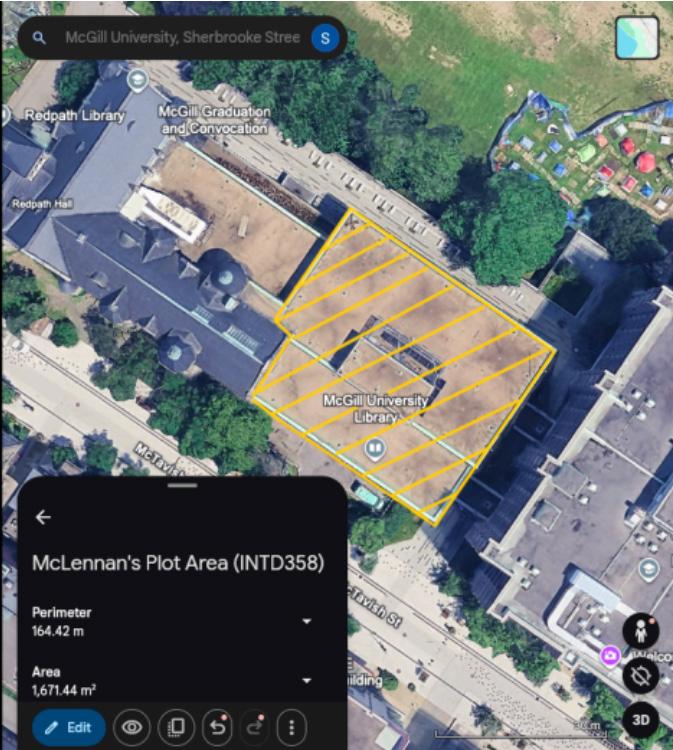
Area = 1671.44 m2
Appendix B: Formula for Calculating Floor Space Index (Sobha, 2024)
FSI = Built-Up Area Plot Area
Where Built-Up Area is equal to the plot area multiplied by the total floor area, or plot area multiplied by the number of floors (if all floors are equal).
Appendix C: Calculating McLennan’s Current and Increased Floor Space Index
Current FSI:

Main Formula: FSI = Built-Up Area
Plot Area
Plot Area (from Google Earth) = 1,671.44m2
Built-Up Area = 1,671.44 7 (number of floors, from McGill Libraries website) = 11,700.08m2
FSI = 11,700.08m21,671.44m2
McLennan’s FSI ≈ 7 (if all floors are equal in space)
Increased FSI:
Dharavi’s FSI increase was 200-300%, therefore a 250% increase is calculated for McLennan
New Floor Space Index = Current FSI 2.5 = 7 2.5 = 17.5
Increased FSI = 17.5 + 7 = 24.5
Therefore, McLennan’s increased FSI is equal to 24.5, an additional 17.5 floors.



Human Trafficking of Indigenous Women and Girls in Canada: A Gendered, Racialised,
and Colonial
Violation of Human Rights
by Wendy Lin
AAbstract
lthough Canada is classified as a Tier 1 country that fully meets the minimum standards in eliminating human trafficking, human trafficking still occurs, with 3,996 incidents reported to police services and 3,103 victims of reported incidents detected between 2012 and 2022.1 Of these incidents, 94% of the victims affected were women and girls, with 82% of the persons accused of human trafficking being men.2 While dominant discourses, international actors, and Canada itself do indeed recognize women as disproportionately targeted victims of human trafficking, they often only focus on cases of transnational trafficking, failing to account for domestic trafficking cases. Moreover, these bodies fail in recognizing the disproportionate targeting of Indigenous women in particular: although Indigenous women make up only 4% of the Canadian population, roughly 50% of trafficking victims are Indigenous women.3 The harmful legacies of colonialism are evident in the policing of human trafficking cases involving Indigenous women, as these scars impact their disproportionate targeting, their racialized disparity of resources, and the public’s view on such cases.
This essay investigates the human trafficking of Indigenous women in Canada through a framework of understanding that emphasizes the influence of colonialism in the human trafficking of Indigenous women–biased laws and violence are shaped by colonial roots, and these roots influence the lack of accountability, systems, and resources for trafficked Indigenous women. Drawing on the works of Guerrero, Mibenge, and Crawley, this essay provides a contextualization of human trafficking of Indigenous women in Canada as a gendered, classist, colonial, and racialized violence. While these three authors’ works do not necessarily connect to Canada, their studies contribute to understanding the ways that violence against marginalized populations, specifically women, Indigenous peoples, and Indigenous women, is unrighteously normalized and reinforced at both the domestic and international levels, and present learned experiences and means of tackling this pressing violation of human rights domestically.
Résumé
Bien que le Canada soit classé comme un pays de niveau 1, répondant pleinement aux normes minimales en matière d’élimination de la traite des êtres humains, ce phénomène persiste. 3 996 incidents ont été signalés aux services de police et 3 103 victimes ont été identifiées entre 2012 et 2022.1 Parmi ces incidents, 94 % des victimes étaient des femmes et des filles, et 82 % des personnes accusées de traite étaient des hommes.2 Si les débats dominants, les acteurs internationaux et le Canada lui-même reconnaissent effectivement que les femmes sont des cibles disproportionnées de la traite, ils se concentrent souvent uniquement sur les cas de traite transnationale, négligeant ainsi la
1 US Department of State, 2024 Trafficking in Persons Report: Canada, (2024), 3.
2 Public Safety Canada, About Human Trafficking, last modified January 20, 2026.
3 Ariana Roudometkina and Kim Wakeford, Trafficking of Indigenous Women and Girls in Canada: Submission to the Standing Committee on Justice and Human Rights. Pdf. Ottawa: Native Women’s Association of Canada (2018).
traite interne. De plus, ces instances échouent à reconnaître la cible disproportionnée que représentent les femmes autochtones : bien qu’elles ne constituent que 4 % de la population canadienne, environ 50 % des victimes de traite sont des femmes autochtones.3 Les héritages nocifs du colonialisme sont clairs dans la gestion policière des cas de traite impliquant des femmes autochtones. En effet, ces séquelles ont un impact sur leur ciblage disproportionné, sur les disparités racialisées en matière de ressources et la perception publique de ces affaires.
Cet essai examine la traite des femmes autochtones au Canada à travers un cadre d’analyse mettant en lumière l’influence du colonialisme dans ce phénomène. Les lois biaisées et la violence sont façonnées par des racines coloniales, qui expliquent le manque de responsabilité, de systèmes et de ressources pour les femmes autochtones victimes de traite. En s’appuyant sur les travaux de Guerrero, Mibenge et Crawley, cet essai contextualise la traite des femmes autochtones au Canada comme une violence genrée, classiste, coloniale et racialisée. Bien que les études de ces trois autrices ne portent pas spécifiquement sur le Canada, elles éclairent les mécanismes par lesquels la violence envers les populations marginalisées, en particulier les femmes, les peuples autochtones et les femmes autochtones, est injustement normalisée et renforcée aux niveaux national et international, tout en proposant des pistes pour lutter contre cette grave violation des droits humains sur le plan domestique.
Introduction
Guerrero’s study of Native American women’s feminism acknowledges the double burden of sexism and racism that Native American women face, while emphasizing the harmful effects that colonial stereotypes of Native American women as exotic and erotic have in promoting violence towards them. Her summary of American colonialism’s lasting scars on Native American women is compared and contrasted with Indigenous women in Canada’s experiences, particularly in the ways that colonialism has influenced the image of Indigenous women.
Mibenge’s analysis of international laws’ progression in prioritising women as a primary group in human rights discourse demonstrates the extent of gendered violence in human rights as she calls for a prioritisation of gender as an analytical method in the study of discrimination. In aligning Canada’s current legislation and human rights language with Mibenge’s tiers of progressions, this essay calls for further development and adjustments within Canada’s approach to human trafficking of Indigenous women to encompass characteristics of the third tier–consider intersectionality and punish violence conducted in private spheres.
trators of violence towards women of colour. Although Crawley’s work concerns visible minority refugee women and not Indigenous women, her study can be used to understand the Canadian regime’s framing of ‘victims’ within the human trafficking discourse as they antagonize the wrong perpetrators of human trafficking and fail to recognise the ways that their own colonial legacy impacts these views—Canadian preventions of human trafficking fail to account for Indigenous women, and further oppresses them and Indigenous men as perpetrators of their own violent traumas.
‘Human Trafficking’ According to Canada
The UN Protocol to Prevent, Suppress, and Punish Trafficking in Persons, Especially Women and Children’s definition of human trafficking was ratified by Canada in 2003.
The protocol defined trafficking as: the threat or use of force or other forms of coercion, of abduction, of fraud, of deception, of the abuse of power or of a position of vulnerability… to achieve the consent of a person having control over another person, for the purpose of exploitation.4
Crawley accuses white feminist approaches of having a colonial blind spot, as they do not recognize the ways that colonialism affects the international refugee regime. She argues that white feminisms reinforce racialized representations of men of colour, painting them as perpe4 Anette Sikka, "Trafficking of Aboriginal Women and Girls in Canada.” Aboriginal Policy Research Consortium International (APRCi) (2010), 203.
This definition was integrated into various legislations, such as the Immigration and Refugee Protection Act (IRPA), but with broadened definitions of trafficking to include the abduction of victims. By 2005, the offence of trafficking was incorporated into the Canadian Crim-
inal Code, which considered “every person who recruits, transports, transfers, receives, holds, conceals, or harbours a person…for the purpose of exploiting them” to be guilty of trafficking.5 Sikka posits that although these definitions show developments in the definitions of trafficking, dominant discourses in both international spheres and domestic agendas have, and still do, regard human trafficking primarily as a cross-border activity, as they focus on the prevention of the forced transfer of persons. Until a consensus is reached in regards to the definition of trafficking, and until the domestic cases of human trafficking are included in this dialogue, a significant demographic of victims will inevitably be left excluded and unprotected, many of whom are Indigenous women.6 The consensus in a definition of trafficking involves three significant terms, which will be explored each in relation to each author’s work: ‘human trafficking,’ ‘victims,’ and ‘criminalisation.’
Colonial Legacies on the Image of Indigenous Women
As a settler colonial state, Canada’s colonial history stems beyond the physical colonization of land and peoples, to an intergenerational apathy in the criminal justice system towards the violence of Indigenous women.7 Sikka asserts that the harsh histories of Indigenous peoples being bought and sold into slavery left many scars on Indigenous women and their image, stating that “the assertion of ownership over Aboriginal women has manifested itself as a right for others (white male settlers) to determine the appropriate…value of Aboriginal women…[they] have been viewed as dirty, criminal, and sexually available.”8 Through colonisation, traditional, spiritual and intellectual values of Aboriginal women were uprooted and replaced “with notions of inferiority, hierarchy, and the paradigm of women as property.”9 She raises the image of the ‘squaw’ to illustrate this harsh image imposed upon
5 Sikka, 204
6 Sikka, 205.
7 Sikka, 201.
8 Sikka, 207.
9 Sikka, 207.
10 Sikka, 207.
11 Sikka, 207.
Indigenous women—“the female counterpart” to the Indigenous male ‘savage.’10 The term ‘squaw’ is used by white settlers to dehumanise Indigenous women: ‘squaws’ are seen to have “no human face, she is lustful, immoral, unfeeling, and dirty.”11
Guerrero: Native Feminist Spirituality
Guerrero’s “Patriarchal Colonialism and Indigenism” analyses Native American women’s perspective on feminism by analyzing the ways that Eurocentric, patriarchal systems complicate their understandings of feminism: she posits that although Western feminism sought equality, it only sought equality between white men and white women, and excluded Indigenous peoples and other people of colour from the conversation. Guerrero promotes a concept of “Native Feminist Spirituality,” which bridges Indigenism and Ecofeminism in postcolonialist reconciliation.12 I apply Guerrero’s understanding to propose alterations to the Canadian approach in defining, reconciling, and ending the human trafficking of Indigenous women. Although Guerrero’s study focuses on a different demographic—Native American women, as opposed to Indigenous women in Canada—her research complements this essay’s call for change in the images associated with Indigenous peoples, particularly women, in discourses of human trafficking.
The myth of tribalism has permeated much of Canadian history, and still continues to do so today: Guerrero raises Native Americans’ understandings of their communities as ‘a people’ in contrast to Western assumptions of their populations as ‘tribes.’13 In terming Native American peoples as ‘tribes,’ they are seen as “dependent… with inferior cultures as compared to the Euroamerican dominant culture.”14 Tribalism affects Indigenous women particularly, framing them as being “exotic and erotic” and as a group of animals to be owned and tamed.15 In tribalizing Native American women, Guerrero states that
12 Jaimes Guerrero, “Patriarchal Colonialism’ and Indigenism: Implications for Native Feminist Spirituality and Native Womanism.” Hypatia 18, no. 2 (2003): 67.
13 Guerrero, 59.
14 Guerrero, 60.
15 Guerrero, 59.
the dominant culture fails to account for themes of Indigenous kinship, which include “communalism; egalitarianism; reciprocity with each other and with nature; and a complementary relationship between women and men, with special respect granted to children and elders.”16 This tribalism bleeds into Canada’s ignorant approach towards the human trafficking of Indigenous women, as the nuances of Indigenous kinship are overlooked as spaces to be full of “contractual violence [that] can happen with impunity.”17
Guerrero proposes Native Feminist Spirituality as a way to combat the violence that comes from tribalism: emphasising the differences in the definition of ‘indigenism’ for Native peoples and Western populations, she states that for Westerners, indigenism might only imply the birth of a place, but for Native peoples, it means “to live in relationship with the place where one was born.”18 In manifesting this indigenism with Native Womanism, which rejects the image of Native American women as exotic and erotic figures to be tamed and exploited, she calls for a restoration of the female principle through an intersection of genocide and ecocide—the destruction of both a people and their cultures—effectively broadening the study of Native American women’s struggles with the dominant sphere as they navigate the influences of American patriarchal colonialism.19
Native American women’s fight against American patriarchy and colonialism bears many resemblances to Indigenous women’s battle against Canada’s colonial impacts. Guerrero’s proposed Native Feminist Spirituality can be applied to Canada’s approach towards recognizing the human trafficking of Indigenous women as a targeted and discriminatory crime. The image of the Indigenous ‘squaw’ is to be dismantled, as well as the assumption that Indigenous peoples and spaces are primitive.
Defining ‘Victims’
Sikka also raises the issue of the definition of the ‘victim’ in discussions of human trafficking. She finds that
16 Guerrero, 65.
17 Sikka, 208.
18 Guerrero, 66.
19 Guerrero, 67.
20 Sikka, 206.
21 Sikka, 206.
22 Crawley, 358.
23 Crawley, 356.
media portrayals of human trafficking often depict ‘victims’ as “entirely under the control of their captor…completely devoid of choice or agency” and unlucky targets of organized crime and sexual exploitation.20 As such, the media differentiates ‘victims’ of human trafficking from consenting sex workers as “foreign, meek, subdued… and thrilled to be saved from her captor.”21 Any deviants from the above criteria are thus not considered as ‘true’ victims, and left without the state’s protection from trafficking. As such, Indigenous women are excluded from this categorization, for Canada’s colonial legacy has imposed on them dehumanizing characteristics of both lustful squaws and pieces of property to be owned—instead of being seen as victims of human trafficking and colonialism, Indigenous women are seen as the perpetrators of their own violent fates.
Crawley: Gendered and Racialised Politics of Protection of ‘Victims’
Although Crawley’s work focuses on transforming the dialogue of refugee women’s protection, her analyses can be applied to the discussion on the contradictory nature of Indigenous women’s statuses as both non-victims under the Canadian government’s prevention of human trafficking, as well as victims and perpetrators at the hands of their own people. Emphasizing that ‘white feminism’ is not necessarily about race, but about privilege, Crawley argues that white feminism creates a worldview that assumes Western values to be superior, as it rejects all other women who do not align with the Western idea of a “modern, educated, sexually liberated women.”22 Crawley finds that white feminism’s intervention in the construction of ‘refugee women’ in international efforts to bring women’s experiences of refugeehood to light has actually created a larger gendered disparity, as women are positioned to be “victims’ of male (often sexual) violence,”23 resulting in the broader political context that actually circulates the violence against refugee women to become overlooked. She furthers her argument by stating that “refugee
protection becomes a mechanism for ‘saving brown women from brown men’ in ‘backward’ and ‘primitive’ societies,”24 She calls for a rejection of gendered and racialised stereotypes as Guerrero does, bringing the example of the Muslim woman’s hijab as a symbol that white feminism has interpreted as sexist and a violation of female power, although many Muslim women use the hijab not only as an indicator of their religious identity but a way to use modest dress to free themselves from men’s enslavement.25 In short, white feminist interpretation of women as ‘victims’ reinforces gendered and racialized stereotypes, further limiting the possibilities of protection. Crawley also calls for a better understanding of Global South women’s experiences as “embedded in systems and structures, inequalities and oppressions, rather than focusing…on their identities as women.”26
Canada’s recognition of women as a demographic disproportionately affected by human trafficking is not enough. A recognition of the colonial structures that promote violence against Indigenous women and the colonial influences that have resulted in barriers and a lack of resources for Indigenous women to seek help is necessary. Until these colonial systems are dismantled through the rejection of viewing Indigenous women as ‘exotic’ figures to exploit, Indigenous women will remain at disproportionate risks of human trafficking.
Defining ‘Criminalization’
The criminalization of human trafficking, particularly in cases involving Indigenous women, has also been influenced by colonialism. Sikka posits that the colonial impact of Indian Residential schools led to Indigenous women’s participation in the sex trade and other criminal behaviour, of which the disproportionate participation resulted in the normalization of Indigenous women in these violent spheres and situations. Cases of violence towards Indigenous women are so normalized that the criminal
24 Crawley, 358.
25 Crawley, 378.
26 Crawley, 378.
27 Sikka, 208.
28 Sikka, 208.
29 Sikka, 208.
justice system further victimises them by charging Indigenous women “when they are reacting to abuse or when they are reacting to the poor social conditions in which the double discrimination against them has left them.”27 Furthermore, the differentiation between “respectable” white neighbourhoods and violent, “racialised” areas also affects the criminalisation of human trafficking cases:28 Sikka claims that human trafficking “activities which take place in…degenerate spaces towards racialised bodies do not qualify as ‘trafficking,’ but are rather seen as a natural consequence of belonging to those spaces.”29 Cases of human trafficking of Indigenous women are not only dismissed due to the state’s assumption of racialized spaces as naturally violent, but also brushed aside, for Indigenous women do not fit the criteria of ‘victims’ and thus are deemed not in need of rescue.
Mibenge: Transforming the Dialogue
The failures of protecting women are defined by Mibenge as the continued violence towards women in conflicts of culture, arms and war, in which the subordination of women is not recognized as a violation of human rights.30 The continued violence in these spheres ranges in scale, and Mibenge highlights Richter’s study on rape survivors’ heightened awareness of “little rapes:”31 little rapes are defined as sexist interactions and comments that are only perceived as negative after the experience of rape. To combat this usage of violence as a strategy against women, Mibenge proposes the extension of human rights law into zones of conflict, and the failed results from typical legal applications of ‘formal equality’ and ‘single category axis.’ Formal equality implies an equality in rights and treatment between men and women, whereas the application of a single category axis describes the narrowly-pathed approach that lawmakers take in centering their responses towards the eradication of inequality and discrimination by pitting the “essentialised female…against an essen-
30 Chiseche Salome Mibenge, “The Women Were Not Raped: Gender and Violence in Butare-Ville,” in Sex and International Tribunals: The Erasure of Gender from the War Narrative (Philadelphia: University of Pennsylvania Press, 2013), 22.
31 Mibenge, 22.
tialised male.”32 Criticizing these two legal responses as reinforcing a “de jure equality between men and women,”33 Mibenge categorizes different international laws into three non-chronological tiers to explain their progressions in including women as a primary group within the discourse of gendered violence as a violation of human rights.
Canada’s progress largely reflects that of Mibenge’s second-tier categorization: Mibenge describes that in the second tier, women’s roles and expectations are considered as socially constructed, and the definition of discrimination is adjusted to include any exclusion made on the basis of sex.34 A big constituent of the second tier that differentiates it from the first tier is that it recognizes gender roles and expectations as social constructions that prevent women’s enjoyment of their human rights.35 However, the second tier still lacks the nuanced prioritization of the third tier, which considers gender as an element to be analyzed in the study of discrimination. In order to progress from the second to the third tier, Mibenge argues that gender should be prioritized as a factor that influences discrimination and violence within private spheres should be included as violations of human rights, and state obligations in protecting victims and punishing abusers should be enforced.36
Mibenge’s three-tiered categorization of international laws’ progression in prioritizing gender as a means of understanding gender discrimination can be used to encourage the Canadian government’s recognition of Indigenous women as a particularly vulnerable, yet representative demographic within the study of gendered violence as it pertains to human trafficking. Canada must look through an intersectional lens that considers Indigenous women’s Indigenous identities, their gender, as well as their class, which is heavily impacted by colonialism. As Canada’s current legislation and attitudes reflect the characteristics of Mibenge’s second tier, it could be persuaded to adopt changes in prioritising gender as an element to analyse in the crime of discrimination, as well as endorse stricter punishments for the private violations of human rights.
Conclusion
In order to combat the targeted human trafficking of Indigenous women in Canada, the Canadian government and peoples must dismantle the colonial legacies that impact the laws and legislations, dominant discourses and attitudes, as well as the resources for Indigenous women. By applying the three authors’ works to reframe our understandings of the links between colonialism and gendered violence, the Canadian government is capable of reducing, and potentially eliminating, the human trafficking of Indigenous women. Harmful stereotypes and images of Indigenous women as ‘squaws’ to be tamed and exploited must be rejected. Indigenous women are to be understood through a lens of Native Feminist Spirituality, which acknowledges their nuanced culture that is communal, egalitarian, and reciprocal. Any notion that suggests Indigenous cultures are inferior to Western ones must be rejected, whether that be in the image of Indigenous women or the approach to ending the human trafficking of this particular demographic. Intersectional identities must be prioritized, especially when defining terms of ‘human trafficking,’ ‘victims,’ and ‘criminalization.’ The pitting of women against men, and Indigenous women against white women, is not conducive to the eradication of human trafficking. By inundating the discourse of human trafficking with terminology that is exclusive of the plethora of victims who do not fit the law’s definition, Indigenous women find themselves at risk of more exploitation, for they are not considered victims by the governing bodies. Lastly, accountability must be ensured in both public and private spaces. From microaggressions and ‘little rapes’ to the physical trafficking of Indigenous women, violent actions and interactions of any size and scale are to be acknowledged and punished.
32 Mibenge, 25.
33 Mibenge, 25.
34 Mibenge, 31.
35 Mibenge, 31.
36 Mibenge, 39.
Bibliography
Crawley, Heaven. “Saving Brown Women from Brown Men? ‘Refugee Women’ Gendered Racialized Politics of Protection.” Refugee Survey Quarterly 41 (2022): 355-380.
Guerrero, Jaimes. “Patriarchal Colonialism’ and Indigenism: Implications for Native Feminist Spirituality and Native Womanism.” Hypatia 18, no. 2 (2003): 58-69.
Mibenge, Chiseche Salome. “The Women Were Not Raped: Gender and Violence in Butare-Ville.” In Sex and International Tribunals: The Erasure of Gender from the War Narrative, 21-59. Philadelphia: University of Pennsylvania Press, 2013. Public Safety Canada. About Human Trafficking. Pdf. Last modified January 20, 2026. https://www.publicsafety.gc.ca/cnt/cntrng-crm/ hmn-trffckng/abt-hmn-trffckng-en.aspx
Roudometkina, Ariana and Wakeford, Kim. Trafficking of Indigenous Women and Girls in Canada: Submission to the Standing Committee on Justice and Human Rights. Pdf. Ottawa: Native Women’s Association of Canada (2018). https://www.ourcommons.ca/Content/Committee/421/JUST/Brief/BR10002955/br-external/NativeWomensAssociationOfCanada-e.pdf
Sikka, Anette. "Trafficking of Aboriginal Women and Girls in Canada.” Aboriginal Policy Research Consortium International (APRCi) (2010): 201-231.
U.S. Department of State. 2024 Trafficking in Persons Report: Canada. Pdf. 2024. https://www.state.gov/reports/2024-trafficking-in-persons-report/canada/



Evaluating the Effectiveness of School Attendance Conditionalities in Brazil’s Bolsa Familia Program
by Ayesha Rahim
TAbstract
his paper evaluates the effectiveness of school attendance conditionalities in Brazil’s Bolsa Família Program (BFP) in reducing poverty and promoting long-term social development. It argues that, compared with health checkup conditionalities, education requirements are more effective in helping families break cycles of intergenerational poverty by improving school enrollment, attendance, and retention. Using a mixed-methods approach, the paper combines quantitative data from program reports and academic studies with qualitative evidence from expert analyses, case studies, and household experiences. The findings show that Bolsa Família has increased school participation, particularly among low-income and secondary-level students, while encouraging families to prioritize education over short-term economic pressures such as child labor. However, the paper also shows that the effectiveness of these conditionalities is uneven across Brazil. Regional inequalities, limited school infrastructure, transportation barriers, and differences in educational quality reduce the program’s impact, especially in rural and poorer areas. Ultimately, the paper concludes that school attendance conditionalities are one of Bolsa Família’s most successful features, but their long-term effectiveness depends on stronger structural support, including investment in rural education, reduced schooling costs, and improved learning conditions.
Résumé
Cet article évalue l’efficacité des conditionnalités de fréquentation scolaire dans le cadre du programme brésilien Bolsa Família (BFP) pour réduire la pauvreté et favoriser un développement social à long terme. Il soutient que, comparées aux conditionnalités liées aux contrôles médicaux, les exigences en matière d’éducation sont plus efficaces pour aider les familles à rompre les cycles de pauvreté intergénérationnelle, en améliorant l’inscription, la fréquentation et la rétention des élèves à l’école. En utilisant une approche mixte, ce document combine des données quantitatives issues de rapports de programme et d’études académiques avec des preuves qualitatives tirées d’analyses d’experts, d’études de cas et d’expériences des ménages. Les résultats montrent que Bolsa Família a accru la participation scolaire, en particulier parmi les élèves issus de milieux défavorisés et ceux du secondaire, tout en incitant les familles à privilégier l’éducation au dessus des pressions économiques à court terme, comme le travail des enfants. Cependant, le document révèle également que l’efficacité de ces conditionnalités est inégale à travers le Brésil. Les inégalités régionales, les infrastructures scolaires limitées, les obstacles liés aux transports et les disparités en matière de qualité de l’éducation réduisent l’impact du programme, notamment dans les zones rurales et les régions les plus pauvres. En fin de compte, le document conclut que les conditionnalités de fréquentation scolaire constituent l’un des aspects les plus réussis de Bolsa Família, mais que leur efficacité à long terme dépend d’un soutien structurel plus solide, incluant des investissements dans l’éducation rurale, une réduction des coûts de scolarisation et une amélioration des conditions d’apprentissage.
Introduction
The Bolsa Familía Program (BFP) is Brazil’s largest and most well-known conditional cash transfer (CCT) program, launched under Lula’s presidency in 2003 to reduce poverty and inequality nationwide. It was developed in response to high poverty and social inequality rates by providing direct financial help to low-income families through Conditional Cash Transfers (CCTs). To receive these benefits, households must meet health and education requirements, such as minimum attendance rates and health checkups. While health checkup conditionalities for women have been critiqued for reinforcing traditional caregiving roles, school attendance conditionalities for children offer an alternative approach to the program. School attendance conditionalities are specifically important because they focus on children, the future of Brazil. As former President Luiz Inácio Lula da Silva said, “Education should be accessible to all who wish to study and have the capability, regardless of social class,”1 highlighting how education is not just a right but the foundation of a stronger Brazil. Education equips the next generation with skills to break cycles of intergenerational poverty while also aligning with global objectives, such as the United Nations Sustainable Development Goal 4: “ensuring inclusive and equitable quality education for all.”
These conditionalities ensure that children regularly attend school, which in turn improves literacy, critical thinking skills, and future opportunities. However, through the costs and benefits of the health conditionality, the success of these requirements depends on structural factors like access to schools, the quality of education provided, and the socioeconomic circumstances of participating households. Additionally, the use of both quantitative data, like enrollment and retention rates, and qualitative perspectives, such as household attitudes toward education, is essential to holistically understand how different target populations experience the program.
impact of these conditionalities on different populations, I will identify barriers, even offering insights to stakeholders. Ultimately, I aim to show how education conditionalities, such as school attendance rates, contribute to sustainable development, not only in Brazil but in other Global South development projects.
Methodology
My evaluation uses a mixed methods approach by integrating both quantitative and qualitative data to understand how the education conditionalities influence short-term attainable educational outcomes and contribute to long-term holistic development. Quantitative data will be taken from program reports, government evaluations, and academic studies. These sources provide statistics on enrollment and retention rates and will highlight the measurable impacts of the conditionalities of school attendance. I will use this data to evaluate the overall effectiveness of the conditionalities in improving access to education and reducing dropout rates across different regions of Brazil. Along with this, qualitative data will also be used, such as expert analyses, case studies, and direct household perspectives. These stories give important insight into how families view and experience the school attendance requirements, providing more depth to my analysis instead of just statistical data. By taking qualitative data into account, I will explore how fair and accessible the educational conditions really are in effect.
Finally, I will compare the impact of school attendance conditions in different regions of Brazil, accounting for socioeconomic disparities and their differing access to quality education. This comparison will highlight the various obstacles that make the conditionalities less effective and suggest improvements to promote lasting development.
Background/Context
In this evaluation, I argue that school attendance conditionalities are more effective than health checkup conditionalities, specifically by improving education and helping families break the cycle of poverty. However, I also argue that their success is not uniform and varies across Brazil’s regions and social groups. By evaluating the 1 Reuters, “Reuters Checagem de Fatos | Reuters,” Checagem de fatos: Lula disse que elite política, não ele, pensa que “universidade foi feita para rico,” June 14, 2024.
The Bolsa Familia Program (BFP) is a key part of Brazil’s efforts to reduce poverty and inequality through conditional cash transfers (CCTs). Within the program, health and education were the main focuses. As previously explored, while the health conditionalities, through the form of health check-ups, significantly improved ma-
ternal and child health, they were accompanied by costs such as limited autonomy and additional caregiving burdens on women. That said, while health conditionalities are important for immediate family health, the program’s school attendance conditionalities may be more effective in breaking the cycle of poverty. Ensuring that children stay in school clearly impacts future employment opportunities, making it one of the program’s most successful components. The success of the school attendance requirement highlights how this aspect of Bolsa Família could be productively revisited to ensure long-term benefits. As Paes-Sousa and Vaitsman explain, the BFP aims to provide “protection against various types of vulnerability, expansion of family incomes, promotion of food security and development of human capital.”2 By “the development of human capital,” they are referencing the school attendance conditionalities, which are central to reducing poverty and promoting human development.
These requirements ensure a “minimum school attendance of 85% for children between 6 and 15 years of age and minimum school attendance of 75% for adolescents of 16 and 17 years of age.”3 According to BFP guidelines, these conditionalities aim to improve literacy rates, reduce school dropout levels, and “produce a more educated and better trained generation of young people capable of more fully exercising citizenship and entering the job market.”4 Moreover, with over 17 million children monitored across 160,000 schools in Brazil’s 5,570 municipalities, the level at which this initiative illustrates its importance in addressing Brazil’s educational challenges.5 By keeping children in school, Bolsa Família helps families prioritize education over short-term economic pressures, such as child labor being the solution to broader social issues.
Before the BFP’s introduction, Brazil faced severe educational challenges, such as historically low school enrollment and high dropout rates, especially in low-income communities. In 1997, the primary education system had
a dropout rate of 4% and a grade repetition rate as high as 23%, discouraging students and leading to further dropouts.6 Cardoso and Verner conclude that this contributes to more dropouts and low educational attainment among Brazil’s poorest communities, forming a continuous cycle. These patterns left many of Brazil’s poorest communities trapped in cycles of low educational attainment and limited opportunities. Moreover, schools, especially in rural areas, often lack adequate resources, qualified teachers, and proper infrastructure, deepening regional inequalities.7 These systemic barriers stressed the urgent need for Bolsa Familia, to provide financial incentives for school attendance and tackle Brazil’s longstanding education crisis.
Effectiveness of School Attendance Conditionalities
The educational attendance requirements of Bolsa Familia have played a crucial role in boosting enrollment and retention rates for children from low-income families, marking an important step in breaking the cycle of poverty. According to Hayley Jones (2016), “The empirical evidence on the BFP supports a positive impact on enrolment and attendance rates, particularly at the secondary level, with studies estimating a 2 and 3 percent increase in school attendance and enrolment, respectively, as a result of the program.”8 Jones highlights how the BFP’s educational conditionalities effectively address education access disparities and foster long-term social development. These statistics demonstrate the program’s success in bridging the educational access gap, specifically for secondary students, where dropout rates are generally higher. By making school attendance a conditionality for financial aid, Bolsa Familia encourages families to prioritize education, thus contributing to sustainable social development.
Furthermore, Glewwe and Kassouf (2012) found that Bolsa Familia boosted school enrollment by 5.5% after three years,9 highlighting the positive effect BFP had on
2 Rômulo Paes-Sousa and Jeni Vaitsman, “The Zero Hunger and Brazil without Extreme Poverty Programs: A Step Forward in Brazilian Social Protection Policy,” Ciência & Saúde Coletiva 19, no. 11 (2014): 4352.
3 Daniel Ximenes, "Bolsa Família: Education and Conditionalities." Presentation at Stanford University (2020), 6.
4 Ministry of Education, "BFP Conditionalities: Results of Monitoring." Social Protection Portal (2017), 1.
5 Ministry of Education, 1.
6 World Bank, "Dropout and Grade Repetition in Brazil's Primary Education: Causes and Consequences." World Bank (2007), 2.
7 Simon, Schwartzman. The Challenges of Education in Brazil (Oxford: Symposium Books, 2003), 5.
8 Hayley Jones, “More Education, Better Jobs? A Critical Review of CCTs and Brazil’s Bolsa Família Programme for Long-Term Poverty Reduction.” Social Policy and Society 15, no. 3 (2016), 472.
9 Paul Glewwe and Ana Lucia Kassouf, "The Impact of Bolsa Família on Education Outcomes: Evidence from Brazil." Economics of Educa-
enrollment and attendance rates. Increasing pressure on attendance requirements has led to fewer absences, meaning more children, especially those from low-income communities, can thrive in school and achieve their full potential. In many low-income families, children often become additional sources of income and start working at a very young age, which can prevent them from getting an education. The CCT aspect of Bolsa Familia alleviates this pressure by providing financial support to families while encouraging their children to focus on their education. While these quantitative achievements showcase the BFP’s success in making education more accessible, they do not completely reflect the real experiences of families. As Teresa Sacchet explains, “the pressure on beneficiaries and the stress generated by the fear of losing the benefit causes much of their day to be spent worrying about their responsibilities and supporting their families.”10 This “stress,” which often affects women more than men, highlights how families sometimes struggle to meet program requirements along with financial issues. However, these conditionalities also offer support that helps families prioritize education and focus on long-term benefits over short-term needs. Jesiel Viana, who grew up in a low-income family in Piauí, explains that even though he faced challenges like unreliable electricity and tough economic times, the BFP helped him stay in school and solely focus on his education. As a result, he became an engineer and professor, highlighting how the BFP’s school conditionalities produce educational opportunities and “pave the way for a brighter future.”11 Viana’s story is one of many from the BFP, highlighting how school attendance conditionalities improve educational access and open doors to new opportunities.
By fostering a culture of education within low-income families, the program has contributed to reshaping societal attitudes toward education, especially for girls. Sacchet argues that “education is a transformative tool for gender equity, enabling girls to access opportunities traditionally tion Review 31, no. 2 (2012), 355.
denied to them.”12 Bolsa Familia has encouraged higher school attendance among female students, simultaneously solving social issues like child marriage and birth, while giving young girls autonomy.
Comparative Analysis
Regional and socioeconomic disparities within Brazil’s education system affect the effectiveness of Bolsa Familia’s school attendance conditionalities. These disparities show how the BFP impacts recipient families unevenly across different contexts based on geography, socioeconomic status, and infrastructure.
Regional and Socioeconomic Disparities in Outcomes
Brazil’s diverse geography and socioeconomic factors lead to differences in the effects of school attendance conditionalities on families. In rural regions, challenges like inadequate infrastructure and unreliable transportation create barriers for the program’s effectiveness. According to a report from the Centre for Public Impact, “the differences in quality of care and education further increase geographic disparities in Brazil.”13 Families living in these areas frequently have to travel long distances to access the nearest school, facing an added challenge due to limited public resources and inconsistent program administration. On the other hand, in urban areas, while infrastructure may be generally better, issues like overcrowded classrooms and educational quality disparities remain. Another Centre for Public Impact report states, “high levels of hunger, poverty, and inequality defined urban life in many densely populated cities in Brazil.”14 These factors challenge equitable access to quality education, which in turn worsens socioeconomic inequalities.
Moreover, socioeconomic disparities also affect Brazilian families’ experiences with Bolsa Família’s school attendance conditionalities. According to Jones (2016), “challenges such as congested classrooms and unequal quality of education continue to limit the program’s impact.”15
10 Teresa Sacchet, “Beyond Distribution: Issues of Gender Justice in Fighting Poverty in Brazil,” in Women, Gender and Conditional Cash Transfers: Interdisciplinary Perspectives from Studies of Bolsa Família, ed. Teresa Sacchet, Silvana Mariano, and Cássia Maria Carloto (New York: Routledge, 2021), 33.
11 El País, "Gracias a Bolsa Familia, Menos Hijos Heredan la Miseria en Brasil." El País América (Madrid, Spain), 2024.
12 Sacchet, 52.
13 Centre for Public Impact, "Bolsa Família in Brazil." Centre for Public Impact, accessed December 2024.
14 Centre for Public Impact.
15 Jones, 470.
Jones highlights that families with more resources, such as access to better schools or transportation, are able to benefit from the program fully. This ties closely to geographic disparities, with families in rural areas like the North and Northeast of Brazil often having lower incomes as they are mainly in the agricultural field. As a result, education may be less of a priority compared to meeting immediate financial needs. In contrast, families in the South, where jobs pay more and are industrialized, tend to have higher incomes and thus have the ability to follow the school attendance conditionality and prioritize education. These differences show us that while Bolsa Família aims to promote equality, persistent structural inequalities such as regional disparities affect its effectiveness.
Limitations
While Bolsa Familia’s school attendance requirements have helped boost enrollment rates, they still struggle to tackle educational inequalities. In many rural areas, schools sometimes face challenges with having enough resources, trained teachers, and proper infrastructure, minimizing the impact of the BFP. For example, “71.3% of Bolsa Família beneficiary students in the Northeast region completed basic education by age 15,” compared to 64% of other public school students.16 This data shows that the program is progressing in closing the education gap, but it also has limitations. It indicates that although attendance might improve, important structural challenges, such as resource limitations, teacher shortages, and regional inequalities, continue to hold back fair educational opportunities for everyone. This limitation highlights the importance of the BFP in encouraging school attendance and tackling the challenges that limit progress, especially in low-income communities.
Additionally, traditional gender roles can significantly impact the effectiveness of the program, especially for girls. Household dynamics and social stereotypes often limit young girls from attaining higher levels of education beyond basic schooling. A study by de Brauw shows that Bolsa Familia helped increase school participation among girls by 8.2%.17 This shows that traditional gender roles and societal expectations can hold back girls from
fully benefiting from education past basic schooling, despite their increasing participation rates. While the program’s requirements seem to help boost school attendance among girls, it is evident that efforts to tackle cultural norms need to be made to fully ensure long-term success and opportunities.
Conclusion
It is evident that the Bolsa Familia Program’s school attendance requirements effectively reduce poverty and create the foundation for sustainable social development in Brazil. Quantitative data show attendance improvements, while qualitative data suggest a change of attitudes towards education and schooling within household dynamics. Nonetheless, regional and socioeconomic disparities, such as poor infrastructure and limited resources across different regional and geographic landscapes in Brazil, limit its effectiveness. Moreover, the quality of education is often lacking due to a dearth of resources, preventing the program from achieving long-term success. To address these challenges, I suggest a few key changes. Firstly, investments in rural education infrastructure are important to improving school facilities, hiring trained teachers, and providing student transportation. The program should also help families with indirect schooling costs like transportation and supplies, which are still a financial barrier for many families. Finally, tying attendance requirements to efforts that improve learning outcomes, such as measuring overall academic performance, will ensure that students gain the skills they need beyond just physically attending school.
By addressing these gaps, Bolsa Familia can enhance its position as a global example of an effective social protection program, specifically how school attendance conditionalities and quality measures can contribute to sustainable development. Therefore, while health conditionalities are important for immediate family health, the program’s school attendance conditionalities are more effective in breaking the cycle of poverty. Ensuring children stay in school impacts future employment opportunities, making it one of the program’s most successful components. In this way, Bolsa Família, literally translated to
16 Social Protection Secretariat, “Bolsa Família Conditionalities: Results of Education Monitoring,” socialprotection.org (Brasil: Ministry of Social Development, 2017), 10.
17 Alan de Brauw et al. "The Impact of Bolsa Família on Education and Health Outcomes in Brazil." SSRN Electronic Journal (2015), 23.
“Family Allowance,” fulfills its purpose by providing financial support and empowering families to achieve a brighter future. As President Luiz Inácio Lula da Silva stated, “Education is the most powerful weapon to transform the world.”18
18 Luiz Inácio Lula da Silva, "Speech on Education." Brasil: 2023.
Bibliography
Centre for Public Impact. "Bolsa Família in Brazil." Centre for Public Impact. Accessed December 2024. https://centreforpublicimpact.org/case-study/bolsa-familia-in-brazil.
CGTN America. "The Heat: Brazil’s Bolsa Familia Pt 1." Video, September 15, 2024. https://www.cgtnamerica.com/. de Brauw, Alan, Daniel O. Gilligan, John Hoddinott, and Shalini Roy. "The Impact of Bolsa Família on Education and Health Outcomes in Brazil." SSRN Electronic Journal (2015). https://papers.ssrn.com/sol3/papers.cfm?abstract_id=2405714. de la Brière, Bénédicte, and Kathy Lindert. “Social Protection Unit, Human Development Network.” World Bank (2005). El País. "Gracias a Bolsa Familia, Menos Hijos Heredan la Miseria en Brasil." El País América, September 1, 2024. https://elpais.com/ america/2024-09-01/gracias-a-bolsa-familia-menos-hijos-heredan-la-miseria-en-brasil.html.
Glewwe, Paul, and Ana Lucia Kassouf. "The Impact of Bolsa Família on Education Outcomes: Evidence from Brazil." Economics of Education Review 31, no. 2 (2012): 345–356.
Jones, Hayley. “More Education, Better Jobs? A Critical Review of CCTs and Brazil’s Bolsa Família Programme for Long-Term Poverty Reduction.” Social Policy and Society 15, no. 3 (2016): 465–78. https://doi.org/10.1017/S1474746416000087.
Ministry of Education. “BFP Conditionalities: Results of Monitoring.” Social Protection Portal (2017). https://socialprotection.org/ sites/default/files/publications_files/09.%20BFP%20Conditio nalities%20-%20Results%20of%20Monitoring.pdf.
Paes-Sousa, Rômulo, and Jeni Vaitsman. “The Zero Hunger and Brazil without Extreme Poverty Programs: A Step Forward in Brazilian Social Protection Policy.” Ciência & Saúde Coletiva 19, no. 11 (November 2014): 4351–60. https://doi.org/10.1590/1413812320141911.08812014
Reuters, “Reuters Checagem de Fatos | Reuters,” Checagem de fatos: Lula disse que elite política, não ele, pensa que “universidade foi feita para rico,” June 14, 2024, https://www.reuters.com/fact-check/portugues/.
Schwartzman, Simon. The Challenges of Education in Brazil. Oxford: Symposium Books, 2003.
Silva, Luiz Inácio Lula da. “Speech on Education.” Brasil: 2023.
Social Protection Secretariat. “Bolsa Família Conditionalities: Results of Education Monitoring.” socialprotection.org. Brasil: Ministry of Social Development, 2017. https://socialprotection.org/.
Teresa Sacchet, “Beyond Distribution: Issues of Gender Justice in Fighting Poverty in Brazil,” in Women, Gender and Conditional Cash Transfers: Interdisciplinary Perspectives from Studies of Bolsa Família, ed. Teresa Sacchet, Silvana Mariano, and Cássia Maria Carloto (New York: Routledge, 2021), 33.
United Nations. “Sustainable Development Goals: Goal 4 - Quality Education.” Accessed December 2024. https://sdgs.un.org/goals/ goal4.

World Bank. “Dropout and Grade Repetition in Brazil’s Primary Education: Causes and Consequences.” 2007. https://documents. worldbank.org/curated/en/850771468227650701/pdf/wps4178.pdf
Ximenes, Daniel. "Bolsa Família: Education and Conditionalities." Presentation at Stanford University (2020). https://lemanncenter. stanford.edu/sites/default/files/20.11%20Stanford%20educacao%20 Daniel%20Ximenes.pdf.

Reclaiming Agency: Strategic Essentialism in Liberia and Sudan’s Peace Processes
by Sandrine Melanson
TAbstract
his article addresses the discrepancy in academic research between women’s formal and informal participation in peace processes. Its central research question revolves around women’s use of informal strategies to influence peace processes, and the consequences for women’s political power. This is assessed through a comparative analysis of two case studies: the Comprehensive Peace Agreement (CPA) in Liberia and the Sudanese CPA. Drawing on scholars such as Jasmine Westendorf and Tania Paffenholz, this article argues that Liberian and Sudanese women used strategic essentialism to assert their agency and gain access to political spheres from which they were formally excluded. Their use of maternal politics simultaneously challenged exclusionary gender roles and reified essentialized associations of peace and femininity. Despite this dialectical relationship, strategic essentialism proved successful in influencing CPA provisions and securing women’s inclusion within highly gendered political cultures.
Résumé
Cet article analyse les divergences observées dans la recherche académique entre la participation formelle et informelle des femmes aux processus de paix. Sa question centrale de recherche porte sur l’utilisation par les femmes de stratégies informelles pour influencer les processus de paix, ainsi que sur les conséquences pour leur pouvoir politique. Cette problématique est évaluée à travers une analyse comparative de deux études de cas : l’Accord de paix global (APG) au Libéria et l’APG soudanais. En s’appuyant sur des chercheuses comme Jasmine Westendorf et Tania Paffenholz, cet article soutient que les femmes libériennes et soudanaises ont eu recours à l’essentialisme stratégique pour affirmer leur autonomie et accéder à des sphères politiques dont elles étaient officiellement exclues. Leur utilisation d’une politique maternelle a à la fois remis en question les rôles de genre exclusifs et renforcé les associations essentialisées entre paix et la féminité. Malgré cette relation dialectique, l’essentialisme stratégique s’est avéré efficace pour influencer les dispositions des APG et garantir l’inclusion des femmes au sein de cultures politiques fortement genrées.
Introduction
In October 2000, the UN Security Council adopted Resolution 1325 (UNSCR 1325), delineating the Women, Peace, and Security (WPS) agenda. This groundbreaking resolution acknowledged the evolving nature and methods of warfare, and particularly the disproportionate impact of wars on women. The resolution called for action in response to the rise in conflicts, increase in violence, including gender-based violence, displacement, food insecurity, health crises, and reduced access to education, especially for girls. Among others, it calls for more substantial involvement of women at all levels of decision-making institutions, to address women’s needs in
post-conflict justice and governance, and an end to the impunity of human rights violations targeting women. Since then, peace processes have largely failed to include women. Their participation is instead visible in the informal realm, where they adopt various strategies to challenge their exclusion and push for the consideration of their interests. This discrepancy between women’s informal and formal participation raises questions about the progress toward the intended changes outlined in UNSCR 1325. What informal strategies do women use to influence peace processes despite their formal exclusion, and what are the consequences for women’s political power? This paper compares the Comprehensive Peace Agree-
ments (CPAs) of Liberia and Sudan, examining women’s formal and informal participation in the peace processes to assess their influence and to understand their divergent outcomes. In the cases at hand, women used strategic essentialism to challenge their exclusion from formal political spheres. This analysis argues that women in Liberia and Sudan directly challenged exclusionary gender roles by strategically mobilizing essentialized notions of women as inherently peacemakers. The intentional use of maternalist politics reproducing gendered associations of women and peace served as a political assertion of their relevance in the peace process rather than a passive acceptance of gender norms. This strategic essentialism expanded women’s influence and involvement in peace processes, enabling them to reclaim their agency through the informal channels despite formal exclusion.
This paper first establishes the relevant theoretical framework for assessing women’s participation in peace processes. The paper then examines two case studies: the Liberian peace process and its 2003 CPA, as well as the Sudanese process culminating in the 2005 CPA. The comparative analysis of these cases draws extensively on Thania Paffenholz’s (2017) framework, which identifies modalities of inclusion and factors that enable or constrain women’s effective participation in peace processes. Finally, the discussion incorporates relevant feminist critiques and perspectives, most notably Spivak’s strategic essentialism and Cohn’s concept of maternal politics. The aim is to demonstrate how women’s informal strategies for participating in informal diplomacy both challenged and reinforced various gender roles, thereby enabling Liberian and Sudanese women to reclaim their agency and exert influence on conflict resolution.
Theoretical Framework
Recent scholarship on women’s participation in peace and security outcomes has generated quantitative and qualitative evidence supporting specific assertions. For one, considerable evidence suggests a connection between
women’s empowerment and gender equality to peace and stability within a society. Their mediating leadership on security decisions makes the resolution of conflicts without recourse to violence more likely. They also tend to moderate extremism through nonviolent approaches based on cooperation, trust, and community relations.1 Furthermore, O’Reilly (2016) presents statistics which indicate that gender equality is a strong predictor of a state’s peacefulness, and research suggests that peace agreements are more likely to be reached when women participate in the process than when they do not. Women have frequently bridged divides, built coalitions and promoted dialogue and trust. Moreover, women’s participation is most evident in its capacity to break the conflict trap, as strengthening women’s social and political involvement reduces the risks of conflict relapse.2 Despite all this evidence supporting the need for women’s participation in peace processes, they often remain excluded from formal spaces. To counteract this exclusion and demonstrate their commitment to peace, women often participate in informal networks of peace advocacy. Research indicates that women remain underrepresented in formal roles, including as mediators, witnesses, signatories, and negotiators.3 According to the Georgetown Institute for Women, Peace, and Security, women’s groups have played active informal roles in most Cold War peace processes.4 Scholars often advance multiple rationales to justify the inclusion of women in peace processes. The “equality and rights” perspective holds that women have a right to participate because they are fundamentally equal to men. This approach emphasizes fairness through proportional representation in decision-making roles.5 Others argue that involving women in peace processes is critical to their success, as their inclusion enhances the effectiveness of the peace negotiations. This perspective often recalls a perception of specific qualities of women, such as their more natural penchant for collaboration, empathy, and conciliation, their different experiences of wartime and the resulting perspectives, as well as the trust and own-
1 Marie O’Reilly, “Inclusive Security and Peaceful Societies: Exploring the Evidence.” PRISM Women, Peace & Inclusive Security 6, no. 1 (2016), 20-33.
2 O’Reilly.
3 Anjali Dayal, “Connecting Informal and Formal Peace Talks: From Movements to Mediators,” Georgetown Institute for Women, Peace and Security (2018).
4 Georgetown Institute for Women, Peace, and Security 2018, 2.
5 Patty Chang et al., “Women Leading Peace: A Close Examination of Women’s Political Participation in Peace Processes in Northern Ireland, Guatemala, Kenya, and the Philippines,” Georgetown Institute for Women, Peace and Security (2015), 25-26.
ership of the process built by their strong community ties and involvement.6 However, Aili Mari Tripp warns that such arguments risk an essentializing effect,7 formalizing stereotypical traits of women as caretakers and peacemakers. Chang et al. (2015) also link positive social transformation to women’s participation,8 since effective peacebuilding identifies and challenges the underlying social and cultural norms that define power imbalances and gender-based injustices. In other words, women’s involvement in peace processes can transform gendered attitudes, practices, and structures.9 Thus, women’s inclusion in peace processes both enhances outcomes and rests on strong normative justifications.
Evidence supporting the benefits of women’s participation in peace processes is extensive. Still, much of it relates more specifically to formal involvement, or Track I diplomacy. Dayal and Christien (2020) define the distinction between Track I and Track II diplomacy: Track I refers to formal peace processes, while Track II encompasses less formal interactions among various actors.10 The authors argue that while women remain largely excluded from Track I diplomacy, they play a significant role in Track II peace processes.11
This comparative analysis will examine women’s participation in such Track II processes in Liberia and Sudan, while also noting their marginal presence in Track I diplomatic efforts. Such an approach to women’s inclusion in peace processes remains somewhat under-researched but is crucial to understanding the current state of affairs. Among peace processes between 1989 and 2017, more than half were accompanied by informal efforts, and most involved coordinated action by women’s groups to build peace.12 Such evidence demonstrates women’s agency and persistence in working towards peace, despite their exclusion from formal modes of participation in peace processes.
6 Chang et al., 26.
Case Studies
Liberia
Liberia signed its Comprehensive Peace Agreement (CPA) in August 2003, marking the end of a 14-year civil war that ravaged the country. Experts estimate the casualties to be around 250,000 deaths, and evidence suggests widespread human rights violations by all conflict parties, many of which women and children were made to bear.13 To deal with the intense violence perpetrated against these vulnerable communities, civil society’s activities grew throughout the war. As such, women’s organizations emerged at the local level, whose goal was to build responses to local problems and enable self-help for women who felt increasingly abandoned by the state. Notably, the work of these organizations often constituted crucial peacebuilding tasks and community development projects. Throughout the conflict, women could thus have been considered agents of peace and reconciliation as they worked to bridge societal divisions and grievances between parties.14 Despite this crucial role, women were still not formally included in Liberia’s peace process; they had to rely on informal channels to defend their demands and interests in the peacebuilding process.
Years after the civil war, Liberia still ranks poorly in various measures of development: it is 177th out of 188 on the Human Development Index, and has a gender inequality index of 0.651.15 As shown by Owino (2011), this low level of human development and gender inequality remained relatively unchanged in 2011. Deconstructing these statistics reveals a more nuanced description of Liberian women’s conditions. Women’s political empowerment and economic participation were relatively high; however, the high level of illiteracy, poor health and mor-
7 Aili M. Tripp, “Introduction: The Gendering of Peacebuilding in Africa,” in Women and Peacebuilding in Africa, eds. Ladan Affi, Liv Tønnessen, and Aili Mari Tripp (Suffolk: Boydell & Brewer, 2021), 6.
8 Chang et al., 27.
9 Chang et al., 27.
10 Anjali K. Dayal and Agathe Christien, “Women’s Participation in Informal Peace Processes.” Global Governance 26, no. 1 (2020), 70.
11 Dayal and Christien, 70.
12 Dayal and Christien, 71.
13 The Centre for Justice and Accountability, “Liberia – CJA.” The Centre for Justice & Accountability.
14 Veronika Fuest, “Liberia’s Women Acting for Peace: Collective Action in a War-Affected Country,” in Movers and Shakers: Social Movements in Africa, eds. Stephen Ellis and Ineke van Kessel (2005), 115.
15 UNDP, “Gender Inequality Index.” Human Development Reports (2023); UNDP, “Human Development Insights.” Human Development Reports (2025).
tality rates drag the score down.16 Regardless, the civil war appears to have undermined women’s political empowerment and marginalized them within the peacemaking process.
As Veronika Fuest outlines, the Liberian women’s peace movement comprised the most important elements of social movements: campaigns, a repertoire of strategies, and concerted public representation, otherwise understood as the unity, number and commitment of participants.17 In these components lies this movement’s strength and uniqueness. Moreover, such women’s organizations were present at all levels of society, encompassing both the elite and the lower, illiterate classes.18 This crossclass unity is a recurring theme present in this case study.
Throughout the peace process, women’s organizations worked to ensure that the practical and strategic needs of women were taken into account. Those practical needs were identified as the most pressing and fundamental, including shelter, healthcare, and access to clean water. In contrast, strategic ones focused on women’s institutional and societal statuses, their need for legal protection, access to education, employment, and land rights, among other issues. Women’s calls for the end of hostilities and a lasting peace were thus framed as strategic needs to ensure the long-term security and stability of their conditions.19
As Zanker explains, women often took on both superseding roles as agents of peace and as victims.20 They demonstrated their agency through participation in various grassroots and regional organizations, such as the Mano River Women’s Peace Network (MARWOPNET), which was granted observer status in the peace process. Interestingly, a dynamic emerged among the various women’s groups as they developed distinct, targeted advocacy roles throughout the process. While MARWOPNET participated in the formal Track I diplomacy, the
West Africa Network for Peacebuilding (WIPNET) took on a more informal role, seeking to influence the peace process from an external perspective.21 They aimed to bring women to the forefront of peacebuilding initiatives, freeing them from anonymity and enabling them to play a key role in the peace process alongside men.22 Surprisingly, WIPNET went so far as to refuse an observer seat when the panel offered one in response to their relentless advocacy for women’s inclusion in the peace accord. This was a strategic move to maintain the good relations the network had built with MARWOPNET, allowing them to serve as the formal voice of women. However, it also underscores the importance of informal strategies in shaping public opinion alongside formal diplomatic efforts.23 WIPNET is considered to have influenced the peace process through its mass-action campaign, the Women of Liberia Mass Action for Peace. This constituted a crossclass alliance rallied around a unifying mission: “We want peace, no more war.”24 As women are often considered particularly vulnerable in times of war, such an alliance was natural. However, within this shared positionality, some poorer women and girls were particularly vulnerable to the effects of war due to the societal hierarchy and the roles they were made to grapple with. These women were even more likely to experience sexual violence, which became associated with civil warfare during Liberia’s internal conflict.25 Moreover, the Mass Action Campaign not only bridged class divisions but also religious differences and geographic factors. The campaign was thus a genuinely inclusive and far-reaching coalition, which signalled women’s unwavering stance on the ongoing hostilities.26 It was a loud public call for peace.
Despite the broad mobilization of women through this campaign, in which thousands assembled to demand a peace deal, they faced barriers to their inclusion once
16 Frannzisca Zanker, “Women in Peace and Transition Processes: Liberia (2003-2011).” Graduate Institute Geneva Institutional Repository (Graduate Institute of International and Development Studies) (2018), 2.
17 Fuest, 116.
18 Fuest, 116.
19 Fuest, 118.
20 Zanker, 3.
21 Zanker, 1.
22 Hawa A. Kamara, “The Role of Women during the Peace Process in Liberia: Perspectives of Market Women.” Thesis, Erasmus International Institute of Social Studies (2021), 21.
23 Zanker, 6.
24 Zanker, 5.
25 Kamara, 19.
26 Kamara, 21.
the original goal of calling for peace negotiations was achieved. Indeed, as the talks took place in Accra, Ghana, this posed significant logistical challenges for grassroots advocacy on site, as most lacked the resources to fund the trip. Nevertheless, through fundraising activities and the participation of women who had sought refuge in Ghana's camps, WIPNET established an important presence at the venues, organizing sit-ins to pressure the conflict parties and mediators to make concessions. Such strategies had a direct impact on negotiations: the CPA was signed two weeks after the most critical sit-in by the conflict parties, during which women prevented negotiating teams from leaving the venue until they made progress.
In examining the influence of identity politics on Liberian women’s participation in the peace process, Veronika Fuest argues that women challenged traditional patriarchal ideologies of male superiority. As the context created space for collective action, women’s participation in the public sector and civil society increased, allowing them to develop their leadership skills, enhance their negotiating powers, and increase their political participation.27 Additionally, the recognition of women’s shared experiences of vulnerability, sexual violence, and imposed burdens formed a collective identity which facilitated collective action.28 Fuest (2005) further argues that the notion of peaceful women in leadership was used to support their claims of political leadership,29 effectively drawing on maternal politics.30 More specifically, MARWOPNET tended to represent mothers as ‘natural experts’ in specific complex tasks related to peacebuilding, essentially capitalizing on the stereotypical notion of women as providers and caring mothers.31 This strategy relies on essentialized gendered roles to secure gains for women’s participation, showcasing women’s agency and their thorough understanding of societal dynamics.
Nonetheless, MARWOPNET had considerable in-
27 Fuest, 125.
28 Fuest, 126.
29 Fuest, 127.
fluence as an observer, given the strong women’s movement and its close collaboration, suggesting that the combination of informal and formal participation in the peace process was crucial to Liberian women’s success.32 However, Fuest notes that the agency of Liberian women did not work in isolation to create such a massive mobilization and influence the peace process.33 She contends that external support was essential to the large mobilization. International organizations, UN agencies, NGOs, international consultants, and organizations from various nationalities primarily provided this support. Even MARWOPNET’s foundation received support from an international NGO dedicated to African women. These actors provided both symbolic and material resources, as well as crucial communication forums within the movement.34
To reiterate, women’s networks, such as MARWOPNET and WIPNET, had a significant influence on the Liberian peace process through formal and informal participation. MARWOPNET’s observer status, WIPNET’s Mass Action Campaign, and civil society actors’ informal consultations with mediators and armed parties constituted such strategies.35 It is a relevant example of a somewhat effective combination of Track I and Track II diplomacy. Simply including women in peace accords as subjects is insufficient to achieve the benefits proclaimed by Resolution 1325 and its assertion that women’s inclusion leads to sustainable peace. Paffenholz’s (2017) evidence shows a positive correlation between women’s influence on peace processes and sustainable peace.36 Therefore, Liberian women’s influence on the peace process appears to have contributed to research on the nexus between women’s participation and sustainable peace. We can also infer from this case that informal involvement may not be sufficient to achieve a sustainable peace, as previously defined. Women’s influence on the peace process led to their further inclusion in the political landscape. However, Li-
30 Maternal politics refer to the use of maternal thinking and practices for political activism (Cohn 2014, 47).
31 Fuest, 127.
32 Thania Paffenholz, “Women in Peace Negotiations,” in Gendering Diplomacy and International Negotiation, eds. by Anne E. Towns and Karin Aggestam (2017), 178.
33 Fuest, 128.
34 Fuest, 128.
35 Zanker.
36 Paffenholz, 169.
beria’s peace cannot be considered positive, as structural violence persists and the absence of physical violence remains fragile.37
Sudan/South Sudan
Sudan and South Sudan have a complex history of political and ethnic tensions stemming from the colonial organization of power and its legacies. While the North has always been the epicentre of power, the capital neglected the South despite its crucial role in securing Sudanese independence. Two bloody civil wars with more than a million deaths resulted in the 2005 Comprehensive Peace Accord (CPA).38 Throughout this process, women played active roles, as local peace activists, promoters of grassroots negotiations in local peace accords, and advocates at the international level.39 Sudanese women established NGOs and networks that spanned both sides of the political divide, travelling to major international organizations and institutions to lobby the international community, urging them to pressure warring parties to end the conflict.40 In fact, international support proved crucial to women’s peace advocacy and the success of their mobilization. Various international actors created skills-building training opportunities for civil society and reiterated their demands. For example, the Netherlands formed the Initiative to Facilitate the Participation of Sudanese Women in the Peace Process, which established regional working committees and enabled grassroots organizations to gain a deeper understanding of the conflict and women’s peacemaking contributions.41 Furthermore, the African Centre for the Constructive Resolution of Disputes (ACCORD) provided additional training and a platform for women to develop their demands and agenda, articulating their interests within the peace process. Despite these efforts, the North-South peace negotiations largely excluded women from formal participation.42
To counteract their exclusion from formal participation in the peace process, women devised several alternatives to influence the situation on the ground and secure peace for their communities. They organized civil society meetings, ranging from informal to formal, to discuss the peace process and the factors contributing to the conflict. Increasingly, peacebuilding initiatives have shifted to informal settings led by civil society actors.43 Further, women played a unifying role during the division of the Sudanese People’s Liberation Movement/Army along ethnic lines, maintaining communication between the Dinka and Nuer factions. This enabled ‘people-to-people’ peace processes, resulting in several grassroots peace accords resolving local ethnic conflicts. Women’s ‘shuttle diplomacy’ efforts and activism in various regions led to peace summits and conferences, which produced covenants addressing ethnic conflicts and contentious points.44 In a way, formal processes emerged from women’s informal strategies, despite their exclusion from official peace talks. Additionally, recourse to indigenous conflict-resolution strategies, such as the judiyya, a customary mediation practice, allowed women to focus on the root causes of war, thereby leading to a more sustainable peace.45
The space granted to women in the formal peace negotiations remained liminal and inconsequential, as they were mostly co-opted onto delegations on short notice, which restricted their ability to consult with women’s groups to bring their interests and concerns to the table. Women were instead expected to contribute to the party’s gender-blind position, relegating their presence to the fulfilment of a simple quota, and preventing their meaningful inclusion in negotiations. The hostile behaviour of male politicians constrained women’s participation as they refused to address gender issues and resorted to intimidating the women whenever they tried to discuss the matter. Even when adopting a compromise at one
37 Pailey Neajai et al., “Liberia Has Suffered 20 Years of ‘Negative Peace.’ It’s Time for Change.” www.aljazeera.com (2023).
38 Jasmine-Kim Westendorf, “Peace Negotiations in the Political Marketplace: The Implications of Women’s Exclusion in the Sudan-South Sudan Peace Process.” Australian Journal of International Affairs 72, no. 5 (2018), 438-439.
39 Westendorf, 439-440.
40 Anne Itto, “Guests at the Table? The Role of Women in Peace Processes.” Accord 18 (2006), 58.
41 Kemi Ogunsanaya, “Women Transforming Conflicts in Africa: Descriptive Studies from Burundi, Côte d’Ivoire, Sierra Leone, South Africa and Sudan.” ACCORD Occasional Paper 2, no. 3 (2007), 26.
42 Ogunsanaya, 26.
43 Ogunsanaya, 25.
44 Westendorf, 440.
45 Ogunsanaya, 25.
stage of the negotiations, such as a 10 per cent quota for women in governmental positions, different negotiating parties later dropped the previous compromise.46 Anne Itto (2006) thus argues that women’s inclusion in formal negotiations reflected a misconstrued perception of women as passive victims of war rather than active political actors.47 Additionally, Westendorf specifies that the three women included in the CPA negotiations were given negotiator status in theory, but in reality, they were treated as observers. Their admission into this political space is considered a concession in response to the strong advocacy of women’s groups.48
The exclusion of women’s meaningful participation in the CPA negotiations led to an agreement that focused solely on ending the war and laying the foundations for state institutions and governance. The CPA did not address the gender dynamics of the conflict nor the role of gender inequality in perpetuating conditions of insecurity.49 Despite this disappointing result, women continued to press for inclusion and participation in new institutions and the implementation of the CPA. As a result, they were included in the Constitutional Review Commission and succeeded in securing some positions in government for women.50
The Darfur peace negotiations were similar in their exclusion of women, despite international support from entities such as United Nations Development Fund for Women (UNIFEM), the African Union, and multiple other donors, whose contributions provided technical support and resources, allowing the elaboration of a technical paper on women’s priorities for the peace and reconstruction in Darfur by the Gender Expert Support Team.51 However, collaboration and communication among women’s groups nationwide enabled Darfurian women to learn from the experiences of other Sudanese women and their exclusion from the CPA. With the support of
46 Itto, 58.
47 Itto, 59.
48 Westendorf, 441.
49 Tripp, 12.
50 Ogunsanaya, 27.
51 Ogunsanaya, 27.
52 Itto, 59.
UNIFEM and other organizations, they lobbied for inclusion in the peace agreement. These efforts proved more successful, as over 70 sections of the agreement addressed women, including the recognition of gender-based violence and recommendations for the inclusion of women in the drafting of legislation.52 This success is an example of women’s influence on peace processes and the resulting peace agreements.
In sum, the formal peace process largely excluded Sudanese women. While two women were present in some SPLA negotiations, they were in fact viewed as ‘guests,’ relegated to an observer role with virtually no influence. This resulted in a gender-blind agreement focused on establishing a negative peace, lacking provisions to address women’s concerns and demands. They were only seen as passive victims of war rather than active participants and advocates, leading to an agreement disregarding the different experiences and vulnerabilities of women.53 Even in recent conflicts and peace processes, women have continued to develop alternative methods to influence peace processes. Following the 2013 conflict, women activists used informal peacebuilding strategies to support the demands and efforts of the few women involved in formal participation, such as the coordination of marches and protests to bring attention to important issues such as gender-based sexual violence. They also contributed to building peace in local contexts by helping to reconcile ethnic tensions. This capacity to bridge ethnic and religious divides through the quotidian work of grassroots organizations is a crucial feature of women’s informal participation in peace processes in Sudan.54 Regardless, the evolving security situation in Sudan clearly demonstrates the failure of the peace process to achieve sustainable peace; the implementation of the 2005 CPA has been riddled with difficulties and setbacks for all parties to the conflict.55
53 Amel Aldehaib, “Sudan’s Comprehensive Peace Agreement Viewed through the Eyes of the Women of South Sudan,” ed. Orly Stern. South Africa: Institute for Justice and Reconciliation (2010), 6-7.
54 Helen Kezi-Nwoha and Juliet Were, “Women Activists’ Informal Peacebuilding Strategies in South Sudan,” in Women and Peacebuilding in Africa, eds. Ladan Affi, Liv Tønnessen, and Aili Mari Tripp (Suffolk: Boydell & Brewer, 2021), 30.
55 Madhav Joshi et al., “Sudan Comprehensive Peace Agreement.” Peace Accords Matrix (2015).
Comparative Analysis
A comparative analysis of Liberia and Sudan’s CPAs primarily demonstrates the importance of women’s informal participation in peace processes as an alternative to formal participation in Track I diplomacy, while also highlighting some interesting dynamics. In fact, women’s groups challenge unfair exclusion from peace processes by strategically utilizing some essentializing gender roles to gain legitimacy in the eyes of conflict parties. This method may inadvertently perpetuate gendered norms and stereotypes. However, such co-optation by Liberian and Sudanese women is a testament to their agency and relentlessness in their efforts to gain consideration in peace processes, which will considerably impact their lives.
Modalities of inclusion
Thania Paffenholz (2017) presents a relevant framework for understanding the factors that contribute to inclusion and influence peace processes, as well as their failure. First, she identifies the modalities of inclusion as multiple entry points.56 She argues that women took on various roles across seven modalities of inclusion, namely direct representation at the negotiation table, observer status, consultations, inclusive commissions, high-level problem-solving workshops, public decision-making, and mass action.57 This framework is visible in Liberian women’s participation, who utilized most of these modalities of inclusion, such as having MARWOPNET as an official observer, WIPNET’s mass action campaigns, continuous efforts to streamline their demands to amplify their needs, and consultations with other actors of the peace process. Such were the diverse strategies employed by Liberian women and their multifaceted efforts to participate, both formally and informally, in the country’s peace process. It may partly explain their general success in being included in the peace agreement. Contrastingly, Sudanese women’s usage of many of these modalities of inclusion, such as some women having a negotiator role, which turned out to be a de facto observer status, high-level workshops supported by international organisations and NGOs for
skills-building, and public, community-level strategies, did not result in gender provisions in the 2005 CPA. These contradictory outcomes highlight the importance of considering other factors in theorizing the effective inclusion of women in peace processes.
Factors influencing women’s inclusion
Paffenholz (2017) then identifies factors that enable or constrain women’s inclusion and categorizes them into two distinct groups: process factors and context factors The former encompass nine factors;58 selection criteria and procedures which include gender criteria (1); decision-making procedures which make women’s presence helpful and productive (2); coalitions and joint positions among participating women which amplify their influence (3); transfer strategies allowing women’s positions and demands to reach the negotiations from external positions (4); conflict parties and mediators who are friendly to the inclusion of women (5); early involvement of women in the process (6); pre-existing support structures for women (7); monitoring of gender provisions and gains in the peace process (8); and funding (9).59 On the other hand, contextual factors further facilitate or impede the impact of women’s participation, formal and informal, in peace processes.60 Elite resistance or support (1), public buy-in (2), regional and international actors’ influence (3), the presence of strong women’s groups (4), the preparedness of women (5), the heterogeneity of women’s identities (6), the attitudes and expectations surrounding gender roles (7), regional and international women’s networks (8), and the existence of prior commitments or gender provisions (9) are all such factors.61
Process factors
Such process factors are relevant in explaining Liberian women’s success. First, women’s networks built broad coalitions and worked to streamline their demands, which were formulated through the joint Golden Tulip Declaration of Liberian Women Attending the Peace Talks. Moreover, the mediator, Abdulsalami Abubakar,
56 Modalities of inclusion refer to the various ways in which women participate in and influence peace processes (Paffenholz, 176).
57 Paffenholz, 176-181.
58 Paffenholz, 182-188.
59 Paffenholz, 182; Zanker, 7-11.
60 Paffenholz, 185-188.
61 Paffenholz, 185.
proved sympathetic to the inclusion of women’s groups and civil society at large. Women activists also benefited from the recognition and widespread respect of their agency as peace activists. Further, from the outset, civil society actors held informal consultations with mediators and armed parties to share their grievances and demand the involvement of women activist groups. Lastly, MARWOPNET benefited from international funding that supported its participation in the negotiations.62 However, these factors also point to shortcomings which limited women’s effectiveness and their meaningful inclusion. Women did not have formal decision-making power during the process, and they did not effectively utilize the power they were given in the transitional government due to shifting priorities. Critics of the new Ministry for Gender and Development pointed out its sole focus on women, rather than addressing the unequal power relations between genders.63
Furthermore, the powerful e[ffects of the far-reaching coalition soon faltered as members developed divergent visions and plans, while class divisions resurfaced during implementation.64 This is not surprising, given the extent to which women had to streamline their demands to generate any gains. Given their size and heterogeneity, they could not reasonably be expected to maintain a unified vision on goals and strategies. Lastly, other sections of the women’s coalition faced funding constraints, as WIPNET did not receive international financial support for its external role and relied on self-funding and donations, limiting the possibility of travel to the peace talks.
In Sudan’s case, women also managed to forge strong cross-ethnic coalitions to amplify their demands, while national networks coordinated to build shared agendas. Women also employed transfer strategies to circumvent their exclusion, such as international advocacy, writing technical papers, and informal peacebuilding through ‘shuttle diplomacy.’65 Sudan had strong civil society networks, and international support helped with capac-
62 Zanker, 7-11.
63 Zanker, 8.
64 Zanker, 9.
65 Westendorf, 440.
66 Ogunsanaya, 26-27.
67 Paffenholz , 185-188.
68 Zanker, 3.
69 Zanker, 10-11.
70 Paffenholz , 178.
ity-building, as well as enabling women’s training, advocacy, and the development of joint positions and documentation.66 However, some of these factors also point to shortcomings in the Sudanese peace process, such as the late (and minimal) integration of women, the co-optation of their participation, and the hostile attitude of the conflict parties toward gender issues and the inclusion of women. Moreover, there were no gender-sensitive selection criteria for participation in the peace process and attempts to address women’s inclusion through quotas, there was a flagrant lack of transparent procedures allowing women to share their insights and perspectives, and women with negotiator status were effectively demoted to mere guests at the negotiating table, easily ignored and dismissed.
Context factors
Paffenholz’s (2017) contextual factors can further explain the outcomes in Liberia and Sudan.67 Applied to Liberia’s case, elite women were part of the coalition, which most likely facilitated many of their interactions. However, this also contributed to the dismantling of the coalition, as the cross-class aspect was bound to lead to interest differences resurfacing eventually.68 Moreover, Liberian actors generally respected women’s groups, particularly WIPNET, a genuine grassroots organization known for bridging many divides. On the other hand, the public was unfamiliar with MARWOPNET and perceived it as the Monrovia elite, leading to lower public support. Nevertheless, these groups were vocal and established, providing strong support for women’s groups within society, which had a positive influence on the peace agreement.69 Paffenholz (2017) had a nuanced view of MARWOPNET’s influence,70 noting that women with observer status were rarely able to influence peace processes and that close cooperation with the women’s movement outside the formal sphere was essential to the group’s influence. Further, there were strong regional and international pressures to
resolve the Liberian conflict, also encouraging civil society participation. Resolution 1325 provided a normative impetus for women’s relentless demands for inclusion. Additionally, the positive attitudes of mediators and conflict parties were key to the success of women’s advocacy; however, women’s adherence to essentialist identities and traditional maternal roles proved crucial to this success. This allowed the women much agency to address gender discrimination rather than only demanding an end to violence. However, the heterogeneity of women’s identities had a notable impact on the long-term influence of women’s involvement as class divisions resurfaced in the post-war period. During the transitional period, elite women were included in commissions and government roles, while WIPNET members and grassroots activists mostly returned to their previous lives and roles. Class identities thus limited the transformative effects.71
In the case of the Sudanese peace process, public buyin seemed relatively strong, as women successfully mobilized communities across societal divides, coordinating large protests and engaging in grassroots peacebuilding focused on ethnic reconciliation, suggesting some measure of public support.72 The influence of regional and international actors was also decisive, providing the groups with training opportunities, technical support, and advocacy platforms, thereby strengthening women’s capacities and amplifying their demands.73 The support of regional and international women’s networks, such as UNIFEM, was also highly beneficial, particularly for knowledge and resource transfer.74 Sudanese women also built networks and alliances which spanned all sides of the political divides, coordinating across conflict lines. These strong domestic organizations were essential to sustaining women’s advocacy despite their exclusion from formal talks.
Thanks to the platforms and training provided by external supporters, women were well-prepared to articulate their agenda; however, the short notice of some women’s formal participation prevented thorough consultations and intense preparations for the negotiations.75
71 Zanker, 12.
72 Itto, 58.
73 Ogunsanaya, 26.
74 Itto, 59.
75 Itto, 58.
76 Westendorf.
77 Westendorf, 441.
78 Westendorf, 439-440.
In Sudan’s case, the heterogeneity of women’s identities proved a strength, as their coalition-building effectively addressed ethnic and political tensions, thereby creating a stronger alliance among activists despite the coalition's cross-ethnic nature.76 Nonetheless, some of these contextual factors also explain the CPA's shortcomings. For one, elites were more generally resistant to women’s inclusion and were quick to dismiss gender provisions in the peace agreement. Additionally, the hostile attitudes of the conflict parties and the perception of women as passive victims of war, rather than active political actors, prevented the influence of the few women with negotiator status. The male elites and conflict parties present resisted addressing gender issues, focusing instead on a gender-blind agreement and viewing the presence of women as mere quota fulfilment.77 The lack of gender commitments thus led to a gender-blind CPA; however, women’s cooperation across regions enabled progress on the Darfur agreement, which included gender provisions, indicating a more successful advocacy campaign rooted in prior mobilization experiences.
Strategic essentialism
Throughout the Liberian and Sudanese case studies, women devised informal strategies to circumvent barriers to their formal participation and inclusion in peace processes. Nonetheless, I argue that some of the methods employed to amplify their demands simultaneously challenged and perpetuated societal gender roles. Women often played within the parameters of stereotypical notions of their roles as caring mothers and natural peacebuilders to claim their legitimacy as formal actors. Interestingly, their active efforts in the informal sector tended to play along these roles as well, as in Sudan’s case, where women were engaged in building local conflict management responses and building peace at the grassroots level, effectively realizing the idea of women as natural peacebuilders.78
Authors warn against the tendency to essentialize
women's roles when justifying the importance of women’s participation in peace efforts.79 However, it seems that such essentialist perspectives on women’s natural roles as agents of peace were co-opted by Liberian and Sudanese women to assert their demands and legitimacy. Considering the social constructivist approach to explaining such narrow roles, their strong involvement in peace efforts through the articulation of interests and needs so closely associated with typical gender roles further associates notions of femininity with peace and, consequently, masculinity with war. In appealing to these gendered narratives, some of these women’s activism may reproduce the essentialist binaries it seeks to challenge. The mobilization of such entrenched associations risks unwittingly reinforcing the construction of women as natural peacebuilders.
This process operates through multiple layers; first, the transformation of women as ‘peacemakers’ rather than ‘victims,’ as outlined in Resolution 1325, effectively reinforces another gendered stereotype: that of women as peaceful mothers dedicated to building peace. This is an iteration of maternalist politics, in which elements of maternal identities are used to encourage participation.80 The deliberate use of maternalist politics for legitimacy and participation may be understood as what Gayatri C. Spivak calls strategic essentialism, which holds that essentialist claims can serve as a strategic position for achieving political gains.81 The adherence to patriarchal logics and gender roles by women in their efforts for inclusion and participation in peace processes is thus a form of strategic essentialism. This is evident in MARWOPNET’s depiction of women, and specifically mothers, as ‘natural experts’ for peacebuilding, and Sudanese women’s motherly and wifely responsibilities to refuse their husbands’ decisions to fight.
Because of their exclusion from formal institutions and processes related to war and peace, Liberian and Sudanese
79 Tripp, 6; Kamara, 24.
women utilized such strategic positioning and essentialist gender roles as leverage to gain legitimacy in their participation objectives. Their methods thus strengthen implicit associations between femininity, peace, informality, private realms, and mothers as peacemakers without formal power, as well as between masculinity, war, politics, and formal diplomatic roles.82 As Carol Cohn (1989) suggests, such gendered discourse represents a symbolic system of meanings and ways of thinking which shape our experiences, understandings, and representations of gender.83 She further stresses similar dichotomies between masculinity and femininity in gender discourse, arguing that those associated with men tend to be accorded more value. This association of gender with human characteristics links masculinity to war and formality, and femininity to peace and informality, thus requiring positioning within these discourses.84 Hence, to gain legitimacy in formal processes and to gain access to political spaces, women may assume more ‘manly’ characteristics and positions. In the case of Sudan’s peace negotiations, this expectation is evidenced by the assumption that women would uphold the party’s gender-blind stance and overlook gender issues once included in the formal peace talks.85 Nevertheless, women strategically used gendered discourse to enable their participation and influence through the focus on women’s peacebuilding capacities, as in Sudanese women’s local grassroots peace efforts, and Liberian women’s adherence to essentializing gender roles in their advocacy. According to a constructivist understanding, as proposed by Judith Butler, gender is a concept consolidated through practices that create coherent gender identities and norms.86 Therefore, it seems that the informal strategies women use to challenge their exclusion from formal processes effectively reify certain aspects of gender discourse. As such, gendered stereotypes of women as peacemakers, informal participants, and mothers are actualized
80 Michelle E. Carreon and Valentine M. Moghadam, “‘Resistance Is Fertile’: Revisiting Maternalist Frames across Cases of Women’s Mobilization.” Women’s Studies International Forum 51 (2015), 19.
81 Alison Stone, “Essentialism and Anti-Essentialism in Feminist Philosophy.” Journal of Moral Philosophy 1, no. 2 (2004).
82 Cynthia Enloe, “Gender Makes the World Go Round: Where Are the Women?” in Bananas, Beaches and Bases, 2nd ed (California: University of California Press, 2014), 12; Betty A. Reardon, Sexism & the War System (New York: Teachers’ College Press, 2006), 58-59; Sara Ruddick, Maternal Thinking: Toward a Politics of Peace (Boston: Beacon Press, 1989), 219.
83 Carol Cohn, “War, Wimps and Women: Talking Gender and Thinking War,” in Gendering War Talk, eds. Mariam G. Cooke and Angela Woollacott (New Jersey: Princeton University Press, 1993), 228-230.
84 Cohn, 228-230.
85 Itto, 58.
86 Judith Butler, Gender Trouble: Feminism and the Subversion of Identity (London: Routledge, 1990), 23-24.
by Liberian and Sudanese women’s strategic use of maternal politics for peace activism.
Nevertheless, when using such strategies, women focus on challenging their exclusion from formal political and military spaces. Their deliberate performance of gender roles and discourses is intended to legitimize their participation in a society which values women’s maternal roles and disvalues their involvement in politics. The problem thus lies in the constraining discursive norms and political environments; they create conditions in which local women feel compelled to play within essentializing discourses to gain access to restricted political spheres. However, for an effective transition to the fair and efficient inclusion of women in peace and security, a rights-based approach to advocacy for women’s inclusion is necessary. According to this approach, women should be proportionally represented in peace processes because of their inherent right to representation.87
Conclusion
Despite the adoption of Resolution 1325, a framework that calls for the inclusion and participation of women in peace and security, the reality often diverges from the stated ideals to which states agreed. This is particularly evident in the rare meaningful inclusion of women in
formal peace talks. Even when included in peace processes, their participation is likely to be co-opted by conflict parties to satisfy quotas, effectively ignoring their input during negotiations.88 This comparative analysis of Liberia and Sudan’s CPAs reveals that women’s influence on the peace process is more pronounced in Liberia. In contrast, the latter yields a much more limited result. These varying results are explained by a series of process and contextual factors.89 Certain crucial factors enabling women's influence on peace processes include the positive attitudes of conflict parties and mediators towards the inclusion of women, as well as broad coalitions that bridge political divides. While such coalitions were present in both cases, the negative attitudes of the parties in Sudan’s peace process proved to be a powerful constraining force on women’s influence, as the conflict parties dismissed
any progress on gender issues.
The argument presented through this comparative analysis demonstrates how women’s informal participation effectively challenged the general exclusion of women from formal positions in peace processes, creating an alternative for civil society to engage with the processes and to articulate women’s demands and needs. In both cases, the women’s groups resorted to an iteration of maternalist politics, which relied on essentialist notions of women’s roles. While this strategic essentialism may have reinforced gender roles and stereotypes that portray women as peaceful mothers, it also allowed Liberian and Sudanese women to reclaim their agency, assert their legitimacy as relevant actors, and support their demands. Therefore, despite scholars’ warnings against essentializing women’s roles, in locales experiencing gender inequalities and deep patriarchal norms, it may just prove to be the key to unlocking political spaces for women. Women’s framing of their participation in peace processes in Sudan and Liberia may thus be concrete applications of the concept of strategic essentialism.
Recognizing the importance and impact of women’s informal participation in peace processes is a crucial step toward understanding the gender dynamics of these processes and identifying the shortcomings of inclusion measures. Combined, these case studies reveal the possibilities and limits of strategic essentialism. While maternalist narratives may allow women’s incursion into exclusionary political realms, they may also reinforce the gendered hierarchies women sought to challenge. This constitutes an important tension in contemporary feminist peacebuilding critiques, as agency is frequently reclaimed through discourses which concurrently constrain it. In the long run, these cases also highlight that women should not have to rely on strategic essentialism to justify their participation in peace processes, as such strategies, if successful, only secure short-term gains. In cases like these, strategic essentialism may open up political spaces, but it cannot resolve the systematic exclusion of women. A sustainable and decisive shift towards genuine and meaningful inclusion of women requires that women’s legitimacy and political authority be understood from a
87 Georgina, Langdon, “Why Are Feminist Theorists in International Relations so Critical of UNSCR 1325?.” E-International Relations (Birmingham: University of Birmingham, 2019), 3.
88 Itto, 58.
89 Paffenholz.
rights-based perspective, independently from essentialist framing. Such an approach would focus on recognizing women as important and deserving actors. Hence, connecting Track I and Track II diplomacy may be necessary, as Dayal (2018) strongly recommends, but it will only be effective and sustainable with reforms to societal norms
Bibliography
surrounding political legitimacy and agency. Without such a fundamental redirection, women’s participation will remain instrumental and peripheral, pushing us farther away from the promises of UNSCR 1325 on inclusive peace processes and sustainable outcomes.
Aldehaib, Amel. “Sudan’s Comprehensive Peace Agreement Viewed through the Eyes of the Women of South Sudan.” Edited by Orly Stern. South Africa: Institute for Justice and Reconciliation (2010). https://www.academia.edu/10638291/Sudan_s_Comprehensive_Peace_ Agreement_viewe d_through_the_eyes_of_the_Women_of_South_Sudan.
Butler, Judith. Gender Trouble: Feminism and the Subversion of Identity. London: Routledge, 1990. https://www-taylorfrancis-com. proxy3.library.mcgill.ca/reader/download/02581750-6b74 -48f1-ae5a-d5c89c7c5157/chapter/pdf?context=ubx.
Carreon, Michelle E., and Valentine M. Moghadam. “‘Resistance Is Fertile’: Revisiting Maternalist Frames across Cases of Women’s Mobilization.” Women’s Studies International Forum 51 (2015): 19–30. https://doi.org/10.1016/j.wsif.2015.04.002.
Chang, Patty, Mayesha Alam, Roslyn Warren, Rukmani Bhatia, and Rebecca Turkington. “Women Leading Peace: A Close Examination of Women’s Political Participation in Peace Processes in Northern Ireland, Guatemala, Kenya, and the Philippines.” Georgetown Institute for Women, Peace and Security. Washington, D.C.: Georgetown Institute for Women, Peace and Security (2015). https://giwps.georgetown. edu/resource/women-leading-peace/.
Cohn, Carol. “War, Wimps and Women: Talking Gender and Thinking War.” In Gendering War Talk, edited by Mariam G. Cooke and Angela Woollacott. New Jersey: Princeton University Press, 1993. https://doi.org/10.1515/9781400863235.
Cohn, Carol. “‘Maternal Thinking’ and the Concept of ‘Vulnerability’ in Security Paradigms, Policies, and Practices.” Journal of International Political Theory 10, no. 1 (2014): 46–69. https://doi.org/10.1177/1755088213507186.
Dayal, Anjali. “Connecting Informal and Formal Peace Talks: From Movements to Mediators.” Washington, D.C.: Georgetown Institute for Women, Peace and Security (2018). https://giwps.georgetown.edu/resource/connecting-informal-and-formal-peace-talks/.
Dayal, Anjali Kaushlesh, and Agathe Christien. “Women’s Participation in Informal Peace Processes.” Global Governance 26, no. 1 (2020): 69–98. https://doi.org/10.2307/27082807.
Enloe, Cynthia. “Gender Makes the World Go Round: Where Are the Women?” In Bananas, Beaches and Bases, 2nd ed. University of California Press (2014). https://www.jstor.org/stable/10.1525/j.ctt6wqbn6.
Fuest, Veronika. “Liberia’s Women Acting for Peace: Collective Action in a War-Affected Country.” In Movers and Shakers: Social Movements in Africa, edited by Stephen Ellis and Ineke van Kessel. Brill, 2005: 114–37. https://doi.org/10.1163/ej.9789004180130.i-260.
Itto, Anne. “Guests at the Table: The Role of Women in Peace Processes.” Accord 18 (2006).
Joshi, Madhav, Jason Michael Quinn, and Patrick M. Regan. “Sudan Comprehensive Peace Agreement.” Peace Accords Matrix. 2015. https://peaceaccords.nd.edu/accord/sudan-comprehensive-peace-agreement.
Kamara, Hawa Angeline. “The Role of Women during the Peace Process in Liberia: Perspectives of Market Women.” Thesis, Erasmus International Institute of Social Studies (2021). https://thesis.eur.nl/pub/61152/Hawa-Angeline-Kamara-THE-ROLE-OF-WOMENDURING-THE-PEACE-PROCESS-IN-LIBERIA.-PERSPECTIVES-OF-MARKET-WOMEN.pdf.
Kezi-Nwoha, Helen, and Juliet Were. “Women Activists’ Informal Peacebuilding Strategies in South Sudan.” In Women and Peacebuilding in Africa, edited by Ladan Affi, Liv Tønnessen, and Aili Mari Tripp. Suffolk: Boydell & Brewer, 2021: 29–52. https://doi.org/10.1017/9 781800102705.002[Opens%20in%20a%20new%20window.
Langdon, Georgina. “Why Are Feminist Theorists in International Relations so Critical of UNSCR 1325?” E-International Relations University of Birmingham, 2019. https://www.e-ir.info/2019/02/11/why-are-feminist-theorists-in-international-relations-so critical-of-unscr-1325/.
Neajai Pailey, Robtel, and Aaron Weah. “Liberia Has Suffered 20 Years of ‘Negative Peace’. It’s Time for Change.” www.aljazeera.com, 2023. https://www.aljazeera.com/opinions/2023/8/17/liberia-has-suffered-20-years-of-negative peace-its-time-for-change.
O’Reilly, Marie. “Inclusive Security and Peaceful Societies: Exploring the Evidence.” PRISM Women, Peace & Inclusive Security 6, no. 1 (2016): 20–33. https://www.jstor.org/stable/10.2307/26470429.
Ogunsanaya, Kemi. “Women Transforming Conflicts in Africa: Descriptive Studies from Burundi, Côte d’Ivoire, Sierra Leone, South Africa and Sudan.” ACCORD Occasional Paper 2, no. 3 (2007). https://doi.org/10.10520/AJA16083954_19.
Owino, Ruth. “Human Development Ranking: 2011 UNDP Report - FEMNET.” The African Women’s Development and Communication Network. FEMNET, 2011. https://www.femnet.org/2011/11/countries-human-development-ranking-2011-undp-repor t/. Paffenholz, Thania. “Women in Peace Negotiations.” In Gendering Diplomacy and International Negotiation, edited by Anne E. Towns and Karin Aggestam. London: Palgrave Macmillan, 2017: 169–91. https://doi.org/10.1007/978-3-319-58682-3_9.
Reardon, Betty A. Sexism & the War System. New York: Teachers’ College Press, 2006. https://books.google.ca/books?hl=fr&lr=&id=i8HRsXjhGbQC&oi=fnd&pg=PP13&dq=s exism+and+the+war+system&ots=0TkGRriD0G&sig=43RxKh5_MUWyeBMWRc1h-7u l128&redir_esc=y#v=onepage&q=peace&f=false.
Ruddick, Sara. Maternal Thinking: Toward a Politics of Peace. Boston: Beacon Press, 1989. https://books.google.ca/books?hl=fr&l-
r=&id=gm_YsZpOmcQC&oi=fnd&pg=PR9&dq= Maternal+Thinking:+Toward+a+Politics+of+Peace+(&ots=h7znWi7Zy9&sig=giId9pTJ6 yucDxhtoa0wLxbLxcI&redir_esc=y#v=onepage&q=peace&f=false.
Stone, Alison. “Essentialism and Anti-Essentialism in Feminist Philosophy.” Journal of Moral Philosophy 1, no. 2 (2004): 135–53. https://doi.org/10.1177/174046810400100202.
The Centre for Justice and Accountability. “Liberia – CJA.” The Centre for Justice & Accountability. Accessed November 18, 2025. https://cja.org/where-we-work/liberia/.
Tripp, Aili Mari. “Introduction: The Gendering of Peacebuilding in Africa.” In Women and Peacebuilding in Africa, edited by Ladan Affi, Liv Tønnessen, and Aili Mari Tripp. Suffolk: Boydell & Brewer, 2021: 1–28. https://doi.org/10.1017/9781800102705.
UNDP. “Gender Inequality Index.” Human Development Reports (2023). https://hdr.undp.org/data-center/thematic-composite-indices/gender-inequality-ind ex#/indices/GII.
———. “Human Development Insights.” Human Development Reports (2025). https://hdr.undp.org/data-center/country-insights#/ ranks.
Westendorf, Jasmine-Kim. “Peace Negotiations in the Political Marketplace: The Implications of Women’s Exclusion in the Sudan-South Sudan Peace Process.” Australian Journal of International Affairs 72, no. 5 (2018): 433–54. https://doi.org/10.1080/10357718.2 018.1510895.
Zanker, Franzisca. “Women in Peace and Transition Processes: Liberia (2003-2011).” Graduate Institute Geneva Institutional Repository (Graduate Institute of International and Development Studies) (2018). July. https://doi.org/10.71609/iheid-zfr7-ae47.



Displacement and Violence in the Downtown East Side: The Legacy of the 2010 Vancouver Olympic Winter Games
by Quinn Moar
TAbstract
he Olympic Games leave an enduring legacy in every city they pass through. In 2010, Vancouver hosted the Winter Olympic Games, which ultimately served as a catalyst for rapid gentrification, displacement, and cultural erasure in the Downtown East Side. Through the mechanisms of biopolitics and technopolitical management, this paper demonstrates how urban redevelopment projects are often marketed as city-wide improvement efforts while, in reality, they follow the neoliberal agenda of social cleansing, which targets Vancouver's most marginalized populations. Through various initiatives, intensive policing and spatial marginalization removed any demographics they deemed “undesirable” to their city-wide image preceding the Games. Drawing on the theoretical frameworks such as Lisa Stevenson's “bare life” and Rob Nixon's “slow violence,” the piece explores how bureaucratic intervention reduced demographics to an anonymous class, prioritizing a self-defined image of “civility” over the welfare of its citizens and community ties. Analyzing how the technopolitics of gentrification, where the discourse of "livability" and the commodification of poverty have turned the DTES into an aesthetic for consumption, has further trapped displaced residents in a state of "stuckness." The paper aims to situate these displacements within a broader history of settler-colonial "un-homing.”
Résumé
Les Jeux olympiques laissent un héritage durable dans chaque ville qui les accueille. En 2010, Vancouver a organisé les Jeux olympiques d’hiver, qui ont finalement servi de catalyseur à une gentrification rapide, à des déplacements de population et à une érosion culturelle dans le quartier du Downtown East Side (DTES). À travers les mécanismes de la biopolitique et de la gestion technopolitique, cet article démontre comment les projets de rénovation urbaine sont souvent présentés comme des efforts d’amélioration pour toute la ville, alors qu’en réalité, ils suivent un agenda néolibéral de nettoyage social, ciblant les populations les plus marginalisées de Vancouver. Par le biais de diverses initiatives, une surveillance policière intensive et une marginalisation spatiale ont éliminé les groupes jugés « indésirables » pour l’image que la ville souhaitait projeter avant les Jeux. En s’appuyant sur les cadres théoriques de Lisa Stevenson (« vie nue ») et de Rob Nixon (« violence lente »), cet article explore comment l’intervention bureaucratique a réduit ces populations à une classe anonyme, privilégiant une image auto-définie de « civilité » au détriment du bien-être de ses citoyens et des liens communautaires. L’analyse montre comment la technopolitique de la gentrification, où le discours de la « qualité de vie » et la marchandisation de la pauvreté ont transformé le DTES en une esthétique de consommation, a piégé les résidents déplacés dans un état d’« immobilité ». L’objectif de cet article est de situer ces déplacements dans un contexte plus large du déracinement lié au colonialisme.
Introduction
Vancouver is one of many cities marked by the eastwest divide, a real geographic and symbolic structure in which the East represents a society of alterity, immigrant communities, and working-class demographics, while the West represents higher-income classes, a majority white demographic, and larger housing developments. The downtown east side of Vancouver, or the DTES, is the
poorest postal code in Canada, with an average income of under $20,000 (CAD) annually in 2016, compared to a city average of $90,000 (CAD) or above.1 An illegal drug epidemic, street prostitution, and historically one of the worst HIV infection rates in Canada,2 the East Side, which includes the DTES as well as neighbourhoods such as Grandview-Woodland and Strathcona, has the highest concentration, historically and presently, of child and youth poverty in the city. Although the 2010 Olympic Games were primarily held outside these areas, the 'Olympic Lane,' designed for the traffic expected during the games, ran straight through the DTES. The Athletes Village was also situated within walking distance of the area, and the games media centre was only blocks away. The legacy of these games was one of rapid gentrification, displacement, and cultural erasure in the DTES, through practices conceptualized as a form of biopolitics and technopolitical management structures. With low-income single-person households, at around 54%,3 and Indigenous residents, at around 31%, making up the majority of the population in the DTES,4 they were and still are disproportionately affected by the urbanization of Vancouver's downtown leading up to and during the winter games. The Olympics demonstrated how developmental discourse masks the systemic erasure of culture and peoples that echoes a legacy of Canadian colonialism.
Olympic Development as Biopolitical Management
The Olympic Games are strategically marketed as an event that not only brings together the global community, but even more so as one that leaves a legacy of improvement in the cities and countries it passes through. In truth, this marketing serves to justify development, masking an agenda of displacement and accelerated urbanization that controls and traps marginalized populations in a cycle of poverty.5 There seems to be a massive disconnect
between the Olympics’ commitments and the lived realities of residents. In an effort to secure government and public support for hosting the games, countries’ Olympic committees make extravagant promises of securing the social legacy of the potential host city through expanded social housing or low-income protections for residents. Realistically, these formal declarations, which Jacqueline Kennelly and Paul Wyatt term the "representation of space," never come to fruition for their more vulnerable targets of change.6 The positive evidence of the Games legacies in different countries, provided by the committees, seemed questionable at best and failed to address the fact that most social commitments made to previous host cities have gone largely unfulfilled.7 The experiences and accounts of marginalized individuals stand in stark contrast to the Olympics' official narrative, painting a picture of developmental prioritization over community welfare. Projects like the Civil City Project, which was launched in 2006 by Vancouver Mayor Sam Sullivan and Councillor Kim Capri, served as a mechanism to clean the city of Vancouver for a global audience, following a rhetoric of improvement synonymous with the Games. The goal of the project was to ensure that Vancouver was ready for the 2010 Winter Games, equating readiness with "civility."8 In order to secure the appearance of a global city, a polished image was seen as necessary. The initiative launched the Downtown Ambassadors Program, which hired security guards to enforce "civility" amongst residents. The ambassadors acted as agents of displacement through various tactics of intimidation and persuasion to leave Vancouver neighbourhoods, making it known to marginalized communities that they were not only being surveilled but also unwelcome in their own city. The effect of the city's "cleansing" was keeping such communities out of the media to maintain the desired image of a safe and welcoming Vancouver. Homeless youth felt specifically targeted during these events and were subjected to
1 City of Vancouver, “Jobs and economy snapshot for the Downtown Eastside,” (2019): 12.
2 Human Rights Watch, “IV: Background,” (2003).
3 Exchange Inner City, “Resources: About the Downtown Eastside,” (2023).
4 Union Gospel Mission, “The history of Vancouver’s Downtown Eastside,” (2025).
5 Jacqueline Kennelly, “You're Making Our City Look Bad': Olympic Security, Neoliberal Urbanization, and Homeless Youth,” Ethnography 16, no. 1 (2015): 4.
6 Jacqueline Kennelly and Paul Wyatt, “Sanitizing Public Space in Olympic Host Cities: The Spatial Experiences of Marginalized Youth in 2010 Vancouver and 2012 London,” Sociology 45, no. 5 (2011): 768-769.
7 Kennelly, 19.
8 Kennelly, 15.
increased policing and arrests for minor infractions such as jaywalking, littering, or shoplifting.9
Through Lisa Sevenson’s framework of the biopolitics of care, we can see how the entity of the "state," in this case, the government and city officials, managed populations through various mechanisms of "care" that were ultimately means of social control in order to purge the city of its “undesirables.” The city prioritized the removal and management of homeless youth, placing immense pressure on individuals to leave tourist areas and forcing them into shelters. Downtown Vancouver treated the homeless populations of the area as an anonymous class instead of individuals embedded in the greater Vancouver community. This focus on managing the homeless population and ensuring the barest level of survival reduced individuals to non-persons, similar to what Stevenson discusses as "bare life." This theoretical framework is used to describe the scenario in which life is stripped down to its most basic biological survival, cutting away any social, political, or cultural significance.10
To draw on another case within Canada as a comparison, the mechanisms of social control employed by the Vancouver Olympics committee bear a strong resemblance to the state's historical management of the Indigenous population in Canada's far North, framed similarly as "helping" the community by further controlling it.11 The Canadian government framed its intervention in Inuit communities as a humanitarian effort to ensure biological survival. However, this "benevolent care," as Stevenson refers to it, was ultimately about asserting dominance and control, and forcing Indigenous communities to comply with Western structures of cooperation that valued order and classification over life and culture.12 By framing homeless intervention in Vancouver as care in directing the homeless into shelters, the Olympic case mirrors the bureaucratic attitude towards Inuit survival in the Arctic, where having a "live and slightly disturbed
9 Kennelly, 9.
Eskimo" was better than a dead one.13 Survival thus becomes conditional on cooperation, where Western ideals of control and civility, through mechanisms like anonymous existence and welfare colonialism, were prioritized over emotion and culture. Homeless youth experienced a sort of "cleansing" within their city that framed them as "dirt," similar to the Canadian government's management of Inuit "bare life" through anonymizing frameworks, which was perceived by Indigenous communities as murderous.14 The bureaucratic method of managing and anonymizing the homeless population of Vancouver fails to consider the interconnectedness of their communities with the rest of the city.
The narrative of improvement that was so important to the function of the Olympic bid enabled the systemic and forcible removal of low-income and Indigenous residents from visible and public spaces within the city. This process was in strong correlation to neoliberal urbanism and biopolitical control strategies historically seen throughout Canada and much of North America. An example we can look at in comparison is the government's strategies in “dealing” with the Inuit communities of the country's north. In this case, the survival of the Inuit took precedence over social and cultural disturbances.15 Anonymous care can be seen throughout the country’s history with Indigenous communities and marginalized groups, whereby any sort of identity is neglected, and subjects are turned into statistics.16 Vancouver's desire to be seen as a global city that was attractive to investors and tourists meant that it went through a comprehensive period of social cleansing that targeted marginalized demographics, specifically homeless youth, drug users, and Indigenous people.17 The goal was achieved through intense policing and spatial marginalization tactics that worked within the framework of the law. Young homeless populations were consistently harassed by police for petty crimes that were previously overlooked. Kennelly's ethnographic
10 Lisa Stevenson, “The Psychic Life of Biopolitics: Survival, Cooperation, and Inuit Community,” American Ethnologist 39, no.3 (2012): 598.
11 Stevenson, 596.
12 Stevenson, 597.
13 Stevenson, 592.
14 Stevenson, 593.
15 Stevenson, 592.
16 Stevenson, 601.
17 Kennelly, 4.
work noted that these populations felt they were being purposefully targeted within their own communities to make the city more palatable to wealthy investors and tourists associated with the Games.18 The police used the tactic of "red zoning," a term coined by the Vancouver Olympic security team, which created parameters that certain demographics could or could not operate within, with many neighbourhoods being "out of bounds" upon threat of criminal charges. The Red Zones were primarily condensed around the Game event areas and the athletes' village to “protect” spectators and competitors alike.19 This red zoning ultimately pushed the majority of the homeless population and drug users into the DTES, which was, even at the time, considered the most dangerous neighbourhood in the city. This not only put at risk youth in the direct line of further drug exposure, but was ultimately the push towards a more concentrated, rampant and centralized crime and drug epidemic. The irony of the DTES and the overall effect of Vancouver's cleansing efforts was that the intensified policing and marginalization of occupants and the homeless propelled more at-risk populations closer to the lifestyles they were trying to escape. These cleansing efforts moved the city's visible poverty into the invisible alleys and side streets, making any rehabilitation efforts even more futile. The DTES became an area where marginalized people were tolerated, and "appropriate" for the Olympics to occur, and yet, by the time the Games moved to the city in 2010, the heavy policing had emptied even those spaces of their familiar occupants.20 The controversial Assistance to Shelter Act was colloquially dubbed the Olympic kidnapping, and was a legally enforced legislation that allowed police to remove residents sleeping in the streets to overcrowded homeless shelters.21 Youth described it as forced removal disguised as help: they were given the illusion of choice between a temporary shelter or a jail cell for the night,
18 Kennelly, 10.
and in some cases, even up to the end of the Olympic Games. Rumours of bus tickets or money being handed out to leave the city entirely were additionally rampant within community circles at the time.22
Housing loss and forced displacement around these kinds of major events can be understood through Rob Nixon's concept of "slow violence." Nixon’s concept essentially examines the incremental harm, psychological or otherwise, dispersed over time that is hard to see in the moment, compared to immediate acts of violence.23 Vancouver's clean-up efforts were a gradual process, subtly moving pockets of poverty from public spaces into hidden, concentrated areas, and then into completely invisible spaces like shelters or beyond city limits. A project like this is often framed as a positive effort by its advocates; however, through such practices, individuals are treated as "surplus people" whose existences are purposely evacuated from the main narrative of events like the Olympic Games.24 It was obvious to many within the city that the solution to address the poverty in Vancouver stemmed more from the lack of funds the city had for low-income housing due to their high hosting expenses, demonstrating the casualties that result from pushes towards "modernity."25
Technopolitics of Gentrification
Through selectively defining priorities and framing residents as obstacles to development, the concept of "livability" as discussed by Tolfo and Doucet (2022) acts as a technopolitical tool justifying the urban redevelopment and gentrification of Vancouver.26 The idea of livability is defined differently across Vancouver's various neighborhoods; some were initially planned to be aesthetic districts with amenities and services catered towards residents, while others were designed around affordability for residents and spatial organization for the city. The
19 Wesley Pue and Robert Diab, “Security for the 2010 Olympics: The Gap in Police Powers under Canadian Law,” Working paper. Peter A. Allard School of Law at the University of British Columbia (2009): 2.
20 Kennelly, 13.
21 Kennelly and Wyatt, 771.
22 Kennelly, 14.
23 Rob Nixon, “Unimagined Communities: Megadams, Monumental Modernity and Developmental Refugees," In Slow Violence and the Environmentalism of the Poor (Cambridge: Harvard University Press, 2011): 62.
24 Nixon, 63.
25 Kennelly, 18.
26 Giuseppe Tolfo and Brian Doucet, "Livability for Whom? Planning for Livability and the Gentrification of Memory in Vancouver," Cities 123: 102854 (2022): 1-2.
DTES has historically been a hub for the "underbelly" of the city, making it a constant target for urban renewal plans, despite only being separated by mere blocks from Vancouver's financial district and tourist areas like Gastown or Robson.27 Despite being marketed as social justice and renewal projects, the use of such livability discourses ultimately results in the justified dispossession of space and home from residents.28 As well as being a historically marginalized neighbourhood, the DTES holds the largest percentage of Indigenous residents of Vancouver within its borders. Recent trends towards poverty tourism have allowed for upscale restaurants, edgy bars, and some of the city's Michelin-star establishments to move into spaces while the area’s residents face issues of high urban density.29 The underlying policy goals for the area have been geared towards a form of "normalization" which attempts to bring the DTES into Vancouver's larger modern urbanism project. This push for livability discussed by the authors stems directly from the previous cleansing efforts that emerged from the Olympic Games, connecting such initiatives to an overarching goal of transforming Vancouver into one of Canada's global cities, rendering marginalized groups even more invisible. This distinct style of gentrification has resulted in the commodification of poverty itself. The influx of trendy establishments has turned many parts of the DTES into foodie destinations, and the presence of low-income and marginalized groups has been twisted into a competitive niche, with one food magazine calling it Vancouver's "sexiest new neighbourhood."30 This perverse form of branding has dubbed its attractiveness as "the patina of danger (real or imagined) that amplified its attractiveness."31 It is an interesting shift from the city's desire to hide its undesirable side to making it hypervisible for consumers, positioning the area as "undeniably genuine" due to its "authenticity and grittiness."32 The "east-side experience" targets old, established
27 Tolfo and Doucet, 6.
28 Tolfo and Doucet, 8.
29 Tolfo and Doucet, 6.
diners and dive bars, staples of the community for generations that have withstood the cleansing. Through such behaviours, poverty then becomes an aesthetic. Dining in these marginalized spaces seems to be just another form of poverty tourism, signalling a trend shift from simple displacement to a complex system of gentrification where identities that were previously shamed and shunned are commodified. While Single Room Occupancy establishments (SROs) protect communities in Vancouver from the complete erasure of visible poverty through low-income housing projects, they also create a paradox of living displacement. If the brand of gentrification seen in the DTES is to survive, there must still exist a layer of grime that can be commodified. This means policymakers must spatially manage and control low-income populations through tightening the borders of the neighbourhood and making the area less desirable for residents to stay, in order to keep them consumable.33
Residents of the DTES are trapped in a state of "stuckedness," as Ghassan Hage (2020) puts it. They are metaphorically trapped between displacement pressure, gentrification trends, and limited options of relocation. Even if low-income residents are not forcibly evicted from their homes, they face immense pressure to relocate yet lack feasible options in the housing market; such tensions leave them stuck in increasingly unwelcome neighbourhoods.34 Instead of being a signal for change within the city, these instances are more of an endurance test for minorities that already face immense barriers. While gentrification can be viewed as a regeneration process, we have seen in many other contexts that the symbolic and physical violence of "un-homing" is another form of systemic abuse that targets vulnerable populations.35 Despite the promise of the Olympics legacy, homeless youth are more aware than ever that the city is not for them. Essentially, the Olympics accelerated the slow gentrification that al-
30 Katherine Burnett, "Commodifying Poverty: Gentrification and Consumption in Vancouver's Downtown Eastside," Urban Geography 35, no. 2 (2014): 169.
31 Burnett, 169.
32 Burnett, 161.
33 Burnett, 164.
34 Ghassan Hage, "On stuckedness: The critique of crisis and the crisis of critique," In Alter-Politics: Critical Anthropology and the Radical Imagination, Edited by Ghassan Hage. Melbourne University Publishing, 2015: 1.
35 Adam Elliott-Cooper et al., "Moving beyond Marcuse: Gentrification, Displacement and the Violence of Un-homing." Progress in Human Geography 44, no. 2 (2020): 12.
ready existed in the DTES. While Vancouver is just one case, Canada as a whole’s agenda of modernizing its cities for the global eye has effectively rendered Indigenous ways of living and occupancies as "filth,"36 especially in the case of the Olympic Games.
Indigenous Unhoming
The rapid gentrification of the DTES that began as a result of the 2010 winter games represents a larger picture of Canada’s continued settler colonial project of the dispossession of Indigenous land and resources. This act is rooted in the historical violence enacted upon Indigenous bodies, and was accelerated by large-scale urban projects that were a part of hosting the Olympics. Such events targeted Indigenous communities on the basis of class. The urban gentrification in this case is not just an economic process, but a form of violence that severs the connection of home and people, in a continuation of colonial "un-homing."37 Displacement in these contexts is a combination of racialized capitalism and urban displacement, where settlers "seek to replace an entire system of ownership with another,"38 making the case of the DTES one of fundamental settler colonial dispossession. The juxtaposition between material dispossession and the right to remain has been challenged by community activism built on attachment to a place marginalized bodies were forced into that represents a shared history of struggle and identity.39 Many historical communities in the DTES, such as the Japanese, share a history of banishment that fosters a "dispossessed collectivism" that relies on this right to remain. The area itself sits on the unceded territories of the Musqueam, Squamish, and Tsleil-Waututh First Nations, and has been a point of "improvement" within the city for most of its history, simply based on its large Indigenous presence that was seen as incompatible with the city's desired global image.40 Framing the
36 Stevenson, 595.
37 Elliott-Cooper et al., 1-2.
38 Elliott-Cooper et al., 1-2.
neighbourhood's residents as "dirt" during Vancouver's cleansing, when the majority of that demographic was and is Indigenous, further reflects the colonial narratives that persist within these "modernized" spaces. The DTES has been a refuge for thousands of Indigenous individuals who have lived lives of systemic poverty and an enduring residential school legacy.41 However, Indigenous activism in the DTES has been on the rise in recent years. These residents have asserted their right to remain, and are determined to bring to light the enduring historical factors of their residency within a new east-side.42 Amidst the 2010 Olympic Games, many organizations and groups protested the event's location on unceded Indigenous land, arguing against the environmental effects the games would cause, and the city’s prioritization of profit over poorer residents.43 Culturally-rooted community organizations like the Aboriginal Front Door Society provide supportive spaces for Indigenous individuals to reconnect with community amidst the urban landscape, hosting traditional healings, elder counseling, and group meetings to support those suffering from drug and alcohol abuse in the DTES.44 It demonstrates the fight against modern economic displacement in the new city structure, hopefully marking it as the final chapter in a long legacy of colonial erasure.
Conclusion
The 2010 Vancouver Olympics demonstrated how urban developmental ideology acts as a biopolitical and technopolitical form of management, with the most vulnerable and marginalized communities in the city being the target of these projects. The disproportionate burden Indigenous peoples face has been explored through the concept of unhoming. This echoes a legacy of colonialism, racism, violence, and cultural erasure that is a direct result of municipal policies and actions. The Olympics'
39 Jeffrey Masuda et al., "After Dispossession: An Urban Rights Praxis of Remaining in Vancouver's Downtown Eastside," Urban Geography
41 no. 4 (2020): 239.
40 Masuda et al., 233.
41 Julia Christensen, "Our Home, Our Way of Life': Spiritual Homelessness and the Sociocultural Dimensions of Indigenous Homelessness in the Northwest Territories (NWT), Canada," Social & Cultural Geography 14, no. 7 (2013): 815.
42 Kennelly, 17.
43 Donna Schatz,“Unsettling the politics of exclusion: Aboriginal activism and the Vancouver Downtown East Side,” paper presented at the Annual Meeting of the Canadian Political Science Association, Montreal, QC, June 3, 2010.
44 Schatz.
promise of Vancouver’s improvement and revitalization masks a system of violence that caters to rich, upper-class, and often foreign parties, enabling the systematic removal of Vancouver's marginalized residents. The tools utilized to make this displacement legible rendered entire demographics as obstacles and non-people. The right to remain offers hope to the future of the DTES and works with rooted Indigenous organizations in the community to
combat these unjust instances of gentrification and dispossession. The case of the DTES offers insight into neoliberal desires to modernize and improve that ultimately hide behind positively marketed mega projects in order to achieve the developmental agendas. Comparing this case to other cities with Olympic legacies could offer insight into these patterns. Physical displacement of this kind, in any context, is no more than cultural erasure.
Bibliography
Blouin, Philippe. "Stirring the Ashes: How Mohawk Mothers Fight Against Representation." Swiss Journal of Sociocultural Anthropology 30, no.1 (2024): 81-99.
Burnett, Katherine. "Commodifying Poverty: Gentrification and Consumption in Vancouver's Downtown Eastside." Urban Geography 35, no. 2 (2014): 157-176.
Christensen, Julia. "Our Home, Our Way of Life': Spiritual Homelessness and the Sociocultural Dimensions of Indigenous Homelessness in the Northwest Territories (NWT), Canada." Social & Cultural Geography 14, no. 7 (2013): 804-828.
City of Vancouver. Jobs and economy snapshot for the Downtown Eastside. 2019. https://vancouver.ca Elliott-Cooper, Adam, Phil Hubbard, Loretta Lees. "Moving beyond Marcuse: Gentrification, Displacement and the Violence of Un-homing." Progress in Human Geography 44, no. 2 (2020): 209-230.
Exchange Inner City. Resources: About the Downtown Eastside. 2023. https://exchangeced.com/resources/ Ghassan Hage, "On Stuckedness: The Critique of crisis and the crisis of critique" In Alter-Politics: Critical Anthropology and the Radical Imagination, edited by Ghassan Hage. Melbourne: Melbourne University Publishing, 2015.
Human Rights Watch. IV. Background. 2003. https://www.hrw.org/reports/2003/canada/canada0503-03.htm
Kennelly, Jacqueline. "You're Making Our City Look Bad': Olympic Security, Neoliberal Urbanization, and Homeless Youth." Ethnography 16, no. 1 (2015): 3-24.
Kennelly, Jacqueline, Paul Wyatt. "Sanitizing Public Space in Olympic Host Cities: The Spatial Experiences of Marginalized Youth in 2010 Vancouver and 2012 London." Sociology 45 no. 5 (2011): 765-781.
Masuda, Jeffrey R., Aaron Franks, Audrey Kobayashi, Trevor Wideman. "After Dispossession: An Urban Rights Praxis of Remaining in Vancouver's Downtown Eastside." Urban Geography 41 no. 4 (2020): 536-556.
Pue, Wesley W., Diab, Robert. "Security for the 2010 Olympics: The Gap in Police Powers under Canadian Law," Working paper. Peter A. Allard School of Law at the University of British Columbia. 2009. http://commons.allard.ubc.ca/fac_pubs/286
Nixon, Rob. "Unimagined Communities: Megadams, Monumental Modernity and Developmental Refugees." In Slow Violence and the Environmentalism of the Poor. Cambridge: Harvard University Press, 2011: 62-80. Schatz, Donna. (2010, June 3). “Unsettling the politics of exclusion: Aboriginal activism and the Vancouver Downtown East Side,” paper presented at the Annual Meeting of the Canadian Political Science Association, Montreal, QC, June 3, 2010. Stevenson, Lisa. “The psychic life of biopolitics: Survival, cooperation, and Inuit Community.” American Ethnologist 39, no.3 (2012): 592-613.
Tolfo, Giuseppe, Brian Doucet. "Livability for Whom? Planning for Livability and the Gentrification of Memory in Vancouver." Cities 123: 102854 (2022): 1-10.
Union Gospel Mission. “The history of Vancouver’s Downtown Eastside,” (2025, March 18). https://ugm.ca/news/history-vancouvers-downtown-eastside


“Venezuela Will Breathe Again”: Desire-Centered Politics, Authoritarian Food Governance, and the Reproduction of Inequality
by Sophia Newman Jimenez
IAbstract
n modern contexts, Venezuela is often framed through narratives of political controversy and humanitarian catastrophe. While these conditions are real, they represent dominant narratives that frequently center damage, reducing the country to crisis alone. This piece adopts Eve Tuck’s desire-centered framework to reexamine authoritarian governance in the context of national food insecurity by centering Venezuelan political agency within the conditions of structural repression. By focusing on the 2016 Local Committee for Supply and Production (CLAP) Program, this piece argues that the state-controlled food subsidy program was meticulously curated to reproduce social inequality rather than adequately mitigate the food insecurity crisis. Through Tania Li’s theory of social reproduction and Arundhati Roy’s account of productive and destructive state power, this piece demonstrates how the regime under Nicolás Maduro consolidates power by destroying infrastructure, institutionalizing dependency, and eroding trust in the government, thus fabricating the conditions where authoritarianism remains steadfast. Venezuela is not solely a case of authoritarian failure. By examining the symbolism and leadership of María Corina Machado, this piece argues for a desire-centered politic which highlights a future vision of democratic reconstruction for Venezuela, grounded in resilience, faith, and collective hope.
Résumé
Dans un contexte moderne, le Venezuela est souvent présenté à travers des récits de controverse politique et de catastrophe humanitaire. Bien que ces réalités soient indéniables, elles constituent des récits qui se concentrent sur les dommages, réduisant le pays à ses crises. Cet article adopte le cadre centré sur le désir d’Eve Tuck pour réexaminer la gouvernance autoritaire dans le contexte de l’insécurité alimentaire nationale, en plaçant l’agence politique vénézuélienne au cœur des conditions de répression structurelle. En se concentrant sur le programme des Comités locaux d’approvisionnement et de production (CLAP) de 2016, cet article soutient que ce programme de subventions alimentaires contrôlé par l’État a été soigneusement conçu pour reproduire les inégalités sociales plutôt que pour atténuer efficacement la crise d’insécurité alimentaire. À travers la théorie de la reproduction sociale de Tania Li et l’analyse du pouvoir étatique à la fois productif et destructeur d’Arundhati Roy, cet article montre comment le régime de Nicolás Maduro consolide son pouvoir en détruisant les infrastructures, en institutionnalisant la dépendance et en érodant la confiance dans le gouvernement, fabriquant ainsi les conditions dans lesquelles l’autoritarisme reste solidement ancré. Le Venezuela n’est pas seulement un cas d’échec autoritaire. En examinant le symbolisme et le leadership de María Corina Machado, cet article plaide pour une politique centrée sur le désir, mettant en avant une vision future de reconstruction démocratique pour le Venezuela, fondée sur la résilience, la foi et l’espoir collectif.
Introduction
Venezuelan governance has become a symbolic case through which global media, humanitarian institutions, and international politics narrate the consequences of twenty-first century authoritarianism. Dominant representations in international media coverage overwhelmingly define Venezuela through political controversy, mass displacement, and humanitarian emergency. While such conditions are factual and necessary in understanding the reality Venezuelans face, these narratives often rely on a framing that centers damage, representing communities solely through historical domination, contemporary brokenness, and the exploitation of their humanity.1 In contrast, this paper adopts what Tuck describes as a desire-centered analysis, which entails conceptualizing the post-1990 Venezuelan case through the complexities of the Venezuelan people’s self-determined visions of political agency, cultivated from the wisdom and resilience of their livelihoods in the context of authoritarian rule. This paper aims to expand and extend Tuck’s notion of desire-centred narratives to an analysis of how international perspectives should include holistic accounts of countries and how local leadership can embody the community’s identity and desires.
II. Methodology
To do this, I will foreground the Venezuelan case through a complete framing of the nuances that encompass the nation’s culture. I will then analyze the Local Committee for Supply and Production (CLAP) program to highlight how the social reproduction of inequality is sustained through government-controlled food distribution. This analysis will reveal how authoritarian regimes deploy programs masked as humanitarian assistance as a means to abuse humanity and consolidate power. Drawing on Tania Li’s framework of social reproduction, I assess how Nicholas Maduro’s longstanding regime under the United Socialist Party of Venezuela has institutionalized its authoritarian rule by rewarding corruption and using the CLAP food distribution program as a clientelist mechanism of political control. This intervention main-
tains state power by both destroying the population’s physical health and trust in the state, while simultaneously reproducing the corrupt conditions that inhibit state control. Arundhati Roy’s account of simultaneous productive and destructive state power will inform this analysis. I conclude by demonstrating how opposition leader María Corina Machado of the Vente Venezuela party embodies Venezuelan agency and political hope, representing desire-centered narratives for both the international community and Venezuelans around the world. Writing from a Venezuelan diaspora perspective, I argue that public interpretations of Venezuelan politics must be framed through a future-oriented will that aims to reconstruct the polarizing narratives surrounding Venezuela.2 This means a central understanding of the lived histories of fighting for freedom, motivated by generational, institutional, and human loss. Rather than a story of authoritarian failure alone, contemporary Venezuela is a nation of truth, resilience, and a communal fight for democratic freedom, a politics of hope held by Venezuelans within and by diasporas scattered across the world.
II. Background
Before the 1990s, Venezuela was characterized by its resource abundance rather than its controversial governance. This was anchored by massive proven oil reserves, estimated at approximately 303.8 billion barrels, which gave the country substantial potential for wealth and economic growth.3 By the late 2000s, its tertiary-education enrollment rates placed it among the more educated countries in Latin America, with female gross tertiary enrollment exceeding one-hundred percent by 2008.4 These structural advantages of resource wealth and relatively high human-capital formation contextualize how Venezuela was once seen as a leading example of development in Latin America. Beyond these measurable indicators, Venezuela is renowned for its diverse geography, ranging from tropical beaches to snowy Andean mountains, deserts, and rainforests—home to the Angel Falls, the highest waterfall in the world. This rich biodiversity extends to cultural diversity, with the Venezuelan population includ-
1 Eve Tuck, “Suspending Damage: A Letter to Communities,” Harvard Educational Review 79, no. 3 (2009): 409-428.
2 The author is the daughter of a Venezuelan-Chilean family raised in South Florida, USA, where her home is populated by an increasingly large Venezuelan diaspora. Hence, this paper is heavily inspired by her familial ties and the lived experiences of her Venezuelan community.
3 BP, “Statistical Review of World Energy,” (2020).
4 IndexMundi, “Venezuela – Educational Attainment, Tertiary, Completed, Population 25+ (%),” Index Mundi (2016).
ing people of Spanish, Italian, Portuguese, Arab, German, African, and indigenous ethnicities.5 Venezuelans take pride in this diversity, reflected through their national music, art, and holiday traditions. Following a desire-centered narrative, this context is crucial in understanding the country’s identity, one that leaders like María Corina Machado invoke in their vision for a restored democratic Venezuela.
While democracy is embedded in the country’s constitution, four decades of stable democratic systems from 1958 to 1998 were met by a left-wing movement led by Hugo Chávez in 1999, which, while promising the establishment of “true democracy,” has ultimately delivered an authoritarian regime continued by Nicolás Maduro for over twenty years. Chávez’s charismatic personality coupled with his policies such as capitalizing on the decline of corrupt institutions, promotion of price controls, nationalization, and restrictions on the private sector made him very popular among Venezuelans and won him the presidential candidacy in 1999.6 However, Chávez’s anti-establishment rhetoric and socialist promises gradually evolved into increasingly authoritarian rule, as his government centralized power over the judiciary, legislature, media institutions, and the country’s oil industry. By concentrating political power and politicizing oil revenues, the Chávez government expanded unsustainable state spending and weakened economic institutions, leaving Venezuela highly vulnerable to oil price shocks and contributing to the inflation, shortages, and poverty that later produced a humanitarian crisis.7 Around 50 percent of the population was living in poverty by the end of the 1990s, rising to 87 percent of Venezuela’s twenty-eight million inhabitants suffering from poverty by 2017.8,9, How can Venezuela’s reversal from profound natural and
5 Craig Belanger, “Venezuela | Research Starters,” EBSCO (2024).
human wealth to authoritarian collapse be understood through a desire-centered framework that foregrounds the political agency of its people?
This paper will hone in on food security as a key indicator of development, as food insecurity negatively affects human physical, social, emotional, and cognitive development throughout the life course and serves as a major social and environmental disruptor, relating to all the United Nations Sustainable Development Goals.10 Correspondingly, the 2016 CLAP program reflects the Maduro government’s artificial attempt to address widening poverty across the country. While this program appears as an act of government responsiveness to widening poverty, the following analyses will exemplify how this program simply reinforced authoritarian control over the lives of Venezuelans through socially reproduced poverty and inequality.
III. Social Reproduction of Poverty through CLAP Food Distribution
Tania Li’s theory of the social reproduction of inequality can be used to understand the impact of CLAP on the Venezuelan food insecurity and malnutrition crisis. Social reproduction is the active, ongoing production of social inequalities through everyday practices, institutional arrangements, and governance structures, rather than merely the result of pre-existing poverty.11 In Venezuela, the CLAP program illustrates this process clearly–while designed to provide essential foodstuffs to households in need, it operates as an instrument of political control through selective distribution, demonstrating how inequality can be systematically reproduced under authoritarian rule.
CLAP is an indirect food subsidy program that dis-
6 Maryhen Jiménez and Guillermo T. Aveledo, “Whose Right, Whose Left? Analyzing the Complexities of Right-Wing Politics in Venezuela.,” in The Recasting of the Latin American Right: Polarization and Conservative Reactions, ed. André Borges, Ryan Lloyd, and Gabriel Vommaro ( Cambridge: Cambridge University Press, 2024), 197-218.
7 Javier Corrales, Michael Penfold-Becerra, and Brookings Institution Latin America Initiative, “Dragon in the Tropics : Hugo Chávez and the Political Economy of Revolution in Venezuela,” (Washington, D.C.: Brookings Institution Press, 2011).
8 Consejo Nacional de la Alimentación, “Report on the Implementation of the Plan of Action of the World Food Summit,” (Caracas: National Food Council, 1998).
9 The political climate in Venezuela has prevented much collection and reporting of poverty, health, and nutrition data more broadly (Schuyler, 2002). As a result, the data used throughout this essay is derived from peer-reviewed papers, containing data from independent research from the highest-level universities in Venezuela and non-government organizations.
10 Rafael Pérez-Escamilla, “Food Security and the 2015–2030 Sustainable Development Goals: From Human to Planetary Health,” Current Developments in Nutrition 1, no. 7 (June 20, 2017): e000513.
11 Tania Murray Li, “Social Reproduction, Situated Politics, and the Will to Improve,” Focaal 2008, no. 52 (December 1, 2008): 111–18.
tributes basic foodstuffs (such as precooked cornmeal, rice, pasta, oil, sugar, and powdered milk) through government-controlled communal boards and distribution organizations.12 Yet access to this program is closely monitored by the government, with food access contingent upon loyalty to the regime. As a result, less than half of those suffering from poverty benefit, and among recipients, distribution is irregular and nutritionally inadequate, with over half of recipients reporting unpredictable delivery schedules and many animal protein products replaced with cereals over time.13 Because of these inadequacies, families’ nutritional needs are not met, a condition shown through children’s stunted growth, renal and gastrointestinal health risks, and increased hospitalizations due to malnutrition.14,15, While this is the reality for most recipients, the government emphasizes that the program attends to 12.5 million people, ignoring the major gaps in the program which contribute to, instead of adequately mitigating, the long-term food insecurity in the country.
Using Li’s perspective, these outcomes are not accidental failures of governance. Rather, CLAP functions as a calculated mechanism through which social inequalities are actively reproduced. The program illustrates Li’s notion of the “will to improve,” where supposed benevolent interventions are framed as development solutions but, in practice, produce and legitimize inequality and dependencies. This is seen in the CLAP program, whereby access to the program benefits is contingent on regime loyalty, and inadequate food quality and unreliable distribution create independence. In this regard, CLAP alleviates immediate hunger for those loyal to the regime while deepening structural neglect for others, exemplifying Li’s argument that development interventions both help some and harm others in calculated ways that do not meet their stated intentions.16 The CLAP program consolidates the regime’s power and, thus, demonstrates how authoritarian regimes can reproduce poverty through programs framed as humanitarian solutions.
IV. Analysis of Domestic and International Humanitarian Intervention
Through the CLAP program, the Venezuelan government simultaneously produces the condition of food insecurity, illustrating Roy’s notion that state power is maintained not just by what it destroys but what it also creates.17 This is achieved by reinforcing political loyalty, destroying the Venezuelan people’s physical well-being, and deteriorating their trust in the government. The population’s dependence on the CLAP program was heightened by the government's collapse of major food imports resulting from the 2014 fall in oil revenues, causing the government to divert prices away from foodstuffs. This led to widespread shortages in markets, which, accompanied by price hyperinflation, made the little food on shelves entirely unaffordable.18 The impacts of the regime's food import changes, accompanied by inadequate and corrupt interventions that require state loyalty needed for food supply, make evident how Venezuela’s government consolidates power by actively producing the condition of food insecurity. Moreover, the regime destroys Venezuelan wellbeing by both eroding the people’s trust in the state—a direct result of performative and ineffective federal “solutions”––and by depriving the people of their human dignity through food deprivation. Roy’s notion of development-backed abuses of power is painfully evident in this food security crisis: the current regime intentionally fabricates the conditions of food insecurity to require political dependency while proudly boasting how Maduro controls “who lives, who dies, who prospers and who doesn’t.”19 While these dynamics illustrate how the crisis is sustained domestically, they also raise questions about the role of the international community in addressing Venezuela’s humanitarian emergency.
Despite established international recognition of Venezuela’s humanitarian emergency by the European Commission and the United Nations under the UNHCR, OECD, and OCHA, fears of intervening in a highly
12 Pablo Hernández et al., “Dismantling of Institutionalization and State Policies as Guarantors of Food Security in Venezuela: Food Safety Implications,” Frontiers in Sustainable Food Systems 5, no. 1 (February 18, 2021).
13 Carlos Aponte Blank, “El CLAP Y La Gran Corrupción Del Siglo XXI En Venezuela[1],” Agroalimentaria 26, no. 50 (2020): 147–66.
14 Hernández et al., 623603.
15 Shannon Doocy et al., “The Food Security and Nutrition Crisis in Venezuela,” Social Science & Medicine 226, no. 1 (April 2019): 63–68.
16 Li, 118.
17 Arundhati Roy, “The Greater Common Good” FRONTLINE 16 (1999).
18 Doocy et al., 63-68.
19 Roy, 31.
polarized geopolitical context, alongside concerns over violating state sovereignty, have significantly constrained meaningful action.20 In 2016, Venezuela received $7.7 million USD in humanitarian assistance and $47 million USD in development aid. However, only $1.8 million USD was allocated to food security and agriculture.21 This poses the question: where did the humanitarian aid go if not addressing the food scarcity and poverty rates? Once aid is received by the state, it is within its sovereign bounds to distribute it accordingly, which, in the case of authoritarian regimes, often doesn’t happen. Humanitarian assistance through aid is unsatisfactory in mitigating the food scarcity crisis in Venezuela because of 1) the regime’s refusal to acknowledge the food scarcity crisis, especially considering that federal programs like CLAP symbolically already address the crisis, and 2) the UN and other international organizations being limited by state sovereignty in their ability to ensure the aid is allocated adequately within the country, as listed in Article 2(7) of the UN Charter.21,22, Thus, by using Roy’s critical view of humanitarianism and analyzing the limitation of state sovereignty on humanitarian aid effectiveness, it is evident that both are examples of symbolic rather than substantive attempts at alleviating food scarcity in Venezuela. Given this analysis, how can we expect hope for Venezuela in the face of deeply entrenched authoritarian abuses of power? As of 2024, many Venezuelans would say a woman by the name of María Corina Machacho is the answer.23
V. María Corina Machado Writing a Narrative of Hope and Resilience for Venezuela
“When will you break the faith? Will you break the faith? Or will you let it break you?” – Arundhati Roy, April 1999
María Corina Machado joined the political fight for
Venezuelan democracy more than twenty years ago while working for the civil association Súmate, leading to the eventual founding of her political party, Vente Venezuela, in 2012.24 Despite being barred from running for president in 2014, she launched a campaign with former diplomat Edmundo González Urrutia, recording and securing approximately 67 percent of the national vote across Venezuela in the July 2024 presidential election, according to opposition tallies.25 The Maduro regime reacted to this democratic win by denouncing the results and even detaining Machado violently in January of 2025.26 However, due to clear democratic electoral processes shown by the intricate digital and paper validity of the polls, leaders from around the world recognized Machado’s victory as a representation of the people’s calls for freedom.27 The most impactful international recognition came when María Corina Machado won the Nobel Peace Prize in October of 2025, publicly honoring “her tireless work promoting democratic rights for the people of Venezuela and for her struggle to achieve a peaceful and just transition from dictatorship to democracy,” according to the Norwegian Nobel Committee.28 This prize represents key global actors’ recognition of the ongoing fight for justice in Venezuela, which had long been ignored by the international community, paving the way for a restabilized and democratic future for the nation.
Drawing from Venezuelan academic journalist for the Journal of Democracy, Paola Bautista de Aleman, and the Chair of the Norwegian Nobel Committee, Jørgen Watne Frydnes, Machado embodies hope and resilience for all Venezuelans longing to return to their homelands in a free and democratic Venezuela. In this context, María Corina Machado is a symbol of a desire-centered framing of Venezuelan people, exemplifying the qualities central to Venezuelan culture.
20 European Commission, “Venezuela,” European Civil Protection and Humanitarian Aid Operations, 2024.
21 Jiménez and Aveledo, 197–218.
22 United Nations, “UN Charter,” San Francisco: United Nations, 1945.
23 Because much of Machado’s global presence has occurred over the past year, there is a lack of peer-reviewed literature about her to date. Hence, much of the analysis of Machado as a symbol of hope is derived from 2025 Nobel Peace Prize publications and Venezuelan journalists. In this sense, I am employing Rosalina Díaz’s radical ethnography to provide a well-rounded account of the influence Machado has had on the desire-centered frame of the country and in prolonging hope for Venezuelans around the world (Díaz 2024).
24 Paola B De Aleman, “Women Are Leading Venezuela’s Fight for Democracy | Journal of Democracy,” Journal of Democracy, 2025.
25 María Corina Machado, “Maria Corina Machado Nobel Prize Lecture,” NobelPrize.org (Oslo: Nobel Foundation, December 10, 2025).
26 Regina Garcia Cano and Joshua Goodman, “Venezuelan Opposition Leader Machado Arrested after Anti-Government Protest,” AP News, January 9, 2025.
27 Machado.
28 Jørgen Watne Frydnes, “Presentation Speech, Nobel Peace Prize 2025,” The Nobel Prize (Oslo: Nobel Foundation, 2025).
Hard work, consistency, trust, resilience, generosity, and faith are traits encompassed by Machado's leadership framework as outlined by Bautista de Aleman. Through her admirable determination in the fight for democracy, especially in the face of the threats by the authoritarian regime, she both inspires and requires trust from Venezuelans and the international community.29 In her public addresses, Machado continues a desire-centered narrative of the nation by consistently referencing the intricacies that make Venezuela home to millions; from the biodiversity to the rich culture, she acutely constructs the narrative of Venezuela not as a frail state, but of one built on the very qualities she possesses: resilience, faith, hope, and generosity. Machado's character resonates powerfully in her reaction to receiving the Nobel Peace Prize: “I thank you so much, but I hope you understand this is a movement. This is an achievement of a whole society. I am just one person . . . I certainly do not deserve this.”30 Her response portrays devotion to the people and echoes the humble nature, generosity, and appreciation encompassed by Venezuelans worldwide.
Applying Eve Tuck’s work to Machado’s leadership, desire-centered research focuses on understanding the complexity, the nuances, the contradictions, and the self-determination of lives. Desire-centered narratives “account for the loss and despair,” alongside the “hope, visions and wisdom of lived lives and communities, longing about the present that is enriched by both the past and the future.”31 In this way, it is evidently clear how Machado represents the embodiment of this. Through academic journalists and the Nobel Committee recognizing her valiant efforts,32 to her self-determination in the public rhetoric which emphasizes the complexities of the Venezuelan people, Machado is at the heart of redefining the narrative of Venezuela to encompass how Venezuelans themselves view their home, not just defined by the bounds of poverty or authoritarianism.
VI. Conclusion
This paper was an attempt at shining a light on the Venezuelan case using Tuck’s desire-centered framework, emphasizing the need to reconceptualize countries in the political and humanitarian spotlight in a way that encompasses their complexities and nuances beyond conventional headlines. A background including the cultural and historical framing of the nuances encompassed by the country was provided. The CLAP food distribution program was analyzed using Li’s social reproduction of inequality as sustained by programs masked as humanitarian assistance as a clientelist mechanism of consolidating authoritarian control. Arundhati Roy’s account of simultaneous productive and destructive state power informed the analysis that Maduro’s authoritarian regime maintains state power by both destroying the population’s physical health and trust in the state, while simultaneously reproducing the corrupt conditions that inhibit state control. I concluded by demonstrating how opposition leader María Corina Machado embodies Venezuelan agency and political hope, representing desire-centered narratives for both the international community and Venezuelans around the world. Writing from a Venezuelan diaspora perspective, I argue that public interpretations of Venezuelan politics must be framed through a future-oriented will that aims to reconstruct the polarizing narratives surrounding Venezuela. As Roy says, “to slow a beast, you break its limbs. To slow a nation, you break its people.”33 The Venezuelan people are not broken, and María Corina Machado is living proof that Venezuelans will never “break the faith.” From the desert, rainforest, snow, and volcano, to the loss and resilience that comes with the fight for freedom, “Venezuela will breathe again,” and “We are returning home.”34
29 De Aleman.
30 Associated Press, “Moment María Corina Machado Hears She Won the Nobel Peace Prize,” YouTube, October 10, 2025.
31 Tuck, 417.
32 It is difficult to find statistics on the popularity of politicians amongst Venezuelans because of fear of persecution, which affects how individuals respond to surveys about politics.
33 Roy, 30.
34 Machado.
“Peace is ultimately an act of love. This love has already set our future in motion. [...] We will hug again. Fall in love again. Hear our streets fill with laughter and music. All the simple joys the world takes for granted will be ours. [...] Our journey towards freedom has always lived inside us. We are returning to ourselves. We are returning home.” – María Corina Machado’s Nobel Lecture, delivered by her daughter, Ana Corina Sosa Machado, on December 10th, 2025 in Oslo, Norway.
Bibliography
Acknowledgements
My mother was part of the primary wave of immigrants fleeing Venezuela in the early 2000s. Thank you to my mom, Marcela Jimenez Lucena, for instilling in me the wisdom and ethic of hard work, perseverance, and resilience embodied by our beautiful motherland. Thank you to my sister, Irene Newman Jimenez, who has supported me in all my endeavors. I hope we can rejoice one day together in Venezuela again.
Aponte Blank, Carlos. “El CLAP Y La Gran Corrupción Del Siglo XXI En Venezuela[1].” Agroalimentaria 26, no. 50 (2020): 147–66. https://www.redalyc.org/journal/1992/199264891009/.
Associated Press. “Moment María Corina Machado Hears She Won the Nobel Peace Prize.” YouTube, October 10, 2025. https://www. youtube.com/watch?v=S0hvgQ6RzQs.
Belanger, Craig. “Venezuela | Research Starters.” EBSCO, 2024. https://www.ebsco.com/research-starters/geography-and-cartography/ venezuela.
BP. “Statistical Review of World Energy,” 2020. https://www.bp.com/content/dam/bp/business-sites/en/global/corporate/pdfs/energy-economics/statistical-review/bp-stats-review-2020-full-report.pdf.
Cano, Regina Garcia, and Joshua Goodman. “Venezuelan Opposition Leader Machado Arrested after Anti-Government Protest.” AP News, January 9, 2025. https://apnews.com/article/venezuela-election-inauguration-maduro-protests-edmundo-machado-db8a045f2614cb71022674dc6b73bd88.
Consejo Nacional de la Alimentación. “Report on the Implementation of the Plan of Action of the World Food Summit.” Caracas: National Food Council, 1998.
Corrales, Javier, Michael Penfold-Becerra, and Brookings Institution Latin America Initiative. “Dragon in the Tropics : Hugo Chávez and the Political Economy of Revolution in Venezuela.” Ebrary.com. Washington, D.C.: Brookings Institution Press, 2011. http://site. ebrary.com/id/10436230.
De Aleman, Paola B. “Women Are Leading Venezuela’s Fight for Democracy | Journal of Democracy.” Journal of Democracy (2025). https://www.journalofdemocracy.org/online-exclusive/women-are-leading-venezuelas-fight-for-democracy/.
Díaz, Rosalina. “Decolonizing Ethnography: A Reimagined Framework for Teaching Radical Ethnography.” Society for Cultural Anthropology (2024). https://www.culanth.org/fieldsights/decolonizing-ethnography-a-reimagined-framework-for-conducting-radical-ethnography. Doocy, Shannon, Mija-Tesse Ververs, Paul Spiegel, and Chris Beyrer. “The Food Security and Nutrition Crisis in Venezuela.” Social Science & Medicine 226, no. 1 (2019): 63–68. https://doi.org/10.1016/j.socscimed.2019.02.007.
European Commission. “Venezuela.” European Civil Protection and Humanitarian Aid Operations, 2024. https://civil-protection-humanitarian-aid.ec.europa.eu/where/latin-america-and-caribbean/venezuela_en.
Frydnes, Jørgen Watne. “Presentation Speech, Nobel Peace Prize 2025.” The Nobel Prize. Oslo: Nobel Foundation, 2025. https://www. nobelprize.org/prizes/peace/2025/ceremony-speech/.
Hernández, Pablo, Andrés Carmona, Maria S. Tapia, and Siloyde Rivas. “Dismantling of Institutionalization and State Policies as Guarantors of Food Security in Venezuela: Food Safety Implications.” Frontiers in Sustainable Food Systems 5, no. 1 (2021). https://doi. org/10.3389/fsufs.2021.623603.
IndexMundi. “Venezuela – Educational Attainment, Tertiary, Completed, Population 25+ (%).” Indexmundi.com, 2016. https://www. indexmundi.com/facts/venezuela/indicator/SE.TER.CUAT.ST.ZS?.
Jiménez , Maryhen, and Guillermo T. Aveledo. “Whose Right, Whose Left? Analyzing the Complexities of Right-Wing Politics in Venezuela.” In The Recasting of the Latin American Right: Polarization and Conservative Reactions, edited by André Borges, Ryan Lloyd, and Gabriel Vommaro (Cambridge: Cambridge University Press, 2024), 197–218.
Li, Tania Murray. “Social Reproduction, Situated Politics, and the Will to Improve.” Focaal 52, (2008): 111–18. https://doi. org/10.3167/fcl.2008.520107.
Machado, María Corina. “Maria Corina Machado Nobel Prize Lecture.” NobelPrize.org. Oslo: Nobel Foundation, December 10, 2025. https://www.nobelprize.org/prizes/peace/2025/machado/lecture/.
Pérez-Escamilla, Rafael. “Food Security and the 2015–2030 Sustainable Development Goals: From Human to Planetary Health.” Current Developments in Nutrition 1, no. 7 (2017): e000513. https://doi.org/10.3945/cdn.117.000513.
Roy, Arundhati 1999: “The Greater Common Good.” Frontline 16 (1999). https://web.cecs.pdx.edu/~sheard/course/Design&Society/ Readings/Narmada/greatercommongood.pdf
Schuyler, George W. “Globalization and Health: Venezuela and Cuba.” Canadian Journal of Development Studies/Revue Canadienne d’Études Du Développement 23, no. 4 (2002): 687–716. https://doi.org/10.1080/02255189.2002.9669969.
Tuck, Eve. “Suspending Damage: A Letter to Communities.” Harvard Educational Review 79, no. 3 (2009): 409–28.
United Nations. “UN Charter.” San Francisco: United Nations, 1945. https://www.un.org/en/about-us/un-charter.



Authors | Auteur•ice.s

Louisa Calame
Lulu Calame is in her third year at McGill University pursuing a joint honours degree in International Development Studies and Sociology. Her academic interests include immigration, bureaucratic violence, and the Israel-Palestine conflict in relation to education, mobility, and reconstruction. Lulu also works as a section editor for the opinion section at The Tribune. In her remaining free time, Lulu enjoys reading David Sedaris cover-to-cover, playing pool, strumming her guitar, and strolling around the plateau.
Shipra Chandane
Shipra is a third-year undergraduate student studying International Development and Canadian Studies. Her interests include slum lifestyles and community-centred development, as well as ethical patterning in urban planning practices. At McGill, Shipra also serves as the President of her A Cappella group, Chomatones! In her free time, she enjoys singing, reading, swimming, and café hopping around Montréal. In the future, Shipra seeks to explore her interests in sustainable neighbourhood development within Toronto’s downtown area.
Wendy Lin
Alexandra J. Douglas
Alex is in her final year of Honours International Development with a major in Economics and currently works as a research assistant in the Economics Department. Her research interests focus on health equity, economics, gender, and development, with particular emphasis on the intersections of these fields. She plans to pursue graduate studies in health economics and hopes to one day make the healthcare system less frustrating for all. In her spare time, you can find her playing volleyball in the field house with her friends.
Wendy is in her final semester at McGill, pursuing a Joint Honours degree in International Development and Cultural Studies, with a Minor in East Asian Language & Literature. She is a McCall MacBain International Fellow and enjoys learning about different cultures and contexts. Her research interests lie at the intersection of migration studies and affect theory. Looking forward to graduation, Wendy is excited to wrap up her undergraduate degree with the completion of her two honours theses—a qualitative study and ethnography of Taiwanese return migration, and an affective study of migrant return in film, respectively. In her free time, Wendy can be found at her favourite spin studio, spending time with her family and dog, going to the cinema, and reading ethnographies.

Sandrine Melanson
Sandrine is in the final year of her BA in Political Science and International Development. Her academic interests center around gender and international relations, peace and conflict studies, and development studies. At McGill, she is involved with Women in International Security (WIIS), for which she serves as the research coordinator for QGIS conflict-mapping workshops. Outside of academic work, she enjoys baking, sewing, and dancing, as she used to train pre-professionally in Ballet. In the upcoming academic year, she will be pursuing a Master’s degree in Political Science and intends to conduct research at the intersection of gender, international law, and peace processes.
Quinn Moar
Quinn is in her third year at McGill, currently completing her undergrad in International Development with a double minor in sociology and anthropology. Within her studies, her main focus and interests include gender studies, international and Canadian politics, and humanitarian projects. Outside of class, she works as a freelance artist and can often be found in her studio painting. She hopes to keep working with NGOs within Canada post-grad and during the summer months.
Sophia Newman-Jimenez

Sophia is in her final year of her degree in International Development Studies and Psychology. Her academic interests center around culture and identity, intergroup relations, and Global South development. At McGill, she serves as vice president of equity, diversity, and inclusion for the Spanish and Latin American Student Association and as vice president of communications for the Multi-Ethnic Student Alliance. In her free time, she enjoys salsa dancing, going to the gym, and trying new recipes with her friends. After graduation, she will pursue a Master’s degree in International and Development Studies (Conflict, Peace and Security) at the Geneva Graduate Institute.
Ayesha Rahim
Ayesha is an International Development student at McGill University, with a minor in Economics, and plans to complete her degree next semester. Her interests include girls’ education in Pakistan, sustainability, and gender-based violence. She is actively involved on campus as a project manager in the Sustainability Consulting Club and a senior consultant at NORD, where she works on socially impactful initiatives. Outside of academics, she enjoys playing cards with friends, watching Bollywood films, and taking spin classes. This summer, she will be interning at a consulting firm as she continues to build experience at the intersection of development, sustainability, and social impact.

Editors| Éditeur•ice.s

EDITOR-IN-CHIEF | RÉDACTRICE EN CHEF
Hannah Hipólito
Hannah is in the final year of her degree in Joint Honours Sociology and Political Science. Her interests include gender and work, social movements, and political theory. At McGill, she also serves as the editor-in-chief of the McGill Policy Association Journal and as a research assistant in the sociology department. In her free time, you can find her baking treats for her friends, running on Mont Royal, and scouting out the best mocha in Montréal. After graduation, she will be attending UCLA to pursue a PhD in sociology.
IDSSA | AEDI VP PUBLICATIONS
Justine Delangle
Justine is in her fourth and final year of her International Development Studies degree. She is passionate about journalism and publishing in all forms, and also currently serves as Co-Editor-in-Chief of Catalyst McGill, the student publications of the IDSSA. She is an avid reader and knitter, and can often be found attempting to do both at the same time. After graduating, she plans to continue to live and work in Montreal.

Sofia Figueredo
EDITORIAL BOARD
Alexandru Albu

Alexandru is in the last year of his Joint Honours Political Science and International Development Studies degree. His main interests are seemingly unrelated: the politics of memory and the study of organized crime. What brings them together is their joint impact on Moldovan politics, his home country. In his free time, you can find Alex either experimenting in the kitchen, practicing on the drums, or playing/watching a variety of sports from F1 to baseball. The next step on his journey is attending law school.
Sofia is a U3 McGill student pursuing a degree in Joint Honours Political Science and International Development. Her research interests involve the study of Transitional Justice, Peace Processes, and the formation of Truth and Reconciliation Commissions in post-conflict contexts. She is also interested in how global political stability shapes migration systems and asylum-seeking processes around the World. Besides academia, she has participated in McGill's Model United Nations as Vice Chair of the Organization of the American States Committee and SP Development Executive at McGill's WUSC Club. In her free time, she enjoys discovering new cafés, drawing in her sketchbook, and volunteering with migrant-centered organizations.

Alexandria Sasso
Laura Rodrigues McCall
Laura is a U2 student studying International Development, Economics, and Political Science. Her interests include development economics, international business, and corporate law. At McGill, she also serves as President of External Affairs for It’s On Us, as well as an editor for other publications. Outside of school, Laura enjoys being active at the gym, spending time with friends, and trying out new cafés. After graduation, Laura hopes to pursue a Joint Master’s in Law and Management or to continue with her work in the consulting field.
Alexandria is finishing her degree in Environment and Development and is currently doing an independent study on how the UN’s System of Environmental-Economic Assessment can support long-term sustainability within development planning. Her academic interests include ecology, resource governance, and equity. When she’s not thinking of policy frameworks, she can be found attempting to improve her chess rating, perfecting a sharp winged eyeliner look, or counting down the days until she can finally redeem her Crunchyroll gift card guilt-free.

Maia Sunnberg

Maia is a second-year joint honours political science and international development major. She has always been drawn to writing, especially about current events, and hopes to become a foreign correspondent. Languages have also been central to her upbringing, and she is currently completing her German Language minor. Maia hopes her future will be one where she meets new people, is constantly moving and contributes positively to the world!
FRENCH TRANSLATOR | TRADUCTEUR FRANÇAIS
Emil Ståhle
Emil is in the final year of his bachelor of science in chemistry. Outside of his academic interests for chemistry, languages and politics, he enjoys exploring Montréal and planning his next trips! He will be starting a PhD in chemistry at the University of Oxford in the fall.

LAYOUT EDITOR | DIRECTRICE DE MISE EN PAGE
Mia Helfrich

Mia is in her final year of English Literature, with a minor in Social Entrepreneurship. Her passions are in children's literature, oral storytelling, and graphic design. Mia also serves as the Creative Director for The Tribune campus newspaper. You can find her drawing in the library or trying to keep her (four) plants alive.

Chrysalis is the annual print journal of the McGill University International Development Studies Students’ Association (IDSSA). Our goal is to highlight the best long-form academic work on International Development written by undergraduate students at McGill University over the previous year. The journal has been published since 2017 under the name Chrysalis and previously under the name Latitudes. We operate under the portfolio of IDSSA’s VP Publications. For more information, please visit catalystmcgill.com/chrysalis.