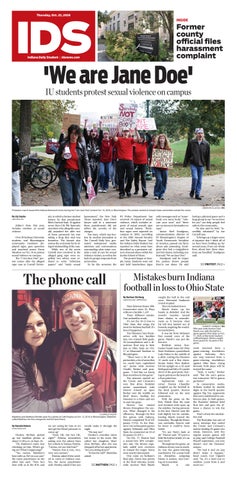
IDS Thursday, Oct. 22, 2026
INSIDE
Former county official files harassment complaint
Indiana Daily Student | idsnews.com
'We are Jane Doe' IU students protest sexual violence on campus
Protesters march toward the Indiana Memorial Union during the “I Am Jane Doe” protest Oct. 16, 2026, in Bloomington. The protest started at Sample Gates and ended outside the union. By Lily Saylor saylorl@iu.edu
Editor’s Note: This story includes mention of sexual violence. Over 50 Indiana University students and Bloomington community members displayed signs, gave speeches and marched across Dunn Meadow on Oct. 16 to protest sexual violence on campus. The “I Am Jane Doe” protest comes after the alleged rape case at Cornell Univer-
sity, in which a former student known by that pseudonym filed a lawsuit Sept. 16 against seven then-Chi Phi fraternity members who allegedly sexually assaulted her after two of them pressured her into taking a drug they said was ketamine. The lawsuit also names the university for its alleged mishandling of the case. While two of the seven Cornell men involved in the alleged gang rape were expelled, two others were ordered to write “reflection papers” and “study sexual
harassment,” the New York Times reported. Jane Doe’s lawyer said in a statement these punishments did not reflect the severity of the charges. The story, which was broken by student journalists at The Cornell Daily Sun, generated widespread media attention and conversations surrounding what some consider a lack of care for sexual violence victims, as well as the lack of a proper response from universities. So far this semester, the
The phone call
IU Police Department has received 18 reports of sexual violence, which includes reports of sexual assault, rape and sexual battery. Thirtyfour rapes were reported on campus in 2025, according to the 2026 Annual Security and Fire Safety Report. And the Indiana Daily Student has reported on what some have described as a persistent culture of sexual abuse within the Jacobs School of Music. The protest began at Sample Gates. Students wore red and held handwritten signs
naashri@iu.edu | @NShriberg
COURTESY PHOTO
By Natalia Nelson nelsonnb@iu.edu
Destiny McHale picked up the landline phone at about 11:30 a.m. on Sept. 16. “Hi, Matthew’s mom. Just checking on him. What’s going on? What’s happening?” “Yes ma’am. Matthew’s here with us. He’s in our care,” the nurse practitioner on the other line said. “Now he’s here with us in the ICU, and
we are caring for him to try and get his blood pressure to come up.” “Yeah, OK, but he’s OK, right?” Destiny remembers asking over the phone from her cubicle in Tampa, Florida. “I mean, we can visit him?” “Ma’am, this is very, very, very, very serious.” Destiny asked if she needed to come to Indiana now. Yes, the nurse practitioner said. Destiny asked if her son
would make it through the night. “He may not.” Destiny’s coworker drove her home in his truck. She called her daughter, Madeline McHale, after she was dropped off at her apartment. “Are you sitting down?” “Is this the call?” Madeline asked.
SEE MATTHEW, PAGE 4
having a physical space and a large group to say “we are here for you” can help people feel safer in the community. He also said he feels “incredibly infuriated” by the Cornell case. “It brings up a larger sense of injustice that I think all of us have been bottling up for several years, if not our whole lives, about how these situations are handled,” Snodgrass said.
SEE PROTEST, PAGE 4
Mistakes burn Indiana football in loss to Ohio State By Nathan Shriberg
Madeline and Matthew McHale pose for a photo at Cafe Pizzaria on Oct. 12, 2019, in Bloomington. Madeline called Matthew her first antagonist and first best friend.
with messages such as “somebody, not some body,” “educate your sons” and “there are no innocent bystanders to rape.” Junior Reef Snodgrass, communications director of IU Bloomington’s chapter of Youth Democratic Socialists of America, passed out flyers about safe protesting. Snodgrass also had a megaphone and led chants, including one that said “We are Jane Doe.” Snodgrass said he hopes the protest shows people they’re not alone. He said
EMERSON ELLEDGE | IDS
Days between losses: 666. Consecutive wins: 22. Plays without a fumble: 1,437. Three different streaks. One unfamiliar result. It's not the 19-15 loss to Ohio State that stings the most for Indiana football. It's how it happened. The Hoosiers hurt themselves with two fumbles lost, two missed field goals, 20 incompletions and a disastrous final step in their loss to Ohio State on Oct. 17 at Memorial Stadium in Bloomington. "There were a lot of opportunities, a lot of areas that we could have capitalized on," junior wide receiver Charlie Becker said postgame. "I feel like we kinda beat ourselves in this game." The miscues started on the Cream and Crimson's very first drive. Redshirt senior quarterback Josh Hoover missed an open Becker over the middle on third down, leading the Hoosiers to a three-and-out to start the game. Hoover has missed throws throughout the season. What changed is his efficiency. Through his first five games with Indiana, Hoover completed 76 of 107 passes (71%). In the Hoosiers' two subsequent games against Nebraska and Ohio State, he connected on 32 of 62 passes (51.6% ). On Oct. 17, Hoover had a season-low 50% completion rate. His throws regularly sailed over receivers or missed the target. Some were nearly intercepted. One came on Indiana's final play. Down four points in the final minutes, junior wide receiver Nick Marsh
caught the ball in the end zone. Memorial Stadium’s crowd erupted. Then he looked down. Marsh threw up his hands in disbelief. And the crowd’s reaction turned from elation to astonishment as it became clear his left foot landed out of bounds, negating the wouldbe touchdown. It was far from Indiana’s first mental error of the game. Marsh's was just the last one. Redshirt senior linebacker Isaiah Jones hit Ohio State freshman quarterback Luke Fahey in the middle of a slide, costing the Hoosiers 15 yards and a first down. Senior kicker Nico Radicic hit the upright on a 32-yard field goal and left a 55-yarder short of the goal posts, leaving six points on the board in a four-point loss. Sophomore wide receiver Davion Chandler coughed up the football in the third quarter. Hoover followed suit on the next possession. With the game on the line, Marsh beat his man and streaked wide open up the sideline. Facing pressure in his face, Hoover sent the ball slightly too far outside, leading Marsh toward the boundary. Though the throw was catchable, Hoover said he knew it could've been better. "It's not Nick's fault at all," Hoover said. "If I put it a little bit further inside, it's an easy catch." Throughout the game, an Indiana victory was in reach. So was the game-winning touchdown. For a team built on discipline, assigning blame is useless. And moving on is essential. Marsh is one
KENNEDY HANNAH | IDS
Fifth-year wide receiver Tyler Morris runs with the ball at a game against Ohio State on Oct. 17, 2026, at Memorial Stadium in Bloomington. Morris caught three passes for 26 yards in the game.
week removed from a game-winning touchdown against Nebraska. He's one step removed from a game-winning touchdown against Ohio State. Going forward, both plays will be treated the same. "Yeah, it sucks," Becker said. "But the sun’s gonna rise tomorrow. We’re gonna get better." In consecutive weeks, Indiana trailed by double digits in the fourth quarter against Big Ten opponents that were undefeated in conference play. In both games, the Hoosiers' defense held firm late and gave the offense a chance to win the game. That's where the similarities end. The final play was one of many missteps that ended the Cream and Crimson's nation-leading 22-game win streak. However, with five regular season games still to play and College Football Playoff aspirations, one loss doesn't end the Hoosiers' season. "We had it and we just didn't make it happen," head coach Curt Cignetti said. "So, it's a hard one to swallow. Learn from it and move on."
Indiana Daily Student
2
NEWS
Oct. 22, 2026 idsnews.com
Editors Ella Curlin, Grace Fridy & Deshna Venkatachalam news@idsnews.com
The ongoing fight against sexual violence By Natalie Chan nkchan@iu.edu
Editor’s Note: This story includes mention of sexual violence and assault. Indiana University students and Bloomington locals demonstrated Oct. 16 in protest of sexual violence on campus. The “I am Jane Doe” protest spurred from an alleged rape case at Cornell University. From the beginning of the fall semester to Thanksgiving Break, universities experience a period known as the “Red Zone,” when students face a higher risk of sexual assault. While a spike in the number of sexual violence reports may call attention to its prevalence on college campuses, experiences behind those reports are shaped by access to resources, complexities in recognizing sexual violence and approaches in preventing such violence. “Anyone can be a victim,” Beth White, president and CEO of the Indiana Coalition to End Sexual Assault, said. “It’s important that what we see as a common denominator is vulnerability.” As of Oct. 19, just less than two months into the fall semester, the Indiana University Police Department has received 18 reports of sexual violence, which includes reports of rape, sexual violence and sexual battery. In 2025, a total of 34 rapes were reported on the IU Bloomington campus, according to IU Public Safety’s 2026 Annual Security and Fire Safety Report. The report also counted 26 cases of on-campus domestic violence. According to the American Psychological Association, 25% of female college students and 6.8% of male college students report experiences of on-campus sexual assault, with gender non-conforming individuals, individuals with disabilities and individuals from marginalized groups including the Black, Hispanic and LGBTQ+ communities, facing higher risks. However, an estimated 90% of oncampus sexual assaults go unreported due to factors
including guilt, shame and fear of not being believed, the APA said. The Rape, Abuse and Incest National Network found 45% of students who have experienced sexual misconduct believe their school would take their reports seriously. Resources available for students. White said she encourages individuals experiencing sexual violence to reach out for help. She said one resource for students is their university’s Title IX office, where advocates can help individuals access counseling, educational and housing accommodations. IU’s Office of Civil Rights Compliance oversees Title IX reports at IU. Students who have faced sexual misconduct can submit a report or contact the office at 812-855-7559 to provide information about their experience, regardless of the report’s nature. Individuals who have submitted a report may receive a response from the office or others in student affairs if additional information is needed. Students can also directly contact university sexual misconduct and Title IX coordinators, who conduct investigations regarding sexual misconduct or coordinate the investigation with the appropriate officials. Another point of contact is IUPD, which can be contacted 24/7 at 812-855-4111 or 911. If a student does not receive the help they need at a Title IX office, White said other resources include communitybased organizations like Middle Way House, group counseling or legal assistance. Middle Way House is a Bloomington nonprofit that supports survivors of sexual assault, domestic violence and others in crises. Some of its services include an emergency shelter, 24-hour crisis line and housing support. IU spokesperson Mark Bode wrote in an email that the university “takes reports of sexual misconduct extremely seriously” and prioritizes various prevention efforts. “Step UP! IU,” a 120-minute bystander intervention pro-
gram led by students, is also required for all members of fraternities and sororities at IU, Bode wrote. The OCRC responds to reports by providing resources to victims and leading investigations, Bode wrote. Bode advised that anyone seeking more information look at the Stop Sexual Violence page on IU’s website. IU also mandates that all first-year and transfer undergraduate students attend an “It’s On Us” 90-minute in-person sexual violence prevention workshop discussing bystander intervention, consent and sexual misconduct policies at IU. Students are also required to complete an online sexual assault prevention program through Vector Solutions. ‘A structural and systematic problem’ The experience of sexual violence is multifaceted and can differ from person to person. Kristen Jozkowski, an IU School of Public Health faculty member and senior scientist at the Kinsey Institute, said that while these programs might be effective in increasing positive bystander attitudes, they may not be as effective in reducing sexual violence. This could be due to a lack of careful completion of online educational programs, Jozkowski said. What these programs can do, she said, is raise awareness about what consent and sexual assault are. “Historically, people might have had the same prevalence of experiences, but they didn’t have the words to identify the sexual assault,” Jozkowski said. “But after experiencing some of the programming, they might be able to say, ‘Actually, that was sexual assault.’” When discussing different ways sexual violence can be defined, Jozkowski said language can become complex. She said people can disagree on the meaning of terms like “survivor” versus “victim,” and “rape” versus “nonconsensual sex.” Identifying an experience as sexual violence can be personal to an individual,
EMERSON ELLEDGE | IDS
Senior Maria Bull holds a sign while listening to a speaker during the “I Am Jane Doe” protest Oct. 16, 2026, in front of Sample Gates in Bloomington. The protest occured during a time known as the “Red Zone,” when from the start of the semester until Thanksgiving break university students face a higher risk of sexual assault.
Jozkowski said. For example, a person could undergo an experience legally defined as sexual assault, but they still might not give it that label themself. Jozkowski said members of the public may not understand the social dynamics with sexual assault. She said a victim’s response can be contextspecific, considering factors like maintaining a social network, trauma, substance use, gender dynamics and the relationship between a victim and perpetrator. “There might be a motivation to continue a relationship and sort of brush something off and say, ‘This wasn’t that big of a deal,’ because they want to continue those social bonds,” she said. “It’s unsurprising to me that people still remain in contact with someone who may have sexually assaulted them.” Jozkowski also said she thinks of consent as “multidimensional,” and that an important aspect of consent is “internal consent,” or the personal willingness of a person. IU defines consent as an agreement to engage in specific sexual conduct at a specific time expressed through affir-
mative and voluntary words or actions understandable to everyone involved. IU’s definition states that consent can be withdrawn at any time “as long as it is clearly communicated.” Consent cannot be coerced or given by an incapacitated person and cannot be assumed by silence or the absence of a “no,” according to the university’s definition. Jozkowski said college students tend to communicate consent in manners that can be explicit and verbal, explicit and nonverbal, implicit and verbal and implicit and nonverbal. She said no-response cues, where an individual may not speak or not resist, could arise in both consensual and nonconsensual situations, such as an individual freezing up or being too intoxicated to say “no.” The various methods of indicating consent could lead to ambiguity in how it is communicated, she said. Jozkowski said preventing sexual violence is a multi-step approach. From a developmental perspective, she said some actions include having conversations about sex, boundaries and consent at
earlier ages. She said consent promotion and bystander intervention programs also have a place in changing people’s attitudes but only begin to deconstruct the issue of sexual violence. “It’s a structural and systematic problem that requires a more complex solution than a one-time online class,” she said. For White, creating an environment where victims are supported is important. She said one key measure is society taking allegations seriously when they happen. Another is considering the language used to talk about sexual violence. “Words matter a great deal,” she said. “The framing of the situation, who’s at fault, what were the circumstances — all of those things have, really, a significant amount to do with whether or not we’re able to stop the behavior.” White said sexual misconduct happens every day, whether it be on campus, in fraternities or at apartments. “We really need to stop thinking this is somebody else’s problem and realizing this is everybody’s problem,” she said.
Political parties ‘not doing their homework’ with young voters By Nora Ruscoe naruscoe@iu.edu
The 2026 midterm general elections are right around the corner, but a large block of voters might not make it to the polls come Nov. 3. In the 2022 midterms, only 23% of 18-29 year olds voted, and Indiana ranked lowest in youth turnout rates, according to the Indiana Bar Foundation. At Indiana University, student groups like IU Student Government and College Democrats at IU, as well as certificate programs like the Political and Civic Engagement program, are working to increase student voting across campus. IUSG and PACE hosted Voterpalooza on Oct. 21, an event dedicated to educating and engaging potential voters through activities like trivia and arts and crafts. “We have registered hundreds of voters this semester,” Mark Fraley, PACE associate director, said. Ben Baranko, student engagement director of College Democrats at IU, said the group increases student outreach through tabling and social platforms. Baranko joined the College Democrats to make a difference in his community, and
he said one way to do so is to increase youth turnout to match that of older generations. “Imagine if students, if young people, had a similar dynamic, if we were a voting block,” Baranko said. “I think people would take us much more seriously.” In order to change the system in favor of youth voters, Baranko said youth must vote. “Your vote does matter, change can happen, change will happen,” Baranko said. “Your vote matters one hundred percent, and the more people that think that it does, the more it will matter.” In an attempt to increase voter turnout for more students, IU began participating in the Big Ten Voting Challenge in 2018. The challenge offered titles for highest turnout and greatest increase in voter rates. Vanessa Cruz Nichols, an assistant professor of political science, said IU’s participation helped boost its turnout rates because it embeds a sense of competition into the act of voting. The competition halted in 2026 due to a U.S. Department of Education investigation into possible FERPA violations. But Fraley said PACE has continued working
on outreach and distributing nonpartisan voter information. Young people are consistently the smallest group of voters in elections. Cruz Nichols said “the easy explanation” is claiming that unregistered or nonvoting students are apathetic. “The parties are not doing their homework to engage young voters,” Cruz Nichols said. “Are they falling short on their parts to better help people understand where their views would be aligned and where they have a political home?” According to U.S. Census Bureau data, 14.7% of registered voters didn’t vote in the 2024 presidential election because they “did not like candidates or campaign issues,” whereas 19.7% stated they were just “not interested.” “To what extent do they feel that the candidates on the ballot align with their interests and excite them in some way?” Cruz Nichols said. “Maybe they’re voting because they don’t want to see someone in the office.” Cruz Nichols said lack of widespread voter education also plays a role, and distributing registration, absentee ballot and deadline information help increase their likelihood of voting.
She also said that parental political guidance contributes to voter turnout, as the more often young adults see their parents vote, the more likely they are to adopt the same habit. Cruz Nichols grew up as the eldest daughter in an immigrant family and would help translate political issues to her parents. She said they figured out politics together based on what she learned in school and saw in the news and advertisements. “They were telling me about the issues that they cared about, what they wanted to see their candidates prioritizing, and so there’s more of this bi-directional learning that happens in immigrant families,” Cruz Nichols said. Still, youth voter registration rates are consistently higher among nonimmigrants compared to first and second generation voters. A 2014 Urban Institute study found only 6% of first-generation immigrants aged 18-24 voted in both the 2010 and 2012 national elections. The process of voting itself can also be difficult, Cruz Nichols said. For out-of-state students, differing state registration requirements coupled with absentee ballot requests can be a barrier to voting. Unlike other states, Indi-
TRIBUNE NEWS SERVICE
A “VOTE” sign is posted near a polling center on March 3, 2026 in Austin, Texas. In the 2022 midterms, only 23% of 18-29 year olds voted, and Indiana ranked lowest in youth turnout rates, according to the Indiana Bar Foundation.
ana requires voters to complete their registration almost a month prior to an election. In addition, legislation like Public Law 70 can complicate the voting process for Indiana college students. With the removal of university-issued student cards as a valid form of voter identification, it is more difficult for students to verify their identity at the polls, especially outof-state students who might
not have an Indiana-issued ID. Cruz Nichols said students often think their vote doesn’t matter, which can often be as harmful as structural barriers. “If my students are too cynical, then they kind of bury their heads in the sand, then the system doesn’t change because their voice isn’t being heard,” Cruz Nichols said.
What’s What’s Happening Happening in in B B--Town? Town? Find & submit events at idsnews.com/events
3
Oct. 22, 2026 | Indiana Daily Student | idsnews.com
Mahjong brings communities together By Natalie Chan nkchan@iu.edu
Chatter floats around Indiana University’s Asian Culture Center as four players sit at a table, each studying a set of ornate tiles, hoping the next draw will make them a winner. Music of varying genres, chosen by players weekly, plays in the background as some sing along. Every week, IU senior Jason Tang hosts “Mahjong Monday” from 4-6 p.m. at the Asian Culture Center, where IU community members of all experience levels can learn and play mahjong. Rooted in Chinese tradition, mahjong — a four-player tile game — emerged in the 1800s, according to TIME Magazine. The game has since traveled globally, gaining popularity in the United States around the 1930s when middle-class Jewish American women began playing a modified version of the game, the magazine reported. It has since resurged in popularity, with ticketing app Eventbrite reporting a 179% increase in mahjong events between 2023 and 2024. Growing up as a Chinese American, Tang said he always wanted to learn how to play mahjong but couldn’t figure out the game until he began playing at the ACC during his sophomore year. He has since overseen Mahjong Mondays. “I was like missing a part of my culture,” he said. “I feel like as I've gotten older, like through the tail end of high school and coming to college, I really care a lot about staying in connection with who I am culturally.” More than that, he said playing mahjong has
ILLUSTRATION BY BRI SUCH
helped him meet people he would otherwise have never crossed paths with. “There's no consistent one archetype of person who's coming in for it anymore, which is the best thing,” Tang said. Senior Talia Richland said her mother taught her family how to play mahjong this past summer. For most people that Richland’s talked to, mahjong is a family tradition. Coming back to Bloomington this semester, Richland met other girls at Chabad at IU who were interested in playing mahjong. From the start, she said she felt a sense of community after Trish Surfus from Mahj in Bloom, a local mahjong club, lent them tables for their program.
Richland and sophomore Rachel Olefson formed a group that plays Mondays at 7 p.m. on the deck of Chabad. “The first two weeks was kind of just teaching all the people that were interested how to play, and now this last week, like everyone knew how to play,” Richland said. “Everyone's been having so much fun with it.” Surfus, founder and primary instructor at Mahj in Bloom, attributed the game’s growing popularity to a variety of factors, like wanting time away from screens and an increased desire for socialization after the COVID-19 pandemic. What also makes American mahjong unique is its tile design, and some mahjong sets can cost $500 or
upwards. As interest in the game grows, Surfus said some people may think they need an expensive set of tiles to play. In reality, sets can range between $25-$50. The ACC plays Chinese mahjong, and Tang said he believes there is significance in retaining the game’s traditional roots. “I acknowledge the significance of American mahjong, especially in American suburban communities, but there are some like gripes that I have with it,” Tang said. “A lot of them have to do with how the game is a business.” Chinese mahjong is typically played with 144 tiles, with each player drawing and discarding tiles to maintain an active set of 13 tiles per round of four total. To
win, players have to form a winning combination, achieved by drawing a 14th tile. While Chinese mahjong follows a general pattern, regional variations of the game can differ in winning patterns, tiles and scoring rules. “It's different, and I think it's important to recognize and retain those differences,” Tang said. “I think that's the only way that cultural tradition and heritage survive — you have to make an effort to keep it alive.” Surfus primarily teaches American mahjong, which is standardized around an annual playing card distributed by the National Mah Jongg League. Each year, the NMJL card publishes different winning combinations for the year, Surfus said. The combinations change each year,
and there are over 1,000 ways to win. To play, each player sets the card in front of them. Three players are dealt 13 tiles, while the dealer holds 14 tiles. Players then pass three unwanted tiles to the player on their right to optimize their set before the game begins, a process known as “The Charleston.” In Chinese mahjong, however, winning combinations are established patterns, which players typically learn over time, Surfus said. Still, when teaching lessons, Surfus said she thinks it is important to recognize there might have been some aspects of cultural appropriation when the game grew popular in the United States. “There’s beautiful meaning behind the symbols that you see on the tile,” she said. Surfus said she can place group orders for players who need a card. The standard sized card costs $14, while a large card costs $15. At least $3 from each card ordered are donated to organizations like New Hope for Families, a family shelter in Bloomington. This year, the club raised over $1,000, she said. Surfus offers a two-class beginner series each month at Heartwork Brewing, the “home base” for Mahj in Bloom, located at 1703 N. College Ave. Surfus also leads a sixweek Monday night league at Heartwork Brewing for veteran players. The club has a Bloomington group within the Mahjong Open, an eightweek league where players can accept or propose rounds with other players, that begins Oct. 25. The week of Oct. 12, the ACC began “Mahjong Wednesdays” from 4-6 p.m. in addition to regular Monday sessions.
Students react to statewide phone ban By Mary Demarco mdemarc@iu.edu
Students in Bloomington public schools can no longer access their phones during the school day after a new state law took effect in July. Senate Enrolled Act 78, authored by Sen. Jeff Raatz, R-Richmond, and Sen. Greg Goode, R-Terre Haute, prohibited students at Indiana public schools from using any “wireless communication device” during the school day. Bloomington High School South senior Ella Pizzo said she thought the ban had both benefits and drawbacks. “It’s annoying because, like, I miss being able to like, listen to music while I'm doing homework and schoolwork and stuff,” Pizzo said. “But like, it's kind of nice to like, actually talk to people and like, I'm allowed to do more, like, board games, I guess, or just being able to get your work done.” According to the Monroe County Community School Corporation, wireless devices include “cell phones, smartwatches, tablets, laptops, wireless headphones, and gaming devices.” The dis-
trict includes 23 K-12 public schools. The MCCSC website instructs students to have devices, “powered completely off (not silenced or on airplane mode),” and “stored out of sight in a location identified by your school’s principal.” The state legislation’s expressed goal is for wireless devices to be “inaccessible to the student.” Pizzo said students at Bloomington South cannot access their phones from 7:45 a.m. to 2:40 p.m — the school’s hours. This type of ban is not new to Bloomington South students. According to MCCSC school board President Erin Cooperman, MCCSC already had policies banning phone use during instructional time. The bill makes an exception for students with a medical condition, Individualized Education Program or 504 plan that indicates a need for phone use. An IEP provides students with disabilities an individual learning program to help them succeed. A 504 plan provides students with academic accommodations. When SEA 78 was enacted, the MCCSC school board spoke over the summer about
what the law would mean for students and parents, Cooperman said. “But we hadn’t really received emails from the public, or especially parents, expressing concern about cellphones in our schools,” Cooperman said. “It wasn’t something that the teacher's union brought to us as a concern. So, it wasn’t something that we identified as a problem within MCCSC schools.” Bloomington South senior Addie Racek, editor for the school’s student newspaper, said that last year her environmental science teacher constantly told students to get off their phones. This year, when she spoke with that teacher for an interview, Racek found that things were different. “She was like, 'I don't really have to do that anymore.’ Sometimes it happens, but, like, most people aren't on their phones,” Racek said. In a press release after the bill was enacted, Raatz cited research conducted by the National Center for Education Statistics that found 72% of public-school leaders thought that cell phone usage was one cause of poor mental
KATHERINE MANERS | IDS
The Monroe County Community School Corporation is pictured Oct. 8, 2025, in Bloomington. A July 2026 state law banned students at Indiana public schools from using phones during the school day.
health. Just over half of those surveyed also thought that phone usage at school impacted students’ grades. Racek said the ban was a barrier for students to communicate with each other about clubs and extracurriculars, since students can no longer use GroupMe during the school day. She also said the ban impacts students’
ability to contact parents and guardians in the case of an emergency. “I was, like, nervous about what was going to happen if I couldn't, like, communicate with my parents about something like that,” Racek said. Some schools in Indiana have implemented phone holding cells to enforce the ban. At Bloomington South,
Racek said that phone holding cells are not present, but most students do not access their phones during the school day. “I'll see them in the hallways, but everyone's really nervous. Like they're always just, like, hiding it, and stuff.” Racek said. “I'd say, like, a majority of people do follow the ban.”
Former county official files harassment complaint By Zoe Reed
reedzoe@iu.edu
Former Monroe County Health Department Administrator Lori Kelley filed a complaint Sept. 14 alleging county health officer, Dr. Sarah Ryterband, subjected her to sexual harassment and gender discrimination. County officials fired Kelley from her role Sept. 10. In a Sept. 12 article, the B Square Bulletin claimed Monroe County leadership did not provide it any details about the change in administration. The Bulletin noted that officials redirected all inquiries to human resources and issued a vague statement that only confirmed there was a change in administration. The complaint does not constitute a lawsuit. A discrimination lawsuit cannot be filed until a formal charge of discrimination is processed through the U.S. Equal Employment Opportunity Commission or the Indiana Civil Rights Commission. Now that Kelley has filed a complaint,
she and her attorney, Mark Waterfill, are waiting to obtain a right-to-sue letter from the EEOC to proceed to court. Filed with the EEOC, the complaint also alleged Kelley was fired by the county in retaliation for reporting the harassment and discrimination. According to the complaint, during Kelley’s employment, Ryterband repeatedly told her “she loved her and that she wanted to be Ms. Kelley’s ‘partner,’” on top of other alleged sexually inappropriate conduct and comments directed towards Kelley. In one instance, Ryterband allegedly sent Kelley a sexually suggestive text message featuring a photo of male enhancement gelcaps. On another occasion, Kelley alleged Ryterband stood beside her, placing her “breasts directly beside Ms. Kelley’s face and creating an extremely uncomfortable situation,” according to the complaint. The complaint said Ryterband insisted on using her personal email to communicate with Kelley, and
Kelley requested help with communication boundaries from a Monroe County Board of Health official. Ryterband continued to demand to meet with Kelley and expressed frustration about why Kelley did not want to spend more time with her. In a verified statement — a written declaration under penalty of perjury — Waterfill provided to the Indiana Daily Student, Kelley alleged the remarks were part of an ongoing issue. “These statements were not isolated,” Kelley wrote in the verified statement. “They became a recurring pattern, including during or after oneon-one meetings and conversations between Dr. Ryterband and me.” When contacted for comment, Ryterband referred the IDS to Monroe County human resources. The complaint said the inappropriate behavior did not solely affect Kelley and referred to an alleged incident in September 2025 when Indiana University Health person-
nel were made uncomfortable due to “extremely sexually explicit” comments made about members of the County Council by Ryterband during a visit with nurses. Kelley worried that objecting to these behaviors would affect her employment, according to the complaint. Still, Kelley reported the behavior to Monroe County Employee Services and health board member Dr. Lisa-Hanner Robinson. According to the complaint, the inappropriate conduct continued. “Despite my complaints and disclosures, the inappropriate conduct did not stop,” Kelley wrote in the verified statement. “I ultimately believed that no meaningful corrective action had been taken.” After attempting to establish professional boundaries, Kelley wrote in the complaint that the relationship between her and Ryterband “deteriorated,” with Ryterband becoming increasingly “hostile.” According to the com-
plaint, the workplace environment caused Kelley to have “substantial anxiety and emotional distress,” leading her to seek out therapy. After continued anxiety, Kelley claimed in the complaint that she began to experience physical symptoms associated with the stress, including headaches, vomiting and increased blood pressure. The complaint said Kelley continued to report the behavior, requesting assistance from the county’s employee services with maintaining professional boundaries during meetings with Ryterband, but she did not receive that help. County attorney Molly Turner-King declined to comment in an email to the IDS, citing pending litigation. The complaint stated that on Sept. 10, Kelley was directed to attend a meeting with Ryterband, Turner-King, Robinson and Monroe County’s Human Resources Director Melissa Stinson-Waddell, where she was told “there were concerns regarding her
ability to perform her job.” Kelley then had to choose whether to be terminated or to resign, according to the complaint. Kelley said she immediately argued against their claims, with the complaint saying there was no “meaningful documentation” that justified termination. “I believe that the stated concerns about my performance and communication were a pretext for retaliation,” Kelley wrote in the verified statement. The health department’s day-to-day operations are now temporarily led by Linnea Emigh, the director of public health preparedness, financial manager Eric Gause and Kathy Hertz, the director of vital records and admin support, until a permanent health administrator is in place. The Monroe County Board of Health will hold a hearing Oct. 22 on whether there is cause to remove Ryterband, right after the board’s regular 4:30 p.m. meeting.
4
» PROTEST
CONTINUED FROM PAGE 1 After the crowd gathered at Sample Gates, several protesters gave speeches. They spoke about their own experiences with sexual violence and offered words of support to victims. Sophomore Lily Brown was among the students who gave a speech. Brown told the crowd she is a victim of multiple sexual assaults, with all incidents happening before the age of 18. She said one of her abusers attended IU. Brown spoke about her struggles as a woman. She spoke about having to hold keys between her fingers while walking in the dark, in fear that a man walking behind her may become violent. “You have to exist in a world that was never built for you to live in from the moment you were born,” Brown said in her speech. “I am so exhausted from carrying an anvil on my shoulders and gaslighting myself that it’s invisible.” Brown also spoke about the life-altering impact rape can have on someone. She said without support from the government and universities, healing from rape can feel like "swimming upwards against a current.” “Stop sacrificing women with unlimited potential for men that lack some profound empathy for others that they are willing to torture a person with only their own pleasure
» MATTHEW
CONTINUED FROM PAGE 1 Matthew McHale was born in Bloomington. He won his fifth-grade spelling bee by spelling “taciturn.” He loved Britney Spears. He made cherry pie for his sister when his mom was too sick to cook. He played football and basketball and tried little league baseball — it didn’t stick; too boring. He loved “The Office” and laughed so loudly his family had to press pause on the remote. He never let anyone bully his little sister. He put up a picture of his mother and sister on the wall of his jail cell. When he and Madeline made promises to each other, they would hook their pinkies and kiss their thumbs and say, “I brother-sister swear.” He was her first antagonist, Madeline said. But he was also her first best friend. When a girl at the bus stop made fun of Madeline’s hair before picture day, he marched straight to her house after school and knocked on the door, asking for the girl’s father. “I just wanted to let you know that your daughter was being mean to my sister,” Madeline recalls him saying. He was lionhearted, Destiny said, smart and brave and fiercely loyal. If drugs had never been present in his life, she always thought he would be a comedian. In 2013, Madeline found Matthew, in his early twenties at the time, slumped over in the bathroom in their family’s home in Kansas after using methamphetamine. She remembers slapping him to try and get him to wake up. Destiny said Matthew had been to behavioral health facilities and a rehabilitation center, but he continued to hide his substance use. In 2014, Matthew moved back to Bloomington and started working at Five Guys and other quick-service restaurant positions to sustain himself. Customers would come into the restaurant to see him, Destiny said, and his bosses loved him and made him team lead. But by 2021, he stopped working.
Oct. 22, 2026 | Indiana Daily Student | idsnews.com
to gain,” Brown said in her speech. “I am a Jane Doe. Every woman and queer person you know is a Jane Doe.” IU freshman Keira Lonadier attended the protest because she said it’s important to have conversations about sexual assault. She said even those who aren’t victims of sexual violence themselves know someone who is, who could be anyone from their mother to their friend. When the news broke about the Cornell case, Lonadier said, she was “disgusted, but not surprised.” “I just feel like it’s so sickening and disheartening to see how difficult it is for sexual assault victims to get justice,” she said. As students gave speeches at Sample Gates, passing cars honked their horns and cheered. While most bystanders were in support of the protest, multiple people were not. One man in the backseat of a car yelled at the protesters to “get a job,” as they drove by. Another car of men yelled, “She deserved it.” After about an hour, protesters marched through Dunn Meadow to the Indiana Memorial Union, where they stood for the remainder of the protest. Snodgrass started up the chants again. “It’s SA, not essays,” the protesters chanted, in reference to the “reflection papers” two of the Cornell men were ordered to write as punishment.
“When the substance abuse came in, it derailed everything,” Destiny said. “Including the jobs. And he left some very good jobs, and he left some very good people that supported him in those jobs.” Once a month, he would check in with her, Destiny said. Then it became once every three months, and when it got to be once every nine months, Destiny started to call the Monroe County nonemergency line. “‘Oh, yeah, I know your son,’” she recalled the resource officers on the other line saying. “‘I talked to him three weeks ago,’ or ‘I put him in jail yesterday.’” The only lifeline Destiny started to have to Matthew was his friends, and it was always through Facebook Messenger or on somebody else’s phone. Whenever an 812 number would pop up, Destiny would answer right away. She didn’t know where he was eating or living. When he was incarcerated for trespassing or disorderly conduct, she sent him commissary money. She wanted him to have a $6 bag of ramen noodles; she wanted him to have briefs and shoes and slippers. Destiny came to visit Matthew in Bloomington in September 2024. “I was watching my adult son — who was supposed to play for Coach Bobby Knight, and who was supposed to host 'Saturday Night Live' — dumpster dive,” Destiny said. “For whatever IU students are willing to throw away.”
“He was so smart, and so he could have graduated alongside all of the people that don’t look at him. He could have been right there with them on that beautiful campus.” Destiny McHale
There are families that raised the men and women
MANASVI DOSHI | IDS
Attendees hold up signs at a protest against sexual violence on campus Oct. 16, 2026, at Sample Gates in Bloomington. Protesters wore red in solidarity.
As the protest came to a close, IU senior Maria Bull spoke into the megaphone again, thanking everyone for coming to the protest despite the cold weather. Bull ended the protest by listing a set of demands addressed to IU President Pamela Whitten, the Board of Trustees, the Office of Civil Rights Compliance, student life lead-
ership and others in the IU Bloomington administration. Bull said the protesters demand independent reviews of the outcome of sexual assault cases reported to the university and that the findings be released publicly. She said students also need biannual surveys that examine campus climate and safety. Bull also advocated for
measurable organizational accountability, such as auditing fraternities and other student groups for “safety practices.” “Publish the data on discipline and discriminatory actions and apply escalating organizational sanctions, including the loss of recognition for serious and repeated substantial violations through fair procedures,” Bull said in her
speech. Bull also demanded guaranteed academic and financial support for victims, including no-cost emergency housing transfers and counseling access. “This is a dire moment, and dire moments must be met with action,” Bull said in her speech. “We are Jane Doe, and we will not back down.”
who live on the street, Destiny said. Families with visions for their future. “He was so smart, and so he could have graduated alongside all of the people that don’t look at him,” Destiny said. “He could have been right there with them on that beautiful campus.” … After the phone call, Destiny flew to Indianapolis to see Matthew at the IU Health Methodist Hospital. When she entered the room, she had to hold on to the rail of the bed for balance so she wouldn’t fall down. Matthew had cut his radial artery punching through a window of a house on West Cottage Grove Avenue, which caused severe blood loss. His family isn’t sure what exactly happened. At the hospital, he was intubated and hooked up to pumps and machines, Destiny said. “Come on, Matt. It’s not time. It’s not time. It’s not time yet,” Destiny remembers saying. “You got to come on now. You’ve got other things to do right now than this.” But she understood what she was seeing. Destiny stayed with him all through the night. She read him his favorite book, “Guess How Much I Love You.” She read “The Very Hungry Caterpillar” and parts of “Harry Potter and the Goblet of Fire.” Madeline arrived at the hospital a few days later. She took a pair of wired headphones Matthew had gifted her and put one earbud in his ear and one in hers. She played “I Miss You” by blink-182, a song they used to listen to together on the school bus in middle and high school. She stood next to him and held onto his arm, which was completely black with necrosis, the death of body tissue. She told him it was OK to go. “‘I know you’re tired. I know life was not kind to you,’” Madeline told him. “I just remember him still breathing on the intubator. He was still warm. His heart thumped. He had a good
COURTESY PHOTO
From left to right: Destiny McHale, David Riedley, Madeline McHale and Matthew McHale pose during Thanksgiving on Nov. 27, 2014. Matthew was a fantastic cook, his family members said.
COURTESY PHOTO
Matthew McHale takes a selfie inside Simon Skjodt Assembly Hall on Feb. 4, 2019, in Bloomington. McHale died Sept. 19, 2026.
heart. That was the organ that was not gonna ever fail, was his heart.” Matthew died at 4:28 a.m. Sept. 19, surrounded by his loved ones. … Madeline went to Bloomington the next day to look for pieces of her brother. She visited the place he had been keeping some of his possessions, a community on the west side that people called “Tarp Town.” It was just tarps and lawn chairs in a circle, with no beds. She left with his checkered IU shirt and watch. On her way out, somebody asked, “Is Matt really dead?” “I just looked up, I looked
COURTESY PHOTO
Matthew McHale (right) poses with his family in IU apparel Feb. 24, 2013, in Basehor, Kansas. McHale was born in Bloomington.
at them, and I said, ‘Please call your family and go get clean.’” Madeline said. “I said, ‘Call somebody, and get help. Because you don’t want your family to see what I just saw.’” Matthew's family will remember him for how much he loved Bloomington. He told Madeline if he ever had a daughter, he would name her Indie, and her middle name would be Ana. They’ll remember him as the man who biked 2 miles to a gas station to help a woman after her car ran out of gas and the person who never forgot Madeline’s birthday. He would make sure his little sister got a call, even though he didn’t always have access to a phone. They will remember him
for carving his nickname, “Chubbs,” into the top bunk of Cabin 11 at McCormick’s Creek State Park, where his family used to visit every summer. They’ll remember him as the class clown whose goal in life was to make everyone laugh. Madeline started a GoFundMe to help pay for Matthew’s funeral services, which had already raised over $5,000 as of Oct. 14. It’ll pay for a walnut urn and a weekend inurnment service in November. Madeline has been reciting her eulogy. She knows how she’s going to end it. She’ll say that she will remember him, that she won’t stop sharing his story. “I brother-sister swear.”
Celebrate the 2025 season and shop online now.
Indiana Daily Student
PHOTO
Oct. 22, 2026 idsnews.com
Editors Trinity Mackenzie, Katherine Maners visuals@idsnews.com
5
Nearly 400 attend Bloomington ‘No Kings’ Rally
MARY DEMARCO | IDS
Hoosiers from Monroe County and neighboring counties encourage people to vote early in the midterms at the “No Kings: Vote Early” rally Oct. 17, 2026, at the Monroe County Courthouse in Bloomington. The event lasted from 3 to 5 p.m.
MARY DEMARCO | IDS
MARY DEMARCO | IDS
Two women attend the “No Kings: Vote Early” rally Oct. 17, 2026, at the Monroe County Courthouse lawn in Bloomington. The attendee on the right held a sign quoting Martin Luther King Jr.
A rally attendee holds up a sign saying, “DONT FROGET TO VOTE” at the “No Kings: Vote Early” rally Oct. 17, 2026, at the Monroe County Courthouse in Bloomington. This attendee won the best poster contest hosted at the rally.
MARY DEMARCO | IDS
MARY DEMARCO | IDS
“No Kings: Early Vote” rally attendees stand on the sidewalk surrounding the Monroe County Courthouse on Oct. 17, 2026, in Bloomington. Many held paper signs provided by event organizers.
A group of singers aligned with the Singing Resistance performed chants and songs to boost morale during the “No Kings: Vote Early” rally Oct. 17, 2026, on the lawn of the Monroe County Courthouse in Bloomington. Kate Steger, a Singing Resistance member, said singing regulates emotions in situations with tension and disagreement.
MARY DEMARCO | IDS
MARY DEMARCO | IDS
A woman shows off her sign during the “No Kings: Vote Early” rally Oct. 17, 2026, on the lawn of the Monroe County Courthouse in Bloomington. The woman explained that she both printed out photos and drew on her poster.
MARY DEMARCO | IDS
Rally attendees listen to Midwest Liberation Front, a local band that performs acoustic songs about activism, Oct. 17, 2026, on the lawn of the Monroe County Courthouse in Bloomington. Earlier that day, the band protested in Spencer, Indiana.
Community member Judy Owens shows off her poster for the “No Kings: Vote Early” rally Oct. 17, 2026, on the lawn of the Monroe County Courthouse in Bloomington. “I think that everyone can agree that it’s stupid to have a trillionaire, multi, multi multi billionaires,” Owens said. “It’s unreasonable. And, to my mind, it’s getting into the zone where it could be dangerous, which is why I have the sign that says the rich should be begging to be taxed.”
Indiana Daily Student
6
OPINION
Oct. 22, 2026 idsnews.com
Editors Eric Cannon, Emma Howard opinion@idsnews.com
ROBINSON WRITES
Does Indiana need a state senate? Spencer Robinson (he/him)
is a junior studying public policy analysis and law and public policy.
Indiana’s government prides itself on doing more with less. Republicans, who campaign on trimming budgets and shrinking bureaucracy, hold supermajorities in both General Assembly chambers. Under their leadership, the state has earned a reputation as a stronghold of smallgovernment conservatism. Yet Indiana maintains a largely redundant legislative chamber. If conservative Hoosiers believe government should be no larger than it needs to be, they should be the first to oppose the state senate. Until the 17th Amendment’s 1913 ratification, state legislatures rather than citizens elected U.S. senators; the idea being U.S. representatives embodied the people’s will, while senators stood for the states’. The change was a major step toward democratizing Congress, but it undermined the Senate’s original purpose. Since 1913, senators have represented a state’s citizenry rather than the state government. As a result, senators answer to the statewide population, while representatives answer to the voters of a single district. Even if the Senate’s equal representation of states is undemocratic, it still balances state interests against the population-weighted House; but the system only works because state borders are fixed. State senates have no such fixed unit. Their districts are redrawn every decade, just like state house districts. The only difference is size. In Indiana, the House has 100 members and the Senate has 50, so each senate district is about twice the size of a house district. This reason is why some states used to mimic Congress, electing one chamber based on population and the other
IDS FILE PHOTO
Indiana Statehouse is seen Feb. 10, 2024, in Indianapolis. The building is where Indiana’s General Assembly, which includes the state’s House of Representatives and Senate, meet.
on geography. State senators would represent a county or group of counties, often giving some voters more political power than others. Then, in 1964, Reynolds v. Sims rejected the use of geography for state legislatures and required every district to be of roughly equal population. Now state senators and state representatives are elected in the same way by the same voters. If the second chamber serves the same purpose as the first, a split between them cannot reflect two different publics, it only creates confusion. When voters have clearly favored one party, divided control muddles that mandate. In states with two legisla-
tive chambers, every new law must pass in both. Separate sets of leaders, committees and calendars must align. Disagreement within the legislature can delay or kill an impactful bill. Separate chambers can increase the risk of divided government — when legislative and gubernatorial control is split between parties. But a second chamber adds another way for government to split: the chambers can fall to different parties, or to different factions of the same one. Indiana saw this last December. The House passed a mid-decade congressional map on a 57-41 vote, with 12 Republicans opposed. The Senate rejected it 31-19, with
21 Republicans joining all 10 Democrats. Even with a Republican supermajority, oneparty control still produced a standoff between the chambers. Defenders of bicameralism, the idea that legislatures should have two chambers, say friction is the point. But friction requires disagreement, a rare event in a supermajority. The National Conference of State Legislatures counts just four divided legislatures among 49 bicameral states, low by historical standards. When one party holds both chambers, as Republicans do in Indiana, the second usually has little reason to resist the first. Redistricting was Indiana’s
rare exception, but it proved fragile. In May, five Republican senators who voted against the map lost their primaries to Trump-endorsed challengers, showing how the Senate cannot check the House when both answer to the same voters. If the chambers agree, the second is redundant. If they disagree, voters will settle it at the next primary. Bicameralism’s proponents also argue that distance from the next election is the point. A second, senior body with longer terms is said to protect minorities by steadying the legislature against “mob rule.” But one chamber can check itself: Nebraska, the country’s only unicameral legislature, requires 33 of 49 votes
to end a filibuster, so a bare majority cannot simply steamroll the minority. Nebraska voters approved a single chamber in 1934, and it first met in 1937. Its champion, Sen. George Norris, successfully argued that Nebraska’s house and senate shifted blame between each other and allowed political partisans to control committees. After the change, membership fell from 133 to 43, and the first unicameral session cost about half as much as the last bicameral one. Nebraska encourages party independence to this day. Candidates appear on the ballot without a party label, and the top two finishers in the primary advance to the general election regardless of party. Once elected, legislators operate without formal party caucuses, or party-based seating, and they choose both Speaker and committee chairs by secret ballot. Without a party line to follow, legislators build coalitions around regional interests or individual bills. The results show in the state’s beneficial policymaking. In April 2026, Nebraska enacted LB966, which will make reduced-price school lunches free for qualifying students throughout a fiveyear pilot. In 2023, the House Republican Study Committee proposed cutting federal funding for similar programs. Despite a nominal Republican supermajority, Nebraska’s legislature went the other way. Republicans have held a trifecta in Indiana since 2011, with supermajorities in both chambers, yet the state maintains a redundant legislature. Nebraska made the leaner choice in 1934 and still runs on one chamber. Indiana, by its own principles, should ask why it needs two. spenrobi@iu.edu
ASTRID’S CORNER
I don’t have a car. And it’s no problem Astrid Alomia (she/her)
is a sophomore studying journalism with a concentration in public relations and a minor in marketing and dance.
Some days I wish I could teleport. I could leave my apartment, get to class in five minutes and go wherever I want without having to check the bus schedule, open Uber or calculate whether a destination is worth the walk. Having a car would solve many of my problems, but my bank account had other plans. As a college student living without a car, I’ve learned that getting around is like an adventure I never signed up for. A place that looks closer on Google Maps ends up being farther. And when it’s cold, raining or when you’re just tired, the idea of getting into a car and arriving at your destination in minutes sounds wonderful. But not having a car also makes me appreciate exploring Bloomington at walking speed. Owning and operating a vehicle can cost an average of $12,863 annually, according to Brittany Moye, about $1,072 a month. That’s a considerable amount for college students who already have to deal with tuition, rent, groceries and other
expenses. A lesser estimate of having a car in college from CollegeData comes in between $4,500 and $9,800 annually. This one also includes insurance and gas expenses, which can quickly add to our budget as students. All those figures make me grateful I don’t have to worry about monthly car payments or even paying for parking. I can spend that money on groceries, save it for something more important and occasionally treat myself without having to worry about whether I have enough gas in my car. Still, I wouldn’t pretend that walking everywhere is a magical solution to transportation. The biggest perk of not having a car is the opportunity to be spontaneous. If I have a last-minute invitation, everything becomes a logistical operation. How far away is it? Is there a bus? Will I have to pay an Uber to get back? Sometimes, the hardest thing is not deciding whether you should go or not but figuring out how to get there. But coming from Peru, where the stores were close to my house and walking was easier than waiting in
traffic, I see the positive side. Walking introduces me to see places I might pass by without a second thought. I get to experience Bloomington’s streets, shops and the changing seasons. A walk to get groceries can become an opportunity to discover a new coffee shop. A familiar route can look different with the orange leaves on the ground and the wind refreshing your face. These are not revolutionary discoveries. People have been walking since the beginning of time. Yet it’s still easy to forget that getting from one place to another isn’t always a task to be completed. Not having a car taught me to be more intentional about where I go. I sometimes combine errands into one trip, choose places I can reach on foot and think twice before spending money on transportation. I’m not arguing that everyone should give up having a car or that walking is way better. I’m arguing that having a car shouldn’t be considered the only way. College is often described as one of the most independent experiences of our lives. We learn to manage schedules, cook our meals, do laundry and make important deci-
CHLOE LAVELLE | IDS
An IU parking lot is seen Sept. 16, 2025, on Union Street in Bloomington. Columnist Astrid Alomia argued the benefits of not having a car as a student.
sions without our family nearby. Learning to navigate a city without a car is also part of the process, even when it’s a little bit frustrating.
I still wish I could teleport when I’m tired or running late. I don’t enjoy every long walk I take, and I also don’t like waiting under the sun for the bus. But for now, I
will keep doing that. I will keep discovering Bloomington, one street at a time, and maybe save money for a car. aalomia@iu.edu
If AI can do your assignments, the assignments are the problem Rishabh Karnawat
is a sophomore studying finance at the Kelley School of Business.
On Jan. 1, Indiana University gave every student free access to ChatGPT Edu. The rollout covered about 120,000 students, faculty and staff. In IU’s announcement, President Pamela Whitten said it would help Hoosiers “lead as AI transforms every sector of the economy.” It sounded like a turning point for IU. But when spring semester started, we were back to the same reading quizzes: the short homework checks on the week’s reading that ChatGPT can finish before you’ve found your seat in Hodge Hall. That’s a strange position to put students in. IU gives us a tool that can do the homework, then, through our syllabi and class instructions,
expects us to keep doing that homework manually, as if ChatGPT wasn’t there. The assignments themselves have not changed, and many of them were already too easy before ChatGPT existed. However, students are taking advantage of the resources they were given. A 2026 Lumina Foundation-Gallup survey of nearly 4,000 U.S. college students found that 57% use AI daily or weekly for schoolwork. I’d bet those numbers include many students filling the tables of Wells Library at midnight. Professors know this, and plenty have tried to fight it. Unfortunately, detecting AI is near impossible. Turnitin is a software colleges use to check papers for plagiarism; its AI detector tries to flag essays and papers written by AI. In 2023, Vanderbilt Uni-
versity turned off Turnitin’s AI detector after looking at its error rate. Even at the 1% error rate Turnitin claimed, the tool could have falsely flagged about 750 of the 75,000 papers Vanderbilt ran through it the year before. Plus, students writing in a secondary language were more likely to be wrongly accused. So, maybe universities are asking the wrong question. Instead of asking how to stop students from using AI, IU should ask why so many of its assignments are this easy for a machine. If a chatbot can finish homework in 10 seconds, the problem isn’t the student. It’s the homework. So what should replace those quizzes? Work that makes us show up. Let me interview someone who has the job I think I want, record the conversation and
tell you what surprised me. Make me email someone I admire and try to earn a reply. Send my project group to a business in Bloomington, Indianapolis or any small town in between, and ask us to help with a problem the owner is dealing with right now. Some programs at IU already teach this way. Media students spend their courses out shooting, interviewing and putting together real stories. That model does not have to stay in one school. That kind of hands-on work matters more because the job market isn’t exactly waiting for us with open arms. The Federal Reserve Bank of New York reported that recent college graduates had a 5.6% unemployment rate in the second quarter of this year, and about 42% of them were working jobs that don’t
require a degree. A Stanford University study found that after generative AI took off, employment for 22 to 25-yearolds in the most AI-exposed jobs fell 13% compared with their peers. Older workers in those same jobs remained in their positions. I’m two years from graduating, and reading that is unsettling. The first rung of the ladder, the entry-level job, is the one disappearing. The good news is that employers have made it clear what they want. In a 2026 survey by the National Association of Colleges and Employers, recruiters said internship experience in their industry was one of the two largest deciding factors when choosing between equally qualified candidates. They want proof you’ve done something real, with tangible results. A perfect
record on Sunday-night quizzes isn’t that. So here’s what I’m asking of a school I really do love: replace assignments a chatbot can complete with work that sends us into the real world. A world where we can be impactful. A world where we can make a difference. Let us meet people, try to solve something they care about and come back able to explain what we accomplished. Tonight, someone on this campus will open a reading quiz a few minutes before midnight, paste the questions into ChatGPT and submit the answers. They’ll get the points. They may go to bed without knowing any more than they did when they opened it. We deserve better than another quiz. rkarnawa@iu.edu
Indiana Daily Student
ARTS
Oct. 22, 2026 idsnews.com
Editors Lexi Bunting, Ursula Stickelmaier, Abby Whited arts@idsnews.com
7
ELLIE SNIDER | IDS
Darn Good Soup signage hangs Oct. 12, 2026, in Bloomington. The business was originally on College Avenue and relocated to 405 S. Walnut St.
COLUMN: Darn Good Soup offers darn good broths for the autumn season By Steven Leatherwood sjleathe@iu.edu
One of the perfect meals for autumn is soup. Working out of the delicious ice cream parlor, The Chocolate Moose on Walnut Street, is Darn Good Soup, which has 71 different types of soups and around 10 options each day. The menu has two permanent offerings: the chicken tortilla soup and the lentil spinach soup, with the other soups on rotation. The day I went, the alternative offerings included black bean chorizo, carrot ginger, mulligatawny, smashed pumpkin, sweet potato coco-
nut, curry cauliflower, twice baked potato and zucchini pesto. Personally, I think having a rotating array of soup flavors is a brilliant marketing strategy. You realistically would only want to order one soup on your visit; you can order a 12-ounce small or a 16-ounce large soup and also take it togo if you want. And even if you visit pretty frequently, there will almost always be a new flavor you can try. Darn Good Soup also prides itself on having a soup option for anyone, regardless of dietary restrictions. The menu always has at least one
dairy free, one gluten free and two vegan soup options every day. You can order the soups at the same service counter you would order any of the sweet treats at The Chocolate Moose, allowing you to mix and match the broths with drinks and shakes. I ordered a small mulligatawny and smashed pumpkin soups, though I was tempted to try them all. Even for the smaller size option, I thought the portion was a great meal, especially because the soup comes with a piece of bread and some crackers for dipping. I did order two of the soups for my
meal, but I took most of the smashed pumpkin home. A meat-based soup like the mulligatawny was $9.25 and a vegetarian soup like the smashed pumpkin was $7.75, both for the 12-ounce option. So, if you’re trying to get a cheap meal, one of the veggie-based soups would be a great choice. Mulligatawny is a soup that combines British and Indian flavors in a curry-infused chicken and cream broth. This soup was a standout for me. It had shredded chicken, chopped carrots and mushrooms mixed in a thick broth. The flavors reminded me of the filling of a chicken pot pie,
with a bit of a curry edge. As far as chicken soups go, I much preferred these flavors to a traditional chicken noodle soup or even chicken tortilla soup. If this is on the menu when you visit, give it a try. The smashed pumpkin soup, however, didn’t impress me. First of all, the consistency of the soup made it seem like a warm pumpkin smoothie — thick and grainy — which I didn’t enjoy. The flavors themselves were fine, just a bit unexpected. I don’t eat many pumpkin-flavored foods that aren’t sweet, so having a pumpkin soup with savory herbs like thyme and sage just
didn’t feel right for my palette. If you enjoy herby and gourd flavors, give this one a try, even if it wasn’t for me. I have heard good things about their other soups from chef Salamon Mathews of Cardinal Spirits. The distillery is currently serving Darn Good Soups’ chicken tortilla and lentil spinach soups. The soup shop also has a location in Nashville, Indiana, inside that town’s location of The Chocolate Moose. If you’re craving soup this autumn, I think you should consider Darn Good Soup, as long as you know what kinds of soup you like going in.
COLUMN: Troye Sivan’s newest album channels hopecore in the best way By Alexis Chavira achavira@iu.edu
“She’s the Best” by Troye Sivan might just be my album of the year. Released Oct. 9, Sivan’s fourth studio album initially reminded me of millennial pop, but as I listened to it a few times over, I found it grew on me. The album’s lyricism and upbeat ambiance is perfect for a walk around campus, filling one with purpose and hope. Sivan kept his signature energetic beats while
implementing new elements reminiscent of classic ‘90s electronic dance influences like Madonna and French indie. Pop-culture icon Lily-Rose Depp played a part in shaping the album with her background vocals and monologues. Depp is a crucial part of the album because of her close ties to Sivan — he noted she supported and inspired him during his career, and
the two worked together on “The Idol.” The album presents themes ranging from confident self-expression to intimate emotional vulnerability through its 12-song lineup. The album commences with lead single “She’s the Best,” which gave me that initial “millennial hopecore” energy. The beat is light and fanciful, as Sivan celebrates his muse, who embodies charm, charisma and self-confidence. He sings, “She’s done looking back, she’s only looking ahead / Pretty, funny, can fight / She always knew she had something special ininside.” I think this song was an excellent opener to the album, because of its positive and light sounds, which made me excited to keep listening. This song easily created a sense of confidence, making me understand the kind of optimistic energy Sivan was trying to create. It feels like the kind of song that can TRIBUNE NEWS SERVICE
Troye Sivan attends the 2026 Met Gala celebrating “Costume Art” at the Metropolitan Museum of Art on May 4, 2026, in New York City. Sivan’s new album “She’s The Best” was released Oct. 9, 2026.
change your mood without asking much from you. “I Do This For You” is the fourth song on the album and my personal favorite, with a spirited beat making it difficult to not love. Sivan reflects on the emotional labor and devotion involved in intimate relationships. His repeated refrain, “I do this for you,” is such a simple sentence, and becomes infectious when combined with the bouncy beat. Beneath the lively production was vulnerability. Paying closer attention to the lyrics made the song feel less like something made for entertainment and more like an honest reflection of Sivan’s true experiences. After “I Do This for You,” the album started to feel more genuine to me. Something I find intriguing about this album is the raw honesty embedded in such beautiful rhythms. In “Embarrassingly,” Sivan highlights this perfectly. He sings, “So, at least I can be alone / When I’m falling into you / Embarrassingly.” The song explores the awkward and intense facets of attraction, with his confessional tone capturing the embarrassment and thrill
that often comes with intimate connection. On the other hand, “FF” definitely was my least favorite track. The song centers on nuances of loyalty and transparency in relationships. While the message was admirable, it ultimately didn’t work for me. I would’ve opted for a more frustrated and passionate sound rather Sivan’s melodic approach. If the song is supposed to be a message for his future partner based on the personal elements in his musicality — why is it so mundane? The song feels hollow, and the continuous chant of “FF” did not make me connect to the song because of the auto-tuned melodies. Even if you push the meaning of the song aside, its general sound is definitely not enjoyable. Another personal favorite of mine was “Lost Time,” which features Depp. She starts out with a seductive French monologue that builds into Sivan’s reflection of nostalgia and regret of missed opportunities. “Lost Time” was one of the songs that made me realize how much of the album relies on emotion rather than just its production. I liked
how Sivan avoids being overly dramatic and instead effortlessly weaves the feelings of nostalgia into the music. Sivan tells a story that communicates with modern-day thoughts and feelings, all driven by sharp and contemporary rhythms that dictate the album’s emotional cadence. Each song captures a different part of relationships, ranging from confidence to vulnerability, which made the album feel personal even when the experiences weren’t my own. For example, searching for someone who hasn’t shown up emotionally is something most people can connect to, and this message is apparent in “I Do This For You”. As someone only familiar with Sivan’s hits, such as “Rush” and “One Of Your Girls,” I didn’t consider myself an avid enthusiast before listening, but this album is definitely changing my mind. The album’s 12 songs explore familiar experiences and emotions found in everyday life, and I would recommend this to anyone seeking thoughtful and engaging storytelling paired with infectious rhythms.
COLUMN: 4 IU-inspired Halloween costumes ahead of the spooky season By Gracie Johnson grrjohns@iu.edu
As Halloween approaches in the next two weeks, the hot topic around college campuses is what everyone is wearing — as is always the case. Some people may have a niche costume idea ready to go, while some may still be searching for a costume. Well, look no further because here are some Indiana Universityinspired costumes that will light up any party this Halloween. Hoosier the Bison Want to dress up like an iconic mascot this Halloween? Well, Hoosier the Bison is the perfect idea for someone looking to show some school pride. For the look, you will need the cream and crimson striped pants, as these are essential to the outfit. There’s multiple options for your choice of shirt since Hoosier loves to show his school pride with different jerseys. Pick out your favorite Indiana Athletics jersey and throw that on with the pants. But don’t forget one impor-
tant detail: the bison ears. You can find cute and affordable bison-style ears on Amazon. This will tie the costume together. the costume together. With the costume complete, you are ready to show off your IU pride and impress your friends. Curt Cignetti If you aren’t feeling the animal idea this Halloween, try our beloved football head coach Curt Cignetti — a great costume choice for any Indiana football lover. Cignetti is frequently spotted in a red IU quarter-zip. This quarter-zip makes the costume but will also keep you warm during the likely cold Halloween night. Next, find a pair of black athletic pants. The jacket and pants already have the costume off to a good start, but I recommend adding a headset to polish the look off. It doesn’t have to be a like-for-like model to what Cignetti uses — I have seen people use gaming headsets which work perfectly. Finally, the Cignetti costume would not be complete without his famous scowl.
Make sure to bring your best frown and “Google Me” sign to make a statement at any Halloween party. Campus squirrel If you aren’t feeling a pull toward the Bison but still want to dress as a cute animal, then the iconic campus squirrel is the next best thing. The squirrels have become an unofficial staple to campus, constantly darting across sidewalks or getting incredibly close to students looking for a snack. I know you have seen these cute creatures all around campus, and they will make just as cute a costume. There are multiple ways to go about the outfit. One option is a brown or tan sweatshirt with brown pants. This is a simple yet cozy outfit. Another route you can take is a brown dress or skirt. Pair it with a fuzzy jacket or boots to give the cuddly squirrel vibe, and add a squirrel ear headband to really complete the outfit. If you want to go the extra mile, you can find inflatable squirrel suits online.
ILLUSTRATION BY AALIYAH LARK
IU’s National Championship Trophy Instead of being an animal or legendary coach, consider dressing up as the one thing all Hoosiers love: Indiana football’s national championship trophy. After the historic triumph last year, creative way to celebrate the victory. You won’t find this costume in stores, but it’s top-
notch, and the outfit is simple. Find something gold, whether it’s a long gold dress, a gold tuxedo or gold sweats. Next, you’ll need to do some DIYing. Print or draw the national championship logo and attach that to the outfit. After attaching, the costume is complete. and attach that to the outfit. After attaching, the costume is complete. If you’re going out in a
group, pair this trophy look with football players to really recreate the national championship celebration this Halloween. Whether you decide to channel your inner Cignetti, embrace a fuzzy friend or go all out as the national championship trophy, there are plenty of ways to bring Hoosier spirit into Halloween this year.
Indiana Daily Student
8
SPORTS
Oct. 22, 2026 idsnews.com
Editors Conor Banks, Sean McAvoy, Kasey Watkins sports@idsnews.com
FOOTBALL
Indiana goals intact despite first loss since 2024 By Conor Banks
conbanks@iu.edu | @conorbanks06
Josh Hoover stood near midfield along Indiana football’s sideline. The redshirt senior quarterback placed his hands on his hips and blankly stared toward Ohio State’s huddle. The Buckeyes broke the huddle and lined up in victory formation, holding a 19-15 lead. Hoover dropped his head as reality sank in — the end of an unprecedented streak for Indiana. Hoover led the Hoosiers into Ohio State territory during the previous drive. Facing a four-point deficit and a fourth-down in a top-five matchup, Indiana needed to meet the moment. Instead, the Hoosiers lost their first home game in the CurtCignetti era on Oct. 17 at Memorial Stadium in Bloomington. Postgame, Hoover said football is a “game of inches.” That small margin for error cost Indiana against Ohio State. Junior wide receiver Nick Marsh streaked open down the left sideline. Hoover lofted the ball, but his throw led Marsh out of bounds with little space separating his left foot from the endzone. Marsh threw his hands to the sides of his helmet while an official signaled incomplete. Indiana’s chance to knock off the No. 4 team in the country slipped away. “I thought we had chances to win that game,” Hoover said postgame. “And we just didn’t make the most of those moments.” Hoover isn’t new to obstacles. The signal caller absorbed scrutiny after throwing 13 interceptions at Texas Christian University last season. He stepped into Indiana’s starting quarterback role with high expectations set by Fernando Mendoza before him. “I had ups and downs, and played four years be-
KENNEDY HANNAH | IDS
Redshirt senior quarterback Josh Hoover throws the ball at a game against Ohio State on Oct. 17, 2026, at Memorial Stadium in Bloomington. Hoover threw for 296 passing yards during the game.
fore this,” Hoover said. “And I think I look back on those times, and those times have prepared me for moments like this.” Through seven games as Indiana’s starter, Hoover’s experience has shown. He scored the game-winning touchdown against Northwestern and rallied the Hoosiers back from an 11-point deficit at Nebraska with two fourth-quarter touchdown passes. One loss doesn’t define Hoover as a player. “I know who I am as a competitor, as a person, as a leader,” Hoover said. “And
I know I’m gonna bounce back. I know my best football’s ahead of me.” Hoover wasn’t the only Hoosier who failed to capitalize. Sophomore wide receiver Davion Chandler secured a 19-yard catch to begin the third quarter but lost a fumble when he was tackled. Indiana senior kicker Nico Radicic missed two field goals, including a 32-yard try in the second quarter. The Hoosiers also committed four penalties. A roughing the passer penalty moved Ohio State into the redzone,
positioning the Buckeyes for their go-ahead touchdown to end the first half. Still — as it did against Nebraska a week ago — the Hoosiers battled. Indiana trailed 19-7 after a Buckeye touchdown with 12:46 remaining in the game. Hoover fired a 19-yard touchdown pass to Marsh to bring the deficit to four. Despite a tough loss in front of a sold-out crowd at Memorial Stadium, Hoover said they learned more about their identity. “That’s just who we are as a team,” Hoover said. “We’re
fighters. And we’ve got a lot of guys in that locker room who don’t quit. So, I think when you got a locker room full of guys that don’t quit, and they believe in each other...Anything is possible.” With its defeat, Indiana’s consecutive Big Ten Championship hopes narrowed. The Hoosiers’ one loss places them below Ohio State and UCL — each of which own undefeated Big Ten records. But Indiana isn’t focused on conference standings yet; the Cream and Crimson head to Ann Arbor, Michigan, on Oct. 24 to
face Michigan. “It’s still all ahead of us,” Indiana head coach Curt Cignetti said postgame. “We can accomplish anything we want, all of our goals, except going undefeated.” In the offseason, Cignetti emphasized eliminating complacency — a common theme in his 22-game win streak as Indiana’s head coach. While Cignetti’s win streak snapped after Oct. 17’s loss, his message remains the same. “Sun comes up tomorrow,” Cignetti said.
COLUMN: Indiana football’s 22-game win streak is over. What now? By Elakai Anela
eanela@iu.edu | @elakai_anela
In the movie “Any Given Sunday,” head coach Tony D’Amato delivers this famous line, “Life’s this game of inches. So is football.” Last year, Indiana football learned that inches could win games. Just look at Omar Cooper Jr.’s catch against Penn State. He levitated in the air while being pushed by a defender before defying gravity and planting his left foot in bounds, keeping the Hoosiers’ perfect season alive. This year, the Hoosiers discovered inches can lose games. I’m sure everybody has seen the play by now, but I’ll still describe it. Indiana was trailing 1915 with just over a minute left in the game. The Hoosiers faced a fourth-and-4 at Ohio State’s 27-yard line. After the Buckeyes brought a blitz, redshirt senior quarterback Josh Hoover threw a fade pass to junior wide receiver Nick Marsh. Marsh had plenty of separation from the defensive back. It should’ve been a touchdown 9 out of 10 times. But, this time, it wasn’t a touchdown. As Marsh kept running toward the sideline, the ball kept floating to the white boundary. Eventually, the Detroit native caught the pass, but his left foot landed out of bounds before his right foot touched in the endzone. It was initially ruled a touchdown. With the fans at Memorial Stadium collectively losing their minds, the referees announced the pass
was incomplete. You can tell Marsh knew he messed up right away. He held his hands over his head and had a blank stare on his face as broadcast cameras zoomed in on him. And that’s both the beauty and the pain of sports. Sometimes you’re the hero. Other times, you’re the victim of a defeat. Just like that, the Hoosiers’ nation-best 22-game winning streak was over. It feels weird to type it, much less say it, but Indiana’s last loss came Dec. 20, 2024, at the University of Notre Dame in the first round of the College Football Playoff. Oct. 17 felt like a game Indiana should’ve won. The Hoosiers had plenty of opportunities to take and build on a potential lead, yet they failed to capitalize. With a 7-3 lead during the second quarter, Indiana marched down the field. Then, on a third-and-6 at Ohio State’s 14-yard line, Hoover had redshirt freshman tight end Brock Schott and junior running back Turbo Richard wide open. Hoover threw the ball to Richard, but it was too late. Ohio State junior linebacker Payton Pierce jumped the wheel route and broke up the pass. Indiana settled for the field goal. However, senior kicker Nico Radicic’s 32yard field goal hit the left upright. After a 12-play, 66yard drive, the Hoosiers finished with zero points. On the ensuing possession, Ohio State drove down the field and scored a touchdown to take the lead. It happened on a fourthand-goal at Indiana’s 2-yard
TRINITY MACKENZIE | IDS
Junior wide receiver Charlie Becker talks to an Ohio State player during a game against the Buckeyes on Oct. 17, 2026, at Memorial Stadium in Bloomington. The Hoosiers ended a 22-game win streak Oct. 17.
line, where the Hoosiers triple-teamed Buckeyes junior wide receiver Jeremiah Smith and left open sophomore running back Bo Jackson for a walk-in touchdown. Any momentum the Hoosiers had was gone as they entered halftime. Indiana head coach Curt Cignetti even called the sequence “a critical moment” during the postgame press conference. As the game progressed, Indiana’s mistakes kept occurring like watching a train wreck in slow motion. During the next three drives, the Hoosiers fumbled twice and missed a 55yard field goal. Somehow,
despite being inside the Buckeyes’ territory on three of those four drives, Indiana came away with zero points — something that simply can’t happen, especially against the No. 4 team in the country. So, what now? Indiana’s loss felt inevitable at some point. After all, nothing lasts forever. Streaks are meant to be broken. The Hoosiers had many close calls last year and even a few earlier this season. Still, it feels odd to realize the team truly lost. I was a freshman in college when Indiana last lost. In fact, I don’t know what Bloomington looked like when Indiana wasn’t a winning foot-
ball program. Ultimately, it’s important to have perspective. As of now, Ohio State and UCLA are still both undefeated in the Big Ten and the frontrunners to appear in the Big Ten Championship. That doesn’t mean Indiana’s season is over. As Cignetti said, “the sun’s going to rise tomorrow.” Hoover reiterated his coach’s statement, saying the Hoosiers will grow despite the loss. “I think our team can respond in the right way,” Hoover said. “I’m going to use this as fuel moving forward.” Currently, the Hoosiers
play only one top-25 team the rest of the season: No. 16 USC on Nov. 14. If Indiana takes care of business and finishes 11-1, I have a good feeling Indiana will be in the College Football Playoff. Yes, a loss to a Buckeyes team who lost starting quarterback junior Julian Sayin for most of the fourth quarter hurts. It especially stings when the Hoosiers had the game in their hands and failed to take the steps to execute. Unlike last season, Indiana will fall short of being perfect this season. The Hoosiers are human. Nevertheless, the defeat to Ohio State doesn’t mean the season is lost yet.
Indiana slides to No. 6 in AP Poll after Ohio State loss By Conor Banks
conbanks@iu.edu | @conorbanks06
Indiana football fell one spot to No. 6 in the latest Associated Press Top 25 Poll released Oct. 18. The shift comes after the Hoosiers’ 19-15 loss to Ohio
State on Oct. 17. The defeat marked Indiana’s first loss since 2024 and head coach Curt Cignetti’s first home loss at the helm. It was a chaotic weekend in college football across the nation, preventing a larger fall for the Hoosiers.
For the first time in college football history, five of the top seven teams lost. With losses by then-No. 1 University of Georgia and then-No. 2 University of Notre Dame, as well as considering its victory over Indiana, Ohio State moved up
one spot to No. 3. Indiana and Ohio State join four other Big Ten programs in this week’s top 25. After ranking No. 12 in last week’s poll, UCLA improved to No. 9 on Oct. 18. The Bruins notched a 17-7 victory over Wisconsin
on Oct. 17. Iowa and USC both had a Week 7 bye but moved up in the rankings. The Trojans elevated three spots to No. 16, while the Hawkeyes advanced two spots to No. 15. Northwestern entered the poll at No. 25 the Sun-
day before and improved one ranking to No. 24 this week. The Wildcats defeated Michigan State 24-21 on Oct. 17. Following its Week 7 loss, Indiana will look to regroup on the road when it faces Michigan at noon Oct. 24.
9
Oct. 22, 2026 | Indiana Daily Student | idsnews.com
MEN'S BASKETBALL
Indiana builds lead, defeats North Carolina By Elakai Anela
eanela@iu.edu | @elakai_anela
Behind a 26-point performance from senior guard Bryce Lindsay, Indiana men’s basketball defeated the University of North Carolina at Chapel Hill 76-58 on Oct. 18 at Gainbridge Fieldhouse in Indianapolis. The Cream and Crimson are now 2-0 in exhibition play. North Carolina jumped out to an early 6-2 lead before Indiana responded with six unanswered points heading into the first media timeout. After the Hoosiers started 2 for 7 from the field, junior guard Darren Harris converted back-to-back three-pointers to give Indiana a lead it wouldn’t relinquish. Lindsay also drilled a long-range shot to extend Indiana’s lead to five points with 12:49 remaining in the first half. North Carolina responded, cutting the deficit to 2321 at the under eight-minute media timeout. Then, the Hoosiers went on a 9-0 run, extending their lead to 11 and forcing North Carolina head coach Michael Malone to call a timeout. During the run, the Tar Heels didn’t score for four minutes and 18 seconds and committed three turnovers. Despite shooting just 38% from the field compared to North Carolina’s 39%, the Hoosiers entered halftime with a 41-29 lead. Indiana held a 27-14 rebounding advantage and capitalized on 10 second-chance points with 11 points off turnovers. In the first half, Lindsay paced the Hoosiers with 18 points on 5-of-9 shooting and two threes. Junior forward Aiden Sherrell tallied seven
BEN HARPER | IDS
Indiana men's basketball senior guard Bryce Lindsay dribbles during a game against the University of North Carolina at Chapel Hill on Oct. 18, 2026 at Gainbridge Fieldhouse in Indianapolis. Lindsay scored 26 points in the Hoosiers' victory over the Tar Heels.
points, four rebounds and two assists. Indiana senior guard Markus Burton made a threepointer to start the second half. On the Hoosiers' next possession, Lindsay hit a stepback two-pointer from the right-wing to put the Hoosiers ahead by 17. However, North Carolina
answered with nine consecutive points. Indiana made just four shots during the first 10 minutes and three seconds of the second half. Yet, the Hoosiers didn’t allow their lead to go below eight points. Coming out of the undereight timeout, the Hoosiers scored eight unanswered. Fifth-year forward Sam Alexis
finished a second-chance layup before Lindsay hit backto-back three-pointers. Indiana continued to run away with the contest, outscoring North Carolina 35-29 in the second half. Ultimately, the Hoosiers defeated the Tar Heels 76-58. After a 25-point and 10-rebound performance in
North Carolina’s opening exhibition against USC, senior forward Jarin Stevenson had just three points and three rebounds on 1 for 7 shooting Oct. 18. As a team, the Tar Heels shot 35%. While Indiana shot 36%, the Hoosiers held a 17-7 advantage in made free throws. Indiana had 22 more re-
bounds than North Carolina and forced 15 Tar Heel turnovers, turning into seven Hoosier fastbreak points. The Hoosiers finish their exhibition slate at 4 p.m. Oct. 25, squaring off against Western Kentucky University at Ford Center in Evansville, Indiana. The contest will be streamed on Big Ten+.
VOLLEYBALL
Collective effort leads Indiana past No. 20 Washington By Savannah Slone
srslone@iu.edu | @savrivers06
After three consecutive losses in the heart of Big Ten play, No. 18 Indiana volleyball entered Alaska Airlines Arena in Seattle on Oct. 18 needing a win to end its skid. The Hoosiers broke their losing streak in dominant fashion against the Huskies with a three-set win (25-22, 25-18, 2521). Indiana recorded its second ranked win of the season and first in Big Ten play behind a complete and balanced performance across its roster. The match started slow for Indiana, as it didn’t record a kill until seven points into the first set. But after fifth-year opposite hitter Avry Tatum scored on her attack to put Indiana ahead 4-3, the Hoosiers’ offense started flowing. Washington took a 10-8 lead in the first set before Indiana went on a 6-0 run to reclaim the lead, which propelled it to the three-point first set win. After the first game started close, the Hoosiers grabbed a significant lead early in the second set, going up 12-7 and prompting a Huskies timeout. Indiana continued to increase its advantage throughout the set, leading to a dominant 2518 win. In the third set, another 6-0 run gave Indiana a hefty lead. The Cream and Crimson carried it to the four-point win to complete the sweep that evening.
While Indiana’s offensive attack was led by junior outside hitter Izzy Clark, who recorded 12 kills on a .455 hitting percentage, the scoring efforts were balanced among the Hoosiers. Behind Clark, sophomore outside hitter Jaidyn Jager tallied 10 kills on a .381 clip, while Tatum had nine kills with a .286 hitting percentage. The middle blockers contributed seven total kills, and sophomore setter Teodora Kričković recorded two. “I think we were just really alive today and all trusted each other and that overall brought us victory,” Jager said on the Big Ten+ broadcast after the match. Aside from Indiana’s relentless offensive, its defensive efforts also contributed to a balanced sweep. The Hoosiers tallied 10 total blocks — led by Tatum’s six block assists — which were important in shutting down Washington’s attackers, like second-year outside hitter Simona Mateska. Indiana held Mateska, who averaged over 3.50 kills per set entering Oct. 18, to just nine kills in the match — tied for her second lowest mark of the season. The Hoosiers’ back-row defense has struggled this season. Before its match against Washington, Indiana ranked last in the Big Ten with 11.37 digs per set. Indiana recorded 38 digs Oct. 18, 10 of which came from
BEN HARPER | IDS
Junior defensive specialist Emma Segal celebrates a point during a match against Nebraska on Oct. 8, 2026, at Wilkinson Hall in Bloomington. The Hoosiers swept Washington on Oct. 18.
Kričković, while Jager and sophomore libero Hannah Leftridge each had nine. Those digs became second-chance opportunities that Indiana was able to take advantage of against a potent Washington offense. With Indiana’s losing streak snapped, the Hoosiers will
return from the West Coast at an even 4-4 conference record as they inch closer to the halfway mark of Big Ten play. The sweep was crucial for Indiana to get back on track in one of the most difficult conferences in the nation, as nine Big Ten squads are ranked in the American Volleyball Coaches
Association poll. While Indiana has already lost to the two best teams in the conference — No. 1 Nebraska and No. 6 Wisconsin — the Big Ten offers no refuge during the conference slate. Indiana will travel to Columbus, Ohio, to take on Ohio State on Oct. 23 in its next contest before re-
turning to Bloomington for another ranked matchup against No. 15 Penn State on Oct. 25. While the schedule won’t let up as the season winds on, Indiana’s sweep of Washington is an important step in the Hoosiers getting out of the rut they were in amid a postseason push.
SWIMMING & DIVING
Indiana swim and dive places 2nd in season’s second CSL match By Leonardo Vesperini
lvesperi@iu.edu | @leovmedia
In its second appearance this season in the College Swimming League, Indiana swimming and diving competed Oct. 16 in the CSL’s Match 5 and finished second with 469.83 points, only behind North Carolina State University. After the CSL’s 12 teams complete all six matches, the three teams with the most league points will automatically earn a spot in the final Championship meet. With a win in its first match and a second-place finish in its next, the Hoosiers have seven points. The next four highest-scoring teams have a chance to claim the fourth and final spot in the Championship meet by com-
peting in the Wild Card round. Both postseason meets will be held Nov. 5-6 at the IU Natatorium in Indianapolis. Indiana started Match 5 by taking second place in both the men's and women's 200-yard backstroke. Junior Miroslav Knedla finished with a time of 1:39.65 in the men's competition and senior Miranda Grana finished with a time of 1:49.09 in the women’s. Knedla went on to win the men's 100-yard backstroke in 45.35 seconds. The first win of the meet came from sophomore Josh Bey in the men’s 200-yard breaststroke, scoring nine points for the Hoosiers with a 1:51.36 finish — his only Match 5 victory. Sophomore Liberty Clark won all three of her events, as
she did in Indiana’s first appearance in the CSL. She won the women’s 50-yard, 100yard and 200-yard freestyle events, earning Indiana 32 points. Sophomore Alex Shackell also won both of her events — the women’s 200-yard butterfly in 1:52.13 and the women’s 100-yard butterfly in 50.89 seconds. The wins provided the Hoosiers with 18 points. Indiana won the women’s 200-yard super skins relay for its second meet in a row. Senior Amanda Grana, junior Anita Bottazzo, Shackell and sophomore Grace Hoeper were the last team standing after four rounds of the event, swimming a 1:36.18 in the final round. The CSL introduced the skins format as an elimination-
style race where the slowest swimmer is eliminated each round until one swimmer is left standing. The super skins format features relays instead of individual swimmers. Following the completion of this meet, Indiana sits third in the league standings with seven league points, tied with NC State and one point behind the University of Virginia. The Wolfpack is ahead due to them having more points in matches scored. Currently, Indiana holds the first wild card spot, two points ahead of three teams. The Hoosiers return to the Counsilman-Billingsley Aquatics Center in Bloomington for their next meet against the University of Kentucky and USC on Oct. 23. The meet is set to begin at 2 p.m.
AARON SMITH | IDS
An Indiana swimmer competes during the Cream & Crimson exhibition on Oct. 2, 2026, at the Counsilman-Billingsley Aquatics Center in Bloomington. The Hoosiers placed second at Match 5 of the College Swimming League on Oct. 16.
Indiana Daily Student
10
Oct. 22, 2026 idsnews.com
PHOTO
Editors Trinity Mackenzie, Katherine Maners visuals@idsnews.com
Indiana basketball defeats North Carolina 76-58 BEN HARPER | IDS
Gainbridge Fieldhouse is pictured in a wide overall view during a game against the University of North Carolina at Chapel Hill on Oct. 18, 2026, in Indianapolis. Indiana made 17 of its 22 attempted free throws.
BEN HARPER | IDS
Indiana junior guard Markus Burton dribbles the ball a game against the University of North Carolina at Chapel Hill on Oct. 18, 2026, at Gainbridge Fieldhouse in Indianapolis. Burton scored 11 points.
BEN HARPER | IDS
Junior guard Jaeden Mustaf looks to pass during a game against the University of North Carolina at Chapel Hill on Oct. 18, 2026, at Gainbridge Fieldhouse in Indianapolis. Mustaf recorded eight points in the game.
BEN HARPER | IDS
Junior guard Bryce Lindsay dribbles the ball during a game against the University of North Carolina at Chapel Hill on Oct. 18, 2026, at Gainbridge Fieldhouse in Indianapolis. Lindsay led the Hoosiers with 26 points.
BEN HARPER | IDS
Junior guard Markus Burton attempts a layup during a game against the University of North Carolina at Chapel Hill on Oct. 18, 2026, at Gainbridge Fieldhouse in Indianapolis. Burton played for 18 minutes.
BEN HARPER | IDS
Indiana junior guard Darren Harris stands during player introductions before a game against the University of North Carolina at Chapel Hill on Oct. 18, 2026, at Gainbridge Fieldhouse in Indianapolis. Harris scored 11 points in Indiana’s 76-58 win.
BEN HARPER | IDS
Junior guard Darren Harris watches his 3-point shot during a game against the University of North Carolina at Chapel Hill on Oct. 18, 2026, at Gainbridge Fieldhouse in Indianapolis. Harris made three 3-pointers in the game.
BEN HARPER | IDS
Junior guard Jaeden Mustaf attempts a layup during a game against the University of North Carolina at Chapel Hill on Oct. 18, 2026, at Gainbridge Fieldhouse in Indianapolis. Mustaf recorded five rebounds.
BEN HARPER | IDS
Fifth-year forward Sam Alexis shoots over a defender during a game against the University of North Carolina at Chapel Hill on Oct. 18, 2026, at Gainbridge Fieldhouse in Indianapolis. Alexis recorded 10 points.