IDS
Her mom died 36 years ago. She's still searching for
Her mom died 36 years ago. She's still searching for
By Jack Forrest jhforres@iu.edu | @byjackforrest
Inside Monroe County’s justice center, Monica was afraid.
As guardian of one of her granddaughters, the 55-yearold was there this January to turn in legal forms. But something like what went down months earlier in the same place, she worried, could happen again.
In April last year, federal agents detained a Mexican man at the Charlotte Zietlow Justice Center on a warrant. He had been scheduled to plead guilty under an agreement stemming from charges of driving under the influence and possession of cocaine. He was at the court that morning to attend a hearing, though it was rescheduled for the next month.
Monica, a house cleaner, has lived in Bloomington for over 25 years, but she is from Mexico. She doesn’t have legal documentation to live in the United States. The Indiana Daily Student is referring to her by a pseudonym to protect her identity.
Monica understands the risk of not having it. But the forceful way immigration enforcement agents have operated makes her sad, she said.
“Because we not animals,” Monica said, “we are people.”
Many like Monica in Bloomington’s Latino and immigrant communities have aimed to remain under the radar. Some have stayed home, skipped work or thought twice about who might be driving an unmarked vehicle. Others worry for their neighbors.
A year after a string of immigration arrests in Bloomington and nearly a year and a half into the Trump administration’s widened deportation campaign, their fear over immigration enforcement lingers.
One day after the justice center arrest last year, three men from Guatemala and Nicaragua were booked into a Kentucky jail. They had been detained in Bloomington by U.S. Immigration and Customs Enforcement. One of them had no prior criminal record.
The scope of ICE activity in the city was unclear at the time. The fear was acute.
Exodus Refugee Immigration temporarily closed its offices. The Monroe County Community School Corporation affirmed to parents ICE had not been at its schools. Local advocates used Signal to attempt to verify sightings of agents. One restaurant manager said she was “expecting” ICE there.
Norma Landgraff recalled getting a flurry of phone calls and texts, many asking the same question: where are they? Landgraff, 56, is the coor-

dinator of Iglesia Hispania, Sherwood Oaks Christian Church’s Spanish-language congregation.
She is originally from Colombia but has U.S. citizenship, she said; her husband is American. That’s why she was comfortable speaking publicly for this story. But she recognizes that many others wouldn’t be. Of the roughly 150 who attend Iglesia Hispania, she estimates 90% are first-generation immigrants.
During the period of fear over ICE arrests last year, attendance at Iglesia Hispania was cut in half, she said. People canceled doctor’s appointments. They stayed at home, some for almost three weeks. Eventually, others gave in, Landgraff said. If they were arrested, so be it; they couldn’t wait anymore.
Now, the community is one of fear, Landgraff said. People are afraid to go to the park or send their kids to school.
“It will not put fear in my life because my God is bigger than any leadership of the country."
Norma Landgraff, coordinator of Iglesia Hispania, Sherwood Oaks Christian Church’s Spanish-language congregation
During an interview inside Sherwood Oaks, Landgraff held up her phone. On the screen were two verses: Leviticus 19:33-34.
“When a foreigner resides among you in your land, do not mistreat them,” she then read aloud. “The foreigner residing among you must be treated as your native born. Love them as yourself, for you were foreigners in Egypt. I am the Lord, your God.” God’s command is clear, she said. It’s not conditional. It directs believers to love immigrants as themselves.
“And love is help,” Landgraff said.
That help has different forms. Landgraff said when requested, the church pays for a first appointment with a lawyer — just the start of the costs associated with the immigration legal process. Iglesia Hispania, in partnership with other groups, also offers English classes, distributes food, assists with bills and otherwise acquaints people with American culture.
This past February, when ICE rumors flared up again, Iglesia Hispania received an influx in requests for help paying bills, Landgraff said; people were again scared to go to work.
For Bloomington’s Community Care Coalition, advocacy takes the shape of organization. Melissa Shelton, an organizer with the coalition, said it includes area organizations or faith groups that work with and assist immigrants through fundraising, advocacy and education.
“It’s up to us to build a strong movement to make sure our immigrant and refugee neighbors know that not only do we care about them, but we are standing in solidarity with them,” Shelton said.
Collectively, the coalition’s organizations — including groups like the Bloomington Friends Meeting and First United Church — have hundreds of members, Shelton estimated.
“It’s up to us to build a strong movement to make sure our immigrant and refugee neighbors know that not only do we care about them, but we are standing in solidarity with them."
Melissa Shelton, an organizer with Bloomington’s Community Care Coalition
Much of the work comes down to keeping each other
safe, she said. One organization has had volunteers accompany immigrants to doctor’s appointments or immigration proceedings.
Hundreds of migrants have been detained at immigration courts nationwide since the start of the Trump administration’s crackdown. The continued practice has been the subject of lawsuits and intense backlash from advocates.
Monroe County itself has run into legal standoffs over immigration enforcement laws.
Indiana Attorney General Todd Rokita sued Sheriff Ruben Marté in 2024, alleging the office’s policy not to hold people based solely on noncriminal or administrative ICE detainer requests violated state law.
Rokita then issued a civil investigative demand to Exodus Refugee in 2025, claiming the nonprofit may have been involved in labor trafficking. In a press release, Rokita implied he’d seek from Exodus “information about possible interference with federal immigration enforcement activities, in which entities in Monroe County may have engaged earlier this year.”
Exodus and the American Civil Liberties Union of Indiana hit back with a federal lawsuit claiming the investigation was retaliation for Exodus’ “association with immigrants and refugees.”
Most recently, Marté filed a federal suit requesting relief from a state law set to take effect July 1 requiring law enforcement to comply with ICE detainers. The April 8 suit argues the legislation is unconstitutional because it would make the sheriff’s office detain people off immigration detainer requests, even without a warrant or probable cause.
At Iglesia Hispania, immigrants have turned to faith. Landgraff said at Bible studies and other meetings, they’ll talk about how God
brought them to the United States for a reason — and if they have to leave the country, it’ll be part of His plan, too.
It’s because of this, and not her citizenship status, that she isn’t afraid. She wants others not to be afraid, either.
“It will not put fear in my life because my God is bigger than any leadership of the country,” Landgraff said.
Monica, the 55-year-old house cleaner, came to the United States to seek a better life for her children. Along the way, she’s been through a lot. She had health issues as a child and still suffers from chronic illness. Monica's mother and stepfather were abusive, she said, as were past partners of hers. She spent almost all her childhood living with her grandmother.
In 2022, her daughter was struck by a truck and killed in Mexico. She was crossing the road. The driver was suspected to be drunk, Monica said. Because she couldn’t go to Mexico, she couldn’t be at the memorial. She watched on FaceTime.
It still doesn’t feel real to Monica. It feels like her daughter is still in Mexico. That they will talk again someday. She didn’t get to say goodbye to her children.
Monica is the guardian of one of her daughter’s daughters, like Monica’s own grandmother cared for her.
They’re surrounded by family here: Monica’s sisters, brother and other relatives.
Monica’s son lives in Bloomington, too. When she started living here, she felt safe. Not anymore.
Last spring, when ICE was in town, she only took her granddaughter to school.
Monica and her granddaughter stayed at her sister’s house, afraid of being alone.
Monica’s son, 30, has
lived nearly his whole life in Bloomington. The IDS is not naming him to avoid further identifying Monica.
Monica’s son said he is a recipient of the Deferred Action for Childhood Arrivals policy, an initiative of the Obama administration to allow certain people who arrived in the United States as a child to delay deportation on a renewable two-year basis.
Recent nationwide delays in the re-application process have increased uncertainty; if his application were not processed in time, Monica’s son said, he couldn’t drive or work. It took about six months for his most recent application to be approved, he said, when it usually takes three. Still, the fear of not having DACA protections looms. President Donald Trump’s administration attempted to end DACA during his first term, though the Supreme Court ultimately overruled the decision. In a February letter to Sen. Dick Durbin, then-Homeland Security Secretary Kristi Noem wrote at least 261 DACA recipients were detained between January and mid-November 2025. DHS has claimed the program “does not confer any form of legal status in this country.” The thought of this possibility is amplified when fear ripples through the community.
Monica’s son was walking his dog with a neighbor earlier this year. Not long before, someone had sent him a poster warning of ICE in town.
As he walked through the neighborhood, an unmarked white vehicle approached. It was the same make and model the police use, he thought. The driver slowed down, looked over and stared at him.
There was no way for Monica’s son to know if the vehicle was ICE. It could be anyone, he said.
When Monica speaks about her granddaughter’s love for soccer, she lights up. She can play with both feet, Monica said. She’s the one scoring goals. They tried out basketball, gymnastics, ballet and hip-hop dancing, but soccer was what stuck. Aside from work, her practices are one of the few occasions Monica will leave home.
Monica has thought about what’d happen to her granddaughter, who she says was born in the United States, should Monica be detained or deported.
She discusses that possibility openly with her granddaughter. In one scenario, Monica’s nephew would look after her, but he’s young. She’s also considered bringing her granddaughter with her.
“She say, ‘I want to go with you,’” Monica said. Monica doesn’t want to be deported. She doesn’t want to leave her granddaughter alone.
By Mia Hilkowitz and Andrew Miller
As the
IU should reaffirm its commitments to free speech and student media
consistently outpacing revenue in fiscal year 2015. After that point, we pulled from cash reserves until fiscal year 2021. Those reserves ran out, and our deficit accumulated. But this year, that’s no longer the case. This fiscal year, the IDS will end in the black. We will do so with our print editions restored, no expected deficit through summer and, in our view, the most comprehensive
plan for IU student media’s future etched into place. Now, we are calling on Media School and university administrators to take the necessary next steps to reaffirm their commitment to editorial independence, free speech and student opportunity: enacting the Task Force on Editorial Independence and Sustainability’s recommendations. Right now is the moment for administrators to decide
what kind of institution IU will become. It’s the culmination of a school year of unnecessary struggle. Last October, we were launched into the national spotlight for our fight against IU’s attempt at censoring our print paper. That came to a head before our planned Oct. 16 paper, set to include our Homecoming edition and regular reporting. After Media School ad-
ministrators directed us to print no news, we, and our then-student media director Jim Rodenbush, pushed back. IU fired Rodenbush and fully cut our paper, in clear retaliation. The outrage was swift and widespread. Outlets across the world shared the story. National advocacy and legal groups, faculty and community members condemned it. Alumni pulled heaps of donations away from the university. This public support clearly overwhelmed IU, leading it to reverse its ban on print and set up the task force. We’ve since had positive conversations with the IU Bloomington chancellor, interim provost and many others. We were both on, and contributed to, the task force established in the aftermath.
By Elizabeth Schuth ekschuth@iu.edu
Clifty Creek Elementary School is bilingual.
Kindergarteners squirm through the hallways in Columbus, Indiana, under candy-colored backpacks as their teacher scolds one student yelling “Vamos en la fila Juan Pablo!” which means “let’s line up Juan Pablo!”
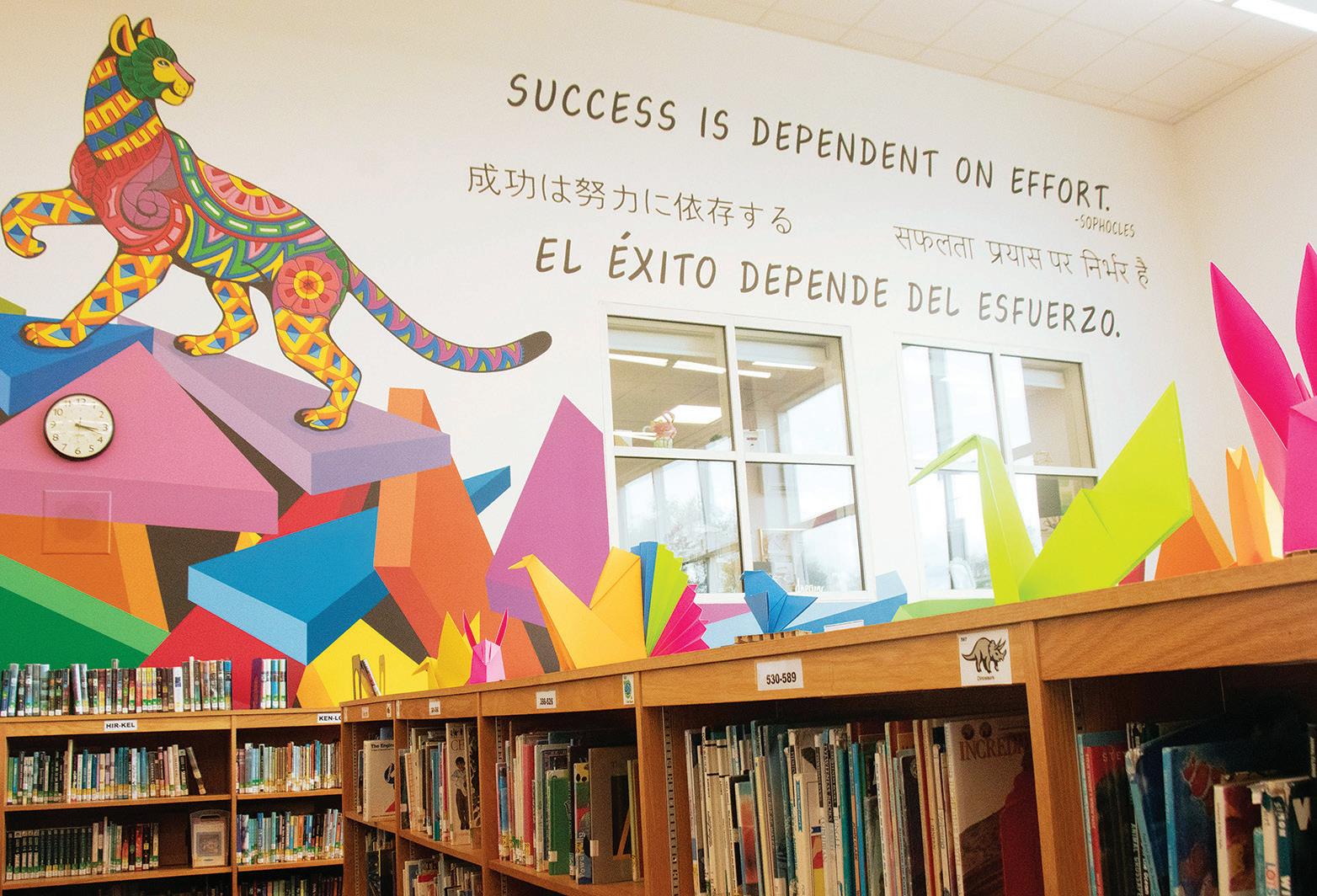
The library features a version of the school’s mascot, a royal blue cougar, painted in bright colors watching over shelves of books in Spanish and English.
The teachers, books and painting are all part of a bilingual education program called the Legado Spanish Immersion Academy.
The program was launched in fall 2018 with kindergarteners and has grown to include classes from pre-K to seventh grade, with two classes per grade level and a bilingual librarian, Liliana Lamadrid.
Legado, which translates to “legacy” in English, follows a model where the students involved spend 80% of the school day in Spanish and 20% in English. Then in second grade it shifts to a 70% and 30% split, slowly getting closer to a half and half split. Generally, language arts and specials such as art, music and STEM, a type of creative sciencebased curriculum, classes are taught in English. Math, reading and writing, as well as other subjects, are all taught in Spanish.
Starting in third grade, the program transitions to more instruction in English for math and reading and writing to help students gain the academic vocabulary they need for state-wide standardized tests like ILEARN.
Clifty Creek Elementary School Principal Patrick Mahaffey was part of the planning committee when the program was first suggested. He said the 80/20 model forces students to engage with the language and learn to keep up with the class. It
By Sofía Rodríguez sr73@iu.edu
The Asian American Association at Indiana University received Student Organization of the Year last month during the Student Organization Awards Ceremony.
The student organization of the year is awarded to an organization with a large impact on its members and the IU community, while exceeding at “community engagement, collaboration, and/ or leadership development,” according to the Office of Student Life. The awards are chosen by a committee from the Student Involvement and Leadership Center.
AAA was founded at IU in 1987 as a nonprofit focused on fostering a community for Asian Americans and Pacific Islanders.
In addition to monthly meetings for club members, AAA hosts events open to the whole student body. The group hosted events this year such as the Lunar New Year celebration in February, which featured student performances and food. It also hosted the Halloween “Grave Rave” in October at Kilroy’s Sports Bar, and a game night in November at the Global and International
prevents students from just waiting to learn and engage until their preferred language is used, which can sometimes happen in a 50/50 model, he said.
Former Bartholemew Consolidated School Corporation Superintendent Jim Roberts encouraged the school district to adopt a dual language program after his experiences with the dual-immersion program for Mandarin in Batesville, Indiana.
According to the Indiana Department of Education, there are currently 43 duallanguage programs across the state all using Spanish and English except for Batesville, which does Mandarin. This includes Summit Elementary School and Batchelor Middle School, two Monroe County Community School Corporation schools.
Legado fourth grade teacher Eric Huggins sees the program as a beneficial alternative for English as a
Studies Building.
AAA places club members into six “families” comprising around 20-25 members. These families help foster relationships inside the club, freshman Irene Thang said, and they hold meetings depending on the availability and interest of the members.
Internal Events Coordinator Frank Nguyen introduced a family ranking system to add friendly competition and boost participation, Thang said in a text to the Indiana Daily Student. The families compete over attendance and participation or in games.
The rankings are gold, silver, bronze, platinum and diamond, and families can earn prizes such as extra funding for family events, sponsored events and bragging rights, Thang wrote.
Junior vice president Jason Tang has been a member of AAA since his freshman year and was elected April 14 to serve as president in the 2026-27 school year.
Tang said the organization helped him find community on campus.
“As far as being an out-ofstate student, coming to college, I didn’t know anybody else here, so I was really looking for a community, a place
Second Language students.
For the 2025-26 school year there were 1,690 ESL students enrolled in BCSC schools.
“This is perfect, because these kids are learning Spanish and English, but from at the time when they are really flexible, their minds are flexible and it’s really the proper time for them to learn it.”
Eric Huggins, Legado fourth grade teacher
“What makes the program meaningful for me is that it’s for the kids who come in who are Spanish speaking at home,” Huggins said. “They traditionally would have gone into like an ESL program, where essentially, they have to learn English before they can
to find my closest friends, and Triple A has definitely, by far, been that organization for me,” Tang said.
Senior Anthony Patiag is the current president of AAA. Pataig started off as a freshman representative and worked his way up through the executive board. He said his main goal is to build social relationships through AAA’s advocacy, which focuses on AAPI experiences, political issues and community building.
“There’s a lot of unstated responsibilities that the president has, primarily, acting as the liaison for Triple A to the public, but also intraorganizational, with organizing our events alongside our board and then just making sure the board collaborates as a team to pursue our mission,” Patiag said.
This is not the organization’s first time earning student award recognition. In 2024, AAA was first runner up to the award behind the African Women’s Leadership Organization. The office gives nine awards each year for various organizations and leaders.
This year, the first runner up was Black Men Evolve, with the second runner up being Sigma Gamma Rho
ever access the content in the classroom at all. And it takes, you know, three, four years to develop that academic level of English.”
Legado aims to have classes with half native Spanish speakers and half native English speakers, so students can learn the languages from each other and not just their teachers.
While it was hard to convince families to sign up at first, the wait list is growing every year, Legado Instructional Coach Greicy Patiño said.
“One thing I tell (families) is that for our kindergarten kids this is the only kindergarten they’ve ever known, so this is just what school is,” Mahaffey said. “It’s usually far more confusing for parents than for kids.”
First grader Eleanor Ramey, 6, enjoys learning Spanish, especially reading books in Spanish from the school library. Her favorite book is from the “Piggy
and Gerald” series called, “Vamos a Dar una Vuelta,” which means “we’re going on a trip.”
Huggins, who before teaching at Legado was a high school Spanish teacher, finds teaching younger children much more impactful.
“This is perfect, because these kids are learning Spanish and English, but from at the time when they are really flexible, their minds are flexible and it’s really the proper time for them to learn it,” Huggins said.
Throughout the day, teachers use different colored lights to indicate what language the students should be using. Blue is for English, green for Spanish and purple for whatever language the students want to use.
The program faced some community backlash when the school replaced its English-only signs with bilingual ones in front of the school, Huggins said. Teachers not in the Legado
program have also been concerned that their jobs could be replaced in favor of bilingual teachers and said the program spilt the school in half between Legado and traditional classes.
Mahaffey has worked to close the gap by holding meetings with traditional and Legado teachers and hosting school-wide programs like the whole school reading “Charlotte’s Web” throughout next year.
Greicy Patiño, one of the founding teachers of Legado, sees the program as a beautiful reflection of the diversity of the community. According to the Columbus city website, there are 54 different native languages spoken in the school system, with immigrants making up 15.9% of the population.
“There are kids in (Clifty Creek Elementary School) who are afraid to speak Spanish,” Huggins said. “But then they come over to Legado and it’s like, ‘Oh, I can speak Spanish at school and be proud of it.’”
Several of Legado’s teachers were originally teachers abroad and through Legado can teach in the United States. Second grade teacher Karen Camargo is originally from Brazil and calls Legado her “happy place.”
“If I make them be happy, believe in themselves, they can learn whatever I want to teach them,” Camargo said. “I think my main job is make the kids enjoy coming to the school every day, be happy to be here, feel safe in this place, and they can learn all the things they can.” Camargo sees the impact Legado has on students. One project involved students reading a book called the “Paletero Man,” meaning popsicle man. After reading, the second graders invented their own flavor of popsicle, with one student creating a bilingual flavored popsicle, one side English and the other Spanish. Camargo hopes to continue teaching at Legado for years to come. “Somos awesome,” she said.

Sorority Inc.
Thang said the club has helped her find community. She found out about the club through her older cousins in AAA, including junior Zingtin Thang, who is the current marketing design chair.
“It was a great group of people, and I couldn’t wait to be involved,” Irene Thang said.
Irene Thang is serving as a freshman representative this school year alongside freshmen Calvin Song and

Jimmy Li. Thang will be re-
turning next school year as the club’s external events coordinator.
Patiag said he hopes to help other people find the kinds of close friendships that AAA provided for him.
“Most of my friends that I met freshman year are still the same friends that I have this year, and it’s just a big support group that I’ve always honored and could never thank Triple A enough for introducing me to,” Patiag
said. Tang said being club president is a daunting task, but he is excited to take on the role next year.
“I love the organization so much that the burden of the work doesn’t really scare me off,” Tang said. “I think it’s more of





We now see a comprehensive and worthy plan for our outlet, IU Student Television and WIUX within reach.
Back in October, people respected in the media landscape encouraged the IDS to separate fully from the university. As the task force notes, this isn’t fully out of the picture yet. Instead, we chose a measured approach and worked with IU because we saw the need to protect the feedback loop between IU and its student media. Both work better together. The IDS attracts some of the best prospective journalists in the country, who learn from award-winning faculty. They take those skills and put them into publication at our organization. For decades, these components have worked hand in hand.
We weren’t ready to abandon that.
The IDS has made goodfaith efforts to find a solution
with the university. Now, the ball is in its court. While proceeding with implementing the task force’s plan, university administrators should remember what happened in October. They should recognize the power students and the community that supports us hold. The lessons from this recent history should not be forgotten. It certainly won’t be in our organization. Another lesson for administrators came from the success we’ve seen after October. We saw fundraising skyrocket, and like many media groups that now rely more on philanthropy, we have been able to use donations to support our operating costs.
As the task force reported, professional media organizations, including the IDS, have seen decreasing advertising revenue in recent years. However, that’s a small part of the picture. Our online audience continues to grow. This school
year’s traffic was 70% higher than last year’s, helping us fight lower ad revenue. We reached nearly 6 million page views on our site this school year. However, industry-wide financial challenges aren’t lost on us, and we are consistently finding innovative ways to adapt.
Selling posters of our newspaper after Indiana football won the national championship — only possible due to administrators clearing bureaucratic red tape — brought the IDS more than $200,000 in revenue. Obviously, we can’t depend on that for sustained cash flow, but the IDS will be selling more and more poster prints in the future — another revenue source.
The strengthening of the IDS after October’s crisis allowed us to continue doing what we do best: journalism. Our staff of reporters, editors, photographers, designers and social media producers has continued to create some of the best stu-

dent journalism in the state and country. For the first time in years, we’re at the precipice of a beneficial cycle. When student media is supported, students get opportunities to learn and excel in their craft, which then generates more money. The way forward is clear: innovation from us and investment from IU, not cuts.
Journalism is changing. The Media School students graduating May 9 will be at the cutting edge of these shifts. With investment and care from our university, IU students could be the first to lead a struggling industry into a sustainable future. The task force’s recommendations outline the best way to commit to this future. There must be no half-mea-


Dr. Andrew Pitcher, D.C.
Dr Cr ystal Gray, D.C. Mon - Thu.: 8 a.m - 6 p.m. 1121 W Second St 812-336-2225
bloomingtonchiropractor com

Baron D Hall, DDS, MSD Jake
Willhite, DDS, MSD Orthodentists
Erica Hall, Hannah Elliott, Kaitlyn
Jacobs, Marilyn Lee, Adrian Price
With modern techniques and a fun style, B-town Orthodontics is the most up-and-coming orthodontics
including invisalign, gold brackets, laser treatments, and even mini implants that can help restore missing teeth and even eliminate the need for surger y consultations and don’t forget to download The Braces App, the hottest free app designed by B-town Orthodontics’ Dr Baron Hall.
Tue - Thu.: 8:30 a.m - 4:30 p.m Lunch 12:30 p.m - 1:30 p.m.
Mon & Fri.: Appointments Only 1320 W Bloomfield Rd., Suite B 812-287-8851 btownorthodontics com

Ryan D Tschetter, DDS Lauren R Hoye, DDS Jackson Creek Dental is conveniently located on South College Mall Road Most insurances accepted, including the Indiana University Cigna Insurance plans as well as the IU Fellowship Anthem state of the art dental technology such as Zoom whitening, same day crown appointments, and Invisalign We also provide restorative, cosmetic and emergency care We pride ourselves in giving the best care to our patients while atmosphere.
Mon - Thu.: 7 a.m - 5 p.m. Fri.: 7 a.m - 3 p.m. 1124 S College Mall Rd. 812-336-5520 jcdsmiles com

NEW OUTLOOK
COUNSELING CENTER INC
Cher yl Mansell, LCSW RPT Kyle Fouch, PMHNP Alisa Doty, LMHCA Kaitlyn Mer win, LCSW Chi-Wei “Diana Kan, LMHC Angie Miller, LMHCA Marisa Soliday, LSW Stephanie Blanford, LSW Alexandria Conger, LMHCA Amber Hancher, LSW Sydney Conger
Providing individuals, couples and family counseling as well as psychiatric evalutation and medication management We ensure that individuals of all ages, experiencing mental illness can better manage life.
Mon - Thu.: 9 a.m - 6 p.m. Fri.: 9 a.m Noon 5010 N Stone Mill 812-929-2193 newoutlookcc org

Ricardo Vasquez MD Medical evaluations: varicose veins, leg pain and swelling No refund needed
Mon - Fri.: 8 a.m - 5 p.m. 815 W Second St. 812-336-6008 vascularcenterandveinclinic.com
Optometr y




Austin C Starr, D.D.S Board Certified Oral Surgeon HOOSIER ORAL SURGEON
Dr Starr is an IU Football Alum who provides pain-free experiences for all Hoosiers with IV sedation He specializes in Wisdom Teeth Extractions, Dental Implants and Plasma Therapy while utilizing 3D imaging technology Accomplish fast and predictable healing with Plasma Therapy to avoid dr y sockets after extractions Voted the Most Trusted in Bloomington, they look for ward to accomplishing continued successful results ever y day for all Hoosiers.
Go IU!
Mon - Thu.: 8 a.m - 5 p.m. Fri.: 8 a.m - 4 p.m. 473 S Landmark Ave. 812-318-1023 starroralsurger y com
Dr. Andrew Pitcher,
of
lems, while also addressing the body chiropractic care helping patients reduce stress, improve mobility and spinal health The quality treatment we provide is always fit to your individual needs and goals Let us help you achieve and maintain
Mon - Thu.: 8 a m - 6 p m. 1121 W Second St 812-336-2225 bloomingtonchiropractor com
Dr. Andrew Jones, OD Dr. Marzia Zamani, OD Dr Mark Houser, OD Dr Tavel Family Eyecare is your partner in your personal eyecare journey Since 1940, the company has believed that ever y Hoosier deser ves quality eyecare and vision exams, special testing, management of eye diseases, glasses, contact lenses and much more, all backed by an insurance acceptance guarantee The company is committed to advancing eye health by investing in the latest technology and providing treatements that are right for ever y patient’s unique needs.


of speech for me, not for thee
the war in Iran.
Spencer Robinson (he/him)
is a sophomore studying public policy analysis and law and public policy.
There is a version of the First Amendment that exists in courtrooms, in appellate opinions, in the careful reasoning of constitutional scholars. In that version, free speech is nearly absolute — an indiscriminate shield that covers the powerful and the powerless alike.
Then there is the version that exists in practice. That version has a different relationship with power. It protects the people who need protection least and binds those who need it most.
Gabriela Saldana found out on April 16 which version applies to her.
When Saldana, a 23-yearold student at Florida International University, posted in her WhatsApp group chat, “Netanyahu, if you can hear me, drop some bonbons for us Capstone students in Ocean Bank Convocation Center,” she was doing what many students do in group chats, being absurd. The message may as well have been a wish directed at Santa Claus.
FIU police arrested her anyway, charging her with making “a threat to kill or do bodily harm to individuals regarding a scheduled event.”
The State of Florida
charged her with a seconddegree felony carrying a maximum sentence of 15 years. At arraignment, Judge Mindy Glazer set bail at $5,000 and offered her legal reasoning: “To an objective person, it's not a joke, and it would be enough for probable cause.” This is not a debatable legal question. Under Watts v. United States (1969), the Supreme Court held that hyperbolic political speech — speech invoking violence and directed at a sitting president — is protected when context makes clear it is not a genuine threat.
The Court tightened that standard further in Counterman v. Colorado (2023), requiring prosecutors to show not just that a reasonable person would find the statement threatening, but that the speaker was at minimum consciously disregarding significant risk that their words could cause harm.
A message asking a foreign leader to drop “bonbons” on a graduation venue, sent in a student group chat, fails that test so thoroughly it falls to the level of “Saturday Night Live” parody.
Probable cause requires reasonable belief that a crime occurred. If conduct is constitutionally protected, there is no crime. Glazer’s statement that “to an objective person, it's not a joke”
is not a legal finding — it’s Glazer’s opinion and contradicts 50 years of Supreme Court precedent. Saldana is almost certainly going to win her case, but that’s entirely beside the point.
The Foundation for Individual Rights and Expression has already alleged First Amendment violations in an April 23 letter to FIU police. Ongoing legal proceedings will take months or years to reach a conclusion. In the meantime, Saldana has been arrested, publicly charged with a felony, forced to post bail and had her name and face attached to a story about threatening a mass casualty event at a graduation ceremony. She will carry that search result wherever she goes — to job applications, to graduate school admissions or social events — regardless of how the case resolves.
Saldana has a right to freedom of expression, but for someone without institutional protection, resources, or social capital, arrest is the punishment. The Constitution is theoretically available to everyone; the protection it provides in real time is not so evenhanded.
One week before Saldana posted about Netanyahu, President Donald Trump wrote on Truth Social that “a whole civilization will die tonight, never to be brought back again,” in reference to
Harvard’s Carr Center for Human Rights Policy characterized the statement as a threat of genocide. Trump was not arrested or charged. No judge found that a reasonable person might take his words as a genuine threat — even though, unlike Saldana, Trump commands an actual military, has the authority to order strikes and has exercised both.
Power, it turns out, is an excellent predictor of whose words are treated as protected political speech and whose are treated as criminal threats. The First Amendment, in practice, is strikingly good at protecting the people least likely to need it.
IU students do not need to look toward Miami to understand this asymmetry.
In April 2024, IU administrators changed a 55-yearold policy overnight, which guaranteed broad protest rights in Dunn Meadow. When students arrived the next morning to set up a planned encampment, the administration had already called the Indiana State Police. Troopers arrived in riot gear. Snipers positioned themselves on the roof of the Union with rifles aimed at students. Dozens were arrested, and many received one-year campus bans.
FIRE, the same organization now defending Gabriela
Saldana, then named IU the worst public university in the country for free speech. When asked to describe a time they felt they could not express their views on campus, one IU student’s answer was simple: “The president has called snipers on protesters before.”
The administration that deployed those snipers — in the name of safety and order and the protection of the campus community — has spent the past year refusing to release the findings of an independent review it commissioned into plagiarism allegations against university President Pamela Whitten.
In August, The HeraldTimes reported what appeared to be an 85-word section of Whitten’s 1996 dissertation that copied almost verbatim from another source, along with several other alleged instances. IU declared the allegations meritless, cited attorney-client privilege to withhold the review and gave Whitten a raise and extended her contract. Legal experts interviewed by the Indiana Daily Student found no legal mandate preventing the university from releasing the report. The question — “why keep it secret?” — is still unanswered.
The pattern arranges itself clearly enough. Integrity standards are enforced downward, against students,
with suspensions, expulsions and felony trespass charges. The same standards, when they implicate IU’s president, become confidential legal matters wshielded from the public. A legal system that protects free speech would attach consequences to its violation at every level, not just at the appellate level years after the damage is done. It would not insulate judges who find probable cause for arrests that contradict half a century of constitutional precedent. It would not permit a university president to deploy armed state troopers and snipers against students exercising protected speech in a designated free speech zone, and face no legal consequence for doing so, while those same students are banned from campus for a year on threat of felony prosecution.
The First Amendment found in textbooks states the law cannot be weaponized against speech simply because it is uncomfortable, provocative or politically inconvenient. The First Amendment that exists in practice in Bloomington and Miami, and in every place where power decides which words are threats and which are protected, states something else entirely.
spenrobi@iu.edu
Eric Cannon (he/him) is a sophomore studying philosophy and political science and currently serves as a member of IU Student Government.
In ballet, a grand pas is a duet in which the drama pauses so the lead dancers can demonstrate their graceful movement. Ballet was born in Renaissance Italy. After it spread to France, it was nurtured in the courts of the “most Christian kings.” It is, by origin, Christian and conservative.
In politics, a faux pas is a post Indiana’s lieutenant governor makes on Facebook.
Late last month, Micah Beckwith posted that Westfield High School’s band kids — who were wearing red and black makeup and outfits for their spring percussion show called “Red Line” — gave him a sense the school loves “giving the (middle finger emoji) to Christian Conservative families.” The comment stirred plenty of drama. It had no grace. When met with backlash for the post, Beckwith said he objected to the themes behind the music the band played, originally from the opera “Carmen,” of exploring and crossing boundaries, witchcraft, seduction and broken family relationships. He then doubled down, calling the band’s performance one example of “demonic” action in Indiana’s public schools, which the Hoosier taxpayer currently funds and which he intends to fight.
This is not the only fight Beckwith has picked with Westfield High School, or with Indiana’s schools more broadly. In November, he threatened to strip Westfield’s funding after claiming the school disinvited him from
an agricultural program it hosted. A week before the latest incident, he said Valparaiso Community Schools’ superintendent sent a “horrible and dangerous message” by apologizing for his visit to a career fair while permitting students to protest U.S. Immigration and Customs Enforcement earlier in the year. Across these cases, a pattern emerges in which Beckwith not merely picks battles, but does so frequently, indelicately, publicly and always with opponents smaller than himself.
Beckwith is not wrong that American civic life once had a more pious, sometimes puritan, sensibility, which has, over the past decades, faded. In the 1980s, the ACLU sued cities big and small across the country for their lone displays of nativity scenes in city halls, eventually securing a Supreme Court win that banned the practice. It used to be that Hollywood’s Hays Code prohibited films that would lower audiences’ moral standards. I don’t suspect evil forces were undermining Westfield band kids’ morality through art at the Red Line, any more than through video games in the 2000s. But I can’t fault the lieutenant governor for caring for the uprightness of the youths, either.
What is at issue is not Beckwith’s grievance but his response, and specifically whether the response reflects serious engagement with what the Christian tradition has said, over a long time and with considerable sophistication, about how believers should conduct themselves toward cultures or persons who oppose them.
Beckwith’s has been the
Trumpist response. This means it is, by origin, neither Christian nor particularly conservative, as President Donald Trump far more closely resembles Nero than St. Louis IX the king of France and a reactionary populist than a steward of this country’s traditional institutions. The form of public discourse Trump has innovated is new and beyond the old pale. Why, then, have so many self-described conservative Christian politicians throughout the country, especially in Indiana, adopted this way of addressing their opponents?
Contrast this approach with that of St. Francis de Sales. The 16th-century Catholic bishop and theologian — and patron saint of journalists — reconverted, according to tradition, 72,000 people in a hostile territory. His region of southern France had recently, and enthusiastically, embraced Calvinism amid a time of fierce, and bloody, religious conflict. Yet de Sales won so many people to his cause through small virtues: gentleness, temperance, modesty and humility.
There is a tradition of Christian thought that would resist the reduction of Christianity’s public relations to gentleness alone, that would insist the faith must sometimes wield muscle, even state power, in addition to meekness. This tradition is found in St. Thomas Aquinas: False beliefs obstruct our enjoyment of the common good, so the state, whose job it is to foster that good, has a valid reason to curb such beliefs. Presumably, Beckwith might place himself in this tradition.
But the difficulty is that Beckwith’s actual relation-
ship to the tradition seems nonexistent. The belligerence that characterizes Beckwith’s rhetoric is not Thomistic. Nor is it clearly the product of theological reflection over St. Thomas. Instead, it appears to have been absorbed from a post-Trump politics that favors the social media attack, replete with all-caps and bad-faith assumptions, as its foremost method of expressing grievances. Christian vocabulary like “demonic” is thus fitted onto a form that postdates it, is unrelated to it and degrades it.
De Sales’ practical counsel, written five centuries earlier, serves well as a response to this trend.
On language, de Sales warned against impolite words. Even without poor intentions, those who hear them may interpret them differently. The problem with Beckwith’s use of the word “demonic” is thus not only that it is uncharitable but
that it prevents the conversation Beckwith should want. Rather than persuade, he performs disgust that only confirms, in the minds of band kids, that Christians are exactly what their naysayers have long suspected them of being: intolerant prudes.
On judging motives, de Sales said human judgment sees only so far. When we assume others’ intents, we attempt something only God can do. Neither band kids playing a classical operatic piece nor the teachers behind it are, on the available evidence, aiming at ruining good morals.
On being slighted, de Sales wrote that humility means we should have a certain joy in our own abjection. Being protested at a career fair or disinvited from another program is therefore an occasion for practicing the small virtue of meekness, not for threatening to defund schools.
On conflict itself, de Sales said, “If possible, fall out with no one.” He followed this with a parable of two kings. One peacefully visits a country, and its people are “gratified and flattered.” The other brings soldiers into the country. Even if the king does this for the people’s sake, he advises that the visit “is sure to be unwelcome and harmful.” De Sales, writing in a time of open conflict and massacres, did not attack, accuse or offend. In “Introduction to the Devout Life,” he rehashes a Christian king’s wisdom to this point: Contradict nobody, unless sin or harm comes from agreeing. When it is necessary to assert one’s own opinion, do so gently and considerately. Nothing is gained “by sharpness or petulance.” And what is more Christian, more conservative than that?
ericcann@iu.edu
Her
died 36 years ago.
By Natalia Nelson nelsonnb@iu.edu
As her husband scrubs the shampoo into her scalp, Jennifer Gatz thinks about her mom.
As he leans her head back to rinse the suds from her long, light brown hair, Jennifer thinks of how lucky she is to have someone who is a good husband and father.
As he scratches her head, she thinks of how her mom never had someone who would buy her flowers when she had a bad day or massage her back.
In gentle moments like these, Jennifer thinks of all the kindnesses her mother didn’t have.
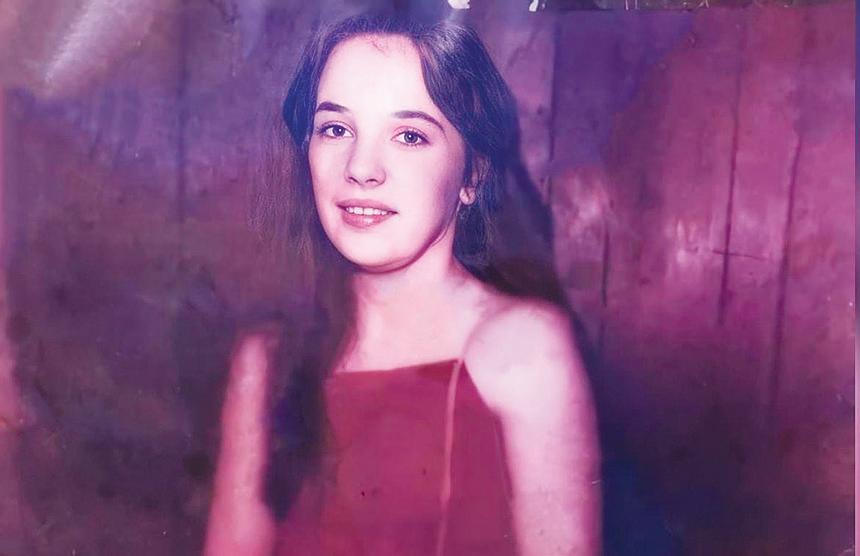
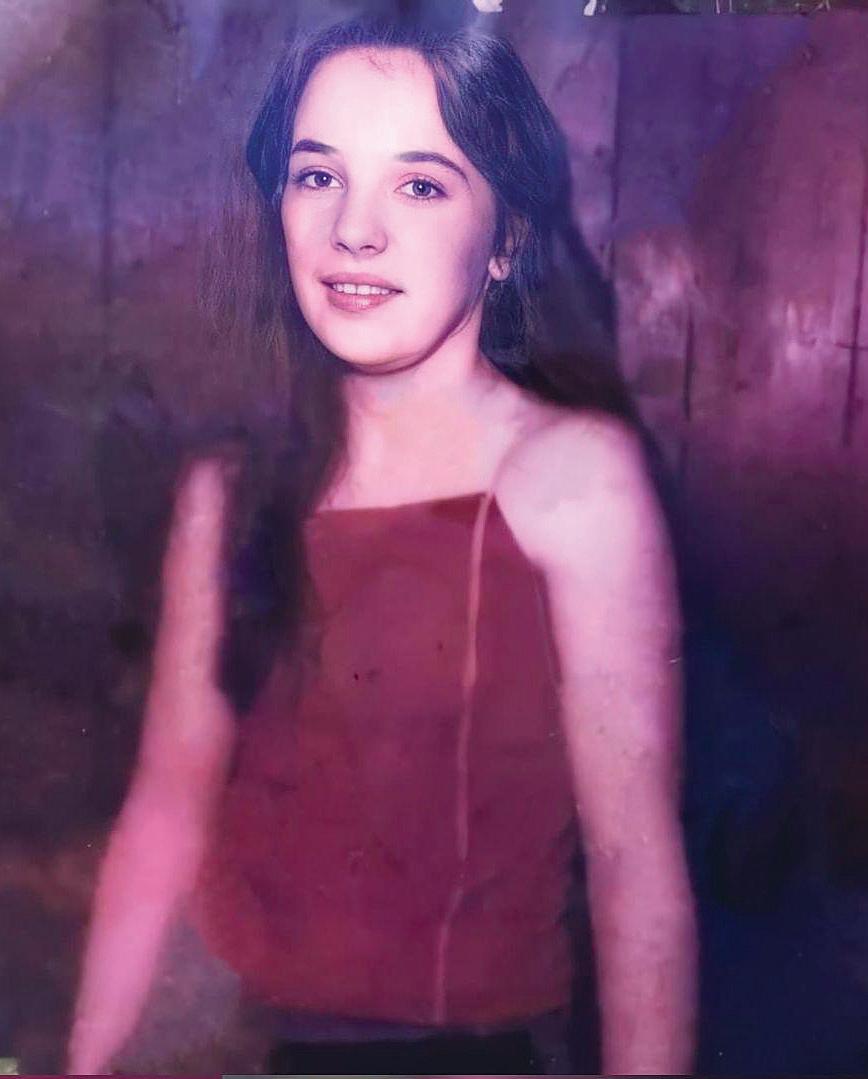
Dawn Caraveo died over 36 years ago in Morgantown, Indiana, just 30 miles northeast of Bloomington. Jennifer was 3 years old.
The autopsy report documented Dawn’s death as a suicide from a self-inflicted gunshot wound to her stomach. But certain details in the case make Jennifer question what really happened.
Thoughts of her mom have consumed her daily life for the past few years.
She’s filed public records requests, sent emails, made calls, viewed crime scene photos and found the autopsy report from that day.
For Jennifer, now 39, there’s no way her mother committed suicide. She wants to know the truth.
Though she was young when her mom died, Jennifer remembers following her three older siblings to her mother’s bedroom after waking up to the sound of a gunshot. It’s her very first memory.
It was the early morning of Jan. 29, 1990, and she remembers running with her siblings to a neighbor’s house for help.
Her legs were so short she couldn’t keep up with the others. Her oldest sister dragged her along by the wrist as they dashed through the Morgantown snow.
The memory from the rest of that day was foggy, but Jennifer said she was put in her uncle’s truck. She and her siblings had different fathers, so they were separated.
“I grew up different than everybody else. It’s not having a mom and dad under the roof, and everybody else seems to have parents.”
Jennifer Gatz
Dawn Caraveo’s daughter
Her dad, Oscar Young, took her in. He remembered how Jennifer used to cry every night, wanting her mom. Jennifer didn’t have much of a relationship with Young, and he didn’t know how to handle it, so he talked to Dawn’s sister about it, and she asked to raise Jennifer.
“That little girl lying there crying, and what? No mom,” Young said. “I didn’t want to tell her.” She stayed with her father for about a month after Dawn’s death, but then he dropped her off at her maternal aunt and uncle’s house in Walton, Indiana.
When she was 12, Child and Protective Services placed her in a foster care facility in Wabash, Indiana, after she said she experienced abuse at her aunt’s house. She ran away frequently to be with her sister, Lynn, who was 9 years older. Lynn would take care of her for a couple of months at a time, before Jennifer would go back into the foster care system. Jennifer was taken out of state care at 15 when her older sister, Samantha Caraveo, got guardianship of her in Texas. Samantha was 22 at the time.
“I grew up different than everybody else,” Jennifer said, “It’s not having a mom and dad under the roof, and everybody else seems to
have parents.”
As a kid, Jennifer would pretend her mom was there, telling Dawn she missed her.
When she ran away, she would go to the cemetery where Dawn was buried and lie there.
She kept a journal as a kid, where she’d wonder about how much she looked like her mom. She tried to imagine Dawn. She wrote about how jealous she was of other children who had moms and dads they grew up with.
“And I wanted that so bad,” Jennifer said.
A pathologist ruled Dawn’s death a suicide within three hours.
Thirty-six years later, no one has been able to find an official police report for Dawn’s case from that day.
Without a police report, there’s no way to know if her hands and feet were ever tested for gunshot residue or if fingerprints were lifted from the 12-gauge shotgun, a weapon Jennifer said belonged to her mother’s boyfriend at the time and said her mother had no access to.
Dawn’s black eye in the crime scene photos wasn’t
living in Texas, tried to get the case reopened. There was too much she felt needed another look.
Dawn never kept guns in the house, and Samantha always wondered how her mom got the gun; she said Dawn’s then-boyfriend always kept one in his truck.
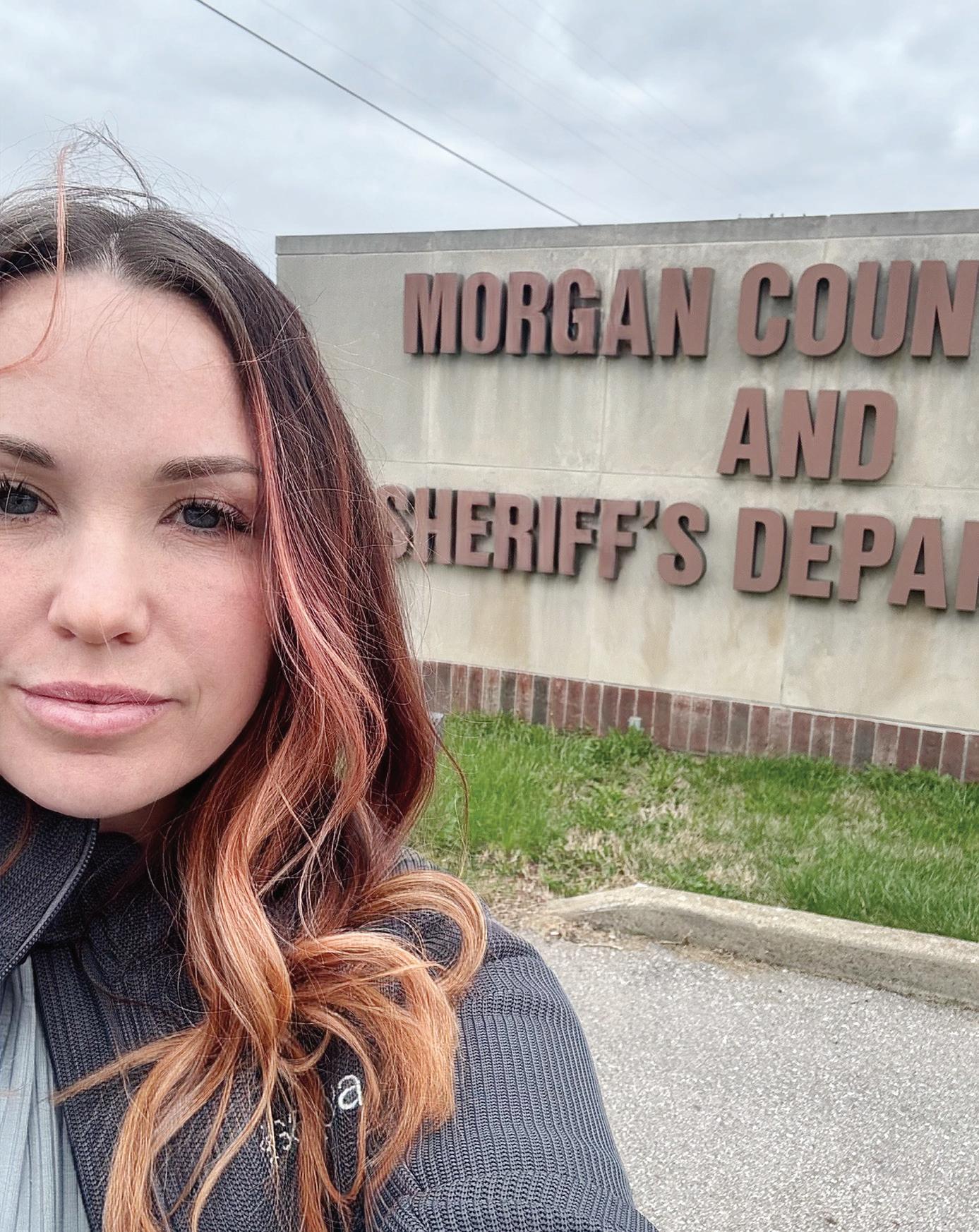
Samantha had a connection to the county coroner at the time, Dan Downing, who she said told her there were discrepancies in the crime scene photos. She reached out to the Morgan County Sheriff’s Office to ask about the case.
Scott Hamilton, then a detective sergeant, started looking into her mom.
Hamilton emailed back and forth with Samantha for a while, telling her he didn’t locate any reports but found the dispatch log and was trying to locate a report from the fire department and ambulance.
Hamilton did not respond to the Indiana Daily Student’s request for an interview.
Samantha told him she suspected Dawn’s boyfriend at the time murdered her mom, and Hamilton said he was trying to find him.
Samantha said she remembers him severely abusing her mother, things she said were truly beyond “normal physical abuse.” She described him as “psychotic.” “Frankly, I’m tired of being lied to. But I’m pursuing this to the fullest.”
Samantha Caraveo Jennifer Gatz’s older sister
Logs from Middle Way House, a domestic abuse treatment center in Bloomington, show Dawn named him as her abuser and described her previous history with him.
“She has been put in the hospital from the abuse about 2mos. ago,” the log, dated December 1989, read. Her exit form — signed just a few weeks before her death — detailed Dawn’s intent to leave Morgantown and move back to Kokomo.
Downing mailed Samantha the autopsy report, the field coroner report and the toxicology report.
Then, Samantha’s communication with both Hamilton and Downing became
sparse. Hamilton wrote to Samantha in March 2003, saying he met with the coroner, who confirmed there were “no indications of foreign footprints in the snow that would have led them to believe that any other party was involved.” Samantha replied to him in May 2003, frustrated with the lack of response.
“Frankly, I’m tired of being lied to,” Samantha wrote. “But I’m pursuing this to the fullest.”
She made an “obscene” amount of calls to Downing, Samantha recalled, but never heard anything back. Finally, it took too much of a mental toll.
Twenty-one years went by with no response.
Jennifer didn’t talk about her first memory she had until December 2024, during a phone call with Samantha. Jennifer had started therapy, knowing she had a lot to work through because of the trauma associated with her mom’s death.
That’s when Samantha shared everything she tried to do in 2002 to find out what happened to their mom.
the captain of the Morgan County Sheriff’s Office, responded five hours later.
“All of the investigators stated that they had no question that this case was a suicide,” Downing said in the Dec. 17, 2024, email to Jennifer. “With that Detective Hamilton did not open a new investigation.”
But he said he acknowledged there could be “discrepancies” within the case that should be followed up on and assigned a detective to follow up on the case.
When Jennifer got the crime scene photos back from a public records request in December 2024, it sealed her belief that someone else shot her mom.
In the photos, there’s blood on the door handle and doorstep but not in the bedroom where her mom died.
The photos also included the gun that Dawn allegedly used to shoot herself. It was a 12-gauge shotgun, and Dawn was barely over 5 feet. Without a police report detailing exactly how long the barrel was, Jennifer questioned how it would have been physically possible for Dawn to pull the trigger.
Beyond that, the gunshot wound was to Dawn’s stomach — a rarity in suicide cases.
Former Morgan County pathologist Allen Griggs, who performed the official autopsy, said he doesn’t see many suicide cases with gunshot wounds to the stomach. After reviewing the autopsy and crime scene photos years later, he said it would have been possible for Dawn’s wound to be selfinflicted.
He said to determine the manner of death, he would have taken in the circumstantial evidence provided by the coroners and police and put it together with the external and internal examination of the body. But he doesn’t remember much of Dawn’s case.
Still, Jennifer believes it wasn’t suicide. It’s partly because her sister Lynn remembered hearing a truck driving away. Jennifer remembers seeing tire tracks in the snow, though she assumes they disappeared before police got to the scene over an hour later. The field report claims Dawn’s boyfriend left the night before and that Dawn was on drugs, though her toxicology report came up clear.
Samantha says she remembers the responding officer, who was town marshal at the time but is now deceased, coming to their house several times, not in a law enforcement capacity. She alleges he even saw Dawn’s boyfriend beating Dawn one time in the street, but the town marshal let him go.
“I questioned it my whole life. I believed he shot her.”
Jennifer Gatz Dawn Caraveo’s daughter
None of her family members were interviewed after Dawn’s death, Jennifer said. She doesn’t know if Dawn’s boyfriend was interviewed, since there is no surviving police report associated with the case.
“I questioned it my whole life,” Jennifer said. “I believed he shot her.” She filed a request for a new investigation in 2025 under Senate Enrolled Act 177, a law that allows an immediate family member to request an investigation into an uncharged death.
The Indiana State Police put together a presentation for review by the ISP Review Board. Still, on June 30, 2025, a special investigations sergeant emailed Jennifer to tell her that the board had denied opening a new investigation. The main suspect, Dawn’s boyfriend, was dead, and so was the investigating officer. There was no original police report, the sergeant said.
SEE DAWN, PAGE 7
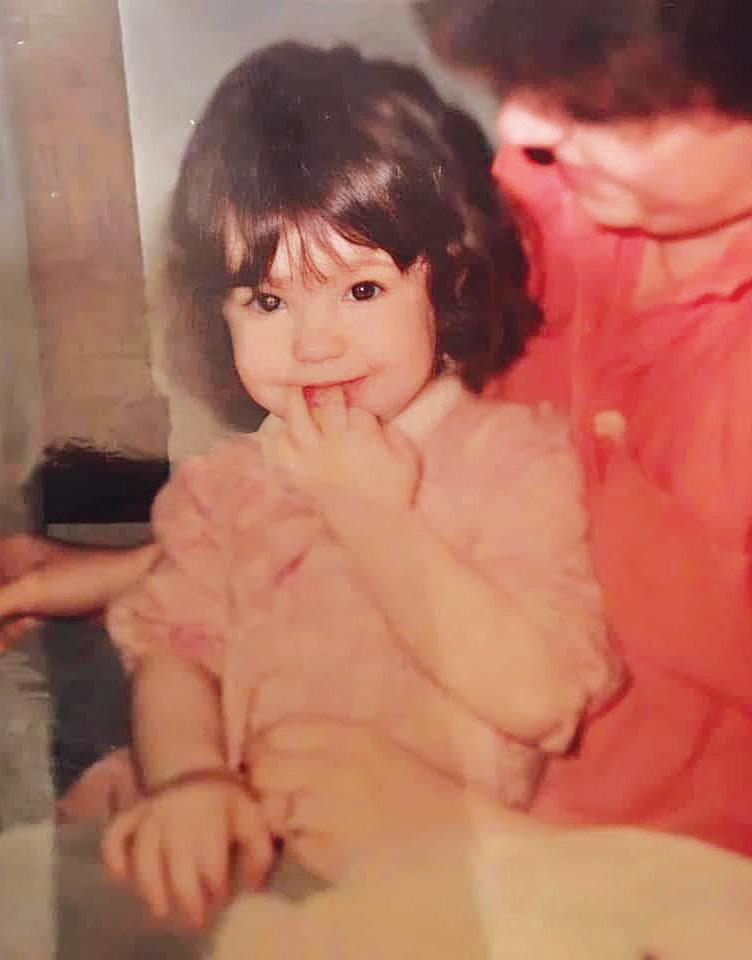
Gatz was 3 when her mother died in 1990
Most parties involved in the investigation are deceased, and all evidence in the case was already released or destroyed.
There was nothing more the ISP could do.
Jennifer has since started a Facebook page called “Fight for Dawn’s Truth” — she said she needed support from people outside of her immediate family. She’s determined not to let her mom’s story be swept under the rug.
Morgantown Town Mar-
shal Ryan Swank told the IDS the department had gone through to find evidence from Dawn’s case and came up dry.
Downing said he would make no further comment on the case, and it was forwarded to the Indiana State Police for review and any necessary follow-up investigation.
Jennifer refuses to let her mom be forgotten. On her Facebook page, she details every discrepancy in the case. She questions everything.
Samantha remembers her mom being a good cook and loving Christmas. Even though their family didn’t
“The goal would be to clear my mom’s name,” Jennifer said. “Even if they were just to say, ‘This case was grossly mishandled, and we’re sorry.’”
have a lot, her mom would always make sure they had a good Christmas.
Dawn made sure Samantha had a basketball and basketball rim to play. On the morning of her mom’s death, Samantha remembered she was excited for a game.
Dawn’s death was a suicide. She liked life too much, Young said. He remembers going camping and fishing with her when they were younger — their parents were friends.
Dawn’s daughters meant everything in the world to
“The goal would be to clear my mom’s name. Even if they were just to say, ‘This case was grossly mishandled, and we’re sorry.’”
Jennifer Gatz, Dawn Caraveo’s daughter
Jennifer only remembers the day her mom died, but her dad tells her about what her mom was like — that she was feisty, she liked to fight and could stand her ground. Young never believed
her, Young said. She would never leave them.
“She would have never committed suicide,” Young said. “Oh, they’ll never convince me of that.” Jennifer now lives in
Georgia with seven children.
Her experience in the foster care system led to a career as a social worker, helping families and children for 12 years before she transitioned to hospice care. Her kids have never asked about their grandmother, but her oldest just recently learned about how she died.
It’s hard for Jennifer to think about her mom. It can consume her, she says, if she doesn’t pace herself. It comes in waves.
She recalls one time she was in a home that had a shotgun that looked identical to the one in her mom’s case.
“I can’t stop thinking about it and trying to, like, brainstorm different things I can do,” Jennifer said.
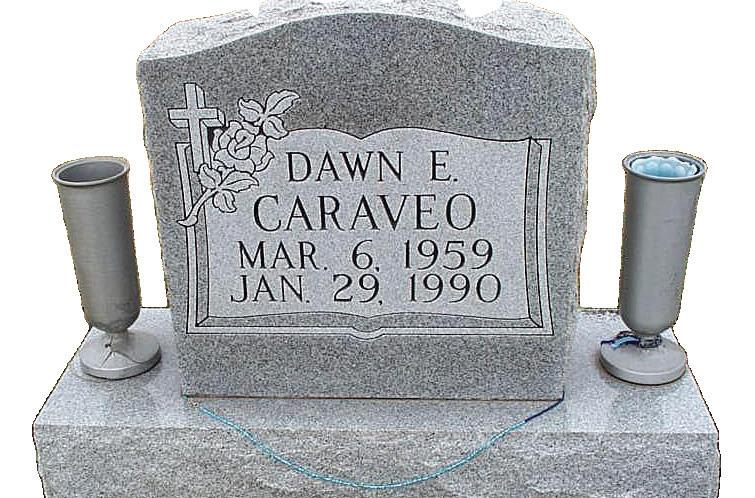
Dawn’s grave is at Crown
Point Cemetery in
At
across
was
of Dawn’s
left by the 11-year-old who just wanted her mom. The necklace was cleared out when Lynn’s ashes were added to Dawn’s headstone and the grave was cleaned. But Jennifer and her sister Samantha went back to visit in March 2025. They decorated it with bluish-purple and white flowers. They knelt beside her grave, resting a hand on the top. Jennifer and Samantha smiled for a photo. A storm was rolling in, its fat gray clouds brushing the tops of the graveyard’s spindly black trees. They didn’t stay for long.




reflects on distance, guilt and the cost of going

By Ursula Stickelmaier ustickel@iu.edu
I had barely started listening to Noah Kahan’s “The Great Divide” before I knew I was about to experience every emotion that could possibly be packed into an hour and 17 minutes.
Released April 24, Kahan’s latest album started out as 17 tracks before he released the extended version
“The Great Divide: The Last of the Bugs” later that day with four additional songs. Exploring themes of nostalgia, emotional distance and shared trauma, Kahan’s new album is the perfect follow up to his 2022 hit “Stick Season.”
Gabe Simon, producer of “Stick Season,” stepped back in to help produce this latest record, but he wasn’t the only collaborator Kahan brought on.
Most of “The Great Divide” was recorded at Long Pond Studio with studio owner Aaron Dessner, founding member of rock band The National and duo Big Red
Machine, who co-wrote and produced nine of the extended album’s 21 tracks.
Dessner, who has collaborated with artists such as Taylor Swift, Gracie Abrams and Mumford & Sons, brings a rich and warm sound to Kahan’s album. He also played several instruments throughout the album including guitar, keyboard and banjo, all of which added to the record’s bittersweet feeling of looking back at the place and people that made you who you are.
Together Simon and Dessner contributed to the album’s melancholic, nostalgic soundscape, which starts the minute you press play on opening track “End of August.” Through its folksy sonic landscape, the song sets the tone for the rest of “The Great Divide.”
Starting with ambient bug noises before introducing the gentle sounds of a piano, the song sits at just over five minutes and serves as a warm and gentle welcome back into Kahan’s world.
While “End of August” is a
gentle melody about what we let go of with time, the following track, “Doors,” is a much louder and more insecure representation of the fear that you’ll lose everything, something we’ve heard Kahan sing about many times before.
I instantly connected the chorus of “Doors,” when Kahan sings “You’re puttin’ money on red, I’m a sure bet at a losin’ streak,” to the opening lines of “Come Over” from “Stick Season,” where he says “I’m in the business of losin’ your interest / And I turn a profit each time that we speak.” Not only do the songs share similarities in their symbolism of viewing relationships as risky and transactional, but both explore similar ideas of believing you’re hard to love and having someone love you anyway.
“Doors” is not the only song that seems to be tied to “Stick Season,” though; much of “The Great Divide” feels like a response to Kahan’s breakout album.
If “Stick Season” was
By Ripra Gupta riprgupt@iu.edu
As soon as visitors entered the Hamilton Lugar School on Friday evening, they were met with catchy Latin music. Inside the vast atrium, students and residents swayed and danced enthusiastically, filling the space with energy and rhythm.
May 1 marked the fifth running of the Hamilton Lugar Music Festival. The event came from a desire to build community among IU students and faculty after the pandemic.
The festival is built around music from a diverse range of cultures. Sampson Lotven, senior associate director of student success and associate director of the HLS Living-Learning Center, said he wanted to center the festival around music because he believes it’s one of the most effective ways people build community.
“I had the idea to build a music festival as an endof-the-year celebration that would bridge a lot of different constituencies,” Lotven said.
Putting the event together, Lotven said, is a continual process throughout the school year. Lotven said he looks to connect with inter-
national musicians and local bands while planning the event.
Funding from the Hamilton Lugar School is critical in organizing the music festival, particularly for paying artists. However, Lotven said this year has been a little more difficult because of cuts to federal Title VI funding for international and foreign language education.
“The funding situation has meant that everyone still wants to stay involved and contribute a little, and we’ve had to move some things around to prioritize what was important to us even without quite as much funding as in past years,” Lotven said.
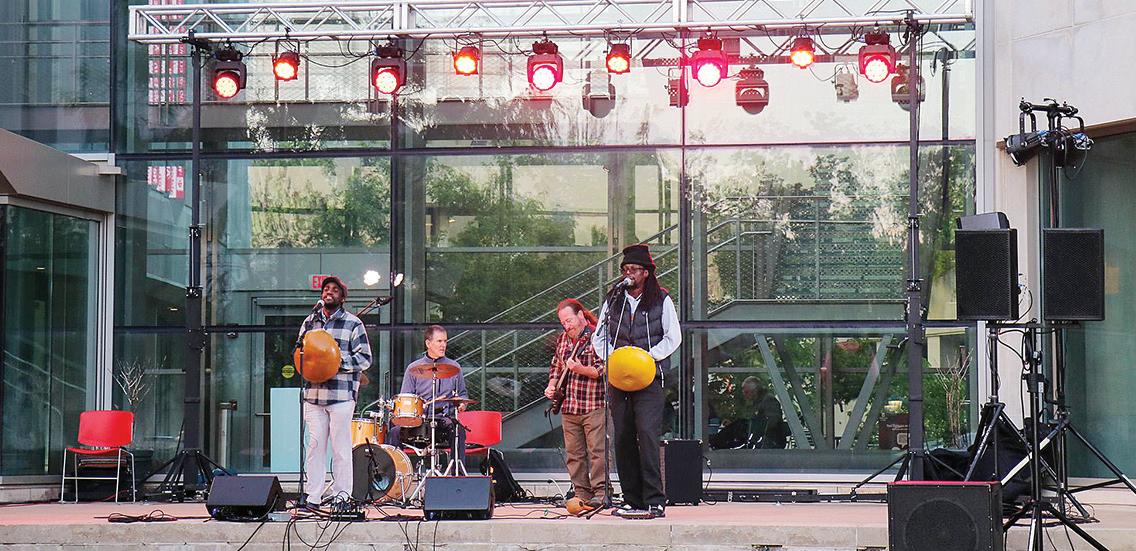
The event featured artists including La Salsoteca, the Indiana Slavic Choir, Dan Kusaya and DJ Kulow. Lotven invited La Salsoteca, a band that performs salsa and other Latin dance music, after seeing the group perform in Bryan Park and being impressed by their energy.
The Indiana Slavic Choir also performed, bringing a range of Eastern and Southern European folk singing traditions to the festival. The group includes many people from around Bloomington including undergraduates, graduate students, faculty, staff and retired staff.
Zimbabwean artist Dan Kusaya blended Afrobeats with the traditional Zimbabwean music of the mbira at the festival.
DJ Kulow, a radio personality and DJ at WFHB, added a more electronic and less traditional element to the lineup.
The festival drew around 30 attendees, most of them Bloomington residents, who danced along throughout the event.
Heysol Buitrago, an IU staff member, said she heard about the event from La Salsoteca’s pianist and IU faculty member Sergio Ospina Romero and through the event email. She attended with David Buitrago, another Bloomington resident.
“We love music,” David Buitrago said.
Mana Reza, another Bloomington resident, said the event was her and her husband’s third time attending the festival and that every time Romero performs, they plan to be there dancing.
“For me, it’s exciting to see students performing on stage,” Reza said. “They always have great music, and there are always great artists here. It feels like I’m feeding my soul by listening to the music, dancing and letting myself be free.”
about the realization that it is okay to leave home, then “The Great Divide” feels like what happens when you actually do it. With songs from the perspective of someone leaving home and the people they left behind, the album is packed with a poetic guilt that undeniably proves Kahan’s songwriting capabilities.
A personal favorite of mine was “Willing and Able,” the 10th song on the extended track list. Instead of being one-sided, this song feels like a conversation between siblings: the one that left home and the one that stayed behind. While the guilt and resentment that can form when distance separates two people makes up most of the song, there is a through line of both sides saying they’re “willing and able” to mend things if the other person is. It feels like an intimate moment Kahan is letting us peek in on, and although I spent the entirety of my first time listening to the album in tears, this was the first song to really overwhelm me and force me to take a breath.
Kahan ventured into a more folk-rock sound with “Deny Deny Deny.” While the lyrics go back to Kahan’s roots of singing about strained relationships, the song is instrumentally much more intense than his past music, featuring both electric guitar and electric mandolin.
The following song, “Headed North,” does a complete 180-turn and goes acoustic, featuring the same ambient nature noise from “End of August.” The song showed off Kahan’s musical capabilities, and I was reminded of late nights camping with my friends, highlighting the nostalgia invoked in almost every song on this album.
The album closes out with “Dan,” by far one of the happiest songs on Kahan’s new album. After 20 songs in the extended album full of heartbreak and the guilt of leaving, Kahan brings the record’s story full circle as he sings of coming home and reconnecting with loved ones, specifically his best friend Dan. The song also pays tribute to
his friend Carlo,
died young in a 2019 interview with Radio Free New Hampshire. It’s a calming moment as Kahan sings “Where do we go when we die? / I wouldn’t mind right here, no, I wouldn’t mind at all.” And it’s a reminder that there is just as much beauty in going home as there is in leaving. I’ve been a fan of Kahan’s music since 2018, when I heard his song “Hurt Somebody” for the first time. I have seen him live and forced countless friends to listen to his music. I’ve felt connected to so much of what he has written. And while I didn’t think my love for his music could grow, his latest album has brought me a new appreciation for Kahan as both an artist and storyteller. If you haven’t listened to “The Great Divide” yet, take my advice and start now, because if I had the chance to listen to this album for the first time again, I would take it in a heartbeat.
COLUMN: ‘Michael’ honors the ‘King of Pop’ but lacks any nuance
By Josh Baskin joshbask@iu.edu
Editor’s Note: This story includes mention of potentially triggering situations, such as child abuse.
Dubbed the “King of Pop,” Michael Jackson has been known as one of the biggest artists of all time. So, it was no surprise when Lionsgate announced there would be a biopic made about him. The biggest question was how to fit such a massive career and sophisticated personal life into one film.
“Michael” covers Jackson’s story from his upbringing in Gary, Indiana, to his “Bad” tour in the late ‘80s.
As someone who wasn’t alive to witness his career and doesn’t have extensive knowledge about his life story, I did not go into this film looking for accuracy, but rather exceptional storytelling. Unfortunately, “Michael” wasn’t looking to blow audiences away with its captivating story; instead, it prioritized fan service with its abundance of recreations of the singer’s iconic moments.
The film opens with a young Michael (Juliano Valdi) and his brothers on the rise to becoming the “Jackson 5,” managed by their father, Joseph Jackson (Colman Domingo). With a tight runtime of nearly two hours, there wasn’t much time allotted for the Jackson family’s upbringing, but with frequent belt lashings and verbal abuse, it was clear that Joseph wasn’t a perfect father.
Domingo wasn’t given much subtlety with his vicious dialogue, which I found made his character come off as cartoonish, and the family dynamic between him and his children never felt authentic to me. While I think Domingo is an exceptional actor, his performance
felt incredibly limited, and I would have loved to see a more sophisticated portrayal of such an impactful person in Michael’s life.
Twelve years later, as Michael matures, he decides to pursue a solo music career and seeks new management. Michael (Jaafar Jackson) has grown to fear his father and asks his newly appointed lawyer, John Branca (Miles Teller), to be the one to break the news to his father. Joseph struggles to accept this and continuously pressures Michael to continue touring and making music with his brothers.
Jaafar Jackson’s portrayal of Michael is easily the highlight of the film. Jaafar Jackson is Michael’s nephew, and his talent confirms that he was the perfect choice to play the part. From Michael’s signature high-pitched voice to his mannerisms, Jaafar Jackson completely transforms into the “King of Pop.” I would also give some credit to the hair and makeup teams, as the actor looked strikingly similar to his uncle throughout the film.
Once the first major time jump to young-adult Michael occurs, the film shifts gears into full fan-service mode, bouncing across songs to recreate iconic moments like the “Thriller” music video and his “Billie Jean” performance at Motown 25. While these sequences perfectly replicate the classic scenes, they offer no additional insight and only serve to check off Michael’s biggest hits.
Recreations can be great when fleshed out to include new perspectives, but these moments gave me nothing I hadn’t already known from watching the original performances. By including all these reenactments, there wasn’t much room for a deeper story to be told, which could have placed a larger focus on Michael’s re-
lationship with his brothers and father after leaving the Jackson 5. While the previous reenactments at least felt like an attempt at a cinematic portrayal, the final sequence turned into a full-on concert film. For five minutes straight, Michael performs two of his biggest hits with his brothers on the “Victory” tour, which ends with Michael announcing this as his last time performing with his brothers. Michael then walks backstage to see his father in complete dismay, but he ignores him and continues walking through a crowd of buzzing reporters and paparazzi.
I figured this would be the end, but it jumps forward once more to Michael’s “Bad” tour, where he performs the titular song in its entirety before fading to the credits. They turned what could have been a powerful final moment of confidence into yet another concert recreation, which completely lacked the emotional impact I felt from the previous scene. Hearing three songs in a row became tiring, which I would have never expected to feel from a biopic of the “King of Pop.”
While the film’s original final act touched on Jackson’s child abuse allegations from 1993, a clause in a settlement from one of his accusers forbade them from being portrayed in the film. This leaves a lot left to tell regarding Jackson’s life after 1993. A sequel film has already been confirmed, though it is unclear how it will approach the allegations. Although I’m looking forward to seeing Jaafar Jackson return as the legendary singer in the sequel, I was ultimately left disappointed by the lack of depth and character exploration in this first film.
By Abby Whited abwhited@iu.edu
As my semester winds down and summer looms, I find myself wanting to listen to music that is loud, evocative and makes me feel something.
Throughout April, I consistently returned to Slayyyter screaming into my ears, ROSALÍA’s ethereal, otherworldly voice and Robyn’s animated pop sound to bring me out of the trenches of finals season.
“WOR$T GIRL IN AMERICA” by Slayyyter
Slayyyter isn’t really an artist who has ever been on my radar, but “WOR$T GIRL IN AMERICA,” released March 27, has certainly changed that. Think Charli xcx’s “BRAT,” but less polished and commercially viable, and that’s this album. None of her past music has ever really resonated with me, but this album feels like she has settled on a sound and character that works for her.
“BEAT UP CHANEL$” is probably my favorite track from the album. It opens with Slayyyter all but screaming about “Money, drugs, chains on my chest, that vintage Celine” before repurposing that sentiment into a dreamy, blissful chorus that feels like sticking your head out the car window on a night out. The contrast between that abrasiveness and smooth chorus makes for a satisfying, dynamic listen.
Much of this album is abrasive, bordering on unpleasant sounding, but in a way that just works.
“OLD TECHNOLOGY” and “CRANK” execute this particularly well, with Slayyyter’s off-putting persona and chaotic sound

coming together in the most effective way.
I also love these songs’ eerie, unsettling music videos, whose visuals really helped bring the music to life for me. There is also a lyrical undercurrent of insecurities and family tensions throughout much of the album, which gives it some interesting narrative dimension. With this album, Slayyyter seems to be satisfying a Kesha-esque craving in pop culture right now for something edgy, fun and unfiltered, and I’m enjoying watching her rise to success.
“LUX” by ROSALÍA
“LUX” by ROSALÍA is a record that came out in November last year that I never devoted time to delving into, but last month was when that changed. Like Slayyyter, ROSALÍA isn’t an artist I have ever been very familiar with, but the positive critical reception around this album drew me to it. What kept me interested were its striking Catholic-inspired imagery, gorgeous soaring vocals and reverent instrumentals.
While admittedly I was worried I would not be able to connect with this mostly

Spanish album since I don’t speak the language, I was pleasantly surprised at how much it resonated with me.
ROSALÍA’s evocative, transportative voice transcends the confines of the language barrier, making every emotion she was conveying through this album palpable. This album is beautiful in sound, but there is a darkness about it and a sense of religious and moral tension that I find simultaneously alluring and haunting. “Divinize,” one of my favorite moments on the record, is a song that really channels
those complexities, featuring an absolutely stunning vocal performance. This album is dramatic, soaring and, at times, unsettling. The grating strings on “Porcelana” are absolutely chilling, as are several other moments on this record. Despite having to rely on English translations, ROSALÍA’s beautiful voice and high-art conceptual instincts made this record reach me on a deep emotional level.
Another highlight from this record is “Talk To Me,” which explores desire through the physical sensuality of verbal communication. Although it doesn’t quite reach the heights of the album’s closing track, this song has a great chorus, signature Robyn vocal distortions and a Max Martin writing credit, making it one of my favorite moments on the record.
Although these three artists are opposites both in terms of sound and energy, they all succeeded in giving me some interesting, thought-provoking albums to discover this April.
“Sexistential” by Robyn I have my grievances with this album; mainly, its short length, 29 minutes, leaves much to be desired. Much of the production was a little too robotic sounding for me, and I also find the title track grating and embarrassing. Nevertheless, there are a couple of gems on this album that ultimately made it a worthwhile listen. The closing track “Into The Sun”, made me forgive all the things I disliked about the rest of the album. It opens with the line “What a view / Only dreams ever brought me this close to you,” which situates the listener within the song’s specific feeling and story. This is a classic Robyn pop song; it has a euphoric chorus with an insanely gratifying replay value, triumphant lyrics and industrial-sounding vocal distortion. This was the closest any song on the album came to capturing that euphoric dance-floor high of “Dancing On My Own,” which is one of those perfect pop songs that feels like it’s laced with an addictive quality that makes you want to play it on repeat forever. “Into the Sun” has a similar energy, which I really felt was needed by the end of this album.
By Elakai Anela eanela@iu.edu | @elakai_anela
Indiana baseball’s biggest issue this season hasn’t been starting series. It has been finishing them.
The Cream and Crimson dropped another rubber match Sunday, falling 9-6 to Northwestern at Rocky and Berenice Miller Park in Evanston, Illinois. And the loss followed a familiar script to other series-deciding games this season.
The Hoosiers are now 1225 in weekend games this season and just 2-3 in May 3 rubber matches.
The series started off strong for Indiana, which opened the weekend with a 9-2 win May 1 at Wrigley Field in Chicago. Indiana had a chance to build momentum, but back-to-back losses pushed the Hoosiers down to 21-27 and 7-17 in the Big Ten.
Indiana matched Northwestern early May 3, with both teams scoring in the first inning. But the game quickly unravelled in the second, when the Wildcats plated five runs on a pair of home runs. Despite scoring six runs, the Hoosiers were unable to recover from their early deficit.
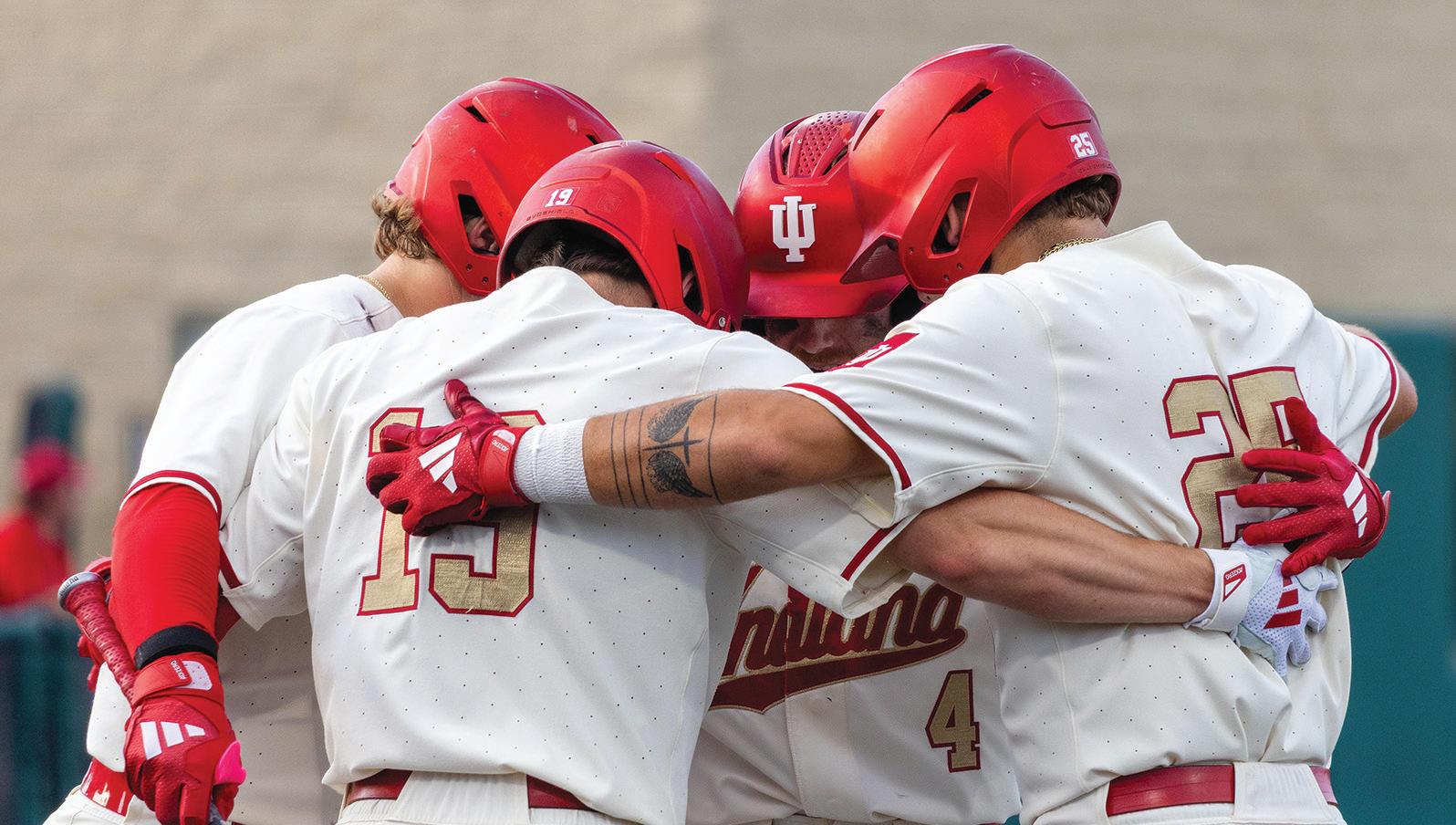
Control issues and inconsistent bullpen performances have been at the center of Indiana’s struggles in deciding games. The impact is clear in the standings.
Indiana is tied with Northwestern for 13th place in the Big Ten, though the Wildcats now hold the headto-head tiebreaker following the series win. Michigan State, which sits at 10-17 in conference play, is just 1.5 games ahead for the final spot in the Big Ten Tournament after suffering a series sweep against UCLA.
Despite the uphill climb, the Hoosiers still have opportunities to change their outlook of the season.
Graduate student lefthanded pitcher Conner Linn was charged with his first loss this year, after allowing two earned runs, two walks and two hits in one inning. Graduate student right-handed pitcher Gavin Seebold surrendered five earned runs on six hits and five walks across four innings.
fore Northwestern responded with a three-run third and two-run fifth inning to take control. Indiana failed to generate a comeback in the later innings after scoring one run in the eighth.
Indiana’s struggles in rubber games began March 8 against Washington.
The May 2 7-4 loss followed a similar pattern. The Hoosiers jumped out to an early lead, scoring three runs in the first three innings be-
After leading 4-2 through the first four innings, the Hoosiers allowed 11 unanswered runs to drop the se-
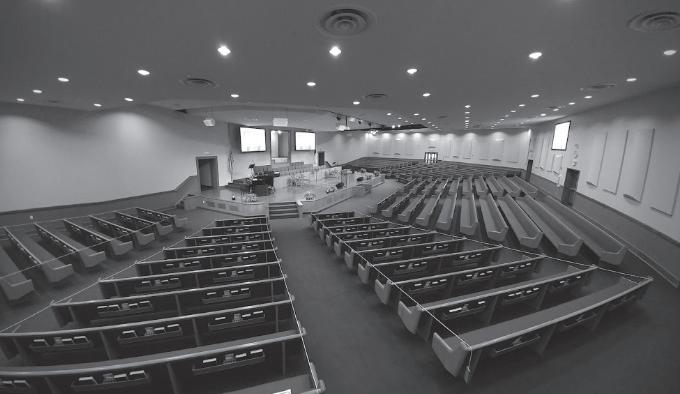
7821 W. State Road 46 812-876-6072 lifewaybaptistchurch.org
Sunday: 9 a.m., Bible Study Classes 10 a.m., Morning Service 5 p.m., Evening Service
*Free transportation provided. Please call if you need a ride to church. Student Ministry: Meeting for Bible study throughout the month. Contact Rosh Dhanawade at bluhenrosh@gmail.com for more information.
Evangelical Lutheran Church in America
Rose House LuMin & St.
Thomas Lutheran Church
3800 E. Third St. 812-332-5252 Stlconline.org
lcmiu.net
Instagram: @hoosierlumin facebook.com/LCMIU facebook.com/StThomasBloomington
Sunday: 8:30 a.m. & 11 a.m.
@ St. Thomas Lutheran Church
3800 E. Third St.
Tuesday: 6:30 p.m. Dinner & Devotions
@ Rose House LuMin 314 S. Rose Ave.
Rose House LuMin and St. Thomas Lutheran Church invite you to experience life together with us. We are an inclusive Christian community who values the faith, gifts, and ministry of all God’s people. We seek justice, serve our neighbors, and love boldly.
Rev. - Adrianne Meier Rev. - Lecia Beck
Rev. Amanda Ghaffarian - Campus Pastor
St. Mark’s United Methodist Church
100 N. State Rd. 46 812-332-5788 smumc.church facebook.com/BloomingtonStMarksUMC
instagram: @stmarksbloomington
Sunday: 10:30 a.m., Service Mon. - Fri: Office: 9 a.m. - 3 p.m.
St. Mark’s United Methodist Church of Bloomington, Indiana is an inclusive community, bringing Christ-like love, healing, and hope to all. We embrace the United Methodist ideal of open hearts, open minds, and open doors by welcoming those of all races, cultures, faith traditions, sexual orientations, and gender identities.
Rev. John Huff - Pastor Rev. Mary Beth Morgan - Pastor
ries finale. Graduate student right-handed pitcher Reagan Rivera allowed four earned runs in four innings, while Linn gave up five earned runs in 1.2 innings of relief.
The pattern resurfaced again April 12 at Maryland. Indiana held a late two-run lead before surrendering a walk-off grand slam.
Even in one of their few successes in Sunday games, the Hoosiers showed vul-
nerability. Against Abilene Christian University on April 19, Indiana led 4-1 entering the seventh inning. But the Hoosiers allowed three runs, which knotted the game. Indiana ultimately escaped with a win, as sophomore Caleb Koskie hit a goahead single in the eighth inning. Rivera pitched a scoreless ninth inning to pick up his second save of the season.
Light House Community Church
850 E. Winslow Rd. 812-339-3306 lhccbloomington.org facebook.com/lighthousecommunitychurchbloomingtonindiana instagram.com/lighthouse_community_ church
Sunday: 9 a.m., Empowerment Classes (for all ages)
10:30 a.m., Service
Wednesday: 7 p.m., Bible Study
Light House Community Church is mandated, by the Word of God, to fulfill the Great Commission by winning lost souls to Christ and empowering the believer to grow in Christ through prayer, study of the Holy Bible, and life application teaching. All are welcome! Transportation is available.
Senior Pastor - Derek L. House Assistant Pastor - Clarence W. Boone,
Trinity Reformed Church 2401 S. Endwright Rd. 812-825-2684 trinityreformed.org instagram.com/trinityreformed facebook.com/trinitychurchbloom
Sunday: 9:15 a.m., Sunday Bible Classes 10:30 a.m., Worship
We are a Reformed Protestant church on the west side of Bloomington with lively worship on Sunday mornings, Bible classes beforehand, home groups, and a college age group called The Mix (a group of young adults who are both attending college and beyond).
Jody Killingsworth - Lead Pastor Max Curell - Shepherding Pastor Stephen Baker - Discipleship Pastor Philip Moyer - Worship & Youth Pastor
Christian Science
Christian Science Church 2425 E. Third St. 812-332-0536 bloomingtonchristianscience.com facebook.com/e3rdStreet
Sunday: 10 - 11 a.m., Service
Wednesday: 7 - 8 p.m., Testimony Meeting Mon. - Fri: Noon - 2 p.m., Reading Room
Interested in spirituality and healing? We welcome you to our church to explore how you can address issues spiritually and experience healing.
Indiana will travel to Purdue, which is currently sixth in the conference, from May 8-10. Then the Hoosiers return home to close the regular season against Illinois from May 14-16, which sits in ninth place. With two Big Ten series remaining, the Hoosiers’ postseason hopes will likely hinge on their ability to reverse a season-long trend and deliver in weekend and series finales. Until then, the issue remains unresolved. Indiana has proven it can compete across a weekend. But unless it finds a way to close out rubber games, those early series wins will continue to slip away.
Redeemer Community Church
111 S. Kimble Dr. 812-269-8975
redeemerbloomington.org facebook.com/RedeemerBtown
Instagram & Twitter: @RedeemerBtown
Sunday: 9 a.m., 11 a.m.
Redeemer is a gospel-centered community on mission. Our vision is to see the gospel of Jesus Christ transform everything: our lives, our church, our city, and our world. We want to be instruments of gospel change in Bloomington and beyond.
Chris Jones - Lead Pastor
United Methodist
219 E. Fourth St. 812-332-6396 jubileebloomington.org Facebook: First United Methodist Church of Bloomington, IN Instagram: @jubileebloomington
Sunday: 9:30 a.m., Classic Worship 11:45 a.m., Contemporary Worship Wednesday: 7:30 p.m., College & Young Adult Dinner
Jubilee is a Christ-centered community open and affirming to all. We gather on Wednesdays at First United Methodist (219 E. 4th St.) for free food, honest discussion, worship, and hanging out. Small groups, service projects, social events (bonfires, game nights, book clubs, etc.), outreach retreats, and leadership opportunities all play a significant role in our rhythm of doing life together. Markus Dickinson - jubilee@fumcb.org
Unity Worldwide
Unity of Bloomington A Center for Spiritual Growth
4001 S. Rogers St. text/call: 812-333-2484 unityofbloomington.org IG: @unityofbloomington facebook@UnityofBloomington Sunday Celebration: 10:30 a.m.
Discover a vibrant, welcoming community at Unity of Bloomington – “a positive path for spiritual living”. Our center offers a space for spiritual growth; embracing all with open arms. We proudly affirm and welcome the LGBTQ+ community, fostering love, acceptance, and inclusion. Join our loving congregation, where everyone is valued and encouraged to explore their spiritual journey. At Unity of Bloomington, all are welcome and together we thrive!
Minnassa Gabon - Spiritual Leader Phyllis Wickliff - Music Director
By Conor Banks conbanks@iu.edu | @conorbanks06
The Indiana trident engraved within an outline of the state typically sits alone at Andy Mohr Field. But for Indiana softball’s regular season finale against Illinois on May 3, the Nos. 15, 16 and 18 surrounded the centerfield logo in honor of Indiana’s trio of seniors — outfielders Cassidy Kettleman and Ellie Goins, along with catcher Avery Parker.
Kettleman, Goins and Parker each stood with their families prior to the May 3 Senior Day game. Videos of the trio recalling favorite softball memories played on the video board in left field, before each player received a framed jersey and flowers to commemorate their careers.
But beyond their recognitions, the seniors played a pivotal role in the Cream and Crimson’s three-game series sweep of the Fighting Illini this weekend.
The first instance came May 1, as Parker broke a three-run tie in the second inning. Entering the weekend, the Westfield, Indiana, native had hit six home runs in five games since breaking Indiana’s career home run record against Iowa on April 19.
In her final Big Ten series as a Hoosier on May 1, Parker launched a grand slam,

giving Indiana a 7-3 lead. Kettleman also added a hit and drew a walk at the plate, as the Cream and Crimson secured an 8-5 win.
After going 0 for 3 on May 1, Goins rebounded with two hits May 2. Meanwhile, Kettleman recorded a hit and scored a run en route to a 7-3 victory in the second game of the series.
Following Senior Day celebrations prior to the May 3 game, the Cream and Crimson refocused to earn the three-game sweep.
Kettleman, Goins and Parker each recorded a hit in what was likely their fi-
Society of Friends (Quaker)
Bloomington Friends Meeting 3820 E. Moores Pike bloomingtonfriendsmeeting.org
Sunday (in person & by Zoom):
9:45 a.m., Hymn singing 10:30 a.m., Meeting for Worship Children’s program available
We practice traditional Quaker worship, gathering in silence with occasional Spirit-led vocal ministry by fellow worshipers. We are an inclusive community with a rich variety of belief and no prescribed creed. We are actively involved in peace action, social justice causes, and environmental concerns.
Rex Sprouse - Clerk rsprouse@iu.edu
Bahá'í Faith
Bloomington
Bahá'í Community and Bahá’í IU Association
424 S. College Mall Rd. 812-331-1863 bloomingtoninbahais.org
facebook.com/Baháí-Community-ofBloomington-Indiana-146343332130574
Instagram: @bloomingtonbahai
Sunday: 10:40 a.m., Regular Services, Devotional Meetings.
Please call or contact through our website for other meetings/activities
The Bahá'í Association of IU works to share the Teachings and Principles of the Founder, Bahá'u'lláh, that promote the "Oneness of Mankind" and the Peace and Harmony of the Planet through advancing the "security, prosperity, wealth and tranquility of all peoples."
Karen Pollock Dan Enslow
Independent Baptist Lifeway Baptist Church
7821 W. State Road 46 812-876-6072 lifewaybaptistchurch.org facebook.com/lifewayellettsville
Sunday: 9 a.m., Bible Study Classes 10 a.m., Morning Service
5 p.m., Evening Service
*Free transportation provided. Please call if you need a ride to church.
Student Ministry: Meeting for Bible study throughout the month. Contact Rosh Dhanawade at bluhenrosh@gmail.com for more information.
Steven VonBokern - Senior Pastor Rosh Dhanawade - IU Coordinator 302-561-0108 bluhenrosh@gmail.com
nal game at Andy Mohr Field. Goins also registered an RBI, driving in freshman outfielder Jada Ellison with a single to right field in the bottom of the fifth inning.
Behind the efforts of their senior class at the plate, the Hoosiers claimed a 7-3 victory. With the sweep, the Hoosiers closed the regular season with a 41-13 record — their third 40-plus win season in the last four years.
Kettleman and Parker each spent all of their fouryear collegiate careers at Indiana. One season before the duo’s arrival in 2023, the Cream and Crimson
Non-Denominational
Christ Community Church
503 S. High St. 812-332-0502 cccbloomington.org facebook.com/christcommunitybtown
Instagram: @christcommunitybtown
Sunday: 9:15 a.m., Educational Hour
10:30 a.m., Worship Service
We are a diverse community of Christ-followers, including many IU students, faculty and staff. Together we are committed to sharing the redeeming grace and transforming truth of Jesus Christ in this college town.
Bob Whitaker - Senior Pastor Adam deWeber - Worship Pastor Dan Waugh - Adult Ministry Pastor
Great Harvest Ministry Center (GHMC Family)
1107 S. Fairview St. 812-325-2428 (GHMC) ghmcfamily.org
Sunday: 10:30 a.m.
GHMC Family is a small church with a big heart. We follow Jesus and not a religion. We believe God’s Word as written for real people living in a messy world. We are a family of believers — your home away from home. Casual, welcoming, and here to support each other through life’s challenges. Come grow with us!
Tony Taylor - Pastor
Christian Student Fellowship
1968 N. David Baker Ave. 812-332-8972 csfindiana.org
Instagram: @csfindiana office@csfindiana.org
Monday - Friday: 10 a.m. - 5 p.m.
Christian Student Fellowship (CSF) exists as a Christ-centered community focused on helping students truly know Jesus Christ. Our ministry hub is located on campus at the last stop on the B bus. Reach out to schedule a tour, or join us for our 8 p.m. Thursday night worship service (Encounter)!
Ben Geiger - Lead Campus Minister
Stephanie Michael - Campus Minister
Nick Conrad - Associate Campus Minister
finished with a 27-22 record and missed the NCAA Tournament. But since Kettleman and Parker first took the field in a Hoosier uniform, Indiana has gone to the tournament three consecutive times, with a fourth straight trip this season likely.
Indiana head coach
Shonda Stanton said Kettleman and Parker helped set “a new standard of excellence and what the expectation is” in 2022.
“That first group wanted to win and win now,” Stanton said May 3 about Indiana’s 2022 roster. “And so
they were great and started to lay the foundation of this culture. And now, every team that comes in, you expect to go win 40 wins.”
Parker said that this success only fueled the team’s ambition.
“Getting to the postseason for the first time in a long time, and getting those 40 wins, getting to the Big Ten championship,” Parker said. “After that, it was like, we were hungry for more.”
While Kettleman and Parker helped lift Indiana to new heights in their collegiate careers, Goins did not experience this same suc-
United Church of Christ and American Baptist Churches-USA First United Church
2420 E. Third St. 812-332-4439 firstuc.org facebook.com/firstuc instagram.com/firstuc2420 youtube.com/@FirstUCBtown
Sunday: 10:30 a.m., Worship
Monday: 10 a.m. via Zoom, Bible Study
We are an Open, Welcoming, and Affirming community of love and acceptance dedicated to welcoming the diversity of God’s beloved. We exist to empower, challenge, and encourage one another to live out Jesus’ ways (compassion, truth, and justice) authentically as human beings in community to create a better world.
Rev. Jessica Petersen-Mutai Senior Minister
Nazarene
Bloomington Eastview Church of the Nazarene
4545 E. Lampkins Ridge Rd. 812-332-4041 eastviewnazarene.org
Facebook - Eastview Church of the Nazarene
Sunday: 9 a.m.: Morning Prayer
9:30 a.m.: Sunday School 10:30 a.m.: Worship Service
3 p.m.: Cedar Creek Worship Wednesday: 10 a.m.: Bible Study
Join us at Bloomington Eastview Church of the Nazarene, where faith meets community! Connect with fellow students through engaging worship, meaningful discussions, and service opportunities. Discover a supportive space to grow spiritually and make lasting friendships. Everyone is welcome - come as you are and be a part of our vibrant family!
Rev. Bruce D. Yates - Pastor
Alicia J. Dollens - Facility Manager
cess in her first three seasons spent at North Carolina State University. There, Goins was a part of two losing seasons and did not reach the NCAA Tournament.
Looking for a centerfielder in the offseason, Goins caught Stanton’s attention in the transfer portal.
“We told her we needed somebody to lock it down in center,” Stanton said about Goins. “Kettle’s (Kettleman) just been so good in left field and we wanted to be able to keep her there. And Ellie’s got an incredibly strong arm, and you see her range, her first step is phenomenal.”
While Goins has helped provide stability in center field for the Hoosiers, she also finished the 2026 regular season with a career-best .306 batting average and seven home runs.
After securing the series sweep over Illinois and going through postgame rituals with the rest of the team for perhaps the final time at Andy Mohr Field, Indiana’s trio of seniors stepped aside for a time of reflection. Each lay on top of their numbers stamped in centerfield for a moment.
“I think just a sense of gratitude,” Goins said. “Like how cool is it that we got to spend our last day on a beautiful day with fans that packed the stands and dogs in the outfield? It was just great.”
Episcopal (Anglican)
Canterbury Mission 719 E. Seventh St. 812-822-1335 IUCanterbury.org
facebook.com/ECMatIU
Instagram: @ECMatIU
Youtube: @canterburyhouseatiu9094
Sunday: 3 p.m. - 7 p.m.
Mon., Wed., Thu.: 10 a.m.
Fri., Sat.: By Appointment
Canterbury: Assertively open & affirming; unapologetically Christian, we proclaim the gospel of Jesus Christ by promoting justice, equality, peace, love and striving to be the change God wants to see in our world.
Ed Bird - Chaplain/Priest
Baptist
Emmanuel Church
1503 W. That Rd. 812-824-2768 Emmanuelbloom.com
Instagram & Facebook: @EmmanuelBloomington
Sunday: 9:15 a.m., Fellowship
Sunday: 10 a.m., Worship Groups: Various times
Emmanuel is a multigenerational church of all types of people. Whether you are questioning faith or have followed Jesus for years, we exist to help fuel a passion for following Jesus as we gather together, grow in community, and go make disciples.
John Winders - Lead Pastor
Second Baptist Church 321 N. Rogers St. 812-336-5827 sbcbloomington.org facebook.com/2ndbaptistbloomington youtube.com/@secondbaptist churchbloomington
Sunday: 10 a.m., Service (In house and on Facebook/YouTube)