ORIGINAL TOUR CAST OF SIX PHOTOS BY ANDREW ECCLES
THURSDAY–SUNDAY
NOV 12–15
IDS 2026 Welcome Back Edition
Indiana Daily Student | idsnews.com
Welcome back, Hoosiers!
Here are some of the top stories the IDS published this summer, along with a few recent stories to get you all caught up on what has been going on in Bloomington.
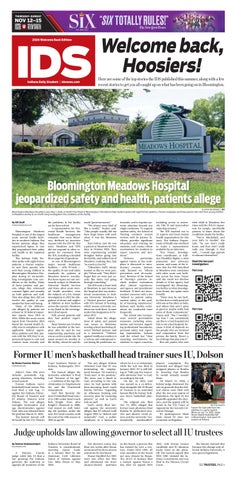
Bloomington Meadows Hospital jeopardized safety and health, patients allege ALAYNA WILKENING | IDS
Bloomington Meadows Hospital is seen May 7, 2026, on North Prow Road in Bloomington. The Indiana Daily Student spoke with eight former patients, a former employee and three parents who sent their young children to Meadows during its six-month-long investigation into conditions at the facility. By IDS Staff
enterprise@idsnews.com
Bloomington Meadows Hospital is one of the largest acute mental health facilities in southern Indiana. But former patients allege they experienced lapses in care that jeopardized their safety and health at the inpatient facility. The Indiana Daily Student spoke with eight former patients, a former employee and three parents who sent their young children to Bloomington Meadows Hospital during its six-monthlong investigation into conditions at the facility. Many of these patients and parents allege they witnessed constant fights and assaults on both patients and staff. They also allege they did not receive the quality of care needed for their well-being. Many of the deficiencies alleged by patients are echoed in 29 federal inspection reports from 2016 to 2024. While the most recent report from December 2024 found the mental health facility was in compliance with applicable federal regulations, patients and their parents told the IDS they’ve experienced lapses in care and conduct more recently and
the problems in the facility are far from solved. A representative for Universal Health Services, the healthcare management company that owns Meadows, declined an interview request with the IDS for this story. Meadows and UHS did not respond to other requests for comment from the IDS, including a detailed three-page list of questions. As one of Bloomington’s major mental healthcare facilities — with 78 beds — the quality of care and safety standards for patients at Meadows deserve scrutiny. But these lapses are not necessarily unique to Meadows. Universal Health Services and three other acute mental health providers were the subjects of a U.S. Senate investigation in 2022 for allegations of abuse and neglect of children at their facilities across the country. Meadows is not listed in the investigation’s final report. Still, several patients said they had positive experiences. Ryan Nunley was 16 when he was admitted to the hospital, after he said he was experiencing psychosis and was an active suicide risk. He spent around six months in the facility, where he said he
made “good memories.” “We always were kind of like a family,” Nunley said. “Like people usually did not have huge issues with each other. It was the Meadows Fam.” Kara Felton, now 40, was a patient at Meadows for five days in October 2022. They were experiencing suicidal thoughts before going into the facility, and walked out of Meadows realizing they had “so much to live for.” “(Meadows staff) always treated us like we were people,” Felton said. “They didn’t forget that we were just exactly like them, but going through something.” The IDS took a closer look at Meadows in part because the hospital also has institutional connections to Indiana University. Meadows is a "clinical practice partner” with IU’s School of Nursing, which means university students can work there. It came under this designation in October 2015. Asked about the allegations of safety and patient care issues at Meadows, nursing school marketing director Michael Jackson said in a statement: “Violence against healthcare workers is a serious and widespread issue facing the profession na-
tionwide, and it requires systemic attention beyond any single institution. To support student safety, the School of Nursing conducts annual reviews with its partner facilities, provides significant education and training for students, and creates robust mechanisms for students to report concerns and incidents.” Violence prevention against nurses in the workplace is discussed in introductory courses, Jackson said, focused on “ethical prevention and de-escalation.” Reviews of the School of Nursing’s partners include student evaluations after clinical experience, and agency and practitioner feedback. If there are documented concerns with a site “related to patient safety, student safety, or the quality of learning experiences,” Jackson said, faculty evaluations are conducted more frequently. The school also incorporates several preventative measures, including orientations and lectures regarding professional boundaries, personal safety and reporting expectations. Jackson said the school has “clear reporting mechanisms for students to report concerns,
including access to university Title IX and misconduct reporting systems.” The IDS reached out to 12 experts and local mental health organizations for this story. The Indiana Department of Health also declined to make a representative available for an interview. Tina Frayer, investigations coordinator at Indiana Disability Rights, a state protection and advocacy system, said many of the issues that the IDS described at Meadows were consistent with other acute care facilities across the state. Frayer said she could not disclose details or if her agency had investigated the Bloomington facility or what investigations found, but spoke more broadly. “There may be one facility that does a really good job with one or the other, or both, and others that aren’t quite as good or maybe really lack some of those components,” Frayer said. “But I wouldn’t say that I can consistently say this is a bad hospital (or) this is not a bad hospital, because it kind of depends on the people who are involved and cooperation from the person, the family. There’s a lot of things that play into it.” But one parent who sent
their child to Meadows five times told the IDS it’s important for people, specifically parents, to know about the conditions inside the facility. “You’re blindsided, and your kid’s in trouble,” she said. “So you don’t really know, and they don’t really walk you through it that well…. I would urge parents to educate themselves.” Read the two part investigation: Part one:
Part two
Former IU men’s basketball head trainer sues IU, Dolson By Mateo Fuentes-Rohwer matfuent@iu.edu
Editor’s Note: This story includes potentially triggering situations, including sexual assault. Former Indiana men’s basketball head trainer Tim Garl filed a suit Aug. 11 against the Indiana University Board of Trustees and IU Athletic Director Scott Dolson. The suit alleges wrongful termination and age discrimination against Garl, who was released from his position March 31, 2025. The federal lawsuit will be heard by the U.S. District
Court Southern District of Indiana, Indianapolis Division. The lawsuit alleges the university admitted it fired Garl “because of his age,” — a violation of the Age Discrimination in Employment Act and the Fourteenth Amendment. Garl first became the men's basketball head trainer in 1981 under head coach Bob Knight. Even after Knight’s dismissal in 2000, Garl stayed on staff, holding the position under the next five head coaches until the end of his 44th season in 2025 at age 68.
The suit alleges Dolson informed Garl that IU was terminating his employment because “IU wanted a ‘fresh start’ in his position.” The news was a shock to Garl, according to the suit, since he had spoken with then-incoming head coach Darian DeVries “regarding an offseason training and recovery plan for incoming players,” as well as Garl’s role on staff. Garl’s newly filed lawsuit against the university alleges that IU refused until August 2025 to “defend and indemnify" Garl, a public employee, in a lawsuit in
which he is a co-defendant, while the suit was filed in January 2025. IU is still failing to “fully pay the reasonable attorneys’ fees” to Garl, according to the suit. On Jan. 14, 2025, Garl was named as a co-defendant alongside the IU Board of Trustees in an amended lawsuit filed by former Indiana men’s basketball players. The original suit, filed Oct. 15, 2024, alleged that former team physician Brad Bomba Sr. performed invasive and abusive rectal exams, and the university “systematically manhandled”
players’ complaints. The amended suit alleged Garl assigned players to Bomba Sr. knowing that Bomba Sr. would sexually assault them. On March 31, 2026, a federal judge dismissed the suit on grounds that the federal claims were filed well after the two-year statute of limitations. On April 16, the plaintiffs appealed the decision, and the appeal will be heard in the U.S. Court of Appeals for the Seventh Circuit in Chicago. IU spokesperson Mark Bode stated IU does not comment on litigation.
IDS FILE PHOTO
Trainer Tim Garl yells from the sidelines in a game against Illinois on Jan. 14, 2025, inside Simon Skjodt Assembly Hall in Bloomington. Garl spent 44 seasons at Indiana.
Judge upholds law allowing governor to select all IU trustees By Deshna Venkatachalam devenkat@iu.edu
A Monroe County judge ruled July 10 that a law granting the Indiana governor the authority to appoint all members of the
Indiana University Board of Trustees is constitutional, rejecting claims made in a lawsuit filed by the American Civil Liberties Union of Indiana against Gov. Mike Braun in May 2025.
The decision comes less than two weeks after Braun announced his three newest selections for the board. House Enrolled Act 1001 went into effect last May and eliminated the three alumni-elected positions
on the board, a process that has existed for over a century. Under HEA 1001, all nine members of the board are now chosen by Braun. The ACLU of Indiana filed a lawsuit against Braun a day after he signed HEA
1001, with former trustee candidate and IU alumnus Justin Vasel as the plaintiff. The lawsuit argued that HEA 1001 violated the Indiana Constitution and was filed in the Monroe Circuit Court.
The lawsuit claimed that because the change only affected Indiana University, it was special legislation.
SEE TRUSTEES, PAGE 4
Indiana Daily Student
2
NEWS
Aug. 20, 2026 idsnews.com
Editor Grace Fridy news@idsnews.com
7 IU fraternity members face felony hazing By Gracy Fridy gfridy@iu.edu
Editor’s Note: This story includes potentially triggering situations, including bodily harm and injury. Seven members of the Phi Kappa Psi fraternity at Indiana University have been charged with hazing, a Level 6 felony, after an October 2025 incident that resulted in the hospitalization of two people. IUPD requested warrants for their arrests July 30, and the seven cases were filed in MyCase the following day. Police records show that a total of 36 Phi Kappa Psi fraternity pledges were allegedly ordered to do push-ups, planks, squats and leg lifts for three hours at an Oct. 15, 2025 initiation event at the fraternity house on North Eagleson Avenue. Around ten pledges, including one of the two hospitalized, were then ordered to take an ice bath. While in the ice bath, pledges were told to recite the first paragraph of the fraternity’s creed. After recitation, pledges were permitted to leave the ice bath. At least two pledges were injured so badly that their muscles started to break down, with one of
IDS FILE PHOTO
The IU Police Department crest is displayed on an IUPD motorcycle at the “Touch a Truck” event on July 2, 2018, in the Chick-fil-A parking lot on East Third Street. Members of the Phi Kappa Psi fraternity chapter at IU are facing felony hazing charges.
the pledges entering the hospital in critical condition. Both were diagnosed with rhabdomyolysis, a condition that can cause organ damage and even death. According to the IU Office of Student Life, Phi Kappa Psi was placed on cease-anddesist Oct. 21 and remains at that status currently. The seven fraternity
members facing felony charges, according to MyCase, are: • Casey Clarke, 20, of Hagaman, New York. • Conforti, Logan 20, of South Elgin, Illinois. • Ryan Donohue, 20, of Eden Prairie, Minnesota.
•
Noah Kucera, 20, of San Clemente, California. • Joseph Moon, 20, of Elkhart, Indiana. • Kaptur Nowacyzk, 20, of Crown Point, Indiana. • Arjun Patel, 20, of Westfield, Indiana. Each of the seven fraternity members is being
charged with two counts of felony hazing, and one member, Patel, is also being charged with obstruction of justice. According to the probable cause affidavits, Patel, the fraternity president at the time, texted one of the pledges and asked him to tell doctors his injuries were caused from working out at
the gym. Patel then allegedly asked him and multiple other pledges and fraternity members to delete their messages about hazing. The affidavit describes video footage obtained from the Phi Kappa Psi house that showed multiple pledges experiencing physical pain upon exiting the room where the hazing occurred, including limping, wincing in pain and falling against walls. Vice Chancellor for Student Life Lamar Hylton said in a statement released by an IU spokesperson Monday that all of Phi Kappa Psi’s organizational activities remain suspended. “The Office of Student Life holds all fraternities and sororities to high standards of safety, accountability and respectful experiences for every member,” Hylton wrote. “The allegations made in the charges announced by the Monroe County Prosecutor’s Office are inconsistent with Indiana University’s values and expectations of student conduct.” Hazing is a Level 6 felony in Indiana when it results in bodily injury, with a maximum sentence of 2.5 years. All seven men have been issued summonses to appear in court in Monroe County Sept. 1.
Faculty criticizes IU for removing Rick Van Kooten as dean By Zoe Reed
reedzoe@iu.edu
IDS FILE PHOTO
The Showalter House, the home of the IU Foundation’s Bloomington offices, is seen Sept. 19, 2022. A member of the IU Foundation’s Board of Directors announced he will not serve another term due to issues with the university’s climate.
‘Rubber stamp with a name plate’ IU Foundation board member exits
By Grace Fridy gfridy@iu.edu
Indiana University alumnus and three-term board member of the IU Foundation James Fielding announced in a July 1 LinkedIn post that he will not serve a fourth term and is choosing to step down because he “cannot in good conscience” continue to defend the university. Fielding wrote in a longer blog post about his choice to leave that after the board’s June and October 2025 meetings, he felt upset and discouraged by university responses to board concerns regarding the future of higher education given changes in state and federal laws and guidance surrounding universities. In the post, Fielding alleged that board members who pushed against the university’s plan not to “rock the boat” were told “to be on the team or to not be in the room.” “A board exists to ask hard questions of an administration,” Fielding
wrote in a July blog post. “A board that is asked to stop asking is not a board anymore. It is a rubber stamp with a name plate.” Fielding began serving on the board in 2017. The IU Foundation manages and seeks out donations for the university, including scholarship donations. The foundation board of directors serves as the organization’s legal governing body and works to meet university fundraising goals. He helped found the Queer Philanthropy Circle in 2019, a philanthropic group that brings IU donors together to support LGBTQ+ students, staff, faculty and alumni. Fielding said that donors to the Queer Philanthropy Circle were informed that it was no longer possible to designate emergency scholarships for LGBTQ+ students, as it could risk national grant funding. In 2025, following federal pressure on universities to end racebased scholarships, the IU
Foundation encouraged donors to change the language for scholarships pertaining to marginalized groups, suggesting that donors include allies in scholarships for LGBTQ+ students. “The mechanism was: we built a community of donors specifically to support LGBTQ+ students at IU, and we were told that supporting them as LGBTQ+ students was now a liability,” he wrote. On June 1, the first day of Pride Month, Indiana Gov. Mike Braun declared it “nuclear family month,” issuing a statement that a family made of one husband and one wife is “God’s design for the family structure.” A version of the proclamation shared online by Lt. Gov. Micah Beckwith also called on people to “take back the rainbow.” In his online statement, Fielding included multiple photos from his wedding and criticized the governor and lieutenant governor’s responses to Pride month. Fielding also pointed to
state and federal pressure as drivers in changing the university climate. Among these drivers, he pointed to a policy written into the state budget in May 2025 that gave the governor full discretion over appointing the university’s Board of Trustees, leading Braun to remove three alumnielected trustees. “At the institutional level, I cannot reconcile what I have seen on free speech, on the dismantling of diversity and inclusion infrastructure, and on the protection of marginalized students, faculty, and staff,” he wrote. “The administration’s posture has been to absorb federal and state pressure quietly rather than push back publicly.” In a statement that both expressed his appreciation for IU as an alma mater and criticized the university’s current climate, Fielding, one of 50 board members, said that he hopes to continue giving back to IU through other philanthropic efforts.
More than 200 Indiana University faculty members from the College of Arts and Sciences signed an open letter expressing concern over the recent removal of the college’s Executive Dean Rick Van Kooten, who had served in the role since 2019. IU announced Van Kooten would leave office Aug. 1 via a June 16 IU Bloomington Today release. He will become a special advisor to IU Bloomington Chancellor David Reingold, while Associate Dean for natural and mathematical sciences and research Caroline Chick Jarrold will step into his place, the release said. The university’s announcement described Van Kooten as having “strengthened the College’s research enterprise, elevated its national reputation, and expanded opportunities for students and faculty across disciplines.” “He has led with deep care for this community and a steadfast commitment to the values that define the liberal arts at IU,” Reingold said in the release. In the letter, which was signed off by 12 named faculty members who helped collect signatures, including four who initiated and drafted the letter, faculty disputed Reingold’s description, calling it a “gross understatement.” They highlight Van Kooten’s prior roles as chair of the physics department and IUB Vice Provost for Research before becoming executive dean. The letter also emphasizes Van Kooten’s “intellectual excellence and real collegiality,” noting his leadership during a time of “real crises of confidence in
LILY WELCH | IDS
Owen Hall, home to the College of Arts and Sciences at Indiana University, at 790 E. Kirkwood Ave.,is shown on April 14, 2026. Over 200 faculty signed an open letter questioning IU’s decision to remove Rick Van Kooten as the College of Arts and Sciences executive dean.
higher administration.” These crises include new faculty and post-tenure review procedures, intellectual diversity mandates and productivity reviews, which have created significant administrative burdens and dissatisfaction among faculty. “We write now to express our deep disappointment in the university’s decision to remove from leadership a colleague who has drawn from his faculty experience and institutional knowledge to be an excellent leader,” the faculty wrote. The letter concludes by raising questions about the future of the college, including the decisions that led to the role change and whether any plans reflect a commitment to the college’s values. “We hope that answers to these concerns will soon be forthcoming,” faculty wrote in the letter. “Because the College of Arts and Sciences has long been the core of IUB’s reputation for excellence, and that excellence has now been placed into question.” The university did not immediately respond to a request for comment.
What’s What’s Happening Happening in in B B--Town? Town? Find & submit events at idsnews.com/events
NEWS
3
Aug. 20, 2026 | Indiana Daily Student | idsnews.com
ACLU sues over Monroe County Jail conditions By Grace Fridy gfridy@iu.edu
The American Civil Liberties Union of Indiana filed a federal class-action lawsuit Friday against the Monroe County Council, the Monroe County Commissioners and the Monroe County sheriff over the jail’s living conditions. Filed on behalf of two people currently incarcerated in the jail, as well as current and future inmates, the lawsuit alleges that decades of overcrowding, deteriorating infrastructure and otherwise bad living conditions violate detainees’ 14th Amendment rights while awaiting trial, as well as their Eighth Amendment rights after a criminal conviction. In 2008, the ACLU filed a similar lawsuit against the county alleging unconstitutional overcrowding at the jail, leading to a 2009 settlement capping the jail population. The county has been looking for a new location to relocate the current Charlotte Zietlow Justice Center in downtown Bloomington, which houses the jail. After the County Council rejected the “North Park” site proposal in October 2025 and in May 2026, the ACLU filed to dismiss the prior case, opening the door for a new lawsuit. Accord-
ing to the new complaint, the 2009 settlement was supposed to expire in 2011, but was extended with the expectation that the county would address issues with the facility. “Monroe County officials have known for years that the jail is overcrowded, unsafe, and falling apart,” said Ken Falk, Legal Director at the ACLU of Indiana, in a Monday press release. “They have had nearly two decades to find a lasting solution, yet people are still being held in unconstitutional conditions that threaten their health and safety.” Monday’s press release states that between June and July, the jail held 260 people, 31 over its 229-person capacity. The ACLU claims that such overcrowding has led to violence and that infrastructure issues, like broken plumbing and mold, have created an unsafe environment. Due to the lack of available beds, the lawsuit alleges that some inmates, including the two named plaintiffs Tayler Grubb and Joseph Merrero, are at times forced to sleep on mattresses on the ground located next to their cells’ communal toilets, causing them to be splashed often with toilet water. Additionally, the lawsuit claims that the jail has failed
JACK FORREST | IDS
The Charlotte Zietlow Justice Center is pictured March 12, 2025, on 301 N. College Ave. in Bloomington. The justice center houses the Monroe County Jail, the subject of a new lawsuit from the American Civil Liberties Union of Indiana.
to safely separate people based on medical and security needs. It says that the only cell in the jail that meets accessibility standards set by the Americans with Disabilities Act is in a male-only block. The lawsuit comes a month after the city and
county formed a new subcommittee June 11, called the Collaborative Justice Project Working Subcommittee, with the goal of recommending a new jail site. The group had five scheduled meetings, with the last occurring Monday afternoon.
The subcommittee voted three to two to recommend that the county renovate the current jail as well as the county-owned Curry Building located southwest of the jail. In a joint meeting that has not been scheduled yet, the subcommittee will formally recommend a renova-
tion of the current jail to the county and city. The lawsuit requests that the court classifies the case as class-action and grants a permanent injunction requiring the county to make jail conditions compliant with constitutional requirements.
SNAP changes pile up in Indiana, affecting communities By Zoe Reed
reedzoe@iu.edu
Kimberly Goy has spent three years feeding Monroe County’s most vulnerable residents as development manager for Community Kitchen of Monroe County, no questions asked. Now, she anticipates that new laws will make that work harder than ever. A series of state and federal policy changes to the Supplemental Nutrition Assistance Program are reshaping food assistance across Indiana, with food security advocates and researchers warning that the consequences will fall hardest on vulnerable populations. These changes are expected to reduce the number of Hoosiers who receive SNAP benefits over the next few months, making it harder for those who remain eligible to keep them and deter some from applying at all. Food security advocacy groups, food pantries, community kitchens across Monroe County, like the Community Kitchen of Monroe County, Pantry 279 and the Indiana Community Action Poverty Institute, say they are already preparing for an influx of clients as the full weight of both laws take hold.
“It’s a strange, different world we’re in right now. We all kind of just need to support each other and give each other and their selves a little bit of grace when things are a little rocky.” Kimberly Goy, development manager at Community Kitchen of Monroe County
Some changes stem from the One Big Beautiful Bill Act, signed into law July 4, 2025, which is a sweeping federal tax and budget reform package designed to deliver the “largest tax cut for working and middle-class Americans in history,” the White House said. Indiana lawmakers then passed Senate Enrolled Act 1 on March 4, 2026, to layer additional restrictions on top of the federal changes — tightening asset limits, household income calculations and immigration verifications. Now, anyone 18 to 64 without a qualifying exemption — such as a disability, age, caregiving responsibility or school and work enrollment — must document at least 80 hours per month of work, job training or volunteer service to continue receiving
benefits beyond three months in a three-year period. Households with more than $3,000 in savings could lose SNAP benefits under Indiana’s new asset cap and mixed-status households could see benefits cut, even for members who are eligible. The One Big Beautiful Bill Act expanded SNAP work requirements to able-bodied adults without dependents ages 18 to 64, the high end is up from 54. Indiana has begun updating its SNAP enforcement to align with federal changes, though full federal guidance on the new requirements is still pending. The White House defended the new work requirements, saying almost three-quarters of ablebodied adults on SNAP have no earned income and that the law is intended to refocus the program on “those who need it most.” According to the most recent available data from the USDA, in 2023, 61% of SNAP households nationwide received unearned income such as Social Security or disability benefits. Some of those households also had jobs — overall, 28% reported earned income. Just 20% had no income from any source. Cindy Chavez, executive director of Monroe County community-run food distributor Pantry 279, disagreed with the assumption that people on SNAP are not working. Of the working adults her pantry serves, she estimated about 80% already hold jobs — many more than one. “Of the 20% that are left, those are all senior citizens or disabled, with the exception of maybe 1%,” Chavez said. According to the USDA, an average of 42.1 million Americans received SNAP benefits per month in 2025. When the bill was enacted, the program served roughly 577,054 recipients in Indiana alone. By February, SNAP participation was down by more than 3.5 million people following the One Big Beautiful Bill enactment, according to a 2026 Center on Budget and Policy Priorities report. Indiana went down 47,162 recipients. Erin Macey, director of low-income research and advocacy organization Indiana Community Action Poverty Institute, has been running focus groups with current and recent SNAP recipients. “They’re worried that they won’t be able to meet the hours requirements because they don’t have control over how many hours they can work — that’s
up to their employer,” Macey said. Macey said her organization has already seen declines in participation and expects the trend to continue. The law also removed an existing exemption for caregivers with children between 14 and 17, meaning parents and caregivers of teenagers who previously qualified for an exemption must now document 80 hours of monthly work or risk losing benefits. Daniel Knudsen, a professor emeritus in geography and former researcher at the IU Food Institute, said the situation is especially complicated in southern Indiana, where grandparents often raise grandchildren whose parents are incarcerated or otherwise absent. Even for those grandparents who qualify for a caregiving exemption, Knudsen said the burden of proving it can be enough to push older adults out of the program entirely. “Anytime there’s a barrier like that, there’s a certain number of people who say it’s just not worth it, and those people are gonna drop out of the program,” Knudsen said. Indiana Senate Enrolled Act 1 layered additional requirements on top of the federal law, tightening asset limits, restricting household income calculations and adding immigration verification requirements beginning July 2026. Senate Majority Floor Leader Chris Garten, the bill’s author, framed it as a necessary response to “end waste, fraud, and abuse” in Indiana’s SNAP programs. “We are restoring integrity to the system to ensure that these programs remain solvent and available for the Hoosiers who truly need them, while shutting the door on fraud and inefficiency,” Garten said in a Feb. 23 statement. Emily Weikert Bryant, executive director of Feeding Indiana’s Hungry — an association of 11 Indiana food banks affiliated with national nonprofit Feeding America — said the fraud narrative driving the legislation does not hold up. “The word fraud is being used freely and loosely and interchangeably with errors, which are different,” Bryant said. “The problem is the rhetoric has taken that and painted a picture that the neighbors who are using food assistance programs are just committing rampant fraud — and that’s absolutely not the case.” By ending Indiana’s participation in a federal option known as expanded categorical eligibility, the Indiana bill lowered the
ZOE REED | IDS
An “Open” sign hangs on the door of Pantry 279 on April 18, 2026. The pantry was opened in 2015 by members from Ellettsville Girl Scout troop 69-279.
state’s SNAP asset limit — the amount of money a family can save before losing SNAP benefits — from $5,000 to the federal baseline of $3,000. Households with a senior or disabled member face a slightly higher cap of $4,500. An estimated 3,112 households will be removed from the program statewide due to the asset change, saving the state about $635,000 over two years, according to a fiscal analysis of the bill. Bryant said this asset limit change runs counter to the program’s own goals.
“Many people are one medical issue, one car accident, one something-breaks away from not having grocery money. By not having a minimal cushion in a bank account, it’s only setting folks up to fail.” Emily Weikert Bryant, executive director of Feeding Indiana’s Hungry
For households over the new threshold, Bryant said the Indiana Family and Social Services Administration will reach out before the July 1 effective date. Her advice: open the mail and respond, since recipients may have the chance to correct or update their asset information before losing benefits. Starting in July, household income calculations will also change. To determine SNAP benefits, the state calculates a household’s total income based on who lives there and how much they earn combined. Previously, if an ineligible person lived in the same household as an eligible recipient, their income was previously excluded from that calculation.
Now, it will be, meaning eligible recipients living with ineligible household members could see their benefits reduced or cut off entirely. People can be ineligible for several reasons — program violations, student or work visas or being a permanent legal resident who has not lived in the country for at least five years. In October, most refugees and asylum seekers will now be ineligible for SNAP. Bryant said the change will affect eligible households in one of two ways, either pushing them over the income threshold entirely and cutting off benefits or reducing their monthly benefit by counting income that was previously excluded. “It’s punishing U.S. citizens for having someone in their household who is not an eligible person,” Bryant said. Supporters of the bill did not dispute that the change would affect mixed-status households — that was the point. “The generosity of Hoosiers should never be exploited by those who have broken our laws to enter this country,” Garten said in the same Feb. 23 statement. “We are drawing a hard line in the sand: Indiana’s public safety net is for vulnerable legal residents, not for illegal aliens.” Applicants must also provide information allowing the state to verify the immigration status of everyone in their household. If the state cannot verify a household member’s status, it is required to forward that information to federal authorities. Critics say the change pushes even legally eligible applicants away from the program out of fear of exposing household members to deportation risk.
Macey said her organization raised the concern directly with lawmakers, particularly around children who are legally entitled to benefits but may lose access anyway. She said fear may be keeping some people from showing up to focus groups at all. Chavez said the Hispanic families who had come to Pantry 279 every week stopped showing up in January after immigration enforcement ramped up across Indiana. “We’ve been really pushing hard in March to let people know, hey, we’re a safe space,” Chavez said. Chavez said Pantry 279 has been serving around 11,000 people a month since July 2025 and doesn’t expect that number to stay the same as the full weight of the changes hit. The pantry offers home delivery — the only one in the region to do so, according to Chavez — in part because so many clients cannot get there on their own. Donations have dropped sharply while food and gas prices continue to rise, Chavez said, straining both the pantry’s resources and the budgets of the clients it serves. Macey said part of what makes the current moment especially difficult is the pace of the changes themselves; some have been implemented with little time for people to learn what’s been rolled out and what’s still coming. For those worried about losing benefits, Goy had a simple message. “There’s no questions asked, we welcome everyone,” Goy said. “It doesn’t matter the age, it doesn’t matter the reason.” CORRECTION: This story was updated to accurately state the dates each photo was taken.
4
Aug 16, 2026 | Indiana Daily Student | idsnews.com
» TRUSTEES
CONTINUED FROM PAGE 1 “Given that there is nothing unique about Indiana University that justifies application of the new statutory scheme to it and not to Indiana’s other four-year universities, the statute violates the [Indiana] Constitution, Article 4, section 23,” the 2025 lawsuit read. The lawsuit also claimed that Vasel experienced “irreparable harm” because he would have been a candidate for the previously alumnielected trustee position and would have also voted in the election. Special Judge Erik Allen determined that Vasel suffered direct injury and has the legal standing to bring the case to court. However, the Friday decision also upheld HEA 1001 as constitutional. Under Article 4, the Indiana Constitution requires that “all laws shall be general,” and apply uniformly
throughout the state. However, the decision states that “special” legislation may still qualify as constitutional when it addresses a subject with “unique characteristics.” The court further explained that the law must stand “if there is a link between the class’s unique characteristics and the legislative fix.” The decision claimed that IU was already unique among Indiana’s public universities by being the only public university with a law that required its alumni trustees to be elected by other alumni. “Even if HEA 1001 is special, it is justified by a unique characteristic of Indiana University’s Board of Trustees,” the decision read. The decision granted the defendant summary judgement, a legal procedure where the lawsuit is resolved before trial. The ACLU of Indiana did not immediately respond to a request for comment.
EMERSON ELLEDGE | IDS
Indiana Gov. Mike Braun receives applause from the audience of the Bloomington stop of Turning Point USA’s “This is the Turning Point” tour on Oct. 21, 2025, inside IU Auditorium in Bloomington. A Monroe County judge ruled Friday that a law granting Braun the authority to appoint all members of the Indiana University Board of Trustees is constitutional, rejecting claims made in a lawsuit filed by the American Civil Liberties Union of Indiana against Braun in May 2025.
Health Spotlight
Jan Taylor-Schultz
Optometry
Dr. Andrew Jones, OD Dr. Marzia Zamani, OD Dr. Mark Houser, OD
Mon. - Fri: 8:30 a.m. - 7:30 p.m. Sat.: 8:30 a.m. - 5 p.m. Sun.: 9:30 a.m. - 4 p.m. 1175 S College Mall Rd. 812-323-4301 kroger.com/health/clinic
General Health
Brent Metzger, APRN Your neighborhood Healthcare starts here. The Little Clinic at Kroger in Bloomington offers convenient care for the whole family. We treat common illnesses and minor injuries, provide physicals, vaccinations, wellness screenings and more. Walk-ins are welcome, or schedule an appointment online. Open 7 days a week with extended hours for your busy schedule. Quality care when you need it — close to home or school! Mon. - Fri: 8:30 a.m. - 7:30 p.m. Sat.: 8:30 a.m. - 5 p.m. Sun.: 9:30 a.m. - 4 p.m. 1175 S College Mall Rd. 812-323-4301 kroger.com/health/clinic
Your neighborhood Healthcare starts here. The Little Clinic at Kroger in Bloomington offers convenient care for the whole family. We treat common illnesses and minor injuries, provide physicals, vaccinations, wellness screenings and more. Walk-ins are welcome, or schedule an appointment online. Open 7 days a week with extended hours for your busy schedule. Quality care when you need it — close to home or school!
Chiropractic
A Way of Wellness Chiropractic Dr. Andrew Pitcer, DC Dr. Crystal Gray, DC A Way of Wellness Chiropractic specializes in comprehensive spinal and extremity care. We offer a wide range of treatment and physical therapy modalities for spinal and extremity issues, addressing not just the symptoms, but the body as a whole. We provide effective chiropractic care helping patients reduce or eliminate pain, improve mobility and function, and improve overall spinal health. The exceptional treatment we provide is always fit to your individual needs and goals. Let us help you achieve and maintain good spinal health. We look forward to meeting you! Mon. - Thu: 8 a.m. - 6 p.m.
Behavioral/Mental
1121 W. Second St. 812-336-2225 bloomingtonchiropractor.com
Oral/Dental Care
Oral/Dental Care
Baron D Hall, DDS, MSD Jake Willhite, DDS, MSD Erica Hall, Hannah Elliot, Kaitlyn Jacobs, Marilyn Lee, Adrian Price With modern techniques and a fun style, B-town Orthodontics is the most up-and-coming orthodontics office in the Bloomington area! We offer the latest technologies including Invisalign, gold brackets, laser treatments, and even mini implants that can help restore missing teeth and even eliminate the need for surgery. B-town orthodontics offers FREE consultations and don’t forget to download The Braces App, the hottest free app designed by B-town Orthodontics’ Dr. Baron Hall.
Dr. Ryan Tschetter, DDS Dr. Lauren Hoye, DDS Dr. Elena Wiser, DDS
Mon. - Thu: 7 a.m. - 5 p.m. 1124 S. College Mall Rd. 812-336-5525 jcdsmiles.com
Tue. - Thu.: 8:30 a.m. - 4:30 p.m. Lunch 12:30 p.m. - 1:30 p.m. Mon. & Fri.: Appointments Only 1320 W. Bloomfield Rd., Suite B 812-287-8851 btownorthodontics.com
Austin C. Starr, DDS Board Certified Oral Surgeon
Mon. - Fri: by appointment 205 N. College Ave., Suite 712 812-575-4540 lpsbehavioralhealth.com
Dr. Josh Chapman Dr. Timothy J. Devitt Dr. Charles Abraham Experience exceptional care at Bloomington Oral Surgery, where your comfort and health come first. Our experienced team combines advanced technology with compassionate, personalized treatment to make your procedure as smooth and stress-free as possible. From consultation through recovery, we’re committed to providing outstanding care and helping you achieve the best possible outcome with confidence. Mon. - Thu.: 7 a.m. - 5 p.m. Fri.: 7 a.m. - 1:30 p.m. 1116 S. College Mall Rd. 812-332-2204 oralsurgeryofbloomington.com
At Chapman Orthodontics, we know what you look for in an orthodontist: someone who is professional, experienced, outgoing, and dedicated to helping you achieve your best smile! We offer free consultations for children, teems and adults. Let us give you a smile you can be proud of using state of the art technology and cutting edge treatment options. We offer clear braces and Invisalign. Chapman Orthodontics is a privately owned orthodontic practice. Dr. Josh Chapman attended IU Bloomington for undergraduate and received his Doctor in Dental Surgery (DDS) AND Masters (MSD) in Orthodontics at IU school of Dentistry in Indy. Go Hoosiers!
Office hours are subject to change. Check the website for most accurate hours.
Jackson Creek Dental is conveniently located on South College Mall Road. Most insurance accepted including the Indiana University Cigna plan. At Jackson Creek Dental we offer same day crowns, in office whitening, sure smile, restorative, cosmetic, and emergency care.
HOOSIER ORAL SURGEON
LPS Behavioral Health is proud to announce our new TMS division, LPS Brain Wellness. TMSm (transcranial magnetic stimulation) is a painless, non-invasive, drug-free, safe treatment for depression, anxiety, OCD, PTSD, and attention disorders. Our Exo-TMS™ system also improves focus, mental clarity, self-control, sleep, and weight management. Treatment requires only six sessions over 1- 3 weeks for scientifically supported results. Interested? Call for more information or an appointment.
Mon. - Wed: 7:30 a.m. - 6 p.m. Thu.: 9 a.m. - 7 p.m. Fri.: 7:30 a.m. - 6 p.m. 2552 E. Third St. 812-233-2343 drtavel.com/locations/bloomington
Oral/Dental Care Floyd F. Robison, PhD, HSPP Beth A. Robison, MS, LMHC Thomas Harmes, MSN, PMHNP-BC
Dr. Tavel Family Eyecare is your partner in your personal eyecare journey. Since 1940, the company has believed that every Hoosier deserves quality eyecare and vision solutions at an affordable price. Dr. Tavel offers comprehensive eye exams, special testing, management of eye diseases, glasses, contact lenses and much more, all backed by an insurance acceptance guarantee. The company is committed to advancing eye health by investing in the latest technology and providing treatments that are right for every patient’s unique needs.
Dr. Starr is an IU Football Alum who provides pain-free experiences for all Hoosiers with IV sedation. He specializes in wisdom teeth extractions, dental implants, and plasma therapy while utilizing 3D imaging technology. Accomplish fast and predictable healing with plasma therapy to avoid dry sockets after extractions. Voted the most trusted in Bloomington, they look forward to accomplishing exceptional results every day for all Hoosiers. Go IU! Mon. - Thu: 8 a.m. - 5 p.m. Fri.: 8 a.m. - 4 p.m. 473 S. Landmark Ave. 812-318-1023 starroralsurgery.com
Mon. - Thu.: 8 a.m. - 5 p.m. 3925 E. Hagan St., Suite 201 812-822-2489 bloomingtonbraces.com
For membership in the Indiana Daily Student Health Directory, please contact ads@idsnews.com.
the care and services you need to stay healthy at idsnews.com/health
Our eye care clinics serve patients in Bloomington-Atwater Eye Care Center and Indianapolis Eye Care Center, with faculty doctors and student interns who work together to provide the most comprehensive eye care available. Our many services include primary care, pediatrics, low vision, dry eye,laser and disease, contact lenses including specialty lenses, myopia management, aniseikonia, and full optical center. Open to the public and accepting most insurances. Mon., Tue., Thu., Fri.,: 8 a.m. - 5 p.m. Wed.: 8 a.m. - 8 p.m. Sat.: 8 a.m. - Noon 744 E. Third St. 812-855-8436 1160 W. Michigan 317-278-1470 optometry.iu.edu
Indiana Daily Student
PHOTO
Aug. 20, 2026 idsnews.com
Editor Briana Pace visuals@idsnews.com
Step right up to the Monroe County Fair 1
2
3
4 5
6 PHOTOS BY BRIANA PACE
1. Hank Ruff performs July 1, 2026, at the Monroe County Fairgrounds in Bloomington. Ruff took the stage at 8 p.m.
7
8
2. Kids go down the Fun Slide on July 1, 2026, at the Monroe County Fairgrounds in Bloomington. Adults were able to ride down with their kids as well. 3. A 4-H member shows his cow July 1, 2026, at the Monroe County Fairgrounds in Bloomington. The beef and dairy steers show began at 4 p.m. 4. The ferris wheel at the Monroe County Fair is seen July 1, 2026, at the Monroe County Fairgrounds in Bloomington. The fair opened June 27. 5. Two fair attendees ride a hang-gliding ride July 1, 2026, at the Monroe County Fairgrounds in Bloomington. The carnival rides opened June 30. 6. Fairgoers ride a small roller coaster July 1, 2026, at the Monroe County Fairgrounds in Bloomington. The ride took guests in a small loop, up and down little hills. 7. A man on stilts gives a little kid a fist bump July 1, 2026, at the Monroe County Fairgrounds in Bloomington. There were multiple people walking around the carnival area on stilts. 8. A 4-H member shows her cow July 1, 2026, at the Monroe County Fairgrounds in Bloomington. Participants walked a loop around the arena with their cows for judgment. 9. Two fairgoers look at rabbits July 1, 2026, at the Monroe County Fairgrounds in Bloomington. The fair also had cows, pigs, poultry and more.
9
5
6
NEWS
Aug. 20, 2026 | Indiana Daily Student | idsnews.com
TRINITY MACKENZIE | IDS
Indiana University president Pamela Whitten speaks during undergraduate commencement May 9, 2026, at Memorial Stadium in Bloomington. The Indiana University Board of Trustees approved a $250,000 bonus for IU President Pamela Whitten during a virtual meeting July 28, 2026.
Whitten receives $250,000 bonus The board voted Tuesday to approve a 25% bonus for IU President Pamela Whitten By Grace Fridy gfridy@iu.edu
The Indiana University Board of Trustees compensation committee unanimously approved a $250,000 bonus for IU President Pamela Whitten during a virtual meeting Tuesday. Sage Steele is the committee chair, Mel Raines is vice chair, and the other committee members are Matt Ferguson, Steve Henke and David Hormuth.
The $250,000 bonus is the maximum bonus amount allowed through her contract, which is 25% of her salary. After receiving a $100,000 salary raise unanimously approved by the board in February, Whitten earns $1 million a year. The board votes annually on giving the president a bonus and has regularly approved it, despite Whitten receiving a 93.1% noconfidence vote from IU Bloomington faculty in 2024. Her last bonus was
approved at a June 2025 meeting, where the only dissenting vote came from then-student trustee Kyle Seibert. During the short public section of Tuesday’s meeting, trustees took the opportunity to commend Whitten, who began her current role in July 2021, on her service as president over the last five years. During Whitten’s tenure, students and faculty established an encampment in Dunn Meadow to protest
the war in Gaza from April to August of 2024. In April, 57 protesters were arrested. In July of that year, IU established an expressive action policy banning expressive activity during certain hours, as well as other forms of protest, without approval. In 2022, the Indiana Graduate Workers Coalition organized a strike during April and May, calling for increased wages. In April 2024, the coalition organized a three-day strike calling for
raises, starting just one day after Whitten received a noconfidence faculty vote. Whitten’s tenure is also notable for the IU football national championship win during the 2025-26 school year. Head coach Curt Cignetti has an eightyear contract worth $105.6 million. If Cignetti opts to leave the university for another coaching job and Whitten has already left IU, his buyout would decrease by 50%. IU’s budget for the 2026
fiscal year increased by $133 million, although state and federal funding dropped, with the state cutting 5% of its funding and withholding another 5%. CORRECTION: This story has been updated to reflect the correct spelling of former student trustee Kyle Seibert. This story has also been updated to better reflect the timeline of the 2022 Indiana Graduate Workers Coalition strike and the 2024 Dunn Meadow encampment.
NEWS
7
Aug. 20, 2026 | Indiana Daily Student | idsnews.com
BPD investigates potential hate crime A woman was physically assaulted Tuesday at People’s Market By Grace Fridy gfridy@iu.edu
A woman was physically assaulted Tuesday, July 21, at People’s Market and First United Church, according to BPD. The incident, which is still being investigated, could potentially be classified as a hate crime. A 46-year-old woman working in the First United Church’s greenhouse on Tuesday evening reported to BPD that while she was there, a younger white man began to yell at her and made racist comments toward her, which led to an argument. People’s Market posted on social media Thursday, identifying the woman as one of their co-founders. They described her attacker as a “young 20 something white supremacist,” who shouted “racist, MAGA things at her.” The post stated that the market won’t let white supremacists stop their goal of feeding the community. The post also announced the cancellation of the July 25 market on Saturday but said that the regular market and volunteer opportunities will return Aug. 1. “We are committed to the protection of our volunteers & our community,” the social media post caption read. BPD Capt. Ryan Pedigo wrote in an email statement to the Indiana Daily Student that officers responded to the call at IU Health Urgent Care East, where the woman reported the incident. According to the People’s Market post, she is doing all right and had the pepper spray flushed from her eyes at urgent care. She told police that while arguing, the man threw his backpack on the ground and began to pepper spray her. She proceeded to kick him, knocking the man down as he continued to pepper spray her before running
IDS FILE PHOTO
A police car is parked Feb 22, 2023, outside the Bloomington Police Department at 220 E. Third St. BPD is investigating an assault at People’s Market that could potentially be classified as a hate crime.
from the scene on a trail that led to a nearby apartment complex. According to Pedigo, the woman told officers that the same man had “berated other Black members of the church in the past.” Police have not yet identified or located a suspect. People’s Market is asking the community to help identify the attacker, and provided a description of him on their social media. They wrote he is a white, skinny man with little muscle mass, around 5 feet, 7 inches tall, with short and floppy brown hair. He was wearing a white T-shirt and khaki shorts at the time. Pedigo also wrote that in Indiana, committing a hate crime is not a separate crim-
inal offense, but that judges have the ability to impose a longer sentence for crimes motivated by bias. “So law enforcement’s responsibility is to investigate each criminal offense and ensure that the investigation attempts to determine if any offense was motivated by bias, then present the case to the Prosecutor’s Office for charging,” Pedigo wrote. “If a judge determines that a crime was motivated by bias, then they can later impose the enhanced sentencing.” Indiana’s legislation surrounding hate crimes, which the state refers to as a bias crime, was nonexistent until 2019, when the state legislature passed a bill allowing judges to increase sentences for bias crimes. The legisla-
PAY LIKE A CHAMPION!
SCORE YOUR FREE* IU ATHLETICS MASTERCARD DEBIT CARD TODAY! Available exclusively at IU Credit Union.
tion was highly criticized for not including gender identity, gender or sex as explicitly protected. The Indiana Advisory Committee to the U.S. Commission on Civil Rights wrote in a December 2025 policy brief that while the law still allows judges to decide what unlisted groups qualify, advocates against the law argue that mandatory sentencing would further deter bias crimes. The assault was a topic of discussion at Wednesday’s Bloomington City Council meeting, where Council President Isak Nti Asare condemned the incident. “The simple fact of the matter is that someone was attacked based on their identity,” Asare said. “And
this is something that I think too often we like to act like does not happen in a place like Bloomington.” He drew comparisons between the city’s attitude to equity and incidents like the one at People’s Market to that of residents in Laramie, Wyoming, where Matthew Shepard, a gay college student, was murdered in 1998. According to The Associated Press, Wyoming and Indiana are two of just five states that have not passed comprehensive hate crime laws focused on victim identity. Asare, who attended high school in Laramie, said during the meeting that both cities often assume such bias crimes don’t happen in their communities. In 2023, Bloomington
woman Billie Davis pleaded guilty to a federal hate crime charge after stabbing an 18-year-old Indiana University student on a Bloomington Transit Bus. Davis told police she targeted the student because she was Asian. “It’s too often that we think that we can rest on our liberal, you know, sort of laurels,” Asare said. “And forget the fact that the very reason why we still have work to do is that if anyone is oppressed, then we all are.” UPDATED: This story has been updated to include information from the People’s Market’s social media. CORRECTION: This story has been updated to better reflect Capt. Ryan Pedigo’s rank.
Reporting& Editing& Podcasting& Designing& Photography& Coding& Multimedia& You. The Indiana Daily Student has been telling the stories of IU, Bloomington and the world for more than 150 years. Come join our staff — no experience or specific major required.
View all six designs at:
Apply online at idsnews.com/jobs.
*Membership eligibility required. Federally insured by NCUA. 812-855-7823 • iucu.org
An Equal Opportunity Employer
8
NEWS
Aug. 20, 2026 | Indiana Daily Student | idsnews.com
What to know after Bloomington City Council’s July meetings
KATHERINE MANERS | IDS
Bloomington Council At-Large Representative Isak Nti Asare transitions from council member reports to the mayor and city clerk reports during the Bloomington City Council regular session on Feb. 18, 2026, at City Hall in Bloomington. The council did not vote to overturn the mayor’s veto on legislation about Kirkwood Avenue at its July 22, 2026 meeting.
On June 22, Bloomington Mayor Kerry Thomson announced that she was vetoing the ordinance. “This is particularly significant as Indiana communities adjust to Senate Enrolled Act 1, which creates substantial uncertainty for municipal revenue and long-term financial planning,” Thomson wrote in a letter to the city addressing her veto. “In that environment, the City must be especially disciplined about adopting recurring commitments.” The council needed a two-thirds majority to overrule the veto at its next meeting. The vote was 4-4, with Council President Isak Nti Asare, Parliamentarian Courtney Daily, Matt Flaherty and Kate Rosenbarger voting in favor of a seasonally car-free Kirkwood. Council members Hopi Stosberg, Isabel Piedmont-Smith, Dave Rollo and Andy Ruff voted against passing the legislation, and Council Vice President Sydney Zulich was
By Grace Fridy gfridy@iu.edu
After a six-week summer recess, the Bloomington City Council returned to work as usual with its July 22 meeting, followed by its July 29 meeting the next week. Here’s what happened: Kirkwood closure Though anticipated, the council did not vote to overturn the mayor’s veto on a piece of legislation about Kirkwood Avenue at its first of the two meetings. Despite a relatively calm return to business as usual for the council, which passed a single piece of legislation at each of its July meetings, the council remained divided on Ordinance 2026-12. The legislation would close sections of Kirkwood Avenue to cars from April 1 to Nov. 15 annually, precluding emergency street openings by the city engineer. The council passed Ordinance 2026-12 in a 5-4 vote at its June 10 meeting before going on a summer recess.
IDS NEWS IN YOUR INBOX SUBSCRIBE AT IDSNEWS.COM/SUBSCRIBE
WN O D
UN R ILY
DA
E AT D P
YU L K
E
WE
N
TIO C LE
WS E N ES
C OI V K
E
AC
BL
E
I
K AS B U
L
AL TB
absent due to illness. The results were consistent with the June 10 vote on the same subject. Bloomington began closing Kirkwood to vehicle traffic during the COVID-19 pandemic in 2020 and has continued to do so in a seasonal manner, encouraging restaurants to expand their outdoor seating into the street. In January 2025, the council passed Ordinance 2025-02, legislation that similarly called for annual Kirkwood closures and expanded the Outdoor Dining Program. The city announced earlier this year that it planned to reopen Kirkwood to vehicle traffic, and the council spent recent months debating the issue. New Monroe County jail Monroe County Board of Commissioners President Julie Thomas and Commissioner Jody Madeira spoke publicly at the July 22 meeting and requested that the council consider the Hopewell site as a location
for a new Monroe County jail. The county has been involved in litigation over conditions in the jail since 2008, including a lawsuit filed in July. Hopewell is a city-led development, and the mayor and council have both called for the building of affordable housing on the site, despite various disagreements over its future. The council spent months discussing, and after multiple delays, passing a Planned Unit Development to rezone the area to meet specific affordable and sustainable development goals. “There is an important caveat, however,” Thomas said during the meeting’s public comment portion. “We cannot utilize this site if it will require a full plan commission and city council review because that would mean an additional minimum of nine months of time that we really do not have.” Thomas suggested that the county could purchase Hopewell property from the city or arrange a land swap for the Thomson property,
a county-owned piece of land on South Rogers Street that has often been a site for homeless encampments. Piedmont-Smith declined to support the commissioners’ request in a July 27 open letter that Stosberg said in the July 29 meeting she “wanted to second,” citing a lack of any prior consideration for Hopewell as a possible jail site. In the letter, she wrote that the request didn’t take into account recent recommendations from a joint local government task force, the Collaborative Justice Project Working Subcommittee, which the commissioners opted out of having a representative in. “All the reasons for the urgency you are now citing to build a new jail have existed for nearly 18 years, and that is the responsibility of your office,” PiedmontSmith wrote in the letter. On July 13, the subcommittee voted 3-2 in favor of recommending the current jail be renovated, with the Thomson property as its
second choice for a new jail location. Hopewell was not one of the top five sites considered, Piedmont-Smith wrote. Fire Merit Commission At the July 29 meeting, the council passed Ordinance 2026-15 unanimously, which will amend the Bloomington Municipal Code to recognize the Bloomington Fire Department’s Fire Merit Commission. The commission was established in January 2025 to oversee the hiring, promoting and disciplining of the fire department. The City Council, mayor and fire department appoint commission members. The new ordinance clarifies that the Bloomington Board of Public Safety still oversees the fire department, except for the employment responsibilities the merit commission has taken over. The City Council’s next regular meeting is at 6:30 p.m. on Wednesday, Aug. 5, in the Council Chambers of City Hall.
Indiana Daily Student
OPINION
Aug. 20, 2026 idsnews.com
Editor Spencer Schaberg opinion@idsnews.com
9
ERRANT ERIC
Bloomington should stay IU’s flagship campus. Sorry, Indianapolis Eric Cannon (he/him)
is a junior studying philosophy and political science and currently serves as a member of IU Student Government.
Editor’s note: All opinions, columns and letters reflect the views of the individual writer and not necessarily those of the IDS or its staffers. The University of Illinois is unlike other large public universities, and not just because its flagship is a modest 244 acres — Indiana University Bloomington’s campus spans eight times that. It also sits neatly within a titanic city, home to 2.73 million inhabitants. When state legislatures chartered the first public universities in the 19th century, they favored former cornfields as campuses. Today we call them Bloomington, State College, College Station, etc. Amid nowhere, land sold cheaply, with the added benefit of cloistering young scholars. And initially, UI, planted in Urbana, Illinois, was no exception. Three years after its inception, only 2,277 people, including its students, lived in city limits. But in 1982, Illinois’ Republican governor, Jim Thompson, asked state entities to “spend less, do more” — sound familiar? Duly heeding Thompson’s call, UI’s trustees founded a campus in Chicago. The Second City was a wellspring of in-state students. Happily for UI’s shriveled budget, being local, they came pre-housed. And Chicago’s abundant professionals meant UI could trim payroll by leaning on adjunct faculty, while corporations provided students with internships. This economical model of academia proved so successful that, in 2020, UI at Chicago dropped the “at” in its name. Two years later, UI named Chicago its flagship campus. Other universities
noticed. In 2023, the University of Michigan Board of Regents approved a plan to move its flagship campus from Ann Arbor to Detroit by 2045. Last year, Pennsylvania State University’s trustees said they hoped to plant a Pittsburgh campus to transition to flagship status by 2060. And the University of Iowa will leave Iowa City for Des Moines in 2050. … If this story sounds a trifle unbelievable — well, good. It is unbelievable; indeed, it never happened. UI’s flagship remains anchored at Urbana-Champaign, with no foreseeable voyage to Chicago. No other university is charting this course, either. But Jacob Stewart, a columnist for the Indianapolis Star, wants you to believe that IU Indianapolis should become IU’s flagship campus. Yes, the outpour of money into IU Indianapolis since IUPUI’s breakup will boost student demand to attend. It will boost it… well, by how much and for how long, exactly? College enrollment on the whole is waning, falling 15% between 2010 and 2021. And universities can’t count on that rate to rebound because birth rates, too, have been trending downward since the pandemic, reaching an all-time low this year. Perhaps IU is gambling on Indianapolis to draw more of the future’s fewer students. But the waters of the fleet system — whence the term “flagship” originates — are perilous, especially in brick-andmortar form. The University of Wisconsin has, in the past several years, scrapped five of its smaller vessels, while Penn State will scuttle seven after spring 2027. An average of 60 colleges, public or private, are shutting their doors every year. Public university
IDS FILE PHOTO
The Herman B Wells statue, located near Sample Gates, is pictured. Wells’ career spanned 70 years at Indiana University Bloomington, starting as an instructor in the Department of Economics and Sociology in 1930.
systems, composed of regional campuses, are products of the post-war era; hence they’re questionable institutions to stake the future of education on while the nation faces a seemingly irreversible baby bust. Universities built most of their regional campuses in the 1960s to meet soaring student demand as the eldest Baby Boomers graduated from high school. Seven branches in the University of California system emerged during this period. As did IUPUI, in 1969. And with the rise of the “college wage premium” throughout the ‘80s and ‘90s, demand for such, more accessible, universities rose further. But the college wage premium has slumped, too. On one hand, the market has become so saturated with degree earners that nearly half, even 10 years after graduating, work jobs they’re nominally overqualified for. On the other hand, 20 states have
eliminated or eased their requirements to hold bachelor’s degrees for government employment. Over the past decade, so have private sector giants: Apple, Bank of America, Delta Airlines, Google and IBM, where, last year, half of open roles lacked a bachelor’s degree requirement. The public and private sectors’ about-turn on degrees suggests there may also be fewer non-traditional students in the future, students whom regional campuses, including IU Indianapolis, usually enroll more of than flagships. If employers devalue degrees for entry-level positions, it’s not a stretch to imagine they’ll also prefer demonstrated skill to paper credentials in determining who they’ll promote. (When employers do request continued education, will the proliferation of online resources not be more practical for the learners of the future who may be
settled and have children in schools?) Much like the other “vast and trunkless legs of stone” the American century built, which now stand “in the desert … half sunk” — ponder the fate of the nightly news, fraternal orders and WASPs — regional campuses face an existential crisis. While IU Indianapolis is, at this point, large enough to withstand changing tides — can the same be said of IU’s other branches? — it probably won’t become the first regional campus to stage a mutiny against its flagship. And it shouldn’t, either. As long as there are traditional students, albeit fewer, many of the highest achieving will continue to apply to the Public Ivies — last year, Forbes named Purdue University West Lafayette, University of Illinois Urbana-Champaign and University of Michigan Ann Arbor, among others, to this list — and the Ivies. With
these, IU Bloomington is better matched to compete, partly because of its scenic campus. Indeed, higher education’s physical presence in the future may again be smaller, a future where legacy campuses are luxuries that universities will want to market as their flagships. Increasingly, online learning could fill the former role of regional campuses. For IU Indianapolis, such a future holds divergent paths. At one extreme, it’s crowned the “UCLA East of the Mississippi.” (Note: Berkeley is UC’s flagship.) At the other, IU Bloomington, much like Saturn, devours its child in a fit of jealous rage, largely due to Stewart’s provocative column. For the record, Gov. Jim Thompson of Illinois was not known for austerity. Far from it — they called him “Big Jim,” for his 6-foot-6 stature and his spending.
HOWARD’S HEADLINE
Dating apps commodify human connection Emma Howard (she/her) is a junior studying journalism.
Editor’s note: All opinions, columns and letters reflect the views of the individual writer and not necessarily those of the IDS or its staffers. I finally did it. After months of my best friend twisting my arm and telling me that life isn’t a Jane Austen novel, I downloaded Hinge. Huddled around my phone screen in the corner of the Blackbird Cafe in our hometown, we created my profile. After poring over every photo in my gallery, a million takes to verify my identity and a million more utterances of “I don’t wanna do this,” it was done. Little did I know I had just unlocked a whole new level of doomscrolling. Of course, when you’re flipping through thousands of profiles telling you how much they love banana bread and physical touch, it’s evident they’re not all going to be winners. All you can do is hope the next swipe will bring you a guy that looks good holding a puppy or a baby. But what might initially feel like searching for a pair of hot lips is actually a classic case of psychological conditioning. Does that sound crazy? Well, let’s throw pigeons into the mix. Behavioral psychologist B.F. Skinner developed the theory of operant conditioning, or the idea that if an action yields rewards, we are more likely to repeat it. In 1948, he studied operant conditioning using the Skinner Box, an enclosed contraption that included a button or lever that an animal could easily manipulate. When hungry pigeons were placed into the box, they received a pellet of food after pecking a button. While not every tap of the button would bring
with it a pellet, the pigeons continued the action anyway. Giving a whole new meaning to the phrase “bird-brained,” Skinner’s experiment revealed some uncomfortable truths about our own habits. Even if a behavior is not consistently rewarding, we’ll continue it repeatedly for the positive outcome we’ve already associated with it. This natural tendency is a wonderful cash collector for companies, as it’s the same force that feeds slot machines and keeps “Candy Crush” crushing. When we’re scouring Instagram Reels, it’s the occasional gem that keeps us going, so we tolerate everything in between. In the case of Hinge, Tinder, Bumble, etc., it’s digging for your soulmate amongst a plethora of fishwielding apoliticals. It is certainly no secret that dating app algorithms can be pretty inefficient in pairing compatible matches. While one in ten partnered adults do meet online, the conflicting goals of bringing users together and generating profit create a paradox. Some users agree that the apps must be purposely pushing bad apples at us to keep us scrolling longer. And while this may sound like quite the conspiracy, it’s not completely baseless. In fact, Christian Rudder, data scientist and co-founder of the dating service OkCupid, openly admitted to doing so in 2014. In a controversial blog post detailing his experiments with the site’s algorithms, he revealed that OkCupid had been lying about compatibility ratings. “In the back of our minds, there’s always been the possibility: maybe it works just because we tell people it does,” he wrote. “Maybe people just like each other because they think they’re supposed to?” While OkCupid might be somewhat outdated in
TRIBUNE NEWS SERVICE
A United States Army corporal inspects newly arrived pigeons in August 1943. The military trained pigeons to serve as messengers and scouts using operant conditioning, which Indiana Daily Student columnist Emma Howard argues also glues humans to dating apps.
the dating app world, it would be no shock if the app that was “designed to be deleted” also manipulated its algorithms to keep users scrolling. After all, dating apps are a billiondollar industry. In 2025, the market brought in around $6 billion in revenue. Match Group, the dating conglomerate that brought us Hinge, Tinder, OkCupid and others, made up $3.3 billion of that. Whether they’re selling users’ data to advertisers or selling Romeo a Platinum plan, dating apps are making bank. The commodification of human experiences under capitalism is nothing new. In his 1956 book “The Art of Loving,” social psychologist Erich Fromm argued that capitalist systems distort our perceptions of love. Under the ideas of Western consumerism, we begin to treat our interpersonal relationships as transactional. We view other people, as well as ourselves, as commodities that we must obtain the maximum number of benefits from. “Two persons thus fall
in love when they feel they have found the best object available on the market, considering the limitations of their own exchange values,” he wrote. Something tells me Match.com wouldn’t be to his taste. Online, romance is an industry in which we are the products. And we, unfortunately, are all too happy to market ourselves. I just about twisted into a pretzel choosing a profile picture. When scrolling through the masses of eligible singles, we examine selling points, not people. We display what aspects of ourselves might generate likes, while excluding the undesirable. When we combine our thirst for validation — Hinge says getting a Rose is quite the compliment! — with our desire to find a serendipitous match, we turn an attempt to connect with others into more of a shopping experience. He’s a 6-foot-3 history buff? Consider me engaged. This market-based system is why apps designed
to be deleted are time and time again deleted and redownloaded. Apps are escape rooms built by our lonesome. We walk through the halls under the promise that the perfect match will be there at the turn of every corner. You might not find the love of your life around the corner, but you might find a shirtless gym picture of Brad. Unfortunately, apps are the only way to find romance anymore. Or so we are told. After advertising services for over a decade, companies are now pointing the finger at younger generations for their own fatigue around dating. Hinge CEO Jackie Jantos claims that Gen Z is “struggling to put themselves out there” due to socializing less in person. Her solution? AI features to help strike up a conversation. Technology, particularly instant messaging, has provided an outlet of connection amid times of loneliness and, in return, stunted social skills. Jantos certainly has a point there.
Dating app usage faced an overwhelming increase during the COVID-19 pandemic. Tinder, in particular, saw a 15% boost in matches and a 10% boost in messaging. However, we’re often told that technology is an inevitable force we must embrace, but more often than not, tech is selling us back solutions to problems it created. So sure, life isn’t a Jane Austen novel. But it never was. Austen wasn’t just a romance writer, she was a social satirist critiquing the superficiality of English high society. Instead of simply accepting the less-thanromantic state of courtship in the Regency era, she took up her pen to envision something different. While CEOs might try to convince young people there’s no other path to finding love and friendship, they’re still ultimately trying to sell a product and reframe it as the norm. Yet, it doesn’t have to be. So many lament their exhaustion surrounding online dating — can we not envision something different, too?
Indiana Daily Student
10
SPORTS
Aug. 20, 2026 idsnews.com
Editor ADD NAME sports@idsnews.com
BASKETBALL
Hoosiers leave Peru wearing gold By Will Kwiatkowski wdkwiatk@iu.edu
Indiana men’s basketball capped off a dominant run through the FISU America Games on Monday, defeating the U.S. Virgin Islands 99-57 to capture the tournament championship as the U.S. representatives. The Hoosiers controlled the game from the opening tip, building a 25-8 lead after the first quarter before extending the advantage to 5223 by halftime. Although the U.S. Virgin Islands outscored Indiana 20-17 in the third quarter, the Hoosiers responded in the final period to secure their fourth win in as many games in Lima, Peru. Indiana showcased the depth, versatility and chemistry of coach Darian DeVries’ retooled roster before returning to Bloomington with a gold medal. Indiana’s interior attack opened the scoring and the floor Indiana wasted little time Monday in establishing its biggest advantage: its size. Rather than settling for perimeter shots, the Hoosiers consistently attacked downhill, putting pressure on the U.S. Virgin Islands’ defense from the opening possession. Guards repeatedly got into the paint, scoring at the
rim while also finding junior forward Aiden Sherrell and graduate forward Sam Alexis, who used their size to convert easy baskets around the rim. Sherrell and Alexis consistently finished through contact as Indiana built an early double-digit lead, forcing the U.S. Virgin Islands to collapse defenders into the paint. Once that happened, the Hoosiers’ offense became even more difficult to stop. Indiana’s rim pressure opened driving lanes and kick-out opportunities for shooters, creating an insideout offensive attack that controlled the first half. The Hoosiers’ willingness to attack the basket rather than settle for contested jumpers allowed them to dictate the pace throughout the afternoon. With Sherrell’s size, Alexis’ athleticism and Indiana’s guards’ ability to get downhill, the Hoosiers showed they have multiple ways to generate efficient offense heading into the regular season. Bryce Lindsay continued to prove he’s more than a shooter Lindsay entered the offseason known primarily as a perimeter shooter during his time at Villanova University. During his final season with the Wildcats, 63% of
Lindsay’s shot attempts came from beyond the 3-point arc, while only 18% came at the rim. Throughout the FISU America Games, however, Lindsay showed he can impact the game in far more ways. Rather than settling for outside shots Monday, Lindsay consistently attacked defenders off the dribble, getting downhill and forcing help defenders to rotate. When the defense collapsed, he made the correct read, whether it was finishing at the basket or finding an open teammate. His ability to facilitate stood out throughout the tournament. While Markus Burton will remain Indiana’s primary ball handler, Lindsay looked comfortable bringing the ball up the floor, organizing the offense and initiating possessions. His decisionmaking gave the Hoosiers another reliable playmaker and should allow DeVries to take pressure off Burton throughout the season. Lindsay still made defenses pay from beyond the arc. Alongside freshman guard Prince-Alexander Moody and junior guard Darren Harris, Indiana knocked down timely 3-pointers that stretched the lead throughout the first half. The trio’s perimeter shooting complemented In-
diana’s interior attack, making it nearly impossible for the U.S. Virgin Islands to focus on taking away one area of the floor. Indiana’s depth continues to separate itself One of Indiana’s biggest strengths throughout the week wasn’t a single player — it was the number of contributors DeVries could rely on. The Hoosiers once again received meaningful production from their bench Monday. Moody continued to play with confidence on both ends of the floor, while Harris provided another reliable perimeter scoring option. Freshman guard Vaughn Karvala continued building on an impressive tournament after his 32-point explosion earlier in the week, while fellow freshman forward Trevor Manhertz earned valuable minutes — and a start — as DeVries continued evaluating his young roster. The depth allowed Indiana to maintain its pace and intensity regardless of who was on the floor. Rather than simply protecting a lead, the Hoosiers’ reserves continued attacking offensively and applying pressure defensively, a trend that persisted throughout all four games in Peru. While the level of competition won’t compare to
TRINITY MACKENZIE | IDS
Freshman forward Trevor Manhertz faces an opponent in an exhibition game against Collège Jean-de-Brébeuf on July 15, 2026, at Simon Skjodt Assembly Hall in Bloomington. Manhertz scored 15 points in Monday’s 99-56 victory over the U.S. Virgin Islands.
what Indiana will see in the Big Ten, the intensity every player brought to the floor throughout the week is exactly what the Hoosiers will need to compete in one of college basketball’s toughest conferences. The tournament provided valuable opportunities to build chemistry, experiment with different lineup combinations and establish an identity before the regular season begins. A gold medal is a nice reward. But the confidence, cohesion and depth Indiana displayed over four domi-
nant victories may prove to be the biggest takeaway once the Hoosiers tip off the 202627 season. Indiana leaves Peru with a gold medal, but the focus now shifts to preparing for the regular season. The Hoosiers will return to Bloomington before beginning their three-game exhibition slate at Butler University on Oct. 11. Indiana then hosts the University of North Carolina on Oct. 18 and Western Kentucky University on Oct. 25 before opening the 2026-27 regular season Nov. 9.
Connect with members of many diverse faiths at idsnews.com/religious Paid Advertising
St. Thomas Lutheran Church & Rose House LuMin
Inter-Denominational
Apostolic Pentecostal
Redeemer Community Church
Lighthouse Community Church of Bloomington
111 S. Kimble Dr. 812-269-8975 redeemerbloomington.org facebook.com/RedeemerBtown Instagram & Twitter: @RedeemerBtown
850 E. Winslow Rd. 812-339-3306 lhccbloomington.org facebook.com/lighthousecommunitychurchbloomingtonindiana instagram.com/lighthouse_community_ church
Sunday: 9 a.m., 11 a.m. Redeemer is a gospel-centered community on mission. Our vision is to see the gospel of Jesus Christ transform everything: our lives, our church, our city, and our world. We want to be instruments of gospel change in Bloomington and beyond. Chris Jones - Lead Pastor Rose House LuMin and St. Thomas Lutheran Church invite you to experience life together with us. We are an inclusive Christian community who values the faith, gifts, and ministry of all God’s people. We seek justice, serve our neighbors, and love boldly.
Evangelical Lutheran Church in America St. Thomas Lutheran Church & Rose House LuMin 3800 E. Third St. 812-332-5252 Stlconline.org lcmiu.net Instagram: @hoosierlumin facebook.com/LCMIU facebook.com/StThomasBloomington Sunday: 8:30 a.m. & 11 a.m. @ St. Thomas Lutheran Church 3800 E. Third St. Tuesday: 6:30 p.m. Dinner & Devotions @ Rose House LuMin 314 S. Rose Ave. Rose House LuMin and St. Thomas Lutheran Church invite you to experience life together with us. We are an inclusive Christian community who values the faith, gifts, and ministry of all God’s people. We seek justice, serve our neighbors, and love boldly. Rev. - Adrianne Meier Rev. Amanda Ghaffarian - Campus Pastor
3800 E. Third St. 812-332-5252 Stlconline.org lcmiu.net Sunday: 8:30 a.m. & 11 a.m. @ St. Thomas Lutheran Church 3800 E. Third St. Tuesday: 6:30 p.m. Dinner & Devotions @ Rose House LuMin 314 S. Rose Ave.
Unity Worldwide Unity of Bloomington A Center for Spiritual Growth 4001 S. Rogers St. text/call: 812-333-2484 unityofbloomington.org IG: @unityofbloomington facebook@UnityofBloomington Sunday Celebration: 10:30 a.m. Discover a vibrant, welcoming community at Unity of Bloomington – “a positive path for spiritual living”. Our center offers a space for spiritual growth; embracing all with open arms. We proudly affirm and welcome the LGBTQ+ community, fostering love, acceptance, and inclusion. Join our loving congregation, where everyone is valued and encouraged to explore their spiritual journey. At Unity of Bloomington, all are welcome and together we thrive! Minnassa Gabon - Spiritual Leader Phyllis Wickliff - Music Director
United Methodist Jubilee 219 E. Fourth St. 812-332-6396 jubileebloomington.org Facebook: First United Methodist Church of Bloomington, IN Instagram: @jubileebloomington Sunday: 9:30 a.m., Classic Worship 11:45 a.m., Contemporary Worship Wednesday: 7:30 p.m., College & Young Adult Dinner Jubilee is a Christ-centered community open and affirming to all. We gather on Wednesdays at First United Methodist (219 E. 4th St.) for free food, honest discussion, worship, and hanging out. Small groups, service projects, social events (bonfires, game nights, book clubs, etc.), outreach retreats, and leadership opportunities all play a significant role in our rhythm of doing life together. Markus Dickinson - jubilee@fumcb.org
St. Mark’s United Methodist Church 100 N. State Rd. 46 812-332-5788 smumc.church facebook.com/BloomingtonStMarksUMC instagram: @stmarksbloomington Sunday: 10:30 a.m., Worhsip Mon. - Fri: Office Hours: 9 a.m. - 3 p.m. St. Mark’s United Methodist Church of Bloomington, Indiana is an inclusive community, bringing Christ-like love, healing, and hope to all. We embrace the United Methodist ideal of open hearts, open minds, and open doors by welcoming those of all races, cultures, faith traditions, sexual orientations, and gender identities. Rev. John Huff - Pastor Rev. Dr. Eve Mugambi - Pastor
Sunday: 9 a.m., Empowerment Classes (for all ages) 10:30 a.m., Service Wednesday: 7 p.m., Bible Study Lighthouse Community Church is mandated, by the Word of God, to fulfill the Great Commission by winning lost souls to Christ and empowering the believer to grow in Christ through prayer, study of the Holy Bible, and life application teaching. All are welcome! Transportation is available. Senior Pastor - Derek L. House Assistant Pastor - Clarence W. Boone
Presbyterian Church (USA) Trinity Reformed Church 2401 S. Endwright Rd. 812-825-2684 trinityreformed.org instagram.com/trinityreformed facebook.com/trinitychurchbloom Sunday: 9 a.m., Worship 10:45 a.m., Worship We are a Reformed Protestant church on the west side of Bloomington with two lively worship services on Sunday mornings at 9 a.m. and 10:45 a.m., home groups, and a college age group called The Mix (a group of young adults who are both attending college and beyond). Jody Killingsworth - Lead Pastor Max Curell - Shepherding Pastor Stephen Baker - Discipleship Pastor
SPORTS
11
Aug. 20, 2026 | Indiana Daily Student | idsnews.com
FOOTBALL
FOOTBALL
Kellan Wyatt returns to Indiana football for 2026 season By Conor Banks
conbanks@iu.edu | @Conorbanks06
LAUREN MCKINNEY | IDS
Senior linebacker Aiden Fisher (left) and senior defensive lineman Stephen Daley (right) celebrate during a game against Indiana State University on Sept. 12, 2025, at Memorial Stadium in Bloomington. Daley announced his return to the Hoosiers on Aug. 4, 2026 after a court ruling granted him another year of eligibility.
Stephen Daley set to return to Indiana football after court ruling
By Conor Banks
conbanks@iu.edu | @Conorbanks06
A district court judge in Colorado issued a preliminary injunction last week, allowing athletes from the 2022 high school class to gain an additional year of collegiate eligibility. Defensive end Stephen Daley took advantage of the ruling, opting to return to Indiana football for the 2026 season, ESPN’s Pete Thamel reported Tuesday on X. Daley transferred from Kent State University prior to the 2025 season, appearing in 13 games with the Hoosiers before missing the College Football Playoff due to a knee injury sustained
Check
during the teams’ post-Big Ten Championship celebration. The edge rusher has now been cleared by Indiana officials to return for his fifth and final collegiate season, per Thamel. Across 13 games last season, Daley collected 5.5 sacks and led the nation with 19 tackles for loss prior to his season-ending injury. Head coach Curt Cignetti praised Indiana’s depth along the defensive front during spring ball, and Daley’s return provides a boost to the Hoosiers’ defensive line that is already projected to be one of the most talented units in the nation. Cignetti brought in three
transfers to aid with the presumed loss of Daley and others in the offseason, including edge rushers Tobi Osunsanmi, Chiddi Obiazor and Josh Burnham. Now, Daley and Osunsanmi are expected to start for the Hoosiers along the edge. Indiana football confirmed Thamel’s report with a video posted to X on Tuesday. “Hoosier nation, excited to get back to work,” Daley said in the video. Daley and the Hoosiers are set to begin fall camp on Wednesday, before kicking off the 2026 season against the University of North Texas at noon Sept. 5 at Memorial Stadium.
Earlier this week, edge rusher Stephen Daley made headlines through his return to Indiana football via the recent injunction to allow a fifth year of eligibility for college athletes who graduated from high school in 2022. Now, the Hoosiers’ defensive front gains another reinforcement, as edge rusher Kellan Wyatt will play a fifth year of college football in Bloomington, ESPN’s Pete Thamel reported Thursday. Wyatt joined the Hoosiers prior to the 2025 season after transferring from Maryland, where he accumulated 80 tackles and 8.5 sacks across three seasons. The edge rusher started the first seven games on the defensive line before sustaining a seasonending knee injury in Indiana’s 38-13 win over Michigan State last October. Across his seven starts last season, Wyatt registered 2.5 sacks and eight tackles for loss. Daley took over the starting role after Wyatt’s injury, before missing the College Football Playoff with a knee injury of his own. Daley was limited to begin fall camp this week, practicing on a “modified program,” which excludes 11on-11 play, head coach Curt Cignetti said Wednesday. While it remains to be seen how large of a role the
LAUREN MCKINNEY | IDS
The Indiana football team celebrates in a game against Iowa on Sept. 27, 2025, at Kinnick Stadium in Iowa City, Iowa. Kellan Wyatt announced his return to the Hoosiers on Aug. 6, 2026, after a court ruling granted him another year of eligibility.
duo of Daley and Wyatt will have early in the year after both suffered season-ending knee injuries last season, their presence provides the Hoosiers with heightened experience and depth up front. With the return of Daley and Wyatt, Indiana projects to have one of the deepest edge rotations in the nation.
The Hoosiers added three edge rushers through the transfer portal in the offseason, including Tobi Osunsanmi, Chiddi Obiazor and Josh Burnham. The Cream and Crimson also return junior edge rusher Daniel Ndukwe, who played a key role following Daley’s injury last season.
the IDS for your directory of local religious services, or go online anytime at idsnews.com/religious For membership in the Indiana Daily Student Religious Directory, please contact ads@idsnews.com.
Society of Friends (Quaker) Bloomington Friends Meeting 3820 E. Moores Pike bloomingtonfriendsmeeting.org Sunday (in person & by Zoom): 9:45 a.m., Hymn singing 10:30 a.m., Meeting for Worship Children’s program available We practice traditional Quaker worship, gathering in silence with occasional Spirit-led vocal ministry by fellow worshipers. We are an inclusive community with a rich variety of belief and no prescribed creed. We are actively involved in peace action, social justice causes, and environmental concerns. All are welcome. Rex Sprouse, Clerk rsprouse@iu.edu
Bahá'í Faith Bloomington Bahá'í Community and Bahá’í IU Association 424 S. College Mall Rd. 812-331-1863 bloomingtoninbahais.org facebook.com/Baháí-Community-ofBloomington-Indiana-146343332130574 Instagram: @bloomingtonbahai Sunday: 10:40 a.m., Regular Services, Devotional Meetings. Please call or contact through our website for other meetings/activities The Bahá'í Association of IU works to share the Teachings and Principles of the Founder, Bahá'u'lláh, that promote the "Oneness of Mankind" and the Peace and Harmony of the Planet through advancing the "security, prosperity, wealth and tranquility of all peoples." Karen Pollock Dan Enslow
Independent Baptist Lifeway Baptist Church 7821 W. State Road 46 812-876-6072 lifewaybaptistchurch.org facebook.com/lifewayellettsville Sunday: 9 a.m., Bible Study Classes 10 a.m., Morning Service 5 p.m., Evening Service *Free transportation provided. Please call if you need a ride to church. Student Ministry: Meeting for Bible study throughout the month. Contact Rosh Dhanawade at bluhenrosh@gmail.com for more information. Steven VonBokern - Senior Pastor Rosh Dhanawade - IU Coordinator 302-561-0108 bluhenrosh@gmail.com
United Church of Christ and American Baptist Churches-USA
First United Church 2420 E. Third St. 812-332-4439 firstuc.org facebook.com/firstuc instagram.com/firstuc2420 youtube.com/@FirstUCBtown Sunday: 10:30 a.m., Worship Monday: 10 a.m. via Zoom, Bible Study We are an Open, Welcoming, and Affirming community of love and acceptance dedicated to welcoming the diversity of God’s beloved. We exist to empower, challenge, and encourage one another to live out Jesus’ ways (compassion, truth, and justice) authentically as human beings in community to create a better world. Rev. Jessica Petersen-Mutai Senior Minister Rev. Shelli Yoder, Associate Minister
Unitarian Universalist Unitarian Universalist Church of Bloomington 2120 N. Fee Ln. 812-332-3695 uubloomington.org facebook.com/uubloomington Sunday: 10:30 a.m. via in person or livestream We’re a multi dynamic congregation actively working towards a more just and loving world. We draw inspiration from world religions and diverse spiritual traditions. Our vision is “Seeking the Spirit, Building Community, Changing the World.” A LGBTQA+, Dementia Friendly, Welcoming Congregation to all ages and groups and a Certified Green Sanctuary. Rev. Susan Frederick-Gray
Lutheran (LCMS) University Lutheran Church 607 E. Seventh St. 812-336-5387 indianalutheran.com Sundays: 10 a.m. University Lutheran Church (LCMS) serves students and the Bloomington community with the Gospel of Jesus Christ in Word and Sacrament. We are located at 7th and Fess, across from Dunn Meadow. We have weekly Divine Services, meals, and other activities. The Student Center is open from 9 a.m. 9 p.m. during the school year. You can study, take a break, cook a meal, or do laundry. For more information, find us at indianalutheran.com, on Instagram (@uluindiana) and on Facebook (ULutheranIU). You have a place here! Timothy Winterstein - Pastor
Episcopal (Anglican)
Non-Denominational
Canterbury Mission
Christ Community Church
719 E. Seventh St. 812-822-1335 IUCanterbury.org facebook.com/ECMatIU Instagram: @ECMatIU Youtube: @canterburyhouseatiu9094
503 S. High St. 812-332-0502 cccbloomington.org/new facebook.com/christcommunitybtown Instagram: @christcommunitybtown
Sunday: 4 p.m. at Canterbury house Wed.: 12:10 p.m. at Trinity Episcopal Church Canterbury: Assertively open & affirming; unapologetically Christian, we proclaim the gospel of Jesus Christ by promoting justice, equality, peace, love and striving to be the change God wants to see in our world. Ed Bird - Chaplain/Priest
Baptist Emmanuel Church 1503 W. That Rd. 812-824-2768 Emmanuelbloom.com Instagram & Facebook: @EmmanuelBloomington Sunday: 9:15 a.m., Fellowship Sunday: 10 a.m., Worship Groups: Various times Emmanuel is a multigenerational church of all types of people. Whether you are questioning faith or have followed Jesus for years, we exist to help fuel a passion for following Jesus as we gather together, grow in community, and go make disciples. John Winders - Lead Pastor
Second Baptist Church 321 N. Rogers St. 812-336-5827 sbcbloomington.org facebook.com/2ndbaptistbloomington youtube.com/@secondbaptist churchbloomington Sunday: 10 a.m., Service (In house and on Facebook/YouTube) Sunday School: 8:45 - 9:45 a.m. Bible Study: Available In House and on Zoom Wednesdays, 6:30 p.m., Thursdays, Noon Please come and worship with us. We are in training for reigning with Christ! Need a ride? Call our Church bus at 812-3271467 before 8 a.m. on Sunday Rev. Dr. Bruce R. Rose - Pastor David Swayze - Associate Pastor Rev. Dr. William Vance - Associate Pastor Tallie Schroeder - Secretary
Sunday: 9:15 a.m., Educational Hour 10:30 a.m., Worship Service We are a diverse community of Christ-followers, including many IU students, faculty and staff. Together we are committed to sharing the redeeming grace and transforming truth of Jesus Christ in this college town. Dan Waugh - Senior Pastor Adam deWeber - Worship Pastor Bob Whitaker - Associate Teaching Pastor
Church of Christ 825 W. Second St. 812-332-0501 facebook.com/w2coc Sunday: 9:30 a.m., Bible Study 10:30 a.m. & 5 p.m., Worship We use no book, but the Bible. We have no creed but His Word within its sacred pages. God is love and as such we wish to share this joy with you. The comprehensive teaching of God’s Word can change you forever.
Buddhist Gaden KhachoeShing Buddhist Monastery 2150 E. Dolan Rd. 812-334-3456 ganden.org facebook.com/khachoeshing Sundays: 10 a.m. - 11 a.m., 2:30 p.m. - 4 p.m. Wednesdays: 6 p.m. Gaden KhachoeShing Monastery is a Tibetan Buddhist monastery dedicated to preserving authentic Buddhist teachings while fostering wisdom, compassion, and inner peace. Through meditation, Teachings, retreats, and community programs, we provide a welcoming space where people of all backgrounds can explore timeless practices for personal growth and the benefit of society. Jam Yang Suzy Fukerson
12
Aug. 20, 2026 | Indiana Daily Student | idsnews.com
SPORTS
MEN’S BASKETBALL
ST UDENT OPE R ATED & UNI V ERSITY FU NDED
FREE and SAFE rides for IU students and employees! Available 7 nights a week from 7:30 p.m.–1:45 a.m. for updates regarding hours, increased wait times, or closures.
JIMMY RUSH | IDS
Senior forward Sam Alexis drives toward the basket against Wisconsin on Feb. 7, 2026, at Simon Skjodt Assembly Hall in Bloomington. Alexis announced Aug. 2, 2026 that he will return to the Hoosiers for the 2026-27 season.
Sam Alexis announces return to Indiana men’s basketball for 2026-27 season
By Will Kwiatkowski wdkwiatk@iu.edu
Review our service guidelines:
Indiana men’s basketball forward Sam Alexis announced Sunday that he will return to the Hoosiers for the 2026-27 season after receiving a court injunction granting him a fifth year of eligibility. Alexis made the announcement on Instagram, posting, “Let’s do it again Hoosier Nation,” confirming his return to Bloomington after Friday’s ruling made him eligible for another collegiate season. The 6-foot-9, 240-pound forward rejoins an Indiana frontcourt that already added University of Alabama transfer Aiden Sherrell and Southern Methodist University transfer Samet Yigitoglu during the offseason, giving Indiana head coach Darian DeVries three experienced high-major big men entering his second season with the Hoosiers. Just weeks before announcing his return, Alexis and the Hoosiers represented Team USA at the FISU America Games in Lima, Peru. He totaled 39 points, 14 rebounds, five assists
and four blocks across three games while shooting 18-for22 from the field. After transferring from the University of Florida before the 2025-26 season, Alexis appeared in all 32 games for Indiana and started the final 23 contests. He averaged 8.8 points, 4.8 rebounds, 1.2 assists and 1.2 blocks per game while setting Indiana’s singleseason record for field goal percentage at 68.7%. With the addition of Alexis, Indiana now has 13 players on scholarship for the 2026-27 season. The Hoosiers are now expected have a deeper rotation than they had in year one with DeVries, as the bench only scored 19.7 points per game in the 202526 season, a weakness in Indiana’s squad last season. Last season, Indiana’s rotation lacked depth, with graduate student guard Lamar Wilkerson and redshirt senior Tucker DeVries each averaging 34 minutes per game while only six players averaged more than 20 minutes per contest. The bench’s production declined further over the final 10 games of the season, as Indiana’s reserves averaged
only 12.6 points per game, accounting for just 18% of the team’s offensive production. Beyond the overall lack of depth, Indiana had just two players rotating at center. In a Big Ten conference constantly loaded with elite post talent, the Hoosiers were often outmatched physically and stretched thin in the frontcourt. The lack of size also forced some of Indiana’s best shooters to play out of position, creating difficult matchups on both ends of the floor. Tucker DeVries and junior guard Nick Dorn, who each attempted more than twothirds of their field-goal attempts from 3-point range, frequently shifted to the power forward position despite both being perimeter-oriented players. Now, with an abundance of talent and depth in the frontcourt, Indiana appears better equipped to battle through a loaded Big Ten schedule. The additions of Sherrell and Yigitoglu, coupled with Alexis’ return, give the Hoosiers the size, experience and depth needed to address many of the issues that plagued them a season ago.
FOOTBALL
Indiana football lands first 5-star recruit in wide receiver Monshun Sales By Conor Banks
conbanks@iu.edu | @Conorbanks06
Get the app to request a ride!
Before Curt Cignetti’s arrival in late 2023, Indiana football rarely made recruiting headlines. The Hoosiers have never signed a five-star recruit, and won last season’s national championship without one on the roster. But Indiana’s turnaround on the field has translated into growing momentum on the recruiting trail. Indiana landed its first five-star recruit in program history Friday, when wide receiver Monshun Sales announced his decision on the Pat McAfee Show. Sales now headlines the Hoosiers’ 2027 class, which held 16 commitments, including four blue chips, entering Friday. Ranked as the No. 2 wide receiver and No. 8 overall player in the 2027 cycle by
247Sports’ composite rankings, Sales chose Indiana over Ohio State, the University of Alabama, the University of Texas at Austin and Louisiana State University. The Indianapolis-native took official visits to each of those schools over the last three months. Indiana first offered Sales in April 2024, and the fivestar prospect made three unofficial visits before committing, per 247Sports. The first came March 8, 2025, followed by an appearance for the Hoosiers’ 31-7 victory over Wisconsin on Nov. 15, 2025. Sales returned for another unofficial visit Jan. 24, before taking his official visit April 24. The Lawrence North High School product utilizes his 6-foot-5, 195-pound frame and speed to excel as a vertical threat. As a
sophomore in 2024, Sales reeled in 34 catches for 568 receiving yards and seven touchdowns. Last season, he totaled 37 catches for 794 yards and nine touchdowns, while averaging 21.5 yards per reception. With Indiana’s top returning receivers, juniors Charlie Becker and Nick Marsh, projected to enter the NFL Draft following the 2026 season, Sales will be at the forefront of a new-look receiving corps in 2027. He joins three-star recruits Branden Sharpe and Jordan Carrasquillo as Indiana’s wide receiver commitments in the 2027 class. “It just felt like home since day one,” Sales said about Indiana following his commitment announcement on the Pat McAfee Show. “And I’m just ready to work.”
SPORTS
13
Aug. 20, 2026 | Indiana Daily Student | idsnews.com
FOOTBALL
‘Most flawed system humanly possible’ IU Athletics changes student football season pass come between Sept. 30 and Oct. 1. The two most high-profile home games at Memorial Stadium are in this period: Ohio State (Oct. 17) and USC (Nov. 14). Students will receive an email on Sept. 28, and claims will be fulfilled based on scanned attendance for September home games.
By Sean McAvoy
semcavoy@iu.edu | @sean_mc07
Indiana Athletics recently released the claim process for student season tickets for the upcoming football season. Students who had previously purchased the 202627 pass received an email Thursday with the rules and procedures. Indiana will only allow students to select up to five out of the eight games at Memorial Stadium in 2026, the email read. Indiana’s national championship campaign was bolstered by student support inside Memorial Stadium. The new process changes the long-standing tradition of Indiana students having the ability to attend all home football games with the season pass. The change in the process wasn’t a hit for Indiana fans. “I don’t want to tweet at IU staff but this claim process is the most flawed system humanly possible,” a X post wrote. “Why as someone who has attended over 50 IU games 2 years, including games off campus should I have to PICK between watching OSU or USC?” Indiana Athletics attributed the change to a “record interest from the IU student body following our 2025 national championship season,” according to the email sent to students.
Here are the games for each window: Claim period No. 1 — Aug. 12-13 vs. University of North Texas (Sept. 5) vs. Howard University (Sept. 12) vs. Western Kentucky University (Sept. 19) *Students can claim two of the three games* Claim period No. 2 — Aug. 26-27 vs. Northwestern (Sept. 25) vs. Minnesota (Oct. 31) vs. Purdue (Nov. 28) *Students can claim two of the three games* SOPHIA KAPLAN | IDS
IU fans fill the stands at Memorial Stadium to cheer on the Hoosiers as they take on the Spartans Oct. 19, 2025, in Bloomington. Indiana Athletics released the student ticket process for the 2026 season on July 30.
“As a freshman I watched us squeak by Akron in 4 overtime’s. As a senior I have to choose a max of 5 games,” another X post read. How will the new process work? Tickets will be fulfilled based on class standing, with
an equal quantity of tickets for each class. Tiebreakers between potential students will be broken by the Student Priority Point Program. The program helps students accumulate points based on their attendance at other sporting events. The process is broken
into three claim periods. Two will occur in August, with the final one going from Sept. 30 to Oct. 1. he first claim period took place from Aug.12- 13. Students received an email Aug. 10 with a date and time for the individual’s claim window for all nonconference
games in Bloomington. The next period will come Aug. 26-27 with students receiving an email on Aug. 24. The Nov. 28 showdown against Purdue for the Old Oaken Bucket will be part of this game selection. The final period will
Claim period No. 3 — Sept. 30-Oct. 1 vs. Ohio State (Oct. 17) vs. USC (Nov. 14) *Students can claim one of the two games* The Hoosiers begin the 2026 season against North Texas on Sept. 5 and start Big Ten play against Northwestern on Sept. 25.
Indiana relying on familiar process to maintain championship By Conor Banks
conbanks@iu.edu | @conorbanks06
At his first Big Ten Football Media Days appearance at Lucas Oil Stadium in Indianapolis in 2024, Indiana football head coach Curt Cignetti outlined a clear vision for the Hoosiers. Upon his Bloomington arrival, Cignetti inherited the losingest program in Division I football history. But he refused to set selfimposed limitations. “Somebody asked me, ‘How do you define success at Indiana?’” Cignetti said at the 2024 Big Ten Media Days. “I was like, ‘Well, we wanna be the best.’” What seemed like wishful thinking at the time transformed into reality for Cignetti and the Hoosiers. Two years after making that declaration in 2024, the head coach stood at the 2026 Big Ten Media Days podium in Chicago on Thursday –– this time as a reigning national champion. Cignetti accomplished the goal he sought out in 2024 –– to be the best in college football. Now, Indiana faces a different challenge in 2026: maintaining the championship standard it established. Despite the Hoosiers’ rapid ascent to the top of college football and this new reputation, little has changed about how they will approach the upcoming season. “We’re very processdriven,” Cignetti said Thursday. “Our focus is on the things you have to do in the
here and now to improve as much as possible. To improve as much as possible today - those types of things. We don’t talk about product, results. We don’t talk about championships, playoffs, national championships – those sorts of things.” Instead, the blueprint that guided James Madison University to a collective 52-9 record in five seasons under Cignetti and the process that transformed Indiana into a national champion remain virtually identical entering 2026. “Our Monday morning meeting will be very similar to what it was eight years ago,” Cignetti said. “It’ll be about an hour long. There’s certain things we’ll do in there. There’s certain things I’ll say in the team meeting Tuesday night that I said eight years ago.” While Indiana’s process remains unchanged, the team looks different compared to when Cignetti last took the Big Ten Media Days stage in 2025. Following the Hoosiers’ historic 16-0 season, 20 players on last season’s roster entered the transfer portal, 24 exhausted their collegiate eligibility and three others with eligibility remaining declared for the 2026 NFL Draft. Perhaps the most notable of these departures was last year’s Heisman Trophy winner and Las Vegas Raiders No. 1 draft selection, quarterback Fernando Mendoza. Cignetti replaced Mendoza with redshirt senior quarterback Josh Hoover, formerly of Texas Christian University,
through the transfer portal. Replacing Mendoza’s impact on winning and producing in crucial moments –– one of his defining traits –– is no small task for Hoover. “I think what separated Fernando was when the game was on the line, those fourth-quarter wins, the last three minutes, four minutes, that’s when he played his best football,” Cignetti said. “He was a tremendous competitor.” Hoover showcased improved arm talent and processing throughout his four seasons at TCU. After throwing for 2,206 yards and 15 touchdowns through 10 games in 2023, Hoover surpassed 3,400 yards and 26 touchdowns in each of the last two seasons. Cignetti raved about Hoover’s playing experience during spring ball and defended his quarterback after TCU head coach Sonny Dykes pointed out the quarterback’s turnover woes. Now, Cignetti is “anxious” to see Hoover in an Indiana uniform in the fall. “So I’m really anxious to see Josh (Hoover) and the progress he’s made in practice starting on Wednesday and fall camp,” Cignetti said. “All the oneyear quarterbacks have followed the same line, and I expect him to, as well.” Hoover is one of 17 transfers joining Indiana this season –– a number Cignetti called “about par for the course across college football right now.” While Cignetti has
BRIANA PACE | IDS
Indiana football head coach Curt Cignetti speaks to the media ahead of the Peach Bowl on Jan. 8, 2026, in Atlanta, Georgia. Cignetti spoke at Big Ten Media Days about the upcoming season July 30.
repeatedly emphasized moving beyond last season’s success, he views fall camp as the foundation for teaching these newcomers the process behind the team’s winning ways. “And it’s all about development,” Cignetti said. “Okay? Player development, team development, positional development and developing the intangibles, the mindset and the identity of your football team.” Cignetti emphasized his team’s identity involves maintaining past habits, such as limiting mistakes, that produced a national championship. During their 2025 title run, the Hoosiers averaged a 1.40 turnover
margin –– the best mark in the nation. “We don’t turn it over, we play smart, all three phases play off each other,” Cignetti said. “We stop the run, we run the ball, we’re good in the red area, touchdown percentage, third and fourth down percentage. Those are things I want to continue to do. The faces just change a little bit.” Cignetti concluded his Big Ten Media Days press conference by commenting on his belief that Big Ten football provides the best preparation for another playoff run. “The Big Ten is the best league in football, and a lot of really good football
teams,” Cignetti said. “It’s hard to win on the road, very physical football teams, very well coached. It definitely prepares you for the playoffs. There’s no doubt about it. The numbers speak for themselves.” Indiana is set to open fall camp in the coming days and will begin the regular season against the University of North Texas on Sept. 5 as reigning national champions for the first time in program history. Cignetti laid out the vision two years ago. Now, Indiana looks to maintain this standard of success by trusting the process that lifted it from the bottom of college football.
MEN’S BASKETBALL
Indiana announces Arkansas matchup in Madison Square Garden By Sean McAvoy
semcavoy@iu.edu | @sean_mc07
The “Mecca of Basketball” will now host Indiana men’s basketball against the University of Arkansas at Madison Square Garden in New York City on Nov. 17, per an announcement from Indiana on July 20. The game will be part of the Bad Boy Mowers Series. The announcement increased Indiana’s high-major nonconference games during the 2026-27 season. The Hoosiers already have matchups against Syracuse University, the University of Kentucky and the University of Missouri on the schedule. The Syracuse and Kentucky contests will be played Nov. 9 and 20, respectively. Indiana holds a 2-3
overall record against the Razorbacks in the program’s history, with four matchups played since the 2007-08 season. In the last game between the premier college basketball programs, Arkansas took down the Hoosiers 71-64 in Simon Skjodt Assembly Hall during the 2019-20 season. The only neutral-site matchup came during the 2008 NCAA tournament, as Arkansas won 86-72 in a first-round game in the RBC Center — now known as the Lenovo Center — in Raleigh, North Carolina. Twenty-two points from then-Indiana senior forward D.J. White couldn’t overcome the Razorbacks. The last time Indiana played in MSG was during the 2023-24 season.
The Hoosiers lost to the University of Connecticut before defeating the University of Louisville 7466 in the Empire Classic. In head coach Darian DeVries’ first season in Bloomington, the Hoosiers went 3-10 in Quadrant 1 games. With the game being at a neutral site, the Razorbacks must be inside the top 50 in NET for it to be classified as a Quad 1 contest. Arkansas head coach John Calipari will make the game a tough task for the Hoosiers. After spending 15 seasons at Kentucky, Calipari moved to Fayetteville, Arkansas, before the start of the 202425 season. The Razorbacks won the 1994 NCAA tournament but haven’t
made a Final Four since 1995. Still, in two seasons at the helm, Calipari has led Arkansas to back-to-back Sweet 16 appearances. The Razorbacks were ranked as the No. 1 2026 recruiting class in the 247 Sports composite rankings. The class was headlined by 6-foot-2 guard Jordan Smith Jr., who was ranked as the No. 3 player in the country. Arkansas also brought in two other five-star recruits: guard JJ Andrews and forward Abdou Toure. However, the Razorbacks will rely on their freshman talent, as many players left the program this offseason. Freshman guard Darius Acuff Jr. led Arkansas with 23.5 points per game last
season but was drafted No. 7 in the NBA Draft by the Sacramento Kings. The Razorbacks also lost freshman guard Meleek Thomas, graduate senior guard Nick Pringle and senior Trevon Brazile, while sophomore wing Karter Knox and junior guard D.J. Wagner entered the transfer portal. Now-junior wing Billy Richmond III is Arkansas’ highest-profile returner for this upcoming season. Richmond averaged 11.2 points, 4.3 rebounds and 2.0 assists per game last season. Arkansas also picked up junior guard Jeremiah Wilkinson. The University of Georgia transfer averaged a team-high 17.4 points per game last season. Fans of the Cream and
Crimson already got an early sneak peek of the new-look Hoosiers lineup with a 98-64 victory over the Collège Jean-de-Brébeuf in an exhibition contest June 16. Indiana is now representing the United States at the FISU America Games from July 20 to Aug. 1 in Lima, Peru. Indiana also announced exhibition contests against the University of North Carolina at Chapel Hill and Western Kentucky University before the regular season begins. The North Carolina game will take place at Gainbridge Fieldhouse in Indianapolis on Oct. 18, while the Ford Center in Evansville, Indiana, will hold the Western Kentucky matchup on Oct. 25.
14
SPORTS
Aug. 20, 2026 | Indiana Daily Student | idsnews.com
WOMEN’S BASKETBALL
TRINITY MACKENZIE | IDS
The Indiana women’s basketball huddles before a game against Washington Jan. 14, 2026, at Simon Skjodt Assembly Hall in Bloomington. The Hoosiers announced that freshman forward Zoe Jackson will miss the upcoming 2026-27 season Aug. 4.
Indiana loses Zoe Jackson for 2026-27 season due to injury By Sean McAvoy
semcavoy@iu.edu | @sean_mc07
Indiana women’s basketball announced Aug. 4 that freshman forward Zoe Jackson will miss the upcoming 2026-27 season due to a knee injury. “Indiana first year forward Zoe Jackson sustained a knee injury during a practice in late July that will sideline her for the 2026-27 season,” the
statement read. “Jackson will undergo surgery in the coming weeks and will rehabilitate her injury with Indiana’s team of physicians, athletics trainers and strength staff. The program will look forward to her return for the 2027-28 season.” Jackson joined the Hoosiers in January 2026 as an early enrollee, getting to practice with future teammates and
under 13th-year head coach Teri Moren. The 6-foot-4 forward was an international recruit out of Australia. She was one of the four members of a strong recruiting class for Indiana. No. 29 guard GiGi Battle and No. 66 guard Ashlinn James, plus No. 25 forward Addy Nyemchek, were members of the eighth-best recruiting class, per ESPN. Jackson hails from
Oakville, New South Wales, Australia — about 45 minutes outside Sydney — leading Arndell Anglican College to five regional titles between 2021 and 2025. Jackson’s team also won gold at the National Schools Championships in 2023, a premier event between scholastic programs from around the country. With her success in scholastic basketball, Jackson also represented Aus-
tralia in international competitions. She won gold with the Opals at the FIBA U15 Oceanic Cup and the FIBA 2023 U16 Asian Cup. In Bloomington, Jackson would have provided additional backup to junior forward Zania Socka-Nguemen and senior forward Jess Petrie, who joined Indiana from Nebraska this offseason. The Hoosiers also have fifth-year forward Alisa
JOIN OUR WAITLIST FOR FALL 2027
FOLLOW US @THEMONROE.IU | WWW.THEMONROELIVING.COM
Williams from Iowa State University and junior Sydney Fenn. However, Fenn has missed the last two seasons while rehabbing from a knee injury also sustained before her first collegiate season. After finishing the 2025-26 campaign with an 18-14 overall record and a 6-12 mark in Big Ten play, Indiana will look to challenge the top teams in the Big Ten next season.
SPORTS
15
Aug. 20, 2026 | Indiana Daily Student | idsnews.com
FOOTBALL
Indiana football ranked No. 6 in preseason AP Poll By Conor Banks conbanks@iu.edu
After finishing the 2025 collegiate season with a 16-0 record and the first national championship in program history, Indiana football will open the 2026 season with its highest Associated Press Top 25 Poll preseason ranking in program history. The Hoosiers landed at No. 6 in the first AP Top 25 Poll released Aug. 17. Indiana began last season at No. 20 in the preseason rankings before entering the College Football Playoff at No. 1. The Cream and Crimson received eight first-place votes in this year’s preseason poll –– the third most in the nation. Ohio State received 40 first-place votes, followed by Oregon with 14. The AP Poll started in 1936 and is the most widely recognized college football rankings system, providing fans with a glimpse at how voters view teams. Around 60 reporters and broadcasters who cover college football for AP member organizations comprise the panel. Once the college football
LAUREN MCKINNEY | IDS
Indiana football head coach Curt Cignetti stands on the sideline as players gather behind him before running onto the field to face UCLA on Oct. 25, 2025, at Memorial Stadium in Bloomington. The Hoosiers ranked No. 6 in the AP Poll on Aug. 17.
regular season is underway, new rankings release at 2 p.m. every Sunday. The Hoosiers join seven other Big Ten programs in
the first AP Poll of 2026, behind only No. 1 Ohio State and No. 2 Oregon. Following Indiana, No. 14 USC, No. 16 Michigan, No. 17 Washing-
ton, No. 18 Penn State and No. 22 Iowa are ranked. Illinois and Minnesota also received top 25 votes. Indiana will compete
against four teams ranked in the top 25 during the regular season, including Ohio State, USC, Michigan and Washington.
The Hoosiers will host the University of North Texas at noon Sept. 5 at Memorial Stadium to begin their 2026 campaign.
Becker, Hardy, Tucker named to Big Ten Preseason Honors list By Sean McAvoy
semcavoy@iu.edu | @sean_mc07
The Big Ten Conference announced its 2026 football preseason honors list July 28 during its football media days.Indiana football junior wide receiver Charlie Becker, junior linebacker Rolijah Hardy and redshirt-senior defensive lineman Tyrique Tucker were named to the 12-player list. The defending national champions had a leagueleading three players who earned the honor. Ohio State, Oregon and Rutgers all had two players named. Iowa, Minnesota and Southern California had one player on the list.
The preseason list was voted on by a media panel, according to a Big Ten press release. Becker broke out in the latter half of the 2025-26 season — his sophomore season. The 6-foot-4, 207-pound wideout finished the season with three 100yard receiving performances. His first came in a 27-24 win at Penn State on Nov. 8, where he caught seven receptions for 118 yards. Becker also scored touchdowns in a 38-3 win against the University of Alabama in the Rose Bowl and a 56-22 victory over the University of Oregon in the Peach Bowl. Hardy also provided
a sophomore-breakout campaign for the Hoosiers last season. He led the team with 103 total tackles — 48 solo — which earned him second-team All-Big Ten from the conference media and coaches’ panels. Tucker is poised for another strong season on the defensive line. The 6-foot, 307-pound Tucker had six sacks — third-most for Indiana — and 12 tackles for loss last season. The James Madison University transfer also compiled 17 solo tackles and 38 total. The new-look Indiana roster begins the regular season against the University of North Texas on Sept. 5 at Memorial Sta-
dium
in
Bloomington.
Full list WR Charlie Becker, • Indiana • LB Rolijah Hardy, Indiana • DL Tyrique Tucker, Indiana • OL Kade Pieper, Iowa • DL Anthony Smith, Minnesota* • QB Julian Sayin, Ohio State* • WR Jeremiah Smith, Ohio State* • QB Dante Moore, Oregon DB Koi • Perich, Oregon • QB Jayden Maiava, USC*
LAUREN MCKINNEY | IDS
Sophomore wide receiver Charlie Becker celebrates during the College Football Playoff quarterfinal game against the University of Alabama on Jan. 1, 2026, at the Rose Bowl Stadium in Pasadena, California. Becker was named to the 2026 football preseason honors list July 28.
• •
WR KJ Duff, Rutgers* RB Antwan Raymond, Rutgers*
*Denotes a team Indiana will play during the 2026 regular season.
16
SPORTS
Aug. 20, 2026 | Indiana Daily Student | idsnews.com
BASEBALL
BRIANA PACE | IDS
Members of the Indiana baseball team huddle together during a game against Rutgers on April 3, 2026, at Bart Kaufman Stadium in Bloomington. Jackson Bergman and Gavin Swartz were selected in the 2026 MLB Draft on July 12, 2026.
Jackson Bergman and Gavin Swartz selected in MLB Draft By Will Kwiatkowski
wdkwiatk@iu.edu | @wkwiatkowski_15
Indiana pitchers, senior Jackson Bergman and freshman signee Gavin Swartz, heard their names called at this year’s MLB draft in Philadelphia, following the conclusion of the 20-round event. Swartz, an 18-year-old from Normal Community High School in Normal, Illinois, starred as a twoway player, dominating on the mound and at the plate. Despite Indiana signing him as a pitcher in its 2026 class, the Colorado Rockies
made him the 11th-round pick in this year’s MLB Draft, selecting Swartz with the 314th pick. The right-hand pitcher features a mid-90s fastball, a sharp curveball, slider and changeup to keep hitters off balance. Swartz also offers a projectable frame to grow into, standing at 6-foot-3 with a promising future. In his two seasons at Normal Community High School, Swartz posted a 2.19 ERA with 12 wins, striking out 147 batters across 105.2 innings. Batters only averaged .189 against Swartz in the two seasons, which
dropped to .159 in his senior season. Seven rounds later, another Hoosier heard his name called. The Chicago White Sox selected Indiana right-hander Jackson Bergman in the 18th round with the No. 525 overall pick. Bergman transferred to Indiana from the University of Toledo after three seasons with the Rockets and entered the 2026 campaign expected to anchor the Hoosiers’ weekend rotation. The 6-foot-6 righty brought a mid-90s fastball, a projectable frame and 132.2 collegiate innings of
experience to Bloomington, earning recognition as one of the Big Ten’s preseason Players to Watch. His season, however, was cut short after just three starts when he suffered from a season-ending elbow injury in March. Bergman finished the year with a 4.50 ERA over 14 innings, striking out nine batters while posting a 1-1 record. Players selected in the MLB Draft are not required to sign with the organization that drafts them. As a high school draftee, Swartz can either begin his professional career with the Rockies or
honor his commitment to Indiana. Bergman also faces a decision after recovering his season-ending elbow injury. The senior is expected to seek a medical hardship waiver, which would grant him another season of eligibility, allowing him to either return to Bloomington to rebuild his draft stock or sign with the White Sox and begin his professional career. Following the draft, Indiana’s closer from the past season graduate student right-hander Gavin Seebold signed a contract
with the Toronto Blue Jays. Seebold finished his career with a 5.75 ERA after posting a 4.67 ERA in his final season. MLB teams and drafted players have until 5 p.m. on July 27 to agree to a contract. If the player does not sign by this deadline, they lose the right to sign with that team and re-enter the draft pool in a future year. With the selections, Indiana has now featured at least one player selected in every MLB draft since 2007, excluding the draft shortened by the COVID-19 pandemic in 2020.
FOOTBALL
Indiana lands No. 6 2028 quarterback recruit Lukas Prock By Sean McAvoy
semcavoy@iu.edu | @sean_mc07
After landing fivestar 2027 wide receiver Monshun Sales last Friday, Indiana football continued its momentum with recruits on Thursday. The Hoosiers landed a commitment from four-star 2028 quarterback Lukas Prock, according to an X post from Rivals’ Hayes Fawcett. Prock chose Indiana over finalists Michigan, Ohio State, the University of Notre Dame and the University of Florida. Prock is the first recruit of Indiana’s 2028 recruiting class. He is ranked as the No. 6 quarterback, the No. 69 player in the country and the third-best player out of New Jersey, per the 247Sports composite rankings. Prock received an offer from Curt Cignetti’s program on May 21. The 6-foot-2, 195-pound rising junior played last season at the Hun School of Princeton in Princeton, New Jersey. During his 2025 campaign, Prock
threw for 4,330 yards with 41 passing touchdowns and seven interceptions. He completed 73.1% of his passing attempts and added 154 rushing yards and one touchdown. The Raiders went 8-4 last season and faced high-profile opponents, including St. Francis Academy and IMG Academy. Prock threw for at least 300 yards in nine of 12 games, including two games with 500-plus yards and one with 600-plus. If Sales and Prock both sign with the Hoosiers, the pair will become Indiana’s highest-ranked football recruits of all time. Prock has a 247Sports composite score of 0.9706, just higher than 2022 linebacker recruit Dasan McCullough. During Cignetti’s first two seasons in Bloomington, the Hoosiers relied on transfer portal quarterbacks. However, the Hoosiers have since been active in the recruiting department. Indiana did not sign a high school quarterback
BRIANA PACE | IDS
Indiana cheerleaders celebrate a touchdown during the game against Wisconsin on Nov. 15, 2025, at Memorial Stadium in Bloomington. The Hoosiers secured a commitment from 2028 quarterback Lukas Prock on July 23, 2026.
in the 2026 class but has a commitment from threestar Jameson Purcell in the 2027 cycle. Texas Christian University redshirt-senior
transfer quarterback Josh Hoover will be the Hoosiers’ QB1 in the fall, with graduate student Grant Wilson and redshirt
freshmen Tyler Cherry and Jacob Bell backing him up. Cignetti and the Hoosiers will begin their quest for another national
championship with a game against the University of North Texas on Sept. 5 at Memorial Stadium in Bloomington.
Indiana home-and-home series with Notre Dame canceled By Conor Banks
conbanks@iu.edu | @conorbanks06
Indiana football’s homeand-home series against Notre Dame University, scheduled for 2030-31, has been canceled. The Athletic’s Pete Sampson was the first to report the news Monday. The decision comes following Monday’s announcement of a renewed four-year rivalry series between Notre Dame and USC, which is slated to begin Week 1 of the 2030 season. Indiana’s home-and-home series was originally set to kick off that same weekend in South Bend, Indiana, creating a scheduling conflict. The series between Indiana and Notre Dame was scheduled in 2021 under former head coaches
Tom Allen and Brian Kelly. The cancellation aligns with Indiana’s recent nonconference scheduling approach under head coach Curt Cignetti. Since taking over the program, Cignetti has favored a lighter nonconference slate. Indiana now has zero Power Four non-conference opponents on its future schedule. Indiana and Notre Dame most recently met in the 2024 College Football Playoff. The Fighting Irish defeated the Hoosiers 27-17 in the NCAA’s first on-campus playoff game. But the two programs have not met in the regular season since Sept. 7, 1991, when Indiana lost 49-27. The Hoosiers have not defeated the Fighting Irish since 1950, holding a 5-24-1 all-time record in the matchup.
BRIANA PACE | IDS
Indiana football players huddle during the College Football Playoff First Round game against the University of Notre Dame on Dec. 20, 2024, at Notre Dame Stadium in South Bend, Indiana. The Hoosiers’ scheduled series with Notre Dame in 2030 and 2031 was canceled Aug. 3, 2026.
Indiana Daily Student
PHOTO
Aug. 20, 2026 idsnews.com
Editor Briana Pace visuals@idsnews.com
17
Indiana defeats Canada in exhibition game
1
3
2
4
6
5
7 PHOTOS BY TRINITY MACKENZIE
1. Redshirt junior guard Markus Burton shoots a layup during an exhibition game against Collège Jean‑de‑Brébeuf on July 15, 2026, at Simon Skjodt Assembly Hall in Bloomington. Burton finished with 17 points and three steals. 2. Team USA head coach Darian DeVries speaks with junior forward Aiden Sherrell during an exhibition game against Collège Jean‑de‑Brébeuf on July 15, 2026, at Simon Skjodt Assembly Hall in Bloomington. Sherrell recorded six rebounds for Team USA. (CORRECTED) 3. Redshirt junior guard Bryce Lindsay dribbles up the court while being defended by a Collège Jean‑de‑Brébeuf player during an exhibition game July 15, 2026, at Simon Skjodt Assembly Hall in Bloomington. Lindsay played for 23 minutes. 4. Redshirt junior guard Markus Burton looks for an opening against Collège Jean‑de‑Brébeuf during an exhibition game July 15, 2026, at Simon Skjodt Assembly Hall in Bloomington. Burton went 3‑for‑6 from the field. 5. Sophomore forward Trent Sisley jumps for a rebound during an exhibition game against Collège Jean-deBrébeuf on July 15, 2026, at Simon Skjodt Assembly Hall in Bloomington. The Hoosiers played in preparation for the Fédération Internationale du Sport Universitaire America games. 6. Fans cheer during Team USA’s exhibition game against Collège Jean‑de‑Brébeuf on July 15, 2026, at Simon Skjodt Assembly Hall in Bloomington. Fans crowded the arena for the midsummer matchup. 7. Junior forward Aiden Sherrell drives toward the basket in an exhibition game against Collège Jean‑de‑Brébeuf on July 15, 2026, at Simon Skjodt Assembly Hall in Bloomington. Sherrell led Team USA with 16 points. 8. Redshirt junior guard Markus Burton jumps to pass during an exhibition game against Collège Jean-deBrébeuf on July 15, 2026, at Simon Skjodt Assembly Hall in Bloomington. Burton scored 11 points. 9. Fans gather on the court after Team USA’s exhibition win over Collège Jean‑de‑Brébeuf on July 15, 2026, at Simon Skjodt Assembly Hall in Bloomington. Team USA defeated Canada 98-64.
8 9
Indiana Daily Student
18
ARTS
Aug. 20, 2026 idsnews.com
Editor Steven Leatherwood arts@idsnews.com
BRIANA PACE | IDS
Riders race along the track during the 2026 women’s Little 500 on April 24, 2026, at Bill Armstrong Stadium in Bloomington. Anne Hathaway’s production company, Somewhere Pictures, is making the upcoming film “Little Five,” about a Little 500 race at Indiana University in the 1980s.
Anne Hathaway brings ‘Little Five’ film to Bloomington By Ursula Stickelmaier ustickel@iu.edu
A piece of Hollywood is coming to Bloomington in the form of Anne Hathaway’s production company Somewhere Pictures and its upcoming film “Little Five.” While little has been confirmed regarding the film’s plot, audiences can look forward to a movie centered around a Little 500 race at Indiana University in the 1980s. The film will follow four young women as they band together and fight for a place in one of IU’s most beloved sporting
traditions. While “Little Five” will not be the first film to come out about the iconic event — that honor goes to Peter Yates’ 1979 movie “Breaking Away” — it will be the first to show the role women have played in the event’s history. Although the women’s Little 500 race officially began in April 1988, women were an important part of the sporting event long before that. In 1976, Kathleen Cerajeski was the first woman to qualify as part of a men’s team. Later, in 1987, the Kappa
Alpha Theta sorority raised awareness for the importance of a women’s race when they tried to participate in the men’s Little 500 race, though ultimately didn’t qualify. Headlining the cast is Rain Spencer, popularly known as Taylor in Amazon’s “The Summer I Turned Pretty,” and Ariana Greenblatt, who has starred in blockbuster films like “Now You See Me: Now You Don’t” and “Barbie.” Their involvement was recently announced by Deadline, though their official roles
have not been disclosed. Somewhere Pictures, which officially began operating in May 2024 with the release of Hathaway’s film “The Idea of You,” will produce “Little Five” in partnership with Pigasus Pictures, an Indianabased independent film production company. Pigasus Pictures was founded by IU alumni John Armstrong and Zachary Spicer as a way to bring filmmaking opportunities to Indiana residents. “Little Five” will be directed by Ian Samuels,
SHOP THE IDS
known for Amazon’s “The Map of Tiny Perfect Things” and Netflix’s “Sierra Burgess Is a Loser,” from a screenplay written by Gillian Williams and longtime Pigasus Pictures collaborator Paul Shoulberg. Most recently Pigasus Pictures produced “The Duel,” which released July 31 2024, and stars Dylan Sprouse and Callan McAuliffe as a pair of best friends that prepare to duel over a girl. The film was shot almost entirely in Indiana, featuring locations in Indianapolis, the Indiana
Dunes and the Blue Spring Caverns in Bedford, Indiana. And it seems “Little Five” will be following this filming model as they search for extras to begin filming in Bloomington this summer. Pigasus Pictures recently issued a casting call for extras available from July 19 to Aug. 12 as they try to recreate a 1980s Bloomington for their film. Along with extras, they also listed that they were looking for drivable vehicles made before 1987 that could be brought for filming.
YOUR HOME FOR EYECARE
E-COMMERCE STORE
REPRODUCTION POSTERS AND MORE NOW AVAILABLE Every purchase supports the IDS and our work covering the IU community.
Make your appointment today. The IU Optometry Clinics offer a wide range of professional eyecare services and examinations at two convenient locations. Extensive Frame Selection • Dry Eye Bursar Billing • Eye Exams Contact Lens Care • Low Vision 24 hr Emergency Care • Vision Therapy Free Repairs • Free Parking IU Discount Atwater Eye Care Center 744 E. Third St. 812-855-8436
Indianapolis Eye Care Center 1160 W. Michigan St. 317-278-1470
OPTOMETRY
www.opt.indiana.edu
ARTS
19
Aug. 20, 2026 | Indiana Daily Student | idsnews.com
Cicada Cinema to open permanent theater By Stella Klaus ssklaus@iu.edu
Bloomington’s Cicada Cinema has hosted popup movie showings for the past 10 years around town at the Buskirk-Chumley Theater, the Orbit Room and other bars or restaurants, but soon that will change. The nonprofit, volunteerrun group has recently purchased a commercial space to open a permanent theater, which they announced in June on their Instagram. The location at 615 N. Fairview St. will feature around 70 seats, a concession stand and a small lobby. The theater will have cinema-quality projection and sound. The venue will also include VHS and laserdisc capabilities. Something else included in the new theater that Cicada Cinema board treasurer Liz Sullivan thinks is especially exciting is their live music PA system which will allow them to have live scores performed alongside select movies. This is something the organization has done before at a September 2025 pop-up at the BuskirkChumley Theater. The event featured Canadian musician and composer Claire Rousay as she performed her reimagined score of the old Slavic animation “The Bloody Lady” alongside a viewing of the film. While the permanent theater will be new to Bloomington, Cicada Cinema isn’t new to the community. Since their first screening Oct. 31, 2016, Cicada has been providing Bloomington with underground movie screenings. The cinema started off by screening movies at the now-closed venue The Void, a multi-use art space. After the space closed in 2017, Cicada started having popup screenings at any place
COURTESY PHOTO
Attendees mingle at Cicada Cinema’s open house June 27, 2026. The organization has hosted pop up events for the past 10 years and is now expanding to a permanent theater location.
that would host them, like the Hopscotch Coffee, Far Center for Contemporary Arts or other bars, restaurants and parks. In the past few years, the cinema has aimed to show around two movies a week. However, Sullivan said that with their pop-up model this hasn’t always been sustainable, and they haven’t been able to do as many screenings as they wanted. With a permanent theater, they will now be able to have multiple showings of the same movies, like big box theaters would. Sullivan also hopes that a permanent theater will become a community space for people
to get to know each other and talk about movies. Getting the community together and bringing back communal moviegoing has been one of the goals of Cicada Cinema, according to Sullivan. “I loved when people wanted to hang out after and talk about the movie, or just get to know each other,” Sullivan said. “We couldn’t facilitate that when we were in other people’s spaces.” They are also dedicated to bringing under-screened films to Bloomington, like “Re-Animator,” a 1985 sci-fi horror film that they showed July 15 at the Orbit Room for their 300th screening. Sullivan said that they try
to show movies that feel a little out of the ordinary and don’t always make it to bigbox movie theaters. This is especially important to film student and vice president of the IU student cinema guild junior Erin Richard because film students, like her, are all small indie filmmakers in the beginning, she said. “We’re all starting out as indie filmmakers and kind of making our way up in the industry, and what better way to do that than supporting each other and giving back to the smaller communities,” Richard said. Richard thinks that seeing smaller films like the ones Cicada shows can
help people gain a new perspective on how much can be done with a small budget. She also loves seeing how experimental these kinds of films can be without big studios calling the shots. An additional goal of the new permanent theater is to bring in audiences of all ages. Sullivan said that with the pop-up shows primarily being held at bars and cafes it was hard to include all ages at many of their screenings. The permanent theater is currently in the buildout stage with a lot of painting and framing starting. They had an open house on June 27 where those interested
could get a peek inside to see the progress and goals of the theater. “We want to have some transparency around how this process goes,” Sullivan said. While they are still in the process of building, Sullivan said that the organization plans to have the theater open by late September or early August, and they are currently fundraising to make that happen. “I really, really hope that people come to our space and feel excited and understood by what they see on the screen and meet like-minded people as well as just seeing great art,” Sullivan said.
RealFest: the summer music festival for those in Bloomington By Stella Klaus ssklaus@iu.edu
RealFest will come to Dunn Meadow Saturday to bring musicians and music lovers together. The festival features artists of varying genres to try and cater to all attendees. This year’s list of performers includes a mix of local talent and artists from other cities like Fraxiom from Chicago, Carriers from Cincinnati and Jake Sargent from Los Angeles. The festival will feature an assortment of genres for attendees to enjoy, a goal that IU alumnus and festival founder Joey Miller expressed placing a lot of importance on when hosting the event. “Rarely would you ever see a bill with, like, Fraxiom and Carriers on the same lineup, they’re two completely different acts but they’re really cool,” Miller said. Fraxiom plays a mixture of rap, EDM and hyperpop, while Sargent mainly performs folk music. The rest of the lineup includes La Salsoteca, The Raspberry Jams, Pluto’s Basement, Jack Daye, Obi, Xylocept and Ensifera which all vary in their styles of music.
Miller said he wants the festival to bring people together and is bringing in a variety of musicians to achieve this. “I think the main goal of this event is to just bring people together, especially people and mainly artists who wouldn’t normally cross paths,” Miller said. RealFest has stayed mostly the same in its six years of existence, mainly growing in attendance. Miller said this year they also had a larger budget, which is a big change from the first festival’s nonexistent budget. The festival started in 2021, the year Miller graduated from IU’s Jacobs School of Music in their audio engineering and sound production program. The idea of the festival first came to him while he was working at Mother Bear’s Pizza West bussing tables and washing dishes during his final semester. “I remember standing there looking at all the dishes and being like, okay, I can plan this. Like, this is becoming an attainable idea for myself,” Miller said. He said he’d had the idea of doing a festival like
WIUX’s Culture Shock, another outdoor music festival, for a while. Since he had worked at Culture Shock and other similar festivals before, he thought that he could do it himself. Despite having basically no budget in the first year, they were still able to pull it off. Miller said the musicians played for free and his crew volunteered to work without pay. Given the festival’s growth, he can now pay both. “It’s still a pretty smallbudget event, and we are obviously trying to work slowly but surely to make it bigger,” Miller said. Miller said he expects this year to have the largest crowd; he hopes it will only continue to grow from here. Miller said he has toyed with the idea of doing it during the school year, but ultimately settled on keeping it in the summer. His love for the summertime and wanting to give those staying in Bloomington over the summer something to enjoy have become his reasons for continuing the event’s summer schedule. “Anybody that’s spent a summer in Bloomington outside of the school year knows how wonderful it
COURTESY PHOTO
Alternative band Sour Tooth based in Nashville, Tennessee, performs at 2024 RealFest on Dunn Meadow. The festival will return this Saturday for its sixth year.
is, and I want this to be something that can feed that enjoyment for those people,” Miller said. As a student, Miller spent two of his summers in Bloomington, one of them being the summer
he started RealFest in 2021 before moving to LA that September to pursue audio engineering projects. He said continuing RealFest has become the perfect opportunity to come back in the summer and hang out in
Bloomington while visiting family. The sixth annual summer music festival RealFest will take place from 1 to 10 p.m. this Saturday at Dunn Meadow. Admission is free for attendees.
COLUMN: ‘Heartstopper Forever’ is a fitting conclusion for a beloved show By Steven Leatherwood sjleathe@iu.edu
SPOILERS: This column contains potential spoilers for “Heartstopper Forever.” “Heartstopper” has always held a special place in my heart as the first show I saw that centered queer characters. This is why I was both excited and heartbroken to learn that the series was going to come to a close with “Heartstopper Forever,” a feature length film that released on Netflix July 17. But what a fitting conclusion it was. “Heartstopper Forever” follows the story of teenage lovers Nick (Kit Connor) and Charlie (Joe Locke) as they navigate their two-year relationship and prepare for long distance as Nick gets ready to leave for college.
They’re also surrounded by their friends, Isaac (Tobie Donovan), Elle (Yasmin Finney) and Tao (William Gao), who go through their own struggles as the end of that era of their life approaches. The first thing I noticed, and loved, was how the storyline for this film continued with the more mature and heavier themes of Season 3. Although it was maybe not as dark as eating disorders and depression, this film deals with the very real possibility of relationships breaking apart as the lives of the people inside of it change. We see this best portrayed in Tao and Elle’s relationship. Although the two work great as best friends, Tao and Elle struggled to stay together
as a couple and break up many times throughout the film, eventually staying apart for good. As a result, this turmoil made Nick and Charlie feel less secure in their “perfect” relationship. The scene where we see Nick and Charlie finally snap and start yelling at each other was honestly one of the best in the film. I think it was a necessary step toward them communicating more effectively and finally becoming less codependent. Although I obviously love queer stories that aren’t just horrifying or tragic, I think adding this layer of realism to their relationship helps the story feel grounded in reality rather than a fairytale romance. I will say that the movie format for this story didn’t feel as natural as the
episodic format of the show. Since the story is based on a graphic novel, breaking it up into smaller chunks like the chapters of a book makes a lot more sense. Plus, a series format leaves a lot more room to tell the stories of the other major characters in the story. Although Elle and Tao’s story is part of the main theme of the film, this movie pretty much drops any other major parts of their lives, such as Elle’s artistic pursuits or Tao’s love of film. And I also wish we had a bit more time with other characters like Tara (Corinna Brown) and Darcy (Kizzy Edgell) as well as my personal favorite, Imogen (Rhea Norwood). I would have loved to see more of Imogen discovering herself and her sexuality.
I think Tara and Darcy added a much-needed levity to the show, and Tara specifically was a helpful mentor and friend to Nick. I wanted to see more of Nick and Tara’s friendship, especially since Nick was in a dark place with no one to turn to after he and Charlie broke up. I would have loved a scene where she and Darcy cheer him up just like Tao, Elle and Isaac did for Charlie. But I guess that’s the tradeoff of a movie versus an entire season of a series. One character they did include though was Nick’s mom Sarah (Anna Maxwell Martin), who I was really glad to see make a return in this film. Olivia Colman, the original actress for the role, wasn’t able to return after Season 2, so I’m glad they
recast her instead of having her weirdly absent like in Season 3. Sarah adds such a calming adult presence to the story, and I think her absence was a large reason why Season 3 felt so much more stressful than the previous installments. I think Martin does a wonderful job portraying the character, by matching the voice and mannerisms of Colman’s Sarah perfectly. Overall, I am satisfied with the conclusion to this story. While I would have preferred a final season rather than a film, I think they did a great job keeping the original feel of the show. And even though the series has come to an end, I know plenty of rewatches are in my future when I need a comfort show to watch.
20
ARTS
Aug. 20, 2026 | Indiana Daily Student | idsnews.com
COLUMN: Christopher Nolan reaches epic heights with ‘The Odyssey’ By Josh Baskin joshbask@iu.edu
SPOILER: This column contains potential spoilers for “The Odyssey.” Since its announcement in 2024, not a single week has gone by without me thinking about how Nolan would pull off a film adaptation of “The Odyssey,” Homer’s epic story about Odysseus’ journey home after the Trojan War. Several directors have offered their own interpretations in the past, but Nolan’s insistence on avoiding CGI and filming on location made me skeptical that he could capture such intricate set pieces without falling back on modern technology. Within the first 10 seconds of the film, I was met with the iconic Trojan horse on a massive scale washed ashore, and it was immediately clear that these technological challenges posed zero threat to Nolan. “The Odyssey” closely follows the plot of the epic, with Odysseus (Matt Damon), the king of Ithaca, struggling to make his way home to his wife, Penelope (Anne Hathaway), and his son, Telemachus (Tom Holland). He’d been gone for nearly 20 years, and though his wife remained loyal, their palace was filled with suitors desperately seeking the throne. The film is structured in a split timeline, with Odysseus struggling to recall his last eight years since the war ended while on a remote island with Calypso (Charlize Theron), a nymph who feeds him memoryclearing lotus flowers and delays his return home. Back in Ithaca, Penelope fends off suitors, and Telemachus grows tired of waiting for news of his father. Both locations were filled with so much beauty. Shooting in a real castle for Odysseus’ home allowed for such intricate attention to detail, with the production design immediately transporting me to ancient
Matt Damon appears in a still from “The Odyssey.” Christopher Nolan’s film was released in theaters July 17, 2026.
Greece. These gorgeous landscapes were shot by Nolan’s longtime cinematographer, Hoyte van Hoytema, all in the massive IMAX 70-millimeter film. Because the cameras were so loud when rolling, Nolan worked with IMAX to develop new technology that allowed them to dampen the camera noise when filming close-up dialogue scenes. These advancements made this the first film to be fully shot in IMAX 70-millimeter film, and it was remarkable to feel its presence in the quiet moments just as much as the action-packed ones. While the cinematography was enthralling, it was Nolan’s
usage of practical elements that made every scene feel like a true work of art. Most notably, the production crew created a full-scale Trojan horse for the Greek soldiers to hide in, which turned the unimaginable feat into a heavily grounded set piece. Surprisingly, Nolan fit the camera inside the horse alongside the soldiers for the first portion of the segment, and I felt like I was in the contraption with them. The dim lighting combined with Ludwig Göransson’s anxietyinducing score made the moment so tense that my heart was racing. When the men sneak out of the horse at night, they race against time to open the gates, as the Trojans on guard become aware of
their presence and alert their comrades. While the Trojans begin taking out Odysseus’ men, Göransson increases the tempo of the aggressive background percussion, making every passing second a nail-biter. When the gates are finally opened, I felt goosebumps as hundreds of Greek soldiers charged into the fortress, with their leader Agamemnon (Benny Safdie) stopping in his tracks to soak in their victory. The island of the cyclops was one of the standout moments of the film for me. Seeing glimpses of Nolan’s cyclops in the trailers was one thing, but watching the gargantuan monster pick up soldiers like twigs was petrifying. Like the Trojan Horse
MOVIE STILLS DATABASE
sequence, Nolan used minimal lighting when the soldiers were trapped in a cave with the cyclops, which let the sound design take the wheel in a moment of pure terror. The monster rarely made noises, so I was just hearing the thunderous footsteps of the creature followed by the screams of impending doom from the soldiers. The production crew used a 60-foot puppet instead of traditional CGI to depict the monster, which made for one of the most realistic-looking mythical creatures I’ve seen on screen. Odysseus’ eventual return is packed with the most heartfelt scenes in the film, including the longawaited reunion with his family. This final act also
includes an incredibly poignant moment in which Odysseus retells the Trojan horse story to Penelope, only this time we see how the Greeks decimated everyone living in Troy, not just the soldiers. This admission of guilt flips the story on its head entirely, as it becomes clear that Odysseus was so haunted by his actions that he couldn’t bear to remember them, hence why he ate the memory-clearing flowers instead of returning home. I thought this was a great way of adding a level of nuance to Odysseus, and Damon executed the emotional turmoil so well that I expect an Oscar to be in his hand next year. It’s incredibly difficult to pack twenty years of a man’s physical and psychological journey into three hours, but Damon made the progression of Odysseus’ character feel very natural, and every emotional beat felt earned. Alongside Damon’s performance, Hathaway does a great job capturing years of sorrow paired with the slowly fading optimism of her husband’s survival. Holland does a decent job as well, but his scenes are paired with such strong actors that it’s easy to overlook his presence. Aside from the leads, one of this film’s strongest factors was its immensely talented ensemble cast. Notably, Robert Pattinson was absolutely wicked as Antinous, one of Penelope’s suitors who stopped at nothing to win her hand in marriage. Similar to “Oppenheimer,” Nolan made great use of the massive ensemble by giving each actor their own time to shine, which kept the film fresh throughout its expansive runtime. Ultimately, Nolan didn’t just adapt “The Odyssey” — he reshaped it into an emotional rollercoaster filled with breathtaking visuals and a score that will dominate my Spotify account for the next few weeks.
ARTS
21
Aug. 20, 2026 | Indiana Daily Student | idsnews.com
MOVIE STILLS DATABASE
Tom Holland is pictured in a scene from “Spider-Man: Brand New Day.” The film was released in theaters July 31, 2026.
COLUMN: ‘Spider-Man: Brand New Day’ reminds us that superheroes are humans too By Josh Baskin joshbask@iu.edu
SPOILER: This column contains potential spoilers for “Spider-Man: Brand New Day.” With eight previous liveaction film adaptations and three different actors, Spider-Man has been portrayed with so many different storylines, charismatic side characters and notorious villains. Two weeks ago, I would have told you “Spider-Man” (2002) is my favorite, no question. But after seeing “Spider-Man: Brand New Day,” the conversation has changed entirely. “Spider-Man: Brand New Day,” released July 31, takes place four years after the events of “Spider-Man: No Way Home.” The film ended with Doctor Strange (Benedict Cumberbatch) casting a spell at Peter Parker’s (Tom Holland) request to make everyone, including his girlfriend, MJ (Zendaya), and best friend, Ned (Jacob Batalon), forget who he is in order to undo the multiversal chaos he previously caused.
Initially, I was worried that Marvel would soften the blow of that sad ending because Spider-Man was characterized as a joyful teenager in Holland’s last three films, but thankfully they didn’t hold back one bit. When the film opens up, we see that Peter lives alone in a shoddy apartment, and instead of reconnecting with his past friends, he spends his time watching them enjoy their years in college through Ned’s social media posts. It was heartbreaking to see someone who would’ve killed to build Lego Star Wars and make nerdy references with his best friend be reduced to merely observing their lives through his phone. Peter’s loneliness was also emphasized through clever shot compositions that utilized the negative space to further alienate him from the rest of society. One of my favorite examples of this is when Peter is looking at his phone while hanging on a metal beam high above New York City. The sweeping view of the skyline shows
how distant he is from his closest friends, both literally and figuratively. Holland does an excellent job of portraying the emotional turmoil that Peter is going through, and I would even go as far as saying this was a careerbest performance from him. Holland had a great flow between the upbeat web-slinger persona during quip-filled fight scenes and the dark, isolated man struggling to connect with others. While the film initially started in a gloomy tone, the introduction of The Punisher (Jon Bernthal) added the perfect touch of humor that I was looking for. Bernthal previously played Punisher in Netflix’s standalone series centered around the character. Punisher is often known for his brutality and lack of filter, something that frequently clashed with Spider-Man’s PG-13 persona, but Bernthal did a great job of shifting his mature character into a more family-oriented project. I was genuinely impressed by how well he fit
ONLINE BIDDING OPENS: Aug 27 LIVE & SIMULCAST AUCTION: Sept 3 | 1 PM BLOOMINGTON CONVENTION CENTER
Seller: Sue Ann Sinn Trust. Lic # AU01049934 Visit website for full auction information. Franchise office is independently owned and operated.
into the film despite their differing personalities, and his character’s distinctly coarse speech was hilarious without becoming cartoonish. Spider-Man and Punisher made for an excellent duo, and I found myself wishing we had more of them together earlier in the film. It felt very fitting for a streetlevel vigilante to interact with a New York superhero, and I’m eager to see more of Bernthal’s character fighting alongside other city heroes. Opposite Spider-Man, Sadie Sink had a fantastic introduction to the Marvel Cinematic Universe as the film’s primary antagonist, Jean Grey. Sink felt menacing in the film, especially when she used her telepathic powers to tease Peter by manipulating his perception of reality and forcing him to relive painful memories, similar to how Mysterio (Jake Gyllenhaal) played mind games with him in “Spider-Man: Far From Home.” At one point, Jean possesses MJ’s mind to trick Peter into believing she re-
membered who he was, a trick that works so well that the entire audience in my theater gasped when Jean taunted him for falling for her deceit. Later in the film, MJ discovers who Peter is through an old letter that he wrote to explain everything to her, and her confrontation with Peter is easily the most heartbreaking moment. While the letter proved that they once had a strong relationship, MJ has no recollection of who Peter even is, while Peter is still deeply in love with her. While this was incredibly difficult to hear, I think it was a very realistic choice for her character, and it would have felt forced if she threw herself back into a relationship with him. I have hope that they may end up back together eventually, but I think it’ll be interesting to see how these two navigate this awkward dynamic in future films. Aside from the outstanding performances, the soundtrack choices in this film were impeccable. When Peter is sitting
alone on a train, looking at Ned from afar, we hear Tame Impala’s “Loser,” which perfectly captures the emotional distress Peter feels from being away from his friends. The film ended with a gorgeous end-credits sequence showing the beauty of the New York City landscape with Steve Lacy’s “Oh Yeah?” playing in the background. Lacy’s powerful vocals combined with the stunning visuals reminded me of the emotional growth that Peter went through and the mark of a new chapter for SpiderMan. “Spider-Man: Brand New Day” truly felt like a breath of fresh air for the MCU and made me more excited than ever for the upcoming “Avengers: Doomsday,” which is set to release Dec. 18. It’s not yet confirmed if Holland will make an appearance in the film, but I would be thrilled if we even got a cameo in the form of an end-credit scene. Nevertheless, I’ll be looking forward to whatever exhilarating adventure comes next for the web-slinger.
22
ARTS
Aug. 20, 2026 | Indiana Daily Student | idsnews.com
COLUMN: ‘Disclosure Day’ is an action-filled emotional roller coaster By Josh Baskin joshbask@iu.edu
nimrods - a green day comedy (2026) - 9/3
A coming of age comedy road trip inspired by GREEN DAY’s early DIY touring days before they broke out with Dookie. Presented by BCT
solo mio (2026) - 9/4
A wedding disaster leaves a groom (Kevin James) stranded in Rome, heartbroken in the world’s happiest city. Presented by BCT
coyote vs acme (2026) - 9/26
A er ACME products fail him one too many times in his dogged pursuit of the Roadrunner, Wile E. Coyote decides to hire a billboard lawyer (Will Forte) to sue ACME Corporation.
sharon van etten, kevin morby, & jordan patterson: Secretly 30 - 8/28 Intimate, up close, and personal solo performances by SHARON VAN ETTEN, KEVIN MORBY, and JORDAN PATTERSON. Presented by BCT & Secretly Group
durand jones & the indications w/ jensen mcrae & angela autumn: granfalloon concert series at switchyard park - 8/29 The third (and final!) show in the Granfalloon Concert Series. Wrap up the summer with Bloomington - natives Durand Jones & The Indications, with performances by up and coming Jensen McRae & Angela Autumn. Presented by IU A&H Council, Granfalloon, City of Bloomington & BCT
Switchyard park | 1601 S Rogers st lotus world music & arts festival - 10/1 - 10/4
Lotus World Music & Arts Festival showcases the exceptional talent of performing artists and musicians from around the globe. All - inclusive 4 day passes & 2 day weekend passes available.
Presented by Lotus Education & Arts Foundation
yonder mountain string band - 10/21
Grammy-nominated Yonder Mountain String Band set the tone for a new way forward in acoustic music, carrying bluegrass into rooms and conversations it has never reached before. Bloomington- based Low Landers opens the show. Presented by BCT & Bloomington Roots
the robert cray band - 10/23
I grew up watching Steven Spielberg’s films. In fact, one of my earliest memories includes watching the 1993 classic “Jurassic Park” at my Pop Pop’s house, scared out of my mind yet amazed by the dinosaurs on the screen. Spielberg continued to astonish me as I grew older, especially with the 2018 release of “Ready Player One” evoking iconic ‘80s and ‘90s pop culture in an epic sci-fi adventure. In recent years, Spielberg shifted his focus toward heartfelt passion projects, including “The Fabelmans,” a semi-autobiographical released in 2022. Eight years after “Ready Player One” was released, Spielberg made his long-awaited return to science fiction with “Disclosure Day,” released on June 12. “Disclosure Day” follows Daniel (Josh O’Connor), a cybersecurity whistleblower who goes on the run for stealing secrets confirming the existence of extraterrestrial life. He crosses paths with Margaret (Emily Blunt), a meteorologist who is experiencing sudden mind-altering powers like the ability to read minds, and together they join forces to reveal the hidden truth of the world. The film welcomed with exhilarating score from the legendary composer John Williams, the man behind some of Spielberg’s most iconic movie themes, like the “Indiana Jones Main Theme.” The presence of Williams’ signature use of motifs, short musical phrases associated with each character, made the newly released film feel reminiscent of the older Spielberg movies I grew up on. Alongside the music, the visuals are absolutely breathtaking. Cinematographer Janusz Kaminski incorporated several unique lens flares throughout the film, including a dazzling shot of dozens of people lighting up the screen with their phone flashlights. Kaminski also isn’t afraid to get up close and personal, which packed so much emotion into the characters’ actions. The movie immediately throws the audience into the action, with Daniel barely escaping from Wardex, the ominous corporation led by Noah Scanlon (Colin Firth), which Daniel used to work for. The company is pursuing him to recover stolen assets
Blues icon. Soul man. Rock and roller. Robert Cray is all these things and more. He’s shared stages with B.B. King, The Rolling Stones, Stevie Ray Vaughan, and many others. Now he’s coming to the Buskirk Stage! Presented by BCT & Amethyst House
By Hope Bernard
For over 3 decades now HOTEL CALIFORNIA have been recreating the legendary sound of THE EAGLES, and thrilling audiences all over the world! Presented by Rock.It Boy Entertainment
SPOILER: This column contains potential spoilers for “Obsession.”
paula poundstone - 10/9
Iconic comedian Paula Poundstone is known for her smart, observational humor and spontaneous wit that has become the stuff of legend. Presented by BCT
david cross - 11/14
Emmy Award winner and two-time Grammy Award Nomi-nee David Cross is an acclaimed comedian, actor, writer, and producer whose work has le an impact on television, film, and stand-up comedy. Presented by BCT
that confirm the existence of aliens, along with a cylindrical extraterrestrial device of unknown power. The film’s first two acts play out like a cat-andmouse game between Daniel and Wardex. Margaret also catches Wardex’s attention as she unexpectedly speaks in a cryptic alien language while delivering the weather forecast, a sign that she is connected to the extraterrestrial device. Margaret gets a call from Hugo (Colman Domingo), another rogue Wardex employee, telling her that she must find Daniel, as they both play a very important role in revealing the company’s secrets about the existence of extraterrestrial life. While I originally thought the film would lean more into its extraterrestrial elements, as the genre is science fiction, it came across as more of an action or suspense movie, having frequent high-octane set pieces. At one moment, Daniel holed up in a motel room with his girlfriend to hide from Wardex agents; just five minutes later, Wardex stormed the building, giving the audience no time to catch their breath. With most directors, this tonal shift would bother me, but the car chases and stealth scenes were so well-executed that I couldn’t help but enjoy them. There may be a fair amount of ‘movie logic’ excusing some of the unrealistic action sequences, such as seeing a car drive straight through a house, but these sequences are so awesome that I couldn’t care less. Aside from the action, the performances in “Disclosure Day” are top-notch. Blunt gives a career-defining performance, capturing all
the heart and emotion that might come with discovering the existence of extraterrestrial life. Domingo has been fantastic in every role I’ve seen him in, so I was slightly disappointed that most of his screen time came from phone conversations with Daniel and Margaret. Despite the movie centering on uncovering the existence of alien life to society, I think the most powerful moment came from Daniel second-guessing his actions, as his girlfriend warns him that people may not be able to handle the truth. Seeing Daniel have a moment of doubt stuck out to me as very realistic within a very unrealistic film. Admittedly, I would have liked the story to dive deeper into this, as I thought questioning the protagonists’ motives would have added a much-needed level of nuance to the story. Alongside this, there wasn’t much background on Scanlon or the Wardex corporation’s rationale for secrecy, which made them feel very onedimensional and almost cartoonish. Given how central Wardex is to the story, the corporation’s lack of identity made its actions feel largely uninspired. Even the standoff moments between the agents and the protagonists that were meant to convey high tension felt extremely dull, and I was never worried that Daniel’s team wouldn’t achieve their goal. Despite my issues with the narrative, I had a great time watching “Disclosure Day” in theaters. Spielberg’s movie captures so much emotion that it deserves to be seen on the biggest screen possible.
COLUMN: ‘Obsession’ is horrifyingly disturbing
hotel california - the original eagles tribute 11/08
MOVIE STILLS DATABASE
Emily Blunt is seen in a still from “Disclosure Day.” The film was released June 12, 2026.
hbernar@iu.edu
I left the theater shocked Monday night after watching the psychological thriller “Obsession,” released May 15. While the film had some gruesome moments, it was the eerie atmosphere that became the movie’s disturbing core. Despite my disgust and sustained shock, “Obsession” has become one of my favorite horror films released in the past few years for its bold blend of both psychological and physical horror. The story starts with Bear (Michael Johnston) as he practices telling his crush, Nikki (Inde Navarrette), that he likes her. It is clear early on that Bear is extremely selfconscious about telling Nikki this news, even going so far as to ask a nearby waitress for her opinion. When Bear visits an occult store to buy a crystal necklace for Nikki, he buys a novelty gift called a “One Wish Willow.” Instead of giving this gift to Nikki and telling her his feelings, he chooses to snap it for himself and wishes that Nikki would love him “more than anyone in the entire world,” commencing the film’s twisted plot. I really enjoyed the film’s dark nature, one that established very early on what kind of movie I was in for. For example, before he makes the fated wish, Bear first re-
turns home, grimly noticing that his cat is dead. Somehow the cat managed to get into Bear’s pill drawer, marking the film’s frequent encounter with death and odd occurrences. The film has supernatural undertones. The way Nikki acts almost seems as though she is possessed by the spell the “One Wish Willow” put on her. It is once this spell begins to take full effect that Bear faces the consequences of his actions, and Nikki starts to go to extreme lengths to be close to him. I was grossed out by the lines that this possessed Nikki crossed, such as digging up Bear’s cat to make a shrine and later using the cat in a sandwich for Bear to unknowingly eat. However, unlike many other horror movies, such as “Midsommar” or “Terrifier,” that feel like they just use grossly intense scenes for shock value, “Obsession” defies this norm. The entity inside Nikki tries to appease Bear’s guilt from his own negligence regarding his pet’s death. As his cat only died because of his own inability to lock away his grandmother’s pills, Bear throws away the body and has trouble recalling the incident to his friends to cover up his mistake. The movie’s psychologically thrilling moments where Bear questions if the spell could make Nikki truly love him are simultaneously amplified by the film’s gross visuals. The result shows the lengths some people would go to for true love, as Bear continues to put up with Nikki’s insane actions until the
very end. If I were Bear, I definitely would have tried to put an end to the spell way earlier. This struggle between my decisions and what the character actually did was increasingly frustrating as the movie continued. I mean if someone is locking you in your house by duct-taping the door, are you really going to stay? Bear’s fatal flaw in letting the situation get out of hand felt heavily rooted in his insecurities around his initial crush on Nikki. The deadly consequences of the “One Wish Willow” eventually prove to Bear that he should have just told Nikki that he liked her and been okay with her answer. Instead, Nikki becomes Bear’s property through the spell’s forced devotion, illustrating the film’s through line about the importance of consent, as Nikki becomes a forced participant in the spell without any real knowledge of it. It seemed like Bear fell in love with the idea of being with Nikki, without having any regard for Nikki herself. He only really rejects the idea of being with her once Nikki starts to perform strange tasks that take the situation too far for him, instead of when it is best to end it for her sake. For some viewers, “Obsession” might prove to be too disturbing to endure. But as my current favorite film of the year, I can say that “Obsession” is a must-see film — not just for horror enthusiasts but for every movie-goer who appreciates bold filmmaking.
ARTS
23
Aug. 20, 2026 | Indiana Daily Student | idsnews.com
COLUMN: ‘Toy Story 5’ tackles the growing issue of children’s screentime By Hope Bernard hbernar@iu.edu
It feels like just yesterday “Toy Story 4” was released, which is why I was so surprised after looking up the film’s release date to learn it’s not the brand-new film I remember. Released a whopping seven years after the installment’s 2019 release, “Toy Story 5” reheats the franchise’s previous heartfelt charm and captivating visuals. However, this time “Toy Story 5,” released June 19, is used to comment on the growing issue of childhood screentime instead of just themes of growing up itself like the previous installments. Something I feel hasn’t been properly discussed in films, especially films designed for kids, made in recent years. The film primarily follows cowgirl ragdoll Jessie (Joan Cusack), who is now the leader of the toys. She notices that other kids refuse to play with their owner Bonnie (Scarlett Spears), even making fun of her for still playing with toys. That’s when Bonnie’s parents get her a Lilypad (Greta Lee), an electronic tablet, to help her socialize with other kids. Bonnie’s “friends” forget to find her during their sleepover game of hide-andseek, treating her differently for not knowing as much about tech as they do. The toys’ traditional playtime dynamics are threatened by this incoming tech replacing them and are forced to find Bonnie a new friend to save playtime. While the conflict of technology’s rising impact on society is often dealt with in ways that I find unenjoyable, such as the film “M3GAN,” I feel like “Toy
BLISS
Bullseye (left) and Jessie (right) from “Toy Story 5” are pictured. The film was released in theaters worldwide June 19, 2026.
Story 5” shows some of the real-world effects of tech in a heartfelt way. Primarily, it shows how tech negatively affects children, whether it is failing to interact with others appropriately or developing self-confidence issues. As someone who has gone to plenty of family gatherings, I have viewed the often-negative influence tech has had on my younger relatives. I felt like Bonnie’s exponential addiction to Lilypad mirrors how introducing devices to young children can develop an early dependency on these objects. While a tablet is an easy way for working parents to keep their children entertained, they might also
enable the kids to compare themselves to others or engage with harmful media and opinions. For Bonnie, after experiencing online bullying from her “friends,” we can see her mood take a sharp turn. Having previously been a happy young girl, she now acts reserved and afraid that every other kid she encounters will judge her. I felt physically disheartened by how these little girls treated her and angry at how the parents didn’t really do much besides turning off the tablet’s messaging feature after seeing how rude her friends were. I kept waiting for them to notify the bullies’ parents, but alas, they never
HARRY BLISS
did. While I think the film’s message is extremely powerful, I also really enjoyed stepping back into the franchise’s childlike nostalgia. What immediately stood out to me was the play scenes, which visually had a more abstract style than the rest of the movie. These scenes looked almost painted in comparison, using airbrushed visuals and brushstrokes to allow viewers to get into the imaginative mind of Bonnie, and later her new friend Blaze (Mykal-Michelle Harris). This new film also nods to previous installments such as Jessie’s origin in “Toy Story 2,” which is, in my opin-
CROSSWORD
MOVIE STILLS DATABASE
ion, one of the most traumatically depressing scenes in cinema history. Jessie’s original backstory depicted her first owner, Emily, outgrowing and later abandoning her, all while the melancholy accompaniment of “When She Loved Me,” sung by Sarah McLachlan played in the background. Jessie’s efforts to help Bonnie and restore their playtime become heavily rooted in her past issues of abandonment, feeling like she was a defective toy. So, when both Bonnie and Jessie finally overcome their struggles together, the payoff was incredibly heartwarming. It even brought me back to the days I once relished in
the positivity of Pixar movies like “Up” and “Ratatouille,” a space I have since left due to its oversaturation of what I think are mid-tier movies such as “Onward” or “Luca.” I also enjoyed the movie’s animation of both realistic animals and their plastic counterparts. When Jessie and Bullseye venture back to Bonnie, they find a real horse. This event becomes key to introducing Jessie back to her cowgirl roots and finding another little girl that plays imaginatively, one that can be Bonnie’s friend. This beautiful blend of animation and realism made my inner animal lover scream inside. Using a whole collection of replica horses, all being ridden by updated tech versions of Buzz Lightyear, was icing on the cake. Seeing these mini steeds catch up to a moving donation truck to save the regretful Lilypad as well as seeing a sluggish potbelly pig block Jessie from escaping a playhouse earlier became hilarious. The pig, comically named after the sausage brand Jimmy Dean, is used as lighthearted humor, breaking up tense moments of Jessie’s journey. Although I might have some bias as a former horseback rider, the introduction of these animals added some life to the film, instead of continuing to add more toys. While it may not live up to the emotional heights of past “Toy Story” movies, this new addition is a perfect watch for enjoyers of the franchise and those who want to watch a decent Pixar movie. Maybe the film’s message and definite broad reach as a Pixar movie can do some good in terms of restricting harmful content from children — but I guess we will see.
LA TIMES
Publish your comic on this page. The IDS is accepting applications for student comic strips for the fall 2026 semester. Email five samples and a brief description of your idea to adviser@iu.edu. Submissions will be reviewed and selections will be made by the editor-in-chief.
SUDOKU THE MEPHAM GROUP
Difficulty level 3 out of 4
BREWSTER ROCKIT: SPACE GUY!
TIM RICKARD
WE’RE HIRING!
GO.IU.EDU/HIREME
Indiana University is an equal opportunity employer and provider of ADA services and prohibits discrimination in hiring.