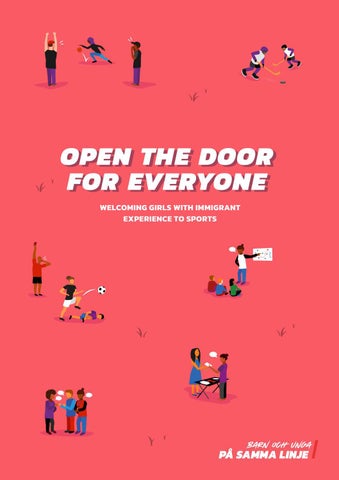
OPEN OPEN THE THE DOOR DOOR FOR FOR EVERYONE EVERYONE WELCOMING GIRLS WITH IMMIGRANT EXPERIENCE TO SPORTS
1
WHEN WE INVOLVE GIRLS WITH IMMIGRANT EXPERIENCE, WE ALSO WELCOME MANY OTHERS TO SPORTS In Finland, the number of people with immigrant experience increases every year. The sports world has an excellent opportunity to create a feeling of community and belonging for more people in our society. It is important to be aware that cultural and gender-specific expectations place demands on young people’s leisure activities. For girls, exercise and sports can in their current form be difficult to participate in. Obstacles to participation can be of social, cultural or economic nature, due to one’s personal background or other conditions. Girls with immigrant experience stay home more than boys do. In terms of integration, staying home can be cause for concern. However, in other cultures home may be seen as a safe and supportive place for the upbringing and schooling of adolescent girls.
“
To make sports more attractive, we need to rethink and reshape the world of sports to make it more welcoming and inclusive. Change requires new methods.
”
Sport provides an excellent environment for a person to feel that they belong somewhere and to identify with society if they do not quite meet the linguistic skill level and appearance standards. In addition to the fact that participation in sports and exercise activities simplifies the integration process, it also helps develop individual skills that are valuable outside of sports. This guide includes tips and ideas on how you can better involve girls with immigrant experience in the activities of your club, school, operation, association, sport or municipality. The content is based on research and experiences from the field. The guide is mainly directed towards coaches, leaders and physical education teachers, but also for others who work with sports and are interested in issues related to immigration. Although the focus of the material is the inclusion of girls with immigrant experience in exercise and sports activities, several tips can be applied to other groups and sectors as well. Inclusion work benefits everyone and opens the door for many to adopt a physically active lifestyle. Thank you for making sports more inclusive! Finlands Svenska Idrott Project ‘Barn och unga på samma linje’
Editor Tarja Krum Graphic design Cecilia Lindström Language review Eerika Ströömi Published 2021 2
USEFUL TERMINOLOGY Immigration means that someone moves from one location to another, voluntarily or out of necessity. Immigrant experience refers to people having different backgrounds and reasons for the immigration. The reasons can be financial or related to safety. A person with immigrant experience can also be a newcomer, adopted or raised in a family that has experienced immigration. Thus, a group with immigrant experience is not to be treated as a homogeneous group. When meeting people with immigrant experience, think of different strategies depending on their background.
Asylum seeker refers to a person who has moved to a foreign country for protection and right of residence. An asylum seeker has yet to receive a residence permit. A person who has been granted a residence permit is called a newcomer. People who move to another country for various reasons are generally called immigrants.
Intersectionality means that an individual can belong to several different groups and categories. For this reason, their prerequisites, needs and positions of power may vary. This may be evident, for instance, in the language support needs of a group of newcomers. Thus, intersectionality functions as a tool for adapting effort and achieving the desired result.
Cultural awareness means the ability to take the impact of someone’s cultural background into account.
Equal treatment means that all people are equal regardless of gender, age, origin, nationality, language, religion, beliefs, opinions, political activity, trade union activity, family relationships, health, functionality, sexual orientation or any other circumstance that applies to the person. Basic rights belong to everyone and therefore personal characteristics, such as origin or skin colour, must not affect the opportunities people have.
Diversity means that we all have several characteristics and we belong to different groups. When diversity is taken into account, all our differences are respected. This contributes to everyone feeling safe and respected. We should all be able to give our contribution to society without fear of being discriminated against.
Segregation means that an individual is not invited to a community. The individual becomes an outsider and creates their own environment, often with others who have been left outside the community.
Integration means that an individual adapts to their surroundings. An individual becomes a part of a group, but that group does not change its form. Integration and segregation are opposite concepts.
Inclusion means that everyone is given the opportunity to participate on equal terms based on their conditions. An individual changes the design of a group by their participation. By inclusion, the individual is allowed to be themselves in the new context and they are also allowed to help the group grow through mutual exchange of experiences.
3
Exclusion is to exclude or remove one or more people from a group. Exclusion can be deliberate or unintentional.
Discrimination means that one person is treated worse than another person in a comparable situation. Discrimination is mostly based on one or more personal characteristics, such as gender, ethnicity or age.
Minority stress means that a person is exposed to long-term social pressure because they belong to a minority. The stress may manifest itself when a person has to be on their guard, has to prepare to be exposed or is questioned because they belong to a minority. Minority stress may be the result of mental and physical illness. The stress can affect individuals who belong to a minority as well as their family members. People who help or represent a minority in relation to their work may also experience minority stress.
Microaggressions may occur when someone is devalued through words and actions. Microaggressions may frequently be veiled in humour and compliments, but they are often perceived as offensive and threatening by people who feel exposed to them. Microaggressions can also come in the form of distancing and making a person that belongs to a minority invisible. Those exposed to such commenting may find it stressful whereas in the eye of the beholder the comments seem harmless and are not given a second thought. Examples of microaggressions: a non-white Finnish person gets asked about their home country and that person’s name is constantly mispronounced. Another example are jokes based on racist stereotypes: e.g. women from the Middle East are oppressed and non-white people have a low education level.1
White standard 2 refers to racist views on the superiority of white people. The white standard is so dominant that white is not seen as a skin colour. It is simply the norm in society. This is evident, for instance, when analysing who newspapers mostly write about or how band-aids are mostly coloured to suit the skin colour of white people only. White people rarely need to worry about not fitting in or being diminished or being exposed to master suppression techniques. The white standard is never a problem for whites.
1 2
4
https://nathatshjalpen.se/a/microaggression/ https://rfslungdom.se/ordlista/vithetsnorm/
CONCRETE TIPS FOR: Individuals • Discuss cultural norms openly with athletes or students, regardless of whether you are a teacher, coach or leader. This increases the understanding of each other’s cultures within the group. With cultural richness, your operation evolves and becomes more modern. • However, be prepared for cultural differences that may lead to cultural clashes and conflicts. Culture clashes are a natural part of diverse sports activities. They occur not only between foreign children with different cultural backgrounds but also among Finnish children. Culture clashes can cause discomfort, but they are not dangerous. It is important to solve them as well as possible, to have a discussion and apologise. Open communication is key. • Everyone in the group should be treated equally and respectfully without any emphasis on cultural differences. • You should look at everyone from an intersectional perspective. For many, identity may overlap with several oppressed groups, an example being a black woman. Girls in particular should not be treated as a homogeneous group.
CLUBS AND SCHOOLS Recruitment • Use various channels in recruiting. For immigrant families, school is often a safe place and thus an excellent channel for providing information about your club’s activities. Put flyers on bulletin boards, ask teachers to provide information in class and during school meetings or showcase your sport during gym class. Ads placed in newspapers, at social welfare offices and at employment agencies as well as visits to multicultural associations are also excellent recruitment tools. • Provide information on what your club does, what sporting and exercising opportunities there are in Finland and what ‘talkoot’ i.e. volunteering means. Distribute Engage Through Sports material found at the end of this guide. • Take the opportunity to meet with families that have immigrant experience. As children start a hobby, their close friends and family learn of the activity. This means that they can bring them along, too. Many would rather try a hobby with their friends than by themselves.
5
Training and other activity • Provide girls with the opportunity to choose between different activities. This has a positive effect on their commitment and self-confidence. Also make sure to offer a wide range of activities, giving a boost to girls’ empowerment. • Include other content that improves individual life skills. Research says3 that girls are motivated to participate in sports when they simultaneously learn other meaningful things, such as leadership, culture, sexual and anatomical knowledge, respectful behaviour and arguing with a gender other than their own. • Take various religions into account during planning. For instance, this may require you to make note of various holidays in the calendar. We often only pay attention to holidays related to our own culture and religion. This may lead to missing a significant holiday, meaning that someone will not have the opportunity to participate or that their ability to perform is not optimal (for example, fasting holidays may affect physical training). In general, it is important to remember that religion is a personal matter. It does not matter if your group includes several people from the same religious community because religion can still have different meanings on an individual level. Thus, it is important to map out everyone’s wishes on how to approach this. • Be sure to promote different types of leaders in terms of culture, ethnicity, language, body shape, age, abilities and so on. Diverse leadership encourages all kinds of people to join. • Find out how the activity can be applied in a way that helps as many people as possible to participate. Try to attract girls to physical activity by 1) aiming the activity only at girls, 2) using only female leaders, 3) making sure that men do not have access to the facility, 4) using clothing that covers the body as required, 5) having different changing rooms and shower areas, 6) making sure it is easy to get to the facility, 7) organising the activity in the afternoon or early in the evening and 8) making the activity more health-oriented than competition-oriented in the beginning. For example, use female instructors for swimming lessons and organise swimming trips for girls and women only. Have an active and open dialogue with girls and their guardians about their wishes. • Use recurring routines. For instance, it is good practice to start and end the activity the same way every time. This gives the participants an understanding of the structure, regardless of language • Agree on all rules for comfort and the activity in advance. Group behaviour and exercise and sports participation varies by culture. • Focus on planning fun activities that provide new experiences without the need to compete. Remember that the social interaction between athletes is as important as sport-specific training. When the threshold is low, girls with immigrant experience can better participate in sports activities.
Elias Musangeya and Joseph Muchechetere (2012) Empowering girls and young women through sport: A Case study of Zimbabwe’s YES programme
3
6
Safety and well-being • Allow girls to wear clothes they feel comfortable in. In some societies, girls should not show too much skin as it can have an adverse effect on their future. For example, there are special hijab variants for physical activity. Make note of this when choosing attire for athletes. For some, future motherhood can be a very important goal in life. A sports outfit that goes against cultural norms can be an obstacle to participating in terms of the future. • Secure the route between the sports facility and home. Arrange joint transport, ask everyone to travel in groups, accompany them home or arrange the activity close to home. • Offer girls the opportunity to engage in exercise activities. If the company of boys makes it difficult, assign girls their own time for practice. Research4 and experience show that macho culture makes boys take up more space than girls. This makes girls more passive and cautious during physical activities. • Invest in creating trusting relationships with the participants. Discuss everything actively with families. When guardians know what the activity is and who is involved in it, the threshold to let children participate becomes lower. Being in contact with the guardian provides a feeling of security both at home and with the child. A dependable leader helps participants dare to be themselves, which in turn improves their attitude towards sports and exercise. If possible, always have the same person lead so that the relationship of trust is built on a safe and familiar leader. • Follow up the process and find out how the experience was regarding the activities, circumstances, other children etc. Take the feedback into account in further planning. • Intervene with unacceptable behaviour. Every child and young person has the right to a safe and comfortable sporting environment. This is not a matter of opinion. Welcoming diversity is at the heart of multicultural activities. Thus, there should be zero tolerance for bullying and racism.
Elias Musangeya and Joseph Muchechetere (2012) Empowering girls and young women through sport: A Case study of Zimbabwe’s YES programme
4
7
Support • Mention the possibility of having a support person for the girls during the activity. It would be great if the support person is someone they know, for example, a teacher or an assistant from the school or from some other familiar environment. The support person can also be someone with who the girls can identify with. • Find out what financial support municipalities provide so that participation fees, competition licenses or equipment do not become an obstacle to participation. Offer to try the sport for free and help with bureaucracy if needed, e.g. if filling out forms becomes an issue due to language skills. Also, offer to pay membership fees and licenses by doing volunteer work for the club. • Provide financial support by donating clothing. Remember to support various needs, for instance by offering a sports hijab to those who wear the hijab on a daily basis. The family’s socioeconomic status and resources, in general, can affect a young person’s ability to participate in sports. Families that have several children have often limited resources in terms of time and money compared to families with two children, for instance. Communication • You can reach more people by communicating in clear, unambiguous language, both written and verbal. Use short sentences and simple words, speak slowly, articulate, address the most important things the recipient needs to know and use pictures. Sometimes the group can include people who speak the same language who can translate for each other. • Use body language, too, so that language does not become an obstacle to participation. Use gestures and symbols, hand signals and picture cards to explain what happens next. • Interaction is especially important if there is no common language. Be in personal contact with the participants and ask for feedback. This builds mutual trust and confidence. Personal attention is given when the leader says hello and welcomes everyone. • If there is a language barrier, you can also use interpreters. If there are several different languages, you can bring in several interpreters and divide the participants into groups with their own interpreters. • Inform guardians in advance what the activity is about and what equipment is needed so that the child can be prepared for the lesson or the training. If there is no opportunity to speak in person or meet the guardians, send a note home with the child, communicate via email or telephone or via an interpreter. You should also advise who the activity is aimed for, e.g. if it is only meant for girls. Make sure that contact information for people who run the operation is available and provide information on language support.
8
ASSOCIATIONS Competence • Train coaches, leaders and other active people in the association in understanding norms, diversity and cultural awareness to make sports and exercise activities more inclusive for girls with immigrant experiences. Support • Check what financial support the association receives and what it is used for. In particular, you should encourage the association to use the money for purposes that increase the participation of girls with immigrant experience. Visibility • Provide long-term role models that girls with immigrant experience can identify with. Research5 shows that role models with a similar background inspire girls to do sports as the status and the recognition they receive improve. The visibility of these role models in the media also had a positive effect on society’s (parents, friends and the general public) perceptions of female sports and thus also of girls doing sports. • Remember that the more visible diversity there is among female athletes, the more it opens up the attitudes of spectators, too. This leads to increased opportunities for girls to play sports. • Ask famous people, such as politicians, to talk about how girls’ right to do sports also affects attitudes towards female sports.
Elias Musangeya and Joseph Muchechetere (2012) Empowering girls and young women through sport: A Case study of Zimbabwe’s YES programme
5
9
MUNICIPALITIES Competence • Improve the skills of higher education teachers who teach gymnastics by arranging training related to the inclusion of girls with immigrant experience. Ask the association coaches and leaders to participate. Support • Organise a sporting goods bank or a sports centre that offers equipment to those who want to practice or try a sport. The sporting goods bank or the sports centre can lend equipment to lower the threshold of practising a sport. If the equipment is not returned in time, do not punish the lender. Simply accept that the equipment is now in good use. Cooperate with a local organisation with the sporting goods bank in order to save resources. This benefits not only girls with immigrant experience but also other residents of the municipality. • Help sports associations financially by providing the opportunity to apply for participation fee support, for instance. • Organise projects around the inclusion of girls with immigrant experience in local exercise and sports activities. The projects should involve supporting people for girls. They should ask girls for their wishes regarding the practice and help them become members of clubs. With someone who feels safe, it is easier for girls to find new hobbies and participate, especially if their guardians are lacking the resources to help. Thus, it is good to have a support person who can help girls become more invested in the hobby. Opportunities • Make sure that no single group is given priority to access sports facilities. See that everyone has equal opportunity to use the facilities. Also make sure that all facilities are safe and equal in quality. • Encourage associations to use school gyms to arrange post-school activities for children and young people. It improves the participation of children and young people.
10
READ MORE... Aimed at newcomers, Engage through sports includes information about sports and club operations in Finland
SOURCES Elias Musangeya and Joseph Muchechetere (2012) Empowering girls and young women through sport: A Case study of Zimbabwe’s YES programme Religion calendar (RESA forum) uskot.fi/sv/religionskalender/ Holiday calendar (AD Astra) juhlakalenteri.fi/sv/ Är det skillnad på integration och inkludering? (Riksidrottsförbundet) www.rf.se/contentassets/08da4d74d5734153a9882bd27046223f /integration-och-inkludering-lillemor-lindell.pdf Vad är mångfald? (Kultur för alla) www.kulttuuriakaikille.fi/mangfald_vad_ar_mangfald Intersektionalitet (jamstall.nu) www.jamstall.nu/fakta/intersektionalitet/ Key integration concepts (Integration.fi) kotouttaminen.fi/sv/centrala-begrepp The concept of immigration (Västra Götlandsregion) www.esmaker.net/esNews/NewsLetter/ ViewNewsLetter?s=13164d9f-0625-4eca-9dd2-07a935a9702e Refugees and immigrants (Amnesty) skola.amnesty.se/lektioner/flyktingar-och-migration /flyktingar-och-migranter/ Words and terms used for immigrants and refugees (Region Värmland) www.regionvarmland.se/vardgivarwebben/administration/Asyl/ord-och-begrepp-gallande-flyktingar/ Final work on the integration of immigrant children and young people through sports and exercise (in Finnish, Haaga-Helia) www.theseus.fi/bitstream/handle/10024/89973/Tiitinen_Julia_Mikkanen_ Joonas.pdf?sequence=1&isAllowed=y https://siirtolaisuus-migration.journal.fi/issue/view/6126/859 Statistics on immigrants in Finland (Statistics Finland) www.tilastokeskus.fi/tup/maahanmuutto/maahanmuuttajat-vaestossa.html Final work on school nurses’ preventive work with students aged 10-15 who fast during Ramadan (in Swedish) gupea.ub.gu.se/bitstream/2077/62624/1/gupea_2077_62624_1.pdf
11