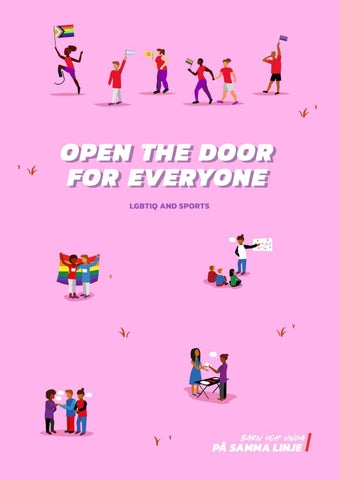
OPEN OPEN THE THE DOOR DOOR FOR FOR EVERYONE EVERYONE LGBTIQ AND SPORTS
1
You are reading an introduction to material whose purpose is to make a change in sports. Gender equality and inclusion often comes with statements such as “everyone is welcome to join our club”. Such statements are naturally made with good intention, but there may be invisible obstacles or unknowingly made statements that exclude or in other ways make many children and young people with different backgrounds feel unwelcome. Gender segregation is considered a natural part of sports, and in most sports the division takes place at an early phase in life. The entire world of sport, both on the elite and grassroots level, is based on the notion that there are only two categories of people: men and women. This gender binary norm also expects women and men to fulfil specific gender attributes and to be attracted to a gender other than their own. In other words, the expectation is heteronormativity. Children and young people who belong to a sexual minority or gender minority face greater challenges in developing a positive self-image regarding sexual orientation, gender identity and gender expression in sports. There are fewer positive role models, and LGBTIQ people are more often forced to hide, explain or defend their identity. One reason why many opt out of sports as a hobby is that the world of sports is difficult to fit into.
“
Sports can contribute to a positive body image in a unique way, making a person value their body based on what it can do and not on how it looks. Therefore, it is important that sports offer an environment where everyone gets the chance to appreciate what their body can do on their own terms.
”
The diversity of gender and sexual orientation is a natural part of sports. Respect and security create a healthy community and give better results. We hope that this guide will give you information on how to make LGBTIQ people feel more secure in sports. This guide includes tips on what you can do on an individual level, in the club or at school, at the federal level and within the municipality. A glossary of LGBTIQ concepts can be found at the end of this guide. Thank you for making sports more inclusive! Finlands Svenska Idrott Project ‘Barn och unga på samma linje’
Editor: Saara Norrgrann Layout: Cecilia Lindström Language review: Eerika Ströömi Published: 2021 2
SEXUAL MINORITIES AND GENDER DIVERSITY This guide addresses two themes that should not be confused with one another: sexual minorities and gender diversity. Sexual minority refers to people who are not heterosexual, e.g. homosexuals, lesbians, bisexuals, pansexuals and asexuals. Nevertheless, all people are part of the diversity of sexual orientations. Gender diversity means that there are an infinite number of ways for people to experience their own gender and express it. Gender diversity exists both among individuals and in society. Some people see themselves clearly as women or men, some as both, and some feel that their gender does not fit into the gender binary. 1
NORMS THAT SHAPE SPORTS The sports world has deep roots in heteronormativity and the gender binary. Heteronormativity is the expectation of how women and men should be, that is, that they should express themselves as either female or male and that they are expected to be attracted to each other. Heteronormativity can also refer to a certain idea of relationships. For example, the idea that a family consists of a mother, a father and children. Gender binary is the notion that there are only two sexes, men and women. According to the gender binary, the biological or legally confirmed sex is what determines whether we are men or women, regardless of the person’s own gender identity or gender expression.2 The sports world is largely shaped by these norms, which can lead to girls and boys feeling the pressure to fit into gender norms. The gender binary has also brought forth assumptions that gender segregation is the natural and only way to divide sports. Organised sports is virtually a gender-segregated activity, regardless of level. In today’s world, there are very few sports where all genders compete together, even if physical differences are not decisive within the sport. Gender segregation is applied early in children’s sports, too, despite the fact that gender does not play a decisive role before puberty. This means that children learn early on that there are only two sexes, and that boys and girls should not compete with each other. As such, competitive sport is structurally based on the assumption that there are two gender categories. This then leads to the exclusion of those who do not fit into the common categorisation of girl/woman and boy/man. Non-binary people are in risk of never fitting into the world of gender-segregated sports. All too often they have to opt out of sports due to what is made possible, instead of having the option of choosing a fun sport.3 In addition to exclusion, gender segregation can also cause gender inequality, as we often act according to a stereotypical expectation of girls vs. boys and treat them differently.
https://thl.fi/sv/web/jamstalldhet/framjande-av-jamstalldhet/ordlista#K%C3%B6nsm%C3%A5ngfald https://www.regnbagsankan.fi/utbildning/fakta-om-hbtiq/ 3 https://www.rfsl.se/verksamhet/idrott-for-alla-kroppar/erfarenheter-fakta-och-tips/
1
2
3
WHAT MAY NORMS CONTRIBUTE TO? Bullying and discrimination are alarmingly common in the sports world. A survey on children’s and young people’s leisure time in Finland indicated that one third of children and young people (10–29 years) have experienced bullying, discrimination or abuse in sports. Young people over the age of 15 who report belonging to a minority group are especially vulnerable to bullying, discrimination and abuse. Up to 60% of children and young people who report belonging to a sexual minority state that they are often or sometimes bullied or discriminated against in their sports hobby.4 In 2019, the results of the first EU-wide survey on experiences of LGBTIQ people in sports were published. The results show that homophobia and transphobia are quite prevalent and evident in sports.5 Survey results: • 5,524 LGBTIQ people from 28 EU countries participated in a survey regarding sports. • 90% believe that homophobia, and especially transphobia, is a problem in sports. • 70% think that it is important for well-known athletes to come out to help deal with the discrimination. • 82% have heard homophobic and transphobic language being used in sports in the last 12 months. • 53% do not act on homophobic or transphobic discrimination. • 33% avoid openly talking about their sexuality or gender identity in connection with sports. • 38% do not know who to turn if they have been discriminated against in sports. • 20% have refrained from participating in sports because of their sexual orientation or gender identity. • The fact that transgender people do not participate in sports is based on negative experiences or simply not fitting into the system.
https://tietoanuorista.fi/wp-content/uploads/2019/02/Lasten-ja-nuorten-vapaa-aikatutkimus-Oikeusliikkua.-Verkkojulkaisu.pdf 5 German Sport University Cologne. https://www.out-sport.eu/wp-content/uploads/2019/05/OUTSPORTReport-Relevance-of-SOGI-in-Sport-in-Europe-3.pdf
4
4
MINORITY STRESS AND MICROAGGRESSIONS Minority stress means that a person is exposed to long-term internal and social pressure because they belong to a minority. The stress may manifest itself when a person has to be on their guard, has to prepare to be exposed or is questioned because they belong to a minority. Minority stress may be the result of mental and physical illness. The stress can affect individuals who belong to a minority as well as their family members. People who help or represent a gender minority in relation to their work may also experience minority stress. Side effects include higher stress levels, anxiety, sleep problems, depression and reduced trust in others. In sports, minority stress can occur when immigrants are grouped into one, blurring out all individual differences. In other words, Finnish-born athletes without a foreign background are seen as individuals, representing themselves, whereas athletes with an immigrant background have to carry the burden of the prejudice and perception related to a specific group. The same applies to other minority groups. Microaggressions may occur when someone is devalued through words and actions. Microaggressions may frequently be veiled in humour and compliments, but they are often perceived as offensive and threatening by people who feel exposed to them. Microaggressions can also come in the form of distancing and making a person that belongs to a minority invisible. Those exposed to such commenting may find it stressful whereas in the eye of the beholder the comments seem harmless and are not given second thought. Some examples of verbal microaggressions include constant questions about whether playing in a hijab is difficult or being constantly referred to with the wrong pronoun. Non-verbal microaggression vis e.g. distancing yourself from a transgender person or ignoring them completely.6
WORK EFFORT An inclusive sports world requires work on several levels. Below is an overview of how to promote inclusion at the individual level, at the club and in school, on a federal level and on a municipal level. Individual level • Use gender-neutral language. Many do not identify within the norms and are not cissexual or heterosexual. For instance, gender-neutral language can be used when giving titles to athletes (using ‘athlete’ instead of ‘sportswoman’ or ‘sportsman’ and ‘football player’ instead of ‘female football player’) and when referring to ‘a partner’ instead of ‘a girlfriend’ or ‘a boyfriend’.
6
https://www.rfsl.se/verksamhet/regnbagsfamiljer-i-vantan/bemotandetips-minoritetsstress/
5
• React immediately when you hear any derogatory language that is linked to body image, privacy or sexuality. This can include verbiage such as ‘bitch’ or ‘throws like a girl’, ‘sus’ (used in a negative sense when someone is suspected to be homosexual) or ‘fruity’ (a term often used to describe certain actions or people as homosexual). Unlock the meaning behind the words and point out that they create a homophobic and sexist environment, even if the words are used ‘as a joke’ between friends. • Think of the diversity of families. Some have rainbow families, some have their parents living in another country and some may have lost their parents. Use words such as guardian, instead of parent. • Avoid stereotypes, such as ‘throws like a girl’ or ‘big strong boys’. Sports should make children and young people stronger, not force them into a predefined role. You should also pay attention to adjectives. Men are often described in more positive and active words than women. • Think of the role models you are referring to. Make sure that all children and young people have someone they can identify with. Bring up role models who break the norm. • Do not simply divide children into boy and girl groups. We sometimes assume that people of the same gender thrive or work best together. However, that is not always the case. Many actually feel more secure in the company of the people with another gender. Gender division may also risk someone’s gender being wrongly defined. Misgendering is a problem for many transgender people. • When your team travels to tournaments, make sure everyone’s needs are met. Make sure to ask in advance if anyone needs a private or a gender-neutral changing room. No one should have to stay home because of changing rooms. • When addressing your team, make sure you have a place that is accessible to all. • Read about minority stress (on page 5) and what you can do to reduce it during and before/after exercise. Be aware that an environment can be unsafe for someone even if no one actually says so. • The experience of being invisible in society is common among minority groups. Focus extra hard on making them visible in the context of sports. Try to actively increase everyone’s security by e.g. actively discussing the importance of respect in sports. • To use the correct pronoun is to show respect. It’s only natural that we all sometimes say the wrong thing. What is important is to apologise and correct yourself. Read more about the pronoun round on page 10. • Do not ask a transgender or non-binary person about their previous name if they have changed their name. • Treat transgender youth with respect and show them support. Indicate that you are interested and ask how the transitioning is going if it has started. • Remember that people who do not change clothes with others can miss the interaction of the group. One concrete tip on what you can do is to talk to the group about the importance of reiterating what was said in the changing room. Exclusion from the changing room must not continue on the playing field.
6
Club • Organise events and training on LGBTIQ issues. The more competence within the club, the better the conditions for everyone to feel welcome. • Communicate about LGBTIQ inclusiveness on your club’s website. Make it clear that transgender people and people that belong to a sexual minority are welcome. • Pay attention to what you post on your website and in printed material. An image of an athlete who is open about their sexuality or gender identity is a great way to contribute to inclusion. • Use visible symbols such as rainbow flags and trans flags to signal equality. Visible symbols in the club’s premises and on its website create a feeling of security. • Add information about changing rooms and available options on your website. Should there be a new construction or renovations, the club, the school etc. can influence how the premises are remodelled and designed to be accessible. • Provide a channel for athletes to turn to if someone is discriminated against and add this information on your website and in your other communications. • Athletes should be allowed to dress comfortably according to their gender identity or gender expression. Take this into account when your club acquires new clothing. Assess the need for gender-based dress codes. Clothes should fit different body types. • Make sure everyone has a safe place to change and shower. No one should have to change in a room designated for people that have a different gender identity. What options does your club have for a gender-neutral space? • Help gender minorities understand association and competition rules and make sure that other participants, referees and coaches treat everyone with respect.
7
Association • The association’s website should include contact information for the person in charge of issues regarding sexual minorities and gender minorities. • All leaders, educators, employees and volunteers in sports must attend training sessions related to issues regarding LGBTIQ and heteronormativity and cisnormativity. Include the themes in all training related to children’s, youth and adult sports. • Produce your own material on LGBTIQ issues or distribute existing material for member associations to use. Make note of special days linked to LGBTIQ issues and share material that member associations can promote in their channels. Participate in Pride and provide information on what the association does with these issues. • Representatives who communicate with the media should be aware of appropriate terminology, correct use of names and current policies. • A transgender person who is a national level athlete should receive support and help should they change teams or their category. Provide information on application for exemption. • Everyone should be able to participate in sports and exercise, regardless of gender. Create a gender equality plan that explicitly includes transgender people. • Review regulations and examine if or how they prevent transgender people from participating in sports. See how you might be able to adjust the regulations to better include transgender people. First, examine the possibility to categorise on a non-gender basis e.g. at the junior level. Another option is to introduce a third competition category alongside the traditional gender division. • Consider privacy. Under no circumstances should the experiences of a transgender athlete be exposed without permission. All medical information must be processed confidentially. • The gender identity and gender expression of all children and young people must be respected. Give children and young people up to 18 years the opportunity to choose their category of competition, team or group regardless of gender.
8
Municipality • Use the municipality’s website to inform sports clubs about accessibility at sports facilities. What do the changing rooms look like? If it is possible to separate changing rooms and toilets or make them gender-neutral, inform clubs about this as well. • Provide the option of anonymously submitting proposals for improvements to sports and exercise facilities. • Establish guidelines for applying for grants and subsidies in a way that also supports LGBTIQ people. • Encourage and give praise to associations that work for the inclusion of LGBTIQ people. • Highlight and support sports that break gender boundaries. • In sports facilities, you often have to pass through the changing rooms in order to get to the gym itself. Take this into account when planning a new construction or a renovation.
INCLUSIVE COMMUNICATION We seldom reflect on exact word choices, and we often use expressions out of habit. We reinforce norms and prejudice unknowingly, without any bad intentions. Being aware of language use helps us strengthen inclusion and make those visible who are at risk of being ignored. No one should have to feel bad due to careless use of language. By using gender-neutral language that is free from stereotypes and using images that symbolise diversity, you can make a wider target group feel welcome and visible. By avoiding language that reinforces norms, young people are given space to develop to what they truly are. Remember the following: • Be vigilant in the use of value-laden and gender-specific words. Generalisations exclude people who break the norm. • When do you use value-laden words, such as ‘strong’, ‘muscular’, ‘sweet’, ‘cute’, ‘rough’, ‘king’, ‘hard’, ‘weak’, ‘lean’, ‘powerful’? Without even thinking about it, we use certain words more when talking about women and others more when talking about men. • ‘They’ is a good pronoun to use when a person’s gender is unknown or it makes no difference and when you want to refer to people who do not want to be categorised as neither male nor female. • Attitudes and reactions can be very obvious with body language and in non-verbal communication. Be aware of this even when you do not feel completely comfortable. • Society is as diverse as its people are. Therefore, you should not assume that you know a person’s background, sexual orientation or gender identity.
9
TIP! Pronoun rounds One way to build up security is to use pronoun rounds. This means that all participants present themselves with names and pronouns (e.g.They, It, Zie, Sie, Ey, Ve, Tey, E). This ensures that correct pronouns are used for all participants. However, pronoun rounds are not always the perfect solution. They must be implemented correctly so that they do not become counterproductive and end up creating insecurity for transgender people. Consider the following: • Describe why you are having a pronoun round. Explain what the pronouns are and what the round is for: as it is not possible to know which pronoun or pronouns someone wants to be used when referring to them, it is important to be aware of the correct pronoun. • Make sure everyone knows it is always okay to say ‘pass’. No one should have to say their pronoun if they do not want to. • If participants start to joke about the pronoun round, make sure to quickly squash the jokes and say that joking is not okay. • Also, remember that some may not have the courage to be open about their pronoun and that the pronouns may change over time. Source: RFSL7
TIP! Do not use gendered names in exercises. For instance, for a coordination exercise called ‘Superman’ where the movement often resembles a flying character with superpowers, the name can be changed to ‘Swinging Ape’ or even ‘Red Riding Hood’. Games like ‘King of the Hill’ can become something like ‘Star of the Show’. Try to challenge gender norms.
7
https://www.rfsl.se/verksamhet/idrott-for-alla-kroppar/erfarenheter-fakta-och-tips/
10
CONCEPTS Words, concepts and terms carry many different meanings. Putting words to emotions and coming up with concepts for phenomena can facilitate the understanding of oneself and others. Words also change over time and take on new meanings. Below is a glossary with terms and definitions related to LGBTIQ issues.
A bisexual or pansexual person can fall in love with or be attracted to people regardless of their gender. A cisgender or cissexual person’s biological gender, the perceived gender and way of expressing their gender corresponds with how their gender was categorised at birth as the legal gender. Crossdressing is to (sometimes or often) have a different gender expression than what is expected based on one’s legal gender. This may include clothing, makeup, hair, body language, voice and other attributes. LGBTIQA+ is an abbreviation for homosexual, bisexual, transgender, intersexual, queer and asexual people. The plus sign can be added to indicate that the abbreviation can also include other orientations and identities. They is a gender-neutral pronoun that you can use to refer to people when their gender is not relevant, you do not know it or when the person prefers they as their pronoun. ‘It’ is another gender-neutral pronoun that can be used if a person wishes so. A heterosexual person can fall in love with or be attracted to the “opposite” sex, ie. men who are attracted to women and women who are attracted to men. Homophobia refers to negative attitudes towards homosexuality and gay and bisexual people. It can manifest itself in individual opinions or even in the values of a society. Homophobia can sometimes overlap with transphobia. Non-binary means that one does not identify oneself based on the division man/woman. Intersexual (intersex, intersex variation) means that a person cannot be categorised as male or female based on the structure of their genitals or chromosome set. This concept, a biological syndrome, covers a large number of DSD (Disorder of Sex Development) diagnoses. There are people for whom intersex is their gender identity or an important part of it, while others may see it as a purely medical thing. It is possible that a newborn is of non-normative sex, and it is also possible that DSD is not discovered until puberty or until the person wants to have children. An intersexual person can be a cisgender or transgender person and have any sexual orientation.
11
The concept of gender can be broken down into five different categories: • The definition of biological sex is based on internal and external genitalia, sex chromosomes and hormone levels. • Legal gender is the gender that appears on official documents, i.e. the gender registered in the population register. A transgender person can apply for a change in the register during their reassignment process. • Gender identity is the perceived gender, i.e. the gender a person feels determines their identity. • Gender expression refers to the way a person expresses their gender – with clothing, for example. Someone’s gender expression may be in accordance with a gender that is socially and culturally the norm or it may break the norm. • Social or cultural gender is based on the norms and expectations of what is considered masculine and feminine. The social and cultural gender varies over time and place. Gender dysphoria is a strong and persistent feeling of being assigned the wrong gender. It causes mental issues and often a reduced ability to function in everyday life. Gender dysphoria can be physical or social. Physical gender dysphoria may refer to how certain body parts or one’s voice can cause strong discomfort or anxiety when they do not match one’s gender identity. Social gender dysphoria takes place when others do not treat the person by their gender, e.g. by using the wrong pronoun. Gender euphoria refers to the positive emotions that a transgender person who is secure in their gender identity feels. Gender euphoria takes various forms for different people. The reasons behind gender euphoria are always unique and personal. One example is the body reflecting one’s gender identity. Gender euphoria may even take place when others confirm one’s identity by using the right name or pronoun, for example. Gender reassignment (gender-affirming treatment) is a collective term for the various ways of changing the body so that it corresponds to one’s gender identity, reducing gender dysphoria. This may include hormone therapy, different types of surgery, hair removal and voice therapy. Often people also change their legal gender in connection with this treatment. In Finland, you can change your legal gender from the age of 18. Transgender people is a broad concept. It usually refers to people who identify or express themselves with a different gender identity than the one assigned to them at birth. Transgender people often break gender norms in different ways. Transphobia refers to negative attitudes towards transgender people. It can manifest itself in individual opinions or even in the values of a society. Queer can refer to gender identity or sexual orientation, describe relationships or sexual practices, and refer to an academic theory, a political movement and queer activism. What is common to all of them is the critique of normalcy. Queer means that you do not have to define your gender or sexual orientation. Source: Regnbågsallians Svenskfinland8 For more information on various concepts, please see www.regnbagsankan.fi/utbildning/fakta-om-hbtiq/ 8
https://www.regnbagsankan.fi/utbildning/fakta-om-hbtiq/
12
DO YOU WANT TO KNOW MORE ABOUT THE SUBJECT? Here are some websites and reports to check out: Trans och idrott – Ingen ska lämnas utanför (in Swedish). RFSL’s report examines and sheds light on transgender people’s experiences in sports. The report surveyed 110 transgender people. Many said that the threshold to participate in sports is high. www.rfsl.se/wp-content/uploads/2020/09/Trans-och-idrott_enstaka-sidor.pdf ILGA World has a website with information about LGBTIQ concepts, among other things. ILGA World – the International Lesbian, Gay, Bisexual, Trans and Intersex Association - is a worldwide federation of more than 1,700 organisations from over 160 countries and territories campaigning for lesbian, gay, bisexual, trans and intersex human rights. https://ilga-europe.org/resources/glossary Research publications on transgender people: tgeu.org/publications/ International Olympic Committee (IOC) Framework on Fairness, Inclusion and Non-Discrimination on the Basis of Gender Identity and Sex Variations: https://stillmed.olympics. com/media/Documents/News/2021/11/IOC-Framework-Fairness-Inclusion-Non-discrimination-2021.pdf?_ga=2.184966889.1714360384.1638362018-amp-L4JqLfCZMwyog8kcqE8KWw
SOURCES 1
https://thl.fi/sv/web/jamstalldhet/framjande-av-jamstalldhet/ordlista#K%C3%B6nsm%C3%A5ngfald
2
https://www.regnbagsankan.fi/utbildning/fakta-om-hbtiq/
3
https://www.rfsl.se/verksamhet/idrott-for-alla-kroppar/erfarenheter-fakta-och-tips/
4
https://tietoanuorista.fi/wp-content/uploads/2019/02/Lasten-ja-nuorten-vapaa-aikatutkimusOikeus-liikkua.-Verkkojulkaisu.pdf
5
German Sport University Cologne https://www.out-sport.eu/wp-content/uploads/2019/05/OUTSPORTReport-Relevance-of-SOGI-in-Sport-in-Europe-3.pdf
6
https://www.rfsl.se/verksamhet/regnbagsfamiljer-i-vantan/bemotandetips-minoritetsstress/
7
https://www.rfsl.se/verksamhet/idrott-for-alla-kroppar/erfarenheter-fakta-och-tips/
8
https://www.regnbagsankan.fi/utbildning/fakta-om-hbtiq/
13