Annual Report 2025-2026
SCALING IMPACT for lasting change
SCALING IMPACT for lasting change 2025-2026 at 31 March 2026
Rooted in the belief that knowledge is a powerful force for good, Canada's International Development Research Centre (IDRC) funds science and innovation across Africa, Asia, Latin America and the Middle East. We work with researchers, institutions and policymakers in low- and middle-income countries to generate evidence that addresses real challenges — and to help that evidence endure, spreading from communities to policies, from one region to the next, advancing equity, opportunity and shared prosperity for people around the world.
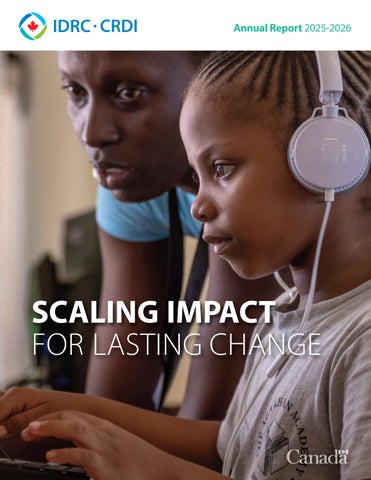
on The cover Pupil and teacher at the aga Khan academy in Mombasa, Kenya, using interactive digital tools as part of an IDrc-supported education project. IDrc supports scalable, evidence-based digital learning solutions that improve student outcomes while strengthening teaching practices. Unless otherwise stated, all monetary amounts in this annual report are in canadian dollars.
IDrc-Panos/Marc shoUl
as part of canada’s foreign affairs and development efforts, IDrc champions and funds research and innovation within and alongside developing regions to drive global change. The centre invests in research to build evidence, inform decisions and generate opportunities that promote an inclusive and sustainable world.
Contents 2
Our year at a glance
4
Message from the chairperson
5
Message from the president
6
From evidence to impact How IDRC enables research to scale
16 Investing in solutions that serve the world, and Canada 17 Management’s discussion and analysis • Core business • Corporate governance • Financial resources • Sustainable and inclusive organization • Risk management • Results and outlook 37 Climate-related financial risk disclosures 43 Financial statements 67 How to reach us
Our year at a glance research creates impact in many ways. it can inform national policy, strengthen public institutions, shape professional practice, generate technologies that improve daily life or redefine how progress itself is measured. scaling impact — the focus of this year’s annual report — traces these diverse pathways to change, showing how locally grounded research contributes to durable, system-level shifts that build capacity in emerging economies while strengthening canada’s connections to regions of strategic and economic importance.
across africa, asia, latin america and the Middle east, iDrc supports researchers and institutions working within their own contexts to address urgent challenges — from food security and gender equality to environmental health, education and democratic governance. the results demonstrate that meaningful change rarely follows a straight line. it unfolds through relationships, sustained engagement and the steady expansion of ideas, tools and partnerships.
IDrc/sven TorfInn
Panos/chrIs De boDe
headquartered in ottawa, iDrc has five regional offices in the global south. in 2025–2026, the total value of new projects approved with iDrc and donor funds was caD148.69 million.
Scaling innovative education across countries
an iDrc-incubated centre of excellence for civil registration and vital statistics has found a permanent home within the Un system, giving it the global reach to help women and girls claim their rights. read more on page 9.
through the Knowledge and innovation exchange, iDrc and the global Partnership for education are helping governments in more than 70 countries expand proven approaches to learning. read more on page 10.
2
aI4PeP ghana, KnUsT
IDrc-Panos/JaMe s oaTWaY
Counting every woman and girl
Clean air for South Africa's most polluted communities
When mosquitoes fly, AI listens
a low-cost, ai-powered air-quality monitoring network developed with iDrc support is expanding into the largest system of its kind in africa, giving millions of people key information to protect their health. read more on page 12.
researchers in ghana have built an ai-powered system that identifies mosquito species by their wingbeat, giving health officials early warning of outbreaks — a local innovation now being adapted across three continents. read more on page 13.
IDr c annUal rePor T 2025-2026
GLOBAL REACH
EFFICIENT DELIVERY
SMART INVESTMENT
5
91%
LESS THAN
regional offices located around the world enable a close connection to issues and stakeholders at the local, national and regional levels.
of funding goes directly to programming, ensuring resources reach those who need them.
SUSTAINABLE ORGANIZATION
2% 24%
is on average the amount of canada’s overseas development assistance invested annually in iDrc, showing big impacts come from modest investments.
reduction in air travel emissions since last year as part of efforts to achieve net-zero emissions by 2050.
OUR GEOGRAPHICAL REACH
OUR PROGRAMMATIC FOCUS
funds allocated towards new research projects approved in 2025-2026, across regions (caD)
funds allocated towards new research projects approved in 2025-2026, across the centre’s core program areas and catalytic fund* (caD) catalytic fund* 7.18M (4.83%)
global 30.35M (20.41%)
eastern and southern africa 55.03M (37.01%)
148.69M
central and West africa 14.20M (9.55%)
global health 17.35M (11.67%)
148.69M Democratic and Inclusive governance 20.05M (13.48%)
asia 23.61M (15.88%) Middle east and north africa 12.58M (8.46%)
climate-resilient food systems 27.64M (18.6%)
latin america and the caribbean 12.92M (8.69%) *
OUR FUNDING SOURCES (caD) iDrc’s 2025-2026 parliamentary appropriation was enhanced by donor funding, amplifying the impact of canada’s investment.
education and science 58.83M (39.56%)
sustainable Inclusive economies 17.64M (11.86%)
iDrc’s catalytic fund supports research on emerging or cross-cutting issues.
297.4M (total revenue) PARLIAMENT OF CANADA: 160.9M (54.1%)
DONORS : 133.8M (45%) OTHER: 2.7M (0.9%)
s c a l I n g I M Pa c T f o r l a s T I n g c h a n g e
3
Message from the chairperson In a year of rapid change, locally grounded research is one of the surest ways to turn evidence into scalable impact that lasts. IDRC’s partners are producing knowledge and moving it into use through policies that shape decisions, programs that strengthen services, innovations people can hold and practices that change how communities work and thrive. Around the world, innovation capacity is becoming more geographically distributed, with new centres of scientific and technological leadership emerging across Africa, Asia, Latin America and the Middle East. These regions are helping shape the rules, standards and partnerships that will underpin future markets and governance frameworks. For Canada, investing in locally led and globally relevant research in this evolving landscape is a strategic imperative. It diversifies relationships and helps shape the standards, markets and norms that will define the future. As you read through the pages of this report, you will notice that locally led solutions often become globally relevant. Innovations developed in Ghana now inform epidemic preparedness in the Philippines. An air-quality system developed in South Africa is being adapted to the United Kingdom. These and other examples show that supporting research for development strengthens systems, markets and relationships that can matter for Canada’s long-term prosperity and security.
4
IDR C ANNUAL REPOR T 2025-2026
As a board, our responsibility is to help ensure IDRC remains fit for purpose — anchored in strong governance, learning and equity — so that evidence travels the last mile to policy, programs, products and practice. We are encouraged by continued progress under Strategy 2030 and by the Centre’s emphasis on scaling what works. In an era of constrained global resources, it is imperative that every investment made is one that generates the highest possible impact for both Canada and the world. The results of IDRC’s work — generating solutions to social and economic challenges across emerging markets while deepening relationships and learnings to benefit Canada and Canadians — speak for themselves. I am inspired by the people behind IDRC’s impact: researchers, co-investors, community leaders and others who are working together to advance innovative solutions. Thanks to IDRC’s governors, management and staff for their enduring commitment to research for development. Together, we are positioning knowledge as a bridge, between local priorities and global challenges, between today’s needs and tomorrow’s opportunities.
Stephen Toope Acting Chairperson, IDRC Board of Governors
Message from the president evidence in the right hands at the right time changes lives. iDrc’s investments in generating and using evidence show that solutions can move quickly from idea to application when they are built to meet urgent, lived needs. the stories in this year’s annual report follow that journey from insight to impact, and then further to impact designed to scale. for example: n research on renewable energy and irrigation informed
Bhutan’s national energy Policy, paving the way for the nationwide adoption of solar-powered irrigation systems. n long-term investments in civil registration and vital
statistics have taken another path to scale: a global resource hub, now housed within the United nations, that is helping countries count every woman and girl so they can plan services that reach them. n in Brazil, a research-backed guide launched by the federal
supreme court is strengthening how justice institutions respond to gendered disinformation. n
and in south africa, low-cost, ai-enabled air-quality monitoring networks are turning data into tools that are already reaching millions.
iDrc’s portfolio of investments has brought concrete benefits to canada over the past year. our regional presence anchors trusted relationships that connect evidence to action and helps inform canada’s engagement in the world. as we co-create with governments, universities, civil society, communities and
the private sector, we are building partnerships and alliances that work towards something bigger. this means that every dollar canada invests attracts additional support from allies, amplifying our shared impact. iDrc’s approach provides lasting influence by investing in people and institutions so that solutions are not only discovered, but adopted, adapted, scaled and sustained over time. looking ahead, and as we enter the midway point of strategy 2030, iDrc remains committed to generating high-quality research and evidence that delivers concrete development results and supports canada’s foreign policy. Whether strengthening aquaculture resilience in the indo-Pacific region in ways that support our own food security and trade, or advancing ethical, inclusive ai to address real-world needs that reinforce canada’s growing ai leadership, iDrc supports those who understand the robust innovations and systems needed for lasting impact. By pairing rigorous evidence with strong innovation frameworks and collaborative partnerships, we ensure our research not only informs policy, but also drives meaningful progress. in a complex world, research remains one of the clearest ways to turn shared challenges into shared progress. i am deeply grateful to iDrc’s staff for their dedication, expertise and innovation in supporting our mandate. and i look forward to continuing to build the institution's future, together.
Julie Delahanty President
s c a l I n g I M Pa c T f o r l a s T I n g c h a n g e
5
From evidence to impact how iDrc enables research to scale around the world, iDrc-supported research generates knowledge with the power to improve lives and create conditions for societies to prosper. But for research to be effective, evidence has to move — through institutions, relationships and decisions — shaping policy, strengthening programs and changing practice along the way. how does evidence move from a study to a policy? from a finding to a farmer’s field? from insight to impact? to find the answers, iDrc studied how researchers and innovators across africa, asia, latin america and the Middle east were finding ways to move evidence into action. What emerged is an approach called scaling science that recognizes the different routes, such as programs, policies and products, through which research can contribute to positive outcomes. scaling science is borne of the belief that we can be more systematic and scientific about the way we scale, and that by doing so we increase the likelihood that our research will effect meaningful change. scaling science is about maximizing the positive impacts of innovation while carefully studying how scaling unfolds. there is no formula for applying scaling science. instead, it provides a frame for asking better questions about how change happens. iDrc uses scaling science to look beyond the outputs of research — papers, reports, conference presentations — and trace how the knowledge contained within those products actually influences the world. that learning is now captured in a growing body of work, including a free online course available since early 2026, developed with the Un sustainable Development solutions network. the course helps researchers, practitioners and policymakers build the skills to navigate real-world complexity — questioning assumptions, examining context and making deliberate choices about how innovations can grow responsibly.
6
IDr c annUal rePor T 2025-2026
this year’s annual report shows what scaling looks like in practice. in Bhutan, evidence on solar-powered irrigation has scaled into national energy policy, with budget allocated for pilot sites. in Zimbabwe, research on unpaid care work is informing a landmark parliamentary motion. in south africa, low-cost air-quality monitors developed by local researchers are now reaching millions of people. in Brazil, research on gendered disinformation is shaping how the federal supreme court protects women online. the stories in this report follow researchers and innovators along different pathways of scaling science, showing what it takes to move from insight to impact. they demonstrate that scaling is not a phase that comes after research. instead, it is a way of thinking that shapes research from the start. What makes this approach possible is how iDrc operates. We fund researchers and institutions embedded in the countries where change is sought, trusting local expertise to shape solutions that fit local realities. iDrc takes the long view, recognizing that influence unfolds over years, not projects. increasingly, we invest not just in generating new research, but in moving existing evidence into use by funding knowledge brokers and bringing researchers and decision-makers together to build relationships that help findings reach the people who can act on them. iDrc’s approach delivers value beyond borders. By investing in research capacity where innovation is happening — in regions with growing economies and deepening technical expertise — canada builds the partnerships that foster durable trade environments, counter instability and open pathways to future opportunity. When scaling works, it creates solutions that serve communities in low-resource and emerging economies while strengthening canada's strategic position in an uncertain world.
IcIMoD
An IDRC-supported project in Bhutan is advancing solar-powered irrigation. Research evidence is informing national policy and enabling the expansion of more productive, climate-resilient farming that can better connect farmers to markets.
Centring evidence in policymaking
Powering farms, empowering women in Bhutan
a well-designed study can either sit on a shelf or reshape how a government acts — influencing laws, regulations and budget priorities. the difference often comes down to relationships, timing and trust. Policy impact rarely happens because evidence is simply "good enough." it happens when researchers understand the political landscape, engage decision-makers early and present findings in ways that speak to real constraints and opportunities.
in Bhutan, agriculture sustains 60% of the population, and more than half of those working the land are women. But only 16% of farmland has access to irrigation. What exists is seasonal, gravity-fed and increasingly vulnerable to climate change.
iDrc supports this work not only by funding research, but also by supporting the translation of research into policyready evidence. this means investing in knowledge brokers who can bridge the gap between researchers and legislators, bringing researchers and decision-makers into the same room and taking the long view: recognizing that policy change often unfolds over years, not months. the stories in this section show what happens when research reaches the right ears at the right moment, and when governments act on what the evidence shows.
iDrc-supported research helped change that — not just for a few farms, but at the national level. evidence generated through the clean energy for Development initiative made its way directly into Bhutan's national energy Policy 2025, creating the foundation for solarpowered irrigation to scale across the country. that evidence came from the Women's empowerment through renewable energy-Powered lift irrigation systems (Werelis) project, led by the international centre for integrated Mountain Development, which set out to answer the question: could solar power move water to farms while creating opportunities for rural women? the research team developed decision-making tools, conducted feasibility studies and worked closely with government ministries to translate findings into policy.
s c a l I n g I M Pa c T f o r l a s T I n g c h a n g e
7
a new provision in the national policy commits the government to promoting the productive use of renewable energy. But not just generating power — putting it to work through water pumping, community enterprises and other applications that support livelihoods.
By generating evidence that shaped local budgets and catalyzed national legislation, this research shows a clear pathway to scale: from research to municipal action to parliamentary debate to potential nationwide policy reform.
the research has also catalyzed concrete action. for the first time, Bhutan has allocated budget funding to implement four pilot solar irrigation sites, expected to be operational by mid-2026. the government is now exploring financing for nationwide expansion.
"Unpaid care and domestic work falls squarely on
climate-resilient agricultural practices like these strengthen global food systems and the supply chains that connect farmers in emerging economies to markets worldwide, including canada.
women's shoulders, hindering their participation in the paid economy and society. By recognizing it as legitimate work, the bill acknowledges the valuable contributions women make to their families and communities." — sitabile Dewa, executive director of WalPe
Why the care economy deserves investment
Making invisible work visible in Zimbabwe across the world, women and girls carry the weight of unpaid care work: cooking, cleaning and caring for children and the elderly. in Zimbabwe, where many women must also fetch water for their households, this invisible labour keeps communities running. But it limits women's opportunities for education, employment and leadership. iDrc-supported research is helping change that. the #Wecareforher equality project is led by the Women's academy for leadership and Political excellence (WalPe) and supported through the scaling care innovations in africa initiative, a partnership between iDrc and global affairs canada. the project set out to generate evidence on how unpaid care constrains women's economic participation and to scale that evidence into policy action. the research showed results. Working with district authorities, the project helped redirect municipal budgets toward water infrastructure and social services that reduce the time women spend on unpaid care work. at the national level, it supported the development of a landmark parliamentary motion on unpaid care work, now set for debate. if passed, the bill would formally recognize unpaid care as legitimate work for the first time in Zimbabwe's legislative history. a learning exchange with Kenya helped build momentum. Zimbabwean parliamentarians, including the chair of the Women's Parliamentary caucus, met with the architects of Kenya's first national care Policy, which is a powerful example of countries learning from one another.
8
IDr c annUal rePor T 2025-2026
What if care were treated less as a private burden and more as economic infrastructure? through the transforming the care economy through impact investing initiative, iDrc and its partners are generating practical evidence for investors and policymakers. the initiative identifies business models that work, helps care enterprises grow and connects entrepreneurs with the capital and policy support they need. recognizing and investing in care is not only about rights. it’s smart economics. When care systems are stronger, women have greater opportunity to participate fully in the economy, laying the groundwork for more inclusive growth.
Strengthening systems that serve people some innovations are best delivered not through policy mandates but through the organizations that serve communities directly: health systems, community organizations, schools. scaling through programs means building something that can be replicated, whether it is an intervention, a training model or a service that can expand its reach and improve outcomes without losing what made it work in the first place. this pathway requires attention to sustainability. a program that collapses when external funding ends hasn't truly scaled; it's just expanded temporarily. iDrc supports research that strengthens institutional capacity, embeds innovations within existing systems and generates the kind of evidence that helps programs attract ongoing support.
IDrc / anDreW esIebo
Ghana’s Births and Deaths Registry conducts an outreach program to register infants. Through its support for civil registration systems across dozens of countries, IDRC helps ensure people can access legal identity and the rights and services it enables.
strong institutions in partner countries create the foundation for long-term collaboration, opening doors for canadian expertise, technology and partnership in sectors from education to health care. the stories here show how research-driven programs move from pilot to permanence.
Counting every woman and girl a birth certificate may seem like a simple document, but it unlocks a lifetime of rights. Without one, a girl is more vulnerable to child marriage, and a woman may be unable to inherit property, access health care, enroll her children in school or vote. across the world, tens of millions of births go unregistered each year, and a disproportionate number of those missing records belong to women and girls. iDrc helped change that — not through a single project, but by building a global institution and then scaling it. What began as an iDrc-incubated centre of excellence now operates within the United nations system, with reach across 130 countries. civil registration and vital statistics systems capture life's key events: births, marriages, divorces, deaths. When these systems work, they provide legal identity and generate data that governments need for planning and services. When they don't, people fall through the cracks and society suffers.
iDrc recognized this gap. in 2015, with joint funding from global affairs canada, iDrc established the centre of excellence for civil registration and Vital statistics (crVs) systems, a global resource hub to help countries strengthen their registration systems, with a particular focus on gender equality. over five years, iDrc supported national efforts in 67 countries, working with governments to strengthen electronic birth registration systems, register marriages to combat child marriage, test innovative digital solutions for remote communities and produce annual vital statistics reports that track gender-disaggregated data. then, to scale its reach further, iDrc transitioned the centre to a new institutional home: the United nations Population fund (UnfPa) — an organization that has the global infrastructure and authority to support data and crVs system strengthening in any country that requests assistance. "robust crVs systems are the very foundation of gender equality," said Julitta onabanjo, director of UnfPa's technical Division. "they start the process of enabling women and girls to claim their autonomy, and their rights, and to realize their full potential." investing in gender equality through systems like crVs is an important driver of rigorous population data-driven economic growth. it contributes to stronger democratic institutions and processes, more stable global partnerships and lasting peace and security.
s c a l I n g I M Pa c T f o r l a s T I n g c h a n g e
9
Scaling evidence-based innovations to transform education strong education systems build the foundation for everything that follows: healthy economies, resilient democracies and communities equipped to solve tomorrow's problems. But millions of children worldwide miss out on high-quality education because schools lack resources, teachers lack training or girls face barriers that keep them out of classrooms altogether. after seven years of operation, the Knowledge and innovation exchange (KiX), a joint endeavour between iDrc and the global Partnership for education, has become a scaling engine for educational innovation by helping governments learn from each other and use evidence to integrate proven approaches into national systems. Managed by iDrc, KiX funds research, tests new approaches and helps governments apply proven solutions in more than 70 countries. the payoff extends beyond classrooms. educated populations drive economic growth, creating the conditions for stable partnerships and shared prosperity, including with canada. KiX-funded projects are driving meaningful change in critical areas: n early learning — in ghana, Kenya and the gambia,
schools are using play-based learning to help young children develop key skills before they start primary school. in Uganda and Zambia, new teacher-training programs have given educators tools to make learning more engaging and interactive, helping children build strong foundations in literacy, numeracy and social skills. n out-of-school children — in ethiopia, Kenya and
tanzania, accelerated education programs are helping thousands of children, especially girls, re-enter school and regain essential learning. these programs have also helped shape government strategies to expand flexible education options — including accelerated programs that adapt school schedules around children’s daily realities — ensuring more children can stay in school. n Teacher professional development — in 41 countries,
teachers improved their skills through peer mentoring, digital learning and coaching. these approaches make lessons more engaging and better suited to students’ needs. in many countries, including Zambia, côte d'ivoire and nigeria, governments have incorporated these methods into national teacher-training programs, ensuring more educators benefit from effective, handson professional development.
10
IDr c annUal rePor T 2025-2026
“When we allow children to explore their passions and interests, we can better identify their talents and guide them in meaningful ways...The GPE KIX Initiative was a turning point for me. Being recognized for my work in play-based learning and receiving a scholarship to pursue my Master’s degree strengthened my confidence in child-centred approaches.” — natasha nyangwete, an early childhood education teacher in Zambia.
By generating and mobilizing locally driven evidence, KiX is helping scale education solutions to reach those who need them most — transforming policy and practice for the long term. supporting education reduces poverty and inequality while building the skilled workforces and stronger economies that create more stable and prosperous trading partners for canada.
Informing perspectives not all change flows through institutions. sometimes, the most powerful impacts happen when individuals adopt new practices: a farmer trying a different technique, a health worker applying new knowledge, a community shifting how it manages a shared resource. this pathway is about people and how research changes what they know, believe and do. Behaviour change is often harder to measure than a new law or a scaled-up program. But it can be just as consequential. iDrc invests in research that reaches practitioners, trains professionals and equips communities with skills that last. as that expertise grows, new relationships take shape, opening space for shared learning and long-term collaboration, including with canadian partners. the stories in this section show how evidence translates into practice, one person and one community at a time.
A new voice for Myanmar in Canadian policy circles When Myanmar's military seized power in february 2021, it triggered a humanitarian crisis that has since displaced more than 3 million people. Yet for years, Burmese issues had been largely absent from canadian foreign policy conversations.
Panos/sean sUTTon
Displaced families in Myanmar’s Karenni State rebuild makeshift shelters after renewed fighting forces them to flee under fire. Their experiences reflect the human impact of a crisis that IDRCsupported research and engagement are helping bring to the attention of Canadian policymakers.
napas thein is helping to change that. a Burmese canadian researcher, thein was supported through iDrc's Knowledge for Democracy–Myanmar (K4DM) initiative, a partnership with global affairs canada and the University of British columbia that nurtures emerging scholars and advocates working toward a democratic future for Myanmar. the fellowship gave thein more than research skills. it connected him to a network of canadian policymakers, parliamentarians and officials who had little prior exposure to Myanmar's political and humanitarian challenges. What began as individual capacity-building was starting to scale into influence. for the first time in years, Burmese issues were being presented directly to decision-makers. in 2024, thein testified before canada’s house of commons subcommittee on international human rights, briefing Members of Parliament on forced displacement, the rohingya refugee crisis and the situation facing millions of internally displaced people. he offered concrete recommendations: expand cross-border humanitarian assistance, work with neighbouring countries to protect refugees and support pro-democracy actors who now govern large parts of the country.
thein described to the committee how young people must choose between conscription, joining resistance forces or fleeing. "i have family members who have been forced to make that decision,” he said. this is how skills scale into influence. a single fellowship built research capacity, created networks and led to testimony before Parliament, demonstrating how investing in emerging leaders can reshape policy conversations. in addition to thien, K4DM has provided fellowships to more than 325 fellows since 2022, affiliated with universities and research institutes across eight countries in asia and north america. these emerging scholars have undertaken research in democracy, peace building, digital security, migration, gender equality, the climate crisis and other areas.
When disinformation becomes gender-based violence for women with public voices — journalists, politicians, activists — social media can be a minefield. in a growing global phenomenon to which canada is not immune, coordinated attacks spread false information to discredit their work, question their competence and drive them
s c a l I n g I M Pa c T f o r l a s T I n g c h a n g e
11
iDrc-supported research helped build the evidence to prove it, and that evidence has now scaled into practice at the highest levels of Brazil's judiciary. through the project Untangling gender in code and law, researchers in latin america investigated how disinformation functions as a tool of gendered violence online. the work examined the legal and policy landscape across the region and developed frameworks to help governments, platforms and civil society respond more effectively. in april 2025, Brazil's federal supreme court launched a booklet called Disinformation: one of the Dimensions of gender Violence, a guide that draws on knowledge generated through iDrc-supported research. Developed in partnership with internetlab, the resource helps judges, officials and the public understand how false information harms women and offers practical guidance on prevention and reporting. "the dissemination of fake news and violent speeches can be an even deeper threat to women, impacting their health, safety, political participation and professional practice," said Minister luís roberto Barroso, president of the court, at the launch. What began as research is now shaping how Brazil's highest court understands and responds to gendered disinformation and strengthening protections for women across the country.
Solutions people can hold some solutions take physical form: a drought-resistant seed variety, a low-cost diagnostic device, software that tracks disease outbreaks. When research produces a tool people can use, scaling means getting it into their hands, whether through markets, public distribution or some combination of both. this pathway often involves navigating the tension between public good and commercial viability. iDrc supports research that keeps equity in view, ensuring that products designed for development reach the communities that need them, not just those that can afford them. the stories here follow innovations from the lab to the field, and sometimes across borders, as solutions developed in one region prove their value in others.
Scaling clean air information across South Africa residents of south africa's industrial heartland could practically taste the toxic air. But until recently, they didn't know exactly what they were breathing. now millions do, thanks to a low-cost, ai-powered airmonitoring system that has scaled from a pilot project and is expanding into the largest and most cost-effective airquality network in africa. the technology, called ai_r, was developed by researchers at Wits University in Johannesburg with iDrc support.
A drone view of Raymond Mhlaba Secondary School in Tshepisong, west of Johannesburg, where AI-powered air quality monitors are being deployed as part of the AI_r project supported by IDRC. They are designed to be affordable enough for widespread use across communities.
12
IDr c annUal rePor T 2025-2026
IDrc/Panos JaMes oaTWaY
from public life. this isn't just harassment. it's a form of gender-based violence.
aI4PeP ghana, KnUsT
Field deployment of an AI-enabled mosquito-tracking device integrated into a trap during outdoor data collection in Ghana. Developed by an IDRC-supported team, the bioacoustics device captures mosquito wingbeat sounds to support improved detection and monitoring of malaria vectors in real-world conditions.
the breakthrough was making it affordable: locally manufactured monitors cost roughly UsD100 (caD137) each, which is a fraction of the cost of conventional systems. that made it possible to deploy sensors densely across communities rather than relying on a handful of expensive government stations. five hundred monitors are being deployed across gauteng province, with a partnership with national fibre operator evotel enabling rapid expansion. the ai-powered system doesn't just measure pollution. it uses machine learning to predict when and where toxic spikes will occur, giving families, schools and health officials time to act. "We are basically bringing in environmental justice," said lotta Mayonga, ai and environmental studies lead for the project. "We can empower the most vulnerable with information so that they can understand what they breathe and what is making them sick." the innovation earned international recognition in 2025, winning the prestigious oDess Prize from france's Pierre fabre foundation. real change in air quality will take years. But by scaling a low-cost technology to population level, this research is already giving south africans something powerful: the evidence they need to protect their health and advocate for cleaner air.
as part of a partnership between Wits University and the University of leeds in the United Kingdom, the ai_r monitors are also being installed in underserved areas of leeds, demonstrating how knowledge and innovation from the global south can benefit communities in developed countries as well. Partnerships like these open new channels for collaboration and shared learning, including with canadian researchers and government institutions working on urban health, climate and environmental monitoring.
When mosquitoes fly, AI listens the hum of a mosquito's wings might be the most dangerous sound on the planet. Mosquitoes kill more than 700,000 people every year, spreading malaria, dengue, yellow fever and other diseases. in ghana, researchers supported by iDrc have turned that sound into a tool for prevention — one that's now scaling to protect communities across three continents. at ghana’s Kwame nkrumah University of science and technology, a team has developed an ai-powered surveillance system that listens to mosquito wingbeats to identify species, sex and age. this matters because different mosquitoes carry different diseases, and only older females bite and transmit pathogens. traditional monitoring methods require manual counting and can miss emerging infections until it's too late.
s c a l I n g I M Pa c T f o r l a s T I n g c h a n g e 13
the project is part of ai for Pandemic and epidemic Preparedness, a five-year initiative funded by iDrc and the United Kingdom's foreign, commonwealth and Development office. the device, built entirely in ghana using local expertise, combines bioacoustic sensors with climate data to predict where outbreaks are likely to occur. the ai model achieves nearly 97% accuracy in classifying mosquitoes, giving public health officials the early warning they need to act before a local outbreak becomes a crisis. "if you rely only on event-based surveillance, you will have a delayed response," said Kingsley Badu, the project's principal investigator. "ai-supported early detection systems will be the best for the country."
IDrc/Panos: eDUarDo JalIl
that's proving true beyond ghana. researchers in the Philippines are now adapting the system to track dengue, while canadian health authorities are exploring its potential for domestic use. What began as a local solution to a local problem is becoming a global tool — proof that innovation built in the global south can protect communities everywhere.
Promoting the use of nanobubble technology in aquaculture iDrc has been at the forefront of supporting research into the use of nanobubbles — tiny gas-filled bubbles that exhibit several unique properties in water — as an innovative, non-chemical disinfection technology, including in aquaculture. nanobubble technology has already transformed wastewater treatment industries around the world and its application to purify water has been successful in many countries. in canada, nanobubble technology is improving water quality and fish health, particularly in salmon farming. iDrcsupported research in thailand is currently evaluating novel applications for ozone nanobubbles in commercial aquaculture settings. the project has found that ozone nanobubble treatment in freshwater is safe for use in fish and shrimp farming, making it feasible for use by any country. the nanobubble project is part of the innovative Veterinary solutions for antimicrobial resistance program, which seeks to reduce the risk that antimicrobial resistance in animals poses to global health and food security, including in canada.
14
IDr c annUal rePor T 2025-2026
New ways of knowing sometimes, the most valuable legacy of research isn't a policy, a program or a product. it's a new way of thinking: a participatory method that changes how communities engage with governance; a measurement framework that shifts how the world defines progress; a research approach that becomes standard practice in a field. Methodologies scale when other researchers, organizations and governments adopt them, sometimes without even knowing where they originated. iDrc has contributed to influential approaches that now shape practice far beyond the projects that first tested them. the stories in this section show how ideas travel.
Beyond GDP: Measuring what matters how should a country measure success? for decades, the answer has been gross domestic product (gDP) — a single number that tracks economic output but says little about whether natural resources are being depleted, people are thriving or growth is shared. iDrc-supported research is helping to move that in a new direction. What began as a focused methodological effort in ethiopia, indonesia and trinidad and tobago has grown into work shaping global thinking on how progress is measured. researchers partnered with national statistical systems to test whether countries could generate the data needed to assess comprehensive wealth — a broader measure that captures the full range of assets underpinning long-term well-being. they found that they can. the results tell a strikingly different story than gDP alone. comprehensive wealth trends often diverge from economic growth, revealing whether gains are being built on sustainable assets or on the depletion of natural, human and social capital. each country faces distinct long-term risks — from declining ecosystems to inefficient use of resources — that traditional measures simply do not capture. this work shows that comprehensive wealth offers a far more accurate picture of whether development can last. a key innovation has been making visible what economies have long overlooked: unpaid care and household work. Using time-use surveys and established valuation methods, researchers demonstrated how activities such as childcare, eldercare, cooking and cleaning — most often carried out by women — can be systematically measured and included in national accounts. in some cases, the value of this work
Panos/MIKKel osTergaarD
IDRC-supported projects across the Global South are connecting researchers, communities and policymakers to strengthen legal empowerment, advance gender equality and expand opportunities. Their research is helping recognize the economic contributions of women’s unpaid care and household work, informing more inclusive policies and growth.
rivals or exceeds major formal sectors. excluding it distorts economic analysis and obscures the essential contributions that sustain families, communities and economies. By integrating unpaid care into comprehensive wealth measures, countries gain a more accurate understanding of well-being, productivity and gender equality, as well as a stronger foundation for policy decisions. iDrc’s early investment in this work has positioned it at the forefront of a rapidly growing global movement. this emphasis on practical tools, country capacity and data readiness has helped inform international efforts, including the Un high-level expert group on Beyond gDP. Momentum is now accelerating. the 2024 Un Pact for the future elevated Beyond gDP from a technical discussion to a global priority, and the 2025 fourth international conference on financing for Development reinforced the need for more meaningful measures of progress. iDrc’s research is helping turn that ambition into action by equipping countries with the tools to understand what truly drives prosperity, and to build economies that are growing and enduring.
Justice strategies that travel in informal settlements around the world — known locally as slums, favelas or shantytowns — residents face a harsh reality: forced evictions, arbitrary arrests, lack of clean water and systems that treat poverty as a crime. But communities are not waiting for change to come from above. they are organizing, mobilizing and using the law as a tool for dignity. how do these grassroots strategies spread? a new book supported by iDrc is helping to scale what works. Legal Empowerment in Informal Settlements: Grassroots Experiences from the Global South, published in september 2025, brings together case studies from countries across africa, asia and latin america. Written by the lawyers, activists, researchers and community members who have supported these communities, sometimes for decades, the book captures strategies that are transforming how informal settlement residents claim their rights. it shows community paralegals helping families fight eviction, participatory mapping projects securing land tenure and advocacy movements pushing for policy change.
s c a l I n g I M Pa c T f o r l a s T I n g c h a n g e
15
five of the case studies draw directly on iDrc-supported research in rio de Janeiro, Brazil; nairobi, Kenya; accra, ghana; Buenos aires, argentina; and Karachi, Pakistan. the impact is already visible. in Kenya, researchers used findings to highlight the "poverty penalty,” or how informal settlement residents pay far more for basic services than those in formal areas. city officials responded by declaring the settlement a special Planning area, a first step toward more equitable infrastructure investment.
the rule of law is the foundation for stable societies where people can build lives and livelihoods. When legal empowerment strengthens in communities around the world, it reinforces the international order that canada and all nations depend on. By consolidating proven strategies into a book anyone can download for free, this initiative gives policymakers, practitioners and academics a roadmap they can adapt to their own contexts. that's how grassroots justice scales — from community to community, and country to country.
Investing in solutions that serve the world, and Canada in an era of mounting global challenges, canada's investment in iDrc represents a strategic commitment to building the research capacity and institutional strength that communities need to solve their own problems — and to ensuring those solutions can grow and spread. When local researchers generate evidence that shapes policy, when innovations developed in the global south expand across regions and when institutions in low- and middle-income countries grow stronger, the returns extend far beyond borders. We are in a time of transformation. economic ties are shifting, technology is accelerating and the world order is being reshaped by uncertainty. in this context, canada faces a choice: either engage early with the innovators solving real-world problems in emerging economies or adapt later to systems and standards shaped by different values. iDrc positions canada strategically in places with growing populations, deepening scientific talent and expanding markets — where tomorrow's solutions are being built today. the payoff is concrete. as knowledge systems strengthen across africa, asia, latin america and the Middle east, they create conditions for mutually beneficial trade, open pathways for canadian expertise and technology, and build the stable international ties that enhance our collective ability to respond to global
16
IDr c annUal rePor T 2025-2026
crises. By funding local experts directly, iDrc fosters the leadership and innovation ecosystems that allow ideas to take hold, adapt and expand — scaling impact in ways that are locally grounded and globally relevant. the stories in this report show what scaling looks like in practice — research that does not stop at the page but travels into policy, programs and products, building the systems that serve communities and strengthen canada’s connections to a changing world. this is iDrc's distinctive approach: taking the long view on influence and building the networks that connect evidence to action, positioning canada as a trusted partner in sustainable development. What's being built today in universities, governments and civil society organizations strengthens global resilience in ways that benefit everyone, including canadians. as we continue implementing strategy 2030, our 10year blueprint to create a more sustainable and inclusive world, iDrc remains focused on ensuring that research doesn't just generate knowledge but drives meaningful, lasting results. the challenges in the global landscape ahead are significant. But by investing in the expertise, institutions and partnerships that enable communities to respond with evidence-based solutions, canada is helping build a more stable, prosperous and equitable world.
ToMMY TrencharD, Panos
Management’s discussion and analysis 18
core business
19
corporate governance
21
financial resources
22
sustainable and inclusive organization
26
risk management
27
results and outlook
core business as a crown corporation, and part of canada’s global affairs and development efforts, iDrc invests in high-quality research and innovation that transforms lives and livelihoods in low- and middle-income countries. leveraging the power of locally led science and innovation, the centre partners with researchers, policymakers and communities in developing countries to build a more inclusive, sustainable and prosperous world. iDrc’s work is directed by the International Development Research Centre Act (1970), which aims “to initiate, encourage, support and conduct research into the problems of the developing regions of the world and into the means for applying and adapting scientific, technical and other knowledge to the economic and social advancement of those regions.” Driven by a commitment to shaping practical solutions for lasting change, the centre: • provides financial support to researchers in the global south to address domestic development challenges and contribute to broader global solutions that benefit not only low- and middle-income countries but canada, canadians and the world • facilitates the use and uptake of research, and encourages dialogue and learning between researchers, policymakers and private sector actors to improve economic development, advance health, education and food systems, protect human rights and spur innovation for healthy industry and trade • synthesizes and shares results from across its research investments to inform local, regional and global agendas, ensuring that research findings lead to tangible actions in policy, programs and communities • engages, convenes and collaborates with research organizations and funding partners throughout the innovation process, mobilizing global alliances for impact and extending the reach and influence of canada’s investments iDrc receives funding through a parliamentary appropriation from the government of canada to carry out its mandate. these funds are leveraged to encourage additional outside donor contributions, which, combined with core government funding, enable the centre to deliver on its mission and objectives. iDrc’s activities are guided by strategy 2030 — a bold and ambitious agenda that affirms the centre’s commitment to support more sustainable and inclusive societies in low- and middle-income countries. triennial reviews of the strategy, the second of which will take place in 2026-2027, provide opportunities to reflect on changes in the external environment, progress and challenges, and necessary adaptations with the goal of improving implementation.
18
IDr c annUal rePor T 2025-2026
in 2026, the office of the auditor general of canada completed its special examination of iDrc. the special examination, a type of audit conducted for federal crown corporations at least once every 10 years, determined that iDrc has good corporate and operational management practices in place, including solid strategic planning, risk identification and assessment, knowledge sharing and collaboration with donors. it noted areas for improvement in governance and program management processes and risk mitigation and reporting to which the centre is responding. the findings of the examination reflect iDrc’s solid standing as a reliable partner and research-fordevelopment funder.
Partnerships as a canadian crown corporation, iDrc brings complementary expertise and a unique network of partners to support major canadian government initiatives and help deliver on common objectives related to canada’s foreign affairs, trade and development priorities. the centre works closely with global affairs canada and regularly collaborates with other government of canada ministries and organizations, such as canada’s research granting councils, to align and increase our shared impact. central to iDrc’s approach are partnerships and alliances that increase our capacity to drive innovation and build knowledge in the global south, including through maximizing iDrc’s investments in research for development. iDrc’s partnerships are focused on strategic collaboration with a wide variety of organizations, including government agencies, granting councils, the private sector and philanthropic foundations in canada and around the world. By mobilizing alliances, the centre leverages and multiplies the financial resources available for building a future where communities in low- and middle-income countries are self-sufficient, healthy and prosperous. in doing so, we promote international stability and build trust and goodwill between canada and the rest of the world.
at 31 March 2026, IDrc had 35 active donor contribution agreements with 15 donors. The value of the donor contributions was $666.4 million.
Programming iDrc follows a robust process to select funding recipients. Proposals are assessed by experts based on scientific merit, development impact and risks. complex projects often involve multiple grantee institutions, and each recipient institution must sign a grant agreement that provides the terms and conditions of funding. all grantee
institutions are subject to a risk-assessment process that scrutinizes their administrative and financial capacity. The release of funds to grantees is based on progress toward research activities and validated through satisfactory technical and financial reports. Sharing results from across our research investments informs local, regional and global agendas and supports the application of research findings. It also strengthens the research capabilities of grant recipients. This component of IDRC’s work forms part of its value to recipients and distinguishes the Centre from other funders where direct funding may not be supported by a comprehensive capacity-building model.
Learning: • for program improvement • to inform decisions • to generate new knowledge
Achieve, assess and demonstrate RESULTS
Accountability: • transparency • enables feedback and participation
Corporate governance The Board of Governors
For active grant recipients as at 31 March 2026, the average grant is $792,039 for an average duration of 37 months. Providing local support to enhance research capabilities is an essential element in strengthening partner relationships and ensuring effective results. As such, the employees in IDRC’s five regional offices play an integral role in collaborating directly with research institutions in low- and middle-income countries to advance initiatives, enabling a close connection to issues and stakeholders at the local, national and regional levels.
Monitoring and evaluation IDRC uses monitoring, evaluation and learning to assess and demonstrate results, learn how research contributes to development, inform decisions and meet accountability requirements. As a steward for research and innovation, IDRC believes the way research is evaluated is important for ensuring that it is a positive force for change in the world. The Centre launched external program evaluations in 2025-2026 focusing on the relevance and coherence of program implementation, the quality of IDRC-supported research and programs' contribution to intended and unintended outcomes. The program evaluations will culminate with the development of Management Responses and Action Plans in September 2026 and will be a key input to the triennial review of IDRC’s Strategy 2030 taking place in 2026-2027. Eleven other evaluations were completed this year, including for externally funded programs such as Climate Adaptation and Resilience, the Knowledge and Innovation Exchange, and Growth and Economic Opportunities for Women. In addition to specific program evaluations, IDRC also undertook a number of initiatives to strengthen our learning agenda. The Centre launched a Massive Open Online Course on scaling impact, began work on a redesign of IDRC's outcome monitoring and reporting platform, and delivered an improved Strategy Progress Report to IDRC’s Board of Governors.
The Board of Governors is responsible for the stewardship of the Centre. It provides strategic direction to management and oversees the Centre’s activities. The board conducts its business in accordance with the IDRC Act, the IDRC General By-Law and within a governance framework informed by applicable legal requirements, internal policies and recognized governance best practices. The Charter of the Board of Governors sets out the roles, responsibilities, authorities and governance practices of the board and its committees. The Board of Governors carries out its responsibilities in accordance with the highest standards of ethics, integrity, transparency and professionalism. Standards of conduct governing the performance of governors’ duties and the exercise of their functions are set out in the IDRC Board Code of Conduct, which governors acknowledge annually. In accordance with the IDRC Board Conflict of Interest Guidelines, governors are required to declare any potential conflict of interest at the beginning of each meeting. Governors, like all IDRC employees, are also expected to adhere to the values and behaviours outlined in the Government of Canada’s Values and Ethics Code for the Public Sector in all activities related to their professional duties.
Membership The composition of the Board of Governors is defined in the IDRC Act, which provides for a balance between Canadian and international representation. While most of the governors must be Canadian, international representation on the board is essential to the Centre. It ensures that the board benefits from perspectives informed by the issues and needs of people and communities in low- and middle-income countries, thereby supporting the continued relevance of the Centre’s programs to the developing world. The chairperson and the president are appointed by the Governor in Council for terms of up to five years. All other governors are appointed for terms of up to four years. Governors are appointed by the Governor in Council through an open, transparent and merit-based selection process.
S C A L I N G I M PA C T F O R L A S T I N G C H A N G E
19
IDRC’s Board of Governors (as at 31 March 2026)
stePhen tooPe Vice-chairperson and acting chairperson, toronto, ontario JUlie DelahantY President, ottawa, ontario aleX aWiti nairobi, Kenya
the Human Resources Committee (convened once in 2025-2026) supports the board in fulfilling its responsibilities related to the application of sound human resource policies and practices that advance the centre’s mission and mandate.
ani hotoYan-JolY Markham, ontario
Compensation
BessMa MoMani Kitchener, ontario
compensation for governors is established in accordance with the Government of Canada Remuneration Guidelines for Part-Time Governor in Council Appointees in Crown Corporations as follows:
hilarY rose sherwood Park, alberta John henDra lahave, nova scotia MarY KaWar amman, Jordan nUrJehan MaWani Vancouver, British columbia
Function of the board the board held four meetings in 2025-2026.
• Per diem for the board chairperson and governors is $360-$420 • annual retainer for committee chairpersons is $4,600-$5,400 • annual retainer for the chairperson is $9,200-$10,800
Centre executives (as at 31 March 2026) JUlie DelahantY President Maggie gorMan VÉleZ Vice-President, strategy, regions and Policy
the board carries out its work through standing committees, each committee operating under its own terms of reference and addressing matters requiring specialized expertise. this committee structure enables detailed analysis and informed advice to be provided to the full board on decision-making matters within each committee’s area of responsibility.
trent hoole Vice-President, People experience and integrity
IDRC has four board committees
Board secretary (as at 31 March 2026)
(as at 31 March 2026)
the Executive Committee (convened three times in 20252026) ensures that the business of the board is carried out between meetings as required. it is also responsible for ensuring that the board maintains a sound approach to corporate governance and operates effectively. the Finance and Audit Committee (convened seven times in 2025-2026) provides oversight with respect to financial management and reporting, internal audit activities, risk management and internal controls, the annual audit of financial statements conducted by the office of the auditor general and standards related to integrity and behaviour.
20
the Strategy, Program Performance and Learning Committee (convened twice in 2025-2026) supports the board in fulfilling its oversight and foresight responsibilities related to strategic and annual planning, as well as performance monitoring.
IDr c annUal rePor T 2025-2026
richarD Danis acting Vice-President, resources and chief financial officer santiago alBa corral Vice-President, Programs and Partnerships
sanDeeP PrasaD, corporate secretary
Centre management (as at 31 March 2026) Kaia aMBrose Director, strategy, evaluation and learning KellY BoWDen Director, Policy and communications richarD Danis Director, finance and administration naser farUQUi Director, education and science
caroline forD Director, Democratic and inclusive governance neil JacoB Director, external funds Montasser KaMal Director, global health Katrina MillarD Director, grant administration erica see general counsel
as a research organization, iDrc publishes the products and results of our funded research in line with our open access policy. this approach is based on the belief that full social and economic benefits of research in support of development should be available to everyone who could use it — and build on it — to improve people’s lives. iDrc’s open access policy is consistent with the broader movement toward open access, supported by research funders and governments, including the government of canada, as a way to increase transparency, accountability and efficiency.
Matt stenson chief of staff and Director of corporate affairs erin tanseY Director, sustainable and inclusive economies Denis trUDeaU Director, Digital solutions and information governance
Regional directors (as at 31 March 2026) feDerico BUrone latin america and caribbean regional office KaPil KaPoor asia regional office KathrYn toUre eastern and southern africa regional office Marie-gloriose ingaBire central and West africa regional office WessaM el Beih Middle east and north africa regional office
Financial resources the centre derives the majority of its revenue from a parliamentary appropriation and donor contributions. the parliamentary appropriation is the largest source of revenue and allows the centre to carry out its mandate. it comprises a recurring portion and a non-recurring portion; the latter fluctuates as iDrc enters into Memoranda of Understanding (MoUs) with other federal government organizations for specific projects. the total amount of the parliamentary appropriation recognized for 2025–2026 was $160.9 million, which represents 54.1% of iDrc’s revenues. iDrc enters into co-funding agreements with donors who provide funding for the purpose of collaborating on projects and programs of common interest and that fall within the centre’s mandate. this source of funding is categorized as donor contributions and represents 45.0% of iDrc’s revenues.
2 2025–2026 revenue by source ($ millions) (
Transparency and accountability iDrc is accountable to Parliament and all canadians for its use of public resources. the centre provides information on its program impacts and details on compliance with key legislative requirements on its website, in reports to Parliament and through an open forum for discussion on its operations at its annual Public Meeting. the centre publishes the travel and hospitality expenses of its senior executives and governors in accordance with the Access to Information Act and submits annual reports to the Minister of Public safety on its compliance with the Fighting Against Forced Labour and Child Labour in Supply Chains Act. these reports and additional financial and corporate reporting, done to ensure compliance with federal requirements for crown corporations, are available online at idrc.ca.
45.0% (133.8)
54.1% (160.9)
297.4
0.9% (2.7) Funded by Parliament
Funded by donors
Other
as part of the co-funding agreements, iDrc recruits experts in specific research areas to work on co-funded projects and programs. therefore, a portion of iDrc’s workforce is funded via funds received from donors. During 2025-2026, a total of 56 positions were funded by donors.
s c a l I n g I M Pa c T f o r l a s T I n g c h a n g e
21
I
IDRC’s workforce by funding source
321
377
56
Parliamentary-funded Donor-funded
Contributions arising from co-funding agreements are accounted for as donor contribution revenues. In 2025–2026, the value of signed multi-year co-funding agreements was $46.7 million.
2
Sustainable and inclusive organization As part of Strategy 2030, IDRC made a strong commitment to being a sustainable and inclusive organization. The Centre’s environmental, social and governance (ESG) strategy is an important component and manifestation of this commitment. The Board of Governors, through its Executive Committee, oversees ESG strategy and ethical governance. The Centre Management Committee (CMC) approves ESG priorities, while an ESG team — comprising the senior ESG specialist, the director of the Financial and Administration Division (FAD) and the manager of Budget and Financial Management (BFM) — manages implementation. IDRC also counts on the support of its ESG Employee Resource Group to consult with employees, provide feedback and promote cross-organizational ownership of ESG issues.
2025-2026 Co-funding agreements by donor type ($ millions)
($ millions)
Foreign bilateral agencies
24.8
46.7
21.7
Foundations
Other organizations
0.2
People and talent Financial accountability and sound financial management IDRC’s financial management framework is robust, which ensures appropriate allocation and management of funds entrusted to IDRC. From the preparation of a rigorous budget to regular monitoring and analysis of financial results and continuous forecasting, the framework ensures that financial resources are used for their intended purpose and contribute to achieving the Centre’s mission and vision. Management monitors key financial indicators and variables that impact the level of resources available for research in future years, including outstanding commitments, expenditure patterns on new projects and the level of administrative expenses. Tracking these indicators ensures that financial management and planning is exercised with the utmost prudence and diligence regarding public funds while achieving IDRC’s goal of being a fit-for-purpose organization.
22
IDR C ANNUAL REPOR T 2025-2026
As a Crown corporation, IDRC is governed by Canada’s Employment Equity Act, which requires that the Centre report data on four underrepresented groups every year with the goal of achieving representation from these groups at labour market I availability or above. IDRC’s workforce by location
Canada 32 284
377
19 18 14 10
Kenya India Senegal Uruguay Jordan
OVERALL REPRESENTATION FOR DESIGNATED GROUPS Designated group
2021
2022
2023
2024
2025
Women
64.70%
66.10%
66.80%
67.73%
67.15%
Visible minorities
27.70%
27.30%
31.50%
33.07%
40.41%
indigenous people
0.40%
1.30%
0.40%
0.40%
0.29%
Persons with disabilities
3.40%
3.10%
9.90%
17.93%
16.28%
*the table above shows overall representation of designated groups hired by the ottawa office from 2021 to 2025, based on calendar year data.
Number of Ottawahired employees
% of Ottawa-hired employees
Designated group
2024
2025
2024
2025
Male
81
109
32.27%
31.69%
female
170
231
67.73%
67.15%
other*
0
4
0.00%
1.16%
*non-binary, gender queer, gender fluid, prefer not to say
Number of Ottawahired employees
% of Ottawa-hired employees
Designated group
2024
2025
2024
2025
racialized group
83
139
33.07%
40.41%
indigenous people
1
1
0.40%
0.29%
Persons with disabilities
45
56
17.93%
16.28%
While 2024 results reflected only voluntary self-identification, 2025 figures reflect a 20% increase in self-identification efforts and alignment with reporting obligations per the Employment Equity Act. although regional office hired staff are not currently captured in this reporting, plans are underway to expand self-identification across the full centre.
leadership development was also expanded. Management participated in a targeted development program delivered by a third party — a direct outcome of a 360-degree assessment process whose aggregated results identified four shared areas for improvement at the group level.
iDrc invests in employee learning and development to support a high-performing, resilient workforce.
Years of service
in 2025-2026, iDrc introduced a new feedback-and-growth approach, replacing traditional organization-wide check-ins. Participation rates were above 90%, reflecting strong engagement among staff and managers. employee development remains a core priority. language training supports bilingualism requirements and effective collaboration with global partners. During the year, employees logged 2,249.5 hours of language training across french, english and spanish, averaging 34 hours per participant.
2025–2026 2023–2024 2024–2025 2023–2024 0%
20% 20% 40% 40% 60%
80% 100% 60% 80%
100%
0–1 year 0–1 year 1– 5 years 1–5 years –510 years5 –10 years 10–2010–20 years years20+ years 20+ years
s c a l I n g I M Pa c T f o r l a s T I n g c h a n g e
23
Workforce stability and transition support remain strong. employee turnover in 2025–2026 was 7%, broadly consistent with the prior year (9%) and below the canadian national average across all industries. to support career transitions, including retirement, 17 employees participated in structured retirement planning programs. in addition, given the context of the comprehensive expenditure review, iDrc took a proactive step by offering additional webinars delivered by a third party specifically focused on retirement preparation. Supporting mental health and wellbeing as part of iDrc’s ongoing commitment to mental health, equity and inclusion, the centre’s Diversity, equity and inclusion committee was tasked with exploring in-depth the findings of a 2024 telus mental health survey. Working with an external firm, the committee led a threephase process to assess experiences of microaggressions and related workplace dynamics across the centre, including through reviewing baseline data, facilitating safe spaces for staff to share experiences, and developing evidence-based recommendations to respond to findings. the committee’s report on microaggressions contains focused recommendations in five key action areas and is being used to develop a roadmap for the centre covering the next three years. Advancing towards reconciliation in 2025-2026, the centre’s indigenous action Working group undertook a series of coordinated actions focused on internal capacity strengthening and supporting indigenous-led research and knowledge generation. staff awareness and capacity strengthening related to truth and reconciliation were increased through education programs delivered to more than 10% of staff, both at the head office and in regional offices. Participants reported strong engagement and identified concrete opportunities to apply the learnings in their work. going forward, the working group is exploring options for broader, centre-wide learning for all staff, in line with the truth and reconciliation commission’s call to action 57 on the education of public servants. on canada’s national Day of truth and reconciliation, the centre promoted learning opportunities and commemorative events to foster awareness, reflection and engagement across the organization. to support more indigenous-led research, the centre launched a targeted funding opportunity in 2026 to build greater collaboration between indigenous researchers in canada and the global south. the open call garnered more than 200 proposals from around the world. from these proposals, an internal-external review committee that included indigenous scholars recommended seven
24
IDr c annUal rePor T 2025-2026
proposals for funding. to improve coordination and monitoring, the working group also compiled an inventory of indigenous-focused research projects within the centre’s active programming and began developing a more systematic approach for tracking and learning from such projects. Advancing gender equality and inclusion iDrc continued to strengthen the integration of gender equality and inclusion (gei) across its programming, partnerships and internal learning. in May 2025, iDrc launched a revised gei programming framework, reflecting evolving approaches to intersectionality and inclusion. to support its application, discussion sessions were held with seven divisions and three regional offices, with additional engagement planned as conditions allow. iDrc also launched sparking change, a research support project examining institutional changes related to gei among research partners. ten grantee organizations participated, and key insights will be shared through internal and external knowledge-sharing events. to further support practical learning, iDrc introduced the gei community clinic in february 2026. this peer-based internal forum provides space for staff to discuss real-time gei challenges and share tools and solutions, complementing existing communities of practice. in addition, iDrc updated its guidance on integrating gei into project proposals. the revised tool incorporates learning on intersectionality, updated gender markers and enhanced guidance for prospective and current grantees. two gei communities of practice were also convened during the year, fostering reflection and dialogue on key themes, including masculinities and positive social norms, and broader reflections on gei in recognition of international Women’s Day. together, these initiatives demonstrate iDrc’s continued commitment to advancing gei across its work and strengthening learning, collaboration and impact. Integrity standards and safeguarding iDrc promotes a culture of integrity and responsibility through regular training and clear standards around ethical and respectful behavior. all staff are required to complete training on the iDrc code of conduct, which includes modules on ethical decision-making, conflict of interest and appropriate workplace behaviour. in 20252026, 92% of iDrc employees completed training on the code of conduct. iDrc launched its culture of right Doing staff campaign in 2025-26 to actively promote everyday actions that reflect the centre’s shared values of respect, intentionality and accountability. the campaign included visible materials installed in iDrc’s offices around the world,
highlighting available avenues for raising concerns and reporting misconduct. the initiative reinforced iDrc’s commitment to ethical conduct and helped normalize conversations around integrity and the centre’s culture of right-doing across the organization. iDrc takes a holistic approach in its efforts to prevent and respond to sexual exploitation, abuse and harassment (seah) and other forms of misconduct. this year, the centre developed and delivered two safeguarding training modules to strengthen staff awareness of seah prevention and safeguarding programming responsibilities, as well as two integrity training modules focused on raising staff awareness of iDrc’s culture and Vaues statement. in parallel, staff capacity-strengthening sessions were delivered by iDrc’s senior safeguarding specialist and regional safeguarding advisors to all five regional offices. safeguarding trainings were also launched for new iDrc grantees following grant signature. approximately 70 participants from 23 grantee teams attended the two capacity-strengthening sessions in 2025-2026. taken together, these measures embedded safeguarding awareness across iDrc processes and strengthened staff and grantee awareness and practice. they ensure consistent alignment with international standards, including the common approach to Protection from seah, as well as key donor requirements. iDrc developed and launched its inaugural integrity report in 2025-2026. tabled with the Board of governors, the report provided iDrc with an overview of the number of enquiries received, assessed and investigated, as well as emerging trends aimed at supporting the centre to strengthen its overall culture of right-doing. in addition, staff in positions with responsibilities for the management and oversight of research projects are required to complete the core-2022 online research ethics training, which is based on the tri-council Policy statement: ethical conduct for research involving humans. this training ensures that staff in designated positions have a comprehensive understanding of the ethical principles and standards governing research involving human participants. in 2025-2026, iDrc had a research ethics training completion rate of 88% among the assigned staff. Greenhouse gas emissions iDrc strives to identify, assess and manage climaterelated risks and opportunities across the centre and throughout its work. as an organization with a commitment to building a more sustainable and inclusive world, iDrc has a vested interest in reducing greenhouse gas (ghg) emissions associated with its operations. overall emissions are declining year over year, driven primarily by continued reductions in business travel, as
outlined in the section on climate-related financial risk disclosures, below. the centre will continue building environmental awareness across all offices to support everyday actions that reduce the organization’s footprint with a view to making further progress towards our organizational goal of net-zero carbon emissions by 2050. Responsible procurement iDrc continues to integrate compliance and due diligence requirements into its supplier onboarding and procurement processes. in 2025-2026, 187 new suppliers were onboarded, with 100% compliance with the supplier code of conduct. iDrc developed procedures to address supplier noncompliance. these procedures outline the approach for assessing non-compliance risks, define subject matter expert roles and responsibilities, establish supplier communication protocols and support the implementation of corrective actions. sustainable procurement policies are regularly reviewed and updated to ensure risks of forced and child labour are identified and mitigated. Policy acknowledgment and understanding are reinforced through training, with incident reporting available via clearView connect and safeguarding channels. iDrc was able to fully utilize the capabilities of the esg intelligence platform to: • conduct periodic risk scanning of top suppliers • invite higher-risk suppliers to complete a light questionnaire and provide supporting documentation for further risk validation • perform enhanced due diligence on high-spend and critical suppliers by reviewing submitted documents and monitoring changes in supplier esg scorecards this year, 28% of iDrc’s suppliers, representing 78% of procurement-related expenditures, were prioritized for esg risk scanning, with 17% of suppliers — accounting for 63% of procurement-related expenditures — actively undergoing assessment through a third-party supply chain risk-management tool. strengthening supply chain esg risk management remains challenging due to iDrc’s diverse and frequently changing supplier base, including a high number of short-term or one-time suppliers, which limits year-overyear comparability of risk assessment results. in 2025–2026, modern slavery training delivered by an external provider was offered to employees through a phased rollout. the training focused initially on senior management and budget holders involved in procurement and sourcing. sixty-three participants were invited to the training, with a completion rate of 58%.
s c a l I n g I M Pa c T f o r l a s T I n g c h a n g e
25
Risk management The Centre is committed to implementing a continuous, proactive and systematic approach to risk management. The ultimate purpose of IDRC’s risk management is the protection of IDRC’s assets and successful mandate delivery. IDRC’s risk-management processes and practices are based on guidelines published by two international bodies that foster sound and prudent risk-management practices: the International Organization for Standardization (ISO 31000:2018) and the Committee of Sponsoring Organizations (COSO 2017). IDRC’s risk-management processes and practices are also aligned with the Treasury Board of Canada’s Framework for the Management of Risk. The guidance provided by these entities has been customized to the Centre’s needs and context.
IDRC evaluates and monitors various types of risks related to diverse areas of the Centre’s business activity (i.e. financial, reputational, programmatic). The formal and structured risk assessment at the corporate level ensures that the total portfolio of IDRC’s risks is considered. The organization’s riskmanagement principles, practices and accountabilities are integrated at all levels and across the Centre. They are designed to identify opportunities that may enhance, as well as threats that may hinder, the achievement of established objectives, and to manage both within acceptable risk levels.
IDRC’s mandate, international network and the complex environments in which the Centre operates expose it to a wide range of risks. IDRC applies various controls and strategies to adequately manage risk and, in addition to the annual audit conducted by the Office of the Auditor General, uses an internal control framework informed by the Institute of Internal Auditor’s Three Lines Model:
In March 2026, the Board of Governors reviewed the Centre’s key corporate risks, namely funding, reputation, wellbeing and cybersecurity and information integrity that were identified through a comprehensive Centre-wide assessment process. Appropriate controls are in place and additional strategies to mitigate those risks will be implemented throughout the year.
• First line: Management leads and directs actions and the application of resources to achieve objectives; ensures compliance with legal, regulatory and ethical expectations; and establishes and maintains appropriate structures, internal controls and processes for the effective management of operations and risk on a day-to-day basis.
The evolution of IDRC’s risk exposure is continuously monitored and emerging risks with an increasing trend are escalated for additional review and action as required. This and other actions aim to foster a risk-aware culture in the Centre’s day-to-day operations and ensure that IDRC is responding to the dynamic environment in which it operates, in accordance with good risk-management practice.
• Second line: Risk management provides leading expertise, complementary support, monitoring and a challenge function related to the management of risk through the analysis of the adequacy and effectiveness of risk management and the continuous improvement of riskmanagement practices at a process, systems and entity level. • Third line: Internal audit maintains primary accountability to the Board of Governors and independence from the responsibilities of management and communicates objective assurance and advice to management and the board on the adequacy and effectiveness of governance, risk management and controls to support the achievement of organizational objectives and to promote continuous improvement.
26
Internal audit provides independent and objective assurance and advice to management and the Board of Governors on the adequacy and effectiveness of governance, risk management and internal controls, supporting the achievement of organizational objectives and promoting continuous improvement.
IDR C ANNUAL REPOR T 2025-2026
Internal audit is a key element of IDRC’s accountability framework. It strengthens IDRC’s ability to create, protect and sustain value by providing risk-based, independent and objective assurance, advice, insight and foresight to the Board of Directors and management. Internal audit enhances the effectiveness of governance, risk management and internal control processes, which supports management’s efforts in achieving IDRC’s mission and strategic objectives, enhances decision-making and oversight, and strengthens IDRC’s reputation and credibility with stakeholders.
Allocations funded by parliamentary appropriation of $86.6 million are lower than the budget of $92.3 million at 31 March 2026. This planned under-allocation for the financial year 2025–2026 supported efficient expense management and helped maximize cost savings. During the financial year, the allocations funded by parliamentary appropriation budget was reduced from $101.8 million to $92.3 million in response to over-commitments made in prior financial years. Allocations funded by donor contributions of $62.3 million are lower than the budget of $65.5 million (see Figure 2). The variance is mostly related to the timing of allocations in the Artificial Intelligence for Development (AI4D) program.
Results and outlook Performance indicators Performance indicators allow the Centre to monitor its performance and identify areas where corrective measures must be taken. IDRC uses performance indicators to ensure the Centre is on track to meet its budget and the organizational objectives as outlined in Strategy 2030. Research project expenses compared to budget
FIGURE 1: RESEARCH PROJECT EXPENSES 250 000
300,000
250,000
200,000
150,000
Funded by donor contributions
100,000
Funded by parliamentary appropriation
50,000
Budget Actual Budget Actual Budget Actual March 2024
March 2025
March 2026
Investment in learning and professional development
200 000
150 000 ($000)
Funded by donor contributions 100 000
Funded by parliamentary appropriation
50 000
0
FIGURE 2: PROGRAM ALLOCATIONS
($000)
Research project expenses are closely monitored, as they represent IDRC’s largest expense and the primary means by which IDRC fulfills its mandate. At 31 March 2026, the overall research project expenses amounted to $223.5 million, or 109.2% of a budget of $204.7 million. The research expenses funded by parliamentary appropriation exceeded budget due to historical over-commitments; mitigation measures are being undertaken so that these expenses return to budgeted levels in 2026–2027. The expenses funded by donor contributions also exceeded budget, primarily due to the Artificial Intelligence for Development (AI4D) program; it is partially offset by variances in large multi-year programs, including Scaling Care Innovations in Africa and the phase II of the CLARE initiative. (see Figure 1).
Budget Actual Budget Actual Budget Actual March 2024
March 2025
March 2026
Program allocations Program allocations represent funds approved for new research projects with disbursements occurring over multiple years. As funds must be allocated before they can be committed and then expensed, program allocations represent a leading indicator for research project expenses — the Centre’s largest expenditure. Allocations can be funded by parliamentary appropriation alone or through a combination of parliamentary appropriation and donor contributions.
IDRC requires highly skilled employees to undertake the work required to deliver on its mandate. Therefore, it is important that the Centre continually invests in learning and development to ensure employees develop and maintain the skills required for IDRC to succeed in a rapidly changing world. The Centre invested 0.7% of its payroll in employee learning and professional development during the year ended 31 March 2026, lower than the target of 1.0%. Management encourages employees to avail themselves of training opportunities given the need to keep up with rapid technological changes and build new skills to respond to changes in IDRC’s operating environment (see Figure 3). In 2026–2027, IDRC will reduce its target for investment in employee learning and professional development from 1.0% to 0.5%. This change reflects spending reductions undertaken as part of the Comprehensive Expenditure Review (CER). To support this adjustment, IDRC will realign its learning and development approach to ensure employees continue to receive the training they need while reducing costs (e.g. by emphasizing on the job training and skills building within portfolios).
S C A L I N G I M PA C T F O R L A S T I N G C H A N G E
27
FIGURE 3: learnIng anD ProfessIonal DeveloPMenT
FIGURE 4: corPoraTe anD aDMInIsTraTIve eXPenses raTIo
1.2% 1.0%
25.0 ($ millions)
0.8% 0.6% 0.4%
20.0 15.0 10.0
20.9
24.3
24.3
2022–2023
2023–2024 Expenses
26.9
25.1
2024–2025
2025–2026
5.0
0.2%
0.0 2021–2022
0.0% 2023–2024
2024–2025 % spent
2025–2026
Annual target of 1%
Corporate and administrative expense ratio iDrc monitors its corporate and administrative expense ratio (i.e. corporate and administrative expenses as a percentage of total expenses) to ensure it is operating efficiently. the corporate and administrative expenses decreased in 2025– 2026, primarily due to reductions in professional services aligned with the government of canada’s objective to reduce spending in this category. the decrease is also due to lower technology-related costs, such as the regular laptop refresh that took place in the 2024–2025 financial year (refer to table 1 for more details on the variance). the percentage of corporate and administrative expenses for the year ending 31 March 2026 decreased to 8.3% (compared to 8.9% for the year ending 31 March 2025). iDrc’s corporate and administrative expenses are within the desired target range of 8% to 11% (see figure 4).
Corporate and administrative services Administrative costs as % of total expenses
Overall financial summary the budget for the 2025–2026 financial year was prepared based on the assumption of stability. research project expenses and related revenues from donor contributions were higher than in the previous financial year due to programming activity in a few large donorfunded programs, such as the artificial intelligence for Development (ai4D) program and phase ii of the climate adaptation and resilience (clare) initiative. research project expenses funded by parliamentary appropriation decreased due to a purposeful reduction in research project allocations, which was required to compensate for over-commitments made in previous financial years.
Expenses of $302.3 million ($301.8 million in 2024–2025)
Revenues of $297.4 million ($286.9 million in 2024–2025)
28
IDr c annUal rePor T 2025-2026
10.0% 9.0% 8.0% 7.0% 6.0% 5.0% 4.0% 3.0% 2.0% 1.0% 0.0%
TABLE 1: sUMMarY of eXPenses anD revenUes a 2025–2026 2024–2025 $ change
($000)
% change a
Development research programming Research projects funded by parliamentary appropriation
Research projects funded by donor contributions
Enhancing research capabilities
110 794
124 785
(13 991)
(11.2%)
❶
112 685
101 401
11 284
11.1%
❷ ❸
53 749
48 767
4 982
10.2%
277 228
274 953
2 275
0.8%
Corporate and administrative services
25 082
26 892
(1 810)
(6.7%)
Total expenses
302 310
301 845
465
0.2%
Total revenues
297 441
286 931
10 510
3.7%
Net results of operations
(4 869)
(14 914)
10 045
(67.4%)
a
❹
❺
$ and % change actual in 2025–2026 over 2024–2025.
Variances ❶
research projects funded by parliamentary appropriation
Year-over-year decrease of $14.0 million is due to lower expenses in both the catalytic fund, as well as the iDrc portion of several large, multi-year programs such as the collaborative one health research initiative on epidemics (cohrie), the ai4D program and the innovative Veterinary solutions for antimicrobial resistance (innoVet-aMr) initiative. it is also due to a reduction in research project allocations, which was required due to over-commitments made in prior financial years. the decrease is partly offset by the recognition of expenses associated with the Post-fire forest and landscape restoration (reViVe) initiative.
❷
research projects funded by donor contribution
Year-over-year increase of $11.3 million is mainly due to programming activities increasing in relation to large programs such as the ai4D program and the phase ii of the clare initiative.
❸
enhancing research capabilities
Year-over-year increase primarily driven by higher salaries and benefits resulting from workforce adjustment expenses related to the government of canada’s comprehensive expenditure review, planned salary increases and higher expenses relating to projects funded by donor contributions.
❹
corporate and administrative services
Year-over-year decrease is mostly attributable to the reductions in professional services, particularly consulting services relating to information governance and digital solutions, and finance and administration. lower purchases of furniture and equipment also contributed to the reduction. these were partially offset by higher salaries and benefits primarily due to the workforce adjustment expenses relating to the government of canada’s comprehensive expenditure review.
❺
Total revenues
Year-over-year increase in revenues is mostly due to higher donor contributions. the increase is partly offset by other revenues. further rationale for these changes is provided in the revenues section.
Expenses the Board of governors approved the 2025–2026 budget prior to the start of the financial year. the results from this exercise are incorporated throughout the annual report’s Management’s Discussion and analysis. iDrc finished the 2024–2025 financial year with a $7.0 million deficit in its unrestricted equity, which has resulted from historical over-commitments. as a result, the centre started taking measures to improve its financial position in 2025–2026, such as lowering research project allocations and making reductions in several categories of operational expenses, including professional services, travel and communications. further mitigation measures are planned for 2026–2027 and beyond.
iDrc reports expenses under two principal headings: development research programming and corporate and administrative services. the direct costs of ongoing scientific and technical research projects that the centre funded in development research programming are presented by source of funding (see table 1). Most of these projects are carried out by independent institutions with the support of research grants. Projects also include research activities undertaken by individuals with the support of individual training grants, scholarships, fellowships, internships and individual research and research-related grants. research project expenses fluctuate annually based on the project portfolio. research project payments are based upon the recipient’s progress on research activities and the submission of satisfactory grant deliverables. as such, research project payments may sometimes be delayed or occur sooner than originally planned.
s c a l I n g I M Pa c T f o r l a s T I n g c h a n g e
29
Development research programming includes enhancing research capabilities, which is an important knowledge-sharing function that is central to IDRC’s business and overall corporate performance.
expenses include services such as information governance and digital solutions, human resources, finance and administration, legal, risk management and internal audit.
Corporate and administrative services provide a variety of functions that support the Centre’s overall operations and corporate responsibilities. These
The table below presents actual expenses by category against budget for the 2025–2026 financial year and a year-over-year comparison of expenses.
TABLE 2: YEAR-OVER-YEAR EXPENSES BY CATEGORY 2025–2026
($000)
Actual
Revised budget
Research projects
223 479
204 683
Salaries and benefits
59 652
Professional services
1 875
Travel
2 875
Accommodations
2 828
Software expenses
Depreciation of right-of-use assets
2 768
1 701
57 448 2 789
Variance 18 796 2 204
( 914)
(32.8%)
2 395
373
15.6 %
36
2.6 %
3 049
1 701
( 221) 0
Other
1 357 3 954
1 231 2 000
126 1 954
302 310
282 116
20 194
a
(2 707)
(38.7%)
1 399
Total expenses
226 186
(1 815)
1 435 386
9.2 %
3.8 %
4 690
Interest on lease liabilities
Furniture, equipment and maintenance Depreciation of property and equipment
2024–2025 Actual
$ change
% variance
731
(345)
(7.2%)
0.0 %
(47.2%)
54 148
actual a
5 504
% change actual a
(1.2%)
❶
10.2 %
❷
( 345)
(10.7%)
❹
2 980
( 212)
(7.1%)
❻
1 441
( 6)
3 191
3 220
2 715
1 711
(1 316) 113
(10)
10.2 %
1 445
(1 059)
97.7%
1 088 3 720
7.2 %
301 845
465
269 234
(41.2%)
4.2 %
(0.6%)
(0.4%)
(73.3%)
24.7 % 6.3%
❸ ❺
❼
❽
❾
0.2 %
$ and % change actual in 2025–2026 over 2024–2025.
Variances ❶ Research projects
Budget variance resulting from increased research project expenses funded by parliamentary appropriation. Research project expenses in this category were higher than budgeted due to over-commitments made in previous financial years. Year-over-year decrease is due to lower research expenses funded by parliamentary appropriation. Refer to Table 1 for more details.
❷ Salaries and benefits
Budget variance is mostly due to workforce adjustment expenses related to the Government of Canada’s Comprehensive Expenditure Review. Year-over-year increase is mostly due to workforce adjustment expenses related to the Government of Canada’s Comprehensive Expenditure Review, planned salary increases, a greater number of employees working on co-funded projects than the prior year and lower vacancies in 2025–2026 compared with 2024–2025.
❸ Professional services
Budget variance and year-over-year decrease are due to a reduction in consulting services relating to information governance and digital solutions, and finance and administration.
❹ Travel
Budget variance and year-over-year decrease due to required mitigation measures which have resulted from IDRC’s over-commitments in previous financial years.
❺ Accommodations
Budget variance is due to utility payments, maintenance and property taxes for office premises being lower than anticipated at the time of budget preparation.
❻ Software expenses
Budget variance is due to higher costs in maintenance, user fees, licence costs, annual subscription fees and support including Software as a Service; these are primarily due to inflationary increases and exchange rate fluctuations. Year-over-year decrease reflects changes in software requirements.
❼ Furniture, equipment and maintenance
❽ Depreciation of property and equipment
❾ Other
30
Budget variance is due to less purchases then anticipated at the time of budgeting. Year-over-year decrease is mostly due to the 2024–2025 head office and regional office laptop refresh. Year-over-year increase and budget variance are due to higher amortization of intangible assets which began in the third quarter of the financial year following the completion of the first phase of the IDRC grantee portal. Year-over-year increase and budget variance are mostly due to foreign exchange losses.
iDR C ANNuAl REPOR T 2025-2026
the centre often combines donor funds (pursuant to a cofunding agreement) with parliamentary funds to amplify funding arrangements with donors. in 2025–2026, iDrc contributed $23.8 million of its internal funds towards agreements linked to donor contributions. this represents 21.5% of the total Parliament-funded research project expenses (see figure 5).
iDrc divides its research project expenses by program based upon needs at the time that funding is allocated. in 2025– 2026, the centre’s largest expenses were in the education and science program, followed by the climate-resilient food systems program (see figure 6). FIGURE 6: DeveloPMenT research ProJecT eXPenses In 2025–2026 bY PrograM area
FIGURE 5: DeveloPMenT research ProJecT eXPenses In 2025–2026
($ Millions)
250.0
Climate-Resilient Food Systems
Funded by donor contributions
200.0
Global Health
($ million)
112.7
74.5
150.0
100.0
50.0
Education and Science
72.5
Funded by parliamentary appropriation — linked to donor contributions
23.8
87.0
Total: 223.5
110.8
27.9
Sustainable Inclusive Economies Democratic and Inclusive Governance
12.0 15.2
Funded by parliamentary appropriation
21.4 Catalytic Fund
0.0
agreement when the related expenses are incurred. consequently, while projects funded by donor contributions significantly contribute to advancing the centre’s mandate, their impact on net results and year-end equity is limited.
Revenues iDrc’s revenues include a parliamentary appropriation, donor contributions and other revenue. the parliamentary appropriation funding is part of canada’s international assistance envelope and allocated to the centre to support the delivery of its mandate. iDrc also receives donor contributions to research programs or specific projects, which are recognized as donor contribution revenue over the life of the co-funding
the table below presents actual revenues against budget for the 2025–2026 financial year, and a year-over-year comparison of revenues.
TABLE 3: revenUes 2025–2026
($000)
Actual
Revised budget
Parliamentary appropriation – recurring
151 898
151 898
Parliamentary appropriation – non-recurring Total parliamentary appropriation
8 967
160 865
159 439
1 426
132 984
755
Total revenues
297 441
293 178
a
-
1 426
133 883
2 693
Variance
7 541
Donor contributions
Investment and other income
2024–2025
899
$ change
Actual
actual a
% change
% variance -
153 446
(1 548)
(1.0%)
18.9% 0.9%
8 024
161 470
943
actual a
11.8%
( 605)
(0.4%)
5 126
(2 433)
(47.5%)
286 931
10 510
3.7 %
1 938
0.7%
256.6%
120 335
4 263
1.5 %
13 548
11.3%
❶ ❷
❸
❹
$ and % change actual in 2025–2026 over 2024–2025.
See Variances on next page.
s c a l I n g I M Pa c T f o r l a s T I n g c h a n g e
31
Variances ❶
Parliamentary appropriation – recurring
Year-over-year decrease reflects the Budget 2023 reduction announced by the government of canada relating to the refocusing government spending initiative.
❷
Parliamentary appropriation – non-recurring
Budget variance is due to $2.7 million relating to a transfer from global affairs canada for the Post-fire forest and landscape restoration (reViVe) in support of the food system transformation in asia and latin america. this is partly offset by lower revenue recognition relating to the transfer from global affairs canada to support naturebased climate solutions in aquacultural food systems in asia-Pacific and to the transfer from cihr to support sexual and reproductive health and rights research in sub-saharan africa. Year-over-year increase of $0.9 million is mostly due to higher revenue recognition related to the reViVe initiative. this increase was partially offset by lower revenue recognition related to support for women’s health and economic well-being for a post-coViD-19 recovery. the remaining variance reflects the recognition of funds received for specific projects or programs as related expenses are incurred, as well as fluctuations in transfers of appropriated funding from other government organizations.
❸
Donor contributions
Budget variance is mainly related to the artificial intelligence for Development (ai4D) program and is partially offset by variances in large multi-year programs, including scaling care innovations in africa and the phase ii of the clare initiative. the fact that payments did not occur as per the projected timing, especially in large and complex multi-year programs, reflects the inherent unpredictability related to the conduct of research activities. Year-over-year increase is mostly due to the ai4D program and phase ii of the clare initiative. Donor contribution revenues fluctuate year-over-year based on the project portfolio. these fluctuations are linked to the phase in the life cycle of the programs.
Investment and other income
Budget variance is due primarily to foreign exchange gains and investment income exceeding budget. Year-over-year decrease is mainly due to one-time revenue recognized in the previous financial year (primarily from unspent funds remaining at the close of donor-funded projects) and to lower investment income this financial year.
iDrc partners with external donors to undertake high-value research projects that allow it to further its mandate. these partnerships are amplified by combining donor funds with iDrc’s own internal funds, resulting in projects that deliver a greater impact. iDrc’s funders include bilateral aid organizations, philanthropic foundations, emerging development research funders in the global south and private-sector actors. iDrc’s largest donors in 2025–2026 were foreign bilateral agencies and the global Partnership for education (see figure 7).
FIGURE 7: revenUes froM Donor conTrIbUTIons a
($ millions)
❹
80.0 70.0 60.0 50.0 40.0 30.0 20.0 10.0 0.0
73.8 60.6
32.6 33.4 11.1 9.5
Foreign bilateral agencies
8.0
Global Affairs Global Canada Partnership for Education 2025–2026
7.3
Foundations
2024–2025
a expended on development research programming
and administrative costs.
32
IDr c annUal rePor T 2025-2026
8.4
9.5
Other organizations
Financial position the majority of the centre’s assets consists of cash and investments derived from the cycle of funding received from donor contributions. liabilities contain a large
portion of deferred revenue, which represents donor funds received but not yet recognized as revenue.
TABLE 4: asseTs ($000)
Cash
Investments
Accounts receivable and prepaid expenses Right-of-use assets
Property, equipment and intangible assets
March 2026
March 2025
$ change
49 602
52 968
(3 366)
34 379 3 456
32 048
4 326
23 331
24 209
117 977
121 661
7 209
total assets decreased by 3.0% to $118.0 million (from $121.7 million as at 31 March 2025). the decrease primarily reflects investments reaching maturity. the centre invests excess liquidities not required in the short-term to earn
8 110
2 331
% change 7.3 %
(6.4%)
( 870)
(20.1%)
( 901)
(11.1%)
( 878)
(3 684)
(3.6%)
(3.0%)
higher interest earnings than can be generated in bank accounts. the investments consist of bonds and guaranteedinvestment certificates (refer to note 3 of the financial statements).
TABLE 5: lIabIlITIes ($000)
March 2026
March 2025
Accounts payable and accrued liabilities
23 017
20 748
Lease liabilities
25 855
26 061
120 477
119 292
Deferred revenue
Workforce adjustment provision Employee benefits
68 143 2 417
1 045
total liabilities increased by 1.0% to $120.5 million (from $119.3 million as at 31 March 2025). this increase is primarily due to higher accounts payable related to the workforce adjustment provision arising from the comprehensive expenditure review (refer to note 9 of the financial statements) and higher grant accruals. this increase is partly offset by a lower balance of deferred revenues. the employee benefits amount shown in table 5 represents
71 541
$ change
(3 398) 2 269
-
2 417
942
103
( 206)
1 185
% change (4.7%)
10.9 %
-
(0.8%)
11.0 % 1.0 %
the non-current portion; the current portion is included within accrued liabilities. iDrc’s equity consists of four classes: unrestricted, restricted, net investments in capital assets and reserved. the equity amount in each class is established in accordance with the centre’s equity policy.
s c a l I n g I M Pa c T f o r l a s T I n g c h a n g e
33
TABLE 6: eQUITY ($000) Unrestricted Restricted
Net investments in capital assets Reserved
Total equity a
2025–2026
Actual (10 985) 1 276
7 209
2024–2025
$ change
% change
(11 008)
(7 010)
(3 975)
56.7 %
( 351)
8 110
( 901)
(11.1%)
2 369
(4 869)
(205.5%)
Budget
Variance
23
7 560
1 276
-
-
6 076
(6 076)
(2 500)
14 935
(17 435)
Actual
1 269 -
7
-
actual a
0.6 % -
$ and % change actual in 2025–2026 over 2024–2025.
the negative balance of $11.0 million in unrestricted equity represents the residual balance of equity after the allotments to restricted equity. this balance reflects all variances from expenses and revenues. it is currently in a negative position due to research project expenses funded by parliamentary appropriation having exceeded the annual target for three years consecutively, driven by historical over-commitments. iDrc has undertaken mitigation measures with the goal of improving its unrestricted equity in 2026–2027 and rebuilding its reserved equity in 2028–2029. Restricted equity is stable at $1.3 million and represents funds received as bequests and donations to be used to support young researchers through fellowships, scholarships or internships.
the $7.2 million net investments in capital assets relate to the portion of the equity representing iDrc’s net investments in capital assets. the balance decreased yearover-year as amortization and depreciation exceeded capital asset purchases (see table 7). the reserved equity is intended to absorb fluctuations in the disbursement of outstanding research program commitments, which depend on recipient performance, and to fund future investments in property, equipment, intangibles and other initiatives. the reserve was used for its intended purposes at the end of the 2024–2025 financial year and was not replenished given the financial performance during the current year.
TABLE 7: caPITal asseTs ($000) Leasehold improvements Computer equipment Software
March 2026
March 2025
4 311
4 822
435 471
525
-
Office furniture, equipment and vehicles
1 436
2 036
Total property, equipment and intangible assets
7 209
8 110
Communication systems
34
actual a
IDr c annUal rePor T 2025-2026
556
727
Other key financial information figure 8 shows the value of outstanding commitments on research projects for five financial years, as well as the projected value for the 2026–2027 financial year. FIGURE 8: oUTsTanDIng coMMITMenTs on research ProJecTs 350 300
($ millions)
250
331.7
329.5
139.5
148.3
269.2 237.8
249.7 214.1
83.7 200
93.8
78.7
67.5
as at 31 March 2026, the centre is committed to disbursing up to $249.7 million for development research programming activities. it is anticipated that the funds will be disbursed over the next six years. the decrease in 2026– 2027 is driven by lower 2026–2027 allocations. this reduction is necessary to support the centre’s commitments under the comprehensive expenditure review and to address the overallocation of research project expenses from previous financial years. these commitments are subject to funds provided by Parliament and by donors on co-funded agreements. they are also subject to the compliance of recipients with the terms and conditions of their grant agreements.
150 100 159.1
185.5
192.2
2023
2024
181.2
155.9
146.6
50 0 2022
2025
Actuals as at 31 March Donor-funded
2026
2027 Projected
Parliamentary appropriation-funded
Historical review and future outlook iDrc conducts forward-looking financial planning using conservative assumptions for both revenues and expenses, while maintaining a focus on maximizing parliamentaryfunded project funding. Management will continue to focus on handling operational expenses to meet organizational needs under strategy 2030, while ensuring the efficient use of financial resources to create impact and add value. the 2026–2027 budget is prepared in the context of the government of canada’s comprehensive expenditure review to ensure government spending is responsible, cost-effective and delivers results for canadians. the financial year 2026–2027 represents the first step of a three-year, phased implementation. similar to other federal departments, agencies and crown corporations, the centre must achieve savings equal to 15% of its 2025–2026 recurring parliamentary appropriation by the 2028–2029 financial year. to meet this requirement, the government of canada has set iDrc annual savings targets of 7.5% ($11.4 million) in 2026–2027, 10%
($15.2 million in 2027–2028) and 15% ($22.8 million) by 2028– 2029. these savings will be realized through reductions in both operational and research project expenses. to identify opportunities, iDrc applied a data-driven approach based on prior program evaluations, audits, internal studies and budgets. the 2026–2027 budget was prepared within these constraints, with a focus on establishing the necessary financial, human and technological resources required to advance in the achievement of the objectives set out in strategy 2030, deliver the centre’s programs as well as meet the deliverables of the corporate priorities and divisional workplans. table 8 provides a historical review of iDrc for the last five financial years for the expenses and revenues found on the statement of comprehensive income, as well as information on program allocations and outstanding commitments. it also presents the financial outlook, providing an overview of the expenses, revenues, allocations and equity forecasts for the 2026–2027 financial year.
s c a l I n g I M Pa c T f o r l a s T I n g c h a n g e
35
TABLE 8: hIsTorIcal revIeW anD bUDgeT oUTlooK Budget
($000)
Actual
2026–2027
2025–2026
2024–2025
2023–2024
2022–2023
91 000
110 794
124 785
114 368
122 495
2021–2022
Statement of comprehensive income Expenses
Development research programming
Research projects funded by parliamentary appropriation Research projects funded by donor contributions Enhancing research capabilities
78 558
47 577
Development research programming
217 135
Corporate and administrative services
22 930
112 685
53 749
277 228 25 082
101 401
48 767
274 953 26 892
71 858
44 395
230 621 24 254
89 910
60 315
56 158
220 940
180 757
38 130
24 300
34 689
20 925
240 065
302 310
301 845
254 875
245 240
201 682
Parliamentary appropriation — recurring
138 394
151 898
153 446
154 866
150 911
148 611
Donor contributions
96 614
133 883
120 335
86 413
71 434
66 283
240 502
297 441
286 931
254 758
231 884
216 161
437
(4 869)
(14 914)
( 117)
(13 356)
14 479
9.6%
8.3%
8.9%
9.5%
9.9%
10.4%
Revenues
Parliamentary appropriation — non-recurring
4 789
Investment and other income
705
Net results of operations
8 967
2 693
8 024
5 126
11 374 2 105
7 380
2 159
-
1 267
Other financial information Financial ratio
Corporate and administrative expenses ratio Program allocations
Development research programming
37 668
62 288
114 319
145 844
137 053
147 858
129 951
146 566
155 878
181 227
192 176
185 450
159 060
Funded by recurring parliamentary appropriation
13 594
Funded by donor contributions Outstanding commitments
Funded by parliamentary appropriation Funded by donor contributions
67 488
the figure below shows the status of donor contributions as at 31 March 2026 and distinguishes revenue already recognized versus future revenue. FIGURE 9: sTaTUs of Donor conTrIbUTIon agreeMenTs (as aT 31 March 2026) 700 600 227.2
($ millions)
500 400 300
666.4 439.2
200 100 0 Active agreements (Total life value)
36
IDr c annUal rePor T 2025-2026
Revenues (Life to date)
Future revenue
86 625
93 815
124 438
148 284
139 481
86 267
83 677
36 721
78 706
as at 31 March 2026, iDrc manages co-funding agreements valued at $666.4 million. of this amount, $439.2 million has been recognized as revenue. this leaves a balance of $227.2 million, which represents donor contribution revenue for the next three to six years. signing new co-funding agreements in the future would replenish this revenue source.
IDrc/aTUl loKe
climate-related financial risk disclosures
recognizing that both the transition to a low-carbon economy and the increasing severity of climate threats could impact the sustainability of iDrc’s work, the centre is proactively addressing climate-related risks and opportunities from both operational and strategic perspectives. iDrc's annual reporting on climate-related financial risks is aligned with the recommendations of the task force on climate-related financial Disclosures (tcfD), established by the international financial stability Board and with the government of canada’s directive to publicly report. Forward-looking statements the public communications in this section may contain forward-looking information. these statements may include, but are not limited to, discussions of strategies, plans or future initiatives. By nature, forward-looking statements are based on assumptions and are subject to significant risks and uncertainties. they should not be relied upon, as external events and general uncertainties may evolve. actual results could differ significantly from those expressed in forwardlooking statements due to various factors, including those outlined in this section. Assumptions and external factors iDrc’s progress toward its esg and net-zero objectives depends on a range of assumptions and external factors, including economic and regulatory conditions, technological change, data availability, climate impacts and third-party performance. While considered reasonable at the time of reporting, these assumptions are not guarantees, and actual results may differ due to evolving risks and uncertainties. Core elements strategy 2030 provides the foundation for integrating climate-related risks and opportunities into iDrc’s long-term strategic direction and for assessing the resilience of the centre’s mandate and operating model under different climate-related scenarios. iDrc’s climate-related risk-management framework incorporates these four core elements: GOVERNANCE
RISK MANAGEMENT
STRATEGY
METRICS AND TARGETS
the following section outlines the steps iDrc is taking to incorporate climate considerations across these four categories.
38
IDr c annUal rePor T 2025-2026
governance climate-related risks and opportunities are overseen by iDrc’s Board of governors as part of its broader governance responsibilities for strategy, risk and stewardship of public resources. the board provides oversight through its executive committee and other standing committees as appropriate and receives regular updates from management on climate-related matters within the centre’s enterprise risk management and esg frameworks. climate considerations are integrated into board and management discussions on strategic planning, operating priorities, risk tolerance and organizational resilience. this includes consideration of climate-related factors when reviewing iDrc’s long-term strategy, major operational decisions, risk assessments and financial planning assumptions. Within management, responsibility for climate-related risk management is embedded in iDrc’s executive leadership structure. the president holds overall accountability for the centre’s climate-related strategy, while the vice-president, resources and chief financial officer, oversees the esg program, including climate-related reporting, risk integration and performance monitoring.
strategy for more than 50 years, iDrc has advanced global change through research and innovation. this commitment was reaffirmed with strategy 2030, which sets out an ambitious agenda to support the Un sustainable Development goals, recognizing inequality and climate change as critical barriers to progress. leveraging its experience and global partnerships, iDrc drives innovation and knowledge sharing to address these challenges, positioning the centre as a leader in climate-related research and inclusive, sustainable development in the global south. strategy 2030 provides the foundation for integrating climate-related risks and opportunities into iDrc’s longterm strategic direction and for assessing the resilience of the centre’s mandate and operating model under different scenarios. in accordance with the tcfD recommendations, iDrc has undertaken a qualitative assessment of the resilience of its strategy under different scenarios. this assessment supports forward-looking consideration of climate-related risks and opportunities and informs strategic planning over the short (1-3 years), medium (3-10 years) and long (beyond 10 years) terms. iDrc considered two broad categories of climate-related scenarios. the first is a transition scenario aligned with a 2°c or lower pathway, characterized by stronger climate policies, evolving donor and stakeholder expectations
and increased emphasis on accountability, emissions management and climate-focused research and innovation. the second encompasses physical risk scenarios, assuming increasing frequency and severity of acute and chronic climate impacts, particularly in regions where iDrc operates or supports research partners. Under transition scenarios, iDrc’s strategy is assessed as resilient. climate change is a central element of strategy 2030 and increased global focus on mitigation, adaptation and resilience is expected to reinforce the relevance of the centre’s research and partnerships. transition-related risks are primarily operational in nature, including expectations related to reporting, travel and emissions. these risks are mitigated through strengthened climate governance, integration of climate considerations into enterprise risk management and ongoing efforts to reduce operational emissions. Physical climate risks present potential challenges related to employee well-being, safety, travel and project delivery in climate-vulnerable regions. iDrc’s resilience is supported by its geographically diversified operations, flexible funding arrangements, strong local partnerships and integration of climate risks into security and operational planning. the centre’s emphasis on locally led research further enhances adaptive capacity. overall, this analysis indicates that iDrc’s strategy remains robust across the scenarios considered. climate-related risks are not expected to compromise the centre’s ability to fulfil its mandate and are likely to increase demand for iDrcsupported research. iDrc will continue to refine its scenario analysis over time as methodologies, data availability and understanding of climate-related impacts evolve.
risk management climate-related risks are integrated into iDrc’s enterprise risk management framework and assessed alongside other strategic and operational risks. risks are evaluated for likelihood and impact and escalated through established governance processes. the board oversees the enterprise risk management framework, while management implements mitigation actions and ongoing monitoring. as climate change challenges continue to grow both globally and locally, iDrc has identified key climate-related risks and opportunities that could significantly affect its operations and strategic goals. in accordance with the tcfD framework, these are categorized into transition risks (which relate to the shift towards a lower-carbon economy) and physical risks (which involve the direct impacts of climate change, such as extreme weather events, rising sea levels and shifts in temperature and precipitation). climate-related risks and opportunities may affect iDrc’s operations, financial planning and ability to deliver on its mandate. transition-related risks may increase governance, reporting, travel and compliance requirements, resulting in additional administrative and operational costs. Physical climate risks may affect staff safety, travel feasibility and project delivery in climate-vulnerable regions, potentially increasing security-related costs and requiring adjustments to delivery models. climate-related opportunities are expected to reinforce the relevance of iDrc’s mandate.
clIMaTe-relaTeD rIsKs TRANSITIONAL RISK
Description and potential impacts
Risk mitigation
Operational risks organizational reputation
failing to place sufficient organizational emphasis on managing climate-related issues to respond to stakeholders' priorities could potentially impact organizational reputation and impede on the core objective of mobilizing alliances for impact.
Management prioritizes strategic exchanges with stakeholders from the office of the Minister of international Development, global affairs canada, parliamentarians and other key government stakeholders to build support and understand emerging budgetary dynamics.
Research and programming risks research strategy
research strategies need to position climate and related topics more broadly across all program areas, as both the potential increase of physical climate impacts and prioritization of climaterelated research among stakeholders could affect existing strategies.
iDrc management and the Board of governors through the strategy, Program Performance and learning committee review programming priorities for each program division to monitor climate-related impacts on ongoing and future research funded by iDrc and make the appropriate changes as necessary.
s c a l I n g I M Pa c T f o r l a s T I n g c h a n g e
39
PHYSICAL RISK
Description and potential impacts
Risk mitigation
Funding and partnerships research funding
funding partners may further increase their prioritization of climate-related issues, and iDrc should seize these opportunities to expand partner funding and further advance on its core objective of mobilizing alliances for impact.
1) the funding Partnerships strategy is in place and outlines iDrc’s approach to engagement with existing and prospective funding partners in support of programming. 2) the centre is implementing a new framework that is focused on diversifying its funding partnerships.
Operational risks employee wellbeing
iDrc employees from each region could face risks to their wellbeing from climate-related incidents, such as droughts, extreme heat, air pollution and other physical climate impacts. such climate-related incidents could negatively affect employee health, thereby threatening iDrc’s ability to maintain a healthy workplace.
1) iDrc is following the health and safety legislation provided by the government of canada and local contexts for regional offices. 2) Various forms of assistance are being offered to employees in support of wellbeing. 3) iDrc’s security plan provides for frequent assessment and training related to security risks specific to regions where employees are travelling or relocating to and residing. the plan also provides for ongoing thirdparty security monitoring for employees on travel or residing abroad.
operational capacity
Both physical and transition risks posed by climate-related issues may threaten iDrc’s ability to fulfil its mandate through a range of impacts, including increased costs, damage to physical infrastructure, reduced capacity for required travel, etc., which could threaten iDrc’s core objective of investing in highquality research and innovation in developing countries.
iDrc monitors the environment to respond to these risks.
Research and programming risks research delivery
climate change could impact national academic infrastructure where researchers operate and reduce financial capacity due to costs of addressing severe national climaterelated damages. additionally, risks resulting from climate-related incidents, such as increased spread of infectious disease and climate-related conflicts, may impact research partners’ capabilities to deliver on research objectives and threaten iDrc’s core objective of investing in high-quality research and innovation in developing countries.
iDrc maintains strong financial management and accountability for the centre’s budget and contracting clauses that allow for flexibility should funding change or not materialize due to unforeseen circumstances.
clIMaTe-relaTeD oPPorTUnITIes
40
AREA OF OPPORTUNITY
Description and potential impacts
operations climate initiatives
Developing an operational-level strategy for climate initiatives could enable iDrc to enhance existing operational climate initiatives like the air canada leave less Program and introduce green and ethical procurement practices. the consolidation of these initiatives into a cohesive operationallevel strategy would support the organizational objective of greening operations and allow iDrc to plan the development of initiatives, leverage synergies between them and track their effectiveness.
research and programming research scope
increased global pressure associated with climate change provides an opportunity for iDrc to build on and expand its existing climate-oriented research and increase the impact of iDrcsupported research, thereby driving the core objective of sharing knowledge for greater uptake and use. this could include areas that the tcfD identifies as climate opportunities, including climate resilience and adaptation, energy efficiency, alternative energy sources and renewable energy.
funding and partnerships research partnerships
iDrc can build and advance partnerships with key strategic actors, such as the private sector, to access climate-specific funding opportunities to scale research, build skills and innovate for the public good, which will further support the organization’s core objective of mobilizing alliances for impact.
IDr c annUal rePor T 2025-2026
Metrics and targets iDrc monitors ghg emissions to support transparency and risk management. the centre uses the widely accepted classification system based on scopes 1, 2 and 3 to measure its ghg emissions, and the ghg inventory was developed based on the ghg Protocol. scope 1 emissions are direct emissions from sources owned or controlled by an organization and a direct result of its activities. scope 2 refers to indirect emissions associated with the purchase of energy (electricity, heating, cooling). these emissions occur at the facility where the energy is generated but are accounted for by the organization because they are the result of the organization’s energy use. scope 3 emissions are all indirect emissions that occur as a result of an organization’s operations but are not within its direct control. they include both upstream and downstream emissions. the centre has maintained the same baseline year for scopes 1 and 2 (2020-2021 financial year). in addition, to calculate scope 2 emissions for the 2025-2026 period, the centre has also continued using the international energy agency (iea) factors (emissions factors 2024, iea, Paris https://www.iea.org/data-andstatistics/data-product/emissions-factors-2024), consistent with best practice. for scope 3 emissions, the updates in the methodology implemented and reported on in 2024-2025 were kept in 2025-2026, but they did not result in material changes when compared to the previous baseline calculations.
Employee commuting methodology employee commuting emissions are reported under scope 3, category 7, which is a new category included in the organization’s scope 3 inventory this reporting year. the inclusion of this category does not result in a recalculation of the scope 3 baseline, as it does not reflect a structural change to the organization or the correction of an error in previously reported data. this category includes emissions from employee travel between home and company worksites using non-companyowned vehicles. emissions associated with telework or workfrom-home arrangements are not included at this time, but the organization plans to incorporate these emissions in future reporting periods. only direct employees are included. Data was collected through an employee commuting survey, which received 145 responses from employees across all office locations. emissions were calculated using a distancebased method, with average commuting emissions calculated per employee based on reported distances and transport modes, then extrapolated to the total employee population. emission factors were sourced from the Defra ghg conversion factors.
employees per office location when extrapolating results, and calculating emissions associated with telework and remote working arrangements, where relevant. SCOPE 1 this financial year, scope 1 emissions for iDrc increased by 17%, primarily due to higher natural gas consumption at the head office (as shown in table 2). the increase is due to ottawa experiencing a harsher winter during 2025-2026 compared to 2020-2021, since natural gas is used entirely to provide heating for iDrc's office space. although small in scale relative to total emissions, natural gas use remains a key focus area for operational efficiency. SCOPE 2 like last year, iDrc maintained a significant reduction in scope 2 emissions compared to the baseline, including a 51% decrease at the head office alone. iDrc continues to benefit from moving its head office to a new and more efficient building and occupying a smaller office footprint. SCOPE 3 scope 3 emissions remain the largest contributor to iDrc’s carbon footprint and are a key focus for future reduction efforts. as an organization that depends on close collaboration with stakeholders in the global south, air travel is essential to delivering on the centre’s strategy. however, emissions related to employee travel continue to account for most of iDrc’s emissions. iDrc achieved a 20% reduction in scope 3 emissions in 20252026 compared to baseline. the centre is making significant efforts to reduce travel both to offset ghg emissions and to attain cost savings in keeping with the direction of the government of canada. this reduction was primarily driven by air travel emissions, which declined to 1,427 tco₂e, representing an approximate 24% decrease compared to 2024–2025. the centre continues to achieve reductions in its emissions through the purchase of sustainable aviation fuel (saf) to offset the emissions of air canada flights. emissions from hotel stays declined further, while rail and bus travel emissions remained minimal and stable. employee commuting emissions were included for the first time in 2025–2026 and totalled approximately 129 tco₂e, representing about 7% of total ghg emissions. SCOPE 1 (5.7%) SCOPE 2 (4.6%)
SCOPE 3 (89.7%)
GHG EMISSIONS
employee commuting emissions are based on survey data and extrapolation, and therefore represent an estimate. future improvements include increasing survey response rates, applying weighting based on the proportion of s c a l I n g I M Pa c T f o r l a s T I n g c h a n g e
41
SCOPE 1, 2 and 3 emissions Source
Site / Activity
GHG emissions 2020-2021 baseline (tC02e)
GHG emissions 2024-2025 (tC02e)
GHG Emissions 2025-2026 (tC02e)
Change tC02e from baseline
Change % from baseline
83.3
95.1
98.3
15.0
18.0%
Emergency diesel Regional offices generator
0.2
0.0
0.0
-0.2
-100%
Fuel consumption Regional offices (vehicles)
1.4
1.0
1.2
-0.2
-11.4%
Total Scope 1
84.9
96.1
99.6
14.7
17.3%
Head office
43.1
20.8
21.3
-21.8
-50.5%
Regional offices
51.6
55.5
59.7
8.1
15.8%
94.7
76.2
81.1
-13.7
-14.4%
GHG emissions 2023-2024 baseline (tC022e)
GHG Emissions 2024-2025 (tC02e)
GHG Emissions 2025-2026 (tC02e)
Change tC02e from baseline
Change % from baseline
SCOPE 1: DIRECT EMISSIONS Natural gas consumption
Head office
SCOPE 2: INDIRECT EMISSIONS Electricity consumption Total Scope 2
Source
Site / Activity
SCOPE 3: INDIRECT EMISSIONS Business travel (Category 6)
Train travel Bus travel Air travel Hotel stays
0.02 0.01 1,948.40 13.20
0.02 0.02 1,885.4 10.9
0.02 0.02 1426.7 8.5
0.00 0.01 -521.7 -4.7
0.0% 100.0% -26.8% -35.4%
Employee commuting (Category 7)
All offices
0.0
0.0
129.0
129.0
—
1,961.60
1,896.3
1564.2
-397.4
-20.3%
Total Scope 3
*Total GHG emissions from air travel after emissions reductions achieved through the purchase of Sustainable Aviation Fuel (SAF). Note: The Employee Commuting GHG emissions started to be calculated in 2025-2026.
Moving forward IDRC is dedicated to addressing climate change and its effects while remaining resilient and adaptable in supporting high-quality research and innovation in developing regions. The Centre takes a leading role in incorporating climate considerations into development research, aiming to make a meaningful impact on global sustainability goals. As IDRC advances its mission, it continues to assess and respond to climate-related risks and opportunities with a responsible and forward-thinking approach. This includes strengthening measures
42
IDR C ANNUAL REPOR T 2025-2026
to monitor environmental impact, mitigate emissions and reduce its overall footprint. While no interim quantitative targets have been set at this time, and the inclusion of certain activities remains under development, IDRC maintains a long-term commitment to achieving net-zero emissions by 2050. In the interim, the organization continues to pursue GHG emissions reductions, particularly in air travel, and intends to consider formal target setting in future reporting periods as data quality and methodologies continue to evolve. IDRC remains committed to refining and strengthening its climate strategy in support of this long-term objective.
Panos/freDerIc noY
financial statements
Financial statements Management Responsibility for Financial Statements The financial statements and all other financial information presented in this Annual Report are the responsibility of management and have been approved by the Board of Governors. Management has prepared the financial statements in accordance with International Financial Reporting Standards and, where appropriate, the financial statements include amounts that reflect management’s best estimates and judgment. Financial information presented elsewhere in the Annual Report is consistent with the information presented in the financial statements. Management is responsible for the integrity and reliability of the financial statements and accounting systems from which they are derived. The Centre maintains an internal control framework to provide reasonable assurance that the financial information is reliable, transactions are authorized and recognized, assets are safeguarded, and liabilities recognized. Management also ensures that resources are managed economically and efficiently in the attainment of corporate objectives and that operations are carried out in accordance with the International Development Research Centre Act and by-law of the Centre. Responsibilities of the Centre’s internal auditors incorporate reviewing internal controls, including accounting and financial controls and their application. The Auditor General of Canada conducts an independent audit of the annual financial statements in accordance with Canadian generally accepted auditing standards. The audit includes appropriate tests and procedures to enable the Auditor General of Canada to express an opinion on the financial statements. The internal and external auditors have full and free access to the Finance and Audit Committee of the Board. The Board of Governors is responsible for ensuring that management fulfills its responsibilities for financial reporting and internal control. The Board benefits from the assistance of its Finance and Audit Committee in overseeing and discharging its financial oversight responsibility, which includes the review of the financial statements with management and the external auditors before recommending their approval to the Board. The Committee, which is made up of independent governors, meets with management, the internal auditors and the external auditors on a regular basis. On behalf of management,
Julie Delahanty President Ottawa, Canada 18 June 2026
44
IDRC ANNUAL REPORT 2025-26
Richard Danis, CPA, CA Acting Vice-President, Resources, and Chief Financial Officer
INDEPENDENT AUDITOR’S REPORT To the International Development Research Centre and to the Minister of Foreign Affairs Report on the Audit of the Financial Statements Opinion We have audited the financial statements of the International Development Research Centre (the Centre), which comprise the statement of financial position as at March 31, 2026, and the statement of comprehensive income, statement of changes in equity and statement of cash flows for the year then ended, and notes to the financial statements, including material accounting policy information. In our opinion, the accompanying financial statements present fairly, in all material respects, the financial position of the Centre as at March 31, 2026, and its financial performance and its cash flows for the year then ended in accordance with IFRS Accounting Standards as issued by the International Accounting Standards Board (IASB). Basis for Opinion We conducted our audit in accordance with Canadian generally accepted auditing standards. Our responsibilities under those standards are further described in the Auditor’s Responsibilities for the Audit of the Financial Statements section of our report. We are independent of the Centre in accordance with the ethical requirements that are relevant to our audit of the financial statements in Canada, and we have fulfilled our other ethical responsibilities in accordance with these requirements. We believe that the audit evidence we have obtained is sufficient and appropriate to provide a basis for our opinion. Other Information Management is responsible for the other information. The other information comprises the information included in the annual report, but does not include the financial statements and our auditor’s report thereon. Our opinion on the financial statements does not cover the other information and we do not express any form of assurance conclusion thereon. In connection with our audit of the financial statements, our responsibility is to read the other information and, in doing so, consider whether the other information is materially inconsistent with the financial statements or our knowledge obtained in the audit or otherwise appears to be
-2materially misstated. If, based on the work we have performed, we conclude that there is a material misstatement of this other information, we are required to report that fact. We have nothing to report in this regard. Responsibilities of Management and Those Charged with Governance for the Financial Statements Management is responsible for the preparation and fair presentation of the financial statements in accordance with IFRS Accounting Standards as issued by the IASB, and for such internal control as management determines is necessary to enable the preparation of financial statements that are free from material misstatement, whether due to fraud or error. In preparing the financial statements, management is responsible for assessing the Centre’s ability to continue as a going concern, disclosing, as applicable, matters related to going concern and using the going concern basis of accounting unless management either intends to liquidate the Centre or to cease operations, or has no realistic alternative but to do so. Those charged with governance are responsible for overseeing the Centre’s financial reporting process. Auditor’s Responsibilities for the Audit of the Financial Statements Our objectives are to obtain reasonable assurance about whether the financial statements as a whole are free from material misstatement, whether due to fraud or error, and to issue an auditor’s report that includes our opinion. Reasonable assurance is a high level of assurance, but is not a guarantee that an audit conducted in accordance with Canadian generally accepted auditing standards will always detect a material misstatement when it exists. Misstatements can arise from fraud or error and are considered material if, individually or in the aggregate, they could reasonably be expected to influence the economic decisions of users taken on the basis of these financial statements. As part of an audit in accordance with Canadian generally accepted auditing standards, we exercise professional judgment and maintain professional skepticism throughout the audit. We also: •
Identify and assess the risks of material misstatement of the financial statements, whether due to fraud or error, design and perform audit procedures responsive to those risks, and obtain audit evidence that is sufficient and appropriate to provide a basis for our opinion. The risk of not detecting a material misstatement resulting from fraud is higher than for one resulting from error, as fraud may involve collusion, forgery, intentional omissions, misrepresentations, or the override of internal control.
-3•
Obtain an understanding of internal control relevant to the audit in order to design audit procedures that are appropriate in the circumstances, but not for the purpose of expressing an opinion on the effectiveness of the Centre’s internal control.
•
Evaluate the appropriateness of accounting policies used and the reasonableness of accounting estimates and related disclosures made by management.
•
Conclude on the appropriateness of management’s use of the going concern basis of accounting and, based on the audit evidence obtained, whether a material uncertainty exists related to events or conditions that may cast significant doubt on the Centre’s ability to continue as a going concern. If we conclude that a material uncertainty exists, we are required to draw attention in our auditor’s report to the related disclosures in the financial statements or, if such disclosures are inadequate, to modify our opinion. Our conclusions are based on the audit evidence obtained up to the date of our auditor’s report. However, future events or conditions may cause the Centre to cease to continue as a going concern.
•
Evaluate the overall presentation, structure and content of the financial statements, including the disclosures, and whether the financial statements represent the underlying transactions and events in a manner that achieves fair presentation.
We communicate with those charged with governance regarding, among other matters, the planned scope and timing of the audit and significant audit findings, including any significant deficiencies in internal control that we identify during our audit. Report on Compliance with Specified Authorities Opinion In conjunction with the audit of the financial statements, we have audited transactions of the International Development Research Centre coming to our notice for compliance with specified authorities. The specified authorities against which compliance was audited are the applicable provisions of Part X of the Financial Administration Act and regulations, the International Development Research Centre Act and the by-laws of the International Development Research Centre. In our opinion, the transactions of the International Development Research Centre that came to our notice during the audit of the financial statements have complied, in all material respects, with the specified authorities referred to above. Further, as required by the Financial Administration Act, we report that, in our opinion, the accounting principles in IFRS Accounting Standards as issued by the IASB have been applied on a basis consistent with that of the preceding year.
-4Responsibilities of Management for Compliance with Specified Authorities Management is responsible for the International Development Research Centre’s compliance with the specified authorities named above, and for such internal control as management determines is necessary to enable the International Development Research Centre to comply with the specified authorities. Auditor’s Responsibilities for the Audit of Compliance with Specified Authorities Our audit responsibilities include planning and performing procedures to provide an audit opinion and reporting on whether the transactions coming to our notice during the audit of the financial statements are in compliance with the specified authorities referred to above.
Firyal Awada, CPA, CA Principal for the Auditor General of Canada Ottawa, Canada June 18, 2026
Statement of Financial Position (in thousands of Canadian dollars) as at 31 March
2026
2025
Assets Current Cash (Note 2) Investments (Note 3) Accounts receivable and prepaid expenses (Note 4) Non-current Investments (Note 3) Property and equipment (Note 5) Intangible assets (Note 6) Right-of-use assets (Note 7)
34 379) 15 979) 3 456) 53 814)
32 048) 5 610) 4 326) 41 984)
33 623) 6 738) 471) 23 331) 117 977)
47 358) 8 110) —) 24 209) 121 661)
23 017) 2 417) 1 000) 55 976) 82 410)
20 748) —)) 965) 60 335) 82 048)
12 167) 1 045) 24 855) 120 477)
11 206) 942) 25 096) 119 292)
(10 985) 1 276) 7 209) —) (2 500) 117 977)
(7 010) 1 269) 8 110) —) 2 369) 121 661)
Liabilities Current Accounts payable and accrued liabilities (Note 8) Workforce adjustment provision (Note 9) Lease liabilities (Note 10) Deferred revenue (Note 11) Non-current Deferred revenue (Note 11) Employee benefits (Note 12) Lease liabilities (Note 10)
Equity Unrestricted Restricted (Note 13) Net investments in capital assets (Notes 5 and 6) Reserved
Commitments (Note 14) The accompanying notes form an integral part of these financial statements. These financial statements were approved by the Board of Governors on 18 June 2026.
Stephen Toope Vice-Chairperson and Acting Chairperson Board of Governors
Hilary Rose Chairperson Finance and Audit Committee
SCALING IMPACT FOR LASTING CHANGE
49
Statement of Comprehensive Income (in thousands of Canadian dollars) for the year ended 31 March
2026
2025
110 794) 112 685) 53 749) 277 228)
) 124 785) 101 401) 48 767) 274 953)
25 082)
26 892)
302 310)
301 845)
Donor contributions (Note 17) Investment income Other income
133 883) 611) 2 082) 136 576)
120 335) 816) 4 310) 125 461)
Cost of operations before parliamentary appropriation
(165 734)
(176 384)
Parliamentary appropriation (Note 17)
160 865)
161 470)
Net results of operations
(4 869)
(14 914)
Expenses Development research programming (Note 15) Research projects funded by parliamentary appropriation (Note 16) Research projects funded by donor contributions (Note 16) Enhancing research capabilities
Corporate and administrative services (Note 15) Total expenses
Revenues
The accompanying notes form an integral part of these financial statements.
50
IDRC ANNUAL REPORT 2025 -26
Statement of Changes in Equity (in thousands of Canadian dollars) for the year ended 31 March
2026
2025
Unrestricted equity Beginning of year Net results of operations Net transfers from other classes of equity Balance end of year
(7 010) (4 869) 894) (10 985)
2 097) (14 914) 5 807) (7 010)
Restricted equity Beginning of year Net transfers to/from other classes of equity Balance end of year
1 269) 7) 1 276)
1 276) (7) 1 269)
Net investments in capital assets Beginning of year Net transfers to/from other classes of equity Balance end of year
8 110) (901) 7 209)
7 574) 536) 8 110)
—)) —)) —))
6 336) (6 336) —))
(2 500)
2 369)
Reserved equity Beginning of year Net transfers to other classes of equity Balance end of year Equity, end of year The accompanying notes form an integral part of these financial statements.
SCALING IMPACT FOR LASTING CHANGE
51
Statement of Cash Flows (in thousands of Canadian dollars) for the year ended 31 March
2026 Operating activities Net results of operations Adjustments to determine net cash (used in)/from operating activities Amortization and depreciation of intangible assets and property and equipment Depreciation of right-of-use assets Amortization of investment premiums/discounts Loss on disposal of property and equipment Gain on lease modification Employee benefits
(4 869)
1 357)
2025
(14 914)
1 701) (782) 120) (86) 103) 2 413)
1 088) 1 710) (827) 3) (294) (74) 1 606)
175) 4 809) (2 703) 2 281)
2 005) 146) 3 539) 5 690)
Cash flows used in operating activities
(175)
(7 618)
Investing activities Purchase of investments Maturity of investments Acquisition of property and equipment
(1 500) 5 648) (699)
(10 902) 14 586) (1 686)
Cash flows from investing activities
3 449)
1 998)
Financing activities Payment of lease liabilities
(943)
(926)
Cash flows used in financing activities
(943)
(926)
Increase (decrease) in cash
2 331)
(6 546)
Cash beginning of year
32 048)
38 594)
Cash end of year
34 379)
32 048)
Change in non-cash operating items Accounts receivable and prepaid expenses Accounts payable and accrued liabilities Deferred revenue
Supplementary Information (Note 21) The accompanying notes form an integral part of these financial statements.
52
IDRC ANNUAL REPORT 2025 -26
Notes to the Financial Statements For the year ended 31 March 2026
1.
Basis of preparation A) General information The International Development Research Centre (the Centre or IDRC), a Canadian Crown corporation without share capital, is not an agent of His Majesty and was established as a registered charity in 1970 by the Parliament of Canada through the International Development Research Centre Act. The Centre is funded primarily through an annual appropriation received from the Parliament of Canada. In accordance with section 85(1.1) of the Financial Administration Act, the Centre is exempt from Divisions I to IV of Part X of the Act, except for sections 89.8 to 89.92, subsection 105(2) and sections 113.1, 119, 131 to 148 and 154.01. The mandate of the Centre is to initiate, encourage, support and conduct research into the problems of the developing regions of the world and into the means for applying and adapting scientific, technical and other knowledge to the economic and social advancement of those regions. B) Basis of preparation These financial statements comply with the International Financial Reporting Standards (IFRS) issued by the International Accounting Standards Board (IASB). These financial statements are prepared on a historical cost basis except for investments, which are measured at amortized cost and certain financial instruments, which are measured at fair value through profit and loss. These financial statements are presented in Canadian dollars, which is the functional currency of the Centre. All values are rounded to the nearest thousand ($000) except where otherwise indicated. C) Material accounting policies The material accounting policies are presented in these financial statements in the appropriate section of these notes. These accounting policies have been used throughout all periods presented in the financial statements unless otherwise disclosed. D) Significant judgements and estimates In the process of applying the Centre’s accounting policies and the application of accounting standards, management is required to make judgements, estimates and assumptions with regards to the carrying amounts of assets and liabilities that are not readily apparent from other sources. The estimates and associated assumptions are based on historical experience and other factors considered relevant. Actual results may differ from these estimates. These judgements, estimates and assumptions affect the reported amounts of assets and liabilities at the date of the financial statements and the reported amounts of revenue and expenses during the year. Uncertainty about these assumptions and estimates, or changes in the significant judgments made, could result in adjustments to the disclosed amounts of the assets or liabilities in future years. Information about judgements, estimates and assumptions that are relevant to understanding these financial statements are disclosed in the relevant notes as follows: -
Credit risk (Note 4 Accounts receivable and prepaid expenses) Useful lives of assets (Note 5 Property and equipment and Note 6 Intangibles) Measurement of borrowing rates (Note 7 Right-of-use assets) Provision for workforce adjustment (Note 9 Workforce adjustment provision) Factors for determining employee benefits (Note 12 Employee benefits) Financial instruments risks (Note19 Financial instruments and related risks)
The judgments, estimates and assumptions are reviewed regularly. Revisions to accounting estimates are recognized in the period in which the estimate is revised if the revision affects only that period, or in the period of the revision and future periods if the revision affects both current and future periods. E) Taxation The Centre is exempt from the payment of income tax, as per section 149 of the Income Tax Act.
SCALING IMPACT FOR LASTING CHANGE
53
F)
Application of new accounting standards I.
New standards, amendments and interpretations that took effect in 2025
There were no new standards, amendments or interpretations issued by the International Accounting Standards Board or the IFRS Interpretation Committee that had an impact on the current financial statements. II.
Standards, amendments and interpretations not yet in effect
IFRS 9 Financial Instruments and IFRS 7 Financial Instruments: Disclosures: Amendments relating to the classification and measurement of financial instruments and enhanced disclosure requirements have been issued and are effective for annual reporting periods beginning on or after 1 January 2026. Management is currently assessing the impact on the Centre’s financial statements. IFRS 18 Presentation and Disclosure in Financial Statements: In April 2024, the IASB issued IFRS 18 Presentation and Disclosure in Financial Statements (IFRS 18), which will replace IAS 1 Presentation of Financial Statements. The objective of IFRS 18 is to improve how information is communicated in the financial statements, with a focus on information in the Statement of Comprehensive Income. It will include requirements for additional defined subtotals in the Statement of Comprehensive Income, disclosures about management performance measures and strengthened requirements for aggregation and disaggregation of information. IFRS 18 is required to be implemented for annual reporting periods beginning on or after 1 January 2027. Management is currently assessing the impact on the Centre’s financial statements.
2.
Cash Accounting policy Cash includes funds on deposit at financial institutions and nominal petty cash at regional offices. Cash is carried at fair value and its performance is actively monitored. Cash not immediately required for working capital can be invested as per the Centre’s Investment Policy.
3.
Investments Accounting policy Investments consist of non-derivative financial assets with fixed or determinable payments of principal and interest and fixed maturities. The Centre’s business model is to hold the investments until maturity to collect the contractual cash flows. The Centre currently holds listed bonds and guaranteed investment certificates (GICs) that are initially recorded at fair value plus transaction costs that are directly attributable to the acquisition and subsequently measured at amortized cost using the effective interest method and are subject to impairment. Gains and losses are recognized in the Statement of Comprehensive Income in the year in which the investments are derecognized, modified or impaired. The Centre has an investment policy approved by the Finance and Audit Committee of the Board of Governors. Interest income is accrued when earned and included in income for the year.
Supporting information The Centre’s investment portfolios consist of Canadian federal, provincial, municipal, corporate and schedule I and II bank financial instruments. The bonds have effective interest rates ranging from 1.38% to 4.42% (coupon rates ranging from 1.40% to 7.35%) and GICs have fixed interest rates ranging from 0.80% to 5.00%. The maturity dates of the bonds vary from June 2026 to October 2032 and those of the GICs vary from April 2026 to September 2030. Management intends to hold all investments to maturity. The net book value, measured at amortized cost, and fair value of these investments, are shown in the following tables. The fair values of the investments can be determined by (a) quoted prices (unadjusted) in active markets for identical assets or liabilities (Level 1); (b) inputs other than quoted prices included within Level 1 that are observable for the asset or liability, either directly (i.e., prices) or indirectly (i.e., derived from prices) (Level 2); or (c) inputs for the asset or liability that are not based on observable market data (unobservable inputs) (Level 3). The fair values of the Centre’s investments are not quoted in an active market, but rather are determined from quoted prices in a decentralized over-the-counter market, which is considered Level 2 in the fair value hierarchy.
54
IDRC ANNUAL REPORT 2025 -26
Net book value at amortized cost 31 March 2026 Bonds Federal Provincial Corporate Municipal Total bonds Guaranteed investment certificates
Fair Value 31 March 2026
Net book value at amortized cost 31 March 2025
Fair Value 31 March 2025
3 046 29 363 3 916 877 37 202
2 855 29 351 3 885 864 36 955
3 034 30 222 3 928 884 38 068
2 856 30 549 3 880 871 38 156
12 400 49 602
12 709 49 664
14 900 52 968
15 240 53 396
Effective interest rates and maturity terms
Effective Interest Rate
Within one year
After one year but no more than five years
More than five years
Total
Bonds Federal Provincial Corporate Municipal Total bonds
1.85%) 1.38% to 4.42% 1.84 % to 3.20 % 2.31 %
— 12 061 1 018 — 13 079
3 046 12 821 2 898 877 19 642
— 4 481 — — 4 481
3 046 29 363 3 916 877 37 202
Guaranteed investment certificates
0.80 % to 5.00 %)
2 900 15 979
9 500 29 142
— 4 481
12 400 49 602
4.
Accounts receivable and prepaid expenses Accounting policy Accounts receivable and prepaid expenses are incurred in the normal course of business. The accounts receivable are due upon issuance and the carrying values approximate their fair value due to the short-term nature of these instruments.
Accounting estimates and judgements These are not considered by management to present a significant credit risk. The Centre did not identify any receivables that are either past due or impaired as at 31 March 2026 (31 March 2025: nil).
Supporting information
Accounts receivable Donor contributions Other Prepaid expenses Total accounts receivable and prepaid expenses
31 March 2026
31 March 2025
—)) 2 130) 2 130) 1 326) 3 456)
695) 1 760) 2 455) 1 871) 4 326)
SCALING IMPACT FOR LASTING CHANGE
55
5.
Property and equipment Accounting policy Property and equipment are stated at cost, net of accumulated depreciation and accumulated impairment losses, if any. Cost includes any expenditure directly related to the acquisition of the asset, dismantling costs to remove the items and restoring the site on which they are located. All maintenance expenditures are recognized in the statement of comprehensive income. Property and equipment are depreciated over their useful lives once the assets are available for use by the Centre and are recognized on a straight-line basis. The estimated useful life of each asset category is as follows: Asset category Computer equipment Office furniture and equipment Vehicles Communication systems Leasehold improvements
Useful life 5 years 5 years 3 to 7 years 5 years Shorter of lease term or the asset’s useful economic life
An item of property and equipment is derecognized upon disposal, or when no future economic benefits are expected from its use or disposal. Any gain or loss arising on derecognition of the property or equipment (calculated as the difference between the net disposal proceeds and the carrying amount of said asset) is included in the statement of comprehensive income in the year the asset is derecognized. The assets’ residual values, useful lives and methods of depreciation are reviewed at each financial year-end and adjusted prospectively when necessary. An assessment is made annually as to whether an asset or a group of assets contained in this category is impaired. Any adjustment to the carrying value of the asset is recorded in the statement of comprehensive income.
Accounting estimates and judgements The following are key sources of estimation uncertainty at the end of the reporting: • Useful lives are assessed annually and are based on management’s best estimates of the period of service provided by the assets. • Changes to useful life estimates would affect future depreciation expenses and the future carrying value of assets.
Supporting information
Cost at 31 March 2025 Additions Disposals at 31 March 2026
Computer equipment
Office furniture & equipment
Vehicles
903) 61) (34) 930)
2 988) —) —) 2 988)
129) —) —) 129)
(977) (595) —) (1 572)
Accumulated depreciation at 31 March 2025 (378) Depreciation for the year (151) Disposals 34) at 31 March 2026 (495)
Communication systems
Leasehold improvements
Total
856) —) —) 856)
5 962) 22) (150) 5 834)
10 838) 83) (184) 10 737
(104)
(129)
(1 140)
(2 728)
(5) —) (109)
(171) —) (300)
(413) 30) (1 523)
(1 335) 64) (3 999)
Net book value at 31 March 2025
525)
2 011)
25)
727)
4 822)
8 110)
at 31 March 2026
435)
1 416)
20)
556)
4 311)
6 738)
At 31 March 2026, the Centre had no impairment of property and equipment.
56
IDRC ANNUAL REPORT 2025 -26
6.
Intangible assets Accounting policy The Centre’s intangible assets consist of software that is not an integral part of any hardware. The software is initially recorded at cost, which includes the cost of material and any other costs directly attributable to bringing the software to a working state for its intended use. Following initial recognition, intangible assets are carried at cost less any accumulated amortization and any accumulated impairment losses. The amortization period and method for intangible assets are reviewed at each financial year-end. Amortization is recognized on a straight-line basis over the useful lives of the assets. The estimated useful life of items in this asset class ranges from 3 to 5 years. An intangible asset is derecognized upon disposal or when no future economic benefits are expected from its use or disposal. The amortization expense is recognized in the statement of comprehensive income. An assessment is made annually as to whether an intangible or a group of intangible assets is impaired. Any adjustment to the carrying value of the asset is recorded in the statement of comprehensive income. At 31 March 2026, the Centre had no impairment of intangible assets.
7.
Right-of-use assets Accounting policy The Centre leases office space in six countries in the normal course of its business. The average lease term for office space is 13 years. At the inception of a contract, the Centre assesses whether the contract is or contains a lease that conveys the right to use an asset for a period in exchange for considerations. The Centre recognizes a right-of-use asset and a corresponding lease liability with respect to all lease agreements in which it is a lessee. The Centre uses a practical expedient in the standard to not separate non-lease components from lease components. The right-of-use assets are measured at cost, which includes the amount of the initial measurement of the lease liability, any lease payments made at or before the commencement date, less any lease incentives received, any initial direct costs incurred and an estimate of the dismantling costs to restore the underlying asset. Right-of-use assets are depreciated over the lease terms on a straight-line basis. The lease term includes periods covered by an option to extend if the Centre is reasonably certain to exercise the option. At the end of each reporting period, an assessment is performed to determine whether there is any indication that right-of-use assets may be impaired. If any such indication exists, the recoverable amount of the right-of-use asset is estimated and an impairment expense is recognized if the carrying value of the right-of-use asset exceeds its recoverable amount.
Accounting estimates and judgements The incremental borrowing rates applied to lease liabilities vary depending on the economic environment in which the lease was entered into, the country-specific risk-free rate and the lease term. The incremental borrowing rates represent the applicable rate had the Centre borrowed funds over a similar term with a similar asset in a similar economic environment. The rate is calculated using various inputs as the Centre does not borrow.
Supporting information The Centre calculated the lease liabilities using the incremental borrowing rate of between 3.8% and 16.45%. The weighted average rate at 31 March 2026 is 5.61% (31 March 2025: 5.54%).
SCALING IMPACT FOR LASTING CHANGE
57
Cost Leases beginning of year Additions
Accumulated depreciation Beginning of year Depreciation expense for the year
Net book value end of year
31 March 2026
31 March 2025
39 376) 823) 40 199)
39 008) 368) 39 376)
(15 167) (1 701) (16 868)
(13 457) (1 710) (15 167)
23 331)
24 209)
The Centre signed a lease modification in September 2025 for the office space in Senegal to extend the term by ten years which includes a 10-year renewal period.
8. Accounts payable and accrued liabilities Accounting policy Accounts payable and accrued liabilities are incurred in the normal course of operations and are classified as non-current liabilities if a right to defer settlement by at least 12 months exists at the end of the reporting period. Accounts payable and accrued liabilities are recognized initially at fair value and subsequently measured at amortized cost.
Supporting information Accounts payable and accrued liabilities of the Centre principally comprise amounts outstanding for purchases relating to operational activities, grants due to be paid under agreements and accruals for employee paid annual leave and overtime. The carrying amounts set out below approximate their fair value due to the short-term nature of these liabilities.
Grant payables and accruals Payroll Trade payables Other
31 March 2026
31 March 2025
13 483) 6 924 2 276) 334) 23 017
11 466) 5 952) 2 989) 341) 20 748)
9. Workforce adjustment provision Accounting policy A provision is recognized when the Centre has a present obligation because of a past event, it is probable that an outflow of resources will be required, and the amount can be reliably estimated.
Accounting estimates and judgements The workforce adjustment provision is based on management’s best estimate of the direct costs required to settle the obligation at the reporting date. The estimate reflects the number of employees impacted, expected severance payments, and other direct costs and excludes costs related to ongoing activities or reductions achieved through attrition. Actual results may differ from these estimates due to changes in the workforce adjustment plan or employee outcomes.
Supporting information On 27 January 2026, the Centre announced a restructuring strategy as part of the Government-wide Comprehensive Expenditure Review. The strategy includes workforce adjustments and organizational changes, with completion expected by 2028–29.
58
IDRC ANNUAL REPORT 2025 -26
A provision of $2.4 million was recognized at 31 March 2026 for workforce adjustment costs related to employees who have been formally notified and for whom the Centre is committed to the restructuring. The provision is expected to be settled in financial year 2026–2027. 31 March 2026 Provision for workforce adjustment - beginning of the year Additions Utilized Provision for workforce adjustment - end of year
—) 2 493 (76) 2 417
No provision has been recognized for future restructuring activities beyond Year 1, as plans remain subject to change and may be achieved through attrition. No reimbursements are expected.
10. Lease liabilities Accounting policy Lease liabilities are comprised of amounts owing for right-of-use assets. At the commencement date, the lease liability is accounted for at the present value of the fixed future lease payments. Subsequent to the commencement date, the liability is remeasured by discounting the revised lease payments using a revised discount rate if the lease term changes. The lease payments are discounted using the Centre’s notional incremental borrowing rate. Lease liabilities are classified as non-current if a right to defer settlement by at least 12 months exists at the end of the reporting period.
Beginning of year Additions Interest expense Lease payments
Lease liabilities included in the statement of financial position Current Non-current (after one year, but not more than five) Non-current (more than five years)
Maturity analysis of contractual undiscounted cash flows Current Non-current (after one year, but not more than five) Non-current (more than five years)
31 March 2026
31 March 2025
26 061) 737) 1 435) (2 378) 25 855)
26 913) 74) 1 441) (2 367) 26 061
1 000) 5 438) 19 417) 25 855)
965) 5 067) 20 029) 26 061)
31 March 2026 ) 2 402) 10 281) 25 203) 37 886)
31 March 2025 2 364) 9 959) 26 102) 38 425)
11. Deferred revenue Deferred revenue includes the unspent portion of funds received or receivable on donor contribution activities and the unspent portion of certain parliamentary appropriations received for specific projects and programs. Deferred revenue are classified as non-current if a right to defer settlement by at least 12 months exists at the end of the reporting period.
SCALING IMPACT FOR LASTING CHANGE
59
Supporting information a.
Donor contribution funding for development research programming
Current Non-current
31 March 2026
31 March 2025
49 745) 7 344) 57 089)
56 263) 10 727) 66 990)
Of the total deferred donor contribution funding, Global Affairs Canada accounts for $13 119 (31 March 2025: $13 365) all of which was received at year-end. b.
Parliamentary appropriations – projects and programs
Current Non-current
c.
31 March 2026
31 March 2025
6 231) 4 823) 11 054)
4 072) 479) 4 551)
31 March 2026
31 March 2025
55 976) 12 167) 68 143)
60 335) 11 206) 71 541)
Total deferred revenues
Current Non-current
12. Employee benefits Accounting policy Pension benefits – head office Most employees of the Centre working in its head office are covered by the Public Service Pension Plan (the Plan), a defined benefit plan established through legislation and sponsored by the Government of Canada. Contributions are required by both the employees and the Centre to cover current service costs. Pursuant to legislation currently in place, the Centre has no legal or constructive obligation to pay further contributions with respect to any past service or funding deficiencies of the Plan. Consequently, contributions are recognized as an expense in the year when employees have rendered services and represent the total pension obligation of the Centre. Pension benefits – regional offices The Centre offers a number of defined contribution plans that provide pension and other benefits to eligible employees in regional offices. The Centre’s contributions reflect the full cost as employer and is currently based on a multiple of an employee’s required contribution to the plans. The Centre’s contributions are expensed during the year the service is rendered and represent the total obligation of the Centre.
Accounting estimates and judgments Employee benefit obligations to be settled in the future require assumptions to establish the benefit obligations. Defined benefit accounting is intended to reflect the recognition of the benefit costs over the employee’s approximate service period or when an event triggering the benefit entitlement occurs based on the terms of the plan. The significant actuarial assumptions used by the Centre in measuring the benefit obligation and benefit costs are the discount rate, mortality tables, and inflation rate, which has an impact on the long-term rates of compensation increase. The Centre consults with external actuaries regarding these assumptions annually. Changes in these assumptions can have an impact on the defined benefit obligation.
60
IDRC ANNUAL REPORT 2025 -26
Supporting information Pension benefits – head office The President of the Treasury Board of Canada sets the required employer contributions based on a multiple of the employees’ required contribution. The general contribution rate for the employer effective at year-end was 10.5% of gross salary (31 March 2025: 11%). Total contributions of $3 689 (31 March 2025: $3 631) were recognized as an expense in the current year. The Government of Canada holds a statutory obligation for the payment of benefits relating to the Plan. Pension benefits generally accrue up to a maximum period of 35 years at an annual rate of 2% of pensionable service times the number of years. The pensionable service value is calculated as the average of the best five consecutive years of earnings. The benefits are coordinated with the Canada and Québec Pension Plan benefits and are indexed to inflation. Pension benefits – regional offices The Centre’s contributions to all regional office plans for the year ended 31 March 2026 were $690 (31 March 2025: $594).
13. Equity management The Centre’s equity balances are comprised of unrestricted, restricted, net investments in capital assets, and reserved equity. The Centre has an equity management policy in place to ensure that it is appropriately funded and that the equity position is identified, measured and managed. The Centre’s objective, with respect to its equity management, is to ensure that sufficient funds are maintained to adequately protect the financial position of the Centre. Equity is managed through a Board-approved equity policy that restricts a portion of equity to fund special or significant programs and operational initiatives planned for future financial years. Management also reserves a portion of equity as a financial planning reserve. The financial planning reserve is intended to absorb the impact of significant variances in development research programming expenditures. The Centre is not subject to any externally imposed equity requirements.
Supporting information Restricted equity Restricted equity for bequests or donations is drawn down as the funds are used for their intended purpose. A total of $1.2 million was set aside in restricted equity to support students at Canadian universities undertaking master’s or PhD research on forests, climate and inclusion. In 2016–2017, $0.1 million was added to restricted equity for funds received for The David and Ruth Hopper & Ramesh and Pilar Bhatia Canada Fund bursaries. These funds are being used to support young researchers through fellowships, scholarships or internships. Net investments in capital assets This represents the Centre’s net investment in capital assets that will be depreciated or amortized over future accounting periods (see Note 5 and 6). Reserved equity The objectives of the reserved equity are to protect the financial position of the Centre by ensuring that a reasonable balance of funds is reserved by management to absorb fluctuations in the disbursement of multi-year outstanding research program commitments, and to fund future purchases of property, equipment and intangibles, as well as future initiatives.
14. Commitments Research project-related The Centre is committed to making payments of up to $249.7 million (31 March 2025: $329.5 million) during the next six years. These payments are subject to funds being provided by Parliament or donors, compliance by recipients with the terms and conditions of their grant agreements, and the fulfillment of existing contracts for services. Of this amount, $155.9 million (31 March 2025: $181.2 million) is expected to be funded from future parliamentary appropriations and $93.8 million (31 March 2025: $148.3 million) from donor contribution agreements.
SCALING IMPACT FOR LASTING CHANGE
61
Within one year After one year, but not more than five More than five years Total future payments
31 March 2026
31 March 2025
143 987) 105 562) 144) 249 693)
171 122) 158 187) 202) 329 511)
Other The Centre has entered into various agreements for goods and services in Canada and abroad. These agreements expire at different dates up to 2045. Future payments related to these commitments are as follows:
Within one year After one year, but not more than five More than five years Total future payments
31 March 2026
31 March 2025
5 066) 16 222) 34 303) 55 591)
5 314) 14 253) 35 570) 55 137)
31 March 2026
31 March 2025
213 845) 32 380) 10 111) 8 466) 2 081) 1 954) 1 605)
218 238) 28 654) 9 069) 7 182) 1 683) 2 168) 1 614)
1 187) 1 157) 976) 127) 66) 3 273) 277 228)
915) 1 163) 980) 368) 168) 2 751) 274 953)
31 March 2026
31 March 2025
17 212) 2 668) 1 367) 544) 459) 385) 213) 186)
16 451) 2 828) 2 580) 547) 461) 365) 454) 1 158)
170) 1 878) 25 082)
173) 1 875) 26 892)
302 310)
301 845)
15. Schedule of Expenses
Development research programming Contribution to institutions and individuals Core salaries and benefits Co-funded project salaries and benefits a Professional services Co-funded project expenses a Travel Accommodations Amortization and depreciation of property and equipment and intangible assets Depreciation of right-of-use assets Interest on lease liabilities Meetings and conferences Furniture, equipment, and maintenance Other
Corporate and administrative services Salaries and benefits Software expenses Professional services Depreciation of right-of-use assets Interest on lease liabilities Accommodations Travel Furniture, equipment, and maintenance Amortization and depreciation of property and equipment and intangible assets Other
Total expenses
62
IDRC ANNUAL REPORT 2025 -26
a
Includes all costs directly related to the development of research capabilities in co-funded projects and programs. These represent a total expense of $12 192 (31 March 2025: $10 752). Enhancing research capabilities expenses represent IDRC’s multifaceted role as research funder, adviser, and knowledge broker. This means that IDRC is a research funder and builds recipient capacity throughout the research process.
16. Grant payments Accounting policy All grant payments to institutions carrying out research projects approved by the Centre are subject to the provision of funds by Parliament or by donors. They are recorded as an expense, either under research projects funded by parliamentary appropriation or research projects funded by donor contributions, in the year they come due as per the terms and conditions of the agreements. Refunds on previously disbursed grant payments are credited against the current year expenses or to other income in situations where the grant account has been closed.
17. Revenue Accounting policy Parliamentary appropriation The parliamentary appropriation is recorded as revenue in the year for which it is approved by Parliament. The exception is for those funds received for specific projects and programs, which are deferred when received and recognized when related expenses are incurred. The Centre does not receive parliamentary appropriations for which the primary condition is that the Centre purchase, construct or otherwise acquire property or equipment. Aside from parliamentary appropriations received for specific projects and programs, there are no conditions or contingencies existing under which the parliamentary appropriation would be required to be repaid once received by the Centre. The IDRC Act gives the Board of Governors the authority to allocate all appropriated funds. Donor contributions The Centre enters into co-funding (contribution) agreements with various donors to complement the Centre’s funding of research for development by deepening and broadening its programming reach, increasing resources for development research projects and programs, and bringing innovation to scale. The Centre manages donor contributions together with its own contribution funded from the parliamentary appropriation. Funds received or receivable under donor contribution agreements are recorded as deferred revenues until the Centre complies with the conditions attached to the agreements. These deferred revenues are recognized as revenues on a systematic basis in the year in which the expenses are incurred for the purposes they were received.
Supporting information
Approved parliamentary appropriation Portion deferred for projects and programs Deferred appropriation recognized Parliamentary appropriation recognized in the statement of comprehensive income
31 March 2026
31 March 2025
167 368) (14 700) 8 197)
160 270) (6 000) 7 200)
160 865)
161 470)
A breakdown of the revenue recognition for donor contributions is provided below.
Foreign, Commonwealth & Development Office (FCDO) Global Partnership for Education Fund (GPE) Global Affairs Canada (GAC) The Secretary of State for Health and Social Care (DHSC) Ministry of Foreign Affairs Netherlands The William and Flora Hewlett Foundation Rockefeller Foundation United States Agency for International Development (USAID) Gates Foundation
31 March 2026
31 March 2025
64 471) 32 582) 11 092) 8 192) 5 376) 2 665) 2 311) 2 300) 2 048)
49 674) 33 391) 9 492) 9 199) 5 951) 3 061) 2 107) 293) 1 311)
SCALING IMPACT FOR LASTING CHANGE
63
Norwegian Agency for Development Cooperation (NORAD) Azrieli Foundation Australian Centre for International Agricultural Research Swedish International Development Cooperation Agency (SIDA) Other donor agencies Total donor contributions
1 118) 937) 300) 207) 284) 133 883)
2 920) 834) 24) 1 769) 309) 120 335)
The Centre recovers administrative costs from the management of donor contribution funding. The total recovery for the year ended 31 March 2026 was $12 154 (31 March 2025: $10 896) of which $1 008 (31 March 2025: $863) was from GAC.
18. Related party transactions Accounting policy The Government of Canada, as the parent of the Centre, has control over the Centre and causes the Centre to be related, due to common ownership, to all Government of Canada created departments, agencies, and Crown corporations. The Centre enters into transactions with other Government of Canada entities in the normal course of operations, under the same terms and conditions that apply to unrelated parties. Any transactions are recorded at their exchange amounts, which are determined to approximate fair value. Related party transactions are disclosed in Notes 11 and 17 to these financial statements. Compensation of key management personnel Key management personnel include the Board of Governors, the president, and the vice-presidents. Compensation paid or payable to key management personnel during the year is summarized in the table below.
Salaries and short-term benefits Post-employment and termination benefits
31 March 2026
31 March 2025
2 130) 314) 2 444)
1 611) 222) 1 833)
19. Financial instruments and related risks Accounting policy The Centre’s financial instruments consist of cash, investments, accounts receivable, lease liabilities, accounts payable, and accrued liabilities that are incurred in the normal course of business. Financial instruments are initially recognized at fair value, which is usually considered to be the transaction price (consideration given). Subsequent to initial recognition, they are measured based on their classification. The classifications are as follows: Financial instruments Cash Investments Accounts receivable Lease liabilities Accounts payable and accrued liabilities
Classification and measurement Financial assets at fair value through profit and loss Financial assets at amortized cost Financial assets at amortized cost Financial liabilities at amortized cost Financial liabilities at amortized cost
Impairment of financial assets An assessment is made at each reporting date as to whether a financial asset or group of financial assets is impaired using a single forward-looking expected credit loss model. Any adjustment to the carrying value of the financial asset is recorded in the statement of comprehensive income. As at 31 March 2026, the Centre had no impairment of financial assets.
64
IDRC ANNUAL REPORT 2025 -26
Financial instruments risks The principal risks to which the Centre is exposed as a result of holding financial instruments are credit risk, market risk and liquidity risk. The Centre has various financial instruments such as cash, investments, accounts receivable, accounts payable and accrued liabilities which arise from operations. Credit risk Credit risk is the risk that the counterparty to a financial instrument will default on its obligations to the Centre, resulting in financial losses. The Centre is exposed to credit risk since it has investments and extends credit to its recipients and donors in the normal course of business. The maximum exposure is represented by cash, investments and accounts receivable amounts disclosed on the Centre’s statement of financial position. The Centre does not use credit derivatives or similar instruments to mitigate risk, and, as such, the maximum exposure is the full carrying value or face value of the financial asset. The Centre minimizes credit risk on cash by depositing the cash only with a reputable and high-quality financial institution. Credit risk associated with accounts receivable is considered by management to be minimal since most receivables are due from Canadian government entities. Credit risk associated with donor receivables is considered low by management since most receivables are due from Canadian or foreign government entities that have contracted with the Centre. The Centre’s investment policy sets out guidelines that define the minimally acceptable counterparty credit ratings pertaining to investments. Investments in financial institutions and corporations must have a minimum rating from an external rating agency that is equivalent to DBRS ratings for short-term instruments of R1L. DBRS ratings for medium/long-term instruments must hold a minimum rating of A (Low) for governments, corporations and Schedule I banks. Schedule II banks must hold a minimum rating of AA (Low). The Centre regularly reviews the credit ratings of issuers with whom the Centre holds investments and confers with the Vice-President, Resources and Chief Financial Officer when the issuer’s credit rating declines below the policy guidelines. The investment policy is reviewed and approved as required by the Finance and Audit Committee of the Board of Governors. These policies and procedures are designed to manage and limit the credit risk associated with these financial instruments. Concentrations of credit risk The Centre’s exposure to credit risk is summarized as follows: DBRS rating Federal Provincial Corporate Municipal Canadian Schedule I Banks
AAA A+ to AA+ A+ to AA A+ BBB to AA+
31 March 2026
31 March 2025
3 046) 29 363) 3 916) 877) 12 400) 49 602)
3 034) 30 222) 3 928) 884) 14 900) 52 968)
Market risk Market risk is the risk that the fair value or future cash flows of a financial instrument will fluctuate because of changes in market prices. Market risk is comprised of three types of risk: currency risk, interest rate risk and other price risk. The Centre is exposed to potential losses as a result of movements in interest and foreign exchange rates. Currency risk Currency risk is the potential adverse impact of foreign exchange rate movements on the fair value or future cash flows of financial instruments. The Centre has exposure to currency risk in part from the local operating costs of five regional offices throughout the world. The Centre does not hedge its regional office expenses against fluctuations in foreign exchange rates and accepts the operational and financial risks associated with any such fluctuations that are not considered to be significant. The Centre has multi-year contribution agreements with non-Canadian donors that are denominated in currencies other than the Canadian dollar. When progress payments are received from those donors, they are translated as described in Note 19. In turn, the Centre incurs expenses and issues multi-year grant agreements mainly denominated in Canadian dollars. The Centre manages its currency risk on these activities by setting aside a portion of the donor contribution agreement funding to absorb exchange gains and losses. The magnitude of the funding set aside is gauged against actual currency fluctuations on a yearly basis, with additions made only when needed and releases made only toward the end of the agreement, when no longer required. The Centre does not hedge its foreign currency revenues against fluctuations in foreign exchange rates and accepts
SCALING IMPACT FOR LASTING CHANGE
65
the operational and financial risks associated with any such fluctuations that, on a financial year basis, are not considered to be significant. Interest rate risk Interest rate risk is the risk that the fair value or future cash flows of a financial instrument will fluctuate due to changes in market interest rates. The Centre is exposed to fluctuations in interest rates on its investments as this would affect the fair value of the instruments. Management intends to hold these instruments until maturity, collecting contractual cash flows over the term of the investment and mitigating exposure to fair value changes. The Centre’s interest rate risk is not considered significant. Liquidity risk Liquidity risk is the risk that the Centre will encounter difficulty in meeting its financial obligations as they fall due. Liquidity risk can arise from mismatched cash flows related to assets and liabilities. The corporate treasury function is responsible for the Centre’s liquidity management. This risk is managed by monitoring forecasted and actual cash flows and matching the maturity profiles of financial assets and liabilities. The Centre may also hold investments in marketable securities readily convertible to cash to ensure that sufficient liquidity can be made available to meet forecasted cash requirements. Given the timing of receipts and payments, the Centre’s exposure to liquidity risk is not significant. Accounts payable and accrued liabilities are generally due within one year from the date of the statement of financial position. Refer to Note 10 for the maturity analysis of contractual undiscounted cash flows related to lease liabilities.
20. Foreign currency translation Accounting policy Transactions in currencies other than the Centre’s functional currency are recognized at rates in effect at the dates of the transactions. At the end of each reporting period, monetary items denominated in foreign currencies are translated to Canadian dollars using the exchange rate at that date. Exchange gains and losses are recognized in other income in the period in which they arise. Non-monetary items are measured at historical cost and are not revalued. The Centre does not actively hedge against foreign currency fluctuations.
21. Supplemental cash flow information
Interest charges on lease obligations Interest received from bank deposits Interest received from investments
31 March 2026
31 March 2025
1 435) 642) 1 726)
1 441) 1 071) 1 832)
The change in accounts receivables and prepaid expenses excludes an amount of $-0.7 million (31 March 2025: $-2.9 million), as the amount relates to deferred revenue. The change in accounts payable and accrued liabilities excludes an amount of $0.1 million (31 March 2025: $0.1 million), as the amount relates to acquisition of property and equipment, within investing activities.
66
IDRC ANNUAL REPORT 2025 -26
How to reach us idrc.ca Follow us Subscribe to IDRC’s online Bulletin: https://idrc.ca/subscribe IDRC’s Digital Library: https://idl-bnc-idrc.dspacedirect.org General information: info@idrc.ca Head Office International Development Research Centre PO Box 8500, Ottawa, ON, Canada K1G 3H9 (mailing address) 45 O’Connor Street, Ottawa, ON, Canada K1P 1A4 Phone: +1 613-236-6163 Teletypewriter (TTY): +1 613-236-1661 Fax: +1 613-238-7230 Email: info@idrc.ca Latin America and the Caribbean Regional Office Juncal 1385 Piso 14, 11.000 Montevideo, Uruguay Phone: +598 2915 0492 Email: lacro@idrc.ca Eastern and Southern Africa Regional Office PO Box 62084 00200, Nairobi, Kenya Eaton Place, 3rd floor United Nations Crescent, Gigiri, Nairobi, Kenya Email: esaro@idrc.ca
Central and West Africa Regional Office PO Box 25121 CP 10700 Dakar Fann Immeuble 2K Plaza Route des Almadies Dakar, Senegal Phone: +221 33 820 09 66 Email: waroinfo@idrc.ca Middle East and North Africa Regional Office Kawar Keystone Building, 5th floor 14 Rafiq Al Hariri Avenue Amman, Jordan Email: mero@idrc.ca Asia Regional Office 5th Floor, DLF Centre Parliament Street New Delhi 110001, India Phone: (+91-11) 2331-9411 Email: aro@idrc.ca
S C A L I N G I M PA C T F O R L A S T I N G C H A N G E
67