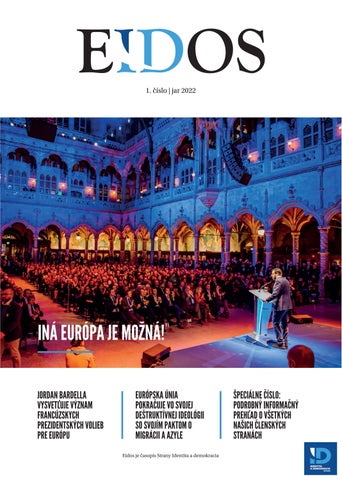
1. císlo | jar 2022
INÁ EURÓPA JE MOŽNÁ! JORDAN BARDELLA VYSVETĽUJE VÝZNAM FRANCÚZSKYCH PREZIDENTSKÝCH VOLIEB PRE EURÓPU
EURÓPSKA ÚNIA POKRAČUJE VO SVOJEJ DEŠTRUKTÍVNEJ IDEOLÓGII SO SVOJÍM PAKTOM O MIGRÁCII A AZYLE Eidos je časopis Strany Identita a demokracia
ŠPECIÁLNE ČÍSLO: PODROBNÝ INFORMAČNÝ PREHĽAD O VŠETKÝCH NAŠICH ČLENSKÝCH STRANÁCH
www.id-party.eu facebook.com/IDParty/ twitter.com/IDParty_ instagram.com/idparty_/
GEROLF ANNEMANS Predseda Strany Identita a demokracia President of the Identity and Democracy Party
Úvodník The term “eidos” originates in the Greek conceptual and philosophical framework of Plato. Plato used it to designate the transcendent: the ideal image of our changing world. Plato thus developed a system of thinking which would later become the philosophical and religious starting point for the European and Western model of civilisation.
Pojem „eidos“ pochádza z gréckeho konceptuálneho a filozofického rámca Platóna. Platón ho použil na označenie transcendentného: ideálneho obrazu nášho meniaceho sa sveta. Platón tak vyvinul systém myslenia, ktorý sa neskôr stal filozofickým a náboženským východiskom pre európsky a západný civilizačný model.
Our European civilisation is the real Europe, the continent which through its diversity and various identities has been the driving force behind world events in such a unique and dynamic way - for better or for worse.
Naša európska civilizácia je skutočnou Európou, kontinentom, ktorý bol svojou rozmanitosťou a rôznymi identitami hnacou silou svetových udalostí takým jedinečným a dynamickým spôsobom - v dobrom aj v zlom.
This beautiful word for Europe, a name rich in signification, has been hijacked: kidnapped by the strategists and communication specialists of what is in fact only a form of European cooperation. They systematically confuse the name of their legal model - the “European Union” - with the name “Europe” of the continental model of civilisation.
Toto krásne slovo pre Európu, meno bohaté na význam, bolo ulúpené: unesené stratégmi a komunikačnými špecialistami niečoho, čo je v skutočnosti len formou európskej spolupráce. Systematicky si mýlia názov svojho právneho modelu „Európska únia“ - s názvom „Európa“ kontinentálneho modelu civilizácie.
As a result, they can quickly label criticism of their European Union as “anti-European” or even “non-European.” They also use the confusion to claim that their European Union is the only possible and sanctified form of cooperation on
V dôsledku toho môžu rýchlo označiť kritiku svojej Európskej únie za „protieurópsku“ alebo dokonca „mimoeurópsku“. Využívajú tento zmätok aj na tvrdenie, že ich Európska únia je jedinou možnou a posvätenou formou spolupráce na
the European continent.
európskom kontinente.
But despite the warning of Brexit, this European Union is moving ever closer in the direction of a supranational state. Resistance is also growing.
Napriek varovaniu brexitu sa však Európska únia stále viac približuje k nadnárodnému štátu. Rastie aj odpor.
The European political party Identity & Democracy wants to (co-)embody the resistance to this state of affairs, as an extension of the eponymous political group in the European Parliament. Resistance is growing in almost all EU Member States because their populations refuse to abandon their identity, their culture and their democracy at the gates of an artificial empire in which they would be reduced to a province or department of Brussels. The most striking feature of the European Union is the way in which the continent is being overwhelmed by an unprecedented flow of immigration which seriously endangers the characteristics and identity of the European model of civilisation -and all this is happening over people's heads. We advocate the primacy of national sovereignty and identity for economic and financial affairs, as well as for
Európska politická strana Identita a demokracia chce (spolu)stelesniť odpor voči tomuto stavu vecí ako rozšírenie rovnomennej politickej skupiny v Európskom parlamente. Takmer vo všetkých členských štátoch EÚ narastá odpor, pretože ich obyvatelia sa odmietajú vzdať svojej identity, svojej kultúry a demokracie pred bránami umelej ríše, v ktorej by sa zmenili na provinciu alebo departement Bruselu. Najvýraznejším znakom Európskej únie je spôsob, akým je kontinent zahltený bezprecedentným tokom prisťahovalectva, ktorý vážne ohrozuje charakteristiky a identitu európskeho modelu civilizácie - a to všetko sa deje nad hlavami ľudí. Zastávame prvenstvo národnej suverenity a identity v hospodárskych a finančných záležitostiach, ako aj v prisťahovalectve a európskej spolupráci. Európska spolupráca musí byť slobodným združením a nie zvieracou kazajkou centralizovaného jednotného štátu, ktorý podporujú
immigration cooperation.
and
European
European cooperation must be a free association and not the straitjacket of the centralised unitary State which the other parties support. The dismantling of sovereignty represents a serious threat to the prosperity and identity of the various European peoples. The traditional political parties, which cannot contemplate differences in their way of thinking, want to eliminate them. In actual fact, these differences are Europe's considerable strength and asset. The European political party ID wants to be the patriotic alternative, based on a Europe that respects the uniqueness of the people and their inalienable right to be themselves, to govern themselves and to determine their own future. Meanwhile, at the Warsaw Summit in early December 2021, a number of national ID Party leaders met with other conservative leaders, such as the Polish and Hungarian Prime Ministers (among others) to map out strategic axes for future cooperation.
ostatné strany. Odstránenie suverenity predstavuje vážnu hrozbu pre prosperitu a identitu rôznych európskych národov. Tradičné politické strany, ktoré nemôžu uvažovať o rozdieloch vo svojom spôsobe myslenia a chcú ich odstrániť. Tieto rozdiely sú v skutočnosti významnou silou a výhodou Európy. Európska politická strana ID chce byť vlasteneckou alternatívou založenou na Európe, ktorá rešpektuje jedinečnosť ľudí a ich neodcudziteľné právo byť sami sebou, vládnuť sami sebe a určovať svoju vlastnú budúcnosť. Medzitým sa začiatkom decembra 2021 na varšavskom samite stretlo niekoľko vedúcich predstaviteľov národných strán ID s ďalšími konzervatívnymi lídrami, ako sú poľskí a maďarskí predsedovia vlád (okrem iného), aby načrtli strategické osi budúcej spolupráce. Naša politická strana je sama osebe obrazom európskej spolupráce, na ktorej chceme budovať budúcnosť nášho kontinentu - v priateľstve, ale aj v rozmanitosti. Gerolf Annemans
Our political party is in itself an image of the European cooperation upon which we want to build the future of our continent - in friendship, but also in diversity.
Predseda Strany Identita a demokracia
Gerolf Annemans President of the Identity and Democracy Party
5
40
82 98
44
90 76
74
88
EVROPA
VLASTI A STRANY
34 Európska únia pokracuje vo
72 Matteo Salvini, európska
svojej deštruktívnej ideológii s Paktom o migrácii The European Union continues its destructive ideology with its Migration Pact
38 Konferencia o budúcnosti
Európy, federalistická fraška The Conference on the Future of Europe, a federalist farce
50 Smerom k vel’kej skupine v Európskom parlamente?
Towards a super group in the European Parliament?
pobrežná stráž
Matteo Salvini, European Coast Guard
74 Vlaams Belang, pripravení na zodpovednost’
Vlaams Belang, ready for responsibility
80 Tomio Okamura,
inšpiratívny vlastenec Tomio Okamura, the inspiring patriot
46
10
60 UDÁLOSTI
VELKÝ ROZHOVOR
88 Lisabon pripravuje pôdu
10 Jordan Bardella
pre inú Európu
Lisbon sets the scene for another Europe
90 Vlastenecká mládež,
prísl’ub lepšej budúcnosti Patriotic youth, the promise of a better future
92 Na juhu Francúzska pre novú
jesen poznacenú bojom proti masovému prist’ahovalectvu
Má Marine Le Penová šancu vyhrat’ prezidentské vol’by? Nový predseda Národného zhromaždenia Jordan Bardella vysvetľuje, prečo je víťazstvo možné. Hovorí aj o svojej verzii Európy. Does Marine Le Pen have a chance of winning the presidential election? Jordan Bardella, new president of the Rassemblement National, explains to us the reasons why victory is possible. He also discusses his vision of Europe.
In the south of France, for a new autumn marked by the fight against mass immigration
7
VEĽKÝ ROZH
JORDAN BARDELLA
HOVOR
EU
VEĽKÝ ROZHOVOR
Má Marine Le Penová šancu vyhrat’ prezidentské vol’by? Exkluzívny rozhovor s Jordanom Bardellom, prezidentom Národného zhromaždenia, členom Úradu Strany ID. Does Marine Le Pen have a chance of winning the presidential election? Exclusive interview with Jordan Bardella, President of the Rassemblement National, member of the ID Party Bureau. Two opposing visions of the world are now confronting each other on the European political scene: the universalist one embodied by the outgoing French president Emmanuel Macron, and the other, rooted and carried by the patriotic political forces, will be championed by Marine Le Pen in the next presidential election. Jordan Bardella, the new president of the Rassemblement National, explains why victory is possible. He also discusses his vision of Europe. Eidos: France is at a turning point in its history. In April, two diametrically opposed visions will clash: a Europeanist and globalist
Na európskej politickej scéne sa teraz stretávajú dve protichodné vízie sveta: tá univerzalistická, ktorej stelesnením je odchádzajúci francúzsky prezident Emmanuel Macron, a tá druhá, zakorenená a nesená vlasteneckými politickými silami, ktorú bude v nasledujúcich prezidentských voľbách obhajovať Marine Le Penová. Nový predseda Národného zhromaždenia Jordan Bardella vysvetľuje, prečo je víťazstvo možné. Hovorí aj o svojej verzii Európy. Eidos: Francúzsko sa nachádza v zlomovom bode svojej histórie. V apríli sa stretnú dve diametrálne odlišné vízie: europeistická a globalistická vízia, ktorú stelesňuje
vision embodied by Emmanuel Macron, and a vision based on nations held by Marine Le Pen. Is this the last chance for the country to escape globalism?
Emmanuel Macron, a vízia založená na národoch, ktorú zastáva Marine Le Penová. Je toto posledná šanca, aby krajina unikla globalizmu?
I dare to believe that France is eternal and that it has all the human resources it needs to get out of the rut into which its leaders have pushed it. The current president Emmanuel Macron has constantly shown his contempt for his country by wanting to dissolve it into unbridled globalisation, by claiming that there is “no French culture,” by making the French feel guilty, even going so far as to say that he wanted to “piss off” millions of them. Based on this, there are effectively two visions of France, one embodied by Marine Le Pen - who will put the French back at the heart of the policies - and the other represented by Macron, who loves neither France nor the French.
Trúfam si veriť, že Francúzsko je večné a že má všetky ľudské zdroje potrebné na to, aby sa dostalo z koľají, do ktorých ho jeho vedúci predstavitelia tlačili. Súčasný prezident Emmanuel Macron neustále prejavuje pohŕdanie svojou krajinou tým, že ju chce rozpustiť do bezuzdnej globalizácie a tvrdí, že neexistuje „žiadna francúzska kultúra“, tým, že vyvoláva vo Francúzoch pocit viny, dokonca zachádza až tak ďaleko, že hovorí, že ich chce „naštvať“ milióny. Na základe toho existujú v podstate dve vízie Francúzska, jednu predstavuje Marine Le Penová - ktorá postaví Francúzov späť do centra politík - a druhú zastupuje Macron, ktorý nemiluje Francúzsko ani Francúzov.
Is it reasonable to believe that victory is possible?
Je rozumné veriť, že víťazstvo je možné?
All the polls now indicate that Marine Le Pen has a real chance of being elected. She is situated at more than 45% of the voting intentions in the second round, i.e. within the margin of error. The French have understood that Emmanuel Macron is the last representative of a worn-out and disconnected system. The candidate supported by the Rassemblement National is now ready, and you can sense her great serenity and determination.
Všetky prieskumy teraz naznačujú, že Marine Le Penová má reálnu šancu byť zvolená. V druhom kole sa nachádza vo viac ako 45 % hlasovacích zámerov, t. j. v rozmedzí chýb. Francúzi pochopili, že Emmanuel Macron je posledným zástupcom opotrebovaného a odpojeného systému. Kandidátka podporovaná Národným zhromaždením je teraz pripravená, a môžete cítiť jej veľkú vyrovnanosť a odhodlanie.
11
VEĽKÝ ROZHOVOR
Let's look ahead and suppose that the French elect Marine Le Pen as Head of State. What will be her priorities on the European stage? The priority will be to meet the European leaders in order to reaffirm very clearly that the French people are sovereign and are masters of their destiny. An unelected and highly undemocratic institution like the European Commission has no business dictating the daily lives of free peoples. Do you think that the European Union as you describe it is reformable? In short, which bodies should be abolished and which should be reworked? As I said to Emmanuel Macron in the European Parliament a few weeks ago, their Europe is 60 years old while ours is 3000 years old. Unlike France, the European Union as it exists today is an artificial construct kept alive by federalists who are increasingly being disowned by their people. All attempts to revive their federal Europe project are doomed to failure. Take the Conference on the Future of Europe. It was a fiasco, and yet Emmanuel Macron has already announced that he wants to draw conclusions from it which we know will lead to more Europe and less nationhood. In my opinion Europe must be reformed, starting not from the Commission but from the sovereign states which derive their legitimacy from the democratic process. We can envisage strategic
Pozrime sa dopredu a predpokladajme, že Francúzi zvolia Marine Le Penovú hlavou štátu. Aké budú jej priority na európskej scéne? Prioritou bude stretnúť sa s európskymi vedúcimi predstaviteľmi, aby sme veľmi jasne potvrdili, že francúzsky ľud je suverénny a pánom svojho osudu. Nevolená a veľmi nedemokratická inštitúcia, akou je Európska komisia, nemá čo diktovať každodenný život slobodných ľudí. Myslíte si, že Európska únia, ako ju opisujete, je reformovateľná? Stručne povedané, ktoré orgány by sa mali zrušiť a ktoré prepracovať? Ako som pred niekoľkými týždňami povedal Emmanuelovi Macronovi v parlamente, ich Európa má 60 rokov, zatiaľ čo naša 3000 rokov. Na rozdiel od Francúzska je Európska únia v súčasnej podobe umelým konštruktom, ktorý udržiavajú nažive federalisti, ktorých sa čoraz viac zriekajú ich občania. Všetky pokusy o oživenie ich projektu federálnej Európy sú odsúdené na neúspech. Vezmite si Konferenciu o budúcnosti Európy. Bolo to fiasko, a napriek tomu Emmanuel Macron už oznámil, že z toho chce vyvodiť závery, o ktorých vieme, že povedú k väčšej Európe a menšej štátnosti. Podľa môjho názoru sa Európa musí reformovať, počnúc nie Komisiou, ale suverénnymi štátmi, ktoré odvodzujú svoju legitimitu od demokratického procesu. Môžeme si predstaviť strategickú spoluprácu v závislosti od
13
VEĽKÝ ROZHOVOR
cooperation interests.
depending
on
their
Which are the areas of activity in which this cooperation could bring added value? And how can it be implemented? There are a number of areas where we should pool our talents, not to sell off our industrial secrets and know-how to other countries but to combine our skills. Macron thought he wanted to move forward on the Future Combat Air System (FCAS), with Germany in particular but also with Spain. France is losing out, as is too often the case in our relations with our German neighbours. Similarly, the idea of a common European defence is not desirable because we have sometimes divergent interests. On the other hand, we can think together about how to defend our borders. Frontex should no longer be an agency for receiving migrants, but rather Europe should do everything possible to prevent them from entering its territory. Things have not changed since the migration crisis of 2015 and the immigrationist ideology has not been defeated... On the contrary. The Marrakesh Pact was a clear signal of the willingness of leaders to promote migration flows. In its wake, the European Union's Migration Pact, which was conceived behind closed doors, is increasingly imposing the idea that migration is part of Europe's destiny. This is
ich záujmov. V ktorých oblastiach činnosti by táto spolupráca mohla priniesť pridanú hodnotu? A ako sa môže realizovať? Existuje niekoľko oblastí, v ktorých by sme mali spojiť naše talenty, nie predávať naše priemyselné tajomstvá a know-how iným krajinám, ale kombinovať naše zručnosti. Macron si myslel, že chce pokročiť v otázke systému Future Combat Air System (FCAS), a to najmä s Nemeckom, ale aj so Španielskom. Francúzsko prehráva, ako sa stáva príliš často v našich vzťahoch s našimi nemeckými susedmi. Podobne myšlienka spoločnej európskej obrany nie je žiaduca, pretože niekedy máme rozdielne záujmy. Na druhej strane môžeme spoločne premýšľať o tom, ako brániť naše hranice. Agentúra Frontex by už nemala byť agentúrou na prijímanie migrantov, ale Európa by mala urobiť všetko, čo je v jej silách, aby im zabránila vstúpiť na jej územie. Od migračnej krízy v roku 2015 sa veci nezmenili a imigračná ideológia nebola porazená... Práve naopak. Marrákešský pakt bol jasným signálom ochoty vedúcich predstaviteľov podporovať migračné toky. Pakt Európskej únie o migrácii, ktorý bol vytvorený za zatvorenými dverami, vo svojom dôsledku stále viac vnucuje myšlienku, že migrácia je súčasťou osudu Európy. To je ďalší dôkaz toho, že elity sú mimo a nie sú prepojené s realitou, pretože na
further proof that the elites are out of touch and disconnected with reality, because, at the logical end of this process it is the ordinary French person from Clermont-Ferrand or Briançon but also the ordinary Estonian or Flemish people who will see their way of life turned upside down. The French government presented a plan for the distribution of migrants a year ago in an authoritarian manner. The countries who are hostile to us have realised that migration is our Achilles heel and are blackmailing our peoples with migration. This is indeed a strategy which has pursued lately by Lukashenko of Belarus, but also in a more structural manner by Recep Tayyip Erdoğan. Given that the latter is multiplying blackmail attempts and threats towards Europe, how should Europe behave with Turkey? Let’s remember the incident in the Mediterranean last June. As part of an international mission to enforce the arms embargo on Libya, a Turkish frigate was aggressive (to say the least) towards a French ship by performing radar illumination on three occasions, with Turkish military personnel on duty. Do we need reminding that a number of our leaders were advocating Turkey's entry into the European Union? This country is not geographically located in Europe, is not part of the European civilisation area and, due to its demographic weight, would send more MEPs to the European Parliament than France.
logickom konci tohto procesu je to obyčajný Francúz z Clermont-Ferrandu alebo Briançonu, ale aj obyčajní Estónci alebo Flámi, ktorých spôsob života sa obráti naruby. Francúzska vláda predložila pred rokom autoritatívnym spôsobom plán rozdeľovania migrantov. Krajiny, ktoré sú k nám nepriateľské, si uvedomili, že migrácia je našou Achillovou pätou a vydierajú našich ľudí migráciou. Je to skutočne stratégia, ktorú v poslednom čase presadzuje Lukašenko z Bieloruska, ale štrukturálnejším spôsobom aj Recep Tayyip Erdoğan. Vzhľadom na to, že ten druhý znásobuje pokusy o vydieranie a hrozby pre Európu, ako by sa mala Európa správať voči Turecku? Spomeňme si na incident v Stredozemnom mori vlani v júni. V rámci medzinárodnej misie na presadzovanie zbrojného embarga voči Líbyi bola turecká fregata agresívna (prinajmenšom) voči francúzskej lodi tým, že trikrát vykonala radarové osvetlenie, pričom turecký vojenský personál bol v službe. Potrebujeme pripomenúť, že viacerí naši vedúci predstavitelia obhajovali vstup Turecka do Európskej únie? Táto krajina nie je geograficky umiestnená v Európe, nie je súčasťou európskeho civilizačného priestoru a vzhľadom na svoju demografickú váhu by poslala do Európskeho parlamentu viac poslancov ako Francúzsko. Musíme mať pevný postoj k islamistickému
15
VEĽKÝ ROZHOVOR
We must have a firm attitude towards the Islamist Sultan Erdoğan, stop giving in to his blackmail and above all stop funding him! Looking back, do you think the British exit from the European Union was a good thing? It's up to the British to say, but clearly Brexit, which was supposed to bring misery and calamity, has been a reasonable success. There has always been a British ideal of insularity and empire. The one as a result of its particular geographical position, and the other (which the European Union sometimes imitated) made its membership of the EU a balancing act. The people have decided, and that's just fine. But this is not the solution that Marine Le Pen and the Rassemblement National advocate for France. Your opponents criticise Marine Le Pen for having evolved on the issue of membership of the EuropeanUnion and the euro... The European context has itself changed significantly. We were isolated in Europe at the time, but we have since established relations everywhere with European patriotic parties. They are each making progress or are already in power in their own country. This is the case in Hungary and Poland and also in Slovakia, where the patriots are in government. In the Czech Republic and in Portugal they are strongly on the rise.
sultánovi Erdoğanovi, prestať sa poddávať jeho vydieraniu a predovšetkým prestať ho financovať! Keď sa obzrieme späť, myslíte si, že britský odchod z Európskej únie bol dobrou vecou? Je na Britoch, aby to povedali, ale Brexit, ktorý mal priniesť utrpenie a pohromu, bol zjavne rozumným úspechom. Vždy existoval britský ideál izolovanosti a impéria. Jeden ako výsledok ich osobitnej geografickej polohy a druhý (ktorý Európska únia niekedy napodobňovala) urobil z ich členstva v EÚ vyvažujúci akt. Ľudia rozhodli, a to je v poriadku. Ale to nie je riešenie, ktoré Marine Le Penová a Národné zhromaždenie obhajuje pre Francúzsko. Vaši odporcovia kritizujú Marine Le Penovú za to, že sa vyvinula v otázke členstva v Európskej únii a eura... Samotný európsky kontext sa výrazne zmenil. V tom čase sme boli v Európe izolovaní, ale odvtedy sme všade nadviazali vzťahy s európskymi vlasteneckými stranami. Každá z nich napreduje alebo je už pri moci vo svojej vlastnej krajine. To je prípad Maďarska a Poľska a tiež Slovenska, kde sú vo vláde patrioti. V Českej republike a Portugalsku sú výrazne na vzostupe. Vráťme sa k Maďarsku a Poľsku: čo si myslíte o tamojšej politike? Bránim suverenitu štátov, preto sa
Let's get back to Hungary and Poland: what do you think of the policies there? I defend the sovereignty of States, so I am always reluctant to interfere in the internal affairs of other countries. The
vždy zdráham zasahovať do vnútorných záležitostí iných krajín. Európska únia sa začala špecializovať na diktovanie vnútorných politík členským štátom, čo začína rozčuľovať vedúcich predstaviteľov aj ľudí. Poliaci a Maďari sa chcú
17
VEĽKÝ ROZHOVOR
European Union has made a speciality to dictate internal policies to Member States, and this is beginning to exasperate leaders and peoples alike. Poles and Hungarians want to decide what is good for their country and its future, and they want to see their identity preserved. How can they be wrong? The patriotic political forces are now divided in the European Parliament, between the member parties of Identity and Democracy and those who sit in the European Conservatives and Reformists. Are you confident that these formations can be brought together under one flag? United, we would be all the stronger to confront the defenders of the federalist vision of Europe. I am optimistic that this process - which has been underway for several months - will come to fruition. This obviously requires discussion because, as patriots, our national interests or our evaluation of certain issues may differ in the details. We don’t have to agree on everything to work together - we just have to respect each other's specificities. But I know that we agree on the essential point, which is to give people hope and allow them to continue to fly their national flags proudly. Let's talk a little about you, Jordan Bardella: do you feel European? Above all, I feel profoundly French, the fruit of a heritage built up over the
rozhodnúť, čo je dobré pre ich krajinu a jej budúcnosť, a chcú si zachovať svoju identitu. Ako sa môžu mýliť? Vlastenecké politické sily sú teraz v Európskom parlamente rozdelené medzi členské strany Identity a demokracie a tých, ktorí sú členmi európskych konzervatívcov a reformistov. Ste si istý, že tieto formácie sa dajú spojiť pod jednu vlajku? Jednotní by sme boli o to silnejší, keby sme sa postavili obhajcom federalistickej vízie Európy. Som presvedčený, že tento proces - ktorý prebieha už niekoľko mesiacov - sa naplní. To si, samozrejme, vyžaduje diskusiu, pretože naše národné záujmy alebo naše hodnotenie určitých otázok, ako patriotov, sa môžu v detailoch líšiť. Nemusíme súhlasiť so všetkým, aby sme spolupracovali musíme len rešpektovať špecifiká toho druhého. Viem však, že sa zhodneme na základnom bode, ktorým je dať ľuďom nádej a umožniť im, aby aj naďalej hrdo vztyčovali svoje národné vlajky. Porozprávajme sa trochu o vás, Jordan Bardella: cítite sa Európanom? Predovšetkým sa cítim byť skrz-naskrz Francúzom, ovocie dedičstva vybudovaného v priebehu storočí našimi predkami, ktorí spojili génia (či už vedeckého, literárneho alebo umeleckého) so spôsobom života, ktorý je pre nás individuálny. Mám tiež pocit, že som garantom
Jordan Bardella a André Ventura, predseda strany Chega
centuries by our ancestors who combined genius (whether scientific, literary or artistic) with a way of life which is individual to us. I also feel that I am the guarantor of France's interests - within its borders of course - but also in Europe and in the world. I want our country to be great again. This does not however prevent us from feeling that we belong to the European civilisation which we share. Precisely which places in Europe arouse such a feeling in you? Let me start by saying that we all have roots within us. Mine are linked to the region where I grew up, in Seine-Saint-Denis, in Ile-de-France, where all the ravages of globalisation can be seen - starting with the consequences of massive immigration. I of course feel this visceral attachment to our country wherever I am on French territory.
záujmov Francúzska - samozrejme v rámci jeho hraníc - ale aj v Európe a vo svete. Chcem, aby naša krajina bola opäť skvelá. To nám však nebráni cítiť, že patríme k európskej civilizácii, ktorú zdieľame. Presne, ktoré miesta v Európe vo vás vzbudzujú takýto pocit? Dovoľte mi začať tým, že všetci máme v sebe korene. Moje sú spojené s regiónom, v ktorom som vyrastal, v Seine-Saint-Denis, v Ile-de-France, kde možno vidieť všetky pustošenia globalizácie - počnúc dôsledkami masívneho prisťahovalectva. Samozrejme, že cítim túto vnútornú väzbu k našej krajine, nech som kdekoľvek na francúzskom území.
19
VEĽKÝ ROZHOVOR
As a 26-year-old, you are from a new generation. Do you feel that there is a support for the ideas of Marine Le Pen among the younger people?
Ako 26-ročný ste z novej generácie. Máte pocit, že medzi mladšími ľuďmi existuje podpora myšlienok Marine Le Penovej?
Marine Le Pen is popular among young people - the Rassemblement National regularly comes out on top among this group both in polls and in election results. There is a real awareness and willingness to put an end to several decades of political correctness and disastrous management which threatens their future as French people. This should encourage us: this youth with pro-national feelings, a phenomenon which can be observed both in France and also everywhere else in Europe, will be the lever we can use to save our nations. Marine Le Pen represents a hope for many young people.
Marine Le Penová je populárna medzi mladými ľuďmi Národné zhromaždenie pravidelne vychádza na vrchole v tejto skupine v prieskumoch aj vo výsledkoch volieb. Je tu skutočné povedomie a ochota ukončiť niekoľko desaťročí politickej korektnosti a katastrofálneho riadenia, ktoré ohrozuje ich budúcnosť ako Francúzov. To by nás malo povzbudiť: táto mládež s pro-národnými pocitmi, fenomén, ktorý možno pozorovať vo Francúzsku aj všade inde v Európe, bude pákou, ktorú môžeme použiť na záchranu našich národov. Marine Le Penová predstavuje nádej pre mnohých mladých ľudí.
21
EURÓPA
Francúzske prezidentské voľby sa uskutočnia 10. a 24. apríla. The French presidential elections will take place on 10 and 24 April The French will be faced with a clear choice: the headlong rush towards ever more globalism or taking back their national sovereignty. Emmanuel Macron and Marine Le Pen embody both sides of the alternative. We can be optimistic: Marine Le Pen has never been placed so high in the polls, which give her between 45 and 50% of the vote in the second round (and so within the margin of error). She has never been so close to the Elysée. France is at a turning point, and with it the whole of Europe. The arrival of a patriot at the head of the state will undoubtedly have positive repercussions for parties which are committed to defending their identity and national sovereignty.
Francúzi budú čeliť jasnej voľbe: bezhlavo sa ponáhľať k čoraz väčšiemu globalizmu alebo si vziať späť svoju národnú suverenitu. Emmanuel Macron a Marine Le Penová stelesňujú obe strany alternatívy. Môžeme byť optimistickí: Marine Le Penová ešte nikdy nebola tak vysoko v prieskumoch verejnej mienky, ktoré jej dávajú 45 a 50 % hlasov v druhom kole (a teda v rámci rozsahu chýb). Nikdy nemala tak blízko k Elyzejským poliam. Francúzsko sa nachádza v zlomovom bode a s ním aj celá Európa. Príchod patriota na čelo štátu bude mať nepochybne pozitívne dôsledky pre strany, ktoré sa zaviazali brániť svoju identitu a národnú suverenitu.
23
RÓPA
EURÓ EURÓPA EURÓP
EURÓPA DOMÁCE K RÓPA D DOMÁCE KRAJI EURÓ PA DOMÁ
EURÓPA
Pre (pokus o) lepšie pochopenie spletitého fungovania Európskej únie To (try to) better understand the convoluted workings of the European Union
The European Union seems to most citizens to be very muddled in its functioning and institutions, which we believe is proof that it does not meet some of the requirements of democratic life: simplicity, representativeness, and democracy. The Identity and Democracy Party is critical of the current functioning of the European Union. Some institutions seem to us to have too much power - such as the unelected European Commission. In order to make it clearer for you, we give you a brief overview of the roles of the different institutions.
Strana Identita a demokracia je kritická k súčasnému fungovaniu Európskej únie. Zdá sa nám, že niektoré inštitúcie majú priveľa právomocí - napríklad nevolená Európska komisia. Aby sme vám to objasnili, poskytujeme vám stručný prehľad úloh jednotlivých inštitúcií. Európska únia sa zdá byť väčšine občanov veľmi zmätená vo svojom fungovaní a inštitúciách, čo je podľa nás dôkazom toho, že nespĺňa niektoré požiadavky demokratického života: jednoduchosť, reprezentatívnosť a demokraciu. Prijímame výzvu, aby sme vám v niekoľkých riadkoch predstavili sedem hlavných inštitúcií.
The European Council brings together the Heads of State and government of the European Union. It is headed by a president - currently the Belgian Charles Michel - who is responsible for facilitating compromises. Its objective is to define the main lines of European policy, and it meets four times a year.
Európska rada združuje hlavy štátov a predsedov vlád Európskej únie. Na jej čele stojí prezident - v súčasnosti belgický Charles Michel -, ktorý je zodpovedný za uľahčovanie kompromisov. Jej cieľom je vymedziť hlavné línie európskej politiky a zasadá štyrikrát ročne.
27
EURÓPA
The principal role of the European Commission is to propose legislation and ensure the implementation of Community policies. Although it is an essential component, it nevertheless suffers from a lack of democracy since the commissioners (one per Member State, 27 in total) are not directly elected by the citizens but proposed by the Heads of State and government and then validated by the Parliament. Established in 1957 by the Treaty of Rome, it is currently headed by Ursula von der Leyen. The Council of the European Union is the body that brings together the ministers in charge of the files in question (ministers of the interior, finance, etc.). It adopts European legislation together with the Parliament on the basis of a proposal from the European Commission, validates (again with the Parliament) the annual budget of the European Union, and draws up the common foreign and security policy. The European Parliament shares the prerogatives of the legislative power with the Council of the European Union. Since 1979, it has been elected by direct universal suffrage according to the proportional voting system (including in countries used to majority voting), which guarantees a representation which is sometimes fairer than in national parliaments. The official seat of the European Parliament is in Strasbourg, where plenary sessions are held, while committees are usually held in Brussels. The elected members of the
Hlavnou úlohou Európskej komisie je navrhovať právne predpisy a zabezpečovať vykonávanie politík Spoločenstva. Hoci ide o základnú zložku, aj tak trpí nedostatkom demokracie, pretože komisári (jeden na členský štát, spolu 27) nie sú priamo volení občanmi, ale navrhovaní hlavami štátov a predsedami vlád a potom potvrdení Parlamentom. Bola založená v roku 1957 Rímskou zmluvou a v súčasnosti na jej čele stojí Ursula von der Leyen. Rada Európskej únie je orgán, ktorý združuje ministrov zodpovedných za predmetné záležitosti (ministrov vnútra, financií atď.). Prijíma európske právne predpisy spolu s Parlamentom na základe návrhu Európskej komisie, schvaľuje (opäť spolu s Parlamentom) ročný rozpočet Európskej únie a vypracúva spoločnú zahraničnú a bezpečnostnú politiku. Európsky parlament sa delí o výsady zákonodarnej moci s Radou Európskej únie. Od roku 1979 sa volí priamym a všeobecným hlasovaním podľa systému pomerného hlasovania (aj v krajinách, v ktorých sa hlasuje väčšinou), ktorý zaručuje zastúpenie, ktoré je niekedy spravodlivejšie ako zastúpenie v národných parlamentoch. Oficiálne sídlo Európskeho parlamentu je v Štrasburgu, kde sa konajú plenárne zasadnutia, zatiaľ čo výbory zvyčajne zasadajú v Bruseli. Zvolení členovia národných strán sú rozdelení do skupín, aby sa uľahčila parlamentná práca.
national parties are divided into groups in order to facilitate parliamentary work. The Court of Justice of the European Union ensures that European law is applied in conformity in all Member States. It is also competent in the interpretation of European law, at the request of judges working in the different countries. The Commission and the Member States may refer cases to it to assess whether a Member State has violated European law. Based in Frankfurt, the European Central Bank sets the direction for monetary policy and the single currency (the euro). Since its creation, one of the main priorities of the Central Bank is price stability and therefore the fight against inflation. The Court of Auditors is responsible for analysing the revenue and expenditure of the European Union. This external body theoretically provides an independent assessment of the management of the institutions' accounts.
Súdny dvor Európskej únie zabezpečuje, aby sa európske právo uplatňovalo v súlade vo všetkých členských štátoch. Je tiež kompetentný v oblasti výkladu európskeho práva na žiadosť sudcov pracujúcich v rôznych krajinách. Komisia a členské štáty mu môžu postúpiť prípady na posúdenie, či členský štát porušil európske právo. Európska centrálna banka so sídlom vo Frankfurte určuje smer menovej politiky a jednotnej meny (euro). Od svojho vzniku je jednou z hlavných priorít centrálnej banky cenová stabilita, a teda aj boj proti inflácii. Dvor audítorov je zodpovedný za analýzu príjmov a výdavkov Európskej únie. Tento externý orgán teoreticky poskytuje nezávislé hodnotenie hospodárenia s účtovnými závierkami inštitúcií.
29
EURÓPA
Čo je to európska politická strana? What is a European political party? European political parties are part of the European “institutional machinery” which costs taxpayers a lot of money. One can guess that they will eventually be the instrument of the “Europeanists” to push for the existence of transnational lists during elections. While the Identity and Democracy Party is “eurocritical,” it is nevertheless obliged to constitute itself as a party in order not to be further excluded from the democratic process. When discussing the European Parliament, we saw that MEPs elected in their country on a national list come together by affinity. The results of the 2019 elections gave the following breakdown: - Group of the European People's Party (182 seats), - Progressive Alliance of Socialists and Democrats in the European Parliament (154), - Renew Europe (108), - Identity and Democracy (75), - Greens/European Free Alliance Group (74), - European Conservatives and Reformists (62),
Európske politické strany sú súčasťou európskeho „inštitucionálneho mechanizmu“, ktorý stojí daňových poplatníkov veľa peňazí. Dá sa predpokladať, že nakoniec budú nástrojom „europeistov“ na presadzovanie existencie nadnárodných zoznamov počas volieb. Strana Identita a demokracia je síce „eurokritická“, musí sa však stať stranou, aby nebola naďalej vylúčená z demokratického procesu. Keď sme diskutovali o Európskom parlamente, videli sme, že poslanci Európskeho parlamentu zvolení vo svojej krajine na národnom zozname sa spájajú podľa príbuznosti. Výsledky volieb v roku 2019 uviedli toto rozdelenie: - Skupina Európskej ľudovej strany (182 kresiel), - Progresívna aliancia socialistov a demokratov v Európskom parlamente (154), - Obnova Európy (108), - Identita a demokracia (75), - Skupina zelených/Európskej slobodnej aliancie (74), - Európski konzervatívci a reformisti (62),
Stretnutie európskych vlasteneckých lídrov
- The Left in the European Parliament Group (41), to which should be added the non-registered members.
- Ľavica v skupine Európskeho parlamentu ^(41), ku ktorým by sa mali pridať neregistrovaní členovia.
While it is tempting to confuse the two, the notion of a European political party is different from that of a group. The two concepts do not overlap. Thus, the parties are intended to contain, for example, national political formations which have elected representatives on their soil but are not represented in the European Parliament. On the other hand, some parties that are members of a group may choose not to join a party due to conviction or other
Hoci je lákavé zamieňať si ich, predstava európskej politickej strany sa líši od predstavy skupiny. Tieto dve koncepcie sa neprekrývajú. Strany sa tak majú skladať napríklad z národných politických útvarov, ktoré majú na svojom území volených zástupcov, ale nie sú zastúpené v Európskom parlamente. Na druhej strane sa niektoré strany, ktoré sú členmi skupiny, môžu rozhodnúť nepripojiť sa k strane z dôvodu presvedčenia alebo z iných dôvodov.
31
EURÓPA
reasons. Finally, some groups in the European Parliament are multi-party: for example, the Green/European Free Alliance Group consisting of the European Green Party (EGP) and the European Free Alliance (EFA). Recognised since the Maastricht Treaty (1992), European parties “contribute to forming a European awareness and to expressing the political will of the citizens of the Union.” As a result of the will of the most ardent federalists, each national party is obliged to display its possible membership of a European party on its website. The Authority for European Political Parties and Foundations is keeping a sharp eye on things! To be recognised as a party, the latter must have representation in at least one quarter of the EU Member States (i.e. seven), in the national or regional parliaments, or in the European Parliament; or it or its member parties must have received at least three per cent of the votes cast in the European Parliament in at least one quarter of the Member States. It is obviously forbidden for a party to use European funds to finance national campaigns. To further complicate the Byzantine European bureaucracy, there are also foundations which are “organisations affiliated to a European political party which support and complement the objectives of that party,” for example by organising conferences.
Napokon, niektoré skupiny v Európskom parlamente sú viacstranné: napríklad Skupina zelených/Európskej slobodnej aliancie pozostávajúca z Európskej strany zelených (EGP) a Európskej slobodnej aliancie (EFA). Európske strany, uznávané od Maastrichtskej zmluvy (1992), „prispievajú k formovaniu európskeho povedomia a k vyjadreniu politickej vôle občanov Únie“. V dôsledku vôle najvášnivejších federalistov je každá národná strana povinná zobraziť svoje možné členstvo v európskej strane na svojej webovej stránke. Úrad pre európske politické strany a nadácie na veci pozorne dohliada! Ak má byť strana uznaná za stranu, musí mať zastúpenie aspoň v jednej štvrtine členských štátov EÚ (t. j. v siedmich), v národných alebo regionálnych parlamentoch alebo v Európskom parlamente; alebo musí táto strana alebo jej členské strany získať aspoň tri percentá hlasov odovzdaných v Európskom parlamente aspoň v jednej štvrtine členských štátov. Samozrejme je zakázané, aby strana využívala európske fondy na financovanie vnútroštátnych kampaní. Aby sa ešte viac skomplikovala byzantská európska byrokracia, existujú aj nadácie, ktoré sú „organizáciami pridruženými k európskej politickej strane, ktoré podporujú a dopĺňajú ciele tejto strany“, napríklad organizovaním
There are currently ten officially recognised European political parties: - European People's Party (centre), - Alliance of Liberals and Democrats for Europe (liberal right), - European Conservatives and Reformists Party (right), - European Christian Political Movement (conservative right), - European Democratic Party (centre), - European Free Alliance (regionalism), - European Green Party (environmentalism), - Party of European Socialists (left), - Party of the European Left (extreme left), - Identity and Democracy Party. The Identity and Democracy Party consists of the following national parties: Lega (Italy), Rassemblement National (France), Vlaams Belang Party (Flanders), Freiheitliche Partei Österreichs (Austria), Eesti Konservatiivne Rahvaerakond (Estonia), Freedom and Direct Democracy (Czech Republic), Sme Rodina (Slovakia) Chega (Portugal) and Nea Dexia (Greece). A more detailed description of each of these parties can be found at the end of the issue.
konferencií. V súčasnosti existuje desať oficiálne uznaných európskych politických strán: - Európska ľudová strana (stred), - Aliancia liberálov a demokratov za Európu (liberálna pravica), - Európska konzervatívna a reformistická strana (pravica), - Európske kresťanské politické hnutie (konzervatívna pravica), - Európska demokratická strana (stred), - Európska slobodná aliancia (regionalizmus), - Európska strana zelených (environmentalizmus), - Strana európskych socialistov (ľavica), - Strana európskej ľavice (krajná ľavica), - strany Identity a demokracie. V neposlednom rade, keďže držíte jej časopis vo svojich rukách, Strana Identita a demokracia sa skladá z týchto národných strán: Lega (Taliansko), Národné zhromaždenie (Francúzsko), Vlaams Belang (Flámsko), Freiheitliche Partei Österreichs (Rakúsko), Eesti Konservatiivne Rahvaerakond (Estónsko), Svoboda a přímá demokracie (Česká republika), Sme rodina (Slovensko) Chega (Portugalsko) a Nea Dexia (Grécko) Podrobnejší popis každej z týchto strán nájdete na konci čísla.
33
EURÓPA
Európska únia č pokracuje vo svojej deštruktívnej ideológii s Paktom o migrácii The European Union continues its destructive ideology with its Migration Pact The Global Compact for Safe, Orderly and Regular Migration, better known to the general public as the Marrakesh Pact, was much discussed in December 2018: it promised ever more uncontrolled immigration and articulated as never before the outlines of the migration ideology prevalent among certain elites. Some countries weren’t taken in and refused to sign it. Among them are Hungary and Poland, in the eye of the European storm for not complying with internationalist and immigrationist injunctions. Belgium rushed to sign it, even if it meant toppling a government, and Charles Michel (its Prime Minister) was chosen as President of the European Council in the process. The politics of petty backroom deals had a bright future ahead of it from that day.
O globálnom pakte o bezpečnej, riadenej a legálnej migrácii, známejšom širokej verejnosti ako Marrákešský pakt, sa veľmi diskutovalo v decembri 2018: sľuboval čoraz viac nekontrolovaného prisťahovalectva a tak ako nikdy predtým vyjadril obrysy ideológie migrácie, ktorá prevláda medzi určitými elitami. Niektoré krajiny ho neprijali a odmietli ho podpísať. Medzi nimi sú aj Maďarsko a Poľsko, ktoré sú cieľom európskej búrky kvôli nedodržiavaniu internacionalistických a imigračných súdnych príkazov. Belgicko sa ponáhľalo s jeho podpisom, aj keď to znamenalo zvrhnutie vlády, a Charles Michel (jeho premiér) bol v tomto procese zvolený za predsedu Európskej rady. Politika malicherných zákulisných obchodov
In order not to suffer another setback, the European Commission has been working on its Migration and Asylum Pact in the greatest secrecy, away from the eyes of people who are especially keen to preserve their identity. The leaders of the European Union are nevertheless constantly defending it with implicit faith, not failing to criticise the “populists who oppose it.” President of the Commission Ursula von der Leyen is constantly reminding us of her mantra. And so during the presentation of the Pact, she didn’t hesitate to declare that “migration has always been a reality in Europe” and that it “will continue to be so.” We have been warned.
mala od toho dňa pred sebou svetlú budúcnosť. Aby Európska komisia neutrpela ďalší neúspech, pracovala na svojom Pakte o migrácii a azyle v najväčšom utajení, ďaleko od očí ľudí, ktorí si obzvlášť chcú zachovať svoju identitu. Vedúci predstavitelia Európskej únie ju napriek tomu neustále obhajujú s implicitnou vierou, pričom nezabúdajú kritizovať „populistov, ktorí sú proti nej“. Predsedníčka Komisie Ursula von der Leyenová nám neustále pripomína svoju mantru. A tak počas prezentácie Paktu neváhala vyhlásiť, že „migrácia bola v Európe vždy realitou“ a že „to tak bude aj naďalej“. Dostali sme varovanie.
35
EURÓPA
Under the pretext of “improving the security of migrants”, the EU Migration and Asylum Pact will create the legal, logistical and political conditions for the mass movement and settlement of people, mainly from the Third World, to the European continent. At the same time, European borders are not secure. Ylva Johansson, who is often caught knitting during
Pod zámienkou „zlepšenia bezpečnosti migrantov“ vytvorí Pakt EÚ o migrácii a azyle právne, logistické a politické podmienky pre hromadný pohyb a usadzovanie ľudí, najmä z tretieho sveta, na európsky kontinent.
parliamentary debates, had to concede that 22% of people entering the EU are not checked. And yet she still likes to repeat, against all common sense: “We need immigration.”
Európske hranice zároveň nie sú bezpečné. Ylva Johansson, ktorú počas parlamentných diskusií často prichytia pri pletení, musela uznať, že 22 % ľudí vstupujúcich do EÚ nie je kontrolovaných. A napriek tomu rada opakuje, proti zdravému rozumu: „Potrebujeme prisťahovalectvo.“
37
EURÓPA
Konferencia o budúcnosti Európy, federalistická fraška The Conference on the Future of Europe, a federalist farce Few European citizens have heard of it, but the Conference on the Future of Europe was nevertheless announced with great fanfare by the European Union authorities. The barely-concealed objective is to continue the European Union's headlong rush towards greater federalism. Several members of the ID Party are defending you: Hélène Laporte (France), Catherine Griset (France), Philippe Olivier (France), Mara Bizzotto (Italy), Alessandro Panza (Italy), Susanna Ceccardi (Italy), Gerolf Annemans (Flanders), Jaak Madison (Estonia), Ludovit Goga (Slovakia), and Petra Steger (Austria) The EU has selected ten themes for debate: climate change and the environment; health; a stronger economy, social justice and employment; the EU in the world; values and rights, rule of law and security; digital transformation; European democracy; migration; education, culture; youth and sport. If the figures are to be believed, it’s a total failure. In total, 38,000 people participated (out of 450 million inhabitants), often leaving a brief message at most. On the topic of migration, barely 500 citizens gave
Málo európskych občanov o nej počulo, ale napriek tomu orgány Európskej únie oznámili Konferenciu o budúcnosti Európy s veľkými fanfárami. Sotva skrytým cieľom je pokračovať v bezhlavom rútení sa Európskej únie smerom k väčšiemu federalizmu. Obhajujú vás viacerí členovia Strany ID: Hélène Laporte (Francúzsko), Catherine Griset (Francúzsko), Philippe Olivier (Francúzsko), Mara Bizzotto (Taliansko), Alessandro Panza (Taliansko), Susanna Ceccardi (Taliansko), Gerolf Annemans (Flámsko), Jaak Madison (Estónsko), Ľudovít Goga (Slovensko) a Petra Steger (Rakúsko) EÚ vybrala desať tém na diskusiu: zmena klímy a životné prostredie; zdravie; silnejšie hospodárstvo, sociálna spravodlivosť a zamestnanosť, EÚ vo svete; hodnoty a práva, právny štát a bezpečnosť; digitálna transformácia; európska demokracia; migrácia; vzdelávanie, kultúra; mládež a šport. Ak máme týmto číslam veriť, je to totálne zlyhanie. Celkovo sa zúčastnilo 38 000 ľudí (zo 450 miliónov obyvateľov) a často zanechali prinajlepšom stručný
their opinion, often leaving anti-migration message.
an
It seems a long time ago that the Conference was launched with such great fanfare, when for example a convinced federalist called for two flags to be flown at the Olympic Games: the national flag and the twelve stars. The very organisation of the debates is a joke. The European Parliament is represented and each country sends representatives from its national parliament. The allocation of speaking time is left to the discretion of the administration. During the last plenary, a Member of the European Parliament from the Identity and Democracy Party was given time to speak on the important subject of the digital transition, but was not chosen by the representative in question. The citizens' panels seem to be hand-picked to ensure that the discourse never deviates from official thinking.
odkaz. Pokiaľ ide o tému migrácie, svoj názor vyjadrilo sotva 500 občanov, pričom často zanechali odkaz proti migrácii. Zdá sa to byť dávno, keď bola spustená konferencia s takou veľkou slávou, keď napríklad presvedčený federalista vyzval, aby sa na olympijských hrách vyvesili dve vlajky: národná vlajka a dvanásť hviezd. Samotná organizácia diskusií je vtip. Je v nej zastúpený Európsky parlament a každá krajina vysiela zástupcov zo svojho národného parlamentu. Rozdelenie rečníckeho času je ponechané na uváženie administratívy. Počas posledného plenárneho zasadnutia dostal poslanec Európskeho parlamentu zo Strany Identita a demokracia čas vystúpiť na dôležitú tému digitálneho prechodu, ale príslušný zástupca ho nevybral. Zdá sa, že panely občanov sa vyberajú tak, aby sa diskurz nikdy neodchyľoval od oficiálneho myslenia.
Conclusions will be drawn from this mess, which we can already confidently predict right here and now: we will need more and more Europe and federalism. The Identity and Democracy Party will never subscribe to such a vision, as it favours sovereign peoples and national identities.
Z tohto neporiadku sa vyvodia závery, ktoré už teraz môžeme s istotou predpovedať: budeme potrebovať čoraz viac Európy a federalizmu. Strana Identita a demokracia sa nikdy nepodpíše pod takúto víziu, pretože uprednostňuje zvrchované národy a národné identity.
While at the beginning we were optimistic, we were quickly disillusioned and had to face the fact that this Conference was a farce.
Zatiaľ čo na začiatku sme boli optimistickí, rýchlo sme stratili ilúzie a museli sme čeliť skutočnosti, že táto konferencia je fraškou.
39
EURÓPA
Mara Bizzotto: „Co dnes potrebujeme, je vybudovat’ nový model Európy, Európy l’udí...“ Mara Bizzotto: “What we need today is to build a new model of Europe, the Europe of the people...” Mara Bizzotto is a Member of the European Parliament for Lega (Italy) “The Conference on the Future of Europe was a historic opportunity to rebuild Europe and design the Europe of tomorrow: it was an important chance that we had to seize, with the courage and foresight to make major changes, including the necessary reform of the European treaties. We need to work together to change the current model of Europe at its roots, a model that has proved to be wrong and too far removed from the real needs of our citizens and territories, as we have also seen during the Covid emergency. What we need today is to build a new model of Europe, a Europe of the people, of the citizens, of work and of true democracy, which will put a definitive end to the Europe of austerity, of the banks and of this bureaucracy which has done so much harm to our countries in recent years.”
Mara Bizzotto je poslankyňou Európskeho parlamentu za stranu Lega (Taliansko) „Konferencia o budúcnosti Európy bola historickou príležitosťou na opätovné vybudovanie Európy a navrhnutie Európy zajtrajška: bola to dôležitá šanca, ktorej sme sa museli chopiť s odvahou a predvídavosťou na uskutočnenie významných zmien vrátane nevyhnutnej reformy európskych zmlúv. Musíme spolupracovať na zmene súčasného modelu Európy v jeho koreňoch, modelu, ktorý sa ukázal ako nesprávny a príliš vzdialený od skutočných potrieb našich občanov a území, ako sme videli aj počas núdzového stavu súvisiaceho s ochorením Covid. Dnes potrebujeme vybudovať nový model Európy, Európy ľudí, občanov, práce a skutočnej demokracie, ktorý definitívne ukončí Európu úsporných opatrení, bánk a tejto byrokracie, ktorá v posledných rokoch tak veľmi uškodila našim krajinám.“
Source : EP
Mara Bizzotto (Taliansko) poslankyňou Európskeho parlamentu Lega
41
EURÓPA
Petra Steger: „Moja vízia Európy je združenie slobodných a sebaurcených národov, v ktorom sa rozmanitost’ kultúr považuje za silnú stránku, nie za prekážku...“ Petra Steger: “My vision of Europe is an association of free and self-determined peoples in which the diversity of cultures is seen as a strength and not an obstacle...” Petra Steger is a Member of the National Council (Austria) for Freiheitliche Partei Österreichs and participates in the Conference on the Future of Europe “A respectful and united cooperation according to the principles of subsidiarity and federalism should guarantee the freedom of each nation State. On the other hand, I categorically reject the path towards a central EU political state, coupled with massive undesirable developments such as the debt and transfer union, EU taxes, losses of national sovereignty or accession negotiations with non-European countries such as Turkey. A return to the real tasks of the EU is needed, namely to ensure peace, freedom and prosperity.
Petra Steger je poslankyňou Národnej rady (Rakúsko) za stranu Freiheitliche Partei Osterreichs a zúčastňuje sa Konferencie o budúcnosti Európy „Moja vízia Európy je združenie slobodných a sebaurčených národov, v ktorom sa rozmanitosť kultúr považuje za silnú stránku, nie za prekážku. Rešpektovaná a jednotná spolupráca v súlade so zásadami subsidiarity a federalizmu by mala zaručiť slobodu každého národného štátu. Na druhej strane kategoricky odmietam cestu k vytvoreniu centrálneho politického štátu EÚ spojenú s rozsiahlym nežiaducim vývojom, ako je dlhová a transferová únia, dane EÚ, straty národnej suverenity alebo prístupové rokovania s neeurópskymi krajinami, ako je Turecko. Je potrebný návrat k skutočným úlohám EÚ, konkrétne k
Source : Wikimedia. License: CC BY-SA 4.0
„strane kategoricky odmítám cestu k vytvorení centrálního politického státu EU“ “I categorically reject the path taken towards a central EU political state”
Petra Steger (Rakúsko) poslankyňou Národnej rady Freiheitliche Partei Österreichs
However, the EU will only remain an order of peace if the components of security and freedom are not forgotten. This means nothing less than self-determination. But it is precisely this self-determination which is increasingly being lost as the EU continually seeks to take over national competences and transform itself into a centralised state. This is also leading to a growing rejection by the citizens. Europe is important, but it can never replace the Nation.”
zabezpečeniu prosperity.
mieru,
slobody
a
EÚ však zostane mierovým poriadkom len vtedy, ak sa nezabudne na zložky bezpečnosti a slobody. To neznamená nič iné ako sebaurčenie. Ale práve toto sebaurčenie sa čoraz viac stráca, keďže EÚ sa neustále snaží prevziať vnútroštátne právomoci a transformovať sa na centralizovaný štát. Toto tiež vedie k rastúcemu odmietaniu zo strany občanov. Európa je dôležitá, ale nikdy nemôže nahradiť národ.
43
EURÓPA
Jaak Madison: „Nie som optimista, pokial’ ide o dlhodobú životaschopnost’ Európskej únie“ Jaak Madison: “I am not optimistic about the long-term viability of the European Union” Jaak Madison is a Member of the European Parliament for Eesti Konservatiivne Rahvaerakond (Estonia)
Jaak Madison je poslancom Európskeho parlamentu za stranu Eesti Konservatiivne Rahvaerakond (Estónsko)
“When we speak of the future of Europe, it is important to remember that we are talking first and foremost about the future of the European Union, not of Europe as a whole. Switzerland, Norway or Iceland are as European and often more so than any EU Member State or the European Commission. I am not optimistic about the long-term viability of the European Union.
„Keď hovoríme o budúcnosti Európy, je dôležité mať na pamäti, že hovoríme predovšetkým o budúcnosti Európskej únie, nie o Európe ako celku. Švajčiarsko, Nórsko alebo Island sú rovnako európske a často viac ako ktorýkoľvek členský štát EÚ alebo Európska komisia. Nie som optimista, pokiaľ ide o dlhodobú životaschopnosť Európskej únie.
The more the European Union tries to seize power and reduce the sovereignty of Member States, for example in environmental, economic, defence or foreign policy, the more likely it is that the Union will eventually collapse. Unfortunately, the European Commission and the European Parliament have not been able to recognise the mistakes which led Britain, for example, to leave the
Čím viac sa Európska únia snaží chopiť moci a znížiť suverenitu členských štátov, napríklad v oblasti environmentálnej, hospodárskej, obrannej alebo zahraničnej politiky, tým je pravdepodobnejšie, že sa Únia nakoniec zrúti. Európska komisia a Európsky parlament, žiaľ, nedokázali uznať chyby, ktoré viedli napríklad Britániu k odchodu z Únie. Budúcnosť Európskej únie je možná len vtedy, ak sa vrátime k pôvodným koreňom
Photo by Fred MARVAUX - Copyright: © European Union 2021 - Source : EP
Jaak Madison (Estónsko) poslancom Európskeho parlamentu Eesti Konservatiivne Rahvaerakond
Union. The future of the European Union is only possible if we return to the original roots of the Union, which are economic cooperation and the free movement of goods. This means abandoning federalist policies in areas which have absolutely no connection with free trade and economic relations.”
Únie, ktorými sú hospodárska spolupráca a voľný pohyb tovaru. To znamená upustiť od federalistickej politiky v oblastiach, ktoré nemajú absolútne žiadnu spojitosť s voľným obchodom a hospodárskymi vzťahmi.“
45
EURÓPA
Francúzske predsedníctvo Rady Európskej únie uprostred prezidentskej kampane: kde je spravodlivost’? The French Presidency of the Council of the European Union in the middle of a presidential campaign: where is the fairness? Since 1 January, France has held the rotating presidency of the Council of the European Union, in accordance with the mechanism whereby each member country takes it in turn to hold the office. Whether it’s a coincidence or not, it comes at the same time as the presidential campaign, allowing Emmanuel Macron to appear in the spotlight. If we can ask ourselves the question of fairness in relation to the other candidates - including Marine Le Pen - we can hope that this European
Od 1. januára Francúzsko vykonáva rotujúce predsedníctvo Rady Európskej únie v súlade s mechanizmom, ktorým každá členská krajina postupne vykonáva funkciu. Či už je to náhoda alebo nie, prichádza v rovnakom čase ako prezidentská kampaň, čo umožňuje Emmanuelovi Macronovi, aby sa objavil v centre pozornosti. Ak si dokážeme položiť otázku spravodlivosti vo vzťahu k ostatným kandidátom vrátane Marine Le Penovej, môžeme dúfať, že táto európska prestávka bude
interlude will be an opportunity for two visions of Europe to face off: on the one hand, the federalist project intending to make Europe the stepping stone to globalisation, and on the other hand, a national programme rooted in and respectful of identities. For Emmanuel Macron has never hidden his intention to drown the French identity - in which he has never believed - in the European melting pot, to the point of speaking of “European sovereignty” and thereby sweeping away the very idea of national sovereignty.
príležitosťou na dve vízie Európy: na jednej strane federalistický projekt, ktorého cieľom je urobiť z Európy odrazový mostík ku globalizácii, a na druhej strane národný program založený na identitách a rešpektujúci ich. Emmanuel Macron totiž nikdy neskrýval svoj úmysel utopiť francúzsku identitu - v ktorú nikdy neveril - v európskom taviacom kotli, a to do tej miery, že hovorí o „európskej suverenite“, a tým zmieta samotnú myšlienku národnej suverenity.
47
EURÓPA
In concrete terms, France's powers will be increasingly entrusted to Europe, especially in military terms, since the current French president hopes to establish a common defence policy in both strategic and operational areas. In other words, the idea of a European army is never far off. He will certainly be able to count on the support of the new German Chancellor Olaf Scholz, whom he has already met, and who has “great ambitions for Europe.” Germany has already announced its intention to “see the European Union evolve into a European federal state.” It is therefore to be feared that the Franco-German couple, the Sarkozy-Hollande/Merkel yesterday, the Macron/Scholz today, will continue to dismantle the national ideal. The French presidential election could change things: with Marine Le Pen in the Elysée, things would certainly take a turn for the better. As a symbol, while France was preparing to take over the presidency of the Council of the European Union, the government in power had the French flag replaced by the European flag under the Arc de Triomphe, where the Unknown Soldier, who died for the country, is buried. It had to be removed after two days. “A patriotic victory,” according to Marine Le Pen. We can hope that she will announce another one in April!
Konkrétne, právomoci Francúzska budú čoraz viac zverené Európe, najmä z vojenského hľadiska, pretože súčasný francúzsky prezident dúfa, že vytvorí spoločnú obrannú politiku v strategických aj operačných oblastiach. Inými slovami, myšlienka európskej armády nie je nikdy ďaleko. Určite sa bude môcť spoľahnúť na podporu nového nemeckého kancelára Olafa Scholza, s ktorým sa už stretol, a ktorý má „veľké ambície pre Európu“. Nemecko už oznámilo svoj zámer „vidieť, ako sa Európska únia vyvíja na európsky federálny štát“. Preto sa treba obávať, že francúzsko-nemecký pár, Sarkozy-Hollande/Merkelová včera, Macron/Scholz dnes, bude naďalej rozkladať národný ideál. Francúzske prezidentské voľby by mohli veci zmeniť: s Marine Le Penovou v Elyzejských poliach by sa veci určite zmenili k lepšiemu. Počas prípravy Francúzska na prevzatie predsedníctva Rady Európskej únie nahradila vládna moc francúzsku vlajku európskou vlajkou pod Víťazným oblúkom, pod ktorým je pochovaný neznámy vojak, ktorý za túto krajinu zomrel. Po dvoch dňoch ju museli odstrániť. „Vlastenecké víťazstvo,“ podľa Marine Le Pen. Môžeme dúfať, že v apríli ohlási ďalšie!
49
EURÓPA
Smerom k vel’kej skupine v Európskom parlamente? Towards a super group in the European Parliament? The Patriots and Conservatives currently form two groups in the European Parliament, with 66 and 64 representatives respectively, behind the European People's Party and the Progressive Alliance of Socialists and Democrats. Frequent contacts between representatives of Identity and Democracy and the European Conservatives and Reformists suggest the possibility of a union between the two groups, who would thereby gain in strength and disrupt the game plan of the European federalists. In July 2021, fourteen parties signed a common charter, engraving in stone the will to strengthen the links which unite them around common principles: rejection of the European super-state, reminder of national integrity, rejection of “moralistic overactivity,” respect for the Judeo-Christian heritage, and more. The exchanges continued in early
Vlastenci a konzervatívci v súčasnosti tvoria v Európskom parlamente dve skupiny so 66 a 64 zástupcami za Európskou ľudovou stranou a Progresívnou alianciou socialistov a demokratov. Časté kontakty medzi predstaviteľmi Identity a demokracie a európskymi konzervatívcami a reformistami naznačujú možnosť zjednotenia týchto dvoch skupín, ktoré by tak získali silu a narušili plán hry európskych federalistov. V júli 2021 podpísalo štrnásť strán spoločnú chartu, ktorá vryla do kameňa vôľu posilniť väzby, ktoré ich spájajú okolo spoločných princípov: odmietnutie európskeho superštátu, pripomenutie národnej integrity, odmietnutie „moralistickej hyperaktivity“, rešpektovanie židovsko-kresťanského dedičstva a ďalšie. Výmeny pokračovali začiatkom decembra na varšavskom samite,
Marine Le Pen, Viktor Orban a Katalin Novak za hnutie Europe et souveraineté
December at the Warsaw Summit, bringing together patriotic leaders from across the continent. Around Marine Le Pen (Rassemblement National), Tom Van Grieken (Vlaams Belang) and Martin Helme (Eesti Konservatiivne Rahvaerakond), were also Hungarian Viktor Orbán (Fidesz) and Polish Jaroslaw Kaczyński (Prawo i Sprawiedliwość). They resulted in a joint declaration recalling the need for cooperation in order to counter the federalist drift of the European Union's leaders, as well as the importance of national sovereignty, the democratic framework par excellence: “Only through such a model of European cooperation can we save the EU from further crises and tensions and put an end to the worrying idea of creating a Europe governed by a self-appointed elite. We reject the arbitrary application of EU law, which misuses or even violates the treaties. Only the sovereign institutions of States have full democratic legitimacy.”
na ktorom sa stretli patriotickí vodcovia z celého kontinentu. Okolo Marine Le Penovej (Národné zhromaždenie), Toma Van Griekena (Vlaams Belang) a Martina Helmeho (Eesti Konservatiivne Rahvaerakond), boli tiež maďarský Viktor Orbán (Fidesz) a poľský Jaroslaw Kaczyński (Prawo i Sprawiedliwość). Ich výsledkom bolo spoločné vyhlásenie, v ktorom sa pripomína potreba spolupráce s cieľom čeliť federalistickému posunu vedúcich predstaviteľov Európskej únie, ako aj dôležitosť národnej suverenity, demokratického rámca par excellence: „Len prostredníctvom takéhoto modelu európskej spolupráce môžeme zachrániť EÚ pred ďalšími krízami a napätím a skoncovať so znepokojujúcou myšlienkou vytvoriť Európu, ktorú by riadila samozvaná elita. Odmietame svojvoľné uplatňovanie práva EÚ, ktoré zneužíva alebo dokonca porušuje zmluvy. Len suverénne inštitúcie štátov majú plnú demokratickú legitimitu.
51
Photo by DAVID ILIFF. License: CC BY-SA 3.0
EURÓPA
Skupiny
Poslanci
%
Poslanecký klub Európskej ľudovej strany
177
25 %
Skupina progresívnej aliancie socialistov a demokratov v Európskom parlamente
145
21 %
Renew Europe
101
14 %
Skupina Identita a demokracia
66
9%
Skupina zelených/Európska slobodná aliancia
73
10 %
Európski konzervatívci a reformisti
64
9%
Skupina ľavice v Európskom parlamente - GUE/NGL
39
6%
nezaradení/é poslanci alebo poslankyne
40
6%
The exchanges continued in Madrid at the end of January 2022, at the instigation of Vox. The summit produced concrete commitments: application of the principle of European preference, defence of the primacy of national constitutions over European texts, establishment of a greater European energy capacity, the fight against immigration promoted by Brussels, etc.
Výmeny pokračovali v Madride koncom januára 2022, na popud Vox. Samit priniesol konkrétne záväzky: uplatňovanie zásady európskej preferencie, obrana nadradenosti národných ústav nad európskymi textami, vytvorenie väčšej európskej energetickej kapacity, boj proti prisťahovalectvu podporovanému Bruselom atď.
53
EURÓPA
Prvé spolocné vyhlásenie európskych vlasteneckých strán (2. júla 2021) First joint declaration of the European patriotic parties (July 2, 2021) In the recently-begun debate on the future of Europe, the voice of the parties committed to the freedom of nations and the traditions of the European peoples must not be ignored. The turbulent history of Europe has brought many misfortunes, especially in the last century. Nations defending their sovereignty and territorial integrity against aggressors have suffered beyond all human imagination. After the Second World War, some European countries had to fight against the domination of Soviet totalitarianism for decades before regaining their independence. This independence, the European Union's Atlantic link with the North Atlantic Treaty and the peace between the cooperating nations are a great achievement for many Europeans, giving them a permanent sense of security and creating optimal conditions for development.
V nedávno začatej diskusii o budúcnosti Európy nesmieme ignorovať hlas strán, ktoré sa zaviazali k slobode národov a tradíciám európskych národov. Búrlivá história Európy priniesla mnoho nešťastí, najmä v minulom storočí. Národy, ktoré bránili svoju suverenitu a územnú celistvosť pred agresormi, trpeli nad ľudskú predstavivosť. Po druhej svetovej vojne museli niektoré európske krajiny desaťročia bojovať proti nadvláde sovietskeho totalitarizmu, aby znovu získali nezávislosť. Táto nezávislosť, atlantické prepojenie Európskej únie so Severoatlantickým paktom a mier medzi spolupracujúcimi národmi sú pre mnohých Európanov veľkým úspechom, ktorý im dáva trvalý pocit bezpečnosti a vytvára optimálne podmienky na rozvoj.
However, the series of serious crises over the last ten years has shown that the work of European cooperation is running out of steam, as nations feel that they are slowly being stripped of their right to exercise their legitimate sovereign powers.
Séria vážnych kríz za posledných desať rokov však ukázala, že európskej spolupráci dochádza dych, keďže národy majú pocit, že sa im pomaly odníma právo vykonávať svoje legitímne zvrchované právomoci.
The
Európska únia potrebuje hlbokú
European
Union
needs
a
„Európska únia potrebuje hlbokú reformu“ “The European Union needs profound reform”
profound reform, because today instead of protecting Europe and its heritage, instead of allowing the free development of European nations, it is itself becoming a source of problems, anxiety and uncertainty.
reformu, pretože dnes sa namiesto ochrany Európy a jej dedičstva, namiesto toho, aby umožnila voľný rozvoj európskych národov, sama stáva zdrojom problémov, úzkosti a neistoty.
The EU is increasingly becoming a tool of radical forces which want to achieve a civilisational transformation and ultimately a nationless construction of Europe, aiming at the creation of a European superstate, the destruction or cancellation of European traditions, and the transformation of basic social institutions and moral principles.
EÚ sa v čoraz väčšej miere stáva nástrojom radikálnych síl, ktoré chcú dosiahnuť civilizačnú transformáciu a v konečnom dôsledku budovanie Európy bez národnej príslušnosti s cieľom vytvoriť európsky superštát, zničiť alebo zrušiť európske tradície a transformovať základné sociálne inštitúcie a morálne zásady.
The use of political structures and law to create a European superstate and new forms of social life is a manifestation of a dangerous and pervasive social engineering of the past, which must be legitimately resisted.
Využívanie politických štruktúr a práva na vytvorenie európskeho superštátu a nových foriem spoločenského života je prejavom nebezpečného a všadeprítomného sociálneho inžinierstva minulosti, ktorému sa treba legitímne brániť.
55
EURÓPA
The moralistic over-activity we have seen in recent years in the EU institutions has led to a dangerous tendency to impose an ideological monopoly.
Moralistická nadmerná aktivita, ktorej sme v posledných rokoch svedkami v inštitúciách EÚ, viedla k nebezpečnej tendencii zavádzať ideologický monopol.
We are convinced that the cooperation of European nations must be based on tradition, respect
Sme presvedčení, že spolupráca európskych národov musí byť založená na tradícii, úcte ku kultúre a
Opätovne potvrdzujeme naše presvedcenie, že rodina je základnou jednotkou našich národov “We reaffirm our conviction that the family is the basic unit of our nations”
for the culture and history of European nations, respect for the Judeo-Christian heritage of Europe and the common values which unite our nations - and not on their destruction.
histórii európskych národov, úcte k židovsko-kresťanskému dedičstvu Európy a spoločným hodnotám, ktoré spájajú naše národy - a nie na ich zničení.
We reaffirm our belief that the family is the basic unit of our nations. At a time when Europe is facing a serious demographic crisis with low birth rates and an ageing population, the answer lies in the development of family-friendly policies rather than mass immigration.
Opätovne potvrdzujeme naše presvedčenie, že rodina je základnou jednotkou našich národov. V čase, keď Európa čelí vážnej demografickej kríze s nízkou mierou pôrodnosti a starnúcim obyvateľstvom, spočíva odpoveď skôr v rozvoji politík priaznivých pre rodiny ako v masovom prisťahovalectve.
We are convinced that the sovereign entities in Europe are and will remain the nations and peoples of Europe.
Sme presvedčení, že zvrchované subjekty v Európe sú a zostanú národmi Európy.
The European Union was created by these peoples to achieve objectives which can be better achieved by the
Tieto národy vytvorili Európsku úniu, aby dosiahli ciele, ktoré môže lepšie dosiahnuť Únia ako jednotlivé
Union than by individual Member States. However, the limits of the Union's competences are set by the principle of attribution - all competences not attributed to the Union belong to the Member States, in accordance with the principle of subsidiarity. These limits have shifted significantly through a substantial reinterpretation of the Treaties by the EU institutions in recent decades - to the detriment of nation states. This situation is incompatible with the fundamental values of the Union and is leading to a decline in the confidence of European nations and citizens in these institutions. In order to stop and reverse this trend, it is necessary to create, in addition to the existing principle of attribution, a list of inviolable competences of the Member States of the European Union and an appropriate mechanism for their protection with the participation of national constitutional courts or equivalent bodies. All attempts to transform the European institutions into bodies which take precedence over national constitutional institutions create chaos, undermine the meaning of the treaties, and call into question the fundamental role of the Member States' constitutions. The resulting conflicts of competence are then resolved by the brutal
členské štáty. Obmedzenia právomocí Únie sú však stanovené zásadou prideľovania - všetky právomoci, ktoré nie sú pridelené Únii, patria členským štátom v súlade so zásadou subsidiarity. Tieto limity sa v posledných desaťročiach výrazne posunuli vďaka výraznej reinterpretácii zmlúv inštitúciami EÚ - na úkor národných štátov. Táto situácia je nezlučiteľná so základnými hodnotami Únie a vedie k poklesu dôvery európskych národov a občanov v tieto inštitúcie. S cieľom zastaviť a zvrátiť tento trend je potrebné okrem existujúcej zásady prideľovania vytvoriť zoznam nedotknuteľných právomocí členských štátov Európskej únie a vhodný mechanizmus ich ochrany za účasti vnútroštátnych ústavných súdov alebo rovnocenných orgánov. Všetky pokusy o transformáciu európskych inštitúcií na orgány, ktoré majú prednosť pred vnútroštátnymi ústavnými inštitúciami, vytvárajú chaos, podkopávajú zmysel zmlúv a spochybňujú základnú úlohu ústav členských štátov. Výsledné kompetenčné konflikty sa potom riešia brutálnym uvalením vôle politicky silnejších subjektov na slabšie. To ničí základ fungovania európskeho spoločenstva ako spoločenstva slobodných národov. Domnievame sa, že konsenzus musí zostať základným prostriedkom na
57
EURÓPA
„Spolocne reformujme Úniu pre budúcnost’ Európy!“ “Let us reform together the Union for the future of Europe!”
imposition of the will of politically stronger entities upon weaker ones. This destroys the basis for the functioning of the European community as a community of free nations. We believe that consensus must remain the fundamental means of achieving a common position in the Union. Recent attempts to circumvent this procedure or ideas to abolish it threaten to exclude certain countries from any influence on decision-making, and to transform the Union into a specific form of oligarchy. This could lead to a de facto incapacitation of national constitutional bodies, including governments and parliaments, which are reduced to the function of approving decisions which have already been taken by others. In the member countries there is still an overwhelming willingness to cooperate, and a spirit of community and friendship permeates the countries and societies of our continent. This is a great asset. A reformed Union will use this asset
dosiahnutie spoločnej pozície v Únii. Nedávne pokusy o obchádzanie tohto postupu alebo myšlienky na jeho zrušenie hrozia vylúčením niektorých krajín z akéhokoľvek vplyvu na rozhodovanie a premenou Únie na osobitnú formu oligarchie. To by mohlo viesť k de facto neschopnosti vnútroštátnych ústavných orgánov vrátane vlád a parlamentov, ktoré sú obmedzené na schvaľovanie rozhodnutí, ktoré už prijali iní. V členských krajinách stále panuje obrovská ochota spolupracovať a krajiny a spoločnosti nášho kontinentu preniká duch spoločenstva a priateľstva. Je to veľká výhoda. Reformovaná Únia využije túto výhodu, zatiaľ čo Únia, ktorá reformu odmietne, ju premrhá. Preto sa teraz obraciame na všetky strany a skupiny, ktoré sa stotožňujú s našimi názormi, pričom tento dokument je základom spoločnej kultúrnej a politickej práce a rešpektuje úlohu súčasných politických skupín. Spoločne reformujme budúcnosť Európy!
Úniu
pre
Spojenectvo Marine Le Pen a Viktora Orbána je čoraz pevnejšie
while a Union which rejects reform will waste it. That is why we are now turning to all parties and groups that share our views, with this document as a basis for joint cultural and political work, respecting the role of the current political groups. Let’s reform the Union together for the future of Europe! Rassemblement National (France), Lega Per Salvini Premier (Italy), Prawo i Sprawiedliwość (Law and Justice Party, PiS, Poland), Fidesz (Hungary), Vox (Spain), Fratelli d'Italia (Italy), Freiheitliche Partei Österreichs, FPÖ (Austria), Vlaams Belang (Flanders), Dansk Folkeparti (Denmark), Eesti Konservatiivne Rahvaerakond (EKRE, Estonia), Perussuomalaiset (PS – Finland), Lietuvos lenkų rinkimų akcija (The Electoral Action of Poles in Lithuania, Lithuania), Ellinikí Lýsi (Greek Solution, EL, Greece)
Rassemblement National (Francúzsko), Lega Per Salvini Premier (Taliansko), Prawo i Sprawiedliwość (Právo a spravodlivosť, PiS, Poľsko), Fidesz (Maďarsko), Vox (Španielsko), Fratelli d’Italia (Bratia Talianska, Taliansko), Freiheitliche Partei Österreichs, (FPÖ, Rakúsko), Vlaams Belang (Flámsko), Dansk Folkeparti (Dánsko), Eesti Konservatiivne Rahvaerakond (EKRE, Estónsko), Perussuomalaiset (PS – Fínsko), Lietuvos lenkų rinkimų akcija (Volebná akcia Poliakov v Litve, Litva), Ellinikí Lýsi (Grécke riešenie, EL, Grécko)
59
EURÓPA
Tlacová správa po varšavskom samite Press release following the Warsaw summit (December 2021) The conference participants share a common and deep conviction that the EU is made up of free and equal nation states, bound together by many areas of close cooperation. We share this conviction with millions of citizens in all EU Member States.
(December 2021) Účastníci konferencie zdieľajú spoločné a hlboké presvedčenie, že EÚ pozostáva zo slobodných a rovnocenných národných štátov, ktoré sú spojené mnohými oblasťami úzkej spolupráce. Toto presvedčenie zdieľame s miliónmi občanov vo všetkých členských štátoch EÚ.
Only through such a model of European cooperation can we save the EU from further crises and tensions and put an end to the worrying idea of creating a Europe governed by a self-appointed elite. We reject the arbitrary application of EU law, which misuses or even violates the treaties. Only the sovereign institutions of States have full democratic legitimacy. The European institutions do not enjoy the same legitimacy and should therefore play a subordinate role to the Nation State in the political architecture.
Len prostredníctvom takéhoto modelu európskej spolupráce môžeme zachrániť EÚ pred ďalšími krízami a napätím a skoncovať so znepokojujúcou myšlienkou vytvoriť Európu, ktorú by riadila samozvaná elita. Odmietame svojvoľné uplatňovanie práva EÚ, ktoré zneužíva alebo dokonca porušuje zmluvy. Len suverénne inštitúcie štátov majú plnú demokratickú legitimitu. Európske inštitúcie nemajú rovnakú legitimitu, a preto by mali v politickej štruktúre zohrávať úlohu podriadenú štátu.
Equally, for this reason they cannot become a social engineering tool to create a new “European nation.” Examples of such social engineering could be, among others, attempts to
Z tohto dôvodu sa nemôžu stať nástrojom sociálneho inžinierstva na vytvorenie nového „európskeho národa“. Príkladom takéhoto sociálneho inžinierstva by mohli byť
61
EURÓPA
ideologically modify our languages in a way which would detach a human being from his or her culture and heritage, such as the recent decision of the European Commission to remove the word “Christmas” from the public sphere. Such a conception of the nation has never existed, does not exist today and cannot exist in the future. The participants declare their willingness to cooperate in a spirit of solidarity, at different levels and forums, with all parties and organisations which support the unique heritage of Europe and the idea of a Europe of Nations. The participants also discussed closer cooperation of their respective parties
okrem iného pokusy ideologicky upraviť naše jazyky spôsobom, ktorý by oddelil ľudskú bytosť od jej kultúry a dedičstva, ako napríklad nedávne rozhodnutie Európskej komisie odstrániť slovo „Vianoce“ z verejnej sféry. Takáto koncepcia národa nikdy neexistovala, neexistuje ani dnes a nemôže existovať ani v budúcnosti. Účastníci deklarujú svoju ochotu spolupracovať v duchu solidarity na rôznych úrovniach a fórach so všetkými stranami a organizáciami, ktoré podporujú jedinečné dedičstvo Európy a myšlienku Európy národov. Účastníci tiež diskutovali o užšej spolupráci svojich príslušných strán v Európskom parlamente vrátane
Marine Le Pen a Jarosław Kaczyński (PiS)
in the European Parliament, including organising joint meetings and aligning votes on common issues, such as the protection of Member States' sovereignty and the position on illegal immigration.
organizovania spoločných stretnutí a zosúladenia hlasovania o spoločných otázkach, ako je ochrana zvrchovanosti členských štátov a stanovisko k nelegálnemu prisťahovalectvu.
The participants also agreed that another conference will be organised in Spain in the coming months in response to the ongoing debate on the future of Europe.
Účastníci sa tiež dohodli, že v nadchádzajúcich mesiacoch sa v Španielsku uskutoční ďalšia konferencia ako reakcia na prebiehajúcu diskusiu o budúcnosti Európy.
63
Madridská deklarácia (29. januára 2022) Madrid Declaration (29 January 2022)
In July 2021, a number of political groupings represented in the European Parliament signed a joint declaration reflecting our concerns and our commitment to defending a European Union which respects the sovereignty, freedom and traditions of the Member States. In return, we agreed to refer to this declaration as a “basis for common cultural and political work, respecting the role of the current political groups.”
V júli 2021 podpísali viaceré politické zoskupenia zastúpené v Európskom parlamente spoločné vyhlásenie, ktoré odráža naše obavy a náš záväzok brániť Európsku úniu, ktorá rešpektuje zvrchovanosť, slobodu a tradície členských štátov. Na oplátku sme sa dohodli, že túto deklaráciu označíme za „základ spoločnej kultúrnej a politickej práce pri rešpektovaní úlohy súčasných politických skupín“.
The first summit of patriotic and conservative forces in Europe took place in Warsaw in December 2021. The participants discussed the need for closer cooperation in the European Parliament, as well as the organisation of joint meetings and the alignment of voting on common issues concerning the protection of the sovereignty of EU Member States.
Prvý samit vlasteneckých a konzervatívnych síl v Európe sa konal vo Varšave v decembri 2021. Účastníci diskutovali o potrebe užšej spolupráce v Európskom parlamente, ako aj o organizácii spoločných stretnutí a zosúladení hlasovania o spoločných otázkach týkajúcich sa ochrany zvrchovanosti členských štátov EÚ.
Participants at the Madrid Summit, which took place in Spain on 28-29
Dnes účastníci madridského samitu, ktorý sa konal 28. - 29. januára v
EURÓPA
January, reiterated their concern about the internal and external attacks on Europe.
Španielsku, opätovne vyjadrili znepokojenie nad vnútornými a vonkajšími útokmi na Európu.
The European Community was forged as a zone of free cooperation between sovereign states. However, there exists a growing threat which seeks to transform the Union into an ideologically-charged federalist superstate - a construct which disregards national identity and sovereignty - and thus the democracy, plurality and interests of the citizens of the nations which form the Union.
Európske spoločenstvo bolo vytvorené ako zóna slobodnej spolupráce medzi suverénnymi štátmi. Existuje však rastúca hrozba, ktorá sa snaží transformovať Úniu na ideologicky podfarbený federalistický superštát - konštrukt, ktorý neberie ohľad na národnú identitu a suverenitu - a tým ani na demokraciu, pluralitu a záujmy občanov národov tvoriacich Úniu.
This drift endangers the Union itself by moving away from the Christian European ideals upon which it was founded. Today, some bureaucrats and parties mistakenly believe that they can promote agendas without democratic legitimacy which run counter to the needs of Europeans and the very survival of Western civilisation itself.
Tento posun ohrozuje samotnú Úniu tým, že sa vzďaľuje od kresťanských európskych ideálov, na ktorých bola založená. Niektorí byrokrati a strany sa dnes mylne domnievajú, že môžu presadzovať programy bez demokratickej legitimity, ktoré sú v rozpore s potrebami Európanov a samotným prežitím samotnej západnej civilizácie.
65
EURÓPA
Confronted with this situation, we, the participants of the Summit, commit ourselves to defending Europe against external and internal threats. We will confront the currents which advocate a European Union which is alien to its history and whose detachment from reality leads to demographic suicide and the transformation of societies. Europe is in demographic decline. We must support family policies.
Vzhľadom na túto situáciu sa my, účastníci samitu, zaväzujeme brániť Európu pred vonkajšími a vnútornými hrozbami. Budeme čeliť prúdom obhajujúcim Európsku úniu, ktorá je cudzia svojej histórii a ktorej odtrhnutie sa od reality vedie k demografickej samovražde a transformácii spoločností. Európa je v demografickom úpadku. Musíme podporovať rodinné politiky.
We love Europe because we love our nations. And we will defend Europe because we defend our nations. That is why we will not stop demanding a Union which focuses on common European values, on people, on their families, on protecting their borders and on the freedom to have energy, industry and a strong primary sector. We need to recover the culture of mutual respect between Member States and with the European institutions, where constitutional identities are safeguarded and not criticised.
Milujeme Európu, pretože milujeme naše národy. A budeme brániť Európu, pretože bránime naše národy. Preto neprestaneme požadovať Úniu, ktorá sa zameriava na spoločné európske hodnoty, na ľudí, na ich rodiny, na ochranu svojich hraníc a na slobodu mať energiu, priemysel a silný primárny sektor. Musíme obnoviť kultúru vzájomného rešpektu medzi členskými štátmi a s európskymi inštitúciami, kde sa chránia a nekritizujú ústavné identity.
We denounce the politically-motivated attacks from Brussels against Poland and Hungary, which show a total disregard for the fundamental principles of the EU and violate the spirit of the treaties. In short, we must cooperate and join forces to protect Europe from the imposed ideologies and anti-democratic drift which are leading to its downfall.
Odsudzujeme politicky motivované útoky Bruselu proti Poľsku a Maďarsku, ktoré preukazujú úplné ignorovanie základných zásad EÚ a porušujú ducha zmlúv. Stručne povedané, musíme spolupracovať a spojiť sily na ochranu Európy pred zavedenými ideológiami a protidemokratickým posunom, ktoré vedú k jej pádu.
To this end, we have agreed on our commitment to: – Enforce the principle of European preference. Goods produced within the Member States must be given priority over goods from third countries, which are responsible for the impoverishment of our nations' farmers and breeders and the weakening of Europe as an industrial power. – Denounce the immigration policy promoted by Brussels and the inefficiency of FRONTEX, which does not contribute to the protection of our borders, and expressly condemn the “Migration Pact,” which has had disastrous effects in Europe. – Work towards greater European energy capacity by putting in place a package of measures to improve energy self-sufficiency where nations can freely dispose of the energy they need while respecting the environment, but without submitting to the imposition of ideological prejudices. Brussels' failed energy policy contributes to unsustainable energy prices. – Demand strict compliance with the treaties in all cases and firmly reject any initiative to unduly extend the competences of the European institutions. – Defend the primacy of national constitutions over European law, and of national laws over EU regulations in all areas which do not fall within the exclusive competence of the Union.
Na tento účel sme sa dohodli na našom záväzku: – Presadzovať zásadu európskej preferencie. Tovar vyrobený v členských štátoch musí mať prednosť pred tovarom z tretích krajín, ktoré sú zodpovedné za ochudobnenie poľnohospodárov a chovateľov našich národov a za oslabenie Európy ako priemyselnej veľmoci. – Odsúdiť prisťahovaleckú politiku, ktorú presadzuje Brusel, a neefektívnosť agentúry FRONTEX, ktorá neprispieva k ochrane našich hraníc, a výslovne odsúdiť „pakt o migrácii“, ktorý má v Európe katastrofálne následky. – Usilovať sa o zvýšenie európskej energetickej kapacity zavedením balíka opatrení na zlepšenie energetickej sebestačnosti, v rámci ktorého budú môcť štáty voľne disponovať energiou, ktorú potrebujú, pričom budú rešpektovať životné prostredie, ale nebudú sa podriaďovať vnucovaniu ideologických predsudkov. Neúspešná energetická politika Bruselu prispieva k neudržateľným cenám energie. – Požadovať prísne dodržiavanie zmlúv vo všetkých prípadoch a dôrazne odmietať akúkoľvek iniciatívu na neprimerané rozšírenie právomocí európskych inštitúcií. – Brániť prednosť vnútroštátnych ústav pred európskym právom a prednosť vnútroštátnych právnych predpisov pred právnymi predpismi
67
EURÓPA
– Urge European and national institutions to sign agreements with third countries so that migrants convicted by a court of law serve their sentences in their countries of origin, and intensify the return of all immigrants who enter the EU illegally. – Work to ensure that a pending application for international protection is not transformed into a pass to enter Europe, but that entry into the common space is only allowed after asylum has been granted. – Create a coordination office as a form of enhanced cooperation between the political groupings present at the Madrid Summit, with the aim of joining forces and voting in the European Parliament on the above-mentioned issues.
EÚ vo všetkých oblastiach, ktoré nepatria do výlučnej právomoci Únie. – Vyzvať európske a vnútroštátne inštitúcie, aby podpísali dohody s tretími krajinami, aby si migranti odsúdení súdom odpykávali tresty vo svojich krajinách pôvodu, a zintenzívniť návrat všetkých prisťahovalcov, ktorí vstupujú do EÚ nelegálne. – Pracovať na tom, aby sa nevybavená žiadosť o medzinárodnú ochranu nepremenila na povolenie vstupu do Európy, ale aby sa vstup do spoločného priestoru povolil až po udelení azylu. - Vytvoriť koordinačný úrad ako formu posilnenej spolupráce medzi politickými zoskupeniami prítomnými na Madridskom samite s cieľom spojiť sily a hlasovať v Európskom parlamente o uvedených otázkach.
Marine Le Pen (Rassemblement National), Viktor Orban (Fidesz), Mateusz Morawiecki (Prawo i Sprawiedliwość, Poland), Santiago Abascal (Vox), Marlene Svazek (Freiheitliche Partei Österreichs), Martin Helme (Eesti Konservatiivne Rahvaerakond), Tom Van Grieken (Vlaams Belang), Aurelian Pavelescu (PNTCD) Krasimir Karakachanov (VMRO), Valdemar Tomaševski (LLRA-KSS)
Marine Le Pen (Rassemblement National), Viktor Orban (Fidesz), Mateusz Morawiecki (Prawo i Sprawiedliwość, Pologne), Santiago Abascal (Vox), Marlene Svazek (Freiheitliche Partei Österreichs), Martin Helme (Eesti Konservatiivne Rahvaerakond), Tom Van Grieken (Vlaams Belang), Aurelian Pavelescu (PNTCD) Krasimir Karakachanov (VMRO), Valdemar Tomaševski (LLRA-KSS)
69
AKRAJINY A STRANY
D
DOMÁCE K OMÁCE KRAJINY A STR NY A STRANY DOMÁCE KRAJI CE KRAJINY A STRANY
ÓPA
DOMÁCE KRAJINY A ST
KRAJINY A STRANY TRANY DO JINY A STRANY Y
DOMÁCE KRAJINY A STRANY COUNTRIES AND PARTIES
Matteo Salvini, európska pobrežná stráž Matteo Salvini, European Coast Guard
As Italian Interior Minister between 2018 and 2019, Matteo Salvini refused to allow a ship full of migrants land on the Italian coast. The message was clear: anyone who wants to land in Italy will not be allowed to do so, especially when the country is being blackmailed by unscrupulous NGOs.
Taliansky minister vnútra v rokoch 2018 a 2019 Matteo Salvini odmietol umožniť pristátie lode plnej migrantov na talianskom pobreží. Posolstvo bolo jasné: nikto nikdy nevstúpi do Talianska, tým menej, keď krajinu vydierajú bezohľadné mimovládne organizácie.
For six days, the ship anchored not far from Sicily, making the situation untenable. A Sicilian court order finally allowed it to dock.
Šesť dní kotvila loď neďaleko Sicílie, takže situácia bola neudržateľná. Sicílsky súdny príkaz mu nakoniec umožnil zakotviť.
However, Matteo Salvini's courage was greatly appreciated among the continent's patriotic forces, who saw Salvini as a hero capable of coming to the rescue of their country. The Italian government had supported the Lega strongman's decision.
Avšak odvaha Mattea Salviniho veľmi ocenili vlastenecké sily kontinentu, ktoré videli Salviniho ako hrdinu schopného prísť zachrániť svoju krajinu. Talianska vláda podporila rozhodnutie silného muža Legy.
After his immunity was lifted by the Senate, for petty political reasons, Matteo Salvini was brought to trial for "kidnapping and abuse": this is how the political correctness lobby translates acts of bravery.
Po tom, čo Senát z malicherných politických dôvodov zrušil jeho imunitu, bol Matteo Salvini nakoniec postavený pred súd za „únos a zneužívanie“: takto sa odmeňujú činy statočnosti v politicky korektných krajinách.
However, in reality the leader of the Lega had merely defended the Italians, something which is expected of all political leaders.
V skutočnosti však vodca Legy len bránil Talianov, čo sa očakáva od všetkých politických predstaviteľov.
A first court ordered that the case be dropped in Catania, but Salvini could not avoid a second trial in Palermo. The show trial is in full swing, with Richard Gere expected to take the stand.
Prvý súd nariadil, aby bol prípad stiahnutý v Catanii, ale Salvini sa nevyhol druhému procesu v Palerme. Predstavenie je v plnom prúde, očakáva sa, že stanovisko zaujme Richard Gere.
73
DOMÁCE KRAJINY A STRANY COUNTRIES AND PARTIES
Vlaams Belang, pripravení na zodpovednost’ Vlaams Belang, ready for responsibility According to the polls, Vlaams Belang has become the largest party in Belgium. It is nevertheless based in the north of the country, with the primary ambition of being the major player in the declaration of independence of Flanders. The ambition is to participate in the next Flemish government, which it has not been able to do so far due to a cordon sanitaire policy which keeps it in opposition. They are now in a position to impose their presence at the negotiating table. The party was founded in 1978 as the Vlaams Blok, a merger of two parties which had split from the Volksunie. It was in 1991 that it emerged electorally and took centre stage: appalled by the irruption of such a popular party, the other political formations spoke of “Black Sunday.” That was thirty years ago. Since then, it has grown steadily, with a gap between 2005 and 2015, when another Flemish patriot party (the Nieuw-Vlaamse Alliantie) rose in the ranks. However, the latter has not kept its promises and is ready to
Podľa prieskumov sa Vlaams Belang stala najväčšou stranou v Belgicku. Sídli však na severe krajiny a jej hlavnou ambíciou je stať sa hlavným aktérom vyhlásenia nezávislosti Flámska. Ambíciou je zúčastniť sa na ďalšej flámskej vláde, čo sa jej doteraz nepodarilo z dôvodu politiky karantény, ktorá ju drží v opozícii. Teraz môže presadiť svoju prítomnosť pri rokovacom stole. Strana bola založená v roku 1978 ako Vlaams Blok, zlúčenie dvoch strán, ktoré sa oddelili od Volksunie. Bolo to v roku 1991, keď sa objavila vo voľbách a dostala sa do centra diania: zhrozené rozvratom takejto ľudovej strany, ostatné politické formácie hovorili o „čiernej nedeli“. To bolo pred tridsiatimi rokmi. Odvtedy stabilne rástla, s prestávkou medzi rokmi 2005 a 2015, keď stúpla v rebríčkoch ďalšia flámska vlastenecká strana (Nieuw-Vlaamse Alliantie). Tá však nedodržala svoje sľuby a je pripravená spojiť svoje sily s Valónskou socialistickou stranou.
join forces with the Walloon Socialist Party. Under the presidency of the young president Tom Van Grieken, the party is again proudly waving its banner of yellow and black. It’s roaring like a lion once more! Vlaams Belang created a surprise in the 2019 federal elections. Since then, the polls have given it a boost by putting it in the lead of the voting intentions. The aim is to build on this popular wave by entering government in a coalition which may involve other right-wing parties. In any case, Vlaams Belang is preparing itself for this. “In 2024, we must be able to exercise power. In the meantime, we need to restructure internally in order to develop this capacity,” said Tom Van Grieken. The objective will then be to reopen the debate and move towards the independence of Flanders, the ultimate ambition of the party, nourished by years of struggle of the “Flemish movement” since the 20th century, since the French-speaking bourgeoisie despised the Flemish people.
Za predsedníctva mladého prezidenta Toma Van Griekena strana opäť hrdo máva svojou žltočiernou vlajkou. Znova reve ako lev! Strana Vlaams Belang prekvapila vo federálnych voľbách v roku 2019. Odvtedy ju volebné prieskumy povzbudzujú tým, že ju stavajú do čela volebných zámerov. Cieľom je nadviazať na túto vlnu popularity vstupom do vlády v koalícii, do ktorej môžu byť zapojené ďalšie pravicové strany. V každom prípade sa Vlaams Belang na to pripravuje. „V roku 2024 musíme byť schopní vykonávať moc. Medzitým sa musíme vnútorne reštrukturalizovať, aby sme túto kapacitu rozvinuli,“ povedal Tom Van Grieken. Cieľom bude potom znovu otvoriť spis Spoločenstva a vyhlásiť nezávislosť Flámska, najvyššej ambície strany, živenej rokmi boja „flámskeho hnutia“ od 20. storočia, odkedy francúzsky hovoriaca buržoázia pohŕdala flámskym ľudom.
75
DOMÁCE KRAJINY A STRANY COUNTRIES AND PARTIES
Chega, strana otriasajúca nastoleným poriadkom Chega, the party shaking up the established order In the parliamentary elections of 30 January 2022, the Chega party obtained 12 MPs compared to only one previously. The newcomer to Portuguese politics has managed to influence the political debate and disrupt the balance in just three years.
V parlamentných voľbách 30. januára 2022 získala strana Chega 12 poslancov v porovnaní s iba jedným predtým. Nováčik portugalskej politiky dokázal ovplyvniť politickú diskusiu a narušiť rovnováhu v priebehu iba troch rokov.
The Portuguese political scene was well-ordered up until then: on the left, the Partido Socialista and on the centre-right the Partido Social-Democrata. The two are used
Portugalská politická scéna bola dovtedy dobre usporiadaná: naľavo Partido Socialista a na strednej pravici Partido Social-Democrata. Tieto dve strany sa navzájom delia o moc: prvá
to sharing power: the former enjoys the position of Prime Minister and the latter President of the Republic. Portugal was the only country in Europe without a patriotic political party until the creation of Chega! (which in Portuguese means “Enough! ”) in spring 2019. Its president, André Ventura from Lisbon, has a law degree from the University of Lisbon and a doctorate in public law from University College Cork in Ireland, but he made his name by commenting on football matches a sport which has become a religion. However, the sprightly columnist soon diversified into commenting on the various things which plague Portuguese society. As a politician, he first supported the Social Democratic Party, which he eventually left, finally fed up with its centrist line. He has always advocated a break with the past and change, particularly in the area of immigration. For this reason, he created Chega! , which is fast becoming the sensation of Portuguese politics, obtaining an MP in the person of its president in the October 2019 elections. On the benches of the Assembleia da República, Portugal's unicameral assembly, he set a fire under the government by denouncing immigration and its consequences, along with the health measures. The other political parties ganged up on
má pozíciu premiéra prezidenta republiky.
a
druhá
Portugalsko bolo jedinou krajinou v Európe bez vlasteneckej politickej strany až do vzniku strany Chega! (čo v portugalčine znamená „Dosť! “) na jar 2019. Jej predseda André Ventura z Lisabonu má titul z práva na univerzite v Lisabone a doktorát z verejného práva z University College Cork v Írsku, ale svoje meno si získal komentovaním futbalových zápasov športu, ktorý sa stal náboženstvom. Žiarivý publicista sa však čoskoro začal komentovať rôzne veci, ktoré trápia portugalskú spoločnosť. Ako politik najprv podporoval Sociálnodemokratickú stranu, nakoniec však mal jej centristickej línie plné zuby a opustil ju. Vždy obhajoval rozchod s minulosťou a zmenu, najmä v oblasti prisťahovalectva. Z tohto dôvodu vytvoril Chegu!, ktorá sa rýchlo stáva senzáciou portugalskej politiky, získava vo voľbách v októbri 2019 poslanca v osobe svojho predsedu. V laviciach zhromaždenia Assembleia da República, jednokomorového zhromaždenia Portugalska, podpálil vládu odsúdením prisťahovalectva a jeho následkov, spolu so zdravotnými opatreniami. Ostatné politické strany sa spojili proti Chege, ale to nezabránilo strane v ďalšom raste a získaní regionálnej opory aj na
77
DOMÁCE KRAJINY A STRANY COUNTRIES AND PARTIES
Chega, but this did not prevent the party from continuing to grow, gaining a regional foothold even in the Azores, where it won two seats in the elections for the autonomous region. Following the crisis caused by the parliamentary rejection of the government's proposed budget, the Portuguese people had to go to the polls again on 30 January 2022. While the Socialists won the electoral contest, obtaining an absolute
Azorských ostrovoch, kde získala dve kreslá vo voľbách pre autonómny región. Po kríze spôsobenej parlamentným odmietnutím vládneho navrhovaného rozpočtu museli obyvatelia Portugalska ísť 30. januára 2022 opäť k voľbám. Zatiaľ čo socialisti vyhrali volebnú súťaž, získali absolútnu väčšinu, ďalším veľkým víťazom bola Chega: so 7,15 % hlasov sa stala treťou politickou silou v krajine, pred liberálmi a radikálnou
DOMÁCE KRAJINY A STRANY COUNTRIES AND PARTIES
majority, the other big winner was Chega: with 7.15% of the vote, it became the third political force in the country, ahead of the Liberals and the radical left, and now has twelve elected members in Parliament.
ľavicou, a teraz má v parlamente dvanásť volených poslancov. André Ventura bol rád, že voliči „pochopili posolstvo strany“ a už oznámil, že povedie skutočnú opozíciu voči socialistickej vláde.
André Ventura was pleased that the voters “understood the party's message” and has already announced that he will lead a real opposition to the socialist government.
79
DOMÁCE KRAJINY A STRANY COUNTRIES AND PARTIES
Tomio Okamura, inšpiratívny vlastenec Tomio Okamura, the inspiring patriot Tomio Okamura is a special character in the political life of his country. His aura even crossed the borders of the Czech Republic. In the opinion of all those who know him, everywhere in Europe, in particular the other leaders of the Identity and Democracy Party, he is an inspiring personality.
Tomio Okamura je osobitnou postavou politickej scény svojej krajiny. Jeho vplyv dokonca prekročil hranice Českej republiky. Podľa názoru všetkých, ktorí ho poznajú, v celej Európe, najmä ostatných lídrov Strany identity a demokracie, je inšpiratívnou osobnosťou.
Born in Tokyo, of a Czech mother and a Japanese father, and possessing dual nationality, he spent his childhood in his fathers country, before finishing his schooling in Czechoslovakia.
Narodil sa v Tokiu, českej matke a japonskému otcovi. Má dvojité občianstvo. Detstvo prežil vo svojej rodnej krajine. Následne si dokončil vzdelanie v Československu.
The rest of his story will forge his character: he lives for a time in an orphanage where he suffers racist remarks, which will affect him deeply. After high school spent studying chemistry, he returned to the Japanese capital where he found small jobs, including as an employee in a cinema complex. On his return to the Czech Republic, he launched a network of travel agencies aimed at a Japanese public, then diversified, notably by opening Japanese food stores.
Jeho príbeh vyformoval jeho osobnosť: žil nejaký čas v sirotinci, kde trpel rasistickými poznámkami, ktoré ho hlboko zasiahli. Po strednej škole zameranej na chémiu sa vrátil do hlavného mesta Japonska, kde mal príležitostné zamestnania, okrem iného aj v kine. Po návrate do Českej republiky založil sieť cestovných kancelárií zameraných na japonskú verejnosť, ktorú neskôr obohatil, najmä otvorením predajní s japonskými potravinami.
Tomio Okamura has an easy and brilliant pen: he writes, at the same time, books on the art of living and Japanese cuisine, but also political themes such as The Art of Governing or The Art of Direct Democracy.
Tomio Okamura píše s ľahkosťou a skvele: je autorom kníh o japonskom životnom štýle a kuchyni a zároveň o politických témach ako Umenie vládnuť alebo Umenie priamej demokracie.
In 2013, he founded a party marked by euroscepticism, a position he will continue to have throughout his political career. After an internal split, he founded the SPD in 2015, a political formation of which he is still the president and which brings together around 10% of the electorate, a trend still confirmed during the October 2021 election.
V roku 2013 založil stranu vyznačujúcu sa euroskepticizmom. V tomto postoji pokračuje počas celej svojej politickej kariéry. Po rozdelení založil v roku 2015 politické hnutie SPD, ktorému dodnes predsedá a ktoré združuje približne 10 % voličov, čo sa potvrdilo počas volieb v októbri 2021.
He targets some of his criticisms on the European Union, responsible for many of the ills from which the Czech Republic suffers, both in terms of migration, fearing that the Czech identity will be diluted, and in terms of energy policy. To fight against the EU, he can count on two deputies in the European Parliament.
Časť jeho kritiky sa zameriava na Európsku úniu, ktorá je zodpovedná za mnohé problémy v Českej republike týkajúce sa migrácie, pričom sa obáva oslabenia českej identity, alebo energetickej politiky. V boji proti EÚ sa môže spoľahnúť na dvoch poslancov v Európskom parlamente.
81
DOMÁCE KRAJINY A STRANY COUNTRIES AND PARTIES
Zameranie na mesto: Atény, kolíska európskej civilizácie City spotlight: Athens, the cradle of European civilization
From the city contested by Athena and Poseidon to the current Greek capital, Athens is the focus of all the past, present and future challenges which Europe has faced and will face in the future.
Od mesta, o ktoré bojovali Aténa a Poseidón, až po súčasné grécke hlavné mesto sú Atény stredobodom všetkých minulých, súčasných a budúcich výziev, ktorým Európa čelila a bude čeliť v budúcnosti.
Around the year 1400 BC, it became an important centre of the Mycenaean civilisation and eventually became dominant due to its strategic location on the coast. The city-state was then governed by kings.
Okolo roku 1400 sa stalo dôležitým centrom mykénskej civilizácie a nakoniec sa stalo dominantným vďaka svojej strategickej polohe na pobreží. Mestskému štátu vtedy vládli králi.
It was at this time that according to Greek mythology Theseus defeated the Minotaur. Forgetting to hoist the white sail which would signify his success, his father Aegeus threw himself in despair into the sea that now bears his name.
Práve v tomto čase podľa rímskej mytológie Théseus porazil Minotaura. Pretože zabudol zdvihnúť bielu plachtu, ktorá by znamenala jeho úspech, jeho otec Aigeus sa vrhol v zúfalstve do mora, ktoré teraz nesie jeho meno.
The first reforms of the system were initiated by Dracon, Solon and Clisthenes, which led step by step to democracy.
Prvé reformy systému iniciovali Drakón, Solón a Kleistenes, a viedli krok za krokom k demokracii. Víťazné bitky proti Peržanom na
83
DOMÁCE KRAJINY A STRANY COUNTRIES AND PARTIES
The victorious battles against the Persians at Marathon and Salamis, in episodes which have remained glorious over time, eventually achieved it regional recognition. The cultural profusion in the fifth century BC which made Athens one of the cradles of European civilisation took place in this context. Some cities, like Sparta, began to revolt. Athens lost its political predominance, but remained a cultural centre valued by the Roman emperors. It was occupied successively by the Franks, the Catalans, the Florentines, the Ottomans and, finally, the Venetians, who reduced it o a field of ruins. On 25 March 1821, the Archbishop of Patras led a revolt against the Sultan and within ten years the country gained its independence over a territory that included Attica, the Peloponnese and southern Epirus, with the memory of ancient Athens as its guiding force. The Turks took a dim view of these events, and carried out massacres, including the massacre at Chios (which was painted by Eugène Delacroix). A philhellenic mobilisation arose throughout the continent to force governments to intervene, which they ended up doing: the Westerners sent a fleet which destroyed that of the Ottomans.
Maratóne a Salamis, v epizódach, ktoré zostali slávne v priebehu času, mu nakoniec dosiahli regionálne uznanie. V tomto kontexte sa odohral v piatom storočí pred naším letopočtom kultúrny rozmach, ktorý urobil z Atén kolísku európskej civilizácie. Avšak iné mestá, vrátane Sparty, sa začali búriť, pretože boli obvinené z krádeže pokladu, ktorý nazhromaždili vo vojnách proti Peržanom. Atény stratili politickú nadvládu, ale zostali kultúrnym centrom, ktoré si cenili rímski cisári. Postupne ho obsadili Frankovia, Katalánci, Florenťania, Osmani a nakoniec Benátčania, ktorí z neho urobili pole ruín. Dňa 25. marca 1821 viedol arcibiskup z Patrasu vzburu proti sultánovi a do desiatich rokov krajina získala nezávislosť nad územím, ktoré zahŕňalo Attiku, Peloponéz a južný Epirus, so spomienkou na staroveké Atény ako na vodiacu silu. Turci niesli tieto udalosti s neľúbosťou a vykonali masakre, vrátane masakru na ostrove Chios (ktorý namaľoval Eugène Delacroix). Na celom kontinente sa zmobilizovalo filhelénske hnutie, ktoré prinútilo vlády zasiahnuť, čo nakoniec aj urobili: Západ vyslal flotilu, ktorá zničila flotilu Osmanov. Londýnsky protokol potvrdil nezávislosť krajiny v roku 1830.
The London Protocol confirmed the country's independence in 1830. After a short period as a republic, Otto I established an absolute monarchy, which was quickly tempered after a coup. The country was economically underdeveloped and relied on its alliances with other countries. In 1967, a coup d'état brought the colonels to power. The dictatorship was bloody and marked by the practice of torture. Strategic errors undermined the system, which led to the introduction of parliamentarianism. In 1981, the country joined the European Union and the Panhellenic Socialist Movement, better known by its acronym PASOK, came to power, making Andreas Papandreou Prime Minister. The country was experiencing prosperous years, benefiting in particular from tourism.
Po krátkom období ako republika nastolil Otto I. absolútnu monarchiu, ktorá sa po prevrate rýchlo zmiernila. Krajina bola hospodársky zaostalá a spoliehala sa na svoje spojenectvá s inými krajinami. V roku 1967 dostal štátny prevrat k moci plukovníkov. Diktatúra bola krvavá a poznačená praktikami mučenia. Strategické chyby podkopali systém, čo viedlo k zavedeniu parlamentarizmu. V roku 1981 krajina vstúpila do Európskej únie a k moci sa dostalo Panhelénske socialistické hnutie, lepšie známe pod skratkou PASOK, čím sa stal premiérom Andreas Papandreou. Krajina prežívala prosperujúce roky, pričom profitovala najmä z cestovného ruchu. Na konci prvej dekády 21. storočia krajina zažila vážnu finančnú krízu, ktorá spochybnila jej členstvo v Európskej únii.
At the end of the 2000s, the country experienced a serious financial crisis, which called into question its membership in the European Union.
85
RANY UDALOSTI VLASTI A STRANY PA
MÁCE KRAJINY A STRA
VLASTI A STRANY
ARTIS
ANY
NY ET PARTIS
UDALOSTI EVENTS
Gerolf Annemans a Matteo Salvini
Lisabon pripravuje pôdu pre inú Európu Lisbon sets the scene for another Europe On the sidelines of the congress of Chega, a member of the ID Party, representatives and leaders met in Estoril to mark their unity and reaffirm the essential challenges for the future of Europe.
Popri kongrese Chegy, člena Strany ID, sa v Estorile stretli zástupcovia a vedúci predstavitelia, aby vyjadrili svoju jednotu a opätovne potvrdili základné výzvy pre budúcnosť Európy.
“Sometimes one of our parties was in a better position, sometimes another, but the heart of the party always remained faithful. Beyond objectives and programmes, what counts in politics is above all friendship, loyalty, values and coherence,” reiterated Matteo Salvini, former Italian interior minister and leader of the Lega.
„Niekedy bola v lepšej pozícii jedna z našich strán, inokedy iná, ale srdce strany zostalo vždy verné. Okrem cieľov a programov je v politike dôležité predovšetkým priateľstvo, lojalita, hodnoty a súdržnosť,“ zdôraznil Matteo Salvini, bývalý taliansky minister vnútra a líder Legy.
Beside him, Gerolf Annemans, chairman of the ID Party, nodded. “The migration crisis has shown that the Brussels bureaucrats who are building a European empire must be firmly opposed! What we want is for the peoples of Europe to fight back against this empire.”
Vedľa neho prikývol Gerolf Annemans, predseda Strany ID. „Migračná kríza ukázala, že bruselským byrokratom, ktorí budujú európske impérium, je potrebné pevne oponovať! Chceme, aby národy Európy bojovali proti tomuto impériu.“
But also, says Martin Helme, president of the Estonians of Eesti Konservatiivne Rahvaerakond, it is around “national and family values” that “a network of cooperation on a European scale is being created in order to pursue the same type of policy everywhere.”
Ale tiež, hovorí Martin Helme, predseda Estóncov z Eesti Konservatiivne Rahvaerakond, je to okolo „národných a rodinných hodnôt“, že „sa vytvára sieť spolupráce v európskom meradle s cieľom vykonávať rovnaký typ politiky všade.“
For Harald Vilimsky, a member of the ID Party bureau, it is important to create a different Europe. “Our alliance of parties is fighting against the centralism of Brussels and we are fighting for the return of competences to the Member States, to the people of Europe who should once again be able to participate directly in their destiny. We want to become the second largest party in the European Parliament.”
Pre Haralda Vilimského, člena predsedníctva Strany ID, je dôležité vytvoriť inú Európu. „Naše spojenectvo strán bojuje proti bruselskému centralizmu a bojujeme za to, aby sa právomoci vrátili členským štátom, ľuďom Európy, ktorí by opäť mali mať možnosť priamo sa podieľať na svojom osude. Chceme sa stať druhou najväčšou stranou v Európskom parlamente .“
Like his party, the SPD, Ivan David, Member of the European Parliament, “wants to give countries back their national independence, especially in the field of agriculture and foreign policy.” The treasurer of the party, Jean-François Jalkh, goes into greater detail on the issue of immigration, a priority subject: “It's an ideological fight, it's obviously not the immigrants as such that we are attacking. It’s the migration policies.”
Rovnako ako jeho strana, aj poslanec Európskeho parlamentu Ivan David chce „vrátiť krajinám ich národnú nezávislosť, najmä v oblasti poľnohospodárstva a zahraničnej politiky“. Pokladník strany Jean-François Jalkh sa podrobnejšie venuje problematike prisťahovalectva, prioritnej téme: „Je to ideologický boj, očividne to nie sú prisťahovalci ako takí, na ktorých útočíme. Je to migračná politika.“
89
UDALOSTI EVENTS
Vlastenecká mládež, prísl’ub lepšej budúcnosti Patriotic youth, the promise of a better future On the sidelines of the European Youth Convention organised by the European Parliament in Strasbourg on 8 and 9 October, the Identity and Democracy Party brought together the young people of its member parties. A total of 150 young people from France, Italy, Slovakia, Portugal, Flanders and Austria met in the Orangery Park, not far from the building housing the Chamber. Several MEPs present took part in the debates. Susanna Ceccardi (Lega) came full of enthusiasm “with a dozen young people from Tuscany and Italy, but also from all over Europe, to bear witness to the need that Europe has for its people and for democracy and to insist on the importance of defending our borders, our values and our social standards.”
Popri Európskom konvente mládeže, ktorý Európsky parlament zorganizoval 8. a 9. októbra v Štrasburgu, sa na stretnutí Strany Identita a demokracia stretli mladí ľudia z jej členských strán. Celkovo 150 mladých ľudí z Francúzska, Talianska, Slovenska, Portugalska, Flámska a Rakúska sa stretlo v Orangery Parku, neďaleko budovy, v ktorej sa nachádza Komora. Viacerí prítomní poslanci sa zúčastnili na diskusiách. Susanna Ceccardi (Lega) prišla plná nadšenia „s tuctom mladých ľudí z Toskánska a Talianska, ale aj z celej Európy, aby dosvedčila potrebu Európy pre svoj ľud a demokraciu a trvala na tom, že je dôležité brániť naše hranice, naše hodnoty a naše sociálne štandardy.“
At the head of a delegation bearing the Flemish lion, Tom Vandendriessche (Vlaams Belang) wished to send a “message of hope” to the youth: “You are not alone! (...) We support each other and a certain spirit is growing all around us: because we have decided to live and defend our destiny.” Among the French people present, Hervé Juvin insisted on the sacrifice “from generation to generation to build our social systems, which are generous,” warning that “if we open them up to all newcomers, it will be over in ten years.” The young people of the member parties then took the floor, taking up the torch from their elders, in a sea of national flags: Aleksandar Nikolic (Rassemblement National), Martin Petriska (Sme Rodina), Silvio Hemmelmayr (Freiheitliche Partei Österreichs), Rita Matias (Chega).
Tom Vandendriessche (Vlaams Belang), vedúci delegácie s flámskym levom, chcel vyslať „posolstvo nádeje“ mládeži: „Nie ste sami! (...) Podporujeme sa navzájom a všade okolo nás vzrastá určitý duch: pretože sme sa rozhodli žiť a brániť svoj osud.“ Medzi prítomnými Francúzmi, Hervé Juvin trval na obete „z generácie na generáciu budovať naše veľkorysé sociálne systémy“, varovanie, že „ak ich otvoríme všetkým nováčikom, bude do desiatich rokov po nich.“ Potom vystúpili mladí ľudia z členských strán, ktorí prevzali pochodeň od svojich starších, v mori národných vlajok: Aleksandar Nikolic (Národné zhromaždenie), Martin Petriska (Sme rodina), Silvio Hemmelmayr (Freiheitliche Partei Österreichs), Rita Matias (Chega!).
91
UDALOSTI EVENTS
Na juhu Francúzska pre novú jesen poznacenú bojom proti masovému prist’ahovalectvu In the south of France, for a new autumn marked by the fight against mass immigration The French delegation of the Identity and Democracy Party followed the tradition of holding its first parliamentary session in Fréjus in the south of France. Vincent Coussedière and Christophe Gervasi presented the results of their research to an audience of French Members of the European Parliament.
Francúzska delegácia Strany Identita a demokracia nadviazala na tradíciu konania prvého parlamentného zasadnutia vo Fréjuse na juhu Francúzska. Vincent Coussedière a Christophe Gervasi predstavili výsledky svojho výskumu publiku francúzskych poslancov Európskeho parlamentu.
Vincent Coussedière analysed his book “In Praise of Assimilation,” warning from the outset that “the European Union has never considered a conception of peoples which enabled the concept of assimilation. For the European Union, peoples are individuals who have common interests guaranteed by law. ”
Vincent Coussedière analyzoval svoju knihu „V chvále asimilácie“, pričom od začiatku varoval, že „Európska únia nikdy neuvažovala o koncepcii národov, ktorá umožnila koncepciu asimilácie. Pre Európsku úniu sú národmi jednotlivci, ktorí majú spoločné záujmy zaručené zákonom.“
Continuing the reflection, the intellectual believes that “we must be
V pokračovaní reflexie intelektuál verí, že „si musíme uvedomiť hĺbku viny. Povedať, že keď asimilujete cudzinca, spáchate rovnaký zločin,
Gilles Lebreton, Jean-Paul Garraud, Hélène Laporte, Jean-Lin Lacapelle, Annika Bruna, Julie Lechanteux, Virginie Joron, France Jamet a André Rougé
be aware of the depth of guilt. To say that when you assimilate a foreigner, you commit the same crime as happened with the Jews is mind-boggling. But it works. Erdogan has repeatedly told his Turkish compatriots living in Germany: do not assimilate or integrate: this is a crime against humanity. In leftist-Islamism, assimilation is made to seem almost criminal.” Christophe Gervasi came to present the first part of his studies for the Identity and Democracy Party on the perception of immigration in the member countries of the European Union. In this compilation of existing studies on the subject, immigration is perceived negatively by the citizens interviewed. According to a survey conducted by the Foundation for Political Innovation in May 2021 in four countries (France, Germany, the UK and Italy), 60% of those aged 65
ako sa stal so Židmi, je šokujúce. Ale funguje to. Erdogan opakovane povedal svojim tureckým krajanom žijúcim v Nemecku: neasimilujte sa ani neintegrujte: je to zločin proti ľudskosti. V ľavicovom islamizme sa asimilácia javí ako takmer zločinná.“ Christophe Gervasi prišiel predstaviť prvú časť svojich štúdií pre Stranu Identita a demokracia o vnímaní prisťahovalectva v členských krajinách Európskej únie. V tomto súbore existujúcich štúdií na túto tému vnímajú občania, s ktorými sa robili rozhovory, prisťahovalectvo negatívne. Podľa prieskumu, ktorý uskutočnila Nadácia pre politické inovácie v máji 2021 v štyroch krajinách (Francúzsko, Nemecko, Spojené kráľovstvo a Taliansko), 60 % ľudí vo veku 65 a viac rokov, 64 % ľudí vo veku 50 - 64 rokov, 61 % ľudí vo veku 35 - 49 rokov, 56 % ľudí vo veku 25 - 34 rokov a 46 % ľudí vo veku 18 24 rokov sa domnieva, že v ich krajine
93
UDALOSTI EVENTS
and over, 64% of those aged 50-64, 61% of those aged 35-49, 56% of those aged 25-34 and 46% of those aged 18-24 believe there are too many immigrants in their country. While Afghanistan was once again all over the news in 2021, with the Taliban (re)taking power, 29% of French people are very opposed and 27% are opposed to receiving refugees from Afghanistan. While the mainstream media had long hammered home the point that there was no link between migration and terrorism, Europeans seemed less fooled. For 79% of the French, 87% of the Germans (remember that Angela Merkel opened Germany to migrants), 90% of the British and 84% of the Poles, “there are also potential terrorists among the very many migrants currently arriving in Europe.” In fact, 63%, 49%, 67% and 60% of the citizens of these countries respectively believe that it is no longer possible to welcome additional immigrants. According to the Eurobarometer, immigration is becoming an increasingly important issue for citizens, with a steady increase since the 2015 migration crisis. Since then, Europeans seem to have realised that the pressure has never diminished.
je príliš veľa prisťahovalcov. Zatiaľ čo Afganistan bol v roku 2021 opäť vo všetkých správach, keď Taliban (opätovne) prevzal moc, 29 % Francúzov je veľmi proti a 27 % je proti prijímaniu utečencov z Afganistanu. Zatiaľ čo médiá hlavného prúdu nám už dlho tvrdili, že neexistuje žiadna súvislosť medzi migráciou a terorizmom, Európania sa zdali byť menej oklamaní. Pre 79 % Francúzov, 87 % Nemcov (pamätajte, že Angela Merkelová otvorila Nemecko migrantom), 90 % Britov a 84 % Poliakov, „existujú aj potenciálni teroristi medzi veľkým počtom migrantov, ktorí v súčasnosti prichádzajú do Európy.“ V skutočnosti sa 63 %, 49 %, 67 % a 60 % občanov týchto krajín domnieva, že už nie je možné prijať ďalších prisťahovalcov. Podľa prieskumu Eurobarometra sa prisťahovalectvo stáva pre občanov čoraz dôležitejšou otázkou a od migračnej krízy v roku 2015 sa neustále zvyšuje. Odvtedy si zrejme Európania uvedomili, že tlak sa nikdy nezmenšil.
PRÍNOS IMIGRÁCIE ALEBO NÁKLADY
KEĎ VEZMETE DO ÚVAHY VŠETKY ASPEKTY, POVEDALI BY STE, ŽE PRÍNOS IMIGRÁCIE PRE VAŠU KRAJINU PREVYŠUJE NÁKLADY, ALEBO NÁKLADY VAŠEJ KRAJINY NA IMIGRÁCIU PREVYŠUJÚ JEJ PRÍNOS? prínos imigráciepre (názov krajiny) prevyšuje náklady náklady na imigráciuv (názov krajiny) prevyšujú jej prínos (neviem)
Prevyšuje prínos Prevyšujú náklady Neviem
Prist’ahovalectvo je pre Európanov príliš drahé! Immigration is too expensive for Europeans! The second part of Christophe Gervasi's study consisted of an extensive survey on the perception of the cost of immigration in four European Union countries: Germany, France, Italy and Lithuania. Immigration is generally perceived negatively: 48% of Germans, 62% of French, 51% of Italians and 60% of Lithuanians consider immigration as being negative. It is worth noting that in France and Lithuania (but also to a lesser extent in Italy) women and the working classes view immigration more negatively than men and elites.
Druhá časť štúdie Christopha Gervasiho pozostávala z rozsiahleho prieskumu o vnímaní nákladov na prisťahovalectvo v štyroch krajinách Európskej únie: Nemecko, Francúzsko, Taliansko a Litva. Prisťahovalectvo je vo všeobecnosti vnímané negatívne: 48 % Nemcov, 62 % Francúzov, 51 % Talianov a 60 % Litovcov považuje prisťahovalectvo za negatívne. Treba poznamenať, že vo Francúzsku a Litve (ale aj v menšej miere v Taliansku) ženy a pracujúce triedy vnímajú prisťahovalectvo negatívne viac ako muži a elity.
The French (57%), Italians (50%) and Lithuanians (48%) think that
Francúzi (57 %), Taliani (50 %) a Litovci (48 %) si myslia, že
95
UDALOSTI EVENTS
ÚLOHA IMIGRÁCIE
MYSLÍTE SI, ŽE V SÚČASNOSTI MÁ IMIGRÁCIA DO(NÁZOV KRAJINY) V OBLASTI ZAMESTNANIA...
Veľmi pozitívnu úlohu Skôr pozitívnu úlohu pozitívnu Skôr negatívnu úlohu Veľmi negatívnu úlohu negatívnu Alebo nehrá žiadnu konkrétnu úlohu
Neviem
immigration plays a negative role for employment (25%, 32% and 27% respectively think it plays a positive role). The figures are more nuanced in Germany.
prisťahovalectvo zohráva negatívnu úlohu v oblasti zamestnanosti (25 %, 32 % a 27 % si myslí, že zohráva pozitívnu úlohu). V Nemecku sú údaje diferencovanejšie.
Overall, 53% of Germans, 63% of French, 56% of Italians and 60% of Lithuanians believe that immigration costs more than it brings in (compared to 33%, 21%, 32% and 18% who believe the opposite in each of these countries).
Celkovo sa 53 % Nemcov, 63 % Francúzov, 56 % Talianov a 60 % Litovčanov domnieva, že prisťahovalectvo stojí viac, ako prináša (v porovnaní s 33 %, 21 %, 32 % a 18 %, ktorí sa domnievajú, že v každej z týchto krajín je to naopak).
TEST SKLADAJÚCI SA Z TVRDENÍ
„IMIGRÁCIA JE HROZBOU PRE BUDÚCNOSŤ NÁŠHO SOCIÁLNEHO SYSTÉMU“
Úplne súhlasím Skôr súhlasím súhlasím Skôr nesúhlasím Vôbec nesúhlasím nesúhlasím Neviem
ÚLOHA IMIGRÁCIE
MYSLÍTE SI, ŽE V SÚČASNOSTI MÁ IMIGRÁCIA DO (NÁZOV KRAJINY) V OBLASTI ZAMESTNANIA...
Veľmi pozitívnu úlohu Skôr pozitívnu úlohu pozitívnu Skôr negatívnu úlohu Veľmi negatívnu úlohu negatívnu Alebo nehrá žiadnu konkrétnu úlohu
Neviem
97
UDALOSTI EVENTS
Európske fórum o prist’ahovalectve s ciel’om pochopit’ nebezpecenstvo masového prist’ahovalectva A European forum on immigration to understand the dangers of mass immigration On 25-26 November 2021, the Identity and Democracy Party held its international forum on immigration in Athens, the cradle of European civilisation. In the shadow of the Parthenon, we were reminded of the importance of preserving our identity, which is being undermined by the migratory flows entering the European continent. According to the Estonian Jaak Madison, “the European Union is doing everything in its power to try to demonstrate that there is no link between crime figures and immigration. In their eyes, this is a discourse reserved for right-wing parties, whereas refugees in themselves are rather a pure notion. In reality, this is the first time in Estonia that we have had a case of a woman who was burned, by a Syrian
Strana Identita a demokracia usporiadala 25. a 26. novembra 2021 medzinárodné fórum o prisťahovalectve v Aténach, kolíske európskej civilizácie. V tieni Partenónu nám bolo pripomenuté, ako je dôležité zachovať našu identitu, ktorú podkopávajú migračné toky vstupujúce na európsky kontinent. Podľa estónskeho prezidenta Jaaka Madisona „Európska únia robí všetko, čo je v jej silách, aby dokázala, že neexistuje žiadna súvislosť medzi kriminalitou a prisťahovalectvom. V ich očiach ide o diskurz vyhradený pre pravicové strany, zatiaľ čo utečenci sú sami osebe skôr čistou predstavou. V skutočnosti je to v Estónsku po prvýkrát, čo máme prípad ženy, ktorú popálil sýrsky utečenec.“ Thierry
Mariani
nám
múdro
Failos Kranidiotis, Ludovit Goga, Thierry Mariani et Andrei Dirlau
refugee in this case.” Thierry Mariani wisely reminded us that, “in the choice of migration policy, we no longer have any power because the will of individuals is now imposed on States.” The French MEP also stressed “the impact of foreign policy on migration. Since the beginning of the 2000s, the West has led a destabilisation of the entire Middle East. Even if I have to be deliberately provocative (...), I think that, at times, the European policy of some of our partners, which consists of aligning themselves with America, can lead to a backlash.”
pripomenul, že „pri výbere migračnej politiky už nemáme žiadnu moc, pretože vôľa jednotlivcov je teraz vnucovaná štátom“. Francúzsky europoslanec tiež zdôraznil „vplyv zahraničnej politiky na migráciu. Od začiatku 21. storočia Západ viedol destabilizáciu celého Blízkeho východu. Aj keď musím byť zámerne provokatívny (...), myslím si, že európska politika niektorých našich partnerov, ktorá spočíva v tom, že sa pripoja k Amerike, môže viesť k odporu.“
99
UDALOSTI EVENTS
L’udovit Goga : „Štát musí zohrávat’ kl’úcovú úlohu v boji proti prist’ahovalectvu“ Ludovit Goga: "The State has a key role to play in the fight against immigration" The State, as an institutionalised form of organisation of society, derives its existence both from the natural right of nations to self-determination and from the definition of its legal essence in the constitution.
Štát ako inštitucionalizovaná forma organizácie spoločnosti odvodzuje svoju existenciu jednak z prirodzeného práva národov na sebaurčenie, jednak z definície svojej právnej podstaty v ústave.
If we want to talk about the role of the State in combating mass migration, we have to ask the crucial question: does it feel threatened and, above all, is it prepared to fight migration?
Ak chceme hovoriť o úlohe štátu v boji proti masovej migrácii, musíme si položiť kľúčovú otázku: cíti sa ohrozený a predovšetkým je pripravený bojovať proti migrácii?
It is essential to recall the fundamental attributes of the existence and functioning of the rule of law based on democratic principles. The State as such has two main definitions: one from a social science perspective and one from an international law perspective.
Je nevyhnutné pripomenúť základné atribúty existencie a fungovania právneho štátu založeného na demokratických zásadách. Štát ako taký má dve hlavné definície: jednu z hľadiska spoločenských vied a jednu z hľadiska medzinárodného práva.
According to the first definition from the point of view of political science and history, “it is a legal organisation of the sovereign political power of a
Podľa prvej definície z hľadiska politológie a histórie „ide o právnu organizáciu zvrchovanej politickej moci spoločnosti na určitom území“. Je to teda forma organizácie ľudskej
society in a certain territory.” It is therefore a form of organisation of human society, whose fundamental and necessary elements are: population, territory, power and State sovereignty. In the second definition of international law and international relations, the State is described as a political entity which has sovereignty. It follows from these two definitions that it is not subject to any higher political power and that its prerogative is to decide its own affairs. Another point that needs to be mentioned to answer our question is the functions of the State, especially, for our purposes, given that one of its key functions is to provide security. We do have any particular need to be reminded that security is the basis for the proper functioning of our society.
spoločnosti, ktorej základnými a nevyhnutnými prvkami sú: obyvateľstvo, územie, moc a štátna suverenita. V druhej definícii medzinárodného práva a medzinárodných vzťahov sa štát opisuje ako politický subjekt, ktorý má zvrchovanosť. Z týchto dvoch definícií vyplýva, že nepodlieha žiadnej vyššej politickej moci a že jeho výsadou je rozhodovať o svojich vlastných záležitostiach. Ďalším bodom, ktorý je potrebné spomenúť, aby sme odpovedali na našu otázku, sú funkcie štátu, najmä na naše účely, keďže jednou z jeho kľúčových funkcií je zaistiť bezpečnosť. Je potrebné pripomenúť, že bezpečnosť je základom riadneho fungovania našej spoločnosti. Tu treba najprv zdôrazniť, že národná bezpečnosť je vo výlučnej právomoci národných štátov. Na druhej strane má štát povinnosť chrániť svojich občanov, či už pred vonkajším nepriateľom alebo domácou hrozbou.
101
UDALOSTI EVENTS
Here, it must first be emphasised that national security is the exclusive competence of Nation States. On the other hand, the State has a duty to protect its citizens, whether from an external enemy or a domestic threat. From the point of view of EU law, a Nation State is considered in the definitions of the principles of subsidiarity and proportionality. The Treaty on European Union applies here, namely: • Article 5, paragraph 3, the principle of SUBSIDIARITY and • Article 5, Paragraph 4, the principle of PROPORTIONALITY It can therefore be confirmed that the State has all the possibilities and powers to intervene and fight mass migration effectively. However, this has to be decided at the highest political level. An effective fight against migration de facto depends on a political decision. It is outrageous that European liberals have taken migration policy as a matter of morality and are harassing free and sovereign European countries. However, they overestimate not only their strengths, but also the real opportunities for the integration of migrants. In this context, another unanswered question arises:
Z hľadiska práva EÚ sa o národnom štáte uvažuje v definíciách zásad subsidiarity a proporcionality. Uplatňuje sa tu Zmluva o Európskej únii, a to: • článok 5 ods. 3, zásada SUBSIDIARITY a • článok 5 ods. 4, zásada PROPORCIONALITY Preto možno potvrdiť, že štát má všetky možnosti a právomoci na to, aby účinne zasiahol a bojoval proti masovej migrácii. O tom sa však musí rozhodnúť na najvyššej politickej úrovni. Účinný boj proti migrácii de facto závisí od politického rozhodnutia. Je nehorázne, že európski liberáli zobrali migračnú politiku ako otázku morálky a obťažujú slobodné a suverénne európske krajiny. Preceňujú však nielen svoje silné stránky, ale aj skutočné príležitosti na integráciu migrantov. V tejto súvislosti sa vynára ďalšia nezodpovedaná otázka: „Podľa akých kritérií je morálne rozhodnutie vystaviť občanov riziku streľby v centre mesta, bodnutia, napríklad vo verejnej doprave, znásilnenia alebo sťatia v kostole? Liberáli podcenili potenciál radikalizácie a násilie sa stalo súčasťou nášho každodenného života.
„Liberáli podcenili potenciál radikalizácie a násilie sa stalo súcast’ou nášho každodenného života“
"By what criteria is the moral decision made to expose citizens to the risk of a shooting in the city centre, a stabbing, for example on public transport, a rape or a beheading in a church?”
Žiadny štát však nemá kapacitu na monitorovanie takého veľkého počtu jednotlivcov, ktorí vyznávajú militantný islam, ktorý už v Európe máme!
Liberals have underestimated the potential for radicalisation and violence has become part of our daily lives.
Morálka je konštruovaná v kontraste so záujmami národného štátu absurdný nápad! Domnievame sa, že za vnútornú bezpečnosť a reguláciu vstupu na územie štátov sú naďalej zodpovedné národné štáty. A že Európska komisia by mala túto skutočnosť rešpektovať!
However, no State has the capacity to monitor such a large number of individuals who adhere to the militant Islam which we already have in Europe! Morality is constructed in contrast to the interests of the Nation State - an absurd contrivance! We believe that internal security and the regulation of entry into the territory of States remain the responsibility of the Nation States. And that the European Commission should respect this fact!
Keď zhrnieme tieto kľúčové body, je jasné, že migrácia v kontexte migračnej krízy, ktorá vrcholila v roku 2015 a pokračuje, sa líši od predchádzajúcich migračných pohybov spôsobených dvoma svetovými vojnami alebo v nedávnej histórii odchodom ľudí z krajín východného bloku. Domnievame sa, že toto je kľúčový bod, v ktorom musíme konať: radikálne zabrániť organizácii migračných pohybov!
103
UDALOSTI EVENTS
Harald Vilimsky a Ludovit Goga
Summarising these key points, it is clear that migration in the context of the migration crisis, which peaked in 2015 and continues, differs from earlier migration movements caused by the two World Wars or, in recent history, the departure of people from Eastern Bloc countries. We believe that this is the key point on which we must act: to radically prevent the organisation of migratory movements! Secondly, I see a solution in stopping the interest of “economic” emigration. I see the setting of mandatory quotas as an attempt to compensate for the lack of interest for migrants of staying in economically weaker countries. And thirdly, and not least, I plan to strengthen the return policy, whether in the form of repatriation or readmission.
Po druhé, vidím riešenie v zastavení záujmu o „hospodársku“ emigráciu. Stanovenie povinných kvót vnímam ako pokus kompenzovať nezáujem migrantov o pobyt v ekonomicky slabších krajinách. A po tretie, a v neposlednom rade, plánujem posilniť politiku návratu, či už vo forme repatriácie alebo readmisie.
Vyššie: Hélène Laporte, predsedníčka skupiny ID v Európskom parlamente EHore vpravo: Zastúpenie strany ID v Lisabone Napravo: Failos Kranidiotis, predseda strany Nea Dexia Nižšie: Martin Helme, predseda strany EKRE Vpravo dole: Jean-François Jalkh, pokladník strany ID
105
STRANY
STRANY PARTIES
Predloženie Charty Strany ID Presentation of the ID Party charter
Demokracia Obrana demokratických princípov pred akýmkoľvek totalitným projektom. Defense of democratic principles against any totalitarian project.
Suverenita Za zvrchovanosť štátov a národov, proti akýmkoľvek nadnárodným výtvorom. For the sovereignty of States and nations, against any supranational construction.
Identita Politické spojenectvo založené na zachovaní identity národov, kontrola prisťahovalectva. Political alliance based on preservation of peoples' identity, control of immigration.
Osobitost’ Zachovanie rozmanitosti politických projektov (hospodárstvo, kultúra atď.) členských strán. Preservation of the diversity of political projects (economy, culture, etc.) of member parties.
Slobody Obrana slobôd jednotlivca a ochrana slobody prejavu vrátane digitálnych slobôd. Defense of individual freedoms and protecting of freedom of expression, including digital freedoms.
Kultúra Obrana kultúry ako podstata všetkých politických krokov. Defense of culture as the essence of all political action.
109
STRANY PARTIES
Lega Federal Secretary: Matteo Salvini Elected officials: 130 MPs 62 senators 24 MEPs 6 regional presidents 201 regional advisers
Spolkový tajomník: Matteo Salvini Zvolený: 130 poslancov 62 senátorov 24 europoslancov 6 regionálnych predsedov 201 členov regionálnych samospráv
Initially based in northern Italy, where its electorate was concentrated, the Lega is now present throughout the country.
Spočiatku sídlila v severnom Taliansku, kde boli sústredení jej voliči. Teraz je Lega prítomná v celej krajine.
The Lega Nord was born in 1989 from the merger of several autonomist movements and took off in the 2000s, during which time it rose in several centre-right governments.
Lega Nord sa zrodila v roku 1989 zlúčením niekoľkých hnutí za autonómiu a odštartovala v prvej dekáde 21. storočia, počas ktorého vzrástla v niekoľkých stredopravých vládach.
The Lega has expanded its geographical reach by making a clear statement on immigration, and also by following it up with concrete results: in power since 2018, it has managed to drastically reduce illegal entries into the country under the leadership of Interior Minister Matteo
Lega rozšírila svoj geografický dosah jasným vyhlásením o prisťahovalectve a tiež tým, že naň nadviazala konkrétnymi výsledkami: od roku 2018 sa jej podarilo radikálne obmedziť nelegálne vstupy do krajiny pod vedením ministra vnútra Mattea
Salvini.
Salviniho.
It withdrew its support for the government following disagreements with another party in the coalition.
Podporu vláde stiahla po nezhodách s inou stranou v koalícii.
It received 34.26% of the vote in the 2019 European elections, a record for the party, which became the largest in number of seats in the Identity and Democracy group. They returned to the Italian government in February 2021
Vo voľbách do Európskeho parlamentu v roku 2019 získala 34,26 % hlasov, čo je rekord strany, ktorá sa stala najväčšou v počte kresiel v skupine Identita a demokracia. Do talianskej vlády sa vráti vo februári 2021
Online legaonline.it
twitter.com/LegaSalvini
facebook.com/legasalvinipremier/ instagram.com/legaofficial/ youtube.com/user/telepadaniatgnord
111
STRANY PARTIES
Rassemblement National Leader: Jordan Bardella Elected officials: 7 MPs 1 senator 23 MEPs elected to the European Parliament in May 2019 255 regional councilors 24 departmental advisers
Predseda: Jordan Bardella Zvolený: 7 poslancov 1 senátor 23 poslancov zvolených do Európskeho parlamentu v máji 2019 225 členov regionálnych samospráv 24 členov rady departementu
Rassemblement National, which took over from the Front National in 2018, has established itself over the years as the leading party in France.
Strana Národné zhromaždenie, ktorá vznikla z Národného frontu v roku 2018, sa etablovala v priebehu rokov ako vedúca strana vo Francúzsku.
Because of the two-round majority system, where traditional parties usually join forces to block it, its representation in the National Assembly remains below its real electoral strength, especially among the working classes.
Vzhľadom na dvojkolový väčšinový systém, kde tradičné strany zvyčajne spájajú sily, aby ho zablokovali, zostáva jej zastúpenie v parlamente pod jeho skutočnou volebnou silou, najmä medzi pracujúcimi triedami.
Rassemblement National fights for more national sovereignty, a limitation of immigration, a strengthening of national security and special attention to the republican
Národné zhromaždenie bojuje za väčšiu národnú suverenitu, obmedzenie prisťahovalectva, posilnenie národnej bezpečnosti a osobitnú pozornosť venovanú paktu republikánov.
pact. Its then president Marine Le Pen reached the second round of the presidential election in 2017 against the representative of the elites, Emmanuel Macron. All the polls indicate her presence in the second round of the next presidential elections and a real chance of being elected President of the Republic.
Jej predsedkyňa Marine Le Penová dosiahla druhé kolo prezidentských volieb v roku 2017 proti zástupcovi elít Emmanuelovi Macronovi. Všetky prieskumy naznačujú jej účasť v druhom kole nasledujúcich prezidentských volieb a reálnu šancu na zvolenie za prezidentku republiky.
Online rassemblementnational.fr facebook.com/RassemblementNational/ twitter.com/RNational_off instagram.com/rassemblementnational_fr/ youtube.com/user/fnofficiel
113
STRANY PARTIES
Vlaams Belang Leader: Tom Van Grieken Elected officials: 3 MEPs 18 federal MPs 7 senators 23 Flemish MPs 1 Brussels MP 24 provincial councilors
Predseda: Tom Van Grieken Zvolený: 3 europoslanci 18 federálnych poslancov 7 senátorov 23 flámskych poslancov 1 bruselský poslanec 24 členov provinčných samospráv
Vlaams Belang has been established for several decades in the Flemish political landscape (since 2004 under this name), where it fights for the move towards the independence of Flanders, advocates against mass immigration that has changed the appearance of towns and villages and a desire to see a zero tolerance policy applied.
Strana Vlaams Belang je už niekoľko desaťročí prítomná na flámskej politickej scéne (od roku 2004 pod týmto názvom), kde neúnavne bojuje za nezávislosť Flámska, a teda za rozpad Belgicka, za boj proti masívnemu prisťahovalectvu, ktoré zmenilo tvár miest a obcí, a za uplatňovanie politiky nulovej tolerancie.
After having achieved its best results at the beginning of the century, with a historic score of more than 24% of the Flemish votes in 2004, the party is settling before experiencing a second youth.
Po dosiahnutí najlepších výsledkov na začiatku 21. storočia, s historickým skóre viac ako 24 % flámskych hlasov, strana potom spomalila, než zažila druhú mladosť.
Vlaams Belang triumphed in the last legislative elections of 2019, under the leadership of its young president Tom Van Grieken, and became the second largest party in Belgium. The other parties are not interested in making it part of a government majority; however, the focus is on 2024 when the objective will be to enter a government. The polls regularly score it as the largest party in Flanders and Belgium.
Strana Vlaams Belang triumfovala v posledných všeobecných voľbách v roku 2019 pod vedením svojho mladého predsedu Toma Van Griekena a stala sa druhou najväčšou stranou v Belgicku. Ostatné strany nemajú záujem urobiť ju súčasťou vládnej väčšiny, dôraz sa však kladie na rok 2024, kedy bude cieľom vstúpiť do vlády. Prieskumy ju pravidelne hodnotia ako najväčšiu stranu vo Flámsku a Belgicku.
Online vlaamsbelang.org
instagram.com/vlaamsbelang/
facebook.com/vlbelang/
youtube.com/user/ VlaamsBelangInBeeld
twitter.com/vlbelang
115
STRANY PARTIES
Svoboda a prímá demokracie President: Tomio Okamura Elected officials: 20 national MPs 2 MEPs 35 regional councillors 155 municipal councilors
Predseda: Tomio Okamura Zvolený: 20 národných poslancov 2 europoslanci 35 členov regionálnych samospráv 155 členov miestnych samospráv
Svoboda a prímá demokracie was founded in 2015 by Tomio Okamura, who is still its president today. In particular, it consisted initially of eight MPs who left a rival political party which has now disappeared.
Stranu Svoboda a přímá demokracie založil v roku 2015 Tomio Okamura, ktorý je jej predsedom dodnes. Spočiatku pozostávala najmä z ôsmich poslancov, ktorí opustili konkurenčnú politickú stranu, ktorá teraz zanikla.
The first elections were an immediate success, with 20 members of parliament.
Prvé voľby boli bezprostredným úspechom s 20 poslancami.
The party is Eurosceptic and wants the Czechs to be consulted on leaving the European Union.
Strana je euroskeptická a chce, aby sa s Čechmi konzultovalo vystúpenie z Európskej únie.
It opposes mass immigration, mainly from Muslim countries, and rejects the quota policy imposed by Europe.
Odmieta masové prisťahovalectvo, najmä z moslimských krajín, a odmieta politiku kvót, ktorú zaviedla Európa.
Svoboda a prímá demokracie supports the introduction of a territorial defensive army.
Svoboda a přímá demokracie podporuje zavedenie územnej obrannej armády.
Online spd.cz facebook.com/hnutispd/ twitter.com/tomio_cz instagram.com/tomio.cz/
117
STRANY PARTIES
Eesti Konservatiivne Rahvaerakond Leader: Martin Helme Elected officials: 19 national MPs 1 MEP
Predseda: Martin Helme Zvolený: 19 národných poslancov 1 europoslanec
Eesti Konservatiivne Rahvaerakond of Estonia was founded in 2012 by Mart Helme, former Estonian ambassador to Russia.
Estónsku konzervatívnu ľudovú stranu založil v roku 2012 Mart Helme, bývalý estónsky veľvyslanec v Rusku.
The group defends patriotism by working tirelessly for the welfare and protection of Estonian values and interests (including culture, education and the economy) and by fighting against current migratory movements.
Skupina obhajuje vlastenectvo neúnavnou prácou na blahobyte a ochrane estónskych hodnôt a záujmov (vrátane kultúry, vzdelávania a hospodárstva) a bojom proti súčasným migračným pohybom.
Ekre also supports participatory democracy and open governance. It defends a Europe of nations, against the omnipotence of the European Commission. It wants to return to the fundamentals of the European Union, i.e. economic cooperation.
Ekre tiež podporuje participatívnu demokraciu a otvorenú správu vecí verejných. Bráni Európu národov pred všemohúcnosťou Európskej komisie. Chce sa vrátiť k základom Európskej únie, teda k hospodárskej spolupráci.
The political party obtained 17.8% of the vote in the March 2019 parliamentary elections and entered a government, until 2021, alongside the centrists and conservatives, in which it has five ministers, including the Minister of the Interior. It is the leading party in Estonia according to the polls.
Politická strana získala 17,8 % hlasov v parlamentných voľbách v marci 2019 a do roku 2021 vstúpila po boku centristov a konzervatívcov do vlády, v ktorej má päť ministrov vrátane ministra vnútra. Podľa prieskumov je to vedúca strana v Estónsku.
Online ekre.ee facebook.com/rahvuspartei/ youtube.com/user/rahvaerakond
119
STRANY PARTIES
Freiheitliche Partei Österreichs Leader: Herbert Kickl Elected officials: 30 national MPs 16 federal councillors 3 MEPs
Predseda: Herbert Kickl Zvolený: 30 národných poslancov 16 federálnych radných 3 europoslanci
The Freiheitliche Partei Österreichs (FPÖ), the Freedom Party of Austria, is the oldest member party of Identity and Democracy, having been founded in 1955.
Freiheitliche Partei Österreichs (FPÖ), Rakúska strana slobody, bola založená v roku 1955 a je najstaršou členskou stranou Identity a demokracie.
It took part in governmental epics in the 1980s before shifting its rather liberal discourse towards positions of national affirmation.
Vlády sa zúčastnila v 80. rokoch minulého storočia a potom svoj pomerne liberálny diskurz posunula smerom k postojom národného potvrdenia.
At the end of the last century, it won the elections by landslides and joined a government coalition under the astonished gaze of the rest of Europe, which then put Austria “under surveillance.”
Na konci minulého storočia s prevahou vyhrala voľby a vstúpila do vládnej koalície pod udiveným pohľadom zvyšku Európy, ktorá potom dala Rakúsko „pod dozor“.
In 2006, the party launched a major referendum against European madness and Turkish accession.
V roku 2006 strana vyhlásila veľké referendum proti európskemu šialenstvu a pristúpeniu Turecka.
Its vision is one of free peoples and free nations.
Jej vízia je víziou slobodných ľudí a slobodných národov.
Ten years later, Norbert Höfer came out on top in the first round of the presidential election with over 35% of the vote, defeating the SPÖ and ÖVP candidates. He was narrowly defeated in the second round by the Green candidate.
O desať rokov neskôr sa Norbert Höfer dostal na vrchol v prvom kole prezidentských volieb s viac ako 35 % hlasov, keď porazil kandidátov SPÖ a ÖVP. V druhom kole ho tesne porazil kandidát Zelených.
The FPÖ is in favour of banning all immigration from Muslim countries, is in favour of the market economy and denounces State intrusion into the economy.
FPÖ podporuje zákaz prisťahovalectva z moslimských krajín, podporuje trhové hospodárstvo a odsudzuje zasahovanie štátu do hospodárstva.
Online fpoe.at
twitter.com/fpoe_tv
facebook.com/fpoe
instagram.com/fpoe_at/
youtube.com/user/FPOETVonline
121
STRANY PARTIES
SME Rodina President: Boris Kollar Elected officials: 17 national MPs 123 municipal councilors
Predseda: Boris Kollár Zvolený: 17 národných poslancov 123 členov miestnych samospráv
The party, whose name means “We are a family,” was founded in 2015 by businessman Boris Kollar and is steadily gaining momentum in the Slovak political arena.
Strana, ktorej názov znamená „Sme rodina“, bola založená v roku 2015 podnikateľom Borisom Kollárom a na slovenskej politickej scéne neustále naberá na sile.
The formation aims to overcome the traditional left-right divide and to be a shield for Slovak interests against both internal and external threats.
Cieľom formácie je prekonať tradičné rozdelenie na ľavicu-pravicu a byť pre slovenské záujmy štítom proti vnútorným aj vonkajším hrozbám.
It holds strong views against mass immigration and is conservative on societal and ethical issues.
Má silné názory proti masovému prisťahovalectvu a je konzervatívna v spoločenských a etických otázkach.
It obtained more than 8% of the vote in the 2020 elections, which led to its entry into the government.
Vo voľbách v roku 2020 získala viac ako 8 % hlasov, čo viedlo k jej vstupu do vlády.
Online hnutie-smerodina.sk facebook.com/HnutieSmeRodina/ twitter.com/SmeRodina instagram.com/sme_rodina/
123
STRANY PARTIES
Chega ! Leader: Andre Ventura Elected officials: 12 MPs 2 regional representatives
Predseda: André Ventura Zvolený: 12 národných poslancov 2 regionálni zástupcovia
The newcomer in the European sphere of patriotic parties: Chega, which in Portuguese means “enough”, was created in 2019.
Toto je nováčik v európskej sfére vlasteneckých strán: Chega, čo v portugalčine znamená „dosť“, vznikla v roku 2019.
In its first participation in national elections, the political group obtained an MP in the person of its president, André Ventura, who was in turn a law professor at the Autonomous University of Lisbon, a polemicist and a sports commentator.
Pri svojej prvej účasti na celoštátnych voľbách získala politická skupina poslanca v osobe svojho predsedu Andrého Venturu, ktorý bol zas profesorom práva na autonómnej univerzite v Lisabone, polemikom a športovým komentátorom.
Chega's programme is based on the following points: defence of Portugal's traditional values, establishment of a more direct democracy at the service of the citizens, a less intrusive State and the fight against bureaucracy, lowering of the tax burden, restoration of effective prison sentences, reform of the justice
Program strany Chega je založený na týchto bodoch: obrana tradičných hodnôt Portugalska, vytvorenie priamejšej demokracie v prospech občanov, menej dotieravý štát a boj proti byrokracii, zníženie daňového zaťaženia, obnovenie účinných trestov odňatia slobody, reforma súdneho systému a boj proti korupcii
system and the fight against corruption, and the establishment of a Europe of Nations. In the 2021 presidential elections, André Ventura came third with 11.9% of the vote, just behind the Socialist candidate. The party confirmed its presence in Portuguese politics by electing eleven MPs in the January 2022 legislative elections.
a vytvorenie Európy národov. V prezidentských voľbách v roku 2021 sa André Ventura umiestnil na treťom mieste s 11,9 % hlasov, tesne za kandidátom socialistov. Strana potvrdila svoju prítomnosť v portugalskej politike zvolením jedenástich poslancov v parlamentných voľbách v januári 2022.
Online partidochega.pt facebook.com/PartidoChegaOficial/ twitter.com/PartidoCHEGA instagram.com/partidochega/
125
STRANY PARTIES
Nea Dexia Leader: Failos Kranidiotis
Predseda: Failos Kranidiotis
The party was founded in 2016 by lawyer and former New Democracy political committee member Faílos Kranidiótis.
Stranu založil v roku 2016 právnik a bývalý člen politického výboru Novej demokracie Faílos Kranidiótis.
The party intends to establish itself in the Greek political landscape, a country in the forefront of the fight against migratory flows, particularly from Erdogan's Turkey, which is putting pressure on the European Union countries. In 2020, Failos Kranidiotis traveled to the Greek-Turkish border, between the towns of Pheres and Orestiada, accompanied by Rassemblement National MEP Jordan Bardella.
Strana sa chce etablovať na gréckej politickej scéne, v krajine, ktorá stojí v čele boja proti migračným tokom, najmä z Erdoganovho Turecka, ktoré vyvíja tlak na krajiny Európskej únie. V roku 2020 navštívil Failos Kranidiotis grécko-tureckú hranicu medzi mestami Pheres a Orestiada spolu s poslancom Národného zhromaždenia Jordanom Bardellom.
Online neadexia.gr facebook.com/neadexiagr/ twitter.com/neadexiagr
127
Časopis vydávaný Stranou Identita a demokracia Identité et Démocratie Parti 75 Boulevard Haussmann - 75008 Paríž - Francúzsko Číslo SIRET: 82340044500024 DIČ v rámci Spoločenstva: FR26823400445 info@id-party.eu Predseda Strany Identita a demokracia: Gerolf Annemans Riaditeľ publikácie: Gregory Vanden Bruel Úpravy, grafický dizajn, komunikácia: Kan.to Vytlačené v Belgicku spoločnosťou Drukkerij ABC - https://abc-drukkerij.be Strana Identita a demokracia je čiastočne financovaná Európskym parlamentom a má výlučnú zodpovednosť za túto publikáciu. Táto publikácia nie je na predaj.
Eidos je časopis Strany Identita a demokracia
1. císlo | jar 2022