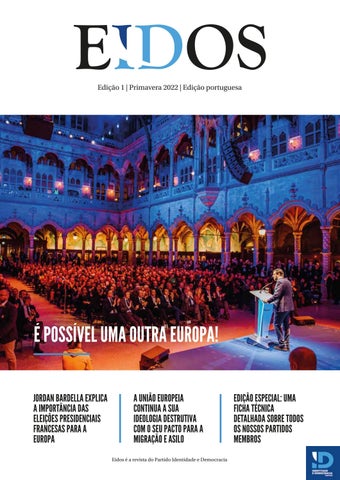
Edição 1 | Primavera 2022 | Edição portuguesa
É POSSÍVEL UMA OUTRA EUROPA! JORDAN BARDELLA EXPLICA A IMPORTÂNCIA DAS ELEIÇÕES PRESIDENCIAIS FRANCESAS PARA A EUROPA
A UNIÃO EUROPEIA CONTINUA A SUA IDEOLOGIA DESTRUTIVA COM O SEU PACTO PARA A MIGRAÇÃO E ASILO Eidos é a revista do Partido Identidade e Democracia
EDIÇÃO ESPECIAL: UMA FICHA TÉCNICA DETALHADA SOBRE TODOS OS NOSSOS PARTIDOS MEMBROS
www.id-party.eu facebook.com/IDParty/ twitter.com/IDParty_ instagram.com/idparty_/
GEROLF ANNEMANS Presidente do Partido Identidade e Democracia President of the Identity and Democracy Party
Editorial The term “eidos” originates in the Greek conceptual and philosophical framework of Plato. Plato used it to designate the transcendent: the ideal image of our changing world. Plato thus developed a system of thinking which would later become the philosophical and religious starting point for the European and Western model of civilisation.
O termo “eidos” tem origem no quadro conceptual e filosófico grego de Platão. Platão utilizou-o para designar o transcendente: a imagem ideal do nosso mundo em mudança. Platão desenvolveu assim um sistema de pensamento que mais tarde se tornaria o ponto de partida filosófico e religioso para o modelo de civilização europeu e ocidental.
Our European civilisation is the real Europe, the continent which through its diversity and various identities has been the driving force behind world events in such a unique and dynamic way - for better or for worse.
A nossa civilização europeia é a verdadeira Europa, o continente que através da sua diversidade e várias identidades tem sido a força motriz por detrás dos acontecimentos mundiais de uma forma tão única e dinâmica - para o melhor e para o pior.
This beautiful word for Europe, a name rich in signification, has been hijacked: kidnapped by the strategists and communication specialists of what is in fact only a form of European cooperation. They systematically confuse the name of their legal model - the “European Union” - with the name “Europe” of the continental model of civilisation. As a result, they can quickly label criticism of their European Union as “anti-European” or even “non-European.” They also use the confusion to claim that their European Union is the only possible and sanctified form of cooperation on
Esta bela palavra para a Europa, um nome rico em significado, foi sequestrada: raptada pelos estrategas e especialistas em comunicação do que, de facto, é apenas uma forma de cooperação europeia. Confundem sistematicamente o nome do seu modelo jurídico - a “União Europeia” - com o nome “Europa” do modelo continental de civilização. Como resultado, podem rapidamente rotular as críticas à sua União Europeia como “antieuropeu” ou mesmo “não-europeu”. Também utilizam a confusão para afirmar que
the European continent. But despite the warning of Brexit, this European Union is moving ever closer in the direction of a supranational state. Resistance is also growing. The European political party Identity & Democracy wants to (co-)embody the resistance to this state of affairs, as an extension of the eponymous political group in the European Parliament. Resistance is growing in almost all EU Member States because their populations refuse to abandon their identity, their culture and their democracy at the gates of an artificial empire in which they would be reduced to a province or department of Brussels. The most striking feature of the European Union is the way in which the continent is being overwhelmed by an unprecedented flow of immigration which seriously endangers the characteristics and identity of the European model of civilisation -and all this is happening over people's heads. We advocate the primacy of national sovereignty and identity for economic and financial affairs, as well as for
a sua União Europeia é a única forma possível e santificada de cooperação no continente europeu. Mas apesar do aviso do Brexit, esta União Europeia está a ir cada vez mais na direção de um estado supranacional. A resistência também está a crescer. O partido político europeu Identidade e Democracia quer (co-)encarnar a resistência a este estado de coisas, como uma extensão do grupo político epónimo no Parlamento Europeu. A resistência está a crescer em quase todos os Estados-Membros da EU, pois as suas populações recusam abandonar a própria identidade, cultura e democracia às portas de um império artificial no qual seriam reduzidas a uma província ou departamento de Bruxelas. O aspeto mais marcante da União Europeia é a forma como o continente está a ser saturado por um fluxo de imigração sem precedentes, o qual põe seriamente em perigo as características e a identidade do modelo europeu de civilização - e tudo isto está a acontecer sem que as pessoas se apercebam. Defendemos a primazia da soberania
immigration cooperation.
and
European
European cooperation must be a free association and not the straitjacket of the centralised unitary State which the other parties support. The dismantling of sovereignty represents a serious threat to the prosperity and identity of the various European peoples. The traditional political parties, which cannot contemplate differences in their way of thinking, want to eliminate them. In actual fact, these differences are Europe's considerable strength and asset. The European political party ID wants to be the patriotic alternative, based on a Europe that respects the uniqueness of the people and their inalienable right to be themselves, to govern themselves and to determine their own future. Meanwhile, at the Warsaw Summit in early December 2021, a number of national ID Party leaders met with other conservative leaders, such as the Polish and Hungarian Prime Ministers (among others) to map out strategic axes for future cooperation. Our political party is in itself an image of the European cooperation upon which we want to build the future of our continent - in friendship, but also in diversity. Gerolf Annemans President of the Identity and Democracy Party
e identidade nacionais para os assuntos económicos e financeiros, bem como para a imigração e cooperação europeia. A cooperação europeia deve ser uma associação livre e não o colete-de-forças do Estado unitário centralizado apoiado pelos outros partidos. O desmantelamento da soberania representa uma séria ameaça à prosperidade e à identidade dos vários povos europeus. Os partidos políticos tradicionais que não desejam contemplar diferenças no seu modo de pensar e querem eliminá-las. Na realidade, estas diferenças são a força e o trunfo consideráveis da Europa. O partido político europeu ID quer ser a alternativa patriótica, baseada numa Europa que respeite a singularidade dos povos e o seu direito inalienável de serem eles próprios, de se governarem a si próprios e de determinarem o seu próprio futuro. Entretanto, na Cimeira de Varsóvia no início de dezembro de 2021, vários líderes do Partido ID reuniram-se com outros líderes conservadores, tais como os primeiros-ministros polaco e húngaro (entre outros) no intuito de traçar eixos estratégicos para uma futura cooperação. O nosso partido político é em si mesmo uma imagem da cooperação europeia sobre a qual queremos construir o futuro do nosso continente - na amizade, mas também na diversidade. Gerolf Annemans Presidente do Partido Identidade e Democracia
5
40
82 98
44
90 76
74
EUROPA
PÁTRIAS E PARTIDOS
34 A União Europeia continua a
72 Matteo Salvini, guarda
sua ideologia destrutiva com o seu Pacto Migratório The European Union continues its destructive ideology with its Migration Pact
38 A Conferência sobre o
Futuro da Europa, uma farsa federalista The Conference on the Future of Europe, a federalist farce
50 Rumo a um grande grupo no Parlamento Europeu?
Towards a super group in the European Parliament?
88
costeira europeia
Matteo Salvini, European Coast Guard
74 Vlaams Belang, pronto para a responsabilidade
Vlaams Belang, ready for responsibility
80 Tomio Okamura, o patriota inspirador
Tomio Okamura, the inspiring patriot
46
10
60 EVENTOS
A GRANDE ENTREVISTA
88 Lisboa define o cenário para
10 Jordan Bardella
uma Europa diferente
Lisbon sets the scene for another Europe
90 A juventude patriótica, a promessa de um futuro melhor
Patriotic youth, the promise of a better future
92 No sul de França, para um
novo Outono marcado pela luta contra a imigração em massa
A Marine Le Pen tem alguma hipótese de ganhar as eleições presidenciais? Jordan Bardella, o novo presidente do Rally Nacional, explica por que razão é possível a vitória. Ele também discute a sua versão da Europa. Does Marine Le Pen have a chance of winning the presidential election? Jordan Bardella, new president of the Rassemblement National, explains to us the reasons why victory is possible. He also discusses his vision of Europe.
In the south of France, for a new autumn marked by the fight against mass immigration
7
A GRANDE E
JORDAN BARDELLA
EU
ENTREVISTA
A GRANDE ENTREVISTA
A Marine Le Pen tem alguma hipótese de ganhar as eleições presidenciais? Entrevista exclusiva com Jordan Bardella, Presidente do Rassemblement National, membro da mesa do Partido ID. Does Marine Le Pen have a chance of winning the presidential election? Exclusive interview with Jordan Bardella, President of the Rassemblement National, member of the ID Party Bureau. Two opposing visions of the world are now confronting each other on the European political scene: the universalist one embodied by the outgoing French president Emmanuel Macron, and the other, rooted and carried by the patriotic political forces, will be championed by Marine Le Pen in the next presidential election. Jordan Bardella, the new president of the Rassemblement National, explains why victory is possible. He also discusses his vision of Europe. Eidos: France is at a turning point in its history. In April, two diametrically opposed visions will clash: a Europeanist and globalist
Duas visões opostas do mundo confrontam-se agora na cena política europeia: a universalista, encarnada pelo presidente francês cessante Emmanuel Macron, e a outra, enraizada e levada pelas forças políticas patrióticas, será defendida por Marine Le Pen nas próximas eleições presidenciais. Jordan Bardella, o novo presidente do Rally Nacional, explica por que razão é possível a vitória. Ele também discute a sua versão da Europa. Eidos: A França encontra-se num ponto de viragem na sua história. Em abril, duas visões diametralmente opostas irão confrontar-se: uma visão
vision embodied by Emmanuel Macron, and a vision based on nations held by Marine Le Pen. Is this the last chance for the country to escape globalism? I dare to believe that France is eternal and that it has all the human resources it needs to get out of the rut into which its leaders have pushed it. The current president Emmanuel Macron has constantly shown his contempt for his country by wanting to dissolve it into unbridled globalisation, by claiming that there is “no French culture,” by making the French feel guilty, even going so far as to say that he wanted to “piss off” millions of them. Based on this, there are effectively two visions of France, one embodied by Marine Le Pen - who will put the French back at the heart of the policies - and the other represented by Macron, who loves neither France nor the French. Is it reasonable to believe that victory is possible? All the polls now indicate that Marine Le Pen has a real chance of being elected. She is situated at more than 45% of the voting intentions in the second round, i.e. within the margin of error. The French have understood that Emmanuel Macron is the last representative of a worn-out and disconnected system. The candidate supported by the Rassemblement National is now ready, and you can sense her great serenity and determination.
europeísta e globalista encarnada por Emmanuel Macron, e uma visão baseada em nações defendida por Marine Le Pen. Será esta a última oportunidade para o país escapar ao globalismo? Ouso acreditar que a França é eterna e que dispõe de todos os recursos humanos necessários para sair da rota para onde os seus líderes a empurraram. O atual presidente Emmanuel Macron tem demonstrado constantemente o seu desprezo pelo seu país ao querer dissolvê-lo numa globalização desenfreada, ao afirmar que “não existe uma cultura francesa”, ao fazer os franceses sentirem-se culpados, chegando ao ponto de dizer que queria “irritar” milhões deles. Com base nisto, existem efetivamente duas visões da França, uma encarnada pela Marine Le Pen - que colocará os franceses novamente no centro das políticas - e a outra representada por Macron, que não ama a França nem os franceses. É razoável acreditar que a vitória é possível? Todas as sondagens indicam agora que a Marine Le Pen tem uma hipótese real de ser eleita. Ela está situada em mais de 45% das intenções de voto na segunda volta, ou seja, dentro da margem de erro. Os franceses compreenderam que Emmanuel Macron é o último representante de um sistema desgastado e desconectado. A candidata apoiada pelo Rally Nacional está agora pronta, e podemos sentir a sua grande
11
A GRANDE ENTREVISTA
Let's look ahead and suppose that the French elect Marine Le Pen as Head of State. What will be her priorities on the European stage? The priority will be to meet the European leaders in order to reaffirm very clearly that the French people are sovereign and are masters of their destiny. An unelected and highly undemocratic institution like the European Commission has no business dictating the daily lives of free peoples. Do you think that the European Union as you describe it is reformable? In short, which bodies should be abolished and which should be reworked? As I said to Emmanuel Macron in the European Parliament a few weeks ago, their Europe is 60 years old while ours is 3000 years old. Unlike France, the European Union as it exists today is an artificial construct kept alive by federalists who are increasingly being disowned by their people. All attempts to revive their federal Europe project are doomed to failure. Take the Conference on the Future of Europe. It was a fiasco, and yet Emmanuel Macron has already announced that he wants to draw conclusions from it which we know will lead to more Europe and less nationhood. In my opinion Europe must be reformed, starting not from the Commission but from the sovereign states which derive their legitimacy from the democratic process. We can envisage strategic
serenidade e determinação. Vamos olhar em frente e supor que os franceses elegem a Marine Le Pen como Chefe de Estado. Quais serão as suas prioridades no palco europeu? A prioridade será encontrar-se com os líderes europeus a fim de reafirmar muito claramente que o povo francês é soberano e é dono do seu destino. Uma instituição não eleita e altamente antidemocrática como a Comissão Europeia não tem nada que ditar a vida quotidiana de povos livres. Pensa que a União Europeia, tal como a descreve, é passível de reforma? Em suma, quais os órgãos que deveriam ser abolidos e quais deveriam ser reformulados? Tal como eu disse a Emmanuel Macron na Assembleia há algumas semanas, a Europa deles tem 60 anos, enquanto a nossa tem 3000. Ao contrário da França, a União Europeia tal como existe hoje é uma construção artificial mantida viva por federalistas que estão cada vez mais a ser deserdados pelo seu povo. Todas as tentativas de reavivar o seu projeto de Europa federal estão condenadas ao fracasso. Veja-se a Conferência sobre o Futuro da Europa. Foi um fiasco, e, no entanto, Emmanuel Macron já anunciou que quer tirar conclusões dela, as quais sabemos que conduzirão a mais Europa e a menos nação. Na minha opinião, a Europa deve ser reformada, partindo não da
13
A GRANDE ENTREVISTA
cooperation interests.
depending
on
their
Which are the areas of activity in which this cooperation could bring added value? And how can it be implemented? There are a number of areas where we should pool our talents, not to sell off our industrial secrets and know-how to other countries but to combine our skills. Macron thought he wanted to move forward on the Future Combat Air System (FCAS), with Germany in particular but also with Spain. France is losing out, as is too often the case in our relations with our German neighbours. Similarly, the idea of a common European defence is not desirable because we have sometimes divergent interests. On the other hand, we can think together about how to defend our borders. Frontex should no longer be an agency for receiving migrants, but rather Europe should do everything possible to prevent them from entering its territory. Things have not changed since the migration crisis of 2015 and the immigrationist ideology has not been defeated... On the contrary. The Marrakesh Pact was a clear signal of the willingness of leaders to promote migration flows. In its wake, the European Union's Migration Pact, which was conceived behind closed doors, is increasingly imposing the idea that migration is part of Europe's destiny. This is
Comissão, mas dos Estados soberanos que derivam a sua legitimidade do processo democrático. Podemos prever uma cooperação estratégica em função dos seus interesses. Quais são as áreas de atividade em que esta cooperação pode acrescentar valor? E como isso pode ser implementado? Há uma série de áreas em que devemos juntar os nossos talentos, não para vender os nossos segredos industriais e know-how a outros países, mas para combinar as nossas competências. Macron pensou que queria progredir no Futuro Sistema de Combate Aéreo (FCAS), com a Alemanha em particular, mas também com a Espanha. A França está a perder, como é frequentemente o caso nas nossas relações com os nossos vizinhos alemães. Do mesmo modo, a ideia de uma defesa europeia em comum não é desejável, pois temos, por vezes, interesses divergentes. Por outro lado, podemos pensar em conjunto sobre a defesa das nossas fronteiras. A Frontex já não deveria ser uma agência de acolhimento de migrantes, a Europa deveria era fazer tudo o que estivesse ao seu alcance para os impedir de entrar no seu território. As coisas não mudaram desde a crise migratória de 2015 e a ideologia imigracionista não foi derrotada... Pelo
contrário.
O
Pacto
de
further proof that the elites are out of touch and disconnected with reality, because, at the logical end of this process it is the ordinary French person from Clermont-Ferrand or Briançon but also the ordinary Estonian or Flemish people who will see their way of life turned upside down. The French government presented a plan for the distribution of migrants a year ago in an authoritarian manner. The countries who are hostile to us have realised that migration is our Achilles heel and are blackmailing our peoples with migration. This is indeed a strategy which has pursued lately by Lukashenko of Belarus, but also in a more structural manner by Recep Tayyip Erdoğan. Given that the latter is multiplying blackmail attempts and threats towards Europe, how should Europe behave with Turkey? Let’s remember the incident in the Mediterranean last June. As part of an international mission to enforce the arms embargo on Libya, a Turkish frigate was aggressive (to say the least) towards a French ship by performing radar illumination on three occasions, with Turkish military personnel on duty. Do we need reminding that a number of our leaders were advocating Turkey's entry into the European Union? This country is not geographically located in Europe, is not part of the European civilisation area and, due to its demographic weight, would send more MEPs to the European Parliament than France.
Marraquexe foi um sinal claro da vontade dos líderes de promover os fluxos migratórios. Na sua esteira, o Pacto de Migração da União Europeia, que foi concebido à porta fechada, impõe cada vez mais a ideia de que a migração faz parte do destino da Europa. Esta é mais uma prova de que as elites estão intocáveis e desligadas da realidade, pois o fim lógico deste processo é o francês comum de Clermont-Ferrand ou Briançon, mas também o estónio comum ou o flamengo comum que verá o seu modo de vida virado de pernas para o ar. O governo francês apresentou há um ano um plano para a distribuição de migrantes de uma forma autoritária. Os países que nos são hostis perceberam que a migração é o nosso calcanhar de Aquiles e estão a chantagear os nossos povos com a migração. Esta é de facto uma estratégia que tem sido seguida ultimamente por Lukashenko da Bielorrússia, mas também de uma forma mais estrutural por Recep Tayyip Erdoğan. Dado que este último está a multiplicar as tentativas de chantagem e ameaças contra a Europa, como deve a Europa comportar-se com a Turquia? Recordemos o incidente no Mediterrâneo em junho passado. Como parte de uma missão internacional para impor o embargo de armas à Líbia, uma fragata turca foi agressiva (no mínimo) em relação a um navio francês, efetuando a iluminação por radar em três
15
A GRANDE ENTREVISTA
We must have a firm attitude towards the Islamist Sultan Erdoğan, stop giving in to his blackmail and above all stop funding him! Looking back, do you think the British exit from the European Union was a good thing? It's up to the British to say, but clearly Brexit, which was supposed to bring misery and calamity, has been a reasonable success. There has always been a British ideal of insularity and empire. The one as a result of its particular geographical position, and the other (which the European Union sometimes imitated) made its membership of the EU a balancing act. The people have decided, and that's just fine. But this is not the solution that Marine Le Pen and the Rassemblement National advocate for France. Your opponents criticise Marine Le Pen for having evolved on the issue of membership of the EuropeanUnion and the euro... The European context has itself changed significantly. We were isolated in Europe at the time, but we have since established relations everywhere with European patriotic parties. They are each making progress or are already in power in their own country. This is the case in Hungary and Poland and also in Slovakia, where the patriots are in government. In the Czech Republic and in Portugal they are strongly on the rise.
ocasiões, com pessoal militar turco de serviço. Será necessário recordar que alguns dos nossos líderes estavam a defender a entrada da Turquia na União Europeia? Este país não está geograficamente localizado na Europa, não faz parte do espaço civilizacional europeu e, devido ao seu peso demográfico, enviaria mais deputados para o Parlamento Europeu do que a França. Devemos ter uma atitude firme em relação ao Sultão islâmico Erdoğan, deixar de ceder à sua chantagem e, sobretudo, deixar de o financiar! Olhando para trás, acha que a saída britânica da União Europeia foi uma coisa boa? Cabe aos britânicos dizer, mas o Brexit, que era suposto trazer miséria e calamidade, tem sido claramente um sucesso razoável. Sempre houve um ideal britânico de insularidade e império. Um como resultado da sua posição geográfica particular, e o outro (que a União Europeia por vezes imitou) fez da sua pertença à UE um ato de equilíbrio. O povo decidiu, e isso é ótimo. Mas esta não é a solução que a Marine Le Pen e o Rally Nacional defendem para a França. Os seus opositores criticam Marine Le Pen por ter evoluído na questão da adesão à União Europeia e ao euro... O próprio contexto europeu mudou significativamente. Na altura estávamos isolados na Europa, mas desde então temos estabelecido
Let's get back to Hungary and Poland: what do you think of the policies there? I defend the sovereignty of States, so I am always reluctant to interfere in the internal affairs of other countries. The
relações em todo o lado com partidos patrióticos europeus. Cada um deles está a fazer progressos ou já se encontram no poder no seu próprio país. É o caso da Hungria e da Polónia e também da Eslováquia, onde os patriotas estão no governo. Na República Checa e em Portugal
17
A GRANDE ENTREVISTA
European Union has made a speciality to dictate internal policies to Member States, and this is beginning to exasperate leaders and peoples alike. Poles and Hungarians want to decide what is good for their country and its future, and they want to see their identity preserved. How can they be wrong? The patriotic political forces are now divided in the European Parliament, between the member parties of Identity and Democracy and those who sit in the European Conservatives and Reformists. Are you confident that these formations can be brought together under one flag? United, we would be all the stronger to confront the defenders of the federalist vision of Europe. I am optimistic that this process - which has been underway for several months - will come to fruition. This obviously requires discussion because, as patriots, our national interests or our evaluation of certain issues may differ in the details. We don’t have to agree on everything to work together - we just have to respect each other's specificities. But I know that we agree on the essential point, which is to give people hope and allow them to continue to fly their national flags proudly. Let's talk a little about you, Jordan Bardella: do you feel European? Above all, I feel profoundly French, the fruit of a heritage built up over the
eles estão em forte ascensão. Voltemos à Hungria e à Polónia: o que pensa das políticas de lá? Defendo a soberania dos Estados, por isso estou sempre relutante em interferir nos assuntos internos de outros países. A União Europeia tem sido especialista a ditar políticas internas aos Estados-Membros, e isto está a começar a exasperar tanto os líderes como os povos. Polacos e húngaros querem decidir o que é bom para o seu país e para o seu futuro, e querem ver a sua identidade preservada. Como podem eles estar errados? As forças políticas patrióticas estão agora divididas no Parlamento Europeu, entre os partidos membros da Identidade e Democracia e os que têm lugar nos Conservadores e Reformistas Europeus. Está confiante de que estas formações podem ser reunidas sob uma só bandeira? Unidos, seríamos todos mais fortes para enfrentar os defensores da visão federalista da Europa. Estou otimista de que este processo - que está em curso há vários meses - venha a concretizar-se. Isto requer obviamente discussão porque, como patriotas, os nossos interesses nacionais ou a nossa avaliação de certas questões podem diferir nos pormenores. Não temos de concordar em tudo para trabalhar em conjunto apenas temos de respeitar as especificidades uns dos outros.
Jordan Bardella com André Ventura, Presidente do Chega
centuries by our ancestors who combined genius (whether scientific, literary or artistic) with a way of life which is individual to us. I also feel that I am the guarantor of France's interests - within its borders of course - but also in Europe and in the world. I want our country to be great again. This does not however prevent us from feeling that we belong to the European civilisation which we share. Precisely which places in Europe arouse such a feeling in you? Let me start by saying that we all have roots within us. Mine are linked to the region where I grew up, in Seine-Saint-Denis, in Ile-de-France, where all the ravages of globalisation can be seen - starting with the consequences of massive immigration. I of course feel this visceral attachment to our country wherever I am on French territory.
Mas sei que estamos de acordo quanto ao ponto essencial, que é dar esperança às pessoas e permitir-lhes que continuem a hastear orgulhosamente as suas bandeiras nacionais. Vamos falar um pouco de si, Jordan Bardella: sente-se europeu? Acima de tudo, sinto-me profundamente francês, fruto de uma herança construída ao longo dos séculos pelos nossos antepassados que combinaram o génio (quer científico, literário ou artístico) com um modo de vida que é para nós singular. Sinto também que sou a garantia dos interesses da França dentro das suas fronteiras, é claro mas também na Europa e no mundo. Quero que o nosso país seja novamente grande. Isto não nos impede, contudo, de sentir que pertencemos à civilização europeia que partilhamos.
19
A GRANDE ENTREVISTA
As a 26-year-old, you are from a new generation. Do you feel that there is a support for the ideas of Marine Le Pen among the younger people? Marine Le Pen is popular among young people - the Rassemblement National regularly comes out on top among this group both in polls and in election results. There is a real awareness and willingness to put an end to several decades of political correctness and disastrous management which threatens their future as French people. This should encourage us: this youth with pro-national feelings, a phenomenon which can be observed both in France and also everywhere else in Europe, will be the lever we can use to save our nations. Marine Le Pen represents a hope for many young people.
Precisamente; que lugares na Europa despertam tal sentimento em si? Deixem-me começar por dizer que todos nós temos raízes dentro de nós. As minhas estão ligadas à região onde cresci, em Seine-Saint-Denis, na Ile-de-France, onde toda a devastação da globalização pode ser vistas a começar pelas consequências da imigração em massa. Claro está que sinto esta ligação visceral ao nosso país onde quer que me encontre em território francês.
Com 26 anos de idade, é de uma nova geração. Sente que existe um apoio para as ideias da Marine Le Pen entre os mais jovens? Marine Le Pen é popular entre os jovens - o Rally Nacional encontra-se regularmente no topo entre este grupo, tanto nas sondagens como nos resultados eleitorais. Existe uma verdadeira consciência e vontade de pôr fim a várias décadas de correção política e gestão desastrosa que ameaçam o seu futuro como franceses. Isto deve encorajar-nos: esta juventude com sentimentos pró-nacionais, um fenómeno que pode ser observado tanto em França como em toda a Europa, será a alavanca que podemos usar para salvar as nossas nações. Marine Le Pen representa uma esperança para muitos jovens.
21
EUROPA
As eleições presidenciais francesas terão lugar a 10 e 24 de abril The French presidential elections will take place on 10 and 24 April The French will be faced with a clear choice: the headlong rush towards ever more globalism or taking back their national sovereignty. Emmanuel Macron and Marine Le Pen embody both sides of the alternative.
Os franceses serão confrontados com uma escolha clara: a corrida precipitada para um cada vez maior globalismo ou a retomada da sua soberania nacional. Emmanuel Macron e Marine Le Pen encarnam ambos os lados da alternativa.
We can be optimistic: Marine Le Pen has never been placed so high in the polls, which give her between 45 and 50% of the vote in the second round (and so within the margin of error). She has never been so close to the Elysée.
Podemos ser otimistas: Marine Le Pen nunca esteve tão alto nas sondagens, que lhe atribuem entre 45 e 50% dos votos na segunda volta (e assim dentro da margem de erro). Ela nunca esteve tão perto do Eliseu.
France is at a turning point, and with it the whole of Europe. The arrival of a patriot at the head of the state will undoubtedly have positive repercussions for parties which are committed to defending their identity and national sovereignty.
A França está num ponto de viragem, e com ela toda a Europa. A chegada de um patriota à cabeça do Estado terá sem dúvida repercussões positivas para as partes empenhadas na defesa da sua identidade e da sua soberania nacional.
23
ROPA
EUR EUROPA EUROP
EUROPA PÁTRIAS E ROPA P PATPÁTRIAS E EURO PA PÁTRI
EUROPA
Para (tentar) compreender melhor o complexo funcionamento da União Europeia To (try to) better understand the convoluted workings of the European Union
The European Union seems to most citizens to be very muddled in its functioning and institutions, which we believe is proof that it does not meet some of the requirements of democratic life: simplicity, representativeness, and democracy. The Identity and Democracy Party is critical of the current functioning of the European Union. Some institutions seem to us to have too much power - such as the unelected European Commission. In order to make it clearer for you, we give you a brief overview of the roles of the different institutions.
O Partido Identidade e Democracia é crítico do atual funcionamento da União Europeia. Algumas instituições parecem-nos ter demasiado poder tal como a não eleita Comissão Europeia. A fim de tornar isto mais claro para si, damos-lhe uma breve visão geral dos papéis das diferentes instituições. A União Europeia parece, para a maioria dos cidadãos, ser muito confusa quanto ao seu funcionamento e instituições, o que acreditamos ser a prova de que não satisfaz alguns dos requisitos da vida democrática: simplicidade, representatividade e democracia. Aceitamos o desafio de lhe apresentar as sete principais instituições em poucas linhas.
The European Council brings together the Heads of State and government of the European Union. It is headed by a president - currently the Belgian Charles Michel - who is responsible for facilitating compromises. Its objective is to define the main lines of European policy, and it meets four times a year.
O Conselho Europeu reúne os Chefes de Estado e de Governo da União Europeia. Tem um presidente atualmente o belga Charles Michel que é responsável por facilitar os compromissos. O objetivo deste Conselho é definir as principais linhas da política europeia e reúne-se quatro vezes por ano.
27
EUROPA
The principal role of the European Commission is to propose legislation and ensure the implementation of Community policies. Although it is an essential component, it nevertheless suffers from a lack of democracy since the commissioners (one per Member State, 27 in total) are not directly elected by the citizens but proposed by the Heads of State and government and then validated by the Parliament. Established in 1957 by the Treaty of Rome, it is currently headed by Ursula von der Leyen.
O principal papel da Comissão Europeia é propor legislação e assegurar a implementação das políticas comunitárias. Embora seja uma componente essencial, sofre de falta de democracia, uma vez que os comissários (um por Estado-Membro, 27 no total) não são diretamente eleitos pelos cidadãos, mas propostos pelos Chefes de Estado e de Governo e depois validados pelo Parlamento. Criada em 1957 pelo Tratado de Roma, é atualmente presidida por Ursula von der Leyen.
The Council of the European Union is the body that brings together the ministers in charge of the files in question (ministers of the interior, finance, etc.). It adopts European legislation together with the Parliament on the basis of a proposal from the European Commission, validates (again with the Parliament) the annual budget of the European Union, and draws up the common foreign and security policy.
O Conselho da União Europeia é o órgão que reúne os ministros encarregados dos processos em questão (Ministros do Interior, das Finanças, etc.). Juntamente com o Parlamento, adota a legislação europeia baseado numa proposta da Comissão Europeia, valida (novamente com o Parlamento) o orçamento anual da União Europeia e elabora as políticas externa e de segurança comuns.
The European Parliament shares the prerogatives of the legislative power with the Council of the European Union. Since 1979, it has been elected by direct universal suffrage according to the proportional voting system (including in countries used to majority voting), which guarantees a representation which is sometimes fairer than in national parliaments. The official seat of the European Parliament is in Strasbourg, where plenary sessions are held, while committees are usually held in Brussels. The elected members of the
O Parlamento Europeu partilha as prerrogativas do poder legislativo com o Conselho da União Europeia. Desde 1979, é eleito por sufrágio universal direto de acordo com o sistema de votação proporcional (inclusive nos países habituados à votação por maioria), o que garante uma representação por vezes mais justa do que nos parlamentos nacionais. A sede oficial do Parlamento Europeu é em Estrasburgo, onde se realizam as sessões plenárias, enquanto as comissões são geralmente realizadas
national parties are divided into groups in order to facilitate parliamentary work. The Court of Justice of the European Union ensures that European law is applied in conformity in all Member States. It is also competent in the interpretation of European law, at the request of judges working in the different countries. The Commission and the Member States may refer cases to it to assess whether a Member State has violated European law. Based in Frankfurt, the European Central Bank sets the direction for monetary policy and the single currency (the euro). Since its creation, one of the main priorities of the Central Bank is price stability and therefore the fight against inflation. The Court of Auditors is responsible for analysing the revenue and expenditure of the European Union. This external body theoretically provides an independent assessment of the management of the institutions' accounts.
em Bruxelas. Os membros eleitos dos partidos nacionais são divididos em grupos, a fim de facilitar o trabalho parlamentar. O Tribunal de Justiça da União Europeia assegura que o direito europeu é aplicado em conformidade em todos os Estados-Membros. É também competente na interpretação do direito europeu, a pedido dos juízes que trabalham nos diferentes países. A Comissão e os Estados-Membros podem remeter-lhe casos para avaliar se um Estado-Membro violou o direito europeu. Com sede em Frankfurt, o Banco Central Europeu define a direção da política monetária e da moeda única (o euro). Desde a sua criação, uma das principais prioridades do Banco Central é a estabilidade dos preços e, por conseguinte, a luta contra a inflação. O Tribunal de Contas é responsável pela análise das receitas e despesas da União Europeia. Na teoria, este organismo externo fornece uma avaliação independente da gestão das contas das instituições.
29
EUROPA
O que é um partido político europeu? What is a European political party? European political parties are part of the European “institutional machinery” which costs taxpayers a lot of money. One can guess that they will eventually be the instrument of the “Europeanists” to push for the existence of transnational lists during elections. While the Identity and Democracy Party is “eurocritical,” it is nevertheless obliged to constitute itself as a party in order not to be further excluded from the democratic process.
Os partidos políticos europeus fazem parte do “mecanismo institucional” europeu que custa muito dinheiro aos contribuintes. Pode-se adivinhar que acabarão por ser o instrumento dos “europeístas” para pressionar a existência de listas transnacionais durante as eleições. Embora o Partido Identidade e Democracia seja “eurocrítico”, é, no entanto, obrigado a constituir-se como partido para não ser ainda mais excluído do processo democrático.
When discussing the European Parliament, we saw that MEPs elected in their country on a national list come together by affinity. The results of the 2019 elections gave the following breakdown: - Group of the European People's Party (182 seats), - Progressive Alliance of Socialists and Democrats in the European Parliament (154), - Renew Europe (108), - Identity and Democracy (75), - Greens/European Free Alliance Group (74), - European Conservatives and Reformists (62),
Ao discutirmos o Parlamento Europeu, vimos que os eurodeputados eleitos no seu país numa lista nacional se juntam por afinidade. Os resultados das eleições de 2019 ficaram repartidos da seguinte forma: - Grupo do Partido Popular Europeu (182 lugares), - Aliança Progressista dos Socialistas e Democratas no Parlamento Europeu (154), - Renovar a Europa (108), - Identidade e Democracia (75), - Grupo dos Verdes/Aliança Livre Europeia (74), - Conservadores e Reformistas
Reunião entre os líderes patrióticos europeus
- The Left in the European Parliament Group (41), to which should be added the non-registered members.
Europeus (62), - A Esquerda Unitária Europeia (41), ao qual devem ser acrescentados os membros não inscritos.
While it is tempting to confuse the two, the notion of a European political party is different from that of a group. The two concepts do not overlap. Thus, the parties are intended to contain, for example, national political formations which have elected representatives on their soil but are not represented in the European Parliament. On the other hand, some parties that are members of a group may choose not to join a party due to conviction or other
Embora seja tentador confundir os dois, a noção de um partido político europeu é diferente da de um grupo. Os dois conceitos não se sobrepõem. Assim, os partidos destinam-se a conter, por exemplo, as formações políticas nacionais que elegeram representantes no seu território, mas não estão representadas no Parlamento Europeu. Por outro lado, alguns partidos que são membros de um grupo podem optar por não aderir a um partido devido a
31
EUROPA
reasons. Finally, some groups in the European Parliament are multi-party: for example, the Green/European Free Alliance Group consisting of the European Green Party (EGP) and the European Free Alliance (EFA). Recognised since the Maastricht Treaty (1992), European parties “contribute to forming a European awareness and to expressing the political will of the citizens of the Union.” As a result of the will of the most ardent federalists, each national party is obliged to display its possible membership of a European party on its website. The Authority for European Political Parties and Foundations is keeping a sharp eye on things! To be recognised as a party, the latter must have representation in at least one quarter of the EU Member States (i.e. seven), in the national or regional parliaments, or in the European Parliament; or it or its member parties must have received at least three per cent of the votes cast in the European Parliament in at least one quarter of the Member States. It is obviously forbidden for a party to use European funds to finance national campaigns. To further complicate the Byzantine European bureaucracy, there are also foundations which are “organisations affiliated to a European political party which support and complement the objectives of that party,” for example by organising conferences.
convicções ou outras razões. Finalmente, alguns grupos no Parlamento Europeu são multipartidários: por exemplo, o Grupo dos Verdes/Aliança Livre Europeia, constituído pelo Partido Verde Europeu (EGP) e a Aliança Livre Europeia (AAE). Reconhecidos desde o Tratado de Maastricht (1992), os partidos europeus “contribuem para formar uma consciência europeia e para exprimir a vontade política dos cidadãos da União”. Como resultado da vontade dos federalistas mais fervorosos, cada partido nacional é obrigado a exibir a sua possível adesão a um partido europeu no seu website. A Autoridade para os Partidos Políticos Europeus e as Fundações Políticas Europeias mantém isto debaixo de olho! Para ser reconhecido como partido, este deve ter representação em pelo menos um quarto dos Estados-Membros da UE (ou seja, em sete), nos parlamentos nacionais ou regionais, ou no Parlamento Europeu; ou este ou os seus partidos membros devem ter recebido pelo menos três por cento dos votos expressos no Parlamento Europeu em pelo menos um quarto dos Estados-Membros. É obviamente proibido a um partido utilizar fundos europeus para financiar campanhas nacionais. Para complicar ainda mais a burocracia bizantina europeia, existem também fundações que são “organizações filiadas a um partido
support and complete the objectives of this party", for example, organizing conferences. There are currently ten officially recognised European political parties: - European People's Party (centre), - Alliance of Liberals and Democrats for Europe (liberal right), - European Conservatives and Reformists Party (right), - European Christian Political Movement (conservative right), - European Democratic Party (centre), - European Free Alliance (regionalism), - European Green Party (environmentalism), - Party of European Socialists (left), - Party of the European Left (extreme left), - Identity and Democracy Party. Visit page 106 to find out more about the national parties that make up the Identity and Democracy Party.
político europeu que apoiam e complementam os objetivos desse partido”, por exemplo, organizando conferências. Existem atualmente dez partidos políticos europeus oficialmente reconhecidos: - Partido Popular Europeu (centro), - Aliança dos Democratas e Liberais pela Europa (direita liberal), - Aliança dos Reformistas e Conservadores Europeus (direita), - Movimento Político Cristão da Europeu (direita conservadora), - Partido Democrático Europeu (centro), - Aliança Livre Europeia (regionalismo), - Partido Verde Europeu (ambientalismo), - Partido dos Socialistas Europeus (esquerda), - Partido da Esquerda Europeia (extrema-esquerda), - Partido Identidade e Democracia. Visite a página 106 para saber mais sobre os partidos nacionais que constituem o Partido Identidade e Democracia.
33
EUROPA
A União Europeia continua a sua ideologia destrutiva com o seu Pacto Migratório The European Union continues its destructive ideology with its Migration Pact The Global Compact for Safe, Orderly and Regular Migration, better known to the general public as the Marrakesh Pact, was much discussed in December 2018: it promised ever more uncontrolled immigration and articulated as never before the outlines of the migration ideology prevalent among certain elites. Some countries weren’t taken in and refused to sign it. Among them are Hungary and Poland, in the eye of the European storm for not complying with internationalist and immigrationist injunctions. Belgium rushed to sign it, even if it meant toppling a government, and Charles Michel (its Prime Minister) was chosen as President of the European Council in the process. The politics of petty backroom deals had a bright future ahead of it from that day.
O Pacto Global para uma Migração Segura, Ordenada e Regular, mais conhecido pelo público em geral como Pacto de Marraquexe, foi muito discutido em dezembro de 2018: prometia uma imigração cada vez mais descontrolada e articulava como nunca os contornos da ideologia da migração prevalecente entre certas elites. Alguns países não foram incluídos e recusaram-se a assiná-lo. Entre eles estão a Hungria e a Polónia, no centro da tempestade europeia por não cumprirem as injunções internacionalistas e imigracionistas. A Bélgica apressou-se a assiná-lo, mesmo que isso significasse derrubar um governo, e, no processo, Charles Michel (o seu primeiro-ministro) foi escolhido como Presidente do Conselho Europeu. A partir desse dia,
In order not to suffer another setback, the European Commission has been working on its Migration and Asylum Pact in the greatest secrecy, away from the eyes of people who are especially keen to preserve their identity. The leaders of the European Union are nevertheless constantly defending it with implicit faith, not failing to criticise the “populists who oppose it.” President of the Commission Ursula von der Leyen is constantly reminding us of her mantra. And so during the presentation of the Pact, she didn’t hesitate to declare that “migration has always been a reality in Europe” and that it “will continue to be so.” We have been warned.
as políticas de pequenos negócios de bastidores tiveram um futuro brilhante à sua frente. Para não sofrer outro revés, a Comissão Europeia tem trabalhado no seu Pacto de Migração e Asilo no maior segredo, longe dos olhos das pessoas que estão especialmente interessadas em preservar a sua identidade. Os líderes da União Europeia, no entanto, defendem-no constantemente com fé implícita, não deixando de criticar os “populistas que se lhe opõem”. A Presidente da Comissão Ursula von der Leyen está constantemente a recordar-nos o seu mantra. E assim, durante a apresentação do Pacto, não hesitou em declarar que “a migração sempre foi uma realidade na Europa” e que
35
EUROPA
Under the pretext of “improving the security of migrants”, the EU Migration and Asylum Pact will create the legal, logistical and political conditions for the mass movement and settlement of people, mainly from the Third World, to the European continent. At the same time, European borders are not secure. Ylva Johansson, who is often caught knitting during
“vai continuar avisados.
a
sê-lo”.
Fomos
Sob o pretexto de “melhorar a segurança dos migrantes”, o Pacto de Migração e Asilo da UE criará as condições legais, logísticas e políticas para a circulação e fixação em massa de pessoas, principalmente do Terceiro Mundo, no continente europeu.
parliamentary debates, had to concede that 22% of people entering the EU are not checked. And yet she still likes to repeat, against all common sense: “We need immigration.”
Ao mesmo tempo, as fronteiras europeias não são seguras. Ylva Johansson, que é frequentemente apanhada a tricotar durante os debates parlamentares, teve de admitir que 22% das pessoas que entram na UE não são controladas. E ainda assim, ela gosta de repetir, contra todo o senso comum: “Precisamos de imigração.”
37
EUROPA
A Conferência sobre o Futuro da Europa, uma farsa federalista The Conference on the Future of Europe, a federalist farce Few European citizens have heard of it, but the Conference on the Future of Europe was nevertheless announced with great fanfare by the European Union authorities. The barely-concealed objective is to continue the European Union's headlong rush towards greater federalism. Several members of the ID Party are defending you: Hélène Laporte (France), Catherine Griset (France), Philippe Olivier (France), Mara Bizzotto (Italy), Alessandro Panza (Italy), Susanna Ceccardi (Italy), Gerolf Annemans (Flanders), Jaak Madison (Italy), Ludovit Goga (Slovakia), and Petra Steger (Austria)
Poucos cidadãos europeus ouviram falar dela, mas, no entanto, a Conferência sobre o Futuro da Europa foi anunciada com grande alarido pelas autoridades da União Europeia. O objetivo mal disfarçado é continuar a corrida precipitada da União Europeia para um maior federalismo. Vários membros do Partido ID estão em sua defesa: Hélène Laporte (França), Catherine Griset (França), Philippe Olivier (França), Mara Bizzotto (Itália), Alessandro Panza (Itália), Susanna Ceccardi (Itália), Gerolf Annemans (Flandres), Jaak Madison (Itália), Ludovit Goga (Eslováquia) e Petra Steger (Áustria).
The EU has selected ten themes for debate: climate change and the environment; health; a stronger economy, social justice and employment; the EU in the world; values and rights, rule of law and security; digital transformation; European democracy; migration; education, culture; youth and sport.
A UE selecionou dez temas para debate: alterações climáticas e ambiente; saúde; uma economia mais forte, justiça social e emprego; a UE no mundo; valores e direitos, Estado de direito e segurança; transformação digital; democracia europeia; migração; educação, cultura; juventude e desporto.
If the figures are to be believed, it’s a total failure. In total, 38,000 people participated (out of 450 million inhabitants), often leaving a brief message at most. On the topic of migration, barely 500 citizens gave
A acreditar nos números, é um fracasso total. No total, participaram 38.000 pessoas (de 450 milhões de habitantes), muitas vezes deixando, no máximo, uma breve mensagem. Sobre o tema da migração, apenas 500
their opinion, often leaving anti-migration message.
an
It seems a long time ago that the Conference was launched with such great fanfare, when for example a convinced federalist called for two flags to be flown at the Olympic Games: the national flag and the twelve stars. The very organisation of the debates is a joke. The European Parliament is represented and each country sends representatives from its national parliament. The allocation of speaking time is left to the discretion of the administration. During the last plenary, a Member of the European Parliament from the Identity and Democracy Party was given time to speak on the important subject of the digital transition, but was not chosen by the representative in question. The citizens' panels seem to be hand-picked to ensure that the discourse never deviates from official thinking. Conclusions will be drawn from this mess, which we can already confidently predict right here and now: we will need more and more Europe and federalism. The Identity and Democracy Party will never subscribe to such a vision, as it favours sovereign peoples and national identities. While at the beginning we were optimistic, we were quickly disillusioned and had to face the fact that this Conference was a farce.
cidadãos deram a sua opinião, deixando muitas vezes uma mensagem anti-migração. Parece há muito tempo que a Conferência foi lançada com tanta fanfarra, quando, por exemplo, um federalista convicto apelou para que duas bandeiras fossem hasteadas nos Jogos Olímpicos: a bandeira nacional e as doze estrelas. A própria organização dos debates é uma anedota. O Parlamento Europeu é representado e cada país envia representantes do seu parlamento nacional. A atribuição do tempo de palavra é deixada à discrição da administração. Durante a última sessão plenária, um eurodeputado do Partido Identidade e Democracia recebeu tempo para falar sobre o importante tema da transição digital, mas não foi escolhido pelo representante em questão. Os painéis de cidadãos parecem ser escolhidos a olho para garantir que o discurso nunca se desvie do pensamento oficial. Desta confusão serão retiradas conclusões, que já podemos prever com confiança aqui e agora: vamos precisar cada vez mais da Europa e do federalismo. O Partido Identidade e Democracia nunca subscreverá tal visão, uma vez que prefere povos soberanos e identidades nacionais. Enquanto no início estávamos otimistas, rapidamente nos desiludimos e tivemos de enfrentar o facto de que esta Conferência era uma farsa.
39
EUROPA
Mara Bizzotto: “O que precisamos hoje é de construir um novo modelo de Europa, a Europa do povo...” Mara Bizzotto: “What we need today is to build a new model of Europe, the Europe of the people...” Mara Bizzotto is a Member of the European Parliament for Lega (Italy)
Mara Bizzoto é uma Eurodeputada do Lega (Itália)
“The Conference on the Future of Europe was a historic opportunity to rebuild Europe and design the Europe of tomorrow: it was an important chance that we had to seize, with the courage and foresight to make major changes, including the necessary reform of the European treaties.
A Conferência sobre o Futuro da Europa foi uma oportunidade histórica para reconstruir a Europa e conceber a Europa de amanhã: foi uma oportunidade importante que tivemos de aproveitar, com coragem e previdência, para fazer grandes mudanças, incluindo a necessária reforma dos tratados europeus.
We need to work together to change the current model of Europe at its roots, a model that has proved to be wrong and too far removed from the real needs of our citizens and territories, as we have also seen during the Covid emergency. What we need today is to build a new model of Europe, a Europe of the people, of the citizens, of work and of true democracy, which will put a definitive end to the Europe of austerity, of the banks and of this bureaucracy which has done so much harm to our countries in recent years.”
Precisamos de trabalhar juntos para mudar o modelo atual da Europa nas suas raízes, um modelo que provou estar errado e demasiado afastado das necessidades reais dos nossos cidadãos e territórios, como também vimos durante a emergência da Covid. O que precisamos hoje é de construir um novo modelo de Europa, uma Europa do povo, dos cidadãos, do trabalho e da verdadeira democracia, que ponha um fim definitivo à Europa da austeridade, dos bancos e desta burocracia que tanto mal tem feito aos nossos países nos últimos anos.
Source : EP
Mara Bizzotto (Itália) Membra do Parlamento Europeu Lega
41
EUROPA
Petra Steger: “A minha visão da Europa é uma associação de povos livres e autodeterminados em que a diversidade de culturas é vista como uma força em vez de um obstáculo...” Petra Steger: “My vision of Europe is an association of free and self-determined peoples in which the diversity of cultures is seen as a strength and not an obstacle...” Petra Steger is a Member of the National Council (Austria) for Freiheitliche Partei Österreichs and participates in the Conference on the Future of Europe
Petra Steger é uma Deputada do Conselho Nacional ( Áustria ) pelo Freiheitliche Partei Österreichse e participa na Conferência sobre o Futuro da Europa.
“A respectful and united cooperation according to the principles of subsidiarity and federalism should guarantee the freedom of each nation State.
A minha visão da Europa é uma associação de povos livres e autodeterminados em que a diversidade de culturas é vista como uma força em vez de um obstáculo. Uma cooperação respeitosa e unida de acordo com os princípios da subsidiariedade e do federalismo deveria garantir a liberdade de cada Estado-Nação.
On the other hand, I categorically reject the path towards a central EU political state, coupled with massive undesirable developments such as the debt and transfer union, EU taxes, losses of national sovereignty or accession negotiations with non-European countries such as Turkey. A return to the real tasks of the EU is needed, namely to ensure peace, freedom and prosperity.
Por outro lado, rejeito categoricamente o caminho para um Estado político central da UE, associado a desenvolvimentos indesejáveis massivos como a união da dívida e da transferência, impostos da UE, perdas de soberania nacional ou negociações de adesão com países
Source : Wikimedia. License: CC BY-SA 4.0
“Rejeito categoricamente o caminho para um Estado político central da UE” “I categorically reject the path taken towards a central EU political state”
Petra Steger (Áustria) Membra do Conselho Nacional Freiheitliche Partei Österreichs
However, the EU will only remain an order of peace if the components of security and freedom are not forgotten. This means nothing less than self-determination. But it is precisely this self-determination which is increasingly being lost as the EU continually seeks to take over national competences and transform itself into a centralised state. This is also leading to a growing rejection by the citizens. Europe is important, but it can never replace the Nation.”
não europeus, como a Turquia. É necessário um regresso às verdadeiras tarefas da UE, nomeadamente assegurar a paz, a liberdade e a prosperidade. No entanto, a UE só permanecerá uma ordem de paz se as componentes da segurança e da liberdade não forem esquecidas. Isto significa nada menos do que autodeterminação. Mas é precisamente esta autodeterminação que se está a perder cada vez mais, à medida que a UE procura continuamente assumir competências nacionais e transformar-se num Estado centralizado. Isto também está a levar a uma rejeição crescente por parte dos cidadãos. A Europa é importante, mas nunca poderá substituir a Nação.
43
EUROPA
Jaak Madison: “Não estou otimista quanto à viabilidade a longo prazo da União Europeia” Jaak Madison: “I am not optimistic about the long-term viability of the European Union” Jaak Madison is a Member of the European Parliament for Eesti Konservatiivne Rahvaerakond (Estonia) “When we speak of the future of Europe, it is important to remember that we are talking first and foremost about the future of the European Union, not of Europe as a whole. Switzerland, Norway or Iceland are as European and often more so than any EU Member State or the European Commission. I am not optimistic about the long-term viability of the European Union. The more the European Union tries to seize power and reduce the sovereignty of Member States, for example in environmental, economic, defence or foreign policy, the more likely it is that the Union will eventually collapse. Unfortunately, the European Commission and the European Parliament have not been able to recognise the mistakes which led Britain, for example, to leave the
Jaak Madison é um Eurodeputado pelo Eesti Konservatiivne Rahvaerakond (Estónia) Quando falamos do futuro da Europa, é importante lembrar que estamos a falar, antes de mais nada, do futuro da União Europeia, e não da Europa como um todo. A Suíça, a Noruega ou a Islândia são tão europeias, e muitas vezes mais, como qualquer Estado-Membro da UE ou a Comissão Europeia. Não estou otimista quanto à viabilidade a longo prazo da União Europeia. Quanto mais a União Europeia tentar assumir o poder e reduzir a soberania dos Estados-Membros, por exemplo em matéria de política ambiental, económica, de defesa ou externa, tanto mais provável é que a União acabe por entrar em colapso. Infelizmente, a Comissão Europeia e o Parlamento Europeu não foram capazes de reconhecer os erros que levaram a Grã-Bretanha, por exemplo, a deixar a União. O futuro da União Europeia só é possível se
Photo by Fred MARVAUX - Copyright: © European Union 2021 - Source : EP
Jaak Madison (Estónia) Membro do Parlamento Europeu Eesti Konservatiivne Rahvaerakond
Union. The future of the European Union is only possible if we return to the original roots of the Union, which are economic cooperation and the free movement of goods. This means abandoning federalist policies in areas which have absolutely no connection with free trade and economic relations.”
regressarmos às raízes da União, que são a cooperação económica e a livre circulação de mercadorias. Isto significa abandonar as políticas federalistas em áreas que não têm absolutamente nenhuma ligação com o comércio livre e as relações económicas.
45
EUROPA
A presidência francesa do Conselho da União Europeia no meio de uma campanha presidencial: onde está a justiça? The French Presidency of the Council of the European Union in the middle of a presidential campaign: where is the fairness? Since 1 January, France has held the rotating presidency of the Council of the European Union, in accordance with the mechanism whereby each member country takes it in turn to hold the office. Whether it’s a coincidence or not, it comes at the same time as the presidential campaign, allowing Emmanuel Macron to appear in the spotlight. If we can ask ourselves the question of fairness in relation to the other candidates - including Marine Le Pen - we can hope that this European
Desde 1 de janeiro, a França detém a presidência rotativa do Conselho da União Europeia, de acordo com o mecanismo através do qual cada país membro assume o cargo à vez. Quer seja coincidência ou não, vem ao mesmo tempo que a campanha presidencial, permitindo a Emmanuel Macron aparecer na ribalta. Se nos podemos colocar a questão da justiça em relação aos outros candidatos - incluindo Marine Le Pen - podemos esperar que este interlúdio europeu seja uma oportunidade para duas visões da Europa se
interlude will be an opportunity for two visions of Europe to face off: on the one hand, the federalist project intending to make Europe the stepping stone to globalisation, and on the other hand, a national programme rooted in and respectful of identities. For Emmanuel Macron has never hidden his intention to drown the French identity - in which he has never believed - in the European melting pot, to the point of speaking of “European sovereignty” and thereby sweeping away the very idea of national sovereignty.
enfrentarem: por um lado, o projeto federalista que pretende fazer da Europa o trampolim para a globalização, e por outro lado, um programa nacional enraizado e respeitoso das identidades. Emmanuel Macron nunca escondeu a sua intenção de afogar a identidade francesa - na qual nunca acreditou no caldeirão europeu, ao ponto de falar de "soberania europeia" e assim varrer a própria ideia de soberania nacional. Em termos concretos, os poderes da França serão cada vez mais confiados
47
EUROPA
In concrete terms, France's powers will be increasingly entrusted to Europe, especially in military terms, since the current French president hopes to establish a common defence policy in both strategic and operational areas. In other words, the idea of a European army is never far off. He will certainly be able to count on the support of the new German Chancellor Olaf Scholz, whom he has already met, and who has “great ambitions for Europe.” Germany has already announced its intention to “see the European Union evolve into a European federal state.” It is therefore to be feared that the Franco-German couple, the Sarkozy-Hollande/Merkel yesterday, the Macron/Scholz today, will continue to dismantle the national ideal. The French presidential election could change things: with Marine Le Pen in the Elysée, things would certainly take a turn for the better. As a symbol, while France was preparing to take over the presidency of the Council of the European Union, the government in power had the French flag replaced by the European flag under the Arc de Triomphe, where the Unknown Soldier, who died for the country, is buried. It had to be removed after two days. “A patriotic victory,” according to Marine Le Pen. We can hope that she will announce another one in April!
à Europa, especialmente em termos militares, uma vez que o atual presidente francês espera estabelecer uma política de defesa comum, tanto em áreas estratégicas como operacionais. Por outras palavras, a ideia de um exército europeu não está longe de ser uma realidade. Certamente, poderá contar com o apoio do novo Chanceler alemão Olaf Scholz, que já conheceu, e que tem “grandes ambições para a Europa”. A Alemanha já anunciou a sua intenção de “ver a União Europeia evoluir para um estado federal europeu”. Por conseguinte, é de temer que o casal f r a n c o - a l e m ã o , Sarkozy-Hollande/Merkel ontem e Macron/Scholz hoje, continue a desmantelar o ideal nacional. As eleições presidenciais francesas poderiam mudar as coisas: com a Marine Le Pen no Eliseu, certamente que as coisas iriam melhor. Como símbolo, enquanto a França se preparava para assumir a presidência do Conselho da União Europeia, o governo no poder mandou substituir a bandeira francesa pela bandeira europeia sob o Arco do Triunfo, onde está enterrado o Soldado Desconhecido, que morreu pelo país. A bandeira teve de ser retirada após dois dias. Segundo a Marine Le Pen foi “uma vitória patriótica”. Podemos ter esperança de que ela anuncie outra em abril!
49
EUROPA
Rumo a um grande grupo no Parlamento Europeu? Towards a super group in the European Parliament? The Patriots and Conservatives currently form two groups in the European Parliament, with 66 and 64 representatives respectively, behind the European People's Party and the Progressive Alliance of Socialists and Democrats.
Os Patriotas e os Conservadores formam atualmente dois grupos no Parlamento Europeu, com 66 e 64 representantes respetivamente, atrás do Partido Popular Europeu e da Aliança Progressista dos Socialistas e Democratas.
Frequent contacts between representatives of Identity and Democracy and the European Conservatives and Reformists suggest the possibility of a union between the two groups, who would thereby gain in strength and disrupt the game plan of the European federalists.
Contactos frequentes entre representantes do Identidade e Democracia e dos Conservadores e Reformistas Europeus sugerem a possibilidade de uma união entre os dois grupos, que assim ganhariam força e perturbariam o plano de jogo dos federalistas europeus.
In July 2021, fourteen parties signed a common charter, engraving in stone the will to strengthen the links which unite them around common principles: rejection of the European super-state, reminder of national integrity, rejection of “moralistic overactivity,” respect for the Judeo-Christian heritage, and more.
Em julho de 2021, catorze partidos assinaram uma carta comum, “gravando em pedra” a vontade de reforçar os laços que os unem em torno de princípios comuns: rejeição do Superestado europeu, lembrança da integridade nacional, rejeição da "hiperatividade moralista", respeito pela herança judaico-cristã, e muito mais.
The exchanges continued in early
Marine Le Pen, Viktor Orban e Katalin Novak por uma Europa de soberanias
December at the Warsaw Summit, bringing together patriotic leaders from across the continent. Around Marine Le Pen (Rassemblement National), Tom Van Grieken (Vlaams Belang) and Martin Helme (Eesti Konservatiivne Rahvaerakond), were also Hungarian Viktor Orbán (Fidesz) and Polish Jaroslaw Kaczyński (Prawo i Sprawiedliwość). They resulted in a joint declaration recalling the need for cooperation in order to counter the federalist drift of the European Union's leaders, as well as the importance of national sovereignty, the democratic framework par excellence: “Only through such a model of European cooperation can we save the EU from further crises and tensions and put an end to the worrying idea of creating a Europe governed by a self-appointed elite. We reject the arbitrary application of EU law, which misuses or even violates the treaties. Only the sovereign institutions of States have full democratic legitimacy.”
Os intercâmbios continuaram no início de dezembro, na Cimeira de Varsóvia, reunindo líderes patrióticos de todo o continente. Com Marine Le Pen (Rally Nacional), Tom Van Grieken (Vlaams Belang) e Martin Helme (Eesti Konservatiivne Rahvaerakond), estiveram também o húngaro Viktor Orbán (Fidesz) e o polaco Jaroslaw Kaczyński (Prawo i Sprawiedliwość). O resultado foi uma declaração conjunta reafirmando a necessidade de cooperação para combater a deriva federalista dos líderes da União Europeia, assim como a importância da soberania nacional, o quadro democrático por excelência: “Só através desse modelo de cooperação europeia poderemos salvar a UE de novas crises e tensões e pôr fim à preocupante ideia de criar uma Europa governada por uma elite autoproclamada. Rejeitamos a aplicação arbitrária do direito da UE, que usa indevidamente ou até viola os tratados. Só as instituições soberanas dos Estados têm plena legitimidade
51
Photo by DAVID ILIFF. License: CC BY-SA 3.0
EUROPA
Membros
%
Partido Popular Europeu (PPE)
177
25 %
Aliança Progressista dos Socialistas e Democratas (S&D)
145
21 %
Renovar a Europa (RE)
101
14 %
Identidade e Democracia (ID)
66
9%
Grupo dos Verdes/Aliança Livre Europeia (Verdes/ALE)
73
10 %
Reformistas e Conservadores Europeus (RCE)
64
9%
Grupo da Esquerda no Parlamento Europeu (GUE/NGL)
39
6%
Não inscritos (NI)
40
6%
Grupo
The exchanges continued in Madrid at the end of January 2022, at the instigation of Vox. The summit produced concrete commitments: application of the principle of European preference, defence of the primacy of national constitutions over European texts, establishment of a greater European energy capacity, the fight against immigration promoted by Brussels, etc.
democrática.” Os intercâmbios continuaram em Madrid no final de janeiro de 2022, por instigação da Vox. Da cimeira resultaram compromissos concretos: aplicação do princípio da preferência europeia, defesa da primazia de constituições nacionais sobre textos europeus, estabelecimento de uma maior capacidade energética europeia, luta contra a imigração promovida por Bruxelas, etc.
53
EUROPA
Primeira declaração conjunta dos partidos patrióticos europeus (2 de julho de 2021) First joint declaration of the European patriotic parties (July 2, 2021) In the recently-begun debate on the future of Europe, the voice of the parties committed to the freedom of nations and the traditions of the European peoples must not be ignored. The turbulent history of Europe has brought many misfortunes, especially in the last century. Nations defending their sovereignty and territorial integrity against aggressors have suffered beyond all human imagination. After the Second World War, some European countries had to fight against the domination of Soviet totalitarianism for decades before regaining their independence. This independence, the European Union's Atlantic link with the North Atlantic Treaty and the peace between the cooperating nations are a great achievement for many Europeans, giving them a permanent sense of security and creating optimal conditions for development.
No debate recentemente iniciado sobre o futuro da Europa, a voz das partes empenhadas na liberdade das nações e nas tradições dos povos europeus não deve ser ignorada. A história turbulenta da Europa trouxe muitos infortúnios, especialmente no século passado. As nações que defendem a sua soberania e integridade territorial contra os agressores sofreram para além de toda a imaginação humana. Após a Segunda Guerra Mundial, alguns países europeus tiveram de lutar contra o domínio do totalitarismo soviético durante décadas antes de recuperarem a sua independência. Esta independência, a ligação atlântica da União Europeia com o Tratado do Atlântico Norte e a paz entre as nações cooperantes são uma grande conquista para muitos europeus, dando-lhes uma sensação permanente de segurança e criando condições ótimas para o desenvolvimento.
However, the series of serious crises over the last ten years has shown that the work of European cooperation is running out of steam, as nations feel that they are slowly being stripped of their right to exercise their legitimate sovereign powers.
Porém, as várias crises graves dos últimos dez anos mostraram que o trabalho de cooperação europeia está a esgotar-se, pois as nações sentem que estão a ser lentamente despojadas do seu direito de exercer os seus legítimos poderes soberanos.
The
A União Europeia necessita de uma
European
Union
needs
a
“A União Europeia precisa de uma reforma profunda” “The European Union needs deep reform”
profound reform, because today instead of protecting Europe and its heritage, instead of allowing the free development of European nations, it is itself becoming a source of problems, anxiety and uncertainty. The EU is increasingly becoming a tool of radical forces which want to achieve a civilisational transformation and ultimately a nationless construction of Europe, aiming at the creation of a European superstate, the destruction or cancellation of European traditions, and the transformation of basic social institutions and moral principles. The use of political structures and law to create a European superstate and new forms of social life is a manifestation of a dangerous and pervasive social engineering of the past, which must be legitimately resisted.
reforma profunda, pois atualmente, em vez de proteger a Europa e o seu património, e de permitir o livre desenvolvimento das nações europeias, ela própria está a transformar-se numa fonte de problemas, ansiedade e incerteza. A UE está a tornar-se mais e mais num instrumento de forças radicais que querem alcançar uma transformação civilizacional e, em última análise, uma construção da Europa sem nações, visando a criação de um Superestado europeu, a destruição ou anulação de tradições europeias, e a transformação das instituições sociais básicas e dos princípios morais. A utilização de estruturas políticas e do direito para criar um Superestado europeu e novas formas de vida social é uma manifestação de uma perigosa e pervasiva engenharia social do passado, a qual deve ser
55
EUROPA
The moralistic over-activity we have seen in recent years in the EU institutions has led to a dangerous tendency to impose an ideological monopoly. We are convinced that the cooperation of European nations must be based on tradition, respect
legitimamente combatida. A hiperatividade moralista a que assistimos nos últimos anos nas instituições da UE levou a uma perigosa tendência para impor um monopólio ideológico. Estamos convencidos de que a
“Nós reafirmamos a nossa convicção de que a familia é a unidade básica das nossas nações” “We reaffirm our conviction that the family is the basic unit of our nations”
for the culture and history of European nations, respect for the Judeo-Christian heritage of Europe and the common values which unite our nations - and not on their destruction. We reaffirm our belief that the family is the basic unit of our nations. At a time when Europe is facing a serious demographic crisis with low birth rates and an ageing population, the answer lies in the development of family-friendly policies rather than mass immigration.
cooperação das nações europeias deve basear-se na tradição, no respeito pela cultura e história das nações europeias, no respeito pela herança judaico-cristã da Europa e pelos valores comuns que unem as nossas nações - e não na sua destruição.
We are convinced that the sovereign entities in Europe are and will remain the nations and peoples of Europe.
Reafirmamos a nossa convicção de que a família é a unidade base das nossas nações. Numa altura em que a Europa enfrenta uma grave crise demográfica com baixas taxas de natalidade e uma população envelhecida, a resposta assenta no desenvolvimento de políticas favoráveis à família e não na imigração em massa.
The European Union was created by these peoples to achieve objectives which can be better achieved by the
Estamos convencidos de que as entidades soberanas na Europa são e continuarão a ser as nações e os povos
Union than by individual Member States. However, the limits of the Union's competences are set by the principle of attribution - all competences not attributed to the Union belong to the Member States, in accordance with the principle of subsidiarity. These limits have shifted significantly through a substantial reinterpretation of the Treaties by the EU institutions in recent decades - to the detriment of nation states. This situation is incompatible with the fundamental values of the Union and is leading to a decline in the confidence of European nations and citizens in these institutions. In order to stop and reverse this trend, it is necessary to create, in addition to the existing principle of attribution, a list of inviolable competences of the Member States of the European Union and an appropriate mechanism for their protection with the participation of national constitutional courts or equivalent bodies. All attempts to transform the European institutions into bodies which take precedence over national constitutional institutions create chaos, undermine the meaning of the treaties, and call into question the fundamental role of the Member States' constitutions. The resulting conflicts of competence are then resolved by the brutal
da Europa. A União Europeia foi criada por estes povos para atingir objetivos que podem ser mais facilmente alcançados pela União do que pelos Estados-Membros individualmente. Contudo, os limites das competências da União são estabelecidos pelo princípio da atribuição - todas as competências não atribuídas à União pertencem aos Estados-Membros, de acordo com o princípio da subsidiariedade. Nas últimas décadas, estes limites mudaram significativamente através de uma reinterpretação substancial dos Tratados pelas instituições da UE - em detrimento dos Estados-Nação. Esta situação é incompatível com os valores fundamentais da União e está a levar a um declínio na confiança das nações e dos cidadãos europeus nestas instituições. No sentido de travar e inverter esta tendência, para além do princípio de atribuição já existente, é necessário criar uma lista de competências invioláveis dos Estados-Membros da União Europeia e um mecanismo adequado para a sua proteção, isto com a participação dos tribunais constitucionais nacionais ou organismos equivalentes. Todas as tentativas de transformar as instituições europeias em organismos que prevalecem sobre as instituições constitucionais nacionais geram o caos, minam o significado dos tratados e põem em causa o papel
57
EUROPA
“Vamos reformar juntos a União pelo futuro da Europa!” “Let us reform together the Union for the future of Europe!”
imposition of the will of politically stronger entities upon weaker ones. This destroys the basis for the functioning of the European community as a community of free nations. We believe that consensus must remain the fundamental means of achieving a common position in the Union. Recent attempts to circumvent this procedure or ideas to abolish it threaten to exclude certain countries from any influence on decision-making, and to transform the Union into a specific form of oligarchy. This could lead to a de facto incapacitation of national constitutional bodies, including governments and parliaments, which are reduced to the function of approving decisions which have already been taken by others. In the member countries there is still an overwhelming willingness to cooperate, and a spirit of community and friendship permeates the countries and societies of our continent. This is a great asset. A reformed Union will use this asset
fundamental das constituições dos Estados-Membros. Os conflitos de competência resultantes são então resolvidos pela imposição brutal da vontade de entidades politicamente mais fortes sobre entidades mais fracas. Isto destrói a base para o funcionamento da comunidade europeia como uma comunidade de nações livres. Acreditamos que o consenso deve continuar a ser o meio fundamental para alcançar uma posição comum na União. Tentativas recentes de contornar este procedimento, ou ideias para o abolir, ameaçam excluir certos países de qualquer influência na tomada de decisões, e transformar a União numa forma específica de oligarquia. Isto poderia conduzir a uma incapacidade de facto dos órgãos constitucionais nacionais, incluindo governos e parlamentos, que seriam reduzidos à função de aprovar decisões já tomadas por outros. Nos países membros ainda existe uma enorme vontade de cooperar, e um espírito de comunidade e amizade permeia os países e sociedades do
Marine Le Pen e Viktor Orban, rumo a uma aliança cada vez mais forte
while a Union which rejects reform will waste it. That is why we are now turning to all parties and groups that share our views, with this document as a basis for joint cultural and political work, respecting the role of the current political groups. Let’s reform the Union together for the future of Europe! Rassemblement National (France), Lega Per Salvini Premier (Italy), Prawo i Sprawiedliwość (Law and Justice Party, PiS, Poland), Fidesz (Hungary), Vox (Spain), Fratelli d'Italia (Italy), Freiheitliche Partei Österreichs, FPÖ (Austria), Vlaams Belang (Flanders), Dansk Folkeparti (Denmark), Eesti Konservatiivne Rahvaerakond (EKRE, Estonia), Perussuomalaiset (PS – Finland), Lietuvos lenkų rinkimų akcija (The Electoral Action of Poles in Lithuania, Lithuania), Ellinikí Lýsi (Greek Solution, EL, Greece)
nosso continente. Este é um grande trunfo. Uma União reformada utilizará este trunfo, enquanto uma União que rejeita a reforma o desperdiçará. É por isso que agora nos voltamos para todos os partidos e grupos que partilham os nossos pontos de vista, com este documento como base para um trabalho cultural e político conjunto, respeitando o papel dos grupos políticos atuais. Vamos reformar juntos a União pelo futuro da Europa! Rassemblement National (França), Lega Per Salvini Premier (Itália), Prawo i Sprawiedliwość (Direito e Justiça, PiS, Polónia), Fidesz (Hungria), Vox (Espanha), Fratelli d’Italia (Irmãos de Itália, Itália), Freiheitliche Partei Österreichs, (FPÖ, Áustria), Vlaams Belang (Flandres), Dansk Folkeparti (Dinamarca), Eesti Konservatiivne Rahvaerakond (EKRE, Estónia), Perussuomalaiset (PS – Finlândia), Lietuvos lenkų rinkimų akcija (Ação Eleitoral dos Polacos na Lituânia, Lituânia), Ellinikí Lýsi (Solução Grega, EL, Grécia)
59
EUROPA
Comunicado de imprensa após a Cimeira de Varsóvia Press release following the Warsaw summit (December 2021) The conference participants share a common and deep conviction that the EU is made up of free and equal nation states, bound together by many areas of close cooperation. We share this conviction with millions of citizens in all EU Member States.
(Dezembro 2021) Os participantes na conferência partilham uma convicção comum e profunda de que a UE é constituída por Estados-Nação livres e iguais, unidos por muitas áreas de estreita cooperação. Partilhamos esta convicção com milhões de cidadãos em todos os Estados-Membros da UE.
Only through such a model of European cooperation can we save the EU from further crises and tensions and put an end to the worrying idea of creating a Europe governed by a self-appointed elite. We reject the arbitrary application of EU law, which misuses or even violates the treaties. Only the sovereign institutions of States have full democratic legitimacy. The European institutions do not enjoy the same legitimacy and should therefore play a subordinate role to the Nation State in the political architecture. Equally, for this reason they cannot become a social engineering tool to create a new “European nation.” Examples of such social engineering could be, among others, attempts to
Somente com esse modelo de cooperação europeia poderemos salvar a UE de novas crises e tensões, pondo fim à ideia preocupante de criar uma Europa governada por uma elite autonomeada. Rejeitamos a aplicação arbitrária do direito da UE, que usa indevidamente ou até viola os tratados. Apenas as instituições soberanas dos Estados têm total legitimidade democrática. As instituições europeias não gozam dessa legitimidade e, portanto, devem desempenhar um papel subordinado ao Estado-Nação na arquitetura política. Do mesmo modo, por esta razão, não se podem tornar um instrumento de engenharia social para criar uma nova “nação europeia”. Exemplos de tal
61
EUROPA
ideologically modify our languages in a way which would detach a human being from his or her culture and heritage, such as the recent decision of the European Commission to remove the word “Christmas” from the public sphere. Such a conception of the nation has never existed, does not exist today and cannot exist in the future. The participants declare their willingness to cooperate in a spirit of solidarity, at different levels and forums, with all parties and organisations which support the unique heritage of Europe and the idea of a Europe of Nations. The participants also discussed closer cooperation of their respective parties
engenharia social poderiam ser, entre outros, tentativas de modificar ideologicamente as nossas línguas de uma forma que separasse um ser humano da sua cultura e património, como foi a recente decisão da Comissão Europeia de retirar a palavra “Natal” da esfera pública. Esta conceção de nação nunca existiu, não existe hoje e não pode existir no futuro. Os participantes declaram a sua vontade de cooperar num espírito de solidariedade, a diferentes níveis e fóruns, com todos os partidos e organizações que apoiam o património único da Europa e a ideia de uma Europa das Nações. Os participantes também discutiram
Marine Le Pen com Jarosław Kaczyński (PiS)
in the European Parliament, including organising joint meetings and aligning votes on common issues, such as the protection of Member States' sovereignty and the position on illegal immigration. The participants also agreed that another conference will be organised in Spain in the coming months in response to the ongoing debate on the future of Europe.
uma cooperação mais estreita dos respetivos partidos no Parlamento Europeu, incluindo a organização de reuniões conjuntas e o alinhamento dos votos sobre questões comuns, tais como a proteção da soberania dos Estados-Membros e a posição sobre a imigração ilegal. Os participantes concordaram também que outra conferência será organizada em Espanha, nos próximos meses, em resposta ao debate em curso sobre o futuro da Europa.
63
Declaração de Madrid (29 de janeiro de 2022) Madrid Declaration (29 January 2022)
In July 2021, a number of political groupings represented in the European Parliament signed a joint declaration reflecting our concerns and our commitment to defending a European Union which respects the sovereignty, freedom and traditions of the Member States. In return, we agreed to refer to this declaration as a “basis for common cultural and political work, respecting the role of the current political groups.” The first summit of patriotic and conservative forces in Europe took place in Warsaw in December 2021. The participants discussed the need for closer cooperation in the European Parliament, as well as the organisation of joint meetings and the alignment of voting on common issues concerning the protection of the sovereignty of EU Member States. Participants at the Madrid Summit, which took place in Spain on 28-29
Em julho de 2021, diversos grupos políticos representados no Parlamento Europeu assinaram uma declaração conjunta que espelha as nossas preocupações e o nosso empenho em defender uma União Europeia que respeite a soberania, a liberdade e as tradições dos Estados-Membros. Em contrapartida, concordámos em ter esta declaração como “base para um trabalho cultural e político comum, respeitando o papel dos grupos políticos atuais”. A primeira cimeira de forças patrióticas e conservadoras na Europa teve lugar em Varsóvia, em dezembro de 2021. Os participantes debateram a necessidade de uma cooperação mais estreita no Parlamento Europeu, bem como a organização de reuniões conjuntas e o alinhamento da votação sobre questões comuns relativas à proteção da soberania dos Estados-Membros da UE.
EUROPA
January, reiterated their concern about the internal and external attacks on Europe. The European Community was forged as a zone of free cooperation between sovereign states. However, there exists a growing threat which seeks to transform the Union into an ideologically-charged federalist superstate - a construct which disregards national identity and sovereignty - and thus the democracy, plurality and interests of the citizens of the nations which form the Union. This drift endangers the Union itself by moving away from the Christian European ideals upon which it was founded. Today, some bureaucrats and parties mistakenly believe that they can promote agendas without democratic legitimacy which run counter to the needs of Europeans and the very survival of Western civilisation itself.
Hoje, os participantes na Cimeira de Madrid, a qual teve lugar em Espanha de 28 a 29 de janeiro, reiteraram a sua preocupação acerca dos ataques internos e externos à Europa. A Comunidade Europeia foi forjada como uma zona de livre cooperação entre Estados soberanos. Contudo, existe uma ameaça crescente que procura transformar a União num Superestado federalista ideologicamente carregado - uma construção que desrespeita a identidade e soberania nacionais - e, portanto, a democracia, a pluralidade e os interesses dos cidadãos das nações que formam a União. Este desvio põe em perigo a própria União ao afastar-se dos ideais cristãos europeus sobre os quais foi fundada. Atualmente, alguns burocratas e partidos acreditam erroneamente que podem promover agendas sem legitimidade democrática que vão
65
EUROPA
Confronted with this situation, we, the participants of the Summit, commit ourselves to defending Europe against external and internal threats. We will confront the currents which advocate a European Union which is alien to its history and whose detachment from reality leads to demographic suicide and the transformation of societies. Europe is in demographic decline. We must support family policies. We love Europe because we love our nations. And we will defend Europe because we defend our nations. That is why we will not stop demanding a Union which focuses on common European values, on people, on their families, on protecting their borders and on the freedom to have energy, industry and a strong primary sector. We need to recover the culture of mutual respect between Member States and with the European institutions, where constitutional identities are safeguarded and not criticised. We denounce the politically-motivated attacks from Brussels against Poland and Hungary, which show a total disregard for the fundamental principles of the EU and violate the spirit of the treaties. In short, we must cooperate and join forces to protect Europe from the imposed ideologies and anti-democratic drift which are leading to its downfall.
contra as necessidades dos europeus e a própria sobrevivência da civilização ocidental. Confrontados com esta situação, nós, os participantes da Cimeira, comprometemo-nos a defender a Europa contra ameaças externas e internas. Vamos confrontar as correntes que defendem uma União Europeia alheia à sua história e cujo distanciamento da realidade conduz ao suicídio demográfico e à transformação das sociedades. A Europa está em declínio demográfico. Temos de apoiar as políticas familiares. Amamos a Europa porque amamos as nossas nações. E vamos defender a Europa porque defendemos as nossas nações. Por esta razão, não deixaremos de exigir uma União centrada em valores europeus comuns, nas pessoas, nas suas famílias, na proteção das suas fronteiras e na liberdade de ter energia, indústria e um forte setor primário. Precisamos de recuperar a cultura do respeito mútuo entre os Estados-Membros e as instituições europeias, onde as identidades constitucionais são salvaguardadas e não criticadas. Denunciamos os ataques politicamente motivados de Bruxelas contra a Polónia e a Hungria, os quais mostram um total desrespeito pelos princípios fundamentais da UE e violam o espírito dos tratados. Em suma, temos de cooperar e unir
To this end, we have agreed on our commitment to: – Enforce the principle of European preference. Goods produced within the Member States must be given priority over goods from third countries, which are responsible for the impoverishment of our nations' farmers and breeders and the weakening of Europe as an industrial power. – Denounce the immigration policy promoted by Brussels and the inefficiency of FRONTEX, which does not contribute to the protection of our borders, and expressly condemn the “Migration Pact,” which has had disastrous effects in Europe. – Work towards greater European energy capacity by putting in place a package of measures to improve energy self-sufficiency where nations can freely dispose of the energy they need while respecting the environment, but without submitting to the imposition of ideological prejudices. Brussels' failed energy policy contributes to unsustainable energy prices. – Demand strict compliance with the treaties in all cases and firmly reject any initiative to unduly extend the competences of the European institutions. – Defend the primacy of national constitutions over European law, and of national laws over EU regulations in all areas which do not fall within the exclusive competence of the Union.
forças para proteger a Europa das ideologias impostas e do desvio antidemocrático que estão a levá-la à sua queda. Com este intuito, comprometemo-nos a: – Reforçar o princípio da preferência europeia. Os bens produzidos nos Estados-Membros devem ter prioridade em relação a bens de países terceiros, que são responsáveis pelo empobrecimento dos agricultores e criadores das nossas nações e pelo enfraquecimento da Europa como potência industrial. – Denunciar a política de imigração promovida por Bruxelas e a ineficácia da FRONTEX, que não contribui para a proteção das nossas fronteiras, e condenar expressamente o “Pacto da Migração”, que tem gerado efeitos desastrosos na Europa. – Trabalhar para uma maior capacidade energética europeia através da criação de um pacote de medidas que melhore a autossuficiência energética onde as nações possam dispor livremente da energia de que necessitam, respeitando o ambiente, mas sem se submeterem à imposição de preconceitos ideológicos. O fracasso da política energética de Bruxelas contribui para preços insustentáveis da energia. – Exigir o cumprimento rigoroso dos tratados em todos os casos e rejeitar firmemente qualquer iniciativa para alargar indevidamente as
67
EUROPA
– Urge European and national institutions to sign agreements with third countries so that migrants convicted by a court of law serve their sentences in their countries of origin, and intensify the return of all immigrants who enter the EU illegally. – Work to ensure that a pending application for international protection is not transformed into a pass to enter Europe, but that entry into the common space is only allowed after asylum has been granted. – Create a coordination office as a form of enhanced cooperation between the political groupings present at the Madrid Summit, with the aim of joining forces and voting in the European Parliament on the above-mentioned issues.
competências europeias.
das
instituições
– Defender a primazia das constituições nacionais sobre o direito europeu, e das leis nacionais sobre os regulamentos da UE em todas as áreas que não são da competência exclusiva da União. – Incitar as instituições europeias e nacionais a assinar acordos com países terceiros para que os migrantes condenados por um tribunal cumpram as suas penas nos países de origem, e intensificar o regresso de todos os imigrantes que entram ilegalmente na UE. – Trabalhar para assegurar que um pedido pendente de proteção internacional não seja transformado num passaporte para entrar na Europa, mas que a entrada no espaço comum seja permitida apenas após o asilo ter sido concedido.
Marine Le Pen (Rassemblement National), Viktor Orban (Fidesz), Mateusz Morawiecki (Prawo i Sprawiedliwość, Poland), Santiago Abascal (Vox), Marlene Svazek (Freiheitliche Partei Österreichs), Martin Helme (Eesti Konservatiivne Rahvaerakond), Tom Van Grieken (Vlaams Belang), Aurelian Pavelescu (PNTCD) Krasimir Karakachanov (VMRO), Valdemar Tomaševski (LLRA-KSS)
– Criar um gabinete de coordenação como forma de cooperação reforçada entre os grupos políticos presentes na Cimeira de Madrid, com o objetivo de unir forças e votar no Parlamento Europeu sobre as questões acima mencionadas. Marine Le Pen (Rassemblement National), Viktor Orban (Fidesz), Mateusz Morawiecki (Prawo i Sprawiedliwość, Pologne), Santiago Abascal (Vox), Marlene Svazek (Freiheitliche Partei Österreichs), Martin Helme (Eesti Konservatiivne Rahvaerakond), Tom Van Grieken (Vlaams Belang), Aurelian Pavelescu (PNTCD) Krasimir Karakachanov (VMRO), Valdemar Tomaševski (LLRA-KSS)
69
PARTIDOS
P
PÁTRIAS ÁTRIAS E PARTIDOS PARTIDOS PÁTRIAS E PAR AS E PARTIDOS
OPÊ
PÁTRIAS E PARTIDOS PÁTR E PARTIDOS
RTIDOS
PÁTRIA
P
PÁTRIAS E PARTIDOS COUNTRIES AND PARTIES
Matteo Salvini, guarda costeira europeia Matteo Salvini, European Coast Guard
As Italian Interior Minister between 2018 and 2019, Matteo Salvini refused to allow a ship full of migrants land on the Italian coast. The message was clear: anyone who wants to land in Italy will not be allowed to do so, especially when the country is being blackmailed by unscrupulous NGOs.
O ministro do Interior italiano de 2018 e 2019, Matteo Salvini, recusou-se a permitir que um barco cheio de migrantes atracasse na costa italiana. A mensagem era clara: ninguém jamais entraria em Itália, muito menos sendo o país chantageado por uma ONG sem escrúpulos.
For six days, the ship anchored not far from Sicily, making the situation untenable. A Sicilian court order finally allowed it to dock.
Durante seis dias, o navio ancorou não muito longe da Sicília, tornando a situação insustentável. Finalmente, uma ordem judicial siciliana permitiu que atracasse.
However, Matteo Salvini's courage was greatly appreciated among the continent's patriotic forces, who saw Salvini as a hero capable of coming to the rescue of their country. The Italian government had supported the Lega strongman's decision.
Contudo, a coragem de Matteo Salvini foi muito apreciada entre as forças patrióticas do continente, que viram em Salvini um herói capaz de vir em socorro do seu país. O governo italiano havia apoiado a decisão do homem forte do Liga.
After his immunity was lifted by the Senate, for petty political reasons, Matteo Salvini was brought to trial for "kidnapping and abuse": this is how the political correctness lobby translates acts of bravery. However, in reality the leader of the Lega had merely defended the Italians, something which is expected of all political leaders. A first court ordered that the case be dropped in Catania, but Salvini could not avoid a second trial in Palermo. The show trial is in full swing, with Richard Gere expected to take the stand.
Após a sua imunidade ter sido levantada pelo Senado por razões políticas insignificantes, Matteo Salvini foi finalmente levado a julgamento por “rapto e abuso”: é assim que atos de bravura são recompensados nas terras do politicamente correto. Contudo, na realidade, o líder do Liga tinha-se limitado a defender os italianos, algo que é esperado de todos os líderes políticos. Um primeiro tribunal ordenou que o caso fosse arquivado em Catania, mas Salvini não conseguiu evitar um segundo julgamento em Palermo. O julgamento mediático está em pleno andamento, esperando-se que Richard Gere vá testemunhar.
73
PÁTRIAS E PARTIDOS COUNTRIES AND PARTIES
Vlaams Belang, pronto para a responsabilidade Vlaams Belang, ready for responsibility According to the polls, Vlaams Belang has become the largest party in Belgium. It is nevertheless based in the north of the country, with the primary ambition of being the major player in the declaration of independence of Flanders.
Segundo as sondagens, o Vlaams Belang tornou-se o maior partido da Bélgica. No entanto, está sediado no norte do país, com a principal ambição de ter o papel fundamental na declaração de independência da Flandres.
The ambition is to participate in the next Flemish government, which it has not been able to do so far due to a cordon sanitaire policy which keeps it in opposition. They are now in a position to impose their presence at the negotiating table.
A ambição é participar no próximo governo flamengo, o que até agora não tem sido possível devido a uma política de cordão sanitário que o mantém em oposição. Está agora em posição de impor a sua presença na mesa de negociações.
The party was founded in 1978 as the Vlaams Blok, a merger of two parties which had split from the Volksunie. It was in 1991 that it emerged electorally and took centre stage: appalled by the irruption of such a popular party, the other political formations spoke of “Black Sunday.” That was thirty years ago. Since then, it has grown steadily, with a gap between 2005 and 2015, when another Flemish patriot party (the Nieuw-Vlaamse Alliantie) rose in the ranks. However, the latter has not kept its promises and is ready to
O partido foi fundado em 1978 como Vlaams Blok, uma fusão de duas partes que se tinham separado do Volksunie. Foi em 1991 que emergiu eleitoralmente e tomou o centro das atenções: estupefactos com a irrupção de um partido tão popular, as outras formações políticas falaram do “Domingo Negro”. Isso aconteceu há trinta anos. Desde então, tem crescido constantemente, com um intervalo entre 2005 e 2015, quando outro partido patriota flamengo (o Nieuw-Vlaamse Alliantie) surgiu.
join forces with the Walloon Socialist Party. Under the presidency of the young president Tom Van Grieken, the party is again proudly waving its banner of yellow and black. It’s roaring like a lion once more! Vlaams Belang created a surprise in the 2019 federal elections. Since then, the polls have given it a boost by putting it in the lead of the voting intentions. The aim is to build on this popular wave by entering government in a coalition which may involve other right-wing parties. In any case, Vlaams Belang is preparing itself for this. “In 2024, we must be able to exercise power. In the meantime, we need to restructure internally in order to develop this capacity,” said Tom Van Grieken. The objective will then be to reopen the debate and move towards the independence of Flanders, the ultimate ambition of the party, nourished by years of struggle of the “Flemish movement” since the 20th century, since the French-speaking bourgeoisie despised the Flemish people.
No entanto, este último não cumpriu as suas promessas e está pronto a unir forças com o Partido Socialista da Valónia. Sob a presidência do jovem Tom Van Grieken, o partido está de novo a acenar orgulhosamente com a sua bandeira amarela e preta. Mais uma vez, está a rugir como um leão! Vlaams Belang criou uma surpresa nas eleições federais de 2019. Desde então, as sondagens deram-lhe um impulso ao colocá-lo na liderança das intenções de voto. O alvo é construir sobre esta onda de popularidade, constituindo governo numa coligação que possa envolver outros partidos de direita. De qualquer modo, o Vlaams Belang está a preparar-se para isso. “Em 2024, temos de ser capazes de exercer o poder. Entretanto, precisamos de reestruturar internamente a fim de desenvolver esta capacidade”, disse Tom Van Grieken. O objetivo será então reabrir o ficheiro comunitário e declarar a independência da Flandres, a principal ambição do partido, alimentada por anos de luta do “movimento flamengo” desde o século XX, uma vez que a burguesia francófona desprezava o povo flamengo.
75
PÁTRIAS E PARTIDOS COUNTRIES AND PARTIES
Chega, o partido a abanar a ordem estabelecida Chega, the party shaking up the established order In the parliamentary elections of 30 January 2022, the Chega party obtained 12 MPs compared to only one previously. The newcomer to Portuguese politics has managed to influence the political debate and disrupt the balance in just three years. The Portuguese political scene was well-ordered up until then: on the left, the Partido Socialista and on the centre-right the Partido Social-Democrata. The two are used
Nas eleições legislativas de 30 de janeiro de 2022, o partido Chega obteve 12 deputados em comparação com apenas um que tinha anteriormente. Em apenas três anos, o recém-chegado à política portuguesa conseguiu influenciar o debate político e perturbar o equilíbrio. A cena política portuguesa era bem ordenada até então: à esquerda, o Partido Socialista e à centro-direita, o
to sharing power: the former enjoys the position of Prime Minister and the latter President of the Republic. Portugal was the only country in Europe without a patriotic political party until the creation of Chega! (which in Portuguese means “Enough! ”) in spring 2019. Its president, André Ventura from Lisbon, has a law degree from the University of Lisbon and a doctorate in public law from University College Cork in Ireland, but he made his name by commenting on football matches a sport which has become a religion. However, the sprightly columnist soon diversified into commenting on the various things which plague Portuguese society. As a politician, he first supported the Social Democratic Party, which he eventually left, finally fed up with its centrist line. He has always advocated a break with the past and change, particularly in the area of immigration. For this reason, he created Chega! , which is fast becoming the sensation of Portuguese politics, obtaining an MP in the person of its president in the October 2019 elections. On the benches of the Assembleia da República, Portugal's unicameral assembly, he set a fire under the government by denouncing immigration and its consequences, along with the health measures. The other political parties ganged up on
Partido Social Democrata. Os dois estão habituados a partilhar o poder: o primeiro goza do cargo de primeiro-ministro e o segundo de Presidente da República. Até à criação do Chega! (que em português significa “Basta!”) na Primavera de 2019, Portugal era o único país da Europa sem um partido político patriótico. O seu presidente, André Ventura de Lisboa, é licenciado em Direito pela Universidade de Lisboa e doutorado em Direito Público pelo University College Cork na Irlanda, mas fez o seu nome comentando jogos de futebol um desporto que se tornou uma religião. No entanto, o colunista de renome cedo diversificou os seus comentários sobre as várias coisas que atormentam a sociedade portuguesa. Como político, apoiou primeiro o Partido Social Democrata, que acabou por abandonar, finalmente farto da sua linha centrista. Sempre defendeu uma rutura com o passado e a mudança, particularmente na área da imigração. Por esta razão, criou o Chega! que se está a tornar rapidamente a sensação da política portuguesa, obtendo um deputado na pessoa do seu presidente nas eleições de outubro de 2019. Nas bancadas da Assembleia da República, a assembleia unicameral de Portugal, ele ateou fogo sob o governo denunciando a imigração e
77
PATRIES ET PARTIS COUNTRIES AND PARTIES
Chega, but this did not prevent the party from continuing to grow, gaining a regional foothold even in the Azores, where it won two seats in the elections for the autonomous region. Following the crisis caused by the parliamentary rejection of the government's proposed budget, the Portuguese people had to go to the polls again on 30 January 2022. While the Socialists won the electoral contest, obtaining an absolute
as suas consequências, juntamente com as medidas para a saúde. Os outros partidos políticos juntaram-se contra o Chega, mas isto não impediu que o partido continuasse a crescer, ganhando terreno a nível regional até mesmo nos Açores, onde conseguiu dois lugares nas eleições para a região autónoma. Como consequência da crise causada pela rejeição parlamentar do orçamento proposto pelo governo, o povo português teve de ir novamente
PÁTRIAS E PARTIDOS COUNTRIES AND PARTIES
majority, the other big winner was Chega: with 7.15% of the vote, it became the third political force in the country, ahead of the Liberals and the radical left, and now has twelve elected members in Parliament. André Ventura was pleased that the voters “understood the party's message” and has already announced that he will lead a real opposition to the socialist government.
às urnas a 30 de janeiro de 2022. Enquanto os Socialistas ganharam as eleições por maioria absoluta, o outro grande vencedor foi o Chega: com 7,15% dos votos, tornou-se a terceira força política do país, à frente dos Liberais e da esquerda radical, e tem agora doze membros eleitos no Parlamento. André Ventura ficou satisfeito por os eleitores “terem compreendido a mensagem do partido” e já anunciou que irá liderar uma verdadeira oposição ao governo socialista.pouvoir socialiste.
79
PÁTRIAS E PARTIDOS COUNTRIES AND PARTIES
Tomio Okamura, o patriota inspirador Tomio Okamura, the inspiring patriot Tomio Okamura is a special character in the political life of his country. His aura even crossed the borders of the Czech Republic. In the opinion of all those who know him, everywhere in Europe, in particular the other leaders of the Identity and Democracy Party, he is an inspiring personality.
Tomio Okamura é uma figura importante da vida política do seu país. A sua fama ultrapassou mesmo as fronteiras da República Checa. É considerado, por todos os que convivem com ele, em toda a Europa, nomeadamente, pelos outros líderes do Partido Identidade e Democracia, uma personalidade inspiradora.
Born in Tokyo, of a Czech mother and a Japanese father, and possessing dual nationality, he spent his childhood in his fathers country, before finishing his schooling in Czechoslovakia.
Nascido em Tóquio, de mãe checa e de pai japonês, e com dupla nacionalidade, passa a sua infância na sua terra natal, antes de concluir os seus estudos na Checoslováquia.
The rest of his story will forge his character: he lives for a time in an orphanage where he suffers racist remarks, which will affect him deeply. After high school spent studying chemistry, he returned to the Japanese capital where he found small jobs, including as an employee in a cinema complex.
O resto da sua história irá moldar o seu caráter: vive durante algum tempo em orfanatos onde sofre discriminação racial, o que o afetou profundamente. Depois de estudar química no ensino médio, muda-se para a capital japonesa onde encontra pequenos trabalhos, nomeadamente num complexo cinematográfico.
On his return to the Czech Republic, he launched a network of travel agencies aimed at a Japanese public, then diversified, notably by opening Japanese food stores.
Ao regressar à República Checa, cria uma rede de agências de viagens destinadas ao público japonês e, depois, diversifica-se, nomeadamente, ao abrir estabelecimentos de produtos alimentares japoneses.
Tomio Okamura has an easy and brilliant pen: he writes, at the same time, books on the art of living and Japanese cuisine, but also political themes such as The Art of Governing or The Art of Direct Democracy.
Tomio Okamura demonstra facilidade e perícia em escrever: redige, em simultâneo, livros sobre a arte de viver e a cozinha japonesa, mas também sobre temas políticos como A arte de governar ou A arte da democracia direta.
In 2013, he founded a party marked by euroscepticism, a position he will continue to have throughout his political career. After an internal split, he founded the SPD in 2015, a political formation of which he is still the president and which brings together around 10% of the electorate, a trend still confirmed during the October 2021 election.
Em 2013, cria um partido marcado pelo euroceticismo, posição que adota ao longo de toda a sua carreira política. Na sequência de uma separação interna, cria o SPD em 2015, partido política do qual ainda é presidente e que reúne cerca de 10 % dos eleitores, tendência ainda confirmada nas eleições de outubro de 2021.
He targets some of his criticisms on the European Union, responsible for many of the ills from which the Czech Republic suffers, both in terms of migration, fearing that the Czech identity will be diluted, and in terms of energy policy. To fight against the EU, he can count on two deputies in the European Parliament.
Direciona uma parte das suas críticas para a União Europeia, responsável por muitos males da República Checa, tanto em termos migratórios, ele que receia ver a dissolução da identidade checa, como em termos de política energética. Para lutar contra a UE, conta com dez deputados no Parlamento Europeu.
81
PÁTRIAS E PARTIDOS COUNTRIES AND PARTIES
Destaque para uma cidade: Atenas, o berço da civilização europeia City spotlight: Athens, the cradle of European civilization
From the city contested by Athena and Poseidon to the current Greek capital, Athens is the focus of all the past, present and future challenges which Europe has faced and will face in the future. Around the year 1400 BC, it became an important centre of the Mycenaean civilisation and eventually became dominant due to its strategic location on the coast. The city-state was then governed by kings.
Desde a cidade disputada por Atena e Poseidon até à atual capital grega, Atenas é o foco de todos os desafios passados, presentes e futuros que a Europa tem enfrentado e enfrentará. Por volta do ano 1400, tornou-se um importante centro da civilização micénica e acabou por se tornar dominante devido à sua localização costeira estratégica. A cidade-estado era então governada por reis.
It was at this time that according to Greek mythology Theseus defeated the Minotaur. Forgetting to hoist the white sail which would signify his success, his father Aegeus threw himself in despair into the sea that now bears his name.
Foi nesta altura que, segundo a mitologia romana, Teseu derrotou o Minotauro. Esquecendo-se de içar a vela branca que significaria o seu sucesso, o seu pai Egeu, desesperado, atirou-se ao mar que agora tem o seu nome.
The first reforms of the system were initiated by Dracon, Solon and Clisthenes, which led step by step to democracy.
As primeiras reformas do sistema foram iniciadas por Drácon, Sólon e Clístenes, as quais, passo a passo, conduziram à democracia.
83
PÁTRIAS E PARTIDOS COUNTRIES AND PARTIES
The victorious battles against the Persians at Marathon and Salamis, in episodes which have remained glorious over time, eventually achieved it regional recognition. The cultural profusion in the fifth century BC which made Athens one of the cradles of European civilisation took place in this context. Some cities, like Sparta, began to revolt. Athens lost its political predominance, but remained a cultural centre valued by the Roman emperors. It was occupied successively by the Franks, the Catalans, the Florentines, the Ottomans and, finally, the Venetians, who reduced it o a field of ruins. On 25 March 1821, the Archbishop of Patras led a revolt against the Sultan and within ten years the country gained its independence over a territory that included Attica, the Peloponnese and southern Epirus, with the memory of ancient Athens as its guiding force. The Turks took a dim view of these events, and carried out massacres, including the massacre at Chios (which was painted by Eugène Delacroix). A philhellenic mobilisation arose throughout the continent to force governments to intervene, which they
As batalhas vitoriosas contra os persas em Maratona e Salamina, em episódios que permaneceram gloriosos ao longo do tempo, acabaram por conseguir reconhecimento regional. Foi neste contexto que a profusão cultural no século V a.C. fez de Atenas um dos berços da civilização europeia. Porém, outras cidades, incluindo Esparta, começaram a revoltar-se por serem acusadas de roubar o tesouro que tinham acumulado nas guerras contra os persas. Atenas perdeu o domínio político, mas continuou a ser um centro cultural valorizado pelos imperadores romanos. Sucessivamente, foi ocupada pelos Francos, os Catalães, os Florentinos, os Otomanos e, finalmente, pelos Venezianos, que a reduziram a um campo de ruínas. A 25 de Março de 1821, o arcebispo de Patras liderou uma revolta contra o sultão e em dez anos o país conquistou a sua independência sobre um território que incluía Ática, Peloponeso e o sul de Epiro, tendo como força orientadora a memória da antiga Atenas. Os turcos tiveram uma visão pouco clara sobre estes acontecimentos, e realizaram massacres, incluindo o massacre em Quios (que foi pintado por Eugène Delacroix). Surgiu uma mobilização em todo o continente no sentido de forçar os
The London Protocol confirmed the country's independence in 1830. After a short period as a republic, Otto I established an absolute monarchy, which was quickly tempered after a coup. The country was economically underdeveloped and relied on its alliances with other countries. In 1967, a coup d'état brought the colonels to power. The dictatorship was bloody and marked by the practice of torture. Strategic errors undermined the system, which led to the introduction of parliamentarianism. In 1981, the country joined the European Union and the Panhellenic Socialist Movement, better known by its acronym PASOK, came to power, making Andreas Papandreou Prime Minister. The country was experiencing prosperous years, benefiting in particular from tourism. At the end of the 2000s, the country experienced a serious financial crisis, which called into question its membership in the European Union.
governos a intervir, o que acabou por acontecer: o Ocidente enviou uma frota que destruiu a dos otomanos. O Tratado de Londres confirmou a independência do país em 1830. Após um curto período como república, Otto I estabeleceu uma monarquia absoluta, que rapidamente foi travada com um golpe de Estado. O país estava economicamente subdesenvolvido e dependia das alianças com outros países. Em 1967, um golpe de Estado levou oficiais ao poder. A ditadura foi sangrenta e marcada pela tortura. O sistema foi minado por erros estratégicos que levaram à implantação do parlamentarismo. Em 1981, o país aderiu à União Europeia e o Movimento Socialista Pan-Helénico, mais conhecido pela sua sigla PASOK, chegou ao poder, fazendo de Andréas Papandréu primeiro-ministro. O país estava a viver anos prósperos, beneficiando em particular do turismo. No final dos anos 2000, o país atravessou uma grave crise financeira, que pôs em causa a sua adesão à União Europeia.
85
EVENTOS AS E PARTIDOS
S E PARTIDOS
ATRIES ET PARTIS
EVENTOS EVENTS
Gerolf Annemans e Matteo Salvini
Lisboa define o cenário para uma Europa diferente Lisbon sets the scene for another Europe On the sidelines of the congress of Chega, a member of the ID Party, representatives and leaders met in Estoril to mark their unity and reaffirm the essential challenges for the future of Europe.
Paralelamente ao congresso do Chega, membro do Partido ID, representantes e líderes reuniram-se no Estoril para marcar a sua unidade e reafirmar os desafios essenciais para o futuro da Europa.
“Sometimes one of our parties was in a better position, sometimes another, but the heart of the party always remained faithful. Beyond objectives and programmes, what counts in politics is above all friendship, loyalty, values and coherence,” reiterated Matteo Salvini, former Italian interior minister and leader of the Lega.
“Por vezes, um dos nossos partidos estava numa posição melhor, outras vezes outro, mas o núcleo do partido permaneceu sempre fiel. Para além de objetivos e programas, o que conta na política é sobretudo a amizade, lealdade, valores e coerência”, reiterou Matteo Salvini, antigo ministro do Interior italiano e líder do Liga.
Beside him, Gerolf Annemans, chairman of the ID Party, nodded. “The migration crisis has shown that the Brussels bureaucrats who are building a European empire must be firmly opposed! What we want is for the peoples of Europe to fight back against this empire.”
A seu lado, Gerolf Annemans, presidente do Partido ID, acenou com a cabeça. “A crise migratória mostrou que os burocratas de Bruxelas que estão a construir um império europeu precisam de uma oposição firme! O que queremos é que os povos da Europa lutem contra este império.”
But also, says Martin Helme, president of the Estonians of Eesti Konservatiivne Rahvaerakond, it is around “national and family values” that “a network of cooperation on a European scale is being created in order to pursue the same type of policy everywhere.”
Mas também, diz Martin Helme, presidente dos estónios do Eesti Konservatiivne Rahvaerakond, é em torno dos “valores nacionais e da família” que “está a ser criada uma rede de cooperação à escala europeia, a fim de exercer o mesmo tipo de política em todo o lado.”
For Harald Vilimsky, a member of the ID Party bureau, it is important to create a different Europe. “Our alliance of parties is fighting against the centralism of Brussels and we are fighting for the return of competences to the Member States, to the people of Europe who should once again be able to participate directly in their destiny. We want to become the second largest party in the European Parliament.”
Para Harald Vilimsky, um membro da Mesa do Partido ID, é importante criar uma Europa diferente. “A nossa aliança de partidos está a lutar contra o centralismo de Bruxelas e pela devolução de competências aos Estados-Membros, aos povos da Europa que deveriam, uma vez mais, poder participar diretamente no seu destino. Queremos tornar-nos o segundo maior partido do Parlamento Europeu.”
Like his party, the SPD, Ivan David, Member of the European Parliament, “wants to give countries back their national independence, especially in the field of agriculture and foreign policy.”
Ivan David, membro do Parlamento Europeu, tal como o seu partido, o SPD, “quer devolver aos países a sua independência nacional, especialmente no domínio da agricultura e da política externa.”
The treasurer of the party, Jean-François Jalkh, goes into greater detail on the issue of immigration, a priority subject: “It's an ideological fight, it's obviously not the immigrants as such that we are attacking. It’s the migration policies.”
Jean-François Jalkh, o tesoureiro do partido, entra em maior detalhe sobre a questão da imigração, um assunto prioritário: “É uma luta ideológica, pois obviamente que não estamos a atacar os imigrantes, mas sim as políticas migratórias.”
89
EVENTOS EVENTS
A juventude patriótica, a promessa de um futuro melhor Patriotic youth, the promise of a better future On the sidelines of the European Youth Convention organised by the European Parliament in Strasbourg on 8 and 9 October, the Identity and Democracy Party brought together the young people of its member parties. A total of 150 young people from France, Italy, Slovakia, Portugal, Flanders and Austria met in the Orangery Park, not far from the building housing the Chamber. Several MEPs present took part in the debates. Susanna Ceccardi (Lega) came full of enthusiasm “with a dozen young people from Tuscany and Italy, but also from all over Europe, to bear witness to the need that Europe has for its people and for democracy and to insist on the importance of defending our borders, our values and our social standards.”
Por altura do Encontro Europeu da Juventude organizado pelo Parlamento Europeu em Estrasburgo a 8 e 9 de outubro, o Partido Identidade e Democracia juntou os jovens dos seus partidos membros. Um total de 150 jovens de França, Itália, Eslováquia, Portugal, Flandres e Áustria reuniram-se no Parque Orangery, não muito longe do edifício que alberga a Câmara. Vários deputados europeus presentes participaram nos debates. Susanna Ceccardi (Liga) veio cheia de entusiasmo “com uma dúzia de jovens da Toscana e Itália, mas também de toda a Europa, para dar testemunho da necessidade que a Europa tem para o seu povo e para a democracia e insistir na importância de defender as nossas fronteiras, os nossos valores e os nossos padrões sociais.”
At the head of a delegation bearing the Flemish lion, Tom Vandendriessche (Vlaams Belang) wished to send a “message of hope” to the youth: “You are not alone! (...) We support each other and a certain spirit is growing all around us: because we have decided to live and defend our destiny.”
Tom Vandendriessche (Vlaams Belang), à frente de uma delegação com o leão flamengo, desejava enviar uma “mensagem de esperança” aos jovens: “Não estás sozinho! (...) Apoiamo-nos mutuamente e este espírito está a crescer à nossa volta: porque decidimos viver e defender o nosso destino.”
Among the French people present, Hervé Juvin insisted on the sacrifice “from generation to generation to build our social systems, which are generous,” warning that “if we open them up to all newcomers, it will be over in ten years.”
Entre os franceses presentes, Hervé Juvin insistiu no sacrifício “de geração em geração para construir os nossos sistemas sociais, que são generosos”, avisando que “se os abrirmos a todos os recém-chegados, acabará tudo dentro de dez anos.”
The young people of the member parties then took the floor, taking up the torch from their elders, in a sea of national flags: Aleksandar Nikolic (Rassemblement National), Martin Petriska (Sme Rodina), Silvio Hemmelmayr (Freiheitliche Partei Österreichs), Rita Matias (Chega).
Os jovens dos partidos membros tomaram então a palavra, pegando na tocha dos mais velhos, num mar de bandeiras nacionais: Aleksandar Nikolic (Rally Nacional), Martin Petriska (Sme Rodina), Silvio Hemmelmayr (Freiheitliche Partei Österreichs), Rita Matias (Chega!).
91
EVENTOS EVENTS
No sul de França, para um novo Outono marcado pela luta contra a imigração em massa In the south of France, for a new autumn marked by the fight against mass immigration The French delegation of the Identity and Democracy Party followed the tradition of holding its first parliamentary session in Fréjus in the south of France. Vincent Coussedière and Christophe Gervasi presented the results of their research to an audience of French Members of the European Parliament.
A delegação francesa do Partido Identidade e Democracia seguiu a tradição de realizar a sua primeira sessão parlamentar em Fréjus, no sul de França. Vincent Coussedière e Christophe Gervasi apresentaram os resultados da sua pesquisa a uma audiência de deputados franceses do Parlamento Europeu.
Vincent Coussedière analysed his book “In Praise of Assimilation,” warning from the outset that “the European Union has never considered a conception of peoples which enabled the concept of assimilation. For the European Union, peoples are individuals who have common interests guaranteed by law. ”
Vincent Coussedière analisou o seu livro “Em louvor da assimilação”, alertando desde o início que “a União Europeia nunca considerou a conceção de povos que viabilizasse o conceito de assimilação. Para a União Europeia, os povos são indivíduos que têm interesses comuns garantidos por lei.”
Continuing the reflection, the intellectual believes that “we must be
Continuando a reflexão, o intelectual acredita que “devemos estar conscientes da profundidade da
Gilles Lebreton, Jean-Paul Garraud, Hélène Laporte, Jean-Lin Lacapelle, Annika Bruna, Julie Lechanteux, Virginie Joron, France Jamet e André Rougé
be aware of the depth of guilt. To say that when you assimilate a foreigner, you commit the same crime as happened with the Jews is mind-boggling. But it works. Erdogan has repeatedly told his Turkish compatriots living in Germany: do not assimilate or integrate: this is a crime against humanity. In leftist-Islamism, assimilation is made to seem almost criminal.”
culpa. Dizer que quando assimilas um estrangeiro, cometes o mesmo crime que aconteceu com os judeus, é alucinante. Mas funciona. Erdogan tem dito repetidamente aos seus compatriotas turcos que vivem na Alemanha: não assimilem ou integrem: isto é um crime contra a humanidade. No islamoesquerdismo, a assimilação é olhada como algo quase criminoso.”
Christophe Gervasi came to present the first part of his studies for the Identity and Democracy Party on the perception of immigration in the member countries of the European Union.
Christophe Gervasi veio apresentar a primeira parte dos seus estudos para o Partido Identidade e Democracia sobre a perceção da imigração nos países membros da União Europeia.
In this compilation of existing studies on the subject, immigration is perceived negatively by the citizens interviewed. According to a survey conducted by the Foundation for Political Innovation in May 2021 in four countries (France, Germany, the UK and Italy), 60% of those aged 65
Nesta compilação de estudos existentes sobre o assunto, os cidadãos entrevistados olham para a imigração de forma negativa. Segundo um inquérito conduzido em maio de 2021 pela Fundação para a Inovação Política em quatro países (França, Alemanha, Reino Unido e Itália), 60% das pessoas com 65 anos
93
EVENTOS EVENTS
and over, 64% of those aged 50-64, 61% of those aged 35-49, 56% of those aged 25-34 and 46% of those aged 18-24 believe there are too many immigrants in their country. While Afghanistan was once again all over the news in 2021, with the Taliban (re)taking power, 29% of French people are very opposed and 27% are opposed to receiving refugees from Afghanistan. While the mainstream media had long hammered home the point that there was no link between migration and terrorism, Europeans seemed less fooled. For 79% of the French, 87% of the Germans (remember that Angela Merkel opened Germany to migrants), 90% of the British and 84% of the Poles, “there are also potential terrorists among the very many migrants currently arriving in Europe.” In fact, 63%, 49%, 67% and 60% of the citizens of these countries respectively believe that it is no longer possible to welcome additional immigrants. According to the Eurobarometer, immigration is becoming an increasingly important issue for citizens, with a steady increase since the 2015 migration crisis. Since then, Europeans seem to have realised that the pressure has never diminished.
ou mais, 64% das pessoas com 50-64 anos, 61% das pessoas com 35-49 anos, 56% das pessoas com 25-34 anos e 46% das pessoas com 18-24 anos creem que há demasiados imigrantes no seu país. Em 2021, quando o Afeganistão esteve novamente em todas as notícias, com os Talibãs (re)tomando o poder, 29% dos franceses são totalmente contra e 27% são contra a receber refugiados do Afeganistão. Enquanto os principais meios de comunicação social há muito tempo que insistiam no ponto de vista de que não havia qualquer ligação entre migração e terrorismo, os europeus pareciam menos enganados. Para 79% dos franceses, 87% dos alemães (recorde-se que Angela Merkel abriu a Alemanha aos migrantes), 90% dos britânicos e 84% dos polacos, “há também potenciais terroristas entre os muitos migrantes que atualmente chegam à Europa.” Na realidade, 63%, 49%, 67% e 60% dos cidadãos destes países, respetivamente, acreditam que já não é possível acolher mais imigrantes. Segundo o Eurobarómetro, a imigração está a tornar-se uma questão cada vez mais importante para os cidadãos, com um aumento constante desde a crise migratória de 2015. Desde então, os europeus parecem ter-se apercebido de que a pressão nunca diminuiu.
AS VANTAGENS E DESVANTAGENS DA IMIGRAÇÃO
NA SUA OPINIÃO, TENDO EM CONTA TODOS OS FACTORES, VOCÊ DIRIA QUE A IMIGRAÇÃO BENEFICIA O SEU PAÍS MAIS DO QUE O PREJUDICA OU QUE A IMIGRAÇÃO PREJUDICA O SEU PAÍS MAIS DO QUE O BENEFICIA? A imigração benificia mais (nome do país) do que prejudica A imigração prejudica mais (nome do país) do que benificia Não sei
Beneficia mais Prejudica mais Não sei
A imigração é demasiado cara para os europeus! Immigration is too expensive for Europeans! The second part of Christophe Gervasi's study consisted of an extensive survey on the perception of the cost of immigration in four European Union countries: Germany, France, Italy and Lithuania. Immigration is generally perceived negatively: 48% of Germans, 62% of French, 51% of Italians and 60% of Lithuanians consider immigration as being negative. It is worth noting that in France and Lithuania (but also to a lesser extent in Italy) women and the working classes view immigration more negatively than men and elites. The French (57%), Italians (50%) and Lithuanians (48%) think that
A segunda parte do estudo de Christophe Gervasi consistiu numa extensa sondagem sobre a perceção do custo da imigração em quatro países da União Europeia: Alemanha, França, Itália e Lituânia. Na generalidade, a imigração é vista de forma negativa: 48% dos alemães, 62% dos franceses, 51% dos italianos e 60% dos lituanos consideram a imigração como sendo negativa. Vale a pena referir que na França e na Lituânia (mas também, embora em menor grau, na Itália) as mulheres e as classes trabalhadoras veem a imigração de forma mais negativa do que os homens e as elites.
95
EVENTOS EVENTS
O PAPEL DA IMIGRAÇÃO
VOCÊ ACHA QUE ACTUALMENTE A IMIGRAÇÃO PARA (NOME DO PAIS) DESEMPENHA UM PAPEL POSITIVO NO EMPREGO?
Um papel muito positivo Um papel relativamente positivo
Agregado positivo Um papel relativamente negativo Um papel muito negativo
Agregado negativo Não desempenha um papel em particular Não sei
immigration plays a negative role for employment (25%, 32% and 27% respectively think it plays a positive role). The figures are more nuanced in Germany. Overall, 53% of Germans, 63% of French, 56% of Italians and 60% of Lithuanians believe that immigration costs more than it brings in (compared to 33%, 21%, 32% and 18% who believe the opposite in each of these countries).
Os franceses (57%), italianos (50%) e lituanos (48%) pensam que a imigração desempenha um papel negativo para o emprego (25%, 32% e 27%, respetivamente, pensam que desempenha um papel positivo). Na Alemanha, os números são mais moderados. No total, 53% dos alemães, 63% dos franceses, 56% dos italianos e 60% dos lituanos acreditam que a imigração tem um custo superior ao benefício (em comparação com 33%, 21%, 32% e 18% que acreditam o contrário em cada um destes países).
A IMIGRAÇÃO É UMA AMEAÇA AO FUTURO DO NOSSO SISTEMA SOCIAL
Concordo Zeerplenamente mee eens Concordo relativamente Enigszins mee eens
AgregadoMee concordo eens Discordo relativamente Concordo plenamente Agregado dicscordo Não sei
ATUALMENTE, VOCÊ ACHA QUE A IMIGRAÇÃO EM (NOME DO PAÍS) TEM GERALMENTE
Um papel muito positivo Um papel relativamente positivo Agregado positivo Um papel relativamente negativo Um papel muito negativo Agregado negativo Não desempenha um papel em particular Não sei
97
EVENTOS EVENTS
Um fórum europeu sobre imigração para compreender os perigos da imigração em massa A European forum on immigration to understand the dangers of mass immigration On 25-26 November 2021, the Identity and Democracy Party held its international forum on immigration in Athens, the cradle of European civilisation. In the shadow of the Parthenon, we were reminded of the importance of preserving our identity, which is being undermined by the migratory flows entering the European continent.
De 25-26 de novembro de 2021, o Partido Identidade e Democracia realizou o seu fórum internacional sobre imigração em Atenas, o berço da civilização europeia. À sombra do Partenon, foi-nos recordada a importância de preservar a nossa identidade, a qual está a ser minada pelos fluxos migratórios que entram no continente europeu.
According to the Estonian Jaak Madison, “the European Union is doing everything in its power to try to demonstrate that there is no link between crime figures and immigration. In their eyes, this is a discourse reserved for right-wing parties, whereas refugees in themselves are rather a pure notion. In reality, this is the first time in Estonia that we have had a case of a woman who was burned, by a Syrian
Segundo o estónio Jaak Madison, “a União Europeia está a fazer tudo o que está ao seu alcance para tentar demonstrar que não existe qualquer ligação entre as figuras do crime e a imigração. Aos seus olhos, este é um discurso reservado aos partidos de direita, já que os refugiados por si só são mais uma mera noção. Na realidade, esta foi a primeira vez na Estónia que uma mulher foi queimada, neste caso por um
Failos Kranidiotis, Ludovit Goga, Thierry Mariani e Andrei Dirlau
refugee in this case.”
refugiado sírio.”
Thierry Mariani wisely reminded us that, “in the choice of migration policy, we no longer have any power because the will of individuals is now imposed on States.” The French MEP also stressed “the impact of foreign policy on migration. Since the beginning of the 2000s, the West has led a destabilisation of the entire Middle East. Even if I have to be deliberately provocative (...), I think that, at times, the European policy of some of our partners, which consists of aligning themselves with America, can lead to a backlash.”
Thierry Mariani, sabiamente, recordou-nos que “na escolha da política de migração, já não temos qualquer poder, pois a vontade dos indivíduos é agora imposta aos Estados.” O eurodeputado francês sublinhou também “o impacto da política externa na migração”. Desde o início dos anos 2000, o Ocidente conduziu a uma desestabilização de todo o Médio Oriente. Ainda que eu tenha de ser deliberadamente provocador (...), penso que, por vezes, a política europeia de alguns dos nossos parceiros, que consiste em alinharem-se à América, pode levar a um retrocesso.”
99
EVENTOS EVENTS
Ludovit Goga : “O Estado tem um papel fundamental a desempenhar na luta contra a imigração” Ludovit Goga: "The State has a key role to play in the fight against immigration" The State, as an institutionalised form of organisation of society, derives its existence both from the natural right of nations to self-determination and from the definition of its legal essence in the constitution. If we want to talk about the role of the State in combating mass migration, we have to ask the crucial question: does it feel threatened and, above all, is it prepared to fight migration? It is essential to recall the fundamental attributes of the existence and functioning of the rule of law based on democratic principles. The State as such has two main definitions: one from a social science perspective and one from an international law perspective. According to the first definition from the point of view of political science and history, “it is a legal organisation of the sovereign political power of a
O Estado, como forma institucionalizada de organização da sociedade, deriva a sua existência tanto do direito natural das nações à autodeterminação como da definição da sua essência jurídica na constituição. Se queremos falar sobre o papel do Estado no combate à migração em massa, temos de colocar a questão crucial: sente-se ameaçado e, principalmente, está preparado para combater a migração? É essencial recordar os atributos fundamentais da existência e do funcionamento do Estado de direito baseado em princípios democráticos. O Estado enquanto tal tem duas definições principais: uma na perspetiva da ciência social e outra na perspetiva do direito internacional. De acordo com a primeira definição do ponto de vista da ciência
society in a certain territory.” It is therefore a form of organisation of human society, whose fundamental and necessary elements are: population, territory, power and State sovereignty. In the second definition of international law and international relations, the State is described as a political entity which has sovereignty. It follows from these two definitions that it is not subject to any higher political power and that its prerogative is to decide its own affairs. Another point that needs to be mentioned to answer our question is the functions of the State, especially, for our purposes, given that one of its key functions is to provide security. We do have any particular need to be reminded that security is the basis for the proper functioning of our society.
política e da história, “é uma organização jurídica do poder político soberano de uma sociedade num determinado território.” Portanto, é uma forma de organização da sociedade humana, cujos elementos fundamentais e necessários são: população, território, poder e soberania do Estado. Na segunda definição do direito internacional e das relações internacionais, o Estado é descrito como uma entidade política com soberania. Decorre destas duas definições que não está sujeito a qualquer poder político superior e que a sua prerrogativa é a de decidir sobre os seus próprios assuntos. Outro ponto que precisa de ser mencionado para responder à nossa pergunta são as funções do Estado, especialmente, para os nossos propósitos, dado que uma das suas principais funções é proporcionar segurança. Temos de nos lembrar que a segurança é a base para o bom funcionamento da nossa sociedade.
101
EVENTOS EVENTS
Here, it must first be emphasised that national security is the exclusive competence of Nation States. On the other hand, the State has a duty to protect its citizens, whether from an external enemy or a domestic threat. From the point of view of EU law, a Nation State is considered in the definitions of the principles of subsidiarity and proportionality. The Treaty on European Union applies here, namely: • Article 5, paragraph 3, the principle of SUBSIDIARITY and • Article 5, Paragraph 4, the principle of PROPORTIONALITY It can therefore be confirmed that the State has all the possibilities and powers to intervene and fight mass migration effectively. However, this has to be decided at the highest political level. An effective fight against migration de facto depends on a political decision. It is outrageous that European liberals have taken migration policy as a matter of morality and are harassing free and sovereign European countries. However, they overestimate not only their strengths, but also the real opportunities for the integration of migrants. In this context, another unanswered question arises:
Aqui, primeiramente, deve ser enfatizado que a segurança nacional é da competência exclusiva dos Estados-Nação. Por outro lado, o Estado tem o dever de proteger os seus cidadãos, quer de um inimigo externo, quer de uma ameaça interna. Do ponto de vista do direito comunitário, um Estado-Nação é considerado nas definições dos princípios da subsidiariedade e da proporcionalidade. O Tratado da União Europeia aplica-se aqui, nomeadamente: • Artigo 5.º, parágrafo 3, o princípio da SUBSIDIARIEDADE e • Artigo 5.º, parágrafo 4, o princípio da PROPORCIONALIDADE Pode, portanto, confirmar-se que o Estado tem todas as possibilidades e poderes para intervir e combater eficazmente a migração em massa. No entanto, isto tem de ser decidido ao mais alto nível político. Um combate eficaz contra a migração depende, de facto, de uma decisão política. É ultrajante que os liberais europeus tenham tomado a política migratória como uma questão de moralidade e estejam a molestar países europeus livres e soberanos. Contudo, sobrestimam não só os seus pontos fortes, como também as oportunidades reais para a integração dos migrantes. Neste contexto, surge outra questão sem resposta:
“Os liberais subestimaram o potencial de radicalização e a violência tornou-se parte da nossa vida quotidiana”
"By what criteria is the moral decision made to expose citizens to the risk of a shooting in the city centre, a stabbing, for example on public transport, a rape or a beheading in a church?” Liberals have underestimated the potential for radicalisation and violence has become part of our daily lives. However, no State has the capacity to monitor such a large number of individuals who adhere to the militant Islam which we already have in Europe! Morality is constructed in contrast to the interests of the Nation State - an absurd contrivance! We believe that internal security and the regulation of entry into the territory of States remain the responsibility of the Nation States. And that the European Commission should respect this fact!
“Segundo que critérios é tomada a decisão moral de expor os cidadãos ao risco de um tiroteio no centro da cidade, um esfaqueamento, por exemplo nos transportes públicos, uma violação ou uma decapitação numa igreja?” Os liberais subestimaram o potencial de radicalização e a violência tornou-se parte da nossa vida quotidiana. Contudo, nenhum Estado tem capacidade para controlar o tão grande número de indivíduos que aderem ao Islão Militante já existente na Europa! A moralidade é construída em contraste com os interesses do Estado-Nação - um estratagema absurdo! Acreditamos que a segurança interna e a regulamentação da entrada no território dos Estados continuam a ser da responsabilidade dos Estados-Nação. E que a Comissão Europeia deveria respeitar este facto!
103
EVENTOS EVENTS
Harald Vilimsky e Ludovit Goga
Summarising these key points, it is clear that migration in the context of the migration crisis, which peaked in 2015 and continues, differs from earlier migration movements caused by the two World Wars or, in recent history, the departure of people from Eastern Bloc countries. We believe that this is the key point on which we must act: to radically prevent the organisation of migratory movements! Secondly, I see a solution in stopping the interest of “economic” emigration. I see the setting of mandatory quotas as an attempt to compensate for the lack of interest for migrants of staying in economically weaker countries. And thirdly, and not least, I plan to strengthen the return policy, whether in the form of repatriation or readmission.
Resumindo estes pontos-chave, é evidente que a migração no contexto da crise migratória, que atingiu o auge em 2015 e ainda continua, difere dos movimentos migratórios anteriores causados pelas duas Guerras Mundiais ou, na história recente, da partida de pessoas dos países do Bloco de Leste. Acreditamos que este é o ponto-chave sobre o qual devemos agir: impedir radicalmente a organização dos movimentos migratórios! Em segundo lugar, tenho uma solução para acabar com o interesse da emigração “económica”. Seria o estabelecimento de quotas obrigatórias como uma tentativa de compensar a falta de interesse dos migrantes em permanecer em países economicamente mais fracos. E em terceiro lugar, e não menos importante, tenciono reforçar a política de regresso, quer sob a forma de repatriamento, quer de readmissão.
Hélène Laporte, lider do grupo ID no Parlamento Europeu Em cima à direita: delegação do partido ID em Lisboa À direita: Fallos Kranidiotis, presidente do Nea Dexia Em baixo: Martin Helme, Presidente do EKRE Em baixo à direita: Jean-François Jalkh Tesoureiro da ID Parti
105
PARTIDOS
PARTIDOS PARTIES
Apresentação da Carta do Partido ID Presentation of the ID Party charter
Democracia Defesa dos princípios democráticos contra qualquer projeto totalitário. Defense of democratic principles against any totalitarian project.
Soberania Pela soberania dos Estados e das nações, contra qualquer construção supranacional. For the sovereignty of States and nations, against any supranational construction.
Identidade Aliança política baseada na preservação da identidade dos povos, controlo da imigração. Political alliance based on preservation of peoples' identity, control of immigration.
Especificidade Preservação da diversidade nos projetos políticos (economia, cultura, etc.) dos partidos membros. Preservation of the diversity of political projects (economy, culture, etc.) of member parties.
Liberdades Defesa das liberdades individuais e proteção da liberdade de expressão, incluindo as liberdades digitais. Defense of individual freedoms and protecting of freedom of expression, including digital freedoms.
Cultura Defesa da cultura como essência de toda Defense of culture as the essence of all political action.
a
ação
política.
109
PARTIDOS PARTIES
Lega Federal Secretary: Matteo Salvini Elected officials: 130 MPs 62 senators 24 MEPs 6 regional presidents 201 regional advisers
Secretário Federal: Matteo Salvini Oficiais eleitos: 130 deputados 62 senadores 24 eurodeputados 6 presidentes regionais 201 conselheiros regionais
Initially based in northern Italy, where its electorate was concentrated, the Lega is now present throughout the country.
Inicialmente com sede no norte de Itália, onde o seu eleitorado estava concentrado, o Liga está agora presente em todo o país.
The Lega Nord was born in 1989 from the merger of several autonomist movements and took off in the 2000s, during which time it rose in several centre-right governments.
O Liga Norte nasceu em 1989 da fusão de vários movimentos autonomistas e descolou nos anos 2000, período em que se ergueu em vários governos de centro-direita.
The Lega has expanded its geographical reach by making a clear statement on immigration, and also by following it up with concrete results: in power since 2018, it has managed to drastically reduce illegal entries into the country under the leadership of Interior Minister Matteo
O Liga expandiu o seu alcance geográfico fazendo uma declaração clara sobre a imigração, e também a acompanhando com resultados concretos: no poder desde 2018, conseguiu reduzir drasticamente as entradas ilegais no país sob a liderança do ministro do Interior
Salvini.
Matteo Salvini.
It withdrew its support for the government following disagreements with another party in the coalition.
Retirou o seu apoio ao governo na sequência de desacordos com outro partido da coligação.
It received 34.26% of the vote in the 2019 European elections, a record for the party, which became the largest in number of seats in the Identity and Democracy group.
Recebeu 34,26% dos votos nas eleições europeias de 2019, um recorde para o partido, que se tornou o maior quanto a lugares no grupo Identidade e Democracia.
They returned to the Italian government in February 2021
On-line legaonline.it
twitter.com/LegaSalvini
facebook.com/legasalvinipremier/ instagram.com/legaofficial/ youtube.com/user/telepadaniatgnord
111
PARTIDOS PARTIES
Rassemblement National Leader: Jordan Bardella Elected officials: 7 MPs 1 senator 23 MEPs elected to the European Parliament in May 2019 255 regional councilors 24 departmental advisers Rassemblement National, which took over from the Front National in 2018, has established itself over the years as the leading party in France. Because of the two-round majority system, where traditional parties usually join forces to block it, its representation in the National Assembly remains below its real electoral strength, especially among the working classes. Rassemblement National fights for more national sovereignty, a limitation of immigration, a strengthening of national security and special attention to the republican
Presidente: Jordan Bardella Oficiais eleitos: 7 deputados 1 senador 23 eurodeputados eleitos para o Parlamento Europeu em maio de 2019 225 conselheiros regionais 24 conselheiros departamentais O Rally Nacional, que tomou o lugar da Frente Nacional em 2018, estabeleceu-se ao longo dos anos como o partido líder em França. Devido ao sistema de maioria em duas fases, onde os partidos tradicionais normalmente unem forças para o bloquear, a sua representação na Assembleia Nacional permanece abaixo da sua força eleitoral real, especialmente entre as classes trabalhadoras. O Rally Nacional luta por mais soberania nacional, pela limitação da imigração, por um reforço da
pact.
segurança nacional e uma atenção especial ao pacto republicano.
Its then president Marine Le Pen reached the second round of the presidential election in 2017 against the representative of the elites, Emmanuel Macron. All the polls indicate her presence in the second round of the next presidential elections and a real chance of being elected President of the Republic.
O seu presidente Marine Le Pen chegou à segunda volta das eleições presidenciais em 2017 contra o representante das elites, Emmanuel Macron. Todas as sondagens indicam a sua presença na segunda volta das próximas eleições presidenciais e uma hipótese real de ser eleita Presidente da República.
On-line rassemblementnational.fr facebook.com/RassemblementNational/ twitter.com/RNational_off instagram.com/rassemblementnational_fr/ youtube.com/user/fnofficiel
113
PARTIDOS PARTIES
Vlaams Belang Leader: Tom Van Grieken Elected officials: 3 MEPs 18 federal MPs 7 senators 23 Flemish MPs 1 Brussels MP 24 provincial councilors
Presidente: Tom Van Grieken Oficiais eleitos: 3 eurodeputados 18 deputados federais 7 senadores 23 deputados flamengos 1 deputado de Bruxelas 24 conselheiros regionais
Vlaams Belang has been established for several decades in the Flemish political landscape (since 2004 under this name), where it fights for the move towards the independence of Flanders, advocates against mass immigration that has changed the appearance of towns and villages and a desire to see a zero tolerance policy applied.
Vlaams Belang está presente na paisagem política flamenga há várias décadas (desde 2004 sob este nome), onde luta incansavelmente pela independência da Flandres e, por conseguinte, pela separação da Bélgica, uma luta contra a imigração em massa que mudou a face de cidades e aldeias e o desejo de ver aplicada uma política de tolerância zero.
After having achieved its best results at the beginning of the century, with a historic score of more than 24% of the Flemish votes in 2004, the party is settling before experiencing a second youth.
Após alcançar os seus melhores resultados no início dos anos 2000, com uma pontuação histórica de mais de 24% dos votos flamengos, o partido abrandou antes de experimentar uma segunda juventude.
Vlaams Belang triumphed in the last legislative elections of 2019, under the leadership of its young president Tom Van Grieken, and became the second largest party in Belgium.
Vlaams Belang triunfou nas últimas eleições gerais de 2019 sob a liderança do seu jovem presidente Tom Van Grieken, tornando-se no segundo maior partido na Bélgica.
The other parties are not interested in making it part of a government majority; however, the focus is on 2024 when the objective will be to enter a government. The polls regularly score it as the largest party in Flanders and Belgium.
Os outros partidos não estão interessados em torná-lo parte de uma maioria governamental; no entanto, o foco está em 2024, quando o alvo será constituir um governo. As sondagens pontuam-no regularmente como o maior partido da Flandres e da Bélgica.
On-line vlaamsbelang.org
instagram.com/vlaamsbelang/
facebook.com/vlbelang/
youtube.com/user/ VlaamsBelangInBeeld
twitter.com/vlbelang
115
PARTIDOS PARTIES
Svoboda a prímá demokracie President: Tomio Okamura Elected officials: 20 national MPs 2 MEPs 35 regional councillors 155 municipal councilors Svoboda a prímá demokracie was founded in 2015 by Tomio Okamura, who is still its president today. In particular, it consisted initially of eight MPs who left a rival political party which has now disappeared. The first elections were an immediate success, with 20 members of parliament. The party is Eurosceptic and wants the Czechs to be consulted on leaving the European Union. It opposes mass immigration, mainly from Muslim countries, and rejects the quota policy imposed by Europe.
Presidente: Tomio Okamura Oficiais eleitos: 20 deputados nacionais 2 eurodeputados 35 conselheiros regionais 155 conselheiros municipais Liberdade e Democracia Direta foi fundado em 2015 por Tomio Okamura, que ainda hoje é o seu presidente. Em particular, consistia inicialmente em oito deputados que haviam deixado um partido político rival que agora deixou de existir. As primeiras eleições foram um sucesso imediato, com 20 membros no parlamento. O partido é eurocético e quer que os checos sejam consultados quanto a sair da União Europeia. Opõe-se à imigração em massa, principalmente de países muçulmanos, e rejeita a política de
Svoboda a prímá demokracie supports the introduction of a territorial defensive army.
quotas imposta pela Europa. Liberdade e Democracia Direta apoia a introdução de um exército defensivo territorial.
On-line spd.cz facebook.com/hnutispd/ twitter.com/tomio_cz instagram.com/tomio.cz/
117
PARTIDOS PARTIES
Eesti Konservatiivne Rahvaerakond Leader: Martin Helme Elected officials: 19 national MPs 1 MEP Eesti Konservatiivne Rahvaerakond of Estonia was founded in 2012 by Mart Helme, former Estonian ambassador to Russia. The group defends patriotism by working tirelessly for the welfare and protection of Estonian values and interests (including culture, education and the economy) and by fighting against current migratory movements. Ekre also supports participatory democracy and open governance. It defends a Europe of nations, against the omnipotence of the European Commission. It wants to return to the fundamentals of the European Union, i.e. economic cooperation.
Presidente: Martin Helme Oficiais eleitos: 19 deputados nacionais 1 eurodeputado O Partido Popular Conservador da Estónia foi fundado em 2012 por Mart Helme, antigo embaixador da Estónia na Rússia. O grupo defende o patriotismo trabalhando de forma incansável para o bem-estar e a proteção dos valores e interesses estonianos (incluindo cultura, educação e economia) e lutando contra os movimentos migratórios atuais. O Ekre também apoia a democracia participativa e a governação aberta. Defende uma Europa das nações, contra a omnipotência da Comissão Europeia. Quer regressar aos fundamentos da União Europeia, ou seja, à cooperação económica.
The political party obtained 17.8% of the vote in the March 2019 parliamentary elections and entered a government, until 2021, alongside the centrists and conservatives, in which it has five ministers, including the Minister of the Interior. It is the leading party in Estonia according to the polls.
O partido político obteve 17,8% dos votos nas eleições legislativas de março de 2019 e até 2021 constituiu governo com os centristas e os conservadores, onde tem cinco ministros, incluindo o ministro do Interior. De acordo com as sondagens, é o partido líder na Estónia.
On-line ekre.ee facebook.com/rahvuspartei/ youtube.com/user/rahvaerakond
119
PARTIDOS PARTIES
Freiheitliche Partei Österreichs Leader: Herbert Kickl Elected officials: 30 national MPs 16 federal councillors 3 MEPs The Freiheitliche Partei Österreichs (FPÖ), the Freedom Party of Austria, is the oldest member party of Identity and Democracy, having been founded in 1955. It took part in governmental epics in the 1980s before shifting its rather liberal discourse towards positions of national affirmation. At the end of the last century, it won the elections by landslides and joined a government coalition under the astonished gaze of the rest of Europe, which then put Austria “under surveillance.” In 2006, the party launched a major referendum against European madness and Turkish accession.
Presidente: Herbert Kickl Oficiais eleitos: 30 deputados nacionais 16 conselheiros federais 3 eurodeputados O Freiheitliche Partei Österreichs (FPÖ), o Partido da Liberdade da Áustria, é o membro mais antigo do Partido Identidade e Democracia, sendo que foi fundado em 1955. Participou em épicos governamentais nos anos 80, antes de mudar o seu discurso bastante liberal para posições de afirmação nacional. No final do século passado, ganhou as eleições por derrocada e juntou-se a uma coligação governamental sob o olhar estupefacto do resto da Europa, que depois colocou a Áustria “sob vigilância”. Em 2006, o partido lançou um grande referendo contra a loucura europeia e
Its vision is one of free peoples and free nations.
a adesão da Turquia. A sua visão é a de povos livres e nações livres.
Ten years later, Norbert Höfer came out on top in the first round of the presidential election with over 35% of the vote, defeating the SPÖ and ÖVP candidates. He was narrowly defeated in the second round by the Green candidate.
Dez anos mais tarde, Norbert Höfer ficou no topo na primeira volta das eleições presidenciais com mais de 35% dos votos, derrotando os candidatos dos SPÖ e ÖVP. Foi derrotado por pouco na segunda volta pelo candidato dos Verdes.
The FPÖ is in favour of banning all immigration from Muslim countries, is in favour of the market economy and denounces State intrusion into the economy.
O FPÖ é a favor da interdição de toda a imigração proveniente de países muçulmanos, é a favor da economia de mercado e denuncia a intrusão do Estado na economia.
On-line fpoe.at
twitter.com/fpoe_tv
facebook.com/fpoe
instagram.com/fpoe_at/
youtube.com/user/FPOETVonline
121
PARTIDOS PARTIES
SME Rodina President: Boris Kollar Elected officials: 17 national MPs 123 municipal councilors The party, whose name means “We are a family,” was founded in 2015 by businessman Boris Kollar and is steadily gaining momentum in the Slovak political arena. The formation aims to overcome the traditional left-right divide and to be a shield for Slovak interests against both internal and external threats. It holds strong views against mass immigration and is conservative on societal and ethical issues. It obtained more than 8% of the vote in the 2020 elections, which led to its entry into the government.
Presidente: Boris Kollar Oficiais eleitos: 17 deputados nacionais 123 conselheiros municipais O partido, cujo nome significa “Nós Somos Família”, foi fundado em 2015 pelo empresário Boris Kollar e está a ganhar ímpeto constante na arena política eslovaca. A formação visa ultrapassar a tradicional divisão de esquerda-direita e ser um escudo para os interesses eslovacos contra as ameaças internas e externas. Tem opiniões fortes contra a imigração em massa e é conservador em questões sociais e éticas. Obteve mais de 8% dos votos nas eleições de 2020, o que levou à sua entrada no governo.
On-line hnutie-smerodina.sk facebook.com/HnutieSmeRodina/ twitter.com/SmeRodina instagram.com/sme_rodina/
123
PARTIDOS PARTIES
Chega ! Leader: Andre Ventura Elected officials: 12 MPs 2 regional representatives The newcomer in the European sphere of patriotic parties: Chega, which in Portuguese means “enough”, was created in 2019. In its first participation in national elections, the political group obtained an MP in the person of its president, André Ventura, who was in turn a law professor at the Autonomous University of Lisbon, a polemicist and a sports commentator. Chega's programme is based on the following points: defence of Portugal's traditional values, establishment of a more direct democracy at the service of the citizens, a less intrusive State and the fight against bureaucracy, lowering of the tax burden, restoration of effective prison sentences, reform of the justice
Presidente: André Ventura Oficiais eleitos: 12 deputados nacionais 2 representantes regionais Este é o recém-chegado na esfera europeia dos partidos patrióticos: o Chega, que em português significa “basta”, foi criado em 2019. Na sua primeira participação nas eleições nacionais, o grupo político obteve um deputado na pessoa do seu presidente, André Ventura, que foi professor de direito na Universidade Autónoma de Lisboa, polémico e comentador desportivo. O programa do Chega tem como base os seguintes pontos: defesa dos valores tradicionais de Portugal, estabelecimento de uma democracia mais direta ao serviço dos cidadãos, um Estado menos intrusivo e a luta contra a burocracia, redução da carga fiscal, implementação da prisão
system and the fight against corruption, and the establishment of a Europe of Nations. In the 2021 presidential elections, André Ventura came third with 11.9% of the vote, just behind the Socialist candidate. The party confirmed its presence in Portuguese politics by electing eleven MPs in the January 2022 legislative elections.
perpétua, reforma do sistema de Justiça e luta contra a corrupção, e o estabelecimento de uma Europa das Nações. Nas eleições presidenciais de 2021, André Ventura ficou em terceiro lugar com 11,9% dos votos, logo atrás do candidato socialista. Nas eleições legislativas de janeiro de 2022, o partido confirmou a sua presença na política portuguesa ao eleger doze deputados.
On-line partidochega.pt facebook.com/PartidoChegaOficial/ twitter.com/PartidoCHEGA instagram.com/partidochega/
125
PARTIDOS PARTIES
Nea Dexia Leader: Failos Kranidiotis
Presidente: Failos Kranidiotis
The party was founded in 2016 by lawyer and former New Democracy political committee member Faílos Kranidiótis.
O partido foi fundado em 2016 por Faílos Kranidiótis, advogado e antigo membro do comité político da Nova Democracia.
The party intends to establish itself in the Greek political landscape, a country in the forefront of the fight against migratory flows, particularly from Erdogan's Turkey, which is putting pressure on the European Union countries.
O partido pretende estabelecer-se na paisagem política grega, um país na vanguarda da luta contra os fluxos migratórios, particularmente da Turquia de Erdogan, que está a exercer pressão sobre os países da União Europeia.
In 2020, Failos Kranidiotis traveled to the Greek-Turkish border, between the towns of Pheres and Orestiada, accompanied by Rassemblement National MEP Jordan Bardella.
Em 2020, Failos Kranidiotis, juntamente com o eurodeputado do Rally Nacional, Jordan Bardella, visitou a fronteira greco-turca entre as cidades de Féres e Orestiáda.
On-line neadexia.gr facebook.com/neadexiagr/ twitter.com/neadexiagr
127
Revista publicada pelo Partido Identidade e Democracia Identité et Démocratie Parti 75 Boulevard Haussmann - 75008 Paris - França Número SIRET: 82340044500024 Número do IVA intracomunitário: FR26823400445 info@id-party.eu Presidente do Partido Identidade e Democracia: Gerolf Annemans Diretor da publicação: Gregory Vanden Bruel Edição, design gráfico, comunicação: Kan.to Impresso na Bélgica por Drukkerij ABC - https://abc-drukkerij.be O Partido Identidade e Democracia é parcialmente financiado pelo Parlamento Europeu e é o único responsável por esta publicação. Esta publicação não é para fins comerciais.
Eidos é a revista do Partido Identidade e Democracia
Edição 1 | Primavera 2022 | Edição portuguesa