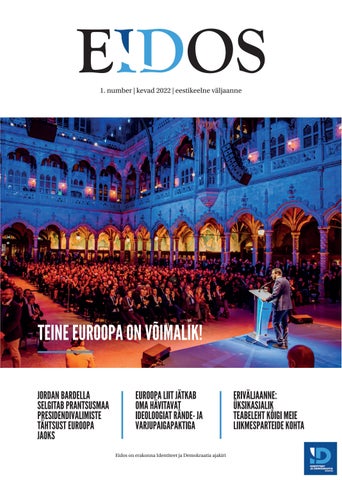
1. number | kevad 2022 | eestikeelne väljaanne
TEINE EUROOPA ON VÕIMALIK! JORDAN BARDELLA SELGITAB PRANTSUSMAA PRESIDENDIVALIMISTE TÄHTSUST EUROOPA JAOKS
EUROOPA LIIT JÄTKAB OMA HÄVITAVAT IDEOLOOGIAT RÄNDE- JA VARJUPAIGAPAKTIGA Eidos on erakonna Identiteet ja Demokraatia ajakiri
ERIVÄLJAANNE: ÜKSIKASJALIK TEABELEHT KÕIGI MEIE LIIKMESPARTEIDE KOHTA
www.id-party.eu facebook.com/IDParty/ twitter.com/IDParty_ instagram.com/idparty_/
GEROLF ANNEMANS Fraktsiooni Identiteet ja Demokraatia president President of the Identity and Democracy Party
Juhtkiri The term “eidos” originates in the Greek conceptual and philosophical framework of Plato. Plato used it to designate the transcendent: the ideal image of our changing world. Plato thus developed a system of thinking which would later become the philosophical and religious starting point for the European and Western model of civilisation.
Termin „eidos“ pärineb Platoni kreekakeelsest kontseptuaalsest ja filosoofilisest raamistikust. Platon kasutas seda tähistamaks transtsendentset: ideaalset kujutist meie muutuvast maailmast. Nii töötas Platon välja mõtlemissüsteemi, millest sai hiljem Euroopa ja Lääne tsivilisatsioonimudeli filosoofiline ja religioosne lähtepunkt.
Our European civilisation is the real Europe, the continent which through its diversity and various identities has been the driving force behind world events in such a unique and dynamic way - for better or for worse.
Meie Euroopa tsivilisatsioon on tõeline Euroopa, kontinent, mis oma mitmekesisuse ja erinevate identiteetide kaudu on olnud maailma sündmuste tõukejõuks ainulaadsel ja dünaamilisel viisil – nii heas kui ka halvas.
This beautiful word for Europe, a name rich in signification, has been hijacked: kidnapped by the strategists and communication specialists of what is in fact only a form of European cooperation. They systematically confuse the name of their legal model - the “European Union” - with the name “Europe” of the continental model of civilisation. As a result, they can quickly label criticism of their European Union as “anti-European” or even “non-European.” They also use the confusion to claim that their European Union is the only possible and sanctified form of cooperation on
See kaunis sõna Euroopa kohta, nimi, mis on rikas tähenduse poolest, on pantvangi võetud: selle on röövinud strateegid ja kommunikatsioonispetsialistid, kes tegutsevad selle heaks, mis on tegelikult vaid üks Euroopa koostöö vorme. Nad ajavad süstemaatiliselt segi oma õigusmudeli – Euroopa Liidu – nime kontinentaalse tsivilisatsioonimudeli nimega Euroopa. Selle tulemusena võivad nad kõhklemata nimetada Euroopa Liidu vastast kriitikat „Euroopa-vastaseks“ või isegi „mitte-euroopalikuks“.
the European continent. But despite the warning of Brexit, this European Union is moving ever closer in the direction of a supranational state. Resistance is also growing. The European political party Identity & Democracy wants to (co-)embody the resistance to this state of affairs, as an extension of the eponymous political group in the European Parliament. Resistance is growing in almost all EU Member States because their populations refuse to abandon their identity, their culture and their democracy at the gates of an artificial empire in which they would be reduced to a province or department of Brussels.
Samuti kasutavad nad segadust ära, väites, et nende Euroopa Liit on ainus võimalik ja pühitsetud koostöövorm Euroopa mandril. Kuid vaatamata Brexiti hoiatusele liigub Euroopa Liit üha lähemale riikideülese riigi suunas. Samuti kasvab vastupanu. Euroopa erakond Identiteet ja Demokraatia soovib (kaas)kehastada vastupanu sellele olukorrale, olles Euroopa Parlamendi samanimelise fraktsiooni laiendus. Vastupanu kasvab peaaegu kõigis ELi liikmesriikides, sest nende elanikkond keeldub loobumast oma identiteedist, kultuurist ja demokraatiast kunstliku impeeriumi väravatel, kus nad taandataks Brüsseli provintsiks või osakonnaks.
The most striking feature of the European Union is the way in which the continent is being overwhelmed by an unprecedented flow of immigration which seriously endangers the characteristics and identity of the European model of civilisation -and all this is happening over people's heads.
Euroopa Liidu kõige silmatorkavam tunnusjoon on viis, kuidas enneolematu sisserändevoog, mis tõsiselt ohustab Euroopa tsivilisatsioonimudeli omadusi ja identiteeti, ujutab kogu kontinendi üle – ja kõik see toimub üle inimeste peade.
We advocate the primacy of national sovereignty and identity for economic and financial affairs, as well as for
Me toetame riikliku suveräänsuse ja identiteedi ülimuslikkust majandusja rahandusküsimustes, samuti
immigration cooperation.
and
European
European cooperation must be a free association and not the straitjacket of the centralised unitary State which the other parties support. The dismantling of sovereignty represents a serious threat to the prosperity and identity of the various European peoples. The traditional political parties, which cannot contemplate differences in their way of thinking, want to eliminate them. In actual fact, these differences are Europe's considerable strength and asset. The European political party ID wants to be the patriotic alternative, based on a Europe that respects the uniqueness of the people and their inalienable right to be themselves, to govern themselves and to determine their own future. Meanwhile, at the Warsaw Summit in early December 2021, a number of national ID Party leaders met with other conservative leaders, such as the Polish and Hungarian Prime Ministers (among others) to map out strategic axes for future cooperation. Our political party is in itself an image of the European cooperation upon which we want to build the future of our continent - in friendship, but also in diversity.
sisserände ja Euroopa koostöö valdkonnas. Euroopa koostöö peab olema vaba assotsiatsioon, mitte tsentraliseeritud ühtse riigi hullusärk, mida toetavad teised parteid. Suveräänsuse kaotamine kujutab endast tõsist ohtu erinevate Euroopa rahvaste jõukusele ja identiteedile. Traditsioonilised erakonnad, kes ei suuda mõtiskleda oma mõtteviisi erinevuste üle ja tahavad need kõrvaldada. Tegelikult on need erinevused Euroopa märkimisväärne tugevus ja väärtus. Euroopa erakond ID tahab olla patriootlik alternatiiv, mis põhineb Euroopal, mis austab inimeste ainulaadsust ja nende võõrandamatut õigust olla nemad ise, valitseda iseennast ja määrata ise oma tulevikku. Samal ajal kohtusid Varssavi tippkohtumisel 2021. aasta detsembri alguses mitmed riiklikud ID parteide juhid teiste konservatiivsete juhtidega, nagu Poola ja Ungari peaministrid (teiste seas), et kaardistada tulevase koostöö strateegilised teljed. Meie poliitiline partei on iseenesest pilt Euroopa koostööst, millele me tahame rajada oma kontinendi tuleviku – sõpruses, aga ka mitmekesisuses. Gerolf Annemans Fraktsiooni Identiteet ja Demokraatia president
Gerolf Annemans President of the Identity and Democracy Party
5
40
82 98
44
90 76
74
88
EUROOPA
KODUMAAD JA PARTEID
34 Euroopa Liit jätkab oma
72 Matteo Salvini, Euroopa
hävitavat ideoloogiat rändepaktiga
The European Union continues its destructive ideology with its Migration Pact
38 Euroopa tuleviku konverents, föderalistlik farss
The Conference on the Future of Europe, a federalist farce
50 Suure Euroopa Parlamendi fraktsiooni poole?
Towards a super group in the European Parliament?
rannavalve
Matteo Salvini, European Coast Guard
74 Vlaams Belang, valmis vastutuseks
Vlaams Belang, ready for responsibility
80 Tomio Okamura, inspireeriv patrioot
Tomio Okamura, the inspiring patriot
46
10
60 SÜNDMUSED
SUUR INTERVJUU
88 Lissabon loob aluse uuele
10 Jordan Bardella
Euroopale
Lisbon sets the scene for another Europe
90 Patriootlikud noored –
lubadus paremaks tulevikuks Patriotic youth, the promise of a better future
92 Lõuna-Prantsusmaal
iseloomustab uut sügist võitlus massilise sisserände vastu
Kas Marine Le Penil on lootust presidendivalimised võita? Jordan Bardella, Rassemblement nationali uus president, selgitab, miks võit on võimalik. Samuti arutleb ta oma versiooni üle Euroopast. Does Marine Le Pen have a chance of winning the presidential election? Jordan Bardella, new president of the Rassemblement National, explains to us the reasons why victory is possible. He also discusses his vision of Europe.
In the south of France, for a new autumn marked by the fight against mass immigration
7
SUUR INTER
JORDAN BARDELLA
RVJUU
EU
SUUR INTERVJUU
Kas Marine Le Penil on lootust presidendivalimised võita? Eksklusiivintervjuu Jordan Bardellaga, Rassemblement nationali presidendiga, ID partei büroo liikmega. Does Marine Le Pen have a chance of winning the presidential election? Exclusive interview with Jordan Bardella, President of the Rassemblement National, member of the ID Party Bureau. Two opposing visions of the world are now confronting each other on the European political scene: the universalist one embodied by the outgoing French president Emmanuel Macron, and the other, rooted and carried by the patriotic political forces, will be championed by Marine Le Pen in the next presidential election. Jordan Bardella, the new president of the Rassemblement National, explains why victory is possible. He also discusses his vision of Europe. Eidos: France is at a turning point in its history. In April, two diametrically opposed visions will clash: a Europeanist and globalist
Euroopa poliitilisel areenil astuvad nüüd üksteisele vastu kaks vastandlikku maailmavaadet: universalistlik maailmavaade, mida kehastab ametist lahkuv Prantsusmaa president Emmanuel Macron, ja patriootlikes poliitilistes jõududes juurdunud ja nende kantud maailmavaade, mida kaitseb järgmistel presidendivalimistel Marine Le Pen. Jordan Bardella, Rassemblement nationali uus president, selgitab, miks võit on võimalik. Samuti arutleb ta oma versiooni üle Euroopast. Eidos: Prantsusmaa on oma ajaloos pöördepunktis. Aprillis põrkuvad kaks täiesti vastandlikku
vision embodied by Emmanuel Macron, and a vision based on nations held by Marine Le Pen. Is this the last chance for the country to escape globalism? I dare to believe that France is eternal and that it has all the human resources it needs to get out of the rut into which its leaders have pushed it. The current president Emmanuel Macron has constantly shown his contempt for his country by wanting to dissolve it into unbridled globalisation, by claiming that there is “no French culture,” by making the French feel guilty, even going so far as to say that he wanted to “piss off” millions of them. Based on this, there are effectively two visions of France, one embodied by Marine Le Pen - who will put the French back at the heart of the policies - and the other represented by Macron, who loves neither France nor the French. Is it reasonable to believe that victory is possible? All the polls now indicate that Marine Le Pen has a real chance of being elected. She is situated at more than 45% of the voting intentions in the second round, i.e. within the margin of error. The French have understood that Emmanuel Macron is the last representative of a worn-out and disconnected system. The candidate supported by the Rassemblement National is now ready, and you can sense her great serenity and determination.
nägemust: euroopalik ja globalistlik nägemus, mida kehastab Emmanuel Macron, ja riikidel põhinev nägemus, mis on omane Marine Le Penile. Kas see on riigi jaoks viimane võimalus globalismist pääseda? Julgen arvata, et Prantsusmaa on igavene ja et tal on kõik inimressursid, mida ta vajab, et pääseda sellest ringiratast tammumisest, millesse tema juhid on ta surunud. Praegune president Emmanuel Macron on pidevalt näidanud põlgust oma riigi vastu, soovides selle lahustada ohjeldamatuks globaliseerumiseks, väites, et ei ole olemas prantsuse kultuuri, pannes prantslased end süüdi tundma, minnes isegi nii kaugele, et öelda, et ta tahtis neist miljoneid välja vihastada. Sellele tuginedes on Prantsusmaast tegelikult kaks nägemust, ühte kehastab Marine Le Pen – kes asetab prantslased poliitika keskmesse tagasi –, ja teist esindab Macron, kes ei armasta Prantsusmaad ega prantslasi. Kas on mõistlik uskuda, et võit on võimalik? Kõik küsitlused näitavad, et Marine Le Penil on reaalne võimalus valituks saada. Tal on teises voorus rohkem kui 45% hääletuskavatsustest, s.t veapiiril. Prantslased on aru saanud, et Emmanuel Macron on kulunud ja lahti ühendatud süsteemi viimane esindaja. Kandidaat, keda toetab Rassemblement national, on nüüd valmis, ja võib tajuda tema suurt rahu ja sihikindlust.
11
SUUR INTERVJUU
Let's look ahead and suppose that the French elect Marine Le Pen as Head of State. What will be her priorities on the European stage?
Vaatame tulevikku ja oletame, et prantslased valivad riigipeaks Marine Le Peni. Millised on tema prioriteedid Euroopa areenil?
The priority will be to meet the European leaders in order to reaffirm very clearly that the French people are sovereign and are masters of their destiny. An unelected and highly undemocratic institution like the European Commission has no business dictating the daily lives of free peoples.
Esmatähtis on kohtuda Euroopa juhtidega, et kinnitada väga selgelt, et Prantsusmaa rahvas on suveräänne ja oma saatuse peremees. Valimata ja väga ebademokraatlikul institutsioonil nagu Euroopa Komisjon ei ole mingit õigust dikteerida vabade rahvaste igapäevaelu.
Do you think that the European Union as you describe it is reformable? In short, which bodies should be abolished and which should be reworked?
Kas te arvate, et Euroopa Liit, nagu te seda kirjeldate, on ümberkujundatav? Lühidalt, millised organid tuleks kaotada ja millised ümber korraldada?
As I said to Emmanuel Macron in the European Parliament a few weeks ago, their Europe is 60 years old while ours is 3000 years old. Unlike France, the European Union as it exists today is an artificial construct kept alive by federalists who are increasingly being disowned by their people. All attempts to revive their federal Europe project are doomed to failure. Take the Conference on the Future of Europe. It was a fiasco, and yet Emmanuel Macron has already announced that he wants to draw conclusions from it which we know will lead to more Europe and less nationhood. In my opinion Europe must be reformed, starting not from the Commission but from the sovereign states which derive their legitimacy from the democratic process. We can envisage strategic
Nagu ma paar nädalat tagasi saalis Emmanuel Macronile ütlesin, on nende Euroopa 60 aastat vana, samas kui meie oma on 3000 aastat vana. Erinevalt Prantsusmaast on Euroopa Liit praegusel kujul kunstlik konstruktsioon, mida hoiavad elus föderalistid, keda nende rahvas üha enam tõrjub. Kõik katsed taaselustada föderaalse Euroopa projekt on määratud läbikukkumisele. Võtame näiteks Euroopa tuleviku konverentsi. See oli fiasko ja ometi on Emmanuel Macron juba teatanud, et tahab sellest järeldusi teha, mis meie teada toob kaasa rohkem Euroopat ja vähem rahvuslust. Minu arvates tuleb Euroopat reformida, alustades mitte komisjonist, vaid suveräänsetest riikidest, mis saavad oma legitiimsuse demokraatlikust protsessist. Võime kavandada strateegilist koostööd
13
SUUR INTERVJUU
cooperation interests.
depending
on
their
Which are the areas of activity in which this cooperation could bring added value? And how can it be implemented? There are a number of areas where we should pool our talents, not to sell off our industrial secrets and know-how to other countries but to combine our skills. Macron thought he wanted to move forward on the Future Combat Air System (FCAS), with Germany in particular but also with Spain. France is losing out, as is too often the case in our relations with our German neighbours. Similarly, the idea of a common European defence is not desirable because we have sometimes divergent interests. On the other hand, we can think together about how to defend our borders. Frontex should no longer be an agency for receiving migrants, but rather Europe should do everything possible to prevent them from entering its territory. Things have not changed since the migration crisis of 2015 and the immigrationist ideology has not been defeated... On the contrary. The Marrakesh Pact was a clear signal of the willingness of leaders to promote migration flows. In its wake, the European Union's Migration Pact, which was conceived behind closed doors, is increasingly imposing the idea that migration is part of Europe's destiny. This is
sõltuvalt nende huvidest. Millistes tegevusvaldkondades võiks see koostöö anda lisaväärtust? Ja kuidas seda rakendada? On mitmeid valdkondi, kus me peaksime oma anded ühendama, mitte müüma oma tööstussaladusi ja oskusteavet teistele riikidele, vaid ühendama oma oskused. Macron arvas, et soovib tuleviku õhulahingute süsteemi (FCAS) osas edasi liikuda, eriti Saksamaaga, aga ka Hispaaniaga. Prantsusmaa kaotaks sellega, nagu liiga tihti meie suhetes sakslastest naabritega. Samamoodi ei ole Euroopa ühise kaitse idee soovitav, sest meie huvid on mõnikord erinevad. Teisest küljest saame koos mõelda, kuidas oma piire kaitsta. Frontex ei peaks enam olema sisserändajate vastuvõtmise amet, vaid Euroopa peaks tegema kõik võimaliku, et takistada nende sisenemist oma territooriumile. Pärast 2015. aasta rändekriisi ei ole olukord muutunud ja sisserände ideoloogiat ei ole alistatud ... Otse vastupidi. Marrakechi pakt oli selge märk juhtide valmisolekust edendada rändevoogusid. Suletud uste taga loodud Euroopa Liidu rändepakt surub üha enam peale mõtet, et ränne on osa Euroopa saatusest. See on järjekordne tõestus sellest, et eliit on reaalsusest irdunud, sest selle protsessi loogilises otsas on tavaline prantslane Clermont-Ferrandist või Briançonist, aga ka tavaline eesti või flaami rahvas,
further proof that the elites are out of touch and disconnected with reality, because, at the logical end of this process it is the ordinary French person from Clermont-Ferrand or Briançon but also the ordinary Estonian or Flemish people who will see their way of life turned upside down. The French government presented a plan for the distribution of migrants a year ago in an authoritarian manner. The countries who are hostile to us have realised that migration is our Achilles heel and are blackmailing our peoples with migration. This is indeed a strategy which has pursued lately by Lukashenko of Belarus, but also in a more structural manner by Recep Tayyip Erdoğan. Given that the latter is multiplying blackmail attempts and threats towards Europe, how should Europe behave with Turkey? Let’s remember the incident in the Mediterranean last June. As part of an international mission to enforce the arms embargo on Libya, a Turkish frigate was aggressive (to say the least) towards a French ship by performing radar illumination on three occasions, with Turkish military personnel on duty. Do we need reminding that a number of our leaders were advocating Turkey's entry into the European Union? This country is not geographically located in Europe, is not part of the European civilisation area and, due to its demographic weight, would send more MEPs to the European Parliament than France.
kes näeb oma eluviisi pea peale pööratavat. Prantsuse valitsus esitas autoritaarselt aasta tagasi sisserändajate jaotamise kava. Riigid, kes on meie vastu vaenulikud, on mõistnud, et ränne on meie Achilleuse kand, ja šantažeerivad meie rahvast rändega. See on tõepoolest strateegia, mida on viimasel ajal järginud Valgevene Lukašenka, aga ka struktuursemalt Recep Tayyip Erdoğan. Arvestades, et viimane mitmekordistab Euroopa vastu suunatud väljapressimiskatseid ja ähvardusi, siis kuidas peaks Euroopa Türgiga käituma? Meenutagem eelmise aasta juunis Vahemerel toimunud intsidenti. Osana rahvusvahelisest missioonist Liibüa relvaembargo jõustamiseks oli Türgi fregatt agressiivne (pehmelt öeldes) Prantsuse laeva suhtes, kasutades kolmel korral radarivalgustust, kusjuures Türgi sõjaväelased olid valves. Kas me peame meelde tuletama, et mitu meie juhti pooldasid Türgi ühinemist Euroopa Liiduga? See riik ei asu geograafiliselt Euroopas, ei ole osa Euroopa tsivilisatsioonipiirkonnast ja saadaks oma demograafilise kaalu tõttu Euroopa Parlamenti rohkem saadikuid kui Prantsusmaa. Peame suhtuma kindlameelselt islamistlikku sultanisse Erdoğani, lõpetama tema väljapressimise ja ennekõike lõpetama tema rahastamise!
15
SUUR INTERVJUU
We must have a firm attitude towards the Islamist Sultan Erdoğan, stop giving in to his blackmail and above all stop funding him! Looking back, do you think the British exit from the European Union was a good thing? It's up to the British to say, but clearly Brexit, which was supposed to bring misery and calamity, has been a reasonable success. There has always been a British ideal of insularity and empire. The one as a result of its particular geographical position, and the other (which the European Union sometimes imitated) made its membership of the EU a balancing act. The people have decided, and that's just fine. But this is not the solution that Marine Le Pen and the Rassemblement National advocate for France. Your opponents criticise Marine Le Pen for having evolved on the issue of membership of the EuropeanUnion and the euro... The European context has itself changed significantly. We were isolated in Europe at the time, but we have since established relations everywhere with European patriotic parties. They are each making progress or are already in power in their own country. This is the case in Hungary and Poland and also in Slovakia, where the patriots are in government. In the Czech Republic and in Portugal they are strongly on the rise.
Tagasi vaadates, kas te arvate, et brittide lahkumine Euroopa Liidust oli hea? Brittide asi on seda öelda, kuid Brexit, mis pidi tooma kannatusi ja õnnetusi, on olnud suhteliselt edukas. Alati on eksisteerinud Briti eraldiseisvuse ja impeeriumi ideaal. Üks nende erilise geograafilise asukoha tõttu ja teine (mida Euroopa Liit mõnikord jäljendas) muutis nende liikmesuse EL-is keeruliseks tasakaalu hoidmiseks. Inimesed on otsustanud ja sellest pole midagi. Kuid see ei ole lahendus, mida Marine Le Pen ja Rassemblement national pooldavad Prantsusmaal. Teie oponendid kritiseerivad Marine Le Peni selle eest, et ta on arenenud Euroopa Liidu liikmelisuse ja euro küsimuses ... Euroopa kontekst ise on oluliselt muutunud. Me olime sel ajal Euroopas isoleeritud, kuid oleme sellest ajast saadik loonud kõikjal suhted Euroopa patriootlike parteidega. Nad kõik teevad edusamme või on juba võimul oma riigis. Nii on see Ungaris ja Poolas ning ka Slovakkias, kus patrioodid on valitsuses. Tšehhi Vabariigis ja Portugalis on see jõudsalt tõusuteel. Lähme tagasi Ungari ja Poola juurde: mida te arvate sealsetest poliitikatest? Ma kaitsen riikide suveräänsust, seega olen alati tõrges sekkuma teiste riikide siseasjadesse. Euroopa Liit on
Let's get back to Hungary and Poland: what do you think of the policies there? I defend the sovereignty of States, so I am always reluctant to interfere in the internal affairs of other countries. The
võtnud eriliseks ülesandeks dikteerida liikmesriikidele sisepoliitikat ning see on hakanud ärritama nii juhte kui ka rahvaid. Poolakad ja ungarlased tahavad otsustada, mis on nende riigi ja selle tuleviku jaoks hea, ning nad tahavad,
17
SUUR INTERVJUU
European Union has made a speciality to dictate internal policies to Member States, and this is beginning to exasperate leaders and peoples alike. Poles and Hungarians want to decide what is good for their country and its future, and they want to see their identity preserved. How can they be wrong? The patriotic political forces are now divided in the European Parliament, between the member parties of Identity and Democracy and those who sit in the European Conservatives and Reformists. Are you confident that these formations can be brought together under one flag? United, we would be all the stronger to confront the defenders of the federalist vision of Europe. I am optimistic that this process - which has been underway for several months - will come to fruition. This obviously requires discussion because, as patriots, our national interests or our evaluation of certain issues may differ in the details. We don’t have to agree on everything to work together - we just have to respect each other's specificities. But I know that we agree on the essential point, which is to give people hope and allow them to continue to fly their national flags proudly. Let's talk a little about you, Jordan Bardella: do you feel European? Above all, I feel profoundly French, the fruit of a heritage built up over the
et nende identiteet säiliks. Kuidas nad saavad eksida? Isamaalised poliitilised jõud on nüüd Euroopa Parlamendis jagunenud Identiteedi ja Demokraatia liikmesparteide ning Euroopa Konservatiivide ja Reformistide vahel. Kas te olete kindel, et need koosseisud saab koondada ühe lipu alla? Ühinedes oleksime tugevamad, et astuda vastu föderalistliku Euroopa nägemuse kaitsjatele. Ma olen optimistlik, et see protsess – mis on kestnud juba mitu kuud –, saab teoks. See nõuab ilmselgelt arutelu, sest patriootidena võivad meie riiklikud huvid või teatud küsimuste hindamine üksikasjades erineda. Me ei pea kõiges nõustuma, et koos töötada – me peame lihtsalt üksteise eripärasid austama. Kuid ma tean, et me nõustume olulise punktiga, milleks on anda inimestele lootust ja lubada neil jätkata uhkusega oma riigilippude heiskamist. Räägime natuke sinust, Jordan Bardella: kas tunned end eurooplasena? Eelkõige tunnen end peamiselt prantslasena, osana pärandist, mille on sajandite jooksul loonud meie esivanemad, kes ühendasid geniaalsuse (olgu see siis teaduslik, kirjanduslik või kunstiline) meile ainuomase eluviisiga. Samuti tunnen, et olen Prantsusmaa huvide tagaja – loomulikult tema piirides –, aga ka Euroopas ja maailmas. Ma tahan, et
Jordan Bardella koos Chega presidendi André Venturaga
centuries by our ancestors who combined genius (whether scientific, literary or artistic) with a way of life which is individual to us. I also feel that I am the guarantor of France's interests - within its borders of course - but also in Europe and in the world. I want our country to be great again. This does not however prevent us from feeling that we belong to the European civilisation which we share. Precisely which places in Europe arouse such a feeling in you? Let me start by saying that we all have roots within us. Mine are linked to the region where I grew up, in Seine-Saint-Denis, in Ile-de-France, where all the ravages of globalisation can be seen - starting with the consequences of massive immigration. I of course feel this visceral attachment to our country wherever I am on French territory.
meie riik oleks jälle suurepärane. See ei takista meid siiski tundmast, et kuulume Euroopa tsivilisatsiooni, mida me jagame. Täpselt; millised kohad Euroopas tekitavad sinus sellise tunde? Alustuseks ütlen, et meil kõigis on juured. Minu omad on seotud piirkonnaga, kus ma üles kasvasin, Seine-Saint-Denis’s, Ile-de-France’is, kus on näha globaliseerumise laastamistööd – alates massilise sisserände tagajärgedest. Loomulikult tunnen ma seda sisemist kiindumust meie riiki, ükskõik kus Prantsusmaa territooriumil ma ka ei viibiks.
19
SUUR INTERVJUU
As a 26-year-old, you are from a new generation. Do you feel that there is a support for the ideas of Marine Le Pen among the younger people?
26-aastasena oled sa uuest põlvkonnast. Kas te arvate, et nooremad inimesed toetavad Marine Le Peni ideid?
Marine Le Pen is popular among young people - the Rassemblement National regularly comes out on top among this group both in polls and in election results. There is a real awareness and willingness to put an end to several decades of political correctness and disastrous management which threatens their future as French people. This should encourage us: this youth with pro-national feelings, a phenomenon which can be observed both in France and also everywhere else in Europe, will be the lever we can use to save our nations. Marine Le Pen represents a hope for many young people.
Marine Le Pen on noorte seas populaarne – Rassemblement national tõuseb regulaarselt selle grupi esikohale nii küsitlustes kui ka valimistulemustes. On olemas tõeline teadlikkus ja tahe teha lõpp mitmekümneaastasele poliitilisele korrektsusele ja katastroofilisele juhtimisele, mis ohustab nende tulevikku prantslastena. See peaks meid julgustama: see rahvuslikke tundeid propageeriv noorus, nähtus, mida võib täheldada nii Prantsusmaal kui ka kõikjal mujal Euroopas, on hoob, mida saame kasutada oma rahvaste päästmiseks. Marine Le Pen on paljude noorte jaoks lootus.
21
EUROOPA
Prantsusmaa presidendivalimised toimuvad 10. ja 24. aprillil. The French presidential elections will take place on 10 and 24 April The French will be faced with a clear choice: the headlong rush towards ever more globalism or taking back their national sovereignty. Emmanuel Macron and Marine Le Pen embody both sides of the alternative.
Prantslased seisavad silmitsi selge valikuga: põikpäine tormamine üha suurema globalismi poole või oma riikliku suveräänsuse tagasivõtmine. Emmanuel Macron ja Marine Le Pen kehastavad kumbki ühte võimalust.
We can be optimistic: Marine Le Pen has never been placed so high in the polls, which give her between 45 and 50% of the vote in the second round (and so within the margin of error). She has never been so close to the Elysée.
Me võime olla optimistlikud: Marine Le Pen ei ole kunagi olnud nii kõrgel kohal valimisküsitlustes, mis annab talle 45–50% häältest teises voorus (ja seega veapiiril). Ta pole kunagi Elysée’le nii lähedal olnud.
France is at a turning point, and with it the whole of Europe. The arrival of a patriot at the head of the state will undoubtedly have positive repercussions for parties which are committed to defending their identity and national sovereignty.
Prantsusmaa on pöördepunktis ja koos sellega kogu Euroopa. Patrioodi saabumisel riigijuhtimisse on kahtlemata positiivsed tagajärjed parteidele, kes on pühendunud oma identiteedi ja rahvusliku suveräänsuse kaitsmisele.
23
ROOPA
EURO EUROOPA EUROO
EUROO KODUMAA ROOPA K KODUMAAD JA EUR OPA KODUM
EUROOPA
Et (püüda) paremini mõista Euroopa Liidu keerulist toimimist To (try to) better understand the convoluted workings of the European Union
The European Union seems to most citizens to be very muddled in its functioning and institutions, which we believe is proof that it does not meet some of the requirements of democratic life: simplicity, representativeness, and democracy. The Identity and Democracy Party is critical of the current functioning of the European Union. Some institutions seem to us to have too much power - such as the unelected European Commission. In order to make it clearer for you, we give you a brief overview of the roles of the different institutions.
Identiteedi ja Demokraatia Partei on kriitiline Euroopa Liidu praeguse toimimise suhtes. Mõnel institutsioonil, näiteks valimata Euroopa Komisjonil, näib olevat liiga palju võimu. Et see oleks teile selgem, anname teile lühiülevaate erinevate institutsioonide rollidest. Euroopa Liit näib olevat oma toimimises ja institutsioonides väga segadusseajav, mis meie arvates tõestab, et see ei vasta mõnele demokraatliku elu nõudele: lihtsusele, esinduslikkusele ja demokraatiale. Me võtame vastu väljakutse esitleda teile seitset peamist institutsiooni paaris reaga.
The European Council brings together the Heads of State and government of the European Union. It is headed by a president - currently the Belgian Charles Michel - who is responsible for facilitating compromises. Its objective is to define the main lines of European policy, and it meets four times a year.
Euroopa Ülemkogu toob kokku Euroopa Liidu riigipead ja valitsusjuhid. Seda juhib president – praegu Belgia president Charles Michel, kes vastutab kompromisside hõlbustamise eest. Selle eesmärk on määratleda Euroopa poliitika põhisuunad ja see kohtub neli korda aastas.
27
EUROOPA
The principal role of the European Commission is to propose legislation and ensure the implementation of Community policies. Although it is an essential component, it nevertheless suffers from a lack of democracy since the commissioners (one per Member State, 27 in total) are not directly elected by the citizens but proposed by the Heads of State and government and then validated by the Parliament. Established in 1957 by the Treaty of Rome, it is currently headed by Ursula von der Leyen. The Council of the European Union is the body that brings together the ministers in charge of the files in question (ministers of the interior, finance, etc.). It adopts European legislation together with the Parliament on the basis of a proposal from the European Commission, validates (again with the Parliament) the annual budget of the European Union, and draws up the common foreign and security policy. The European Parliament shares the prerogatives of the legislative power with the Council of the European Union. Since 1979, it has been elected by direct universal suffrage according to the proportional voting system (including in countries used to majority voting), which guarantees a representation which is sometimes fairer than in national parliaments. The official seat of the European Parliament is in Strasbourg, where plenary sessions are held, while committees are usually held in Brussels. The elected members of the
Euroopa Komisjoni peamine roll on õigusaktide ettepanekute tegemine ja ühenduse poliitika rakendamise tagamine. Kuigi see on oluline komponent, kannatab see siiski demokraatia puudumise all, sest volinikke (üks igast liikmesriigist, kokku 27) ei vali kodanikud otse, vaid neid esitavad riigipead ja valitsusjuhid ning parlament kinnitab nad. See asutati 1957. aastal Rooma lepinguga ja praegu juhib seda Ursula von der Leyen. Euroopa Liidu Nõukogu on organ, mis koondab kõnealuste dokumentide eest vastutavad ministrid (siseministrid, rahandusministrid jne). See võtab Euroopa Komisjoni ettepaneku alusel vastu Euroopa õigusaktid koos parlamendiga, kinnitab (taas koos parlamendiga) Euroopa Liidu aastaeelarve ning koostab ühise välisja julgeolekupoliitika. Euroopa Parlament jagab seadusandliku võimu eesõigusi Euroopa Liidu Nõukoguga. Alates 1979. aastast on see valitud otsestel ja üldistel valimistel proportsionaalse hääletamissüsteemi alusel (sealhulgas riikides, kus kasutatakse häälteenamust), mis tagab mõnikord õiglasema esindatuse kui riikide parlamentides. Euroopa Parlamendi ametlik asukoht on Strasbourgis, kus toimuvad täiskogu istungid, samas kui komisjonid kohtuvad tavaliselt Brüsselis. Rahvusparteide valitud liikmed jagunevad parlamenditöö hõlbustamiseks rühmadesse.
national parties are divided into groups in order to facilitate parliamentary work. The Court of Justice of the European Union ensures that European law is applied in conformity in all Member States. It is also competent in the interpretation of European law, at the request of judges working in the different countries. The Commission and the Member States may refer cases to it to assess whether a Member State has violated European law. Based in Frankfurt, the European Central Bank sets the direction for monetary policy and the single currency (the euro). Since its creation, one of the main priorities of the Central Bank is price stability and therefore the fight against inflation. The Court of Auditors is responsible for analysing the revenue and expenditure of the European Union. This external body theoretically provides an independent assessment of the management of the institutions' accounts.
Euroopa Liidu Kohus tagab, et Euroopa õigust kohaldatakse kooskõlastatult kõigis liikmesriikides. See on pädev ka Euroopa õiguse tõlgendamisel eri riikides töötavate kohtunike taotlusel. Komisjon ja liikmesriigid võivad pöörduda komisjoni poole, et hinnata, kas liikmesriik on rikkunud Euroopa õigust. Frankfurdis asuv Euroopa Keskpank määrab kindlaks rahapoliitika ja ühisraha (euro) suuna. Alates keskpanga loomisest on selle üks peamisi prioriteete hinnastabiilsus ja seega võitlus inflatsiooniga. Kontrollikoja ülesanne on analüüsida Euroopa Liidu tulusid ja kulusid. See väline asutus annab teoreetiliselt sõltumatu hinnangu institutsioonide raamatupidamisarvestuse haldamise kohta.
29
EUROOPA
Mis on Euroopa erakond? What is a European political party? European political parties are part of the European “institutional machinery” which costs taxpayers a lot of money. One can guess that they will eventually be the instrument of the “Europeanists” to push for the existence of transnational lists during elections. While the Identity and Democracy Party is “eurocritical,” it is nevertheless obliged to constitute itself as a party in order not to be further excluded from the democratic process. When discussing the European Parliament, we saw that MEPs elected in their country on a national list come together by affinity. The results of the 2019 elections gave the following breakdown: - Group of the European People's Party (182 seats), - Progressive Alliance of Socialists and Democrats in the European Parliament (154), - Renew Europe (108), - Identity and Democracy (75), - Greens/European Free Alliance Group (74), - European Conservatives and Reformists (62),
Euroopa tasandi erakonnad on osa Euroopa institutsioonilisest mehhanismist, mis maksab maksumaksjatele palju raha. Võib arvata, et neist saavad lõpuks nn euroopalaste töövahendid, et suruda valimisteks läbi riikidevahelised nimekirjad. Kuigi Identiteedi ja Demokraatia Partei on n-ö eurokriitiline, on see siiski kohustatud moodustama partei, et mitte jääda demokraatlikust protsessist välja. Euroopa Parlamendi teemal arutades nägime, et oma kodumaal riiklikust nimekirjast valitud parlamendiliikmed tulevad kokku sarnasuse alusel. 2019. aasta valimiste tulemused jagunesid järgmiselt: - Euroopa Rahvapartei fraktsioon (182 kohta), - Sotsiaaldemokraatide ja demokraatide fraktsioon Euroopa Parlamendis (154), - Euroopa Uuendamine (108), - Identiteet ja Demokraatia (75), - Roheliste / Euroopa Vabaliidu fraktsioon (74), - Euroopa Konservatiivid ja Reformistid (62),
Euroopa patriootlike liidrite kohtumine
- The Left in the European Parliament Group (41), to which should be added the non-registered members.
- Vasakpoolsed Euroopa Parlamendis (41), millele tuleks lisada registreerimata liikmed.
While it is tempting to confuse the two, the notion of a European political party is different from that of a group. The two concepts do not overlap. Thus, the parties are intended to contain, for example, national political formations which have elected representatives on their soil but are not represented in the European Parliament. On the other hand, some parties that are members of a group may choose not to join a party due to conviction or other
Kuigi nende kahe segiajamine on ahvatlev, erineb Euroopa tasandi erakonna mõiste fraktsiooni omast. Need kaks mõistet ei kattu. Seega on erakondade eesmärk hõlmata näiteks riiklikke poliitilisi rühmitusi, kellel on oma riigis valitud esindajad, kuid kes ei ole esindatud Euroopa Parlamendis. Teisest küljest võivad mõned rühmitusse kuuluvad liikmed otsustada põhimõtete või muude põhjuste tõttu erakonnaga mitte ühineda. Lõpetuseks, mõned
31
EUROOPA
reasons. Finally, some groups in the European Parliament are multi-party: for example, the Green/European Free Alliance Group consisting of the European Green Party (EGP) and the European Free Alliance (EFA). Recognised since the Maastricht Treaty (1992), European parties “contribute to forming a European awareness and to expressing the political will of the citizens of the Union.” As a result of the will of the most ardent federalists, each national party is obliged to display its possible membership of a European party on its website. The Authority for European Political Parties and Foundations is keeping a sharp eye on things!
Euroopa Parlamendi fraktsioonid on mitmeparteilised: näiteks Roheliste / Euroopa Vabaliidu fraktsioon, mis koosneb Euroopa Rohelisest Parteist (EGP) ja Euroopa Vabaliidust (EFA). Alates Maastrichti lepingust (1992) tunnustatud Euroopa erakonnad „aitavad kaasa Euroopa teadlikkuse kujunemisele ja Euroopa Liidu kodanike poliitilise tahte väljendamisele.“ Kõige tulihingelisemate föderalistide tahte tulemusena on iga riiklik erakond kohustatud oma veebisaidil näitama oma võimalikku liikmesust Euroopa erakonnas. Euroopa erakondade ja sihtasutuste amet hoiab asjadel tähelepanelikult silma peal!
To be recognised as a party, the latter must have representation in at least one quarter of the EU Member States (i.e. seven), in the national or regional parliaments, or in the European Parliament; or it or its member parties must have received at least three per cent of the votes cast in the European Parliament in at least one quarter of the Member States. It is obviously forbidden for a party to use European funds to finance national campaigns.
Erakonnana tunnustamiseks peab sellel olema esindatus vähemalt ühes neljandikus EL-i liikmesriikidest (st seitsmes), riiklikes või piirkondlikes parlamentides või Euroopa Parlamendis; või peab see või selle liikmesparteid olema saanud vähemalt kolm protsenti Euroopa Parlamendis antud häältest vähemalt ühes neljandikus liikmesriikidest. Erakonnal on ilmselgelt keelatud kasutada Euroopa vahendeid riiklike kampaaniate rahastamiseks.
To further complicate the Byzantine European bureaucracy, there are also foundations which are “organisations affiliated to a European political party which support and complement the objectives of that party,” for example by organising conferences.
Bütsantsliku bürokraatia edasiseks raskendamiseks Euroopas on olemas ka sihtasutused, mis on „Euroopa erakonnaga seotud organisatsioonid, mis toetavad ja täiendavad selle erakonna eesmärke“, näiteks konverentside korraldamise kaudu.
There are currently ten officially recognised European political parties:
Praegu on ametlikult tunnustatud Euroopa erakondi kümme:
- European People's Party (centre), - Alliance of Liberals and Democrats for Europe (liberal right), - European Conservatives and Reformists Party (right), - European Christian Political Movement (conservative right), - European Democratic Party (centre), - European Free Alliance (regionalism), - European Green Party (environmentalism), - Party of European Socialists (left), - Party of the European Left (extreme left), - Identity and Democracy Party.
- Euroopa Rahvapartei (tsentristid), - Euroopa Demokraatide ja Liberaalide Liit (liberaalsed parempoolsed), - Euroopa Konservatiivide ja Reformistide Partei (parempoolsed), - Euroopa Kristlik Poliitiline Liikumine (konservatiivsed parempoolsed), - Euroopa Demokraatlik Partei (tsentristid), Euroopa Vabaliit (regionalistid), - Euroopa Roheline Partei (enviromentalistid), - Euroopa Sotsiaaldemokraatide Partei (vasakpoolsed), - Euroopa Vasakpartei (ultravasakpoolsed), - erakond Identiteet ja Demokraatia.
The Identity and Democracy Party consists of the following national parties: Lega (Italy), Rassemblement National (France), Vlaams Belang Party (Flanders), Freiheitliche Partei Österreichs (Austria), Eesti Konservatiivne Rahvaerakond (Estonia), Freedom and Direct Democracy (Czech Republic), Sme Rodina (Slovakia) Chega (Portugal) and Nea Dexia (Greece). A more detailed description of each of these parties can be found at the end of the issue.
Viimasena, kuid mitte vähemtähtsana, kuna teie käes on erakonna ajakiri, koosneb erakond Identiteet ja Demokraatia järgmistest riiklikest erakondadest: Lega (Itaalia), Rassemblement national (Prantsusmaa), Vlaams Belang (Flandria), Freiheitliche Partei Österreichs (Austria), Eesti Konservatiivne Rahvaerakond (Eesti), Svoboda a přímá demokracie (Tšehhi Vabariik), Sme Rodina (Slovakkia), Chega (Portugal) ja Nea Dexia (Kreeka). Rohkem teavet iga erakonna kohta leiate ajakirja lõpust.
33
EUROOPA
Euroopa Liit jätkab č oma hävitavat ideoloogiat rändepaktiga The European Union continues its destructive ideology with its Migration Pact The Global Compact for Safe, Orderly and Regular Migration, better known to the general public as the Marrakesh Pact, was much discussed in December 2018: it promised ever more uncontrolled immigration and articulated as never before the outlines of the migration ideology prevalent among certain elites. Some countries weren’t taken in and refused to sign it. Among them are Hungary and Poland, in the eye of the European storm for not complying with internationalist and immigrationist injunctions. Belgium rushed to sign it, even if it meant toppling a government, and Charles Michel (its Prime Minister) was chosen as President of the European Council in the process. The politics of petty backroom deals had a bright future ahead of it from that day.
Ohutut, korrapärast ja tavapärast rännet käsitlevast ülemaailmsest kokkuleppest, mida avalikkus tunneb paremini Marrakechi paktina, räägiti 2018. aasta detsembris palju: see lubas üha enam kontrollimatut sisserännet ja sõnastas teatud eliidi hulgas levinud rändeideoloogia piirjooned paremini kui kunagi varem. Mõni riik ei nõustunud sellega ja nad keeldusid alla kirjutamast. Nende hulgas on Ungari ja Poola, kes hoolimata neid ümbritsevast tormist keelduvad täitmast internatsionalistide ja immigratsioonipooldajate ettekirjutusi. Belgia kiirustas sellele alla kirjutama, isegi kui see tähendas valitsuse kukkumist, ning protsessi käigus valiti Euroopa Ülemkogu eesistujaks Charles Michel (nende
In order not to suffer another setback, the European Commission has been working on its Migration and Asylum Pact in the greatest secrecy, away from the eyes of people who are especially keen to preserve their identity. The leaders of the European Union are nevertheless constantly defending it with implicit faith, not failing to criticise the “populists who oppose it.” President of the Commission Ursula von der Leyen is constantly reminding us of her mantra. And so during the presentation of the Pact, she didn’t hesitate to declare that “migration has always been a reality in Europe” and that it “will continue to be so.” We have been warned.
peaminister). Väikeste tagatoatehingute poliitikat oli sellest päevast alates ootamas helge tulevik. Et mitte kannatada järjekordset tagasilööki, on Euroopa Komisjon töötanud oma rändeja varjupaigapakti kallal suurima saladuskatte all, eemal inimeste silmist, kes on eriti huvitatud oma identiteedi säilitamisest. Sellegipoolest kaitsevad Euroopa Liidu juhid seda pidevalt kaudse usuga, aina kritiseerides „populiste, kes sellele vastu seisavad“. Komisjoni president Ursula von der Leyen meenutab meile pidevalt oma mantrat. Seega ei kõhelnud ta pakti tutvustamise ajal kuulutamast, et „ränne on Euroopas alati olnud reaalsus“ ja et „see on nii ka edaspidi“. Meid on hoiatatud.
35
EUROOPA
Under the pretext of “improving the security of migrants”, the EU Migration and Asylum Pact will create the legal, logistical and political conditions for the mass movement and settlement of people, mainly from the Third World, to the European continent.
Sisserändajate turvalisuse parandamise ettekäändel luuakse EL-i rände- ja varjupaigapaktiga õiguslikud, logistilised ja poliitilised tingimused inimeste massiliseks liikumiseks ja asustamiseks peamiselt kolmandast maailmast Euroopa mandrile.
At the same time, European borders are not secure. Ylva Johansson, who is often caught knitting during
Samal ajal ei ole Euroopa piirid turvalised. Sageli parlamendidebattide käigus
parliamentary debates, had to concede that 22% of people entering the EU are not checked. And yet she still likes to repeat, against all common sense: “We need immigration.”
kudumisega vahele jäänud Ylva Johansson pidi möönma, et 22% Euroopa Liitu sisenejatest on kontrollimata. Ja ometi meeldib talle ikka veel korrata, terve mõistuse vastaselt: „Me vajame sisserännet.“
37
EUROOPA
Euroopa tuleviku konverents, föderalistlik farss The Conference on the Future of Europe, a federalist farce Few European citizens have heard of it, but the Conference on the Future of Europe was nevertheless announced with great fanfare by the European Union authorities. The barely-concealed objective is to continue the European Union's headlong rush towards greater federalism. Several members of the ID Party are defending you: Hélène Laporte (France), Catherine Griset (France), Philippe Olivier (France), Mara Bizzotto (Italy), Alessandro Panza (Italy), Susanna Ceccardi (Italy), Gerolf Annemans (Flanders), Jaak Madison (Estonia), Ludovit Goga (Slovakia), and Petra Steger (Austria) The EU has selected ten themes for debate: climate change and the environment; health; a stronger economy, social justice and employment; the EU in the world; values and rights, rule of law and security; digital transformation; European democracy; migration; education, culture; youth and sport. If the figures are to be believed, it’s a total failure. In total, 38,000 people participated (out of 450 million inhabitants), often leaving a brief message at most. On the topic of migration, barely 500 citizens gave
Vähesed Euroopa kodanikud on sellest kuulnud, kuid Euroopa Liidu ametivõimud kuulutasid Euroopa tuleviku konverentsi siiski fanfaaride saatel välja. Vaevu varjatud eesmärk on jätkata Euroopa Liidu pea ees kiirustamist suurema föderalismi suunas. Mitu ID partei liiget kaitsevad teid: Hélène Laporte (Prantsusmaa), Catherine Griset (Prantsusmaa), Philippe Olivier (Prantsusmaa), Mara Bizzotto (Itaalia), Alessandro Panza (Itaalia), Susanna Ceccardi (Itaalia), Gerolf Annemans (Flandria), Jaak Madison (Eesti), Ludovit Goga (Slovakkia) ja Petra Steger (Austria). EL on valinud aruteluks kümme teemat: kliimamuutus ja keskkond; tervishoid; tugevam majandus, sotsiaalne õiglus ja tööhõive; EL maailmas; väärtused ja õigused, õigusriik ja julgeolek; digipööre; Euroopa demokraatia; ränne; haridus, kultuur; noored ja sport. Kui arve uskuda, siis oli see täielik läbikukkumine. Kokku osales 38 000 inimest (450 miljonist elanikust), kes jätsid sageli lühikese sõnumi. Rände teemal avaldas arvamust vaevalt 500 kodanikku, kes jätsid sageli rändevastase sõnumi.
their opinion, often leaving anti-migration message.
an
It seems a long time ago that the Conference was launched with such great fanfare, when for example a convinced federalist called for two flags to be flown at the Olympic Games: the national flag and the twelve stars. The very organisation of the debates is a joke. The European Parliament is represented and each country sends representatives from its national parliament. The allocation of speaking time is left to the discretion of the administration. During the last plenary, a Member of the European Parliament from the Identity and Democracy Party was given time to speak on the important subject of the digital transition, but was not chosen by the representative in question. The citizens' panels seem to be hand-picked to ensure that the discourse never deviates from official thinking. Conclusions will be drawn from this mess, which we can already confidently predict right here and now: we will need more and more Europe and federalism. The Identity and Democracy Party will never subscribe to such a vision, as it favours sovereign peoples and national identities.
Tundub, et kaua aega tagasi käivitati konverents nii suure fanfaariga, kui näiteks veendunud föderalist nõudis, et olümpiamängudel heisataks kaks lippu: riigilipp ja kaksteist tähte. Juba arutelude korraldus on nali. Euroopa Parlament on esindatud ja iga riik saadab oma riigi parlamendi esindajad. Kõneaja eraldamine on jäetud administratsiooni otsustada. Eelmisel täiskogu istungil anti Euroopa Parlamendi liikmele erakonnast Identiteet ja Demokraatia aega rääkida olulisel digipöörde teemal, kuid kõnealune esindaja ei valinud teda. Kodanike paneelid näivad olevat spetsiaalselt valitud, tagamaks, et diskursus ei kalduks kunagi kõrvale ametlikust mõtteviisist. Sellest segadusest tehakse järeldused, mida me võime juba praegu enesekindlalt ennustada: me vajame üha rohkem Euroopat ja föderalismi. Identiteedi ja Demokraatia partei ei nõustu kunagi sellise visiooniga, sest see soosib suveräänseid rahvaid ja rahvuslikku identiteeti. Kuigi alguses olime optimistlikud, olime kiiresti pettunud ja pidime tunnistama fakti, et see konverents oli farss.
While at the beginning we were optimistic, we were quickly disillusioned and had to face the fact that this Conference was a farce.
39
EUROOPA
Mara Bizzotto: „Täna on meil vaja üles ehitada uus Euroopa mudel, inimeste Euroopa ...“ Mara Bizzotto: “What we need today is to build a new model of Europe, the Europe of the people...” Mara Bizzotto is a Member of the European Parliament for Lega (Italy) “The Conference on the Future of Europe was a historic opportunity to rebuild Europe and design the Europe of tomorrow: it was an important chance that we had to seize, with the courage and foresight to make major changes, including the necessary reform of the European treaties. We need to work together to change the current model of Europe at its roots, a model that has proved to be wrong and too far removed from the real needs of our citizens and territories, as we have also seen during the Covid emergency. What we need today is to build a new model of Europe, a Europe of the people, of the citizens, of work and of true democracy, which will put a definitive end to the Europe of austerity, of the banks and of this bureaucracy which has done so much harm to our countries in recent years.”
Mara Bizzotto Parlamendi liige, saadik (Itaalia)
on Lega
Euroopa erakonna
„Euroopa tuleviku konverents oli ajalooline võimalus Euroopa ülesehitamiseks ja homse Euroopa kujundamiseks: see oli oluline võimalus, mida me pidime kasutama, julguse ja ettenägelikkusega teha suuri muudatusi, sealhulgas Euroopa aluslepingute vajalik reform. Me peame tegema koostööd, et muuta praegust Euroopa mudelit selle juurtes, mudelit, mis on osutunud valeks ja liikunud liiga kaugele meie kodanike ja territooriumide tegelikest vajadustest, nagu me oleme näinud ka COVID-19 hädaolukorra ajal. Täna on meil vaja ehitada uus Euroopa mudel, inimeste, kodanike, töö ja tõelise demokraatia Euroopa, mis teeb lõpu kokkuhoiu, pankade ja bürokraatia Euroopale, mis on meie riikidele viimastel aastatel nii palju kahju teinud.“
Source : EP
Mara Bizzotto (Itaalia) Euroopa Parlamendi liige Lega
41
EUROOPA
Petra Steger: „Minu nägemus Euroopast on vaba ja ennast määratlevate rahvaste ühendus, kus kultuuride mitmekesisust nähakse tugevusena, mitte takistusena ...“ Petra Steger: “My vision of Europe is an association of free and self-determined peoples in which the diversity of cultures is seen as a strength and not an obstacle...” Petra Steger is a Member of the National Council (Austria) for Freiheitliche Partei Österreichs and participates in the Conference on the Future of Europe “A respectful and united cooperation according to the principles of subsidiarity and federalism should guarantee the freedom of each nation State. On the other hand, I categorically reject the path towards a central EU political state, coupled with massive undesirable developments such as the debt and transfer union, EU taxes, losses of national sovereignty or accession negotiations with non-European countries such as Turkey. A return to the real tasks of the EU is needed, namely to ensure peace, freedom and prosperity.
Petra Steger on Austria Rahvusnõukogu liige, Freiheitliche Partei Österreichs erakonna saadik ja osaleb Euroopa tuleviku konverentsil „Minu nägemus Euroopast on vaba ja ennast määratlevate rahvaste ühendus, kus kultuuride mitmekesisust nähakse tugevusena, mitte takistusena. Subsidiaarsuse ja föderalismi põhimõtetele vastav austav ja ühtne koostöö peaks tagama iga rahvusriigi vabaduse. Teisest küljest lükkan ma kategooriliselt tagasi tee EL-i keskse poliitilise riigini koos tohutute ebasoovitavate arengutega, nagu võlgade ja ülekannete liit, EL-i maksud, riikliku suveräänsuse kaotamine või ühinemisläbirääkimised selliste kolmandate riikidega nagu Türgi. Vaja on naasta EL-i tegelike ülesannete juurde, nimelt tagada
Source : Wikimedia. License: CC BY-SA 4.0
„Ma lükkan kategooriliselt tagasi tee ELi keskse poliitilise riigi suunas“ “I categorically reject the path taken towards a central EU political state”
Petra Steger (Austria) rahvusnõukogu liige Freiheitliche Partei Österreichs
However, the EU will only remain an order of peace if the components of security and freedom are not forgotten. This means nothing less than self-determination. But it is precisely this self-determination which is increasingly being lost as the EU continually seeks to take over national competences and transform itself into a centralised state. This is also leading to a growing rejection by the citizens. Europe is important, but it can never replace the Nation.”
rahu, vabadus ja heaolu. EL jääb siiski rahu orduks ainult siis, kui julgeoleku ja vabaduse komponente ei unustata. See ei tähenda midagi vähemat kui enesemääramist. Kuid just seda enesemääramisõigust kaotatakse üha enam, kui EL püüab pidevalt üle võtta riiklikke pädevusi ja muuta end tsentraliseeritud riigiks. See toob kaasa ka kodanike üha suureneva tõrjumise. Euroopa on tähtis, kuid see ei saa kunagi asendada rahvast.“
43
EUROOPA
Jaak Madison: „Ma ei ole Euroopa Liidu pikaajalise elujõulisuse suhtes optimistlik“ Jaak Madison: “I am not optimistic about the long-term viability of the European Union” Jaak Madison is a Member of the European Parliament for Eesti Konservatiivne Rahvaerakond (Estonia) “When we speak of the future of Europe, it is important to remember that we are talking first and foremost about the future of the European Union, not of Europe as a whole. Switzerland, Norway or Iceland are as European and often more so than any EU Member State or the European Commission. I am not optimistic about the long-term viability of the European Union. The more the European Union tries to seize power and reduce the sovereignty of Member States, for example in environmental, economic, defence or foreign policy, the more likely it is that the Union will eventually collapse. Unfortunately, the European Commission and the European Parliament have not been able to recognise the mistakes which led Britain, for example, to leave the
Jaak Madison on Euroopa Parlamendi liige, Eesti Konservatiivse Rahvaerakonna saadik (Eesti) „Kui me räägime Euroopa tulevikust, on oluline meeles pidada, et me räägime eelkõige Euroopa Liidu tulevikust, mitte Euroopast tervikuna. Šveits, Norra ja Island on sama euroopalikud ja tihtipeale rohkemgi kui ükski teine EL-i liikmesriik või Euroopa Komisjon. Ma ei ole Euroopa Liidu pikaajalise elujõulisuse suhtes optimistlik. Mida rohkem püüab Euroopa Liit võimu haarata ja vähendada liikmesriikide suveräänsust näiteks keskkonna-, majandus-, kaitse- või välispoliitikas, seda tõenäolisem on, et liit lõpuks kokku kukub. Kahjuks ei ole Euroopa Komisjon ja Euroopa Parlament suutnud tunnistada vigu, mille tõttu näiteks Suurbritannia liidust lahkus. Euroopa Liidu tulevik on võimalik ainult siis, kui naaseme liidu algsete juurte juurde, milleks on majanduslik koostöö ja kaupade vaba liikumine.
Photo by Fred MARVAUX - Copyright: © European Union 2021 - Source : EP
Jaak Madison (Eesti) Euroopa Parlamendi liige Eesti Konservatiivne Rahvaerakond
Union. The future of the European Union is only possible if we return to the original roots of the Union, which are economic cooperation and the free movement of goods. This means abandoning federalist policies in areas which have absolutely no connection with free trade and economic relations.”
See tähendab föderalistliku poliitika hülgamist valdkondades, mis ei ole absoluutselt seotud vabakaubanduse ja majandussuhetega.“
45
EUROOPA
Euroopa Liidu Nõukogu eesistujariik Prantsusmaa keset presidendikampaaniat: kus on õiglus? The French Presidency of the Council of the European Union in the middle of a presidential campaign: where is the fairness? Since 1 January, France has held the rotating presidency of the Council of the European Union, in accordance with the mechanism whereby each member country takes it in turn to hold the office. Whether it’s a coincidence or not, it comes at the same time as the presidential campaign, allowing Emmanuel Macron to appear in the spotlight. If we can ask ourselves the question of fairness in relation to the other candidates - including Marine Le Pen - we can hope that this European
Alates 1. jaanuarist on Prantsusmaa olnud Euroopa Liidu Nõukogu vahetuv eesistujariik vastavalt mehhanismile, mille kohaselt iga liikmesriik on vaheldumisi eesistuja. Kas see on kokkusattumus või mitte, aga see tuleb samal ajal kui presidendikampaania, lubades Emmanuel Macronil olla tähelepanu keskpunktis. Kui suudame endalt küsida õigluse küsimuse teiste kandidaatide suhtes – sealhulgas Marine Le Pen –, võime loota, et see Euroopa vahemäng annab võimaluse kahe Euroopa
interlude will be an opportunity for two visions of Europe to face off: on the one hand, the federalist project intending to make Europe the stepping stone to globalisation, and on the other hand, a national programme rooted in and respectful of identities. For Emmanuel Macron has never hidden his intention to drown the French identity - in which he has never believed - in the European melting pot, to the point of speaking of “European sovereignty” and thereby sweeping away the very idea of national sovereignty.
nägemuse vastasseisule: ühelt poolt föderalistlik projekt, mille eesmärk on muuta Euroopa globaliseerumise hüppekiviks, ja teiselt poolt identiteedile tuginev ja seda austav riiklik programm. Sest Emmanuel Macron ei ole kunagi varjanud oma kavatsust uputada Prantsuse identiteet – millesse ta ei ole kunagi uskunud – Euroopa sulatusahju, kuni „Euroopa suveräänsusest“ rääkimiseni, ja pühkida sellega minema idee riiklikust suveräänsusest. Konkreetselt
usaldatakse
47
EUROOPA
In concrete terms, France's powers will be increasingly entrusted to Europe, especially in military terms, since the current French president hopes to establish a common defence policy in both strategic and operational areas. In other words, the idea of a European army is never far off. He will certainly be able to count on the support of the new German Chancellor Olaf Scholz, whom he has already met, and who has “great ambitions for Europe.” Germany has already announced its intention to “see the European Union evolve into a European federal state.” It is therefore to be feared that the Franco-German couple, the Sarkozy-Hollande/Merkel yesterday, the Macron/Scholz today, will continue to dismantle the national ideal. The French presidential election could change things: with Marine Le Pen in the Elysée, things would certainly take a turn for the better. As a symbol, while France was preparing to take over the presidency of the Council of the European Union, the government in power had the French flag replaced by the European flag under the Arc de Triomphe, where the Unknown Soldier, who died for the country, is buried. It had to be removed after two days. “A patriotic victory,” according to Marine Le Pen. We can hope that she will announce another one in April!
Prantsusmaa volitused üha enam Euroopale, eriti sõjalises mõttes, sest praegune Prantsusmaa president loodab luua ühise kaitsepoliitika nii strateegilistes kui ka operatiivsetes valdkondades. Teisisõnu, Euroopa armee idee ei ole kunagi kaugel. Kindlasti saab ta loota Saksamaa uue kantsleri Olaf Scholzi toetusele, kellega ta on juba kohtunud, ja kellel on „suured ambitsioonid Euroopa jaoks“. Saksamaa on juba teatanud oma kavatsusest „näha Euroopa Liidu arenemist Euroopa föderaalriigiks“. Seetõttu tuleb karta, et Prantsuse-Saksa paar Sarkozy-Hollande/Merkel eile, Macron/Scholz täna jätkab rahvusliku ideaali lammutamist. Prantsusmaa presidendivalimised võiksid asju muuta: kui Marine Le Pen oleks Elysées, võtaksid asjad kindlasti parema pöörde. Samal ajal, kui Prantsusmaa valmistus Euroopa Liidu Nõukogu eesistujaks saama, asendas võimul olev valitsus Prantsusmaa lipu Euroopa lipuga Triumfikaare all, kuhu on maetud tundmatu sõdur, kes riigi eest suri. See tuli kahe päeva pärast eemaldada. „Patriootlik võit,“ ütles Marine Le Pen. Loodame, et ta kuulutab aprillis välja veel ühe!
49
EUROOPA
Suure Euroopa Parlamendi fraktsiooni poole? Towards a super group in the European Parliament? The Patriots and Conservatives currently form two groups in the European Parliament, with 66 and 64 representatives respectively, behind the European People's Party and the Progressive Alliance of Socialists and Democrats.
Patrioodid ja konservatiivid moodustavad praegu Euroopa Parlamendis kaks fraktsiooni, millel on vastavalt 66 ja 64 esindajat, Euroopa Rahvapartei ning Sotsiaaldemokraatide ja Demokraatide Progressiivse Liidu.
Frequent contacts between representatives of Identity and Democracy and the European Conservatives and Reformists suggest the possibility of a union between the two groups, who would thereby gain in strength and disrupt the game plan of the European federalists.
Identiteedi ja Demokraatia esindajate ning Euroopa konservatiivide ja reformistide vahelised sagedased kontaktid viitavad võimalusele luua liit kahe fraktsiooni vahel, mis seeläbi tugevneks ja häiriks Euroopa föderalistide mänguplaani.
In July 2021, fourteen parties signed a common charter, engraving in stone the will to strengthen the links which unite them around common principles: rejection of the European super-state, reminder of national integrity, rejection of “moralistic overactivity,” respect for the Judeo-Christian heritage, and more.
Juulis 2021 kirjutasid neliteist osapoolt alla ühisele hartale, raiudes kivisse tahte tugevdada sidemeid, mis ühendavad neid ühiste põhimõtete ümber: Euroopa superriigi tagasilükkamine, rahvusliku terviklikkuse meeldetuletamine, „moralistliku liigaktiivsuse“ tagasilükkamine, austus juudakristliku pärandi vastu ja palju muud.
The exchanges continued in early
Detsembri alguses jätkati Varssavi
Marine Le Pen, Viktor Orban ja Katalin Novak suveräänsetest riikidest koosneva Euroopa eest
December at the Warsaw Summit, bringing together patriotic leaders from across the continent. Around Marine Le Pen (Rassemblement National), Tom Van Grieken (Vlaams Belang) and Martin Helme (Eesti Konservatiivne Rahvaerakond), were also Hungarian Viktor Orbán (Fidesz) and Polish Jaroslaw Kaczyński (Prawo i Sprawiedliwość).
tippkohtumisel suhtlust, mis tõi kokku patriootlikud juhid kogu kontinendilt. Ümber Marine Le Peni (Rassemblement National), Tom Van Griekein (Vlaams Belang) ja Martin Helme (Eesti Konservatiivne Rahvaerakond) olid ka ungarlane Viktor Orbán (Fidesz) ja poolakas Jaroslaw Kaczyński (Prawo i Sprawiedliwość).
They resulted in a joint declaration recalling the need for cooperation in order to counter the federalist drift of the European Union's leaders, as well as the importance of national sovereignty, the democratic framework par excellence: “Only through such a model of European cooperation can we save the EU from further crises and tensions and put an end to the worrying idea of creating a Europe governed by a self-appointed elite. We reject the arbitrary application of EU law, which misuses or even violates the treaties. Only the sovereign institutions of States have full democratic legitimacy.”
Nende tulemuseks oli ühisdeklaratsioon, milles tuletati meelde vajadust koostöö järele, et võidelda Euroopa Liidu juhtide föderalistliku liikumisega, ning samuti riikliku suveräänsuse kui demokraatliku raamistiku tähtsust: „Ainult sellise Euroopa koostöömudeli abil saame päästa EL-i edasistest kriisidest ja pingetest ning teha lõpu murettekitavale ideele luua Euroopa, mida juhib isehakanud eliit. Me lükkame tagasi EL-i õiguse meelevaldse kohaldamise, mis kuritarvitab aluslepinguid või isegi rikub neid. Ainult riikide suveräänsetel institutsioonidel on täielik demokraatlik legitiimsus
51
Photo by DAVID ILIFF. License: CC BY-SA 3.0
EUROOPA
Liikmete arv
%
Euroopa Rahvapartei (ERP fraktsioon)
177
25 %
Sotsiaaldemokraatide ja demokraatide fraktsioon Euroopa Parlamendis (S&D)
145
21 %
Renew Europe (RE)
101
14 %
Identiteedi ja Demokraatia fraktsioon (ID)
66
9%
Rohelised / Euroopa Vabaliit (Rohelised/EVL)
73
10 %
Euroopa Konservatiivid ja Reformistid (EKR)
64
9%
Euroopa Ühendatud Vasakpoolsed ja Põhjala Vasak-Rohelised (EÜV/PVR)
39
6%
Fraktsioonilise kuuluvuseta parlamendiliikmed
40
6%
Fraktsioon
The exchanges continued in Madrid at the end of January 2022, at the instigation of Vox. The summit produced concrete commitments: application of the principle of European preference, defence of the primacy of national constitutions over European texts, establishment of a greater European energy capacity, the fight against immigration promoted by Brussels, etc.
Suhtlus jätkus Madridis 2022. aasta jaanuari lõpus Voxi algatusel. Tippkohtumisel võeti konkreetseid kohustusi: Euroopa eelistamise põhimõtte kohaldamine, riiklike põhiseaduste ülimuslikkuse kaitsmine Euroopa tekstide ees, suurema Euroopa energiavõimekuse loomine, võitlus sisserändega, mida edendab Brüssel, jne.
53
EUROOPA
Euroopa patriootlike parteide esimene ühisdeklaratsioon (2. juuli 2021) First joint declaration of the European patriotic parties (July 2, 2021) In the recently-begun debate on the future of Europe, the voice of the parties committed to the freedom of nations and the traditions of the European peoples must not be ignored. The turbulent history of Europe has brought many misfortunes, especially in the last century. Nations defending their sovereignty and territorial integrity against aggressors have suffered beyond all human imagination. After the Second World War, some European countries had to fight against the domination of Soviet totalitarianism for decades before regaining their independence. This independence, the European Union's Atlantic link with the North Atlantic Treaty and the peace between the cooperating nations are a great achievement for many Europeans, giving them a permanent sense of security and creating optimal conditions for development.
Hiljuti alanud arutelus Euroopa tuleviku üle ei tohi eirata rahvaste vabadusele ja Euroopa rahvaste traditsioonidele pühendunud osapoolte häält. Euroopa tormiline ajalugu on toonud kaasa palju ebaõnne, eriti eelmisel sajandil. Riigid, kes kaitsevad oma suveräänsust ja territoriaalset terviklikkust agressorite vastu, on kannatanud üle igasuguse inimliku kujutlusvõime. Pärast Teist maailmasõda pidid mõned Euroopa riigid aastakümneid enne taasiseseisvumist võitlema nõukogude totalitarismi ülemvõimu vastu. See iseseisvus, Euroopa Liidu Atlandi-ülene seos Põhja-Atlandi lepingu kaudu ja rahu koostööd tegevate riikide vahel on paljude eurooplaste jaoks suur saavutus, mis annab neile alalise turvatunde ja loob optimaalsed tingimused arenguks.
However, the series of serious crises over the last ten years has shown that the work of European cooperation is running out of steam, as nations feel that they are slowly being stripped of their right to exercise their legitimate sovereign powers.
Viimase kümne aasta jooksul aset leidnud tõsised kriisid on aga näidanud, et Euroopa koostöö aur hakkab otsa saama, sest rahvad tunnevad, et neilt võetakse aegamööda ära õigus kasutada oma seaduslikke suveräänseid volitusi.
The
Euroopa Liit vajab põhjalikku reformi,
European
Union
needs
a
„Euroopa Liit vajab põhjalikku reformi“ “The European Union needs profound reform”
profound reform, because today instead of protecting Europe and its heritage, instead of allowing the free development of European nations, it is itself becoming a source of problems, anxiety and uncertainty.
sest tänase Euroopa ja selle pärandi kaitsmise asemel, Euroopa rahvaste vaba arengu võimaldamise asemel, on see ise muutumas probleemide, ärevuse ja ebakindluse allikaks.
The EU is increasingly becoming a tool of radical forces which want to achieve a civilisational transformation and ultimately a nationless construction of Europe, aiming at the creation of a European superstate, the destruction or cancellation of European traditions, and the transformation of basic social institutions and moral principles.
EL on muutumas üha enam radikaalsete jõudude tööriistaks, mis soovivad saavutada tsivilisatsioonilist muutust ja lõppkokkuvõttes rahvusteta Euroopa ülesehitamist, mille eesmärk on Euroopa superriigi loomine, Euroopa traditsioonide hävitamine või tühistamine ning sotsiaalsete institutsioonide ja moraalsete põhimõtete ümberkujundamine.
The use of political structures and law to create a European superstate and new forms of social life is a manifestation of a dangerous and pervasive social engineering of the past, which must be legitimately resisted.
Poliitiliste struktuuride ja õiguse kasutamine Euroopa superriigi ja ühiskondliku elu uute vormide loomiseks on mineviku ohtliku ja läbiva sotsiaalse inseneritöö ilming, millele tuleb õiguspäraselt vastu seista.
55
EUROOPA
The moralistic over-activity we have seen in recent years in the EU institutions has led to a dangerous tendency to impose an ideological monopoly.
Moralistlik liigaktiivsus, mida oleme viimastel aastatel EL-i institutsioonides näinud, on viinud ohtliku tendentsini kehtestada ideoloogiline monopol.
We are convinced that the cooperation of European nations must be based on tradition, respect
Oleme veendunud, et Euroopa rahvaste koostöö peaks põhinema traditsioonidel, Euroopa rahvaste
„Kinnitame taas oma usku, et perekond on meie rahvaste põhiüksus“ “We reaffirm our conviction that the family is the basic unit of our nations”
for the culture and history of European nations, respect for the Judeo-Christian heritage of Europe and the common values which unite our nations - and not on their destruction. We reaffirm our belief that the family is the basic unit of our nations. At a time when Europe is facing a serious demographic crisis with low birth rates and an ageing population, the answer lies in the development of family-friendly policies rather than mass immigration. We are convinced that the sovereign entities in Europe are and will remain the nations and peoples of Europe. The European Union was created by these peoples to achieve objectives which can be better achieved by the
kultuuri ja ajaloo austamisel, Euroopa judeokristliku pärandi ja meie rahvaid ühendavate ühiste väärtuste austamisel, mitte nende hävitamisel. Kinnitame taas oma usku, et perekond on meie rahvaste põhiüksus. Ajal, mil Euroopa seisab silmitsi tõsise demograafilise kriisiga, kus sündimus on madal ja elanikkond vananeb, on vastus pigem peresõbraliku poliitika väljatöötamine kui massiline sisseränne. Oleme veendunud, et Euroopa suveräänsed üksused on nüüd ja edaspidi Euroopa rahvad ja rahvused. Need rahvad lõid Euroopa Liidu, et saavutada eesmärke, mida liit saab saavutada paremini kui üksikud liikmesriigid. Liidu pädevuse piirid on
Union than by individual Member States. However, the limits of the Union's competences are set by the principle of attribution - all competences not attributed to the Union belong to the Member States, in accordance with the principle of subsidiarity. These limits have shifted significantly through a substantial reinterpretation of the Treaties by the EU institutions in recent decades - to the detriment of nation states. This situation is incompatible with the fundamental values of the Union and is leading to a decline in the confidence of European nations and citizens in these institutions. In order to stop and reverse this trend, it is necessary to create, in addition to the existing principle of attribution, a list of inviolable competences of the Member States of the European Union and an appropriate mechanism for their protection with the participation of national constitutional courts or equivalent bodies. All attempts to transform the European institutions into bodies which take precedence over national constitutional institutions create chaos, undermine the meaning of the treaties, and call into question the fundamental role of the Member States' constitutions. The resulting conflicts of competence are then resolved by the brutal
siiski kindlaks määratud jaotamispõhimõttega – kõik pädevusvaldkonnad, mis ei kuulu liidule, kuuluvad subsidiaarsuse põhimõtte kohaselt liikmesriikidele. Need piirangud on viimastel aastakümnetel EL-i institutsioonide aluslepingute olulise ümbertõlgendamise kaudu oluliselt nihkunud – rahvusriikide kahjuks. Selline olukord on vastuolus liidu põhiväärtustega ning vähendab Euroopa rahvaste ja kodanike usaldust nende institutsioonide vastu. Selle suundumuse peatamiseks ja ümberpööramiseks on lisaks olemasolevale jaotamispõhimõttele vaja koostada Euroopa Liidu liikmesriikide puutumatute pädevuste loetelu ja nende kaitseks asjakohane mehhanism, milles osaleksid liikmesriikide konstitutsioonikohtud või samaväärsed organid. Kõik katsed muuta Euroopa institutsioonid asutusteks, mis on ülimuslikud riiklike põhiseaduslike institutsioonide suhtes, tekitavad kaose, õõnestavad aluslepingute tähendust ja seavad kahtluse alla liikmesriikide põhiseaduste põhirolli. Sellest tulenevad pädevuskonfliktid lahendatakse siis poliitiliselt tugevamate üksuste tahte jõhkra pealesurumisega nõrgemate suhtes. See hävitab Euroopa kogukonna kui vabade rahvaste kogukonna toimimise aluse.
57
EUROOPA
„Reformime koos liitu Euroopa tuleviku nimel!“ “Let us reform together the Union for the future of Europe!”
imposition of the will of politically stronger entities upon weaker ones. This destroys the basis for the functioning of the European community as a community of free nations. We believe that consensus must remain the fundamental means of achieving a common position in the Union. Recent attempts to circumvent this procedure or ideas to abolish it threaten to exclude certain countries from any influence on decision-making, and to transform the Union into a specific form of oligarchy. This could lead to a de facto incapacitation of national constitutional bodies, including governments and parliaments, which are reduced to the function of approving decisions which have already been taken by others. In the member countries there is still an overwhelming willingness to cooperate, and a spirit of community and friendship permeates the countries and societies of our continent. This is a great asset. A reformed Union will use this asset
Usume, et konsensus peab jääma liidus ühise seisukoha saavutamise põhivahendiks. Hiljutised katsed sellest menetlusest mööda hiilida või selle kaotamise ideed ähvardavad jätta teatud riigid otsuste tegemisest kõrvale ning muuta liit eriliseks oligarhia vormiks. See võib viia riikide põhiseaduslike organite, sealhulgas valitsuste ja parlamentide, tegeliku tegevusvõimetuseni, mis on taandatud teiste poolt juba vastu võetud otsuste heakskiitmise ülesandeks. Liikmesriikides valitseb ikka veel ülekaalukas koostöötahe ning meie mandri riike ja ühiskondi läbib kogukonna ja sõpruse vaim. See on suurepärane eelis. Reformitud liit kasutaks seda eelist, samal ajal kui reformi tagasi lükkav liit raiskaks seda. Seepärast pöördume nüüd kõigi erakondade ja fraktsioonide poole, kes jagavad meie seisukohti, ning see dokument on aluseks ühisele kultuurilisele ja poliitilisele tööle, austades praeguste fraktsioonide rolli. Reformime
koos
liitu
Euroopa
Marine Le Pen ja Viktor Orban, pidevalt tugevneva liidu suunas
while a Union which rejects reform will waste it. That is why we are now turning to all parties and groups that share our views, with this document as a basis for joint cultural and political work, respecting the role of the current political groups. Let’s reform the Union together for the future of Europe! Rassemblement National (France), Lega Per Salvini Premier (Italy), Prawo i Sprawiedliwość (Law and Justice Party, PiS, Poland), Fidesz (Hungary), Vox (Spain), Fratelli d'Italia (Italy), Freiheitliche Partei Österreichs, FPÖ (Austria), Vlaams Belang (Flanders), Dansk Folkeparti (Denmark), Eesti Konservatiivne Rahvaerakond (EKRE, Estonia), Perussuomalaiset (PS – Finland), Lietuvos lenkų rinkimų akcija (The Electoral Action of Poles in Lithuania, Lithuania), Ellinikí Lýsi (Greek Solution, EL, Greece)
tuleviku nimel! Rassemblement National (Prantsusmaa), Lega Per Salvini Premier (Itaalia), Prawo i Sprawiedliwość (Seadus ja Õigus, PiS, Poola), Fidesz (Ungari), Vox (Hispaania), Fratelli d’Italia (Itaalia Vennad – Itaalia ), Freiheitliche Partei Österreichs, (FPÖ, Austria), Vlaams Belang (Flandria), Dansk Folkeparti (Taani), Eesti Konservatiivne Rahvaerakond (EKRE, Eesti), Perussuomalaiset (PS – Soome), Lietuvos lenkų rinkimų akcija (Leedu poolakate valimisliit, Leedu), Ellinikí Lýsi (Kreeka lahendus, EL, Kreeka)
59
EUROOPA
Pressiteade pärast Varssavi tippkohtumist Press release following the Warsaw summit (December 2021) The conference participants share a common and deep conviction that the EU is made up of free and equal nation states, bound together by many areas of close cooperation. We share this conviction with millions of citizens in all EU Member States.
(detsember 2021) Konverentsil osalejad jagavad ühist ja sügavat veendumust, et EL koosneb vabadest ja võrdsetest rahvusriikidest, keda seovad mitmed tiheda koostöö valdkonnad. Me jagame seda veendumust miljonite kodanikega kõigis EL-i liikmesriikides.
Only through such a model of European cooperation can we save the EU from further crises and tensions and put an end to the worrying idea of creating a Europe governed by a self-appointed elite. We reject the arbitrary application of EU law, which misuses or even violates the treaties. Only the sovereign institutions of States have full democratic legitimacy. The European institutions do not enjoy the same legitimacy and should therefore play a subordinate role to the Nation State in the political architecture.
Ainult sellise Euroopa koostöömudeli abil saame päästa EL-i edasistest kriisidest ja pingetest ning teha lõpu murettekitavale ideele luua Euroopa, mida juhib isehakanud eliit. Me lükkame tagasi EL-i õiguse meelevaldse kohaldamise, mis kuritarvitab aluslepinguid või isegi rikub neid. Ainult riikide suveräänsetel institutsioonidel on täielik demokraatlik legitiimsus. Euroopa institutsioonidel ei ole samasugust legitiimsust ja seetõttu peaks neil olema rahvusriigile alluv roll poliitilises ülesehituses.
Equally, for this reason they cannot become a social engineering tool to create a new “European nation.” Examples of such social engineering could be, among others, attempts to
Samamoodi ei saa neist sel põhjusel saada sotsiaalse inseneritöö vahendit, et luua uus „Euroopa rahvas“. Sellisteks sotsiaalseteks inseneritöödeks võivad muu hulgas
61
EUROOPA
ideologically modify our languages in a way which would detach a human being from his or her culture and heritage, such as the recent decision of the European Commission to remove the word “Christmas” from the public sphere. Such a conception of the nation has never existed, does not exist today and cannot exist in the future. The participants declare their willingness to cooperate in a spirit of solidarity, at different levels and forums, with all parties and organisations which support the unique heritage of Europe and the idea of a Europe of Nations. The participants also discussed closer cooperation of their respective parties
olla katsed ideoloogiliselt muuta meie keeli viisil, mis eraldaks inimese tema kultuurist ja pärandist, näiteks Euroopa Komisjoni hiljutine otsus eemaldada avalikkusest sõna „jõulud“. Sellist arusaama rahvusest pole kunagi eksisteerinud, ei eksisteeri täna ega saa eksisteerida ka tulevikus. Osalejad teatavad oma valmisolekust teha eri tasanditel ja foorumitel solidaarsuse vaimus koostööd kõigi osapoolte ja organisatsioonidega, kes toetavad Euroopa ainulaadset pärandit ja rahvaste Euroopa ideed. Samuti arutasid osalejad Euroopa Parlamendis oma vastavate erakondade tihedamat koostööd,
Marine Le Pen koos Jarosław Kaczyńskiga (PiS)
in the European Parliament, including organising joint meetings and aligning votes on common issues, such as the protection of Member States' sovereignty and the position on illegal immigration.
sealhulgas ühiste koosolekute korraldamist ja hääletuste ühtlustamist sellistes ühistes küsimustes nagu liikmesriikide suveräänsuse kaitse ja seisukoht ebaseadusliku sisserände suhtes.
The participants also agreed that another conference will be organised in Spain in the coming months in response to the ongoing debate on the future of Europe.
Samuti leppisid osalejad kokku, et vastuseks käimasolevale arutelule Euroopa tuleviku üle korraldatakse Hispaanias lähikuudel veel üks konverents.
63
Madridi deklaratsioon (29. jaanuar 2022) Madrid Declaration (29 January 2022)
In July 2021, a number of political groupings represented in the European Parliament signed a joint declaration reflecting our concerns and our commitment to defending a European Union which respects the sovereignty, freedom and traditions of the Member States. In return, we agreed to refer to this declaration as a “basis for common cultural and political work, respecting the role of the current political groups.”
2021. aasta juulis kirjutasid mitmed Euroopa Parlamendis esindatud fraktsioonid alla ühisdeklaratsioonile, mis kajastab meie muret ja pühendumust kaitsta Euroopa Liitu, mis austab liikmesriikide suveräänsust, vabadust ja traditsioone. Vastutasuks leppisime kokku, et nimetame seda deklaratsiooni „ühise kultuurilise ja poliitilise töö aluseks, austades praeguste fraktsioonide rolli“.
The first summit of patriotic and conservative forces in Europe took place in Warsaw in December 2021. The participants discussed the need for closer cooperation in the European Parliament, as well as the organisation of joint meetings and the alignment of voting on common issues concerning the protection of the sovereignty of EU Member States.
Esimene patriootlike ja konservatiivsete jõudude tippkohtumine Euroopas toimus Varssavis 2021. aasta detsembris. Osalejad arutasid vajadust tihedama koostöö järele Euroopa Parlamendis ning ühiste koosolekute korraldamist ja hääletuste ühtlustamist EL-i liikmesriikide suveräänsuse kaitsega seotud ühistes küsimustes.
Participants at the Madrid Summit, which took place in Spain on 28-29
Täna kordasid Hispaanias 28.–29. jaanuaril toimunud Madridi
EUROOPA
January, reiterated their concern about the internal and external attacks on Europe.
tippkohtumisel osalejad oma muret Euroopa vastu suunatud sise- ja välisrünnakute pärast
The European Community was forged as a zone of free cooperation between sovereign states. However, there exists a growing threat which seeks to transform the Union into an ideologically-charged federalist superstate - a construct which disregards national identity and sovereignty - and thus the democracy, plurality and interests of the citizens of the nations which form the Union.
Euroopa Ühendus loodi suveräänsete riikide vahelise vaba koostöö tsoonina. Ent eksisteerib kasvav oht, mille eesmärk on muuta liit ideoloogiliselt juhitavaks föderaalsuperriigiks – konstruktsiooniks, mis eirab rahvuslikku identiteeti ja suveräänsust – ning seeläbi liidu moodustavate rahvaste kodanike demokraatiat, paljusust ja huvisid.
This drift endangers the Union itself by moving away from the Christian European ideals upon which it was founded. Today, some bureaucrats and parties mistakenly believe that they can promote agendas without democratic legitimacy which run counter to the needs of Europeans and the very survival of Western civilisation itself.
See triiv ohustab liitu ennast, eemaldudes kristliku Euroopa ideaalidest, millele see rajati. Tänapäeval usuvad mõned bürokraadid ja parteid ekslikult, et nad saavad edendada ilma demokraatliku õiguspärasuseta tegevuskavasid, mis on vastuolus eurooplaste vajadustega ja Lääne tsivilisatsiooni enda
65
EUROOPA
Confronted with this situation, we, the participants of the Summit, commit ourselves to defending Europe against external and internal threats. We will confront the currents which advocate a European Union which is alien to its history and whose detachment from reality leads to demographic suicide and the transformation of societies. Europe is in demographic decline. We must support family policies. We love Europe because we love our nations. And we will defend Europe because we defend our nations. That is why we will not stop demanding a Union which focuses on common European values, on people, on their families, on protecting their borders and on the freedom to have energy, industry and a strong primary sector. We need to recover the culture of mutual respect between Member States and with the European institutions, where constitutional identities are safeguarded and not criticised. We denounce the politically-motivated attacks from Brussels against Poland and Hungary, which show a total disregard for the fundamental principles of the EU and violate the spirit of the treaties. In short, we must cooperate and join forces to protect Europe from the imposed ideologies and anti-democratic drift which are leading to its downfall.
püsimajäämisega. Selle olukorraga silmitsi seistes kohustume meie, tippkohtumisel osalejad, kaitsma Euroopat väliste ja sisemiste ohtude eest. Me astume vastu hoovustele, mis toetavad Euroopa Liitu, mis on võõras oma ajaloole ja mille eraldatus reaalsusest viib demograafilise enesetapuni ja ühiskondade muutumiseni. Euroopa on demograafilises languses. Me peame toetama perepoliitikat. Me armastame Euroopat, sest armastame oma rahvaid. Ja me kaitseme Euroopat, sest me kaitseme oma rahvaid. Seepärast ei lõpeta me nõudmast liitu, mis keskendub ühistele Euroopa väärtustele, inimestele, peredele, piiride kaitsmisele ning vabadusele omada energiat, tööstust ja tugevat esmassektorit. Me peame taastama vastastikuse austuse kultuuri liikmesriikide vahel ja Euroopa institutsioonidega, kus põhiseaduslikku identiteeti kaitstakse ja ei kritiseerita. Mõistame hukka poliitiliselt motiveeritud rünnakud Brüsselist Poola ja Ungari vastu, mis näitavad täielikku hoolimatust EL-i aluspõhimõtete vastu ja rikuvad aluslepingute vaimu. Lühidalt öeldes peame tegema koostööd ja ühendama jõud, et kaitsta Euroopat pealesunnitud ideoloogiate ja demokraatiavastase triivi eest, mis viib selle langemiseni.
To this end, we have agreed on our commitment to: – Enforce the principle of European preference. Goods produced within the Member States must be given priority over goods from third countries, which are responsible for the impoverishment of our nations' farmers and breeders and the weakening of Europe as an industrial power. – Denounce the immigration policy promoted by Brussels and the inefficiency of FRONTEX, which does not contribute to the protection of our borders, and expressly condemn the “Migration Pact,” which has had disastrous effects in Europe. – Work towards greater European energy capacity by putting in place a package of measures to improve energy self-sufficiency where nations can freely dispose of the energy they need while respecting the environment, but without submitting to the imposition of ideological prejudices. Brussels' failed energy policy contributes to unsustainable energy prices. – Demand strict compliance with the treaties in all cases and firmly reject any initiative to unduly extend the competences of the European institutions. – Defend the primacy of national constitutions over European law, and of national laws over EU regulations in all areas which do not fall within the exclusive competence of the Union.
Selleks oleme kokku leppinud oma kohustustes. - Jõustada Euroopa eelistamise põhimõtet. Liikmesriikides toodetud kaupu tuleb eelistada kolmandatest riikidest pärit kaupadele, mis on vastutavad meie rahvaste põllumajandustootjate ja tõuaretajate vaesumise eest ning Euroopa kui tööstusjõu nõrgenemise eest. - Mõista hukka Brüsseli edendatav sisserändepoliitika ja FRONTEX-i ebatõhusus, mis ei aita kaasa meie piiride kaitsmisele, ning mõista sõnaselgelt hukka rändepakt, millel on olnud Euroopas katastroofiline mõju. Töötada suurema Euroopa energiavõimekuse nimel, kehtestades meetmete paketi energia iseseisvuse parandamiseks, kus riigid saavad vabalt kasutada vajalikku energiat, austades samal ajal keskkonda, kuid allumata ideoloogilistele eelarvamustele. Brüsseli ebaõnnestunud energiapoliitika aitab kaasa jätkusuutmatutele energiahindadele. Nõuda kõikidel juhtudel aluslepingute ranget järgimist ja lükata kindlalt tagasi kõik algatused Euroopa institutsioonide pädevuse põhjendamatuks laiendamiseks. - Kaitsta liikmesriikide põhiseaduste ülimuslikkust Euroopa õiguse suhtes ja riiklike õigusaktide ülimuslikkust EL-i määruste suhtes kõigis valdkondades, mis ei kuulu liidu ainupädevusse.
67
EUROOPA
– Urge European and national institutions to sign agreements with third countries so that migrants convicted by a court of law serve their sentences in their countries of origin, and intensify the return of all immigrants who enter the EU illegally.
- Ärgitada Euroopa ja riiklikke institutsioone allkirjastama lepingud kolmandate riikidega, nii et kohtus süüdi mõistetud sisserändajad kannavad karistust oma päritoluriigis, ning tõhustama kõigi ebaseaduslikult EL-i sisenevate sisserändajate tagasisaatmist.
– Work to ensure that a pending application for international protection is not transformed into a pass to enter Europe, but that entry into the common space is only allowed after asylum has been granted.
- Teha tööd selle nimel, et menetluses olevat rahvusvahelise kaitse taotlust ei muudetaks Euroopasse sisenemise loaks, vaid et sisenemine ühisruumi oleks lubatud alles pärast varjupaiga andmist.
– Create a coordination office as a form of enhanced cooperation between the political groupings present at the Madrid Summit, with the aim of joining forces and voting in the European Parliament on the above-mentioned issues.
- Luua Madridi tippkohtumisel osalevate poliitiliste rühmituste vahelise tõhustatud koostöö vormina koordineerimisbüroo, mille eesmärk on ühendada jõud ja hääletada Euroopa Parlamendis eespool nimetatud küsimustes.
Marine Le Pen (Rassemblement National), Viktor Orban (Fidesz), Mateusz Morawiecki (Prawo i Sprawiedliwość, Poland), Santiago Abascal (Vox), Marlene Svazek (Freiheitliche Partei Österreichs), Martin Helme (Eesti Konservatiivne Rahvaerakond), Tom Van Grieken (Vlaams Belang), Aurelian Pavelescu (PNTCD) Krasimir Karakachanov (VMRO), Valdemar Tomaševski (LLRA-KSS)
Marine Le Pen (Rassemblement National), Viktor Orban (Fidesz), Mateusz Morawiecki (Prawo i Sprawiedliwość, Pologne), Santiago Abascal (Vox), Marlene Svazek (Freiheitliche Partei Österreichs), Martin Helme (Eesti Konservatiivne Rahvaerakond), Tom Van Grieken (Vlaams Belang), Aurelian Pavelescu (PNTCD) Krasimir Karakachanov (VMRO), Valdemar Tomaševski (LLRA-KSS)
69
OPA D JA PARTEID
V
KODUMAA ODUMAAD JA PARTEID PARTEID KODUMAAD JA MAAD JA PARTEID
ROOPA
VLASTI A STRANY
KO
AAD JA PARTEID D KODUMA A PARTEID
VLASTI A STRANY COUNTRIES AND PARTIES
Matteo Salvini, Euroopa rannavalve Matteo Salvini, European Coast Guard
As Italian Interior Minister between 2018 and 2019, Matteo Salvini refused to allow a ship full of migrants land on the Italian coast. The message was clear: anyone who wants to land in Italy will not be allowed to do so, especially when the country is being blackmailed by unscrupulous NGOs.
Itaalia 2018. ja 2019. aasta siseminister Matteo Salvini keeldus lubamast Itaalia rannikule paati, mis oli täis rändajaid. Sõnum oli selge: keegi ei sisene kunagi Itaaliasse, veel vähem siis, kui seda riiki šantažeerivad südametunnistuseta valitsusvälised organisatsioonid.
For six days, the ship anchored not far from Sicily, making the situation untenable. A Sicilian court order finally allowed it to dock.
Kuus päeva seisis laev ankrus Sitsiilia lähedal, muutes olukorra talumatuks. Sitsiilia kohtumäärus lubas sellel lõpuks dokkida.
However, Matteo Salvini's courage was greatly appreciated among the continent's patriotic forces, who saw Salvini as a hero capable of coming to the rescue of their country. The Italian government had supported the Lega strongman's decision.
Kuid Matteo Salvini julgust hinnati kõrgelt mandri patriootlike jõudude seas, kes nägid Salvinit kangelasena, kes oli võimeline oma riiki päästma. Itaalia valitsus oli toetanud Lega jõumehe otsust.
After his immunity was lifted by the Senate, for petty political reasons, Matteo Salvini was brought to trial for "kidnapping and abuse": this is how the political correctness lobby translates acts of bravery. However, in reality the leader of the Lega had merely defended the Italians, something which is expected of all political leaders. A first court ordered that the case be dropped in Catania, but Salvini could not avoid a second trial in Palermo. The show trial is in full swing, with Richard Gere expected to take the stand.
Pärast seda, kui senat oli tema puutumatuse tühistel poliitilistel põhjustel tühistanud, toodi Matteo Salvini lõpuks „inimröövi ja väärkohtlemise“ eest kohtu alla: nii premeeritakse vaprust poliitiliselt korrektsetes maades. Kuid tegelikkuses oli Lega juht kaitsnud vaid itaallasi, mida oodatakse kõigilt poliitilistelt juhtidelt. Esimene kohus andis korralduse kohtuasjast Catanias loobuda, kuid Salvini ei suutnud teist kohtuprotsessi Palermos vältida. Näidisprotsess on täies hoos, Richard Gere peaks tunnistama.
73
KODUMAAD JA PARTEID COUNTRIES AND PARTIES
Vlaams Belang, valmis vastutuseks Vlaams Belang, ready for responsibility According to the polls, Vlaams Belang has become the largest party in Belgium. It is nevertheless based in the north of the country, with the primary ambition of being the major player in the declaration of independence of Flanders. The ambition is to participate in the next Flemish government, which it has not been able to do so far due to a cordon sanitaire policy which keeps it in opposition. They are now in a position to impose their presence at the negotiating table. The party was founded in 1978 as the Vlaams Blok, a merger of two parties which had split from the Volksunie. It was in 1991 that it emerged electorally and took centre stage: appalled by the irruption of such a popular party, the other political formations spoke of “Black Sunday.” That was thirty years ago. Since then, it has grown steadily, with a gap between 2005 and 2015, when another Flemish patriot party (the Nieuw-Vlaamse Alliantie) rose in the ranks. However, the latter has not kept its promises and is ready to
Küsitluste kohaselt on Vlaams Belangist saanud Belgia suurim partei. Sellele vaatamata asub see riigi põhjaosas, kus peamine eesmärk on olla peamine osaleja Flandria iseseisvuse väljakuulutamisel. Eesmärk on osaleda järgmises Flaami valitsuses, mida see ei ole siiani suutnud teha sanitaarja puhvertsooni poliitika tõttu, mis hoiab seda opositsioonis. Sellel on nüüd võimalik nõuda oma kohalolekut läbirääkimiste laua taga. Partei asutati 1978. aastal kui Vlaams Blok kahe partei ühinemise järel, mis olid lahku löönud Volksuniest. Alles 1991. aastal kerkis see valimiste toel ja tõusis kesksele kohale: nii populaarse partei ärritusest kohkudes rääkisid teised poliitilised koosseisud „mustast pühapäevast“. See oli 30 aastat tagasi. Pärast seda on see pidevalt kasvanud, välja arvatud 2005 kuni 2015, kui teine flaami patriootlik partei (Nieuw-Vlaamse Alliantie) tõusis nende kõrvale. Viimane ei ole aga oma lubadusi täitnud ja on valmis ühendama jõud Vallooni
join forces with the Walloon Socialist Party. Under the presidency of the young president Tom Van Grieken, the party is again proudly waving its banner of yellow and black. It’s roaring like a lion once more! Vlaams Belang created a surprise in the 2019 federal elections. Since then, the polls have given it a boost by putting it in the lead of the voting intentions. The aim is to build on this popular wave by entering government in a coalition which may involve other right-wing parties. In any case, Vlaams Belang is preparing itself for this. “In 2024, we must be able to exercise power. In the meantime, we need to restructure internally in order to develop this capacity,” said Tom Van Grieken. The objective will then be to reopen the debate and move towards the independence of Flanders, the ultimate ambition of the party, nourished by years of struggle of the “Flemish movement” since the 20th century, since the French-speaking bourgeoisie despised the Flemish people.
Sotsialistliku Parteiga. Noore presidendi Tom Van Griekeni juhtimisel vehib partei taas uhkusega oma kollase ja musta lipuga. See möirgab jälle nagu lõvi! Vlaams Belang lõi üllatuse 2019. aasta föderaalvalimistel. Sellest ajast saadik on küsitlused andnud sellele tõuke, seades selle hääletamiskavatsuste etteotsa. Eesmärk on tugineda sellele rahvalikule populaarsusele, jõudes valitsusse koalitsiooniga, mis võib hõlmata ka teisi parempoolseid parteisid. Igal juhul valmistub Vlaams Belang selleks. „2024. aastal peame suutma võimu teostada. Vahepeal peame selle suutlikkuse arendamiseks end sisemiselt ümber korraldama,“ ütles Tom Van Grieken. Eesmärk on siis taasavada ühenduse toimik ja kuulutada välja Flandria iseseisvus, mis on partei ülim eesmärk, mida on alates 20. sajandist toetanud flaami liikumise aastatepikkune võitlus, kuna prantsuskeelne kodanlus põlgas flaami rahvast.
75
KODUMAAD JA PARTEID COUNTRIES AND PARTIES
Chega, partei, mis raputab väljakujunenud korda Chega, the party shaking up the established order In the parliamentary elections of 30 January 2022, the Chega party obtained 12 MPs compared to only one previously. The newcomer to Portuguese politics has managed to influence the political debate and disrupt the balance in just three years.
30. jaanuaril 2022 toimunud parlamendivalimistel sai Chega partei 12 parlamendikohta, võrreldes varasema ühega. Portugali poliitika uustulnukal on õnnestunud mõjutada poliitilist arutelu ja häirida tasakaalu vaid kolme aastaga.
The Portuguese political scene was well-ordered up until then: on the left, the Partido Socialista and on the centre-right the Partido Social-Democrata. The two are used
Kuni selle ajani oli Portugali poliitiline maastik hästi korraldatud: vasakul Partido Socialista ja paremal Partido Social-Democrata. Mõlemad on harjunud võimu jagama: esimesel on
to sharing power: the former enjoys the position of Prime Minister and the latter President of the Republic. Portugal was the only country in Europe without a patriotic political party until the creation of Chega! (which in Portuguese means “Enough! ”) in spring 2019. Its president, André Ventura from Lisbon, has a law degree from the University of Lisbon and a doctorate in public law from University College Cork in Ireland, but he made his name by commenting on football matches a sport which has become a religion. However, the sprightly columnist soon diversified into commenting on the various things which plague Portuguese society. As a politician, he first supported the Social Democratic Party, which he eventually left, finally fed up with its centrist line. He has always advocated a break with the past and change, particularly in the area of immigration. For this reason, he created Chega! , which is fast becoming the sensation of Portuguese politics, obtaining an MP in the person of its president in the October 2019 elections. On the benches of the Assembleia da República, Portugal's unicameral assembly, he set a fire under the government by denouncing immigration and its consequences, along with the health measures. The other political parties ganged up on
peaministri ja teisel Presidendi ametikoht.
Vabariigi
Portugal oli ainus riik Euroopas, kus puudus patriootlik erakond, kuni Chega (mis tähendab portugali keeles „Aitab! “) loomiseni 2019. aasta kevadel. Selle president André Ventura Lissabonist on omandanud Lissaboni ülikoolis õigusteaduse kraadi ja doktorikraadi avalik-õiguslikus ülikoolis Corkis Iirimaal, kuid ta tegi endale nime jalgpallimatšide kommenteerimisega – spordiala, millest on saanud religioon. Kuid särtsakas kolumnist hakkas peagi kommenteerima erinevaid asju, mis vaevavad Portugali ühiskonda. Poliitikuna toetas ta kõigepealt Sotsiaaldemokraatlikku Parteid, millest ta lõpuks lahkus, kui tüdines lõpuks selle tsentristlikust liinist. Ta on alati pooldanud mineviku katkestamist ja muutusi, eriti sisserände valdkonnas. Sel põhjusel lõi ta Chega , mis on kiiresti muutumas Portugali poliitika sensatsiooniks, saades 2019. aasta oktoobris toimunud valimistel parlamendiliikme koha oma presidendi isikus. Portugali ühekojalise assamblee Assembleia da República pinkidel süütas ta valitsuse all tule, mõistes hukka sisserände ja selle tagajärjed ning tervishoiumeetmed. Teised erakonnad kogunesid Chega vastu, kuid see ei takistanud partei kasvu
77
KODUMAAD JA PARTEID COUNTRIES AND PARTIES
Chega, but this did not prevent the party from continuing to grow, gaining a regional foothold even in the Azores, where it won two seats in the elections for the autonomous region. Following the crisis caused by the parliamentary rejection of the government's proposed budget, the Portuguese people had to go to the polls again on 30 January 2022. While the Socialists won the electoral contest, obtaining an absolute
jätkamist, saavutades piirkondliku positsiooni isegi Assooridel, kus see saavutas autonoomse piirkonna valimistel kaks kohta. Pärast kriisi, mille põhjustas valitsuse kavandatud eelarve tagasilükkamine parlamendis, pidid portugallased uuesti hääletama minema 30. jaanuaril 2022. Kuigi sotsialistid võitsid valimisvõistluse, saades absoluutse enamuse, oli teine suur võitja Chega: 7,15% häältega sai sellest kolmas poliitiline jõud riigis,
KODUMAAD JA PARTEID COUNTRIES AND PARTIES
majority, the other big winner was Chega: with 7.15% of the vote, it became the third political force in the country, ahead of the Liberals and the radical left, and now has twelve elected members in Parliament. André Ventura was pleased that the voters “understood the party's message” and has already announced that he will lead a real opposition to the socialist government.
edestades liberaale ja radikaalseid vasakpoolseid, ning nüüd on sellel parlamendis kaksteist valitud liiget. André Ventura avaldas heameelt, et valijad „mõistsid erakonna sõnumit“, ning on juba teatanud, et juhib tõelist opositsiooni sotsialistlikule valitsusele.
79
KODUMAAD JA PARTEID COUNTRIES AND PARTIES
Tomio Okamura, inspireeriv patrioot Tomio Okamura, the inspiring patriot Tomio Okamura is a special character in the political life of his country. His aura even crossed the borders of the Czech Republic. In the opinion of all those who know him, everywhere in Europe, in particular the other leaders of the Identity and Democracy Party, he is an inspiring personality.
Tomio Okamura on oma riigi poliitilises elus väljapaistev tegelane. Tema aura levis isegi Tšehhi piiride taha. Kõik, kes teda tunnevad, kõikjal Euroopas, eelkõige aga teiste Identiteedi ja Demokraatia fraktsiooni liidrid leiavad, et ta on inspireeriv isiksus.
Born in Tokyo, of a Czech mother and a Japanese father, and possessing dual nationality, he spent his childhood in his fathers country, before finishing his schooling in Czechoslovakia.
Tokyos sündinud Tomio, kellel on tšehhitarist ema ja jaapanlasest isa ning topeltkodakondsus, veetis lapsepõlve oma sünnimaal ning seejärel omandas hariduse Tšehhoslovakkias.
The rest of his story will forge his character: he lives for a time in an orphanage where he suffers racist remarks, which will affect him deeply. After high school spent studying chemistry, he returned to the Japanese capital where he found small jobs, including as an employee in a cinema complex.
Tema eluloo ülejäänud seigad on kujundanud tema iseloomu: ta elas mõnda aega lastekodus, kus kannatas rassistlike märkuste all, mis mõjutasid teda sügavalt. Pärast keemiaõpinguid ülikoolis naasis ta Jaapani pealinna, kus leidis juhutöid, sealhulgas töötajana kinokompleksis.
On his return to the Czech Republic, he launched a network of travel agencies aimed at a Japanese public, then diversified, notably by opening Japanese food stores.
Pärast naasmist Tšehhi Vabariiki käivitas ta Jaapani avalikkusele suunatud reisibüroode võrgustiku ning mitmekesistas hiljem oma äritegevust eelkõige Jaapani toidupoodide avamisega.
Tomio Okamura has an easy and brilliant pen: he writes, at the same time, books on the art of living and Japanese cuisine, but also political themes such as The Art of Governing or The Art of Direct Democracy.
Tomio Okamura on lihtsa ja geniaalse sulega: ta kirjutab üheaegselt raamatuid Jaapani elukunstist ja köögist ning poliitilistel teemadel, nagu valitsemise kunst või otsedemokraatia kunst.
In 2013, he founded a party marked by euroscepticism, a position he will continue to have throughout his political career. After an internal split, he founded the SPD in 2015, a political formation of which he is still the president and which brings together around 10% of the electorate, a trend still confirmed during the October 2021 election.
2013. aastal asutas ta erakonna, mida iseloomustab euroskeptilisus – ta säilitab selle positsiooni kogu oma poliitilise karjääri jooksul. Pärast erakonna sisemist lõhenemist asutas ta 2015. aastal Vabaduse ja Otsedemokraatia Partei (SPD), mille president ta on siiani ja mis koondab umbes 10% valijaskonnast – sama trendi kinnitasid ka 2021. aasta oktoobris toimunud valimised.
He targets some of his criticisms on the European Union, responsible for many of the ills from which the Czech Republic suffers, both in terms of migration, fearing that the Czech identity will be diluted, and in terms of energy policy. To fight against the EU, he can count on two deputies in the European Parliament.
Osa tema kriitikast on suunatud Euroopa Liidule, mis vastutab tema arvates paljude Tšehhi Vabariigi probleemide eest, nii sisserände ja Tšehhi identiteedi nõrgenemise eest kui ka energiapoliitika osas. EL-i vastu võitlemisel võib ta europarlamendis arvestada kahe saadikuga.
81
KODUMAAD JA PARTEID COUNTRIES AND PARTIES
Linn prožektorivalguses: Ateena, Euroopa tsivilisatsiooni häll City spotlight: Athens, the cradle of European civilization
From the city contested by Athena and Poseidon to the current Greek capital, Athens is the focus of all the past, present and future challenges which Europe has faced and will face in the future. Around the year 1400 BC, it became an important centre of the Mycenaean civilisation and eventually became dominant due to its strategic location on the coast. The city-state was then governed by kings.
Ateena ja Poseidoni vaidlusalusest linnast praeguse Kreeka pealinnani on Ateena kõigi nende mineviku, oleviku ja tuleviku väljakutsete keskpunkt, millega Euroopa on silmitsi seisnud ja tulevikus silmitsi seisab. Umbes aastal 1400 sai sellest Mükeene tsivilisatsiooni oluline keskus, mis lõpuks sai domineerivaks tänu oma strateegilisele asukohale rannikul. Seejärel valitsesid linnriiki kuningad.
It was at this time that according to Greek mythology Theseus defeated the Minotaur. Forgetting to hoist the white sail which would signify his success, his father Aegeus threw himself in despair into the sea that now bears his name. The first reforms of the system were initiated by Dracon, Solon and Clisthenes, which led step by step to democracy.
Just sel ajal võitis Rooma mütoloogia kohaselt Theseus Minotauruse. Unustades heisata valge purje, mis tähendaks tema edu, viskas tema isa Egeus end meeleheites merre, mis kannab nüüd tema nime. Süsteemi esimesed reformid algatasid Dracon, Solon ja Clisthenes, mis viisid samm-sammult demokraatiani. Võidukad lahingud pärslaste vastu Maratonil ja Salamises, episoodides, mis on aja jooksul jäänud
83
KODUMAAD JA PARTEID COUNTRIES AND PARTIES
The victorious battles against the Persians at Marathon and Salamis, in episodes which have remained glorious over time, eventually achieved it regional recognition. The cultural profusion in the fifth century BC which made Athens one of the cradles of European civilisation took place in this context. Some cities, like Sparta, began to revolt. Athens lost its political predominance, but remained a cultural centre valued by the Roman emperors. It was occupied successively by the Franks, the Catalans, the Florentines, the Ottomans and, finally, the Venetians, who reduced it o a field of ruins. On 25 March 1821, the Archbishop of Patras led a revolt against the Sultan and within ten years the country gained its independence over a territory that included Attica, the Peloponnese and southern Epirus, with the memory of ancient Athens as its guiding force. The Turks took a dim view of these events, and carried out massacres, including the massacre at Chios (which was painted by Eugène Delacroix). A philhellenic mobilisation arose throughout the continent to force governments to intervene, which they ended up doing: the Westerners sent a fleet which destroyed that of the Ottomans.
kuulsusrikkaks, saavutasid lõpuks selle piirkondliku tunnustuse. Kultuuriline küllus viiendal sajandil eKr, mis muutis Ateena Euroopa tsivilisatsiooni üheks hälliks, toimus selles kontekstis. Kuid teised linnad, sealhulgas Sparta, hakkasid mässama, sest neid süüdistati varanduse varastamises, mille nad olid kogunud sõdades pärslaste vastu. Ateena kaotas oma poliitilise ülemvõimu, kuid jäi Rooma keisrite poolt hinnatud kultuurikeskuseks. Seda okupeerisid järjest frangid, katalaanid, firenzelased, ottomanid ja lõpuks venelased, kes muutsid selle varemeteks. 25. märtsil 1821 juhtis Patrase peapiiskop ülestõusu sultani vastu ja kümne aasta jooksul saavutas riik iseseisvuse territooriumi üle, mis hõlmas Atika, Peloponnesose ja Lõuna-Epeirose ning mille juhtjõuks oli muistne Ateena. Türklased suhtusid neisse sündmustesse kahtlustavalt ja viisid läbi massimõrvu, sealhulgas Chiose massimõrva (mida on maalinud Eugène Delacroix). Kogu mandril tekkis filheleeniline mobilisatsioon, et sundida valitsusi sekkuma, mida nad ka lõpuks tegid: Lääs saatis laevastiku, mis hävitas otomanide laevastiku. Londoni protokoll kinnitas riigi iseseisvuse 1830. aastal. Pärast
The London Protocol confirmed the country's independence in 1830. After a short period as a republic, Otto I established an absolute monarchy, which was quickly tempered after a coup. The country was economically underdeveloped and relied on its alliances with other countries. In 1967, a coup d'état brought the colonels to power. The dictatorship was bloody and marked by the practice of torture. Strategic errors undermined the system, which led to the introduction of parliamentarianism. In 1981, the country joined the European Union and the Panhellenic Socialist Movement, better known by its acronym PASOK, came to power, making Andreas Papandreou Prime Minister. The country was experiencing prosperous years, benefiting in particular from tourism.
lühikest aega vabariigina kehtestas Otto I absoluutse monarhia, mida pärast riigipööret kiiresti piirati. Riik oli majanduslikult vähearenenud ja sõltus liitlassuhetest teiste riikidega. 1967. aastal tõi riigipööre kolonelid võimule. Diktatuur oli verine ja seda iseloomustas piinamine. Strateegilised vead õõnestasid süsteemi, mis viis parlamentarismi kehtestamiseni. 1981. aastal ühines riik Euroopa Liiduga ja võimule tuli panhellenistlik sotsialistlik liikumine, mida tuntakse rohkem akronüümi PASOK all, tehes Andreas Papandreou peaministriks. Riigis olid jõukad aastad, eelkõige tänu turismile. 2000. aastate lõpus oli riigis tõsine finantskriis, mis seadis kahtluse alla riigi liikmesuse Euroopa Liidus.
At the end of the 2000s, the country experienced a serious financial crisis, which called into question its membership in the European Union.
85
SÜNDMUSED DUMAAD JA PARTEID
AAD JA PARTEID
VLASTI A STRANY ET P
PARTIS
SÜNDMUSED EVENTS
Gerolf Annemans ja Matteo Salvini
Lissabon loob aluse uuele Euroopale Lisbon sets the scene for another Europe On the sidelines of the congress of Chega, a member of the ID Party, representatives and leaders met in Estoril to mark their unity and reaffirm the essential challenges for the future of Europe. “Sometimes one of our parties was in a better position, sometimes another, but the heart of the party always remained faithful. Beyond objectives and programmes, what counts in politics is above all friendship, loyalty, values and coherence,” reiterated Matteo Salvini, former Italian interior minister and leader of the Lega.
Chega kongressi kõrval kohtusid fraktsiooni ID liige, esindajad ja juhid Estorilis, et tähistada nende ühtsust ja kinnitada veel kord Euroopa tuleviku jaoks olulisi väljakutseid. „Mõnikord oli üks meie erakondadest paremas olukorras, mõnikord teine, kuid erakonna süda jäi alati truuks. Lisaks eesmärkidele ja programmidele on poliitikas oluline eelkõige sõprus, lojaalsus, väärtused ja sidusus,“ kordas endine Itaalia siseminister ja Lega erakonna juht Matteo Salvini. Tema kõrval fraktsiooni ID esimees
Beside him, Gerolf Annemans, chairman of the ID Party, nodded. “The migration crisis has shown that the Brussels bureaucrats who are building a European empire must be firmly opposed! What we want is for the peoples of Europe to fight back against this empire.” But also, says Martin Helme, Chairman of the Estonians of Eesti Konservatiivne Rahvaerakond, it is around “national and family values” that “a network of cooperation on a European scale is being created in order to pursue the same type of policy everywhere.” For Harald Vilimsky, a member of the ID Party bureau, it is important to create a different Europe. “Our alliance of parties is fighting against the centralism of Brussels and we are fighting for the return of competences to the Member States, to the people of Europe who should once again be able to participate directly in their destiny. We want to become the second largest party in the European Parliament.” Like his party, the SPD, Ivan David, Member of the European Parliament, “wants to give countries back their national independence, especially in the field of agriculture and foreign policy.”
Gerolf Annemans noogutas. „Rändekriis on näidanud, et Brüsseli bürokraatidele, kes ehitavad Euroopa impeeriumi, tuleb astuda kindlalt vastu! Tahame, et Euroopa rahvad võitleksid selle impeeriumi vastu.“ Kuid ka eestlaste Eesti Konservatiivse Rahvaerakonna Esimees Martin Helme ütleb, et just rahvuslikud ja perekondlikud väärtused on need, mille ümber luuakse Euroopa tasandil koostöövõrgustik sama tüüpi poliitika elluviimiseks kõikjal. Fraktsiooni ID juhatuse liikme Harald Vilimsky jaoks on oluline luua teistsugune Euroopa. „Meie parteide liit võitleb Brüsseli tsentralismi vastu ja võitleme pädevuste tagastamise eest liikmesriikidele, Euroopa inimestele, kes peaksid taas saama otseselt osaleda oma saatuses. Tahame saada suuruselt teiseks parteiks Euroopa Parlamendis. “ Nagu tema partei SPD, tahab Euroopa Parlamendi liige Ivan David anda riikidele tagasi oma riikliku sõltumatuse, eriti põllumajanduse ja välispoliitika valdkonnas. Partei laekur Jean-François Jalkh läheneb üksikasjalikumalt sisserände küsimusele, mis on prioriteetne teema: „See on ideoloogiline võitlus, ilmselgelt ei ründa me sisserändajaid kui selliseid. See on rändepoliitika.“
The treasurer of the party, Jean-François Jalkh, goes into greater detail on the issue of immigration, a priority subject: “It's an ideological fight, it's obviously not the immigrants as such that we are attacking. It’s the migration policies.”
89
SÜNDMUSED EVENTS
Patriootlikud noored – lubadus paremaks tulevikuks Patriotic youth, the promise of a better future On the sidelines of the European Youth Convention organised by the European Parliament in Strasbourg on 8 and 9 October, the Identity and Democracy Party brought together the young people of its member parties. A total of 150 young people from France, Italy, Slovakia, Portugal, Flanders and Austria met in the Orangery Park, not far from the building housing the Chamber. Several MEPs present took part in the debates. Susanna Ceccardi (Lega) came full of enthusiasm “with a dozen young people from Tuscany and Italy, but also from all over Europe, to bear witness to the need that Europe has for its people and for democracy and to insist on the importance of defending our borders, our values and our social standards.”
8.–9. oktoobril Strasbourgis Euroopa Parlamendi korraldatud Euroopa noortekonventsiooni raames tõi fraktsioon Identiteet ja Demokraatia kokku oma liikmeserakondade noored. Kokku 150 noort Prantsusmaalt, Itaaliast, Slovakkiast, Portugalist, Flandriast ja Austriast kohtusid Orangery pargis, mis ei ole kaugel koja hoonest. Aruteludes osales mitu kohalviibivat parlamendiliiget. Susanna Ceccardi (Lega) oli täis entusiasmi tosina noorega Toscanast ja Itaaliast, aga ka kogu Euroopast, et tunnistada Euroopa vajadust oma inimeste ja demokraatia järele ning rõhutada, kui oluline on kaitsta meie piire, meie väärtusi ja sotsiaalseid standardeid.
At the head of a delegation bearing the Flemish lion, Tom Vandendriessche (Vlaams Belang) wished to send a “message of hope” to the youth: “You are not alone! (...) We support each other and a certain spirit is growing all around us: because we have decided to live and defend our destiny.” Among the French people present, Hervé Juvin insisted on the sacrifice “from generation to generation to build our social systems, which are generous,” warning that “if we open them up to all newcomers, it will be over in ten years.” The young people of the member parties then took the floor, taking up the torch from their elders, in a sea of national flags: Aleksandar Nikolic (Rassemblement National), Martin Petriska (Sme Rodina), Silvio Hemmelmayr (Freiheitliche Partei Österreichs), Rita Matias (Chega).
Flaami lõviga delegatsiooni juhina soovis Tom Vandendriessche (Vlaams Belang) saata noortele lootust andva sõnumi: „Sa ei ole üksi! (...) Me toetame üksteist ja meie ümber kasvab teatud vaim: sest oleme otsustanud elada ja kaitsta oma saatust.“ Kohalviibivate prantslaste seas nõudis Hervé Juvin ohverdamist põlvkonnast põlvkonda, et ehitada meie jaoks heldeid sotsiaalsüsteeme, hoiatades, et kui me avame need kõigile uustulnukatele, on see kümne aastaga möödas. Seejärel võtsid sõna liikmeserakondade noored, kes asusid oma vanematelt tõrvikule riigilippude meres: Aleksandar Nikolic (Rassemblement national), Martin Petriska (Sme Rodina), Silvio Hemmelmayr (Freiheitliche Partei Österreichs), Rita Matias (Chega!).
91
SÜNDMUSED EVENTS
Lõuna-Prantsusmaal iseloomustab uut sügist võitlus massilise sisserände vastu In the south of France, for a new autumn marked by the fight against mass immigration The French delegation of the Identity and Democracy Party followed the tradition of holding its first parliamentary session in Fréjus in the south of France. Vincent Coussedière and Christophe Gervasi presented the results of their research to an audience of French Members of the European Parliament.
Prantsusmaa fraktsiooni Identiteet ja Demokraatia delegatsioon järgis traditsiooni pidada oma esimene parlamendiistung Fréjuses Lõuna-Prantsusmaal. Vincent Coussedière ja Christophe Gervasi tutvustasid oma uuringute tulemusi Euroopa Parlamendi Prantsusmaa liikmetele.
Vincent Coussedière analysed his book “In Praise of Assimilation,” warning from the outset that “the European Union has never considered a conception of peoples which enabled the concept of assimilation. For the European Union, peoples are individuals who have common interests guaranteed by law. ”
Vincent Coussedière analüüsis oma raamatut „Eloge de l'assimilation“ („Assimileerimise kiituseks“), hoiatades algusest peale, et Euroopa Liit ei ole kunagi kaalunud rahvaste kontseptsiooni, mis võimaldas assimileerimise kontseptsiooni. Euroopa Liidu jaoks on rahvad üksikisikud, kellel on seadusega tagatud ühised huvid. .
Continuing the reflection, the intellectual believes that “we must be
Jätkates peegeldust, intellektuaal usub, et me peame olema teadlikud
Gilles Lebreton, Jean-Paul Garraud, Hélène Laporte, Jean-Lin Lacapelle, Annika Bruna, Julie Lechanteux, Virginie Joron, France Jamet ja André Rougé
be aware of the depth of guilt. To say that when you assimilate a foreigner, you commit the same crime as happened with the Jews is mind-boggling. But it works. Erdogan has repeatedly told his Turkish compatriots living in Germany: do not assimilate or integrate: this is a crime against humanity. In leftist-Islamism, assimilation is made to seem almost criminal.”
süü sügavusest. Öelda, et välismaalase assimileerimisel sooritad sama kuriteo, mis juhtus juutidega, on midagi täiesti erakordset. Aga see töötab. Erdogan on korduvalt öelnud oma Türgi kaasmaalastele, kes elavad Saksamaal, mitte assimileerida ega integreerida. See on inimsusevastane kuritegu. Vasakpoolses islamismis on assimilatsioon peaaegu kriminaalne.
Christophe Gervasi came to present the first part of his studies for the Identity and Democracy Party on the perception of immigration in the member countries of the European Union.
Christophe Gervasi tuli tutvustama esimest osa oma uuringust partei Identiteedi ja Demokraatia jaoks sisserände tajumise kohta Euroopa Liidu liikmesriikides.
In this compilation of existing studies on the subject, immigration is perceived negatively by the citizens interviewed. According to a survey conducted by the Foundation for Political Innovation in May 2021 in four countries (France, Germany, the UK and Italy), 60% of those aged 65
Küsitletud kodanikud tajuvad sisserännet selles valdkonnas olemasolevate uuringute kokkuvõttes negatiivselt. Poliitilise innovatsiooni sihtasutuse poolt 2021. aasta mais neljas riigis (Prantsusmaa, Saksamaa, Ühendkuningriik ja Itaalia) korraldatud uuringu kohaselt usub 60% 65-aastastest ja vanematest, 64%
93
SÜNDMUSED EVENTS
and over, 64% of those aged 50-64, 61% of those aged 35-49, 56% of those aged 25-34 and 46% of those aged 18-24 believe there are too many immigrants in their country.
50–64-aastastest, 61% 35–49-aastastest, 56% 25–34-aastastest ja 46% 18–24-aastastest, et nende riigis on liiga palju sisserändajaid.
While Afghanistan was once again all over the news in 2021, with the Taliban (re)taking power, 29% of French people are very opposed and 27% are opposed to receiving refugees from Afghanistan.
Samal ajal kui Afganistan oli 2021. aastal taas uudistes, kus Taliban oli (taas)tulemas võimule, on 29% prantslastest väga vastu ja 27% on vastu pagulaste vastuvõtmisele Afganistanist.
While the mainstream media had long hammered home the point that there was no link between migration and terrorism, Europeans seemed less fooled. For 79% of the French, 87% of the Germans (remember that Angela Merkel opened Germany to migrants), 90% of the British and 84% of the Poles, “there are also potential terrorists among the very many migrants currently arriving in Europe.” In fact, 63%, 49%, 67% and 60% of the citizens of these countries respectively believe that it is no longer possible to welcome additional immigrants.
Kuigi peavoolumeedia kordas pikka aega sõnumit, et rände ja terrorismi vahel ei olnud seost, tundusid eurooplased vähem petetud. 79% prantslastest, 87% sakslastest (pidage meeles, et Angela Merkel avas Saksamaa sisserändajatele), 90% brittidest ja 84% poolakatest arvavad, et väga paljude praegu Euroopasse saabuvate rändajate seas on ka potentsiaalsed terroristid. Tegelikult usub usuvad 63%, 49%, 67% ja 60% nende riikide kodanikest, et uusi sisserändajaid ei ole enam võimalik vastu võtta.
According to the Eurobarometer, immigration is becoming an increasingly important issue for citizens, with a steady increase since the 2015 migration crisis. Since then, Europeans seem to have realised that the pressure has never diminished.
Eurobaromeetri andmetel muutub sisseränne kodanike jaoks üha olulisemaks küsimuseks ning alates 2015. aasta rändekriisist on see pidevalt suurenenud. Sellest ajast alates näib, et eurooplased on mõistnud, et surve ei ole kunagi vähenenud.
SISSERÄNDE TULU VÕI KULU
KAS TEIE ARVATES, KÕIKI ASPEKTE ARVESSE VÕTTES, SISSERÄNNE TOOB TEIE RIIGILE PIGEM ROHKEM TULU, KUI MAKSMA LÄHEB, VÕI LÄHEB SISSERÄNNE TEIE RIIGILE PIGEM ROHKEM MAKSMA, KUI TULU TOOB? sisseränne toob (riigi nimi) rohkem tulu, kui maksma läheb, sisseränne läheb (riigi nimi) rohkem maksma, kui tulu toob (Ei hääleta)
Toob rohkem tulu Läheb rohkem maksma (Ei hääleta)
Sisseränne on eurooplaste jaoks liiga kallis! Immigration is too expensive for Europeans! The second part of Christophe Gervasi's study consisted of an extensive survey on the perception of the cost of immigration in four European Union countries: Germany, France, Italy and Lithuania. Immigration is generally perceived negatively: 48% of Germans, 62% of French, 51% of Italians and 60% of Lithuanians consider immigration as being negative. It is worth noting that in France and Lithuania (but also to a lesser extent in Italy) women and the working classes view immigration more negatively than men and elites. The French (57%), Italians (50%) and Lithuanians (48%) think that
Christophe Gervasi uuringu teine osa koosnes ulatuslikust uuringust sisserände maksumuse tajumise kohta neljas Euroopa Liidu riigis: Saksamaa, Prantsusmaa, Itaalia ja Leedu. Sisserännet tajutakse üldiselt negatiivselt: 48% sakslastest, 62% prantslastest, 51% itaallastest ja 60% leedulastest peavad sisserännet negatiivseks. Väärib märkimist, et Prantsusmaal ja Leedus (kuid ka vähemal määral Itaalias) suhtuvad naised ja töölisklass sisserändesse negatiivsemalt kui mehed ja eliit. Prantslased (57%), itaallased (50%) ja leedulased (48%) arvavad, et sisserändel on tööhõives negatiivne
95
SÜNDMUSED EVENTS
SISSERÄNDE ROLL
KAS TEIE ARVATES ON SISSERÄNDEL (RIIGI NIMI - MILLE?) TÖÖHÕIVES HETKEL...
väga positiivne roll pigem positiivne roll kokku positiivne pigem negatiivne roll väga negatiivne roll kokku negatiivne või ei ole erilist rolli (Ei hääleta)
immigration plays a negative role for employment (25%, 32% and 27% respectively think it plays a positive role). The figures are more nuanced in Germany. Overall, 53% of Germans, 63% of French, 56% of Italians and 60% of Lithuanians believe that immigration costs more than it brings in (compared to 33%, 21%, 32% and 18% who believe the opposite in each of these countries).
roll (vastavalt 25%, 32% ja 27% peavad sisserännet positiivseks). Saksamaal on need arvud nüansirikkamad. Kokkuvõttes usub 53% sakslastest, 63% prantslastest, 56% itaallastest ja 60% leedulastest, et sisseränne maksab rohkem kui see toob sisse (võrreldes 33%, 21%, 32% ja 18%-ga, kes usuvad neis riikides vastupidist).
VÄIDETE TESTIMINE
„SISSERÄNNE OHUSTAB MEIE SOTSIAALSÜSTEEMI TULEVIKKU.“
Nõustun täielikult Pigem nõustun Kokku nõustunuid Pigem ei nõustu Üldse ei nõustu Kokku mittenõustunuid (Ei hääleta)
SISSERÄNDE ROLL
KAS TEIE ARVATES ON SISSERÄNDEL (RIIGI NIMI -KUS?) HETKEL ÜLDISELT...
väga positiivne roll pigem positiivne roll kokku positiivne pigem negatiivne roll väga negatiivne roll kokku negatiivne või ei ole erilist rolli (Ei hääleta)
97
SÜNDMUSED EVENTS
Euroopa rändefoorum massilise sisserände ohtude mõistmiseks A European forum on immigration to understand the dangers of mass immigration On 25-26 November 2021, the Identity and Democracy Party held its international forum on immigration in Athens, the cradle of European civilisation. In the shadow of the Parthenon, we were reminded of the importance of preserving our identity, which is being undermined by the migratory flows entering the European continent. According to the Estonian Jaak Madison, “the European Union is doing everything in its power to try to demonstrate that there is no link between crime figures and immigration. In their eyes, this is a discourse reserved for right-wing parties, whereas refugees in themselves are rather a pure notion. In reality, this is the first time in Estonia that we have had a case of a woman who was burned, by a Syrian
25.–26. novembril 2021 pidas fraktsioon Identiteet ja Demokraatia oma rahvusvahelise sisserändeteemalise foorumi Ateenas, mis on Euroopa tsivilisatsiooni häll. Parthenoni varjus tuletati meile meelde oma identiteedi säilitamise tähtsust, mida õõnestavad Euroopa mandrile sisenevad rändevood. Eestlase Jaak Madisoni sõnul teeb Euroopa Liit kõik endast oleneva, et näidata seose puudumist kuritegevuse ja sisserände vahel. Nende silmis on see diskursus, mis on mõeldud parempoolsetele parteidele, samas kui pagulased on iseenesest pigem mõiste. Tegelikkuses on see Eestis esimene kord, kui meil süüdati naisterahvas põlema, ja antud juhul tegi seda Süüria pagulane. Thierry Mariani tuletas meile targalt
Failos Kranidiotis, Ludovit Goga, Thierry Mariani ja Andrei Dirlau
refugee in this case.” Thierry Mariani wisely reminded us that, “in the choice of migration policy, we no longer have any power because the will of individuals is now imposed on States.” The French MEP also stressed “the impact of foreign policy on migration. Since the beginning of the 2000s, the West has led a destabilisation of the entire Middle East. Even if I have to be deliberately provocative (...), I think that, at times, the European policy of some of our partners, which consists of aligning themselves with America, can lead to a backlash.”
meelde, et rändepoliitika valikul ei ole meil enam võimu, sest üksikisikute tahe on nüüd riikidele peale surutud. Euroopa Parlamendi prantslasest liige rõhutas ka välispoliitika mõju rändele: „Alates 2000. aastate algusest on läänes toimunud kogu Lähis-Ida destabiliseerimine. Isegi kui ma pean olema teadlikult provokatiivne (...), arvan, et mõnikord võib mõnede meie partnerite Euroopa poliitika, mis seisneb Ameerikaga ühinemises, viia tagasilöögini.”
99
SÜNDMUSED EVENTS
Ludovit Goga: „Riigil on immigratsioonivastases võitluses võtmeroll“ Ludovit Goga: "The State has a key role to play in the fight against immigration" The State, as an institutionalised form of organisation of society, derives its existence both from the natural right of nations to self-determination and from the definition of its legal essence in the constitution. If we want to talk about the role of the State in combating mass migration, we have to ask the crucial question: does it feel threatened and, above all, is it prepared to fight migration?
Riik kui ühiskonna institutsionaliseeritud korralduse vorm tuleneb oma olemasolust nii rahvaste loomulikust enesemääramisõigusest kui ka selle õigusliku olemuse määratlusest põhiseaduses. Kui tahame rääkida riigi rollist võitluses massilise rändega, peame esitama olulise küsimuse: kas ta tunneb end ohustatuna ja eelkõige, kas on ta valmis rändega võitlema?
It is essential to recall the fundamental attributes of the existence and functioning of the rule of law based on democratic principles. The State as such has two main definitions: one from a social science perspective and one from an international law perspective.
Oluline on tuletada meelde demokraatlikel põhimõtetel põhineva õigusriigi olemasolu ja toimimise põhiomadusi. Riigil kui sellisel on kaks peamist määratlust: üks sotsiaalteaduste seisukohast ja teine rahvusvahelise õiguse seisukohast.
According to the first definition from the point of view of political science and history, “it is a legal organisation of the sovereign political power of a
Esimese definitsiooni kohaselt politoloogia ja ajaloo seisukohast on see teatud territooriumil asuva ühiskonna suveräänse poliitilise
society in a certain territory.” It is therefore a form of organisation of human society, whose fundamental and necessary elements are: population, territory, power and State sovereignty.
võimu õiguslik korraldus. Seetõttu on tegemist inimühiskonna korralduse vormiga, mille põhielemendid ja vajalikud elemendid on: rahvastik, territoorium, võim ja riigi suveräänsus.
In the second definition of international law and international relations, the State is described as a political entity which has sovereignty.
Rahvusvahelise õiguse ja rahvusvaheliste suhete teises määratluses kirjeldatakse riiki kui poliitilist üksust, millel on suveräänsus.
It follows from these two definitions that it is not subject to any higher political power and that its prerogative is to decide its own affairs. Another point that needs to be mentioned to answer our question is the functions of the State, especially, for our purposes, given that one of its key functions is to provide security. We do have any particular need to be reminded that security is the basis for the proper functioning of our society.
Nendest kahest määratlusest tuleneb, et ta ei allu ühelegi kõrgemale poliitilisele võimule ja et tema eesõigus on otsustada ise oma asjade üle. Veel üks punkt, mida tuleb meie küsimusele vastamiseks mainida, on riigi ülesanded, eriti meie jaoks, arvestades, et üks tema põhifunktsioone on tagada julgeolek. Meil on vaja meelde tuletada, et julgeolek on meie ühiskonna nõuetekohase toimimise alus. Siinkohal tuleb kõigepealt rõhutada, et riiklik julgeolek kuulub rahvusriikide ainupädevusse.
101
SÜNDMUSED EVENTS
Here, it must first be emphasised that national security is the exclusive competence of Nation States. On the other hand, the State has a duty to protect its citizens, whether from an external enemy or a domestic threat. From the point of view of EU law, a Nation State is considered in the definitions of the principles of subsidiarity and proportionality. The Treaty on European Union applies here, namely: • Article 5, paragraph 3, the principle of SUBSIDIARITY and • Article 5, Paragraph 4, the principle of PROPORTIONALITY It can therefore be confirmed that the State has all the possibilities and powers to intervene and fight mass migration effectively. However, this has to be decided at the highest political level. An effective fight against migration de facto depends on a political decision. It is outrageous that European liberals have taken migration policy as a matter of morality and are harassing free and sovereign European countries. However, they overestimate not only their strengths, but also the real opportunities for the integration of migrants. In this context, another unanswered question arises:
Teisest küljest on riigil kohustus kaitsta oma kodanikke kas välise vaenlase või riigisisese ohu eest. ELi õiguse seisukohast võetakse subsidiaarsuse ja proportsionaalsuse põhimõtte määratlemisel arvesse rahvusriiki. Siin kohaldatakse Euroopa Liidu lepingut, nimelt: • artikli 5 lõige 3, SUBSIDIAARSUSE põhimõte ja • artikli 5 lõige 4, PROPORTSIONAALSUSE põhimõte. Seega võib kinnitada, et riigil on kõik võimalused ja volitused massilise rände tõhusaks sekkumiseks ja selle vastu võitlemiseks. See tuleb aga otsustada kõrgeimal poliitilisel tasandil. Tõhus võitlus rände vastu sõltub de facto poliitilisest otsusest. On ennekuulmatu, et Euroopa liberaalid on võtnud rändepoliitika kui moraali küsimuse ning ahistavad vabasid ja suveräänseid Euroopa riike. Samas ei hinda nad üle mitte ainult oma tugevaid külgi, vaid ka tegelikke võimalusi rändajate integreerimiseks. Sellega seoses tekib veel üks vastamata küsimus: Milliste kriteeriumide alusel tehakse moraalne otsus seada kodanikud ohtu kesklinnas tulistamise, näiteks ühistranspordis pussitamise, vägistamise või kirikus pea maha löömise suhtes?
„Liberaalid on alahinnanud radikaliseerumise potentsiaali ja vägivald on muutunud osaks meie igapäevaelust“
"By what criteria is the moral decision made to expose citizens to the risk of a shooting in the city centre, a stabbing, for example on public transport, a rape or a beheading in a church?” Liberals have underestimated the potential for radicalisation and violence has become part of our daily lives. However, no State has the capacity to monitor such a large number of individuals who adhere to the militant Islam which we already have in Europe! Morality is constructed in contrast to the interests of the Nation State - an absurd contrivance! We believe that internal security and the regulation of entry into the territory of States remain the responsibility of the Nation States. And that the European Commission should respect this fact!
Liberaalid on alahinnanud radikaliseerumise potentsiaali ja vägivald on muutunud osaks meie igapäevaelust. Kuid ükski riik ei ole võimeline jälgima nii suurt hulka inimesi, kes liituvad sõjaka islamiga, mis meil Euroopas juba on! Moraal on ehitatud vastupidiselt rahvusriigi huvidele – absurdne väljamõeldis! Usume, et sisejulgeolek ja riikide territooriumile sisenemise reguleerimine jäävad rahvusriikide vastutusalasse. Ja et Euroopa Komisjon peaks seda asjaolu austama! Neid põhipunkte kokku võttes on selge, et 2015. aastal haripunkti jõudnud ja jätkuva rändekriisi kontekstis erineb ränne varasematest rändeliikumistest, mille põhjustasid kaks maailmasõda või lähiajaloos inimeste lahkumine idabloki riikidest. Usume, et see on peamine punkt, mille alusel peame tegutsema: takistada radikaalselt rändeliikumiste
103
SÜNDMUSED EVENTS
Harald Vilimsky ja Ludovit Goga
Summarising these key points, it is clear that migration in the context of the migration crisis, which peaked in 2015 and continues, differs from earlier migration movements caused by the two World Wars or, in recent history, the departure of people from Eastern Bloc countries. We believe that this is the key point on which we must act: to radically prevent the organisation of migratory movements! Secondly, I see a solution in stopping the interest of “economic” emigration. I see the setting of mandatory quotas as an attempt to compensate for the lack of interest for migrants of staying in economically weaker countries. And thirdly, and not least, I plan to strengthen the return policy, whether in the form of repatriation or readmission.
korraldamist. Teiseks näen lahendust majandusliku väljarände huvi peatamises. Ma näen kohustuslike kvootide kehtestamist katsena kompenseerida rändajate huvi jääda majanduslikult nõrgematesse riikidesse. Kolmandaks kavatsen tugevdada tagasisaatmispoliitikat kas repatrieerimise või tagasivõtmise vormis.
Ülal: Hélène Laporte, ID grupi juht Euroopa Parlamendis Üleval paremal: ID fraktsiooni delegatsioon Lissabonis Paremal: Failos Kranidiotis, Nea Dexia esimees All: Martin Helme, EKRE president All paremal: Jean-Francois Jalkh, ID fraktsiooni laekur
105
STRANY
ERAKONNAD PARTIES
Fraktsiooni ID harta tutvustus Presentation of the ID Party charter
Demokraatia Demokraatlike põhimõtete kaitsmine totalitaarse projekti vastu Defense of democratic principles against any totalitarian project.
Suveräänsus Seismine riikide ja rahvaste suveräänsuse eest mis tahes riigiülese ülesehituse vastu For the sovereignty of States and nations, against any supranational construction.
Identiteet Poliitiline liit, mis põhineb inimeste identiteedi säilitamisel ja sisserände kontrollimisel Political alliance based on preservation of peoples' identity, control of immigration.
Spetsiifilisus Liikmeserakondade poliitiliste projektide (majandus, kultuur jne) mitmekesisuse säilitamine Preservation of the diversity of political projects (economy, culture, etc.) of member parties.
Vabadused Isikuvabaduste kaitse ja sõnavabaduse, sealhulgas digitaalsete vabaduste kaitse Defense of individual freedoms and protecting of freedom of expression, including digital freedoms.
Kultuur Kultuuri kaitsmine kui kogu poliitilise tegevuse põhisisu Defense of culture as the essence of all political action.
109
ERAKONNAD PARTIES
Lega Federal Secretary: Matteo Salvini Elected officials: 130 MPs 62 senators 24 MEPs 6 regional presidents 201 regional advisers
Föderaalne sekretär: Matteo Salvini Valitud: 130 parlamendi liiget 62 senaatorit 24 Euroopa Parlamendi liiget 6 piirkondlikku esimeest 201 piirkonnavolikogu liiget
Initially based in northern Italy, where its electorate was concentrated, the Lega is now present throughout the country.
Algselt Põhja-Itaalias, kus selle valijaskond oli koondunud, asunud Lega on nüüd esindatud kogu riigis.
The Lega Nord was born in 1989 from the merger of several autonomist movements and took off in the 2000s, during which time it rose in several centre-right governments. The Lega has expanded its geographical reach by making a clear statement on immigration, and also by following it up with concrete results: in power since 2018, it has managed to drastically reduce illegal entries into the country under the leadership of Interior Minister Matteo
Lega Nord sündis 1989. aastal mitmete autonomistlike liikumiste ühendamisest ja alustas tööd 2000. aastatel, mil see tõusis mitmes paremas keskvalitsuses. Lega on laiendanud oma geograafilist ulatust, esitades selge avalduse sisserände kohta ja jälgides seda konkreetsete tulemustega: alates 2018. aastast võimul oleva siseminister Matteo Salvini juhtimisel on ebaseaduslikult riiki sisenemised drastiliselt vähenenud.
Salvini. It withdrew its support for the government following disagreements with another party in the coalition. It received 34.26% of the vote in the 2019 European elections, a record for the party, which became the largest in number of seats in the Identity and Democracy group.
Ta loobus oma toetusest valitsusele pärast erimeelsusi koalitsiooni teise parteiga. 2019. aastal toimunud Euroopa Parlamendi valimistel sai ta 34,26% häältest, mis on erakonna rekord, mille järel sai ta fraktsioonis Identiteet ja Demokraatia suurima arvu kohti. Nad naasid Itaalia valitsusse 2021. aasta veebruaris
They returned to the Italian government in February 2021
Internetis legaonline.it
twitter.com/LegaSalvini
facebook.com/legasalvinipremier/ instagram.com/legaofficial/ youtube.com/user/telepadaniatgnord
111
ERAKONNAD PARTIES
Rassemblement National Leader: Jordan Bardella Elected officials: 7 MPs 1 senator 23 MEPs elected to the European Parliament in May 2019 255 regional councilors 24 departmental advisers
Eesistuja: Jordan Bardella Valitud: 7 parlamendi liiget 1 senaator 23 Euroopa Parlamendi liiget, valiti 2019. aasta mais 225 piirkonnavolikogu liiget 24 departemanguvolikogu liiget
Rassemblement National, which took over from the Front National in 2018, has established itself over the years as the leading party in France.
Rassemblement national, mis võttis 2018. aastal üle Front Nationali, on kujunenud aastate jooksul juhtivaks parteiks Prantsusmaal.
Because of the two-round majority system, where traditional parties usually join forces to block it, its representation in the National Assembly remains below its real electoral strength, especially among the working classes.
Kahe vooru enamuse süsteemi tõttu, kus traditsioonilised parteid ühendavad tavaliselt jõud selle blokeerimiseks, jääb selle esindatus rahvuskogus endiselt alla selle tegelikule valimisjõule, eriti töölisklasside seas.
Rassemblement National fights for more national sovereignty, a limitation of immigration, a strengthening of national security and special attention to the republican
Rassemblement national võitleb suurema riikliku suveräänsuse, sisserände piiramise, riikliku julgeoleku tugevdamise ja erilise tähelepanu eest vabariigi paktile.
pact. Its then president Marine Le Pen reached the second round of the presidential election in 2017 against the representative of the elites, Emmanuel Macron. All the polls indicate her presence in the second round of the next presidential elections and a real chance of being elected President of the Republic.
Selle president Marine Le Pen jõudis 2017. aasta presidendivalimiste teise vooru eliidi esindaja Emmanuel Macroni vastu. Kõik küsitlused viitavad tema kohalolekule järgmiste presidendivalimiste teises voorus ja reaalsele võimalusele saada vabariigi presidendiks.
Internetis rassemblementnational.fr facebook.com/RassemblementNational/ twitter.com/RNational_off instagram.com/rassemblementnational_fr/ youtube.com/user/fnofficiel
113
ERAKONNAD PARTIES
Vlaams Belang Leader: Tom Van Grieken Elected officials: 3 MEPs 18 federal MPs 7 senators 23 Flemish MPs 1 Brussels MP 24 provincial councilors
Eesistuja: Tom Van Grieken Valitud: 3 Euroopa Parlamendi liiget 18 föderaalse parlamendi liiget 7 senaatorit 23 flaami parlamendi liiget 1 Brüsseli parlamendi liige 24 provintsinõunikku
Vlaams Belang has been established for several decades in the Flemish political landscape (since 2004 under this name), where it fights for the move towards the independence of Flanders, advocates against mass immigration that has changed the appearance of towns and villages and a desire to see a zero tolerance policy applied.
Vlaams Belang on viibinud Flaami poliitilisel maastikul mitu aastakümmet (alates 2004. aastast selle nime all), kus ta võitleb järeleandmatult Flandria iseseisvuse ja seega Belgia lagunemise eest, võitleb massilise sisserändega, mis on muutnud linnade ja külade nägu, ning soovi eest näha nulltolerantsi poliitika rakendamist.
After having achieved its best results at the beginning of the century, with a historic score of more than 24% of the Flemish votes in 2004, the party is settling before experiencing a second youth.
Pärast 2000. aastate alguses oma parima tulemuse saavutamist, mil ajalooline tulemus oli üle 24% Flaami häältest, erakond aeglustus, enne kui koges teist tulemist.
Vlaams Belang triumphed in the last legislative elections of 2019, under the leadership of its young president Tom Van Grieken, and became the second largest party in Belgium.
Vlaams Belangi saatis 2019. aasta viimastel üldvalimistel edu noore presidendi Tom Van Griekeni juhtimisel ja sellest sai suuruselt teine partei Belgias.
The other parties are not interested in making it part of a government majority; however, the focus is on 2024 when the objective will be to enter a government. The polls regularly score it as the largest party in Flanders and Belgium.
Teised erakonnad pole huvitatud selle muutmisest valitsuse enamuse osaks. Samas on tähelepanu keskmes 2024. aasta, mil eesmärgiks on valitsusega liitumine. Küsitlused hindavad selle regulaarselt Flandria ja Belgia suurimaks parteiks.
Internetis vlaamsbelang.org
instagram.com/vlaamsbelang/
facebook.com/vlbelang/
youtube.com/user/ VlaamsBelangInBeeld
twitter.com/vlbelang
115
ERAKONNAD PARTIES
Svoboda a prímá demokracie President: Tomio Okamura Elected officials: 20 national MPs 2 MEPs 35 regional councillors 155 municipal councilors
Eesistuja: Tomio Okamura Valitud: 20 riigi parlamendiliiget 2 Euroopa Parlamendi liiget 35 piirkonnavolikogu liiget 155 linna-/vallavalitsuse liiget
Svoboda a prímá demokracie was founded in 2015 by Tomio Okamura, who is still its president today. In particular, it consisted initially of eight MPs who left a rival political party which has now disappeared.
Svoboda a přímá demokracie asutas 2015. aastal Tomio Okamura, kes on tänaseni selle president. Eelkõige koosnes see esialgu kaheksast parlamendiliikmest, kes lahkusid konkureerivast erakonnast, mis on nüüdseks kadunud.
The first elections were an immediate success, with 20 members of parliament. The party is Eurosceptic and wants the Czechs to be consulted on leaving the European Union. It opposes mass immigration, mainly from Muslim countries, and rejects the quota policy imposed by Europe.
Partei on euroskeptik ja soovib, et tšehhidega konsulteeritaks Euroopa Liidust lahkumiseks. Ta on vastu massilisele sisserändele, peamiselt moslemiriikidest, ja lükkab tagasi Euroopa kehtestatud kvoodipoliitika. Svoboda a přímá demokracie toetab territoriaalse kaitseväe loomist.
Svoboda a prímá demokracie supports the introduction of a territorial defensive army.
Internetis spd.cz facebook.com/hnutispd/ twitter.com/tomio_cz instagram.com/tomio.cz/
117
ERAKONNAD PARTIES
Eesti Konservatiivne Rahvaerakond Chairman: Martin Helme Elected officials: 19 national MPs 1 MEP 245 municipal councillors
Esimees: Martin Helme Valitud: 19 riigi parlamendiliiget 1 Euroopa Parlamendi liige 245 kohalike volikogude liiget
Eesti Konservatiivne Rahvaerakond was formed in 2012 after the merger of non-partliamentary rural party Rahvaliit and the national pressure group Eesti Rahvuslik Liikumine. The former Ambassador to Russia Mart Helme became a Chairman of the party in 2013.
Eesti Konservatiivne Rahvaerakond tekkis 2012. aastal parlamendivälise maaerakonna Rahvaliit ja rahvusliku survegrupi Eesti Rahvuslik Liikumine ühinemise järel. Erakonna juhiks tõusis 2013. aastal Eesti endine suursaadik Venemaal Mart Helme.
The group defends patriotism by working tirelessly for the welfare and protection of Estonian values and interests (including culture, education and the economy) and by fighting against current migratory movements. Ekre also supports participatory democracy and open governance. It defends a Europe of nations, against the omnipotence of the European
Grupp kaitseb patriotismi, töötades väsimatult Eesti väärtuste ja huvide (sh kultuuri, hariduse ja majanduse) heaolu ja kaitse nimel ning võideldes praeguste rändeliikumiste vastu. EKRE toetab ka osalusdemokraatiat ja avatud valitsemist. See kaitseb rahvaste Euroopat Euroopa Komisjoni kõikvõimsuse eest. Ta soovib pöörduda tagasi Euroopa Liidu põhialuste, st majanduskoostöö juurde.
Commission. It wants to return to the fundamentals of the European Union, i.e. economic cooperation. The political party obtained 17.8% of the vote in the March 2019 parliamentary elections and entered a government, until 2021, alongside the centrists and conservatives, in which it has five ministers, including the Minister of the Interior. It is the leading party in Estonia according to the polls.
2019. aasta märtsis toimunud riigikoguvalimistel sai erakond 17,8% häältest ning moodustas kuni 2021. aastani valitsusse koos tsentristide ja konservatiividega, kus tal on viis ministrit, sealhulgas siseminister. Küsitluste kohaselt on see Eesti juhtiv erakond.
Internetis ekre.ee facebook.com/rahvuspartei/ youtube.com/user/rahvaerakond uueduudised.ee/
119
ERAKONNAD PARTIES
Freiheitliche Partei Österreichs Leader: Herbert Kickl Elected officials: 30 national MPs 16 federal councillors 3 MEPs
PEesistuja: Herbert Kickl Valitud: 30 riigi parlamendiliiget 16 liidunõunikku 3 Euroopa Parlamendi liiget
The Freiheitliche Partei Österreichs (FPÖ), the Freedom Party of Austria, is the oldest member party of Identity and Democracy, having been founded in 1955.
Austria Vabaduspartei Freiheitliche Partei Österreichs (FPÖ) on fraktsiooni Identiteet ja Demokraatia vanim 1955. aastal asutatud partei.
It took part in governmental epics in the 1980s before shifting its rather liberal discourse towards positions of national affirmation. At the end of the last century, it won the elections by landslides and joined a government coalition under the astonished gaze of the rest of Europe, which then put Austria “under surveillance.” In 2006, the party launched a major referendum against European madness and Turkish accession.
Ta osales 1980. aastatel valitsuses, enne kui nihutas oma üsna liberaalse diskursuse rahvuslikkuse kinnitamise positsioonidele. Eelmise sajandi lõpus võitis ta ülekaalukalt valimised ja ühines valitsuse koalitsiooniga ülejäänud Euroopa hämmastunud pilgu all, mis Austria pani seejärel „järelevalve alla“. 2006. aastal algatas partei ulatusliku referendumi Euroopa hulluse ja Türgi ühinemise vastu. Selle visiooniks on vabad inimesed ja vabad rahvad.
Its vision is one of free peoples and free nations. Ten years later, Norbert Höfer came out on top in the first round of the presidential election with over 35% of the vote, defeating the SPÖ and ÖVP candidates. He was narrowly defeated in the second round by the Green candidate.
Kümme aastat hiljem tuli Norbert Höfer presidendivalimiste esimeses voorus esikohale, kogudes üle 35% häältest, võites SPÖ ja ÖVP kandidaate. Ta sai napilt teises voorus roheliste kandidaadilt lüüa. FPÖ pooldab igasuguse sisserände keelustamist moslemiriikidest, pooldab turumajandust ja mõistab hukka riigi sekkumise majandusse.
The FPÖ is in favour of banning all immigration from Muslim countries, is in favour of the market economy and denounces State intrusion into the economy.
Internetis fpoe.at
twitter.com/fpoe_tv
facebook.com/fpoe
instagram.com/fpoe_at/
youtube.com/user/FPOETVonline
121
ERAKONNAD PARTIES
SME Rodina President: Boris Kollar Elected officials: 17 national MPs 123 municipal councilors
Eesistuja: Boris Kollar Valitud: 17 riigi parlamendiliiget 123 linna-/vallavalitsuse liiget
The party, whose name means “We are a family,” was founded in 2015 by businessman Boris Kollar and is steadily gaining momentum in the Slovak political arena.
Erakond, mille nimi tähendab „Me oleme perekond“, asutas 2015. aastal ärimees Boris Kollar ja see kogub Slovakkia poliitilisel areenil pidevalt hoogu.
The formation aims to overcome the traditional left-right divide and to be a shield for Slovak interests against both internal and external threats.
Koosseisu eesmärk on ületada traditsiooniline vasak-parem lõhe ja kaitsta Slovakkia huve nii sisemiste kui ka väliste ohtude eest.
It holds strong views against mass immigration and is conservative on societal and ethical issues.
Sellel on tugevad seisukohad massilise sisserände vastu ning ta on ühiskondlikes ja eetilistes küsimustes konservatiivne.
It obtained more than 8% of the vote in the 2020 elections, which led to its entry into the government.
Ta sai 2020. aasta valimistel rohkem kui 8% häältest, mis viis valitsuse liikmeks saamiseni.
Internetis hnutie-smerodina.sk facebook.com/HnutieSmeRodina/ twitter.com/SmeRodina instagram.com/sme_rodina/
123
ERAKONNAD PARTIES
Chega ! Leader: Andre Ventura Elected officials: 12 MPs 2 regional representatives
Eesistuja: André Ventura Valitud: 12 riigi parlamendiliiget 2 piirkondlikku esindajat
The newcomer in the European sphere of patriotic parties: Chega, which in Portuguese means “enough”, was created in 2019.
Ta on Euroopa patriootlike parteide ringkonnas uustulnuk: Chega, mis portugali keeles tähendab „piisavalt“, loodi 2019. aastal.
In its first participation in national elections, the political group obtained an MP in the person of its president, André Ventura, who was in turn a law professor at the Autonomous University of Lisbon, a polemicist and a sports commentator.
Esimestel riiklikel valimistel osalemisel sai poliitiline rühmitus oma presidendi André Ventura näol parlamendiliikme, kes oli omakorda Lissaboni Autonoomse Ülikooli õigusprofessor, poleemika ja spordikommentaator.
Chega's programme is based on the following points: defence of Portugal's traditional values, establishment of a more direct democracy at the service of the citizens, a less intrusive State and the fight against bureaucracy, lowering of the tax burden, restoration of effective prison sentences, reform of the justice
Chega programm põhineb järgmistel punktidel: Portugali traditsiooniliste väärtuste kaitsmine, otsesema kodanike teenistuses oleva demokraatia loomine, vähem sekkuv riik ja võitlus bürokraatia vastu, maksukoormuse vähendamine, tõhusate vanglakaristuste taastamine, kohtusüsteemi reform ja
system and the fight against corruption, and the establishment of a Europe of Nations. In the 2021 presidential elections, André Ventura came third with 11.9% of the vote, just behind the Socialist candidate. The party confirmed its presence in Portuguese politics by electing eleven MPs in the January 2022 legislative elections.
korruptsioonivastane võitlus rahvaste Euroopa loomine.
ning
2021. aasta presidendivalimistel tuli André Ventura 11,9% häältega kolmandaks, jäädes napilt sotsialistide kandidaadi taha. Partei kinnitas oma kohalolekut Portugali poliitikas, kui 2022. aasta jaanuari parlamendivalimistel saadi 11 parlamendi kohta.
Internetis partidochega.pt facebook.com/PartidoChegaOficial/ twitter.com/PartidoCHEGA instagram.com/partidochega/
125
ERAKONNAD PARTIES
Nea Dexia Leader: Failos Kranidiotis
Eesistuja: Failos Kranidiotis
The party was founded in 2016 by lawyer and former New Democracy political committee member Faílos Kranidiótis.
Erakonna asutas 2016. aastal jurist ja endine Uus-Demokraatia poliitilise komitee liige Faílos Kranidiótis.
The party intends to establish itself in the Greek political landscape, a country in the forefront of the fight against migratory flows, particularly from Erdogan's Turkey, which is putting pressure on the European Union countries. In 2020, Failos Kranidiotis traveled to the Greek-Turkish border, between the towns of Pheres and Orestiada, accompanied by Rassemblement National MEP Jordan Bardella.
Erakond soovib end kehtestada Kreeka poliitilisel maastikul, riigis, mis on võitluses rändevoogude vastu esirinnas, eriti Erdogani Türgist, mis avaldab survet Euroopa Liidu riikidele. 2020. aastal külastas Failos Kranidiotis koos Euroopa Parlamendi liikme Jordan Bardellaga Kreeka-Türgi piiri Pheresi ja Orestiada linnade vahel.
Internetis neadexia.gr facebook.com/neadexiagr/ twitter.com/neadexiagr
127
Ajakirja annab välja erakond Identiteet ja Demokraatia Identité et Démocratie Parti 75 Boulevard Haussmann - 75008 Paris - Prantsusmaa SIRETi number: 82340044500024 Ühendusesisene käibemaksukohustuslase number: FR26823400445 info@id-party.eu Erakonna Identiteet ja Demokraatia president: Gerolf Annemans Väljaande direktor: Gregory Vanden Bruel Redigeerimine, graafiline disain, suhtlemine: Kan.to Trükitud Belgias Drukkerij ABC poolt – https://abc-drukkerij.be Erakonna Identiteet ja Demokraatia projekti rahastab osaliselt Euroopa Parlament ning vastutab ainuisikuliselt selle avaldamise eest See väljaanne ei ole müügiks.
Eidos on erakonna Identiteet ja Demokraatia ajakiri
1. number | kevad 2022 | eestikeelne väljaanne