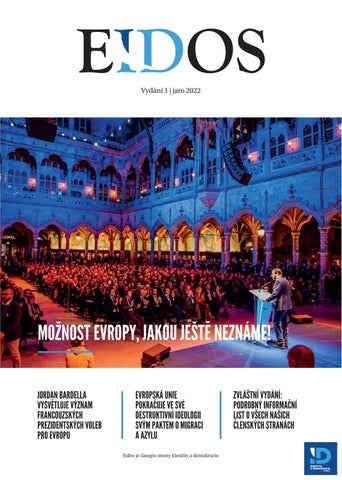
Vydání 1 | jaro 2022
MOŽNOST EVROPY, JAKOU JEŠTĚ NEZNÁME! JORDAN BARDELLA VYSVĚTLUJE VÝZNAM FRANCOUZSKÝCH PREZIDENTSKÝCH VOLEB PRO EVROPU
EVROPSKÁ UNIE POKRAČUJE VE SVÉ DESTRUKTIVNÍ IDEOLOGII SVÝM PAKTEM O MIGRACI A AZYLU Eidos je časopis strany Identity a demokracie
ZVLÁŠTNÍ VYDÁNÍ: PODROBNÝ INFORMAČNÍ LIST O VŠECH NAŠICH ČLENSKÝCH STRANÁCH
www.id-party.eu facebook.com/IDParty/ twitter.com/IDParty_ instagram.com/idparty_/
GEROLF ANNEMANS Předseda strany Identita a demokracie President of the Identity and Democracy Party
Úvodní slovo The term “eidos” originates in the Greek conceptual and philosophical framework of Plato. Plato used it to designate the transcendent: the ideal image of our changing world. Plato thus developed a system of thinking which would later become the philosophical and religious starting point for the European and Western model of civilisation.
Termín „eidos“ pochází z řeckého abstraktního a filozofického rámce Platóna. Platón jím označoval transcendentno (nadpřirozenost, nadsmyslovost): ideální obraz našeho měnícího se světa. Platón tak vytvořil systém myšlení, který se později stal filozofickým a náboženským východiskem evropského a západního modelu civilizace.
Our European civilisation is the real Europe, the continent which through its diversity and various identities has been the driving force behind world events in such a unique and dynamic way - for better or for worse.
Naše evropská civilizace je skutečnou Evropou. Kontinentem, který je díky své rozmanitosti a různým identitám hybnou silou světového dění tak jedinečným a dynamickým způsobem – v dobrém i zlém.
This beautiful word for Europe, a name rich in signification, has been hijacked: kidnapped by the strategists and communication specialists of what is in fact only a form of European cooperation. They systematically confuse the name of their legal model - the “European Union” - with the name “Europe” of the continental model of civilisation.
Toto krásné slovo pro Evropu, název bohatý na významy, bylo zneužito: zneužito stratégy a odborníky na komunikaci toho, co je ve skutečnosti pouze formou evropské spolupráce. Systematicky zaměňují název svého právního modelu „Evropská unie“ – za název „Evropa“ z hlediska kontinentálního modelu civilizace.
As a result, they can quickly label criticism of their European Union as “anti-European” or even “non-European.” They also use the confusion to claim that their European Union is the only possible and sanctified form of cooperation on
V důsledku toho mohou rychle označit kritiku své Evropské unie za „protievropskou“ nebo dokonce „neevropskou“. Využívají také záměnu k tvrzení, že jejich Evropská unie je jedinou možnou a posvěcenou formou spolupráce na evropském kontinentu.
the European continent. But despite the warning of Brexit, this European Union is moving ever closer in the direction of a supranational state. Resistance is also growing. The European political party Identity & Democracy wants to (co-)embody the resistance to this state of affairs, as an extension of the eponymous political group in the European Parliament. Resistance is growing in almost all EU Member States because their populations refuse to abandon their identity, their culture and their democracy at the gates of an artificial empire in which they would be reduced to a province or department of Brussels. The most striking feature of the European Union is the way in which the continent is being overwhelmed by an unprecedented flow of immigration which seriously endangers the characteristics and identity of the European model of civilisation -and all this is happening over people's heads. We advocate the primacy of national sovereignty and identity for economic and financial affairs, as well as for
Navzdory varování před Brexitem se však Evropská unie stále více přibližuje k nadnárodnímu státu. Roste i odpor. Evropská politická strana Identita a demokracie chce (spolu)ztělesnit odpor vůči tomuto stavu v podobě rozšíření stejnojmenného politického uskupení v Evropském parlamentu. Téměř ve všech členských státech EU sílí odpor, protože jejich obyvatelé odmítají opustit svou identitu, svou kulturu a svou demokracii u bran umělého impéria, v němž by byli redukováni na provincii nebo nějaký útvar Bruselu. Nejvýraznějším rysem Evropské unie je způsob, jakým je kontinent zahlcen nebývalým přílivem přistěhovalců, který vážně ohrožuje charakteristiky a identitu evropského modelu civilizace – a o tom všem se rozhoduje pouze na vyšších místech. Zastáváme prvořadost národní suverenity a identity pro hospodářské a finanční záležitosti, jakož i pro přistěhovalectví a evropskou spolupráci. Evropská spolupráce musí být svobodným sdružením, a nikoli svěrací kazajkou centralizovaného jednotného státu, kterou podporují ostatní strany.
immigration cooperation.
and
European
European cooperation must be a free association and not the straitjacket of the centralised unitary State which the other parties support. The dismantling of sovereignty represents a serious threat to the prosperity and identity of the various European peoples. The traditional political parties, which cannot contemplate differences in their way of thinking, want to eliminate them. In actual fact, these differences are Europe's considerable strength and asset. The European political party ID wants to be the patriotic alternative, based on a Europe that respects the uniqueness of the people and their inalienable right to be themselves, to govern themselves and to determine their own future. Meanwhile, at the Warsaw Summit in early December 2021, a number of national ID Party leaders met with other conservative leaders, such as the Polish and Hungarian Prime Ministers (among others) to map out strategic axes for future cooperation. Our political party is in itself an image of the European cooperation upon which we want to build the future of our continent - in friendship, but also in diversity.
Likvidace suverenity představuje vážnou hrozbu pro prosperitu a identitu různých evropských národů. Tradiční politické strany, které neumí nebo nemohou uvažovat o rozmanitosti ve svém způsobu myšlení a chtějí tuto rozmanitost odstranit. Tato rozmanitost je ve skutečnosti značnou silou a výhodou Evropy. Evropská politická strana ID (Identita a demokracie) chce být vlasteneckou alternativou založenou na Evropě, která respektuje jedinečnost svých obyvatel a jejich nezcizitelné právo být sami sebou, vládnout sami sobě a určovat svou vlastní budoucnost. Na varšavském summitu ze začátku prosince 2021 se mezitím řada vedoucích představitelů národních buněk strany ID setkala s dalšími konzervativními vůdci, jako jsou polští a maďarští premiéři (mimo ostatní), aby nastínili strategické body budoucí spolupráce. Naše politická strana je sama o sobě obrazem evropské spolupráce, na níž chceme budovat budoucnost našeho kontinentu – v přátelství a samozřejmě i v rozmanitosti. Gerolf Annemans Předseda strany Identita a demokracie
Gerolf Annemans President of the Identity and Democracy Party
5
40
82 98
44
90 76
74
88
EVROPA
VLASTI A STRANY
34 Evropská unie pokracuje ve
72 Matteo Salvini, Evropská
své destruktivní ideologii svým Paktem o migraci
The European Union continues its destructive ideology with its Migration Pact
38 Konference o budoucnosti
Evropy, federalistická fraška The Conference on the Future of Europe, a federalist farce
50 Nasmerování k velkému uskupení v Evropském parlamentu?
Towards a super group in the European Parliament?
pobrežní stráž
Matteo Salvini, European Coast Guard
74 Strana Vlaams Belang,
pripravenost k odpovednosti Vlaams Belang, ready for responsibility
80 Inspirativní patriot Tomio Okamura
Tomio Okamura, the inspiring patriot
46
10
60 UDÁLOSTI
VELKÝ ROZHOVOR
88 Lisabon predstavuje jinou
10 Jordan Bardella
Evropu
Lisbon sets the scene for another Europe
90 Vlastenecká mládež, príslib lepší budoucnosti
Patriotic youth, the promise of a better future
92 Nadcházející podzim na jihu
Francie ve znamení boje proti masovému pristehovalectví
Má šanci Marine Le Penová vyhrát prezidentské volby? Jordan Bardella, nový prezident Národní sdružení, vysvětluje, proč je vítězství možné. Diskutuje také o své verzi Evropy. Does Marine Le Pen have a chance of winning the presidential election? Jordan Bardella, new president of the Rassemblement National, explains to us the reasons why victory is possible. He also discusses his vision of Europe.
In the south of France, for a new autumn marked by the fight against mass immigration
7
VELKÝ ROZH
JORDAN BARDELLA
HOVOR
EV
VELKÝ ROZHOVOR
Má šanci Marine Le Penová vyhrát prezidentské volby? Exkluzivní rozhovor s Jordanem Bardellou, prezidentem Národního sdružení, členem byra strany ID. Does Marine Le Pen have a chance of winning the presidential election? Exclusive interview with Jordan Bardella, President of the Rassemblement National, member of the ID Party Bureau. Two opposing visions of the world are now confronting each other on the European political scene: the universalist one embodied by the outgoing French president Emmanuel Macron, and the other, rooted and carried by the patriotic political forces, will be championed by Marine Le Pen in the next presidential election. Jordan Bardella, the new president of the Rassemblement National, explains why victory is possible. He also discusses his vision of Europe. Eidos: France is at a turning point in its history. In April, two diametrically opposed visions will clash: a Europeanist and globalist
Na evropské politické scéně se nyní setkávají dvě protichůdné vize světa: univerzalistické, ztělesněné odcházejícím francouzským prezidentem Emmanuelem Macronem a druhé, zakořeněné a nesené vlasteneckými politickými silami, jež bude v příštích prezidentských volbách prosazována Marine Le Penovou. Jordan Bardella, nový prezident Národní sdružení, vysvětluje, proč je vítězství možné. Diskutuje také o své verzi Evropy. Eidos: Francie se nachází ve zlomovém bodě svých dějin. V dubnu se střetnou dvě diametrálně protichůdné vize: evropská a globalistická vize ztělesněná
vision embodied by Emmanuel Macron, and a vision based on nations held by Marine Le Pen. Is this the last chance for the country to escape globalism?
Emmanuelem Macronem a vize založená na národech podporovaná Marine Le Penovou. Je to pro stát poslední šance uniknout globalizmu?
I dare to believe that France is eternal and that it has all the human resources it needs to get out of the rut into which its leaders have pushed it. The current president Emmanuel Macron has constantly shown his contempt for his country by wanting to dissolve it into unbridled globalisation, by claiming that there is “no French culture,” by making the French feel guilty, even going so far as to say that he wanted to “piss off” millions of them. Based on this, there are effectively two visions of France, one embodied by Marine Le Pen - who will put the French back at the heart of the policies - and the other represented by Macron, who loves neither France nor the French.
Troufám si věřit, že Francie je věčná a že má všechny lidské zdroje, které potřebuje, aby se dostala z nasměřování, do kterého ji její vůdci zatlačili. Současný prezident Emmanuel Macron neustále vyjadřuje své pohrdání svou zemí tím, že ji chce rozpustit do bezuzdné globalizace, a tvrdí, že „neexistuje žádná francouzská kultura“, a to tím, že nutí Francouze cítit vinu, a dokonce tím, že zachází až tak daleko, že tvrdí, že chce miliony z nich „naštvat“. Na základě toho existují ve skutečnosti dvě vize Francie, jednu ztělesňuje Marine Le Penová – která vrátí Francouze zpět do centra politik – a druhou zastupuje Macron, který Francii ani Francouze nemiluje.
Is it reasonable to believe that victory is possible?
Lze vůbec věřit, že je vítězství vůbec možné?
All the polls now indicate that Marine Le Pen has a real chance of being elected. She is situated at more than 45% of the voting intentions in the second round, i.e. within the margin of error. The French have understood that Emmanuel Macron is the last representative of a worn-out and disconnected system. The candidate supported by the Rassemblement National is now ready, and you can sense her great serenity and determination.
Všechny průzkumy ukazují, že Marine Le Penová má reálnou šanci být zvolena. Ve druhém kole se nachází ve více než 45 % hlasovacích záměrů, tedy v mezích chyby. Francouzi pochopili, že Emmanuel Macron je posledním zástupcem opotřebovaného a odtažitého systému. Kandidátka podporovaná Národním sdružením je nyní připravena a je z ní cítit velký klid a odhodlání.
11
VELKÝ ROZHOVOR
Let's look ahead and suppose that the French elect Marine Le Pen as Head of State. What will be her priorities on the European stage? The priority will be to meet the European leaders in order to reaffirm very clearly that the French people are sovereign and are masters of their destiny. An unelected and highly undemocratic institution like the European Commission has no business dictating the daily lives of free peoples. Do you think that the European Union as you describe it is reformable? In short, which bodies should be abolished and which should be reworked? As I said to Emmanuel Macron in the European Parliament a few weeks ago, their Europe is 60 years old while ours is 3000 years old. Unlike France, the European Union as it exists today is an artificial construct kept alive by federalists who are increasingly being disowned by their people. All attempts to revive their federal Europe project are doomed to failure. Take the Conference on the Future of Europe. It was a fiasco, and yet Emmanuel Macron has already announced that he wants to draw conclusions from it which we know will lead to more Europe and less nationhood. In my opinion Europe must be reformed, starting not from the Commission but from the sovereign states which derive their legitimacy from the democratic process. We can envisage strategic
Podívejme se do budoucna a předpokládejme, že Francouzi zvolí Marine Le Penovou hlavou státu. Jaké budou její priority na evropské scéně? Prioritou bude setkat se s evropskými vůdci, abychom znovu jasně potvrdili, že francouzský lid je suverénní a vládne svému osudu. Nevolená a vysoce nedemokratická instituce, jako je Evropská komise, nemá co diktovat každodenní život svobodných lidí. Myslíte si, že Evropská unie, jak ji popisujete, je reformovatelná? Stručně řečeno, které orgány by měly být zrušeny a které přepracovány? Jak jsem před několika týdny řekl Emmanuelu Macronovi ve sněmovně, jejich Evropa je 60 let stará, zatímco naše 3000 let. Na rozdíl od Francie je Evropská unie ve své dnešní podobě umělým konstruktem, který udržují při životě federalisté, jejichž obyvatelé se stále více odcizují. Všechny pokusy o oživení projektu federální Evropy jsou odsouzeny k nezdaru. Měli jste se zúčastnit konference o budoucnosti Evropy. To bylo fiasko, a přesto Emmanuel Macron již oznámil, že z toho chce vyvodit závěry, které, jak víme, povedou k větší Evropě a menší národnosti. Podle mého názoru musí být Evropa reformována. Reformu by neprováděla Komise, ale suverénní státy, které odvozují svou legitimitu od demokratického procesu. Umíme si představit strategickou spolupráci v závislosti na jejich zájmech.
13
VELKÝ ROZHOVOR
cooperation interests.
depending
on
their
Which are the areas of activity in which this cooperation could bring added value? And how can it be implemented? There are a number of areas where we should pool our talents, not to sell off our industrial secrets and know-how to other countries but to combine our skills. Macron thought he wanted to move forward on the Future Combat Air System (FCAS), with Germany in particular but also with Spain. France is losing out, as is too often the case in our relations with our German neighbours. Similarly, the idea of a common European defence is not desirable because we have sometimes divergent interests. On the other hand, we can think together about how to defend our borders. Frontex should no longer be an agency for receiving migrants, but rather Europe should do everything possible to prevent them from entering its territory. Things have not changed since the migration crisis of 2015 and the immigrationist ideology has not been defeated... On the contrary. The Marrakesh Pact was a clear signal of the willingness of leaders to promote migration flows. In its wake, the European Union's Migration Pact, which was conceived behind closed doors, is increasingly imposing the idea that migration is part of Europe's destiny. This is
Jaké jsou oblasti činnosti, v nichž by tato spolupráce mohla přinést přidanou hodnotu? A jak ji lze realizovat? Existuje řada oblastí, kde bychom měli spojit naše talenty, ne však prodávat naše průmyslová tajemství a know-how do jiných zemí, ale kombinovat naše dovednosti. Prezident Macron si myslel, že pokročí v otázce vzdušného bojového systému budoucnosti (FCAS), zejména ve spolupráci s německou a také španělskou stranou. Francie prohrává, což se příliš často děje v našich vztazích s našimi německými sousedy. Podobně myšlenka společné evropské obrany není žádoucí, protože máme někdy rozdílné zájmy. Na druhé straně můžeme společně přemýšlet o tom, jak bránit naše hranice. Agentura Frontex by již neměla být agenturou pro přijímání migrantů, ale Evropa by měla vynaložit nejvyšší úsilí, aby zabránila jejich vstupu na své území. Od migrační krize v roce 2015 se situace nezměnila a imigrační ideologie nebyla poražena... Naopak. Marrákešský protokol byl jasným signálem ochoty vedoucích představitelů podporovat migrační toky. Protokol Evropské unie, který řeší migraci, a který byl koncipován za zavřenými dveřmi, po svém vzniku stále více vnucuje myšlenku, že migrace je součástí evropského osudu. Je to další důkaz, že elity jsou odtrženy od reality, protože na logickém konci tohoto procesu se
further proof that the elites are out of touch and disconnected with reality, because, at the logical end of this process it is the ordinary French person from Clermont-Ferrand or Briançon but also the ordinary Estonian or Flemish people who will see their way of life turned upside down. The French government presented a plan for the distribution of migrants a year ago in an authoritarian manner. The countries who are hostile to us have realised that migration is our Achilles heel and are blackmailing our peoples with migration. This is indeed a strategy which has pursued lately by Lukashenko of Belarus, but also in a more structural manner by Recep Tayyip Erdoğan. Given that the latter is multiplying blackmail attempts and threats towards Europe, how should Europe behave with Turkey? Let’s remember the incident in the Mediterranean last June. As part of an international mission to enforce the arms embargo on Libya, a Turkish frigate was aggressive (to say the least) towards a French ship by performing radar illumination on three occasions, with Turkish military personnel on duty. Do we need reminding that a number of our leaders were advocating Turkey's entry into the European Union? This country is not geographically located in Europe, is not part of the European civilisation area and, due to its demographic weight, would send more MEPs to the European Parliament than France.
ocitne nejen obyčejný Francouz z Clermont-Ferrandu nebo Briançonu, ale i běžný Estonec nebo Vlám, jehož způsob života se obrátí naruby. Francouzská vláda předložila před rokem autoritativním způsobem plán přerozdělování migrantů. Země, které jsou k nám nepřátelské, si uvědomily, že migrace je naší Achillovou patou, a vydírají naše občany migrací. Jde o skutečnou strategii, kterou v poslední době prosazuje Lukašenko z Běloruska, ale strukturálněji také Recep Tayyip Erdoğan. Vzhledem k tomu, že vydírání vůči Evropě se množí, jak by se měla Evropa chovat vůči Turecku? Vzpomeňme si na incident ve Středozemním moři loni v červnu. V rámci mezinárodní mise za účelem prosazení zbrojního embarga vůči Libyi byla turecká fregata agresivní (mírně řečeno) vůči francouzské lodi tím, že třikrát prováděla radarové osvětlení, přičemž turecký vojenský personál byl ve službě. Musíme připomínat, že řada našich vedoucích představitelů obhajovala vstup Turecka do Evropské unie? Tato země není geograficky umístěna v Evropě, není součástí evropského civilizačního prostoru a vzhledem ke své demografické váze by do Evropského parlamentu vyslala více poslanců než Francie. Musíme mít pevný postoj k islamistickému sultánovi Erdoğanovi, přestat se poddávat jeho vydírání a především ho přestat financovat!
15
VELKÝ ROZHOVOR
We must have a firm attitude towards the Islamist Sultan Erdoğan, stop giving in to his blackmail and above all stop funding him! Looking back, do you think the British exit from the European Union was a good thing? It's up to the British to say, but clearly Brexit, which was supposed to bring misery and calamity, has been a reasonable success. There has always been a British ideal of insularity and empire. The one as a result of its particular geographical position, and the other (which the European Union sometimes imitated) made its membership of the EU a balancing act. The people have decided, and that's just fine. But this is not the solution that Marine Le Pen and the Rassemblement National advocate for France. Your opponents criticise Marine Le Pen for having evolved on the issue of membership of the EuropeanUnion and the euro... The European context has itself changed significantly. We were isolated in Europe at the time, but we have since established relations everywhere with European patriotic parties. They are each making progress or are already in power in their own country. This is the case in Hungary and Poland and also in Slovakia, where the patriots are in government. In the Czech Republic and in Portugal they are strongly on the rise.
Když se ohlédnu zpět, myslíte si, že britský odchod z Evropské unie byl dobrý? Tuto otázku by měli zodpovědět sami Britové, nicméně Brexit, který měl přinést utrpení a pohromu, byl naopak zjevně rozumným úspěchem. Britský ideál ostrovní společnosti a impéria vždy existoval. Jeden z nich vyplýval z její zvláštní zeměpisné polohy a druhý (který Evropská unie někdy napodobovala) činil z jejího členství v EU akt vyvažování. Lidé se rozhodli a to je v pořádku. To však není řešení, které pro Francii prosazuje Marine Le Penová a Národní sdružení. Vaši odpůrci kritizují Marine Le Penovou za to, že získala politické body v otázce členství v Evropské unii a eura... Samotný evropský kontext se výrazně změnil. V té době jsme byli v Evropě izolováni, ale od té doby jsme všude navázali vztahy s evropskými vlasteneckými stranami. Každý z nich dělá pokroky nebo je již u moci ve své vlastní zemi. Je tomu tak v Maďarsku, Polsku a také na Slovensku, kde jsou vlastenci ve vládě. V České republice a v Portugalsku jsou silně na vzestupu. Vraťme se k Maďarsku a Polsku: co si myslíte o tamních politikách? Bráním suverenitu států, takže se vždy zdráhám zasahovat do vnitřních záležitostí jiných zemí. Evropská unie se specializuje na diktování vnitřních politik členským státům, což začíná
Let's get back to Hungary and Poland: what do you think of the policies there? I defend the sovereignty of States, so I am always reluctant to interfere in the internal affairs of other countries. The
vadit jak vedoucím představitelům, tak občanům. Poláci a Maďaři se chtějí rozhodnout, co je dobré pro jejich zemi a její budoucnost, a chtějí, aby byla zachována jejich identita. Jak by se mohli mýlit?
17
VELKÝ ROZHOVOR
European Union has made a speciality to dictate internal policies to Member States, and this is beginning to exasperate leaders and peoples alike. Poles and Hungarians want to decide what is good for their country and its future, and they want to see their identity preserved. How can they be wrong? The patriotic political forces are now divided in the European Parliament, between the member parties of Identity and Democracy and those who sit in the European Conservatives and Reformists. Are you confident that these formations can be brought together under one flag? United, we would be all the stronger to confront the defenders of the federalist vision of Europe. I am optimistic that this process - which has been underway for several months - will come to fruition. This obviously requires discussion because, as patriots, our national interests or our evaluation of certain issues may differ in the details. We don’t have to agree on everything to work together - we just have to respect each other's specificities. But I know that we agree on the essential point, which is to give people hope and allow them to continue to fly their national flags proudly. Let's talk a little about you, Jordan Bardella: do you feel European? Above all, I feel profoundly French, the fruit of a heritage built up over the
Vlastenecké politické síly jsou nyní v Evropském parlamentu rozděleny mezi členské strany Identita a demokracie a ty, jež jsou členy Evropských konzervativců a reformistů. Jste si jistý, že tyto formace mohou být spojeny pod jednou vlajkou? Společně bychom byli silnější, pokud jde o konfrontaci s obhájci federalistické vize Evropy. Jsem optimistický v tom, že tento proces, který probíhá již několik měsíců, se naplní. To samozřejmě vyžaduje diskusi, protože jako vlastenci se naše národní zájmy nebo naše hodnocení určitých otázek mohou v detailech lišit. Nemusíme se shodnout na všem, abychom spolupracovali – musíme jen respektovat specifika toho druhého. Vím však, že se shodneme na zásadním bodu, kterým je dát lidem naději a umožnit jim, aby i nadále hrdě vyvěšovali své národní vlajky. Povězte něco o sobě, pane Jordane Bardello: cítíte se jako Evropan? Především se cítím jako opravdový Francouz, plodem dědictví vybudovaného v průběhu staletí našimi předky, kteří spojili genialitu (ať už vědeckou, literární nebo uměleckou) se způsobem života, který je pro nás individuální. Mám také pocit, že jsem garantem zájmů Francie – samozřejmě v rámci jejích hranic – nejen v Evropě, ale i ve světě. Chci, aby naše země byla opět slavná. To nám však nebrání mít pocit, že patříme k evropské civilizaci,
Jordan Bardella a André Ventura, předseda strany Chega
centuries by our ancestors who combined genius (whether scientific, literary or artistic) with a way of life which is individual to us. I also feel that I am the guarantor of France's interests - within its borders of course - but also in Europe and in the world. I want our country to be great again. This does not however prevent us from feeling that we belong to the European civilisation which we share. Precisely which places in Europe arouse such a feeling in you? Let me start by saying that we all have roots within us. Mine are linked to the region where I grew up, in Seine-Saint-Denis, in Ile-de-France, where all the ravages of globalisation can be seen - starting with the consequences of massive immigration. I of course feel this visceral attachment to our country wherever I am on French territory.
kterou sdílíme. Přesně která místa v Evropě ve vás vyvolávají takový pocit? Dovolte mi začít tím, že všichni máme v sobě kořeny. Ty moje jsou spojeny s regionem, kde jsem vyrůstal, se Seinou-Saint-Denis, v Ile-de-France, kde jsou patrné všechny známky pustošení ve jménu globalizace – na první pohled bijí do očí důsledky masivního přistěhovalectví. Samozřejmě cítím toto vnitřní pouto k naší zemi, ať už jsem kdekoliv na francouzském území.
19
VELKÝ ROZHOVOR
As a 26-year-old, you are from a new generation. Do you feel that there is a support for the ideas of Marine Le Pen among the younger people?
Váš věk 26 let poukazuje na novou generaci. Máte pocit, že mezi mladými lidmi existuje podpora myšlenek Marine Le Penové?
Marine Le Pen is popular among young people - the Rassemblement National regularly comes out on top among this group both in polls and in election results. There is a real awareness and willingness to put an end to several decades of political correctness and disastrous management which threatens their future as French people. This should encourage us: this youth with pro-national feelings, a phenomenon which can be observed both in France and also everywhere else in Europe, will be the lever we can use to save our nations. Marine Le Pen represents a hope for many young people.
Marine Le Penová je oblíbená mezi mladými lidmi – Národní sdružení se v průzkumech veřejného mínění i ve volebních výsledcích pravidelně umisťuje na předních místech v této skupině obyvatel. Existuje skutečné povědomí a vůle skoncovat s několika desetiletími politické korektnosti a katastrofálního řízení, které ohrožuje jejich budoucnost jako francouzského národa. To by nás mělo povzbudit: tato mládež s pronárodními pocity, což je jev, který lze pozorovat jak ve Francii, tak všude jinde v Evropě, bude pákou, kterou můžeme využít k záchraně našich národů. Marine Le Penová je nadějí pro mnoho mladých lidí.
21
EVROPA
Francouzské prezidentské volby se budou konat ve dnech 10. a 24. dubna The French presidential elections will take place on 10 and 24 April The French will be faced with a clear choice: the headlong rush towards ever more globalism or taking back their national sovereignty. Emmanuel Macron and Marine Le Pen embody both sides of the alternative. We can be optimistic: Marine Le Pen has never been placed so high in the polls, which give her between 45 and 50% of the vote in the second round (and so within the margin of error). She has never been so close to the Elysée. France is at a turning point, and with it the whole of Europe. The arrival of a patriot at the head of the state will undoubtedly have positive repercussions for parties which are committed to defending their identity and national sovereignty.
Francouzi budou čelit jasné volbě: bezhlavému spěchu směřujícímu ke stále většímu globalizmu nebo opětovnému získání jejich národní suverenity. Emmanuel Macron a Marine Le Penová ztělesňují obě strany alternativy. Můžeme být optimističtí: Marine Le Penová nikdy nebyla v průzkumech veřejného mínění tak vysoko, což jí dává 45 až 50 % hlasů ve druhém kole (a tedy v mezích chyb). Nikdy nebyla tak blízko Elysejské říše. Francie se nachází ve zlomovém bodě a s ní celá Evropa. Příchod vlastenecky smýšlející do čela státu bude mít nepochybně pozitivní dopad na strany, které jsou odhodlány bránit svou identitu a národní suverenitu.
23
ROPA
EVRO EVROPA EVROP
EVROPA PATRIVLA ROPA V PATRIESVLAST EVRO PA PVLAS
EVROPA
Lepší porozumení (snaha o porozumení) spletitému fungování Evropské unie To (try to) better understand the convoluted workings of the European Union
The European Union seems to most citizens to be very muddled in its functioning and institutions, which we believe is proof that it does not meet some of the requirements of democratic life: simplicity, representativeness, and democracy. The Identity and Democracy Party is critical of the current functioning of the European Union. Some institutions seem to us to have too much power - such as the unelected European Commission. In order to make it clearer for you, we give you a brief overview of the roles of the different institutions.
Strana Identity a demokracie je vůči současnému fungování Evropské unie kritická. Zdá se nám, že některé instituce mají příliš mnoho pravomocí – například nevolená Evropská komise. Abychom vám to objasnili, poskytujeme vám stručný přehled o rolích jednotlivých institucí. Evropská unie se zdá být většině občanů velmi zmatená ve svém fungování a orgánech, což je podle nás důkazem toho, že nesplňuje některé požadavky demokratického života: jednoduchost, reprezentativnost a demokracii. Přijímáme výzvu, abychom vám v několika řádcích představili sedm hlavních institucí.
The European Council brings together the Heads of State and government of the European Union. It is headed by a president - currently the Belgian Charles Michel - who is responsible for facilitating compromises. Its objective is to define the main lines of European policy, and it meets four times a year.
Evropská rada sdružuje hlavy států a předsedy vlád Evropské unie. V jeho čele stojí prezident – v současnosti Belgičan Charles Michel, který je zodpovědný za zprostředkování kompromisů. Jejím cílem je definovat hlavní směry evropské politiky a schází se čtyřikrát ročně.
27
EVROPA
The principal role of the European Commission is to propose legislation and ensure the implementation of Community policies. Although it is an essential component, it nevertheless suffers from a lack of democracy since the commissioners (one per Member State, 27 in total) are not directly elected by the citizens but proposed by the Heads of State and government and then validated by the Parliament. Established in 1957 by the Treaty of Rome, it is currently headed by Ursula von der Leyen. The Council of the European Union is the body that brings together the ministers in charge of the files in question (ministers of the interior, finance, etc.). It adopts European legislation together with the Parliament on the basis of a proposal from the European Commission, validates (again with the Parliament) the annual budget of the European Union, and draws up the common foreign and security policy. The European Parliament shares the prerogatives of the legislative power with the Council of the European Union. Since 1979, it has been elected by direct universal suffrage according to the proportional voting system (including in countries used to majority voting), which guarantees a representation which is sometimes fairer than in national parliaments. The official seat of the European Parliament is in Strasbourg, where plenary sessions are held, while committees are usually held in Brussels. The elected members of the
Hlavní úlohou Evropské komise je navrhovat právní předpisy a zajišťovat provádění politik Společenství. Přestože se jedná o zásadní složku, trpí nedostatkem demokracie, protože komisaři (jeden na členský stát, celkem 27) nejsou přímo voleni občany, ale navrženi hlavami států a předsedy vlád a poté potvrzeni Parlamentem. Byla založena v roce 1957 Římskou smlouvou a v současné době ji vede Ursula von der Leyen. Rada Evropské unie je orgánem, který sdružuje ministry odpovědné za dané záležitosti (ministry vnitra, financí atd.). Společně s Parlamentem přijímá evropské právní předpisy na základě návrhu Evropské komise, schvaluje (opět společně s Parlamentem) roční rozpočet Evropské unie a vypracovává společnou zahraniční a bezpečnostní politiku. Evropský parlament sdílí výsady zákonodárné moci s Radou Evropské unie. Od roku 1979 se volí ve všeobecných přímých volbách podle poměrného volebního systému (a to i v zemích zvyklých na většinový volební systém), který zaručuje někdy spravedlivější zastoupení než v národních parlamentech. Oficiální sídlo Evropského parlamentu je ve Štrasburku, kde se konají plenární zasedání, zatímco zasedání výborů se obvykle koná v Bruselu. Volení členové národních stran jsou rozděleni do uskupení, aby se usnadnila práce v parlamentu.
national parties are divided into groups in order to facilitate parliamentary work. The Court of Justice of the European Union ensures that European law is applied in conformity in all Member States. It is also competent in the interpretation of European law, at the request of judges working in the different countries. The Commission and the Member States may refer cases to it to assess whether a Member State has violated European law. Based in Frankfurt, the European Central Bank sets the direction for monetary policy and the single currency (the euro). Since its creation, one of the main priorities of the Central Bank is price stability and therefore the fight against inflation.
Soudní dvůr Evropské unie zajišťuje, aby bylo evropské právo uplatňováno ve všech členských státech v souladu s právními předpisy. Je rovněž kompetentní ve výkladu evropského práva na žádost soudců pracujících v různých zemích. Komise a členské státy jí mohou postoupit případy, aby posoudily, zda členský stát porušil evropské právo. Evropská centrální banka se sídlem ve Frankfurtu určuje směr měnové politiky a jednotné měny (euro). Od svého vzniku je jednou z hlavních priorit centrální banky cenová stabilita, a tedy boj proti inflaci. Účetní dvůr (Court of Auditors EU) je odpovědný za analýzu příjmů a výdajů Evropské unie. Tento externí subjekt teoreticky poskytuje nezávislé posouzení vedení účtů institucí.
The Court of Auditors is responsible for analysing the revenue and expenditure of the European Union. This external body theoretically provides an independent assessment of the management of the institutions' accounts.
29
EVROPA
Co je to evropská politická strana? What is a European political party? European political parties are part of the European “institutional machinery” which costs taxpayers a lot of money. One can guess that they will eventually be the instrument of the “Europeanists” to push for the existence of transnational lists during elections. While the Identity and Democracy Party is “eurocritical,” it is nevertheless obliged to constitute itself as a party in order not to be further excluded from the democratic process.
Evropské politické strany jsou součástí evropského „institucionálního mechanismu“, který stojí daňové poplatníky hodně peněz. Lze předpokládat, že se nakonec stanou nástrojem „evropistů“, kteří budou ve volbách prosazovat existenci nadnárodních kandidátních listin. Strana Identity a demokracie je sice „eurokritická“, ale přesto je povinna stát se stranou, aby nebyla dále vyloučena z demokratického procesu.
When discussing the European Parliament, we saw that MEPs elected in their country on a national list come together by affinity. The results of the 2019 elections gave the following breakdown: - Group of the European People's Party (182 seats), - Progressive Alliance of Socialists and Democrats in the European Parliament (154), - Renew Europe (108), - Identity and Democracy (75), - Greens/European Free Alliance Group (74), - European Conservatives and Reformists (62),
Při diskusi o Evropském parlamentu jsme viděli, že europoslanci zvolení ve své zemi na národních kandidátních listinách se sdružují na základě spřízněnosti. Výsledky voleb 2019 přinesly následující rozdělení: - uskupení Evropské lidové strany (182 křesel), - Progresivní aliance socialistů a demokratů v Evropském parlamentu (154), - Obnova Evropy (108), - Identita a demokracie (75), - uskupení Zelených/Evropské svobodné aliance (74), - Evropští konzervativci a reformisté (62),
Setkání evropských vlasteneckých lídrů
- The Left in the European Parliament Group (41), to which should be added the non-registered members.
- uskupení levice v Evropském parlamentu (41), ke kterému je třeba připočíst neregistrované členy.
While it is tempting to confuse the two, the notion of a European political party is different from that of a group. The two concepts do not overlap. Thus, the parties are intended to contain, for example, national political formations which have elected representatives on their soil but are not represented in the European Parliament. On the other hand, some parties that are members of a group may choose not to join a party due to conviction or other
I když je lákavé tyto dva pojmy zaměňovat, představa evropské politické strany je jiná než představa uskupení. Tyto dva pojmy se nepřekrývají. Strany tak mají obsahovat například národní politické formace, které mají na svém území volené zástupce, ale nejsou zastoupeny v Evropském parlamentu. Na druhou stranu se některé strany, které jsou členy uskupení, mohou rozhodnout do strany nevstoupit z důvodu přesvědčení nebo z jiných
31
EVROPA
reasons. Finally, some groups in the European Parliament are multi-party: for example, the Green/European Free Alliance Group consisting of the European Green Party (EGP) and the European Free Alliance (EFA).
důvodů. A konečně, některá uskupení v Evropském parlamentu jsou vícestranná: například uskupení Zelení/Evropská svobodná aliance složené z Evropské zelené strany (EGP) a Evropské svobodné aliance (EFA).
Recognised since the Maastricht Treaty (1992), European parties “contribute to forming a European awareness and to expressing the political will of the citizens of the Union.” As a result of the will of the most ardent federalists, each national party is obliged to display its possible membership of a European party on its website. The Authority for European Political Parties and Foundations is keeping a sharp eye on things!
Evropské strany uznané Maastrichtskou smlouvou (1992) „přispívají k utváření evropského povědomí a k vyjadřování politické vůle občanů Unie.“ Z vůle nejzarytějších federalistů je každá národní strana povinna na svých internetových stránkách uvádět své případné členství v evropské straně. Úřad pro evropské politické strany a nadace vše bedlivě sleduje!
To be recognised as a party, the latter must have representation in at least one quarter of the EU Member States (i.e. seven), in the national or regional parliaments, or in the European Parliament; or it or its member parties must have received at least three per cent of the votes cast in the European Parliament in at least one quarter of the Member States. It is obviously forbidden for a party to use European funds to finance national campaigns.
Aby mohla být strana uznána, musí mít zastoupení alespoň v jedné čtvrtině členských států EU (tj. v sedmi), ve vnitrostátních nebo regionálních parlamentech nebo v Evropském parlamentu; nebo musí tato strana nebo její členské strany získat alespoň tři procenta hlasů odevzdaných v Evropském parlamentu alespoň v jedné čtvrtině členských států. Je samozřejmě zakázáno, aby strana využívala evropské fondy k financování národních kampaní.
To further complicate the Byzantine European bureaucracy, there are also foundations which are “organisations affiliated to a European political party which support and complement the objectives of that party,” for example by organising conferences.
Aby se byzantská evropská byrokracie ještě více zkomplikovala, existují také nadace, které jsou „organizacemi přidruženými k evropské politické straně, které podporují a doplňují cíle této strany“, například pořádáním konferencí.
There are currently ten officially recognised European political parties: - European People's Party (centre), - Alliance of Liberals and Democrats for Europe (liberal right), - European Conservatives and Reformists Party (right), - European Christian Political Movement (conservative right), - European Democratic Party (centre), - European Free Alliance (regionalism), - European Green Party (environmentalism), - Party of European Socialists (left), - Party of the European Left (extreme left), - Identity and Democracy Party. The Identity and Democracy Party consists of the following national parties: Lega (Italy), Rassemblement National (France), Vlaams Belang Party (Flanders), Freiheitliche Partei Österreichs (Austria), Eesti Konservatiivne Rahvaerakond (Estonia), Freedom and Direct Democracy (Czech Republic), Sme Rodina (Slovakia) Chega (Portugal) and Nea Dexia (Greece). A more detailed description of each of these parties can be found at the end of the issue.
V současné době existuje deset oficiálně uznaných evropských politických stran: - Evropská lidová strana (střed), - Aliance liberálů a demokratů pro Evropu (liberální pravice), - Evropská konzervativní a reformní strana (pravice), - Evropské křesťanské politické hnutí (konzervativní pravice), - Evropská demokratická strana (střed), - Evropská svobodná aliance (regionalismus), - Evropská zelená strana (environmentalismus), - Strana evropských socialistů (vlevo), - Strana evropské levice (vlevo), - strany Identity a demokracie. A konečně, protože držíte v rukou její časopis, strana Identita a demokracie se skládá z následujících národních stran: Lega (Liga – Itálie), Rassemblement National (Francie), strana Vlaams Belang (Flandry), Freiheitliche Partei Österreichs (Rakouská strana svobodných – Rakousko), Eesti Konservatiivne Rahvaerakond (Estonská konzervativní lidová strana – Estonsko), Svoboda a přímá demokracie (Česká republika), Sme Rodina (Slovensko) Chega (A dost – Portugalsko) a Nea Dexia (Nový zákon – Řecko). Podrobnější popis každé z těchto stran naleznete na konci vydání.
33
EVROPA
Evropská unie č pokracuje ve své destruktivní ideologii svým Paktem o migraci The European Union continues its destructive ideology with its Migration Pact The Global Compact for Safe, Orderly and Regular Migration, better known to the general public as the Marrakesh Pact, was much discussed in December 2018: it promised ever more uncontrolled immigration and articulated as never before the outlines of the migration ideology prevalent among certain elites.
Globální pakt o bezpečné, řízené a pravidelné migraci, veřejnosti známý spíše jako Marrákešský protokol, byl v prosinci 2018 hodně diskutován: sliboval stále nekontrolovanější imigraci a jako nikdy předtím zformuloval obrysy migrační ideologie převládající mezi některými elitami.
Some countries weren’t taken in and refused to sign it. Among them are Hungary and Poland, in the eye of the European storm for not complying with internationalist and immigrationist injunctions. Belgium rushed to sign it, even if it meant toppling a government, and Charles Michel (its Prime Minister) was chosen as President of the European Council in the process. The politics of petty backroom deals had a bright future ahead of it from that day.
Některé země nebyly přijaty a odmítly pakt podepsat. Mezi ně patří Maďarsko a Polsko, které se ocitly v centru evropské bouře kvůli nedodržování internacionalistických a imigračních příkazů. Belgie pospíchala s podpisem, i kdyby to znamenalo svržení vlády, a Charles Michel (její premiér) byl v tomto procesu zvolen předsedou Evropské rady. Politika drobných zákulisních dohod měla od tohoto dne před sebou zářnou budoucnost.
In order not to suffer another setback, the European Commission has been working on its Migration and Asylum Pact in the greatest secrecy, away from the eyes of people who are especially keen to preserve their identity. The leaders of the European Union are nevertheless constantly defending it with implicit faith, not failing to criticise the “populists who oppose it.” President of the Commission Ursula von der Leyen is constantly reminding us of her mantra. And so during the presentation of the Pact, she didn’t hesitate to declare that “migration has always been a reality in Europe” and that it “will continue to be so.” We have been warned.
Aby Evropská komise neutrpěla další nezdar, pracuje na svém Paktu o migraci a azylu v největším utajení, mimo dosah zejména těch občanů, jejich hlavním zájmem je zachování své identity. Vedoucí představitelé Evropské unie jej nicméně neustále s nepřímou vírou hájí a neopomíjejí kritizovat „populisty, kteří se proti němu staví“. Předsedkyně Komise Ursula von der Leyenová nám neustále připomíná svou mantru. A tak během prezentace Paktu o migraci a azylu neváhala prohlásit, že „migrace byla v Evropě vždy realitou“ a že „tomu tak bude i nadále“. Byli jsme varováni.
35
EVROPA
Under the pretext of “improving the security of migrants”, the EU Migration and Asylum Pact will create the legal, logistical and political conditions for the mass movement and settlement of people, mainly from the Third World, to the European continent. At the same time, European borders are not secure. Ylva Johansson, who is often caught knitting during
Pod záminkou „zlepšení bezpečnosti migrantů“ vytvoří EU Pakt o migraci a azylu právní, logistické a politické podmínky pro hromadný pohyb a usazování lidí, zejména ze třetího světa, na evropský kontinent.
parliamentary debates, had to concede that 22% of people entering the EU are not checked. And yet she still likes to repeat, against all common sense: “We need immigration.”
Evropské hranice přitom nejsou bezpečné. Ylva Johanssonová, která je často přistižena, že si během parlamentních rozprav pletete svetr, musela připustit, že 22 % lidí vstupujících do EU není kontrolováno. A přesto ráda opakuje, proti všemu zdravému rozumu: „Potřebujeme imigraci.“
37
EVROPA
Konference o budoucnosti Evropy, federalistická fraška The Conference on the Future of Europe, a federalist farce Few European citizens have heard of it, but the Conference on the Future of Europe was nevertheless announced with great fanfare by the European Union authorities. The barely-concealed objective is to continue the European Union's headlong rush towards greater federalism. Several members of the ID Party are defending you: Hélène Laporte (France), Catherine Griset (France), Philippe Olivier (France), Mara Bizzotto (Italy), Alessandro Panza (Italy), Susanna Ceccardi (Italy), Gerolf Annemans (Flanders), Jaak Madison (Estonia), Ludovit Goga (Slovakia), and Petra Steger (Austria) The EU has selected ten themes for debate: climate change and the environment; health; a stronger economy, social justice and employment; the EU in the world; values and rights, rule of law and security; digital transformation; European democracy; migration; education, culture; youth and sport. If the figures are to be believed, it’s a total failure. In total, 38,000 people participated (out of 450 million inhabitants), often leaving a brief message at most. On the topic of migration, barely 500 citizens gave
Jen málo evropských občanů o ní slyšelo, nicméně Konference o budoucnosti Evropy byla oznámena s velkým nadšením ze strany orgánů Evropské unie. Těžko skrývaným cílem je pokračovat v bezhlavém směřování Evropské unie k většímu federalismu. Několik členů strany ID vás však brání: Hélène Laporte (Francie), Catherine Griset (Francie), Philippe Olivier (Francie), Mara Bizzotto (Itálie), Alessandro Panza (Italie), Susanna Ceccardi (Itálie), Gerolf Annemans (Flandry), Jaak Madison (Estonsko), Ludovit Goga (Slovensko), Petra Steger (Rakousko). EU vybrala k diskusi deset témat: změna klimatu a životní prostředí; zdraví; silnější hospodářství, sociální spravedlnost a zaměstnanost; EU ve světě; hodnoty a práva, právní stát a bezpečnost; digitální transformace; evropská demokracie; migrace; vzdělávání, kultura; mládež a sport. Pokud máme číslům věřit, je to naprosté selhání. Zúčastnilo se jej celkem 38 000 lidí (ze 450 milionů obyvatel), což často zanechává stručný vzkaz. Pokud jde o migraci, vyjádřilo svůj názor sotva 500 občanů, s tím, že byli proti migraci.
their opinion, often leaving anti-migration message.
an
It seems a long time ago that the Conference was launched with such great fanfare, when for example a convinced federalist called for two flags to be flown at the Olympic Games: the national flag and the twelve stars. The very organisation of the debates is a joke. The European Parliament is represented and each country sends representatives from its national parliament. The allocation of speaking time is left to the discretion of the administration. During the last plenary, a Member of the European Parliament from the Identity and Democracy Party was given time to speak on the important subject of the digital transition, but was not chosen by the representative in question. The citizens' panels seem to be hand-picked to ensure that the discourse never deviates from official thinking. Conclusions will be drawn from this mess, which we can already confidently predict right here and now: we will need more and more Europe and federalism. The Identity and Democracy Party will never subscribe to such a vision, as it favours sovereign peoples and national identities.
Konference byla zahájena s velkou pompou, když například jeden přesvědčený federalista požadoval, aby se na olympijských hrách vyvěšovaly dvě vlajky: státní vlajka a vlajka s dvanácti hvězdami. Samotná organizace rozprav je vtipem. Každý stát vysílá zástupce svého národního parlamentu který jej bude zastupovat v Evropském parlamentu. Přidělení řečnického času je ponecháno na uvážení administrativy. Během posledního plenárního zasedání byl přislíben prostor poslanci Evropského parlamentu ze strany Identita a demokracie, aby se vyjádřil k důležitému tématu přechodu na digitální technologie, tento zástupce však nebyl na zasedání vybrán, aby svůj příspěvek přednesl. Zdá se, že občanská komise je vybírána tak, aby se diskurz nikdy neodchýlil od oficiálního myšlení. Z tohoto zmatku vyvodíme závěry, které můžeme s jistotou předvídat již nyní: budeme potřebovat stále více Evropy a federalismu. Strana Identita a demokracie takovou vizi nikdy nepodepíše, neboť upřednostňuje suverénní národy a národní identity. Zatímco na začátku jsme byli optimističtí, byli jsme rychle vyvedeni z omylu a museli jsme čelit faktu, že tato konference je fraška.
While at the beginning we were optimistic, we were quickly disillusioned and had to face the fact that this Conference was a farce.
39
EVROPA
Mara Bizzotto: „To, co dnes potrebujeme, je vybudovat nový ř model Evropy, Evropy lidu...“ Mara Bizzotto: “What we need today is to build a new model of Europe, the Europe of the people...” Mara Bizzotto is a Member of the European Parliament for Lega (Italy) “The Conference on the Future of Europe was a historic opportunity to rebuild Europe and design the Europe of tomorrow: it was an important chance that we had to seize, with the courage and foresight to make major changes, including the necessary reform of the European treaties. We need to work together to change the current model of Europe at its roots, a model that has proved to be wrong and too far removed from the real needs of our citizens and territories, as we have also seen during the Covid emergency. What we need today is to build a new model of Europe, a Europe of the people, of the citizens, of work and of true democracy, which will put a definitive end to the Europe of austerity, of the banks and of this bureaucracy which has done so much harm to our countries in recent years.”
Mara Bizzotto je poslankyně Evropského parlamentu za stranu Lega (Itálie) „Konference o budoucnosti Evropy byla historickou příležitostí k obnově Evropy a utváření Evropy zítřka: byla to významná příležitost, které jsme se museli chopit, s odvahou a předvídavostí k provedení zásadních změn, včetně nezbytné reformy evropských smluv. Musíme spolupracovat na změně současného modelu Evropy u jejích kořenů, na modelu, který se ukázal jako chybný a příliš vzdálený od skutečných potřeb našich občanů a územních celků, jak jsme také viděli během krizové situace v souvislosti s covidem. Dnes potřebujeme vybudovat nový model Evropy, Evropy lidu, občanů, práce a skutečné demokracie, který definitivně ukončí Evropu úsporných opatření, bank a současné byrokracie, která našim zemím v posledních letech tolik ublížila.“
Source : EP
Mara Bizzotto (Itálie) poslankyně Evropského parlamentu Lega
41
EVROPA
Petra Steger: „Moje vize Evropy je sdružení svobodných národu se sebeurcením, v nemž je rozmanitost kultur vnímána jako síla, nikoli jako prekážka…“ Petra Steger: “My vision of Europe is an association of free and self-determined peoples in which the diversity of cultures is seen as a strength and not an obstacle...” Petra Steger is a Member of the National Council (Austria) for Freiheitliche Partei Österreichs and participates in the Conference on the Future of Europe
Petra Steger je poslankyní Národní rady (Rakousko) za stranu Freiheitliche Partei Osterreichs a účastní se Konference o budoucnosti Evropy
“A respectful and united cooperation according to the principles of subsidiarity and federalism should guarantee the freedom of each nation State.
„Moje vize Evropy je sdružení svobodných národů se sebeurčením, v němž je rozmanitost kultur vnímána jako síla, nikoli jako překážka. Uvážlivá a jednotná spolupráce podle zásad subsidiarity a federalismu by měla zaručit svobodu každého národního státu.
On the other hand, I categorically reject the path towards a central EU political state, coupled with massive undesirable developments such as the debt and transfer union, EU taxes, losses of national sovereignty or accession negotiations with non-European countries such as Turkey. A return to the real tasks of the EU is needed, namely to ensure peace, freedom and prosperity.
Na druhé straně kategoricky odmítám cestu k vytvoření centrálního politického státu EU, doprovázenou rozsáhlým nežádoucím vývojem, jako je dluhová a transferová unie, zdaňování v EU, ztráty národní suverenity nebo přístupová jednání s neevropskými zeměmi, jako je Turecko. Je třeba se vrátit ke skutečným úkolům EU, zejména k
Source : Wikimedia. License: CC BY-SA 4.0
„strane kategoricky odmítám cestu k vytvorení centrálního politického státu EU“ “I categorically reject the path taken towards a central EU political state”
Petra Steger (Rakousko) poslankyní Národní rady Freiheitliche Partei Österreichs
However, the EU will only remain an order of peace if the components of security and freedom are not forgotten. This means nothing less than self-determination. But it is precisely this self-determination which is increasingly being lost as the EU continually seeks to take over national competences and transform itself into a centralised state. This is also leading to a growing rejection by the citizens. Europe is important, but it can never replace the Nation.”
zajištění míru, svobody a prosperity. EU však zůstane mírovým řádem pouze tehdy, pokud se nezapomene na složky bezpečnosti a svobody. To neznamená nic jiného než sebeurčení. Právě toto sebeurčení se však stále více ztrácí, neboť EU se neustále snaží převzít vnitrostátní pravomoci a přeměnit se v centralizovaný stát. To také vede k rostoucímu odmítání ze strany občanů. Evropa je důležitá, ale nikdy nemůže nahradit národ.“
43
EVROPA
Jaak Madison: „Nejsem optimistický, pokud jde o dlouhodobou životaschopnost Evropské unie“ Jaak Madison: “I am not optimistic about the long-term viability of the European Union” Jaak Madison is a Member of the European Parliament for Eesti Konservatiivne Rahvaerakond (Estonia)
Jaak Madison je poslancem Evropského parlamentu za stranu Eesti Konservatiivne Rahvaerakond (Estonsko)
“When we speak of the future of Europe, it is important to remember that we are talking first and foremost about the future of the European Union, not of Europe as a whole. Switzerland, Norway or Iceland are as European and often more so than any EU Member State or the European Commission. I am not optimistic about the long-term viability of the European Union.
„Hovoříme-li o budoucnosti Evropy, je důležité mít na paměti, že hovoříme především o budoucnosti Evropské unie, nikoli o Evropě jako celku. Švýcarsko, Norsko nebo Island jsou stejně evropské a často dokonce více než kterýkoli členský stát EU nebo Evropská komise. Nejsem optimistický, pokud jde o dlouhodobou životaschopnost Evropské unie.
The more the European Union tries to seize power and reduce the sovereignty of Member States, for example in environmental, economic, defence or foreign policy, the more likely it is that the Union will eventually collapse.
Čím více se Evropská unie snaží chopit moci a snížit suverenitu členských států, například v oblasti environmentální, hospodářské, obranné nebo zahraniční politiky, tím je pravděpodobnější, že se Unie nakonec zhroutí.
Unfortunately, the European Commission and the European Parliament have not been able to recognise the mistakes which led Britain, for example, to leave the
Evropská komise a Evropský parlament bohužel nebyly schopny rozpoznat chyby, které vedly například Británii k odchodu z Unie. Budoucnost Evropské unie je možná
Photo by Fred MARVAUX - Copyright: © European Union 2021 - Source : EP
Jaak Madison (Estonsko) poslancem Evropského parlamentu Eesti Konservatiivne Rahvaerakond
Union. The future of the European Union is only possible if we return to the original roots of the Union, which are economic cooperation and the free movement of goods. This means abandoning federalist policies in areas which have absolutely no connection with free trade and economic relations.”
pouze tehdy, vrátíme-li se k původním kořenům Unie, jimiž jsou hospodářská spolupráce a volný pohyb zboží. To znamená opuštění federalistické politiky v oblastech, které nemají absolutně žádnou spojitost s volným obchodem a hospodářskými vztahy.“
45
EVROPA
Francouzské predsednictví Rady Evropské unie uprostred prezidentské kampane: kde je spravedlnost? The French Presidency of the Council of the European Union in the middle of a presidential campaign: where is the fairness? Since 1 January, France has held the rotating presidency of the Council of the European Union, in accordance with the mechanism whereby each member country takes it in turn to hold the office. Whether it’s a coincidence or not, it comes at the same time as the presidential campaign, allowing Emmanuel Macron to appear in the spotlight. If we can ask ourselves the question of fairness in relation to the other candidates - including Marine Le Pen - we can hope that this European
Od 1. ledna vykonává Francie předsednictví Rady Evropské unie na principu rotace, přičemž každá členská země se v této funkci vystřídá. Ať už je to náhoda nebo ne, přichází ve stejnou dobu jako prezidentská kampaň, což umožňuje Emmanuelu Macronovi, aby se objevil v centru pozornosti. Pokud si můžeme položit otázku spravedlnosti ve vztahu k ostatním kandidátům – včetně Marine Le Penové – můžeme doufat, že toto evropské intermezzo bude příležitostí pro střetnutí dvou vizí Evropy: na
interlude will be an opportunity for two visions of Europe to face off: on the one hand, the federalist project intending to make Europe the stepping stone to globalisation, and on the other hand, a national programme rooted in and respectful of identities. For Emmanuel Macron has never hidden his intention to drown the French identity - in which he has never believed - in the European melting pot, to the point of speaking of “European sovereignty” and thereby sweeping away the very idea of national sovereignty.
jedné straně federalistického projektu, který má z Evropy učinit odrazový můstek ke globalizaci, a na straně druhé národního programu, který je zakořeněn v identitách a respektuje je. Emmanuel Macron totiž nikdy neskrýval svůj záměr utopit francouzskou identitu – v niž nikdy nevěřil – v evropském tavicí peci, a to do té míry, že bude hovořit o „evropské suverenitě“, a tím smete samotnou myšlenku národní suverenity. Konkrétně budou pravomoci Francie
47
EVROPA
In concrete terms, France's powers will be increasingly entrusted to Europe, especially in military terms, since the current French president hopes to establish a common defence policy in both strategic and operational areas. In other words, the idea of a European army is never far off. He will certainly be able to count on the support of the new German Chancellor Olaf Scholz, whom he has already met, and who has “great ambitions for Europe.” Germany has already announced its intention to “see the European Union evolve into a European federal state.” It is therefore to be feared that the Franco-German couple, the Sarkozy-Hollande/Merkel yesterday, the Macron/Scholz today, will continue to dismantle the national ideal. The French presidential election could change things: with Marine Le Pen in the Elysée, things would certainly take a turn for the better. As a symbol, while France was preparing to take over the presidency of the Council of the European Union, the government in power had the French flag replaced by the European flag under the Arc de Triomphe, where the Unknown Soldier, who died for the country, is buried. It had to be removed after two days. “A patriotic victory,” according to Marine Le Pen. We can hope that she will announce another one in April!
stále více svěřovány Evropě, zejména ve vojenské oblasti, poněvadž současný francouzský prezident doufá, že zavede společnou obrannou politiku jak ve strategických, tak v operačních oblastech. Jinými slovy, myšlenka evropské armády není vzdálená. Určitě se bude moci spolehnout na podporu nového německého kancléře Olafa Scholze, s nímž se již setkal a který má „velké ambice pro Evropu“. Německo již oznámilo svůj záměr „vidět, jak se Evropská unie vyvine v evropský federální stát“. Je proto třeba se obávat, že francouzsko-německý pár Sarkozy-Hollande/Merkelová včera, Macron/Scholz dnes, bude pokračovat v rozkladu národního ideálu. Francouzské prezidentské volby by mohly situaci změnit: s Marine Le Penovou v Elysejském paláci by se situace jistě změnila k lepšímu. Jako symbol lze uvést, že když se Francie připravovala na převzetí předsednictví v Radě Evropské unie, nechala úřadující vláda vyměnit francouzskou vlajku za evropskou pod Vítězným obloukem, pod obloukem, kde je pohřben Neznámý vojín, který padl za vlast. Po dvou dnech musela být odstraněna. „Vlastenecké vítězství,“ podle Marine Le Penové. Lze očekávat, že v dubnu ohlásí další!
49
EVROPA
Nasmerování k velkému uskupení v Evropském parlamentu? Towards a super group in the European Parliament? The Patriots and Conservatives currently form two groups in the European Parliament, with 66 and 64 representatives respectively, behind the European People's Party and the Progressive Alliance of Socialists and Democrats. Frequent contacts between representatives of Identity and Democracy and the European Conservatives and Reformists suggest the possibility of a union between the two groups, who would thereby gain in strength and disrupt the game plan of the European federalists. In July 2021, fourteen parties signed a common charter, engraving in stone the will to strengthen the links which unite them around common principles: rejection of the European super-state, reminder of national integrity, rejection of “moralistic overactivity,” respect for the Judeo-Christian heritage, and more. The exchanges continued in early
Patrioti a konzervativci v současnosti tvoří v Evropském parlamentu dvě uskupení, která mají 66, resp. 64 zástupců, za Evropskou lidovou stranou a Progresivní alianci socialistů a demokratů. Časté kontakty mezi představiteli strany Identita a demokracie a Evropských konzervativců a reformistů naznačují možnost spojení těchto dvou uskupení, které by tak posílily a narušily plán evropských federalistů. V červenci 2021 podepsalo čtrnáct stran společnou chartu, do níž byla vtesána vůle posílit vazby, které je spojují kolem společných principů: odmítání evropského superstátu, připomínání národní integrity, odmítání „moralistické hyperaktivity“, úcta k židovsko-křesťanskému dědictví a další. Výměna názorů pokračovala počátkem prosince na varšavském
Marine Le Pen, Viktor Orban et Katalin Novak pour une Europe des souverainetés
December at the Warsaw Summit, bringing together patriotic leaders from across the continent. Around Marine Le Pen (Rassemblement National), Tom Van Grieken (Vlaams Belang) and Martin Helme (Eesti Konservatiivne Rahvaerakond), were also Hungarian Viktor Orbán (Fidesz) and Polish Jaroslaw Kaczyński (Prawo i Sprawiedliwość).
summitu, na němž se sešli vlastenečtí vůdci z celého kontinentu. Kolem Marine Le Penové (Národní sdružení), Toma Van Griekena (Vlámská strana Vlaams Belang) a Martina Helmeho (Estonská konzervativní lidová strana) se pohybovali také maďarský Viktor Orbán (Fidesz) a polský Jaroslaw Kaczyński (Právo a spravedlnost).
They resulted in a joint declaration recalling the need for cooperation in order to counter the federalist drift of the European Union's leaders, as well as the importance of national sovereignty, the democratic framework par excellence: “Only through such a model of European cooperation can we save the EU from further crises and tensions and put an end to the worrying idea of creating a Europe governed by a self-appointed elite. We reject the arbitrary application of EU law, which misuses or even violates the treaties. Only the sovereign institutions of States have full democratic legitimacy.”
Jejich výsledkem bylo společné prohlášení připomínající potřebu spolupráce s cílem čelit federalistickému posunu vedoucích představitelů Evropské unie, jakož i významu národní suverenity, demokratického rámce par excellence: „Jedině takovým modelem evropské spolupráce můžeme zachránit EU před dalšími krizemi a napětím a ukončit znepokojivou myšlenku vytvoření Evropy řízené samozvanou elitou. Odmítáme svévolné uplatňování práva EU, které zneužívá nebo dokonce porušuje smlouvy. Pouze svrchované instituce států mají plnou demokratickou legitimitu.
51
Photo by DAVID ILIFF. License: CC BY-SA 3.0
EVROPA
Poslanci
%
Poslanecký klub Evropské lidové strany
177
25 %
Skupina progresivní aliance socialistů a demokratů v Evropském parlamentu
145
21 %
Renew Europe
101
14 %
Skupina pro identitu a demokracii
66
9%
Skupina Zelených/Evropské svobodné aliance
73
10 %
Skupina Evropských konzervativců a reformistů
64
9%
Levice v Evropském parlamentu - GUE/NGL
39
6%
nezařazenými poslanci a poslankyněmi
40
6%
Skupiny
The exchanges continued in Madrid at the end of January 2022, at the instigation of Vox. The summit produced concrete commitments: application of the principle of European preference, defence of the primacy of national constitutions over European texts, establishment of a greater European energy capacity, the fight against immigration promoted by Brussels, etc.
Výměny pokračovaly v Madridu na konci ledna 2022, na popud strany Vox. Na summitu byly přijaty konkrétní závazky: uplatňování zásady evropské preference, obhajoba přednosti národních ústav před evropskými texty, vytvoření větší evropské energetické kapacity, boj proti přistěhovalectví podporovaný Bruselem atd.
53
EVROPA
První spolecné prohlášení evropských vlasteneckých stran (2. cervence 2021) First joint declaration of the European patriotic parties (July 2, 2021) In the recently-begun debate on the future of Europe, the voice of the parties committed to the freedom of nations and the traditions of the European peoples must not be ignored. The turbulent history of Europe has brought many misfortunes, especially in the last century. Nations defending their sovereignty and territorial integrity against aggressors have suffered beyond all human imagination. After the Second World War, some European countries had to fight against the domination of Soviet totalitarianism for decades before regaining their independence. This independence, the European Union's Atlantic link with the North Atlantic Treaty and the peace between the cooperating nations are a great achievement for many Europeans, giving them a permanent sense of security and creating optimal conditions for development.
V nedávno zahájené rozpravě o budoucnosti Evropy nesmíme přehlížet hlas stran, které se zavázaly ke svobodě národů a tradicím evropských národů. Bouřlivá historie Evropy přinesla mnoho neštěstí, zejména v minulém století. Národy bránící svou suverenitu a územní celistvost proti agresorům trpěly nad veškerou lidskou představivost. Po druhé světové válce musely některé evropské země po desetiletí bojovat proti nadvládě sovětského totalitarismu, než znovu získaly nezávislost. Tato nezávislost, atlantické spojení Evropské unie se Severoatlantickou smlouvou a mír mezi spolupracujícími národy jsou pro mnoho Evropanů velkým úspěchem, neboť jim poskytují trvalý pocit bezpečí a vytvářejí optimální podmínky pro rozvoj.
However, the series of serious crises over the last ten years has shown that the work of European cooperation is running out of steam, as nations feel that they are slowly being stripped of their right to exercise their legitimate sovereign powers. The
European
Union
needs
a
Řada vážných krizí za posledních deset let však ukázala, že evropské spolupráci dochází pára, neboť státy mají pocit, že jsou pomalu zbavovány svého práva vykonávat své legitimní svrchované pravomoci. Evropská unie potřebuje hlubokou reformu, protože místo aby chránila
„Evropská unie potrebuje hlubokou reformu“ “The European Union needs profound reform”
profound reform, because today instead of protecting Europe and its heritage, instead of allowing the free development of European nations, it is itself becoming a source of problems, anxiety and uncertainty. The EU is increasingly becoming a tool of radical forces which want to achieve a civilisational transformation and ultimately a nationless construction of Europe, aiming at the creation of a European superstate, the destruction or cancellation of European traditions, and the transformation of basic social institutions and moral principles. The use of political structures and law to create a European superstate and new forms of social life is a manifestation of a dangerous and pervasive social engineering of the past, which must be legitimately resisted.
Evropu a její dědictví a umožňovala svobodný rozvoj evropských národů, se dnes stává sama zdrojem problémů, úzkosti a nejistoty. EU se stále více stává nástrojem radikálních sil, které chtějí dosáhnout civilizační transformace a nakonec i beznárodní podoby Evropy s cílem vytvořit evropský superstát, zničit nebo zrušit evropské tradice a změnit základní společenské instituce a morální principy. Využití politických struktur a práva k vytvoření evropského superstátu a nových forem společenského života je projevem nebezpečného a všudypřítomného sociálního inženýrství minulosti, kterému je třeba legitimně vzdorovat.
55
EVROPA
The moralistic over-activity we have seen in recent years in the EU institutions has led to a dangerous tendency to impose an ideological monopoly.
Přehnaná moralistická aktivita, které jsme byli v posledních letech svědky v institucích EU, vedla k nebezpečné tendenci nastolit ideologický monopol.
We are convinced that the cooperation of European nations must be based on tradition, respect
Jsme přesvědčeni, že spolupráce evropských národů musí být založena na tradici, úctě ke kultuře a historii
Opetovne potvrzujeme své presvedcení, že rodina je základní jednotkou našich národu “We reaffirm our conviction that the family is the basic unit of our nations”
for the culture and history of European nations, respect for the Judeo-Christian heritage of Europe and the common values which unite our nations - and not on their destruction. We reaffirm our belief that the family is the basic unit of our nations. At a time when Europe is facing a serious demographic crisis with low birth rates and an ageing population, the answer lies in the development of family-friendly policies rather than mass immigration. We are convinced that the sovereign entities in Europe are and will remain the nations and peoples of Europe. The European Union was created by these peoples to achieve objectives which can be better achieved by the
evropských národů, respektu k židovsko-křesťanskému dědictví Evropy a společným hodnotám, které naše národy spojují – a nikoliv na jejich ničení. Opětovně potvrzujeme své přesvědčení, že rodina je základní jednotkou našich národů. V době, kdy Evropa čelí vážné demografické krizi s nízkou porodností a stárnoucím obyvatelstvem, spočívá odpověď spíše v rozvoji politik vstřícných k rodinám než v masovém přistěhovalectví. Jsme přesvědčeni, že suverénními entitami v Evropě jsou a zůstanou evropské národy a občané. Evropská unie byla těmito národy vytvořena k dosažení cílů, kterých může Unie dosáhnout lépe než jednotlivé členské státy. Hranice
Union than by individual Member States. However, the limits of the Union's competences are set by the principle of attribution - all competences not attributed to the Union belong to the Member States, in accordance with the principle of subsidiarity. These limits have shifted significantly through a substantial reinterpretation of the Treaties by the EU institutions in recent decades - to the detriment of nation states. This situation is incompatible with the fundamental values of the Union and is leading to a decline in the confidence of European nations and citizens in these institutions. In order to stop and reverse this trend, it is necessary to create, in addition to the existing principle of attribution, a list of inviolable competences of the Member States of the European Union and an appropriate mechanism for their protection with the participation of national constitutional courts or equivalent bodies. All attempts to transform the European institutions into bodies which take precedence over national constitutional institutions create chaos, undermine the meaning of the treaties, and call into question the fundamental role of the Member States' constitutions. The resulting conflicts of competence are then resolved by the brutal
pravomocí Unie jsou však dány zásadou atribuce – všechny pravomoci, které nejsou přisouzeny Unii, náleží v souladu se zásadou subsidiarity členským státům. Tyto hranice se výrazně posunuly z důvodu, že instituce EU v posledních desetiletích podstatně přehodnotily výklad Smluv – na úkor národních států. Tato situace je neslučitelná se základními hodnotami Unie a vede k poklesu důvěry evropských národů a občanů v tyto instituce. Aby se tento trend zastavil a zvrátil, je nezbytné kromě stávající zásady přidělování vytvořit seznam nedotknutelných pravomocí členských států Evropské unie a vhodný mechanismus jejich ochrany za účasti vnitrostátních ústavních soudů nebo rovnocenných orgánů. Všechny pokusy o přeměnu evropských orgánů v orgány, které mají přednost před vnitrostátními ústavními orgány, vytvářejí chaos, podkopávají smysl smluv a zpochybňují základní úlohu ústav členských států. Vzniklé kompetenční konflikty se pak řeší hrubým vnucováním vůle politicky silnějších subjektů těm slabším. Tím se ničí základ fungování evropského společenství jako společenství svobodných národů. Jsme přesvědčeni, že základním prostředkem k dosažení společného postoje v Unii musí zůstat konsensus.
57
EVROPA
„Pojd’me spolecne reformovat Unii pro budoucnost Evropy!“ “Let us reform together the Union for the future of Europe!”
imposition of the will of politically stronger entities upon weaker ones. This destroys the basis for the functioning of the European community as a community of free nations.
Nedávné pokusy tento postup obejít, nebo myšlenky na jeho zrušení, jsou podporovány hrozbou vyloučení některých zemí z jakéhokoli vlivu na rozhodování a přeměnou Unie ve specifickou formu oligarchie.
We believe that consensus must remain the fundamental means of achieving a common position in the Union.
To by mohlo vést k faktické nefunkčnosti vnitrostátních ústavních orgánů, včetně vlád a parlamentů, které jsou pak omezovány na pouhé schvalování rozhodnutí, která již byla přijata jinými.
Recent attempts to circumvent this procedure or ideas to abolish it threaten to exclude certain countries from any influence on decision-making, and to transform the Union into a specific form of oligarchy. This could lead to a de facto incapacitation of national constitutional bodies, including governments and parliaments, which are reduced to the function of approving decisions which have already been taken by others. In the member countries there is still an overwhelming willingness to cooperate, and a spirit of community and friendship permeates the countries and societies of our continent. This is a great asset. A reformed Union will use this asset
V členských zemích stále převládá ochota spolupracovat a duch společenství a přátelství i nadále prostupuje zeměmi a společnostmi našeho kontinentu. To je velký přínos. Reformovaná Unie tuto výhodu využije, zatímco Unie, která reformu odmítne, ji promarní. Proto se nyní obracíme na všechny strany a uskupení, které sdílejí naše názory, s tímto dokumentem jako základem pro společnou kulturní a politickou práci, přičemž respektujeme úlohu současných politických uskupení. Pojďme společně reformovat Unii pro budoucnost Evropy!
Spojenectví Marine Le Pen a Viktora Orbána je stále pevnější
while a Union which rejects reform will waste it. That is why we are now turning to all parties and groups that share our views, with this document as a basis for joint cultural and political work, respecting the role of the current political groups. Let’s reform the Union together for the future of Europe! Rassemblement National (France), Lega Per Salvini Premier (Italy), Prawo i Sprawiedliwość (Law and Justice Party, PiS, Poland), Fidesz (Hungary), Vox (Spain), Fratelli d'Italia (Italy), Freiheitliche Partei Österreichs, FPÖ (Austria), Vlaams Belang (Flanders), Dansk Folkeparti (Denmark), Eesti Konservatiivne Rahvaerakond (EKRE, Estonia), Perussuomalaiset (PS – Finland), Lietuvos lenkų rinkimų akcija (The Electoral Action of Poles in Lithuania, Lithuania), Ellinikí Lýsi (Greek Solution, EL, Greece)
Rassemblement National (Francie), Lega Per Salvini Premier (Itálie), Prawo i Sprawiedliwość (Právo a spravedlnost, PiS, Polsko), Fidesz (Maďarsko), Vox (Španělsko), Fratelli d’Italia (Italští bratři, Itálie), Freiheitliche Partei Österreichs, (FPÖ, Rakousko), Vlaams Belang (Flandry), Dansk Folkeparti (Dánsko), Eesti Konservatiivne Rahvaerakond (EKRE, Estonsko), Perussuomalaiset (PS – Finsko), Lietuvos lenkų rinkimų akcija (Volební akce Poláků v Litvě, Litvě), Ellinikí Lýsi (Řecké řešení, EL, Řecko)
59
EVROPA
Tisková zpráva po varšavském summitu Press release following the Warsaw summit (December 2021) The conference participants share a common and deep conviction that the EU is made up of free and equal nation states, bound together by many areas of close cooperation. We share this conviction with millions of citizens in all EU Member States.
(prosinec 2021) Účastníci konference sdílejí společné a hluboké přesvědčení, že EU se skládá ze svobodných a rovnoprávných národních států, které spojuje mnoho oblastí úzké spolupráce. Toto přesvědčení sdílíme s miliony občanů ve všech členských státech EU.
Only through such a model of European cooperation can we save the EU from further crises and tensions and put an end to the worrying idea of creating a Europe governed by a self-appointed elite. We reject the arbitrary application of EU law, which misuses or even violates the treaties. Only the sovereign institutions of States have full democratic legitimacy. The European institutions do not enjoy the same legitimacy and should therefore play a subordinate role to the Nation State in the political architecture. Equally, for this reason they cannot become a social engineering tool to create a new “European nation.” Examples of such social engineering could be, among others, attempts to
„Jedině takovým modelem evropské spolupráce můžeme zachránit EU před dalšími krizemi a napětím a ukončit znepokojivou myšlenku vytvoření Evropy řízené samozvanou elitou. Odmítáme svévolné uplatňování práva EU, které zneužívá nebo dokonce porušuje smlouvy. Pouze svrchované instituce států mají plnou demokratickou legitimitu. Evropské instituce stejnou legitimitu nemají, a proto by měly v politické architektuře hrát podřízenou roli národnímu státu. Stejně tak se z tohoto důvodu nemohou stát nástrojem sociálního inženýrství k vytvoření nového „evropského národa“. Příkladem takového sociálního inženýrství mohou být mimo jiné pokusy
61
EVROPA
ideologically modify our languages in a way which would detach a human being from his or her culture and heritage, such as the recent decision of the European Commission to remove the word “Christmas” from the public sphere. Such a conception of the nation has never existed, does not exist today and cannot exist in the future. The participants declare their willingness to cooperate in a spirit of solidarity, at different levels and forums, with all parties and organisations which support the unique heritage of Europe and the idea of a Europe of Nations. The participants also discussed closer cooperation of their respective parties
o ideologickou úpravu našich jazyků, která by člověka odtrhla od jeho kultury a dědictví, jako například nedávné rozhodnutí Evropské komise odstranit slovo „Vánoce“ z veřejné sféry. Takové pojetí národa nikdy neexistovalo, neexistuje a ani nemůže v budoucnosti existovat. Účastníci prohlašují, že jsou ochotni solidárně spolupracovat na různých úrovních a fórech se všemi stranami a organizacemi, které podporují jedinečné dědictví Evropy a myšlenku Evropy národů. Účastníci rovněž diskutovali o užší spolupráci svých stran v Evropském parlamentu, včetně organizace společných zasedání a sladění
Marine Le Pen a Jarosław Kaczyński (PiS)
in the European Parliament, including organising joint meetings and aligning votes on common issues, such as the protection of Member States' sovereignty and the position on illegal immigration. The participants also agreed that another conference will be organised in Spain in the coming months in response to the ongoing debate on the future of Europe.
hlasování o společných otázkách, jako je ochrana svrchovanosti členských států a postoj k nedovolenému přistěhovalectví. Účastníci se rovněž dohodli, že v nadcházejících měsících bude ve Španělsku uspořádána další konference v reakci na probíhající diskusi o budoucnosti Evropy.
63
Madridské prohlášení (29. ledna 2022) Madrid Declaration (29 January 2022)
In July 2021, a number of political groupings represented in the European Parliament signed a joint declaration reflecting our concerns and our commitment to defending a European Union which respects the sovereignty, freedom and traditions of the Member States. In return, we agreed to refer to this declaration as a “basis for common cultural and political work, respecting the role of the current political groups.”
V červenci 2021 podepsala řada politických uskupení zastoupených v Evropském parlamentu společné prohlášení, které odráží naše obavy a náš závazek bránit Evropskou unii, která respektuje svrchovanost, svobodu a tradice členských států. Na oplátku jsme se dohodli, že toto prohlášení označíme za „základ společné kulturní a politické práce, která respektuje úlohu současných politických uskupení“.
The first summit of patriotic and conservative forces in Europe took place in Warsaw in December 2021. The participants discussed the need for closer cooperation in the European Parliament, as well as the organisation of joint meetings and the alignment of voting on common issues concerning the protection of the sovereignty of EU Member States.
První summit vlasteneckých a konzervativních sil v Evropě se konal ve Varšavě v prosinci 2021. Účastníci diskutovali o potřebě užší spolupráce v Evropském parlamentu, o organizaci společných zasedání a o sladění hlasování o společných otázkách týkajících se ochrany svrchovanosti členských států EU.
Participants at the Madrid Summit, which took place in Spain on 28-29
Účastníci madridského summitu, který se konal ve Španělsku ve dnech 28. až 29. ledna, dnes zopakovali své
EVROPA
January, reiterated their concern about the internal and external attacks on Europe. The European Community was forged as a zone of free cooperation between sovereign states. However, there exists a growing threat which seeks to transform the Union into an ideologically-charged federalist superstate - a construct which disregards national identity and sovereignty - and thus the democracy, plurality and interests of the citizens of the nations which form the Union. This drift endangers the Union itself by moving away from the Christian European ideals upon which it was founded. Today, some bureaucrats and parties mistakenly believe that they can promote agendas without democratic legitimacy which run counter to the needs of Europeans and the very survival of Western civilisation itself.
znepokojení nad vnitřními a vnějšími útoky na Evropu Evropské společenství bylo vytvořeno jako zóna svobodné spolupráce mezi suverénními státy. Existuje však rostoucí hrozba, která se snaží přeměnit Unii v ideologicky nabitý federalistický superstát – konstrukt, který nebere ohled na národní identitu a suverenitu – a tím i demokracii, pluralitu a zájmy občanů národů, které tvoří Unii. Tento posun ohrožuje samotnou Unii tím, že se vzdaluje od křesťanských evropských ideálů, na nichž byla Unie založena. Dnes se někteří byrokraté a strany mylně domnívají, že mohou prosazovat programy bez demokratické legitimity, které jsou v rozporu s potřebami Evropanů a samotným přežitím samotné západní civilizace.
65
EVROPA
Confronted with this situation, we, the participants of the Summit, commit ourselves to defending Europe against external and internal threats. We will confront the currents which advocate a European Union which is alien to its history and whose detachment from reality leads to demographic suicide and the transformation of societies. Europe is in demographic decline. We must support family policies.
Tváří v tvář této situaci se my, účastníci summitu, zavazujeme bránit Evropu před vnějšími a vnitřními hrozbami. Budeme čelit myšlenkám, které prosazují Evropskou unii, jež je cizí své historii a jejíž odtržení od reality vede k demografické sebevraždě a transformaci společností. Evropa je v demografickém úpadku. Musíme podporovat rodinnou politiku.
We love Europe because we love our nations. And we will defend Europe because we defend our nations. That is why we will not stop demanding a Union which focuses on common European values, on people, on their families, on protecting their borders and on the freedom to have energy, industry and a strong primary sector. We need to recover the culture of mutual respect between Member States and with the European institutions, where constitutional identities are safeguarded and not criticised.
Milujeme Evropu, protože milujeme naše národy. A my budeme bránit Evropu, protože bráníme své národy. Proto nepřestaneme požadovat Unii, která se soustředí na společné evropské hodnoty, na lidi, jejich rodiny, na ochranu hranic a na svobodu mít zdroje energie, průmysl a silný primární sektor. Musíme obnovit kulturu vzájemného respektu mezi členskými státy a evropskými institucemi, kde je chráněna ústavní identita a kde není kritizována.
We denounce the politically-motivated attacks from Brussels against Poland and Hungary, which show a total disregard for the fundamental principles of the EU and violate the spirit of the treaties. In short, we must cooperate and join forces to protect Europe from the imposed ideologies and anti-democratic drift which are leading to its downfall.
Odsuzujeme politicky motivované útoky Bruselu proti Polsku a Maďarsku, které prokazují naprostou lhostejnost k základním zásadám EU a porušují ducha smluv. Stručně řečeno, musíme spolupracovat a spojit síly, abychom chránili Evropu před zavedenými ideologiemi a před protidemokratickým posunem, které vedou k jejímu pádu.
To this end, we have agreed on our commitment to: – Enforce the principle of European preference. Goods produced within the Member States must be given priority over goods from third countries, which are responsible for the impoverishment of our nations' farmers and breeders and the weakening of Europe as an industrial power. – Denounce the immigration policy promoted by Brussels and the inefficiency of FRONTEX, which does not contribute to the protection of our borders, and expressly condemn the “Migration Pact,” which has had disastrous effects in Europe. – Work towards greater European energy capacity by putting in place a package of measures to improve energy self-sufficiency where nations can freely dispose of the energy they need while respecting the environment, but without submitting to the imposition of ideological prejudices. Brussels' failed energy policy contributes to unsustainable energy prices. – Demand strict compliance with the treaties in all cases and firmly reject any initiative to unduly extend the competences of the European institutions. – Defend the primacy of national constitutions over European law, and of national laws over EU regulations in all areas which do not fall within the exclusive competence of the Union.
Za tímto účelem jsme se dohodli na našem závazku: – prosazovat zásadu evropské preference. Zboží vyrobené v členských státech musí mít přednost před zbožím ze třetích zemí, které je zodpovědné za zbídačování zemědělců a chovatelů u našich národů a za oslabování Evropy jako průmyslové velmoci. – odsoudit imigrační politiku prosazovanou Bruselem a neefektivnost agentury FRONTEX, která nepřispívá k ochraně našich hranic, a výslovně odsoudit „Pakt o migraci“, který má v Evropě katastrofální důsledky. – usilovat o větší evropskou energetickou kapacitu zavedením balíčku opatření ke zvýšení energetické soběstačnosti, kdy státy mohou volně nakládat s energií, kterou potřebují, při respektování životního prostředí, ale bez podřizování se ideologickým předsudkům. Neúspěšná energetická politika Bruselu přispívá k neudržitelným cenám energie. – ve všech případech vyžadovat přísné dodržování smluv a důrazně odmítat jakoukoli iniciativu na nepřiměřené rozšíření pravomocí evropských orgánů. – hájit nadřazenost vnitrostátních ústav nad evropským právem a vnitrostátní právní předpisy nad právními předpisy EU ve všech oblastech, které nespadají do výlučné pravomoci Unie.
67
EVROPA
– Urge European and national institutions to sign agreements with third countries so that migrants convicted by a court of law serve their sentences in their countries of origin, and intensify the return of all immigrants who enter the EU illegally.
– naléhat na evropské a národní instituce, aby podepsaly dohody se třetími zeměmi, aby si migranti odsouzení soudem odpykávali své tresty v zemích původu, a zintenzivnit navracení všech přistěhovalců, kteří vstoupili do EU nelegálně.
– Work to ensure that a pending application for international protection is not transformed into a pass to enter Europe, but that entry into the common space is only allowed after asylum has been granted.
– usilovat o to, aby nevyřízená žádost o mezinárodní ochranu nebyla přeměněna na propustku pro vstup do Evropy, ale aby byl vstup do společného prostoru povolen až po udělení azylu.
– Create a coordination office as a form of enhanced cooperation between the political groupings present at the Madrid Summit, with the aim of joining forces and voting in the European Parliament on the above-mentioned issues.
– vytvořit koordinační úřad jako formu posílené spolupráce mezi politickými uskupeními přítomnými na madridském summitu s cílem spojit síly a hlasovat v Evropském parlamentu o výše uvedených otázkách.
Marine Le Pen (Rassemblement National), Viktor Orban (Fidesz), Mateusz Morawiecki (Prawo i Sprawiedliwość, Poland), Santiago Abascal (Vox), Marlene Svazek (Freiheitliche Partei Österreichs), Martin Helme (Eesti Konservatiivne Rahvaerakond), Tom Van Grieken (Vlaams Belang), Aurelian Pavelescu (PNTCD) Krasimir Karakachanov (VMRO), Valdemar Tomaševski (LLRA-KSS)
Marine Le Pen (Rassemblement National), Viktor Orban (Fidesz), Mateusz Morawiecki (Prawo i Sprawiedliwość, Pologne), Santiago Abascal (Vox), Marlene Svazek (Freiheitliche Partei Österreichs), Martin Helme (Eesti Konservatiivne Rahvaerakond), Tom Van Grieken (Vlaams Belang), Aurelian Pavelescu (PNTCD) Krasimir Karakachanov (VMRO), Valdemar Tomaševski (LLRA-KSS)
69
ASTI A STRANY
V
VLASTI A LASTI A STRANY I A STRANY VLASTI A STRA TI A STRANY
OPAÊ
VLASTI A STRANY
A STRANY
ANY
VLA
VLAST
VLA
VLASTI A STRANY COUNTRIES AND PARTIES
Matteo Salvini, Evropská pobrežní stráž Matteo Salvini, European Coast Guard
As Italian Interior Minister between 2018 and 2019, Matteo Salvini refused to allow a ship full of migrants land on the Italian coast. The message was clear: anyone who wants to land in Italy will not be allowed to do so, especially when the country is being blackmailed by unscrupulous NGOs. For six days, the ship anchored not far from Sicily, making the situation untenable. A Sicilian court order finally allowed it to dock. However, Matteo Salvini's courage was greatly appreciated among the continent's patriotic forces, who saw Salvini as a hero capable of coming to the rescue of their country. The Italian government had supported the Lega strongman's decision.
Italský ministr vnitra v letech 2018 a 2019 Matteo Salvini odmítl povolit přistání lodi plné migrantů na italském pobřeží. Poselství bylo jasné: do Itálie nikdo nikdy nevkročí, tím méně, když zemi vydírají bezohledné nevládní organizace. Loď šest dní kotvila nedaleko Sicílie, takže situace se stala neudržitelná. Soudní příkaz sicilských úřadů lodi konečně dovolil přistát. Odvahu Mattea Salviniho však velmi ocenily vlastenecké síly na kontinentu, které v něm viděly hrdinu schopného přijít na pomoc své zemi. Italská vláda podpořila rozhodnutí silného představitele strany Lega (Liga).
After his immunity was lifted by the Senate, for petty political reasons, Matteo Salvini was brought to trial for "kidnapping and abuse": this is how the political correctness lobby translates acts of bravery.
Poté, co Senát zrušil imunitu Mattea Salviniho z malicherných politických důvodů, byl Matteo Salvini dodatečně postaven před soud za „únosy a zneužívání“: takto se odměňují statečné skutky v politicky korektních zemích.
However, in reality the leader of the Lega had merely defended the Italians, something which is expected of all political leaders.
Ve skutečnosti však vůdce strany Lega (Liga) pouze bránil Italy, což se očekává od všech politických vůdců.
A first court ordered that the case be dropped in Catania, but Salvini could not avoid a second trial in Palermo. The show trial is in full swing, with Richard Gere expected to take the stand.
První soud v Catanii rozhodl o zastavení řízení, ale Salvini se nevyhnul druhému procesu v Palermu. Soud je v plném proudu a očekává se, že se ho zúčastní i Richard Gere.
73
VLASTI A STRANY COUNTRIES AND PARTIES
Strana Vlaams Belang, pripravenost k odpovednosti Vlaams Belang, ready for responsibility According to the polls, Vlaams Belang has become the largest party in Belgium. It is nevertheless based in the north of the country, with the primary ambition of being the major player in the declaration of independence of Flanders. The ambition is to participate in the next Flemish government, which it has not been able to do so far due to a cordon sanitaire policy which keeps it in opposition. They are now in a position to impose their presence at the negotiating table. The party was founded in 1978 as the Vlaams Blok, a merger of two parties which had split from the Volksunie. It was in 1991 that it emerged electorally and took centre stage: appalled by the irruption of such a popular party, the other political formations spoke of “Black Sunday.” That was thirty years ago. Since then, it has grown steadily, with a gap between 2005 and 2015, when another Flemish patriot party (the Nieuw-Vlaamse Alliantie) rose in the ranks. However, the latter has not kept its promises and is ready to
Podle průzkumů se strana Vlaams Belang stala největší stranou v Belgii. Její sídlo je nicméně na severu země a její hlavní ambicí je být hlavním aktérem vyhlášení nezávislosti Vlámska. Její ambicí je podílet se na příští vlámské vládě, což se jí zatím nepodařilo kvůli politice cordon sanitaire (sanitární kordón, v politice: všichni proti jednomu), která ji drží v opozici. Nyní má možnost prosadit svou přítomnost u jednacího stolu. Strana vznikla v roce 1978 jako Vlaams Blok sloučením dvou stran, které se oddělily od Volksunie. Teprve v roce 1991 se voličsky prosadila a dostala se do centra pozornosti: ostatní politické formace, zděšené vpádem tak populární strany, hovořily o „černé neděli“. To bylo před třiceti lety. Od té doby se postupně rozrůstala, kromě období mezi lety 2005 a 2015, kdy se v jejích řadách objevila další vlámská vlastenecká strana (Nieuw-Vlaamse Alliantie). Ta však nedodržela své sliby a oznámila svou připravenost spojit své síly s
join forces with the Walloon Socialist Party. Under the presidency of the young president Tom Van Grieken, the party is again proudly waving its banner of yellow and black. It’s roaring like a lion once more! Vlaams Belang created a surprise in the 2019 federal elections. Since then, the polls have given it a boost by putting it in the lead of the voting intentions. The aim is to build on this popular wave by entering government in a coalition which may involve other right-wing parties. In any case, Vlaams Belang is preparing itself for this. “In 2024, we must be able to exercise power. In the meantime, we need to restructure internally in order to develop this capacity,” said Tom Van Grieken. The objective will then be to reopen the debate and move towards the independence of Flanders, the ultimate ambition of the party, nourished by years of struggle of the “Flemish movement” since the 20th century, since the French-speaking bourgeoisie despised the Flemish people.
Valonskou socialistickou stranou. Ta pod vedením mladého předsedy Toma Van Griekena opět hrdě mává svým žlutočerným praporem. Opět řve jako lev! Strana Vlaams Belang se postarala o překvapení ve federálních volbách v roce 2019. Od té doby ji průzkumy veřejného mínění povzbudily a vynesly ji do čela volebních preferencí. Jejím cílem je na tuto vlnu popularity navázat vstupem do vlády v koalici, do níž se mohou zapojit i další pravicové strany. V každém případě, se na tuto možnost strana Vlaams Belang připravuje. „V roce 2024 musíme být plnohodnotnými účastníky výkonné moci. Do tohoto data musíme provést vnitřní restrukturalizaci, abychom tuto schopnost mohli rozvíjet,“ řekl Tom Van Grieken. Cílem pak bude znovu otevřít složku Společenství a vyhlásit nezávislost Vlámska, což je konečná ambice strany živená dlouholetým bojem „vlámského hnutí“ od 20. století, neboť francouzsky mluvící buržoazie Vlámy pohrdala.
75
VLASTI A STRANY COUNTRIES AND PARTIES
Chega, strana, která otrásá zavedenými porádky Chega, the party shaking up the established order In the parliamentary elections of 30 January 2022, the Chega party obtained 12 MPs compared to only one previously. The newcomer to Portuguese politics has managed to influence the political debate and disrupt the balance in just three years. The Portuguese political scene was well-ordered up until then: on the left, the Partido Socialista and on the centre-right the Partido Social-Democrata. The two are used
V parlamentních volbách 30. ledna 2022 získala strana Chega (strana „A dost!“) 12 poslanců, zatímco po předchozích volbách měla zástupce pouze jednoho. Nováček v portugalské politice dokázal za pouhé tři roky ovlivnit politickou debatu a narušit rovnováhu. Portugalská politická scéna byla do té doby dobře uspořádaná: vlevo Partido Socialista a v pravém středu Partido Social-Democrata. Obě strany jsou
to sharing power: the former enjoys the position of Prime Minister and the latter President of the Republic.
zvyklé dělit se o moc: první z nich zastává funkci předsedy vlády a druhý prezidenta republiky.
Portugal was the only country in Europe without a patriotic political party until the creation of Chega! (which in Portuguese means “Enough! ”) in spring 2019.
Portugalsko bylo až do jara 2019 jedinou zemí v Evropě bez vlastenecké politické strany, kdy byla založena strana Chega (což v portugalštině znamená „A dost! “).
Its president, André Ventura from Lisbon, has a law degree from the University of Lisbon and a doctorate in public law from University College Cork in Ireland, but he made his name by commenting on football matches a sport which has become a religion. However, the sprightly columnist soon diversified into commenting on the various things which plague Portuguese society.
Její předseda André Ventura z Lisabonu vystudoval práva na Lisabonské univerzitě a doktorát z veřejného práva na University College Cork v Irsku, ale proslavil se též komentováním fotbalových zápasů – sportu, který se stal náboženstvím. Brzy se však tento čilý publicista pustil do komentování nejrůznějších věcí, které trápí portugalskou společnost.
As a politician, he first supported the Social Democratic Party, which he eventually left, finally fed up with its centrist line. He has always advocated a break with the past and change, particularly in the area of immigration. For this reason, he created Chega! , which is fast becoming the sensation of Portuguese politics, obtaining an MP in the person of its president in the October 2019 elections. On the benches of the Assembleia da República, Portugal's unicameral assembly, he set a fire under the government by denouncing immigration and its consequences, along with the health measures. The other political parties ganged up on
Jako politik nejprve podporoval Sociálnědemokratickou stranu, kterou nakonec opustil, protože se mu znelíbila její centristické směřování. Vždy obhajoval rozchod s minulostí a změnu, zejména v oblasti přistěhovalectví. Proto vytvořil stranu Chega, která se rychle stává senzací portugalské politiky a v říjnových volbách 2019 získá jedno křeslo poslance, na které usedne samotný André Ventura. V poslaneckých lavicích portugalského jednokomorového shromáždění Assembleia da República se pustil do vlády, když odsoudil přistěhovalectví a jeho důsledky, jakož i zdravotní opatření. Ostatní politické strany se proti straně Chega postavily, ale to nezabránilo dalšímu
77
PATRIES ET PARTIS COUNTRIES AND PARTIES
Chega, but this did not prevent the party from continuing to grow, gaining a regional foothold even in the Azores, where it won two seats in the elections for the autonomous region. Following the crisis caused by the parliamentary rejection of the government's proposed budget, the Portuguese people had to go to the polls again on 30 January 2022. While the Socialists won the electoral contest, obtaining an absolute
růstu strany, která získala regionální pozici i na Azorských ostrovech, kde ve volbách do autonomní oblasti získala dvě křesla. Po krizi způsobené zamítnutím vládního návrhu rozpočtu parlamentem museli Portugalci 30. ledna 2022 znovu k volbám. Volební klání sice vyhráli socialisté, kteří získali absolutní většinu, ale druhým velkým vítězem se stala Chega: se 7,15 % hlasů se stala třetí největší politickou silou v zemi před liberály a
VLASTI A STRANY COUNTRIES AND PARTIES
majority, the other big winner was Chega: with 7.15% of the vote, it became the third political force in the country, ahead of the Liberals and the radical left, and now has twelve elected members in Parliament.
radikální levicí a v parlamentu má nyní dvanáct zvolených poslanců. André Ventura byl potěšen, že voliči „pochopili poselství strany“ a již oznámil, že povede skutečnou opozici proti socialistické vládě.
André Ventura was pleased that the voters “understood the party's message” and has already announced that he will lead a real opposition to the socialist government.
79
VLASTI A STRANY COUNTRIES AND PARTIES
Inspirativní patriot Tomio Okamura Tomio Okamura, the inspiring patriot Tomio Okamura is a special character in the political life of his country. His aura even crossed the borders of the Czech Republic. In the opinion of all those who know him, everywhere in Europe, in particular the other leaders of the Identity and Democracy Party, he is an inspiring personality.
Tomio Okamura je neobvyklou osobou působící v politické sféře ve své zemi. Jeho působení dokonce překročilo hranice České republiky. Podle názoru všech, kteří ho znají, po celé Evropě, zejména mezi ostatními představiteli Strany identity a demokracie, je to inspirativní osobnost.
Born in Tokyo, of a Czech mother and a Japanese father, and possessing dual nationality, he spent his childhood in his fathers country, before finishing his schooling in Czechoslovakia.
Narodil se v Tokiu české matce a japonskému otci a měl dvojí státní příslušnost. Než dokončil studium v Československu, prožil své dětství v rodné zemi.
The rest of his story will forge his character: he lives for a time in an orphanage where he suffers racist remarks, which will affect him deeply. After high school spent studying chemistry, he returned to the Japanese capital where he found small jobs, including as an employee in a cinema complex.
Zbytek jeho příběhu dotvořil jeho osobnost: nějakou dobu žil v sirotčinci, kde musel snášet rasistické poznámky, které na něj měly velký vliv. Po střední škole, kde studoval chemii, se vrátil do hlavního města Japonska, kde měl různá krátkodobá zaměstnání, mimo jiné byl zaměstnán v komplexu kina.
On his return to the Czech Republic, he launched a network of travel agencies aimed at a Japanese public, then diversified, notably by opening Japanese food stores.
Po návratu do České republiky založil síť cestovních kanceláří zaměřených na japonskou veřejnost, a poté začal podnikat v dalších oblastech, zejména s obchody s japonskými potravinami.
Tomio Okamura has an easy and brilliant pen: he writes, at the same time, books on the art of living and Japanese cuisine, but also political themes such as The Art of Governing or The Art of Direct Democracy.
Tomio Okamura je dobrý spisovatel: píše knihy o umění života a japonské kuchyni, ale také o pojednává o politických tématech v knihách Umění vládnout nebo Umění přímé demokracie.
In 2013, he founded a party marked by euroscepticism, a position he will continue to have throughout his political career. After an internal split, he founded the SPD in 2015, a political formation of which he is still the president and which brings together around 10% of the electorate, a trend still confirmed during the October 2021 election.
V roce 2013 založil stranu poznamenanou euroskepticismem a tuto pozici zastával i nadále po celou svou politickou kariéru. Po vnitřním rozkolu založil v roce 2015 politickou stranu SPD, ve které dodnes působí jako prezident, a která má kolem 10 % voličů, což se potvrdilo i během voleb v říjnu 2021.
He targets some of his criticisms on the European Union, responsible for many of the ills from which the Czech Republic suffers, both in terms of migration, fearing that the Czech identity will be diluted, and in terms of energy policy. To fight against the EU, he can count on two deputies in the European Parliament.
Některé své kritiky směřuje na Evropskou unii, která je odpovědná za mnohé neduhy, kterými Česká republika trpí, jak z hlediska migrace a oslabení české identity, tak z hlediska energetické politiky. V boji proti EU může počítat se dvěma poslanci v Evropském parlamentu.
81
VLASTI A STRANY COUNTRIES AND PARTIES
Pozornost venovaná mestu: Atény, kolébka evropské civilizace City spotlight: Athens, the cradle of European civilization
From the city contested by Athena and Poseidon to the current Greek capital, Athens is the focus of all the past, present and future challenges which Europe has faced and will face in the future. Around the year 1400 BC, it became an important centre of the Mycenaean civilisation and eventually became dominant due to its strategic location on the coast. The city-state was then governed by kings.
Od města, o které se přetahovali bohové Athéna a Poseidon, až po současné hlavní město Řecka jsou Atény středem všech minulých, současných i budoucích výzev, kterým Evropa čelila a bude čelit v budoucnu. Kolem roku 1400 se stalo důležitým centrem mykénské civilizace a nakonec i dominantním místem díky své strategické poloze na pobřeží. Městskému státu tehdy vládli králové.
It was at this time that according to Greek mythology Theseus defeated the Minotaur. Forgetting to hoist the white sail which would signify his success, his father Aegeus threw himself in despair into the sea that now bears his name. The first reforms of the system were initiated by Dracon, Solon and Clisthenes, which led step by step to democracy.
V této době podle římské mytologie Theseus porazil Minotaura. Jeho otec Aegeus zapomněl vztyčit bílou plachtu, která měla znamenat jeho úspěch, a v zoufalství se vrhl do moře, které nyní nese jeho jméno. První reformy systému iniciovali Drakon, Solón a Klisthenés, které krok za krokem vedly k demokracii. Vítězné bitvy proti Peršanům u Marathónu a Salamíny, které si v průběhu času zachovaly slávu, městu
83
VLASTI A STRANY COUNTRIES AND PARTIES
The victorious battles against the Persians at Marathon and Salamis, in episodes which have remained glorious over time, eventually achieved it regional recognition. The cultural profusion in the fifth century BC which made Athens one of the cradles of European civilisation took place in this context. Some cities, like Sparta, began to revolt. Athens lost its political predominance, but remained a cultural centre valued by the Roman emperors. It was occupied successively by the Franks, the Catalans, the Florentines, the Ottomans and, finally, the Venetians, who reduced it o a field of ruins. On 25 March 1821, the Archbishop of Patras led a revolt against the Sultan and within ten years the country gained its independence over a territory that included Attica, the Peloponnese and southern Epirus, with the memory of ancient Athens as its guiding force. The Turks took a dim view of these events, and carried out massacres, including the massacre at Chios (which was painted by Eugène Delacroix). A philhellenic mobilisation arose throughout the continent to force governments to intervene, which they ended up doing: the Westerners sent a fleet which destroyed that of the Ottomans.
nakonec zajistily regionální uznání. V tomto kontextu se v pátém století př. n. l. odehrával kulturní rozmach, díky němuž se Athény staly jednou z kolébek evropské civilizace. Ostatní města, včetně Sparty, se však začala bouřit, protože Atény byly obviněny z krádeže pokladu, který byl nashromážděn během válek proti Peršanům. Atény ztratily politickou nadvládu, ale zůstaly kulturním centrem ceněným římskými císaři. Atény postupně obsadili Frankové, Katalánci, Florenťané, Osmané a nakonec Benátčané, kteří z města vytvořili pouhé ruiny. Dne 25. března 1821 vedl patraský arcibiskup povstání proti sultánovi a během deseti let získala země nezávislost na území, které zahrnovalo Attiku, Peloponés a jižní Epirus, přičemž hnací silou povstání byla vzpomínka na starověké Athény. Turci se na tyto události dívali s nelibostí a prováděli masakry, včetně masakru na Chiosu (který namaloval Eugène Delacroix). Na celém kontinentu se zvedla filhelénská mobilizace, která donutila vlády zasáhnout, což se nakonec stalo: Západ vyslal flotilu, která zničila osmanskou. Londýnský protokol potvrdil nezávislost země v roce 1830. Po krátkém období republiky zavedl Ota I. absolutní monarchii, která byla po převratu rychle potlačena.
The London Protocol confirmed the country's independence in 1830. After a short period as a republic, Otto I established an absolute monarchy, which was quickly tempered after a coup. The country was economically underdeveloped and relied on its alliances with other countries. In 1967, a coup d'état brought the colonels to power. The dictatorship was bloody and marked by the practice of torture. Strategic errors undermined the system, which led to the introduction of parliamentarianism. In 1981, the country joined the European Union and the Panhellenic Socialist Movement, better known by its acronym PASOK, came to power, making Andreas Papandreou Prime Minister. The country was experiencing prosperous years, benefiting in particular from tourism.
Země byla hospodářsky málo rozvinutá a spoléhala na spojenectví s jinými zeměmi. V roce 1967 se pučem dostali k moci pučisté. Diktatura byla krvavá a vyznačovala se mučením. Strategické chyby podkopaly systém, což vedlo k zavedení parlamentarismu. V roce 1981 vstoupila země do Evropské unie a k moci se dostalo Panhelénské socialistické hnutí, známější pod zkratkou PASOK, a premiérem se stal Andreas Papandreu. Země zažívala léta prosperity, z níž těžil zejména cestovní ruch. Na konci roku 2000 se země ocitla ve vážné finanční krizi, která zpochybnila její členství v Evropské unii.
At the end of the 2000s, the country experienced a serious financial crisis, which called into question its membership in the European Union.
85
UDÁLOSTI ASTI A STRANY PARTIS
TI A STRANYIS
STI A STRANY ET PART
S
RTIS
UDÁLOSTI EVENTS
Gerolf Annemans a Matteo Salvini
Lisabon predstavuje jinou Evropu Lisbon sets the scene for another Europe On the sidelines of the congress of Chega, a member of the ID Party, representatives and leaders met in Estoril to mark their unity and reaffirm the essential challenges for the future of Europe. “Sometimes one of our parties was in a better position, sometimes another, but the heart of the party always remained faithful. Beyond objectives and programmes, what counts in politics is above all friendship, loyalty, values and coherence,” reiterated Matteo Salvini, former Italian interior minister and leader of the Lega.
Před zahájením kongresu strany Chega, člena strany ID (strana Identita a demokracie), se v Estorilu sešli představitelé a lídři stran, aby vyjádřili svou jednotu a potvrdili zásadní výzvy pro budoucnost Evropy. „Někdy byla v lepší pozici jedna z našich stran, jindy druhá, ale srdce strany zůstalo vždy věrné. Kromě cílů a programů je v politice důležité především přátelství, loajalita, hodnoty a soudržnost,“ zopakoval Matteo Salvini, bývalý italský ministr vnitra a předseda strany Lega (Liga).
Beside him, Gerolf Annemans, chairman of the ID Party, nodded. “The migration crisis has shown that the Brussels bureaucrats who are building a European empire must be firmly opposed! What we want is for the peoples of Europe to fight back against this empire.”
Vedle něj souhlasně přikyvoval Gerolf Annemans, předseda strany ID. „Migrační krize ukázala, že bruselským byrokratům, kteří budují evropské impérium, je třeba se tvrdě postavit! Chceme, aby se národy Evropy proti tomuto impériu postavily.“
But also, says Martin Helme, president of the Estonians of Eesti Konservatiivne Rahvaerakond, it is around “national and family values” that “a network of cooperation on a European scale is being created in order to pursue the same type of policy everywhere.”
Ale také, jak říká Martin Helme, předseda estonské organizace Eesti Konservatiivne Rahvaerakond (Estonská konzervativní lidová strana), právě kolem „národních a rodinných hodnot“ se „vytváří síť spolupráce v evropském měřítku, aby se všude prosazoval stejný typ politiky“.
For Harald Vilimsky, a member of the ID Party bureau, it is important to create a different Europe. “Our alliance of parties is fighting against the centralism of Brussels and we are fighting for the return of competences to the Member States, to the people of Europe who should once again be able to participate directly in their destiny. We want to become the second largest party in the European Parliament.” Like his party, the SPD, Ivan David, Member of the European Parliament, “wants to give countries back their national independence, especially in the field of agriculture and foreign policy.” The treasurer of the party, Jean-François Jalkh, goes into greater detail on the issue of immigration, a priority subject: “It's an ideological fight, it's obviously not the immigrants as such that we are attacking. It’s the migration policies.”
Pro Haralda Vilimského, člena předsednictva strany ID, je důležité vytvořit jinou Evropu. „Naše aliance stran bojuje proti bruselskému centralismu a bojuje za návrat pravomocí členským státům, lidem v Evropě, kteří by měli mít opět možnost přímo se podílet na svém osudu. Chceme se stát druhou největší stranou v Evropském parlamentu .” Poslanec Evropského parlamentu Ivan David chce, stejně jako jeho strana SPD, „vrátit zemím jejich národní nezávislost, zejména v oblasti zemědělství a zahraniční politiky“. Pokladník strany Jean-François Jalkh se podrobněji věnuje otázce imigrace, která je prioritním tématem: „Je to ideologický boj, samozřejmě to nejsou imigranti jako takoví, na které útočíme. Je to migrační politika.“
89
UDÁLOSTI EVENTS
Vlastenecká mládež, príslib lepší budoucnosti Patriotic youth, the promise of a better future On the sidelines of the European Youth Convention organised by the European Parliament in Strasbourg on 8 and 9 October, the Identity and Democracy Party brought together the young people of its member parties. A total of 150 young people from France, Italy, Slovakia, Portugal, Flanders and Austria met in the Orangery Park, not far from the building housing the Chamber.
V rámci Evropského konventu mládeže, který uspořádal Evropský parlament ve dnech 8. a 9. října ve Štrasburku, se v rámci strany Identita a demokracie sešli mladí lidé z jejích členských stran. Celkem 150 mladých lidí z Francie, Itálie, Slovenska, Portugalska, Vlámska a Rakouska se sešlo v parku Orangery nedaleko budovy, v níž sídlí Poslanecká sněmovna.
Several MEPs present took part in the debates.
Rozpravy se zúčastnilo několik přítomných poslanců Evropského parlamentu.
Susanna Ceccardi (Lega) came full of enthusiasm “with a dozen young people from Tuscany and Italy, but also from all over Europe, to bear witness to the need that Europe has for its people and for democracy and to insist on the importance of defending our borders, our values and our social standards.”
Susanna Ceccardiová (Lega – Liga) přijela plná nadšení „s tuctem mladých lidí z Toskánska a Itálie, ale také z celé Evropy, aby podala svědectví o potřebě, aby Evropa byla pro své občany a pro demokracii, a aby se trvalo na tom, že je důležité bránit naše hranice, naše hodnoty a naše sociální standardy.“
At the head of a delegation bearing the Flemish lion, Tom Vandendriessche (Vlaams Belang) wished to send a “message of hope” to the youth: “You are not alone! (...) We support each other and a certain spirit is growing all around us: because we have decided to live and defend our destiny.” Among the French people present, Hervé Juvin insisted on the sacrifice “from generation to generation to build our social systems, which are generous,” warning that “if we open them up to all newcomers, it will be over in ten years.” The young people of the member parties then took the floor, taking up the torch from their elders, in a sea of national flags: Aleksandar Nikolic (Rassemblement National), Martin Petriska (Sme Rodina), Silvio Hemmelmayr (Freiheitliche Partei Österreichs), Rita Matias (Chega).
V čele delegace s vlámským lvem chtěl Tom Vandendriessche (Vlaams Belang) poslat mládeži „poselství naděje“: „Nejste sami! (...) Vzájemně se podporujeme a všude kolem nás roste určité souznění: rozhodli jsme se žít a bránit svůj osud.“ Z přítomných Francouzů Hervé Juvin zdůraznil oběti, které „z generace na generaci přináší budování našich sociálních systémů, které jsou velkorysé“, a varoval, že „pokud je otevřeme všem nově příchozím, do deseti let skončí“. Poté se slova ujali mladí lidé z členských stran, kteří v moři národních vlajek převzali pochodeň od svých starších kolegů: Aleksandar Nikolic (Národní sdružení), Martin Petriska (Sme Rodina), Silvio Hemmelmayr (Freiheitliche Partei Österreichs – Rakouská strana svobodných), Rita Matias (Chega – strana „A dost!“).
91
UDÁLOSTI EVENTS
Nadcházející podzim na jihu Francie ve znamení boje proti masovému pristehovalectví In the south of France, for a new autumn marked by the fight against mass immigration The French delegation of the Identity and Democracy Party followed the tradition of holding its first parliamentary session in Fréjus in the south of France. Vincent Coussedière and Christophe Gervasi presented the results of their research to an audience of French Members of the European Parliament.
Francouzská delegace strany Identita a demokracie navázala na tradici a uspořádala své první parlamentní zasedání ve městě Fréjus na jihu Francie. Vincent Coussedière a Christophe Gervasi představili výsledky svého výzkumu francouzským poslancům Evropského parlamentu.
Vincent Coussedière analysed his book “In Praise of Assimilation,” warning from the outset that “the European Union has never considered a conception of peoples which enabled the concept of assimilation. For the European Union, peoples are individuals who have common interests guaranteed by law. ”
Vincent Coussedière analyzoval svou knihu „Chvála asimilace“ a hned na začátku varoval, že „Evropská unie nikdy neuvažovala o pojetí národů, které by umožňovalo koncept asimilace. Pro Evropskou unii jsou národy jedinci, kteří mají společné zájmy zaručené zákonem .”
Continuing the reflection, the intellectual believes that “we must be
V pokračování úvahy se intelektuál domnívá, že „si musíme být vědomi hloubky viny. Tvrdit, že když asimilujete cizince, dopouštíte se
Gilles Lebreton, Jean-Paul Garraud, Hélène Laporte, Jean-Lin Lacapelle, Annika Bruna, Julie Lechanteux, Virginie Joron, France Jamet a André Rougé
be aware of the depth of guilt. To say that when you assimilate a foreigner, you commit the same crime as happened with the Jews is mind-boggling. But it works. Erdogan has repeatedly told his Turkish compatriots living in Germany: do not assimilate or integrate: this is a crime against humanity. In leftist-Islamism, assimilation is made to seem almost criminal.” Christophe Gervasi came to present the first part of his studies for the Identity and Democracy Party on the perception of immigration in the member countries of the European Union. In this compilation of existing studies on the subject, immigration is perceived negatively by the citizens interviewed. According to a survey conducted by the Foundation for Political Innovation in May 2021 in four countries (France, Germany, the UK and Italy), 60% of those aged 65
stejného zločinu, jaký se stal Židům, je zarážející. Ale funguje to. Erdogan svým tureckým krajanům žijícím v Německu opakovaně vzkazuje: neasimilujte se a neintegrujte se: je to zločin proti lidskosti. V levicovém islamismu se asimilace jeví téměř jako zločin.“ Christophe Gervasi zde představil první část své studie pro stranu Identita a demokracie o vnímání imigrace v členských zemích Evropské unie. V této kompilaci studií na téma imigrace je pak imigrace vnímána občany, s nimiž byly vedeny rozhovory, negativně. Podle průzkumu, který v květnu 2021 provedla Nadace pro politické inovace ve čtyřech zemích (ve Francii, Německu, Spojeném království a Itálii), se 60 % osob starších 65 let, 64 % osob ve věku 50 – 64 let, 61 % osob ve věku 35 – 49 let, 56 % osob ve věku 25 – 34 let a 46 % osob ve věku 18 – 24
93
UDÁLOSTI EVENTS
and over, 64% of those aged 50-64, 61% of those aged 35-49, 56% of those aged 25-34 and 46% of those aged 18-24 believe there are too many immigrants in their country. While Afghanistan was once again all over the news in 2021, with the Taliban (re)taking power, 29% of French people are very opposed and 27% are opposed to receiving refugees from Afghanistan. While the mainstream media had long hammered home the point that there was no link between migration and terrorism, Europeans seemed less fooled. For 79% of the French, 87% of the Germans (remember that Angela Merkel opened Germany to migrants), 90% of the British and 84% of the Poles, “there are also potential terrorists among the very many migrants currently arriving in Europe.” In fact, 63%, 49%, 67% and 60% of the citizens of these countries respectively believe that it is no longer possible to welcome additional immigrants. According to the Eurobarometer, immigration is becoming an increasingly important issue for citizens, with a steady increase since the 2015 migration crisis. Since then, Europeans seem to have realised that the pressure has never diminished.
let domnívá, že v jejich zemi je příliš mnoho přistěhovalců. Zatímco v roce 2021 se o Afghánistánu opět mluvilo v souvislosti s (opětovným) převzetím moci Talibanem, 29 % Francouzů je velmi proti a 27 % je proti přijímání uprchlíků z Afghánistánu. Zatímco mainstreamová média dlouho vtloukala do hlavy, že mezi migrací a terorismem není žádná souvislost, Evropané se zdáli být méně oklamáni. Pro 79 % Francouzů, 87 % Němců ( připomínáme, že Angela Merkelová otevřela Německo migrantům), 90 % Britů a 84 % Poláků „je mezi velkým množstvím migrantů, kteří v současné době přicházejí do Evropy, také množství potenciálních teroristů“. Ve skutečnosti se 63 %, 49 %, 67 % a 60 % občanů těchto zemí domnívá, že již není možné přijímat další imigranty. Podle průzkumu Eurobarometr se imigrace stává pro občany stále důležitějším tématem, přičemž od migrační krize v roce 2015 dochází k jejímu neustálému nárůstu. Zdá se, že od té doby si Evropané uvědomili, že tlak na ně nikdy nepolevil.
PŘÍNOS IMIGRACE NEBO NÁKLADY
KDYŽ VEZMETE DO ÚVAHY VŠECHNY ASPEKTY, ŘEKLI BYSTE, ŽE PŘÍNOS IMIGRACE PRO VAŠI ZEMI PREVYŠUJE NÁKLADY, NEBO NÁKLADY VAŠÍ ZEMÉ NA IMIGRACI PREVYŠUJÍ JEJÍ PŘÍNOS? přínos imigrace pro (název země) převyšuje náklady náklady na imigraci v (název země) převyšují její přínos (nevím)
Prevyšuje přínos Prevyšuje náklady nevím
Pristehovalectví je pro Evropany príliš drahé! Immigration is too expensive for Europeans! The second part of Christophe Gervasi's study consisted of an extensive survey on the perception of the cost of immigration in four European Union countries: Germany, France, Italy and Lithuania. Immigration is generally perceived negatively: 48% of Germans, 62% of French, 51% of Italians and 60% of Lithuanians consider immigration as being negative. It is worth noting that in France and Lithuania (but also to a lesser extent in Italy) women and the working classes view immigration more negatively than men and elites. The French (57%), Italians (50%) and Lithuanians (48%) think that
Druhá část studie Christopha Gervasiho spočívala v rozsáhlém průzkumu o vnímání nákladů na imigraci ve čtyřech zemích Evropské unie: Německo, Francie, Itálie a Litva. Imigrace je obecně vnímána negativně: 48 % Němců, 62 % Francouzů, 51 % Italů a 60 % Litevců považuje přistěhovalectví za negativní přínos. Stojí za povšimnutí, že ve Francii a Litvě (ale v menší míře i v Itálii) ženy a dělnické vrstvy vnímají imigraci negativněji než muži a elity. Francouzi (57 %), Italové (50 %) a Litevci (48 %) si myslí, že imigrace hraje negativní roli pro zaměstnanost (25 %, 32 % a 27 % si myslí, že hraje
95
UDÁLOSTI EVENTS
ÚLOHA IMIGRÁCE
MYSLÍTE SI, ŽE V SOUČASNOSTI MÁ IMIGRACE DO (NÁZEV ZEMĚ) V OBLASTI ZAMĚSTNÁNÍ...
Velmi pozitívní roli Spíše pozitívní roli pozitívní Spíše negatívní roli Veľmi negatívní roli negatívní Nehraje žádnou konkrítní roli
Nevím
immigration plays a negative role for employment (25%, 32% and 27% respectively think it plays a positive role). The figures are more nuanced in Germany. Overall, 53% of Germans, 63% of French, 56% of Italians and 60% of Lithuanians believe that immigration costs more than it brings in (compared to 33%, 21%, 32% and 18% who believe the opposite in each of these countries).
pozitivní roli). V Německu se údaje liší více. Celkem 53 % Němců, 63 % Francouzů, 56 % Italů a 60 % Litevců se domnívá, že přistěhovalectví stojí více, než kolik přináší (oproti 33 %, 21 %, 32 % a 18 %, které si v každé z těchto zemí myslí opak).
TEST SKLÁDAJÍCÍ SE Z TVRZENÍ
„IMIGRACE JE HROZBOU PRO BUDOUCNOST NAŠEHO SOCIÁLNÍHO SYSTÉMU“
Plně souhlasím Spíše souhlasím souhlasím Spíše nesouhlasím Vůbec nesouhlasím nesouhlasím Nevím
ÚLOHA IMIGRÁCE
MYSLÍTE SI, ŽE V SOUČASNOSTI HRAJE MIGRACE DO (NÁZEV ZEMĚ) OBECNÉ..
Velmi pozitívní roli Spíše pozitívní roli pozitívní Spíše negatívní roli Velmi negatívní roli negatívní Nehraje žádnou konkrétní roli
Nevím
97
UDÁLOSTI EVENTS
Evropské fórum o pristehovalectví s cílem pochopit nebezpecí hromadné imigrace A European forum on immigration to understand the dangers of mass immigration On 25-26 November 2021, the Identity and Democracy Party held its international forum on immigration in Athens, the cradle of European civilisation. In the shadow of the Parthenon, we were reminded of the importance of preserving our identity, which is being undermined by the migratory flows entering the European continent. According to the Estonian Jaak Madison, “the European Union is doing everything in its power to try to demonstrate that there is no link between crime figures and immigration. In their eyes, this is a discourse reserved for right-wing parties, whereas refugees in themselves are rather a pure notion. In reality, this is the first time in Estonia that we have had a case of a woman who was burned, by a Syrian
Ve dnech 25. – 26. listopadu 2021 uspořádala strana Identita a demokracie mezinárodní fórum o přistěhovalectví v Aténách, kolébce evropské civilizace. Ve stínu Parthenonu nám bylo připomenuto, že je důležité zachovat naši identitu, kterou podkopávají migrační toky vstupující na evropský kontinent. Podle estonského prezidenta Jaaka Madisona „Evropská unie dělá vše, co je v jejích silách, aby dokázala, že neexistuje žádná spojitost mezi kriminalitou a přistěhovalectvím. V očích unie jde o diskurz vyhrazený pravicovým stranám, zatímco uprchlíci sami o sobě jsou považování za představu čistých bytostí. Ve skutečnosti je to poprvé, co jsme v Estonsku měli případ popálené ženy, a to od syrského uprchlíka.“
Failos Kranidiotis, Ludovit Goga, Thierry Mariani et Andrei Dirlau
refugee in this case.” Thierry Mariani wisely reminded us that, “in the choice of migration policy, we no longer have any power because the will of individuals is now imposed on States.” The French MEP also stressed “the impact of foreign policy on migration. Since the beginning of the 2000s, the West has led a destabilisation of the entire Middle East. Even if I have to be deliberately provocative (...), I think that, at times, the European policy of some of our partners, which consists of aligning themselves with America, can lead to a backlash.”
Thierry Mariani moudře připomněl, že „při volbě migrační politiky již nemáme žádnou moc, protože vůle jednotlivců je nyní vnucována státům“. Francouzský europoslanec také zdůraznil „dopad zahraniční politiky na migraci. Od počátku roku 2000 způsobil Západ destabilizaci celého Blízkého východu. I když musím být záměrně provokativní (...), myslím si, že občas může evropská politika některých našich partnerů, která spočívá ve sbližování se s Amerikou, vést k opačné reakci.“
99
UDÁLOSTI EVENTS
Ludovit Goga : „Stát musí hrát klícovou roli v boji proti imigraci“ Ludovit Goga: "The State has a key role to play in the fight against immigration" The State, as an institutionalised form of organisation of society, derives its existence both from the natural right of nations to self-determination and from the definition of its legal essence in the constitution. If we want to talk about the role of the State in combating mass migration, we have to ask the crucial question: does it feel threatened and, above all, is it prepared to fight migration? It is essential to recall the fundamental attributes of the existence and functioning of the rule of law based on democratic principles. The State as such has two main definitions: one from a social science perspective and one from an international law perspective. According to the first definition from the point of view of political science and history, “it is a legal organisation of the sovereign political power of a
Stát jako institucionalizovaná forma organizace společnosti odvozuje svou existenci jak z přirozeného práva národů na sebeurčení, tak z definice své právní podstaty v ústavě. Chceme-li hovořit o roli státu v boji proti masové migraci, musíme si položit zásadní otázku: cítí se ohrožen a především je připraven proti imigraci bojovat? Je nezbytné připomenout základní atributy existence a fungování právního státu založeného na demokratických zásadách. Stát jako takový má dvě hlavní definice: jednu z pohledu sociálních věd a druhou z pohledu mezinárodního práva. Podle první definice z hlediska politologie a historie „jde o právní organizaci svrchované politické moci společnosti na určitém území.“ Je to tedy forma organizace lidské společnosti, jejímiž základními a
society in a certain territory.” It is therefore a form of organisation of human society, whose fundamental and necessary elements are: population, territory, power and State sovereignty. In the second definition of international law and international relations, the State is described as a political entity which has sovereignty. It follows from these two definitions that it is not subject to any higher political power and that its prerogative is to decide its own affairs. Another point that needs to be mentioned to answer our question is the functions of the State, especially, for our purposes, given that one of its key functions is to provide security. We do have any particular need to be reminded that security is the basis for the proper functioning of our society.
nezbytnými prvky jsou: obyvatelstvo, území, moc a státní svrchovanost. Z těchto dvou definic vyplývá, že nepodléhá žádné vyšší politické moci a že jeho výsadou je rozhodovat o vlastních záležitostech. Dalším bodem, který je třeba zmínit pro zodpovězení naší otázky, jsou funkce státu, zejména pro naše účely vzhledem k tomu, že jednou z jeho klíčových funkcí je zajištění bezpečnosti. Máme skutečně zvláštní potřebu připomínat, že bezpečnost je základem řádného fungování naší společnosti. Zde je třeba nejprve zdůraznit, že národní bezpečnost je ve výlučné pravomoci národních států. Na druhé straně má stát povinnost chránit své občany, ať už před vnějším nepřítelem nebo domácí hrozbou. Z hlediska práva EU se v definicích zásad subsidiarity (podřízenost) a proporcionality (poměrnost) posuzuje stát členského státu.
101
UDÁLOSTI EVENTS
Here, it must first be emphasised that national security is the exclusive competence of Nation States. On the other hand, the State has a duty to protect its citizens, whether from an external enemy or a domestic threat.
Platí zde Smlouva o Evropské unii, a to: • čl. 5 odst. 3, zásada SUBSIDIARITY A • čl. 5 odst. 4, zásada PROPORCIONALITY
From the point of view of EU law, a Nation State is considered in the definitions of the principles of subsidiarity and proportionality.
Lze tedy potvrdit, že stát má veškeré možnosti a pravomoci k účinnému zásahu a boji proti masové migraci.
The Treaty on European Union applies here, namely: • Article 5, paragraph 3, the principle of SUBSIDIARITY and • Article 5, Paragraph 4, the principle of PROPORTIONALITY It can therefore be confirmed that the State has all the possibilities and powers to intervene and fight mass migration effectively. However, this has to be decided at the highest political level. An effective fight against migration de facto depends on a political decision. It is outrageous that European liberals have taken migration policy as a matter of morality and are harassing free and sovereign European countries. However, they overestimate not only their strengths, but also the real opportunities for the integration of migrants. In this context, another unanswered question arises:
O tom však musí být rozhodnuto na nejvyšší politické úrovni. Účinný boj proti migraci de facto závisí na politickém rozhodnutí. Je pobuřující, že evropští liberálové považují migrační politiku za morální záležitost a šikanují svobodné a suverénní evropské země. Přeceňují však nejen své síly, ale i reálné možnosti integrace migrantů. V této souvislosti vyvstává další nezodpovězená otázka: „Podle jakých kritérií se morálně rozhoduje o vystavení občanů riziku střelby v centru města, pobodání například ve veřejné dopravě, znásilnění nebo uříznutí hlavy v kostele? Liberálové podcenili potenciál radikalizace a násilí se stalo součástí našeho každodenního života. Žádný stát však nemá schopnost monitorovat tak velký počet jednotlivců, kteří vyznávají militantní islám, který již v Evropě máme!
„Liberálové podcenili potenciál radikalizace a násilí se stalo soucástí našeho každodenního života“
"By what criteria is the moral decision made to expose citizens to the risk of a shooting in the city centre, a stabbing, for example on public transport, a rape or a beheading in a church?” Liberals have underestimated the potential for radicalisation and violence has become part of our daily lives. However, no State has the capacity to monitor such a large number of individuals who adhere to the militant Islam which we already have in Europe! Morality is constructed in contrast to the interests of the Nation State - an absurd contrivance! We believe that internal security and the regulation of entry into the territory of States remain the responsibility of the Nation States. And that the European Commission should respect this fact!
Morálka je budována v kontrastu se zájmy národního státu – absurdní trik! Jsme přesvědčeni, že vnitřní bezpečnost a regulace vstupu na území států zůstávají v kompetenci národních států. A že Evropská komise by měla tuto skutečnost respektovat! Shrneme-li tyto klíčové body, je zřejmé, že migrace v souvislosti s migrační krizí, která vrcholila v roce 2015 a stále pokračuje, se liší od dřívějších migračních pohybů způsobených dvěma světovými válkami nebo v nedávné historii odchodem lidí ze zemí východního bloku. Domníváme se, že právě v tomto bodě je třeba jednat: radikálně zabránit organizaci migračních pohybů! Zadruhé, vidím řešení v zastavení zájmu o „ekonomickou“ emigraci. Stanovení povinných kvót považuji za pokus kompenzovat nezájem migrantů o pobyt v hospodářsky slabších zemích.
103
UDÁLOSTI EVENTS
Harald Vilimsky a Ludovit Goga
Summarising these key points, it is clear that migration in the context of the migration crisis, which peaked in 2015 and continues, differs from earlier migration movements caused by the two World Wars or, in recent history, the departure of people from Eastern Bloc countries. We believe that this is the key point on which we must act: to radically prevent the organisation of migratory movements! Secondly, I see a solution in stopping the interest of “economic” emigration. I see the setting of mandatory quotas as an attempt to compensate for the lack of interest for migrants of staying in economically weaker countries. And thirdly, and not least, I plan to strengthen the return policy, whether in the form of repatriation or readmission.
A zatřetí, a v neposlední řadě, plánuji posílit návratovou politiku, ať už ve formě repatriace nebo zpětného přebírání.
Výše: Hélène Laporte, předsedkyně skupiny ID v Evropském parlamentu Nahoře vpravo: Zastoupení strany ID v Lisabonu Vpravo: Failos Kranidiotis, président de Nea Dexia Níže: Martin Helme, předseda strany EKRE Vpravo dole: Jean-François Jalkh, pokladník strany ID
105
STRANY
STRANY PARTIES
Predstavení Charty strany ID v bodech Presentation of the ID Party charter
Demokracie Obrana demokratických principů před jakýmkoli totalitním projektem. Defense of democratic principles against any totalitarian project.
Suverenita Za suverenitu států a národů proti jakékoli nadnárodní koncepci. For the sovereignty of States and nations, against any supranational construction.
Identita Politické spojenectví založené na zachování identity občanů, kontrole přistěhovalectví. Political alliance based on preservation of peoples' identity, control of immigration.
Specificnost Zachování rozmanitosti politických projektů (hospodářství, kultura atd.) členských stran. Preservation of the diversity of political projects (economy, culture, etc.) of member parties.
Svoboda Obrana osobních svobod a ochrana svobody projevu, včetně svobod digitálních. Defense of individual freedoms and protecting of freedom of expression, including digital freedoms.
Kultura Obrana kultury jako podstata všech politických kroků. Defense of culture as the essence of all political action.
109
STRANY PARTIES
Lega Federal Secretary: Matteo Salvini Elected officials: 130 MPs 62 senators 24 MEPs 6 regional presidents 201 regional advisers
Spolkový tajemník: Matteo Salvini Zvolený: 130 poslanců parlamentu 62 senátorů 24 poslanců Evropského parlamentu 6 regionálních předsedů 201 krajských radních
Initially based in northern Italy, where its electorate was concentrated, the Lega is now present throughout the country.
Lega (Liga) původně působila v severní Itálii, kde byl soustředěn okruh voličů strany, ale nyní působí již po celé zemi.
The Lega Nord was born in 1989 from the merger of several autonomist movements and took off in the 2000s, during which time it rose in several centre-right governments.
Lega Nord (Liga severu) se zrodila v roce 1989 sloučením několika autonomistických hnutí a vzestup zaznamenala v roce 2000, během něhož se dostala do několika středopravicových vlád.
The Lega has expanded its geographical reach by making a clear statement on immigration, and also by following it up with concrete results: in power since 2018, it has managed to drastically reduce illegal entries into the country under the leadership of Interior Minister Matteo
Liga rozšířila svůj geografický dosah tím, že učinila jasné prohlášení o přistěhovalectví, a také tím, že na něj navázala konkrétními výsledky: od roku 2018 se jí podařilo radikálně omezit nelegální vstupy do země pod vedením ministra vnitra Mattea
Salvini.
Salviniho.
It withdrew its support for the government following disagreements with another party in the coalition.
Stáhla svou podporu vládě po neshodách s jinou stranou v koalici.
It received 34.26% of the vote in the 2019 European elections, a record for the party, which became the largest in number of seats in the Identity and Democracy group.
V evropských volbách v roce 2019 získala 34,26 % hlasů, což je rekord strany, která se stala největší z hlediska počtu křesel v uskupení Identita a demokracie. Do italské vlády se vrací v únoru 2021
They returned to the Italian government in February 2021
Online legaonline.it
twitter.com/LegaSalvini
facebook.com/legasalvinipremier/ instagram.com/legaofficial/ youtube.com/user/telepadaniatgnord
111
STRANY PARTIES
Rassemblement National Leader: Jordan Bardella Elected officials: 7 MPs 1 senator 23 MEPs elected to the European Parliament in May 2019 255 regional councilors 24 departmental advisers
Předseda: Jordan Bardella Zvolený: 7 poslanců parlamentu 1 senátor V květnu 2019 bylo do Evropského parlamentu zvoleno 23 poslanců 225 krajských radních 24 oblastních radních
Rassemblement National, which took over from the Front National in 2018, has established itself over the years as the leading party in France.
Národní sdružení, které v roce 2018 vystřídalo Národní frontu, se během let etablovalo jako vedoucí strana ve Francii.
Because of the two-round majority system, where traditional parties usually join forces to block it, its representation in the National Assembly remains below its real electoral strength, especially among the working classes.
Z důvodu dvoukolového většinového systému, kdy se tradiční strany obvykle spojují, aby Národní sdružení zablokovaly, zůstává její zastoupení v Národním shromáždění nižší než její skutečná volební síla, zejména mezi dělnickými třídami.
Rassemblement National fights for more national sovereignty, a limitation of immigration, a strengthening of national security and special attention to the republican
Národní sdružení bojuje za větší národní suverenitu, omezení imigrace, posílení národní bezpečnosti a zvláštní pozornost paktu republikánů.
pact. Its then president Marine Le Pen reached the second round of the presidential election in 2017 against the representative of the elites, Emmanuel Macron. All the polls indicate her presence in the second round of the next presidential elections and a real chance of being elected President of the Republic.
Její prezidentka Marine Le Penová dosáhla druhého kola prezidentských voleb v roce 2017 proti představiteli elit Emmanuelu Macronovi. Všechny průzkumy naznačují její účast ve druhém kole příštích prezidentských voleb a reálnou šanci na zvolení prezidentkou republiky.
Online rassemblementnational.fr facebook.com/RassemblementNational/ twitter.com/RNational_off instagram.com/rassemblementnational_fr/ youtube.com/user/fnofficiel
113
STRANY PARTIES
Vlaams Belang Leader: Tom Van Grieken Elected officials: 3 MEPs 18 federal MPs 7 senators 23 Flemish MPs 1 Brussels MP 24 provincial councilors Vlaams Belang has been established for several decades in the Flemish political landscape (since 2004 under this name), where it fights for the move towards the independence of Flanders, advocates against mass immigration that has changed the appearance of towns and villages and a desire to see a zero tolerance policy applied. After having achieved its best results at the beginning of the century, with a historic score of more than 24% of the Flemish votes in 2004, the party is settling before experiencing a second youth.
Předseda: Tom Van Grieken Zvolený: 3 poslanci v Evropském parlamentu 18 federálních poslanců parlamentu 7 senátorů 23 vlámských poslanců parlamentu 1 bruselský poslanec parlamentu 24 provinčních radních Strana Vlaams Belang (Vlámská strana) je již několik desetiletí (od roku 2004 pod tímto názvem) přítomna na vlámské politické scéně, kde neúnavně bojuje za nezávislost Vlámska, a tím i za rozpad Belgie, bojuje proti masivní imigraci, která změnila tvář měst a vesnic, a chce, aby byla uplatňována politika nulové tolerance. Po dosažení svých nejlepších výsledků na počátku roku 2000, s historickým skóre více než 24 % vlámských hlasů, pak strana zpomalila, aby nabrala druhý dech.
Vlaams Belang triumphed in the last legislative elections of 2019, under the leadership of its young president Tom Van Grieken, and became the second largest party in Belgium. The other parties are not interested in making it part of a government majority; however, the focus is on 2024 when the objective will be to enter a government. The polls regularly score it as the largest party in Flanders and Belgium.
Strana Vlaams Belang (Vlámská strana) triumfoval v posledních všeobecných volbách v roce 2019 pod vedením svého mladého prezidenta Toma Van Griekena a stal se druhou největší stranou v Belgii. Ostatní strany nemají zájem stát se součástí vládní většiny, důraz je však kladen na rok 2024, kdy bude cílem vstoupit do vlády. Průzkumy veřejného mínění jej pravidelně hodnotí jako největší stranu ve Flandrech a Belgii.
Online vlaamsbelang.org
instagram.com/vlaamsbelang/
facebook.com/vlbelang/
youtube.com/user/ VlaamsBelangInBeeld
twitter.com/vlbelang
115
STRANY PARTIES
Svoboda a prímá demokracie President: Tomio Okamura Elected officials: 20 national MPs 2 MEPs 35 regional councillors 155 municipal councilors Svoboda a přímá demokracie was founded in 2015 by Tomio Okamura, who is still its president today. In particular, it consisted initially of three MPs who left a rival political party which has now disappeared. The first elections were an immediate success, with 22 members of parliament. The party is Eurosceptic and wants the Czechs to be consulted on leaving the European Union on the basis of a referendum. It opposes mass immigration, mainly from Muslim countries, and rejects the quota policy imposed by Europe.
Předseda: Tomio Okamura Zvolený: 20 poslanců v národním parlamentu 2 poslanci v Evropském parlamentu 35 krajských zastupitelů 155 obecních zastupitelů Hnutí Svoboda a přímá demokracie založil v roce 2015 Tomio Okamura, který je dodnes jejím předsedou. Původně ji tvořili zejména tři poslanci, kteří odešli z konkurenční politické strany, která v současnosti již neexistuje. Hned první volby skončily úspěchem, když se do parlamentu dostalo 22 poslanců. Strana je euroskeptická a chce, aby se v Česku konzultovalo vystoupení z Evropské unie na základě referenda. Strana odmítá masové přistěhovalectví, zejména z muslimských zemí, a odmítá politiku kvót zavedenou Evropou.
Svoboda a přímá demokracie supports to reform the own armed forces to achieve the more abilities to defend own national borders and territory.
Hnutí Svoboda a přímá demokracie podporuje reformu vlastních ozbrojených sil k dosažení větší schopnosti bránit vlastní státní hranice a území.
Online spd.cz facebook.com/hnutispd/ twitter.com/tomio_cz instagram.com/tomio.cz/
117
STRANY PARTIES
Eesti Konservatiivne Rahvaerakond Leader: Martin Helme Elected officials: 19 national MPs 1 MEP Eesti Konservatiivne Rahvaerakond of Estonia was founded in 2012 by Mart Helme, former Estonian ambassador to Russia. The group defends patriotism by working tirelessly for the welfare and protection of Estonian values and interests (including culture, education and the economy) and by fighting against current migratory movements. Ekre also supports participatory democracy and open governance. It defends a Europe of nations, against the omnipotence of the European Commission. It wants to return to the fundamentals of the European Union, i.e. economic cooperation.
Předseda: Martin Helme Zvolený: 19 poslanců v národním parlamentu 1 poslanec Evropského parlamentu Estonskou konzervativní lidovou stranu založil v roce 2012 Mart Helme, bývalý estonský velvyslanec v Rusku. Uskupení hájí vlastenectví nepolevující prací na blahobytu a ochraně estonských hodnot a zájmů (včetně kultury, vzdělávání a hospodářství) a bojem proti současným migračním hnutím. Strana EKRE rovněž podporuje participativní demokracii a otevřenou správu věcí veřejných. Brání Evropu národů proti všemohoucnosti Evropské komise. Chce se vrátit k základům Evropské unie, tedy k hospodářské spolupráci.
The political party obtained 17.8% of the vote in the March 2019 parliamentary elections and entered a government, until 2021, alongside the centrists and conservatives, in which it has five ministers, including the Minister of the Interior. It is the leading party in Estonia according to the polls.
Politická strana získala 17,8 % hlasů v parlamentních volbách v březnu 2019 a v roce 2021 vstoupila do vlády po boku centristů a konzervativců, v níž má pět ministrů, včetně ministra vnitra. Podle průzkumů jde o vůdčí stranu v Estonsku.
Online ekre.ee facebook.com/rahvuspartei/ youtube.com/user/rahvaerakond
119
STRANY PARTIES
Freiheitliche Partei Österreichs Leader: Herbert Kickl Elected officials: 30 national MPs 16 federal councillors 3 MEPs The Freiheitliche Partei Österreichs (FPÖ), the Freedom Party of Austria, is the oldest member party of Identity and Democracy, having been founded in 1955. It took part in governmental epics in the 1980s before shifting its rather liberal discourse towards positions of national affirmation. At the end of the last century, it won the elections by landslides and joined a government coalition under the astonished gaze of the rest of Europe, which then put Austria “under surveillance.” In 2006, the party launched a major referendum against European madness and Turkish accession.
Předseda: Herbert Kickl Zvolený: 30 poslanců v národním parlamentu 16 federálních radních 3 poslanci v Evropském parlamentu Freiheitliche Partei Österreichs (Rakouská strana svobodných – FPÖ), Rakouská strana svobody, je nejstarším členem strany Identita a demokracie, která byla založena v roce 1955. V 80. letech se účastnila vládních eposů, než posunula svůj dosti liberální diskurz směrem k národním postojům. Na konci minulého století s přehledem vyhrálo volby a vstoupilo do vládní koalice za udiveného přihlížení zbytku Evropy, která pak Rakousko podrobila „dohledu“. V roce 2006 strana zahájila velké referendum proti evropskému
Its vision is one of free peoples and free nations. Ten years later, Norbert Höfer came out on top in the first round of the presidential election with over 35% of the vote, defeating the SPÖ and ÖVP candidates. He was narrowly defeated in the second round by the Green candidate. The FPÖ is in favour of banning all immigration from Muslim countries, is in favour of the market economy and denounces State intrusion into the economy.
šílenství a vstupu Turecka. Jeho vizí jsou svobodní občané a svobodné národy. O deset let později se Norbert Höfer dostal v prvním kole prezidentských voleb na vrchol s více než 35 % hlasů, když porazil kandidáty za SPÖ a ÖVP. Ve druhém kole ho jen těsně porazil kandidát Zelených. FPÖ je pro zákaz veškerého přistěhovalectví z muslimských zemí, je pro tržní hospodářství a odsuzuje zásah státu do hospodářství.
Online fpoe.at
twitter.com/fpoe_tv
facebook.com/fpoe
instagram.com/fpoe_at/
youtube.com/user/FPOETVonline
121
STRANY PARTIES
SME Rodina President: Boris Kollar Elected officials: 17 national MPs 123 municipal councilors
Předseda: Boris Kollar Zvolený: 17 députés nationaux 123 conseillers municipaux
The party, whose name means “We are a family,” was founded in 2015 by businessman Boris Kollar and is steadily gaining momentum in the Slovak political arena.
Strana, jejíž jméno znamená „Jsme rodina“, byla založena v roce 2015 podnikatelem Borisem Kollárem a na slovenské politické scéně stále více nabývá na významu.
The formation aims to overcome the traditional left-right divide and to be a shield for Slovak interests against both internal and external threats.
Cílem formace je překonat tradiční levicovou a pravicovou propast a stát se štítem pro slovenské zájmy před vnitřními i vnějšími hrozbami.
It holds strong views against mass immigration and is conservative on societal and ethical issues.
Má vyhraněné názory proti masové imigraci a je konzervativní, co se týče společenské a etické otázky.
It obtained more than 8% of the vote in the 2020 elections, which led to its entry into the government.
Ve volbách v roce 2020 získala více než 8 % hlasů, což vyústilo ke vstupu strany do vlády.
Online hnutie-smerodina.sk facebook.com/HnutieSmeRodina/ twitter.com/SmeRodina instagram.com/sme_rodina/
123
STRANY PARTIES
Chega ! Leader: Andre Ventura Elected officials: 12 MPs 2 regional representatives The newcomer in the European sphere of patriotic parties: Chega, which in Portuguese means “enough”, was created in 2019. In its first participation in national elections, the political group obtained an MP in the person of its president, André Ventura, who was in turn a law professor at the Autonomous University of Lisbon, a polemicist and a sports commentator. Chega's programme is based on the following points: defence of Portugal's traditional values, establishment of a more direct democracy at the service of the citizens, a less intrusive State and the fight against bureaucracy, lowering of the tax burden, restoration of effective prison sentences, reform of the justice
Předseda: André Ventura Zvolený: 12 poslanců v národním parlamentu 2 regionální zástupci V evropské sféře vlasteneckých stran se jedná o nováčka: Chega, což v portugalštině znamená „A dost“, vznikla v roce 2019. Při své první účasti v celostátních volbách získalo toto politické uskupení poslance parlamentu v podobě nynějšího předsedy strany Andrého Ventury, který byl původně profesorem práva na Lisabonské autonomní univerzitě, polemikem a sportovním komentátorem. Program Chegy je založen na následujících bodech: obrana tradičních hodnot Portugalska, vytvoření přímější demokracie ve službách občanů, méně dotěrný stát a boj proti byrokracii, snížení daňového zatížení, obnovení účinných trestů
system and the fight against corruption, and the establishment of a Europe of Nations.
odnětí svobody, reforma soudního systému a boj proti korupci a vytvoření Evropy národů.
In the 2021 presidential elections, André Ventura came third with 11.9% of the vote, just behind the Socialist candidate. The party confirmed its presence in Portuguese politics by electing eleven MPs in the January 2022 legislative elections.
V prezidentských volbách v roce 2021 skončil André Ventura na třetím místě s 11,9 % hlasů, těsně za socialistickým kandidátem. Strana potvrdila svou přítomnost v portugalské politice zvolením jedenácti poslanců v parlamentních volbách v lednu 2022.
Online partidochega.pt facebook.com/PartidoChegaOficial/ twitter.com/PartidoCHEGA instagram.com/partidochega/
125
STRANY PARTIES
Nea Dexia Leader: Failos Kranidiotis
Předseda: Failos Kranidiotis
The party was founded in 2016 by lawyer and former New Democracy political committee member Faílos Kranidiótis.
Stranu založil v roce 2016 právník a bývalý člen politického výboru Nové demokracie Faílos Kranidiótis.
The party intends to establish itself in the Greek political landscape, a country in the forefront of the fight against migratory flows, particularly from Erdogan's Turkey, which is putting pressure on the European Union countries. In 2020, Failos Kranidiotis traveled to the Greek-Turkish border, between the towns of Pheres and Orestiada, accompanied by Rassemblement National MEP Jordan Bardella.
Strana se hodlá prosadit na řecké politické scéně, která stojí v čele boje proti migračním tokům, zejména z Erdoğanova Turecka, jež vyvíjí tlak na země Evropské unie. V roce 2020 navštívil Failos Kranidiotis společně s poslancem za Národní sdružení Jordanem Bardellou řecko-tureckou hranici mezi městy Pheres a Orestiada.
Online neadexia.gr facebook.com/neadexiagr/ twitter.com/neadexiagr
127
Časopis vydávaný stranou Identita a demokracie Identité et Démocratie Parti 75 Boulevard Haussmann - 75008 Paris - Francie Číslo SIRET: 82340044500024 DIČ v rámci Společenství: FR26823400445 info@id-party.eu Předseda strany Identita a demokracie: Gerolf Annemans Ředitel publikace: Gregory Vanden Bruel Editace, grafický design, komunikace: Kan.to Vytištěno v Belgii společností Drukkerij ABC - https://abc-drukkerij.be Strana Identita a demokracie je částečně financována Evropským parlamentem a nese výhradní odpovědnost za tuto publikaci Tato publikace není na prodej
Eidos je časopis strany Identity a demokracie
Vydání 1 | jaro 2022