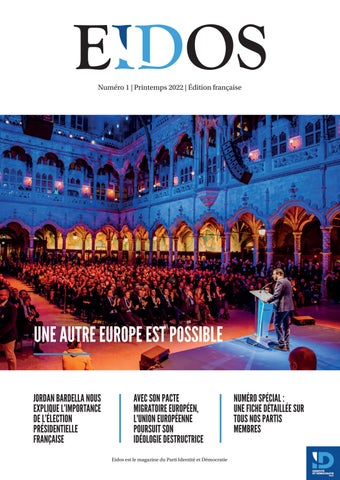
Numéro 1 | Printemps 2022 | Édition française
UNE AUTRE EUROPE EST POSSIBLE JORDAN BARDELLA NOUS EXPLIQUE L’IMPORTANCE DE L’ÉLECTION PRÉSIDENTIELLE FRANÇAISE
AVEC SON PACTE MIGRATOIRE EUROPÉEN, L'UNION EUROPÉENNE POURSUIT SON IDÉOLOGIE DESTRUCTRICE Eidos est le magazine du Parti Identité et Démocratie
NUMÉRO SPÉCIAL : UNE FICHE DÉTAILLÉE SUR TOUS NOS PARTIS MEMBRES
www.id-party.eu facebook.com/IDParty/ twitter.com/IDParty_ instagram.com/idparty_/
GEROLF ANNEMANS Président du Parti Identité et Démocratie President of the Identity and Democracy Party
Éditorial The term “eidos” originates in the Greek conceptual and philosophical framework of Plato. Plato used it to designate the transcendent: the ideal image of our changing world. Plato thus developed a system of thinking which would later become the philosophical and religious starting point for the European and Western model of civilisation. Our European civilisation is the real Europe, the continent which through its diversity and various identities has been the driving force behind world events in such a unique and dynamic way - for better or for worse. This beautiful word for Europe, a name rich in signification, has been hijacked: kidnapped by the strategists and communication specialists of what is in fact only a form of European cooperation. They systematically confuse the name of their legal model - the “European Union” - with the name “Europe” of the continental model of civilisation. As a result, they can quickly label criticism of their European Union as “anti-European” or even “non-European.” They also use the confusion to claim that their European Union is the only possible and sanctified form of cooperation on
Le terme « eidos » provient du cadre conceptuel et philosophique grec de Platon. Platon l'utilisait pour désigner le transcendant, l'image idéale de notre monde pourtant changeant. Platon a ainsi développé un mode de pensée qui deviendra plus tard, tant sur le plan philosophique que religieux, le point de départ du modèle de civilisation européen et occidental. Notre civilisation européenne est la véritable Europe, le continent qui, par sa diversité et ses différentes identités, a été le moteur des évènements mondiaux de manière si unique et dynamique, pour le meilleur et pour le pire. Ce beau mot, ce nom significatif d'Europe, a été détourné, kidnappé par les stratèges et les spécialistes de la communication de ce qui n'est, en fait, qu'une forme de coopération européenne. Ils confondent systématiquement le nom de leur modèle juridique, l' « Union européenne », avec le nom « Europe » du modèle continental de civilisation. Par conséquent, ils peuvent rapidement qualifier les critiques envers leur Union européenne d' « anti-européennes » ou même de « non-européennes ». Ils utilisent
the European continent. But despite the warning of Brexit, this European Union is moving ever closer in the direction of a supranational state. Resistance is also growing. The European political party Identity & Democracy wants to (co-)embody the resistance to this state of affairs, as an extension of the eponymous political group in the European Parliament. Resistance is growing in almost all EU Member States because their populations refuse to abandon their identity, their culture and their democracy at the gates of an artificial empire in which they would be reduced to a province or department of Brussels. The most striking feature of the European Union is the way in which the continent is being overwhelmed by an unprecedented flow of immigration which seriously endangers the characteristics and identity of the European model of civilisation -and all this is happening over people's heads. We advocate the primacy of national sovereignty and identity for economic and financial affairs, as well as for
également la confusion pour prétendre que leur Union européenne est la seule forme possible et sanctifiée de coopération sur le continent européen. Mais alors que cette Union européenne – malgré l'avertissement du Brexit – avance toujours plus loin et de façon toujours plus large dans la direction d'un État supranational, la résistance s'accroît également. Le parti politique européen Identité & Démocratie veut (co-)incarner la résistance à cet état de fait, dans le prolongement de l’action du groupe politique éponyme au Parlement européen. La résistance grandit, dans presque tous les États membres de l'Union européenne, parce que les populations de ces États membres refusent d'abandonner leur identité, leur culture et leur démocratie aux portes d'un empire factice dans lequel elles seraient réduites à une province ou à un département de Bruxelles. Le trait le plus marquant de l'Union européenne est la manière dont, par-dessus la tête des gens, le continent est submergé par un flux d'immigration sans précédent qui met gravement en danger les
immigration cooperation.
and
European
European cooperation must be a free association and not the straitjacket of the centralised unitary State which the other parties support. The dismantling of sovereignty represents a serious threat to the prosperity and identity of the various European peoples. The traditional political parties, which cannot contemplate differences in their way of thinking, want to eliminate them. In actual fact, these differences are Europe's considerable strength and asset. The European political party ID wants to be the patriotic alternative, based on a Europe that respects the uniqueness of the people and their inalienable right to be themselves, to govern themselves and to determine their own future. Meanwhile, at the Warsaw Summit in early December 2021, a number of national ID Party leaders met with other conservative leaders, such as the Polish and Hungarian Prime Ministers (among others) to map out strategic axes for future cooperation. Our political party is in itself an image of the European cooperation upon which we want to build the future of our continent - in friendship, but also in diversity. Gerolf Annemans President of the Identity and Democracy Party
caractéristiques et l'identité modèle européen de civilisation.
du
Nous prônons la primauté de la souveraineté et de l'identité nationales, tant sur le plan économique que financier, ainsi que sur les sujets de l'immigration et de la coopération européenne. La coopération européenne doit être une libre association et non cette camisole de force de l'État unitaire centralisé que les autres partis soutiennent. Le démantèlement de la souveraineté est une menace sérieuse pour la prospérité et l'identité des différents peuples européens. Les partis politiques classiques, qui ne peuvent envisager les différences dans leur façon de penser, veulent les éliminer, alors qu'au contraire ces différences sont la force et l'atout considérables de l'Europe. Le parti politique européen ID veut être l'alternative patriotique, fondée sur une Europe qui respecte les peuples dans leur singularité et dans leur droit inaliénable à être eux-mêmes, à se gouverner et à déterminer leur propre avenir. Entre-temps, lors d'un sommet dit « de Varsovie », au début du mois de décembre 2021, un certain nombre de dirigeants nationaux du ID Parti se sont réunis avec d'autres dirigeants conservateurs, tels que les Premiers ministres polonais et hongrois, entre autres, pour tracer les lignes stratégiques de la future coopération. Notre parti politique est en soi une image de la coopération européenne – dans l'amitié, mais dans la diversité – sur laquelle nous voulons construire l'avenir de notre continent. Gerolf Annemans Président du Parti Identité et Démocratie
5
40
82 98
44
90 76
74
88
EUROPE
PATRIES ET PARTIS COUNTRIES AND PARTIES
34 Avec son Pacte migratoire,
72 Matteo Salvini, garde-côte
l'Union européenne poursuit son idéologie destructrice The European Union continues its destructive ideology with its Migration Pact
38 La Conférence sur l'Avenir de l'Europe, une mascarade fédéraliste
The Conference on the Future of Europe, a federalist farce
50 Vers un grand groupe au Parlement européen ?
Towards a super group in the European Parliament?
européen
Matteo Salvini, European Coast Guard
74 Le Vlaams Belang, prêt pour les responsabilités
Vlaams Belang, ready for responsibility
80 Tomio Okamura, le patriote inspirant
Tomio Okamura, the inspiring patriot
46
10
60 ÉVÈNEMENTS EVENTS
LA GRANDE INTERVIEW
88 Les jalons d’une autre
10 Jordan Bardella
Europe posés à Lisbonne Lisbon sets the scene for another Europe
90 La jeunesse patriote,
promesse d'un avenir meilleur Patriotic youth, the promise of a better future
92 Dans le sud de la France, pour une rentrée marquée par la lutte contre l’immigration massive
Marine Le Pen a-t-elle une chance de gagner l’élection présidentielle ? Jordan Bardella, nouveau président du Rassemblement National, nous explique les raisons pour lesquelles la victoire est possible. Il est aussi revenu sur sa vision de l'Europe. Does Marine Le Pen have a chance of winning the presidential election? Jordan Bardella, new president of the Rassemblement National, explains to us the reasons why victory is possible. He also discusses his vision of Europe.
In the south of France, for a new autumn marked by the fight against mass immigration
7
LA GRANDE
JORDAN BARDELLA
EU INTERVIEW
LA GRANDE INTERVIEW
Marine Le Pen a-t-elle une chance de gagner l’élection présidentielle ? Entretien exclusif avec Jordan Bardella, président du Rassemblement National, membre du Bureau du ID Parti. Does Marine Le Pen have a chance of winning the presidential election? Exclusive interview with Jordan Bardella, President of the Rassemblement National, member of the ID Party Bureau. Two opposing visions of the world are now confronting each other on the European political scene: the universalist one embodied by the outgoing French president Emmanuel Macron, and the other, rooted and carried by the patriotic political forces, will be championed by Marine Le Pen in the next presidential election. Jordan Bardella, the new president of the Rassemblement National, explains why victory is possible. He also discusses his vision of Europe.
Deux visions du monde s'affrontent désormais sur l'échiquier politique européen : celle, universaliste, incarnée par le président français sortant Emmanuel Macron, l'autre enracinée, portée par les forces politiques patriotes, dont Marine Le Pen défendra les couleurs lors de la prochaine élection présidentielle. Jordan Bardella, nouveau président du Rassemblement National, nous explique les raisons pour lesquelles la victoire est possible. Il est aussi revenu sur sa vision de l'Europe.
Eidos: France is at a turning point in its history. In April, two diametrically opposed visions will clash: a Europeanist and globalist
Eidos : La France est à un tournant de son histoire. En avril, elle verra s'affronter deux visions diamétralement opposées : une
vision embodied by Emmanuel Macron, and a vision based on nations held by Marine Le Pen. Is this the last chance for the country to escape globalism? I dare to believe that France is eternal and that it has all the human resources it needs to get out of the rut into which its leaders have pushed it. The current president Emmanuel Macron has constantly shown his contempt for his country by wanting to dissolve it into unbridled globalisation, by claiming that there is “no French culture,” by making the French feel guilty, even going so far as to say that he wanted to “piss off” millions of them. Based on this, there are effectively two visions of France, one embodied by Marine Le Pen - who will put the French back at the heart of the policies - and the other represented by Macron, who loves neither France nor the French. Is it reasonable to believe that victory is possible? All the polls now indicate that Marine Le Pen has a real chance of being elected. She is situated at more than 45% of the voting intentions in the second round, i.e. within the margin of error. The French have understood that Emmanuel Macron is the last representative of a worn-out and disconnected system. The candidate supported by the Rassemblement National is now ready, and you can sense her great serenity and determination.
vision européiste et mondialiste incarnée par Emmanuel Macron, et une vision basée sur les nations que porte Marine Le Pen. Est-ce la dernière chance pour le pays de sortir du globalisme ? J'ose croire que la France est éternelle et qu'elle possède en son sein toutes les ressources humaines pour sortir de l'ornière dans laquelle l'ont plongée ses dirigeants. Le président en exercice, Emmanuel Macron, n'a eu de cesse de la mépriser en voulant la dissoudre dans la mondialisation sauvage, en affirmant qu'il n'y a « pas de culture française », en culpabilisant les Français, allant jusqu'à dire qu'il souhaitait « emmerder » des millions d’entre eux. Partant de là, il existe effectivement deux visions de la France, l'une qu'incarne Marine Le Pen, qui remettra les Français au cœur des politiques menées, et l'autre, que Macron représente, qui n’aime ni la France ni les Français. Peut-on raisonnablement penser que la victoire est possible ? Tous les sondages indiquent aujourd'hui que Marine Le Pen a une réelle chance d'être élue. Elle est située à plus de 45 % des intentions de vote au second tour, c'est-à-dire dans la marge d'erreur. Les Français ont compris qu'Emmanuel Macron était le dernier représentant d'un système usé et déconnecté. La candidate soutenue par le Rassemblement National est aujourd'hui prête et on sent chez elle une grande sérénité et une grande détermination.
11
LA GRANDE INTERVIEW
Let's look ahead and suppose that the French elect Marine Le Pen as Head of State. What will be her priorities on the European stage?
Projetons-nous et supposons que les Français portent Marine Le Pen à la tête de l'État. Quelles seront ses priorités sur la scène européenne ?
The priority will be to meet the European leaders in order to reaffirm very clearly that the French people are sovereign and are masters of their destiny. An unelected and highly undemocratic institution like the European Commission has no business dictating the daily lives of free peoples.
La priorité sera de rencontrer les dirigeants européens afin de leur réaffirmer très clairement que le peuple français est souverain et maître de son destin. Une institution non élue et très peu démocratique comme la Commission européenne n'a pas à dicter le quotidien des peuples libres.
Do you think that the European Union as you describe it is reformable? In short, which bodies should be abolished and which should be reworked?
Pensez-vous que l'Union européenne telle que vous la décrivez est réformable ? En somme, quelles sont les instances à supprimer et celles dont il faut revoir le mode de fonctionnement ?
As I said to Emmanuel Macron in the European Parliament a few weeks ago, their Europe is 60 years old while ours is 3000 years old. Unlike France, the European Union as it exists today is an artificial construct kept alive by federalists who are increasingly being disowned by their people. All attempts to revive their federal Europe project are doomed to failure. Take the Conference on the Future of Europe. It was a fiasco, and yet Emmanuel Macron has already announced that he wants to draw conclusions from it which we know will lead to more Europe and less nationhood. In my opinion Europe must be reformed, starting not from the Commission but from the sovereign states which derive their legitimacy from the democratic process. We can envisage strategic
Comme je l’ai dit à Emmanuel Macron dans l’hémicycle il y a quelques semaines, leur Europe a 60 ans, la nôtre en a 3 000. À l'inverse de la France, l’Union européenne telle qu’elle existe aujourd’hui est une construction artificielle maintenue en vie par des fédéralistes de plus en plus désavoués par leur peuple. Toutes les tentatives pour relancer leur projet d’Europe fédérale sont vouées à l'échec. Prenez la Conférence sur l'avenir de l'Europe qui est un fiasco et, pourtant, Emmanuel Macron a déjà annoncé vouloir tirer des conclusions dont on sait le sens qu'elles prendront : toujours plus d'Europe, toujours moins de nation. Il faudra à mon sens réformer l'Europe en partant non plus de la Commission, mais des États
13
LA GRANDE INTERVIEW
cooperation interests.
depending
on
their
Which are the areas of activity in which this cooperation could bring added value? And how can it be implemented? There are a number of areas where we should pool our talents, not to sell off our industrial secrets and know-how to other countries but to combine our skills. Macron thought he wanted to move forward on the Future Combat Air System (FCAS), with Germany in particular but also with Spain. France is losing out, as is too often the case in our relations with our German neighbours. Similarly, the idea of a common European defence is not desirable because we have sometimes divergent interests. On the other hand, we can think together about how to defend our borders. Frontex should no longer be an agency for receiving migrants, but rather Europe should do everything possible to prevent them from entering its territory. Things have not changed since the migration crisis of 2015 and the immigrationist ideology has not been defeated... On the contrary. The Marrakesh Pact was a clear signal of the willingness of leaders to promote migration flows. In its wake, the European Union's Migration Pact, which was conceived behind closed doors, is increasingly imposing the idea that migration is part of Europe's destiny. This is
souverains qui tirent leur légitimité du processus démocratique. En fonction de leurs intérêts, nous pouvons envisager des coopérations stratégiques. Quels sont les domaines d'activité dans lesquels cette coopération pourrait apporter une plus-value ? Et comment la mettre en application ? Un certain nombre de domaines mériteraient que l'on mette en commun nos talents, non pour brader à d'autres pays nos secrets et savoir-faire industriels, mais pour additionner les compétences. Macron a cru bon de vouloir avancer sur le Système de combat aérien du futur (SCAF), avec l'Allemagne notamment, mais aussi avec l'Espagne. Comme trop souvent dans nos rapports avec nos voisins allemands, la France se retrouve perdante. De la même manière, l'idée de Défense européenne unifiée, alors que nous avons des intérêts parfois divergents, n’est pas souhaitable. En revanche, on peut réfléchir en commun à la façon de défendre nos frontières. Frontex ne doit plus être une agence d'accueil des migrants, mais, au contraire, l'Europe doit tout faire pour empêcher leur entrée sur son territoire. Les choses n'ont pas changé depuis la crise migratoire de 2015 et l'idéologie immigrationniste n'a pas été battue en brèche... Au contraire. Le Pacte de Marrakech
further proof that the elites are out of touch and disconnected with reality, because, at the logical end of this process it is the ordinary French person from Clermont-Ferrand or Briançon but also the ordinary Estonian or Flemish people who will see their way of life turned upside down. The French government presented a plan for the distribution of migrants a year ago in an authoritarian manner. The countries who are hostile to us have realised that migration is our Achilles heel and are blackmailing our peoples with migration. This is indeed a strategy which has pursued lately by Lukashenko of Belarus, but also in a more structural manner by Recep Tayyip Erdoğan. Given that the latter is multiplying blackmail attempts and threats towards Europe, how should Europe behave with Turkey? Let’s remember the incident in the Mediterranean last June. As part of an international mission to enforce the arms embargo on Libya, a Turkish frigate was aggressive (to say the least) towards a French ship by performing radar illumination on three occasions, with Turkish military personnel on duty. Do we need reminding that a number of our leaders were advocating Turkey's entry into the European Union? This country is not geographically located in Europe, is not part of the European civilisation area and, due to its demographic weight, would send more MEPs to the European Parliament than France.
fut un signal très clair de la volonté des dirigeants de favoriser les flux migratoires. Dans la foulée, le Pacte migratoire de l'Union européenne, conçu à l'abri des regards, impose toujours plus l'idée que les migrations s'inscriraient dans le destin de l'Europe. C'est une nouvelle preuve que les élites sont « hors sol » et déconnectées des réalités, car, au bout de la logique, c'est le Français, de Clermont-Ferrand ou de Briançon, mais aussi l'Estonien ou le Flamand qui verront leur mode de vie bouleversé. De façon autoritaire, le gouvernement français a présenté, il y a un an, un plan de répartition des migrants. Les pays qui nous sont hostiles ont compris que les migrations étaient notre talon d'Achille et font peser sur nos peuples un chantage migratoire. C'est effectivement une stratégie menée dernièrement par le Biélorusse Loukachenko, mais aussi, de façon plus structurelle, par Recep Tayyip Erdogan. Sachant que celui-ci multiplie les tentatives de chantage et les menaces envers l'Europe, comment celle-ci doit-elle se comporter avec la Turquie ? Souvenons-nous de l'incident survenu en Méditerranée en juin dernier. Dans le cadre d'une mission internationale visant à faire respecter l'embargo sur les armes imposé à la Libye, une frégate turque a eu une attitude pour le moins agressive envers un navire français en procédant à une illumination radar à trois reprises, avec des militaires turcs
15
LA GRANDE INTERVIEW
We must have a firm attitude towards the Islamist Sultan Erdoğan, stop giving in to his blackmail and above all stop funding him! Looking back, do you think the British exit from the European Union was a good thing? It's up to the British to say, but clearly Brexit, which was supposed to bring misery and calamity, has been a reasonable success. There has always been a British ideal of insularity and empire. The one as a result of its particular geographical position, and the other (which the European Union sometimes imitated) made its membership of the EU a balancing act. The people have decided, and that's just fine. But this is not the solution that Marine Le Pen and the Rassemblement National advocate for France. Your opponents criticise Marine Le Pen for having evolved on the issue of membership of the EuropeanUnion and the euro... The European context has itself changed significantly. We were isolated in Europe at the time, but we have since established relations everywhere with European patriotic parties. They are each making progress or are already in power in their own country. This is the case in Hungary and Poland and also in Slovakia, where the patriots are in government. In the Czech Republic and in Portugal they are strongly on the rise.
en poste. Faut-il rappeler qu'un certain nombre de nos dirigeants plaidaient pour l'entrée de la Turquie dans l'Union européenne ? Ce pays n'est géographiquement pas situé en Europe, ne fait pas partie de l’aire civilisationnelle européenne et, de par son poids démographique, enverrait davantage de députés que la France au Parlement européen. Nous devons avoir une attitude ferme envers le sultan islamiste Erdogan, cesser de céder à ses chantages et surtout cesser de le financer ! Avec le recul, pensez-vous que la sortie des Britanniques de l'Union européenne ait été une bonne chose ? C'est aux Britanniques de le dire, mais visiblement le Brexit, qui était censé leur apporter misère et calamités, ne leur a pas trop mal réussi. Il y a toujours eu, chez les Britanniques, une idée d'insularité et d'empire. L'une, fruit de sa position géographique particulière, et l'autre, que l'Union européenne pouvait parfois concurrencer, faisait de son appartenance à l'UE un exercice d'équilibriste. Le peuple a tranché, c'est très bien ainsi. Mais ce n'est pas la solution que Marine Le Pen et le Rassemblement National préconisent pour la France. Vos adversaires reprochent à Marine Le Pen d'avoir évolué sur la question de l'appartenance à l'Union européenne et de l'euro... Le contexte européen a lui-même
Let's get back to Hungary and Poland: what do you think of the policies there? I defend the sovereignty of States, so I am always reluctant to interfere in the internal affairs of other countries. The
beaucoup changé. Nous étions alors isolés en Europe, mais nous avons depuis noué des relations partout avec des partis patriotiques européens qui, chacun dans leur pays, progressent, voire sont déjà aux responsabilités. C'est le cas en Hongrie et en Pologne, mais aussi en
17
LA GRANDE INTERVIEW
European Union has made a speciality to dictate internal policies to Member States, and this is beginning to exasperate leaders and peoples alike. Poles and Hungarians want to decide what is good for their country and its future, and they want to see their identity preserved. How can they be wrong? The patriotic political forces are now divided in the European Parliament, between the member parties of Identity and Democracy and those who sit in the European Conservatives and Reformists. Are you confident that these formations can be brought together under one flag? United, we would be all the stronger to confront the defenders of the federalist vision of Europe. I am optimistic that this process - which has been underway for several months - will come to fruition. This obviously requires discussion because, as patriots, our national interests or our evaluation of certain issues may differ in the details. We don’t have to agree on everything to work together - we just have to respect each other's specificities. But I know that we agree on the essential point, which is to give people hope and allow them to continue to fly their national flags proudly. Let's talk a little about you, Jordan Bardella: do you feel European? Above all, I feel profoundly French, the fruit of a heritage built up over the
Slovaquie, où les patriotes sont au gouvernement, en République tchèque ou au Portugal où ils connaissent une très belle ascension. Revenons sur la Hongrie et la Pologne : que vous inspirent les politiques qui y sont menées ? Je défends la souveraineté des États, je suis donc toujours réticent à m’immiscer dans les affaires internes d’autres pays. L’Union européenne s’est fait une spécialité de dicter aux États membres leurs politiques intérieures, et cela commence à exaspérer légitimement les dirigeants et les peuples. Les Polonais et les Hongrois entendent décider de ce qui est bon pour leur pays et son avenir, et souhaitent voir leur identité préservée. Comment leur donner tort ? Les forces politiques patriotiques sont aujourd'hui divisées au sein du Parlement européen, entre les partis membres d'Identité et Démocratie et ceux qui siègent chez les Conservateurs et Réformistes européens. Avez-vous bon espoir que ces formations puissent être rassemblées sous un même drapeau ? Unis, nous n'en serions que plus forts pour affronter les défenseurs de la vision fédéraliste de l'Europe. Je suis optimiste et j’espère voir ce processus, entamé depuis plusieurs mois, aboutir. Cela nécessite évidemment des discussions car, en tant que patriotes, nos intérêts
Jordan Bardella avec André Ventura, président de Chega
centuries by our ancestors who combined genius (whether scientific, literary or artistic) with a way of life which is individual to us. I also feel that I am the guarantor of France's interests - within its borders of course - but also in Europe and in the world. I want our country to be great again. This does not however prevent us from feeling that we belong to the European civilisation which we share. Precisely which places in Europe arouse such a feeling in you? Let me start by saying that we all have roots within us. Mine are linked to the region where I grew up, in Seine-Saint-Denis, in Ile-de-France, where all the ravages of globalisation can be seen - starting with the consequences of massive immigration. I of course feel this visceral attachment to our country wherever I am on French territory.
nationaux ou notre appréciation sur certains dossiers peuvent diverger à la marge. Nous ne sommes d’ailleurs pas obligés d’être en accord sur tout pour travailler ensemble, nous devons respecter les spécificités de chacun. Mais je sais que nous sommes d'accord sur l'essentiel, c'est-à-dire redonner l'espoir aux peuples et leur permettre de continuer à brandir fièrement leur drapeau national. Parlons un peu de vous, Jordan Bardella : vous sentez-vous européen ? Je me sens avant tout profondément français, fruit d'un héritage construit au fil des siècles par nos ancêtres qui allièrent le génie, qu'il fût scientifique, littéraire ou artistique, à une manière de vivre qui nous est particulière. Je me sens également garant des intérêts de la France, au sein de ses frontières évidemment, mais aussi en Europe et dans le monde. Je souhaite que notre pays retrouve sa grandeur. Cela n’empêche pas néanmoins de se sentir appartenir à la civilisation
19
LA GRANDE INTERVIEW
As a 26-year-old, you are from a new generation. Do you feel that there is a support for the ideas of Marine Le Pen among the younger people? Marine Le Pen is popular among young people - the Rassemblement National regularly comes out on top among this group both in polls and in election results. There is a real awareness and willingness to put an end to several decades of political correctness and disastrous management which threatens their future as French people. This should encourage us: this youth with pro-national feelings, a phenomenon which can be observed both in France and also everywhere else in Europe, will be the lever we can use to save our nations. Marine Le Pen represents a hope for many young people.
européenne que nous avons en commun. Justement, quels sont les endroits en Europe qui éveillent en vous un pareil sentiment ? Permettez-moi tout d'abord de penser que l'on porte chacun en nous un enracinement. Le mien est lié à la région où j'ai grandi, la Seine-Saint-Denis, en Île-de-France, où tous les ravages de la mondialisation s'observent, à commencer par les conséquences de l'immigration massive. Je ressens évidemment cet attachement viscéral à notre pays où que je me trouve sur le territoire français.
Vous êtes issu d'une nouvelle génération, puisque vous n'avez que 26 ans. Sentez-vous qu'il existe chez les plus jeunes une adhésion aux idées portées par Marine Le Pen ? Marine Le Pen est populaire chez les jeunes, le Rassemblement National arrive régulièrement en tête chez les jeunes, que ce soit dans les sondages ou les résultats électoraux. Il y a une réelle prise de conscience et une volonté d'en finir avec plusieurs décennies de politiquement correct et de gestion désastreuse qui menace leur avenir comme Français. Cela doit nous encourager : cette jeunesse animée de sentiments nationaux, phénomène qui s'observe en France mais aussi partout ailleurs en Europe, sera le levier sur lequel s'appuyer pour sauver nos nations. Pour beaucoup de jeunes, Marine Le Pen incarne en cela un espoir.
21
EUROPE
L'élection présidentielle française se déroulera les 10 et 24 avril prochains The French presidential elections will take place on 10 and 24 April The French will be faced with a clear choice: the headlong rush towards ever more globalism or taking back their national sovereignty. Emmanuel Macron and Marine Le Pen embody both sides of the alternative. We can be optimistic: Marine Le Pen has never been placed so high in the polls, which give her between 45 and 50% of the vote in the second round (and so within the margin of error). She has never been so close to the Elysée. France is at a turning point, and with it the whole of Europe. The arrival of a patriot at the head of the state will undoubtedly have positive repercussions for parties which are committed to defending their identity and national sovereignty.
Un choix clair se posera aux Français : la fuite en avant vers toujours plus de mondialisme, ou la reprise en main de la souveraineté nationale. Emmanuel Macron et Marine Le Pen incarnent les deux versants de l'alternative. Nous pouvons nous montrer optimistes : Marine Le Pen n'a jamais été placée si haut dans les sondages qui la créditent entre 45 et 50 % des voix au deuxième tour, donc dans la marge d'erreur. Elle n'a jamais été si proche de l'Élysée. La France se trouve à un tournant et, avec elle, l'Europe tout entière. L'arrivée au sommet de l'État d'une patriote aura incontestablement des répercussions positives pour les partis ayant à cœur de défendre leur identité et la souveraineté nationale.
23
ROPE
EUR EUROPE EUROP
EUROPE PATRIES E ROPE P PATRIES ET PA EURO PE PATRI
EUROPE
Pour (essayer de) mieux comprendre le fonctionnement alambiqué de l'Union européenne To (try to) better understand the convoluted workings of the European Union
The European Union seems to most citizens to be very muddled in its functioning and institutions, which we believe is proof that it does not meet some of the requirements of democratic life: simplicity, representativeness, and democracy. The Identity and Democracy Party is critical of the current functioning of the European Union. Some institutions seem to us to have too much power - such as the unelected European Commission. In order to make it clearer for you, we give you a brief overview of the roles of the different institutions.
L'Union européenne semble, pour la plupart des citoyens, très floue dans son fonctionnement et ses institutions, preuve, selon nous, qu'elle ne répond pas à quelques exigences de la vie démocratique : simplicité, représentativité, démocratie. Le Parti Identité et Démocratie est critique envers le fonctionnement actuel de l'Union européenne. Certaines institutions nous semblent ainsi avoir trop de pouvoirs, comme la Commission européenne, non élue. Afin que vous puissiez y voir plus clair, nous vous présentons de façon succincte le rôle des différentes institutions.
The European Council brings together the Heads of State and government of the European Union. It is headed by a president - currently the Belgian Charles Michel - who is responsible for facilitating compromises. Its objective is to define the main lines of European policy, and it meets four times a year.
Le Conseil européen réunit les chefs d'État et de gouvernement de l'Union européenne. Il est dirigé par un président, actuellement le Belge Charles Michel, chargé de faciliter les compromis. Son objectif est la définition des grands axes de la politique européenne et se réunit quatre fois par an.
27
EUROPE
The principal role of the European Commission is to propose legislation and ensure the implementation of Community policies. Although it is an essential component, it nevertheless suffers from a lack of democracy since the commissioners (one per Member State, 27 in total) are not directly elected by the citizens but proposed by the Heads of State and government and then validated by the Parliament. Established in 1957 by the Treaty of Rome, it is currently headed by Ursula von der Leyen.
Le rôle principal de la Commission européenne est de proposer des textes et de veiller à l'application des politiques communautaires. Rouage essentiel, elle n'en souffre pas moins d'une carence en démocratie puisque les commissaires (un par État membre, vingt-sept au total) ne sont pas directement élus par les citoyens, mais proposés par les chefs d'État et de gouvernement, puis validés par le Parlement. Instituée en 1957 par le traité de Rome, elle est actuellement dirigée par Ursula von der Leyen.
The Council of the European Union is the body that brings together the ministers in charge of the files in question (ministers of the interior, finance, etc.). It adopts European legislation together with the Parliament on the basis of a proposal from the European Commission, validates (again with the Parliament) the annual budget of the European Union, and draws up the common foreign and security policy.
Le Conseil de l'Union européenne est l'organe réunissant les ministres en charge des dossiers traités (ministres de l'Intérieur, des Finances...). Il adopte la législation européenne avec le Parlement sur proposition de la Commission européenne, valide (toujours avec le Parlement) le budget annuel de l'Union européenne, élabore la politique étrangère et de sécurité commune.
The European Parliament shares the prerogatives of the legislative power with the Council of the European Union. Since 1979, it has been elected by direct universal suffrage according to the proportional voting system (including in countries used to majority voting), which guarantees a representation which is sometimes fairer than in national parliaments. The official seat of the European Parliament is in Strasbourg, where plenary sessions are held, while committees are usually held in Brussels. The elected members of the
Le Parlement européen partage, avec le Conseil de l'Union européenne, les prérogatives dévolues au pouvoir législatif. Il est élu, depuis 1979, au suffrage universel direct selon le monde de scrutin proportionnel (y compris dans les pays habitués au scrutin majoritaire), ce qui garantit une représentation parfois plus juste que dans les assemblées nationales. Le siège officiel du Parlement européen se situe à Strasbourg, où se tiennent les plénières, tandis que les commissions ont généralement lieu à Bruxelles. Afin de faciliter le travail parlementaire, les élus des partis
national parties are divided into groups in order to facilitate parliamentary work.
nationaux sont réunis en groupes.
The Court of Justice of the European Union ensures that European law is applied in conformity in all Member States. It is also competent in the interpretation of European law, at the request of judges working in the different countries. The Commission and the Member States may refer cases to it to assess whether a Member State has violated European law.
La Cour de Justice de l'Union européenne veille à l'application conforme du droit européen dans l'ensemble des États membres. Elle est aussi compétente dans l'interprétation du droit européen à la demande des juges œuvrant dans les différents pays. Elle peut être saisie, tant par la Commission que par les États, pour évaluer une éventuelle violation du droit européen par un État membre.
Based in Frankfurt, the European Central Bank sets the direction for monetary policy and the single currency (the euro). Since its creation, one of the main priorities of the Central Bank is price stability and therefore the fight against inflation.
Située à Francfort, la Banque centrale européenne définit les axes de la politique monétaire et de la monnaie unique, l'euro. Une des grandes priorités de la Banque centrale, depuis sa création, est la stabilité des prix et donc la lutte contre l'inflation.
The Court of Auditors is responsible for analysing the revenue and expenditure of the European Union. This external body theoretically provides an independent assessment of the management of the institutions' accounts.
La Cour des Comptes est compétente dans l'analyse des recettes et des dépenses de l'Union européenne, cet organe externe permettant théoriquement une expertise indépendante de la gestion des comptes des institutions.
29
EUROPE
Qu'est-ce qu'un parti politique européen ? What is a European political party? European political parties are part of the European “institutional machinery” which costs taxpayers a lot of money. One can guess that they will eventually be the instrument of the “Europeanists” to push for the existence of transnational lists during elections. While the Identity and Democracy Party is “eurocritical,” it is nevertheless obliged to constitute itself as a party in order not to be further excluded from the democratic process.
Les partis politiques européens font partie de la « machinerie institutionnelle » européenne qui coûte cher aux contribuables. On peut deviner qu'ils seront à terme l'instrument des « européistes » pour pousser à l'existence de listes transnationales lors des élections. Si le Parti Identité et Démocratie est « eurocritique », il est néanmoins obligé de se constituer en parti pour ne pas être encore plus exclu du jeu démocratique.
When discussing the European Parliament, we saw that MEPs elected in their country on a national list come together by affinity. The results of the 2019 elections gave the following breakdown: - Group of the European People's Party (182 seats), - Progressive Alliance of Socialists and Democrats in the European Parliament (154), - Renew Europe (108), - Identity and Democracy (75), - Greens/European Free Alliance Group (74), - European Conservatives and Reformists (62),
Nous avons vu, au moment d'aborder le Parlement européen, que les députés, élus dans leur pays sur une liste nationale, se rassemblent par affinités. Les résultats des élections de 2019 ont donné la répartition suivante : - Groupe du Parti Populaire européen (182 sièges), - l'Alliance progressiste des socialistes et démocrates au Parlement européen (154), - Renew Europe (108), - Identité et Démocratie (75), - Groupe des Verts/Alliance libre européenne (74), - Conservateurs et Réformistes
Réunion entre leaders patriotiques européens
- The Left in the European Parliament Group (41), to which should be added the non-registered members. While it is tempting to confuse the two, the notion of a European political party is different from that of a group. The two concepts do not overlap. Thus, the parties are intended to contain, for example, national political formations which have elected representatives on their soil but are not represented in the European Parliament. On the other hand, some parties that are members of a group may choose not to join a party due to conviction or other
européens (62), - Groupe de la Gauche au Parlement européen (41), auxquels il convient d'ajouter les non-inscrits. S'il est tentant de confondre les deux, la notion de parti politique européen diffère de celle de groupe. Les deux concepts ne se recoupent pas. Ainsi les partis ont vocation à accueillir, par exemple, des formations politiques nationales ayant des élus sur leur sol, mais n'étant pas représentés au Parlement européen. A contrario, certains partis membres d'un groupe peuvent faire le choix de ne pas adhérer, par conviction ou pour
31
EUROPE
reasons. Finally, some groups in the European Parliament are multi-party: for example, the Green/European Free Alliance Group consisting of the European Green Party (EGP) and the European Free Alliance (EFA). Recognised since the Maastricht Treaty (1992), European parties “contribute to forming a European awareness and to expressing the political will of the citizens of the Union.” As a result of the will of the most ardent federalists, each national party is obliged to display its possible membership of a European party on its website. The Authority for European Political Parties and Foundations is keeping a sharp eye on things! To be recognised as a party, the latter must have representation in at least one quarter of the EU Member States (i.e. seven), in the national or regional parliaments, or in the European Parliament; or it or its member parties must have received at least three per cent of the votes cast in the European Parliament in at least one quarter of the Member States. It is obviously forbidden for a party to use European funds to finance national campaigns. To further complicate the Byzantine European bureaucracy, there are also foundations which are “organisations affiliated to a European political party which support and complement the objectives of that party,” for example by organising conferences.
d'autres raisons, à un parti. Enfin, certains groupes rassemblent, au Parlement européen, plusieurs partis : c'est le cas, par exemple, du Groupe des Verts/Alliance Libre européenne composé du Parti vert européen (PVL) et de l'Alliance libre européenne (ALE). Reconnus depuis le traité de Maastricht (1992), les partis européens « contribuent à la formation d’une conscience européenne et à l’expression de la volonté politique des citoyens de l’Union ». Selon la volonté des fédéralistes les plus farouches, chaque parti national se voit dans l'obligation d'afficher, sur son site, son appartenance éventuelle à un parti européen. L'Autorité pour les partis politiques européens et les fondations politiques européennes veillent au grain ! Pour se voir reconnu comme parti, il importe d'avoir une représentation dans au moins un quart des États membres de l’Union européenne (c'est-à-dire sept), dans les parlements nationaux, régionaux, ou au Parlement européen ; ou bien, lui ou ses partis membres doivent avoir réuni, dans au moins un quart des États membres, au moins 3 % des votes exprimés au Parlement européen. Il est interdit, évidemment, pour un parti d'utiliser les deniers européens pour financer des campagnes nationales.
support and complete the objectives of this party", for example, organizing conferences. There are currently ten officially recognised European political parties: - European People's Party (centre), - Alliance of Liberals and Democrats for Europe (liberal right), - European Conservatives and Reformists Party (right), - European Christian Political Movement (conservative right), - European Democratic Party (centre), - European Free Alliance (regionalism), - European Green Party (environmentalism), - Party of European Socialists (left), - Party of the European Left (extreme left). - Identity and Democracy Party Visit page 106 to find out more about the national parties that make up the Identity and Democracy Party.
Pour compliquer le millefeuille européen, il existe aussi les fondations qui sont des « organisations affiliées à un parti politique européen qui soutiennent et complètent les objectifs de ce parti », par le biais par exemple d'organisation de conférences. Il existe, à l'heure actuelle, dix partis politiques européens officiellement reconnus : - Parti populaire européen (centre), - Alliance des Libéraux et des Démocrates pour l'Europe (droite libérale), -Parti des Conservateurs et Réformistes européens (droite), - Mouvement politique chrétien européen (droite conservatrice), - Parti démocrate européen (centre), - Alliance libre européenne (régionalisme), - Parti vert européen (écologisme), - Parti socialiste européen (gauche), - Parti de la Gauche européenne (extrême gauche). - Parti Identité et Démocratie Rendez-vous à la page 106 pour en savoir plus sur les partis nationaux qui sont membres du Parti Identité et Démocratie.
33
EUROPE
Avec son Pacte migratoire, l'Union européenne poursuit son idéologie destructrice The European Union continues its destructive ideology with its Migration Pact The Global Compact for Safe, Orderly and Regular Migration, better known to the general public as the Marrakesh Pact, was much discussed in December 2018: it promised ever more uncontrolled immigration and articulated as never before the outlines of the migration ideology prevalent among certain elites. Some countries weren’t taken in and refused to sign it. Among them are Hungary and Poland, in the eye of the European storm for not complying with internationalist and immigrationist injunctions. Belgium rushed to sign it, even if it meant toppling a government, and Charles Michel (its Prime Minister) was chosen as President of the European Council in the process. The politics of petty backroom deals had a bright future ahead of it from that day.
Le Pacte mondial pour des migrations sûres, ordonnées et régulières, que le grand public connaît mieux sous le nom de Pacte de Marrakech, avait fait couler beaucoup d'encre en décembre 2018 : il était la promesse d'une immigration toujours plus incontrôlée et formulait, comme jamais auparavant, les contours de l'idéologie migratoire ayant cours parmi certaines élites. Quelques pays ne s'y trompèrent pas et refusèrent de le signer. Parmi ceux-ci, la Hongrie et la Pologne, dans l'œil du cyclone européen pour ne pas se conformer aux injonctions internationalistes et immigrationnistes. La Belgique, quant à elle, se pressa de le signer, quitte à faire tomber un gouvernement, et Charles Michel, son Premier ministre, fut choisi dans la
In order not to suffer another setback, the European Commission has been working on its Migration and Asylum Pact in the greatest secrecy, away from the eyes of people who are especially keen to preserve their identity. The leaders of the European Union are nevertheless constantly defending it with implicit faith, not failing to criticise the “populists who oppose it.” President of the Commission Ursula von der Leyen is constantly reminding us of her mantra. And so during the presentation of the Pact, she didn’t hesitate to declare that “migration has always been a reality in Europe” and that it “will continue to be so.” We have been warned.
foulée comme président du Conseil européen. La politique des petits arrangements avait, ce jour-là, de beaux jours devant elle. Afin de ne pas connaître de nouveau camouflet, la Commission européenne a travaillé son Pacte sur la Migration et l'Asile dans le plus grand des secrets, à l'abri des regards de peuples surtout désireux de préserver leur identité. Avec la foi du charbonnier, les dirigeants de l'Union européenne ne cessent pourtant de le défendre, ne manquant pas au passage de critiquer les « populistes qui s'y opposent ». Ursula von der Leyen, présidente de la Commission, ne cesse de rappeler son mantra. Ainsi, lors de la présentation du Pacte, elle n'hésita pas à déclarer que la « migration a toujours été une
35
EUROPE
Under the pretext of “improving the security of migrants”, the EU Migration and Asylum Pact will create the legal, logistical and political conditions for the mass movement and settlement of people, mainly from the Third World, to the European continent. At the same time, European borders are not secure. Ylva Johansson, who is often caught knitting during
réalité en Europe » et qu'elle « continuera à l'être ». Nous voilà prévenus. Sous le prétexte d ' « améliorer la sécurité des migrants », le Pacte pour les Migrations et l'Asile de l'UE créera les conditions juridiques, logistiques et politiques de l’acheminement et de l'installation massive de populations, issues principalement du tiers-monde, sur le continent
parliamentary debates, had to concede that 22% of people entering the EU are not checked. And yet she still likes to repeat, against all common sense: “We need immigration.”
européen. Dans le même temps, les frontières européennes ne sont pas gardées. Ylva Johansson, souvent surprise en train de... tricoter pendant les débats parlementaires, a dû concéder que 22 % des personnes entrant dans l'espace européen ne sont pas contrôlées. Et pourtant, se plaît-elle à répéter, contre tout bon sens : « Nous avons besoin de l'immigration ».
37
EUROPE
La Conférence sur l'avenir de l'Europe, une mascarade fédéraliste The Conference on the Future of Europe, a federalist farce Few European citizens have heard of it, but the Conference on the Future of Europe was nevertheless announced with great fanfare by the European Union authorities. The barely-concealed objective is to continue the European Union's headlong rush towards greater federalism. Several members of the ID Party are defending you: Hélène Laporte (France), Catherine Griset (France), Philippe Olivier (France), Mara Bizzotto (Italy), Alessandro Panza (Italy), Susanna Ceccardi (Italy), Gerolf Annemans (Flanders), Jaak Madison (Italy), Ludovit Goga (Slovakia), and Petra Steger (Austria)
Peu de citoyens européens en ont entendu parler : la Conférence sur l'avenir de l'Europe a pourtant été annoncée en grandes pompes par les instances de l'Union européenne. L'objectif, à peine caché, est de poursuivre la fuite en avant de l'Union européenne vers plus de fédéralisme. Plusieurs membres du ID Parti vous y défendent : Hélène Laporte (France), Catherine Griset (France), Philippe Olivier (France), Mara Bizzotto (Italie), Alessandro Panza (Italie), Susanna Ceccardi (Italie), Gerolf Annemans (Flandre), Jaak Madison (Italie), Ludovit Goga (Slovaquie), Petra Steger (Autriche).
The EU has selected ten themes for debate: climate change and the environment; health; a stronger economy, social justice and employment; the EU in the world; values and rights, rule of law and security; digital transformation; European democracy; migration; education, culture; youth and sport.
L'UE a sélectionné dix thématiques à soumettre à débats : changement climatique et environnement ; santé ; économie plus forte, justice sociale et emploi ; l'UE dans le monde ; valeurs et droits, état de droit et sécurité ; transformation numérique ; démocratie européenne ; migration ; éducation, culture ; jeunesse et sport.
If the figures are to be believed, it’s a total failure. In total, 38,000 people participated (out of 450 million inhabitants), often leaving a brief message at most. On the topic of migration, barely 500 citizens gave
Un échec total, si l'on en croit les chiffres. Au total, 38 000 personnes ont participé (sur 450 millions d'habitants), laissant souvent au plus un message laconique. Sur le thème migratoire, à peine 500 citoyens ont
their opinion, often leaving anti-migration message.
an
donné leur avis, laissant souvent un message opposé aux migrations.
It seems a long time ago that the Conference was launched with such great fanfare, when for example a convinced federalist called for two flags to be flown at the Olympic Games: the national flag and the twelve stars.
Il semble loin le temps du lancement en fanfare de la Conférence, lorsqu'un fédéraliste convaincu en appelait, par exemple, à arborer deux drapeaux lors des Jeux olympiques : l'étendard national accompagné des douze étoiles.
The very organisation of the debates is a joke. The European Parliament is represented and each country sends representatives from its national parliament. The allocation of speaking time is left to the discretion of the administration. During the last plenary, a Member of the European Parliament from the Identity and Democracy Party was given time to speak on the important subject of the digital transition, but was not chosen by the representative in question. The citizens' panels seem to be hand-picked to ensure that the discourse never deviates from official thinking.
L'organisation même des débats est cataclysmique. Le Parlement européen est représenté et chaque pays y envoie des représentants des Parlements nationaux. L'attribution des prises de parole est confiée au bon vouloir de l'administration. Lors de la dernière plénière, un député européen du Parti Identité et Démocratie s'est vu attribuer un temps de parole sur la transition numérique, sujet important, mais non choisi par le représentant en question. Les panels citoyens semblent triés sur le volet tant le discours ne s'écarte jamais de la pensée officielle.
Conclusions will be drawn from this mess, which we can already confidently predict right here and now: we will need more and more Europe and federalism. The Identity and Democracy Party will never subscribe to such a vision, as it favours sovereign peoples and national identities.
De ce micmac seront tirées des conclusions que l'on peut déjà tracer ici sans grand risque de se tromper : il faudra toujours plus d'Europe et de fédéralisme. Le Parti Identité et Démocratie ne souscrira jamais à cette vision-là, lui qui fait la part belle aux peuples souverains et aux identités nationales.
While at the beginning we were optimistic, we were quickly disillusioned and had to face the fact that this Conference was a farce.
Si au début, nous étions optimistes, nous avons rapidement dû déchanter et nous rendre à l'évidence que cette Conférence était une mascarade.
39
EUROPE
Mara Bizzotto: « Ce dont nous avons besoin aujourd'hui, c'est de construire un nouveau modèle d'Europe, l'Europe des peuples... » Mara Bizzotto: “What we need today is to build a new model of Europe, the Europe of the people...” Mara Bizzotto is a Member of the European Parliament for Lega (Italy)
Mara Bizzotto est membre du Parlement européen pour Lega (Italie)
“The Conference on the Future of Europe was a historic opportunity to rebuild Europe and design the Europe of tomorrow: it was an important chance that we had to seize, with the courage and foresight to make major changes, including the necessary reform of the European treaties.
« La Conférence sur l'avenir de l'Europe représentait une opportunité historique pour reconstruire l'Europe et concevoir l'Europe de demain : c'était une occasion importante dont nous devions profiter, en ayant le courage et la clairvoyance d'opérer des changements majeurs, notamment par la nécessaire réforme des traités européens.
We need to work together to change the current model of Europe at its roots, a model that has proved to be wrong and too far removed from the real needs of our citizens and territories, as we have also seen during the Covid emergency. What we need today is to build a new model of Europe, a Europe of the people, of the citizens, of work and of true democracy, which will put a definitive end to the Europe of austerity, of the banks and of this bureaucracy which has done so much harm to our countries in recent years.”
Il faut travailler ensemble pour changer à la racine le modèle actuel de l'Europe, un modèle qui s'est avéré mauvais et trop éloigné des besoins réels de nos citoyens et de nos territoires, comme nous l'avons vu aussi au cours de l'urgence du Covid. Ce dont nous avons besoin aujourd'hui, c'est de construire un nouveau modèle d'Europe, l'Europe des peuples, des citoyens, du travail et de la vraie démocratie, qui mettra définitivement fin à l'Europe de l'austérité, des banques et de cette bureaucratie qui a fait tant de mal à nos pays ces dernières années. »
Source : EP
Mara Bizzotto (Italie) membre du Parlement européen Lega
41
EUROPE
Petra Steger: « Ma vision de l'Europe est une association de peuples libres et autodéterminés dans laquelle la diversité des cultures est perçue comme une force et non comme un obstacle... » Petra Steger: “My vision of Europe is an association of free and self-determined peoples in which the diversity of cultures is seen as a strength and not an obstacle...” Petra Steger is a Member of the National Council (Austria) for Freiheitliche Partei Österreichs and participates in the Conference on the Future of Europe “A respectful and united cooperation according to the principles of subsidiarity and federalism should guarantee the freedom of each nation State. On the other hand, I categorically reject the path towards a central EU political state, coupled with massive undesirable developments such as the debt and transfer union, EU taxes, losses of national sovereignty or accession negotiations with non-European countries such as Turkey. A return to the real tasks of the EU is needed, namely to ensure peace, freedom and prosperity.
Petra Steger est membre du Conseil national (Autriche) du Freiheitliche Partei Österreichs et participe à ce titre à la Conférence sur l’avenir de l'Europe « Une coopération respectueuse et solidaire, selon les principes de subsidiarité et de fédéralisme, devrait garantir la liberté de chaque État-nation. En revanche, je rejette catégoriquement la voie empruntée vers un État politique central de l'UE, couplée à des développements indésirables massifs tels que l'union de la dette et des transferts, les impôts de l'UE, les pertes de souveraineté nationale ou les négociations d'adhésion avec des pays non européens comme la Turquie. Un retour aux tâches réelles de l'UE est nécessaire : assurer la paix, la liberté et la prospérité.
Source : Wikimedia. License: CC BY-SA 4.0
« Je rejette catégoriquement la voie empruntée vers un État politique central de l'UE » “I categorically reject the path taken towards a central EU political state”
Petra Steger (Autriche) députée au Conseil national Freiheitliche Partei Österreichs
However, the EU will only remain an order of peace if the components of security and freedom are not forgotten. This means nothing less than self-determination. But it is precisely this self-determination which is increasingly being lost as the EU continually seeks to take over national competences and transform itself into a centralised state. This is also leading to a growing rejection by the citizens. Europe is important, but it can never replace the Nation.”
Cependant, l'UE ne restera un ordre de paix que si l'on n'oublie pas les composantes de la sécurité et de la liberté, ce qui ne signifie rien d'autre que l'autodétermination. Mais c'est précisément cette autodétermination qui se perd de plus en plus, alors que l'UE veut de plus en plus reprendre les compétences nationales et se transforme en un État centralisé. Cela conduit également à un rejet croissant de la part des citoyens. L'Europe est importante, mais elle ne pourra jamais remplacer la patrie. »
43
EUROPE
Jaak Madison: « Je ne suis pas optimiste quant à la viabilité à long terme de l'Union européenne » Jaak Madison: “I am not optimistic about the long-term viability of the European Union” Jaak Madison is a Member of the European Parliament for Eesti Konservatiivne Rahvaerakond (Estonia)
Jaak Madison est membre du Parlement européen pour Eesti Konservatiivne Rahvaerakond (Estonie)
“When we speak of the future of Europe, it is important to remember that we are talking first and foremost about the future of the European Union, not of Europe as a whole. Switzerland, Norway or Iceland are as European and often more so than any EU Member State or the European Commission. I am not optimistic about the long-term viability of the European Union.
« Lorsque nous parlons de l'avenir de l'Europe, il est important de se rappeler que nous parlons d'abord et avant tout de l'avenir de l'Union européenne, et non de l'Europe dans son ensemble. La Suisse, la Norvège ou l'Islande sont autant européennes et souvent même plus que n'importe quel État membre de l'UE ou la Commission européenne. Je ne suis pas optimiste quant à la viabilité à long terme de l'Union européenne.
The more the European Union tries to seize power and reduce the sovereignty of Member States, for example in environmental, economic, defence or foreign policy, the more likely it is that the Union will eventually collapse. Unfortunately, the European Commission and the European Parliament have not been able to recognise the mistakes which led Britain, for example, to leave the
Plus l'Union européenne tente de s'emparer du pouvoir et de réduire la souveraineté des États membres, par exemple en matière de politique environnementale, économique, de défense ou étrangère, plus il est probable que l'Union finisse par s'effondrer. Malheureusement, la Commission européenne et le Parlement européen n'ont pas été en mesure de
Photo by Fred MARVAUX - Copyright: © European Union 2021 - Source : EP
Jaak Madison (Estonie) membre du Parlement européen Eesti Konservatiivne Rahvaerakond
Union. The future of the European Union is only possible if we return to the original roots of the Union, which are economic cooperation and the free movement of goods. This means abandoning federalist policies in areas which have absolutely no connection with free trade and economic relations.”
reconnaître les erreurs qui ont conduit la Grande-Bretagne, par exemple, à quitter l'Union. L'avenir de l'Union européenne n'est possible que si l'on revient aux racines originelles de l'Union, qui sont la coopération économique et la libre circulation des marchandises. Cela signifie abandonner les politiques fédéralistes dans des domaines qui n'ont absolument aucun souci de libre-échange et de relations économiques. »
45
EUROPE
La Présidence française du Conseil de l'Union européenne en pleine campagne présidentielle : où est l'équité ? The French Presidency of the Council of the European Union in the middle of a presidential campaign: where is the fairness? Since 1 January, France has held the rotating presidency of the Council of the European Union, in accordance with the mechanism whereby each member country takes it in turn to hold the office.
La France occupe depuis le 1er janvier la présidence tournante du Conseil de l'Union européenne, selon le mécanisme permettant à chaque pays membre d'occuper, à tour de rôle, la fonction.
Whether it’s a coincidence or not, it comes at the same time as the presidential campaign, allowing Emmanuel Macron to appear in the spotlight.
Hasard ou non du calendrier, celle-ci intervient en même temps que la campagne présidentielle, permettant à Emmanuel Macron d'apparaître sous les projecteurs.
If we can ask ourselves the question of fairness in relation to the other candidates - including Marine Le Pen - we can hope that this European
Si l'on peut se poser la question de l'équité par rapport aux autres candidats, dont Marine Le Pen, on peut espérer que cet intermède
interlude will be an opportunity for two visions of Europe to face off: on the one hand, the federalist project intending to make Europe the stepping stone to globalisation, and on the other hand, a national programme rooted in and respectful of identities. For Emmanuel Macron has never hidden his intention to drown the French identity - in which he has never believed - in the European melting pot, to the point of speaking of “European sovereignty” and thereby sweeping away the very idea of national sovereignty.
européen soit l'occasion de confronter deux visions de l'Europe : d'un côté, le projet fédéraliste entendant faire de l'Europe le marchepied vers la globalisation ; de l'autre, un programme national, enraciné et respectueux des identités. Car Emmanuel Macron n'a jamais caché son intention de noyer l'identité française à laquelle il n'a jamais cru dans le magma européen, jusqu'à parler de « souveraineté européenne », balayant l'idée même de souveraineté nationale.
47
EUROPE
In concrete terms, France's powers will be increasingly entrusted to Europe, especially in military terms, since the current French president hopes to establish a common defence policy in both strategic and operational areas. In other words, the idea of a European army is never far off. He will certainly be able to count on the support of the new German Chancellor Olaf Scholz, whom he has already met, and who has “great ambitions for Europe.” Germany has already announced its intention to “see the European Union evolve into a European federal state.” It is therefore to be feared that the Franco-German couple, the Sarkozy-Hollande/Merkel yesterday, the Macron/Scholz today, will continue to dismantle the national ideal. The French presidential election could change things: with Marine Le Pen in the Elysée, things would certainly take a turn for the better. As a symbol, while France was preparing to take over the presidency of the Council of the European Union, the government in power had the French flag replaced by the European flag under the Arc de Triomphe, where the Unknown Soldier, who died for the country, is buried. It had to be removed after two days. “A patriotic victory,” according to Marine Le Pen. We can hope that she will announce another one in April!
Concrètement, les pouvoirs de la France seront toujours plus confiés à l'Europe, notamment en termes militaires puisque l'actuel président français espère mettre en place une politique de défense commune, tant dans les domaines stratégiques qu'opérationnels. En d'autres termes, l'idée d'une armée européenne n'est jamais bien éloignée. Il pourra assurément compter sur le soutien du nouveau chancelier allemand Olaf Scholz, qu'il a déjà rencontré, et qui nourrit, pour l'Europe, « de grandes ambitions ». L'Allemagne a déjà annoncé son intention de « voir évoluer l'Union européenne vers un État fédéral européen ». On peut donc craindre que le couple franco-allemand, Sarkozy-Hollande/Merkel hier, Macron/Scholz aujourd'hui, ne poursuive le dépeçage de l'idée nationale. L'élection présidentielle française pourrait changer la donne : avec Marine Le Pen à l'Élysée, les choses se passeraient, forcément, différemment. Comme un symbole, alors que la France s'apprêtait à prendre la présidence du Conseil de l'Union européenne, le pouvoir en place a fait remplacer le drapeau français par le drapeau européen sous l'Arc de Triomphe, où repose... le soldat inconnu, mort pour la patrie. Il dut être retiré après deux jours. « Une victoire patriote », selon Marine Le Pen. Gageons qu'elle en annonce une autre, en avril.
49
EUROPE
Vers un grand groupe au Parlement européen ? Towards a super group in the European Parliament? The Patriots and Conservatives currently form two groups in the European Parliament, with 66 and 64 representatives respectively, behind the European People's Party and the Progressive Alliance of Socialists and Democrats. Frequent contacts between representatives of Identity and Democracy and the European Conservatives and Reformists suggest the possibility of a union between the two groups, who would thereby gain in strength and disrupt the game plan of the European federalists. In July 2021, fourteen parties signed a common charter, engraving in stone the will to strengthen the links which unite them around common principles: rejection of the European super-state, reminder of national integrity, rejection of “moralistic overactivity,” respect for the Judeo-Christian heritage, and more. The exchanges continued in early
Les patriotes et conservateurs forment à l'heure actuelle deux groupes au Parlement européen, avec respectivement 66 et 64 représentants, derrière les groupes du Parti Populaire européen et l'Alliance progressiste des socialistes et démocrates. Des contacts fréquents entre représentants d'Identité et Démocratie et des Conservateurs et Réformistes européens laissent entrevoir la possibilité d'une réunion entre les deux ensembles qui gagneraient ainsi en puissance et viendraient troubler le jeu des fédéralistes européens. En juillet 2021, quatorze partis ont signé une charte commune, gravant dans l'airain la volonté de resserrer les liens qui les unissent, autour de principes communs : rejet du super-État européen, rappel de l'intégrité nationale, rejet de la « suractivité moralisatrice », respect de l'héritage judéo-chrétien...
Marine Le Pen, Viktor Orban et Katalin Novak pour une Europe des souverainetés
December at the Warsaw Summit, bringing together patriotic leaders from across the continent. Around Marine Le Pen (Rassemblement National), Tom Van Grieken (Vlaams Belang) and Martin Helme (Eesti Konservatiivne Rahvaerakond), were also Hungarian Viktor Orbán (Fidesz) and Polish Jaroslaw Kaczyński (Prawo i Sprawiedliwość). They resulted in a joint declaration recalling the need for cooperation in order to counter the federalist drift of the European Union's leaders, as well as the importance of national sovereignty, the democratic framework par excellence: “Only through such a model of European cooperation can we save the EU from further crises and tensions and put an end to the worrying idea of creating a Europe governed by a self-appointed elite. We reject the arbitrary application of EU law, which misuses or even violates the treaties. Only the sovereign institutions of States have full democratic legitimacy.”
Début décembre, lors du sommet de Varsovie réunissant des leaders patriotes venus de tout le continent, les échanges se poursuivirent. Autour de Marine Le Pen (Rassemblement National), de Tom Van Grieken (Vlaams Belang) et de Martin Helme (Eesti Konservatiivne Rahvaerakond), figuraient également le hongrois Viktor Orban (Fidesz) et le polonais Jaroslaw Kaczyński (Prawo i Sprawiedliwość). Ils aboutiront à une déclaration commune, rappelant la nécessité d'une coopération afin de contrer la dérive fédéraliste des responsables de l'Union européenne, ainsi que l'importance de la souveraineté nationale, le cadre démocratique par excellence : « Ce n'est qu'à travers un tel modèle de coopération européenne que nous pourrons sauver l'UE de nouvelles crises et tensions, et mettre un terme à l'idée inquiétante de créer une Europe gouvernée par une élite autoproclamée. Nous rejetons l'application arbitraire du droit de
51
Photo by DAVID ILIFF. License: CC BY-SA 3.0
EUROPE
Députés
%
Groupe du Parti populaire européen (PPE)
177
25 %
Alliance progressiste des socialistes et démocrates au Parlement européen (S&D)
145
21 %
Renew Europe (RE)
101
14 %
Identité et démocratie (ID)
66
9%
Groupe des Verts?Alliance libre européene (Verts/ALE)
73
10 %
Conservateurs et réformistes européens (CRE)
64
9%
Groupe de la Gauche au Parlement européen (GUE/NGL)
39
6%
Non-Inscrits (NI)
40
6%
Groupe
The exchanges continued in Madrid at the end of January 2022, at the instigation of Vox. The summit produced concrete commitments: application of the principle of European preference, defence of the primacy of national constitutions over European texts, establishment of a greater European energy capacity, the fight against immigration promoted by Brussels, etc.
l'Union, détournant, voire violant, les traités. Seules les institutions souveraines des États ont une pleine légitimité démocratique. » Fin janvier 2022, c'est à Madrid que les échanges se poursuivirent, à l'instigation de Vox. Le sommet a accouché d'engagements concrets : application du principe de préférence européenne, défense de la primauté des constitutions nationales sur les textes européens, instauration d'une plus grande capacité énergétique européenne, lutte contre l'immigration promue par Bruxelles...
53
EUROPE
Première déclaration commune des partis patriotes européens (2 juillet 2021) First joint declaration of the European patriotic parties (July 2, 2021) In the recently-begun debate on the future of Europe, the voice of the parties committed to the freedom of nations and the traditions of the European peoples must not be ignored. The turbulent history of Europe has brought many misfortunes, especially in the last century. Nations defending their sovereignty and territorial integrity against aggressors have suffered beyond all human imagination. After the Second World War, some European countries had to fight against the domination of Soviet totalitarianism for decades before regaining their independence. This independence, the European Union's Atlantic link with the North Atlantic Treaty and the peace between the cooperating nations are a great achievement for many Europeans, giving them a permanent sense of security and creating optimal conditions for development.
Dans le débat sur l'avenir de l'Europe qui a récemment commencé, la voix des partis attachés à la liberté des nations et les traditions des peuples européens ne doit pas manquer. L'histoire mouvementée de l'Europe, surtout au siècle dernier, a apporté de nombreux malheurs. Les nations défendant leur souveraineté et leur intégrité territoriale contre des agresseurs ont souffert au-delà de l'imagination humaine. Après la Seconde Guerre mondiale, certains pays européens ont dû lutter contre la domination du totalitarisme soviétique pendant des décennies avant de retrouver leur indépendance. Cette indépendance, le lien atlantique de l’Union européenne avec le Traité Atlantique Nord ainsi que la paix entre les nations coopérantes sont une grande réussite pour un grand nombre d'Européens, leur donnant un sentiment de sécurité permanent et créant des conditions optimales de développement.
However, the series of serious crises over the last ten years has shown that the work of European cooperation is running out of steam, as nations feel that they are slowly being stripped of their right to exercise their legitimate sovereign powers. The
European
Union
needs
a
Cependant, la série de crises graves qui l'ont secouée au cours des dix dernières années a montré que l'œuvre de coopération européenne est en train de s'essouffler, car les nations ont le sentiment d'être lentement dépouillées de leur droit d'exercer leurs pouvoirs souverains légitimes.
<< L'Union européenne a besoin d'une réforme profonde >> “The European Union needs deep reform”
profound reform, because today instead of protecting Europe and its heritage, instead of allowing the free development of European nations, it is itself becoming a source of problems, anxiety and uncertainty. The EU is increasingly becoming a tool of radical forces which want to achieve a civilisational transformation and ultimately a nationless construction of Europe, aiming at the creation of a European superstate, the destruction or cancellation of European traditions, and the transformation of basic social institutions and moral principles. The use of political structures and law to create a European superstate and new forms of social life is a manifestation of a dangerous and pervasive social engineering of the past, which must be legitimately resisted.
L'Union européenne a besoin d'une réforme profonde, car aujourd'hui au lieu de protéger l'Europe et son patrimoine, au lieu de permettre le libre développement des nations européennes, elle devient elle-même une source de problèmes, d'anxiété et d’incertitudes. L'UE devient de plus en plus un outil de forces radicales qui voudraient réaliser une transformation civilisationnelle et finalement une construction sans nations de l’Europe, visant la création d’un super-État européen, la destruction ou l'annulation des traditions européennes, la transformation des institutions sociales de base et des principes moraux. L'utilisation des structures politiques et du droit pour créer un super-État européen et de nouvelles formes de
55
EUROPE
The moralistic over-activity we have seen in recent years in the EU institutions has led to a dangerous tendency to impose an ideological monopoly. We are convinced that the cooperation of European nations must be based on tradition, respect
vie sociale est une manifestation d’une dangereuse et envahissante ingénierie sociale du passé, qui doit susciter une résistance légitime. La suractivité moralisatrice à laquelle nous avons assisté ces dernières années dans les institutions de l'UE a entraîné une tendance dangereuse à imposer un monopole idéologique.
<< Nous réaffirmons notre conviction que la famille est l'unité de base de nos nations. >> “We reaffirm our conviction that the family is the basic unit of our nations”
for the culture and history of European nations, respect for the Judeo-Christian heritage of Europe and the common values which unite our nations - and not on their destruction. We reaffirm our belief that the family is the basic unit of our nations. At a time when Europe is facing a serious demographic crisis with low birth rates and an ageing population, the answer lies in the development of family-friendly policies rather than mass immigration. We are convinced that the sovereign entities in Europe are and will remain the nations and peoples of Europe. The European Union was created by these peoples to achieve objectives which can be better achieved by the
Nous sommes convaincus que la coopération des nations européennes doit être fondée sur la tradition, le respect de la culture et de l'histoire des nations européennes, le respect de l'héritage judéo-chrétien de l'Europe et des valeurs communes qui unissent nos nations, et non sur leur destruction. Nous réaffirmons notre conviction que la famille est l'unité de base de nos nations. À une époque où l'Europe est confrontée à une grave crise démographique avec de faibles taux de natalité et une population vieillissante, l'élaboration de politiques favorables à la famille devrait être une réponse plutôt que l'immigration de masse. Nous sommes convaincus que les souverains en Europe sont et
Union than by individual Member States.
resteront les nations et les peuples d'Europe.
However, the limits of the Union's competences are set by the principle of attribution - all competences not attributed to the Union belong to the Member States, in accordance with the principle of subsidiarity.
L'Union européenne a été créée par ces peuples pour atteindre des objectifs qui peuvent être réalisés plus efficacement par l'Union que par des États membres seuls. Toutefois, les limites des compétences de l'Union sont fixées par le principe d'attribution - toutes les compétences non attribuées à l'Union appartiennent aux États membres, dans le respect du principe de subsidiarité.
These limits have shifted significantly through a substantial reinterpretation of the Treaties by the EU institutions in recent decades - to the detriment of nation states. This situation is incompatible with the fundamental values of the Union and is leading to a decline in the confidence of European nations and citizens in these institutions. In order to stop and reverse this trend, it is necessary to create, in addition to the existing principle of attribution, a list of inviolable competences of the Member States of the European Union and an appropriate mechanism for their protection with the participation of national constitutional courts or equivalent bodies. All attempts to transform the European institutions into bodies which take precedence over national constitutional institutions create chaos, undermine the meaning of the treaties, and call into question the fundamental role of the Member States' constitutions. The resulting conflicts of competence are then resolved by the brutal
Au travers d’une réinterprétation substantielle des Traités par les institutions de l'Union européenne au cours des dernières décennies, ces limites se sont déplacées de manière significative au détriment des États-nations. Cette situation est incompatible avec les valeurs fondamentales de l'Union et entraîne un déclin de la confiance des nations et des citoyens européens dans ces institutions. Afin d'arrêter et d'inverser cette tendance, il est nécessaire de créer, en plus du principe d'attribution existant, une liste de compétences inviolables des États membres de l'Union européenne, et un mécanisme approprié pour leur protection avec la participation des cours constitutionnelles nationales ou d’organes équivalents. Toutes les tentatives de transformer les Institutions européennes en organes qui primeraient sur
57
EUROPE
<< Réformons ensemble l'Union pour l'avenir de l'Europe ! >> “Let us reform together the Union for the future of Europe!”
imposition of the will of politically stronger entities upon weaker ones. This destroys the basis for the functioning of the European community as a community of free nations. We believe that consensus must remain the fundamental means of achieving a common position in the Union. Recent attempts to circumvent this procedure or ideas to abolish it threaten to exclude certain countries from any influence on decision-making, and to transform the Union into a specific form of oligarchy. This could lead to a de facto incapacitation of national constitutional bodies, including governments and parliaments, which are reduced to the function of approving decisions which have already been taken by others. In the member countries there is still an overwhelming willingness to cooperate, and a spirit of community and friendship permeates the countries and societies of our continent. This is a great asset. A reformed Union will use this asset
les institutions constitutionnelles nationales créent le chaos, sapent le sens des traités, remettent en question le rôle fondamental des constitutions des États membres. Les conflits de compétences qui en résultent sont dès lors réglés par l'imposition brutale de la volonté d'entités politiquement plus fortes sur des entités plus faibles. Ce qui détruit la base du fonctionnement de la communauté européenne en tant que communauté de nations libres. Nous pensons que le consensus doit rester le moyen fondamental de parvenir à une position commune dans l'Union. Les récentes tentatives de contourner cette procédure ou les idées de son abolition menacent d'exclure certains pays de toute influence sur la prise de décision, et de transformer l'Union en une forme particulière d'oligarchie. Cela pourrait conduire à une incapacité de fait des organes constitutionnels nationaux, y compris les gouvernements et les parlements, réduits à la fonction d'approbation de décisions déjà prises par d'autres.
Marine Le Pen and Viktor Orban, vers une alliance toujours plus solide
while a Union which rejects reform will waste it. That is why we are now turning to all parties and groups that share our views, with this document as a basis for joint cultural and political work, respecting the role of the current political groups. Let’s reform the Union together for the future of Europe! Rassemblement National (France), Lega Per Salvini Premier (Italy), Prawo i Sprawiedliwość (Law and Justice Party, PiS, Poland), Fidesz (Hungary), Vox (Spain), Fratelli d'Italia (Italy), Freiheitliche Partei Österreichs, FPÖ (Austria), Vlaams Belang (Flanders), Dansk Folkeparti (Denmark), Eesti Konservatiivne Rahvaerakond (EKRE, Estonia), Perussuomalaiset (PS – Finland), Lietuvos lenkų rinkimų akcija (The Electoral Action of Poles in Lithuania, Lithuania), Ellinikí Lýsi (Greek Solution, EL, Greece)
Dans les pays membres, il existe encore une volonté écrasante de coopérer, et un esprit de communauté et d'amitié imprègne les pays et les sociétés de notre continent. Cela constitue un grand capital. Une Union réformée utilisera ce capital, tandis qu'une Union qui rejette la réforme le gaspillera. C'est pourquoi nous nous tournons aujourd'hui vers tous les partis et groupes qui partagent nos vues, avec ce document comme base d'un travail culturel et politique commun, respectant le rôle des groupes politiques actuels. Réformons ensemble l'Union pour l'avenir de l'Europe ! Rassemblement National (France), Lega Per Salvini Premier (Italie), Prawo i Sprawiedliwość (Droit et Justice, PiS, Pologne), Fidesz (Hongrie), Vox (Espagne), Fratelli d’Italia (Frères d’Italie, Italie), Freiheitliche Partei Österreichs, (FPÖ, Autriche), Vlaams Belang (Flandre), Dansk Folkeparti (Danemark), Eesti Konservatiivne Rahvaerakond (EKRE, Estonie), Perussuomalaiset (PS – Finlande), Lietuvos lenkų rinkimų akcija (Action électorale polonaise de Lituanie, Lituanie), Ellinikí Lýsi (Solution grecque, EL, Grèce)
59
EUROPE
Communiqué de presse à l'issue du sommet de Varsovie Press release following the Warsaw summit (December 2021) The conference participants share a common and deep conviction that the EU is made up of free and equal nation states, bound together by many areas of close cooperation. We share this conviction with millions of citizens in all EU Member States.
(Décembre 2021) Les participants à la conférence partagent une conviction commune et profonde, que l'UE est composée d'États-nations libres et égaux, liés par de nombreux domaines d'étroite coopération. Nous partageons cette conviction avec des millions de citoyens dans tous les États membres de l'UE.
Only through such a model of European cooperation can we save the EU from further crises and tensions and put an end to the worrying idea of creating a Europe governed by a self-appointed elite. We reject the arbitrary application of EU law, which misuses or even violates the treaties. Only the sovereign institutions of States have full democratic legitimacy. The European institutions do not enjoy the same legitimacy and should therefore play a subordinate role to the Nation State in the political architecture. Equally, for this reason they cannot become a social engineering tool to create a new “European nation.” Examples of such social engineering could be, among others, attempts to
Ce n'est qu'à travers un tel modèle de coopération européenne que nous pourrons sauver l'UE de nouvelles crises et tensions, et mettre un terme à l'idée inquiétante de créer une Europe gouvernée par une élite autoproclamée. Nous rejetons l'application arbitraire du droit de l'Union, détournant voire violant les traités. Seules les institutions souveraines des États ont une pleine légitimité démocratique. Les institutions européennes ne jouissent pas de la même légitimité et devraient donc jouer un rôle inféodé dans l'architecture politique à l'État-nation. De même, pour cette raison, ils ne peuvent pas devenir un outil d'ingénierie sociale visant à créer une
61
EUROPE
ideologically modify our languages in a way which would detach a human being from his or her culture and heritage, such as the recent decision of the European Commission to remove the word “Christmas” from the public sphere. Such a conception of the nation has never existed, does not exist today and cannot exist in the future. The participants declare their willingness to cooperate in a spirit of solidarity, at different levels and forums, with all parties and organisations which support the unique heritage of Europe and the idea of a Europe of Nations. The participants also discussed closer cooperation of their respective parties
nouvelle « nation européenne ». Des exemples d'une telle ingénierie sociale pourraient être, entre autres, les tentatives de modifier idéologiquement nos langues d'une manière qui détacherait un être humain de sa culture et de son héritage, comme la récente décision de la Commission européenne de supprimer le mot « Noël » de la sphère publique. Une telle conception de la nation n'a jamais existé, n'existe pas aujourd'hui ni ne pourra exister à l'avenir. Les participants déclarent leur volonté de coopérer dans un esprit de solidarité, à différents niveaux et forums, avec tous les partis et organisations qui portent l'héritage unique de l'Europe et l'idée d'une
Marine Le Pen avec Jarosław Kaczyński (PiS)
in the European Parliament, including organising joint meetings and aligning votes on common issues, such as the protection of Member States' sovereignty and the position on illegal immigration. The participants also agreed that another conference will be organised in Spain in the coming months in response to the ongoing debate on the future of Europe.
Europe des Nations. Les participants ont également discuté d'une coopération plus étroite de leurs partis respectifs au Parlement européen, y compris l'organisation de réunions conjointes et l'alignement des votes sur des questions communes, telles que la protection de la souveraineté des États membres et la position sur l'immigration illégale. Les participants ont également convenu que dans les prochains mois, une autre conférence sera organisée en Espagne en réponse au débat en cours sur l'avenir de l'Europe.
63
Déclaration de Madrid (29 janvier 2022) Madrid Declaration (29 January 2022)
In July 2021, a number of political groupings represented in the European Parliament signed a joint declaration reflecting our concerns and our commitment to defending a European Union which respects the sovereignty, freedom and traditions of the Member States. In return, we agreed to refer to this declaration as a “basis for common cultural and political work, respecting the role of the current political groups.” The first summit of patriotic and conservative forces in Europe took place in Warsaw in December 2021. The participants discussed the need for closer cooperation in the European Parliament, as well as the organisation of joint meetings and the alignment of voting on common issues concerning the protection of the sovereignty of EU Member States. Participants at the Madrid Summit, which took place in Spain on 28-29
En juillet 2021, plusieurs formations politiques représentées au Parlement européen ont signé une déclaration commune reflétant nos préoccupations et notre engagement à défendre une Union européenne qui respecte la souveraineté, la liberté et les traditions des États membres. En retour, nous avons convenu de nous référer à cette déclaration comme “base d’un travail commun culturel et politique, dans le respect du rôle des groupes politiques actuels”. En décembre 2021, le premier sommet des forces patriotiques et conservatrices en Europe a eu lieu à Varsovie. Les participants ont discuté de la nécessité d’une coopération plus étroite au sein du Parlement européen, ainsi que de l’organisation de réunions communes et de l’alignement du vote sur des questions communes concernant la protection de la souveraineté des États membres de l’Union.
EUROPE
January, reiterated their concern about the internal and external attacks on Europe. The European Community was forged as a zone of free cooperation between sovereign states. However, there exists a growing threat which seeks to transform the Union into an ideologically-charged federalist superstate - a construct which disregards national identity and sovereignty - and thus the democracy, plurality and interests of the citizens of the nations which form the Union. This drift endangers the Union itself by moving away from the Christian European ideals upon which it was founded. Today, some bureaucrats and parties mistakenly believe that they can promote agendas without democratic legitimacy which run counter to the needs of Europeans and the very survival of Western civilisation itself.
Les participants au Sommet de Madrid, qui s’est déroulé en Espagne les 28 et 29 janvier, ont réitéré leur inquiétude face aux attaques internes et externes contre l’Europe. La Communauté européenne a été forgée comme un espace de libre coopération entre des États souverains. Cependant, il existe une menace croissante qui cherche à transformer l’Union en un super-État fédéraliste chargé d’idéologie ; une construction qui fait fi de l’identité et de la souveraineté nationales, et donc de la démocratie, de la pluralité et des intérêts des citoyens des nations qui forment l’Union. Cette dérive met en danger l’Union elle-même en s’éloignant des idéaux européens chrétiens sur lesquels elle a été fondée. Aujourd’hui, certains bureaucrates et certains partis croient à tort qu’ils peuvent promouvoir des agendas sans légitimité démocratique
65
EUROPE
Confronted with this situation, we, the participants of the Summit, commit ourselves to defending Europe against external and internal threats. We will confront the currents which advocate a European Union which is alien to its history and whose detachment from reality leads to demographic suicide and the transformation of societies. Europe is in demographic decline. We must support family policies. We love Europe because we love our nations. And we will defend Europe because we defend our nations. That is why we will not stop demanding a Union which focuses on common European values, on people, on their families, on protecting their borders and on the freedom to have energy, industry and a strong primary sector. We need to recover the culture of mutual respect between Member States and with the European institutions, where constitutional identities are safeguarded and not criticised. We denounce the politically-motivated attacks from Brussels against Poland and Hungary, which show a total disregard for the fundamental principles of the EU and violate the spirit of the treaties. In short, we must cooperate and join forces to protect Europe from the imposed ideologies and anti-democratic drift which are leading to its downfall.
qui vont à l’encontre des besoins des Européens et de la survie de la civilisation occidentale elle-même. Face à cette situation, nous, les participants au Sommet, nous engageons à défendre l’Europe contre les menaces externes et internes. Nous ferons face aux courants qui prônent une Union européenne étrangère à son histoire et qui, détachés de la réalité, conduisent au suicide démographique et à la transformation des sociétés. L’Europe est en déclin démographique. Nous devons soutenir les politiques familiales. Nous aimons l’Europe parce que nous aimons nos nations. Et nous défendrons l’Europe parce que nous défendons nos nations. C’est pourquoi nous ne cesserons d’exiger une Union centrée sur les valeurs européennes communes, sur les personnes, sur leurs familles, sur la protection de leurs frontières et sur la liberté d’avoir de l’énergie, de l’industrie et un secteur primaire fort. Nous devons retrouver la culture du respect mutuel entre les États membres et avec les institutions européennes, où les identités constitutionnelles sont sauvegardées et non critiquées. Nous dénonçons les attaques politiquement motivées de Bruxelles contre la Pologne et la Hongrie qui démontrent un mépris total des principes fondamentaux de l’UE et violent l’esprit des traités.
To this end, we have agreed on our commitment to: – Enforce the principle of European preference. Goods produced within the Member States must be given priority over goods from third countries, which are responsible for the impoverishment of our nations' farmers and breeders and the weakening of Europe as an industrial power. – Denounce the immigration policy promoted by Brussels and the inefficiency of FRONTEX, which does not contribute to the protection of our borders, and expressly condemn the “Migration Pact,” which has had disastrous effects in Europe. – Work towards greater European energy capacity by putting in place a package of measures to improve energy self-sufficiency where nations can freely dispose of the energy they need while respecting the environment, but without submitting to the imposition of ideological prejudices. Brussels' failed energy policy contributes to unsustainable energy prices. – Demand strict compliance with the treaties in all cases and firmly reject any initiative to unduly extend the competences of the European institutions. – Defend the primacy of national constitutions over European law, and of national laws over EU regulations in all areas which do not fall within the exclusive competence of the Union.
En bref, nous devons coopérer et unir nos forces pour protéger l’Europe des idéologies imposées et de la dérive antidémocratique qui conduisent à sa perte. À cette fin, nous avons convenu de notre engagement à : – Faire appliquer le principe de la préférence européenne. Les biens produits au sein des États membres doivent être prioritaires par rapport aux biens provenant de pays tiers, responsables de l’appauvrissement des agriculteurs et des éleveurs de nos nations et de l’affaiblissement de l’Europe en tant que puissance industrielle. – Dénoncer la politique d’immigration promue par Bruxelles et l’inefficacité de FRONTEX, qui ne contribue pas à la protection de nos frontières, et condamner expressément le « Pacte des migrations », qui a eu des effets désastreux en Europe. – Œuvrer pour une plus grande capacité énergétique européenne, en mettant en place un ensemble de mesures visant à améliorer l’autosuffisance énergétique où les nations peuvent disposer librement de l’énergie dont elles ont besoin tout en respectant l’environnement, mais sans se soumettre à l’imposition de préjugés idéologiques. L’échec de la politique énergétique de Bruxelles contribue aux prix insupportables de l’énergie.
67
EUROPE
– Urge European and national institutions to sign agreements with third countries so that migrants convicted by a court of law serve their sentences in their countries of origin, and intensify the return of all immigrants who enter the EU illegally. – Work to ensure that a pending application for international protection is not transformed into a pass to enter Europe, but that entry into the common space is only allowed after asylum has been granted. – Create a coordination office as a form of enhanced cooperation between the political groupings present at the Madrid Summit, with the aim of joining forces and voting in the European Parliament on the above-mentioned issues.
– Exiger le strict respect des traités dans tous les cas et rejeter fermement toute initiative visant à étendre indûment les compétences des institutions européennes. – Défendre la primauté des constitutions nationales sur le droit européen, et des lois nationales sur les règlements de l’UE dans tous les domaines qui ne relèvent pas de la compétence exclusive de l’Union. – Exhorter les institutions européennes et nationales à signer des accords avec les pays tiers afin que les migrants reconnus coupables par un tribunal purgent leur peine dans leur pays d’origine, et intensifier le retour de tous les immigrants qui entrent illégalement sur le territoire de l’UE. – Œuvrer pour qu’une demande de protection internationale en cours ne se transforme pas en un laissez-passer pour l’Europe, mais que l’entrée dans
Marine Le Pen (Rassemblement National), Viktor Orban (Fidesz), Mateusz Morawiecki (Prawo i Sprawiedliwość, Poland), Santiago Abascal (Vox), Marlene Svazek (Freiheitliche Partei Österreichs), Martin Helme (Eesti Konservatiivne Rahvaerakond), Tom Van Grieken (Vlaams Belang), Aurelian Pavelescu (PNTCD) Krasimir Karakachanov (VMRO), Valdemar Tomaševski (LLRA-KSS)
l’espace commun ne soit autorisée qu’après l’octroi de l’asile. – Créer un bureau de coordination comme forme de coopération renforcée entre les formations politiques présentes au Sommet de Madrid, dans le but d’unir les forces et de voter au Parlement européen sur les questions susmentionnées. Marine Le Pen (Rassemblement National), Viktor Orban (Fidesz), Mateusz Morawiecki (Prawo i Sprawiedliwość, Pologne), Santiago Abascal (Vox), Marlene Svazek (Freiheitliche Partei Österreichs), Martin Helme (Eesti Konservatiivne Rahvaerakond), Tom Van Grieken (Vlaams Belang), Aurelian Pavelescu (PNTCD) Krasimir Karakachanov (VMRO), Valdemar Tomaševski (LLRA-KSS)
69
T PARTIS
P
PATRIES ATRIES ET PARTIS RTIS PATRIES ET PA ES ET PARTIS
PÊ
PATRIES ET PARTIS PATRIE ET PARTIS
ARTIS
PATRIES ET
PAT
PATRIES ET PARTIS COUNTRIES AND PARTIES
Matteo Salvini, garde-côte européen Matteo Salvini, European Coast Guard
As Italian Interior Minister between 2018 and 2019, Matteo Salvini refused to allow a ship full of migrants land on the Italian coast. The message was clear: anyone who wants to land in Italy will not be allowed to do so, especially when the country is being blackmailed by unscrupulous NGOs. For six days, the ship anchored not far from Sicily, making the situation untenable. A Sicilian court order finally allowed it to dock. However, Matteo Salvini's courage was greatly appreciated among the continent's patriotic forces, who saw Salvini as a hero capable of coming to the rescue of their country. The Italian government had supported the Lega strongman's decision.
Ministre de l’Intérieur italien en 2018 et 2019, Matteo Salvini avait refusé qu’un bateau rempli de migrants accoste sur les côtes italiennes. Le message était limpide : ne rentrerait plus qui veut en Italie, encore moins lorsqu’est exercé sur le pays un chantage par des ONG peu scrupuleuses. Pendant six jours, le navire mouilla non loin de la Sicile, rendant la situation difficilement tenable. Une ordonnance de la justice sicilienne lui permit finalement d’accoster. Toutefois, le courage de Matteo Salvini fut souligné parmi les forces patriotes du continent, voyant en Salvini un de ces héros capables de venir au secours de leur pays. Le gouvernement italien avait soutenu la décision de l’homme fort de la Lega.
After his immunity was lifted by the Senate, for petty political reasons, Matteo Salvini was brought to trial for "kidnapping and abuse": this is how the political correctness lobby translates acts of bravery. However, in reality the leader of the Lega had merely defended the Italians, something which is expected of all political leaders. A first court ordered that the case be dropped in Catania, but Salvini could not avoid a second trial in Palermo. The show trial is in full swing, with Richard Gere expected to take the stand.
Après la levée de son immunité par le Sénat, pour des raisons bassement politiciennes, Matteo Salvini fut finalement traduit en justice pour « séquestration de personnes et d'abus » : c’est ainsi que l’on traduit, en terres politiquement correctes, les actes de bravoure. Le leader de la Lega n’avait pourtant fait que défendre les Italiens, ce qu’on attend, en somme, de tous les dirigeants politiques. Un premier tribunal avait ordonné l'abandon des poursuites à Catane, mais Salvini ne put éviter un deuxième procès à Palerme. La justice-spectacle pouvait battre son plein, avec Richard Gere attendu à la barre.
73
PATRIES ET PARTIS COUNTRIES AND PARTIES
Le Vlaams Belang, prêt pour les responsabilités Vlaams Belang, ready for responsibility According to the polls, Vlaams Belang has become the largest party in Belgium. It is nevertheless based in the north of the country, with the primary ambition of being the major player in the declaration of independence of Flanders.
Le Vlaams Belang est devenu, selon les sondages, le premier parti de Belgique. Mais c’est bien au nord du pays qu’il est implanté, avec pour ambition première d’être l’acteur majeur d’une Flandre libre, souveraine et indépendante.
The ambition is to participate in the next Flemish government, which it has not been able to do so far due to a cordon sanitaire policy which keeps it in opposition. They are now in a position to impose their presence at the negotiating table.
L’ambition est de participer au prochain gouvernement flamand, ce qu’il n’a pas réussi à faire jusqu’à présent en raison d’une politique de cordon sanitaire qui le maintient dans l’opposition. Il est aujourd’hui en mesure d’imposer sa présence à la table des négociations.
The party was founded in 1978 as the Vlaams Blok, a merger of two parties which had split from the Volksunie. It was in 1991 that it emerged electorally and took centre stage: appalled by the irruption of such a popular party, the other political formations spoke of “Black Sunday.” That was thirty years ago. Since then, it has grown steadily, with a gap between 2005 and 2015, when another Flemish patriot party (the Nieuw-Vlaamse Alliantie) rose in the ranks. However, the latter has not kept its promises and is ready to
Le parti est né en 1978 sous le nom de Vlaams Blok, fusion de deux partis issus de la Volksunie. C’est en 1991 qu’il émerge électoralement et occupe le devant de la scène : effarées par l’irruption d’un tel parti populaire, les autres formations politiques ont parlé de « dimanche noir ». C’était il y a trente ans. Depuis, il n’a cessé de progresser, connaissant un passage à vide entre 2005 et 2015, lorsqu’un autre parti patriote flamand (la Nieuw-Vlaamse Alliantie)
join forces with the Walloon Socialist Party. Under the presidency of the young president Tom Van Grieken, the party is again proudly waving its banner of yellow and black. It’s roaring like a lion once more! Vlaams Belang created a surprise in the 2019 federal elections. Since then, the polls have given it a boost by putting it in the lead of the voting intentions. The aim is to build on this popular wave by entering government in a coalition which may involve other right-wing parties. In any case, Vlaams Belang is preparing itself for this. “In 2024, we must be able to exercise power. In the meantime, we need to restructure internally in order to develop this capacity,” said Tom Van Grieken. The objective will then be to reopen the debate and move towards the independence of Flanders, the ultimate ambition of the party, nourished by years of struggle of the “Flemish movement” since the 20th century, since the French-speaking bourgeoisie despised the Flemish people.
a connu une ascension. Mais ce dernier n’a pas tenu ses promesses et est prêt à s’associer avec le Parti socialiste wallon. Sous la présidence de Tom Van Grieken, jeune président, le parti a retrouvé des couleurs. Et les siennes sont jaunes et noires. Il rugit à nouveau, comme le lion. Lors des élections fédérales de 2019, le Vlaams Belang a créé la surprise. Depuis, les sondages le confortent en le plaçant en tête des intentions de vote. L'objectif est de concrétiser cette vague populaire en sa faveur en montant au gouvernement, dans une coalition qui pourrait impliquer d'autres partis de droite. Le Vlaams Belang, en tout cas, s'y prépare. « En 2024, nous devrons être en mesure d’exercer le pouvoir. D’ici là, nous devons nous restructurer en interne afin de développer cette capacité-là », a déclaré Tom Van Grieken. L'objectif sera alors de rouvrir le dossier communautaire et évoluer vers l’indépendance de la Flandre, ambition ultime du parti, nourrie par des années de combat du « mouvement flamand », depuis le XXe siècle lorsque la bourgeoisie francophone méprisait le peuple flamand.
75
PATRIES ET PARTIS COUNTRIES AND PARTIES
Chega, le parti qui vient bousculer l’ordre établi Chega, the party shaking up the established order In the parliamentary elections of 30 January 2022, the Chega party obtained 12 MPs compared to only one previously. The newcomer to Portuguese politics has managed to influence the political debate and disrupt the balance in just three years.
Lors des élections législatives du 30 janvier 2022, le parti Chega a obtenu 12 députés, alors qu'il en comptait un seul auparavant. Le nouveau venu de la politique portugaise a réussi à peser dans le débat politique et à modifier les équilibres en trois ans à peine.
The Portuguese political scene was well-ordered up until then: on the left, the Partido Socialista and on the centre-right the Partido Social-Democrata. The two are used
La scène politique portugaise était bien ordonnée : à gauche, le Partido Socialista ; au centre-droit, le Partido Social-Democrata. Les deux ont l'habitude de se partager le pouvoir :
to sharing power: the former enjoys the position of Prime Minister and the latter President of the Republic.
au premier le poste de Premier ministre ; au second celui de Président de la République.
Portugal was the only country in Europe without a patriotic political party until the creation of Chega! (which in Portuguese means “Enough! ”) in spring 2019.
Exception en Europe, le Portugal ne comptait pas de parti politique patriote jusqu’à la création de Chega (qui, en Portugais, signifie « Ça suffit ») au printemps 2019.
Its president, André Ventura from Lisbon, has a law degree from the University of Lisbon and a doctorate in public law from University College Cork in Ireland, but he made his name by commenting on football matches a sport which has become a religion. However, the sprightly columnist soon diversified into commenting on the various things which plague Portuguese society.
Son président, le Lisboète André Ventura, est diplômé en droit de l'Université de Lisbonne et docteur en droit public de l'University College Cork d'Irlande, mais s’est fait connaître en commentant les matches de football, sport érigé en religion. Pourtant, le sémillant chroniqueur s'est vite diversifié en commentant les faits divers qui minent la société portugaise.
As a politician, he first supported the Social Democratic Party, which he eventually left, finally fed up with its centrist line. He has always advocated a break with the past and change, particularly in the area of immigration.
Engagé en politique, il a tout d'abord soutenu le Parti Social-Démocrate qu’il finit par quitter, las de la ligne centriste imprimé par ce dernier. Lui a toujours prôné la rupture et le changement, en matière d’immigration notamment.
For this reason, he created Chega! , which is fast becoming the sensation of Portuguese politics, obtaining an MP in the person of its president in the October 2019 elections. On the benches of the Assembleia da República, Portugal's unicameral assembly, he set a fire under the government by denouncing immigration and its consequences, along with the health measures. The other political parties ganged up on
C'est pour cette raison qu'il a créé Chega, qui devient rapidement la sensation de la vie politique portugaise en obtenant un député, en la personne de son président, lors du scrutin d'octobre 2019. Sur les bancs de l'Assembleia da República, assemblée monocamérale portugaise, il fit feu de tout bois en dénonçant l'immigration massive et les conséquences qu'elle entraîne ou les mesures sanitaires. Les autres partis
77
PATRIES ET PARTIS COUNTRIES AND PARTIES
Chega, but this did not prevent the party from continuing to grow, gaining a regional foothold even in the Azores, where it won two seats in the elections for the autonomous region. Following the crisis caused by the parliamentary rejection of the government's proposed budget, the Portuguese people had to go to the polls again on 30 January 2022. While the Socialists won the electoral contest, obtaining an absolute
politiques se sont ligués contre Chega, ce qui n'empêcha pas le parti de continuer à progresser, s'implantant régionalement, jusque dans les Açores où il obtint deux élus lors des élections au sein de la région autonome. À l'issue de la crise causée par le rejet parlementaire du budget proposé par le gouvernement, les Portugais ont dû à nouveau se rendre aux urnes le 30 janvier 2022. Si les socialistes sortent vainqueurs de la joute électorale,
PATRIES ET PARTIS COUNTRIES AND PARTIES
majority, the other big winner was Chega: with 7.15% of the vote, it became the third political force in the country, ahead of the Liberals and the radical left, and now has twelve elected members in Parliament. André Ventura was pleased that the voters “understood the party's message” and has already announced that he will lead a real opposition to the socialist government.
obtenant une majorité absolue, l'autre grand vainqueur est Chega : avec 7,15 % des voix, il devient la troisième force politique du pays, devant les libéraux et la gauche radicale, et compte désormais douze élus au Parlement. André Ventura s'est réjoui que les électeurs « aient compris le message du parti » et a déjà annoncé qu'il allait mener une vraie opposition au pouvoir socialiste.
79
PATRIES ET PARTIS COUNTRIES AND PARTIES
Tomio Okamura, le patriote inspirant Tomio Okamura, the inspiring patriot Tomio Okamura is a special character in the political life of his country. His aura even crossed the borders of the Czech Republic. In the opinion of all those who know him, everywhere in Europe, in particular the other leaders of the Identity and Democracy Party, he is an inspiring personality. Born in Tokyo, of a Czech mother and a Japanese father, and possessing dual nationality, he spent his childhood in his fathers country, before finishing his schooling in Czechoslovakia. The rest of his story will forge his character: he lives for a time in an orphanage where he suffers racist remarks, which will affect him deeply. After high school spent studying chemistry, he returned to the Japanese capital where he found small jobs, including as an employee in a cinema complex. On his return to the Czech Republic, he launched a network of travel agencies aimed at a Japanese public, then diversified, notably by opening Japanese food stores.
Tomio Okamura est un personnage à part dans la vie politique de son pays. Son aura a même dépassé les frontières de la République tchèque. De l'avis de tous ceux qui le côtoient, partout en Europe, notamment les autres leaders du Parti Identité et Démocratie, il est une personnalité inspirante. Né à Tokyo, de mère tchèque et de père japonais, et possédant la double nationalité, il passe son enfance dans son pays natal, avant de terminer sa scolarité en Tchécoslovaquie. La suite de son histoire forgera son caractère : il vit un temps en orphelinat où il subit des remarques racistes, ce qui l'affectera profondément. Après des études secondaires passées à étudier la chimie, il rentre dans la capitale japonaise où il trouve des petits emplois, notamment d'employé dans un complexe cinématographique. A son retour en République tchèque, il lance un réseau d'agences de voyage à destination d'un public nippon, puis se diversifie, notamment en ouvrant des magasins d'alimentation japonaise.
Tomio Okamura has an easy and brilliant pen: he writes, at the same time, books on the art of living and Japanese cuisine, but also political themes such as The Art of Governing or The Art of Direct Democracy. In 2013, he founded a party marked by euroscepticism, a position he will continue to have throughout his political career. After an internal split, he founded the SPD in 2015, a political formation of which he is still the president and which brings together around 10% of the electorate, a trend still confirmed during the October 2021 election. He targets some of his criticisms on the European Union, responsible for many of the ills from which the Czech Republic suffers, both in terms of migration, fearing that the Czech identity will be diluted, and in terms of energy policy. To fight against the EU, he can count on two deputies in the European Parliament.
Tomio Okamura a la plume facile et brillante : il rédige, dans le même temps, des livres sur l'art de vivre et la cuisine japonaise, mais aussi des thématiques politiques comme L'art de gouverner ou L'art de la démocratie directe. En 2013, il fonde un parti marqué par l'euroscepticisme, position qu'il ne cessera d'avoir tout au long de sa carrière politique. Après une scission interne, il fonde le SPD en 2015, formation politique dont il est encore le président et qui rassemble environ 10 % de l'électorat, tendance encore confirmée lors du scrutin d'octobre 2021. Il cible une partie de ses critiques sur l'Union européenne, responsable de bien des maux dont souffre la République tchèque, aussi bien en termes migratoires, lui qui craint de voir se diluer l'identité tchèque, qu'en matière de politique énergétique. Pour lutter contre l'UE, il peut compter sur deux députés au Parlement européen.
81
PATRIES ET PARTIS COUNTRIES AND PARTIES
Projecteur sur une ville : Athènes, berceau de la civilisation européenne City spotlight: Athens, the cradle of European civilization
From the city contested by Athena and Poseidon to the current Greek capital, Athens is the focus of all the past, present and future challenges which Europe has faced and will face in the future.
De la ville disputée par Athéna et Poséidon à l'actuelle capitale grecque, Athènes concentre en son histoire tous les défis passés, actuels et futurs qui se sont présentés et se présenteront à l'Europe.
Around the year 1400 BC, it became an important centre of the Mycenaean civilisation and eventually became dominant due to its strategic location on the coast. The city-state was then governed by kings.
Vers 1400 av JC, elle devient un important centre de la civilisation mycénienne et finit par devenir dominante en raison de son emplacement stratégique en bord de mer. La ville-État était alors gouvernée par des rois.
It was at this time that according to Greek mythology Theseus defeated the Minotaur. Forgetting to hoist the white sail which would signify his success, his father Aegeus threw himself in despair into the sea that now bears his name.
C'est à cette époque que, selon la mythologie grecque, Thésée vainquit le Minotaure. Oubliant de hisser la voile blanche qui devait signifier son succès, son père Égée se jeta de désespoir dans la mer qui porte désormais son nom.
The first reforms of the system were initiated by Dracon, Solon and Clisthenes, which led step by step to democracy.
Des premières réformes du système furent initiées par Dracon, Solon et Clisthène qui aboutirent, de fil en aiguille, à la démocratie.
83
PATRIES ET PARTIS COUNTRIES AND PARTIES
The victorious battles against the Persians at Marathon and Salamis, in episodes which have remained glorious over time, eventually achieved it regional recognition.
Les batailles victorieuses face aux Perses, à Marathon et à Salamine, dans des épisodes restés glorieux, finirent par lui octroyer une reconnaissance régionale.
The cultural profusion in the fifth century BC which made Athens one of the cradles of European civilisation took place in this context.
La profusion culturelle au Ve siècle avant Jésus-Christ qui a fait d'Athènes un des berceaux de la civilisation européenne s'est faite dans ce contexte-là.
Some cities, like Sparta, began to revolt. Athens lost its political predominance, but remained a cultural centre valued by the Roman emperors. It was occupied successively by the Franks, the Catalans, the Florentines, the Ottomans and, finally, the Venetians, who reduced it o a field of ruins. On 25 March 1821, the Archbishop of Patras led a revolt against the Sultan and within ten years the country gained its independence over a territory that included Attica, the Peloponnese and southern Epirus, with the memory of ancient Athens as its guiding force.
Certaines cités, comme Sparte, commencèrent à se révolter. Athènes perdit sa prédominance politique, mais resta un centre culturel valorisé par les empereurs romains. Fort prisée, elle est occupée successivement par les Francs, les Catalans, les Florentins, les Ottomans et, finalement, les Vénitiens qui la transformèrent en champs de ruines. Le 25 mars 1821, l'archevêque de Patras sonna la révolte contre le sultan et le pays obtint en une dizaine d'années son indépendance sur un territoire incluant l'Attique, le Péloponnèse et le sud de l'Épire, avec pour boussole le souvenir de l'Athènes antique.
The Turks took a dim view of these events, and carried out massacres, including the massacre at Chios (which was painted by Eugène Delacroix).
Les Turcs virent ces événements d'un mauvais oeil et perpétrèrent alors des massacres dont celui de Scio, mis sur toile par Eugène Delacroix.
A philhellenic mobilisation arose throughout the continent to force governments to intervene, which they
Une mobilisation philhéllène vit le jour partout sur le continent afin de forcer les gouvernements à
The London Protocol confirmed the country's independence in 1830. After a short period as a republic, Otto I established an absolute monarchy, which was quickly tempered after a coup. The country was economically underdeveloped and relied on its alliances with other countries. In 1967, a coup d'état brought the colonels to power. The dictatorship was bloody and marked by the practice of torture. Strategic errors undermined the system, which led to the introduction of parliamentarianism. In 1981, the country joined the European Union and the Panhellenic Socialist Movement, better known by its acronym PASOK, came to power, making Andreas Papandreou Prime Minister. The country was experiencing prosperous years, benefiting in particular from tourism. At the end of the 2000s, the country experienced a serious financial crisis, which called into question its membership in the European Union.
intervenir, ce qu'ils finirent par faire : les Occidentaux envoyèrent une flotte qui détruisit celle des Ottomans. Le protocole de Londres confirma l'indépendance du pays en 1830. Après une courte période où le pays fut une République, Othon Ier mit en place une monarchie absolue, rapidement tempérée après un coup d'État. Fort peu développé économiquement, le pays vit de ses alliances avec d'autres pays. En 1967, un nouveau coup d'état permit aux colonels d'accéder au pouvoir. La dictature fut sanglante et marquée par la pratique de la torture. Des erreurs stratégiques amenuisèrent le système mis en place, ce qui déboucha sur l'instauration du parlementarisme. En 1981, le pays adhère à l'Union européenne et le Mouvement socialiste panhellénique, mieux connu sous son acronyme PASOK, arrive au pouvoir, permettant à Andreas Papandreou d'accéder au poste de Premier ministre. Le pays vit des années prospères, profitant notamment du tourisme. À la fin des années 2000, le pays connaît une grave crise financière, qui remit son adhésion à l'Union européenne en cause.
85
ÉVÈNEMENTS S ET PARTIS
PARTIS
RIES ET PARTIS
ÉVÈNEMENTS EVENTS
Gerolf Annemans et Matteo Salvini
Les jalons d’une autre Europe posés à Lisbonne Lisbon sets the scene for another Europe On the sidelines of the congress of Chega, a member of the ID Party, representatives and leaders met in Estoril to mark their unity and reaffirm the essential challenges for the future of Europe.
En marge du congrès de Chega, parti membre du ID Parti, des représentants et leaders se sont retrouvés à Estoril pour marquer leur unité et réaffirmer les enjeux essentiels pour l’avenir de l’Europe.
“Sometimes one of our parties was in a better position, sometimes another, but the heart of the party always remained faithful. Beyond objectives and programmes, what counts in politics is above all friendship, loyalty, values and coherence,” reiterated Matteo Salvini, former Italian interior minister and leader of the Lega.
« Parfois, un de nos partis se trouvait dans une position meilleure, parfois un autre, mais le cœur du parti est toujours resté fidèle. Au-delà des objectifs et des programmes, ce qui compte en politique, c’est avant tout l’amitié, la loyauté, les valeurs et la cohérence », a rappelé Matteo Salvini, ancien ministre italien de l’Intérieur, et responsable de la Lega.
Beside him, Gerolf Annemans, chairman of the ID Party, nodded. “The migration crisis has shown that the Brussels bureaucrats who are building a European empire must be firmly opposed! What we want is for the peoples of Europe to fight back against this empire.” But also, says Martin Helme, president of the Estonians of Eesti Konservatiivne Rahvaerakond, it is around “national and family values” that “a network of cooperation on a European scale is being created in order to pursue the same type of policy everywhere.” For Harald Vilimsky, a member of the ID Party bureau, it is important to create a different Europe. “Our alliance of parties is fighting against the centralism of Brussels and we are fighting for the return of competences to the Member States, to the people of Europe who should once again be able to participate directly in their destiny. We want to become the second largest party in the European Parliament.” Like his party, the SPD, Ivan David, Member of the European Parliament, “wants to give countries back their national independence, especially in the field of agriculture and foreign policy.” The treasurer of the party, Jean-François Jalkh, goes into greater detail on the issue of immigration, a priority subject: “It's an ideological fight, it's obviously not the immigrants as such that we are attacking. It’s the migration policies.”
À ses côtés, Gerolf Annemans, président du ID Parti, acquiesce. « La crise migratoire a montré que ceux qui construisent un empire européen, les bureaucrates de Bruxelles, doivent se voir contre-attaqués de façon ferme ! Ce que nous souhaitons, c’est une réplique des peuples européens contre cet empire ». Mais aussi, poursuit Martin Helme, président des Estoniens de Eesti Konservatiivne Rahvaerakond, c'est autour des « valeurs nationales et familiales » que se crée « un réseau de coopération à l’échelle européenne afin de poursuivre partout le même type de politique ». Pour Harald Vilimsky, membre du bureau du ID Parti, il importe de créer une autre Europe. « Notre alliance de partis lutte contre le centralisme de Bruxelles et nous luttons pour le retour des compétences aux États membres, aux peuples d’Europe qui devraient à nouveau pouvoir intervenir de façon directe dans leur destinée. Nous voulons à terme devenir le deuxième parti le plus important au Parlement européen ». À l’image de son parti, le SPD, Ivan David, membre du Parlement européen, « veut redonner aux pays leur indépendance nationale, notamment dans le domaine agricole et de politique étrangère ». Le trésorier du parti, Jean-François Jalkh, est quant à lui revenu plus longuement sur la question de l'immigration, sujet prioritaire : « c’est un combat idéologique, ce n’est évidemment pas aux immigrés en tant que tels que nous nous en prenons. C’est aux politiques migratoires ».
89
ÉVÈNEMENTS EVENTS
La jeunesse patriote, promesse d'un avenir meilleur Patriotic youth, the promise of a better future On the sidelines of the European Youth Convention organised by the European Parliament in Strasbourg on 8 and 9 October, the Identity and Democracy Party brought together the young people of its member parties.
En marge des Rencontres entre les Jeunes européens organisées par le Parlement européen à Strasbourg les 8 et 9 octobre, le Parti Identité et Démocratie a réuni les jeunes de ses partis membres.
A total of 150 young people from France, Italy, Slovakia, Portugal, Flanders and Austria met in the Orangery Park, not far from the building housing the Chamber.
Au total, 150 jeunes venus de France, d'Italie, de Slovaquie, du Portugal, de Flandre et d'Autriche se sont rencontrés dans le cadre du parc de l'Orangerie, non loin du bâtiment abritant l'hémicycle.
Several MEPs present took part in the debates.
Plusieurs députés européens présents ont pris part aux débats.
Susanna Ceccardi (Lega) came full of enthusiasm “with a dozen young people from Tuscany and Italy, but also from all over Europe, to bear witness to the need that Europe has for its people and for democracy and to insist on the importance of defending our borders, our values and our social standards.”
Susanna Ceccardi (Lega) est venue pleine d'enthousiasme « avec une dizaine de jeunes de Toscane et d'Italie, mais aussi de toute l'Europe, pour témoigner du besoin que l'Europe a de ses peuples et de la démocratie et pour insister sur l'importance de défendre nos frontières, nos valeurs et nos standards sociaux ».
At the head of a delegation bearing the Flemish lion, Tom Vandendriessche (Vlaams Belang) wished to send a “message of hope” to the youth: “You are not alone! (...) We support each other and a certain spirit is growing all around us: because we have decided to live and defend our destiny.” Among the French people present, Hervé Juvin insisted on the sacrifice “from generation to generation to build our social systems, which are generous,” warning that “if we open them up to all newcomers, it will be over in ten years.” The young people of the member parties then took the floor, taking up the torch from their elders, in a sea of national flags: Aleksandar Nikolic (Rassemblement National), Martin Petriska (Sme Rodina), Silvio Hemmelmayr (Freiheitliche Partei Österreichs), Rita Matias (Chega).
A la tête d'une délégation arborant le lion flamand, Tom Vandendriessche (Vlaams Belang) a souhaité adresser un « message d'espoir » à la jeunesse : « Vous n'êtes pas seuls ! (...) Nous nous soutenons mutuellement et un certain état d'esprit est en train de se développer partout, parce que nous avons décidé de vivre et de défendre notre destinée ». Parmi les Français présents, Hervé Juvin a insisté sur le sacrifice « de génération en génération pour construire nos systèmes sociaux qui sont généreux », prévenant que « si on les ouvre à tous les nouveaux venus, ce sera terminé dans dix ans ». Les jeunes des partis membres ont ensuite pris la parole, reprenant le flambeau de leurs aînés, dans une marée de drapeaux nationaux : Aleksandar Nikolic (Rassemblement National), Martin Petriska (Sme Rodina), Silvio Hemmelmayr (Freiheitliche Partei Österreichs), Rita Matias (Chega).
91
ÉVÈNEMENTS EVENTS
Dans le sud de la France, pour une rentrée marquée par la lutte contre l’immigration massive In the south of France, for a new autumn marked by the fight against mass immigration The French delegation of the Identity and Democracy Party followed the tradition of holding its first parliamentary session in Fréjus in the south of France. Vincent Coussedière and Christophe Gervasi presented the results of their research to an audience of French Members of the European Parliament.
La délégation française du Parti Identité et Démocratie a sacrifié à la tradition d’effectuer sa rentrée parlementaire à Fréjus, dans le sud de la France. Devant un parterre de députés français au Parlement européen, Vincent Coussedière et Christophe Gervasi ont présenté les résultats de leurs recherches.
Vincent Coussedière analysed his book “In Praise of Assimilation,” warning from the outset that “the European Union has never considered a conception of peoples which enabled the concept of assimilation. For the European Union, peoples are individuals who have common interests guaranteed by law. ”
Vincent Coussedière a fait une recension de son ouvrage faisant l’ « Éloge de l’assimilation », prévenant d’emblée que « l’Union européenne n’a jamais considéré une conception des peuples qui faisait place à la question de l’assimilation. Pour l’Union européenne, les peuples, ce sont des individus qui ont des intérêts communs garantis par le droit. »
Continuing the reflection, the intellectual believes that “we must be
Poursuivant la réflexion, l’intellectuel estime qu’ « il faut prendre conscience
Gilles Lebreton, Jean-Paul Garraud, Hélène Laporte, Jean-Lin Lacapelle, Annika Bruna, Julie Lechanteux, Virginie Joron, France Jamet et André Rougé
be aware of the depth of guilt. To say that when you assimilate a foreigner, you commit the same crime as happened with the Jews is mind-boggling. But it works. Erdogan has repeatedly told his Turkish compatriots living in Germany: do not assimilate or integrate: this is a crime against humanity. In leftist-Islamism, assimilation is made to seem almost criminal.” Christophe Gervasi came to present the first part of his studies for the Identity and Democracy Party on the perception of immigration in the member countries of the European Union. In this compilation of existing studies on the subject, immigration is perceived negatively by the citizens interviewed. According to a survey conducted by the Foundation for Political Innovation in May 2021 in four countries (France, Germany, the UK and Italy), 60% of those aged 65
de la profondeur de la culpabilité. Dire que lorsqu'on assimile un étranger, on commet un même crime que par rapport aux juifs, c’est hallucinant. Mais cela fonctionne. Erdogan a répété à plusieurs reprises à ses compatriotes turcs vivant en Allemagne : ne vous assimilez ou ne vous intégrez pas, car c’est un crime contre l’humanité. Dans le gaucho-islamisme, on fait porter à l’assimilation le fait d’être quasiment criminel ». Christophe Gervasi est venu présenter le premier volet de ses études pour le compte du Parti Identité et Démocratie consacrées à la perception de l'immigration au sein des pays membres de l'Union européenne. Dans cette compilation d'études existant sur le sujet, l'immigration y est perçue négativement par les citoyens interrogés. Selon une étude réalisée par la Fondation pour
93
ÉVÈNEMENTS EVENTS
and over, 64% of those aged 50-64, 61% of those aged 35-49, 56% of those aged 25-34 and 46% of those aged 18-24 believe there are too many immigrants in their country. While Afghanistan was once again all over the news in 2021, with the Taliban (re)taking power, 29% of French people are very opposed and 27% are opposed to receiving refugees from Afghanistan. While the mainstream media had long hammered home the point that there was no link between migration and terrorism, Europeans seemed less fooled. For 79% of the French, 87% of the Germans (remember that Angela Merkel opened Germany to migrants), 90% of the British and 84% of the Poles, “there are also potential terrorists among the very many migrants currently arriving in Europe.” In fact, 63%, 49%, 67% and 60% of the citizens of these countries respectively believe that it is no longer possible to welcome additional immigrants. According to the Eurobarometer, immigration is becoming an increasingly important issue for citizens, with a steady increase since the 2015 migration crisis. Since then, Europeans seem to have realised that the pressure has never diminished.
l'innovation politique réalisée en mai 2021 dans quatre pays (France, Allemagne, Royaume Uni et Italie), 60 % des 65 ans et plus, 64 % des 50-64 ans, 61 % des 35-49 ans, 56 % des 25-34 ans et 46 % des 18-24 ans estiment qu'il y a trop d'immigrés dans leur pays. Tandis que l'Afghanistan a de nouveau occupé la une de l'actualité en 2021, avec la (re)prise du pouvoir par les talibans, 29 % des Français sont très opposés et 27 % sont opposés à l'accueil de réfugiés en provenance d'Afghanistan. Tandis que les médias traditionnels ont pendant longtemps martelé qu'il n'y avait aucun lien entre flux migratoires et terrorisme, les Européens semblaient moins dupes. Pour 79 % des Français, 87 % des Allemands (souvenons-nous qu'Angela Merkel avait ouvert l'Allemagne aux migrants), 90 % des Anglais et 84 % des Polonais, « on trouve parmi les très nombreux migrants qui arrivent actuellement en Europe également des terroristes potentiels ». D'ailleurs, respectivement 63 %, 49 %, 67 % et 60 % des citoyens de ces pays estiment qu'il n'est plus possible d'accueillir des immigrés supplémentaires. Selon l'Eurobaromètre, l'immigration occupe une place croissante dans les préoccupations des citoyens, avec une progression continue depuis la crise migratoire de 2015. Depuis, les Européens semblent avoir pris conscience que la pression n'a jamais diminué.
Pour les Européens, l'immigration coûte trop cher ! Immigration is too expensive for Europeans! The second part of Christophe Gervasi's study consisted of an extensive survey on the perception of the cost of immigration in four European Union countries: Germany, France, Italy and Lithuania. Immigration is generally perceived negatively: 48% of Germans, 62% of French, 51% of Italians and 60% of Lithuanians consider immigration as being negative. It is worth noting that in France and Lithuania (but also to a lesser extent in Italy) women and the working classes view immigration more negatively than men and elites. The French (57%), Italians (50%) and Lithuanians (48%) think that
Le second volet de l'étude de Christophe Gervasi a consisté en une vaste étude sur la perception du coût de l'immigration dans quatre pays de l'Union européenne : l'Allemagne, la France, l'Italie et la Lituanie. L'immigration y est perçue négativement de façon globale : 48 % des Allemands, 62 % des Français, 51 % des Italiens et 60 % des Lituaniens jugent l'immigration négative. Il est à noter qu'en France et en Lituanie, mais aussi de façon moins marquée en Italie, les femmes et les classes populaires voient l'immigration plus négativement que les hommes et les élites.
95
ÉVÈNEMENTS EVENTS
immigration plays a negative role for employment (25%, 32% and 27% respectively think it plays a positive role). The figures are more nuanced in Germany. Overall, 53% of Germans, 63% of French, 56% of Italians and 60% of Lithuanians believe that immigration costs more than it brings in (compared to 33%, 21%, 32% and 18% who believe the opposite in each of these countries).
Les Français (57 %), les Italiens (50 %), les Lituaniens (48 %) pensent que l'immigration joue un rôle négatif pour l'emploi (ils sont respectivement 25 %, 32 % et 27 % à penser qu'elle joue un rôle positif). Les chiffres sont plus nuancés en Allemagne. De façon globale, 53 % des Allemands, 63 % des Français, 56 % des Italiens et 60 % des Lituaniens estiment que l'immigration coûte plus qu'elle ne rapporte (contre 33 %, 21 %, 32 % et 18 % qui pensent l'inverse dans chacun de ces pays).
97
ÉVÈNEMENTS EVENTS
Un forum européen sur l'immigration pour comprendre les dangers de l'immigration massive A European forum on immigration to understand the dangers of mass immigration On 25-26 November 2021, the Identity and Democracy Party held its international forum on immigration in Athens, the cradle of European civilisation. In the shadow of the Parthenon, we were reminded of the importance of preserving our identity, which is being undermined by the migratory flows entering the European continent. According to the Estonian Jaak Madison, “the European Union is doing everything in its power to try to demonstrate that there is no link between crime figures and immigration. In their eyes, this is a discourse reserved for right-wing parties, whereas refugees in themselves are rather a pure notion. In reality, this is the first time in Estonia that we have had a case of a woman who was burned, by a Syrian
Les 25 et 26 novembre 2021, le Parti Identité et Démocratie tenait son forum international sur l'immigration à Athènes, berceau de la civilisation européenne. À l'ombre du Parthénon, il fut rappelé l'importance de préserver notre identité, mise à mal par les flux migratoires qui pénètrent sur le continent européen. Selon l'Estonien Jaak Madison, « l’Union européenne fait tout ce qui est en son pouvoir pour tenter de démontrer qu’il n’y aurait pas de lien entre les chiffres de la criminalité et l’immigration. Ce ne serait à leurs yeux qu’un discours réservé aux partis de droite alors que les réfugiés seraient une notion assez pure. Dans la réalité, c’est la première fois en Estonie que nous avons eu le cas d’une femme qui a été brûlée, par un réfugié syrien en l’occurrence ».
Failos Kranidiotis, Ludovit Goga, Thierry Mariani et Andrei Dirlau
refugee in this case.” Thierry Mariani wisely reminded us that, “in the choice of migration policy, we no longer have any power because the will of individuals is now imposed on States.” The French MEP also stressed “the impact of foreign policy on migration. Since the beginning of the 2000s, the West has led a destabilisation of the entire Middle East. Even if I have to be deliberately provocative (...), I think that, at times, the European policy of some of our partners, which consists of aligning themselves with America, can lead to a backlash.”
Thierry Mariani a rappelé fort judicieusement que, dans « le choix de la politique migratoire, nous n’avons plus aucun pouvoir car la volonté des individus s’impose désormais aux États ». Le député français au Parlement européen a également insisté sur « l’impact de la politique étrangère sur les migrations. Depuis le début des années 2000, l’Occident a mené une déstabilisation de tout le Moyen-Orient. Quitte à être volontairement provocateur (…), je trouve que, par moments, la politique européenne de certains de nos partenaires, qui consiste à s’aligner sur l’Amérique, peut amener un retour de bâton. »
99
ÉVÈNEMENTS EVENTS
Ludovit Goga : « L'État a un rôle-clé à jouer dans la lutte contre l'immigration » Ludovit Goga: "The State has a key role to play in the fight against immigration" The State, as an institutionalised form of organisation of society, derives its existence both from the natural right of nations to self-determination and from the definition of its legal essence in the constitution. If we want to talk about the role of the State in combating mass migration, we have to ask the crucial question: does it feel threatened and, above all, is it prepared to fight migration? It is essential to recall the fundamental attributes of the existence and functioning of the rule of law based on democratic principles. The State as such has two main definitions: one from a social science perspective and one from an international law perspective. According to the first definition from the point of view of political science and history, “it is a legal organisation of the sovereign political power of a
L'État, en tant que forme institutionnalisée d'organisation de la société, tire son existence à la fois du droit naturel des nations à disposer d'elles-mêmes et de la définition de son essence juridique inscrite dans la Constitution. Quand on veut parler du rôle de l'État dans la lutte contre les migrations de masse, il faut se poser la question cruciale : se sent-il menacé et, surtout, est-il prêt à lutter contre les migrations ? Il est essentiel de rappeler les attributs fondamentaux de l'existence et du fonctionnement de l'État de droit fondé sur des principes démocratiques. L'État en tant que tel a deux définitions principales : l'une du point de vue des sciences sociales et l'autre du droit international. Selon la première définition du point de vue de la science politique et de
society in a certain territory.” It is therefore a form of organisation of human society, whose fundamental and necessary elements are: population, territory, power and State sovereignty. In the second definition of international law and international relations, the State is described as a political entity which has sovereignty. It follows from these two definitions that it is not subject to any higher political power and that its prerogative is to decide its own affairs. Another point that needs to be mentioned to answer our question is the functions of the State, especially, for our purposes, given that one of its key functions is to provide security. We do have any particular need to be reminded that security is the basis for the proper functioning of our society.
l'histoire, « il est une organisation légale du pouvoir politique souverain d'une société sur un certain territoire ». C'est donc une forme d'organisation de la société humaine, dont les éléments fondamentaux et nécessaires sont : la population, le territoire, le pouvoir et la souveraineté de l'État. Dans la deuxième définition du droit international et des relations internationales, l'État est décrit comme une entité politique qui a la souveraineté. Il résulte de ces deux définitions qu'il n'est soumis à aucun pouvoir politique supérieur et que sa prérogative est de décider de ses propres affaires. Un autre point qu'il faut mentionner pour répondre à notre question est celui des fonctions de l'État, surtout, pour notre propos, étant donné que l'une de ses fonctions clés est celle d'assurer la sécurité. Nous n'avons pas particulièrement besoin de rappeler que la sécurité est la base du bon fonctionnement de notre société.
101
ÉVÈNEMENTS EVENTS
Here, it must first be emphasised that national security is the exclusive competence of Nation States. On the other hand, the State has a duty to protect its citizens, whether from an external enemy or a domestic threat. From the point of view of EU law, a Nation State is considered in the definitions of the principles of subsidiarity and proportionality. The Treaty on European Union applies here, namely: • Article 5, paragraph 3, the principle of SUBSIDIARITY and • Article 5, Paragraph 4, the principle of PROPORTIONALITY It can therefore be confirmed that the State has all the possibilities and powers to intervene and fight mass migration effectively. However, this has to be decided at the highest political level. An effective fight against migration de facto depends on a political decision. It is outrageous that European liberals have taken migration policy as a matter of morality and are harassing free and sovereign European countries. However, they overestimate not only their strengths, but also the real opportunities for the integration of migrants. In this context, another unanswered question arises:
Ici, il faut d'abord souligner que la sécurité nationale est de la compétence exclusive des États-nations ; d'autre part, l'État a le devoir de protéger ses citoyens, qu'il s'agisse d'un ennemi extérieur ou d'une menace intérieure. Du point de vue du droit de l'Union européenne, un État-nation est considéré dans les définitions des principes de subsidiarité et de proportionnalité. Le traité sur l'Union européenne est en vigueur ici, à savoir : • Article 5, paragraphe 3, le principe de SUBSIDIARITÉ et • Article 5, Paragraphe 4, le principe de PROPORTIONNALITE On peut donc affirmer que l'État a toutes les possibilités et tous les pouvoirs pour intervenir et lutter efficacement contre les migrations de masse. Cependant, cela doit être décidé par les plus hauts responsables politiques. Une lutte efficace contre les migrations dépend de facto d'une décision politique. Il est scandaleux que les libéraux européens aient pris la politique migratoire pour une question de moralité et harcèlent des pays européens libres et souverains. Cependant, ils surestiment non seulement leurs atouts, mais aussi les réelles opportunités d'intégration des migrants. Dans ce contexte, une autre question sans réponse se pose :
<< Les libéraux ont sous-estimé le potentiel de radicalisation et la violence fait désormais partie de notre quotidien. >>
"By what criteria is the moral decision made to expose citizens to the risk of a shooting in the city centre, a stabbing, for example on public transport, a rape or a beheading in a church?” Liberals have underestimated the potential for radicalisation and violence has become part of our daily lives. However, no State has the capacity to monitor such a large number of individuals who adhere to the militant Islam which we already have in Europe! Morality is constructed in contrast to the interests of the Nation State - an absurd contrivance! We believe that internal security and the regulation of entry into the territory of States remain the responsibility of the Nation States. And that the European Commission should respect this fact!
« Selon quels critères est prise la décision morale d'exposer ses concitoyens au risque de fusillade en centre-ville, d'agression au couteau, par exemple dans les transports en commun, de viol ou de décapitation dans une église ? » Les libéraux ont sous-estimé le potentiel de radicalisation et la violence fait désormais partie de notre quotidien. Cependant, aucun État n'a la capacité de surveiller un si grand nombre d'individus, adhérant à l'islam militant que nous avons déjà en Europe ! La morale est construite en contraste avec les intérêts de l'État-nation, ce qui est une construction absurde ! Nous pensons que la sécurité intérieure et la réglementation de l'entrée sur le territoire des États restent de la compétence des États-nations ! Et la Commission européenne devrait respecter ce fait !
103
ÉVÈNEMENTS EVENTS
Harald Vilimsky et Ludovit Goga
Summarising these key points, it is clear that migration in the context of the migration crisis, which peaked in 2015 and continues, differs from earlier migration movements caused by the two World Wars or, in recent history, the departure of people from Eastern Bloc countries. We believe that this is the key point on which we must act: to radically prevent the organisation of migratory movements! Secondly, I see a solution in stopping the interest of “economic” emigration. I see the setting of mandatory quotas as an attempt to compensate for the lack of interest for migrants of staying in economically weaker countries. And thirdly, and not least, I plan to strengthen the return policy, whether in the form of repatriation or readmission.
En résumant ces points clés, il est clair que la migration dans le contexte de la crise migratoire, qui a culminé en 2015 et persiste, diffère des mouvements migratoires antérieurs provoqués par les deux guerres mondiales ou, dans l'histoire récente, par le départ des personnes des pays du bloc de l'Est. Nous pensons que c'est sur ce point névralgique qu'il faut agir : empêcher radicalement l'organisation de mouvements migratoires ! Deuxièmement, je vois une solution en arrêtant les incitants à l'émigration que sont les avantages de nature économique. Je vois la fixation de quotas obligatoires comme une tentative de compenser le manque d'intérêt des migrants à rester dans des pays économiquement plus faibles. Et comme troisième point, et non le moins important, j'envisage de renforcer la politique de retour, que ce soit sous forme de rapatriement ou de réadmission.
Ci-dessus : Hélène Laporte, chef du groupe ID au Parlement européen En haut à droite : Délégation du ID Parti à Lisbonne A droite : Failos Kranidiotis, président de Nea Dexia Ci-dessous : Martin Helme, président de EKRE En bas à droite : Jean-François Jalkh, trésorier du ID Parti
105
PARTIS
PARTIS PARTIES
Présentation de la charte du ID Parti Presentation of the ID Party charter
Démocratie Défense des principes démocratiques contre tout projet totalitaire. Defense of democratic principles against any totalitarian project.
Souveraineté Pour la souveraineté des États et des nations, contre toute construction supranationale. For the sovereignty of States and nations, against any supranational construction.
Identité Alliance politique basée sur la préservation de l'identité des peuples, contrôle de l'immigration. Political alliance based on preservation of peoples' identity, control of immigration.
Spécificité Préservation de la diversité des projets politiques (économie, culture…) des partis membres. Preservation of the diversity of political projects (economy, culture, etc.) of member parties.
Libertés Défense des libertés individuelles et protection de la liberté d'expression, notamment les libertés numériques. Defense of individual freedoms and protecting of freedom of expression, including digital freedoms.
La culture Défense de la culture comme essence de toute action politique. Defense of culture as the essence of all political action.
109
PARTIS PARTIES
Lega Federal Secretary: Matteo Salvini Elected officials: 130 MPs 62 senators 24 MEPs 6 regional presidents 201 regional advisers
Secrétaire fédéral : Matteo Salvini Élus : 130 députés 62 sénateurs 24 députés européens 6 présidents de région 201 conseillers régionaux
Initially based in northern Italy, where its electorate was concentrated, the Lega is now present throughout the country.
Initialement implantée au nord de l’Italie, où se concentrait son électorat, la Lega est aujourd’hui présente dans l’ensemble du pays.
The Lega Nord was born in 1989 from the merger of several autonomist movements and took off in the 2000s, during which time it rose in several centre-right governments.
La Lega Nord est née en 1989 de la fusion entre plusieurs mouvements autonomistes et prend son envol dans les années 2000 au cours desquelles elle monta dans plusieurs gouvernements de centre-droit.
The Lega has expanded its geographical reach by making a clear statement on immigration, and also by following it up with concrete results: in power since 2018, it has managed to drastically reduce illegal entries into the country under the leadership of Interior Minister Matteo
La Lega a étendu son implantation géographique en tenant un discours clair sur l’immigration, mais aussi en faisant suivre celui-ci de résultats concrets : au pouvoir dès 2018, elle parvient à réduire drastiquement, sous l’impulsion de Matteo Salvini,
Salvini. It withdrew its support for the government following disagreements with another party in the coalition. It received 34.26% of the vote in the 2019 European elections, a record for the party, which became the largest in number of seats in the Identity and Democracy group. They returned to the Italian government in February 2021
ministre de l’Intérieur, les entrées illégales dans le pays. Elle retire son soutien au gouvernement suite à des désaccords avec un autre parti de la coalition. Elle obtient 34,26 % des voix lors des élections européennes de 2019, ce qui constitue un record pour le parti, devenu le plus important en nombre de sièges du Groupe Identité et Démocratie. Elle réintègre le gouvernement italien en février 2021
En ligne Online legaonline.it
twitter.com/LegaSalvini
facebook.com/legasalvinipremier/ instagram.com/legaofficial/ youtube.com/user/telepadaniatgnord
111
PARTIS PARTIES
Rassemblement National Leader: Jordan Bardella Elected officials: 7 MPs 1 senator 23 MEPs elected to the European Parliament in May 2019 255 regional councilors 24 departmental advisers
Président : Jordan Bardella Élus : 7 députés 1 sénateur 23 députés élus au Parlement européen en mai 2019 255 conseillers régionaux 24 conseillers départementaux
Rassemblement National, which took over from the Front National in 2018, has established itself over the years as the leading party in France.
Le Rassemblement National, qui a pris la suite du Front National en 2018, s’est imposé au fil des années comme le premier parti de France.
Because of the two-round majority system, where traditional parties usually join forces to block it, its representation in the National Assembly remains below its real electoral strength, especially among the working classes.
En raison du scrutin majoritaire à deux tours, où les partis traditionnels s’allient le plus souvent pour lui faire barrage, la représentation à l’Assemblée nationale reste en-deçà de sa force électorale réelle, notamment auprès des classes populaires.
Rassemblement National fights for more national sovereignty, a limitation of immigration, a strengthening of national security and special attention to the republican
Le Rassemblement National lutte pour davantage de souveraineté nationale, une limitation de l’immigration, un renforcement de la
pact. Its then president Marine Le Pen reached the second round of the presidential election in 2017 against the representative of the elites, Emmanuel Macron. All the polls indicate her presence in the second round of the next presidential elections and a real chance of being elected President of the Republic.
sécurité nationale et porte une attention toute particulière au pacte républicain. Sa présidente Marine Le Pen a atteint le deuxième tour de l’élection présidentielle en 2017 face au représentant des élites, Emmanuel Macron. Tous les sondages indiquent sa présence au deuxième tour lors de la prochaine élection présidentielle et une réelle chance d'être élue présidente de la République.
En ligne Online rassemblementnational.fr facebook.com/RassemblementNational/ twitter.com/RNational_off instagram.com/rassemblementnational_fr/ youtube.com/user/fnofficiel
113
PARTIS PARTIES
Vlaams Belang Leader: Tom Van Grieken Elected officials: 3 MEPs 18 federal MPs 7 senators 23 Flemish MPs 1 Brussels MP 24 provincial councilors
Président : Tom Van Grieken Élus : 3 députés européens 18 députés fédéraux 7 sénateurs 23 députés flamands 1 député bruxellois 24 conseillers provinciaux
Vlaams Belang has been established for several decades in the Flemish political landscape (since 2004 under this name), where it fights for the move towards the independence of Flanders, advocates against mass immigration that has changed the appearance of towns and villages and a desire to see a zero tolerance policy applied.
Le Vlaams Belang est implanté depuis plusieurs décennies dans le paysage politique flamand (depuis 2004 sous cette appellation), où il livre un combat pour l’évolution vers l’indépendance de la Flandre, une lutte contre l’immigration massive qui a modifié la physionomie des villes et des villages et une volonté de voir appliquée une politique de tolérance zéro.
After having achieved its best results at the beginning of the century, with a historic score of more than 24% of the Flemish votes in 2004, the party is settling before experiencing a second youth.
Après avoir atteint ses meilleurs résultats au début du siècle, avec un score historique de plus de 24 % des voix flamandes en 2004, le parti se tasse avant de connaître une seconde jeunesse.
Vlaams Belang triumphed in the last legislative elections of 2019, under the leadership of its young president Tom Van Grieken, and became the second largest party in Belgium. The other parties are not interested in making it part of a government majority; however, the focus is on 2024 when the objective will be to enter a government. The polls regularly score it as the largest party in Flanders and Belgium.
Le Vlaams Belang triomphe ainsi lors des dernières élections législatives de 2019, sous l’impulsion de son jeune président Tom Van Grieken, et devient le deuxième plus grand parti de Belgique. Les autres partis ne souhaitent pas le faire entrer dans une majorité gouvernementale ; qu’à cela ne tienne, les yeux sont rivés vers 2024 où l’objectif sera d’entrer dans un gouvernement. Les sondages en font régulièrement le plus grand parti flamand et de Belgique.
En ligne Online vlaamsbelang.org
instagram.com/vlaamsbelang/
facebook.com/vlbelang/
youtube.com/user/ VlaamsBelangInBeeld
twitter.com/vlbelang
115
PARTIS PARTIES
Svoboda a prímá demokracie President: Tomio Okamura Elected officials: 20 national MPs 2 MEPs 35 regional councillors 155 municipal councilors
Président : Tomio Okamura Élus : 20 députés nationaux 2 députés européens 35 conseillers régionaux 155 conseillers municipaux
Svoboda a prímá demokracie was founded in 2015 by Tomio Okamura, who is still its president today. In particular, it consisted initially of eight MPs who left a rival political party which has now disappeared.
Svoboda a přímá demokracie est fondé en 2015 par Tomio Okamura qui en est toujours, à l’heure actuelle, le président. Il s’appuie notamment, dans un premier temps, sur huit députés ayant quitté une formation politique rivale aujourd’hui disparue.
The first elections were an immediate success, with 20 members of parliament. The party is Eurosceptic and wants the Czechs to be consulted on leaving the European Union. It opposes mass immigration, mainly from Muslim countries, and rejects the quota policy imposed by Europe.
Les premières élections sont directement un succès puisqu’il obtient une représentation de 20 députés au Parlement. Le parti se veut eurosceptique et souhaite que les Tchèques soient consultés sur la sortie de l’Union européenne. Il s’oppose à l’immigration de masse, principalement en provenance des
Svoboda a prímá demokracie supports the introduction of a territorial defensive army.
pays musulmans, et refuse la politique des quotas imposés par l’Europe. Svoboda a přímá demokracie est favorable à l’introduction d’une armée territoriale défensive.
En ligne Online spd.cz facebook.com/hnutispd/ twitter.com/tomio_cz instagram.com/tomio.cz/
117
PARTIS PARTIES
Eesti Konservatiivne Rahvaerakond Leader: Martin Helme Elected officials: 19 national MPs 1 MEP
Président : Martin Helme Élus : 19 députés nationaux 1 député européen
Eesti Konservatiivne Rahvaerakond of Estonia was founded in 2012 by Mart Helme, former Estonian ambassador to Russia.
Eesti Konservatiivne Rahvaerakond d’Estonie est fondé en 2012 par Mart Helme, ancien ambassadeur estonien en Russie.
The group defends patriotism by working tirelessly for the welfare and protection of Estonian values and interests (including culture, education and the economy) and by fighting against current migratory movements.
La formation défend le patriotisme en s’engageant sans relâche pour le bien-être et la protection des valeurs et des intérêts de l’Estonie (notamment en matière de culture, d’éducation et d’économie) et en luttant contre les mouvements migratoires actuels.
Ekre also supports participatory democracy and open governance. It defends a Europe of nations, against the omnipotence of the European Commission. It wants to return to the fundamentals of the European Union, i.e. economic cooperation.
Ekre est aussi favorable à une démocratie participative et une gouvernance ouverte. Il défend une Europe des nations contre la toute-puissance de la Commission européenne. Il souhaite revenir aux fondamentaux de l’Union européenne, c’est-à-dire la
The political party obtained 17.8% of the vote in the March 2019 parliamentary elections and entered a government, until 2021, alongside the centrists and conservatives, in which it has five ministers, including the Minister of the Interior. It is the leading party in Estonia according to the polls.
coopération économique. La formation politique obtient 17,8 % des voix lors des élections législatives de mars 2019 et entre dans un gouvernement, jusqu'en 2021, aux côtés des centristes et des conservateurs au sein duquel il compte 5 ministres, dont celui de l’Intérieur. Il est désormais, selon les sondages, le premier parti en Estonie.
En ligne Online ekre.ee facebook.com/rahvuspartei/ youtube.com/user/rahvaerakond
119
PARTIS PARTIES
Freiheitliche Partei Österreichs Leader: Herbert Kickl Elected officials: 30 national MPs 16 federal councillors 3 MEPs
Président : Herbert Kickl Élus : 30 députés nationaux 16 conseillers fédéraux 3 députés européens
The Freiheitliche Partei Österreichs (FPÖ), the Freedom Party of Austria, is the oldest member party of Identity and Democracy, having been founded in 1955.
Le Freiheitliche Partei Österreichs (FPÖ), parti de la liberté d’Autriche, est le plus ancien des partis membres d’Identité et Démocratie puisqu’il est fondé en 1955.
It took part in governmental epics in the 1980s before shifting its rather liberal discourse towards positions of national affirmation.
Il prend part à des épopées gouvernementales dans les années 1980 avant d’infléchir son discours, plutôt libéral, vers des positions d’affirmation nationale.
At the end of the last century, it won the elections by landslides and joined a government coalition under the astonished gaze of the rest of Europe, which then put Austria “under surveillance.” In 2006, the party launched a major referendum against European madness and Turkish accession.
À la fin du siècle dernier, vainqueur haut la main des élections, il entre dans une coalition gouvernementale sous le regard médusé du reste de l’Europe qui met alors l’Autriche « sous surveillance ». En 2006, le parti lance un grand referendum contre la folie
Its vision is one of free peoples and free nations. Ten years later, Norbert Höfer came out on top in the first round of the presidential election with over 35% of the vote, defeating the SPÖ and ÖVP candidates. He was narrowly defeated in the second round by the Green candidate. The FPÖ is in favour of banning all immigration from Muslim countries, is in favour of the market economy and denounces State intrusion into the economy.
européenne et contre l’adhésion de la Turquie. Sa vision est celle des peuples et des patries libres. Dix ans plus tard, Norbert Höfer arrive en tête au premier tour de l’élection présidentielle avec plus de 35 % des voix, éliminant les candidats du SPÖ et de l’ÖVP. Il sera battu de justesse au deuxième tour par le candidat écologiste. Le FPÖ est pour l’interdiction de toute immigration en provenance des pays musulmans et est favorable à l’économie de marché et dénonce l’intrusion de l’État dans l’économie.
En ligne Online fpoe.at
twitter.com/fpoe_tv
facebook.com/fpoe
instagram.com/fpoe_at/
youtube.com/user/FPOETVonline
121
PARTIS PARTIES
SME Rodina President: Boris Kollar Elected officials: 17 national MPs 123 municipal councilors
Président : Boris Kollar Élus : 17 députés nationaux 123 conseillers municipaux
The party, whose name means “We are a family,” was founded in 2015 by businessman Boris Kollar and is steadily gaining momentum in the Slovak political arena.
Le parti, dont le nom signifie « Nous sommes une famille », a été fondé en 2015 par l’homme d’affaires Boris Kollar et ne cesse de prendre de l’ampleur dans le jeu politique slovaque.
The formation aims to overcome the traditional left-right divide and to be a shield for Slovak interests against both internal and external threats. It holds strong views against mass immigration and is conservative on societal and ethical issues. It obtained more than 8% of the vote in the 2020 elections, which led to its entry into the government.
La formation entend surmonter le clivage gauche-droite traditionnel et se veut le bouclier des intérêts slovaques contre les menaces tant intérieures qu’extérieures. Il professe des opinions fortes contre l’immigration de masse et se veut conservateur sur les questions sociétales et éthiques. Aux élections de 2020, il obtient plus de 8 % des voix, ce qui lui vaut de faire son entrée au gouvernement.
En ligne Online hnutie-smerodina.sk facebook.com/HnutieSmeRodina/ twitter.com/SmeRodina instagram.com/sme_rodina/
123
PARTIS PARTIES
Chega ! Leader: Andre Ventura Elected officials: 12 MPs 2 regional representatives
Président : André Ventura Élus : 12 députés nationaux 2 élus régionaux
The newcomer in the European sphere of patriotic parties: Chega, which in Portuguese means “enough”, was created in 2019.
C’est le nouveau venu dans la sphère européenne des partis patriotes : Chega, qui en portugais signifie « ça suffit », a été créé en 2019.
In its first participation in national elections, the political group obtained an MP in the person of its president, André Ventura, who was in turn a law professor at the Autonomous University of Lisbon, a polemicist and a sports commentator.
Lors de sa première participation électorale à l’échelon national, la formation politique obtient un député en la personne de son président André Ventura : celui-ci fut tour à tour professeur de droit à l’université autonome de Lisbonne, polémiste et commentateur sportif.
Chega's programme is based on the following points: defence of Portugal's traditional values, establishment of a more direct democracy at the service of the citizens, a less intrusive State and the fight against bureaucracy, lowering of the tax burden, restoration of effective prison sentences, reform of the justice
Le programme de Chega s’articule autour des points suivants : défense des valeurs traditionnelles du Portugal, instauration d’une démocratie plus directe au service des citoyens, un État moins intrusif et lutte contre la bureaucratie, baisse des charges fiscales, rétablissement
system and the fight against corruption, and the establishment of a Europe of Nations. In the 2021 presidential elections, André Ventura came third with 11.9% of the vote, just behind the Socialist candidate. The party confirmed its presence in Portuguese politics by electing eleven MPs in the January 2022 legislative elections.
des peines de prison effectives, réforme de la justice et lutte contre la corruption et instauration d’une Europe des nations. Lors des élections présidentielles de 2021, André Ventura est arrivé à la troisième position avec 11,9 % des voix, juste derrière la candidate socialiste. Le parti confirme son implantation dans la vie politique portugaise en obtenant onze députés lors des législatives de janvier 2022.
En ligne Online partidochega.pt facebook.com/PartidoChegaOficial/ twitter.com/PartidoCHEGA instagram.com/partidochega/
125
PARTIS PARTIES
Volya Leader: Veselin Mareshki
Président : Veselin Mareshki
The political party was founded in 2007 by Veselin Mareshki as the Liberal Alliance, but only took on its current name in 2016.
La formation politique a été fondée en 2007 par Veselin Mareshki sous le nom d’Alliance libérale, mais n’a pris son nom actuel qu’en 2016.
This new momentum enabled the party to elect 12 MPs in the 2017 parliamentary elections. Volya decided to support the government which was formed in the aftermath.
Cette nouvelle dynamique a permis au parti d’obtenir 12 députés lors des élections parlementaires de 2017. Volya a décidé de soutenir le gouvernement qui s’est formé dans la foulée.
The party claims to be patriotic by defending the values of the Bulgarian people and fighting against immigration. It is part of the populist trend while claiming to be reformist, fights against endemic corruption and, on the diplomatic front.
Le parti se veut patriote en défendant les valeurs du peuple bulgare et en luttant contre l’immigration, s’inscrit dans le courant populiste tout en se voulant réformiste, lutte contre la corruption endémique et, sur le plan diplomatique.
En ligne Online volia.bg facebook.com/MareshkiVeselin/
127
PARTIS PARTIES
Nea Dexia Leader: Failos Kranidiotis
Président : Failos Kranidiotis
The party was founded in 2016 by lawyer and former New Democracy political committee member Faílos Kranidiótis.
Le parti est fondé en 2016 par l’avocat et ancien membre du comité politique de Nouvelle Démocratie, Faílos Kranidiótis.
The party intends to establish itself in the Greek political landscape, a country in the forefront of the fight against migratory flows, particularly from Erdogan's Turkey, which is putting pressure on the European Union countries.
Le parti entend s’implanter dans le paysage politique grec, pays se trouvant en première ligne dans la lutte contre les flux migratoires, en provenance notamment de la Turquie d’Erdogan, qui fait monter la pression sur les pays de l’Union européenne.
In 2020, Failos Kranidiotis traveled to the Greek-Turkish border, between the towns of Pheres and Orestiada, accompanied by Rassemblement National MEP Jordan Bardella.
En 2020, Failos Kranidiotis s’est rendu à la frontière gréco-turque, entre les villes de Pheres et d’Orestiada, en compagnie du député européen du Rassemblement National Jordan Bardella.
En ligne Online neadexia.gr facebook.com/neadexiagr/ twitter.com/neadexiagr
129
Revue éditée par le Parti Identité et Démocratie Identité et Démocratie Parti 75 Boulevard Haussmann - 75008 Paris - France Numéro de SIRET : 82340044500024 TVA intracommunautaire : FR26823400445 info@id-party.eu Président du Parti Identité et Démocratie : Gerolf Annemans Directeur de la publication : Gregory Vanden Bruel Édition, conception graphique, communication: Kan.to Imprimé en Belgique par Drukkerij ABC - https://abc-drukkerij.be Le Parti Identité et Démocratie est partiellement financé par le Parlement européen et a la seule responsabilité de cette publication Cette publication n'est pas destinée à la vente
Eidos est le magazine du Parti Identité et Démocratie
Numéro 1 | Printemps 2022 | Édition française