

INDEPENDENT DEALER
the official publication of WSA AUGUST
Editorial & Contents
This month’s Cover Story, and a number of the columns, focus on a growing revenue source for dealers: print and promo. As the article and Jennifer Vitanzo’s column on page 32 suggest, when done well, it can offer an excellent return on investment for both dealers and customers.
One of the interesting things about the category, is that—unlike office products—it can often be something your customers don’t know they need… until they need it! It is also something that can help bring new clients to your door.
I can vouch for this personally. As captain of a cricket team, I am currently organizing a road trip— taking 20 or so members to play three games in France. As this will involve a number of middle-aged men sharing sleeping accommodation, I thought it would be a nice idea to provide them all with earplugs and eye masks, branded with our team logo, both to ensure a good night’s sleep and as a memento of the trip. A quick search has already revealed that many of the best options involve local office products dealerships!

Rowan McIntyre, editor and publisher rowan@idealercentral.com
Now, I’ve never needed customized equipment before; but if I can find a good enough deal and am impressed with the service, I may well have found a source for many more products than I originally intended going forward.
On a separate note, I would like to offer my congratulations and best wishes to S.P. Richards executive vice president Jack Reagan, who has announced that he will retire later this year.
Jack has been a stalwart of the industry for many years and has helped many independents during that time, particularly through the recent wholesaler upheaval. I would also like to thank him for his support of this magazine. All the best, Jack!

COVER STORY
Print and promo is alive and well: Lisa Veeck on the thriving print and promo category and how your dealership can make the most of this opportunity
32 COLUMNS
32 Jennifer Vitanzo: Promo products that punch
34 Marisa Pensa: Don’t let AI replace your curiosity
36 West McDonald: Selling the possibility
38 Tom Buxton: Ensuring you have the right pricing
52 Troy Harrison: Building sales teams
Editor and publisher
Rowan McIntyre
Associate editor
Lisa Veeck
Head
Chris Turness
Kelly Hilleard Head of
Enghis




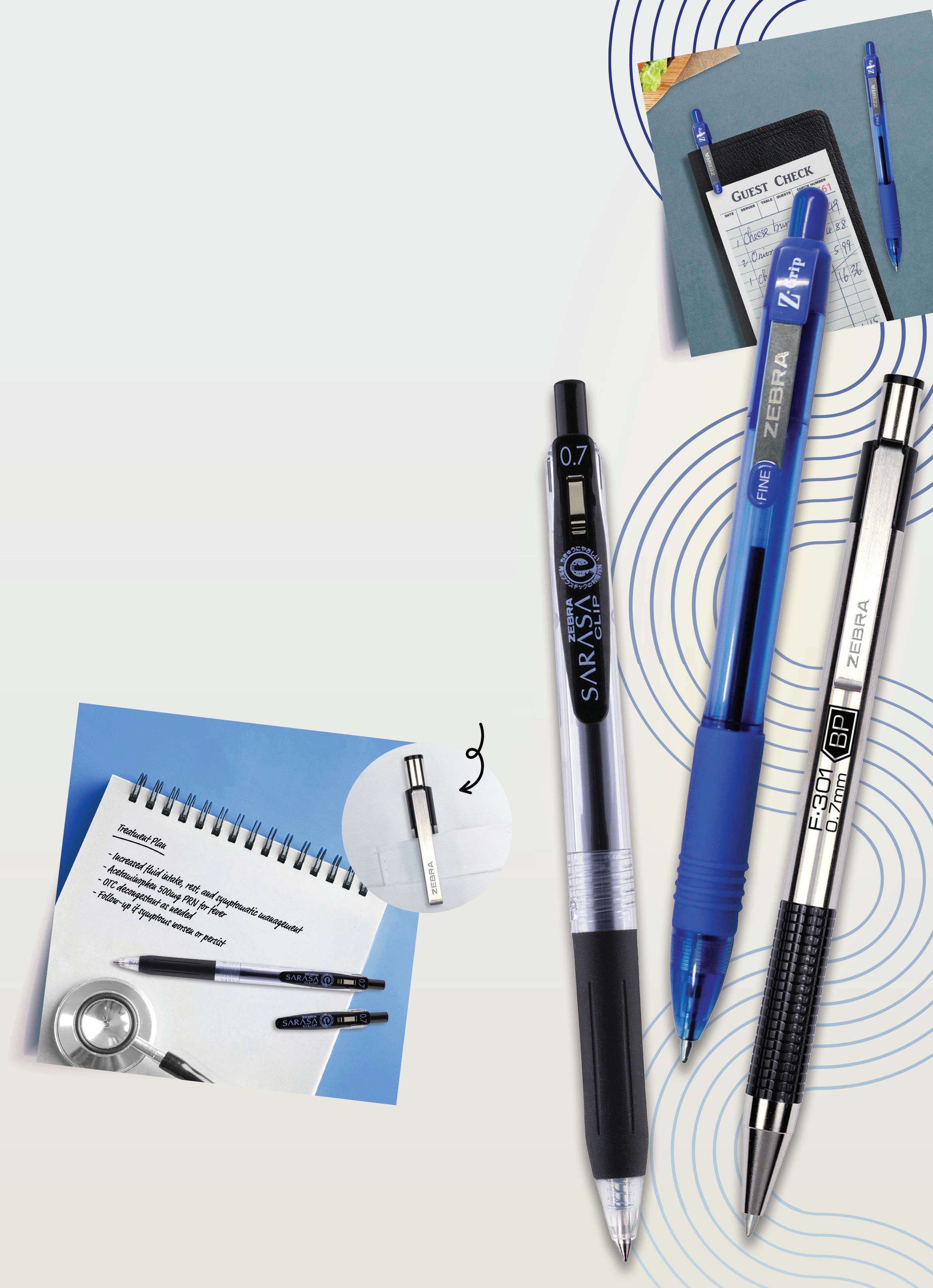
Click it. Grip It. Write It. Clip It.
Zebra Pen o ers a wide range of retractable ballpoint and gel pens. Whether metal or alligator, Zebra’s retractable pens o er reliable clipability, guaranteed to be right there where you need it, when you need it.
Designed for everyday writing, these pens deliver smooth ink flow, comfortable grips, and reliable performance. The durable clip can be attached to shirt pockets, notebooks, check presenters, and more, always keeping your pen secure.
Clip it!
Scan to learn more about Zebra Pen.
Winner’s Circle
Office Express Office Products turns 40
Technically, Office Express Office Products, Cedar Rapids, Iowa, is now more than 40 years old. That’s if you count the years clocked up by its predecessor, a company started by Richard Keel. Richard was a top salesman for pharmaceutical giant Pfizer. He and his family moved from Cedar Rapids to Arlington Heights, Illinois, to better accommodate his hectic travel schedule. However, in the early 1980s, with four children to raise, Richard’s wife Mary wanted him to travel less. She convinced him to return to Cedar Rapids and launch his own independent drug company, which he did. The startup, Kenyon Drug Co., did well—until the large pharmaceutical companies started buying up all the raw materials, making it increasingly difficult for the independents to compete.
In the meantime, however, Richard’s son, Randal “Randy” Keel, had joined the company. He realized sales were sliding and sought advice from his older brother, Rick. Rick had noticed that, with the advent of copy printers, people were moving from dot-matrix paper to cut-copy paper. Believing this could provide a sales boost, Randy approached his father with the idea of carrying the paper. Keen to encourage his son’s entrepreneurial spirit, his father agreed—on condition that Randy be responsible for selling it. And that he did.
“My father sold copy paper all across the state,” says Randy’s son, Benjamin Keel, Office Express president and co-owner. “He would sell the paper, then get up at 4.00 a.m., fill up his car and deliver it himself. Soon customers started asking for other things—like adding machine tape, writing instruments and rubber bands—so he started getting those too.”
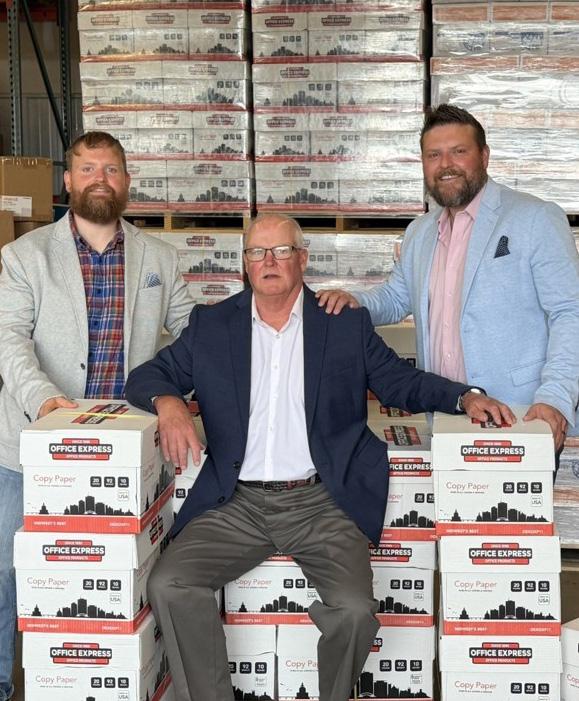
Now an office products dealer, the company began operating under the name KDC Co. and, in 1986, officially changed its name to Office Express Office Products.
Since then, the company has acquired three office product dealers in Iowa—purchases that have helped expand its territory and product offerings. Today, Office Express lines include janitorial, print and promotions, MRO, breakroom and—through its sister company, Office Concepts Design—furniture. Office Express has 34 employees, enjoys annual sales of $15 million and is co-owned by the third
generation, Benjamin and his younger brother Brandon, who started as a delivery driver about 10 years ago and moved into sales management this year.
“I am really excited about Brandon moving into sales,” enthuses Benjamin. “I am impressed with his energy, fresh perspective and commitment to long-term growth— all while maintaining the values the family business was built on.”
According to Benjamin, there are several reasons the company has thrived for four decades: “Our ability to evolve has been really important and core to our success.
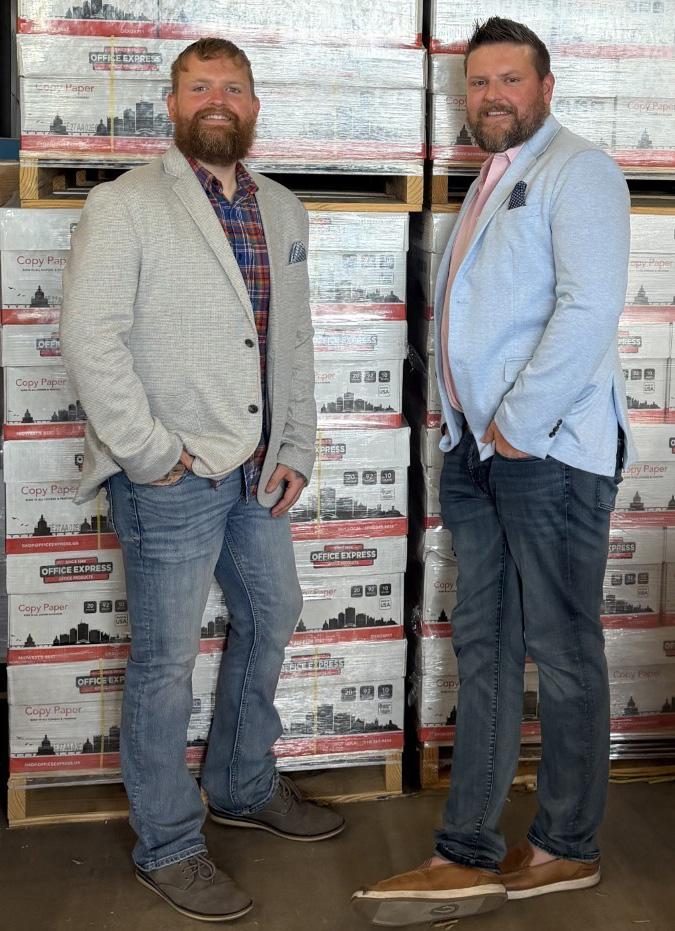
Brandon (left) and Benjman Keel and their father Randy
Expanding into all the categories we offer has led to more opportunities and deepened our footprint with our existing customers. It’s made us a more complete workplace solution.
“The longevity and quality of our people are also key,” he continues. “We have employees who started with us in 2009 who are still here. Part of that is our culture. We try to make the workplace fun. We reward our employees for hard work and give our reps freedom to form partnerships with our customers.”
Benjamin is also proud of his own hard work: “I started here in 2009, when the company was doing well but needed a little push. Back then, our annual sales were about $5 million. Today they are about $15 million. I am proud of that growth; and now, with my brother in sales, I see that growing even more.”
New initiatives include adding foodservice to its offering. “We just wrapped up a couple of really great opportunities in foodservice thanks to Brandon, who hooked us up with
a really great manufacturer and now we are its primary distributor,” explains Benjamin.
As for most independent dealers, Amazon has impacted Office Express’ business, particularly in office product sales. Ultimately, however, Benjamin predicts the dealer and others willing to take on the challenge will emerge victorious: “Amazon is a necessary evil now, and you can sit on the sidelines or face it head-on. We chose not to shy away from the challenge and, besides reasonable pricing, we have found accounts like ours to be easy to order from, consistent and supportive. They like getting the whole package.”
For dealers looking for longevity, Benjamin’s advice might seem surprising: “We’ve never been a stocking dealer. Especially since Essendant’s exit, many dealers got scared and shifted to stocking their warehouses; but I don’t think that is necessary long term. Today’s buyers change so often and so do their
Winner’s Circle
preferences. We can get products from S.P. Richards and partners through buying groups like ISG and provide a just-in-time solution without stocking a lot of products we may not sell and using our staff’s time to pick and package orders.”
He also suggests: “Don’t be afraid to change. The more categories you offer, the stickier your customer relationships will be.”
Zuma Office buys the supply division of WJ Office
Zuma Office, Houston, Texas, has bought the janitorial supplies, foodservice products, breakroom essentials and general office supplies division of WJ Office, Boone, North Carolina.
The move will enable WJ Office to sharpen its focus on its core growth areas of business technology solutions and office
furniture. By concentrating on these key segments, WJ Office aims to boost its service offerings through innovative document and workflow solutions and a larger footprint in the commercial furniture sector.
“We are proud of the strong relationships and service legacy we have built within our janitorial and office supply divisions,” said WJ Office president Neville Chaney. “Zuma Office is well positioned to continue delivering exceptional value to those customers. This transition allows us to dedicate more resources and expertise to expanding our technology and furniture offerings, where we see significant opportunity for growth and innovation.”
Two current WJ Office staff members, Wil Barber and Derek Ward, will join Zuma to ensure a smooth transition. As part of this transition, customers have been shifted from WJ Office’s online store to Zuma’s ordering platform, supported by Zuma’s expanding local and personal delivery network, which includes key markets such as Raleigh, Greensboro, Lenoir, Charlotte, Southern Pines, Boone and the High Country.
With a physical presence in Boone and a strong emphasis on reliable local service, Zuma plans to build on WJ Office’s legacy while enhancing convenience, product availability and overall customer support.
Intivity earns MWBE award
Intivity, Rochester, New York, has been ranked No. 17 on the 2026 Greater Rochester Chamber MWBE Awards list, recognizing the fastest-growing privately owned minority and woman-owned business enterprises (MWBEs) in the Greater Rochester and Finger Lakes region. The rankings were revealed during the recent Greater Rochester Chamber MWBE Awards celebration, which was attended by nearly 450 business and community leaders.
“We are incredibly honored
A&B
serves
to be recognized as the 17th fastest-growing MWBE in the Greater Rochester region,” says president and CEO Fabricio Morales. “This achievement reflects the trust our customers place in us, the strength of our partnerships and the dedication of our entire team. We are grateful for the opportunity to serve organizations across New York State and remain committed to delivering innovative solutions that help our clients succeed.”
The MWBE awards are presented
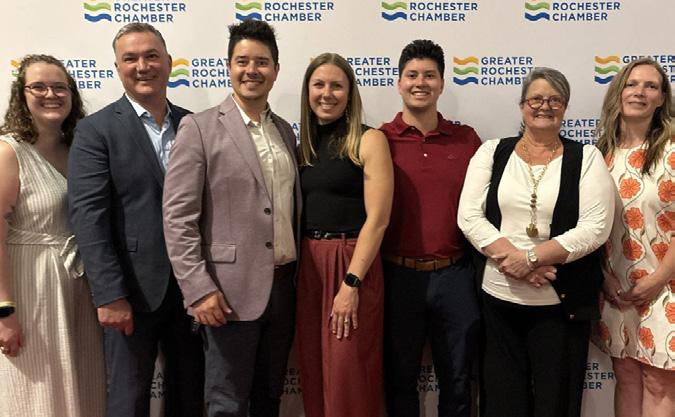
annually by the Greater Rochester Chamber, in partnership with Insero Advisors, to organizations demonstrating exceptional growth and business success. Rankings are determined through a confidential evaluation of both percentage and dollar revenue growth over a three-year period.
lunch as part of its annual volunteer goal
As part of their goal to hit 1,250 volunteer hours, employees from A&B Solutions in Sioux Falls, South Dakota, are serving lunch at the St. Francis House homeless shelter on the third Thursday of every month. A&B provides employees with paid volunteer hours and has raised this target to 1,250 hours after exceeding its previous goal of donating 1,000
hours to local communities.
“This is just one example of our team’s commitment to helping the communities in which we work and live,” says marketing specialist Galena Zaranchuk. “We want to be in the community, helping out, and allow our employees to choose organizations that are close to their hearts. Perhaps an employee went through a similar rough
time and chooses a specific charity; then the whole team gets involved. It’s in keeping with our vision, our mission, to develop a strong internal and external community culture.”
St. Francis House aims to move people from homelessness to hope by meeting the evolving needs of individuals experiencing homelessness in the community.
Guernsey’s Schwam earns Ordre National du Mérite
Chuck Schwam, account manager for Guernsey, Dulles, Virginia, was recently presented with the Ordre National du Mérite medal by U.S. French ambassador Charles Kushner. Schwam received this recognition for his long-term leadership and hard work at the American Friends of Lafayette, a key organization that educates and memorializes American Revolutionary War hero the Marquis de Lafayette.
“This endeavor on Chuck’s part is tantamount to an avocation in which he has succeeded significantly by raising all our awareness as to how involved and important Lafayette was to America winning the Revolutionary War,” says Guernsey founder and chairman David Guernsey. “Chuck has been part of our team for decades—he’s superb at his job; and educating
us all on the role of Lafayette is one way he gives back, not just to our community but to all U.S. citizens willing to learn from him. Chuck is a friend and a colleague, and I’m immensely proud of him.”


Built to Fit, Priced to Grow
Your business isn’t one-size-fits-all and your ecommerce platform shouldn’t be either. Logicblock delivers the customization, support, and scalability you need to grow, without locking you into overpriced plans or cookie-cutter templates.
Take a 30-day test drive with real data, real support, no surprises.
Winner’s Circle
FSIoffice launches FSI Cares with clothing drive
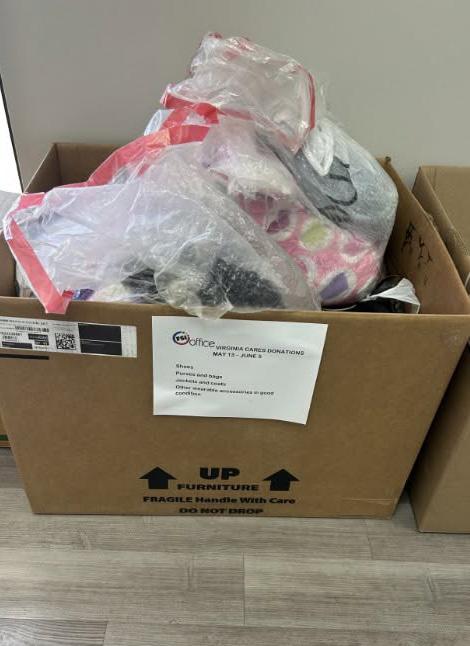
FSIoffice, Charlotte, North Carolina, has launched FSI Cares, an internal faith-based organization dedicated to serving, praying and growing within the community while living out the company’s mission of loving God and others.
As part of the launch, FSI employees recently came together for a clothing drive that—according to FSI Cares event coordinator Jeanine Deutsch—“exceeded all expectations.” Thanks to the generosity of approximately 150 FSI employees throughout its distribution centers and corporate headquarters, hundreds of essential items were collected to support individuals and families in need throughout the communities FSI serves.
While clothing was the primary focus of the drive, employees also donated shoes, handbags, accessories, diapers, radios and many other personal essentials to local nonprofit organizations. Additionally, FSI volunteers helped sort, organize and pack the donations for distribution.
The donated items were delivered to nonprofit organizations making
a meaningful impact in their communities, including:
• Cabarrus Victims Assistance Network—a women and children’s rescue center in Concord, North Carolina;
• Dove’s Nest Women’s Shelter in Charlotte, North Carolina;
• Charlotte Men’s Shelter in Charlotte, North Carolina;
• GATE Pregnancy Center in Concord, North Carolina;
• HIS House in Columbia, South Carolina;
• Salvation Army in Greenville, South Carolina; and
• additional community organizations serving the Columbia, Greenville, Chesapeake, Virginia and Lumberton, North Carolina areas.
The clothing drive was an employee-only initiative, with participation from team members in Charlotte, Lumberton, Charleston, Columbia, Chesapeake and Greenville, as well as Myrtle Beach, South Carolina.
“We created FSI Cares because

we believe serving our communities should be more than an occasional event; it should be part of who we are as a company,” explains Deutsch. “By providing intentional opportunities to give back throughout the year, we hope to make a lasting impact while bringing our employees together to serve others.”
The clothing drive is just the beginning. During the fourth quarter, FSI plans to expand the outreach by inviting customers and vendor partners to participate in a community food drive.
According to Deutsch, each quarter, FSI Cares will focus on a different area of service, including:
• a meal-based community service opportunity;
• a mission-based service initiative;
• a hands-on volunteer project where employees can use their time and talents to build, improve or assist with meaningful community projects; and
• an additional outreach initiative that addresses ongoing local needs.

l Senior-level




A&B Business Solutions Secrets of Success
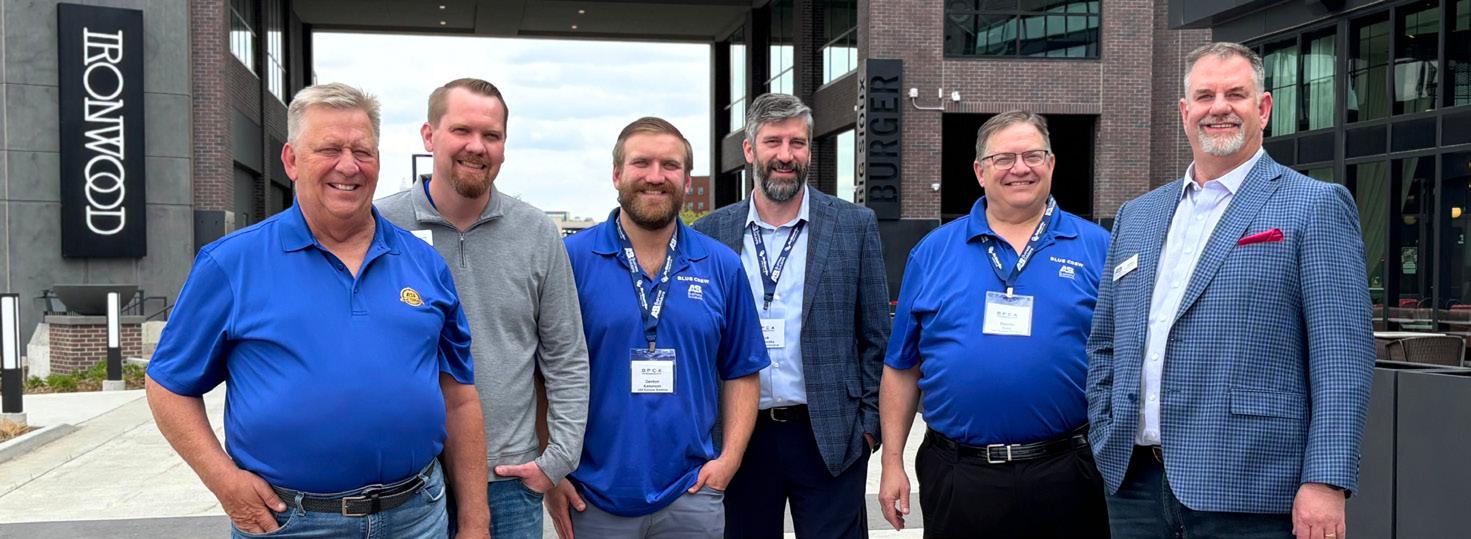
In 1981, Art Sinkey and Bill Kominga opened a small, three-employee copy machine company in Sioux Falls, South Dakota, naming it after their initials. The company soon became known for its product quality, superior service and reasonable pricing. In 1993, the current owner, Dennis Aanenson, bought the company. It has since grown under his leadership and today boasts more than 100 employees and annual sales of $37 million. Attesting to its success, A&B has been a Pro Elite 100 dealer—a top 100 office products dealer in the United States—since 2008 and is recognized as a leading Toshiba and Ricoh vendor.
According to marketing specialist Galina Zaranchuk, much of this impressive growth can be attributed
Company info
Headquarters: Sioux Falls, South Dakota
Top management: Dennis Aanenson, owner; Kyle Lambert, chief financial officer; Tim Paris, vice president—sales; Dennis Dunn, vice president—service; Rob Grunendike, vice president—operations; Denton Aanenson, IT director
Number of employees: 100+
Annual sales: $37 million
Percentage of sales by category: 80% office products; 20% other
to community: “Our vision remains focused on developing a strong community and culture inside and outside by volunteering. We give paid time off for volunteering; our goal this year is 1,250 hours. We allow the employees to choose where they volunteer in the community based on their personal values and where they feel they should be most involved. We want to improve the communities where we live. From a business standpoint, being involved in the community means people know us. Companies trust us and are loyal. They want to do business with vendors who care about their community.”
And giving back isn’t the only key to the company’s success. “We really focus on development and training,” continues Zaranchuk. “It’s one of our core values. All our service technicians are certified. Every week, we hold training sessions across various areas—such as professional leadership and motivation—for the entire team. Some are virtual, but many are in person. Since we do so much personal and professional development, our goals and standards are high. We have what we call the Blue Standard—our dark blue logo color. As a result, our sales reps overachieve their year-over-year goals. That is why sales reps in our established territories never want to leave!”
This employee loyalty is another factor she attributes to the company’s
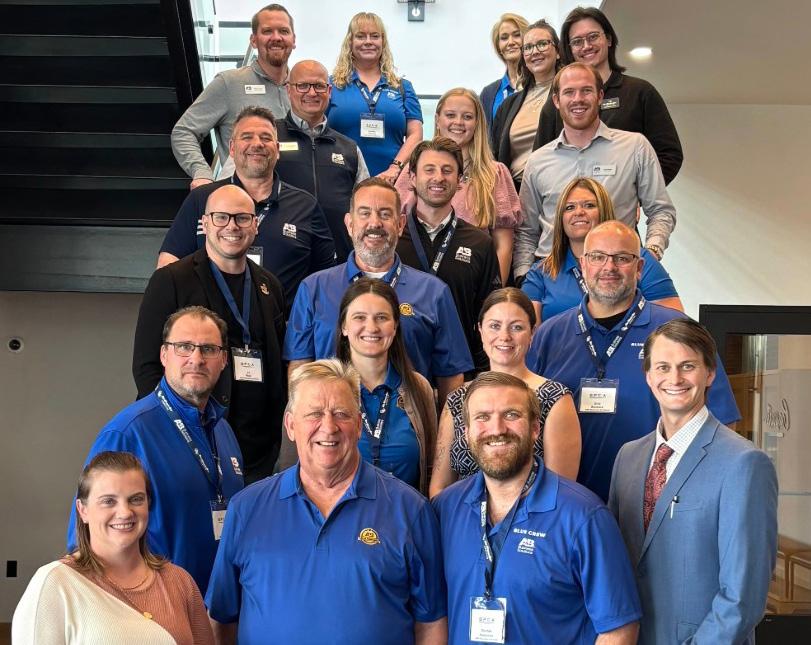
culture: “The longevity of our employees has been important. We have many long-term employees and at least half of them have been here for over a decade. They stick around because of the way we treat them.”
Meeting the challenges
As is inevitably the case, success does not come without its challenges. Zaranchuk cites two main hurdles as “Competition in our area and pushing to get our name out in new territories. We are trying to grow by moving into other states, including Iowa, Nebraska and Minnesota; and this year we bought half of J.D Young, a dealer in Oklahoma.” She also reports that finding sales reps and other hires in these areas, where A&B doesn’t have a history, can be difficult; as can acquiring a new business and onboarding the employees to meet A&B Blue Standard and assimilate into its culture.
Culture club
For other independent dealers keen to emulate A&B’s success, Zaranchuk recommends creating a culture that makes employees want to stay and that reflects the company’s values. She also advises getting involved in the community to build customer trust, loyalty and developing long-lasting relationships—the mainstays of business longevity.

See why Hammermill® rules the school.
Studies show that kids learn better on paper than on screens. So what’s the best paper for schools? The brand that won’t jam the printer (99.99% JAM FREE®) and gives you multiple choices (Everyday, Multi-Purpose, or Premium). Raise your hand if you said Hammermill. It’s Paper Made Right® for education.
WSA announces 2026 scholarship recipients Industry
The Workplace Solutions Association (WSA) has announced the recipients of its 2026 educational scholarship program, awarding a total of $42,000 to students pursuing higher education.
The annual program, which has been running for more than 50 years, has awarded nearly $3 million in scholarships to families of office products and office furniture dealers. It is funded entirely through contributions from WSA members and individuals.
WSA president Elena Wuchner said the recipients demonstrated the qualities needed to help shape the future of the industry.
“We are honored to recognize this year’s outstanding scholarship recipients. Their academic achievements, leadership and commitment to their communities reflect the very best of our industry’s future. We are proud to support their continued educational journeys and look forward to seeing the positive impact they will make as tomorrow’s professionals.”
The top scholarship recipients for 2026 are:
• William Daley ($7,000), Bluefin Office Group
• Isla Tousignant ($6,000), American Office Products Distributors
• Jacob Putnam ($5,000), S.P. Richards
• Abby Andrews ($4,000), Kennedy Office
• Sophie Colson ($3,000), Kennedy Office
In addition, Cami McQuire of Innovative Office Solutions received the George A. Thompson Award, which includes a $3,000 scholarship. This award recognizes a student who combines academic excellence with a strong commitment to community service.
The recipients of the $2,000 scholarships are:
• Riley Anderson, Walker’s Supply Company
• Ella Austin, FSI Office
• Macey Beam, EON Workplace
• Madilyn Benson, Porter’s Office Products
• Julia Buck, Kennedy Office
• Trinity Kary, Fireside Office Solutions
• Blaize Whitmore, Porter’s Office Products
Robin King, former owner of Schwegman Office Supply, chaired the WSA scholarship committee, which selected this year’s recipients.
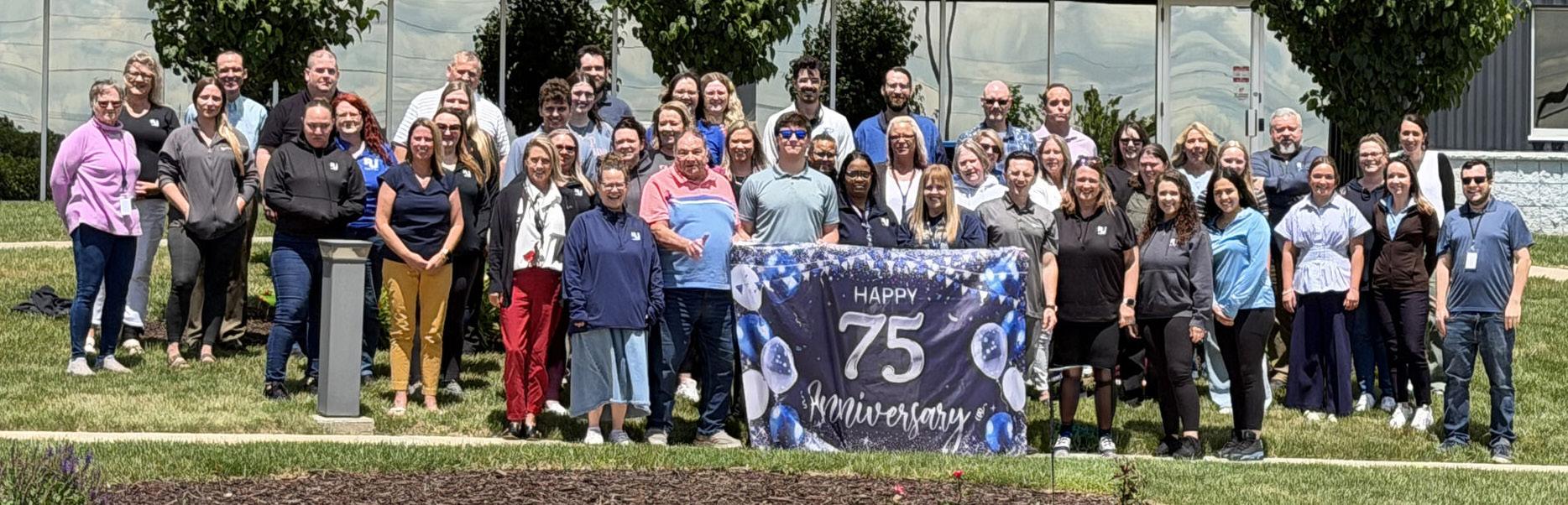
RJ Schinner celebrates 75 years
Last month, the industry wholesaler RJ Schinner celebrated the company’s 75th anniversary. Company staff at its corporate headquarters in Menomonee Falls, Wisconsin marked the occasion with a company-sponsored BBQ from the Just Smoking BBQ Food Truck, followed by a few
seriously competitive rounds of cornhole. “It was the perfect summer day to pause, unwind and celebrate this historic milestone together,” read a company statement. “Cheers to 75 years of excellence and an even bigger thank you to our phenomenal team.”












SSI is privately owned and operated. That means we answer to our customers, not shareholders or equity investors.
So if your looking for affordable dealer software that will still be around as your business grows, shift your focus to SSI… and picture a more profitable future.








SPR’s Reagan to retire
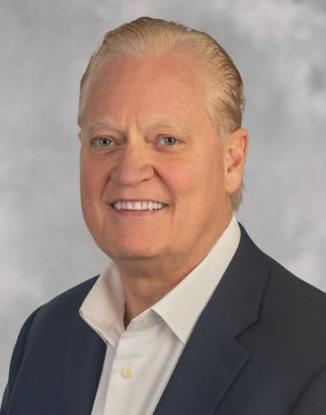
US wholesaler S.P. Richards (SPR) has announced that longtime executive and business products industry icon Jack Reagan will retire from the company, effective November 30.
Reagan will step down after more than 17 years with SPR and a career spanning over four decades across both the dealer and wholesale sides of the business.
During his time at SPR, Reagan helped shape the company’s strategic direction and played a key role in guiding it through a period of significant change. The company said his leadership and longstanding relationships with customers and supplier partners have positioned SPR for continued growth.
SPR president Jason Horst admitted Reagan’s impact on SPR and the wider industry was “difficult to put into words,” commenting: “I’ve known Jack for nearly 30 years and throughout his career, he has demonstrated an unwavering
commitment to doing what is right for this organization, our customers and our supplier partners. He has helped guide SPR through significant industry change and transformation, always bringing a steady hand, strategic vision and an incredible ability to build lasting relationships.”
Beyond his commercial responsibilities, Reagan has also been a long-time supporter of City of Hope. He serves on the City of Hope National Business Products Industry (NBPI) Council, is an NBPI Hall of Fame inductee and is Chair of the 2026 Atlanta Walk for Hope, which takes place on November 7.
Commenting on his retirement, the 2024 North American Office Products Awards Professional of the Year winner said: “After a long and rewarding career, I feel incredibly fortunate for the people, partnerships and friendships that have been part of this journey. SPR has been a tremendous part of my
life and I am proud of what we have accomplished together.
“Most importantly, I believe SPR is in a strong position for the future. We have an outstanding team, strong relationships across the industry and tremendous opportunities ahead.”
Reagan will remain on the leadership team and be actively engaged with SPR until November 30, working alongside Horst and other senior executives to support what the company described as a “thoughtful and seamless” transition.
AOPD sets 2027 annual meeting date
US national accounts organization
AOPD is heading back to California for its 2027 annual meeting.
The Engage 2027 event will take place at the Hyatt Regency Huntington Beach Resort & Spa in Huntington Beach, California—the same venue as this year—April 18–20, 2027. It will bring together dealer members, business partners and other industry participants.
The event will include educational sessions, networking opportunities and discussions focused on sales
and marketing strategies, as well as AOPD’s national accounts, cooperative purchasing and healthcare programs.
According to executive director Angela Price, the organization chose to return to Huntington Beach following positive feedback from attendees at the 2026 meeting.
Further details, including registration and accommodation information, will be released later this year.





Gift your TEACHERS the joy of




We need to ensure teachers are fully supported with the necessary tools for managing their daily tasks.
Paper Mate® Flair!® Felt Tip Pens will not bleed through paper making them a perfect choice for teachers filling out their personal lesson plan books. A variety of vivid colors that are smear and fade-resistant can help visually organize information easily.
Teachers spend a significant amount of time grading assignments. Paper Mate® InkJoy® Gel Pens feature a comfort grip providing cushion which is beneficial to a teacher's hand during repetitive writing. The brilliant and vibrant colors offered in these gel pens can be instrumental in offering different types of feedback while grading.






Paper Mate® Clearpoint® Mechanical Pencils
STRONG LEAD, LESS BREAKS AND A JUMBO ERASER FOR LITTLE MISTAKES.
NAOPA 2026 shortlist announced Industry News

INDEPENDENT DEALER’s sister publication OPI has revealed the shortlist for the 2026 North American Office Products Awards.
The awards will take place during ISG’s Industry Week ’26, which is being held in San Diego, California, from November 1–5.
The awards recognize the organizations and people driving progress and innovation across the industry. All entries were carefully studied by a panel of experienced executives.
Shortlists have been finalized for the five product categories, along with the Young Executive of the Year award. They are:
Best Product:
Core Business Product
• 3M: Command Electronic Organization Collection
• 3M: Scotch Heavy Duty Recycled Tape
• Fellowes Brands: Breyta Wrist Support and Mats
• Kensington: KB535 EQ Rechargeable Multi-Device Keyboard
• MBM: AeroDieCut
• Victor Technology: Heetz Foot and Leg Warmer
Best Product: Facilities
• Apex Tools: Crescent SITERUNNER 3 Shelf Folding
Jobsite Cart
• Energizer: Ultimate Child Shield
• IPC: CT15 Compact Scrubber
• Noramco: TruBio
• Star Brands: The Pink Stuff Miracle Cleaning Paste
• Victor Technology: Zip Stick
Best Product: Furniture & Design
• Eurotech: The Ciro chair
• Eurotech: The Ergohuman with colored frames
• FireKing International: FireShield Edge Series
• Ghent: Flyte Collection
• SAFCO: TechWorks
• The HON Company: Brim
Best Product: Technology
• ECI Software Solutions: EvolutionX
• Kensington: VeriMark Desktop 2.0 Fingerprint Key
• Luxor Workspaces: KwikBoost
Standard Floor Stand Charging Station
• Luxor Workspaces: LuxPower Charging Tower
• MBM: Precision Card Pro
• Victor Technology: SpinCalc
• Energizer: Ultimate Child Shield
• Essity: Tork Hygiene for All
• Kensington: Eyesafe Blue Light Privacy Screen Filter
• Luxor Workspaces: LuxPower Charging Tower
• NewEraSOS Scientific Optimal Solutions: Clean-Seal-Protect Program
• Victor Stationery: Zip Stick
Young Executive of the Year
• Ethan Boulware: Herald Office Solutions
• Alex Gordon: Highlands
• JP Grogan: Benjamin Office Supply
• Andrew Nash: Dicks and Company
Two additional individual awards—Professional of the Year and Industry Achievement—will be revealed during Industry Week.
Finally, INDEPENDENT DEALER readers have the opportunity to vote for the highly anticipated People’s Choice award, selected from all the shortlisted products listed above. To vote please visit www.opi.net/vote26
More information about Industry Week ’26 can be found here
Innovation of the Year

About CBIZ Employee Benefits

CBIZ Employee Benefits is the single-source benefits solution for members of the Workplace Solutions Association. With a national presence, enrollment support, and supplemental communications materials, CBIZ can help you meet the needs of your employees in an everchanging market.
CBIZ Employee Benefits is the single-source benefits solution for members of the Workplace Solutions Association. With a national presence, enrollment support, and supplemental communications materials, CBIZ can help you meet the needs of your employees in an everchanging market.
CBIZ Employee Benefits is the single-source benefits solution for members of the Workplace Solutions Association. With a national presence, enrollment support, and supplemental communications materials, CBIZ can help you meet the needs of your employees in an everchanging market.
Our team of specialized experts will collaborate with you to develop an actionable plan tailored to your unique pain points and goals. This is not cookie-cutter consulting. With thousands of clients nationwide, and more than a decade of proven results, we’re the partner you can count of to provide the strategic benefits solutions you need.
Our team of specialized experts will collaborate with you to develop an actionable plan tailored to your unique pain points and goals. This is not cookie-cutter consulting. With thousands of clients nationwide, and more than a decade of proven results, we’re the partner you can count of to provide the strategic benefits solutions you need.
Our team of specialized experts will collaborate with you to develop an actionable plan tailored to your unique pain points and goals. This is not cookie-cutter consulting. With thousands of clients nationwide, and more than a decade of proven results, we’re the partner you can count of to provide the strategic benefits solutions you need.
To learn how we can help you please email or click the link:
To learn how we can help you please email or click the link:
Ryan Oursler at ryan.oursler@cbiz.com
Ryan Oursler at ryan.oursler@cbiz.com
To learn how we can help you please email or click the link:
Contact CBIZ
Contact CBIZ
Ryan Oursler at ryan.oursler@cbiz.com
Contact CBIZ

Get Better Benefits Through WSA Membership
Get Better Benefits Through WSA Membership LEARN
HOW CBIZ
LEARN HOW CBIZ EMPLOYEE BENEFITS CAN HELP WITH YOUR UPCOMING RENEWAL
Are you looking to lower your rates while offering improved benefits to your employees?
Are you looking to lower your rates while offering improved benefits to your employees?
Are you looking to lower your rates while offering improved benefits to your employees?
Explore our free on-demand webinar to discover strategies to reduce costs, options for optimizing benefits for your team, and more!
Explore our free on-demand webinar to discover strategies to reduce costs, options for optimizing benefits for your team, and more!
Explore our free on-demand webinar to discover strategies to reduce costs, options for optimizing benefits for your team, and more!
Watch Now
Watch Now
Watch Now
Novexco says CWS integration exceeding expectations
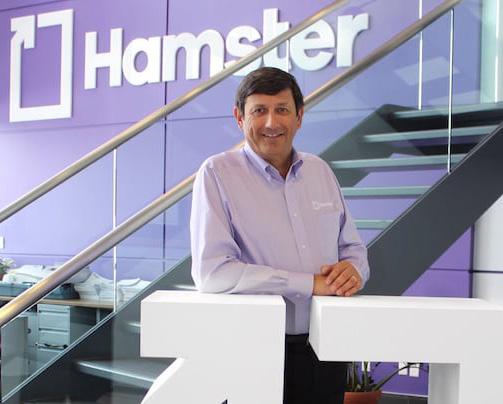
Canadian multichannel operator Novexco says demand from dealers that joined the organization through its acquisition of Canadian Workplace Solutions (CWS) and Guild Stationers has exceeded expectations as integration of the businesses continues.
In an exclusive interview with INDEPENDENT DEALER’s sister publication OPI ahead of his retirement next month, CEO Denis Mathieu said dealer onboarding had been completed and Guild’s warehouse operations successfully transferred to Novexco’s Brampton facility.
“Demand from CWS and Guild dealers has been higher than expected, as our warehouses held nearly 20,000 SKUs—significantly more than the former Guild warehouse, which carried approximately 7,000 SKUs,” he reported.
Mathieu added that the increased demand had created some supply challenges, with “some suppliers struggling to keep up with the growth in demand.”
His comments come about
six months after the landmark transaction for the Canadian IDC, which expanded Novexco’s dealer network to almost 140 members operating around 220 locations across the country.
Looking ahead, Mathieu said Novexco’s priorities include strengthening its private label strategy, further diversifying its
product portfolio and expanding the use of AI to improve operational efficiency and dealer support.
The outgoing CEO also highlighted continued growth in categories such as cleaning and hygiene, breakroom and packaging, helping offset ongoing weakness in traditional office products demand.
Koozie adds U Brands to its retail portfolio
Promotional products supplier Koozie Group has announced the addition of U Brands to its portfolio of retail brand partnerships.
Founded in 2014, U Brands was purchased by Smead in 2017 and expanded its portfolio and market reach, catering to both consumers and educators with an emphasis on aesthetically pleasing designs. Ownership was then transferred to TOPS Products, which acquired Smead in June last year.
Koozie Group will offer four U Brands pen styles, including a felt-tip option. All pens
come presented in a velour sleeve, with an optional two-pen gift box available for an additional charge.
“At Koozie Group, we’ve built a portfolio of brands that our customers know, trust and ask for by name, and U Brands fits right in,” said Jonaleah Carrow Sherman, category manager. “Metal pens have been gaining momentum and our customers have been looking for an option that delivers a premium, executive feel. We’re excited to add these pens to our lineup.”

OMNIA Partners issues OPUS update
Leading cooperative purchasing organization OMNIA Partners continues to grow its OPUS online ordering platform for the public sector.
The company has added 10 new suppliers to the platform, taking the number of products available for online purchase to more than 8 million across almost 200 categories. The latest additions are BradyPLUS, SHI, Graybar, Fisher Scientific, Insight Public Sector, School Specialty, Johnson-Lancaster & Associates, Vari, Mediatechnologies and E-Z-GO/Cushman. Together, they expand OPUS into areas including IT, laboratory supplies, education, workplace furniture, facilities
maintenance, electrical infrastructure and fleet management.
OMNIA Partners said almost 40,000 procurement professionals from government agencies, schools, higher education institutions and nonprofit organizations are now using OPUS. Since its launch in April 2024, it has enabled members to search contracts, compare products and purchase from multiple suppliers through a single online shopping cart while remaining compliant with public procurement requirements.
Alongside the supplier expansion, OMNIA Partners has introduced a series of platform enhancements designed to streamline purchasing. These include an improved search function, easier access to contract
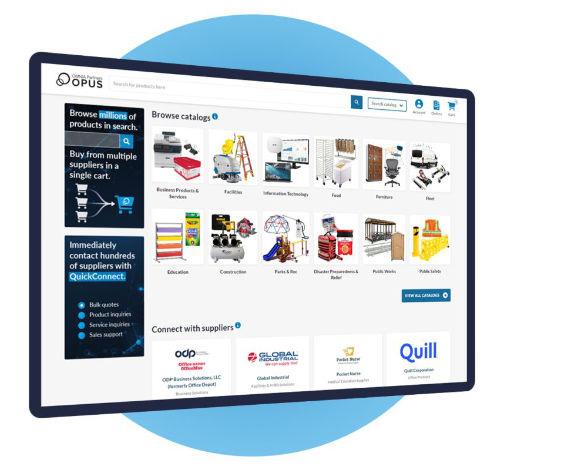
information, a centralized supplier W-9 library, integrated chat support, shareable product lists and expanded administration and approval tools.
Todd Abner, CEO of OMNIA Partners, said the company’s continued investment in the platform was aimed at making it easier for public agencies and nonprofits to access contracts and suppliers while simplifying the purchasing process and maintaining compliance.

Paul A. Miller, legislative counsel, Workplace Solutions Association
250 years of having a voice: why grassroots lobbying still defines America’s independent dealers

As America celebrates its 250th birthday, I have found myself thinking less about the fireworks and more about the conversations.
For years, I have walked the halls of Congress, sat across the table from members of Congress and their staff,
worked with administrations from both parties and watched countless debates unfold inside committee rooms and federal agencies. One lesson has remained remarkably consistent: policy is shaped by those who show up.
That truth is as old as our nation itself.
When our founders declared independence in 1776, they weren’t simply rejecting a king. They were embracing something revolutionary: the belief that citizens should have a voice in their government. The First Amendment would later guarantee the right to petition that government, creating one of the most powerful tools any American has ever been given. For small businesses, that right has never been more important.
As legislative counsel for the Workplace Solutions Association (WSA), I’ve had the privilege of representing an industry that rarely grabs headlines but touches virtually every workplace, every classroom, every hospital, every government office and every community in America. Independent office products dealers don’t ask for special treatment. They simply ask for the opportunity to compete. That sounds simple; but in Washington, it rarely is.
The challenge of being seen
One of the biggest misconceptions about Congress is that every industry naturally has a seat at the table. They don’t. Members of Congress deal with thousands of issues every year—national security, healthcare, agriculture, taxes, transportation, energy, education, immigration, appropriations and countless others.
The office products industry is rarely the first issue on anyone’s morning briefing. That doesn’t diminish its importance. It simply means someone has to explain why our issues matter. Why procurement policies affect thousands of locally owned businesses. Why government contracting should encourage competition rather than consolidation. Why independent dealers often provide better service, greater flexibility and stronger community investment than national competitors. Why excessive credit card swipe fees quietly drain resources from Main Street businesses every single day. Why anticompetitive practices don’t just hurt one dealer—they reduce choices for schools, governments, nonprofits and businesses across America. Those conversations don’t happen by accident. Someone has to make them happen.
A small association with an outsized voice I have often been asked how an association the size of WSA continues to have influence in Washington. The answer isn’t complicated. Relationships. Credibility. Consistency. And members who understand that grassroots lobbying isn’t something you do only when there’s a crisis.
Over the years, I have watched WSA become one of those organizations that congressional offices trust. Not because we always agree; but because when we walk into an office, we bring facts. We bring solutions. We bring the perspective of real businesses operating in real communities. That credibility has allowed WSA to punch well above its weight.
I have seen members of Congress seek our input before introducing legislation. I have
watched committee staff call us looking for industry insight. I have worked alongside agencies trying to understand how regulations would affect independent dealers on the ground. Those relationships weren’t built overnight. They were built over decades.
When grassroots lobbying produces real results
One moment that continues to stand out in my career involved the United States Postal Service (USPS).
Changes in contracting practices had effectively closed the door on many independent office products dealers. For many businesses, that decision could have meant the end of an important customer relationship. Rather than accept the outcome, WSA went to work. We met with decision-makers. We explained the unintended consequences. We demonstrated why independent dealers deserved the opportunity to compete. Eventually, the contracting process was reopened, giving independent dealers the ability to once again pursue USPS business. It wasn’t a victory that generated national headlines. But for the companies affected, it mattered. For their employees, it mattered. For the communities they serve, it mattered. That’s what grassroots lobbying looks like. Sometimes success isn’t measured by a press conference. Sometimes it’s measured by preserving opportunities that otherwise would have disappeared.
Washington has changed
When I first began working on Capitol Hill issues, grassroots lobbying looked very different. Meetings happened face to face. Letters arrived by mail. Policy moved more deliberately. Today, information travels instantly. AI is changing how information is
consumed. Social media can shape public opinion before Congress even begins debating an issue. Federal regulations are increasingly complex. Large corporations employ armies of lobbyists, lawyers, economists, communications teams and consultants to influence policy every single day.
While small businesses cannot match those resources individually, together they can. In many ways, grassroots lobbying in 2026 is not about having a voice; it’s about amplifying it. That requires data. Member engagement. Grassroots action. Coalition building. Strategic communication. And, perhaps most importantly, telling the human stories behind every policy debate.
Why WSA matters more than ever
The issues facing independent dealers continue to evolve:
• federal procurement;
• AI;
• supply chain resilience;
• cybersecurity;
• tax policy;
• competition policy;
• government purchasing reform;
• credit card competition;
• antitrust; and
• Amazon’s growing influence in public procurement.
Every one of these issues has the potential to reshape the marketplace for independent dealers. If independent dealers are not part of those conversations, someone else will determine those policies for them. That’s in part why WSA exists—not simply to respond to legislation, but to help write the future.
Looking ahead
Our Founding Fathers could never have imagined cloud computing, AI,
e-commerce or digital procurement. But they understood something timeless: a government works best when its citizens participate. That principle has carried America for 250 years and it should continue carrying us for the next 250.
As I reflect on the years I have spent representing this industry, I’m reminded that some of the most meaningful victories are often the quiet ones. A procurement rule changed. A burdensome regulation prevented. A harmful
proposal defeated. An opportunity preserved for independent dealers. Those victories rarely make the evening news. But they strengthen communities across America every single day.
That is the value of grassroots lobbying. That is the value of having a seat at the table. And that is what I believe our founders hoped every generation of Americans would continue to do. WSA may never be the largest organization walking the halls of Congress, but it doesn’t have
to be. Because influence has never been measured solely by numbers. It is measured by trust. By credibility. By relationships. By persistence. And by never forgetting that the freedoms secured in 1776 include the responsibility to keep showing up, keep speaking and keep ensuring that America’s small businesses have a voice.
Two hundred and fifty years after our nation’s founding, that responsibility has never been greater. Nor has the opportunity.
Strong dealer-rep relationships are an industrywide responsibility
Mike Tucker, executive director, Workplace Solutions Association

Changes over the last four to five years have had a dramatic impact on the nature of our industry. Distribution patterns have shifted. New products have come on the market offering major new growth opportunities. At the same time, new competitors have emerged in the business-to-business and public sector segments.
These changes have affected one of the industry’s basic elements: the relationship between the dealer and sales rep. In some ways, the relationship has grown stronger, as dealers are looking for more
information and training on jan/san, furniture, technology products and other new categories—help which reps are perfectly placed to provide.
“Reps’ greatest strengths are their long-lasting relationships, deep territory expertise and training capabilities,” says Darlene Akers, president at East Coast rep group Akers Business Solutions. “By connecting manufacturers with the right partners and customers, they play a vital role in helping dealers succeed in an increasingly competitive and rapidly changing marketplace.”
On the other hand, dealers— particularly smaller ones—often report that reps call on them too rarely. They complain that info on new products and promotions doesn’t reach them in a timely and effective manner. “Rising costs have made it difficult for reps to maintain the same level of coverage for smaller dealers,” reveals Kevin Schoen, president of Schoen and Associates, headquartered in Chicago, Illinois. “Before Essendant exited the channel, its structure provided an income stream that supported field sales across all
DeliveringHope
Led by 2026 honoree Greg Welchans, president and CMO of Distribution Management, we’re honoring the values that define the business products industry—speed, service, and integrity—by helping City of Hope® expand compassionate, leading‑edge cancer and diabetes care across the country.
Together, we’re accelerating research breakthroughs, advocating for veterans, and advancing whole‑person care—while carrying forward a legacy of generosity that has defined our field for decades. With a special focus on access and equity, this year’s campaign is helping bring hope to more patients and families—faster than ever before.

CITY OF HOPE’S NATIONAL BUSINESS PRODUCTS INDUSTRY’S 2026 UPCOMING EVENTS
Wednesday and Thursday, September 23-24 Spirit of Life Golf & Gala, Honoring Greg Welchans
Hosted by the National Business Products Council Cantigny Golf Club and Navy Pier Chicago, IL
Fall 2026
Walk For Hope
Los Angeles, Orange County, Chicago, Atlanta, Phoenix and Virtual
Visit Cityofhope.org/walkforhope for more information

For more information or to register for one of our events, scan here:

2026 Spirit of Life® Honoree Greg Welchans President and CMO Distribution Management
WSA Focus
dealer tiers. That financial support system is largely gone.”
It’s no longer a question of going in, picking up an order and ensuring the dealer’s literature is up to date. The new question is what reps can do for their customers to make them more successful. Dealers have become much more sophisticated businesspeople and competition from Amazon and non-traditional resellers has grown aggressively.
“New products have created pockets of opportunity, but not enough to offset the loss,” adds Schoen. “Growth now depends on expanding into adjacent channels such as furniture, jan/san, education, medical, industrial and technology. Jan/san remains the closest fit and ISSA has provided strong support for dealers entering that space.”
Group purchasing organizations represent another meaningful avenue for expansion. Reps should be the quarterback that helps the dealer prepare its business for these opportunities: helping them recognize obstacles, showing ways to overcome them and assisting salespeople in conquering their fear of the unknown. They can also help them target customers better, looking beyond purchasing agents and accounting to facilities managers, building engineers, property managers, etc.
“Dealers should also expect their reps to look within their companies to ensure all members of their staff are informed,” continues Akers. “They can help by training sales teams, coordinating end-user engagements, supporting bids and product launches and delivering valuable
Running an old slide rule over your business
At AOPD’s Engage 2026 event earlier this year, industry veteran Wayne Stillwagon, most recently president and CEO of Miller’s Supplies at Work, won the MC “Bud” Mundt award. This prestigious award celebrates people that have given years of dedicated service to the national sales organization and its members.
The award is named after industry legend and former AOPD executive director Bud Mundt, who enjoyed a 46-year career in the office products industry, beginning as a sales rep at 3M in 1969 and rising to the role of vice-president of sales and marketing at the vendor before a spell on the reseller side of the industry in the 1990s at Miller
Business Systems and BT Office Products.
A hugely popular and influential figure, Mundt was recognised on numerous occasions for his dedication to the industry. In 2014, he proudly accepted the Lifetime Achievement accolade at the North American Office Products Awards; and in 2015, he collected the Leadership Award from the Business Solutions Association. He sadly passed away due to cancer in 2017.
In Stillwagon’s acceptance speech, he referenced an article he had found in an old issue of NOPA Special Report (the newsletter of the predecessor to the WSA) written by Bud Mundt in 2003. In that article, Mundt offered a short survey to
market intelligence.”
Acting as a critical link between manufacturers, dealers, wholesalers and end users, reps navigate industry consolidation, e-commerce pressures and evolving workplace demands. The rep’s ability to make quality presentations and willingness to support sales staff should be considered as important as product price and availability.
To be fair, some reps I’ve spoken to are frustrated about cuts in marketing support and fewer new products from their manufacturers. So, ensure you have all the facts before you blame the rep. A strong dealer rep relationship is very valuable, but it needs open communication to respond promptly and intelligently to changes as they occur. It’s as simple—and as complex—as that.
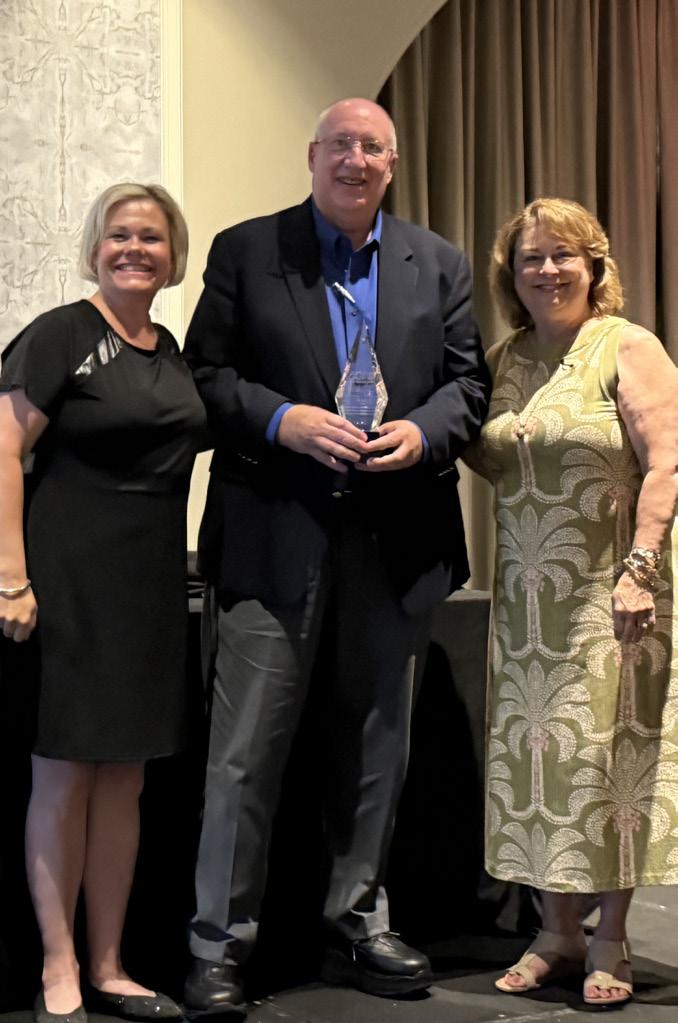
help dealers discover if they could be more profitable. Stillwagon suggested that the survey is pretty much as relevant today as it was over 20 years ago, and we agree. That survey is reproduced on the next page—see what you think…
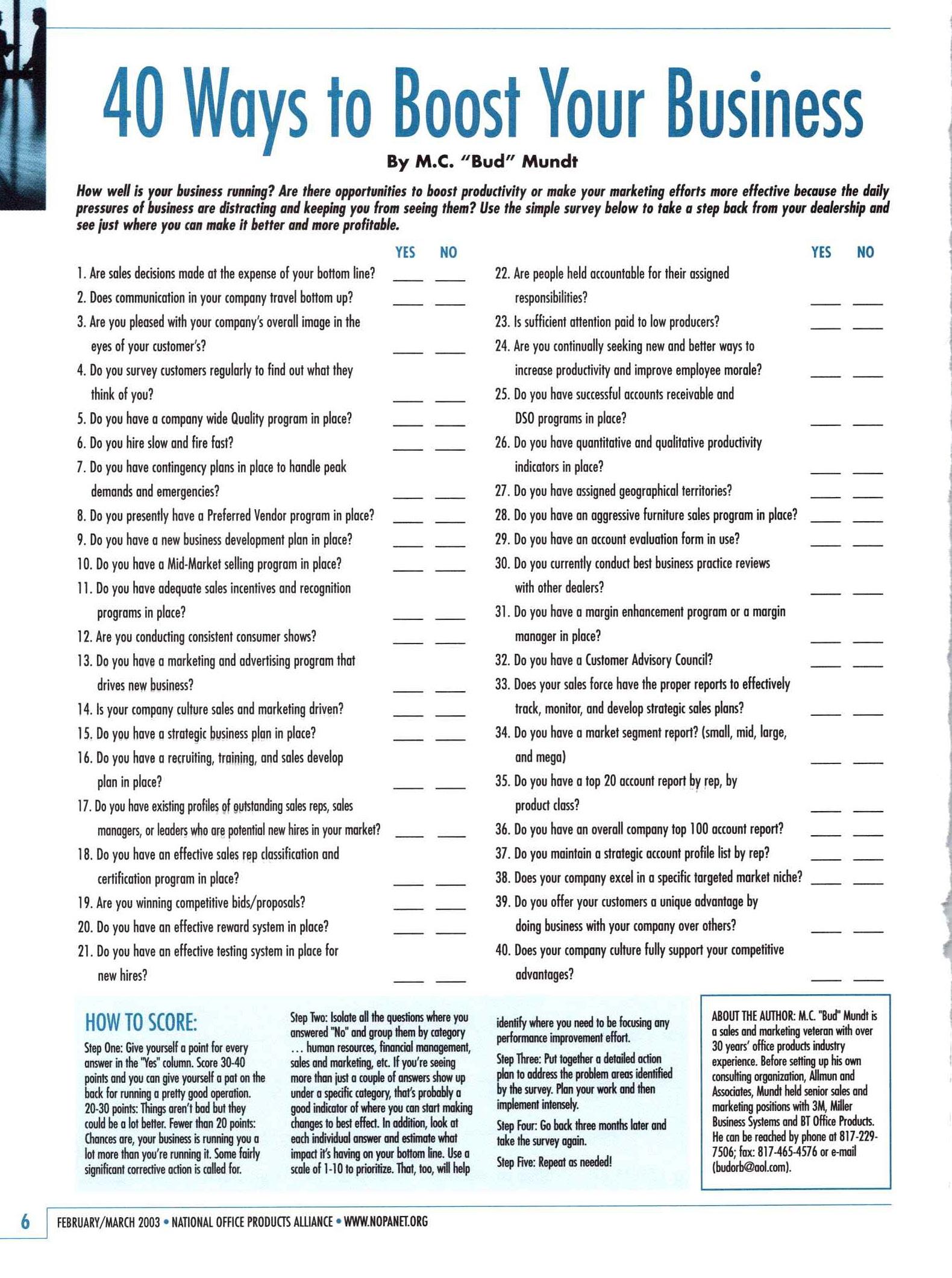
Bud Mundt’s survey originally appeared in NOPA Special Report in 2003 and is reprinted here (see previous page for more details)

By Lisa Veeck
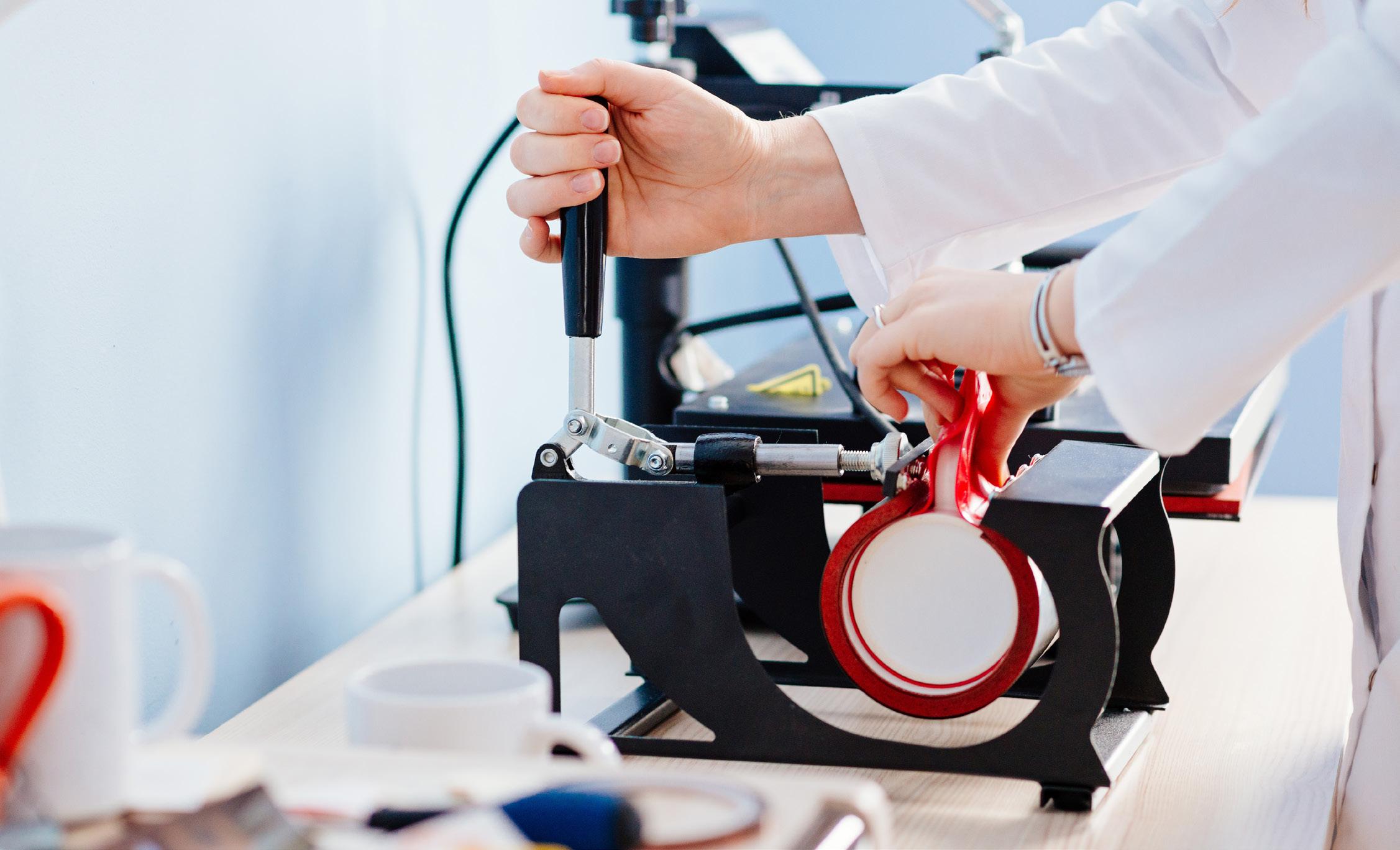
Remember a few years back—okay, maybe decades—when computers infiltrated the workplace and conventional wisdom assured us that print was dead? Wrong! The independent dealers we interviewed for this feature report that print and printed promotional materials isn’t just alive and well, but thriving. Let’s see what they have to say:
Who’s selling what?
At Office Express Office Products, Cedar Rapids, Iowa, print and promotional products account for 8–10 percent of the company’s $15 million in annual sales—and Benjamin Keel, president and co-owner, forecasts that number will rise. “We do more in the print area, but in promotions, we do a lot of trinkets, like stress balls, coffee mugs and frisbees,” he says. “Whatever companies want their logo on, we can do. Print and promo is far and away the most profitable portion of our business and a huge growth area for us because, honestly, it’s a segment we haven’t gone after before. Now, we are connecting with customers and letting them know we
offer it. It can take a while to gain their trust, but once you have completed a project and have something to show them, the proof is in the pudding. It’s a great way to make up profit margins on office products lost to Amazon.”
Upon request, Office Express also creates portals that allow customer employees to order customized items the company has agreed they can purchase, which, Keel reports, breeds greater client “stickiness” and loyalty.
About 30 percent of Katy, Texas-based Butler Business Products’ $2 million in annual sales is attributable to paper and promo. Along with what most distributors consider “the usual—business cards, letterheads, envelopes and the like”—the company sells a lot of wearables.
“Being in Texas, we have a lot of customers in the oil and gas industries, but education is by far our

biggest customer in the category,” reports CEO Stacy Duke. “The schools put their name and/or logo on anything and everything they can, from T-shirts to chairs to trashcans.”
Butler also produces complete exhibition packages, including flyers and brochures, walls and tents. Its promo offerings range from logo-inscribed chocolate in order sizes ranging from 100 to 200,000 to plush animals.
Print and promo accounts for 33 percent of sales—and 42 percent of gross margins—of the $15–20 million annual sales at Storey Kenworthy, Des Moines, Iowa. Interestingly, the company fell into the category a bit by accident.
“We had always sold a little print and promo, and we would broker the business out,” explains vice-president Lincoln Dix. “But 15 years ago, we bought another company. We did due diligence, but sometimes you don’t find things out until after the purchase. The shareholders thought it mostly sold furniture and office products but later realized it was also heavily into print. As John Kenworthy [owner] explained it, management had to take a step back and work out if this was an area they wanted to invest in, and they decided it was a natural fit.”
Storey Kenworthy divides the category into three segments: traditional print, like forms, letterheads and business cards; customer-branded products, such as mugs; and its most lucrative products, branded apparel. Because most orders are in bulk, the company offers send-on-demand. “Typically, it’s not a few keychains, but 500,” says Dix. “Sometimes we ship all 500, but often we warehouse them so they can have us send whatever number they need when they need them.”
Cover Story
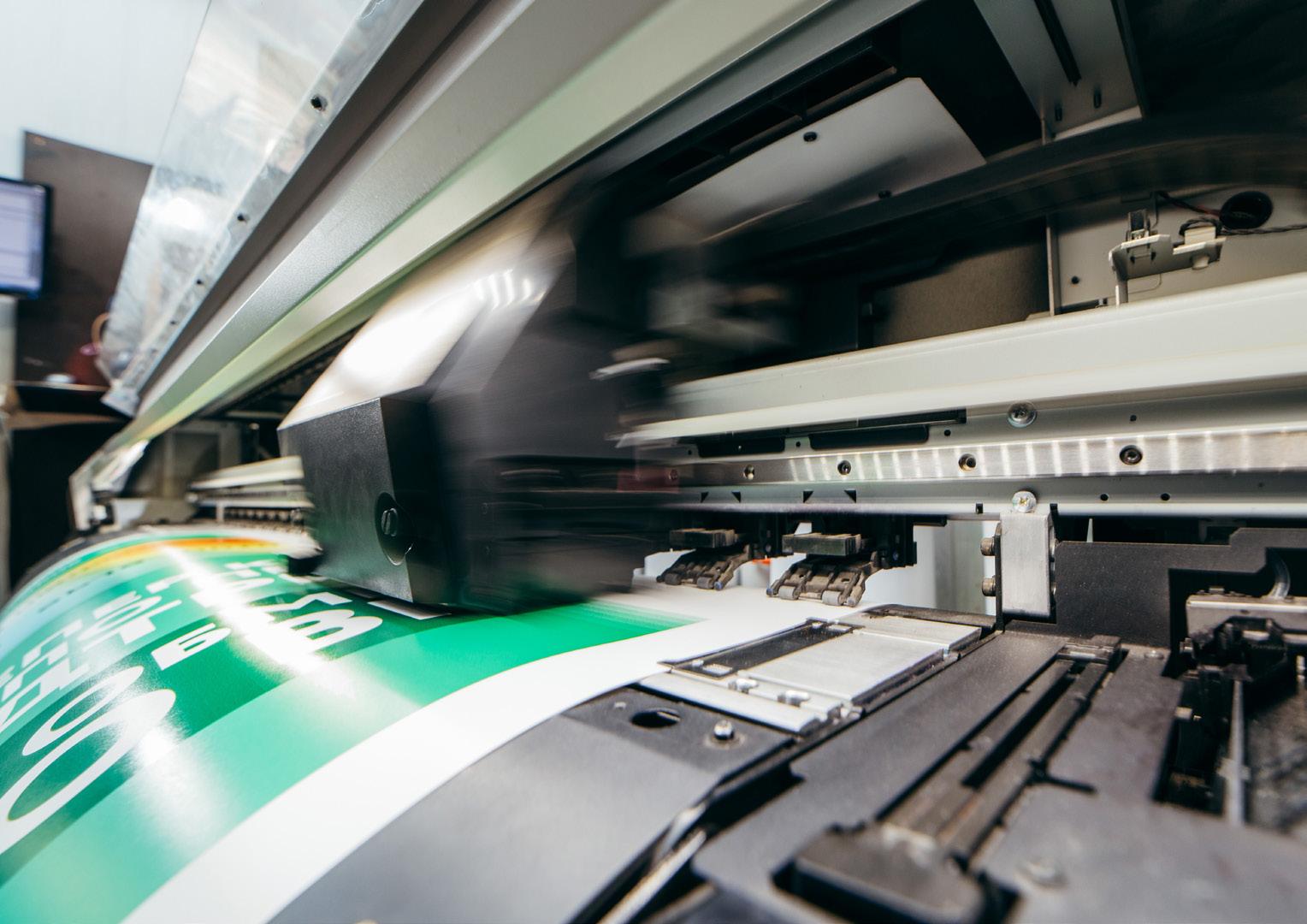
Some of the most curious printed items the company sells? “It’s not super odd, but one of the most interesting is ballots for federal— including for US president—state and local elections,” replies Dix. “Every four years, we get a huge order; and we get big ones for the midterms. We also do ballots for unions, school boards and other entities. We have an excellent team because these require high accuracy and precision. We also handle mission-critical and security items. For example, a power plant was being brought back online and it needed high-visibility vests with a logo and a name patch for each employee. We do many of the jobs in-house, but in this case, we took them to a local seamstress. It shows the level of service and effort we are willing to take to help our customers.”
FriendsOffice, Findlay, Ohio, enjoys annual sales of $36 million, with $2.5–3 million coming from print and promo. Its main customers are in the education, healthcare and city and county government sectors. FriendsOffice has sold the category
for about 30 years, but on a much smaller level. Five years ago, it bought a full-scale print shop. Today, the company offers both digital and web offset printing and employs three designers and four production assistants, according to print manager Jeff Seery. The company has 20–30 sales reps, all of whom sell some print and promo.
Strive Workforce Solutions, Portland, Oregon, has been doing print since its inception 59 years ago. Today, print and promo accounts for 5 percent of its $10 million-plus annual sales. Leading buyers include banks and other financial institutions, supermarkets, construction firms and technology companies. Most print orders are bulk orders that the company warehouses and ships on an as-needed basis, which anchors customers to Strive—especially those with multiple locations.
When it comes to promo products, the sky is the virtual limit. “On our custom promo website, we have literally hundreds of thousands of products,” attests president Jeff Lurcook. “Customers can go on the
site, pick out the item they want—like a specific type of golf ball—upload an image and the program will show the image on the ball they selected. Before finalizing the order, they will see an online proof in real time and can make any changes necessary.”
The most successful promo item Lurcook has witnessed is one Strive produces for itself: “We do glass nail files with our logo on them for customer events and tradeshows and get mobbed. The women come and want one for themselves, their daughters and their moms. We’ve done them for bank appreciation days and especially the women employees all want the files.”
Print and promo generates about 2 percent of annual sales at Tempe, Arizona-based Wist Business Supplies and Equipment, with the largest customers hailing from education, state and local governments and the private sector, such as insurance companies, law firms and car dealers. While the segment may not represent a huge portion of its business, it is still a meaningful one.
“It’s a highly profitable category for us because the profit margins are stronger than, say, paper towel, toilet paper and copy paper,” explains president Ian Wist. “I’ll never walk away from the $600,000 we make from it. It’s an area we want to grow, especially for our loyal customers. A lot of the promo we do is mugs, but I have right now a foam truck sitting on my desk and today we just finished a promo for a school: a big red pencil with our name and logo. We also do a lot of embroidery for apparel like shirts and hats.”
Up for the challenge
The dealers all emphasize that— unlike office products, which tend to be transactional—customized
business is very high-touch and can require time and patience.
FriendsOffice’s’ Seery identifies several other challenges: “Sales is the most difficult part. It can seem daunting for reps used to selling office supplies and it requires constant training to keep them at the cutting edge. There is also the competition. The market is concentrated, especially in the promo field. Further, many of the smaller shops have been bought up by big conglomerates, so pricing is an issue. Sourcing the cheapest, yet most consistent, quality paper can also be challenging. There are issues with mills not being able to find what we need and we have to source alternatives. Also, we look for paper globally and we try not to raise our prices, but sometimes it’s unavoidable. For example, paper prices in the Middle East have gone way up.”
At Strive, the biggest issue is customer awareness. “We provide so many categories—office products, jan/san, MRO—that it’s a challenge getting the word out that we do print and promo too,” admits Lurcook. “That is part of the reason why, when we rebranded in 2020, we decided we didn’t want ‘office products’ in the name.”
Reaping the benefits
Still, the consensus is that these challenges are far outweighed by the advantages, including repeat orders. “It creates a lot of loyalty,” says Duke. “We can send an email asking if they want any changes to the copy. We have had some of the same customers for the last 15 years because it’s easy for them to reorder.”
Seery agrees: “We do punchouts and print on demand, including for banks and hospitals that have hundreds of forms. Once we set them
up, customers can go in and reorder as required. It also means we can better serve our customers’ needs; and customized items are warm and fuzzy—so ‘stickier’—compared to office products. And the whole process, from order to invoice, is automated.”
Strive’s Lurcook believes this automation is an advantage—as is the finality of the orders: “We send a quote and a proof for approval electronically. Once they sign off on a special order, there’s no going back.” Other positives he appreciates include longer lead times and larger orders. “Unless they are new, most customers who place special-order print orders understand that they take time to produce,” he elaborates. “We can accommodate just-in-time orders, but customers usually know they won’t be as high quality and will cost more. So too will smaller orders; the highest printing costs are setup
Cover Story
and press time. So, if a customer wants 250 business cards, we will explain that ordering 1,000 is much more cost effective.”
According to Wist, not all the benefits are one-sided: “It’s a category that isn’t often discounted, so customers are less likely to shop around. Customers know who they are dealing with; they already know and trust us. So, it’s convenient for them to be able to bundle it with their regular orders and get one bill.”
Inside and out
Whether to keep everything in-house or use outside vendors varies by dealer. For example, Butler, Strive and Wist outsource printing, though sales reps often get involved in the creative process. Story Kenworthy employs a full-time designer. At FriendsOffice, “Most of our jobs are done in-house, but two of our production assistants focus on outsourcing for jobs that don’t fit or
can’t be done on our equipment, like larger laminate jobs that don’t fit on our 28-inch laminator,” says Seery.
Prime promo
For those looking to get started or dive deeper into print and promo, Butler’s Duke recommends: “Buy an existing company. In 2020, we bought Proline Supply, an office products company that did a lot of print and promo, and it really helped our business.”
Storey Kenworthy’s Dix suggests: “If you are interested in it, do it. It’s a great piece of business to add on. But it requires training. We have been doing this for 15-plus years and just found out there is a certification for print and promo salespeople. It’s offered through PPAI [ppai.org], an association similar to ISG. We had no idea it existed; but whether your team get certified or not, training is very important, as it adds credibility.”
Seery from FriendsOffice agrees: “It’s really important to have a
diversified workforce trained in the category. It can be painful, but it’s a must. Otherwise, you are never going to get off the starting line.”
Strive’s Lurcook echoes these recommendations: “Have someone on staff with print and promo experience. If you don’t, hire them. We hired Tyler, who has a print and graphics background, 15 years ago and every special-order project crosses his desk. He also deals directly with customers. Some things in printing can get pretty technical and Tyler can explain them better. If someone sends a picture, he can tell them we need it in a JPEG or GIF format, better than the salesperson. So, pay a little more and hire someone with experience.”
Wist concludes: “Be specific in the details so the customers get exactly what they want and it’s a positive experience. Otherwise, it’s not a complex category. It’s not hard to do, so don’t be afraid to get into it.”


creative design service OPI’s NEW
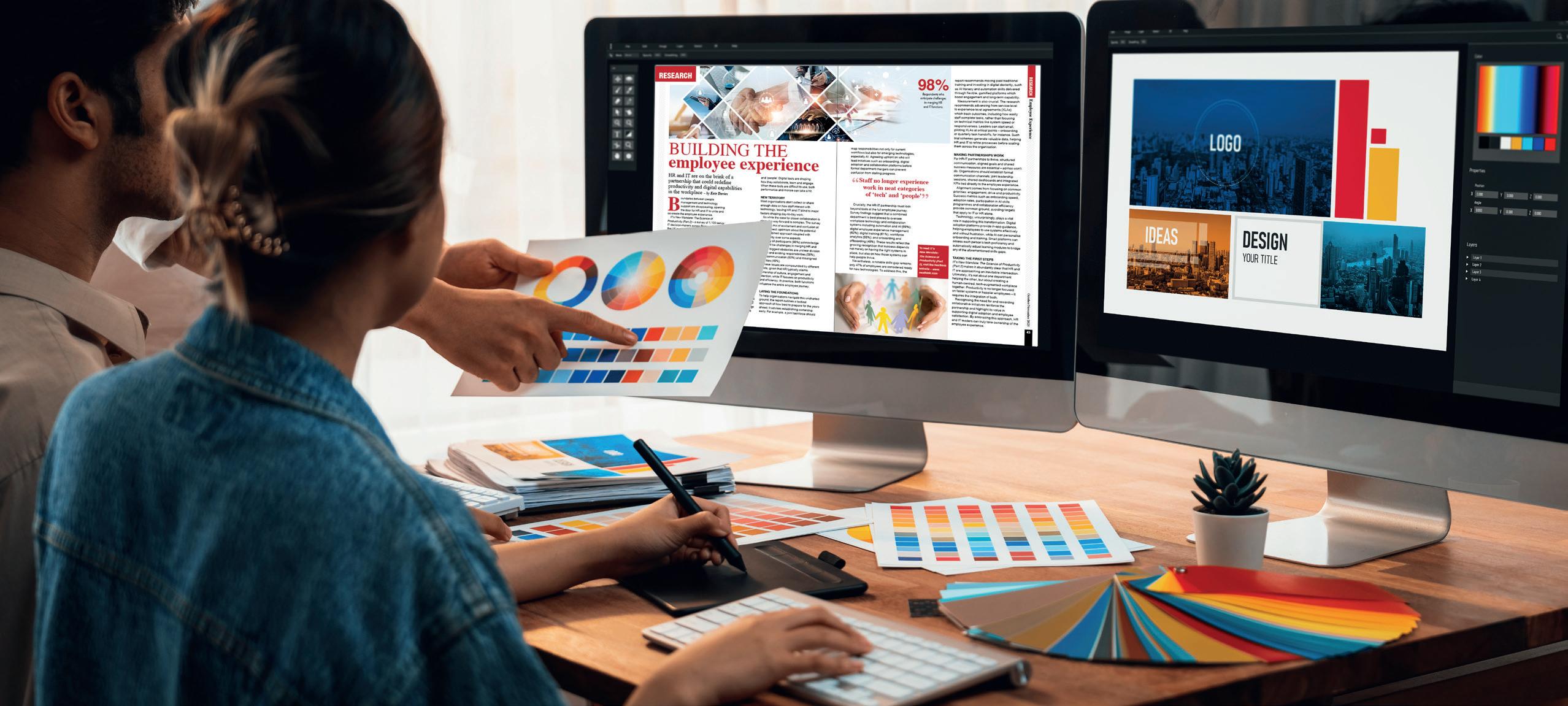
Planning a print or digital advert in any of our OPI publications?
Our end-to-end creative service ensures your brand not only looks great but performs.
With unrivalled industry knowledge, our team designs high-impact adverts built to stand out. Whether it’s a web banner, digital or print magazine advert, event and marketing assets or full show guides, we’ve got it covered.
from the team at

(AND THE ROI BEHIND THEM) PROMOTIONAL PRODUCTS THAT PACK A PUNCH
If you’ve ever cleaned out a junk drawer, you’ll know the truth about most branded swag: it doesn’t survive long. The stress ball rolls under the couch; the flimsy pen runs dry in a week; the tote bag with the too-small logo ends up in a donation bin. When people search for “best promotional products for ROI” or “branded items people actually use,” what they are really asking is simple: which giveaways earn their keep instead of becoming landfill with a logo on?
The answer matters more than most marketing budgets suggest. A well-chosen promotional product isn’t a throwaway gesture; it’s a physical,
ongoing touchpoint with your brand that lives in someone’s home, car or workspace for months or years. Understanding which items survive—and why—is the difference between a marketing spend that disappears and one that keeps working long after the tradeshow ends.
Why keepable promotional products create real brand value
Traditional digital ads have a shelf life measured in seconds. A promotional product that someone actually uses has a shelf life measured in months, sometimes years, and every use is a fresh impression. Industry research on certain
promotional products consistently shows cost-per-impression figures that beat nearly every other advertising channel, often landing well under a penny per impression once an item is used regularly over its lifespan. That’s the core ROI argument: you’re not paying for a single moment of attention; you’re paying for hundreds of them. There is also a psychological angle that digital advertising can’t replicate. When someone chooses to keep an item, they are forming a small,
repeated association between your brand and something useful in their daily life. That is brand recall built on utility. Useful items form a positive connection between the consumer and the brand. And because the recipient is the one deciding whether the item earns a permanent spot in their kitchen or backpack, keepable promotional products essentially get a built-in relevance filter—only the
Jennifer Vitanzo is a content writer for Fortune Web Marketing. She has been writing professionally for over 20 years. When not wordsmithing, Jenn is performing onstage as a singer/songwriter or out in nature photographing wildlife for conservation organizations.


those are the ones doing the marketing work. Finally, there is the referral effect. A branded item used in public—a hat at the gym, a mug on someone’s desk— becomes a walking, talking ad that reaches people who were never part of your original audience, creating earned exposure you didn’t have to buy twice.
Five promotional products with the most staying power
Insulated drinkware
Branded tumblers and water bottles top nearly every list of promotional items with the highest perceived value and it’s
easy to see why. People use them daily; they solve a real problem (keeping coffee hot or water cold for hours); and a quality insulated bottle can easily replace something someone would have bought anyway. Because it travels wherever you go, it also generates far more impressions per day than almost any other giveaway.
High-quality tech accessories
Wireless chargers, portable power banks and durable phone stands sit at the intersection of “useful” and “expensive enough that people wouldn’t necessarily buy one for themselves.” A power bank that actually works when someone’s phone is at 3% during a busy day builds genuine goodwill and stays visible every time it’s plugged in.
Comfortable apparel, done right
The key word is “comfortable.” A stiff polyester polo with an oversized logo gets worn once, if that. A soft, well-fitted quarter-zip or hoodie with a subtle, tasteful logo placement gets worn constantly, especially if it’s the kind of piece someone would wear even without the branding. Apparel also has the advantage of turning the recipient into a mobile billboard in public, everyday settings.
Notebooks and planners with real craftsmanship
In a world of digital fatigue, genuinely nice notebooks—thick paper, durable covers, ribbon bookmarks—still get used daily by a surprising number of people, from students to executives. Unlike a cheap notepad that ends up as scrap paper, a well-made journal earns a spot on a desk or in a bag because it feels like a small upgrade rather than a giveaway.
Multi-tools and everyday-carry items

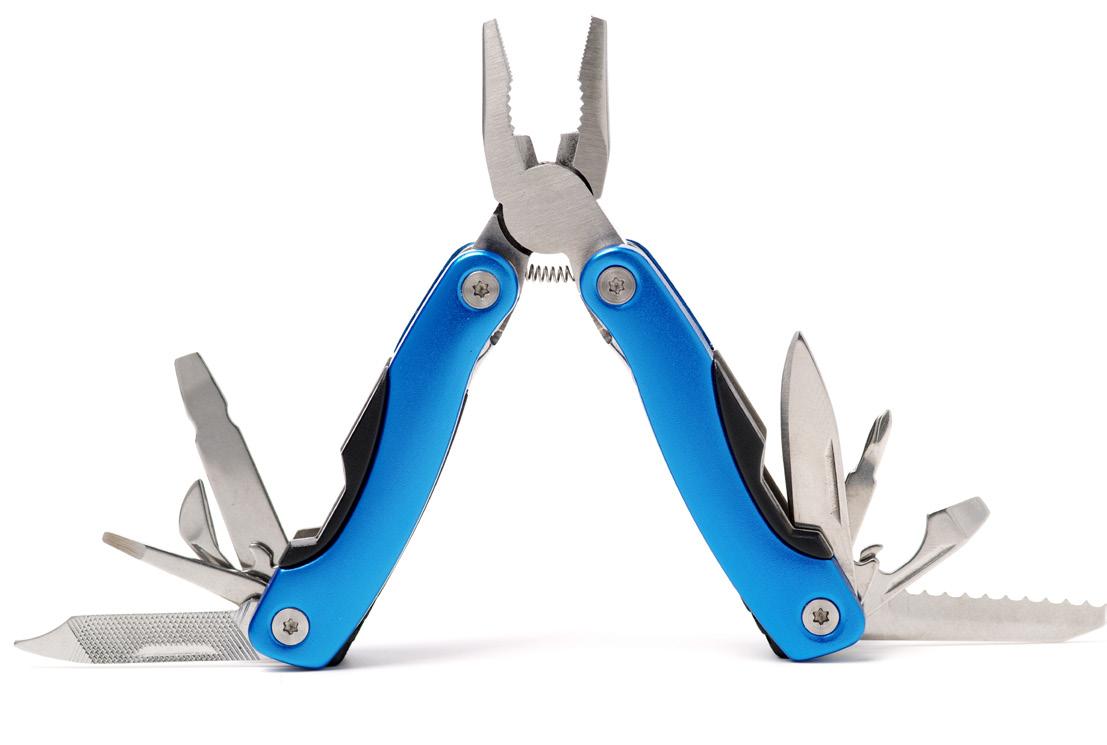
Compact tools, keychain gadgets and small utility items solve micro-problems people run into constantly, which is exactly why they stick around. A tool that opens boxes, tightens a loose screw or charges a phone in a pinch earns its place through pure usefulness.
The common thread: utility beats novelty Every item on this list shares one trait: it solves a real, recurring problem in someone’s day. That’s the pattern to search for when researching promotional products with the best ROI—not “What’s the cheapest item we can order in bulk?” but “What would someone use even if they would pay for it themselves?” When you flip the question that way, the ROI math tends to work itself out, because usage is what turns a giveaway into
worth its weight in gold.
The best promotional products strategy isn’t about maximizing the number of items handed out. It’s about maximizing the number of times your logo gets seen after the event is over. Guide customers toward items people would genuinely want to keep and the impressions—and the brand equity—will take care of themselves.

Marisa Pensa
Marisa Pensa is founder of Methods in Motion, a sales training company that helps dealers execute training concepts and create accountability to see both inside and outside sales initiatives through to success.
For more information, please visit www. methodsnmotion.com

DON’T LET AI REPLACE YOUR CURIOSITY
AI has changed how sales professionals prepare. In minutes, industry-specific AI tools can help you research a company, understand an industry, organize your thoughts and generate questions for an upcoming meeting including targeted categories.
That is a real advantage. But it can also create a dangerous feeling: “I already know this customer.” You read the website. You scan recent news. You review a few LinkedIn profiles. You uncover lease renewal or contract renewal dates. And then AI gives you a polished summary of the company’s likely priorities
and challenges.
The problem? “Likely” can quickly start to feel like “true.” AI should prepare you for discovery. It should never do the discovering for you.
Here are five ways to use AI without losing the curiosity that makes great selling work.
Use AI to prepare
AI is excellent at helping you get ready. Use it to research companies and industries, brainstorm questions, organize your thoughts, identify possible decision-makers and spot blind spots. Used well, AI saves time and helps you enter the conversation more informed.
the wrong conclusion. A company may be expanding, but growth may not be the customer’s biggest concern. The real issue could be staffing, service, cost control or the time lost managing too many vendors.
The danger is not using AI. The danger is believing you have learned everything before meeting the customer. Preparation should increase your curiosity, not replace it.
Try this prompt: “I’m preparing for a first meeting with [company name]. Using publicly available information, give me a brief overview of the business, three possible priorities or challenges and three thoughtful discovery questions.”
But preparation is only the starting point. The goal is not to prove how much you know; it is to learn what you do not know.
Watch where AI can fool you
AI can make assumptions sound like facts. It can also be incomplete, outdated or simply wrong.
Even accurate information can lead to
Remember: curiosity cannot be automated AI can tell you what a company does, what happened recently and what trends may affect its industry. But only a real conversation can uncover why the customer is considering a change now, what is frustrating them, what success looks like and what they are worried could go wrong. Use your research to open the conversation, not control it.
Ask the questions AI cannot answer AI can suggest questions. The art of selling is knowing what to ask next. Try:
• “How did you decide on ….?”
• “Had we not called, what were you already planning to do about …?”
• “What have you already tried?”
• “If you were sitting in a review six months from

now, having personally made a significant impact on the business, what would success look like for you?”
• “What happens if nothing changes?” These questions move the conversation beyond surface-level pain. They
also help you avoid pouncing too quickly. Whether the customer mentions delivery, cost, service or vendor consolidation, slow down. The first answer is rarely the full answer. Ask one more question before offering one more solution.
Do not outsource your curiosity
Everyone has access to similar AI tools, but not everyone listens well. Not everyone notices hesitation, follows an unexpected comment or stays with an issue long enough to uncover what really matters. That is still your competitive advantage.
Use AI to prepare, broaden your thinking and identify what you may be missing. Then put it away and be fully present. Before your next customer conversation, challenge yourself to do three things:
• Prepare with AI. Verify with the customer. Ask
one more question before offering a solution. Do not simply work through a list of AI-generated questions. Listen to the answer and follow where it leads. The question you did not plan to ask may be the one that uncovers the real opportunity.
• The more powerful AI becomes, the more valuable human curiosity becomes. AI can help you enter the conversation more informed.
• Your next move is to stay curious long enough to leave the conversation with a better understanding.

STOP SELLING SWAG; START SELLING THE POSSIBILITY
What if your next five-figure print and promotional order started with a three-hour conversation with AI?
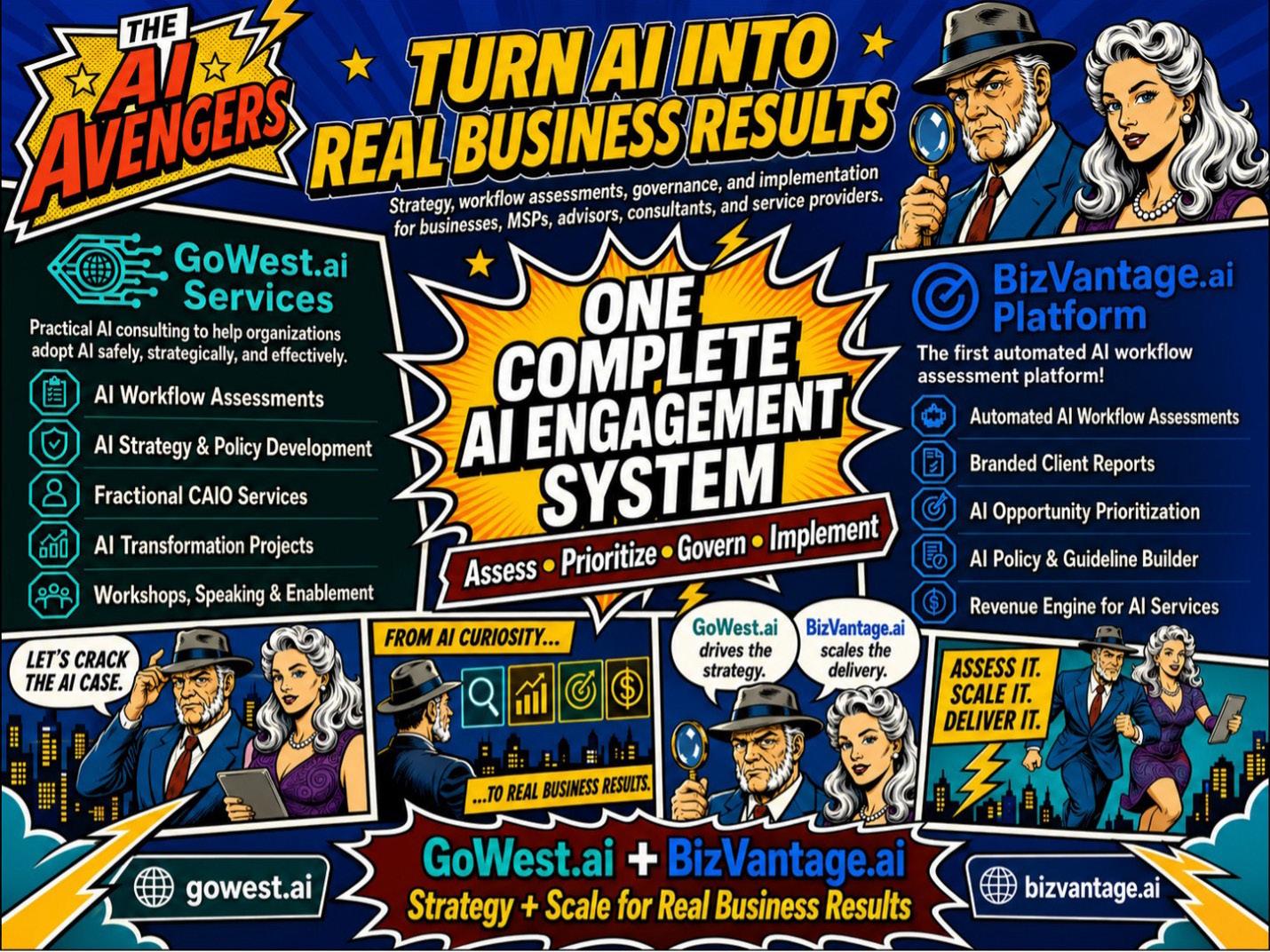
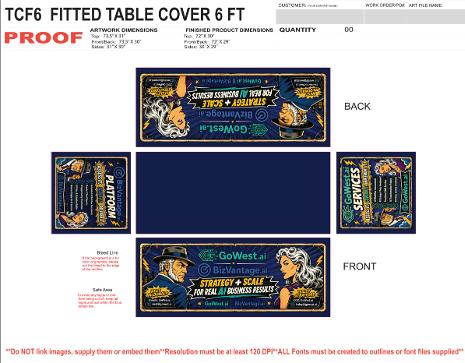
That is almost exactly what happened when we rebuilt the GoWest. ai tradeshow presence for this year’s GTIA ChannelCon. We needed a new backdrop, a coordinated tablecloth and something memorable to hand visitors at the booth.
In the past, a project like this could easily stretch across several weeks of meetings, sketches, emails and revisions.
We completed the core design work in less than three hours of back and forth with ChatGPT.
We provided our logos, colors, booth dimensions, audience and the story we wanted the display to tell. ChatGPT helped us develop the creative
direction, generate the imagery and revise the composition until it felt like us. The result was bold, colorful and built around an old-school comic-book theme (above).
There was a production reality. Images created in ChatGPT are not automatically large enough for clean output on a 10-foot display. We used Affinity, now part of Canva, with Canva’s AI tools to
upscale the artwork and complete the professional production work. AI created the starting point and professional design software helped make it printable. (See image on page 37.)
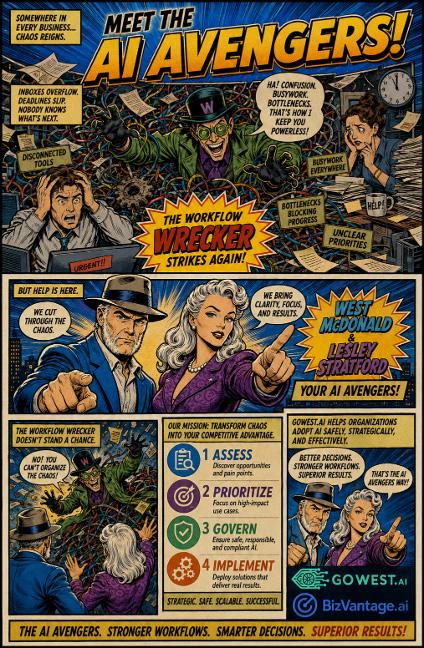
We also used AI to create a comic book for the booth. Instead of another brochure filled with service descriptions, the comic turned our company, our clients’
West McDonald, founder of GoWest.
ai, is a recognized expert in AI solutions, with extensive experience across various technology sectors. His work focuses on generative AI applications and strategies for maximizing recurring revenue, guiding businesses toward innovative growth. West is dedicated to fostering a culture of learning and excellence through AI-driven innovation.
business challenges and our solutions into an action-packed story (see image right.)
Most customers wouldn’t choose a Dick Tracy or superhero theme, and they shouldn’t. The lesson is that AI can help dealers move beyond quoting products and start creating complete ideas customers can see and get excited about.
The industry is moving in this direction. United Alliance’s 2025 AI Adoption in the Printing
Industry report surveyed 201 print providers. It found that 57 percent were using generative AI for design and copy, while 38 percent were using it for marketing personalization. Among 178 providers reporting on benefits, 25 percent said AI had improved sales and marketing results.
AI is not simply a production efficiency story. It is becoming part of how printers develop ideas, communicate value and win business.
Sell a campaign, not a single item
A customer asks for 300 shirts for an employee event. The traditional response is to provide shirt choices and a quote.
AI can turn that request into an employee engagement campaign. In minutes, a salesperson can develop an event name, theme, invitation, signage package, welcome kit, recognition awards and follow-up message.
West McDonald
The customer may still buy 300 shirts, but now there are opportunities for banners, posters, table graphics, name badges, drinkware, awards and direct mail.
Research the customer before recommending products
ASI Media recently profiled promotional professionals using AI in practical sales situations. Pam Weaver of HALO Branded Solutions uses AI to research industries she does not know well, including what people in those fields
use every day and what matters in their work. That research helps her suggest more relevant promotional ideas.
Ken McDowall of Proforma Adams Promotions uses ChatGPT to help source locally relevant products when clients request highly specific regional items. Instead of searching a catalogue for something interesting, begin with the recipient’s world. What do these people do and what would they genuinely use? What would make the brand feel thoughtful rather than forgettable?
West McDonald
Show the customer what “yes” looks like Customers often cannot visualize the finished result. A flat proof or catalog photo may be accurate, but it does not always create excitement.
AI can generate several campaign directions before the customer commits, showing signage in a lobby, a welcome kit being opened or apparel being worn at an event. For our project, we created an image of the completed GoWest. ai booth as though it were already installed at ChannelCon. It gave us a better feel for scale, color, traffic flow and how the design would appear in real life.
Identify these images as concepts, not production proofs. Their purpose is to help customers choose a direction and become invested in the project.
Build ready-to-customize sales packages
Dealers can use AI to create repeatable packages for common business needs. Think employee onboarding, customer appreciation, safety month, recruiting, grand openings, sales kickoffs, anniversaries and trade show follow-up. Each package can include products, printed materials, messaging, timelines, budget levels and optional upgrades. Once built, AI can adapt it for a healthcare
GoWest.ai helps independent office product dealers use AI in practical, business-ready ways.
We focus on sales enablement, marketing, operations and training, with one goal in mind: helping independents move faster, compete smarter and protect margins in a changing market.
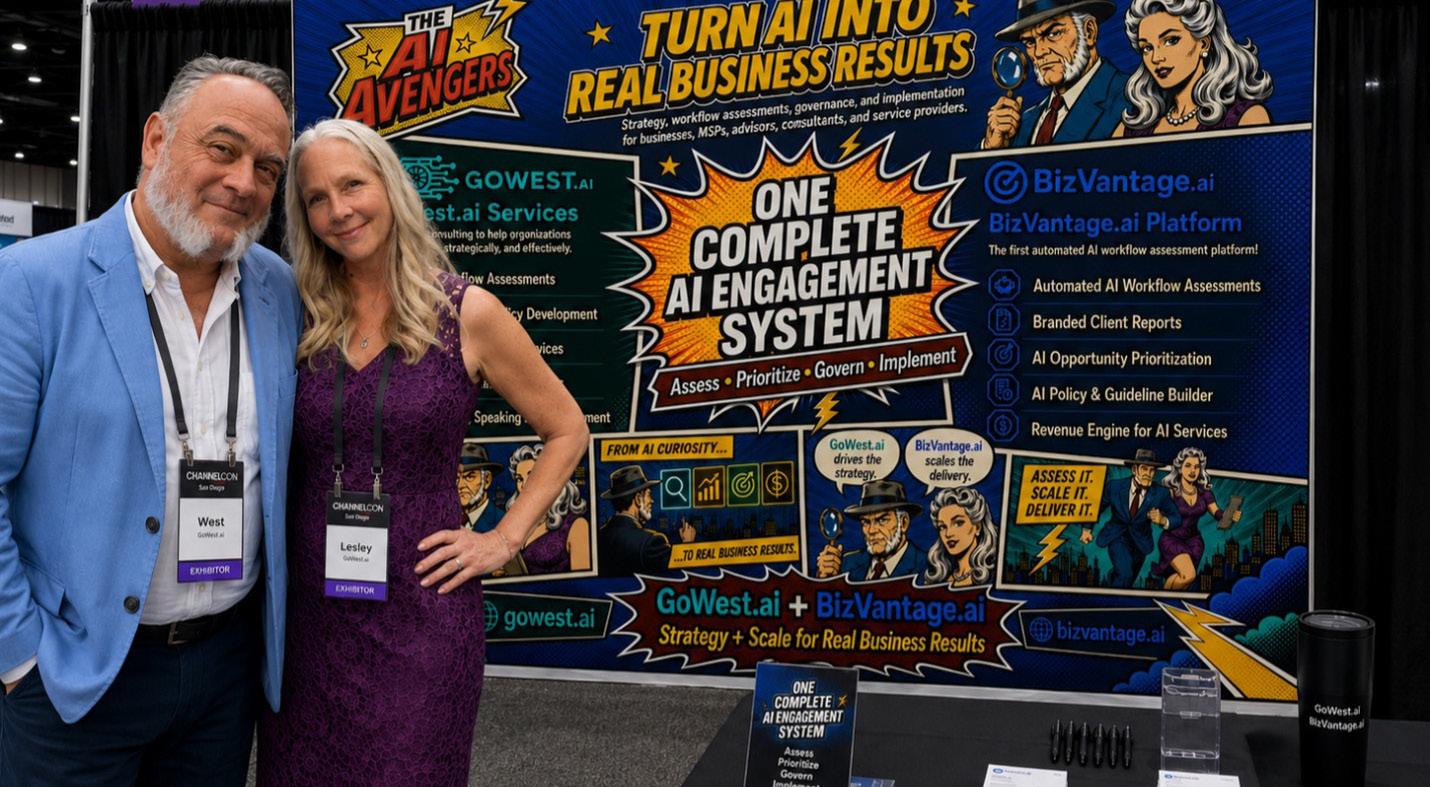
company, school, law firm, manufacturer or nonprofit. Instead of emailing another catalogue link, the salesperson arrives with a solution.
Turn old orders into new conversations
With an approved and secure AI environment, dealers can analyze order history to identify seasonal patterns, missed cross-selling opportunities and accounts that have gone quiet.
A customer that orders tradeshow graphics may also need booth apparel, pre-event invitations, giveaways, lead capture cards and a post-event direct mail campaign. AI can help surface the opportunity. The salesperson decides how to start the conversation.
Make promotional products more personal
According to PPAI’s Product Power 2026 research, based on more than 5,000 US
respondents, 83 percent of consumers said receiving a promotional product made them feel appreciated, while 90 percent reported it improved their perception of the brand.
AI can tailor messages and product combinations for different audiences, locations or industries. The products remain real and useful. AI helps make the experience more relevant.
A little adult supervision, please AI can produce wrong information, strange images, questionable spelling and ideas that do not fit the customer’s brand. Every concept needs human review. Product specifications, trademarks, image rights, pricing, color values and resolution must all be checked before production.
Customer information should only be used in AI tools approved by your company. A
concept image is not a press-ready file, and a clever product suggestion is not a substitute for checking availability, decoration requirements and delivery dates.
The opportunity is not to remove people from the creative process. It is to help good people develop stronger ideas faster.
The next time a customer asks for mugs, shirts, banners or giveaways, do not begin with the catalog. Begin with the business goal. Ask AI to build the campaign, visualize the experience and find the larger opportunity behind the request.
That is how dealers can stop selling more stuff and start selling more possibilities.
Need help finding practical ways to use AI in your print or promotional products sales efforts? Reach out to me at west@ gowest.ai or visit www. gowest.ai
Beautifully curated and so informative! It was great collaborating with other dealers to see how they are taking on the same problems everyone is facing as well as get to meet suppliers in person and have meaningful conversations with them. Not overwhelming like other tradeshows - great ability to come and speak to everyone beyond the superficial conversations.
- Ellie Dowsland Bulk Office Supply
Industry Week is the only event that brings dealers and vendor partners from all corners of the country together to collaborate and learn from one another. It is a MUST attend event.
- Jordan Kudler Legacy Office Solutions

This time to think about the business instead of working on the business was invaluable. It was fantastic recognizing that we were not alone in some of the problems we struggle through. The event provided us with a renewed sense of energy to go after business when we got back to the office.
- Alan Bird Complete Office Supply
Industry Week is a great and needed investment into your business. If you put in the time and effort with the seminars and networking with other dealers, you can't help but improve your dealership.
- Tige Vester Boss Office Products
members should plan to arrive on Oct.

In addition to serving as national sales manager for AOPD, Tom Buxton, founder and CEO of the InterBizGroup consulting organization, works with independent office products dealers to help increase sales and profitability. Tom is also the author of a book on effective business development, Dating the Gatekeeper. For more information, visit www.interbiz group.com

“OUR PRICES ARE SO HIGH THAT I CAN’T GROW
UNTIL WE CUT THEM!”
Have you heard this from members of your sales team lately? Pardon my directness, but if your people don’t believe there is an opportunity to win new business, find new people.
In my role as national sales manager for American Office Products Distributors (AOPD), I hear almost daily about large sales opportunities our members have generated, as well as opportunities from group purchasing
organizations such as Equalis, OMNIA, Pandion, Premier and Vizient that specifically request our members’ help in serving their organizations. Our dealers also secure business with many state agencies through both single-source and multi-award contracts.
Over the past few months, AOPD dealers have additionally won significant regional and national contracts with law firms, banks
and other private sector organizations. So, when someone suggests that the future of the independent solutions dealer looks bleak, I question their strategy and commitment, not the marketplace. And just so you know, AOPD is a nonprofit organization, so we aren’t collecting dues from your company just to give them to larger members.
Meanwhile, our “big box” competitors continue to shrink, while
dealers committed to pursuing growth through organizations like AOPD and AFFLINK are thriving. Those without that passion are selling out or disappearing altogether. So, which kind of company is yours?
Do you let the “inmates run the asylum” by accepting blanket statements like the title of this article? Or do you push back against the negativity by investing in better sales strategies,
Tom Buxton
better target accounts, broader product offerings and, if necessary, better salespeople?
I’ll bet you $25, paid through PayPal or Venmo, that your medium and large customers generate your highest margins, and that you lose a smaller percentage of their business each year than you ever will grow profitability by trying to prospect, win and retain large numbers of small customers. (We can verify this through Acsellerate.)
Your smallest customers are the most price sensitive. They often scrutinize every purchase
and waste time shopping for the lowest possible price. If those customers are generating higher overall margins than your medium and large accounts, you need a better matrix pricing strategy because you’re leaving profit on the table. (We discussed improving sales and overall profitability through matrix pricing in the last issue of INDEPENDENT DEALER.)
Small customers behave much like Amazon customers and Amazon reports that its average order size is only $38. That’s not the type of customer your
salespeople should be spending your money and their time pursuing. In fact, they shouldn’t be calling on small businesses with fewer than 30 employees. Yet that’s exactly where many sales reps focus their efforts.
And I’ll bet I can hear their “sales pitch” right now. Your salesperson often walks in carrying a “hot list” of low-priced products, hoping to win business by being cheaper. Your company will never be less expensive across the board than Amazon, Office Depot, Staples or other online competitors— and it doesn’t need to be. It needs to be better. If your company wasn’t already delivering more value than the large competitors in the eyes of your best and likely your largest customers, you would have gone out of business years ago. So, wake up. You can survive and thrive in the office solutions industry—but only if you’re willing to invest in the right salespeople, pursue the right prospects and partner with the right organizations to help you grow. Please contact me if you have questions or would like to take $25 from me!

Are you building a sales team or renting one?
Picture a decision that feels smart in the moment. A sales seat is open or a budget review is underway and someone asks why the company should carry a green rep who isn’t producing yet when a senior closer bills real revenue right now. The math looks obvious: the junior person is a debit; the senior person is a credit. So the junior role gets cut, or never gets created in the first place, and everyone congratulates themselves on running a lean operation.
That logic is a trap—and
it’s one that business owners almost always spring on themselves.
The senior closers who justify the math today are exactly the people who leave, retire or burn out tomorrow; and if you never developed anyone underneath them, you have no one ready to take the handoff. You didn’t build a sales team, you rented one—and the lease is about to come due.
This problem shows up in year three, not this quarter
The reason this trap catches so many
smart people is that the consequences arrive long after the decision. Cutting the junior role causes no pain this quarter, next quarter or maybe even this year. The senior reps are still producing and the choice looks vindicated. The “80/20 rule” is always correct, right? But then a top producer gives notice or a key relationship retires out of the business, and suddenly there’s a crater where one-quarter of your revenue used to be, with no one prepared to fill it. At that point, you’re back in the hiring market
at the worst possible time: recruiting from outside, desperate and waiting months for a stranger to ramp while the territory goes cold. The efficient-looking decision turns out to have been the expensive one all along.
Renting costs more than it seems
When you hire a salesperson off the street, you’re betting on incomplete information. You don’t know how they will sell or whether they will fit your culture until they’re already on your
Troy Harrison is the Sales Navigator and the author of Sell Like
You Mean It and The Pocket Sales Manager
He helps companies navigate the elements of sales on their journey to success. He offers a free 45-minute sales strategy review. To schedule, call 913-645-3603 or email troy@troyharrison.com.

payroll and in front of your customers. The ramp takes months, the failure rate is high and an outside hire knows nothing about your business on day one. A good onboarding program (you do have one, right?) can fix the knowledge gap, but the time lag still exists. You’re paying them to sell while they’re still learning what they’re selling, and your customers feel every bit of that gap.
A bench solves both problems at once. When you develop salespeople from inside, you are betting on people you’ve already watched work for months or years. You know their character and they already know your business cold, so they ramp faster and stumble less when they finally take the field. The green rep who “isn’t producing yet”
isn’t a cost to be trimmed; they’re the insurance policy on every senior producer you have.
You already have a bench
The good news is that you probably already employ your best future salespeople—they’re just sitting in another department. Customer service is the most obvious and most overlooked source. The people answering your phones already know your products, your customers and your most common problems, and they’ve been solving those problems under pressure every day. A service rep who is sharp, curious and good with people has most of the raw materials a salesperson needs. What they’re usually missing is selling skill, which is far easier to teach than product knowledge and customer rapport.
Inside sales, sales support and operations or technical roles are natural feeders too. Someone who has spent two years solving customer problems hands-on often understands the buyer’s world better than a candidate hired purely for sales polish. The point isn’t that any one department is the answer; it’s to look at your org chart and ask the question most companies never ask: “Which of our current people already understand the business and could learn to sell?”
Troy Harrison
Building
the development program
Now it’s time to dig your well before you’re thirsty. Your development program doesn’t have to be elaborate, but it does have to be deliberate.
Start by defining what a successful salesperson in your organization actually needs to know and do. Most companies have never written this down, which means they have no standard to develop toward. Lay out the skills, activities and benchmarks that separate a strong rep from a weak one: what builds a healthy funnel; what good questioning looks like; how your buyers actually make decisions. Once that picture exists, developing people toward it becomes a manageable task instead of a hope.
Next, give bench candidates exposure before they ever carry a quota. Let them ride along on calls, pair them with a strong salesperson and invite them to sit in on pipeline reviews. This costs almost nothing, teaches them more than any classroom could and lets you see how they think before you commit them to a territory.
Then invest in real skills building through actual sales training. The product knowledge and relationships they bring are the hard parts to teach—but they already have those. What you are adding is questioning,
discovery and the ability to navigate a buyer through the buyer’s journey, and those skills respond to structured practice. Finally, make the path visible. People won’t develop toward an opportunity they don’t know exists. When your support staff understand that a sales career is a real possibility, you create a retention tool on top of a recruiting pipeline: the ambitious ones stay and grow instead of leaving to find advancement elsewhere.
Your win
A company that builds bench strength stops living at the mercy of the hiring market. When a seat opens, someone is ready who already knows the business and has been preparing for the moment. Turnover hurts less because the next person up is already in motion; and the quality of the sales force climbs over time because you’re selecting from people whose character you know firsthand rather than gambling on a polished interviewee.
You’re going to need salespeople next year and the year after that. The only question is whether you’ll keep renting them and hoping your senior people never leave—or whether you’ll start building the bench that takes the handoff before you need it.