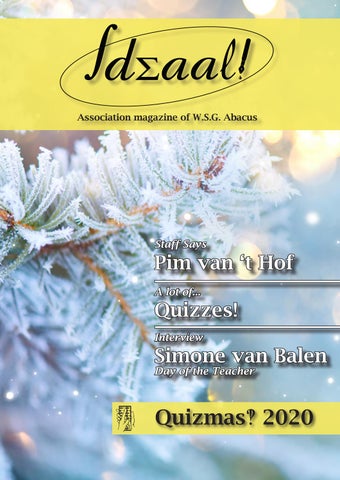
S Association magazine of W.S.G. Abacus
Staff Says
Pim van ‘t Hof A lot of...
Quizzes! Interview
Simone van Balen Day of the Teacher
Quizmas‽ 2020
INDEX 4 5 6 16 26
Columns Your Story External Thoughts Staff Says On the Couch The Pen Mathematical The Basics of Creating AI for Simple Games 12
4, 7 7, 27, 28 8, 18, 24 10 13 16 17 2
Minimizing the overlap of cleaning times after surgeries 20 Fun Puzzle Solutions Quizzes Interviews Abacus needs your help! Non-mathematicians Puzzle A Day With...
Editorial Dear Readers!
The time of the year has arrived which is usually characterised by seeing lots of different people in the span of two weeks. Firstly, we would usually spend Christmas breakfasts, brunches and dinners with all different kinds of families and one week later with as much friends as possible on New Year’s Eve. Except for the fact that meeting many people will be very complicated in these times. Therefore, we have to find now, after a spring, summer and autumn, also a new way to come through the winter. While in the weeks before (and after) the break we still could keep ourselves busy with studying or work, the Christmas holidays are feeling pretty empty this year. In my case, one thing already showed up to fill up that gap, a former tradition of our family in this time: making puzzles. It is of course the most suitable time in the year for that: the sun almost never shines outside and it is dark very early on the day.
ally it doesn’t last that long, halfway through January everyone is very busy again, but who knows what will happen next year? Everyone will have their own thing that they will do this year more than previous years. Making puzzles or quizzes, playing games or music, reading books, whatever you like, but of course also reading this Quizmas‽-edition of the Ideaal!. As long as it gives some peace of mind before the new year starts. Have a nice Christmas time everyone! Daan van Kats
• 12 January Lunch Lecture Da Vinci • 13 January Ab-Actie X www.com Escape Room • 20 January Chinese Checkers
• 2 February Lunch Lecture Gupta • 11 February Lunch Lecture Chartwell Consulting
Colophon
Editors: Emma Donkers Jorg Gortemaker Daan van Kats Lavinia Lanting Timon Veurink
• 6 January FMC Games Night
• 27 January Board interest lunch
Every year we go through all of our Jigsaw puzzles called “Jan van Haasteren”, a bit comic-like illustrations of 1000 or 2000 pieces, and choose a few puzzles we don’t remember from last years and puzzle hours per day for some weeks. Usu-
Editorial address: W.S.G. Abacus Postbus 217, 7500 AE Enschede Phone: 053 - 489 3435 ideaal@abacus.utwente.nl www.abacus.utwente.nl
AGENDA
Guest writers: Erik Leering (Your Story), Daan Pluister (Puzzle Solution), Jorn de Jong (External Thoughts, Puzzle Solution), Pim van ‘t Hof (Staff Says), Tim Schuttevaer, Annemarie Bult and Wouter de Sain (Non-mathematicians about mathematicians), Diana Dalenoord (Interview: Anete Valnere, Interview: Simone van Balen), Thomas Middelkamp (Minimizing the overlap of cleaning times after surgeries while considering multiple cleaning teams), Anouk Beursgens (Abacus Website Hunt).
Ideaal! is the magazine issue of Wiskundig Studiegenootschap Abacus and the department of Applied Mathematics. The responsibility for the articles published in this magazine lies with the original author(s). The period of notice of Abacus is four weeks before the end of the association year (August 1st). That means that you must cancel your membership before July 4th. If you have forgotten to cancel your membership before that time, you will pay contribution for another college year. Would you like to cancel your membership? Send an email to board@abacus.utwente.nl.
3
Your Story Text: Erik Leering Minor time As for all third years students, it was time for me to follow some subjects that are not part of the normal physics/ mathematics course for my minor. I knew for sure that I was not interested in anything social (no offense and not to say that I am asocial, of course) and I didn’t want a minor with a lack of formulas to work with. Luckily for me, there was a very interesting minor called Soft and Biological Physics, which, as the name suggests, has some connection to both physics and biology. This course is only offered as a minor for 15 students, and I was very relieved to be in time to be the last to enlist. There are 2 things that I like best about this minor: 1. You get a feeling for the size, scale and context of what you are studying. In mathematics, we usu-
Puzzle Solution Text: Daan Pluister
4
ally learn stuff that can always be implemented and does not depend on size. Here, the very tiny size of the stuff that you’re working on matters, and is thoroughly discussed. 2. You get a broad knowledge on the applications of the matter. One subject of 5EC is dedicated to learning techniques/doing practicals where you apply the knowledge you learnt in the minor. You also read and discuss more than enough papers that drag you into the subjects and help you get the feeling that you can participate in this sort of research. That being said, it may very well be one of the tougher minors, so con-
tinuous participation (with the help of bonus assignments) is a must. This module places itself in my top 3 most enjoyable modules, together with Electromagnetism and Systems and Control.
External Thoughts Text: Jorn de Jong After hearing the title, Quizmas‽, I knew immediately what to write about. The Kick-In, Christmas, and the one and only Christmas puzzle (quiz). ‘‽’ is almost the logo of my do-group during the Kick-In, Absolutely Maybe. During the Kick-In, I already got to know my fellow board members. For example Luuk, who thought I was retarded and would stop the study within a month. Or Velthuis, who couldn’t remember my name so he named me ‘moersleutelman’ is his contacts on his phone.
I was at ice skating (just kidding, I still suck). Skeuvel convinced me to join them with their free hot chocolate promotion (for the new members, this was at the time you still had to pay for hot chocolate at Abacus: the bad old days).
no Christmas dinner. However, for me, this also means there is one very big positive point, a lot more free time for other things that are still possible. For example for the AIVD Kerstpuzzel, or to go out on a run.
During Christmas, there are of course more good things happening. For example the Christmas dinner and the release of the AIVD Kerstpuzzel. For those of you who don’t know this, try to talk to me during December and you probably will. It is a puzzle from the Intelligence and Security Agency of the Netherlands and it’s a perfect way not to get bored during Christmas.
It also means companies are more likely to try unconventional stuff. For example, a case that is just like a game. That would never happen under normal circumstances. Or a company not located in the Netherlands who wants to give a lunch lecture.
After the Kick-In, it was quickly time for Christmas. Just before Christmas, we went Ice skating with Abacus. Luckily, I joined Skeuvel before, so I could flex with how good
This year, everything described above is different. No big parties during the Kick-In, no loud Christmas music in the Abacus room, no ice skating with Abacus, probably
So to conclude, obliviously a lot of things are different than usual, but I hope this will also give you time to think about all the alternative nice things that would never have happened otherwise.
Ideaal! wishes you...
5
Staff Says Text: Pim van ‘t Hof When I received the invitation to write something for the column ‘Staff Says’, I was told: “The theme of this edition is Quizmas (as in Christmas with quizzes), but you could write about anything you want, for example introducing yourself to the students of the Mathematics department.” So, let me start with a small quiz, and then reveal the answers to the questions in the piece of text below where I tell you a bit about myself (no peeking!). 1. In which Dutch province can you find a scaled-down copy of St Peter’s Basilica in Rome? A. Limburg B. North Brabant C. North Holland D. Utrecht 2. Glanerbrug, a small village close to Enschede, is home to one of the best wind orchestras in the Netherlands. Which former Dutch queen is the orchestra named after? A. Beatrix B. Emma C. Juliana D. Wilhelmina 3. Which university claims to be the third-oldest university in England, after the University of Oxford (est. 1167) and the University of Cambrigde (est. 1209)? A. Durham University B. King’s College London C. University College London D. University of London 4. Which Norwegian city is known as the ‘Gateway to the Fjords’? A. Bergen B. Lillehammer C. Oslo D. Trondheim 5.
6
Which Dutch city is the
birthplace of the popular fastfood meal/snack ‘kapsalon’? A. Amsterdam B. Den Haag C. Eindhoven D. Rotterdam I grew up in Oudenbosch, a village in the southern province of North Brabant, known for its scaled-down copy of St Peter’s Basilica in Rome [1] where my father is one of the organists, where Frans Bauer got married, and where Queen Beatrix mildly offended her tour guide by uttering the words ‘What a curious element in these surroundings’ during a short visit in 1992. In 1997, I started studying Applied Mathematics at the University of Twente, which turned out to be a very enjoyable experience. During my 9 (!) years as a student, I was an active Abacus member, served on the Programme Committee and Faculty Council for several years, played oboe and cor anglais in (and was the chairman of) the student wind orchestra SHOT, and competed for the university’s table tennis and snooker clubs. I also experienced many memorable musical moments with Muziekvereniging Wilhelmina Glanerbrug and during concert tours with the Dutch Student Orchestra [2] and the Youth Orchestra of the Netherlands [3]. Shameless plagiarism alert: as the deadline for this column just passed, I’m re-using part of the text I wrote to introduce myself in the recent Educational Newsletter below. After graduating in 2006, I moved to Durham University in England to do a PhD in the Algorithms & Complexity group under the supervision of Daniel Paulusma and Hajo Broersma, both former members of the Applied Mathematics department at the UT. Durham is amazing: think 11th century castle and cathedral, rowing, Harry Potter. Durham University claims to be the third-oldest university in England, as do King’s College London, University College
London, and the University of London [4]. Congratulations on scoring at least 1 point in the quiz! After completing my PhD in 2010, I exchanged delightful Durham (as Bill Bryson wrote: “If you have never been to Durham, go at once. Take my car. It’s wonderful.”) for beautiful Bergen in Norway (‘Gateway to the Fjords’). I worked as a postdoc in the Algorithms Research group at the Department of Informatics of the University of Bergen for four years. During this time, my research focused on graph algorithms and parameterized complexity, while my hiking efforts focused on the seven mountains surrounding the city of Bergen (climbing all of them in one day during the notorious annual ‘7-fjellsturen’). In 2014, I returned to the Netherlands to take up a lecturer position at the Rotterdam University of Applied Sciences. I found a lovely apartment just around the corner, and soon discovered that the birthplace of the ‘kapsalon’ was located just around another corner [5]. Despite thoroughly enjoying working with students and winning a Teacher of the Year award, I decided to leave higher education in 2017 to join ORTEC, where I worked as an Operations Research Engineer and -later- as a Team Lead in the team responsible for the development of ORTEC’s vehicle routing software. There, I experienced firsthand how mathematics is applied in practice, and discovered that in order to do so successfully, there are many more problems to overcome than just the mathematical ones. I also learnt that my passion for teaching was even bigger than I thought. That’s why, when I found out the UT was seeking to appoint a lecturer in Applied Mathematics, I decided to apply. When I’m not working, I enjoy running, reading, and playing the oboe (I rejoined Muziekvereniging Wilhelmina Glanerbrug within a week
after my return to Twente). I hope to find more time soon to spend on some of my other hobbies, including table tennis, pool/snooker, and origami (more on the latter soon during a Mathematical Café…).
Sources/links: [1] www.basiliekoudenbosch.com [2] www.nso.nl [3] https://www.jeugdorkest.nl/
[4] https://en.wikipedia.org/ wiki/Third-oldest_university_in_ England_debate [5] https://en.wikipedia.org/ wiki/Kapsalon
Music Quiz Text: Lavinia Lanting Can you name the title of the Christmas song to which the following lyrics belong?
1. Santa Baby 2. It’s beginning to look a lot like Christmas 3. Sleigh ride 4. Christmas wrapping 5. Christmas waltz 6. Meery Christmas baby 7. Wonderful Christmastime 8. What Christmas means to me 9. Do they know it’s Christmas? 10. Here comes Santa Claus
1. “Fill my stocking with a duplex and checks, sign your X on the line.” 2. “But the prettiest sight to see is the holly that will be on your own front door.” 3. “There’s a birthday party at the home of Farmer Gray. It’ll be the perfect ending of a perfect day.” 4. “Bah humbug, no that’s too strong.” 5. “Frosted window panes. Candles gleaming inside. Painted candy canes on the tree.” 6. “I feel like I’m gonna kiss you, standing beneath that mistletoe.” 7. “The choir of children sing their song they practiced all year long.” 8. “Let’s deck the halls with holly, singing ‘Silent Night.’” 9. “And in our world of plenty, we can spread a smile of joy.” 10. “Peace on earth will come to all, if we just follow the light.”
Puzzle Solution Text: Jorn de Jong Do you know enough about the birthday of Abacus to solve this puzzle? The key to solve the first one is the date of the dies. 1) fggt bgi! ygs pgauht qvh omlpq jnlq. ogl qvh phegdt jnlq ygs dhht qvh yhnl, ndt tgd’q ygs qly qg evhnq! Of course mathematics uses an i and not a j. 2) OVLGPAAMZIPMEABPTNS A L E H L X VS E G P OT B P N V T E E C MRSXPTESPHBXLEEPGXAY
3) ..-.-......-..-.-..-......--...-......-...-..-.--..-.--..---...-.--.-.-.-.-..--..-.....--.-...-..-....-..--.-.-....--.-.........-..-.-..--.-.-......-..-..-....--.-.--.. The birthday of Abacus was amazing, so here the solution to the (hopefully) amazing puzzle above! 1) This was a monoalphabetic substitution, with key ‘nineteenofnovember’. This gives ‘good job! you solved the first part. For the second part you need the year, and don’t you try to cheat!’
2) Don’t try to cheat was a hint to playfair, playfair with key ‘nineteensixtynine’ gives ‘goodobyousolvedthesecondpartihopethereisalunchwithbacontoday’, where ob was just a typo, no secret hint, sorry for that. 3) Bacon was a hint to the bacon cipher, where the first character was a ‘.’ and the second one a ‘-‘. This gives ‘Fakka, nice, you solved it. Congratulation.’
7
Interview
We had the pleasure of interviewing the 53rd board of Abacus. Velthuis, Luuk, Pluister, Jorn and Anouk told us about their board year. Text: Jorg Gortemaker and Lavinia Lanting
What was your favorite day so far? V: My favorite day as a board member? That is a good question. A: The candidate round was a lot of fun. L: The day of the GMA when we also went to de Vluchte. A: Every day that Mariya and Thomas have visited me at the Service Desk. L: Today, because now we finally had another Chairman at the BM. J: Today, because today we finally have the meeting with the Ideaal! V: The bachelor graduation ceremony was great fun. L: The beach volleyball activity with drinks afterwards was also a lot of fun. P: I actually just like being a board member. What do you look forward to the most? J: AMW to Texel. V: Yo, you have to say National Mathematics Symposium as External. J: Nothing like AMW. A: The day members can come back to the Abacus Room. What will you remember most about your Candidate period?
8
A: Still the candidate round. V: Creating the video as candidate board. J: And some of the coffee dates too. V: Well most. Most were nice. P: The pub quiz together with the EEMCS Candidate boards and Policy Week. How did you decide on your board color? L: Yes ... V: That’s a nice story. We all agreed that this is the most beautiful colour in the world. A: Do you want to hear the real story now? V: What do you mean Anouk? This is the real story. How did you decide on the shade of blue? V: I don’t recognise our colour in this term. P: It’s a very different colour from the previous board. V: It’s navy, not blue. And otherwise the answer is continue with the time. What has surprised you most in the last weeks? V: Mark Rutte and Hugo de Jonge.
J: Henk Krol founding a new party. V: I am surprised that Luuk looks so good bald. Assume Abacus had an infinite amount of money. Which activity would you organize? L: Endless vaccines. J: AMW to Ameland. P: No, everyone has their own villa with AMW. V, L, A: But that’s unpleasant. A: Everyone has their own keg. P: Everyone has their own keg!? V: Oh wait, with an infinite amount of money I would pay off SBZ’s debt. Imagine: With the chance of being infected being very present, which board member will be forced to skip all activities so you guys can have a designated survivor? Alternatively, which board member can you afford to miss at activities the most? A: I can’t miss anyone. V: Pluister is Treasurer, Secretary, Internal. Pluister is the designated survivor. J: Pluister is the oldest. He would be the most affected.
Describe the new “Sjaars” in three words. A: Nice! L: I don’t know. V: Matlab sign-off session. L, P: Get active now. A: They are fun sjaars but they don’t seem to want to get active which is a shame. So I agree with that: Nice! Get active! Why are you better than the last board? J: Well, what kind of question is this? P: You can’t be better than the previous board in all areas. J: We have only been board for a month and a half. We cannot judge this objectively. L: I think we are nicer than the previous board. How is your experience with being board in comparison to being a committee member? V: It is more work. A: You are involved in many more things and you have to consider many more things. V: You also have to determine many more things yourself. That in itself can be summarized in more responsibility.
Personal Questions to Board Members
Who is your favorite mathematician? V: Good question. Gauss. J: Grigori Perelman. L: Ramanujan. P: Hamilton. A: I don’t know. Aristotle: He’s one of the first people for logic and I like that. Which is your favorite committee to follow until now? V: Thursday is the Sjaarcie’s first meeting and I’m really looking forward to it. P: Ideaal! of course! A: As Officer of Educational Affairs I of course have to say Education Committee. L: Pixcie.
J: For me of course the Symposium Committee. The symposium is also just amazing. V: I thought WWW for life. J: That too, but not as a board member. Which are the top three couples in the board? J: Pluister and I are at 1. Velthuis and Luuk at 2 and 3…we weren’t really sure. V: So who with Clara? Velthuis and Pluister: You both are named Daan, but there are even more people named Daan that are members of Abacus. How do you plan on determining who the OG Daan is? P: We’re going to have a competition. V: Street fight! The only rule is that you are not allowed to talk about the street fight. Velthuis: As the only board member who comes from this region, how do you plan on keeping the values of Twente up high within your board? V: I have a new idea that has not yet been discussed with the rest of the board: the site is now available in English and Dutch, but I think there should be a third language. Furthermore, every FC Twente match will be streamed live. Velthuis: How are you going to prevent Abacus from being taken over by Skeuvel? V: So what I did very cleverly is create Covid-19 so that Skeuvel goes bankrupt and cannot take over us.
L: Well, they just shared with each other so it’s really going to be fine. Luuk: Who of the entire board has the most useful things to say during the Board Meetings? L: I think Anouk is often sharp during meetings and I think Jorn too. Jorn or Anouk. Jorn always prepares very well. Pluister: How are you going to protect the cash this year? P: Don’t give anyone the code? J: Pluister is now currently in the room to protect the money. Jorn: Who do you like sneaking money from the most? J: I don’t like taking money off anyone. Apart from Velthuis: I have taken money from him to buy 53 frikandel rolls. Anouk: You are the only woman on the board, but are you also the most feminine? A: I always add a female point of view, but I am not always the most feminine. L: Like? A: I don’t have any such examples currently. L: Yes ... this is cowardly. Now you have to continue. Do you have anything nice left to say? V: Shoutout to the Ideaal! L: Yes.
Everybody else: What is more important: Abacus or Skeuvel? A: Abacus! V: Dude, if I hear Skeuvel even once… Luuk: Did you know you no longer have to use a sundial to keep track of time? Knowing this, how do you plan on keeping track of the agendas of all board members (including yours)?
9
Abacus Needs Your Help! Abacus is still running thanks to a lot of active members. However, in some places more people are needed! Could that person be you? Find out here!
CoCo
The CoCo is the computer committee at W.S.G. Abacus. They look after all the digital systems of Abacus, such as the servers, the computers, the printer, the television screen and the cookie terminal. All this will only work if the software is held up-to-date and the problems are being solved. The CoCo is a committee that works in the background. If you don’t see them, then everything is running fine. They meet once per week and sometimes they have a CoCo-day to do some big chores. The CoCo is a technical committee, so you need to be interested in digital systems, if you want to be
Twick-In 2021
Every year the Twick-In organizes the faculty Kick-In. The committee consists out of second year or higher Bachelor students, and we are currently looking for members of the Twick-In 2021! The tasks of the Twick-In are for example looking for do-group parents and forming do-groups, organizing the first evening of the Kick-In, and hopefully the camp. The Twick-In meets once per week and has a couple of brainstorms throughout the year, for example about the games taking place during the camp, or about the shopping list. If you are interested in applying for this committee, send an e-mail before Friday 10 January 2021 to treasurer@abacus.utwente.nl.
10
part of the CoCo. You don’t need to know much, you will learn everything by doing it. The knowledge that you’ll gain in the CoCo will be useful for the rest of your life. If you are interested in learning
about any technical stuff send a mail to chairman@abacus.utwente. nl.
Ab-Actie
The Ab-Actie organizes almost all activities for W.S.G. Abacus, unless there is a committee for a certain activity. Sometimes other members from W.S.G. Abacus help the Ab-Actie to organize an activity. The Ab-Actie organizes five or six activities per quarter. These activities range from a pubquiz to a card game tournament. The Ab-Actie also organizes some smaller, more original activities, such as a Running Dinner or a Bob Ross painting activity. If you become a part of the AbActie, you’ll learn everything you need to organize a great activity. You’ll learn how to promote, how to make an activity script and how to guide an activity. Aside from that, the Ab-Actie consists of students from different years, so you can learn a lot from the more experienced members. The Ab-Actie meets once every two
Board
The board of W.S.G. Abacus makes sure that the Abacus room is open every weekday, coffee and tea can be had, the atmosphere in the room is nice and fruit and sweets can be bought.
weeks. Once per quarter they’ll have a brainstorm to decide which activities will be organized in the next quarter. The Ab-Actie also has a yearly committee outing. As part of the Ab-Actie you’ll be responsible for around two activities per quarter.
ations on the university to keep all relationships healthy. Are you interested in the board tasks or you just want to know more? Then make sure you visit
Do you have plenty of ideas for activities or have the ambition to create some great activities? Make sure to send an e-mail to intern@ abacus.utwente.nl.
the board interest lunch on the 27 January. Or send an email to board@abacus.utwente.nl to plan a to visit of a board meeting.
Besides these visible tasks, the board takes care of a lot of other things. The board takes care of the book sales, the exams on the website, lunch lectures, planning of social activities and creating committees. The board also helps taking care of the bars in the Zilverling building and makes sure that the Educafé stays habitable. The board also represents W.S.G. Abacus on the rest of the university and throughout the country. She visits the WISO (countrywide consultation in which all mathematics and computer science associations take part) as well as constitution drinks of other associ-
11
The Basics of Creating AI for Simple Games Text: Timon Veurink AI’s are cool, and I am not just saying that because they might take over the world someday. In this piece I will talk mostly about evolutionary programming, optimizations to this and possible shortcuts. I will illustrate my points by giving examples of your favourite games. We are going to start with making an easy AI for one of the simplest games in existence: snake. I will assume everyone knows what snake is and continue with how you can make an AI that will always work. In Figure 1 you can see a 5x8 grid, if we pull a line threw all points without a beginning or end, and we let our snake always take this path regardless of where the fruits are, we will win. However, this is far from optimal if you want to do it fast. Also it is quite boring since the snake will do the same thing every time.
Figure 1 But what if you want an AI for more complex games? A cycle like this is far from always possible. Then we get into the territory of evolutionary programming. The basics are that you will get a group of so called “individuals” and in the beginning you will give them completely random properties. If the individual reaches certain set goals, it gets bonus points. If it does bad, you take points away. Then you run the simulation for a whole set of
12
individuals and the better they do, the higher the chance is they can continue to the next generation. What is the next generation? In this simulation we take all the individuals who managed to go to the next round, adjust there properties slightly and run the AI again. You repeat this process until the AI gets really good at the game, a.k.a. got really good properties. This kind of AI would work really well for a game like Tetris. Here you can give points to individuals who get the most points per amount of lines. Or a bit more in depth, give them points if they keep the right slot open, store line pieces until the opportunity for a Tetris arrives, actually make terisses, etc. And you can punish it for creating holes, stacking on top of holes, leaving little opportunity to get rid of certain pieces, etc. The properties you give an individual would depend on how important these qualities are. Do want to avoid holes at all cost, or do you really want to keep that right slot free? Preferably, you do both, but since that is not always possible, the AI will figure out the ratio of importance of these properties. That is one side of the story, but there is a whole other category
Figure 2 who makes use of a similar technique: finite positional games. These are games with a finite amount of positions: think of games like chess and four in a row. Theoretically one could calculate these games to the very end and find the best move for every position. Practically, however, there are way too many possible positions for any computer to calculate this. Anyway, it does give us way more discreteness in the steps and much less randomness like when playing Tetris where you just don’t know what block you’ll get. Of course we can just try the computational approach and see how far we can get with it. After we have done a set amount of moves we can look at all the positions. We decide whether or not this position is good for us and reverse calculate the best move for us. We do this using minimaxing. Minimaxing is the process where you set up a tree diagram and assume both players are infinitely smart. Player one wants to maximise the goodness of their position, while player two wants to minimise this. Look at the far left of this chart (Figure 2) at 10 and infinity. I will explain this in reverse order. My opponent wants to minimize this, so he picks 10, then I get the choice between 10 and 5, and I want to maximize, so I would pick 10. My opponent gets the choice between 10 and -10 and will thus
pick -10. Now I am at position -7 at the top, I know that with perfect play my resulting position will get a score of -10 when I go to the left. If I go to the right my score will be -7, which is better, so my first step would be to go to the right. We can optimise this by the process of alpha-beta pruning where we basically just don’t consider moves
that are obviously bad to slink down the amount of positions we can end up in. There are many more kinds of optimisations you could do like saving positions so you don’t have to calculate them again etc. But I won’t mention them here. To run the AI we can use the same kind of AI as before, where we let players who find different things important play within the game and find out
what the order of importance is for certain properties. AI’s are fun, but dangerous in the wrong hands. So now you know a bit of the theory behind making these. Don’t let me find out you use them to cheat online. Santa’s watching you.
Non-mathematicians About Mathematicians Tim Schuttevaer As the famous mathematician Leonhard Euler once said: “Solving a mathematical problem is like walking through a maze: it’s all fun and games until you’re stuck and can’t get out of the damn thing.” To be honest, I am not sure if he said that at all. Don’t blame me though: I’m not a mathematician. I am just someone who chose to do an AM module and witnesses soonto-be mathematicians at work. After some time, I have noticed that mathematicians are different from the people from my own discipline of Chemical Engineering. First of all, mathematicians solve problems with a lot more determination due to their unending curiosity. When I’ve given up after a minute and consulted the internet for help, others around me continue until they have solved the problem themselves. However, this does cause the inevitable side effect that they get lost in thought quite often. Second of all, they have quite a unique sense of humour, which is more innocent than the humour I know, but still causes a good chuckle.
Annemarie Bult In my personal opinion, the Applied Mathematics students are both recognizable and unrecognizable. They are not as indistinguishable as certain physics-based studies, yet they do not stand out as much as the German Psychology students. When it comes to a proper fashion sense, it does not appear to be a requirement for the study, although a couple do seem to possess this trade. One of the qualities however, that make an AM student a very useful addition to a student home, is with dividing food. Quiche’s, pies, cakes and lasagna sometime have to be divided into an odd (odd as in unusual, not in the mathematical term (well perhaps both)) number of pieces. Here the AM student can be counted upon to properly divide the cake in 7 pieces, making sure that everybody gets the same amount. Although they usually divide the cake in 8 pieces and tell the rest of us to stop whining.
Wouter de Sain As a mechanical engineer I am a great supporter of the following proverb: Mathematics is a tool to do fun (read mechanical engineering) things with. From experience, I have found that mathematicians disagree. My dataset of mathematicians I know consists of as many as 3 (or according to the meme: π or e). These mathematicians range from extremely precise and methodical to high functioning alcoholic. From this it can be said that mathematicians are very different in characters and thus do not just fit the stereotype of autists or recluses.
In the end, my views will perhaps not represent reality too accurately. Don’t blame me though: I‘m not a mathematician.
13
Just Abacu Dies Red Th
14
us things... hread Game!
15
On the “Couch” with... The Freshmen Committee Text: Daan van Kats, Jorg Gortemaker 1. Introduce yourself
O: I’m Olaf Hofstee and I’m the chairman of the committee. L: I’m Leon, and I’m the one with the money. I “beheers” the money. R: I’m Rixt and I’m the secretary. S: I’m Sterre and I have no function Y: I’m Ylona, I also have no function
2. What was the best moment of your week?
O: Tuesday night I went to have a lot of drinks with the jaarclub of the student association. L: I don’t have that social of a life, but I went to some poker tournaments yesterday. S: I had Sinterklaas this weekend, so that was the best moment of my week. R: My parents got the key for their new house. Y: I also had Sinterklaas this weekend.
3. What’s your favourite math theorem? L: The Gram-Smidth process, because I think it is very satisfying. Cayley-Hamilton because I have the
same knowledge of proving it as Jasper. S: I have that one too. O: There was this theorem that if you have two rational numbers there will always be another number in between. Density of the rationals. Y, R: I don’t have a favourite math theorem. Interviewer: You will find your favourite theorem during the study. O: Physics is fine for this.
4. Are you a cat or dog person? L: Dog R: Dog O: Cat S: Dog Y: Cat
5. Cayley or Hamilton?
L: Cayley or Hamilton? Lewis Hamilton? O: I choose Hamilton. L: Cayley I suppose. Are they the same person? R, S, Y: Hamilton I suppose.
O: Something to organise physically. L, R, S, Y: Yeah, that would be great. S: Just do some fun stuff.
7. Best month of the year?
L: August R: Mine is December S: Yeah mine too. Y: Same for me. O: June, because then I still have the best months in front of me. December is fun, but if there are no parties then it’s only dark and cold.
8. Where are you going next?
L: I will have my girlfriend come over. O: I will probably be studying. Big surprise. R: I have training tonight. A cycling training. S: I will be studying, tonight I will be tutoring someone and I will be going to a friend. Y: I will be studying and tonight I will have an evening with my house.
6. What are you most looking forward to doing as a committee?
Christmas Words Puzzle Text: Daan van Kats Descriptions: Vertical: 1: 2: 3: 4: 5: 6:
16
Some sequence interviewed in every Ideaal! Discord function to be paid at the end of each month λ-distribution of a small family member Counting till the 24th of December with a lot of positive energy Proof technique for linguistic people A frightening Christmas singer Enemies on the 31st of December
A Day With... Sinterklaas! Text: Jorg Gortemaker, Lavinia Lanting This one is especially interesting because it involves all kinds of different special values. Modern mathematics are my favourite part. What is it like being the Sint? It feels very honourable being the Sint. Always being an old man, life is not always the best, but people are always looking forward to meeting the Sint. Dear Sint, welcome to Abacus. It’s good to see you’ve come back again this year, even in these strange times. Are you happy to be back again as well? Yeah, I think this year it is particularly important to come by and it is important to acknowledge what the students have done the past few weeks. Especially for students, for whom going out and partying is really important, the Corona measures have been really severe. Do you have a favourite Abacus committee? Why is that your favourite committee? There are so many committees that combine all kinds of students to do and organise all kind of different things. Of course Sint enjoys all committees equally, but perhaps especially the sports committee, since during the Sports Day a lot of staff members can participate as well. To us it appears that you have changed a lot over the past few years, is there any reason for that? Yes, it is very important to show the diversity. So hopefully the Sint will come back next year as a woman, because Sint can be anyone and should also show the diversity of Apllied Mathematics.
During the drink you will have some “Petes” with you. How many have you brought this year? Are they any good? There will be two Petes, and I think they will be very nice and very funny as well. What are you looking most forward to during the drink? I am looking forward to the poems and to the cooperation between the different committees, Sint and the Petes. Just doing something together is already quite a lot.
What is it that brings you back to Abacus to celebrate each year? Sint is everywhere where Sint is invited, Sint doesn’t miss anything, especially Abacus. Will we see you again next year? Of course, and it will hopefully be live and this whole Corona situation will be forgotten by then.
What is your favourite candy during the Saint Nicholas season? Do you prefer “kruidnoten” or do you like “schuimpjes” better (for example)? My favourite are the “pepernoten” as long as they don’t come from the 1 euro bag from the Hema. Also all the different types like the ones with chocolate for example. What is your favourite theorem in mathematics? Sint visiting Abacus of course has to know a bit of mathematics.
There are many fascinating theorems, but I find this one very nice:
17
Interview: Anete Valnere Text: Diana Dalenoord Week of the international student #wotis
Student: Anete Valnere Study: BSc Applied Mathematics (AM) Study year: 2nd year Originating from: Riga, Latvia A challenge abroad, studying mathematics and making a lot of international friends
Why did you choose the Bachelor of Applied Mathematics @ UT? Anete: “Well, it was a simple exclusion principle. I had the choice of staying in Europe or leaving it, and because I liked the idea of being close to my family, it became the first option: a study in a European country. Now with COVID19, I am glad I stayed in Europe. I did not want to go to Great Britain because of Brexit, and my German is not that great. That left the Netherlands as my main choice, and UT was one of the surprisingly few universities that offered mathematics in English. I knew that I wanted to study mathematics, there was no doubt about that, so I applied and got in.” What does your day look like? Anete; “The answer differs greatly depending on when this day was. Last year, before COVID19, I woke up at 7:30 almost every day and cycled to the university from Enschede city centre around 8:20. Then I would spend most of my day in lectures and tutorials, and possibly spend the lunch break play-
18
ing card games with my friends or preparing for exams. Then after like 16 or 17 I would cycle back home and make myself some dinner and do any homework that was still not done and prepare things for the evening. I would maybe go to the gym or play some games, and then I would go to sleep around 23. However, now my schedule is very different. I wake up after 9 because I don’t have a lecture before 9, that is why my schedule is delayed, and I study until 18 or 19. I am, of course, not very happy about it all, but this is the result of the Corona rules. Everything has to be adapted, including the education that is now often given online. This is also the reason that I go to sleep way after midnight, and now I am stuck in this loop. I preferred the previous schedule, and I think most people do. Let us hope that we will soon be rid of COVID19 and be able to return to a normal rhythm.” The educational programme at the University of Twente is divided into modules - 4 modules per academic year. Each module ends with the implementation of a project in which you can use what you have learned. Which module project did you like best, so far? “That is a good question. I think I preferred the projection project, as that was very numerical. We had to manually create a 3D object in
our computers and then calculate how it would look projected onto the screen or 3D glasses. I liked it as I enjoy programming (not so much that I would study Computer Science, though) and my favourite subjects are more numerical, such as Linear Structures or Calculus, and this project was very much just trying to calculate intersections of lines and planes. I can enjoy pure mathematics as well, and I think this is exactly why this was my favourite project,” Anete explains. Which course do you like best? “I would say that my favourite course was Linear Structures. This probably is because this was one of the first courses, so it was the easiest to follow. Additionally, I like more precise courses, without the need for rounding or approximations, and Linear Structures did not involve any of that. It did not involve complicated integrals or derivatives, which made me like it more,” Anete smiles. How did your introduction to the UT and Applied Mathematics go? Anete: “I participated in the introduction period Kick-In of 2019, and I am glad I did, it was certainly worth it. I was somewhat awkward around my peers, however, that is not on them. Everyone in the AM
programme is very welcoming and open, and from what I have heard of other programmes, the Applied Mathematics study association is more of a community than other associations are. Moving to the Netherlands was stressful and the study association ‘Abacus’ definitely helped me feel more at ease. Luckily, I do not miss my home a lot, I was quite independent back home already, so I was ready for living away from my parents. However, I do miss everyone now and then. I think I feel the most homesick for my mom’s cooking, as it differs from Dutch dishes quite a lot.” Have you made many friends at UT? “I think I have made more friends than I hoped for. Of course, most of my friends are from Applied Mathematics, but I also do have some friends from Computer Science, Psychology and Electrical Engineering. It is nice that we had to do a module project with Physics students in the 3rd Module as well, I now have some acquaintances in that programme too. I am fairly sure of the girls started AM in 2019 there are now 8 left, which might seem like a few, but what if I say that there are less than 30 people total still studying from that year? It suddenly does not feel so bad, right? I would like to think that the gender does not impact whether a person is my friend or not, and looking at my friends, I would say that the proportions of their gender are similar to those of their studies. I wish that more women would study STEM (Science, Technology, Engineering and Mathematics). This will not happen just on its own or by me saying that I like it, the studies need to be slightly tailored or at least advertised more,” Anete says. Student life does not only consist of studying but of course, you also have free time. What do you spend this time off on? Anete: “I have free time regularly, however, I do not always spend it socializing. I play games with my
friends on Fridays and before COVID19 hit, I was also actively participating in the study association’s bartending committee (A)bac(ch) us. Now there are no events that need bartending. It was nice to be responsible and have small talk with Abacus members or sometimes people from our faculty EEMCS (Electrical Engineering, Mathematics & Computer Science). I participated in some Abacus events this year, and I wish (as does everyone else) that we would be allowed to have parties and just get together with other students and talk about life again. But, because of the Corona restrictions, we can’t have what we want right now. We are all looking forward to organising and meeting up with our peers again. Let us hope it does not take too long anymore. I miss the happy hours and the chats with everyone.” Would you recommend AM @ UT to students back home? “That is a hard question! Of course, I only have my own experiences, which I gained at UT. I cannot make comparisons with other universities. I think studying abroad is an awesome experience which, if you can afford it, is worth it! And as I mentioned before, the study association Abacus of AM is great. I
think the programmes are fun as well, the lecturers are welcoming and the campus is fairly green, and it’s always nice to stroll through the colourful campus,” Anete explains. You are now a second-year Bachelor student, have you made up your mind about what you are going to do after graduation? Anete: “I might do my Master’s in mathematics, however, I do not know yet which track to choose. And I might study in a different country. It is nothing personal or that I do not like it here in the Netherlands, believe me, it is just that I want to explore as many different countries and their cultures as I can, and it seems to me that three years should be enough to give me an idea of how the Dutch live. Of course, staying in the Netherlands or staying at the UT would be convenient, as I have started to understand Dutch and familiarize myself with the surroundings. After that... who knows?”
19
Minimizing the overlap of cleaning times after sur Text: Thomas Middelkamp
I do not have to stress the importance of efficient use of resources in hospitals nowaFigure 1 days. In my Bachelor’s assignment, I investigated the optimal schedule Break in Moments and Break In Intervals. to minimize cleaning time overlap. As can be seen in Figure 1, the the cleaning time of another OR, Such an optimal schedule has the BIMs occur whenever a sur- while this was not planned in interesting property that it reduces gery ends, the interval between the original schedule. This overthe waiting time of emergency pa- two consecutive BIM is the BII. lap later in the day is caused tients. This has everything to do However, Figure 1 is not accurate by an overlap earlier that day. with the Break In Moment (BIM) with the situation in reality. Every The effects of the delay in this exproblem, first introduced by [Van OR is cleaned after surgery. A de- ample are displayed in Figure 3. Essen et al., 2012]. lay in one or more ORs occurs in the following situation. If more ORs An emergency patient can be treatLet me outline the structure of this need to be cleaned at the same ed only if an OR is available or durtext. time but there are fewer cleaning ing any moment when cleaning is First, I will explain the BIM prob- teams than ORs. This will cause a done. Because of this, instead of lem, after which several heuristic delay in one or more ORs. There- the BIMs being moments, the BIMs methods are introduced. Then we fore, we want to prevent that clean- become intervals. will see how the BIM structure can ing times of different ORs overlap, In the worst case, an emergency be applied to minimizing overlap of as this decreases the probability of patient arrives just after the start cleaning times. Some heuristics for causing a delay. In this particular of the largest BII. Therefore, in the scheduling the surgeries are given situation, we assume there is only BIM problem, it suffices to schedwith the results. ule the elective surgeries such that one cleaning team. the maximum BII is minimized. The delay is indicated in Figure 2.
The BIM Problem
Let me first explain the BIM problem. The goal of this problem is to minimize the waiting time of emergency patients. If no Operating Rooms (ORs) are available, an emergency patient has to wait until any OR finishes surgery. These moments when an emergency patient can ‘break’ into the schedule of preassigned surgeries are called Break In Moments. The time between two consecutive BIMs is called a Break In Interval (BII). Minimizing the largest BII is a good thing to do, which is done by [Van Essen et al., 2012]. Before going any further, let us first visualize how the BIMs and BIIs look like in a schedule. For simplification, we will use three ORs.
20
The delays affect the rest of the schedule that day. As can be seen in Figure 2, the delay in OR 1 causes a delay of the end time of surgery 3. The cleaning time of surgery 3 might overlap with
In [Van Essen et al., 2012] several heuristic solution methods are proposed. The heuristic methods determine an ordering of the surgeries in each OR. We assume that on a given day, we know exactly what
Figure 2 The schedule with the overlapping cleaning time indicated.
rgeries while considering multiple cleaning teams surgeries need to be scheduled in each OR. Now, this is all very nice, but the objective of the BIM problem and minimizing cleaning overlap is clearly different. But the structure of the BIM problem is the same as our problem. So with some adjustments, we can change the heuristics such that we (hopefully) minimize the overlap of cleaning times.
Realistic Constraints
To stay close to reality, several realistic constraints are introduced. Since you can not eat or drink before surgery, children need to be scheduled first on the day. Also, people with an infectious disease like MRSA should be scheduled at the end of the day, so that we prevent contamination. A surgeon also wants to have a somewhat consistent schedule. So surgeries of the same type, e.g. Ear Nose and Throat (ENT), gynecology (GYN), or Urology (URO), should be scheduled consecutively. The latter is quite an oversimplification of reality, but it resembles reality better than a random schedule. Of course, surgery durations and cleaning times are not deterministic and depend on the type of surgery.
Solution methods
To explain one solution method, some notation is needed. I’ll try to keep it short. Let be the set of surgeries. Each surgery i ϵ I is of a certain type. The type of surgery i is denoted by t ϵ T, where is the set of all distinct types of surgeries. We write iₜ if surgery i ϵ I is of type t ϵ T. The duration of the surgery iₜ ϵ I, t ϵ T is denoted as pᵢₜ. The set of ORs is given by .
Figure 3 The adjusted schedule. The set of surgeries assigned to OR j ϵ J is Ij ⊂ I. Let O(i) denote the OR in which surgery i ϵ I can be performed. We define a block B to be a set of surgeries of the same type. Thus the set of surgeries in OR j ϵ J, , tᵣ ϵ T for 1 ≤ r ≤ S. After every surgery, the OR in which the surgery was performed has to be cleaned. For surgery iₜ ϵ I, t ϵ T denote the cleaning time of this surgery as Lᵢₜ.
Heuristic: One by one sequencing We start by selecting the surgery with the shortest completion and cleaning time altogether. We call this surgery k ϵ I. In this way, the idle time of the cleaning team at the beginning of the day is minimized. Doing this enables us to increase coverage of the cleaning times over the occupied interval. This facilitates spreading the cleaning intervals more evenly over the day.
k is as close as possible to the completion time of surgery i. Thus, choosing such a surgery can be realised according to the following This is illustrated in Figure 4a. Both surgeries i₁ and i₂ do not cause an overlap in cleaning time.
Only positive values are considered. This is because if both values are negative, this minimization does not minimize the overlapping cleaning time. This is illustrated in Figure 4b. In order to minimize this overlap, we choose
In choosing the next surgery i ϵ I, we try to not schedule surgeries that will result in an overlap of cleaning times. Choosing surgery i ϵ I can be done from two perspectives. One perspective is that the completion time added to the cleaning time of surgery i is as close as possible to the completion time of surgery k. The other perspective is to choose the next surgery such that the completion time added to the cleaning time of surgery
21
Figure 4a Either one of these scenorios is preferred.
Figure 4b A situation where the cleaning times will always overlap.
The heuristic is illustrated in the following algorithm.
Data
I was given a data set from a Dutch hospital with data from a year with all the surgeries that took place in each OR for any given day. Everything was very precisely documented, from when a person arrived at an OR and the starting time of the surgery, to the time when the patient left the OR and entered the recovery room. Using this data, we can extract the duration of each
22
surgery. This means we can fit a probability distribution for the duration of the surgeries, which is super useful as the duration times are stochastic. In each type of surgery, there can be long and short surgeries. So it would not be realistic to consider all the surgeries from the same type at once to fit this distribution. Therefore, the subcategories of each surgery type are considered.
We assume that the surgery durations follow a lognormal distribution. Two fits for two subcategories of the surgery type ‘Anaplasty’ are shown in Figure 5a and Figure 5b.
Figure 5a A lognormal fit for anaplasty type surgeries of the 30 minute subcategory.
Results
After being frustrated with Python for a few weeks, all the data extraction was done and the algorithms were implemented. The number of cleaning teams can be set as a variable in the simulation. A ran-
Figure 5b A lognormal fit for anaplasty type surgeries of the 90 minute subcategory.
domly selected week is chosen and simulated 500 times in order to construct confidence intervals. As can be seen, almost all the heuristics do not improve the cleaning time overlap by a lot. Using the heuristics, the length of the maximum
BII can be reduced substantially. This is because the framework on which the heuristics are developed are very similar to the heuristics in the BIM problem.
References: [van Essen et al., 2012] van Essen, J. T., Hans, E. W., Hurink, J. L., and Oversberg, A. (2012). Minimizing the waiting time for emergency surgery. Operations Research for Health Care, 1(2-3):34-44.
23
Interview: Simone van Balen Text: Diana Dalenoord Creative, enthusiastic and committed teachers are a gift to our society As a teacher, you are a creative professional who, with knowledge and commitment, is always looking for new ways to respond to what students need and what society demands of them. Simone has opted for the Master’s programme Science Education & Communication after her bachelor’s programme in Applied Mathematics at the University of Twente. With her mathematics background, she can creatively familiarize her students with mathematics, get them enthusiastic about this subject and, of course, the accompanying teaching material.
How did you get into mathematics? “When I was looking for an advanced course of study after obtaining my vwo diploma, I immediately thought of mathematics. I always thought it was a very interesting and fun subject and I thought you could do anything you wanted with it. That turned out to be the case later on. I visited an Open Day and took part in student for a day together with a mathematics student. I liked the atmosphere very much, and I saw myself walking around the campus of the University of Twente. This turned out to have been a good choice because besides getting my BSc degree, I also had a great time as a student” says Simone.
24
A new moment of choice after obtaining the BSc diploma After completing a bachelor’s programme, there is another moment of choice. You can choose to move on to the master’s programme in Applied Mathematics, another technical or social master’s programme, look for a job, or choose to enter the teaching profession and follow the master’s programme in Science Education & Communication. Simone chose the latter. Simone: “After my bachelor’s degree in mathematics, I chose to do the master’s SEC, but wanted to make this study a little more mathematical. That’s why I took a relatively large number of courses at mastermath in Utrecht and split my graduation into an education and a mathematics part. I wanted to graduate at a company to apply the mathematics I had learned there. I ended up at the UMC in Utrecht and went to see the Oncology nursing departments. With the help of a simulation I made of nurses’ walking routes, they were able to see the influence of different choices and thus, if necessary, adjust them to their advantage. Do you benefit from this mathematics background while performing your teaching? “It’s nice that you’re well above the material anyway so that when students want to know just a little bit more you have the necessary knowledge ready. I set up Maths D at our school (Openbaar Lyceum Zeist), in these classes some students like to dive deep into the material. Also, one of the most frequently asked questions is ‘Why do I have to learn this?’ or ‘What is this used for? Because you have seen many different applications during your training, but also have many friends who are now work-
ing as mathematicians within companies, you can quickly give examples” Simone explains. Has the Science Education & Communication programme prepared you well for teaching? “During my master’s I immediately went for it by working as a teacher at the secondary school Het Noordik in Almelo. I am very happy that I did this then. As a result, you immediately experience a lot of classroom situations and your learning curve as a teacher is steeper, I think. Of course, during the programme, you learn a lot of educational science, pedagogy and teaching methodology, but ultimately teaching is also something you have to experience and learn by trial and error. I particularly enjoyed the moments of intervention during the study programme and at the work placement school. One point that was somewhat underexposed at the time was order management in the classroom. Of course, the class is not always very interested in what you have to say”. Simone laughs. What were your favourite parts during your teacher training? Simone: “Nellie Verhoef’s lectures on teaching methodology stayed with me. She was very good at getting future teachers to think for themselves. Why do children need to learn this? What is a suitable way? Can they perhaps ‘discover’ mathematics themselves? In the delusion of the day you quickly pick
up the teaching method, but sometimes a different route or order of the different subjects is better”. Mathematics is not known as the most favourite subject for students. How do you ensure that your pupils enjoy working with mathematics? “I don’t agree with this statement! A lot of students do like mathematics and experience making ‘little puzzles’ as a lot of fun. Often the reason is that maths is less fun, that pupils find it very difficult and think they can’t do it because they ‘don’t see it’. So I try to teach them learning strategies that give them the experience that they can do things differently. With languages, nobody says ‘I can’t do it’ (at least I don’t hear it very often), but the attitude is much more that you can at least learn the words and grammar rules super well. In mathematics, for example, there are ‘little words to learn’. But in the end, of course, my goal is that the pupils grasp and see the maths, because that way you don’t have to learn anything by heart, because then you can just distract it when you need it! In my explanation, I try to be clear and structured. But most of all I try to get them to work more independently. Mathematics is very logical, so if someone shows it in small steps, you quickly think... well, yes! Logical, I get this. But then you get a task in front of you and then it’s often, how should I start? I had this experience myself during my studies at classes in the more difficult subjects, an experience I like to share with students who think you can learn mathematics by reading alone. Above all, it is also a matter of practicing a lot yourself. And it’s a really fun subject,” Simone explains. Why did you choose to teach the new generation of mathematics as a teacher? Simone: “After graduating, I had some doubts as to which direction I wanted to go, into business or become a teacher? I remem-
bered that sometimes I left a bit tired for my school in Almelo and went home with more energy. What could be nicer than a job that gives you energy? The contact with the students is the best part of my job and watching them understanding mathematics. I really missed this in the recent period when education was temporarily a lot online due to the COVID19 rules. I hope to show students that mathematics can be fun, beautiful and useful, but I also understand when it is not their favourite subject. In every classroom, I try to do something different once in a while. For example, practising growth factors using bingo is fun, I love games. I have also made a mathematical escape room for a final exam class, I would like to do this kind of thing more often but it is difficult to find the time to do it. And of course, it is very nice to hear from students that they are going to study mathematics through your lessons, for example”. Can you explain, now that you’ve been teaching for some years now, what the great thing about this job is? “The best part is the contact with students and being busy with mathematics. One day you give a little more algebra, after that, you have some lessons about probability theory and statistics. Sometimes you have a class that is very interested
in what’s on the programme, but on Friday afternoons it can also be that everyone is mentally already celebrating the weekend. So you always have to switch gears, but that’s what makes it so varied. In addition to teaching, there are also fun projects now and then. At the Openbaar Lyceum Zeist, for example, we will be switching to a flex timetable next school year, to offer students more choice in their school week. So this school year, as a section, we are preparing how we are going to design this, how are we going to adapt our lessons to this? A nice challenge, next to the teaching itself!” Simone says. Would you recommend UT students to go into teaching? Simone: “I would advise students, who are unsure whether they want to be in front of the class, to opt for the Teaching to Teach (Leren lesgeven) minor in the first instance. That way you can experience whether the subject is right for you. If you are enthusiastic, you can then start with the master’s programme Science Education & Communication”.
25
The Pen Text: Jorg Gortemaker Quizzes The basic concept of a quiz feels rather mundane, at least that is how I personally feel. Of course it always feels good to show off your knowledge and winning a pubquiz might be one of the best things you have done during your student time. However, watching people participate in quizzes as a concept for television feels rather flawed. As a viewer at home it can be fun to join in and try to answer the questions as well. However, in the end seeing people struggle with some of the easiest questions, especially the maths related questions, can be quite frustrating. But still, I think Dutch television shines brightest when I look at all the great quizzes it has to offer and I would like to use this piece as a love letter to some of my favourite ones. The first quiz I would like to talk about is the “Top 2000 Quiz”. Out of all of the quizzes I will discuss, this one is closest to a standard quiz. In the Top 2000 Quiz, all the questions are centred around music from the top 2000. The thing that makes this quiz so good is the fact that it has questions about great music, but also the concept behind scoring in the quiz makes it such that some more difficult and in-depth questions can be asked. In the quiz, scoring follows a pattern of 1 point for the first question, 2 for the second and so on until the fourth question. The difficulty of the questions also rises, with the last question being the most difficult. This way contestants can be challenged with hard music questions, but do not go home with zero points since they will always have the easier questions to begin with. Also, the focus is always more on the contestants and what they think about music; the quiz setting is just an easy way to combine music knowledge and to get to know the contestants’ music opinion.
26
This makes a big difference for the whole experience. For contrast, look at one of the other music quizzes on Dutch television: “The Big Music Quiz”, where the questions just boil down to some simple questions and plainly guessing songs. At the end it is just an excuse to get views by playing hit songs. The closest you get to an opinion is “Oh yeah, that’s a great song!” One of my other all-time favourite quizzes is “Met Het Mes Op Tafel”. The setting is like a pubquiz with different categories and also a bar as the décor. The concept of the quiz shakes things up quite a bit however. The quiz plays out more like a poker game: winning the quiz rarely means somebody knew all the answers. It is the closest one can ever get to a more skill-based version of poker. That’s what I love about it: the genius combination of the two. This also takes care of the issue of having question rounds that are too hard or too easy. If a round is (too) easy and a contestant manages to get four out of the four questions right, they still have to consider if their opponents managed to get four questions right, since betting it all could still mean having to play a shootout question to decide on a winner and losing it all. The same goes for only managing to get a single question right: a contestant could still reasonably estimate the knowledge of their opponent and bet them out of the game. The third quiz solves the issue of questions being too difficult in a completely other way. I am of course talking about “2 voor 12”. In this quiz the focus shifts by not only requiring contestants to have a lot of present knowledge but also to be great at looking up the answers they do not know. They always play the quiz in pairs: one person to keep track of the answers they got and one to look up the missing answers. In the end they have to “buy” letters of answers they have given to find out their position in the final
word and guess the word before the time runs out. The great thing here is that if a question is hard contestants still can look up the answer in exchange for the score. Contestants always get rewarded for being good at both aspects of the game and it also makes it rather enjoyable to play along at home and try and guess the word at the end quicker than the contestants. Finally, I would like to mention my favourite quiz from Dutch television: “Per Seconde Wijzer”. The title is a play on words and translates to “Smarter by the Second”. In this quiz the questions are completely different with respect to any of the other before mentioned quizzes. Every round revolves around a theme and the contestants get nine possible answers right at the start. The quiz master then starts by giving descriptions or showing pictures. The contestants have to link up the descriptions or pictures with one of the nine answers on screen. After all the nine description or pictures have been shown the contestant is allowed to switch around the answers and most importantly, stop the time. The whole quiz revolves around the contestants having to give answers under time pressure, explaining the second part of the name. This way, every question has a quick pace to it. To aid the contestant, jokers are given and only questions from the selected category are asked. The fact that they have the nine answers at the start also rewards people who are good at guessing the answers quickly. Being quick is sometimes more of the essence than being right. This is because jokers cost time and the contestant has to complete four questions within the total time of 200 seconds. Here one of the elements of “Met Het Mes Op Tafel” returns as well: the quiz rewards people who are able to estimate their own knowledge well, since using a joker or not using a joker can truly make the difference between having enough
time for the last question or not. As a closing statement, I would like to summarize a bit. To me the setting of a quiz is more important than the actual quiz itself. It should be possible to ask difficult questions without becoming boring so it not only challenges the contestants but also the people at home. It should
be possible to focus on things outside of the quiz questions, for example what the contestants’ interests are. Also, a good element of a quiz is that it should not only question the contestant’s knowledge but also the contestant’s awareness of their own knowledge.
Finally, for the reader who read to the end, I specifically mentioned my favourite quiz here since you soon might be able to join it yourself.
Christmas Quiz! Text: Emma Donkers For this Quizmas‽ edition of the Ideaal! I put a Christmas Quiz together for you! Enjoy! 1. Which British king delivered the first Christmas message? 2. How old is Kevin McCallister in the first “Home Alone” movie? 3. “Die Hard” takes place on Christmas Eve - but in which city? 4. In which children’s classic book is it ‘always winter but never Christmas’? 5. In what year was Mariah Carey’s Christmas hit “All I Want for Christmas” released? 6. Dr Seuss’s The Grinch attempts to steal Christmas from which unsuspecting town? 7. What character does Will Ferrell play in “Elf”? 8. In the famous song ’12 days of Christmas’, a lot of gifts were given. How many? 9. Which country started the tradition of putting up a Christmas tree? 10. How many ghosts show up in “A Christmas Carol by Charles Dickens? 11. In which Christmas movie does Tom Hanks play 6 of the characters? 12. What colour are mistletoe berries? Answers Christmas Quiz: 1. George V in 1932, 2. 8 years old, 3. Los Angeles, 4. CS Lewis’ “The Lion, The Witch and The Wardrobe”, 5. 1994, 6. Whoville, 7. Buddy, 8. 364, 9. Germany. It became popular in England when in 1846, the popular royals, Queen Victoria and her German Prince, Albert, were sketched in the Illustrated London News standing with their children around a Christmas tree. 10. Four: former business partner Jacob Marley, and the spirits of Christmas Past, Present and Future. 11. “The Polar Express”: he plays Hero Boy, Father, Conductor, Hobo, Scrooge and Santa Claus. 12. White.
27
Abacus Website Hunt Text: Anouk Beursgens 1. Who is, in contrast to the rest of the committee, not wearing his committee shirt on the committee photo? 2. What is the title of the most recent photo album on the site? 3. Name the three people on the cover photo of the album of question 2. 4. How many sister associations are mentioned on the site (‘zustervereniging’)? 5. On which day is the FMC Games night 2021 planned? 6. Which four “serious” activities are mentioned to illustrate what Abacus organises (to reach the goals of the association)? 7. What book has, according to the picture on the site, a sort of question mark on its cover? 8. What is the title of the Ideaal! of March 2020? 9. Which animal can you find in the logo of the freshmen committee 2015-2016? 10. How many quotes does the internal affairs currently have on the quote page? 11. And which quote is your favorite one? 12. Who are the student members of the Programme Committee? 13. In which year was a Lama evening organised? 14. In which year was the first general adjunct part of the board? 15. What was the task of the committee called ABBA? 16. As substitute of which course did the course “Pioneers of Applies Mathematics” come? 17. What was the board colour and slogan of the 33rd board? 18. What is the name of the activity, that has as album cover photo “50’vo”in blacklight sticks? 19. Which purchases where collected in your first debt collection from Abacus?
Answers Abacus Website Hunt: 1. Chendo. 2. Dies Dinner. 3. Sterre, Emma and Alberto. 4. 13. 5. 6 January. 6. Lectures, excursions, symposiums and study trips. 7. Probability Models. 8. Flower Power. 9. Giraffe. 10. 22. 11. Mine is: “Waar komt die k vandaan...wow...ik heb een k in mn naam”. 12. Sem, Linda, Lavinia and Lisa. 13. 2013. 14. 1972. 15. Making the Almanac 2013-2015. 16. Philosophy of Engineering (from Educational Newsletter March 2016). 17. Lilac, Mooi lila is niet paars. 18. Kick-In camp day 1 (2017). 19. For me it was a sweater and a speculaastorondo.
28