Your Trusted Representatives in
Livestock Marketing Since 1989
©DOVERSPIKE
Upcoming Sale Dates SEPTEMBER 15
OCTOBER 16
NOVEMBER 6
Consignment Deadline: August 31
Consignment Deadline: October 8
Consignment Deadline: October 29
Haythorn Ranch Ogallala, NE
WVM Headquarters Cottonwood, CA
Embassy Suites Amarillo, TX
Follow Us!
(530) 347-3793 wvm@wvmcattle.com
wvmcattle.com
Protect Your PRF and LRP
CONTACT
Jack Field 509-929-1711 jfield@ckpinsurance.com
(Pasture, Rangeland, Forage & Livestock Risk Protection)
• • • • • •
Affordable Backed by the USDA Protects your cash flow No claim forms for PRF Quick & easy claim payments No adjusters required
Let CKP Help You Protect Your PRF & LRP so you: • Protect your land and livelihood against potential losses due to lack of rainfall • Make the most informed decision for your business • Never purchase unnecessary coverage and pay more than you need
Reduce risk and protect your operation from the unpredictable markets with Livestock Risk Protection (LRP)! LRP can be used as a useful tool to securing lending for your operation! It provides year-round coverage on a per-head basis and a guaranteed price with no bid/ask spread.
877-CKP-INS1 (877-257-4671)
ckpinsurance.com
W h e n b u yin g b u s in e s s in s u ra n c e , it ’s o ka y to h av e a g e n e ra list a g e n t. W h e n b u yin g PR F in s u ra n c e , it ’s S M A R T to h av e a S PE C IA LI S T.
TABLE OF CONTENTS
SEPTEMBER 2026
BOARD OF DIRECTORS PRESIDENT
Feeder Issue
Val Carter..................... (Pingree) 208-390-4811 PRESIDENT-ELECT Arnold Callison.......... (Blackfoot) 208-681-8441 VICE PRESIDENT Jesse Human...................(Jerome) 208-358-1277 PAST PRESIDENT Spencer Black...................(Malta) 208-647-8130 TREASURER Scott Bunderson..... (Grand View) 208-250-7549 FEEDER COUNCIL CHAIR Logan Peters.................... (Boise) 208-999-2584 PUREBRED COUNCIL CHAIR Chase Lanting............(Twin Falls) 208-539-4371 COW-CALF COUNCIL CHAIR Royce Schwenkfelder...(Cambridge) 208-550-2200 CATTLEWOMEN COUNCIL CHAIR Christie Prescott.......... (Fairfield) 208-420-3548 DISTRICT 1 REPRESENTATIVES Meranda Small........ (Grangeville) 208-816-2004 Cece Baldwin.......(Coeur d’Alene) 208-699-6611 DISTRICT 2 REPRESENTATIVES Mark Moura...................(Cambridge) 208-830-5417 Rex Hoagland................. (Melba) 208-800-2798 DISTRICT 3 REPRESENTATIVES Broden Matthews............(Oakley) 208-431-3263 Valene Cauhorn............. (Jerome) 208-571-9086 DISTRICT 4 REPRESENTATIVES Shane Rosenkrance.........(Mackay) 208-589-3110 Danna Beckman...... (Idaho Falls) 208-201-9902 DISTRICT 5 REPRESENTATIVES Tim Munns.................(Snowville) 435-279-4420 Matt Thomson.......... (Idaho Falls) 208-589-6901 ALLIED INDUSTRY REPRESENTATIVE Elena Montemagni........(Caldwell) 559-786-3627
DEPARTMENTS
CATTLEWOMEN BOARD REPRESENTATIVE
FEATURES
Bailey Storms............(Idaho Falls) 208-973-2710
Message from the President
6
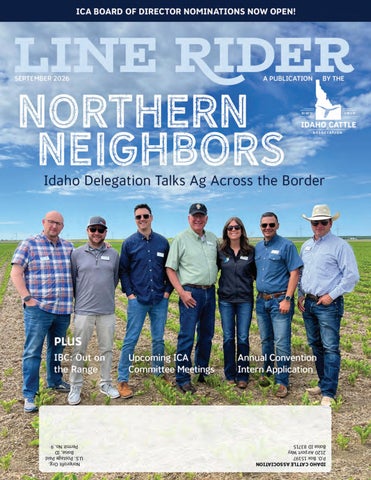
Cover Story: Northern Neighbors
16
Message from the EVP
8
Message from Natural Resources Policy Director
Idaho Beef Council: Out on the Range
22
10
U of I: SITREP BEEF 2026
24
Feeder Council
14
Nominate Producers to Fill Seats On the ICA Board of Directors
DIRECTORS AT LARGE Casey Scott............... (Clarkston) 208-431-3024 Randall Raymond.... (Grand View) 208-599-0391
ADMINISTRATIVE STAFF EXECUTIVE VICE PRESIDENT Cameron Mulrony........cameron@idahocattle.org MEMBER PROGRAMS & SERVICES MANAGER
27
Montana Ertel.................montana@idahocattle.org ADMINISTRATIVE ASSISTANT Michelle Johnson.......... michelle@idahocattle.org NATURAL RESOURCES POLICY DIRECTOR Karen Williams..................karen@idahocattle.org Contact Idaho Cattle Association: Mailing address: P.O. Box 15397, Boise, ID 83715 Location: 2120 Airport Way, Boise, ID 83705 Phone: 208-343-1615
For advertising sales, contact: idahocattlepublications@gmail.com
Cover photo by Idaho State Department of Agriculture 4
LINE RIDER SEPTEMBER 2026
The Line Rider is the official publication of the Idaho Cattle Association. It is published 10 times each year, in January, February, March, April/May, June, July/August, September, October, November and December.
www.idahocattle.org
FORFOR IMMEDIATE RELEASE IMMEDIATE RELEASE August 14, 2026 August 14, 2026 a
CONTACT: CONTACT: Montana MacConnell ErtelErtel Montana MacConnell Member Programs & Services Manager Member Programs & Services Manager (208) 343-1615 (208) 343-1615 montana@idahocattle.org montana@idahocattle.org
a
Statewide Funding Available forfor Livestock Education Programs Statewide Funding Available Livestock Education Programs BOISE, Idaho – The Idaho Cattle Foundation (ICF) is requesting submission of funding applications BOISE, Idaho – The Idaho Cattle Foundation (ICF) is requesting submission of funding applications
for for public and/or higher education programs thatthat advance the the state’s livestock industry to be public and/or higher education programs advance state’s livestock industry toreceived be received by November 1st, 1st, 2026. Through an application process (available at at by November 2026. Through an application process (available www.idahocattlefoundation.org), the the ICFICF willwill recommend funding to the Idaho State Board of of www.idahocattlefoundation.org), recommend funding to the Idaho State Board Education for for livestock education programs. Funding is available from the the proceeds of the Unclaimed Education livestock education programs. Funding is available from proceeds of the Unclaimed Livestock Account for for programs thatthat advance Idaho’s livestock-based industries through public or or Livestock Account programs advance Idaho’s livestock-based industries through public higher education. higher education. TheThe ICFICF hashas recommended Unclaimed Livestock Funds transferred intointo the the Idaho State Board of of recommended Unclaimed Livestock Funds transferred Idaho State Board Education’s miscellaneous revenue fund be granted to educational programs advancing the the livestock Education’s miscellaneous revenue fund be granted to educational programs advancing livestock industry. Applications for for these educational funds are are available at www.idahocattlefoundation.org. industry. Applications these educational funds available at www.idahocattlefoundation.org. Applications willwill be accepted until 5:00 pm pm November 1st, 1st, 2026. Applications be accepted until 5:00 November 2026. ### ###
ICFICF is aischaritable organization established by the Idaho Cattle Association to provide an Idaho beefbeef a charitable organization established by the Idaho Cattle Association to provide an Idaho industry presence in education andand science, priding itself in being the the state’s official organization industry presence in education science, priding itself in being state’s official organization tasked with recommending unclaimed livestock proceeds. ForFor more information, please visitvisit the the tasked with recommending unclaimed livestock proceeds. more information, please website at www.idahocattlefoundation.org or call (208) 343-1615. website at www.idahocattlefoundation.org or call (208) 343-1615.
2122 01A irpAoirtpo Wrat yWa• y P•O B oxB1o5x3195739• 7 B•oisBeo, iIsD 15 16 20 PO e, 8I3 D78 371•5 (2•08 (2) 0384)33-4 31-5 1 61 5
MESSAGE FROM THE PRESIDENT
Feedyard appreciation One segment of a complex industry
I
hope that by the time you lay eyes on this issue of the Line Rider, the sky is blue and you are inhaling fresh air. It’s been a tough summer so far, with multiple fires burning across the state and a shortage of both irrigation water and rainfall. Even in these dry conditions, there have been a few scattered areas in our region where cloud bursts have granted a significant amount of rain. If you are among those who didn’t share in that moisture, don’t feel guilty. The Lord said, “He causes His sun to rise on the evil and on the good, and sendeth rain on the just and the unjust (Matthew 5:45),” so even if you’ve been missing out on rain this season, it’ll come eventually—we all fit in there somewhere.
If you think about how critical our feedyards are, it creates a greater appreciation for what they do. My heart goes out to those of you who have dealt with catastrophic fires and suffered great losses this year. It is a reminder to all of us how fragile life is, and how important it is to prepare for events we hope never come our way. I encourage each of you, if you have been affected, to contact the Idaho Cattle Association (ICA) office to see what resources might be available. This fire season will certainly stretch those resources to the limit. We are grateful to the individuals and businesses who have contributed to the Fire Fund so far, as it was able to provide immediate aid to some of our Rangeland Fire Protection As6
LINE RIDER SEPTEMBER 2026
BY VAL CARTER ICA President
sociations. We are also thankful to those of you who donated selfless amounts of time and resources, not to mention placing your own safety in jeopardy, to help these organizations. September is the month where we take a moment to focus on the feeder segment of our industry. If you think about how critical our feedyards are, it creates a greater appreciation for what they do. It doesn’t matter if you send cattle to, or receive them from a feeder, almost every animal goes through a feedyard (except for the less than 1% that are on a grass-finished program). We feed our own sale bulls, but I will be the first to admit that I know nothing about feeding cattle, aside from the fact that bunk management is a science I’ve not yet achieved. I had one of those “I had no idea” moments last month at our county 4H/FFA market animal sale. I happened to be standing by a good friend who manages a feedlot for a private feeder who owns several feedlots across southern Idaho. Somewhere between the rabbits and chickens, I found my attention slip from the county auction to the topic on my mind: feeding cattle. I began asking my friend questions and, before I knew it, he had his phone out, showing me graphs and charts on each of the feedyards that illustrated how slight differences in climate, feedstuffs, etc. affected how the cattle graded and performed. The amount of data and the ability to track performance and make calculated decisions was impressive. This experience was a good exercise for me to learn about other segments of our industry. It is something we need to do more often. Sometimes, when margins tighten, we have a tendency to point fingers back and forth between cow/ calf, feeder, packer, and retailer, thinking somewww.idahocattle.org
one else is getting more than their share of the pie. That might be true occasionally, but it all evens out over time. The more we learn about our industry partners, the more appreciation we will have for the tight margins and effects of drought, weather, inflation, regulation, labor cost, and reduced supply that we all have to deal with. Undoubtably, we need to protect against market interference and maintain a level playing field, but we are all one industry and need to recognize our dependence on each other and always maintain an appreciation for the part each of our industry partners play. We are surrounded by good people in this industry. As we left the sale that night, my friend shared that the owner of the feedyard had instructed him to stay until the end of the 4H/FFA auction and make sure that every kid went home with a fair price for their project. He contributed thousands of dollars that night to support the local community and their children. Just months before, I had attended a county zoning meeting considering expansion of this same feedyard, where the owner silently listened to exaggerated complaints and unfounded accusations regarding odor, flies, dust, noise, and traffic. His response to the criticism? Showing up and giving back anyway. Hats off to our Idaho feeders. Have a great fall!
YOUR ADVANTAGE POWERED BY ANGUS
CONTACT YOUR REGIONAL MANAGER TO
LOCATE ANGUS GENETICS SELECT MARKETING OPTIONS TAILORED TO YOUR NEEDS ACCESS AMERICAN ANGUS ASSOCIATION® PROGRAMS AND SERVICES BUY THE ADVANTAGE. BUY THE POWER.
BUY REGISTERED ANGUS GENETICS. angus.org/angus-advantage
Matt Rosman, Regional Manager 509-641-0409 mrosman@angus.org Hawaii | Idaho | Oregon | Washington
www.idahocattle.org
KNIPE LAND COMPANY (208) 345-3163
knipeland.com
SNAKE RIVER CANYON RIM - NEW
A premier development opportunity near Twin Falls with breathtaking views of the Snake River Canyon & overlooking two golf courses; rural residential zoning, a platted 9 lot subdivision and an approved 62 lot subdivision, 75± acres designated commercial, & agricultural income with water rights. $34,000,000
KENDRICK RANCH - NEW
731± acres on the Potlatch River and Big Bear Creek with fenced pastures, canyons, and timbered terrain. Scenic & easily accessible. 2 homes, cabin, & shop. Potential for additional development. $3,495,000
COUNCIL HORNET CREEK RANCH
321± acres on Hornet Creek. Irrigated and sub-irrigated pasture, marshland, and dry grazing ground with a spring fed pond. Borders BLM with a grazing permit included. Recreate on and off the property. $2,400,000
ROUND SPRING CREEK RANCH EMMETT BENCH FARM-PENDING
Excellent hunting ranch on the Beautiful home on 48± irrigated Joseph Plains. 1,718± acres acres. Hay barn, shop, machine with water, trees, meadows, shed, orchard, feedlot, & horse and a furnished cabin. Access facilities. $2,700,000. to state lands. $3,866,800
IDAHO HUNTING RANCH
BULL CANYON RANCH
1,486± acres bordering public 80± acres bordering BLM near lands, natural spring, lush New Meadows, with Nat’l Forest meadow and timbered draws, access. Harvest elk, bear, and and great access. Includes mountain lions. Includes a home BLM permit $2,500,000 and shop. $3,300,000
LEMHI ROAD RANCH - SOLD
HOMEDALE RANCH
Just South of the Snake River, Irrigated pasture, hay fields, this 143± acres features 45± acres of irrigated farmland and grazing land. $1,990,000 grazing land, a home, and valley views. $1,900,000. COUNCIL RANCH - SOLD Home on 320± acres surrounded SOUTH NEW MEADOWS RANCH by public land. $1,850,000 Expansive views, Weiser River ST. CHARLES SALMON RANCH frontage, meadows, and timber 60± acres of irrigated land with on 224± acres. Logging roads, 600’± of river frontage, and trails and wildlife. $1,909,695 utilities at the street. 5± acres OLA HOLBROOK RANCH under contract. $1,125,000
KAMIAH FARM - PENDING
PRICE REDUCED
158± acres with easy access, Scenic 142± acres with 125± seasonal creek, spring, & acres in productive grass hay & fabulous views. 3 parcels, with a stock pond. A great setting for electric nearby, and adjacent to public land. $940,000 a new home. $995,000
IDAHO CATTLE ASSOCIATION
7
MESSAGE FROM THE EVP
An opportunity for improvement How do we prevent history from repeating itself
A
s I write this, we are once again sitting in heavy smoke across the state. In the cattle industry, we knew that the weather patterns over the past few months could lead to a potentially devastating fire season in Idaho and across the West. Well, lo and behold, here we are. August has brought fires of many sizes, but two in particular have drawn the attention of the higher powers in our federal government. The Big Grass Fire and the Tartar Fire leave many lessons to be learned.
This is our chance to funnel answers from the grassroots level directly to the people who are in a position to make changes. Many of us who have spent time on a fire line have dealt with the hurdles of fire management and, at times, experienced the support of a federal partner working alongside us. We know the challenges that come with managing fire, protecting communities and livestock, and making decisions in difficult and rapidly changing circumstances. The media attention and stories these fires bring to our industry are not exactly a welcomed sight. If you or your area is in the news, it probably means you have experienced a crisis. However, while we have the ears of our leaders, we need to use this opportunity to leverage our voices. This is where your membership and your voice are critical. In the coming months, there will be plenty of work to be done. A multitude of discussions and 8
LINE RIDER SEPTEMBER 2026
BY CAMERON MULRONY ICA Executive Vice President
meetings will slowly get the ball rolling on the post-fire recovery process. There will be a lot to do moving forward, but it is equally important that we look back and start asking the hard questions. What could have been done differently? What worked well? What needs to change? These are questions we will hear from federal agencies and elected officials. This is our chance to funnel answers from the grassroots level directly to the people who are in a position to make changes. I have heard firsthand about many of the difficult and complex situations that occurred during these fires, and I wonder how much more impactful the message would be coming directly from the folks who were on the ground. Despite the devastation, sharing what happened will be crucial to making improvements. We cannot change what happened, but we can learn from it. More importantly, we have an opportunity to make sure those lessons are heard. We are at a pivotal time as the Idaho Department of Lands, U.S. Forest Service, and the new U.S. Wildland Fire Service coordinate to provide resources across the West. Those of us on the ground knew there could be some hiccups with the launch of the Wildland Fire Service. The fire year we entered and are currently experiencing may not have been the ideal one to start a new concept, but here we are. Rural Fire Protection Associations have evolved well beyond initial attack on fires this season. Cattlemen and their neighbors have worked long and hard to protect their assets, as well as the assets of the nation. I know they will continue to do so. However, I also hope we can ensure appropriate resources and support, when possible, to maintain an initial-attack voluntary resource status. www.idahocattle.org
I salute all of those who have spent time on a fire working to protect Idaho. I respect the process necessary to keep all of us safe, as no square inch of landscape is worth a life lost to fire. I also know there is an opportunity and a need for change as our landscape and resources evolve in regard to fire, land management, and grazing. That change will not happen without involvement. I ask that you stay engaged in the processes that drive change, fire-related or otherwise. Being a member of the Idaho Cattle Association (ICA) is the first step toward making a difference. Voice your thoughts and concerns. Ask for change, expect results, and hold yourself and others accountable. I read a sign on a tour that spoke to me: “Be the leader that you would follow.” We at the ICA will continue to work on behalf of the Idaho cattle industry today, tomorrow, next week, next month, and even for the centuries that will outlive this message. But we cannot do that work alone. Share your experiences, your concerns, your ideas, and your suggestions. This is an opportunity for improvement that we can’t pass up.
Specializing in Truck and Livestock Scales Established in 1959, Scales NW offers a wide range of equipment, from precision lab balances to high capacity rail scales, as well as certified scale service and installation.
Scales NW is proud to serve: California Idaho Montana Nevada Oregon Utah Washington
Contact Steve Orr for more information today! Email: steveorr@scalesnw.com Phone: (503) 510-3540
www.scalesnw.com • (800) 451-0187
A Box For ALL Seasons
AD_POWELL_LivestockTruckScale_4.5x5.indd 1
12/20/2017 4:34:34 PM
Rumax BoviBox
RUMAX BOVIBOX
10 0l b N o- M e l t fo rmul a i n bi o degra da bl e a n d e d ib le pa cka gi ng. Co m pl e te ye a r - ro und vi ta mi n, mi nera l a nd p rote in suppl ement. S up po r t for m a x i mum perfo rma nce a nd effic ie n cy at a l l pro ducti o n sta ges. Improve d i g e sti o n, bo dy co ndi ti o n, repro d u c t io n a nd feta l growth. Co nta i ns Avai l a 4 a nd Bovi a ci l l us Pro du c t io n Pl us o pti o n.
In addition to a full vitamin and mineral package it has 30% crude protein along with high levels of mono and poly unsaturated fat and a live multispecies probiotic for improved immunity and reproduction NOW WITH MULTI-SPECIES LIVE PROBIOTIC!
BOVIBOX NATURAL
Has all the benefits of a quality mineral and vitamin package with 20% all-natural protein and the same high mono and poly unsaturated fat and live probiotic combination to boost immunity and reproduction NOW WITH MULTI-SPECIES LIVE PROBIOTIC!
Multiple Formulations to serve your nEEds ˜°˛˝˙˜˝ˆˇ ˆ ALL-Season ˜ Formula
Easy ˆto ˙˜˝ ˝ ˙ ˝˙ disperse
ˆˇ˝ ˝ ˙ˇ ˆˇ˝ Consistent ˆˇ Consumption
F i n d ou t m o r e at P e r fo r m i x n u t r i t i o n .c o m | 8 0 0 .4 2 6 .3 5 7 2
www.idahocattle.org
IDAHO CATTLE ASSOCIATION
9
MESSAGE FROM NATURAL RESOURCES POLICY DIRECTOR
Priority issues check-in Taking a pulse on ICA’s goals for 2026
C
ertain points in a calendar year offer the feeling of a reset. September is one of those times for me. As summer comes to a close, along with all of its activities and traditions and heat, a natural shift in focus tends to follow the changing season. As kids return to school and routines return, I often find myself taking a moment to catch my breath and refocus. With well over half of the year behind us, (and where did the time go?), it is likewise an
With well over half of the year behind us, it is an appropriate time to do a check-in on the Idaho Cattle Association’s priority issues. appropriate time to do a check-in on the Idaho Cattle Association’s (ICA) priority issues and our related efforts. Have we won any battles? Have we made progress on correcting problems impacting our industry? Are there issues where more focus is needed given action, or lack of action, related to them? ICA’s priority issues for the year were set by our board of directors in December. The list contains twenty-five separate issues that our board and committee leadership felt would be of concern to Idaho’s cattle industry in 2026. Of those twenty-five issues, twelve were selected as top priorities to specifically direct ICA staff and leadership to take a proactive role in finding solutions and seeking progress. Below is a quick 10 LINE RIDER SEPTEMBER 2026
BY KAREN WILLIAMS ICA Natural Resources Policy Director
run-through of those issues and current action related to them. As you will see, we have made headway on some of them, while others may still need some work. Changes to Federal Lands Grazing Permit Management – We have seen positive momentum on this priority issue. The U.S. Departments of Agriculture and Interior jointly issued an MOU seeking for improvements to the way grazing is administered on Bureau of Land Management (BLM) and US Forest Service land. This MOU included key priorities that we have been presenting to governmental leaders for years, which included increasing flexibilities in permit administration, opening vacant allotments, and more. Additionally, earlier this summer, BLM released proposed changes to their grazing regulations. ICA thoroughly reviewed and commented on the proposal and saw many changes incorporated that we have been seeking, and we hope that more will be addressed when the proposal is made final. Equal Access to Justice Act – The Equal Access to Justice Act (EAJA) has been notoriously abused by the environmental activist community to fund their efforts to litigate against land use and then recover their attorney fees to turn around and sue again, and collect money again, repeated in a cycle. There have been several attempts in the past to reform EAJA,+ but a newly proposed bill has gained some traction. The Stop Serial Litigation Act of 2026 was introduced in June and is intended CONTINUED, PAGE 12 www.idahocattle.org
TOOLS OF THE TRADE From garden to back pasture, Henry Repeating Arms builds firearms for the work ranch life demands. From keeping your land pest and predator free, to putting food on the table, and protecting what you hold dear, there’s a Henry built for it.
Tracker Rifle & Carbine Fast-handling rimfire rifles built for small game hunting and keeping varmints in check. .22 S/L/LR | .22 Magnum
Homesteader Carbine What’s Yours Remains Yours with this semi-auto carbine designed for home and property protection. 9mm – Glock/Sig/S&W Magazine Compatibility
Provider Rifle A hard-hitting lever-action rifle made for dependable deer hunting. .30-30 Win | .45-70 Gov’t
Lever Action Supreme Rifle A modern lever-action rifle built for fast follow-up shots and the accuracy needed for predator hunting. .223 Rem/5.56 NATO | .300 BLK
Garden Gun A handy, easy-to-carry smoothbore rimfire built for close-range pest control around the garden, barn, and outbuildings. .22 S/L/LR | .22 Mag.
Explore 250+ Rifles, Shotguns, and Revolvers
SCAN or VISIT
LIFETIME WARRANTY | 100% SATISFACTION GUARANTEE
ORDER YOUR FREE CATALOG AND DECALS
HenryUSA.com/catalog
to put a stop to the exploitation of EAJA by habitual enviro-extremist litigators. It would limit the amount of dollars that could be recovered by an entity in a year and would require more complete proof of work before reimbursement could be provided. As with any bill in Congress, it is a long shot to reach approval this year, but the introduction of the measure is an important step in gaining attention for an issue that desperately needs addressed. Federal Grazing Permit Litigation – Some headway has been made on permits that have been tied up in litigation. After years of pushing and negotiating on the Owyhee 68 grazing permits, the BLM has been able to work with many of the permittees to finalize their permits and initiate needed updates to them. It remains our hope that with the current policy fixes that are being introduced by the Trump administration, litigation will be staved off in the future. Grazing Improvement Program – ICA continues to support the Grazing Improvement Program, established in Idaho legislature in 2024 and administered by the Idaho State Department of Agriculture’s Range Program. The program is being used to assist grazing permittees in developing improvements on the ground, and has been used to fund range improvement projects, virtual fence, and more. During this spring’s state legislative session, we were able to gain passage of housekeeping legislation related to this program that allows continuous appropriation of funding across fiscal years. As implementation of the program begins to take shape, we will continue to work toward its efficacy in assisting ranchers where help is truly needed. Trade – Concerns about trade issues have been rumbling ever since President Trump proposed to open up beef import markets as a way to reduce grocery store beef prices. We continue to monitor and combat that rhetoric while following various international trade issues. Most recently, we worked with the Idaho congressional delegation to submit a letter to the administration seeking timely review and renewal of the United States-Mexico-Canada Agreement. Producer Data Privacy – As technologies continue to advance, we continue to advocate for the protection of data related to an operation’s production. We will continue to explore the feasibility of state and federal legislation and policies that will protect information collected through government programs by providing an exemption 12 LINE RIDER SEPTEMBER 2026
for data collected through any technological device, be it livestock collars, electronic identification tags, or other emerging technologies. We have also had meetings with agency leadership to discuss this issue and assert our position that mandatory enforcement of/requirements for emerging technologies would be wholly inappropriate. Idaho Fish & Game Department – Our working relationship with Idaho Fish & Game remains solid. We continue to work to keep the doors of communication open with the agency as issues emerge and re-emerge related to wildlife management including wolves, depredations, sage grouse, grizzly bears, and landowner protections and recognition. Sage Grouse – The BLM finalized their sage grouse management plan in late December 2025. We continue to monitor the implementation of this plan to ensure that grazing management prescriptions are not unnecessarily applied in the name of sage grouse. As we have always maintained, what is good for the herd is good for the bird, and science backs this up. Predator Management – While wholesale grizzly bear delisting across the state remains our primary goal related to management of the species, some headway has been made on this issue. In July, the U.S. Fish and Wildlife Service (FWS) announced a revised rule under section 4(d) of the Endangered Species Act (ESA) that would keep existing protections while providing additional management flexibility for the species in specific areas (WA, OR, ID, MT, WY). A comment period on this proposal closed on August 17. We appreciate the acknowledgement of the need for better leeway in managing the species, but will also continue to push for a full delisting. Grass Futurity – The 14th annual ICA Grass Futurity contest, which is our primary fundraising source, is well underway. This year, thanks to the efforts of a subcommittee comprised of ICA board members, the program has been greatly enhanced. This year’s contest includes a record-breaking sixty entries. The final weigh out will occur mid-September, and we are excited to learn who will take home the top prize. Winners will be announced during the Monday Strolling Supper at the ICA Annual Convention in Sun Valley. The proceeds will help tremendously in funding the Political Action Committee and Cattle Action Legal Fund. Membership – Thank you to all of our members who continue to support our efforts and our association. www.idahocattle.org
Without you, we would not exist and Idaho’s cattle industry would be without a voice. Simple as that. Public Outreach Through Education – ICA continues to find ways to publicly present the good stories of our industry. While cattle prices have remained strong, much of 2026 has not been kind to our industry due to the effects of drought and horribly disastrous wildfires. As these issues gain visibility in the public eye, it remains incumbent upon us to be very active in expressing not only the impact to Idaho producers, but the need for improvements to failed policies that lead to catastrophic conditions. If you have any thoughts on these issues, or any other policy issue impacting your ability to raise cattle, now is a great time to engage. During the months of September and October, we will hold virtual committee meetings to discuss current issues and review ICA policy related to them. We welcome and encourage your participation and input. The committee meeting schedule is listed below. Any ICA member is invited to participate. Additionally, the deadline to propose new policy to be considered at our annual convention in November is September 26. Send me an email at karen@idahocattle.org if you have any policy questions, or have an issue you would like addressed by ICA.
www.idahocattle.org
IDAHO CATTLE ASSOCIATION
13
FEEDER COUNCIL
Cultivating the new generation in the beef industry Giving hands-on opportunities to young people makes a difference
“T
he only source of knowledge is experience.” — Albert Einstein
We have all had experiences throughout our lives that have helped shape the careers, passions, and way of life that we have today. Many of those experiences began when we were young. Some were good, some were challenging, and some may not have seemed significant at the time. Yet, each one helped shape our interests, our work ethic and, ultimately, the path we chose to follow. As summer comes to a close, I find myself reflecting on the interns who have contributed to our business.
As industry leaders, it is our responsibility to open the door. Summer internships provide students with an opportunity to step outside the classroom, get their hands dirty, and apply what they have learned in school to real-world situations. For many students, an internship is their first opportunity to experience how a business truly operates. They get to see the people, processes and decisions that make an operation successful. More importantly, they begin to see the opportunities that exist for them after graduation. Regardless of the location, employer, or pay scale, every intern walks away with something valuable: another experience under their belt. Experiences teach students what they enjoy, what they don’t enjoy, where they find value, and how they want to build their careers. They also begin to understand how their individual efforts can help a business—and an industry—grow. 14 LINE RIDER SEPTEMBER 2026
BY LOGAN PETERS Feeder Council Chair
Our responsibility should not simply be to develop the next generation of employees for our own operation, it should be to help develop the next generation of people who will make the entire beef industry stronger. That student may not come back to work for you. But what if, five years from now, that same student is managing a feedlot you work with? What if they become part of a seedstock operation, work for the USDA or a breed association, or become a vet clinic tech, banker, feed broker, or livestock hauler? Maybe they become an equipment mechanic, construction manager, sale-barn employee, or business owner. The possibilities are endless. Even if they never become your employee, they may eventually have an impact on your operation—or on the cattle industry as a whole—through one of those careers. That is why I believe providing opportunities for young people is so valuable. It might be a high school student helping on the local ranch on weekends. It could be a college student spending the summer at
INTERNSHIPS GIVE STUDENTS A CHANCE TO LEARN IN THE FIELD, RATHER THAN AT A DESK OR IN A CLASSROOM.
www.idahocattle.org
a feedyard, ranch, or livestock business. Or it could be a recent graduate who simply wants to spend some time learning about the beef industry before committing to a full-time career. As industry leaders, it is our responsibility to open the door. And sometimes opening that door doesn’t require writing a check. It might mean making an introduction, connecting a student with someone in the industry, answering a phone call, offering advice, or simply taking the time to explain why we do what we do. Those small investments can have a lasting impact. We may not know where every young person we work with will eventually end up. We may not know which conversation, responsibility, or experience will stick with them years down the road. But we can be confident that those experiences matter. The next generation doesn’t need us to have all the answers. They need us to give them a chance—to let them ask questions, make mistakes, take on responsibility, and experience what makes this industry worth being a part of. After all, we were all given an opportunity at some point to learn from someone who was willing to invest their time in us. Now it’s our turn to do the same. Because the experiences we give the next generation today may very well shape the people who lead our industry tomorrow.
Keeping Idaho farms safe and productive since 1968. Our employee owners are dedicated to ensuring you get the best tires and auto service.
WE PROUDLY
SUPPORT
MAKE THE CO-OP CHOICE
Propane, bulk fuel, oils & lubricants
RETAIL
Farm supply, clothing, boots, fencing & feed
AGRONOMY
vwcenergy.com
shop.valleywidecoop.com
valleyag.com
ENERGY
www.idahocattle.org
Precision agriculture, fertilizer & seed
IDAHO CATTLE ASSOCIATION
15
COVER STORY
BY MONTANA MacCONNELL
WITH CONTRIBUTIONS FROM SYDNEY KENNEDY (IDAHO STATE DEPARTMENT OF AGRICULTURE AND JESSE HUMAN (ICA VICE PRESIDENT)
NORTHERN
16 LINE RIDER SEPTEMBER 2026
www.idahocattle.org
E)
NEIGHBORS Idaho Delegation Talks Ag Across the Border
www.idahocattle.org
IDAHO CATTLE ASSOCIATION
17
S
ometimes, in Idaho agriculture, it is easy to forget the broad influence of our industry. When you spend all day in the same mountain range, the rest of the world fades away into the background. However, though it may seem foreign to one state’s agriculture, there is a vibrant relationship between Canada and Idaho. The northern border is a whole lot more than a line on a map, particularly for the cattle industry.
Canada is Idaho’s No. 1 foreign market for food and agricultural products. In 2025, Idaho exported more than $451.8 million in agricultural products to Canada, accounting for 31% of the state’s total agricultural exports. For Idaho’s cattle producers, that relationship is especially significant. More than 235,000 head of cattle moved from Idaho to Canada during 2024 and 2025, valued at more than $262 million. Those numbers make the relationship worth more than looking at trade statistics. They make it worth getting on the ground, meeting the people on the other side of the border and understanding how agriculture operates in Alberta. That was the purpose of the Idaho State Department of Agriculture’s (ISDA) recent agricultural policy tour to Alberta. The Idaho Cattle Association (ICA) participated in the mission, giving ICA staff and board members the opportunity to see Canadian agriculture firsthand.
REPRINTED FROM THE IDAHO STATE DEPARTMENT OF AGRICULTURE
The following information is reprinted from the Idaho State Department of Agriculture with permission. Trade relationships, market access and producer-to-producer connections were at the center of the Idaho State Department of Agriculture’s recent agricultural policy tour to Alberta, Canada. Joined by Lt. Gov. Scott Bedke and representatives from ten Idaho businesses and organizations, ISDA led the tour focused on the longstanding partnership between Idaho and Alberta and reinforced the importance of maintaining strong relationships with one of Idaho agriculture’s most valuable trading partners. Meetings with Alberta government officials, commodity groups and producers gave the Idaho delegation an
FROM THE FIELD TO THE RODEO, TRADE RELATIONSHIPS WERE THE FOCAL POINT OF THE TOUR.
18 LINE RIDER SEPTEMBER 2026
www.idahocattle.org
IDAHOANS REPRESENTING A VARIETY OF AGRICULTURAL COMMODITIES ENJOYED THE CANADIAN EXPERIENCE, INCLUDING ATTENDING THE CALGARY STAMPEDE.
opportunity to discuss issues affecting agriculture on both sides of the border and strengthen relationships with Canadian counterparts. Canada continues to be Idaho’s largest market for food and agricultural products. In 2025, exports to Canada totaled more than $451.8 million, accounting for 31% of the state’s agricultural exports. Idaho’s leading agricultural exports to Canada include live cattle, potatoes, grains and seed. “Idaho and Alberta share a strong agricultural heritage, with similar values and a commitment to supporting our farmers and ranchers,” said Lt. Gov. Scott Bedke. “Our discussions with Alberta officials and producers made it clear that we have far more in common than differences, and we look forward to building on this strong partnership for years to come.” This visit comes at an important time as the United States, Canada and Mexico continue discussions about the future of the United States-Mexico-Canada Agreement (USMCA). On July 1, the United States announced it would not renew the agreement in its current form. Although the agreement provides significant value to Idaho agriculture by supporting reliable market access with two of Idaho’s largest trading partners, it also presents opportunities for the U.S. to address other aspects of the agreement. In the meantime, the agreement remains in place until it terminates in 2036. www.idahocattle.org
For Idaho producers, Canada is more than a neighboring country, they are a critical partner. Idaho’s agricultural exports to Canada span a wide range of commodities, with live cattle being the largest agricultural export. In 2024 and 2025, Idaho exported more than 235,000 head of cattle to Canada, valued at more than $262 million. “This policy tour provided valuable opportunities for commodity-specific conversations with industry and government leaders, allowing us to better understand shared priorities, address challenges and continue building the productive partnerships that benefit producers on both sides of the border,” said ISDA Director Chanel Tewalt. “Strong trade relationships are critical to the success of Idaho agriculture, and opportunities like this policy tour help ensure those relationships continue to grow.” As trade discussions continue, maintaining strong relationships with international partners such as Alberta will remain an important part of supporting Idaho agriculture and expanding opportunities for the state’s producers.
THE BEEF INDUSTRY PERSPECTIVE
For ICA Vice President Jesse Human, one of the biggest takeaways from the trip was seeing firsthand just how significant the cattle connection between Idaho and Alberta has become. “Turns out there is more than polar bears and igloos in Canada—there are a lot of cattle,” Human said. IDAHO CATTLE ASSOCIATION
19
THE TOUR PROVIDED VALUABLE OPPORTUNITIES FOR CONVERSATION WITH INDUSTRY PARTNERS.
THE FEEDER SECTOR SPANS THE BORDER Alberta has significant feeding capacity, creating demand for cattle from Idaho and other parts of the United States. With the Canadian beef herd also at historically low levels, access to feeder cattle is important to keeping those feeding operations supplied. Feed costs can also play a role in where cattle are fed. Depending on the year, Canadian feed costs can make feeding cattle in Alberta attractive. Currency exchange rates add another layer to the equation, with Canadian buyers and sellers closely watching the value of the U.S. and Canadian dollars. The relationship is not necessarily one-way. Cattle can move north into Alberta’s feeding system and later return to the United States, creating a cycle of commerce that connects producers, feeders, and processors on both sides of the border. Canadian tax policy can also influence cattle purchasing decisions. Human noted that Canadian producers have the ability to write off cattle as an expense at the time of purchase, providing another factor that can influence when and how cattle are purchased. For Idaho cattle producers, those differences matter. The cattle market does not stop at the border, and decisions made by producers and feeders in Canada can have implications for cattle moving through the broader North American market.
and labor. One of Human’s surprises was the price of irrigated farmland near Taber, Alberta. An acre of irrigated ground was reported at approximately $30,000 Canadian, or roughly $21,000 U.S. Water management was another noticeable difference. Drinking and irrigation wells are relatively uncommon in southern Alberta. Instead, much of the area’s agricultural water comes through canal systems. Water can be stored
WATER, LAND, AND LABOR While cattle were a major focus, the delegation also had the opportunity to see how Alberta handles water, land, 20 LINE RIDER SEPTEMBER 2026
CANADA IS IDAHO’S LARGEST MARKET FOR AGRICULTURAL COMMODITIES.
www.idahocattle.org
in large ponds on individual farms for later use, including household and livestock needs during the winter. Even more foreign to an Idaho perspective was how water savings can translate into additional irrigated acres. As Alberta canal systems become more efficient through the conversion of open ditches to piped systems, the canal companies can make the saved water available for purchase. Producers can then use that water to bring additional acres into production. “For my Idaho mind, it was hard to wrap around that concept,” Human said. Labor was another area where Alberta and Idaho share some similarities but approach the issues differently. Canadian agricultural producers rely on workers from around the world through visa programs. Human said that the producers the delegation met with indicated they were able to readily procure agricultural employees through those programs. For producers on both sides of the border, access to a dependable workforce remains an important part of keeping agricultural operations running. While trade and policy were at the center of the trip, Human said one of the most valuable parts of the experience was the opportunity to build relationships. “ICA participation in this trade mission not only allowed us to see Canadian production firsthand and the chance to interact directly with our neighbors to the north, it allowed ICA staff and board members to spend time getting to know other members of the trade mission on a much more personal level,” Human said.
Let us watch the market while you run your operation. Choose Livestock Risk Protection with StoneX for market expertise.
The trading of derivatives such as futures, options, and over-the-counter (OTC) products or “swaps” may not be suitable for all investors. Derivatives trading involves substantial risk of loss. Past results are not necessarily indicative of future results. © Copyright 2025. All rights reserved.
WORD OF THE DAY During a meeting with a group of Canadian water districts, the Idaho delegation kept hearing one unfamiliar word: plebiscite. Naturally, they had to ask. A plebiscite is a vote in which the people of an entire country or district express an opinion for or against a proposal, particularly concerning government or a major public question. Human suggests finding a way to work it into conversation. It may not come up often around an Idaho cattle operation, but after a trade mission to Alberta, you never know.
CONCLUSION
THE RELATIONSHIPS DEVELOPED IN ALBERTA WILL REMAIN IMPORTANT TO IDAHO TRADE FOR YEARS TO COME.
www.idahocattle.org
The United States and Canada have a long history of agricultural trade; cattle, potatoes, grains, seed, and other Idaho products cross the border every year. As discussions surrounding USMCA continue, Idaho producers have a stake in what happens next. More than 235,000 head of Idaho cattle crossing the northern border to Canada over the last couple of years is a pretty good reminder that what happens north of the border matters to the cattle industry here at home. IDAHO CATTLE ASSOCIATION
21
IDAHO BEEF COUNCIL
Idaho Beef Council: Out on the Range Keeping beef at the center of the plate.
E
very meal begins with a producer, and every purchase is an opportunity to support an industry that feeds families, strengthens communities, and fuels Idaho’s economy. The Idaho Beef Council (IBC) exists to ensure consumers understand the value of beef while creating greater demand for the product Idaho ranchers work hard to produce. Funded by beef farmers and ranchers through the Beef Checkoff Program, IBC invests in strategic marketing, consumer education, retail and foodservice partnerships, and producer outreach to showcase beef’s nutritional benefits, strengthen local communities, and expand market opportunities for Idaho’s beef industry across state, national, and international borders. To keep beef at the center of the plate, the Consumer Program combines high-visibility media, digital engagement, community partnerships, and grassroots outreach. A centerpiece of recent outreach was a targeted media push around the Milan Cortina 2026 Winter Olympics, representing an expenditure of $50,108 designed to educate consumers and drive statewide demand. By surrounding viewers on both television and digital streaming platforms through NBC affiliates, the campaign achieved remarkable reach. Television advertising across Boise, Twin Falls, Idaho Falls, and Coeur d’Alene delivered 2,006,691 total impressions, exceeding planned delivery by 15 percent. KTVB in Boise generated 1,137,687 impressions (+10%), KTFT in Twin Falls recorded 394,949 impressions (+33%), KBVI in Idaho Falls delivered 441,400 impressions (+8%), and Coeur d’Alene cable achieved 32,655 impressions (+147%). On the digital front, NBC streaming coverage surpassed delivery goals by 20 percent overall, generating 1,737,000 streaming impressions in Boise (+30%) and 875,100 in Twin Falls (+500%). In the digital sphere, the Council’s paid search and search engine optimization efforts running from March 25 through June 30, 2026, established a highly effective baseline for consumer connection. With a full-campaign spend of $29,800, Google Ads generated 12,802,017 impressions, 113,876 site visits and clicks, and 4,477 direct Google Ads engagements. Traffic was acquired with exceptional efficiency, achieving an average cost per click of just $0.26, well below the industry benchmark range of $0.75 to $1.75. Web analytics confirmed strong consumer engagement following 22
LINE RIDER SEPTEMBER 2026
the click, with GA4 recording 66,703 user engagement events, a 57.48 percent engagement rate, and an economical cost per engaged session of $0.45. Complementing these digital efforts, the flagship Hero Video continues to captivate audiences by celebrating the dedication of Idaho ranching families and promoting high-quality beef as a premier protein choice. On the ground in local sports marketing, the IBC served as the sponsor for the BEEF. It’s What’s For Dinner. Grill at Memorial Stadium during the Boise Hawks baseball season. Equipped with branded tents, and stadium signage, the grill saw high concession sales volume, serving 2,691 all-beef hot dogs, 1,102 hamburgers, 899 beef kielbasa, and 768 cheesesteaks to stadium patrons. The partnership was highlighted on Idaho Beef Night on July 18, featuring postgame fireworks, stadium promotions, and an on-field charity fundraiser. J.W. Wood, IBC Chair, attended along with 80 IBC representatives and enjoyed the festivities. The Boise Hawks presented a check to Wood on the field for Beef Counts, a one-of-a-kind partnership between the Idaho Beef Council (IBC), Idaho Cattle Association (ICA), Idaho CattleWomen, Agri Beef, and The Idaho Foodbank. “Idaho Beef Night with the Boise Hawks is really all about bringing people together. It gives us a wonderful opportunity to get
IBC IS PROUD TO MAKE SURE FANS ENJOY BEEF WHILE THEY WATCH THE BALL GAME AT THE BOISE HAWKS STADIUM!
www.idahocattle.org
A BEEF COUNTS CHECK PRESENTATION ON THE BOISE HAWKS BASEBALL FIELD.
out into the community, educate the public about the cattle industry, and enjoy a good game of baseball with our families and friends. Beef Counts is an amazing program the Beef Council is proud to be a part of. Educating the public about this life-changing organization is important to us and Idaho Beef Night gives us the opportunity to do that,” said Wood. Together, local organizations have built a program that delivers a consistent supply of nutritious, high-quality beef to Idahoans in need. The IBC, along with its partners, remains deeply committed to fighting local hunger through the Beef Counts initiative. Established in 2010 as a unique partnership between Idaho’s beef industry and The Idaho Foodbank, Beef Counts has provided more than 2.8 million 3-ounce servings of high-quality protein to food-insecure families statewide. During the 2025 calendar year alone, the program raised $149,352 in total cash donations and distributed 230,802 beef servings. Looking ahead through 2026, donations to date have reached $96,160.18 toward the annual fundraising goal of $166,000. In the foodservice arena, the Council collaborated with an Idaho Premium Protein Specialist to conduct specialized training for culinary and service personnel from Barbacoa and Hemlock, enhancing menu positioning and proper beef preparation techniques. Lynn Bachman, IBC Secretary/Treasurer and cattle producer, spoke to the chefs. “I think it was eye-opening for them to talk with a producer and understand how beef makes its way to the restaurant. They were able to better understand the production system and amount of time and effort it takes to raise cattle from start to finish before it ever reaches the plate,” said Bachman. Chefs gained a deeper understanding of beef production and the dedicated ranchers behind www.idahocattle.org
it, empowering them to transform every meal they prepare into an authentic story worth sharing with their guests. Expanding regional perspectives on trade policy and agricultural partnerships, IBC representatives also participated in the 2026 Idaho Farm Policy Tour in Alberta, Canada. Jodie Mink, cattle producer and IBC Vice Chair, participated in the tour. “The recent Canada Farm Tour was a great opportunity to bring Idaho commodity groups together to better understand the significance of the Idaho/Alberta agricultural trade. Traveling with representatives from the Idaho Cattle Association, Idaho Farm Bureau, Idaho Dairymen’s Association and the Idaho State Department of Agricultural allowed for open discussions about markets, trade and forecasts and the impact those relationships with Canada potentially effect Idaho producers,” said Mink. Canada remains Idaho’s largest international market for food and agricultural products, accounting for 31% of the state’s total agricultural exports in 2025. That year, Idaho’s agricultural exports to Canada exceeded $451.8 million, highlighting the strong trade relationship between the two regions. Alberta plays a particularly significant role, accounting for 48.3% of Canadian agri-food imports from Idaho. The province imports Idaho live cattle, while Idaho imports processed potatoes, beef, and live cattle from Alberta. This two-way partnership continues to strengthen both economies and reinforces the importance of cross-border collaboration in agriculture. At the international level, IBC board member and Idaho cattle producer Jared Brackett attended the 2026 Cattle Industry Summer Business Meeting in Aurora, Colorado, contributing to vital discussions on Checkoff strategies and industry priorities. Working closely with the U.S. Meat Export Federation (USMEF), the International Marketing Committee guides foreign Checkoff investments and monitors emerging culinary and cut trends around the globe. These international efforts continue to drive tangible returns for producers. In April 2026, beef carcass export value reached an impressive $415.88 per head of fed slaughter. Today, American beef is making a strong comeback in markets like the United Kingdom and Australia, while maintaining its top-tier status across major Asian markets like South Korea. Highlighting how global marketing lifts overall carcass value for local ranchers, Brackett noted, “International trade is one of the most effective tools we have for maximizing the value of every single head of cattle we raise. By partnering with USMEF, we can market underutilized cuts to international buyers who place a high premium on them.” Elevating the demand for these specific cuts increases the overall value of the carcass, returning significant financial value directly back to Idaho producers. IDAHO CATTLE ASSOCIATION
23
UNIVERSITY OF IDAHO
SITREP BEEF 2026 A look at the state of the industry. BY PHIL BASS, Ph.D.
Associate Professor — Meat Science Animal, Veterinary and Food Sciences University of Idaho
I
cattle inventory in the US peaked in 1975 at over 132 million head (Figure 1). Since then, we are now at less than 2/3 of that population (86 million head). Incredibly, because of the prowess and resilience of our cattle ranchers in the US, the pounds of red meat from the 30 million head of cattle
n emergency services and military parlance, SITREP stands for “situation report.” Considering the beef market conditions at the time of writing this article, I couldn’t find a more fitting parallel than aligning the beef market with that of an incident management task. To say that the beef market is experiencing volatility and unprecedented circumstances is like saying “it’s only a minor inconvenience” while the building is actively on fire – understated. Let’s focus on a few of the clear and present conditions that are of utmost importance for those reliant on the beef cattle system in the US for their livelihood.
CATTLE NUMBERS AND FIGURES Since 1971, overall US cattle slaughter numbers have been decreasing at an average rate of nearly 50,000 head per year. According to USDA National Agricultural Statistics Service, 24 LINE RIDER SEPTEMBER 2026
Figure 1 www.idahocattle.org
slaughtered per year remains relatively constant around 2 billion pounds of beef. That tonnage consistency has a lot to do with the fact that since the 1970’s the average steer hot carcass weight has increased linearly by 5 lbs. each year; in 2025 USDA reported an astounding steer average hot carcass weight of 955 lbs. Many thanks to the cattle farmers and ranchers for helping to keep sufficient amounts of beef on the plates of our consumers.
US BEEF PACKING BASE As many who monitor the cattle industry market often say, the pie from which we all eat is much larger than it ever has been, and so are the pieces... at least for those on the live side of things. Cattle feeders continue to have the thinnest margins, but as of recently they are still in the black. It’s the beef packers that are going into their third year of losses and are currently hemorrhaging cash to keep the lights on. According to my dear friend, John Nalivka of Sterling Marketing, packers were losing an average of $293 per head the week ending July 18. Three years of profit losses in a row for packers is an unsustainable scenario. The pressure has already caused major ripples in the industry. In 2024, the regional packer Missouri Prime Beef closed down after only 4 years in business. In January 2026, the 5,000 head per day capacity Tyson Foods packing house in Lexington, NE shuttered for good after over 3 decades in operation, and the closest to home, Intermountain Beef in Idaho Falls closed down in April of this year. So, what’s going on? The reality is that there just aren’t enough cattle to keep these plants in business, and the US packing base is in a contraction state. It has to be. The Tyson plant in Nebraska was built to handle cattle numbers of the 1990’s. Moreover, Tyson has another packing house in Dakota City, NE with a capacity of over 7,000 head per day. Nebraska already has an overabundance of packing capacity, and something had to give. The quieter news in the beef packing sector is that, at the time of writing this article in late July, the over 4,000 head per day capacity Cargill beef harvest facility in Fort Morgan, CO has been in negotiations with the local labor union and has not slaughtered cattle at that location since May of 2026. It will be curious to see how US beef packers will fare at the end of this year.
WEATHER Unless one has been just completely disconnected from the outside world for the past several months (which thankfully is an entire possibility in our great state), the northern hemisphere is expecting a strong El Niño conwww.idahocattle.org
Figure 2 dition for the remainder of 2026 and into spring of 2027. So, what does this mean? El Niño is a cyclical warming of the Pacific waters off of the northern coast of the South American continent. This creates warmer conditions in the northwest and central northern plains and an expected wetter than normal conditions in the southern part of the US due to changes in the jet stream and barometric pressure. As a result, we in the northwest should expect some of our drought conditions to persist while some of the big cattle country in the south may see drought reprieve (Figure 2). Current drought conditions are hanging around in the center of the Rockies, but storms in the Gulf of America have certainly been dropping moisture in the Texas and southern plains region. Let’s all keep thinking good thoughts in an effort to see most of that dark red go away in future drought monitor maps.
TAKEAWAY If you own cattle, you should be able to make some money in 2026. If you’re a packer, hang on. In order for the whole system to work long-term, everyone, including the packer, needs to be fiscally sound. If we can grow more cattle, let’s do it. Thank you to all of the members at Idaho Cattle Association, Public Lands Council, and the like, working to keep our grazing open and affordable; it’s one of the few ways I think we’re going to grow our US herd. Keep an eye on the sky. Water is essential to our way of life and let’s hope we can get enough to keep the grass growing this fall. And finally, I didn’t even mention the New World Screwworm situation in the southwestern US. The situation continues to change daily. Keep an informed ear out and remain diligent with your parasite control. We’re relatively safe up here in the northwest, but bugs don’t respect borders. Stay safe and Go Beef! IDAHO CATTLE ASSOCIATION
25
160+-ACRES Zoned: Agriculture, Sage brush grazing with fencing around perimeter. Aberdeen: $240,000 ***SOLD*** 1826.74+-ACRES Livestock well, 314+-CRP, 320+- AUMS Carey: $2,745,000 74.691+-ACRES 66.73+- Irrigated, 75.27+- TFCC water Buhl: $1,680,000 320+-ACRES Zoned: Agriculture, dryland, surrounded by BLM Carey: $400,000 657.72 +- ACRES 367 +Carey: $7,800,000 160 +- ACRES 128+-Irrigated, IDWR, Pivot/Handlines Pingree: $1,995,000 Call Mark Jones 208.308.3030
We Specialize in Tax Deferred Exchanges - Accredited Land Consultant
26
LINE RIDER SEPTEMBER 2026
www.idahocattle.org
IDAHO CATTLE ASSOCIATION LEADERSHIP
Nominate Producers to Fill Seats On the ICA Board of Directors
T
our bylaws allow for nominations to be taken from the floor at any annual business meeting, and are in addition to the recommendations put forth by the nominating committee. Nominations from the floor are considered official nominations of the Association.
he Idaho Cattle Association Board of Directors is comprised of 23 members that meet to help direct the organization through the processes of working to preserve, promote, and protect the cattle industry in Idaho.
ABOUT THE BOARD OF DIRECTORS
ICA board members include the officer team: President, President Elect, Vice President, Past- President, and Treasurer. In addition to our officers, our Executive Committee is comprised of the officer team and four council chairs. The four councils represented on the executive committee include: Cow-Calf, Purebred, Feeder, and CattleWomen. The nine-member executive committee is accompanied by fourteen additional board members, with two delegates from each of the five ICA districts, two atlarge positions, an Allied Industry representative, and a CattleWomen Council representative. Continued input and support from the ICA Board of Directors is a vital part of the continued success of the Idaho Cattle Association. Idaho Cattle Association bylaws state that the Nominating Committee is comprised of the four past presidents, the retiring president, and five district vice-presidents. The immediate past president will serve as the chairperson of this committee. The current retiring president will only vote to break a tie in the process. You may be able, or know of someone who is able, to join the leadership of ICA.
NOMINATING PROCESS
The ICA Nominating Committee will consider all names submitwww.idahocattle.org
THE 2026 NOMINATING COMMITTEE
ted to fill vacated ICA officer and board seats. Please call or submit your letter of interest to any ICA Nominating Committee member prior to October 15, 2026. A brief cover letter stating the background of the potential candidate, their leadership experience, and interest to serve would be appropriate. This could be given directly to a member of the committee, mailed to the chair or mailed to the office to be forwarded on to the committee. Council Chairpersons will be selected by the respective councils when the seat becomes vacant. Each council should submit two names in ranking order for consideration. Nominations are brought forth in either a council meeting or submitted in a written format to the proper council chair. The council chairs then submit nominations to the Nominating Committee for review and consideration. It is important to note that
Chair: Spencer Black Past Presidents: Mark Pratt, Kim Brackett, and Jerry Wroten Current Retiring President: Val Carter District Vice Presidents: District I: Cece Baldwin District II: Rex Hoagland District III: Valene Cauhorn District IV: Shane Rosenkrance District V: Tim Munns
BOARD POSITIONS EXPIRING IN 2026 • Office of President-Elect • Office of Vice President • Purebred Council Chairman • Feeder Chairman • District One Representative • District Four Representative • District Five Representative • Allied Industry Representative • Director at Large
MAIL TO Idaho Cattle Association Attn: Nominating Committee PO Box 15397 Boise, Idaho 83715 Or Call/Email: (208) 343-1615 cameron@idahocattle.org IDAHO CATTLE ASSOCIATION
27
MEMBERSHIP
New and renewed ICA members Addy Brackett
DL Evans Bank
Josh Bruce
Robert Olmstead
Axiota Animal Health
Donna Bennett
Kabel & Megan Satterwhite
Roy Farmer
Bart Gingerich
Douglas Pickett
Katie Brackett
Sarah Brackett
Belle Brackett
Elting Hasbrouck
Katy Belles
Sarah Ryan
Ben Berthelson
Eugene Matthews
Leith & Richard Negley
Benton Glaze
Gerald Martens
Lewiston Livestock Market
Bert & Paula Brackett
Gus & Kimberly Brackett
Mark & Carla Malson
Broden & Angie Matthews
Gwen Whitworth
Marlin & Jeanne Wolfe
Bruce Lake
HUB International
Marty Gill
Cale Homer
Idaho Trappers Association
Mattie & Tyler Johnson
Carmen & Ben Stevens
Jake & Samantha Brackett
Max & Lex Firth
Clint & Alecia Zenner
Jared Patterson
Melvin Seebeck, Jr.
Cris Davis
Jess Showell Family Trust
Monte & Anne MacConnell
Dan Ratliffe
John & Kellsie Peterson
Nathan Brown
Will Brackett
Dennis & John Dau
John Conner
Obendorf Ranches
Will Hayes
Dennis Lake
John Williamson
R & O AG Loomix
Y-TEX
Schroeder Law Offices, P.C. Scott & Gwen Whitworth Scoular Co. Steve & Janna Herbst Teo & Sarah Maestrejuan Terry McNellis Tom Houret Tracy Vulgamore Troy Jenkins Van Burtenshaw
TOP NOTCH FEED & FENCE
Work Hard Feed Right Fence Strong
FENCE BUILT
01. TO LAST
Everything you need to get the job done right: • Posts • Panels • Wire • Gates • Tough, Reliable Materials
YOUR HERD 02. KEEP STRONG
High-quality livestock supplements that support: • Growth & Weight Gain • Herd Health • Peak Performance
208.642.2134
28
LINE RIDER SEPTEMBER 2026
Top Notch Feed & Fence
1340 S. 16th St. Payette, ID
www.idahocattle.org
2 Year Olds & Spring Yearling Bulls Spring Yearling Hereford & Red Baldy Heifers Check out our offering at jbbalherefords.com James & Dawn Anderson 208-280-1505 208-280-1509 Beverly Bryan
KNIPE LAND COMPANY
Hang’n A Cattle Company Alan and Leslie Alexander
(509) 727-9151 - Alan (509) 432-4802 - William PASCO, WA
Bulls and Females available Private Treaty Email : william@hangnacattle.com hangna@owt.com
JBB/AL HEREFORDS Bryan & Charly Anderson 208-280-1964 1973 S 1500 E Jae Anderson GOODING, ID 83330 jbbalherefords@gmail.com
www.hangnacattle.com Follow Us on Facebook
Your Northwest Source for Quality Charolais Cattle
• Farm, Ranch, Recreation, Large Land Parcels, and High Net-Worth Real Estate • 1031 Tax Deferred Exchanges
Our experienced sales team is ready to solve your real estate needs. Ready to buy or sell? Call today! info@knipeland.com • 208-345-3163 • www.knipeland.com
(208) 431-0346
NEW WINKEL LIVESTOCK EQUIPMENT FOR SALE
BREEDER & SERVICE GUIDE
PRIVATE TREATY SALES HEREFORD & RED ANGUS
Dennis Boehlke 9351 Lake Shore Drive Nampa ID 83686 2 miles west of Hwy. 45
Dennis: (208) 989-1612
PHOTO CREDIT: CHARLOTTE MULKEY
www.idahocattle.org
IDAHO CATTLE ASSOCIATION
29
Make Your Feed Dollars Go Further
Supplement conveniently. Manage costs confidently. Built for the realities of western ranching, Herdworthy™ Range Cubes are a cost-conscious protein supplement for all classes of beef cattle. When forage gets short and feeding seasons get long, cubes can be scattered where cattle are grazing to help manage costs, improve herd access, and reduce reliance on concentrated feeding locations. Easy Ground Feeding
Quality Natural Protein
Stretch Feed Dollars
Herdworthy 28% Range Cube G U A R A N T E E D A N A LY S I S
Manufactured in Jerome, Idaho and backed by Scoular’s long history of serving agriculture, Herdworthy Range Cubes are designed to provide western ranchers with a practical, dependable supplementation alternative to traditional lick tubs. Feed where your cattle are grazing, improve protein access across the herd, and manage feeding costs through longer seasons.
© Scoular 2026
Crude Protein
Min 28%
Crude Fat
Min 5%
Crude Fiber
Max 8%
Acid Detergent Fiber (ADF)
Max 13%
Calcium (Ca)
Min 0.1% Max 1%
Phosphorus
Min 0.4%
Made in the west. Backed by Scoular. Contact us at Herdworthy@Scoular.com
GET ‘EM GOING. Vitalix Kickstart Weaning – with Diamond V® Beef Shield and Zinpro® Availa® 4 – is tailor-made for cattle under stressful conditions and formulated specifically to reduce the impact of stress on cattle’s overall wellness and performance. This product is Zinpro® Verified. Northern ID • Jason Bean • 509-794-9059 • jbean@vitalix.com Southern ID • Owen Albrecht • 385-335-1745 • oalbrecht@vitalix.com
YOU WORK HARD. YOUR EQUIPMENT SHOULD TOO. THE AUTHORITY FOR OVER 85 YEARS
PowderRiver.com
P: 800.453.5318 57 Years of Manufacturing Excellence
www.idahocattle.org
IDAHO CATTLE ASSOCIATION
31