A century of commitment. And counting.
For over 100 years we have seen the cycles, weathered the storms and adapted with the times, steadfast in our commitment to support producers and rural communities alike. Because some things should never change.
Learn more at AgWestFC.com. Equal Housing Lender This institution is an equal opportunity provider and employer.
Protect Your PRF and LRP
CONTACT
Jack Field 509-929-1711 jfield@ckpinsurance.com
(Pasture, Rangeland, Forage & Livestock Risk Protection)
• • • • • •
Affordable Backed by the USDA Protects your cash flow No claim forms for PRF Quick & easy claim payments No adjusters required
Let CKP Help You Protect Your PRF & LRP so you: • Protect your land and livelihood against potential losses due to lack of rainfall • Make the most informed decision for your business • Never purchase unnecessary coverage and pay more than you need
Reduce risk and protect your operation from the unpredictable markets with Livestock Risk Protection (LRP)! LRP can be used as a useful tool to securing lending for your operation! It provides year-round coverage on a per-head basis and a guaranteed price with no bid/ask spread.
877-CKP-INS1 (877-257-4671)
ckpinsurance.com
W h e n b u yin g b u s in e s s in s u ra n c e , it ’s o ka y to h av e a g e n e ra list a g e n t. W h e n b u yin g PR F in s u ra n c e , it ’s S M A R T to h av e a S PE C IA LI S T.
TABLE OF CONTENTS
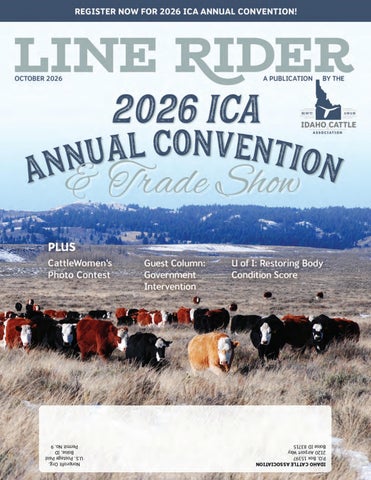
OCTOBER 2026
BOARD OF DIRECTORS PRESIDENT Val Carter..................... (Pingree) 208-390-4811
Convention Issue
PRESIDENT-ELECT Arnold Callison.......... (Blackfoot) 208-681-8441 VICE PRESIDENT Jesse Human...................(Jerome) 208-358-1277 PAST PRESIDENT Spencer Black...................(Malta) 208-647-8130 TREASURER Scott Bunderson..... (Grand View) 208-250-7549 FEEDER COUNCIL CHAIR Logan Peters.................... (Boise) 208-999-2584 PUREBRED COUNCIL CHAIR Chase Lanting............(Twin Falls) 208-539-4371 COW-CALF COUNCIL CHAIR Royce Schwenkfelder...(Cambridge) 208-550-2200 CATTLEWOMEN COUNCIL CHAIR Christie Prescott.......... (Fairfield) 208-420-3548 DISTRICT 1 REPRESENTATIVES Meranda Small........ (Grangeville) 208-816-2004 Cece Baldwin.......(Coeur d’Alene) 208-699-6611 DISTRICT 2 REPRESENTATIVES Mark Moura...................(Cambridge) 208-830-5417 Rex Hoagland................. (Melba) 208-800-2798 DISTRICT 3 REPRESENTATIVES Broden Matthews............(Oakley) 208-431-3263 Valene Cauhorn............. (Jerome) 208-571-9086 DISTRICT 4 REPRESENTATIVES Shane Rosenkrance.........(Mackay) 208-589-3110 Danna Beckman...... (Idaho Falls) 208-201-9902 DISTRICT 5 REPRESENTATIVES Tim Munns.................(Snowville) 435-279-4420 Matt Thomson.......... (Idaho Falls) 208-589-6901 ALLIED INDUSTRY REPRESENTATIVE Elena Montemagni........(Caldwell) 559-786-3627 CATTLEWOMEN BOARD REPRESENTATIVE Bailey Storms............(Idaho Falls) 208-973-2710
DEPARTMENTS
FEATURES
Message from the President
6
Convention is Tradition
15
Message from the EVP
8
ICA Convention Registration and Agenda
16
Message from Natural Resources Policy Director
10
Guest Column
12
Idaho Beef Council: Idaho’s Beef Industry Accounts for 3% of State’s Total Economic Output 20 U of I: Supplementation Strategy ICA Political Action Committee: Giving Our Vote a Voice
24 29
Idaho CattleWomen Photo Contest 30 Fall Coloring Contest
33
DIRECTORS AT LARGE Casey Scott............... (Clarkston) 208-431-3024 Randall Raymond.... (Grand View) 208-599-0391
ADMINISTRATIVE STAFF EXECUTIVE VICE PRESIDENT Cameron Mulrony........cameron@idahocattle.org DIRECTOR OF MEMBER COMMUNICATIONS AND SERVICES Montana Ertel.................montana@idahocattle.org DIRECTOR OF ADMINISTRATION AND FINANCE Michelle Johnson.......... michelle@idahocattle.org NATURAL RESOURCES POLICY DIRECTOR Karen Williams..................karen@idahocattle.org Contact Idaho Cattle Association: Mailing address: P.O. Box 15397, Boise, ID 83715 Location: 2120 Airport Way, Boise, ID 83705 Phone: 208-343-1615
For advertising sales, contact: idahocattlepublications@gmail.com The Line Rider is the official publication of the Idaho Cattle Association. It is published 10 times each year, in January, February, March, April/May, June, July/August, September, October, November and December.
4
LINE RIDER OCTOBER 2026
www.idahocattle.org
Make Your Feed Dollars Go Further
Supplement conveniently. Manage costs confidently. Built for the realities of western ranching, Herdworthy™ Range Cubes are a cost-conscious protein supplement for all classes of beef cattle. When forage gets short and feeding seasons get long, cubes can be scattered where cattle are grazing to help manage costs, improve herd access, and reduce reliance on concentrated feeding locations. Easy Ground Feeding
Quality Natural Protein
Stretch Feed Dollars
Herdworthy 28% Range Cube G U A R A N T E E D A N A LY S I S
Manufactured in Jerome, Idaho and backed by Scoular’s long history of serving agriculture, Herdworthy Range Cubes are designed to provide western ranchers with a practical, dependable supplementation alternative to traditional lick tubs. Feed where your cattle are grazing, improve protein access across the herd, and manage feeding costs through longer seasons.
© Scoular 2026
Crude Protein
Min 28%
Crude Fat
Min 5%
Crude Fiber
Max 8%
Acid Detergent Fiber (ADF)
Max 13%
Calcium (Ca)
Min 0.1% Max 1%
Phosphorus
Min 0.4%
Made in the west. Backed by Scoular. Contact us at Herdworthy@Scoular.com
MESSAGE FROM THE PRESIDENT
Time well spent Getting out of a rut at the ICA Convention
I
once heard the story of a young farm boy who wanted more than anything else to attain a college degree. It was in the late 1800s when higher education was not common and there were no government programs to assist. He came from a large family who could offer him no assistance, so, to reach his goal, he would have to find work to pay his tuition and boarding. Still, he remained optimistic, and when the time came, he gathered his belongings and bid his family farewell, striking out for the big city where the university was located.
Sometimes we get so busy “chopping wood” (doing the daily work) that it’s easy to lose sight of our overall vision. He soon found a job chopping wood and delivering it to local homes to fuel their wood stoves. He enrolled in the university and began attending classes, continuing to chop wood after school and on weekends. Before long, word got out about the service he provided, and many people began to take advantage of its convenience. Soon he had so many customers he could scarcely keep up with his orders. The money was good, and he could now enjoy things he had never been able to afford. As business continued to increase, he struggled to make time for class and schoolwork. He eventually fell behind, quit school, and spent all of his time chopping and delivering wood. He had become so busy with the job at hand that he forfeited his vision of a college education and increased earning potential for a short-term gain. 6
LINE RIDER OCTOBER 2026
BY VAL CARTER ICA President
Now, you might ask what this story has to do with cows or the Idaho Cattle Association (ICA). Allow me to explain: next month will be the ICA Annual Convention in Sun Valley, November 9–11. In short, it’s a good party with educational speakers, legislative and industry updates, a tradeshow, and, most importantly, the annual business meeting where policy is reviewed and new leadership is voted in. My point is this: Sometimes we get so busy “chopping wood” (doing the daily work) that it’s easy to lose sight of our overall vision. Convention is a great opportunity to escape that rut for a couple of days and mingle with other cattlemen, hear innovative ideas, and see the latest technology at the tradeshow. Sometimes a day away—surrounded
by new people and new ideas—gets those creative juices flowing again, and we go back home with a broader vision, armed with more information and better problem-solving skills. I know with winter fast approaching that it’s a busy time of year and convention costs money, but I always feel like I come away with new ideas and a renewed enthusiasm for what we do every day. I also feel that you get more out of your ICA membership if you attend the annual business meeting. I know it’s not a nail-biter for entertainment, but this is where you can have a voice in policy and leadership. I have scanned the room a few times during this meeting, and by a head count, there are often fewer than 50 people in the room. That equates to 5 or 6 percent of the ICA membership that votes and does the decision-making. That’s probably how I became the ICA www.idahocattle.org
President! So, if you’re not okay with other people making your decisions, come join us. An important part of the business meeting is voting in new leadership. ICA Bylaws, Article VI, Section 2, states that, “Election of all officers shall be at the annual business meeting. The Officers of the Association shall be elected by a simple majority of those Regular Members present and voting.” The ICA has a nominating committee chaired by the immediate past president. It is their responsibility to provide a report for the annual business meeting presenting nominations for the various officers and board members whose terms are expiring. If you have a desire to serve in the ICA or know someone you think might better represent you, please contact a board member or Spencer Black, the current nominating committee chair, and make them aware of your availability. Also, Article XV, Section 3, states, “Nominations from the floor for all elected officers of the ICA at any annual business meeting are in addition to those of the Nominating Committee and are to be considered official nominations of this association.” In this association, you have the opportunity for your voice to be heard, but you have to be present for that to happen. We would love to have you there. Even if you can only come for a day, I promise it will be time well spent, and you may increase your earning potential. Or, you can stay home “chopping wood.”
TOP NOTCH FEED & FENCE
Work Hard Feed Right Fence Strong
FENCE BUILT
01. TO LAST
Everything you need to get the job done right: • Posts • Panels • Wire • Gates • Tough, Reliable Materials
YOUR HERD 02. KEEP STRONG
High-quality livestock supplements that support: • Growth & Weight Gain • Herd Health • Peak Performance
208.642.2134
Top Notch Feed & Fence
1340 S. 16th St. Payette, ID
LEGENDARY
SINCE 1971 ROZOL POCKET GOPHER BAIT
NEW BAG!
www.idahocattle.org
Build your legacy with the legendary Rozol® Pocket Gopher Bait Burrow Builder Formula. Brought to you by Liphatech Ag, your Most Valuable Partner for effective rodent control.
WE HAVE YOUR BACKS, BARNS AND BOTTOM LINES.
Rozol Pocket Gopher Bait Burrow Builder Formula is a restricted use pesticide.
IDAHO CATTLE ASSOCIATION
7
MESSAGE FROM THE EVP
Headlines and outcomes Showing up to ask the right questions
N
ovember elections are quickly approaching. As I have said before, this is where decisions are made by those that show up… and showing up is especially important now. The past several weeks have seen “beef” in the national news time and time again, as headlines share new happenings and their impacts on our industry. From the opening of the border to plant closures, plus investigations, tariff adjustments, potential new programs, etc.
This is our chance to funnel answers from the grassroots level directly to the people who are in a position to make changes. The explosion and acceptance of messaging through social media has highlighted each of these items and their potential impacts on our industry. However, it is the details of these announcements that will determine which of these may be actually impactful to the industry, rather than simply making a statement to influence the general public as they head to their polling places. Let’s look at a few of the headlines and see their potential impacts. There will likely be more questions than answers, as the implementation of these ideas is still rather hazy. First off, take the import of 300,000 metric tons of beef to be sold at below market value. What does it actually do for the consumer? Market demand is high and consumers across the globe prefer US beef. The majority of our imports are lean trim that is mixed with the fat and trim from our processors to make ground products. 8
LINE RIDER OCTOBER 2026
BY CAMERON MULRONY ICA Executive Vice President
We did see a shift in our market following this announcement. Was it due to this headline? Maybe, but it’s also normal to see a seasonal shift at this time every year, not to mention that we had closing of plants, border opening, etc. How did it impact our price individually? I don’t know, but someone could possibly put a number on it. The bottom line is that your calves are not being replaced by the import of lean trim. It could impact the supply of grind; however, the amount is not significant enough to move the supply and it is unlikely that the consumer will see any impact at the checkout counter. It seems that one of the issues is the threat of uncertainty. It takes time to make decisions at home that will ultimately impact the consumer. If I wean in fall 2026 and choose to keep a replacement heifer, she doesn’t get bred until spring 2027. Her first calf hits the ground in early 2028 and the grocery store doesn’t see the product until mid-2029 or later. Our industry needs some certainty in our markets. We have risk management tools available, but the free market is still the king in our industry and our risk is played out over a much longer period of time than those in other industries. In the weeks following the import announcement, we saw announcements to try and provide certainty. A heifer retention program that would
www.idahocattle.org
provide LRP? Sounds good in theory, right? But wow, I have a lot of questions on how this can be impactful and implemented. Who puts the value on the heifers I want to enroll? Do I have to buy them? When can I sell and make a claim? If she doesn’t breed? If she sloughs her calf? If she dies? If she doesn’t breed back with calf at side? Can I insure my heifers for the same price regardless of my management strategies? So many questions. In theory, sure. In reality, how? What about Mandatory Country of Origin Labeling, or MCOOL? The Idaho Cattle Association (ICA) has policy that supports voluntary labeling and there are folks in our industry who have created branded programs to promote their products. The USDA has made changes that now include the requirement to be born, raised, and processed in the United States in order to receive that label and companies (including some here in Idaho) have worked to ensure their products can carry that label. The M in MCOOL is where ICA policy does not align. For the most part, mandatory programs are not welcomed in our industry. We understand and accept that there are some out there, but each one comes at a regulatory cost. Most of the whole muscle cuts that are consumed in the US are from US cattle. The ground beef in our grocery stores? Most likely US born. The mixed products are utilized to make ground beef products. Will the retail and fast-food industries be labeling their menu with the possible places of origin of their hamburgers? Probably not. Does the consumer here tend to purchase based on origin or on price? What about in the grocery store? Does the consumer buying a product to cook in their home make a decision based on the labeling and marketing on the package? Possibly, yes. Does the consumer in a fast-food restaurant make that same decision? Likely not, they look at cost and convenience while expecting a consistent product. When MCOOL was in effect in 2015, the data showed that the consumer did not make their decisions based on origin. We do not know the true cost of MCOOL implementation in 2027. However, reports showed a cost of $200 million per year when it was in place the first time around. Who pays this cost? How would implementation impact our export markets? It is estimated that the retaliatory tariffs on our product would cost nearly $1 billion. Again, in theory it may seem like a good idea, but it has real consequences on producers’ bottom line. The newly revamped “Product of the USA” label does require that the product be born, raised, and processed in country. It seems that this is what folks want. It is a label that is voluntary and if the consumer preferences show www.idahocattle.org
that it is a demanded change it will grow and have impact on our industry and American beef. All of these thoughts and questions are important to answer before we make a policy change that could impact ourselves and our future generations. Showing up is an important part of this process. How can you show up? Be an active member of your local, state, and national associations, and ask your friends and neighbors to do the same. Engage with staff and leadership, attend events, and speak your mind. Encourage dialogue, digest conversation, write to your leaders, vote at the polls… The opportunities are endless. Lastly, when you make a statement, know your reason. There are some social media cowboys out there who continually address issues with negativity. They don’t inspire change, instead, there messaging is solely to create conflict because it sells. If I constantly create turmoil and conflict people will stop and listen to the mess. Does it create change, not always, but it does sell clicks and make those cowboys YouTube famous. Please get out and show up, because these conversations do not happen in a silo. Join us in November at our Annual Convention as we set policy to guide our message to leaders in the coming year. Long live cowboys, and God Bless America.
57 Years of Manufacturing Excellence
IDAHO CATTLE ASSOCIATION
9
MESSAGE FROM NATURAL RESOURCES POLICY DIRECTOR
The reason for resolutions Taking your opportunity to weigh in
L
et’s talk about nobody’s favorite subject: resolutions. While I acknowledge that the mention of the word may elicit more than a few groans, the process of establishing policy for our organization—for any organization, really—is critical. ICA’s policy-setting process, adopted through the form of resolutions, keeps our actions and responses tied to the direction established by our members, the cattle producers of Idaho.
ICA’s policy book, consisting of 132 resolutions, covers the breadth of issues impacting our industry. Over the past couple of months, our industry has unwittingly been in more than its share of national headlines as President Trump has delved into cattle policy issues. We have seen the full range of the good, the bad, and the ugly in terms of political threats, actions, and promises. Setting aside the particulars of those issues, which have proven to create debate and division within our own industry, the entire exercise only underscored the intense need for clear direction and policy for an organization such as ours. The debate swirled around the rights and wrongs of what was being proposed, each side wanting us to weigh in in favor of their respective positions. All of our responses and recommendations were weighed against our policy book. We stayed true to our resolutions and limited our response so that it remained within the confines of established policy. This ensures that we as an organization are acting 10 LINE RIDER OCTOBER 2026
BY KAREN WILLIAMS ICA Natural Resources Policy Director
in accordance with the direction authorized by our members through our established process. Your opportunity to weigh in on that process is now. Our upcoming Annual Convention, set for November 9-11 in Sun Valley, is the time when our resolutions are reviewed and revised. ICA’s policy book, consisting of 132 resolutions, covers the breadth of issues impacting our industry. Before ICA staff and leadership can take action or respond to an issue during the course of the year, we must first ensure that we have established policy addressing that issue and directing our response. That is precisely why we need you to attend convention and sit through the resolutions session, however unexciting it may seem—so that our policy book is reflective of industry needs and is complete enough to enable us to act accordingly when problems arise. Our resolutions are reviewed on a rotating basis to allow for every resolution to be acted on at least once every five years. This year is the point in the cycle where we have several expiring resolutions that will need to be reviewed. They are: COW/CALF COUNCIL 1. Tax Issues 7. Estate Taxes FEEDER COUNCIL 5. CAFO Siting Department References 6. Government Involvement in the Dairy Industry CATTLE HEALTH COMMITTEE Regulatory Issues Subcommittee 3. Animal Identification 5. Proposed Animal Cruelty Legislation www.idahocattle.org
Science & Technology Subcommittee 1. U of I Steer-A-Year Program 2. U of I College of Ag and Life Sciences Budget FEDERAL & STATE LANDS COMMITTEE 2. Economic Value of Public Lands 3. Federal Grazing Fee Formula 4. Range Stewardship Program 5. Public Lands Permit Violations 6. Wild Horses and Burros 7. Wilderness, Wilderness Study Areas, And Other Special Designations 8. Non-Willful Trespass 10. Riparian Area Management 11. Sub-Leasing 12. Idaho Dept Of Agriculture’s Role in Natural Resource Decisions and ESA Actions 15. State Lands Grazing Program 29. University of Idaho Rangeland Center 34. Management of Federal Lands MARKETING COMMITTEE 1. Government Intervention in Livestock Markets 2. U.S. – Canadian Cattle Trade 3. BQA Marketing Programs with Industry Partners 10. U.S. Trade Negotiations and Agreements
This list gives you a glimpse into the comprehensive nature of our policy book and the wide variety of issues that ICA addresses on a daily basis. If you have any interest in any of these issues or have experience that would better inform our discussion as we consider each resolution individually, please let me know. Over the course of the month of September, each ICA committee met virtually to review these resolutions and make recommendations for their sunset, renewal, or update. These recommendations will be listed on our resolutions document at convention, but any member has the opportunity to make their own recommendation or change it during the resolutions session and then again at the annual business meeting, both of which will occur on Tuesday, November 10 in Sun Valley. In addition, any member has the privilege of presenting new resolutions for consideration. If you have a question about an issue and want to know if ICA has existing policy on it, or would like help in drafting a new resolution for consideration by our membership, please reach out to me at karen@idahocattle.org. Come to convention and tell us how these issues are impacting you, and then take part in seeking solutions to those challenges. I look forward to visiting with you in November!
PRIVATE LANDS & ENVIRONMENT COMMITTEE Private Lands Subcommittee 1. Property Rights and Local Land Use Plans 2. Government Agency Land Acquisitions Water Subcommittee 1. Wild and Scenic Rivers Bills 3. Water for Salmon Recovery 4. Livestock Watering Rights RESOLUTIONS COMMITTEE 1. Unclaimed Livestock Funds Use for Industry Education WILDLIFE COMMITTEE 1. Idaho Fish and Game Commission 3. Amend the Endangered Species Act 4. Wildlife Stewardship 6. Landowner Appreciation Permits 7. Fish and Game Land Acquisition 17. Sage Grouse 18. Wildlife Management Areas www.idahocattle.org
IDAHO CATTLE ASSOCIATION
11
GUEST COLUMN
A few thoughts Government intervention in the beef industry
O
ver the past few weeks, the Administration has focused on curing record high beef prices. I have one comment in that regard. Record high beef prices are the result of basic economics— supply and demand with demand being the primary driver. Yes, the U.S. has the lowest cattle inventory since 1951 as the result of both reduced grazing due to severe drought AND significant losses to cow-calf production during 2022/2023 with both of those situations leading to significant herd liquidation, but if consumers were not buying beef, prices would not be
The industry does not need any attempt to manipulate the market to anyone’s satisfaction record high. Prior to last year, this was the experience of the beef industry. Demand would not support the higher prices that resulted from reduced cattle numbers following herd liquidation. But, also in past cattle cycles, heifer retention began early in the period
12 LINE RIDER OCTOBER 2026
BY JOHN NALIVKA Sterling Marketing Inc. of higher prices. Cattlemen anticipated continued strong prices when those heifers calved and it is important to remember that most herd building took place in herds having less than 100 cows. We have a different scenario this time around with heifer retention by ranchers proceeding at a much slower pace—perhaps historically slow as ranchers benefit from record-high prices. Recent market volatility as well as record-high diesel prices, which represent a large share of production costs, have increased the uncertainty regarding the short-term market while also overshadowing the longer-term outlook. A heifer’s value today certainly is a major consideration in the decision to retain heifers. So, now the government not only has the politically driven incentive to lower beef prices, but also to create another program to encourage ranchers to build herds. I am highly pessimistic about the government’s involvement in the herd building decision. And, while I encourage ranchers to actively participate in sound risk management, risk management should be directed toward the impact of market volatility and to support the highest value for cattle to be marketed off the ranch. Except for policy regarding global trade, the government needs to stay out of the beef market. The industry does not need any attempt to manipulate the market to anyone’s satisfaction, particularly in response to politics whether it be tariffs, country of origin labeling, encouraging small packing plants, or herd building. This can only lead to unintended consequences with one of those consequences being additional government programs to compensate for the first action. It becomes one government intervention after another in response to criticism from various groups. Reducing burdensome regulations on the U.S. beef industry should always be the goal. www.idahocattle.org
Specializing in Truck and Livestock Scales Established in 1959, Scales NW offers a wide range of equipment, from precision lab balances to high capacity rail scales, as well as certified scale service and installation.
Scales NW is proud to serve: California Idaho Montana Nevada Oregon Utah Washington
Contact Steve Orr for more information today! Email: steveorr@scalesnw.com Phone: (503) 510-3540
www.scalesnw.com • (800) 451-0187
MAKE THE CO-OP CHOICE
AD_POWELL_LivestockTruckScale_4.5x5.indd 1
12/20/2017 4:34:34 PM
Propane, bulk fuel, oils & lubricants
RETAIL
Farm supply, clothing, boots, fencing & feed
AGRONOMY
vwcenergy.com
shop.valleywidecoop.com
valleyag.com
ENERGY
www.idahocattle.org
Precision agriculture, fertilizer & seed
IDAHO CATTLE ASSOCIATION
13
GET ‘EM GOING. Vitalix Kickstart Weaning – with Diamond V® Beef Shield and Zinpro® Availa® 4 – is tailor-made for cattle under stressful conditions and formulated specifically to reduce the impact of stress on cattle’s overall wellness and performance. This product is Zinpro® Verified. Northern ID • Jason Bean • 509-794-9059 • jbean@vitalix.com Southern ID • Owen Albrecht • 385-335-1745 • oalbrecht@vitalix.com 14 LINE RIDER OCTOBER 2026
www.idahocattle.org
Convention is Tradition ICA Annual Convention will be held November 9-11
F
or some Idaho Cattle Association (ICA) members, the Annual Convention & Tradeshow can become a yearly tradition. For others, it is an opportunity to meet fellow producers, learn about the issues shaping the industry and take a break from the dayto-day work of ranching. For James Boggan, the Convention has been part of his life for many years. His connection to ICA began as a young person attending alongside his parents and continued through his time with the Student ICA. Today, he returns to Sun Valley as a producer, agricultural education instructor, and member of a family operation in Riggins. “The Idaho Cattle Association convention in Sun Valley has been a highlight of my year for many years! When I was very young I would attend with my parents, my dad was on the ICA board, I attended with SICA, and now I attend as a producer and an agricultural education instructor. My wife, Hannah, and I run cattle with my dad on a family operation in Riggins, Idaho, which he and my mother obtained in 1993. For us attending the Idaho Cattle Association convention is very important for many reasons. We have the opportunity to network with industry professionals, network with likeminded ranchers or those in akin industries, and we have the opportunity to learn. The keynote speaker, breakout sessions, and tradeshow are something that we always look forward to! On top of ranching with my dad, I also teach agricultural education, and am able to continue rangeland monitoring for various ranchers. My wife and I also care deeply about the ranching community and enjoy sharing our love for Christ and what He has done in our lives through ranching and agriculture.
www.idahocattle.org
THE IDAHO CATTLE ASSOCIATION ANNUAL CONVENTION IS ALWAYS AN EDUCATIONAL, EXCITING, AND FUN-FILLED EVENT!
Overall, the ICA convention allows us to network, learn, build relationships, and take away educational opportunities and future endeavors. We look forward to seeing you in Sun Valley in November!” That combination of learning and relationships is a common theme among longtime Convention attendees. For Laurie Munns and her husband, Tim, attending ICA Convention began 25 years ago when Tim, then President-Elect of the Utah Cattlemen’s Association, want-
ed to become better acquainted with Idaho’s cattle industry and its leaders. The tradition continued, giving the couple an opportunity to stay connected with producers and keep up with changes across the industry. “Tim started attending ICA Convention 25 years ago. He was President-Elect for Utah Cattlemen’s Association and wanted to get to know the neighboring state’s leadership and members. Tim and I have continued to attend. The value for us has been the networking and socializing with ranchers and fellow producers involved in the industry. We enjoy learning new ways to do things, from technology, tax and estate planning, Beef Quality Assurance, and what is happening within the state agencies. Some of the “don’t miss” sessions are the NCBA update and the Idaho Beef Council luncheon. Both are informative to keep a pulse on the cattle industry. The evening socials are a fun way to relax and enjoy socializing with friends and neighbors. Sun Valley is always a fun venue, whether it is the beautiful fall colors or the first snow of the season. A walk around the property is always an enjoyable break. We’d like to encourage all to attend. Come renew old friendships and make new ones that will last a lifetime.” While the speakers, topics and faces may change from year to year, the reasons members return often remain the same. Convention provides a place to catch up with friends, meet new people, hear what is happening throughout the industry and bring ideas home to the ranch. For longtime attendees like Boggan and the Munns, those connections are what make the annual trip to Sun Valley worth making. And for those attending for the first time, it can be the beginning of a tradition of their own. IDAHO CATTLE ASSOCIATION
15
N O C V ENTIO L A U N AN& Trade Show N NOVEMBER 9-11, 2026
Sun Valley, Idaho
The ICA Annual Convention brings together Idaho cattle producers and industry leaders for timely discussions, expert speakers, and valuable networking opportunities focused on the future of the beef industry. ACTIVITIES & SPEAKERS The ICA Annual Convention is the premier gathering for Idaho's cattle industry. Throughout the event, attendees will have the opportunity to hear from knowledgeable speakers, participate in educational sessions, connect with fellow members, and celebrate the people and progress that strengthen our industry. Whether you're attending to learn, network, or reconnect with friends and colleagues, Convention offers something for everyone and continues to be a highlight of the year for Idaho's cattle community. TRADE SHOW STROLLING SUPPER & AUCTION
The Strolling Supper is the perfect opportunity to enjoy a great meal while connecting with fellow cattle producers, industry partners, and exhibitors from across the region. Visit with exhibitors showcasing products, services, and innovations for today's ranching operations, and take part in the always-popular Idaho Cattle PAC live and silent auctions. Whether you're networking, bidding, or simply catching up with friends, the Strolling Supper is a Convention tradition you won't want to miss.
Call the Sun Valley Resort at (800) 786-8259 to book your room with Idaho Cattle Association today!
N O C VENTIO L A U N AN& Trade Show N NOVEMBER 9-11, 2026
Sun Valley, Idaho
ATTENDEE REGISTRATION FORM (EARLY REGISTRATION CLOSES OCTOBER 16, 2026) Attendee One: Attendee Two: Company/Ranch Name: Address: City:
Zip:
State:
Email:
Phone:
PACKAGE SELECTIONS EVENT
MEMBER
Meetings Only
$100
Strolling Supper
$65
Tuesday Breakfast
NONMEMBER
$120
ATTENDEES
TOTAL
x
=
$75
x
=
$50
$60
x
=
Beef Checkoff Lunch $55
$65
x
=
$75
$85
x
=
President's Banquet
CASH
CHECK
NON-MEMBER PACKAGE $395 No. of attendees Total $
Please list attendees and how they want their name tag to appear:
Attendee:
Credit Card Number: Exp. Date:
City/Company:
Name on Card:
Attendee:
City: Zip: Phone:
$325
NAME TAG INFORMATION:
PAYMENT CARD
COMPLETE PACKAGE
State: Email: Total Amount:
Please return your payment and registration form to the ICA office by Friday, October 16. Forms can be emailed to michelle@idahocattle.org or mailed to Idaho Cattle Association, PO Box 15397, Boise, ID 83715. Meal availability cannot be guaranteed after the registration deadline. Registration prices increase on Oct 16. In the event of a cancellation, ICA will refund the full registration amount prior to October 16.
City/Company:
DON'T FORGET! Registration Available Online
Save a stamp by visiting idahocattle.org/annual-convention.
Reserve Your Room Today
Call the Sun Valley Resort at (800) 786-8259 and reference Idaho Cattle Assoc to make room reservations, or book online at https://book.passkey.com/event.
Registration Questions? Call the ICA Office at (208) 343-1615
Your Trusted Representatives in
Livestock Marketing Since 1989
©DOVERSPIKE
Upcoming Sale Dates OCTOBER 16
NOVEMBER 6
DECEMBER 6
Consignment Deadline: October 8
Consignment Deadline: October 29
Consignment Deadline: November 18
WVM Headquarters Cottonwood, CA
Embassy Suites Amarillo, TX
Atlantis Casino Reno, NV
Follow Us!
(530) 347-3793 wvm@wvmcattle.com
wvmcattle.com
IDAHO BEEF COUNCIL
Idaho’s Beef Industry Accounts for 3% of State’s Total Economic Output
Idaho’s Beef Industry Accounts for 3 Percent of State’s Total Economic Output In an effort to more fully quantify the direct impact of the Idaho cattle industry on the state’s economy, the Idaho Beef Council funded a University of Idaho research project analyzing USDA National Statistical Service data. In an Idaho’s effort to more quantify the ofdirect impact of the Idaho cattle industry Beef Industryfully Accounts for 3 Percent State’s Total Economic Output an effort more fully quantify direct impact of the Idaho cattle onsupports the state’s Idaho to beef industry contributes significant economic valuefunded to theindustry stateaand theeconomy, agricultural on theInThe state’s economy, the the Idaho Beef Council University of Idaho the Idaho Beef Council funded a University of Idaho research project analyzing USDA National baseproject and rural economy, according to a recent University of Idaho study. “In total,data. the Idaho beef value research USDA National Statistical Service Statistical Serviceanalyzing data. chain contributes over $7.2 billion in economic output, supports nearly 22,000 jobs, and accounts for approximately $2.6 billion in gross state product, or roughly 3 percent of Idaho’s total economic output,” The beef industry contributes economic to the state and supports theSciences, agricultural saysIdaho Phillip Watson, University of significant Idaho Professor in thevalue College of Agricultural and Life base and ruralof economy, according to a recent University of Idaho study. “In total, the the research Idaho beef value Department Agricultural Economics and Rural Sociology. Watson conducted using U.S. chain contributes over $7.2 billion in economic output, supports nearly jobs, and accounts for Department of Agriculture National Agricultural Statistics Service and22,000 other source data. His complete approximately $2.6 billion grosstitled state“Economic product, orContribution roughly 3 percent of Idaho’s output,” findings can be found in ainpaper of Idaho’s Cattletotal and economic Beef Industry.” says Phillip Watson, University of Idaho Professor in the College of Agricultural and Life Sciences, Department Agricultural and Rural Sociology. research using The projectofwas funded byEconomics the Idaho Beef Council (IBC) in Watson an effortconducted to enhancethe understanding of U.S. the Department of Agriculture National Agricultural Statistics Service and other source data. His complete economic significance of the beef industry within the state. “It is essential to examine these economic findings canasbethis found in a paper titled “Economic of Idaho’s Cattle andeffectively,” Beef Industry.” variables, knowledge will enable the IBC Contribution to allocate research funding more says J.W. Wood, chairman of the IBC. “This strategic investment not only supports Idaho producers but also The project was funded by the Idaho Beef Council (IBC) in an producers effort to enhance understanding of the leads to valuable research outcomes that ultimately empower to continue delivering higheconomic significance of the beef industry within the state. “It is essential to examine these economic quality protein for consumers.” variables, as this knowledge will enable the IBC to allocate research funding more effectively,” says J.W. chairman of the IBC. “This strategic investment not only supports Idaho producers but also TheWood, Numbers Tell The Story leads to valuable research outcomes that ultimately producers to continue delivering Breaking the numbers down highlights that direct empower sales of cattle and processed beef productshighoutside the quality protein$3.4 for consumers.” state totaled billion in new dollars generated, 7,600 direct jobs and $870 million in direct value added (gross state product) in 2024. An additional $3.8 billion in indirect and induced output, 14,600 The Numbers TheinStory jobs, and $1.7Tell billion additional value added came through supply-chain and household spending. Breaking the numbers down highlights that direct sales of cattle and processed beef products outside the state $3.4 of billion in economic new dollars direct jobs andin $870 in directdata value Tabletotaled 1 - Summary the 2024 base generated, contributions7,600 of the beef value chain Idaho. million Source: IMPLAN and author calculations. added (gross state product) in 2024. An additional $3.8 billion in indirect and induced output, 14,600 jobs, and $1.7 billion in additional value added came through supply-chain and household spending. Table 1 - Summary of the 2024 economic base contributions of the beef value chain in Idaho. Source: IMPLAN data and author calculations.
Economic Activity Measure
Direct Effect
Output
$3.4 billion
Indirect and Induced Effect
Economic Base Contribution $7.2 billion Economic Base 22,000 jobs Contribution
Economic Activity Measure Employment
Direct Effect 7,600 jobs
$3.8 billion Indirect and Induced 14,600 Effectjobs
Gross State Product Output
$870billion million $3.4
$1.7billion billion $3.8
$2.6billion billion $7.2
Employment
7,600 jobs
14,600 jobs
22,000 jobs
Gross State Product $870 million $1.7 billion $2.6 billion Multiple Sectors Make Up Beef Industry The beef industry spans the sectors of cow-calf, backgrounding, feedlots and processors. In addition, the industry is supported by input suppliers, transportation companies and marketing firms, which provide an extensive network to support the beef industry. All these sectors work together to create value for the Multiple Sectors Make Up Beef Industry state’s economy. The beef industry spans the sectors of cow-calf, backgrounding, feedlots and processors. In addition, the industry is supported by input suppliers, transportation companies and marketing firms, which provide an extensive network 2026 to support the beef industry. All these sectors work together to create value forwww.idahocattle.org the 20 LINE RIDER OCTOBER state’s economy.
Gross State Product
$870 million
$1.7 billion
$2.6 billion
Multiple Sectors Make Up Beef Industry The beef industry spans the sectors of cow-calf, backgrounding, feedlots and processors. In addition, the industry is supported by input suppliers, transportation companies and marketing firms, which provide an extensive network to support the beef industry. All these sectors work together to create value for the state’s economy.
Figure 3 -Visualization of the beef industry value chain. The Value of a Beef Dollar “The output multiplier for the total beef industry is 2.14, meaning that for every dollar of new output generated by the beef value chain, an additional $1.14 in economic activity is generated elsewhere in the state through supply-chain purchases and household spending,” Watson reports. Watson also evaluated employment and value added multipliers which lead to direct policy relevance. “While cattle ranching is the foundation of Idaho's beef economy and carries strong output and employment linkages of its own, beef processing is the sector where each unit of activity generates the deepest economic returns within the state,” Watson reports. “These results suggest that additional processing capacity could generate larger in-state economic effects, provided facilities can operate competitively.” Table 2 - Economic multipliers for beef industry in Idaho. Source: IMPLAN and author calculations Multipliers
Cattle
Beef Processing
Overall Beef Industry
Output
2.17
2.10
2.14
Employment
2.52
3.71
2.92
Value-Added
2.40
4.58
2.97
Cattle Supply Effects In the paper, Watson states as of Jan. 1, 2026, Idaho maintained approximately 2.5 million head of cattle and calves, including roughly 435,000 beef cows and 355,000 cattle on feed, according to USDA NASS data. These numbers represent a slight increase from 2025 and stability in the state’s herd size compared to national cow herd numbers. The U.S. cow herd peaked again in 2019 after several decades of decline, only to continue to decrease due to drought across the country, high input costs and producer liquidation decisions. Tight cattle supplies have resulted in higher prices for cow-calf producers, which helps operations offset inflation in labor, fuel, veterinary services and machinery expenses. However, high prices create complex www.idahocattle.org
IDAHO CATTLE ASSOCIATION
21
to national cow herd numbers. The U.S. cow herd peaked again in 2019 after several decades of decline, only to continue to decrease due to drought across the country, high input costs and producer liquidation decisions. Tight cattle supplies have resulted in higher prices for cow-calf producers, which helps operations offset inflation in labor, fuel, veterinary services and machinery expenses. However, high prices create complex incentives to herd rebuilding as producers have to make decisions to give up short-term revenue or retain replacement heifers for future production. These decisions require confidence in forage availability and financing conditions, Watson summarizes. Beef on Dairy or Dairy-Origin Cattle Contribute to Beef Industry The contribution of dairy-origin cattle to the beef supply chain is particularly important in Idaho due to the state’s large and highly productive dairy sector, Watson says. Idaho consistently remains one of the top five states in milk production and has a herd size that exceeds its beef cow inventory. Because of that, dairy-origin animals (both cull cows and beef-on-dairy calves) represent a meaningful share of the cattle entering Idaho feedlots and beef processing facilities. Compared to Other Industries Idaho’s beef industry ranks among the largest sectors in the state’s economy by any measure, according to Watson’s report. At $7.2 billion in total economic output and $2.6 billion in gross state product, beef contributes more than wood and paper products, mining, and tourism and outdoor recreation sectors. It is similar to Idaho’s semiconductor and technology sector that comes in at $9 billion and 3.6% of the state’s output. State government, healthcare and food processing (of which beef is a part of), are the largest employment sectors in the state. Conclusion According to the research, Watson concludes the Idaho beef industry remains a pillar of state’s economic base, generating substantial output, employment, and value added dollars with a broad and interconnected supply chain. “Overall, the Idaho beef industry functions as a major economic base sector, bringing external revenue into the state and generating substantial multiplier effects throughout the economy,” Watson summarizes. “In the context of tight national cattle supplies, elevated price levels, and evolving supply-chain dynamics, the sector’s scale, interconnectedness, and export orientation position it as both a stabilizing force in Idaho agriculture and a critical contributor to statewide economic performance.”
For the full report, scan the QR code below.
22
LINE RIDER OCTOBER 2026
www.idahocattle.org
Keeping Idaho farms safe and productive since 1968. Our employee owners are dedicated to ensuring you get the best tires and auto service.
WE PROUDLY
SUPPORT
www.idahocattle.org
IDAHO CATTLE ASSOCIATION
23
UNIVERSITY OF IDAHO
Supplementation Strategy Cost effective strategies for restoring cow body condition after weaning. UI COWS CONSUME PROTEIN CUBES ON DORMANT SEASON RANGE IN DUBOIS, ID IN 2017.
JIM SPRINKLE, Ph. D.
Extension Beef Specialist University of Idaho Nancy M. Cummings Research, Extension & Education Center
F
or many Idaho beef producers, 2026 has been a challenging time with cows losing more weight than usual during the summer grazing season. Many cattle may need to regain 1.0 to 1.5 body condition scores (BCS), which is equivalent to 100 to 150 lbs. It is a time proven practice to acquire a BCS of 5.0 at calving in order to achieve acceptable breed back. If calves are weaned on October 15th and calving starts on February 15th, then cattle with a 3.5 BCS at weaning would need to gain 1.22 lbs per day. Cattle with a BCS of 4.0 at weaning would need to gain 0.81 lbs per day. Left to her own devices, cows grazing dormant season rangeland pastures will not usually be able to meet BCS targets at calving without: a) some type of protein supplementation; or b) adding grain to the diet during the winter-feeding period (Figure 1). As forage ages, the amount of fiber
24 LINE RIDER OCTOBER 2026
(hemicellulose, cellulose, and lignin) increases and crude protein declines. The harvested forage is more slowly digested by rumen microbes due to the increase of cell wall constituents in the plants. By providing more rumen degradable protein in the form of a protein supplement, we allow the rumen microbes to increase in population, thus allowing for more microbes to break down and digest the forage into volatile fatty acids (such as acetate) which are absorbed through the rumen and used as an energy source. Protein supplementation will also speed up the passage rate of the forage from the rumen, allowing the cow to eat more forage to help satisfy maintenance requirements. For cool season grasses, we can expect forage digestibility to improve by 5% and forage intake to increase by 7% when degradable protein is provided on low-quality forage. Some of these rumen microbes will also pass into the lower digestive tract and can be used as a protein source by the cow. Undegradable dietary protein that passes through the rumen without being used by the rumen microbes is referred to as bypass protein and will be digested in the small intestine. When cows are se-
PHOTO BY JIM SPRINKLE
verely stressed by extreme weight loss or harsh winter conditions, bypass protein can be helpful to reduce weight loss. Common bypass protein ingredients used by feed companies include fish meal, feather meal, and Soyplus. An economic analysis for adding protein supplements to the diet is compared for cows that have either a 3.6 or 4.0 BCS at weaning and fed either 0, 1.0, or 2.0 lbs/day protein supplement is presented in Figure 2. As you can see, both economics and animal performance favor feeding protein supplement on dormant season forage when dietary protein is less than 7%. Please note that when feeding protein supplements, it does not need to be fed every day like energy (corn, barley, wheat mids, etc) supplements. Along with other scientists, we have successfully fed 7 lbs/cow protein supplement in once a week feeding. Cow performance shown in Figures 1 and 2 were produced using a Supplement Calculator spreadsheet available at https://drive.google.com/drive/ folders/17KY1mXi3Frp537u8Zi7acMMeE_ZZSlcn. With this spreadsheet entitled Forage Intake Cows Sprinkle FS www.idahocattle.org
FIGURE 1. PREDICTING COW PERFORMANCE FOR COWS FOLLOWING 2026 DROUGHT WITH AND WITHOUT PROTEIN SUPPLEMENT.
6 Mar 9 Calving.xlsx, you can duplicate the analyses I did or do your own analysis for your cows. If you desire to do this, download the spreadsheet to your computer. I suggest making a backup copy in case you accidentally delete a formula. Figure 3 highlights what cells you need to change when adding a protein supplement to the diet. A graph showing monthly weights is produced as the scenario is executed. Items in red can be changed. The forage TDN values shown are what I projected was available at many Idaho locations in 2026. There is also a Winter Feeding Requirements worksheet available on the aforementioned spreadsheet that will match feed quality requirements with desired average daily gain. Figure 4 illustrates a decision support tool for choosing a supplementation program for nonlactating cattle. The decision tool is discussed more fully in a webinar video entitled Strategic Supplementation for Drought and Dormant Season Grazing available on the Uniwww.idahocattle.org
versity of Idaho Drought Resources for Livestock Producers website at https://bit.ly/UIDrought. Briefly, if you have an abundance of green forage or adequate forage with greater than 7% CP, no intervention for supplementation to the cowherd is required. Most late fall irrigated hay meadows with residual forage or rangelands with abundant quality browse (e.g., winterfat) would fit into this category. Let us assume that you will not be bringing the cowherd to your stockpiled hay meadows until mid-December. If the forage supply is adequate for your late-season rangelands (< 40 to 50% forage utilization), the next decision to make is whether the CP is 5 to 6% or < 5%. If CP is less than 5% and the year is somewhat normal, then the suggestion is to provide 1 lb of protein supplement per cow/day but fed once weekly at 7 lbs/ cow. Range cow research over the last 20 years has shown similar performance between cows fed protein supplement daily, two or thee times/wk, and once/wk. This works because the breakdown prod-
uct of excess protein will recycle back into the rumen 2 or 3 days after being consumed. If cow weight loss is extreme or if there are many days of inclement weather, then the cowherd should probably receive 2 lbs of protein supplement/ day, fed twice a week at 7 lbs/cow. Figure 4 further shows that if the forage utilization is greater than 50%, then one should consider feeding an energy supplement or combination protein/energy supplement. If an energy supplement is fed, it must be fed daily to avoid issues with rumen acidosis and impaired fiber digestion. For any of these supplements, feeding at mid-day when cows are typically resting from grazing will reduce the disruption to grazing.
CONCLUSIONS
By carefully planning your supplementation strategy after calves are weaned, it is possible to economically restore body condition lost by range cows during this drought year. Unless we receive a lot of fall rain before the end of the growing IDAHO CATTLE ASSOCIATION
25
season, it will be cheaper to feed protein supplement than it will be to try to catch up after cows are brought home this fall. In a research project conducted from 2021 to 2022 at Malad, Idaho by the Uni-
versity of Idaho, non-supplemented cows gained 0.66 lbs./day from late October to late November when abundant fall rains were received before the end of the growing season (estimated TDN of 58%). In
a more normal year in 2022 (dormant forage, 49% TDN, 3.4% crude protein), non-supplemented cows lost 1.87 lbs./ day during the same time period while grazing the same rangeland.
FIGURE 2. ECONOMIC ANALYSIS FOR FEEDING PROTEIN SUPPLEMENTS.
FIGURE 3. IF SUPPLEMENTING WITH PROTEIN SUPPLEMENT CHANGE C16:C18 TO 2.43, 2.04, AND 1.98 AND CHANGE K16:K18 TO 56, 55, AND 55. TO CHANGE TO A COW AT A BCS OF 4 AT WEANING CHANGE PEAK MILK PRODUCTION IN CELL H10 TO 21. ADD SUPPLEMENT AMOUNTS TO CELLS R16:R18. THIS IS FROM THE SUPPLEMENT CALCULATOR WORKSHEET FROM THE SPREADSHEET ENTITLED FORAGE INTAKE COWS SPRINKLE FS 6 MAR 9 CALVING.XLSX AVAILABLE ONLINE AT HTTPS://DRIVE.GOOGLE.COM/DRIVE/FOLDERS/17KY1MXI3FRP537U8ZI7ACMMEE_ZZSLCN .
26
LINE RIDER OCTOBER 2026
www.idahocattle.org
FIGURE 4. DECISION SUPPORT TOOL FOR SUPPLEMENTATION. THREE MAIN POINTS TO CONSIDER ARE THE AMOUNT AND QUALITY OF THE FORAGE AVAILABLE AS WELL AS AN INDICATION OF THE COW’S NUTRITIONAL STATUS (IT’S BCS).
A Box For ALL Seasons Rumax BoviBox
RUMAX BOVIBOX
1 0 0 l b N o- M e l t fo rmul a i n bi o degra da bl e a n d e d ib le pa cka gi ng. Co m pl e te ye a r - ro und vi ta mi n, mi nera l a nd p rote in suppl ement. S uppo r t for m a x i mum perfo rma nce a nd effic ie n cy at a l l pro ducti o n sta ges. I m p rove d i g e sti o n, bo dy co ndi ti o n, repro d u c t io n a nd feta l grow th. Co nta i ns Avai l a 4 a nd Bovi a ci l l us Pro du c t io n Pl us o pti o n.
In addition to a full vitamin and mineral package it has 30% crude protein along with high levels of mono and poly unsaturated fat and a live multispecies probiotic for improved immunity and reproduction NOW WITH MULTI-SPECIES LIVE PROBIOTIC!
BOVIBOX NATURAL
Has all the benefits of a quality mineral and vitamin package with 20% all-natural protein and the same high mono and poly unsaturated fat and live probiotic combination to boost immunity and reproduction NOW WITH MULTI-SPECIES LIVE PROBIOTIC!
Multiple Formulations to serve your nEEds ˜°˛˝˙˜˝ˆˇ ˆ ALL-Season ˜ Formula
Easy ˆto ˙˜˝ ˝ ˙ ˝˙ disperse
ˆˇ˝ ˝ ˙ˇ ˆˇ˝ Consistent ˆˇ Consumption
F i n d o u t m o r e at P e r fo r m i x n u t r i t i o n .c o m | 8 0 0 .4 2 6 .3 5 7 2
www.idahocattle.org
IDAHO CATTLE ASSOCIATION
27
Name:
Fall Coloring Contest
Age:
Show us your art skills! Color the page and bring it to convention on November 9th to enter.
ICA POLITICAL ACTION COMMITTEE
Giving Our Vote a Voice An opportunity to support the ICA Political Action Committee.
BY TUCKER SHAW
I
ICA PAC Chairman
went to Boise earlier this summer. Downtown Boise, mind you. It was the first time I had been in that part of Idaho for some time. It’s not too far away from home, only 45 minutes or an hour and a half, depending on traffic. I was lucky enough to find parking in the one garage that I know how to get in and out of. I wandered around unsupervised, trying to find a landmark—someplace that I knew or was at least familiar with. Everything was so different compared to what I remember from when I ran around town in my teens and twenties. Idaho is changing. You see it in almost every town. First, a subdivision goes up overnight, than another new store is built on the edge of town. Idaho has the second fastest annual population growth rate in the nation. Most of the growth is newcomers from other states. They like the idea of what Idaho stands for, our values and principles. Then they want to change the state to something they are familiar with. Cattle continue to rank as one of Idaho’s highest grossing agricultural commodities, but those of us involved in all aspects of raising livestock, from birth to harvest, are a small voting population. Some of the value of being a member of the Idaho Cattle Association (ICA) is that leadership and staff represent all of us and help tell our stories. The next level of value is the ICA Political Action Committee (ICA PAC). We are able to combine our donations to have a greater impact and support the politicians and political candidates that support our goals. In the 2024 and 2026 primary elections, ICA PAC had a 70% success rate in candidates we supported winning their primary. In the 2024 general election, our ICA PAC had higher than 90% success rate on candidates being elected. There are six members from throughout the state that serve on the ICA PAC. We review races in every district, looking at the incumbent’s record pertaining to ICA priority issues and investigating challengers. It is important that we have a voice. Growth and change are inevitable. Our state, the pop-
www.idahocattle.org
ulation, and those elected to represent us will look different year after year. Each election cycle seems to be more important than the last. Those elected to represent us are making laws that affect the way we do business. That’s why it is important to support those who prioritize agriculture in Idaho and give our vote a voice. The ICA PAC runs on donations and on the funds raised from our annual PAC auction at the ICA Annual Convention in November. This auction will allow the PAC to continue to support the election of capable lawmakers and public officials who will act as public servants to Idaho and to the Idaho cattle industry. If you have something you would like to donate, please contact the office at (208) 343-1615 or email Michelle at michelle@idahocattle.org. Otherwise, please consider contributing to the PAC auction in November.
Let us watch the market while you run your operation. Choose Livestock Risk Protection with StoneX for market expertise.
The trading of derivatives such as futures, options, and over-the-counter (OTC) products or “swaps” may not be suitable for all investors. Derivatives trading involves substantial risk of loss. Past results are not necessarily indicative of future results. © Copyright 2025. All rights reserved.
IDAHO CATTLE ASSOCIATION
29
Idaho
<(;tit
PRESENTED BY THE
IDAHO CATTLEWOMEN $10.00 Pre Entry Unlimited Entries
Please Print Legibly for Office Use First & Last Name: Mai 1 ing Address: ---------------------------------------Category for this entry - Please check one:
D Ranch Life D Idaho Landscapes & Cattle D People of the Ranch D Pocket Shot Title of this Photo: Please provide a brief description of the photo (who, what , when, where):
I certify that I am the person who took this photo, and there are no other copyrights on the photo. I have consent of any people who appear in the photo. I understand that a digital copy of the entry must be sent to Montana MacConnell at the Idaho Cattle Association Office at montana@idahocattle.org. I understand that I am responsible for picking up the photos after the contest. All images may have the opportunity to appear in future ICA publications and communications materials. Should my photo be used, I will receive photo credit. Photos have been submitted without watermarks. Signature of photographer : --------------------------------- Date: ________________ Signature of person in photo (if applicable): __________________ Date: ________________
32 LINE RIDER OCTOBER 2026
www.idahocattle.org
Thank You Board Members! The Idaho Cattle Association would like to extend our gratitude to these outgoing Board of Directors members for their time & dedication to the Idaho beef industry!
Spencer Black
Chase Lanting
Past President
Purebred Council
Logan Peters Feeder Council
CeCe Baldwin
Tim Munns
District 1 Represenative
Elena Montemagni
District 4 Representative
Allied Industries Representative
Shane Rosenkrance District 5 Representative
Casey Scott
Director at Large
MEMBERSHIP
New and renewed ICA members AG Equipment Inc. DBA-NW Mixer Feeder Alana Maloney Alyssa Wilson Angel Garrett Ashton Brassfield Briggs Weygandt Casey & Pattie Chandler Colby & Jessica Lord Colyer Cattle Co. Inc. Cottonwood Livestock Auction Dave & Diane Myklegard Dean Morris Diamond Peak Cattle Feeders Don Webster Doug & Sandy Kinzer DT Group LLC Dude Ranch Cafe
Endovac Animal Health
Kaid Panek
Rachel Semrau
Envu
Katelyn Suta
Real Tuff Cattle Equipment
Evin Sharman
Katlin Caldwell
Renny Wylie
Kayley Fugina
Reynolds Creek Calf Ranch
Kloe Campbell
Robert & Kelly Thomas
Kyndra Stout
Robert & Rochelle Oxarango
Lane Tellefson
Ruben Mendoza
Linda Ramsey
Rye Mathison
Lord Ranch, LLP
Schroeder Law Offices, P.C.
Lorenzo Torres-Navarro
Staci Maiden
Loyd & Stephanie Briggs
Summit Ag Appraisal, Inc.
Lucy Brock
Tatum Osterberg
Lynn & Tiffany Bachman
The Evans Group
Mackenzie Serrano
Thomas Rountree
Maicy Bothman
Trans Ova Genetics
Matthew Waite
Vitalix, Inc.
FERA Diagnosstics & Biologicals Grassroots Carbon Gretel Kleint Hadley MacConnell Harley Engle Jack “Teel” Bruner II James Risch Jared Smith Jason & Diana Tindall Jaxon Ford Jesse Jensen Josiah Bolyard Justun McCall
Nick Noyes
Weiser River Cattle Feeders
Kaden Seward
Petan Co. of Nevada, Inc
Wilder Cattle Feeders
Kaden Wyatt
Phillip & Yvett Davis
Wilson Creek Cattle Feeders
160+-ACRES Zoned: Agriculture, Sage brush grazing with fencing around perimeter. Aberdeen: $240,000 ***SOLD***
YOU WORK HARD. YOUR EQUIPMENT SHOULD TOO.
1826.74+-ACRES Livestock well, 314+-CRP, 320+- AUMS Carey: $2,745,000 74.691+-ACRES 66.73+- Irrigated, 75.27+- TFCC water Buhl: $1,680,000 320+-ACRES Zoned: Agriculture, dryland, surrounded by BLM Carey: $400,000 657.72 +- ACRES 367 +Carey: $7,800,000
THE AUTHORITY FOR OVER 85 YEARS
160 +- ACRES 128+-Irrigated, IDWR, Pivot/Handlines Pingree: $1,995,000 Call Mark Jones 208.308.3030
PowderRiver.com
P: 800.453.5318 We Specialize in Tax Deferred Exchanges - Accredited Land Consultant
34
LINE RIDER OCTOBER 2026
www.idahocattle.org
2 Year Olds & Spring Yearling Bulls Spring Yearling Hereford & Red Baldy Heifers Check out our offering at jbbalherefords.com James & Dawn Anderson 208-280-1505 208-280-1509 Beverly Bryan
KNIPE LAND COMPANY
Hang’n A Cattle Company Alan and Leslie Alexander
• Farm, Ranch, Recreation, Large Land Parcels, and High Net-Worth Real Estate • 1031 Tax Deferred Exchanges
(509) 727-9151 - Alan (509) 432-4802 - William PASCO, WA
Bulls and Females available Private Treaty Email : william@hangnacattle.com hangna@owt.com
JBB/AL HEREFORDS Bryan & Charly Anderson 208-280-1964 1973 S 1500 E Jae Anderson GOODING, ID 83330 jbbalherefords@gmail.com
Our experienced sales team is ready to solve your real estate needs. Ready to buy or sell? Call today!
www.hangnacattle.com Follow Us on Facebook
Your Northwest Source for Quality Charolais Cattle
info@knipeland.com • 208-345-3163 • www.knipeland.com
Dennis Boehlke 9351 Lake Shore Drive Nampa ID 83686 2 miles west of Hwy. 45
Dennis: (208) 989-1612
52nd Annual Production Sale March 10, 2026 Lunch at 11:30 • 1:00 MST pm • At Ranch in Ashton, Idaho 120 Yearling Red Angus Bulls and 85 Yearling Heifers
(208) 431-0346
NEW WINKEL LIVESTOCK EQUIPMENT FOR SALE
BREEDER & SERVICE GUIDE
PRIVATE TREATY SALES HEREFORD & RED ANGUS
www.loosliredangus.com Brian Loosli 3127 E. 1100 N. Ashton, ID 83420 208-652-3303 208-317-7878 blloosli@gmail.com
www.idahocattle.org
Jonathan Meek 208-227-3779 Mark Loosli 208-351-3333
PHOTO CREDIT: CHARLOTTE MULKEY
IDAHO CATTLE ASSOCIATION
35
WE HEART YOU
It takes a farmer to understand a farmer. And here at Liphatech Ag, we have the farming and ranching backgrounds to know what you’re up against every day. Your dedication, grit and selflessness doesn’t go unnoticed. Our team is here to support you in every way we can.
LIPHATECHAG.COM 800.351.1476
Rozol® Pocket Gopher Bait Burrow Builder Formula, Ground Squirrel Bait and Vole Bait are Restricted Use Pesticides. Metarex® is a Restricted Use Pesticide in New York.
WE HAVE YOUR BACKS, BARNS AND BOTTOM LINES.