Detachment in Context of Interpersonal Relationships: A Grounded Theory Study
L. Alexia Camfield
Institute for Clinical Social Work
Dissertation Submission for the Degree of Doctor of Philosophy
Dr. Jacquelyn Vincson
December 1, 2025
Acknowledgements
I would first like to acknowledge my dissertation committee. My chair, Dr. Jacquelyn Vincson, made the research process so dynamic and fun. Dr. Amy Groessl, who, from our first conversation, understood the project’s core and has an incredible ability to break down daunting challenges into manageable chunks. Dr. Gina Shropshire, whose knowledge and love of psychodynamic theory, and your personal resonance with this study, were instrumental in helping me strengthen the literature review and ground this phenomenon. Dr. Kevin McMahon, first as a consultant willing to “play in the space of possibility” and now as my reader. It has been a gift to work with a committee that not only understood but also found excitement in the “magic of detachment.” I am also thankful to the Institute of Clinical Social Work and my time with Joe Palombo, who encouraged me to pursue this topic, especially during the initial challenge of articulating its place within psychodynamic theory and practice.
This project, at its heart, belongs to the Al-Anon community. I am grateful for the program's wisdom, which prominently features detachment in its literature, and to the 16 AlAnon members who generously shared their time and experiences with me. Finally, I could not have completed this journey without my personal support system. My parents, who always believe in me; my husband; and my daughters, for your understanding and grace; and to my dog, Banks, who has been steadfastly by my side throughout the process. The magic of detachment has forever changed me, and I am excited to make these findings available to anyone curious about this space.
Abstract
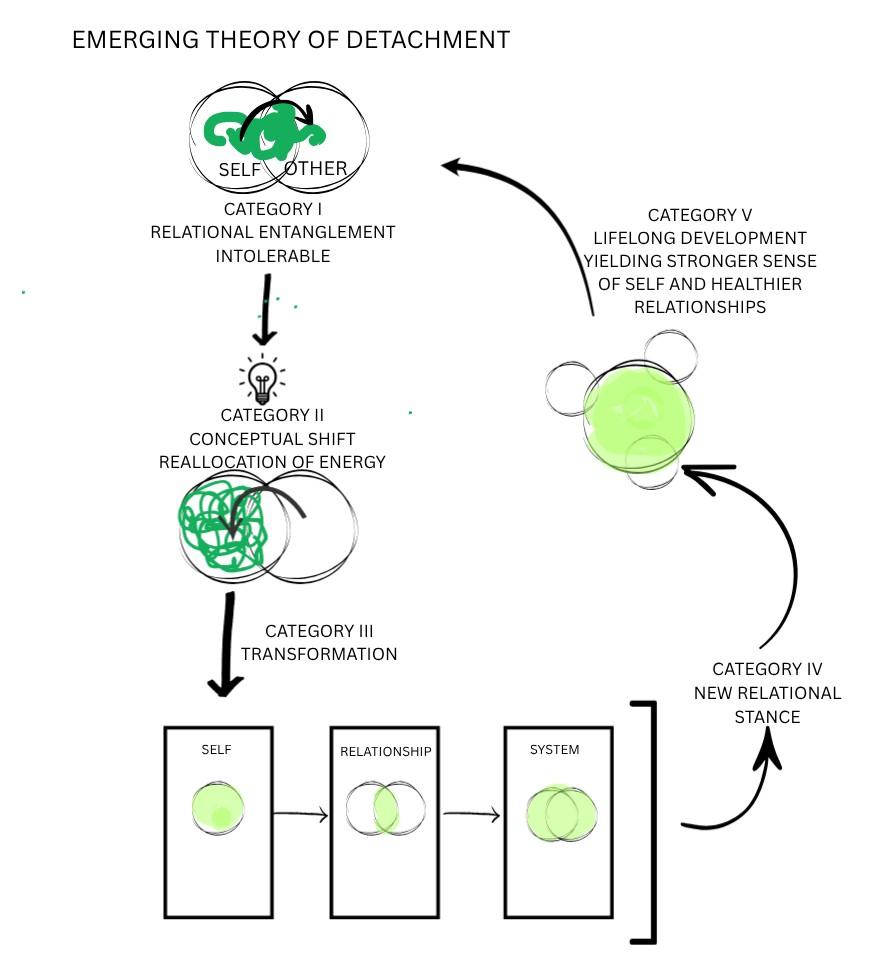
This grounded theory study explored how Al-Anon members experience and perceive detachment in the context of their interpersonal relationships. Interviews were conducted with 16 participants. Analysis was performed using open, axial, and selective coding methods. Five categories allowed for an emergent theory of detachment, from which a model was developed to explain the social and psychological processes of detachment as a developmental capacity. A neuropsychoanalytical discussion of the findings demonstrates how the theory expands on the understanding of relational dynamics, affect regulation, and self-development, with significant implications for clinical social work theory and practice. The study concludes by positioning this new theory within psychodynamic inquiry to suggest new avenues for research and practice.
Keywords: grounded theory, detachment, neuropsychoanalytical, psychodynamic
Detachment in Context of Interpersonal Relationships: A Grounded Theory Study
General Statement of Purpose
The purpose of this grounded theory study was to develop a theory of detachment in interpersonal relationships by understanding how Al-Anon members experience and perceive detachment and their capacity for it in their relationships. In this study, detachment is considered a counterpoint to attachment, representing the space of disengagement in the context of interpersonal relationships. The capacity for detachment is considered in relation to the individual’s experience of space or separateness that occurs in their relationships. The phenomenon of detachment in this study is explored through components of Al-Anon literature and key psychodynamic theories, providing a basis for its conceptualization.
The inspiration for this study came from my exposure to Al-Anon’s consideration of detachment as a capacity critical for healthy relationships and the practice of detachment in addressing a collapse in this capacity characteristic of family members of alcoholics. Al-Anon members are a group of individuals whose lives have been impacted by the relationships they have with someone who suffers from alcoholism. Al-Anon offers support to friends and family members of alcoholics by shifting the emphasis or focus back onto the life of the individual themselves and modeling detachment with love. This practice facilitates the development of a relational capacity for detachment, even as we still love the person suffering from alcoholism.
The serenity prayer which is spoken at the start of every Al-Anon meeting, “God, grant me the serenity to accept the things I cannot change, the courage to change the things I can, and the wisdom to know the difference (Al-Anon Family Group, 2005b),” reminds us to place the focus
on ourselves and acknowledges that the work for change in the alcoholic can only come from that person.
Detachment with love offers a consideration of healthy space for growth and development within the context of interpersonal relationships, made possible through opportunities for rupture or discord that extend beyond the rooms of Al-Anon and have the potential to inform the relational aspects of clinical social work theory and practice. Al-Anon member interviews provide valuable insights into their experiences with detachment. This population is well-suited for understanding this phenomenon, as Al-Anon recognizes the importance of an individual’s capacity for detachment in relationships, and this construct is regularly seen throughout the Al-Anon literature (Al-Anon Family Group, 1995, 2005a, 2005b, 2006, 2007, 2018, 2019). The findings from the interviews with Al-Anon members for this study are analyzed and then further considered from a psychodynamic framework, thereby expanding theoretical and practical understanding of the role of detachment in interpersonal relationships.
Significance of the Study for Clinical Social Work
Throughout our psychodynamic theories, there is language that describes the space that arises in the context of relationships for an individual’s growth and development; however, there is no consistent language or conceptualization of this phenomenon. Without such language, as theorists and clinicians, we limit the potential for understanding and usefulness of this space. AlAnon has utilized this construct by incorporating language and detachment, which references the space individuals need between themselves and their relationships for a healthy, boundaried sense of autonomy in the context of relationships. The Al-Anon concept of detachment is rooted in principles that extend beyond the context of relationships impacted by addiction, affording valuable insight and deepening understanding of detachment in relationships in general (Al-
Anon Family Group, 1995, 2005a, 2005b, 2006, 2007, 2018, 2019). Al-Anon’s use of detachment complements psychological constructs such as emotional regulation and selfdifferentiation and has the potential to offer insights that inform critical developmental interpersonal processes. Drawing on the language of Al-Anon, this study presents a theory of detachment that can be applied to expand social work theory and practice.
According to Aristotle’s concept of potentiality and actuality (Aristotle, 1999), the entirety of a system or entity can possess qualities or characteristics that are not simply the aggregate of its components. By considering how this use of space is reflected in our social work theories of development, this study aims to conceptualize the construct of detachment in holism and explore its emergent properties. Currently, there is no consistent term used across psychodynamic theory to conceptualize and/or communicate the space of detachment inherent to interpersonal relationships. This study introduces the language and highlights the usefulness of a theory of detachment in clinical social work.
Contemporary neuropsychodynamic perspectives on attachment and affect regulation theories reflect the integration of science-based psychoanalytic theories for a more comprehensive understanding of psychic phenomena (Beebe, 1988; Schore & Schore, 2007; Tronick, 2007). Crocker and Bauer introduce the term "detachment" to further strengthen theoretical understanding and the potential for effective psychodynamic techniques and treatment, emphasizing the link between affect theories and psychodynamic theories. This study contributes to understanding the role of detachment in regulatory processes as a meaningful link in the development of these capacities.
Central to the study of psychodynamic theory and practice is the role that relationships play in the development and experience of individuals throughout their lifetime (Berzoff et al.,
2022). Psychodynamic practitioners rely on theory to make sense of and inform their work with their clients. Social work theory development relies on research aimed at understanding individuals’ lived experiences within their environments. Understanding detachment in the lives of Al-Anon members enables clinical social workers to better comprehend this phenomenon, which extends beyond this population and has implications for our theories of development and for clinical work with individuals and the systems they inhabit.
Sheldon Bach, in his paper, On Being Forgotten and Forgetting One’s Self (2001), writes: “Of course, even in normal development, …connection cannot exist without the disconnection that destroys it.” The concept of disengagement in the context of relationships for affect regulation, recovery, and reengagement processes is referenced throughout developmental theory, despite the absence of a conceptually cohesive language surrounding this phenomenon. The lack of language may help explain the deficit in literature and research that satisfactorily explores detachment as a developmental capacity inherent in interpersonal relationships. The concept of detachment, both as a capacity and a counterpoint to attachment, serves as a means to integrate affect theory and contemporary neuroscience, facilitating a more comprehensive understanding of psychic phenomena and offering potential for further research to expand our understanding of relationships.
Statement of the Problem and Specific Objectives
A psychodynamic lens considers phenomena as multifaceted and seeks to understand that which lies beneath the surface (Berzoff et al., 2022). The relationships we have throughout our lifetime are significant to our lived experience. During periods of tension or loss, our affective experience highlights our sense of attachment in these relationships. Regulation capacity in relationships is critical throughout life. The concept of attachment provides a framework for
understanding the capacity for connection (Schore & Schore, 2007). We are drawn to understand these connections and therefore focus much of our time and energy on theory and practice to deepen our understanding of how to strengthen interpersonal relationships. Paradoxically, a shift in emphasis to the space between an individual and their relationships, as well as the capacity required for healthy detachment, also holds a valuable counterpoint to the work of being in relationship (Crocker & Bauer, 2020). Currently, there is no established theory of detachment in interpersonal relationships. By introducing a theory of detachment, this study also introduces language and facilitates the integration of concepts from psychodynamic theories of development that might otherwise be underrepresented. Most importantly, this study enables consideration of these ideas in relation to social work theory and practice.
The objectives of this study were as follows:
1. Develop a theory of detachment based on the lived experiences of Al-Anon members.
2. Explore how findings can be integrated with existing theoretical conceptualizations to generate new insights for psychodynamic theory and practice.
3. Consider neuropsychodynamic perspectives of emotional regulation and relational dynamics.
There are references throughout psychodynamic theory as to the importance and usefulness of a necessary space of disengagement in the context of healthy relationships. In Freud’s paper, Mourning and Melancholia, about the work of mourning, he writes with regard to the loved object, “Detachment of the libido is accomplished in respect of it. When the work of mourning is completed, the ego becomes free and uninhibited again (Freud, 1917, p.244). Freud uses the term "detachment" interchangeably with "decathexis," referring to an incremental withdrawal of energy from a loved object. In contemporary neuropsychodynamic research,
Beebe (1988) and Tronick (2007) observe the beginning of this capacity between infants and their caregivers during moments of disengagement and reengagement. In states of melancholia, Freud theorizes that the individual lacks access to the capacity for healthy detachment. For healthy narcissism, the ego must have the capacity for cathexis and decathexis. In melancholia, a collapse in the space of the object relationship is transformed into an ego loss. The capacity for detachment requires having developed a healthy enough sense of narcissism to withstand the absence of the loved object (Freud, 1917).
Central to Donald Winnicott’s contribution to theory is the idea that at least initially, mother and infant are one: “There is no infant without a mother.” Inevitably, the “good enough mother” provides opportunities for the experience of separateness and the development of individuality. A child develops a capacity for internal representations through the use of transitional objects. Critical is the child’s development of a capacity to reconcile the needs for attachment and separateness (Winnicott, 1953). Crocker and Bauer (2020) suggest that the terms “secure enough attachment” and “secure enough detachment” more accurately depict the developmental objective of this most critical interpersonal relationship.
Melanie Klein’s conceptualization of the paranoid-schizoid defense mechanism illustrates the struggle between the needs for attachment and detachment, which remain unreconciled. The infant's initial fragmented experience of external objects begins to become integrated through processes such as incorporation, introjection, and identification. Over time, the infant learns it can hold both the good and the bad of the whole object and moves into a form of identification, developing a capacity for engagement and disengagement from external objects (Klein, 1946). It is through the processes of love, hate, and reparation that the space for healthy disengagement becomes possible (Klein, 1964). Winnicott (1947) also discusses the need for a space to hate in
relationships as a critical component for not losing oneself entirely. In his paper, The Use of an Object (1969), Winnicott describes a sequence in which the subject relates to the object, the object is in the process of being found, the subject destroys the object, the object survives destruction, and the subject can then use the object. It is only through engaging with and disengaging from the object that the subject can utilize it.
Kohut’s theory of development describes a process in which the individual internalizes selfobject functions through transmuting internalization. This process is only possible during a period of optimal frustration, when the individual internalizes the selfobject function that has been disrupted (Kohut, 1977). This feature of development is not possible without a space of detachment.
Attachment theory is where I initially considered to locate the Al-Anon reference of a healthy space of detachment in the context of interpersonal relationships, finding resonance in John Bowlby’s work documenting a sequence of protest-despair-detachment in infants who are separated from their caregivers, with the function of detachment being to permit the formation of emotional bonds with new caregivers. Bowlby hypothesized that a degree of emotional detachment facilitates independent and self-reliant functioning (Bowlby, 1969, 1973, & 1979).
Schore and Schore (2007) provide a basis for integrating attachment theory and psychodynamic thinking as a theory of regulation. Of particular interest in their work is the finding that critical to social engagement is the allowance for periods of recovery or disengagement in the context of the relational field. This work establishes these processes as regulatory, with direct implications for clinical practice and technique, emphasizing the importance of nonverbal communication over verbal communication as a curative approach.
I have been struck by how little information I have found outside Al-Anon on detachment as a capacity critical to healthy interpersonal relationships. One contemporary paper, Integrating Science into Psychoanalytic Theory (Crocker & Bauer, 2020), suggests the usefulness of introducing the term detachment as a construct that is meaningful for the integration of attachment and affect ideology in psychoanalytic theory and practice, and supports the theory I have around the potential usefulness of considering detachment as a construct. The authors affirm the absence of language for this phenomenon and its need, as well as the potential it offers for expanding theory and practice.
Salman Akhtar’s 2021 lecture at the Freud Museum in London, titled "Letting Go: My Proposal of ‘Detachment Theory, ‘" is about detachment as both a psychological and an emotional process. Akhtar emphasizes that detachment is not about cutting off or withdrawing from relationships but about maintaining the capacity to engage with others while preserving one’s emotional integrity and autonomy. Akhtar considers detachment an essential developmental and relational capacity, enabling individuals to navigate life’s challenges, regulate their emotions, and form healthier, more mature connections with others. Akhtar’s reflections underscore the potential value of incorporating a theory of detachment into social work theory and practice, thereby supporting the objectives of this qualitative research study.
Several contemporary epistemological studies have explored the importance of affect regulation, attachment, and the therapeutic alliance (Ruiz-Aranda et al., 2021; Mair, 2020), which inspired me to consider the potential for incorporating detachment into relational regulation processes. Arlene Montgomery’s work, Neurobiology Essentials for Clinicians: What Every Therapist Needs to Know (2013), integrates the use of defense mechanisms through a system of categorization that corresponds with the sympathetic and parasympathetic branches of
the autonomic nervous system. Montgomery’s work contributes to establishing a model for affect regulation. It illustrates practical implications for a theory of regulation that might also incorporate how defenses apply to attachment and detachment processes in interpersonal regulation.
Studies on interpersonal regulation primarily focus on how people regulate in interpersonal engagement (Tran et al., 2023). A study titled "Emotion Regulation in the Face of Loss: How Detachment, Positive Reappraisal and Acceptance Shape Experiences, Physiology and Perceptions in Late Life" (Rompilla et al., 2021) cites detachment as effective in downregulating negative emotions. The cognitive-based intervention for affect regulation reflects a valued outcome, as it promotes a return to positive emotions and highlights the usefulness of detachment in affect regulation. The focus is more on detachment as a strategy than as a relational capacity. Aside from the Crocker and Bauer (2020) paper and Akhtar’s lecture, the language of detachment is absent mainly in psychodynamic literature.
The primary objective of this study is to generate theory from the data and to extend and link current psychodynamic theories of development. This study is using a grounded theory approach to inquiry. According to Bloomberg (2023), social phenomena can be explained through a step-by-step process of categorizing data and identifying themes that give rise to theory. The researcher's insights contribute to knowledge building and potential practical applications (Bloomberg, 2023). This approach fits with the three primary objectives: 1.) development of a theory of detachment from the lived experience of individuals who are familiar with this construct; 2.) determining the usefulness of the construct of detachment for psychodynamic theory and practice; and 3.) introducing language that encourages the integration of psychodynamic theory and neuroscience. The findings of this research will be shared with
colleagues in the field of clinical social work to expand our understanding of individuals within the context of relationships and to enhance the treatment efficacy we provide to our patients.
Research Questions Explored
The central research questions looked at for this study were, “How do Al-Anon members experience detachment in their relationships?” and “How do Al-Anon members develop the capacity for detachment in their relationships?”
Theoretical
Detachment
and
Operational
Definition of Major Concepts
There is an inconsistency in the literature regarding the definition of detachment. Definitions I have found relevant to this study within the field of the social sciences, as well as the definition suggested by Crocker and Bauer (2020), are provided below:
The APA Dictionary of Psychology (2024) defines detachment as:
1. A feeling of emotional freedom resulting from a lack of involvement in a problem or situation with a person.
2. Objectivity: that is, the ability to consider a problem on its merits alone. Also called intellectual detachment.
3. In developmental psychology, the child’s desire to have new experiences and outgrow the period of total attachment to and dependence on the parent or caregiver.
The psychoanalytic term that most closely fits is decathexis. The APA Dictionary of Psychology (2024) defines decathexis as:
n. In psychoanalytic theory, the withdrawal of libido from objects (i.e., other people) in the external world.
In Freud’s observation, the work of successful mourning requires an incremental withdrawal of energy from the loved object, in which the ego once again becomes free and uninhibited. The capacity for detachment requires having developed a healthy enough sense of narcissism to withstand the absence of the loved object. For healthy narcissism, the ego must have the capacity for cathexis and decathexis. Melancholia occurs when a collapse in the space of the object relationship transforms into an ego loss (Freud, 1917). The use of decathexis in this sense resembles Freud’s consideration of melancholia versus his consideration of secondary narcissism or a pathological state of withdrawal from the social world.
Crocker and Bauer, in their paper, Connecting Loose Ends: Integrating Science into Psychoanalytic Theory (2020) proposes a definition for “secure enough detachment” as the state of being alone while simultaneously in relationship with the other, a state of contentment, a necessity for healthy aloneness, and a sense of being boundaried. At this stage in the research, detachment will be considered as a counterpoint to attachment and defined as the space of disengagement in the context of relationships. One objective of this research is to understand and better illustrate this concept.
Counterpoint
Counterpoint is included in this section to expand on detachment as a counterpoint to attachment. Counterpoint can describe something different from, but complementary to, or in contrast with, another element, highlighting the interplay of contrasting ideas or elements that creates a richer, more complex effect. In considering detachment as a counterpoint to attachment, this study views them as dialectically related, each shaping and informing the other. From a developmental or psychodynamic lens, detachment emerges within the context of attachment, not despite it. This concept is like Winnicott’s notion of the capacity to be alone, which is only
made possible through the presence of someone who neither intrudes nor abandons us (Winnicott, 1969).
Statement of Assumptions
Assumption #1.
Detachment is a counterpoint to attachment in the context of interpersonal relationships.
Assumption #2.
There is usefulness in the construct of detachment.
Assumption # 3.
Al-Anon members find detachment useful in the context of their interpersonal relationships.
Assumption #4.
There is value in exploring detachment as a counterpoint.
Assumption #5.
Detachment is useful for psychodynamic theory and practice.
Assumption #6.
Detachment plays a significant role in individual affective and interpersonal regulation.
Assumption #7.
Detachment is a critical developmental capacity.
Epistemological Foundation of the Project
For this study, I have adopted a constructivist stance, recognizing that reality is socially constructed. From this position, knowledge is viewed as situated and context-dependent, rather than objective and universal. I maintain the assumption that both I and the participants coconstruct the meaning of the data and acknowledge her influence on shaping the research process
and outcomes, as her interactions with the data, reflexivity, and interpretation influence how theory is generated. From a constructivist stance, the resultant theories of detachment are coconstructed with the participants, grounded in their specific experiences and meanings.
According to Creswell (2024), people develop subjective meanings of their experiences. The goal of this study was to understand the participants' experiences regarding the construct of detachment in interpersonal relationships. To facilitate the exploration of their subjective experiences, open-ended, broad interview questions were used to invite participants to share how they have made meaning of their lived experiences of detachment in the context of their relationships. I acknowledge that my background, thoughts, and experience with detachment impact and shape the research and the interpretation of the data. The constructivist grounded theory approach assumes that the researcher will not start with any preconceived theory. Instead, any meaning generated from this study, contributing to a theory of detachment, is considered coconstructed. The data from the interviews reveals multiple realities from each participant. The epistemology of this study relied on generating theory from participants' shared experiences.
Foregrounding
I was introduced to the construct of detachment from involvement in Al-Anon after a family member’s struggle with alcoholism. This construct seems to be of significant use to many of the members, and it was my observation that the crisis of addiction appears to create an overly anxious attachment relationship to loved ones. This is a dynamic I have also noticed in my work with mothers of children with special needs or chronic illness. I began to consider the possibility of a collapse in the space of relationships, affecting the health of the individual and the relationship as a whole. These observations have sparked curiosity, both personally and professionally, about the capacity for detachment.
I discovered that the language of detachment offered a new way to conceptualize myself in relationships and found it counterintuitive to consider a space of detachment in the context of a relationship in crisis. I became aware of its usefulness in affect regulation and maintaining a sense of self. The reflection that it is only possible to be healthy in a relationship, yet you can also be healthy outside of it, expanded my consideration for experiences in relationships. The capacity for detachment has become integral to my thinking about relationships.
In my clinical work with families, I have observed that the capacity for detachment can be particularly challenging for parents, given their strong sense of commitment and responsibility towards their children. The challenges of managing ruptures or unwanted space in romantic relationships and essential friendships often reveal a deficit in, or a collapse of, an individual’s capacity for healthy detachment. Al-Anon recognizes a prevalence of unhealthy relationships in the families of alcoholics and believes that strengthening one’s capacity for healthy detachment is a critical component of recovery for that individual (Al-Anon Family Group,1995, 2005a, 2005b, 2006, 2007, 2018, 2019). The value of detachment in the context of these relationships impacted by addiction inspires consideration of how all relationships might benefit from a better understanding of detachment in the context of interpersonal relationships.
Entering the PhD program at the Institute of Clinical Social Work in Chicago, I was initially curious about where detachment in the context of interpersonal relationships would be located within developmental theories. I assumed I would find the phenomenon I had experienced and had begun to note in my clinical work in the attachment theory literature. Some of the most valuable aspects of my personal experience with detachment in Al-Anon included its impact on affective regulation and the increased awareness of the need for space in my relationships. Contemporary attachment theory is considered a theory of regulation; however, I
was unable to find any information on the use of detachment. I was interested in what contributes to the development of this capacity and its collapse, and began to consider how the construct of detachment, or the necessary space within relationships, is reflected in psychodynamic theory. These processes are inherent to, illustrative of, and of great value in considering relationships. This awareness has helped me listen more attentively to my clients and recognize when they are experiencing anxieties related to the need for or the collapse of space in their relationships.
Literature Review
Introduction
The primary objective of this qualitative research is to develop a theory of the experience and development of detachment capacity in interpersonal relationships, using a group of subjects who have been exposed to and found meaning in the concept of detachment through their involvement with Al-Anon. To date, I have been unable to locate any works that consider the experience of and capacity for detachment in interpersonal relationships, which reinforces my commitment to and belief in the value of establishing a theory from which a conversation might continue. This deficit led to the decision to employ a grounded theory methodology. The literature review in a grounded theory study considers the use of literature before, during and after data collection, and is used to place the study in context and inform the researcher of what has been done, to define the concepts, to clarify further the relationships in the theory that emerge from the data, and to confirm or refute the categories that are found, and whether the data links to existing theories (Bloomberg, 2023). The literature review for this study begins with an interest in detachment, sparked by exposure to the Al-Anon program and literature, which presents detachment as a critical capacity for individuals to manage and maintain healthy interpersonal relationships.
A brief definition of detachment and decathexis, as found in the American Psychological Association Dictionary of Psychology (APA, 2018) and the Comprehensive Dictionary of Psychoanalysis (Akhtar, 2021), is provided next. The literature review then transitions into an exploration of key psychodynamic theories for the contextualization and understanding of detachment as a developmental capacity. The organization and coverage of theories in this section are, for the most part, chronological and reflect the order in which the investigation ensued. Of note, the initial belief was that detachment would be located within attachment theory. The inability to locate a satisfactory explicit reference to detachment in these theories prompted the investigation to begin with Freud, specifically his 1917 paper, Mourning and Melancholia, as this was the first reference in psychodynamic theory to address detachment explicitly.
The review of psychodynamic theories highlights aspects of classical Freudian theory, Object Relations theory, Self-Psychology, Attachment and Relational theories, each of which contains significant implicit and explicit references to the capacity for detachment in interpersonal relationships, supporting the potential value of explicitly considering detachment as a developmental capacity. Works by Sigmund Freud, Melanie Klein, Donald Winnicott, Heinz Kohut, John Bowlby, Mary Ainsworth, Alan Schore, Stephen Miller, Jessica Benjamin, and Stephen Kuchuck will be included. The review of psychodynamic literature is by no means exhaustive but rather illustrates where we might begin to consider detachment as a developmental capacity and invites the reader into greater awareness of its value and potential for use in psychodynamic theory and practice. This section of the literature review will extend the theoretical orientation query to include insights from the works of Beatrice Beebe and Ed Tronick on neurobehavioral and social-emotional development, as well as Daniel Hill’s work on
affect regulation. Additionally, it will incorporate neurobiological considerations from the works of Arlene Montgomery and Stephen Porges.
The section that follows presents a sample of qualitative and quantitative research on detachment, providing context for the varying conceptualizations of detachment and for the lack of research on detachment as a developmental capacity in interpersonal relationships. This section concludes with Crocker and Bauer’s (2020) theoretical and integrative paper that proposes using detachment in the effort to bridge neuroscience and psychodynamic theory, and Salman Akhtar’s lecture on detachment at the Freud Institute (2021) which highlights the relevance of detachment within psychoanalytic thought and suggests that greater attention to this concept could enrich understanding of psychic development and relational dynamics. These works have had the closest direct reference to the scope of this query, specifically regarding detachment in interpersonal relationships and its connection to psychodynamic theory and practice. The literature review concludes with an overview of the sources used to guide the grounded theory methodology employed in this study. These works aim to orient the reader around the objectives of this study and spark excitement about what might be discovered.
Orientation to the Study
Al-Anon Literature
The inspiration for this study originated from the exposure to detachment as a critical capacity for healthy interpersonal relationships, as understood within the Al-Anon program and literature. The concept of ‘practicing detachment’ is regularly discussed in meetings and appears throughout Al-Anon literature and daily readers. How Al-Anon Works (Al-Anon Family Group, 2008) explains detachment as a capacity critical for healthy interpersonal relationships and as a practice or technique for creating a space of emotional and spiritual separation between oneself
and others, thereby reclaiming oneself. This process is considered to be difficult because of a loss of space or collapse in the capacity for detachment between oneself and others, notably so in relationships with the alcoholic friend or family member. Key references from this text include:
“…the result is we lose the sense of where we leave off, and the alcoholic begins. We have become so enmeshed with another person’s life and problems that we have lost the knowledge that we are separate individuals.” (Al-Anon Family Group, 2008, p. 82).
“Many of us even confuse this absence of personal boundaries with love and caring.” (AlAnon Family Group, 2008, p. 82).
“The choice to abandon our own plans (in an effort to feel like we have some power over the drinking) is an act of fear, not an act of love.” (Al-Anon Family Group, 2008, p. 83).
“Detachment is one of the most valuable techniques Al-Anon offers those of us who seek to reclaim ourselves. Simply put, detachment means to separate ourselves emotionally and spiritually from other people.” (Al-Anon Family Group, 2008, p. 83).
We may have to take action to help us achieve greater emotional distance. We might change the subject, leave the room, or even the house, or engage in some physically demanding activity. We may need the support or perspective that only a sponsor of fellow Al-Anon member can provide. An Al-Anon call or meeting could be just what we need to help us separate ourselves from the symptoms and effects of the disease without separating ourselves from human beings. (Al-Anon Family Group, 2008, p. 84).
…establishing personal boundaries is not the same as building walls. Our goal is to heal ourselves and our relationships with other human beings, not to …distance ourselves… detachment is far more compassionate and respectful than the unfeeling distancing or the compulsive involvement many of us have practiced in the past. When we detach with
love, we accept others exactly as they are. (Al-Anon Family Group, 2008, pp. 84-85).
“It takes time and practice to master detachment.” (Al-Anon Family Group, 2008, p. 84).
Al-Anon is a 12-step program for the friends and families of alcoholics that takes into consideration the impact of being in these relationships. A collapse in healthy boundaries often occurs when one’s attention becomes focused on another person’s life and problems. The practice of detachment supports Al-Anon recovery, which is about shifting obsessive focus from loved ones toward reclaiming the healthy space necessary for one’s own life. The practice of detachment in Al-Anon is not about distancing oneself as much as it is about separating oneself enough to allow space and focus for one’s own needs. Fear and an effort to feel some power or control often contribute to hypercathexis—an intensity around emotional attachment —leading to a collapse in the capacity for detachment. Detachment is respectful of the space in relationships required for healthy autonomy.
There are numerous references to this practice of detachment throughout the many daily Al-Anon readers and publications that encourage the development and maintenance of a healthy space in our interpersonal relationships. The following are a sample of references to the practice of detachment from Al-Anon’s most recent daily reader, A Little Time for Myself- A Collection of Al-Anon Personal Experiences (2024):
“Whether I am faced with unacceptable behavior from myself or others, detachment can give me the time and space to decide how to respond.” (Al-Anon, 2024, P. 41).
“Detachment allows us to let go of our obsession with others' behavior and begin to lead happier, more manageable lives...” (Al-Anon, 2024, p. 93).
Detaching with love allows me to stop getting in my loved one’s way and start concentrating on what I can change - myself. By learning to focus on ourselves, our
attitudes and well-being improve. We allow the alcoholics in our lives to experience the consequences of their own actions (Al-Anon, 2024, p. 251).
“By practicing detachment, I can learn to accept and love myself again and pass that acceptance and love onto others. How does detachment free me to experience love?” (AlAnon, 2024, p. 351).
Because of my familiarity with attachment theories of development, I became curious about how psychodynamic theory might consider detachment. A shift from thinking about attachment to considering detachment in the context of relationships allowed for a new examination of how this space is represented in psychodynamic theories of development. The identification of the impact on the internal space of or capacity for detachment in the context of relationships or attachments with individuals who struggle with addiction, and the identification of the necessity for the recovery of this internal space or capacity for healthy relationships as it appears in the Al-Anon literature emphasizes the value for furthering psychodynamic understanding detachment supporting the purpose of this study for a theory of detachment that extends beyond the experience of Al-Anon members.
Detachment Defined
In search of an operational definition of detachment that aligns with the space in relationships referenced in the Al-Anon literature and is considerate of developmental capacity, definitions from the American Psychological Association Dictionary of Psychology (APA, 2018), as well as in the Comprehensive Dictionary of Psychoanalysis (Akhtar, 2009) are used to provide a basis for consideration. The APA dictionary describes three aspects of detachment: 1. A feeling of emotional freedom resulting from a lack of involvement in a problem or situation or with a person.
2. Objectivity: that is, the ability to consider a problem on its merits alone. Also called intellectual detachment.
3. In developmental psychology, children seek new experiences and develop new skills. This typically occurs around age 2, as the child begins to outgrow the period of total attachment and dependence on the parent or caregiver.
The Comprehensive Dictionary of Psychoanalysis (Akhtar, 2009) did not specifically reference detachment; however, cathexis and decathexis, which are part of the psychoanalytic language used to translate Freud’s works, discussed in the following section, are relevant to considering detachment. Cathexis is the investment of psychic energy in an object or the self, while decathexis is the withdrawal of psychic energy from an object or an idea. Detachment in this study is not considered separate from attachment, but rather is understood in the context of, or as a complementary feature of, attachment in relationships.
Theoretical Base for the Study
The literature review considers psychodynamic works from Freudian theory, Object Relations theory, Self-Psychology, Attachment and Relational theories, which acknowledge detachment in both implicit and explicit ways in the context of interpersonal relationships, supporting the value of a more focused theory of detachment as a developmental capacity.
Sigmund Freud Freud’s 1917 paper, Mourning and Melancholia, provides direct references to detachment as a capacity critical to the psyche's functions, specifically regarding the separation between the ego and its objects. Freud states that regarding the process of mourning, which is carried out slowly and over time, “…detachment of the libido is accomplished in respect of it…that when
the work of mourning is completed the ego becomes free and uninhibited again (Freud, 1917, p.244).” Regarding melancholia, Freud refers to, “countless separate struggles carried on over the object, in which hate, and love contend with each other, the one seeks to detach the libido from the object, the other to maintain this position of the libido against the assault (Freud, p.245).” Freud identifies three preconditions of melancholia: loss of the object, ambivalence, and the regression of the libido into the ego, which are significant to this study in considering factors that challenge the capacity for healthy detachment in interpersonal relationships, as observed among Al-Anon members (Freud, 1917).
Freud uses the terms “cathexis” in reference to the investment of psychic energy and “decathexis” as the process of withdrawing that psychic energy and seems to use the term detachment interchangeably with decathexis, further clarifying that the capacity for detachment involves the capacity for the ego to withstand the incremental withdrawal of energy from a loved object. In states of melancholia, the individual lacks the capacity to complete the task of mourning, instead remaining entrenched in the struggle to maintain a connection to that which is no longer available. Freud suggests that there may also be a relationship to narcissistic type object choice and melancholia, or, for this study, the capacity for object detachment.
Freud’s 1923 paper, The Ego and the Id, examines the dynamics of the id and the separation between the ego and its objects. These concepts help us understand how the ego manages cathexis and decathexis, or attachment and detachment. Libido, or psychic energy, is central to understanding the processes underlying the ego’s attachment to objects. In mourning, the libido is withdrawn from the lost object, allowing the ego to detach and adapt as energy is redirected. In melancholia, the energy remains fixated on the internalized object, preventing the ego from moving on, leading to self-reproach and a diminished sense of self. In his 1936 paper,
Inhibitions, Symptoms, & Anxiety, Freud addresses how anxiety functions within the psyche, often leading to withdrawal or avoidance to protect the ego from overwhelming stimuli or conflict. Freud differentiates between detachment as a capacity for managing decathexis, and detachment from the loved object as a form of self-protection or defense. This differs from his consideration of secondary narcissism, a pathological state, in which there is an excessive return of libido towards the self at the expense of the libido towards external objects (Freud, 1914) and reflects a compromised capacity for healthy detachment. This is particularly important for this study, given its focus on detachment as a capacity for managing object loss or the lack of object availability.
Object Relations Theory
Melanie Klein. In her 1940 paper, Mourning and Its Relation to Manic-Depressive States, Melanie Klein emphasizes that mourning involves temporarily withdrawing emotional investment from the lost object, a form of detachment. This withdrawal allows the individual to process the loss without collapsing into manic defenses or depressive despair. Klein describes how manic defenses such as denial, omnipotent control, and triumph over the lost object prevent genuine mourning. These defenses suggest an inability to tolerate the temporary detachment necessary for mourning, leading instead to a defensive clinging to or negation of the object. As mourning progresses, Klein describes how the internal good object is reestablished, reducing persecutory anxiety. This restoration enables a form of detachment that is neither defensive nor avoidant, but somewhat reflective of a secure relationship with the lost object. In this sense, detachment is not about severing ties but about maintaining a dynamic, internal relationship with the object. Klein’s ideas suggest that the capacity for detachment develops alongside the ability to tolerate depressive anxieties and aligns with the conceptualization of detachment as a
developmental achievement rather than a defense. The capacity to let go of an object without resorting to defenses reflects a mature integration of loss.
Klein’s work, Love, Guilt, and Reparation (Klein & Riviere, 1964), offers insight into how the capacity for detachment might be understood through the paranoid-schizoid and depressive positions, as well as through reparation. Klein references detachment throughout this text, beginning with a reference to the internalization of objects: But only if one has been able to develop such relationships with the parents and unconscious phantasy, and has been able to overcome to some extent one's feelings of guilt connected with these phantasies, and gradually to detach oneself from as well as remaining attached to the parents, is one capable of transferring these wishes to other people, who then stand for desired objects of the past, though they are not identical with them. (Klein & Riviere, p. 76)
In this context, Klein frames detachment as a prerequisite for the internalization of the object and as a foundation for subsequent object relations. Klein goes on to describe that children are driven to weaken their attachments to their “all-important person, their mother,” for if she were to remain inseparable, ‘her death would therefore imply one’s death (Klein & Riviere, p. 84).”
Klein references the fear of dependence as an incentive to detaching (Klein & Riviere, p. 117) and notes the development of an over-dependence in those motivated by unconscious fears around loss of the loved one referencing the role of the capacity for detachment in healthy relationship regulation, healthy to be understood as in service of one’s development (Klein & Riviere, p. 84). Klein describes the infant's process of detachment as gradual, motivated by growing curiosity and the location of new objects. Klein notes the role of siblings in facilitating early experiences of detachment. “His growing up with them allows him to develop a new type
of relationship with his brothers and sisters and detach from his parents (Klein & Riviere, p. 93).” Klein sees the child’s ability to detach himself from his mother as not fully being explained by these desires and references unconscious tension between giving her up and a desire to keep her forever. Klein views this as part of the process that enables the child to discover new objects and transfer affection to them. It is in this process that Klein addresses detachment as a developmental capacity that she conceptualizes as “…of the greatest importance for the development of the personality and of human relationships; indeed, one may say, for the development of culture and civilization as a whole (Klein & Riviere, 1964, p. 91).”
Melanie Klein’s theory of object relations helps illuminate how individuals navigate emotional ambivalence and manage loss, and to differentiate between detachment as an integrated mature stance rooted in the depressive position or as a defensive retreat to the paranoid schizoid position. Klein’s conceptualization of the paranoid-schizoid defense mechanism illustrates the struggle between the needs for attachment and detachment, which remain unreconciled. Klein describes the primitive use of splitting into good and bad object experiences as a means of managing overwhelming emotions and anxieties. This split allows for detachment from that which feels threatening and alignment with that which feels safe. This primitive inability to tolerate ambivalence in relationships often leads to a defensive use of detachment. The capacity to integrate good and bad aspects of the object experience allows for both love and hate to coexist and for ambivalence to be tolerated. This movement into what Klein refers to as the depressive position allows for guilt, making reparation or the ability to restore emotional bonds after conflict or rupture possible and fosters a sense of resilience. It is of note for the consideration of this study that detachment allows for reflection on one’s own emotions rather than projecting outward. From this position of gratitude, a key component of the
Al-Anon program, it is possible. Both empathy and gratitude might then only be feasible from a position of detachment. The capacity for reparation enables detachment to be a thoughtful and intentional process rather than a defensive withdrawal, characteristic of the paranoid-schizoid position. As internal objects become more integrated in the depressive position, individuals can separate from relationship conflict without becoming overwhelmed or losing the ability to connect. Detachment can be seen as it is reflected in Klein’s theory as a dynamic relational process rooted in the developmental work of integrating internal and external worlds.
The infant's initial fragmented experience of external objects begins to become integrated through processes such as incorporation, introjection, and identification. Over time, the infant learns it can hold both the good and the bad of the whole object and moves into a form of identification, developing a capacity for engagement and disengagement from external objects. It is through the processes of love, hate, and reparation that the space for healthy disengagement becomes possible (Klein & Riviere,1964).
Donald Winnicott. Throughout much of his theoretical writing, Donald Winnicott considers the need for space in relationships as having a natural and critical role in development.
Winnicott’s 1953 paper, Transitional Objects and Transitional Phenomena – A Study of the First
Not-Me Possession, describes the importance of special objects, such as a blanket or stuffed animal, as a defense against anxiety during the process of individuation. Transitional objects are symbolic representations of the caregiver, helping the child bridge the gap between dependency on the caregiver and independence. This allows the child to feel comforted even in the caregiver's absence, fostering the ability to detach without losing a sense of connection. Detachment in this frame can be seen as reflective and integrative, suggesting that the capacity to be alone is supported by the internalization of a reliable caregiver, making detachment a
developmental achievement rather than a defensive withdrawal. Transitional objects serve to diffuse the territory between inner psychic reality and the external world. An infant’s transitional object helps to facilitate the experience of individuation and “becomes gradually decathected, especially as cultural interests develop.” Throughout this paper, Winnicott highlights the processes of individuation and the management of anxieties that accompany the development of the individual's capacity to be separate or alone.
Winnicott’s 1958 paper, The Capacity to Be Alone, examines the capacity of the individual to be alone and asserts that this capacity “is one of the most important signs of maturity in emotional development.” Winnicott argues that this phenomenon is only possible after the establishment of the 3-body relationships. The capacity to be alone is considered to depend on the existence in the psyche of a good object, allowing the individual to feel confident about the present and the future. The internalization of a secure attachment enables the individual to tolerate solitude and separation without distress. In this sense, detachment can be viewed as a mature capacity necessary for emotional autonomy and for reflecting on one's experiences without feeling overwhelmed by dependency or isolation. The basis of this achievement of emotional maturity is marked by the capacity to experience being alone in the presence of someone else.
As the mother emerges from primary maternal preoccupation, the infant experiences a sense of disillusionment. Aggression, or “ruthlessness,” is seen as integral to personal individuation. Winnicott’s notion of hate implies a transition from being merged with the mother to being separate - the “me” and “not me” being established. In his 1965 paper, "The Maturational Processes and the Facilitating Environment," Winnicott describes the good-enough mother as initially providing an almost complete adaptation to her infant’s needs—a holding
environment—that enables the infant to develop a stable sense of self. As time passes, she adapts less and less completely to the infant’s growing ability to cope with her failure. This gradual adaptation is central to Winnicott’s theory of development, where maternal failures within a tolerable range help the infant build resilience and a stable sense of self. These failures offer manageable opportunities to develop the capacity to tolerate detachment in the context of the infant's attachment to their mother. The developmental achievement of tolerating emotional separation without feeling abandoned enables the internalization of a secure sense of self, which supports emotional regulation and autonomy. This capacity plays an important role in establishing a True Self, or authentic expression of self, in which an individual can separate without fear of losing a sense of identity, characteristic of Winnicott’s False Self adaptation (Winnicott, 1960).
In Al-Anon, an essential aspect of detachment is that the person is not abandoning the alcoholic; instead, they are detaching or disinvesting in the alcoholic’s behavior. Detachment requires the capacity to be alone. According to Winnicott, the capacity to be alone develops in the context of a present other who is capable of being alone with themselves in a way that is nonintrusive of the experience of being alone and highlights the role Al-Anon meetings and AlAnon relationships may play in facilitating the healthy development of this capacity.
Winnicott’s 1967 paper, The Location of Cultural Experience, describes potential space as the intermediate area between inner and outer reality, where creativity, play, and cultural experience emerge. He considers this space crucial for development, as it allows the child to transition from absolute dependence to a more autonomous engagement with the world. These processes made possible through space between oneself and one’s objects are further explored in his 1969 paper, The Use of an Object, in which Winnicott describes a sequence in which the
subject relates to the object, the object is in the process of being found, the subject destroys the object, the object survives destruction, and the subject can then use the object. In the space between destruction and use —the transitional space —the subject can form a stable representation of the object as both real and separate, “not-me.” Once the object is recognized as independent, existing beyond projections, it can become available for relational exchange. The recognition of the object makes interpersonal responsibility possible, symbolizing a move from fantasy to intersubjectivity. It is only through the processes of engaging with and disengaging from the object —a capacity for detachment in the context of the attachment relationship —that the subject can utilize the object.
In his 1971 paper, Playing: A Theoretical Statement, experimentation and the development of new perspectives are made possible within the context of potential space. Detachment, or autonomy in the context of an internalized environmental object mother, allows engagement in creative and reflective processes. There are numerous opportunities in Winnicott’s theoretical conceptualizations to consider the importance of detachment as a critical developmental capacity and the role that transitional objects and potential space play in facilitating this process.
Self Psychology
In Kohut’s works, The Analysis of the Self (1971) and The Restoration of the Self (1977), Kohut describes developmental processes in which the individual internalizes what he terms selfobject functions through a process he calls transmuting internalization. Selfobjects are others who provide essential emotional functions for the self, such as mirroring, twinship, and idealization, and facilitate the development of a cohesive and resilient self. Empathy is considered a central component of Kohut’s theory, providing the mirroring individuals need to
feel understood and supported (Kohut, 1971). The process of transmuting internalization occurs during a period of optimal frustration, a period in which the individual internalizes the selfobject function that has been disrupted (Kohut, 1977). This feature in Kohut’s theory of development is not possible without a space of detachment within the interpersonal relationship.
Kohut emphasizes the role of optimal frustration in this process, in which minor, manageable self-object failures afford the individual the opportunity to develop self-soothing capacities and resilience. These periods of optimal frustration teach the individual to detach temporarily and rely on internalized selfobject functions rather than external sources. Optimal frustration fosters the capacity for reflective detachment, where individuals learn to manage separations or disappointments without resorting to defensive withdrawal or enmeshment. This process, transmuting internalization, describes how selfobject functions are gradually internalized through relationships, enabling individuals to internalize self-regulation and maintain a sense of self without external connection, and allowing for a balance between independence and connection, which Kohut refers to as the bipolar self (Kohut, 1977).
Self-cohesion and autonomy enable the sense of stability necessary for managing emotions in interpersonal relationships, allowing detachment from others and the capacity for reflection without feeling fragmented or fearing the loss of one’s self. Kohut viewed reflection and creativity as extensions of a cohesive self. It is in the capacity for insight that individuals can explore new possibilities and perspectives without losing emotional connection (Kohut, 1977). The capacity for detachment, or the space of detachment, is critical to processes of individual development and self-regulation in interpersonal relationships, according to this theory. Kohut’s emphasis on the self and its relational needs highlights how detachment can reflect both adaptive and defensive processes. Narcissistic vulnerability occurs where individuals feel fragile
or exposed due to unmet selfobject needs and, in response, may develop defensive forms of detachment, including emotional withdrawal, aloofness, and grandiosity, to protect the self from further injury. Failure to meet selfobject needs can lead to maladaptive strategies for managing separation and frustration (Kohut, 1977). Schopenhauer’s metaphor, the porcupine’s dilemma, reflects the paradox of human intimacy, illustrating the struggle to balance connection and the risk of getting hurt in relationships (Luepnitz, 2002). Kohut’s theory exemplifies the critical role of reflective detachment in interpersonal relationships for self-development, self-cohesion, and relationship dynamics.
Attachment Theory
Attachment theories emphasize attachment behaviors and dynamics rather than explicitly exploring detachment as a separate concept; however, detachment is often implicitly discussed in the context of separation, loss, and coping strategies. John Bowlby’s foundational framework for attachment theory, presented in his three-volume series, Attachment and Loss (Bowlby, 1969, 1973, & 1980), describes attachment as a developmental and relational process. Bowlby emphasizes the importance of early attachment bonds in shaping emotional and relational capacities. Bowlby explicitly references detachment as part of the separation process from attachment figures. The first phase of separation is considered to be protest, or active distress at the separation. In phase 2, despair, the individual experiences sadness and withdraws emotionally. Phase 3, detachment, is considered a state in which the individual emotionally distances themselves from the attachment figure, making room for new relationships. In this way, Bowlby considers detachment as behavior but does not consider it as a distinct process. This study is specifically interested in the underlying process that facilitates this behavior and
aims to understand the lived experience of detachment through interviews with Al-Anon participants.
Bowlby is credited with the idea of internal working models, which illustrate how early interactions with caregivers create mental representations that influence how individuals perceive and interact with others throughout their lives. These internal working models serve as a blueprint for future relationships, based on early experiences with primary caregivers (Bowlby, 1969). Daniel Hill’s 2015 book, Affect Regulation Theory: A Clinical Model, explains how the infant's and mother's representational processes become employed for autoregulation and form the basis for considering dyadic regulation processes. As the infant and mother mature, there is a growing appreciation for the realistic limitations of attachment figures and the developing capacities for achieving felt security, ideas previously considered in the developmental opportunities of Winnicott’s 'good enough mother' (Winnicott, 1965) and Kohut’s concept of 'optimal frustration' (Kohut, 1977). Hill refers to these ongoing processes as “developmental updates,” which, in the context of detachment, enable the development of increasingly complex and flexible schemas for relating to different attachment figures throughout life.
Mary Ainsworth’s findings from her “strange situation” research, as detailed in Patterns of Attachment: A Psychological Study of the Strange Situation (1978), identify three attachment patterns. Securely attached infants demonstrate the capacity for individuation and the ability to return to a state of regulation when separated from their attachment figure, typically their mother. In these infants, there is an implicit capacity to manage periods of separation through the use of self- and dyadic regulation. Anxious-ambivalent attached infants often present as clingy and preoccupied with their mother, seeking security through physical proximity. These infants rely on dyadic regulation and are unable to use self-regulation strategies, suggesting they have not
sufficiently developed the capacity to manage periods of separation. Ainsworth later identified a third pattern of attachment, avoidant, in which these infants show minimal distress at separation from the caregiver and rely on autoregulation. Main and Solomon extend this research to classify a fourth, disorganized, type of attachment in which these infants were unable to use either auto or dyadic strategies for self-regulation, likely reflecting unresolved trauma or loss (Main & Solomon, 1985). These patterns of attachment illustrate the importance of developing a capacity to manage loss and separation in relationships —or, for this study, detachment —as a critical developmental capacity.
Mary Main continued to advance attachment theory, building on the classifications of attachment based on the behavioral patterns of mothers and infants, to develop classifications of attachment patterns in adults in her work with Kaplan and George, particularly in the development of the Adult Attachment Interview (Main, Kaplan, and George, 1985). Main and Goldwyn, in their 1998 paper, Adult Attachment Scoring and Classification System, indicated that attachment patterns can change over time due to significant life experiences, suggesting that such experiences may also impact the capacity for detachment. These findings as well as later studies (Roisman, 2002; Pearson, 1994; Cicchetti et al. 2006, Fonagy, 1991 & 2002; Van IJzendoorn, 1995 & 2006; Main et al. 1985; Waters, 2000, & Weinfield, 2000) highlight several factors that contribute to shifts in attachment security to include: 1.) Therapeutic or reflective experiences; 2.) Secure stable relationships; 3.) Parenthood and reflective functioning. 4.) Trauma loss: and 5.) Earned Security, which often occurs through sustained, meaningful relationships or personal growth. Waters et al. (2000) in their study, "Attachment security in infancy and early adulthood: A twenty-year longitudinal study," demonstrate that while attachment classifications are relatively stable, major life events such as loss, trauma, marriage,
or therapy can lead to changes in attachment security. Weinfeld et al. (2000) in their study,
"Individual differences in infant-caregiver attachment: Conceptual and empirical aspects of security," note that individuals who experience severe adversity are more likely to shift towards an insecure attachment over time, while those who form stable, supportive relationships are more likely to become securely attached. Attachment theory allows consideration of attachment categories or styles, which implicitly address the capacity to manage separation, rupture, and loss in relationships. As this study aims to understand the factors that contribute to the capacity for detachment in the context of adult relationships, the factors that influence changes in secure attachment capacity are also of interest.
Mikulincer and Shaver (2018) are recognized for developing the ECR, Experiences in Close Relationships scale, which assesses individual differences in anxiety and avoidance, expanding the application of attachment theory, and contributing to the integration of social psychology and developmental psychology. Their 2018 paper, Attachment Theory as a Framework for Studying Relationship Dynamics and Functioning, illustrates that attachment patterns developed in childhood manifest in adult relationships, including romantic partnerships. These adult studies, although not focused explicitly on detachment, highlight the ongoing need to manage loss, separation, and ambiguity in attachment relationships throughout life. Healthy, secure attachment is contingent, in part, on the individual's capacity for both dyadic and selfregulation, and this need for attachment in relationships remains throughout life. Implicit in these theories of healthy, secure attachment is the capacity for healthy detachment.
Peter Fonagy and Mary Target, in their 2002 paper, Affect Regulation, Mentalization, and the Development of the Self, introduce the concept of mentalization as the ability to understand one’s own and others’ mental states. Mentalization, through a form of psychological
space or detachment, enables the individual to step back from emotional reactivity and understand and manage the dynamics of relationships. Dan Siegel’s 1999 book, The Developing Mind, builds on attachment theory by exploring how early relational experiences shape brain development and emotional regulation. His work aligns with that of earlier attachment theorists, such as Bowlby and Ainsworth. Still, it extends their ideas by incorporating research on neuroplasticity, mirror neurons, and the role of reflective functioning in emotional well-being.
Siegel’s work is foundational in integrating attachment theory with neuroscience and interpersonal neurobiology. Siegel introduced the concept of mindsight, or the ability to perceive and understand one’s mind and the minds of others, made possible through secure attachment, which enables a person to remain emotionally connected to others while maintaining a sense of self. Siegel builds on Fonagy’s concept of mentalization, or the ability to reflect on one’s own and others’ mental states. Integrated neural networks enable individuals to regulate their emotions effectively, responding rather than reacting, which is crucial for maintaining emotional balance. Without these networks, individuals may become hyper-reactive or hypo-reactive. A well-integrated brain would then support the ability to detach in a way that is neither dissociative nor avoidant but somewhat intentional and responsive to relational dynamics.
Neurobehavioral, Social-Emotional, and Affect Theories
Contemporary attachment theories have advanced classical attachment theory towards a neuropsychobiological theory with a focus on the development of self-regulation. This study examines the role of detachment in regulation and its developmental implications. Schore, J. & Schore, A. (2007), Modern Attachment Theory: The Central Role of Affect Regulation in Development and Treatment, details how affective neurobiology corresponds with attachment
theory beginning prenatally with the development of neurological affect regulation system that organizes the limbic system and the organization of the autonomic nervous system throughout infancy, influenced by affect-regulating experiences. The mother-infant dyad undergoes repeated transactions that become encoded in implicit memory as script-like procedures for upregulating or downregulating. The limbic system can appraise and provide instructions to the autonomic nervous system for regulation, which supports engagement or disengagement. Beebe and Lachmann (1988), in their paper The Contribution of Mother-Infant Mutual Influence on the Origins of Self-Object Representations, offer that during mother-infant interactions, gaze transactions, the infant must occasionally avert their gaze to avoid becoming overwhelmed. In these transactions, the mother must allow and synchronize with the rhythms of engagement and disengagement. The mother attunes and makes room for the infant to downregulate. These interactions directly address the need for a certain level of detachment in close relationships, thereby contributing to the development of regulatory processes that include a capacity for emotional detachment.
Ed Tronick’s Still Face Experiment, as described in The Neurobehavioral and SocialEmotional Development of Infants and Children (2007), found that dyadic engagement and regulation, when disrupted by a mother’s unresponsive or still face, result in infants responding with distress and becoming disorganized, making attempts to reengage the mother. If left in a state of dysregulation for a prolonged period, infants will eventually collapse and disengage. Ultimately, Tronick found that these moments of disengagement provided opportunities for the development of stress tolerance and self-mastery, concluding that the capacity to regulate hyperarousal is crucial to developmental autonomy. These ideas provide a framework for
exploring opportunities for development in the context of detachment or disengagement within the relationship experiences of Al-Anon members.
Arlene Montgomery’s text, Neurobiology Essentials for Clinicians (2013), offers a framework for examining self-protective behaviors or defenses by integrating neuroscience and psychodynamic theory within the context of the underlying forces that prompt their use. This work incorporates Daniel Siegel’s “window of tolerance” or state of arousal, in which we can function and thrive in everyday life, and Stephen Porges’ autonomic nervous system and its role in social interactions to provide an expanded understanding of psychodynamic defense mechanisms, organized into four categories. Homeostatically balanced defenses use the parasympathetic system as appropriate for the situation. Parasympathetically driven defenses reduce stimulation, whereas sympathetically driven defenses increase it. Disorganized defenses appear to lack a strategy. Montgomery lists defense mechanisms specific to each of these categories, grouped by the level of affect they manage. This work frames understanding of the capacity for detachment in the context of defenses serving the regulation necessary for healthy growth and development.
Relational Theories
More recent theories from the relational school consider the dynamic interplay between connection and autonomy, providing valuable insights for this study on detachment; however, they lack a dedicated focus on detachment as an independent concept. Relational theorists, such as Jessica Benjamin and Stephen Mitchell, consider the interplay between connection and autonomy, with detachment implicit in this dynamic. Benjamin’s 1988 work, The Bonds of Love: Psychoanalysis, Feminism, and the Problem of Domination, argues that relationships are often structured around a struggle for mutual recognition; however, when recognition fails, it
results in a "doer /done to" dynamic, with one person controlling and the other submitting. Benjamin describes the capacity to see others as separate subjects, rather than as extensions of one’s own needs, as what allows them to move towards recognition rather than control. This consideration of separateness in context of relationship closely aligns with the interest in detachment for this study. The value in this separateness is further explored in her 2004 work,
Beyond Doer and Done To: An Intersubjective View of Thirdness, in which Benjamin describes the capacity to step outside dyadic struggles and adopt a more reflective, relational perspective as a form of thirdness.
Stephen Mitchell's 1988 work, “Relational Concepts in Psychoanalysis: An Integration,” explores relational dynamics and mutual regulation as integral components of the relational matrix. Mitchell holds that people carry relational templates from early experiences, which are revised through new relational experiences. In his 1977 work with Greenberg, Object Relations in Psychoanalytic Theory, Mitchell challenges psychoanalytic ideas that autonomy is achieved through separation and argues that independence is cultivated within relationships. His work supports the possibility that detachment occurs alongside attachment, rather than as its opposite, highlighting the importance of understanding shifts in how detachment is experienced within relationships, rather than through disengagement from relationships.
Stephen Kuchuck considers mutual regulation an outcome of the dance of dependence and interdependence in each subject’s relations with others and critical for development. These ideas raise the question of the role of detachment in a relationship, not only for individual regulation but also for its impact on mutual regulation. Kuchuck describes that individuals with parents who struggle with the capacity for self-regulation often have problematic self-regulating systems. The relational movement, along with an understanding of mutual regulation models,
positions attachment theories alongside psychoanalytic theories. Relational theorists are interested in how fantasy and reality inform each other, considering successful attachment to be responsible for the capacity for affect regulation.
Contemporary Consideration
Two significant works propose the value of a developmental theory of detachment and its usefulness in the integration of psychoanalytic theory and neuroscience: Crocker and Bauer’s 2020 paper, Connecting Loose Ends: Integrating Science into Psychoanalytic Theory, and Salman Akhtar’s lecture at the Freud Museum in London titled, Letting Go: My Proposal of ‘Detachment Theory. Crocker and Bauer (2020) attempt to bridge theoretical differences and enhance understanding of psychic phenomena by considering attachment theory and affect theory as science-based psychoanalytic theories that are measurable and supported by social psychology, neuroscience, and infant research. Drawing on Bowlby and Winnicott, they suggest introducing the term "detachment" and expanding the language to include "secure enough detachment" and "secure enough attachment." Extending beyond the inclusion of detachment as a language to integrate and expand psychoanalytic theory, these researchers highlight the critical need for developmental privacy and space, which is also profoundly important for emotional needs.
Crocker & Bauer (2020) cite Winnicott, who suggests that our two most significant needs are to be seen and to be hidden. Optimal parenting occurs when parents successfully adapt to the needs for interaction as well as the space for reverie or being. The authors suggest that for secure enough attachment, the state in which we feel close and connected, and for secure enough detachment, healthy aloneness in the context of attachment and a sense of being boundaried, are interrelated. These ideas are extended to considerations of detachment, as seen in Nathanson’s
1986 concept of an empathic wall, by which therapists protect themselves from excessive empathy, and which ultimately serves as an affect-regulating mechanism for both the patient and the therapist. Racker’s 1968 consideration of what keeps us from drowning in the countertransference is similar in that he finds that allowing psychic space in the therapeutic relationship allows for the regulation of intensity and connection. The attuned therapist is considerate of this need for a hidden space, where secure attachment is necessary for it to come into being. This is tied to an explicit appreciation for the need for privacy as an integral part of secure attachment, and for the importance of providing space for secure enough detachment.
Salman Akhtar’s 2021 lecture at the Freud Museum in London titled, Letting Go: My Proposal of ‘Detachment Theory '” is, to date, the work that most aligns with this study in terms of language, scope, and conceptualization. Akhtar, finds that the explicit consideration of detachment in our psychoanalytic literature is limited to the work of Bowlby and Freud, noting that Bowlby’s conceptualization is more focused on ruptured attachment, specifically dealing with separation and longing for attachment. Within the sequence of protest, despair, and detachment, the primary focus of detachment is on facilitating new attachments. Akhtar notes that Bowlby’s work gave way to long-term studies on the longing for attachment, rather than expanding on the role of detachment in developmental and relational processes. Akhtar cites Freud as the first to properly mention detachment as a psychic function, specifically as a decathexis of investment from internal object representation in the service of mourning. Akhtar considers the non-attachment characteristic of many Eastern philosophies as being qualitatively different from detachment, in that with detachment, it is implied that there had been an attachment, and what is withdrawn is the emotional investment.
Akhtar observes that each stage of development requires leaving something behind and that decathexis, a gradual process of detaching, divests one from objects, stating, “growing up involves growing apart” (Akhtar, 2021). Akhtar notes that individuals experience and manage detachment differently; some have no problem, while others struggle. He describes a child leaving for college, evoking daily calls from a parent as an expression of love, who, in her own experience, maintains the experience of love but desires a sense of space from less frequent communications, leaving us with the question of what amount of detachment and what amount of attachment is where we draw the line between health and morbidity. His curiosity about these differences in individual experience extends to considering self-induced detachment versus involuntary detachment and questioning whether detachment can be considered both intrapsychic and interpersonal, or if these are the same. Akhtar identifies several variables for consideration to include: 1.) genetic or temperament-based; 2.) disappointment, lack of maternal provision; 3.) developmental loss of omnipotence; 4.) the capacity to hold transference distortions; and 5.) spiritual non-investment of external or disinvestment of self in various objects.
Akhtar considers the intrapsychic effects of excessive detachment and links this efficiency to dissociation, noting that it is the capacity for linking many self-representations that defends against such psychopathology. Practical considerations include the maternal provision of the therapist or the good mother who starts the session on time, as well as the importance of the father who cuts the umbilical cord and ends the session on time. It is the capacity for detachment in the context of the therapeutic relationship, in part, that allows for a secure and boundaried intrapsychic and interpersonal experience.
To date, I have been unable to locate empirical studies on detachment as a developmental capacity in the context of interpersonal relationships. There is a significant body of research
around psychological detachment from work. Gaudino & Destefano in their 2021 quantitative study, To Detach or Not to Detach? The Role of Psychological Detachment in the Relationship Between Heavy Work Investment and Well-being: A Latent Profile Analysis examines findings from 75 studies in psychology and marketing to determine how detachment in interpersonal relationships can be understood in the context of customer-employee relationships. These authors emphasize the limited literature on detachment, with most research focusing on attachment, underscoring the need for future studies on detachment in interpersonal relationships. The authors primarily draw on studies on brand detachment, noting that a lack of interpersonal research limits understanding of the concept. This study may lay the groundwork for and invite future research on this phenomenon.
Conclusion
The literature review provides a solid foundation for developing a theory of detachment in interpersonal relationships. The Al-Anon literature emphasizes detachment as a crucial component of healthy self-regulation in interpersonal relationships, offering insight into developing this capacity through practice. A review of key psychodynamic theories locates the concept of detachment in the context of interpersonal and intrapsychic relationships. Neuropsychodynamic literature examines how detachment is represented as a counterpoint to attachment and its role in affect-regulation theories. There is no consistent language surrounding the concept of detachment in interpersonal relationships, and there is no specific theory of detachment within psychodynamic theory. This may be why there is inconsistency in how detachment is conceptualized, and to date, there are no known empirical studies or theories of detachment in the context of interpersonal relationships. It is only recently, as cited in works by Crocker and Bauer (2020), Akhtar (2021), and Gaudino and Distefano (2021), that the value of a
theory of detachment in interpersonal relationships has been proposed. This grounded theory study marks the beginning of a meaningful conversation on clinical social work theory and practice and sparks additional research questions.
Methodology
The purpose of this grounded theory study was to understand detachment as a developmental capacity in the context of interpersonal relationships. This exploration was conducted through interviews with Al-Anon members regarding their conceptualization and lived experiences of detachment in interpersonal relationships. The central research questions for this study are, “How do Al-Anon members experience detachment in their relationships?” and “How do Al-Anon members develop the capacity for detachment in their relationships?”
Rationale for Qualitative Research Design
The goal of this qualitative study was to develop a theory of detachment. The aim was to gain a deeper understanding of the usefulness and lived experience of detachment, the development of this capacity, and the relationship between detachment and an individual’s affect regulation in the context of interpersonal relationships. Data were collected through interviews with Al-Anon members to gain insight into their experiences with detachment in interpersonal relationships. Through interviews, it was possible to effectively step into the participants' internal experience, expanding her understanding and questioning her assumptions about the capacity for healthy detachment.
As clinical social workers, we regularly empower our clients to manage themselves effectively within the context of their interpersonal relationships. This research provides insight into the language surrounding detachment as a critical capacity for regulating interpersonal relationships. Qualitative research was conducted to align with the study's goal of developing a
theory of detachment. This was achieved by understanding the use of space inherent to interpersonal relationships through the lived experiences of individuals with an established language and familiarity with the concept of detachment. The exploration of subjective experiences of detachment through a psychodynamic lens informed the grounded theory methodology, which was used to develop a model that expands the understanding of what is required for healthy interpersonal relationships.
Rationale for Grounded Theory Methodology
Grounded theory was developed by sociologists Barney Glaser and Anselm Strauss in 1967. In the psychosocial sciences, it is often used to create an empirically driven understanding of a phenomenon. Grounded theory methods are used for their detailed descriptions and explanations of lived experiences. Theory is driven by the data collection process (Creswell, 2014). Data analysis and rich interviews can contribute to and develop theory (Glaser, 2013). For this study, the capacity for detachment has been examined through the lived experience of the participants in pursuit of a theory of detachment that: 1) expands on current psychodynamic theoretical understanding of interpersonal relationships, 2) allows for language that is useful across theories, and 3) further incorporates affect theory and neuroscience into social theory and practice.
Grounded theory methodology facilitated intimate involvement in conceptualizing participants' internal experiences, from which categories emerged. From the data collected in each participant interview, I continually deepened my understanding of the phenomenon throughout the process, thereby guiding each subsequent interview. Grounded theory was wellsuited for this study, as it enabled the development of a conceptualization of the capacity for detachment based on the reported experiences, thereby informing data collection. The data
analysis allowed for the identification of the components of a theory of detachment. Further analysis through the lens of psychodynamic theory expanded the understanding of the data by considering psychodynamic developmental and interpersonal relationship processes. This ultimately contributes new insights to social work practice and the knowledge of interpersonal relationships.
Constructivist grounded theory researchers focus on how meaning is constructed interpersonally from participants' perspectives to develop a deeper understanding of a phenomenon (Bryant & Charmaz, 2013). Constructivists hold that there are multiple valid versions of reality and consider how researchers and participants co-construct meanings. Considerations include the interpretive lenses considered for analysis, assumptions, and group characteristics. In contrast to other methodologies like phenomenology, which focuses on lived experience, or narrative inquiry, which examines the storytelling aspect, constructivist grounded theory was better suited for developing a systematic understanding of how detachment functions and evolves across different contexts for the following reasons:
1. Theory Development: Since the capacity for detachment in interpersonal relationships is a nuanced concept that may be understood differently across individuals and contexts, constructivist grounded theory was ideal for generating a theory grounded in participants' actual experiences, as it allows new theories to emerge from the data.
2. Interpretivist Approach: Constructivist grounded theory emphasizes the co-construction of meaning between the researcher and participants, aligning well with the subjective and relational aspects of detachment. It supports the idea that participants’ realities are socially constructed, making it well-suited for exploring how individuals make sense of the capacity for detachment in various relational dynamics.
3. Attention to Process: Detachment often evolves in relationships. Constructivist grounded theories focus on understanding how processes unfold, making it well-suited to capture the dynamic nature of detachment and its role in interpersonal interactions.
4. Rich Data Analysis: The methodology encourages detailed coding and constant comparison, which helped to uncover subtle differences in how individuals develop and experience the capacity for detachment, what contributes to this development, and its impact on affect and interpersonal relationship regulation.
The Research Sample
Data in grounded theory research are typically collected in iterative waves, starting with participants expected to be relevant to the study and progressively seeking out those relevant to identifiable gaps in understanding (Levitt, 2021). Theoretical sampling is a method of data collection designed to develop concepts and identify relationships between them. According to Corbin and Strauss (2015), it is concepts, not data, that are being sampled. Data analysis occurs after each data collection point, and the ideas generated from each analysis drive the development of new questions, advancing the evolving theory. This process continues until saturation or until no new concepts emerge (Corbin & Strauss, 2015).
Participants were chosen purposively, selecting individuals who were already familiar with the concept of detachment as it pertains to their interpersonal relationships. More specifically, the focus was on individuals who have been exposed to ‘detachment’ through AlAnon and have developed some awareness of its usefulness in their relationships. Potential participants were identified and asked to help identify other potential subjects (Ridings, 2024).
Participants in this study consider themselves members of Al-Anon or regularly attend Al-Anon meetings and are familiar with the concept of detachment in their interpersonal
relationships. This population was chosen because, within the Al-Anon program, I was introduced to detachment in the context of relationships and began to consider its usefulness in managing oneself in interpersonal relationships, sparking curiosity about the capacity for detachment and how it could be understood through the lens of psychodynamic theory. This study examined detachment in the lived experiences of these individuals and developed an emerging theory of detachment.
In a grounded theory study, the number of participants varies because the objective is to achieve data saturation rather than a predetermined sample size. Data saturation occurs when no new significant categories or insights emerge from the interviews, and the core categories in the developing theory are well-developed and richly described, typically after 10 to 25 participant interviews. Sixteen participants were interviewed for this study. Participants in this study had at least 2 years of regular Al-Anon attendance. They considered themselves familiar with the concept of detachment, having gained exposure to it through their participation in Al-Anon.
The inclusion criteria that were set included:
1. Must be interested in participating in a study on detachment
2. Must be at least 20 years of age
3. Must have a minimum of two years of participation in Al-Anon
4. Must consider detachment to be a concept they have had significant exposure to through Al-Anon
5. Must be willing and able to reflect on interpersonal relationship experiences
The criteria for exclusion have been set to include:
1. Not interested in participating in a study on detachment
2. Under 20 years of age
3. Less than two years of participation in Al-Anon
4. Does not feel that they have had significant exposure to detachment through Al-Anon
Participants' vulnerability was considered when discussing interpersonal relationships. Participants were encouraged to share only to the extent they were comfortable, and they were free to ask questions or verbalize any discomfort at any time during the interview process. They were given the option to drop out of the study at any point if they did not wish to continue, with no adverse consequences.
Participants were recruited purposively by directly reaching out to individuals who themselves met the criteria and/or could identify other potential participants. Colleagues helped to identify potential participants. Using a purposive and snowball sampling approach, the initial subjects were identified, who then referred other possible subjects. A recruitment flyer (Appendix A) with a brief description of the study, the inclusion criteria, and contact information was distributed to potential participants.
Because the sample size in a grounded theory study is relatively small, intentionality was used in selecting subjects to ensure the sample reflected the general composition of Al-Anon members, thereby maintaining the primary focus on exposure and participation. A review of AlAnon membership surveys from 2021 reveals that approximately 86% of participants identify as female, 14% as male, and 0.6% as neither male nor female. Most members are 51 years or older, and 45% have attended for 10 years or more. Al-Anon membership is predominantly white with limited representation from other racial and ethnic groups, and to date, there does not seem to be data readily available regarding sexual orientation (Al-Anon Family Groups, 2021).
Demographics
This grounded theory study explored the phenomenon of detachment in interpersonal relationships through the lived experiences of adults who are familiar with the construct of detachment through regular involvement in Al-Anon. Demographics, including age, gender, race, and location, were collected. Due to the recruitment methods, these demographics were primarily determined by respondents' responses to the recruitment flyer (Appendix A).
Research Design
The purpose of a methodological integrity framework is to strengthen the rigor of qualitative inquiry. This is made possible by articulating the rationale for the choice and use of procedures that best fit the study’s purposes and characteristics. The following list outlines the steps taken in conducting this study.
1. The Al-Anon research participants were recruited. Recruitment flyers (Appendix A) were distributed at local Al-Anon meeting sites and distributed to colleagues and local professionals with access to potential participants. The individuals who responded were screened (Appendix B) for qualifying criteria, and any preliminary questions about participation in the study were addressed.
2. Research information and consent for participation were reviewed with participants, and any questions were addressed. Participants who agreed to participate completed forms. Qualified participants were scheduled for an interview and provided with information about what to expect.
3. Participant interviews took place via Zoom. Participants were given instructions regarding the interview process and reminded to share only what they are comfortable sharing for this study, and that they could withdraw from participation at any time. Interviews were recorded. A list of open-ended questions helped to guide the interviews
(Appendix C), and participants were encouraged to share insights of their own that may not have been considered. Demographic information was collected at this time. Recordings were transcribed and then deleted. Participants were offered a $25 gift card to Amazon or Starbucks before the interview as a gesture of gratitude for their willingness to participate, regardless of whether they completed the interview.
4. A member check (Appendix D) was offered to participants to clarify the gathered data and to address any new questions that emerged from the analysis.
5. Information from the analysis of the data and the emerging concepts led to an emerging theory of detachment.
Data Collection
Grounded theory researchers in the social sciences typically use semi-structured interviews, with the flexibility to adapt to best meet the research project's goals, develop a clear and in-depth understanding of the topic, and respect participants' contexts and experiences (Levitt, Pomerville, et al., 2017). Semi-structured interviews employ a predetermined set of open-ended questions, along with the flexibility for interviewers to explore additional topics that emerge during the conversation. An interview guide (Appendix C) was used, consisting of demographic questions, questions about involvement in Al-Anon, and a list of topics of interest for understanding detachment. However, the flexibility to deviate as needed to pursue new insights that arose during the interview was maintained. The semi-structured format allowed participants to express their views in their own words, thereby making the data more reflective of their perspectives (Corbin & Strauss, 2015). Participants were encouraged to determine the depth of their comfort with their disclosure. The extent or depth of data, therefore, varied between subjects and specific questions or topics. Intentionality around allowing flexibility and space for
a discourse was used. This method enables the safe and authentic exploration of participants’ thoughts, feelings, and experiences, with the potential to yield rich, detailed data (Corbin & Strauss, 2015). A member check provided participants with the opportunity to review concepts and supporting quotations from the data analysis. This is also discussed further in the section on trustworthiness. However, the member check provided an additional opportunity for participants to clarify and contribute to their initial interview (McKim, 2023).
A commitment to being alert to potential power differentials that could impact participants (Levitt, 2021) was held with each participant interview. The status of being a clinician and/or researcher could communicate power differentials, and this was addressed by acknowledging these differences and by being sensitive to the wording of the questions. Participants’ feelings of safety in participating in the study were communicated. The research purpose and goals were communicated transparently, allowing participants to ask multiple questions.
Each potential subject for this study was approached with respect and gratitude for the opportunity to further this area of inquiry through learning from each participant’s lived experience. A posture of humility and self-examination was maintained throughout the process (Shelton & Delgado-Romero, 2013) to foster a safe sense of mutuality and to avoid microaggressions. She believed that this approach would also serve the integrity of the data. In developing interview questions for this study, the primary concern was understanding how meaning is constructed interpersonally from the participants' perspective, to gain a deeper understanding of the phenomenon of detachment. Constructivists hold that there are multiple valid versions of reality and consider how researchers and participants co-construct meanings (Corbin & Strauss, 2015).
Participant screening data collected included (Appendix B):
1. Age (20+ years old)
2. Length of time of participation in Al-Anon (minimum 2 years)
3. Understanding of detachment from Al-Anon
4. Interest in involvement and ability to discuss experiences with detachment
5. Contact information
Participants who qualified and were willing to participate in the study were given consent forms, and any questions were addressed before the interview. Al-Anon participant interviews were conducted via Zoom, providing a secure location for participants to respond to questions and discuss their experiences confidentially and openly. The interview guide (Appendix C) was used to guide the interview process. Demographic information, involvement in Al-Anon, exposure to detachment, and participant experiences with detachment were included. Participants were encouraged to engage at a level that felt most comfortable to them and were welcome to ask questions at any time throughout the process. Throughout the interview process, consideration was given to checking in to clarify and ensure an accurate understanding. All interviews were recorded and transcribed using Zoom’s encrypted transcription service. Participants’ names were not included.
After the interview, a member check was provided within 1-2 weeks, during which participants were asked to provide input on the findings. They were provided with core concepts identified from the data, including direct quotations from the interview. Participants were asked to provide feedback taken from McKim’s (2023) structural approach to member-checking (Appendix D):
a. After reading through the findings, what are your general thoughts?
b. How accurately do you feel the findings captured your thoughts/experiences?
c. What could be added to the findings to better capture your experiences?
Data Analysis
Grounded theory is a qualitative research methodology that aims to develop theories through the gathering and analysis of data. Data analysis in grounded theory is an iterative process involving several stages of coding, analysis, and categorization to ensure a comprehensive understanding of the phenomenon and theory grounded in the data. The data from each participant interview for this study were coded for any emerging categories or concepts. In the initial or open coding phase of analysis, the interview data were examined line by line to identify key concepts or units. The data were broken down into discrete parts, and each was labeled with a corresponding code. Related concepts were grouped into categories and further analyzed for their characteristics. The interview guide was modified to incorporate emerging themes from each interview, thereby developing a robust and in-depth guide to explore the construct of detachment. In this way, each subsequent interview further deepened the development and strengthening of emerging themes and concepts, notably when the same themes persisted.
The open coding process continued after each interview. A phase of data analysis, known as axial coding, was employed to synthesize and organize the data into a coherent and meaningful framework, from which a grounded theory of detachment ultimately emerged. Axial coding identified key central phenomena that the participants experience around detachment and the relationships among these categories. This process was used continuously to revisit and refine categories and relationships as each subsequent interview was analyzed. This approach allowed for the identification of connections between emergent categories while noting causal
relationships. Axial coding was conducted alongside open coding throughout the data analysis, continuing until data collection no longer generated new theoretical insights, core codes, or categories. It is this point of saturation that made possible a move into the final phase of analysis, selective coding. In this phase, a core category or central phenomenon was identified around which all other categories are systematically related, and the theory surrounding the phenomenon under study was refined. A basic code sheet was developed to summarize the data.
A hybrid approach to data analysis was used in this study, combining grounded theory coding, manual coding, and AI-assisted coding. A manual approach to data analysis was initially employed for this study, as it aligns with the commitment to being immersed in the data analysis. This method supports flexibility, allowing the data to guide the creative expression of a theory grounded in the interviews. Google Gemini Pro 2.5 was used to support the initial coding efforts by expanding the consideration of codes and their organization into categories (Google, 2024). The AI-assisted coding helped identify additional concepts for consideration, challenge assumptions, efficiently search for supporting data, and organize data. AI-assisted coding necessitated exhaustive and careful consideration of the provided analysis to identify misinformation, also known as AI “hallucination.” All analytic interpretations and theoretical formulations were done manually. The steps used for data analysis were as follows:
1. Step 1: Initial Open Coding
Read through the full de-identified transcript.
Read line by line, making notes in the margins, keying descriptive words or phrases, and examining experiences and processes.
Highlight participants’ words “in vivo codes.”
Memo ideas, questions, patterns.
Maintain an open approach to the bigger picture at this point.
2. Step 2: Repeat step 1 for participants 2, 3, & 4.
3. Step 3: Axial Coding / Grouping and Connecting Codes
a. Identification of categories from comparative analysis of codes generated in the data from participants representing the central phenomena that participants face. Movement from descriptive, in-vivo codes to conceptual categories.
b. Sketch rough diagrams of relationships linking categories and concepts. Draw evolving diagrams of developing theory.
4. Step 4: AI (Google Gemini Pro 2.5) feedback on the organization of codes and categories, code refinement, and organization of the codebook.
5. Step 5: Updates to the interview guide.
6. Step 6: Continue open and axial coding until theoretical saturation.
a. Open Coding for each subsequent interview (5-16). Shift from line-by-line to section/thematic coding.
b. Axial Coding following interviews 7, 12 & 16.
7. Step 7: Continued use of AI for feedback on the organization of codes and categories, code refinement, and organization of the codebook, and assessment of theoretical saturation following interviews 14-16, to confirm the assessment that no new theoretical insights or properties of core theoretical categories were revealed from participant data.
8. Step 8: Selective Coding
a. Identification of a core category that ties everything together; relate all other categories back to this core category/
b. Refine the theory based on these relationships
c. Develop a story and a diagram of how the theory works
Ethical Considerations
The approach to this study was one of humility, self-examination, and learning from the participants’ lived experiences. I worked to remain open to learning about power in relation to both me and the participants, maintaining awareness of my position as both a seasoned clinician and a doctorate-level researcher.
The identity and confidentiality of participants have been protected. Intentionality was used to address privacy concerns, especially in light of a shared sense of community. As I have shared aspects of identification with participants in this study, I maintained at the forefront the issues that similarities, such as confidentiality concerns, shared community, or assumptions of over-similarity, might raise. I have maintained this sensitivity and awareness of aspects of intersectionality that may interfere with participants' safe experience throughout this study.
Before beginning the interview, potential risks they might face by participating were discussed, and participants were encouraged to ask any questions they might have about the research or the research process. Transparency was used regarding the research goals and the phenomenon being studied. Participants were informed about how their data would be used and that their participation was voluntary (APA, 2017). Participants were advised that this research is processual and that they had the right to withdraw their consent at any time. It was explained that they could participate at the depth with which they were most comfortable, from one question to the next. The discussion of interpersonal relationships is recognized as a sensitive topic, and the following measures were used to respect the vulnerability of the participants:
1. Interviews took place via Zoom to ensure a private environment.
2. Open-ended questions allowed participants to share as much or as little as they felt
comfortable.
3. Participants had the option to skip questions or to discontinue participation at any time in the interview.
4. Use of active listening and respect for the topic’s sensitivity.
5. At the end of the interview, participants were invited to debrief by asking questions, sharing their thoughts, or discussing any concerns.
6. I was prepared to provide mental health resources if distress occurred.
Finally, as a psychodynamic psychotherapist, I kept in mind the parameters of my role as an interviewer in this study. To maintain a power balance and in keeping with feminist ethics, participants were invited to ask questions of interest following the interview (Levitt, 2021).
Issues of Trustworthiness
Participants were selected purposively to gain an understanding of the phenomenon of detachment. Data adequacy was sought through recruiting participants who have established familiarity with detachment as a construct in the context of their interpersonal relationships.
Going into this study, I was aware of my own experiences with and interest in the phenomenon being studied, having had significant opportunities to consider it throughout my coursework at ICSW and in my work with clients over the past several years. It was essential to consider this to manage perspective during data collection. The experience brought to this study was of great value, and it cannot be set aside entirely. I used reflective journaling throughout the interviews to ensure transparency regarding my own subjectivity and to minimize the influence on respondents’ answers. Ortlipp (2008) finds that the use of reflective journaling in qualitative research allows the researcher’s opinions, thoughts, and feelings to remain visible and acknowledged as part of the research design and is methodologically supported by the rigor of
the study. The use of member checks allowed participants to review selections from their own interviews for clarity and comprehensiveness (Levitt, 2021).
In developing interview topics, a participatory approach was used, consulting with committee members and members of the Al-Anon community to identify key areas of inquiry. The iterative grounded theory process also refined the interview guide based on the participant interviews. Participants were given the opportunity to provide feedback about the interview. The data from each interview helped to inform the refinement of the interview topics for subsequent interviews.
The methods and procedures used to collect and interpret the data included the following: after each participant interview, the data were analyzed. Quotes directly from the participant interviews were used to illustrate the meaning of each finding. This brings the lived experience directly into the readers’ understanding of the phenomenon, establishing trustworthiness through the groundedness of the data. Feedback from my research chair was incorporated throughout this process. Key findings from neuropsychodynamic theories served as a lens for analyzing and guiding data.
To ensure that the findings from this study could be applied to other settings, rich, detailed accounts of the data and the context in which it was gathered have been provided. This detailed description should facilitate the transferability of the findings across other settings, given differences in those settings.
Limitations and Delimitations
The iterative process of data collection, coding, and analysis was time-intensive, complex, and overwhelming. This process required patience, organization, efficiency, and support. My committee and faculty at ICSW supported me throughout the process and helped me
manage the challenges. Nevertheless, preconceptions and biases influence data interpretation and theory development. Feedback from both her committee members and participants, as well as reflective memoeing throughout the process, has helped identify and maintain self-awareness.
Generalizability also poses a potential limitation of this study, due to the small sample size and the non-probability nature of the purposive and snowball sampling methods (Ridings, 2024). The population was limited to participants who had established familiarity with the phenomenon under study, ‘detachment’, through Al-Anon.
Strategies attempted to address limitations:
1. Transparency: Acknowledge limitations of this study, particularly its small sample size, and that findings may not be widely generalizable.
2. Highlight the Depth of Qualitative Insights: Emphasize the richness and depth of the qualitative data being gathered, focusing on depth of insight rather than breadth. The findings offer a rich and nuanced understanding of the phenomenon under study.
3. Emphasize Theoretical Saturation: In constructivist grounded theory, the goal is to achieve theoretical saturation, in which no new themes emerge from the data. Emphasis that even with a small sample size, if saturation is reached, the findings remain robust.
4. Use of Purposive Sampling: Although small, the sample is well-suited to the research question, as the participants chosen were exceptionally knowledgeable or experienced with detachment in relationships.
5. Suggestions for Future Research: This study is positioned as a stepping stone for future research and acknowledges that more diverse studies may be necessary to test the transferability of these findings.
Despite its limitations, Grounded theory was a strong choice for exploring detachment in interpersonal relationships, as this topic has received little attention to date. There is no cohesive language or core theory in psychodynamic literature around this phenomenon. The emergent design allowed for a theory of detachment to evolve. The sampling criteria yielded rich interview data and a depth of understanding of participants’ experiences. Despite assumptions about the usefulness of understanding detachment in interpersonal relationships, the inductive approach inherent to grounded theory creates a sense of excitement about learning from this process.
The Role of the Researcher
I have approached the role of researcher with gratitude for the opportunity to hear the participants’ lived experiences of detachment in their interpersonal relationships. I respect that the experiences shared with me hold significant meaning, emotionality, and vulnerability for the participants as individuals. It was important to ensure their safety and to demonstrate sensitivity, support, and receptivity throughout the process. I approached this process with humility. I am respectful of the time and personal expense required of all participants in in-depth interviews. The role of the researcher is to maintain awareness of power differentials and any points of intersectionality that feel important to consider. I kept a posture of compassion and curiosity, taking note of any biases or judgments that arose.
Throughout the data analysis, I remained flexible and open to the themes that emerged, taking note of any assumptions or preconceived ideas that arose. I adopted a neutral yet curious stance throughout this process until the data came together in a coherent model for consideration of the experience and development of detachment in the context of interpersonal relationships.
Results
The purpose of this grounded theory study is to develop a theory of detachment in interpersonal relationships by understanding how Al-Anon members experience and perceive detachment and their capacity for it in their relationships. Grounded theory was selected as the method of inquiry for this study because it goes beyond describing experiences or phenomena, allowing a theory to emerge from the participant data that explains the social and psychological processes of detachment as a developmental capacity. The participant interviews, line-by-line coding, use of in vivo codes, and constant comparative analysis have grounded participants' words and perspectives, yielding rich, authentic, and resonant findings. The iterative process encouraged a co-creative approach. Adjustments were made to the interview guide in response to new categories and questions that emerged, thereby facilitating engagement with the data and enabling it to guide the inquiry. This process has enabled a dynamic, discovery-oriented inquiry into detachment in the context of interpersonal relationships.
This section examines the five core themes or categories that comprise an emergent theory of detachment, informed by the findings from the participant interviews. It begins with an overview of participant demographics, a brief introduction to the five categories, and a summary of the data analysis process. This will be followed by a more in-depth exploration of each category, as represented through participant quotes and a synthesis of the emergent theory of detachment. Participants It was anticipated that this study would require 10 to 25 participants, as the objective in a grounded theory study is to achieve data saturation rather than to target a predetermined sample size. Five significant themes or categories emerged following interview seven and were well developed and richly described by interview 12. By interview 15, no new significant themes,
categories, or insights were revealed, and the emerging theory was presented as conceptually rich and well-integrated. One additional participant was interviewed, bringing the total to 16 for this study.
The participants were recruited by distributing flyers to local mental health practitioners, posting in a private community wellness group chat, and in community centers where Al-Anon meetings are held. Flyers were distributed directly to Al-Anon participants and by word of mouth. Participants were also recruited from other research participants. The flyer seemed most beneficial as a tool to accompany word of mouth and snowball recruitment. Before scheduling, each participant completed the consent form and discussed the study with the interviewer. Participants were generally enthusiastic and did not raise any questions or concerns about the interview or the study.
A pseudonym was assigned to each participant, the name used to refer to the participant throughout the study. All interviews were conducted using Zoom with enhanced encryption, and participants agreed to have their interviews transcribed. Transcriptions were deidentified before being saved in the participant data file. An interview guide was updated to include new considerations following each subsequent interview. During the interviews, notes were made on any thoughts or connections that arose to be included with her findings.
All participants completed the interview. Participants were offered $25.00 gift cards as a token of gratitude for participation. All participants indicated that they would be interested in a summary of findings. Each participant was engaged and thoughtful, sharing openly and in depth about their relational experiences with detachment, resulting in interviews rich in concepts and insights. Participants seemed to genuinely appreciate the opportunity to reflect and discuss their experiences with detachment; many reported that the interview process had yielded new
awareness and felt meaningful. Following each interview, a member check was conducted by summarizing the significant themes that emerged from the interview data, asking participants to provide feedback on the accuracy, and inviting them to share any additional thoughts. Twelve of the participants responded affirming accuracy, one of whom clarified and shared a further insight. Four participants did not respond to the query.
At the start of each scheduled interview, participants were asked to provide demographic information, including age, gender, race/ethnicity, geographic location, and years of exposure to Al-Anon. Participants ranged in age from their 30s to 80. Fifteen identified themselves as women and one as a man. These demographics are consistent with the Al-Anon population, as anticipated. Most participants were spouses of individuals who have struggled with addiction. However, four participants were parents of children who had struggled with addiction, and two participants also had parents who abused alcohol, although this was not what prompted them to seek out Al-Anon support. One participant had been familiar with Al-Anon through her involvement in Alcoholics Anonymous and began attending meetings for support with relationship dynamics after the birth of her son. All participants had exposure to Al-Anon and its consideration of detachment, with durations ranging from 2 to 40 years, averaging over 10 years each. Nine of the participants who were interviewed reside in Texas, two in Colorado, one in Arizona, one in Washington, one in Michigan, and one in Lagos, Nigeria. Twelve participants self-identified as Caucasian, one as Asian American, one as Hispanic, one as Norwegian, and one as Indian White. The following table summarizes the participant demographics:
Table 1
Participant Demographics
Participant Gender Age State of Residence Race/Ethnicity Relationship Time in Al-Anon
Kit F 67 Texas Caucasian Husband 17 years, OG*
Dixie F 55 Texas Caucasian Husband 10 years, OG*
Olivia F 31 Washington Caucasian Father+Partner 6 years, OG*
Holly F 64 Colorado Caucasian Husband 2 years
Sunshine F 61 Colorado Caucasian Husband 2-3
Stella F 48 Texas Caucasian Husband 8 years, OG*
Annie F 54 Texas Caucasian Husband 8 years, OG*
Art M 55 Arizona Caucasian Spouse+Child 6 years
Lucy F 42 Nigeria Hispanic Self 12 years, OG*
Rosie F 80 Texas Caucasian Husband 40 years, OG*
Bonnie F 75 Texas Caucasian Daughter Over 2 years
Lula F 55 Texas Caucasian Husband 10 years
Mimi F 60 Texas Caucasian Husband 7 years, OG*
Joy F 57 Texas AsianAmerican Son 3 years, OG*
Sally F 46 Texas Indian White Husband 15 years, OG*
Camille F 79 Michigan Norwegian Daughter 17 years, OG*
Note: *OG = Participant has ongoing involvement; F = Female; M = Male.
The deidentified transcripts of participant interviews were printed, and the first step in data analysis was to read each interview and make initial impressions. In grounded theory research, the theory is driven by the data (Corbin and Strauss, 2015). To accomplish this, the next step was to review the data line by line, highlighting “in-vivo” codes using the participants' own words and noting concepts. Corbin and Strauss (2015) define this open coding process as “The analytic process through which concepts are identified, and their properties and dimensions are discovered in the data” (p. 195). They explain that open coding involves “Breaking data apart and delineating concepts to stand for blocks of raw data.” (p.196-196) Line-by-line coding was adhered to in the first four interviews to remain close to participants’ meanings and processes. Next, relationships among the open codes were identified and grouped into categories. Each subsequent interview was approached in the same way and checked against the focused codes from the previous interviews. Corbin and Strauss (2015) consider that this constant comparison, “Stimulates thinking about similarities and differences between incidents, leading to the delineation of categories and their properties.” (p.105-106) As the patterns began to solidify following the fourth interview, a shift to more concentrated, sectional, and thematic coding was used for the subsequent interviews in keeping with grounded theory standards (Charmaz, 2014).
Emergent overarching ideas and concepts began to emerge. They were noted as distinct categories across the interviews about the experience and development of detachment in the context of their relationships. Charmaz (2014) notes that it is, “Through coding, you define what is happening in the data and begin to grapple with what it means. Categories and their properties emerge from this process.” (p. 111) This process of open and axial coding continued throughout the data analysis phase, resulting in five well-developed categories or themes that illustrate a
developmental theory of detachment, which ultimately serves to strengthen the individual and their relationships.
The data analysis was conducted using a hybrid process of manual and AI-assisted coding, as detailed in the methodology section. The manual approach enabled dynamic engagement with data deemed valuable in the iterative process. Memoeing and diagramming also facilitated the integration of themes into a theoretical framework that resonated with the participant data, thereby enhancing the depth of categorical conceptualization. The AI-assisted coding supported the initial coding efforts by expanding the consideration of codes and their organization into categories. The AI-assisted coding helped identify additional concepts for consideration, challenge assumptions, efficiently search for supporting data, and organize data.
Of most interest and value to the integrity of the data, the AI prompted the reconsideration of several codes that had not been included. This process illuminated an assumption not previously considered about including participants' negative conceptualizations of detachment and their value. The challenges of using AI included inconsistencies in the information generated by AIassisted coding, which necessitated careful, exhaustive consideration of the provided analysis. This is exemplified by several misquotes of participants and the blatant offering of misinformation, also known as AI “hallucination.” The remainder of this section will be devoted to the five core categories that emerged from the data, which serve to illustrate an emergent theory of detachment as a developmental process of relational reorientation as depicted in the diagram below:
Figure 1
Emergent Theory of Detachment
The process of detachment begins with Category I: The Catalyst: When Entanglement
Becomes Intolerable. The context participants describe as a state of reactive entanglement that has become psychologically intolerable and a catalyst for change. Category II: Conceptual Shift:
The Reallocation of Energy involves a conscious and often counterintuitive shift, creating a generative psychological space by reallocating energy from a focus on the other to a reinvestment in the self. Category III: The Transformative Impact illustrates how this space for self-development transforms and strengthens, fostering a more cohesive and confident identity. This paradoxically alters the relational system and often leads to deeper, more authentic intimacy. Category IV: Navigating the Relational Shift describes the fundamental shift in how individuals approach relationships as they begin to practice detachment, including the challenges and outcomes. Category V: A Lifelong Practice considers detachment as a lifelong practice of navigating the space between self and other to maintain both personal well-being and a healthy connection, with the outcome of this ongoing practice being a more cohesive and confident sense of self.
Category I: The Catalyst: When Entanglement Becomes Intolerable
Detachment for this study is considered in the context of a relationship or an attachment. Across all sixteen participants, a state of relational entanglement that had become psychologically intolerable led to a greater awareness of the need for change than the need to maintain their patterns of engagement in the relationship. Six concepts or well-developed codes contribute to this first category, representing a stage where participants have not yet identified a new direction or a straightforward solution to what has become intolerable: 1. Reactive entanglement/internal chaos; 2. Internal signals; 3. Readiness; 4. Fear/counterintuitive; 5. Grieving the ideal/negative perception.
The first category, reactive entanglement/internal chaos, refers to the moment of painful awareness when participants recognize that their current way of relating has become intolerable, marked by internal signals prompting a readiness for change. This change marks the beginning
of a new psychological space to consider meeting their unmet needs, which initially evokes fears and challenges to the participants’ ideas about themselves and their relationships. This category highlights the need to meet self-needs through relationships and the self-identifications and beliefs surrounding that, which require grieving the ideal and the counterintuitive nature of letting go or detachment.
Reactive Entanglement / Internal Chaos
Each of the participants, as introduced below, describes significant attachments or relationships that had reached a painful and unsustainable state, excessively tying their sense of self and well-being to them.
Participant 1, Kit, is a 67-year-old Caucasian woman residing in Texas, with 17 years of ongoing participation in Al-Anon. Kit describes a state of chaos in her life due to her husband’s alcoholism, “our lives were just chaotic at the time. He had lost five jobs in 5 years. I had filed for divorce, and it was just chaos.” “I don’t think either one of us wanted a divorce, but what was going on wasn’t sustainable.” This awareness that the current state was no longer tolerable was the direct catalyst for seeking help.
Participant 2, Dixie, is a 55-year-old Caucasian woman from Texas who has been engaged in Al-Anon for 10 years. Her catalyst for detachment was the slow, desperate realization that she needed to find a new way to cope with her husband's increasing dysfunction. She described entanglement that became intolerable as her husband grew less functional, and she struggled to find support. “[I was] just desperately trying to figure out how I was going to deal with this... It was slow unfolding…and so it took a while to get this picture of what I was dealing with.”
Participant 3, Olivia, is a 31-year-old Caucasian woman living in Washington State and has been in Al-Anon for six years. The catalyst for Olivia began during a dual crisis involving her father's addiction relapse and an unhealthy romantic relationship, challenging her foundational beliefs about love and connection. “It was a really unhealthy relationship.” She described the internal conflict of creating the space she needed for herself as a betrayal of the love for the relationship: “Does that mean I don’t love them, or don’t care about them?”
Participant 4, Holly, is a 64-year-old Caucasian woman from Colorado with two years in Al-Anon. Holly describes how her divorce from an alcoholic spouse created the initial break that allowed her to see other “unhealthy” dynamics. “I put up with a lot of things that I shouldn’t have put up with, like behaviors toward me… behaviors I would never exhibit myself.”
Participant 5, Sunshine, is a 61-year-old Caucasian woman from Colorado who has "several years" of Al-Anon experience. She describes a gradual shift from a deep-seated sense of hopelessness in her marriage to the realization that change was necessary for her own survival and happiness. She describes the struggle she experienced due to a fear of abandoning her partner. “I had people tell me that I was abandoning him… and I just couldn’t believe that…that was a hard one.”
Participant 6, Stella, is a 48-year-old Caucasian woman residing in Texas, with eight years in Al-Anon. Uniquely, her profound catalyst for detachment was not her husband's addiction but rather his unexpected serenity in recovery, which starkly highlighted her own chaotic state and challenged her self-identity.
I remember walking through the living room, and he was meditating, and I’m like, wow, when did that happen? How did our roles get reversed? I felt like I was that person who was serene and grounded, and I wasn’t.
A fear of being ‘outgrown’ challenged her to address her own chaos.
Participant 7, Annie, is a 54-year-old Caucasian woman from Texas with eight years of ongoing participation in Al-Anon. She describes the catalyst as being the moment when she realized the chaos of the “family disease” drove her daughter to suicidality, and the pain of not having a clear solution. “The raging had driven our daughter to the point that she was suicidal, and I really hit this point of depression…I just said out to the universe, I don’t know what to do.”
Participant 8, Art, is a 55-year-old Caucasian man from Arizona with 6 years of experience in Al-Anon. Art describes the repeated “pain” of unmet expectations in relationships as a catalyst for detachment, although his initial perception of detachment was limited to “a complete amputation.”
You think you're gonna get this nice ripe juicy orange, but what you get is the rind, and you need to get it in your mind and have the expectation that it's gonna look like an orange, but you get the orange rind... that was a pretty pivotal moment for me in saying ohh OK... this is painful because I keep expecting an orange.
Participant 9, Lucy, is a 42-year-old Hispanic woman residing in Nigeria, with 12 years of ongoing involvement in Al-Anon. Her catalyst was the overwhelming stress she experienced after the birth of her son. Lucy describes feeling like she was “going off the rails.” Lucy is Hispanic and attributes cultural scripts that define love as worry and over-involvement, making detachment a “counter-cultural” act. She described the experience as “gut-wrenching” and like “free-falling into an abyss.”
Participant 10, Rosie, is an 80-year-old Caucasian woman from Texas, with 40 years of ongoing Al-Anon participation. Lucy reflected that she felt she had an innate capacity for healthy detachment before she “got sucked into the disease” around her husband’s alcoholism. “Living in
the disease of alcoholism had made me forget a lot about the detachment that I had previously practiced because I got so sucked into the disease, and how can I make this better?” For her, the intolerable state was the recognition that she had lost this essential part of herself and needed to get it back.
Participant 11, Bonnie, is a 75-year-old Caucasian woman from Texas with over twelve years in Al-Anon. She describes the pre-catalyst state as being “unconscious” and “sleepwalking” through life: “Truthfully, most of my life, I was just unconscious doing whatever happened next and through that process I think I started to stop and look.” The catalyst for Bonnie was in a meeting she attended in response to her teenage daughter’s addiction, where she had a sudden “light bulb moment” when she heard the phrase, “you think you’re here for your addict, but you’re here for you.” This awareness began a shift in her focus from the external problem to her internal state and to question, “What could I possibly need?”
Participant 12, Lula, is a 55-year-old Caucasian woman from Texas with over two years in Al-Anon. She describes the initial state that precipitated detachment: “Our life was utterly unmanageable, with me being just blindly co-dependent. I didn’t realize how much my life had become watching the movie of his [her husband’s] addiction, and just living a life being totally responsive.” “I was so unhappy, so unfulfilled, and so hopeless feeling…there was a place where I just wanted more peace than I wanted to try to tolerate it anymore.” The catalyst was when she made a conscious decision, in which the desire for peace finally outweighed the desire to keep tolerating the pain. She described this state of not having direction as, “I was utterly just a person who was like a leaf in the wind getting blown around in life and reacting to life.”
Participant 13, Mimi, is a 60-year-old Caucasian woman from Texas with seven years of ongoing Al-Anon engagement. Mimi’s story, managing her relationship with her husband in his
active addiction, highlights the concept of readiness in that the catalyst is not just an event but the combination of an event and the individual’s internal readiness. “The enmeshment was so strong that there was not even any space to consider that word [detachment]…like I never even gave it a chance…15 years later I could hear the word.” Mimi describes the “light bulb went off when my sponsor said to me It’s just an illusion of control. You don’t really have control.”
Participant 14, Joy, is a 57-year-old Asian American woman from Texas with three years of ongoing Al-Anon participation. Joy saw the “peace” and “radical acceptance” in another woman whose child was also struggling with addiction and realized that was something she wanted for herself. The intolerable state was the contrast between her own “frenzy” and the calm she witnessed in someone else, illustrating that the catalyst can be the pull of something desired, not just the separation from a painful present.
Participant 15, Sally, is a 46-year-old Indian American woman from Texas, with 15 years of ongoing Al-Anon involvement. She describes the initial state of entanglement as “the default human condition,” finding detachment to be “counterintuitive” because “we are inherently designed to want to attach for survival.” The catalyst for Sally was the realization that this instinct is problematic when applied in a dysfunctional system, highlighting the resistance that must be overcome for this psychological space to be possible.
Participant 16, Camille, is a 79-year-old Norwegian woman from Michigan, with 17 years of ongoing Al-Anon involvement. She describes feeling “scared to death” by her daughter’s “uncontrollable” behavior and being in a state of internal chaos. Camilla recalls an initial resistance to Al-Anon and notes that the readiness wasn’t there until years later, when “things were at their worst.” Her metaphor of “tripping over each other” describes the functional breakdown of entanglement.
The data suggest that the participants were not just reacting to chaos, but that the entanglement is fundamentally driven by the individual’s attempt to get their own, often unconscious, needs met through the relationship. The desire to help, protect, or fix is not a separate cause, but rather the primary strategy or manifestation of that internal need. Four specific needs that drive this entanglement were identified: 1. Safety and stability; 2. Relational ideal; 3. Ingrained Role; and 4. Sense of Identity.
Safety and Stability
Participants identified attempts to control others’ behavior to manage their own fears and create a stable environment. Annie describes being driven by a “deep fear” for her daughter’s well-being, a fear that destabilized her entire family system. Bonnie shares, “I had to be clear that I had no control and that this could end up in really bad ways, and I would just have to figure out on the way, how do I cope with it?” Mimi describes staying busy and focusing on her kids as a way to manage her fears and create stability. “When my kids were younger, recovery was not a priority to me…I mean, life was busy… my way to survive was to stay busy… I didn’t have to feel the pain or deal with the pain, right?”
The need for worthiness and acceptance is illustrated when the participant’s sense of selfworth becomes tied to their ability to fix or save the other. Camilla believed, “I’m pretty smart, I know stuff,” which proved to be a barrier to the support she needed. It was not until “Things were at their worst…that I got reintroduced to Al-Anon and did not want to leave.” Lula shared, I feel unworthy, unlovable, if I’m not… If I don’t do this, that, and the other for people… and that’s some of my core fear stuff… I’m not worthy if I’m not, you know, doing all these things to fix stuff.
Stella shared, “I’m the person that, like, I want everybody to like me…and so, saying no to somebody is really hard… that’s that fear of not being liked.”
Relational Ideal
Participants also describe the need to fulfill a relational ideal. “I think I kind of had this mindset that was just like, oh well, this is my person, and I have to make it work, you know? And it felt so scary to let it go (Olivia).” Rosie shared, I really expected that we got married, and it was going to be 50-50…he was gonna see all the things that I needed, and I was gonna see all the things that he needed, and we were gonna fill each other’s bucket. And that isn’t how it works. Lucy reflected, “I would have this dream of one day I’ll be the wife that hosts this amazing gathering with him…you know, I really had to detach from that.”
Ingrained Role
The need to fulfill and an ingrained role that has been internalized was reflected in participants’ consideration of relational entanglement. Mimi shared, “I was a mom, and you’re supposed to be attached to your kids.” For Lucy, “In my Hispanic background…the more you worry, that means you love. That’s the definition of love, is, like, worry and concern, and almost obsessing over the person’s well-being, like, shows how much you love them.” Lula adds, “I have a very caretaking, nurturing personality…and so I could fall into codependency.” Camilla who was the oldest of eight children reflects, “My father died when I was only seven…my mom…is the active drinker…I became the adult.”
Sense of Identity
Participants describe how aspects of their identity within a relationship are proven unsustainable or illusory, expanding their understanding that what is intolerable extends beyond
the situation and poses a deeper challenge to the self. Kit’s internal crisis was around her identity as a partner in a sustainable relationship when she realized, “what was going on wasn’t sustainable.” Dixie began to question her identity as a competent, professional psychotherapist and a wife in the midst of the crisis with her husband’s addiction; she was “desperately trying to figure out how I was going to deal with this.” Olivia’s sense of self as a caring person conflicted with her needs in a relationship, “If I’m detached, does that mean I don’t love them, or don’t care about them?” Holly’s crisis challenged her identity as a “peacemaker” and as the person who “accommodated people’s behavior because that’s what was modeled to me” when she realized it was no longer serving her or her relationships. Sunshine describes her identity as being tied to the cultural and personal belief in lifelong marriage, “no matter what goes on,” and the “shame” and sense of “failure” she felt due to her need to separate from her husband. Stella’s identity in her relationship with her husband as “the serene and grounded one” was shaken by the awareness that “[My husband] was now the serene one” and by her self-awareness as “twisted off and chaotic.” Camilla had self-identified as, “…the captain standing on the bough…we’re going this way…I was a big sis. I took over…”
Annie experienced a crisis in her identity as a mother who could protect her child when she realized her actions had contributed to unhealthy family dynamics, “my role in the family disease.” Art had identified masculinity with being a capable “fixer.” The crisis around the rigidity of these limitations ultimately supported Art’s “becoming softer.” Lucy’s crisis was a direct challenge to a culturally driven identity, challenging the belief that “love is defined as worry and concern, and almost obsessing.” Rosie’s crisis was a realization that she had “got so sucked into the disease,” she had lost aspects of her identity that needed to be reclaimed.
Bonnie described her identity as that of a helper, “someone there for others.” The “light bulb moment,” “you’re here for you,” illustrates a shift in which she considered herself as the central subject of her life. Lula describes a loss of identity beyond her husband in the realization that her life had become “watching the movie of his addiction,” leading her to consider, “If I’m not the co-star of his movie, do I even have a movie of my own?” Mimi’s identity as a “good mom” was challenged when she realized she was actually “crippling” her children, driven by an “illusion of control.” Joy’s witnessing of the “peace” in another parent allowed her to realize her own “frenzy,” creating a painful gap between who she was and who she wanted to be. Sally’s identity was tied to what she considers a core human instinct to attach for “survival.” The realization that this aspect of her identity could also be problematic challenged her to practice new, often “counterintuitive” behaviors.
Internal Signals
Each participant was able to identify clear internal signals indicating that their current mode of relating is becoming intolerable. These signals encompass emotional, cognitive, and even physical cues that alert participants to their reactive entanglement and the ensuing psychological pain. Ranging from a sudden “spike in anxiety,” a “gut-wrenching” sensation, or “hamsters in the brain,” to feelings of “burnout,” “frustration,” or “self-righteousness,” these internal alerts serve as an individual’s intrinsic alarm system and signify that the cost of maintaining the status quo has exceeded the perceived benefits. Internal signals are a crucial prompt towards awareness and the need for change. Table 2 describes the internal signals for detachment and provides direct quotes from each participant illustrating these signals.
Internal Signals for Detachment
Participant
Internal Signal(s)
Kit Feeling overly responsible; trying to control outcomes.
Dixie Being "triggered"; intense emotional reaction; feeling unsafe, chaotic, or lacking choice.
Olivia Spike in anxiety or fear; compulsion to peopleplease.
Holly Physical and emotional tightening; voice tightening, getting teary.
Sunshine Feeling frustrated or anxious; sense that something isn't right.
Stella Feeling upset or "flared up" emotionally.
Annie Physical tension in heart/chest; obsessive thoughts ("hamsters in brain").
Art Feeling of self-
Supporting Quote
"All of a sudden, I'm not detached, and I'm in the middle of it before it's like, oh. This is not my business, and I've got to step back."
"If I'm triggered, you know, if I'm having kind of intense, you know, emotional reaction internally. That's where I kind of have to be aware... Or if I'm feeling very, like, unsafe and kind of chaotic and... like, I don't have choice."
"When I start to feel… like, a spike in my anxiety or fear... or to, like... do something that I think is gonna upset the other person."
"When I start getting emotional... I think my voice tightens; I get teary. Yeah, it's a… it's physical."
"I think when I start to feel... frustrated, like, I don't have any time, or that I... feel anxious, or, like, something's not right that I need to just take some time."
"When I start getting upset... then I have to look at what's triggering me to get upset, and then if it's something that I can detach from."
"I can feel it sort of in my heart and in my chest... and that's most of the time accompanied by the hamsters in my brain that won't stop thinking."
"Self-righteousness. Yeah, that's a very succinct and
Participant Internal Signal(s)
Supporting Quote righteousness. direct answer that I know is 100% true."
Lucy Stress manifesting as shorttemperedness or weepiness.
"I think stress… and then that manifests into, like, short-temperedness, or, like, being weepy... when I start to get too stressed out. I know I've taken on too much."
Rosie Physical "gut wrench" feeling; impulse to fix.
Bonnie Feeling "cautious"; sensing negative "energy."
Lula Burnout or frustration; feeling a relationship is one-sided.
Mimi Riddled with fear; overwhelming sadness; feeling "hooked in."
"When I get that gut wrench. Feeling like, I gotta fix this."
"If I get that sense about that energy, I'm like. Oops, nope. Backing up... needing to be cautious. If I get that feeling, then I think, okay, what's this about?"
"If I feel, um… burnout or frustration, those would be some clues that, um, something's not okay."
"When I am just… riddled in fear over… someone's behavior... or I can definitely… get an overwhelming sense of sadness, and that signals me, like, I'm just too connected to it."
Joy Specific physical craving/desire (often in throat); self-doubt.
Sally Awareness of feelings; feeling over-attached; obsessive thinking about others.
Camille “Knot in stomach” somatic cue; Feeling “Out of Kilter” troubled emotional state.
"I can feel it in my body... I feel this sense, desire, or craving, and often it's in my throat... when I'm having self-doubt, it's usually a signal for something."
"…awareness of feelings, feeling over attached... obsessive thinking about someone else or wanting to control an outcome."
“That knot in my stomach…When I’m in a situation…I just feel bad.” “I can tell when I’m out of kilter. Troubled. You know…uncertain.”
Readiness
Readiness explains why the catalyst becomes effective at a particular moment and highlights the internal state required for the individual to “hear” and act on the idea of detachment. Mimi’s quote, “When my kids were younger, the enmeshment was so strong that there was not even any space to consider that word. Like, it never…I never gave it a chance…15 years later, I could hear the word” illustrates that while the concept of detachment may have been present, her internal readiness wasn’t there until much later. Lula’s quote, I was so unhappy, so unfulfilled, and so hopeless feeling…there was a place where I just wanted peace more than I wanted to try to work it out or tolerate it anymore. Peace became the thing I wanted the most, demonstrates a shift in priorities. The desire for peace outweighed the ingrained impulse to control or tolerate chaos, leading to a reevaluation of needs. Bonnie’s quote, “Truthfully, most of my life I was just unconscious doing whatever happened next…and through the process, I think I started to stop and look,” highlights a shift from an unconscious state to active awareness and reflection, and a readiness to perceive her situation differently. Stella’s realization, sparked by her husband’s recovery, shows a readiness that she had become internally ready to acknowledge her own need for change: “How did our roles get reversed?... I felt like I was that person who was serene and grounded, and I wasn’t…I really need to focus on me and do some selfimprovement.” Camilla reflects that although she was not “ready” the first time she attended AlAnon, “It was the proverbial planting of the seeds. You know, I mean the seed just sat in the ground.” Years later, “When things were just at their worst…I got reintroduced to Al-Anon…did not want to leave.”
Fear and Counterintuitive
The most prominent barrier to detaching from painful entanglement was fear. This was interrelated with what was described as feeling detachment, which was counterintuitive. Lula reflected, “I think fear that I might be…unloved if I don’t do blah blah blah. If I start having a feeling of fear around a relationship, or that I could be abandoned…” directly linking fear to core anxieties that prevent letting go. Mimi shared, “When I am just riddled in fear over someone’s behavior, I get hooked into the littlest inconsequential things because of my fear.” This description shows how fear can drive hyper focus and over-involvement in an attempt to control a situation driven by anxiety. Olivia reflected, I was scared of what other people would think. I was scared because, like, I was choosing an uncertain. Like the uncertainty of the future, I wanted certainty, even though the situation was scary and bad; it was more certain than the unknown. This highlights the fear of the unknown, the ambiguity of change, and the challenge of detachment. Dixie shared:
There’s a fear of if I do that, will I still be able to, will we still be able to stay connected?” Am I gonna, like, move forward and leave them behind? Scary, the thought of losing a relationship and a connection, even if it is so unhealthy and destructive. The fear of loss and disconnection further illustrates the challenges to detachment. Participants also demonstrate how detachment can feel so “wrong” or unnatural as it initially conflicts with core instincts, learned roles, and societal definitions of love and care. Bonnie shared, “I felt like parenting an addict is counterintuitive because you always want to help your kids, and when you help your addict, you’re not really helping.” Sally also described detachment as counterintuitive, “I think we are wired for the yummy sit on the couch style of together attachment and anything that seems separate from that seems like you won’t get that
back.” Lula shared, “I really associated it feels like then I’m not loving and there was just confusion there.” For Art, the word “detachment” was associated with “amputation.” “I associated detachment and amputation.” Mimi felt: Because I was a mom and you’re supposed to be attached to your kids. When my kids were younger, the enmeshment was so strong that there was not even space to consider the word. Like I never gave it a chance.
Grieving the Ideal
In this first theme, participants describe that the awareness of what has become intolerable also involves grieving or letting go of the ideal. Holly explains, “It’s grief of what could be, and what I feel should be… the loss of that, of what the relationship could be.” For Art, “This is painful because I keep expecting an orange [but I get the rind].” He also describes having to let go of “that hope for my daughter’s sport scholarship,” and “outcomes at work.” Stella, in consideration of her relationship with her mother, said, “I just wanted her to be somebody that she wasn’t, and I couldn’t understand it; it was just chaos in my brain.” Mimi finds, “The tighter I held on it never came to the way I wanted it.” Rosie believed that in marriage, “we were gonna fill each other’s bucket… and that isn’t how it works… It allows me to grieve and let go more.” Lucy describes letting go of “the strings attached with his [her husband’s] expectations of me,” and “one day being the wife that hosts.” This component of Category I is a key factor in helping participants overcome the counterintuitive nature of detachment and the fear of abandonment and loss, as revealed in many of their stories.
Negative Perceptions
In Category I, "The Catalyst: When Entanglement Becomes Intolerable," participants consistently revealed a profound initial resistance to the concept of detachment, often framing it
negatively and associating it with negative perceptions. Before engaging in the process, detachment was frequently seen as cold, uncaring, and a betrayal of love, suggesting a fundamental abandonment of the relationship rather than a healthy separation. For many, the very word evoked visceral, destructive imagery, likened to "amputation" or "detaching your arm." This aversion was often rooted in ingrained societal and personal beliefs that equated love with constant involvement, worry, and fixing, making any form of psychological space feel "counterintuitive" or against their "wiring" for connection. Some participants, particularly those in caretaking roles (e.g., mothers), initially found the idea unthinkable, as it challenged their core identity and perceived duties. This collective initial perception highlights the immense psychological barrier that must be overcome for detachment even to be considered a viable path. For Camilla, detachment was a coping mechanism of denial, which she contrasts sharply with the healthy, conscious practice learned in Al-Anon. “My ability to just block it all out…did not hear or see anything going on around me…I think I was detaching. Almost in a denial way.” Detachment for Camilla was “shutting it all out.”
Category II: Conceptual Shift: Reallocation of Energy
Category I: ‘The Catalyst: When Entanglement Becomes Intolerable’ primarily focuses on the realization that the current state is unsustainable, as it occurs when the individual recognizes that a fundamental change is necessary. Category II: Conceptual Shift: Reallocation of Energy requires overcoming the fears and counterintuitive nature of detachment, as well as letting go of ideals. It is here that the negative associations of detachment begin to loosen, making way for a more constructive and expanded understanding to emerge. This conceptual shift in understanding enables the redirection of energy inward that had been directed outward. The participant data reveal several codes that characterize the transition and intentional actions
within the process of detachment: redirection of energy, boundary setting, internal self-dialogue, self-care practices, regulation of emotions, acceptance of consequences, and the choice not to interfere or engage. This shift marks the beginning of conscious, deliberate effort and the movement from unmanageability to agency. Each of these codes and data selections that support and illustrate their role in this theme will be presented in this section. Table 3 below illustrates the evolution in conceptualization that has enabled this practice:
Table 3
Shift in Conceptualization of Detachment
Participant Initial Conception of Detachment Shifted Conception of Detachment
Kit Lack of concept; innate drive to control and fix chaotic situations.
Dixie Perceived as being "cold and uncaring," or "tough" and "unnatural."
Olivia Confused with "not loving" or "not caring," a betrayal of relationship.
Holly Lack of concept; foreign due to ingrained caretaking and peoplepleasing.
Sunshine Had a "negative" sound and association, seen as abandoning someone.
Stella Associated with "detaching your arm" – a negative, destructive "amputation."
"I can love somebody. And not have to jump into the chaos with them."
"It means, um, emotionally separating myself... to allow other people to experience the consequences of their choices."
"It means that I can still love someone fiercely but also maintain my sense of self and not lose myself in the relationship."
"It's about respecting myself enough to not allow that behavior to be put on me... but also loving that person enough to let them be who they are."
"It allows me to live my life and be at peace."
"It's about loving somebody enough to allow them to be themselves, and to go on their own journey without me getting twisted up into it."
Participant Initial Conception of Detachment
Annie Lack of concept; primary instinct was to control and manage the situation.
Art Associated with "amputation," a complete severing and destruction of connection.
Lucy Perceived as "ignoring somebody, or cutting somebody off, or closing my heart."
Rosie Lost capacity for it; being "sucked into the disease" meant losing self.
Bonnie Foreign concept: confusion about focusing on self ("What could I possibly need?").
Joy Taught by the "world" to "fix it" and "stick with them," the opposite of detachment.
Sally "Counterintuitive" and against being "wired for... together attachment."
Camille “My ability to just block it all out… denial.”
Redirection of Energy
Shifted Conception of Detachment
"It means taking care of me... not going on the emotional rollercoaster... not letting their choices impact me as much."
"I'm going to be with you, but I'm not going to be hooked into your problem... It's not about being cold."
"It's a really compassionate way to love someone... it doesn't mean that I don't care... I still love them, but I'm not wrapped up in them."
"Just allowing him to be who he was, it just creates more intimacy."
"It means taking care of me first so that I can then be of benefit to others."
"I can detach from my own… self that wants to do this thing, this clinging thing... I can be the observer of my own self."
"It's a conscious choice to not be drawn into things that are not mine to fix or control."
“The freedom to be me.” “Time to think.” “The opportunity to experience the moment.”
This code describes the intentional shift of focus from the other person to oneself and one’s own well-being. For Annie, “It means taking care of me…not going on the emotional roller coaster…not letting their choices impact me as much.” Bonnie explains, “I think I started to stop and look…Okay, what am I bringing to this? What’s my side of the street?” Lula reflects,
“Detachment allows me to have my own inner peace and not be swept up in someone else’s storm.” Mimi shares the awareness, “When my kids were younger, recovery was not a priority to me,” and “I think I allowed myself time or space for my own recovery.” Stella finds, “I really need to focus on me and like, do something, do some self-improvement.”
Setting Boundaries / Relational Delineation
This code encompasses the practical, actionable limits participants establish, both explicit and implicit, to protect their own well-being and delineate their responsibilities from others’. Holly shares, “I’ll say ‘I love you. I need to go.’ And I just leave.” Dixie finds, “It’s a lot of physically pulling away…that space that I create for myself.” Rosie reflects, “I don’t offer advice. I don’t give money…I just let them be and let it play out.” Kit describes this visually as, “Okay, that’s not my business. I’ve got to step back, get back in my hula hoop, get back into what’s mine.” For Sally, “It’s a conscious choice not to be drawn back into things that are not mine to fix or control… taking a physical step back.” For Camilla, I was hanging on too tightly, we were basically tripping each other, both unable to walk or pedal safely and strongly on our own. So, when I started to be on my own, on my own bike, it just freed up so much more energy for me to be me.
Internal Self-Talk
The participants describe internal processes that highlight awareness and remind them of their limits. Olivia specifically references this with, “My Internal dialogue is just ‘That’s not yours,’ or ‘Stay on your side of the street,’ or ‘It’s not your job to fix that. ‘” Stella notes, “When I start getting upset…then if it’s something that I can detach from, then I gotta, like, hit that little button.” Joy brings awareness to the idea of detachment from herself, “I can detach from my own self that wants to do this thing, this clinging thing…I can be the observer of my own self.” Art
notes the internal reframing of expectations to align with experience: “You need to get it in your mind and have the expectation that…you get the orange rind.” Camilla reflects that generally her language started to shift, “My old language was like, you really should do this…I learned a new language which was like you could figure this out, I’m here if you want to talk this over…I’ve had the same feeling…”
Self-Care
Participants describe the experience of energy redirected inward that supports their needs and allows them to be more available for others. Sunshine reflects, “I’ll just pray and go to the beach…I give it to God, and I take a deep breath.” Lucy shares, “It’s hard, but it’s okay because I know that I am taking care of myself first so I can be there for them.” Mimi describes “staying busy so I didn’t have to feel the pain.” For Bonnie, “It means taking care of me first so that I can then be of benefit to others.” Camilla notes, “I didn’t have to keep doing all that hard work, and I could just be the authentic me.”
Emotional-Regulation
This code describes the conscious effort participants make to manage their own feelings when confronted with an emotionally entangling situation, rather than reacting impulsively. For Annie, it is embodied in her reference to “not going on the emotional rollercoaster.” Lucy reflects, recognizing that the lack of regulation is the signal to practice it: “I think stress…and then that manifests into like short-temperedness, or like being weepy…when I start to get too stressed out…I know I’ve taken on too much.” Stella identifies that emotional dysregulation is a trigger for needing to detach and is a helpful move towards reregulation: “When I start getting upset…Then I have to look at what’s triggering me to get upset, and then if it’s something that I can detach from.” Dixie similarly notes, “If I’m triggered, you know, if I’m having intense, you
know, emotional reaction internally. That’s where I kind of have to be aware.” Detachment helps Camilla manage her emotional responses more effectively, moving away from being overwhelmed or “countering my childhood instinct to shut off and close down.”
Allowing Consequences
Allowing consequences is an external practice secondary to a mindset shift in which participants intentionally step back from intervening in others' interactions, allowing the natural outcomes of their choices. This is an area of focus that many participants have described as having significant emotional investment, often at the expense of their own needs. In this new conceptualization, Rosie explains, “I don’t offer advice. I don’t give money…I just let them be, and I let it play out.” Mimi adds, “It’s really letting go of the outcome…and allowing them to walk their own journey.” For Dixie, “It’s about allowing other people to experience the consequences of their choices and their decisions…and me not trying to change that.” Kit reflects acceptance that allowing consequences may lead to adverse outcomes for the other, but that it’s not hers to control: “I had to hold…be clear that I had no control, and that this could end up in a really bad way. And I would just…have to figure out on the way, how do I cope with it?”
Non-Interference / Non-Engagement
Participants describe the active decision to refrain from getting involved in others’ problems as a component of this theme. Art expresses what this process looks like for him, “I’m not going to offer my solutions to the problem that you brought to me…I’m going to be with you, but I’m not going to be hooked into your problem.” Annie shares, “You don’t participate in the conversation…you don’t take it on.” Lula reflects on the stance she has adopted, “I’m not going to give you my opinion, unless you ask me, and sometimes even then, I’m going to say, ‘You know what? I’ve got to think about that.” For Sally, “It’s a conscious choice not to be
drawn into things that are not mine to fix or control.” Camilla has found value in meeting someone where they are in their journey rather than trying to pull them to where you want them to be, “You gotta go where they are. They’re already there.”
Category III: Transformative Impact: Self, Relationship, System
Category III illustrates how the processes of disengagement and self-reinvestment have resulted in outcomes for the individual that often influence their relationships and broader system as well. Participants report experiencing developmental shifts in self-regulation, personal growth, and maturity, as well as a strengthened capacity for tolerating the ambiguous feelings that arise from uncertainty about the outcome. Participants note that this internal shift alters the relational system, in turn creating a different set of opportunities for the relationship and for the other people involved. Often, this enables relationships that were previously unmanageable to become possible, allowing the individual to remain more healthily and sustainably connected. Tables 4, 5, and 6 below ground examples of the transformative impact on the self, the relationship, and the system in excerpts from participant data:
Table 4
Transformative Impact: Self (Self-Cohesion)
Code Definition of Code Participant Quote
Increased SelfAwareness
A deeper understanding of one's own thoughts, feelings, needs, and patterns, independent of the other.
Internal Locus of Control A shift from believing external circumstances or others'
Lula: "I didn't realize... how much my life had become watching the movie of his addiction, and just living a life being totally responsive." Camilla: “That knot in my stomach.”
Annie: "I can be in the same house and be detached. It is a choice...
Code
Definition of Code Participant Quote behaviors dictate one's wellbeing, to recognizing one's own power to manage internal states and make choices.
I'm not going to let it... impact me." Camilla: “Being on my own bike…frees up energy to be me.”
Emotional Resilience/Regulation
Enhanced capacity to tolerate ambiguity/uncertainty and manage one's emotions effectively, reducing reactivity and overwhelm.
Self-Trust/SelfConfidence
Clearer Self-Definition/Identit y
A growing belief in one's own judgment, capabilities, and inherent worth, leading to greater security in decision-making and interactions.
A stronger, more distinct sense of who one is, separate from the roles or identities previously derived from the entangled relationship.
Dixie: "If I'm triggered... That's where I kind of have to be aware and try to get myself back to a place of inner peace... so that I can manage my emotions."
“Detachment helps one be okay with not knowing what the outcome is…I can be in this place of uncertainty…while this conversation evolves.” Lucy
Kathryn: "I finally had to get where I said, 'Okay, I love you, but I have to be okay with me... I gotta live my own life.'” Camilla: My own being and my own self…I can talk about that.”
Lula: "If I'm not the co-star of his movie, do I even have a movie of my own?"
“Focus on myself versus the other person…I can work on…my serenity, my mental health.”
Self-Compassion/SelfAcceptance
A kinder, more accepting attitude towards oneself, embracing imperfections and valuing selfworth.
Joy: "I found that the more I practiced detachment from her, the more compassion I had for myself."
Empowerment
A feeling of increased personal
Annie: "I felt so powerless... and
Code
Definition of Code Participant Quote power and agency in life, no longer feeling powerless. now I feel like I have some agency, like I can actually do something."
“I would have had no personal growth whatsoever…” Lula
Inner Peace/Serenity A more consistent experience of calm and tranquility, less dependent on external conditions or others' behavior.
Lula: "Detachment allows me to have my own inner peace... and not be swept up in someone else's storm." Camilla, “Overall, it feels right.”
Table 5
Transformative Impact: Relationship (Authenticity)
Code
Healthier Connection/Intimacy
Definition of Code
Detachment paradoxically leads to more authentic, respectful, and genuine connection, free from enmeshment.
Participant Quote
Rosie: "Just allowing him to be who he was, it just creates more intimacy. It just creates more… a deeper connection."
“I would not have the relationship with her today…I would have written her off in the way my brother’s written her off…detachment did that for me.”
Stella
“Becoming ourselves. It gives the other person so much better opportunity to have a good relationship with us because they know what they’re really getting. Camilla
Code
Improved Communication
Definition of Code
More direct, honest, clear, and less reactive communication patterns.
Mutual Respect
Reduced Conflict/Drama
Increased mutual regard for each other's autonomy and boundaries.
Code
Systemic Shift
A decrease in the intensity, frequency, and emotional toll of relational conflicts.
Participant Quote
Dixie: "The communication can become clearer, because I'm not as emotionally reactive anymore... so I can hear them, and they can hear me."
Camilla: “…had to learn a new language.”
Kathryn: "I love you. I'm not going to do this.' And it's respected."
Camilla: “My old language was you really should do this…I learned…you can figure this out, I’m here if you want to talk this over.”
Annie: "It means taking care of me... not going on the emotional rollercoaster."
Camilla: “My behaviors are different than what they are used to seeing and feeling from me…but in a good way.”
Definition of Code
The individual's detachment creates a ripple effect, changing dynamics, expectations, and roles within the broader family or social system.
Reduced Disruption of old
Participant Quote
Mimi: "When I started doing that, the whole family dynamic shifted. The children... started to make different choices."
Camilla: “In big families…I can now see new formations in the groups…where there is a new parent.”
Sally: "It became clear that my
Table 6
Transformative Impact: System (Opportunity)
Code Definition of Code Participant Quote
Enabling/Codependency (Systemic) codependent patterns, leading to greater individual responsibility within the system. 'help' was actually preventing others from taking responsibility."
Camilla: “We were tripping over each other.”
New Opportunities/Possibilities
The opening up of new avenues, choices, or solutions within the system that were previously blocked by entanglement.
Art: "It opens up space for them to find their own solutions, which they weren't doing when I was always fixing."
“When I detached and he stayed homeless for a while, it finally led to him to get treatment and help, and for the last few years, he’s just been doing great.”
Sunshine
“I would not have the relationship with her today…I would have written her off in the way my brother’s written her off… detachment did that for me.”
Stella
Impact for Self: Cohesive and Confident Identity
The core concept that emerged from the data regarding the transformative impact on the self was a sense of becoming more whole, secure, and independent, which, in turn, affected their engagement in their relationship and in the system. Eight codes were identified from the data, illustrating this transformation of self: increased self-awareness, internal locus of control, emotional resilience/regulation, self-trust/self-confidence, clearer self-definition/identity, selfcompassion/self-acceptance, empowerment, and inner peace/serenity.
Increased Self-Awareness. Participants describe a deeper understanding of their own thoughts, feelings, needs, and patterns, independent of their relationship, due to detachment. Bonnie describes this as, “Most of my life, I was just unconscious doing whatever happened next…and through that process, I think I started to stop and look.” For Lula, it was the realization of “how much my life had become watching the movie of his addiction and just living a life being totally responsive.” Joy describes detaching “from my own self that wants to do this thing, this clinging thing…I can be the observer of my own self.” Kit describes, “All of a sudden, I’m not detached, and I’m in the middle of it before it’s like, oh, this is not my business, and I’ve got to step back.” Camilla describes, “Maybe that’s part of detachment…It’s time to think…in those moments you don’t take time to think.”
Internal Locus of Control. This code describes a shift from believing external circumstances or others’ behaviors dictate one’s well-being to recognizing one’s own power to manage internal states and make choices. For Annie, “I can be in the same house and be detached. It is a choice…I’m not going to let it impact me.” Mimi describes her “light bulb” moment when she realized “It’s just an illusion of control. You don’t really have control.” The acceptance of this paradoxically allows for greater internal control over one’s own reactions. Lula chose to prioritize internal state, “I just wanted peace more than I wanted to try to tolerate it anymore.” Sally describes it as, “A conscious choice not to be drawn into things that are not mine to be drawn into.” Camilla explains, “Allows some of my core values and beliefs, you know, and things will all work out without my control.”
Emotional Resilience/Regulation. The enhanced capacity to manage one’s emotions without being overwhelmed or needing to react to or control external situations was a notable transformation in participant data. Dixie describes, “If I’m triggered…that’s where I kind of have
100 to be aware and try to get myself back to a place of inner peace…so that I can manage my emotions.” For Annie, it means taking care of me…not going on the emotional rollercoaster… not letting their choices impact me so much,” and for Olivia, “When I start to feel like a spike in my anxiety or fear…I have learned just to slow down.” For Art, it is emotional engagement without withdrawal, “It’s not just an amputation. It’s a way of saying, ‘I’m going to be with you, but I’m not going to be hooked into your problem’ emotionally.” For Camilla, it is “Countering my childhood instinct to shut off and close down…opportunity to truly experience the moment… the emotion.”
Self-Trust/Self-Confidence. Participants describe a growing belief in their own judgment, capabilities, and worth, leading to greater security in decision-making and interactions. Kit “…finally had to get where I said, ‘Okay, I love you, but I have to be okay with me…I gotta live my own life.” For Stella, “I really need to focus on me and like do something… do some…self-improvement…I felt like I was worth it.” Lucy described “Knowing that I’m taking care of myself so I can be there for them.” Bonnie “…started to trust my own judgment more …and knowing that I could handle whatever came next.” For Camilla, “It’s that freedom to be me to be able to talk about myself.”
Clearer Self-Definition/Identity. In this code, participants describe a clearer sense of who they are, distinct from the roles or identities previously derived from entangled relationships. For Stella, detachment “allowed me to figure out who I was outside of that relationship.” For Olivia, this meant, “I can still love someone fiercely, but also maintain my sense of self and not lose myself in the relationship.” Rosie became aware that “Living in the disease of alcoholism had made me forget about detachment.” For her, redefinition meant recognizing that she had lost an essential part of herself and needed to reclaim it. Camilla
reflects, “I’m not that little girl anymore, the one who would just close off…made me the Camilla I chose to be and strive to be.”
Self-Compassion/Self-Acceptance. This code reflects participants’ development of a kinder, more accepting attitude towards themself, recognizing imperfections while still valuing their worth. Joy reflects, “The more I practiced detachment, the more compassion I had for myself.” Holly’s awareness that “I accept behaviors from other people that I would never exhibit myself” leads her to self-protect and to value her own standards. Sunshine’s detachment from external judgment led her to trust her own need for self-preservation and self-acceptance. “I had people tell me I was abandoning him…and I just couldn’t believe that.” For Rosie, this was illustrated in her awareness that, “It allows me to grieve and let go more of expectations of others but also of myself.”
Empowerment. A feeling of increased personal power and agency in life, in which participants describe no longer feeling powerless. In Annie’s words, "I felt so powerless... and now I feel like I have some agency, like I can actually do something." Lula reflects with regard to this shift, “I would have had no personal growth whatsoever…”
Inner Peace/Serenity. A more consistent experience of calm and tranquility, less dependent on external conditions or others’ behaviors. Lula describes, “Detachment allows me to have my own inner peace…and not be swept up in someone else’s storm.” Sunshine reflects, “It allows me to live my life and be at peace.” For Dixie, “If I’m triggered…that’s where I kind of have to be aware and try to get myself back to a place of inner peace.” Camilla reflects, “Overall, it feels right…Allows some of my core values and beliefs that things will work out without my control.”
Impact for Relationship
Participants describe having a greater capacity for healthier connections and intimacy, improved communication, increased respect, and reduced conflict as a result of a shift in their internal experience. Rosie reflects the paradox that detachment often leads to a more authentic, respectful, and genuinely connected relationship, rather than a less authentic one. “Just allowing him to be who he was, it just creates more intimacy. It just creates more…a deeper connection.”
For Art, who had only been able to consider detachment as an amputation, detachment allowed him, “…a way of saying, ‘I’m going to be with you, but I’m not going to be hooded into your problem’…the relationship actually got closer.” Stella now views, “It’s about living somebody enough to allow them to be themselves, and it makes our relationship stronger.”
Participants describe greater capacity for direct, honest, and less reactive communication in their relationships. For Dixie, “The communication can become clearer, because I’m not as emotionally reactive anymore, so that I can hear them, and they can hear me.” Kit notes, “Now, my communication is clear: ‘I love you. I’m not going to do this, ’ and it’s respected.” Lula describes that for her, “I’m not going to give you my opinion, unless you ask me, and sometimes even if I’m going to say…I’ve got to think about that. It creates a space for honest conversation.”
Sally described that when she let go of ‘fixing’ things, “It allowed for more direct and truthful conversations.”
Participants describe an increase in capacity for respect in their relationships. For Holly, “It is about respecting myself enough…but also loving that person enough to let them be who they are.” Art notes, “I now respect their journey more…without trying to change it.” Mimi notes, “It’s really letting go of the outcome and allowing them to walk their own journey,” demonstrating a respect for autonomy.
A decrease in the intensity, frequency, or emotional toll of conflicts due to new boundaries and reduced reactivity is reflected in Dixie’s observation, “My husband and I, our arguments are less frequent and less intense now.” Sally notes, “There’s less reactivity, less friction when I maintain my boundaries.” For Lula, “Detachment allows me to…not be swept up in someone else’s storm,” and for Annie, it is through “taking care of me…not going on the emotional rollercoaster.”
Impact on the System
Participants describe a systemic shift that results from detachment, disrupting codependency patterns, and the opening up of new opportunities within the system. Art notes new opportunities for others in the system: “It opens up space for them to find their own solutions, which they weren’t doing when I was always fixing.” Mimi also reflects on systemic shifts that allow for new opportunities: “When I started doing that, the whole family dynamic shifted, new ways of interacting emerged.” Lula notes, “Now I have tools…I have a voice,” reflecting new possibilities for her own life and role in the system.
A ripple effect occurs when an individual’s detachment alters the dynamics and expectations within the broader family or social system. Stella shares, “It was amazing to see how others in the family started to change once I stopped trying to control everything.” New boundaries and behaviors disrupt relational patterns of codependency. For Sally, “It became clear that my help was preventing others from taking responsibility, and for Bonnie, it was in the understanding that “helping” her daughter was also enabling her addiction. Camilla notes that when she made changes and no longer stepped into the parent role with her siblings, this made way for “New formations in those groups.”
Category III directly illustrates how a redirection of focus serves to transform the self and develop the capacity for detachment, allowing new ways of engaging with relationships. It acknowledges that while external outcomes may vary, the participant's internal development remains consistent.
Category IV: Navigating the Relational Shift: Risks, Rewards, and a New Reality
Theme IV illustrates new ways of engaging — active negotiation of interdependence — and the consequences and challenges that accompany shifts in relational contexts resulting from the transformational impacts described in Category III. Six key concepts emerged from the participant data, which describe this new set of experiences: grieving the ideal/attachments, fear of loss/uncertainty, the paradox of intimacy/deeper connection, contingent trust/unattainable ideal, acceptance of others’ autonomy and choices, and a shift in emotional intensity.
Grieving the Ideal
Participants describe the emotional processes of releasing expectations, fantasies, or attachments to their ideas about what a relationship “should be”, often accompanied by feelings of grief or disappointment. Holly describes, “It’s grief of what could be, and what I feel should be. For Art, the release was in the awareness of his own ideals or expectations: “This is painful because I keep expecting an orange, but I get the rind.”
Fear of Loss/Uncertainty
Participants acknowledge the emotional challenge of detachment, including anxieties about losing the relationship, experiencing adverse outcomes, or dealing with the unknown future of the relationship. For Mimi, “It comes with…fear…what if it doesn’t work out? What if I detach and they get hurt?” Dixie reflects, “You watch somebody that you love and care about
just disintegrate, and it’s a very hopeless and helpless feeling.” For Lucy, “Detachment helps me be okay with not knowing what that outcome is…I can be in this place of uncertainty.”
Paradox of Intimacy
Participants describe the counter-intuitive realization that creating space through detachment can lead to greater vulnerability, closeness, and a healthier, more genuine connection in a relationship. Annie describes this,
The paradox is that if you let go… you can be closer. When I allow them…when I step away and honor the life that they want to live…their vulnerability opens up, and I think it allows for a deepening of the relationship.
Sally thoughtfully finds, “No one wants to be controlled, so if you give them room to be themselves, then they feel comfortable sharing with you.”
Contingent Trust and Unattainable Ideal
Participants also allow for a new understanding that positive relational outcomes of detachment are contingent on the other person’s capacity for healthy engagement in the relationship. For Sally, “It doesn’t work with my mom… [to be] closer. I don’t trust her. [Detachment] makes it possible to maintain the relationship.” This reflects her awareness that her experience of limits the intimacy that Sally desires in the relationship with her mother and trust in her mother’s relational capacities. Stella also describes awareness around limitations in relationships from her experiences, “From a sick person that doesn’t understand the healthy side of detachment…they take that as…they’re offended by that, because they don’t understand it.”
In this reflection, Stella illustrates the capacity to allow others to have their own experiences of her shifts. Camilla notes the freedom she experiences from letting go of ideals, “Relationships are more fun…you just enjoy the quirks.”
Acceptance of Others’ Autonomy and Choices
Through the relational delineation that occurs during detachment, participants describe a greater capacity for and respect toward others’ choices. This extends to acknowledging their right to decide how they live their lives and face their own consequences, even when those choices differ from or challenge their own ideals. Rosie notes, “I think it is respect. Allowing other people to make choices that are not the same as mine. I was thinking about the people in my life that I like who disagree with me politically. That’s just really hard,” Kit finds, “I can love somebody and support somebody and accept their decisions are their decisions.”
Shift in Emotional Intensity
A relational outcome of detachment is that it is generally experienced as calmer and less intense. This adjustment can impact both the emotional highs and lows associated with entanglement. Olivia reflects on both this stabilizing feature as well as noting some of the loss around the intensity, “I don’t feel like emotions are as intense with detachment…a part of me is like…you know, there is that really nice feeling of like falling in love and feeling…it feels so intense.” Camilla respects that her “behaviors and choices are different from what they’re [her relationships] used to…but to me...in a good way.”
The participant data illustrate a new way of relating, involving levels of consciousness and active navigation. The shifts enabled by creating a healthier space facilitate a move towards interdependence. In Category V, participants describe the lifelong nature of this practice and its developmental outcomes.
Category V: A Lifelong Practice: The Developmental Arc
Category V: A Lifelong Practice describes the long-term developmental process of detachment as a continuous, evolving, and deeply integrated practice that ultimately leads to a
more cohesive and confident sense of self, as seen in Category III. Participant data yielded four significant concepts that led to the final category in this emerging theme of detachment: an ongoing, iterative process; increased ease/automaticity; adaptive capacity and rediscovery; and a maturing perspective/broader view.
Ongoing and Iterative Process
Participants understand that detachment is not a one-time event or a destination, but a continuous journey of learning, relearning, and applying principles as new situations arise. Annie describes, “It’s an ongoing practice because it’s very easy for me to fall back into being…having unhealthy concerns and attachments for the choices that someone in my life is making. Rosie notes, “As new things come up, it’s like, whoop, this is all brand new. I get to go through this again and get to the layers…” Art finds, “I haven’t solved my detachment issue yet, like everything else, a lifelong process.”
Increased Ease/Automatic
Over time and with consistent practice, detachment becomes less effortful, more natural, and often becomes an integrated, almost unconscious way in which the participants operate in relationships. Holly notes, “I don’t even think about it anymore…I don’t think I consciously practice…It’s integrated. For Sunshine, “It’s substantially easier for me now…When I was first starting out, it was extremely challenging for me to detach from anything. Bonnie reflects, “I think it’s easier. I think it’s more automatic. You know I’m more inclined now to think of…to think of myself.”
Adaptive Capacity and Rediscovery
Participants describe the flexibility and ability to adjust their detachment strategies and boundaries in response to changing life circumstances or new challenges, sometimes feeling
“caught off guard,” but rediscovering and reapplying their capacity. Kit shares, “What I understood about detachment at year two is very different than what I understood at year 6, which is very different than what I understood at year 12. Lucy finds, “It’s this ever-evolving thing…you use your past experience, but you almost always feel caught off guard…at the next big one.” Olivia reflects, “I think the first time you, like, detach is like really, really hard and scary. Um, and then after that, it gets easier, you know? …It’s like riding a bike or something.”
Camilla, who currently has three family members with cancer diagnoses, describes, “My loved ones are sick with a new disease. The principles are the same.”
Maturing Perspective/Broader View
Participants describe a shift in their overall outlook that embraces the long-term nature of growth as a continuous process and integrates detachment as a fundamental life principle. Mimi notes, “I’m shifting…in the right direction…I don’t know if you ever get there.” Joy shares, “I feel like it’s a life journey. When I hear that it’s a life journey, I feel like I have time to do…like I don’t have to master it all right now.” For Stella, “It’s a part of life. It’s literally like…a cornerstone…detachment is just…it’s like, just kind of right there.” Camilla had found that through this process, “Made me…the Camilla that I choose to be and strive to be.”
Category V signifies that the navigation of Category IV gradually evolves into a more integrated and inherent way of being, broadening the scope of detachment from specific relational challenges to detachment as a “lifelong practice.” Detachment is now defined as a cumulative and ongoing experience from which new understandings will continue to emerge.
Synthesis of the Emergent Theory of Detachment
This emergent theory illuminates detachment not as an act of severing or abandonment, but as a dynamic, transformative, and lifelong developmental process initiated by acute relational
pain and sustained by an evolving commitment to self-integrity, acceptance, and authenticity in relationships. Detachment occurs in the context of a relationship. The catalyst, Category I: When Entanglement Becomes Intolerable, occurs when participants experience psychological and emotional entanglement with another, reaching a point that becomes unmanageable or intolerable. A conceptual shift from a previously negatively perceived act of separation to a valuable principle of creating healthy psychological space is explored in Category II: Conceptual Shift. This shift involves the conscious, often counterintuitive, reallocation of energy from outward control to an inward focus on self-awareness, self-care, and the active setting of boundaries.
These practices lead to Category III: The Transformative Impact, illustrating their effect on the self, the system, and the relationship. For the individual, it fosters a cohesive and confident self, marked by increased self-awareness, emotional resilience, and an internal locus of control, along with a renewed sense of inner peace. This internal shift alters the broader relational system, often making healthier connections possible and allowing relationships that had become unsustainable to continue. These shifts can also serve as catalysts for others' growth. This transformation necessitates Category IV: Navigating the Relational Shift, in which participants actively adapt to new relational experiences. The theory culminates in Category V: A Lifelong Practice, illustrating that detachment is an ongoing, iterative process that becomes integrated over time. The theory posits that self-preservation through healthy detachment ultimately fosters greater authenticity within the relational system by continuously integrating a new way of relating to oneself and others.
Discussion
The emergent grounded theory of detachment illustrates the dynamic, transformative, and lifelong developmental process. The theoretical discussion that follows a summary of the five core categories that emerged from the data effectively demonstrates that a theory of detachment facilitates the integration of an essential concept from psychodynamic theories that might otherwise be underrepresented. The discussion addresses the research objectives by showing how the theory extends understanding of relational dynamics, affect regulation, and development, thus having significant implications for clinical social work theory and practice. Finally, with respect to the limitations of this study, the need for continued conversation and further research on the space of detachment will be noted.
Summary of the Emergent Theory of Detachment
Five well-developed categories emerged from the data, and, when considered as a system, illustrate a theory of detachment in interpersonal relationships. Detachment occurs in the context of a relationship or attachment, in which a state of relational entanglement that has become psychologically intolerable has led to a greater awareness of the need for change than the need to maintain the existing patterns of engagement in the relationship. There are internal signals that indicate and ultimately direct a readiness for change. This marks the beginning of a new psychological space to consider the meeting of unmet needs, which often evokes fears and challenges ideas about oneself and one's relationships, and is experienced as counterintuitive.
This first category, The Catalyst: When Relational Entanglement Becomes Intolerable, highlights the need to meet self-needs through relationships and the self-identifications and beliefs that surround them, which require grieving the ideal and evoke fears of loss and disconnection. Initial resistance to the concept of detachment, along with negative perceptions and associations, begins to loosen as awareness grows that the current state is unsustainable,
leading to the second category in this theory: Conceptual Shift: Reallocation of Energy. It is this shift that marks the beginning of a conscious, deliberate effort to reallocate energy from the relationship inward. Movement from unmanageability to agency allows for an expanded conceptualization of detachment. This category encompasses relational delineation, in which one’s own needs are reprioritized and new attention is given to the investment of energy and its implications for emotional regulation.
This energy shift and the processes of disengagement and self-reinvestment result in outcomes for the individual that often influence their relationship and the broader system, defining the third category in the emerging theory of detachment: Transformative Impact: Self, Relationship, System. Developmental shifts in self-regulation, personal growth, and maturity, as well as a strengthened capacity for tolerating the ambiguous feelings that arise from uncertainty about the outcome, are among the most common outcomes for individuals. These internal shifts alter the relational system, creating a different set of opportunities for the relationship and for the other people involved. Often, this enables relationships that were previously unmanageable to become possible, allowing the individual to remain more healthily and sustainably connected. This category clearly illustrates how a redirection of focus can transform the self and develop the capacity for detachment, enabling new ways of engaging with relationships.
The fourth category, Navigating the Relational Shift: Risks, Rewards, and a New Reality, describes a new set of experiences that includes loosening or letting go of previously held ideals regarding relationships and a greater capacity for acceptance and respect for the autonomy of self and others. A notable decrease in emotional intensity and anxiety about relational outcomes reveals that detachment can foster greater vulnerability, closeness, and a healthier, more genuine connection in a relationship. Ultimately, this movement towards interdependence is what
facilitates the final category of this emerging theory, A Lifelong Practice: The Developmental Arc.
This fifth category describes the long-term developmental process of detachment as a continuous, evolving, and integrated practice that ultimately leads to a more cohesive and confident sense of self. It is now understood that detachment is not a one-time event or destination, but an ongoing, iterative process of learning, relearning, and applying principles as new situations arise. This does not eliminate the challenges or the at times counterintuitive nature of detachment; however, over time and with practice, detachment becomes less effortful, more natural, and often becomes integrated almost unconsciously into how participants operate in relationships. A shift in overall outlook broadens consideration of detachment from specific relational challenges, to incorporating it as a fundamental relational principle and lifelong practice, continuously integrating new ways of relating to oneself and others.
In grounded theory, analytic units are generally referred to as categories rather than stages – unless the data clearly reveal a temporal or developmental sequence. Kathy Charmaz (2006, 2014) often frames her findings as processes and identifies phases of an experience. She cautions against rigid developmental or sequential labels unless participants’ narratives clearly support that structure. Corbin and Strauss (2015) highlight that, in grounded theory, time and process are often central, and that one may describe sequences of change, sometimes expressed as stages. In this study, five major categories emerged from the data that, together, delineate the process by which participants develop the capacity for detachment. Although these categories are analytically distinct, they appear to unfold in a general sequence that reflects participants’ shifting relationships to self and others. Thus, they can be understood as stages within a dynamic, recursive process rather than as fixed or universal phases.
Discussion of Findings in Relation to Existing Literature
This emergent theory of detachment provides the language and conceptualization needed to consider the space of disengagement and counterpoint to attachment, not merely as an absence of attachment, but as a dynamic and complementary force that enables healthier attachment and self-integrity. This study demonstrates how this space is actively created, experienced, utilized, and developed over time. Category I, The Catalyst, clearly shows the collapse of this healthy space due to relational entanglement. Category II, Conceptual Shift / Reallocation of Energy, which embodies the practice, is the active, intentional creation and reestablishment of this counterpoint space. Categories III and IV, Transformation and New Relational Stance, illustrate the benefits of this space for both self and relationship, as well as the complexities of establishing it within existing relational attachments. Theme V, Lifelong Development, portrays the ongoing, evolving nature of maintaining this dynamic balance between connection and separateness.
Freud
Freud’s 1917 paper, Mourning and Melancholia, provides direct references to detachment as a capacity critical to the psyche's functions, specifically regarding the separation between the ego and its objects. The participants’ experiences of intense distress and unmanageability in Category I, Intolerable Entanglement, align directly with Freud’s concept of melancholia, where libido remains fixed on a problematic object, preventing healthy decathexis, leading to a sense of ego loss. They are caught in the “countless separate struggles…over the object where hate and love contend with each other” (Freud, 1917, p.256).
Freud states that regarding the process of mourning, which is carried out slowly and over time, “…detachment of the libido is accomplished in respect of it…that when the work of
mourning is completed the ego becomes free and uninhibited again (Freud, 1917, p.244).”
Category II, the practice of detachment represents the active “decathexis” – the incremental, volitional withdrawal of psychic energy or a reallocation of energy from outward focus to inward focus from the entanglement, a process much like the work of mourning. The capacity for detachment requires the ego to withstand the incremental withdrawal of energy from a loved object; in states of melancholia, the individual remains entrenched in the struggle to maintain a connection that is no longer available. Category II, Conceptual Shift, offers participants the hope of a new internal experience through a conscious reallocation of psychic investment from the loved object inward.
Freud distinguishes between detachment as a capacity to manage decathexis and detachment from the loved object as a form of self-protection or defense (Freud, 1936). Category III, Transformation, demonstrates the development of a healthy enough sense of narcissism to withstand the absence of the loved object, enabling adaptive functioning and the redirection of energy inward. Detachment in this way serves as a functional capacity for managing object loss or unavailability rather than as a pathological withdrawal or secondary narcissism. Participant data from this study exemplifies and expands on the importance of a capacity for healthy detachment in the context of relationships and illustrates the processes by which this is made possible. Klein
In her 1940 paper, Mourning and Its Relation to Manic-Depressive States, Melanie Klein emphasizes that mourning involves temporarily withdrawing emotional investment from the lost object as a form of detachment, allowing the individual to process the loss without collapsing into manic defenses or depressive despair. Manic defenses, including clinging to the object,
represent an inability to tolerate the temporary detachment needed for mourning. In Category I, it is an intolerable entanglement or a state of enmeshment and unmanageability that can be linked to aspects of the paranoid-schizoid position, where primitive defenses and an inability to tolerate ambivalence led to a lack of clear boundaries and intense anxieties. Category II, which involves a shift in conceptualization, represents a movement towards integrating the good and bad aspects of the relational experience, fostering the capacity to tolerate ambivalence. In this sense, detachment is not about severing ties but about maintaining a dynamic, internal relationship with the object, and it is a crucial step out of paranoid-schizoid splitting. Participant data support that the capacity for detachment develops alongside the ability to tolerate depressive anxieties and aligns with Klein’s conceptualization of detachment as a developmental achievement rather than a defense. The capacity to let go of an object without resorting to defenses reflects a mature integration of loss.
Klein frames detachment as a prerequisite for the internalization of the object and as a foundation for subsequent object relations (Klein & Riviere, 1964), which supports the basis of this theory as reflected in Category V that detachment, in the context of interpersonal relationships and as a capacity, is an integral component of maturational processes. Klein describes a child’s ability to detach himself from his mother and references unconscious tension between giving her up and a desire to keep her forever. Klein views this as part of the process that allows the child to discover new objects and transfer affection to them (Klein, 1964). This is demonstrated in the challenges participants describe as the counterintuitive nature of detachment in Category I of this emerging theory.
The development of emotional resilience, self-regulation, and healthier connections, as reflected in Category III, Transformation, demonstrates a shift towards the depressive position,
object acceptance in wholeness (Klein, 1964). Here, individuals can engage in reparation, showing a mature integration of loss. Empathy and gratitude become possible from this detached position. The transformation represented in Category III illustrates Klein’s conceptualization that in this process lies, “…of the greatest importance for the development of the personality and of human relationships; indeed, one may say, for the development of culture and civilization as a whole (Klein & Riviere, 1964, p.91).”
Category V illustrates detachment as a lifelong practice, much as Klein describes the need for attachment and detachment as a struggle that remains unreconciled. The iterative nature of this theory emphasizes that it is through these repeated object experiences and the selfreflection that detachment strengthens the work of integrating internal and external worlds. The emergent theory of detachment illustrates Klein’s emphasis on the need for a split as an integral component of maturation. Further, it emphasizes the importance of a theory of detachment in understanding growth and development.
Winnicott
The emergent theory of detachment exemplifies Donald Winnicott’s concepts of space in relationships and the developmental achievement of autonomy. Category II, which considers the practice of detachment, the inward focus on self-awareness and self-care, and internal grounding practices, illustrates the development of “the capacity to be alone,” as described in Winnicott’s 1958 paper. According to Winnicott, this capacity “is one of the most important signs of maturity in emotional development,” and is necessary for emotional autonomy and for reflecting on one’s experiences without feeling overwhelmed by dependency or isolation. Throughout this paper, Winnicott highlights the processes of individuation and anxiety management, as illustrated by the movement from Category I, a state of relational entanglement, to Category II, a shift in
conceptualization that accompanies the development of the individual’s capacity to be separate or alone. The Al-Anon program can serve as a “holding environment” or a “transitional object” that facilitates this internalization, making healthy aloneness possible. In Winnicott’s 1971 paper, Playing: A Theoretical Statement, it can be understood that the development of new perspectives is made possible within the context of potential space. Engagement in creative and reflective processes is both a process that facilitates detachment in the reallocation of energy and a new experience that becomes available from the space created.
The developmental achievement of tolerating emotional separation without feeling abandoned enables the internalization of a more secure sense of self, which supports emotional regulation and autonomy. This capacity plays a vital role in establishing a True Self, or an authentic expression of self, in which an individual can separate without fear of losing a sense of identity, characteristic of Winnicott’s False Self adaptation (Winnicott, 1960). Category III, Transformation, illustrates the more “cohesive and confident self” described by Winnicott, which emerges and reflects the establishment of a more authentic or “True Self” expression that differentiates “me” from “not-me” through manageable opportunities to develop the capacity to tolerate detachment and allows for emotional autonomy and reflection.
Category IV, New Relational Stance, illustrates the paradox of intimacy and the role of contingent trust in navigating the relational shift, and directly corresponds to the process Winnicott describes in his 1969 paper, "The Use of an Object." Despite being destroyed, detached from, or let go of, the object survives and remains available for use. It is in the context of “potential space,” through detachment, that creativity and new perspectives emerge, allowing for relational delineation, often in a healthier form. This emergent theory of detachment supports the need for space in relationships as a natural and critical role in development.
Heinz Kohut’s works, The Analysis of the Self (1971), and The Restoration of the Self (1977), describe a developmental process in which the individual internalizes what he terms selfobject functions through a process he calls transmuting internalization, which occurs during a period of optimal frustration in which this function has been disrupted. This feature, described in Kohut’s theory, is not possible without a space of detachment within the interpersonal relationship. During these periods of optimal frustration, the individual detaches temporarily from reliance on the selfobject and turns to internalized selfobject functions to meet these needs.
In Category II, the active reallocation of energy inward and the shift of focus to self-care represent an attempt to provide selfobject functions for oneself. Optimal frustration fosters the capacity for reflective detachment and the internalization of self-regulation, allowing the individual to develop internal self-cohesion, which strengthens independence and connection, or the development of a bipolar self. The Al-Anon program itself can serve as a supportive environment providing mirroring and idealizing selfobject functions that facilitate transmuting internalization.
Self-cohesion and autonomy foster a sense of stability, enabling detachment from others without feeling fragmented. Aligning with Kohut’s theory, the capacity for detachment is critical to processes of individual development and self-regulation. The development of self-cohesion, emotional resilience, and the ability to manage relational rupture are direct outcomes of successful transmuting internalization, an illustration of the transformative impact characterizing Category III, where participants learn to detach temporarily and rely on internalized selfobject functions, which ultimately support the development of a bipolar self capable of balancing independence and connection.
Kohut’s work illustrates how detachment can reflect both adaptive and defensive processes. Narcissistic vulnerability occurs when individuals feel fragile due to unmet selfobject needs and, in response, may develop defensive forms of detachment to protect the self from further injury. Category I, which reflects intolerable entanglement, can be framed as a state of non-optimal frustration in which selfobject functions are severely lacking or overwhelming, leading to a fragmented self, or losing oneself in another’s problems. Kohut’s theory exemplifies the critical role of reflective detachment in interpersonal relationships for self-development, selfcohesion, and relationship dynamics. Inherent to Category IV and navigating the relational shift, periods of optimal frustration around grief and fear of loss encountered here are navigated through detachment, reinforcing internalized selfobject functions. This reflective detachment paradoxically holds the potential for deeper, more authentic connection.
Attachment Theory
Attachment theories emphasize attachment behaviors and dynamics. John Bowlby’s foundational framework for attachment theory describes attachment as a developmental and relational process emphasizing the importance of early attachment bonds in shaping emotional and relational capacities. Bowlby explicitly references detachment as part of the separation process from attachment figures as a state in which the individual emotionally distances themselves from the attachment figure, making room for new relationships. Bowlby considers detachment as behavior but does not consider it as a distinct process (Bowlby, 1969, 1973, & 1980). This is a crucial area in which this study contributes to distinguishing and expanding detachment.
In the proposed emerging theory of detachment, this study illustrates in Category I, the catalyst for detachment as being an intolerable entanglement and a readiness for change. The
change begins in Category II through a conceptual shift and a reallocation of energy from the object to an internal reinvestment in the self. This shift is less about separating from attachment figures and more about redirecting energy and the emergent space that results. Category II further describes the distinct processes involved in this shift, including redirection of energy, boundary setting, internal self-dialogue, self-care practices, regulation of emotions, acceptance of consequences, and the choice not to interfere or engage.
The intolerable entanglement of Category I can be described as a prolonged, maladaptive state of “protest-despair” from Bowlby’s sequence due to a collapse in the capacity for healthy detachment, indicative of insecure attachment patterns in which the individual is preoccupied with the other person. In Category II, the practice of detachment is an active, conscious effort to move from maladaptive despair to a healthy, volitional form of detachment. It is about rebuilding the self-regulation capacities that were lacking, as observed in securely attached infants who can return to a state of regulation after separation. In Category III, Transformation, changes in selfregulation, self-trust, and interpersonal connection demonstrate a shift towards a more secure attachment style. These findings show the developmental updates that lead to increasingly complex and flexible schemas for relating. Ultimately, the capacity for auto and dyadic regulation is strengthened. It is in Category IV, navigating the relational shift, that grieving the ideal and contingent trust explicitly highlights the revision of internal working models in the face of ongoing relational realities. The participant’s experience of moving from fear of loss to deeper connection illustrates the capacity to manage separation without losing connection, reflective of earned security.
Bowlby is credited with the idea of internal working models, which illustrate how early interactions with caregivers create mental representations that influence how individuals perceive
and interact with others throughout their lives (Bowlby, 1969). These concepts are illustrated through participants’ descriptions of relational ideals in Category I. These ideals, through the shifts and expansion of understanding as experienced in Category II, are transformed as reflected in Category III. The relational shifts of Category IV reflect participants’ new awareness and capacity to let go of and incorporate expanded ideals or “models,” illustrating the powerful developmental capacity of detachment. Daniel Hill (2015) explains how infants’ and mothers’ representational processes are employed for autoregulation and form the basis for considering dyadic regulation processes that, because of realistic limitations of attachment figures, are subject to ongoing developmental updates, enabling the development of increasingly complex schemas for relationships throughout life (Hill, 2015). The role of detachment in the context of attachments can be seen as serving ongoing developmental updates and as a critical component in developing the capacity for autoregulation. The process of developmental updates is illustrated through the emergent theory of detachment: the conceptual shift that occurs between Category I and II, the transformation described in Category III, and the new relational stance of Category IV.
Mary Ainsworth’s Strange Situation research identifies three attachment patterns: secure, anxious-ambivalent, and avoidant. Ainsworth’s consideration of attachment patterns does not explicitly include detachment. Detachment as a counterpoint, as illustrated through the emergent theory presented in this paper, serves to expand understanding of each of these patterns and of attachment theory in general. For Ainsworth, secure attachment is characterized by infants' ability to manage periods of separation through self- and dyadic regulation, thereby demonstrating a capacity to tolerate detachment and to maintain or quickly return to a state of self-cohesion through autoregulation. Anxious-ambivalent attachment, in which infants are
clingy and preoccupied with their mother and cannot use self-regulation strategies, suggests they have not fully developed the capacity to handle separation or detachment. Infants with avoidant attachment patterns primarily rely on self-regulation strategies and show little distress during separation (Ainsworth, 2015).
These patterns highlight the importance of developing the ability to manage loss, separation, or detachment in relationships. Healthy, secure attachment thus depends partly on the individual’s capacity for both dyadic and self-regulation and is not possible without the capacity to manage detachment. The need for secure attachments continues throughout life.
Category IV of the emerging theory of detachment paradoxically suggests that authentic connection is contingent on the capacity for detachment in relationships. Studies of adult attachment indicate that attachment patterns can change over time due to significant life experiences (Main and Goldwyn, 1998). Category IV illustrates the changes participants experience in their relational patterns following the transformations in Category III. Implicit in the core psychodynamic theories of healthy, secure attachment is the capacity for healthy detachment.
Peter Fonagy and Mary Target’s 2002 paper, Affect Regulation, Mentalization and the Development of the Self, introduces mentalization as a form of psychological space or detachment which enables the individual to step back from emotional reactivity and understand and manage the dynamics of relationships. Category II describes the processes by which detachment shifts relational dynamics through redirection of energy, relational delineation, and emotional regulation, thereby transforming the individual, the relationship, and the system, as seen in Category III. Dan Siegel’s 1999 book, The Developing Mind, builds on attachment theory and is foundational in integrating attachment theory with neuroscience and interpersonal
neurobiology. Siegel introduced the concept of mindsight, in which a person can remain emotionally connected to others while maintaining a sense of self. The inclusion of a detachment component in the context of attachment and an emergent theory of detachment illustrates how the capacity for detachment in interpersonal relationships supports the development of a cohesive self throughout life. According to Siegel, integrated neural networks enable individuals to regulate their emotions, responding rather than reacting, which is critical for maintaining emotional balance and for detaching in ways that are neither dissociative nor avoidant but intentional and responsive to relational dynamics. Detachment as a conscious process facilitates the emotional regulation required at any given time for the individual to consider their needs and the options available to them, and to remain authentically engaged and/or disengaged to the extent required for the health of the individual and the system.
The emerging theory of detachment shows that detachment is not merely a behavioral stage, as seen in Bowlby’s work, or a pathological state, but a dynamic, active, and developmentally crucial capacity that enables secure attachment and self-regulation, thereby explaining how shifts to secure attachment occur. This is an essential area for distinguishing and expanding, and it moves beyond Bowlby’s descriptive detachment as a behavior for forming new bonds to explore the underlying, intentional processes and developmental capacities that facilitate healthier attachment.
Neurobehavioral and Affect Theories
Contemporary attachment theories have advanced classical attachment theory into a neuropsychobiological model emphasizing the development of self-regulation. The emerging theory of detachment helps explain its role in regulation. Dysregulation, as seen in Category I, where relational entanglement becomes intolerable, ultimately triggers Category II, where
detachment processes aid in regulating and transforming the self in Category III. The new relational stance of Theme IV further supports lifelong development of this capacity, strengthening the self and self-regulation abilities.
Schore & Schore (2007) detail how affective neurobiology corresponds with attachment theory, beginning prenatally with the development of the neurological affect regulation system that organizes the limbic system and the autonomic nervous system throughout infancy, influenced by affect-regulating experiences. The mother-infant dyad undergoes repeated transactions that become encoded in implicit memory as script-like procedures for upregulating or downregulating. Recurrent transactions throughout life are characteristic of Category V and reinforce the critical role of detachment as a developmental opportunity in relationships. The relational entanglement of Category I helps illustrate the challenge posed by implicit scripts, and Category II shows how these scripts shift and ultimately update in Categories III and IV. Schore & Schore (2007) further note that the limbic system can appraise and provide instructions to the autonomic nervous system for regulation, which supports engagement or disengagement. The processes for regulation through detachment, as described in Category II, offer a consciously driven path for redirecting energies from relational engagement towards self-regulation.
Beebe and Lachman (1988) suggest that during mother-infant interactions, gaze exchanges, the infant must occasionally look away to avoid becoming overwhelmed. Category I describes the catalyst for detachment and relational entanglement that has become intolerable, leading to Category II, the practice of detachment in the relationship as a way to manage overwhelm. In these exchanges, the mother must allow and synchronize with the rhythms of engagement and disengagement. The mother attunes and creates space for the infant to downregulate. This emphasizes the critical role of non-interference in transitioning out of
relational entanglement of Category I and in developing the capacity for detachment seen in Category II. These interactions support the natural need for a certain level of detachment in close relationships, which helps develop regulatory processes, including emotional detachment. This demonstrates a fundamental need for disengagement and downregulation within relationships and highlights the importance of these findings, which extend beyond the Al-Anon population.
Ed Tronick’s Still Face Experiment (2007) found that dyadic engagement and regulation, when disrupted by a mother’s unresponsive or still face, cause infants to respond with distress and become disorganized, trying to reengage the mother. If left in a state of dysregulation for too long, infants will eventually collapse and disengage. This is similar to what appears to happen at the point of readiness for change in Category I of our emerging theory of detachment, ultimately paving the way for the conceptual shift to Category II, where detachment becomes a new option. In the end, Tronick discovered that these moments of disengagement offer opportunities to develop stress tolerance and self-mastery, as seen in Category III, concluding that the ability to regulate hyperarousal is vital for developmental autonomy, which is reflected in strengthening self-cohesion and the lifelong process of building relationships.
Tronick’s later work with Claudia Gould (2020) suggests that these moments of mismatch and repair are crucial for developing self-resilience, intimacy, and trust. This perspective is also helpful for understanding the changes in self, relationships, and systems resulting from detachment or a shift of energy from Category II. Tronick and Gould’s research further supports the idea that growth happens through “good enough relationships.” This redefines conflict as a normal and healthy aspect of relationships that can foster stronger connections (Tronick & Gould, 2020) and highlights the broader relevance of detachment theory’s findings beyond Al-Anon members.
Arlene Montgomery (2013) presents a framework for analyzing self-protective behaviors or defenses by combining neuroscience and psychodynamic theory, emphasizing the underlying forces that drive their use. This work includes Daniel Siegel’s “window of tolerance,” which defines the range of arousal states within which we can function and thrive in daily life, and Stephen Porges’ autonomic nervous system and its role in social interactions, providing an expanded understanding of psychodynamic defense mechanisms. Sympathetic defenses activate, energize, and engage; parasympathetic defenses calm, decrease, or disengage the nervous system. Montgomery specifies defense mechanisms grouped by the level of affect they manage (Montgomery, 2013). Detachment theory helps illustrate the dysregulation associated with a hyperactive sympathetic defense characteristic of Category I, in which relational entanglement has become intolerable. The catalyst seems to alert the defense system that a shift or reallocation of energy is needed back into the self, or a parasympathetic downregulation, as seen in Category II. Detachment processes in this way serve to regulate the autonomic nervous system, allowing for the transformation of the self, relationships, and the system, as seen in Category III. The lifelong developing capacity, as seen in Category V, reflects the strengthening of the capacity for regulation through engagement and disengagement strategies in the context of relationships. Montgomery’s work helps frame an understanding of the capacity for detachment in the context of defenses serving the regulation necessary for healthy growth and development. The emerging theory of detachment empirically links the abstract “space of detachment” to tangible neurobiological and affect regulation processes. Category I, Intolerable Entanglement, involves states of dysregulation, hyperarousal, or chronic stress in which the limbic system and the autonomic nervous system become overwhelmed, leading to a collapse in self-regulation. In Category II, Conceptual Shift, and the practice of detachment, inward focus,
and internal grounding techniques aim to activate parasympathetically driven defenses, helping to downregulate intense emotions and return to Siegel’s window of tolerance (Siegel, 1999). This process is the active recovery or disengagement phase described by Schore & Schore (2007). The methods outlined are specific behaviors that facilitate regulation, similar to Beebe & Lachmann’s (1988) infant averting gaze. Theme III, Transformative Impact, emphasizes the development of emotional resilience and regulation, demonstrating an integrated affect regulation system as described by Schore & Schore (2007). Mentalization (Fonagy & Target, 2002) and Mindsight (Siegel, 1999) are enhanced by detachment, enabling individuals to step back from emotional reactivity and understand their own and others’ mental states. Theme V, Lifelong Practice, highlights how increased ease and automaticity reflect the embedding of these script-like procedures for upregulating or downregulating (Schore & Schore, 2007) into implicit memory, ultimately making healthy detachment an unconscious, integrated response. It also underscores ongoing developmental updates in affect regulation (Hill, 2015).
Relational Theories
Relational theories consider the dynamic interplay between connection and autonomy. Detachment theory provides the specific language that relational theorists implicitly acknowledge but have not fully conceptualized. Jessica Benjamin (1988) argues that relationships are often structured around a struggle for mutual recognition; however, when recognition fails, it results in a “doer/done to” dynamic, with one person controlling and the other submitting. In Category I, the “doer/done to” dynamic is evident in the participants’ prior enmeshment and attempts to control the other. The “collapse in the space of relationships” leads to a failure of mutual recognition. Benjamin’s work offers powerful insight into the mechanisms of this collapse, and her consideration of the separateness required in relationships aligns with
128 this study's findings that healthy detachment ultimately fosters greater authenticity within the relational system.
Benjamin (2004) describes the ability to step outside of dyadic struggles and adopt a more reflective, relational view as a form of thirdness. Category II, which explains the practice of detachment, includes conceptual reframing and intentional boundary setting, aligning with Benjamin’s idea of seeing others as separate individuals rather than extensions of one’s own needs. The space of detachment allows for a move toward mutual recognition and thirdness, as demonstrated by the transformative impact on the self, relationship, and system in Category III.
Mitchell’s work (1988) explores relational dynamics and mutual regulation as key aspects of the relational matrix. He believes that people carry relational templates from early experiences, which are revised through new relational encounters. In the context of Category I, participant data suggest that the relational templates they operate from have contributed to the relational entanglement that has become intolerable. This experience triggers detachment, providing the separation needed for revision.
In his work with Greenberg (1977), Mitchell asserts that autonomy is achieved through separation and argues that independence is cultivated within relationships. The findings from this study strongly support that independence is cultivated within relationships and that detachment occurs alongside attachment rather than as its opposite, as seen in Category III. The emergent theory of detachment expands understanding of how detachment is experienced and how the capacity for detachment is developed within rather than from relationships.
Stephen Kuchuck (2021) considers mutual regulation as an outcome of the dance of dependence and interdependence in each subject’s relations with others and as a critical component of development. The paradox of intimacy, as described in the transformative impacts
in Category III, is a direct example of mutual regulation and the dance of dependence and interdependence, where healthy detachment facilitates healthier connection. The awareness of contingent trust, as understood in Category IV, New Relational Stance, acknowledges the challenges of achieving mutual recognition when the other person isn’t capable. Kuchuck describes that individuals with parents who struggle with the capacity for self-regulation often have problematic self-regulating systems. This suggests that detachment in relationships is critical not only for individual regulation but also for mutual regulation.
Relational theorists’ contribution to the psychodynamic understanding of mutual regulation, combined with the neuropsychodynamic models mentioned earlier, positions Attachment theory as a key link between neuroscience and psychodynamic theory. Relational theorists focus on how fantasy and reality influence each other, viewing successful attachment as essential for affect regulation. The emerging theory of detachment raises the question: Can we continue to consider the role of attachment in mutual regulation without also examining detachment?
Contemporary Considerations
Croker and Bauer’s 2020 paper, Connecting Loose Ends: Integrating Science into Psychoanalytic Theory, and Salman Akhtar’s lecture at the Freud Museum in London titled Letting Go: My Proposal of Detachment Theory, provide the direct theoretical justification for this study, and the findings now offer empirical support. Crocker and Bauer attempt to bridge theoretical differences and improve understanding of psychic phenomena by considering attachment theory and affect theory as science-based psychoanalytic theories that are measurable and supported by social psychology, neuroscience, and infant research. Drawing on Bowlby and Winnicott, they suggest introducing the term detachment and expanding the language to include
“secure enough detachment” and “secure enough attachment.” The emergent theory of detachment proposed in this study strengthens the integration of affect and science-based psychoanalytic theories. It deepens understanding of the space of detachment, which is critical for healthy development.
Extending beyond the inclusion of detachment as a language to integrate and broaden theory, Crocker and Bauer (2020) highlight the critical need for developmental privacy and space. The emergent theory of Detachment empirically substantiates their call for “secure enough detachment.” Category I reflects the experience of a collapse in the space of detachment needed for healthy relationships. Categories II, III, and V show how individuals achieve this state of healthy aloneness in the context of attachment and maintain a sense of being boundaried.
Crocker and Bauer cite Winnicott, who suggests that our two most significant needs are to be seen and to be hidden. The interplay between being seen and being hidden is central to Category II’s inward focus and to Category III's self-definition, in which a stronger, more distinct sense of who one is, separate from the roles or identities previously derived for the entangled relationship, becomes possible. The authors suggest that for “secure enough attachment”, the state in which we feel close and connected, and for “secure enough detachment”, healthy aloneness in the context of attachment and a sense of being boundaried are interrelated. This is substantiated in the transformation experience of Category III and the new relational stance of Category IV in which the paradox of healthy connection through healthy detachment is seen.
Crocker and Bauer (2020) also suggest that optimal parenting occurs when parents successfully adapt to the needs for interaction as well as the space for reverie or being. Category I offers understanding and awareness of how this space becomes collapsed. The emergent theory
of detachment expands understanding of these collapses as developmental opportunities within a dynamic, transformative, and lifelong developmental process. These ideas are extended to considerations of detachment, as seen in Nathanson’s 1986 concept of an empathic wall, by which therapists protect themselves from excessive empathy as characterized in Category I, and which, through the use of detachment as seen in Category II, ultimately serves as an affectregulation mechanism for both the patient and the therapist. Racker’s 1968 consideration of what keeps us from drowning in the countertransference, akin to the experience of Category I, is similar in that he finds that allowing psychic space, the practice of detachment of Category II, in the therapeutic relationship allows for the regulation of intensity and connection, as reflected in the understanding of impact in Category III. The attuned therapist, Category IV, is considerate of this need for a hidden space, where secure attachment is necessary for it to come into being. This is tied into an explicit appreciation for the need for privacy as an integral part of secure attachment and for the importance of providing space for secure enough detachment. Detachment theory, Category IV, suggests that the work of conscious awareness in Category II often becomes integrated into the new relational stance.
The emergent theory of detachment answers Salman Akhtar’s (2021) call for a “Theory of Detachment”. It provides empirical support for his hypothesis of detachment as an essential developmental and relational capacity. Akhtar credits Freud as the first to mention detachment as a psychic function properly. Akhtar specifies that, with detachment, it is implied that there had been an attachment, as seen in Category I, and that what is withdrawn is the emotional investment, as represented by the shift in Category II. Akhtar observes that each stage of development requires leaving something behind and that decathexis, a gradual process of detachment, divests one from objects. The five categories of detachment theory offer the process
of letting go that he describes, showing how it enables individuals to regulate their emotions and form healthier, more mature connections.
Akhtar asks what amounts of detachment and attachment mark the line between health and morbidity. He is curious about the role of differences in individual experience, as well as self-induced versus involuntary detachment. Category I is rich in consideration of addressing these questions, specifically through insights on internal signals and readiness. Akhtar also questions whether detachment can be considered both intrapsychic and interpersonal, or if these are the same. The intrapsychic and interpersonal aspects of detachment are clearly demonstrated across the emergent theory of detachment and address the variables he suggests for consideration, such as disappointment or lack of maternal provision, leading to Category I, and the developmental loss of omnipotence, leading to the acceptance characteristic of Category II. Category III, transformational impacts of the self, the relationship, and the system, suggests that detachment is an intrapsychic process in the context of interpersonal relationships that serves to transform the self, the relationship, and the system, and thus becomes, by default, an interpersonal process. These findings would support detachment as both intrapsychic and interpersonal.
Implications for Theory
The previous section demonstrates how the emergent theory of detachment can be considered in the context of psychodynamic theory, its relevance across these theories, its importance for intrapsychic and interpersonal development, and its contribution to integrating neuroscience and psychodynamic theory. This section will emphasize the importance of incorporating the language of detachment, the expansion of theory, detachment as a counterpoint to attachment, its role in affect regulation, and its role in intrapsychic and interpersonal
development, reinforcing the importance of incorporating detachment theory into psychodynamic theories of development.
Language facilitates the integration of concepts from psychodynamic theories that might otherwise be underrepresented. The emergent theory of detachment provides the explicit language and framework for understanding detachment that has been missing in the psychodynamic literature so far, as discussed in the first two sections of this paper. It offers a structural framework for understanding the space of disengagement in relationships, which is essential for the healthy growth and development of individuals and their connections. At the onset of this study, detachment was seen as a counterpoint to attachment and defined as the space of disengagement within relationships. The broader understanding from the emergent theory considers detachment to be a dynamic, ongoing, and transformative psychological process that begins when a person recognizes an intolerable relational entanglement, during which they intentionally shift their internal energy from external matters to an inward focus on selfawareness, self-care, and boundary setting.
This process, departing from earlier negative conceptions of detachment to include abandonment or indifference, is understood as a lifelong practice that cultivates a space of disengagement within relationships, leading to enhanced self-integrity and cohesion, enabling healthier, more authentic relational engagement, and transforming the relational system, opening new opportunities. Fundamentally, this emergent theory defines detachment as an empowering act of self-preservation and psychological delineation, not as a severing of connection, but as the foundation for conscious interdependence and enduring well-being for both the individual and their relational systems. Detachment, as conceptually grounded in the data, facilitates the integration of language from which deeper theoretical consideration can ensue.
As shown in the literature review, past theorists have conceptualized the space of disengagement, both extrinsically and intrinsically, in relationships has contributed to our understanding of detachment (Ainsworth, 1978; Akhtar, 2021; Beebe & Lachmann, 1988; Benjamin, 1988, 2004; Bowlby, 1969, 1973, 1979, 1980; Crocker & Bauer, 2020; Freud, 1962; Hill, 2015; Klein, 1940, 1964; Kohut, 1971; Kuchuck, 2021; Main & Goldwyn, 1998; Mitchell, 1988; Schore & Schore, 2007; Tronick, 2007; Tronick & Gould, 2020; Winnicott, 1947, 1953, 1958, 1960, 1969, 1970, 1971). Referencing once again Aristotle’s concept of potentiality and actuality, the entirety of a system or entity can possess qualities or characteristics that are not simply the aggregate of its components (Aristotle, 1999). Akhtar (2021) and Crocker and Bauer (2020) specifically note the absence of and need for the inclusion of language and expanded conceptualization of detachment in our theories of development. The emergent theory now offers empirical support and expands on these theories, providing a structured means of understanding this critical developmental capacity.
The emergent theory of detachment is a critical contribution to expanding attachment theory as it moves beyond detachment as merely part of the separation process from attachment figures, in Bowlby’s protest, despair, and detachment sequence, or as a pathological state of relational distancing as seen in Ainsworth’s anxious ambivalent and avoidant patterns (Ainsworth, 2015). Detachment is a dynamic, active, and developmentally crucial capacity that enables secure attachment and self-regulation. The capacity for healthy detachment is implied in Ainsworth’s secure attachment pattern, in which the infant can tolerate separation from the attachment figure and reengage with her when she returns (Ainsworth, 2015). Detachment theory supports an understanding of how shifts towards a more secure attachment occur, aligning with Main and Goldwyn’s Adult Attachment Inventory and the concept of earned security (Main &
Goldwyn, 1998), as well as reflecting Hill’s idea of developmental updates, when patterns built in infancy and childhood are reorganized providing a new regulatory experience that the nervous system can take in (Hill, 2015).
Detachment theory offers a counterpoint to how attachment is considered. It establishes detachment as a necessary counterpoint to attachment, demonstrating how these seemingly opposing forces are interdependent for healthy development and relational functioning. Detachment must be viewed in the context of attachment, and this theory raises the question of whether attachment can be understood without detachment as its counterpoint.
Crocker & Bauer, in their 2020 paper, Connecting Loose Ends: Integrating Science into Psychoanalytic Theory, explicitly call for the inclusion of the terms “secure enough attachment” and “secure enough detachment” to establish a language and more accurately reflect the integration of neuroscience and psychodynamic theories. The emergent theory of detachment shows the lived experience of psychodynamic processes such as decathexis (Freud, 1962), potential space (Winnicott, 1971), and optimal frustration (Kohut, 1971), thereby empirically linking these concepts to the neurobiological underpinnings of affect regulation. This theory also empirically supports models like Montgomery’s (2013) in which she describes defenses as early automatic strategies for affect regulation that develop to protect the self from overwhelming states. Montgomery emphasizes that, rather than being purely pathological, defenses serve as adaptive neurobiological mechanisms that help individuals maintain internal stability until more mature forms of affect regulation can develop. She lists these defenses in categories aligned with the regulation of the autonomic nervous system, including homeostatic, parasympathetic, and sympathetic (Montgomery, 2013). Detachment is now understood to serve as a regulatory
strategy, although its counterintuitive nature often conflicts with the individual’s need to manage overwhelming states.
Detachment theory helps establish it as both interpersonal and intrapsychic. The theory proposes a developmental arc of detachment, moving from reactive necessity to integrated capacity, a perspective largely absent in the existing literature, and hopefully serves to further the conversation and spark new thinking.
Implications for Practice / Clinical Social Work
The findings from this study offer new possibilities for clinicians working with their clients’ interpersonal and intrapsychic challenges. Detachment theory provides an expanded framework for clinicians to assess the challenges of relational entanglement and the capacity for, as well as barriers to, healthy detachment. This expanded framework is then available for use, enabling the conceptual shift needed to facilitate the reallocation of energy, create new possibilities for the individual and their relationships, and co-create strategies around detachment that can become new supports for the individual in other relationships.
The transformational experiences of the self, the relationship, and the system support a new relational stance that continues to support the individual and allows for new possibilities. The use of this framework supports clinicians in moving beyond the limitations of attachment styles as fixed and introduces a dynamic process through the developing capacity for detachment.
As an intervention strategy, this offers concrete, measurable strategies for clients struggling with relational entanglement that, because of the counterintuitive barrier, can be more easily identified when made aware of. It also offers strategies for managing dysregulation, as the reallocation of energy from the relationship back into the self strengthens self-cohesion.
Clinicians and their clients can work together to identify and co-create specific strategies for making the shift in stage two and for working within the newfound space of discovery to strengthen self and relational experiences.
The emergent theory data suggest that the applicability of findings is not limited to the Al-Anon population. Al-Anon members often describe the entanglement with a specific relationship that was the catalyst for detachment - a shift in conceptualization leading to a reallocation of energy. The data suggest that the transformations that ensue lead to a stronger sense of self and a more mature relational stance, now including a conceptualization of the space needed in relationships. This development continues throughout life, impacting all interpersonal relationships and clearly demonstrating the usefulness of detachment beyond the Al-Anon population. Interpersonal relationships have the potential to become entangled. Identifying entanglement and an identifiable path for intervention that strengthens intrapsychic and interpersonal development is an asset for clinical practice. Interpersonal challenges that present beyond addiction to include parenting, chronic illness, job loss, ageing, rupture in relationships, and death often lead to overwhelm, and clinicians can begin to work with their clients on awareness around and developing a healthy capacity for detachment.
Clinicians can use the stages or categories to guide clients through the developmental arc of detachment, fostering greater awareness and new possibilities for self-regulation, boundary setting, and navigating relational shifts. The theory can help clients understand that the grief and fear of loss, and the counterintuitive nature of redirecting energy or creating space, are normal, albeit challenging, parts of developing healthy boundaries and strengthening emotional autonomy. The findings align with neuroscience findings (Beebe & Lachmann, 1988; Tronick, 2007; Tronick & Gould 2020) around the role of rupture or discord in relationships as necessary
regulatory features and the well-established psychodynamic literature (Ainsworth, 1978; Akhtar, 2021; Beebe & Lachmann, 1988; Benjamin, 1988, 2004; Bowlby, 1969, 1973, 1979, 1980; Crocker & Bauer, 2020; Freud, 1962; Hill, 2015; Klein, 1940, 1964; Kohut, 1971; Kuchuck, 2021; Main & Goldwyn, 1998; Mitchell, 1988; Schore & Schore, 2007; Tronick, 2007; Tronick & Gould, 2020; Winnicott, 1947, 1953, 1958, 1960, 1969, 1970, 1971) support around the role of space in interpersonal relationships around the processes of growth and development.
Detachment theory expands the therapeutic lens through which clinicians practice, including consideration of connection in interpersonal relationships, with explicit attention to the space between as a critical factor in client wellbeing and relational health. It offers valuable psychoeducational content on the importance of cultivating detachment for healthy interdependence.
The concepts are helpful for clinicians regarding the therapist-client relationship. Daniel Nathanson (1992) who described the empathic wall as a necessary internal boundary that allows the therapist to stay empathically attuned without becoming emotionally flooded suggests that it protects the therapist from overidentifying with the clients affect and allows for empathic resonance while maintaining reflective distance and the consideration of the clinician’s own capacity for detachment to effectively manage intense relational dynamics in the therapeutic relationship. It is analogous to what Freud (1912) described as evenly hovering attention and with Winnicott’s (1960) ideas about the importance of the therapist’s own psyche as an organizing environment. The empathic wall enables the therapist to receive the client’s emotional communication while still thinking, interpreting, and maintaining a steady therapeutic frame. Heinrich Racker (1968), in his work on countertransference, maintains that the therapist’s internal psychological space is necessary for the therapist's psyche to process the patient’s
emotional experiences. Detachment theory provides clinicians with a means to consider their own capacity for detachment or the psychic space required to effectively manage the intense relational dynamics, fostering awareness of the need for space and the intentional creation of it in the therapeutic relationship. At the heart of psychodynamic and clinical social work is the work of making the unconscious conscious. Detachment theory contributes directly to this work in illuminating aspects of interpersonal and intrapsychic work that might otherwise remain unexplored.
Limitations of the Study
First and foremost, the most significant limitation of this study is that it was conducted solely with Al-Anon members, whose experiences are shaped by being in a relationship with someone with addiction. While the data suggests and the theory aims for broader applicability, Al-Anon is a specific context from which participants were recruited. Addiction is at least in part what drew participants to Al-Anon.
Additionally, as a qualitative study, findings are based on participants’ subjective experiences and narratives. Category 1, The Catalyst, describes the context from which detachment arises as a relational entanglement that has become unmanageable. This subsequently leads to a conceptual shift and a reallocation of energy. The processes the participants identify in this stage are the beginnings of a practice of detachment. This practice results in interpersonal and intrapsychic transformations, which in turn lead to a new relational stance that extends beyond the relationship impacted by addiction. The self-development and discovery of this new relational stance, as grounded in the data, suggest that although the relationship with the alcoholic may have brought them into Al-Anon, the experience and
development of a greater capacity for detachment have value well beyond their identification with Al-Anon.
My experience with Al-Anon is potentially another limitation of this study.
Paradoxically, had I not been exposed to Al-Anon and experienced detachment through AlAnon, this study would not have occurred, as it is my experience with detachment and my curiosity about its place in our theories of development that inspired this query. The constructivist stance emphasized the co-creation of meaning through interaction between the researcher and the data (Charmaz, 2014). This approach allowed me to be a part of data construction rather than to direct or uncover an objective reality. The use of AI, Google Gemini
Pro 2.5 (Google, 2024), in data analysis, as discussed in the results section, supported the identification of blind spots, as components of the data that had initially been thought irrelevant to the developing theory emerged. Throughout the process and through the use of memoeing, an attempt was made to maintain an openness to consider facets of detachment that had not been previously available to me through my own experiences but that were now possible to integrate through the participant data and the emergent theory.
An additional limitation of this study is that it did not attempt to quantify it or directly compare it with other populations. This study’s focus was limited to understanding the experience and development of detachment in interpersonal relationships of Al-Anon members and to spark a conversation for future research.
Recommendations for Future Research
To date, I have been unable to locate empirical studies on detachment as a developmental capacity in the context of interpersonal relationships. Gaudino and Destefano (2021), in a review of the literature on detachment in interpersonal relationships, emphasize the limited research on
detachment, noting that a lack of interpersonal research limits understanding of the concept. Crocker and Bauer (2020), in their paper Connecting Loose Ends: Integrating Science into Psychoanalytic Theory, and Salman Akhtar (2021), in a lecture at the Freud Museum, Letting go: My proposal of Detachment Theory, also call for the inclusion of detachment as an essential and largely unaddressed concept in psychodynamic theories of development. This emergent theory of detachment provides an empirically supported framework and illuminates the need for future research.
As touched on in the limitations section, this study was conducted solely with Al-Anon members. One recommendation for future research would be to test the applicability of this theory in other populations around their experience of relational entanglement, including parents (or, more specifically, parents of children with chronic illness), individuals in high-stress professions, diverse cultural groups, and individuals caring for elderly parents. A study in response to Gaudino and Destefano’s review could aim to understand how the emergent theory of detachment can be applied to strengthen client relationships.
A useful extension of this study would be the development of a Detachment Interview modeled after the Adult Attachment Interview (AAI) developed by Main, Kaplan, and George (1985). Like the AAI, this semi-structured interview would elicit narrative accounts of early relational experiences, moments of emotional overwhelm, and the developmental emergence of the capacity to step back while maintaining connection. There is significant consideration of the role of attachment in affect regulation, as previously discussed in the works of Hill (2015), Fonagy and Target (2002), Siegel (1999), Schore and Schore (2007), Beebe and Lachmann (1988), Tronick (2007), and Montgomery (2013). A mixed-methods design could pair this interview with a self-report measure of affect regulation or distress tolerance, allowing
researchers to explore relationships among detachment narratives, reflective functioning, and emotional regulation capacities, thereby expanding on neuropsychodynamic theories.
As this study established detachment as a lifelong developmental capacity, longitudinal studies could provide additional information around how the experience of and capacity for detachment change across different life stages or in response to specific practices or interventions. This leads to the consideration of intervention studies, in which the design and testing of clinical interventions based on the theory’s principles could be evaluated for their efficacy in fostering healthy detachment.
Participant data touched on the role of family of origin and culture around love, boundaries, parenting, and meeting one’s own needs. Cross-cultural comparative studies exploring the concept and experience of detachment might offer insight into how it differs across cultural contexts.
What is most exciting about this study and the emergent theory of detachment is the possibility of what we might discover if we continue the conversation. Psychodynamic theorists and clinicians understand that so much of the human lived experience is challenging to understand and even to see. The generation of language, concepts, and understanding of processes helps to clarify how people cope, adapt, relate, and develop. The better we understand the human experience, the better we can make sense of its inherent complexities and develop more effective clinical and social interventions. `
As a clinical social worker, I am interested in integrating this emergent theory into clinical thinking and practice. I intend to continue the conversation through a single-case study design, using the emergent theory of detachment as an applied clinical-analytic lens. This would demonstrate how the emergent theory informs case formulation, treatment decisions, and
understanding of clinical change, and would serve to document the clinical usefulness and limitations, and to identify needed refinements.
References
Ainsworth, M. D. S., Blehar, M. C., Waters, E., & Wall, S. (1978). Patterns of attachment: A psychological study of the strange situation. Lawrence Erlbaum Associates.
Akhtar, S. (2009). Comprehensive dictionary of psychoanalysis. Karnac Books.
Akhtar, S. (2021). Letting go: My proposal of ‘detachment theory’ [Video lecture]. Freud
Museum London. https://www.freud.org.uk/whats-on/on-demand/talks/letting-go-myproposal-of-detachment-theory/
Al-Anon Family Group. (1995). Path to recovery. Al-Anon Family Group Headquarters.
Al-Anon Family Group. (2002). A little time for myself. Al-Anon Family Group Headquarters.
Al-Anon Family Group. (2005). Courage to change. Al-Anon Family Group Headquarters.
Al-Anon Family Group. (2008). How Al-Anon works for families & friends of alcoholics. AlAnon Family Group Headquarters.
Al-Anon Family Group. (2019). Detachment [Pamphlet]. Al-Anon Family Group Headquarters.
Al-Anon Family Groups. (2021). Research and surveys.
https://al-anon.org/for-members/members-resources/research-and-surveys/
American Psychological Association. (n.d.). Decathexis. In APA dictionary of psychology.
Retrieved April 8, 2024, from https://dictionary.apa.org/decathexis
American Psychological Association. (n.d.). Detachment. In APA dictionary of psychology
Retrieved April 8, 2024, from https://dictionary.apa.org/detachment
American Psychological Association. (2017). Ethical principles of psychologists and code of conduct. https://www.apa.org/ethics/code/index.aspx
American Psychological Association. (2020). Publication manual of the American Psychological Association (7th ed.). https://doi.org/10.1037/0000165-000
Aristotle. (1999). Metaphysics (W. D. Ross, Trans.). Oxford University Press.
Bach, S. (2001). On being forgotten and forgetting one’s self. Psychoanalytic Quarterly, 70(4), 739–756.
Barry, R. A., Lawrence, E., & Langer, A. (2009). Conceptualization and assessment of disengagement in romantic relationships. Journal of Family Psychology, 15(3), 297–315.
Beebe, B., & Lachmann, F. (1988). The contribution of mother-infant mutual influence on the origins of self-object representations. Psychoanalytic Psychology, 5(4), 305–337.
Benjamin, J. (1988). The bonds of love: Psychoanalysis, feminism, and the problem of domination. Pantheon Books.
Benjamin, J. (2004). Beyond doer and done to: An intersubjective view of thirdness.
Psychoanalytic Quarterly, 73(1), 5–46.
Berzoff, J., Flanagan, L. M., & Hertz, P. (2022). Inside out and outside in: Psychodynamic clinical theory and practice in contemporary multicultural contexts (3rd ed.). Rowman & Littlefield.
Bloomberg, L. D. (2023). Completing your qualitative dissertation: A road map from beginning to end (5th ed.). Sage Publications.
Bowlby, J. (1969). Attachment & loss: Vol. 1. Attachment. Basic Books.
Bowlby, J. (1973). Attachment & loss: Vol. 2. Separation: Anxiety & anger. Basic Books.
Bowlby, J. (1979). The making & breaking of affectional bonds. Tavistock.
Bowlby, J. (1980). Attachment & loss: Vol. 3. Loss: Sadness and depression. Basic Books.
Bryant, A., & Charmaz, K. (Eds.). (2013). The SAGE handbook of grounded theory. Sage Publications.
Cassidy, J., & Shaver, P. R. (Eds.). (2009). Handbook of attachment: Theory, research, and clinical applications. Guilford Press.
Charmaz, K. (2014). Constructing grounded theory (2nd ed.). Sage Publications.
Cicchetti, D., Rogosch, F. A., & Toth, S. L. (2006). Fostering secure attachment in maltreated infants through preventive interventions. Development and Psychopathology, 18(3), 623–649.
Corbin, J., & Morse, J. (2003). The unstructured interview: Issues of reciprocity and risks when dealing with sensitive topics. Qualitative Inquiry, 9(3), 335–354.
Corbin, J., & Strauss, A. (2015). Basics of qualitative research: Techniques and procedures for developing grounded theory (4th ed.). Sage.
Creswell, J. W. (2013). Qualitative inquiry & research design: Choosing among five approaches. Sage.
Creswell, J. W. (2014). Research design: Qualitative, quantitative, and mixed methods approaches. Sage.
Crocker, M., & Baur, A. (2022). Connecting loose ends: Integrating science into psychoanalytic theory. Clinical Social Work Journal, 50(4), 347–357.
Dalal, F. (2006). Racism: Processes of detachment, dehumanization, & hatred. Psychoanalytic Quarterly, 75(1), 131–161.
Debrot, A., Siegler, S., Klumb, P., & Schoebi, D. (2018). Daily work stress and relationship satisfaction: Detachment affects the quality of romantic couples’ interactions. Journal of Happiness Studies, 19(1), 281–296.
Eckardt, F., & Spies, H. (2023). The breaking of bonds: A systematized review of detachment in interpersonal and customer relationships. Journal of Relationship Marketing, 23(3), 147–188.
Etzion, D., Eden, D., & Lapidot, Y. (1998). Relief from job stressors and burnout: Reserve service and respite. Journal of Applied Psychology, 83(4), 577–585.
Fonagy, P., Gergely, G., Jurist, E. L., & Target, M. (2002). Affect regulation, mentalization, and the development of the self. Other Press.
Fonagy, P., Steele, M., Steele, H., Moran, G. S., & Higgitt, A. C. (1991). The capacity for understanding mental states: The reflective self in parent and child and its significance for security of attachment. Infant Mental Health Journal, 12(3), 201–218.
Freud, S. (1957). On narcissism. In J. Strachey (Ed. & Trans.), The standard edition of the complete psychological works of Sigmund Freud (Vol. 14, pp. 69–102). Hogarth Press. (Original work published 1914)
Freud, S. (1957). Mourning and melancholia. In J. Strachey (Ed. & Trans.), The standard edition of the complete psychological works of Sigmund Freud (Vol. 14, pp. 237–258). Hogarth Press. (Original work published 1917)
Freud, S. (1958). Recommendations to physicians practicing psycho-analysis. In J. Strachey (Ed. & Trans.), The standard edition of the complete psychological works of Sigmund Freud (Vol. 12, pp. 109–120). Hogarth Press. (Original work published 1912)
Gaudiino, M., & DiStefano, G. (2023). To detach or not to detach? The role of psychological detachment on the relationship between heavy work investment and well-being: A latent profile analysis. Current Psychology, 42(8), 6667–6681.
George, C., Kaplan, N., & Main, M. (1985). The Adult Attachment Interview. [Unpublished manuscript], University of California at Berkeley.
Germeys, L., & De Gieter, S. (2017). Psychological detachment mediating the daily relationship between workload and marital satisfaction. Frontiers in Psychology, 7, 2036.
Glaser, B. G. (2013). Doing formal grounded theory. In A. Bryant & K. Charmaz (Eds.), The SAGE handbook of grounded theory (pp. 96–114). SAGE.
Google. (2004). Gemini (Version 2.5 Pro) [Large language model]. https://gemini/google.com
Gostečnik, C., Slavič, T. R., Lukek, S., Pate, T., & Cvetek, R. (2017). Emotional detachment of partners and the sanctity of the relationship with the analyst as the most powerful curative factor. Journal of Religion and Health, 56(4), 1123–1136.
Greenberg, J. R., & Mitchell, S. A. (1977). Object relations in psychoanalytic theory. Harvard University Press.
Greenaway, K., Kostopoulous, J., O’Brien, S., & Kalokerinos, E. (2023). Mapping interpersonal emotional regulation in everyday life. Affective Science, 4, 672–683.
Gulbas, L. E., Zayas, L. H., Nolle, A. P., Hausmann-Stabile, C., Kuhlberg, J. A., Baumann, A. A., & Peña, J. B. (2011). Family relationships and Latina teen suicide attempts: Reciprocity, asymmetry, and detachment. Families in Society, 92(3), 317–323.
Hill, D. (2015). Affect regulation theory: A clinical model. W. W. Norton & Co.
Ingoglia, S., Liga, F., Lo Coco, A., & Lo Cricchio, M. G. (2011). Emotional separation and detachment as two distinct dimensions of parent-adolescent relationships. International Journal of Behavioral Development, 35(3), 271–281.
Jager, J., Yuen, C. X., Putnick, D. L., Hendricks, C., & Bornstein, M. H. (2015). Adolescent-peer relationships, separation and detachment from parents, and internalizing and
externalizing behaviors: Linkages and interactions. The Journal of Early Adolescence, 35(4), 511–537.
Klein, M. (1940). Mourning and its relation to manic-depressive states. International Journal of Psychoanalysis, 21, 125–153.
Klein, M. (1946). Notes on some schizoid mechanisms. International Journal of Psychoanalysis, 27, 99–110.
Klein, M. (1964). Love, guilt, and reparation. In M. Klein & J. Riviere, Love, hate, and reparation (pp. 258–289). W. W. Norton. (Original work published 1940)
Klein, M., & Riviere, J. (1964). Love, hate, and reparation. W. W. Norton & Company.
Kohut, H. (1971). The analysis of the self: A systematic approach to the psychoanalytic treatment of narcissistic personality disorders. The University of Chicago Press.
Kohut, H. (1977). The restoration of the self. The University of Chicago Press.
Kuchuck, S. (2021). The relational revolution in psychoanalysis and psychotherapy. Confer Books.
Lee, G. Y., & Fletcher, A. C. (2023). Emotional detachment moderates associations between students’ perceptions of parental support and first-year college adjustment: Generational status differences. Journal of College Student Retention, 24(4), 1002–1027.
Levitt, H. M. (2021). Essentials of critical constructivist grounded theory research. American Psychological Association.
Levitt, H. M., Pomerville, A., Surace, F. I., & Grabowski, L. M. (2017). Meta-method study of qualitative psychotherapy research on clients’ experiences: Review and recommendations. Journal of Counseling Psychology, 54, 625–644.
Luepnitz, D. A. (2002). Schopenhauer’s porcupines: Intimacy and its dilemmas: Five stories of psychotherapy. Basic Books.
Main, M., & Goldwyn, R. (1998). Adult Attachment Scoring and Classification System. [Unpublished manuscript], University of California at Berkeley.
Main, M., Kaplan, N., & Cassidy, J. (1985). Security in infancy, childhood, and adulthood: A move to the level of representation. Monographs of the Society for Research in Child Development, 50(1/2), 66–104.
Main, M., & Solomon, J. (1986). Discovery of an insecure-disorganized/disoriented attachment pattern: Procedures, findings, and implications for the classification of behavior. In T. B. Brazelton & M. Yogman (Eds.), Affective development in infancy (pp. 95–124). Ablex.
Mair, H. (2021). Attachment safety in psychotherapy. Counseling Psychotherapy Resources, 21, 710–718.
Martin, A, Ordonez, C., Mendoza, G., De Jesus, S., & De Luna, M. (2024). Understanding the emotional detachment of adolescents from their parents: A qualitative study. International Journal of Research and Innovation in Social Sciences, 8(4), 2401–2423.
McKim, C. (2023). Meaningful member-checking: A structured approach to member-checking. American Journal of Qualitative Research, 7(2), 41–52.
Mikulincer, M., & Shaver, P. R. (2018). Attachment theory as a framework for studying relationship dynamics and functioning. In A. L. Vangelisti & D. Perlman (Eds.), The Cambridge handbook of personal relationships (2nd ed., pp. 175–185). Cambridge University Press.
Mitchell, S. A. (1988). Relational concepts in psychoanalysis: An integration. Harvard University Press.
Montgomery, A. (2013). Neurobiology essentials for clinicians. W. W. Norton & Company.
Nathanson, D. L. (1992). Shame and pride: Affect, sex, and the birth of the self. W. W. Norton.
Ortlipp, M. (2008). Keeping and using reflective journals in the qualitative research process. The Qualitative Report, 13(4), 695–705.
Pace, U., & Zappulla, C. (2013). Detachment from parents, problem behaviors, and the moderating role of parental support among Italian adolescents. Journal of Family Issues, 34(6), 768–783.
Pearson, J. L., Cohn, D. A., Cowan, P. A., & Cowan, C. P. (1994). Earned- and continuoussecurity in adult attachment: Relation to depressive symptomatology and parenting style. Development and Psychopathology, 6(2), 359–373.
Racker, H. (1968). Transference and countertransference. International Universities Press.
Reibstein, J., & Reibstein, J. (1998). Attachment, pain, and detachment for the adults in divorce. Sexual and Marital Therapy, 13(4), 351–360.
Ridings, J. (2024). Introduction to qualitative research [PowerPoint slides]. Institute for Clinical Social Work.
Roisman, G. I., Padron, E., Sroufe, L. A., & Egeland, B. (2002). Earned security can override childhood adversity: The importance of internal working models. Attachment & Human Development, 4(3), 287–302.
Rompilla, D., Hittner, E., Stephens, J., Mauss, I., & Haase, C. (2022). Emotion regulation in the face of loss: How detachment, positive reappraisal, and acceptance shape experiences, physiology, and perceptions in late life. Emotion, 22(7), 1417–1434.
Ruiz-Aranda, D., Cardoso-Álvarez, S., & Fenollar-Cortés, J. (2021). Therapist attachment and the working alliance: The moderating effect of emotional regulation. Frontiers in Psychology, 12, 78410.
Safstrom, M., & Hartig, T. (2013). Psychological detachment in the relationship between job stressors and strain. Behavioral Sciences, 3(3), 418–433.
Schore, J., & Schore, A. (2007). Modern attachment theory: The central role of affect regulation in development and treatment. Clinical Social Work Journal, 36, 9–20.
Shelton, K., & Delgado-Romero, A. (2013). Sexual orientation microaggressions: The experience of lesbian, gay, bisexual and queer clients in psychotherapy. Psychology of Sexual Orientation and Gender Diversity, 1(S), 59–70. https://doi-org/10.1037/23290382.1.S.59
Siegel, D. J. (1999). The developing mind: Toward a neurobiology of interpersonal experience Guilford Press.
Tronick, E. (2007). The neurobehavioral and social-emotional development of infants and children. W. W. Norton & Company.
Tronick, E., & Gould, E. (2020). The power of discord: Why the ups and downs of relationships are the secret to building intimacy, resilience, and trust. Little, Brown Spark.
Van IJzendoorn, M. H. (1995). Adult attachment representations, parental responsiveness, and infant attachment: A meta-analysis on the predictive validity of the Adult Attachment Interview. Psychological Bulletin, 117(3), 387–403.
Van IJzendoorn, M. H. (2006). The intergenerational transmission of attachment: A move to the contextual level. Attachment & Human Development, 8(3), 341–355.
Waters, E., Merrick, S., Treboux, D., Crowell, J., & Albersheim, L. (2000). Attachment security in infancy and early adulthood: A twenty-year longitudinal study. Child Development, 71(3), 684–689. https://doi.org/10.1111/1467-8624.00176
Weinfield, N. S., Sroufe, L. A., Egeland, B., & Carlson, E. A. (2000). Individual differences in infant-caregiver attachment: Conceptual and empirical aspects of security. In J. Cassidy & P. R. Shaver (Eds.), Handbook of attachment: Theory, research, and clinical applications (pp. 78–101). Guilford Press.
Winnicott, D. (1947). Hate in the countertransference. International Journal of Psycho-Analysis, 100, 194–203.
Winnicott, D. (1953). Transitional objects and transitional phenomena: A study of the first notme possession. The International Journal of Psychoanalysis, 34, 89–97.
Winnicott, D. (1958). The capacity to be alone. The International Journal of Psychoanalysis, 39, 416–420.
Winnicott, D. (1960). The theory of the parent infant relationship. In The maturational processes and the facilitating environment (pp. 37–55). Hogarth Press.
Winnicott, D. (1967). The location of cultural experience. International Journal of PsychoAnalysis, 48(3), 368–372.
Winnicott, D. (1971). Playing and reality. Routledge.
Winnicott, D. (1983). Ego distortion in terms of true and false self. The International Journal of Psychoanalysis, 64(2), 140–152.
Appendix A
Recruitment Flyer for Al-Anon Participants
Detachment Study - Seeking Al-Anon Member Participation
Do you attend Al-Anon? Would you consider participating in a clinical social work
study? Your experience with detachment could help deepen understanding of the role of detachment in relationships…
Participant Eligibility
20 years of age or older
At least two years of regular participation in Al-Anon
Willing and able to reflect on your experiences with detachment
Study Details
60-minute Zoom interview / short follow-up 10–15-minute interview
Interview information will be kept anonymous
A copy of the study will be offered to you upon completion
Why Participate?
Your experiences contribute to understanding and strengthening relationship experiences
Your contribution contributes to advancing clinical social work theory and practice
Participants will receive a $25 gift card of their choice from Amazon or Starbucks
Interested? Let’s Connect
Alexia Camfield acamfield@icsw.edu 713-857-6358
Research Institution: Institute for Clinical Social Work, Chicago
IRB Protocol Number: 088 Email: irbchair@icsw.edu
Approval Date: June 2, 2025 Phone: (773) 935-6500