
EvMed Premed Synthetic Course:
Premedical MCAT Preparatory Course Using Evolutionary Medicine
Noel T. Boaz, Ph.D., M.D.The basic medical sciences are a disparate array of disciplines whose integration defies the intellectual efforts of average and even the above - average premedical and medical student. Failing to understand why they are required to learn the myriad and apparently unrelated facts in the basic science premedical and medical school curricula they resort to the time - honored strategy of rote “memorization without understanding” ( Regan- Smith et al. 1994). Although there is a place for rote learning in the procedural phases of medical education (Kwan and Mafe 2016), assimilating in this way the torrent of facts in the eclectic mix of the medical basic science s unconnected except by their perceived application to curing disease or treating patients, is not conducive to retention of information, does not facilitate translation of scientific concepts into medical practice, and ultimately does not serve to advance medical care and improve patient outcomes. There is a better way.
An overarching paradigm now unites disciplines in the biomedical sciences. It is the Synthetic Theory of Evolution by Natural Selection (Darwin 1859, Simpson 1944, Mayr 1982) , and it has given rise to the new field of Evolutionary Medicine (Eaton, et al. 1988, Nesse and Williams 1999, Boaz 2002, Gluckman et al. 2016, Stearns and Medzhitov 2016) . Evolutionary Medicine incorporates the biopsychosocial model of standard Biomedicine but seeks to supersede its limitations replete with inferential disease associations, syndromes with causally unrelated signs and symptoms, and wide tolerance of idiopathic diagnoses. Rather, drawing upon a multidisciplinary array of cross- verifying scientific disciplines that include genomics, evolutionary and developmental (“evo- devo”) biology, astrobiology, onto- phylogenetic anatomy, biomedical anthropology, comparative physiology, and evolutionary neuroscience, Evolutionary Medicine seeks to understand the origins and phylogenetic development of human adaptations. It thereby aims to uncover the root causes of disease , illness, and congenital malformations. The promise of this new field of medicine is the more precise targeting of the etiologies of pathology, thereby improving therapeutic efficacy and thus avoiding many of the undesirable side effects of overly broad pharmaceutical regimes, preventing unnecessary surgical interventions, fostering more effective mental health treatments, and embracing preventive medicine as a primary modality of medical care. In the present context of premedical education, Evolutionary Medicine offers the distinct advantage of offe ring the “why” answers by providing narrative hypotheses that integrate the disparate views of the many disciplines that play into modern scientific medicine. Whereas traditional medicine can be viewed as much the same as the 12 blind sages of ancient India describing an elephant by reference to only those part that they could individually perceive, Evolutionary Medicine offers a synthetic overview of the whole animal.
Course Schedule
Classes Content
Assessments and Activities
Module 1
Natural Selection and Evolutionary Medicine
Medicine is applied human biology, and all biology is evolutionary biology. General foundation in human and organismic biology as part of Medicine; Human relatedness to other living creatures, why and how we age, how the immune system works, how genetic diseases fit in, the role of nutrition and lifestyle in health, including heart disease, basic neurobiology and endocrinology, the hormonal biology of stress, and human reproduction, including early development and sexual differentiation.
Module 2
Elemental and Molecular Organization
The a biotic envi r onment of physical and chemical l a ws and molecular or ganization were the stage on which the first self-replicating nucleic acid molecules and proto-cells evolved. Astrobiology shows that deep sea hydrothermal vents during a lengthy “snowball -earth” phase were a formative pre-sunlight and oxygenless crucible in which the first cells were formed. These were the beginnings of bioc hemical and c ellular mechanisms underlying normal and disease pr oc esses. Etiolog ies of metabolic diseases and struc tural biochemical abnormalities are investigated, emphasizing integr ation with ana tomical struc tur e and physiolog ical func tion.
Lecture
Lecturio videos and questions
Draw - I t- to- Know - It
Concept Mapping with LucidChart
Module 3
Cellular Life: Prokaryotes and the RNA
World
Basic biology of ba c teria, with pa r ticular emphasis on c ellular pr oc esses and struc tur es which a r e determinants of pathogenici ty, chara c teristics used for detec tion and identification, and ta r gets of antimic r obial chemothera py; vi r olog y, pathogenic or ganism s, and infec tious disease; pathogenic mic r oor ganisms and the dia g nosi s, tr eatment, and pr evention of human infec tious diseases. Labora tor y teaches standa r d mic r obiolog ical techniques and illustra tes key principles.
Lecture
Lecturio videos and questions
Draw - It- to- Know - It
Concept Mapping with LucidChart
Module 4
Structural organization of cells, tissue s, and organ sy stems at the microscopic le v e l, emphasizing the
Lecture
Lecturio videos and questions
Draw - It- to- Know - It
Concept Mapping with LucidChart
Lecture
Lecturio videos and questions
Cellular Life: Eukaryotes, DNA, and the Nucleus
dynamic relationships be tw een structure and function. Students dire ctly obse rv e microanatomical structure in the laboratory, and be gin using their knowledge of normal structure and function in clinical problem solving. DNA replication and repair, transcription, protein synthesis, and new “ - omics” discipline s. Topics include how mutations result in disease processes; the molecular nature of specific genetic disorders, classic Mendelian inheritance and complex f orms of inheritance , the impact of genetic disease on the family and socie ty, diagnostic, prenatal, pre - symptomatic testing, and genetic screening and gene therapy
Draw - It- to- Know - It
Concept Mapping with LucidChart
Module 5
Opisthokonts and Origins of the Reproductive System
The f e rtilized egg ( zy gote) is the totipotential first cell in an individual’s body and all other cells dif f e rentiate f rom it; undif f e rentiated pluripotential stem cells are retained in the adult gonads , comprising the core of the reproductiv e sy stem. Unicellular opisthokonts, akin to living choanoflagellate organisms, were our distant ancestors from whom we inherit our flagellated cells. Lack of normal cell motility in sperm ( Kartagener’s Syndrome) and dysfunction of uterine tube cilia are major cause s of infertility.
Module 6 Cnidarians and the Evolution of the Endocrine System
Before there were somatic nerves there were hormones. Cells live , reproduce , metabolize , and communicate intracellularly and with other cells first through various che micals; These chemicals diffuse through intracellular (interstitial) spaces to bind to membrane receptors on other cells, thereby communicating with them and changing their chemistry; These paracrine functions are important in embryonic development of tissues and in functions of adult organs as well; Distant chemical communications evolved in tandem with the evolving circulatory system and hormonal functions be come organized in the adult within the endocrine sy stem. Extant species of cnidarians, a group of organisms that that contains jellyfish, are
Lecture
Lecturio videos and questions
Draw - It- to- Know - It
Concept Mapping with LucidChart
Lecture
Lecturio videos and questions
Draw - It- to- Know - It
Concept Mapping with LucidChart
Module 7 The Cardiovascular System Evolves to Supply an Elongated and Bilaterally Symmetrical Body
representative of this group of our ancient deuterostome ancestors.
The heart is the first organ sy stem to be come functional and be gins to contract at Day 10 of embry ogenesis; by providing an ef f e ctiv e deliv e ry of nutrients and a removal sy stem f or metabolites the vasculature is an adaptation that now allow s body length to increase and other sy stems to de v elop; The model extant organism of this stage of our evolutionary history is the nematode worm, Caenorhabditis elegans , similar to early members of the Bilateria. These animals evolved larger size by adding segments onto their tail ends, resembling millipedes and centipedes in this respect; Humans retain this basic segmental (“metameric”) structure throughout their bodies, although it is most obviously retained in the vertebral column and thoracic cage.
Module 8 Chordate Organization and the Gastrointestinal System
A central organizing mesodermally - deriv ed cartilaginous notochord divides the bilaterian body plan; pharyngeal gills e v olv e as a feeding adaptation and re - organize the head re gion; muscles e v olv e that bend the notochord to f orm swimming mov ements; Metabolism at a multi- sy stem le v el starts when the gut tube f orms at embry onic Day 16, allowing ingestion and digestion, and f orming the definitiv e body cavity ( coelom) around which other organs will de v elop.
Lecture
Lecturio videos and questions
Draw - It- to- Know - It
Concept Mapping with LucidChart
Module 9
Vertebrates and the Evolution of the Urinary System
The kidne y s de v elop behind the gut tube and fulfill the function of e x cretion of metabolic wastes; a se gmented glomerular filtration sy stem (mesonephros) is conne cted by the cardiovascular sy stem to the rest of the body ; the metanephric kidney e v olv es to maintain isotonic balance in fresh water, thus our kidneys function initially to filter out excess water from the environment; resorption of water evolves for life on land through adaptations of kidney tubules, the Loop of Henle, and collecting ducts; the kidneys become essential in maintaining acid- base balance and electrolyte levels in the blood to ensure physiological homeostasis; Kidney function becomes closely correlated with
Lecture
Lecturio videos and questions
Draw - It- to- Know - It
Concept Mapping with LucidChart
Lecture
Lecturio videos and questions
Draw - It- to- Know - It
Concept Mapping with LucidChart
Module 10
Evolution of the Immune System
maintaining stable blood volume; its dysregulation can lead to high blood pressure (hypertension) and is treated medically with diuretics that increase urine output.
Cells originally with a digestiv e function specialize to re cognize and engulf invading cells f rom outside the body ; the lymphatics de v elop alongside v eins to conne ct to lymph nodes and specialized organs such as the thymus de v elop with immune function
Lecture
Lecturio videos and questions
Draw - It- to- Know - It
Concept Mapping with LucidChart
Module 11 Nervous System
The neural tube f orms by Day 25 of embry onic de v elopment and be comes se gmented throughout its length; ne rv es de v elop to send and re ceiv e impulses to and f rom body se gments more rapidly ; increasingly ef f e ctiv e sensory modalities and an inte grating brain de v elop; neural crest cells migrate widely in the body and f orm the adrenal medulla, head- and- neck mesenchyme , and peripheral nerves throughout the body . A simplified view of the human brain is that it “triune,” organized with structures and pathways evolved at the reptilian, mammalian, and advanced primate levels.
Lecture
Lecturio videos and questions
Draw - It- to- Know - It
Concept Mapping with LucidChart
Module 12
M usculoskeletal System
Blocky se gments of mesoderm de v elop into the somites which dif f e rentiate to f orm skeletal muscles and the bony skele ton by the fif th w eek of embry onic de v elopment; the skull, pharyngeal arche s, limbs, and tail de v elop each with their own set of skeletal elements and associated muscles; Patterns of nerve supply to the muscles and skin follow the primitive segmental arrangements of dermomyotomes, a pattern of structural organization that finds many clinical applications in medicine. Much of the musculoskeletal system is adapted to moving the body through space (locomotion) and feeding.
Lecture
Lecturio videos and questions
Draw - It- to- Know - It
Concept Mapping with LucidChart
Module 13
Respiratory System
Lungs are among the last of the major sy stems to de v elop, f orming f rom the gut tube and maturing only within the last month of f etal lif e; significant changes in the blood, heart, pharyngeal arche s, and
Lecture
Lecturio videos and questions
Module 14
Mammalian Adaptations
kidne y s occur to enable ef f e ctiv e functioning of the air- breathing lungs.
Skin, hair, and nails f orm f rom the e ctoderm and be come progressiv ely more impe rvious to fluids, light, trauma, and pathogens as de v elopment proceeds, creating with the immune sy stem the body ’s most important de f ense to inf e ction. The placenta e v olv es to provide f or f etal de v elopment inside the mothe r’s body and post- partum lactation nurtures the y oung; homeothermy and testis descent
Draw - It- to- Know - It
Concept Mapping with LucidChart
Lecture
Lecturio videos and questions
Draw - It- to- Know - It
Concept Mapping with LucidChart
Module 15
Primate Organization
Binocular ste reoscopic vision, grasping hands, and a v egetarian- omniv orous diet e v olv ed among primates; higher primates e v olv ed a new biochemical pathw ay using ascorbate , predisposing them to V itamin C deficiency and scurv y ; Human sexual sele ction, mating, social behavior, play, and learning are primate patte rns.
Lecture
Lecturio videos and questions
Draw - It- to- Know - It
Concept Mapping with LucidChart
Module 16
The Human Condition –
Brain and Behavior
The hominid body plan is alte red by bipedalism and the brain enlarges greatly ; the ce rebral cortex mediates all human behavior but underlying brain structures and neurotransmitters still ope rate; significant postnatal brain maturation occurs. The learned sy stem that controls human social behavior, culture , is key to human survival and adaptability ; Epidemiological transitions hav e occurred as human population densities hav e increase d, with balancing sele ction conf erring fitness benefits in response to inf e ctious and parasitic diseases; “Diseases of Civilization. ”
Lecture
Lecturio videos and questions
Draw - It- to- Know - It
Concept Mapping with LucidChart
Learning Modalities
Lectures
Each module in the course will have a stage-setting narrative lecture based on the 17-stage onto-phylogenetic model published by Boaz (2002) (Figure 1).
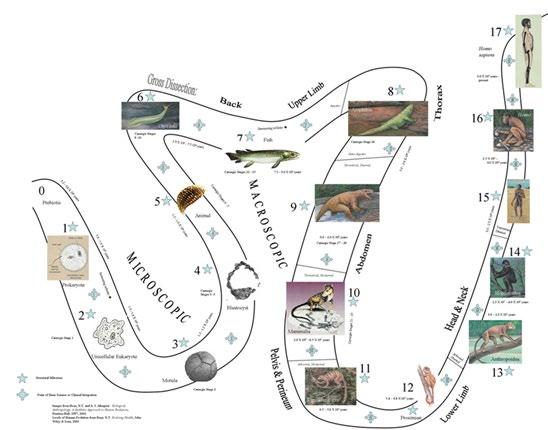
Fig. 1. Onto-phylogenetic stages of the human organism from Boaz (2002). This evolutionary approach elaborates organismal biology from 1) early to late geological time, 2) simple to complex structure and function, 3) microscopic to macroscopic scales, and 4) regional anatomical systems based on key morphophysiological adaptations Human pathologies from this view of Evolutionary Medicine can be understood as disruptions or dysfunctions of one or more of these adaptational plateaus.
Lectures will be built around the evolutionary nodes of human phylogeny as referenced to the Time Tree of Life Project ( www.timetree.org ), which integrates genomic, paleontological, and geochronological data (Figure 2) . LUCA refers to the Last Universal Common Ancestor which lived some 4.3 billion years ago. This empirical framework underlies the evolutionary narrative illustrated in Figure 1. The figure lists early major steps in the evolution of the integument, one of the eleven systems of the body.
Fig. 2. Phylogram of human evolution from the Last Universal Common Ancestor to modern hominins. Inferred geological ages for taxonomic nodal points are indicated. Extant comparative or model organisms are listed along the top row.
Lectures will highlight Evolutionary Medicine as a robust field of ongoing research, as indicated in Figure 3. Although essentially retrodictive and historical in its narrative elements, evolutionary medicine draws on numerous independent paradigms and scientific disciplines to falsify hypotheses. Those hypotheses which defy disproof are incorporated into the synthesis. This synthetic nature of Evolutionary Medicine is the glue that binds the many disparate fields of scientific medicine together and enables a coherent picture of human health and pathology to emerge.

Fig. 3. A matrix of hypotheses (narrative elements) in Evolutionary Medicine on the Y-axis and scientific disciplines (paradigmatic tools) used to test them on the X-axis. Only those narrative elements that survive multiple empirical cross-checks are retained as working hypotheses.
Lecturio Videos and Question Banks
As part of this review course students will have access to Lecturio. Of the many premedical, postbaccalaureate, and medical studentreview course platforms now available, Lecturio was found to offer the bestfit with this curriculum, with which it will be closely integrated. Video lectures (Figure 4) by medical school faculty are professionally produced and are cross-referenced to the most commonly used textbooks, which will be referenced in this course. These lectures and the associated references will be the primary sources of basic science content utilized in the evolutionary narratives.


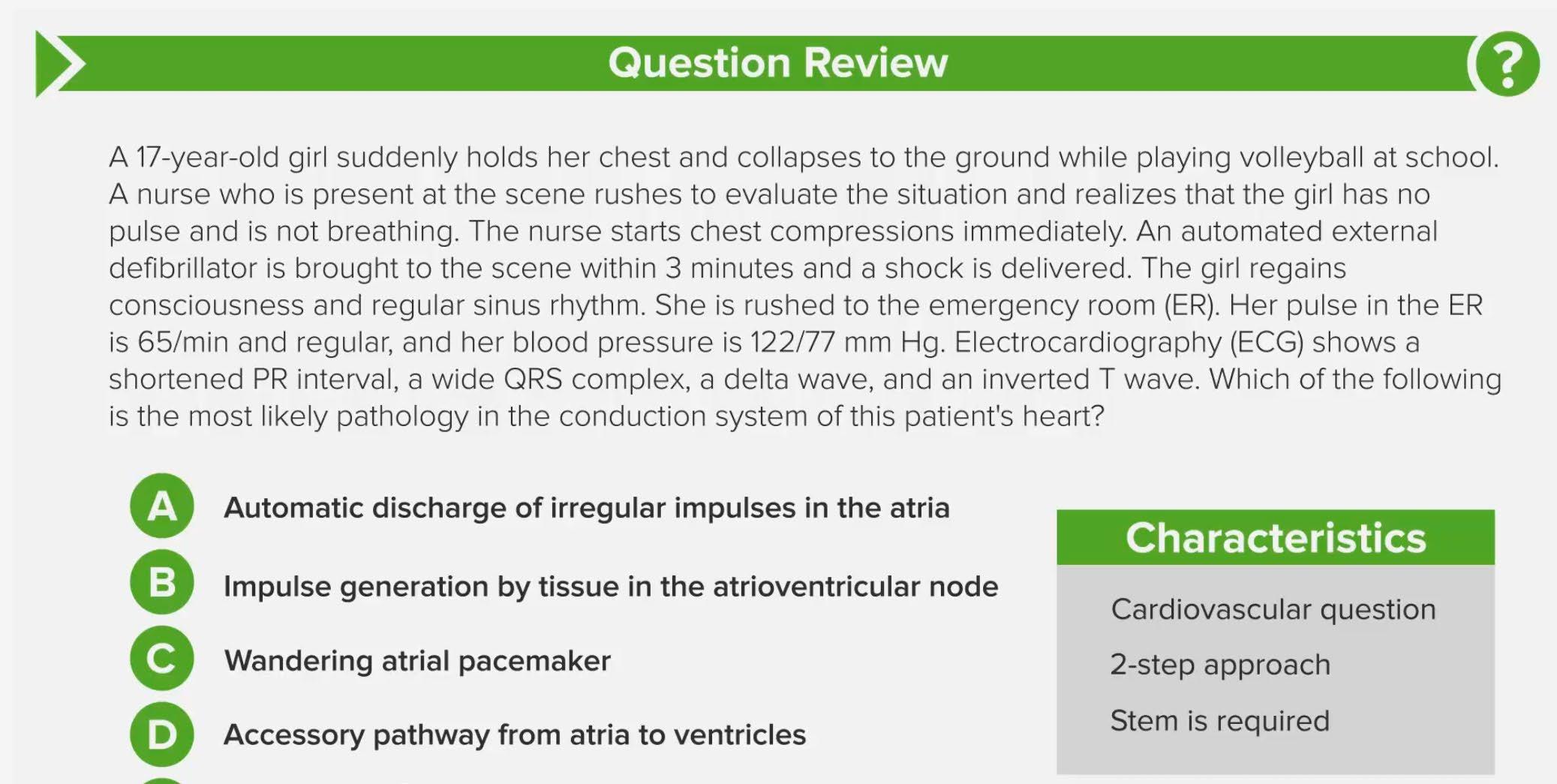
Lecturio offers a wide range of premedical (MCAT) and medical student (USMLE) questions for review and practice (Figure 5). These questions are adaptive in that they remember past mistakes by the student and repeat these questions for closer review and reinforcement. There is an emphasis on clinical v ignette questions that are now emphasized on medical board examinations.
Fig. 5. A USMLE- type review vignette question in Lecturio. The question is first read aloud, the answer options given, and the steps needed to answer the question are reviewed. I n this instance the question is identified as a cardiovascular system question. It is a second- order question, i.e. one that needs two steps to answer. And lastly, it is a question in which the information in the stem (the main narrative) is required to answer the question. If the student answers correctly, he or she goes on to the next question. If not, there is a detailed answer that pops up to explain why that selection is incorrect, and the student has another chance to answer. The system remembers incorrect answers and will re - present a missed question in a future review session.
DRAW -IT- TO- KNOW -IT
Active learning is a central element of effective didactic practice, even in on- line courses. Draw - It- ToKnow - It is a medical education learning platform that presents videos that lead a student though drawing a structure, flowchart, or process. Figure 6 shows three successive stages of a lesson from Draw - It- To- Know - It on kidney structure and its relationship to the clinical entity of nephrotic syndrome.
LucidChart Concept Mapping


Experience shows that many students have enough knowledge to pare down the number of potential answers in a multiple choice question to two, but choosing between those two becomes a toss-up. 5050 are not good odds for getting into medical school or passing one’s licensure examination. Concept mapping is an active-learning modality developed by Dr. John Pelley, a professorof biochemistry at Texas Tech University School of Medicine to aid medical students who had failed to pass the USMLE Step

One examination. It is a laborious and time - consuming process but for students who are committed to drilling dow n to the right answer, it is a tried and true method of success. An example of a simple concept map is illustrated in Figure 7.
Constructing a concept map
1. Select the topic to be studied. Since it is going to be subdivided, the size of the topic is not critical. It can be part of a lecture or material that is covered in several lectures.
2. Identify by listing on a notepad or highlighting the major concepts from the text, and especially material from the lecture notes that was especially emphasized.
3. Rank the concepts (and facts) from most general to most specific.
4. Arrange the concept map with the most general concept at the top. Link it to the less inclusive concepts and enclose the t ext with circles or other shapes. Label lines with linking words that explain the relationship, if needed. Arrowheads can show direction, cause-and-effect, etc.
5. Try to branch out at each level of the hierarchy with more than one link.
6. Identify and dr aw cross-links between related concepts. This is a powerful step in developing integrative thinking.
7. Alternative patterns: A “spider” or cluster pattern can be constructed from the center outward, but this will not be seen as readily by sensing types.
8. Leave white space to grow your map for further development , explanations, action items
9. Expand the map over time (right up to an exam if necessary!)
10. Compare your maps with others; different groupings or overall organization can teach insight.
Figure 7. An example of a concept map of caffeine used to begin mapping its pharmacological effects on the body (from J .W. Pelley, Ph. D. https://www.ttuhsc.edu/medicine/medical- education/successtypes/documents/conceptmappingmedschool.pdf ).
A flexible and user- f rie ndly software program that can be used on mobile phones, tablets, laptops, or desk- top computers is LucidChart, which will be provided to students in this course. Comparison of student- generated concept maps of a problem or question provides an excellent basis for a small- group learning session.

References Cited
Boaz, N. T. 2002 Evolving Health. New York: John Wiley
Darwin, C.R. 1859 Origin of the Species . London: Murray.
Eaton, S.B., M. Shostack, and M. Konner 1986 The Paleolithic Prescription New York: Harper and Row
Kwan R, Mafe C. 2016 Rote learning: a necessary evil. Adv Med Educ Pract. A ug 2;7:429- 32. doi: 10.2147/AMEP.S115838. PMID: 27536167; PMCID: PMC4976761.
Gluckman, P. D., Beedle, A., Buklijas, T., Low, F., & Hanson, M. A. 2016 Principles of Evolutionary medicine (Second edition). Oxford: Oxford University Press.
Mayr, E. 1982 The Growth of Biological Thought. Cambridge MA: Belknap.
Ne sse, R., and G. Williams 1999 Why We Get Sick. New York: Vantage
Regan- Smith MG. Obenshain SS, Zeitz H, Richards B, Wood- ward C, Small PA. 1994 Rote learning in medical school. JAMA, 01 Nov 1994, 272(17):1380- 1381
Simpson, G. G. 1944 Tempo and Mode in Evolution . New York: Columbia Univ. Press.
Stearns, S. C., & Medzhitov, R. 2016 Evolutionary medicine. Sunderland, Massachusetts: Sinauer.
Trevathan, W., E.O. Smith, and J. McKenna (eds.) 2007 Evolutionary Medicine and Health. 2nd ed. New York: Oxford University Press