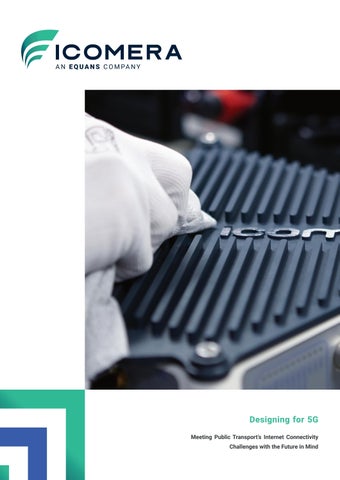
Designing for 5G Meeting Public Transport’s Internet Connectivity Challenges with the Future in Mind
Background The demand and consumption of Internet data by passengers and onboard systems on public transport have steadily increased, alongside the implementation of each new generation of wireless communications technologies and standards. One of the methods presently employed to provide passengers with Internet connectivity during their journey is to facilitate direct connections from their mobile devices to cell towers along the route. This system, however, is unable to offer the coverage and capacity required to meet the increasing demand for data, as each connection is reliant on the capacity and coverage provided by a single Mobile Network Operator (MNO) at a time. This can result in an onboard experience that is unpredictable, unfair, and generally unreliable. Additionally, a direct passenger-to-cell-tower strategy does not provide onboard digital systems with Internet connectivity - an important consideration in the modern era. Installing onboard networks that can intelligently aggregate all available capacity from all MNOs and other sources along the route allows transport operators to cost-effectively use existing wireless communications standards and technologies, along with those introduced by 5G, to ensure fast, consistent connectivity to their vehicles and passengers.
1
Part 1 Cellular Connectivity Today The future of public transport is digital, with both passengers and transport operators having growing expectations for the Internet connectivity available on vehicles. Passengers demand constant connections when they are onboard, and transport operators want real-time operational data from their vehicles.
Passenger Data Demand Passengers expect to be able to use the Internet, on demand, wherever they are. Reports show that wireless data consumption has continued to increase rapidly year-on-year, especially since the deployment of 4G (now dubbed “The Streaming Era”). Increases in wireless data usage and higher average data volumes per session have primarily been fuelled by video content consumption. In addition to content streaming, the opportunity to increase productivity while travelling has, over the last decade, made public transport usage more attractive for passengers. With the ability to send emails or take part in conference calls, commuters can work beyond the confines of the office space. Leisure passengers can communicate with friends and family via social media, shop online, or catch-up with the latest news. The COVID-19 pandemic has created the need to restore passenger confidence in their use of public transport, especially where more crowded services are concerned, as well as the need to adopt new means of working. This is best achieved through the communication of onboard safety measures, real-time service updates, and passenger loads via technologies such as Wi-Fi portals, and passenger information and announcement systems. The availability of Wi-Fi on trains and buses is also helping employers and employees to stagger work start and end times. A passenger’s commute can now contribute towards their core working hours, easing the congestion of traditional peak travel hours.
2
Transport Operators’ Data Demand The number of onboard devices or systems requiring Internet connectivity is increasing, along with the bandwidth required by the features they offer. Transport operators are installing these connected devices to improve communication channels and the flow of real-time information for passengers and staff, and to remotely monitor and manage their vehicles by intelligently predicting and pre-emptively resolving issues to prevent service disruption. Some of these connected systems will be business-critical, especially in the wake of the COVID-19 pandemic, which has brought the need to bolster passenger confidence in public transport services.
Digitally connected vehicles of the future support numerous onboard devices and systems that all require reliable Internet connectivity to function optimally.
These Sources of Demand Raise Two Main Challenges for Transport Operators: 1. Passengers and onboard systems share the same limited bandwidth of the onboard Internet connectivity 2. Connectivity needs to be available for the entire journey through rural and/or urban environments Icomera has seen this rise in demand first-hand since we created the passenger Wi-Fi business segment twenty years ago. Today, personal and commercial Internet connectivity on the move is largely delivered through cellular networks, however in most countries, MNOs and regulators do not prioritise coverage and capacity along public transport routes, which are sparsely populated. As the world’s leading provider of mobile Internet connectivity for public transport, we have had to identify and address numerous challenges in order to deliver the fastest, most reliable Internet connection for passengers and transport operators.
3
Challenges That Have Been Overcome: The Faraday Cage Effect The Challenge: The metallic construction of public transport vehicles tends to block electromagnetic signals, shielding equipment, staff, and passengers from all but 0.1% of external Radio Frequency (RF) signals - known as the "Faraday cage effect". This issue makes it very difficult for a smart device located within the vehicle to directly find the signal provided by a cellular network operator.
Generally, only 0.1 % of RF signals are able to pass through into public transport vehicles with metallic coverings on their windows.
The Solution: To bypass the Faraday cage effect, purpose-built external antennas are mounted on the vehicle’s roof, which capture all available 4G & 5G network capacity outside of the vehicle. This connectivity is then aggregated and delivered in full to the vehicle’s onboard network and provided to passengers as reliable, highspeed Wi-Fi throughout the inside of the vehicle.
Roof-mounted antennas bypass the Faraday cage, allowing reliable, direct access to the onboard network.
4
Poor Network Coverage & Capacity Along Routes The Challenge: A single MNO is often unable to offer sufficient coverage and capacity for the entirety of a vehicle’s route. Geographical patches of poor coverage and capacity mean that the strength and stability of the Internet connection varies, causing data packets to be delayed or lost. In real-world terms, this means slow webpage load times, video buffering, broken VPN tunnels and dropped conference calls. Furthermore, mobile devices can only connect to one cell tower and one network operator at a time. This is not very effective when a vehicle is travelling between cell towers at high speed! When switching between towers or networks, the “handover” is not always seamless, meaning that passengers and systems will still experience data packet delay or loss and, in some cases, failed hand-over, where the call or data connection is lost completely.
The Solution: Specifically designed for use on public transport, Icomera’s multi-modem mobile access routers aggregate all of the available radio frequencies across multiple carriers. When the connection from a particular MNO is lost, the router retains all other available connections, improving the reliability of the onboard connectivity even in regions with sparse network capacity. To accomplish maximum data capacity, coverage, availability, redundancy, and minimise data loss from handover, Icomera’s SureWAN™ algorithm allows the modems in its routers to intelligently connect to multiple cellular (and other communications) networks at the same time, as part of a single solution.
5
Increased Load on Cellular Networks The Challenge: As an example from rail transport, from a cellular network’s perspective, a modern train is comparable to a small town of up to 1,000 people arriving in their area of coverage at over 200km/h and leaving again just as quickly. Imagine this many passengers all trying to maintain a direct connection to the same cell towers along the route. Attempting to connect this many users at once results in resource fragmentation, lost capacity, and data packet loss in the “handover” from one cell tower to the next.
Average users per household, café, and a modern train full of passengers. The latter is comparable to a small village or town, in terms of numbers of users.
The Solution: Icomera’s onboard connectivity platform reduces the total number of direct connections from devices on board the vehicle, to the cell towers along the route, reducing the strain on the cellular network Icomera’s multi-modem aggregation router acts to distribute the load across all available networks, ensuring more available capacity for passengers and that existing infrastructure is used more efficiently. This is achieved through two levels of aggregation: ● Carrier Aggregation: Each modem in the router aggregates all available radio frequencies from a single MNO along the route ● MNO Aggregation: Each router contains multiple carrier-aggregating modems, capturing all available capacity provided by all MNOs in the coverage area This multi-layered approach allows the router to maintain seamless aggregated connectivity, even as the vehicle passes through different networks. 6
The Efficiency of Aggregation In summary, specialised vehicle roof antennas, Icomera’s high-performance multi-modem routers, and SureWAN technology all work together to ensure higher total available capacity and increased stability. This is achieved by aggregating all available capacity outside the vehicle and delivering it to passengers and onboard systems through a single onboard network. The efficiency of modem and carrier aggregation can be illustrated by comparing modes of transport: Due to their total capacity, a single train or bus is a more efficient means of carrying people over longer distances when compared to the number of cars required to transport the same amount of people. Likewise, a stable, aggregated connection will carry more packets of data over time than less reliable individual connections, which may also suffer packet loss in handover.
One train transports more passengers than a much higher number of cars. Similarly, carrier aggregation transports more packets of data by combining a higher number of them into a single connection.
Technologies deployed to enable passenger-to-tower connectivity via their own mobile devices act to resolve specific issues, such as the Faraday cage effect, however their scope does not extend beyond this, so additional solutions are required in any case. These methods also rely on a single MNO’s network and one network alone cannot provide adequate coverage or capacity along every route, resulting in an onboard experience that varies from passenger to passenger, likely depending on how much they pay for their mobile data subscription. Onboard multi-modem aggregation routers, however, will always offer more reliable connectivity and an effective way to overcome all connectivity challenges, all of the time, rather than just targeting a single use-case. Additionally, the aggregation of all available capacity from all MNOs resolves the problems presented by insufficient coverage and capacity along routes, empowering transport operators to give their passengers a fair and reliable digital experience to match their excellent overall customer service delivery. 7
8
Part 2 5G and Public Transport Given public transport’s heavy reliance on cellular networks for onboard wireless Internet connectivity, it should be no surprise that “5G” is an extremely popular topic for discussion. But, what is 5G and to what extent is it useful for public transport operators? Going forward, we will establish what 5G comprises, the benefits it promises, its limitations, and how public transport operators can back-haul 5G connectivity to the vehicle without having to install potentially costly and potentially inefficient technologies, such as radio repeaters or RF-transparent windows.
What is 5G? The cellular telecommunications industry is periodically upgraded with new standards approximately every ten years and the previous generation of standards, LTE (4G) had to evolve for cellular operators to meet the rising demand for public data consumption. While the term “5G” is generally used as a catch-all term for a single wireless technology; 5G is better described as “the fifth and latest generation of multiple wireless communications standards and technologies”. The difference between 5G and 4G LTE technologies is not nearly as pronounced as the leap in functionality seen in the transition from 2G to 3G, and 3G to 4G, respectively; therefore, it is best to think of 5G as an upgrade rather than a total overhaul, or an “evolution, not a revolution”.
The 5G Promise
5G promises higher capacity, lower latency, and greater throughput than 4G networks. 5G’s objectives are to offer a thousand times higher cellular data volumes, ten- to one-hundred times typical end-user data rates (up to 10 Gbps), and lower latency, all at a lower cost for both MNOs and consumers - When compared to the 4G standards of 2010. 9
Components of 5G The technologies that comprise 5G use additional RF bands with much greater bandwidth, and new radio antenna configurations, on top of existing infrastructure, to deliver faster, more cost-efficient communications and increased network capacity and availability than was previously possible solely with 4G LTE networks. New Radio (NR) The term New Radio (NR) can be thought of as the technology (“radio access method”) behind the name “5G”. In this sense, it is to 5G what LTE is to “4G”, or WCDMA is to “3G”, etc. The two main frequency ranges currently used by 5G cellular networks are: Frequency Range 1: 400 MHz – 4.2 GHz frequencies (Low/Mid Band) Frequency Range 2: Around 30 GHz (mmWave)
Note: Exact frequency ranges may vary across each geographical region and their specific regulations.
The first group of frequencies (“Sub-6 GHz”) are themselves split into two bands: ● Low Bands: < 1 GHz ● Mid Bands: 1 GHz – 2.6 GHz, and approximately 3.4 GHz – 4.2 GHz (depending on region) 5G adds a wider frequency spectrum for Mid Bands, more than doubling the total available cellular capacity by including the 700 MHz band for coverage, and the 3.4 GHz to 4.2 GHz range for additional capacity. It is this collection of “Sub-6 GHz” frequencies that will form the backbone of 5G networks for public transport (with the 5 GHz and 6 GHz bands ideally allocated for Wi-Fi usage). Frequency Range 2: Millimeter Wave (mmWave) The second group (“mmWave”) are radio waves that, for practical usage, generally fall within the 24 GHz to 80+ GHz frequency range. As 5G becomes more prevalent, frequencies of around 30 GHz are being considered as additional bands for use in urban areas throughout Europe and North America. 10
The Limitations of 5G for Public Transport 5G provides plenty of great opportunities for increasing data capacity on public transport, however there are some limiting factors that transport operators should take into account:
Frequency Limitations Higher frequency RF bands such as mmWave propagate poorly over long distances when compared to lower frequencies, so they are generally not the best choice for most public transport connectivity use-cases, particularly where long, rural routes are concerned. Low and Mid Band frequencies in the 3.4 GHz - 4.2 GHz range are still the most versatile options for delivering consistent connectivity along entire routes, with mmWave becoming more useful at shorter ranges, for example in station/depot environments, when the vehicle is in a dedicated mmWave network.
Duration of Rollout Due to the CAPEX-constrained nature of cellular network development, it is likely that the 5G rollout will take a considerable amount of time, as MNOs may only be able to reasonably replace a small portion of their infrastructure each year. This puts large-scale mass adoption of “real” 5G services at around the mid-2020’s, with full 5G rollouts in higher bands likely taking even longer to complete. Therefore, because 5G has some limitations where public transport is concerned, transport operators need to adopt a wider connectivity strategy, selecting the right technologies that will make the most of 5G’s eventual benefits, while continuing to resolve existing connectivity challenges well into the future.
11
12
Part 3 Designing for 5G We have outlined the challenges that transport operators faced in providing reliable mobile Internet connectivity to their vehicles and how Icomera overcomes those challenges. Next, we looked at the composition of 5G as well as its limitations for public transport applications. We will now present the solution that allows transport operators to derive benefits from the improved cellular technologies and standards that 5G brings, without resorting to costly or inefficient measures.
Does 5G Resolve the Existing Challenges Presented by Cellular Networks? In a word, “No”. The existing challenges faced by public transport operators broadly remain unaffected, as there is no difference in the technologies required to circumvent them, especially where the lack of coverage and capacity along routes are concerned. Taking this all into account, Icomera recommends that transport operators take extra care when considering their options for delivering vehicle connectivity, prioritising cost efficiency, long-term reliability, and provable results above all else. To that end, Icomera designs its solutions to offer transport operators the best of both LTE and 5G technologies, while continuing to overcoming existing challenges. 13
Delivering End-to-End Capacity Coverage is Not Enough In the same way that cars need roads to be built from their origin to their destination to make their journey, mobile data requires cellular network coverage along the entire route. This coverage, however, does not count for much if the capacity provided by that coverage is low. To continue the car analogy, a narrow dirt road (low-capacity coverage) connecting two cities supports fewer cars (analogous to data packets), compared to wide motorways that allow for the movement of many cars travelling in both directions at the same time.
Coverage is not enough! The route is covered by two roads, however their capacity to transport vehicles differs considerably.
To deliver enough Internet capacity to meet the demands of all passengers and systems on vehicles moving at high speeds, all available network capacity from within and without the vehicles needs to be used in the most efficient way possible. To achieve this level of connectivity, the vehicle needs to be equipped with a multi-modem aggregation router, roof-mounted antennas, and, ideally, 10Gbps PoE Ethernet switches.
14
A Transport Operator-Led Approach Icomera provides a proven method for delivering reliable, high-speed connectivity across entire routes using a “5G/LTE-hybrid” approach. This maximises the effectiveness of existing coverage and capacity, plugs gaps along the line, and delivers more consistent performance, closing the gap between that performance across both rural and urban environments, all in a fully cost-efficient manner. Of course, this approach does not bypass MNOs by any means – It simply facilitates their cooperation with transport operators, who will have better control over the data being used on their own vehicles, while opening a direct channel of communication with their passengers, as well as opening the door to new sources of revenue.
15
5G-Ready Onboard Routers
In order to utilise 5G connectivity, it is necessary to install onboard routers that are 5G capable. The ideal onboard mobile aggregation router houses up to four 5G modems. In turn, each modem has four antenna ports, totalling sixteen router antennas. Within every router, multiple modems connect to multiple cellular networks and aggregate all available capacity for the best results. 5G-ready routers use “MIMO” (Multiple Input / Multiple Output) antenna technology. “Multiplexing MIMO” makes it possible to send and receive multiple signals along the same radio channel by using (typically) two or four antennas, and has been in wide commercial use since the adoption of 4G. To make the most of 5G connectivity, it is also important to ensure that: ●
5G-ready routers support 10Gbps Ethernet;
●
From routers to switches and access points, every part of the onboard network must support a higher data transfer rate between systems & devices;
These factors are important, as an onboard network’s bandwidth is only as strong as its weakest link. For example, routers that only support 1Gbps Ethernet will only be able to deliver a maximum of 1Gbps throughout the vehicle, even if the potential router capacity being delivered to the vehicle is higher. 16
Vehicle Antenna Configurations Vehicle Antennas & Supported Frequencies Icomera will help transport operators ensure that their vehicles’ antennas can use 5G frequency bands, as well as advising on the number of antennas they will need to install. As previously discussed, Low and Mid Band frequencies are suitable for most cases involving moving vehicles, since they can travel over longer distances. mmWave frequencies may be used in specific use cases where coverage is only needed over short distances, for example in depots or stations. Transport operators planning for 5G should consider whether the vehicle antennas they currently use can take advantage of the 700 MHz band and the 2.3 GHz – 4.2 GHz range as they become available. 5G technology is backwards-compatible: i.e. 5G products will be able to use the new frequency ranges as well as the previous LTE frequencies.
Number of Vehicle Antennas In addition to considering whether the currently installed antennas can receive all new frequency bands, transport operators also need to consider the quantity of cellular antennas required. For example, a 2x2 MIMO installation increases performance using two antennas that can send and receive data simultaneously, however it may not be able to fully take advantage of 5G technology. 5G modems support 4x4 MIMO, which uses four antennas per modem to further improve performance.
As industry leaders, Icomera brings its innovative technology platform and expertise to transport operators, helping them to benefit from the full potential of 5G connectivity, while continuing to overcome existing challenges. 17
Trusted Solutions from the Leading Supplier Icomera is committed to providing the best possible connectivity to public transport vehicles and is working actively alongside the 5G rollout. Icomera pioneered aggregated wireless connectivity, as well as the use of MIMO antennas for the public transport sector. We have employed 5G specialists and have strong working relationships with leading telecommunications industry figures, researchers, and technology institutes. These relationships allow us to design and build our technology to meet the current and future needs of the transport industry - specifically, the types of applications that operators will be looking to support over the next 10 years and the data requirements that come with these. Our guidance and approach today eliminates potential bottlenecks for innovation in the future, making for the most cost-effective delivery of digital applications based on real-time data streams and accelerating the realisation of truly connected journeys. We work alongside transport operators as a Digital Partner to provide the best possible connectivity, including that provided by 5G. If you have any questions about how your Icomera solution can take advantage of 5G connectivity, contact your Account Manager.
About Icomera We work with other industry leaders and academics to harness 5G-ready mobile network aggregation technology, to deliver the Digital Journey of the future: A secure digital ecosystem that allows transport operators to derive considerable benefits from data-driven insights. Icomera, a subsidiary of EQUANS, is the world’s leading provider of wireless Internet connectivity for public transport. Icomera is committed to promoting green mobility by making public transport a more attractive option for passengers. 18
ICOMERA Odinsgatan 28, 411 03 Göteborg, Sweden T +46 31 799 21 00 sales@icomera.com