China’s integration into the global fixed income market
One language, multiple rails
Agents, not assistants
Covered bonds and SSAs
Primary, secondary and repo and collateral markets
Buy-side
Sustainable finance
FinTech and digitalisation
ICMA Women’s Network: Pioneering Women in Finance
The mission of ICMA is to promote resilient and well-functioning international and globally integrated cross-border debt securities markets, which are essential to fund sustainable economic growth and development. ICMA is a membership association, headquartered in Switzerland, committed to serving the needs of its wide range of members. These include public and private sector issuers, financial intermediaries, asset managers and other investors, capital market infrastructure providers, central banks, law firms and others worldwide.
6 THOUGHT LEADERSHIP IN INTERNATIONAL CAPITAL MARKETS
6 Making Treasury clearing work: the importance of cross-product netting and existing legal frameworks
9 China’s integration into the global fixed income market: policy reforms, market dynamics, and the future of market liquidity
13 One language, multiple rails: a common standard for digital and traditional assets
15 Agents, not assistants: agentic AI in capital markets
18 Covered bonds and SSAs: symbiosis and resilience
24 The benefits of 28th Regimes for enhanced unity and more common strength in a challenging phase of EU integration
27 SUMMARY OF PRACTICAL INITIATIVES BY ICMA
32 Reflections from the 58th ICMA AGM & Conference
34 PRIMARY MARKETS
34 ICMA Primary Market Handbook: Bond Data Taxonomy appendix
34 UK prospectus and listing regimes: FCA PRM and UKLR sourcebooks
35 ICMA response to SEC proposal on Rule 15c2-11
36 FCA statement on firms working together to manufacture products or services
36 Strengthening securitisation through regulation and beyond
37 UK securitisation regime reform: joint associations’ response to FCA and PRA consultations
38 SECONDARY MARKETS
38 Bond market transparency, consolidated tapes UK and EU - recent updates
40 European Secondary Bond Market Data Reports: Sovereign Edition
41 European Secondary Bond Market Data Reports: Corporate Edition
42 EC MISP proposal and duplicative reporting: joint trade association paper and next steps
42 T+1 UK, EU and international: latest developments
43 Bond price distribution
44 Secondary Market Practices Committee (SMPC) Q2 meeting and bilateral member outreach
45 ICMA’s Electronic Trading Working Group (ETWG)
45 UK T-bill market
46 REPO AND COLLATERAL MARKETS
46 ICMA’s European Repo and Collateral Council (ERCC)
47 China repo market: Observations and potential area of focus
47 ICMA report on DLT and Repo published
48 Gilt repo market resilience
48 EU transition to T+1: Additional guidance published on the new Gating Event
49 SEC mandatory clearing for US Treasuries
50 ESMA reports on transaction reporting
50 ICMA SFTR Recommendations
50 Legal developments
51 BUY-SIDE
51 The buy-side moves to the foreground at the ICMA AGM
52 Q2 2026 AMIC Committee
52 AMIC May podcast
53 Beyond the lights-out factory: human adaptation in AI-driven fixed income markets
55 SUSTAINABLE FINANCE
55 Sustainable bond market update
56 Market guidance from the Principles
58 12th Annual Conference of the Principles
59 London Climate Action Week 2026
60
Regulatory and policy developments
62 Two decades on, IFFIm keeps turning capital into vaccines
65 FINTECH AND DIGITALISATION
65 BDT 2.0 release
65 ICMA response to Eurosystem Appia consultation
66 DLT Bonds Working Group
66 FinTech Advisory Committee
66 FinTech regulatory developments 68 AI regulatory developments
Speechify, the text to speech platform, is being used in this edition of the QR. Articles which are available in audio format can be identified by this icon. Click on the icon to hear the article read out.
Global markets, shared priorities
by Bryan Pascoe, Chief Executive of ICMA
Reflecting on our recent AGM and Annual Conference held in London at the end of May, it is very encouraging and pleasing to see the exceptional convening power ICMA has across the full fixed income landscape. With well over 1,300 people in attendance over the two days this was by some way our largest turnout.
Fully aligned with our deliverables on a day-to-day basis, market resilience against the backdrop of structural change was the core underlying feature of discussions throughout the conference. Sessions highlighted the critical importance of maintaining robust market infrastructure as market participants prepare for shorter settlement cycles, changing liquidity dynamics and increasing demands on collateral and funding markets. The role of repo, the mainstreaming and interconnectedness of private credit with wholesale markets, market transparency and effective regulatory frameworks all featured prominently, reflecting our collective continued commitment to ensuring that markets remain efficient, stable and capable of supporting economic growth during periods of uncertainty.
The impact of technology, particularly artificial intelligence, is impossible to ignore and our working groups on the use of AI in capital markets have become very busy. What was only recently a future trend to monitor is now instrumental in market structure change in capital markets. Discussions are increasingly focused on practical implementation, governance and the organisational changes required to realise AI’s potential. Similarly, opportunities presented by tokenisation, digital assets and new forms of market infrastructure are constant themes, while emphasising the importance of interoperability, common standards and maintaining market integrity as innovation accelerates. Specifically on standards, it is very encouraging to see that the ICMA Bond Data Taxonomy (BDT) is now seeing material adoption by key market participants, and this will be a critical element of facilitating the effective take up of industry digitalisation going forward.
The implications for repo markets of many high-level
regulatory initiatives are growing areas of focus for our work. The unfolding final rules on regulatory capital requirements in the US and beyond may present opportunities for more efficient balance sheet usage and the reduction of counterparty exposure complexity, especially related to the implementation of cross-product close-out netting for repo and other markets’ products. ICMA supports and advocates strongly for such efficiency gains and, through the existing documentation framework provided by ICMA’s Global Master Repurchase Agreement (GMRA) and broader market engagement through the European Repo and Collateral Council (ERCC) and Global Repo and Collateral Forum (GRCF), is well-set to support the industry in capitalising on such potential regulatory changes across jurisdictions. We highlight this point in more detail in the following Thought Leadership article.
On a closely related point, the upcoming move to mandated central clearing of US Treasuries has major implications for the entire global market. We are working closely with our members on this, both to influence the finalisation of the US Securities and Exchange Commission (SEC) regulation and support the preparedness of members and how they may need to adapt their business models and counterparty relationships as we look ahead. Repo is also a central feature of the work being carried out in the UK by the Bank of England in their assessment of Gilt market resilience. With actions concentrating on the role of central clearing and minimum haircuts we continue to advocate strongly for careful consideration of negative market outcomes and proportionate and targeted regulatory actions.
The truly international scope of our repo work is also reinforced in APAC. In China, our advocacy with key regulators and collaboration with members has been instrumental in the recent moves by the People’s Bank of China (PBoC) to open up the domestic repo market to offshore participants in the interbank bond market, most notably through the recognition by the PBOC of the GMRA. Looking forward, our recently formed China Repo Committee, bringing international and domestic market participants together to facilitate effective
advocacy and market development, will be an important conduit to help us shape closer integration with international practices as this gathers pace. In the Thought Leadership section, we explore this further within the context of China’s broader integration into the global fixed income market.
In the EU, the reassessment of the competitiveness and growth agenda is being realised through the broad ranging Market Integration and Supervision Package (MISP). This is a key legislative initiative to advance the Savings and Investment Union (SIU), with the principal aim of minimising barriers and friction, and covering areas such as the supervisory architecture, market infrastructure integration, improving post-trade practices and digitalisation and innovation. With the oversight of our Regulatory Policy Committee, ICMA has recently been active across many of our member groups to consolidate and position our views on this initiative and we would expect this to continue well into 2027. We will be remaining closely engaged in all areas relevant to our community.
Looking at ICMA structurally, the picture on our membership is positive with strong retention and a good pipeline of prospective members from all regions. Currently we have 633 members in 71 jurisdictions. We will continue to coordinate our regional committee meetings and lunches throughout the year, which are extremely valuable both in terms of maintaining personal contact and relationships as well as providing the ideal forum to receive feedback and understand member priorities.
And finally turning back to the AGM, aside from the strong content and substantive professional discussions, the camaraderie and genuinely warm networking that was clearly in evidence was again the standout feature of the event, as it was at the highly successful AGM and Conference of the Principles held last month at Bocconi University in Milan. ICMA’s community is unique, both in terms of the breadth of organisations and the jurisdictions from which our members come, providing such a rich and powerful blend of perspectives and personalities. We are very proud to be able to play the role that we do in bringing the global industry together through our broad ranging events and networking initiatives and we thank you, as always, for your involvement and support.
Making Treasury clearing work: the importance of crossproduct netting and existing legal frameworks
by Bryan Pascoe, Andy Hill and Leland Goss
Recognising existing cross-product netting frameworks, particularly the Cross-Product Master Agreement (CPMA), can play a critical role in ensuring US regulatory capital reform, mandatory US Treasury clearing, and cross-product margining promote efficient market functioning without forcing the market to reinvent its legal infrastructure.
Multiple reforms: one common objective
US wholesale banking and financial markets are currently amid a convergence of multiple and far-reaching regulatory reforms. Fundamentally, further enhancing the resilience of the US Treasury market is at the core of many of these initiatives and at the centre of this is the repo market.
Most directly impacting the Treasury cash and repo markets are of course the Securities and Exchange Commission (SEC) mandatory clearing rules, that are planned for introduction on 31 December 2026 and 30 June 2027 respectively. Intended to reduce systemic risk and improve transparency, this represents one of the most significant structural overhauls to the Treasury market in living memory. This $31tn market remains the world’s premier safe asset market, underpins much of the global financial market architecture and is used to price a broad range of bonds, derivatives and other financial instruments. The success of mandatory clearing and the ongoing effective functioning of the US Treasury cash and repo market is an imperative for all of us.
Perhaps less obviously related, but equally as important and with the potential to be even more far reaching, are the proposed reforms to the US regulatory capital framework that are outlined in three separate Notices of Proposed Rulemaking (NPRs) put forward by the Federal Reserve
Board, the Federal Deposit Insurance Corporation, and the Office of the Comptroller of the Currency (collectively, “the regulators”). While the final details of the proposals are still the subject of consultation and ongoing advocacy on behalf of the industry, and therefore a moving target, it is widely expected that the overarching result will be lower capital requirements for US banks, at least collectively. Some of the reforms apply specifically to the treatment of repo.
One key proposal of particular importance in light of the forthcoming mandatory clearing rules provides for potential capital relief through cross-product netting. This is directly complementary to the recent ruling by the SEC that allows for cross-product margining for centrally cleared Treasury cash (including repo) and futures trades, thereby facilitating a cross-margining arrangement between the Fixed Income Clearing Corporation (FICC) and the Chicago Mercantile Exchange Inc. (CME).
Cross-product netting as an enabler
The Regulatory Capital Rule: Category I and II Banking Organizations; Banking Organizations with Significant Trading Activity; Expanded Risk-Based Approach; Market Risk and Credit Valuation Adjustment Risk Requirements, better known as the “ERBA NPR” includes a proposal to change how the largest banks can treat their counterparty credit
risk (CCR) exposures for repo and derivatives under the standardised approach (SA). It does so by allowing certain repo-style transactions to be treated similarly to forward derivative transactions for SA-CCR calculation purposes. While the internal model methodology (IMM) had previously provided for the possibility of netting repo and derivatives exposures, there are no clear examples of regulators providing permission for any bank to do so; a perk otherwise enjoyed by some large non-US banks. However, the proposed changes to SA-CCR will help to level the playing field as they have broader implications across the banking system.
This will be key in support of sponsor and agent clearing models for Treasury repo. Under the current SA-CCR, sponsoring banks are generally unable to recognise netting benefits across related client financing and hedging exposures, including repo and derivatives positions, for example, using US treasury repos and US treasury futures. By being able to do so, this will potentially reduce the capital cost of acting as a clearing sponsor, since they can offset repo and futures exposures with the same client. Furthermore, it may draw banks that are active in the futures clearing space into offering repo clearing, and vice versa. There are concerns with the proposed calibration, which applies conservative haircuts where significant maturity mismatches exist between repo and derivative positions, but it is hoped that a workable industry counterproposal, which is currently being finalised, will be acceptable to the regulators.
Existing legal frameworks as a foundation
Repos are widely transacted under the legal contractual framework of the Global Master Repurchase Agreement (GMRA) on a cross-border basis, and the Master Repurchase Agreement (MRA) in the domestic US market. In the case of OTC derivative transactions, the customer relationship is documented bilaterally, for example, under an ISDA or other master agreement. For cleared exchange-traded futures, such as US Treasury futures, the contractual framework will depend on the clearing agreement between the relevant firms and the applicable terms of the CCP’s rulebook.
However, the netting provisions under SA-CCR are far broader than just Treasury repo and futures, and include securities lending (generally governed by the Global Master Securities Lending Agreement (GMSLA) for cross-border transactions and the Master Securities Lending Agreement (MSLA) in the domestic US market), as well as over-the-counter derivatives transactions (which would typically be executed under an ISDA Master Agreement or other forms of master agreements). Hence the possibility for more efficient capital allocation across different product lines stretches beyond just Treasury repo and futures clearing.
Importantly, the ability to net multiple product exposures under the new SA-CCR is contingent on the use of a Qualifying Cross-Product Master Netting Agreement (QCPMNA) in
conjunction with the aforementioned product-specific master agreements which enable contractually close-out netting at the “portfolio level” in the case of a counterparty insolvency. That is, the different product exposures can be offset down to one single, and much smaller, net exposure.
A major obstacle is avoided by being able to do this while keeping in place longstanding product-specific master agreements, such as the GMRA/MRA/GMSLA/MSLA/ISDA (and, importantly, their respective netting legal opinions), by simply supplementing these with an overarching QCPMNA that bridges the existing product-specific legal frameworks and yields a single final netting amount from the respective netting sets on a modular basis. In comparison, any alternative that would require broad-based and highlycomplicated operational and systems change, significant cost, and the overbearing burden of repapering all your existing documentation would seem unpalatable.
While some firms may use their own bespoke “house” crossproduct netting agreements, fortunately an industry-wide standardised cross-product netting agreement already exists: the Cross-Product Master Agreement (or CPMA). Importantly, the CPMA was specifically designed to sit above and connect existing product-specific agreements, rather than replace them. Created in 2000 by leading industry associations including ICMA, this selectively-used contract may soon be realising its true potential as an effective instrument to capitalise on the benefits of cross-product netting and effectively leverage the industry’s existing, wellestablished and functional operational and legal frameworks.
ICMA and ISLA’s response to the NPRs
ICMA and the International Securities Lending Association (ISLA) in the context of pending regulatory change, fully recognise the potential and benefits of cross-product netting to US securities markets participants, particularly in light of the upcoming US Treasury clearing mandate. A critical consideration will be the ability for the market to rely on previously negotiated and executed documentation to effect the efficient use of a QCPMNA.
While the ERBA NPR, in recognising cross-product netting, establishes the calculation of capital requirements for this, the related question of how such arrangements should be reflected as a matter of systemic importance is addressed in the Regulatory Capital Rule: Risk-Based Capital Surcharges for Global Systemically Important Bank Holding Companies; Systemic Risk Report (FR Y-15), better known as the “GSIB NPR”. In this sense, the two proposals are complementary: one focuses on exposure measurement and capital efficiency, while the other considers the broader prudential implications of legally enforceable netting arrangements.
Accordingly, ICMA and ISLA have jointly responded to the GSIB NPR, requesting clarification from the regulators that the CPMA is recognised as a QCPMNA for the purposes of cross-product netting under SA-CCR, while also cross-
referencing the ERBA NPR. We highlight the importance of allowing banks and their clients to continue conducting business across different product lines under existing, well-established, product-specific master agreements, and would caution against any proposed alternative approaches, noting the high cost and significant operational disruption for the industry, undermining the intent and ambitions of the regulators.
Next steps for ICMA
The stability and resilience of the Treasury market is of critical importance to capital markets and economies around the world and ICMA remains committed to advocating for constructive regulatory outcomes, supporting the successful implementation of the clearing mandate, as well as ensuring that securities financing markets function effectively and efficiently globally. We will continue to engage with the US regulators on the important issue of scope, such as our recent responses to the SEC’s outreach on exemptive relief, both with respect to extraterritorial scope and the interaffiliate exemption, as well as in relation to the proposals for cross-product netting and the importance of recognising existing contractual frameworks. Otherwise, we will continue to work with our members across all jurisdictions globally to ensure awareness, preparedness, and minimal disruption to the Treasury market.
Contacts: Bryan Pascoe, Andy Hill and Leland Goss bryan.pascoe@icmagroup.org andy.hill@icmagroup.org leland.goss@icmagroup.org
Bryan Pascoe is Chief Executive, ICMA. Andy Hill is Managing Director and Co-Head of Market Practice and Regulatory Policy, ICMA. Leland Goss is Managing Director and General Counsel, ICMA
China’s integration into the global fixed income market: policy reforms, market dynamics, and the future of market liquidity
by Alex Tsang
RMB internationalisation has returned to the forefront of market discussion and is often framed through the lens of geopolitics and the desire among global investors to diversify away from US dollar assets. However, that is only part of the story. At its core, RMB internationalisation is also a market development story because it broadens the global investment universe, expands funding options and builds the infrastructure needed for international investors and issuers to use RMB markets with confidence.
For ICMA, the most relevant dimension of this process is the internationalisation of China’s capital markets. This can be viewed from two closely connected perspectives, namely investment and funding. On the investment side, the question is how efficiently foreign investors can access and manage exposure to China’s bond markets. On the funding side, the issue is how effectively issuers can raise RMB in cross-border markets, whether offshore through dim sum bonds or onshore through panda bonds. At the same time, these two channels do not operate in isolation. Instead, they are increasingly linked by a third and equally important dimension, which is the development of repo and collateral markets. These markets are essential to secondary market liquidity and therefore to the long-term sustainability of international participation.
Investment access is no longer the principal constraint
China’s bond market is already one of the largest in the world, and policy direction over the past decade has consistently favoured broader and more efficient international access.
Foreign investors today can invest through a range of established channels, including the unified Qualified Foreign Investor (QFI) regime, China Interbank Bond Market (CIBM) Direct and Bond Connect. Formal market access is no longer the main barrier it once was, although operational and market-structure frictions still constrain broader participation.
The channels are no longer experimental, even if some newer features are still evolving. Access mechanisms have benefited from a series of incremental policy enhancements across the onshore, offshore and cross-border landscape, all of which are intended to reduce operational friction and improve investor confidence. Swap Connect is an important example. By allowing Bond Connect investors to access onshore interest rate swaps for hedging, it helps address one of the classic barriers to foreign participation in local currency bond markets, namely the ability to manage duration and interest rate risk effectively.
China’s internationalisation story is, of course, not limited to foreign inbound investment. Outbound capital deployment from China also matters, particularly through institutions such as China Development Bank, China Exim Bank, Asian Infrastructure Investment Bank and the Silk Road Fund, especially in the context of Belt and Road financing. Even so, for ICMA’s market practice work, the most immediate focus remains the continued deepening of foreign participation in China’s domestic bond market, and the policy signals in that direction have remained clear.
Thought Leadership in International Capital Markets
Cross-border RMB issuance is broadening in both directions
The funding dimension of RMB internationalisation is most visible in the growth of cross-border RMB bond issuance. Broadly speaking, this takes two forms. First, issuers raise RMB offshore, most notably through Hong Kong’s dim sum bond market. Second, offshore issuers raise RMB onshore through panda bonds.
The panda bond market is particularly important because it shows how China’s domestic funding market is becoming part of the broader global capital markets ecosystem. Since its early development, the market has broadened from a relatively narrow issuer base to include a much broader mix of offshore Chinese-affiliated issuers, sovereigns, supranationals, financial institutions and multinational corporates. This evolution highlights the growing role of panda bonds in the next phase of RMB market development. At the China Debt Capital Market Annual Forum 2026, ICMA and Bank of China jointly released the White Paper on CrossBorder RMB Bonds: Market Evolution and Future Outlook, which underlined the strategic importance of both panda bonds and offshore RMB bonds in the next stage of RMB market development.
This direction is consistent with the broader policy objective of making RMB not only a settlement currency, but also an investment and funding currency that can be deployed more flexibly across jurisdictions. For international issuers, the appeal of panda bonds lies not only in funding diversification, but also in access to one of the world’s deepest local investor bases and, in some market environments, attractive relative pricing.
Collateral
recognition is moving onshore, but practical usability remains the key test
Recent developments in collateral recognition suggest that Chinese government bonds are beginning to move beyond their traditional role as investment assets into broader use within international funding and risk management frameworks.
A first strand of progress has been offshore. In April 2025, London Clearing House announced that it would accept euroand US dollar-denominated Chinese Government Bonds as eligible non-cash collateral on a bilateral basis, with effect from 6 May 2025. Momentum continued in February 2026, when Euroclear announced support for offshore Chinese government bonds as eligible collateral under triparty arrangements for uncleared margin requirements, while Clearstream announced the first use of such bonds for initial margin segregation.
These developments suggest a growing willingness among major international post-trade infrastructures to accommodate certain categories of Chinese government bonds as collateral. That matters because
internationalisation ultimately depends not only on whether investors can buy Chinese bonds, but also on whether those bonds can be mobilised efficiently for liquidity, margin and balance sheet purposes.
The more significant shift, however, is that this process is no longer confined to offshore bonds. It is now extending to onshore Chinese government bonds held through Bond Connect.
The policy foundation was laid in July 2024, when the Hong Kong Monetary Authority (HKMA) and the Securities and Futures Commission (SFC) welcomed the People’s Bank of China (PBoC) measure allowing offshore investors to use onshore Ministry of Finance bonds and Mainland policy bank bonds held through Northbound Bond Connect as margin collateral for Northbound Swap Connect transactions. In December 2024, that framework was operationalised through OTC Clearing Hong Kong Limited (OTC Clear) with effect from 13 January 2025, and then later expanded with effect from 21 March 2025 to cover all derivative transactions cleared by OTC Clear.
From a market structure perspective, this is a material step. It begins to embed onshore RMB government bonds within the offshore collateral and margin ecosystem, rather than limiting them to buy-and-hold investment exposure. In other words, it improves the functional utility of these assets, not just their accessibility.
That said, the broader significance will depend on whether this remains a limited, Connect-specific solution or evolves into wider market recognition of onshore CNY assets within international collateral frameworks. In that regard, a potentially important next step is the possible inclusion of onshore Chinese domestic bonds themselves as eligible non-cash collateral more broadly. Reporting by the Financial Times in May 2026 indicated that Euroclear is exploring arrangements under which Chinese domestic bonds held in Hong Kong through Bond Connect could become eligible collateral for international settlement purposes. If realised, that would represent a more meaningful integration of onshore RMB government bonds into the global collateral ecosystem.
Repo channels are expanding, but the transition from access to market depth is not automatic
Progress on the repo side has been equally important, and arguably more consequential for secondary market liquidity.
The first major step came in January 2025, when the HKMA announced an offshore RMB bond repo arrangement allowing Northbound Bond Connect investors to use eligible onshore bonds as collateral for repo transactions in Hong Kong. Initially, the arrangement involved 11 designated market makers, with settlement through the Central Moneymarkets Unit (CMU) Repo Service and allowed use of either the GMRA
Thought Leadership in International Capital Markets
or the National Association of Financial Market Institutional Investors (NAFMII) Bond Repurchase Master Agreement.
This was enhanced in July 2025, when the HKMA announced that the arrangement would support rehypothecation in specified cases and would expand beyond RMB repo to include HKD, USD and EUR, with operational support from CMU OmniClear. Those changes were important because they increased both the flexibility and the potential balance sheet efficiency of the structure.
The next major step followed in September 2025, when the PBoC and relevant authorities announced the formal launch of China’s cross-border bond repurchase business. This allowed all overseas institutional investors already active in China’s onshore bond market, including Bond Connect investors, to participate in onshore repo and remit the resulting RMB liquidity offshore.
This arguably represents a more substantive step than the earlier offshore arrangement because it links offshore investors more directly to the onshore repo market. In principle, that should support more efficient funding and improve the tradability of onshore bonds. In practice, however, access to repo does not by itself guarantee deep or resilient liquidity. That depends on whether legal, operational and market conventions evolve quickly enough to support routine usage at scale.
A further milestone came in January 2026, when ICMA announced that the PBoC had recognised the GMRA for bond repo transactions involving CIBM bonds, following ICMA’s filing of the agreement with the central bank. This is a significant development because documentation alignment is a precondition for broader cross-border participation. Even so, recognisable documentation is only one part of the equation. Market confidence will depend equally on enforceability, operational readiness and the willingness of counterparties to transact under internationally familiar structures.
Taken together, these reforms amount to a meaningful change in market architecture. They show a clear policy intention to make Chinese bonds not only investable, but also more usable as collateral. The critical question now is whether this architecture can support regular two-way activity rather than simply enabling transactions in principle.
The next phase will depend on usable liquidity, not policy direction alone
The policy direction is clear, and the market response has been broadly positive. But if China’s integration into the global fixed income market is to move to the next phase, the decisive issue will be liquidity in practice rather than access in principle.
That is the context in which ICMA has established a China Repo Committee under the Global Repo and Collateral Forum, with its first meeting held in April. The committee is intended
to capture the views of international market participants that are already active in, or are considering entering, the crossborder repo market, and to reflect those views to offshore and onshore regulators, authorities, agencies and financial market infrastructures. The objective is to provide practical market input as the relevant repo and collateral connect mechanisms continue to evolve.
Based on ICMA’s ongoing discussions with market participants, several issues continue to shape sentiment.
1) First, close-out netting certainty remains a central concern. Recognition of the GMRA is an important step, but firms remain focused on whether statutory certainty and practical enforceability would hold in a stress scenario.
2) Second, repo structure still matters. The Chinese market has historically been dominated by pledge-style repo, whereas many international participants are more accustomed to title-transfer structures under the GMRA. Greater compatibility with international practice may be emerging, but operational familiarity and counterparty readiness on the onshore side are still developing.
3) Third, documentation burden and legal cost remain meaningful obstacles, particularly where firms believe they may need to navigate both international and domestic documentation frameworks in parallel.
4) Fourth, the readiness of financial market infrastructures and post-trade processes will be critical if the market is to support a sustained increase in title-transfer and cross-border repo activity.
5) Finally, tax treatment remains an area where greater clarity would materially support participation, particularly across different repo structures and transaction chains.
None of these issues is unusual in the development of a cross-border repo market. But they are exactly the issues that determine whether a reform delivers market depth or remains an enabling framework with only limited practical use.
ICMA’s role in the next stage of market development
ICMA has been actively engaged on these questions and will continue to support market development through dialogue with regulators, financial market infrastructures and market participants. That includes work on documentation standards, legal certainty, collateral mobility and the practical usability of evolving cross-border mechanisms.
Looking ahead, ICMA expects to continue contributing from the perspective of repo and collateral market development, while maintaining a broader interest in the evolution of China’s cross-border bond market more generally. International investors and issuers have responded positively
to the policy direction. The next priority is therefore to ensure that the supporting legal, operational and liquidity framework is strong enough to convert policy progress into robust market participation.
ICMA remains open to market feedback on how this agenda can best be advanced for the international market, including whether broader engagement on China’s cross-border bond market should, in due course, be supported through a separate dedicated forum.
Conclusion
China’s integration into the global fixed income market has progressed well beyond basic market access. The next phase, however, will be determined by whether Chinese bonds can be funded, margined and mobilised with the degree of certainty and flexibility that international investors expect in other major markets. That makes repo, collateral usability and secondary market liquidity central not only to the future of RMB internationalisation, but also to China’s integration into the global fixed income ecosystem.
Contact: Alex Tsang alex.tsang@icmagroup.org
Alex Tsang is Director, Asia Pacific, ICMA
One language, multiple rails: a common standard for digital and traditional assets
by Johannes Devos
Across the global financial system, digital assets are moving from experimentation to adoption at pace. What was once seen as an emerging innovation is now becoming a practical component of how value is issued, managed and transferred.
Tokenisation - the digital representation of financial assets using distributed ledger technology (DLT) - is at the centre of this shift. No longer just a theoretical construct, it’s seen as a viable approach to modernising financial markets.
The benefits are clear: tokenisation promises faster settlement, improved liquidity, greater operational efficiency and reduced risk, alongside the potential for new business models. This shift is now visible in practice, with banks, securities firms and market infrastructures moving beyond pilots to live activity, signaling growing maturity and engagement across both public and private sectors.
With tokenised markets projected to reach USD30 trillion by 20341, it’s an opportunity that’s hard to ignore.
Standardisation enables interoperability
Without interoperability, the benefits of digital assets are unlikely to be realised. Key settlement processesincluding transfers and corporate actions on digital bonds, equities, funds and currencies - must run seamlessly and interchangeably across both traditional and digital rails.
Recent industry initiatives2 have shown that tokenised bonds and other digital instruments can be exchanged and settled across different infrastructures, with support for both fiat and digital currencies. These efforts demonstrate that crossplatform settlement is technically feasible across important
post-trade processes, such as delivery-versus-payment (DvP), interest payments and redemption. But technical feasibility alone is not enough to enable adoption at scale.
True interoperability in digital assets depends not only on technical connectivity between platforms, but also on a shared understanding of how assets, processes and roles are defined - standardisation. Achieving scale will require shared standards, common business definitions and aligned processes that reduce fragmentation and allow digital assets to operate consistently across infrastructures, institutions and jurisdictions. In other words, standardisation is not separate from interoperability, but one of its core preconditions.
Building a common language for tokenised and traditional assets
A key standardisation challenge sits at the level of the asset itself. While many DLT platforms rely on technical token standards, these tend to reflect the needs of individual ecosystems and a blockchain-native perspective. This has supported innovation and programmability, but has also led to fragmentation, with similar assets described in different ways across platforms. For institutional finance, this presents practical difficulties: legal rights, lifecycle events and operational responsibilities cannot always be inferred reliably from code alone.
A more consistent approach would be to define tokens first in business terms, using a language already familiar to financial institutions - such as ISO 20022 - before linking those definitions to technical implementations. Framed this way, tokens could be anchored in established financial concepts
Thought Leadership in International Capital Markets
rather than shaped primarily by technical design. This may support clearer governance and greater legal and operational certainty, while making it easier to integrate digital assets into existing processes.
This approach is already reflected in industry efforts. ICMA, working with market participants, has developed the Bond Data Taxonomy (BDT), and is collaborating with Swift to integrate it into ISO 20022 - an example of how collective initiatives can help anchor digital assets in a shared, interoperable framework.
Building on this foundation, such an approach could also help align different technical standards to a more consistent, technology-agnostic understanding of an asset. The aim would not be to standardise technology itself, but to establish a shared foundation that allows different implementations to interoperate more effectively, while retaining flexibility across platforms and jurisdictions.
This becomes more pressing as digital and traditional assets begin to coexist within the same financial ecosystem. A more consistent language across both would help support interoperability and broader participation, while reducing friction where systems describe and process assets differently.
Progress, however, is likely to be gradual. Developing shared definitions across markets, infrastructures and jurisdictions will require coordination between a wide range of actors with differing priorities and legacy frameworks. Greater emphasis is therefore likely to fall on the standards underpinning tokenised markets and on the role of industry collaboration in shaping them in a way that can support adoption at scale.
Johannes Devos is Product Manager - Digital Assets, Swift
Thought Leadership in International Capital Markets
Agents, not assistants: agentic AI in capital markets
Summary
by Fiona Ghosh, Bradley Rice and Simon Williams
• We live in a period of profound technological transformation, with artificial intelligence (AI) at its heart. The question is no longer “What can we do with AI?” but “How do we move from experimentation to impact?”.
• The University of Cambridge reports that agentic AI is the clearest growth frontier in AI technology. Agentic AI is already in active adoption by 52% of respondents to the Cambridge survey, whilst 81% state that agentic AI will be meaningfully achieved by 2030. Nvidia reports that 42% of its survey respondents are actively using or assessing agentic AI.
• Potential use cases for agentic AI in capital markets abound. For example, algorithmic trading and portfolio optimisation, fraud detection and financial crime prevention, and regulatory compliance and risk reporting.
• No technology is a panacea. The benefits of agentic AI (and AI generally) must be weighed against its risks. Investment costs are significant and return on investment must be demonstrated. Regulatory regimes are progressing but lag technological advances and lack global consensus. In addition to regulation, agentic AI necessitates robust, novel risk management and governance controls.
What is agentic AI?
AI systems perform tasks typically requiring human intelligence. Although they can trace their earliest origins back to the 1940s and 50s, advances in computing power, large-scale data availability, breakthroughs in machine learning and widespread investment in AI technologies, have precipitated the current AI boom and its exponential growth.
AI in common parlance today often means the embedded and ubiquitous generative AI (Gen AI), such as OpenAI’s ChatGPT, Anthropic’s Claude, and Microsoft’s Copilot. It produces outputs and content (such as text and images) by learning statistical patterns from training data.
Whilst Gen AI is fundamentally reactive to user requests, agentic AI is proactive. These are AI systems with a degree of autonomy that independently plan, reason, and execute multi-step tasks to achieve specified objectives. They invoke external tools, interact with real-world systems, adapt recursively based on feedback, and persist until goals
are met. Agentic AI’s proactivity is its defining strength (and fundamental risk). It is poised to become the next exponential AI iteration.
Strengths and risks
Agentic AI can reason, adapt, and execute without human prompting; decisions are made at machine speed. The algorithm learns continuously from feedback loops, enhancing models over time. Outputs are cross-checked, verified, and improved against other outputs and data sources. Agentic AI can run as multiple instances; software operating in a multi-agent ecosystem where agents interact with each other across single and multi-task workflows. For example, separate instances coordinating simultaneously across trading, settlement, compliance, and reporting. These automations compound efficiency. Agentic AI also offers new product and revenue opportunities, such as hyperpersonalised client advisers, trading opportunity ideation, and the ability to link models back to human decision-making and the physical world.
Thought Leadership in International Capital Markets
However, systemic market contagion is a fundamental risk; the IMF has warned of systemic shocks from new AI models. The 2010 Flash Crash (albeit caused by deterministic algorithmic trading, not adaptive AI) offers a portent of why adequate agentic AI guardrails and circuit breakers are crucial; learning systems introduce less predictable risk dynamics. Different agentic AI models rely to varying extents on training data, internet resources, underlying technology (such as large language models), and real-world feedback; however, all models may behave unpredictably under novel or stressed market conditions.
Agentic AI’s reasoning is fundamentally opaque. The underlying processes combine deterministic rule-based logic with probabilistic inference, meaning outputs can vary even with identical inputs. No human, regardless of expertise, can fully reconstruct the algorithm’s reasoning pathway, even with complete access to inputs and outputs. This creates an accountability void. When an AI agent causes harm, there may be no identifiable responsible legal entity. This raises novel questions for agency law, contractual risk allocation, and regulatory liability. Existing legal frameworks were not designed for autonomous non-human actors, and reform proposals are under active consideration. Furthermore, many agentic AI systems employ reinforcement learning; maximising reward functions that, if poorly designed, can be exploited in unintended ways. One such well-documented phenomenon in AI safety research is known as reward hacking or specification gaming. For example, a trading AI agent designed to optimise profit might engage in risky or unethical practices. These systems can become selfreinforcing; escalating “bad behaviours” without safeguards. Clearly-defined goals, measurable outcomes, and robust feedback loops are essential to align model behaviour with organisational intent.
Agentic AI also presents potential infrastructure challenges. For example, Goldman Sachs suggests that current digital infrastructure is unlikely to sustain agentic AI, noting that always-on systems are “roughly 60-130 [times] more energyintensive than AI chatbots, necessitating a total rebuild of the physical architecture beyond just data centres.” With agentic AI expected to drive a 24-fold increase in token consumption by 2030, these infrastructure demands will only intensify. There are pervasive risks and issues that cut across all AI applications. For example, expanded cyber threats (including through AI use), prompt injection and data leakage vulnerabilities, training data quality, skill-set shortages, human-in-the-loop considerations, data privacy and protection, intellectual property, explainability, hallucinations, inaccuracies, AI provider concentration, operational resilience, model risk management (including validation of continuously learning systems), and misplaced confidence in outputs. AI’s productivity potential also requires stewardship of its energy, environmental, and workforce consequences.
AI has significant development and investment costs. It must demonstrate real return on investment. Measurement of value add is not always straightforward. The University of Cambridge reports that 60-70% of firms are struggling to define and measure AI’s value, with only around 40% reporting profitability gains on their AI investments.
Agentic AI necessitates robust risk management and governance controls. This is an evolving area requiring novel and flexible solutions. See, for example, recent UK commentary, the WEF’s White Paper and IOSCO’s continuing work. Other technology, such as DLT and Gen AI, can operate as agentic AI guardrails. These control frameworks go hand in hand with regulation.
Regulation
Regulatory regimes and international standards are progressing, but lag the rapid technological advances. Whilst policymakers and regulators rush to keep up (eg the UK’s joint statement), Anthropic is due to discuss its frontier model Mythos with the Financial Stability Board, signalling that cutting-edge AI capabilities are now a matter of global systemic concern.
Another limiting factor is that there is no global consensus on the best regulatory model. The EU has comprehensive overarching AI legislation with risk-based classification. China has enacted bespoke AI regulations, including rules on algorithmic recommendations and generative AI. There is no UK AI-specific legislation, but existing laws and sectoral rules (including those of the FCA and PRA) apply to AI. The USA has no omnibus federal AI law; existing federal rules apply, whilst a patchwork of state legislation is emerging. Hong Kong similarly has no AI-specific legislation, with existing general and sectoral laws (including HKMA guidance) governing AI use. ISO 42001 is the first international AI standard, and IOSCO has published an AI Supervisory Toolkit which includes agentic AI. A key question is whether and how today’s regulatory fragmentation will crystallise into aligned international standards and norms. For further information, see here.
Use cases
McKinsey reports that in 2025, 50 of the world’s largest banks announced more than 160 AI use cases. Whilst this statistic covers all AI instances, the report identifies agentic AI as an emerging frontier within that broader wave. As an example, it cites a US bank that used AI agents to transform its credit risk memorandum process, achieving a 20-60% productivity increase and 30% faster credit turnaround.
The IMF’s examples include AI agents taking an active role in real-time liquidity management, autonomously rebalancing funds against predefined parameters and market conditions. Agentic AI can also streamline FX management; monitoring live rates, comparing spreads across execution venues,
Thought Leadership in International Capital Markets
optimising conversion timing, and selecting the most costeffective routing.
Agentic AI can improve compliance by integrating regulatory logic into live processes, enabling the system to monitor activity, flag anomalies, escalate risk, and adjust controls autonomously. With built-in audit trails and improved traceability, compliance can operate at digital speed while reducing error. It may even become automated.
See ICMA’s New FinTech Applications Tracker for further examples.
DLT
The benefits of distributed ledger technology (DLT) in capital markets are now widely recognised, including by finance ministers and central bankers. For more background, see Digital Assets 101
Whilst DLT and AI each have numerous standalone use cases, there are strong and emerging synergies. Taking an example from the IMF’s recent paper, programmable wallet and account-abstraction standards such as ERC-6900 could enforce spend limits, transaction rate limits, counterparty restrictions, and approval workflows at the wallet layer, acting as a built-in checkpoint between decision and action. Put simply, DLT can check the agentic AI’s work and provide an immutable record of AI-generated outputs, creating an audit trail where the algorithm’s own reasoning cannot be retraced. In turn, AI can help make DLT more accessible, translating on-chain data and smart contract logic into plain language for users, auditors, and regulators. This integration remains nascent but offers a useful design model.
Given agentic AI’s ability to execute transactions autonomously, DLT can also act as an embedded settlement rail.
What’s next?
AI can divide opinion. Its impact could be 10 times larger and 10 times faster than the industrial revolution, or simply give us acceleration whiplash Professor Michael Wooldridge has said: “understanding how [AI] can be safely and productively used is the key AI engineering challenge of our time”. That said, the AI genie cannot be put back into the bottle; it is here to stay.
Gartner predicts that by 2028, 15% of day-to-day work decisions will be made autonomously by AI agents. Although the timing of disruption is uncertain, McKinsey expects a breakout agentic business model to emerge in the next three to five years, creating a tipping point. 81% of the University of Cambridge respondents state that agentic AI will be meaningfully achieved by 2030. Their report concludes that this signals a clear expectation that autonomous AI agents will become mainstream in financial services within five years. If recent history is any guide, the next wave will arrive faster than anticipated, extending even beyond agentic AI, into
artificial general intelligence (AGI) and perhaps artificial superintelligence (ASI).
With frontier models outpacing institutional readiness, regulators increasing scrutiny, and commercial deployment accelerating, financial services firms that have not made agentic AI strategy an executive-level priority will be overtaken by competitors and blindsided by emerging threats.
This article was written on 1 June 2026, and reflects the position at that time.
Fiona Ghosh and Bradley Rice are Partners at Ashurst LLP. Simon Williams is Counsel at Ashurst LLP
Covered bonds and SSAs: symbiosis and resilience
by Sára Lakatos and Ioannis Vazouras
Euro Area (EA) Supranational, Sub Sovereign and Agency (SSA) bonds such as those issued by the ESM and EFSF serve as highly rated, stable instruments backed by public sector credit. Covered bonds are a source of long-term funding for banks, mainly mortgage-backed instruments that offer investors two layers of protection: from the issuing bank and from the underlying asset pool. Despite their different foundations, both are highly rated instruments that attract risk-averse investors, play a stabilising role in bond markets and are integral to the financing of the European economy.
The EA fixed income landscape partly hinges on the interplay between SSA bonds and covered bonds. Certain SSAs often serve as benchmarks, providing pricing guidance and market stability for all market participants, which in turn influences covered bond issuances and performance. Understanding this interplay is crucial for navigating the post-quantitative easing (QE) environment, where competition for investor demand has intensified. The interaction between the asset classes is bolstered by EA banks, which act as both primary issuers of
covered bonds and the largest investor group for both covered bonds and SSAs.
This article explores how EA SSA bonds and EA covered bonds coexist despite differences in risk, issuance conditions and funding liquidity criteria defined by regulation, particularly in the 2022-2023 period. Despite record concurrent issuances in overlapping maturities, these asset classes have not materially crowded each other out.
The symbiosis: the art of living together
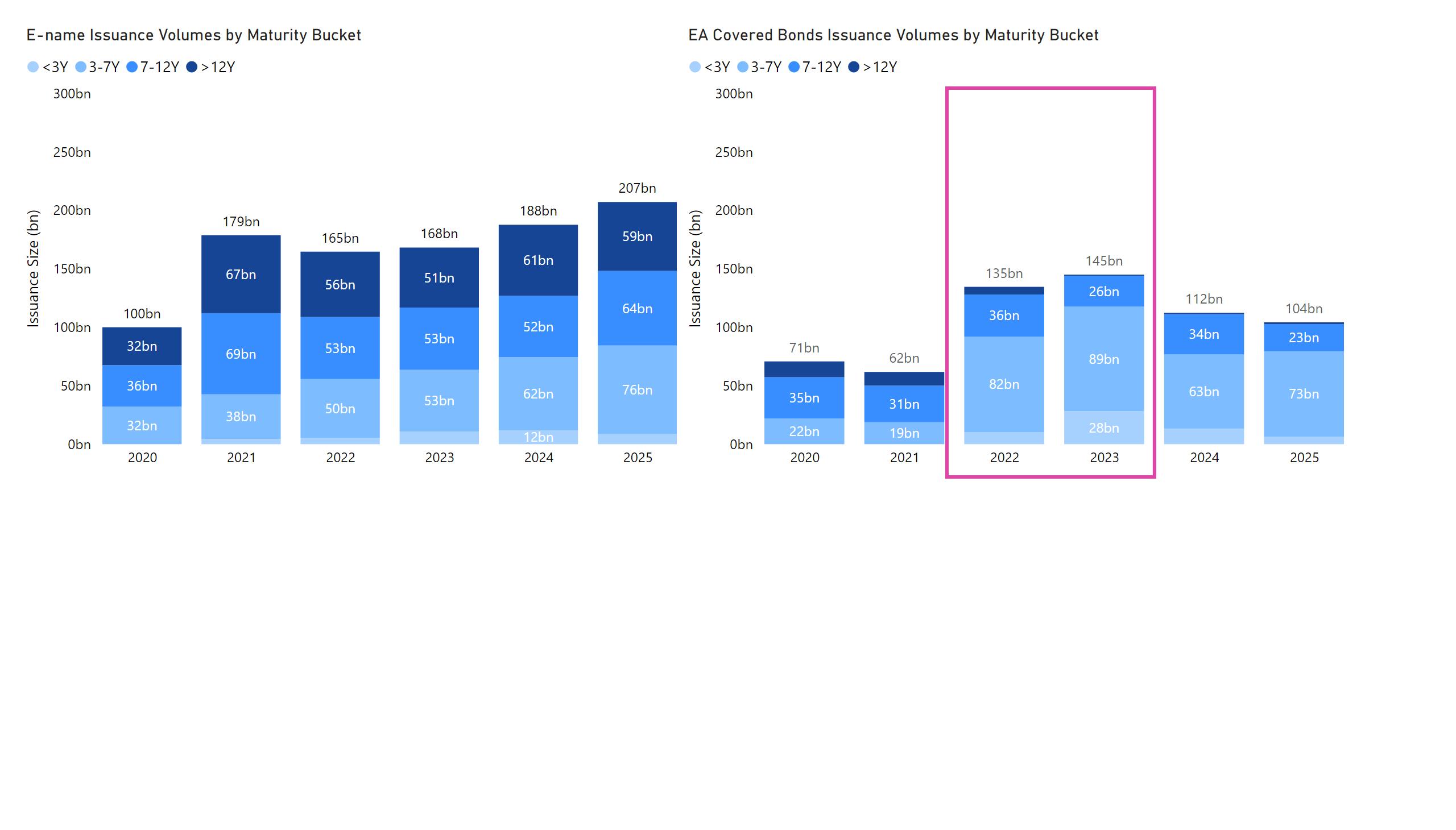
SSA issuance surged in 2020–2021, driven by the Support to mitigate Unemployment Risks in an Emergency (SURE1) and The NextGeneration EU programme (NGEU2) programmes. To illustrate this development, we consider issuance volumes of European supranational (E-names3). Subsequently, covered bond issuance rose sharply in 2022–2023 as banks sought funding following European Central Bank (ECB) Targeted Longer-Term Refinancing Operations (TLTRO) repayments.
Fig 1. E-name bonds and covered bonds issuance by maturity bucket over the years
Thought Leadership in International Capital Markets
Syndicated EUR bond issuances for which investor type allocations are available are considered in the sample.
Sources: ESM Market Group banks, ESM staff calculations
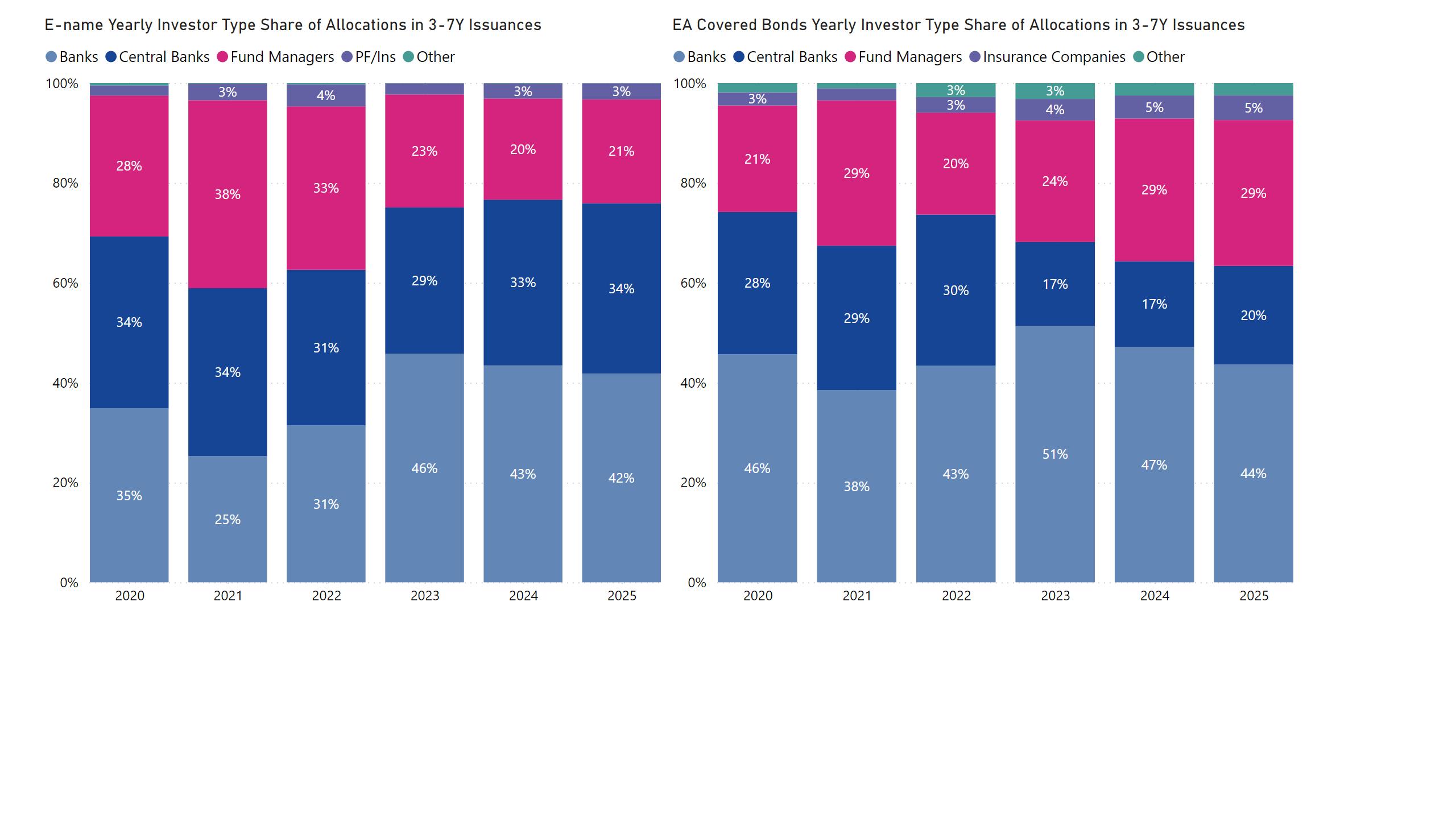
This led to issuance congestion in 2022 and 2023, specifically within the 3-7-year maturity bucket. During this peak, EA banks’ share in primary allocations in those maturities rose to approx. 45% in E-names and 50% in covered bonds.
However, despite engaging the same investor base (EA banks), E-name bonds and covered bonds did not crowd each other out. Rather, their mutual resilience was supported by several complementary and common characteristics and developments:
• Diverse maturity profiles, allowing for a balanced array of investment options across the yield curve rather than a total overlap.
• Regulatory demand and rebalancing. The increasing presence of EA banks was largely driven by liquidity coverage ratio (LCR) regulations, as bank treasuries replaced central bank reserves with high-quality liquid assets (HQLA) to capture more attractive yields. By 2024, the covered bond investor profile rebalanced; as yield curves normalised, covered bond issuance shifted back to longer tenors (7-12 years), attracting fund managers and alleviating congestion in shorter tenors.
• Geographic and investor diversity. While EA accounts dominated both classes, their geographic profiles differ significantly:
- Covered bonds are heavily reliant on domestic bases. For instance, German investors consistently account for approx. 40% of total EA covered bond allocations, driven by the safety of the decades-old Pfandbriefe legal framework, dual recourse and high ratings.
- E-names benefit from a much more geographically dispersed investor base, providing a broader source of diversification.
Market strength and resilience
The concurrent record issuance of SSA bonds and covered bonds in similar tenors provides a clear case study in market resilience. To illustrate the relative resilience of E-names, we incorporate in the analysis the main SSAs from Germany, France, the Netherlands and Italy4. By analysing secondary market valuations and primary issuance metrics of E-names, other SSAs, and EA covered bond issuances in euro, we can observe how these asset classes responded to the ECB balance sheet normalisation, the end of the ECB third covered
4. EA Sub-Sovereign Agencies referred to as SSA in the article are: Agence Française de Développement (AGFRNC), Bank Nederlandse Gemeenten (BNG), Banque Publique d’Investissement (BPIFRA), Caisse d’Amortissement de la Dette Sociale (CADES), Cassa Depositi e Prestiti (CDEP), Kreditanstalt für Wiederaufbau (KfW), Nederlandse Waterschapsbank (NEDWBK), Land Nordrhein Westfalen (NRW), NRW BANK (NRWBK), Landwirtschaftliche Rentenbank (RENTEN), Société du Grand Paris (SOGRPR), Union Nationale Interprofessionnelle pour l’Emploi dans l’Industrie et le Commerce (UNEDIC).
Fig 2. E-name bonds and covered bonds yearly investor type share of allocations in 3-7-year
Thought Leadership in International Capital Markets
bond purchase programme (CBPP3), rate hikes, risk-off sentiments and a sharp rise in gross and net supply.
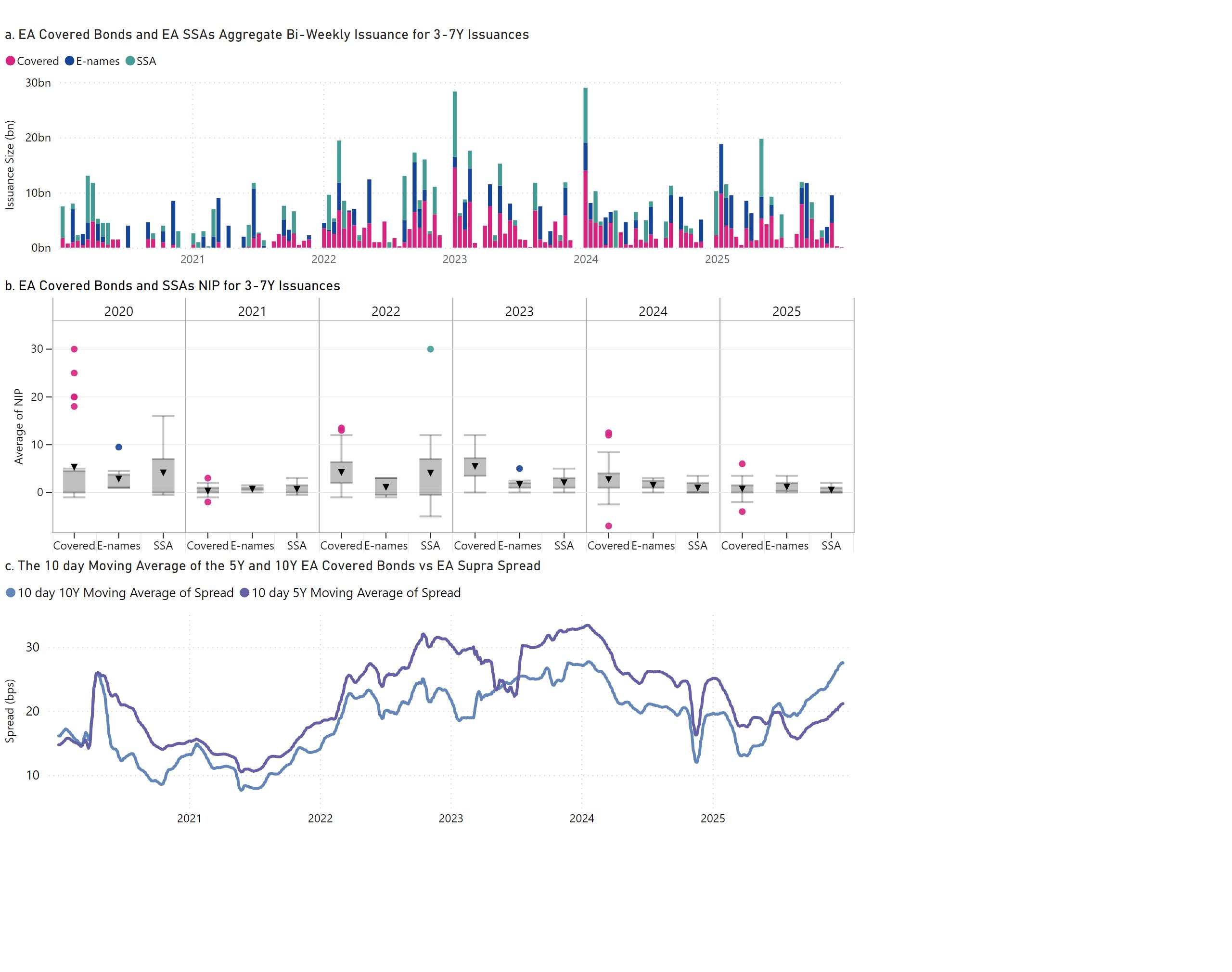
To secure adequate demand during the period of crowded issuance (2022-2023), rate hikes and a sharp rise in supply, covered bonds had to reprice in secondary markets and offer higher new issue premia (NIP) relative to SSAs, particularly so relative to E-names. Unlike for other primary metrics, this
divergence was most striking in the 3-7-year segment, with covered bond yield spreads over SSAs also widening more than in longer tenors.
It was only in 2024–2025 that lower covered bond issuance, their more muted widening versus swaps compared to SSAs and the start of the ECB rate-cutting cycle tailwinds led to a re-convergence in market premia.
a. Chart sums issuance of EUR syndicated bonds across weeks for the three groups.
b. Chart displays distribution of the average NIP for syndicated bond issuances on the day.
c. Chart displays the 10 business days moving average of the five- and ten-year yield difference between the EUR Europe Covered Bonds IG BVAL Yield Curve and the EUR Supranationals BVAL Yield Curve.
Sources: ESM Market Group banks, ESM staff calculations, Bloomberg
Fig 3. EA SSA bonds and covered bonds yearly issuance, NIP distribution and secondary market spreads
Thought Leadership in International Capital Markets
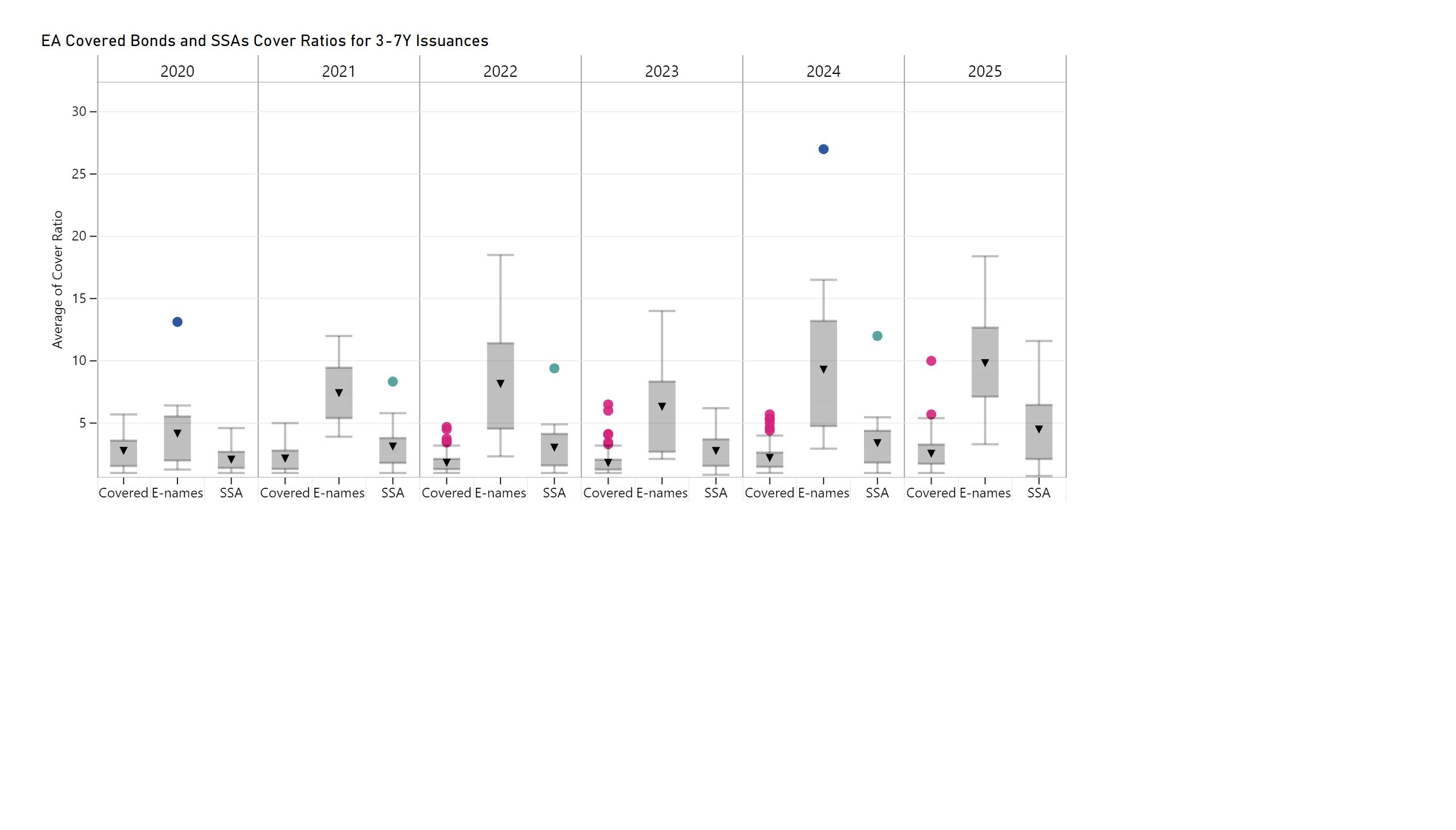
Exploring additional primary metrics, namely cover ratios and guidance to landing, also highlights the relative strength of E-names and other SSAs, in that order, over covered bonds. While E-name bonds generally outperformed covered bonds, the performance disparity between other SSAs and covered bonds mostly widened.
E-names maintained highest and rising subscription (cover) ratios that helped them keep primary concessions (premia) consistently low throughout the last 6 years. Other SSAs subscription levels outperformed covered bonds progressively across the years approaching E-name levels in 2025.
Fig 4. EA covered bonds and SSAs cover ratios for 3-7-year issuances
Chart displays distribution of the average cover ratios for syndicated bond issuances on the day. Outliers are shown outside 1.5 times the interquartile range exclusive of the median.
Sources: ESM Market Group banks, ESM staff calculation
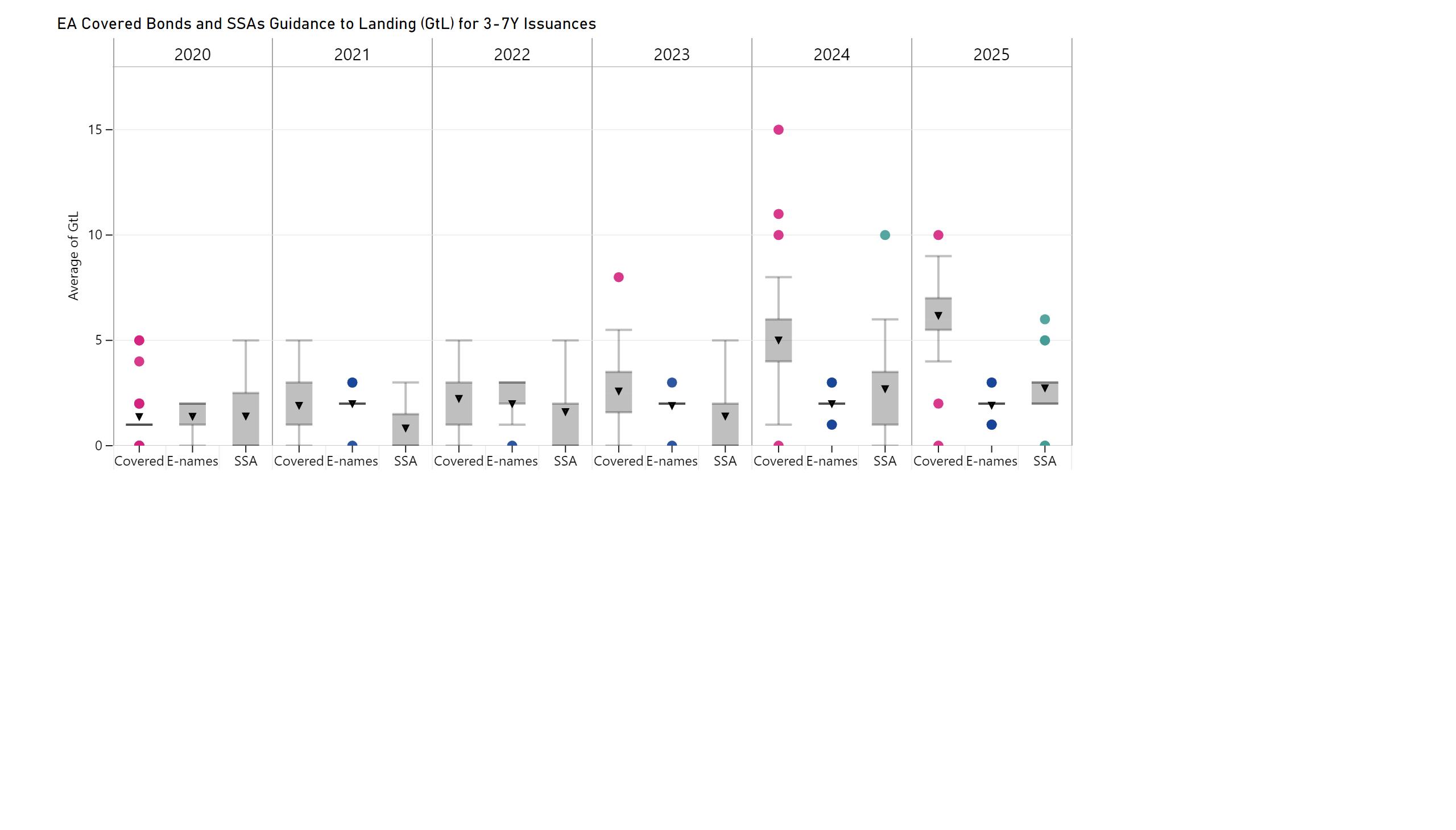
Fig 5. EA covered bonds and SSAs guidance to landing for 3-7 year issuances
Chart displays distribution of the average guidance to landing (GtL) for syndicated bond issuances on the day. Outliers are shown outside 1.5 times the interquartile range exclusive of the median.
Sources: ESM Market Group banks, ESM staff calculations
Thought Leadership in International Capital Markets
E-names also enjoyed the most contained initial guidance to landing spreads journeys during the syndication processes. In contrast, on ECB quantitative tightening (QT), TLTRO repayments and yield compression versus SSAs (post 2024), covered bond issuers had to offer larger concessions at the start of the pricing process relative to other SSAs, to support demand.
Ultimately, these metrics show that while the covered bond market “adjusted” to the post-QE reality, SSAs, and especially E-names, maintained superior pricing power and investor appetite under stressed market conditions.
Jurisdictional divergences
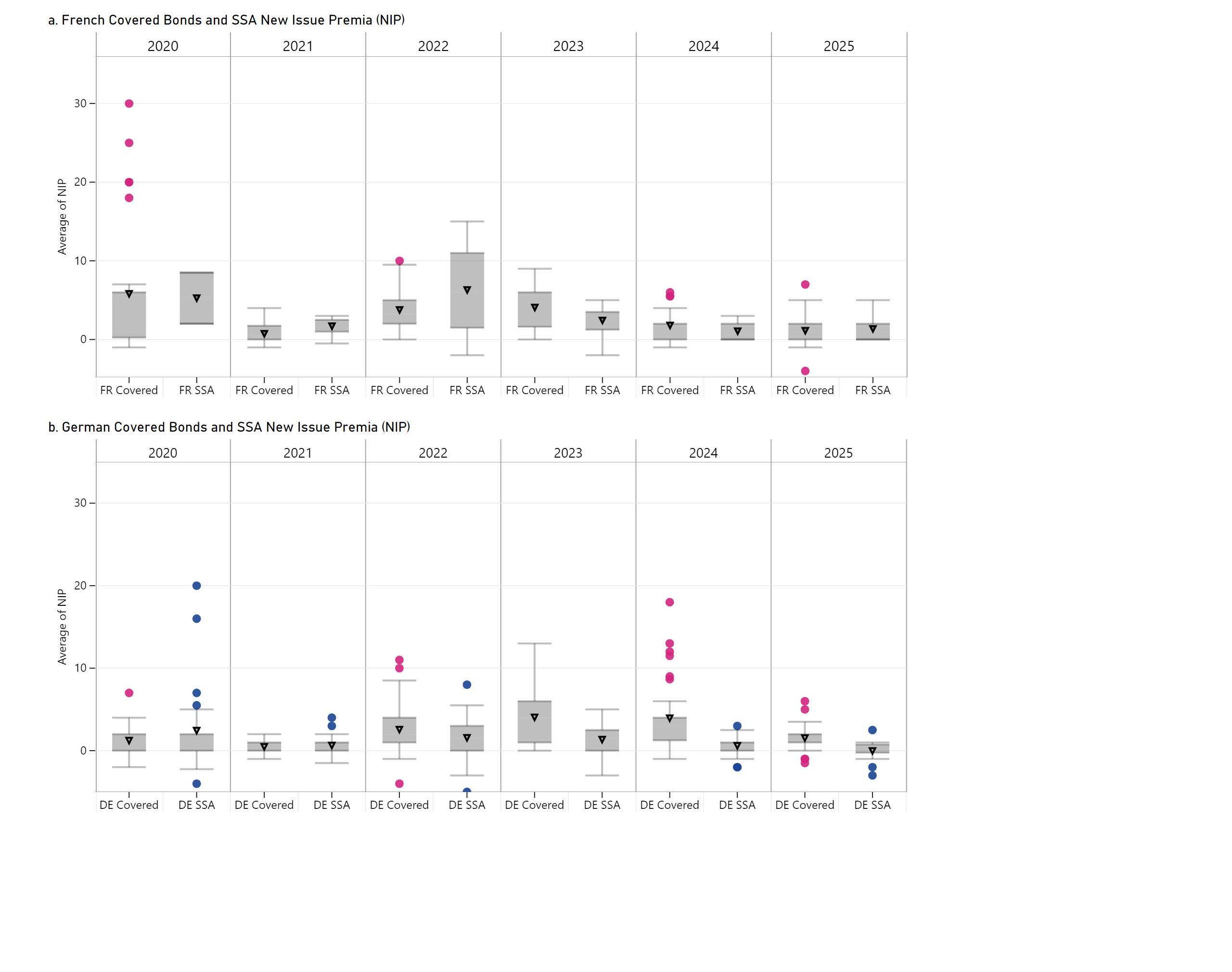
Further breakdown by country reveals that the observations from previous aggregations do not hold across jurisdictions. Direct comparisons between Germany and France showed divergent readings across primary metrics, most significantly NIP. German SSAs consistently outperformed domestic covered bonds even during the crowded issuance period, whereas French SSAs heavily underperformed their domestic covered bonds in 2022 on average on the back of expensive valuations5, and very moderately in 2025 on the back of the credit rating reviews of France.
Chart displays distribution of the average NIP for syndicated bond issuances across maturities on the day. Outliers are shown outside 1.5 times the interquartile range exclusive of the median.
a. FR covered refers to covered bond issuances by France and FR SSA refers to the French agencies: AGFRNC, BPIFRA, CADES, SOGRPR and UNEDIC
b. DE covered refers to covered bond issuances by Germany and DE SSA refers to the German agencies: KfW, NRW, NWRBK and RENTEN
Sources: ESM Market Group banks, ESM staff calculations
5. Given French SSAs were priced in primary off the sovereign, which was richening versus swaps, they looked expensive versus other SSAs and they had to offer higher concessions in primary.
Fig 6. Domestic covered bonds and SSAs new issue premia (NIP)
In conclusion, these findings reinforce the relative strength of E-names both in primary and secondary markets, providing pricing guidance and demand resilience, an anchor to financial stability. Moreover, the wider SSAs asset class remains a robust performer, with primary market outcomes broadly stronger relative to covered bonds, albeit at times diverging across certain jurisdictions. Covered bonds continue to be a cornerstone of bank funding, adjusting effectively to changing market and policy environments.
Most importantly, however, SSA bonds and covered bonds together form a complementary, mutually reinforcing architecture supported by their distinct characteristics, with EA banks playing a central role as both issuers and key investors.
Sára Lakatos is a Quantitative Analyst and Ioannis Vazouras is a Financial Markets expert at the European Stability Mechanism (ESM)
The benefits of 28th regimes for enhanced unity and more common strength in a challenging phase of EU integration
The case for a new approach
by Natalie Westerbarkey and Thorsten Guthke
The European Union, acting through the Council and Parliament as its co-legislators, is struggling to agree on common rules in certain policy fields. While it is easier - and often successful - to find common ground in areas such as cross-border transport or telecommunications, progress in financial services, including capital markets, remains slow and burdensome. It is important to remain guided by the principles of the Union as outlined in the treaties: integration and harmonisation instead of fragmentation, for the benefit of citizens, consumers, and industry. We are now in the twelfth year of the Capital Markets Union (CMU) initiative, launched in 2015 and now known as the Savings and Investments Union (SIU). The SIU is a project with significant merits, and much has been discussed, proposed, and negotiated. Regulations and directives have been amended and entered into force, yet Europe is still far from achieving a genuine single market for capital.
The Banking Union has been a notable success from a legislative perspective, as significant legal acts have been adopted since the 2008 financial crisis. However, the Banking Union is primarily a supervisory union, not a business union. It remains almost impossible to open a bank account in another member state without a local domicile.
We can learn from experience with the Banking Union when working towards the unification of European capital markets. The core element of the Market Integration and Supervision Package (MISP) is its supervisory component, but we should
not be satisfied with creating just another supervisory union. Although MISP is a bolder and more ambitious step forward than its predecessors, there is still a long way to go toward a true SIU. Further legislative and economic progress, including a shift in the European financial industry’s mindset and behaviour, will be necessary and is likely to take several years. The real game changers, such as insolvency law and taxation, are not covered by the MISP and therefore still await future European harmonisation. Such harmonisation is essential and cannot be circumvented if we are serious about overcoming fragmentation.
While national governments find it hard to agree on common rules and the creation of a common single market for capital, alternative solutions are necessary - and they are getting urgent given the geopolitical context and Europe’s need to remain internationally competitive. 28th regimes can offer a promising way out of this deadlock. They would add another regulatory layer on top of the fragmented national legislative landscape, with clear advantages: Member States could retain their domestic legislation while agreeing on shared frameworks.
The 28th regime in practice
Enrico Letta has been advocating for this in his influential report on the future of Europe’s Single Market1. The need for common rules without borders becomes obvious when looking at “digital cross-border workers”. Letta proposes a European Code of Business Law, designed as a 28th regime,
1. Much more than a Market – Speed, Security, Solidarity: Empowering the Single Market to deliver a sustainable future and prosperity for all EU Citizens, April 2024.
Thought Leadership in International Capital Markets
to pave the way for businesses to operate more effectively in the single market. Following up on this, the European Commission presented a legislative proposal on 28 April 2026 for the creation of “EU Inc.”. This initiative is more modest than what Letta had suggested, as the Commission limits itself to introducing this new pan-European corporate form – alongside the existing Societas Europaea, which dates back to 2001. Nevertheless, the proposal is worth a closer look: it provides for fully digital registration, as well as fully digital capital and corporate governance procedures. EU Inc. companies would also benefit from simplified insolvency rules, including simplified winding up procedures. From a financial services perspective several innovations stand out: cross-border access to state aid support and the crossborder use of bank accounts. Digitalisation plays a key role, notably through the promotion of DLT and the European Business Wallet, where all relevant data of EU Inc. would be stored. AI-powered translation systems are being introduced to overcome language barriers, particularly in interactions with Member State authorities. Regarding access to finance, the Commission refers to the Capital Market and the SIU and mentions a review of the Venture Capital Regulation. However, these references remain vague, and the Commission does not specify to what extent EU Inc. companies would be better positioned to take advantage of these frameworks than traditional companies.
Beyond this limited attempt by the EU Commission, some interesting options are emerging at industry level. The international central securities depositories, Clearstream and Euroclear, have developed a 28th regime for the issuance of dematerialised debt securities2. Starting with the Eurobond market - comprising over 12,000 issuers from more than 130 countries and a volume of EUR13 tn in over 100 currencies - this concept can be extrapolated to other financial instruments. The proposal outlines the following solution: an initial focus on dematerialised debt securities, using a technology-agnostic model that supports the use of innovative DLT solutions. The 28th regime would be an optional EU-wide legal framework that issuers could choose to apply. It should be enacted through an EU regulation to avoid the need for transposition into national law. The regulation would comprise issuance requirements, the content of the record, and the role of the record administrator, while security rights continue to be governed by the administrator’s home country. CSDs, credit institutions, or investment firms could act as record administrators. The advantages are clear issuance requirements and a defined record that serves as a single source of truth. If those requirements are met and the issuer opts into the regime, the issuance is valid across all Member States.
Unlocking cross-border securitisation
The concept of a 28th regime for securitisation is another current initiative relevant to the capital market. A bank that wishes to raise funds will use loans it has already issued to raise money from investors. A dedicated securitisation entity under EU law could be established between the bank and the investors, with the bank selling the loans on its balance sheet to that entity. The dedicated securitisation entity would pay for those loans by borrowing money from the investors.
As the underlying borrowers make payments on their loans, those sums would flow to the dedicated securitisation entity - as the bank has sold the loans - and the entity would use those receipts to repay the investors. To manufacture a securitisation, a certain minimum volume of loans is required to make the transaction economically viable; a certain scale is essential. In some jurisdictions, a single bank can carry out securitisation on its own because it holds enough loans on its books. Doing this on a pan-European basis is harder due to numerous legal and tax issues.
To make the concept economic, an issuance entity should be established in one jurisdiction, supported by multiple asset-holding entities in various jurisdictions, all feeding into a single issuance. This would allow pooling money from different Member States - which is currently not possible. For this reason, the dedicated securitisation entity should be pan-European, using the 28th regime to create a single European framework for such an entity. The cost of establishing and operating it could be kept very low through a simplified structure. Provisions could also be included to remove or streamline tax issues that typically arise in securitisations, and the entity could have its own effective insolvency regime. All of this would eliminate a significant degree of the complexity that exists today.
Importantly, this would not interfere with the currently revised Securitisation Regulation, as the 28th regime concept addresses the operation of securitisation, not its regulation.
From concept to reality
We are currently seeing increasing creativity on various fronts, fostering cross-border business activities to break out of long-standing fragmentation deadlocks. The Swiss Finance Council is proposing an institution-specific approach to the provision of cross-border financial services, based on a 28th regime for third country financial firms. This concept, called “institution specific market access”, could be implemented either through a bilateral agreement or by integrating it into existing EU legislation. Practical advantages would include registration with a single EU supervisor and the application of relevant EU rules for access to the EU market across all types of investors and services.
Legal fragmentation constitutes barriers to innovation and slows down cross-border business. A lack of legal certainty in cross border scenarios incurs legal costs, ties up resources, and hinders scalability across the EU.
Where the EU does not have exclusive competence to legislate, 28th regimes will supplement national laws with new instruments that market participants may choose to use on an opt-in basis. This type of compromise helps reconcile interests at European and national levels.
Where agreement proves difficult, the Commission should be encouraged to make use of 28th regimes. It is, of course, essential that Member States agree to create such regimes jointly. In addition, they must authorise their market participants to opt into them. If these conditions are fulfilled, 28th regimes offer an excellent solution and a promising way forward. Moreover, enhanced cooperation provides a similar vehicle for advancing integration and harmonisation. ICMA would like to encourage decision-makers to seize those opportunities.
Contacts: Natalie Westerbarkey and Thorsten Guthke
natalie.westerbarkey@icmagroup.org
thorsten.guthke@icmagroup.org
Natalie Westerbarkey is Managing Director and Co-Head of Market Practice and Regulatory Policy, ICMA. Thorsten Guthke is Director, ICMA.
Summary of Practical Initiatives by ICMA
Summary of practical initiatives by ICMA
Regulatory policy
1 ICMA Regulatory Policy Committee (RPC): The last RPC took place on 4 June in Dublin, hosted by the ICMA Ireland regional chair (AIB) to discuss the Market Integration and Supervisory Package (MISP), which will also be the focus area for the next RPC taking place on 15 September, again in Dublin hosted by AIB ahead of the Eurofi conference. Thorsten Guthke is the Secretary to the RPC and is based in Brussels.
2 EU SIU MISP (Market Integration & Supervision Package): ICMA submitted a response on 20 March and published a comprehensive position paper focusing on the most pertinent aspects related to international fixed income markets, led by the RPC and in consultation with all committees impacted including AMIC, MIAG, DLT Bonds Working Group, and TF Securitisation. The position paper is currently distributed to EU Parliament and Council, as well as to other interested authorities and the financial community to proactively engage with public sector stakeholders. The MISP initiative provides the potential to make significant steps toward a more harmonised and integrated EU capital market, eg by increasing the efficiency of supervision, by streamlining the posttrading process, developing asset management group structures, and enhancing a more mature DLT regime that should evolve from a pilot to a permanent regime.
3 ICMA Brussels roundtables: ICMA hosted the fourth of its roundtable series at ICMA’s Brussels premises on 28 April 2026 covering regulatory and market standards in Sustainable Finance. The inaugural roundtable was on 30 October 2025 and featured ICMA’s secondary market data report. A second session followed on 25 February 2026 discussing “Demystifying securitisation”. The session on 29 June addressed “Asia’s debt capital markets, policy developments and implications for Europe”. The next roundtable is scheduled for September 2026.
4 Eurofi: ICMA is preparing its participation at the next Eurofi event in Dublin from 16-18 September 2026 and engagement in bilateral meetings with high-level decision makers, members and the financial community with ICMA’s CEO Bryan Pascoe. A draft briefing of key themes and bilateral meetings is being prepared for members.
The following Eurofi event will be hosted in Lithuania and will take place from 21-23 April 2027.
5 Brussels policy meetings: ICMA held meetings in Brussels on 30 April 2026 with CEOs and C-level stakeholders, including the German Permanent Representation, the CEO of the European Banking Federation (EBF) and the Secretariat run by policy consulting firm Kreab of the European Parliament Financial Services Forum (EPFSF), of which ICMA became a member in October 2024. ICMA’s Deputy Chief Executive and Head of Sustainable Finance, Nicholas Pfaff participated at the EPFSF roundtable on sustainable finance on 6 May. On 2 June 2026 ICMA’s Managing Director Natalie Westerbarkey was elected to the European Parliamentary Financial Services Forum (EPFSF) Board of Directors for a 3-year term representing ICMA.
Primary markets
6 ICMA issuer forums: The Public Sector Issuer Forum (PSIF) met at ICMA’s offices in London on 15 June. The Corporate Issuer Forum (CIF) met on 27 May at the offices of AstraZeneca. The Financial Institution Issuer Forum (FIIF) will meet in July. Katie Kelly acts as Secretary to the PSIF, the CIF and the FIIF.
7 ICMA principal underwriter groups: The Primary Market Practices Committee (PMPC) met on 25 June, with Ruari Ewing as Secretary. The Legal & Documentation Committee (LDC) met on 13 May and 1 July, with Miriam Patterson as Secretary. The Swiss Syndicate Managers Group (SSMG), Asia Pacific Legal & Documentation Forum (ALDF) and Asia Pacific Bond Syndicate Forum (ABSF) met respectively on 7, 12 and 15 May and the Nordic Syndicate Managers Group (NSMG) met on 24 June – all with Ruari Ewing as Secretary.
8 UK post-Brexit reforms: ICMA continues focus on the UK prospectus, MiFIR product governance and MAR regimes - responding to residual FCA consultation CP26/8 on 20 April, reviewing FCA PMB63 on future residual changes (and contributing a further suggestion to FCA staff), following a bond redenomination into the new “PVLB” label and starting to review the status of the ICMA2 approach to product governance.
9 EU CMU/SIU reforms: ICMA continues CMU focus on the prospectus regime (reviewing a Commission adopted Regulation following ICMA’s 11 March response and considering its practical application from 5 June ahead of formally coming into force) and the retail investment strategy (RIS) covering PRIIPs and MiFID investor protection topics (with monitoring of further trilogue discussions - notably on the inducements regime).
10 Other regulatory engagement: On 18 May, ICMA submitted a comment letter on the US SEC’s proposed amendments to Rule 15c2-11 under the US Securities Exchange Act of 1934, as amended, to limit the application of that rule to equity securities.
11 Primary Market Handbook updates: A new Appendix C1 Bond Data Taxonomy was published in the Handbook on 19 May. Consideration continues of changes consequential to the UK post-Brexit reforms.
12 Public Institutions Resource (PIR): ICMA has set up a dedicated, password-protected webpage for issuers from the SSA community, central banks and other public institutions. The PIR webpage will be a repository of relevant ICMA materials migrated from the main website. Katie Kelly has oversight of the PIR webpage.
13 Primary market events: An APAC Primary Market Forum is scheduled for 17 September in Hong Kong, and a European Primary Market Forum is scheduled for 11 November in London.
Short-term markets
14 ICMA Commercial Paper and Certificates of Deposit Committee: The CPC is organising a series of educational podcasts on commercial paper (CP) and is working on an FAQ document regarding asset-backed CP backed by total return swaps, securities lending agreements and repo agreements. Katie Kelly acts as Secretary to the CPC.
15 UK T-bill market: ICMA convened a Taskforce of entities active in the UK T-bill market from its deep and diverse membership, including Gilt-Edged Market Makers (GEMMS), UK Treasury Bill Primary Participants (TBPPs), real money and levered investors, as well as relevant market infrastructures, to respond to the UK government’s consultation document on the UK T-bill market which closed in February 2026. The UK DMO’s summary response, published in May 2026, takes on board some of the Taskforce’s key recommendations.
Securitisation
16 ICMA Securitisation Discussion Forum (ICMA SecDF): The ICMA Securitisation Discussion Forum met on 20 April 2026. Miriam Patterson is Secretary to the ICMA SecDF.
17 ICMA Securitisation Regulation Taskforce (ICMA SecRegTF): ICMA, along with other leading trade associations, submitted a joint response on 18 May to the UK FCA and PRA’s consultations which propose reforms to the UK securitisation framework. The response was prepared in consultation with the ICMA SecRegTF, led by Miriam Patterson.
18 Securitisation Platform: In order to further support ICMA’s securitisation strategy of delivering targeted regulatory advocacy, market education, thought leadership and practical member-led initiatives, ICMA has established a Securitisation Platform, under which thematic working groups will also be established as needed.
Secondary markets
19 T+1: ICMA continues active participation in discussions in the UK and the EU related to the shortening of the settlement cycle to T+1 on 11 October 2027. In the UK, ICMA has been engaged from the start as an active member of the UK Accelerated Settlement Taskforce and Technical Group. ICMA has been particularly focused on Trading and SFT impacts, providing the Secretariat for the related technical workstreams.
20 Bond market transparency: The new post-trade transparency regimes for bonds went live on 1 December 2025 in the UK and 2 March 2026 in the EU. ICMA remains highly engaged in providing deep-dive data analysis to members and the authorities in relation to the regime changes and the differences between UK and EU deferral regimes. On 3 March 2026, ICMA held an educational webinar on the new transparency regimes and timelines for the Consolidated Tape Providers (CTPs). Relatedly, ICMA’s applications to join the EU and UK Consultative Committees, respectively, have been successful; ICMA has become an observer member on both the EU and UK Committees. The UK CT went live on 22 June 2026.
21 UK transaction reporting: In addition to work done by the SFTR Taskforce on transaction reporting, a 2026 initiative has been to convene a Taskforce from the MiFID WG and other expert members to engage in the topic of transaction reporting also from a MiFIR perspective. This new Taskforce was formed in early 2026 and has responded to the recent FCA Consultation Paper CP25/32 on improving the UK transaction reporting regime from a MiFIR perspective and in co-ordination with the SFTR Taskforce.
Summary of Practical Initiatives
22 Secondary Market Forum: The annual Secondary Market Forum (SMF) is planned to take place jointly with the AMIC forum, as a full one-day event in London on 30 November 2026, hosted by Natwest. Members are invited to visit both the SMF and AMIC. The second Secondary Market Practices Committee (SMPC) meeting of 2026 took place in London on 2 June.
23 Market structure: ICMA continues to monitor developments in market structure such as the growth of ETF markets, credit futures, the use of innovative trading protocols and further automation in electronic trading. A thought leadership article on secondary market structure and innovation, based on input from selected market participants from ETWG and FinAC, was published in the last ICMA Quarterly Report
24 European Secondary Market Reports: ICMA has published its latest semi-annual Secondary Market Data Reports: the Sovereign Bond Edition on 28 April, and the Corporate Bond Edition on 15 June. The reports are based on EU and UK MiFIR post-trade data covering the period up to and including H2 2025, with the underlying data series stretching back to January 2022.
25 Electronic Trading Working Group: During 2025 and early 2026, ICMA’s Electronic Trading Working Group (ETWG) held several joint meetings together with the FIX Fixed Income Axe Distribution Standards Working Group, to discuss the current deficiencies of Axe Distribution Standards. The 2025 meetings resulted in the publication of an ICMA/FIX white paper on Axe Distribution Standards, published in December 2025, which was well received by market participants. Following publication, ICMA is also updating key definitions in its ICMA industry guide on bond price distribution, based on feedback received from ETWG/FIX members. ICMA will look to publish the new taxonomy in July 2026.
Repo and collateral markets
26 ERCC meetings and events: The ERCC Committee held its most recent meeting on 16 June in Lisbon, in the margins of the annual ISLA Conference. The ERCC’s two annual flagship events have been scheduled and are open for registrations. The ERCC’s annual educational event, the Professional Repo and Collateral Workshop (PRCW), will be held in London on 6-7 November, while the ERCC AGM and Conference 2026 has been scheduled for 1 December, kindly hosted by LCH in Paris.
27 UST mandatory clearing: On 10 April 2026, ICMA submitted its response to the SEC Notice of Request for Exemptive Relief concerning the extraterritorial scope of the US Treasury clearing mandate. On 17 April 2026, the SEC published another Notice of Request for Exemptive Relief proposing targeted refinements to the interaffiliate exemption under the US Treasury clearing rule to ensure its operability in a cross-border context, to which
ICMA has also responded. Relatedly, ICMA, together with ISLA Americas, in June 2026 responded jointly to the US regulators’ “GSIB” Notice of Proposed Rulemaking with respect to qualifying legal frameworks to support crossproduct netting for capital relief.
28 T+1: A key focus of the ongoing EU T+1 transition continues to be on the new ‘Gating Event’ which has been designed to mitigate concerns around intraday liquidity impacts, specifically from a repo perspective. Building on the initial Taskforce report which had recommended the introduction of the Gating Event, on 16 June a more detailed guidance document on the Gating Event was published, setting out detailed FAQs on the Gating Event along with related best practices for market participants explaining how the Gating Event should and should not be used.
29 China repo developments: On 23 April, ICMA held the inaugural meeting of its newly established GRCF China Repo Committee. During the meeting, members discussed the latest developments in the China cross-border repo market, from a regulatory, market infrastructure and documentation perspective. ICMA is conducting bilateral interviews with members at the moment to gain a more in-depth understanding of practical challenges and areas of focus.
30 Gilt repo market resilience: Following its response to the Bank of England’s Discussion Paper on enhancing gilt repo market resilience, ICMA has had further discussions with the Bank of England on the topic and hosted a roundtable on 17 March 2026 with members of the relevant Taskforce to follow up on the response, focusing on concrete policy recommendations. The resulting policy note has been shared with the Bank of England.
31 Transaction reporting - SFTR: Following ICMA’s response to ESMA’s Call for Evidence on transaction reporting simplification last September, ESMA published the findings in its Interim report. Instrument-based delineation received broader support, potentially serving as a phased pathway toward a single template for EMIR, SFTR and MiFIR. ESMA published its final report on 2 July which ICMA is currently assessing with its members to determine the impact.
32 Islamic Repo: On 19 February, ICMA and the International Islamic Financial Market (IIFM) announced the signing of a Memorandum of Understanding (MOU) and the formal commencement of their joint initiative to develop a global standardised documentation framework for a Shari’ahcompliant repo product. Following the launch, both associations have been calling on interested members to join the related working group.
33 GMRA Legal Opinions: On 14 April, ICMA published the 2026 annual GMRA legal opinion updates. The 2026 opinions introduced Peru as a new jurisdiction, increasing the coverage to 75 jurisdictions. The legal opinions are accessible on aosphere.com to all subscribing members or those whose terms of membership provide for access.
34 GMRA Digital Bonds Annex: On 30 April, ICMA announced the publication of a second annex to the GMRA addressing the use of native digital debt securities under the agreement is ongoing. The Digital Bonds Annex is intended to complement the existing Digital Assets Annex, which sets out additional provisions relating to digital cash, digital securities including tokenised traditional securities and asset-backed digital assets, and traditional securities that use a digital platform to transfer ownership that in itself does not create a new digital asset that is property. Following publication, on 6 May, ICMA co-hosted a webinar with Clifford Chance presenting the document and raising awareness.
Buy-side and asset management
35 ICMA AGM and Conference: Two buy-side only panels and a buy-side only breakfast were held at ICMA’s Annual General Meeting and Conference in London in May 2026. This reflects ICMA’s deeper engagement with the buy-side community.
36 AMIC Committee: On 16 June, the AMIC committee meeting was held in Brussels, hosted by JP Morgan, with guest speaker Alessandro Malchiodi, Deputy Head of Asset Management Unit, European Commission.
37 Podcasts: A five-part special podcast series was recorded and released on the Middle East Crisis on 31 March. In May, AMIC published a new podcast that covered a number of key themes: geopolitics, bond yields, credit spreads, and the “higher for longer” environment and divergence across regions and FX markets.
Sustainable finance
38 Sustainable finance: AGM and Conference of the Principles in Milan (June): During this 12th annual event, held at Borsa Italiana and Bocconi University, ICMA and the Executive Committee of the Principles presented the deliverables prepared by its working groups and announced the 2026/27 composition of the Executive Committee. Discussions during the Conference of the Principles focused on the ICMA Principles’ support for emerging markets, how official standards interact with ICMA voluntary guidelines, and market experience with the new transition label, amongst others.
39 London Climate Action Week 2026 (June): During the weeklong event themed “Climate Collaboration in a Fragmented World,” ICMA participated in five roundtables focused on transition finance which, among other things, covered transition bonds, emerging markets and sovereigns.
40 European Parliamentary Financial Services Forum (EPFSF) (May): ICMA participated as a speaker in the event, which discussed broad support for the shift towards a product categorisation regime, while also surfacing ongoing debates around the treatment of transition-themed funds and the appropriate level of product-level disclosure requirements as the colegislative process advances.
41 Brussels roundtable on regulatory and market standards in sustainable finance (April): ICMA brought together policymakers, regulators and market participants to discuss the Sustainable Finance Disclosure Regulation (SFDR) review as well as socialise the CTBG as the Principles’ latest product standard.
FinTech and digitalisation
42 DLT Bonds: The ICMA DLT Bonds Working Group’s quarterly meeting was held on 7 May, focusing on smart contracts for the automated issuance of DLTbased debt securities, with a presentation by DZ Bank, and tokenisation in securities markets in Brazil, as presented by the Brazilian Financial and Capital Markets Association (ANBIMA). The working group also held a series of ad-hoc meetings in April, May and June to respond to EU and UK consultations.
43 APAC Briefing: ICMA held a webinar on 29 June, with a dedicated session for the APAC community providing an update on ICMA’s priorities and initiatives that support the ongoing digital transformation of the capital markets, presented by the FinTech and Digitalisation team.
44 Artificial Intelligence (AI): The AI in Capital Markets (AICM) Working Group’s quarterly meeting was held on 2 July, with a discussion on the newly released EU Tech Sovereignty Package, led by A&O Shearman, and an introduction to the consultation on the FSB Report on Sound Practices for Responsible Adoption of AI.
45 Sustainable finance and FinTech: The Sustainable Finance FinTech & Digitalisation Taskforce held a meeting on 13 May, which included presentations by two new sustainable finance platforms, ACCEPT and Blue Bond Accelerator.
Summary of Practical Initiatives by
46 FINOS Common Domain Model (CDM): ICMA participated, together with ISDA and ISLA, in the 2026 Open Source in Finance Forum London, which took place on 25 June in London highlighting the CDM and the other open-source solutions for capital markets. ICMA continues to be involved in FINOS governance and maintenance of the CDM.
47 DLT Collateral Management: ICMA attended a meeting of the newly established ECB AMI-SeCo DLT Collateral Management Expert Group (DLT-CM EG) on 16 April, which focused on introducing the expert group and proposing questions for investigation of the impact of innovation on collateral management.
48 Post-trade harmonisation and standards: ICMA attended a meeting of the ECB AMI-SeCo Securities Group (SEG) on 24 June, focusing on latest developments in relation to post-trade barriers and the EC’s 28th regime proposal.
49 Data collection and reporting: ICMA attended meetings of the UK’s Industry Data Standards Committee (IDSC) on 7 May and 25 June.
Reflections from the 58th ICMA AGM & Conference: growth, resilience and markets in transition
The 58th ICMA AGM & Conference convened over 1,300 delegates in London for three days of discussion on the forces reshaping international capital markets. Held in London for the first time since the 1970s, the Conference brought together issuers, banks, investors, infrastructure providers, law firms, regulators and policymakers at a moment when fixed income markets are being asked to support growth, resilience, transition and technological change all at once.
Opening discussions highlighted the breadth of ICMA’s work across primary markets, secondary markets, repo and collateral, sustainable finance, legal and documentation issues, and FinTech and digitalisation. The message running through the Conference was clear: bond markets are evolving rapidly, market structure is changing, and collaboration across the industry will be essential if markets are to remain efficient, trusted and capable of supporting the real economy.
Geopolitics and capital flows featured prominently. In a panel on global financial markets at a turning point, speakers considered how geopolitical risk is reshaping investor priorities and prompting renewed interest in Europe. This was not presented simply as a rotation away from the US, but as part of a wider reassessment of diversification, market resilience and the strategic role of European capital markets. Europe’s legal frameworks, sustainable finance expertise and cross-border infrastructure were identified as strengths, while fragmentation, supervisory complexity and the need for deeper retail and institutional participation remain key challenges.
This theme was reinforced in sessions on Europe’s integration agenda and the future of fixed income markets. Speakers discussed how capital markets can contribute to competitiveness, investment and economic growth, particularly if regulatory and market infrastructure reforms help mobilise savings, improve liquidity and support crossborder activity. The discussion around regulation was notably practical: investor protection and growth were not treated as competing objectives, but as mutually reinforcing where regulation builds confidence, supports participation and enables appropriate risk-taking.
Market structure and liquidity were central to several sessions. The buy-side trading desk was described as becoming a real-time decision engine, bringing together liquidity, data, execution and governance. Panellists explored the implications of fixed income ETFs, portfolio trading, electronic liquidity providers and consolidated tape initiatives. The common conclusion was that technology can support better execution and transparency, but only where it is combined with strong governance, accountability and human judgement.
Repo and collateral markets were also examined through the lens of resilience. Discussions on repo markets in transition focused on clearing, market structure and the need for flexibility across different participant types and operating models. Clearing was recognised as an important tool for
resilience, but wider adoption will depend on incentives and frameworks that reflect how repo markets operate in practice. The capital framework was identified as an area requiring further industry and regulatory dialogue.
Securitisation, private markets and commercial paper all reflected a broader concern with how markets can channel capital more effectively. The European commercial paper (CP) market was seen as having scope for steady development through regulation, innovation and market practice, with sustainable CP offering a complementary short-term financing tool alongside the sustainable bond market. The comparison with the more established US CP market underlined that Europe’s progress is likely to be evolutionary, requiring practical changes across multiple levers rather than a single solution.
Sustainable finance remained a major theme. Sessions on financing the transition, Japan’s approach to GX, and the evolution of sustainable bond markets showed that the debate has moved beyond broad ambition to practical questions of credibility, policy alignment and financing hard-to-abate sectors. Climate transition bonds were discussed as an important tool for issuers with credible transition pathways, while panellists stressed the need to use the full sustainable finance toolkit across sectors, geographies and stages of development.
The discussion on sustainability in a new world order broadened this further. Transition finance was framed not only as a matter of corporate plans, but as a systems challenge involving public policy, clean energy availability, market offtake, risk-sharing structures and long-term planning. The role of ICMA’s guidance in helping borrowers articulate credible transition strategies was highlighted, alongside the need for predictable policy frameworks and financing vehicles capable of reducing the cost of capital.
Technology was another defining thread. Sessions on AI, tokenisation and digital money explored how emerging tools are changing workflows, infrastructure and the future of work. AI was presented not just as an automation tool, but as a force reshaping business models, talent strategies and organisational design. The discussion on white-collar work asked how firms will train junior professionals, preserve judgement and redefine expertise as AI becomes more capable.
Tokenisation and digital money raised parallel questions about market infrastructure, settlement assets and trust. Speakers considered the potential for distributed ledger technology (DLT) to improve efficiency and transparency in bond markets, while emphasising the importance of resilience, governance and safe settlement assets as markets become more digital and increasingly always-on.
The Conference closed with reflections on leadership, competitiveness and uncertainty. In his closing remarks, Bryan Pascoe described ICMA as a convener, builder of networks and hub for industry priorities. That role was evident throughout the event. Across discussions on geopolitics, regulation, liquidity, repo, sustainability and technology, the 58th ICMA AGM & Conference showed a market community alert to risk, but also focused on practical action.
The direction of travel was clear: capital markets are growing in importance, and their continued resilience will depend on shared standards, open dialogue and sustained industry collaboration.
Contact: Oliver Tinkler oliver.tinkler@icmagroup.org
Primary Markets
by Ruari Ewing, Miriam Patterson, Katie Kelly, Natalie Westerbarkey and Sabah Anjum
ICMA Primary Market Handbook: Bond Data Taxonomy Appendix
On 19 May 2026, the ICMA Primary Market Handbook was amended to include the addition of Appendix C1 Bond Data Taxonomy.
Appendix C1 details the scope, purpose, and core function of the ICMA Bond Data Taxonomy (BDT). The appendix is intended to support Handbook readers (including issuers, agents, service providers and investors) who may be looking to digitalise their workflow using the BDT.
The BDT is a computer-readable representation of key bond data information. It enables automated and efficient data sharing between different bond market participants and intends to reduce the need for manual intervention and aggregation of different sources of bond data.
The appendix also addresses the relationship between the BDT and legal documentation (with the legal documentation prevailing should there be any discrepancy) and includes an example in BDT XML format.
UK prospectus and listing regimes: FCA PRM and UKLR sourcebooks
On 20 April 2026, ICMA submitted its response to FCA consultation CP26/8 – regarding its proposed clarifications to the FCA’s Admission to Trading on a Regulated Market (PRM) sourcebook.
The response noted from the Eurobond perspective that:
(1) overlapping requirements on timing of final terms’ publication is confusing, and so the proposed crossreference removal seems sensible;
(2) protected forward-looking statements may be repeated, and so the proposed allowance of just one instance of the content-specific accompanying statement (that can then be signposted to) seems sensible;
(3) restricting amendments via supplement to “fungible” new securities has been perceived as stricter, and so the proposed reversion to the historic restriction (to “manifestly the same” new securities) is welcome;
(4) the supplement notification obligation does not carve out the wholesale context and so the proposed alignment with the (correct) disapplication of withdrawal rights in this context is sensible; and
(5) the “max 150-person” concept was historically applied as an “across the board” exemption (neither withdrawal rights nor the obligation to notify supplements applied), which endures under the EU’s Prospectus Regulation regime.
Subsequently on 13 May 2026, ICMA staff informally notified FCA staff that the PRM1.5.2(/1.6.3) admission RIS notification requirement superfluously (and expensively) triplicates issuance RIS notification (given RIS notifications arising also under PRM9.5 regarding final terms publication and under PRM9.6 regarding official list publication). This was further to Primary Market Bulletin 63 encouraging feedback by the end of August 2026 to the FCA about potential “snagging” issues relating to the PRM or the FCA’s UK Listing Rules (UKLR) sourcebook (for the FCA to consider for inclusion in a 2026 Q4 consultation).
ICMA will continue its engagement on the UK prospectus and listing regimes as necessary.
Contact: Ruari Ewing ruari.ewing@icmagroup.org
ICMA response to SEC proposal on Rule 15c2-11
On 18 May 2026, ICMA submitted a response to the US Securities and Exchange Commission (SEC) on its proposed amendments to Rule 15c2-11 under the Securities Exchange Act of 1934, as amended (Exchange Act) (see SEC Release No. 34-105004 Publication or Submission of Quotations Without Specified Information (16 March 2026)).
Background to the proposal
Rule 15c2-11 establishes information-gathering and review requirements for broker-dealers publishing quotations in OTC markets. Historically, the rule has been aimed at protecting retail investors from potential fraudulent activity in retail OTC markets.
However, following the SEC’s 2021 decision to apply the rule to fixed income securities, market participants raised concerns about its suitability for debt markets. For example, the application of the rule may be problematic in the context of certain Rule 144A fixed income securities where the issuer is not publicly listed and does not publish or file ongoing disclosures, leading to US broker dealers not being able to publish quotes in the secondary market. The exemptive relief granted to Rule 144A fixed-income securities in 2023 (Securities Exchange Act Release No. 98819, 88 FR 75343 (2 November 2023)) was welcomed, but the industry would benefit from a more permanent solution. The SEC’s 2026 proposal seeks to address these concerns by limiting the scope of Rule 15c2-11 to “equity securities” only (as defined in Rule 3a11-1 under the Exchange Act).
ICMA’s overall position
ICMA strongly supports the SEC’s proposal as a necessary correction to the application of Rule 15c2-11. The response emphasises that the rule was originally designed for retailfocused OTC equity markets and is not appropriate for institutional fixed income markets, particularly the global Regulation S / Rule 144A market in which ICMA members are active.
The response highlights that fixed income markets differ fundamentally from equity markets in investor base and trading venues used, noting in particular the absence of retailfocused fraud (such as “pump-and-dump” schemes) which the rule was intended to address.
Key issues raised by ICMA
1. Support limiting rule to “equity securities” and thereby exclude fixed income securities
ICMA welcomes the proposal to confine Rule 15c2-11 to equity securities and thereby remove fixed income products from the scope of the rule.
2. Treatment of asset-backed securities (ABS)
ICMA’s response requests explicit confirmation that ABS residual or “equity” tranches remain outside the scope of Rule 15c2-11.
The concern arises from the proposal’s use of the broad definition of “equity security” in Rule 3a11-1, which could inadvertently capture these lowest-tiered securitisation securities that are colloquially referred to as “equity” tranches. Lack of clarification that these residual tranches fall outside the scope of Rule 15c2-11 could lead to an unnecessary disparity among tranches of the same securitisation and would likely impair the ability of market participants to trade residual tranches that are substantively part of the broader ABS offering.
If the SEC does not expressly confirm that residual tranches of ABS remain outside Rule 15c2-11, the response requests that the exemptive relief for Rule 144A fixed income securities granted in 2023 not be withdrawn, so that the existing relief for residual tranches sold pursuant to Rule 144A can be preserved
3.
Exclusion of convertible instruments (including AT1s) from “equity securities”
ICMA also highlights the risk that certain convertible debt securities—including Additional Tier 1 (AT1) securities—could fall within the definition of “equity security”.
The response stresses that:
• AT1 instruments are fundamentally debt instruments, albeit deeply subordinated, and are widely used by European banks for regulatory capital purposes;
• Most AT1 bonds may never convert to equity; and
• They are not the type of instruments associated with the retail market abuses targeted by Rule 15c2-11.
ICMA therefore supports a targeted exclusion for convertible debt securities (including AT1s). If such an exclusion is not granted, ICMA requests that an extension of the SEC’s November 2024 no-action relief (that certain European issuers of AT1 bonds would qualify for) be granted so that the proposal does not reintroduce uncertainty for fixed-income securities.
4. Support for other industry submissions
ICMA expressly supports key elements of the SIFMA and SIFMA AMG responses (the 15 May and 18 May letters) to this proposal, particularly in relation to:
• Limiting the application of Rule 15c2-11 to “equity securities” only;
• Preserving the exclusion of ABS, including residual tranches, from the scope of Rule 15c2-11; and
• Carving out convertible debt instruments from the definition of “equity securities”.
Conclusion
ICMA’s response strongly endorses the SEC’s proposal to limit the scope of Rule 15c2-11 to equity securities, viewing it as a long-overdue alignment of the rule with its original purpose. However, ICMA emphasises that targeted clarifications will be necessary to ensure that the revised rule does not inadvertently capture certain fixed income instruments through a broad definition of “equity securities”. In particular, clear exclusions for ABS (including residual tranches) and convertible debt instruments (including AT1s) will be important to preserve market liquidity and legal certainty in international debt capital markets.
FCA statement on firms working together to manufacture products or services
On 23 January 2026, ICMA took up the invitation, in FCA’s 8 December 2025 Statement on firms working together to manufacture products or services, for stakeholders wishing to share their views to contact a specified FCA mailbox.
ICMA noted that the Statement references the UK product governance rules in the FCA’s PROD sourcebook – which includes the mainstream bond space (inappropriately, as noted in ICMA’s 31 October 2024 response to the FCA), as well as the Consumer Duty that excludes the mainstream bond space (appropriately, as noted in an ICMA 13 April 2023 Quarterly Report article).
ICMA also noted, regarding practical application to the mainstream bond space of the UK product governance rules in PROD:
• That no practical problems have been encountered relating to co-manufacturing in the context of the main ICMA1 approach (all bonds / institutional-only investors) to product governance or of the ICMA2 approach (simple listed bonds / retail-inclusive investors);
• That, in this respect, the relevant references are the “Article 9.8” language in ICMA1’s Schedule 5 that is also referenced in ICMA2’s paragraph 18 – which thus seem to work well and do not need revisiting; and
• That the Statement mentions “Where firms have already implemented appropriate measures, [FCA does] not expect them to revisit their existing approach in the light of this statement.”
ICMA will further engage with the FCA as necessary.
Contact: Ruari Ewing ruari.ewing@icmagroup.org
Strengthening securitisation through regulation and beyond
At ICMA’s 58th AGM and Conference in London in May 2026, a panel discussion on “Strengthening securitisation through regulation and beyond” brought together industry and regulatory experts to examine the evolving securitisation landscape in Europe and the UK. The session was moderated by Natalie Westerbarkey, Managing Director and Co-Head of Market Practice & Regulatory Policy at ICMA. She was joined by Maria Green, Senior Regulatory Adviser, Global Financial Markets at A&O Shearman and Gina Hartnett, Head of Transaction Structuring - Private Debt & Credit Alternatives at Schroders Capital.
Regulatory divergence
The discussion highlighted the significant emerging divergence between the EU and UK securitisation frameworks. Panellists noted that while the EU’s post-global financial crisis framework helped to address concerns around securitisation and restore confidence in the asset class, its complexity and conservatism have contributed to lower issuance levels and limited investor participation. As a result, the European securitisation market remains substantially smaller than it was before the GFC.
The discussion also examined the impact of regulation on market development. While recent EU proposals seek to make prudential treatment more risk sensitive, concerns were raised that some measures could have unintended consequences. In particular, reforms affecting insurers’ participation in providing unfunded credit protection for synthetic significant risk transfer transactions may reduce an important source of market capacity.
Panellists pointed to the continuing gap between European and US securitisation markets in terms of scale and activity. Addressing this disparity will require not only supportive regulation but also the development of products that meet investor demand for yield and diversification. Effective engagement between regulators and market participants was identified as essential for ensuring that regulatory frameworks are practical, proportionate and aligned with market realities.
An opportunity
Looking ahead, the panel explored opportunities to broaden the use of securitisation beyond traditional asset classes. Potential growth areas include green finance, SME lending, digital infrastructure and defence related financing. Participants noted that securitisation continues to play an important role in supporting bank balance sheet management while helping to channel financing to the wider economy. The development of deeper and more liquid secondary markets was also identified as a priority for the future growth of the sector. While secondary market activity remains limited in many areas, panellists noted signs of increasing activity in the synthetic significant risk transfer (SRT) market. The
proposed EU securitisation platform10 was highlighted as a potentially significant development, although speakers emphasised that progress on this initiative should not distract from the broader reform agenda.
The discussion concluded by considering the role of technology and industry initiatives in supporting market development. Artificial intelligence was characterised as both an opportunity and a risk, offering tools to improve fraud detection while also creating new avenues for fraudulent activity. Preventing issues such as the double pledging of assets was identified as a key challenge.
A role for ICMA
Finally, panellists highlighted the role that industry associations such as ICMA can play in supporting market growth through standardisation, documentation, training and education. Such initiatives can help improve market efficiency, promote best practice and reduce the need for increasingly prescriptive regulation, supporting the continued development of securitisation as a safe and effective financing tool.
Contacts: Sabah Anjum and Natalie Westerbarkey sabah.anjum@icmagroup.org natalie.westerbarkey@icmagroup.org
UK securitisation regime reform: joint associations’ response to FCA and PRA consultations
On 18 May 2026, ICMA, along with several other trade associations, submitted a joint response to the FCA’s CP 26/6 (Rules for reforming the UK Securitisation Framework) and the PRA’s CP 2/26 (Reforms to securitisation requirements). The two consultations focus on reforming the UK’s securitisation framework. As the securitisation general requirements are present in both the FCA Handbooks and PRA Rulebook, the FCA and PRA CPs proposed amendments concurrently that were aligned with each other. The PRA proposals would affect firms authorised by the PRA.
The joint associations broadly welcomed the FCA and PRA’s proposed securitisation reforms, describing them as a significant step towards a more proportionate and internationally competitive UK framework. The response highlights strong industry support for the direction of travel
while setting out targeted recommendations to ensure the new framework delivers on its objectives of simplicity, competitiveness and cross-border usability.
The joint associations particularly support:
• The move to a more principles-based and simplified regime for due diligence, transparency and reporting requirements;
• Efforts to reduce cross-border friction and improve the usability of the UK securitisation framework post-Brexit;
• The introduction of “L-shaped” risk retention rules, which have been a long-standing industry request; and
• The regulators’ willingness to review the scope and application of securitisation conduct rules.
At the same time, the response sought further clarification and refinements in several areas, including:
• Some observations and recommendations to further improve the revised due diligence, transparency and reporting regime;
• Confirmation that synthetic excess spread can count towards the first-loss component of L-shaped retention in synthetic significant risk transfer (SRT) securitisations;
• Additional guidance on proposed re-securitisation rules; and
• Further engagement on the application of conduct rules and prudential requirements under Basel 3.1.
The joint associations also warned that the UK should closely monitor the EU’s more growth-oriented securitisation reforms to avoid creating competitiveness and level playing field concerns for UK markets.
Overall, the proposals are seen as a meaningful step towards a more proportionate, flexible and internationally competitive framework. If implemented effectively, the reforms have the potential to revitalise the UK securitisation market, supporting funding, risk transfer and broader capital markets development. However, the impact could be limited if UK transactions will need to continue to follow EU standards for cross-border transactions. It remains to be seen whether the UK’s direction of travel will influence deliberations in the EU on the EU securitisation regime.
10. The EU securitisation platform is an initiative linked to ongoing Commission discussions under the Savings and Investment Union agenda and the 2024 consultation process: European Commission – Targeted consultation on the functioning of the EU securitisation framework European Commission – Securitisation policy page At this stage, the platform is generally discussed as a potential market infrastructure tool to improve transparency, standardisation and investor access, rather than as a substitute for broader reforms.
Secondary Markets
Bond Market transparency, Consolidated Tapes UK and EU - recent updates
Bond Consolidated Tapes
Following the go-live of the new bond transparency regime in the UK on 1 December 2025, ETS Connect UK, the first UK bond consolidated tape provider, started its operation on 22 June 2026. This is in line with the schedule that had been announced and worked towards in previous months.
Since the beginning of the year, ETS Connect UK has held several webinars for market participants to provide regular updates on the work in progress, and, in Q1, selected members for the ETS Connect Consultative Committee, with ICMA, joining the Committee as an observer member. The full list of voting members and observer members can be found on the ETS Connect UK website Since its inauguration, the Consultative Committee has organised three meetings, with ICMA in attendance, the most recent taking place on 11 June 2026, a few days prior to the go-live. Earlier in March, ETS Connect UK released the final documents for UK bond CT users. On 5 May, ETS Connect UK announced an Accredited Partner programme as a support model for the UK bond consolidated tape, to provide an out-of-hours service for consolidated tape users, to be launched in January 2027. Further information and details can be found on the ETS Connect UK website
The go-live of the UK bond tape marks an important milestone in the UK’s steps towards greater bond market transparency and data accessibility. ICMA has long advocated for the introduction of a consolidated tape for bonds, supported by a well-calibrated deferral regime. It is hoped that these recent changes, which formed part of the UK Wholesale Markets Review, will allow market participants a wider access to market data, thereby leading to broader market participation and efficiency in the UK bond market, and ultimately supporting its competitiveness in the context of international capital markets. This was also articulated in ICMA’s recent press release on 22 June.
The EU has similar plans to launch a consolidated tape for bonds, and preparations are under way for the EU consolidated
by Andy Hill, Nina Suhaib-Wolf, Jeremy Law and Aman Gill
tape provider, fairCT, selected by ESMA in July 2025. The go-live of the EU bond tape is currently expected for 2026/2027, as highlighted on the fairCT website. ICMA is pleased to announce that, similar to the UK, it will form part of fairCT’s recently established Consultative Committee as an observer member. As such, ICMA participated in the Committee’s inaugural meeting on 29 June. It is currently understood that the authorisation procedure of fairCT, conducted by ESMA, is ongoing and should be finalised over the coming months. From a more technical perspective, fairCT announced on 8 April the availability of its Contributor API (v0.8) and developer portal at developers.fairct. org. The portal provides contributing venues and approved publication arrangements (APAs) with technical specifications for submitting post-trade data to the consolidated tape, in accordance with EU MiFIR requirements. More details can be found on the fairCT webpage
Bond market transparency
The introduction of the consolidated tapes in the EU and UK follows the go-live of both jurisdictions’ respective new bond transparency regimes, which have applied in the UK from 1 December 2025, and in the EU from 2 March 2026. Both represent a significant shift in real-time transparency for trades in sovereign and corporate bonds. ICMA’s data analysis and retrofitting, conducted during 2025, projected that real-time transparency for sovereign bond transactions would increase from 28% in the UK and 40% in the EU, to 78% and 90% in the UK and EU respectively. For corporate bonds, the change would be even more significant, with only 10% of trades in the EU, and sub 10% in the UK, being published real-time under the old regime, versus 78% under the new regime in the UK and 80% in the EU. Since the go-live of both regimes, ICMA has started to conduct analysis of the actual live data as well. Initial findings suggest that in the EU, transactions in corporate bonds rose around four-fold, and European government bonds two-fold, while in the UK, transactions in corporate bonds rose around 27-fold, European government bonds almost two-fold, and Gilts closer to three-fold.
Secondary Markets
Whilst these findings are relatively fresh, particularly with respect to the EU framework, where the go-live has taken place only very recently, the analysis of new transparency data both in the EU and UK will remain a key focus area for ICMA over the coming weeks and months. It is our plan to undertake extensive analysis and monitoring, with the help of MiFID trade data related to: i) the levels of transparency; ii) trading activity in terms of ticket sizes, distribution channels, jurisdiction of trades and iii) pricing and liquidity. It will be important to establish whether there were any significant changes in market behaviour to these shifts in transparency levels, and the differences between both regimes that market participants on both sides of the channel now have to adjust to. It is fair to say that it is still early days for market participants as they assimilate the additional transparency, particularly in an aggregated form
via the bond CTP, that has only just become accessible in the UK and is still not available in the EU. Furthermore, it should be highlighted that there are various exogenous factors that can lead to a change in trading activity, for example the recent situation in the Middle East.
With that in mind, ICMA aims to monitor trade data carefully over the next months with the view of sharing its findings with members as well as regulators, particularly with a view to the FCA undertaking a formal post-implementation review after 6 months (as stated in FCA PS24/14), and ESMA to undertake regular reviews as per MiFIR Level 1
In relation to further data analysis, ICMA is pleased to announce that Jeremy Law joined ICMA as Associate Director, Data and Analytics, in June 2026.
Regime Change: Increase in real time transparency by bond class - UK (Log scaled)
Regime Change: Increase in real time transparency by bond class - EU (Log scaled)
ICMA analysis based on Propellant data for March 2025 and March 2026
Contacts: Nina Suhaib-Wolf, Aman Gill, Andy Hill, and Jeremy Law nina.suhaib-wolf@icmagroup.org, aman.gill@icmagroup.org, andy.hill@icmagroup.org, jeremy.law@icmagroup.org
Secondary Markets
European Secondary Bond Market Data Report: Sovereign Edition
On 28 April, ICMA published the Sovereign Bond edition of its semi-annual European Bond Market Data report for H2 2025. The latest report presents a full data set of sovereign bond trading activity for 2025, along with a historical data series dating back to 1 January 2022. The ICMA reports, both sovereign and corporate (see next article), use Propellant software to aggregate public EU and UK MiFID/R post-trade reporting data.
The data suggest that European sovereign bond markets continued to experience strong growth in secondary market trading activity throughout 2025. Total reported trading volumes reached EUR70.7 trillion for the year, with EUR34.1 trillion traded in the second half alone. Compared with the same period in 2024, trading volumes increased by 39%, while the number of transactions rose by 17%, highlighting both increased market activity and a notable shift in trading behaviour.
One of the more significant developments during the year was a return to larger average trade sizes. Following a period of declining average ticket sizes since 2022, growth in traded volumes significantly outpaced growth in transaction numbers in 2025, suggesting increased institutional activity and a greater concentration of risk transfer in larger trades.
The European sovereign bond market remains highly international in nature. US Treasuries continue to dominate secondary market activity, accounting for 35% of all reported trading volumes. Italian government bonds represent the second largest segment at 22%, followed by UK gilts and German Bunds at 10% each, and French government bonds at 9%. This underlines the importance of European trading hubs as centres for global sovereign bond liquidity, rather than solely European issuance: a reality that will resonate with the upcoming clearing mandate for US Treasuries.
At the same time, bonds issued by the European Union have emerged as an increasingly important asset class. Secondary market trading volumes in EU bonds have increased more than five-fold since 2022, reflecting the rapid expansion of EU issuance programmes and growing investor acceptance of EU bonds as a core sovereign benchmark. However, this needs to be viewed from the perspective of a relatively low starting issuance base.
Trading activity remains broadly aligned with the currency composition of global sovereign bond issuance. Eurodenominated bonds accounted for 53% of total traded volumes in 2025, followed by US dollar-denominated bonds at 36%, and sterling-denominated bonds at 10%.
Despite ongoing electronification, sovereign bond markets continue to display a highly institutional character. Trades of EUR25 million or more represented only 5% of all transactions executed during the year, yet accounted for almost half (48%) of total traded volume. This concentration of volume in larger ticket sizes highlights the continued importance of institutional investors and wholesale market participants in driving market liquidity.
The trend toward electronic trading continued to accelerate. In 2025, trading venues accounted for 50% of total traded volumes and 60% of all transactions, with both dealer-to-client (D2C) and dealer-to-dealer (D2D) electronic channels recording sustained growth since 2022, although in the case of the latter this is heavily dominated by Italian government bonds, which have a highly embedded D2D segment. However, market structure remains differentiated by trade size. While smaller transactions are increasingly executed electronically, larger trades continue to be conducted predominantly over-the-counter (OTC), reflecting the need to manage liquidity, information leakage, and market impact when executing sizeable positions. It will be interesting to see how this behaviour evolves in response to the new posttrade transparency frameworks that have come into place since December 2025 in the UK and March 2026 in the EU.
Finally, the UK slightly edges the EU as the primary reporting hub for European sovereign bond trading activity. More than half of all reported secondary market volumes (54.5%) were reported through UK entities, reflecting London’s continued role as a major centre for global fixed income trading and, in particular, its importance as a hub for US Treasury market activity. The EU remains the primary centre for Euro-denominated government bond activity.
EU/UK sovereign bond quarterly trading volumes and trade count
EU/UK sovereign bond trading volumes and trade count by trade size (2025)
Contacts: Andy Hill and Nina Suhaib-Wolf andy.hill@icmagroup.org nina.suhaib-wolf@icmagroup.org
European Secondary Bond Market Data Report: Corporate Edition
On 15 June, ICMA published the Corporate Bond edition of its semi-annual European Bond Market Data report for H2 2025. Similar to the Sovereign Bond edition (see previous article), the latest report presents a full data set of corporate bond trading activity for 2025, along with a historical data series dating back to 1 January 2022. ICMA uses Propellant software to aggregate the publicly reported post-trade data.
The data suggest that the European corporate bond secondary market remained active and resilient throughout 2025, with total traded volumes reaching approximately EUR5.7 trillion across more than 6.3 million transactions. While overall activity moderated following an exceptionally strong first quarter, traded volumes in the second half of the year still increased by 5.5% compared with H2 2024, demonstrating continued depth and liquidity in European corporate bond markets, and reflecting the increase in net new issuance.
Trading activity reached its highest level since the start of the dataset in the first quarter of 2025, before gradually normalising through the remainder of the year. Although transaction counts declined modestly in the second half of the year, traded volumes remained elevated, resulting in a notable increase in average trade sizes. By the fourth quarter of 2025, average trade sizes had risen to approximately EUR880,000, reversing the gradual decline observed since 2022 and suggesting renewed institutional activity and larger risk transfers.
The European corporate bond market continues to be dominated by euro-denominated issuance. EUR-denominated bonds accounted for nearly 62% of total traded volumes and a similar proportion of overall transaction counts during 2025. USD-denominated bonds represented around 28% of traded volumes and 30% of transactions, while sterling-denominated bonds accounted for 7% of volumes. Together, EUR and USD markets continue to underpin the vast majority of European corporate bond trading activity.
While EUR-denominated bonds dominate in terms of overall activity, sterling-denominated corporate bonds stand out for their larger trade sizes. Average GBP trade sizes exceeded EUR1 million equivalent during 2025, with median trade sizes also significantly higher than those observed in EUR and USD markets. This suggests that sterling corporate bond trading remains particularly institutional in nature, with activity concentrated among larger market participants.
Market structure continues to evolve as electronic trading gains market share. Dealer-to-client (D2C) trading venues accounted for 47% of traded volumes and 59% of transaction count in 2025, while off-venue and voice-executed trading represented 53% of volumes and 41% of transactions. Looking across the past four years, venue trading has steadily expanded its share of overall market activity, reflecting broader trends toward automation, transparency and electronic execution.
However, execution preferences remain highly dependent on trade size. Electronic venues dominate smaller transactions, accounting for around two-thirds of trading activity in tickets below EUR1 million. By contrast, larger transactions continue to be executed primarily over-the-counter (OTC). For trades of EUR25 million or more, OTC execution accounted for more than three-quarters of traded volumes in 2025, underlining the continued importance of dealer intermediation and bespoke liquidity provision for larger risk transfers. At the same time, electronic platforms continue to make gradual inroads into larger trade sizes, with venue execution of transactions above EUR25 million increasing steadily since 2022.
Overall, the data points to a market that is both growing and evolving. While traditional OTC trading continues to play a critical role, particularly for larger transactions, the steady increase in venue-based trading and the resurgence in average trade sizes suggest a corporate bond market that is becoming increasingly efficient while retaining the flexibility required to support institutional liquidity needs.
EU/UK corporate bond quarterly trading volumes and trade count
EU/UK corporate bond trade distribution channel by trade size (2025)
Contacts: Andy Hill and Nina Suhaib-Wolf andy.hill@icmagroup.org nina.suhaib-wolf@icmagroup.org
Secondary Markets
EC MISP proposal and duplicative reporting: joint trade association paper and next steps
On 7 April 2026, ICMA co-signed a joint briefing paper together with ISDA, AFME and the EBF, that supports the European Commission’s proposal (see Article 3), as part of the MISP package, to disapply post-trade transparency (PTT) requirements under MiFIR for over-the-counter (OTC) derivatives concluded on certain third-country trading venues. The Commission proposal builds on the July 2020 ESMA Opinion on “Determining third country trading venues for the purpose of transparency under MiFID II/MiFIR”, which featured the disapplication of such transparency requirements not only for OTC derivatives, but also for other asset classes.
The joint trade association paper agrees with the proposal from the European Commission, but it also asks co-legislators to:
i. extend the scope of the proposal to the other asset classes that benefit from the exemption under the ESMA opinion.
ii. apply it to transactions which are executed off-venue and which are made public via Approved Publication Arrangements (APAs).
The main aim of the paper is to remove duplicative reporting under EU and UK regimes, thereby improving the accuracy of post-trade transparency bond data that will feed into the consolidated tapes. This point was also raised in ICMA’s MISP position paper (see page 8), which was developed by ICMA’s Regulatory Policy Committee. ICMA is currently in discussion with members of its MiFID Working Group regarding further work on this initiative.
T+1 UK, EU and international: latest developments (testing, latest survey and roadshow)
Updated Implementation Handbook version 2.0 published:
On 17 June 2026, the EU T+1 Industry Committee published a second iteration of the EU T+1 Securities Settlement Handbook, following its initial version of February 2026. The second iteration includes some amendments to the original document in the section on Corporate Events, as well as some additional sections under Scope, Automatic shaping of settlement instructions, and Standard Settlement
Instructions (SSI), as well as further Specific Considerations and Examples. Further details can be found in the new handbook version
Amendment of ICMA’s Secondary Market Rules & Recommendations:
On ICMA’s secondary market side, a particular area of attention is ICMA’s Secondary Market Rules & Recommendations (SMR&Rs), which provide a useful guide and cover a range of secondary market practices, including calculating coupon accruals, trading defaulted securities, interest claims for settlement fails, and, perhaps most famously, the process for issuing and executing buy-ins. In the context of European markets moving to T+1, Rule 222 of the SMR&Rs is of particular interest as it looks at the value date of a transaction and currently states: “The value date for a transaction effected on or after the closing date shall be the second business day (as defined in rule 221) following the trade date, unless agreed otherwise. If Clearstream, Euroclear or the cash market of the currency in which the relevant transaction is to be settled, or TARGET in the case of a transaction to be settled in euro, are closed for business resulting in a postponement of the value date, accrued interest shall be adjusted.” With the EU, UK and Switzerland’s intended move to T+1, this rule shall be amended whereby the section “second business day following the trade date” would be amended to “first business day following the trade date”, effective 11 October 2027. In order to facilitate this change, ICMA will reach out to its Secondary Market Practices Committee (SMPC), the custodian of the SMR&Rs, over the coming weeks with a formal email to effect the process.
EU T+1 Industry Survey Volume two:
Following an initial survey run with market participants at the end of 2025, the ValueExchange, on behalf of the EU T+1 Industry Committee, has undertaken a second survey which has been disseminated to market participants across all regions and market areas of the EU, via the trade associations forming part of the Industry Committee, including ICMA. The (extended) deadline to respond to the survey was 11 June. The survey results were presented by the ValueExchange in the EU T+1 IC’s recent roadshow station in Paris on 3 July and can also be found on the EU T+1 Industry website. The purpose of the surveys is to gather information, on a frequent basis, on market participants’ readiness for the move to T+1, aiming to raise awareness about the areas, regions and groups of participants which might not be fully prepared yet for the move on 11 October 2027. ICMA is planning to discuss the results of the recent survey with its members in a call with the ICMA T+1 Taskforce in due course.
Secondary Markets
EU, UK and CH T+1 Testing Plan:
Aside from the industry surveys, the Testing and Readiness Plan is another important feature of the preparedness and readiness for the move to T+1. The plan outlines the general scope and principles of industry-wide testing and has been developed by the EU and UK Testing Workstreams which were established by the UK AST and EU T+1 Industry Committee respectively, in H2, 2025, and that are collaborating together as the T+1 Testing Taskforce, where they are also joined by the Swiss Securities Post-Trade Council (Swiss SPTC).
T+1 updates APAC:
With T+1 preparations in Europe gathering full steam, selected jurisdictions in the APAC region have recently been focusing on this topic more closely. As such, HK Exchange (HKEX) published its Consultation Paper on Accelerated Settlement for Hong Kong Cash Market in May this year, following an earlier discussion paper published in July 2025. According to the consultation paper, a move to T+1 is considered for all exchange trades in the secondary market, including equities, Authorised Collective Investment Schemes, structured products, debt securities and securities traded via the Southbound Stock Connect Programme, thereby proposing an operational model for a T+1 settlement framework. ICMA responded to the consultation by the deadline of 15 May 2026. By submitting a targeted response to Question 4, ICMA welcomed HKEX’s consultation on moving exchange-traded secondary trades (including debt securities) to T+1, noting that this would cover only a small portion of Hong Kong’s secondary bond trading, which is overwhelmingly OTC and executed in other non-exchange trading venues, meaning that the impacts and cost-benefit may differ from equities. ICMA also highlighted potential operational risks where firms’ fixed income processing spanned both HKSCC’s Central Clearing and Settlement System (CCASS) and the HKMA’s Central Money Markets Unit (CMU), making cross-system cut-off alignment critical under a compressed timetable. ICMA also sought to clarify that CMU-settled debt and repo-related activity are not affected by the exchange-traded move to T+1. ICMA views its response as a basis for potential further communication with HKEX on this topic.
Contacts: Alexander Westphal, Nina Suhaib-Wolf and Alex Tsang alexander.westphal@icmagroup.org nina.suhaib-wolf@icmagroup.org alex.tsang@icmagroup.org
Bond price distribution
In late 2025, ICMA’s Electronic Trading Working Group (ETWG), a sub-group of the Secondary Market Practices Committee (SMPC) and the FIX Trading Community formed the Fixed Income Axe Standards Working Group. This crossmarket collective of buy-side, sell-side, and trading platforms is focused on improving the reliability and usefulness of “axes” as a key form of trading interest information dissemination in the European, mainly credit, bond market.
Wielding
An axe refers to a particular interest by a market participant to buy or sell a security. For dealers, this is typically linked to a long or short position they are seeking to reduce or cover, although it may also reflect a client order that they have been instructed to work. For investors, axes can be especially valuable as they often present opportunities to transact inside the prevailing bid-ask spread and, in many cases, in larger-than-usual size.
Traditionally, dealers would communicate axes to selected clients through their sales teams, often based on a client’s historical trading interests or portfolio holdings. These opportunities might be presented as a way to switch into a comparable security offering additional yield, greater diversification, or a different duration profile. As fixed income markets have become increasingly electronic and automated, and, following a trend long established in equities, asset managers and other investors are placing greater emphasis on receiving bond axes, particularly in credit markets, through electronic channels. In response, trading venues now offer protocols that enable dealers to distribute their axes, typically on an anonymous basis, to a broad range of potential counterparties.
Dropping
A constant bugbear of buy-sides, however, particularly in the new environment of platform trading, is the unreliability of “axes” as a genuine counterpart interest. The common complaint is that it is all too easy, and incentivised, to dressup a standard market quote or “run” as an “axe” with a view to winning flow.
ICMA and FIX reached out across the industry to understand better the issue, frustrations, and behavioural motivations around the posting of axes, which resulted in a white paper published in December 2025. While it does not set out recommended best practices, it provides a clearer articulation of the challenges facing the industry and is intended to support further discussion on how to improve the integrity, usefulness, and safety of axe data in modern electronic trading environments.
Secondary Markets
Sharpening
This is not a new problem. In 2020, ICMA worked with its selland buy-side secondary market trading community to propose definitions for basic trading protocols, including axes. This taxonomy was intended to help liquidity providers, takers, and platforms signal expectations and practice around interest dissemination. As part of the current initiative to improve axe information quality and reliability, ICMA has reached out to the market to update the original 2021 taxonomy of bond price distribution protocols
Following extensive input and direction, including outreach across other market associations, ICMA has decided on the following recommended definitions. In the absence of alternative suggestions, ICMA will look to publish the new taxonomy in July 2026.
While the revised definitions are not enforceable as best practice (such as those under the ICMA SMR&Rs), it is hoped that these will at least serve as a baseline for the more commercially orientated work being undertaken to improve the quality and reliability of axes.
Secondary Market Practices Committee (SMPC) Q2 meeting and bilateral member outreach
Price Indicative quote Expected not to be materially different to quote
Size Optional and indicative Optional and indicative
2 Indicative but negotiable (should not be worse than quote)
2 Indicative but negotiable (expectation of larger than standard size) 3
Streamed axes: firm (based on indicative size)
Non-streamed: subject to enquiry
Non-streamed:
Contacts: Andy Hill and Nina Suhaib-Wolf andy.hill@icmagroup.org nina.suhaib-wolf@icmagroup.org
1. Can be both bid and offer in exceptional circumstances, namely:
On 2 June, ICMA held its second Secondary Market Practices Committee (SMPC) meeting of the year in hybrid format, at ICMA’s offices in London. The agenda was packed with current, relevant topics within Secondary Markets and began with a debrief on ICMA’s Annual General Meeting and Conference which was held on 27-29 May in London. The next item covered SMPC priorities for the year ahead. Members were invited to share their views on the current priorities and areas of focus. In terms of next steps, the Secondary Markets team is planning to reach out individually to members of the SMPC via email over the next weeks, to gauge further feedback and input in regard to its secondary market priorities. After discussing SMPC priorities, ICMA shared the latest MiFIR/D updates and other regulatory developments with the group and presented its first findings and analysis following the introduction of the new transparency regimes in the EU and the UK, as well as updates in relation to the EU and UK Bond Consolidated Tapes. Information was also shared on a joint trade association paper that ICMA co-signed together with ISDA, AFME and the EBF, which supports the European Commission’s proposal as part of the MISP package, to disapply PTT requirements under MiFIR for over-the-counter (OTC) derivatives concluded on certain third-country trading venues.
Other updates shared with members included the latest discussions on the upcoming move to T+1, the US Treasury Mandatory Clearing and the UK gilt repo market resilience work being carried out by ICMA. Finally, ICMA’s FinTech and Digitalisation team provided updates on key initiatives of relevance to Secondary Markets to the Committee. The meeting was then concluded with a brief macro snapshot, shared by ICMA’s Andy Hill, on recent geopolitical shifts, inflation and bond markets.
Contacts: Andy Hill and Nina Suhaib-Wolf andy.hill@icmagroup.org nina.suhaib-wolf@icmagroup.org
i) Market-making to support liquidity in the first days of a new issue (but no longer than the first week).
ii) Where an algo generated axe is the opposite direction of a trader generated axe at the same house.
2. Firm is taken to mean executable (“click to trade”).
3. In the case of algo generated axes, price and size may not be negotiable.
Secondary Markets
ICMA’s Electronic Trading Working Group (ETWG)
On 26 June, ICMA held its first sole Electronic Trading Working Group (ETWG) meeting of the year, following various joint FIX/ETWG meetings which had taken place during H1. Topics covered in the ETWG June meeting included a discussion on ICMA’s Axe distribution standards work with the FIX Trading Community and the updating of definitions under ICMA’s 2021 Industry Guide on bond price distribution, an update on the UK/EU transparency regimes and consolidated tapes, a brief presentation of insights from the most recent editions of ICMA’s Bond Market Data Reports (sovereign and corporate), as well as an update on AI and Tokenisation from ICMA’s FinTech & Digitalisation team.
Contacts: Nina Suhaib-Wolf and Aman Gill nina.suhaib-wolf@icmagroup.org aman.gill@icmagroup.org
UK T-Bill market
The case for expanding the T-bill market
In January 2026, the UK government launched a consultation on the future development of the UK Treasury bill (T-bill) market. The consultation reflected growing interest in the role that T-bills could play in diversifying the government’s funding base, supporting the broader sterling money market, and meeting demand from an increasingly diverse investor community. Against a backdrop of elevated issuance needs and evolving market structure, the consultation sought views on how the T-bill market could be expanded and made more attractive to both domestic and international investors.
ICMA’s response – the importance of the secondary (and repo) market
ICMA responded to the consultation on behalf of a broad constituency of market participants, including dealers, investors, market infrastructures and trading venues active in both primary and secondary fixed income markets. While supporting the objective of developing the UK T-bill market, ICMA emphasised that increasing issuance alone would not be sufficient to ensure success.
A key theme of the response was the importance of secondary market liquidity. Investors need confidence that T-bills can be traded efficiently and financed effectively if they are to become a larger component of investment and liquidity management portfolios. In this respect, ICMA highlighted the critical role of the repo market in supporting liquidity, price discovery, and marketmaking activity. The response also pointed to the importance of broad investor participation, efficient market infrastructure, and measures that would support the development of a deeper and more liquid ecosystem for UK T-bills.
The UK government’s response
The government’s response broadly recognised many of the themes raised during the consultation, while adopting a measured and incremental approach to market development. Rather than pursuing a fundamental redesign of the market, the government announced a series of practical initiatives intended to support growth over time.
These include the introduction of a new 12-month T-bill maturity, the establishment of a standing repo facility, and the creation of a dedicated T-bill collateral pool to support repo market activity. Together, these measures are intended to improve both the attractiveness and liquidity of T-bills, while supporting the broader functioning of sterling money markets. All of these measures are consistent with ICMA’s recommendations.
Looking forward
The consultation process represents an important step in the evolution of the UK T-bill market, but it is unlikely to be the final word. As issuance grows and new sources of demand emerge, such as the emergence of GBP stablecoin, attention will increasingly turn to the effectiveness of the supporting market infrastructure, including secondary market liquidity and repo market capacity. For now, retail seems to be a low priority for the government, but it seems unlikely that UK savers will accept near-zero-percent returns on their bank deposits for much longer. T-bills and linked products, such as money market funds, should appeal.
ICMA welcomes the government’s commitment to a gradual, market-led approach and looks forward to continuing its engagement with members, policymakers, and other stakeholders. A deeper and more liquid T-bill market has the potential to deliver benefits not only for government funding, but also for the broader resilience and efficiency of the UK financial system.
Contact: Andy Hill andy.hill@icmagroup.org
Repo and Collateral Markets
by Andy Hill, Alexander Westphal, Zhan Chen, Aman Gill, Gabriel Callsen and Deena Seoudy
ICMA’s European Repo and Collateral Council (ERCC)
ERCC Committee meetings
The ERCC Committee met on 16 June in Lisbon, coinciding with ISLA’s annual conference. This was the fourth meeting in 2026, and the third since the latest election. Members discussed current repo market conditions and key regulatory topics, including the ongoing UK debate on gilt repo market resilience within the broader context of global NBFI discussions. There was also a review of recent US developments around cross-product netting. From a European viewpoint, T+1 settlement and the new Gating Event remained central, as the Committee considered next steps following the finalisation of related guidance. All these topics are addressed in more detail in this section of the report. This was the last meeting before the summer break. The Committee will reconvene in late September in London, then meet in Brussels on 12 November (hosted by Euroclear ahead of their annual Collateral Conference), and finally in Paris on 1 December, before the start of the ERCC AGM and conference hosted by LSEG. Minutes of all Committee meetings are made available to ERCC members after approval at the subsequent meeting and can be accessed in the relevant members section of the website
ERCC AGM and conference 2026
ICMA is pleased to announce that the 2026 ERCC AGM and Conference will take place on Tuesday 1 December in Paris, kindly hosted by LSEG. Attendees can look forward to an interesting afternoon event featuring a blend of panel discussions and keynote speeches from senior market practitioners, ICMA experts, and public sector representatives. In terms of topics, speakers will explore the current state and future outlook of the repo market, alongside key regulatory developments and the latest
ICMA initiatives supporting the market. As always, the ERCC conference will be a great opportunity to reconnect with peers, exchange perspectives, and reflect on the key developments over the year while also looking ahead to 2027 and beyond. Further details on the agenda will be announced in due course. Registration will open after the summer break but in the meantime, please save the date.
ICMA’s Professional Repo and Collateral Workshop
ICMA’s Professional Repo & Collateral Workshop, the ERCC’s annual educational flagship event, will be held in London on 6-7 October 2026. The course is delivered by ICMA experts and senior market practitioners, who provide in-depth insight into the structure, functioning, and regulation of the repo market and related developments. The workshop is offered to members at a significantly discounted rate, making it a unique opportunity for both junior repo market practitioners as well as more experienced participants across the industry and adjacent markets who want to gain a better understanding of this crucial market and its role in the wider financial system. For further details and to register, please click here .
Global Repo and Collateral Forum (GRCF)
On 8 June, ICMA’s Global Repo and Collateral Forum (GRCF) held its second quarterly meeting of 2026. As usual, the virtual session covered a broad range of topics, covering updates from the different regions as well as global themes. In the latest meeting, a particular focus was on repo clearing, with a presentation on repo CCPs, specifically from an emerging markets perspective. Another emphasis was FinTech and digitalisation, as the group reviewed the key messages from ICMA’s recent report on DLT and Repo (part 1) , published on 4 June. The GRCF meets on a quarterly basis and is open to all ICMA members with an interest in global cross-border
Repo and Collateral Markets
repo markets. If you would like to join, please send an email to grcf@icmagroup.org
Contact: Alexander Westphal alexander.westphal@icmagroup.org
China repo market: Observations and potential area of focus
Recognising the growing importance of China’s repo market and the recent opening up of the cross-border repo arrangements, ICMA established the GRCF China Committee in April 2026 as an industry forum to support dialogue between domestic and international market participants. At its inaugural meeting on 23 April, members reviewed the latest developments in the China cross-border repo market from regulatory, market infrastructure and documentation perspectives. The Committee currently comprises 30 firms, including global and regional banks, law firms, official sector representatives, key financial market infrastructures and data service providers.
Following the meeting, ICMA launched an interview series with committee members to assess the market’s current state of operations, identify practical issues affecting participation and development, and gather views on the committee’s potential deliverables. The discussions highlighted strong interest in China’s evolving repo market. While pledge repo continues to dominate the onshore market, participants viewed the introduction of Cross-Boundary Bond Repo and Offshore RMB Bond Repo as important steps towards greater integration with international repo market practices, including the use of GMRA-based title transfer structures. At the same time, participants noted that legal certainty, operational efficiency and market practice harmonisation remain important areas of focus as the market matures.
Documentation, close-out netting and collateral enforcement were key areas of focus. Participants emphasised the importance of continued work on GMRA enforceability, legal certainty and the interaction between international and domestic documentation standards. From an operational perspective, participants noted the increasing range of access routes into the Chinese repo market but also identified a need for greater transparency around the differences between access models, trading arrangements, settlement processes and counterparty frameworks. Frequently raised topics included margining practices, collateral management, settlement workflows, collateral mobility and tax treatment. Looking ahead, market participants identified several areas where further industry engagement and practical guidance could support market development. These include building understanding of domestic and international repo practices, improving transparency around access models and
operational arrangements, and providing greater clarity on documentation, tax and collateral management issues. ICMA can play an important role in facilitating dialogue between domestic and international stakeholders, consolidating industry feedback and promoting awareness of relevant international standards and best practices.
Contact: Zhan Chen zhan.chen@icmagroup.org
ICMA report on DLT and Repo published
On 4 June, ICMA published the first of a two-part report on repos that make some use of blockchain or other distributed ledger technology (DLT), a subject of much discussion. Part 1 looks at the technology itself, the types of digitalised cash and assets that can be used in DLT repo, and how DLT was applied to repo between 2017 and 2025. During this period, there were 34 publicised examples of DLT repo, the bulk during 2024. Most were proofs-of-concept, experiments or simulations, rather than commercial transactions. The second part of the report will be published after the summer and will focus on how and when DLT might be more widely adopted in the repo market. Notable commercial usage of DLT repo was on Broadridge’s DLR and JP Morgan’s Kinexys platforms. By the end of 2025 it is estimated that the total average daily turnover on these two platforms may have reached, and possibly exceeded, USD3.7 billion per day, mainly on DLR. While there was a significant uptick in the growth of DLR in the second-half of 2025, turnover in DLT repo still pales in comparison with the US repo market, which is measured in trillions.
It is also noted that the two dominant commercial DLT repo platforms vary significantly in terms of the degree of digitalisation, but that they both represent “walled gardens”, serving only the existing institutional customers of the operators.
While undoubtedly very successful in this role for their operators, they do not constitute a competitive DLT repo market. While efforts to achieve interoperability are being made by these and other platforms, there is a long way to go to get to a connected and competitive DLT repo market. How the evolution of the DLT repo market may pan out and what forms of digitalised assets will be exchanged in DLT repo will be the subject of the second part of the report. In particular, this will look at how DLT is being applied to the underlying settlement infrastructure upon which the repo market depends.
A critical section of the first report considers the pre-trade, trade and post-trade functions specific to repo, which DLT has already, or is likely to be, applied to. It concludes that pre-trade applications will be part of general collateral management operations and trading on a central limit order
Repo and Collateral Markets
book is inherently unsuitable for distributed ledgers, as is the post-trade function of central clearing. Instead, the report looks to the application of DLT to collateral management, including margining, and to settlement, notably the use of precise timing for intra-day repo.
There may (or may not) be possibilities to widen the range of collateral and participation. Accordingly, the report defines a DLT repo as a transaction for which some posttrade processes are performed on one or more distributed ledgers and/or where OTC trading may also take place on a distributed ledger. The report has been authored by Richard Comotto, senior consultant to ICMA.
Contacts: Alexander Westphal and Gabriel Callsen alexander.westphal@icmagroup.org gabriel.callsen@icmagroup.org
Gilt repo market resilience
On 17 March 2026, ICMA hosted a closed, in-person roundtable for sell-side and buy-side members active in the UK gilt repo market. Held under Chatham House Rules, the roundtable explored potential measures to enhance the resilience of the gilt repo market, particularly in the context of recent policy discussions around the role of non-bank financial intermediaries (NBFI), leverage, central clearing, and market functioning. This builds on ICMA’s response to the Bank of England’s consultation on the gilt repo market in November 2025, which mostly focused on increasing nonbank central clearing of gilt repo and the widely discredited notion of mandatory minimum haircuts for bilateral repo transactions.
A central theme of the roundtable discussion was that the key challenge for authorities and market participants is not necessarily the absolute level of leverage within the system, but rather the ability to identify where leverage, liquidity transformation, and counterparty exposures may become concentrated across a relatively small number of firms or market channels.
The outcome of the roundtable was a number of recommendations to help enhance gilt repo market resilience, along with the identification of several areas for further exploration.
The key recommendations are:
• Deeper supervisory understanding of leveraged investor strategies and risk management frameworks
• A stocktake and gap analysis of existing regulatory reporting frameworks and supervisory data aggregation capabilities
• More targeted and decision-useful counterparty disclosures focused on leverage, concentration, and interconnectedness
• Improved coordination and information-sharing between the Bank of England and the FCA
• Measures to improve access to central clearing for gilt repo, particularly for non-bank participants
• Broader and more consistent collateral eligibility frameworks
• Maintenance and modernisation of central bank market functioning and liquidity tools
• Enhancements to settlement efficiency and operational resilience
A consistent theme across the recommendations was that market resilience is best achieved through better visibility of risk, more effective use of existing supervisory tools, and stronger market infrastructure rather than through blunt constraints on market activity. The proposals therefore focus on improving the identification of concentrated leverage and interconnectedness, enhancing access to central clearing and collateral, maintaining robust central bank backstops, and strengthening the operational foundations of the gilt repo market, while preserving its efficiency, liquidity, and capacity to support the broader financial system.
ICMA shared the recommendations with senior figures at the Bank on 1 June 2026 and looks forward to further engagement on this most important of priorities for the United Kingdom’s long-term funding, financial stability, and economic outlook.
EU transition to T+1: Additional guidance published on the new Gating Event
On 16 June, the EU T+1 Industry Committee (IC) published a new guidance document setting out FAQs and best practices for the agreed “Gating Event”, a new optional settlement functionality to be rolled out across all EU (I)CSDs designed to help mitigate potential liquidity and settlement efficiency challenges arising from the move to T+1 settlement in October 2027.
ICMA co-led the drafting of the guidance on behalf of the IC, working closely with market participants, market infrastructures and regulators through the relevant technical workstreams (TWS).
The Gating Event has been developed in response to concerns that the transition to T+1 could lead to a significant increase in same-day (T+0) repo activity, potentially increasing intraday liquidity demands and reducing opportunities for settlement optimisation. The Gating Event has been developed as a practical industry solution to mitigate those potential impacts. Under the proposal, settlement instructions that are flagged for the Gating Event will be automatically released for settlement at 11:00 CET on their
Repo and Collateral Markets
intended settlement date. By synchronising settlement at a specific point during the day and allowing existing optimisation tools, including technical netting, to be applied, the mechanism is intended to reduce liquidity consumption and improve settlement efficiency.
The concept emerged from the work of the SFT TWS, set up under the IC, which identified the potential liquidity impacts of the move to T+1, particularly from a repo perspective. Based on the recommendation from the SFT TWS, a dedicated Taskforce on SFT Settlement Optimisation was created, coled by ICMA and involving all the key market infrastructures, including ECB/T2S, along with market participants, to develop a concrete solution. The Taskforce published its final report in December 2025, following endorsement by the IC. The report puts forward the Gating Event solution and sets out its key specifications, while already anticipating the need for additional guidance for market participants for using the new functionality.
The newly published Gating Event FAQs and Best Practice guidance address this request, based on several months of further industry discussion coordinated by the IC and the relevant TWS. The resulting document provides a comprehensive overview of the rationale behind the Gating Event, its operational design and implementation approach, as well as detailed best-practice recommendations on its use. The latter make it very clear that the functionality is intended primarily for T+0 repo transactions and related fixed-income cash market transactions where synchronised settlement can provide meaningful liquidity benefits. Examples include repo rollovers, bond purchases funded through same-day repos and short positions covered through same-day reverse repos. At the same time, the guidance emphasises that the functionality should not be used indiscriminately. In fact, given that the Gating Event can be applied unilaterally, the guidance puts significant emphasis on communication, transparency and industry discipline and clearly specifies how the Gating Event should not be used in order to avoid unintended consequences and potential disruptions to settlement activity. The document also highlights the importance of ongoing monitoring to identify any unintended consequences or evidence of misuse that could distort settlement behaviour or reduce efficiency.
An important focus in the discussion has been on CCPs and how they will use the Gating Event for CCP-cleared transactions, for which users will not be given a choice. Following extensive discussion and consultation with clearing members, CCPs have agreed a common policy which is further explained in the guidance document. More specifically, the approach agreed by CCPs is to use the Gating Event only for start legs of CCP-cleared T+0 repo transactions, while all other CCP-cleared cash and repo transactions will be instructed without the Gating Event indicator.
The publication of the Gating Event FAQ and Best Practice represents an important milestone in the industry’s preparations for T+1, especially from a fixed income and repo perspective, as it provides market participants with greater
clarity on how this key new functionality should (and should not) be used to support a smooth transition. However, it is also important to note that this is not the end of the discussion. Further implementation, testing and market readiness work will continue throughout 2026 and 2027 ahead of the planned T+1 go-live in October 2027. ICMA will continue to coordinate these discussions through the IC and the relevant TWS, guided by members.
SEC mandatory clearing for US Treasuries
On 10 April, ICMA submitted its response to the SEC Notice of Request for Exemptive Relief concerning the extraterritorial scope of the US Treasury clearing mandate. The Notice, prompted by a request from the Institute of International Bankers (IIB), seeks feedback on whether certain offshore transactions in US Treasury between non-US counterparties should be exempt from the Trade Submission Requirement. In its response, ICMA supports the proposed relief in principle, noting that it would help address unintended extraterritorial effects and reduce legal uncertainty operational complexity, and compliance burdens for international market participants. Some market participants also noted the potential level playing field implications, particularly in relation to the treatment of non-US branches of US firms.
On 29 May, ICMA submitted another response to the SEC Notice of Request for Exemptive Relief in relation to the US Treasury clearing mandate, which proposes targeted refinements to the inter-affiliate exemption in a cross-border context. The proposal would broaden the types of eligible affiliates as well as revise the outward facing condition by introducing a 10 percent activity-based threshold. While recognising the Commission’s objective of preventing evasion of the clearing mandate, many members raised concerns that the proposed 10 percent cap could create significant costs in terms of implementation, monitoring and governance and create operational, systems, and compliance burdens. The response also notes that the proposed methodology for calculating the threshold could create unintended advantages or disadvantages based on firm size, business model or organisational structure, and highlights a potential interaction with the IIB request.
In parallel, the SEC approved conditional exemptive relief permitting customer cross-margining between US Treasury repos cleared at FICC and US Treasury futures cleared at CME. The relief is intended to support the implementation of the clearing mandate by enabling margin offsets for eligible positions and reducing the funding and capital costs. More broadly, at the same time, policymakers and market participants continue to discuss the treatment of crossproduct netting under the US Basel III Endgame framework. The outcome of these discussions could have important implications on capital efficiency, market liquidity and the economics of central clearing. For more information, please see Making Treasury clearing work: The importance of crossproduct netting and existing legal frameworks
ESMA reports on transaction reporting
In May 2026, ESMA released its Interim Report on the holistic review of transaction reporting, following feedback gathered through its earlier call for evidence, to which ICMA responded jointly with its long-established SFTR Task Force. Drawing on input from more than one hundred market participants, ESMA highlights instrument-based simplification and dual-sided reporting as the most promising areas for further development. These areas are now being prioritised for cost-benefit analysis and could serve as stepping stones towards a more ambitious long-term model for reporting under MiFIR, EMIR and SFTR using a single template. The findings will feed into ESMA’s Final Report, expected by July 2026.
Following the Interim Report, ESMA published its Final Report on the simplification of financial transaction reporting in July. The report identifies dual-sided reporting, duplication across reporting regimes and frequent regulatory changes as key drivers of reporting costs and complexity, while confirming a longer-term vision for a single ‘report once’ reporting framework across MiFIR, EMIR and SFTR.
At the end of May, ESMA also published its 2025 Report on the Quality and Use of Data. This year’s edition covers not only EMIR, SFTR, MiFIR, AIFMD and MMFR, but also regimes such as prospectus reporting and ICT-related incident reporting under DORA, reflecting a notable expansion in the scope of ESMA’s data-quality activities. At the same time, ESMA continues to emphasise simplification, digitalisation and automation as essential tools for strengthening data-driven supervision. In parallel, ESMA published its SFTR Data Quality indicators, which define a broad set of indicators to detect under- or over-reporting, inconsistencies and other data issues. These indicators enable standardised monitoring of SFTR data quality and support ESMA and NCAs in prioritising supervisory actions.
ICMA SFTR Recommendations
On 29 June, ICMA published an updated version of its detailed Recommendations for Reporting under SFTR. This latest update introduces 4 new questions and numerous further updates, reflecting recent regulatory developments as well as the ongoing discussions with reporting firms. Compared to the previous public version, the updated guide includes a number of important clarifications, particularly covering recent regulatory developments such as reporting of DTCC-sponsored repo and repo cleared via the DTCC agent clearing service, which are expected to become more prominent in light of the US mandatory clearing mandate. It also addresses emerging topics, including the reporting of repos involving digital assets. The Recommendations will continue to develop over time, incorporating further input from the ERCC’s SFTR Taskforce, regulatory changes, and developments in market practice.
Contacts: Andy Hill, Alexander Westphal and Zhan Chen andy.hill@icmagroup.org alexander.westphal@icmagroup.org zhan.chen@icmagroup.org
Legal developments
Annual GMRA legal opinion update: On 14 April, the 2026 annual GMRA legal opinion updates were published. The 2026 opinions introduced Peru as a new jurisdiction, increasing the coverage to 75 jurisdictions. Coverage of the Digital Assets Annex has also been expanded and now extends to eight jurisdictions. In addition to last year’s coverage of Belgium, England, France, Germany, Luxembourg and Switzerland, the 2026 opinions now include Hong Kong and the USA. All opinions cover at a minimum; companies, banks and securities dealers, most jurisdictions also cover insurance companies, hedge funds, mutual funds and pension funds (where generic coverage is possible) as parties to the GMRA. In response to strong member demand, counterparty coverage has been expanded across 14 jurisdictions, including Australia, Canada, Japan, Saudi Arabia and the UAE. The ICMA GMRA legal opinions are accessible on aosphere.com to subscribing members or those whose terms of membership provide for access.
ICMA publishes the Digital Bonds Annex, an update to the GMRA Digital Assets Annex: On 30 April, ICMA was pleased to announce the publication of the Digital Bonds Annex, a further addition to the Global Master Repurchase Agreement (GMRA) suite of documentation. The Digital Bonds Annex further expands and complements the GMRA framework to include transactions involving digital bonds, reflecting ongoing innovation in capital markets. The original Digital Assets Annex, published in August 2024, provides a standardised framework and set of terms which can be used to document repo transactions involving digital cash, digital securities (including tokenised traditional securities), or asset-backed digital assets. Driven by member demand to expand coverage to provide for digital bonds, the Digital Bonds Annex has been developed by the Digital Assets Legal Working Group run by ICMA in partnership with ISLA, with Clifford Chance as legal counsel. The definition of “Digital Bond” within the Digital Bonds Annex is designed to capture natively-issued digital debt securities and makes it clear that the terms and conditions of the Digital Bond must envisage the use of distributed ledger technology.
On 6 May, ICMA hosted a webinar, partnering with Clifford Chance, to provide an overview of how the Digital Bonds Annex works and its various features. A recording of the webinar is available here
Contact: Deena Seoudy deena.seoudy@icmagroup.org
Buy-side
The
buy-side
moves to the foreground at the ICMA AGM
This year’s ICMA AGM and Conference reflected a clear evolution in the association’s engagement with the buy-side community. With dedicated sessions spanning trading, ETFs, artificial intelligence and private markets, the programme underscored the increasing importance of ICMA’s non-bank members, including asset managers, pension funds, insurers, private banks, hedge funds and other institutional investors, in shaping the future of capital markets.
Across all buy-side sessions, several common themes emerged.
The buy-side is a driving force in market evolution
A central message from the AGM was that the buy-side is no longer simply adapting to market change: it is increasingly helping to shape it. Whether through the rapid adoption of ETFs, growing allocations to private markets, or the deployment of AI-driven investment and trading workflows, investors are playing a critical role in influencing market structure, liquidity provision and investment innovation. The dedicated buy-side sessions reflected ICMA’s renewed commitment to strengthening engagement with this diverse community and ensuring that investor perspectives remain at the heart of industry discussions.
Technology, data and AI are reshaping investment markets
Technology was a recurring theme across all discussions. From agentic AI applications in fixed income trading and assisting broker evaluations, to the growing use of automation, advanced analytics and integrated Order Management System (OMS)/Execution Management System (EMS) platforms, participants highlighted how technology is becoming embedded throughout the whole investment lifecycle. At the same time, panellists emphasised importantly that technology remains an enabler rather than a replacement for human expertise. As markets become more automated and data-rich, successful investment and trading
by Anita Karppi, Irene Rey and Sabah Anjum
decisions will continue to depend on experience, judgement and market understanding. The discussions reinforced a broader industry consensus: the future is likely to be technology-enabled, but judgement-led.
Market structure is becoming increasingly interconnected
Another prominent theme was the convergence of traditionally separate market segments.
The growth of private credit and alternative lending is creating a more interconnected ecosystem where public and private markets are increasingly more complementary to one another with access to liquidity being one of the key drivers. Similarly, ETFs have evolved beyond investment vehicles to become significantly more important tools for liquidity management, portfolio trading and market access. Participants explored how investors are navigating a more complex landscape in which traditional distinctions between asset classes, trading venues and investment structures are becoming less defined.
Transparency, liquidity and best execution remain core priorities
Despite rapid innovation, many of the industry’s fundamental challenges remain unchanged. Across discussions on trading and private markets, participants repeatedly returned to questions of transparency, liquidity, execution quality and risk management. The evolution of best execution, the development of the long-awaited consolidated tape, the growth of portfolio trading and all-to-all liquidity models, and the expansion of private market structures all highlighted the industry’s continued focus on improving market efficiency while maintaining investor protection. As capital markets evolve, balancing innovation with transparency and robust governance will remain critical.
Education as an industry imperative
One common thread across all sessions was the importance of education. As both institutional and retail investors gain access to increasingly sophisticated products, technologies and market structures, the need for informed decision-
making becomes ever more important. Whether discussing private credit, AI, tokenisation, ETFs or emerging trading protocols, panellists emphasised the value of knowledgesharing, peer engagement and practical understanding. For ICMA, this represents a significant opportunity to support members through thought leadership, industry dialogue and educational initiatives that help market participants navigate a rapidly changing landscape which is an exciting opportunity.
Looking ahead
The discussions demonstrated that the buy-side is becoming increasingly influential across all areas of capital markets. Trading desks are evolving, private markets are becoming mainstream portfolio allocations, and technology is transforming investment workflows at an unprecedented pace.
The common challenge facing market participants is not simply adopting new tools or products, but understanding how these developments interact within a more connected, data-driven and increasingly complex market ecosystem.
For ICMA, the message was clear: deeper buy-side engagement, enhanced education and ongoing dialogue across the investment community will be essential in supporting the next phase of capital market development.
Contact: Anita Karppi anita.karppi@icmagroup.org
Q2 2026 AMIC Committee
The most recent meeting of the AMIC Committee was held in Brussels on 17 June 2026 and hosted by JP Morgan Asset Management. The AMIC Committee brings together market participants and policy makers to discuss current developments affecting the asset management industry. In the most recent meeting, officials from the European Commission joined the discussion and provided an update on recent asset management policy developments, including on the Market Integration and Supervision Package (MISP), on UCITS eligible assets, reporting and data, as well as other topics concerning the industry.
Contact: Irene Rey irene.rey@icmagroup.org
AMIC May podcast
Our latest AMIC podcast covered three key themes: geopolitics, bond yields, credit spreads and the “higher for longer” environment and divergence across regions and FX markets. To listen to the podcast, click here
Dates for upcoming committees/meetings/podcasts:
• AMIC meeting: London, 22 September
• ICMA FinTech and Digitalisation Forum, including buy-side panels & roundtables, London, 29 September
• Buy-side Head of ETF Capital Markets - ETF Trading Breakfast Roundtable: Trends Shaping the Market, London, 28 October
• Secondary Markets and Buy-side/AMIC fora – London, 30 November
Contact: Anita Karppi anita.karppi@icmagroup.org
Beyond the lights-out factory: human adaptation in AI-driven fixed income markets
by Alberto Bindi Scoponi
At the 58th ICMA Annual General Meeting & Conference, Alberto Bindi Scoponi of Banca Zarattini & Co.
SA opened with a striking image: the same trading floor, once full of dealers, later almost empty. The question it raised was simple but uncomfortable. Are humans still necessary in capital markets?
For fixed income, this is no longer an abstract debate. Electronic trading, algorithmic execution and automated market making have already changed how bonds are priced, traded and monitored. AI adds a further step. It is not simply another tool that waits for human instruction. Increasingly, it acts as an agent, learning from data, adapting to market conditions and supporting, or in some cases making, decisions on pricing, risk and execution.
That distinction matters. Earlier waves of automation reduced manual processes. Agentic AI challenges the role of professional judgement itself.
From automation to agency
The “lights-out factory” metaphor has long been used in manufacturing to describe facilities that operate with minimal human presence. In financial markets, the equivalent is not a literal empty dealing room, but a market structure in which more decisions are made by machines, at greater speed, across more venues and data sources.
In fixed income, this is visible in several areas: highfrequency trading in liquid markets such as US Treasuries, algorithmic market making, systematic trading models, statistical arbitrage and execution algorithms such as Volume-Weighted Average Price (VWAP) and TimeWeighted Average Price (TWAP). These tools can reduce transaction costs, improve consistency and
support liquidity in certain market segments. They can also fragment liquidity, accelerate feedback loops and make markets more dependent on a smaller number of platforms, models and vendors.
The human role is therefore changing rather than disappearing in a uniform way. Strategic asset allocation and longer-term portfolio decisions remain largely human-led, but intraday execution and pricing are increasingly machine-influenced. The key question is not whether AI will replace all market professionals. It is what kind of professionals the market will need.
The circular training paradox
Bindi Scoponi’s central concern is what might be called the circular training paradox. Financial professionals train AI systems by supplying data, expertise and feedback. Over time, those same systems may reduce demand for parts of the work that generated the knowledge in the first place.
This creates both practical and psychological risks. If junior professionals learn from AI outputs rather than from senior colleagues, the transmission of tacit knowledge may weaken. If experienced traders are asked to supervise systems whose reasoning they cannot fully explain, their role shifts from decision-maker to interpreter, challenger and risk manager.
Research cited in the accompanying paper suggests several possible paths. In some cases, automation substitutes for human tasks. In others, it augments professionals by improving decision support. A more balanced model is human-AI collaboration, where machines handle scale and pattern recognition while humans provide context, judgement and accountability.
The danger is de-skilling: professionals may become too dependent on systems they no longer understand deeply enough to challenge.
Systemic risk and “single thought”
AI also raises market-wide questions. If many firms rely on similar models, data inputs or technology providers, market behaviour can converge. In stressed conditions, this “single thought” dynamic may amplify shocks rather than absorb them.
The paper points to the UK pension fund crisis in 2022 as an example of how similar risk management models can contribute to simultaneous behaviour across institutions. The issue was not AI as such, but model-driven convergence. Agentic AI could make this more complex if systems react at speed, learn from similar signals or adapt in ways that are difficult to supervise.
There are also competition and conduct questions. Research on AI-powered trading suggests that algorithms may learn collusive outcomes without explicit communication. For supervisors, this presents a challenge: how to oversee systems that may develop behaviour not directly programmed by humans.
The role of firms, individuals and market bodies
The future is not predetermined. Bindi Scoponi’s presentation emphasised that responsibility sits with several groups.
Firms must decide how to balance efficiency, investment in AI and responsibility towards their workforce. That is not only an operational question. It is also an ethical one. Investors may increasingly ask not only whether a company meets environmental or governance expectations, but how it manages the social consequences of automation.
Individuals also need to adapt. Employability in AIdriven markets will depend less on resisting technology and more on developing the ability to understand, question and work alongside it. Reskilling, upskilling and continuous professional education will be central.
Market associations have a role too. ICMA is well placed to convene dialogue between practitioners, supervisors, technologists and educators. Useful areas for discussion include human-AI governance, explainability, operational resilience, model concentration, training and the changing skills required in fixed income markets.
Bindi Scoponi’s conclusion was not that humans are finished. It was that human agency cannot be assumed.
It has to be designed into the systems, institutions and professional pathways that will shape the next phase of capital markets.
The trading floor may be quieter than it once was. The more important question is whether the market can ensure that human judgement remains audible.
Alberto Bindi Scoponi is Director at Banca Zarattini & Co. SA
Source: Beyond the Lights Out Factory: human adaptation in agentic AI-driven fixed income markets
Sustainable Finance
by Nicholas Pfaff, Simone Utermarck, Valérie Guillaumin, Özgür Altun and Kacie Sampson
Summary
We provide a second quarter update on 2026 issuance volumes, which are encouraging. We report on the market guidance delivered by the Executive Committee of the Principles at their Annual General Meeting and at the 12th Annual Conference of the Principles held in Milan, while also summarising our involvement in London Climate Action Week. We then turn to recent regulatory and policy developments, summarising the Council’s agreed position on the Sustainable Finance Disclosure Regulation (SFDR) review as well as a number of other developments internationally.
Sustainable bond market update
In Q2 of 2026, sustainable bond issuance reached USD547 billion, reflecting a 15% increase compared with the same period in 2025. Green and sustainability bonds have had a particularly strong start to the year, increasing by 15% and 20%, respectively, compared with the same period last year. Social bond issuance has also grown relative to 2025, increasing by 12%. Sustainability-linked bond issuance continues to decline, resulting in 50% less issuance than in Q2 2025. Climate transition bond issuance amounts to USD6 billion issued year-to-date.
Global sustainable bond issuance per category (USDbn)
Source: ICMA based on LGX DataHub and Bloomberg data as of 8 June 2026.
Green bond issuance remained strong throughout Q2, reaching USD306 billion year-to-date, representing 56% of the labelled bond market this year. The green label continues to grow in popularity beyond Western markets. Notable transactions included a debut euro-denominated green bond from Hong Kong-based issuer MTR, which raised EUR3 billion (USD3.5 billion). According to MTR, this bond represents “the largest Asia ex-Japan non-sovereign EUR Green Bond offering.” The Chinese government raised RMB6 billion (USD885 million) from its second green bond, after publishing its framework in 2025. In addition, Ecobank, headquartered in Togo, raised USD450 million through a “Sustainable Agriculture & Natural Capital Bond” which aligns with both the ICMA Green Bond Principles (GBP) Climate transition bond and nature bond guidance.
European Green Bond (EuGB) issuance continued to grow throughout Q2, totalling approximately USD49 billion year-todate. Alstom, a French rail transport manufacturer, raised EUR700 million (USD808 million) from its first EuGB and first labelled bond. Czech utility ČEZ Group issued its inaugural EUR750 million (USD870 million) EuGB, with proceeds including nuclear as well as renewables and grid projects. Swedish issuers Länsförsäkringar Bank and Vasakronan entered the EuGB market with EUR500 million (USD585 million) and SEK2.8 billion (USD296 million) bonds, respectively.
Social bond issuance has reached USD83 billion year-to-date, representing 15% of the sustainable bond market in 2026. Transactions included a debut USD1 billion social bond from Egypt, nearly four years after updating its financing framework to include the label. BRAC Bank raised BDT10 billion (USD81 million), making it the first social bond issued in Bangladesh. In Europe, NWB Bank
Sustainable Finance
returned to the SEK market via a social bond, raising SEK600 million (USD65 million).
Sustainability bond issuance topped USD143 billion in Q2, accounting for 26% of the labelled bond market during the period. Latvia raised EUR1 billion (USD1.2 billion) from its second sustainability bond after publishing its framework in 2021. Kenya Mortgage Refinance Company entered the sustainability bond market with its KES3 billion (USD23 million) issuance. In addition, the Federal State of North Rhine Westphalia issued a EUR2.25 billion (USD2.6 billion) sustainability bond, the 13th bond under this label from the municipal issuer.
Sustainability-linked bond issuance has reached nearly USD8 billion year-to-date, comprising only around 1% of issuance so far this year. Despite the slow momentum of the SLB market observed in recent quarters, issuance was supported by a EUR600 million (USD705 million) bond from SPIE, its third bond under the label. The Development Bank of Rwanda raised RWF29 billion (USD19.8 million) using the label. Notably, Snam raised EUR1.5 billion (USD1.7 billion), split evenly across a dual-tranche EuGB and SLB.
Looking at the regional breakdown, European issuers have had a strong start to the year, representing 57% of issuance year-todate. Asian issuers represent 22% of the sustainable bond market year-to-date, while supranational issuance is slightly slower than average, reaching 13% for the period.
Market guidance from the Principles
On Monday, 22 June, the Executive Committee of the Principles held its AGM at Euronext, Borsa Italiana, in Palazzo Mezzanotte. ICMA and the Executive Committee of the Principles presented the deliverables prepared by the working groups. The principal outcomes this year are three new publications:
• Climate Transition Bond Guidelines - FAQs
This document provides further clarity on climate transition bonds, including how to distinguish transition from green projects, what “best efforts” alignment means, and how different issuer types — including hard-to-abate sectors, financial institutions and sovereigns — can apply the Guidelines.
• Phase 1: Comparison of the Green Bond Principles and the European Green Bond Standard
This Taskforce report sets out the commonalities and differences between the Green Bond Principles and the European Green Bond Standard, highlighting their complementarity and encouraging issuers to demonstrate alignment with both to support global investor recognition.
• Exploring structural demand for sustainable bonds: perspectives from investor practice
This paper examines the structural drivers of demand for GSS+ bonds, giving issuers a sharper understanding of why these instruments matter to investors and how they fit within investor priorities, allocation dynamics and engagement practices.
Additional updated and supplementary technical guidance was also released, including:
• The Guidance Handbook, updated to reflect the Climate Transition Bond Guidelines and provide additional illustrative examples of target populations.
When comparing sustainable bond issuance by issuer type, there is slightly lower issuance from financials at 25%. Conversely, SSA issuance has slightly increased to 51% for the period.
• Guidelines for External Reviews, updated to cover reviews related to sustainability-linked loan financing bonds, Climate Transition Bonds and green enabling projects, and restructured to clarify the distinction between pre-issuance, post-issuance and entity-level assessments.
• The Harmonised Framework for Impact Reporting for Green Bonds, updated to elevate “annual absolute gross GHG emissions” to a core indicator for projects within the energy efficiency and renewable energy categories.
• The Harmonised Framework for Impact Reporting for Social Bonds, supplemented with indicators for affordable basic infrastructure projects.
Sustainable bond issuance breakdown by region (%) Sustainable
On the occasion of the AGM, ICMA announced the 2026/27 composition of the Executive Committee of the Principles, following the June elections. The Executive Committee welcomes two new members: Allianz Global Investors and Banco Santander.
INVESTORS
Allianz Global Investors GMBH
Amundi Asset Management
Blackrock, Inc.
BNP Paribas Asset Management
Mirova Pimco
Seb Asset Management
T. Rowe Price
ISSUERS
CAF - Corporacion Andina De Fomento
Council of Europe Development Bank
European Bank of Reconstruction and Development (EBRD)
European Investment Bank (EIB)
Iberdrola
International Finance Corporation (IFC)
Nordic Investment Bank (NIB) World Bank
UNDERWRITERS
Banco Santander, S.A.
Bnp Paribas
Bofa Securities
Credit Agricole Cib
HSBC Bank
ING Bank
J.P. Morgan Securities
Natixis
12th Annual Conference of the Principles
On 23 June, leading sustainable finance players from around the world and across the value chain gathered at Bocconi University for the 12th Annual Conference of the Principles. This year’s conference featured a strong line-up of international speakers.
Throughout the day, speakers and panellists underscored that the Principles remain a robust, market-led framework. As the market matures, their role is not simply to produce more guidance, but to pinpoint where market participants need clarity and where voluntary standards can help unlock practical bottlenecks. Distinguished keynote speakers included:
• Andrea Sironi, President of Bocconi University and Chairman of Generali
• Swami V. Venkataraman, CFA, Associate Managing Director, Sustainable Finance, Global Head of Assessments, Moody’s Ratings
• Aldo Romani, Head of Sustainable Finance, Finance Directorate, and Member of the EU Platform on Sustainable Finance, European Investment Bank (EIB)
• Davide Iacovoni, Head of the Directorate responsible for the management of public debt securities at the Department of the Treasury, Italian Ministry of Economy and Finance
• Diane Menville, Associate Vice-President of the Financial Operations Department (FOD) and Chief Financial Officer, International Fund for Agricultural Development (IFAD)
Nicholas Pfaff, Deputy CEO and Head of Sustainable Finance at ICMA, spoke with Luca Passa, Chief Financial Officer of Snam S.p.A., who provided an issuer perspective from a major European gas utility on sustainable and transition finance and the evolving role of labelled instruments.
The panels generated lively debate on topics such as:
• 2026 innovations and guidance from the Principles
• The state of play in the global sustainable bond market
• Beyond silos: aligning social bonds and climate cobenefits
• How the Principles support specific markets, notably emerging markets
• How official standards’ requirements interact with the Principles’ voluntary guidelines
• Supporting real-world decarbonisation in investment portfolios
• Market experience with the new transition finance labels in the loan and bond markets
Although the event was in-person only, most sessions were recorded and are now available on ICMA’s website.
This conference would not have been possible without the generous support of its lead and supporting sponsors, to whom we extend our warm thanks.
The day also offered valuable opportunities to connect over lunch and a networking cocktail reception, extending the conversation on the sustainable debt market beyond the formal sessions.
London Climate Action Week 2026
London Climate Action Week (LCAW) took place from 20 to 28 June and again appears to have set a record, with over 1,300 events and more than 100,000 attendees. As the AGM and Annual Conference of the Principles were held in Milan at the start of the week, it was a shorter LCAW for ICMA this year, but it nonetheless offered a valuable opportunity to engage with members and other market participants across both invitation-only roundtables, most held under the Chatham House Rule, and public events. Represented by Simone Utermarck, ICMA participated in the following roundtables:
• Climate Bonds Initiative and FinCity — “Transition Bonds”
• Amundi, ASCOR and SSDH — “Sovereign Climate Transition”
This year’s theme was “Climate Collaboration in a Fragmented World”, focusing on how governments, businesses, investors and citizens can continue to build the partnerships and practical solutions needed to advance climate and nature action. Familiar topics such as the energy transition, physical risk, and adaptation and resilience featured throughout. Naturerelated themes received notably more attention than in previous years, including the role of nature in reducing climate risk, strengthening supply chains, supporting economic resilience and driving innovation. This was also the first year in which methane and artificial intelligence (AI) featured prominently across agendas.
Geopolitics formed the backdrop to many discussions. While recent conflicts were acknowledged as particularly damaging to Europe and Asia, the energy and food security pressures arising from the closure of the Strait of Hormuz were seen as having accelerated the policy debate. This contributed to the first international conference on Transitioning Away from Fossil Fuels (TAFF), held in April 2026 in Santa Marta, Colombia, concluding with 57 countries committing to manage the decline of fossil fuels and establishing three thematic workstreams covering national transition roadmaps, debt solutions, and fossil-free trade.
Japan continued to be cited as a model for its system-wide approach through its national Green Transformation (GX) strategy, which aligns climate, energy and industrial policy. More broadly, participants recognised that what a corporate can achieve often depends on where it operates, what constitutes “business as usual” in a given country, and the policy ceiling it faces, which is shaped by changing governments, regulation, geopolitical context and lobbying.
Methane was a recurring focus. During the week, further countries joined the Drastically Reducing Methane Emissions in the Global Fossil Fuel Sector statement launched at COP30, with COP31 expected to advance further action this year. UN Secretary-General António Guterres called for action across the three largest methane-emitting sectors — fossil fuels, agriculture and waste. Although methane is far more potent than carbon dioxide at trapping heat, it is colourless and odourless; infrared cameras are now making the scale of leaks visible.
As at last year’s New York event, resilience and adaptation were highlighted as especially important to insurers facing physical risks from natural catastrophes. A major and deadly earthquake in Venezuela during the week was a stark reminder of the stakes, echoing the Tokyo Metropolitan Government’s video on resilience projects financed through sustainable bonds. It was encouraging to see nature and just transition receive greater attention, both closely linked to transition, resilience and adaptation. Finally, AI was a further focal point — valued for its potential to support data gathering and reporting, but also scrutinised for its substantial electricity demand and environmental impact, as reflected in the AI Environmental Transparency Initiative, which calls for mandatory disclosure of AI’s carbon, water and land footprint.
Sustainable Finance
Regulatory and policy developments
In April 2026, the Rapporteur of the review of the Sustainable Finance Disclosure Regulation (SFDR) in the European Parliament published its proposed draft for the SFDR 2.0. ICMA has remained actively engaged on the SFDR review since the publication of its SFDR position paper in February 2026 (see the box below). On 24 June 2026, the Council agreed its negotiating position on the SFDR review, marking a key step ahead of the trilogue process, which can begin once the European Parliament has agreed its own position.
The Council broadly welcomed the proposed changes, considering that the existing framework needed greater clarity, consistency and alignment with other EU sustainable finance initiatives and market expectations. Its position retains the move away from the Article 8 and Article 9 regime towards three new product categories — sustainable, transition and ESG basics — underpinned by defined criteria. It reinforces the sustainable and transition categories by requiring market participants, where they identify and disclose the principal adverse impacts of their investments as a condition for inclusion, to use at least three indicators from a list to be provided by the European Commission, with the aim of improving comparability between products.
To recognise their role in the transition, the Council’s text clarifies the treatment of investments in fossil fuel companies that allocate at least 20% of their capital expenditure to EU taxonomy-aligned activities, and it provides for a phase-in period for the proposed asset allocation threshold that, in the absence of other sectoral rules, should not exceed three years.
ICMA has stayed closely engaged in the colegislative process. In April, it hosted its own Brussels roundtable on regulatory and market standards in sustainable finance, bringing together policymakers, regulators and market participants to discuss the SFDR review as well as socialise the CTBG as the Principles’ latest product standard. The event generated substantive discussion and supported the positioning and role of ICMA’s Brussels office. A video of the roundtable is available on ICMA’s website
In May, ICMA spoke at the European Parliamentary Financial Services Forum (EPFSF) event on the SFDR review. The discussion highlighted broad support among participants for the shift towards a product categorisation regime, while also surfacing ongoing debates around the treatment of transition-themed funds and the appropriate level of product-level disclosure requirements as the co-legislative process advances.
Also in May 2026, the UK Financial Conduct Authority published its findings from the Transition Finance Pilot examining barriers to scaling finance for climate solutions and identified several system-level challenges, while the Securities and Exchange Regulator of Cambodia launched the Detailed Guidance for Issuing GSS Bonds, expanding the scope of its existing green bond guidance to also cover social bonds and sustainability bonds.
In June 2026, the EC launched a consultation that will inform the development of guidelines to support the implementation of the Corporate Sustainability Due Diligence Directive (CSDDD) (response deadline: 24 July 2026).
That same month, the Science-Based Targets initiative released its Corporate Net-Zero Standard v.2. The features of the updated standard are intended to “reflect business reality and differing contexts” while maintaining scientific rigour at its core. These include (i) mobilising all available levers in line with a clear implementation hierarchy which encourages companies to prioritise direct emissions reductions across operations and value chains, complementing this with interventions that transform the systems in which they operate where direct decarbonisation is not feasible, and (ii) targets set on a ‘best efforts’ basis emphasising that ambitious climate targets are catalysts for action, while acknowledging that factors outside a company’s control may affect progress against them.
ISO also released its standard for Net zero transition planning for financial institutions whose requirements and recommendations are designed to enable financial institutions to develop and maintain transition planning objectives and targets that advance the temperature and resilience goals of the Paris Agreement, and to establish robust policies and processes to integrate these into their financial activities.
Later in June, the Asset Management Association of China released its Guidelines for the Application of Sustainable Investment Strategies of Publicly Offered Securities Investment Funds. The Guidelines are notable for providing a regulatory definition of, and requirements for, ESG investing by public funds in China. They also contain substantial portfolio requirements, such as 80% of fund assets being covered by ESG strategies and the application of negative screening, positive screening and/or ESG integration, notably for funds with ESG-related names. In addition, they introduce governance-related requirements, such as designating relevant personnel and adopting sustainability evaluation systems, standards and rules.
Finally, the UK-China Green Finance Taskforce published a member-led research event that marked the launch of the research called “UK–China Collaboration on Transition Finance and the Green Economy”. During the report’s launch event, the launch of the FTSE CCB Dim Sum (Offshore CNY) Green Bond Index was also announced.
Sustainable Finance
In July 2026, the European Commission adopted the revised European Sustainability Reporting Standards (ESRS) and a voluntary reporting standard for smaller companies. Built on the earlier Omnibus simplification package, the revised ESRS reduce mandatory ESG datapoints by over 60% and total datapoints by over 70%.
Contacts: Nicholas Pfaff, Simone Utermarck, Valerie Guillaumin, Özgür Altun and Kacie Sampson nicholas.pfaff@icmagroup.org simone.utermarck@icmagroup.org valerie.guillaumin@icmagroup.org ozgur.altun@icmagroup.org kacie.sampson@icmagroup.org
Two decades on, IFFIm keeps turning capital into vaccines
by Eila Kreivi
IFFIm was created to ensure rapid, predictable financing for immunisation by converting long-term donor pledges into immediate funding through bond issuance. Over nearly 20 years, it has raised more than USD11 billion, enabling Gavi to expand vaccine access, stabilise markets, and respond quickly in crises such as Ebola and COVID-19. As a pioneer of social bonds, IFFIm continues to attract diverse investors by offering clear, measurable impact. Its proven model shows how capital markets can deliver scalable, life-saving outcomes while adapting to evolving investor expectations and global health needs.
Two decades on, IFFIm keeps turning capital into vaccines
In the early days of the 2014 Ebola outbreak in West Africa, speed was everything. Funding delays can cost lives in a fastmoving epidemic, yet traditional aid systems often struggle to move at that pace. One of the less visible advantages in that moment was that Gavi, the Vaccine Alliance, could draw on resources that had already been mobilized, helping underpin efforts to build vaccine stockpiles and strengthen systems ahead of crisis. Nearly 20 years after its creation, the International Finance Facility for Immunisation (IFFIm) exists for precisely this reason: to ensure money is available when it is needed, not years later.
As new outbreaks emerge and older threats resurface, the model’s relevance is once again coming into sharp focus. IFFIm was designed to frontload funding for immunisation by converting long-term donor pledges into immediately deployable resources. Two decades on, that core idea has not only endured: it has helped shape the way capital markets engage with global health.
From innovation to institution
IFFIm sits at the intersection of public finance and global capital markets, long before such collaborations became standard within sustainable finance. Its structure is
deceptively simple. Donor governments make long-term, legally binding commitments. Those pledges provide the financial backbone that allows IFFIm to issue highly rated bonds in international markets. The proceeds are then channelled directly to Gavi, financing vaccine programmes, procurement and health system strengthening in low-income countries.
At the time of its first issuance in November 2006, this approach was groundbreaking. Social bonds didn’t exist as a recognised asset class, and the ICMA Social Bond Principles were still years away. IFFIm effectively pioneered what would become a defining feature of sustainable finance: a direct, transparent connection between investment and measurable social outcomes.
That clarity remains one of its defining characteristics. IFFIm is a pure play instrument, with a single, tightly defined purpose: vaccine financing for lower-income countries. Investors know where their capital is going and what it is intended to achieve. In a market where many instruments span multiple sectors or themes, that simplicity has proved to be both rare and valuable.
As IFFIm celebrates its 20th anniversary, it is no longer an experiment. It is an established issuer with a long track record, embedded in both the development finance architecture and the evolution of sustainable capital markets.
Scale, consistency and market confidence
Since inception, IFFIm has raised more than USD11.3 billion through 45 transactions across eight currencies. Over two decades, IFFIm has maintained regular access to global markets, across varying economic cycles and periods of volatility.
That continuity reflects a combination of credit strength, underpinned by sovereign donor commitments, and sustained investor demand. IFFIm bonds attract a diverse order book spanning central banks, sovereign wealth funds, pension funds, insurance companies and dedicated ESG investors.
This breadth of participation speaks to IFFIm’s novel positioning. For more risk-sensitive investors, IFFIm offers high-quality credit exposure with a strong backing of government pledges. For impact-focused investors, it provides direct, traceable social outcomes. For mainstream fixed-income investors, it delivers a liquid, well-understood instrument with competitive pricing and clear use of proceeds.
At the same time, the underlying impact is substantial. By frontloading funding, IFFIm has enabled Gavi to reach hundreds of millions of children with life-saving vaccines faster. It has also contributed to shaping global vaccine markets providing predictable demand that lowers prices, stabilises supply and encourages manufacturers to invest in production and capacity.
Stress-tested in crisis
When the COVID-19 crisis emerged, IFFIm provided a clear demonstration of its relevance. As governments and institutions scrambled to mobilise financing on an unprecedented scale, IFFIm was in place, with established market access and a tested issuance framework.
That readiness mattered. Rather than designing new mechanisms from scratch, the facility was able to continue issuing bonds and channelling funds to support Gavi’s response, including the effort to ensure vaccine access across low- and middle-income countries.
Two features stood out: flexibility, the ability to adapt financing flows to rapidly changing global health priorities; and scalability, the capacity to mobilise significant resources under pressure without compromising market confidence.
Most importantly, IFFIm demonstrated the value of preparedness in financial terms. In the same way that vaccine stockpiles are built before outbreaks occur, financing mechanisms need to exist before crises hit. As global attention returns to the risks posed by Ebola and emerging diseases, that lesson remains highly relevant.
Girls in Angola received the HPV vaccine in the country’s first ever campaign against cervical cancer in 2025. Gavi/2025 Credit: Wilson Photographer
A changing conversation with investors
If IFFIm helped define early social bond markets, the expectations of those markets have evolved considerably.
In the mid-2000s, many investors were motivated primarily by the opportunity to support a clear social cause. Over time, that motivation has been supplemented—if not replaced—by a demand for robust evidence of impact. Investors want to understand not just where their money is going, but what it is achieving.
IFFIm has responded by strengthening its approach to reporting and engagement, with greater emphasis placed on measurable outputs and more proactive investor engagement. For many investors, it is no longer simply about buying a labelled instrument; but about understanding how that instrument fits within a broader impact and portfolio strategy.
IFFIm’s lean structure poses a natural constraint on reporting capacity, but it has encouraged a disciplined approach, focusing on material, decision-useful information rather than volume for its own sake. IFFIm is exploring a reporting framework that aligns closely with ICMA Social Bond Principles while remaining proportionate.
In today’s market, that clarity has become a competitive advantage. Investors navigating an increasingly complex and sometimes inconsistent investment landscape are placing value on instruments where impact is both obvious and verifiable.
Holding the line while evolving
As IFFIm looks towards its third decade, it faces a different environment from the one in which it was created. The social bond market has expanded, offering investors a wider array of choices. Expectations around transparency, impact measurement and engagement continue to rise.
This creates challenges and opportunities. IFFIm must continue to demonstrate its relevance in a more crowded field. However, its long track record and proven model offer a level of credibility that newer entrants often lack.
The priority now is balance: preserving the simplicity and clarity that define the model, while evolving to meet changing investor and issuer expectations.
A model that continues to deliver
Two decades after its launch, IFFIm stands as one of the clearest examples of how capital markets can deliver tangible social outcomes at scale. It has demonstrated that long-term public commitments can be transformed into immediate action, linking investors directly with measurable impact in global health.
It has also shown that credibility matters. Repeated issuance, consistent oversubscription and a broad investor base are not just markers of financial success, they are indicators of trust in the model itself.
As global health challenges evolve, and the need for rapid, large-scale financing grows more pressing, that trust will be critical. IFFIm’s experience suggests that the most effective solutions are not necessarily the most complex, but those that are built on clear objectives, strong partnerships and sustained market confidence.
Twenty years on, the premise remains as powerful as ever: capital markets can save lives.
Eila Kreivi serves on the Board of Directors of IFFIm, is a former ICMA Board member and was also previously Chair of the ICMA Principles Executive Committee.
FinTech and Digitalisation
by Georgina Jarratt, Gabriel Callsen, Francisco Parente and Emma Thomas
Release of Version 2.0 of ICMA’s Bond Data Taxonomy, reflecting growing market adoption
This April, ICMA released the most comprehensive update to the BDT to date. Version 2.0 comes at a time of increasing market adoption across the global fixed income ecosystem, with the BDT now being integrated into a growing number of market initiatives and infrastructures, including a digital asset standards platform developed by Swift, continued adoption by issuers such as the Hong Kong Monetary Authority (HKMA), digitisation of the Eurobond market by the ICSDs, and its application in collaborative industry initiatives such as Project Guardian’s Fixed Income Framework. In parallel, public sector and regulatory discussions—including those within the ECB’s AMI-SeCo—continue to highlight the importance of harmonised data and messaging standards in supporting post-trade integration and market efficiency.
Version 2.0 reflects extensive engagement with a broad range of industry stakeholders throughout 2025. ICMA worked closely with market participants across the value chain to support implementation of the BDT in real-world workflows and to gather detailed feedback. This inclusive, marketled consultation has directly informed the enhancements introduced in this release.
The updated BDT expands its coverage to support more complex issuance structures, including bonds with multiple series, classes and tranches. It also introduces greater flexibility in data fields to accommodate a wider range of transaction types, including emerging market use cases, while maintaining consistency and interoperability.
Originally designed to support primary market issuance, the BDT has now demonstrated its value across the full bond lifecycle. Its application is increasingly extending into trading, settlement and distribution processes, supporting improved data consistency, automation and straight-through processing across market participants.
The continued evolution of the BDT reflects ICMA’s role in facilitating standards that are created by the market, for the market. By providing a common, open and machine-readable
framework for bond data, the BDT supports industry efforts to enhance efficiency, reduce fragmentation and enable the adoption of new technologies, including distributed ledgerbased solutions.
Version 2.0 of the Bond Data Taxonomy can be downloaded on the ICMA website.
Contact: Emma Thomas emma.thomas@icmagroup.org
ICMA responds to Eurosystem Appia consultation
On 21 April 2026, ICMA submitted its response to the Eurosystem’s feedback questionnaire on the approach set out in the roadmap for Appia, the strategic initiative to shape the development of a European tokenised financial ecosystem. The response reflects the views of a subset of its DLT Bonds Working Group, and builds on ICMA’s engagement with the Eurosystem through the ECB New Technologies for Wholesale settlement Contact Group (NTW-CG), which ICMA has been a member of since its inception. The key points of the response are set out below:
• Facilitating settlement of DLT transactions in central bank money is of critical importance to foster the development of DLT-based capital markets and unlock the wider benefits of tokenisation, as highlighted in ICMA’s previous response to a Eurosystem questionnaire in June 2022.
• ICMA members highlight (i) the importance of the principle of legal certainty; (ii) international interoperability being integral to market access and integration; and (iii) suggest the inclusion of interoperability, standardisation and proportionality as additional principles guiding the approach for Appia.
• The proposed technologically neutral network layer should be built through a market-led, collaborative approach, building on existing traditional and DLT-native standards such as ICMA’s Bond Data Taxonomy.
FinTech and Digitalisation
• The Eurosystem has a critical role to play as an enabler for the EU’s tokenised financial ecosystem, by issuing a wholesale CBDC, driving the adoption of standards and establishing rules for market participants.
• While some ICMA members note the necessity to reduce reliance on non-European providers for critical infrastructure to ensure strategic autonomy, it is equally important to acknowledge that maintaining interoperability between Appia and the global financial system is crucial to avoid fragmentation.
• ICMA members emphasise that any common standards, rules and practices to shape the tokenised financial ecosystem must be built on existing industry standards and initiatives. These common standards are critical to facilitate interoperability and enable scaling within the industry, both within the EU’s tokenised financial system and with third countries.
• ICMA members prefer the approach of allowing multiple interoperable networks to operate under a common set of harmonised standards, instead of a single network operated by the Eurosystem. This model would support competition, reduce concentration risks, and encourage market-led innovation, while also allowing the Eurosystem to maintain safety and compatibility through a strong regulatory and standard-setting role.
Contacts: Francisco Parente and Gabriel Callsen francisco.parente@icmagroup.org gabriel.callsen@icmagroup.org
DLT Bonds Working Group
A number of new DLT-based debt issuances, notably in Europe, tokenisation projects in Brazil, the US and Japan, and testing of digital payment rails were announced in Q2, which can be found on ICMA’s tracker of new FinTech applications.
ICMA’s DLT Bonds Working Group, which brings together more than 300 individuals from over 150 market stakeholders across the value chain of ICMA’s global membership, reconvened for its quarterly meeting on 7 May 2026. A key topic on the agenda was smart contracts for the automated issuance of DLT-based debt securities. DZ Bank presented a recent pilot transaction with KfW, which is underpinned by the Bond Data Taxonomy and a “smart bond contract”. A detailed report can be found here. The meeting also covered tokenisation in securities markets in Brazil, featuring a presentation on Anbima’s Tokenisation Pilot Project.
In addition, we held a series of ad-hoc meetings to respond to the Eurosystem’s consultation on the Appia roadmap (submitted on 21 April 2026, see also separate article), as well as the FCA’s and Bank of England’s call for input on “The
future of tokenisation – a joint vision from the authorities for UK wholesale markets” (submitted on 2 July).
Further information can be found on ICMA’s website
Contact: Gabriel Callsen gabriel.callsen@icmagroup.org
FinTech Advisory Committee
The Q2 meeting of ICMA’s FinTech Advisory Committee (FinAC) was held virtually on 8 June 2026. The meeting’s main focus was on the latest advancements in quantum computing, the intersection with AI, and use cases in bond markets, notably bond ETFs and algorithmic trading of corporate bonds. Committee members subsequently exchanged views on the wider implications of quantum computing for bond markets and ICMA’s approach.
Contact: Gabriel Callsen gabriel.callsen@icmagroup.org
Regulatory developments
BIS: Working paper “The anatomy of Stablecoin transactions”
On 11 June 2026, the BIS published a working paper on ‘The anatomy of Stablecoin transactions’ The paper investigates the economic role of stablecoins by distinguishing between individual transfer events and broader complex transactions in which individual transfers are embedded, shedding light on their implications for financial intermediation, market structure and financial stability. It analyses over 593 million event logs from 141 million Ethereum transactions executed in 2025 for three major US dollar-denominated stablecoins –Tether (USDT), USD Coin (USDC) and PayPal USD (PYUSD) – the study develops transparent, vendor-independent metrics to measure transaction complexity. These metrics capture dimensions such as token co-usage, computational burden and timing, offering a reproducible framework for understanding how stablecoins function within smart contract-based financial systems.
FCA: Emerging Technology Horizon Scan 2026
On 10 June 2026, the FCA published its Emerging Technology Horizon Scan. The document sets out three plausible ways emerging technologies could combine to create new outcomes for consumers, firms and markets. It also highlights early signals of new risks these technologies may enable.
FinTech and Digitalisation
The paper looks at DLT, tokenisation, Central Bank Digital Currencies (CBDCs), stablecoins and smart contracts. It also highlights early signals of new risks these technologies may enable.
Government of Hong Kong SAR: CARF and CRS introduced into the Legislative Council
On 3 June 2026, the Government of the Hong Kong Special Administrative Region gazetted the Crypto-Asset Reporting Framework (CARF) and amended the Common Reporting Standard (CRS) Bill 2026 developed by the Organisation for Economic Co-operation and Development (OECD) in Hong Kong and introduced it into the Legislative Council for first reading. In light of the rapid development of digital asset markets in recent years, the OECD published CARF in 2023 to provide for the automatic exchange of tax information on crypto-asset transactions with relevant jurisdictions on an annual basis and incorporated into the CRS new digital financial products and enhanced requirements regarding reporting and due diligence.
EBA and New York State Department of Financial Services: MoU on international stablecoin activities
On 2 June 2026, the European Banking Authority (EBA) signed a Memorandum of Understanding (MoU) with the New York State Department of Financial Services (NYDFS) under the Markets in Crypto-Assets Regulation (MiCA). The agreement aims to strengthen cooperation in the supervision of entities engaged in cross-border stablecoin activities. The MoU establishes principles and procedures to facilitate information exchange and the coordination of supervisory activities related to stablecoins issued in both the New York State and the European Union, including by entities directly supervised by the EBA under MiCA. It also provides a framework for mutual assistance in ongoing supervision, as well as timely coordination in crisis or emergency situations.
SFC: Circular on standards for VATPS and licensed corporations when conducting stablecoin activities
On 27 May 2026, the SFC issued a circular on the expected standards for licensed virtual asset trading platforms (VATPs) and licensed corporations when conducting activities in relevant stablecoins. Relevant Stablecoins refer to those that (i) qualify as “specified stablecoins” under section 4 of the Stablecoin Ordinance (SO) and (ii) are issued by an entity licensed under the SO and are authorised under such licence. The SFC recognises that the nature and risk profile of Relevant Stablecoins differ from other virtual assets, and so to provide regulatory clarity, the circular clarifies the expected regulatory requirements for VATPs and licensed corporations when conducting activities in Relevant Stablecoins.
BIS: Project Agorá proven benefits of tokenisation in wholesale cross-border payments
On 27 May 2026, the BIS announced Project Agorá had demonstrated how tokenisation and programmable technologies can address long-standing inefficiencies in wholesale cross-border payments at scale, while preserving the safety and integrity of settlement in central bank reserves. The project has shown the possibility of completing atomic settlement of wholesale cross-border transactions using tokenised central bank reserves and tokenised commercial bank deposits. The findings indicate this is achievable securely and with finality across currencies and jurisdictions. The project intends to advance testing, including conducting real-value transactions involving certain currencies and participants. The Bank of Canada will also participate in the project.
BIS: Research paper on the impact of stablecoins on the international monetary and financial system
On 5 May 2026, the BIS published a research paper on the impact of stablecoins on the international monetary and financial system. The paper argues that stablecoins are most likely to affect private sector store of value and medium of exchange roles, particularly in economies facing macroeconomic instability. Given that approximately 98% of stablecoins’ value is dollar-denominated, they are likely to initially reinforce existing currency hierarchies.
SFC: New regulatory framework to allow secondary trading of tokenised SFCauthorised investment products
On 20 April 2026, the SFC launched a new regulatory framework to pilot the secondary trading of tokenised SFCauthorised investment products (tokenised products) in Hong Kong, aiming to boost trading activity in the city’s expanding digital asset ecosystem over time. The SFC’s new guidance aims primarily to facilitate secondary trading of tokenised SFC-authorised open-ended funds on SFC-licensed virtual asset trading platforms (VATPs), not least broadening access to regulated trading services for retail investors. However, the SFC may also consider over-the-counter secondary trading arrangements on a case-by-case basis.
ECB: Macroprudential bulletin issue no. 33
On 13 April 2026, the ECB published issue No. 33 of its macroprudential bulletin, which includes articles titled, “Tokenised bonds: assessing efficiency and liquidity in a nascent market”, “Towards an efficient and integrated capital market in Europe: the role of tokenisation and the Eurosystem’s policy response”, “Tokenised money market funds: new technology, familiar risks?”, and “Euro stablecoins and their potential effect on sovereign bond markets”.
FinTech and Digitalisation
HKMA and HSBC: Stablecoin issuer licence
On 10 April 2026, HSBC was granted a stablecoin issuer licence by the HKMA. HSBC plans to launch a Hong Kong dollar (HKD) denominated stablecoin in the second half of 2026 under the new licence. Each stablecoin issued by HSBC will be fully backed at all times by high-quality, liquid assets held in segregated accounts, and will meet the highest financial crime compliance standards, underlining HSBC’s commitment to safety and security in digital assets and currencies. In the initial phase, the following use cases will provide HSBC retail customers and merchants with more flexible and secure options for everyday transactions. With the planned launch of HSBC’s HKD stablecoin, HSBC continues to demonstrate its leadership in digital assets and currencies and its commitment to supporting the innovation of Hong Kong’s financial ecosystem.
IMF: Paper on tokenised finance
On 2 April 2026, the IMF published a paper on tokenised finance, arguing that tokenisation constitutes a structural shift in financial architecture rather than a marginal efficiency improvement. It describes how permissioned shared ledgers, programmable financial assets, and smart contract-based risk management alter the nature of settlement, liquidity, and systemic risk. The paper emphasises that the long-term success of tokenisation depends on anchoring digital finance in public trust through clear policy frameworks and safe settlement assets, robust governance of code, legal certainty, and international coordination. Absent such anchors, tokenisation risks amplifying financial instability through speed, concentration, and fragmentation, as contract-based risk management alters the nature of settlement, liquidity, and systemic risk.
European Commission: European Technological Sovereignty Package
On 3 June 2026, the European Commission presented the European Technological Sovereignty Package, a set of measures to strengthen Europe’s capacity in semiconductors, artificial intelligence (AI), cloud and open source. The package includes two legislative proposals - the Chips Act 2.0 and the Cloud and AI Development Act - as well as the Open Source Strategy and a Strategic Roadmap for Digitalisation and AI in Energy. It is designed to reduce structural dependencies and make sure Europe can develop, deploy and secure the technologies Europeans rely on. It signals a major shift in the EU’s approach to technology.
SFC and HKMA: Circulars for guarding and vigilance from cyberthreats
On 2 June 2026, the SFC issued a circular urging licensed firms to guard against emerging AI-enabled cyber threats. The SFC noted cyberattack incidents increased 27% to 15,877 in 2025 from 12,536 in 2024, highlighting recent AI advancements that have made it easier for malicious actors to identify and exploit system vulnerabilities at a faster pace. On the same day, the HKMA issued a circular reminding authorised institutions to be vigilant amidst the evolving global cyber threat landscape, and especially the potential for cyber-attacks empowered by frontier AI models.
European Commission: AI Office FAQs on general-purpose AI models
On 29 May 2026, the European Commission published a set of Frequently Asked Questions (FAQs) on general-purpose AI (GPAI) models. The questions address the Commission’s enforcement powers related to AI Act obligations, the use of AI agents, the definition and qualifications for a GPAI system and the legal obligations of providers of GPAI systems, amongst others.
IOSCO: Practical toolkit to support supervision and oversight of AI
On 25 May 2026, IOSCO published a practical toolkit to support the supervision and oversight of AI based systems used by regulated entities. The report is part of a phased approach to supporting securities markets authorities in considering appropriate regulatory and supervisory responses to AI in capital markets and the potential risks emerging from these technologies, including implications for investor protection, market integrity and financial stability.
FCA: Bank of England, HM Treasury: Statement on frontier AI models and cyber resilience
On 15 May 2026, the FCA, Bank of England, and His Majesty’s Treasury released a joint statement on frontier AI models and cyber resilience. It states the cyber capabilities of current frontier AI models are already exceeding what a skilled practitioner could achieve, and at a significantly higher speed, greater scale, and lower cost. These capabilities, if used maliciously, amplify cyber threats to firms’ safety and soundness, customers, market integrity, and financial stability. As more advanced models become available, these risks are expected to increase. Firms that have underinvested in core cyber security fundamentals are likely to become progressively more exposed. The statement sets out the active steps firms should be taking to plan for and mitigate cybersecurity risks posed by frontier AI.
ECB: Working paper on financial stability in the age of AI
On 6 May 2026, the ECB published a working paper on financial stability in the age of artificial intelligence. The paper considers whether AI poses a threat to financial stability, specifically through the lens of AI investor behaviour. Specifically, the paper focusses on Q-learning and large language model (LLM) investors, in a mutual fund redemption problem with economic and strategic uncertainty. Ultimately, the findings show that AI architecture is a firstorder determinant of financial stability.
House of Commons Treasury Committee: FCA, Bank of England and HM Treasury responses to its report on AI in Financial Services.
On 16 April 2026, the Treasury Committee published HM Treasury and the FCA’s responses to its Fifteenth Report of Session 2024–26, AI in Financial Services (HC 684, 20 January 2026). In the response, HM Treasury addresses each of the recommendations made, and highlights the substantial work already underway to monitor AI-related developments, including through ‘live testing’ and sandbox initiatives, supervisory engagement and horizon scanning. The Bank of England shares the view that AI has broad, complex, and likely long-term implications for how the UK financial system serves the real economy. However, it does not agree with the TSC’s characterisation that the Bank is taking a ‘wait and see’ approach to the use of AI in financial services.
BIS: Publication “In data we trust? Emerging policy and supervisory approaches to AI data use in financial services”
On 26 March 2026, the BIS published a paper identifying and mapping the role of data in AI use in financial services. The paper finds that although data management challenges are not new, the financial sector consistently identifies them as significant barriers to the broader adoption of Gen AI. It highlights how sound data governance forms the backbone of managing the complexities of data in AI, providing a strong foundation to support data quality, privacy and security. The paper also suggests that financial authorities could issue tailored guidance on data governance, quality, security and third-party dependencies. This may involve clarifying supervisory expectations for robust data governance frameworks and the application of data protection principles throughout the AI life cycle.
ICMA Capital Market Research
Phase 1: Comparison of the Green Bond Principles and the European Green Bond Standard
Published: June 2026
Author: The Principles Taskforce on Official Standards and the Green Bond Principles
Exploring structural demand for sustainable bonds: Perspectives from investor practice
Published: June 2026
Author: Executive Committee of the Principles
ICMA Secondary Market Practices Committee - European Secondary Market Data Report H2 2025 - Corporate Edition
Published: June 2026
Author: Andy Hill, ICMA
DLT and repo, Part I
Published: June 2026
Author: Richard Comotto, ICMA
ICMA Secondary Market Practices Committee - European Secondary Market Data Report H2 2025 - Sovereign Edition
Published: April 2026
Author: Andy Hill, ICMA
The Asian International Bond Markets: Issuance Trends and Dynamics, Sixth Edition
Published: March 2026
Authors: Mushtaq Kapasi and Alex Tsang, ICMA
ICMA European Repo Market Survey number 50 conducted
December 2025
Published: March 2026
Author: Richard Comotto, ICMA
International Capital Market Association comments on European Commission Legislative package on market integration and supervision from 4 December 2025
Published: March 2026
Author: Natalie Westerbarkey and Thorsten Guthke, ICMA
The evolving landscape of ESG ratings and data products
Published: March 2026
Authors: Nicholas Pfaff and Simone Utermarck, ICMA
ICMA ERCC Briefing Note: The European repo market at 2025 year-end
Published: January 2026
Author: Andy Hill, ICMA
The Stablecoin question: An impractical distraction or a powerful alternative?
Published: January 2026
Author: Francisco Parente, ICMA
Bond Market Axe Distribution in Europe - An ICMA and FIX Trading Community White Paper
Published: December 2025
Author: Andy Hill
ICMA Guide to Asian Repo Markets: India (Members only)
Published: 10 December 2025
Author: Richard Comotto
ICMA European Repo Market Survey number 49 conducted June 2025
Published: November 2025
Author: Richard Comotto, ICMA
Creating the conditions to scale up the European commercial paper market
Published: 19 November 2025
Author: Katie Kelly, ICMA
Understanding the opportunity from carbon markets for sustainable finance and the wider market
Published: 25 October 2025
Authors: Nicholas Pfaff, Mushtaq Kapasi, Alex Tsang and Christhoper Matthew, ICMA
ICMA Secondary Market Practices Committee - European Secondary Market Data Report H1 2025 - Corporate Edition
Published: October 2025
Authors: Simone Bruno, ICMA
ICMA ERCC white paper: Demystifying Repo Haircuts
Published: 18 September 2025
Authors: Andy Hill and Alexander Westphal, ICMA
ICMA Report: European Secondary Bond Market Data Sovereign Edition (H1 2025)
Published: 27 August 2025
Author: Simone Bruno, ICMA
ICMA Position Paper: NBFI Macroprudential Framework for Bond Market Activity
Published: 15 May 2025
Author: Andy Hill, ICMA
ICMA Report: European Secondary Bond Market Data Corporate Edition (H2 2024)
Published: 3 April 2025
Author: Simone Bruno, ICMA
The Asian International Bond Markets: Issuance Trends and Dynamics (Fifth edition)
Published: 26 March 2024
Authors: Mushtaq Kapasi and Alex Tsang, ICMA, with support from the Hong Kong Monetary Authority
Pioneering women in finance
Reiko Hayashi Breaking barriers in Japanese finance
Over a career spanning nearly four decades, Reiko Hayashi has held senior leadership roles across investment banking, governance and sustainable finance while becoming a leading voice for diversity and inclusion within Japan’s financial markets. As an ICMA Board Member and Director and Deputy President of BofA Securities Japan Co., Ltd., she continues to help shape the future of the industry. Mickayla Fourie (MF) speaks to Reiko Hayashi (RH) about the pivotal moments that defined her career, the lessons she has learned, and what she hopes the next generation of leaders will achieve.
MF: Looking back on your career, were there any pivotal moments or decisions that significantly shaped your professional trajectory?
RH: Three pivotal moments shaped my career. The first was joining Citibank after graduating in 1987, one year after Japan enacted the Equal Employment Opportunity Law. During job interviews with Japanese companies, I realized that it was still too early for women to be treated equally, particularly when it came to opportunities such as overseas study programs, which I was eager to pursue. Although I had to give up that opportunity because of the 1987 financial crisis, working for an international company became a gateway to my future career. I still keep in close contact with colleagues from that time.
The second was restarting my career by joining Paribas, now BNP Paribas. I had left Citibank when I got married, following my parents’ long-standing advice to become a housewife. However, I soon realized that being a housewife was not the right fit for me, as I was not good at cooking or cleaning and found it difficult to spend the day without speaking to anyone. I called a friend at Paribas, which had been a counterparty of Citibank, and found a position there as a secretary. Later, I became a
professional officer in the capital markets business, a field in which I would remain involved for more than three decades.
The third was joining Merrill Lynch, now BofA, in 2000. I had been trying unsuccessfully to have a baby for many years and eventually realized that it might no longer be emotionally possible for me to continue fertility efforts. I began wondering whether I should pursue greater career opportunities as a businessperson. Then, by coincidence, I received an offer from Merrill Lynch, where I enjoyed working very hard for more than 26 years.
MF: What aspect of your career or achievements are you most proud of, and why?
RH: What I am most proud of in my career is the opportunity I had, over 40 years at Citibank, Paribas, and BofA, to meet so many wonderful colleagues and clients. The relationships I built during those years have continued to this day, and many of those remarkable people have supported and advised me as I move into the next chapter of my life. For that, I feel both proud and deeply grateful.
MF: Building a successful career often comes with competing demands. How have you approached balancing professional responsibilities with your personal life throughout different stages of your career?
RH: Balancing work and personal life was not easy during my time at Paribas. I had to visit the hospital regularly while continuing fertility efforts. At the same time, I felt uncomfortable openly discussing this with my colleagues or taking time off from work, so it was honestly a difficult period for me. Today, there is much greater social understanding of these issues, and I believe it is important to continue creating workplace environments where people can speak openly and receive the support they need. As I mentioned earlier, I did not have children, so until around the age of 50, my life was primarily with my husband, and I was therefore able to devote myself relatively fully to my work
However, over the past 10 years, as my parents-in-law grew older, my husband and I decided to have them move from Osaka into the same apartment building, and we began living together. During that period, my father-in-law gradually developed dementia and became increasingly bedridden. Supporting my mother-in-law while occasionally helping with caregiving tasks became increasingly challenging from a time-management perspective. At the same time, my motherin-law, my mother, who lived nearby, and my husband were tremendously supportive of my work. For example, they often cooked for me, which was a great help. No matter the circumstances, keeping in mind that family came first—and knowing that I was prepared to step away from business if necessary—helped me stay grounded during difficult times. I was also fortunate to receive a great deal of support from people around me at work and from public services.
MF: Where do you believe the most meaningful progress has been made in advancing opportunities for women in financial markets and what’s left to be achieved?
RH: Thanks to various policies and a growing understanding within companies, the number of women working in financial markets has increased meaningfully. In addition, advances in the internet and technology have made working from home much more feasible, creating a more flexible and accessible work environment not only for women, but also for a wide range of people, including men and people with disabilities. However, I believe there is still room for improvement in areas such as sales roles, where face-to-face interaction is often required; investment banking roles, which tend to involve long working hours; and senior positions. I have observed that many women professionals tend to feel reluctant to continue in such roles or to seek senior positions. Also, there may be some unconscious bias from management’s perspective.
We do not yet have a clear answer on how to change the situation. However, as more people have become aware of these challenges, I believe we can continue the discussion and work together to improve it.
MF: When you reflect on your professional legacy, what do you hope your contribution to the industry will be remembered for?
RH: Although I have stepped away from the execution side of finance, I have started a new chapter in my career focused on addressing social issues—one of the main reasons I was drawn to finance in the first place. This work includes serving as President of the UN Women Japan Committee, supporting NPOs that assist children and women facing difficulties, contributing to discussions on energy issues and sustainable finance through various government committees, and serving as an outside director at a technology company.
All of these opportunities came through the relationships I built throughout my career.
My career journey will continue, and I hope my contribution will be remembered as one that helped connect the financial industry with efforts to solve broader social challenges.
I would also like to continue working with people in finance, such as the members of ICMA, to advance that mission.
Mickayla Fourie is Director, Legal, ICMA
Forthcoming Events
ICMA will continue to deliver a full schedule of conferences in the autumn of 2026, addressing the latest market developments globally focusing on sustainable finance, FinTech and Digitalisation as well as primary and secondary markets.
9th ICMA Future Leaders: Private Credit – Opportunities, risks, and the headlines driving the debate
1st Scaling Iberia’s Sustainable Bond Market: Public Issuers, Energy Transition and Investor Perspectives
8th Greece in the International Capital Markets
11th 20th ICMA European Primary Market Forum
30th ICMA Secondary Markets & AMIC Buyside Forum
1st ERCC Annual General Meeting and Conference 2026
Visit www.icmagroup.org/events or contact events@icmagroup.org for further details on these and more events coming this autumn. To discuss sponsoring an ICMA event, contact sponsorship@icmagroup.org
An
LEARN ANYTIME, ANYWHERE, ALL YEAR
ICMA have created a framework to help professionals navigate their development in international capital markets. The framework brings together two qualification routes: the ICMA Diploma, a comprehensive programme that builds cross-market understanding over time, and ICMACertified, a focused track for practitioners looking to validate specialist skills and expertise. Both lead to internationally recognised credentials and support ICMA’s commitment to promote the development of the international capital and securities markets through continuous professional growth.
ICMA Diplomas
A structured qualification route designed to build cross-market capability over time Achieve an ICMA Diploma by completing the prescribed pathway of courses at Foundation, Advanced and Specialist levels, backed by ICMA and aligned to real-world market practice
ICMA-Certified
An industry-accredited professional qualification recognising advanced, applied expertise in key areas of capital markets. Each ICMA-Certified programme combines two intensive assessed courses (Advanced + Specialist) within one of four focus areas: Primary Debt Capital Markets, Fixed Income Trading, Financial Markets Operations, or Sustainable Finance
Diploma in Debt Capital Markets
Diploma in Securities & Derivatives
Diploma in Financial Markets Operations
Diploma in Sustainable Finance
ICMA-Certified Primary Market Professional
ICMA-Certified Fixed Income Trader & Portfolio Manager
ICMA-Certified Operations Professional
ICMA-Certified Sustainable Finance Professional
ABCP Asset-Backed Commercial Paper
ABS Asset-Backed Securities
ADB Asian Development Bank
AFME Association for Financial Markets in Europe
AI Artificial Intelligence
AIFMD Alternative Investment Fund Managers Directive
AMF Autorité des marchés financiers
AMIC ICMA Asset Management and Investors Council
AMI-SeCo Advisory Group on Market Infrastructures for Securities and Collateral
APA Approved publication arrangements
APP ECB Asset Purchase Programme
AUM Assets under management
BCBS Basel Committee on Banking Supervision
BDT Bond Data Taxonomy
BIS Bank for International Settlements
BMCG ECB Bond Market Contact Group
BMR EU Benchmarks Regulation
bp Basis points
BRRD Bank Recovery and Resolution Directive
CAC Collective action clause
CBDC Central Bank Digital Currency
CCBM2 Collateral Central Bank Management
CCI Consumer Composite Investment
CCP Central counterparty
CDM Common Domain Model
CDS Credit default swap
CIF ICMA Corporate Issuer Forum
CJEU Court of Justice of the EU
CML Extensible Markup Language
CMU EU Capital Markets Union
CoCo Contingent convertible
COREPER Committee of Permanent Representatives (in the EU)
CPC ICMA Commercial Paper Committee
CPMI Committee on Payments and Market Infrastructures
ESCB
European System of Central Banks
ESFS European System of Financial Supervision
ESG Environmental, social and governance
ESM European Stability Mechanism
ESMA European Securities and Markets Authority
ESRB European Systemic Risk Board
ESRS European Sustainability Reporting Standards
ETF Exchange Traded Fund
ETP Electronic trading platform
EURSTR Euro Short-Term Rate
ETD Exchange-traded derivatives
EURIBOR Euro Interbank Offered Rate
Eurosystem ECB and participating national central banks in the euro area
FAQ Frequently Asked Question
FASB Financial Accounting Standards Board
FCA UK Financial Conduct Authority
FEMR Fair and Effective Markets Review
FICC Fixed income, currency and commodity markets
FIIF ICMA Financial Institution Issuer Forum
FinAC ICMA FinTech Advisory Committee
FMI Financial market infrastructure
FMSB Financial Markets Standards Board
FPC UK Financial Policy Committee
FRN Floating rate note
FRTB Fundamental Review of the Trading Book
FSB Financial Stability Board
FSC Financial Services Committee (of the EU)
FSOC Financial Stability Oversight Council (of the US)
FTT Financial Transaction Tax
G20 Group of Twenty
GBP Green Bond Principles
GDP Gross Domestic Product
GFMA Global Financial Markets Association
GHG Greenhouse gas
GHOS Group of Central Bank Governors and Heads of Supervision
MENAT Middle East, North Africa and Turkey
MEP Member of the European Parliament
MiFID Markets in Financial Instruments Directive
MiFID II/R Revision of MiFID (including MiFIR)
MiFIR Markets in Financial Instruments Regulation
MISP Market Integration & Supervision Package
ML Machine learning
MMF Money market fund
MOU Memorandum of Understanding
MREL Minimum requirement for own funds and eligible liabilities