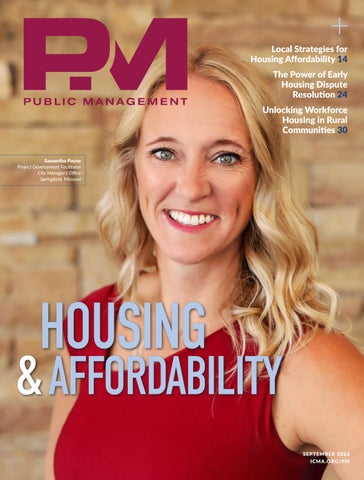
Local Strategies for Housing Affordability 14 The Power of Early Housing Dispute Resolution 24 Unlocking Workforce Housing in Rural Communities 30 Samantha Payne Project Development Facilitator City Manager’s Office Springfield, Missouri
HOUSING
& AFFORDABILITY SEPTEMBER 2026 ICMA.ORG/PM
LONG BEACH, CA
OCTOBER 17-21
#ICMA2026
5,000+ Local Government Leaders. Shaping What’s Next. The challenges facing our communities know no borders. This October 17–21 in Long Beach, CA, the world’s city, town, and county management professionals are uniting to shape what’s next in local leadership.
Unmatched Peer Connection
Actionable ROI
Benchmarking with 5000+ local government professionals from around the world.
Walk away with proven solutions across 150+ sessions, 20+ Micro Certifications and immersive mobile workshops.
Main Stage Visionaries Hear from author Simon Sinek and presidential historian Jon Meacham about purpose-driven leadership.
Will You Be in the Room? Registration is open and hotel rooms are available! Lock in your place alongside your peers.
Scan the QR Code to Register Now! icma.org/conference
SEPTEMBER 2026 VOL. 108 NO. 9
CONTENTS
In celebration of the 25th anniversary of ICMA’s Credentialed Manager program, we’ll be acknowledging each author that holds the credential with this gold icon ICMA-CM in each issue of 2026.
F E AT U R E S
14
14
Restoring Opportunity: Local Strategies for Housing Affordability Through zoning innovation, preservation efforts, and public-private partnerships, Lower Merion Township, Pennsylvania, is advancing practical, locally driven solutions. Brandon Ford, ICMA-CM Candidate and Charles Doyle
20
When Profit Meets Public Good: Why Cities and Developers See Growth Differently Understanding the motivation gap can lead to more productive conversations, clearer expectations, and better development outcomes for everyone involved. Samantha Payne
24
Early Housing Dispute Resolution Improves Health, Safety, and Economic Growth Why upstream eviction prevention may be one of local government’s most powerful housing tools. Alec Chapa
30
Unlocking Workforce Housing in Rural Communities
D E PA RT M E N T S 2 Executive Director’s Corner
Housing Solutions Start at the Local Level
4 Ethics Matter!
Who Is Eligible to File an Ethics Complaint with ICMA and Why This Matters
6 Perspectives
The Municipal Operating System
8 Veterans
From Baghdad to City Hall: Building Trust in a Contested Information Environment
How two Nebraska communities are aligning land, infrastructure, financing, and partnerships to create housing that supports long-term economic growth. Amanda Engell and Lisa Hurley
10 Women in Leadership
36
How ICMA Welcome Ambassadors Help New Members Find Belonging
The Art of the City Manager–Mayor Relationship A practical guide for city managers on how to collaborate with their mayor for better governance, clearer communication, and stronger communities. Rod Gould, ICMA-CM Jan Perkins, ICMA-CM & Frank Benest, ICMA-CM
40
30
Let Them Think You’ll Miss, Then Run the Table
12 Inside ICMA
48 Member Spotlight
From Air Force Colonel to City Manager
50 Assistants and Deputies
Turning Staff Feedback into a Blueprint for Success
Better Resident Service Begins with Employee Engagement
52 Local Gov 250
When employees feel heard and valued, they are better equipped to listen to residents, understand their needs, and respond with care. Rick Davis, ICMA-CM
54 Career
44
20
Democracy Happens in the Details
44
Your Resume, Your Story
56 Professional Services Directory
Collaborative Governance in Action: Oregon’s Watershed Restoration Success How local governments, nonprofits, state agencies, and citizen groups worked together to improve water quality and restore salmon habitats. Jiho Kim
International City/County Management Association S E P T E M B E R 2 0 2 6 | O F F I C I A L P U B L I C AT I O N O F I C M A | 1
EXECUTIVE DIRECTOR’S CORNER
Housing Solutions Start at the Local Level The September issue offers insight into how local government leaders should act with urgency, curiosity, and collaboration to address housing pressures in their communities. BY JULIA D. NOVAK, ICMA-CM
Housing is one of the most complex challenges local communities face, and the nature of
JULIA D. NOVAK, ICMA-CM is executive director of ICMA.
that challenge varies by country, state, region, and locality. This month’s Public Management magazine examines how communities are responding and how private-sector partners can contribute to solutions amid what many describe as a housing crisis. One reality I have come to appreciate is that vexing issues such as housing are both global and local. Regulation, local control, and the effects of short-term rentals were prominent topics at the recent Local Government Conference hosted by Local Government Professionals Australia New South Wales in Sydney. At the ICMA Annual Conference in Long Beach in October, attendees will find 14 sessions related to housing—further evidence that communities everywhere are searching for approaches that fit their circumstances.
Policy decisions do not eliminate tradeoffs; they help determine which consequences communities will experience. Local governments are often the first level of government to confront the unintended effects of wellintended policy. That proximity makes it essential for local leaders to remain open to adaptive change, test new ideas, and adjust as conditions evolve. Promising practices deserve attention, but they are not templates to be copied without regard for local history, market conditions, infrastructure, capacity, and community priorities. The most effective local leaders pair urgency with curiosity: they study what is working elsewhere, engage the people most affected, and adapt ideas rather than importing them unchanged. Local leaders must monitor changing conditions, identify unintended consequences, and share what they learn. Housing is not simply a matter of units, permits, or financing. It shapes whether a public works crew member Public Management (PM)
International City/County
Public Management (PM) (USPS: 449-300) is published monthly by ICMA (the International City/County Management Association) at 660 North Capitol St NW, Suite 700, Washington, DC 20001. Periodicals postage paid at Washington, D.C., and at additional mailing offices. The opinions expressed in the magazine are those of the authors and do not necessarily reflect the views of ICMA.
icma.org
COPYRIGHT 2026 by the International City/County Management Association. All rights reserved. Material may not be reproduced or translated without written permission.
EDITORIAL: khansen@icma.org
September 2026
REPRINTS: To order article reprints or request reprint permission, contact khansen@icma.org.
Management Association
SUBSCRIPTIONS: U.S. subscription rate, $60 per year; other countries subscription rate, $155 per year. Printed in the United States. Contact: 202/289-4262; subscriptions@icma.org.
ICMA has moved! Our new address: 660 N Capitol St NW Suite 700, Washington, DC 20001
POSTMASTER: Send address changes to Public Management, ICMA, 660 North Capitol St NW, Suite 700, Washington, DC 20001. ARTICLE PROPOSALS: Visit icma.org/writeforus to see editorial guidelines for contributors. For more information on local government leadership and management topics, visit icma.org.
2 | PUBLIC MANAGEMENT | SEPTEMBER 2026
icma.org/pm ICMA 660 North Capitol St NW Suite 700 Washington, DC 20001
ADVERTISING SALES: Natalie Matter Bellis The YGS Group natalie.matterbellis@ theygsgroup.com 717-580-8184 ICMA MEMBER SERVICES: 800.745.8780 | 202.962.3680 membership@icma.org
ICMA Creating and Supporting Thriving Communities ICMA’s vision is to be the leading association of local government professionals dedicated to creating and supporting thriving communities throughout the world. It does this by working with its more than 13,000 members to identify and speed the adoption of leading local government practices and improve the lives of residents. ICMA offers membership, professional development programs, research, publications, data and information, technical assistance, and training to thousands of city, town, and county chief administrative officers, their staffs, and other organizations throughout the world. Public Management (PM) aims to inspire innovation, inform decision making, connect leading-edge thinking to everyday challenges, and serve ICMA members and local governments in creating and sustaining thriving communities throughout the world.
can live close enough to respond in an emergency, whether an older resident can remain in the community they helped build, and whether employers can attract and retain the people they need. For local government managers, that makes housing both a community priority and an organizational imperative. Together, the articles in this issue reinforce a practical lesson: no single tool will resolve the housing challenge. Zoning reform can open opportunities, preservation can protect existing affordability, early dispute resolution can stabilize households, and thoughtful partnerships can help public and private actors align their incentives. Rural and suburban communities may use different
combinations of these tools, but each must begin with a clear understanding of its own conditions and constraints. What I appreciate about this month’s focus on housing is its refusal to reduce the challenge to a single sound bite. Expanding supply matters, but housing needs cannot be understood only through that lens—or only through the experience of urban areas and tourist towns. This issue examines the challenge in varied settings and from multiple perspectives. What does housing affordability look like in a rural community? How do public- and privatesector partners understand the challenge differently? And how can they build solutions that reflect local conditions while advancing the public good?
I hope this issue prompts you to ask what role your organization can play next. Where are local rules producing unintended barriers? Which existing homes or neighborhoods need protection? Who is missing from the conversation? And where could an early intervention or new partnership make a measurable difference? Local governments may not control every force shaping housing, but they are uniquely positioned to convene people, test practical approaches, learn from results, and adapt. PM is here to share ideas that you can consider, contextualize, and (hopefully) implement! Wicked problems require creativity and innovation—and that’s what our members do every day!
PRESIDENT
Midwest Region
Southeast Region
Michael Land* City Manager Coppell, Texas
Jeffrey Weckbach* Township Administrator Colerain Township, Ohio
Eric Stuckey City Administrator Franklin, Tennessee
PRESIDENT-ELECT
Cynthia Steinhauser* Deputy City Administrator Rochester, Minnesota
Chelsea Jackson Deputy City Manager Douglasville, Georgia
ICMA Executive Director
Julia D. Novak, ICMA-CM
Cori Burbach* Assistant City Manager Dubuque, Iowa
Justin Smith Assistant City Manager Pelham, Alabama
Managing Director, Brand Management, Marketing, and Outreach
Lynne Scott lscott@icma.org
Mountain Plains Region
West Coast Region
Pamela Davis Assistant City Manager Boulder, Colorado
Nat Rojanasathira* Assistant City Manager Monterey, California
Senior Managing Editor
Kerry Hansen khansen@icma.org
Sereniah Breland City Manager Pflugerville, Texas
Elisa Cox* City Manager Rancho Cucamonga, California
Penny Postoak Ferguson* County Manager Johnson County, Kansas
Katie Koester* City Manager Juneau, Alaska
Andy Pederson* Village Manager Bayside, Wisconsin PAST PRESIDENT
Tanya Ange* County Administrator Washington County, Oregon VICE PRESIDENTS
International Region
Meighan Wark County Administrative Officer Huron County, Canada Lungile Dlamini Chief Executive Officer Municipal Council of Manzini, Eswatini Jānis Lange Chief Executive Officer Riga City Municipality, Latvia
Northeast Region
Steve Bartha* Town Manager Lexington, Massachusetts
Senior Editor
Kathleen Karas kkaras@icma.org
Design & Production
picantecreative.com
* ICMA-CM
Brandon Ford Assistant Township Manager Lower Merion Township, Pennsylvania Kristy Rogers* Town Manager Milton, Delaware
S E P T E M B E R 2 0 2 6 | O F F I C I A L P U B L I C AT I O N O F I C M A | 3
ETHICS MATTER!™
Who Is Eligible to File an Ethics Complaint with ICMA and Why This Matters Revising the ethics review process to respond to increasing global incivility and polarization. BY JESSICA COWLES
Since 1924, our membership has stood on the
foundation of ICMA’s Code of Ethics. Publicly affirming a commitment to those principles requires a combination of education and training on ethical decision-making, as well as holding peers accountable to the Code’s high standards when needed. The ICMA Executive Board’s Committee on Professional Conduct (CPC) is acutely aware that ethics complaints have become a weapon in the arsenal of an increasingly polarized society. The CPC reviews all ethics complaints submitted to ICMA (between 50 and 70 each year) that allege a member’s conduct has violated the Code. The Rules of Procedure for Enforcement of the Code of Ethics (Rules) govern the ethics review process. It was against the backdrop of caring for our members’ well-being in an environment of incivility and polarization that the CPC explored revisions to the Rules and ultimately updated the Rules of Procedure for Enforcement in 2026. 2025–2026 Review
JESSICA COWLES is director of ethics at ICMA (jcowles@icma.org).
The CPC conducted comparative research to assess how other organizations handled who is eligible to file an ethics complaint and details about their review process before analyzing complaints filed in the past five years. Data showed that when individuals outside the local government profession filed ethics complaints, the overwhelming majority resulted in findings that the members’ conduct did not violate the Code. Since ICMA’s ethics review process is concerned about member conduct that undermines the profession’s integrity and damages public trust, this data on the outcome of ethics reviews demonstrated the vulnerability our members experience by committing to uphold our Code of Ethics. The CPC’s
4 | PUBLIC MANAGEMENT | SEPTEMBER 2026
review confirmed that ICMA needed to protect our members from spurious complaints. Based on these findings, ICMA offered dedicated opportunities for member input as the CPC began revising the Rules language that was adopted by the ICMA Executive Board during its May 2026 meeting. The following is a summary of those changes: • Narrows who is eligible to file an ethics complaint with ICMA to these three groups: - Current ICMA members. - Current state/country association members. - An individual who is not a member of ICMA and possesses the necessary first-hand knowledge of the alleged conduct, such as an employee of the member or a representative of the member’s governing body. • This process allows a nonmember “whistleblower” the eligibility to file a complaint only if they are aware of the conduct themselves. Individuals without the eligibility to file an ICMA complaint may choose to pursue other avenues such as their state ethics commission process. • Added language that ICMA will not tolerate harassing behavior or retaliation of any individual connected with the ethics review process. ICMA may engage law enforcement, the legal process, or reject a complaint when warranted.
• Reviews are limited to conduct within five years of ICMA receiving the ethics complaint unless the member concealed the conduct. • Members can request reconsideration and appeals/hearings regardless of whether they retain membership during an ethics review. (In prior versions of the Rules, members waived their rights if they resigned their ICMA membership.) • A complaint about a member’s conduct remains strictly confidential unless the ICMA Executive Board determines public censure is the appropriate sanction. The revised confidentiality provisions clarify that: - ICMA may choose not to process a complaint if confidentiality cannot be maintained for the benefit of the member. - When a review results in no ethics violation, the CPC may determine whether notification of appropriate parties is warranted when confidentiality cannot be assured or when notification is not in ICMA’s best interest.
Additional Highlights
• A complaint must be electronically filed, signed, and include the submitter’s contact information for ICMA to contact the submitter with clarifying questions. Submitters can still choose to be named as a complainant or remain anonymous to the member whose conduct is alleged to have violated the Code. • Clarified the limited circumstances when a state association fact-finding committee is required to gather the facts for an ethics complaint. • Provided overall edits and updated language. The Importance of Being Proactive
Members are sometimes put in difficult situations that may lead to the media incorrectly or inaccurately reporting on a potential ethics concern. Before it gets to that point, remember that ICMA provides free, confidential ethics advice to any member who may need guidance about a dilemma or may be uncertain of their obligations. ICMA ethics staff is here to serve as a neutral third party and advisor. Reach out to Ethics Director Jessica Cowles at jcowles@ icma.org if you want to explore an issue.
Is It Time to Upgrade Your Municipal Website? You
bsi
r sid
s o ind in orma ion, acc ss
hould ma
as
s rvi
s and ngag w h your commun y.
Download his prac ical ch wh h r i ’
im
o
bsi
or
lis o valua pgrad .
L arn Mor Sca
h
od
acc ss o
c
and s
888.228.2233 | civicplus.com
o gain c lis im
o
upgrad your w bsi .
S E P T E M B E R 2 0 2 6 | O F F I C I A L P U B L I C AT I O N O F I C M A | 5
PERSPECTIVES
The Municipal Operating System Connecting departments, automating work, and transforming resident service delivery. BY DIVERSIFIED TECHNOLOGY
Local governments have invested in
LEARN MORE about OneGov OS at diversifiedtech nology.com/ try-it.
technology for decades. Finance has one system. Public works has another. Permitting, utilities, parks and recreation, and code enforcement all rely on separate applications designed to serve individual departments. While these systems often perform well on their own, they rarely work together. Information becomes trapped in departmental silos, forcing employees to re-enter data, coordinate work through emails and spreadsheets, and manually move processes from one department to another. The result is unnecessary delays, duplicated effort, and limited visibility across the organization. At a time when residents expect responsive digital services and governments face increasing demands with limited staffing, local government needs a different approach: the municipal operating system.
6 | SPONSORED CONTENT | SEPTEMBER 2026
Rather than replacing every departmental application, a municipal operating system provides a common digital foundation that connects data, workflows, and resident services across the entire organization. It enables departments to operate as a single enterprise while preserving investments in existing software. OneGov OS was designed specifically to serve as that municipal operating system. Creating a Single Source of Truth
The first major benefit is a unified data foundation. Today, the same property, business, or resident information often exists in multiple applications, creating inconsistencies and making it difficult to obtain a complete picture of municipal operations.
A municipal operating system establishes a single source of truth, allowing information entered once to be securely shared wherever it is needed. Staff spend less time searching for information, leaders gain better operational insight, and departments collaborate using shared, reliable data instead of competing versions of the same information. Eliminating Friction Between Departments
The second major benefit is workflow automation. Most government services involve multiple departments, yet many organizations still rely on manual handoffs to move work through the process. A municipal operating system automates those workflows. Tasks are routed automatically, approvals move electronically, and information follows the process without repeated data entry. The result is faster service, fewer errors, greater accountability, and more time for employees to focus on solving problems instead of managing paperwork. Better Service for Residents
The greatest benefit is not simply improved efficiency— it’s better service. Residents expect government to function as one organization, not as a collection of disconnected departments. When information flows seamlessly and processes are automated, communities benefit from
Residents expect government to function as one organization, not as a collection of disconnected departments. faster response times, improved transparency, and a more consistent customer experience. By combining a unified data foundation with automated workflows, OneGov OS enables local governments to operate as a connected enterprise rather than a collection of isolated systems. The result is a more productive workforce, more effective operations, and better service for every resident. Try It. Right Here. Right Now. Visit diversifiedtechnology.com/try-it to explore a
fully functional demonstration of OneGov OS from both the resident’s and municipality’s perspectives—and see how a municipal operating system can transform service delivery in your community.
SEPTEMBER 2026 | SPONSORED CONTENT | 7
VETERANS
From Baghdad to City Hall: Building Trust in a Contested Information Environment
How leaders can connect performance, evidence, and communication to strengthen legitimacy and trust. BY DARRIN K. TANGEMAN, ICMA-CM
As a Special Forces officer, I served in
Baghdad as a liaison officer to the U.S. Army division responsible for the city. One enduring lesson was that success depended on more than what happened on the ground. Leaders also had to understand whom people trusted, how quickly information moved, and how actions could be interpreted within a changing information environment. A documented 2006 incident involving U.S. special operations forces became an important lesson for later missions. Its aftermath influenced how we operated, especially when events could be reinterpreted,
and the competing accounts shaped how those deaths were understood. In moments like these, establishing an accurate record is not only an institutional responsibility; it’s also a matter of respect for those affected and for a public trying to understand what happened. Fortunately, combat-camera personnel accompanied the force, and some soldiers also wore helmet-mounted cameras, creating a contemporaneous record before the scene was altered. That imagery became critical to understanding what had occurred, with the conclusion that it “made all the difference” during the investigation.2 The lesson is similar to what local governments have learned from police body-
GEO is not about manipulating an algorithm. It’s about making authoritative information easier for people and AI systems to discover and verify.
DARRIN K. TANGEMAN, ICMA-CM is chief financial officer for Orleans, Massachusetts, and co-founder of ICMA’s Veterans Local Government Management Fellowship.
scenes altered, and competing narratives established before the facts were understood or communicated. It reinforced the importance of considering the information environment during operational planning, not only afterward. During the operation, U.S. special operations and Iraqi forces engaged an armed group in a deadly confrontation in which several people lost their lives. After the forces departed, the circumstances surrounding those deaths quickly became part of a competing public narrative. Within about 45 minutes, weapons were removed and some remains were moved to create the appearance that those killed had been praying rather than participating in an armed confrontation. Images of the altered scene were distributed with allegations that American forces had entered a place of worship and killed peaceful civilians. That account reached the media before the force returned.1 The human cost should not be lost in the lesson that followed. People had died, families and communities would carry those losses long after the operation ended,
8 | PUBLIC MANAGEMENT | SEPTEMBER 2026
worn cameras. A camera cannot resolve every disputed fact or capture every piece of context, but it can preserve an independent record before memories fade, evidence changes, or competing accounts become established. More importantly, it demonstrates the value of building documentation and accountability into operations from the outset. Yet preserving the record is only part of the challenge. Briefing materials were assembled within hours, but approval processes kept them from public release for almost 70 hours. The operations officer involved later put it plainly: “It took us three days. That’s our fault.”3 That is where the connection to local government becomes clear. Public trust depends not only on whether government has a factual record, but on whether it can verify and communicate that record while people are still forming judgments. Meeting videos, staff reports, police footage, inspection records, and technical studies may establish what happened, but if they are difficult to find or arrive too late, their ability to strengthen trust is diminished. Residents also judge the institution and the messenger. Research shows that perceived expertise and trustworthiness
niyazz - stock.adobe.com.jpeg
affect how people distinguish accurate from false information.4 The question is not simply, “What are the facts?” but also, “Who should explain them, and what evidence can residents verify?” Trust is strongest when institution, messenger, and evidence reinforce one another. This challenge is growing as residents encounter civic information through social media, search engines, neighborhood networks, and AI-generated content, often without visiting a municipal website. This is where generative engine optimization, or GEO, becomes relevant. In simple terms, GEO structures reliable online information so generative AI systems can more easily find it, understand it, attribute it to the correct source, and use it when answering questions. Research indicates that authoritative citations, statistics, quotations, and clear structure can improve source visibility in generative-engine responses.5 For local government, GEO is not about manipulating an algorithm. It’s about making authoritative information easier for people and AI systems to discover and verify. Meeting minutes and videos, budgets, staff reports, technical studies, datasets, policies, and other public records should form an accessible evidentiary record connected to the decisions they support. My doctoral research examines whether evidencetransparent municipal communication can build on these principles by pairing factual claims with primary evidence, source documentation, and decision-making rationale so residents can independently evaluate what government tells them. Taken together, the lesson from Baghdad and the challenges facing local government today point to a broader principle: trust is strengthened when organizations create a reliable record, verify what they know, communicate it promptly, and update that record as new information emerges. For local government leaders, that principle can be translated into five practical disciplines, found in the box on this page.
One lesson I carried from special operations into local government is that technology is not the strategy; it helps well-led organizations carry out strategy more effectively. Local government cannot control the information environment, nor should it try. It can perform well, preserve the record, communicate through credible people, make reliable evidence discoverable, and let residents evaluate it for themselves. That is how we build a government worthy of being believed and trusted. ENDNOTES AND RESOURCES
Dauber, C. E. (2009). The truth is out there: Responding to insurgent disinformation and deception operations. Military Review, 89(1), 13–24. 2 Ibid. 3 Ibid. 4 Prike, T., Butler, L. H., & Ecker, U. K. H. (2024). Source-credibility information and social norms improve truth discernment and reduce engagement with misinformation online. Scientific Reports, 14, Article 6900. 5 Aggarwal, P., Murahari, V., Rajpurohit, T., Kalyan, A., Narasimhan, K., & Deshpande, A. (2024). GEO: Generative engine optimization. Proceedings of the 30th ACM SIGKDD Conference on Knowledge Discovery and Data Mining. 1
Five Practical Disciplines for Innovative Communities 1.
Record. Create contemporaneous evidence showing what government knew, considered, and decided.
2.
Verify. Establish authoritative facts while distinguishing evidence from assumptions and what remains unknown.
3.
Release. Communicate verified information promptly and publish supporting evidence in clear, searchable formats.
4.
Update. Explain what is known, what remains uncertain, and what changes as new evidence emerges.
5.
Evaluate. Determine whether residents understood the information, found the messenger and evidence credible, and perceived the process as fair. Use those findings to improve future communication and strengthen public trust. S E P T E M B E R 2 0 2 6 | O F F I C I A L P U B L I C AT I O N O F I C M A | 9
WOMEN IN LEADERSHIP
Let Them Think You’ll Miss, Then Run the Table What playing pool taught me about leading in local government. BY KELLYE MAZZOLI
I walked up to the pool table before our league
match, put my hand out, and introduced myself. The man I was about to play did not give me his name or ask for mine. He looked at me, then back at the table, and said, “You’re a five?” In pool, amateur league players carry a skill rating, and five is a decent one. In fact, most women in my local league are not rated quite that high. “Yeah,” I said. “I’m a five. And what are you?” I’ve been in plenty of rooms where women are sized up in this same way, and pool is actually where I learned what to do about it. In all, I spent more than 15 years in local government, and now I coach the managers who are still sitting in the chair. Here are the top five lessons that playing pool actually taught me about managing a city. Stop Shooting the Closest Ball
KELLYE MAZZOLI is an executive coach for local government leaders and former assistant city manager for Bothell, Washington. She is a member of the ICMA SheLeadsGov committee. (citybosscoach. com, linkedin.com/ in/kellyemazzoli)
A strategic player reads the whole table first. A reactive player shoots the ball that is nearest or easiest just like a reactive city manager deals with whatever fire happens to walk through their door at that moment. It’s the same move: closest ball, closest flame. That’s what gets attention. I believe the strategic city manager still puts out fires every day, but aims in a way that moves the city toward preventing a similar fire in the future. Play the Table in Front of You
Power Scatters the Rack
You see, the table is never perfect, and it’s never exactly the same in every game. There’s always a ball positioned in a way you didn’t plan for, between you and the goal or leave that you wanted. (The leave is where the cue ball stops. The spot you hand yourself for the next shot.) Sometimes in city management, we find that revenue softens, the state preempts you, an election turns the dais, or your best director resigns mid-project. These are the obstacles on the table. The skilled player is not trying to move and clear every obstacle. Instead, they adjust to the table and adapt the plan to still achieve the desired result. Maybe even using some of the obstacle balls to pocket one of their own.
Position is about speed and touch, not how hard you hit. Power without control just scatters the balls. What you find in pool and in leadership is that force and urgency are not necessarily tied to effectiveness. Your finesse, timing, and relationships move more than pressure ever will. Overall, I found that the game rewards the most controlled and strategic player in the room, not the loudest. For a woman that means she does not need to be the (physically) strongest player in order to be the most successful.
10 | PUBLIC MANAGEMENT | SEPTEMBER 2026
They Watch the Shots You Don’t Take
You learn this game by watching better players. And everyone is watching you, including the shots you choose
Kellye Mazzoli at the APA Spring City Cup, New Orleans, May 10, 2026 | Photo by Desi Williams
not to take. Your leadership team reads you the same way, learning as much from what you decline to do as from what you actually do. I tell the managers I coach the same thing: you don’t get to turn off being the example. The only choice is whether you are a deliberate one. You get better the same way your team does—by watching closely and seeing what works. Play Above Your Rating
A rating tells the room how good you are allowed to be, if you accept it. I see women in pool who stay low on purpose, comfortable rather than challenged. Do not be that player. When you clear an arbitrarily set bar, something shifts. I’ve learned that being underestimated
is no longer about proving a room wrong; it starts being about what I’m doing with the authority I’ve earned. I never did get that man’s name (even though I asked). I guess he had my number and figured that was the whole story. It never is. Remember, there’s a place at the table for you. Walk around it, make your plan, be strategic, then set up (take a deep breath) and take your shot. Every time you do, you make it a little easier for the next woman to step up to the table. And the game? For me, it honestly got a lot more fun. Just envision this: somewhere out there, the next woman is chalking her cue. Play like she’s watching. S E P T E M B E R 2 0 2 6 | O F F I C I A L P U B L I C AT I O N O F I C M A | 11
INSIDE ICMA
How ICMA Welcome Ambassadors Help New Members Find Belonging For 15 years, they have helped new members and first-time conference attendees build connections, confidence, and community. BY TAYLOR LOUGH, DAVID MILLER, LINDSAY RADCLIFF-COOMBES, AND KRISTIN READ
Joining a professional association— especially one with more than a century of history—can be intimidating. “When I first joined ICMA, I was very introverted and honestly avoided attending the annual conference. The thought of walking into a room full of people I didn’t know was intimidating,” said Melissa Marsh, city manager of Madison Heights, Michigan, and an ICMA welcome ambassador. “Early in my career, I received a scholarship to attend, and I’m so glad I said yes.” Friendly Faces TAYLOR LOUGH is assistant town administrator of Highland Park, Texas.
DAVID MILLER is city administrator of Springtown, Texas.
LINDSAY RADCLIFFCOOMBES is deputy town manager of Severance, Colorado.
KRISTIN READ is assistant town manager of Castle Rock, Colorado.
Now in its fifteenth year, ICMA’s Welcome Ambassadors Committee offers personal, peer-to-peer outreach for current members and those who have recently joined the association. The committee’s 22 members reach out each month, giving new members a contact who can answer questions, make introductions, and help them navigate ICMA. At this year’s annual conference in Long Beach, California, attendees can find a friendly face at the committee’s welcome table on Saturday from 10:00 a.m. to 4:00 p.m. and Sunday from 11:00 a.m. to 1:00 p.m. Ambassadors will also attend the First-Time Attendee Reception at 12:15 p.m. on Sunday, helping new members find connections before the opening general session. Learn more at conference.icma.org/tips-for-first-time-attendees. “My first conference was about five months into the role of CAO. Seeing that I was not alone, that others were also new, and that there was a world of support for me meant a great deal,” said Billy Peppers, city manager of Canton, Georgia, and committee chair. “Knowing my colleagues from my state were involved and saw benefit encouraged me to get engaged.” Peppers—and every other ambassador—personally welcomes more than 100 new ICMA members each year. Welcome as an Action
Committee members see their role as more than sending an introductory message. “Welcome is not a word; it’s an
12 | PUBLIC MANAGEMENT | SEPTEMBER 2026
action. A true welcome extends far beyond a spoken greeting or a polite gesture at a doorway,” said David Miller, city administrator of Springtown, Texas. “Welcome means making ourselves available… creating a safe environment where people feel genuinely valued, understood, and seen.” Listening is central to that work. So is helping newcomers find knowledge and relationships that can sustain a career in local government. William Webb, assistant county administrator for Isle of Wight County, Virginia, encourages new members to “be a sponge” and learn as much as they can. He advises them to find a local mentor or neighboring manager who can serve as a sounding board. Dave Slezickey, chief executive officer of The Village, Oklahoma, offers similar advice: Because no two days on the job are alike, networking and peer relationships are essential. Small Gestures, Lasting Connections
Several ambassadors still remember the people who made them feel that they belonged. “I received a handwritten note from senior advisor Mark Wollenweber,” said Oliver Turner, township administrator for Sylvania Township, Ohio. “I kept the note for a long time, and it helped me feel welcome to the profession.” Eric Anthony Devezin, founding president of California Baptist University’s ICMA Student Chapter, remembers receiving a standardized email when he joined in 2024. Now a welcome ambassador, he appreciates how the committee’s outreach has grown. “Seeing how much our ambassador outreach has evolved into something genuinely warm, dynamic, and community-centric makes me incredibly proud to help lead that growth today.” The methods have evolved, but the purpose has remained constant: Make sure every new member finds not only information, but also a person who is ready to listen, connect, and welcome them into the profession.
Making the Most of Your ICMA Annual Conference Experience David Miller, City Administrator, Springtown, Texas
Welcome Stories Taylor Lough Assistant Town Administrator, Highland Park, Texas
Early in my career, colleagues encouraged me to get involved and give back to the profession. Their advice has stayed with me: you don’t have to change jobs to grow—learn from others, bring new ideas home, and make a greater impact in your own community. For the past decade, I’ve served as a welcome ambassador because our profession’s greatest strength is one another. My advice to new and longtime members is simple: Reach out. Introduce yourself. Ask questions. Share your experiences. One conversation may influence someone else’s career— or your own. Lindsay Radcliff-Coombes Deputy Town Manager, Severance, Colorado
ICMA members are incredibly approachable. I have learned that a simple introduction or email can lead to valuable mentorships, friendships, and professional opportunities. In the Mountain Plains region especially, we value collaboration over competition, and I hope every new member feels that generosity and support. When I welcome someone, I ask about their community, what brought them to local government, and what they hope to gain from ICMA. If someone in my network has similar interests or experience, I make an introduction. My goal is not just to welcome someone to the organization; it’s to help them feel they have joined a community. Kristin Read Assistant Town Manager, Castle Rock, Colorado
I joined ICMA as an early-career professional and at my first conference, I felt overwhelmed—and a bit out of place as a woman still in her 20s. In recent years, I’ve pursued the Credentialed Manager designation and served on this committee and the Conference Evaluation Committee. Those experiences have reinforced what our colleagues shared: The more involved you become with ICMA, the more comfortable and connected you feel. If you are considering a next step within the association, I suggest you take it.
Community and networking are at the heart of the ICMA annual conference experience. While the education sessions, keynote speakers, and professional development opportunities are invaluable, it’s often the relationships we build that have the greatest impact on our careers and our ability to serve our communities. I learned this firsthand when I attended my first ICMA annual conference. Like many first-time attendees, I was completely lost. The conference was overwhelming, and I found myself isolated simply because I didn’t know how to navigate the event or connect with others. I missed opportunities that could have enhanced my experience and expanded my professional network. That experience became the primary motivation for my involvement with the ICMA Welcome Ambassadors Committee. I wanted to help ensure that new attendees would not feel the same uncertainty and isolation that I experienced. The committee plays a critical role in welcoming first-time participants and helping them build connections, navigate the conference, and take full advantage of everything ICMA has to offer. As ICMA members, we all have a responsibility to foster a welcoming and inclusive environment. A simple introduction, invitation to join a conversation, or offer to answer questions can make a lasting difference for someone attending their first conference. These small acts of engagement help transform a large professional gathering into a meaningful community. When we invest in helping new attendees build connections, we strengthen not only their conference experience but also the future of the profession. Strong networks create lasting relationships, encourage collaboration, and ensure that ICMA remains a vibrant community of leaders committed to supporting one another and advancing local government excellence.
S E P T E M B E R 2 0 2 6 | O F F I C I A L P U B L I C AT I O N O F I C M A | 13
Restoring Opportunity Local Strategies for Housing Affordability
Through zoning innovation, preservation efforts, and public-private partnerships, Lower Merion Township, Pennsylvania, is advancing practical, locally driven solutions. BY BRANDON FORD, ICMA-CM CANDIDATE & CHARLES DOYLE Housing affordability is no longer just a challenge for major cities. In Lower Merion Township, Pennsylvania, one of the Philadelphia region’s most desirable suburban communities, the gap between what homes cost and what households can afford is reshaping who can live and work in the community. These conditions raise a question that extends well beyond
Lower Merion: How can local governments help preserve access to the communities they have worked so hard to build? As the nation celebrates its 250th anniversary, that question takes on particular significance. The American Dream, the enduring belief that anyone
14 | PUBLIC MANAGEMENT | SEPTEMBER 2026
should have the opportunity to build a stable life and choose where they live, depends in part on whether communities remain accessible to the people who want to call them home.
While housing markets are shaped by regional and national forces, local governments are not powerless. Through zoning
innovation, preservation strategies, targeted funding, and public-private partnerships, municipalities can expand housing opportunities and help ensure that affordability is not simply a market outcome, but a local policy priority.
Defining Affordability in a Local Context Affordability, especially as it pertains to housing, is a term that is often thrown around with minimal context. The same is true about “attainable” housing. While related, these terms are not interchangeable; each describes a distinct segment of the housing market and serves different populations. Both are grounded in a region’s area median income (AMI), which represents an estimated midpoint of household earnings in a given area and serves as a common benchmark for what residents can reasonably afford. Housing affordability is fundamentally defined by cost burden rather than a fixed income band: a household is considered cost-burdened if it spends more than 30% of its income on housing. In practice, however, income-restricted affordable housing is typically
targeted to households earning up to 80% of a region’s AMI, with rents or sale prices calibrated to remain within that 30% affordability threshold, often supported by public subsidies, incentives, or regulatory requirements. Attainable, or moderateincome/workforce housing, by contrast, is defined by its income range. It generally serves households earning between 80 and 120% of the AMI. These households may not qualify for subsidized housing but still face affordability challenges in high-cost markets. While not always formally subsidized, these units are often priced or designed with the same 30%
affordability benchmark in mind and are more commonly delivered through marketbased or mixed-income development strategies. Together, affordable and attainable housing form a continuum of housing affordability. One addresses the needs of lower-income households, while the other fills the gap for moderateincome residents who are increasingly priced out of the communities where they live and work. Understanding the distinction is critical for local governments seeking to craft policies that respond to the full spectrum of housing needs, rather than treating affordability as a one-size-fits-all challenge. For purposes of this article, the term affordability is used broadly to encompass both affordable and attainable
housing, with distinctions noted where relevant.
The Growing Affordability Gap Lower Merion Township’s 2025 housing needs assessment highlights a structural imbalance between supply and demand. Over the past decade, job growth (+18%) has significantly outpaced housing production (+6.5%), further constraining an already tight housing market. In 2019, the average home sale price in Lower Merion was $553,000 while a median income household could afford a home priced up to $690,000. By spring 2025, the typical home value had climbed to approximately $861,000, a 56% increase, while conversely the purchasing power of medianincome households slightly
S E P T E M B E R 2 0 2 6 | O F F I C I A L P U B L I C AT I O N O F I C M A | 15
decreased to $686,000. This divergence between income and cost has metaphorically closed the door to homeownership for many households, limiting opportunity within the township. The rental market reflects similar pressures. With a vacancy rate averaging just 1.8%, well below the 5% generally considered healthy for local housing markets, renters face limited options and intense competition. This limited supply has driven rents up by more than 20% since 2018, further widening the gap between what households earn and what they can afford in housing costs. Consequently, nearly half of all renter households (48%) in the township are now cost-burdened. Vulnerable populations are particularly
affected, including 71% of senior renters and 77% of single-parent households. Together, these market trends are reshaping the community. Essential workers, young families, and long-time residents, particularly those on fixed incomes, are finding it increasingly difficult to move into or remain in the township.
From National Challenge to Local Action Lower Merion is not alone in experiencing these housing hardships. Rising home prices and limited options have altered the housing landscape across the nation, prompting professionals and elected officials to confront a crucial question: How can local government help restore access to a wider range of
16 | PUBLIC MANAGEMENT | SEPTEMBER 2026
housing opportunities? Increasingly, communities of all sizes are recognizing that housing affordability is not just a market issue, but a core governance issue— one that affects economic competitiveness, workforce retention, and long-term community stability. Local governments are stepping beyond traditional roles
and services in response to this growing challenge by supporting broader access to housing opportunities across varying income levels. The township’s response begins with a simple but critical shift: treating housing affordability as a shared local responsibility. While housing markets are shaped by regional and national
forces, Lower Merion has embraced an understanding that local governments play a decisive role through land use regulation, policy design, and facilitating partnerships. The township’s housing strategy is not defined by a single initiative, but by a coordinated set of tools designed to expand opportunity. This approach respects community context while acknowledging fiscal and operational limitations of smaller and mid-sized municipalities. Through zoning innovation, preservation efforts, and public-private partnerships, Lower Merion Township is advancing practical, locally driven solutions.
Zoning and Land Use Innovation Zoning sits at the center of Lower Merion’s local housing
strategy. Recognizing that conventional zoning patterns can constrain affordability through restrictive density limits and parking requirements, the township adopted a new zoning code in 2020 that prioritizes housing diversity. The new code established the town center zoning districts (TC1 and TC2), which support mediumintensity mixed-use development areas along commercial corridors, main street business districts, and transit hubs. It also introduced a definition for moderate-income housing and then tied the provision to a height incentive in the TC1 District. Under this framework, developers can add an additional story to a building if they provide either
Housing affordability is not just a market issue, but a core governance issue—one that affects economic competitiveness, workforce retention, and long-term community stability.
five units or 20% of total units (whichever is greater) at 80–120% AMI. This incentive has already resulted in the creation of attainable housing units that would not otherwise have been delivered. The zoning update also created a dedicated affordable housing fund. This local, flexible financing tool is supported by contributions from developers who opt to utilize the TC1 height incentive without providing the required number of moderate-income housing units. Since it was established, the fund has been used to further the township’s housing goals, including its 2025 housing assessment and action plan, and to provide gap funding for affordable housing developments like Ardmore House II, which we’ll discuss later.
Solutions for Backflow Valves Fire Valves Fire Hydrants
Secured by
866-308-9911
www.backflowtheft.com info@backflowtheft.com
800-422-2866
www.laigroup.com sales@laigroup.com
S E P T E M B E R 2 0 2 6 | O F F I C I A L P U B L I C AT I O N O F I C M A | 17
for resale to income-qualifying households. By offsetting the cost of extensive repairs and placing deed restrictions on homes acquired and sold to low- to moderate-income households, Lower Merion is able to preserve NOAHs and maintain affordability in a more cost-effective way compared to the pursuit of new construction.
Preservation of Existing Affordable Housing While new housing construction is essential, Lower Merion also recognizes the importance of preserving naturally occurring affordable housing units (NOAHs). NOAHs are residential housing units that have remained affordable or attainable without the use of government subsidies, often due to age, condition,
or smaller size. In many communities, NOAHs represent a significant share of the most affordable housing options available to low- and moderate-income households. However, NOAHs are increasingly vulnerable to reinvestment pressures. As property values rise, older properties are often purchased, renovated, and placed back on the market at higher price points,
18 | PUBLIC MANAGEMENT | SEPTEMBER 2026
eventually eliminating their affordability. Lower Merion’s approach to NOAHs recognizes the need to proactively preserve these units through targeted policies and programs. For years, the township has utilized a significant portion of its federal community development block grant (CDBG) funding to support housing rehabilitation efforts and the acquisition of NOAHs
Public-Private Partnerships: Ardmore House II No single entity can address housing affordability alone. Public-private partnerships act as a central component of Lower Merion’s approach to affordability, enabling the township to leverage additional resources, gain in-depth expertise, and share risk in moving housing projects from concept to completion. The township has worked to build partnerships with nonprofit organizations, private developers, and institutional stakeholders to translate its housing policy goals into tangible outcomes.
Ardmore House II, a lowincome, multifamily senior housing development, stands as a leading example of this strategy. Developed in partnership with county and state officials, as well as a nonprofit housing developer, the project converts an underutilized, predominantly paved, township-owned parking lot into high-quality, affordable housing for seniors. Beyond the physical development, Ardmore House II reflects the value of alignment between public priorities and private execution. The township actively created conditions for success through planning, public engagement, and administrative support, while development partners brought the technical capacity and financing necessary to deliver the project. This shared approach enabled the creation of housing that meets a specific community need.
Where to Start: A Commitment to Local Action Lower Merion’s experience offers several lessons for local governments impacted by affordability pressures or that seek to take a more proactive role in addressing housing challenges. Although shaped by the experience of a highcost suburban community, these principles are broadly applicable to jurisdictions of all sizes working to expand housing opportunities: Start with data and planning. A clear
understanding of local market conditions and housing needs is essential to developing effective, targeted strategies. Use a range of tools. No single policy or program will solve affordability challenges. Success requires a coordinated approach that combines
innovative zoning incentives, strong partnerships, and viable funding tools. Leverage partnerships.
Collaboration with nonprofit organizations, private developers, and governmental partners expands capacity and creates pathways for implementation. Balance production and preservation. Increasing
housing supply is critical, but preserving existing affordable housing is equally important. When local governments act as conveners and facilitators of housing affordability, they can
unlock opportunities that might otherwise remain out of reach. In doing so, they reinforce a broader principle: restoring access to housing opportunities requires both vision and partnership. In Lower Merion Township, that effort is taking shape through deliberate planning, collaborative action, and a sustained commitment to expanding opportunity. By addressing housing affordability at the local level, Lower Merion’s experience shows how municipal managers can use limited tools in responding to
complex challenges with practical, forward-looking solutions.
BRANDON FORD, ICMA-CM CANDIDATE, is assistant township manager for Lower Merion Township, Pennsylvania, and ICMA Northeast regional vice president. CHARLES DOYLE, AICP, is assistant director for planning for Lower Merion Township, Pennsylvania.
S E P T E M B E R 2 0 2 6 | O F F I C I A L P U B L I C AT I O N O F I C M A | 19
WHEN PROFIT MEETS PUBLIC GOOD
Why Cities and Developers See Growth Differently Understanding the motivation gap can lead to more productive conversations, clearer expectations, and better development outcomes for everyone involved. BY SAMANTHA PAYNE
20 | PUBLIC MANAGEMENT | SEPTEMBER 2026
A
developer walks into a pre-application meeting with a project that does not meet zoning. Not a little off. Significantly off. And before anyone says a word, everyone in the room already knows how the conversation is going to go. From the developer’s side, the numbers only work at a certain scale. Cut too many units and the project does not move forward. It’s that simple. From the city’s side, the question is not just whether the project works
financially. It’s whether it works for the community long term. Infrastructure, traffic, and consistency with adopted plans all come into play. We often talk about this type of situation as if something is broken. As if cities and developers are working against each other. In reality, this is exactly how the system is supposed to work.
The Development Motivation Gap There is a gap in how cities and developers approach growth. Not in whether they want it, but in how they define success.
Developers are driven by financial feasibility. If the numbers don’t work, the project doesn’t happen. Cities are responsible for the bigger picture. They have to think about infrastructure, long-term planning, and the cumulative impact of growth over time. Both sides want development, but they are solving different problems. Most of the friction we see in the development process comes from this gap.
Developer Motivation: What Has to Work Development decisions live or die on a spreadsheet. Every
Early conversations matter. When developers and city staff can talk through a concept before it is fully designed, it’s easier to identify issues and adjust direction.
project has a point where it becomes viable. Land costs, construction pricing, interest rates, and expected return all factor in. Small changes can have outsized impacts. One of the most common misunderstandings is how sensitive projects are to scale. Removing even a handful of units can be enough to make a project fall apart financially. What looks like a minor adjustment from the outside can be the difference between moving forward and walking away. Time matters just as much. Delays increase carrying costs,
create uncertainty, and affect financing. From a developer’s perspective, predictability is not a luxury. It’s part of making the project work. Requests for more density or flexibility are often framed as maximizing profit. In many cases, they are about making the project possible at all.
City Motivation: Thinking Past the Project Cities are asking a different set of questions. A project might work financially and still create long-term issues. Roads, utilities, stormwater
S E P T E M B E R 2 0 2 6 | O F F I C I A L P U B L I C AT I O N O F I C M A | 21
systems, and public services all have limits. One project may not strain those systems, but repeated decisions over time will. Zoning and development standards are not arbitrary. They reflect past decisions about how a community wants to grow. They are one of the few tools that cities have to manage that growth intentionally. There is also public accountability. Cities are responsible to residents who expect growth to be managed in a way that protects quality of life. This is why cities can feel slow or overly cautious. They are not just reviewing a single project. They are thinking about what happens if the same decision is made over and over again.
Where the Tension Shows Up This gap becomes most visible during project review. Density is a common pressure point. Developers may need more units to make the numbers work. Cities may be working within limits that reflect infrastructure capacity or community expectations. Infrastructure requirements create similar friction. What is necessary from a city perspective can significantly impact project cost from a developer’s side. Design standards can also pull in different directions. What improves long-term outcomes for a community can reduce efficiency or increase cost for a project. In many cases, these conversations happen before a formal application is ever submitted, when both sides
Transparency is key. When developers understand the reasoning behind requirements, and cities understand the financial impact of decisions, the conversation changes. are trying to understand what is possible within the constraints they each face. Cities are often accused of slowing down development. Developers are often accused of prioritizing profit over community. Both critiques miss the point. Each side is doing exactly what it’s supposed to do.
The Tension Is the System It’s easy to assume this tension is something to fix. It’s not. Without development pressure, cities can become overly restrictive and limit growth that communities need. Investment, housing, and redevelopment don’t happen without developers willing to take on risk. Without municipal oversight, development decisions could prioritize short-term outcomes without fully accounting for long-term impacts. The tension between these two perspectives is what creates balance, and the goal should not be to disrupt that balance but to understand it. The problem is not that the tension exists. The problem is that we often misunderstand why it exists. Bridging the Gap If the motivations are different, the process
22 | PUBLIC MANAGEMENT | SEPTEMBER 2026
has to acknowledge that. Predictability is one of the most important pieces. Clear standards and consistent processes reduce uncertainty and help developers understand expectations early. Early conversations matter. When developers and city staff can talk through a concept before it is fully designed, it’s easier to identify issues and adjust direction. There is also value in roles that sit between these perspectives. In many communities, development facilitators help translate between financial realities and regulatory requirements. That role is less about making decisions and more about helping both sides understand what the other is working within. Transparency is key. When developers understand the reasoning behind requirements, and cities understand the financial impact of decisions, the conversation changes.
Developers bring capital and execution. Cities provide structure and long-term accountability. When that is understood, the conversation shifts. It becomes less about winning and more about finding a path forward.
Rethinking the Narrative We tend to talk about development as a conflict between two sides. That framing is too simple. Cities and developers are not working against each other. They are working within the same system, just with different responsibilities.
© Samantha Payne
Conclusion Most development debates focus on the visible disagreement. A project asks for something beyond what is allowed. The city pushes back. The developer pushes forward. What is less visible is that both sides are responding to the constraints they operate under. Developers are trying to make projects viable. Cities are trying to make growth sustainable. Both are necessary. The goal is not to eliminate the tension between them. The goal is to understand it well enough to work through it. Because that tension is not what stops good development. It’s what shapes it.
SAMANTHA PAYNE is the project development facilitator for the city manager’s office of Springfield, Missouri.
Calendar of Events Upcoming conferences, professional and leadership development, webinars, and trainings Learn more and register at icma.org/events | learninglab.icma.org.
SEPT 1
Strengthening Communities Through Strategic Partnerships
ONLINE | FREE WEBINAR
SEPT 9
Beyond the Uniform: Translating Military Service into Local Government Impact
ONLINE | FREE WEBINAR
SEPT 16
A Day with ICMA | Lawrence, Kansas
IN-PERSON | ICMA MEMBERS ONLY
OCT 1
Strengthen Your Employee Benefits with Student Loan Forgiveness Support
ONLINE | FREE WEBINAR
SEPT 3
Strengthen Your Employee Benefits with Student Loan Forgiveness Support
ONLINE | FREE WEBINAR
SEPT 15
SheLeadsGov: Successful Managing Beyond the Scope of Practice
ONLINE | FREE WEBINAR
SEPT 17
2026 State of Public Budgeting: Addressing Concerns with Reductions in State and Federal Funding
ONLINE | FREE WEBINAR
OCT 14
SEPT 8
Tools of Local Government: Using Data to Solve Community Challenges
ONLINE | FREE WEBINAR
SEPT 16-18
Gettysburg Leadership Institute
IN-PERSON | LEADERSHIP DEVELOPMENT
SEPT 22OCT 13
ICMA Innovation Bootcamp
ONLINE | TRAINING SERIES
How to Become a Great Coach
ONLINE | FREE WEBINAR
S E P T E M B E R 2 0 2 6 | O F F I C I A L P U B L I C AT I O N O F I C M A | 23
Early Housing Dispute Resolution Improves Health, Safety, and Economic Growth Why upstream eviction prevention may be one of local government’s most powerful housing tools. BY ALEC CHAPA
ince 2015, the number of Americans without permanent or even temporary shelter has doubled, reaching three million. The reasons are readily apparent. Home prices rose 60% between 2019 and 2025, pushing the median home price to an all-time high of $420,000— five times the median household income.1 Rent has climbed just as dramatically, jumping from $1,350 per month in 20152 to $2,100 in 2025,3 outpacing both inflation and wages. In fact, between 2000 and 2022, rent grew more than six times faster than real household income.4 As Massachusetts Senator Lydia Edwards put it, “The rent eats first, but now the rent eats it all.” Housing has climbed to become the top policy priority in nearly every community in America.5 The value of preventing homelessness is clear and urgent. And the research pointing to the increasing need for mediation as a prevention force has never been stronger.6
24 | PUBLIC MANAGEMENT | SEPTEMBER 2026
A Proven Framework for Preventing Housing Disaster Early intervention programs have proven capable of keeping roofs overhead and bottom lines intact—before eviction and turnover, before homelessness and social services, before crisis. Research and development efforts have synthesized lessons learned from pandemic-era diversion programs, what experts across the U.S. advise, and early dispute resolution which have now become best practice recommended by the American Bar Association.
This research led to a unique approach to mediation. Instead of engaging in zero sum policy debates between housing providers and tenants, each wanting more at the other’s expense, a third option has emerged as a strong contender: pre-filing dispute resolution that stabilizes both households and housing providers. When they can both win together, why continue a game requiring one to lose? Successful prevention models often begin by educating housing providers on the massive pain of eviction and the proven results that mediation can bear for this problem: once stakes and benefits are clear, they voluntarily commit to prevention by making it their property management default, which proved true for Texas providers.7 Both housing providers and residents agree up front to mediate disputes rather than rushing to court. Both commit equal resources in small monthly fees, comparable to a fast food meal. And structured prevention frameworks make that commitment practical and accessible with a cohesive system complete with user-friendly guides, readily available resources, and on-demand services. The small monthly investment holds enough psychological weight that is key to commitment and ultimately good faith participation, as evidenced by recent research from Stanford Medicine.8 These funds support on-demand services and educational resources on conflict resolution. While these resources are helpful to have for any type of conflict and help justify ongoing program costs, they most importantly prepare parties for productive conflict engagements. Shared-cost helps ensure mutual buy-in while program design ensures accessibility. Stakeholders can access these services whether conflicts arise between roommates, neighbors, or housing providers and residents because any one of these relationships can jeopardize stability. This widespread access creates a ripple effect across entire rental communities. In the wake of HUD funding cuts, public leaders are searching for solutions. San Antonio, Texas, stands out here: its housing ecosystem is increasingly focused on preventing housing instability before it escalates into eviction or homelessness.
Opportunity Home, the largest public housing provider in Texas, has repeatedly emphasized housing stability, innovative solutions, and protection against displacement,9 while the city of San Antonio already supports landlord-tenant mediation as a housing preservation tool. Together, these trends suggest growing opportunities for upstream interventions that resolve conflict before housing crises occur. And if stakeholder pooled funding can work in a city like San Antonio that consistently ranks among the nation’s most impoverished,10 it may offer a model for communities elsewhere. The challenge each city must address is how to bring parties to the table. Philadelphia mandates participation in its diversion program, even if not all filed cases go to mediation, while other cities may rely on upstream education, incentives, and voluntary participation. For the latter to work, coordination and collaboration across the housing ecosystem are essential. If eviction prevention is an upstream strategy, then mediation awareness and stakeholder buy-in are the enabling conditions for prevention success. The trust and legitimacy necessary for effective resolution processes should not be established after disputes erupt around the mediation table, but long before. In this sense, housing dispute resolution becomes more than a service delivered during crisis; it becomes civic infrastructure that is built, funded, understood, and trusted before it is needed. This systematized preparedness is reflected in the most robust organizations: dispute resolution contract clauses that include required arbitration with all logistics outlined, most famously with the American Arbitration Association procedures. At scale, these approaches can function as civic infrastructure that strengthens resilience, stability, and shared prosperity. When risks and disputes are routinely addressed through collaborative, confidential, and upstream problem-solving processes, they are metabolized into opportunities for mutual gain and damage mitigation. Although leaders continue to debate on public health or public safety approaches, early intervention frameworks deliver benefits in both areas, along with the economic advantages previously mentioned.
S E P T E M B E R 2 0 2 6 | O F F I C I A L P U B L I C AT I O N O F I C M A | 25
Building a Common Ground Economy Every community can better flourish when its resources are better managed. When it comes to fiscal responsibility, it would be tough to find an area more impactful than housing. As a cornerstone of the economy, housing accounts for 4% of GDP and influences as much as 40% of growth or recession cycles.11 Stable housing systems, like those featuring prevention measures, make local economies more resilient, thereby attracting investment and insulating against downturns. Prevention also saves money. Permanent supportive housing, while not inexpensive, still beats the alternative, reducing costs by reducing shelter stays, ER visits, and jail time. Utah’s adoption of Housing First in 2005 reduced chronic homelessness by 74% while cutting annual per-person costs from $20,000 to $8,000.12 Seattle saw similar results, with supportive housing cutting costs by 53%, or about $2,500 per person per month.13 Early intervention strategies apply the same principle upstream, preventing homelessness before it starts, with the potential for even greater savings. Evidence also shows mediation reduces court congestion and costs. Philadelphia’s citywide mediation program cut eviction cases from 22,000 pre-pandemic to 14,000 in 2024, resolving 70% of disputes outside of court.14 Similar pre-filing dispute resolution programs mirror this approach: fewer filings, lower costs, and leaner use of public resources. Better strategy means better leverage; more stability, less waste. For deficit-challenged cities like San Antonio already bracing for federal budget cuts,15 these savings are not optional; they are essential. Philadelphia’s experience also highlights a broader lesson: mediation works best when public trust and stakeholder buyin exist before disputes occur. Early education and voluntary participation help parties engage in good faith, increasing the likelihood of successful resolution. In summary: once participants commit, they can come early, come prepared, and come out ahead. Housing as Public Health Stable housing is health care by another name. Evictions trigger ER visits, worsen mental health crises, and accelerate long-term decline. Listening sessions by Close to Home, the lead continuum of care agency for San Antonio, reveal that experiencing homelessness often leads to substance abuse which then further entrenches the struggle with being unhoused.16 Open, widespread use of substances in public is often the image many get when thinking of extreme homelessness, yet the co-occurring public health disasters of homelessness and substance abuse are reducible with prevention. Studies show that supportive housing reduces ER visits, hospitalizations, and jail stays.17 By preventing eviction before it escalates into homelessness, early intervention offers the same returns earlier and at lower cost. Eviction prevention may not be medicine, but it certainly produces measurable, resource-efficient public health gains. Children face the greatest risk.18 Research shows eviction damages educational achievement, cognitive development, and 26 | PUBLIC MANAGEMENT | SEPTEMBER 2026
long-term outcomes.19 In Rochester, Maryland, the problem became so pronounced that one school began hiring staff to support eviction prevention among students,20 demonstrating both the widespread need and real impact from taking action even in unexpected places. These disruptions shape not only present suffering but the future economy, because struggling children become struggling adults. Upstream intervention changes that trajectory, giving communities the tools to safeguard its next generation by protecting its current or future renters.
Housing dispute resolution is more than a service delivered during crisis. It’s civic infrastructure that is built, funded, understood, and trusted before it is needed. Housing as Public Safety Prevention also promotes safety. Most gun violence, recent groundbreaking research shows, results from a simple formula: unresolved conflict, time, and access to a gun.21 While most disputes don’t turn deadly, any dispute can, which is where the relational aspects of mediation become paramount. Whether it’s used early on before lawsuits are filed and tensions are up, or after judgments are rendered and resentment has set in, mediation serves to de-escalate tensions and ultimately prevent violence for those would-be cases. In 2024, a man killed his girlfriend’s tenant in an argument over an eviction case in San Antonio. If mediation
had been used for this provider-resident dispute instead of two trials in the winner-loser court system, the murder may have been prevented.22 At the end of the day, it’s not hard to see why the two approaches—litigation and mediation—regularly produce drastically different results. Courts pit people against one another to produce fault and a clear loser, whereas mediation brings them together to solve the root problem. Even when agreement isn’t possible, it doesn’t produce fault or a loser, and it doesn’t preclude resolution by other means. Early housing interventions inserts this relational process into one of the most universal human experiences: housing. Making mediation easily accessible directly addresses the formula previously mentioned, addressing conflict while time is still on our side (without needing to alter second amendment rights). Stable housing itself reduces crime. Research in Pennsylvania23 and NIH studies24 confirm that secure housing lowers recidivism. A clear link between housing stability and safer streets can be seen from the results of Houston’s Housing First approach: not only was homelessness reduced, so were encounters with the police.25 Meaningful gains in homelessness prevention are therefore meaningful gains in public safety, a key priority emphasized by the current administration. By embedding mediation into housing systems, early dispute resolution offers meaningful outcomes for public safety by preventing the conditions that lead to both crime and violence.
From Bipartisan Framework to Scalable Future Debates between public health versus safety approaches to housing don’t have to be polarizing if we focus on outcomes, beginning with economics, where agreement is easier to find. Even across sharp political divides, cities and states agree on one thing: prevention works. Utah and Seattle as political opposites shows that prevention-oriented approaches offer a pragmatic opportunity to advance both public health and public safety goals while reducing costs, without the need to abandon political ideologies. While the public health versus safety framing carries meaningful implications, both camps can achieve tremendous impact in their shared zone of possible agreement (ZOPA) without needing to get tangled up in political debate rhetoric, which too often features distinctions without differences. What it comes down to for public officials at all levels is this: are we going to continue relying on the adversarial legal system then looking to law enforcement to crack down on the aftermath, or leverage prevention methods that afford us the time and compassion to better handle issues, and in the end, lead to better outcomes? It may be tempting to embrace law enforcement methods when the pressure is on and stakes are high, but even a little prevention can match (and often outperform) force. The earlier intervention happens, the better the outcomes tend to be, making it tough for any downstream method to match those upstream. Whether public officials emphasize public health or safety, both of them are expensive precisely because the prevention didn’t happen.
And not everything is a matter of disagreement. The Urban Institute’s Three-P framework for affordable housing (production, preservation, and protection) is widely accepted by experts of different political persuasions. Early dispute resolution strategies strengthen the protection pillar, keeping families stable while longer-term production and preservation efforts catch up.26 Most importantly, mediation is one of the few tools that both tenant advocates and property owners agree has value. If litigation raises costs and tension, mediation lowers both. When these translate into agreeable terms of resolution, both sides readily embrace it. Dispute resolution processes can transform adversaries into problem-solvers, shifting resources from fighting each other toward building solutions. These proven methods work for even the toughest issues among the most divided groups, as exemplified by the House Select Committee on the Modernization of Congress,27 an experiment recognized by the American Bar Association, which redesigned house congressional members engaged in lawmaking and produced over 200 pieces of bipartisan recommendations, most of which were adopted unanimously.28 These proven collaborative practices enable even the most polarized individuals to become collaborators, and can also enable opposing advocacy groups to do the same.
Conclusion: A Shared Investment in Stability Shared responsibility funding models can work because stakeholders themselves see the value and pay into it, creating both financial and psychological buy-in. Yet there remains a role for public partnership for public gain, such as covering mediation costs, offering rental relief, or incentivizing participation, to expand reach and impact. In fact, programs featuring two or more simultaneous interventions produce the best results,29 demonstrating the need for public investment to achieve the best outcomes. Some of this can occur through local prevention programs, such as covering mediation fees for residents impacted by job loss. Others can work in tandem, like rent relief operated independently of dispute resolution initiatives, or a tenantright-to-counsel program where mediation sets a collaborative, upstream stage and counsel ensures adequate legal capacity. In either case, the presence of rental assistance and other complimentary interventions would undoubtedly enhance service impact and program outcomes. For judges, pre-filing dispute resolution programs can streamline rather than delay cases, resolving most disputes and giving plaintiffs proof of good-faith effort for those that proceed. Courts reduce dockets without denying justice; quite the contrary, court-based justice is able to deliver faster with a less congested docket and more available resources. The logic of early dispute resolution is so clear that the American Bar Association now recommends early dispute resolution across all civil cases as a precursor to litigation.30 Furthermore, while legal professionals may rightly question how useful mandating mediation is if parties come in bad faith, programs can address this through proactive S E P T E M B E R 2 0 2 6 | O F F I C I A L P U B L I C AT I O N O F I C M A | 27
U.S. home prices rose 60% between 2019 and 2025, pushing the median home price to an all-time high of $420,000—five times the median household income.
education that converts skepticism and court mandates into interest-based voluntary participation. Early programs suggest that housing providers participate when costs and benefits are clearly shared. Voluntary, educationbased approaches can also help build public trust before disputes occur, thereby evading objections associated with mandated methods. For tenant advocates, mediation means dignity and agency, preventing avoidable displacement and buying time until unit production and preservation catch up. For housing provider advocates, it means reduced legal costs, fewer vacancies, and predictable rent flow. For business leaders, it means stability and growth. The path forward is clear: prevention is cheaper, healthier, safer, and more sustainable. Early housing stability interventions can (and should) be more than crisis response services—they can function as infrastructure for America’s stability. ENDNOTES AND RESOURCES
The State of the Nation’s Housing 2025, Joint Center for Housing Studies of Harvard University, 2025 2 Gudell, Svenja. The Rent Is Still Too Damn High – And Getting Higher, Zillow, 19 Feb. 2015, www.zillow.com/research/jan-2015-market-report-8951/. 3 US Rental Market What Is the Average Rent in US?, Zillow, www.zillow.com/rentalmanager/market-trends/united-states/. Accessed 15 June 2026. 4 Average Rent Increase per Year, iPropertyManagement, ipropertymanagement.com/ research/average-rent-increase-per-year. Accessed 15 June 2026. 5 The State of the Nation’s Housing 2025, Joint Center for Housing Studies of Harvard University, 2025 6 Desmond, Matthew. How to Solve the Housing Crisis, New York Review, 7 Nov. 2024, www.nybooks.com/articles/2024/11/07/how-to-solve-the-housing-crisis-matthewdesmond/. 7 Treskon, Mark. Eviction Prevention and Diversion Programs, Urban Institute, Apr. 2021, www.urban.org/sites/default/files/publication/104148/eviction-prevention-anddiversion-programs-early-lessons-from-the-pandemic_0_0.pdf. 8 Goldman, Bruce. “Stanford Medicine Study Reveals Why We Value Things More When They Cost Us More.” News Center, Stanford Medicine, Nov. 2023, med.stanford. edu/news/all-news/2023/11/dopamine-sunk-cost.html. 9 Opportunity Home Board Names Public Affairs Executive as Acting President and CEO - Opportunity Home San Antonio, June 2024, homesa.org/press_release/ opportunityhome-ceo/. 10 Karlis, Michael. “San Antonio Has Third-Highest Poverty Rate of Any Big U.S. City, U.S. Census Says.” Despite Rapid Wage Growth, San Antonio Remains among Most Impoverished U.S. Metros, San Antonio Current, Sept. 2025, www.sacurrent. com/news/san-antonio-has-third-highest-poverty-rate-of-any-big-us-city-us-censussays-32648158/. 11 The State of the Nation’s Housing 2025, Joint Center for Housing Studies of Harvard University, 2025 12 Surowiecki, James. Home Free?, The New Yorker, 2014, www.newyorker.com/ magazine/2014/09/22. 13 Larimer, Mary E. “Health Care and Public Service Use and Costs Before and After Provision of Housing for Chronically Homeless Persons With Severe Alcohol Problems.” JAMA, vol. 301, no. 13, 1 Apr. 2009, p. 1349, https://doi.org/10.1001/ jama.2009.414. 1
28 | PUBLIC MANAGEMENT | SEPTEMBER 2026
Vallejo, Camila. How Local Leaders Are Stemming the Eviction Crisis, The Eviction Lab, 2025, evictionlab.org/how-local-leaders-are-stemming-the-eviction-crisis/. 15 Peck, Josh. “San Antonio City Council Weighs Budget Priorities as Deficits Loom, Rules out Property Tax Raise | TPR.” San Antonio City Council Weighs Budget Priorities as Deficits Loom, Rules out Property Tax Raise, 2025, www.tpr.org/governmentpolitics/2025-06-27/san-antonio-city-council-weighs-budget-priorities-as-deficitsloom-rules-out-property-tax-raise. 16 https://www.closetohomesa.org/uploads/1/4/8/8/148868018/soh_-_final_ downloadable.pdf 17 Culhane, Dennis P., et al. “Public Service reductions associated with placement of homeless persons with severe mental illness in supportive housing.” Housing Policy Debate, vol. 13, no. 1, Mar. 2010, pp. 107–163, https://doi.org/10.1080/10511482.20 02.9521437. 18 Graetz, Nick. “Who Is Evicted in America.” The Eviction Lab, Princeton University, 2023, evictionlab.org/who-is-evicted-in-america/. 19 Nealon, Dennis. “Evictions Haunt Families, Harm Children’s Health | Harvard Medical School.” Evictions Haunt Families, Harm Children’s Health, 2023, hms.harvard. edu/news/evictions-haunt-families-harm-childrens-health. 20 Vallejo, Camila. How Local Leaders Are Stemming the Eviction Crisis, The Eviction Lab, 2025, evictionlab.org/how-local-leaders-are-stemming-the-eviction-crisis/. 21 Ma, Adrian. “A New Theory on Gun Violence : NPR.” A New Theory on Gun Violence, 2025, www.npr.org/2025/05/23/nx-s1-5406718/a-new-theory-on-gun-violence. 22 Hickok, Mason. “Landlord’s Boyfriend Arrested in Connection with Fatal Tenant Dispute.” KSAT, 2024, https://www.ksat.com/news/local/2024/01/02/watch-liveperson-arrested-in-connection-with-fatal-north-side-shooting/. 23 https://housingalliancepa.org/wp-content/uploads/No-Home-to-Return-to.pdf 24 https://pmc.ncbi.nlm.nih.gov/articles/PMC8496894/ 25 McLean, Danielle. “Why Coordinated Care Is Key to Houston’s Housing-First Approach to Homelessness | Smart Cities Dive.” Why Coordinated Care Is Key to Houston’s Housing-First Approach to Homelessness, 2022, www.smartcitiesdive.com/ news/coordinated-care-key-houston-housing-first-approach-homeless-the-wayhome/638583/. 26 Poethig, Erika. “Opportunity for All Envisioning a National Preservation Strategy Erika Poethig.” Envisioning a National Preservation Strategy, Urban Institute, 2020, www.urban.org/sites/default/files/publication/102837/envisioning-a-nationalpreservation-strategy_0_1.pdf. 27 http://www.washingtonpost.com/opinions/2023/02/09/house-modernizationcommittee-bipartisan-collaboration-lessons/ 28 Ripley, Amanda. What a Divided Congressional Committee Learned When They Did Mediation, The Washington Post, 2023, www.washingtonpost.com/ opinions/2023/02/09/house-modernization-committee-bipartisan-collaborationlessons/. 29 Elliott, Rachel. “‘The Eviction Crisis Is Rampaging: Time to Implement Diversion Programs’ by Rachel Elliott.” The Eviction Crisis Is Rampaging: Time to Implement Diversion Programs, Journal of Dispute Resolution, 2025, scholarship.law.missouri.edu/ jdr/vol2025/iss1/8/. 30 Harris Hoss, Felicia, and Ellie Villendrer. “ABA Unanimously Adopts Policy Encouraging Early Dispute Resolution.” ABA Unanimously Adopts Policy Encouraging Early Dispute Resolution, American Bar Association, 2024, www.americanbar.org/ groups/dispute_resolution/resources/just-resolutions/2024-may/aba-unanimouslyadopts-policy-encouraging-early-dispute-resolution/. 14
ALEC CHAPA, SHRM-CP, PMP, is the 2026 co-chair of the ABA Dispute Resolution Section Ombuds Committee, a former board member of the Texas Association of Mediators, and founder of Mosaic Collaborative Consulting, a dispute resolution and capacity building firm. (linkedin.com/in/alec-chapa-tx/)
IN SUPPORT OF DEMOCRACY
An Election Preparedness Playbook for Local Government Managers
Elections Are Coming. Equip Your Organization for Safe and Secure Voting. What’s Inside This Digital Playbook: • How to prepare for every election phase • Roles of public administrators • Strategies for facility, security, coordination, communications, and more • Ready-made tools, including worksheets and checklists • Practical guidance grounded in the ICMA Code of Ethics
Be Prepared. Know your role. Protect public trust.
BUY IT AT THE ICMA BOOKSTORE ICMA Member Price: $34.99 Non-Member Price: $54.99 bookstore.icma.org
Unlocking Workforce Housing in
RURAL COMMUNITIES How two Nebraska communities are aligning land, infrastructure, financing, and partnerships to create housing that supports long-term economic growth. BY AMANDA ENGELL AND LISA HURLEY
30 | PUBLIC MANAGEMENT | SEPTEMBER 2026
F
or many city and county leaders, housing has moved from a quality-oflife conversation to a core economic development issue. Employers cannot grow if workers cannot find a place to live. Hospitals, schools, manufacturers, small businesses, and local governments all feel the pressure when the housing market cannot support recruitment, retention, or expansion. This is especially true in rural communities. The need may be obvious, but the path to implementation is rarely simple.
Construction costs are high. Infrastructure is expensive. Developers may be limited or cautious. Financing gaps are common. Public perception can be challenging, particularly when local officials are asked to support housing tools that are not always well understood by the general public. In McCook and York County, Nebraska, housing work has required more than identifying a shortage. It has required building partnerships, reducing risk, using local and state tools creatively, and staying flexible when the first solution did not fit the market. While the two
communities have different assets, challenges, and project types, both experiences point to a similar conclusion: rural housing development does not happen by accident. It takes local leadership, patient capital, practical problem solving, and a willingness to move from conversation to implementation.
McCook: Building Momentum Through Flexible Tools and Partnerships As a regional hub for southwest Nebraska, McCook serves far more than its population of just over 7,100 residents. Each day,
more than 35,000 people are drawn to the community for employment, retail, healthcare, education, and professional services. This regional influence has made McCook a logical location for business investment and expansion, offering employers access to a broad labor pool, strong transportation connections, and the amenities expected of a regional center. Yet despite these advantages, one challenge increasingly threatened the community’s ability to capitalize on new opportunities: housing. As existing employers looked to expand and prospective
S E P T E M B E R 2 0 2 6 | O F F I C I A L P U B L I C AT I O N O F I C M A | 31
Workforce Housing Duplex Development
businesses evaluated McCook as a location for investment, the availability of housing became a recurring concern. Companies recognized the community as an excellent place to do business, but many questioned whether they could successfully recruit and retain the workforce necessary to support future growth. After decades of limited residential investment, the community’s housing supply had not kept pace with changing workforce demands, creating a barrier to economic development that could no longer be ignored. Recognizing that housing is fundamental to long-term economic growth, the McCook Economic Development Corporation (MEDC) understood that addressing the issue would require more than isolated projects. It would require dedicated leadership, strong partnerships, and a long-term strategy. Through the collective support of local businesses, philanthropic partners, and community organizations, MEDC secured
the funding necessary to establish a full-time director of housing development. The position was created with a singular focus: to identify housing opportunities, cultivate strategic partnerships, pursue funding, and coordinate the many moving pieces required to move projects from concept to completion. From the beginning, one lesson became clear: meaningful housing development could not happen without collaboration. Housing was not a challenge that either the public or private sector could solve independently. Success would depend on aligning the strengths of local government, private developers, builders, lenders, employers, and community partners around a shared vision. Together, the city of McCook and MEDC began identifying barriers, leveraging available resources, and implementing practical solutions that created an environment where private investment could succeed.
32 | PUBLIC MANAGEMENT | SEPTEMBER 2026
The first barrier was one of the most fundamental requirements of housing development: land. McCook had not seen a new residential subdivision developed in more than three decades, leaving few opportunities for new home construction. Rather than waiting for a developer willing to assume the financial risk of installing infrastructure while also building homes in an unproven market, MEDC acquired land for a new subdivision on the edge of the city. Working alongside the city of McCook, tax increment financing (TIF) was utilized to install the public infrastructure necessary to create build ready lots. MEDC then partnered with local investment groups to finance the construction of multiple homes at one time, allowing builders to reduce costs through economies of scale while minimizing the risk of carrying unsold inventory. The strategy proved that the market existed for new construction housing, with the
initial homes selling quickly and providing the confidence to continue building. Today, the subdivision includes 27 buildready lots and continues to expand housing opportunities for workforce families. Creating new lots addressed one important barrier, but MEDC recognized that increasing housing supply would require additional tools as well. The organization identified city-owned property that had the potential to support workforce housing development. In response, the city reviewed and amended its ordinances to allow the conveyance of city-owned property to nonprofit organizations for the development of workforce and affordable housing. This policy change transformed underutilized public assets into another tool for expanding housing opportunities while demonstrating how local governments can create conditions that encourage development.
New construction alone, however, would not meet every housing need. More than half of McCook’s housing stock was built before 1960, and the community was seeing growing demand for accessible housing that would allow residents to age in place. Recognizing that housing needs evolve throughout every stage of life, MEDC and the city worked together to utilize planned unit developments to provide greater flexibility in site design and development standards. This approach created opportunities for higherdensity, accessible housing while making more efficient use of available land and expanding the range of housing choices within the community. MEDC and the city have also embraced redevelopment as another important housing strategy. One of the community’s greatest opportunities is the long-vacant St. Catherine’s healthcare campus, a property that had
Housing is not only about rooftops. It affects workforce recruitment, business retention, school enrollment, health care access, downtown vitality, public safety recruitment, and long-term tax base growth. become both a safety concern and a visible reminder of decline after years of vacancy and absentee ownership. Through a collaborative effort, MEDC provided financing that enabled the city of McCook Community Development Agency to acquire the property and return it to local control. That partnership positioned the community to successfully secure an EPA brownfields cleanup grant, creating the opportunity to prepare the site for future affordable housing redevelopment while eliminating a longstanding source of blight. McCook’s experience demonstrates that successful
St. Catherine’s Hospital, a long-vacant property that will be the site of future affordable housing redevelopment with the help of a brownfields cleanup grant.
housing development is rarely the result of a single project or funding source. Instead, it’s the result of building a system that reduces barriers, encourages investment, and adapts to changing community needs. Public investment creates the foundation by providing infrastructure, supportive policies, strategic leadership, and access to redevelopment tools. Private developers, builders, lenders, employers, and investors provide the capital, expertise, and market confidence necessary to transform those opportunities into completed homes. When each partner understands its role and works toward a common goal, housing projects become far more achievable. McCook’s experience reinforces that housing is no longer simply a community development issue. It’s an economic development strategy that depends on collaboration, shared investment, and a commitment from both the public and private sectors to create lasting community growth.
York County: Turning Housing into an Economic Development System In York County, housing availability affects nearly every part of local growth. When employers are trying to hire, housing matters. When communities are trying
to attract families, housing matters. When businesses are evaluating expansion, housing matters. For the York County Development Corporation (YCDC), housing is not separate from economic development. It’s part of the same system that includes workforce, infrastructure, business growth, and long-term community vitality. York County has a population of 14,443—up from 14,125 in the 2020 Census. The county has approximately 9,310 jobs and about 8,050 residents between the ages of 18 and 64. Those numbers matter because they show both opportunity and pressure. Employers need workers, workers need housing, and communities need housing options that fit different stages of life and income levels. Most rural leaders already know they need housing. The real challenge is figuring out how to make projects pencil (financially viable) in a market where construction costs, insurance costs, and infrastructure expenses continue to rise faster than project values. Increased insurance costs, infrastructure costs, and construction costs have changed the economics of housing development. In many smaller markets, the appraised value of a completed home or apartment project may not support the actual cost to build it. That creates financing gaps. At the same
S E P T E M B E R 2 0 2 6 | O F F I C I A L P U B L I C AT I O N O F I C M A | 33
time, limited developer activity, zoning challenges, and a lack of dedicated housing staff in many rural communities mean that projects do not simply appear because a need exists. One of the lessons we have learned is that housing leadership often means helping people see the issue differently. Employers may view housing as a workforce issue. Residents may view it as a neighborhood issue. Elected officials may view it as an infrastructure issue. Effective leaders must connect those perspectives and help stakeholders understand that housing affects every part of a community’s ability to grow and remain competitive. Housing also comes with public perception challenges. Elected officials are often asked to support housing tools, infrastructure participation, or redevelopment strategies before the public can see the finished product. That can be difficult. Perhaps the most important leadership responsibility is communication. Local leaders must consistently connect housing investments to workforce needs, school enrollment, healthcare staffing, business retention, and longterm tax base growth. When residents understand the why, it becomes easier to discuss the how. YCDC’s approach has been to treat housing as a long-term implementation strategy. The model includes revolving capital, local and state investment, ongoing reuse of funds, technical assistance for developers and communities, and a diversity of project types. The goal is not to solve the housing shortage with one project. The goal is to create a system that can support multiple projects over time.
In many smaller markets, the appraised value of a completed home or apartment project may not support the actual cost to build it. One of the most important tools in this work has been the rural workforce housing fund. For York County, the value of the fund is not only the initial investment. It is the ability to reuse dollars as projects are completed and loans are repaid. That revolving structure allows the same capital to continue supporting housing activity beyond the first project. YCDC chose early on to build a revolving system rather than chase one-time projects. That decision has allowed approximately $8.94 million in housing investment to occur while positioning capital for future projects. That total does not include projects completed without YCDC financial assistance. Supported projects have included York Creekside Apartments, a 48-unit complex; Countryside Estates, with 12 single-family homes underway; apartment rehabilitation; purchase, rehab, and resale activity; housing relocation work in Bradshaw, where seven homes were moved, placed on new basements, and are being rehabilitated for new use;
34 | PUBLIC MANAGEMENT | SEPTEMBER 2026
and the technical support to increase the number of available lots throughout the county to more than 70. The range of project types is intentional. Rural housing needs are not one-dimensional. A community may need new single-family homes, but it may also need rental units, senior housing, rehabilitation of existing properties, infill development, and creative reuse of structures or homes that might otherwise be lost. York County’s housing work has included multi-family housing, single-family development, rehab and infill, relocation of homes, partnership with Champion Home Builders, and independent living. What we have learned in York County is that funding alone does not create housing. Technical assistance has also been a key part of the model. Many rural communities do not have full-time housing staff, and smaller developers may need help navigating local tools, financing options, infrastructure questions, redevelopment areas, or public processes. YCDC’s role is often to help connect the right partners, identify the right tool, and keep the project moving. That partnership model includes local government, developers, banks, employers, and economic development or housing organizations. Each partner has a different role. Developers bring project capacity and market knowledge. Banks help evaluate financing. Employers help explain workforce demand. Economic development organizations can help connect housing to business growth. Cities and counties can support infrastructure, provide local match, communicate
commitment, and consider tools such as micro-TIF and redevelopment areas. The role of local government is often underestimated in housing discussions. While cities and counties do not need to become developers, they do influence nearly every factor that affects whether a project moves forward or stalls. They need to understand how their policies, infrastructure decisions, land-use tools, and communication affect housing feasibility. In some cases, infrastructure support can make a project possible. In other cases, zoning flexibility, redevelopment tools, or the use of city-owned property can unlock a site that the private market could not otherwise use. A key lesson from York County is that housing projects need both capital and capacity. Funding matters, but so does staff time. A financing tool without someone to manage the relationships, communicate with partners, and troubleshoot barriers will have limited impact. Likewise, community support matters. If residents and elected officials do not understand why housing is tied to workforce and economic growth, even strong projects can struggle to move forward. York County’s work has also reinforced that housing implementation takes patience. Some projects move quickly, but many require months or years of planning, financing, infrastructure coordination, public conversation, and problem solving. The communities that make progress are often the ones willing to stay with the work after the first obstacle appears.
North Pointe Development Market-Rate Subdivision
Shared Lessons for City and County Leaders The experiences in McCook and York County are different, but the lessons are connected. A few things to keep in mind: Rural housing work must be flexible. The first
plan may not be the plan that works. A community may begin with a subdivision concept and discover that infill is more feasible. It may pursue new construction while also realizing that rehabilitation or relocation can add units more quickly. It may need to adjust ordinances, rethink lot sizes, consider planned unit development, or use redevelopment tools to make a project viable. Local leaders must focus on reducing risk. In
smaller markets, developers and builders are often cautious for good reason. If costs are high and demand is uncertain, even a needed project may not move forward. Incentives, infrastructure participation, land contributions, revolving loan funds, and predevelopment assistance can help reduce risk enough for the private sector to act. Partnerships matter.
Housing cannot be solved
by one organization. Cities, counties, economic development organizations, housing organizations, banks, developers, major employers, schools, hospitals, and state partners all have a role. The strongest projects often come from aligning those roles around a shared outcome. Housing should be communicated as part of economic development.
For city and county managers, this is critical. Housing is not only about rooftops. It affects workforce recruitment, business retention, school enrollment, health care access, downtown vitality, public safety recruitment, and long-term tax base growth. When local governments explain housing in that broader context, they help residents understand why these projects deserve attention and support. Rural communities need implementation capacity.
Data can identify the need. Plans can define the strategy. But progress happens when someone is responsible for convening partners, identifying tools, following up, and moving projects through the process. In rural communities, that capacity may come from city
staff, county staff, an economic development organization, a housing director, or a formal partnership. The structure can vary, but the function is essential. Housing shortages were not created overnight, and they will not be solved by one program, one subdivision, or one funding source. But McCook and York County show that progress is possible when rural communities use the tools available to them, adapt those tools to local conditions, and commit to implementation. Housing work rarely follows a straight line. Projects stall. Costs increase. Financing structures change. Developers come and go. Successful communities are not necessarily the ones that avoid setbacks; they are the ones that continue moving forward despite them. Communities often spend considerable time discussing housing needs. Far fewer invest in the people responsible for moving projects forward. Housing requires champions, conveners, and problemsolvers. Without capacity, even the strongest plans remain on paper.
Five Questions Local Leaders Should Ask • Do we have someone responsible for housing implementation? • Are our ordinances helping or hindering housing development? • What public assets could support housing? • Have we engaged employers in the conversation? • Do residents understand the economic importance of housing? The question for local leaders is no longer whether housing matters. It’s whether their community has the partnerships, tools, and capacity necessary to turn housing conversations into housing units.
AMANDA ENGELL is director of housing development for McCook Economic Development Corporation. LISA HURLEY, CECD, is executive director of York County Development Corporation.
S E P T E M B E R 2 0 2 6 | O F F I C I A L P U B L I C AT I O N O F I C M A | 35
The Art of the City Manager–
Mayor Relationship A practical guide for city managers on how to collaborate with their mayor for better governance, clearer communication, and stronger communities. BY ROD GOULD, ICMA-CM JAN PERKINS, ICMA-CM & FRANK BENEST, ICMA-CM 36 | PUBLIC MANAGEMENT | SEPTEMBER 2026
M
ayors hold special roles and responsibilities beyond those of councilmembers in most cities and yet have the same voting powers as every other councilmember.1 For the smooth functioning of the council and the business of government, city managers must develop and maintain healthy working relations with mayors, while serving all the members of their councils fairly and equally.
Finding the Balance The ICMA Code of Ethics states that city managers are to serve all members of the governing body equally and impartially. It’s not only the right thing to do, but it’s the smart thing. All members of council are elected to serve their constituents equally, and they all need and expect the same level of respect and information.
Mayors have one vote like other members of council, but they also have additional duties and responsibilities.2 The partnership between the mayor and city manager is a critical one. It can be the difference between council meetings going productively or off the rails. It can also affect the trust and confidence the community holds for the council and city staff.
How Are Mayors Different from Other Councilmembers? The mayor’s role differs from other members of council. The mayor leads council meetings, typically serves as the chief spokesperson for the city in ceremonial functions, often is the designated person to speak to the press on behalf of the city, and frequently is the elected official who represents the city to other governmental agencies. Due to the mayor’s role in council and public meetings, there is a particular need for the manager and mayor to collaborate and communicate closely for the effective functioning of the city. In a council-manager form of government, mayors can be elected at large or appointed by the city council through a rotation or pre-set system. Mayors may have different terms than councilmembers. Some mayors only vote to break council vote ties; others may not vote at all. This article does not address the strong mayor form (where there are executive powers assigned to the mayor), since the topic of discussion here is the city manager/mayor partnership. A wide range of people with varied backgrounds are elected as mayors of their communities. For directly elected mayors, these individuals may well be among the most active politicians in the city, have deep roots in the community, and enjoy large networks of supporters. Some have served other governing bodies, such as school boards. Other directly elected mayors may be new to city government, with a need to learn both the role of a governing body member and their own. The same range of experience is true for mayors
The partnership between the mayor and city manager is a critical one. appointed from among their peers—they may be new to city government or may have been on the council for many years. Some mayors particularly enjoy the public interaction aspects of the role, and others gravitate toward governance responsibilities. Mayors may or may not have any management or supervisory experience. That is not essential given that the city manager is the chief executive officer in a council-manager system. Mayors can play an important role in creating consensus on a council. While the “equal vote” rule matters,3 finding the magic middle ground where all members of council can support a policy can be the difference between moving forward collectively as a body, and having some members continuing to chafe after a decision is made. The city manager can also help in this regard by offering alternatives to help the entire council get to a collective “yes” in a way that helps solve a community problem.
Why Is the Relationship between the City Manager and Mayor Important? While seeking to equitably serve all the members of the city council, city managers typically must collaborate closely with the mayor on matters pertaining to the agenda, speaking engagements, proclamations, or other duties
that are assigned to the mayor in the charter or ordinances. Yet city managers must be mindful of tensions that can be created with other members of council if they perceive the manager to be providing more information to or favoring the mayor over other members. What characterizes the “special” relationship with the mayor that the city manager should have for effective governance and smooth government operations? Both the mayor and city manager must respect that the two roles are different but complementary. The
mayor has clear responsibilities regarding council meetings and other duties but is not in the business of running the organization. That is the city manager’s role. The line between policy and administration must be honored, but it requires collaborative conversations to foster mutual understanding. Tenet 6 of the Code of Ethics states that elected representatives are accountable to their community for their decisions, while ICMA
members are accountable for implementing those decisions. City managers are to refrain from participating in local politics and must take great pains to remain nonpolitical/ nonpartisan, and impartial.
A key ingredient to a constructive relationship between the mayor and city
S E P T E M B E R 2 0 2 6 | O F F I C I A L P U B L I C AT I O N O F I C M A | 37
manager is a commitment to each other’s success. As
a basic value, the city manager should support the mayor in his or her role. Ideally, it is mutual, in that the mayor strives to support the manager’s success. This occurs best when there is a collaborative, communicative relationship between the two. Given that knowledge is power, a robust sharing of knowledge from both sides to the other is essential to maintain this balance. The mayor and city manager should engage in regular communication about community issues,
people who may appear at the next council meeting, and any concerns brewing that impact operations. These issues also can and should be conveyed by other members of council to the city manager. The city manager needs to be aware of such issues to course-correct and/or handle matters that are operational in nature. The city manager must understand that, in the view
of the community, the mayor is the face and voice of the city and the focal point for people seeking city services or influencing city policy. In many communities, people reach out to the mayor if they have questions because they are unclear about the city manager’s role. In a highly functioning organization, there is a good system of handing off these inquiries that come to the mayor to direct them to staff for follow up. Many residents look to the mayor for leadership on all city issues.
What a Collegial Working Relationship Looks Like Effective governance is characterized by mayors, as well as all members of council,
offering city managers their perspectives on community needs, city services, and likely reactions to changes. This takes good communication and must be done without directing the manager’s actions. Mayors can be sounding boards on administrative decisions if they do not impose their views on the city managers who are responsible and accountable for such decisions. Other members of the council should also serve as sounding boards. City managers should advise the entire council, and may begin with the mayor, on the likely bigpicture impacts and unintended side effects of proposed policies. There may be times that it’s appropriate for the city manager to brainstorm policy and administrative decisions with the mayor without violating the equal communication rule between the manager and all members of council.
Council Relations Having a solid, open relationship with the mayor can also be helpful when there is an issue within the council. For instance, if a member of council is trying to direct staff, interfering in operations, or using social media in a way that creates confusion, the mayor may be able to have a one-on-one conversation with that councilmember about the impacts of those behaviors and on the role of the council. If the behavior persists, the city manager and mayor can confer about options for addressing the problem. Smart city managers share information and knowledge; offer praise for mayors, councils, and staff when things go right; and then step out in front as the one accountable when things go badly. If relations are mutually supportive, often mayors and
38 | PUBLIC MANAGEMENT | SEPTEMBER 2026
councilmembers will defend city managers in tough times as long as they feel included, respected, and fully informed.
Visioning and Messaging Having a cogent vision for the city developed by the city council that is then reflected in budgets and action plans helps to align the entire organization, starting from the top. A vision and strategic plan that all members of the council have been part of creating is baseline for having a unified direction. The mayor can be influential with the council in this process, encouraging all members of the council to be full participants in this work. The manager and staff assist by developing a strategic planning process, providing facts and information to assist the council in setting the vision for the community, and implementing the strategic plan once developed. When it comes to speaking to the media, many cities have a protocol that it is the mayor who is the spokesperson. The city manager has the
responsibility to ensure that factual information is provided to all members of the council to support their speaking engagements, and to the mayor in his or her media responses. The mayor and councilmembers should also reach out to the city manager to seek necessary information to best represent the city’s vision and unified direction of the council. The manager is also well advised to fully brief all members of the council on setbacks and roadblocks on projects and other issues so that no member is surprised and can be well-versed when speaking to groups or individuals. The mayor and city manager should collaborate before such talks and press conferences, so the mayor is truly prepared. In times of emergency, this partnership is particularly important. The city manager has ultimate responsibility for leading the city response, and the mayor serves an important role in reassuring residents about the city’s response to the emergency.
The annual state of the city address presented by the mayor is the perfect example of how the two top officials can collaborate on messaging. Getting this annual message right is a way to instill confidence in city government. It also is a way of demonstrating a unified front by the entire city council and staff. It is an important undertaking for both the mayor and city manager.
Agenda Planning and Meeting Management Agenda planning and council meeting debriefing are two areas where mayors and city managers should work together seamlessly as both have a large stake in how these public legislative meetings go. Agendas must be carefully developed to avoid peaks and valleys in terms of time spent on items during council meetings. The mayor and city manager will each have a sense of how much time topics will take for staff reporting, public comment, and council deliberation. Meetings that run too long or end too quickly are both ineffective and wasteful of the public’s time and attention. Similarly, after each council meeting the mayor and city manager should review what went well and what could be improved. Close collaboration in agenda planning and meeting management benefits the public process and decisionmaking. These functions are particular to the mayor and city manager and rarely involve other councilmembers. When Relations Are Strained So, what happens when the mayor and city manager are not on the same wavelength, do not share similar values or visions
for the city, or just plain don’t like one another? Both need to put individual differences aside and do the right thing for the community and work collegially for the betterment of the municipality. This is more easily said than done but is bound up in the duties of these two leadership positions in city government. The nurturing of this critical relationship is just too important to neglect. Mayors and city managers should set aside regular time to talk through the work together. These discussions do not have to be structured and can be over meals or coffee where everyday topics are also discussed. Trust, respect, and commitment to the community good are common bonds. If differences or discord
between the two are such that the relationship is seriously compromised, the city manager may wish to ask the mayor to engage in neutral facilitated problem-solving for the wellbeing of the city.
Team Up with the Mayor for Results It is often said that city government is the ultimate team sport. No one person can really accomplish much of anything alone. While the council, staff, community stakeholders, and volunteers all play their parts, the mayor and city manager must work closely and effectively for the system to operate at a high level. As a professional administrator, the city manager should work closely with the
mayor in a collegial, trusting, and collaborative fashion. As previously said, the city manager must also develop and sustain relationships with all members of the council. An effective mayor/city manager relationship benefits the community, council, and staff. Devoting time and goodwill as a city manager is in the best interests of all who rely on city government. ENDNOTES
Note: Voting powers for mayors may vary by state. 2 In some cities, mayors only vote to break ties during council meetings or have no vote at all. 3 Again, some mayors may not vote on matters before the council except in the case of a tie or lack of quorum. 1
6 Steps for City Managers 1. Build the relationship. Take time to learn about the mayor’s experiences and share a bit about who you are outside of work. 2. Schedule a regular weekly meeting with the mayor to debrief the previous city council meeting, plan the next council meeting agenda, and provide a briefing on other upcoming issues. 3. Discuss key messages in any upcoming presentations by the mayor. 4. Suggest positive ways that the mayor can help the council as a body move forward on the city council policy agenda. 5. Help the mayor understand the tension between the mayor’s special role and the role of other councilmembers and how to minimize that tension and any resentment. 6. Discuss ways of structuring key strategic planning sessions with the council or significant community civic engagement meetings for the best results for the council and community.
ROD GOULD, ICMA-CM is chairman of the board of HdL Companies, a former ICMA Executive Board member, retired city manager, consultant, and supporter of all those who toil in local government service. (rodgould17@gmail.com) JAN PERKINS, ICMA-CM is vice president of Raftelis, a local government management consultant and facilitator, retired city manager, and a believer in good government and professional management. (jperkins@ raftelis.com) DR. FRANK BENEST, ICMA-CM is a retired city manager and currently serves as a local government trainer and ICMA’s liaison for Next Generation Initiatives. (frank@frankbenest.com).
S E P T E M B E R 2 0 2 6 | O F F I C I A L P U B L I C AT I O N O F I C M A | 39
Better Resident Service Begins with
Employee Engagement BY RICK DAVIS
40 | PUBLIC MANAGEMENT | SEPTEMBER 2026
When employees feel heard and valued, they are better equipped to listen to residents, understand their needs, and respond with care.
I
t seems we are ever urging and encouraging our employees to exhibit higher levels of customer service. We want them to be attentive, responsive, and innovative. Beyond this, we expect our staff members to treat each resident like their best customer— to communicate respect, appreciation, and value with every interaction. The tough question is, are we being unreasonable? The truth is that our employees will rarely treat residents any better than they themselves perceive they are being treated as employees. That’s the watermark of customer service. If our people don’t feel heard, respected, appreciated, and valued, likely neither will our residents. In fact, to answer the question, it is indeed unreasonable to expect any output when the inputs are wrong. If you want your employees to provide world-class customer service, then you must first treat them like world-class customers, and it all begins with both listening to them and engaging them in making government better. I have confidence, meanwhile, that most of my colleagues reading this have already “bought into” this concept of listening to their people. In fact, a lot of well-meaning managers will tell their employees, “The door to my office is always open,” insinuating that staff members should expect to be warmly greeted every time they show up at their supervisor’s door. It is a wonderful gesture, but let’s be honest. How many employees take you up on it? I once instituted a program called Lunch with Rick. As the name denotes, it was a chance for my employees to go to lunch with me. I’d even pay! I thought it would be a wonderful way to connect to line employees and hear their concerns and ideas. On paper, that seemed like something other cities would want to emulate. In practice, however, very few employees took me up on it. It wasn’t that the opportunity wasn’t well publicized. It wasn’t that it lacked sincerity. It wasn’t even that I picked lousy restaurants. In fact, employees could choose any restaurant in the city. So what was it? Why did so few accept my offer? There I was, all ears and heart, ready to listen to their ideas, concerns, dreams, and fears! It boils down to human nature and cultures of the organization. Yes, I said cultures, plural. Your police department has a culture, your public works department has a culture, and oh boy, does your fire department have a culture! While these cultures vary in many respects, they all have spoken and unspoken rules of conduct and expectations to which new recruits are formally or informally introduced shortly after their first day. Some of the unspoken norms of a department may not entirely support the idea of going out to lunch with the city manager, lest one be regarded a “brown noser” by one’s colleagues. And let’s be honest, it can be downright frightening to “break bread” with the guy or gal who you believe could end your career with the swipe of a pen. Likewise, if you’re a supervisor, department director, or even the city manager, don’t be surprised if when you fling your arms wide open, your employees don’t immediately rush into them, S E P T E M B E R 2 0 2 6 | O F F I C I A L P U B L I C AT I O N O F I C M A | 41
confiding in you all their fears, dreams, ambitions, and ideas. The conundrum, though, is this: How can we listen if they aren’t talking? And if they aren’t talking, could it be that they don’t feel entirely safe doing so. Author and inspirational speaker Simon Sinek reminds us that “letting someone into an organization is like adopting a child.”1 However, many employees don’t feel like adopted children, but rather the red-headed stepchild with his room in the attic. This is why Sinek suggests that the responsibility of every organizational leader is to create something he calls a circle of safety: A portion of cultural or organizational space free of intimidation, humiliation, isolation, ridicule, rejection, and all the other stress and shame agents against which employees often feel compelled to defend themselves instead of using that same energy on endeavors that would otherwise edify and elevate the organization. When our people know that the person to the left and right of them have their back, they are in a much better position to spend their energy on lifting our organization instead of simply playing defense. Circles of safety are excellent places to listen to your employees, but they don’t just appear spontaneously or organically. They are intentionally constructed and should be relentlessly defended and fortified. In two of my organizations, I established a people empowerment and process improvement program modeled after the city of Denver’s Peak Academy. Both their program and ours mimicked a martial arts Six Sigma format where employees were awarded different colors
of belts for completing levels of program competency. From yellow belt to green belt, and from black to red, we intentionally created a circle of safety under the guise of a process improvement and innovation program. Know what it really was? It was a place for our employees to be heard. It was a place where, for once, somebody listened to their ideas, concerns, and advice. The course equipped them with some analytical tools that better enabled them to identify potential innovation opportunities, and they demonstrated their “mastery” of these principles and techniques by submitting one project/innovation for green belt and three for black belt. Classes were called “cohorts” and presented periodically throughout the year. And guess who we placed into the very first cohort—the city manager, assistant city manager, and every department head. We called those first couple of classes “green belt for leaders,” and we started with the executive team for a very strategic reason. You see, their presence in that first cohort signaled safety to the supervisors and line personnel who reported to them. In the second cohort, we filled the class with frontline managers and supervisors. By the time we
42 | PUBLIC MANAGEMENT | SEPTEMBER 2026
presented our third cohort, we had a waiting list of employees from every department in the city. The coast was clear, and they jumped in with both feet. From the more than 550 participating employees came more than $5 million in recurring annual savings in the first 18 months of the program! If you’re now saying to yourself, “Five mil in 18 months…that’s not bad,” you might be missing the point. The Elevate Academy, as it’s called, represents a means to an end. It was simply a vehicle. While saving taxpayer dollars is a worthwhile endeavor, we established this program to create a circle of safety, a place where employees would feel safe to share their best ideas—a place where they could feel heard. Meanwhile, employees who feel heard, understood, and then have opportunities to act and make a difference are not only better, happier employees; they are employees who are ultimately more likely to trust their organizational leadership and listen to the residents they serve.2 The Elevate Academy, once again, was simply a means to an end. You don’t need to mimic it or the Denver Peak Academy. However, you need to structure space inside yourlocal government organization where employees feel safe to express
their thoughts, ideas, fears, and concerns. As your employees feel heard and acknowledged, they will be far more likely to reciprocate by listening and acknowledging the needs of your residents. Do you see the absurdity of expecting your staff members to listen and respond to your residents when no one listens to or acknowledges them? Do you see how crazy it is to attempt to elevate trust in your community when the city/county staff doesn’t trust the executive and elected leadership? Regardless, you may be surprised by how many cities attempt to defy the laws of organizational physics by expecting an output from an entirely different set of inputs. Once again, if you want your staff to listen to your residents, start by listening to them; and in order to listen to them, you’ll have to create a circle of safety. RESOURCES AND ENDNOTES
Sinek, Simon. Leaders Eat Last, p. 27. Lee, A., Willis, S., & Tian, A. W. (2017). Empowering leadership: A meta-analytic examination of incremental contribution, mediation, and moderation. Journal of Organizational Behavior, 39(3), 306–325. 1 2
RICK DAVIS is assistant city manager of League City, Texas.
Collaborative Governance in Action
Oregon’s Watershed Restoration Success How local governments, nonprofits, state agencies, and citizen groups worked together to improve water quality and restore salmon habitats. BY JIHO KIM
44 | PUBLIC MANAGEMENT | SEPTEMBER 2026
Upper Middle Fork of the Willamette River
W
hen Oregon lawmakers passed the Oregon Plan for Salmon and Watersheds in 1997, backed by a $30 million funding package, no one could guarantee how well it would work. Decades of overfishing, logging, and industrial activity had left the state’s rivers and streams polluted, water temperatures rising, and riparian areas (the banks of the rivers and streams) damaged. By the 1990s, the situation was so dire that the National Marine Fisheries Service listed Oregon Coho salmon as a threatened species. Instead of imposing new topdown regulations, legislators tried something different: they empowered citizen groups, nonprofit organizations, private firms, and government agencies to work together to restore the state’s watersheds. Legislation for Collaboration Nearly three decades later, that bet appears to have paid off. In our new study in Public Administration Review, my colleagues, Yixin Liu and Tina Nabatchi, and I found that Oregon’s collaborative approach improved water quality by about 5% after the 1997 law took effect. Analyzing 42 years of Oregon water quality index data, we found that the law’s impact wasn’t just symbolic—it produced measurable improvements within six months. Average water quality scores jumped from “poor” to “fair,” and those gains have largely remained stable until now. The lesson is clear: collaboration isn’t just a feel-good buzzword. When it’s embedded in law and backed by institutional design, it becomes a form of civic infrastructure, capable of delivering real environmental results across jurisdictions and over decades. Before the law, Oregon’s restoration efforts were rather fragmented. Local conservation groups, landowners, nonprofits, and agencies S E P T E M B E R 2 0 2 6 | O F F I C I A L P U B L I C AT I O N O F I C M A | 45
often worked in isolation, with little coordination or support for collaboration from the state. The 1997 legislation changed that dynamic by creating watershed councils and authorizing a state grant agency—the Oregon Watershed Enhancement Board—to coordinate and fund collaborative projects. To date, these institutions have supported more than 20,000 collaborative projects. Together, they give communities the structure, legitimacy, resources, and technical help needed to manage watersheds, which don’t fit into jurisdictional boundaries. Thus, we call this a watershed moment for collaboration. Even accounting for factors like land use and seasonal variations,
the legislative framework itself stood out as the key turning point.
Lead Organization and Goal Management But the legislation alone wasn’t enough. The study goes deeper, analyzing 8,853 collaborative projects completed between 1997 and 2020. We found that who leads a collaborative effort matters as much as the legal framework that enables it. Projects run by local governments and watershed councils were the most effective at improving water quality. In contrast, projects led by citizen groups or state agencies showed insignificant effects. Why? Local governments occupy a “sweet spot.” They have enough authority and technical capacity to coordinate
Coho Salmon jumping up a waterfall at Lower Lake Creek Falls in Western Oregon.
46 | PUBLIC MANAGEMENT | SEPTEMBER 2026
When embedded in law, managed with intention, and informed by data, collaborative governance can offer a powerful alternative to the siloed and adversarial approaches that too often stall problem-solving.
across boundaries, yet remain close enough to residents to build trust and tailor solutions to local conditions. Watershed councils also performed well because they are designated 501(c)(3) nonprofit organizations and operate as long-term collaborative governance regimes, not temporary partnerships. This means watershed councils are designed to build, nurture, enact—and most importantly—sustain collaboration to improve watershed health. Another lesson from Oregon’s experience is about goal overload. Environmental projects are rarely simple. A single initiative might aim to restore fish habitats, reduce erosion, improve water quality, and enhance education—all
BEFORE
at once. But more isn’t always better. We found that citizenled projects that juggle too many goals performed worse on average. Local governments managed goal diversity relatively better, but state agencies excelled at turning multiple goals into stronger water quality outcomes. While state governments may lack the local knowledge or close relationships with the community residents to address place-based goals, they may have stronger coordination capacity than other lead organizations.
Key Takeaways for Local Government Officials Oregon’s story offers two pieces of practical guidance for turning collaboration into real progress. Design matters. Laws that merely provide funding or encourage partnerships are rarely sufficient. Oregon’s approach worked because it formalized collaboration
AFTER
through creating councils, assigning responsibilities, and funding the work. The improvements in water quality show that welldesigned collaboration doesn’t have to be sluggish. With structure and accountability, even largescale networks can produce results quickly and maintain those results over decades. Leadership matters.
While grassroots efforts are valuable, government-led collaborations often have a better-developed capacity to deliver. Local governments often strike the best balance between technical expertise and community trust. They can bridge the gap between state directives and on-the-ground needs, something neither high-level bureaucracies nor citizen groups can do alone. State governments, meanwhile, are uniquely equipped to coordinate complex, multigoal projects and transform them into impact.
Designing Effective Collaboration The broader message extends beyond rivers and salmon. Whether the challenge is affordable housing, wildfire prevention, or infrastructure modernization, many public problems today demand the same kind of institutionalized cross-sector collaboration that Oregon built into law nearly three decades ago. When embedded in law, managed with intention, and informed by data, collaborative governance can offer a powerful alternative to the siloed and adversarial approaches that too often stall problem-solving. But collaboration is not a silver bullet, and not all collaboratives are created equal. The sweet spot lies between rigid topdown mandates and loose partnerships. Collaboration succeeds when it is designed with clear rules, adequate resources, and reliable brokers who can keep diverse actors aligned toward shared goals.
Otherwise, it risks becoming a performative exercise that drains communities of resources—human, financial, and motivational. Oregon’s watersheds still face challenges, but their recovery is proof that when institutions invite everyone to the table and give them the tools to act, progress is both possible and measurable. The Oregon plan stands as a model of governance design in an era when nearly every public problem crosses boundaries, whether geographic, organizational, sectoral, or political. Government can legislate collaboration—not by forcing it, but by building and sustaining the systems that make it work.
JIHO KIM is an assistant professor in the School of Public Affairs, Watts College of Public Service and Community Solutions, at Arizona State University. (jkim635@asu.edu)
S E P T E M B E R 2 0 2 6 | O F F I C I A L P U B L I C AT I O N O F I C M A | 47
MEMBER SPOTLIGHT
From Air Force Colonel to City Manager
A conversation with Tom Joyce on mission-driven leadership, his journey to local government, and why communities should recruit veterans. BY JESSI FINLEY
For Tom Joyce, leadership has always
been about service. A retired U.S. Air Force colonel, Joyce spent much of his career in military leadership before transitioning to senior federal civilian service and, eventually, local government. Today, he serves as city manager of Minot, North Dakota, a community of nearly 50,000. Although Joyce’s path to local government was not traditional, he found that much of his previous experience translated naturally to local government leadership. “I had been interested in serving in a local government capacity for quite some time,” Joyce shared. As he prepared to retire from the Air Force, he began exploring opportunities in local government. While the timing wasn’t right then, his subsequent role as a civilian deputy garrison commander on an Army installation gave him experience remarkably similar to municipal management, overseeing functions including police and fire, an airport, public works, engineering, planning, finance, human resources, legal services, and public information. When the opportunity arose to join Minot’s leadership team, Joyce saw a natural fit. “The role of the new assistant city manager in a great military community such as Minot seemed like a good fit, and indeed, it has been.” Adapting Leadership to a New Environment
JESSI FINLEY is a marketing manager at ICMA (jfinley@icma.org).
While Joyce found that many of his leadership skills transferred directly to local government, the transition also challenged him to approach leadership in new ways. His ability to build teams across diverse functional areas, focus on continuous
48 | PUBLIC MANAGEMENT | SEPTEMBER 2026
process improvement, and pursue operational results translated seamlessly. But working within a council-manager form of government introduced a different dynamic. Coming from previous roles where he had one supervisor at a time, Joyce now works with seven elected councilmembers serving four-year terms. Balancing individual perspectives with the broader needs of the organization and community has become an important part of his role. “Council-manager relations is probably my biggest challenge and it’s certainly a work in progress,” Joyce reflected. “Ultimately, I move at the speed and direction of the majority, and that’s not easy to come by at times. I’m learning every day.” Building Teams for the Long Run
Now in the role of city manager, Joyce has greater influence over the organization, and he is intentional about how he uses it. His
For Joyce, the session is another opportunity to “pay it forward” and help local government leaders recognize the value veterans can bring to their organizations. “Military veterans offer some common traits and values—such as selfless service, duty, responsibility and trust—but also functional skills that can transition well into local government operations.” Giving Veterans a Fair Chance
focus is on building a strong team at every level, regardless of title. “My goal is to build a team for the long run,” he emphasized. That means developing others, strengthening succession management, and encouraging departments to work collaboratively toward citywide priorities. For Joyce, that requires looking beyond individual departments and creating a more collaborative organization positioned to succeed well beyond his own tenure. Learning From the People Around You
As someone who entered local government from outside the traditional career pathway, Joyce has found professional connections particularly valuable. “ICMA has been very supportive.” He has attended the past two ICMA Annual Conferences as well as meetings of the Great Open Spaces City Managers Association. He credits those experiences with helping him learn from his peers and build “a whole new group of peer mentors to lean on.” One of his most memorable conference takeaways, however, didn’t come from a formal session. While waiting in line for a professional headshot, Joyce struck up a conversation with a longtime city manager who recommended establishing a weekly public safety huddle with his police and fire chiefs. “Now, every Monday morning we review the past weekend’s activities and the week ahead. It’s been very beneficial.” This experience illustrates one of the unique benefits of professional conferences: sometimes the most useful ideas come from unexpected conversations. Bringing Veterans’ Experience to Local Government
His dynamic perspective is also what makes Joyce’s upcoming session at the 2026 ICMA Annual Conference especially personal. He is a panelist in the session, “MissionDriven Leadership: Veterans Building Trust and Integrity in Local Government,” focused on how veterans can bring their leadership experience, values, and skills into local government.
Through his conference session and his Member Spotlight interview, Joyce hopes to challenge assumptions about what veterans bring to the workplace. “One common misconception is that everyone is a ‘General Patton,’ so don’t let that scare you away. In fact, there’s only been one General Patton, and I’m confident his leadership style and tenacity was exactly what was needed at the time.” Veterans bring different experiences depending on their roles, responsibilities, and length of service. For veterans considering a transition into public service, Joyce offers advice informed by his own experience: “Make sure you are going to be happy in the role.” That starts with selfawareness and understanding what type of work will allow an individual to make the greatest contribution—a lesson Joyce learned himself after taking his first post-military position. Although he joined a great company with a strong culture, he realized the position did not allow him to fully utilize his skills. He urges veterans to ask questions and seek out people who can provide firsthand insight. “Ask for informational interviews with those currently in local government roles,” he encouraged. “I’m always willing to answer questions and give my two cents.” Continuing the Journey at the Annual Conference
After experiencing the learning and professional connections that ICMA Annual Conferences have brought to his own career, Joyce encourages first-time attendees to approach the conference with intention. “Plan ahead,” he recommends. Review sessions in advance but leave room for networking and unexpected opportunities. Introduce yourself to others, attend the icebreaker, explore the exhibit floor, and have backup options in case popular sessions fill up. Most importantly, Joyce recommends leaving the conference with at least three new professional contacts. At the 2026 ICMA Annual Conference in Long Beach, Joyce will bring that perspective to his session on mission-driven leadership and veterans in local government. For attendees, it will be an opportunity to consider what veterans can bring to the profession and how local governments can create meaningful pathways for people who want to continue a lifetime of service. And, as Joyce’s own experience demonstrates, sometimes the next step in that journey begins with simply being willing to learn from someone else.
WANT TO HEAR MORE?
Watch the full ICMA Member Spotlight interview with Tom Joyce on YouTube at youtube.com/watch?v=xaeMaiTuU2A. S E P T E M B E R 2 0 2 6 | O F F I C I A L P U B L I C AT I O N O F I C M A | 49
ASSISTANTS AND DEPUTIES
Turning Staff Feedback into a Blueprint for Success
How one Colorado city transformed staff recommendations into sustainable programs for recognition, training, volunteering, and workplace culture. BY TIM DODD
Englewood, Colorado, is a full-service
TIM DODD is the interim city manager and assistant city manager for Englewood, Colorado.
core suburb bordering Denver to the north with approximately 35,000 residents. In 2019, a new city manager arrived and began meeting with the staff to understand opportunities and challenges from their perspectives, focused on building a culture where all employees feel known, mattered, and included. He wanted to get to know them while also collecting their ideas on how to improve the organization long-term. These discussions led him to establish five task forces: cross training and departmental coordination, diversity and inclusion, community engagement, training and development, and employee recognition. More than 35 employees participated and presented their ideas for change in an all-hands meeting. I joined the city in summer 2020 as assistant to the city manager, halfway through the task forces’ work, and was struck by the city manager’s meaningful approach to employee engagement and the thoughtful ideas the task forces proposed. Those ideas later became the Blueprint for Organizational Success, a plan with more than 30 projects designed to improve the employee experience and strengthen the overall culture. I’m grateful for the opportunity to lead the blueprint’s development, helping turn ideas for improvement into meaningful organizational change. The blueprint became part of the city’s strategic plan. Over the last several years, several programs and initiatives have been implemented based on task force recommendations, including a “homegrown” training program with courses developed and taught by city employees; an employee interest group program, through which employees with shared interests can develop clubs; and formal recognition events throughout the year. The HR department was an essential partner in helping the city manager’s office (CMO), directors, and employees across the organization implement these projects and initiatives. Over the past five years, I directly oversaw HR’s work and helped build a strong
50 | PUBLIC MANAGEMENT | SEPTEMBER 2026
partnership with the HR director and his team around these new programs. I see the CMO as an incubator, uniquely positioned to work with internal and external partners to develop programs that address organizational challenges and goals. Although many ideas began in our office, I worked closely with HR to ensure the department supported the projects, was prepared to implement them, and could sustain their long-term success. Examples over the last several years of partnerships between the CMO and HR include: • EngleCares—a program through which employees can volunteer during work hours for a registered nonprofit. • Interest groups—a program through which a group of employees may establish a group focused on shared interest such as public speaking, skiing, and French. • Sabbaticals—a policy that allows for extended periods of time away from the office based on years of service, starting with three weeks for employees with five years of service and increasing by one week every five years. • A formal internship program—now in its third year with program components including a group project, recognition at a council meeting, and end-of-summer lunch. The CMO led the establishment of each of these programs, championing the ideas throughout the organization, connecting key employees across several departments to build program capacity, and obtaining director-level buy-in and support. In each case, the HR department was brought in early to provide expertise and to build out long-term program sustainability. Over time, the CMO improved its handoff to HR by holding check-ins as well as developing standard operating procedures. The CMO provides the organizational buy-in for employee engagement and recognition programs to succeed, while HR provides the structure and continuity to sustain them.
THRIVE IN LOCAL GOVERNMENT 2026 COACHING PROGRAM
UPCOMING FREE WEBINARS – Register at icma.org/coachingwebinars WEDNESDAY, SEPTEMBER 16 Combating Chronic Organizational Distress WEDNESDAY, OCTOBER 14 How To Become a Great Coach WEDNESDAY, NOVEMBER 18 What I Wish I Knew As a Younger Manager
All Webinars start at 1:30pm Eastern time. Miss a webinar? Watch it anytime! Register and watch on-demand.
Don’t miss out on these FREE 2026 coaching webinars. REGISTER TODAY!
Additional free coaching resources at ICMA Coaching: • Access digital recordings on ICMA’s Learning Lab • Career Compass monthly advice column • CoachConnect for one-to-one coach matching • Live speed coaching events, talent development resources, and more.
Join our list for coaching program updates and more. Email coaching@icma.org.
Learn more at icma.org/coaching.
LOCAL GOV 250
Democracy Happens in the Details Democracy is sustained not only through visible civic participation but also through the behind-the-scenes work that builds public trust and institutional effectiveness in local government. BY REGINA YOUNGBLOOD, ICMA-CM
As the United States celebrates its 250th
REGINA YOUNGBLOOD, ICMA-CM is a public sector executive whose career has focused on strengthening democratic institutions, improving organizational performance, and building trust between governments and the communities they serve.
anniversary, conversations about democracy often focus on elections, civic participation, and the visible work of governing. Those elements matter. They remind us that government derives its authority from the people and exists to serve the public good. But after the votes are counted and the meetings adjourn, democracy depends on something less visible. Over the course of my career in local government, I have come to believe that democracy happens in the details. It happens in the daily decisions that shape whether institutions are trusted, whether public resources are stewarded responsibly, and whether government can consistently deliver on its commitments to the communities it serves. Residents may never see the internal systems that support local government, but they experience the outcomes every day. They know when government works. They know when it doesn’t. Their trust in public institutions is shaped not only by policy decisions, but by whether government consistently demonstrates competence, fairness, and follow-through. That trust is not built in a single moment. It’s built over time through countless choices, interactions, and decisions. It’s built in the details. We often celebrate the visible work of local government, and rightly so. Residents interact with frontline employees, attend public meetings, and experience the services that local governments provide. Yet behind every visible success are public servants whose work is largely unseen. They recruit and develop
52 | PUBLIC MANAGEMENT | SEPTEMBER 2026
employees, steward public resources, build systems, establish policies, and solve organizational problems before residents ever have a reason to notice them. Their work rarely receives public recognition, yet much of what residents value about local government depends upon it. One of the most important lessons I learned about trust came from a transformation effort in the city of Durham, North Carolina, called HR Without Obstacles. At the time, many employees viewed human resources as a department they encountered only when something went wrong. Our goal was to reimagine HR as a serviceoriented partner that helped employees succeed. We focused on responsiveness, communication, and removing barriers that prevented employees and managers from doing their best work. Although the initiative had a memorable name, its purpose was not branding. It was about building trust between employees and the organization. As employees began to experience HR differently, relationships improved. Managers sought guidance earlier, employees felt more supported, and the organization became stronger. What appeared to be an internal service improvement ultimately strengthened service to the community. Employees who feel respected, supported, and equipped are better able to focus on serving residents. They collaborate more effectively, solve problems more creatively, and bring greater commitment to their work. That experience reinforced something I have observed
As employees began to experience HR differently, relationships improved. Managers sought guidance earlier, employees felt more supported, and the organization became stronger.
throughout my career: strong public institutions are built from the inside out. Culture is not separate from service delivery; it is one of the conditions that makes service delivery possible. The same principle applies to organizational values. While serving in Hayward, California, I helped lead efforts that contributed to a significant increase in the city’s municipal equality index score, a national benchmark that evaluates how effectively municipalities support and include LGBTQ+ residents and employees. While the score itself was meaningful, what mattered most was what it represented. The work required examining policies, practices, and systems through the lens of fairness, inclusion, and belonging. It required asking whether the organization’s actions aligned with its stated values. Metrics can never tell the entire story, but they can reveal whether institutions are moving closer to the principles they claim to uphold. Trust grows when people see consistency between what an organization says and what it does. Among the most important details in local government is one that often receives little attention until something goes wrong: whether the boundary between politics and professional administration is respected. Like many of the systems that support effective government, this distinction is often invisible when it is functioning well. When it breaks down, however, the consequences can be felt throughout an organization and, ultimately, by the community it serves. Elected officials and professional administrators play different but complementary roles. One provides democratic accountability and policy direction. The other provides expertise, continuity, and implementation. The health of local government depends on both, and maintaining that balance requires trust, discipline, and mutual respect. It is one of the many details that allows institutions to function effectively even though residents may rarely see it. At first glance, an HR transformation, an equity initiative, and the relationship between elected officials and professional administrators may appear unrelated. In reality, each asks the same question: Can people trust the institution? Can employees trust that they will be treated fairly? Can residents trust that services will be delivered
equitably? Can communities trust that public resources will be managed responsibly? Can elected officials and professional administrators trust one another to fulfill their respective roles? The answers to those questions are rarely determined by a single decision. They are shaped by systems, practices, and behaviors repeated over time. In other words, they are determined in the details. As local governments look toward the next chapter of American democracy, I believe we should broaden how we talk about the work of public service. Democracy is not sustained solely through participation; it is sustained through stewardship. It depends on institutions that are competent enough to deliver results, ethical enough to earn trust, and resilient enough to serve communities through both opportunity and adversity. Every public servant contributes to that work. Some interact directly with residents. Others design the systems, processes, and organizational capacity that make excellent service possible. While their roles may differ, their purpose is the same: helping government deliver on its commitments to the community. When local government functions at its best, residents may never notice the countless decisions, relationships, and systems working on their behalf. They simply experience institutions they can trust and services they can rely upon. That confidence does not emerge by accident. It’s built over time through competence, fairness, integrity, and follow-through. Democracy, after all, happens in the details.
Culture is not separate from service delivery; it is one of the conditions that makes service delivery possible.
Learn More about Local Gov 250
In collaboration with other local government associations, ICMA is commemorating America’s 250th anniversary by celebrating the “democracy at the doorstep” facilitated by cities, counties, regional councils, and tribal governments. Learn more at localgov250.org. S E P T E M B E R 2 0 2 6 | O F F I C I A L P U B L I C AT I O N O F I C M A | 53
CAREER
Your Resume, Your Story
A recruiter’s guide to crafting a local government resume that showcases your career story, community impact, and value to local government employers. BY ANNE LEWIS
I’ve read a lot of resumes. Seriously, a lot. As
ANNE LEWIS
is a senior manager at Raftelis.
a recruiter who’s successfully placed local government candidates across the United States, I’ve read thousands of resumes. Recruiters read resumes every day. We read every cover letter and resume for each search because it matters. It’s the opening window to who you are. Your experience and the value you bring to an organization are important. The time you invest in sharing your background and experience ensures that we fully understand your strengths and can represent you accurately as a candidate. Let’s dive into the job market. It’s constantly changing. People are retiring which frees up positions for others. But fewer people are pursuing local government careers than decades ago when I first started working. Negativity about government has discouraged many young people from pursuing local government in the same numbers as in the past. Plus, pure demographics—the Baby Boomer era produced large numbers of people entering the workforce and excited about government jobs. Fortunately, there are plenty of people committed to serving communities through a local government career, either at the entry level, mid-point, or in executive positions. Our communities still need leaders at all levels of our organizations who care about reminding people what makes this work so meaningful, so dynamic, and so fulfilling. We need to attract new talent to experience what it means to serve a community and make a difference. If you’re job hunting, you’re in good company. Recruiters want to help you stand out from the rest of the applicant pool to make sure that your story gets noticed. I love a good story—one that pulls me in and makes me want to learn more about the characters, where the story takes place, how it will end. Your resume is your story. Delray Beach human resources director Duane D’Andrea agrees. “I always say you never get a second chance to make a first impression as a job seeker, that is so true, and it begins with your resume. It tells the reader a story about you and if it is not written well and does not describe your knowledge, skills, abilities, and what value you will bring to a specific organization, more than likely the first impression will be the only one that will be attained.” Your resume needs to sound like you and accurately reflect your professional journey—your experiences, your
54 | PUBLIC MANAGEMENT | SEPTEMBER 2026
growth, and your impact. Updating your resume is an essential career habit, whether you’re actively job hunting or just keeping things current. When I began my local government career, my mentor shared a simple but powerful truth about public service: “Our mission is to make peoples’ lives better.” Even on a resident’s worst day, we have the opportunity to make someone’s life better. I read a resume with one question in mind: “So what?” I want to understand what you accomplished, how you will approach your work, and how you make residents’ lives (and your organization) better. A job description tells me what you should do or what you are responsible for, but I want to read about what you achieved, how it made your organization better, and how you served the community.
D’Andrea believes details are important. “In local government, we are stewards of public funds. If your resume doesn’t show me the metrics—budgets managed, percentages saved, or projects completed on time—I can’t visualize how you will perform in our high-stakes environment.” Recruiters care about connecting the right people with the right communities. We want to help you put your best foot forward. My colleagues and I put our heads together to share some of our best practices to ensure your resume is polished, effective, and up to date: 1. Regularly Update Your Resume. Try to do so at least every 6–12 months. Even if you’re not job hunting, add new roles, responsibilities, skills, accomplishments, or certifications as they happen so you don’t forget important details. 2. Tailor Your Resume to the Role. Customize your resume for each job you apply for. Use keywords from the job description. Highlight the most relevant experience and skills. Prioritize recent and relevant accomplishments. Reverse-chronological resumes are preferred. Don’t make the reader play detective with your employment dates—list them clearly! If you have a gap, just own it. Life happens, and there are plenty of reasons for those periods. Feel free to explain it in your cover letter. 3. Use Action-oriented Language. Start bullet points with strong action verbs (e.g., led, developed, launched, optimized), and focus on achievements, not just duties. Make sure your resume is written in plain language that anyone can easily understand. Steer clear of acronyms or jargon that are specific to your job. 4. Quantify Achievements. Metrics (e.g., department size, budget, turnover rates) and outcomes (e.g., cost savings, policy improvements) are important to demonstrate the scope and impact of work. Add numbers and metrics where possible. A few examples: “Led a third-party administrator transition for plan year 2024 (medical, dental, pharmacy, and vision), projecting $5M savings in overall healthcare costs.” “Reduced customer service response time by 40% resulting in quicker water service connections.” 5. Focus on Impact, Not Just Tasks. Don’t copy and paste the job description for your position. Instead of listing responsibilities, show how your work made a difference. For example: Instead of “managed a public communications team,” try “led a five-person communications team to deliver a 30% increase in community engagement over six months.” 6. Keep the Format Clean and Consistent. Use a modern, applicant tracking system-friendly format. (No fancy graphics.) Keep margins readable and the font professional. Reverse-chronological resumes are preferred in most industries. Save your resume as a PDF to preserve formatting. Use consistent formatting for dates, headings,
and bullet points. Avoid first-person pronouns and use action-oriented bullet points without “I” or “my” to maintain a professional tone. 7. Include Only Relevant Information. Keep it under five pages. Preferably no more than three pages, but it also may depend on how many years you have been working. Remove outdated technology or irrelevant jobs (especially from over 10 years ago). Don’t include “references available upon request.” 8. Update Your Skills Section. Ensure your skills reflect current technologies, tools, and methodologies.
Your resume isn’t just a list of jobs. It’s your unique professional story, carefully crafted to showcase your impact, growth, and potential. Especially for technical roles, remove obsolete tools (e.g. old programming languages) unless required. 9. Protect Against Bias. To reduce the risk of unconscious bias, especially during initial screenings, don’t include your gender, marital status or family information, photos, or full address (city and state is usually enough). Leave out your date of birth/age and graduation dates. You don’t want to be judged for being “too old” or “too young.” 10. Proofread Thoroughly. Use spell check, then read it aloud or ask someone else to review it. Typos or formatting issues can hurt credibility. 11. Align It with Your LinkedIn Profile. Make sure your resume and LinkedIn profile tell the same story. As recruiters, we often cross-check both. In the end, your resume isn’t just a list of jobs; it’s your unique professional story, carefully crafted to showcase your impact, growth, and potential. As recruiters, we are not looking for perfection. We’re looking for clarity, impact, and a true reflection of the difference you’ve made—and the difference you’re eager to continue making. “Whether I’m using a recruiter or running the search myself, I’m looking for authenticity,” says D’Andrea. “The best resumes don’t just list duties; they reflect a career dedicated to public service. Your resume should make me want to meet the person behind the paper.” By investing the time to implement these practices, you’re not just improving your chances of landing an interview; you’re demonstrating your commitment to public service and your ability to contribute to the vital mission that drives local government—to truly make people’s lives better. S E P T E M B E R 2 0 2 6 | O F F I C I A L P U B L I C AT I O N O F I C M A | 55
MARKETPLACE | professional services
IS YOUR COMMUNITY MISSIN OUT ON CRITICAL RANT FUNDIN ? BellTower Consulting Group specializes in helping cities and counties WIN with grants.
SERVICES: Grant Research Grant Writing Grant Award Management Grant Training and Coaching
Public Safety & Human Resource Consultants Fire/EMS/Police Department Audits Consolidation Studies Compensation & Benefit Analysis Human Resource Audits Employee Handbooks Job Descriptions
www.grantsforcities.com
mcgrathconsulting.com (815) 728-9111 mcgrathhumanresources.com
Give the Gift of
A subscription to ICMA’s award-winning magazine is the perfect gift for new MPA grads or anyone entering or new to local government. icma.org/subscribe
56 | PUBLIC MANAGEMENT | SEPTEMBER 2026
A Pathway for Grieving in the Workplace
"Losing my dog broke my heart. Pretending to be fine at work broke my focus."
Ralph Andersen & Associates The Grief-Responsive Leadership Program builds the language, the systems, and the culture to support employees through loss — and keep your organization strong when it matters most.
916 . 6 30. 4900 w w w. ra l p h a n d er s en . co m
MARKETPLACE | professional services
Providing Executive Search and Consulting Services to Local Governments nationwide since 1972
Grief doesn't wait for a convenient moment
FOLD & GO
QUICK DEPLOYMENT AND EASY STORAGE
LEARN MORE
Empowering the public sector to thrive Strategic planning and facilitation
Organizational assessment
Executive services
Digital, technology, and data
Finance
Strategic communications
Artificial intelligence (AI) Asset management
Utility development, implementation, and program support raftelis.com
S E P T E M B E R 2 0 2 6 | O F F I C I A L P U B L I C AT I O N O F I C M A | 57
Boost Recruitment & Retention through Student Loan Benefits Join Savi and ICMA on the first Thursday of every month for a webinar designed for local government employees and HR leaders. See how Savi streamlines Public Service Loan Forgiveness (PSLF) enrollment and helps employees navigate student debt with confidence — while giving HR leaders a meaningful financial wellness benefit that strengthens recruitment, retention, and workforce stability. Enhance your benefits strategy and empower your employees’ financial future. Scan the QR code below to register.
$38k
average student debt per borrower
$460
5%
average monthly student loan payment 1
of PSLF applications have been accepted since 2020 1
1
99% of applications submitted through the Savi portal are accepted 1
Avg. monthly savings with Savi:
Avg. loan forgiveness earned
$187
$40,000
Here’s how Savi Student Loan Assistance can help your employees:
DIY Plan
Essential
Pro
Personalized repayment calculator
Only pay for employees who enroll
Only pay for employees who enroll
Forgiveness eligibility detection
Money-back Guarantee
Money-back Guarantee for borrowers with
Basic federal enrollment guide
Digital Application with Savi e-file system
complex loans/financials
Maximize forgiveness credits
Essential Plan +
Student loan dashboard Live Education Workshops Call Center (wait time of 2 seconds)
Personalized support from experts
Dedicated Savi phone support
Ongoing monitoring and management
Free credit counseling session
Enrollment and payment reminders
Comprehensive financial review
BENEFITS FOR YOU Co-Branded Microsite
Educational Webinars
*Family members are also eligible for participation
1:1 Support from Experts
Employer Dashboard with Impact Metrics
Automated Enrollment & Digital Forms
Turnkey Communications Resources
1-data from educationdata.org 2-Savi average reported monthly savings as of October 2024
Scan Me